1. Introduction
The European Commission announced a €1.6 billion funding package in 2023 to help European Union (EU) innovators scale breakthrough technologies. “Technological change is happening at an accelerating pace. Europe largely missed the digital revolution driven by the internet” [
1]. Central to the innovation ecosystem is a web of interconnected organisations, including startups, established companies, research institutions, and government entities, all working together to promote creativity and innovation. As technology continues to advance and globalisation accelerates, understanding the role of the innovation ecosystem becomes essential for both entrepreneurs aiming for sustainable growth and policymakers seeking to develop competitive economies. Startups that integrate environmental and social objectives alongside economic goals are increasingly recognised as drivers of systemic change [
2,
3]. Institutional environmental sustainability affects the development of national, regional and local entrepreneurial ecosystems [
4], while governance and economic freedom significantly improve sustainability outcomes across economies [
5]. Innovation ecosystems are important for startups as they facilitate access to essential resources, knowledge exchange, and market opportunities. By participating in such dynamic environments, startup founders can leverage shared knowledge and build relationships that enable them to navigate the complexities of launching and scaling their ventures. Most academic work primarily examines the innovation ecosystem from the perspectives of internal mechanisms and external challenges, but not from the perspective of the relationship with rapidly growing startups, which may respond differently to the economic environment than other innovative companies [
6].
An emerging body of literature argues that the conditions of the innovation ecosystem simultaneously shape the long-term sustainability of startups in economic, environmental, and social dimensions [
7]. To understand how innovation ecosystem conditions drive startup scaling capacity and long-term sustainable performance, this study integrates three complementary theoretical frameworks: entrepreneurial ecosystem theory, the resource-based view of the firm, and Schumpeterian theory of creative destruction. However, empirical evidence in this field is limited, as, in general, a small number of quantitative studies are reported in the literature [
8]. This study aims to empirically investigate the influence of the innovation ecosystem on the sustainability of startups, addressing a gap in the literature where prior research predominantly focuses on startup formation or survival rather than growth dynamics.
In this study, the sustainability of startups is conceptualised through the Triple Bottom Line (TBL) framework [
9], which defines sustainable performance across three interdependent pillars: economic, environmental and social. Due to the lack of systemic environmental and social reporting, it is not possible to operationalise all three TBL pillars, but the economic pillar is the most important for startup sustainability research. Recent literature confirms that economic growth is a necessary prerequisite for startups to invest in environmental and social sustainability: without scaling capacity, startups lack the resources to pursue green product development, responsible employment practices, or stakeholder engagement [
2]. Therefore, turnover growth is used in this study as a proxy for the economic sustainability pillar of the TBL framework.
To address the limitations mentioned above, we used financial data from startups in four innovation ecosystems in Latvia (LV), Lithuania (LT), Estonia (EE) and Spain (ES). The Birch Index was used to normalise turnover growth, followed by Principal Component Analysis (PCA) and K-means clustering to identify startup growth profiles. To examine the differential associations between key conditions of the innovation ecosystem—namely, access to markets, knowledge spillovers, human capital endowment, financial support mechanisms, and access to venture capital—this study employs a two-stage analytical framework. In the first stage, startups are grouped into distinct growth profiles through K-means clustering. In the second stage, a multivariate regression framework integrating three complementary methodological approaches: Ordinary Least Squares (OLS) estimation, Panel Fixed Effects (FE) modelling, and Generalised Additive Models (GAM) is applied to each profile, enabling a differential assessment of ecosystem conditions effects across different startup growth profiles. The entrepreneurial ecosystem theory [
10,
11,
12] defines that the success of high-growth startups is structurally dependent on a complex, interdependent network of regional actors, cultural norms, and enabling conditions. The innovation ecosystem is conceptualised by [
13] as the system where “the evolving set of actors, activities, and artefacts, and institutions and relations […] are important for the innovative performance of an actor”. The startup is usually defined as a venture that is young, innovative, and growth-oriented; one of the earliest definitions, by [
14], is “a temporary organisation in search of a scalable, repeatable, profitable business model”. According to [
15], a startup is an independent organisation younger than 10 years that aims to create, improve, and expand a scalable, innovative, technology-enabled product with high, rapid growth.
Schumpeterian creative destruction [
16,
17] highlights that startups are the primary agents of economic renewal, displacing incumbent firms through radical innovation. Within this theoretical synthesis, an effective innovation ecosystem serves as an enabling environment that provides the necessary resources [
18] for continuous creative destruction, accelerating economic growth, and supporting startups in integrating long-term environmental and social sustainability objectives. Ref. [
2] demonstrate that the pressures of the entrepreneurial ecosystem on economic objectives are not necessarily at odds with environmental and social sustainability: their survey of Italian startups finds that these pressures can coexist synergistically, with innovation ecosystems that integrate sustainability-oriented actors that generate more resilient and innovation-capable ventures. Scalable startup business models are expected to integrate the TBL framework, balancing economic, environmental, and social objectives to ensure long-term resilience [
19]. A systematic review by [
9] of 42 peer-reviewed studies confirms that while economic viability dominates startup priorities, integrating all three pillars of TBL is associated with better market positioning, stronger investor relationships, and greater long-term resilience. The concept of “ecopreneurship” further extends this perspective by examining how entrepreneurs can create economically viable businesses whilst retaining core environmental and social values [
9].
The innovative nature of startups, underpinned by human capital and knowledge, is not just a feature of their operation but a fundamental component of their growth potential. The definition of a high-growth firm [
20] is: “… average annualised growth greater than 20% per annum, over a three-year period…”; empirical evidence by [
21] points to startup turnover growth several times higher than that of industry peers. Startup growth patterns differ significantly from those of other firms, as firm size plays a crucial role in growth dynamics and small firms experience sporadic, less predictable growth [
22]. Authors question startups’ ability to sustain long-term growth [
23]. The sustainability of startup growth is further complicated by the need to balance rapid scaling with responsible resource use. Digital startups in emerging economies face high failure rates due to misaligned growth models and the absence of localised sustainability frameworks [
24].
Research on value drivers in the startup ecosystem identifies institutional environment, venture resilience, and long-term sustainability as core performance dimensions [
24]. Human capital is a key factor in the development of startups. Human capital provides the specialised skills and visionary leadership required to design eco-innovations and socially responsible business models. Attracting highly qualified professionals who seek to work in environments aligned with their values is a recognised advantage for startups committed to sustainability [
2]. Even when unprofitable, startups offer salaries more than twice the market average [
21]. Characteristics of entrepreneurial competence, including sustainability orientation, have been shown to positively influence entrepreneurs’ long-term sustainability through the mediating effect of mentoring [
25].
The startup’s geographical location is another significant factor for growth and sustainability, as explained by the phenomenon of knowledge spillovers [
26]. Knowledge spillovers within innovation ecosystems facilitate the diffusion of eco-innovative practices and sustainable business models. Stakeholder collaboration within an innovation ecosystem is identified as a key mechanism for driving eco-innovation in supply chains and across value networks, with startups acting as key enablers of environmental, technological, and social innovation [
7]. The positive relationship between R&D activity and growth was established by [
27]; however, later work by [
28] found that the most successful ventures are often located outside regional clusters. Ref. [
29] admitted that there is no clear answer as to how startups benefit from knowledge spillovers and what mechanisms they use to integrate knowledge into their innovation processes. Being in such an environment does not guarantee that the startups will capitalise on this social capital [
30]: its impact also depends on the development stage [
31].
Targeted fiscal policies can improve capital flow in early-stage ventures [
32,
33]; R&D tax credits promote the formation of new businesses [
34]. Targeted financial support, such as grants [
35] and public subsidies on R&D intensity [
36] de-risks startups’ early-stage development of sustainable technologies [
37], which often require longer time horizons to achieve commercial viability. However, there is an ongoing debate on the effectiveness of public financial support for high-growth startups. Supporting all companies indiscriminately may be counterproductive; the exit of failing companies frees skilled labour that could be better used elsewhere in the innovation ecosystem [
38]. The sustainability dimension of public financial support is equally contested. Research on startup ecosystems in Asian countries finds that government initiatives contribute to sustainable development and increased entrepreneurial activity, but their effectiveness depends critically on the institutional environment and the alignment of support mechanisms with sustainability principles [
39]. Business incubators have emerged as important intermediaries for sustainable startups, providing access to resources and knowledge that allow them to integrate sustainability intentions from the early stages of their development [
40].
The supply of venture capital is considered by many authors to be the strongest factor affecting the creation, survival, and sustainable profitable growth of innovative startups [
28,
41]. Previous studies emphasised the positive impact of venture capital on sales and employment growth [
42,
43]. Venture capital firms remain an integral part of the innovation ecosystem due to their expertise in dealing with risky ventures [
44]. Venture capital not only supplies the scaling capital necessary for economic growth, but increasingly imposes Environmental, Social, and Governance (ESG) criteria on portfolio companies, driving systemic adherence to sustainability standards [
45]. Recent evidence highlights that sustainable startups are increasingly attractive to venture capitalists and impact investors [
2,
3]. In sustainability-conscious innovation ecosystems, venture capital is increasingly directed toward ventures with credible environmental and social impact credentials [
19]. Access to green finance and state support are among the most influential drivers of entrepreneurial activity and sustainable innovation [
5].
Although the nature of the startup is to cope with high risk, the innovation ecosystem plays an important role in protecting the startup from environmental contingencies arising from the pace of technological change and the uncertainty of demand [
46]. Market access, facilitated by ecosystem networks, allows startups to reach environmentally conscious consumers and business partners, ensuring that sustainable value propositions turn into long-term competitive advantages. Investors contribute to the growth of startups not only as a source of capital but also as facilitators of internationalisation and market access, helping them overcome cultural challenges and entry risks [
47]. Startups need market access to achieve both growth and maintain their business operations [
48]. Early internationalisation of start-ups also provides an opportunity for organisational learning for sustainable growth [
49].
Recent studies, such as [
24], which identifies key value drivers of startup ecosystem sustainability, and [
2], which examines how entrepreneurial ecosystem pressures shape startups’ economic, social, and environmental orientations, provide important insights but do not empirically investigate the differential effects of innovation ecosystem conditions on sustainable startups’ growth. Most existing studies treat startups as a homogeneous group or focus on a single country context. This study addresses these gaps by: identifying different startup growth profiles; covering four European innovation ecosystems—Latvia, Lithuania, Estonia, and Spain. The scientific novelty and contribution of this study lie in positioning innovation ecosystem conditions as structural conditions associated with high-growth startup scaling capacity and long-term economic sustainability, and in examining the differential associations of innovation ecosystem factors across heterogeneous startup growth profiles. The contribution of this study, therefore, lies not only in its empirical scope but also in its methodological capacity to reveal how the same ecosystem conditions produce heterogeneous outcomes across diverse startup growth profiles.
3. Results
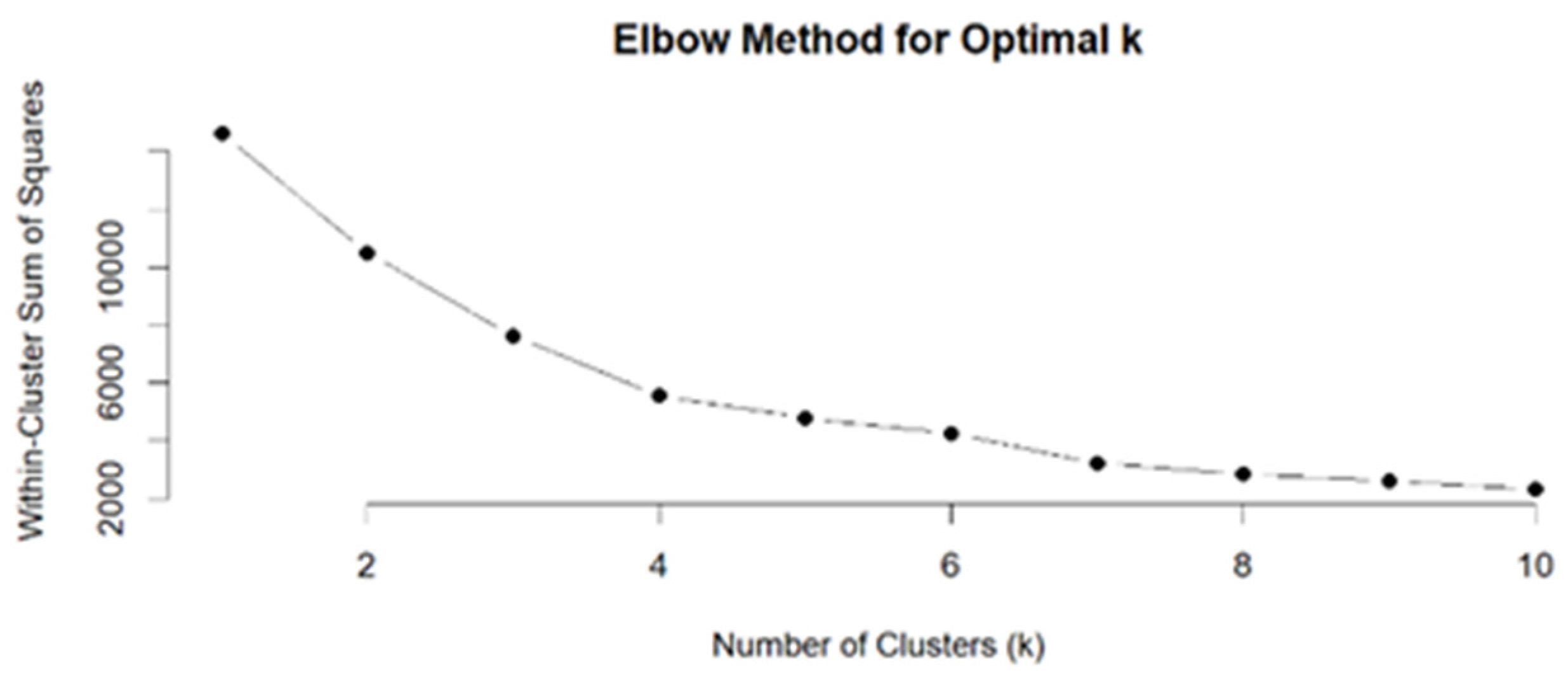
To verify that the clustering procedure did not introduce circularity into the econometric estimation, the correlation between the clustering input (compound annual growth rate, CAGR) and the dependent variable (Birch Index, net log transformed) was calculated; the resulting low correlation (r = 0.106) confirmed the independence of the two measures. The number of clusters (k) was selected using the elbow criterion, which evaluates the within-cluster sum of squares across increasing values of k; the plot indicated a clear inflexion point at k = 5 (see
Figure 1), at which the ratio of between-cluster to total sum of squares reached 57.7%, indicating that the five-cluster solution captures a meaningful share of the total variance in the data.
The K-means algorithm accordingly categorised startups into five distinct growth profiles (see
Table 2).
Before interpreting the coefficients from the econometric model, multicollinearity among predictors was assessed using the Variance Inflation Factor (VIF). All VIF values fall below the conventional threshold of 5, indicating that multicollinearity does not pose a serious threat to the reliability of the estimated coefficients: AM (3.034), VC (1.59), KS (1.9), GDP GR (1.25), FS (2.84), HC (4.67), and AGE (2.7). Two diagnostic tests confirmed that OLS alone is insufficient. The Breusch-Pagan test (BP = 163.4, p < 0.001) rejected homoskedasticity, and Ramsey’s RESET test (F = 8.48, p < 0.001) confirmed the presence of nonlinear relationships in the data. Consequently, robust standard errors for heteroskedasticity were applied in OLS, and a semiparametric GAM specification was adopted as the primary model. To account for the panel structure of the data and the fact that innovation ecosystem indicators vary at the country level—meaning observations within the same country share identical innovation ecosystem values each year—standard errors were additionally clustered by country. The panel fixed effects (FE) model was estimated, along with OLS as a robustness check; the Breusch-Godfrey/Woolridge test for serial correlation in panel residuals (χ2 = 154.49, p < 0.001) confirmed serial dependence in the idiosyncratic errors, and Arellano cluster-robust standard errors were applied accordingly.
In the pooled OLS model among the innovation ecosystem factors, access to markets (AM) emerges as the strongest positive correlate (β = 0.20,
p < 0.001), indicating that startups operating in the innovation ecosystem with better market access are associated with significantly higher and more sustainable growth, as seen in
Table 3. Human capital (HC) also shows a positive and significant coefficient (β = 0.09,
p < 0.001), consistent with the concept that skill-intensive ecosystems allow faster product development and scaling. Knowledge spillovers (KS) show a negative, highly significant association with growth (β = −0.05,
p < 0.001), suggesting that freely distributed knowledge within the innovation ecosystem may erode startups’ competitive advantage rather than enhancing it. Venture capital availability (VC) yields a small but marginally significant negative coefficient in the OLS regression (β = −0.01,
p < 0.05). Financial support (FS) is not statistically significant in either specification, providing no evidence that public R&D expenditure or direct government funding is associated with measurable growth for startups. Macroeconomic conditions matter: GDP growth is strongly positive (β = 0.38,
p < 0.001), and the starting age exerts a significant negative effect on growth (β = −0.32,
p < 0.001), consistent with previous findings [
15] that the growth rates decelerate as firms mature. Among the dummies of the growth profile, Cluster 5—characterised by very young, very small, high-growth startups—shows a large and significant premium (β = 6.33,
p < 0.001), while Cluster 3 is associated with significantly lower growth relative to the baseline (β = −0.76,
p < 0.05).
The firm FE model absorbed all time-invariant firm-level heterogeneity, identifying innovation ecosystem associations solely from within-firm variation over time. The substantially lower within-R2 (0.03) reflects the slow-moving nature of country-level innovation ecosystem indicators, which carry limited within-firm temporal variation. Despite this conservative specification, several key findings should be noted: the availability of VC retains a positive and significant coefficient (β = 0.01, p < 0.05), and its sign reversal relative to OLS—from negative to positive—indicates that the OLS estimate was distorted by unobserved firm heterogeneity, with the FE result providing a more conservative model-based estimate of the VC coefficient. Market access (AM) remains positive and significant (β = 0.06, p < 0.05). Knowledge spillovers (KS) retain their negative sign (β = −0.01) and remain marginally significant (p < 0.1). In particular, human capital (HC) loses significance under FE (β = −0.01, p = ns). GDP growth and startup age remain strongly significant across both specifications (GDP_GR: β = 0.29, p < 0.001; AGE: β = −0.72, p < 0.001), which confirms the robustness of these effects of the control variable. Cluster dummies and the intercept are absorbed by the firm fixed effects and are therefore not reported in the FE specification.
The GAM was estimated as the primary specification on two samples: the full startup sample and the NACE 62 industry code sample, with the latter yielding a notably better model fit. Among the parametric coefficients in the complete sample, venture capital (VC) was positive and significant (β = 0.03, p < 0.01), consistent with the panel FE result and confirming that the negative OLS estimate was driven by uncontrolled heterogeneity and nonlinearity. VC loses significance in the NACE 62 subsample, possibly reflecting the fact that Information and Communication Technology (ICT) startups at this stage are more dependent on market traction than on investment availability per se. Knowledge spillovers (KS) retained a negative and highly significant coefficient (β = −0.03, p < 0.001) and were strongly negative and larger in magnitude for NACE 62 firms (β = −0.07, p < 0.001) than for the entire sample, suggesting that talent drain is especially relevant in the ICT sector, where knowledge diffuses rapidly, and employee mobility is high. Market access (AM) loses significance in the entire GAM sample (β = 0.04, p = ns), but it is the dominant parametric factor (β = 0.16, p < 0.001) in the NACE 62 sample, confirming that ICT startups are particularly sensitive to international market conditions and global connectivity—consistent with the born-global nature of software ventures. Cluster 5—the youngest, smallest, and highest-growth profile—retains a large and significant premium (β = 5.17, p < 0.001).
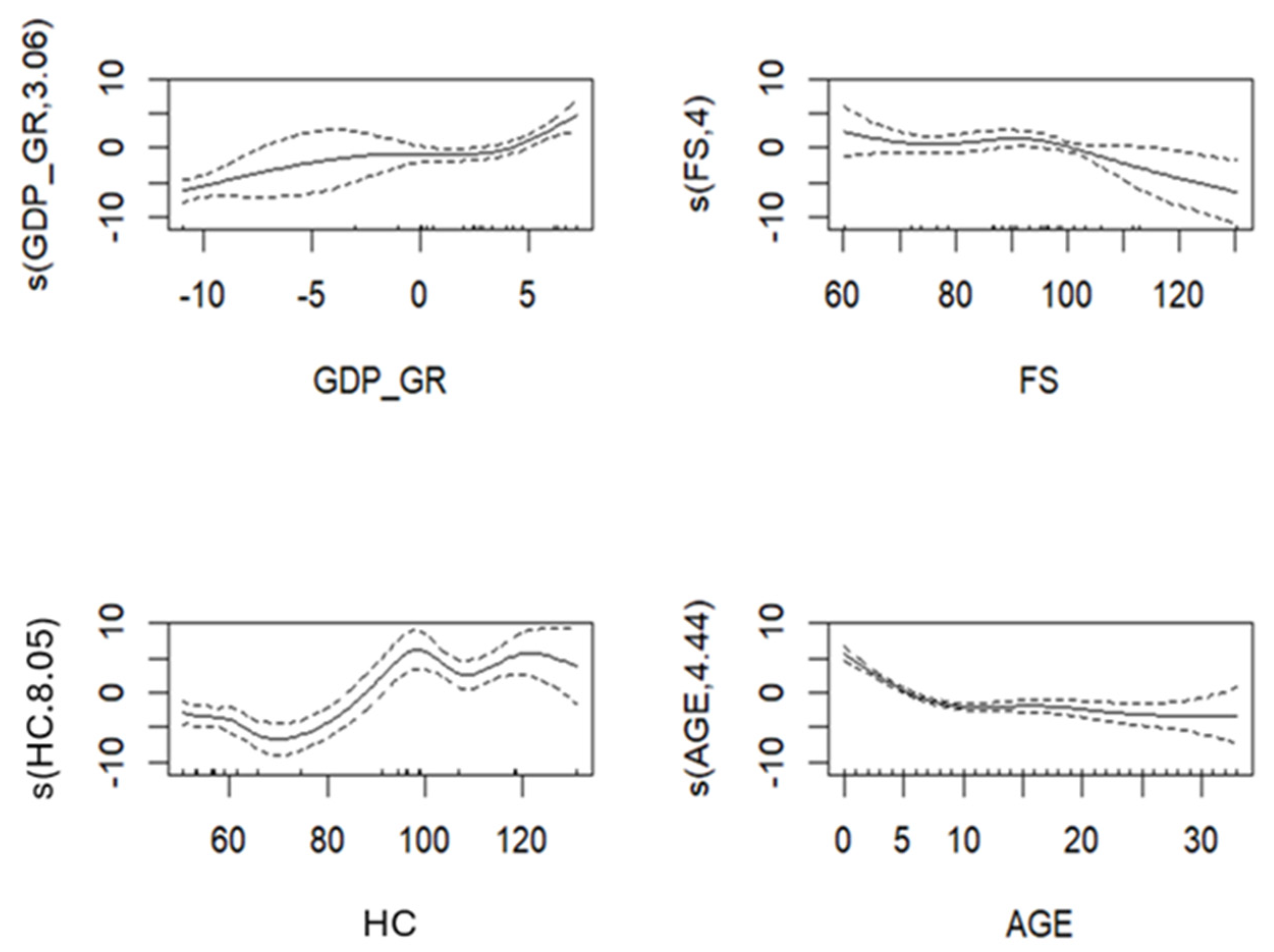
Among smooth terms, GDP growth exhibits a significant nonlinear relationship in both samples (full sample: edf = 3.06, F = 8.30,
p < 0.001; NACE 62: edf = 4.91, F = 4.33,
p < 0.01), with the higher effective degrees of freedom in the NACE 62 model suggesting a more complex, potentially cyclical relationship between macroeconomic conditions and ICT startup growth, as seen in
Figure 2.
Human capital displays a highly nonlinear effect in the entire sample (edf = 8.05, F = 7.35, p < 0.001), with nearly maximum effective degrees of freedom indicating a complex smooth function rather than a simple monotonic relationship—consistent with the Schumpeterian interpretation of diminishing returns at very high HC levels. In the NACE 62 subsample, the HC smooth is less complex (edf = 3.35) but remains strongly significant (F = 7.76, p < 0.001). Startup age produces the strongest nonlinear smooth in the full sample (edf = 4.44, F = 27.74, p < 0.001) and remains significant in NACE 62 (edf = 3.12, F = 7.31, p < 0.001), confirming a nonlinear growth deceleration trajectory across the startup lifecycle. Financial support (FS) remains insignificant as a smooth term in both samples (full sample: edf = 4.00, F = 1.90, p = 0.114; NACE 62: edf = 2.31, F = 2.01, p = ns), providing consistent evidence across all three specifications that public financial instruments do not translate into measurable startup growth within the studied period and ecosystems.
The sign and significance of the core findings are broadly stable in OLS, panel FE, and GAM. Knowledge spillovers are consistently negative and significant in all models and in both samples. Venture capital is positive in the panel FE and GAM specifications, with the OLS sign reversal attributable to uncontrolled heterogeneity. Financial support is uniformly insignificant. Human capital and market access are strongest in the cross-sectional OLS and NACE 62 GAM, respectively, confirming their role as structural rather than temporal determinants of the innovation ecosystem. There is a progressive improvement in the model fit from OLS (adj. R2 = 0.23) to GAM for all ST (adj. R2 = 0.24) to GAM for NACE 62 (adj. R2 = 0.31).
To identify ecosystem factor effects that transcend national boundaries and operate at the level of startup growth dynamics, the results reported below are organised by startup growth profile (cluster). The four countries in the sample contribute observations to each cluster, and the variation in the innovation ecosystem at the country level is captured through the time-varying EIS indicators included as independent variables. The cluster-specific GAM estimations revealed considerable heterogeneity in both sample composition and explanatory power. Cluster 1 (n = 1779) and Cluster 3 (n = 2677) are the largest groups and drive many of the full-sample results. Cluster 2 (n = 1219) achieves the highest model fit among the larger groups (adj. R
2 = 0.37). Cluster 5 (n = 43) is too small for reliable inference—standard errors are extremely large, no coefficient reaches significance, and results are treated as indicative only, as seen in
Table 4. Cluster 4 is absent from the estimation due to insufficient observations.
Cluster 1 (small, moderately aged, moderate-growth startups). Access to markets (AM) is positive and significant (β = 0.12, p < 0.01), confirming that market connectivity is a significant growth correlate even for small and moderately growing startups. Knowledge spillovers (KS) are negative and highly significant (β = −0.04, p < 0.001), consistent with the full-sample finding. The initial-stage age exerts the largest age coefficient across all clusters, suggesting that the deceleration of growth with age is especially pronounced in this profile. VC and financial support do not show significant parametric effects. Among smooth terms, GDP growth is only marginally significant. Human capital (HC) is significant as a smooth term (edf = 2.19, F = 3.72, p < 0.05), with relatively low effective degrees of freedom, suggesting a moderately nonlinear relationship between ecosystem human capital and growth for this group.
Cluster 2 (large, mature, low-growth startups). None of the parametric coefficients reach conventional significance thresholds, although VC shows a marginally positive effect (β = 0.05, p < 0.1), consistent with the interpretation that mature firms with established operations benefit from VC primarily through strategic rather than survival-driven investment. The insignificance of AM, KS, AGE, and FS for this cluster is substantively meaningful: large mature startups have already internationalised and stabilised, making them less sensitive to ecosystem-level market access conditions and age-driven deceleration. The high fit of the model despite insignificant parametric terms is explained by the smooth terms: GDP growth is strongly significant (edf = 3.03, F = 11.71, p < 0.001) and human capital (HC) is highly significant (edf = 5.51, F = 8.65, p < 0.001), indicating that macroeconomic cycles and nonlinear HC dynamics dominate the growth variation for this mature profile. The high HC edf (5.51) suggests a complex, smooth function, consistent with the interpretation that large, mature firms benefit from HC in a cyclical manner tied to innovation wave dynamics.
Cluster 3 (small to medium-sized, moderately aged, moderately growing startups). Cluster 3 more closely mirrors the full-sample results. Access to markets is positive and highly significant (β = 0.16, p < 0.001), the largest AM coefficient across all clusters, reinforcing the idea that market access is the dominant innovation ecosystem correlate for the typical startup profile in the sample. Knowledge spillovers are again negative and highly significant (β = −0.05, p < 0.001), replicating the full-sample competitive-erosion finding with near-identical magnitude. Startup age retains a significant negative effect (β = −0.42, p < 0.001), though smaller in absolute value than Cluster 1, suggesting a less acute growth deceleration for moderately sized firms. VC and financial support are insignificant. Both smooth terms are strongly significant: GDP growth (edf = 3.81, F = 8.35, p < 0.001) and human capital (edf = 4.53, F = 5.17, p < 0.001), with the HC smooth indicating a moderately complex nonlinear relationship. The consistency between Cluster 3 and the full-sample GAM confirms that this dominant cluster drives the aggregate findings.
Cluster 5 (very young, very small, extreme-growth startups). The results for Cluster 5 cannot be reliably interpreted due to the extremely small sample size (n = 43). The findings are consistent in reliable groups (1, 2, 3). Knowledge spillovers are negative wherever they reach significance. Second, human capital operates nonlinearly across all clusters, with higher effective degrees of freedom for larger and more mature firms. Third, access to markets is significant only for smaller, moderately growing startups (Clusters 1 and 3), while large, mature firms (Cluster 2) no longer respond to ecosystem-level market access. Financial support remains insignificant across all profiles, providing the most consistent null finding in the study.
Control factors. The models included controls for startup age and overall economic growth (GDP GR). Startups’ age has a negative effect on growth, significant in both OLS and GAM (the GAM allowed the age effect to be nonlinear; see
Figure 2), but insignificant for big mature startups (Cluster 2) and very young and small startups (Cluster 5). GDP GR was significant and positive at various levels across all profiles, except for the youngest, very high-growth startups.
4. Discussion
The resource-based view [
18] explains how startups achieve sustained competitive advantage by mobilising valuable, rare, and inimitable resources—such as specialised human capital and proprietary knowledge—which are often accessed and absorbed through the surrounding innovation ecosystem. Startup growth, capturing only the economic sustainability pillar of the TBL framework, is influenced by general economic conditions, but our findings suggest that innovation ecosystem conditions have their own significant contribution, and the association varies across startup growth profiles: while small, moderately growing startups are highly sensitive to ecosystem conditions, fast-growing or mature firms appear largely independent from these structural determinants. Therefore, the discussion refers to economic sustainability and should not be read as evidence of environmental or social sustainability outcomes.
Startups are global-market-orientated enterprises from birth [
60], but as they age, their growth decreases. Consistent with [
22], our results confirm that the negative age-growth association for mature startups diminishes over time. Access to markets and human capital showed the strongest associations with growth, especially for young software development-based businesses, according to [
61] and consistent with the resource-based view [
18]. Startups thrive when they can grow their customer base and revenues internationally if the innovation ecosystem reduces barriers to new markets through trade support, existing networks, or global investors. Innovations require skilled human capital: high adoption of ICT helps startups develop their products and scale faster. The widespread use of digital tools within the innovation ecosystem improves efficiency and connectivity, translating into better performance. The effect of nonlinear human capital is consistent with [
62], who demonstrate positive but diminishing returns of human capital in technology adoption: beyond a threshold level, incremental gains in ecosystem-level human capital yield progressively lower returns, consistent with Schumpeterian creative destruction where contemporary skill advantages are eroded as innovations diffuse and become common [
17]. This could be important for policymakers and founders: ensuring that startups have access to ICT talent may support their growth trajectories.
The positive association between human capital and market access and growth aligns with what [
63] call the “innovation-sustainability pathway”: startups that attract skilled ICT personnel and access international markets are better positioned to embed eco-friendly design into product development from the early stages, thereby combining economic growth with environmental and social impact. Ref. [
64] further demonstrate that product innovation improves sustainability performance through absorptive capacity: the same knowledge-intensive innovation ecosystem conditions that drive growth-oriented human capital enable startups to translate innovation into sustainable outcomes. This suggests that innovation ecosystem policies targeting human capital and market integration carry a “sustainability dividend”: by strengthening the absorptive capacity of startups, they enable simultaneous advances in economic performance and TBL objectives [
2,
9].
The models also highlighted the important role of venture capital. It allows startups to take risks, enter new markets, and develop products to scale. The number of investors [
65] influences the success of the funding and the equity raised, but having money alone does not guarantee success. Our findings did not establish that access to finance (government grants, subsidies, public R&D expenditures) is associated with startup growth, suggesting that funding must be coupled with efficient commercialisation and market access to translate into growth—a question also raised by [
66]. Our venture capital-related findings also intersect with the evolving landscape of sustainable finance. As innovation ecosystems increasingly prioritise ESG-aligned investment, the character of venture capital support is shifting from purely financial returns to mission-driven, impact-oriented capital. Ref. [
18] show that startups affiliated with ESG-conscious accelerators and aligned with the Sustainable Development Goals attract disproportionately more investment, suggesting that the venture capital growth nexus we document is related to sustainability orientation.
It is important to note that the negative knowledge spillover effect observed in our sample is context-dependent and should not be generalised uncritically. This finding is consistent with prior empirical work. Knowledge spillovers are generally considered beneficial for innovation, but when knowledge flows freely within the innovation ecosystem, it becomes easier for competitors to access and replicate innovations. Refs. [
67,
68,
69] argued that economic connectedness can negatively impact high-growth startups by creating barriers to scaling, and that higher levels of competition can suppress knowledge spillovers that support startups’ development. Young startups might struggle to capture the full value of knowledge spillovers if these become widely accessible to competitors or more mature firms, as was the case for big, mature startups in our model, for whom the knowledge spillover factor was insignificant. High job-to-job mobility in science and technology fosters knowledge diffusion, but for startups, it may also lead to a talent drain: frequent job switching increases recruitment and training costs and causes startups to lose talent before they can benefit from their expertise. Especially relevant for the Baltic innovation ecosystems, characterised by relatively small domestic markets and high ICT labour mobility, these competitive erosion dynamics may be amplified.
The negative knowledge spillover association observed in our models has a distinct sustainability dimension. Within a circular economy perspective, free knowledge flows become a shared resource for eco-innovation and sustainable transitions. Ref. [
19] find that stakeholder engagement and network interactions are precisely what enable startups to develop circular business models, suggesting that policy designs that increase the sustainability orientation of innovation ecosystem networks may shift the balance of knowledge spillovers from competitive erosion toward collaborative environmental value-creation. Ref. [
7] show that circular startups leveraging ecosystem collaboration can turn knowledge commons into accelerators of sustainability transitions. This implies that the predominantly negative knowledge-spillover effect observed in our sample may, in part, reflect the limited integration of circular and sustainability-oriented collaboration norms in the studied innovation ecosystems gap that represents both a policy challenge and a research opportunity.
5. Conclusions
This study supports previous research, indicating that innovation ecosystems have varied associations with the expansion of fast-growing technology firms (startups). Market access is crucial to their global business strategies, and human capital is essential for creating innovative products. However, knowledge spillovers can be negatively associated with the growth of startups. High industry concentration increases competition, potentially disadvantaging young companies with longer product development cycles. In addition, the high turnover of skilled workers increases the costs for startups in attracting and retaining talent. The role of financial support is significant: the amount of available venture capital is positively associated with startup growth, although this is not mirrored by public-sector R&D investments or direct government funding. The diverse associations of innovation ecosystem factors on startups’ growth profiles were also observed. The most significant innovation ecosystem factors were present for small, moderately aged, moderately sized, and moderately growing firms, while no factors were notable for extremely fast-growing, very young firms, and only the human capital showed a positive association for mature, slow-growing firms. The lack of a universally accepted definition of startup presents several challenges for empirical research.
This study has several limitations that should be acknowledged. First, reliance on startup turnover growth as the dependent variable captures only the economic dimension of sustainability, leaving the environmental and social dimensions unmeasured. Second, because of the limited availability and quality of startup-related data, the geographical scope is limited to four European countries, as publicly accessible databases often contain incomplete or unreliable information, necessitating extensive manual verification. Because no single startup age threshold is commonly agreed upon, age was excluded as a defining variable in the study. Instead, we aimed to examine the relationship between enabling conditions of the innovation ecosystem and sustainable startup growth beyond the early-stage phase. Third, the innovation ecosystem indicators, sourced from the EIS, are composite indices that may not fully capture the nuanced institutional dynamics within each ecosystem. Fourth, the negative effect of knowledge spillover should be interpreted cautiously as a context-specific finding rather than a universal result. Fifth, the absence of firm-level sustainability data prevents a direct assessment of TBL performance. Consequently, the findings should not be interpreted as direct evidence of environmental or social sustainability outcomes.
From a sustainability perspective, the findings of this study have implications beyond the growth dimension. The conditions of the innovation ecosystem that most consistently support startup growth—human capital, market access, and venture capital—are also those identified in the sustainability literature as foundational for embedding TBL objectives into startup business models [
2,
3,
9]. This convergence suggests that policies targeting growth-enabling factors in the innovation ecosystem are not in conflict with sustainability goals. The growing integration of circular economy principles, digital sustainability tools, and multi-stakeholder collaboration into innovation ecosystem design represents a priority area for future research. Future studies should explicitly operationalise sustainability performance—across economic, environmental and social dimensions—as a dependent variable alongside growth, allowing a fuller assessment of the conditions of the innovation ecosystem as correlates of startup expansion and directly measured sustainability performance.