Article

Institutional Innovation Policy and Enterprise ESG Performance: Theoretical Analysis and Empirical Evidence from China

1
School of Finance and Economics, Guangxi Science & Technology Normal University, Laibin 546199, China
2
School of Economics and Trade, Hunan University of Technology and Business, Changsha 410205, China
3
Engineering Training Center, Inner Mongolia University of Science & Technology, Baotou 014000, China
*
Authors to whom correspondence should be addressed.
Sustainability 2026, 18(12), 5804; https://doi.org/10.3390/su18125804
Submission received: 7 April 2026 / Revised: 6 May 2026 / Accepted: 10 May 2026 / Published: 6 June 2026

Abstract

The tension between corporate growth and sustainability is a common governance dilemma faced by transitional economies in their green development. This study incorporates corporate ESG performance and its potential influencing factors into the analysis framework and constructs a theoretical model to capture the relationship between China’s National Demonstration Base policy for Mass Entrepreneurship and Innovation (MEI) and corporate ESG performance, based on the framework that integrates resource enablement, reputation accumulation and information governance. Leveraging the quasi-natural experiment provided by China’s National Demonstration Program for Mass Entrepreneurship and Innovation (MEI), this study systematically evaluates the impact of China’s demonstration policy on corporate ESG performance, drawing on data from A-share listed companies spanning 2010 to 2024. The study finds that the demonstration policy significantly improves enterprise ESG performance, which remains robust after a series of robustness tests. The mechanism test reveals that the policy promotes firms’ green technology innovation by lowering innovation costs, facilitates the accumulation of social reputational capital by incentivizing charitable donations, and compels improvements in information disclosure quality by strengthening market-oriented oversight. Heterogeneity analysis shows that the policy effects are more prominent among heavy polluting industries, large-scale enterprises and firms at the mature stage. Moreover, industry competition intensity and digital transformation have a positive moderating effect on the policy effects. This paper enriches the theoretical dialogue between institutional innovation policy and enterprise sustainable development, providing empirical evidence for the development of a collaborative ESG governance mechanism characterized by an active government and an efficient market.

1. Introduction and Literature Review

As the global economy undergoes a deeper evolution toward inclusive growth and low-carbon transition, corporate environmental, social, and governance (ESG) performance has emerged as a pivotal indicator for international capital markets in assessing firms’ long-term value creation capacity and systemic risk exposure [1]. Unlike concepts such as corporate sustainability, corporate social responsibility (CSR), and corporate citizenship, ESG performance primarily emphasizes quantifiable metrics across three dimensions: environmental management, social responsibility fulfillment, and corporate governance structure. However, navigating the tension between growth and sustainability remains a common governance predicament for enterprises in emerging market economies [2]. As a core institutional carrier for the strategy of Mass Entrepreneurship and Innovation (MEI), China’s National Demonstration Base policy for MEI provides systematic incentives for enterprises [3], possibly serving as an important institutional pathway to resolve the current growth–sustainability tension. Based on this, this paper examines the impact and mechanisms of China’s National Demonstration Base policy for Mass Entrepreneurship and Innovation (MEI) on enterprise ESG performance, aiming to provide theoretical support and empirical evidence for addressing the tension between corporate growth and sustainability.
Existing literature has identified multiple factors influencing enterprise ESG performance, mainly focusing on two dimensions: entrepreneurship and innovation activities. Furthermore, studies have revealed the effects of Mass Entrepreneurship and Innovation (MEI) policies on corporate innovation and even urban green transformation. At the entrepreneurship level, entrepreneurial spirit significantly improves corporate ESG performance by enhancing total factor productivity, strengthening risk-taking capacity, and promoting environmentally friendly innovation [4]. Xie et al. [5] further revealed the chain mediating effect of entrepreneurship driving ESG improvement through green technology innovation, social performance improvement and governance capacity optimization. Meanwhile, Wang et al. [6] found that alleviating financial constraints and promoting sustainable investment serve as important transmission channels. In terms of innovation dimension, at the innovation level, both the adoption of innovative technologies [7] and open innovation activities [8] contribute to ESG performance in specific industries, which confirms the penetrating effect of innovation activities across ESG dimensions along the input–output chain. Among them, green innovation plays a critical bridge linking innovation activities and ESG performance, with different types of green innovation exerting heterogeneous effects on ESG performance by shaping corporate green image [9]. In addition, government subsidies can effectively improve corporate ESG performance by increasing innovation investment and alleviating management myopia [10,11]. With respect to the dimension of Mass Entrepreneurship and Innovation (MEI) policy, the existing research mainly reveals the mechanism of policy effects from the dual perspectives of micro enterprise innovation and macro urban green transformation. At the enterprise level, the R&D subsidies provided by the MEI policy can significantly promote the substantive innovation of enterprises, while tax incentives may even exert a dampening effect [3]. At the city level, the construction of China’s demonstration base indirectly drives urban green transformation through fiscal expenditures on science and technology, while the policy effects exhibit significant heterogeneity across cities with different sizes and levels of development [12]. Furthermore, enterprise digital transformation, as a key extension of innovation policy, is gradually emerging as an important driver for the synergistic improvement of corporates’ overall ESG performance. By building a digital information-sharing platform, the national demonstration bases for MEI have significantly optimized the efficiency of resource allocation, thus improving the performance of enterprise environmental management [13]. At the same time, digital transformation enhances the ability of interaction between enterprises and stakeholders, which not only facilitates the accumulation of social capital but also effectively promotes the fulfillment of corporate social responsibility and information disclosure [14,15]. This significantly improves the quality and transparency of corporate information disclosure, laying a solid foundation for strengthening corporate governance.
The development of China’s National Demonstration Bases for Mass Entrepreneurship and Innovation (MEI) represents a top-down institutional innovation policy launched by the Chinese government in 2016 [16]. Its core lies in building an innovation ecosystem within designated spatial areas through administrative authorization and targeted resource allocation. In terms of policy attributes, it is neither a simple fiscal subsidy nor a straightforward tax incentive, but rather an embodiment of institutional entrepreneurship, where the government attempts to correct failures of market innovation by strengthening property rights protection, reducing transaction costs, and establishing public platforms [17]. Notably, the demonstration policy incorporates dual objectives. Instrumentally, it aims to stabilize employment and stimulate growth in the short term. Substantively, it targets a transformation of the development model in the long run. This dual pursuit of growth and sustainability aligns the policy with the concept of enterprise ESG performance. It could collectively provide firms with both external legitimacy pressures and internal resource support for enterprise ESG practices through mandatory environmental requirements, the demonstration effect of social responsibility, and institutional demands for governance transparency.
To sum up, while existing research has laid an important foundation for understanding the relationship between innovation and entrepreneurship and ESG performance, there remains a notable research gap in systematically examining the causal mechanisms and boundary conditions through which institutional innovation policies affect enterprise ESG performance. To this end, this paper focuses on three interrelated questions as follows. The first is whether the construction of China’s National Demonstration Base for Mass Entrepreneurship and Innovation (MEI) significantly improves corporate ESG performance. The second is through what channels the policy effect operates. The third is what the heterogeneity and context dependence of the policy effect are. Given that improvements in ESG performance depend on the synergistic support of innovative resource allocation, social capital accumulation and governance structure optimization [18], this paper adopts a quasi-natural experiment research strategy. Theoretically, this study develops a three-dimensional analysis framework integrating resource empowerment, reputation accumulation and information governance, based on resource-based theory [19], stakeholder theory [20] and signal transmission theory [21], to systematically explain the mechanism of institutional innovation policy affecting enterprise ESG performance. Empirically, leveraging the staggered establishment of China’s national demonstration bases as an exogenous policy shock, this paper employs a multi-period difference-in-differences model to identify the net effects of the demonstration policy and further conducts mechanism tests along three channels: green technology innovation, corporate charitable donations, and information disclosure quality. Meanwhile, this paper examines the heterogeneity of policy effects across dimensions such as industrial pollution intensity, firm size, and firm life cycle. Furthermore, this paper identifies the moderating effect of industry competition intensity and enterprise digital transformation, revealing the internal logic of policy reinforcing ESG transformation efficiency jointly by market competition stimulating transformation power and digital technology enhancing absorptive capacity.
The marginal contribution of this paper is mainly reflected in three aspects. First, in terms of research perspective, while the existing literature has largely examined the drivers of ESG performance from the standpoint of micro corporate behaviors, such as entrepreneurship [4,5] or innovation activities [7,8], this study takes a distinct approach by leveraging the staggered establishment of China’s National Demonstration Base for Mass Entrepreneurship and Innovation (MEI) as a quasi-natural experiment. It identifies the causal effect of institutional incentives on corporate ESG performance from the perspective of institutional innovation policy, providing new empirical evidence for understanding the logic through which an active government drives corporate sustainability in a transitional economy. Second, in terms of theoretical analysis, it breaks through the common practice of exploring single mechanisms, such as green innovation [9] or financing constraints [22], but establishes the objective function model of single-period value maximization by developing a three-dimensional framework integrating resource enablement, reputation accumulation, and information governance. It systematically elucidates the multiple transmission channels and synergistic mechanisms through which institution-based innovation policies influence enterprise ESG performance. Third, in terms of analytical depth, this paper clarifies the boundary conditions and situational dependence that shape policy effectiveness, by examining the heterogeneous effects of industrial pollution intensity, enterprise size and life cycle, as well as the moderating role of industrial competition intensity and enterprise digital transformation, which provides more refined empirical evidence for differentiated institutional design.
The remainder of this paper is structured as follows. Section 2 reviews the institutional evolution of China’s National Demonstration Base for Mass Entrepreneurship and Innovation (MEI) and puts forward theoretical models and research hypotheses to explain how MEI policies affect enterprise ESG performance. Section 3 provides a detailed description of the research design. Section 4 presents and analyzes the empirical results. Section 5 carries out further analysis, including robustness test, mechanism test, heterogeneity test and moderating effect test. Section 6 concludes the study with a summary of the findings, policy implications, and limitations.

2. Policy Evolution and Theoretical Analysis

2.1. Policy Evolution

To deepen the innovation-driven development strategy and dismantle institutional barriers, the Chinese government has piloted the National Demonstration Base policy for Mass Entrepreneurship and Innovation (MEI) since 2015, following the evolution of policy first together with pilot breakthroughs.
The initial period (2015–2016) focused on institutional breakthroughs. The State Council successively issued a series of guidelines and implementation opinions, establishing the first batch of 28 demonstration bases. Through signaling effects, these initiatives guided enterprises to improve their governance structures by lowering market entry costs, which consolidated the foundations of innovation at the micro level.
The expansion period (2017–2019) emphasized the scale effect. The launch of 92 additional demonstration bases accelerated the translation of agglomeration economics into commercial outcomes. With significant policy externalities, enterprises are encouraged to incorporate employment promotion and start-up support into their strategies, thereby strengthening their social responsibilities and realizing the social sharing of innovation dividends.
The deepening period (2020 to present) shifted focus toward qualitative improvements. With the establishment of the third batch of bases, the total number across all three phases reached 212, almost achieving nationwide coverage. Under the 14th Five-Year Plan and the Digital China initiative, the evaluation orientation shifted from quantity to quality, with mandatory requirements for green and low-carbon development. High ESG performance has emerged as a critical screening criterion for enterprises seeking institutional dividends, including credit and tax incentives, pressuring R&D to lean toward green technology, thus enhancing their environmental performance.
In general, since 2015, China’s National Demonstration Base policy for Mass Entrepreneurship and Innovation (MEI) can be essentially understood as a process of reshaping micro behaviors through institutional supply, that is, involving a transition from reducing transaction costs to expanding positive externalities and then correcting market failures in the green sector. Enterprises have evolved their ESG strategy from passive compliance to active competition, proving that good governance, corporate responsibility and a green development model serve as the core cornerstone to implement an innovation-driven strategy and achieve high-quality development.

2.2. Theoretical Basis and Mathematical Model

To deeply analyze the impact of institutional innovation policies on corporate ESG performance, this paper constructs a systematic analytical framework centered on resource enablement, reputation accumulation and information governance, based on resource-based theory [19], stakeholder theory [20] and signal transmission theory [21]. Within this framework, this paper identifies the transmission mechanisms through which China’s National Demonstration Base policy for Mass Entrepreneurship and Innovation (MEI) influences corporate ESG performance. To this end, it constructs a mathematical model of optimal firm decisions based on the binary nature of the demonstration policy and derives the mechanisms through which the demonstration policy affects ESG performance via continuous processing and difference-based validation. Accordingly, this paper addresses the gap in existing research that relies on a single theoretical perspective to explain the single-dimensional effects on ESG.

2.2.1. Theoretical Basis

China’s National Demonstration Base policy for Mass Entrepreneurship and Innovation (MEI) serves as a core institutional arrangement to promote entrepreneurship, corporate innovation, and high-quality development in China, with a combination of resource allocation, regulatory oversight, and incentive-based guidance implemented through the selection of demonstration bases and policy pilots. By reshaping enterprises’ cost–benefit structures and resource allocation, it drives improvements in corporate environmental, social, and governance (ESG) practices.
Among the three classical theories, the resource-based theory provides the material premise for stakeholder value synergy. The sustainable development capacity of enterprises, as a prerequisite for ESG practices, stems from the heterogeneous resources and dynamic allocation capacity [23]. Through policy instruments, including fiscal subsidies, tax incentives, and financing support, the demonstration policy expands access to financial, technological, and policy-related resources, which helps enterprises overcome resource allocation constraints with the necessary support for green technology innovation, social responsibility fulfillment, and the development of information disclosure systems.
The stakeholder theory presents the value orientation for corporate ESG practices. ESG performance directly reflects how enterprises respond to the demands of shareholders, employees, the government, and the public [24]. By incorporating ESG-related performance into the dynamic evaluation system for demonstration identification and policy support, the demonstration policy steers enterprises from a singular focus on profit maximization toward stakeholder-oriented value synergy. In this context, the heterogeneous resources emphasized by the resource-based theory lay the material groundwork for meeting diverse stakeholder expectations.
The signal transmission theory integrates the internal resource allocation of enterprises and the demands of external stakeholders to jointly explain the mechanism through which the demonstration policy affects corporate ESG performance. The information asymmetry between enterprises and external stakeholders tends to raise financing costs and discourage long-term ESG activities [25]. China’s National Demonstration Base policy for MEI forms a unique policy endorsement by virtue of its institutional demonstration identification. Through enhanced information disclosure requirements and the establishment of standardized signaling mechanisms, it encourages enterprises to carry out credible ESG practices, thereby reducing information frictions in the capital market and lowering financing costs, which further amplifies the positive effects of signaling [26].
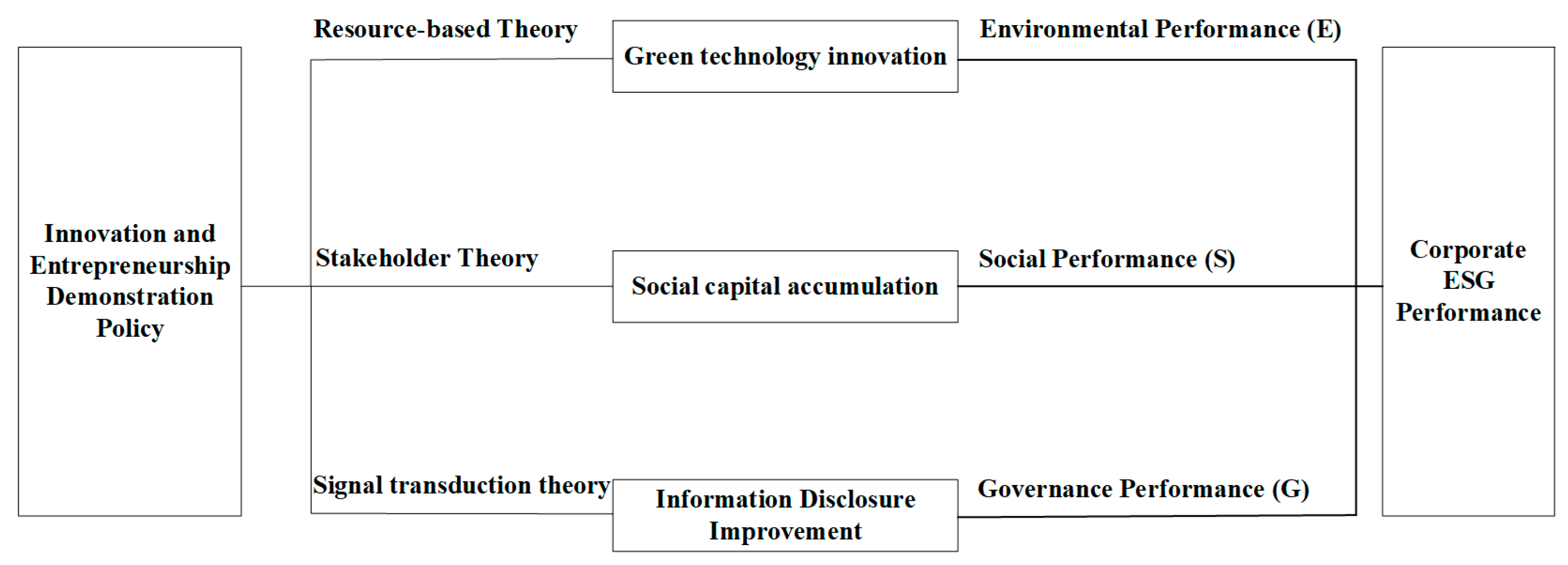
Building on the above theoretical framework, combined with the innovation, responsibility, and regulatory aspects of the demonstration policy, this paper identifies three core pathways through which the policy influences corporate ESG performance. These pathways correspond systematically to the environmental (E), social (S), and governance (G) dimensions of corporate ESG performance (see Figure 1), operating synergistically through the channels of resources, reputation and signals. First, green innovation serves as an endogenous driver of environmental performance, representing a specific application of the resource-based theory in a policy context. Second, social charitable donations provide a key channel for enterprises to accumulate social capital, which reflects the core of stakeholder theory. Third, the quality of information disclosure presents an important way for enterprises to enhance their governance quality, integrating signaling theory with the policy endorsement function.

2.2.2. Model Construction

This paper constructs the enterprise’s intertemporal optimal decision-making model under the impact of China’s National Demonstration Base policy for Mass Entrepreneurship and Innovation (MEI), integrating the investment in green innovation, the level of social charitable donation and the quality of information disclosure into a unified framework of enterprise value maximization. It first simplifies the discrete policy variables and then verifies the conclusion of the discrete policy impact through the difference method, which fully considers the implementation characteristics of China’s national demonstration base policy for MEI.
(1) Basic Settings
First, we consider the single-period optimal decision of representative enterprises, whose core goal is to maximize intertemporal value.
Regarding endogenous decision variables, G is the green innovation input (E dimension), which is measured by the annual green innovation input in currency, covering R&D funds, equipment renewal and other direct inputs. D is the level of social charitable donations (S dimension), which is measured by the monetary amount of annual social charitable donations, including cash and material donations. Q is the quality of information disclosure (G dimension), for which a 0–1 standardized scoring system is adopted; the scoring dimensions include disclosure integrity, timeliness and authenticity. In addition, this paper posits that enterprises all have positive ESG input and disclosure behaviors, so all endogenous decision variables are strictly greater than 0.
Regarding exogenous policy variables, P is a 0–1 discrete variable, representing China’s national demonstration base policy for MEI. In order to incorporate the policy variable into the model framework and realize partial derivative analysis, this paper further expands the variable into a 0–1 continuous policy intensity variable, which comprehensively reflects the strength of resource support, the strength of regulatory norms and the level of demonstration recognition.
In addition, the core parameters are defined as shown in Table 1, and all the parameters meet the basic economic assumptions of diminishing marginal returns and increasing marginal costs.
(2) Objective function and constraints
The objective of single-period value maximization focuses on the impact of ESG decisions on the additional value of enterprises, and it is assumed that corporate profits are exogenous variables that do not change with ESG decisions. In view of this, this paper constructs an objective function including green innovation profit, social donation reputation, information disclosure cost, capital cost and regulatory punishment cost on the basis of basic production and operation profit π 0 . At the same time, combined with the resource scarcity of resource-based theory and the compliance requirements of mass entrepreneurship and innovation policies, the dual constraints of resource constraints and compliance constraints are set.
Based on theoretical support and variable setting, this paper sets the objective function of single-period value maximization as follows.
V =   π 0 + π   ( G ,   P ) + S   ( D ,   P )     C I   ( Q ) r   ( Q ,   P ) C R ( Q )
In Formula (1), this paper defines its variable, function and parameter as follows.
π 0 stands for the basic production and operating profit of the enterprise, which is an exogenous variable and does not change with the ESG decision-making variable of the enterprise.
π G P represents the profit function of green innovation, reflecting the diminishing marginal returns of green innovation and the incentive effect of policy subsidies, and π G P = α G 1 2 c G 2 + θ P G .
S D P symbolizes the social charitable donation reputation function, and S D P = γ l n 1 + D + η P D , in logarithmic form, reflects the marginal saturation characteristics of donation reputation returns. η is the policy donation reputation amplification coefficient, reflects the promotion effect of policy on donation reputation.
C I ( Q ) presents the cost function of information disclosure, reflecting the increasing marginal cost of information disclosure, and C I ( Q ) = 1 2 β Q 2 .
r Q P is the capital cost function based on signal transmission theory, and r Q P = r δ Q μ P Q . The introduction of the interaction term PQ reflects that policy endorsement magnifies the reduction effect of capital cost through information disclosure, which is in line with the complex characteristics of China’s demonstration policy.
C R ( Q ) represents the regulatory punishment cost function, which is set as a piecewise function, echoing the compliance constraint as below.
C R ( Q ) = 0 , Q Q - ( P ) φ × ( Q - ( P ) Q ) 2 , Q < Q - ( P )
When the information disclosure quality meets the policy compliance requirements, the punishment cost is 0. When compliance requirements are not met, the penalty cost is proportional to the square of the compliance gap, reflecting the marginally increasing characteristics of regulatory punishment.
In addition, combined with the reality of enterprise resource allocation and policy and regulatory requirements, we set dual constraints and consider the exogenous impact of mass entrepreneurship and innovation policies. First, resource constraints: G + D R P , and R / P > 0 . Mass entrepreneurship and innovation policies expand the disposable resources R P of enterprises through resource tilt. The greater the policy intensity, the more resources firms have at their disposal. Second, compliance constraints: Q Q ¯ P , and Q ¯ / P > 0 . Entrepreneurship and innovation policies improve the regulatory requirements of information disclosure. The greater the policy intensity, the higher the minimum compliance standard of enterprise information disclosure quality Q ¯ P . When Q = Q ¯ P , it is the boundary solution and when Q > Q ¯ P , it is the interior point solution. Third, non-negative constraints: G 0 , D 0 , Q 0 ; the decision variables are all positive, in line with economic reality.
(3) Basic model and robustness
Combined with the interior point solution and the assumption of tight resource constraints, the enterprise allocates all the resources expended by China’s demonstration policy to green innovation and social donation, that is G + D = R P , the model is fully expressed in Formula (3).
max G , D , Q V = π 0 + α G 1 2 c G 2 + θ PG + γ ln ( 1 + D ) + η PD 1 2 β Q 2 r + δ Q + μ PQ C R ( Q )
s . t .   G + D = R ( P ) ,   R / P > 0 Q Q - ( P ) ,   Q - / P > 0 G 0 , D 0 , Q 0
Based on the assumption of tight resource constraints G + D = R P , this paper constructs the Lagrange function, as shown in Formula (4).
L = π 0 + α G 1 2 c G 2 + θ P G + γ ln ( 1 + D ) + η P D 1 2 β Q 2 r + δ Q + μ P Q C R ( Q ) + λ R P G D
The optimal solution can be obtained by solving the first-order conditions for the Lagrange Function (4) as follows:
L G = α c G + θ P λ = 0 G * = α + θ P λ c
L D = γ 1 + D + η P λ = 0 D * = γ λ η P 1
L Q = β Q + δ + μ P = 0 Q * = δ + μ P β
where Formula (7) is the first-order partial derivative of pairs in the case of interior point solution.
In order to verify the robustness and universality of the model, this paper conducts an expansion analysis from three dimensions, including the endogenous expansion of equity capital stock, supplementary boundary points and discrete policy verification. All expansions do not change the core conclusions of the model.
First, equity capital stock expands endogenously.
In this paper, the equity capital stock is set as the index of the cumulative change with respect to green innovation investment and information disclosure quality, as shown in Formula (8).
K t + 1 = K t + α 1 G + α 2 Q
By encouraging enterprises to increase green investment and charitable donations, China’s demonstration policy has effectively expanded the capital stock of enterprises. The improvement of capital stock not only broadens the boundary of disposable resources for enterprises but also reduces the shadow price of resources λ , thus providing solid support for the co-improvement of ESG performance while relieving internal financing constraints.
Second, the model incorporates a boundary solution as a complement to existing calculations.
Theoretically, if G = 0, D = 0 or Q =   Q - ( P ) occurs in the optimal strategy of enterprises, it means that China’s national demonstration policy fails to form an effective incentive and restraint mechanism. On the one hand, when enterprises choose zero investment in green innovation or zero social donations, it indicates that the demonstration policy fails to provide substantial subsidies and resource preferences. On the other hand, when the enterprise only meets the minimum standard of information disclosure, it indicates that the policy supervision of information disclosure is extremely loose, and the improvement of disclosure quality only brings about an increase in marginal cost without the corresponding benefit, so the enterprise lacks the motivation for quality improvement. However, these extreme scenarios are based on the assumption of policy absence or regulatory failure. In reality, the enterprises covered by China’s national demonstration base policy for MEI can usually obtain substantial subsidies and resource support from the government, and the supervision of information disclosure also has corresponding institutional constraints and incentive mechanisms.
Third, the model uses discrete policy verification.
The 0–1 discretization of continuous policy intensity variables is carried out by the difference method to calculate the change in ESG decision variables before and after the policy shock. The results are shown below.
Δ G * = G * ( P = 1 ) G * ( P = 0 ) = θ c > 0
Δ D * = D * ( P = 1 ) D * ( P = 0 ) = γ λ η γ λ > 0
Δ Q * = Q * ( P = 1 ) Q * ( P = 0 ) = δ β > 0
It can be found that under discrete policy shocks, the three decision variables are significantly positive, which is consistent with the conclusion regarding the marginal impact of continuous policy intensity.


2.3. Mechanism Analysis and Research Hypotheses

When P is the policy intensity indicator, based on the comparative static analysis of the equilibrium solution of model (4), we can obtain the following:
G * P = θ c > 0
D * P = γ η ( λ η P ) 2 > 0
Q * P = μ β > 0
It can be seen that the demonstration policy significantly promotes enterprises to increase investment in green innovation, improve the level of social charitable donations, and improve the quality of information disclosure, thus promoting the improvement of corporate ESG performance.

2.3.1. Core Logic of the Three Mechanisms

(1) Green technology innovation mechanism
China’s demonstration policy promotes enterprises’ investment in green innovation and facilitates the green transformation of production processes through three pathways, including subsidy incentives, resource expansion, and signal transmission, thereby enhancing environmental performance. Specifically, the policy directly boosts the marginal returns of green innovation by increasing the subsidy rate for green innovation θ . It also reduces the shadow prices of resources, λ , by expanding the disposable resources R P , and lowers the financing costs for enterprises through the signaling effect of information disclosure, which in turn supports further investment in green innovation.
(2) Social Charity Donation Mechanism
China’s demonstration policy promotes enterprises to increase their charitable contributions through reputation amplification, social recognition, and resource support. This helps reconcile the relationships among stakeholders and accumulate social capital, ultimately enhancing their social performance. Specifically, the policy directly increases the marginal reputation benefits of donations through the reputation amplification coefficient η . It enhances the social exposure and recognition of the enterprise’s donation behavior through institutional demonstration identification, which provides a material foundation for resource expansion.
(3) Information Disclosure Quality Mechanism
China’s demonstration policy promotes enterprises to enhance information disclosure quality by leveraging compliance pressure, cost savings, and financing incentives. This reduces information asymmetry and improves corporate governance, thereby enhancing governance performance. The compliance pressure faced by enterprises arises from the policy’s imposition of a minimum compliance standard Q ¯ P and the intensity of regulatory penalties φ . Additionally, the signaling amplification coefficient μ , supported by policy endorsement, reduces the marginal cost of enterprise information disclosure, while the interaction between the disclosure quality and the demonstration policy lowers the cost of capital, thus generating financing incentives. This mechanism holds true for both internal and boundary solutions. Enterprises enhance their disclosure quality mainly to meet compliance requirements at lower policy intensity, while they do so proactively to capture financing incentives at higher policy intensity.
(4) Synergistic Effects of the Three Mechanisms
These mechanisms do not operate in isolation. Instead, they interact deeply through the synergies of resources, reputation, and financing, which amplifies the policy’s effect on comprehensive ESG performance. The first is the resource synergy, which complementarily allocates the disposable resources expanded by the policy between green innovation and charitable giving, avoiding resource crowding-out in either area. Resource utilization could be further amplified through an optimization of resource allocation efficiency due to the improvement in information disclosure quality. The second is the reputation synergy, the fulfillment of environmental responsibility through green innovation and social charitable donations that jointly contributes to corporate reputation, while higher information disclosure quality reinforces the credibility of reputation signals, leading to a multiplicative effect on reputation accumulation. The third is the financing synergy, where the reduction in financing costs enabled by better information disclosure quality provides additional financial support for green innovation and charitable donations. The reputation gains from these activities in turn further strengthen the signaling effect of information disclosure, creating a positive cycle between financing and ESG investments.

2.3.2. Research Hypotheses

Drawing on theoretical analysis, model derivation and mechanism interpretation, combined with the fundamental assumptions of economics and the distinctive characteristics of Chinese enterprises, research hypotheses are proposed as follows:
H1: 
China’s National Demonstration Base policy for Mass Entrepreneurship and Innovation (MEI) significantly enhances corporate ESG performance.
H2a: 
The demonstration policy improves ESG performance by promoting green technology innovation in enterprises.
H2b: 
The demonstration policy improves ESG performance by increasing corporate charitable donations.
H2c: 
The demonstration policy improves ESG performance by enhancing the quality of enterprise information disclosure.

3. Research Design

3.1. Model Specification

This paper employs a multi-period difference-in-differences model approach to assess the policy effects of China’s national demonstration base policy for MEI. The State Council’s Office initiated the first batch of national innovation and entrepreneurship demonstration pilot programs in 2016 and then implemented them in batches in 2017 and 2020, forming the basis for the natural design of this paper. The multi-period difference-in-differences model is specified as follows:
E S G i t = α 0 + α 1 D I D i t + α 2 C o n t r o l s i t + μ i + γ t + ε i t
In Model (15), the subscript t represents the year, i represents the enterprise, and E S G i t represents the ESG performance of enterprise i in year t . D I D represents the explanatory variable, which is a dummy variable indicating whether the enterprise is located in a city that is a virtual representative of the national demonstration base. The estimated coefficient of the D I D regression is α 1 ; if α 1 > 0, it indicates that the national demonstration base policy can promote the improvement of the enterprise’s ESG performance. C o n t r o l s is a control variable, which refers to other variables that affect the ESG performance of the enterprise. μ i represents the individual fixed effect, γ t represents the year fixed effect, and ε i t represents the random error term.

3.2. Variable Definition

3.2.1. Dependent Variable

With corporate ESG performance (ESG) as the dependent variable, this paper selects the ESG rating score of the Shanghai Huazheng Index to measure the ESG performance of listed companies. Shanghai Huazheng Index Information Service Co., Ltd. (Shanghai, China), as an authoritative index compiler in China, has an ESG assessment system that is in line with the characteristics of Chinese enterprises and is also accurate and reliable.

3.2.2. Explanatory Variables

With National Innovation and Entrepreneurship Demonstration (DID) as the explanatory variable, this study uses China’s National Demonstration Base policy for Mass Entrepreneurship and Innovation (MEI), issued by the General Office of the State Council of China, as the basis. Enterprises set within the base scope are regarded as the treatment group, with a DID value of 1, while other enterprises are regarded as the control group, with a value of 0.
Specifically, in May 2016, the General Office of the State Council of China released the list of the first batch of demonstration bases, covering 19 cities such as Beijing, Tianjin, and Shenyang. In June 2017, the second batch of demonstration bases was released, covering 35 cities such as Baoding, Taiyuan, and Baotou. In December 2020, the third batch of demonstration bases was released, covering 35 cities such as Jincheng, Liaoyuan, and Mudanjiang. Additionally, since the third batch was released in December, 2021 is taken as the policy time point for the third batch.

3.2.3. Control Variables

Drawing on Zhao et al. [27], Wang et al. [28], and Wang et al. [29], eight control variables were selected when conducting the regression estimation of the model. Enterprise size (Size) represents the natural logarithm of total assets. The asset leverage ratio (LEV) presents the ratio of total liabilities to total assets. Return on total assets (ROA) is the ratio of net profit to total assets. Tobin’s Q value (TobinQ) symbolizes a comprehensive ratio of the market value of tradable stocks, non-tradable shareholdings multiplied by the net asset value per share, and the book value of liabilities to the total assets. Company age (ListAge) stands for the natural logarithm of the company’s listing years. Shareholding concentration (Top1) represents the proportion of the first major shareholder’s holdings. Board independence (Indep) is the proportion of independent directors in the total number of the board. Financial leverage (FL) presents the ratio of the sum of net profit, income tax expense, and financial expense to the sum of net profit and income tax expense.

3.2.4. Mechanism Variables

The first is green technology innovation (Green). Refer to Lin et al. [30]. In this paper, the green patent application count of enterprises in the current year is added to one and then the natural logarithm is used to measure the green technological innovation ability of enterprises.
The second is social charity donation (Donation). Refer to Li [31]. In this paper, the amount of charitable donations by enterprises is selected as the proxy variable for the social donations of enterprises.
The third is information disclosure quality (KV_N). According to Ascioglu [32], the KV index can be used to measure the quality of enterprise information disclosure, and the higher the index value, the lower the quality of information disclosure of listed companies. In this paper, the negative value of the KV index is chosen to measure the degree of company information disclosure; that is, the larger the KV_N value, the smaller the KV index value, and the higher the quality of information disclosure of listed companies.

3.2.5. Moderating Variable

The first is industry competition intensity (HHI). Referring to Chang & Yoo [33], the HHI index is selected as the proxy indicator of industrial competition.
The second is digital transformation capability (DT). Referring to Yang et al. [34], the sum of keywords in the five technological dimensions of artificial intelligence, block-chain, cloud computing, big data, and digital technology applications in the annual report of the enterprise is selected as a proxy indicator for the degree of digital transformation (DT) of enterprises.

3.3. Data Source

This study initially selects Chinese A-share listed companies from 2010 to 2024 as the research sample and screens them according to the following criteria. The first is to exclude financial enterprises; the second is to eliminate the samples flagged as ST or *ST in a given year; the third is to exclude observations with missing values of key variables; the fourth is to winsorize all continuous variables at the 1% and 99% quantiles to control the interference of extreme values. These procedures yield a final sample of 35,918 valid observations. The variables of corporate ESG performance were sourced from Huazheng ESG rating. The control variables were derived from the annual reports of listed companies, the CSMAR database, and the CNRDS database. The data for the three mechanism variables, including green technology innovation, social charitable donation, and information disclosure quality, were obtained from the China National Intellectual Property Administration and the CSMAR database. The descriptive statistics for all variables are presented in Table 2. The mean value of corporate ESG performance is 73.729, with a standard deviation of 4.906, indicating a moderately above-average level for the ESG performance of the sample enterprises, with some individual variation. The mean value of the DID variable is 0.508, suggesting a relatively balanced sample size between the treatment and control groups. The mean and standard deviation of the remaining control variables are basically consistent with the results of existing domestic research, and the variables are reasonably distributed with no outliers.

4. Empirical Results and Analysis

4.1. Benchmark Regression Results

Table 3 reports the benchmark regression results of China’s demonstration policy on corporate ESG performance. Column (1) includes only the National Innovation and Entrepreneurship Demonstration (DID), and Column (2) further adds year and firm fixed effects, from which can be seen that the estimated coefficient of the demonstration policy remains significantly positive at the 1% level regardless of the inclusion of fixed effects. In Column (3), we add a set of firm-level control variables. Column (4) further includes year and firm fixed effects. As shown in Column (4), every additional National Demonstration base increases corporate ESG performance by 0.703 units. This indicates that the National Demonstration Base policy promotes corporate ESG performance, which confirms Hypothesis H1.
Regarding the control variables, enterprise size (Size), return on total assets (ROA), board independence (Indep), and equity concentration (Top1) all show statistically significant positive coefficients in Columns (3) and (4), indicating that larger enterprises with stronger profitability, more independent governance structures and higher concentration of equity have better ESG performance. The debt ratio (Lev), Tobin’s Q value (TobinQ), and financial leverage (fl) all show statistically significant negative coefficients in Columns (3) and (4), suggesting that enterprises with higher financial leverage have poorer ESG performance, possibly due to the crowding-out effect of high debt on ESG investment. Company age (FirmAge) is significant only when there is no fixed effect, because company age itself is a relatively stable characteristic of the enterprise, and its promoting effect is absorbed by the fixed effect. In general, the signs and significance of most control variables are consistent with existing research [27,28].

4.2. Parallel Trend Test

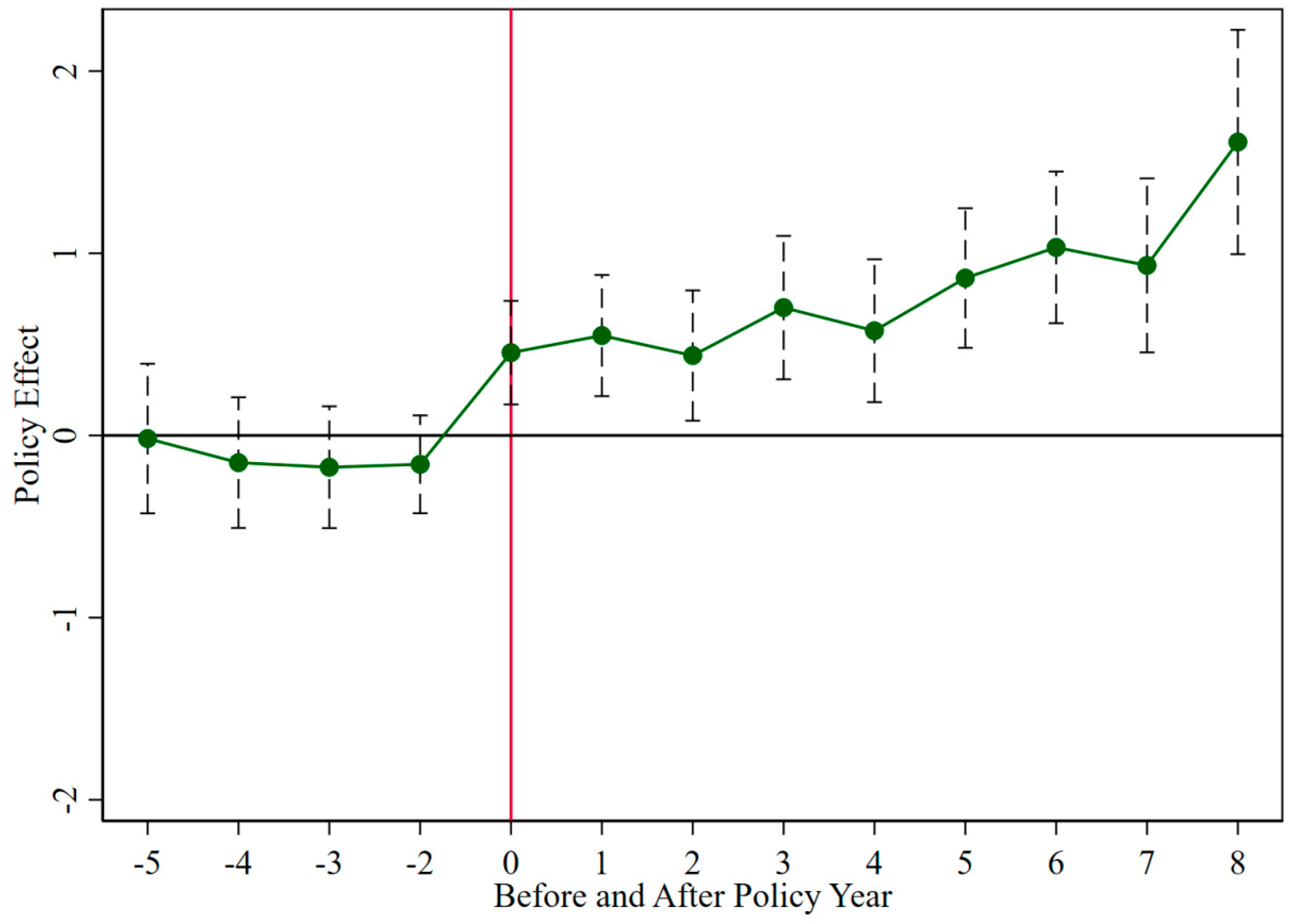
The prerequisite for ensuring the validity of the difference-in-differences model is to meet the parallel trend test, which means that before the establishment of China’s National Demonstration Base for Mass Entrepreneurship and Innovation (MEI), the ESG performance of the experimental group enterprises and the control group enterprises had the same trend of change, and after the establishment of China’s National Demonstration Bases for MEI, there was a significant difference in the ESG performance of the experimental group enterprises compared to the control group enterprises. Due to the relatively insufficient sample size in the earlier periods before the implementation of China’s demonstration policy, and to ensure the stability and statistical power of the regression results, this paper will uniformly combine the observation samples from the 5 years before the policy implementation and earlier into the group of 5 years before policy implementation, in order to more clearly test the long-term leading trend of the policy shock. Therefore, this paper constructs the following model.
E S G i t = α 0 + k > = 5 , k 1 8 β k D it k + α 1 C o n t r o l s + μ i + γ t + ε i t
Here, D i t k is the event representing China’s demonstration policy set as a dummy variable. The D i t k assignment rule is as follows: Let x i represent the specific year when the corresponding enterprise is classified into the key industry. If t x i 5 , then D i t 5 = 1 . Otherwise D i t 5 = 0 . If t x i = k , then D i t k = 1 . Otherwise D i t k = 0 . This model sets the year before the event occurrence as the base year to avoid the problem of multicollinearity. The regression model excludes the observation group of the base year, and the test results are shown in Figure 2. It is found that before the policy implementation, there were no significant differences between the treatment group and the control group, while after the policy implementation, the ESG performance improvement of the treatment group enterprises was significantly higher than that of the control group, verifying the parallel trend assumption.

4.3. Regression Analysis Based on the PSM-DID Method

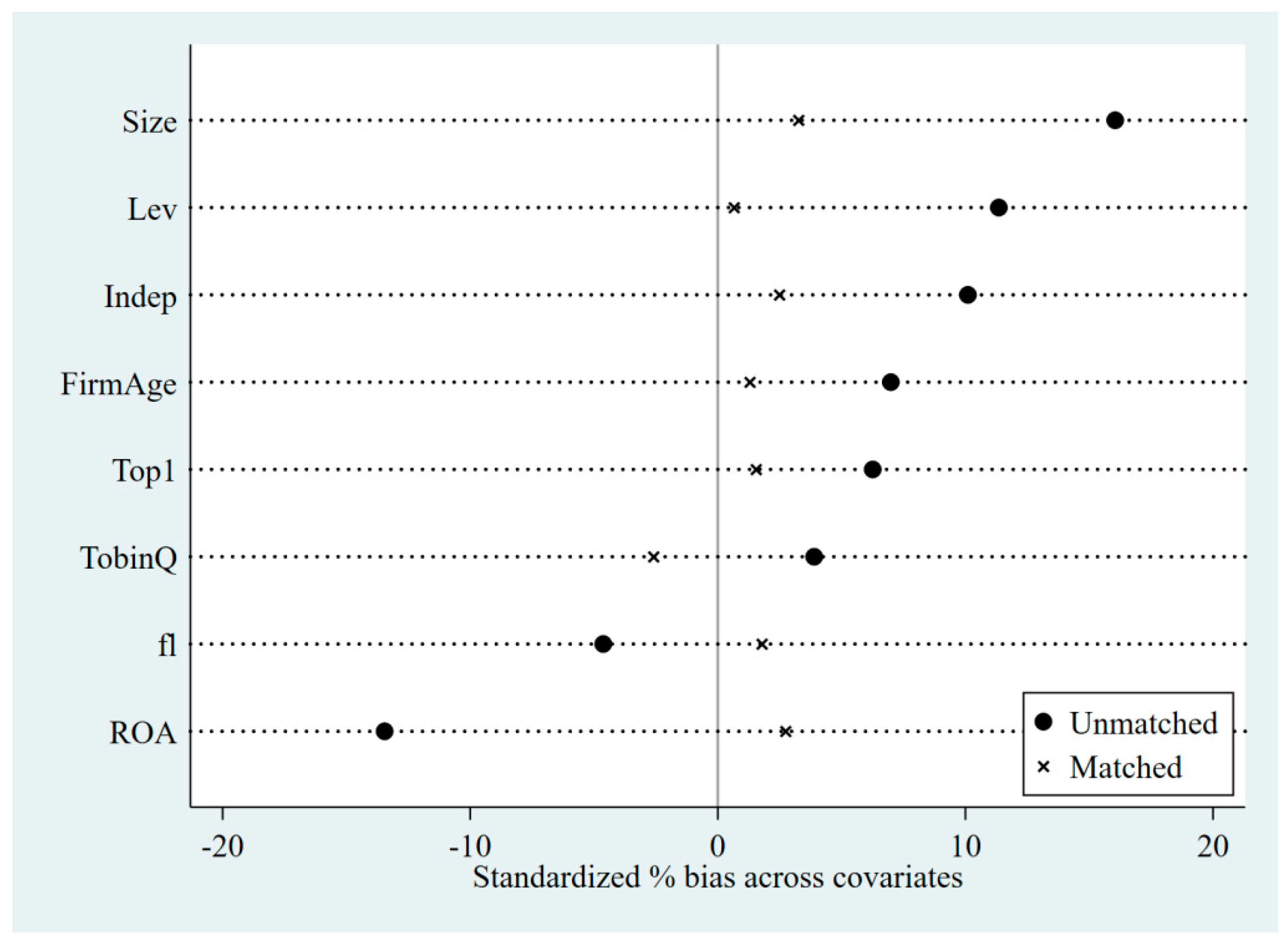
The selection of China’s National Demonstration Bases for Mass Entrepreneurship and Innovation (MEI) may not be random. Regions with higher innovation levels and more developed digital infrastructure are more likely to be included in the pilot scope. To alleviate potential selection bias and accurately estimate the policy effect of national innovation and entrepreneurship demonstration, this paper adopts the PSM-DID method proposed by Heckman et al. [35] to conduct a re-estimation of the regression. Specifically, all control variables in Model (15) are used as matching variables, and the control group is selected and matched according to the 1:1 nearest neighbor matching method. Then, the regression is conducted using the matched samples. The applicability test results of the PSM-DID method are shown in Figure 3. The results indicate that the standardized deviations of all variables after matching have dropped below the 10% threshold.
After verifying the validity of the PSM-DID method, the regression results of PSM-DID are shown in Table 4. Consistent with the benchmark regression results, the estimated coefficients of the national innovation and entrepreneurship demonstration (DID) in Columns (1) to (4) are all positive and pass the 1% significance test. This result indicates that after mitigating the sample selection bias, the benchmark regression results remain robust; that is, the construction of China’s National Demonstration Bases for Mass Entrepreneurship and Innovation (MEI) can significantly improve the ESG performance of enterprises.

5. Further Analysis

5.1. Robustness Test

5.1.1. Placebo Test

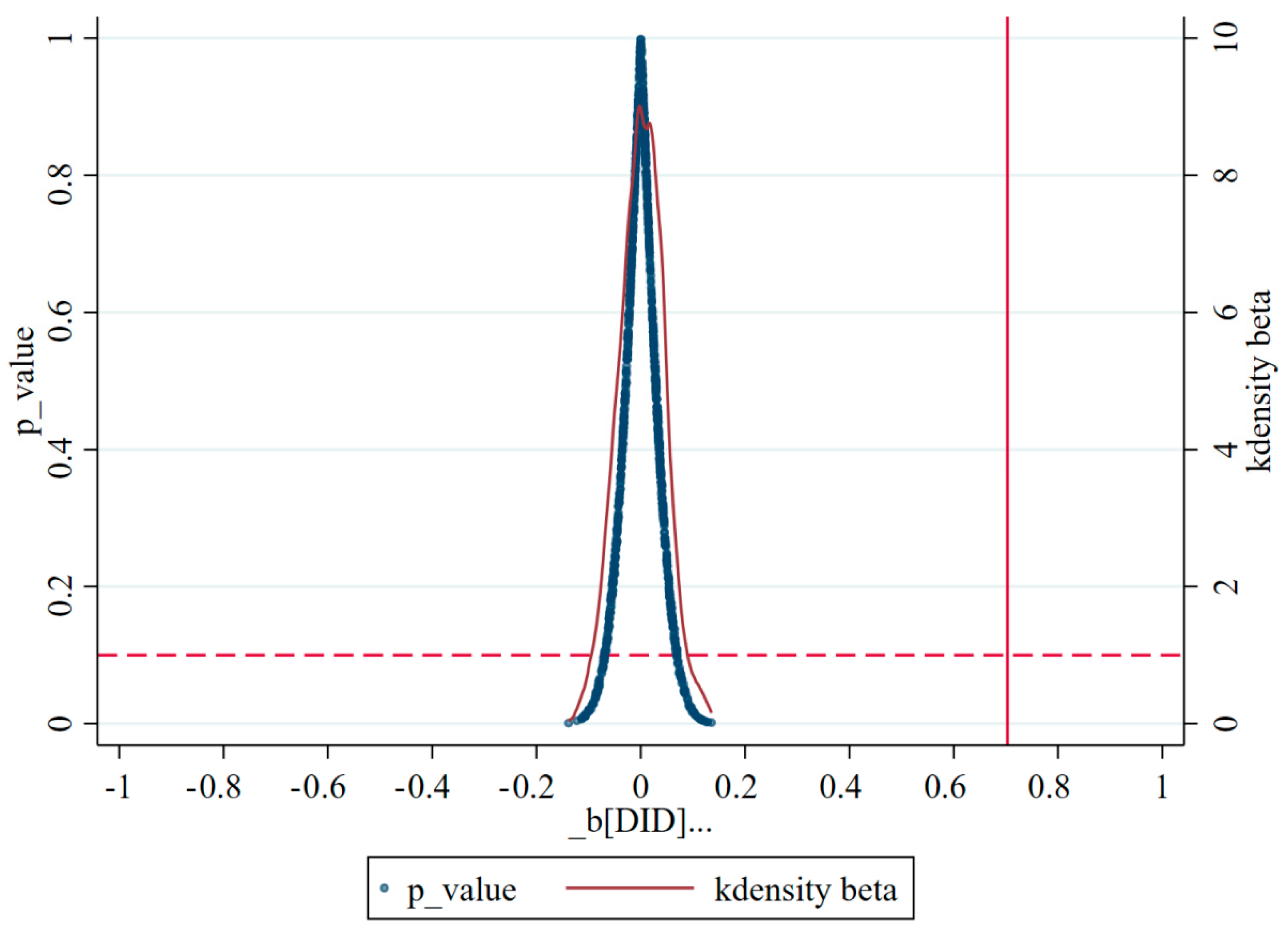
After the establishment of the demonstration base for MEI, the benchmark regression results may be affected by unobservable factors. To this end, a placebo test is required to ensure the robustness of the findings. Specifically, this paper randomly draws the DID variable 1000 times and conducts regression analyses to generate 1000 estimates. The results show that most of the 1000 estimated coefficients are distributed around the value of 0, approximately zero, and normally distributed. Moreover, most of the p-values exceed 0.1, consistent with the expectations of the placebo test. This confirms the robustness of the benchmark regression results mentioned above. The results of the placebo test are presented in Figure 4.

5.1.2. Other Robustness Tests

In addition, this paper conducts robustness tests from the following aspects: (1) Replacement of the dependent variable. Huazheng ESG is based on the ESG comprehensive score and rates enterprises, with a rating ranging from C to AAA, totaling 9 levels. Given this, this paper selects ESG rating (ESG_V) to replace the ESG comprehensive score. (2) Lagged control variables. To alleviate the possible bidirectional causal relationship between the control variables and the enterprise’s ESG performance, this paper lags all control variables by one period. (3) Experimental reconstruction and sample reconstruction. The list of the third batch of National Demonstration Bases for Mass Entrepreneurship and Innovation (MEI) was released in 2021, which was relatively late, and the policy effects have not fully manifested yet. Therefore, this paper takes the cities where the first batch and the second batch of demonstration bases were established as treatment groups, reconstructing the difference-in-differences model and the multi-time-point difference-in-differences model for regression tests. (4) Exclusion of other policy interference. During the investigation period of this paper, three policies are relevant to the study: the green credit policy (DID_L) issued in 2012, the national Innovative City pilot policy (DID_C) rolled out in batches after 2010, and the carbon emission trading policy (DID_H) implemented since 2013. Accordingly, this paper sequentially adds the dummy variables of these three policies to the benchmark regression model to control for their potential influence on the estimation results. The results of the robustness tests are shown in Table 5, starting from (1) to (7). It is found that the estimated coefficients of the DID and the two reconstructed explanatory variables are all positive and significant at the 1% level, proving the robustness of the benchmark regression results.

5.2. Mechanism Test

The empirical research results indicate that the national demonstration program has significantly improved the ESG performance of enterprises. However, through which mechanisms does the national demonstration program promote the ESG performance of enterprises? Just as in Section 2 of this paper, where a theoretical model was constructed, the national demonstration program, on the one hand, uses policy tools such as fiscal subsidies to help enterprises break through resource constraints and provide resource support for their green innovation. On the other hand, it urges enterprises to improve governance quality and guides them to accumulate social capital through social charity donations, thereby jointly promoting the improvement of corporate ESG performance from the environmental, social, and governance dimensions. Therefore, this paper adopts a two-step method and constructs the following model to verify the mechanism.
M i t = θ 0 + θ 1 D I D i t + θ 2 Controls it + μ i + γ t + ε i t
Here, M i t are mechanism variables, namely green technological innovation (Green), social charitable donation (Donation), and information disclosure quality (KV_N). θ 1 is the explanatory variable for the regression of the mechanism variables. If θ 1 > 0 , it indicates that China’s demonstration can have an incentive effect on the mechanism variables. Conversely, it indicates that the demonstration will have a suppressive effect on the mechanism variables. The definitions of other variables are the same as those in the benchmark regression.

5.2.1. Green Technology Innovation Mechanism

The regression results of China’s National Demonstration Base policy for Mass Entrepreneurship and Innovation (MEI) on green technology innovation are shown in Column (1) of Table 6. It can be seen that China’s demonstration policy significantly enhances enterprises’ green technology innovation levels, consistent with the expectations of resource-based theory. Policy support improves the investment capacity of enterprises to carry out green activities by alleviating enterprises’ resource constraints, thereby notably improving their green technology innovation. Furthermore, the improvement in green innovation capability brought about by policies can directly reduce corporate pollution emissions and enhance their environmental performance. On the other hand, the new energy and environmental protection service industries generated by green innovation can create a large number of job opportunities [36], thereby promoting the comprehensive improvement of enterprises’ ESG performance. This confirms Hypothesis H2a.

5.2.2. Social Charity Donation Mechanism

The regression results of China’s National Demonstration Base policy for Mass Entrepreneurship and Innovation (MEI) on social charitable donations are shown in Column (2) of Table 6. The results show that the construction of China’s demonstration policy significantly encourages corporate charitable donations, which is in line with the expectations of stakeholder theory. Policies enhance the ability of enterprises to meet the demands of stakeholders through resource support, establish legitimacy constraints through assessment and demonstration positioning, and promote enterprises to actively fulfill their social responsibilities. This resource support and compliance requirements force enterprises to have both the ability and willingness to make social donations [37]. Social donations manifest as the accumulation of reputation capital, promoting the improvement of enterprises’ ESG performance. Corporate charitable donations can strengthen government trust, stabilize policy resource support and optimize governance structure [38]. They can also reduce financing costs by improving market reputation [39], thereby enhancing the ability to invest in green technological innovation. Finally, a positive feedback loop is formed, from resource redundancy, strategic donation, and reputation accumulation to an increase in ESG performance. This confirms Hypothesis H2b.

5.2.3. Information Disclosure Quality Mechanism

The regression results of China’s National Demonstration Base policy for Mass Entrepreneurship and Innovation (MEI) on information disclosure quality are shown in Column (3) of Table 6. It can be seen that the construction of the national demonstration base for MEI can effectively improve the quality of enterprise information disclosure, consistent with the expectations of signal transmission theory. The national demonstration base will attract more market attention and external supervision pressure, forcing enterprises to improve their initiative and transparency in information disclosure, thereby reducing external doubts about enterprises’ operations and green behavior. As the key to alleviating financing constraints, high-quality information disclosure helps to alleviate information asymmetry, thus attracting institutional investors’ support and broadening green financing channels [40], which help enterprises obtain financial support such as green credit and provide a financial guarantee for long-term their ESG activities. Hypothesis H2c is confirmed.

5.3. Heterogeneity Test

To systematically clarify the boundary conditions and situational dependence of the effect of the National Demonstration Base policy for Mass Entrepreneurship and Innovation (MEI) on corporate ESG performance, this paper carries out multidimensional heterogeneity test. Considering the systematic differentiation of different enterprises in their response to and execution of mass entrepreneurship and innovation policies, this paper conducts empirical tests in groups to reveal the differentiation characteristics of policy effects from three perspectives: distinguishing the attribute differences of polluting industries from the industry dimension, examining the enterprise scale characteristics from the enterprise endowment dimension, and incorporating the enterprise life cycle from the development stage dimension.

5.3.1. Heterogeneity in Industry Pollution Attributes

There exists heterogeneity in industrial pollution attributes regarding the effect of the national demonstration base policy on corporate ESG performance. Compared with low-pollution industries, high-pollution industries face stricter environmental regulations and higher environmental costs [41]. In these heavily polluting industries, the national demonstration base policy can leverage innovation subsidies to facilitate green technology innovation, thereby significantly improving corporate environmental performance. In contrast, low-pollution industries experience less environmental pressure, exhibit weaker incentives for green innovation, and encounter greater difficulty in technological upgrading; thus, the effect of the demonstration policy on their ESG performance is relatively limited. In view of this, this paper refers to Wu et al. [42], defining 16 sub-industries as heavy-pollution industries. Enterprises belonging to these industries are classified as high-pollution enterprises, while others are classified as low-pollution enterprises. The results are shown in Columns (1) and (2) of Table 7, and it is found that the DID coefficient of high-pollution industries is significantly larger, indicating a stronger promotional effect of the demonstration base policy on ESG performance in highly polluting enterprises.

5.3.2. Heterogeneity in Firm Size

The enhancing effect of the national demonstration base policy for MEI on corporate ESG performance exhibits significant firm size heterogeneity. Specifically, large-scale enterprises possess more sufficient resources and stronger capabilities in technology implementation, whereas small-scale enterprises are often constrained by limited resources [27]. Following this logic, large-scale enterprises enjoy inherent advantages in green technology innovation, low-carbon transformation and environmental performance management. At the same time, driven by higher profitability, greater social reputation, and stronger external supervision pressure, large enterprises are also more motivated and able to consistently engage in social responsibility activities, including social welfare and charitable donations, as well as continuously improve the quality of ESG information disclosure and internal governance. Consequently, these enterprises comprehensively promote their ESG performance from the three dimensions of environment, society and governance. In this paper, the median of Firm Size (Size) is used as the boundary to divide the large and small subgroups. The test results are reported in Columns (3) and (4) of Table 7, and the DID coefficient of large-scale enterprises is significantly lower, indicating that the national demonstration base policy has a stronger enabling effect on the ESG performance of large-scale enterprises.

5.3.3. Heterogeneity in Firm Life Cycle

The role of the national demonstration base policy in improving corporate ESG performance varies by life cycle stage. Specifically, enterprises in the growth stage have limited resources and focus on market expansion; enterprises in the mature stage possess abundant resources and strategic layout capabilities; and enterprises in the decline stage face shrinking resources and prioritize survival [43]. First of all, mature-stage enterprises have abundant resources, outstanding organizational capabilities and competitive advantages, which can effectively transform the technical and resource support of the national demonstration base policy for MEI into green innovation, social responsibility and governance optimization, thereby significantly enhancing ESG performance. Secondly, growth-stage firms are constrained by market competition and resource shortages, despite benefiting from policy incentives. They tend to focus more on product expansion than long-term ESG investments, thus yielding weaker policy effects. Finally, decline-stage enterprises, characterized by resource scarcity and financial fragility, prioritize mere survival and lack both the capacity and motivation to invest in ESG, which renders the policy largely ineffective. Therefore, this paper refers to Dickinson’s [44] cash flow model method to divide the enterprise life cycle. On this basis, the introduction period and growth period are combined into the growth stage, and the shock period and decline period are combined into the decline stage, thus forming three groups of samples: enterprises in the growth stage, maturity stage and decline stage. The grouped regression results, in Columns (5) to (7) of Table 7, show that the DID coefficients of the national demonstration base policy are the highest in the mature-stage enterprises, followed by the growth-stage enterprises and the lowest in the decline-stage enterprises, indicating that the enabling effect of the policy on ESG performance is more pronounced for mature-stage enterprises.

5.4. Adjustment Test

This paper further examines the effects of industry competition intensity and enterprise digitalization level on the improvement of enterprises’ ESG performance promoted by the demonstration policy. The test model is shown as the following formulas:
ESG it = σ 0 + σ 1 DID it + σ 2 DID it HHI it + σ 3 HHI it + σ 4 Controls it + μ i + γ t + ε i t
ESG it = σ 0 + σ 1 DID it + σ 2 DID it DT it + σ 3 DT it + σ 4 Controls it + μ i + γ t + ε i t
Here, HHI it refers to the industry competition intensity that enterprise i faces in the t-th year; it refers to the degree of digital transformation of enterprise i in the t-th year, and σ are the estimated coefficients of each variable in the regression analysis of the enterprise’s ESG performance. The definitions of other variables are the same as those in the benchmark regression.

5.4.1. Industry Competition

The test results of the regulatory effect of industrial competition are reported in Column (1) of Table 8. The results show that the estimated coefficients of DID and DID×HHI are significantly positive, indicating that industry competition significantly strengthens the promotional effect of the national demonstration base policy for MEI on enterprise ESG performance. This promoting effect may be achieved in two ways. Firstly, competitive pressure constitutes an external incentive for enterprises’ green transformation [45]. In a highly competitive market environment, enterprises have a stronger motivation to invest in green technology research and ESG system construction by utilizing the policy resources of the demonstration bases, thereby enhancing the marginal output efficiency of the policy resources. Secondly, market competition can effectively alleviate the negative impact of environmental information uncertainty on ESG performance, enhancing the credibility of ESG as a quality signal [46]. In industries with numerous competitors, the observability and comparability of corporate ESG performance as a quality signal significantly improve, reducing the identification costs for investors and consumers, and thereby increasing the efficiency of policy resource allocation and social recognition.

5.4.2. Enterprise Digital Transformation

The test results of the moderating effect of enterprise digital transformation are shown in Column (2) of Table 8. It is found that the estimated coefficients of DID and DID*DT are both significantly positive, indicating that enterprise digital transformation can significantly strengthen the promotional effect of the national demonstration base policy for MEI on enterprise ESG performance. The key to this promotional effect lies in the enhancement of the absorptive capacity of enterprises through digital transformation [47]. Specifically, with stronger absorptive capacity, highly digital enterprises can more effectively internalize external resources, such as human capital training and financing support provided by the national demonstration base policy for MEI, into ESG practices to obtain better ESG performance. However, low digital enterprises are prone to falling into the capacity trap due to insufficient absorption capacity, making it difficult to achieve the same policy transformation effect.

5.5. Further Discussion

The research on the relationship between government institutional innovation policies and corporate ESG performance represents a frontier issue at the intersection of corporate governance and environmental economics. This paper expands upon the existing literature in the following aspects. Firstly, it expands the policy tools from environmental regulations to innovation policies. While existing literature mostly focuses on the impact of environmental regulations, such as environmental taxes and carbon emissions trading on ESG [48,49], this paper highlights the positive role of incentive-guided innovation policies on corporate ESG performance, thereby enriching the spectrum of policy instruments. Zhao et al. [3] found that the R&D subsidies under the Mass Entrepreneurship and Innovation (MEI) policy promote enterprise innovation. This study further extends the policy effect to corporate ESG performance, revealing the intrinsic connection between innovation policies and sustainable development. Secondly, it constructs a three-dimensional framework integrating resource enablement, reputation accumulation and information governance, moving beyond the limitations of a single mechanism perspective [9,22], revealing the policy transmission logic driven by the synergistic effects of multiple mechanisms. Wen et al. [12] found that the national demonstration bases for the demonstration policy drive urban green transformation through fiscal science and technology expenditures. Thus, this paper provides a theoretical response from the micro-enterprise perspective. Third, this paper reveals the moderating roles of industry competition intensity and enterprise digital transformation. Existing research shows divergent views on the relationship between industry competition and ESG performance. Wang & Xu [50] argue that industry competition intensity can promote corporate ESG performance, while Li & Li [51] suggest that under conditions of high market competition, enterprises tend to allocate resources to other expenditures rather than improving ESG performance. In this regard, this paper finds that industry competition positively moderates the ESG effect of policies, as competitive pressure creates an external forcing mechanism that drives enterprises to accelerate green transformation, thereby effectively converting financial support, including fiscal subsidies and funds provided by the demonstration policy, into tangible momentum for enhancing ESG performance. Moreover, this study confirms that enterprise digital transformation positively moderates the effect of MEI policies on promoting ESG performance, which provides new empirical evidence for research on the relationship between digital transformation and corporate sustainable development.
Furthermore, from the perspective of policy synergy, this paper provides empirical evidence supporting the coordinated implementation of the Digital China initiative and the Mass Entrepreneurship and Innovation strategy. Against the backdrop of government innovation policies and digital transformation, corporate ESG performance benefits from dual empowerment from both policy support and technology drive. The finding indicates that efforts to establish China’s national demonstration bases for Mass Entrepreneurship and Innovation (MEI) should be accompanied by a parallel focus on enterprises’ digital infrastructure development and digital capability cultivation to maximize the transformation efficiency of policy-guided ESG performance. This paper also identifies heterogeneity in enterprise digital capabilities as a critical boundary condition shaping policy effect, which offers refined empirical insights for the design of differentiated policies.

6. Research Findings and Policy Recommendations

6.1. Research Findings

Against the backdrop of the persistent governance dilemma between corporate growth and sustainability that characterizes green development in transition economies, China’s National Demonstration Bases for MEI, as a pivotal innovative practice, significantly enhance corporate ESG performance and sustainable growth. This paper develops a theoretical analysis framework centered on resource enablement, reputation accumulation and information governance. Employing a quasi-natural experiment based on China’s National Demonstration Base policy for Mass Entrepreneurship and Innovation (MEI) with panel data from A-share listed companies from 2010 to 2024, we apply a multi-period difference-in-differences model alongside the PSM-DID approach to systematically identify the causal effects, transmission mechanisms, and contextual boundaries of institutional innovation policies on corporate ESG performance in transition economies. The main findings are as follows.
First, the construction of China’s National Demonstration Bases for Mass Entrepreneurship and Innovation (MEI) exerts a significant positive effect on enterprise ESG performance. The benchmark regression results indicate that corporate ESG performance in the treatment group improved significantly relative to that of the control group following policy implementation. This finding still holds after a series of robustness tests, confirming the causal effect of the demonstration policy in driving corporate sustainable development.
Second, mechanism tests reveal that China’s demonstration policy enhances corporate ESG performance through three interconnected pathways, including green innovation, charitable donations, and information disclosure. In the environmental dimension, the policy reduces the cost of green innovation for enterprises through fiscal science and technology expenditure and tax incentives, thereby improving green technology innovation capabilities. In the social dimension, the policy encourages charitable donations by providing resource slack and exerting legitimacy pressures, thus achieving the accumulation of reputational capital. In the governance dimension, the policy attracts institutional investors and strengthens market-oriented supervision, compelling improvements in information disclosure quality. These three pathways work in tandem to create a synergistic effect encompassing resources, reputation, and financing.
Third, the heterogeneity analysis and moderation effect test reveal the marginal conditions of policy effects. From the perspective of industry attributes, enterprises in heavily polluting industries benefit more significantly owing to the combination of environmental regulatory pressures they face and the transformation drive formed by policy subsidies. From the perspective of enterprise development stage, the policy effect is more prominent in the mature stage of enterprises, which confirms the definitive role of organizational redundancy and strategic layout ability in ensuring the effectiveness of policy execution. Additionally, industry competition intensity and enterprise digitalization levels positively moderate the policy effects, with market competition stimulating the transformation drive and digital technology enhancing absorption capacity, thereby jointly strengthening the marginal output efficiency of policy resources.

6.2. Policy Recommendations

Based on the above research findings, this paper proposes the following policy recommendations.
First, refine institutional design to strengthen the ESG orientation of MEI policies. It is suggested that in subsequent policy layouts, corporate ESG performance should be included in the evaluation system for demonstration bases by establishing a mechanism that links fiscal subsidies and tax incentives with corporate environmental performance, social responsibility fulfillment, and governance transparency. Concurrently, efforts should be made to enhance synergy between innovation policies and green finance as well as transition finance, thereby leveraging the institutional guiding role of an active government in addressing the tension between growth and sustainability.
Second, establish well-functioning transmission channels to build a policy empowerment system jointly driven by multiple forces. Specifically, regarding the green technological innovation mechanism, special projects for green technology research and collaborative platforms for industry-university-research should be established to channel innovation resources toward low-carbon technology development. Regarding the social charitable donation mechanism, a multi-party dialogue mechanism involving the government, enterprises, and communities should be set up to guide enterprises in accumulating structural social capital through charitable donations. Regarding information disclosure quality mechanisms, efforts should be made to improve digital information disclosure platforms, formulate sector-specific ESG disclosure disciplines, formulate industry-specific ESG information disclosure guidelines, and strengthen third-party verification and market-based supervision.
Third, implement targeted policies to enhance the allocation efficiency of policy resources and establish classified support programs based on enterprise categories. Special funds for green transformation will be set up for heavily polluting industries, linking policy resources to pollution reduction performance. Policy support should be differentiated based on firm size and life cycle. Specifically, low-threshold and standardized green credit and guarantees are to be provided to small and medium-sized enterprises and growth-stage enterprises to alleviate resource constraints. For large-scale and mature-stage enterprises, market-oriented tools, including ESG-linked bonds and transition bonds, will be allocated to impose advanced requirements on environmental performance and supply chain social responsibility. These tools prevent raising enterprises’ compliance costs through a one-size-fits-all approach. Meanwhile, we should establish a tiered linkage mechanism that ties fiscal subsidies and tax incentives to corporate ESG performance, promoting synergy between innovation policies, green finance and transformation finance, thus leveraging the institutional traction role of an active government in breaking the tension between corporate growth and sustainability.
Fourth, cultivate an enabling ecosystem to strengthen the mediating mechanisms for policy effects. In constructing demonstration bases, attention should be paid to fostering a fair and orderly market environment, where antitrust enforcement can stimulate firms’ endogenous motivation for green transformation. Meanwhile, greater support should be provided for enterprises’ digital transformation. Leveraging new infrastructure such as industrial internet and big data centers enhances firms’ ability to efficiently absorb and apply policy resources. This fosters a virtuous cycle from digital empowerment to policy-driven support, leading to ESG improvement.

6.3. Research Limitations and Outlook

Though this paper has provided effective findings on corporate ESG performance, several limitations remain to be addressed in future research. Regarding measurement, due to data availability constraints, this study focuses primarily on listed companies, leaving the vast majority of small and medium-sized enterprises uncovered. Consequently, the external validity of the research conclusions warrants further validation across a broader range of enterprise types. Regarding dynamic effects, this paper mainly examines the short-term average treatment effects of China’s demonstration policy, without fully exploring the temporal evolution patterns, attenuation laws, stage-specific heterogeneity or potential adverse effects of the policy. In terms of mechanism selection, this paper conducts path analysis based on the three dimensions of ESG performance, but does not rule out the existence of other potential mechanisms. Future research may further explore these alternative pathways to more fully uncover the underlying logic of policy effects. Additionally, taking China’s transitional economy as the institutional context, this study reveals the core logic through which government-led industrial policy drives corporate ESG performance. The extrapolated validity of this finding is subject to institutional boundaries. It applies only to jurisdictions with state-led regulatory traditions, ESG disclosure systems still in the mandatory transition phase, and policy implementation relying on administrative hierarchy transmission. Conversely, for economies where the ESG framework is centered on market self-regulation or where a mature third-party authentication mechanism has been established, the theoretical mechanism of this study may present insufficient explanatory power.

Author Contributions

Conceptualization, W.M. and J.K.; formal analysis, W.M. and J.K.; investigation, P.X.; data curation, W.L.; writing—original draft preparation, W.M., W.L., P.X., J.K. and X.L.; writing—review and editing, W.M., W.L., P.X., J.K. and X.L.; visualization, W.L., P.X. and X.L. All authors have read and agreed to the published version of the manuscript.

Funding

This research was supported by the National Social Science Fund of China, “Research on the Division of Labor and Market Thought of Marx and Engels and Its Contemporary Value” (22&ZD051), and the Key Scientific Research Project of Hunan Provincial Education Department, “Research on Theory and Policy of New Quality Productivity Promoting Common Prosperity in Hunan” (24A0445).

Institutional Review Board Statement

Not Applicable.

Informed Consent Statement

Not Applicable.

Data Availability Statement

The data that support the findings of this study are available from the corresponding author upon reasonable request.

Conflicts of Interest

All authors declare no conflicts of interest.

References

  1. Giese, G.; Lee, L.-E.; Melas, D.; Nagy, Z.; Nishikawa, L. Foundations of ESG investing: How ESG affects equity valuation, risk, and performance. J. Portf. Manag. 2019, 45, 69–83. [Google Scholar] [CrossRef]
  2. Tingli, L.; Ishtiaq, M.; Saud, S.; Rasheed, M.Q. Achieving sustainable development in emerging economies: Interplay between markets, resources, and environment. Renew. Energy 2025, 238, 121941. [Google Scholar] [CrossRef]
  3. Zhao, K.; Wu, W.; Ye, J. The impact of “Mass Entrepreneurship and Innovation” policy on SMEs’ innovation: Using quasi-natural experiments. Bull. Econ. Res. 2023, 75, 348–365. [Google Scholar] [CrossRef]
  4. Tian, T.; Chen, N. How does entrepreneurship promote corporate ESG performance? Int. Rev. Financ. Anal. 2024, 96, 103557. [Google Scholar] [CrossRef]
  5. Xie, H.; Qin, Z.; Li, J. Entrepreneurship and Corporate ESG Performance—A Case Study of China’s A-Share Listed Companies. Sustainability 2024, 16, 7964. [Google Scholar] [CrossRef]
  6. Wang, A.; Saqib, A. How entrepreneurship drives ESG performance: The roles of data assetization and financing constraints. Financ. Res. Lett. 2025, 82, 107630. [Google Scholar] [CrossRef]
  7. Hsu, C.-C. The impact of innovation adoption on sustainable business development in China: The role of environmental, social, and corporate governance performance. Eng. Econ. 2024, 35, 169–181. [Google Scholar] [CrossRef]
  8. Luan, X.; Wang, X. Open innovation, enterprise value and the mediating effect of ESG. Bus. Process. Manag. J. 2023, 29, 489–504. [Google Scholar] [CrossRef]
  9. Liu, X.; Huang, N.; Su, W.; Zhou, H. Green innovation and corporate ESG performance: Evidence from Chinese listed companies. Int. Rev. Econ. Financ. 2024, 95, 103461. [Google Scholar] [CrossRef]
  10. Na, C.; Ni, Z.; Shu, Q.; Zhang, H. Can government subsidies improve corporate ESG performance? Evidence from listed enterprises in China. Financ. Res. Lett. 2024, 64, 105427. [Google Scholar] [CrossRef]
  11. Liu, Z.; Chen, L.; Jiang, H.; Yan, Z.; Li, T. Corporate innovation and ESG performance: The role of government subsidies. J. Clean. Prod. 2025, 498, 145209. [Google Scholar] [CrossRef]
  12. Wen, J.; Lan, Y.; Bu, G. Do Innovation and Entrepreneurship Support Policies Promote Urban Green Transformation?—The Mediating Role of Fiscal Technology Expenditure. Sustainability 2024, 16, 2622. [Google Scholar] [CrossRef]
  13. Guo, L.; Chen, F.; Chen, L. How does digital transformation affect corporate sustainability performance? Evidence from listed energy companies in China. PLoS ONE 2025, 20, e0325898. [Google Scholar] [CrossRef] [PubMed]
  14. Ding, X.; Vuković, D.B.; Sokolov, B.I.; Vukovic, N.; Liu, Y. Enhancing ESG performance through digital transformation: Insights from China’s manufacturing sector. Technol. Soc. 2024, 79, 102753. [Google Scholar] [CrossRef]
  15. Gu, J. Digitalization, spillover and environmental, social, and governance performance: Evidence from China. J. Environ. Dev. 2024, 33, 286–311. [Google Scholar] [CrossRef]
  16. Yao, Y.; Zhao, W.; Zhang, S. Effects of government innovation support on the innovation ability of universities: Evidence from the quasi-natural experiment of China’s innovation and entrepreneurship pilot demonstration policy. Sustainability 2023, 15, 791. [Google Scholar] [CrossRef]
  17. Gu, S. Institutional entrepreneurship and policy learning in China. J. Sci. Technol. Policy China 2013, 4, 36–54. [Google Scholar] [CrossRef]
  18. Gillan, S.L.; Koch, A.; Starks, L.T. Firms and social responsibility: A review of ESG and CSR research in corporate finance. J. Corp. Financ. 2021, 66, 101889. [Google Scholar] [CrossRef]
  19. Penrose, E.T. The Theory of the Growth of the Firm; Oxford University Press: Oxford, UK, 2009. [Google Scholar]
  20. Freeman, R.E. Strategic Management: A Stokcholder Approach; Pitman: Boston, MA, USA, 1984. [Google Scholar]
  21. Spence, M. Job market signaling. In Uncertainty in Economics; Elsevier: Amsterdam, The Netherlands, 1978; pp. 281–306. [Google Scholar]
  22. Tian, P.; Lin, B. Impact of financing constraints on firm’s environmental performance: Evidence from China with survey data. J. Clean. Prod. 2019, 217, 432–439. [Google Scholar] [CrossRef]
  23. Bhadra, K.; Kamalanabhan, T.; Singh, S.K. Evolution of dynamic capabilities for business sustainability performance: Evidence from the Indian manufacturing sector. Bus. Strat. Environ. 2024, 33, 5583–5605. [Google Scholar] [CrossRef]
  24. Choi, A.Y.; Kim, D.; Na, J. Disaggregating ESG Mechanisms: The Mediating Role of Stakeholder Pressure in the Financial Performance of Logistics Firms. Sustainability 2025, 17, 8840. [Google Scholar] [CrossRef]
  25. Wang, Z.; Nishihara, M. Investment and information asymmetry in corporate sustainability: Incentive-auditing contracts and policy insights. Int. Rev. Financ. Anal. 2025, 105, 104435. [Google Scholar] [CrossRef]
  26. Qin, Y.; Xiao, H. Market-based financing reforms and shareholder valuations: Event study evidence from the Chinese Sci-Technology Innovation Board. Asia-Pac. J. Account. Econ. 2023, 30, 172–195. [Google Scholar] [CrossRef]
  27. Zhao, Y.; Zhou, Y.; Yang, Q.; Gong, Y. Technology empowerment, digital transformation, and enhancing corporate ESG performance. Int. Rev. Econ. Financ. 2025, 101, 104239. [Google Scholar] [CrossRef]
  28. Wang, L.; Fu, L.; Yu, B. CEO industry expertise and corporate ESG performance. Int. Rev. Econ. Financ. 2025, 105, 104815. [Google Scholar] [CrossRef]
  29. Wang, Y.; Wang, D.D. The dual path of the impact of digital technology adoption on ESG performance. Sustainability 2025, 17, 2341. [Google Scholar] [CrossRef]
  30. Lin, J.; Cao, X.; Dong, X.; An, Y. Environmental regulations, supply chain relationships, and green technological innovation. J. Corp. Financ. 2024, 88, 102645. [Google Scholar] [CrossRef]
  31. Li, M.; Gan, Y. More Philanthropy, More Consistency? Examining the Impact of Corporate Charitable Donations on ESG Rating Uncertainty. Economics 2025, 19, 20250148. [Google Scholar] [CrossRef]
  32. Ascioglu, A.; Hegde, S.P.; McDermott, J.B. Auditor compensation, disclosure quality, and market liquidity: Evidence from the stock market. J. Account. Public Policy 2005, 24, 325–354. [Google Scholar] [CrossRef]
  33. Chang, Y.J.; Yoo, J.W. How does the degree of competition in an industry affect a company’s environmental management and performance? Sustainability 2023, 15, 7675. [Google Scholar] [CrossRef]
  34. Yang, T.; Wu, K.; Du, X.; Yuan, G. Does the digital transformation of enterprises affect capital mismatch? evidence from Chinese listed firms. PLoS ONE 2025, 20, e0313674. [Google Scholar] [CrossRef]
  35. Heckman, J.J.; Ichimura, H.; Todd, P. Matching as an econometric evaluation estimator. Rev. Econ. Stud. 1998, 65, 261–294. [Google Scholar] [CrossRef]
  36. Jiang, L.; Shen, S. Opportunity or Curse: Can Green Technology Innovation Stabilize Employment? Sustainability 2024, 16, 5805. [Google Scholar] [CrossRef]
  37. Lyu, X.; Zhao, Y. High-tech enterprise identification policy and corporate charitable donations: A perspective on the spillover effects of innovation policy. Financ. Res. Lett. 2025, 86, 108390. [Google Scholar] [CrossRef]
  38. Hong, Q.; Shi, H. The effect of government official’s visit on corporate charitable donation: Evidence from China. Int. Rev. Econ. Financ. 2025, 98, 103978. [Google Scholar] [CrossRef]
  39. Yang, Z.; Yang, Z. Corporate reputation, information disclosure and cost of capital. Int. Rev. Financ. Anal. 2025, 107, 104592. [Google Scholar] [CrossRef]
  40. Liang, X.; Cao, P. Does corporate ESG disclosure enhance investor relationship management? Evidence from China. Account. Financ. 2024, 64, 2011–2035. [Google Scholar] [CrossRef]
  41. Zheng, Z.; Wu, M. Environmental Regulation, Information Disclosure, and Clean Production in Heavy-Polluting Enterprises: Evidence from China. Sustainability 2025, 17, 9586. [Google Scholar] [CrossRef]
  42. Wu, G.; Sun, M.; Feng, Y. How does the new environmental protection law affect the environmental social responsibility of enterprises in Chinese heavily polluting industries? Humanit. Soc. Sci. Commun. 2024, 11, 168. [Google Scholar] [CrossRef]
  43. Hasan, M.M.; Habib, A. Corporate life cycle, organizational financial resources and corporate social responsibility. J. Contemp. Account. Econ. 2017, 13, 20–36. [Google Scholar] [CrossRef]
  44. Dickinson, V. Cash flow patterns as a proxy for firm life cycle. Account. Rev. 2011, 86, 1969–1994. [Google Scholar] [CrossRef]
  45. Zhang, A.; Zhang, H.; Meng, J.; Li, W.; Zhang, Y. Can green finance policies promote substantive green transformation in firms?—Evidence from the risk-taking and market competition. Financ. Res. Lett. 2025, 90, 108891. [Google Scholar] [CrossRef]
  46. Shi, D.; Tan, H.; Ling, Y.; Liu, Y.; Liu, B.; Tu, Y. Impact of environmental information uncertainty and market competition on corporate ESG performance. Int. Rev. Financ. Anal. 2025, 99, 103935. [Google Scholar] [CrossRef]
  47. Li, W.; Zhang, M. Digital transformation, absorptive capacity and enterprise ESG performance: A case study of strategic emerging industries. Sustainability 2024, 16, 5018. [Google Scholar] [CrossRef]
  48. Huang, Y.; Liu, C.; Wang, L.; Qi, Y. The impact of environmental protection tax on corporate ESG performance and corporate green behavior. Res. Int. Bus. Financ. 2025, 75, 102772. [Google Scholar] [CrossRef]
  49. Dai, Y.; He, R. The impact of carbon emissions trading policy on the ESG performance of Heavy-Polluting enterprises: The mediating role of green technological innovation and financing constraints. Sustainability 2025, 17, 1365. [Google Scholar] [CrossRef]
  50. Wang, Q.; Xu, Y. Can industry competition stimulate enterprises ESG performance? Int. Rev. Financ. Anal. 2025, 104, 104274. [Google Scholar] [CrossRef]
  51. Li, C.; Li, Y. Market competition, resource allocation and corporate ESG performance. Eurasian Bus. Rev. 2025, 1–36. [Google Scholar] [CrossRef]
Figure 1. Theoretical analysis framework.
Sustainability 18 05804 g001
Figure 2. Parallel trend test.
Sustainability 18 05804 g002
Figure 3. Applicability test of the PSM-DID method.
Sustainability 18 05804 g003
Figure 4. Placebo Test.
Sustainability 18 05804 g004
Table 1. Definition of core basic parameters of the model.
ParameterEconomic MeaningValue Range Core Characteristics
α Marginal revenue coefficient of green innovation α > 0 It reflects the direct contribution of green innovation to corporate profits with diminishing marginal returns
c Marginal cost coefficient of green innovation c > 0 It reflects the increasing rate of marginal cost of green innovation
θ Policy green innovation subsidy rate θ > 0 We will increase the marginal returns of green innovation to reflect the preference of policy resources
γ Coefficient of income from social charitable donation based on reputation γ > 0 It reflects the reputation transformation ability of donation behavior without policy
η Policy donation reputation amplification coefficient η > 0 The marginal reputation benefit of donation should be increased to reflect the policy demonstration effect
β Information disclosure cost coefficient β > 0 It reflects the increasing rate of marginal cost of information disclosure
r Benchmark cost of equity capital rate r > 0 The level of corporate capital cost without policy intervention
δ Coefficient of signal transmission effect of information disclosure δ > 0 Reduce the cost of capital for enterprises through signaling
μ Amplification coefficient of policy endorsement signal μ > 0 Enlarge the signal transmission effect of enterprise information disclosure and reflect policy endorsement
φ Coefficient of intensity of regulatory punishment φ > 0 The punishment intensity, reflecting non-compliance in information disclosure, is positively related to the intensity of policy supervision
λ Shadow price of resources λ > 0 It reflects the marginal value of disposable resources per unit and indicates the scarcity of resources
Table 2. Descriptive statistics.
VariableNMeansdMinMax
ESG35,91873.7294.90659.33086.190
DID35,9180.5080.5000.0001.000
Size35,91822.2391.30420.01926.393
Lev35,9180.3980.1950.0500.847
ROA35,9180.0390.057−0.1950.193
TobinQ35,9181.9351.0990.8327.111
Indep35,9180.3780.0540.3330.571
Top135,9180.3380.1480.0830.743
fl35,9181.1910.776−0.7445.973
FirmAge35,9182.9650.3241.9463.611
LnGreen_Inv35,9180.6741.0360.0004.522
Donation35,918170.224520.1720.0003840.100
KV_N35,918−0.5070.193−1.110−0.136
HHI35,9180.0720.0800.0140.537
DT35,9181.6251.3850.0004.466
Table 3. Benchmark regression results.
Variable(1)(2)(3)(4)
ESGESGESGESG
DID0.697 ***0.647 ***0.668 ***0.703 ***
(0.052)(0.147)(0.050)(0.139)
Size 1.174 ***1.566 ***
(0.024)(0.105)
Lev −4.320 ***−6.175 ***
(0.165)(0.376)
ROA 14.096 ***4.366 ***
(0.479)(0.703)
TobinQ −0.128 ***−0.145 ***
(0.024)(0.037)
Indep 6.229 ***4.828 ***
(0.453)(0.896)
Top1 0.324 *2.370 ***
(0.169)(0.634)
fl −0.323 ***−0.113 ***
(0.032)(0.035)
FirmAge −0.896 ***0.404
(0.079)(0.735)
yearfixNoYesNoYes
firmfixNoYesNoYes
Constant73.375 ***73.401 ***49.275 ***37.432 ***
(0.037)(0.074)(0.544)(3.037)
Observations35,91835,91835,91835,918
R-squared0.0050.4550.1340.479
Note: The values in parentheses represent the standard error. ***, **, and * indicate significance at the 1%, 5%, and 10% statistical levels, respectively. The same applies below.
Table 4. Results of PSM-DID test.
Variable(1)(2)(3)(4)
ESGESGESGESG
DID0.706 ***0.778 ***0.761 ***0.834 ***
(0.080)(0.199)(0.077)(0.188)
Constant73.299 ***73.266 ***52.243 ***44.306 ***
(0.047)(0.065)(0.842)(4.300)
ControlsNoNoNoYes
yearfixNoYesYesYes
firmfixNoYesYesYes
Observations16,36416,36416,36416,364
R-squared0.0050.4920.1150.531
Table 5. Robustness test.
Variables(1)(2)(3)(4)(5)(6)(7)
ESG_reESGESGESGESGESGESG
DID0.150 ***0.826 *** 0.701 ***0.704 ***0.708 ***
(0.029)(0.150) (0.139)(0.140)(0.140)
DID1 0.917 ***
(0.151)
DID2 0.599 ***
(0.143)
DID_L −0.411
(0.377)
DID_C −0.024
(0.161)
DID_H −0.040
(0.169)
Constant−3.682 ***38.267 ***37.838 ***37.596 ***37.395 ***37.449 ***37.447 ***
(0.643)(3.464)(3.021)(3.040)(3.033)(3.036)(3.040)
yearfixYesYesYesYesYesYesYes
firmfixYesYesYesYesYesYesYes
Observations35,91830,75535,91835,91835,91835,91835,918
R-squared0.4460.5070.4790.4790.4790.4790.479
Table 6. Results of mechanism test.
Variable(1)(2)(3)
LnGreen_InvDonationKV_N
DID0.064 ***53.219 ***0.011 **
(0.023)(14.192)(0.005)
Constant−6.579 ***−3496.568 ***1.972 ***
(0.589)(366.573)(0.092)
ControlsYesYesYes
YearfixYesYesYes
FirmfixYesYesYes
Observations35,91835,91835,918
R-squared0.7400.6590.428
Table 7. Results of heterogeneity test.
Variables(1)(2)(3)(4)(5)(6)(7)
Low-Pollution Industry EnterprisesHigh-Pollution Industry EnterprisesLarge Scale EnterpriseSmall Scale EnterpriseGrowth Period Maturity Period Decline Period
ESGESGESGESGESGESGESG
DID0.522 ***0.726 **0.871 ***0.444 **0.712 ***0.974 **0.310
(0.159)(0.292)(0.213)(0.209)(0.159)(0.424)(0.334)
Constant32.712 ***51.920 ***12.202 **53.811 ***36.133 ***54.853 ***33.378 ***
(3.384)(7.008)(5.373)(4.691)(3.614)(8.950)(6.862)
ControlsYesYesYesYesYesYesYes
yearfixYesYesYesYesYesYesYes
firmfixYesYesYesYesYesYesYes
Observations29,311774417,82017,77625,06629815829
R-squared0.4950.4860.5080.5290.4940.6320.629
Table 8. Results of regulatory tests.
Variables(1)(2)
ESGESG
DID0.546 ***0.485 ***
(0.158)(0.174)
DID*HHI2.113 **
(1.044)
HHI−1.249
(0.817)
DID*DT 0.115 **
(0.058)
DT 0.012
(0.050)
Constant37.488 ***37.962 ***
(3.027)(3.053)
ControlsYesYes
yearfixYesYes
firmfixYesYes
Observations35,91835,918
R-squared0.4790.479
Disclaimer/Publisher’s Note: The statements, opinions and data contained in all publications are solely those of the individual author(s) and contributor(s) and not of MDPI and/or the editor(s). MDPI and/or the editor(s) disclaim responsibility for any injury to people or property resulting from any ideas, methods, instructions or products referred to in the content.