Article

Investigation of Balıkesir Sındırgı Granaries in the Context of Sustainable Conservation

by
Şenay Ekşi
1,2,* and
Uzay Yergün
3
1
Institute of Science, Faculty of Architecture, Department of Architecture, Yıldız Technical University, Istanbul 34349, Türkiye
2
Interior Design Program, Department of Design, Dogus University, Istanbul 34775, Türkiye
3
Faculty of Architecture, Department of Architecture, Yıldız Technical University, Istanbul 34349, Türkiye
*
Author to whom correspondence should be addressed.
Sustainability 2026, 18(11), 5243; https://doi.org/10.3390/su18115243
Submission received: 15 April 2026 / Revised: 13 May 2026 / Accepted: 15 May 2026 / Published: 22 May 2026

Abstract

Traditional wooden granaries in rural Türkiye are disappearing at an accelerating rate due to agricultural abandonment, rural depopulation, and the absence of systematic documentation and conservation frameworks. In the Sındırgı district of Balıkesir, one of the richest concentrations of vernacular granary architecture in the Marmara Region, these structures remain largely unprotected and unstudied within a sustainable design framework, constituting an urgent conservation challenge. This study aims to assess the current preservation status of Sındırgı granaries, classify their typological diversity, and evaluate their sustainability performance against a defined set of ecological design criteria. A mixed methods approach was employed, combining a systematic literature review with extensive fieldwork across 33 neighborhoods. In total, 1411 granaries were identified and grouped into five typologies: evli, Simav, kabak, sandık, and üstü örtülü sandık. These typologies were systematically compared to five parameters: spatial distribution across neighborhoods, plan and section geometry, construction system and structural elements, material selection and condition, and preservation status. This comparison revealed that typological variation is not incidental but directly reflects differences in land ownership, agricultural production capacity, topography, and distance from the district center. Representative examples from each typology were documented through onsite measurements, photogrammetry, technical drawings, and interviews with local craftsmen. The sustainability performance of the granaries was then assessed across seven ecological design criteria: spatial organization, building form design, structural element design, material use and conservation, design with nature, urban design area planning, and nature interaction. The findings demonstrate that the long-term durability of these structures depends on an interrelated system of climate-responsive design decisions rather than any single factor. The study concludes by proposing a holistic conservation model comprising typology-based inventory, roof water moisture-focused intervention, periodic monitoring, and transmission of vernacular building knowledge, a framework applicable to comparable rural granary heritage across the region.

1. Introduction

The granaries, which extend uninterrupted across Anatolia’s diverse geography, are an important part of traditional Turkish architecture [1]. These structures hold an indispensable place in the contract production series and are used regularly. The importance of granaries is not limited solely to their functional use for storage. Regional architectural differences and the use of local materials should also be considered as tangible reflections of cultural values [2]. Positioned as auxiliary spaces in rural production systems, these structures play important functional roles in maintaining management continuity [3]. In traditional Turkish residential architecture, granaries were an organic part of residential buildings, and mobile life played a central role in both the economic and social structures [4].
In different geographical regions of Türkiye, granaries are known by various names such as serender and Nayla in the Black Sea region, herkil in the Marmara region, and haro in the Eastern Anatolia region [5,6]. The unique climatic conditions, topographical structure, cultural characteristics, craftsmanship, and experience of each region lead to different architectural solutions. Granaries used for storage exhibit diverse structural characteristics worldwide, influenced by the materials, construction techniques, and forms used. Granaries in the Mediterranean and Marmara regions show similarities with the Aitta granaries in Finland and the Storehose granaries in Switzerland in terms of elevated stone structures, the use of wood, and structural features [7,8,9]. In contrast, the Black Sea granaries, which rise on wooden poles, are similar in material properties and construction techniques to the granary structures called Horeo in Spain and Loft in Norway [1,10,11].
Located in the south of the Marmara Region, the Sındırgı district of Balıkesir is an important area exhibiting a diversity of traditional granary structures [12,13]. Geographical location, climatic conditions, and agricultural activities have shaped a unique granary architecture in this region. Granaries in Sındırgı are an integral part of the rural settlement fabric and hold an important place within the cultural landscape values of this region, contributing to its regional identity [14]. The district has a deep-rooted rural architectural tradition. Granary structures are an important component of traditional residential architecture and rural production spaces [12,15].
Beyond being functional, granaries hold a key role as carriers of the region’s cultural memory. They represent the accumulated knowledge, craftsmanship traditions, and rural life culture handed down over time [16]. To sustain granary structures and cultural heritage, preserving and passing on grain granaries to future generations is crucial [17]. Today, modern agricultural techniques, industrial storage, and the decline of the rural population have reduced the practical value of traditional granaries. As a result, many abandoned granaries are at risk of disappearing due to neglect [18,19]. Studies in rural areas list disuse, lack of reconstruction, failure to repair, and lack of preservation as reasons for the decline in granary numbers over time. This shows that rural architectural heritage is vanishing [20,21,22,23]. Sustainable conservation addresses this by safeguarding not only the physical structures but also their social, economic, and cultural values [24,25,26,27].
The Sındırgı district of Balıkesir was selected as the study area for several interconnected reasons. First, existing literature confirms that Sındırgı contains one of the richest and most diverse concentrations of traditional wooden granaries in the Marmara Region, making it an exceptional case for typological investigation. Second, these granaries remain largely undocumented and unprotected, presenting an urgent conservation challenge. Third, the district’s unique combination of geographic, climatic, and socio-economic conditions has given rise to granary forms not systematically studied within the framework of sustainable design criteria. The absence of such a study in literature constitutes the primary motivation for this research. Following this approach, this study focuses on granaries as cultural heritage. It assesses the condition of those that still exist without conservation and identifies reasons for their deterioration. The study also aims to develop a conservation method by determining what is needed to preserve at-risk granaries, identifying the causes of decay, and implementing preventive measures. The research centers on the following questions:
  • RQ1: What is the current state of preservation of traditional granaries in Sındırgı, what are the main factors determining their deterioration, and what physical, structural, and environmental conditions are necessary to preserve granaries at risk of collapse?
  • RQ2: What are the most common types of granaries in Sındırgı, and how can this typological distribution be explained in relation to settlement, production, and usage practices? How can a visual typological synthesis (including plan, section, and preservation status) contribute to the understanding and communication of these findings?
  • RQ3: How can the sustainability of granaries be evaluated in terms of spatial organization, building form, structural design, material use, and harmony with nature, and what role do granaries play in the intergenerational transmission of rural life, culture, and local building knowledge?
The remainder of this paper is organized as follows. Section 2 presents the theoretical frameworks and reviews the relevant global, Turkish, and Sındırgı-specific literature. Section 3 describes the study area (Section 3.1) and the field research methodology and sustainability criteria framework (Section 3.2). Section 4 reports the field findings, including the identification and typological classification of the 1411 granaries into five categories. Section 5 discusses the sustainability dimensions of the granaries across seven ecological design criteria. Section 6 presents the conclusions drawn in response to each research question, and Section 7 offers practical recommendations for the sustainable conservation of these structures. Table 1 below summarizes the key links between research questions, main findings, and recommendations.

2. Literature Review

This study is grounded in two intersecting theoretical frameworks. The first is the sustainable heritage conservation framework, which holds that the conservation of built heritage must address not only physical preservation but also the social, economic, and cultural dimensions of living heritage. The second is the ecological building design framework, which evaluates the performance of vernacular structures through criteria such as spatial organization, building form, material use, and interaction with the natural environment. Together, these frameworks provide the conceptual lens through which the Sındırgı granaries are analyzed and assessed. This section reviews the relevant global and regional literature within this conceptual context.
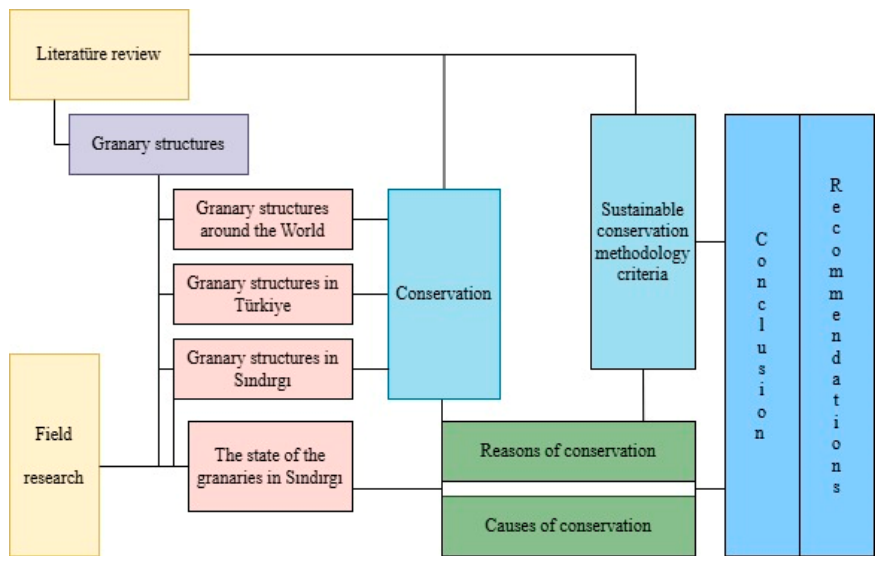
Granaries play a critical role in agricultural production and consumption. They ensure food security, balance seasonal production cycles, and support sustainability [22,28,29,30]. Consequently, granary structures exist almost everywhere in the world. Studies on granary structures were accessed by searching Web of Science, Scopus, Google Scholar, and ScienceDirect using the keywords ‘granary’ and ‘rural storage structures’. These studies were categorized under three headings: those conducted in Türkiye and those in Sındırgı (Figure 1).
Looking at studies conducted worldwide, Elsdon Best, in his study examines Pataka granary structures belonging to Maori culture in New Zealand from the perspective of cultural anthropology and architectural documentation. Best studied from an ethnographic documentation standpoint, revealing the architectural features, construction techniques, and socio-cultural contexts of storage structures in Maori culture [21]. Gómez Martínez, Ma, Pellegrini, and Reimão Costa, in their study *Vernacular Architecture and Cultural Identity in Shrinking Rural Settlements*, examined the population decline and cultural shrinkage process in rural settlements in western Spain following the Spanish Civil War and assessed the impact of this process on folk architecture, particularly traditional structures (Horreo). In Spain, traditional granary structures (Horreo) and rural folk architecture are examined in terms of cultural identity and the shrinking of rural settlements. The study offers different approaches to transforming endangered cultural heritage into a revitalizing force for the region, developing conservation and valorization strategies, and solving socio-cultural problems. This study examines granaries from the perspective of cultural heritage, identity, conservation, and rural development [31]. In their collaborative study, “Historical vicissitudes of grain storage environment of granaries in the North China Plain”, Li, Hou, Yu, Niu, Chen, Han, and Zhang examine traditional granaries, climate-adaptive strategies, and the grain storage environment in the North China Plain. This study analyzes four granary structures built over the period from 583 AD to 2002 using mathematical simulation methods, evaluating their climate-adaptive strategies, historical variations in the grain storage environment (air temperature and relative humidity), and environmental performance. The study reveals that historical granaries adopted two different strategies: temperature-first and humidity-first. This work addresses the granaries from the perspectives of environmental sustainability, climate-adaptive design, and optimization of the grain storage environment [32]. Vahdati and Tedjosaputro, in their study, “A comparative study: Vernacular timber construction techniques of Iranian, Japanese, and Spanish granary structures”, comparatively examined vernacular timber construction techniques and sustainable design principles. They conducted a comparative analysis of granaries in these three countries regarding roof, body, and foundation systems, structural joining techniques, and connection details. The study examined the compliance of these structures with Design for Disassembly (DfD) principles, the use of open structure systems and structural grid systems, climate resistance, and ease of assembly/disassembly. This study considers granaries from the perspective of technical and structural characteristics, sustainable construction practices, and ecological design principles [33].
In Türkiye, traditional grain silos and granary structures have been examined in different regions within the context of typology, archaeology, and rural architecture. Even in large-scale studies of rural architecture, silos are included because they are at the heart of sustainable living. In their study entitled “Auxiliary Spaces in Rural Production: Grain Silos”, Balkoca, Sağıroğlu, Demirci, and Güngör [3] conducted a comparative typological analysis of wooden grain silos in the İskilip district of Çorum province with world silo architecture and discussed their conservation status, threats, and conservation strategies. In his study, “A Group of Examples of Traditional Storage Spaces in Çavdarhisar: Aizanoi II”, M. Ekmekçi [34] examined the traditional storage spaces in the Kemaller neighborhood of Çavdarhisar, Kütahya, documented their construction systems, and presented a comparative analysis with other examples of granaries in Anatolia. In his study, “Wooden Grain Granaries of Elmalı as an Example of Rural Architectural Heritage: Current Situation and Conservation Problems”, S. Baybo [20] evaluated the current situation of the structures, conservation problems, and the effects of the climate crisis in the context of Teke Yaylası in Elmalı, Antalya, between 2019 and 2024. In his study titled “Architectural Findings Related to Agricultural Production in the Karabel Settlement in Central Lycia”, B. İşler [35] examined the Hellenistic-Byzantine period agricultural production structures (wine/olive oil workshops, cisterns, and storage spaces) in the Karabel settlement in terms of archaeological and architectural findings. Fairbairn and Omura [36], in their study titled “Archaeological identification and significance of ÉSAG (agricultural storage pits) at Kaman-Kalehöyük, central Anatolia”, dealt with the agricultural storage pits (ÉSAG) in Kaman-Kalehöyük in Central Anatolia through archaeological and historical analysis; In Istanbul, Dizdar and Sönmez [37], in their work “Stone Rooms and Lantern Houses in Istanbul in Ottoman Civil Architecture”, examined storage spaces such as Ottoman-era stone rooms and lantern houses in a social, economic and cultural context. Studies of this kind are extensive in the Black Sea region; grain storage structures, primarily serenders, are discussed. In the Eastern Black Sea region, serenders, with their raised pole systems, solutions for protection against humidity and pests, and regional wooden construction traditions, have been frequently discussed in the literature. Haşim Karpuz’s study [1]., “Serander and Loft: Two Equivalent Structures in Turkish and Norwegian Folk Architecture”, describes the architecture of traditional grain granaries and their regional diversity, highlighting similarities and differences with examples from abroad. N. Erol’s “Folk Architecture in Kandıra” [6], K. Karabulut’s “Historical Development and Art Structures of Yusufeli Urban Fabric” [38], and N. Turgut Gültekin and M. Uysal’s “Site definition in the sustainability of cultural heritage: the example of taşkale rock-carved grain storage granary” [17] all address storage granary structures within the context of cultural heritage sustainability and site definition. These studies reveal the regional diversity of storage granaries and warehousing heritage in Türkiye, the need for its preservation, and the deficiencies in its documentation.
Sındırgı district of Balıkesir has been the subject of numerous studies in various fields such as geography, archaeology, architectural heritage, cultural landscape, demography, tourism, handicrafts, mining, and wildlife. Ferhat Arslan’s “Settlements in Bigadiç and Sındırgı Districts” [39] and Ferhat Arslan and M. Elibüyük’s “Livestock Economy in Sındırgı” [40] provide information on changes in the rural geographical features of the district from the past to the present, as well as on population development in the district. Yusuf Sezgin and S. Aybek’s “Archaeological Values of Sındırgı” [41] and Cengiz Gürbıyık’s “Traditional Urban Fabric and Historical Structures” [42] studies demonstrate the importance of Sındırgı’s regional value. In Salim İbiş’s study, “A Research on Tourism Potential of Sındırgı and its Surroundings Within the Scope of Sustainable Tourism” [43], the tourism potential of Sındırgı and its surroundings was examined within the context of sustainable tourism; and in A. Ağan and F. Altıner’s study, “Determination of Cultural Landscape Values: Case of Sındırgı,” [14] studied the determination of cultural landscape values.
In her study titled “The Meanings of Motifs Used in Traditional Turkish Carpet Art: A Semiotic Analysis of Sındırgı-Yağacıbedir Carpets”, Sevda Bozkurt [44] studied Sındırgı Yağcıbedir carpets in the field of handicrafts. Zehra Ebru Erkan’s study, “Enrichment of Kaolin Ore in Döküştepe Area, Düvertepe Region, Balıkesir–Sındırgı” [45], examined Sındırgı in the context of mining and engineering. Ergül Gündağ Arikan’s study, “An Example of the Transmission of Cultural Memory: Wooden Granary in Sındırgı Villages” [19], examined the rural settlement pattern in Çoturtepe village and developed proposals for its preservation, focusing on the protection of traditional housing structures. In their study, “A Saw, A Hammer, A Hundred Planks, A Master: Wooden Grain Silos in Sındırgı Villages,” Ergül Gündağ Arıkan and S. Maraşlı [13] provide information about the tradition and craftsmanship of woodworking, evaluate the granaries as carriers of cultural memory, and compare the Sındırgı granaries with similar granary structures around the world. This methodological study constitutes the literature on granaries and rural architecture in the district.
In her thesis titled “Ecological Assessment Methods in Ecological and Sustainable Architecture,” completed at Çukurova University, Pınar Emel [46] addressed ecological building design criteria under six headings: spatial organization, building form design, building element design and use, water use and conservation, material use and conservation, and renewable energy use.
In their study, “Ecological Building Design Criteria: A Case Study in Ankara,” Arzuhan Burcu Gültekin and Bengü Alparslan [47] evaluated ecological building design criteria under four main headings: Energy Conservation, Water Conservation, Material Conservation, and Livable Design.
In their study titled “Evaluation of Ecological Buildings in Terms of Basic Design Criteria,” Jale Gürel and Demet Irklı Eryıldız [48] examined and evaluated buildings in terms of architectural form and ecological design criteria. They assessed these criteria under five headings: energy use, water use, waste utilization, land use, and interior physical conditions. Additionally, they separately studied the roof and facade under a separate heading as building envelopes.
Kim, J-J., and Rigdon, B. [49], in their study “Conceptual Framework Developed for Sustainable Design and Construction,” addressed the principles of sustainable architecture under three main headings: resource management, life-cycle design, and methods for providing livable environments. The topics of energy, water, materials, and building areas, which are included in studies in this field, were evaluated under the heading of resource management. In their study, under the heading of methods for providing livable environments, they established criteria for sustainability by working on the preservation of natural conditions, the planning of urban design areas, and design for human comfort.
In their work, Bekkering, J., Schröder, T., and Zhong, W. [50], “Biophilic design in architecture and its contributions to health, well-being, and sustainability: A critical review. Frontiers of Architecture,” describe sustainability as the continuation of nature and the natural world, encompassing nature incorporation, nature inspiration, and nature interaction.
In their book “Ecological Design,” Sim Van Der Ryn and Stuart Cowan [51] discuss the need for design based on the existing environment and the necessity of ensuring compatibility with all living beings within it. They also emphasize the importance of including the user in the design process.
While traditional granary structures are examined in world literature from the perspectives of cultural anthropology, climate adaptive design, vernacular construction techniques, and cultural heritage, in Türkiye, studies have focused primarily on typology, archaeology, conservation, and regional documentation, and the wooden granaries of Sındırgı have been addressed within the scope of cultural memory and comparative granary studies. In the field of ecological and sustainable architecture, frameworks exist that evaluate structures using criteria such as spatial organization, building form design, structural element design, water use and conservation, material use and conservation, use of renewable energy, design for human comfort, urban design area planning, and preservation of natural conditions, under the headings of design and structural criteria, environmental and resource management, life cycle, and user comfort. However, a defined criteria system for traditional structures has not yet been established.

3. Materials and Methods

This section presents the methodological framework of the study. It first describes the geographic, historical, climatic, and demographic characteristics of the Sındırgı district as the study area. It then explains the field research procedures used to identify, document, and classify the granaries, and sets out the sustainability design criteria applied in the analysis.

3.1. Study Area: Geographic, Historical and Socio-Economic Context

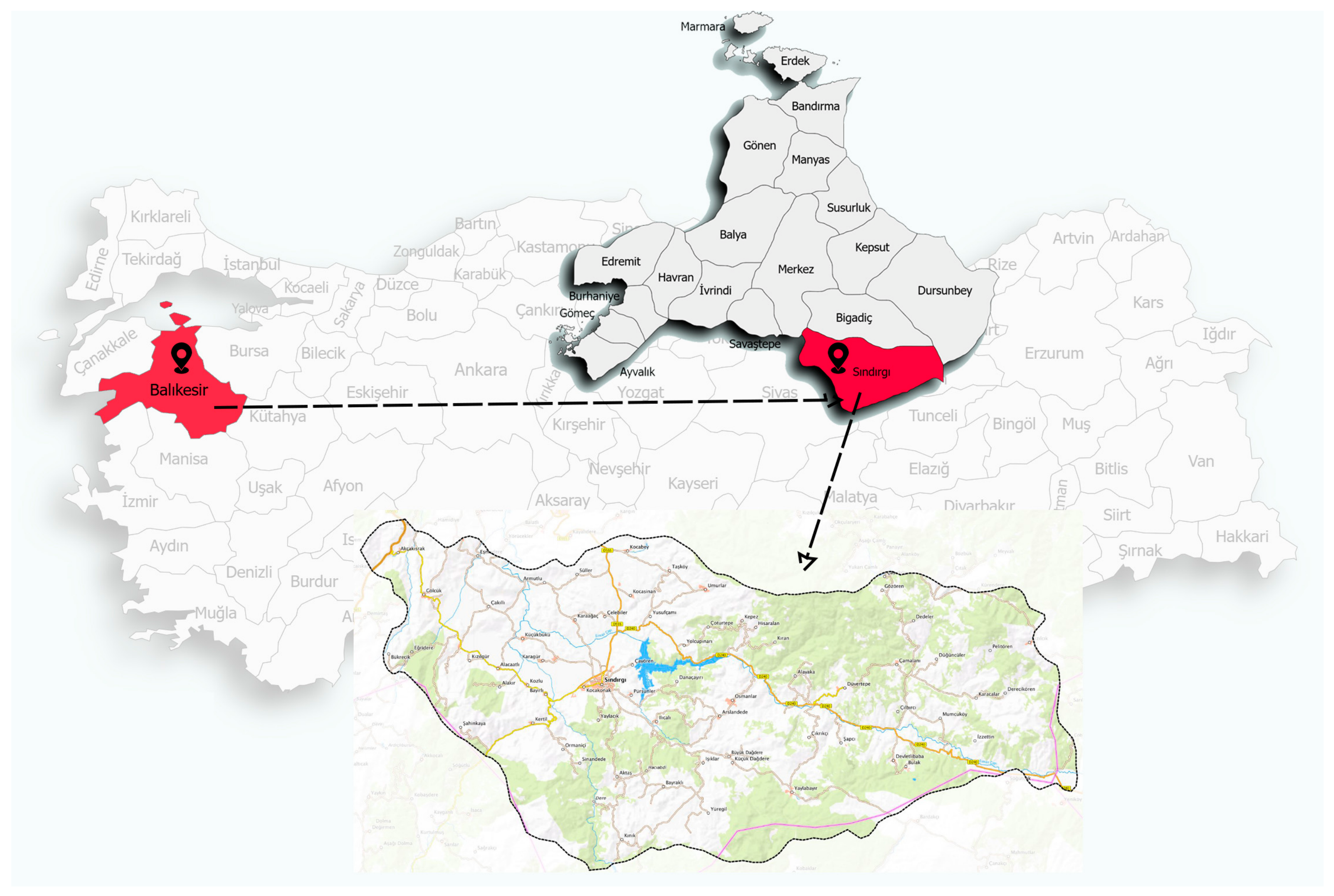
Sındırgı is a district located in the southeast of Balıkesir province, within the Marmara Region of Türkiye. The district is 63 km from the center of Balıkesir and borders Bigadiç and Dursunbey districts to the north [52]. Sındırgı is bordered by Manisa province (Akhisar, Demirci, and Gördes districts) to the south, Manisa province (Kırkağaç district) to the west, and Kütahya province (Simav district) to the east [53] (Figure 2).
Located in the Simav fault zone, the Sındırgı district is at high risk of earthquakes [54]. Considering all this data, the Sındırgı region, where the study was conducted, is tectonically unsuitable and lies on loose soil [55].
When rainfall amounts in Sındırgı are examined, it is seen that the most rainfall occurs in the winter months, December and January. After the winter season, the region receives the most rainfall in the spring, and the Marmara Transition Type rainfall regime is dominant [56]. In Sındırgı, where rainfall is almost nonexistent in the summer months, rainfall begins to increase again in the autumn. Climate data affects not only the products produced but also daily life activities [57].
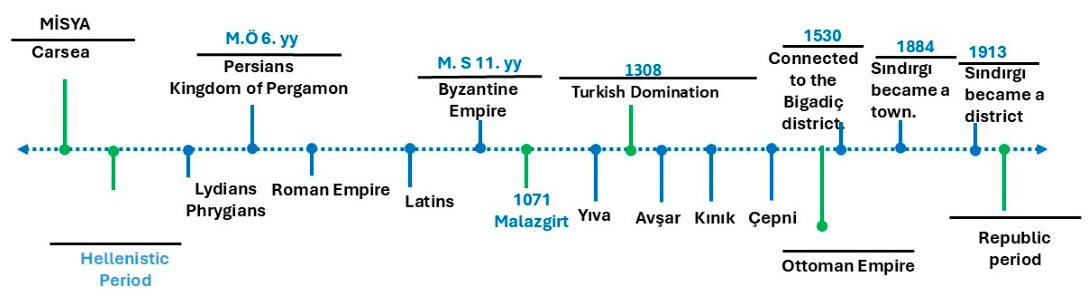
The history of Sındırgı dates to ancient times. It is stated that Sındırgı was under the rule of the Phrygians and Lydians until the Persians invaded the region in the 6th century BC [58]. Before the region came under Turkish rule, it was successively under the dominion of the Lydians, Persians, the Kingdom of Pergamon, the Roman Empire, and the Byzantine Empire until the end of the 11th century [59] (Figure 3).
Looking at population movements, the population, which was around 40,000 in 1970, gradually decreased towards the 2000s, then increased slightly towards 2010, but has continued to decrease until the present day [60]. Given population growth, it is understood that migration has occurred from rural to urban areas. Even with population growth in the city, the total population has decreased, so there is no numerical increase.
The economic structure of Sındırgı is based on agriculture and animal husbandry. Given the natural environment, the most common animal husbandry activities are cattle and sheep farming, and beekeeping [39,40,55]. Agricultural activities, the second most important source of livelihood after animal husbandry, are quite diverse. 65% of the district’s land is used for agriculture. The main agricultural products are: wheat (35,000 tons annually), barley (20,000 tons annually), olives (8000 decares), and grapes (5000 decares) [60]. Although seasonal factors affecting suitable agricultural conditions have reduced the number of crops grown in recent years, agriculture remains an important source of livelihood for the region.
Since cultivated products are not only consumed daily but also stored, they must be preserved. These products are stored in granary structures designed to protect them from weather conditions, insect infestations, wild animals, and all other environmental factors.
Upon examining all this data, it was determined that no study in the literature systematically analyzes traditional grain granaries in Türkiye, specifically in Sındırgı, and relates them to ecological building design criteria and sustainable architecture principles. This gap highlighted the need to develop ecological and sustainable evaluation methods for traditional granary structures, which constitute the subject of this study.

3.2. Research Design and Field Methodology

The data in this study were obtained from literature reviews combined with field research conducted on granaries identified in situ in the Sındırgı district of Balıkesir province (Figure 4). Fieldwork in 33 neighborhoods of the Sındırgı district identified 1411 granaries. These 1411 granaries were grouped into five categories based on their similar characteristics (house granary, Simav granary, kabak granary, sandık granary, üstü örtülü granary). One granary from each group was selected as a sample. The current condition, architectural features, and structural details of these sample granaries were documented using photogrammetry. Sketching was conducted in the field to capture architectural details, construction techniques, and spatial configurations. Detailed measurements of the selected granaries were taken using traditional methods. These measurements provided information about plan dimensions, granary heights, structural element dimensions, and spatial relationships. The collected field data, including measurements and photographic documentation, were processed using computer-aided software and converted into technical drawings. As a result of these studies, architectural drawings were created, including plans, sections, elevations, and detail drawings of the granaries. In addition, data on the construction and use of the granaries were collected through interviews with local people and woodworkers in the Sındırgı district, where the study was conducted.
The identified grain silos should be evaluated within the scope of both tangible and intangible cultural heritage, as they reflect the local way of life and were constructed using traditional rural building techniques and craftsmanship [61,62]. Conservation is possible by safeguarding societies’ tangible and intangible cultural heritage against threats to ensure its sustainability [63]. The sustainability of silos aims to ensure that these structures remain a living value in social, economic, and environmental terms, beyond mere conservation [64,65]. The evaluation of traditional structures within the context of sustainable design criteria involves climate data, land use, material selection, and energy efficiency [66].
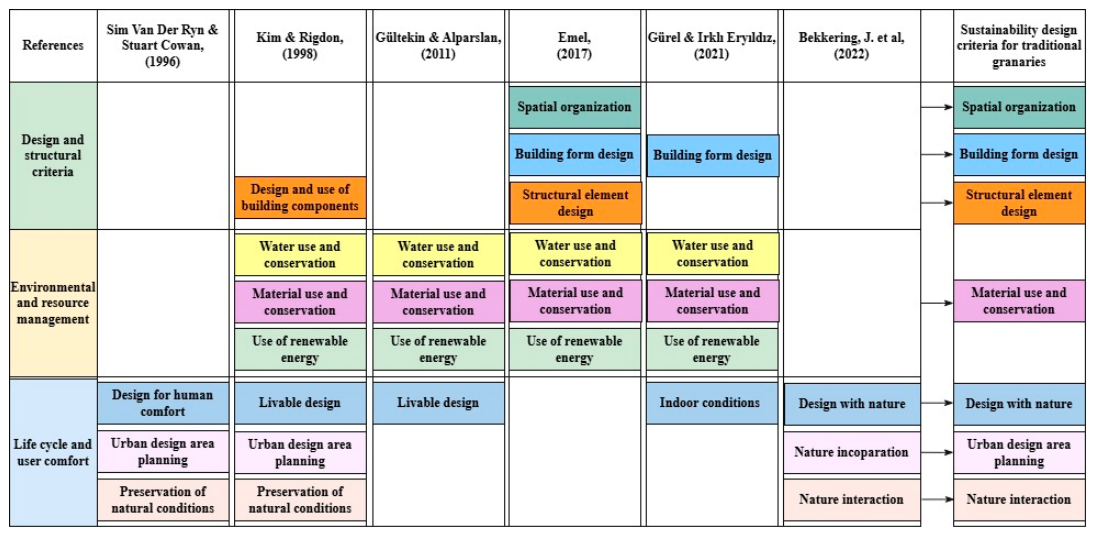
Based on the literature review, the following table was created by considering the criteria established for the sustainability of structures (Figure 5). The seven criteria, spatial organization, building form design, structural element design, material use and conservation, design with nature, urban design area planning, and nature interaction, were derived from the ecological and sustainable architecture frameworks proposed by Emel [46], Gültekin and Alparslan [47], Gürel and Irklı Eryıldız [48], Kim and Rigdon [49], Bekkering et al. [50], and Van Der Ryn and Cowan [51].
These seven criteria derived from [46,47,48,49,50,51] provide the analytical framework applied in Section 5 to evaluate the sustainability performance of each granary typology.

4. Findings

As part of the field study, granaries were identified in 33 of the 75 neighborhoods in Sındırgı. The layout, typological distribution, and usage characteristics of these granaries were evaluated together in these neighborhoods. The data obtained show that granary types differ according to land structure, relationship with the center, and granary needs.

4.1. Identification of Sındırgı Granary

In Sındırgı and its surroundings, which have a Mediterranean transitional climate, black pine trees are commonly found in semi-humid forests [39]. Due to its abundance and durability, black pine wood is used in the construction of granaries. Although trade activities have recently become the main source of livelihood for local people, their previous main sources were agriculture and animal husbandry [55]. Therefore, granaries used for storing food are an important part of village life. While some neighborhoods no longer have granaries, there are villages where they are still frequently seen and actively used.
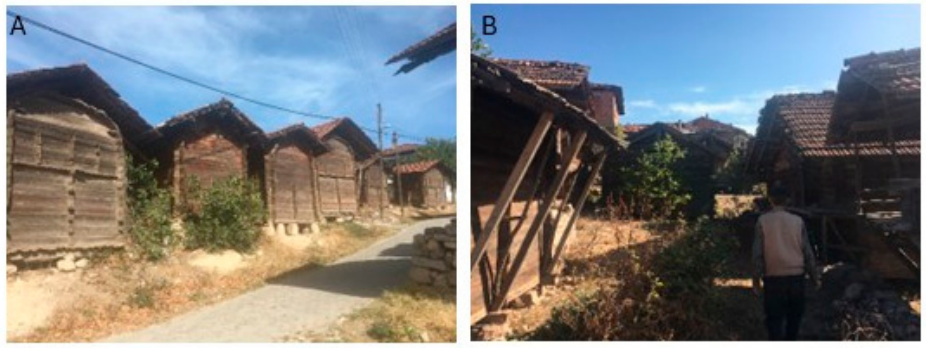
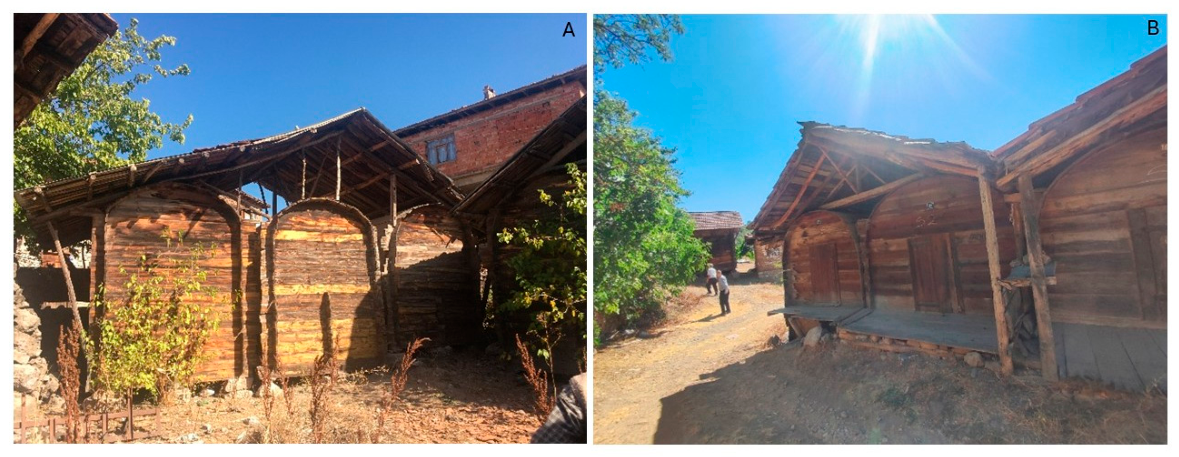
The granaries were built in suitable proximity to the houses. Located at a certain distance from the houses, depending on the topography, the granaries are either lined up along the village entrance (Figure 6A) or clustered in the village square (Figure 6B).
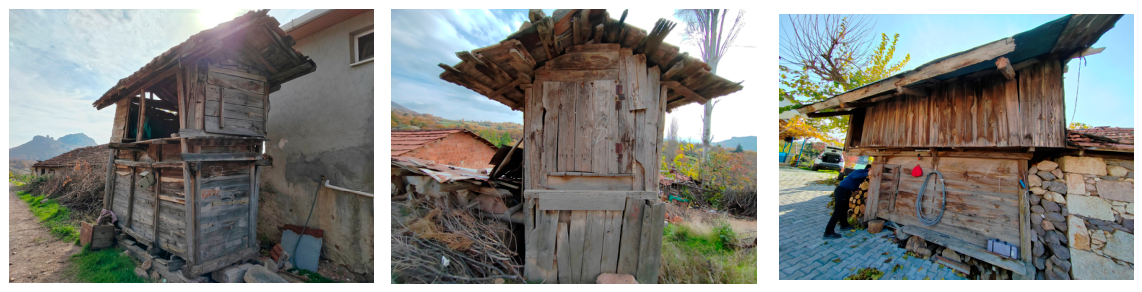
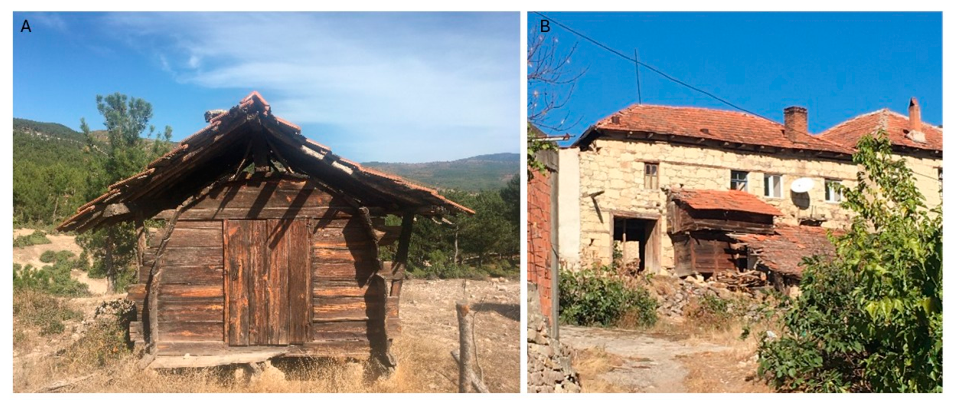
Those who own fields near their homes also build granary structures behind their houses to store their own food (Figure 7A). Although rare, granary structures are also attached to the houses (Figure 7B).
Granaries are either single-story or two-story. Single-story granaries consist of a single space with compartments designed for grain storage. Granaries are identical in terms of materials, technology, and function. Their size and number of stories vary depending on the land structure, agricultural production quantity, and storage needs. The most important factor in determining the size of the granary is the amount of land owned. The more produce available for storage, the larger the granary required.
Granaries were identified in 33 of the 75 neighborhoods in Sındırgı. The study was conducted in these neighborhoods. Table 2 shows the number and types of granaries located in the neighborhoods.
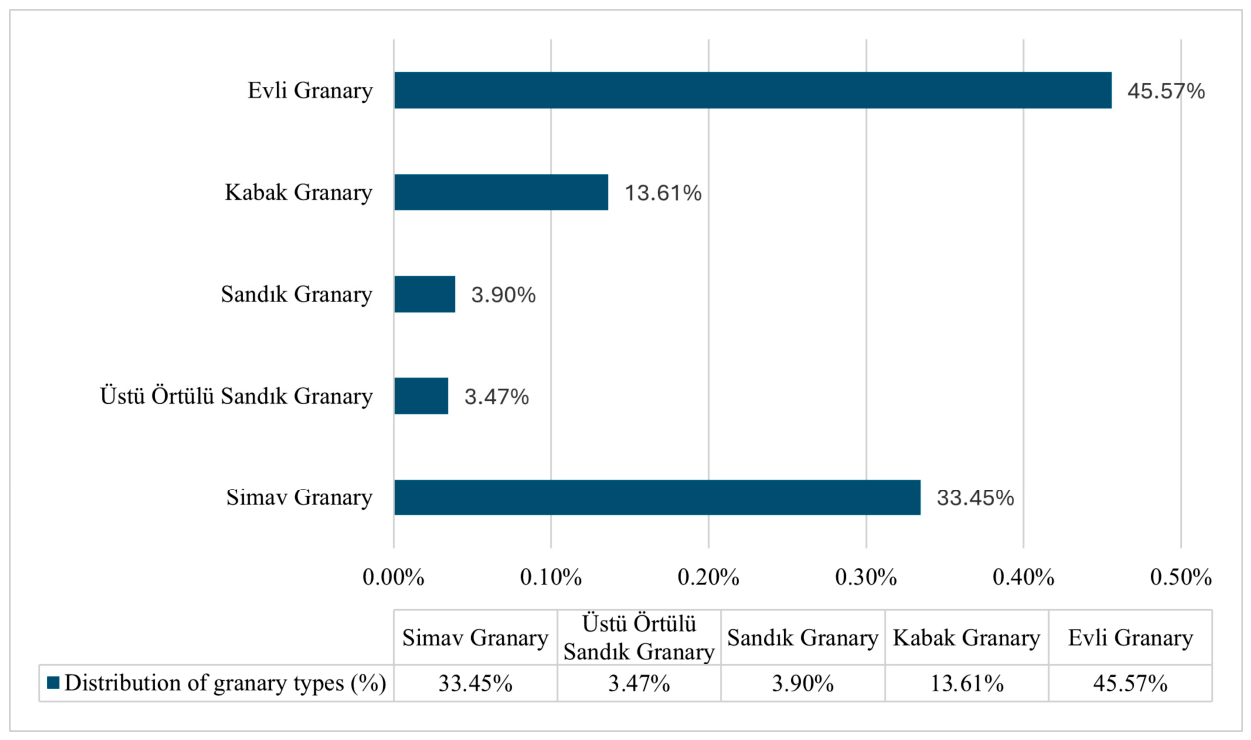
In Sındırgı, as a result of studies conducted in 33 neighborhoods, five types of granaries have been identified: married granary, Simav granary, kabak granary, sandık granary, and üstü örtülü sandık granary. The granary ratio is shown in Figure 8 below.

4.2. Sındırgı Granary Typologies

Granaries have been identified as five types based on their size and plan variations. These typologies are examined under Section 4.2.1, Section 4.2.2, Section 4.2.3, Section 4.2.4 and Section 4.2.5.
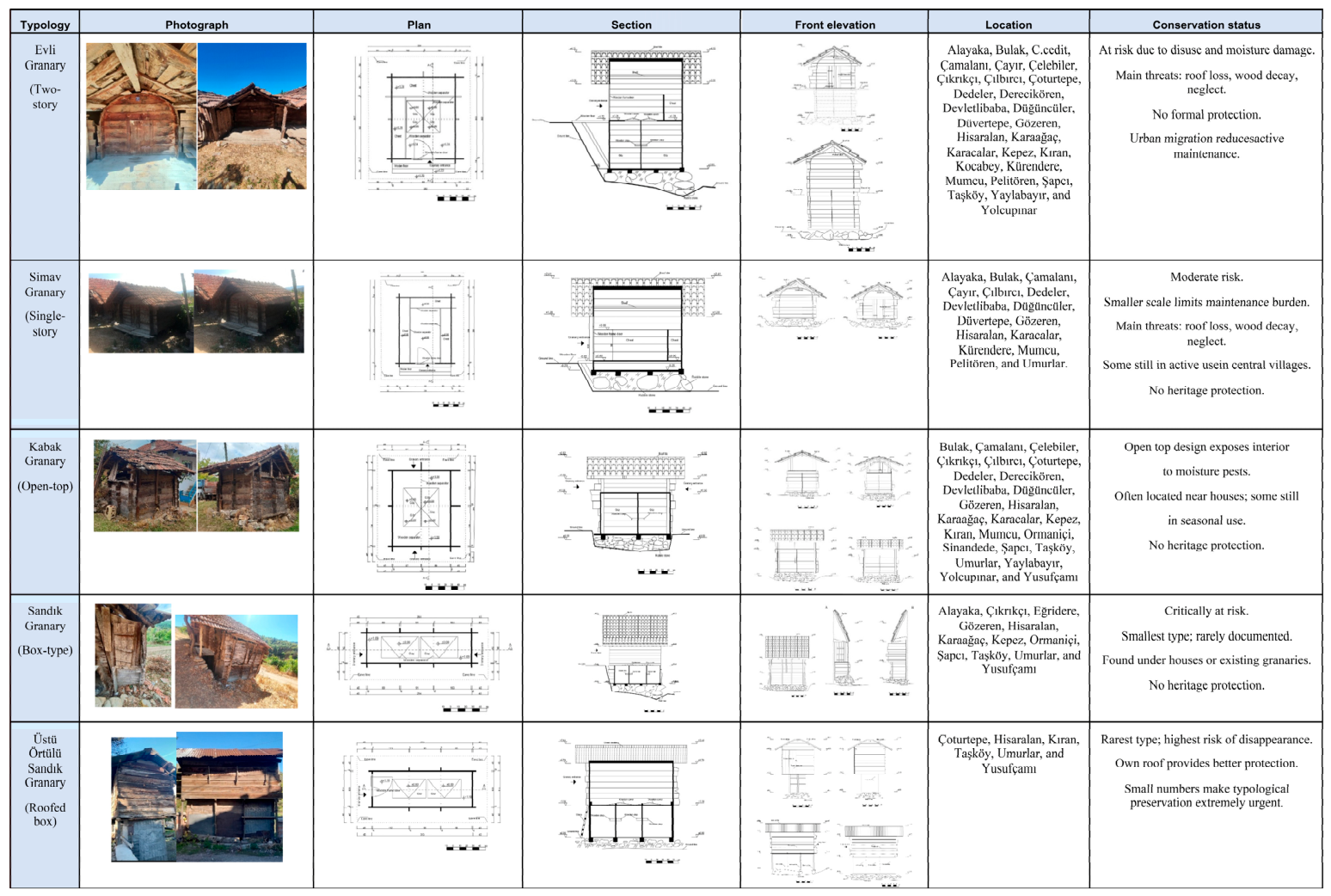
A graphic summary table visually synthesizing all five granary typologies has been prepared (Figure 9). Such a table, presenting for each type a representative photograph, plan, section and elevation, location within the district, and preservation status, will serve as an effective communication tool by directly linking typological findings to RQ2 and facilitating comparative analysis. The preparation of this synthesis table is important as a priority output for future dissemination and stakeholder engagement.

4.2.1. Evli Granary

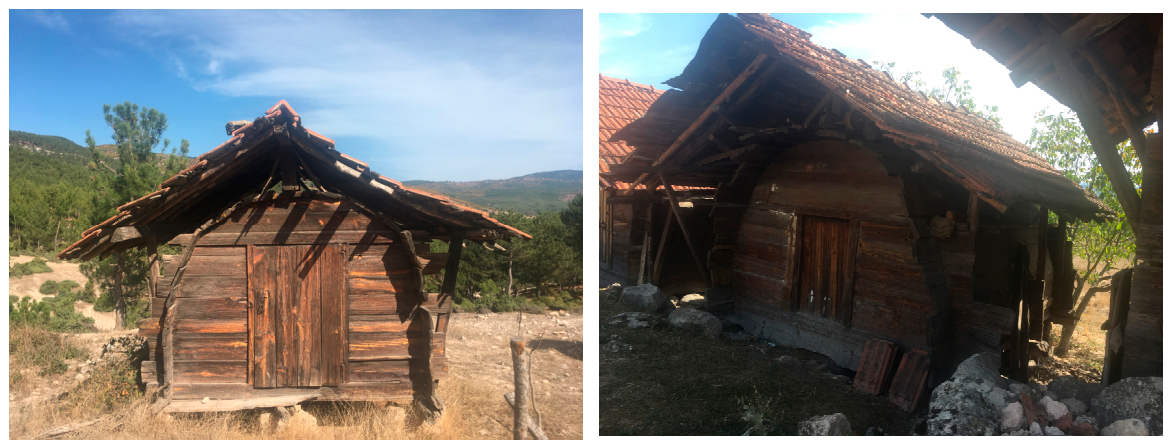
The “evli granary” is a type of two-story, large grain granary common in the rugged, mountainous neighborhoods east of Sındırgı. It is most commonly called “evli granary”; it is also known as “tam granary” and “büyük granary” (Figure 10). In this study, it will be referred to as the “evli granary”.
There are a total of 643 granaries in 28 neighborhoods, including Alayaka, Bulak, C.cedit, Çamalanı, Çayır, Çelebiler, Çıkrıkçı, Çılbırcı, Çoturtepe, Dedeler, Derecikören, Devletlibaba, Düğüncüler, Düvertepe, Gözeren, Hisaralan, Karaağaç, Karacalar, Kepez, Kıran, Kocabey, Kürendere, Mumcu, Pelitören, Şapcı, Taşköy, Yaylabayır, and Yolcupınar. Granaries can be located under one roof in one, two, or three levels (Figure 11).
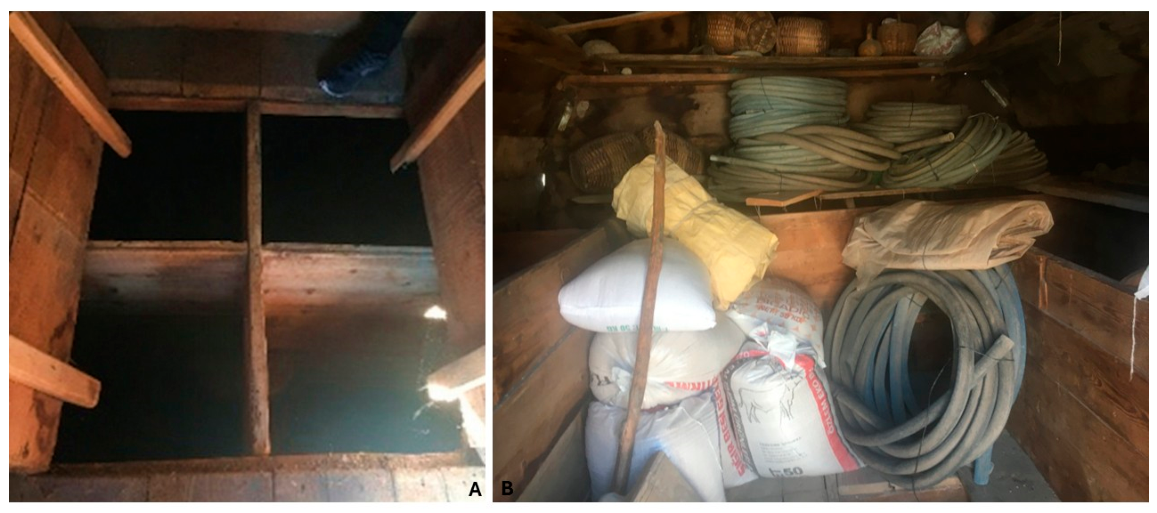
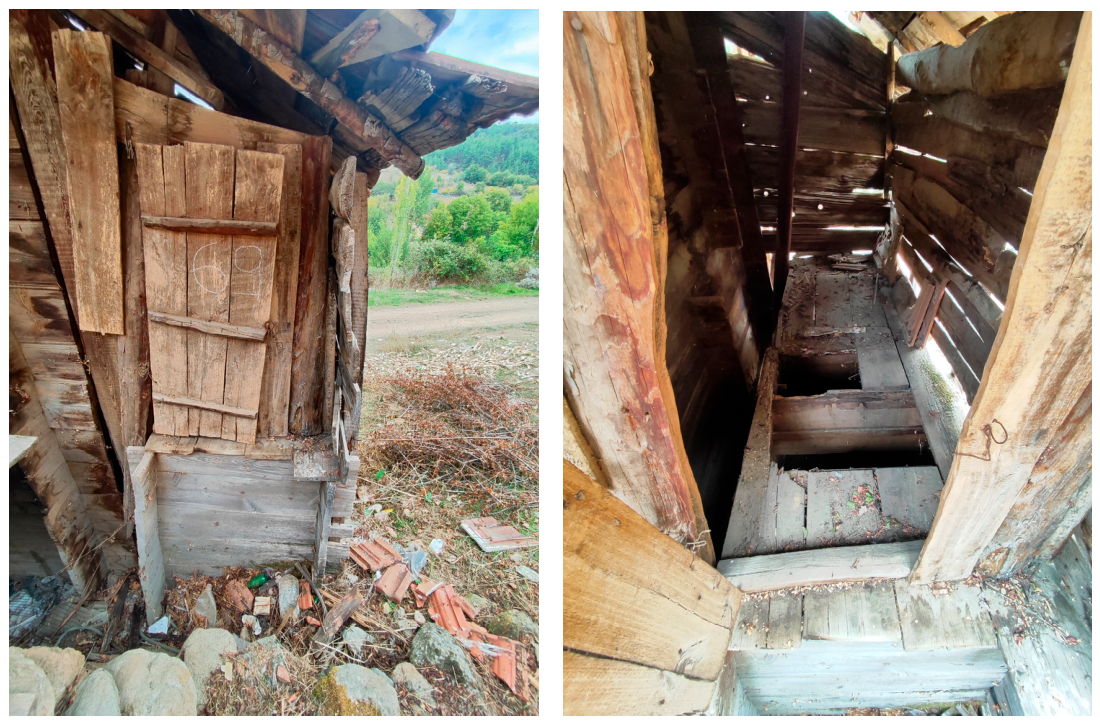
The two-story granaries have hatches at the entrance leading to a lower level. This lower level is divided into two, three, or four sections, depending on the individual’s needs. The section labeled “göz” (Figure 12A). The entrance area of the two-story granary also has wooden partitions. These partitions contain crops, vegetables, and fruits harvested from the fields and dried.
Additionally, surplus quilts, mattresses, and, if there is a girl of marriageable age in the house, her dowry are also stored in this area (Figure 12B).
Below is a plan (Figure 9), a section (Figure 9), and views (Figure 9) of the granary.

4.2.2. Simav Granary

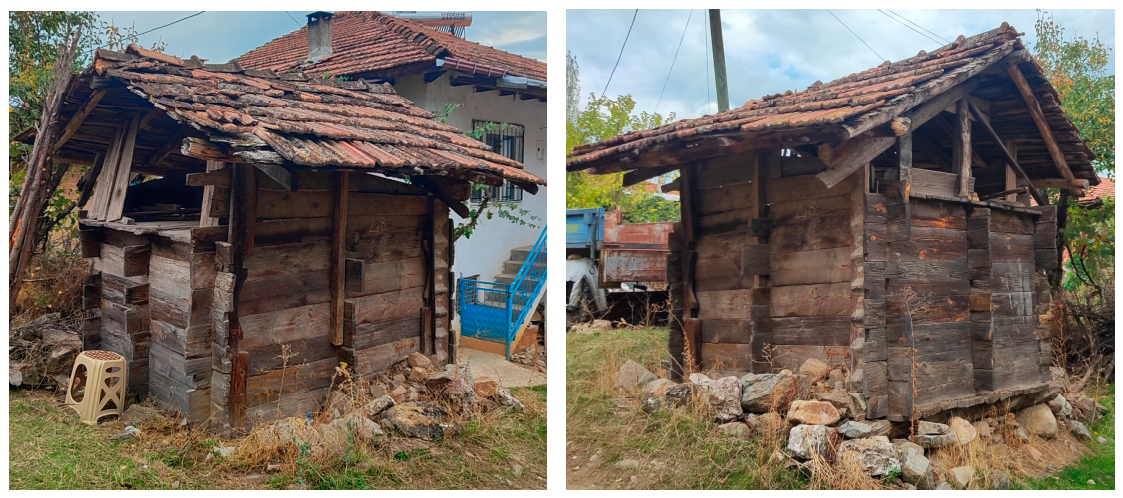
As one moves from mountainous, rugged regions to flatter areas and villages closer to the center, the need for storage decreases, reflected in the smaller size of the granaries. In settlements near the center of Sındırgı, transporting produce to the market or obtaining supplies is easier than in mountain villages. Therefore, the type of granary seen in villages near the center is mostly single-story and is known as a “half-granary” or “Simav granary.” This type does not include the lower section where grain is stored; it only has an upper floor. The name “half” comes from this structural difference (Figure 13). The name “Simav granary” derives from its resemblance to the granaries in the Simav region of Kütahya.
There are a total of 472 granaries in 16 neighborhoods: Alayaka, Bulak, Çamalanı, Çayır, Çılbırcı, Dedeler, Devletlibaba, Düğüncüler, Düvertepe, Gözeren, Hisaralan, Karacalar, Kürendere, Mumcu, Pelitören, and Umurlar.
Below is a plan (Figure 9), a section (Figure 9), and views (Figure 9) of the granary.

4.2.3. Kabak Granary

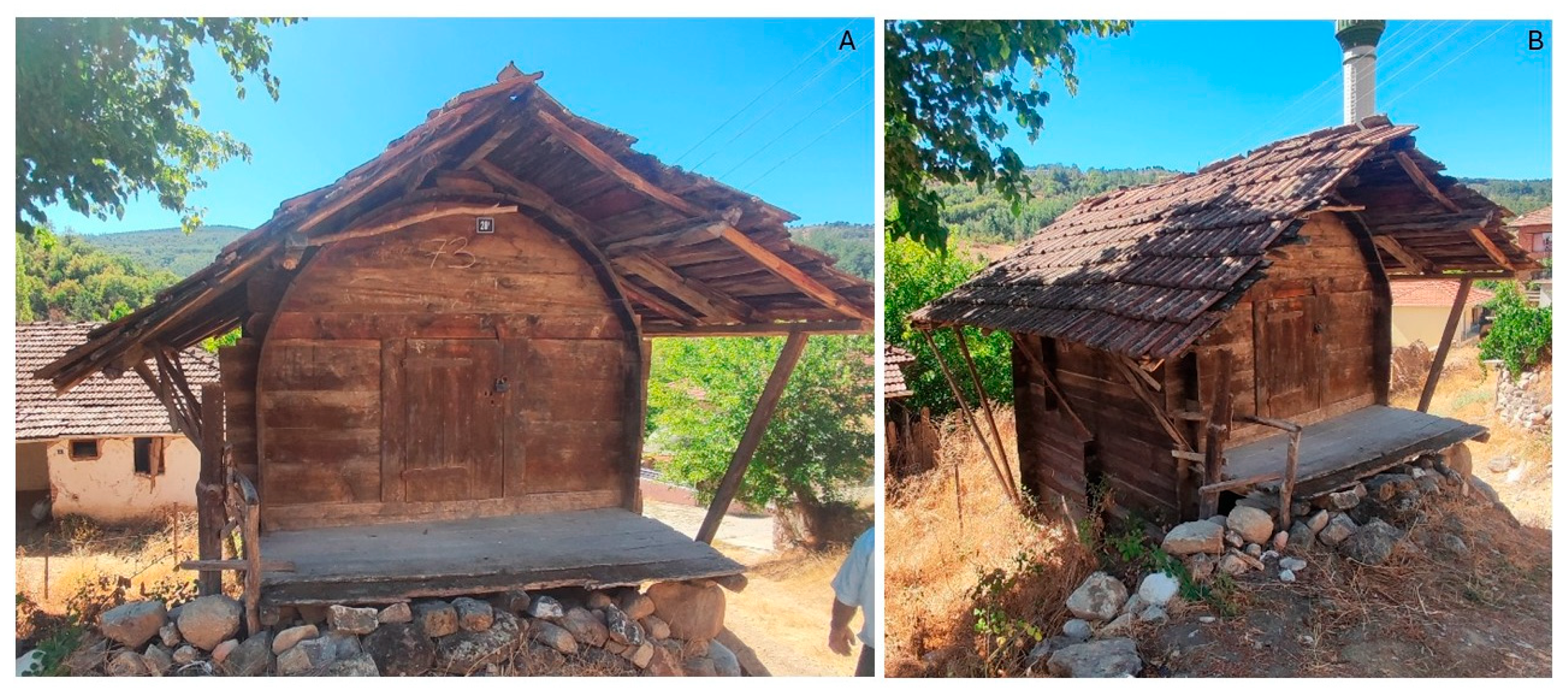
The most common and smallest type of granary in the lowland villages near the city center is the “kabak granary.” Unlike granaries with houses, this type does not have an upper floor; only the ground floor is used. The open top gives it its name, “kabak.” Due to its small size, it is easily located and therefore more often situated closer to houses (Figure 14).
There is a total of 192 granaries in 25 neighborhoods: Bulak, Çamalanı, Çelebiler, Çıkrıkçı, Çılbırcı, Çoturtepe, Dedeler, Derecikören, Devletlibaba, Düğüncüler, Gözeren, Hisaralan, Karaağaç, Karacalar, Kepez, Kıran, Mumcu, Ormaniçi, Sinandede, Şapcı, Taşköy, Umurlar, Yaylabayır, Yolcupınar, and Yusufçamı.
Below is a plan (Figure 9), section (Figure 9), and views (Figure 9) of the granary.

4.2.4. Sandık Granary

Sandık granaries are the smallest type of granary. They are rectangular in shape and generally have three compartments. They are located under houses or under the roofs of existing granaries (Figure 15).
They are preferred in places with less product to store. There is a total of 55 of them in 12 neighborhoods: Alayaka, Çıkrıkçı, Eğridere, Gözeren, Hisaralan, Karaağaç, Kepez, Ormaniçi, Şapcı, Taşköy, Umurlar, and Yusufçamı.
Below is a plan (Figure 9), a section (Figure 9), and views (Figure 9) of the granary.

4.2.5. Üstü Örtülü Sandık Granary

The üstü örtülü sandık granary, rectangular in shape and with three compartments, has the same dimensions as the standard sandık granary. The difference between a üstü örtülü sandık granary and a standard sandık granary is that the üstü örtülü sandık granary has its own roof. The space between the roof and the granary is closed with wooden elements, and a door is added. Although it resembles a house-style granary with its two-story appearance, it is a completely different type of granary, thanks to its smaller size and the absence of a vaulted form. This type of granary is generally located near the owner’s house, in their garden (Figure 16).
There is a total of 49 üstü örtülü sandık granaries in 6 neighborhoods: Çoturtepe, Hisaralan, Kıran, Taşköy, Umurlar, and Yusufçamı.
Below is a plan (Figure 9), a section (Figure 9), and views (Figure 9) of the granary.

5. Results and Discussion

In Sındırgı and its surroundings, which have a Mediterranean transitional climate, black pine trees are commonly found in semihumid forests [39]. Due to its abundance and durability, black pine wood is used in the construction of granaries. Although trade activities have recently become the main source of livelihood for local people, their previous main sources were agriculture and animal husbandry [55]. Granaries used for storing food are therefore an important part of village life, and their material and functional characteristics must be understood as a reflection of this socio-economic context. While some neighborhoods no longer have granaries, there are villages where they are still frequently seen and actively used, a contrast that itself warrants discussion in terms of conservation urgency.
The granaries are either single-story or two-story. Single-story granaries consist of a single space with compartments designed for grain storage. While granaries share the same materials, technology, and function, their size and number of stories vary depending on land structure, agricultural production quantity, and storage needs. The most important factor in determining the size of the granary is the amount of land owned. This scaling logic of more produce that requires larger storage is itself an expression of a sustainable, demand-driven building culture, a point discussed further in Section 5.1 and Section 5.2. The sustainability of granaries can be evaluated not only by the materials used, but also by how the structure’s relationship with its environment is reflected in the design. In this context, the Sındırgı granaries are discussed within the framework of sustainable design criteria for traditional granary structures, encompassing: “spatial organization,” “building form design”, “structural element design, “material use and conservation, “design with nature, “urban design area planning,” and “nature interaction”.

5.1. Spatial Organization

Spatial layout and building scale are key variables determining sustainability performance. Increasing building size intensifies environmental impacts by increasing material use and energy demand during operation. Conversely, compactly designed and functionally balanced plan schemes allow for more efficient use of resources [67]. In this context, the surface-to-volume ratio is a critical indicator; changes in it directly affect heat losses and, consequently, energy consumption. Therefore, building form is not merely a formal preference in sustainability assessments, but a fundamental design decision that determines performance. On the other hand, spatial organization also influences economic efficiency and social inclusion through parameters such as accessibility, circulation layout, and usage intensity, making the multi-dimensional nature of sustainability visible [68].
The presence of granary in different scales and distributions across neighborhoods, depending on need, stems from the need for spatial organization. The table shows varying presence and density of “Simav granary,” “Evli granary,” “Kabak granary,” “Sandık granary,” and “üstü örtülü sandık granary” in each neighborhood. This diversity demonstrates that storage is not necessarily tied to a single large building scheme within the settlement; instead, it reflects a spatial organization approach that structures storage capacity at the neighborhood level. Thus, instead of unnecessary expansion, space utilization becomes more efficient by selecting types that align with the neighborhood’s storage needs.
Furthermore, the fact that high-capacity types such as “household storage” are more prevalent in some neighborhoods and less so in others shows that the preference for establishing storage centrally or more dispersed within the settlement fabric supports sustainability. In contrast, the presence of smaller alternative types (Simav, kabak, sandık, and üstü örtülü sandık) across different neighborhoods indicates that the storage function can be adapted to the settlement in ways related to housing. This situation contributes to sustainability because it reflects a settlement logic that reduces the need for repeated intervention and reinstallation throughout the lifespan of the granaries.

5.2. Building Form Design

In the Sındırgı granaries, the building form is not merely an aesthetic choice, but rather a performance decision directly related to climate, topography, and storage capacity. The energy performance of buildings is not limited solely to physical characteristics but is also determined by environmental conditions. In energy-efficient building and settlement design, parameters such as building typology, distance between buildings, building height, aspect ratio, settlement form, orientation, and density significantly influence energy consumption [69,70]. The size of the form, the number of floors, and the mass ratio vary according to the quantity of products, the lifespan of the building, and the intensity of needs at the neighborhood scale. Higher-volume or two-story solutions seen in sloping areas address the need to increase capacity within a limited floor area, while the preference for lower, simpler masses in flat areas limits unnecessary building growth. This differentiation emphasizes a contextual form-production approach rather than a uniform form approach.
In the case of Sındırgı, typological diversity demonstrates that this risk is controlled at the local level and that the form is determined proportionally to the functional requirement. Therefore, the building form is designed to achieve a balance among low intervention, sufficient capacity, and sustainability.
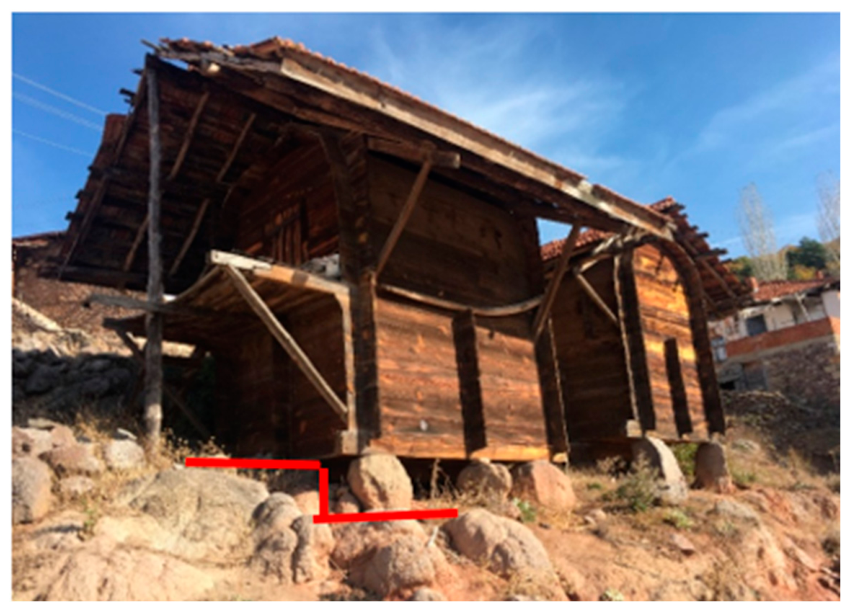
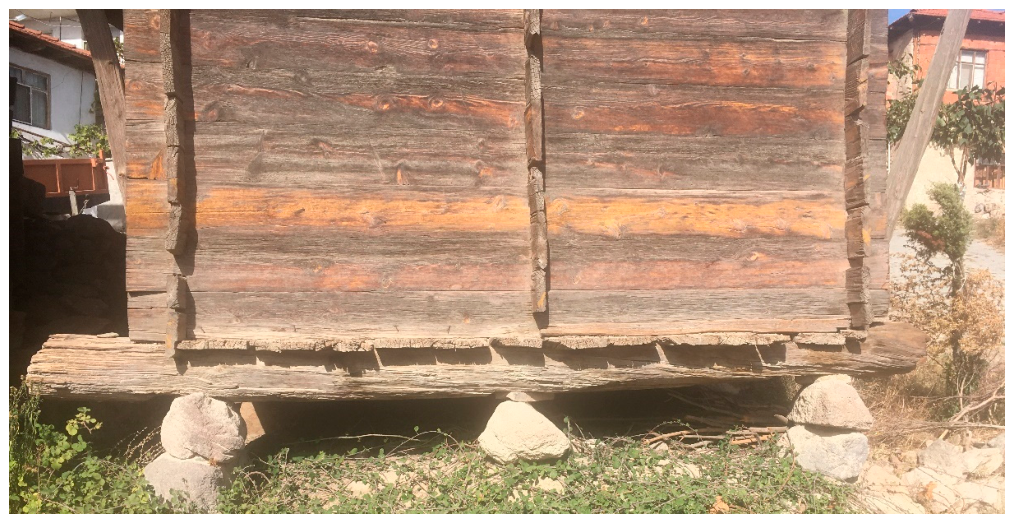
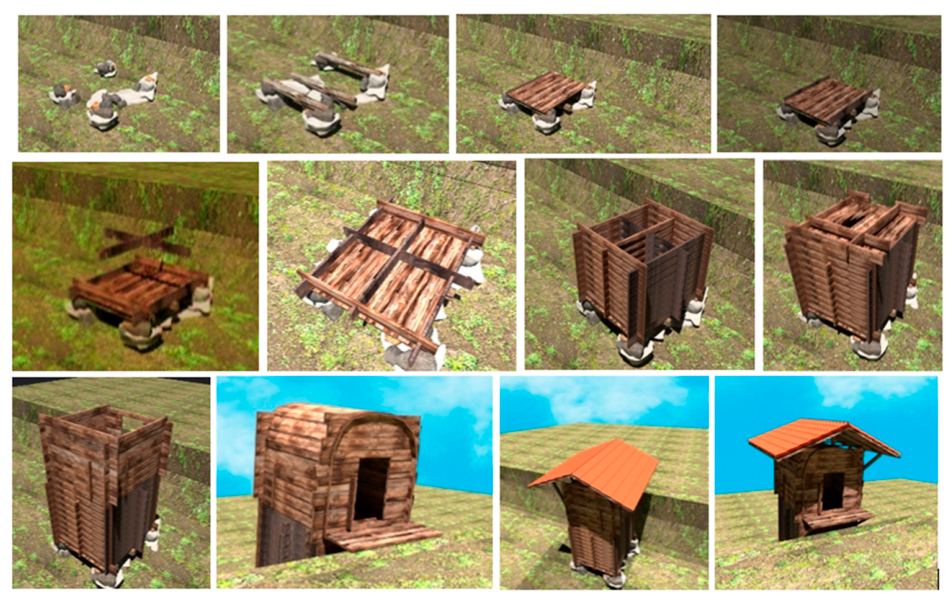
When starting construction of a granary, the first step is to select a location based on the structure’s needs. This location can be chosen to facilitate easy access from the fields, such as a row of buildings at the neighborhood entrance, a cluster in the neighborhood square, or near houses. After selecting the location, the granary’s floor is raised by approximately 30–70 cm using rubble stones to prevent moisture from the ground (Figure 17). This also protects the products inside from pests and rodents. Raising the floor by 30–70 cm with rubble stones during granary construction reduces the moisture load on the wood, decreasing the likelihood of decay; this directly contributes to the structure’s durability, service life, and sustainability. It is emphasized that wood decay depends on the interactions among temperature, relative humidity, and wood moisture content, and that moisture is a threshold variable. The literature emphasizes that wood decay develops due to the interaction of temperature, relative humidity, and wood moisture content, with moisture being a threshold variable [71,72,73]. Generally, they are built of roughly hewn stones; sometimes, granary construction begins on a brick wall. These stones, which they call rough stone or flint, also help to level out variations in the ground.
Wooden planks, which they call “yatak,” are placed on top of the stones. Spaces are created in these “yatak” to accommodate the wall planks that will be placed on top (Figure 18). Additionally, the wooden planks forming the granary floor are laid in rows on top of the yatak. The thickness of the wooden planks in the rows varies between 5 and 10 cm (image). To create staggering in the side wall planks above the yatak, the first outer wall plank and the outer wall directly opposite it are made shorter. While the maximum dimensions of the planks are generally between 18 and 35 cm, the plank of the first outer wall above the yatak is chosen to be no more than 20 cm to create staggering. The granary walls are not constructed separately as in residential buildings. The structure is raised vertically by placing wooden elements in layers along the four outer walls, starting from the bed level. The critical point in the form design is managing thermal behavior through the surface-volume balance. More compact masses can limit seasonal heat losses by reducing the outer shell area, thereby contributing to more stable storage conditions [74,75]. As the outer walls rise, the compartments within the granary are separated. These compartments are formed by joining timbers with the dovetail joint, just as with the outer walls. These sections, called “göz”, are visible from the outside thanks to the protruding wooden elements.
The granaries, constructed from Scots pine wood approximately 3 to 5 cm thick and measuring 2.00–2.60 m × 3.00–3.50 m, are single or double-story. In areas with sloping terrain, the lower floor of two-story granaries is below ground level, with access via a few steps or at ground level. Grains are stored in the lower floor (Figure 19). The most distinctive feature that sets Sındırgı granaries apart from others is the vaulted form, which begins to develop on the second floor. Midway through the second floor, the side wall timbers are angled to create the vaulted structure. The sloped design prevents rainwater from accumulating on the surface, enabling rapid, controlled drainage. This reduces the exposure of structural elements to water and limits moisture-related material deterioration. Thus, the lifespan of the structure is extended, maintenance and repair needs are reduced, and resource consumption is decreased. Therefore, sloping forms directly contribute to building sustainability through water management and durability performance [76,77].
The roof is one of the most important components of the building envelope and serves as the first line of defense, protecting the structure from climatic conditions such as rain, snow, and wind. The primary function of the building envelope is to control external environmental loads, and water penetration into building elements is a decisive factor in material degradation [78]. Prolonged exposure to water increases hydrological effects, accelerates biological degradation, and reduces material strength, negatively impacting the service life of the structure [73].
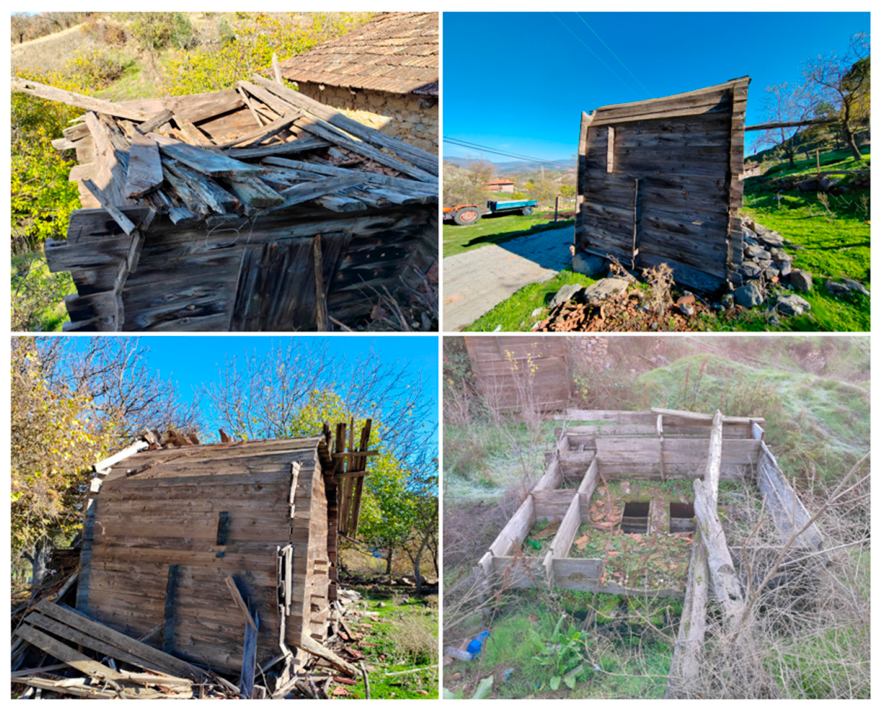
In a comparative assessment, it was found that, while all other variables remained constant, barns without roofs degraded more quickly in terms of material and structural performance (Figure 20).
In conclusion, the roof is not merely a passive element with a top covering; it is an active protection system that supports structural durability and reduces the need for maintenance and repair. Shortening the contact time between water and building materials extends the materials’ life and preserves their performance. These features make the roof one of the fundamental components in a sustainable building approach [79,80].

5.3. Structural Element Design

The structural and complementary elements of the granaries in Sındırgı reflect a balance between durability and local construction practices. For the continuity of the storage function, structural decisions such as contact with the ground, moisture control, load-bearing structure stability, and proper opening proportions are decisive. In this context, structural elements should be considered not only as load-bearing technical components but also as performance components that affect product protection, the structure’s maintenance cycle, and operational safety [81].
The variation in granary types across neighborhoods suggests that the structural element design is also scaled to capacity and usage intensity. In larger types, the regular and repeatable nature of the load-bearing system increases long-term stability by balancing load transfer; in smaller types, simpler structural solutions offer the advantages of rapid production and minimal intervention. This approach supports the principle of using only as many structural elements as needed for each type [82,83].
In conclusion, the success of structural design lies not in increasing complexity; the key is to establish a system suitable for local conditions, repairable, and capable of maintaining its functionality throughout its lifespan.

5.4. Material Use and Conservation

Material use in the Sındırgı granaries should be interpreted within a conservation framework that considers both the economic consumption of resources and the long-term performance of the structures. Thanks to typological diversity, the construction of structures at a scale appropriate to each neighborhood’s storage needs prevents excessive material use. Stronger, more durable material decisions are prioritized in areas requiring large-volume storage, while simpler, more limited configurations may suffice in lower-capacity units. This indicates that material decisions are not standardized but rather optimized to meet specific needs.
Black pine wood was used in the construction of the Sındırgı granaries. Due to its rapid growth and wide distribution area, black pine can be considered a continuously renewable wood source. When produced using local forestry practices, it reduces energy consumption and consequently carbon emissions because the need for long-distance transportation decreases [84]; this makes black pine a material compatible with sustainability goals in terms of both the controlled use of natural resources and the reduction in greenhouse gas emissions [85].
In terms of conservation, the main gains are durability and improved maintenance management, which reduce the frequency of building renovations. Appropriate material selection extends repair intervals by providing resistance to climate and usage conditions, thereby reducing both the economic burden and the demand for new materials. Furthermore, the continued functionality of existing granary stock strengthens the “maintenance-adaptation” cycle instead of the “demolish and rebuild” cycle. Thus, material use ceases to be merely a technical decision at the time of construction and becomes a strategic sustainability tool that determines the settlement’s long-term environmental impact.

5.5. Design with Nature

The fact that granary types are not designed according to a single standard scheme but rather differentiated by local variables such as topography, production density, flowering areas, and storage demand in the neighborhood indicates that design decisions are made in conjunction with these factors. Furthermore, the distribution of granaries across neighborhoods with varying densities and typologies demonstrates the creation of a storage system sensitive to settlement explosions and social dynamics. This distribution model ensures spatial flexibility by spreading storage across varying sub-scales according to demand and production structure, rather than concentrating it in a single center [86].
When considering the concentration of high-capacity types in specific focal points alongside the integration of smaller-scale types into the residential fabric, it becomes clear that the system offers a hybrid design capable of operating on both central and local scales. Furthermore, the preference for larger, two-story granaries in mountainous and rugged areas allows for a form suited to the terrain and the storage needs of production. Conversely, as storage needs decrease towards flatter areas and the city center, a shift to simpler, smaller-volume types (Simav granary, kabak granary, and crate) supports scale harmony, reducing unnecessary intervention in nature. This approach has the potential to indirectly reduce both the amount of materials used in construction and the maintenance and repair burden [87]. Thus, the location and type selection of granaries align with sustainability goals, harmonize with the natural environment, require minimal intervention, and have a long lifespan.

5.6. Urban Design Area Planning

In the Sındırgı example, the varying densities of granaries across neighborhoods demonstrate the adoption of a multi-focal organizational structure in area planning, moving away from a single-centered storage approach. The gradual distribution of storage capacity within the settlement balances the access network and prevents the excessive concentration of functional loads at specific points. Therefore, the granary system should be understood not merely as the sum of building types, but as a planning infrastructure that also considers the division of labor between neighborhoods, circulation relationships, and service radii.
The topography and location of the land are the most important factors in choosing a location for granaries. It needs to be a place where harvested crops can be easily stored and within a suitable distance from the house, allowing access to the stored products whenever needed. Choosing a location suitable to the topography, ensuring proximity to each other, and providing shade are important for heat control [88,89]. Granaries should be positioned according to the wind direction, allowing humid air to be expelled by the wind and drier air to be drawn in. This helps maintain relative humidity [90,91].
The concentration of high-capacity granaries in specific locations ensures logistical efficiency during periods of critical product accumulation, while integrating smaller-scale types into the residential fabric meets daily storage needs on-site. This dual structure strikes a balance between centralized efficiency and local accessibility. From an area-planning perspective, this balance keeps demand for new construction under control, reduces pressure for transformation, and preserves the continuity of the existing fabric. As a result, the Sındırgı granary system offers a strong example of how functional distribution can be designed in a flexible, scalable, and sustainable manner in rural-urban transition areas.

5.7. Nature Interaction

The granary layout in Sındırgı reveals how human-nature interaction is reflected in space through daily production practices. The diversification of storage units according to product type, seasonal cycle, household scale, and neighborhood usage habits demonstrates that the built environment operates according to ecological rhythms. Here, interaction should be understood not only as physical proximity but also as a relational order shaped by time, frequency of use, and the flow of production and consumption. Within this order, the granary is not a passive storage box but an active interface carrying knowledge of local life.
Another important dimension in terms of interaction with nature is the adaptability of the storage function to the settlement. The coexistence of different types shows that a single solution is not imposed across all conditions; rather, alternatives are kept in play as environmental and social conditions change. This flexibility strengthens structural continuity by reducing the need for major interventions throughout the lifespan. Furthermore, maintaining the production area housing storage relationship helps balance energy and labor costs at the local level. Thus, the Sındırgı granaries acquire the character of a holistic system that supports interaction with nature not only in terms of environmental performance but also of cultural continuity and social resilience. When the sustainability of traditional grain granaries is evaluated within the framework of seven ecological design criteria, it becomes evident that these structures embody a multilayered ecological reasoning. This reasoning minimizes environmental impact and resource consumption across a wide spectrum from spatial organization to material selection, from integration with nature to urban planning principles while prioritizing reparability and long service life and adapting to local topography and production conditions.
Table 3 presents the sustainability assessment of the identified granary typologies evaluated across seven ecological design criteria.

6. Conclusions

This study documented and assessed the traditional granaries of Balıkesir-Sındırgı through a systematic field survey covering 33 of the district’s 75 neighborhoods. A total of 1411 granaries were identified and classified into five typological categories: evli, Simav, kabak, sandık, and üstü örtülü sandık granaries. Their spatial, structural, material, and ecological characteristics were subsequently evaluated against a framework of seven sustainability design criteria derived from the ecological and sustainable architecture literature. The findings are summarized below in relation to the three research questions that guided the study.
In response to RQ1 concerning the current state of preservation, the main factors of deterioration, and the physical and environmental conditions necessary to prevent col-lapse the study found that the sustainability of the granaries rests on a set of interrelated design decisions rather than any single factor. These include placement on elevated stone bases to limit soil moisture exposure, sloped roof forms that ensure rapid water drainage, the use of locally sourced black pine wood for its durability and renewability, and the maintenance of active use cycles that keep repair knowledge alive. Conversely, the most critical vulnerabilities were identified as roof failure, moisture accumulation, abandonment, and the declining pool of craftsmen with knowledge of traditional joinery techniques. Sustainable conservation of at risk granaries therefore requires not only physical intervention but also a process-oriented framework that integrates monitoring, maintenance, education, and community participation.
In response to RQ2 concerning the most common typologies and their relationship to settlement patterns, production practices, and usage the evli and Simav types were found to be the most prevalent, concentrated respectively in mountainous inland neighborhoods where storage demand is highest and in settlements closer to the district center where smaller-scale storage suffices. The kabak, sandık, and üstü örtülü sandık types of function as smaller, complementary units distributed across a wider range of neighborhoods. This typological diversity is not incidental; it reflects a demand-responsive, spatially adaptive building culture in which storage capacity is scaled to land ownership, agricultural output, and topographic conditions. A visual typological synthesis presenting the plan, section, and preservation status of each type is proposed as a communication tool to make these distinctions accessible to non-specialist audiences and conservation planners alike.
In response to RQ3 concerning the sustainability of granaries across spatial, structural, material, and ecological dimensions, and their role in intergenerational cultural transmission the analysis across all seven criteria confirms that the Sındırgı granaries embody a coherent and performative sustainable design logic. Spatial organization avoids overbuilding by distributing storage across neighborhood subscales. Building form is calibrated to topography and capacity rather than imposed uniformly. Structural element design uses repairable timber joint systems that prioritize longevity over complexity. Material choices favor a locally renewable wood source with low transportation impact. De-sign with nature is reflected in the settlement’s sensitivity to terrain, shade, wind direction, and proximity to fields. Urban planning considerations are evident in the multifocal distribution of storage infrastructure across the settlement. Finally, the granaries sustain a living relationship with nature through their integration into seasonal production and consumption rhythms. Beyond these physical dimensions, the granaries function as knowledge environments in which construction techniques, woodworking skills, and rural life practices are transmitted across generations. Their disappearance would represent not only the loss of physical structures but the erosion of local technical knowledge and cultural memory. The proposed conservation framework comprising typology-based inventory, performance-oriented maintenance, local knowledge transfer, and continuity of use is applicable not only to Sındırgı but to comparable rural granary heritage across the region.

7. Recommendations

Based on the research findings, the following recommendations have been developed to strengthen the preservation and sustainability of the Sındırgı granaries:
Typology-based conservation prioritization should be implemented.
An emergency response program focusing on roof, water, and moisture should be implemented. Since water is the primary factor accelerating deterioration, the first priority should be given to roof integrity, water drainage, and the prevention of ground moisture.
A periodic maintenance and monitoring system should be established.
Structural elements, timber joints, roof details, stone base, and ventilation should be regularly inspected at least once a year using checklists.
The documentation and transmission of traditional construction knowledge should be ensured.
Technical knowledge should be recorded through oral history interviews with local craftsmen, detailed drawings, and application videos; master-apprentice workshops for younger generations should be supported.
Repair interventions should be compatible with the original techniques. Instead of inappropriate modern interventions, reversible, traditionally compatible repair methods should be adopted, and the local context should be considered when selecting materials.
Continuous use should be central to the conservation policy. Since the complete disuse of granaries accelerates deterioration, alternative uses for agricultural granaries or local production should be encouraged.
Inventorying, preparation of technical guides, pilot repair applications, and training activities should be carried out in cooperation with institutions such as the municipality and the Ministry of Culture.
A regional database should be created for rural heritage.
The data and evaluation method developed in Sındırgı can be extended to the whole of Balıkesir and similar regions to produce comparative conservation strategies.
The abandonment of granaries should be prevented by developing local conservation status, incentive mechanisms, and maintenance support programs.
Future research should be supported by performance measurements. Current findings should be strengthened with quantitative data from temperature-humidity monitoring, material strength analysis, maintenance costs, and life cycle assessments.

Author Contributions

Conceptualization, Ş.E. and U.Y.; methodology, Ş.E. and U.Y.; validation, Ş.E. and U.Y.; formal analysis, Ş.E. and U.Y.; investigation, Ş.E. and U.Y.; resources, Ş.E. and U.Y.; data curation, Ş.E. and U.Y.; writing—original draft preparation, Ş.E. and U.Y.; writing—review and editing, Ş.E. and U.Y.; supervision, U.Y.; project administration, Ş.E. and U.Y. All authors have read and agreed to the published version of the manuscript.

Funding

This research received no external funding.

Institutional Review Board Statement

The study was conducted in accordance with the Declaration of Helsinki, and approved by the Yildiz Technical University Social and Human Sciences Research Ethics Board (Protocol code 2026.01 and date of 1 January 2026).

Informed Consent Statement

Informed consent was obtained from all subjects involved in the study.

Data Availability Statement

The original contributions presented in this study are included in the article. Further inquiries can be directed to the corresponding author.

Conflicts of Interest

The authors declare no conflicts of interest.

References

  1. Karpuz, H. Serander’ And ‘Loft’: Two Equivalent Structures in Turkish and Norwegian Folk Architecture. METU J. Fac. Archit. 1999, 19, 71–82. Available online: https://jfa.arch.metu.edu.tr/tr/yazar/hasim-karpuz (accessed on 10 February 2026).
  2. Ribeiro, A.S.F. Património Vernacular Construído-O Beiral, o Espigueiro e a Eira: Formas, Usos e Contextos. Master’s Thesis, Faculdade de Letras da Universidade do Porto, Porto, Portugal, 2016. [Google Scholar]
  3. Sağıroğlu Demirci, Ö.; Balkoca, Ö.; Güngör, C. Auxiliary Spaces in Rural Production: Grain Silos. Online J. Art Des. 2023, 11, 264–279. Available online: https://adjournal.net/articles/111/11117.pdf (accessed on 10 February 2026).
  4. Açikel, M.; kaynakçi Elinç, Z. Examination of storage units in terms of the design of space and furniture in traditional turkish dwelling. Z. Welt Türken/J. World Turks 2022, 14, 291–312. [Google Scholar] [CrossRef]
  5. Ardahan, V. Some Words Used in the Local Dialect of Ardahan. 2025. Available online: https://ardahan.gov.tr/ardahan-da-yoresel-dil-de-kullanilan-bazi-kelimeler (accessed on 10 February 2026).
  6. Erol, N.T.C. Selçuk University: Konya, Türkiye, 2014. Available online: https://acikerisim.selcuk.edu.tr/items/626effc8-aa62-44a8-9ffb-743f108e0a93 (accessed on 10 February 2026).
  7. Aitta Granary. Available online: https://www.hankahomesteadmuseum.org/buildings/granary-aitta/ (accessed on 15 February 2026).
  8. Sweedish Granary. Available online: https://explorecumberlandnj.com/cumberland-historic-sites/swedish-granary/ (accessed on 15 February 2026).
  9. Küçük, N. From Lycia to Teke Province, from cedar to warehouse: The story of Antalya wooden granaries. Cedrus 2022, 10, 401–418. [Google Scholar] [CrossRef]
  10. Felek, S. Serender, a type of traditional architecture from the Eastern Black Sea region, and similar structures from around the world. Karadeniz Incel. Derg. 2020, 14, 525–546. Available online: https://dergipark.org.tr/tr/pub/kid/article/729927 (accessed on 10 February 2026). [CrossRef]
  11. Yeşilyurt Tunç, Z. Review of Serender Structures in Trabzon and Reconstruction Recommendations. Master’s Thesis, Maltepe Üniversitesi, Istanbul, Türkiye, 2019. [Google Scholar]
  12. Özkan, H.N. Investigation of the Traditional Housing Fabric of Sindirgi, Balikesir, and Development of Recommendations for its Preservation. Master’s Thesis, Dokuz Eylül University, Izmir, Türkiye, 2023. Available online: https://avesis.deu.edu.tr/yonetilen-tez/e1784b0f-8845-4355-b0c8-a508f56283c2/balikesir-sindirgi-geleneksel-konut-dokusunun-incelenmesi-ve-korunmasina-yonelik-onerilerin-gelistirilmesi (accessed on 10 February 2026).
  13. Maraşlı, S.; Gündağ Arıkan, E. One Saw, One Hammer, One Hundred Boards, One Master: Wooden Granaries in the Villages of Sındırgı. Sanat Tarihi Derg. 2025, 34, 909–931. [Google Scholar] [CrossRef]
  14. Ağan, A.; Altıner, F. Determination of Cultural Landscape Values: Case of Sındırgı. In Proceedings of the 8th International Conference of Contemporary Affairs in Architecture and Urbanism (ICCAUA2025), Alanya, Türkiye, 8–9 May 2025. [Google Scholar] [CrossRef]
  15. Koç, S.N. Examination of the Rural Settlement Pattern and Conservation Proposals in Çoturtepe Village, Sindirgi, Balikesir. Master’s Thesis, Balıkesir Üniversitesi, Balikesir, Türkiye, 2024. Available online: https://acikerisim.balikesir.edu.tr/items/224d847b-4f6f-4728-984e-fd354561f18e/full (accessed on 10 February 2026).
  16. Correia, M.; Dipasquale, L.; Mecca, S. VERSUS: Heritage for Tomorrow Vernacular Knowledge for Sustainable Architecture; Correia, L.D.S.M.M., Ed.; Firenze University Press: Firenze, Italy, 2014. [Google Scholar]
  17. Turgut Gültekin, N.; Uysal, M. Area Definition in the Sustainability of Cultural Heritage: The Example of Taşkale Rock-Carved Grain Silos. Nwsa Acad. J. 2018, 13, 36–56. [Google Scholar] [CrossRef]
  18. Kaya, M. Granaries from Anatolian Culture to World Culture. Ege Geogr. J. 2020, 29, 321–344. Available online: https://dergipark.org.tr/tr/pub/ecd/article/783616 (accessed on 10 February 2026).
  19. Arikan, G.E. An Example of the Transmission of Cultural Memory: Wooden Barns in Sindirgi Villages. Master’s Thesis, Nevşehir Hacı Bektaş Veli Üniversitesi, Nevsehir, Türkiye, 2024. Available online: https://acikerisim.nevsehir.edu.tr/handle/20.500.11787/8906 (accessed on 10 February 2026).
  20. Baybo, S. The Wooden Granaries of Elmali as an Example of Rural Vernacular Architectural Heritage: Present Condition and Conservation Issues. Turk. Acad. Sci. J. Cult. Inventory 2025, 32, 251–276. Available online: https://dergipark.org.tr/en/pub/tubaked/article/1602576 (accessed on 10 February 2026).
  21. Best, E. Māori Storehouses and Kindred Structures: Houses, Platforms, Racks and Pits Used for Storing Food, Etc.; New Zealand Electronic Text Centre: Wellington, New Zealand, 2014. [Google Scholar]
  22. Karaman, S.; Okuroğlu, M.; Kızıloğlu, M.F.; Cemek, B. Planning of Apple Storage Facilities Suitable for the Climatic Conditions of Karaman Province. J. Agric. Nat. Sci. 2009, 2, 145–154. Available online: https://www.ijans.org/index.php/ijans/article/view/30 (accessed on 10 February 2026).
  23. Küçük, N. Antalya’s Historic Wooden Grain Silos. Bachelor’s Thesis, Akdeniz University, Antalya, Türkiye, 2020. Available online: https://www.academia.edu/74803934/Antalya_Tarihi_Ahs_ap_Tah%C4%B1l_Ambarlar%C4%B1 (accessed on 10 February 2026).
  24. Aşkın, G.D.; Aşkın, O. Integration of Digital Arts Into Spaces Restored by Imm Heritage. Sanat Tasarım Derg. 2025, 15, 338–358. [Google Scholar] [CrossRef]
  25. Council Of Europe. Cets 199—Council of Europe Framework Convention on The Value of Cultural Heritage for Society. 2025. Available online: https://www.coe.int/en/web/conventions/-/council-of-europe-council-of-europe-framework-convention-on-the-value-of-cultural-heritage-for-society-cets-no-199-translations (accessed on 25 February 2026).
  26. ICOMOS; IFLA. ICOMOS-IFLA Principles Concerning Rural Landscapes as heritage. International Council on Monuments and Sites. 2017. Available online: https://www.icomos.org/images/DOCUMENTS/Charters/GA2017_6-3-1_RuralLandscapesPrinciples_EN_adopted-15122017.pdf (accessed on 25 February 2026).
  27. Icomos Burra Charter. The Burra Charter: The Australia Icomos Charter for Places of Cultural Significance 1999: With Associated Guidelines and Code on The Ethics of Co-Existence; Australia Icomos: Melbourne, Australia, 1999. [Google Scholar]
  28. Christakis, K.S. Pithoi and Food Storage in Neopalatial Crete: A Domestic Perspective. World Archaeol. 1999, 31, 1–20. [Google Scholar] [CrossRef]
  29. Tanyaş, M.; Başkak, M. Classification of Warehouses from Different Perspectives. In Proceedings of the 1st National Logistics and Supply Chain Congress, Konya, Turkey, 10–12 May 2012; pp. 1–9. Available online: https://cdn.loder.org.tr/loder/production/uploads/files/2023/12/aac117595e970c0.pdf (accessed on 25 February 2026).
  30. Woodburn, J. Egalitarian Societies. Man 1982, 17, 431. [Google Scholar] [CrossRef] [PubMed]
  31. Gómez Martínez, V.; Ma, G.; Pellegrini, P.; Reimão Costa, M. Vernacular Architecture and Cultural Identity in Shrinking Rural Settlements. ACE Archit. City Environ. 2022, 17, 11389. [Google Scholar] [CrossRef]
  32. Li, E.; Hou, R.; Yu, J.; Niu, S.; Chen, X.; Han, B.; Zhang, P. Historical vicissitudes of grain storage environment of granaries in the North China Plain. J. Asian Archit. Build. Eng. 2024, 23, 220–244. [Google Scholar] [CrossRef]
  33. Zhang, F.; Yu, R.; Bischeri, C.; Liu, T.; Khoshbakht, M.; Vahdati, F.; Tedjosaputro, M. A Comparative Study: Vernacular Timber Construction Techniques of Iranian, Japanese, And Spanish Granary Structures. In Proceedings of the 57th International Conference of the Architectural Science Association, Gold Coast, Australia, 25–28 November 2026. [Google Scholar]
  34. Ekmekçi, M. A Group of Examples of Traditional Storage Spaces in Çavdarhisar; Bilgin Culture and Arts Publications: Ankara, Türkiye, 2016; Available online: https://www.academia.edu/40913287/Mustafa_Ekmekci_%C3%87avdarhisardaki_Geleneksel_Depolama_Mek%C3%A2nlar%C4%B1ndan_Bir_Grup_%C3%96rnek_A_SET_OF_SAMPLES_FROM_TRADITIONAL_STORAGE_PLACES_IN_%C3%87AVDARH%C4%B0SAR (accessed on 10 February 2026).
  35. Işler, B. Architectural Findings Regarding Agricultural Production of Karabel Setting in Middle Lycia. J. Turk. Stud. 2014, 9, 697–714. Available online: https://turkishstudies.net/turkishstudies?mod=makale_tr_ozet&makale_id=18200 (accessed on 10 February 2026). [CrossRef]
  36. Fairbairn, A.; Omura, S. Archaeological identification and significance of ÉSAG (agricultural storage pits) at Kaman-Kalehöyük, central Anatolia. Anatol. Stud. 2005, 55, 15–23. [Google Scholar] [CrossRef]
  37. Dizdar, S.İ.; Sönmez, N. Stone Rooms and Lantern Houses in Ottoman Civil Architecture in Istanbul. Megaron 2006, 2, 126–142. Available online: https://pdf.journalagent.com/megaron/pdfs/MEGARON-85547-ARTICLE-DIZDAR.pdf (accessed on 10 February 2026).
  38. Karabulut, K. Historical Development and Art Structures of Yusufeli’s Urban Fabric. Sosyal Bilimler Enstitüsü. Master’s Thesis, Van Yüzüncü Yıl University, Van, Türkiye, 2007. Available online: https://avesis.yyu.edu.tr/proje/c264ff02-3ba4-46e3-92f2-0a8aa0c85a8d/yusufeli-kent-dokusunun-tarihsel-gelisimi-ve-sanat-yapilari (accessed on 10 February 2026).
  39. Arslan, F. Settlements in Bigadiç and Sındırgı Districts. Doctoral Thesis, Ankara University, Ankara, Türkiye, 2013. [Google Scholar]
  40. Arslan, F.; Elibüyük, M. The Livestock Economy in Bigadic and Sindirgi. BalıkesirUniversity Balıkesir Univ. J. Soc. Sci. Inst. 2012, 15, 19–39. Available online: https://search.trdizin.gov.tr/tr/yayin/detay/224141/bigadic-ve-sindirgida-hayvancilik-ekonomisi (accessed on 10 February 2026).
  41. Sezgin, Y.; Aybek, S. Archaeological Treasures of Sındırgı; Aslan, F., Aksak, P., Zoğal, V., Üzülmez, M., Demir, E., Eds.; Faculty of Letters, Ege University: Izmir, Turkiye, 2018; pp. 3–14. Available online: https://www.academia.edu/36826819/S%C4%B1nd%C4%B1rg%C4%B1n%C4%B1n_Arkeolojik_De%C4%9Ferleri (accessed on 10 February 2026).
  42. Gürbıyık, C. Sındırgı with its Traditional Urban Fabric and Historical Buildings; Arslan, F., Aksak, P., Zoğal, V., Üzülmez, M., Demir, E., Eds.; Sındırgı in Light of Current Research (Proceedings Book); Ege University Publications: Izmir, Türkiye, 2018; pp. 137–153. Available online: https://www.academia.edu/36831930/Geleneksel_Kent_Dokusu_ve_Tarihi_Yap%C4%B1lar%C4%B1yla_S%C4%B1nd%C4%B1rg%C4%B1 (accessed on 10 February 2026).
  43. İBİŞ, S. A Research on Tourism Potential of Sındırgı and its Surroundings Within the Scope of Sustainable Tourism. Turk Tur. Arastirmalari Derg. 2018, 2, 26–40. [Google Scholar] [CrossRef]
  44. Bozkurt, S. The Meanings of Motifs Used in Traditional Turkish Carpet Art: A Semiotic Analysis of Sindirgi-Yağcibedir Carpets. Gümüşhane Univ. Fac. Commun. Electron. J. 2020, 8, 697–731. [Google Scholar] [CrossRef]
  45. Erkan, Z.E. Enrichment of Kaolin Ore in Döküştepe Location, Düvertepe Region, Sindirgi, Balikesir. Master’s Thesis, Dokuz Eylul University, Izmir, Türkiye, 2002. Available online: https://avesis.deu.edu.tr/yonetilen-tez/e3c96aac-6bf7-4af3-867e-200c29d08c32/balikesir-sindirgi-duvertepe-bolgesi-dokustepe-mevkii-kaolin-cevherinin-zenginlestirilmesi (accessed on 10 February 2026).
  46. Emel, P. Ecological Evaluation Methods in Ecological and Sustainable Architecture. Master’s Thesis, Çukurova University Institute of Science, Adana, Türkiye, 2017. Available online: https://tez.yok.gov.tr/UlusalTezMerkezi/tezDetay.jsp?id=BZxoO6Tj1B6vFgQm3UqQKA&no=8WOhWdSAxKVN6IjTMDIogA (accessed on 10 February 2026).
  47. Gültekin, A.B.; Alparslan, B. Ecological Building Design Criteria: A Case Study in Ankara. Gazi Univ. J. Sci. 2011, 24, 605–616. [Google Scholar]
  48. Gürel, J.; Irklı Eryıldız, D. Evaluation of Ecological Structures in Terms of Basic Design Criteria. PEYZAJ—Educ. Sci. Cult. Art J. 2021, 3, 1–27. Available online: https://dergipark.org.tr/tr/pub/peyzaj/article/896804 (accessed on 10 February 2026).
  49. Kim, J.-J.; Rigdon, B. Sustainable Architecture Module: Introduction to Sustainable Design. National Pollution Prevention Center for Higher Education; The University of Michigan: Ann Arbor, MI, USA, 1998; pp. 8–15. [Google Scholar]
  50. Zhong, W.; Schröder, T.; Bekkering, J. Biophilic design in architecture and its contributions to health, well-being, and sustainability: A critical review. Front. Archit. Res. 2022, 11, 114–141. [Google Scholar] [CrossRef]
  51. Van der Ryn, S.; Cowan, S. Ecological Design; Island Press: Washington, DC, USA, 1996. [Google Scholar]
  52. Acar, A.B. The Approach of Local People Living in Sındırgı District of Balıkesir to the Slow City Movement. Master’s Thesis, BalıkesirUniversity Institute of Social Sciences, Balikesir, Türkiye, 2017. Available online: https://acikerisim.balikesir.edu.tr/items/b4d3b762-7289-4074-b621-0eef5fe37ed5 (accessed on 10 February 2026).
  53. Özdem, F. Bitek Kent: Balıkesir; Balıkesir, D.F.G., Ed.; Yapı Kredi Yayınları: Istanbul, Türkiye, 2003. [Google Scholar]
  54. Gündoğdu, E.; Ozden, S.; Bekler, T. Kinematic and Seismotectonic Characteristics of the Vicinity of the Sındırgı Fault and Düvertepe Fault Zone: Western Anatolia (Türkiye). J. Adv. Res. Nat. Appl. Sci. 2020, 6, 378–395. [Google Scholar] [CrossRef]
  55. Sarıkaya, B. Sındırgı City Geography. Master’s Thesis, Marmara University Institute of Social SciencesIstanbul, Türkiye, 2020. [Google Scholar]
  56. Sensoy, S.; Demircan, M.; Ulupinar, Y.; Balta, İ. Climate of Türkiye; General Directorate of State Meteorology. Ankara, Türkiye. Available online: https://mgm.gov.tr/FILES/iklim/yayinlar/turkiye_iklimi.pdf (accessed on 1 March 2026).
  57. Ministry of Environment, Urbanization and Development. Climate Change Action Plan. 2023. Available online: https://webdosya.csb.gov.tr/db/iklim/banner/banner591.pdf (accessed on 1 March 2026).
  58. Uysal, R.S. The Book of Sındırgı; Alter Yayıncılık: Ankara, Türkiye, 2006. Available online: https://search.trdizin.gov.tr/tr/yayin/detay/71396/r-selcuk-uysal-sindirginin-kitabi-alter-yayincilik-ankara-2006-isbn-975-9007-32-0-299-sayfa (accessed on 1 March 2026).
  59. Öntuğ, M.M. The Physical, Demographic, and Socio-Economic Structure of Balıkesir City in the First Half of the 17th Century. Ph.D. Thesis, Selçuk University, Konya, Türkiye, 2003. Available online: https://tez.yok.gov.tr/UlusalTezMerkezi/tezDetay.jsp?id=2Os6bszNzBcKpLEghYbPKA&no=aWZ5c5-Rcc877bpfimNh_w (accessed on 10 February 2026).
  60. TÜİK. Census Results. 2023. Available online: https://veriportali.tuik.gov.tr/tr/press/49684 (accessed on 1 March 2026).
  61. Karakul, Ö. A Holistic Approach to Historic Environment Protection in Theory and Practice. Soc. Sci. Res. J. 2019, 8, 61–78. Available online: https://www.researchgate.net/publication/331563312_Kuram_ve_Uygulamada_Tarihi_Cevre_Korumaya_Butuncul_Bir_Yaklasim (accessed on 10 February 2026).
  62. Unesco. Convention for the Protection of Intangible Cultural Heritage. 17 October 2003. Available online: https://ich.unesco.org/doc/src/00009-TR-PDF.pdf (accessed on 25 February 2026).
  63. Uçkan, B.Y.O. The Process of Protecting Cultural Heritage in Turkey on the 100th Anniversary of Our Republic. Anadolu Univ. J. Soc. Sci. 2023, 23, 171–183. Available online: https://dergipark.org.tr/tr/pub/ausbd/article/1310594 (accessed on 10 February 2026).
  64. Matar, F.; Palaiologou, F.; Richards, S. Urban sustainability assessment for vernacular and traditional built environments. J. Urban Manag. 2023, 12, 129–140. [Google Scholar] [CrossRef]
  65. Zong, J.; Wan Mohamed, W.S.; Zaky Jaafar, M.F.; Ujang, N. Sustainable development of vernacular architecture: A systematic literature review. J. Asian Archit. Build. Eng. 2025, 24, 3558–3574. [Google Scholar] [CrossRef]
  66. Güney Yüksel, F.C.; Söğüt, M.A. An Examination of Sustainability in Traditional Bodrum Houses from the Perspective of Housing Typology. Kocaeli Univ. Archit. Life J. 2021, 6, 77–93. [Google Scholar] [CrossRef]
  67. Park, S.; Cho, K.; Choi, M. A Sustainability Evaluation of Buildings: A Review on Sustainability Factors to Move towards a Greener City Environment. Buildings 2024, 14, 446. [Google Scholar] [CrossRef]
  68. Luo, J.; Zhao, Z.; Zeng, R. Urban spatial structure and sustainable development: A bibliometric analysis. Sustain. Cities Soc. 2026, 140, 107260. [Google Scholar] [CrossRef]
  69. Murathan, E.K.; Manioğlu, G. Impact of urban form on energy performance, outdoor thermal comfort, and urban heat island: A case study in Istanbul. Energy Build. 2025, 345, 116109. [Google Scholar] [CrossRef]
  70. Xu, S.; Sang, M.; Xie, M.; Xiong, F.; Mendis, T.; Xiang, X. Influence of urban morphological factors on building energy consumption combined with photovoltaic potential: A case study of residential blocks in central China. Build. Simul. 2023, 16, 1777–1792. [Google Scholar] [CrossRef]
  71. Brischke, C.; Thelandersson, S. Modelling the outdoor performance of wood products—A review on existing approaches. Constr. Build. Mater. 2014, 66, 384–397. [Google Scholar] [CrossRef]
  72. Viitanen, H.A. Modelling the Time Factor in the Development of Mould Fungi—The Effect of Critical Humidity and Temperature Conditions on Pine and Spruce Sapwood. Holzforschung 1997, 51, 6–14. [Google Scholar] [CrossRef]
  73. Viitanen, H.; Vinha, J.; Salminen, K.; Ojanen, T.; Peuhkuri, R.; Paajanen, L.; Lähdesmäki, K. Moisture and Bio-deterioration Risk of Building Materials and Structures. J. Build. Phys. 2010, 33, 201–224. [Google Scholar] [CrossRef]
  74. Hajtmanek, R.; Morgenstein, P.; Hubinský, T.; Legény, J.; Špaček, R. Determination of Solar-Surface-Area-to-Volume Ratio: Early Design Stage Solar Performance Assessment of Buildings. Buildings 2023, 13, 296. [Google Scholar] [CrossRef]
  75. Li, H.; Zheng, J.; Zhang, Y.; Zhang, R. Urban morphology and residential building net-zero energy performance: A global meta-analysis. Energy Build. 2025, 346, 116142. [Google Scholar] [CrossRef]
  76. Hashemi, S.S.G.; Mahmud, H.B.; Ashraf, M.A. Performance of green roofs with respect to water quality and reduction of energy consumption in tropics: A review. Renew. Sustain. Energy Rev. 2015, 52, 669–679. [Google Scholar] [CrossRef]
  77. Abdalla, E.M.H.; Alfredsen, K.; Muthanna, T.M. Impacts of slope and length on the hydrological performance of green roof drainage mats. J. Hydrol. 2024, 632, 130974. [Google Scholar] [CrossRef]
  78. Riahinezhad, M.; Hallman, M.; Masson, J.-F. Critical Review of Polymeric Building Envelope Materials: Degradation, Durability and Service Life Prediction. Buildings 2021, 11, 299. [Google Scholar] [CrossRef]
  79. Chen, C.; Hou, H.; Shi, Y.; Zhao, P.; Li, Y.; Wang, Y.; Zhang, Y.; Hu, T. Impact of Different Building Roof Types on Hydrological Processes at the Urban Community Scale. Hydrology 2025, 12, 154. [Google Scholar] [CrossRef]
  80. Ertosun Yıldız, M.; Yıldız, M.A. Impact Analysis of Building Structure on Building Envelope Design in the Context of Sustainability. Black Sea J. Eng. Sci. 2025, 8, 480–495. [Google Scholar] [CrossRef]
  81. Yari, M.; Esmizadeh, E.; Jahan, E.; Lopez-Carreon, I.; Riahinezhad, M.; Touchette, J.; Xiao, Z.; Lacasse, M.; Dragomirescu, E. Moisture Ingress in Building Envelope Materials: (I) Scientometric Analysis and Experimental Fundamentals. Buildings 2025, 15, 798. [Google Scholar] [CrossRef]
  82. Elattar, S.; Hu, X.; Golzad, H.; Banihashemi, S. Environmental Sustainability of Advanced Structures: A Descriptive and Thematic Analysis. Buildings 2025, 15, 2027. [Google Scholar] [CrossRef]
  83. Waqar, A.; Alrasheed, K.A.; Khan, A.M.; Almujibah, H.; Benjeddou, O. Analyzing the impact of holistic building design on the process of lifecycle management of building structures. Sci. Rep. 2024, 14, 29020. [Google Scholar] [CrossRef]
  84. Akyel, I.; Komurlu, R.; Arditi, D. A Comparative Analysis of Green Building Certification Systems for Schools. Sustainability 2025, 17, 10491. [Google Scholar] [CrossRef]
  85. Can, A.; Özlüsoylu, İ.; Sözen, E.; Ergün, M.E. Properties of Pinus nigra Arn. wood impregnated with phase change materials for potential energy-saving building material. J. Energy Storage 2024, 83, 110687. [Google Scholar] [CrossRef]
  86. Asquith, L.; Vellinga, M. Vernacular Architecture in the Twenty-First Century: Theory, Education and Practice; Taylor & Francis: New York, NY, USA, 2006. [Google Scholar]
  87. Batty, M. The Size, Scale, and Shape of Cities. Science 2008, 319, 769–771. [Google Scholar] [CrossRef]
  88. Huang, Y.; Yang, Y.; Ren, H.; Ye, L.; Liu, Q. From Urban Design to Energy Sustainability: How Urban Morphology Influences Photovoltaic System Performance. Sustainability 2024, 16, 7193. [Google Scholar] [CrossRef]
  89. Koclar Oral, G. Sustainable Energy and Building Design. Des. Mag. 2008, 181, 114–117. [Google Scholar]
  90. Oliver, P. Built to Meet Needs: Cultural Issues in Vernacular Architecture; Architectural Press: Oxford, UK, 2006. [Google Scholar]
  91. Santamouris, M.; Allard, F. Natural Ventilation in Buildings: A Design Handbook; James and James (Science Publishers) Ltd.: London, UK, 1998. [Google Scholar]
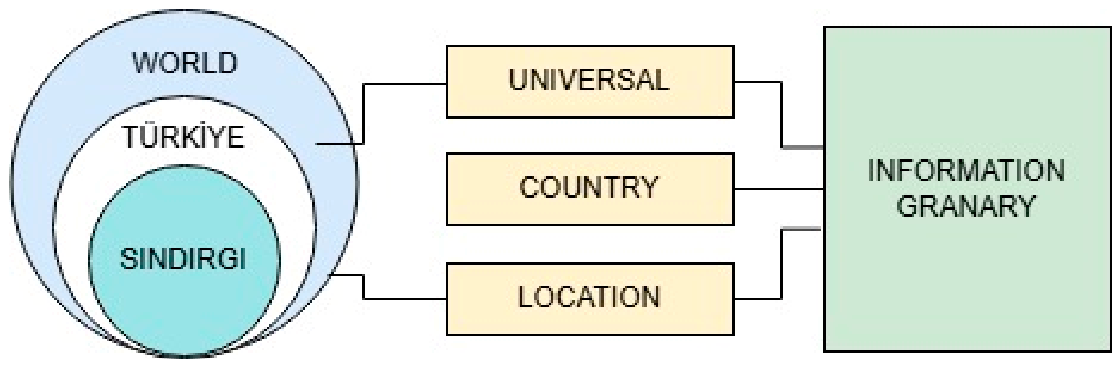
Figure 1. The granary literature is included on a global, Turkish, and Sındırgı scale.
Sustainability 18 05243 g001
Figure 2. Location of Balıkesir in Türkiye Map; Sındırgı district of Balıkesir Map and the neighborhoods of Sındırgı Map.
Sustainability 18 05243 g002
Figure 3. History of Sındırgı.
Sustainability 18 05243 g003
Figure 4. Research design and data collection procedure.
Sustainability 18 05243 g004
Figure 5. Sustainability design criteria for traditional granaries, based on Emel [46]; Gültekin & Alparslan [47]; Gürel & Irkh Eryıldız [48]; Kim & Rigdon [49]; Bekkering [50]; Sim Van Der Ryn & Stuart Cowan [51].
Sustainability 18 05243 g005
Figure 6. Granaries located in rows at the entrance of the neighbourhood (A) or in the neighbourhood square (B) (Photographs: Authors, Sındırgı fieldwork, 2022−2026).
Sustainability 18 05243 g006
Figure 7. Granary located in the garden (A) and attached to the house (B) (Photographs: Authors, Sındırgı fieldwork, 2022–2026).
Sustainability 18 05243 g007
Figure 8. The distribution of granary types (Drawing: authors).
Sustainability 18 05243 g008
Figure 9. Granary typologies. Field documentation by authors (2022–2026). Drawings and photographs by authors.
Sustainability 18 05243 g009
Figure 10. Evli granary front view (A) and side view (B) (Photographs: Authors, Sındırgı fieldwork, 2022−2026).
Sustainability 18 05243 g010
Figure 11. Three granaries under one roof (A), two granaries under one roof (B) (Photographs: Authors, Sındırgı fieldwork, 2022−2026).
Sustainability 18 05243 g011
Figure 12. The section called the “göz” inside the granary (A) and the stored items (B) (Photographs: Authors, Sındırgı fieldwork, 2022−2026).
Sustainability 18 05243 g012
Figure 13. Simav granary examples (Photographs: Authors, Sındırgı fieldwork, 2022−2026).
Sustainability 18 05243 g013
Figure 14. Kabak granary (Photographs: Authors, Sındırgı fieldwork, 2022−2026).
Sustainability 18 05243 g014
Figure 15. Sandık granary examples (Photographs: Authors, Sındırgı fieldwork, 2022−2026).
Sustainability 18 05243 g015
Figure 16. Üstü örtülü sandık granary examples (Photographs: Authors, Sındırgı fieldwork, 2022−2026).
Sustainability 18 05243 g016
Figure 17. A granary raised and balanced with stones (Photographs: Authors, Sındırgı fieldwork, 2022−2026).
Sustainability 18 05243 g017
Figure 18. Wooden planks, which they call “yatak,” are placed on top of the stones. (Photographs: Authors, Sındırgı fieldwork, 2022−2026).
Sustainability 18 05243 g018
Figure 19. Granary construction (Drawing: Authors).
Sustainability 18 05243 g019
Figure 20. Examples of granaries that collapsed because they lacked a roof (Photographs: Authors, Sındırgı fieldwork, 2022−2026).
Sustainability 18 05243 g020
Table 1. Summary of research questions, main findings, and key recommendations (Created by the authors).
Research QuestionMain FindingKey Recommendation
RQ1: Preservation status and deterioration factorsSustainability rests on interrelated design decisions: elevated stone base, sloped roof, black pine wood, and active use cycles. Main vulnerabilities: roof failure, moisture accumulation, abandonment, and loss of traditional joinery knowledge.Emergency roof and moisture intervention; periodic monitoring system; reversible repair techniques compatible with original construction methods.
RQ2: Typological distribution and usage patternsFive typologies identified (evli, Simav, kabak, sandık, üstü örtülü sandık). Evli and Simav types most prevalent; typological diversity reflects demand-responsive, spatially adaptive building culture scaled to land ownership, production, and topography.Typology-based conservation prioritization; development of a graphic summary table presenting plan, section, location, and preservation status for each typology.
RQ3: Sustainability and cultural continuityGranaries embody a coherent sustainable design logic across all seven criteria. They function as knowledge environments transmitting construction techniques and rural life practices across generations.Documentation of craftsmen knowledge; master apprentice workshops; continuity of use as a core conservation policy; regional database for rural heritage.
Table 2. Types and numbers of granary typologies located in Sındırgı districts (Created by the authors) (Neighborhoods that granary are shown in color).
NeighborhoodsSimav
Granary
Evli
Granary
Kabak
Granary
Sandık
Granary
Üstü Örtülü
Sandık Granary
Total
1Aktaş XXXXX0
2AkçakısrakXXXXX0
3AlacaatlıXXXXX0
4AlakırXXXXX0
5Alayaka686X1X75
6ArmutluXXXXX0
7AslandedeXXXXX0
8CüneytXXXXX0
9BayraklıXXXXX0
10Bulak963XX18
11BükrecikXXXXX0
12B.DağdereXXXXX0
13C.CeditX3XXX3
14C.KebirXXXXX0
15ÇakıllıXXXXX0
16ÇaltılıXXXXX0
17Çamalanı68333XX104
18Ç.OğluXXXXX0
19Ç.GörenXXXXX0
20Çayır331XXX34
21ÇelebilerX13XX4
22ÇıkrıkçıX4146X24
23Çılbırcı13116XX30
24ÇoturtepeX15X612
25DanaçayırXXXXX0
26Dedeler34285XX67
27DerecikörenX1172XX119
28Devletlibaba8192XX29
29Düğüncüler2112111XX153
30Düvertepe914XXX23
31EğridereXXX1X1
32EşmedereXXXXX0
33Gölcük XXXXX0
34Gözeren32155X43
35Hisaralan1418317
36EmendereXXXXX0
37IşıklarXXXXX0
38İbillerXXXXX0
39İzzettinXXXXX0
40KaraağaçX711X9
41Karacalar1802XX83
42KaragürXXXXX0
43KepezX15132X30
44KertilXXXXX0
45KınıkXXXXX0
46Kıran X92X112
47KızılgürXXXXX0
48KocabeyX2XXX2
49KocakonakXXXXX0
50KozluXXXXX0
51KocasinanXXXXX0
52KurtuluşXXXXX0
53KüçükbüküXXXXX0
54K.DağdereXXXXX0
55Kürendere12712XXX139
56MandıraXXXXX0
57Mumcu21141XX117
58OrmaniçiXX131X14
59OsmanlarXXXXX0
60Pelitören457XXX52
61PürsünlerXXXXX0
62RızaiyeXXXXX0
63SinandedeXX14XX14
64SüllerXXXXX0
65ŞahinkayaXXXXX0
66ŞapcıX3226X31
67TaşköyX12011436
68Umurlar1X34112773
69YaylabayırX71XX8
70YaylacıkXXXXX0
71YolcupınarX162XX18
72YusufçamıXX72817
73YüreğilXXXXX0
74KarakayaXXXXX0
75YağcıbedirXXXXX0
Table 3. Summary of sustainability assessment across seven ecological design criteria (Created by the authors).
Spatial OrganizationMultifocal distribution across neighborhoods; granaries located near houses, at village entrances, or clustered in squares according to access needs.Avoids overbuilding; optimizes access and minimizes logistical impact.
Building Form DesignVaulted roof, sloped form, elevated stone base; size calibrated to land ownership and production volume; single or two-story according to need.Rapid water drainage; reduced moisture load; demand-scaled construction prevents over-building.
Structural Element DesignDovetail timber joints; “yatak” platform system; scaled load-bearing solutions by typology (larger types more robust, smaller types simpler).Repairable systems; long service life; proportional structural investment.
Material Use and ConservationLocally sourced black pine (Pinus nigra); rapidly renewable; low transportation impact; optimized material use per typology.Reduced carbon emissions; supports maintenance adaptation cycle; low environmental burden.
Design with NatureTypological differentiation based on topography, production density, and settlement structure; larger types in mountainous areas, smaller types near center.Minimal intervention; long lifespan; scale harmony with natural environment.
Urban Design Area PlanningMultifocal settlement distribution; wind direction, shade, and topography considered in siting; balances central efficiency with local accessibility.Controls new construction demand; preserves existing fabric; flexible and scalable planning.
Nature InteractionStorage diversified by product type, seasonal cycle, and household scale; production area housing–storage relationship maintained; adaptable to changing conditions.Supports cultural continuity and social resilience; reduces energy and labor costs; embeds ecological rhythm into built environment.
Disclaimer/Publisher’s Note: The statements, opinions and data contained in all publications are solely those of the individual author(s) and contributor(s) and not of MDPI and/or the editor(s). MDPI and/or the editor(s) disclaim responsibility for any injury to people or property resulting from any ideas, methods, instructions or products referred to in the content.