Article

Revealing the Co-Creation Mechanism of Tourists Supporting the Sustainable Development of Rural Art Tourism Through a Hybrid Model of PLS-SEM and ANN

by
Bin Zhao
1,
Shijin Cui
2,* and
Xuesong Cheng
1,*
1
Shanghai Academy of Fine Arts, Shanghai University, Shanghai 200444, China
2
School of Innovation, Hubei Institute of Fine Arts, Wuhan 430060, China
*
Authors to whom correspondence should be addressed.
Sustainability 2026, 18(11), 5230; https://doi.org/10.3390/su18115230
Submission received: 20 March 2026 / Revised: 11 May 2026 / Accepted: 13 May 2026 / Published: 22 May 2026

Abstract

Rural land art festivals serve as an important practical vehicle for integrating urban and rural culture and tourism. They constitute a crucial component of rural tourism in China and play a key role in the sustainable development of rural areas. However, in practice, these festivals are generally confronted with the dilemma of superficial tourist participation and insufficient sustainability. This study aims to uncover the intrinsic psychological evolution mechanism underlying tourists’ responses to external stimuli and their value co-creation. The S-O-R model and the two-factor theory are integrated to construct an analytical framework: “external stimulus–psychological sequence–behavioral response.” Using “Modern Fields” as the case study and 437 valid data points, an empirical analysis is conducted with PLS-SEM and artificial neural networks (ANNs). The results indicate that tourist participation is directly driven by destination quality. Content stickiness exerts an indirect influence through perceived value. Perceived value facilitates value co-creation only when it is fully mediated by tourist participation. The path from participation to co-creation is significantly strengthened by restorative environmental perception. A multi-group analysis further reveals that inexperienced tourists exhibit a “stimulus-driven” characteristic, whereas experienced tourists follow a “value internalization” path. The ANN analysis further shows that the strongest nonlinear predictive power for co-creation behavior is held by restorative environmental perception. A significant direct nonlinear effect is also exerted by destination quality. The evolutionary nodes and boundary conditions of tourists’ psychological sequence during this process are revealed. The boundary effect of restorative environmental perception as a catalyst for rural art tourism is demonstrated. A theoretical basis and practical insights are thereby provided for the segmented operation and sustainable development of these activities.

1. Introduction

A fundamental paradigm shift is currently being observed in rural tourism as travel thresholds continue to rise. This shift moves away from natural-resource-based sightseeing toward a mode of cultural and ecological consumption oriented to complex experiences and healing. This trend has been widely noted internationally. A key force in this transformation has been identified in rural land art festivals, an innovative form that integrates land art, rural revitalization, and cultural tourism. The effectiveness of these festivals in promoting sustainable rural development has been extensively validated, with examples ranging from the internationally recognized Echigo-Tsumari Art Triennale to the “Rural Sharing” art project at Merveilleux Prétexte in France and the Feskas Art Biennale in Finland.
This phenomenon is even more pronounced in China, where rural revitalization is prioritized as a national strategy. In 2026, during the annual Two Sessions, it was emphasized by Sun Yeli, the Minister of Culture and Tourism, that tourism is no longer limited to visiting scenic spots and sightseeing. Instead, greater attention is being directed toward engaging with everyday life and experiencing culture. It was also noted that tourism products emphasizing experience and empathy are gaining popularity, reflecting the growing influence of the experience economy. Within China’s rural tourism sector, rural land art festivals have gradually been developed into an important platform for integrating cultural revitalization with tourism development. These festivals increasingly serve as a bridge connecting urban and rural resources. They also help activate the endogenous development potential of rural areas. Unlike traditional art festivals, rural land art festivals represent an emerging cultural form [1]. Art design and curatorial strategies are integrated in these events, with strong emphasis placed on experience and emotional engagement. As a result, they provide an important perspective for understanding the sociology of art.
The practice of art-based rural development in China can be traced to the pioneering “Art-based Rural Construction” initiative represented by the “Xucun Project” in Shanxi Province in 2007. The scope of artistic intervention in rural revitalization was further expanded by subsequent projects, such as the “Shijiezi Art Museum” in Gansu (2009) and the “Bishan Project” in Anhui (2011). In recent years, influential examples have been provided by university-led initiatives. Representative cases include the “Guanzhong Busy End Art Festival” in Shaanxi (2018) and the “Modern Fields Rural Land Art Festival” in Shanghai (2021). These developments indicate that rural art festivals have gradually evolved from sporadic experimental practices into more widespread and systematic forms of cultural activity. At the same time, the development model has shifted from artist-led experimental projects toward participatory platforms that emphasize value co-creation among multiple stakeholders.
Despite these developments, many rural art festival projects continue to face practical challenges. Tensions are often observed between urban aesthetic preferences and local rural culture. Participation by local communities is sometimes limited, and tourist engagement may remain superficial, often taking the form of brief “photo-taking and check-in” activities [2]. These issues constrain the sustainable development of such initiatives. Existing studies have provided valuable insights into rural art festivals. For example, previous research has examined endogenous models of rural tourism for revitalizing traditional villages [3], the role of integrating rural landscapes with tourism services [4], and the revitalization of idle rural facilities through interactive art installations [5]. Nevertheless, several important research gaps remain.
One important limitation concerns the formation mechanism of tourists’ perceived value. Existing studies tend to focus primarily on the basic attributes of the destination, such as supporting infrastructure and tourism services including catering and accommodation. Much less attention has been given to how evolving artistic content interacts with the surrounding rural environment to shape tourists’ overall perceptions. In practice, tourists tend to value both the friendliness and comfort of the rural environment and the uniqueness and symbolic appeal of artistic content [6]. However, whether these two types of stimuli influence perceived value through distinct psychological pathways has not been systematically examined.
Another unresolved issue involves the mechanism through which perceived value is translated into value co-creation behavior. In some highly regarded art festivals, tourists actively provide suggestions, share ideas, and even participate in local creative activities. In other cases, tourist involvement remains limited to passive viewing and brief visits. The factors that lead to these different behavioral outcomes have not yet been clearly explained.
In addition, the potential influence of contextual psychological factors has received limited attention. Rural art festivals combine natural environments with cultural and artistic experiences, which may generate distinctive restorative or therapeutic effects. However, the ways in which such restorative perceptions influence tourist behavior remain insufficiently understood. Tourists’ prior experiences may also shape their information processing and behavioral decision-making. The extent to which past experience affects participation and value co-creation behavior has not been fully explored in the existing literature.
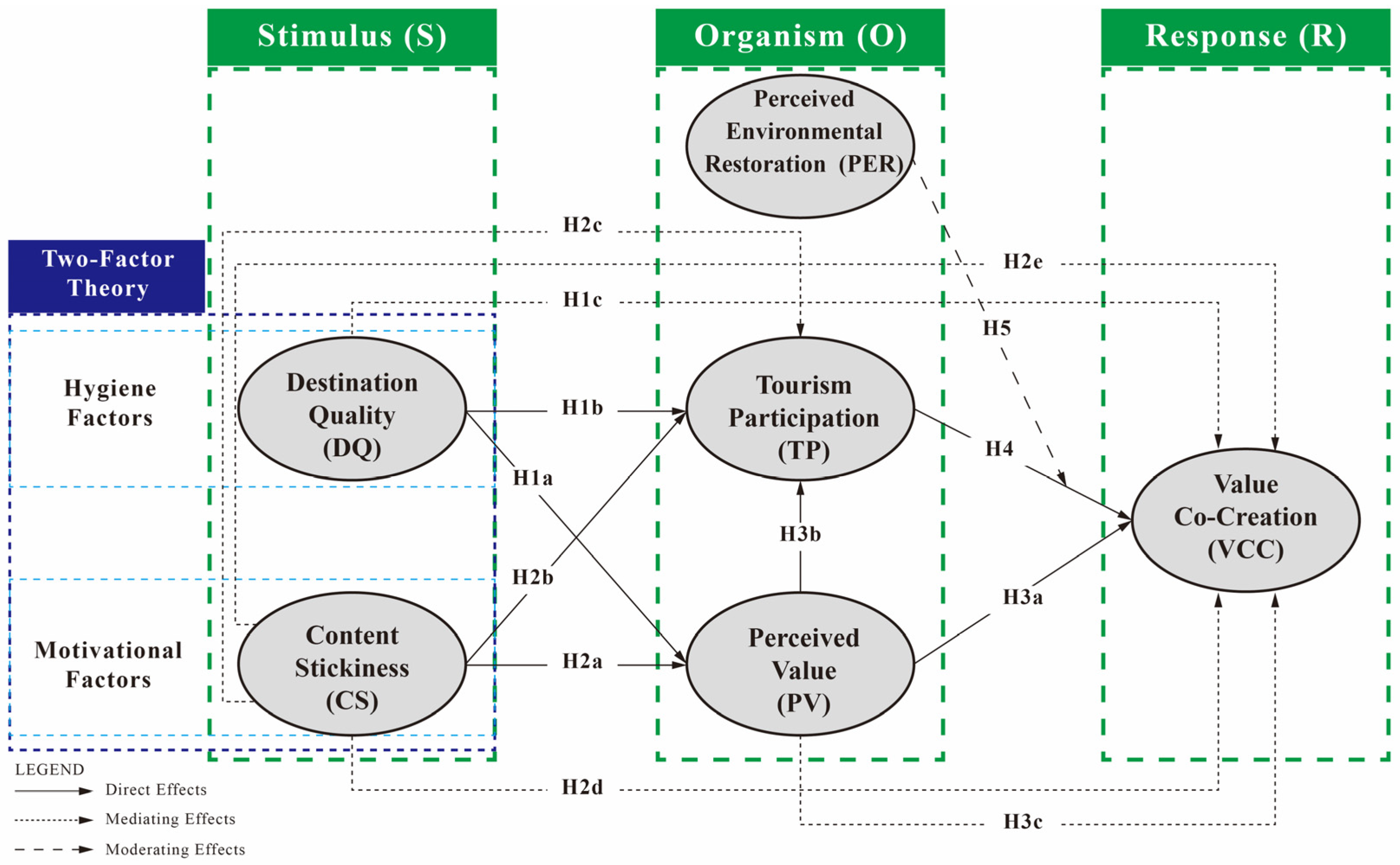
To address these issues, this study integrates Herzberg’s two-factor theory [7] with the S-O-R model [8]. The limitation of the traditional S-O-R framework in distinguishing between different types of external stimuli is thereby overcome. Within this integrated framework, destination quality is treated as a hygiene factor that primarily prevents tourist dissatisfaction. In contrast, content stickiness is conceptualized as a motivating factor that stimulates positive tourist experiences. Together, these elements are regarded as the external stimulus (S). Perceived value and tourism participation are regarded as the internal psychological states of tourists (O), while value co-creation behavior represents the final external response (R). In addition, restorative environmental perception is introduced as a moderating variable to capture the distinctive combination of natural and cultural elements present in rural land art festivals.
Based on this framework, three research questions are proposed. First, through which distinct pathways do destination quality and content stickiness influence perceived value and tourism participation? Second, is the mediating role of tourism participation required for perceived value to promote value co-creation behavior? Third, what role is played by restorative environmental perception in this process? Specifically, does it strengthen or weaken the relationship between tourism participation and value co-creation? The present study is designed to elucidate the psychological and behavioral mechanisms through which tourists are transformed from passive observers into active co-creators. These mechanisms are explored by addressing the aforementioned questions. The findings are expected to provide theoretical innovation for the international research system on rural tourism and rural art tourism. Reflections and references for the sustainable development of rural land art festival practices across diverse regions are likewise anticipated.

2. Theoretical Background and Research Hypotheses

2.1. Complementarity of the Stimulus-Organism-Response (S-O-R) Model and the Two-Factor Theory

The Stimulus-Organism-Response (S-O-R) model, proposed by Mehrabian and Russell [8], explains how environmental factors influence individual behavior. In this model, external situational factors are defined as stimuli (S), internal psychological states are defined as the organism (O), and resulting behaviors are defined as responses (R). Behavioral responses are generated through the influence of stimuli on internal psychological processes. Because this framework clearly explains the mechanism linking environment, psychology, and behavior, it has been widely applied in environmental psychology, consumer behavior, and sustainability research.
The central mechanism of the S-O-R model is identified in the mediating role of the organism (O). External stimuli influence internal psychological states, which then shape behavioral responses [9]. Environmental stimuli are interpreted through perception, evaluation, and emotional processing. These internal processes guide behavioral decisions in specific contexts [10]. Although recent studies have extended the organism dimension, such as examining multisensory emotional responses in natural soundscape environments [11], many applications remain overly general. Psychological mechanisms are often insufficiently integrated into specific research contexts. This limitation reduces the explanatory precision of the model. In the context of rural land art festivals, the S-O-R model provides a useful foundation for explaining how environmental factors influence tourist psychology and behavior. However, it does not clearly distinguish between different types of environmental stimuli. As a result, it cannot fully explain why different stimuli produce different psychological and behavioral outcomes.
To address this limitation, the two-factor theory is introduced. This theory classifies the factors influencing individual psychology and behavior into hygiene factors and motivational factors [7]. Hygiene factors represent basic environmental conditions. When these factors are inadequate, dissatisfaction is generated. When they are sufficient, dissatisfaction is reduced, but positive motivation is not necessarily created. In contrast, motivational factors directly stimulate intrinsic motivation and promote positive behavioral responses [12]. This distinction provides a more precise explanation of how different types of external stimuli influence psychological perception. As a result, the explanatory depth of the S-O-R model is strengthened.
The integration of the S-O-R model and the two-factor theory improves the classification of environmental stimuli and strengthens the explanation of psychological mechanisms. It also addresses limitations found in other behavioral theories, such as the Theory of Planned Behavior and the Value–Belief–Norm framework, which often emphasize cognitive or normative factors while giving less attention to contextual and emotional influences [13].
Within this integrated structure, destination quality is conceptualized as a hygiene factor, and content stickiness is positioned as a motivating factor. External stimuli (S) are thus constituted by these elements, which represent pre-experience attributes intrinsic to the Rural Land Art Festival itself and remain independent of visitors’ psychological and behavioral responses. The organismic variables (O) are defined to encompass Perceived Value (PV), which captures rational cognitive appraisal; Perceived Environmental Restoration (PER), which reflects emotional experience; and Tourism Participation (TP), which signifies intentional preparation for behavioral change. These internal psychological states are understood to span the three complete stages of cognition, emotion, and intention. Value co-creation is subsequently designated as the response (R). It is characterized as the final behavioral outcome, manifested after visitors have completed the entire psychological process, and it represents the higher-order contributions through which added value is generated for the festival activities. A clear and systematic account of how environmental stimuli shape psychological processes and behavioral outcomes is provided by this integrated framework. A solid theoretical foundation is thereby laid for the definition of core constructs and the formulation of research hypotheses.

2.2. Stimulus: The Dual System Underlying the Attractiveness of the Rural Land Art Festival

Within the S-O-R framework, stimuli (S) are defined as the initial external drivers that shape tourists’ psychological responses and participation behavior. Drawing upon the contextualized application of the two-factor theory, external stimuli are defined as destination quality (DQ), which corresponds to hygiene factors, and content stickiness (CS), corresponding to motivational factors. These two factors serve as the primary external drivers that influence tourists’ perceived value and willingness to participate. They also represent the core competitive elements that enable rural land art festivals to attract visitors, encourage repeat engagement, and sustain long-term development.

2.2.1. Destination Quality (DQ)

As a hygiene factor in two-factor theory, destination quality (DQ) is defined as tourists’ overall evaluation of a village’s environment, cultural resources, and activity spaces based on their festival experience [14]. Its primary function is to provide a reliable foundation for the visitor experience. Negative experiences are reduced, and a supportive environment is created for positive perceived value and active participation [15]. Therefore, destination quality is considered essential for ensuring visitor satisfaction and supporting the long-term sustainability of rural land art festivals. The importance of this relationship is underscored by existing research. The influence of the environment and historical sites on the sustainable development of the local tourism economy was investigated by Pantovic et al. [16] in the context of rural tourism in the Republic of Serbia. Effective strategies for managing tourism resources and engaging local residents were examined by Lazovic et al. [17]. Their work focused on improving the environmental quality of community facilities in rural areas such as Fernia, with the aim of promoting sustainable rural development.
Existing studies have primarily measured destination quality using indicators related to traditional tourism infrastructure, such as transportation, accommodation, and service facilities. Two representative frameworks have been widely adopted. One is the “6A” model, which includes attractions, accessibility, amenities, ancillary services, available packages, and activities [18]. Another framework emphasizes landscape resources, service facilities, transportation, destination reputation, and cost level [19]. Although these models capture important structural attributes, they do not fully address the distinctive features of rural land art festivals. In particular, factors such as cultural integration, artistic spatial design, and community atmosphere are not adequately represented. As a result, conventional measures may fail to accurately reflect tourists’ actual experiences in rural art festival settings [20].
To address this limitation, destination quality is conceptualized in this study as a three-dimensional structure comprising environmental perception, cultural cognition, and emotional connection. These dimensions are designed to capture the fundamental attributes of the destination itself, without reference to tourists’ psychological interests or behavioral outcomes. Environmental perception is taken to refer to tourists’ evaluation of the destination’s natural scenery, landscape diversity, environmental cleanliness, and supporting facilities [21]. The most basic hygiene attributes are constituted by such features, and sensory comfort and a positive experience are thereby secured. Cultural cognition, in turn, concerns tourists’ awareness of the richness of local cultural resources, the degree to which spatial design aligns with historical and cultural characteristics, and the artistry and functionality of festival activity spaces. This dimension embodies the core cultural threshold that distinguishes rural art festivals from ordinary rural tourism [4]. Building upon these foundational experiences, emotional connection is understood as the sense of intimacy and belonging to the destination environment that is subsequently formed. It constitutes the fundamental emotional prerequisite for deeper tourist participation [22], without extending into subsequent emotional recovery or investment behavior. Together, these three dimensions furnish a comprehensive framework for assessing whether the festival environment is welcoming, aesthetically pleasing, and culturally significant.

2.2.2. Content Stickiness (CS)

Content stickiness (CS) is conceptualized as a motivational factor within the two-factor theory. The concept is derived from the “Sticky Journey Model” in service design [23], which emphasizes system openness and distinctive experiences across multiple service cycles. In this study, content stickiness refers to the ability of the Rural Land Art Festival to sustain visitor attention, stimulate enthusiasm, and encourage repeat visits through dynamic, differentiated art programming and immersive experience design [24]. Its primary function is to strengthen positive psychological responses and shift visitors from passive observation to active participation, and from superficial attendance to deeper engagement. Unlike destination quality, which provides a basic experiential foundation [25], content stickiness functions as a driving force for long-term engagement and helps prevent the “one-time visit” phenomenon.
In practice, many rural art festivals exhibit limited content stickiness. A reliance on outdated programs is often observed, with the assumption that existing content will continue to attract new visitors. Continuous innovation in artistic themes and experiential projects is frequently insufficient, which constrains repeat visitation and long-term appeal [26]. As similar events become more common, visitors’ expectations increase [27]. High-quality rural land art festivals are no longer characterized by the simple transfer of urban art into rural settings. Instead, local cultural symbols are deeply explored, and distinctive rural art brands are developed through creative transformation and innovation [28]. In terms of experiential design, programming has evolved from static exhibitions to immersive, interactive, and participatory formats [29]. For example, community-based art creation and site-specific performances enable visitors to move beyond the role of observer and become participants or co-creators.
Content stickiness is accordingly reconceptualized in this study as a multidimensional construct. Its focus is directed toward the intrinsic properties of festival content, and tourists’ behavioral outcomes are explicitly excluded from its scope. The construct is thus understood to operate beyond the mere pursuit of novelty or sensory stimulation [30]. One core dimension, brand uniqueness, refers to the distinctiveness of the festival’s central theme, its intellectual property positioning, and its cultural brand. This dimension serves as the principal motivational attribute for forging differentiated competitiveness and sustained visitor attention. A further dimension, experience richness, encompasses the diversity, interactivity, and immersive quality of the festival’s offline thematic activities, experiential programs, and supporting services. It is posited as the immediate vehicle through which tourists’ intrinsic motivation for participation is activated. An additional dimension, content sustainability, captures the capacity for continuous renewal within the festival’s online intellectual property content, thematic iteration, and cultural product innovation. This attribute is recognized as critical for maintaining prolonged engagement and stimulating repeat visitation. Comparative analysis reveals that a combination of continuously updated thematic activities, unique and iteratively developed cultural products, and immersive programs orchestrated around a coherent core theme constitutes the key factors in attracting repeated user participation and fostering a favorable reputation. User attention is further amplified, emotional attachment is cultivated, and unforgettable experiences are generated through the ongoing refinement of thematic intellectual property (IP) and the enrichment of design elements [31]. These processes may ultimately serve to enhance brand loyalty, supportive behaviors, and co-creative engagement [32]. Grounded in this logic, a new evaluative framework is proposed in this paper. Within this framework, online intellectual property updates are integrated with offline thematic activities, experiential projects, and supporting services. A more comprehensive assessment of content stickiness within the specific milieu of the Rural Land Art Festival is thereby enabled.

2.3. Organism: Psychological Processes of Value Assessment, Behavioral Preparation, and Emotional Impact

The organism (O) represents the central mediating link in the S-O-R framework. It connects external stimuli with behavioral responses by capturing tourists’ psychological perceptions, emotional experiences, and engagement intentions. In the context of rural land art festivals, these responses are shaped by the combined effects of destination quality and content stickiness.

2.3.1. Perceived Value (PV)

The concept of perceived value (PV) originated from customer value theory in the 1980s [33]. In tourism research, its definition has evolved from a “cost–benefit comparison” to a broader “overall utility assessment” [34]. While existing studies have developed measurement tools for urban tourism [35] and heritage tourism [36], these instruments are not directly applicable to rural land art festivals.
This study clarifies the multidimensional nature of perceived value, which includes individual variability, temporal fluctuations, environmental dependence, and structural stratification [37]. Here, PV is defined as a comprehensive evaluation of the overall benefits tourists gain from participating in a rural land art festival, balanced against perceived losses [38]. Gains include cultural experiences and emotional satisfaction, while losses include time, money, and other resources [39]. Positioned as a core cognitive variable at the organism level, PV is conceptualized as the rational decision-making foundation for tourists’ subsequent participation and co-creation behaviors. A clear conceptual distinction is drawn between PV and Destination Quality (DQ). DQ is characterized as an evaluation of the festival’s objective attributes, whereas PV represents a subjective appraisal of the gains and losses inherent in tourists’ own experiences. A further distinction is established with Perceived Environmental Restoration (PER). PV is focused on a rational cost–benefit assessment, while PER is oriented toward non-rational emotional recovery benefits.
Drawing on two-factor theory, perceived value arises from the interplay of hygiene and motivating factors. Destination quality acts as a hygiene factor by reducing perceived losses, while content stickiness serves as a motivating factor, enhancing perceived gains [40]. These factors operate through both cognitive and emotional pathways to shape overall perceived value. Gains include cultural enrichment, emotional healing, cognitive inspiration, and social connections. Losses include monetary costs as well as implicit costs such as travel from urban centers and potential cultural barriers [41]. Together, these elements define the unique perceived value of rural art festivals.
To measure PV in this context, the study develops an evaluation framework with six core dimensions: curatorial style, art design, local elements, operational model, emotional experience, and psychological expectations. A successful rural land art festival should align its curatorial style with local culture, offer diverse artistic forms such as installations and creative designs, and integrate local cultural elements—for example, Jiangnan and Shanghai-style culture—to create a distinctive artistic identity. Operational models should be sustainable, low-cost, and involve local communities. Rich spiritual and cultural experiences should also be delivered by the festivals, relieving urban stress and meeting visitors’ aesthetic and experiential expectations.

2.3.2. Perceived Environmental Restoration (PER)

Perceived environmental restoration (PER) is recognized in tourism, leisure, and ecotherapy research as a distinct psychological construct [42]. Its theoretical foundation is largely based on Attention Restoration Theory (ART) [43], which emphasizes the positive role of specific environments in cognitive and emotional recovery. Humans have limited attentional capacity, and prolonged use can lead to mental fatigue, reducing the ability to regulate emotions effectively. Exposure to natural environments that demand minimal mental effort can restore attention [44].
Recently, ART has been extended to cultural landscapes and aesthetic experiences, with evidence suggesting that environments imbued with artistic elements can also promote psychological restoration [45]. However, most research has focused on conventional natural settings, such as urban parks or wilderness areas, with limited attention to complex rural environments that integrate nature and humanistic art [46].
In this study, Perceived Environmental Restoration (PER) is defined as the emotional and cognitive recovery derived from contact with natural landscapes and artistic interventions at rural land art festivals. This experience is understood to encompass emotional relief, psychological pleasure, and cognitive renewal. As a core emotional variable positioned at the organism level, PER is clearly distinguished from Destination Quality (DQ). DQ pertains to tourists’ evaluation of the objective attributes of the destination environment and is situated at the stimulus level. PER, in contrast, captures the psychological recovery benefits that are experienced after environmental stimuli have been received, thus residing at the organism level. The former concerns the question of whether the environment is good; the latter concerns the question of what benefits the environment confers upon the individual. These constructs occupy opposite ends of the causal chain and are considered to share no conceptual overlap.
Natural landscapes and artistic interventions are combined in the Rural Land Art Festival, and a unique restorative experience is thus theoretically offered. Empirical studies on restorative environments, however, have largely emphasized natural elements such as vegetation and water bodies [47]. Humanistic dimensions, such as artistic interaction and cultural immersion, have been largely neglected. At these festivals, restorative perception manifests as emotional relief, psychological pleasure, and cognitive renewal, achieved through engagement with landscapes, artworks, and festival activities [48]. This perspective builds on traditional concepts of “psychological escape” [49] and “cognitive recovery” [50] while extending them to include “cultural immersion” and “experience compatibility” due to artistic integration [51]. The combination of nature and art thus provides not only basic psychological relief but also deeper emotional satisfaction through cultural resonance and aesthetic interaction, distinguishing these festivals from conventional nature-based tourism [52].
In this study, PER is treated as a multidimensional construct. Within the “organism” component of the S-O-R model, it is conceptualized as a psychological variable distinct from perceived value or tourism participation. Its focus is not on rational evaluation of utility or behavioral effort but on the psychological and emotional benefits provided by the rural natural and cultural environment. Additionally, PER is treated as a key moderating variable, encompassing the quality of the natural environment, the appeal of artistic content, and perceptions of cultural atmosphere. The underlying logic is that positive restorative experiences enhance tourists’ emotions, strengthen emotional connections, and more effectively facilitate the transformation from tourism participation to value co-creation.

2.3.3. Tourism Participation (TP)

Tourism participation (TP) is situated at the intersection of tourism behavior and social exchange theory [53]. It is defined as the integration of tourists’ psychological engagement and behavioral involvement in tourism activities [54], reflecting their interest, willingness, and actual participation [55]. Factors driving TP have been identified in existing research. These include the pursuit of destination knowledge, curiosity about cultural differences, social reputation building, and functional experience needs [56]. However, current measurement tools—such as check-ins [57] and consumption behavior [58]—focus on superficial or singular actions. They inadequately capture the rich artistic experiences and local interactions unique to rural land art festivals, limiting their ability to link psychological perception with value co-creation [59].
In this study, tourism participation is conceptualized as tourists’ willingness and actual engagement, driven by perceived value and restorative environmental perception. It reflects the active investment of time, energy, and emotion in festival activities, interactive experiences, and creative contributions, under the external influence of destination quality and content stickiness. A core mediating role is played by TP in translating external stimuli and psychological responses into value co-creation behaviors. The complete process of individual participation is captured [60], and clear boundaries are maintained between this construct and variables situated at the stimulus and response layers. Content Stickiness (CS), for instance, is located at the stimulus layer, where it represents the intrinsic attractiveness of festival content—the reason for participation. In contrast, TP constitutes the actual participatory behavior driven by CS and is positioned as the outcome of that stimulus. Tourism participation typically progresses from passive observation to active immersion, and ultimately to creative co-creation. Its dimensions include willingness to participate, immersive experience, creative feedback, and word-of-mouth dissemination [61]. Within the S-O-R framework, perceived value functions as a positive internal evaluation, enhancing tourists’ motivation and readiness for deeper involvement. Shallow engagement, such as a positive impression without meaningful interaction, is insufficient to encourage the contribution of resources or creative ideas. Thus, TP is a crucial mediating bridge connecting perceived value to substantive co-creation behavior.

2.4. Response: Value Co-Creation (VCC) by Multiple Stakeholders

Value co-creation (VCC) arises from a service-oriented logic, emphasizing the collaborative creation of value through the integration of resources and interaction among multiple stakeholders [62]. In tourism research, VCC has been widely explored. However, most measurement models focus on the binary relationship between businesses and consumers, often limited to joint development and word-of-mouth recommendations [63]. Such models are insufficient for capturing the complex context of rural land art festivals, which involve diverse participants, public welfare objectives, and rural empowerment.
Existing research has laid a foundation for understanding value co-creation, extending into areas such as community governance and commercial experiences. In rural land art festivals, however, value co-creation goes beyond economic benefits [49]. It integrates cultural heritage, social connections, and ecological protection, becoming a key mechanism for activating rural dynamics and linking urban and rural resources. Unlike traditional one-way tourism supply models, VCC in this context requires collaboration among tourists, local residents, government, and operators [64]. Such collaboration helps prevent the festival from fading after its conclusion and supports long-term value sharing and development.
In prior studies, terms such as “collaborative creation” and “participatory design” are often used interchangeably with value co-creation. Regardless of terminology, the essence remains the same: multiple parties jointly create value. In rural land art festivals, value co-creation ranges from simple interaction to deep participation, reflecting diverse behavioral levels and the integration of stakeholder interests [65]. This complexity demands contextually relevant measurement tools. As the final response variable in the S-O-R framework, value co-creation (VCC) is defined as the higher-order contribution behaviors through which visitors generate added value for the festival. Such behaviors are produced after a complete psychological sequence has been traversed, encompassing stimulus reception, value assessment, emotional recovery, and basic participation. The definition is confined strictly to the visitor level and is clearly distinguished from Tourism Participation (TP). At its core, VCC entails visitors actively creating new value for the festival, a process that extends beyond the acquisition of personal experience. It is not reducible to passive engagement in existing activities; rather, it represents an active contribution prompted by the quality of the festival content and the nature of participation it affords [66]. Contributions include feedback on art and design, operational suggestions, promotional efforts, and exploration of industry opportunities.
Ideally, value co-creation is multidimensional and intersubjective. Experience and emotional satisfaction are gained by out-of-town tourists through immersive participation [67], while word-of-mouth promotion and creative feedback are simultaneously contributed [68]. Local residents, as cultural inheritors and creators [69], actively engage in art creation, environmental construction, and service provision, strengthening community identity. Operating entities achieve economic and social benefits through resource integration and brand development. Rural communities gain new momentum through cultural empowerment and industrial activation [70]. This multi-stakeholder framework drives the sustainable development of rural land art festivals (Figure 1).
At the tourist level, value co-creation can be viewed as a two-way exchange: tourists offer ideas, suggestions, and promotional efforts, while the festival provides intellectual stimulation, entrepreneurial inspiration, and cultural experiences that extend beyond traditional tourism. Based on this understanding, the following research hypotheses are proposed:
H1a. 
Destination Quality (DQ) has a significant positive impact on Perceived Value (PV).
H1b. 
Destination quality has a significant positive impact on tourism participation.
H1c. 
Tourism participation mediates the relationship between destination quality and value co-creation.
H2a. 
Content Stickiness (CS) has a significant positive impact on Perceived Value (PV).
H2b. 
Content stickiness has a significant positive impact on tourism participation.
H2c. 
Perceived value mediates the relationship between content stickiness and tourism participation.
H2d. 
Perceived value mediates the relationship between content stickiness and value co-creation.
H2e. 
Tourism participation mediates the relationship between content stickiness and value co-creation.
H3a. 
Perceived value has a significant positive impact on value co-creation.
H3b. 
Perceived value has a significant positive impact on tourism participation.
H3c. 
Tourism participation mediates the relationship between perceived value and value co-creation.
H4. 
Tourism participation has a significant positive impact on value co-creation.
H5. 
Restorative environmental perception moderates the relationship between tourism participation and value co-creation.

3. Methods

3.1. Research Background

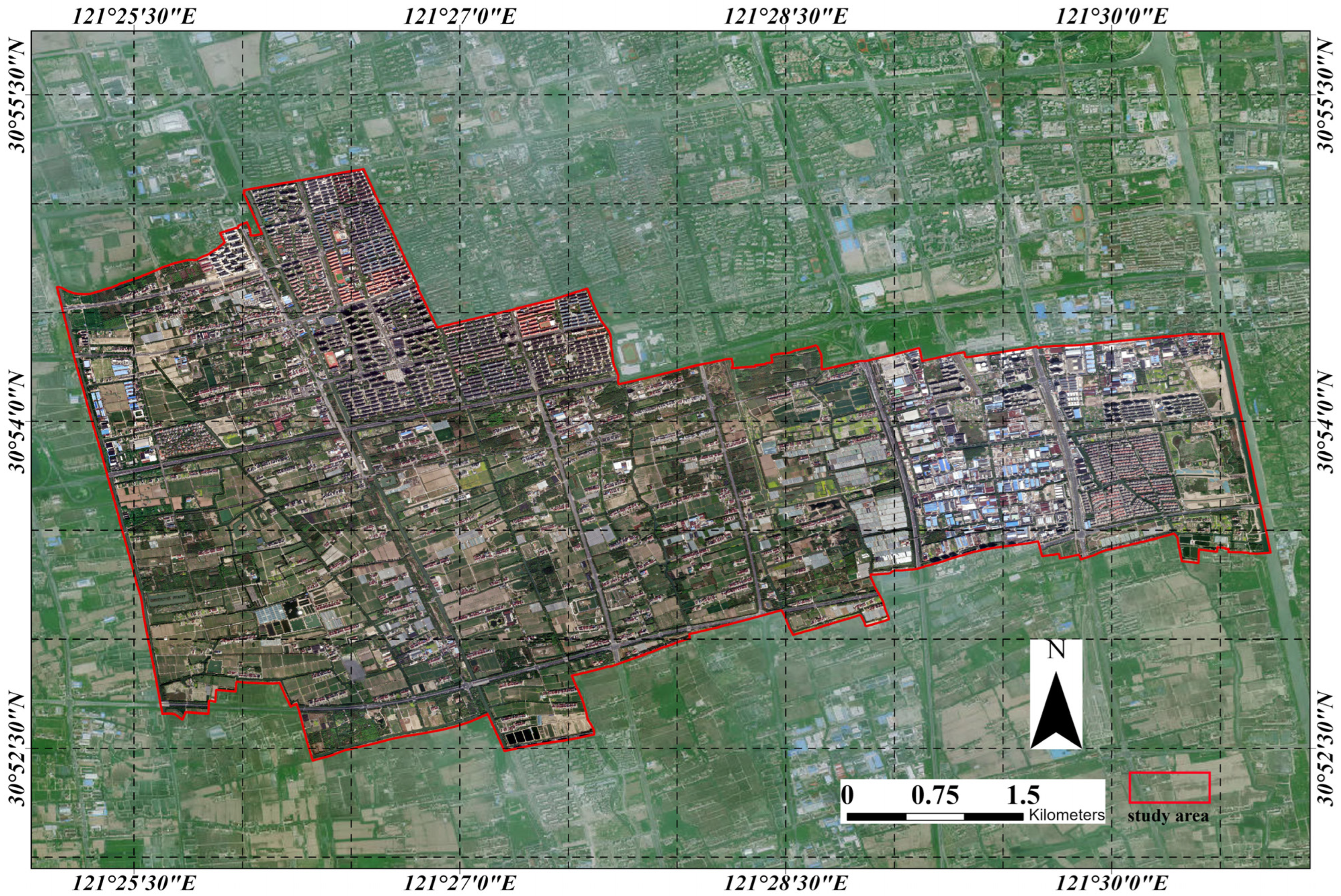
This study examines the Modern Fields Rural Land Art Festival, held in Nanqiao Town, Fengxian District, Shanghai, China. This case was selected for its representativeness, uniqueness, and accessibility. Since 2021, the festival has been successfully conducted for three consecutive years through the efforts of our research team in collaboration with the Shanghai Academy of Fine Arts, Shanghai University, the Fengxian District Culture and Tourism Bureau, and the Nanqiao Town Government. The initiative is aimed at promoting rural revitalization through accessible art and curatorial practices. In 2023, the project was recognized by the Data Center of the Ministry of Culture and Tourism of China as one of the top ten cases of art–tourism integration. Notably, it is the only project selected based on university–local government collaboration (Figure 2).
It is noteworthy that the implementation of this project directly contributed to Jianghai Village being included in the fourth batch of rural revitalization demonstration villages in Shanghai in 2022. Over four years, the project progressed through distinct stages. In 2022, the first New Shanghai Style Rural Art Education Exhibition was launched. A principle of minimal intervention was adhered to by the organizing team. Alterations to land use were avoided, and restoration of agricultural structures was limited. Instead, new content was integrated into existing spaces to redefine their purpose and cultural significance.
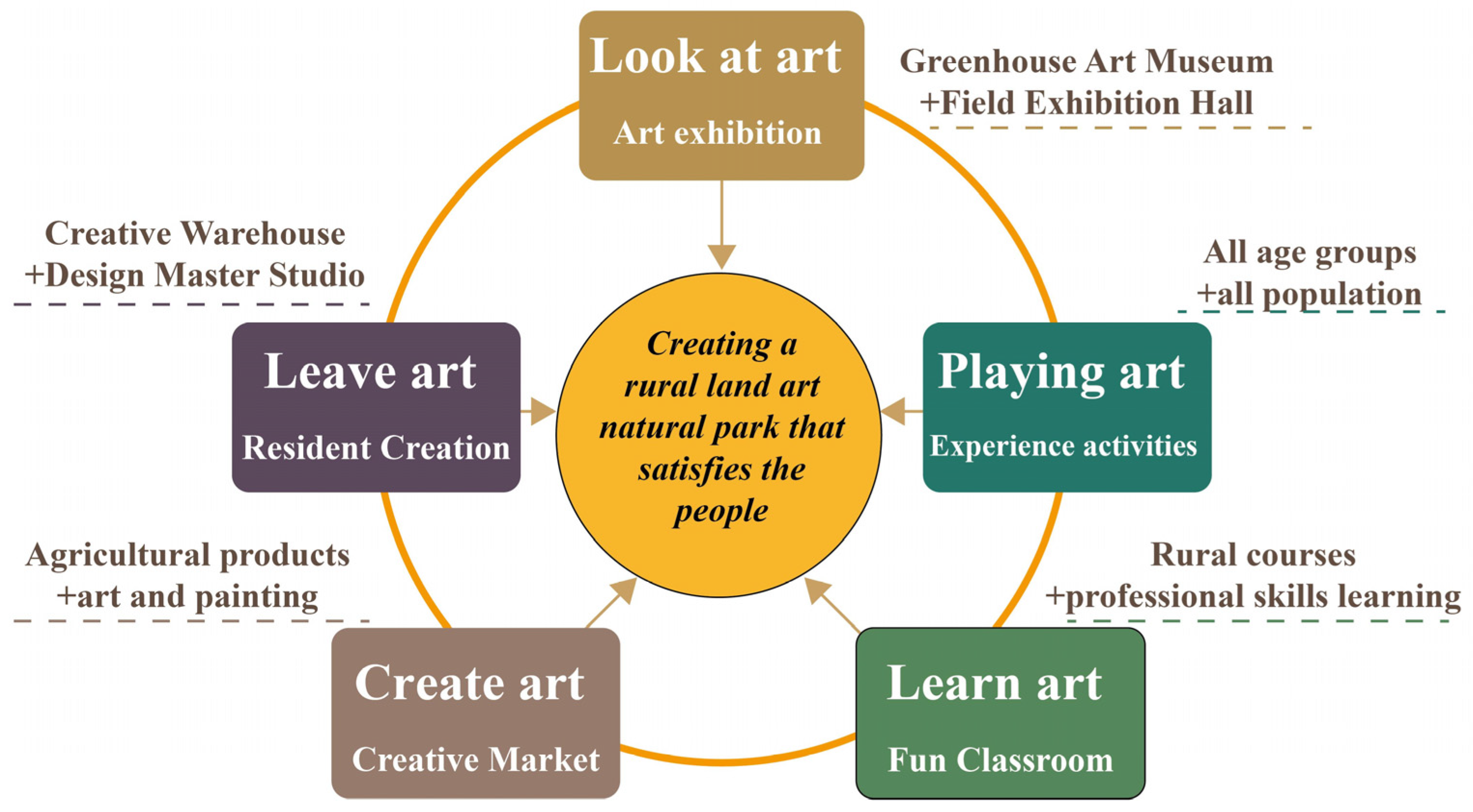
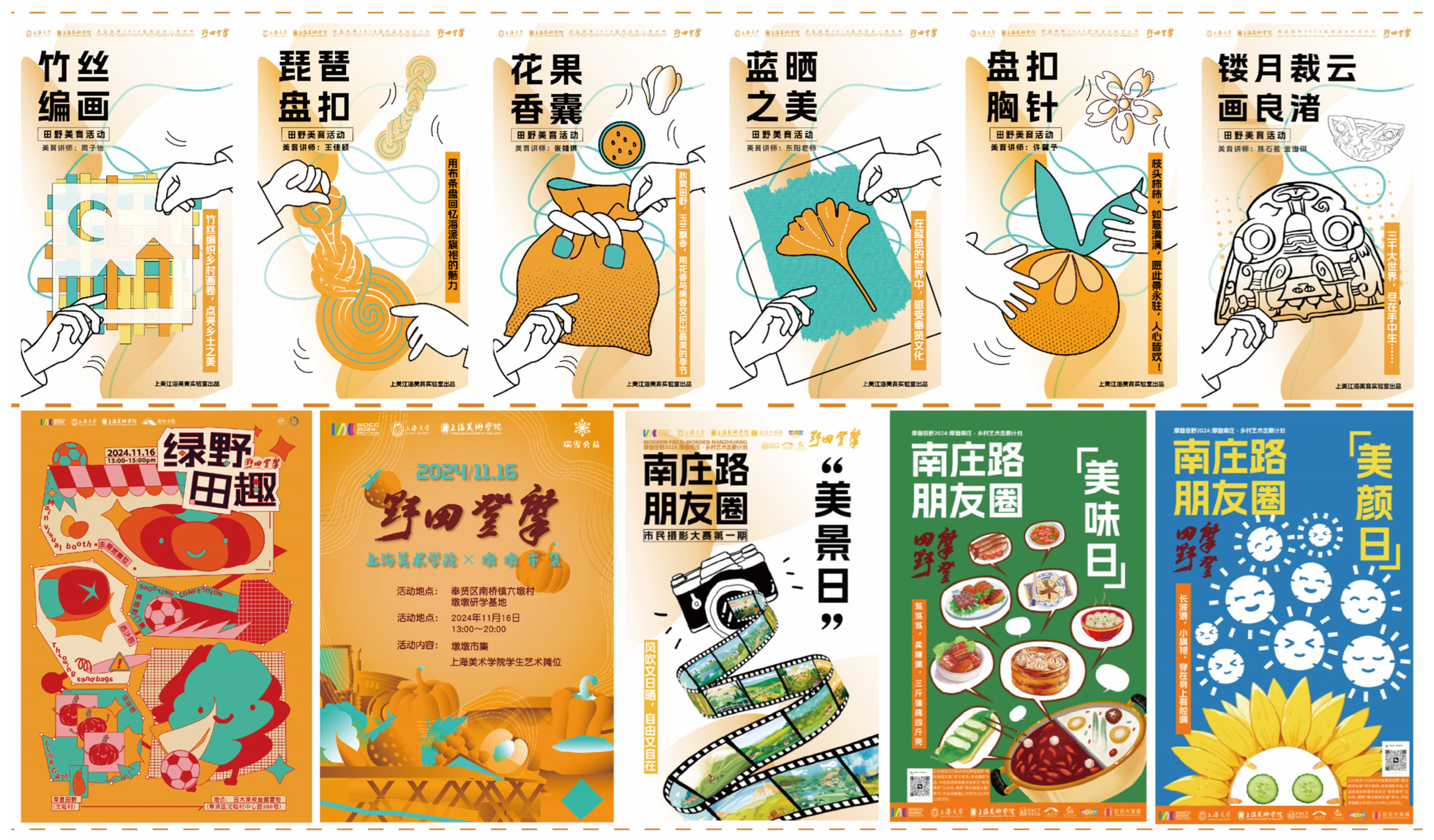
By 2023, the initiative had evolved into the New Shanghai Style Rural Art Festival. structured around a five-pronged framework: greenhouse art exhibitions, design empowerment, curriculum integration, local creation, and rural art education (Figure 3). In 2024, the project was further elevated to the Rural Art Corridor Initiative. Experts from ten leading domestic art institutions, including the Central Academy of Fine Arts and the China Academy of Art, collaborated with local villagers on public art installations and related projects in four rural revitalization demonstration villages along Nanzhuang Road. This initiative fostered a cluster effect of art intervention in rural development (Figure 4).
The selection of this case is supported by four representative criteria that enable in-depth verification and sustained inquiry. An authoritative benchmark certification confirms the festival’s standing as a representative rural land art festival in China, reflecting an “art plus cultural tourism” model of integrated sustainable development. A complete development cycle is documented through materials and records that span the full trajectory from early exploration to cluster-based growth, revealing the long-term operational logic underpinning such events. Appropriate field alignment is evidenced by a coherent system that extends from physical carriers to content construction, marked by strong localization and authenticity. Substantive relevance to rural Chinese society is further demonstrated. Rather than being undertaken by a single group, the project engages local governments, universities, resident villagers, settled operators, and a diverse tourist base—a configuration that closely mirrors the complex, multi-stakeholder fabric characteristic of rural land art festivals in China.

3.2. Research Design

Empirical data were collected through a questionnaire survey. The questionnaire comprised two sections. Demographic and background information was gathered in the first section. This information encompassed whether respondents were first-time visitors to the village, whether they had previously visited or heard of the Modern Country Art Festival or other art festivals, and whether their primary interest was directed toward the artistic aspects of the event.
The second section included six measurement scales, each adapted from established research and slightly modified to fit the context of the Rural Land Art Festival: destination quality items were adapted from Strandberg and Styven [71], covering environmental belonging and landscape quality; content stickiness items were adapted from HE and LI [26] and Steenkamp and Baumgartner [72], including the appeal of updated themes and experiences; perceived value items were adapted from Droseltis and Vignoles [73] and Tseng and Wang [74], encompassing liking for art and design and alignment with psychological expectations; tourism participation items were adapted from Laurent and Kapferer [75], including willingness to share experiences and engage in interactions; restorative environmental perception items were adapted from Wilkie and Stavridou [76], covering pleasant acceptance of content and stimulation of exploration enthusiasm; and value co-creation items were adapted from Chen et al. [77] and Tu, Zhou and Yan [70], including willingness to provide aesthetic feedback and recommend the festival through word-of-mouth. All items were rated on a 5-point Likert scale (1 = strongly disagree; 5 = strongly agree).
To ensure accuracy for Chinese respondents, three bilingual researchers verified the translation of the scales. An English-to-English translation was conducted, followed by a review from three scholars in relevant fields to ensure consistency with prior research. The questionnaire was pre-tested with four professors, two doctoral students, five master’s students, and two undergraduate students in related disciplines to assess readability, clarity, and content validity. Minor adjustments were made based on feedback.

3.3. Sampling and Data Collection

During the Modern Fields Rural Land Art Festival, 10 graduate student volunteers served as questionnaire collectors from 16 November to 23 December 2024. They received brief pre-training and conducted an on-site survey of festival participants using convenience sampling. Data were collected via paper questionnaires and QR codes, covering 16 themed festival activities between 9:00 AM and 7:00 PM under sunny conditions.
Following established research on tourists’ perceptual and cognitive abilities, participants aged 15 and above were selected [78]. Participation was voluntary, and informed consent was obtained. Respondents were informed that their responses would be used solely for academic research and that their identities would remain confidential. The study received an ethical review waiver from the Shanghai Academy of Fine Arts, Shanghai University. Several practical challenges were encountered during data collection. Because the festival was dispersed across multiple locations, the simultaneous deployment of volunteer teams at different sites was not always feasible, and full coverage of visitor traffic could not be guaranteed. While both paper-based and QR-code questionnaires were made available, comfort with mobile devices was found to be lower among some elderly visitors, a factor that occasionally slowed the response process. In such instances, assistance with questionnaire completion was provided by volunteers through direct communication. Data collection was further restricted to sunny days in order to safeguard visitor comfort and ensure reliable outdoor conditions, a decision that may have slightly limited the representativeness of the sample with respect to visitors whose experience is unaffected by weather. These on-site survey limitations are commonly observed in intercept surveys conducted at outdoor cultural events and have been taken into careful consideration in the interpretation of the results.
A total of 468 questionnaires were collected. After excluding invalid responses, 437 valid questionnaires remained, yielding a valid response rate of 93.38%. Detailed demographic information is presented in Table 1. Among respondents, 47.4% were male and 52.6% were female. The age distribution showed that 39.4% were between 26 and 35 years old, and 83.8% held a bachelor’s degree or higher. Regarding occupation, students accounted for 34.6%, followed by professionals at 16.7%. Monthly income exceeded 5001 yuan for 59.7% of respondents.
Concerning visitor experience, 74.1% were first-time visitors to the village, 55.8% had never previously visited or heard of the Modern Fields Rural Art Festival, and 58.1% had attended or learned about other arts festivals.

3.4. Statistical Analysis

This study utilized two software programs for statistical analysis. Descriptive statistics for demographic variables were calculated using SPSS 26.0.0.0. Data analysis and hypothesis testing were performed in SmartPLS 4.1.1.1.
The PLS-SEM method was selected due to its suitability for causal-predictive analysis. It does not require data to follow a normal distribution and imposes minimal restrictions on sample size and residual distribution [79]. PLS-SEM is particularly appropriate for studies involving complex models and predictive research [80]. In this study, the model included multiple constructs and indicators, and the survey data did not exhibit a normal distribution, supporting the use of PLS-SEM.
Despite its advantages, PLS-SEM has limitations. It may underestimate path coefficients in structural models [81]. To address this, the Bootstrap method was applied to test significance, thereby improving the accuracy of path coefficient estimates. Measurement reliability and validity were first assessed using the PLS-SEM algorithm. Path coefficients were then tested for significance via Bootstrap, verifying direct, mediating, and moderating effects. Cross-group comparisons were conducted using both Bootstrap and Permutation multi-group analyses to identify significant differences among groups. Finally, we used an artificial neural network (ANN) model to optimize the problem that PLS SEM struggles to effectively predict non-complementary and nonlinear relationships. This model can accurately capture and reliably analyze nonlinear relationships in the data [82]. The integrated SEM-ANN framework, therefore, can verify the structural relationships between variables while also capturing potential nonlinear interactions and complex influence patterns. Better results in both theoretical exploration and prediction accuracy can thus be achieved.

4. Results

4.1. Common Method Bias and Multiple Covariance Tests

Since the data in this study were self-reported, common method bias (CMB) may exist, which could potentially affect measurement validity and the relationships between constructs [83]. To mitigate this, both procedural and statistical controls were applied.
Procedurally, respondents were encouraged to provide honest feedback and were informed that there were no right or wrong answers. The questionnaire was also carefully designed to reduce bias by optimizing question wording and removing ambiguous or confusing items.
Statistically, Harman’s single-factor test was conducted using SPSS 26.0. The results indicated that a single factor accounted for 34.45% of the total variance, well below the 50% threshold [84]. Multicollinearity was assessed using the variance inflation factor (VIF), following Kock [85] guidelines that a VIF below 3.3 indicates no severe multicollinearity or CMB issues [86]. In this study, VIF values ranged from 1.015 to 1.850, confirming that the dataset meets the assumptions required for subsequent statistical analyses and that no significant CMB or multicollinearity problems were present.

4.2. Measurement Model

Before evaluating the structural model, the measurement model was assessed for reliability and validity using Partial Least Squares Structural Equation Modeling (PLS-SEM) standards. Convergent validity was evaluated through factor loadings and average variance extracted (AVE). As shown in Table 2, factor loadings for all items ranged from 0.711 to 0.862, exceeding the recommended threshold of 0.6 [87]. AVE values for all constructs were above 0.5, confirming adequate convergent validity.
Internal consistency and composite reliability were assessed using Cronbach’s α and composite reliability (CR). Cronbach’s α values ranged from 0.851 to 0.904, and CR values ranged from 0.889 to 0.926. All values exceeded the recommended threshold of 0.7 [88], indicating that all constructs demonstrated acceptable convergent validity and reliability.
Discriminant validity was assessed using the Fornell–Larcker criterion and the heterotrait–monotrait ratio (HTMT). According to the Fornell–Larcker criterion, the square root of the AVE for each latent variable must exceed its correlations with other variables [89]. As shown in Table 3, this requirement was met, indicating acceptable discriminant validity.
The HTMT analysis requires that all HTMT values do not exceed 0.90 [88]. Table 4 shows that all values met this criterion, further supporting the discriminant validity of the constructs in this study.

4.3. Structural Model Evaluation

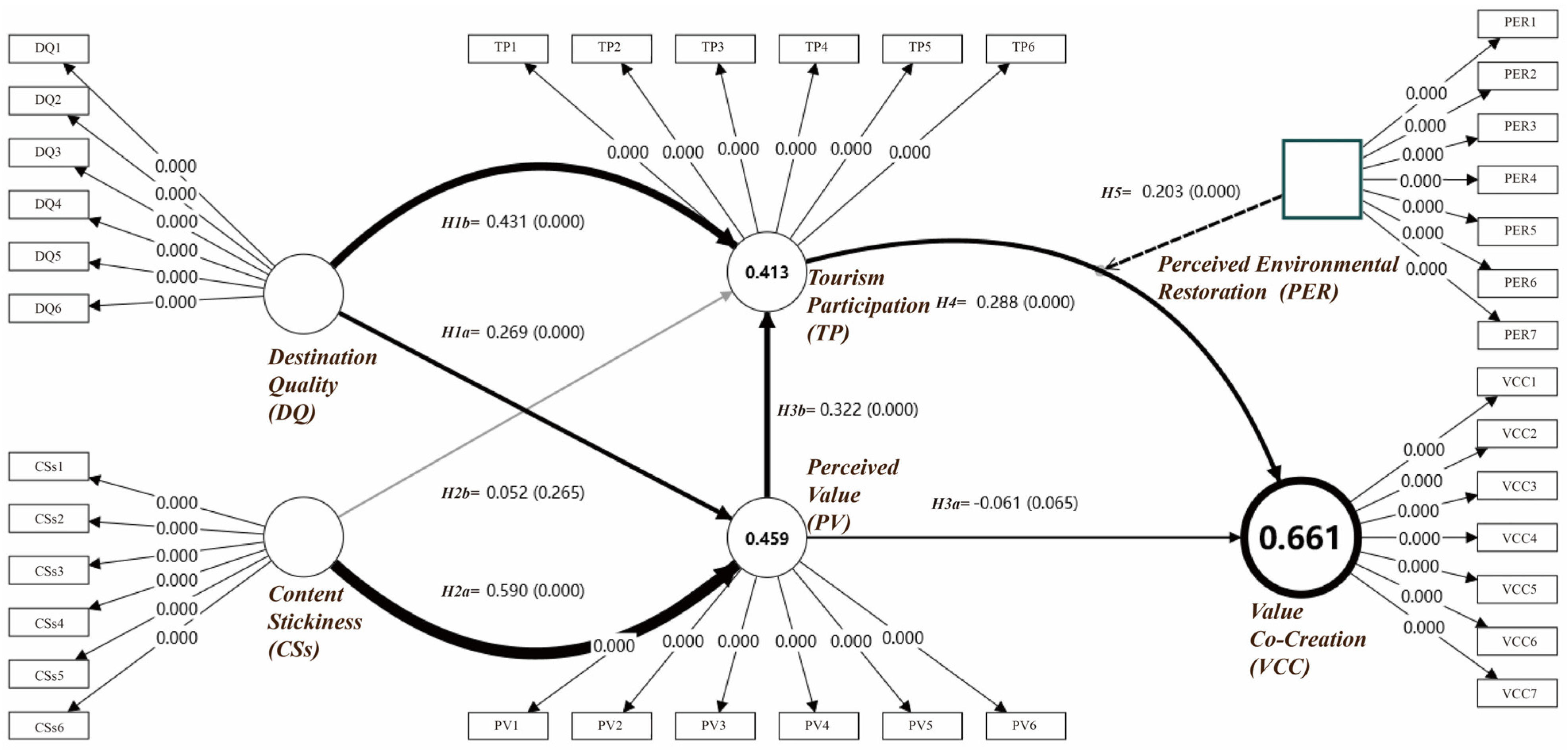
To test the structural model, the PLS-SEM algorithm and PLSpredict tool were employed to calculate the coefficient of determination (R2) and predictive relevance (Q2), thereby evaluating the model’s explanatory power and predictive accuracy. R2 reflects the proportion of variance in endogenous variables explained by the model. Following the guidelines of Hair et al. [90], R2 values of 0.25, 0.50, and 0.75 indicate small, medium, and large effect sizes, respectively. Analysis revealed that the R2 values for perceived value (PV, 0.459), tourism participation (TP, 0.413), and value co-creation (VCC, 0.661) fall within the medium effect size range, suggesting that the model possesses adequate explanatory power.
Predictive relevance was assessed using Q2 values, which were 0.450 for PV, 0.347 for TP, and 0.613 for VCC. All values exceeded the reference threshold of 0.15, indicating satisfactory predictive relevance [88]. Model fit in SmartPLS was further evaluated using the standardized root mean square residual (SRMR), an absolute goodness-of-fit measure. An SRMR below 0.10 is considered acceptable, and values below 0.08 indicate a good fit [91]. The SRMR for this model was 0.048, confirming a good fit.
Hypotheses were tested via a bootstrap algorithm with 5000 resamples (Figure 5). Confidence intervals were calculated using the bias-corrected and accelerated (BCa) method [92]. As shown in Table 5, destination quality had a significant positive effect on perceived value (β = 0.269, p < 0.001) and tourism participation (β = 0.431, p < 0.001), supporting H1a and H1b. Content stickiness significantly influenced perceived value (β = 0.590, p < 0.001), supporting H2a, but its effect on tourism participation was not significant (β = 0.052, p = 0.265), leading to the rejection of H2b. Perceived value did not significantly affect value co-creation (β = −0.061, p = 0.065), so H3a was not supported; however, it positively affected tourism participation (β = 0.322, p < 0.001), supporting H3b. Tourism participation, in turn, had a significant positive impact on value co-creation (β = 0.288, p < 0.001), confirming H4.
These findings align with Dwyer et al. [93], who highlighted that strong attachments enhance emotional connections between individuals and specific locations, underscoring the importance of destination quality and content stickiness in shaping perceived value and tourism participation. Unlike prior studies that primarily examined how destinations meet activity needs or are socially accepted [94], this study emphasizes indirect pathways to value co-creation, particularly through the mediating role of tourism participation. Moreover, while prior research on restorative environmental perception has focused on direct environmental factors, the present study demonstrates how destination quality and content stickiness influence value co-creation via perceived value and tourism participation. Notably, environmental quality has been recognized as a key driver of tourism experiences [15]; thus, this study measures restorative environmental perception through destination quality and content stickiness, both of which significantly impact tourism engagement and value co-creation.

4.4. Mediation Effects Testing

Mediation effects in the model were tested using the bootstrap method with 5000 resamples. Mediation was assessed based on the variance accounted for (VAF), following the framework of Nitzl et al. [95]. A VAF above 80% indicates full mediation, 20–80% indicates partial mediation, and below 20% indicates no significant mediation. The results are presented in Table 6.
Destination quality fully mediated value co-creation through tourism participation (β = 0.124, p < 0.001, VAF = 93.94%), supporting H1c. Content stickiness partially mediated tourism participation through perceived value (β = 0.190, p < 0.001, VAF = 78.51%), supporting H2c. However, content stickiness did not significantly mediate value co-creation through perceived value (β = −0.036, p = 0.072) or through tourism participation (β = 0.015, p = 0.275), leading to the rejection of H2d and H2e. Perceived value significantly mediated the effect of tourism participation on value co-creation (β = 0.093, p < 0.001). Given the nonsignificant direct effect, H3c is supported as a case of full mediation.
These results indicate that destination quality indirectly influences value co-creation through tourism participation, while content stickiness indirectly affects tourism participation through perceived value. Notably, content stickiness does not significantly impact the mediating pathways leading to value co-creation, suggesting that its influence is primarily focused on tourism participation as an intermediary, rather than extending to value co-creation.
These findings align with the two-factor theory applied in this study [37]. Destination quality, as a hygiene factor, serves as a foundational prerequisite for motivating individual activities. In contrast, content stickiness, as a motivation factor, cannot realize its full effect in isolation. Perceived value and tourism participation, which reflect on-site experience and behavioral engagement, more directly produce positive outcomes. Individuals assess perceived gains and losses, and when positive motivation is experienced, they are more willing to actively engage in rural land art festivals and contribute to value co-creation.

4.5. Moderation Effects Testing

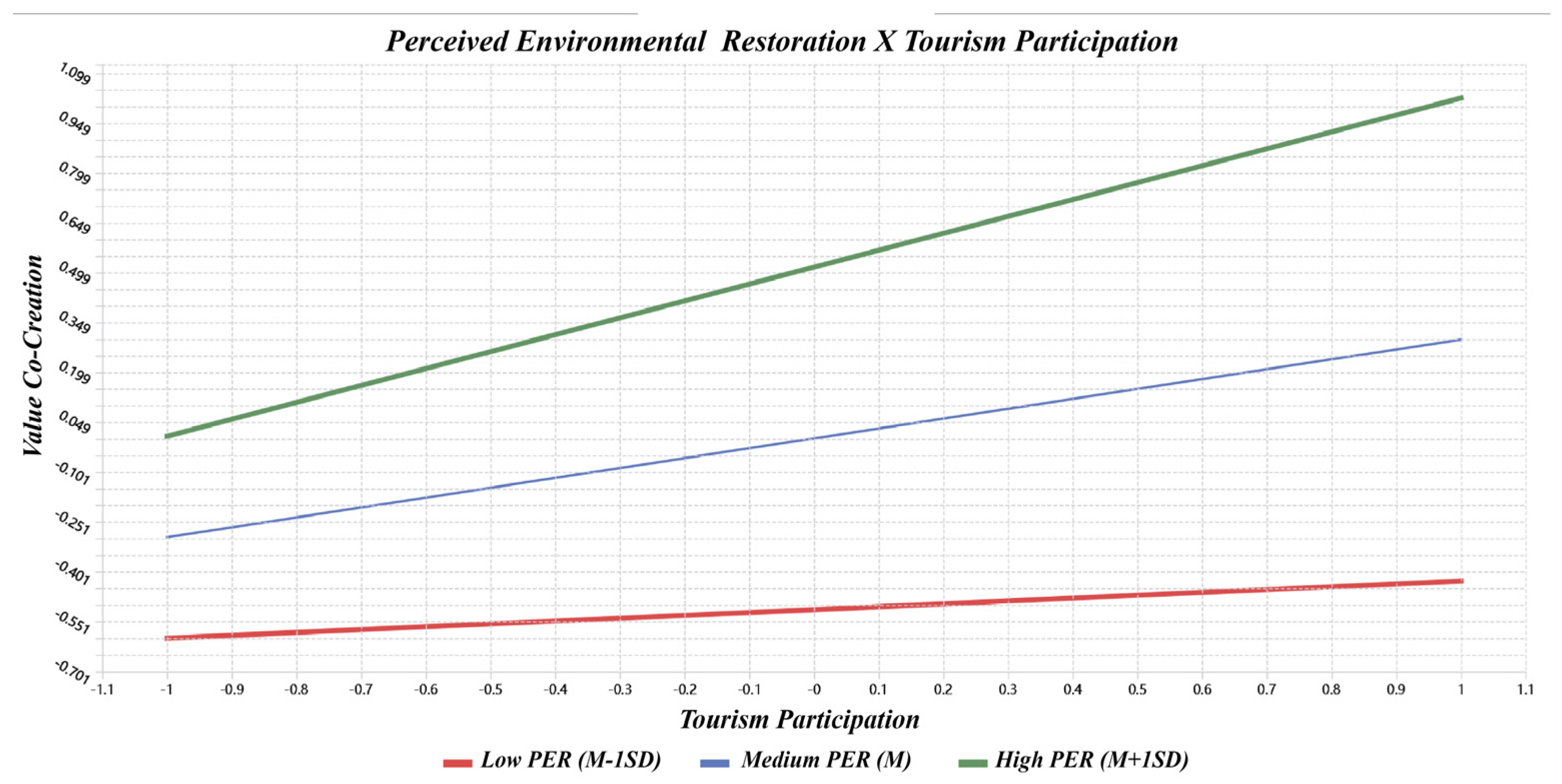
To examine the moderating effect of restorative environmental perception, the self-help confidence interval method was employed, and the results are presented in Table 7. The analysis indicated that the interaction between restorative environmental perception and tourism participation had a significant positive effect on value co-creation (β = 0.203, SE = 0.025, 95% CI [0.151, 0.249]), supporting H5.
A simple slope analysis was conducted to clarify the nature of this moderation (Table 8). When restorative environmental perception was high (+1 SD), tourism participation strongly promoted value co-creation (β = 0.490, 95% CI [0.398, 0.570]). At an average level, the effect was moderate = 0.288, 95% CI [0.217, 0.356]). When perception was low (−1 SD), the positive effect, though still significant, was weak (β = 0.085, 95% CI [0.002, 0.176]). These results indicate that a stronger perceived restorative environment amplifies the impact of tourism participation on value co-creation. This aligns with previous research showing that destination environmental quality can enhance the influence of tourist participation on behavioral intentions [96]. H5 extends this mechanism to value co-creation, confirming the reinforcing role of restorative environmental perception (Figure 6).
Unlike prior studies that treated environmental perception as a direct antecedent of tourist behavior [97] or as a mediator between experience quality and satisfaction [98], this study highlights its moderating role. Restorative environmental perception does not directly drive co-creative behavior. Instead, it enhances the effectiveness of tourism participation, indirectly promoting value co-creation. In rural land art festival settings, the restorative qualities of natural and cultural environments not only replenish psychological resources but also provide a contextual boost, facilitating the transformation of participation into co-creative outcomes.

4.6. Multi-Group Analysis

To examine differences in psychological mechanisms among tourists with varying participation experiences, a multi-group analysis was conducted. Two non-parametric methods were employed: the measurement invariance of composite models (MICOM) proposed by Henseler et al. [99] and the permutation test recommended by Hair Jr et al. [100]. These methods are widely recognized for assessing inter-group differences in PLS-SEM path coefficients.
Based on prior experience with the Rural Land Art Festival, respondents were divided into an experienced group (Stage 1, n = 189) and an inexperienced group (Stage 2, n = 248). Measurement invariance was first tested using the three-step MICOM procedure [101]. Results showed that all constructs satisfied configuration invariance, and most satisfied compositional invariance. Although full scalar invariance was not achieved, meaningful exploratory analysis of inter-group path differences is still permissible according to PLS-SEM guidelines, as the first two steps of invariance were satisfied (Table 9).
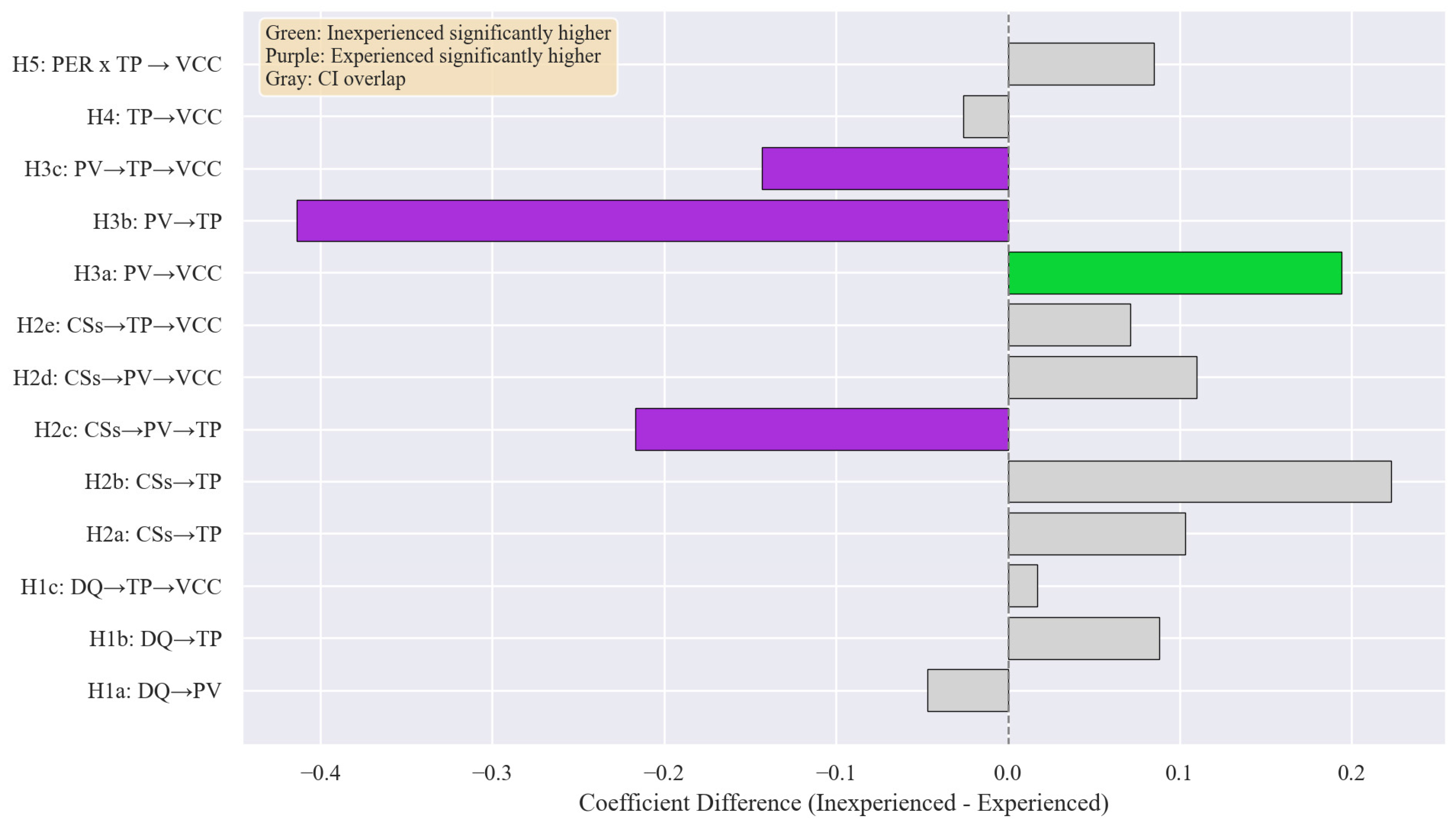
Permutation testing was then conducted to assess differences in inter-group path coefficients. Results (Table 10) show that all relevant permutation p-values were below 0.05, indicating significant differences between groups in several pathways: H2b (p = 0.019), H2c (p = 0.001), H2d (p = 0.011), H2e (p = 0.010), H3a (p = 0.007), H3b (p = 0.000), and H3c (p = 0.000). These findings suggest that tourists’ prior participation experience significantly moderates the core transmission mechanism from “content perception” to “value assessment,” then to “tourism participation,” and finally to “value co-creation.” The remaining pathways—including all destination quality effects, the direct effects of tourism participation, and the moderating effect of restorative environmental perception—did not differ significantly across groups, indicating relative stability in these mechanisms.
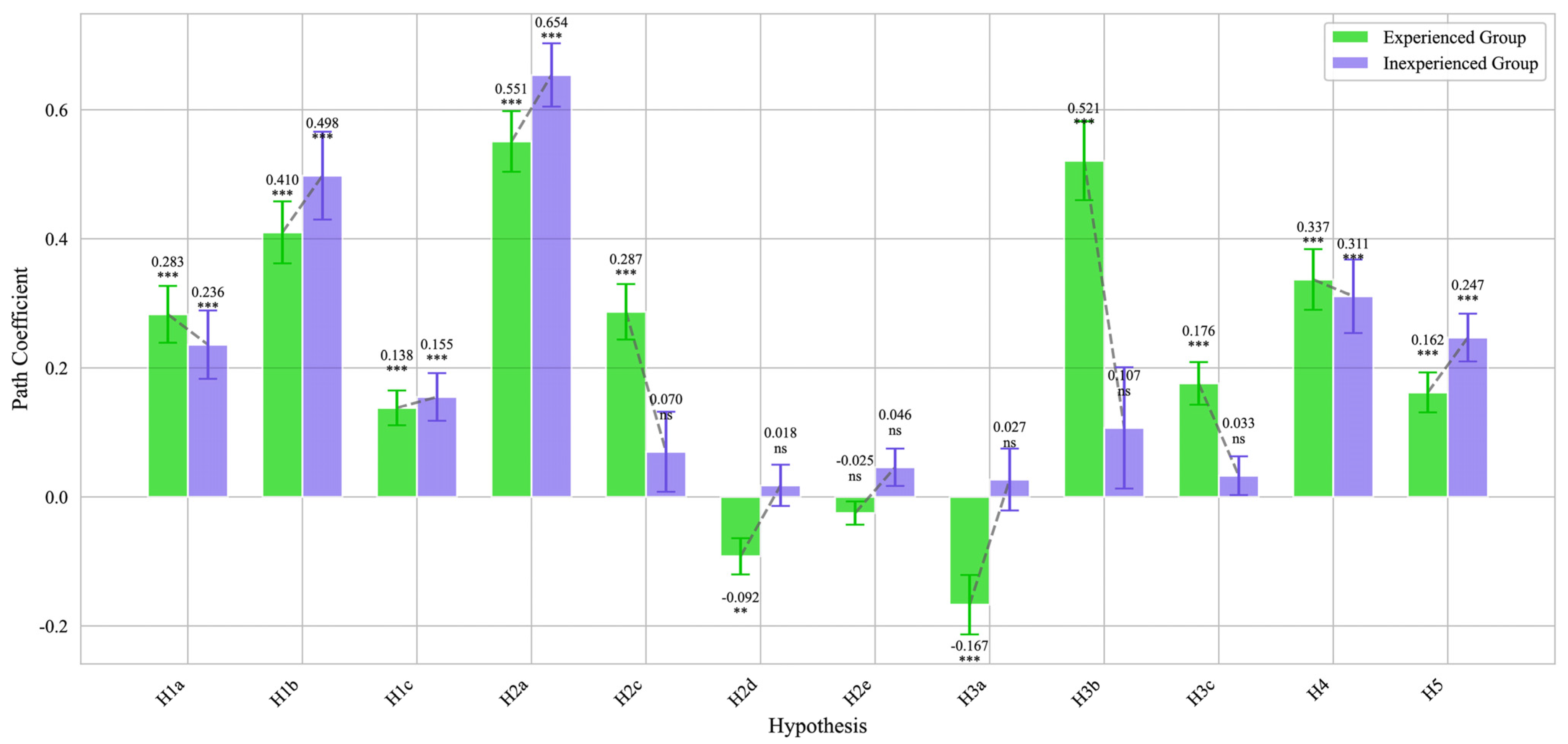
Bootstrapping analysis of the PLS-MGA further revealed the direction, magnitude, and significance of pathway coefficients within each group (Table 11). Destination quality pathways demonstrated cross-group stability, showing consistent positive effects. Specifically, H1a was significant in both the experienced (β = 0.283, p < 0.001) and inexperienced groups (β = 0.236, p < 0.001), H1b was significant in both groups (β = 0.410, p < 0.001; β = 0.498, p < 0.001), and the indirect effect H1c was significant in both groups (β = 0.138, p < 0.001; β = 0.155, p < 0.001). These results indicate that destination quality serves as a fundamental driver of subsequent cognition and behavior for both experienced and inexperienced tourists.
Significant inter-group differences were observed in pathways related to content stickiness and perceived value. H2a was significant in both groups (β = 0.551, p < 0.001 for experienced tourists; β = 0.654, p < 0.001 for inexperienced tourists). H2b was nonsignificant and negative in the experienced group (β = −0.075, p = 0.143) but nearly significant and positive in the inexperienced group (β = 0.148, p = 0.094). H2c and H2d were significant only in the experienced group (β = 0.287 and −0.092, both p < 0.01) and not significant in the inexperienced group. Among pathways related to perceived value, H3a, H3b, and H3c were significant only in the experienced group (β = −0.167, 0.521, 0.176, all p < 0.001) and nonsignificant in the inexperienced group. H4 remained significant in both groups (p < 0.001), and H5 showed that restorative environmental perception positively reinforced the effect of tourism participation on value co-creation regardless of prior participation experience (Figure 7).
These results highlight systematic differences in the value co-creation mechanism between tourists with and without prior festival experience. Prior experience and perceived value emerge as key factors influencing subsequent behavior [102]. Specifically, in the context of the Rural Edo Art Festival, the influence of digital content characteristics (e.g., IP image, thematic changes) and destination attributes on tourists’ value co-creation behavior varies depending on prior participation experience.
A core finding is that experienced tourists rely more on internalized value cognition, whereas inexperienced tourists respond more directly to external cues [103]. For experienced tourists, perceived value fully mediates the relationship between content stickiness and tourism participation (H2b nonsignificant, H2c significant), and it strongly drives tourism participation (H3b, β = 0.521). In contrast, for inexperienced tourists, content stickiness shows a nearly significant direct effect on tourism participation (H2b, p = 0.094), but perceived value exerts no significant effect (H3b nonsignificant). These results indicate that experienced tourists translate content information into value judgments, guiding their participation, while inexperienced tourists respond more impulsively to content without the support of value cognition (Figure 8).
Prior research in rural cultural tourism has emphasized the importance of place attachment and past experiences. This study used “prior participation experience” as a grouping criterion, hypothesizing that it shapes information processing and behavioral decision-making. The empirical results support this: participation experience not only influences path strength but can alter the existence of specific paths, as seen in the disappearance of the perceived value–tourism participation link among inexperienced tourists. Thus, prior participation experience serves as a key moderating variable in understanding the psychological mechanisms underlying tourist value co-creation, reflecting a shift from “novice” to “experienced” behavior patterns.
The moderating effect of restorative environmental perception (H5) did not differ significantly between groups (p = 0.091) and was significantly positive in both. This aligns with prior research showing that pro-nature environments support individual restoration [104]. Regardless of prior experience, restorative environments enhance the positive impact of tourism participation on value co-creation, particularly when tourists resonate with the cultural attributes of the environment. This suggests that restorative environmental perception operates as a stable psychological mechanism, relatively unaffected by past experience.

4.7. Artificial Neural Network (ANN) Construction and Analysis

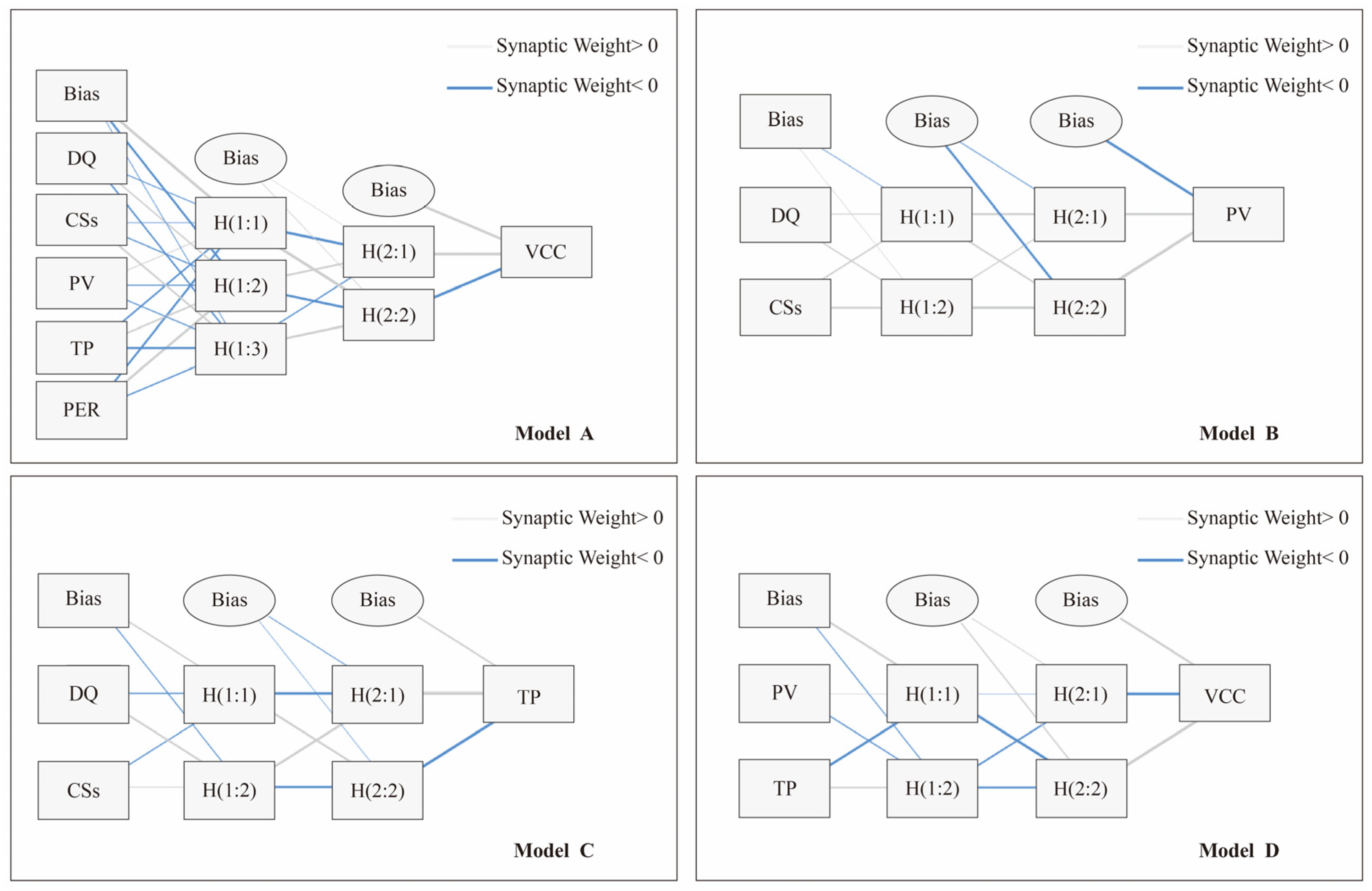
To improve prediction accuracy and capture the potentially nonlinear relationships among variables, an Artificial Neural Network (ANN) approach was introduced following the structural equation modeling (SEM) analysis [105]. Based on the relationships identified in the SEM results, an integrated analytical framework was developed to further examine tourist perception and value co-creation behavior.
Four ANN models (Models A, B, C, and D) with different input–output structures were constructed, as illustrated in Figure 9. In Model A, Destination Quality (DQ), Content Stickiness (CS), Perceived Value (PV), Perceived Restorative Environment (PER), and Tourism Participation (TP) were used as input neurons, while Value Co-creation (VCC) was specified as the output neuron. This model was designed to examine the combined influence of multiple antecedent variables on value co-creation behavior.
Models B and C used Destination Quality (DQ) and Content Stickiness (CS) as input neurons but differed in their output variables. In Model B, Perceived Value (PV) was defined as the output variable, whereas Tourism Participation (TP) served as the output variable in Model C. These two models were developed to explore the formation mechanisms of perceived value and tourism participation. Model D used Perceived Value (PV) and Tourism Participation (TP) as input variables and Value Co-creation (VCC) as the output variable, allowing the direct and combined effects of these factors on value co-creation behavior to be examined.

4.7.1. Model Fitting and Root Mean Square Error Validation

To ensure the effectiveness of ANN training and the robustness of the results, ten-fold cross-validation was employed to evaluate the predictive performance of the four models [106]. In this procedure, the dataset was randomly divided into ten subsets. During each iteration, 70% of the samples were used as the training set, while the remaining 30% served as the test set [107]. The process was repeated until each subset had been used as the test set at least once.
This validation strategy helps reduce the risk of overfitting and provides a reliable estimate of the model’s generalization ability. The root mean square error (RMSE) and the coefficient of determination (R2) for each model across the ten iterations are presented in Table 12.
Overall, the mean RMSE values of the four models ranged from 0.0799 to 0.1334, while the mean R2 values ranged from 0.5716 to 0.9001. These results indicate that the models achieved relatively low prediction errors. Moreover, the differences between the training and testing results were small, and the standard deviations remained within a narrow range. These findings suggest that none of the models experienced significant overfitting and that strong out-of-sample generalization ability was achieved. Therefore, the ANN models provide a reliable basis for subsequent analysis [108].

4.7.2. Sensitivity Analysis

Sensitivity analysis was conducted to assess the relative importance of each input variable and to identify the contribution of different factors to the prediction of the output variables. The normalized importance results are reported in Table 13. For Model A, the Perceived Restorative Environment (PER) showed the highest importance (100%), indicating that it played the most influential role in predicting value co-creation behavior. Tourism Participation (TP) ranked second with a normalized importance of 52.48%, followed by Destination Quality (DQ) at 42.97%. In contrast, Content Stickiness (CS) and Perceived Value (PV) exhibited relatively lower importance values of 19.58% and 8.28%, respectively.
In the other models, different factors were found to dominate the prediction results. In Model B, Content Stickiness (CS) showed the highest importance (100%), substantially exceeding Destination Quality (DQ), which had a normalized importance of 67.87%. In Model C, Content Stickiness (CS) again emerged as the most influential predictor with a normalized importance of 100%. In Model D, Tourism Participation (TP) demonstrated the highest importance (100%), whereas the contribution of Perceived Value (PV) was considerably lower, with a normalized importance of 23.79%.

4.7.3. Cross-Method Comparison and Interpretation

To obtain a more comprehensive understanding of tourist value co-creation mechanisms, the results of structural equation modeling (SEM) and artificial neural network (ANN) analyses were compared. Specifically, SEM path coefficients were examined alongside the normalized relative importance values derived from ANN sensitivity analysis. As shown in Table 14, the two methods show strong consistency in identifying the key determinants of value co-creation, while ANN additionally reveals nonlinear effects that cannot be captured by linear SEM models.
SEM results indicate that Tourism Participation (TP) is the only variable with a significant direct positive effect on Value Co-creation (VCC) (β = 0.288, p < 0.001). In contrast, Perceived Value (PV) shows no significant direct effect (β = −0.061, p = 0.065), while Destination Quality (DQ) and Content Stickiness (CS) influence VCC only indirectly through mediating paths. Consistent with these findings, ANN Model A shows that TP has substantial predictive importance for VCC (52.48%), whereas PV (8.28%) and CS (19.58%) contribute relatively little. These results indicate that tourism participation functions as the core direct driver of value co-creation, while the influence of perceived value mainly operates through participation.
The mechanisms underlying perceived value and tourism participation also show strong consistency across the two methods. SEM results show that Content Stickiness (CS) has a stronger effect on Perceived Value (PV) (β = 0.590, p < 0.001) than Destination Quality (DQ). ANN Model B confirms this pattern, with normalized importance values of 100% for CS and 67.87% for DQ. For Tourism Participation (TP), SEM indicates that Destination Quality (DQ) has a significant positive effect (β = 0.431, p < 0.001), while the direct effect of CS is not significant. ANN Model C further supports this result, showing the highest importance for DQ (100%) compared with CS (43.22%). Model D also confirms the dominant role of TP in predicting VCC (100%), whereas PV shows a much smaller contribution (23.79%). Together, these results consistently support the SEM conclusion that tourism participation plays the central role in driving value co-creation.
Additional insights are revealed in the analysis of restorative environmental perception (PER). In SEM, PER was modeled as a moderating variable and was found to significantly strengthen the relationship between tourism participation and value co-creation (β = 0.203, p < 0.001). However, ANN results indicate that PER has the highest predictive importance for VCC (100%), suggesting that its influence may extend beyond moderation and include a strong nonlinear predictive effect.
A similar pattern is observed for Destination Quality (DQ). Although the SEM results show no significant direct path from DQ to VCC, the ANN analysis indicates a relatively high importance value (42.97%), ranking third among all predictors. This finding suggests that the influence of destination quality on value co-creation may be nonlinear and may become significant only when destination quality reaches a certain threshold.
Overall, the combined SEM–ANN analysis provides strong support for the theoretical framework proposed in this study. While SEM identifies the linear causal relationships among variables, ANN reveals additional nonlinear predictive patterns, particularly for restorative environmental perception and destination quality. These findings suggest that relying solely on linear models may underestimate the influence of certain key factors in explaining tourist value co-creation behavior.


5. Discussion and Conclusions

5.1. Foundational Discussion

Against the backdrop of the global expansion of rural land art festivals and the growing scholarly attention devoted to rural art tourism, an extended analytical framework better suited to this topic was constructed. Within this framework, the S-O-R model is integrated with two-factor theory, and a hybrid PLS-SEM and ANN approach is adopted to explore the correlation mechanisms linking external stimuli, tourists’ psychological processes, and value co-creation behavior in rural land art festival settings. How art festivals stimulate tourists’ co-creation behavior is clarified by the results, and a theoretical explanation is provided for the common practical problems of low participation and weak long-term sustainability that are observed in rural land art festivals around the world.
The SEM and ANN results show strong consistency and jointly support the differentiated roles of two types of external stimuli within the extended framework. Destination quality, acting as a hygiene factor, and content stickiness, acting as a motivating factor, both significantly enhance perceived value [109]. However, their behavioral pathways differ. Destination quality directly promotes tourism participation, whereas content stickiness influences participation indirectly through perceived value [110]. These findings are consistent with the core propositions of two-factor theory as validated in classic international tourism research [25]. The theory is further extended by clarifying the heterogeneous action paths of hygiene and motivation factors within the context of rural arts festivals. The theoretical position that destination attributes cannot be treated as a single integrative stimulus—and that the differential mechanisms of distinct types of external factors must be systematically distinguished—is thereby substantially enriched [37]. These findings clarify the distinct mechanisms through which external stimuli operate in rural tourism contexts.
Further analysis reveals that tourism participation plays a central mediating role in the transition from psychological perception to behavioral response. SEM results show that perceived value does not directly influence value co-creation, and its effect occurs entirely through tourism participation [111]. ANN results confirm this pattern, showing that the predictive importance of tourism participation for value co-creation is substantially higher than that of perceived value. A common assumption advanced in previous international research, which holds that value perception leads directly to behavioral outcomes [112], is challenged by this finding, and the “black box” of the transition from value perception to co-creative behavior in rural arts tourism is thereby opened. A theoretical explanation is also provided for the widely observed practical dilemma of “high visitor satisfaction but low deep engagement” in rural arts festival practice [70]. Instead, it highlights deep participation as the key mechanism linking value cognition and co-creation behavior, helping explain why many rural art festivals struggle to move beyond superficial tourist engagement [113].
The moderating role of restorative environmental perception was also confirmed. SEM results show that restorative environmental perception significantly strengthens the relationship between tourism participation and value co-creation. ANN analysis further indicates that this variable has the highest nonlinear predictive importance for value co-creation. These findings indicate that restorative environmental perception not only serves a moderating function but also acts as a powerful nonlinear driver of co-creation behavior. The application boundaries of Attention Restoration Theory (ART) in international tourism research are thus significantly expanded [114]. The focus of most previous studies has been placed on the psychological restorative effects of traditional natural environments such as forest reserves [46]. This research boundary is extended by the present findings, which demonstrate that restorative effects can also occur in hybrid environments that combine nature with cultural and artistic interventions—increasingly prevalent settings that have remained under-researched. Multi-group analysis further reveals differences in behavioral mechanisms between visitor groups with different levels of participation experience. Inexperienced visitors tend to display stimulus-driven behavior, whereas experienced visitors follow a value-internalization pathway. However, the moderating effect of restorative environmental perception remains stable across both groups. International research on the segmentation of rural arts festival tourism, which has long emphasized demographic characteristics while neglecting the heterogeneity of participatory experiences [58], is complemented by these heterogeneous findings, and a contribution is thereby made to the international literature on tourism experiences and repeat visits. The particularity of rural land art festivals is further reflected in several hypotheses that received no empirical support. The localized and immersive nature of artistic content requires value perception to be internalized before it can translate into participatory behavior [115]. Moreover, value co-creation represents a proactive and high-level behavioral outcome that cannot be driven by value cognition alone and must be realized through deeper participation.

5.2. Theoretical Contributions

The theoretical contributions of this study can be summarized in several aspects. Two-factor theory is first integrated into the S-O-R framework to establish a binary stimulus classification consisting of hygiene factors and motivating factors. This integration addresses the ambiguity of stimulus classification in traditional S-O-R models while overcoming the limitation of two-factor theory, which often examines individual motivation without adequately considering contextual influences [9]. A more coherent analytical lens for explaining complex tourist behavior in rural art festival contexts is thus provided from an international perspective. Building upon this foundation, the two core constructs of destination quality and content stickiness were reconceptualized for the rural land art festival setting. Destination quality was expanded into a multidimensional structure that encompasses emotional connection, environmental perception, and cultural cognition, while content stickiness was redefined through the integration of content sustainability, brand uniqueness, and experience richness. The situational adaptability of the measurement was improved, and the theoretical system of international rural art tourism research on destination attractiveness was supplemented by this reconceptualization.
Furthermore, the study clarifies the fully mediating role of tourism participation in the relationship between perceived value and value co-creation. By identifying participation as the key mechanism linking perception and behavioral contribution, the study moves beyond the simplified assumption that value perception directly leads to behavioral outcomes and extends the application of value co-creation theory in experiential tourism contexts [31]. In addition, restorative environmental perception is reconceptualized as a moderating factor rather than a traditional antecedent variable [116]. Artificial neural network (ANN) analysis further uncovered its strong and significant nonlinear influence on value co-creation behavior, offering an explanatory complement to the simplified linear assumptions prevalent in existing international studies. These insights extend the application of attention restoration theory from the realm of psychological recovery into the process of value creation and highlight the unique competitive advantage of rural land art festivals over traditional tourism activities within international scholarship. Another contribution concerns the methodological approach. A hybrid analytical strategy combining partial least squares structural equation modeling (PLS-SEM) and artificial neural networks (ANNs) was employed. The complementary strengths of PLS-SEM in verifying linear causality and testing hypotheses are combined with the capacity of ANN to identify nonlinear predictive effects and capture complex interactions. The limitations inherent in traditional linear models within international tourism research are overcome by this hybrid framework, and a more robust and comprehensive methodological paradigm is provided for investigating multidimensional tourism behavior mechanisms in complex tourism settings.

5.3. Management Implications

The management insights presented in this study are derived strictly from the empirical findings and from the team’s practical engagement in event planning. The content is organized in accordance with the logical sequence of “empirical findings–management insights–actionable suggestions.” A rigorous connection between theoretical analysis and the pursuit of sustainable development in rural land art festivals is thereby established, and a reference for real-world rural practice is provided.
A differentiated operational strategy can be driven by a dual-factor stimulus system. Empirical results indicate that both Destination Quality (DQ) and Content Stickiness (CS) significantly enhance perceived value. Basic protection is afforded by DQ through the reduction of tourists’ perceived losses, while intrinsic motivation is supplied by CS through the elevation of their perceived benefits. Common operational misconceptions observed in current rural land art festivals—such as an emphasis on content innovation that neglects basic destination quality, or an exclusive focus on infrastructure construction without core content appeal—are thereby challenged. As a specific measure, attention is directed to the environmental perception dimension within the three-dimensional structure of DQ. The cleanliness of natural landscapes, the integrity of landscape diversity, and the reasonable layout of supporting facilities in densely populated areas are to be emphasized so that the basic sensory comfort of tourists is ensured. For CS, brand uniqueness constitutes a core element. Local cultural symbols are to be deeply explored, and unique festival IPs with sustained recognition are to be created. The rural art brand “Modern Fields” serves as a notable example.
Layered participation guidance can be informed by the full mediating role of tourism participation. The core mediating function of Tourism Participation (TP) in the transition from psychological perception to value co-creation behavior is revealed by the empirical results. No significant direct impact of perceived value (PV) on value co-creation (VCC) is observed; its influence on VCC is entirely mediated through TP. Enhancing tourists’ VCC behavior thus depends not solely on raising their perceived value, but more critically on constructing a complete, progressive participation path through which value perception is translated into actual participation. A four-level progressive participation system, validated in the practice of “Modern Fields,” is proposed. The first level, observation and perception, offers low-threshold basic activities such as free guided tours, enabling tourists to form an initial sense of perceived value. The second level, immersion and experience, provides interactive experiential activities—handicraft workshops and agricultural experience projects, for instance—for tourists who have developed initial positive perceptions. The third level, creativity and feedback, opens deeper participation channels for those who have undergone immersive experiences; examples include the collection of creative suggestions and art-making experiences. The fourth level, co-creation and contribution, involves festival content co-creation and joint promotion. Targeted incentives—limited-edition cultural products, priority participation rights for subsequent activities, and co-creation certificates—are supplied to reinforce positive feedback on participation and to realize the ultimate value of co-creation behavior.
The moderating role of Perceived Environmental Restoration (PER) can be leveraged in restorative environmental creation. A key driving role of PER in promoting tourists’ co-creation behavior is confirmed by the empirical results. Rural land art festivals that integrate natural landscapes and artistic intervention possess a unique advantage in providing a restorative environmental experience. The creation of restorative environments must therefore fully exploit the combined strengths of natural landscapes and artistic intervention. With respect to natural healing, the original rural landscape—farmland, water systems, and vegetation—is to be strictly protected, and excessive commercial transformation is to be avoided. Regarding the effectiveness of art therapy, art installations are integrated into the natural rural environment, fostering an atmosphere of harmonious coexistence between humans and nature. In addition, experiential activities with a healing theme, such as rural nature walks and artistic meditation, are designed to help tourists attain deeper restorative experiences.
Precise operations can be developed based on visitor heterogeneity. Significant differences in the behavioral mechanisms of tourist groups with varying levels of experience are revealed by multiple analyses. First-time visitors exhibit stimulus-driven behavior, concentrating more on the basic security and surface attractiveness of the destination. Returning visitors display value-internalization behavior, placing greater emphasis on the value connotation of content and the depth of their participation experience, and demonstrating a higher willingness to co-create. The operation of art festivals must therefore move beyond one-size-fits-all service and activity design; phased operational strategies tailored to tourists at different experience levels should be adopted to match their distinct behavioral mechanisms. For inexperienced tourists, one-stop basic services such as free guided tours, route maps, and activity schedules are recommended, accompanied by low-threshold, highly interactive experiential activities that help create a positive first impression. For experienced tourists, priority access to core activities, artist exchange meetings, and other exclusive services should be provided.
A long-term operational support system grounded in multi-party participation is essential. Funding and local community engagement constitute key challenges. Sustainable development is sustained by diversified sources of funding, including government grants, operating income, corporate sponsorship, charitable foundations, or crowdfunding. The practice of “Modern Fields,” for example, successfully integrated resources from universities, businesses, and cultural institutions. Local community participation is encouraged through the cultivation of a sense of ownership and identity. The achievements of festivals are shared by invited cultural celebrities, elders, or village representatives; visits to successful demonstration sites are arranged; and villagers are involved in artistic creation or environmental improvement. A fair profit distribution mechanism is also to be established. Tourism revenue is distributed through village-level collective organizations so that workers are remunerated and villagers are ensured direct benefits from the festivals.

5.4. Limitations and Directions for Future Research

The findings of this study are subject to certain limitations that affect their generalizability. The research focused on a single case—the “Modern Fields Rural Land Art Festival”—with close involvement from the research team. Semi-structured interview data were collected by the research team from multiple stakeholders throughout the project’s implementation period up to 2024, allowing deeper exploration of the topic. The data encompassed village government officials, businesses operating within the village, and on-site visitors. Because research resources were constrained, interviews lasting 15 to 20 min were conducted with seven participants at the event (more detailed interview materials can be found in Appendix A Table A1). The findings obtained from government officials served to confirm the project’s officially recognized practical value. The Secretary of the Jianghai Village Committee stated explicitly, “Modern Fieldwork has expanded the village’s visibility, brought cultural empowerment, and allowed people to experience the charm of Jianghai Village.” Similarly, the Deputy Secretary of the Shenlu Village Committee noted that the festival had encouraged the return of local villagers, diversified local employment opportunities, and facilitated the transformation of the village’s industrial structure toward an integration of agriculture, culture, and tourism. These firsthand accounts demonstrate that the case constitutes not a short-term, unreplicable artistic performance, but a typical successful practice of China’s Rural Land Art Festival, with sustainable rural empowerment effects.
Further validation of the fit between this case and the theoretical model was provided by interview data from participating operators. Key personnel from participating businesses pointed out that “narrow rural roads are not the problem; what is lacking is attractive content along the way to encourage people to come in,” and that “infrastructure development is too slow to support the long-term operation of the festival.” These observations align closely with the core logic of distinguishing Destination Quality, as a hygiene factor and basic threshold, from Content Stickiness, as a motivating factor and source of core appeal.
A triangular validation with the quantitative findings was established through interview data from independent tourists. Remarks were offered that “the concept of art installations is good, but without explanation, we cannot understand them; we need to know what they are,” and that “the content of the activities needs to be richer to attract people.” It was also observed that “urban tourists come to the countryside mainly to relax and relieve the pressure of high-rise buildings.” A high degree of consistency was found between these qualitative observations and the core conclusions regarding the mediating role of tourism participation and the moderating role of restorative environmental perception, further strengthening the robustness of the quantitative results.
While the preceding evidence attests to the internal validity and typicality of the case, the distinctive contextual attributes of the setting are undeniable. As a consequence, the conclusions drawn from this study cannot be directly and indiscriminately generalized to all types of rural art festivals in China. Considerable variation is observed across China’s rural art festivals in terms of leadership structures, community foundations, artistic themes, and levels of commercialization. To address this, future studies could adopt multi-case comparative approaches, including festivals with diverse operating models and development stages. Such cross-case analyses would allow testing of the proposed “destination quality–content stickiness” stimulus and the “perceived value–tourism participation” mediation mechanism across different contexts, leading to a more universally applicable theoretical framework.
The use of a cross-sectional questionnaire during the festival introduces another limitation. While this method effectively captures visitors’ perceptions and behavioral intentions at a single point in time, it cannot account for the evolution of individual experiences over multiple visits or years. Visitors’ perceived value, engagement depth, and co-creation behaviors are likely to change as festivals update content annually or as participants become more familiar with the event. Longitudinal research could track these dynamics, for instance, through multi-year follow-up surveys of first-time participants, capturing their progression from novice to experienced visitor. This approach would provide stronger empirical support for segmented management strategies and targeted engagement initiatives.
Measurement methods also constrain the study’s insights. Physiological tools, such as electroencephalography (EEG) or eye-tracking, were not utilized. Evidence suggests that these methods can complement self-reported measures by reducing cognitive bias and providing objective, real-time data on visitors’ emotional and cognitive responses, as demonstrated by Miranda-Correa et al. [117]. Incorporating physiological measurements could offer a deeper understanding of visitors’ emotional engagement and the restorative impact of the rural environment. Additionally, stratified sampling techniques could improve representativeness and enhance the generalizability of findings [118].
Future research could adopt a multi-stakeholder approach, using interviews, participant observation, and social network analysis to examine how power relations, resource exchanges, and value conflicts shape co-creation outcomes. This would extend the S-O-R framework from the individual to the group and organizational levels, offering a more comprehensive understanding of rural festival dynamics.

Author Contributions

B.Z.—Research design, execution, data organization, software, formal analysis, writing; S.C.—Investigation, methodology, validation, project management, and funding acquisition; X.C.—Conceptualization, resourcing, and review. All authors have read and agreed to the published version of the manuscript.

Funding

The first batch of new liberal arts research and reform practice projects funded by the Ministry of Education of China in 2021 [grant number:2021160030].

Institutional Review Board Statement

This study has been granted an ethical review exemption by Shanghai Academy of Fine Arts, Shanghai University, with certificate number [SAFA2025080401].

Informed Consent Statement

Informed consent was obtained from all subjects involved in the study.

Data Availability Statement

The raw data supporting the conclusions of this article will be made available by the authors on request.

Acknowledgments

We sincerely thank the editors and reviewers for their valuable opinions and suggestions, as well as the staff from the Modern Field Art Festival at Shanghai Academy of Fine Arts, Shanghai University, for their support in data collection and other aspects of this study.

Conflicts of Interest

The authors declare no conflicts of interest.

Appendix A

Table A1. Semi-structured interview materials.
IdentityCore ViewpointViewpoint Extraction
Secretary of Jianghai Village, Fengxian, Shanghai; Male; 40–50 years olda. Modern Field has expanded its popularity and brought cultural empowerment to the villageCultural empowerment and increased visibility; Request for continuity of activities; Value conversion of cultural and creative products; Policy resource support; Operational manpower bottleneck
b. I hope to normalize activities like an art museum and establish a village art troupe
c. Plan to set up self-service sales points for cultural and creative products in homestays
d. The Shanghai Jiangnan policy will be implemented in the second half of the year, supported by comprehensive land funds
e. The tourist sightseeing bus is short of operating personnel and cannot be pushed temporarily
Deputy Secretary of Shenlu Village Committee, Fengxian, Shanghai; Female; 30–40 years olda. Middle aged and elderly villagers return after the epidemic, while young people return on weekendsPopulation return phenomenon; Diversified local employment; Industrial structure upgrading (transformation from the secondary industry to the tertiary industry); Integration strategy of agriculture, culture, and tourism
b. Iron wood fruit dream city, distribution center, cooperative provide diversified employment opportunities
c. Eliminate low-end manufacturing and introduce training centers and distribution companies
d. Focus on developing the integration of red culture and agricultural characteristics in agriculture, culture, and tourism
Shanghai Fengxian Jianghai Village Committee; Male; 20–30 years olda. Strict control over land properties makes it difficult to change commercial useRigid constraints of land system; Difficulties in circulation coordination; Lack of planning and management tools
b. There are a few obstacles to the unified transfer of land that are opposed by households
c. Lack of industrial area statistics and refined planning decisions
Manager of the settled enterprise in Jianghai Village (Heguang · Impression); Female; 20–30 years olda. Jianghai Village lacks distinctive recognitionInsufficient differentiation of destinations; The motivation for site selection is site orientation; Lack of highlights in experience design; Suggestions for co-creation of farmland experience; The lagging infrastructure hinders development; User-oriented design concept
b. I chose this place only because there is a standalone venue with a yard
c. Narrowing the road is not a problem, what’s missing is the attractive points along the way
d. Suggest conducting farmland experience (sowing/harvesting)
e. The construction of homestay infrastructure has not been completed for two years, and the speed is too slow
f. Design should be from the perspective of tourists, avoiding self indulgence
Staff members of enterprises settled in Jianghai Village (Yehu Tea Affairs); Female; 20–30 years olda. The location is seeking a quiet, slow paced, and peaceful environment amidst the hustle and bustlePerceived restorative environment; Local supportive policies; Word-of-mouth communication is dominant; Intention to expand business formats; Target customer profile
b. The village supports entrepreneurship and helps solve parking problems
c. The main source of customers relies on word-of-mouth communication on social media
d. Plan to expand filming collaborations, team building, and salons
e. The customer base is mainly young people and parents, with a relaxed atmosphere
Jianghai Village Free Tourist; Female; 30–40 years olda. Insufficient promotion, difficult to find platform informationInsufficient information accessibility; Unifying the content of activities; Lack of artistic interpretation affects the experience
b. The activity content needs to be more diverse, not just providing venues
c. The concept of art installation is good, but lacks introduction, making it difficult for the audience to understand
Staff of Yunye Camp in Yuli Village, Fengxian, Shanghai; Male; 20–30 years olda. Tourists come from the stressful environment of high-rise buildings and experience the relaxation of “barbarism and revelry” in the countrysideRural areas serve as spaces for stress release; Resilience perception brought by environmental comparison

References

  1. Lin, L.C.; He, P.F. Cultural Arts with Brand Value: Branding from Chinese Dragon Boat Racing. In Proceedings of the 2nd International Conference on Economics and Management Innovations (ICEMI), Bangkok, Thailand, 15–16 July 2017; pp. 136–138. [Google Scholar]
  2. Gao, S.L.; Huang, S.S.; Huang, Y.C. Rural Tourism Development in China. Int. J. Tour. Res. 2009, 11, 439–450. [Google Scholar] [CrossRef]
  3. Gao, J.; Wu, B.H. Revitalizing traditional villages through rural tourism: A case study of Yuanjia Village, Shaanxi Province, China. Tour. Manag. 2017, 63, 223–233. [Google Scholar] [CrossRef]
  4. Yi, Y.Y.; Siow, M.L.; Ibrahim, R.; Aziz, F.A. Understanding the Role of Tourist-Oriented Villages in Promoting Rural Tourism in China: Integrating Rural Landscapes and Tourist Services. J. Qual. Assur. Hosp. Tour. 2024, 2024, 1–41. [Google Scholar] [CrossRef]
  5. Ling, J.; Wang, R.; Yang, L.O. Revitalizing Community Identity Through Interactive Art Installations: A Case Study of Gan Zhu Tan Hydropower Station in Zuotan Village. In Proceedings of the 26th International Conference on Human-Computer Interaction, HCII, Washington, DC, USA, 29 June–4 July 2024; pp. 281–291. [Google Scholar]
  6. Liu, C.Y.; Dou, X.T.; Li, J.F.; Cai, L.P.A. Analyzing government role in rural tourism development: An empirical investigation from China. J. Rural Stud. 2020, 79, 177–188. [Google Scholar] [CrossRef]
  7. Herzberg, F.; Mausner, B.; Snyderman, B. The Motivation to Work; John Willey & Sons: New York, NY, USA, 1959. [Google Scholar]
  8. Mehrabian, A.; Russell, J. An Approach to Environmental Psychology; The MIT Press: Cambridge, MA, USA, 1974. [Google Scholar]
  9. Zhai, X.S.; Wang, M.J.; Ghani, U. The SOR (stimulus-organism-response) paradigm in online learning: An empirical study of students’ knowledge hiding perceptions. Interact. Learn. Environ. 2020, 28, 586–601. [Google Scholar] [CrossRef]
  10. Chen, G.H.; So, K.K.F.; Hu, X.Y.; Poomchaisuwan, M. Travel for Affection: A Stimulus-Organism-Response Model of Honeymoon Tourism Experiences. J. Hosp. Tour. Res. 2022, 46, 1187–1219. [Google Scholar] [CrossRef]
  11. Jiang, J. The role of natural soundscape in nature-based tourism experience: An extension of the stimulus–organism–response model. Curr. Issues Tour. 2022, 25, 707–726. [Google Scholar] [CrossRef]
  12. Yu, J. Herzberg motivation-development of health care factor theory. Psychol. Sci. 2002, 5, 633–634. [Google Scholar]
  13. Ulker-Demirel, E.; Ciftci, G. A systematic literature review of the theory of planned behavior in tourism, leisure and hospitality management research. J. Hosp. Tour. Manag. 2020, 43, 209–219. [Google Scholar] [CrossRef]
  14. Rejikumar, G.; Ajitha, A.A.; Jose, A.; Mathew, S. Strategic positioning of tourist destinations-analyzing the role of perceived meaningfulness. J. Hosp. Tour. Manag. 2021, 49, 140–151. [Google Scholar] [CrossRef]
  15. Coelho, M.d.F.; Gosling, M.d.S.; Almeida, A.S.A.d. Tourism experiences: Core processes of memorable trips. J. Hosp. Tour. Manag. 2018, 37, 11–22. [Google Scholar] [CrossRef]
  16. Pantovic, D.; Parausic, V.; Radosavljevic, K.; Mihailovic, B. Rural tourism and local authority satisfaction: Social, economic, and environmental effects. J. Tour. Manag. Res. 2025, 12, 17–26. [Google Scholar] [CrossRef]
  17. Lazovic, S.; Milicevic, S.; Dordevic, N.; Kraguljac, V. Exploring rural tourism potential in rural areas of Vrnjačka Banja. Menadz. U Hotel. I Tur. 2024, 12, 59–73. [Google Scholar] [CrossRef]
  18. Buhalis, D. Marketing the competitive destination of the future. Tour. Manag. 2000, 21, 97–116. [Google Scholar] [CrossRef]
  19. Middleton, V.T.; Clarke, J.R. Marketing in Travel and Tourism; Routledge: Abingdon, UK, 2012. [Google Scholar]
  20. Souiden, N.; Ladhari, R.; Chiadmi, N.E. Destination personality and destination image. J. Hosp. Tour. Manag. 2017, 32, 54–70. [Google Scholar] [CrossRef]
  21. Loi, L.T.I.; So, A.S.I.; Lo, I.S.; Fong, L.H.N. Does the quality of tourist shuttles influence revisit intention through destination image and satisfaction? The case of Macao. J. Hosp. Tour. Manag. 2017, 32, 115–123. [Google Scholar] [CrossRef]
  22. Dedeoğlu, B.B. Shaping tourists’ destination quality perception and loyalty through destination country image: The importance of involvement and perceived value. Tour. Manag. Perspect. 2019, 29, 105–117. [Google Scholar] [CrossRef]
  23. Siebert, A.; Gopaldas, A.; Lindridge, A.; Simes, C. Customer Experience Journeys: Loyalty Loops Versus Involvement Spirals. J. Mark. 2020, 84, 45–66. [Google Scholar] [CrossRef]
  24. Oishi, S.; Choi, H.; Koo, M.; Galinha, I.; Ishii, K.; Komiya, A.; Luhmann, M.; Scollon, C.; Shin, J.-E.; Lee, H. Happiness, meaning, and psychological richness. Affect. Sci. 2020, 1, 107–115. [Google Scholar] [CrossRef]
  25. Oishi, S.; Westgate, E.C. A psychologically rich life: Beyond happiness and meaning. Psychol. Rev. 2022, 129, 790. [Google Scholar] [CrossRef]
  26. He, W.; Li, C. The impact mechanism of effectiveness of tourist experience journey design on theme park revisit intention: Based on the two-factor theory. Tour. Trib. 2024, 39, 98–111. [Google Scholar]
  27. So, K.K.F.; King, C.; Hudson, S.; Meng, F. The missing link in building customer brand identification: The role of brand attractiveness. Tour. Manag. 2017, 59, 640–651. [Google Scholar] [CrossRef]
  28. Cai, G.W.; Xu, L.; Gao, W.J.; Hong, Y.; Ying, X.Y.; Wang, Y.; Qian, F.Y. The Positive Impacts of Exhibition-Driven Tourism on Sustainable Tourism, Economics, and Population: The Case of the Echigo-Tsumari Art Triennale in Japan. Int. J. Environ. Res. Public Health 2020, 17, 1489. [Google Scholar] [CrossRef]
  29. Marin, L.; Ruiz de Maya, S. The role of affiliation, attractiveness and personal connection in consumer-company identification. Eur. J. Mark. 2013, 47, 655–673. [Google Scholar] [CrossRef]
  30. Zheng, D.; Ritchie, B.W.; Benckendorff, P.J.; Bao, J. Emotional responses toward Tourism Performing Arts Development: A comparison of urban and rural residents in China. Tour. Manag. 2019, 70, 238–249. [Google Scholar] [CrossRef]
  31. Dresler, E.; Jackson, V. Multidimensionality of nostalgic festival experiences: The Art Deco Festival case. J. Destin. Mark. Manag. 2024, 31, 100827. [Google Scholar] [CrossRef]
  32. Tubillejas-Andres, B.; Cervera-Taulet, A.; García, H.C. How emotional response mediates servicescape impact on post consumption outcomes: An application to opera events. Tour. Manag. Perspect. 2020, 34, 100660. [Google Scholar] [CrossRef]
  33. Zeithaml, V.A. Consumer perceptions of price, quality, and value: A means-end model and synthesis of evidence. J. Mark. 1988, 52, 2–22. [Google Scholar] [CrossRef]
  34. Gallarza, M.G.; Saura, I.G. Value dimensions, perceived value, satisfaction and loyalty: An investigation of university students’ travel behaviour. Tour. Manag. 2006, 27, 437–452. [Google Scholar] [CrossRef]
  35. Pandža Bajs, I. Tourist perceived value, relationship to satisfaction, and behavioral intentions: The example of the Croatian tourist destination Dubrovnik. J. Travel Res. 2015, 54, 122–134. [Google Scholar] [CrossRef]
  36. Yi, X.; Fu, X.; Lin, B.; Zhang, G.; Jiang, L.; Zhang, J. Investigating the impact of tourists’ perceived authenticity and aesthetics on word-of-mouth in cultural heritage sites. Tour. Manag. 2025, 111, 105167. [Google Scholar] [CrossRef]
  37. Sterchele, D. Memorable tourism experiences and their consequences: An interaction ritual (IR) theory approach. Ann. Tour. Res. 2020, 81, 102847. [Google Scholar] [CrossRef]
  38. Naidoo, P.; Sharpley, R. Local perceptions of the relative contributions of enclave tourism and agritourism to community well-being: The case of Mauritius. J. Destin. Mark. Manag. 2016, 5, 16–25. [Google Scholar] [CrossRef]
  39. Netzer, L.; Gutentag, T.; Kim, M.Y.; Solak, N.; Tamir, M. Evaluations of emotions: Distinguishing between affective, behavioral and cognitive components. Personal. Individ. Differ. 2018, 135, 13–24. [Google Scholar] [CrossRef]
  40. Prebensen, N.K.; Xie, J. Efficacy of co-creation and mastering on perceived value and satisfaction in tourists’ consumption. Tour. Manag. 2017, 60, 166–176. [Google Scholar] [CrossRef]
  41. Le-Anh, T.; Nguyen-To, T. Consumer purchasing behaviour of organic food in an emerging market. Int. J. Consum. Stud. 2020, 44, 563–573. [Google Scholar] [CrossRef]
  42. Chen, G.; Xi, W. The impact of visitors’ perceived destination restorative qualities on satisfaction and post-tour behavioral intentions: A case study of Nankunshan. Tour. Sci. 2018, 32, 17–30. [Google Scholar]
  43. Kaplan, S. The restorative benefits of nature: Toward an integrative framework. J. Environ. Psychol. 1995, 15, 169–182. [Google Scholar] [CrossRef]
  44. Pals, R.; Steg, L.; Siero, F.W.; van der Zee, K.I. Development of the PRCQ: A measure of perceived restorative characteristics of zoo attractions. J. Environ. Psychol. 2009, 29, 441–449. [Google Scholar] [CrossRef]
  45. Feng, N.; Zhang, A.; Cui, L.; Zeng, H.; Mankad, A. Effects of neighbourhood social cohesion and need for restoration on restorative experiences. Asian J. Soc. Psychol. 2020, 23, 422–434. [Google Scholar] [CrossRef]
  46. Tang, Y.; Liang, S.; Bu, H.; Huang, R. Sustainable development in wetland tourism: The impacts of gratitude to nature and connectedness to nature on environmentally responsible behavior. J. Hosp. Tour. Manag. 2025, 63, 460–477. [Google Scholar] [CrossRef]
  47. Shi, H.; Chen, W. Environmental values, face, and ecotourism intention in China: The mediating role of ecotourism attitude and the moderating role of emotional intelligence. J. Hosp. Tour. Manag. 2024, 61, 101–114. [Google Scholar] [CrossRef]
  48. Ji, C.; Liu, Y.; Prentice, C. The ripple effects of great experience with attending exhibitions the case of the integrated resorts. J. Hosp. Tour. Manag. 2025, 64, 101322. [Google Scholar] [CrossRef]
  49. Zhou, J.; Zhou, Y.; Li, D. Exploring the complex mechanism of the influence of a multisensory tourism experience on tourists’ mental restoration in the research context of historical and cultural blocks. Curr. Issues Tour. 2024, 27, 2682–2702. [Google Scholar] [CrossRef]
  50. Wang, Y.; Xiong, M.; Miao, H.; Wang, Y.; Yang, X.; Zhou, J. Impact of perceived rural destinations restorativeness on revisit intentions: The neglected post-travel negative emotions. J. Hosp. Tour. Manag. 2025, 62, 219–231. [Google Scholar] [CrossRef]
  51. Liu, C.-R.; Wang, Y.-C.; Huang, W.-S.; Chen, S.-P. Destination fascination: Conceptualization and scale development. Tour. Manag. 2017, 63, 255–267. [Google Scholar] [CrossRef]
  52. Zhang, Y.; Lee, T.J.; Cheng, H. Can traditional festivals held during pandemics induce happiness for residents? Testing four alternative models. J. Hosp. Tour. Manag. 2024, 58, 164–173. [Google Scholar] [CrossRef]
  53. Zhao, J.; Liu, B. To be same, or to be different? Study on the relationship between local identity and tourists’ value co-creation behavior. Hum. Geogr. 2024, 39, 172–182. [Google Scholar] [CrossRef]
  54. Manfredo, M.J. An investigation of the basis for external information search in recreation and tourism. Leis. Sci. 1989, 11, 29–45. [Google Scholar] [CrossRef]
  55. Havitz, M.E.; Dimanche, F. Leisure involvement revisited: Conceptual conundrums and measurement advances. J. Leis. Res. 1997, 29, 245–278. [Google Scholar] [CrossRef]
  56. Jaafar, M.; Noor, S.M.; Rasoolimanesh, S.M. Perception of young local residents toward sustainable conservation programmes: A case study of the Lenggong World Cultural Heritage Site. Tour. Manag. 2015, 48, 154–163. [Google Scholar] [CrossRef]
  57. Hillman, P.; Lamont, M.; Scherrer, P.; Kennelly, M. Reframing mass participation events as active leisure: Implications for tourism and leisure research. Tour. Manag. Perspect. 2021, 39, 100865. [Google Scholar] [CrossRef]
  58. Jiang, J.; Yan, B. From soundscape participation to tourist loyalty in nature-based tourism: The moderating role of soundscape emotion and the mediating role of soundscape satisfaction. J. Destin. Mark. Manag. 2022, 26, 100730. [Google Scholar] [CrossRef]
  59. Bi, J.; Gu, C. Cultural distance and international tourists’ intention to visit a destination. Asia Pac. J. Tour. Res. 2019, 24, 839–849. [Google Scholar] [CrossRef]
  60. Whitaker, P. Full on-Festival art therapy. Eur. J. Psychother. Couns. 2021, 23, 304–317. [Google Scholar] [CrossRef]
  61. Wang, Y.; Liu, Y.; Yang, L.; Gu, F.; Li, X.; Zha, R.; Wei, Z.; Pei, Y.; Zhang, P.; Zhou, Y. Novelty seeking is related to individual risk preference and brain activation associated with risk prediction during decision making. Sci. Rep. 2015, 5, 10534. [Google Scholar] [CrossRef][Green Version]
  62. Prebensen, N.K.; Woo, E.; Chen, J.S.; Uysal, M. Motivation and Involvement as Antecedents of the Perceived Value of the Destination Experience. J. Travel Res. 2013, 52, 253–264. [Google Scholar] [CrossRef]
  63. Wieseke, J.; Alavi, S.; Habel, J. Willing to Pay More, Eager to Pay Less: The Role of Customer Loyalty in Price Negotiations. J. Mark. 2014, 78, 17–37. [Google Scholar] [CrossRef]
  64. Zheng, X.; Yang, Z. Research on value co-creation of tourism services: A perspective based on service dominance logic. Soc. Sci. 2016, 6, 103–107. [Google Scholar]
  65. Ranjan, K.R.; Read, S. Value co-creation: Concept and measurement. J. Acad. Mark. Sci. 2016, 44, 290–315. [Google Scholar] [CrossRef]
  66. Merz, M.A.; He, Y.; Vargo, S.L. The evolving brand logic: A service-dominant logic perspective. J. Acad. Mark. Sci. 2009, 37, 328–344. [Google Scholar] [CrossRef]
  67. Dekhili, S.; Hallem, Y. An examination of the relationship between co-creation and well-being: An application in the case of tourism. J. Travel Tour. Mark. 2020, 37, 33–47. [Google Scholar] [CrossRef]
  68. Vargo, S.L.; Lusch, R.F. Evolving to a new dominant logic for marketing. J. Mark. 2004, 68, 24036. [Google Scholar] [CrossRef]
  69. Buonincontri, P.; Morvillo, A.; Okumus, F.; van Niekerk, M. Managing the experience co-creation process in tourism destinations: Empirical findings from Naples. Tour. Manag. 2017, 62, 264–277. [Google Scholar] [CrossRef]
  70. Tu, H.; Zhou, Y.; Yan, K. The power of saying “thank you”: Examining the effect of tourist gratitude expression on resident participation in value co-creation. J. Hosp. Tour. Manag. 2024, 61, 200–211. [Google Scholar] [CrossRef]
  71. Strandberg, C.; Styven, M.E. The multidimensionality of place identity: A systematic concept analysis and framework of place-related identity elements. J. Environ. Psychol. 2024, 95, 102257. [Google Scholar] [CrossRef]
  72. Steenkamp, J.-B.E.M.; Baumgartner, H. Development and cross-cultural validation of a short form of CSI as a measure of optimum stimulation level. Int. J. Res. Mark. 1995, 12, 97–104. [Google Scholar] [CrossRef]
  73. Droseltis, O.; Vignoles, V.L. Towards an integrative model of place identification: Dimensionality and predictors of intrapersonal-level place preferences. J. Environ. Psychol. 2010, 30, 23–34. [Google Scholar] [CrossRef]
  74. Tseng, T.H.; Wang, H.-Y. Consumer attitudes and purchase intentions towards internet celebrity self-brands: An integrated view of congruence, brand authenticity and internet celebrity involvement. J. Prod. Brand Manag. 2023, 32, 863–877. [Google Scholar] [CrossRef]
  75. Laurent, G.; Kapferer, J.-N. Measuring consumer involvement profiles. J. Mark. Res. 1985, 22, 41–53. [Google Scholar] [CrossRef]
  76. Wilkie, S.; Stavridou, A. Influence of environmental preference and environment type congruence on judgments of restoration potential. Urban For. Urban Green. 2013, 12, 163–170. [Google Scholar] [CrossRef]
  77. Chen, Y.; Cottam, E.; Lin, Z. The effect of resident-tourist value co-creation on residents’ well-being. J. Hosp. Tour. Manag. 2020, 44, 30–37. [Google Scholar] [CrossRef]
  78. Su, L.; Hsu, M.K.; Boostrom, R.E. From recreation to responsibility: Increasing environmentally responsible behavior in tourism. J. Bus. Res. 2020, 109, 557–573. [Google Scholar] [CrossRef]
  79. Hair, J.; Hult, G.T.M.; Ringle, C.; Sarstedt, M. A Primer on Partial Least Squares Structural Equation Modeling (PLS-SEM); SAGE Publications: Los Angeles, CA, USA, 2022. [Google Scholar]
  80. Akbari, M.; Azbari, M.E.; Chaijani, M.H. Performance of the firms in a free-trade zone: The role of institutional factors and resources. Eur. Manag. Rev. 2019, 16, 363–378. [Google Scholar] [CrossRef]
  81. Henseler, J.; Ringle, C.M.; Sinkovics, R.R. The use of partial least squares path modeling in international marketing. In New Challenges to International Marketing; Emerald Group Publishing Limited: Bingley, UK, 2009; pp. 277–319. [Google Scholar]
  82. Albahri, A.S.; Alnoor, A.; Zaidan, A.A.; Albahri, O.S.; Hameed, H.; Zaidan, B.B.; Peh, S.S.; Zain, A.B.; Siraj, S.B.; Masnan, A.H.B.; et al. Hybrid artificial neural network and structural equation modelling techniques: A survey. Complex Intell. Syst. 2022, 8, 1781–1801. [Google Scholar] [CrossRef] [PubMed]
  83. Avolio, B.J.; Yammarino, F.J.; Bass, B.M. Identifying common methods variance with data collected from a single source: An unresolved sticky issue. J. Manag. 1991, 17, 571–587. [Google Scholar] [CrossRef]
  84. Fuller, C.M.; Simmering, M.J.; Atinc, G.; Atinc, Y.; Babin, B.J. Common methods variance detection in business research. J. Bus. Res. 2016, 69, 3192–3198. [Google Scholar] [CrossRef]
  85. Kock, N. Common method bias in PLS-SEM: A full collinearity assessment approach. Int. J. E-Collab. (IJeC) 2015, 11, 1–10. [Google Scholar] [CrossRef]
  86. Rasoolimanesh, S.M.; Jaafar, M.; Kock, N.; Ramayah, T. A revised framework of social exchange theory to investigate the factors influencing residents’ perceptions. Tour. Manag. Perspect. 2015, 16, 335–345. [Google Scholar] [CrossRef]
  87. Hair, J.F. A Primer on Partial Least Squares Structural Equation Modeling (PLS-SEM); Sage: Thousand Oaks, CA, USA, 2014. [Google Scholar]
  88. Hair, J.F.; Risher, J.J.; Sarstedt, M.; Ringle, C.M. When to use and how to report the results of PLS-SEM. Eur. Bus. Rev. 2019, 31, 2–24. [Google Scholar] [CrossRef]
  89. Fornell, C.; Larcker, D.F. Evaluating structural equation models with unobservable variables and measurement error. J. Mark. Res. 1981, 18, 39–50. [Google Scholar] [CrossRef]
  90. Hair, J.F.; Ringle, C.M.; Sarstedt, M. PLS-SEM: Indeed a silver bullet. J. Mark. Theory Pract. 2011, 19, 139–152. [Google Scholar] [CrossRef]
  91. Nkoulou Mvondo, G.F.; Jing, F.; Hussain, K.; Raza, M.A. Converting tourists into evangelists: Exploring the role of tourists’ participation in value co-creation in enhancing brand evangelism, empowerment, and commitment. J. Hosp. Tour. Manag. 2022, 52, 1–12. [Google Scholar] [CrossRef]
  92. Ringle, C.M. Partial least squares structural equation modelling (PLS-SEM) using SmartPLS 3. In Computational Data Analysis and Numerical Methods VII WCDANM; Northern Advanced Research Training Initiative (NARTI): Leeds, UK, 2015. [Google Scholar]
  93. Dwyer, L.; Chen, N.; Lee, J. The role of place attachment in tourism research. J. Travel Tour. Mark. 2019, 36, 645–652. [Google Scholar] [CrossRef]
  94. Woosnam, K.M.; Aleshinloye, K.D.; Ribeiro, M.A.; Stylidis, D.; Jiang, J.; Erul, E. Social determinants of place attachment at a World Heritage Site. Tour. Manag. 2018, 67, 139–146. [Google Scholar] [CrossRef]
  95. Nitzl, C.; Roldan, J.L.; Cepeda, G. Mediation analysis in partial least squares path modeling. Ind. Manag. Data Syst. 2016, 116, 1849–1864. [Google Scholar] [CrossRef]
  96. Su, L.; Swanson, S.R. The effect of destination social responsibility on tourist environmentally responsible behavior: Compared analysis of first-time and repeat tourists. Tour. Manag. 2017, 60, 308–321. [Google Scholar] [CrossRef]
  97. Arbelo, K.; Delgado, N.; Ruiz, C.; Hernández-Fernaud, E. The role of perceived restorative capacity and crowding on satisfaction: A study in different tourist spaces (El papel de la capacidad restauradora percibida y el hacinamiento sobre la satisfacción: Un estudio en diferentes espacios turísticos). Rev. Psicol. Soc. 2021, 36, 265–299. [Google Scholar] [CrossRef]
  98. Zhou, B.; Wang, L.; Huang, S.; Xiong, Q. Impact of perceived environmental restorativeness on tourists’ pro-environmental behavior: Examining the mediation of place attachment and the moderation of ecocentrism. J. Hosp. Tour. Manag. 2023, 56, 398–409. [Google Scholar] [CrossRef]
  99. Henseler, J.; Ringle, C.M.; Sarstedt, M. Testing measurement invariance of composites using partial least squares. Int. Mark. Rev. 2016, 33, 405–431. [Google Scholar] [CrossRef]
  100. Hair, J., Jr.; Hair, J.F., Jr.; Sarstedt, M.; Ringle, C.M.; Gudergan, S.P. Advanced Issues in Partial Least Squares Structural Equation Modeling; Sage publications: Thousand Oaks, CA, USA, 2023. [Google Scholar]
  101. Matthews, L. Applying Multigroup Analysis in PLS-SEM: A Step-by-Step Process. In Partial Least Squares Path Modeling: Basic Concepts, Methodological Issues and Applications; Latan, H., Noonan, R., Eds.; Springer International Publishing: Cham, Switzerland, 2017; pp. 219–243. [Google Scholar]
  102. Lee, S.; Bruwer, J.; Song, H. Experiential and involvement effects on the Korean wine tourist’s decision-making process. Curr. Issues Tour. 2017, 20, 1215–1231. [Google Scholar] [CrossRef]
  103. Schneider, M.; Simonsmeier, B.A. How does prior knowledge affect learning? A review of 16 mechanisms and a framework for future research. Learn. Individ. Differ. 2025, 122, 102744. [Google Scholar] [CrossRef]
  104. Shekari, F.; Azizi, F.; Ghaderi, Z. Adults’ pro-environmental behaviours and childhood experiences: The mediating role of nature connectedness, psychological ownership, and environmental knowledge. Curr. Issues Tour. 2024, 27, 3849–3865. [Google Scholar] [CrossRef]
  105. Stojanović, A.; Arsić, S.; Milošević, I.; Mihajlović, I.; Spasojević Brkić, V. Analyzing the Impact of Corporate Social Responsibility on Employee Satisfaction Using a Hybrid SEM-ANN Approach. Sustainability 2025, 17, 4009. [Google Scholar] [CrossRef]
  106. Hameed, I.; Zainab, B.; Akram, U.; Ying, W.J.; Chan Xing, C.; Khan, K. Decoding willingness to buy in live-streaming retail: The application of stimulus organism response model using PLS-SEM and SEM-ANN. J. Retail. Consum. Serv. 2025, 84, 104236. [Google Scholar] [CrossRef]
  107. Zhao, B.; Zheng, H.; Cheng, X. A Machine Learning Approach to Predict Site Selection from the Perspective of Vitality Improvement. Land 2024, 13, 2113. [Google Scholar] [CrossRef]
  108. Leong, L.-Y.; Hew, T.-S.; Ooi, K.-B.; Wei, J. Predicting mobile wallet resistance: A two-staged structural equation modeling-artificial neural network approach. Int. J. Inf. Manag. 2020, 51, 102047. [Google Scholar] [CrossRef]
  109. Kim, J.-H. The antecedents of memorable tourism experiences: The development of a scale to measure the destination attributes associated with memorable experiences. Tour. Manag. 2014, 44, 34–45. [Google Scholar] [CrossRef]
  110. Sun, B.; Liu, J.; Yin, C.; Cao, J. Residential and workplace neighborhood environments and life satisfaction: Exploring chain-mediation effects of activity and place satisfaction. J. Transp. Geogr. 2022, 104, 103435. [Google Scholar] [CrossRef]
  111. Kirillova, K.; Fu, X.; Lehto, X.; Cai, L. What makes a destination beautiful? Dimensions of tourist aesthetic judgment. Tour. Manag. 2014, 42, 282–293. [Google Scholar] [CrossRef]
  112. Lugosi, P. Mobilising identity and culture in experience co-creation and venue operation. Tour. Manag. 2014, 40, 165–179. [Google Scholar] [CrossRef]
  113. Brown, K.; Adger, W.N.; Devine-Wright, P.; Anderies, J.M.; Barr, S.; Bousquet, F.; Butler, C.; Evans, L.; Marshall, N.; Quinn, T. Empathy, place and identity interactions for sustainability. Glob. Environ. Change 2019, 56, 11–17. [Google Scholar] [CrossRef]
  114. Wang, S.; Xu, H. Influence of place-based senses of distinctiveness, continuity, self-esteem and self-efficacy on residents’ attitudes toward tourism. Tour. Manag. 2015, 47, 241–250. [Google Scholar] [CrossRef]
  115. Kim, J.-H.; Ritchie, J.B. Cross-cultural validation of a memorable tourism experience scale (MTES). J. Travel Res. 2014, 53, 323–335. [Google Scholar] [CrossRef]
  116. Backman, S.J.; Huang, Y.-C.; Chen, C.-C.; Lee, H.-Y.; Cheng, J.-S. Engaging with restorative environments in wellness tourism. Curr. Issues Tour. 2023, 26, 789–806. [Google Scholar] [CrossRef]
  117. Miranda-Correa, J.A.; Abadi, M.K.; Sebe, N.; Patras, I. AMIGOS: A Dataset for Affect, Personality and Mood Research on Individuals and Groups. IEEE Trans. Affect. Comput. 2021, 12, 479–493. [Google Scholar] [CrossRef]
  118. Wang, L.H.; Yeh, S.S.; Chen, K.Y.; Huan, T.C. Tourists’ travel intention: Revisiting the TPB model with age and perceived risk as moderator and attitude as mediator. Tour. Rev. 2022, 77, 877–896. [Google Scholar] [CrossRef]
Figure 1. Research concept model (Source: Created by the author).
Sustainability 18 05230 g001
Figure 2. The activity area of the 2024 “Modern Fields” Rural Land Art Festival (Source: Created by the author).
Sustainability 18 05230 g002
Figure 3. The concept of “Five Artistic Concepts” in “Modern Field” (Source: Created by the author).
Sustainability 18 05230 g003
Figure 4. Promotional posters for some of the activities of the 3rd ‘Modern Fields’ in 2024. Because the target audience and usage context are Chinese, the poster is designed in a Chinese-language format (Source: Created by the author).
Sustainability 18 05230 g004
Figure 5. PLS-SEM analysis results (Source: Created by the author).
Sustainability 18 05230 g005
Figure 6. The moderating effect of restorative environment perception (Source: Created by the author).
Sustainability 18 05230 g006
Figure 7. Comparison of Path Coefficients: Experienced and Inexperienced Groups. NS means that the p-value is not significant and has no statistical significance; * Means p < 0.05; ** Means p < 0.01; *** This means p < 0.001 (Source: Created by the author).
Sustainability 18 05230 g007
Figure 8. Between-group Path Coefficient Difference (Source: Created by the author).
Sustainability 18 05230 g008
Figure 9. Construction of artificial neural network model (Source: Created by the author).
Sustainability 18 05230 g009
Table 1. Statistical characteristics of the sample (n = 437).
VariableOptionFrequencyPercent
GenderMale20747.4%
Female23052.6%
Age25 and under10323.6%
26–3517239.4%
36–4510624.3%
46–55 296.6%
56 and over276.2%
EducationGraduate and above16237.1%
Bachelor’s degree20446.7%
College degree409.2%
High school and below317.1%
OccupationAdministrative personnel in government, Party organizations, and public institutions5813.3%
Professional and technical personnel (science, education, culture, health, and finance, such as doctors)7316.7%
Social production and life service personnel4911.2%
Agriculture, forestry, animal husbandry, fishery, and water conservancy production personnel204.6%
Production and transportation equipment operators and related personnel419.4%
Students15134.6%
Other4510.3%
Monthly Income5001 yuan and below17640.3%
5001–10,000 yuan14232.5%
10,001 yuan and above11927.2%
Is this your first time visiting the village?Yes32474.1%
NO11325.9%
Have you visited or heard about the Modern Field Art Festival before?Yes19344.2%
NO24455.8%
Have you visited or heard about other art festivals before?Yes25458.1%
NO18341.9%
Table 2. Reliability and validity analysis.
ConstructsLoadingsAVECRCronbach’s Alpha
Destination Quality (DQ)
DQ1: The villages participating in the festival have an inexplicable sense of familiarity and belonging to me.0.777 0.677 0.926 0.904
DQ2: The natural environment and diverse landscapes of the villages are beautiful.0.862
DQ3: The sanitation and greenery are excellent.0.827
DQ4: The villages are rich in local cultural heritage.0.851
DQ5: The environmental design of the villages reflects strong local cultural characteristics.0.782
DQ6: The main venues for the festival are of a pleasant scale, balancing artistic and practical qualities.0.835
Content Stickiness (CS)
CS1: The constant availability of new themed activities during the festival makes me want to visit even more.0.850 0.609 0.903 0.871
CS2: The constant availability of new themed merchandise makes me want to visit even more.0.780
CS3: The periodic changes in the design of the surrounding facilities make me want to visit even more.0.748
CS4: The constant addition of new experiences during the festival makes me want to visit even more.0.729
CS5: The annual updates to the theme IP created by the festival make me want to visit even more.0.813
CS6: The continuous enrichment of cultural and design elements introduced by the festival makes me want to visit even more.0.756
Perceived Value (PV)
PV1: I think the festival’s organization and curatorial style are excellent.0.745 0.573 0.889 0.851
PV2: I find the art and design produced at the festival very rich and engaging, and I really enjoy it.0.792
PV3: I think the festival makes good use of local cultural resources and design elements.0.731
PV4: I think the festival’s format is low-cost and sustainable.0.724
PV5: I think the artistic content at the festival enriches my spiritual and cultural life.0.795
PV6: Compared to other art festivals, this one best meets my travel expectations.0.750
Perceived Environmental Restoration (PER)
PER1: The art festival has created an inviting artistic atmosphere in the countryside.0.785 0.625 0.921 0.900
PER2: While touring the festival, I was struck by the novelty of encountering local interpretations of design culture from various schools.0.769
PER3: The designs presented during the festival complemented the overall natural environment.0.782
PER4: I found the festival’s art and design-related content enjoyable, and I understood and embraced it.0.792
PER5: The festival’s attractions captivated me and sparked my passion for exploration.0.773
PER6: During the festival, I was able to freely participate in the activities I enjoyed, which made me feel comfortable and at ease.0.827
PER7: The interactive services at the festival’s experiential activities were user-friendly and engaging.0.805
Tourism Participation (TP)
TP1: I’d love to check out all the land art works at the festival.0.711 0.583 0.893 0.856
TP2: I’ll actively participate in the festival’s interactive activities.0.751
TP3: I’ll actively share my experiences at the festival with others.0.780
TP4: Visiting the festival brings me a special feeling and many unique experiences.0.796
TP5: Visiting the festival has given me a deeper understanding of the region’s history and folk customs.0.789
TP6: The festival has satisfied my curiosity and thirst for knowledge about how art can empower rural development.0.751
Value Co-Creation (VCC)
VCC1: From a “beautiful/aesthetic” perspective, I will actively provide feedback on the festival’s artistic design, cultural and creative products, and other aspects.0.746 0.629 0.922 0.901
VCC2: I will report any issues that need improvement during my visit to the festival’s responsible persons or platforms.0.828
VCC3: From a “management and operations” perspective, I will actively explore any issues the festival faces in event promotion and brand building.0.837
VCC4: I am willing to propose creative ideas for the festival’s future development.0.819
VCC5: I am willing to serve as a “publicity ambassador” and actively recommend friends and family to visit the festival.0.714
VCC6: Visiting the festival can broaden my horizons and provide valuable learning opportunities.0.821
VCC7: The festival has helped me discover new entrepreneurial opportunities in rural areas, including commerce, tourism, and the service industry.0.780
Table 3. Discriminant validity: Results of the Fornell–Larker test.
MeanSDDQCSPVTPVCCPER
DQ3.5280.7100.856
CS4.6290.5240.1180.867
PV4.3700.5770.3400.6210.792
TP3.9910.6450.5430.3050.4990.811
VCC3.5430.7270.6600.0550.3070.6150.809
PER3.6550.7290.6280.0900.3850.5810.7570.817
Note: The bold numbers on the diagonal in the table represent the square root of AVE.
Table 4. Discriminant validity: HTMT test results.
VCCCSTPDQPERPV
VCC
CS0.072
TP0.7000.353
DQ0.7330.1390.619
PER0.8410.1080.6620.697
PV0.3500.7220.5830.3880.439
Table 5. Hypothesis testing results (direct effects).
HypothesisPathβSEp ValuesHypothesis Supported?
H1aDQ→PV0.2690.0330.000Yes
H1bDQ→TP0.4310.0420.000Yes
H2aCS→PV0.590.0330.000Yes
H2bCS→TP0.0520.0460.265No
H3aPV→VCC−0.0610.0330.065No
H3bPV→TP0.3220.0540.000Yes
H4TP→VCC0.2880.0360.000Yes
Table 6. Hypothesis testing results (mediation effects).
HypothesisPathβSEp Values95% Confidence IntervalVAF
(%)
Result
H1cDQ→TP→VCC0.1240.0200.000[0.086, 0.167]93.94%Complete mediation
H2cCS→PV→TP0.1900.0330.000[0.127, 0.254]78.51%Partial mediation
H2dCS→PV→VCC−0.0360.0200.072[−0.078, 0.001]-Insignificant mediation effect
H2eCS→TP→VCC0.0150.0140.275[−0.011, 0.043]-Complete mediation
H3cPV→TP→VCC0.0930.0200.000[0.057, 0.136]-Complete mediation
Table 7. Hypothesis testing results (moderation effects).
HypothesisPathβSE95% Confidence Interval
H5PER × TP→VCC0.2030.025[0.151, 0.249]
Table 8. Moderating effects of 1 standard deviation above and below the mean for Recovery Environment Perception (PER).
VariableβSE95% Confidence Interval
High PER (M+1SD)0.4090.043[0.398, 0.570]
Medium PER (M)0.2880.036[0.217, 0.356]
Low PER (M-1SD)0.0850.044[0.002, 0.176]
Table 9. Results of the invariance measurement tests using permutations.
ConstructsConfigurational Invariance
(Step 1)
Compositional Invariance (Step 2)Partial Measurement InvarianceEqual Mean Assessment (Step 3a)Equal Variance Assessment (Step 3b)Full Measurement Invariance
Original Correlation5.00% Original DifferencesConfidence IntervalOriginal DifferencesConfidence IntervalYes/No
DQYes0.9990.998Yes−0.166[−0.185, 0.189]−0.321[−0.259, 0.274]No/No
CSYes0.9980.997Yes0.33[−0.194, 0.190]−0.55[−0.359, 0.377]No/No
PVYes10.998Yes0.008[−0.192, 0.192]−0.273[−0.222, 0.245]Yes/No
TPYes0.9990.998Yes0.305[−0.190, 0.194]−0.403[−0.203, 0.219]No/No
PERYes0.9990.999NO−0.308[−0.192, 0.197]0.095[−0.21, 0.221]No/Yes
VCCYes10.999Yes−0.174[−0.188, 0.185]−0.145[−0.269, 0.270]Yes/Yes
Table 10. Permutation test path coefficient results.
HypothesisPathPath Coefficient Original DifferencePath Coefficient Permutation Mean Difference (Stage l–Stage 2)CILLCIULPermutation p-Values
H1aDQ→PV0.0480.002−0.1330.1370.500
H1bDQ→TP−0.088−0.002−0.1720.1660.315
H1cDQ→TP→VCC−0.017−0.001−0.0860.0790.689
H2aCS→TP−0.103−0.003−0.1420.1320.137
H2bCS→TP−0.2230.000−0.1900.1810.019
H2cCS→PV→TP0.2170.001−0.1340.1330.001
H2dCS→PV→VCC−0.0920.018−0.0840.0840.011
H2eCS→TP→VCC−0.0250.046−0.0560.0520.01
H3aPV→VCC−0.194−0.001−0.1400.1360.007
H3bPV→TP0.4140.003−0.2120.2230.000
H3cPV→TP→VCC0.1420.000−0.0800.0780.000
H4TP→VCC0.026−0.001−0.1430.1420.715
H5PER × TP→VCC−0.0850.001−0.0980.1010.091
Table 11. Bootstrapping results of PLS-MGA analysis.
HypothesisPathPath Coefficients (Stage 1)Path Coefficients (Stage 2)STDEV (Stage 1)STDEV (Stage 2)t-Value (Stage 1)t-Value (Stage 2)p-Value (Stage l)p-Value (Stage 2)
H1aDQ→PV0.283 0.236 0.044 0.053 6.501 4.452 0.000 0.000
H1bDQ→TP0.410 0.498 0.048 0.068 8.615 7.382 0.000 0.000
H1cDQ→TP→VCC0.138 0.155 0.027 0.037 5.173 4.225 0.000 0.000
H2aCS→TP0.551 0.654 0.047 0.049 11.819 13.229 0.000 0.000
H2bCS→TP−0.0750.148 0.051 0.088 1.463 1.676 0.143 0.094
H2cCS→PV→TP0.287 0.070 0.043 0.062 6.749 1.128 0.000 0.260
H2dCS→PV→VCC−0.0920.0180.0280.0323.2460.5570.0010.578
H2eCS→TP→VCC−0.0250.0460.0180.0291.4171.570.1570.116
H3aPV→VCC−0.167 0.027 0.046 0.048 3.626 0.562 0.000 0.574
H3bPV→TP0.521 0.107 0.061 0.094 8.586 1.140 0.000 0.255
H3cPV→TP→VCC0.176 0.033 0.033 0.030 5.290 1.100 0.000 0.271
H4TP→VCC0.337 0.311 0.047 0.057 7.130 5.441 0.000 0.000
H5PER × TP→VCC0.162 0.247 0.031 0.037 5.184 6.769 0.000 0.000
Table 12. Ten-Fold Cross-Validation Model Performance Metrics.
Model A Model B Model C Model D
Input: DQ, CS, PV, TP, PERInput: DQ, CSInput: DQ, CSInput: PV, TP
Output: VCCOutput: PVOutput: TPOutput: VCC
Neural NetworkTraining RMSETraining R2Testing RMSETesting R2Training RMSETraining R2Testing RMSETesting R2Training RMSETraining R2Testing RMSETesting R2Training RMSETraining R2Testing RMSETesting R2
ANN10.09250.90080.10540.86010.13050.70190.12890.67740.12370.58780.11570.55240.09620.72860.08680.6044
ANN20.07160.90080.07690.8660.13350.65070.12880.72960.12560.55640.11090.61310.11680.70730.11790.5376
ANN30.08590.9130.09540.81420.12970.68980.13190.7030.17110.62790.20120.47290.10630.75790.1120.7686
ANN40.0850.89890.09480.88910.14190.6340.13630.72860.13940.5390.12790.67620.09320.75790.09420.4888
ANN50.08150.92760.0920.85410.12830.69750.13350.70190.12090.62180.12260.45540.10320.78380.11880.6875
ANN60.07210.90270.06890.90330.13340.65890.13230.68080.13440.58530.13840.5840.09430.72020.08380.78
ANN70.0760.88510.06180.92660.13940.68080.13450.69090.12310.54710.12180.59040.10410.7560.11340.7921
ANN80.08250.91120.09220.89240.13320.68980.12530.69090.14050.49590.13140.67620.0890.77250.09290.6909
ANN90.07650.87470.06820.91180.1310.70410.13170.640.1360.57360.13640.60940.1070.7470.11290.757
ANN100.07570.88580.06750.90640.12720.7440.13580.55380.11930.62180.1250.48590.08930.76670.09210.7041
Mean0.07990.90010.08230.88240.13280.68520.13190.67970.13340.57570.13310.57160.09990.74980.10250.6811
SD0.00680.0120.01530.03450.00470.03130.00340.05120.01540.04230.02540.07920.0090.02420.01370.1052
Table 13. Independent Variable Importance Raw Values and Summary.
Model A (Output: VCC)Model B (Output: PV)Model C (Output: TP)Model C (Output: VCC)
Neural NetworkDQCSPVTPPERDQCSDQCSPVTP
ANN10.218 0.025 0.043 0.258 0.456 0.291 0.709 0.692 0.308 0.083 0.917
ANN20.170 0.104 0.033 0.216 0.477 0.417 0.583 0.726 0.274 0.213 0.787
ANN30.191 0.098 0.030 0.192 0.490 0.418 0.582 0.708 0.292 0.276 0.724
ANN40.208 0.111 0.013 0.230 0.438 0.361 0.639 0.662 0.338 0.144 0.856
ANN50.190 0.075 0.064 0.250 0.422 0.396 0.604 0.719 0.281 0.288 0.712
ANN60.139 0.130 0.041 0.205 0.485 0.490 0.510 0.717 0.283 0.120 0.880
ANN70.211 0.051 0.085 0.242 0.412 0.423 0.577 0.690 0.310 0.282 0.718
ANN80.163 0.115 0.024 0.266 0.432 0.432 0.568 0.698 0.302 0.128 0.872
ANN90.213 0.110 0.026 0.228 0.424 0.394 0.606 0.690 0.310 0.218 0.782
ANN100.222 0.058 0.012 0.264 0.444 0.421 0.579 0.681 0.319 0.170 0.830
Average relative importance0.193 0.088 0.037 0.235 0.448 0.404 0.596 0.698 0.302 0.192 0.808
Normalized relative importance (%)42.97%19.58%8.28%52.48%100.00%67.87%100.00%100.00%43.22%23.79%100.00%
Table 14. Comparison of SEM and ANN results.
Explained VariableIndependent VariableSEM: Path Coefficient (Hypothesis, Effect Ranking)ANN: Normalized Relative Importance (%) (Effect Ranking)
VCCPER0.203 (H5, 1)100.00 (1)
TP0.288 (H4, 1)52.48 (2)
DQNS42.97 (3)
CSNS19.58 (4)
PVNS8.28 (5)
PVCS0.590 (H2a, 1)100.00 (1)
DQ0.269 (H1a, 2)67.87 (2)
TPDQ0.431 (H1b, 1)100.00 (1)
PV0.322 (H3b, 2)-
CSNS43.22 (3)
Note: NS represents insignificant results.
Disclaimer/Publisher’s Note: The statements, opinions and data contained in all publications are solely those of the individual author(s) and contributor(s) and not of MDPI and/or the editor(s). MDPI and/or the editor(s) disclaim responsibility for any injury to people or property resulting from any ideas, methods, instructions or products referred to in the content.