Article

Can Public Data Openness Improve Carbon Emission Efficiency? A Quasi-Natural Experiment Analysis Based on the Launch of Public Data Platforms

School of Finance and Economics, Jiangsu University, Zhenjiang 212013, China
*
Author to whom correspondence should be addressed.
Sustainability 2026, 18(10), 5188; https://doi.org/10.3390/su18105188
Submission received: 13 April 2026 / Revised: 15 May 2026 / Accepted: 19 May 2026 / Published: 21 May 2026

Abstract

Public data openness (PDO) is critical for advancing digital government initiatives and sustainable development. This study investigates the impact and underlying mechanisms of PDO on carbon emission efficiency (CEE) using a staggered difference-in-differences (DID) approach. The results reveal that the PDO significantly improves CEE. Mechanism analysis demonstrates that PDO enhances CEE by facilitating digital technology innovation, improving capacity utilization, and fostering industrial structure upgrading. The positive effect of PDO on CEE exhibits heterogeneity across the dimensions of data themes, human capital, green finance development, and land marketization. Furthermore, the Broadband China Strategy (BCS) and the New Energy Demonstration City (NEDC) policy amplify PDO’s positive effect on CEE. This study quantitatively evaluates the economic and environmental effects of data resource openness and sharing, offering insights into deepening data infrastructure development and unleashing data’s potential to promote sustainable development.

1. Introduction

Greenhouse gases, particularly carbon dioxide, pose a significant barrier to global sustainable development. Consequently, the transition to a low-carbon economy, which prioritizes improving carbon emission efficiency (CEE), has emerged as a worldwide consensus. Meanwhile, the rapid expansion of the digital economy has sparked extensive discussions regarding its environmental implications [1,2,3]. Data functions not merely as an informational repository, but as a strategic asset driving economic transformation [4]. To fulfill their statutory responsibilities and serve the public, governments accumulate large volumes of credible administrative data. Public data openness (PDO) has been implemented globally to improve public accessibility to governmental data and unlock its value-generating potential. This movement began with the U.S.-promoted Open Government Initiative in 2009. The European Commission subsequently initiated the Open Data Strategy for Europe in December 2011. Since 2012, several Chinese prefecture-level cities have gradually launched public data platforms (PDPs). In 2022, the European Commission’s new Open Data Platform Beta version was released to the public. According to the UN E-Government Surveys Report (2024), 156 countries or regions have established public data portals or platforms.
Public data encompasses information free from copyright, patent, and other regulatory restrictions, permitting unrestricted public access, previewing, downloading, and utilization via data interfaces. In terms of economic value creation, PDO reduces institutional transaction costs, improves the business environment, and attracts corporate involvement. PDO also facilitates the integration of data elements into the production system, improves the utilization efficiency of traditional factors, and drives economic growth [5]. From a social governance perspective, PDO enhances government transparency and reinforces accountability [6]. This further fosters innovation in public policies, including government service systems, market operation mechanisms, and resource allocation measures [7]. Furthermore, environmental data constitutes an essential component of governmental data. The disclosure of environmental information raises public environmental awareness, strengthens government supervision, promotes technological innovation, and thus reduces environmental pollution [8,9]. Consequently, this study poses the following questions: Can PDO improve CEE? If so, through what mechanisms does this occur? Resolving these issues is vital for evaluating the contribution of PDO to environmental governance in the era of big data.
Although an emerging economy, China possesses abundant data resources. According to China’s National Data Resource Survey Report (2023), total data production in China reached 32.85 zettabytes in 2023, with government data accounting for the largest proportion. China is also a strong advocate for public data openness. By 2012, Shanghai and Beijing had already launched PDPs. By July 2024, the number of PDPs had reached 243, with more than 370,000 effective government datasets. Because PDPs are launched in different cities at varying times, they provide a quasi-natural experiment for this study. Therefore, this study treats the launch of PDPs as a quasi-experiment and employs a staggered DID approach to investigate the impact and mechanisms of PDO on CEE using panel data from Chinese prefecture-level cities. Additionally, it examines the synergistic effects of PDO and other concurrent policies on CEE. Ultimately, this study seeks to offer insights from the perspective of an emerging economy to better evaluate the economic and environmental impacts of PDO and the low-carbon transition.
The marginal contributions of this study are threefold. First, this study expands the evaluation framework of PDO by incorporating a low-carbon economic transformation perspective. As a pivotal strategic resource characterized by inherent public value, authoritative credibility, and demonstrative utility, government data holds unique value. Although existing studies have primarily focused on the drivers of PDO and its role in economic value creation [10,11,12,13], limited attention has been paid to its potential in advancing low-carbon transitions. While prior research explores the environmental governance implications of environmental information disclosure [14], such disclosures constitute only a subset of government data. Crucially, PDO transcends traditional information disclosure paradigms. It represents an institutional innovation that modernizes governance in the digital era [15]. By investigating the impact of PDO on CEE, this study bridges the gap regarding the synergistic economic and environmental effects of public data sharing.
Second, by adopting a data-element perspective, this study advances understanding of the factors driving low-carbon economic transformation in the digital economy age. It is widely accepted that the digital economy constitutes a fundamental driving force behind this transition [16,17]. Nevertheless, the impact of PDO on low-carbon transition remains insufficiently explored. Consequently, by focusing on the practice of PDO, the present study explores the impact of data, functioning as an essential production factor, on the low-carbon economic transformation. This approach broadens the literature on CEE determinants while offering fresh insights into how data-driven governance contributes to achieving sustainable development goals.
Third, this study explores the mechanisms by which PDO affects CEE from three perspectives: digital technology innovation, capacity utilization, and industrial structure upgrading. The heterogeneity effects of PDO on CEE are also investigated across different data themes and traditional production factors, including green financial development, human capital, and the marketization of land transfers. Furthermore, the study investigates the synergistic effects of PDO with the BCS and the NEDC policy on CEE. These investigations deepen our understanding of how digital public governance drives the low-carbon economic transition. Concurrently, they offer targeted pathways for achieving mutually beneficial outcomes of economic development and environmental protection through the use of public data.

2. Literature Review

PDO has garnered widespread attention as an innovative approach to public governance. Early research primarily focused on the determinants of PDO adoption and utilization, often employing the Technology Acceptance Model (TAM), social trust theory, and social cognitive theory. These studies have identified organizational, technological, and legal dimensions as critical determinants of PDO [10,18,19,20,21,22]. In recent years, the literature on PDO has primarily concentrated on its economic and social value [23,24]. PDO enhances government transparency and accountability while facilitating public participation in decision-making processes, thereby generating greater public value [25]. For instance, studies have demonstrated that PDO promotes a more equitable distribution of educational resources [26] and empowers public engagement in monitoring environmental justice issues [27]. Access to external resources is vital to firm growth. PDO reduces information acquisition costs for businesses [28], breaks down inter-organizational data silos, accelerates knowledge creation and spillover effects, mitigates investment uncertainties, and helps identify new commercial opportunities, thereby fostering technological innovation [29]. Nagaraj [30] found that NASA’s Landsat satellite mapping data significantly increased gold discovery rates by 20%, while lifting the market share of emerging industry participants from 10% to 25%. Leviäkangas and Molarius [31] revealed that public data released by a transport safety agency delivered annual marginal revenue growth of at least €102 million for private enterprises. Zhou et al. [13] found that PDO enhances corporate performance.
The factors influencing CEE have been extensively explored. Agriculture mitigates carbon emissions and adverse environmental impacts through carbon sinks in farmland systems [32,33]. Conversely, Carbon emissions stem from industrial production. Prior studies have identified technological innovation [34], green fiscal policy [35], industrial structure upgrading [36], energy structure, and energy efficiency [37] as critical determinants of CEE. The digital economy serves as a key driver of carbon reduction [38,39,40]. Digital infrastructure facilitates green technology innovation, optimizes industrial structures, encourages green lifestyle transitions among residents, and promotes low-carbon development [41,42,43,44]. Furthermore, the enhanced resource allocation efficiency and reduced energy intensity driven by digital economy expansion reduce carbon emissions and improve CEE [45,46].
In the digital era, data has evolved into a fundamental factor of production and a strategic resource that powerfully drives sustainable economic growth. Data factor marketization enhances information transparency, mitigates information asymmetry, alleviates corporate financing constraints, and promotes innovation capabilities, thereby improving green governance performance [47]. The agglomeration of data factors has also proven effective in spurring green technology innovation, advancing industrial structure upgrading, and raising energy utilization efficiency, which in turn facilitates carbon emission reduction [48,49].
Existing research has forged a solid foundation. However, there are also gaps to be further explored. First, while extant studies predominantly concentrate on the economic value creation of PDO, they inadequately address its environmental implications. Considering escalating climate challenges, the potential of PDO in achieving carbon decoupling should be thoroughly explored. This holds practical value for sustainable economic development while offering fresh insights into the assessment of PDO performance metrics. Second, while extensive research has explored the carbon-reduction effects of the digital economy, the environmental externalities of public data have been less reported. Compared to private-sector data, government data possesses distinctive public good attributes, including collective interests, massive scale, and comprehensive coverage. Unveiling the influence of PDO on CEE is vital for high-quality development. Therefore, this study explores the impact of PDO on CEE, exploits its mechanisms, and examines the synergistic effects of external policies.

3. Policy Background and Research Hypothesis

3.1. Policy Background

Data serves as a foundational strategic resource driving socioeconomic development. Accordingly, many countries and regions have recognized the immense value of data assets. In 2009, the U.S. government launched https://data.gov/ (accessed on 11 April 2026), making government data accessible to the public. In 2012, Shanghai launched its PDP, the Shanghai Government Data Service Network, providing free access to raw datasets spanning urban development, economic construction, and education technology. Beijing also launched its PDP in 2012. Subsequently, PDPs were launched in Wuxi, Foshan, Zhanjiang, and Wuhan in 2014. In 2015, the Chinese State Council issued the Action Outline for Promoting the Development of Big Data, which explicitly proposed establishing a national, unified government data platform by 2018. In 2022, the Chinese government promulgated the Comprehensive Reform Plan for Factor Market Allocation. By the end of 2023, over 60% of prefecture-level cities had launched PDPs, totaling 204.
PDPs generally encompass datasets categorized into three major themes: economic operations, resource and environmental management, and public service administration. The economic operations theme encompasses enterprise registries, trade statistics, fiscal taxation and finance, scientific innovation indices, credit services, government expenditure, average wage benchmarks, and employment metrics. The resource and environmental management theme includes environmental monitoring parameters, ecological protection indicators, natural resource inventory, and utilization records. The public service administration theme covers community governance metrics, urban-rural development plans, healthcare statistics, regulatory enforcement records, administrative approval documentation, and social security systems. In practice, PDPs have tangibly contributed to economic development. For instance, the Shanghai Data Group has leveraged its PDP to provide entrepreneurial loan products to small and medium-sized enterprises (SMEs) and technology-based innovative firms. Similarly, the Chengdu Data Group developed the BeiRong application utilizing government data; this platform currently serves over 100,000 enterprises and boasts an active user base exceeding 3.5 million. The transformations in traditional socioeconomic production systems, value creation models, and public governance paradigms triggered by PDO will profoundly influence both economic development and environmental governance.

3.2. The Influence of PDO on CEE

By providing the public with extensive, highly credible datasets, PDO generates significant effects on both economic value creation and environmental governance. From a value-creation perspective, PDO reduces the costs associated with data searching, acquisition, and verification by supplying large-scale, reliable data. This enables market entities to make data-driven decisions in domains such as site selection for resource exploration and research and development (R&D) innovation, thereby generating economic value [29,50,51]. Regarding environmental governance, PDO enhances transparency by enabling public oversight of both policymaking processes and outcomes. Consequently, accountability mechanisms are strengthened [52]. This facilitates the optimization of government services and the improvement of governmental decision-making [52,53,54] and thus enhances environmental governance performance [55]. Furthermore, optimizing resource allocation serves as a critical pathway for improving CEE [56,57]. PDO broadens the sources of decision-making information for market entities and lowers the barriers to public information access. It also facilitates the cross-level, cross-departmental, and cross-domain circulation and sharing of public data. Collectively, these factors contribute to mitigating resource misallocation caused by information fragmentation. Therefore, the following research hypothesis is proposed:
Hypothesis 1.
PDO enhances CEE.

3.3. Influence Channels of PDO on CEE

3.3.1. The Channel of Digital Technology Innovation

PDO supplies abundant foundational data that empowers traditional factors of production, stimulates entrepreneurial spirit, reduces innovation costs, and enhances overall innovation efficiency. First, PDO stimulates entrepreneurial vitality. According to Schumpeter’s theory of innovation, profit is the primary driving force behind technological innovation. Data elements are characterized by an unlimited supply, strong extensibility across various scenarios, and a high concentration of digital knowledge. The outcomes of digital technology innovation are generally easy to disseminate and replicate efficiently [58,59]. These self-generative features enhance both the demand for and the iterative capacity of digital innovations, thereby accelerating the overall frequency of innovation.
Second, PDO reduces the costs associated with digital technology innovation by providing structured, machine-readable datasets. New institutional economics emphasizes that fostering a sound institutional environment and reducing institutional transaction costs are crucial for stimulating entrepreneurship [60,61]. By increasing government transparency and strengthening public supervision, PDO optimizes administrative functions and public service delivery systems. As a result, the institutional transaction costs encountered by market entities are substantially reduced, correspondingly stimulating entrepreneurial zeal [62]. For example, the PDP of Xiamen discloses vital information, including unified administrative approval workflows, smart documentation templates, and public resource bidding specifications, which effectively reduces institutional friction for entrepreneurs.
Third, PDO enhances the broader capability for digital technology innovation. PDPs consolidate the knowledge, market data, and policy information necessary for entrepreneurship. This comprehensive resource enables innovators to expand their digital research trajectories, develop novel digital products, and improve digital service capabilities. Furthermore, PDPs offer abundant information regarding consumer retail trends, economic surveys, innovation incubators, and technological transformation investments. Market entities can seamlessly query, download, and analyze these datasets. Access to such information allows innovators to gain profound insights into market demand trends and development prospects. Consequently, it improves the alignment between innovation activities and market demand while mitigating the risks associated with digital innovation.
Technology innovation is a critical determinant of CEE [34]. By deeply integrating with tangible industries, digital technology innovation facilitates the intelligent transformation of production systems, optimizes product production and distribution processes, and enhances energy efficiency, ultimately promoting CEE. This aligns with the findings of Ma and Lin [63], who demonstrated that digital technology innovation promotes CEE by boosting digital industrialization and improving energy efficiency.
Based on the above analysis, the following research hypothesis is proposed:
Hypothesis 2a.
PDO enhances CEE by promoting digital technology innovation.

3.3.2. The Channel of Capacity Utilization

Capacity idleness occurs when a firm’s output falls substantially below its normal production capacity or when product supply greatly outpaces market demand. This excessive capacity leads to resource wastage and generates substantial carbon emissions. Conversely, higher capacity utilization indicates the efficient use of production resources, resulting in higher output levels [64] and improved energy efficiency [65]. Therefore, capacity utilization is a vital determinant of CEE.
Supply-demand imbalances and excessive governmental intervention are the primary causes of low capacity utilization in developing economies [66]. Strengthening information sharing and enhancing production flexibility can mitigate overcapacity caused by these mismatches [67]. PDO lowers the barriers and costs to accessing government data, increases information availability, and eases information frictions among economic agents [5]. On the one hand, extracting insights regarding diverse and personalized market demands from government data enables enterprises to precisely identify consumer preferences [68]. By promptly addressing these demands through product updates and upgrades, firms improve the alignment between their production and market requirements. This process mitigates homogenized competition and simultaneously promotes higher capacity utilization. Moreover, reduced information friction lowers search costs and improves transaction efficiency [69]. On the other hand, public data (particularly concerning resource extraction, energy reserves, and land-use specifications) enables enterprises to optimize resource exploration, raw material procurement, and facility location planning. The integration of data elements with traditional production factors advances lean management transformations within operational processes, reduces resource allocation distortions, and thereby improves capacity utilization [70].
Furthermore, environmental regulation is a crucial instrument for developing countries to address overcapacity [71]. It alleviates overcapacity through both the compliance cost effect and the innovation offset effect [72,73]. Stringent environmental governance increases corporate environmental costs, squeezing profit margins and thereby constraining reckless expansion and excessive investment. Faced with mounting compliance costs, long-term high-pollution and energy-intensive enterprises are forced to curtail capacity investment plans and phase out obsolete production facilities. Ultimately, many will exit the market due to unaffordable environmental compliance burdens [74]. Additionally, according to the Porter Hypothesis, stringent environmental regulations prompt corporations to engage in technological innovation. This enhances corporate competitiveness, breaks the dilemma of product homogeneity, and further improves capacity utilization. In this context, environmental data openness mitigates informational asymmetry between central and local governments, enhancing the central authority’s oversight regarding subnational environmental policy implementation and enforcement effectiveness. Within China’s political tournament framework, the central government’s environmental governance priorities and performance evaluation metrics incentivize subnational governments to reallocate resources toward environmental protection. Moreover, expanding public access to environmental information heightens public awareness, which consequently reinforces the effectiveness of governmental environmental oversight [75].
Based on the above analysis, the following research hypothesis is proposed:
Hypothesis 2b.
PDO enhances CEE by improving capacity utilization.

3.3.3. The Channel of Industrial Structure Upgrading

The manufacturing sector remains the dominant source of both energy consumption and carbon emissions. Upgrading the industrial structure lowers energy intensity and promotes industrial decarbonization, thereby improving CEE [41,76]. Such structural optimization is significantly facilitated by PDO. On the supply side, the deep integration of data elements with traditional industries drives digital transformation. The recombination of data assets with traditional production factors accelerates the mobility of resources from labor-intensive sectors to knowledge- and data-intensive industries. This mobility drives business model innovations, such as the proliferation of e-commerce [77]. On the demand side, the income effect constitutes a critical mechanism influencing industrial structure upgrading [78]. As incomes rise, consumers tend to reduce their relative spending on goods with lower income elasticities (e.g., food and basic industrial consumer products), reallocating their expenditures toward service-oriented goods that exhibit higher income elasticities [79]. This demand-side reorientation facilitates the reallocation of labor from agriculture and traditional manufacturing to the service sector, consequently accelerating structural upgrading.
PDO stimulates such income growth through multiple avenues. First, it reduces information search and institutional transaction costs while enhancing information-matching efficiency; this attracts new enterprise entries and boosts urban entrepreneurial vitality. This enhanced entrepreneurship creates more employment opportunities, raises employment rates, and ultimately increases aggregate wage incomes. Second, total factor productivity (TFP) growth is pivotal for emerging economies seeking to overcome the middle-income trap and attain high-income status. Beyond technological innovation, the optimization of resource allocation constitutes a fundamental driver of TFP growth. PDO improves public service efficiency while simultaneously curbing excessive governmental intervention in economic activities, thereby fostering a competitive market environment that optimizes resource allocation.
Based on the above analysis, the following research hypothesis is proposed:
Hypothesis 2c.
PDO enhances CEE by facilitating industrial structure upgrading.

4. Research Design

4.1. Model Construction

The heterogeneous launch timing of PDPs across cities provides a quasi-natural experiment, enabling this study to adopt a staggered difference-in-differences (DID) approach to examine the impact of PDO on CEE. In practice, the chronological order of platform launches is not strictly correlated with local economic development levels. For example, Nanjing—a city with relatively abundant scientific and technological innovation resources—launched its PDP later than Yangzhou, which is located in the same province. This indicates that the timing of PDP launches exhibits a degree of exogeneity and randomness. To test Hypothesis 1, the baseline model is specified as Equation (1):
  C E E i t   =   α 0   +   α 1 P D O i t   +   α X   +   μ i   +   φ t   +   ε it  
where CEEit refers to the carbon emissions efficiency of i city in t year. PDOit refers to the launch of PDPs. X denotes control variables. μi and φt are the city and year fixed effects, respectively. εit is a random error term.
Equations (2) and (3) are established to test Hypothesis 2a, Hypothesis 2b, and Hypothesis 2c.
M i t = β 0 + β 1 P D O i t + α X + μ i + φ t + ε i t
C E E i t = β 0 + β 2 M i t + α X + μ i + φ t + ε i t
where M represents digital technology innovation (DTI), capacity utilization (CU), and industrial structure upgrading (STR), respectively.

4.2. Variable Measurement

4.2.1. Dependent Variable

Carbon emission efficiency (CEE). Following Guo et al. [80], the SBM-DEA model is used to measure CEE. Suppose there are n decision-making units (DMU), and each consumes m inputs and generates s1 desirable outputs and s2 undesirable outputs. The vectors of three factors for DMUi are given by xRm, yqRs1, and ycRs2, respectively. Then, the matrices X, Yq and Yp can be defined as X = [x1, x2,…, xn] ∈ Rm×n, Yq = [ y 1 q , y 2 q , , y n q ] ∈ Rsn and Yp = [ y 1 p , y 2 p , , y n p ] ∈ Rsn, respectively. All data on X, Yq, and Yp are positive. The SBM-DEA model is formulated as Equations (4)–(6).
P = { ( x , y q , y p ) | x X λ , y q Y q λ , y p Y p λ , λ 0 }
ρ * = m i n 1 1 m i = 1 m s i x i 0 1 + 1 s 1   +   s 2 ( r = 1 s 1 s r q y r 0 q + r = 1 s 2 s r p y r 0 c + )
s . t . { x 0 = X λ + s ; y 0 q = Y q λ s q ; y 0 p = Y p λ + s p s 0 ; s g 0 ; s p 0 ; λ 0  
where the vectors s and sp are the excesses in inputs and undesirable outputs, respectively, while sq denotes the shortage of desirable outputs.
The definitions and measurements of input, desirable output, and undesirable output variables are consistent with those provided in [35].

4.2.2. Core Independent Variable

Public data openness (PDO). If city i launched the public data platform in year t, PDO equals 1 from t onward, and 0 otherwise.

4.2.3. Mechanism Variables

(1)
Digital technology innovation (DTI). DTI is measured by the number of granted digital technology patents [81], with a measurement unit of one thousand patents.
(2)
Capacity utilization (CU). Referring to Lin and Xie [64], CU is measured by using the Stochastic Frontier Analysis (SFA) method with a trans-log production function, as formally specified in Equation (7).
l n Y i t = α 0 + α 1 t + α 2 l n K i t + α 3 l n L i t + α 4 t × l n K i t + α 5 t × l n L i t + 1 2 α 6 t 2 + 1 2 α 7 l n K i t × l n L i t + 1 2 α 8 ( l n K i t ) 2 + 1 2 α 9 ( l n L i t ) 2 + v i t μ i t
where Y represents the actual output of the enterprise, measured by operating revenue. K represents capital input, measured by the net value of fixed assets. L represents labor input, measured by the number of employees. CU is defined as the ratio of the current actual output to the expected output under random conditions, as shown in Equation (8).
C U i t = E [ f ( x i t , α ) e x p ( v i t μ i t ) ] E [ f ( x i t , α ) e x p ( v i t μ i t ) | μ i t = 0 ]
(3)
Industrial structure upgrading (STR). STR = 1 × I1 + 2 × I2 + 3 × I3, where Ii (i = 1, 2, 3) represents the ratio of value added of the i-th industry to GDP [82].

4.2.4. Control Variables

(1) Economic development (PGDP). (2) Foreign direct investment (FDI). (3) Urbanization rate (URBAN). (4) Fiscal expenditure on science and technology (STEX). (5) Transport (TRANS). (6) Built-up area greening rate (GREEN). The measurement of these variables follows the specification in [35].

4.3. Sample and Data Source

This study constructs a panel dataset comprising Chinese prefecture-level cities over the period from 2006 to 2022. Observations with severe missing values, inconsistent statistical standards, or changes in administrative hierarchy during the sample period are excluded to ensure data reliability. Data concerning energy consumption, digital technology patents, other macroeconomic indicators, and firm-level variables are sourced from the China Energy Statistical Yearbook, as well as the CNRDS, EPS, and CSMAR databases. Table 1 presents the descriptive statistics for all primary variables used in this study.

5. Empirical Results

5.1. Baseline Regression

Table 2 presents the estimation results of the baseline model specified in Equation (1). The coefficient of PDO is significantly positive across all specifications. As shown in Column (3), the coefficient of PDO is 0.014 and statistically significant at the 5% level, indicating that the launch of PDPs significantly improves CEE, thereby verifying Hypothesis 1. By providing substantial free or low-cost data resources, public data platforms enable the integration of data with traditional production factors. This integration reshapes manufacturing and service models, enhances productivity, and yields higher economic value. Furthermore, PDO improves government transparency while strengthening supervision and accountability. These improvements reduce institutional transaction costs, enhance resource allocation efficiency, and ultimately bolster governmental environmental governance performance.

5.2. Robustness Tests

5.2.1. Parallel Trend and Placebo Tests

A credible DID design requires the satisfaction of the parallel trend assumption. Specifically, the treatment and control groups must exhibit similar evolutionary trends in CEE prior to the launch of PDPs. To formally test this, an event-study approach is employed, with the model specified in Equation (9):
  C E E i t   =   θ 10   +   k = 10 , 1 10 d k D i k   +   θ X   +   μ i   +   φ t   +   λ i t   +   θ i   +   ε i t  
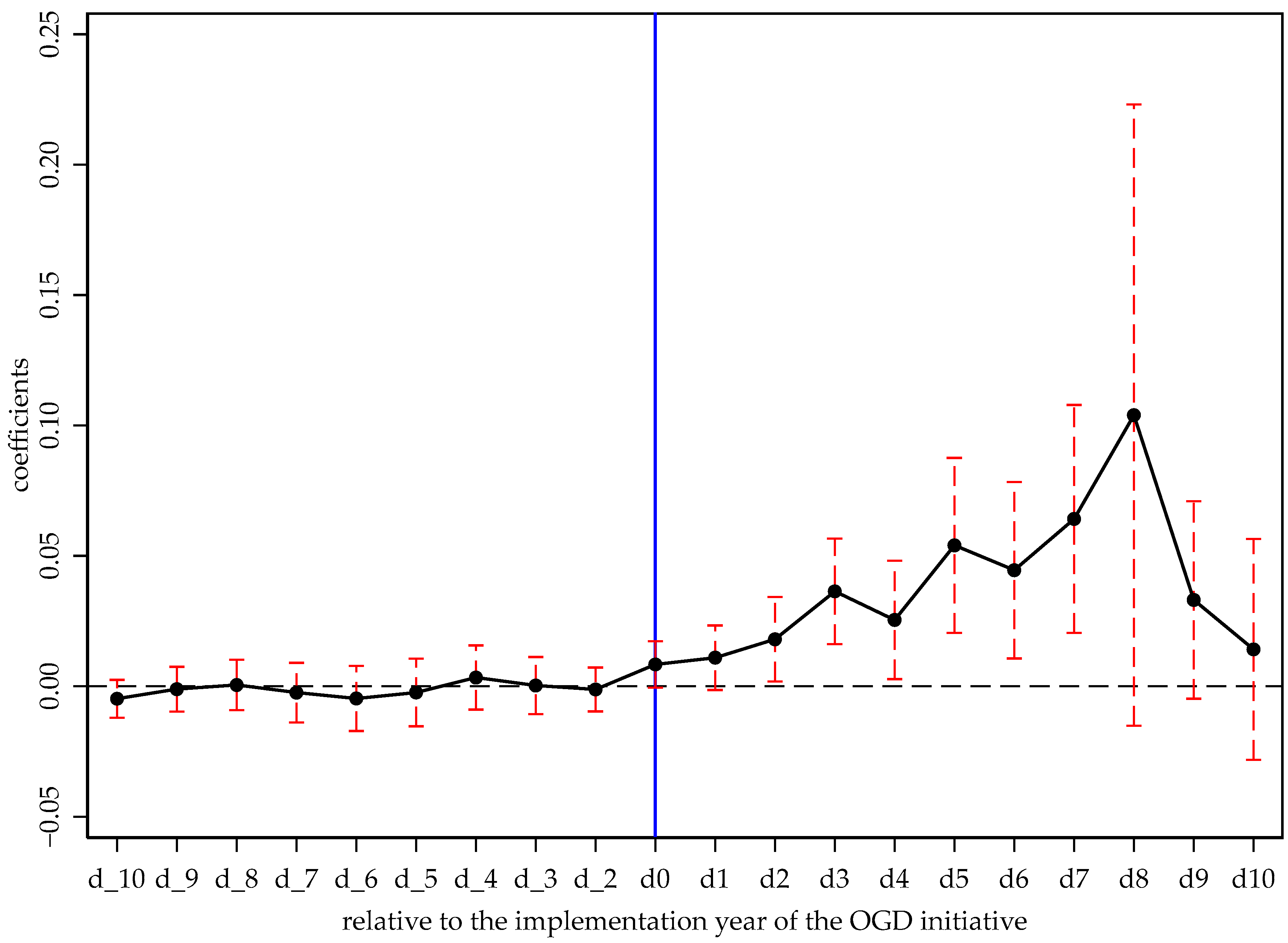
where Dik is a set of dummy variables. Here, k < 0 represents the k-th year prior to the launch of a PDP, k = 0 denotes the year of policy implementation, and k > 0 represents the k-th year following the launch. To avoid perfect multicollinearity, the period immediately preceding the policy implementation (k = −1) is excluded as the baseline. For periods k < 0, if the estimated coefficients (dk) are not significantly different from zero, it indicates that the treatment and control groups were statistically indistinguishable in terms of CEE prior to policy implementation, meaning the parallel trend assumption cannot be rejected.
Figure 1 illustrates the estimated coefficients from Equation (9) along with their 95% confidence intervals. The horizontal axis represents the years relative to the launch of a PDP, while the vertical axis displays the corresponding estimated coefficients. At the 5% significance level, all pre-treatment coefficients (d10 to d2) are statistically insignificant, suggesting that the parallel trend assumption holds. Following Roth [83], a joint significance test is conducted for these pre-treatment coefficients. The test yields an F-statistic of 1.49 with a corresponding p-value of 0.1502, confirming the absence of joint statistical significance. Conversely, the post-treatment coefficients (d3 to d7) are statistically significant at the 5% level, indicating that PDO exerts a sustained, long-term positive effect on CEE.
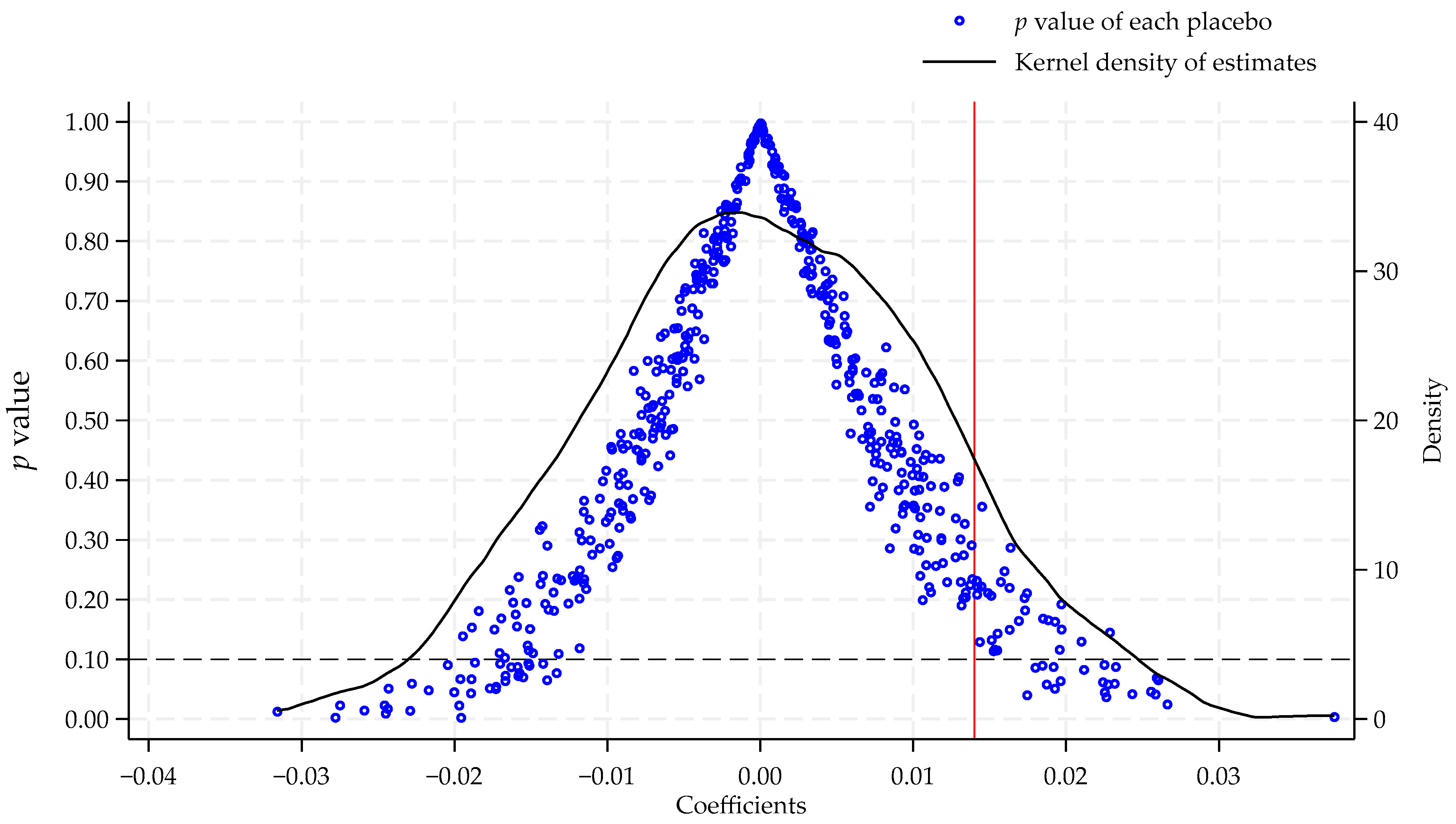
To rule out the possibility that the estimation results are driven by unobservable variables or random factors, a placebo test is conducted. Specifically, a “pseudo-treatment” group is created by randomly assigning the timing of PDP launches across the sample cities, while the remaining cities serve as the control group. This random assignment is repeated 500 times, and Equation (1) is re-estimated for each iteration. Figure 2 presents the distribution of the placebo estimates. The p-values of most estimated placebo coefficients exceed 0.1, indicating a lack of statistical significance. Furthermore, the majority of these coefficients cluster around zero and fall well below the true baseline regression coefficient of 0.014 (indicated by the red vertical line). The kernel density of the placebo coefficients is approximately normally distributed and centered around zero. These findings confirm that the randomly generated treatment assignments cannot explain the enhancement of CEE, demonstrating that the baseline regression results are highly reliable and that the observed increase in CEE is genuinely attributable to PDO.

5.2.2. Heterogeneous Treatment Effects

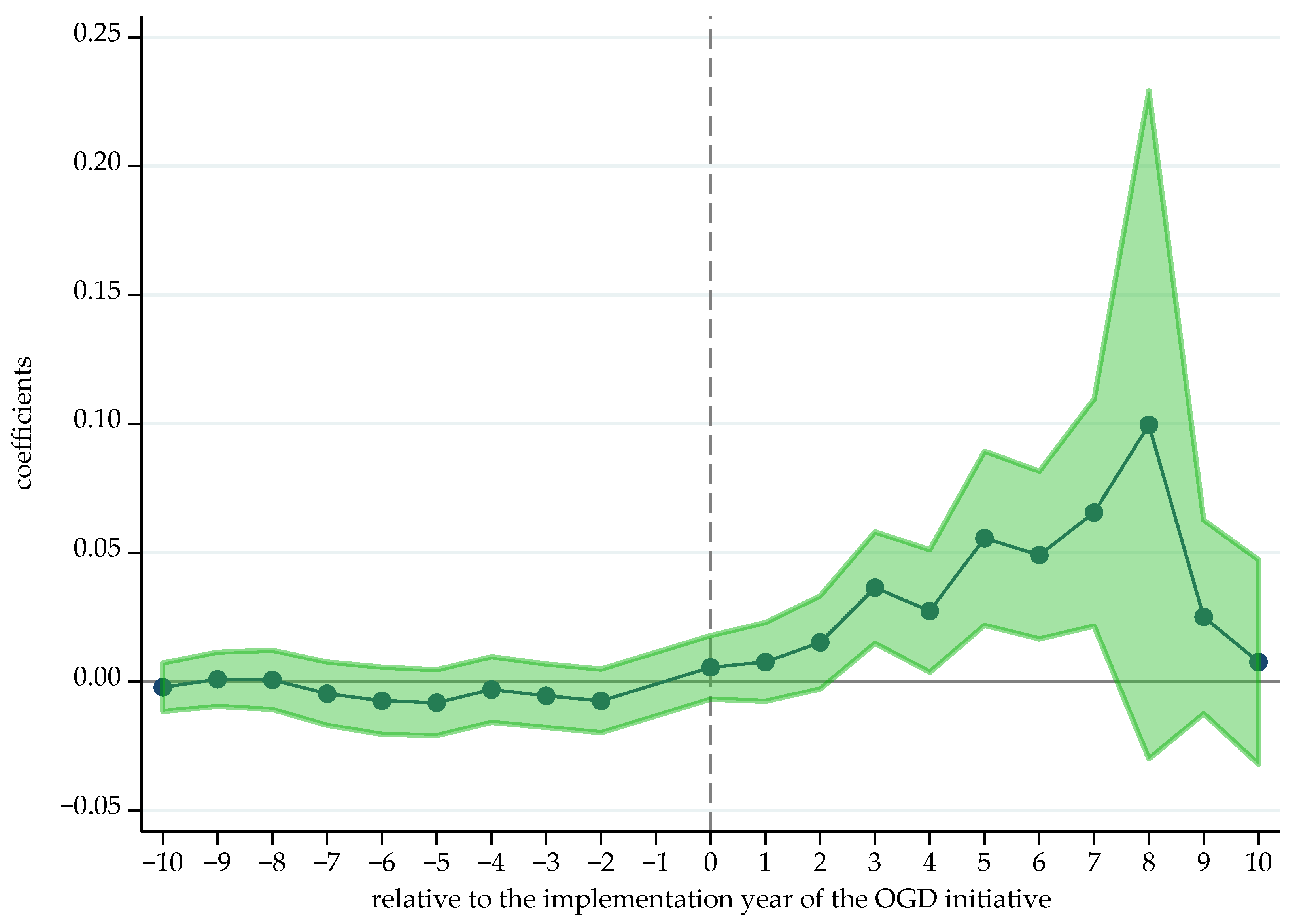
A critical concern in staggered DID designs is the potential for biased estimates due to heterogeneous treatment effects, as the conventional two-way fixed effects (TWFE) estimator may assign negative weights to certain comparisons [84]. To diagnose this potential bias, the Goodman-Bacon decomposition is employed [85]. As shown in Table 3, the decomposition results indicate that PDO still significantly enhances CEE at the 5% level, with “bad comparisons” (i.e., later-treated vs. earlier-treated acting as controls) carrying a relatively small weight. To formally address this issue, an interaction-weighted estimator designed for staggered DID [86] is adopted. This method enhances estimation robustness by stratifying the data based on treatment timing, estimating the DID effects separately for each event cohort, and subsequently pooling these estimates to derive a more reliable average treatment effect on the treated (ATT). Figure 3 illustrates the event-study estimation results derived from this heterogeneity-robust DID approach, confirming that PDO consistently improves CEE even after controlling for heterogeneous treatment effects.

5.2.3. Endogeneity Concerns and Instrumental Variable Approach

While the aforementioned empirical analysis demonstrates that PDO enhances CEE, the baseline regression results may still suffer from endogeneity. The launch of PDPs is not strictly exogenous; unobserved factors could simultaneously influence a local government’s decision to launch a PDP and the city’s CEE. Therefore, an instrumental variable (IV) approach is employed to mitigate these potential endogeneity concerns. The launch of a PDP is a localized governance innovation primarily driven by municipal governments, making it highly susceptible to the characteristics of local leadership and horizontal intergovernmental competition. As the primary executors of China’s economic policies and institutional reforms, local officials exert substantial influence over regional economic development trajectories and policy formulation within their jurisdictions.
Imprinting theory posits that the cultural preferences of government officials leave an “institutional imprint” on the formulation and implementation of urban policies, thereby shaping a city’s development trajectory [87]. Within China’s institutional context, the municipal Party secretary serves as the primary decision-maker in the urban governance framework. Endowed with specific cultural capital and distinct value orientations, these officials profoundly shape the local policy ecology. A region’s geographic characteristics, particularly its distance from the coastline, have historically affected its degree of openness and economic development paradigms [88]. Consequently, the distance from a municipal Party secretary’s ancestral hometown to the coast may subconsciously influence their openness to innovative policies like PDO.
Based on this logic, an instrumental variable for PDO is constructed as follows. First, data on the ancestral hometowns of municipal Party secretaries from 1995 to 2005 are manually collected. The average minimum distance between the geographic centroids of these cities and the coastline is calculated, denoted Mean_D. Mean_D represents a historical geographic characteristic variable. Moreover, according to the appointment system for Chinese government officials, the majority of municipal party secretaries do not work in their ancestral places. The impact of Mean_D on the CEE is negligible. Therefore, Mean_D satisfies the conditions of relevance and exogeneity. Next, the number of PDPs in the province to which the city belongs is calculated for the last year, denoted as lag_NPDO. A larger lag_NPDO indicates a greater tendency for local governments to launch PDPs. It is unlikely that lag_NPDO influences CEE through other channels. Thus, lag_NPDO satisfies the conditions of relevance and exogeneity. The instrumental variable for PDO (PDO_IV1) is expressed as PDO_IV1 = (1/Mean_D) × lag_NPDO. In robustness tests, Mean_D is measured by the average minimum distance from the municipal party secretary’s ancestral place to the nearest port, denoted as Mean_D1. The instrumental variable for PDO (PDO_IV2) is expressed as PDO_IV2 = (1/Mean_D1) × lag_NPDO.
A two-stage least squares (2SLS) approach is employed to estimate the model. As a standard IV technique, this method yields consistent estimates, facilitates straightforward diagnostics for weak instruments and overidentification tests. Columns (1) and (2) of Table 4 present the results. The coefficient of PDO_IV1 is positive and significant at the 1% level (Column (1)), suggesting that PDO_IV1 satisfies the relevance assumption. Both the Cragg-Donald Wald F statistic and the Kleibergen-Paap Wald rk F statistic exceed 16.38 (the Stock-Yogo weak ID test critical value at the 10% significance level), which indicates no severe weak instrument bias. The Kleibergen-Paap rk LM statistic yields a p-value of 0.000, rejecting the null hypothesis of underidentification. The coefficient of PDO is significantly positive at the 5% level (Column (2)). Columns (3) and (4) further confirm the robustness of baseline regression results when PDO_IV2 is employed as an alternative IV for PDO. Upon addressing endogeneity concerns, Hypothesis 1 remains valid.

5.2.4. Other Robustness Tests

(1)
PSM-DID Method. The treatment and control groups may differ systematically in their underlying economic foundations and environmental regulations, potentially giving rise to sample selection bias. To address this, a Propensity Score Matching Difference-in-Differences (PSM-DID) approach is employed. The control variables (PGDP, FDI, URBAN, STEX, TRANS, and GREEN) are used as covariates, and kernel matching is selected as the matching algorithm. As shown in Column (1) of Table 5, the coefficient of PDO remains positive (0.015) and is statistically significant at the 1% level.
(2)
Controlling for Province Fixed Effects. Unobservable, time-invariant provincial characteristics may have been omitted from the baseline specification. Therefore, province fixed effects are incorporated into Equation (1). According to Column (2) of Table 5, PDO continues to exert a significant positive effect on CEE.
(3)
Alternative Measurement of CEE. To ensure the findings are not sensitive to the dependent variable’s construction, CEE is re-calculated using the Non-radial Directional Distance Function (NDDF) method [89]. As indicated in Column (3) of Table 5, the coefficient of PDO remains positive and statistically significant at the 5% level.
(4)
Excluding Direct-Administered Municipalities. China’s four direct-administered municipalities (Beijing, Shanghai, Tianjin, and Chongqing) possess distinct advantages in economic scale and policy support compared to standard prefecture-level cities. To prevent these outliers from driving the results, the baseline model is re-estimated after excluding them. The results, presented in Column (4) of Table 5, show that the coefficient of PDO is 0.014 and remains significant at the 5% level.
(5)
Isolating the Effects of Concurrent Policies. During the sample period, China implemented several pilot policies aimed at fostering sustainable economic development and the digital transition. These include the Smart City Pilot Program, the Low-Carbon City Pilot Policy, the Carbon Emissions Trading Scheme, the New Energy Demonstration City Program, and the National E-commerce Demonstration City Initiative. Additionally, the establishment of the National Big Data Comprehensive Pilot Zones significantly affects data marketization and carbon emissions. To isolate the specific impact of PDO from these concurrent initiatives, dummy variables for these policies are included as additional controls in Equation (1). As shown in Column (5) of Table 5, the positive effect of PDO on CEE remains robust.

5.3. Mechanism Test

Section 3.2 analyzes the mechanism by which PDO affects CEE in terms of digital technology innovation, capacity utilization, and industrial structure upgrading. This section examines these mechanisms.

5.3.1. Digital Technology Innovation

M is replaced with DTI, and the estimation results of Equations (2) and (3) are presented in Table 6. According to Column (1), PDO promotes digital technology innovation at the 1% level. PDO reduces the cost of digital technology innovation, accelerates knowledge spillovers, stimulates entrepreneurial spirit, and enhances the success rate of digital technology innovation. Based on patent type, digital technology patents are further classified into invention-type digital technology patents (DTI_1) as well as design and utility model patents (DTI_2). Columns (2) and (3) indicate that, at the 1% significance level, PDO also promotes digital technology innovation in the form of invention-type, design, and utility model innovations. As shown in Columns (4), (5), and (6), the coefficients of DTI, DTI_1, and DTI_2 are positive at the 1% significance level. Digital technology innovation facilitates the transformation of traditional production models into digital and intelligent forms, thereby improving CEE. The result is consistent with [63]. Hypothesis 2a is verified.

5.3.2. Capacity Utilization

M is replaced with CU, and the estimation results of Equations (2) and (3) are reported in Table 7. According to Columns (1) and (2), at the 5% significance level, PDO significantly increases capacity utilization. To draw a robust conclusion, city-level CU (CU_city) is computed as the weighted average of firm-level capacity utilization for each city and year using the ratio of each sample firm’s assets to the total assets of sample firms in the same city as the weight. PDO significantly improves CU at the 1% level, as shown in Column (3), which aligns with the estimates from the first two columns. PDO improves information sharing and enhances production flexibility [67], thereby reducing overcapacity arising from a mismatch between supply and demand. In addition, PDO increases the government’s attention to environmental issues, consequently improving environmental regulation. The cost-effectiveness and innovation compensation effects caused by environmental regulation help restrain overcapacity [72,73]. According to Column (4), capacity utilization significantly enhances CEE. The result is consistent with [65]. Improved capacity utilization lowers energy intensity per unit of output, thus enhancing CEE. Hypothesis 2b is verified.

5.3.3. Industrial Structure Upgrading

M is replaced with STR, and Table 8 reports the estimates of Equations (2) and (3). Column (1) indicates that PDO significantly promotes industrial structure upgrading at the 1% level. PDO increases residents’ income, reduces income disparities, drives consumption upgrades, and thereby facilitates industrial structure upgrading. Column (2) suggests that PDO does not exert a statistically significant effect on CEE, possibly attributed to the collinearity between STR and the covariates.
Following Zheng et al. [90], the Theil index (TL) is adopted to measure STR.
T L = i = 1 3 Y i Y l n ( Y i L i / Y L )
where Y denotes GDP, L denotes employment, and Yi and Li are the output and employment of industry i, respectively. At economic equilibrium, labor productivity is equal across industries, and the TL equals 0. A higher TL value indicates greater irrationality in the industrial structure.
According to Column (3), the coefficient of PDO is negative and significant at the 10% level, indicating that PDO improves the rationalization of the industrial structure. According to Column (4), at the 1% level, the coefficient of STR is significantly negative, indicating that the rationalization of the industrial structure significantly improves CEE. The result is consistent with [39]. Hypothesis 2c is verified.

5.4. Heterogeneity Analysis

5.4.1. Heterogeneous Impacts of Data Themes

China currently lacks a standardized framework for PDO, leading to significant variations in the data themes provided across different PDPs. For example, the Shanghai PDP features 15 data themes, encompassing areas such as urban construction, economic development, and resource and environmental protection. Similarly, the Hefei PDP offers 12 data themes, including economic development, financial services, and energy and environmental protection. To explore these differences, the sample is divided into two sub-samples based on whether a city’s PDP includes resource and environmental themes. Specifically, the sub-sample containing resource and environmental data comprises 3400 observations, accounting for over 70% of the total sample. As shown in Column (2) of Table 9, PDO significantly improves CEE in cities where the PDP incorporates resource and environmental datasets. Conversely, in cities where these themes are absent, the impact of PDO on CEE is statistically insignificant (Column 1).

5.4.2. Heterogeneous Impacts of Traditional Production Elements

Data value chain theory posits that for data to create economic value, it must pass through a series of interlocking stages, including collection, processing, circulation, and application. The effective operation of each stage relies on the deep integration of data with different production factors. That is, when data elements are combined with labor, capital, and land, they generate multiplicative and additive effects on innovation, capacity utilization, and industrial structure upgrading. This implies that the impact of PDO on CEE may vary depending on regional endowments of labor, capital, and land.
(1)
Human Capital (HC)
Following Chen et al. [91], HC is measured as the ratio of the number of students enrolled in regular higher education institutions to the resident population. Based on the median HC, the sample is divided into two groups: higher and lower human capital. According to Columns (1) and (2) of Table 10, PDO significantly improves CEE in cities with higher human capital, yet its impact is statistically insignificant in those with lower human capital. This suggests that the positive impact of PDO on CEE is contingent upon a high level of human capital.
(2)
Green Finance (GF)
GF is measured by the entropy-weighted method, incorporating green credit, green insurance, green securities, and green investment. The sample is split into two groups based on the median of GF. As shown in Columns (3) and (4) of Table 10, in the higher green finance development group, PDO significantly improves CEE at the 5% level, but the effect is not statistically significant in the lower green finance development group. Green finance provides financial support for green and low-carbon technology innovation, green industry development, and environmental governance. Improvements in green finance amplify its synergy with PDO, further boosting CEE.
(3)
Marketization Level of Industrial Land Transfer
Industrial land transfer mechanisms in China include authorized operation, agreement transfer, bidding transfer, auction transfer, and listing transfer. Among these, bidding, auction, and listing are classified as market-oriented transfer models. By efficiently allocating land resources through market mechanisms, land transfer marketization promotes industrial structure upgrading [92], thereby improving CEE. Consequently, the degree of land transfer marketization may moderate the impact of PDO on CEE. This marketization is measured by the share of land transferred through bidding, auction, or listing. The sample is split into high and low-marketization groups, with the regression results reported in Columns (5) and (6) of Table 10. The results indicate that PDO significantly enhances CEE (at the 5% significance level) only in cities with a relatively lower level of land transfer marketization. By publicly releasing land transaction information, PDO mitigates information asymmetry and enhances the transparency of the land market. This fosters public supervision and accelerates the transformation of land transfers toward market-based methods. In contrast, in cities that already exhibit a high degree of land transfer marketization, the marginal transparency benefits of PDO are limited, rendering its impact on CEE statistically insignificant.

6. Further Analysis: Synergistic Impacts of Other Policies on CEE

6.1. Synergistic Impacts of the BCS and PDO on CEE

Broadband networks are a key strategic public infrastructure in the digital economy era. The Chinese government issued The Broadband China Strategic Implementation Plan (BCS) in 2013. On the one hand, digital infrastructure serves as the foundation for the construction, openness, and operation management of PDPs. By optimizing broadband networks and enhancing their application, the implementation of the BCS establishes the foundation for the collection, transmission, and processing of public data, thereby enabling government data to be more efficiently downloaded and utilized. On the other hand, PDO contributes to the implementation of the BCS. PDO lowers the threshold for accessing public data while increasing government transparency and governance efficiency. That facilitates the inflow of human capital and funds into public infrastructure, provides intellectual and financial support for R&D of key core technologies and the industrialization of digital products, which in turn facilitates broadband network upgrading. Consequently, BCS and PDO synergistically improve CEE.
Equation (11) is established to test the above analysis.
C E E i t = γ 0 + γ 1 P D O i t   + γ 2 B C S i t + γ 3 P D O i t   ×   B C S i t   + γ X   + μ i + φ t +   ε i t  
If city i is selected as a BCS city in year t, BCSit equals 1 for year t and subsequent years, and 0 otherwise [93]. All other variables are defined consistently with those in Equation (1).
The estimation results of Equation (11) are shown in Table 11. The coefficient of PDO × BCS is significantly positive, implying that digital infrastructure amplifies the positive impact of PDO on CEE. The above analysis is supported by empirical validation.

6.2. Synergistic Impacts of the New Energy Demonstration City Policy and PDO on CEE

Excessive reliance on traditional fossil fuels for economic development leads to environmental pollution. The Chinese government has implemented the New Energy Demonstration City (NEDC) policy, aiming to advance the development and use of renewable energy and facilitate the green transition of energy. The NEDC policy facilitates green innovation and reduces energy intensity, thereby improving CEE [94]. On the one hand, PDO strengthens public supervision and accountability, thereby enhancing governmental environmental oversight and governance capacity. This enables pilot cities to accomplish the NEDC construction tasks. Additionally, PDO offers large-scale data resources. When merged with traditional production elements, these resources advance the digital transformation and technological innovation of the energy industry. On the other hand, to accomplish the NEDC construction task, NEDC proactively intensifies environmental regulations, such as improved environmental information disclosure. Broader accessibility of environmental public data enhances CEE. That implies that the NEDC policy and PDO synergistically improve CEE.
Equation (12) is established to test the above analysis.
C E E i t = γ 0 + γ 1 P D O i t + γ 2 N E D C i t + γ 3 P D O i t   ×   N E D C i t +   j = 1 r γ 1 j X j i t + μ i   + φ t + ε i t  
NEDCit equals 1 for city i from the year it is selected as a new energy demonstration city onward, and 0 otherwise. All other variables are defined consistently with those in Equation (1).
The estimation results of Equation (12) are shown in Table 12. According to Columns (1) and (2), the coefficient of PDO × NEDC is positive and statistically significant. This indicates that PDO and the NEDC policy synergistically enhance CEE. They synergistically promote technological innovation and capacity utilization, thereby improving CEE.

7. Conclusions and Policy Implications

Enhancing CEE is vital for facilitating low-carbon economic transitions. Scholars worldwide have reached a consensus that data elements, as emerging production factors, play an essential role in high-quality development. This study investigates the impact of PDO on CEE and explores its underlying mechanisms. The empirical results demonstrate that PDO significantly improves CEE, a finding that remains robust after a series of stringent tests and rigorous endogeneity treatments. Mechanism analyses reveal that PDO enhances CEE by facilitating digital technology innovation, improving capacity utilization, and advancing industrial structure upgrading. Furthermore, the positive effect of PDO on CEE is contingent upon specific data themes and regional factor endowments. PDO exclusively boosts CEE in cities characterized by comparatively higher levels of human capital, robust green finance development, and a lower degree of industrial land transfer marketization. Additionally, concurrent policies such as the BCS and the NEDC policy positively synergize with PDO to further strengthen CEE.
Based on these conclusions, the following policy recommendations are proposed. First, policymakers should expand the scope of public data sharing, particularly concerning economic construction and resource and environmental management. Regarding data management, governments should establish standardized classification and grading frameworks for public data to enhance both data completeness and accessibility. Second, local governments should persistently refine administrative approval services and cultivate a fair, competitive market environment. On the one hand, these measures will optimize the business ecosystem by reducing institutional transaction costs and market frictions, thereby providing abundant data resources and favorable market conditions for the data-driven transformation of traditional production factors. On the other hand, they will reinforce a survival-of-the-fittest market mechanism, accelerating the phase-out of inefficient production capacities and consequently elevating overall capacity utilization rates. Additionally, policymakers should enhance the availability of public data regarding education, employment, and social security to better inform household consumption decisions, which in turn stimulates industrial structure upgrading. Third, context-specific, differentiated strategies should be adopted for PDO implementation. Cities with underdeveloped green finance and limited human capital should prioritize reallocating credit away from heavily polluting industries toward green enterprises, alongside increasing educational investments. Furthermore, governments should strengthen digital infrastructure. Specific measures should include establishing dedicated public data platforms for scientific research and technology commercialization, thereby fostering open innovation and accelerating the application of technological advancements.

8. Discussion, Limitations, and Further Research

Prior studies have generally examined the economic value or environmental effects of data sharing separately. In contrast, this study simultaneously considers both economic and environmental effects. Taking the launch of public data platforms as a quasi-natural experiment, this study investigates the impact of PDO on CEE, thereby facilitating a more comprehensive assessment of the value of PDO. In terms of mechanism analysis, the influencing channels of PDO on CEE are explored from perspectives covering digital technology innovation, capacity utilization, and industrial structure upgrading. Furthermore, this study examines the synergistic effects of PDO with the BCS and NEDC policies on CEE, and the heterogeneous effects of PDO on CEE are analyzed based on data themes and traditional production factors. These analyses jointly deepen and broaden the mechanisms and boundary conditions through which data sharing influences the low-carbon economic transition.
However, several limitations remain to be addressed in future research. First, the ratio of the number of students enrolled in regular higher education institutions to the resident population is hereby utilized to measure human capital. Indicators, including the faculty-student ratio, may serve as more reasonable alternative measures. Future studies will investigate more sophisticated methods for measuring human capital. Second, this study may overestimate the positive impact of PDO on CEE. Su et al. [65] revealed that PDO improves energy efficiency. However, the improvement in energy efficiency reduces the cost of energy services, increases output, thereby generating an energy rebound effect [95,96]. This implies that the improvement in CEE driven by PDO may be lower than expected. Subsequent research will further investigate the energy rebound effect induced by PDO. Third, this study overlooks the spatial spillover effects of PDO on CEE. Characterized by non-rivalry, positive externalities, and high permeability, data resources can be simultaneously used by multiple regions without depletion. PDO reduces the cost of information acquisition for neighboring regions. It helps break down data silos, weaken market segmentation, and facilitate the efficient flow and allocation of production factors across a larger geographical scope, thereby improving resource allocation efficiency. Moreover, PDO releases a substantial number of data elements that often integrate multi-source information from government affairs, industry, environment, and other domains. This broadens knowledge diversity in neighboring areas while reducing the costs and entry barriers associated with digital technology innovation. Consequently, PDO may exert spatial spillover effects on CEE. To fill this gap, future research will employ a spatial DID approach to investigate the spatial spillover effects and the underlying mechanisms of PDO on CEE.


Author Contributions

Y.D.: methodology, software, formal analysis, writing—original draft preparation, writing—review and editing, project administration; S.S.: software, validation, formal analysis, writing—original draft preparation, visualization; H.J.: conceptualization, methodology, validation, investigation, resources, data curation, writing—review and editing, supervision; N.L.: conceptualization, investigation, resources, visualization, project administration. All authors have read and agreed to the published version of the manuscript.

Funding

This research was funded by the National Social Science Fund of China, 24BJY086.

Institutional Review Board Statement

Not applicable.

Informed Consent Statement

Not applicable.

Data Availability Statement

The data that support the findings of this study are available from the corresponding author upon reasonable request.

Conflicts of Interest

The authors declare no conflicts of interest.

Abbreviations

The following abbreviations are used in this manuscript:
PDOPublic Data Openness
PDPPublic Data Platform
CEECarbon Emission Efficiency
DTIDigital Technology Innovation
CUCapacity Utilization
STRIndustrial Structure Upgrading
SFAStochastic Frontier Analysis
NDDFNon-radial Directional Distance Function
BCSBroadband China Strategy
NEDCNew Energy Demonstration City
TAMTechnology Acceptance Model

References

  1. Chang, H.; Ding, Q.; Zhao, W.; Hou, N.; Liu, W. The digital economy, industrial structure upgrading, and carbon emission intensity—Empirical evidence from China’s provinces. Energy Strategy Rev. 2023, 50, 101218. [Google Scholar] [CrossRef]
  2. Cheng, X.; Yao, D.; Qian, Y.; Wang, B.; Zhang, D. How does fintech influence carbon emissions: Evidence from China’s prefecture-level cities. Int. Rev. Financ. Anal. 2023, 87, 102655. [Google Scholar] [CrossRef]
  3. Zhao, H.; Chen, S.; Zhang, W. Does digital inclusive finance affect urban carbon emission intensity: Evidence from 285 cities in China. Cities 2023, 142, 104552. [Google Scholar] [CrossRef]
  4. Jones, C.I.; Tonetti, C. Nonrivalry and the Economics of Data. Am. Econ. Rev. 2020, 110, 2819–2858. [Google Scholar] [CrossRef]
  5. Goldfarb, A.; Tucker, C. Digital economics. J. Econ. Lit. 2019, 57, 3–43. [Google Scholar] [CrossRef]
  6. Bertot, J.C.; Gorham, U.; Jaeger, P.T.; Sarin, L.C.; Choi, H. Big data, open government and e-government: Issues, policies and recommendations. Inf. Polity 2014, 19, 5–16. [Google Scholar] [CrossRef]
  7. Park, S.; Gil-Garcia, J.R. Open data innovation: Visualizations and process redesign as a way to bridge the transparency-accountability gap. Gov. Inf. Q. 2022, 39, 101456. [Google Scholar] [CrossRef]
  8. Huang, R.; Chen, D. Does Environmental Information Disclosure Benefit Waste Discharge Reduction? Evidence from China. J. Bus. Ethics 2015, 129, 535–552. [Google Scholar] [CrossRef]
  9. Shi, D.; Bu, C.; Xue, H. Deterrence effects of disclosure: The impact of environmental information disclosure on emission reduction of firms. Energy Econ. 2021, 104, 105680. [Google Scholar] [CrossRef]
  10. Grimmelikhuijsen, S.G.; Feeney, M.K. Developing and Testing an Integrative Framework for Open Government Adoption in Local Governments. Public Adm. Rev. 2017, 77, 579–590. [Google Scholar] [CrossRef]
  11. Safarov, I. Institutional Dimensions of Open Government Data Implementation: Evidence from the Netherlands, Sweden, and the UK. Public Perform. Manag. Rev. 2019, 42, 305–328. [Google Scholar] [CrossRef]
  12. Zhao, Y.; Liang, Y.; Yao, C.; Han, X. Key factors and generation mechanisms of open government data performance: A mixed methods study in the case of China. Gov. Inf. Q. 2022, 39, 101717. [Google Scholar] [CrossRef]
  13. Zhou, M.; Wang, Y.; Huang, X.; Li, G. Can open government data policy improve firm performance? Evidence from listed firms in China. Manag. Decis. Econ. 2023, 44, 2593–2603. [Google Scholar] [CrossRef]
  14. Cheng, B.; Mao, X. Does environmental information disclosure regulation improve environmental governance? Evidence from China. Emerg. Mark. Rev. 2024, 63, 101196. [Google Scholar] [CrossRef]
  15. Hardy, K.; Maurushat, A. Opening up government data for Big Data analysis and public benefit. Comput. Law Secur. Rev. 2017, 33, 30–37. [Google Scholar] [CrossRef]
  16. Chen, M.; Cao, Y.; Liang, Y. Determinants of open government data usage: Integrating trust theory and social cognitive theory. Gov. Inf. Q. 2023, 40, 101857. [Google Scholar] [CrossRef]
  17. Kou, J.; Xu, X. Does internet infrastructure improve or reduce carbon emission performance?—A dual perspective based on local government intervention and market segmentation. J. Clean. Prod. 2022, 379, 134789. [Google Scholar] [CrossRef]
  18. Martin, E.G.; Begany, G.M. Opening government health data to the public: Benefits, challenges, and lessons learned from early innovators. J. Am. Med. Inform. Assoc. 2017, 24, 345–351. [Google Scholar] [CrossRef] [PubMed]
  19. Yang, T.-M.; Lo, J.; Shiang, J. To open or not to open? Determinants of open government data. J. Inf. Sci. 2015, 41, 596–612. [Google Scholar] [CrossRef]
  20. Yang, T.-M.; Wu, Y.-J. Examining the socio-technical determinants influencing government agencies’ open data publication: A study in Taiwan. Gov. Inf. Q. 2016, 33, 378–392. [Google Scholar] [CrossRef]
  21. Zhao, Y.; Fan, B. Effect of an agency’s resources on the implementation of open government data. Inf. Manag. 2021, 58, 103465. [Google Scholar] [CrossRef]
  22. Zhao, Y.; Fan, B. Understanding the key factors and configurational paths of the open government data performance: Based on fuzzy-set qualitative comparative analysis. Gov. Inf. Q. 2021, 38, 101580. [Google Scholar] [CrossRef]
  23. Ahmadi Zeleti, F.; Ojo, A.; Curry, E. Exploring the economic value of open government data. Gov. Inf. Q. 2016, 33, 535–551. [Google Scholar] [CrossRef]
  24. Zhu, Z.; Wulder, M.A.; Roy, D.P.; Woodcock, C.E.; Hansen, M.C.; Radeloff, V.C.; Healey, S.P.; Schaaf, C.; Hostert, P.; Strobl, P.; et al. Benefits of the free and open Landsat data policy. Remote Sens. Environ. 2019, 224, 382–385. [Google Scholar] [CrossRef]
  25. Pereira, G.V.; Macadar, M.A.; Luciano, E.M.; Testa, M.G. Delivering public value through open government data initiatives in a Smart City context. Inf. Syst. Front. 2017, 19, 213–229. [Google Scholar] [CrossRef]
  26. Palmaccio, S.; Schiltz, F.; De Witte, K. Information shocks and parental response in education—A case study of an open government initiative. Gov. Inf. Q. 2022, 39, 101702. [Google Scholar] [CrossRef]
  27. Fusi, F.; Zhang, F.; Liang, J. Unveiling environmental justice through open government data: Work in progress for most US states. Public Adm. 2023, 101, 1088–1114. [Google Scholar] [CrossRef]
  28. Du, J.; Gao, H.; Wen, H.; Ye, Y. Public data access and stock price synchronicity: Evidence from China. Econ. Model. 2024, 130, 106591. [Google Scholar] [CrossRef]
  29. Yan, R.; Xing, C.; Chen, X.; Zhao, Y. Is it real or illusory? An empirical examination of the impact of open government data on innovation capability in the case of China. Technol. Soc. 2023, 75, 102396. [Google Scholar] [CrossRef]
  30. Nagaraj, A. The Private Impact of Public Data: Landsat Satellite Maps Increased Gold Discoveries and Encouraged Entry. Manag. Sci. 2022, 68, 564–582. [Google Scholar] [CrossRef]
  31. Leviäkangas, P.; Molarius, R. Open government data policy and value added—Evidence on transport safety agency case. Technol. Soc. 2020, 63, 101389. [Google Scholar] [CrossRef]
  32. Nazir, M.J.; Li, G.; Nazir, M.M.; Zulfiqar, F.; Siddique, K.H.M.; Iqbal, B.; Du, D. Harnessing soil carbon sequestration to address climate change challenges in agriculture. Soil Tillage Res. 2024, 237, 105959. [Google Scholar] [CrossRef]
  33. Wang, X.; Zheng, Z.; Jia, W.; Tai, K.; Xu, Y.; He, Y. Response Mechanism and Evolution Trend of Carbon Effect in the Farmland Ecosystem of the Middle and Lower Reaches of the Yangtze River. Agronomy 2024, 14, 2354. [Google Scholar] [CrossRef]
  34. Xie, Z.; Wu, R.; Wang, S. How technological progress affects the carbon emission efficiency? Evidence from national panel quantile regression. J. Clean. Prod. 2021, 307, 127133. [Google Scholar] [CrossRef]
  35. Jiang, H.; Hu, W.; Hou, Y.; Jiang, P.; Lu, N. Green fiscal policies, economic growth target constraints and carbon emission efficiency: Evidence from DID and double machine learning. Energy 2025, 339, 138961. [Google Scholar] [CrossRef]
  36. Zhang, F.; Deng, X.; Phillips, F.; Fang, C.; Wang, C. Impacts of industrial structure and technical progress on carbon emission intensity: Evidence from 281 cities in China. Technol. Forecast. Soc. Change 2020, 154, 119949. [Google Scholar] [CrossRef]
  37. Dong, F.; Li, Y.; Gao, Y.; Zhu, J.; Qin, C.; Zhang, X. Energy transition and carbon neutrality: Exploring the non-linear impact of renewable energy development on carbon emission efficiency in developed countries. Resour. Conserv. Recycl. 2022, 177, 106002. [Google Scholar] [CrossRef]
  38. Chen, L.; Lu, Y.; Meng, Y.; Zhao, W. Research on the nexus between the digital economy and carbon emissions -Evidence at China’s province level. J. Clean. Prod. 2023, 413, 137484. [Google Scholar] [CrossRef]
  39. Li, W.; Wang, W.; Wang, Y.; Qin, Y. Industrial structure, technological progress and CO2 emissions in China: Analysis based on the STIRPAT framework. Nat. Hazards 2017, 88, 1545–1564. [Google Scholar] [CrossRef]
  40. Li, Z.; Shao, S.; Shi, X.; Sun, Y.; Zhang, X. Structural transformation of manufacturing, natural resource dependence, and carbon emissions reduction: Evidence of a threshold effect from China. J. Clean. Prod. 2019, 206, 920–927. [Google Scholar] [CrossRef]
  41. Lin, B.; Zhou, Y. Does the Internet development affect energy and carbon emission performance? Sustain. Prod. Consum. 2021, 28, 1–10. [Google Scholar] [CrossRef]
  42. Peng, H.; Ling, K.; Zhang, Y. The carbon emission reduction effect of digital infrastructure development: Evidence from the broadband China policy. J. Clean. Prod. 2024, 434, 140060. [Google Scholar] [CrossRef]
  43. Tang, K.; Yang, G. Does digital infrastructure cut carbon emissions in Chinese cities? Sustain. Prod. Consum. 2023, 35, 431–443. [Google Scholar] [CrossRef]
  44. Zhang, W.; Fan, H.; Zhao, Q. Seeing green: How does digital infrastructure affect carbon emission intensity? Energy Econ. 2023, 127, 107085. [Google Scholar] [CrossRef]
  45. Jiang, H.; Hu, W.; Guo, Z.; Hou, Y.; Chen, T. E-commerce development and carbon emission efficiency: Evidence from 240 cities in China. Econ. Anal. Policy 2024, 82, 586–603. [Google Scholar] [CrossRef]
  46. Wang, H.; Li, Y.; Lin, W.; Wei, W. How does digital technology promote carbon emission reduction? Empirical evidence based on e-commerce pilot city policy in China. J. Environ. Manag. 2023, 325, 116524. [Google Scholar] [CrossRef]
  47. Wang, W.; Xiao, D. Marketization of Data Elements and Enterprise Green Governance Performance: A Quasi-Natural Experiment Based on Data Trading Platforms. Manag. Decis. Econ. 2025, 46, 1686–1700. [Google Scholar] [CrossRef]
  48. Wei, X.; Jiang, F.; Yang, L. Does digital dividend matter in China’s green low-carbon development: Environmental impact assessment of the big data comprehensive pilot zones policy. Environ. Impact Assess. Rev. 2023, 101, 107143. [Google Scholar] [CrossRef]
  49. Wu, Y.; Du, H.; Wei, X.; Li, H. Big data development and agricultural carbon emissions: Exacerbation or suppression? A quasi-natural experiment based on the establishment of the National Big Data Comprehensive Pilot Zone. J. Environ. Manag. 2024, 368, 122178. [Google Scholar] [CrossRef] [PubMed]
  50. Bedini, I.; Farazi, F.; Leoni, D.; Pane, J.; Tankoyeu, I.; Leucci, S. Open Government Data: Fostering Innovation. JeDEM EJ. EDemocr. Open Gov. 2014, 6, 69–79. [Google Scholar] [CrossRef]
  51. Beraja, M.; Yang, D.Y.; Yuchtman, N. Data-intensive Innovation and the State: Evidence from AI Firms in China. Rev. Econ. Stud. 2023, 90, 1701–1723. [Google Scholar] [CrossRef]
  52. Zuiderwijk, A.; Janssen, M. Open data policies, their implementation and impact: A framework for comparison. Gov. Inf. Q. 2014, 31, 17–29. [Google Scholar] [CrossRef]
  53. Fazekas, M.; Kocsis, G. Uncovering High-Level Corruption: Cross-National Objective Corruption Risk Indicators Using Public Procurement Data. Br. J. Political Sci. 2020, 50, 155–164. [Google Scholar] [CrossRef]
  54. Weerakkody, V.; Irani, Z.; Kapoor, K.; Sivarajah, U.; Dwivedi, Y.K. Open data and its usability: An empirical view from the Citizen’s perspective. Inf. Syst. Front. 2017, 19, 285–300. [Google Scholar] [CrossRef]
  55. Tsang, S.; Burnett, M.; Hills, P.; Welford, R. Trust, public participation and environmental governance in Hong Kong. Environ. Policy Gov. 2009, 19, 99–114. [Google Scholar] [CrossRef]
  56. Guang, F.; Deng, Y.; Wen, L.; Sharp, B.; Hong, S. Impact of regional energy allocation distortion on carbon emission efficiency: Evidence from China. J. Environ. Manag. 2023, 342, 118241. [Google Scholar] [CrossRef]
  57. Zhang, S.; Yu, R.; Wen, Z.; Xu, J.; Liu, P.; Zhou, Y.; Zheng, X.; Wang, L.; Hao, J. Impact of labor and energy allocation imbalance on carbon emission efficiency in China’s industrial sectors. Renew. Sustain. Energy Rev. 2023, 184, 113586. [Google Scholar] [CrossRef]
  58. Ciriello, R.F.; Richter, A.; Schwabe, G. Digital Innovation: R. Ciriello et al. Bus. Inf. Syst. Eng. 2018, 60, 563–569. [Google Scholar] [CrossRef]
  59. Arvidsson, V.; Monsted, T. Generating innovation potential: How digital entrepreneurs conceal, sequence, anchor, and propagate new technology. J. Strateg. Inf. Syst. 2018, 27, 369–383. [Google Scholar] [CrossRef]
  60. Acemoglu, D.; Johnson, S.; Robinson, J.A. Institutions as a Fundamental Cause of Long-Run Growth. Handb. Econ. Growth 2005, 1, 385–472. [Google Scholar] [CrossRef]
  61. Alam, A.; Uddin, M.; Yazdifar, H. Institutional determinants of R&D investment: Evidence from emerging markets. Technol. Forecast. Soc. Change 2019, 138, 34–44. [Google Scholar] [CrossRef]
  62. Huber, F.; Ponce, A.; Rentocchini, F.; Wainwright, T. The wealth of (Open Data) nations? Open government data, country-level institutions and entrepreneurial activity. Ind. Innov. 2022, 29, 992–1023. [Google Scholar] [CrossRef]
  63. Ma, R.; Lin, B. The impact of digital technology innovation on energy-saving and emission reduction based on the urban innovation environment. J. Environ. Manag. 2025, 375, 124176. [Google Scholar] [CrossRef]
  64. Lin, B.; Xie, Y. The impact of government subsidies on capacity utilization in the Chinese renewable energy industry: Does technological innovation matter? Appl. Energy 2023, 352, 121959. [Google Scholar] [CrossRef]
  65. Su, Y.; Peng, D.; Wang, Y.; Tan, Z. The Impact of Government Open Data on Firms’ Energy Efficiency: Analyse the Mediating Role of Capacity Utilization and Biased Technological Progress. Energies 2025, 18, 4626. [Google Scholar] [CrossRef]
  66. Wang, H.; Ye, S.; Yin, J.Y. How does public data access promote enterprises’ effective investment: From the perspective of capacity utilization. China Ind. Econ. 2024, 8, 153. (In Chinese) [Google Scholar] [CrossRef]
  67. Marini, G.; Pannone, A. Capital and capacity utilization revisited: A theory for ICT-assisted production systems. Struct. Change Econ. Dyn. 2007, 18, 231–248. [Google Scholar] [CrossRef]
  68. Ghasemaghaei, M.; Calic, G. Does big data enhance firm innovation competency? The mediating role of data-driven insights. J. Bus. Res. 2019, 104, 69–84. [Google Scholar] [CrossRef]
  69. Chaney, T. The network structure of international trade. Am. Econ. Rev. 2014, 104, 3600–3634. [Google Scholar] [CrossRef]
  70. Mikalef, P.; Pateli, A. Information technology-enabled dynamic capabilities and their indirect effect on competitive performance: Findings from PLS-SEM and fsQCA. J. Bus. Res. 2017, 70, 1–16. [Google Scholar] [CrossRef]
  71. Xie, B.; Yang, C.; Song, W.; Song, L.; Wang, H. The impact of environmental regulation on capacity utilization of China’s manufacturing industry: An empirical research based on the sector level. Ecol. Indic. 2023, 148, 110085. [Google Scholar] [CrossRef]
  72. Li, M.; Du, W. Opening the black box of capacity governance: Environmental regulation and capacity utilization of microcosmic firms in China. Econ. Model. 2022, 108, 105766. [Google Scholar] [CrossRef]
  73. Yu, B.; Shen, C. Environmental regulation and industrial capacity utilization: An empirical study of China. J. Clean. Prod. 2020, 246, 118986. [Google Scholar] [CrossRef]
  74. Berman, E.; Bui, L.T. Environmental regulation and productivity: Evidence from oil refineries. Rev. Econ. Stat. 2001, 83, 498–510. [Google Scholar] [CrossRef]
  75. Zhang, G.; Deng, N.; Mou, H.; Zhang, Z.; Chen, X. The impact of the policy and behavior of public participation on environmental governance performance: Empirical analysis based on provincial panel data in China. Energy Policy 2019, 129, 1347–1354. [Google Scholar] [CrossRef]
  76. You, J.; Zhang, W. How heterogeneous technological progress promotes industrial structure upgrading and industrial carbon efficiency? Evidence from China’s industries. Energy 2022, 247, 123386. [Google Scholar] [CrossRef]
  77. Nambisan, S.; Lyytinen, K.; Majchrzak, A.; Song, M. Digital innovation management: Reinventing rnnovation management research in a digital world. MIS Q. 2017, 41, 223–238. [Google Scholar] [CrossRef]
  78. Kongsamut, P.; Rebelo, S.; Xie, D. Beyond balanced growth. Rev. Econ. Stud. 2001, 68, 869–882. [Google Scholar] [CrossRef]
  79. Echevarria, C. Agricultural development vs. industrialization: Effects of trade. Can. J. Econ. 1995, 28, 631–647. [Google Scholar] [CrossRef]
  80. Guo, Q.; Dong, Y.; Feng, B.; Zhang, H. Can green finance development promote total-factor energy efficiency? Empirical evidence from China based on a spatial Durbin model. Energy Policy 2023, 177, 113523. [Google Scholar] [CrossRef]
  81. Ren, S.; Zhang, Q.; Yu, X.; Yang, G. China’s urban digital patent scale and patent knowledge breadth: Spatial-temporal evolution characteristics and influencing factors. J. Asian Econ. 2025, 100, 102003. [Google Scholar] [CrossRef]
  82. Song, Y.; Zhang, X.; Zhang, M. The influence of environmental regulation on industrial structure upgrading: Based on the strategic interaction behavior of environmental regulation among local governments. Technol. Forecast. Soc. Change 2021, 170, 120930. [Google Scholar] [CrossRef]
  83. Roth, J. Pretest with Caution: Event-Study Estimates after Testing for Parallel Trends. Am. Econ. Rev. Insights 2022, 4, 305–322. [Google Scholar] [CrossRef]
  84. De Chaisemartin, C.; D’Haultfoeuille, X. Two-Way Fixed Effects Estimators with Heterogeneous Treatment Effects. Am. Econ. Rev. 2020, 110, 2964–2996. [Google Scholar] [CrossRef]
  85. Goodman-Bacon, A. Difference-in-differences with variation in treatment timing. J. Econom. 2021, 225, 254–277. [Google Scholar] [CrossRef]
  86. Cengiz, D.; Dube, A.; Lindner, A.; Zipperer, B. The effect of minimum wages on low-wage jobs. Q. J. Econ. 2019, 134, 1405–1454. [Google Scholar] [CrossRef]
  87. Johnson, V. What is organizational imprinting? Cultural entrepreneurship in the founding of the Paris Opera. Am. J. Sociol. 2007, 113, 97–127. [Google Scholar] [CrossRef]
  88. Xu, C. The Fundamental Institutions of China’s Reforms and Development. J. Econ. Lit. 2011, 49, 1076–1151. [Google Scholar] [CrossRef]
  89. Zhou, X.; Wang, R.; Han, M. Uncovering the black box of public data: The contribution of open government data to air pollution control. Front. Environ. Sci. 2025, 13, 1580362. [Google Scholar] [CrossRef]
  90. Zheng, J.; Shao, X.; Liu, W.; Kong, J.; Zuo, G. The impact of the pilot program on industrial structure upgrading in low-carbon cities. J. Clean. Prod. 2021, 290, 125868. [Google Scholar] [CrossRef]
  91. Chen, Y.; An, Y.; Nie, Z.; Chi, Y.; Jia, X. Impact of Green Financial Reform on Urban Economic Resilience—A Quasi-Natural Experiment Based on Green Financial Reform and Innovation Pilot Zones. Sustainability 2025, 17, 6969. [Google Scholar] [CrossRef]
  92. Li, J.; Jiao, L.; Li, R.; Zhu, J.; Zhang, P.; Guo, Y.; Lu, X. How does market-oriented allocation of industrial land affect carbon emissions? Evidence from China. J. Environ. Manag. 2023, 342, 118288. [Google Scholar] [CrossRef]
  93. Tang, Y.; Li, S. Research of open government data in China: A systematic literature study in public administration (2013–2023). Chin. Public Adm. Rev. 2024, 15, 128–141. [Google Scholar] [CrossRef]
  94. Chai, J.; Tian, L.; Jia, R. New energy demonstration city, spatial spillover and carbon emission efficiency: Evidence from China’s quasi-natural experiment. Energy Policy 2023, 173, 113389. [Google Scholar] [CrossRef]
  95. Berner, A.; Bruns, S.; Moneta, A.; Stern, D.I. Do energy efficiency improvements reduce energy use? Empirical evidence on the economy-wide rebound effect in Europe and the United States. Energy Econ. 2022, 110, 105939. [Google Scholar] [CrossRef]
  96. Li, J.; Liu, H.; Du, K. Does market-oriented reform increase energy rebound effect? Evidence from China’s regional development. China Econ. Rev. 2019, 56, 101304. [Google Scholar] [CrossRef]
Figure 1. Parallel trend test. Note: The blue line denotes the year of policy implementation.
Sustainability 18 05188 g001
Figure 2. Placebo test.
Sustainability 18 05188 g002
Figure 3. Event-study plot based on the staggered DID approach.
Sustainability 18 05188 g003
Table 1. Descriptive statistics.
VariablesObsMeanStdP50MinMax
CEE46580.3750.1260.3610.1480.821
PDO46580.2170.4120.0000.0001.000
PGDP465810.5350.70210.5708.81312.009
FDI46580.0170.0180.0110.00010.085
URBAN46580.5470.1080.5540.3160.780
STEX46580.0150.01400.0110.0010.070
TRANS46581.0660.5051.0310.1312.238
GREEN46580.3930.0680.4050.1550.604
DTI46580.9152.5820.1280.00018.872
CU33,2457.5330.5417.5775.5758.717
STR46582.2790.1492.2721.8212.836
Table 2. Baseline regression results.
(1)(2)(3)
VariablesCEECEECEE
PDO0.035 ***0.020 ***0.014 **
(0.008)(0.007)(0.007)
PGDP 0.140 ***0.142 ***
(0.015)(0.014)
FDI −0.527 ***−0.460 ***
(0.156)(0.153)
URBAN −0.117−0.150
(0.129)(0.121)
STEX 1.101 ***
(0.290)
TRANS −0.031 *
(0.017)
GREEN −0.033
(0.035)
Constant0.367 ***−1.028 ***−1.005 ***
(0.002)(0.135)(0.134)
City-FE YESYESYES
Year-FEYESYESYES
Obs.465846584658
R20.7490.7790.783
Note: ***, **, * denote significance levels at 1%, 5%, and 10%, respectively. Cluster robust standard errors, reported in parentheses, are clustered at city level.
Table 3. Bacon decomposition.
CEECoefficientp-Value
PDO0.014 ** (0.007)0.041
Bacon decomposition
coefficienttotal weight
Timing_groups0.0140.622
Never_v_timing0.0670.315
Within−0.2480.063
Note: ***, **, * denote significance levels at 1%, 5%, and 10%, respectively. Cluster robust standard errors, reported in parentheses, are clustered at city level.
Table 4. The results of IV-2SLS.
(1)(2)(3)(4)
First StageSecond StageFirst StageSecond Stage
PDOCEEPDOCEE
PDO_IV11.212 ***
(0.158)
PDO_IV2 1.450 ***
(0.312)
PDO 0.049 ** 0.073 ***
(0.025) (0.027)
controlsYesYesYesYes
Year-FEYesYesYesYes
City-FEYesYesYesYes
Cragg-Donald Wald F statistic434.68439.67
Kleibergen-Paap Wald rk F statistic58.8521.61
Kleibergen-Paap rk LM statisticChi-sq(1) = 55.94
p-val = 0.000
Chi-sq(1) = 60.28
p-val = 0.000
Obs.45564556
R20.1380.108
Note: ***, **, * denote significance levels at 1%, 5%, and 10%, respectively. Cluster robust standard errors, reported in parentheses, are clustered at city level.
Table 5. Other robustness test.
(1)(2)(3)(4)(5)
VariablesCEECEECEE CEECEE
PDO0.015 ***0.014 **0.010 **0.014 **0.012 *
(0.006)(0.007)(0.005)(0.007)(0.007)
controlsYESYESYESYESYES
Year-FEYESYESYESYESYES
City-FEYESYESYESYESYES
Province-FENOYESNONONO
Constant−0.972 ***−1.005 ***−1.511 ***−1.005 ***−1.071 ***
(0.345)(0.134)(0.092)(0.136)(0.130)
Obs.32424658465845904658
R20.7890.7830.7720.7830.791
Note: ***, **, * denote significance levels at 1%, 5%, and 10%, respectively. Cluster robust standard errors, reported in parentheses, are clustered at city level.
Table 6. Mechanism test: digital technology innovation.
(1)(2)(3)(4)(5)(6)
VariablesDTIDTI_1DTI_2CEECEECEE
PDO0.707 ***0.186 ***0.522 ***
(0.161)(0.051)(0.115)
DTI 0.011 ***
(0.002)
DTI_1 0.030 ***
(0.006)
DTI_2 0.016 ***
(0.003)
controlsYESYESYESYESYESYES
Year-FEYESYESYESYESYESYES
City-FEYESYESYESYESYESYES
Constant19.389 ***6.153 ***13.237 ***−1.237 ***−1.203 ***−1.226 ***
(4.052)(1.403)(2.771)(0.136)(0.136)(0.135)
Obs.465846584658465846584658
R20.7700.7440.7660.7960.7940.795
Note: ***, **, * denote significance levels at 1%, 5%, and 10%, respectively. Cluster robust standard errors, reported in parentheses, are clustered at city level.
Table 7. Mechanism test: capacity utilization.
(1)(2)(3)(4)
VariablesCUCUCU_CityCEE
PDO0.018 *0.023 **1.336 ***
(0.011)(0.010)(0.352)
CU_city 0.001 ***
(0.0004)
Firm-ControlsYESYESNONO
City-ControlsNOYESYESYES
Year-FEYESYESYESYES
Firm-FEYESYESNONO
City-FEYESYESYESYES
Constant9.336 ***9.052 ***37.892 ***−1.063 ***
(0.298)(0.423)(7.490)(0.154)
Obs.32,08332,01033653365
R20.7460.7470.8210.783
Note: ***, **, * denote significance levels at 1%, 5%, and 10%, respectively. Cluster robust standard errors, reported in parentheses, are clustered at city level. Since the statistical standards for financial indicators of Chinese listed companies were adjusted in 2007, the sample of listed companies spans from 2007 to 2022. In addition, some cities have no listed companies. These factors account for why the observations in column (3) of Table 7 are smaller than those in Table 1.
Table 8. Mechanism test: industrial structure upgrading.
(1)(2)(3)(4)
VariablesSTRCEETLCEE
PDO0.009 *** −0.011 *
(0.003) (0.006)
STR −0.043
(0.042)
TL −0.056 ***
(0.011)
controlsYESYESYESYES
Year-FEYESYESYESYES
City-FEYESYESYESYES
Constant2.128 ***−0.939 ***0.489 ***−0.971 ***
(0.050)(0.191)(0.052)(0.070)
Obs.4658465846584658
R20.9190.7830.7820.784
Note: ***, **, * denote significance levels at 1%, 5%, and 10%, respectively. Cluster robust standard errors, reported in parentheses, are clustered at city level.
Table 9. Heterogeneous impacts of data themes on CEE.
(1)(2)
VariablesExcludeInclude
PDO0.0090.017 **
(0.013)(0.008)
controlsYESYES
Year-FEYESYES
City-FEYESYES
Constant−0.556 **−1.156 ***
(0.278)(0.158)
Obs.12583400
R20.8180.774
Note: ***, **, * denote significance levels at 1%, 5%, and 10%, respectively. Cluster robust standard errors, reported in parentheses, are clustered at city level.
Table 10. Heterogeneous impact of traditional production elements.
(1)(2)(3)(4)(5)(6)
Human CapitalGreen FinanceThe Level of Land Transfer Marketization
LowHighLowHighLowHigh
PDO0.0040.016 *−0.0060.032 ***0.023 **0.002
(0.010)(0.009)(0.009)(0.011)(0.010)(0.009)
controlsYESYESYESYESYESYES
Year-FEYESYESYESYESYESYES
City-FEYESYESYESYESYESYES
Constant−1.382 ***−1.238 ***−0.434 ***0.032 ***−1.218 ***−0.713 ***
(0.182)(0.195)(0.166)(0.011)(0.193)(0.205)
Obs.229423462499215923122346
R20.8260.7870.7890.7860.7660.804
Note: ***, **, * denote significance levels at 1%, 5%, and 10%, respectively. Cluster robust standard errors, reported in parentheses, are clustered at city level.
Table 11. The synergistic effect of PDO and BCS on CEE.
(1)(2)
DIDDID
VariablesCEE CEE
PDO0.022 **−0.000
(0.009)(0.008)
BCS0.0060.011
(0.008)(0.007)
PDO × BCS0.027 **0.034 ***
(0.012)(0.011)
controlsNOYES
Year-FEYESYES
City-FEYESYES
Constant0.366 ***−1.066 ***
(0.002)(0.134)
Obs.47264658
R20.7490.788
Note: ***, **, * denote significance levels at 1%, 5%, and 10%, respectively. Cluster robust standard errors, reported in parentheses, are clustered at city level.
Table 12. The synergistic effect of the PDO policy and the NEDC policy on CEE.
(1)(2)
VariablesCEECEE
PDO0.029 ***0.008
(0.009)(0.008)
NEDC0.0110.007
(0.008)(0.007)
PDO × NEDC0.026 *0.029 **
(0.014)(0.013)
controlsNOYES
Year-FEYESYES
City-FEYESYES
Constant0.366 ***−0.986 ***
(0.002)(0.133)
Obs.47264658
R20.7480.785
Note: ***, **, * denote significance levels at 1%, 5%, and 10%, respectively. Cluster robust standard errors, reported in parentheses, are clustered at city level.
Disclaimer/Publisher’s Note: The statements, opinions and data contained in all publications are solely those of the individual author(s) and contributor(s) and not of MDPI and/or the editor(s). MDPI and/or the editor(s) disclaim responsibility for any injury to people or property resulting from any ideas, methods, instructions or products referred to in the content.