Systematic Review

Emerging Contaminants in Water Resources: Monitoring Gaps, Treatment Limitations and Governance Challenges with Insights from Portugal


by
Pedro Esperanço
1,2,3,*,†,
Teresa Leal
1,4,†,
André Almeida
1,3,†,
António Canatário Duarte
1,5,
Luísa Cruz-Lopes
6,7,
José Manuel Gonçalves
2,3 and
Margarida Oliveira
8,9,10
1
Agriculture School, Polytechnic University of Castelo Branco, 6000-084 Castelo Branco, Portugal
2
Agriculture School, Polytechnic University of Coimbra, Rua da Misericórdia, Lagar dos Cortiços, S. Martinho do Bispo, 3045-093 Coimbra, Portugal
3
Research Center for Natural Resources, Environment and Society (CERNAS), Polytechnic University of Coimbra, Bencanta, 3045-601 Coimbra, Portugal
4
Federal Institute of Education, Science and Technology of Santa Catarina (IFSC), MPPR, Rua 14 de Julho, 150, Coqueiros, Florianópolis 88020-300, Santa Catarina, Brazil
5
Research Center for Natural Resources, Environment and Society (CERNAS), Castelo Branco Polytechnic University, 6001-909 Castelo Branco, Portugal
6
Research Center for Natural Resources, Environment and Society (CERNAS), Viseu Polytechnic University, Campus Politécnico, Repeses, 3504-510 Viseu, Portugal
7
School of Technology and Management, Viseu Polytechnic University, Campus Politécnico, Repeses, 3504-510 Viseu, Portugal
8
School of Agriculture, Santarém Polytechnic University, Quinta do Galinheiro–S. Pedro, 2001-904 Santarém, Portugal
9
Research Center in Natural Resources, Environment and Society (CERNAS), Santarém Polytechnic University, Quinta do Galinheiro–S. Pedro, 2001-904 Santarém, Portugal
10
Instituto Nacional de Investigação Agrária e Veterinária (INIAV), Av. da República, Quinta do Marquês, Oeiras, 2780-157 Lisboa, Portugal
*
Author to whom correspondence should be addressed.
These authors contributed equally to this work.
Sustainability 2026, 18(10), 5086; https://doi.org/10.3390/su18105086
Submission received: 10 March 2026 / Revised: 20 April 2026 / Accepted: 27 April 2026 / Published: 18 May 2026

Abstract

This study provides a comprehensive overview of emerging contaminants in water resources. It includes a global perspective with specific insights from Portugal. Following PRISMA 2020 guidelines, peer-reviewed studies published between 2020 and 2025 were critically assessed to identify patterns of contamination, monitoring gaps and technological readiness levels. Results indicate frequently detected emerging contaminants including pesticides, antibiotics and antidepressants in surface water, groundwater and wastewater systems. Advanced analytical methods, particularly liquid chromatography coupled with high-resolution mass spectrometry, stands out as the main detection technique, allowing the identification of trace levels of contaminants. These techniques also support the identification of pollution patterns associated with agriculture, urban and industrial effluents. However, significant asymmetries persist between international and Portuguese research. Particularly evident in systematic monitoring networks and integrated risk assessment approaches. Conventional water/wastewater treatment plants show limited removal efficiency, while advanced oxidation processes, adsorption technologies and microalgae-based systems demonstrate promising but variable performance depending on scale and operational maturity. The findings highlight gaps between scientific advances and regulatory implementation, emphasizing the need for strengthened monitoring frameworks and technology scale-up strategies. They also call for improved integration between science, governance, and sustainability policies to ensure resilient water resource management in line with the Sustainable Development Goals.

1. Introduction

Emerging contaminants (ECs) are increasingly recognized as a major environmental and public health concern. Their persistence, continuous release into aquatic systems, and potential impacts on ecosystems and human health make them particularly relevant [1].
For the purpose of this study, ECs are operationally defined as synthetic or naturally occurring chemical substances that are not yet fully regulated or routinely monitored, but that have the potential to enter aquatic environments and cause adverse ecological or human health effects, even at trace concentrations. This definition includes pharmaceuticals, personal care products, per- and polyfluoroalkyl substances (PFAS), microplastics, and other persistent or bioactive compounds. Additionally, certain conventional pollutants, such as nitrates, phosphorus, and heavy metals, were considered within the analytical framework when they exhibit emerging behavior in specific environmental contexts, particularly in terms of increased occurrence, evolving risk perception, or insufficient regulatory control [2]. This operational approach allows for a comparative analysis between traditionally regulated contaminants and newly recognized substances, reflecting the dynamic and context-dependent nature of the ECs concept in contemporary environmental research.
Intensive agriculture, a recognized driver of soil and water contamination, contributes to the occurrence of pesticides in water resources. Nitrates and phosphorus, although classic contaminants, are often addressed as ECs, depending on where they occur and as accumulate addressing environmental pressures and evolving research priorities [3]. In this context, conventional pollutants such as nitrates, phosphorus, and heavy metals are included when they exhibit characteristics associated with emerging environmental risks, including increased occurrence, complex interactions with other contaminants, or insufficient regulatory control under current environmental conditions.
Throughout this review, the term “emerging contaminants” is used for substances not yet fully regulated or routinely monitored, whereas conventional pollutants such as nitrates, phosphorus, and heavy metals are only discussed within an emerging risk context when justified by occurrence patterns, exposure concerns, or regulatory gaps.
The historical limitation has been mainly analytical: many ECs occur in complex matrices and at extremely low concentrations, requiring advanced chromatography, mass spectrometry, and new sensors for broader and more agile surveillance [1].
Another emerging concern is the interaction between pollutants, such as microplastics, PFAS, and organic contaminants, which can alter bioavailability, transport, and toxicity, complicating risk assessments based on isolated substances.
On the regulatory and policy side, there is a growing movement to classify and limit priority substances, support monitoring, and fund improvements in water treatment. However, global implementation is uneven and often lagging behind the rapid pace of environmental dispersion [4]. Promising mitigations strategies include pre-screening of sources, advanced treatment technologies (activated carbon adsorption, advanced oxidation, membranes), circular waste management, and source reduction policies for high-risk products [1].
New scientific approaches, such as exposomic epidemiology, defined as the study of environmental exposures and their relationship with health outcomes, are increasingly used to better understand cumulative risks associated with ECs [5]. From a public health perspective, incomplete scientific evidence should not be a barrier to taking preventive action; precautionary principles guide efforts to reduce emissions, improve labelling, and increase transparency on industrial chemical formulations [6].

1.1. Legislative and Regulatory Overview of ECs

The regulation of ECs in Europe has evolved gradually. Key instruments include: Directive (EU) 2020/2184 on the quality of water intended for human consumption, which extends monitoring requirements to a broader set of contaminants, including endocrine disruptors and microplastics, and emphasizes risk-based management programs [7]; Commission Implementing Decision (EU) 2022/679, which establishes watch lists for substances of emerging concern, such as pharmaceuticals, new pesticides, and PFAS, enabling early detection and mitigation [8]; Regulation (EU) 2020/741, which sets minimum standards for the reuse of treated wastewater, promoting safe application in agriculture while encouraging risk-based approaches and advanced treatment [9]. The United States Environmental Protection Agency (EPA) Contaminant Candidate List (CCL) follows a similar logic. The US list is based on five-year cycles of review and prioritization of contaminants, based on scientific evidence, including PFAS, cyanotoxins and disinfection by-products. However, institutional and technical differences result in different rates of conversion of watch lists into binding legal limits [10].
These regulatory developments have direct implications for wastewater treatment and reuse. Many ECs are not effectively removed by conventional treatment processes, requiring advanced technologies such as ozonation, advanced oxidation, and membrane filtration, as well as continuous monitoring. From a public health perspective, water reuse raises important concerns regarding exposure to ECs [9,10].

1.2. Portuguese Scenario

In recent years, Portugal has faced several challenges in water quality, particularly regarding the presence of ECs [11]. According to Sampaio [12], the absence of specific regulations does not reduce their importance, as several studies demonstrate their potential to cause adverse impacts on both human health and aquatic ecosystems.
ECs include pharmaceuticals, personal care products (such as preservatives or filters present in sunscreens), pesticides of different formulations, per- and polyfluoroalkyl substances (PFAS), paraben compounds, microplastics, nanomaterials, as well as metabolites and by-products resulting from industrial chemicals [13,14]. There are also ECs characterized by high persistence, environmental mobility and toxicity, which implies considerable risks even at very low levels of occurrence [12].
National and international scientific literature has provided consistent evidence of the occurrence of these pollutants in Portuguese surface waters. A recent study identified the presence of PFAS in several rivers in the country, with significant seasonal variation, revealing their recurrent detection in river basins such as Ave, Leça, Antuã and Cértima [15]. These findings reinforce that ECs not only accumulate in ecosystems but are also resistant to natural degradation processes.
Studies involving Portugal, Spain and France have conducted a comparative analysis of a wide range of ECs in wastewater treatment plants, rivers and coastal areas. The results show limitations in conventional treatment systems, with 30 to 70% of the substances investigated remaining after the treatment process. This highlights a technological gap with direct implications for water quality management [16,17].

1.3. Legislative and Regulatory Framework of ECs in Portugal

The legislative and regulatory framework for ECs in Portugal is part of an increasingly demanding and comprehensive European context. The Water Framework Directive (WFD, 2000/60/EC) [18] and the European list of priority substances laid the foundations for the identification and control of pollutants. The Directive 91/271/EEC [19] on urban wastewater treatment and subsequent regulations have guided the modernization of sanitation and treatment infrastructure. More recently, the European Union has consolidated standards on the reuse of treated wastewater through Regulation (EU) 2020/741 [20] and developed the Strategy on Pharmaceuticals in the Environment [COM (2019)128], reflecting growing concern about substances such as pharmaceuticals, PFAS, microplastics and disinfection by-products, now recognized as regulatory priorities [21,22].
Portuguese legislation has gradually transposed these EU requirements. Key instruments include Decree-Law No. 152/97 [23] (wastewater treatment), Decree-Law No. 119/2019 [24] (reuse and effluent management), and technical guidance issued by the Portuguese Environment Agency (APA) [25]. These measures aim to align national practices with EU standards, encompassing treatment, monitoring, and risk management. Despite this formal alignment, implementation remains partial. Limitations include insufficient individualized monitoring of specific compounds, gaps in analytical capacity at WWTPs, and the absence of regulatory limits for emerging pharmaceuticals and PFAS mixtures.
The presence of ECs in effluents raises several concerns, including ecotoxic effects on aquatic organisms, potential bioaccumulation, formation of toxic by-products, and human health risks in the context of water reuse are key concerns [12,16]. Ensuring safe reuse requires treatment, targeted monitoring, and risk assessment that incorporates chronic exposure and mixture effects. Regulation (EU) 2020/741 [20] establishes minimum criteria for agricultural reuse but allows Member States to adopt more stringent standards based on local environmental and public health realities.
From a historical perspective, a trajectory can be traced from the classic regulation of effluents and sanitation in the 1990s and 2000s, to the intensification of environmental policies and the inclusion of ECs on European agendas (2010–2020), and the consolidation of a regulatory framework on water reuse from 2020 onwards.
Thus, conducting in-depth studies on ECs in Portugal is justified not only by their scientific relevance but also by their strategic relevance in the context of environmental sustainability, industrial development, and social well-being. Understanding the presence, behavior, and impacts of these pollutants is essential for designing effective public policies, promoting more responsible industrial practices, and driving more innovative treatment technologies.
Despite the growing body of literature on ECs, significant gaps remain in the integration of monitoring data, technological readiness, and regulatory implementation within a sustainability framework. Limited attention has been given to how national contexts align with international trends in detection capacity, treatment innovation, and governance effectiveness.
Therefore, this study addresses three interconnected questions:
(i)
What are the dominant trends in occurrence and detection of ECs in recent international and Portuguese literature?
(ii)
How effective and technologically mature are current treatment solutions, considering their Technology Readiness Levels?
(iii)
What governance and monitoring gaps hinder the transition towards sustainable wastewater management?
To answer these questions, a systematic review (2020–2025) was conducted to comparatively analyze occurrence patterns, analytical methods, treatment technologies and governance instruments at both international and national levels.

2. Materials and Methods

2.1. Literature Review

The literature review and comparative analysis presented were developed according to the PRISMA 2020 guidelines [26]. The PRISMA 2020 checklist is provided as Supplementary Material (Table S1), together with the list of screened articles, included and excluded, with corresponding DOI information (Table S2). However, it is positioned as a structured comparative review rather than a fully systematic meta-analysis, due to the qualitative and integrative nature of the analysis. This framework allowed for the consistent structuring of the stages of identification, selection, evaluation, and synthesis of the literature, reducing bias and ensuring the traceability of decisions made throughout the process. Therefore, this review should be interpreted as a structured comparative analysis rather than a fully systematic and exhaustive review, emphasizing methodological consistency and contextual depth over dataset size.
The literature search was performed in October 2025 across three major scientific databases: Scopus, ScienceDirect and MDPI. These databases were selected due to their broad coverage of peer-reviewed literature in environmental sciences, water research and emerging contaminants, as well as their complementary indexing scope. Scopus was used as the primary multidisciplinary database, ensuring wide coverage of high-impact journals. ScienceDirect provided access to full-text articles from Elsevier journals, particularly relevant for applied environmental and engineering studies. MDPI was included to ensure representation of recent open-access publications, which are prominent in the field of emerging contaminants. Although Web of Science was not included, the combined use of Scopus, ScienceDirect and MDPI ensures substantial overlap with core indexed journals in environmental sciences. This strategy prioritizes access to full-text, recent, and methodologically detailed studies, while minimizing the risk of systematic exclusion of high-impact publications. This limitation is acknowledged and discussed in Section 2.4.
The search strategy was based on a Boolean combination of keywords related to emerging contaminants and water resources: (“emerging contaminants” OR “micropollutants”) AND (“water resources” OR “surface water” OR “groundwater”) AND (“Europe” OR “America” OR “Portugal”). Additional database specific filters were applied where available to limit the results to published between 2020 and 2025, only peer-reviewed research, review articles with open-access. The language was limited to English, and an additional filter regarding publication title on ScienceDirect was used to limit to “emerging contaminants”, available on the database.
The central purpose of this study was to critically analyze current knowledge on ECs in water resources, with special attention to the Portuguese context in comparison with international studies. The review focused on ECs such as pharmaceuticals, personal care products, microplastics, pesticides and persistent industrial substances, recognized for their potential ecotoxicological and human health risks.
The research was organized into two phases: (i) an international review covering studies from Europe and the United States, including legislation, analytical methods, and treatment technologies; and (ii) a national review focused on Portuguese studies addressing occurrence and treatment in different water matrices.
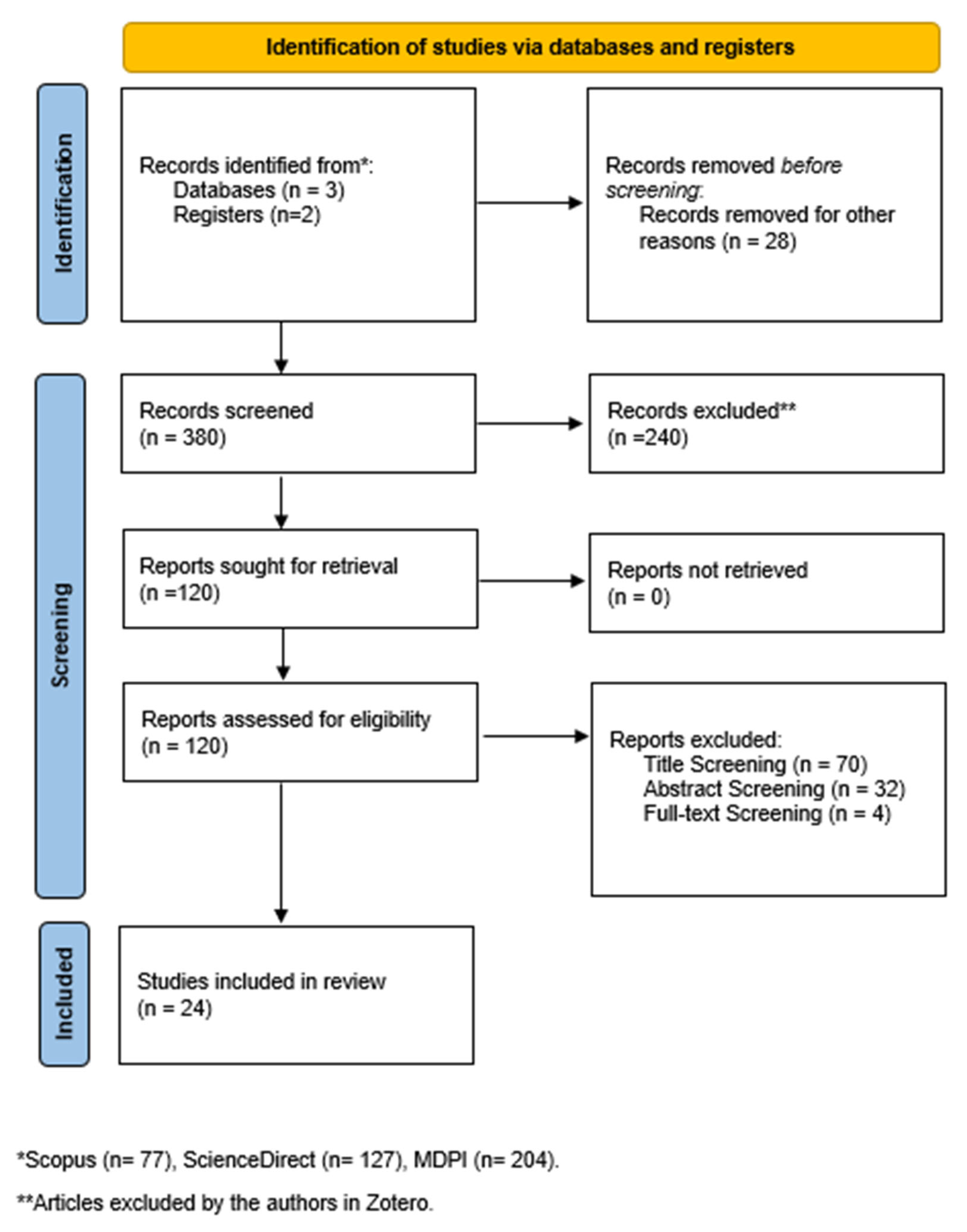
A total of 408 articles were identified: 204 from MDPI, 77 from Scopus, and 127 from ScienceDirect. All retrieved records were exported to Zotero for reference management and further screening. The screening and selection process was conducted by three independent reviewers, with any disagreement resolved through discussion.
From the initial dataset, 28 articles were removed by incomplete bibliographic information. The screening phase excluded 240 records because they were not explicitly focused on the occurrence or treatment of ECs. Subsequently, title screening was conducted to refine the dataset by targeting the mention of ECs, or specifically antibiotics/pharmaceuticals, PFAS and pesticides, resulting in the exclusion of 70 articles. This was followed by abstract screening aimed at identifying studies addressing monitoring, occurrence or treatment processes, which led to the exclusion of 32 additional articles. A full-text assessment was then conducted, resulting in the inclusion of 24 eligible studies: 12 articles for the international review and 12 articles for the national review. The study selection process is summarized in a PRISMA flow diagram (Figure 1).
The terms used allowed for the identification of recent studies on the occurrence, concentration, environmental dynamics and management of ECs in European, American, and Portuguese contexts. Although the initial search retrieved 408 records, the final inclusion of 24 studies reflects the application of strict eligibility criteria, prioritizing recent (2020–2025), peer-reviewed studies with quantitative data and direct relevance to ECs in aquatic environments. Rather than aiming for exhaustive coverage, this review adopted a focused comparative approach, emphasizing methodological consistency, data quality, and contextual relevance, particularly in relation to the Portuguese case study. This strategy enables a more robust and coherent cross-analysis between international and national studies, despite the reduced sample size.
To ensure consistency and relevance, strict inclusion and exclusion criteria were applied. Inclusion criteria comprised peer-reviewed articles published between 2020 and 2025 that presented empirical data or systematic analyses related to ECs in water matrices. Exclusion criteria included studies not focused on aquatic environments, purely theoretical or opinion-based works without empirical support, and studies lacking sufficient methodological detail.

2.2. Gap Analysis

A gap analysis was conducted through a structured qualitative synthesis of the selected literature.
The synthesis followed a comparative and integrative framework organized into four analytical axes: (1) occurrence and environmental behavior of ECs; (2) ecological and human health risks associated with chronic exposure; (3) development, optimization, and validation of analytical and treatment technologies for trace-level detection and removal; and (4) regulatory frameworks and their implications for sustainable water management [24,27]. For each study, the following variables were extracted: target contaminants, environmental matrix, concentration range, analytical or treatment technology, operational scale (laboratory, pilot, or full-scale), and reported performance indicators. International studies and national Portuguese studies were analyzed in relation to contaminants prioritized under national and European legislation, including nitrates, pesticides, and antibiotics, with emphasis on analytical techniques, environmental matrices (surface water, groundwater, wastewater), and compliance with legal thresholds.
Representative case studies were further examined to compare experimentally tested concentrations with environmentally reported levels, highlighting potential discrepancies between laboratory research conditions and real-world scenarios.
Treatment and detection technologies were classified according to operational scale and assigned an estimated Technology Readiness Level (TRL) based on the European Commission TRL framework. The classification considered three main criteria: (i) operational scale (laboratory, pilot or full-scale implementation), (ii) validation environment (synthetic solutions versus real aquatic matrices), and (iii) degree of technological integration under realistic conditions. Laboratory-scale studies conducted under controlled conditions were classified within TRL 3–4, pilot-scale systems validated under semi-real conditions were assigned TRL 5–6, and full-scale operational technologies were classified within TRL 7–9.

2.3. Assessment of the Alignment Between Technology and Policy

To evaluate the alignment between scientific research and regulatory priorities, a semi-quantitative content analysis was performed. Each selected study constituted a unit of analysis and was systematically coded according to predefined criteria: Environmental matrix (wastewater, surface water and groundwater), target ECs (PFAS, antibiotics/pharmaceuticals, pesticides) and contaminants of emerging concern (nitrates, phosphorus and heavy metals), study typology (review, occurrence, or treatment), and inclusion of risk assessment components.
A scoring system was applied in which each parameter received a value of 0 (absence), 0.5 (moderate mention or indirect relevance), or 1 (explicit focus and central objective of the study). Moderate mention (0.5) was assigned when the parameter was discussed but did not constitute the primary research objective. The coding process was conducted through structured reading of the full texts, and discrepancies in classification were resolved through iterative review to ensure consistency.
To reduce subjectivity, the evaluation was conducted independently by two reviewers, with discrepancies resolved through discussion and consensus. This scoring system was used as an exploratory comparative tool to support the identification of patterns rather than as a definitive quantitative metric.
The scoring framework encompassed four major parameter groups:
(i)
Environmental matrix: wastewater, surface water, groundwater;
(ii)
Target ECs: PFAS, antibiotics/pharmaceuticals, pesticides and conventional contaminants considered in an emerging risk context: nitrates, phosphorus, and metals;
(iii)
Study typology: review, occurrence monitoring, or evaluation of treatment technologies;
(iv)
Inclusion of risk assessment components.
Heatmaps were generated using R software (version 4.5.1) [28] with graphical visualization packages (heatmap), representing the assigned scores on a color gradient ranging from light blue (low alignment) to dark blue (high alignment). All categories were weighed equally to allow comparative visualization without introducing preferential bias.
This exploratory visualization enabled identification of thematic concentration areas, research gaps, and potential misalignment between technological innovation and regulatory emphasis in both Portuguese and international contexts.
It should be noted that this scoring system is inherently interpretative and is intended as an exploratory visualization tool to identify patterns and gaps, rather than to provide statistically robust or fully reproducible quantitative results.

2.4. Limitations of This Study

This study presents several limitations that should be considered when interpreting the results. The temporal scope (2020–2025) and the databases selected may exclude relevant studies that could provide additional context.
The relatively small dataset (n = 24), and the heterogeneity of the included studies, particularly in terms of environmental matrices, contaminant types, and differences between laboratory and environmental concentration ranges, limits direct comparability across results. Additionally, the literature includes studies with different methodological approaches (monitoring, detection, treatment, and review articles) which introduces an additional layer of heterogeneity that limits direct comparability. Therefore, the results should be interpreted as integrative and indicative trends rather than strictly comparable quantitative outcomes.
A formal assessment of study quality or risk of bias was not conducted, as the objective of this review was to provide a structured comparative analysis rather than a fully systematic quantitative evaluation. Nevertheless, potential selection bias may have been introduced through the choice of databases, search terms, and the focus on specific groups of ECs. Furthermore, the screening process (title, abstract, and full-text review) inherently involves a degree of subjectivity, which may have influenced study inclusion decisions.
The use of semi-quantitative and interpretative approaches, such as heatmap scoring and Technology Readiness Level (TRL) classification, involves an element of expert judgment. Although these methods provide a structured framework for identifying trends and research gaps, they should be interpreted as exploratory rather than definitive.
In addition, given the conceptual breadth of the topic, particular care was taken to maintain terminological consistency across sections, especially when distinguishing between classical pollutants and contaminants discussed under an emerging risk perspective.

3. Results and Discussion

To systematically evaluate ECs, this section is organized according to study type and analytical focus. First, contaminant occurrence and detection trends in international and national literature are presented (Section 3.1), followed by treatment technologies and their technological readiness level (Section 3.2), and finally governance, monitoring and implementation gaps (Section 3.3).
The analysis of international and national literature on ECs allowed us to identify convergent trends, significant methodological advances, and persistent challenges in the field of environmental governance. The evidence gathered reveals not only the expansion of scientific knowledge but also increasing complexity of the problem, marked by the ubiquity of contaminants, the diversity of affected environmental matrices, and the sophistication of the analytical techniques employed.
Initially, the consolidation of scientific knowledge and the expansion of the spectrum of identified contaminants are examined. Next, the technological capacity demonstrated in the analyzed studies is evaluated, with special attention to the limitations associated with its systematic implementation. Subsequently, a critical analysis of the structural misalignment between scientific innovation and the regulatory framework is carried out. Finally, implications for the development of more adaptive and integrated governance models are discussed.
The analysis of the twelve selected international articles, published between 2020 and 2025, highlights the comprehensive approach to ECs in different environmental matrices, including drinking water, effluents, and global monitoring systems. The studies range from reviews of risk profiles and regulatory policies to applied research involving advanced sensors and electrochemical degradation technologies. This methodological diversity allows for the assessment of both health and environmental impacts and the effectiveness of technological strategies for pollutant mitigation.

3.1. Occurrence and Detection Trends: International vs. Portuguese Context

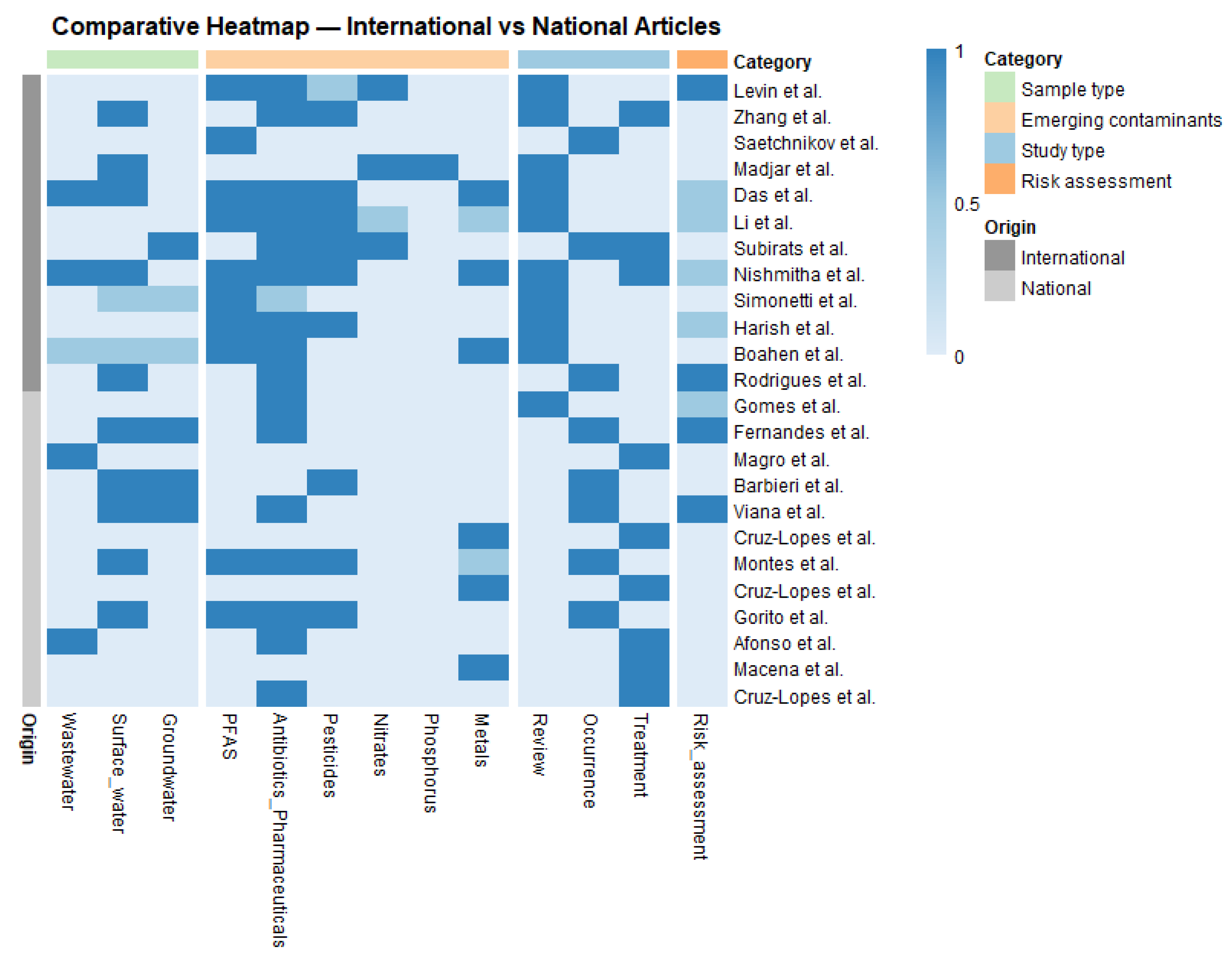
Following this integrated review, Figure 2 synthesizes the comparative distribution of contaminants, sample types and risk assessment approaches across international and Portuguese studies.
The comparative heatmap highlights differences and convergences between international and national studies in terms of sample type, contaminant focus, study design, and the incorporation of risk assessment. Overall, surface water appears to be the most frequently investigated matrix across both groups, suggesting its prominent role within the analyzed studies. Wastewater and groundwater are also commonly addressed, reflecting interest in point sources and treatment system performance. A few studies cover multiple water types, suggesting a broader environmental surveillance approach.
With respect to contaminant type, a thematic distinction is suggested. International studies show a strong emphasis on ECs, such as PFAS, antibiotics/pharmaceuticals and pesticides, with studies addressing several ECs. These compounds are commonly linked to global regulatory debates and concerns regarding persistence, bioaccumulation, and long-term ecological and human health risks within the analyzed literature. Although conventional contaminants in an emerging risk context such as nutrients (nitrates and phosphorus) and metals are still addressed in international research, they are comparatively less dominant. ECs appear in national research, mainly antibiotics/pharmaceuticals, with pesticides also moderately represented, but with lower consistency than in the international literature, with limited representation of PFAS. This asymmetry may suggest differences in research priorities with international research more aligned with emerging global contaminant issues and national research more centered on established water quality parameters.
In terms of study type, occurrence-based investigations dominate across national publications. Occurrence and treatment studies are more visible nationally, suggesting relatively stronger engagement with mitigation strategies and technological development. Review articles are more prevalent internationally, reflecting a broader effort to synthesize existing knowledge and guide future research directions, and it is also evident a relative scarcity of review articles nationally, suggesting the need to consolidate existing knowledge.
Risk assessment is the least represented component overall. International studies more frequently consider risk assessment, while a few national studies have taken risk assessment as a parameter explicitly addressed as a central objective of the work. This integration suggests an effort to link environmental occurrence data with potential ecological and human health implications, thereby increasing policy relevance. The limited integration of risk assessment may indicate a gap between monitoring activities and decision-support frameworks, potentially constraining the translation of scientific findings into regulatory or management actions.
Taken together, the heatmap suggests that international research appears to be characterized by broader thematic scope, greater methodological diversity, and stronger integration of risk-based perspectives. National research, while robust in occurrence and treatment of ECs, appears more concentrated and less diversified in terms of contaminant range. These asymmetries suggest opportunities for strengthening national research frameworks through expanded attention to ECs, increased incorporation of risk assessment methodologies, and greater engagement with treatment and mitigation strategies. Conversely, international research may benefit from increased attention to groundwater systems and more localized, context-specific applications to enhance practical implementation.
Beyond the patterns observed in the heatmap, broader literature and policy analyses suggest that, despite technical and scientific advances, the extent and continuity of monitoring actions in Portugal remain limited. Unlike in Central European or North American countries, where there are systematic and widely institutionalized networks for the surveillance of ECs, the Portuguese reality is largely based on finite academic projects and isolated regional initiatives. This dependence compromises both the spatial representativeness and temporal consistency of the data collected, hindering an integrated assessment of the status of water bodies and limiting the capacity for regulatory response. Although national legislation is formally aligned with the Water Framework Directive (2000/60/EC) [18], significant gaps remain. Decree-Law No. 69/2023 [25], for example, while adopting a risk management approach for water intended for human consumption, does not incorporate most of the ECs among the mandatory monitoring parameters. Similarly, Decree-Laws No. 152/97 and 119/2019 [23,24], which regulate the treatment and reuse of wastewater, still do not include specific indicators for pharmaceutical compounds and polar pesticides.
To further detail these patterns, Table 1 and Table 2 summarize the methodological approaches and contaminant profiles of the selected studies. This synthesis allows us to identify global trends, monitoring gaps, and technological advances, establishing a solid basis for an integrated discussion of the impacts of emerging and classic contaminants in different contexts.
Recent international literature has focused on reviewing existing knowledge on ECs, with review articles assessing different techniques, multiple water matrices and ECs, however there is a growing congruence towards LC-MS/MS as monitoring tool for determination of ECs. The literature demonstrates a strong concentration on ECs, particularly PFAS, pharmaceuticals, while conventional contaminants such as nitrates and heavy metals are associated with agricultural runoff. Studies conducted in the United States and Europe highlight the widespread occurrence of arsenic, nitrates, PFAS, and pharmaceutical residues in drinking water and surface waters, emphasizing both ecological and public health implications [29,38,39]. Urban monitoring campaigns reveal extensive pharmaceutical contamination, with compounds detected in up to 91% of sampling points and mixtures present in 79%, indicating complex exposure scenarios in densely populated regions [39]. At the same time, nutrient pollution remains a structural problem in Europe, where approximately 40% of water bodies fail to achieve “good ecological status” reflecting the persistent impact of nitrogen and phosphorus inputs despite decades of regulation [32].
A notable characteristic of international literature is the increasing integration of environmental monitoring with human exposure pathways and toxicological assessment. Several studies connect contaminant occurrence to vulnerable populations, chronic ingestion risks, endocrine disruption, antimicrobial resistance, and food-chain bioaccumulation [29,35,38]. This integration reflects a shift toward a One Health perspective, in which environmental contamination, ecosystem integrity, and public health are treated as interconnected dimensions of the same risk framework. In parallel, global assessments emphasize the need for holistic mitigation strategies that combine technological innovation with exposure reduction and regulatory reform [33,35].
Another prominent trend is the growing incorporation of risk modelling and predictive tools. Environmental modelling, ecological risk assessment, and human health risk frameworks are increasingly embedded within contaminant studies, strengthening the policy relevance of scientific findings [29,32]. Advanced detection and monitoring technologies, including multiplexed optical sensors, portable optical systems, and automated miniaturized platforms are being developed to support real-time surveillance and decentralized monitoring programs [30,35]. Simultaneously, technological mitigation research is expanding toward selective and high-efficiency removal systems, such as molecularly imprinted materials combined with advanced oxidation processes, although challenges related to scalability, stability, and environmental safety remain [30].
At the regulatory level, analyses of international legal frameworks reveal significant gaps in harmonization and enforcement, particularly regarding ECs underscoring the need for globally coordinated governance mechanisms [37].
Overall, the international research landscape appears to be advancing towards multidisciplinary integration, combining contaminant detection, exposure pathways, risk modelling, technological mitigation, and regulatory analysis. The Portuguese context, although scientifically robust and expanding, still shows room for deeper integration between environmental monitoring, health risk modelling, and governance frameworks.
Table 2 below presents a comparative summary of the main methods used, the contaminants analyzed and the most relevant results, allowing for the identification of knowledge gaps and guiding future research on water resource contamination in Portugal.
The twelve national studies summarized in Table 2 reveal substantial methodological diversity, yet they converge around three main analytical dimensions: dominant contaminant typologies, degree of risk assessment integration, and monitoring continuity with LC-MS/MS, being the most reported technology for the determination of ECs, so as in international studies.
Regarding contaminant typologies, pharmaceuticals, antibiotics, pesticides, herbicides, and other organic ECs clearly dominate the Portuguese research landscape. LC-MS/MS emerges as the predominant analytical technique due to its high sensitivity and capacity for multi-residue detection across complex matrices [43,44]. Large-scale screening efforts identified extensive contaminant diversity, including 343 substances detected through suspect screening using LC-HRMS in northern Portugal-Galicia, and approximately 90% of monitored compounds in WWTPs and river basins meeting PMT (persistent mobile and toxic) criteria, with 18 classified as posing significant environmental risk [46]. Estuarine monitoring campaigns further confirmed the frequent occurrence of compounds such as isoproturon, PFOS, trimethoprim, and diclofenac, even at low concentrations, highlighting persistence as a key concern [48].
Pharmaceutical contamination is particularly widespread, as shown in both national and European-scale assessments. Urban stream monitoring detected pharmaceuticals in 91% of sampling sites, with contamination patterns influenced by population density and landscape structure [39]. In parallel, microbial-level impacts have been documented, with evidence that antibiotics and non-antibiotic pharmaceuticals such as carbamazepine and diclofenac can alter microbial behavior and exert selective pressure for antimicrobial resistance, although effects on biofilms remain methodologically inconsistent [40].
Heavy metals also remain a significant research focus, particularly in the development of biosorption-based mitigation strategies. Lignocellulosic residues such as walnut and chestnut shells achieved removals above 90% for Pb2+, Ni2+, and Cr6+, with adsorption strongly influenced by pH [45,47]. Under optimized conditions, removals of 97–99% for Pb2+ were reported, following pseudo-second-order kinetics [50].
Advanced hybrid materials, such as pine bark biochar combined with TiO2, achieved nearly 96% removal of ceftriaxone through synergistic adsorption and photodegradation mechanisms [51]. Additionally, microalgal consortia cultivated in treated wastewater removed between 40% and 83% of pharmaceuticals and one herbicide, achieving almost complete removal of fluoxetine, venlafaxine, atenolol, and diuron, while maintaining robust biomass production [49]. Electrochemical degradation approaches also demonstrated technological potential, with Ti/MMO anodes identified as the most efficient for triclosan removal [42].
Concerning the degree of risk assessment integration, a small portion of Portuguese studies combine chemical quantification with ecological or human health risk evaluation. Antibiotic monitoring coupled with ecological risk assessment frameworks demonstrates the importance of complementary toxicity and persistence data for meaningful interpretation [41,44]. Broader risk-oriented analyses highlight the environmental persistence, bioaccumulation potential, and classification of compounds as PMT or vMvP, reinforcing concerns about long-term ecological exposure [46]. However, risk modelling is not systematically present. Studies such as Gomes et al. [40] emphasize the need for standardized methodologies and stronger integration within a One Health framework, particularly regarding microbial resistance dynamics.
With respect to monitoring continuity, differences emerge between punctual and longitudinal approaches. Automated methodologies capable of processing large volumes of samples provide high-accuracy but time-limited datasets [43], whereas passive sampling strategies integrated with LC-MS/MS enable more continuous detection of low-concentration compounds [44]. Year-long monitoring in estuarine environments [48] represents a more systematic approach, while suspect screening campaigns and WWTP assessments provide extensive but often cross-sectional contamination snapshots [46]. Overall, although analytical capacity is technically advanced, sustained long-term monitoring frameworks remain less consolidated.
Collectively, the Portuguese research landscape demonstrates strong analytical sophistication and growing integration of mitigation technologies, including electrochemical systems, biosorption using forest residues, and microalgal treatment. Nevertheless, compared to broader international discussions that increasingly combine predictive modelling, regulatory analysis, and systemic exposure frameworks [1,39], national studies remain more focused on detection, characterization, and localized risk assessment than on integrated governance-oriented modelling.
Thus, while Portugal exhibits a robust scientific foundation in contaminant identification and technological experimentation, further consolidation of long-term monitoring programs and predictive risk integration would strengthen the translation of scientific evidence into strategic environmental management.
Table 3 was developed using primary experimental and observational studies, deliberately excluding review papers, since they do not provide original concentration values but instead compile secondary data from multiple sources. This methodological choice ensures that the information presented is consistent, precise, and directly derived from measured values, avoiding duplication or misattribution of data. For each included study, the contaminants investigated, the concentration ranges measured or detected, the analytical or experimental context (laboratory removal tests, environmental monitoring, advanced sensor detection), and the corresponding references were systematically extracted.
The concentration ranges presented in Table 3 reveal a critical scale discrepancy between laboratory-based removal experiments (mg/L) and environmentally detected levels (ng/L–µg/L), highlighting the challenge of translating experimental efficiency into real-world relevance. This difference can reach 104 to 106 times, raising critical questions regarding the direct extrapolation of laboratory-observed efficiency to real-world scenarios. At high concentrations, adsorption mechanisms tend to promote rapid saturation of active sites and the achievement of high removal percentages. However, at trace levels, processes may be governed by distinct phenomena, such as more pronounced diffusional limitations, competition with natural organic matter, matrix effects, and changes in solid–liquid partition dynamics. Therefore, a high removal efficiency expressed in mg/L does not necessarily guarantee equivalent performance at ng/L, particularly when complex and multicomponent environmental systems are considered.
The included studies exhibit substantial heterogeneity in matrices, concentration ranges, and experimental conditions. Laboratory studies often employ synthetic solutions at mg/L concentrations to evaluate removal efficiency, while environmental monitoring studies report contaminants at ng/L–µg/L levels. These differences should be considered when interpreting treatment efficiency and exposure relevance.
In addition, the studies differ in their primary analytical focus, encompassing contaminant detection, environmental monitoring, and treatment evaluation. Detection-oriented studies rely on high-sensitivity techniques such as LC–MS/MS and HRMS to quantify trace-level contaminants in complex matrices. Monitoring studies emphasize spatial and temporal variability, often using passive sampling or periodic campaigns to characterize occurrence patterns. In contrast, treatment-focused studies are generally conducted under controlled laboratory or pilot-scale conditions, frequently using simplified matrices and higher contaminant concentrations to assess removal efficiency.
This diversity in study objectives and methodologies introduces an additional layer of heterogeneity, limiting direct comparability across results. Differences between controlled experimental conditions and real-world environmental systems constrain the extrapolation of treatment performance, while variability in monitoring design affects the representativeness of occurrence data. Therefore, the findings should be interpreted as indicative of general trends across detection, monitoring, and treatment domains, rather than directly comparable quantitative outcomes.
While adsorption and photocatalytic processes achieve high removal efficiencies at mg/L concentrations in controlled experiments, environmental concentrations of contaminants are several orders of magnitude lower (ng/L–µg/L). This scale discrepancy can limit the transferability of laboratory results to real-world applications, as adsorption dynamics and degradation kinetics may differ under natural conditions. Similar challenges have been reported in other review studies of adsorption and photocatalytic application [51,52,53], highlighting the need for testing removal technologies under environmentally relevant conditions to ensure realistic performance assessments.
From a technological perspective, this discrepancy may lead to an overestimation of the performance of certain adsorbent materials or advanced treatment processes if evaluation is restricted to idealized conditions. From an environmental standpoint, ecological relevance is associated with chronic exposure to low concentrations, where even trace levels may exert cumulative ecotoxicological effects. Consequently, the validation of treatment technologies should incorporate testing at environmentally representative concentrations, as well as real matrices, to ensure that the demonstrated efficiency is effectively transferable to practical applications.
The highlighted data reveal significant variability across contaminant types and the scales at which they occur in aquatic environments. Metallic contaminants such as Ni2+ appear in high mg/L ranges typical of controlled adsorption experiments, while pharmaceutical pollutants like ceftriaxone are also studied in mg/L concentrations during removal tests. In contrast, environmentally detected antibiotics occur at ng/L levels, reflecting their trace presence in natural waters and the need for sensitive analytical methods. PFAS are detected at extremely low concentrations (around 1 ppb) using advanced optical technologies, and antibiotic resistance genes (ARGs) represent biological contaminants measured not by mass but through genetic markers. Together, these distinctions illustrate the complexity of emerging contaminant assessment and the breadth of analytical strategies required to address water pollution challenges.
Understanding contaminant occurrence and concentration patterns provides the necessary context for evaluating treatment technologies. Section 3.2 therefore explores the technological solutions developed to mitigate these contaminants and assesses their readiness for real-world implementation.

3.2. Treatment Technologies and Technological Maturity (TRL)

To provide a clearer overview of the technological approaches discussed, Table 4 presents a summary of the treatment technologies evaluated in the studies, highlighting the contaminants addressed, the operational scale, and the respective Technology Readiness Level (TRL) based on the scale proposed by the European Commission [54]. The operational scale (or Technology Readiness Scale) and the respective TRL are an assessment system used to measure the degree of maturity of a technology, from the initial stages of research to its commercial use. The European Commission adopted a 9-level scale (TRL 1–9), aligned with the scale originally developed by NASA, but adapted to the European context of innovation, funding, and public policies.
A critical analysis of Table 4 reveals that most technologies remain at laboratory scale (TRL 3–5), with only one study reaching industrial implementation (TRL 8–9). This predominance of experimental-scale research indicates that, although removal efficiencies are frequently high under controlled conditions, the transition to full-scale application remains limited. Furthermore, many studies rely on synthetic aqueous matrices and tightly controlled operational parameters (such as pH, temperature, contaminant concentration), which may not fully reflect the variability of real environmental systems. These findings suggest that the current technological landscape demonstrates strong theoretical and experimental potential but still faces significant barriers in achieving operational maturity and large-scale deployment.
As previously discussed, the heatmap (Figure 2) highlighted a strong national emphasis on historically regulated contaminants, such as heavy metals, while international studies showed greater homogeneity in the ECs considered and risk assessment approaches. This thematic asymmetry is mirrored in the technological landscape: research efforts are concentrated on conventional pollutants, and the transition toward scalable solutions for ECs remains limited.
Moreover, the heatmap revealed a lower incidence of risk assessment integration in national studies, which may partially explain the slower progression toward higher TRLs. Technologies developed primarily under controlled laboratory conditions, often using synthetic aqueous matrices and tightly regulated parameters such as pH, temperature, and contaminant concentration, tend to remain confined to experimental validation stages. While removal efficiencies are frequently high under these idealized conditions, the absence of broader environmental variability and risk-based performance evaluation constrains their operational advancement. Thus, the technological immaturity identified in Table 4 can be interpreted not merely as a technical limitation, but as a reflection of the research priorities and methodological patterns evidenced in the bibliometric heatmap analysis.
Research on adsorption technologies based on lignocellulosic materials has demonstrated significant potential for contaminant removal. When considering Figure 2, it is even possible to make a bridge between national studies focusing on heavy metals removal through adsorption. Studies conducted by Cruz-Lopes et al. [45,47] demonstrate the high efficiency of lignocellulosic biosorbents in the adsorption of heavy metals such as Ni2+, Cr6+ and Pb2+, with performance strongly dependent on pH and the physicochemical characteristics of the materials. Macena et al. [50], when exploring lignocellulosic by-products for lead removal, reinforced the potential of these materials as low-cost and highly effective alternatives. Similarly, Cruz-Lopes et al. [51] showed that pine bark biochar combined with TiO2 can remove cephalosporins from aqueous matrices, highlighting a promising technological route for mitigating persistent pharmaceuticals. Collectively, these studies broaden the debate on viable technological solutions for Portugal by demonstrating that innovation capacity is not restricted to conventional or highly specialized systems but also encompasses renewable materials with high applicability potential.
In the field of biotechnological solutions, Subirats et al. [34] describe a pilot-scale system combining microalgae with a cork/wood biofilter for the treatment of contaminated groundwater. The system achieved removal efficiencies of up to 98% for nitrates and over 90% for pesticides and antibiotics throughout all seasons. Additionally, the biofilter significantly reduced bacterial load and resistance genes, while the microalgal biomass remained free of contaminant accumulation, suggesting potential agricultural reuse. The authors conclude that this approach constitutes a green, sustainable, and economically viable alternative for drinking water production in rural areas. However large-scale cultivation of microalgae faces significant hurdles across economic and operational domain, the scale-up process is complex requiring critical optimization of process [55,56]. Gurreri et al. [57] conducted a Life-Cycle Assessment reporting the need for a large consumption of chemicals (8 kg/kg dry weight), a high electrical energy consumption (around 267 kWh/kg DW) and concluding that the sustainability of the process of microalgae cultivation was very hard to achieve.
Beyond individual technologies, the transition of these innovative approaches to operational scale faces significant challenges, particularly regarding implementation costs, energy requirements, and adaptation to variable environmental conditions. In contrast, countries such as Germany and the United States have advanced in the adoption of hybrid systems that combine physical-chemical and biological processes with digital technologies for continuous monitoring, enabling real-time water quality management and improved operational control.
Within this broader technological landscape, although Portugal has developed a solid and expanding scientific base, strengthening the interface between knowledge production and public policy formulation remains essential. The effective integration of emerging technologies into treatment and monitoring systems, together with updated regulatory standards and formal recognition of sustainable biosorbents, represents a decisive step toward building a more comprehensive and effective national strategy for monitoring and mitigation.
It is important to note that nitrates (NO3) are not traditionally classified as ECs in the same way as pharmaceuticals, biosurfactants, or personal care products. Nevertheless, increasing scientific attention suggests that nitrates may warrant reconsideration within the emerging contaminant discourse. Selvarangam et al. [57] and Aju et al. [58] argue that there are scientific grounds to frame nitrates as an emerging environmental risk, despite their historical classification as conventional pollutants. In a recent publication emphasized the growing global awareness of nitrate contamination as a major environmental problem [59]. Furthermore, research conducted in Bangladesh characterizes nitrate pollution in groundwater as an emerging threat to public health due to its persistence and the chronic risks associated with long-term ingestion.
While laboratory and pilot-scale technologies show promising removal efficiencies, their practical deployment depends on regulatory frameworks, monitoring capacity, and operational feasibility. Section 3.3 examines these governance and implementation dimensions to highlight structural barriers and integration opportunities.

3.3. Governance, Monitoring and Implementation Gaps

Despite the scientific progress described in the previous sections, the translation of these advances into sustainable water management remains incomplete. In Portugal, monitoring of ECs is still predominantly associated with short-term academic projects, rather than integrated into permanent national surveillance frameworks. This fragmentation compromises temporal continuity and weakens the ability to generate consistent datasets capable of informing evidence-based regulatory decisions.
A similar imbalance can be observed at the regulatory level. Although Directive (EU) 2020/2184 [7] and the subsequent watch list mechanism established by Commission Implementing Decision (EU) 2022/679 [8] represent important advances in the European framework, the effective incorporation of ECs into binding national monitoring parameters remains partial. As discussed by Silva [16] and Sampaio [12], several compounds frequently detected in Portuguese water bodies are not yet systematically included in mandatory control programs. Risk assessment approaches still tend to focus on individual substances, despite growing scientific recognition of mixture effects and cumulative exposure patterns [1,5]. This regulatory delay reinforces a reactive model of governance, where scientific evidence often precedes formal policy adaptation.
Technological transition also faces structural constraints. While advanced treatment options, such as adsorption systems, electrochemical processes and microalgae-based solutions have demonstrated promising removal efficiencies [34,42,47], most remain at laboratory or pilot scale. As highlighted by Novoveská et al. [55] and Gurreri et al. [56], large-scale deployment is frequently limited by energy demand, operational complexity, and economic viability. In the absence of regulatory incentives or dedicated funding instruments, wastewater treatment utilities tend to prioritize compliance with existing standards rather than the proactive adoption of innovative solutions targeting ECs that are not yet legally required.
Taken together, these monitoring, regulatory and implementation constraints illustrate the persistence of a structural gap between scientific progress and institutional practice. Although analytical technologies in Portugal have significantly advanced, particularly through the application of LC-MS/MS and HRMS techniques [41,46], the integration of these technologies into permanent surveillance networks remains limited. Strengthening coordination between scientific research, environmental agencies such as APA, and wastewater management authorities therefore becomes essential to ensure that knowledge production effectively supports sustainable and resilient water governance in line with European and global sustainability commitments.

4. Conclusions

The persistence of ECs across different aquatic matrices compromises ecosystem integrity and raises concerns regarding long-term human exposure. In this context, the issue intersects directly with several Sustainable Development Goals (SDGs), notably, SDG 6 (clean water and sanitation); SDG 3 (good health and well-being); and SDGs 14 and 15 (life below water and life on land), highlighting the need for more integrated and preventive approaches to water governance.
This review provides a comparative analysis of ECs in Portuguese water systems within the context of international evidence, highlighting how Portugal aligns with or diverges from broader European trends. The analysis shows that, although analytical techniques such as LC-MS/MS and HRMS are well established, gaps remain in continuous monitoring, systematic risk assessment integration, and coordinated governance. Treatment technologies, including adsorption, photocatalysis, and microalgae-based systems, demonstrate promising removal efficiencies, their large-scale implementation remains limited by technical, economic and regulatory constraints.
The main contribution of this review lies in integrating occurrence patterns, technological readiness, and governance frameworks into a single analytical perspective, highlighting the disconnect between scientific advances and their practical application in water management.
To address these gaps, future efforts should prioritize: (i) the establishment of long-term and harmonized monitoring programs, including ECs mixtures; (ii) the validation and scaling-up of treatment technologies under real-world conditions; and (iii) the strengthening of coordination between research institutions, wastewater operators, and regulatory authorities to support evidence-based policy implementation.
This study has some limitations, including the restricted temporal scope (2020–2025) and the limited number and heterogeneity of the selected studies, which constrain the generalizability of the results. Therefore, the findings should be interpreted as indicative of patterns observed within the sample analyzed, rather than broadly generalized conclusions. Nevertheless, the review provides relevant insights into the challenges of integrating science, technology, and policy, supporting the development of more resilient and sustainable water management strategies in Portugal.

Supplementary Materials

The following supporting information can be downloaded at: https://www.mdpi.com/article/10.3390/su18105086/s1.

Author Contributions

Conceptualization, P.E., A.A. and T.L.; methodology, P.E. and T.L.; software, P.E. and T.L.; validation, A.C.D., M.O., L.C.-L. and J.M.G.; investigation, P.E. and T.L.; writing—original draft preparation, A.A., P.E. and T.L.; writing—review and editing, L.C.-L. and M.O.; supervision, A.C.D., M.O., L.C.-L. and J.M.G. All authors have read and agreed to the published version of the manuscript.

Funding

This research was funded by Fundação para a Ciência e Tecnologia (FCT), Portugal, under project UIDB/0681/2025, attributed to CERNAS—Research Centre for Natural Resources, Environment and Society. P. Esperanço was supported by FCT through grant 2025.07113.BDANA.

Institutional Review Board Statement

Not applicable.

Informed Consent Statement

Not applicable.

Data Availability Statement

The data supporting the findings of this study are derived from publicly available sources, as cited in the reference list. This work is a systematic review conducted according to PRISMA 2020 guidelines, and no new datasets were generated or analyzed. All relevant data are included within the article and its references.

Acknowledgments

The authors thank the Research Centre for Natural Resources, Environment and Society (CERNAS) for institutional support.

Conflicts of Interest

The authors declare no conflicts of interest.

Abbreviations

The following abbreviations are used in this manuscript:
AOPsAdvanced oxidation processes
APAPortuguese Environment Agency
ARGsAntibiotic Resistant Genes
BETBrunauer–Emmett–Teller
BJHBarrett–Joyner–Halenda
CCLContaminant Candidate List
ECsEmerging contaminants
ELISAEnzyme-Linked Immunosorbent Assay
EPAUnited States Environmental Protection Agency
EUEuropean Union
GCGas Chromatography
GC-MSGas Chromatography–Mass Spectrometry
FTIRFourier Transform Infrared Spectroscopy
HMsHeavy Metals
HRMSHigh-Resolution Mass Spectrometry
LC-HRMSLiquid Chromatography–High-Resolution mass spectrometry
LC-MS/MSLiquid Chromatography coupled to mass spectrometry
MDPIMultidisciplinary Digital Publishing Institute
MPsMicroplastics
MIPsMolecularly imprinted materials
NASANational Aeronautics and Space Administration
PCRPolymerase Chain Reaction
PFASPolyfluoroalkyl substances
PFOSPerfluorooctane Sulfonate
PMTPersistent, moving and toxic substances
PPCPsPharmaceuticals and Personal Care Products
PhACsPharmaceuticals
PXRDPowder X-Ray Diffraction
SDGSustainable Development Goals
SEMScanning Electron Microscopy
TRLTechnology Readiness Level
UNEPUnited Nations Environmental Program
USAUnited States of America
UVUltra-violet
UV-VisUltra-violet Visible Spectroscopy
vMVPsVery persistent and very mobile substances
WWTPWastewater treatment plants

References

  1. Li, X.; Shen, X.; Jiang, W.; Xi, Y.; Song, L. Comprehensive review of emerging contaminants: Detection technologies and management strategies. Ecotoxicol. Environ. Saf. 2024, 278, 116420. [Google Scholar] [CrossRef]
  2. Otorkpa, O.J.; Otorkpa, C.O. Health effects of microplastics and nanoplastics: Review of published case reports. Environ. Anal. Health Toxicol. 2024, 39, e2024020. [Google Scholar] [CrossRef]
  3. Corato, U.D.; Viola, E.; Keswani, C.; Minkina, T. Impact of sustainable agricultural practices for governing soil health from the perspective of a rising agri-based circular bioeconomy. Appl. Soil Ecol. 2024, 194, 105199. [Google Scholar] [CrossRef]
  4. United States Environmental Protection Agency. Per- and Polyfluoroalkyl Substances (PFAS). 2025. Available online: https://www.epa.gov (accessed on 28 October 2025).
  5. Garduño-Jiménez, A.-L.; Gomes, R.L.; López-Maldonado, Y.; Carter, L.J. Addressing global data imbalance of contaminants of emerging concern under the SDGs. RSC Sustain. 2025, 3, 3384–3391. [Google Scholar] [CrossRef]
  6. United Nations Environment Programme. Per- and Polyfluoroalkyl Substances (PFASs). 2024. Available online: https://www.unep.org (accessed on 28 October 2025).
  7. The European Parliament and the Council of the European Union. Directive (EU) 2020/2184 of the European Parliament and of the Council on the quality of water intended for human consumption. Off. J. Eur. Union 2020, 63, 1–62. [Google Scholar]
  8. European Commission. Commission Implementing Decision (EU) 2022/679 establishing a watch list of substances for water intended for human consumption. Off. J. Eur. Union 2022, 65, L124/41. [Google Scholar]
  9. European Commission. New Substances Added to EU Surface Water Watch List; European Commission: Brussels, Belgium, 2025. [Google Scholar]
  10. United States Environmental Protection Agency. Contaminant Candidate List (CCL). 2025. Available online: https://www.epa.gov/ccl (accessed on 1 November 2025).
  11. Sousa, R.; Ferreira, V.; Costas, S.; Alves, C.; Anastácio, P.; Chaínho, P.; Costa, P.A.; Duarte, S.; Feio, M.J.; Franco, J.N.; et al. Scanning the horizon: Anticipating future changes in Portuguese aquatic ecosystems. Environ. Sustain. Indic. 2025, 3, 100876. [Google Scholar] [CrossRef]
  12. Sampaio, P.W.R. Regulação Multinível e Transição dos Resíduos Para Dinâmica dos Recursos. Ph.D. Thesis, Universidade NOVA de Lisboa, Lisbon, Portugal, 2025. [Google Scholar]
  13. Wang, F.; Xiang, L.; Leung, K.S.-Y.; Elsner, M.; Zhang, Y.; Guo, Y.; Pan, B.; Sun, H.; An, T.; Ying, G.; et al. Emerging contaminants: A One Health perspective. Innovation 2024, 5, 100612. [Google Scholar] [CrossRef]
  14. Vale, F.; Sousa, C.A.; Sousa, H.; Santos, L.; Simões, M. Parabens as emerging contaminants: Environmental persistence, current practices and treatment processes. J. Clean. Prod. 2022, 347, 131244. [Google Scholar] [CrossRef]
  15. Barbosa, M.O.; Ratola, N.; Homem, V.; Pereira, M.F.R.; Silva, A.M.T.; Ribeiro, A.R.L.; Llorca, M.; Farré, M. Per- and poly-fluoroalkyl substances in Portuguese rivers: Spatial-temporal monitoring. Molecules 2023, 28, 1209. [Google Scholar] [CrossRef]
  16. Silva, C.C.Z. Poluentes Alvo de Preocupação Emergente em Águas Residuais Urbanas Tratadas. Master’s Thesis, Universidade do Algarve, Faro, Portugal, 2023. [Google Scholar]
  17. Montes, R.; Méndez, S.; Cobas, J.; Carro, N.; Neuparth, T.; Alves, N.; Santos, M.M.; Quintana, J.B.; Rodil, R. Occurrence of persistent and mobile chemicals and other contaminants of emerging concern in Spanish and Portuguese wastewater treatment plants, transnational river basins and coastal water. Sci. Total Environ. 2023, 885, 163737. [Google Scholar] [CrossRef]
  18. European Parliament and Council of the European Union. Directive 2000/60/EC establishing a framework for Community action in the field of water policy (Water Framework Directive). Off. J. Eur. Communities 2000, 43, 1–73. [Google Scholar]
  19. Council of the European Communities. Directive 91/271/EEC concerning urban wastewater treatment. Off. J. Eur. Communities 1991, 34, 40–52. [Google Scholar]
  20. European Parliament and Council of the European Union. Regulation (EU) 2020/741 on minimum requirements for water reuse. Off. J. Eur. Union 2020, 63, 32–55. [Google Scholar]
  21. European Commission. European Union Strategic Approach to Pharmaceuticals in the Environment; COM(2019)128 Final; European Commission: Brussels, Belgium, 2019; Available online: https://eur-lex.europa.eu (accessed on 21 October 2025).
  22. European Environment Agency. EEA: Copenhagen, Denmark, 2023. Available online: https://www.eea.europa.eu (accessed on 23 October 2025).
  23. Portuguese Republic. Decree-Law No. 152/97 of 19 June (Transposing Directive No. 91/271/EEC Concerning Urban Wastewater Treatment into National Law); Series I-A, No. 139; Diário da República: Lisbon, Portugal, 1997. [Google Scholar]
  24. Portuguese Republic. Decree-Law No. 119/2019 of 21 August (Establishing the Legal Framework for the Production of Water for Reuse, Obtained from Wastewater Treatment, as Well as Its Use); Series I, No. 159; Diário da República: Lisbon, Portugal, 2019; pp. 21–44. [Google Scholar]
  25. Agência Portuguesa do Ambiente. Avaliação de Substâncias Prioritárias, Outros; APA: Lisbon, Portugal, 2021; Available online: https://apambient.pt (accessed on 3 October 2025).
  26. Page, M.J.; McKenzie, J.E.; Bossuyt, P.M.; Boutron, I.; Hoffmann, T.C.; Mulrow, C.D.; Shamseer, L.; Tetzlaff, J.M.; Akl, E.A.; Brennan, S.E.; et al. The PRISMA 2020 statement: An updated guideline for reporting systematic reviews. PLoS Med. 2021, 18, e1003583. [Google Scholar] [CrossRef] [PubMed]
  27. United Nations. The Sustainable Development Goals Report 2023: Special Edition; United Nations: New York, NY, USA, 2023. [Google Scholar]
  28. R Core Team. R: A Language and Environment for Statistical Computing; R Foundation for Statistical Computing: Vienna, Austria, 2025; Available online: https://www.R-project.org/ (accessed on 16 October 2025).
  29. Levin, R.; Villanueva, C.M.; Beene, D.; Cradock, A.L.; Donat-Vargas, C.; Lewis, J.; Martinez-Morata, I.; Minovi, D.; Nigra, A.E.; Olson, E.D.; et al. US drinking water quality: Exposure risk profiles for seven legacy and emerging contaminants. J. Expo. Sci. Environ. Epidemiol. 2023, 34, 3–22. [Google Scholar] [CrossRef]
  30. Zhang, Y.; Zhang, X.; Wang, S. Removal of emerging contaminants by molecularly imprinted materials in advanced oxidation processes. Sci. Total Environ. 2023, 883, 163702. [Google Scholar] [CrossRef] [PubMed]
  31. Saetchnikov, A.; Tcherniavskaia, E.; Saetchnikov, V.; Ostendorf, A. Detection of PFAS water contaminants using multiplexed 4D microcavities sensor. Photonics Res. 2023, 11, A88–A96. [Google Scholar] [CrossRef]
  32. Madjar, R.M.; Scăețeanu, G.V.; Sandu, M.A. Nutrient water pollution from unsustainable patterns of agricultural systems, effects and measures of integrated farming. Water 2024, 16, 3146. [Google Scholar] [CrossRef]
  33. Das, S.; Parida, V.K.; Tiwary, C.S.; Gupta, A.K.; Chowdhury, S. Emerging contaminants in the aquatic environment: Fate, occurrence, impacts and toxicity. In Bioremediation of Emerging Contaminants in Water; ACS Symposium Series; American Chemical Society: Washington, DC, USA, 2024; Volume 1, pp. 1–32. [Google Scholar] [CrossRef]
  34. Subirats, J.; Pastor-López, E.J.; Pascó, J.; Mendoza, M.; Guivernau, M.; Fernández, B.; Trobajo, R.; Viñas, M.; Biel, C.; Sánchez, D.; et al. Green solutions for treating groundwater polluted with nitrates, pesticides, antibiotics, and antibiotic resistance genes for drinking water production. J. Environ. Manag. 2025, 375, 124263. [Google Scholar] [CrossRef]
  35. Nishmitha, P.S.; Akhilghosh, K.A.; Aiswriya, V.P.; Ramesh, A.; Muthuchamy, M.; Muthukumar, A. Understanding emerging contaminants in water and wastewater: A comprehensive review on detection, impacts, and solutions. J. Hazard. Mater. Adv. 2025, 18, 100755. [Google Scholar] [CrossRef]
  36. Simonetti, F.; Brillarelli, S.; Agostini, M.; Mancini, M.; Gioia, V.; Murtas, S.; Migliorati, V. A Review on the Latest Frontiers in Water Quality in the Era of Emerging Contaminants: A Focus on Perfluoroalkyl Compounds. Environ. Pollut. 2025, 381, 126402. [Google Scholar] [CrossRef] [PubMed]
  37. Harish, H.; Jegatheesan, V. Review of legislative measures and treatment technologies for contaminants of emerging concern. Curr. Pollut. Rep. 2025, 11, 44. [Google Scholar] [CrossRef]
  38. Boahen, E.; Owusu, L.; Adjei-Anim, S.O. A comprehensive review of emerging environmental contaminants of global concern. Discov. Environ. 2025, 3, 144. [Google Scholar] [CrossRef]
  39. Rodrigues, F.; Calapez, A.R.; Pereira, A.M.P.T.; Silva, L.J.G.; Freitas, A.; Bouchali, R.; De Cock, A.; Forio, M.A.E.; Goethals, P.; Henni, S.H.; et al. Patterns of pharmaceutical contamination in streams of European cities across urbanisation gradients: Potential impacts on One Health. J. Hazard. Mater. 2025, 499, 139946. [Google Scholar] [CrossRef]
  40. Gomes, I.B.; Maillard, J.-Y.; Simões, L.C.; Simões, M. Emerging contaminants affect the microbiome of water systems—Strategies for mitigation. npj Clean Water 2020, 3, 39. [Google Scholar] [CrossRef]
  41. Fernandes, M.J.; Paíga, P.; Silva, A.; Llaguno, C.P.; Carvalho, M.; Vázquez, F.M.; Delerue-Matos, C. Antibiotics and antidepressants occurrence in surface waters and sediments collected in the north of Portugal. Chemosphere 2020, 239, 124729. [Google Scholar] [CrossRef]
  42. Magro, C.; Mateus, E.P.; Paz-Garcia, J.M.; Ribeiro, A.B. Emerging organic contaminants in wastewater: Electrochemical degradation of triclosan. Chemosphere 2020, 247, 125758. [Google Scholar] [CrossRef]
  43. Barbieri, L.S.M.-A.; Postigo, C.; Alda, M.L. Improved fully automated method for determination of medium to highly polar pesticides in surface and groundwater. Sci. Total Environ. 2020, 745, 140650. [Google Scholar] [CrossRef]
  44. Viana, P.; Meisel, L.; Lopes, A.; de Jesus, R.; Sarmento, G.; Duarte, S.; Sepodes, B.; Fernandes, A.; dos Santos, M.M.C.; Almeida, A.; et al. Identification of antibiotics in surface–groundwater. A tool towards the ecopharmacovigilance approach: A Portuguese case study. Antibiotics 2021, 10, 888. [Google Scholar] [CrossRef]
  45. Cruz-Lopes, L.P.; Macena, M.; Esteves, B.; Guiné, R.P.F. Ideal pH for adsorption of Cr6+, Ni2+, and Pb2+ using different adsorbent materials. Open Agric. 2021, 6, 115–123. [Google Scholar] [CrossRef]
  46. Montes, R.; Méndez, S.; Carro, N.; Cobas, J.; Alves, N.; Neuparth, T.; Santos, M.M.; Quintana, J.B.; Rodil, R. Screening of contaminants of emerging concern in surface water and wastewater effluents, assisted by the persistency–mobility–toxicity criteria. Molecules 2022, 27, 3915. [Google Scholar] [CrossRef] [PubMed]
  47. Cruz-Lopes, L.; Macena, M.; Esteves, B.; Santos-Vieira, I. Lignocellulosic materials used as biosorbents for nickel (II) capture. Appl. Sci. 2022, 12, 933. [Google Scholar] [CrossRef]
  48. Gorito, A.M.; Ribeiro, A.R.L.; Ramos, S.; Silva, A.M.T.; Almeida, M.R. Occurrence of micropollutants in surface waters of Portuguese estuaries. Mar. Pollut. Bull. 2024, 209, 117140. [Google Scholar] [CrossRef] [PubMed]
  49. Afonso, V.; Rodrigues, B.; Borges, R.; Barros, R.; Bebianno, M.J.; Raposo, S. The potential of native microalgae consortia to remove pharmaceutical compounds present in treated wastewater. J. Environ. Manag. 2025, 392, 126858. [Google Scholar] [CrossRef] [PubMed]
  50. Macena, M.; Pereira, H.; Grosche, L.; Esteves, B.; Santos-Vieira, I.; Cruz-Lopes, L. Lignocellulosic byproducts as bio-adsorbents for lead removal. Materials 2025, 18, 2320. [Google Scholar] [CrossRef]
  51. Cruz-Lopes, L.; Araújo, R.; Lopes, A.R.; Moles, S.; Romero-Sarria, F.; Esteves, B. Kinetics and isotherm study of ceftriaxone removal using functionalized biochar combined with photocatalysis. Molecules 2025, 30, 4291. [Google Scholar] [CrossRef]
  52. Matesun, J.; Petrik, L.; Musvoto, E.; Ayinde, W.; Ikumi, D. Limitations of wastewater treatment plants in removing trace anthropogenic biomarkers and future directions: A review. Ecotoxicol. Environ. Saf. 2024, 281, 116610. [Google Scholar] [CrossRef]
  53. Rueda-Marquez, J.J.; Levchuk, I.; Fernández Ibañez, P.; Sillanpää, M. A critical review on application of photocatalysis for toxicity reduction of real wastewaters. J. Clean. Prod. 2020, 258, 120694. [Google Scholar] [CrossRef]
  54. European Commission, Directorate-General for Research and Innovation. Technology Readiness Level: Guidance Principles for Renewable Energy Technologies—Final Report; Publications Office of the European Union: Luxembourg, 2017; Available online: https://gransking.cdn.fo/savn/2900/trl-orka.pdf?s=vQFCMc35xTsLM25LoQIiD2nRAuo (accessed on 26 April 2025).
  55. Novoveská, L.; Nielsen, S.L.; Eroldoğan, O.T.; Haznedaroglu, B.Z.; Rinkevich, B.; Fazi, S.; Robbens, J.; Vasquez, M.; Einarsson, H. Overview and Challenges of Large-Scale Cultivation of Photosynthetic Microalgae and Cyanobacteria. Mar. Drugs 2023, 21, 445. [Google Scholar] [CrossRef]
  56. Gurreri, L.; Calanni Rindina, M.; Luciano, A.; Falqui, L.; Fino, D.; Mancini, G. Microalgae production in industrial-scale photobioreactors: Life cycle assessment. Sustain. Chem. Pharm. 2024, 39, 101598. [Google Scholar] [CrossRef]
  57. Selvarangam, D.K.; Jayalakshmi, S.; Ramakrishnan, S.S. Prediction of nitrate and sulphate dynamics in groundwater. Sci. Rep. 2025, 15, 39760. [Google Scholar] [CrossRef]
  58. Aju, C.D.; Achu, A.L.; Maharoof, M.; Raicy, M.C.; Reghunath, R.; Reghunath, M.C.; Gopinath, G. Emerging nitrate contamination in groundwater: Changing phase in a fast-growing state of India. Chemosphere 2024, 357, 141964. [Google Scholar] [CrossRef]
  59. Singh, S.; Anil, A.G.; Kumar, V.; Kapoor, D.; Subramanian, S.; Singh, J.; Ramamurthy, P.C. Nitrates in the environment: A critical review of their distribution, sensing techniques, ecological effects and remediation. Chemosphere 2022, 287, 131996. [Google Scholar] [CrossRef]
Figure 1. PRISMA 2020 flowchart built from a database of articles found. Adapted from PRISMA 2020 diagram [26], under the license CC BY 4.0.: Authors, 2025.
Sustainability 18 05086 g001
Figure 2. Comparative heatmap between selected international and national studies [1,29,30,31,32,33,34,35,36,37,38,39,40,41,42,43,44,45,46,47,48,49,50,51], showing the distribution of evaluated parameters. Scores were assigned as follows: 0 (absence of the parameter), 0.5 (parameter mentioned but not a primary focus of the study), and 1 (parameter explicitly addressed as a central objective). Source: Authors, 2025.
Sustainability 18 05086 g002
Table 1. International articles on emerging contaminants (references [1,29,30,31,32,33,34,35,36,37,38,39]), including study type, analytical or treatment methods, sample type, target contaminants, and key findings.
ReferenceStudy TypeAnalytical MethodsSample
Type
ECsResults
1Levin et al. [29]Literature ReviewMonitoring ProgramsDrinking waterArsenic, Nitrate, PFASRisk profiles and health effects in the USA
2Zhang et al. [30]Literature ReviewAOPsSurface water and wastewatersPhACs, pesticides, ECDs Emerging technologies reviewed
3Saetchnikov et al. [31]Original ResearchOptical sensorAqueous solutionsPFASMultiplexed detection of PFAS
4Madjar et al. [32]Original ResearchLC-MS/MSSurface and wastewaterNitrate, PhosphorousReview of nutrient pollution and mitigation strategies
5Das et al. [33]Literature ReviewNot discussedSurface and wastewaterPhACs, EDCs, PFAS, microplastics, heavy metals, pesticidesIdentification of environmental impacts and main sources
6Li et al. [1]Literature ReviewCG, HR-MS, Capillary electrophoresis and nuclear magnetic resonance spectroscopySurface water, groundwater and wastewaterPhACs, PPCPs, EDCs, nanomaterialsIdentification of sources, environmental and health impacts, analytical challenges, and regulatory limitations. Highlights the need for sensitive technologies, long-term monitoring, and innovation in treatment methods.
7Subirats et al. [34]Original ResearchUPLC-MS/MSGroundwaterNitrates, pesticides, antibiotics, ARGsMicroalgae-biofilter system removed 15–98% of nitrates; low accumulation in biomass (<20 ng/g) allowing reuse
8Nishmitha et al. [35]Literature Reviewmicroscopy, FTIR, UHPLC-PDA, LC-MS/MS, GC-MS/MSSurface and wastewaterPhACs, PFAS, MPs, heavy metals, pesticidesConventional technologies fail; need for advanced techniques; data gaps highlighted
9Simonetti et al. [36]Literature ReviewOptical and electrochemical sensors, HR-MSSurface water, groundwater and wastewaterPFAS and other ECsComparison between classical methods and advanced technologies
10Harish et al. [37]Literature ReviewMembrane filtration, adsorption, electrochemical, advanced oxidation processes,Surface water, groundwater and wastewater PFAS, pesticides, medicinesAnalysis of global legal sources and measures
11Boahen et al. [38]Literature ReviewGC, HPLC, LC-MS/MS, PCR, ELISASurface water, groundwater and wastewater PFAS, PPCPs, MPsEvidence of global occurrence, even in remote regions; significant regulatory gaps
12Rodrigues et al. [39]Original ResearchLC-MS/MSSurface water16 PhACs91% of locations with ≥1 drug; influence of urban factors; One Health implications
Abbreviations: AOPs (advanced oxidation processes), ARGs (antibiotic resistance genes), DW (drinking water), EDCs (endocrine-disrupting compounds), ELISA (enzyme-linked immunosorbent assay), FTIR (Fourier-transform infrared spectroscopy), GC-MS (gas chromatography–mass spectrometry), HMs (heavy metals), HRMS (high-resolution mass spectrometry), LC-MS/MS (liquid chromatography–tandem mass spectrometry), MPs (microplastics), PCR (polymerase chain reaction), PFAS (per- and polyfluoroalkyl substances), PhACs (pharmaceuticals), PPCPs (personal care products), SEM (scanning electron microscopy), UPLC-MS/MS (ultra-performance liquid chromatography–tandem mass spectrometry), and XRD (X-ray diffraction).
Table 2. National articles on emerging contaminants (references [40,41,42,43,44,45,46,47,48,49,50,51]), including study type, analytical or treatment methods, sample type, target contaminants, and key findings.
ReferenceArticle TypeAnalytical MethodsSample TypeECsResults
1Gomes et al. [40]Literature ReviewActivated Carbon, Filtration, AOPsSurface water, ground water, wastewater and drinking waterPhACs, personal care products,ECs alter the microbiome, increase tolerance to antimicrobials and biofilms; effects depend on the type of contaminant and environmental context
2Fernandes et al. [41]Original ResearchLC-MS/MSSurface water and ground waterAntibiotics, antidepressantsIdentification of pharmaceutical compounds in rivers and sediments; ecological risk assessment
3Magro et al. [42]Original ResearchElectrochemistry/electrochemical reactorWastewaterTriclosan and by-productsHigh degradation efficiencies with different anodes (Ti/MMO best)
4Barbieri et al. [43]Original ResearchLC-MS/MSSurface water and groundwaterPolar pesticidesDevelopment of an automated method for determining pesticides; application in agricultural areas
5Viana et al. [44]Original ResearchLC-MS/MSSurface water and groundwaterAntibioticsAntibiotic detection; ecological risk assessment
6Cruz-Lopes et al. [45]Original ResearchBiosorptionAqueous solutionsCr6+, Ni2+, Pb2+pH strongly influences adsorption; Pb2+ with greater removal; Ni2+ better at pH ~5; chestnut and walnut shells are better adsorbents
7Montes et al. [46]Original ResearchLC-HRMSSurface water and wastewater>3500 priority compounds, including PhACs and industrial chemicals343 substances identified; 153 PMTs; 23 vMvPs; reinforces need for monitoring and prioritization
8Cruz-Lopes et al. [47]Original ResearchBET adsorption; BJH; FTIR; SEM; XRDAqueous solution Ni2+All biosorbents remove Ni2+; efficiency depends on pH and material; promising and sustainable natural materials
9Gorito et al. [48]Original ResearchLC-MS/MSSurface waters34 ECs (herbicides, PFAS, PhACs)Isoproturon, PFOS and PhACs; persistent presence; need for mitigation
10Afonso et al. [49]Original ResearchLC-MS/MSWastewater19 PhACs + DiuronRemoval of 40 to 83%; almost total elimination for Fluoxetine, Venlafaxine, Atenolol and Diuron
11Macena et al. [50]Original ResearchAdsorption; SEM; BET; PXRDAqueous solutionsPb2+High efficiency; dominant chemisorption; sustainable potential as bioadsorbents
12Cruz-Lopes et al. [51]Original ResearchAdsorption; UV-Vis photocatalysisAqueous solutions CeftriaxoneBiochar with high adsorption; TiO2 with moderate removal; combination with synergistic effect
Abbreviations: AOPs (advanced oxidation processes), BET (Brunauer–Emmett–Teller), BJH (Barrett–Joyner–Halenda), ECs (emerging contaminants), FTIR (Fourier-transform infrared spectroscopy), HMs (heavy metals), LC-HRMS (liquid chromatography–high-resolution mass spectrometry), LC-MS/MS (liquid chromatography–tandem mass spectrometry), MPs (microplastics), PFAS (per- and polyfluoroalkyl substances), PFOS (perfluorooctanesulfonate), PhACs (pharmaceuticals), PPCPs (personal care products), PXRD (powder X-ray diffraction), PMT (persistent, mobile and toxic substances), SEM (scanning electron microscopy), vMvP (very persistent and very mobile substances), and XRD (X-ray diffraction).
Table 3. Emerging Contaminants, Concentrations and References [31,44,47,51].
ECsConcentration (In Water)Notes/ContextStudy ScaleReference
Ni2+5–200 mg/L for isotherms; 25 mg/L for kineticsAdsorption studies using lignocellulosic biosorbents (walnut shell, chestnut shell, pine wood, burned wood)Laboratory[47]
Ceftriaxone (antibiotic)5–50 mg/L (isotherms); 15 mg/L (kinetics)Removal using functionalized pine bark biochar + TiO2 photocatalysisLaboratory[51]
PFASUp to 1 ppb detectedDetection via advanced 4D microcavity optical sensor (whispering-gallery mode)Field[31]
Antibioticsng/L range (some up to ~150 ng/L)Environmental monitoring using POCIS passive samplers in surface and groundwaterField[44]
Table 4. Comparison of treatment technologies evaluated in each study on emerging contaminants [31,34,42,45,47,49,50,51].
ReferenceAnalytical TechniqueSample TypeECsTreatment conditions HighlightsResults
1Saetchnikov et al. [31]Optical sensor (treatment: detection system)Aqueous solutionsPFASLower pH higher interactionLab scale; sensitive detection; early TRL 3–4
2Subirats et al. [34]Microalgae–biofilter systemGroundwaterNitrates, pesticides, antibioticsFiltered through a 0.7 μm glass filter of 47 mm
Acidified to pH 2 with hydrochloric acid
Pilot scale; good nitrate removal; TRL 5–6
3Magro et al. [42]Electrochemical reactorWastewaterTriclosan4 h (Ti/MMO as anode)
pH = 8.3 ± 0.1
Conductivity = 1.2 ± 0.2 mS/cm
Lab scale; high degradation; TRL 4–5
4 h (Nb/BDD as anode)
pH = 8.4 ± 0.2
Conductivity = 1.4 ± 0.9 mS/cm
1 h (Ti/MMO as anode)
pH = 7.6 ± 0.5
Conductivity = 1.6 ± 1.0 mS/cm
1 h (Nb/BDD as anode)
pH = 7.3 ± 0.0
Conductivity = 2.3 ± 0.0 mS/cm
4Cruz-Lopes et al. [45]BiosorptionAqueous solutionsCr6+, Ni2+, Pb2+Cr6+ biosorption—ideal pH = 3.0–6.5
Ni2+ biosorption—ideal pH ≈ 5.0
Pb2+ biosorption—ideal pH = 5.5–7.5
Lab scale; efficient metal removal; TRL 3–4
5Cruz-Lopes et al. [47]Adsorption (BET, FTIR, SEM, XRD)Aqueous solutionNi2+Ideal pH ≈ 5.0 (constant room temperature)Lab scale; good adsorption; TRL 3–4
6Afonso et al. [49]Full-scale WWTP processesWastewaterPharmaceuticals, DiuronInitial pH 7–8; microalgae growth pH 8–9Industrial scale; moderate–high removal; TRL 8–9
7Macena et al. [50]Adsorption (SEM, BET)Aqueous solutionsPb2+Ideal pH ≈ 7 (room temperature)Lab scale; high removal; TRL 3–4
8Cruz-Lopes et al. [51]Adsorption + UV–Vis photocatalysisAqueous solutionsCeftriaxoneIdeal pH ≈ 3 (constant room temperature)Lab scale; synergistic removal; TRL 4–5
Abbreviations: TRL, Technology Readiness Level; PFAS, Per- and Polyfluoroalkyl Substances; Cr6+, Hexavalent Chromium; Ni2+, Nickel (II); Pb2+, Lead (II); BET, Brunauer–Emmett–Teller; FTIR, Fourier Transform Infrared Spectroscopy; SEM, Scanning Electron Microscopy; XRD, X-ray Diffraction; UV–Vis, Ultraviolet–Visible Spectroscopy; WWTP, Wastewater Treatment Plant.
Disclaimer/Publisher’s Note: The statements, opinions and data contained in all publications are solely those of the individual author(s) and contributor(s) and not of MDPI and/or the editor(s). MDPI and/or the editor(s) disclaim responsibility for any injury to people or property resulting from any ideas, methods, instructions or products referred to in the content.