1. Introduction
Artificial intelligence (AI) is now being rapidly applied as generative technology to influence formal education and professional training across numerous fields [
1]. Current generative AI platforms can generate explanations, help solve difficult tasks, and support learners in analyzing data through conversational interaction [
2]. These abilities are especially applicable in learning areas where students must work with large amounts of information and acquire higher-order thinking skills. Simultaneously, the accounting profession is undergoing significant change, as issues of sustainability, environmental, social, and governance (ESG) reporting, and responsible corporate decision-making become increasingly influential in modern business [
3,
4]. Accountants are not expected to focus solely on financial information, but also on sustainability disclosures, and to consider environmental and social concerns in their financial decisions. This has led to the importance of competence in making informed judgments on sustainability-related issues being considered an essential skill for future accounting professionals [
5,
6].
To counter such developments, accounting education has come to incorporate more sustainability-centric subjects, including ESG reporting, environmental accounting, and corporate social responsibility into the university curriculum [
7,
8]. This change is attributable to an increase in demand for accounting graduates to be equipped with analytical reasoning and sustainability-oriented knowledge to solve complex sustainability issues in organizational decision-making [
5,
9]. Meanwhile, colleges and universities are adopting digital technologies, such as artificial intelligence, data analytics, and intelligent tutoring systems, to make learning more effective and to facilitate the development of professional skills. Generative AI is one such technology that has received significant attention for its ability to provide adaptive feedback, learner-focused problem-solving activities, and individualized learning opportunities [
10]. With the help of these systems, students may be able to experiment with accounting situations, consider different interpretations, and engage with sustainability information in ways not necessarily available in traditional teaching methods [
7].
According to recent studies, AI-based learning is associated with higher-order thinking, including critical thinking, analytical reasoning, and knowledge development. These abilities are especially valuable in accounting education, where students are required to analyze both financial and non-financial data, analyze uncertain data, and make judgments based on professional criteria [
11,
12,
13]. Accounting decisions related to sustainability are particularly complicated because they require combining financial, environmental, and social factors. Thus, analytical thinking and sustainability awareness are significant in determining the quality of accounting students’ sustainability-related judgments [
5].
These developments are especially applicable to the Saudi context, where digital transformation and sustainability have become national priorities [
14]. The Saudi Vision 2030 program focuses on building a knowledge-based economy, technological innovation, and sustainable economic growth. Under this change, universities are being pushed to adopt modern digital learning tools and to include sustainability competencies in curricula [
15,
16,
17]. The process of Saudi Arabian accounting education is thus changing to meet the increased demand for professionals who can handle sustainability reporting, ESG compliance, and responsible financial decision-making. Meanwhile, the active development of artificial intelligence technologies in the education sector opens new opportunities to enhance students’ analytical and decision-making skills [
18].
Although the significance of AI-assisted learning is increasing alongside the importance of sustainability accounting education, several gaps remain in the literature [
19,
20,
21,
22]. To begin with, most research on the use of generative AI in higher education focuses on learning efficiency, technology adoption, and academic integrity. Conversely, sustainability accounting education is mostly focused on curriculum design and ESG awareness in research [
1,
7]. Consequently, the overlap between AI-driven learning systems and sustainability-focused accounting skills is not properly covered. Second, current studies in AI in education are more inclined to focus on performance or engagement in learning, and practically no effort has been made to develop the concept of professional judgment, a key skill in accounting practice [
23]. Third, although AI-based learning environments have the potential to affect decision-making abilities, the cognitive processes by which they influence sustainability-related judgments, especially critical thinking and sustainability knowledge, have not been thoroughly investigated yet [
24,
25,
26].
The other critical aspect is students’ ability to interact with AI systems. Even though generative AI tools can be an effective source of analytical support, their effectiveness is greatly determined by users’ capacity to interpret and critically analyze AI-generated outputs [
27,
28]. Students with higher AI literacy might be better positioned to assess the credibility of AI-generated information, develop effective prompts, and refine AI responses through continuous interaction [
29,
30]. On the other hand, less AI-literate students may take AI outputs at face value, thereby reducing the potential learning value of AI-enhanced environments. The role of AI literacy is thus a critical aspect that should be used to describe the contribution of generative AI-based learning towards cognitive development and the creation of sustainability-related judgments [
31].
To address these gaps, this research examines the effect of generative AI-supported learning on the quality of sustainability judgment among accounting students. In particular, the paper evaluates the roles of critical thinking and sustainability knowledge as cognitive processes through which AI-mediated learning impacts sustainability-related decision-making, and it also examines the moderating impact of AI literacy.
Importantly, this study adopts a perception-based perspective, focusing on students’ self-reported capabilities rather than objectively measured cognitive performance. In educational research, perceived competence and self-efficacy are widely recognized as meaningful constructs that influence learners’ motivation, engagement, confidence, and willingness to engage in complex tasks. In the context of AI-supported learning environments, students’ perceptions of their ability to think critically, understand sustainability concepts, and make sustainability-related judgments play a critical role in shaping their learning behavior and readiness for professional decision-making. Therefore, this study positions perceived sustainability judgment capability as an important outcome reflecting learners’ self-assessed readiness rather than objectively demonstrated performance.
Based on this, the research questions of this study are the following:
RQ1: What is the effect of generative AI-based learning on the quality of sustainability judgment among accounting students?
RQ2: Do perceived critical thinking and perceived sustainability knowledge mediate the relationship between generative AI-supported learning and perceived sustainability judgment capability?
RQ3: Does AI literacy strengthen the relationship between generative AI-supported learning and perceived critical thinking and perceived sustainability knowledge?
The paper is based on Decision Support Systems (DSS) theory and constructivist learning theory, which, in combination, imply that generative AI can be used as an educational decision-support system that promotes knowledge building and analytical thinking in AI-powered learning settings. In this light, generative AI is not only effective in enhancing learning efficiency but also helps students process sustainability-related information and perform professional decision-making tasks.
The study contributes by examining how generative AI-supported learning is associated with students’ perceived cognitive and sustainability-related capabilities. By focusing on perceived critical thinking, perceived sustainability knowledge, and perceived sustainability judgment capability, the study advances understanding of learners’ self-assessed readiness for sustainability-oriented decision-making. This perception-based perspective is important, as learners’ beliefs about their capabilities influence engagement, confidence, and future professional development.
A key consideration in this study is the focus on perceived capabilities rather than objectively measured performance. In educational research, perceived competence and self-efficacy are widely recognized as important predictors of learning behavior, as they influence students’ motivation, engagement, confidence, and willingness to engage in complex cognitive tasks. Learners who perceive themselves as capable are more likely to actively interact with learning environments, persist in challenging tasks, and apply knowledge in decision-making contexts. In the context of AI-supported learning, these perceptions become particularly relevant, as students must actively interpret, evaluate, and refine AI-generated outputs. Therefore, perceived critical thinking, perceived sustainability knowledge, and perceived sustainability judgment capability are not merely proxies for actual performance but represent meaningful indicators of learners’ self-assessed readiness for sustainability-oriented decision-making. This perspective allows the study to contribute to understanding how generative AI-supported learning relates to learners’ perceived preparedness for professional accounting contexts.
2. Literature Review
In this study, the basis is Decision Support Systems (DSS) theory and constructivist learning theory. DSS theory describes how information technologies optimize the decision-making process by assisting in analytical decision-making and processing complex information [
32,
33]. In the educational context, generative AI systems can be used as decision-support systems, helping students analyze accounting problems and assess sustainability information. Constructivist learning theory assumes that learners actively interact with learning environments to acquire knowledge [
34]. The AI-assisted learning tools enable students to engage with information, create explanations, and refine their knowledge, thereby developing higher-order cognitive skills, such as critical thinking and sustainability knowledge [
35,
36]. These cognitive abilities are associated with the perceived sustainability judgment capability of accounting students.
2.1. Generative Artificial Intelligence in Higher Education
According to constructivist learning theory, knowledge is created when an individual interacts with learning environments, rather than being delivered by an instructor [
37]. The learning process can be facilitated by generative AI tools, which allow learners to solve problems interactively, create explanations, and develop their knowledge through dialogue [
38,
39]. These conditions encourage higher-order thinking, such as critical thinking and analytical reasoning, which are necessary for forming professional judgment in an accounting situation. Based on this, AI-enhanced learning environments can affect the quality of judgment through cognitive processes such as critical thinking and domain knowledge [
40,
41]. The implementation of generative artificial intelligence in universities has become an innovative development that is reforming pedagogical practices and learning environments. Existing research shows that generative AI systems can enhance student learning by providing adaptive feedback, enabling problem-solving activities, and supporting individualized learning journeys [
42,
43]. These technologies enable students to engage with more sophisticated information environments and acquire more complex cognitive abilities that will enable them to make professional decisions. Empirical findings also indicate that the use of AI influences the way learners process course material and acquire cognitive skills within the context of the disciplines [
43]. Generative AI systems can supplement conventional teaching methods by providing immediate feedback, contextual examples, and scaffolding for complex tasks [
44]. In addition, AI-powered learning platforms are associated with perceived analytical thinking by placing students in real-world problem situations and enabling differentiated learning tailored to diverse learning needs [
45]. Simultaneously, researchers note that significant issues include academic dishonesty, the overuse of AI-generated content, and the need for students to critically evaluate information provided by AI [
46,
47]. These problems underscore the need to introduce generative AI into education through approaches that facilitate learning without compromising pedagogical standards.
2.2. Generative AI in Accounting Education
In the context of accounting education, generative AI has sparked a growing debate over curriculum design, assessment schemes, and the development of professional skills. Since the field of accounting is highly focused on analytical thinking and professional judgment, accounting education offers both opportunities and challenges for implementing AI-driven learning technologies [
42,
48]. According to the latest studies, AI-based learning environments and intelligent tutoring systems can improve students’ understanding of complex accounting concepts and facilitate the acquisition of critical thinking skills that students need to practice professionally [
20,
49]. For example, Ref. [
42] illustrates how generative AI applications like ChatGPT 5.5 can help teachers create assessments consistent with Bloom’s taxonomy, thereby creating cognitively challenging tasks that lead to higher-order learning outcomes. Equally, Ref. [
50] identifies that AI-assisted learning environments affect students’ learning approaches and enable them to acquire both technical and professional skills, such as communication and ethical reasoning. The growing use of data analytics tasks also indicates technological changes in accounting education [
51,
52]. It has been shown that cognitive skills, especially reflective judgment, are positively associated with the achievement of accounting students in analytics-based activities [
53]. According to their results, they propose moving to alternative assessment formats that adopt analytical, data-driven assignments to enhance the development of decision-making and reasoning skills applicable to modern accounting practice. There is also substantial empirical support for the integration of generative AI into financial accounting education, but its implementation requires alignment with pedagogical goals [
54]. Both opportunities and challenges related to the use of AI tools in accounting classrooms are outlined by [
48,
55], and it is important to plan learning activities to promote the critical assessment of AI-generated outputs. Taken together, these papers indicate that though generative AI has substantial potential to improve accounting education, its application requires pedagogical approaches that support the development of analytical reasoning and professional judgment.
2.3. Sustainability and ESG Integration in Accounting Education
Together with technological progress, accounting education has also focused more on sustainability, environmental, social, and governance (ESG) reporting, and corporate social responsibility [
56]. This change corresponds to the profession’s evolving role in addressing global sustainability issues and the increasing demand for accountants who can operate in complex ESG systems and support sustainable business operations [
3,
57,
58]. This has also led to the redesigning of accounting programs such that students can incorporate environmental and social issues alongside traditional financial decision-making. The study highlights the relevance and challenges of incorporating sustainability into accounting education [
32,
59]. For example, Ref. [
60] state that most accounting education professionals are strongly in favor of introducing ESG in curricula. However, barriers to ESG implementation are also noted, including curriculum constraints, faculty skill gaps, and resource shortages. Practical strategies of ESG integration have also been discussed. Reference [
61] shows that sustainability ideas can be integrated into managerial accounting topics like cost analysis, budgeting, and performance measurement, illustrating how sustainability considerations can be incorporated into conventional accounting education. The implementation of the Sustainable Development Goals (SDGs) provides a broader scope for enhancing sustainability capabilities in accounting education [
62]. Regarding SDG-related content in universities, Ref. [
63] find that implementation is not uniform and is either confined to sustainability-related special programs [
64]. Equally, Refs. [
62,
65] demonstrate that sustainability learning can be facilitated by incremental strategies, e.g., integrating sustainability topics into existing management accounting modules. Still, these strategies might not be as comprehensive as dedicated sustainability courses. In addition to curriculum design, raising students’ awareness of environmental, social, and economic problems is cited as one of the important aspects of sustainability accounting competence [
66,
67]. In [
68], educators and students acknowledge the significance of sustainability accounting education, yet there remains concern that existing methods do not sufficiently equip graduates to obtain professional jobs in sustainability reporting and assurance. Overall, the literature indicates that sustainable implementation of ESG must be based not only on incorporating sustainability content but also on pedagogical strategies that stimulate critical thinking about the multifaceted ethical and strategic trade-offs in sustainability decision-making [
62,
69].
2.4. Judgment Capability in Accounting Decision-Making
Professional judgment is a primary component of accounting practice, as accountants often have to assess uncertain and complex financial and non-financial information and make decisions [
70,
71]. Perceived Judgment Capability refers to students’ self-reported ability to analyze the facts at hand, weigh alternative interpretations, and reach well-founded conclusions that can be taken based on professional norms and ethical requirements. Students’ judgment skills are thus viewed in accounting education as an important learning [
72,
73]. The judgment is further complicated in sustainability contexts, as accountants need to balance financial, environmental, and social considerations. Analytical reasoning and the capacity to process quantitative and qualitative information to evaluate sustainability disclosures, assess ESG risks, and identify material sustainability issues are required [
61,
74]. According to previous studies, high levels of critical thinking and domain-specific knowledge are associated with better decision-making and professional judgment in accounting contexts [
73,
75,
76]. As a result, educational interventions that make accounting students more analytical and knowledgeable about sustainability are needed to enhance the quality of their sustainability judgment. These cognitive abilities will likely be significant in how AI-enhanced learning environments can be used to generate better sustainability-related judgments. Within the context of Decision Support Systems theory, stronger analytical abilities and domain knowledge are likely to lead to higher-quality sustainability judgments by accounting students.
2.5. Role of Critical Thinking and Sustainability Knowledge as Cognitive Mechanisms
Cognitive processes that mediate the effect of educational interventions are increasingly elucidating the relation between educational intervention and learning outcomes [
53,
77,
78]. Critical thinking skills and sustainability knowledge can be identified as two crucial processes in which generative AI-facilitated learning conditions can affect the students’ ability to make high-quality judgments in sustainability-related accounting settings. In this study, critical thinking is captured as a perceived capability, reflecting students’ self-assessed ability rather than objectively measured cognitive performance. In this study, critical thinking is captured as a perceived capability that implies analysis, evaluation, inference, and self-regulation [
50,
75,
79]. It allows students in accounting education to go beyond the mechanical application of rules and move to reasoned decision-making, where they evaluate evidence, consider multiple points of view, and are aware of informational constraints. The investigation has shown that case-based [
80] learning, problem-solving tasks, and reflective practices are pedagogical tools that can strengthen critical thinking. Using generative AI systems, students should be able to evaluate the information generated by them critically, assessing its quality, identifying potential bias, and correlating information across multiple sources [
81]. The second cognitive mechanism is sustainability knowledge. Sustainability knowledge is also conceptualized as a perceived understanding of ESG-related concepts rather than formally assessed knowledge.
Knowledge encompasses awareness of the ESG frameworks, environmental accounting principles, and the overall relationship between business operations and the environmental and social systems [
82]. Perceived knowledge provides a conceptual basis for assessing sustainability-related accounting issues [
83]. According to educational research, domain-related knowledge supports higher-order reasoning by reducing cognitive load and allowing learners to identify patterns and apply concepts to new situations. In this line, the more sustainability knowledge students have, the more likely they are to make sense of ESG disclosures, recognize material sustainability concerns, and consider sustainability in financial decisions [
84,
85]. Their interplay with thinking processes is consistent with learning perspectives such as cognitive load theory and knowledge integration frameworks, which propose that effective learning occurs when the design of lessons and thinking about lessons interact [
86,
87]. Generative AI tools are perceived to support these processes in an AI-assisted learning environment by scaffolding complex thinking tasks, offering multiple perspectives, and helping refine ideas [
43]. On the same note, AI-based platforms are associated with the perceived development of sustainability knowledge by providing contextual examples, real-time access to information, and customized learning opportunities [
88]. Nevertheless, the success of such technologies ultimately depends on students’ active engagement and the development of internal cognitive processes that help them make informed judgments [
89]. The study suggests that generative AI technologies may transform the accounting education process by allowing students to think critically and address complex sustainability issues [
41]. Since sustainability and ESG are becoming more a part of the accounting curriculum, the capacity to make informed sustainability-related judgments constitutes a significant learning outcome. However, the process by which AI-assisted learning environments affect sustainability judgment is inadequately studied [
90]. One way AI-enhanced learning could help accounting students is by developing critical thinking and sustainability knowledge to improve the quality of sustainability judgment.
2.6. AI Literacy
AI literacy is an individual’s capacity to understand, analyze, and interact effectively with artificial intelligence systems. In learning, AI literacy can enable students to analyze AI-generated outputs critically, compose effective prompts, and apply AI-supported knowledge to their learning. According to previous studies, the usefulness of AI-supported learning environments depends heavily on users’ ability to interact effectively with intelligent systems [
91,
92]. The more AI-literate students are, the more accurately they can assess the reliability of AI-generated information, recognize potential errors, and refine AI responses through iterative interaction [
29]. Conversely, less AI-literate students can be passive consumers of AI outputs, failing to question their validity. In the field of accounting education, where critical thinking and professional judgment are essential qualities, AI literacy can enhance the effectiveness of generative AI tools in stimulating these cognitive processes and domain knowledge [
93]. The more AI-literate students are, the more confident they will become in using AI systems not as tools to provide answers, but as learning partners, and they will be able to engage more with sustainability-related information and accounting issues [
26,
43]. Therefore, AI literacy can enhance the connection between generative AI-supported learning and the development of critical thinking and sustainability knowledge, thereby improving the quality of sustainability judgment among accounting students.
2.7. Research Gap and Study Contribution
Although the literature on generative AI in education, the inclusion of sustainability in accounting programs, and the quality of judgments in accounting decisions has increased, the intersection of these three areas has been scarcely discussed. These issues are mostly studied in isolation in the literature. The current body of research on generative AI in accounting education is based on enhancing technical competencies, learning effectiveness, and assessments, yet it does not emphasize sustainability-related competencies [
42,
43,
48]. In the same manner, current research on sustainability integration is primarily focused on curriculum design and ESG awareness, with a low likelihood of examining how new technologies such as generative AI can facilitate sustainability-oriented learning and decision-making [
58,
94]. Moreover, research on Judgment Capability and critical thinking in accounting education has recognized that AI-facilitated learning environments may help develop these competencies in sustainability settings [
75,
76]. This divide in research streams leaves a significant gap, especially since the accounting profession needs graduates who can apply digital technologies and make informed judgments on sustainability and ESG-related matters. Although sustainability information and financial data integration is expected of accountants, limited research has examined the role of AI-assisted learning environments in the development of sustainability judgment among accounting students or the cognitive processes that support this relationship. To fill this gap, the current paper examines the effect of generative AI-based learning on the quality of sustainability judgment among accounting students, with critical thinking skills and sustainability knowledge as mediating variables. This study contributes to understanding how technology-driven learning environments can be used to develop sustainability-related professional skills and to shape the design of accounting education that will equip future professionals with sustainability-related decision-making abilities.
2.8. Theoretical Contribution
The paper contributes to the literature by extending Decision Support Systems (DSS) theory to the context of accounting education and sustainability learning from a perception-based perspective. While DSS theory is traditionally used to explain how information technologies support decision-making in organizational settings, this study conceptualizes generative AI as a perceived educational decision-support system that is associated with students’ self-assessed ability to interpret, evaluate, and apply information. In this sense, the focus is not on actual performance improvement, but on how learners perceive their cognitive capabilities within AI-supported learning environments. In addition, the study advances constructivist learning theory by emphasizing the role of perceived capabilities as meaningful learning outcomes in their own right. Specifically, perceived critical thinking and perceived sustainability knowledge are not treated merely as by-products of learning, but as learners’ evaluative judgments of their own cognitive readiness. These constructs differ from related concepts such as self-efficacy or general learner beliefs, as they reflect a broader, domain-specific assessment of one’s ability to analyze information and apply knowledge in complex contexts.
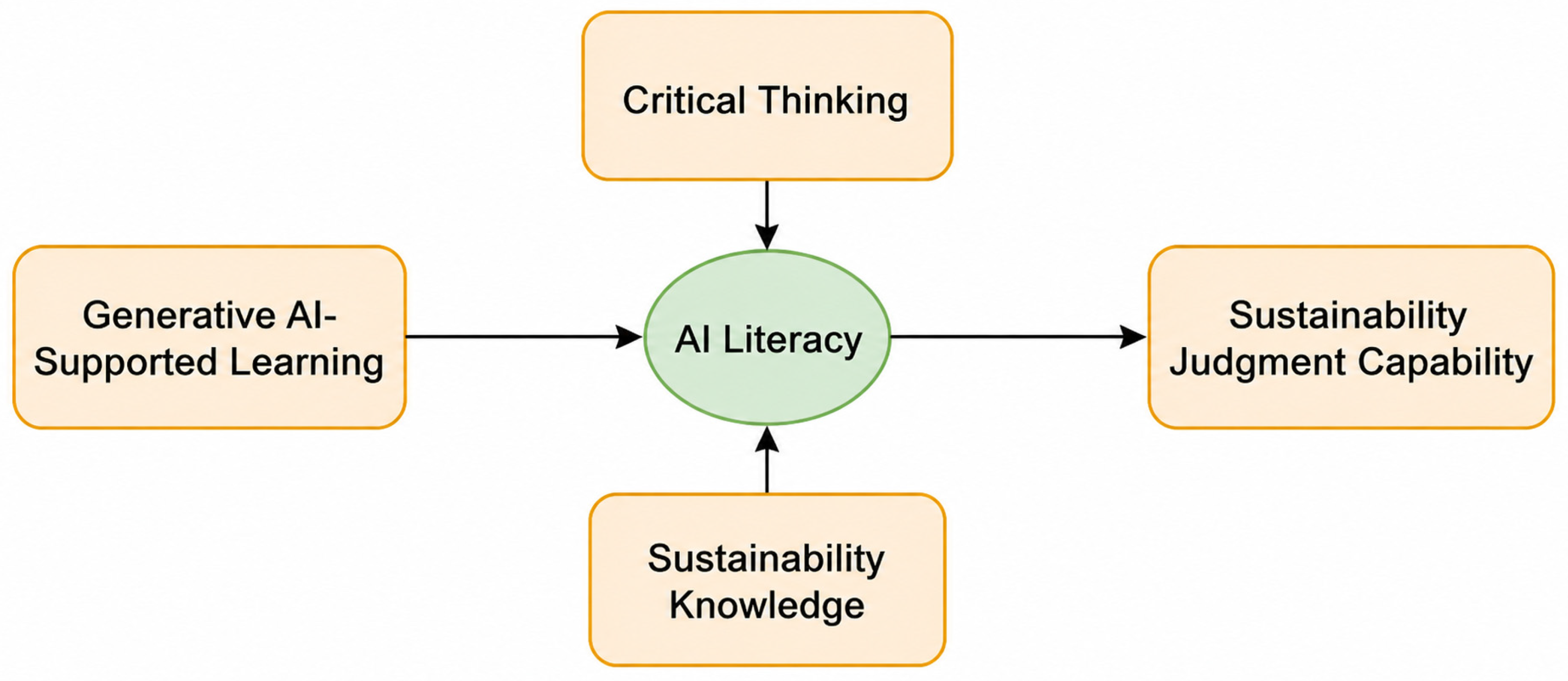
By integrating these perspectives, the study explains how generative AI-supported learning is associated with perceived sustainability judgment capability through cognitive pathways. This approach brings together insights from AI in education, accounting education, and sustainability accounting, offering a more nuanced understanding of how technology-driven learning environments shape learners’ perceived readiness for professional decision-making. Based on this theoretical foundation, the conceptual framework of the study is presented in
Figure 1.
While Decision Support Systems (DSS) theory and constructivist learning theory provide the conceptual foundation for this study, they are interpreted here from a perceptual perspective. Specifically, generative AI is conceptualized as a perceived decision-support mechanism, and learning processes are reflected through students’ perceived cognitive engagement and knowledge construction. In line with literature on perceived competence, self-efficacy, and learner beliefs, the study focuses on how students perceive their capabilities in AI-supported learning environments rather than how these capabilities are objectively developed or enacted. This repositioning ensures alignment between theoretical framing and the perceptual nature of the measurement approach.
2.9. Hypotheses Development
Consistent with the perception-based framing of the study, all proposed relationships are interpreted as associations between self-reported perceived capabilities. While generative AI can be perceived as a decision-support mechanism within the DSS framework, its role in learning environments is more complex. Prior research highlights that interactions with AI systems may also involve risks such as automation bias and overreliance, where users accept AI-generated outputs without sufficient critical evaluation. In such contexts, the effectiveness of AI-supported learning depends on learners’ ability to calibrate their reliance on AI systems. This concept of human–AI calibration emphasizes the importance of balancing trust in AI with critical reflection. Accordingly, in educational settings, generative AI is not only associated with perceived support for decision-making but also with learners’ perceived ability to critically engage with AI-generated information. This perspective provides a more nuanced understanding of how AI-supported learning relates to perceived critical thinking, perceived sustainability knowledge, and perceived sustainability judgment capability.
2.9.1. Generative AI-Supported Learning and Critical Thinking
GenAI applications provide interactive learning tools that enable students to analyze complex information, consider alternative explanations, and develop iterative problem-solving skills. Being intelligent decision-support systems, these technologies motivate students to analyze information critically rather than memorize it by heart. According to previous literature, AI-assisted learning systems have the potential to facilitate higher-order cognition by providing adaptive feedback and exposing learners to complex problem situations [
43]. Critical thinking plays a key role in accounting education because it is required to analyze financial and non-financial data, particularly when solving sustainability-related problems that require proper interpretation and judgment. Exposure to generative AI systems often requires students to evaluate the applicability and correctness of AI-generated responses, thus stimulating critical thinking and reflection.
H1. Generative AI-supported learning is positively associated with students’ perceived critical thinking ability.
2.9.2. Generative AI-Supported Learning and Sustainability Knowledge
Generative AI systems can also facilitate knowledge acquisition by providing explanations, examples, and context on complex issues such as sustainability and ESG reporting. The interactive queries and case-based discussions enabled by AI-driven learning environments enable students to learn about sustainability concepts and environmental accounting practices. It has been suggested that technology-supported learning environments facilitate domain knowledge acquisition by offering personalized learning opportunities and immediate access to relevant information [
42]. Such systems in accounting education enhance students’ understanding of sustainability-related practices such as ESG reporting and environmental cost analysis.
H2. Generative AI-supported learning positively influences students’ sustainability knowledge.
2.9.3. Critical Thinking and Sustainability Judgment Capability
Critical thinking is an important component of accounting decision-making because it allows individuals to evaluate evidence and analyze complex information while considering alternative perspectives. In sustainability contexts, accounting judgments require integrating financial data with environmental and social considerations. Previous studies reveal that critical thinking skills play an important role in the development of professional judgment abilities in accounting education [
75,
76].
H3. Perceived critical thinking positively influences perceived Judgment Capability.
2.9.4. Sustainability Knowledge and Sustainability Judgment Capability
Another significant determinant of perceived Judgment Capability is domain-specific knowledge. Students with strong knowledge of sustainability frameworks and environmental accounting principles are better positioned to interpret ESG disclosures and integrate sustainability considerations into financial decision-making. Research in accounting education demonstrates that sustainability knowledge enables students to identify material sustainability issues better and make informed judgments [
58,
61].
H4. Sustainability knowledge positively influences perceived sustainability Judgment Capability.
2.9.5. Mediating Role of Critical Thinking and Sustainability Knowledge
From the perspective of Decision Support Systems (DSS) theory, the use of information technology improves decision outcomes by enhancing users’ analytical abilities and access to relevant information. Generative AI systems can therefore serve as decision-support tools in educational settings, facilitating cognitive development and knowledge acquisition. Constructivist learning theory further suggests that learning outcomes emerge through cognitive processes such as knowledge construction and analytical reasoning. Based on this, the influence of AI-assisted learning on sustainability Judgment Capability may occur indirectly through the development of critical thinking and sustainability knowledge.
H5. Perceived critical thinking mediates the relationship between generative AI-supported learning and the quality of sustainability judgment.
H6. Sustainability knowledge mediates the relationship between generative AI-supported learning and the quality of sustainability judgment.
2.9.6. Moderating Role of AI Literacy in AI-Supported Learning
AI literacy is the ability of students to understand, evaluate, and engage with artificial intelligence systems. The advantages of generative AI-supported learning may not always be equally beneficial to every student, as the success of AI use requires users to understand the results, develop relevant prompts, and evaluate the relevance and validity of the information generated by AI. According to previous studies, the usefulness of AI-enhanced settings depends heavily on users’ ability to engage in meaningful interactions with intelligent systems [
95,
96]. More AI-literate students will be more likely to use generative AI as a learning companion, rather than as a tool to provide answers. This will enable them to be more active in engaging with accounting issues and sustainability-related information, thereby enhancing the intellectual gains from AI-based learning.
In the accounting education domain, where critical thinking and sustainability knowledge play a significant role in decision-making, AI literacy can enhance the effectiveness of generative AI-supported learning in achieving these outcomes. More AI-literate students are better positioned to critically interpret AI-generated responses, recognize limitations and bias, and learn more through interaction. Hence, AI literacy will enhance the positive relationship between generative AI-mediated learning and the acquisition of critical thinking and sustainability knowledge.
H7. AI literacy positively moderates the relationship between generative AI-supported learning and critical thinking, such that the relationship is stronger when AI literacy is high.
H8. AI literacy positively moderates the relationship between generative AI-supported learning and sustainability knowledge, such that the relationship is stronger when AI literacy is high.
3. Methodology
3.1. Research Design
The current study uses a quantitative research design [
97] to examine the association between generative AI-based learning on the quality of sustainability judgments among accounting students. The research paper seeks to investigate the role of generative AI learning environments in the development of perceived critical thinking and sustainability knowledge, which, in turn, are positively associated with students’ capacity to make sustainability-related judgments. The empirical data used to gather evidence were from a cross-sectional survey of university students. Quantitative research methods are suitable for investigating the relationships among constructs and for testing theoretical models using statistical measures. To test the research framework presented, the present study uses Partial Least Squares Structural Equation Modeling (PLS-SEM) [
98], which is widely used in the social sciences and educational research to analyze complex models with mediating and moderating relationships. The present study measures students’ self-reported perceptions of cognitive and judgment-related capabilities rather than objective performance, and therefore captures perceived rather than demonstrated competencies.
3.2. Research Context
The research was carried out in Saudi Arabian institutions of higher learning, where digital learning technologies and artificial intelligence tools have gained significant popularity in teaching. Saudi Arabia has focused on digital transformation and technological development in education in recent years, and the national Vision 2030 initiative that supports innovation, knowledge-based development, and sustainability. Saudi university education in accounting has also been changing to include sustainability-related issues, which include environmental accounting, ESG reporting, and corporate social responsibility. As a result, both Generative AI-supported learning technologies and sustainability-related decision-making contexts are becoming more common among accounting students, making Saudi Arabia a suitable setting to explore the connection between generative AI learning and the quality of sustainability judgment.
3.3. Population and Sampling
The research population of the research project consisted of undergraduate and postgraduate accounting students at universities in Saudi Arabia. The sample was based on accounting students due to the nature of accounting education, which involves perceived critical thinking, professional judgment, and decision-making abilities critical to assessing financial information related to sustainability issues (Refer to
Appendix A for the demographic profile). To be institutionally and contextually diverse, data were gathered across five universities in various geographic areas of Saudi Arabia. This sample consisted of two state (government) universities and three private universities, thus. The institutions involved were chosen to cover the western, central, southern, and eastern parts of the Kingdom, to minimize potential regional bias and to enhance the contextual representativeness of the results. The inclusion of both public and private institutions was intended to increase generalizability across various higher education settings in Saudi Arabia. The subjects had to fit certain inclusion criteria. To begin with, the respondents had to be enrolled in one of the sampled universities, either in a postgraduate or an undergraduate accounting course. Second, participants were required to have completed at least one accounting course to ensure basic exposure to the academic domain. The initial aim of the study was to obtain approximately 1000 respondents to achieve sufficient statistical power and model stability. A simple random sampling technique [
99] was used to collect data by selecting respondents from the target population enrolled in the participating universities. The research also tried to maintain an equal number of students from each university. The questionnaire was administered online through an e-survey that was easily accessible to students in various universities (Refer to
Appendix B for items and scale). A sufficiently large sample was targeted to ensure statistical reliability and validity for the structural equation modeling analysis.
The data were screened, and biased responses were removed by eliminating incomplete and nonresponsive cases, leaving a final usable sample of 721 valid responses. The obtained sample size was greater than the recommended sample size for structural equation modeling. In accordance with the common rule of thumb in behavioral research, a sufficient sample size can be estimated at 20 times the number of measurement items in the instrument. However, given the number of indicators identified to measure the constructs in the current research, the end sample was significantly larger than the minimum required, thereby enabling effective estimation of higher-order constructs and mediation effects in the context of PLS-SEM. The sample size was validated using post hoc analysis [
100] (Refer to
Appendix C). Post hoc power analysis was conducted as a supplementary diagnostic rather than a primary basis for inference. The achieved power values reflect the observed model conditions, given the sample size and estimated effect sizes.
In contrast, the reported required sample sizes indicate the minimum sample needed to detect effects of specific magnitudes under predefined significance and power levels. These two metrics serve different purposes and are therefore not directly comparable. Accordingly, the results of the power analysis should be interpreted cautiously and in conjunction with the primary PLS-SEM results.
3.4. Instrument Development
The data were gathered using a structured questionnaire developed from previously tested measurement scales used in earlier research. The questionnaire had a few sections aimed at measuring the study’s constructs, including generative AI-supported learning, critical thinking, sustainability knowledge, perceived Judgment Capability of sustainability, and AI literacy. The learning based on generative AI involved measuring the level at which students apply AI tools to facilitate academic problem-solving and learning. Critical thinking evaluated students’ ability to analyze information, evidence, and alternative viewpoints. Sustainability knowledge was assessed by evaluating students’ understanding of sustainability-related accounting concepts, such as ESG reporting and environmental accounting practices. Sustainability-perceived Judgment Capability describes students’ ability to appraise sustainability-related financial information and make informed decisions that incorporate environmental and financial considerations. AI literacy focuses on students’ ability to comprehend, interpret, and engage effectively with artificial intelligence systems. The measures of the items were based on a five-point Likert scale, with a 1 (strongly disagree) to 5 (strongly agree) range, and such a scale is often utilized in social science research to obtain the perception and attitude of the respondents.
3.5. Construct Operationalization
In this study, all focal constructs are operationalized as self-reported perceptions of capability, consistent with prior research in educational technology and self-regulated learning, which uses learners’ internal evaluations to capture cognitive and skill-related outcomes. Accordingly, the constructs do not represent objective performance but rather students’ perceived abilities in the context of generative AI-supported learning.
Generative AI-supported learning is conceptualized as students’ reported use of generative AI tools (e.g., AI-based text-generation systems) to support their academic learning activities, including information retrieval, explanation, and problem-solving. Perceived critical thinking is defined as students’ self-assessed ability to analyze, evaluate, and question information when engaging with academic tasks. Perceived sustainability knowledge refers to students’ perceived understanding of sustainability-related concepts, including environmental, social, and governance (ESG) considerations, sustainability reporting, and their relevance to accounting practices.
Furthermore, perceived sustainability judgment capability is operationalized as students’ self-reported ability and confidence to evaluate sustainability-related accounting information and to integrate financial and sustainability considerations in decision-making contexts. AI literacy is defined as students’ perceived capability to understand, evaluate, and effectively use generative AI tools, including their ability to critically assess AI-generated outputs and recognize potential limitations such as bias or inaccuracy.
All constructs were measured using multi-item scales adapted from prior, well-validated studies and assessed on a five-point Likert scale ranging from strongly disagree to agree strongly. The measurement items are presented in
Appendix B. Additionally, all measurement items were carefully reviewed and aligned with their respective constructs to ensure conceptual and empirical consistency. The present study measures students’ self-reported perceptions of cognitive and judgment-related capabilities rather than objective performance.
3.6. Pilot Study
To assess the clarity of the questionnaire, its relevance, and the understanding of the measurement items, the questionnaire was administered to a small group of accounting students before the main survey. The pilot participants provided feedback, which helped detect ambiguous wording and refine the questionnaire as a whole. There were slight modifications to the survey instrument to improve clarity and reliability, and the final questionnaire was administered to the target sample.
3.7. Data Collection Procedure
The data were obtained from an online survey conducted among accounting students at Saudi universities. The survey questionnaire was sent via academic networks, student forums, and university mailing lists. The study was voluntary, and respondents were informed of the research’s purpose before completing the questionnaire. To safeguard confidentiality, the respondents were not expected to give personally identifiable information. To conduct the statistical analysis, the responses were filtered to identify incomplete or invalid questionnaires.
3.8. Data Analysis Technique
The data were collected and analyzed using Partial Least Squares Structural Equation Modeling (PLS-SEM) in SmartPLS 4 [
101]. PLS-SEM was chosen because it is appropriate for studying complex research models with mediation and moderating relationships, and is especially applicable when prediction is in focus. Also, PLS-SEM does not impose strict assumptions of multivariate normality and is useful with sophisticated models and latent constructs. The analysis was conducted in two steps. In the initial phase, the measurement model was used to assess the reliability and validity of the constructs. To verify internal consistency and convergent validity, indicator loadings, Cronbach’s alpha, composite reliability, and average variance extracted were studied. Discriminant validity was examined to ensure that each construct is distinct. The second stage involved evaluating the structural model to test the proposed hypotheses. Path coefficients, significance levels, and explanatory power were analyzed to establish relationships among the constructs. The interaction term approach within the PLS-SEM framework was used to test the moderating effect of AI literacy.
3.9. Common Method Bias
The data were collected using a single survey, so possible common-method bias was addressed during the analysis stage. Procedural remedies, including the assurance of respondent anonymity and the separation of measurement sections, were adopted in questionnaire design. Also, statistical tests were conducted to assess the possibility of common-method bias influencing the outcomes. Although statistical remedies were employed to assess common method bias, the study did not incorporate design-based procedural remedies such as temporal separation or multi-source data collection. Therefore, the potential influence of common method bias cannot be entirely ruled out.
3.10. Ethical Considerations
The ethical considerations were upheld during the research. The survey was voluntary, and respondents were informed of the study’s purpose before completing the questionnaire. Participants remained confidential and anonymous, and the collected data were used solely for academic research.
5. Discussion
Accordingly, the findings should be interpreted as associative evidence reflecting students’ perceived cognitive and judgment-related capabilities rather than causal effects or objectively demonstrated performance. The results of this research provide valuable insights into the relevance of generative AI-driven learning to the improvement of sustainability-related judgment development among accounting students. This study can be used to explain the impact of AI-assisted learning environments on cognitive development and decision-making skills in accounting education by integrating Decision Support Systems (DSS) theory and constructivist learning theory.
In the DSS theory, information technologies are used as tools to help people process complex information and make high-quality decisions. Generative AI, when applied in the educational context, can be viewed as an intelligent decision-support system to assist learners in assessing information, analyzing options, and refining their thinking processes. This theoretical proposal is supported by the findings of the current study, which demonstrate that the use of generative AI-supported learning is associated with perceived analytical thinking and subject-specific knowledge that are fundamental to sustainability-related decision-making. This result adds weight to previous statements that digital technologies could improve decision quality by making information accessible and assisting cognitive analysis [
32,
33]. Among the academic accounting community, where professional judgment presupposes the combination of financial and non-financial data, AI-enabled systems are perceived as cognitive support systems that allow students to work with complex problems related to sustainability.
Constructivist learning theory is also useful in interpreting the results since it highlights the role of knowledge building through interaction with the learning environment instead of being passively taught by the instructor. Generative AI applications produce interactive learning environments where students engage in dialogue, come up with explanations, and can refine their knowledge by asking questions in sequence. These interactions allow the learners to investigate other points of view and build a more conceptual knowledge. The observation aligns with existing research demonstrating that AI-guided learning experiences can stimulate higher-order thinking through active interaction and self-directed learning of knowledge [
37,
102]. Such interactive learning environments are especially useful for acquiring professional competencies in accounting education, where complex financial and sustainability information must be interpreted and assessed.
The other valuable finding in this study concerns the role of domain-specific knowledge in sustainable decision-making. The results indicate that sustainability knowledge is a particularly determining factor in students’ capacity to make consistent sustainability judgments. The observation can be explained by the fact that the current literature emphasizes the importance of accounting professionals having a solid grasp of ESG frameworks, sustainability reporting principles, and environmental accounting principles to effectively assess sustainability disclosures [
58,
61]. Making sustainability-related decisions usually entails the combination of financial information and environmental and social issues, which is not only general analytical reasoning but also demands specific knowledge. Hence, the results support the idea that sustainability education should be developed not only in terms of analytical skills but also in domain-specific knowledge associated with sustainability accounting.
An important finding of this study is that the indirect association through perceived critical thinking is weaker than the pathway through perceived sustainability knowledge. One possible explanation is that sustainability-related judgment in accounting is inherently domain-specific and depends more directly on students’ understanding of ESG reporting, sustainability concepts, and environmental accounting practices than on general analytical self-assessment. In this context, perceived sustainability judgment capability appears to be conceptually closer to perceived sustainability knowledge than to broader critical thinking, which may partly explain the stronger mediated relationship. Furthermore, the use of self-reported measures may reinforce consistency between students’ perceived knowledge and their perceived judgment capability, thereby strengthening this pathway. These findings suggest that domain-specific knowledge plays a more central role in shaping sustainability-related judgment than general cognitive self-assessments.
The results also emphasize the complementary role of perceived critical thinking as a cognitive process that helps in making sustainability judgments and allows learners to appraise evidence, consider alternative interpretations, and understand the limitations of the information used to analyze sustainability issues. They are especially important in accounting situations where decision-makers must analyze complex disclosures and assess the risk that environmental and social impacts may pose. It has previously been found that perceived critical thinking is an important contributor to the formation of professional judgment in accounting education [
75,
76]. The findings of this research support this opinion, as they show that analytical thinking plays a role in the formation of sustainability judgments. Nevertheless, the results also indicate that perceived critical thinking is most effective with strong domain knowledge, supporting the importance of incorporating both analytical and knowledge-based skills in accounting education.
A valuable contribution of this research is the role of AI literacy as a facilitating capability in AI-assisted learning settings. The findings indicate that the efficiency of generative AI-supported learning depends on students’ ability to engage in meaningful interaction with AI technologies. This fact confirms previous studies that the educational advantages of AI systems do not rely solely on the technology but also on the conditions under which users can comprehend and analyze AI-generated information [
49,
81,
103]. More AI-literate students are also more likely to use generative AI as a learning companion and assess its results critically, refining their questions to receive more valuable information. On the other hand, students who lack high AI literacy might use AI output without questioning it, which could limit the development of higher cognitive abilities. Thus, AI literacy can be considered one of the key capabilities that can help to maximize the effectiveness of AI-supported learning environments.
The findings also indicate that learning with the assistance of generative AI affects sustainability judgment through the interplay of cognitive and technological processes. In particular, the development of perceived critical thinking and sustainability knowledge appears to be one of the most important cognitive processes linking AI-enhanced learning experiences to higher-quality decision-making outcomes. Meanwhile, AI literacy reinforces these connections by enabling students to work with AI-generated information more effectively. This interplay of technology, cognition, and knowledge development underscores the complex nature of AI-based learning processes.
In a broader sense, the results contribute to the existing literature on AI in higher education by demonstrating that sustainability-related professional competencies can be developed with the support of generative AI technologies. Although past research has been mostly concerned with the technical and pedagogical consequences of AI implementation in education [
42,
48]. This study extends the research by examining the effects of AI-assisted learning environments on sustainability-oriented decision-making in accounting situations. Since sustainability reporting and ESG are gaining more significance in the contemporary business landscape, interpreting sustainability information and making proper judgments is a crucial professional skill that prospective accountants must have.
In general, the results indicate that emerging AI technologies can help transform accounting education to support the growth of analytical reasoning, domain knowledge, and sustainability-driven decision-making skills. But these technologies are not only effective depending on their availability; they also require that students have the required cognitive and technological skills to utilize them critically. Consequently, it might be crucial to incorporate AI literacy education and sustainability-oriented learning tasks into the accounting curriculum to maximize the educational value of generative AI-based learning environments. This highlights that perceived capabilities are important outcomes in their own right, as they shape how learners engage with AI-supported environments and their readiness to apply sustainability-related judgment in professional contexts.
While the findings provide important insights into the associations between generative AI-supported learning and students’ perceived sustainability judgment capability, the study is limited by its reliance on self-reported perceptual measures rather than objective assessments of cognitive performance or demonstrated judgment ability.
6. Conclusions
This paper has explored the impact of generative AI-supported learning on the quality of sustainability judgment among accounting students by combining Decision Support Systems (DSS) theory and constructivist learning theory. The results imply that generative AI is a kind of educational decision-support system that stimulates the improvement of the cognitive capacities of students, specifically, perceived critical thinking and sustainability knowledge, which are crucial in assessing complex accounting challenges related to sustainability. Through interactive learning, access to contextual information, and analytical interactions with sustainability concepts, AI-assisted learning environments can help are associated with perceived competency development that are needed when making sustainability-related decisions. Another significant contribution identified in the research results is the role of AI literacy in the effectiveness of AI-supported learning. More AI-literate students can better interpret, evaluate, and refine AI-generated outputs, allowing them to leverage AI systems as partners in learning and not only as information providers. It implies that the advantages of generative AI in education are not solely dependent on technology availability but also require students to critically engage with AI tools. On the whole, the paper advances the literature by showing that generative AI-supported learning can increase sustainability-related professional competencies in accounting education through cognitive processes and technological capabilities. As sustainability and ESG issues become more prominent in the accounting field, AI-assisted learning and sustainability-oriented education in the training of future accountants can be significant in ensuring they can make sound and responsible judgments on sustainability.
6.1. Theoretical Implications
This paper is a contribution to the literature by applying Decision Support Systems (DSS) theory to AI-enabled accounting education and sustainability decision-making. Although DSS theory has generally been used in organizational decision-making, this study showed that generative AI can also serve as a cognitive decision-support system in the educational setting. The study contributes to the overall theoretical understanding of AI-supported learning and the formation of sustainability judgment by building on, perceived critical thinking development and the formation of sustainability knowledge, which aid in forming the overall sustainability judgment. Another way the study contributes to constructivist learning theory is by empirically demonstrating that AI-supported learning environments enable knowledge construction through interactive and analytical thinking. The results indicate that learning outcomes are manifested through cognitive activities, including perceived critical thinking and domain-related sustainability knowledge. The identification of these mediating processes helps the study elucidate how generative AI can shape judgment formation, rather than simply affecting overall learning performance. In addition, the study helps develop the growing body of AI-related research in accounting education by combining three research streams that have been studied primarily independently: generative AI in education, sustainability accounting education, and perceived sustainability Judgment Capability in accounting decision-making. The study connects these spheres and offers a much deeper insight into how technology-based learning environments can be used to enhance sustainability-related professional competencies.
6.2. Practical Implications
The results have significant implications for accounting educators, universities, and curriculum designers. First, the findings indicate that generative AI tools can be used as pedagogical support systems to improve analytical reasoning and sustainability knowledge among accounting students. Instead of limiting the application of generative AI in the academic environment, educators can consider how AI tools can be used in learning activities such as sustainability case analysis, ESG reporting exercises, and decision-making tasks. This kind of application may help students interact with complex sustainability data and enhance their skills in assessing sustainability disclosures. Second, the study emphasizes AI literacy as a critical skill for effective AI-based learning. Universities are thus recommended to introduce AI literacy training into accounting courses to make sure that learners acquire the skills to critically assess AI-generated data, devise effective prompts, make sense of AI responses, and act responsibly. In the absence of these competencies, students might accept answers generated by AI without critically assessing their relevance, which can limit the development of higher-order cognitive abilities. Third, the findings highlight the need to intensify sustainability-related knowledge in accounting courses. As sustainability knowledge is important in determining the quality of judgment, sustainability-related content such as ESG reporting, environmental accounting, and sustainability performance measurement should be incorporated into the current accounting coursework. These topics, in combination with AI-based learning tools, can enable the development of more realistic and data-driven learning environments that can be updated according to the transforming needs of the accounting profession.
6.3. Limitations of the Study
As all constructs are measured using self-reported perceptions, the findings do not reflect objective cognitive performance or demonstrated judgment ability. Therefore, the results should be interpreted as perceived capabilities rather than actual outcomes. Therefore, the findings reflect perceived capabilities rather than actual cognitive performance or demonstrated judgment ability. Data were collected across multiple universities; however, potential clustering effects at the institution, course, or instructor level were not modeled. Such contextual factors may influence the observed relationships and should be considered in future research. Future studies may employ multilevel modeling approaches to account for institutional and contextual variations.
As all constructs are measured using self-reported perceptions, the findings may be subject to biases inherent in self-assessment. Respondents may overestimate their capabilities due to overconfidence or provide socially desirable responses that reflect expected academic behavior rather than actual perceptions. Such biases may lead to inflated relationships among constructs, particularly when respondents consistently evaluate their abilities in a favorable manner. Therefore, the results should be interpreted as reflecting perceived capabilities rather than objective cognitive performance or demonstrated judgment ability. Future research may address these limitations by incorporating performance-based assessments, experimental designs, or multi-source data to provide a more comprehensive evaluation of cognitive and judgment-related outcomes. As a result, the findings should be interpreted as reflecting students’ perceived capabilities and readiness rather than actual professional judgment performance. Future research may extend this work by employing experimental designs, behavioral assessments, vignette-based evaluations, or longitudinal approaches to examine whether AI-supported learning environments translate into objectively measurable sustainability-related decision-making outcomes.
6.4. Future Avenues for Research
Even though this research offers significant insights into the importance of generative AI-supported learning in sustainability-focused accounting education, there are still several directions for future exploration. To begin with, the model may be expanded in the future to include psychological and behavioral variables that describe students’ interactions with AI systems. Constructs such as trust in AI systems, perceived usefulness, and perceived risk of AI-generated information could be included in the framework to better understand the adoption and dependence on generative AI in learning settings. These factors affect how students perceive AI information and whether they are critical of the information presented by AI tools. Second, learning engagement and cognitive engagement could be considered as additional mediating variables in future research. Although the present paper focuses on perceived critical thinking and sustainability knowledge as cognitive processes, engagement-oriented constructs may help explain how students actively work with AI-based learning tools and how such interaction leads to knowledge acquisition and Judgment Capability. Third, in the future, self-efficacy and technology readiness can be included as moderating variables in studies. Students with higher AI self-efficacy might be more confident in exploring AI tools and refining prompts, thereby further enhancing learning outcomes associated with generative AI. Similarly, technological readiness can influence students’ willingness to use AI-enhanced learning systems and interact with advanced technological platforms. Fourth, future studies may examine the importance of ethical awareness and sustainability orientation in the formation of sustainability-related judgments. As sustainability decision-making involves ethical considerations and value-based reasoning, integrating sustainability-related constructs such as ethical judgment, environmental awareness, or sustainability commitment may provide deeper insights into how students evaluate sustainability-related accounting information. Fifth, future research may explore the influence of instructional design variables, such as AI-supported case-based learning, simulation-based sustainability activities, or problem-based learning environments, on the formation of sustainability judgments. These pedagogical approaches may help identify how AI technologies can be effectively integrated into accounting education to improve learning outcomes. Lastly, the effectiveness of AI-supported learning environments could be examined through institutional and contextual variables, such as digital infrastructure, the integration of ESG issues into the curriculum, and faculty AI competency, which may influence their effectiveness.