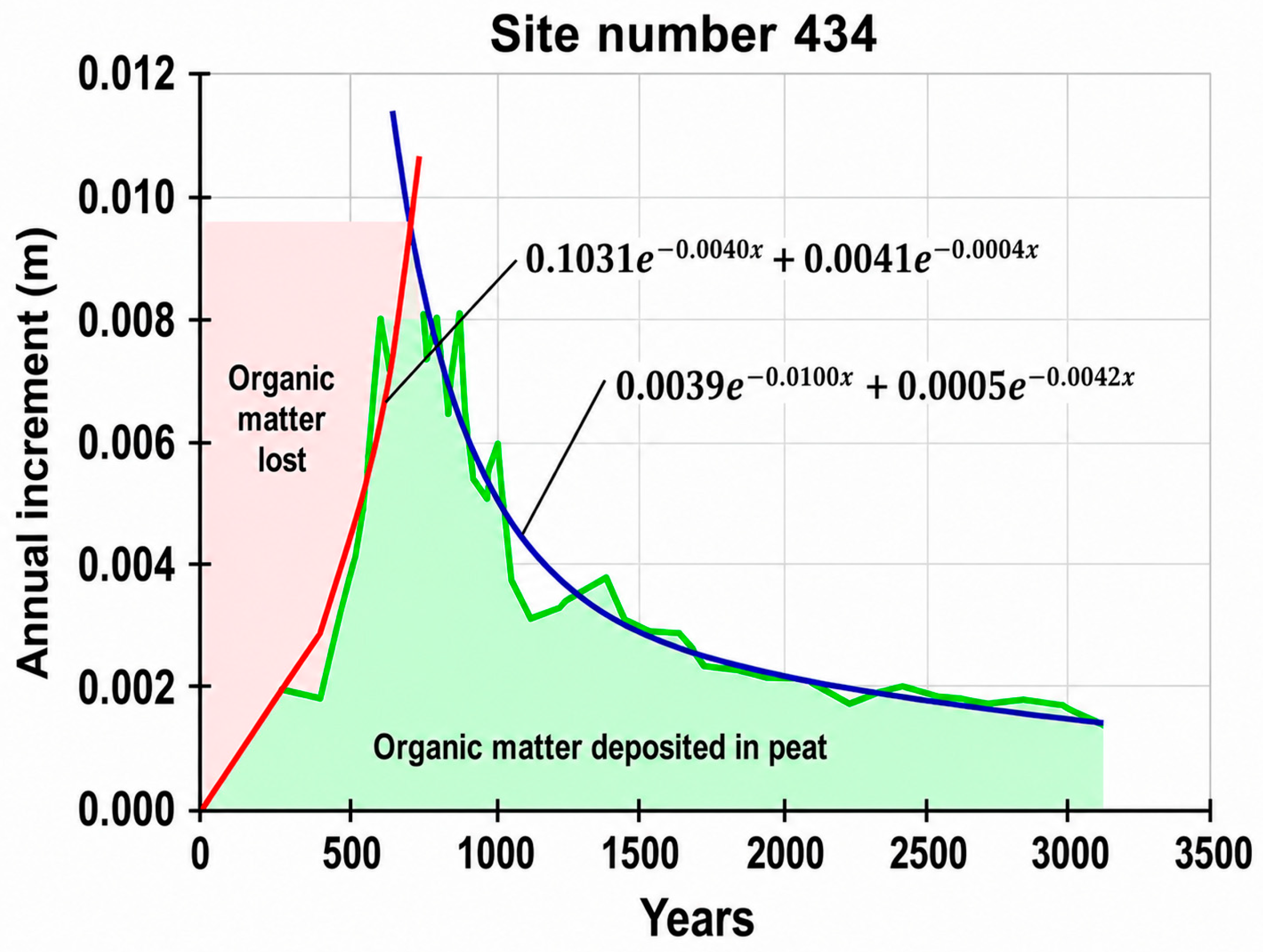
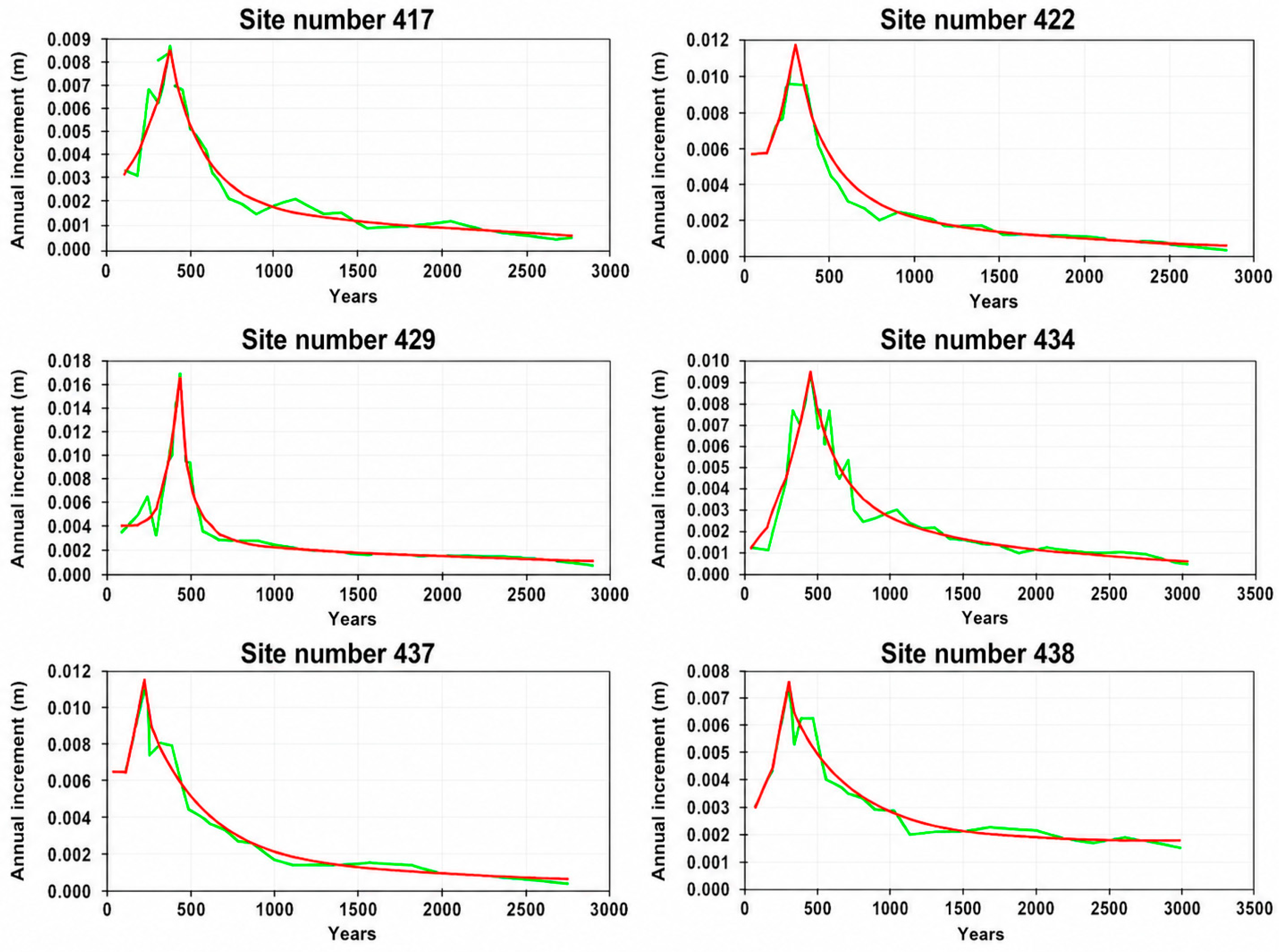
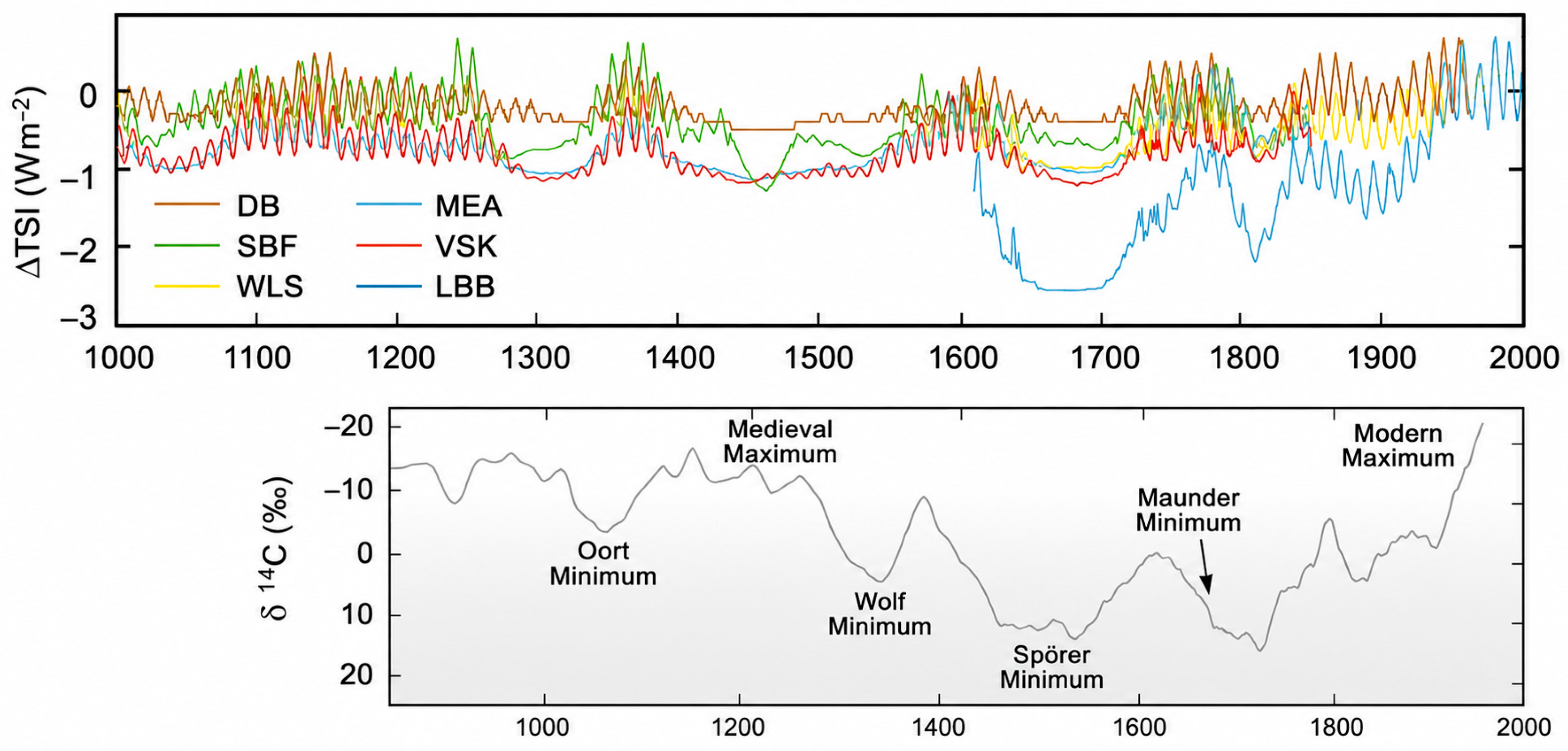
Peatland Stratigraphy as a Proxy for Long-Term Carbon Dynamics: A Case Study from Estonia


Abstract
1. Introduction
2. Materials and Methods
2.1. Data Sources
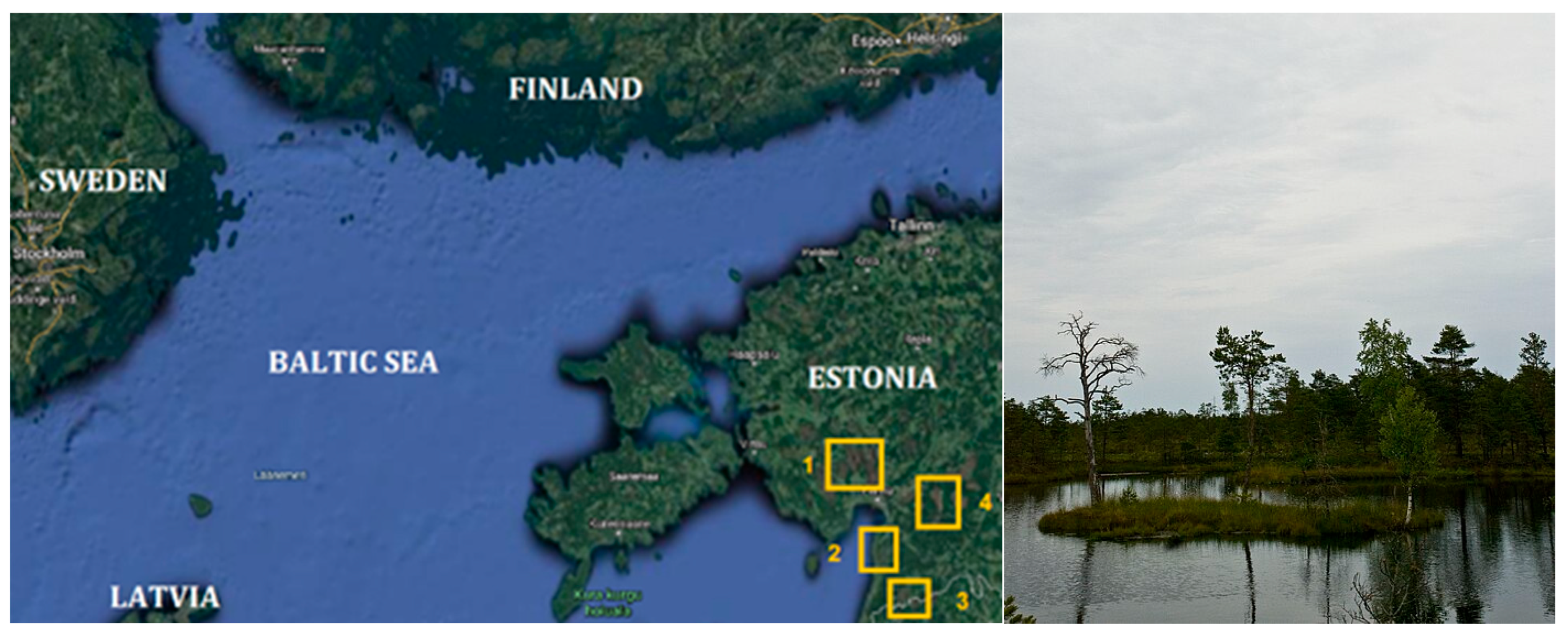
2.2. Study Area
2.3. Modeling Approach
3. Results
4. Discussion
5. Conclusions
Author Contributions
Funding
Institutional Review Board Statement
Informed Consent Statement
Data Availability Statement
Acknowledgments
Conflicts of Interest
Abbreviations
| GHGs | Greenhouse gases |
| C | Carbon |
| LULUCF | Land use, land use change, and forestry |
| DNDC | DeNitrification-DeComposition (model) |
| HPM | Holocene Peat Model |
| LPX | Land surface Processes and eXchanges (model) |
| N | Nitrogen |
| ODBL | Open Data Commons Database |
References
- Lefèvre, C.; Rekik, F.; Alcantara, V.; Wiese, L. Soil Organic Carbon: The Hidden Potential; FAO: Rome, Italy, 2017; Available online: https://openknowledge.fao.org/server/api/core/bitstreams/b382a255-5bd5-4656-a8cd-e30fff1a8bfe/content (accessed on 1 January 2023).
- Joosten, H. The Global Peatland CO2 Picture; UNFCCC: Bonn, Germany, 2012; Available online: https://unfccc.int/files/kyoto_protocol/application/pdf/draftpeatlandco2report.pdf (accessed on 1 January 2023).
- IUCN. Peatlands and Climate Change; IUCN: Gland, Switzerland, 2020; Available online: https://iucn.org/sites/default/files/2022-04/iucn_issues_brief_peatlands_and_climate_change_final_nov21.pdf (accessed on 1 January 2023).
- Salm, J.-O. Emission of Greenhouse Gases CO2, CH4 and N2O from Estonian Transitional Fens and Ombrotrophic Bogs: The Impact of Different Land-Use Practices. Ph.D. Thesis, University of Tartu, Tartu, Estonia, 2012. [Google Scholar]
- Veber, G.; Kull, A.; Villa, J.A.; Maddison, M.; Paal, J.; Oja, T.; Iturraspe, R.; Pärn, J.; Teemusk, A.; Mander, Ü. Greenhouse Gas Emissions in Natural and Managed Peatlands of America: Case Studies Along a Latitudinal Gradient. Ecol. Eng. 2018, 114, 34–45. [Google Scholar] [CrossRef]
- Frolking, S.; Roulet, N.T.; Tuittila, E.; Bubier, J.L.; Quillet, A.; Talbot, J.; Richard, P.J.H. A New Model of Holocene Peatland Net Primary Production, Decomposition, Water Balance, and Peat Accumulation. Earth Syst. Dyn. 2010, 1, 1–21. [Google Scholar] [CrossRef]
- Piotrowska, N.; Blaauw, M.; Mauquoy, D.; Chambers, F.M. Constructing Deposition Chronologies for Peat Deposits Using Radiocarbon Dating. Mires Peat 2011, 7, 10. [Google Scholar] [CrossRef]
- Holmquist, J.R.; Finkelstein, S.A.; Garneau, M.; Massa, C.; Yu, Z.; MacDonald, G.M. A Comparison of Radiocarbon Ages Derived from Bulk Peat and Selected Plant Macrofossils in Basal Peat Cores from Circum-Arctic Peatlands. Quat. Geochronol. 2016, 31, 53–61. [Google Scholar] [CrossRef]
- Hutchinson, G.L.; Livingston, G.P. Use of Chamber Systems to Measure Trace Gas Fluxes. In Agricultural Ecosystem Effects on Trace Gases and Global Climate Change; ASA: Madison, WI, USA, 1993; pp. 63–78. [Google Scholar] [CrossRef]
- Sikorski, J. A New Method for Constructing Pb-210 Chronology of Young Peat Profiles Sampled with Low Frequency. Geochronometria 2019, 46, 1–14. [Google Scholar] [CrossRef]
- Turetsky, M.; Manning, S.; Wieder, R. Dating Recent Peat Deposits. Wetlands 2004, 24, 324–356. [Google Scholar] [CrossRef]
- Swindles, G.; Vleeschouwer, F.; Plunkett, G. Dating Peat Profiles Using Tephra: Stratigraphy, Geochemistry and Chronology. Mires Peat 2010, 7, 5. [Google Scholar] [CrossRef]
- Molinuevo-Salces, B.; Gómez, X.; Morán, A.; García-González, M.C. Anaerobic Co-Digestion of Livestock and Vegetable Processing Wastes: Fibre Degradation and Digestate Stability. Waste Manag. 2013, 33, 1332–1338. [Google Scholar] [CrossRef]
- Swindles, G. Dating Recent Peat Profiles Using Spheroidal Carbonaceous Particles (SCPs). Mires Peat 2010, 7, 3. [Google Scholar] [CrossRef]
- Liiv, J.; Zekker, I.; Tämm, K.; Rikmann, E. Greenhouse Gases Emissions and Climate Change—Beyond Mainstream. MOJ Bioorg. Org. Chem. 2020, 4, 11–16. [Google Scholar]
- Zhu, P.; Zhuang, Q.; Welp, L.; Ciais, P.; Heimann, M.; Peng, B.; Li, W.; Bernacchi, C.; Roedenbeck, C.; Keenan, T.F. Recent Warming Has Resulted in Smaller Gains in Net Carbon Uptake in Northern High Latitudes. J. Clim. 2019, 32, 5849–5863. [Google Scholar] [CrossRef]
- Wang, S.; Zhuang, Q.; Yu, Z.; Bridgham, S.; Keller, J.K. Quantifying Peat Carbon Accumulation in Alaska Using a Process-Based Biogeochemistry Model. J. Geophys. Res. Biogeosci. 2016, 121, 2172–2185. [Google Scholar] [CrossRef]
- Leifeld, J.; Wüst-Galley, C.; Page, S. Intact and Managed Peatland Soils as a Source and Sink of GHGs from 1850 to 2100. Nat. Clim. Change 2019, 9, 945–947. [Google Scholar] [CrossRef]
- Wüst-Galley, C.; Grünig, A.; Leifeld, J. Land Use-Driven Historical Soil Carbon Losses in Swiss Peatlands. Landsc. Ecol. 2020, 35, 173–187. [Google Scholar] [CrossRef]
- Krüger, J.P.; Leifeld, J.; Glatzel, S.; Szidat, S.; Alewell, C. Biogeochemical Indicators of Peatland Degradation—A Case Study of a Temperate Bog in Northern Germany. Biogeosciences 2015, 12, 2861–2871. [Google Scholar] [CrossRef]
- Webster, K.L.; McLaughlin, J.W.; Kim, Y.; Packalen, M.S.; Li, C.S. Modelling Carbon Dynamics and Response to Environmental Change along a Boreal Fen Nutrient Gradient. Ecol. Modell. 2013, 248, 148–164. [Google Scholar] [CrossRef]
- Clément, R.; Pärn, J.; Maddison, M.; Henine, H.; Chaumont, C.; Tournebize, J.; Uri, V.; Espenberg, M.; Günther, T.; Mander, Ü. Frequency-Domain Electromagnetic Induction for Upscaling Greenhouse Gas Fluxes in Two Hemiboreal Drained Peatland Forests. J. Appl. Geophys. 2020, 173, 103944. [Google Scholar] [CrossRef]
- Spahni, R.; Joos, F.; Stocker, B.D.; Steinacher, M.; Yu, Z.C. Transient Simulations of the Carbon and Nitrogen Dynamics in Northern Peatlands: From the Last Glacial Maximum to the 21st Century. Clim. Past 2013, 9, 1287–1308. [Google Scholar] [CrossRef]
- Orru, M.; Aarniste, M.; Mustonen, E.; Hints, O. Eesti Turbauuringute Andmebaas (Peat Studies Database of Estonia); Tallinna Tehnikaülikooli Geoloogia Instituut: Tallinn, Estonia, 2020. [Google Scholar] [CrossRef]
- Heinsalu, A.; Orru, M.; Aarniste, M. Turbaalaste Uurimistööde Digitaliseerimine ja Andmebaasi Koostamine I Etapp (Harju, Rapla, Pärnu Maakond) Seletuskiri ja Kasutusjuhend; Eesti Geoloogiateenistus: Rakvere, Estonia, 2018; Available online: https://kirjandus.geoloogia.info/en/reference/37485 (accessed on 1 January 2023).
- Orru, M.; Aarniste, M.; Mustonen, E.; Hint, O. Turbaalaste Uurimistööde Digitaliseerimine ja Andmebaasi Koostamine II Etapp Seletuskiri ja Kasutusjuhend (Peat Studies Database of Estonia: Manual); TalTech Geoloogia Instituut: Tallinn, Estonia, 2020. [Google Scholar]
- Valk, U. (Ed.) Eesti Sood; Valgus: Tallinn, Estonia, 1988; pp. 1–343. (In Estonian) [Google Scholar]
- Hénin, S.; Dupuis, M. Essai de Bilan de la Matière Organique du Sol; Dunod: Paris, France, 1945. [Google Scholar]
- Bertora, C.; Zavattaro, L.; Sacco, D.; Monaco, S.; Grignani, C. Soil Organic Matter Dynamics and Losses in Manured Maize-Based Forage Systems. Eur. J. Agron. 2009, 30, 177–186. [Google Scholar] [CrossRef]
- Orru, M. Dependence of Estonian Peat Deposit Properties on Landscape Types and Feeding Condition. Ph.D. Thesis, Tallinn University of Technology, Tallinn, Estonia, 2010. [Google Scholar]
- Charman, D.; Mäkilä, M. Climate Reconstruction from Peatlands. PAGES News 2003, 11, 15–17. [Google Scholar]
- Loisel, J.; Yu, Z.; Beilman, D.W.; Camill, P.; Alm, J.; Amesbury, M.J.; Anderson, D.; Andersson, S.; Bochicchio, C.; Barber, K.; et al. A Database and Synthesis of Northern Peatland Soil Properties and Holocene Carbon and Nitrogen Accumulation. Holocene 2014, 24, 1028–1042. [Google Scholar] [CrossRef]
- Delaygue, G.; Bard, E. An Antarctic view of Beryllium-10 and solar activity for the past millennium. Clim. Dyn. 2011, 36, 2201–2218. [Google Scholar] [CrossRef]
- Steinhilber, F.; Beer, J.; Fröhlich, C. Total solar irradiance during the Holocene. Geophys. Res. Lett. 2009, 36, L19704. [Google Scholar] [CrossRef]
- Wang, Y.-M.; Lean, J.L.; Sheeley, N.R., Jr. Modeling the Sun’s magnetic field and irradiance since 1713. Astrophys. J. 2005, 625, 522–538. [Google Scholar] [CrossRef]
- Muscheler, R.; Joos, F.; Beer, J.; Müller, S.A.; Vonmoos, M.; Snowball, I. Solar activity during the last 1000 yr inferred from radionuclide records. Quat. Sci. Rev. 2007, 26, 82–97. [Google Scholar] [CrossRef]
- Vieira, L.E.A.; Solanki, S.K.; Krivova, N.A.; Usoskin, I. Evolution of the solar irradiance during the Holocene. Astron. Astrophys. 2011, 531, A6. [Google Scholar] [CrossRef]
- Lean, J.; Beer, J.; Bradley, R. Reconstruction of Solar Irradiance Since 1610: Implications for Climate Change. Geophys. Res. Lett. 1995, 22, 3195–3198. [Google Scholar] [CrossRef]
- IPCC. Fifth Assessment Report. 2014. Available online: https://www.ipcc.ch/assessment-report/ar5/ (accessed on 1 January 2023).
- Vitt, D.H.; Kulzer, L. Chemistry of Some Sphagnum-Dominated Peatlands. In Community Profile of Sphagnum-Dominated Peatlands in Western Washington; King County: Seattle, WA, USA, 2001. [Google Scholar]
- Wassen, M.J.; Barendregt, A.; Palczynski, A.; de Smidt, J.T.; de Mars, H. The Relationship between Fen Vegetation Gradients, Groundwater Flow and Flooding in an Undrained Valley Mire at Biebrza, Poland. J. Ecol. 1990, 78, 1106–1122. [Google Scholar] [CrossRef]
- Muller, J.; Wüst, R.A.J.; Weiss, D.; Hu, Y. Geochemical and Stratigraphic Evidence of Environmental Change at Lynch’s Crater, Queensland, Australia. Glob. Planet. Change 2006, 53, 269–277. [Google Scholar] [CrossRef]





| Study Site | Lavassaare | Tolkuse- Soometsa | Nigula-Tõrga-Rongu | Kikepera- Mustraba |
|---|---|---|---|---|
| Study area (ha) | 21,868 | 5503 + 1631 | 2320 + 1291 + 1348 | 8725 + 2310 |
| Size of excavation area (ha) | 19,701.9 | 4129.32 + 1148 | 2078 + 829 + 770 | 6144 + 1450 |
| Peat deposit types (ha) | Lavassaare: | Tolkuse: | Nigula: | Kikepera: |
| Fen soils 7490 Mixed-raised bog 4794 Raised bog 9584 | Fen bog 3472 Mixed raised bog 412 Bog 1619 | Fen bog 2320 Mixed-raised bog 242 Raised bog 2078 | Fen bog 3175 Mixed bog 1475 Raised bog 4075 | |
| Soometsa: | Tõrga: | Mustraba: | ||
| Fen bog 750 Bog 881 | Fen bog 624 Raised bog 667 | Fen bog 1472 Raised bog 838 | ||
| Rongu: | ||||
| Fen bog 578 Raised bog 770 | ||||
| Site description | Fed by rain and groundwater. Thin sapropel layer (0.1–0.2 m) under the peat deposit. Peat and sapropel are lying on loam, sandy loam and sand. The dominant bog type is open bog (50–60%). Peat has been industrially mined there for more than 100 years [27]. | Bogs are formed from lagoon lakes between the dunes of the Littorina Sea and Ancylus Lake and fed by rainwater. The peat is lying on sand (glacial till in the southern part). Mostly forested. | Mainly rain-fed blanket bogs lying on glacial till. Open bogs with lakes and bog islands. | Raised bogs formed from lakes (lake mud layer 0.2–0.3 m under the peat deposit) and fed by rainwater. Mostly rusty bog moss (Sphagnum fuscum) deposit. |
| Soil | Fen, transitional bog and bog soils. Histic and Eutric Histosols. | Fen, transitional bog and bog soils. Histic and Eutric Histosols. | Fen, transitional bog and bog soils. Histic and Eutric Histosols. | Fen, mixed bog and bog soils. Histic and Eutric Histosols. |
| Plant association or dominant plant species | Lavassaare: | Tolkuse: | Nigula: | Kikepera: |
| Fen type forest on the bog edges. Transitional bog Pinus sylvestris Betula sp. mixed forest containing several bog species (Ledum palustre L., Calluna vulgaris L., Oxycoccus palustris Pers., Scheuchzeria palustris). | Picea abies–Betula sp. forest types. Transitional bog forests with Ledum palustre, Vaccinium myrtillus L., Rubus chamaemorus L., Vaccinium vitis-idaea, Eriophorum vaginatum, Carex sp., Bryopsida sp. in undergrowth. | Treeless and forested ombrotrophic raised bog. | Fen type forest Treeless and treed ombrotrophic raised bogs on the area edges. | |
| Tõrga: | Mustraba: | |||
| Open bog with a large number of Vaccinium oxycoccucos L. and Rubus chamaemorus L. | Treeless or treed ridge–hollow bog. | |||
| Soometsa: | Rongu: | |||
| Treeless and treed ombrotrophic raised bog with ridge-hollows. | Mixed bog types (treeless and treed ombrotrophic raised bog). Fens with sparse or no trees. | |||
| Depth of peat deposit (m) | Up to 9.9 | 1.1–6.8 | 4.25–7.0 | 1.5–7.45 |
| Number of peat samples analyzed | 754 | 121 + 101 | 58 + 103 + 84 | 269 + 164 |
Disclaimer/Publisher’s Note: The statements, opinions and data contained in all publications are solely those of the individual author(s) and contributor(s) and not of MDPI and/or the editor(s). MDPI and/or the editor(s) disclaim responsibility for any injury to people or property resulting from any ideas, methods, instructions or products referred to in the content. |
© 2026 by the authors. Licensee MDPI, Basel, Switzerland. This article is an open access article distributed under the terms and conditions of the Creative Commons Attribution (CC BY) license.
Share and Cite
Liiv, J.; Miidla, P.; Shanskiy, M.; Rikmann, E. Peatland Stratigraphy as a Proxy for Long-Term Carbon Dynamics: A Case Study from Estonia. Sustainability 2026, 18, 5004. https://doi.org/10.3390/su18105004
Liiv J, Miidla P, Shanskiy M, Rikmann E. Peatland Stratigraphy as a Proxy for Long-Term Carbon Dynamics: A Case Study from Estonia. Sustainability. 2026; 18(10):5004. https://doi.org/10.3390/su18105004
Chicago/Turabian StyleLiiv, Jüri, Peep Miidla, Merrit Shanskiy, and Ergo Rikmann. 2026. "Peatland Stratigraphy as a Proxy for Long-Term Carbon Dynamics: A Case Study from Estonia" Sustainability 18, no. 10: 5004. https://doi.org/10.3390/su18105004
APA StyleLiiv, J., Miidla, P., Shanskiy, M., & Rikmann, E. (2026). Peatland Stratigraphy as a Proxy for Long-Term Carbon Dynamics: A Case Study from Estonia. Sustainability, 18(10), 5004. https://doi.org/10.3390/su18105004