


Drivers and Barriers to Artificial Intelligence Adoption in Agriculture: A Socio-Technical Analysis of Midwestern United States Farmers



Abstract
1. Introduction
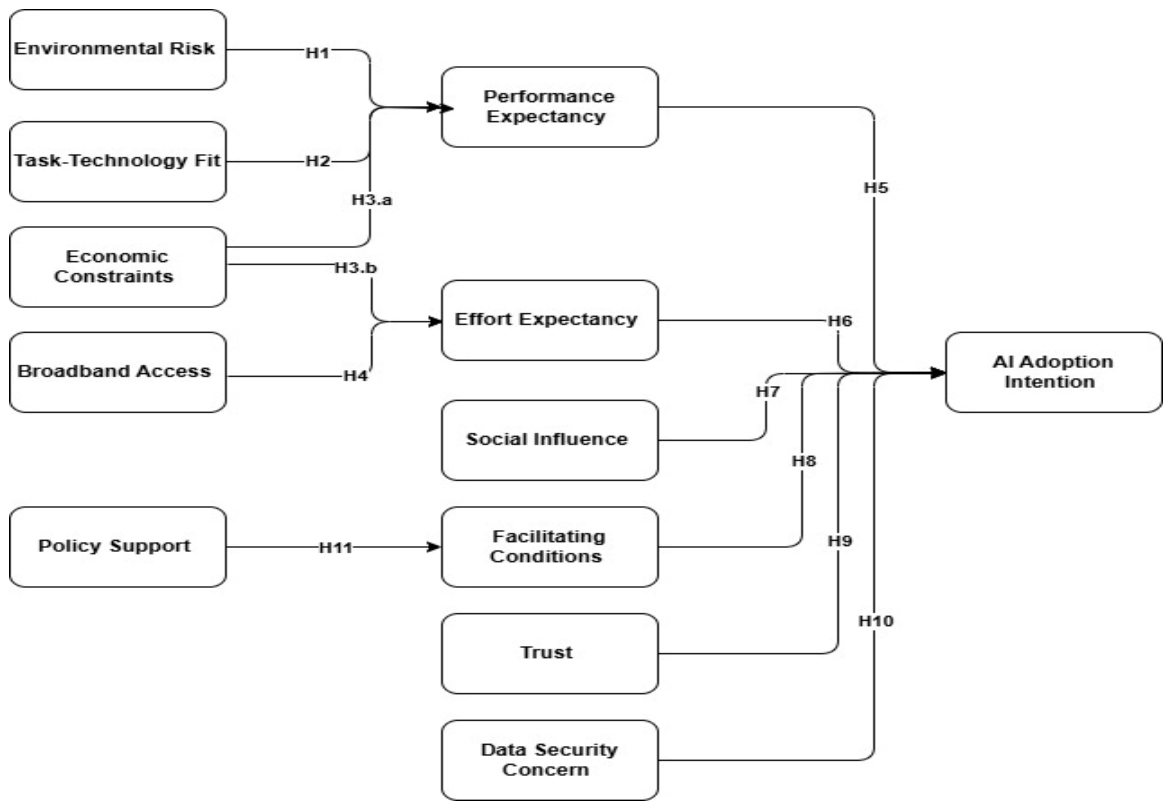
- Theoretical contribution: By integrating UTAUT and TTF with agriculture-specific variables, this study advances a context-rich socio-technical model that enhances our understanding of AI adoption in rural settings. Unlike previous studies that apply UTAUT as a static model, this study contributes a dynamic socio-technical framework where environmental and economic realities are modeled as direct antecedents to cognitive perceptions, specifically addressing the ‘algorithmic agency’ of AI.
- Practical implication: The findings can guide policymakers, ag-tech developers, and extension agencies to take action in order to overcome the real-life obstacles encountered by farmers and develop equitable and effective design interventions.
- Regional relevance: The study, targeting the U.S. Midwest, which is an important agricultural region globally, is a valuable source of evidence to enhance AI diffusion in high-production, yet digitally skewed, settings.
2. Literature Review
2.1. Artificial Intelligence Adoption in Agriculture
2.2. Theoretical Foundations: UTAUT and Task–Technology Fit in Ag-Tech Contexts
2.3. Hypotheses Development
2.3.1. Environmental Risk
2.3.2. Task–Technology Fit
2.3.3. Economic Constraints
2.3.4. Broadband Access
2.3.5. Effort Expectancy
2.3.6. Performance Expectancy
2.3.7. Trust in Technology
2.3.8. Data Security Concerns
2.3.9. Social Influence
2.3.10. Facilitating Conditions
2.3.11. Policy Support
3. Methodology
3.1. Sample and Data Collection Procedures
3.2. Questionnaire Development and Validation
3.3. Participant Recruitment and Data Collection
3.4. Sample Characteristics and Size
3.5. Data Screening and Non-Response Bias
4. Results
4.1. Evaluation of the Measurement Model
4.2. Item and Construct Reliability
4.3. Convergent Validity
4.4. Discriminant Validity
4.5. Collinearity Assessment
4.6. Evaluation of the Structural Model
5. Discussion
5.1. Environmental and Technological Fit Factors
5.2. Economic and Infrastructure Considerations
5.3. Core Technology Acceptance Constructs
5.4. Social and Institutional Enablers
5.5. Theoretical Synthesis: Beyond Deterministic Adoption
5.6. Practical Realities of AI Deployment in Midwestern Agriculture
6. Conclusions and Implications
6.1. Conclusions
6.2. Theoretical Implications
6.3. Managerial and Practical Implications
6.4. Limitations and Recommendations for Future Research
Author Contributions
Funding
Institutional Review Board Statement
Informed Consent Statement
Data Availability Statement
Acknowledgments
Conflicts of Interest
Appendix A

| Construct | Questionnaire Item | Reference | |
|---|---|---|---|
| Performance Expectancy | PE1 | I would find the use of AI tools useful in my daily farm work. | [14,18] |
| PE2 | I think the use of AI technologies makes my farm more productive. | ||
| PE3 | Using AI tools would improve the overall efficiency of my farm operations. | ||
| PE4 | AI use will increase the profitability of my farming activities. | ||
| PE5 | I think that the use of AI tools would make my farm management more environmentally sustainable. | ||
| Effort Expectancy | EE1 | Learning to use AI tools would be easy for me. | [14,18] |
| EE2 | I find AI-based systems user-friendly for farm operations. | ||
| EE3 | It would not take much effort to become skillful at using AI tools. | ||
| EE4 | My interaction with AI technologies is clear and understandable. | ||
| Task–Technology Fit | TTF1 | AI tools match the specific tasks required in my farming operations. | [19] |
| TTF2 | AI features are relevant to the way I manage my farm. | [19] | |
| TTF3 | There is a good fit between the AI tools available and my agricultural needs. | [88] | |
| TTF4 | The AI tools I use are capable of supporting the most critical decisions I make on my farm. | [27] | |
| TTF5 | I believe the AI tools provide functionality that aligns with my daily agricultural work processes. | [27] | |
| Trust in Technology | TT1 | I believe AI tools will work reliably on my farm. | [26] |
| TT2 | I am confident AI tools will produce accurate recommendations. | [25] | |
| TT3 | I trust the algorithms behind AI tools to make objective decisions. | [89] | |
| Social Influence | SI1 | People I work with on the farm (agronomists, consultants, salesmen, etc.) think I should use AI technologies. | [14,18] |
| SI2 | People I trust think I should use AI tools. | ||
| SI3 | I feel social pressure to adopt AI technologies in farming. | ||
| SI4 | Extension agents or co-op advisors encourage me to use AI systems. | ||
| SI5 | In general, most people who are important to me in my farming community think I should use AI technologies | ||
| Facilitating Conditions | FC1 | I think I have the necessary basic knowledge to adopt AI technologies. | [14,18] |
| FC2 | I think I have the necessary resources (economic, technical, infrastructural, etc.) to adopt AI technologies. | ||
| FC3 | AI technologies are compatible with other technologies I already use. | ||
| FC4 | If I am in difficulty with the use of AI technologies, there are people (or a group of people) who would provide me with assistance and/or support. | ||
| Data Security Concerns | DSC1 | I am concerned about how my farm data is stored by AI systems. | [4] |
| DSC2 | I worry about unauthorized access to the data collected by AI tools. | [90] | |
| DSC3 | I am hesitant to adopt AI because of privacy concerns with my information. | [17,58,91] | |
| Digital Literacy | DL1 | I feel confident using technology like smartphones, tablets, or computers. | [92] |
| DL2 | I can easily learn to use new digital tools for farm-related decisions. | [65] | |
| DL3 | I often use digital tools or applications in my farming practices. | [65] | |
| Trust in Institutions | TI1 | I trust recommendations about AI tools from university extension programs. | [93] |
| TI2 | I believe government agencies like USDA support farmers fairly with technology. | [94] | |
| TI3 | I have confidence in the private companies providing AI services. | [94] | |
| Policy Support | PS1 | There are government incentives to support AI use in agriculture. | [1] |
| PS2 | Current ag policies promote the use of AI tools on farms like mine. | [10] | |
| PS3 | Federal or state programs provide resources for adopting AI. | [1] | |
| Environmental Risk | ER1 | Changes in the environment (e.g., drought, pests) push me to try AI. | [29] |
| ER2 | AI tools help me manage climate-related risks more effectively. | [30] | |
| ER3 | I feel pressure to adopt AI due to worsening environmental conditions. | [30] | |
| Broadband Access | BA1 | My internet connection is reliable enough to run AI tools. | [13] |
| BA2 | I have consistent broadband access to use AI-based applications. | [13,43] | |
| BA3 | Internet speed on my farm is sufficient to support real-time AI tools. | [13] | |
| Economic Constraints | EC1 | The cost of AI tools is too high for my current financial situation. | [95] |
| EC2 | I am uncertain about the return on investment of AI tools. | [96] | |
| EC3 | My farm income level limits my ability to adopt new technologies like AI. | [96] |
References
- OECD. Digital Opportunities for Better Agricultural Policies; OECD: Paris, France, 2019. [Google Scholar] [CrossRef]
- Eastwood, C.; Klerkx, L.; Ayre, M.; Dela Rue, B. Managing Socio-Ethical Challenges in the Development of Smart Farming: From a Fragmented to a Comprehensive Approach for Responsible Research and Innovation. J. Agric. Environ. Ethics 2019, 32, 741–768. [Google Scholar] [CrossRef]
- Klerkx, L.; Jakku, E.; Labarthe, P. A review of social science on digital agriculture, smart farming and agriculture 4.0: New contributions and a future research agenda. NJAS Wagening. J. Life Sci. 2019, 90–91, 1–16. [Google Scholar] [CrossRef]
- Wolfert, S.; Ge, L.; Verdouw, C.; Bogaardt, M.-J. Big Data in Smart Farming–A review. Agric. Syst. 2017, 153, 69–80. [Google Scholar] [CrossRef]
- Koshariya, A.K.; Rameshkumar, P.M.; Balaji, P.; Cavaliere, L.P.L.; Dornadula, V.H.R.; Singh, B. Data-driven insights for agricultural management: Leveraging industry 4.0 technologies for improved crop yields and resource optimization. In Robotics and Automation in Industry 4.0; CRC Press: Boca Raton, FL, USA, 2024; pp. 260–274. [Google Scholar]
- Liakos, K.G.; Busato, P.; Moshou, D.; Pearson, S.; Bochtis, D. Machine Learning in Agriculture: A Review. Sensors 2018, 18, 2674. [Google Scholar] [CrossRef]
- Sharma, K.; Shivandu, S.K. Integrating artificial intelligence and Internet of Things (IoT) for enhanced crop monitoring and management in precision agriculture. Sens. Int. 2024, 5, 100292. [Google Scholar] [CrossRef]
- USDA Midwest Climate Hub. Climate Change and Agriculture in the Midwest; USDA Midwest Climate Hub: Ames, IA, USA, 2021.
- Gardezi, M.; Joshi, B.; Rizzo, D.M.; Ryan, M.; Prutzer, E.; Brugler, S.; Dadkhah, A. Artificial intelligence in farming: Challenges and opportunities for building trust. Agron. J. 2024, 116, 1217–1228. [Google Scholar] [CrossRef]
- Prokopy, L.S.; Floress, K.; Arbuckle, J.G.; Church, S.P.; Eanes, F.R.; Gao, Y.; Gramig, B.M.; Ranjan, P.; Singh, A.S. Adoption of agricultural conservation practices in the United States: Evidence from 35 years of quantitative literature. J. Soil Water Conserv. 2019, 74, 520–534. [Google Scholar] [CrossRef]
- Cano, P.; Mandrini, G.; Buckmaster, D.; Arnall, B.; Carroll, M.; Sharda, A.; Balboa, G.; Carcedo, A.; Hawkins, E.; Fulton, J.; et al. Farmer perspectives on digital agriculture in the US Midwest. Agron. J. 2026, 118, e70268. [Google Scholar] [CrossRef]
- GAO.U.S. Government Accountability Office. Precision Agriculture: Benefits and Challenges for Technology Adoption and Use (GAO-24-105962); GAO.U.S.: Washington, DC, USA, 2024.
- Whitacre, B.; Gallardo, R.; Strover, S. Broadband׳s contribution to economic growth in rural areas: Moving towards a causal relationship. Telecommun. Policy 2014, 38, 1011–1023. [Google Scholar] [CrossRef]
- Giua, C.; Materia, V.C.; Camanzi, L. Smart farming technologies adoption: Which factors play a role in the digital transition? Technol. Soc. 2022, 68, 101869. [Google Scholar] [CrossRef]
- Michels, M.; Bonke, V.; Musshoff, O. Understanding the adoption of smartphone apps in crop protection. Precis. Agric. 2020, 21, 1209–1226. [Google Scholar] [CrossRef]
- Patil, R.; Sable, N.P.; Mahalle, P.N.; Shinde, G.R.; Dhotre, P.; Chandre, P. Role of data-centric artificial intelligence in agriculture. In Data-Centric Artificial Intelligence for Multidisciplinary Applications; Chapman and Hall/CRC: Boca Raton, FL, USA, 2024; pp. 159–176. [Google Scholar]
- Sood, A.; Bhardwaj, A.K.; Sharma, R.K. Perceptions of facilitators towards adoption of AI-based solutions for sustainable agriculture. J. Decis. Syst. 2023, 1–35. [Google Scholar] [CrossRef]
- Venkatesh, V.; Morris, M.G.; Davis, G.B.; Davis, F.D. User Acceptance of Information Technology: Toward a Unified View. MIS Q. 2003, 27, 425–478. [Google Scholar] [CrossRef]
- Goodhue, D.L.; Thompson, R.L. Task-Technology Fit and Individual Performance. Manag. Inf. Syst. Q. 1995, 19, 213–236. [Google Scholar] [CrossRef]
- Ronaghi, M.H.; Forouharfar, A. A contextualized study of the usage of the Internet of things (IoTs) in smart farming in a typical Middle Eastern country within the context of Unified Theory of Acceptance and Use of Technology model (UTAUT). Technol. Soc. 2020, 63, 101415. [Google Scholar] [CrossRef]
- Drewry, J.L.; Shutske, J.M.; Trechter, D.; Luck, B.D.; Pitman, L. Assessment of digital technology adoption and access barriers among crop, dairy and livestock producers in Wisconsin. Comput. Electron. Agric. 2019, 165, 104960. [Google Scholar] [CrossRef]
- Venkatesh, V.; Thong, J.Y.L.; Xu, X. Consumer Acceptance and Use of Information Technology: Extending the Unified Theory of Acceptance and Use of Technology. MIS Q. 2012, 36, 157–178. [Google Scholar] [CrossRef]
- Abdulmuhsin, A.A.; Al Atraqchi, O.M.A.; Rehman, S.U.; Alkhwaldi, A.F.; Mjlae, S.A. Exploring Academics’ Orientation Towards Large Language Model Adoption: A Knowledge Management Approach Using ChatGPT and Retrieval-Augmented Generation. Knowl. Process Manag. 2026. [Google Scholar] [CrossRef]
- Alshammari, S.H.; Alkhwaldi, A.F.; Alshammari, A.E.A.; Alshammari, M.H.; Alrashidi, M.E. Extending the UTAUT Model: The role of cognitive flexibility in AI adoption in higher education. Acta Psychol. 2026, 263, 106363. [Google Scholar] [CrossRef]
- Pavlou, P.A. Consumer acceptance of electronic commerce: Integrating trust and risk with the technology acceptance model. Int. J. Electron. Commer. 2003, 7, 101–134. [Google Scholar] [CrossRef]
- McKnight, D.H.; Carter, M.; Thatcher, J.B.; Clay, P.F. Trust in a specific technology: An investigation of its components and measures. ACM Trans. Manag. Inf. Syst. (TMIS) 2011, 2, 12. [Google Scholar] [CrossRef]
- Wang, X.; Li, M.; Yao, Y.; Zhu, X. A Study of Factors Influencing Chinese Design Students’ Adoption of AIGC Tools. IEEE Access 2025, 13, 117753–117770. [Google Scholar] [CrossRef]
- Arbuckle, J.G.; Morton, L.W.; Hobbs, J. Understanding Farmer Perspectives on Climate Change Adaptation and Mitigation:The Roles of Trust in Sources of Climate Information, Climate Change Beliefs, and Perceived Risk. Environ. Behav. 2015, 47, 205–234. [Google Scholar] [CrossRef] [PubMed]
- Arbuckle, J.G.; Tyndall, J.C.; Morton, L.W.; Hobbs, J. Climate change typologies and audience segmentation among Corn Belt farmers. J. Soil Water Conserv. 2017, 72, 205–214. [Google Scholar] [CrossRef]
- Antle, J.M.; Ray, S. Sustainable agricultural development. In Palgrave Studies in Agricultural Economics and Food Policy, 1st ed.; Palgrave Macmillan: Cham, Switzerland, 2020. [Google Scholar]
- Guo, Z.; Chen, X.; Zhang, Y. Impact of environmental regulation perception on farmers’ agricultural green production technology adoption: A new perspective of social capital. Technol. Soc. 2022, 71, 102085. [Google Scholar] [CrossRef]
- Xie, H.; Huang, Y. Influencing factors of farmers’ adoption of pro-environmental agricultural technologies in China: Meta-analysis. Land Use Policy 2021, 109, 105622. [Google Scholar] [CrossRef]
- Dishaw, M.T.; Strong, D.M. Extending the technology acceptance model with task–technology fit constructs. Inf. Manag. 1999, 36, 9–21. [Google Scholar] [CrossRef]
- Mohr, S.; Kühl, R. Acceptance of artificial intelligence in German agriculture: An application of the technology acceptance model and the theory of planned behavior. Precis. Agric. 2021, 22, 1816–1844. [Google Scholar] [CrossRef]
- Rose, D.C.; Chilvers, J. Agriculture 4.0: Broadening responsible innovation in an era of smart farming. Front. Sustain. Food Syst. 2018, 2, 87. [Google Scholar] [CrossRef]
- Engotoit, B.; Kituyi, G.M.; Moya, M.B. Influence of performance expectancy on commercial farmers’ intention to use mobile-based communication technologies in Uganda. J. Syst. Inf. Technol. 2016, 18, 346–366. [Google Scholar] [CrossRef]
- Rose, D.C.; Sutherland, W.J.; Parker, C.; Lobley, M.; Winter, M.; Morris, C.; Twining, S.; Ffoulkes, C.; Amano, T.; Dicks, L.V. Decision support tools for agriculture: Towards effective design and delivery. Agric. Syst. 2016, 149, 165–174. [Google Scholar] [CrossRef]
- Raunaq, F.F.; Islam, S.; Anam, M.Z.; Bari, A.B.M.M. Assessing the challenges to digital technology adoption in the healthcare sector: Implications for sustainability in emerging economies. Inform. Health 2025, 2, 194–209. [Google Scholar] [CrossRef]
- Lioutas, E.D.; Charatsari, C. Big data in agriculture: Does the new oil lead to sustainability? Geoforum 2020, 109, 1–3. [Google Scholar] [CrossRef]
- Sharma, V.; Priya, B. Bridging the gap: AI-powered FinTech and its impact on financial inclusion and financial well-being. Discov. Artif. Intell. 2025, 5, 290. [Google Scholar] [CrossRef]
- Sabbagh, M.; Gutierrez, L. Farmers’ Intention Towards Investing in Agriculture 4.0 in Marginal and Non-marginal Conditions. Bio-Based Appl. Econ. 2025, 14, 45–66. [Google Scholar] [CrossRef]
- Venkatesh, V. Adoption and use of AI tools: A research agenda grounded in UTAUT. Ann. Oper. Res. 2022, 308, 641–652. [Google Scholar] [CrossRef]
- Greig, J.; Nelson, H.; Clardy, G.; Douglas, M. Almost priceless: How internet access impacts US farmer leaders’ precision agriculture technology perceptions. Precis. Agric. 2024, 25, 360–375. [Google Scholar] [CrossRef]
- Saha, A.; Dutta, A.; Sifat, R.I. The mental impact of digital divide due to COVID-19 pandemic induced emergency online learning at undergraduate level: Evidence from undergraduate students from Dhaka City. J. Affect. Disord. 2021, 294, 170–179. [Google Scholar] [CrossRef]
- Paico-Saavedra, S.; Rojas-Rivero, A.; Elizondo-Candanedo, R.F.; Arranz-López, A.; Soria-Lara, J.A. Digital and socioeconomic inequalities in perceived mobility restrictions for activity participation: Captive users in Madrid. J. Urban Mobil. 2025, 8, 100142. [Google Scholar] [CrossRef]
- Li, X.; Zhang, C.; Zhao, Y.; Feng, H. Navigating Ageing in Place Within a Smart Home: Bridging Stakeholder Viewpoints. J. Popul. Ageing 2025, 1–20. [Google Scholar] [CrossRef]
- Gefen, D.; Straub, D.W. The relative importance of perceived ease of use in IS adoption: A study of e-commerce adoption. J. Assoc. Inf. Syst. 2000, 1, 8. [Google Scholar] [CrossRef]
- Yan, H.; Lu, L.; Li, Z.; Wang, J. From Innovation to Implementation: Factors Driving Chinese Farmers’ Adoption Intentions for Laser Weeding Robots. In Proceedings of the 2025 International Conference on Smart Agriculture and Artificial Intelligence, Xi’an, China, 13–15 June 2025; pp. 150–156. [Google Scholar]
- Alkhwaldi, A.F.; Abdulmuhsin, A.A.; Bhat, M.A.; Khan, S.T.; Al-Adwan, A.S. Harnessing AI for greener behaviour: How artificial intelligence can nudge individuals and organizations towards environmental sustainability. J. Syst. Inf. Technol. 2026, 1–26. [Google Scholar] [CrossRef]
- Ng, S.W.T.; Zhang, R. Trust in AI-driven chatbots: A systematic review. Telemat. Inform. 2025, 97, 102240. [Google Scholar] [CrossRef]
- PurdueUniversity. Americans Support AI in Farming But Demand Transparency. Available online: https://www.nationalhogfarmer.com/farming-business-management/americans-support-ai-in-farming-but-demand-transparency (accessed on 26 November 2025).
- Weston, S.; Crowley, K.; Smith, W.; Crow, J. Could the Next AI Revolution be Found on American Farms? Available online: https://www.ksnblocal4.com/2025/11/12/could-next-ai-revolution-be-found-american-farms/ (accessed on 26 November 2025).
- Houda, Z.; Khalid, C. The Role of Uncertainty Avoidance, Trust, and Land Tenure in Predicting the Adoption of Green IoT Irrigation Systems in Morocco: An Improved Model. In Proceedings of the International Conference on Advanced Intelligent Systems for Sustainable Development; Springer: Cham, Switzerland, 2023; pp. 368–383. [Google Scholar]
- Akudugu, M.A.; Nkegbe, P.K.; Wongnaa, C.A.; Millar, K.K. Technology adoption behaviors of farmers during crises: What are the key factors to consider? J. Agric. Food Res. 2023, 14, 100694. [Google Scholar] [CrossRef]
- Gan, Q.; Lau, R.Y.K. Trust in a ‘trust-free’system: Blockchain acceptance in the banking and finance sector. Technol. Forecast. Soc. Change 2024, 199, 123050. [Google Scholar] [CrossRef]
- Asif, M.; Sarwar, F. The essential position of trust in the technology acceptance model: A comprehensive review and bibliometric analysis in management studies. J. Model. Manag. 2025, 20, 1635–1655. [Google Scholar] [CrossRef]
- Holzinger, A.; Weippl, E.; Tjoa, A.M.; Kieseberg, P. Digital Transformation for Sustainable Development Goals (SDGs)-A Security, Safety and Privacy Perspective on AI. In International Cross-Domain Conference for Machine Learning and Knowledge Extraction; Springer: Cham, Switzerland, 2021; pp. 1–20. [Google Scholar]
- Sood, A.; Bhardwaj, A.K.; Sharma, R.K. Towards sustainable agriculture: Key determinants of adopting artificial intelligence in agriculture. J. Decis. Syst. 2024, 33, 833–877. [Google Scholar] [CrossRef]
- Georgopoulos, V.P.; Gkikas, D.C.; Theodorou, J.A. Factors Influencing the Adoption of Artificial Intelligence Technologies in Agriculture, Livestock Farming and Aquaculture: A Systematic Literature Review Using PRISMA 2020. Sustainability 2023, 15, 16385. [Google Scholar] [CrossRef]
- Al-Mughairi, H.; Bhaskar, P. Exploring the factors affecting the adoption AI techniques in higher education: Insights from teachers’ perspectives on ChatGPT. J. Res. Innov. Teach. Learn. 2025, 18, 232–247. [Google Scholar] [CrossRef]
- Sakib, M.N.; Akter, M.; Sahabuddin, M.; Fahlevi, M. An application of the extended UTAUT model to understand the adoption of cashless transactions: Evidence from developing country. J. Sci. Technol. Policy Manag. 2024, 16, 912–926. [Google Scholar] [CrossRef]
- Salah, O.H.; Ayyash, M.M. Understanding user adoption of mobile wallet: Extended TAM with knowledge sharing, perceived value, perceived privacy awareness and control, perceived security. VINE J. Inf. Knowl. Manag. Syst. 2025, 55, 1223–1250. [Google Scholar] [CrossRef]
- Sultan, E.A.J.; Abdulmuhsin, A.A.; Rehman, S.U.; Alkhwaldi, A.F.; Abu-AlSondos, I.A.; Yaseen, S.G. Bridging minds in the metaverse: Unveiling academics’ intentions through a UTAUT3 lens on relational capital integration. Inf. Discov. Deliv. 2026, 1–21. [Google Scholar] [CrossRef]
- High, C.; Singh, N.; Nemes, G. Artificial Intelligence for Agricultural Extension: Supporting Transformative Learning Among Smallholder Farmers. J. Dev. Policy Pract. 2025, 11, 61–80. [Google Scholar] [CrossRef]
- Rogers, E. Diffusion of Innovations. In An Integrated Approach to Communication Theory and Research, 5th ed.; Routledge: London, UK, 2003. [Google Scholar]
- Molina-Maturano, J.; Verhulst, N.; Tur-Cardona, J.; Güereña, D.T.; Gardeazábal-Monsalve, A.; Govaerts, B.; Speelman, S. Understanding Smallholder Farmers’ Intention to Adopt Agricultural Apps: The Role of Mastery Approach and Innovation Hubs in Mexico. Agronomy 2021, 11, 194. [Google Scholar] [CrossRef]
- USDA. ReConnect Loan and Grant Program. Available online: https://www.usda.gov/reconnect (accessed on 27 December 2025).
- National Institute of Food and Agriculture, U.S. Department of Agriculture, USDA NIFA. AFRI Education and Workforce Development Program. Available online: https://www.nifa.usda.gov/grants/programs/agriculture-food-research-initiative-afri (accessed on 15 January 2026).
- USDA. Conservation Innovation Grants (CIG). Available online: https://www.nrcs.usda.gov/programs-initiatives/conservation-innovation-grants (accessed on 27 December 2025).
- Li, B.; Ding, J.; Wang, J.; Zhang, B.; Zhang, L. Key factors affecting the adoption willingness, behavior, and willingness-behavior consistency of farmers regarding photovoltaic agriculture in China. Energy Policy 2021, 149, 112101. [Google Scholar] [CrossRef]
- Driessen, C.; Heutinck, L.F.M. Cows desiring to be milked? Milking robots and the co-evolution of ethics and technology on Dutch dairy farms. Agric. Hum. Values 2015, 32, 3–20. [Google Scholar] [CrossRef]
- Hair, J.F.; Hult, G.T.M.; Ringle, C.M.; Sarstedt, M. A Primer on Partial Least Squares Structural Equation Modeling (PLS-SEM), 3rd ed.; SAGE Publications: Thousand Oaks, CA, USA, 2021. [Google Scholar]
- Hair, J.F.; Black, W.C.; Babin, B.J.; Anderson, R.E. Multivariate Data Analysis, 8th ed.; Cengage Learning: Boston, MA, USA, 2019. [Google Scholar]
- Armstrong, J.S.; Overton, T.S. Estimating Nonresponse Bias in Mail Surveys. J. Mark. Res. 1977, 14, 396–402. [Google Scholar] [CrossRef]
- Hair, J.F.; Hult, G.T.M.; Ringle, C.M.; Sarstedt, M.; Danks, N.P.; Ray, S. Partial Least Squares Structural Equation Modeling (PLS-SEM) Using R: A Workbook; Springer: Berlin/Heidelberg, Germany, 2022. [Google Scholar]
- Hair, J.F.; Risher, J.J.; Sarstedt, M.; Ringle, C.M. When to use and how to report the results of PLS-SEM. Eur. Bus. Rev. 2019, 31, 2–24. [Google Scholar] [CrossRef]
- Chin, W.W. The partial least squares approach to structural equation modeling. In Modern Methods for Business Research; Psychology Press: Hove, UK, 1998; pp. 295–336. [Google Scholar]
- Nunnally, J.C.; Bernstein, I.H. Psychometric Theory; New York McGraw-Hill: New York, NY, USA, 1994. [Google Scholar]
- Raykov, T. Estimation of composite reliability for congeneric measures. Appl. Psychol. Meas. 1997, 21, 173–184. [Google Scholar] [CrossRef]
- Fornell, C.; Larcker, D.F. Evaluating Structural Equation Models with Unobservable Variables and Measurement Error. J. Mark. Res. 1981, 18, 39–50. [Google Scholar] [CrossRef]
- Henseler, J.; Ringle, C.M.; Sarstedt, M. A new criterion for assessing discriminant validity in variance-based structural equation modeling. J. Acad. Mark. Sci. 2015, 43, 115–135. [Google Scholar] [CrossRef]
- Diamantopoulos, A.; Siguaw, J.A. Formative versus reflective indicators in organizational measure development: A comparison and empirical illustration. Br. J. Manag. 2006, 17, 263–282. [Google Scholar] [CrossRef]
- Kock, N. Common method bias in PLS-SEM: A full collinearity assessment approach. Int. J. E-Collab. (IJEC) 2015, 11, 1–10. [Google Scholar] [CrossRef]
- Cohen, J. Statistical Power Analysis for the Behavioral Sciences, 2nd ed.; Lawrence Erlbaum Associates: Mahwah, NJ, USA, 1988. [Google Scholar]
- Stone, M. Cross-validatory choice and assessment of statistical predictions. J. R. Stat. Soc. Ser. B (Methodol.) 1974, 36, 111–133. [Google Scholar] [CrossRef]
- Geisser, S. The predictive sample reuse method with applications. J. Am. Stat. Assoc. 1975, 70, 320–328. [Google Scholar] [CrossRef]
- Hu, L.t.; Bentler, P.M. Cutoff criteria for fit indexes in covariance structure analysis: Conventional criteria versus new alternatives. Struct. Equ. Model. A Multidiscip. J. 1999, 6, 1–55. [Google Scholar] [CrossRef]
- Gebauer, J.; Shaw, M.J.; Gribbins, M.L. Task-Technology Fit for Mobile Information Systems. J. Inf. Technol. 2010, 25, 259–272. [Google Scholar] [CrossRef]
- Thatcher, J.B.; McKnight, D.H.; Baker, E.W.; Arsal, R.E.; Roberts, N.H. The Role of Trust in Postadoption IT Exploration: An Empirical Examination of Knowledge Management Systems. IEEE Trans. Eng. Manag. 2011, 58, 56–70. [Google Scholar] [CrossRef]
- Carbonell, I.M. The ethics of big data in big agriculture. Internet Policy Rev. 2016, 5, 1–13. [Google Scholar] [CrossRef]
- Shutske, J.M.; Trechter, D.; Luck, B.D.; Drewry, J.L.; DeWitte, M.J.; Pitman, L.; Kluz, M. Assessment of Digital Capacity, Needs and Access Barriers Among Crop, Dairy and Livestock Producers. In Proceedings of the 2018 ASABE Annual International Meeting, St. Joseph, MI, USA, 29 July–1 August 2018; p. 1. [Google Scholar]
- van Deursen, A.J.A.M.; van Dijk, J.A.G.M. The digital divide shifts to differences in usage. New Med. Soc. 2014, 16, 507–526. [Google Scholar] [CrossRef]
- Slovic, P. Perceived Risk, Trust, and Democracy. Risk Anal. 1993, 13, 675–682. [Google Scholar] [CrossRef]
- Siegrist, M.; Cvetkovich, G.; Roth, C. Salient Value Similarity, Social Trust, and Risk/Benefit Perception. Risk Anal. 2000, 20, 353–362. [Google Scholar] [CrossRef]
- Feder, G.; Just, R.E.; Zilberman, D. Adoption of Agricultural Innovations in Developing Countries: A Survey. Econ. Dev. Cult. Change 1985, 33, 255–298. [Google Scholar] [CrossRef]
- Schimmelpfennig, D. Farm Profits and Adoption of Precision Agriculture; ERR-217; U.S. Department of Agriculture, Economic Research Service: Washington, DC, USA, 2016.
| Categories | Details | N | % |
|---|---|---|---|
| Age (n years) | Under 35 | 59 | 12.07% |
| 35–44 | 89 | 18.20% | |
| 45–54 years | 110 | 22.49% | |
| 55–64 years | 138 | 28.22% | |
| 65 years or older | 93 | 19.02% | |
| Education | High school/GED | 99 | 20.25% |
| Some college/tech | 94 | 19.22% | |
| Associate’s degree | 77 | 15.75% | |
| Bachelor’s degree | 163 | 33.33% | |
| Graduate degree | 56 | 11.45% | |
| Gender | Male | 333 | 67.48% |
| Female | 159 | 32.52% | |
| Farming Experience (#years) | 5 or less | 51 | 10.43% |
| 6–15 | 97 | 19.84% | |
| 15–25 | 124 | 25.36% | |
| 26–35 | 129 | 26.38% | |
| More than 35 | 88 | 17.99% |
| Constructs | Items | Factor Loadings | Cronbach’s Alpha | Composite Reliability (CR) | Average Variance Extracted (AVE) |
|---|---|---|---|---|---|
| PE | PE_item1 | 0.944 | 0.959 | 0.969 | 0.861 |
| PE_item2 | 0.936 | ||||
| PE_item3 | 0.925 | ||||
| PE_item4 | 0.948 | ||||
| PE_item5 | 0.884 | ||||
| EE | EE_item1 | 0.934 | 0.941 | 0.958 | 0.850 |
| EE_item2 | 0.885 | ||||
| EE_item3 | 0.929 | ||||
| EE_item4 | 0.939 | ||||
| SI | SI_item1 | 0.933 | 0.968 | 0.975 | 0.887 |
| SI_item2 | 0.940 | ||||
| SI_item3 | 0.943 | ||||
| SI_item4 | 0.936 | ||||
| SI_item5 | 0.956 | ||||
| FC | FC_item1 | 0.868 | 0.911 | 0.937 | 0.789 |
| FC_item2 | 0.917 | ||||
| FC_item3 | 0.892 | ||||
| FC_item4 | 0.874 | ||||
| ER | ER_item1 | 0.910 | 0.915 | 0.946 | 0.854 |
| ER_item2 | 0.921 | ||||
| ER_item3 | 0.941 | ||||
| TTF | TTF_item1 | 0.931 | 0.970 | 0.977 | 0.893 |
| TTF_item2 | 0.957 | ||||
| TTF_item3 | 0.946 | ||||
| TTF_item4 | 0.947 | ||||
| TTF_item5 | 0.945 | ||||
| EC | EC_item1 | 0.941 | 0.926 | 0.953 | 0.871 |
| EC_item2 | 0.930 | ||||
| EC_item3 | 0.929 | ||||
| BA | BA_item1 | 0.943 | 0.934 | 0.958 | 0.883 |
| BA_item2 | 0.941 | ||||
| BA_item3 | 0.935 | ||||
| PS | PS_item1 | 0.919 | 0.913 | 0.945 | 0.852 |
| PS_item2 | 0.918 | ||||
| PS_item3 | 0.933 | ||||
| Tr | Tr_item1 | 0.823 | 0.854 | 0.910 | 0.772 |
| Tr_item2 | 0.908 | ||||
| Tr_item3 | 0.902 | ||||
| DSC | DSC_item1 | 0.967 | 0.954 | 0.970 | 0.915 |
| DSC_item2 | 0.948 | ||||
| DSC_item3 | 0.956 | ||||
| BI | BI_item1 | 0.906 | 0.904 | 0.940 | 0.839 |
| BI_item2 | 0.926 | ||||
| BI_item3 | 0.916 |
| Constructs | BA | BI | DSC | EC | EE | ER | FC | PE | PS | SI | TTF | Tr |
|---|---|---|---|---|---|---|---|---|---|---|---|---|
| BA | 0.94 | 0.12 | 0.02 | 0.05 | 0.30 | 0.04 | 0.04 | 0.05 | 0.03 | 0.03 | 0.05 | 0.06 |
| BI | 0.11 | 0.92 | 0.26 | 0.30 | 0.47 | 0.14 | 0.21 | 0.46 | 0.05 | 0.19 | 0.09 | 0.39 |
| DSC | −0.01 | −0.24 | 0.96 | 0.04 | 0.02 | 0.05 | 0.03 | 0.04 | 0.03 | 0.02 | 0.02 | 0.02 |
| EC | 0.05 | −0.28 | −0.03 | 0.93 | 0.45 | 0.06 | 0.06 | 0.43 | 0.03 | 0.03 | 0.03 | 0.04 |
| EE | 0.29 | 0.43 | −0.01 | −0.42 | 0.92 | 0.03 | 0.04 | 0.23 | 0.04 | 0.02 | 0.02 | 0.05 |
| ER | −0.03 | 0.12 | −0.05 | 0.05 | 0.01 | 0.92 | 0.11 | 0.34 | 0.05 | 0.03 | 0.04 | 0.04 |
| FC | −0.02 | 0.19 | 0.03 | 0.05 | −0.03 | −0.10 | 0.89 | 0.03 | 0.36 | 0.02 | 0.03 | 0.15 |
| PE | −0.05 | 0.43 | 0.02 | −0.40 | 0.22 | 0.32 | −0.02 | 0.93 | 0.05 | 0.03 | 0.37 | 0.05 |
| PS | −0.03 | 0.05 | −0.01 | 0.03 | −0.04 | −0.03 | 0.33 | −0.05 | 0.92 | 0.02 | 0.04 | 0.12 |
| SI | −0.03 | 0.18 | 0.01 | 0.02 | −0.01 | 0.03 | 0.01 | 0.01 | −0.02 | 0.94 | 0.03 | 0.02 |
| TTF | −0.05 | 0.08 | 0.02 | 0.02 | −0.01 | 0.03 | −0.03 | 0.35 | −0.03 | −0.02 | 0.95 | 0.04 |
| Tr | 0.05 | 0.35 | 0.01 | 0.04 | 0.02 | 0.00 | 0.13 | −0.05 | 0.11 | 0.01 | 0.01 | 0.88 |
| BI | EE | FC | PE | |
|---|---|---|---|---|
| BA | 1.002 | |||
| DSC | 1.002 | |||
| EC | 1.002 | 1.003 | ||
| EE | 1.052 | |||
| ER | 1.004 | |||
| FC | 1.020 | |||
| PE | 1.053 | |||
| PS | 1.000 | |||
| SI | 1.000 | |||
| TTF | 1.001 | |||
| Tr | 1.021 |
| Relationships | β | SD | t-Statistics | p-Values | f2 | R2; Q2 | Results? |
|---|---|---|---|---|---|---|---|
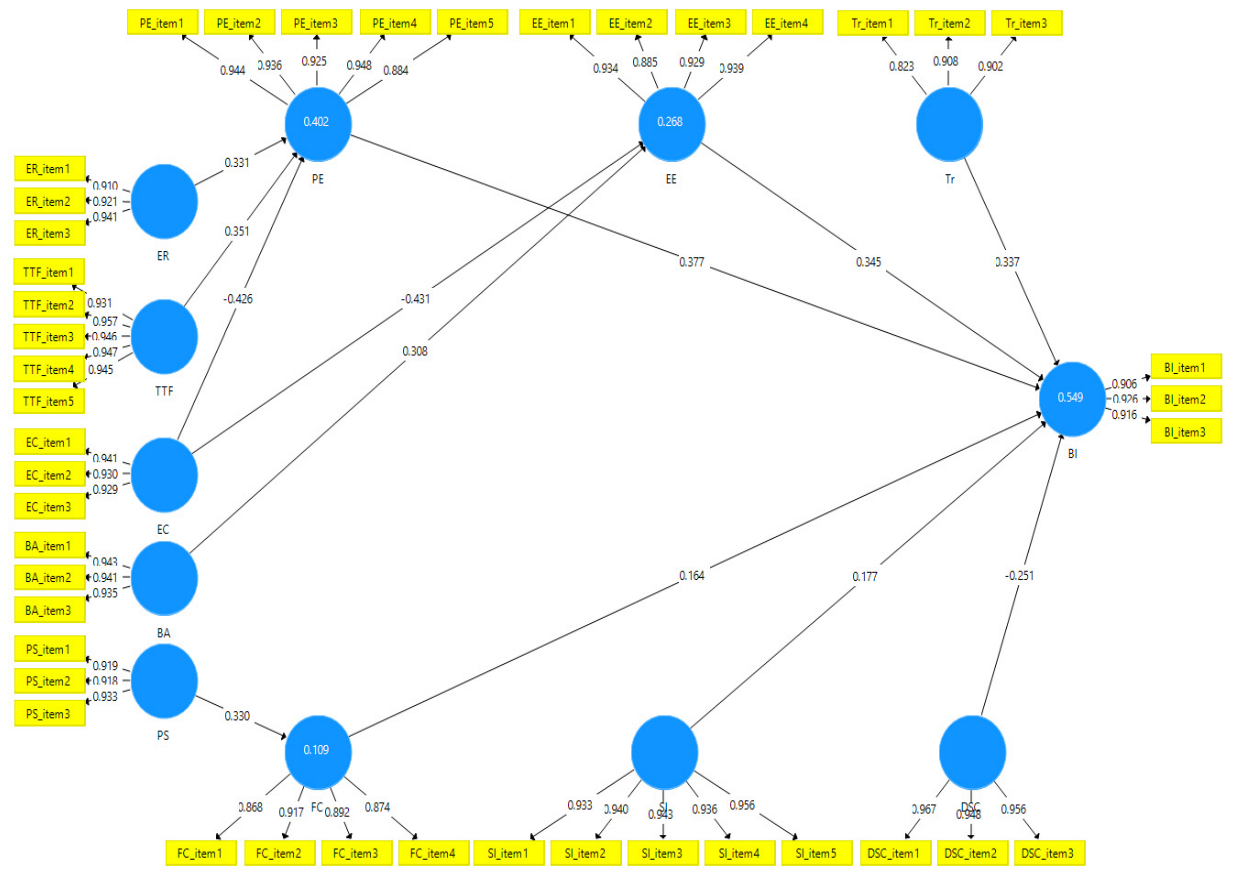
| PE → BI | 0.377 | 0.029 | 12.854 | 0.000 | 0.300 | 0.549; 0.328 | Positive |
| EE → BI | 0.345 | 0.027 | 12.782 | 0.000 | 0.252 | Positive | |
| SI → BI | 0.177 | 0.030 | 5.813 | 0.000 | 0.070 | Positive | |
| FC → BI | 0.164 | 0.032 | 5.061 | 0.000 | 0.058 | Positive | |
| Tr → BI | 0.337 | 0.032 | 10.603 | 0.000 | 0.247 | Positive | |
| DSC → BI | −0.251 | 0.031 | 7.981 | 0.000 | 0.139 | Negative | |
| ER → PE | 0.331 | 0.035 | 9.414 | 0.000 | 0.183 | 0.402; 0.394 | Positive |
| TTF → PE | 0.351 | 0.037 | 9.563 | 0.000 | 0.206 | Positive | |
| EC → PE | −0.426 | 0.034 | 12.580 | 0.000 | 0.303 | Negative | |
| EC → EE | −0.431 | 0.038 | 11.319 | 0.000 | 0.254 | 0.268; 0.261 | Negative |
| BA → EE | 0.308 | 0.036 | 8.598 | 0.000 | 0.129 | Positive | |
| PS → FC | 0.330 | 0.039 | 8.561 | 0.000 | 0.122 | 0.109; 0.105 | Positive |
Disclaimer/Publisher’s Note: The statements, opinions and data contained in all publications are solely those of the individual author(s) and contributor(s) and not of MDPI and/or the editor(s). MDPI and/or the editor(s) disclaim responsibility for any injury to people or property resulting from any ideas, methods, instructions or products referred to in the content. |
© 2026 by the authors. Licensee MDPI, Basel, Switzerland. This article is an open access article distributed under the terms and conditions of the Creative Commons Attribution (CC BY) license.
Share and Cite
Alkhwaldi, A.F.; Noteboom, C.; Abdulmuhsin, A.A. Drivers and Barriers to Artificial Intelligence Adoption in Agriculture: A Socio-Technical Analysis of Midwestern United States Farmers. Sustainability 2026, 18, 4996. https://doi.org/10.3390/su18104996
Alkhwaldi AF, Noteboom C, Abdulmuhsin AA. Drivers and Barriers to Artificial Intelligence Adoption in Agriculture: A Socio-Technical Analysis of Midwestern United States Farmers. Sustainability. 2026; 18(10):4996. https://doi.org/10.3390/su18104996
Chicago/Turabian StyleAlkhwaldi, Abeer F., Cherie Noteboom, and Amir A. Abdulmuhsin. 2026. "Drivers and Barriers to Artificial Intelligence Adoption in Agriculture: A Socio-Technical Analysis of Midwestern United States Farmers" Sustainability 18, no. 10: 4996. https://doi.org/10.3390/su18104996
APA StyleAlkhwaldi, A. F., Noteboom, C., & Abdulmuhsin, A. A. (2026). Drivers and Barriers to Artificial Intelligence Adoption in Agriculture: A Socio-Technical Analysis of Midwestern United States Farmers. Sustainability, 18(10), 4996. https://doi.org/10.3390/su18104996

