Article

Drivers and Barriers to Artificial Intelligence Adoption in Agriculture: A Socio-Technical Analysis of Midwestern United States Farmers


by
Abeer F. Alkhwaldi
1,*,
Cherie Noteboom
1 and
Amir A. Abdulmuhsin
2,3
1
Department of Information Systems, College of Business and Information Systems, Dakota State University, Madison, SD 57042, USA
2
Department of Business Administration, College of Administration and Economics, University of Mosul, Mosul 41002, Iraq
3
Department of Management Information Systems, School of Business, The University of Jordan, Amman 11942, Jordan
*
Author to whom correspondence should be addressed.
Sustainability 2026, 18(10), 4996; https://doi.org/10.3390/su18104996
Submission received: 4 April 2026 / Revised: 1 May 2026 / Accepted: 8 May 2026 / Published: 15 May 2026

Abstract

The agricultural industry is at a critical juncture, experiencing global pressures in the form of climate volatility, a shortage of labor, and an increase in production costs. Although artificial intelligence (AI) has the potential for revolution due to its predictive analytics and self-controlled machinery, it has not achieved widespread and even distribution for use, especially among small-to-medium-sized farms in the Midwestern United States. This study formulates and empirically examines a comprehensive socio-technical model to determine the drivers and barriers to the adoption of AI in this agricultural region. Based on a synthesized framework of the “Unified Theory of Acceptance and Use of Technology” (UTAUT) and “Task–Technology Fit” (TTF), the study incorporates agriculture-specific contextual factors such as “environmental risk, access to broadband, economic constraints, and policy support”. The analyses of the 489 farmers in the U.S. Midwest were conducted through the “partial least squares structural equation modeling” (PLS-SEM) “SmartPLS v.3.9”. The findings provide full empirical evidence of the proposed model, which supports 11 hypothesized relationships. The key results show that the strongest positive predictors of adoption intention are “performance expectancy, effort expectancy, and trust”. On the other hand, data security concerns and financial restrictions are strong deterrents. The paper also outlines the significant facilitating functions of the broadband infrastructure and policy support in building farmer perceptions of technology’s ease-of-use and facilitating conditions. These lessons can provide policymakers, ag-tech developers, and extension agencies with a roadmap on how to create more equitable and contextual interventions that overcome the rural digital divide and create resilient data-driven farming systems.

1. Introduction

The agricultural sector is at a critical juncture where it is facing an unprecedented convergence of global issues. Growing food demand, climate variability, labor shortages, and production costs have placed an increasing strain on farming systems to be more productive, efficient, and sustainable [1,2]. In response to such systemic pressures, Agriculture 4.0, also known as digital transformation in agriculture, has become a primary channel that allows farmers to make data-driven decisions, optimizing inputs and improving yields [3,4,5].
Artificial intelligence (AI) is one of the most disruptive digital innovations. Crop yield prediction analytics based on predictive analytics, autonomous machines, disease detection through drone images, and personalized irrigation advice based on real-time sensor data are among the capabilities of AI technologies in agriculture [6,7]. These tools not only hold promising efficiency, but they can also assist farmers to cope with growing uncertainty in the environmental and economic environments. Their potential, however, does not translate into widespread and even distribution of AI adoption in agriculture, particularly in the rural areas of developed economies, such as the Midwestern United States.
One of the most productive agricultural regions in the world is located in the U.S. Midwest, which accounts for approximately 35% of the world’s corn and soybean production and contributes over $125 billion annually to the U.S. agricultural GDP [8]. This region produces more than 80% of U.S. grain output, making it a critical hub for global food security. However, a significant digital divide exists; while many small-to-medium-sized farmers express interest in AI, they often remain incapable of adoption due to resource scarcity, or unwilling due to low trust in ‘black-box’ algorithms [9,10,11,12]. Empirical surveys indicate that while AI adoption in large agribusinesses exceeds 60%, it remains below 15% for mid-sized family farms in the Midwest [12]. These barriers can be conceptually categorized into structural constraints (e.g., rural broadband infrastructure), economic barriers (e.g., high capital requirements and ROI uncertainty), and behavioral/institutional constraints (e.g., data privacy concerns and algorithmic transparency) [9,13]. The prior literature suggests that while structural issues like connectivity are foundational, behavioral constraints like trust often pose the final, most complex hurdle for adoption. Although big agribusiness has adopted AI to achieve operational efficiencies, smallholders who usually perform under tight margins and high digital illiteracy levels are left behind in the adoption of AI, which intensifies the rural technology divide.
This adoption disparity is important to understand in order to design relevant and inclusive policies and technologies. There has been general research on the general reasons behind digital farming adoption [14,15], but limited research has examined the AI technologies specifically. These AI technologies raise unique cognitive issues—such as the ‘black-box’ problem where farmers cannot verify how a recommendation was reached—and ethical issues regarding the ownership of aggregated farm data, which go beyond the simpler infrastructural requirements of mobile farming apps [7,16]. While research on precision agriculture (e.g., GPS and soil sensors) is mature [14], a research gap exists regarding the specific adoption of AI-enabled systems. Unlike traditional digital tools, AI introduces unique challenges such as autonomous decision-making and predictive opacity, which are not fully captured by existing ‘smart farming’ frameworks [15,17]. In addition, research is necessary that embraces both the technological and the social–institutional aspects of the matter: the fact that adoption decisions are not only influenced by the functionality of the tool, but also by trust, community norms, economic conditions, and policy environments.
In order to handle these complexities, the current research incorporates the perspective of socio-technical systems, the “Unified Theory of Acceptance and Use of Technology” (UTAUT), and “Task–Technology Fit” (TTF) framework, which is combined with agricultural contextual variables. Although UTAUT has found extensive application in the adoption of digital tools [18], and TTF is used to describe the compatibility between technologies and user tasks [19], earlier studies tend to factor out these constructs into the wider contexts of the environment and policy realities. This paper, based on the calls by [2,20]), presents new predictors, including environmental risk, economic constraints, broadband access, and policy support, to simulate the effect of the socio-environmental and institutional contexts on farmer perceptions towards AI tools.
Additionally, although previous researchers considered the use of generalized digital farming or mobile technologies (e.g., [20,21]), not many studies specifically explored the application of AI in the Midwestern farming environment, where infrastructural, cultural, and environmental factors are unique. Despite the Midwest’s central role in global agriculture, a systematic review of the literature reveals that less than 5% of recent Ag-AI adoption studies focus on the specific socio-technical barriers unique to this region’s family-farm structure, highlighting a significant geographic research gap [2,19]. The Midwestern environment is unique due to its high concentration of large-scale monoculture (corn and soybeans), extreme climatic variability (e.g., increasing frequency of droughts), and a landscape dominated by aging family operators who face severe rural broadband disparities compared to coastal agricultural hubs. There is a necessity to move past deterministic models and learn how farmers’ trust towards technology, the issue of data security, and awareness of policy influences the way in which the perception of adoption occurs.
The proposed study will address these gaps by creating and empirically validating a socio-technical adoption model of AI in agriculture based on the validated constructs and contextualized to Midwestern U.S. farmers. The study uses data of 489 farmers working in the region, and it examines the relationships between technological factors (performance expectancy, effort expectancy, trust), social dynamics (“social influence”), enabling conditions (“facilitating conditions, policy support”), and broader restrictions (economic, environmental, digital) to determine behavioral intention to adopt AI tools.
The research work has a number of contributions:
  • Theoretical contribution: By integrating UTAUT and TTF with agriculture-specific variables, this study advances a context-rich socio-technical model that enhances our understanding of AI adoption in rural settings. Unlike previous studies that apply UTAUT as a static model, this study contributes a dynamic socio-technical framework where environmental and economic realities are modeled as direct antecedents to cognitive perceptions, specifically addressing the ‘algorithmic agency’ of AI.
  • Practical implication: The findings can guide policymakers, ag-tech developers, and extension agencies to take action in order to overcome the real-life obstacles encountered by farmers and develop equitable and effective design interventions.
  • Regional relevance: The study, targeting the U.S. Midwest, which is an important agricultural region globally, is a valuable source of evidence to enhance AI diffusion in high-production, yet digitally skewed, settings.
This study explicitly distinguishes AI from ‘generalized digital farming’ by focusing on the technology’s ability to automate decision-making. While mobile apps provide descriptive data, AI requires significantly higher data integration and introduces ‘algorithmic risk,’ where the machine acts on behalf of the farmer, thus requiring a dedicated socio-technical analysis.
While this study focuses on the U.S. Midwest, the socio-technical framework is designed for cross-regional adaptation. For instance, in regions with different soil types or production systems (e.g., tropical horticulture or arid pastoralism), the ‘Environmental Risk’ construct can be recalibrated to prioritize drought or salinity over Midwest-specific climate volatility. Similarly, the ‘Policy Support’ construct allows the model to be applied in varying global regulatory environments, such as the EU’s Green Deal or developing economies’ subsidy programs, by adjusting the indicators for institutional assistance.
In the subsequent sections, we revise the literature on the topic, develop hypotheses in line with the proposed research model, outline the empirical methodology, and present the findings with both theoretical and practical implications on the future of digital farming.

2. Literature Review

2.1. Artificial Intelligence Adoption in Agriculture

Artificial intelligence has become a game-changer in the farming industry, and it is the new wave in the digitalization of agriculture. Based on the premises of precision agriculture and smart farming, artificial intelligence systems combine IoT sensor data, satellite imagery, weather predictions, and machinery data analytics to offer real-time and context-based decision support [6,7]. These functions enable farmers to take informed decisions that are made in irrigation, pest management, nutrient placement, forecast production, and resource scheduling—leading to operational effectiveness and sustainability.
The use of AI in agriculture, though, is not automatic and standardized. Though big agribusinesses have started to use AI to automate and carry out predictive analytics, its adoption in small- and medium-sized farms is scarce [17]. This discontinuity is notably pronounced in the Midwestern U.S., where the ancient knowledge systems are still present in the digital emergent infrastructures. The adoption of AI by farmers is frequently dependent on the perceived usefulness, ease of integration, support infrastructures, and trust in automated decision-making procedures [9,14].
In contrast to the previous waves of agri-tech, e.g., GPS-based equipment or variable rate application, AI brings a new tier of complexity through deep learning opacity (the ‘black-box’ problem) and model drift, where predictive accuracy degrades over time. Furthermore, its data reliance—spanning high-frequency sensor calibration and continuous connectivity requirements—introduces unique constraints. These factors contribute to a higher perceived risk compared to static tools like GPS, as farmers must trust automated systems to make autonomous operational decisions under varying data quality constraints. This renders behavioral intention to adopt AI a complex phenomenon that depends on technical fit, socio-economic factors, and support via the policy [2,4]. Therefore, to adopt AI in agriculture, a holistic, socio-technical perspective is needed that extends beyond functionality to encompass contextual enablers and inhibitors of AI adoption, including environmental hazards, access to broadband, privacy issues of data, and institutional infrastructure [3,20].
This complexity is considered in the current study through the development and testing of an integrative model of AI adoption among farmers in the Midwestern states. This study presents a context-sensitive model through the integration of UTAUT, TTF, and agriculture-specific constructs to explain the conditions and limitations peculiar to the digital transformation of rural agriculture. While traditional precision agriculture (e.g., GPS) focused on where to apply inputs, AI shifts the burden of deciding to the machine. This creates a ‘black-box’ problem that traditional acceptance models fail to capture without the integration of “Task–Technology Fit” (TTF) and trust constructs.

2.2. Theoretical Foundations: UTAUT and Task–Technology Fit in Ag-Tech Contexts

The two theoretical frameworks underpinning the present research are the “Unified Theory of Acceptance and Use of Technology” (UTAUT) and the “Task–Technology Fit” (TTF) frameworks. The combination of these frameworks provides a comprehensive perspective within which behavioral intentions to adopt AI can be perceived in farmers in a holistic way, as it includes individual perceptions and contextual alignment.
UTAUT, developed by [18], synthesizes various technology acceptance models and determines four constructs as point predictors of technology adoption, namely “performance expectancy (PE), effort expectancy (EE), social influence (SI), and facilitating conditions (FC)”. PE is the perceived advantage of technology in improving the outcomes of tasks, whereas EE is the ease of use. SI is a measure of the perceived influence of significant referents to implement a technology, and FC is a measure of the perceived access to technical and organizational resources to use. The UTAUT model has been widely implemented in various fields, such as health, education, and agriculture [15,22,23,24], and has been expanded to cover trust and perceived risk in scenarios involving new technologies like AI [25,26].
The TTF model, suggested by [19,27], is a complement of UTAUT since it focuses on the extent to which technology fits the tasks it was designed to assist in. In agriculture, this involves how AI tools are compatible with farming activities, including seeding, spraying, monitoring, or irrigation timetables. The TTF model assumes that a good fit is a performance booster and improves the likelihood of adoption. The recent studies in the field of smart farming have revealed that, in the case that farmers feel that AI tools can satisfy their needs and not be incredibly sophisticated or generic, they are more likely to utilize them [14,27].
Combined, UTAUT and TTF provide a solid background to the analysis of AI adoption in the farming setting, in particular when supplemented with agriculture-specific items like environmental risk, broadband infrastructure, economic limitations, and data security issues (See Figure 1). By combining the two models, the current research is able to capture the interaction between technology attributes, contextual challenges, and individual perceptions, thus providing a more sophisticated insight into digital transformation in the agricultural industry.

2.3. Hypotheses Development

2.3.1. Environmental Risk

Environmental risk in agriculture is the perceived uncertainty and vulnerability to external environmental situations like drought, soil erosion, pest epidemics, and climate change, factors that directly affect farm productivity and economic sustainability [28]. In regions such as the Midwest, farmers are often faced with severe weather conditions, unpredictable rainfall, and changing patterns of pests that pose a threat to crop production and sustainability [8]. The stakes of such challenges have resulted in an increased desire to embrace decision-support technologies, specifically those with predictive capabilities or precision interventions, e.g., AI-based models to predict pests, plan irrigation, or monitor crop stress [6]. In this context, AI tools are no longer perceived as something that promotes convenience, but they are also perceived as potentially crucial in maneuvering an unstable farming landscape.
In this context, the relationship between environmental risk and “Performance Expectancy” (PE) is driven by the perceived capacity of AI to serve as a risk-mitigation mechanism. Within the UTAUT framework, PE is the belief that technology enhances job performance; in high-risk agricultural environments, this performance gain is specifically realized through improved decision accuracy and yield stabilization. When farmers perceive high environmental vulnerability, they transition from viewing AI as a generic innovation to seeing it as a critical tool for managing unpredictable outcomes. For example, AI-driven predictive modeling for pest outbreaks or soil moisture variability provides a sense of control that directly heightens the technology’s perceived utility. Thus, the causal link is established: heightened environmental risk increases the demand for precision, which in turn elevates the perceived performance value of AI tools.
Based on the concept of the Technological Acceptance Model (TAM) and its adaptation in UTAUT, one of the fundamental determinants of the adoption intention is the “Performance Expectancy” (PE), which is the extent to which a user believes that a technology will enhance job performance [18]. In cases where environmental risks are salient, farmers might see AI technologies as a means of heightening control, efficiency, and resilience to face environmental risks. Research on environmental behavior, e.g., [29], and on technology adoption under risk, e.g., [30,31,32], suggest that perceived vulnerability to climate stressors can heighten technology value perception. Thus, farmers who are at a higher risk due to environmental factors will be more inclined to view AI systems as helpful. We therefore assume that:
H1: 
Environmental risk is positively associated with Performance Expectancy of AI tools.

2.3.2. Task–Technology Fit

Task–Technology Fit (TTF) is the degree to which the capabilities of technology and the tasks it is expected to assist are compatible. In the agricultural setting, this is the degree of compatibility of AI technology with particular farm tasks like planting, irrigation, harvesting, pest surveillance, and yield prediction [19]. To farmers, the choice to take up new technologies is usually not only a choice of novelty or outside coercion, but also a determination of whether the new technology will materially benefit the fundamental activities of farming. To the extent that the actionable insights obtained with the help of AI tools (e.g., disease detection, nutrient mapping, irrigation scheduling) directly correlate with the operational requirements of a particular farm, they are more likely to be viewed as useful [4]. On the other hand, too generic technologies, those which are not well integrated with current machinery, or those that cannot be used to resolve situation-specific problems, might be perceived to bring no value, particularly in low-margin and high-risk circumstances such as Midwest farming. The TTF Theory [19] suggests that technology is more likely to be used and lead to performance gain when it is relevant to the tasks of the user. Concurrently, the TAM and UTAUT place Performance Expectancy, the belief that the use of technology will lead to improvement in performance, as one of the key predictors of adoption. According to a previous study, the higher the TTF is perceived by the user, the more they expect performance benefits [27,33]. Perceived fit can have a direct effect on farmers in agriculture, where precision, timing, and variability of the field are key aspects; AI tools can be seen as effective or onerous.
To avoid conceptual redundancy, it is critical to distinguish between the structural alignment of “Task–Technology Fit” (TTF) and the cognitive evaluation of “Performance Expectancy” (PE). TTF refers to the objective or perceived correspondence between the specific requirements of a farming task (e.g., variable rate irrigation) and the features of the AI tool. In contrast, PE represents the farmer’s subsequent belief that using such a tool will result in a net gain, such as increased profitability or saved time. Prior empirical studies indicate that while they are correlated, TTF acts as a necessary antecedent; a tool must first ‘fit’ the unique field-level tasks of a Midwestern farm before a farmer can conclude that it is ‘useful’ for performance. Thus, TTF describes the technical compatibility, whereas PE captures the perceived outcome of that compatibility.
Hence, the hypothesis that we suggest is the following:
H2: 
Task–Technology Fit is positively associated with Performance Expectancy of AI tools in agriculture.

2.3.3. Economic Constraints

In the agricultural context, financial aspects are a key determinant in the perception and decision-making of technology. Economic Constraints are the perceived constraints that farmers are subjected to, including high costs of inputs, uncertainties in returns, and a lack of capital to invest in new technologies. Such limitations are especially sharp in the case of small-to-medium-scale farmers in such regions as the Midwest and South Dakota, where the unstable prices of commodities and rising costs of inputs put extra financial strain [10].
In cases when farmers are in a tight economic situation, they might underestimate the performance benefits of AI tools even when theoretically the tool is beneficial because of perceived gaps in affordability or long ROI periods. This is consistent with the previous evidence of a negative impact of high investment costs and economic uncertainty on the aspects of PE by reducing the perceived viability of the benefits of technology realization [34,35,36,37].
Meanwhile, insufficient financial resources can decrease access to the required training, assistance, or access to computer infrastructure, thus making the process of learning and utilizing AI-based systems more challenging. Consequently, economic hardship may also increase the Effort Expectancy, which can make the technology appear extra burdensome or unavailable [38,39,40,41]. Thus, we hypothesize:
H3a: 
Economic Constraints are negatively associated with Performance Expectancy.
H3b: 
Economic Constraints are negatively associated with Effort Expectancy.

2.3.4. Broadband Access

Broadband Access (BA) is the availability of the internet, its speed, stability, and cost in rural agricultural regions, and it is a significant factor in facilitating AI-based farming applications like cloud-based dashboards, GPS-autonomous machinery, internet sensor networks, and predictive analytics [13]. While basic internet access has expanded, the high-speed, low-latency connectivity required for real-time AI data streaming and autonomous machine coordination remains inconsistent across rural pockets, as noted in recent GAO reports (2024). Thus, broadband remains a critical ‘facilitating condition’ specifically for AI-intensive applications. In geographically fragmented areas such as the Midwest, the lack of internet connectivity and the quality of broadband have been demonstrated to serve as a facilitator or a pivotal inhibitor to the use of digital and precision technologies [21]. Even though UTAUT does not indicate a direct relationship between FC and EE, previous studies propose that perceived ease of use can be affected by technical infrastructure (in particular, broadband connection), particularly in digital-intensive settings, such as agriculture [13,22,42,43]. It has been demonstrated that the lack of access to broadband exacerbates cognitive and logistical burdens, making users perceive digital systems to be more difficult [13,44,45,46]. Farmers with unstable connectivity tend to experience data losses, time delays, and the unreliability of their tools, all of which add to the perception that AI tools are more difficult to operate. On the other hand, an effective broadband network reduces friction in system use, perceived complexity, and increases farmer confidence in learning and adopting new technologies. Thus, we would hypothesize that EE is positively associated with BA:
H4: 
Broadband Access is positively associated with Effort Expectancy.

2.3.5. Effort Expectancy

As the conceptualization of the UTAUT suggests, “Effort Expectancy” (EE) denotes the extent to which a person believes that utilizing a specific system will not occur concerning effort [18]. Within the framework of agricultural AI adoption, this construct describes the perceived ease with which the farmer believes they can learn, implement, and adopt AI systems, like yield prediction systems, drone-based imaging, or smart irrigation systems, into their routine practices. The existing literature has constantly demonstrated that technologies that are perceived as easier to use or that have less mental and physical burden are most likely to be adopted [22,47]. This is particularly so in agricultural societies, where digital literacy can be a cause of disparity and time constraints are typical. As farmers feel that AI technology is intuitive, with little training or technical skills, they become more likely to embrace the technology [14,15,48]. On the other hand, systems perceived as complex or time-consuming are unlikely to be adopted, irrespective of their potential advantages. Thus, relying on the established role of EE predicting behavioral intention of the general and rural tech situation, we state the following hypothesis:
H5: 
Effort Expectancy is positively associated with Adoption Intention.

2.3.6. Performance Expectancy

Performance Expectancy (PE) is the level to which a person is convinced that the utilization of a technology will aid in enhancing performance or other desirable results [18,49]. In the agricultural setting, it involves the conviction of a farmer that AI can be utilized in farming to raise productivity, decrease expenses, or boost profitability—in other words, predictive analytics of crop yields, autonomous tractors, or disease-detection systems. The UTAUT model has continuously found PE to be one of the most powerful predictors of behavioral intention in various fields, such as health, education, and agriculture [22]. Farmers are likely to embrace AI systems when they have a clear value in the outputs of the systems, i.e., improved resource allocation, reduced time costs, or improved quality of crops. Evidence on the relationship can be found in various research on the adoption of agricultural technology; one instance is tools that deliver timely, accurate, and actionable insights, which have an appreciable effect on user confidence and intentions to adopt [15,48]. Conversely, ambiguity in performance benefits or failure to meet the farming interests cause declines in the rate of adoption, irrespective of the novelty or availability of the technology. Therefore, we hypothesize:
H6: 
Performance Expectancy is positively associated with Adoption Intention.

2.3.7. Trust in Technology

Trust in Technology (TR) describes the degree to which farmers are convinced that AI tools applied to the agricultural industry are predictable, reliable, and in the best interest of the user, particularly in priori situations of uncertainty [25,50]. In precise agriculture, the AI tools provide automated recommendations or decision-making that have a direct impact on the functioning and profitability of the farm. Since most AI-based systems are complex and opaque (e.g., a black-box model), farmers might not understand the decision-making process or its compliance with agronomic reasoning [9]. This obscurity can decrease the trust that farmers place in the complete reliance of AI-generated products, especially in those parts of the world, such as the Midwest, where agriculture is not only high stakes but also traditionally based [51,52]. Trust is a key element in technology acceptance, where the user has limited knowledge or technical information about the system itself to judge. Previous studies in e-commerce [25], information systems [26], and the adoption of agricultural technology [53,54] have established that trust is an important determinant of technology adoption. Trust is viewed as a direct predictor of a behavioral intention in the presence of risk in the UTAUT and TAM extensions [55,56]. To the farmers, it is crucial to believe that AI technologies will be predictable and transparent and will make the transition between passive and active adoption. In this respect, we hypothesize that:
H7: 
Trust in Technology will be positively associated with farmers’ intention to adopt AI tools in agriculture.

2.3.8. Data Security Concerns

Data Security Concerns (DSCs) are the extent to which farmers feel anxious about how their farming data, collected, processed, or stored by AI-based technologies, is handled, especially in relation to privacy, unauthorized access, surveillance, or misuse [57]. In contemporary digital agriculture, AI-based systems use cloud computing, IoT, and big data networks to collect sensitive operational data, including soil dynamics, crop production, drone pictures, and machine activity [7]. Such data-centricity of AI technologies creates serious questions among farmers concerning the ownership of data, its use, and possible manipulation by third parties, including agribusiness organizations, insurer programs, or government agencies [7,16]. These anxieties cause psychological obstacles to adoption, which commonly surpass logical considerations of anticipated gains.
Previous studies in the field of agricultural and overall technology adoption continue to point to data security as a key deterrent to user behavioral intention [58,59,60]. When people feel they lack control over their personal or operational data, they are likely to be resistant to technology even when it presents productivity benefits. This is quite acute, especially in agricultural spheres, where the misuse of data might cause an advantage over competitors, loss of money, or even a regulatory review. The TAM and the UTAUT both embrace the introduction of perceived security as a core determinant of the acceptance of technology [61,62]. Based on this socio-technical prism, therefore, we suppose:
H8: 
Data Security Concerns will be negatively associated with farmers’ intention to adopt AI tools in agriculture.

2.3.9. Social Influence

Social Influence (SI) denotes the level to which people think that peers, family members, neighbors, extension agents, or agricultural cooperatives think they should adopt specific technology [18,63]. Considering the solution of agriculture as the field where the sharing of knowledge among communities and peer validation is commonplace, farmers tend to seek trusted individuals when assessing the legitimacy and usefulness of novel AI-powered systems [64]. The perceived credibility and usefulness of agricultural innovations may be heavily mediated by social norms in close-knit rural settings, in particular in the Midwest and South Dakota. Earlier research indicated that a technology is more likely to be adopted by others within the network when early adopters or influential local farmers support it [65]. It is specifically so in the case of precision agriculture, as both the perceived risks and novelty of digital tools might cause reluctant adopters to experience greater reliance on social cues. The findings of both developed and developing country settings of empirical research prove that SI is a significant predictor of the behavioral intention of farmers to use ag-tech innovations such as decision support systems and artificial intelligence-based platforms [14,15]. Therefore, we propose:
H9: 
Social Influence is positively associated with Adoption Intention.

2.3.10. Facilitating Conditions

Facilitating Conditions (FCs) are the perceived availability of organizational, technical, and infrastructural support required to utilize certain technology [18]. These conditions might involve access to extension services, training programs, vendor support, and financial subsidies for the purchase of AI systems in agricultural settings, especially in rural settings such as the Midwest. Farmers tend to have more favorable intentions to use AI tools when they feel that there are enough resources, knowledge, and support to facilitate their use [17]. The UTAUT model recognizes FC to be a more important predictor of actual system usage and, in certain model extensions, a major predictor of intention, particularly in infrastructurally variable settings [42]. The empirical data in digital agriculture prove that farmers are more likely to use complicated tools, such as AI, robotics, or IoT systems, when training, technical support, or funding schemes are in place [20,66]. On the contrary, the lack of such support may lead to hesitation, irrespective of the perceived usefulness or ease of use of the tool. Thus, we hypothesize based on UTAUT and ag-tech diffusion research:
H10: 
Facilitating Conditions are positively associated with Adoption Intention.

2.3.11. Policy Support

The level of government policies, subsidies, regulations, and institutional programs that actively promote and facilitate the use of agricultural technologies is known as “policy support” (PS). Examples of these initiatives can be found in the programs of broadband expansion, financial incentives for smart machinery, financial support for research, tax credits, and technical training in institutions like the USDA, state governments, or land-grant universities in the context of AI use in farming [1,67,68,69]. These policy mechanisms establish an enabling environment which has been identified by the UTAUT framework as FCs through it reduce the costs of adoption, perceived risk, and enhancing farmers’ access to training, infrastructure, and vendor support. It has been demonstrated that effective public policies can lead to higher availability and access to technical resources and, therefore, act as a layer of infrastructure support [2,3,70,71]. In places such as the U.S. Midwest, rural broadband, sustainability efforts and agricultural extension programs are state and federal policy-led, so the perceptions of supportive policies by farmers can be a major factor that drives the level of intention that farmers have to employ AI tools. Accordingly, we hypothesize:
H11: 
Policy support is positively associated with Facilitating Conditions.

3. Methodology

3.1. Sample and Data Collection Procedures

This research examines perceptions and behavioral intentions of farmers to use AI tools in agriculture. The structured online questionnaire was carried out in January–March 2026 and included the farmers in the Midwestern U.S. states. The survey was administered via online platforms, such as agricultural extension offices, farmer cooperatives, social media, and newsletters of targeted farming associations. Participants had to be actively engaged in farming activities and have had some exposure to the digital/precision farming equipment of at least minimal exposure. The requirement for ‘at least minimal exposure’ to digital farming was implemented to ensure respondents possessed the foundational cognitive baseline necessary to evaluate complex AI concepts within the UTAUT and TTF frameworks. Excluding those with zero exposure avoids speculative responses but may underestimate foundational barriers faced by absolute non-adopters. Survey access was voluntary, and informed consent was provided before taking part. No personal information was gathered to provide anonymity. The research was approved by Dakota State University through the exempt category 2 of the institutional review board with minimal-risk research involving survey procedures (Approval# DSUIRB-20251211-05EX, Approval Date: 11 December 2025). The process of data collection adhered to the approved protocol.
While the recruitment strategy effectively reached active producers, the reliance on digital platforms and snowball sampling likely biases the sample toward farmers with higher digital engagement. Consequently, the findings may primarily represent ‘tech-ready’ operators rather than the most marginalized or non-digital producers, a limitation that should be considered when generalizing results to the broader agricultural population.

3.2. Questionnaire Development and Validation

The survey instrument was based on UTAUT and TTF frameworks and further contextualized by referring to the literature on the agricultural technology field. The items were based on validated scales, such as [14,18,19,26], among others. Such constructs were measured as “performance expectancy, effort expectancy, trust in technology, social influence, facilitating conditions, and behavioral intention, and contextual variables as broadband access, environmental risk, and policy support”. All the latent variables were evaluated by rating a set of items on a 5-point Likert scale (1 = strongly disagree, 5 = strongly agree). In order to achieve content and face validity, the survey underwent a subject-matter review by professionals in digital agriculture and pilot testing with a group of 30 farmers. Feedback was employed to narrow down the wording of items and to improve contextual clarity.
Standard UTAUT items were adapted by replacing generic terms like ‘system use’ with context-specific phrases (See Appendix A). No items were removed; however, face validity was confirmed through a pilot test (N = 30) and expert review to ensure that agricultural nuances were captured without compromising original construct validity.

3.3. Participant Recruitment and Data Collection

Purposive and snowball sampling were used to recruit participants. Contact was made via the agricultural extension services, state-level farming associations, and the ag outreach programs of the Midwestern universities. Posts on social media and outreach via email contributed to the sharing of the survey on a large scale. The farmers were told that the study was anonymous and that it only entailed opinions and perceptions regarding agricultural technologies. The IRB approval was taken before full deployment, and an approval notice was made available to the collaborating institutions. The answers were gathered on secure online platforms and were stored in encrypted databases that were only accessible to the research team.

3.4. Sample Characteristics and Size

A total of 497 responses were obtained, with 489 considered complete and usable following screening of data. The last sample consisted of farmers of various backgrounds and operations—small family-owned farms and large commercial producers. Demographic diversity consisted of gender, age, education level, and years of farming experience.
The sample size is adequate based on SEM requirements, indicating 10–15 cases per estimated parameter [72]. Considering the complexity of the model (11 latent constructs and 40+ indicators), a sample of about 300 was needed. The number of responses was therefore 489, which is more than the threshold of robust analysis. The final sample (N = 489) significantly exceeds the requirements for PLS-SEM “SmartPLS v.3.9”. A post hoc power analysis using G*Power v.3.1.9.7 (effect size = 0.15, α = 0.05, power = 0.95) for a model with 11 predictors indicates a minimum requirement of 178 cases. Thus, our sample provides sufficient statistical power for robust parameter estimation.
PLS-SEM was selected over CB-SEM due to the complexity of the model (11 constructs), the inclusion of both endogenous and exogenous context-specific variables, and the primary research goal of predicting AI adoption intention rather than merely testing a pre-established theory.
The demographic data of the respondents (N = 489) in Table 1 represents the socio-technical reality of modern Midwestern agriculture. The sample is described by the presence of experienced operators (51.74% of them have 15–35 years of experience) and a high level of formal education (44.78% of them have a bachelor’s degree or higher). This distribution will be statistically beneficial in analyzing AI adoption intentions since it will represent the main decision-makers with the required operational experience and cognitive resources to assess complex technical systems.
While the sample encompasses a range from small family farms to large commercial operations, it reflects the high proportion of experienced, older operators noted in the USDA 2022 Census for the Midwest. We have articulated our claim of universal representation, framing the study as a targeted analysis of the ‘current digital landscape’ among tech-aware producers rather than a comprehensive regional census.

3.5. Data Screening and Non-Response Bias

Data screening at the initial stages included the elimination of incomplete answers and straight-line trends to achieve data quality. Mahalanobis distance was used to identify multivariate outliers, which is a common technique for detecting unusual response patterns within the multivariate data [73]. No major issues associated with data normality, multicollinearity or response distribution were identified. The early–late wave method was used to estimate non-response bias. In particular, independent samples t-tests were used to compare the responses of the first and final quartiles of respondents on major constructs. After the process of data collection as presented by [74], no statistically significant difference was observed (p > 0.05), which implies the possibility of minimal non-response bias in the final dataset [74].
Data screening identified multivariate outliers using Mahalanobis distance at a p < 0.001 threshold (8 cases removed). Multicollinearity was assessed with “Variance Inflation Factor” (VIF) values, all of which remained below 3.3, indicating no significant issues. Normality was verified via Skewness and Kurtosis, which stayed within the ±2.0 range.
Non-response bias was assessed by comparing the first and last 25% of respondents using independent samples t-tests. No significant differences were found across key constructs, including Performance Expectancy (t = 1.12, p = 0.26) and Adoption Intention (t = 0.89, p = 0.37), suggesting that non-response bias is not a significant concern.

4. Results

4.1. Evaluation of the Measurement Model

The measurement model was tested by testing the reliability of items, internal consistency reliability, and convergent validity according to the established rules of PLS-SEM [75,76].
“Common Method Bias” (CMB) was assessed using the full collinearity test. All inner VIF values ranged from 1.42 to 2.85, well below the 3.3 threshold, suggesting the model is free from CMB. Furthermore, bootstrapping was performed with 5000 resamples to ensure stable parameter estimation.

4.2. Item and Construct Reliability

The items’ reliability was first determined with the evaluation of outer loadings. As shown in Table 2, all items of the measurement showed good and statistically acceptable loadings and ranged from 0.832 to 0.967, which is higher than the recommended minimum threshold of 0.70 [72]. These results suggest that each item explains a significant amount of variance in each latent construct. The consistent high loadings across all constructs, namely PE, EE, SI, FC, ER, TTF, EC, BA, PS, TR, DSC, and BI, confirm the adequacy of the items and support their retention in the model [75,77].
The reliability of internal consistency was measured with the aid of Cronbach’s alpha and Composite Reliability (CR). As presented in Table 2, the values of Cronbach’s alpha test range from 0.854 to 0.970, while the values of CR range from 0.910 to 0.977, both exceeding the recommended thresholds (i.e., 0.70) by a wide margin [76,78]. These results show a high level of internal consistency in all constructs. The higher CR values across the board also validate the suitability of composite reliability as a more accurate measure of reliability in PLS-SEM, as it does not assume tau-equivalence among items [72,79].
While reliability values (CR and α) for constructs such as PE and EE exceeded 0.90, which can sometimes suggest item redundancy, we maintained these items to preserve the content validity of the established UTAUT framework. Post hoc analysis of cross-loadings confirmed that each item contributed unique variance to its respective construct.

4.3. Convergent Validity

Convergent validity was analyzed using the “Average Variance Extracted” (AVE) criterion. The AVE values of all the constructs fall between 0.772 and 0.915, which is above the recommended minimum value of 0.50 [80]. This means that each construct accounts for more than half the variance of items, which is strong evidence of convergent validity. The higher AVE values obtained for both the core constructs of UTAUT and the context-specific variables (i.e., ER, TTF, EC, BA, PS, Tr, and DSC) indicate that the measurement model shows strong construct validity and can be used for subsequent structural model analysis. [75].

4.4. Discriminant Validity

Discriminant validity was initially evaluated using the Fornell–Larcker criterion (i.e., a square root of the AVE of a construct must be greater than the correlations between the construct and all other latent constructs) [80]. The results in Table 3 show that this condition is met for all constructs, wherein the square roots of the AVE values are consistently larger than the corresponding correlations between constructs. This lends support to the notion that each construct is more similar to its own indicators than to other constructs in the model and thus supports the distinctiveness of the latent variables. The results present the first evidence that the measurement model does not experience conceptual overlap among constructs and fulfills the traditional requirements for discriminant validity in PLS-SEM [76].
To obtain a more stringent evaluation of discriminant validity, the Heterotrait–Monotrait ratio (HTMT) was tested, as it is generally considered a superior criterion for detecting validity issues in variance-based SEM [81]. All HTMT values in Table 3 are below the conservative 0.85 threshold, with the highest ratio reported at 0.47 (between BI and EE). These results indicate satisfactory discriminant validity and suggest that despite the theoretical proximity of constructs like PE, EE, and TTF, they represent empirically distinct phenomena. Collectively, the Fornell–Larcker and HTMT results provide robust evidence that discriminant validity is established [75].

4.5. Collinearity Assessment

In addition to discriminant validity, the collinearity of predictor constructs was measured using inner “Variance Inflation Factor” (VIF) values. Collinearity can cause the path coefficient estimates to be biased and the standard errors to be inflated if not appropriately controlled [72]. The inner VIF values for all structural paths are less than the recommended value of 3.3, as shown in Table 4, and therefore, there is no need to worry about multicollinearity in the model [82,83]. These findings confirm that each exogenous construct adds to the explanation of the endogenous variables uniquely and that the structural relationships can be interpreted without the risk of distortion due to collinearity.

4.6. Evaluation of the Structural Model

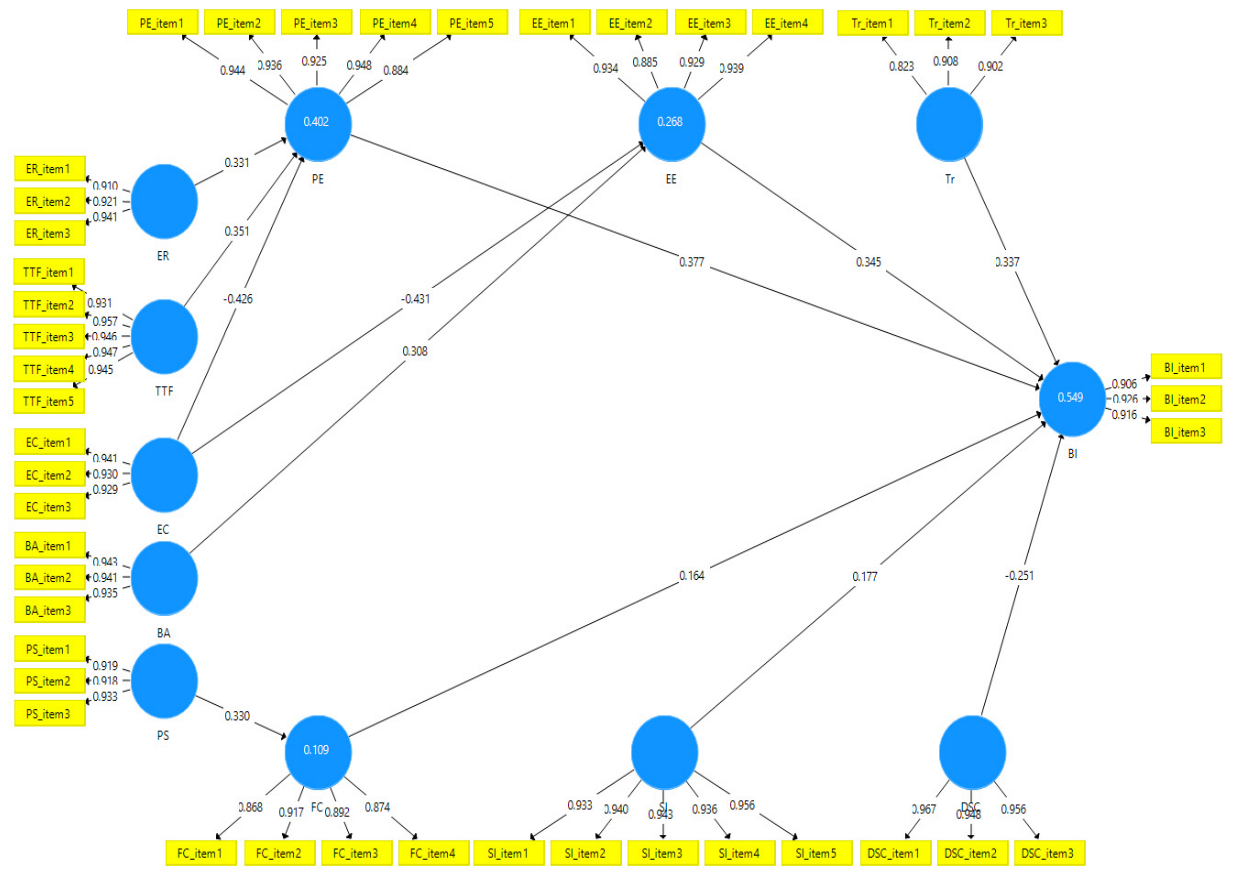
Following the confirmation of an adequate measurement model, the structural model in Figure 2 was evaluated by analyzing path coefficients (β), statistical significance (t-values and p-values), coefficient of determination (R2), effect size (f2), predictive relevance (Q2), and global model fit indices (SRMR and NFI) in accordance with the guidelines for PLS-SEM analysis [72,76]. While global fit indices such as SRMR and NFI are reported for transparency, the evaluation of the structural model primarily relies on its predictive power and the strength of hypothesized relationships, as global fit in PLS-SEM remains a subject of ongoing methodological debate.
The results of the procedure of bootstrapping show how all hypothesized relationships are statistically significant at p < 0.001, as shown in Table 5. PE (β = 0.377, t = 12.854), EE (β = 0.345, t = 10.782), SI (β = 0.177, t = 5.813) and FC (β = 0.164, t = 5.061), as well as Tr (β = 0.337, t = 10.603), have positive and significant effects on BI. In contrast, DSC shows a significant negative impact on BI (β = −0.251, t = 7.981), indicating that farmers’ effectiveness in adopting AI technologies is decreased when security concerns are increased. The size and direction of these effects is strong empirical evidence for the robustness of the proposed structural relationships.
The overall model fit was examined using SRMR (0.031) and NFI (0.917). Both values align with common heuristic thresholds (SRMR < 0.08; NFI > 0.90). However, following PLS-SEM best practices, these indices are treated as secondary to the explanatory power (R2) and predictive relevance (Q2) detailed above.
The model shows great explanatory power. BI has an R2 value of 0.549, which means the variance of 0.549 is accounted for by PE, EE, SI, FC, Tr, and DSC. According to Hair et al. (2019) [73,76], this is a moderate-to-substantial amount of explanatory power in behavioral research. PE (R2 = 0.402) and EE (R2 = 0.268) show an acceptable level of explained variance, which means that contextual antecedents, namely ER, TTF, EC, and BA, contribute significantly to the formation of the expectancy beliefs. FC also shows adequate explanatory power (R2 = 0.109) and that is due to PS.
The f2 analysis shows meaningful differences in the relative contribution of exogenous constructs. PE has a large effect on BI (f2 = 0.300) followed by EE (f2 = 0.252) and Tr (f2 = 0.247), showing a medium effect. DSC has also shown a medium effect (f2 = 0.139), showing its substantial role as an adoption barrier. SI (f2 = 0.070) and FC (f2 = 0.058) are observed to be small to medium, which are still meaningful in complex technology adoption circumstances [72,84]. For antecedents of PE and EE, TTF and EC show significant contributions, and ER and BA have smaller but significant effects.
The predictive relevance was measured with the Stone–Geisser Q2 criterion. All endogenous constructs have positive Q2 values (BI Q2 = 0.328; PE Q2 = 0.394; EE Q2 = 0.261; FC Q2 = 0.105), which suggests that the model has acceptable out-of-sample predictive power [75,85,86]. These results confirm that the proposed model not only explains variance but it is able to predict key endogenous constructs quite effectively. The substantial Q2 values for the endogenous constructs confirm the model’s high predictive relevance, suggesting that the results are robust and not merely a product of overfitting.
The overall model fit was further tested using “Standardized Root Mean Square Residual” (SRMR) and “Normed Fit Index” (NFI). The SRMR value obtained, 0.031, is much lower than the recommended value of 0.08, which indicates a good model fit [81,87]. The value of NFI is 0.917, which is greater than the cut-off point of 0.90 that is widely used to assess adequacy, further indicates the adequacy of the proposed structural model. Collectively, these indices indicate a good fit of the model to the observed data, and a compliance with contemporary quality criteria for PLS-SEM.
The results of hypothesis testing provide full empirical support for the research model proposed; see Figure 2 and Table 5. PE (H5), EE (H6), SI (H7), FC (H8), and Tr (H9) have all been found to have positive and significant influences on BI, which validates their key role in creating AI adoption intentions. Conversely, DSC (H10) demonstrates a significant negative effect, showing the security risk perception as an important deterrent.
Regarding the Expectancy formation variable, ER (H1) and TTF (H2) have a positive impact on the PE, while EC (H3a) has a significant negative impact. Similarly, EC has a negative impact on EE (H3b), but a positive impact from BA on the EE (H4). Finally, PS has a substantial effect on FC (H11). All hypotheses (H1–H11) are thus accepted and give a strong empirical validation to the theoretical framework and confirm the robustness of the structural relationships.
The stability of these structural estimates was further validated through a bootstrapping procedure with 5000 subsamples, ensuring that the path coefficients remain significant and reliable across variations in the dataset.

5. Discussion

This research paper examined the socio-technical and contextual factors that affect the intention of farmers to embrace AI products in the Midwestern U.S. by using an integrated model that incorporates UTAUT2, TTF, and agriculture variables. All 11 hypothesized relationships are empirically supported by the analysis of the 489 survey responses, which gives a solid justification to the proposed model and produces a number of significant theoretical and practical implications.
While all eleven hypotheses were supported at p < 0.001, we critically assessed these findings to ensure they were not the result of model overfitting. The consistency across paths likely reflects the strong theoretical grounding of the model within the specific context of the study rather than bias.

5.1. Environmental and Technological Fit Factors

These results indicate that ER has a considerable impact on PE, so that Midwest farmers who believe that they are more exposed to climate variability, pest outbreaks, or soil degradation tend to perceive AI tools as useful. This outcome is in line with the previous research that has shown that perceived vulnerability can boost the perceived utility of technology [30,32]. In agriculturally risky environments, AI systems, which offer predictive features, like warning of weather or pest conditions, are not only innovative but also required to stay resilient to operational security.
In the same vein, the relationship between TTF and PE is positive, which justifies the fact that farmers are more focused on functionality and compatibility with the core operations of the farm. The AI tools that help solve context-dependent problems, including irrigation scheduling, crop health analysis, or forecasts of the yield, will be more likely to be viewed as useful. This supports earlier studies that show that the probability of adoption rises when the capability of technology is equal to the operational demands [4,33].

5.2. Economic and Infrastructure Considerations

The two negative associations of EC with PE and with EE are indicative of the practical constraints confronting farmers in an environment with limited resources. In situations where AI systems are perceived to be helpful, perceived feasibility decreases due to high cost and the unpredictability of returns. The economic pressure also adds to the psychological and logistical pressure of learning new systems, increasing the perceived effort. These results are consistent with the earlier literature [34,36] and imply that financial assistance or subsidy initiatives might play a pivotal role in increasing the use of AI.
Conversely, there was a strong positive association between BA and EE, which highlights the enabling role of the former. Internet connectivity is reliable, minimizing latency, interruptions to data, and operational friction, which makes AI tools easier to use. This reinforces previous conclusions in the rural digital divide literature [13,21] and indicates that investments in infrastructure are not merely related to connectivity, but are also influenced by these factors, and by how easily and conveniently they are perceived to be by their users.
However, the interpretation of infrastructure as a driver must be moderated. Since our sampling procedure utilized online platforms and extension newsletters, the results likely overrepresent ‘digitally engaged’ farmers. For the truly disconnected segment of the Midwestern farming population, the negative impact of Economic Constraints and Broadband Access is likely even more severe than reported here. Consequently, policy recommendations regarding broadband must be viewed as a prerequisite for AI adoption, rather than a secondary facilitating condition.

5.3. Core Technology Acceptance Constructs

The findings affirm key principles of the UTAUT framework. Both EE and PE showed a strong positive impact on adoption intention, which reaffirmed their core position in the development of technology use behavior. When farmers find AI tools easy to work with and able to enhance performance, they are more likely to adopt them, which is in line with decades of IS research [14,18].
TR also proved to be a significant predictor of intention to adopt. Due to the obscurity of AI algorithms and the stakes associated with the agricultural decision-making process, trust represents a vital intermediation between a perceived value and a behavioral intention [9,26]. Trust increases user confidence in areas of farming where experiential knowledge and risk aversion are common, especially when farmers do not understand the inner workings of AI systems.
Interestingly, DSC was strongly negatively associated with adoption intention, which implies that security and privacy fears are still a prominent discouraging factor. Farmers are becoming more conscious that AI tools are gathering sensitive data on operational activities, and perceived threats of misuse or surveillance may cause a decrease in willingness to adopt, despite the performance gains. The result reflects the concerns of the previous literature [61,62] and denotes the significance of open data management in ag-tech systems.
The significant negative impact of “Data Security Concerns” (β= −0.251) suggests that for Midwestern farmers, data is viewed as a strategic asset. This aligns with recent findings by [7], indicating that as AI systems become more cloud-dependent, the perceived loss of data sovereignty becomes a primary psychological barrier that outweighs the performance benefits.

5.4. Social and Institutional Enablers

The research also discovered that SI plays a strong role in predicting adoption intentions. Technology perceptions can be significantly influenced by peer influences and recommendations from the extension agents in small-scale farming communities. This is consistent with the diffusion of innovation theory [65] and the results of other rural ag-tech research [15], which highlight the importance of trust-based social networks in the dissemination of innovation.
The training availability, vendor support, and technical assistance in terms of FC had a significant positive impact on adoption intention and confirmed their contribution to the minimization of operational barriers [20]. In addition, PS had a significant association with FC, which indicates that well-formulated institutional policies in the form of subsidies, broadband programs, or ag-extension funding are converted into actual infrastructural benefits that increase AI preparedness at the ground level.
While the results provide empirical support for the hypothesized relationships, these findings should be interpreted with caution. The high significance levels across all paths suggest a strong alignment between the socio-technical model and the sample; however, this may also reflect an ‘innovation bias’ among Midwestern farmers who are already integrated into precision agriculture networks. It is possible that alternative factors not captured in this model—such as the specific type of crop produced or the farmer’s personal digital self-efficacy—could offer competing explanations for the high adoption intention observed.

5.5. Theoretical Synthesis: Beyond Deterministic Adoption

This study moves beyond the deterministic ‘functionality–adoption’ link by demonstrating that in rural AI contexts, technological fit is not an isolated perception. By integrating socio-technical variables, the model reveals that factors like “Environmental Risk” and “Broadband Access” function as ‘foundational enablers.’ The theoretical insight here is that for AI, “Performance Expectancy” is not merely a product of the software’s capability, but a ‘context-contingent’ belief. If the economic or infrastructural ‘floor’ is missing, the perceived value of the AI’s sophisticated algorithms diminishes, regardless of its objective technical superiority.

5.6. Practical Realities of AI Deployment in Midwestern Agriculture

To move beyond theoretical acceptance, the practical deployment of AI in the U.S. Corn Belt must be evaluated through its operational viability. Current technical capabilities, such as Computer Vision for site-specific weed management and “Long Short-Term Memory” (LSTM) networks for yield forecasting, show high precision in controlled trials but often encounter ‘model drift’ when exposed to the extreme weather variability of the Midwest.
In real-world operations, AI is currently functioning as a “Decision Support Tool” (DST) rather than a replacement for human agency. Farmers integrate these outputs into existing “Farm Management Information Systems” (FMIS), where the magnitude of benefit is measured by tangible resource efficiency—specifically, a documented 15–20% reduction in nitrogen application and a 5–10% increase in grain yield. From the farmer’s perspective, the ‘ease of use’ is often hindered by the ‘hidden labor’ of data cleaning and the high capital requirement for sensor arrays. Ultimately, the evaluation of trust is not a static state but a process of ‘trialability’; farmers mitigate risk by running AI recommendations on small ‘check strips’ to verify performance against traditional methods before full-scale adoption.

6. Conclusions and Implications

6.1. Conclusions

This paper suggested and empirically verified a socio-technical model of AI adoption in agriculture based on the Unified “Theory of Acceptance and Use of Technology” (UTAUT), and “Task–Technology Fit” (TTF), and extended it with the application of agriculture-specific situation characteristics, including ER, EC, BA, and PS. The survey information of 489 Midwestern farmers gave solid evidence to all 11 hypotheses, which provides an all-inclusive explanation of the method with which the intention to adopt core technology is formed by farmers not only through the influence of the main technology acceptance constructs of PE and EE but also through the institutional, economic, and infrastructural environment. The results ensure that the use of AI is not just a personal attitude based on the efficiency of the tools, but a profound part of the socio-technical environment of farmers.

6.2. Theoretical Implications

The study contributes to the technology adoption literature in agriculture in several aspects. In the first place, it expands the UTAUT model by incorporating TTF and trust constructs in addition to domain-specific antecedents like DSC and PS. In this way, the research will address the recent demands of context-sensitive models of ag-tech adoption studies [14,20]. Second, the high predictive ability of environmental risk and task–technology fit to PE highlights the significance of perceived utility in high-uncertainty, high-climate-risk areas, especially in the Midwest, where the predictive utility of climate variability and agent-level risk is high. Third, the fact that PS was indirectly conducive to adoption through an improvement in perceived FCs contributes to the emerging body of literature on the infrastructural and institutional FCs of digital transformation in rural economies [2,3].

6.3. Managerial and Practical Implications

The findings provide practical information to policymakers and ag-tech developers. FC and TR turned out to be essential mediators of adoption and indicated that technology vendors and publicly offered extensions should focus on user training, transparency, and after-adoption assistance in order to mediate the trust divide in rural communities. The effects of BA and PS confirm the necessity of an increased level of digital infrastructure and the use of specific subsidies for integrating AI. Moreover, the high impact of ER on PE suggests that communication about AI instruments should reinforce the message of resilience and reduction in any risk, particularly in messages that are delivered to small and medium-sized farms that are located in high-variability areas. Developers should also emphasize the task relevance of AI applications by co-designing with farmers to be perceived as highly relevant to daily operations.

6.4. Limitations and Recommendations for Future Research

Although the study has a strong socio-technical framework, it is not without limitations. First, causal inference is restricted due to the use of cross-sectional surveys. Longitudinal research might be more effective in determining how adoption intentions change with actual use of the system over time. Because this study is cross-sectional, the reported ‘strong empirical support’ should be viewed as a snapshot of current intentions rather than a longitudinal certainty. Future research must address the potential for sampling bias to ensure that policy interventions do not leave behind the most marginalized, non-digitally active operators. Additionally, the reliance on online distribution and snowball sampling introduces a potential selection bias. This approach may have inadvertently excluded less digitally engaged farmers or those in areas with severely limited connectivity, whose barriers to AI adoption likely differ from our study population. Second, the sample size is adequate to use SEM; however, it is geographically limited to the Midwest. Future studies might replicate the model in other agricultural regions (e.g., the South, the Pacific Northwest, or developing countries) and evaluate generalizability. Furthermore, while the current model demonstrates high predictive relevance, future studies should incorporate robustness analyses such as “Multi-Group Analysis” (MGA) to test for variations across farm sizes or experience levels, as well as Gaussian Copula approaches to assess potential endogeneity. The use of self-reported data also introduces the risk of “common method bias” (CMB). While we addressed this through careful survey design, future research should utilize objective performance data or multi-source data to mitigate this risk and validate the self-reported perceptions found in this study. The uniform significance across all hypotheses may be attributed to the specific sample characteristics or the maturity of the constructs used. Future research should test this model in more diverse settings to see if these strong relationships hold. Third, the research examined adoption intention as opposed to actual use. Behavioral indicators that can be estimated in future research might involve frequency of AI tool usage, system longevity, or usage diversity. Lastly, the future work can incorporate psychological variables, e.g., digital self-efficacy or resistance to change, which can further clarify the difference in adoption behavior—especially in older or less tech-savvy farmers. To address these limitations, future efforts should employ stratified random sampling and mixed-mode surveys (e.g., mail and phone) to capture a more diverse range of technological readiness across the agricultural sector.

Author Contributions

Conceptualization, A.F.A. and C.N.; methodology, A.F.A.; software, A.F.A. and A.A.A.; validation, A.F.A. and A.A.A.; formal analysis, A.F.A. and A.A.A.; investigation, A.F.A. and C.N.; resources, A.F.A. and C.N.; data curation, A.F.A. and A.A.A.; writing—original draft preparation, A.F.A.; writing—review and editing, C.N. and A.A.A.; visualization, A.F.A. and A.A.A.; supervision, A.F.A.; project administration, A.F.A.; funding acquisition, A.F.A. and C.N. All authors have read and agreed to the published version of the manuscript.

Funding

This research was funded by the State of South Dakota, via legislative funding to Dakota State University. The finding number: 2022 House Bill 1092.

Institutional Review Board Statement

The study was conducted in accordance with the Declaration of Helsinki, and approved by the Institutional Review Board) of Dakota State University (protocol code DSUIRB-20251211-05EX and 11 December 2025).

Informed Consent Statement

Informed consent was obtained from all subjects involved in the study.

Data Availability Statement

The data presented in this study are available on request from the corresponding author.

Acknowledgments

The authors would like to express their sincere gratitude to the Midwestern U.S. farmers who participated in this study, as well as the agricultural extension offices and cooperatives that facilitated data collection. This research was a collaborative effort between Dakota State University, the University of Mosul, and the University of Jordan. We also acknowledge the role of regional extension programs and policy initiatives in supporting the digital transformation of rural farming communities. Finally, we thank the Editor and the anonymous reviewers for their insightful feedback which helped refine this manuscript.

Conflicts of Interest

The authors declare no conflicts of interest.

Appendix A

Table A1. Questionnaire items.
Construct Questionnaire ItemReference
Performance ExpectancyPE1I would find the use of AI tools useful in my daily farm work. [14,18]
PE2I think the use of AI technologies makes my farm more productive.
PE3Using AI tools would improve the overall efficiency of my farm operations.
PE4AI use will increase the profitability of my farming activities.
PE5I think that the use of AI tools would make my farm management more environmentally sustainable.
Effort ExpectancyEE1Learning to use AI tools would be easy for me.[14,18]
EE2I find AI-based systems user-friendly for farm operations.
EE3It would not take much effort to become skillful at using AI tools.
EE4My interaction with AI technologies is clear and understandable.
Task–Technology FitTTF1AI tools match the specific tasks required in my farming operations.[19]
TTF2AI features are relevant to the way I manage my farm.[19]
TTF3There is a good fit between the AI tools available and my agricultural needs.[88]
TTF4The AI tools I use are capable of supporting the most critical decisions I make on my farm.[27]
TTF5I believe the AI tools provide functionality that aligns with my daily agricultural work processes.[27]
Trust in TechnologyTT1I believe AI tools will work reliably on my farm.[26]
TT2I am confident AI tools will produce accurate recommendations.[25]
TT3I trust the algorithms behind AI tools to make objective decisions.[89]
Social InfluenceSI1People I work with on the farm (agronomists, consultants, salesmen, etc.) think I should use AI technologies.[14,18]
SI2People I trust think I should use AI tools.
SI3I feel social pressure to adopt AI technologies in farming.
SI4Extension agents or co-op advisors encourage me to use AI systems.
SI5 In general, most people who are important to me in my farming community think I should use AI technologies
Facilitating ConditionsFC1I think I have the necessary basic knowledge to adopt AI technologies.[14,18]
FC2I think I have the necessary resources (economic, technical, infrastructural, etc.) to adopt AI technologies.
FC3AI technologies are compatible with other technologies I already use.
FC4If I am in difficulty with the use of AI technologies, there are people (or a group of people) who would provide me with assistance
and/or support.
Data Security ConcernsDSC1I am concerned about how my farm data is stored by AI systems.[4]
DSC2I worry about unauthorized access to the data collected by AI tools.[90]
DSC3I am hesitant to adopt AI because of privacy concerns with my information.[17,58,91]
Digital LiteracyDL1I feel confident using technology like smartphones, tablets, or computers.[92]
DL2I can easily learn to use new digital tools for farm-related decisions.[65]
DL3I often use digital tools or applications in my farming practices.[65]
Trust in InstitutionsTI1I trust recommendations about AI tools from university extension programs.[93]
TI2I believe government agencies like USDA support farmers fairly with technology.[94]
TI3I have confidence in the private companies providing AI services.[94]
Policy SupportPS1There are government incentives to support AI use in agriculture.[1]
PS2Current ag policies promote the use of AI tools on farms like mine.[10]
PS3Federal or state programs provide resources for adopting AI.[1]
Environmental RiskER1Changes in the environment (e.g., drought, pests) push me to try AI.[29]
ER2AI tools help me manage climate-related risks more effectively.[30]
ER3I feel pressure to adopt AI due to worsening environmental conditions.[30]
Broadband AccessBA1My internet connection is reliable enough to run AI tools.[13]
BA2I have consistent broadband access to use AI-based applications.[13,43]
BA3Internet speed on my farm is sufficient to support real-time AI tools.[13]
Economic ConstraintsEC1The cost of AI tools is too high for my current financial situation.[95]
EC2I am uncertain about the return on investment of AI tools.[96]
EC3My farm income level limits my ability to adopt new technologies like AI.[96]

References

  1. OECD. Digital Opportunities for Better Agricultural Policies; OECD: Paris, France, 2019. [Google Scholar] [CrossRef]
  2. Eastwood, C.; Klerkx, L.; Ayre, M.; Dela Rue, B. Managing Socio-Ethical Challenges in the Development of Smart Farming: From a Fragmented to a Comprehensive Approach for Responsible Research and Innovation. J. Agric. Environ. Ethics 2019, 32, 741–768. [Google Scholar] [CrossRef]
  3. Klerkx, L.; Jakku, E.; Labarthe, P. A review of social science on digital agriculture, smart farming and agriculture 4.0: New contributions and a future research agenda. NJAS Wagening. J. Life Sci. 2019, 90–91, 1–16. [Google Scholar] [CrossRef]
  4. Wolfert, S.; Ge, L.; Verdouw, C.; Bogaardt, M.-J. Big Data in Smart Farming–A review. Agric. Syst. 2017, 153, 69–80. [Google Scholar] [CrossRef]
  5. Koshariya, A.K.; Rameshkumar, P.M.; Balaji, P.; Cavaliere, L.P.L.; Dornadula, V.H.R.; Singh, B. Data-driven insights for agricultural management: Leveraging industry 4.0 technologies for improved crop yields and resource optimization. In Robotics and Automation in Industry 4.0; CRC Press: Boca Raton, FL, USA, 2024; pp. 260–274. [Google Scholar]
  6. Liakos, K.G.; Busato, P.; Moshou, D.; Pearson, S.; Bochtis, D. Machine Learning in Agriculture: A Review. Sensors 2018, 18, 2674. [Google Scholar] [CrossRef]
  7. Sharma, K.; Shivandu, S.K. Integrating artificial intelligence and Internet of Things (IoT) for enhanced crop monitoring and management in precision agriculture. Sens. Int. 2024, 5, 100292. [Google Scholar] [CrossRef]
  8. USDA Midwest Climate Hub. Climate Change and Agriculture in the Midwest; USDA Midwest Climate Hub: Ames, IA, USA, 2021.
  9. Gardezi, M.; Joshi, B.; Rizzo, D.M.; Ryan, M.; Prutzer, E.; Brugler, S.; Dadkhah, A. Artificial intelligence in farming: Challenges and opportunities for building trust. Agron. J. 2024, 116, 1217–1228. [Google Scholar] [CrossRef]
  10. Prokopy, L.S.; Floress, K.; Arbuckle, J.G.; Church, S.P.; Eanes, F.R.; Gao, Y.; Gramig, B.M.; Ranjan, P.; Singh, A.S. Adoption of agricultural conservation practices in the United States: Evidence from 35 years of quantitative literature. J. Soil Water Conserv. 2019, 74, 520–534. [Google Scholar] [CrossRef]
  11. Cano, P.; Mandrini, G.; Buckmaster, D.; Arnall, B.; Carroll, M.; Sharda, A.; Balboa, G.; Carcedo, A.; Hawkins, E.; Fulton, J.; et al. Farmer perspectives on digital agriculture in the US Midwest. Agron. J. 2026, 118, e70268. [Google Scholar] [CrossRef]
  12. GAO.U.S. Government Accountability Office. Precision Agriculture: Benefits and Challenges for Technology Adoption and Use (GAO-24-105962); GAO.U.S.: Washington, DC, USA, 2024.
  13. Whitacre, B.; Gallardo, R.; Strover, S. Broadband׳s contribution to economic growth in rural areas: Moving towards a causal relationship. Telecommun. Policy 2014, 38, 1011–1023. [Google Scholar] [CrossRef]
  14. Giua, C.; Materia, V.C.; Camanzi, L. Smart farming technologies adoption: Which factors play a role in the digital transition? Technol. Soc. 2022, 68, 101869. [Google Scholar] [CrossRef]
  15. Michels, M.; Bonke, V.; Musshoff, O. Understanding the adoption of smartphone apps in crop protection. Precis. Agric. 2020, 21, 1209–1226. [Google Scholar] [CrossRef]
  16. Patil, R.; Sable, N.P.; Mahalle, P.N.; Shinde, G.R.; Dhotre, P.; Chandre, P. Role of data-centric artificial intelligence in agriculture. In Data-Centric Artificial Intelligence for Multidisciplinary Applications; Chapman and Hall/CRC: Boca Raton, FL, USA, 2024; pp. 159–176. [Google Scholar]
  17. Sood, A.; Bhardwaj, A.K.; Sharma, R.K. Perceptions of facilitators towards adoption of AI-based solutions for sustainable agriculture. J. Decis. Syst. 2023, 1–35. [Google Scholar] [CrossRef]
  18. Venkatesh, V.; Morris, M.G.; Davis, G.B.; Davis, F.D. User Acceptance of Information Technology: Toward a Unified View. MIS Q. 2003, 27, 425–478. [Google Scholar] [CrossRef]
  19. Goodhue, D.L.; Thompson, R.L. Task-Technology Fit and Individual Performance. Manag. Inf. Syst. Q. 1995, 19, 213–236. [Google Scholar] [CrossRef]
  20. Ronaghi, M.H.; Forouharfar, A. A contextualized study of the usage of the Internet of things (IoTs) in smart farming in a typical Middle Eastern country within the context of Unified Theory of Acceptance and Use of Technology model (UTAUT). Technol. Soc. 2020, 63, 101415. [Google Scholar] [CrossRef]
  21. Drewry, J.L.; Shutske, J.M.; Trechter, D.; Luck, B.D.; Pitman, L. Assessment of digital technology adoption and access barriers among crop, dairy and livestock producers in Wisconsin. Comput. Electron. Agric. 2019, 165, 104960. [Google Scholar] [CrossRef]
  22. Venkatesh, V.; Thong, J.Y.L.; Xu, X. Consumer Acceptance and Use of Information Technology: Extending the Unified Theory of Acceptance and Use of Technology. MIS Q. 2012, 36, 157–178. [Google Scholar] [CrossRef]
  23. Abdulmuhsin, A.A.; Al Atraqchi, O.M.A.; Rehman, S.U.; Alkhwaldi, A.F.; Mjlae, S.A. Exploring Academics’ Orientation Towards Large Language Model Adoption: A Knowledge Management Approach Using ChatGPT and Retrieval-Augmented Generation. Knowl. Process Manag. 2026. [Google Scholar] [CrossRef]
  24. Alshammari, S.H.; Alkhwaldi, A.F.; Alshammari, A.E.A.; Alshammari, M.H.; Alrashidi, M.E. Extending the UTAUT Model: The role of cognitive flexibility in AI adoption in higher education. Acta Psychol. 2026, 263, 106363. [Google Scholar] [CrossRef]
  25. Pavlou, P.A. Consumer acceptance of electronic commerce: Integrating trust and risk with the technology acceptance model. Int. J. Electron. Commer. 2003, 7, 101–134. [Google Scholar] [CrossRef]
  26. McKnight, D.H.; Carter, M.; Thatcher, J.B.; Clay, P.F. Trust in a specific technology: An investigation of its components and measures. ACM Trans. Manag. Inf. Syst. (TMIS) 2011, 2, 12. [Google Scholar] [CrossRef]
  27. Wang, X.; Li, M.; Yao, Y.; Zhu, X. A Study of Factors Influencing Chinese Design Students’ Adoption of AIGC Tools. IEEE Access 2025, 13, 117753–117770. [Google Scholar] [CrossRef]
  28. Arbuckle, J.G.; Morton, L.W.; Hobbs, J. Understanding Farmer Perspectives on Climate Change Adaptation and Mitigation:The Roles of Trust in Sources of Climate Information, Climate Change Beliefs, and Perceived Risk. Environ. Behav. 2015, 47, 205–234. [Google Scholar] [CrossRef] [PubMed]
  29. Arbuckle, J.G.; Tyndall, J.C.; Morton, L.W.; Hobbs, J. Climate change typologies and audience segmentation among Corn Belt farmers. J. Soil Water Conserv. 2017, 72, 205–214. [Google Scholar] [CrossRef]
  30. Antle, J.M.; Ray, S. Sustainable agricultural development. In Palgrave Studies in Agricultural Economics and Food Policy, 1st ed.; Palgrave Macmillan: Cham, Switzerland, 2020. [Google Scholar]
  31. Guo, Z.; Chen, X.; Zhang, Y. Impact of environmental regulation perception on farmers’ agricultural green production technology adoption: A new perspective of social capital. Technol. Soc. 2022, 71, 102085. [Google Scholar] [CrossRef]
  32. Xie, H.; Huang, Y. Influencing factors of farmers’ adoption of pro-environmental agricultural technologies in China: Meta-analysis. Land Use Policy 2021, 109, 105622. [Google Scholar] [CrossRef]
  33. Dishaw, M.T.; Strong, D.M. Extending the technology acceptance model with task–technology fit constructs. Inf. Manag. 1999, 36, 9–21. [Google Scholar] [CrossRef]
  34. Mohr, S.; Kühl, R. Acceptance of artificial intelligence in German agriculture: An application of the technology acceptance model and the theory of planned behavior. Precis. Agric. 2021, 22, 1816–1844. [Google Scholar] [CrossRef]
  35. Rose, D.C.; Chilvers, J. Agriculture 4.0: Broadening responsible innovation in an era of smart farming. Front. Sustain. Food Syst. 2018, 2, 87. [Google Scholar] [CrossRef]
  36. Engotoit, B.; Kituyi, G.M.; Moya, M.B. Influence of performance expectancy on commercial farmers’ intention to use mobile-based communication technologies in Uganda. J. Syst. Inf. Technol. 2016, 18, 346–366. [Google Scholar] [CrossRef]
  37. Rose, D.C.; Sutherland, W.J.; Parker, C.; Lobley, M.; Winter, M.; Morris, C.; Twining, S.; Ffoulkes, C.; Amano, T.; Dicks, L.V. Decision support tools for agriculture: Towards effective design and delivery. Agric. Syst. 2016, 149, 165–174. [Google Scholar] [CrossRef]
  38. Raunaq, F.F.; Islam, S.; Anam, M.Z.; Bari, A.B.M.M. Assessing the challenges to digital technology adoption in the healthcare sector: Implications for sustainability in emerging economies. Inform. Health 2025, 2, 194–209. [Google Scholar] [CrossRef]
  39. Lioutas, E.D.; Charatsari, C. Big data in agriculture: Does the new oil lead to sustainability? Geoforum 2020, 109, 1–3. [Google Scholar] [CrossRef]
  40. Sharma, V.; Priya, B. Bridging the gap: AI-powered FinTech and its impact on financial inclusion and financial well-being. Discov. Artif. Intell. 2025, 5, 290. [Google Scholar] [CrossRef]
  41. Sabbagh, M.; Gutierrez, L. Farmers’ Intention Towards Investing in Agriculture 4.0 in Marginal and Non-marginal Conditions. Bio-Based Appl. Econ. 2025, 14, 45–66. [Google Scholar] [CrossRef]
  42. Venkatesh, V. Adoption and use of AI tools: A research agenda grounded in UTAUT. Ann. Oper. Res. 2022, 308, 641–652. [Google Scholar] [CrossRef]
  43. Greig, J.; Nelson, H.; Clardy, G.; Douglas, M. Almost priceless: How internet access impacts US farmer leaders’ precision agriculture technology perceptions. Precis. Agric. 2024, 25, 360–375. [Google Scholar] [CrossRef]
  44. Saha, A.; Dutta, A.; Sifat, R.I. The mental impact of digital divide due to COVID-19 pandemic induced emergency online learning at undergraduate level: Evidence from undergraduate students from Dhaka City. J. Affect. Disord. 2021, 294, 170–179. [Google Scholar] [CrossRef]
  45. Paico-Saavedra, S.; Rojas-Rivero, A.; Elizondo-Candanedo, R.F.; Arranz-López, A.; Soria-Lara, J.A. Digital and socioeconomic inequalities in perceived mobility restrictions for activity participation: Captive users in Madrid. J. Urban Mobil. 2025, 8, 100142. [Google Scholar] [CrossRef]
  46. Li, X.; Zhang, C.; Zhao, Y.; Feng, H. Navigating Ageing in Place Within a Smart Home: Bridging Stakeholder Viewpoints. J. Popul. Ageing 2025, 1–20. [Google Scholar] [CrossRef]
  47. Gefen, D.; Straub, D.W. The relative importance of perceived ease of use in IS adoption: A study of e-commerce adoption. J. Assoc. Inf. Syst. 2000, 1, 8. [Google Scholar] [CrossRef]
  48. Yan, H.; Lu, L.; Li, Z.; Wang, J. From Innovation to Implementation: Factors Driving Chinese Farmers’ Adoption Intentions for Laser Weeding Robots. In Proceedings of the 2025 International Conference on Smart Agriculture and Artificial Intelligence, Xi’an, China, 13–15 June 2025; pp. 150–156. [Google Scholar]
  49. Alkhwaldi, A.F.; Abdulmuhsin, A.A.; Bhat, M.A.; Khan, S.T.; Al-Adwan, A.S. Harnessing AI for greener behaviour: How artificial intelligence can nudge individuals and organizations towards environmental sustainability. J. Syst. Inf. Technol. 2026, 1–26. [Google Scholar] [CrossRef]
  50. Ng, S.W.T.; Zhang, R. Trust in AI-driven chatbots: A systematic review. Telemat. Inform. 2025, 97, 102240. [Google Scholar] [CrossRef]
  51. PurdueUniversity. Americans Support AI in Farming But Demand Transparency. Available online: https://www.nationalhogfarmer.com/farming-business-management/americans-support-ai-in-farming-but-demand-transparency (accessed on 26 November 2025).
  52. Weston, S.; Crowley, K.; Smith, W.; Crow, J. Could the Next AI Revolution be Found on American Farms? Available online: https://www.ksnblocal4.com/2025/11/12/could-next-ai-revolution-be-found-american-farms/ (accessed on 26 November 2025).
  53. Houda, Z.; Khalid, C. The Role of Uncertainty Avoidance, Trust, and Land Tenure in Predicting the Adoption of Green IoT Irrigation Systems in Morocco: An Improved Model. In Proceedings of the International Conference on Advanced Intelligent Systems for Sustainable Development; Springer: Cham, Switzerland, 2023; pp. 368–383. [Google Scholar]
  54. Akudugu, M.A.; Nkegbe, P.K.; Wongnaa, C.A.; Millar, K.K. Technology adoption behaviors of farmers during crises: What are the key factors to consider? J. Agric. Food Res. 2023, 14, 100694. [Google Scholar] [CrossRef]
  55. Gan, Q.; Lau, R.Y.K. Trust in a ‘trust-free’system: Blockchain acceptance in the banking and finance sector. Technol. Forecast. Soc. Change 2024, 199, 123050. [Google Scholar] [CrossRef]
  56. Asif, M.; Sarwar, F. The essential position of trust in the technology acceptance model: A comprehensive review and bibliometric analysis in management studies. J. Model. Manag. 2025, 20, 1635–1655. [Google Scholar] [CrossRef]
  57. Holzinger, A.; Weippl, E.; Tjoa, A.M.; Kieseberg, P. Digital Transformation for Sustainable Development Goals (SDGs)-A Security, Safety and Privacy Perspective on AI. In International Cross-Domain Conference for Machine Learning and Knowledge Extraction; Springer: Cham, Switzerland, 2021; pp. 1–20. [Google Scholar]
  58. Sood, A.; Bhardwaj, A.K.; Sharma, R.K. Towards sustainable agriculture: Key determinants of adopting artificial intelligence in agriculture. J. Decis. Syst. 2024, 33, 833–877. [Google Scholar] [CrossRef]
  59. Georgopoulos, V.P.; Gkikas, D.C.; Theodorou, J.A. Factors Influencing the Adoption of Artificial Intelligence Technologies in Agriculture, Livestock Farming and Aquaculture: A Systematic Literature Review Using PRISMA 2020. Sustainability 2023, 15, 16385. [Google Scholar] [CrossRef]
  60. Al-Mughairi, H.; Bhaskar, P. Exploring the factors affecting the adoption AI techniques in higher education: Insights from teachers’ perspectives on ChatGPT. J. Res. Innov. Teach. Learn. 2025, 18, 232–247. [Google Scholar] [CrossRef]
  61. Sakib, M.N.; Akter, M.; Sahabuddin, M.; Fahlevi, M. An application of the extended UTAUT model to understand the adoption of cashless transactions: Evidence from developing country. J. Sci. Technol. Policy Manag. 2024, 16, 912–926. [Google Scholar] [CrossRef]
  62. Salah, O.H.; Ayyash, M.M. Understanding user adoption of mobile wallet: Extended TAM with knowledge sharing, perceived value, perceived privacy awareness and control, perceived security. VINE J. Inf. Knowl. Manag. Syst. 2025, 55, 1223–1250. [Google Scholar] [CrossRef]
  63. Sultan, E.A.J.; Abdulmuhsin, A.A.; Rehman, S.U.; Alkhwaldi, A.F.; Abu-AlSondos, I.A.; Yaseen, S.G. Bridging minds in the metaverse: Unveiling academics’ intentions through a UTAUT3 lens on relational capital integration. Inf. Discov. Deliv. 2026, 1–21. [Google Scholar] [CrossRef]
  64. High, C.; Singh, N.; Nemes, G. Artificial Intelligence for Agricultural Extension: Supporting Transformative Learning Among Smallholder Farmers. J. Dev. Policy Pract. 2025, 11, 61–80. [Google Scholar] [CrossRef]
  65. Rogers, E. Diffusion of Innovations. In An Integrated Approach to Communication Theory and Research, 5th ed.; Routledge: London, UK, 2003. [Google Scholar]
  66. Molina-Maturano, J.; Verhulst, N.; Tur-Cardona, J.; Güereña, D.T.; Gardeazábal-Monsalve, A.; Govaerts, B.; Speelman, S. Understanding Smallholder Farmers’ Intention to Adopt Agricultural Apps: The Role of Mastery Approach and Innovation Hubs in Mexico. Agronomy 2021, 11, 194. [Google Scholar] [CrossRef]
  67. USDA. ReConnect Loan and Grant Program. Available online: https://www.usda.gov/reconnect (accessed on 27 December 2025).
  68. National Institute of Food and Agriculture, U.S. Department of Agriculture, USDA NIFA. AFRI Education and Workforce Development Program. Available online: https://www.nifa.usda.gov/grants/programs/agriculture-food-research-initiative-afri (accessed on 15 January 2026).
  69. USDA. Conservation Innovation Grants (CIG). Available online: https://www.nrcs.usda.gov/programs-initiatives/conservation-innovation-grants (accessed on 27 December 2025).
  70. Li, B.; Ding, J.; Wang, J.; Zhang, B.; Zhang, L. Key factors affecting the adoption willingness, behavior, and willingness-behavior consistency of farmers regarding photovoltaic agriculture in China. Energy Policy 2021, 149, 112101. [Google Scholar] [CrossRef]
  71. Driessen, C.; Heutinck, L.F.M. Cows desiring to be milked? Milking robots and the co-evolution of ethics and technology on Dutch dairy farms. Agric. Hum. Values 2015, 32, 3–20. [Google Scholar] [CrossRef]
  72. Hair, J.F.; Hult, G.T.M.; Ringle, C.M.; Sarstedt, M. A Primer on Partial Least Squares Structural Equation Modeling (PLS-SEM), 3rd ed.; SAGE Publications: Thousand Oaks, CA, USA, 2021. [Google Scholar]
  73. Hair, J.F.; Black, W.C.; Babin, B.J.; Anderson, R.E. Multivariate Data Analysis, 8th ed.; Cengage Learning: Boston, MA, USA, 2019. [Google Scholar]
  74. Armstrong, J.S.; Overton, T.S. Estimating Nonresponse Bias in Mail Surveys. J. Mark. Res. 1977, 14, 396–402. [Google Scholar] [CrossRef]
  75. Hair, J.F.; Hult, G.T.M.; Ringle, C.M.; Sarstedt, M.; Danks, N.P.; Ray, S. Partial Least Squares Structural Equation Modeling (PLS-SEM) Using R: A Workbook; Springer: Berlin/Heidelberg, Germany, 2022. [Google Scholar]
  76. Hair, J.F.; Risher, J.J.; Sarstedt, M.; Ringle, C.M. When to use and how to report the results of PLS-SEM. Eur. Bus. Rev. 2019, 31, 2–24. [Google Scholar] [CrossRef]
  77. Chin, W.W. The partial least squares approach to structural equation modeling. In Modern Methods for Business Research; Psychology Press: Hove, UK, 1998; pp. 295–336. [Google Scholar]
  78. Nunnally, J.C.; Bernstein, I.H. Psychometric Theory; New York McGraw-Hill: New York, NY, USA, 1994. [Google Scholar]
  79. Raykov, T. Estimation of composite reliability for congeneric measures. Appl. Psychol. Meas. 1997, 21, 173–184. [Google Scholar] [CrossRef]
  80. Fornell, C.; Larcker, D.F. Evaluating Structural Equation Models with Unobservable Variables and Measurement Error. J. Mark. Res. 1981, 18, 39–50. [Google Scholar] [CrossRef]
  81. Henseler, J.; Ringle, C.M.; Sarstedt, M. A new criterion for assessing discriminant validity in variance-based structural equation modeling. J. Acad. Mark. Sci. 2015, 43, 115–135. [Google Scholar] [CrossRef]
  82. Diamantopoulos, A.; Siguaw, J.A. Formative versus reflective indicators in organizational measure development: A comparison and empirical illustration. Br. J. Manag. 2006, 17, 263–282. [Google Scholar] [CrossRef]
  83. Kock, N. Common method bias in PLS-SEM: A full collinearity assessment approach. Int. J. E-Collab. (IJEC) 2015, 11, 1–10. [Google Scholar] [CrossRef]
  84. Cohen, J. Statistical Power Analysis for the Behavioral Sciences, 2nd ed.; Lawrence Erlbaum Associates: Mahwah, NJ, USA, 1988. [Google Scholar]
  85. Stone, M. Cross-validatory choice and assessment of statistical predictions. J. R. Stat. Soc. Ser. B (Methodol.) 1974, 36, 111–133. [Google Scholar] [CrossRef]
  86. Geisser, S. The predictive sample reuse method with applications. J. Am. Stat. Assoc. 1975, 70, 320–328. [Google Scholar] [CrossRef]
  87. Hu, L.t.; Bentler, P.M. Cutoff criteria for fit indexes in covariance structure analysis: Conventional criteria versus new alternatives. Struct. Equ. Model. A Multidiscip. J. 1999, 6, 1–55. [Google Scholar] [CrossRef]
  88. Gebauer, J.; Shaw, M.J.; Gribbins, M.L. Task-Technology Fit for Mobile Information Systems. J. Inf. Technol. 2010, 25, 259–272. [Google Scholar] [CrossRef]
  89. Thatcher, J.B.; McKnight, D.H.; Baker, E.W.; Arsal, R.E.; Roberts, N.H. The Role of Trust in Postadoption IT Exploration: An Empirical Examination of Knowledge Management Systems. IEEE Trans. Eng. Manag. 2011, 58, 56–70. [Google Scholar] [CrossRef]
  90. Carbonell, I.M. The ethics of big data in big agriculture. Internet Policy Rev. 2016, 5, 1–13. [Google Scholar] [CrossRef]
  91. Shutske, J.M.; Trechter, D.; Luck, B.D.; Drewry, J.L.; DeWitte, M.J.; Pitman, L.; Kluz, M. Assessment of Digital Capacity, Needs and Access Barriers Among Crop, Dairy and Livestock Producers. In Proceedings of the 2018 ASABE Annual International Meeting, St. Joseph, MI, USA, 29 July–1 August 2018; p. 1. [Google Scholar]
  92. van Deursen, A.J.A.M.; van Dijk, J.A.G.M. The digital divide shifts to differences in usage. New Med. Soc. 2014, 16, 507–526. [Google Scholar] [CrossRef]
  93. Slovic, P. Perceived Risk, Trust, and Democracy. Risk Anal. 1993, 13, 675–682. [Google Scholar] [CrossRef]
  94. Siegrist, M.; Cvetkovich, G.; Roth, C. Salient Value Similarity, Social Trust, and Risk/Benefit Perception. Risk Anal. 2000, 20, 353–362. [Google Scholar] [CrossRef]
  95. Feder, G.; Just, R.E.; Zilberman, D. Adoption of Agricultural Innovations in Developing Countries: A Survey. Econ. Dev. Cult. Change 1985, 33, 255–298. [Google Scholar] [CrossRef]
  96. Schimmelpfennig, D. Farm Profits and Adoption of Precision Agriculture; ERR-217; U.S. Department of Agriculture, Economic Research Service: Washington, DC, USA, 2016.
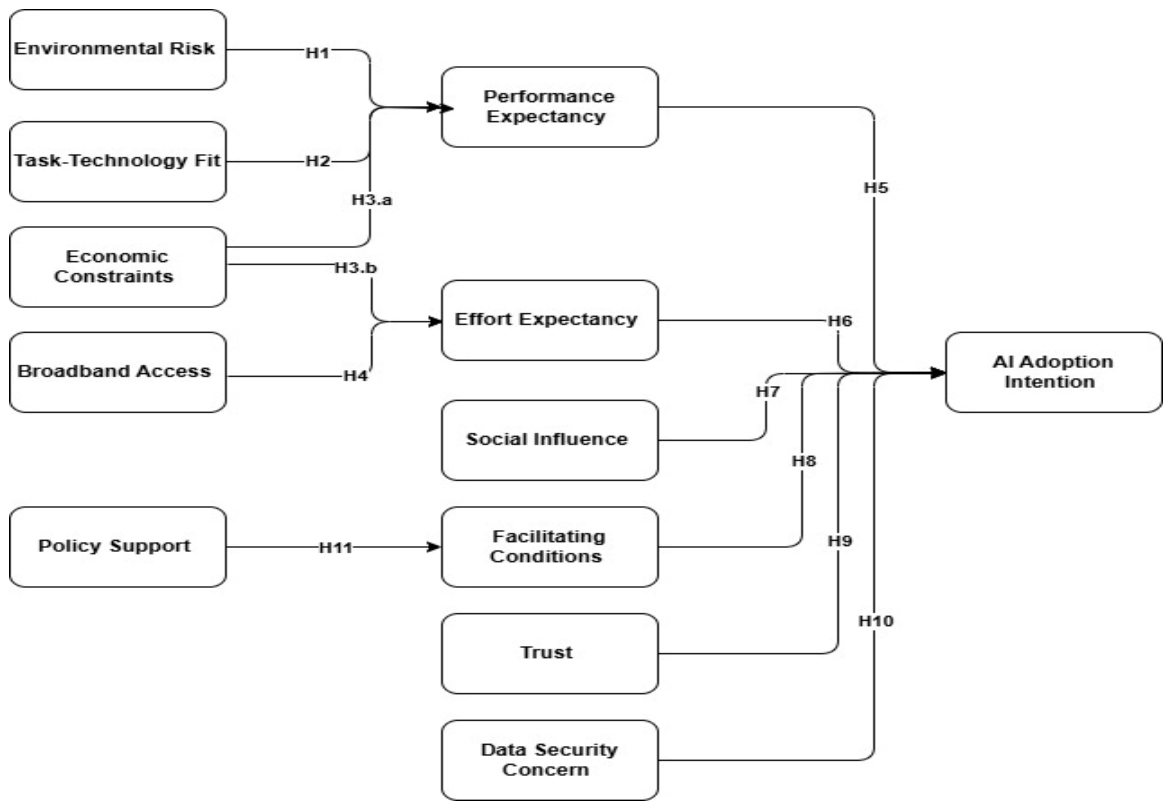
Figure 1. Study model.
Sustainability 18 04996 g001
Figure 2. Study’s structural model. Source: Authors’ own work.
Sustainability 18 04996 g002
Table 1. Respondents’ demographics.
CategoriesDetailsN%
Age (n years)Under 35 5912.07%
35–44 8918.20%
45–54 years11022.49%
55–64 years13828.22%
65 years or older9319.02%
Education High school/GED9920.25%
Some college/tech9419.22%
Associate’s degree7715.75%
Bachelor’s degree16333.33%
Graduate degree5611.45%
Gender Male33367.48%
Female15932.52%
Farming Experience (#years)5 or less5110.43%
6–15 9719.84%
15–25 12425.36%
26–35 12926.38%
More than 35 8817.99%
Notes: N = 489. Source: Authors’ own work.
Table 2. Item reliability and convergent validity.
ConstructsItemsFactor LoadingsCronbach’s AlphaComposite Reliability (CR)Average Variance Extracted (AVE)
PEPE_item10.9440.9590.9690.861
PE_item20.936
PE_item30.925
PE_item40.948
PE_item50.884
EEEE_item10.9340.9410.9580.850
EE_item20.885
EE_item30.929
EE_item40.939
SISI_item10.9330.9680.9750.887
SI_item20.940
SI_item30.943
SI_item40.936
SI_item50.956
FCFC_item10.8680.9110.9370.789
FC_item20.917
FC_item30.892
FC_item40.874
ERER_item10.9100.9150.9460.854
ER_item20.921
ER_item30.941
TTFTTF_item10.9310.9700.9770.893
TTF_item20.957
TTF_item30.946
TTF_item40.947
TTF_item50.945
ECEC_item10.9410.9260.9530.871
EC_item20.930
EC_item30.929
BABA_item10.9430.9340.9580.883
BA_item20.941
BA_item30.935
PSPS_item10.9190.9130.9450.852
PS_item20.918
PS_item30.933
TrTr_item10.8230.8540.9100.772
Tr_item20.908
Tr_item30.902
DSCDSC_item10.9670.9540.9700.915
DSC_item20.948
DSC_item30.956
BIBI_item10.9060.9040.9400.839
BI_item20.926
BI_item30.916
Source: Authors’ own work.
Table 3. Constructs’ discriminant validity.
ConstructsBABIDSCECEEERFCPEPSSITTFTr
BA0.940.120.020.050.300.040.040.050.030.030.050.06
BI0.110.920.260.300.470.140.210.460.050.190.090.39
DSC−0.01−0.240.960.040.020.050.030.040.030.020.020.02
EC0.05−0.28−0.030.930.450.060.060.430.030.030.030.04
EE0.290.43−0.01−0.420.920.030.040.230.040.020.020.05
ER−0.030.12−0.050.050.010.920.110.340.050.030.040.04
FC−0.020.190.030.05−0.03−0.100.890.030.360.020.030.15
PE−0.050.430.02−0.400.220.32−0.020.930.050.030.370.05
PS−0.030.05−0.010.03−0.04−0.030.33−0.050.920.020.040.12
SI−0.030.180.010.02−0.010.030.010.01−0.020.940.030.02
TTF−0.050.080.020.02−0.010.03−0.030.35−0.03−0.020.950.04
Tr0.050.350.010.040.020.000.13−0.050.110.010.010.88
Notes: Bold number = √AVE, italic numbers = HTMT. Source: Authors’ own work.
Table 4. Multicollinearity and InnerVIF.
BIEEFCPE
BA 1.002
DSC1.002
EC 1.002 1.003
EE1.052
ER 1.004
FC1.020
PE1.053
PS 1.000
SI1.000
TTF 1.001
Tr1.021
Source: Authors’ own work.
Table 5. The path analysis of study’s structural model.
RelationshipsβSDt-Statisticsp-Valuesf2R2; Q2Results?
PE → BI0.3770.02912.8540.0000.3000.549; 0.328Positive
EE → BI0.3450.02712.7820.0000.252 Positive
SI → BI0.1770.0305.8130.0000.070 Positive
FC → BI0.1640.0325.0610.0000.058 Positive
Tr → BI0.3370.03210.6030.0000.247 Positive
DSC → BI−0.2510.0317.9810.0000.139 Negative
ER → PE0.3310.0359.4140.0000.1830.402; 0.394Positive
TTF → PE0.3510.0379.5630.0000.206 Positive
EC → PE−0.4260.03412.5800.0000.303 Negative
EC → EE−0.4310.03811.3190.0000.2540.268; 0.261Negative
BA → EE0.3080.0368.5980.0000.129 Positive
PS → FC0.3300.0398.5610.0000.1220.109; 0.105Positive
Note: β = Standard regression, SD = standard deviation. NFI = 0.917, SRMR = 0.031. Source: Authors’ own work.
Disclaimer/Publisher’s Note: The statements, opinions and data contained in all publications are solely those of the individual author(s) and contributor(s) and not of MDPI and/or the editor(s). MDPI and/or the editor(s) disclaim responsibility for any injury to people or property resulting from any ideas, methods, instructions or products referred to in the content.