Article

Impacts of Inner-Lane Closure on Safety and Operations of Multilane Roundabouts in Motorcycle-Dominated Environments


by
Chaiwat Yaibok
1,
Paramet Luathep
1,*,
Piyapong Suwanno
2 and
Sittha Jaensirisak
3
1
Department of Civil and Environmental Engineering, Faculty of Engineering, Prince of Songkla University, Songkhla 90110, Thailand
2
Department of Civil Engineering, College of Industrial Technology and Management, Rajamangala University of Technology Srivijaya, Nakhon Si Thammarat 80210, Thailand
3
Department of Civil Engineering, Faculty of Engineering, Ubon Ratchathani University, Ubon Ratchathani 34190, Thailand
*
Author to whom correspondence should be addressed.
Sustainability 2026, 18(10), 4995; https://doi.org/10.3390/su18104995
Submission received: 18 April 2026 / Revised: 7 May 2026 / Accepted: 12 May 2026 / Published: 15 May 2026

Abstract

While multilane roundabouts follow geometric design standards, they often overlook motorcycle-dominated traffic behavior. This study evaluates lane-reduction strategies to create safer and more inclusive urban corridors in mixed-traffic conditions, focusing on a case study in Southern Thailand. High-resolution unmanned aerial vehicle (UAV) trajectory data were analyzed using the Macroscopic Fundamental Diagram (MFD), Cell Transmission Model (CTM), and Time-To-Collision (TTC) frameworks under three configurations: full lane availability, partial inner-lane closure, and full inner-lane closure. Results indicate progressive deterioration in performance under restricted-lane conditions. Under full closure, total flow decreased by 31%, and average travel time increased by 43%. The MFD curve shifted toward higher critical densities, indicating earlier congestion onset, while CTM results revealed longer discharge times, queue spillback, and increased merging friction. Conversely, safety outcomes (TTC) improved significantly: extreme rear-end conflicts were reduced by 48%, and severe lane-change conflicts were nearly eliminated (99%). Behavioral evidence suggests that full closure constrains motorcycles to a single circulating path, reducing erratic filtering and promoting more stable interactions. Overall, this study identifies a systemic trade-off between safety and efficiency, highlighting how geometric interventions catalyze behavioral adaptation. The findings highlight how geometric constraints shape collective behavior in motorcycle-dominated roundabouts and demonstrate the value of an integrated UAV-based framework as a vital tool for inclusive urban management, providing the granular data needed to balance safety and mobility in complex traffic landscapes.

1. Introduction

Roundabouts are widely used as an intersection control strategy because they can improve traffic safety and operational efficiency by reducing severe crossing conflicts and promoting continuous traffic movement [1,2]. Compared with signalized intersections, roundabouts reduce stop-and-go operations, abrupt acceleration and deceleration, and prolonged idling, thereby supporting safer and more sustainable urban mobility [1,2]. However, these benefits are not uniform across all geometric and traffic conditions. At multilane roundabouts, operational performance and safety are strongly influenced by lane availability, circulating width, lane-use behavior, and traffic composition [2,3]. When lane availability is reduced, either due to incidents, temporary roadworks, or intentional lane-management strategies, vehicles must adapt their paths and merging behavior, which may increase queue formation, entry delay, lane-changing activity, and the risk of rear-end or side-swipe conflicts [2,4,5]. Thus, lane management at multilane roundabouts should be viewed not only as an operational control measure, but also as a behavioral and safety-oriented intervention that can reshape road-user interactions.
This issue is particularly important in motorcycle-dominated mixed-traffic environments. Although multilane roundabouts may satisfy conventional geometric design requirements, they may not fully account for motorcycle-specific movement patterns. In addition, geometric inconsistencies between recommended roundabout design standards and actual field implementation are frequently observed in practice, particularly in Thailand. In some cases, roundabouts that are geometrically and functionally suited to single-lane operation are nevertheless marked or operated as two-lane facilities. Such mismatches between recommended design practice and actual lane configuration can create ambiguity in lane use, especially for motorcyclists, and may contribute to side-by-side riding, unsafe filtering, and confusion within the circulatory roadway [2,6].
Motorcycles often exhibit shorter headways, higher maneuverability, lateral filtering, side-by-side movement, and more flexible path selection than passenger cars [3,6,7,8,9,10]. Recent studies in Southeast Asian and Thai traffic environments further confirm that motorcycle behavior is strongly shaped by filtering, stopping behavior, departure headways, and safety-critical interaction patterns, which can create distinct conflict mechanisms in dense mixed traffic [4,11,12]. These characteristics can compromise lane discipline and increase the likelihood of weaving, abrupt lane changes, unstable merging, and close-following interactions, particularly near entries, circulating segments, and exits [6,7,8,9,10]. Therefore, interventions that modify circulating space, such as inner-lane closure, may influence not only traffic capacity but also interactions between motorcycles and passenger cars within the roundabout.
Existing studies have examined roundabout safety, geometric design, and traffic operations from different methodological perspectives. Microscopic models and surrogate safety measures provide detailed insight into localized vehicle interactions and near-miss events [13,14,15,16,17]. In contrast, macroscopic and mesoscopic models, such as the Macroscopic Fundamental Diagram (MFD) and Cell Transmission Model (CTM), describe system-level flow, density, congestion propagation, and queue dynamics [18,19,20,21]. However, these approaches are often applied separately. Microscopic approaches may not fully capture network-level congestion propagation under lane restrictions, while macroscopic approaches may overlook localized interaction mechanisms and conflict severity [13,14,15,16,17,18,19,20,21]. This limitation is particularly critical in motorcycle-dominated roundabouts, where changes in circulating-lane availability can simultaneously affect capacity, density, lane-use behavior, car–motorcycle interactions, and safety outcomes.
Recent advances in unmanned aerial vehicle (UAV)-based observation, computer vision, and trajectory-based safety analytics provide an opportunity to bridge this gap. UAV-derived trajectories enable continuous observation of vehicle movements across entries, circulating lanes, and exits, while vision-based detection and tracking tools support the extraction of high-resolution vehicle trajectories in heterogeneous traffic [13,14,22,23,24,25,26,27]. Recent video-based conflict studies and multidimensional trajectory-risk frameworks further demonstrate that trajectory data support both real-world safety assessment and proactive risk evaluation in mixed-traffic environments [28,29]. Nevertheless, few studies have integrated UAV-based trajectory data with both macroscopic traffic-flow analysis and Time-to-Collision (TTC)-based surrogate safety assessment to evaluate lane-reduction strategies at multilane roundabouts under motorcycle-dominated conditions.
To address this research gap, this study develops an integrated empirical framework that combines UAV-based traffic trajectories, MFD analysis, CTM-based congestion interpretation, and TTC-based conflict analysis. The framework is applied to evaluate the operational and safety impacts of three circulating-lane configurations: full lane availability, partial inner-lane closure, and full inner-lane closure, in a case study in Southern Thailand. By jointly examining traffic efficiency, congestion dynamics, conflict severity, and car–motorcycle interaction patterns, the study provides empirical evidence on the capacity–safety trade-off associated with inner-lane closure in motorcycle-dominated multilane roundabouts.
Three research questions guide the study:
(1)
How does inner-lane closure affect traffic dynamics, including density, delay, and congestion propagation, at a multilane roundabout?
(2)
How does inner-lane closure influence the frequency, type, and severity of traffic conflicts, particularly rear-end, lane-change, and crossing interactions?
(3)
How do lane-use patterns and car–motorcycle interactions adapt under partial and full inner-lane closures?
This study contributes to the literature in four main ways. First, it provides empirical evidence from high-resolution UAV trajectory data rather than relying solely on simulation-based analysis. Second, it integrates MFD and CTM analyses with TTC-based surrogate safety assessment to jointly examine operational and safety trade-offs. Third, it explicitly considers motorcycle-dominated mixed traffic conditions, in which informal lane use and rider behavior play a critical role in shaping roundabout operational performance. Finally, it frames lane management as a context-sensitive and sustainable transportation strategy that balances mobility, safety, and infrastructure design in mixed-traffic urban environments. Because the analysis is based on a specific motorcycle-dominated multilane roundabout, the findings are intended to provide transferable insights for comparable contexts rather than universal design prescriptions.
To orient readers, the article is divided into five sections. Section 2 provides a comprehensive literature review of roundabout safety, motorcycle behavior in mixed traffic, trajectory-based safety analytics, macroscopic and mesoscopic operational models, and geometry-related gaps in lane management. Section 3 details the study design, drone-based trajectory extraction, application of the MFD, CTM, and conflict analysis. Section 4 presents the results and discussion interpreting the MFD, CTM, and conflict findings in light of prior research. Section 5 concludes the contributions, acknowledges limitations, and outlines directions for future work.

2. Literature Review

Understanding how circulating lane configuration affects the safety and operations of multilane roundabouts requires a systematic examination of research conducted across multiple analytical scales. In this regard, a recent systematic review synthesized diverse methods for assessing roundabout safety, including crash-based analyses, surrogate safety measures, and video-trajectory approaches, and highlighted data collection and user behavior as key factors in evaluating multilane roundabout performance [30].
Foundational design guidelines have consistently highlighted the safety benefits of roundabouts over signalized and unsignalized intersections, particularly in single-lane configurations or under clearly defined geometric control conditions [1,2]. For example, according to the Federal Highway Administration (FHWA), roundabout conversions have been shown to reduce total crashes by 35–76% and injuries by up to 90% [2]. Empirical evaluations in regions such as Washington State, Flanders, and Carmel, Indiana, further support these claims, consistently documenting 60–80% reductions in injury crashes and fewer fatal collisions at single-lane roundabouts [31,32,33]. However, these benefits tend to diminish at multilane roundabouts, where weak lane discipline, inconsistent yielding, and incomplete user adaptation may reintroduce conflict risks. Recent research on cyclists and other at-risk road users further indicates that safety and comfort at roundabouts are highly sensitive to lane configurations, crossing patterns, and traffic speeds, particularly in multi-lane environments where detailed geometric design greatly influences user experience and conflict resolution [34,35,36].
Building on this foundational evidence, recent studies have investigated the operational and safety implications of lane configurations using diverse methodological approaches, including micro-level conflict diagnostics, vision-based trajectory reconstruction, macroscopic flow modeling, and crash-based statistical analysis. In particular, advanced predictive models that incorporate geometric and flow variables to estimate crash probability in multilane roundabouts have expanded the analytical scope of roundabout safety assessment [37]. Table 1 synthesizes these contributions by organizing the literature into five thematic groups: roundabout safety and vulnerable road users; motorcycle behavior in mixed-traffic environments; traffic trajectory and emerging safety analytics; macroscopic and mesoscopic operational analysis; and geometry, lane management, and the research gap addressed by the present study. Collectively, these themes trace a coherent progression from individual driver interactions to network-wide traffic behavior, thereby forming the conceptual foundation for the mixed-method framework developed in the subsequent sections.

2.1. Roundabout Safety and Vulnerable Road Users

The first thematic cluster lays the foundation for understanding why modern roundabouts generally exhibit superior safety performance compared to signalized or unsignalized intersections, particularly in reducing severe crashes. Unlike signalized junctions, which often involve high-speed angle or red-light-running collisions, roundabouts eliminate crossing conflicts by requiring vehicles to yield and circulate at lower speeds. This inherent deflection and speed control significantly reduce the likelihood and severity of crashes. However, these benefits may be tempered at multilane roundabouts where lane discipline is weak, or driver adaptation remains incomplete, especially in motorcycle-dominant settings. Recent studies have further shown that these safety benefits are not distributed equally across all user groups. In particular, cyclists’ comfort and safety at roundabouts are strongly influenced by multilane configurations, operating speeds, and crossing design [34], while related infrastructure studies show that design treatments, such as roundabout markings and lane width, affect cyclist behavior and road position [35]. More recent evidence also indicates that vehicle speed and yielding behavior at roundabout crossings remain critical for people walking and biking, especially at entry and exit points [36]. These findings are relevant to the present study because they show that roundabout design should not be assessed solely in terms of aggregate crash reduction or vehicular throughput, but also in terms of how lane configuration affects vulnerable and behavior-sensitive users.

2.2. Motorcycle Behavior in Mixed-Traffic Environments and Roundabouts

The second thematic cluster focuses on motorcycle behavior in mixed traffic, highlighting its distinct characteristics compared to passenger cars, especially in roundabout contexts. Because crashes are relatively rare and heterogeneous, researchers have increasingly relied on surrogate safety measures (SSMs), including Time-to-Collision (TTC), Post-Encroachment Time (PET), Deceleration Rate (DRAC), and speed differential (Δv), to quantify near-miss interactions and classify rear-end, weaving, lane-change, and crossing conflicts [13,14,15,16,17]. In mixed traffic, motorcycles and scooters tend to exhibit shorter headways, greater lateral dispersion, flexible path selection, and filtering behavior, complicating the use of conventional lane-based safety thresholds [4,7,8,9,10]. Microscopic evidence from Southeast Asia further shows that motorcycles at roundabouts often accept smaller gaps and display more variable acceleration, deceleration, and turning behavior than passenger cars [4]. Recent studies from Thailand and other Asian contexts also indicate that filtering, stopping behavior, departure headways, and safety-critical interactions strongly shape motorcycle movement in dense mixed traffic [11,12]. These findings suggest that motorcycle-related conflicts should be interpreted not only as geometric problems, but also as behavioral outcomes of gap acceptance, risk perception, and adaptive movement under constrained space. This behavioral foundation underscores the need for trajectory-based safety analysis that captures both conflict mechanisms and lane-use adaptation in motorcycle-dominated roundabouts.

2.3. Traffic Trajectory and Emerging Safety Analytics

The third thematic cluster examines recent technological advances that have transformed the collection and analysis of traffic trajectories. Unmanned aerial vehicles (UAVs) equipped with high-resolution footage, combined with artificial intelligence (AI) techniques such as deep-learning-based object detection and multi-object tracking (e.g., the You Only Look Once (YOLO) detection and the ByteTrack tracking algorithm), enable continuous observation of mixed traffic with sub-meter spatial accuracy [13,14,23,24,25,26,27]. These tools allow the computation of surrogate safety metrics over extended observation periods and facilitate the evaluation of the spatial distribution of conflicts, even under visually complex or partially occluded conditions. Empirical studies have confirmed that integrated UAV–AI frameworks exhibit strong correspondence with field-measured conflicts (R2 > 0.85) and improve detection accuracy by 20–30 percent compared with traditional manual or loop-detector methods [22]. Drone-based observations in dense urban environments further indicate that approximately 43–47 percent of drivers violate at least one operational rule, with speeding (≈79 percent) and failure to yield (≈21 percent) being the most frequent. Motorcycles, in particular, often accept lateral gaps as small as 0.7 m [39]. These findings suggest that lane narrowing, or partial closures, can intensify merging pressure and increase conflict density unless supported by appropriate geometric guidance and clear signage. As a result, UAV-based vision systems have become indispensable for assessing the safety effects of geometric and operational changes both before and after implementation. Thai mixed-traffic studies using video-based traffic conflict analysis also demonstrate that trajectory-derived risk measures can be used to assess real-world safety performance under heterogeneous traffic conditions [28]. Beyond conflict identification alone, recent trajectory-based studies have extended these methods toward multidimensional, proactive safety analytics, demonstrating that trajectory data can also support richer real-time or near-real-time risk assessment [29]. The insights gained from these micro-level observations naturally motivate a broader systems perspective. Understanding how thousands of individual vehicle interactions aggregate into collective traffic dynamics requires a macroscopic modeling approach, which is discussed in the next cluster.

2.4. Macroscopic and Mesoscopic Operational Analysis

The fourth thematic cluster explores how macroscopic frameworks conceptualize and formalize the collective behavior of traffic streams, and how they link to safety outcomes. The MFD provides a concise representation of the aggregate relationships among flow, density, and speed, allowing the roundabout and its approaches to be analyzed as a single interdependent system [20,21,42,43,44,45,46]. MFD-based studies have shown that reducing the circulating width lowers overall capacity, increases the critical density, and accelerates the transition from free flow to congestion. To complement this macroscopic view, the CTM offers a more granular, mesoscopic perspective by discretizing the roundabout into sequential cells representing entries, circulating segments, and exits. This approach enables detailed modeling of queue propagation and spillback dynamics within the network [48,49]. Under restricted-lane conditions, CTM simulations consistently predict earlier queue formation, longer discharge times, and diminished flow stability. Extending this operational focus, the macroscopic safety diagram shows that increasing density beyond the maximum throughput point is associated with a higher probability of conflicts or crashes [47]. In motorcycle-dominated environments, these relationships become steeper because two-wheelers occupy less space while exhibiting greater speed and lateral-positioning variability, amplifying density fluctuations. Thus, macroscopic modeling not only quantifies efficiency losses associated with lane reduction but also bridges operational performance and safety outcomes by identifying congestion regimes that are inherently risk-prone.
Recent mixed-traffic roundabout studies further suggest that trajectory-based safety analysis can be meaningfully combined with broader operational interpretation, particularly when heterogeneous motorcycle behavior affects both localized conflict mechanisms and system-level traffic states [11,28]. Accordingly, neither purely microscopic nor purely macroscopic analysis is sufficient on its own. Microscopic approaches capture localized vehicle interactions and merging behavior [13,14,15,16,17,18,19], whereas macroscopic and mesoscopic models are better suited to describing congestion propagation, capacity changes, and queue dynamics [20,21,48,49]. This limitation supports the need for a combined analytical framework that links trajectory-based conflict diagnostics with MFD- and CTM-based operational interpretation [13,14,15,16,17,20,21,28,29,48,49].

2.5. Effects of Geometric Design and Lane Management on Traffic Operations and Safety

The last thematic cluster investigates how geometric design and user interaction jointly determine crash risk. Crash- and conflict-related studies show that entry width, circulating width, inscribed diameter, central island radius, and the number of circulating lanes influence roundabout safety outcomes [50,51,53]. In addition, the FHWA guide emphasizes that entry width, circulatory roadway width, lane configuration, and entry–exit arrangement shape vehicle paths, speed control, and merging behavior [2].
Design guidelines [1] indicate that multilane roundabouts are more complex for two-wheel users than single-lane roundabouts, as users must select appropriate lanes while interacting with entering and exiting traffic. Although primarily developed for cyclists, this principle is also relevant to motorcycle-dominated environments, where riders frequently exhibit flexible lane positioning, lateral filtering, and non-lane-based path selection. The guidelines further recommend that bicycle lanes should not be located within the circulatory roadway, as this may encourage edge riding and increase the risk of interaction at entry and exit points. This principle is consistent with motorcycle-prevalent contexts, including the study site, where two-wheel users tend to operate near the outer edge in the absence of physically separated facilities.
In Thailand, national-scale evidence also indicates that geometric characteristics, including circular-lane width and diameter, are associated with crash likelihood [6]. These findings suggest that mismatches between recommended design principles and actual lane configuration may create lane-use ambiguity, especially for motorcyclists, and may contribute to side-by-side riding, unsafe filtering, and confusion within the circulatory roadway [2,4,6,11,12]. In this context, lane reduction is not considered a motorcycle-specific regulation but a geometric and operational intervention intended to reduce unsafe lateral filtering and unstable merging opportunities in motorcycle-rich traffic.
Sites with a high proportion of motorcycles often exhibit distinct conflict patterns, where weaving, abrupt lane changes, aggressive gap acceptance, and rapid acceleration–deceleration cycles dominate [4,7,11,12,39]. At the microscopic level, evaluations using PET, Δv, and extreme-value theory have shown that crash-prone states can be predicted directly from UAV-derived trajectories [22]. Recent behavioral studies in Asian motorcycle-dominant traffic environments further show that motorcycle movements are strongly influenced by filtering, stopping behavior, and safety-critical interaction patterns, which can become more pronounced under restricted lane configurations and generate context-specific conflict mechanisms [11,12].
Within the context of geometry and lane-management research, the reviewed evidence suggests a common need to integrate operational performance and safety assessment within a unified analytical framework. This study therefore extends prior geometric and surrogate-safety research by explicitly linking lane-management design, motorcycle-sensitive behavior, macroscopic efficiency, and TTC-based conflict severity within a single empirical framework.

2.6. Identified Research Gaps and Contributions of This Study

Although substantial progress has been made within each methodological stream, few studies have jointly examined the macroscopic efficiency and microscopic safety effects of lane reduction in multilane roundabouts. Most prior research treats these aspects independently: surrogate safety analyses focus on localized vehicle interactions and near-miss events, whereas macroscopic models capture system-wide flow, density, and delay. However, their interdependence, particularly the influence of congestion patterns on localized conflict generation, remains insufficiently explored. This limitation is especially critical in urban roundabouts, where geometric constraints and driver behavior closely link operational performance and safety outcomes.
Moreover, existing literature provides limited insight into motorcycle-dominated environments, where powered two-wheelers exhibit shorter headways, greater lateral movement, and more assertive merging than passenger cars, making system performance highly sensitive to lane availability. Under lane-reduction scenarios, constrained geometry may reduce weaving but increase merging pressure and queue volatility—effects that cannot be fully captured without integrating micro-level conflict diagnostics with macro-level flow analysis. Although previous studies have examined the microscopic behavior of motorcycles at roundabouts or in mixed traffic using trajectory-based approaches, few have explicitly linked these behavioral mechanisms to the combined assessment of macroscopic efficiency, conflict severity, and lane-reduction strategies within multilane roundabouts [4,11,28].
To address these limitations, this study adopts a multi-scale analytical framework that links surrogate conflict metrics, particularly TTC-based conflict severity and speed-related indicators derived from high-resolution trajectory data, with macroscopic indicators such as flow, critical density, and capacity. The framework integrates UAV-based trajectory extraction and vision-based tracking methods [4,11,12,22,23,24,25,26,28], surrogate safety models [13,14,15,16,17], and macroscopic models, including the MFD and CTM [20,21,42,43,44,45,46,47,48,49]. This integration enables simultaneous evaluation of safety (in terms of conflict frequency and severity) and operational efficiency (in terms of flow stability and congestion dynamics) across varying lane-closure scenarios. Grounded in roundabout conversion studies [31,32,33] and operational flow theory [20,21,42,43,44,45,46,47,48,49], the proposed framework provides a unified perspective linking geometric design, user behavior, and system performance. As summarized in Table 1, the proposed framework aligns micro-behavioral mechanisms with macro-level modeling to support the mixed-method analysis presented in this study. In contrast to prior studies that focused primarily on vulnerable-user design, motorcycle behavior, or trajectory-based risk analytics in isolation, the present study integrates these strands within a single empirical framework tailored to multilane roundabouts under motorcycle-dominated traffic.
To further address the identified gaps, this study makes four key contributions. First, it develops an integrated analytical framework combining macroscopic traffic flow models (MFD and CTM) with high-resolution UAV-based trajectory data, enabling concurrent assessment of system-level efficiency and localized traffic dynamics (see Section 3.2, Section 3.3 and Section 3.4). Second, it incorporates TTC-based surrogate safety measures and approach speed to quantify conflict severity across interaction types, directly linking operational conditions to the dynamics of safety outcomes (see Section 3.5 and Section 4.3). Third, it utilizes empirical trajectory data to capture realistic car–motorcycle interactions and behavioral adaptations under lane-reduction scenarios, moving beyond reliance on simulation-based approaches (see Section 3.2, Section 4.1 and Section 4.3). Finally, it explicitly examines the capacity-safety trade-off in motorcycle-dominated environments, offering transferable insights for adaptive, context-sensitive lane management strategies in mixed-traffic systems (see Section 4.1, Section 4.2, Section 4.3 and Section 5.2).

3. Research Methodology

3.1. Study Design and Scenarios

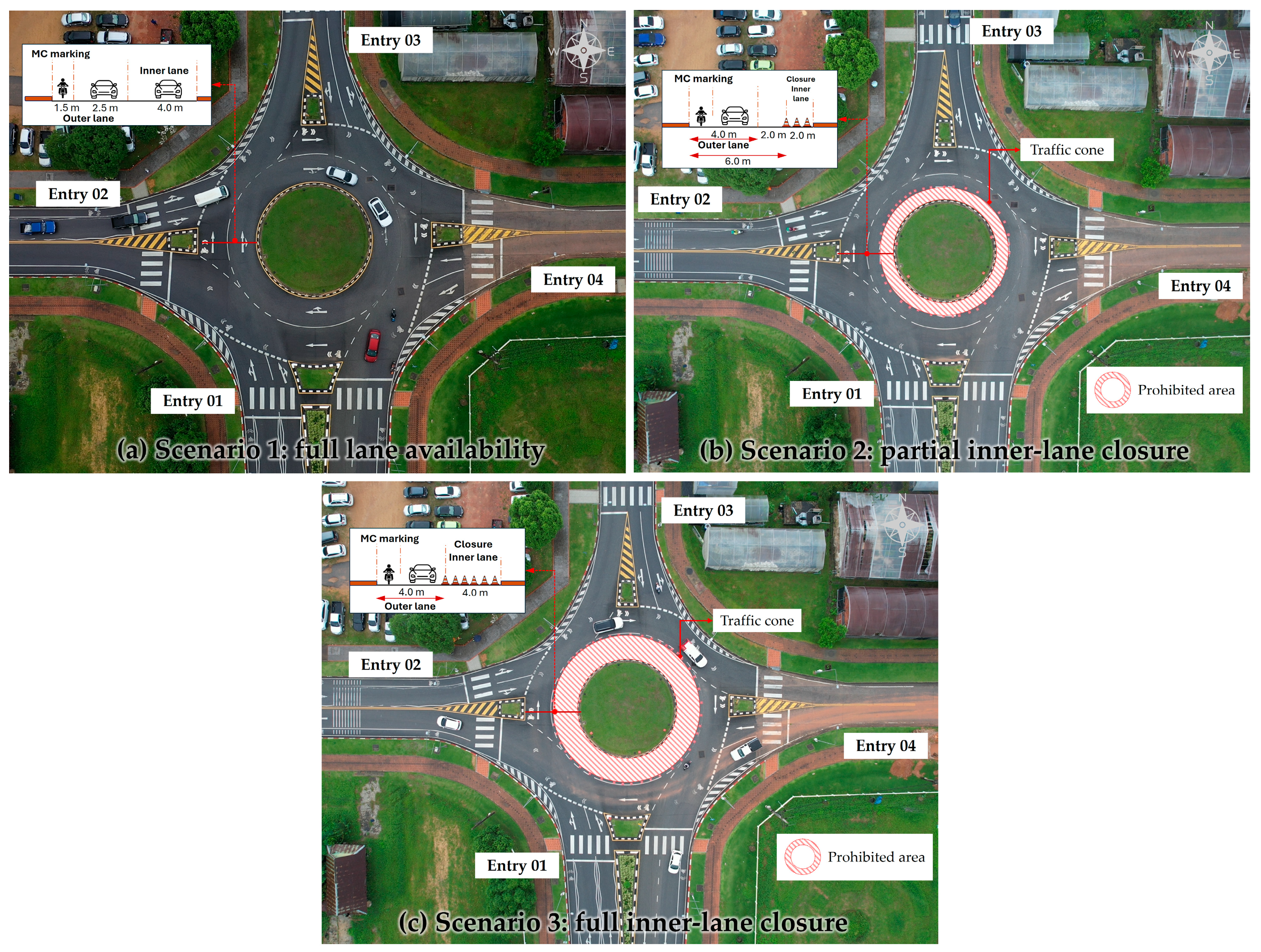
The overall study design is summarized in Figure 1. Traffic operations were examined under three circulating-lane configurations: Scenario 1, full lane availability under the existing two-lane condition; Scenario 2, partial inner-lane closure; and Scenario 3, full inner-lane closure. UAV-based video surveillance was used to collect traffic data under each scenario. Vehicle trajectories were extracted from UAV footage using a YOLOv8-based detection model [57] and a multi-object tracking procedure (i.e., ByteTrack, [24]). The resulting trajectory datasets included vehicle position, movement direction, speed, and vehicle class, primarily motorcycles (MC) and passenger cars (PC). These data were subsequently used to derive operational and safety indicators through the Macroscopic Fundamental Diagram (MFD), Cell Transmission Model (CTM), and Time-to-Collision (TTC)-based conflict analysis.
This study was conducted at a two-lane roundabout located within the Prince of Songkla University campus in Hat Yai, Songkhla, Thailand, as a case study. The site was selected because it typifies a motorcycle-dominated mixed-traffic environment, characterized by recurrent congestion and frequent car–motorcycle interactions within the circulating roadway. Given that the analysis is based on a single site and short-term field observations, the findings should be interpreted as context-specific evidence applicable to similar motorcycle-dominated multilane roundabouts, rather than as universally generalizable design prescriptions. Limitations related to site representativeness, observation duration, and temporary lane-control implementation are discussed in Section 5.3.
Although this study is based on a single site, the selected roundabout reflects a common design configuration observed in motorcycle-dominated multilane roundabouts, including a two-lane circulating roadway, shared entry operation, and the absence of a physically separated motorcycle lane. This configuration aligns with established roundabout design guidance, which notes that multilane circulatory roadways increase lane-selection complexity for two-wheel users and that bicycle lanes should not be placed within the circulatory roadway because of potential conflicts with entering and exiting vehicles [1]. Accordingly, while the site is not intended to represent all roundabouts, it provides an analytically relevant case for examining how a typical multilane configuration interacts with high motorcycle volumes, flexible lane-use behavior, and inner-lane reduction. The findings should therefore be interpreted as transferable insights for similar motorcycle-dominated multilane roundabouts, rather than as universally applicable design prescriptions.
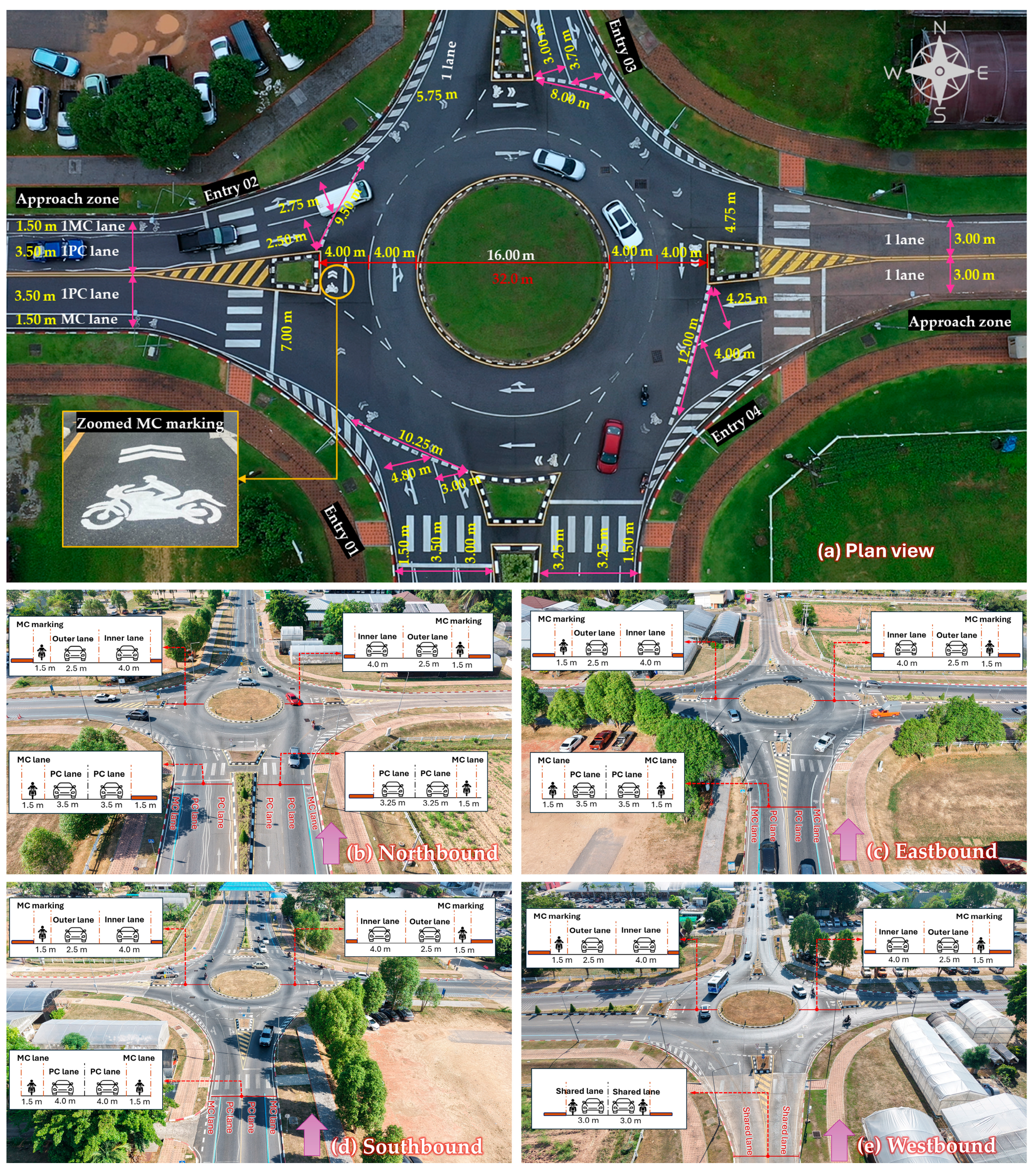
The physical characteristics of the study site are illustrated in Figure 2, which presents the plan view and cross-sectional profiles for each approach. The plan view depicts the existing geometric layout of the roundabout, including entry and exit lanes, the circulating roadway, the central island, and adjacent road alignments. The cross-sectional panels provide detailed information on lane arrangements and widths for each direction. The figure clarifies key geometric features, lane dimensions, entry–exit configurations, circulating lanes, and motorcycle-related facilities.
The geometric inventory was established using UAV imagery, field measurements, and observations of road cross-sections. The roundabout has a central island diameter of approximately 16.0 m and an inscribed circle diameter of approximately 32.0 m. The circulatory roadway consists of two marked circulating lanes under the existing condition, with each lane approximately 4.0 m wide. Thus, the total effective circulating width under the existing condition is approximately 8.0 m. Across the approaches, entry-lane widths range from approximately 2.5 m to 4.8 m, and the yield line is located approximately 8–12 m upstream of the entry point. The entry and exit geometries were kept unchanged across all scenarios to isolate the effects of an inner circulating-lane closure.
The motorcycle-lane configuration was identified based on field inventory and cross-sectional surveys. Dedicated motorcycle lanes (MC lanes) are provided only on selected approach segments prior to entering the roundabout. At the entry, motorcycles (MCs) and passenger cars (PCs) share lanes. Within the circulating roadway, no physically separated or dedicated motorcycle lane is provided. Instead, pavement markings for motorcycles are placed near the outer edge of the circulatory roadway; however, these markings do not constitute a designed motorcycle lane. Therefore, the circulating roadway is treated as a mixed-traffic environment in which MCs and PCs interact within a shared space.
The experimental lane-closure configurations are shown in Figure 3. Scenario 1 represents the existing condition with full lane availability, in which both the inner and outer circulating lanes are open to traffic. Scenario 2 represents a partial inner-lane closure, where the inner circulating lane is closed over a defined arc using traffic cones and advanced warning signs. This scenario reduces the effective circulating width to approximately 6.0 m along the restricted section while retaining some lateral maneuvering space. Scenario 3 represents a full inner-lane closure, with traffic guided primarily through the outer circulating lane, resulting in an effective circulating width of approximately 4.0 m throughout the controlled section. Across all scenarios, only the effective circulating width was modified, while the entry and exit geometries remained unchanged.
The rationale for selecting the inner circulating lane as the target for lane reduction is based on the interaction between the existing geometric layout and motorcycle-dominated traffic behavior. The study roundabout operates as a two-lane circulating roadway, a configuration that primarily supports lane-based vehicle movements. However, under high motorcycle shares, motorcyclists may not strictly adhere to marked lanes and instead select shorter paths, ride side by side, or filter laterally between vehicles. Such behavior can reduce lane discipline, increase speed variability, and create ambiguous interaction patterns between motorcycles and passenger cars, particularly on circulating roadways [4,6,11].
It should be noted that the inner-lane closure was not treated as a motorcycle-specific design regulation. Rather, it was introduced as an experimental geometric and operational intervention to examine whether reducing excessive lateral maneuvering space could increase path deflection, moderate motorcycle filtering behavior, improve path consistency, and reduce high-risk interactions within the circulating roadway. Comparing across Scenarios 1–3 allowed the study to evaluate how increasing levels of inner-lane restriction affect traffic efficiency, lane-use behavior, car–motorcycle interactions, and TTC-based conflict severity.
Traffic volume was recorded during daytime observation periods to identify the daily traffic patterns and distinguish peak and off-peak conditions. This survey provides the operational context of the study site. However, UAV-based trajectory data were collected during off-peak periods to capture typical driving behavior under safer and more controlled conditions, particularly during the implementation of a temporary lane closure. During peak periods, the average traffic volume was approximately 4061 vehicles per hour, comprising approximately 60% MCs, 39% PCs, and 1% other vehicles.
Historical crash records from 2019 to 2022 further underscore the site’s relevance for motorcycle safety analysis. A total of 12 crashes were recorded over this period, averaging approximately three crashes per year. Of these, 83% involved motorcycles, and 25% were MC–MC crashes. Most incidents involved two vehicles, particularly MC–MC and MC–PC interactions, with sideswipe and rear-end collisions being the dominant patterns, while crossing-type crashes were less frequent. These patterns indicate that the site provides a suitable context for examining how circulating-lane availability influences motorcycle-related interactions and conflict risk.
UAV data collection was conducted under dry daylight conditions, with no incidents or unrelated roadworks during the survey period. Surveys for the three scenarios were conducted on 24 July 2024 during off-peak periods. Each scenario was recorded for approximately 40 min, of which 30 min of stable video footage was selected for analysis after excluding the initial and final segments. High-resolution videos (1920 × 1080 pixels) were recorded from a fixed aerial viewpoint covering the circulating roadway and adjacent entry–exit areas. The scenario-specific UAV recording periods and usable durations are summarized in Table 2.
To characterize observation counts and temporal variability across scenarios, vehicle volumes were summarized over 30 min observation intervals for each scenario. As shown in Table 3, Scenario 1 included 359 vehicles (203 MCs and 156 PCs), with motorcycles accounting for 56.5% of the traffic stream. Scenario 2 included 357 vehicles (166 MCs and 191 PCs), with a motorcycle share of 46.5%. Scenario 3 included 518 vehicles (304 MCs and 214 PCs), with motorcycles accounting for 58.7%. These results indicate that Scenarios 1 and 2 had comparable observed volumes, whereas Scenario 3 had a substantially higher observed volume. Therefore, comparisons across scenarios were interpreted with consideration of differences in traffic demand and MC–PC composition.
Observation summaries in Table 3 were used to verify the comparability of traffic demand and vehicle composition across scenarios before interpreting the MFD, CTM, and TTC results. Potential short-term behavioral adaptation was considered, as road users may adjust their behavior in response to visible temporary traffic-control devices, such as traffic cones, warning signs, and lane-closure arrangements. To mitigate such effects, researchers and traffic safety personnel remained outside the drivers’ field of view during UAV data collection. A 5 min acclimatization period was applied after each scenario setup to allow drivers to adjust to the lane-closure configuration, and only data collected thereafter were included in the analysis.
The lane-closure scenarios were implemented as real-world physical interventions rather than simulation-based conditions. This field-based experimental approach enabled direct observation of actual driver and motorcyclist responses in real traffic conditions, including path selection, filtering, close following, merging, and speed adaptation. This is particularly important in motorcycle-dominated traffic, where behavior is strongly influenced by local driving culture, perceived space, and interaction with other road users, which are difficult to fully capture in simulation models. Nevertheless, some residual adaptation to temporary control devices may remain. Accordingly, the results should be interpreted as short-term behavioral and operational responses rather than long-term equilibrium conditions.
As the field trials involved temporary modifications to live traffic operations, safety and ethical considerations were incorporated into the survey procedure. No human participants were recruited, and no personal or identifiable information was collected. UAV video data were used exclusively to extract anonymized vehicle trajectories and traffic movement characteristics. Temporary lane closures were implemented using traffic cones, advanced warning signage, and on-site supervision by traffic police and safety personnel to mitigate risks to road users. These constraints are further discussed in Section 5.3.

3.2. Drone Video Processing for Vehicle Trajectories

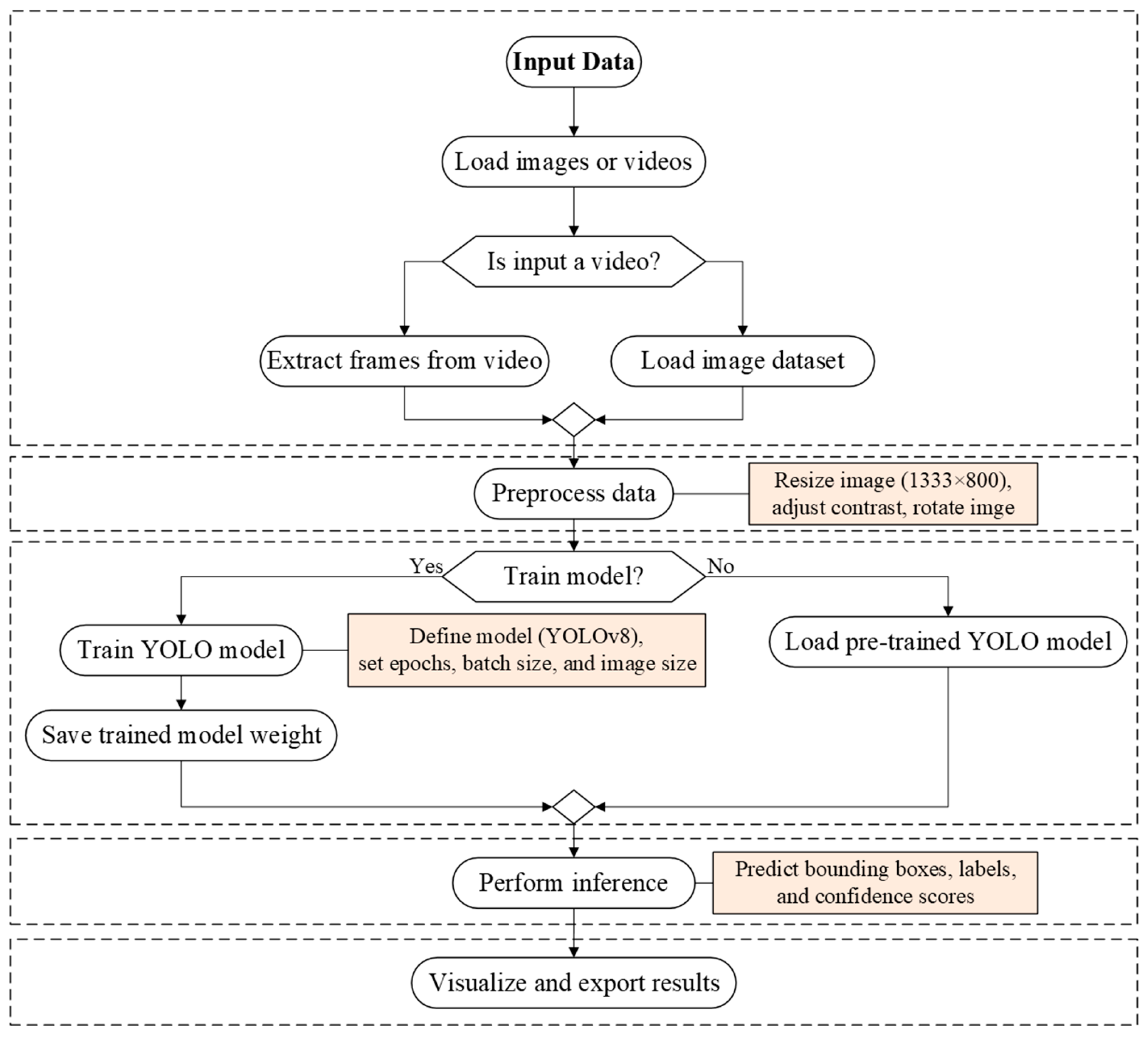
This section presents the framework for extracting lane-level vehicle trajectories from UAV imagery, as summarized in Figure 4. The workflow follows a structured sequence from video input and frame extraction to image preprocessing, vehicle detection, multi-object tracking, trajectory post-processing, and output generation. The resulting vehicle trajectories were then used as the input for subsequent MFD, CTM, and TTC-based safety analyses. It should be emphasized that TTC was not calculated directly from raw detection boxes. Instead, YOLOv8 [57] and ByteTrack [24] were used to generate vehicle trajectory outputs, and TTC was computed later from the post-processed trajectory dataset.
The first step involved inputting UAV video footage and extracting individual frames to generate an image dataset for model development. High-resolution UAV imagery captured from the study site provided broad spatial coverage and sufficient ground resolution for vehicle detection and tracking, offering a practical alternative to fixed surveillance systems [22,23,28,39]. The UAV videos were recorded at a Full HD resolution (1920 × 1080 pixels). A custom Python script was used to extract image frames from the videos at a predefined frame rate, such as one frame per second, to obtain representative images for model training while reducing excessive similarity between consecutive frames.
The extracted images were processed using Roboflow [58] for dataset management, annotation, preprocessing, augmentation, and export. Vehicles were annotated into two classes: passenger cars (PC) and motorcycles (MC), which were consistently adopted in the subsequent traffic analysis. The PC class included passenger cars, pickup trucks, and vans, while buses and other large vehicles were excluded due to their negligible representation. Table 4 presents the dataset split used for model development. The final annotated dataset contained 2647 images, consisting of 2316 training images (87%), 222 validation images (8%), and 109 test images (4%).
During preprocessing, all images were resized to 1333 × 800 pixels. Data augmentation was applied through Roboflow to improve model robustness under variations in lighting, viewing angle, vehicle position, and traffic density. The augmentation process included image rotation, flipping, brightness adjustment, blur, and noise injection [58,59].
Vehicle detection was performed using the YOLOv8 model implemented via the Ultralytics framework [57]. The dataset, prepared and annotated in Roboflow, was exported in YOLOv8 format and used for model training in Google Colab [60,61] with GPU acceleration. The model was initialized with pretrained yolov8m.pt weights. Training parameters are summarized in Table 5 and include 100 epochs, a batch size of 8, an input image size of 800 × 800 pixels, a patience of 15, and an initial learning rate of 0.001. Roboflow was used for dataset preparation, annotation, augmentation, and export, whereas Ultralytics YOLOv8 was employed for model training and inference.
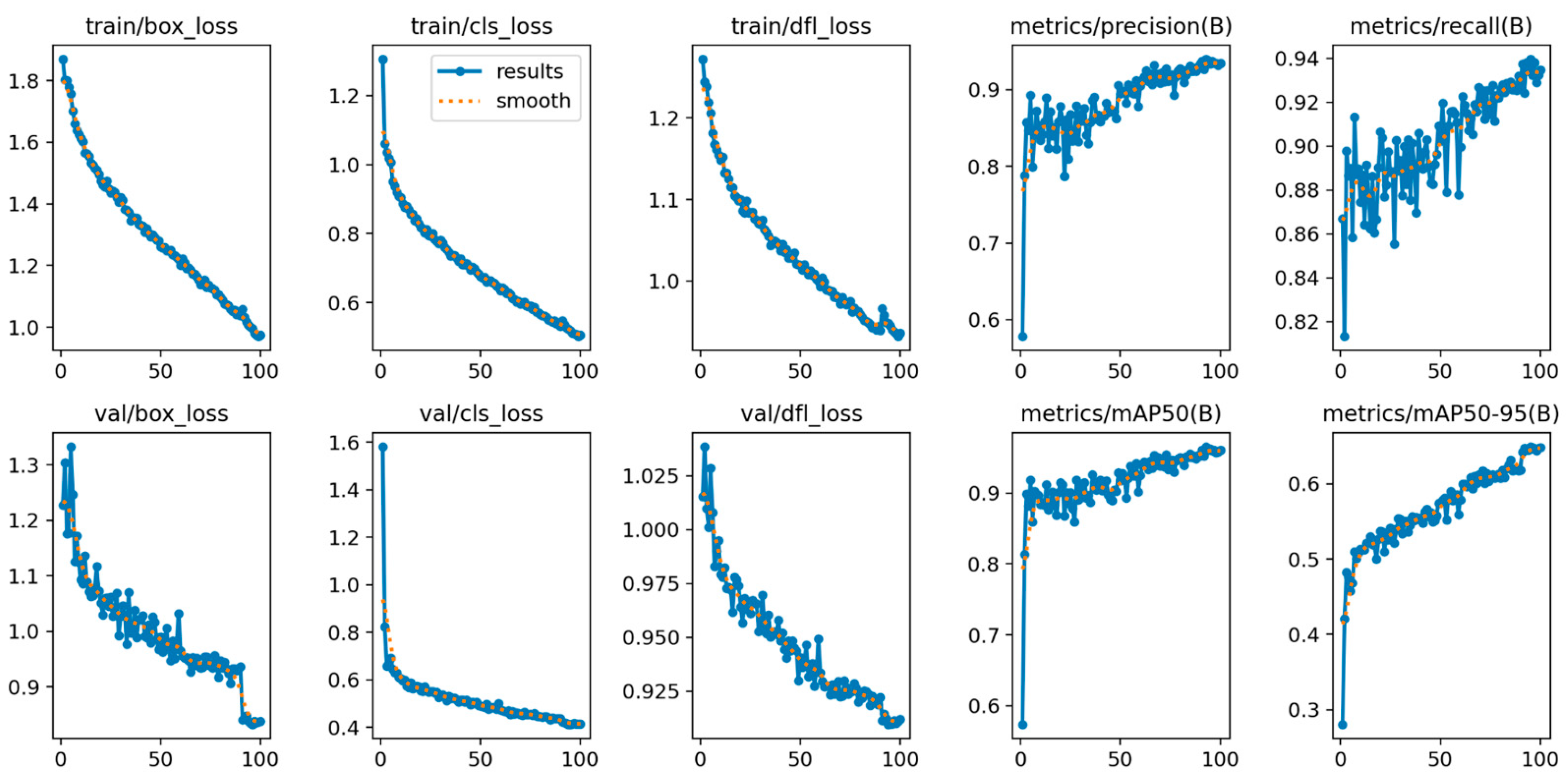
Figure 5 presents the training and validation results of the YOLOv8 model. The training curves show that the box loss, classification loss, and distribution focal loss decreased consistently, with the largest reductions occurring during the early training epochs and smaller improvements thereafter. The validation losses followed similar downward trends, indicating stable optimization and no clear evidence of overfitting. The final model achieved a mean average precision (mAP@50) of 96.2%, with corresponding precision and recall of 93.4% and 94.0%, respectively, indicating strong detection performance. These results confirm that the trained YOLOv8 model provides reliable detection of motorcycles and passenger cars in UAV-based roundabout observations.
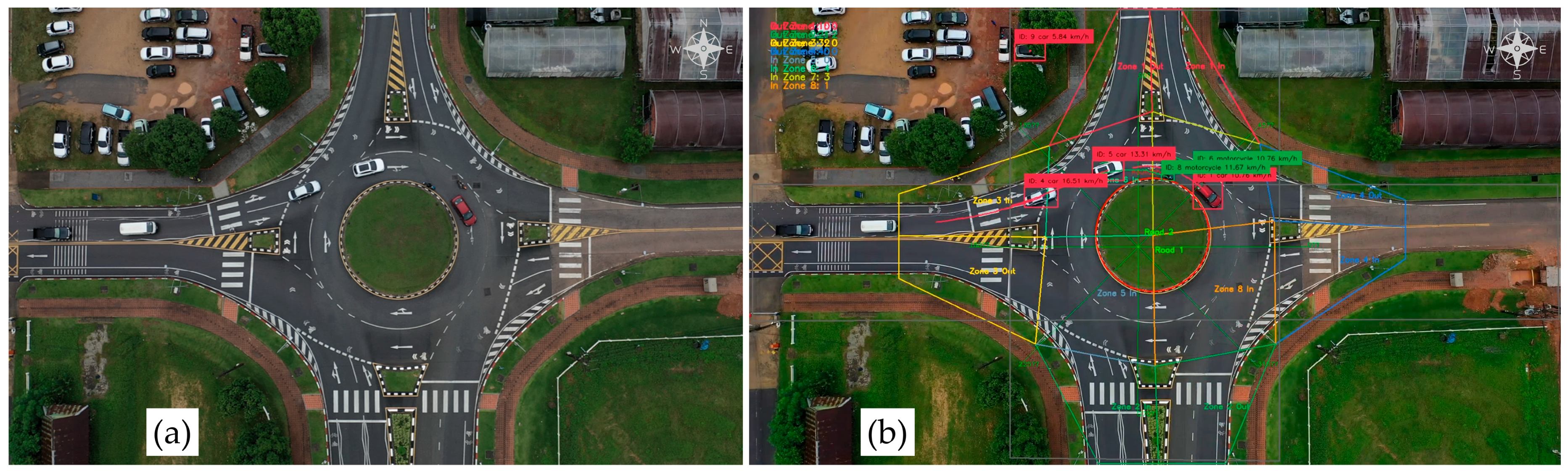
After vehicle detection, the YOLOv8 outputs were associated across consecutive frames using the ByteTrack multi-object tracking algorithm [24]. ByteTrack was used to maintain persistent vehicle identifiers and reconstruct continuous trajectories from frame-level detections. Figure 6 shows an example of the detection and tracking outputs, including the raw UAV frame and the corresponding tracking overlay. A custom Python-based video-processing script was developed to apply the trained YOLOv8 model to UAV videos, perform tracking, define traffic zones, and export vehicle trajectory outputs. Tracking parameters, including activation threshold, lost-track buffer, matching threshold, and minimum consecutive frames, were adjusted to improve identity persistence and reduce unstable tracks.
Inference and tracking were restricted to predefined regions of interest covering the entry, circulating, and exit zones of the roundabout. Off-road detections, stationary objects, and detections outside the predefined road zones were removed during post-processing. The processed trajectories were overlaid on the original UAV imagery to visually inspect tracking continuity, lane alignment, and object-ID consistency.
The final trajectory dataset was exported in comma-separated values (.csv) format, with one record per tracked vehicle per frame. Table 6 lists the main fields included in the exported trajectory dataset. Each record included a unique track identifier, vehicle class, speed, local planar coordinates, geographic coordinates where available, zone labels, heading angle, timestamp, and frame index. The exported CSV files were then used as the common data source for subsequent MFD aggregation, CTM interpretation, and TTC-based traffic conflict analysis.
Trajectory smoothing and filtering were performed on the post-processed video output to improve data quality prior to analysis. The exported CSV files were processed using external Python-based scripts to remove abnormal records, eliminate unstable trajectories, and smooth vehicle paths. This step is critical, as minor coordinate fluctuations from detection and tracking can propagate into errors in derived variables such as speed, heading, and relative motion.
TTC was not computed directly from YOLOv8 detection outputs but from processed trajectory data following detection, tracking, coordinate transformation, speed estimation, filtering, and smoothing. The trajectory data provides time-series position, speed, heading, and track ID, enabling the identification of interacting vehicle pairs and the estimation of relative position and speed. As a result, detection and tracking inaccuracies may indirectly influence TTC estimates. To address this issue, trajectory filtering and smoothing were applied prior to TTC computation. TTC values are therefore interpreted as surrogate safety indicators rather than direct measures of collision occurrence.
The integrated UAV–YOLOv8–ByteTrack framework generated analysis-ready trajectory datasets for MC and PC. These datasets were used to reconstruct trajectories, derive CTM state variables, compute MFD aggregates, and estimate TTC-based safety indicators, thereby providing a transparent linkage from raw imagery to the analytical outputs.

3.3. Application of the Macroscopic Fundamental Diagram (MFD) in Roundabout Analysis

The Macroscopic Fundamental Diagram (MFD) represents the aggregate relationship among traffic flow, density, and speed within a defined traffic system. It is commonly used to describe the transition from free-flow conditions to congested states and to identify capacity-related changes in traffic performance [21]. In this study, the MFD framework was applied to assess the effects of inner-lane closure configurations on roundabout operations using high-resolution vehicle trajectories derived from UAV imagery.
To support the spatial applicability of the MFD, the roundabout was conceptualized as a compact traffic system with clearly defined entry, circulating, and exit zones. UAV observations encompassed the circulating roadway and adjacent entry–exit areas within a fixed spatial boundary, allowing consistent measurements of vehicle accumulation, discharge, and speed variation across scenarios. Therefore, the MFD was applied as a site-level macroscopic representation of traffic behavior, rather than as a network-level equilibrium model.
Instead of conventional Vehicle Kilometers Traveled (VKT) and Vehicle Hours Traveled (VHT), this study adopts Vehicle Meters Traveled (VMT) and Vehicle Seconds Traveled (VST) to ensure unit consistency with the dataset, where distance and time are measured in meters (m) and seconds (s), respectively (see Equations (1) and (2)). These parameters enable precise macroscopic characterization of traffic dynamics across different lane configurations.
VMT captures the total distance traveled by all vehicles, reflecting overall system throughput, while VST represents the total travel time, capturing congestion and delay. The ratio VMT/VST provides an estimate of average network speed, a key indicator in macroscopic traffic flow analysis and MFD construction. This formulation is particularly suitable for roundabout environments, where vehicle movements are continuous and spatially distributed rather than link-based. Furthermore, high-resolution UAV trajectory data enables accurate computation of both distance and time components, ensuring robust and consistent macroscopic traffic measures across different scenarios.
V M T = i = 1 N d i
V S T = i = 1 N t i
where
N is the number of vehicles tracked within the analysis domain
d i is the distance traveled by vehicle i in meters, and
t i represents the total time spent by vehicle i in seconds.
VMT and VST metrics are suitable for roundabout analysis because vehicle movements are continuous and spatially distributed across the entry, circulating, and exit zones. UAV-derived trajectory data provide vehicle-level distance and time measurements, enabling consistent aggregation of traffic variables across all lane-closure scenarios.
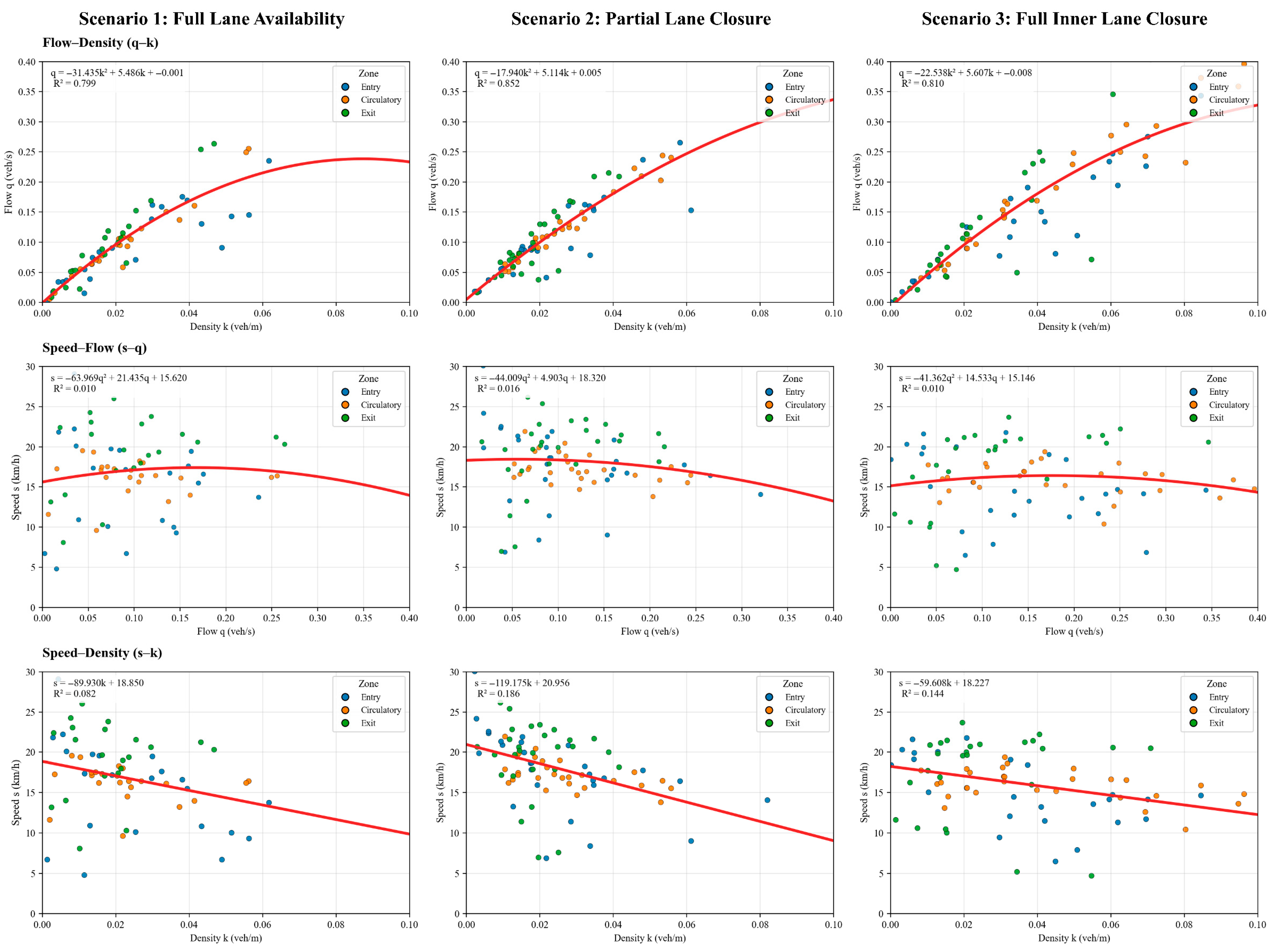
To assess the impact of lane availability on traffic flow efficiency, the MFD curve was plotted using traffic density ( k ) and flow ( q ) relationships extracted from drone-tracked vehicle trajectories at a specific roundabout location. The observed parabolic trend in the MFD aligns with Greenshield’s fundamental traffic flow model, which assumes a linear speed-density relationship and results in a quadratic flow-density function. This relationship is mathematically expressed as shown in Equation (3) [62]:
q k = q m a x k k m a x 1 k k m a x
where:
q m a x represents the maximum vehicle throughput before congestion occurs.
k m a x is the critical density threshold, beyond which flow begins to break down.
The relationship between flow ( q ) and density ( k ) is formulated using the MFD, which describes the aggregate traffic performance within the roundabout. The MFD was derived from aggregated flow–density pairs obtained from UAV trajectory data, with each data point representing a 60 s interval. This approach enables comparison of traffic performance across different lane-closure scenarios by examining shifts in the MFD curve, which indicate variations in maximum flow ( q m a x ) and critical density ( k m a x ).
As no independent calibration dataset was available, the flow-density relationships were derived directly from the UAV-derived traffic variables. The resulting patterns were then examined against observed variations in congestion, throughput, and travel time across the three scenarios to confirm consistency between the macroscopic representation and empirical traffic conditions.
Model reliability was further evaluated by assessing the goodness-of-fit of the empirical flow–density relationships using the coefficient of determination (R2). This approach determines the extent to which the fitted MFD curves capture observed traffic states, thereby reducing reliance on aggregate mean values. The fitted curves and associated R2 values are reported and discussed in Section 4 together with the MFD results.

3.4. Application of the Cell Transmission Model (CTM) for Traffic Propagation at a Roundabout

The CTM is a macroscopic traffic-flow framework that captures congestion buildup, queue spillback, and propagation across discretized road facilities [48,49]. Rooted in kinematic-wave theory, it offers a computationally efficient alternative to microscopic simulation while retaining the aggregate interactions most relevant to roundabout operations under lane closures, namely merging, lane usage, and spillback effects. In this study, the CTM is applied to quantify the impact of inner-lane closures on merging efficiency, traffic stability, and system-level flow. Implementation begins with defining transmission cells. As no independent calibration was available, model parameters were derived directly from high-resolution UAV trajectory observations, and CTM performance was assessed by comparing congestion buildup, discharge patterns, and spillback tendencies with the observed traffic dynamics under each lane-closure scenario.

3.4.1. Definition of Transmission Cells

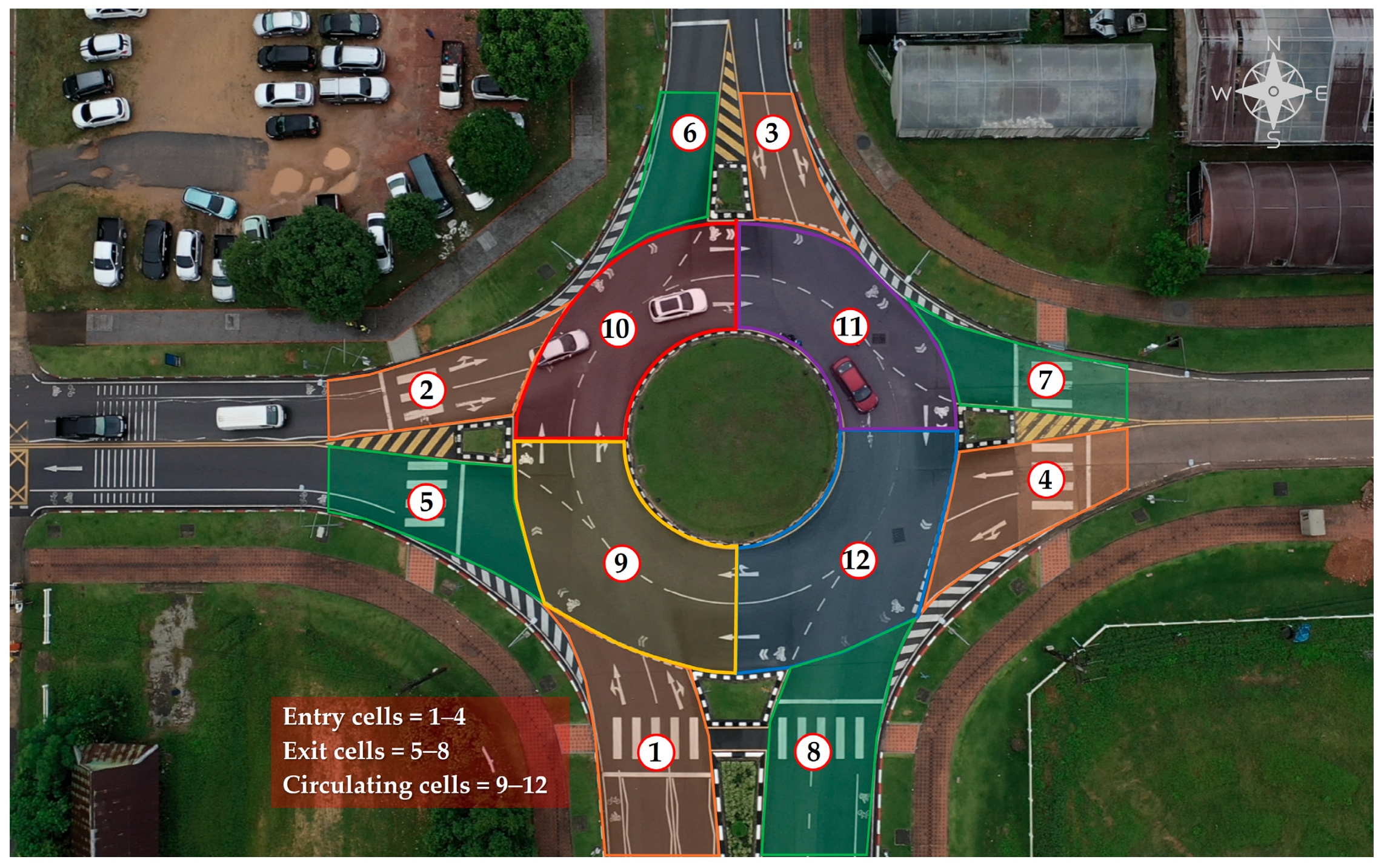
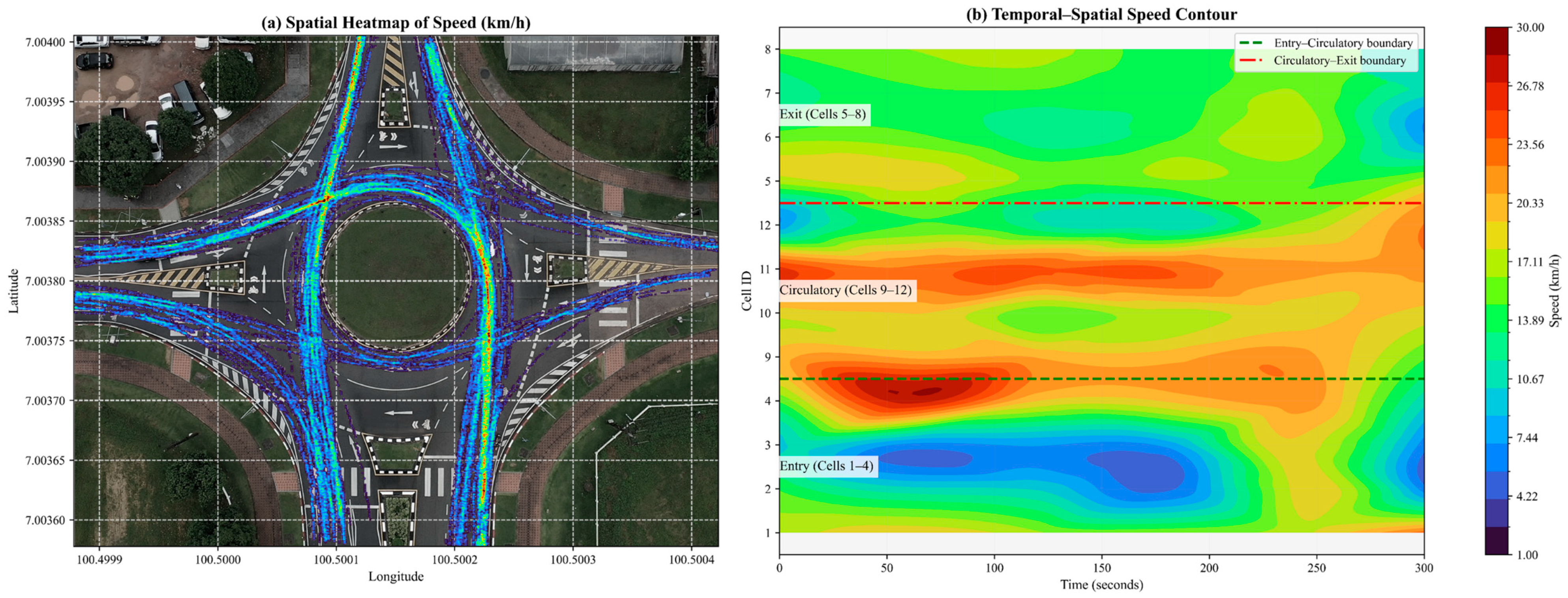
To model vehicle movements at the study roundabout (Figure 7), the facility was discretized into 12 transmission cells consistent with the CTM. Numbering proceeds clockwise from the south approach and is used consistently in subsequent analyses: Cells 1–4 are entry cells, Cells 5–8 are exit cells, and Cells 9–12 are circulating-roadway cells. Entry cells (1–4) represent approach segments where vehicles queue at the yield line and accept gaps, with operations governed by upstream demand and priority rules. Exit cells (5–8) represent departure segments where vehicles merge onto downstream links, with efficiency influenced by downstream capacity and local controls. Circulating cells (9–12) represent arcs along the circulatory roadway, where performance reflects merging interactions, lane usage, and congestion. This partition supports a compact CTM representation of queue formation, lane changes, and spillback under varying demand and inner-lane closure scenarios. The following subsections detail the constraints on the sending/receiving flow and the state-update equations used to evaluate each configuration.

3.4.2. Establishing Flow Constraints and CTM State Equations

Each transmission cell in the CTM operates under the flow-conservation principle, meaning that the number of vehicles in a given cell changes dynamically in response to inflow and outflow conditions. The state transition equation, governing vehicle accumulation in each cell, ensures that the system adheres to capacity and demand constraints, preventing unrealistic vehicle movement and congestion overflow. It is formulated as shown in Equation (4) [48]:
N i t + 1 = N i t + m i n s i t , d i ( t ) } m i n s i t , d i + 1 ( t ) }
where:
N i t is the number of vehicles in cell i at time t
s i t is the supply function, indicating the available space in cell i
d i t is the demand function, representing the outflow of vehicles from cell i
d i + 1 t is the downstream demand function that determines whether vehicles can advance to the next cell.
To ensure realistic traffic modeling, each cell is subjected to two fundamental flow constraints that prevent excessive congestion and spillback. The jam density constraint, which defines the maximum occupancy of a cell, is given by Equation (5) [48]:
N i t N m a x
where:
N m a x is the maximum vehicle storage capacity of the cell.
This constraint ensures that no cell exceeds its maximum allowable density, which is essential for accurately modeling traffic bottlenecks and gridlock conditions. The outflow constraint, which governs vehicle movement between adjacent cells, is expressed as Equation (6) [48]:
q t ( t ) = m i n ( d i t , s i + 1 t ,   q m a x )
where:
q m a x is the maximum possible vehicle outflow per unit time.
This constraint ensures that traffic flow is regulated by downstream capacity and merging interactions, preventing spillback effects and traffic oversaturation.

3.4.3. Evaluating Traffic Performance Metrics

Key traffic indicators are extracted from CTM simulations, with a focus on per-cell analysis to assess roundabout performance in greater detail. Instead of evaluating system-wide metrics alone, this approach examines traffic flow ( q ), speed ( v ), and density ( k ) at each transmission cell, providing insights into localized congestion, lane utilization patterns, and variations in traffic efficiency. Traffic flow is analyzed for each transmission cell to determine how vehicles transition through different roundabout sections over time. The total system flow is computed according to Equation (7):
q = i = 1 12 q i
where:
q i is the number of vehicles exiting transmission cell i per unit of time.
However, the per-cell analysis identifies flow restrictions, bottlenecks, and uneven traffic distribution within the roundabout. If a particular cell exhibits lower outflow than its upstream neighbors, it may indicate merging conflicts, excessive vehicle accumulation, or lane-capacity limitations. To evaluate the severity of localized congestion and traffic stability, the average vehicle speed ( v a v g , k m / h , i ) was computed for each transmission cell based on Vehicle Meters Traveled (VMT) and Vehicle Seconds Traveled (VST), as shown in Equation (8):
v a v g , k m / h , i = V M T i V S T i × 3.6
where:
V M T i is the total distance all vehicles travel within transmission cell i (m).
V S T i is the total time all vehicles spend within transmission cell i (s).
Traffic density represents the concentration of vehicles within a given cell and was derived using an occupancy-based formulation consistent with the Cell Transmission Model (CTM). This time-averaged measure accounts for the accumulated vehicle-seconds over each 60 s interval, divided by the corresponding cell length ( L c e l l ), as expressed in Equation (9):
k i = V S T i t × L c e l l
where:
V S T i is the total vehicle-seconds accumulated in cell i over the observation period
t is the observation interval (s), and
L c e l l is the length of transmission cell i (m).
Finally, the macroscopic flow within each cell was determined using the fundamental relationship between flow, density, and speed, ensuring full consistency between the CTM and the MFD frameworks as shown in Equation (10):
q i = V M T i t × L c e l l
where:
V M T i is the total distance traveled within cell i over the observation period
t is observation interval (s), and
L c e l l is the length of transmission cell i (m).
All parameters were derived automatically from UAV-tracked vehicle trajectories, maintaining dimensional consistency and ensuring full coherence between empirical data processing and the theoretical MFD–CTM formulations.

3.4.4. Using CTM to Compare Different Lane Closure Scenarios

The CTM was run under three configurations to quantify the impact of lane restrictions on roundabout performance. Scenario codes use the pair (outer, inner) to denote the fraction of usable capacity in the two circulating lanes, with entry and exit geometry held constant. The existing case (1, 1) represents full availability of both lanes, yielding the lowest delays and highest throughput. The partial inner-lane closure case (1, 0.5) restricts the inner lane over a defined arc, reducing usable merging space, increasing queue spillback, and lowering effective capacity; this scenario reflects temporary work zones and targeted management strategies to reduce conflicts in mixed car-motorcycle traffic. The full inner-lane closure case (1, 0) removes the inner lane entirely, forcing all vehicles into the outer lane, representing emergency restrictions or deliberate safety measures aimed at curbing abrupt lane changes that cause rear-end and weaving conflicts.

3.5. Traffic Conflict Analysis

Traffic conflict analysis was conducted to quantify near-miss interactions and assess safety variations across the three lane-closure scenarios. It should be clarified that TTC was not computed directly from YOLOv8 detections but rather from post-processed trajectory data resulting from vehicle detection, multi-object tracking, coordinate transformation, speed estimation, trajectory filtering, and smoothing. The resulting dataset includes time-series vehicle IDs, classes, positions, speeds, heading, timestamps, and functional zone labels, supporting the identification of interacting vehicle pairs and the estimation of relative positions and speeds for TTC calculation.
To ensure data reliability, trajectory quality control procedures were applied to mitigate detection jitter, tracking instability, and coordinate noise. Off-road detections, stationary objects, out-of-zone records, short unstable tracks, and visually inconsistent trajectories were excluded. Trajectories were then smoothed before deriving kinematic and relative-motion variables. This preprocessing is particularly important for motorcycles, whose smaller image footprint increases sensitivity to detection and tracking errors.
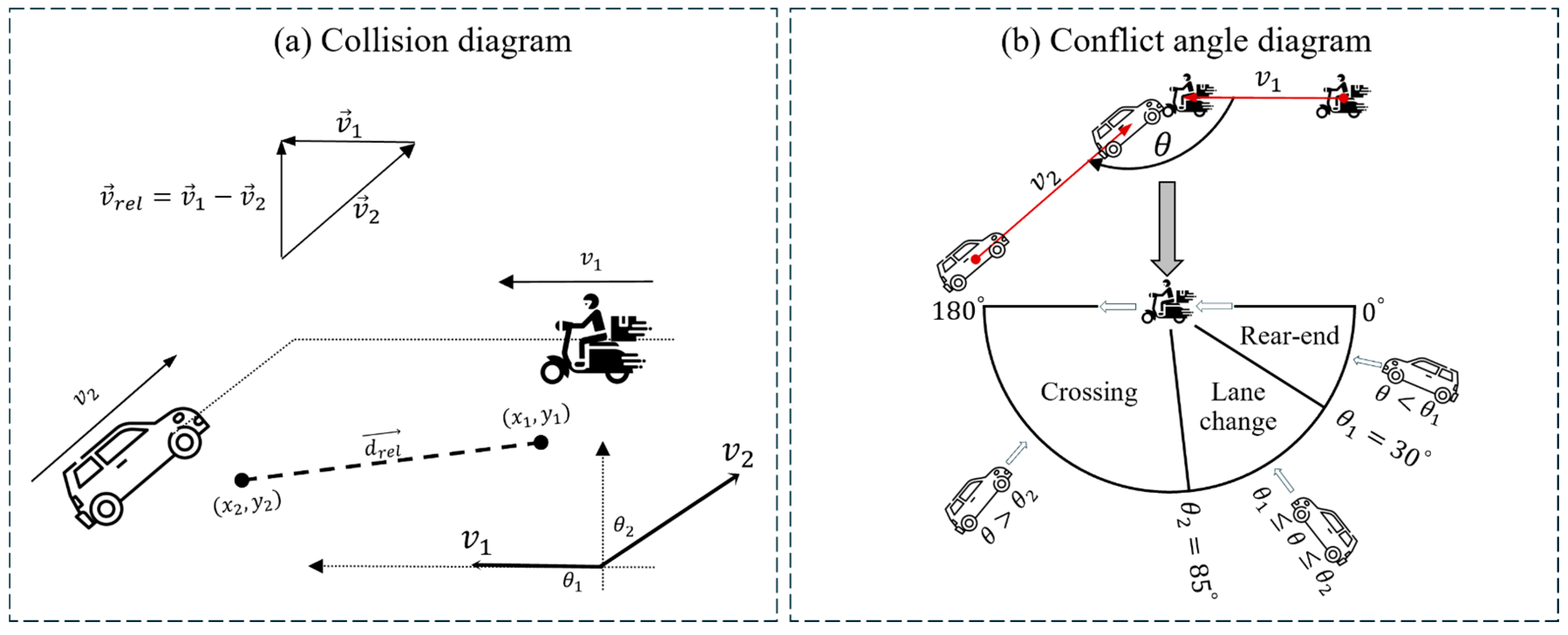
The Time-To-Collision (TTC) between two interacting vehicles was computed using their relative position and relative velocity vectors, as expressed in Equation (11):
T T C = d r e l · v r e l v r e l 2 ,     i f   d r e l · v r e l < 0   ( c o l l i s i o n   p o s s i b l e ) ,                         i f   d r e l · v r e l 0   ( c o l l i s i o n   i m p o s s i b l e )
where:
TTC is Time-To-Collision, representing the estimated time before two vehicles collide if no corrective actions are taken (s).
d r e l is the relative distance vector between the two approaching vehicles (m).
v r e l is the relative velocity vector between the two vehicles (m/s).
v 1 , v 2 are the velocity vectors of Vehicle 1 and Vehicle 2, respectively.
d 1 ,     d 2 are the position vectors of Vehicle 1 and Vehicle 2, respectively.
v r e l 2 is the squared magnitude of the relative velocity, ensuring a non-negative denominator for valid TTC computation.
The relative position vectors, velocity vectors, and conflict-angle classification used for TTC computation are illustrated in Figure 8.
High-resolution UAV footage was processed to extract frame-level trajectories, which were mapped onto a site-fixed Cartesian coordinate system. At each time step, candidate vehicle pairs within a predefined screening radius and operating in the same functional area (entry, circulating, or exit) were identified. Pairs exhibiting separating motion or negligible relative speed were excluded to avoid unstable TTC estimates.
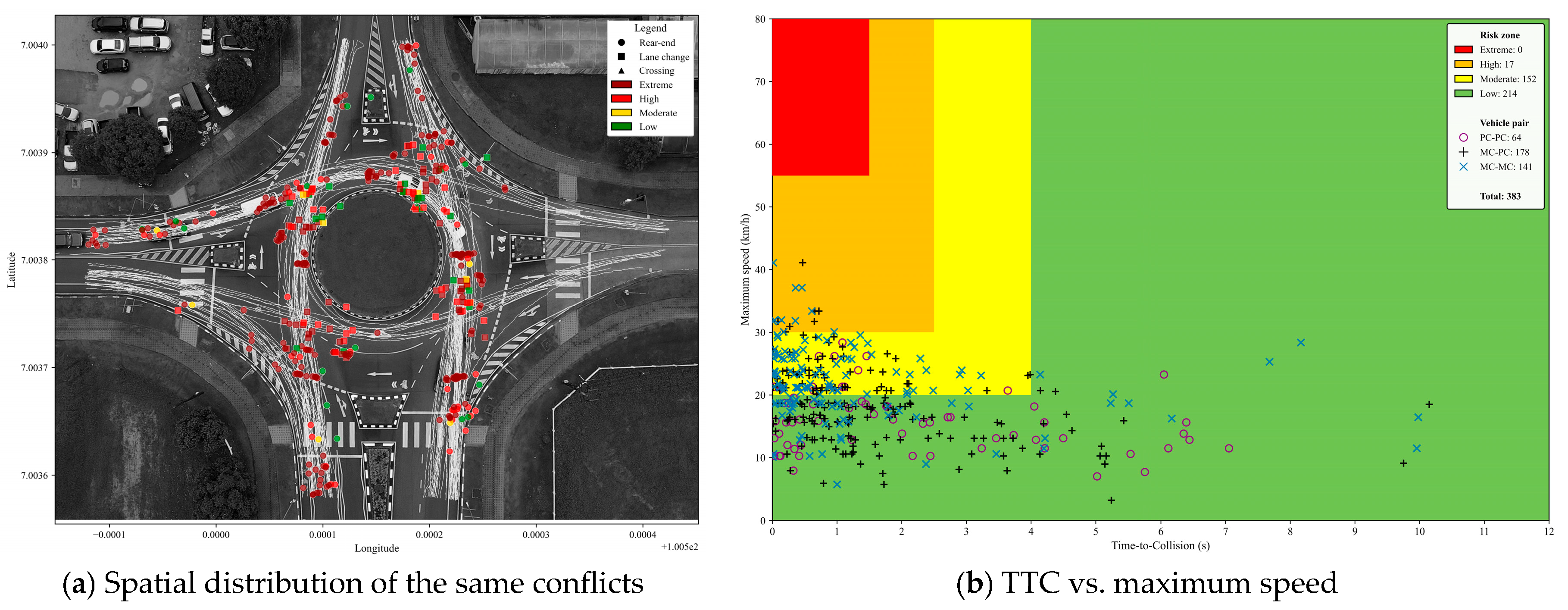
A two-dimensional risk interpretation framework was used to classify TTC-based traffic interactions by considering both temporal proximity and potential collision intensity. In this framework, TTC represents the temporal closeness of an interaction, while approach speed reflects the kinetic-energy component of potential crash severity. This interpretation is consistent with surrogate safety assessment principles, which use temporal indicators to identify near-miss interactions and classify conflict risk [8,13,14,15,16,17,63].
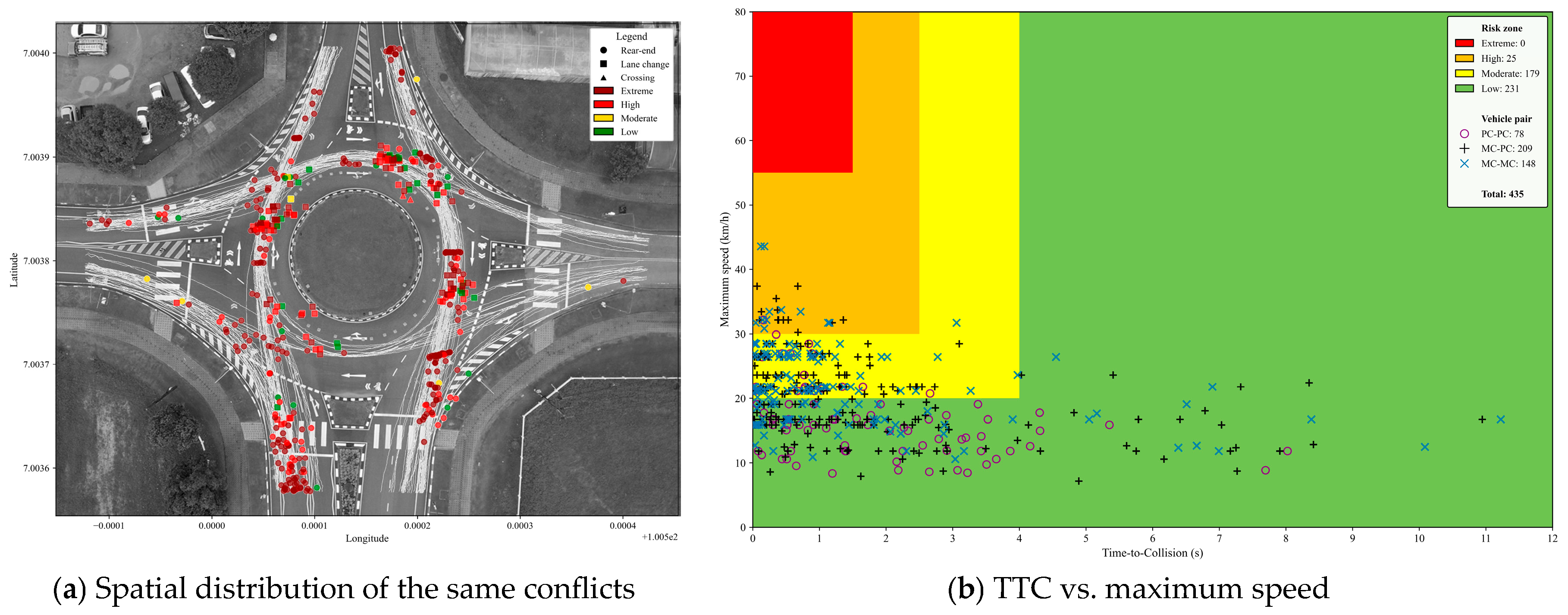
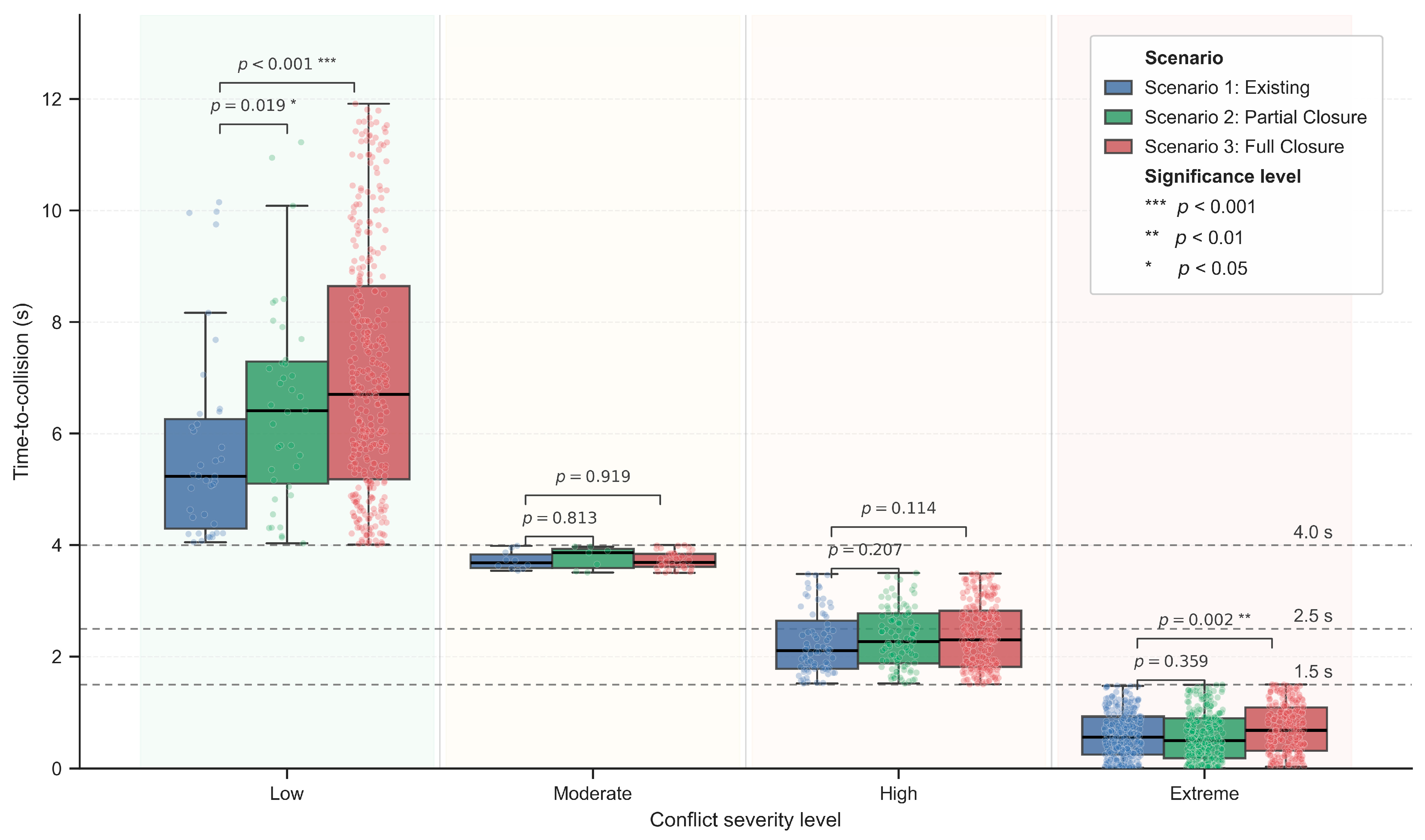
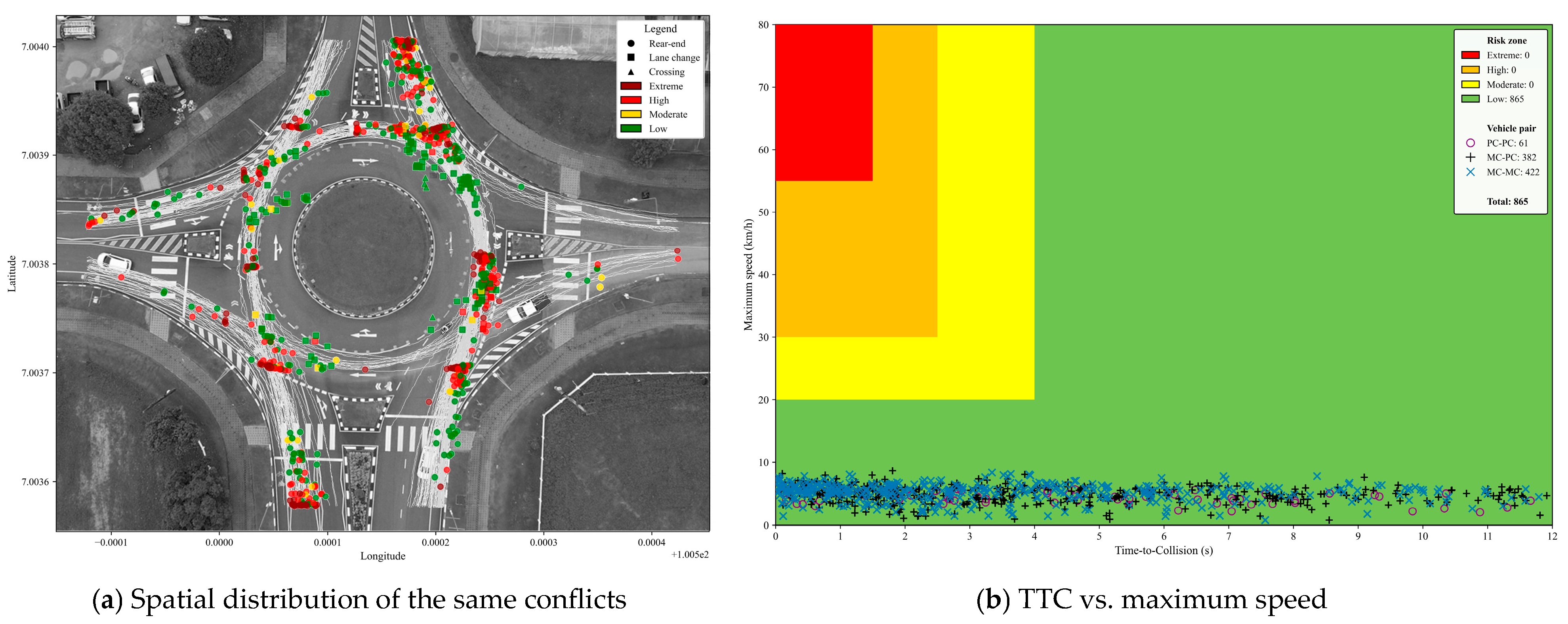
A TTC threshold of 4.0 s was used to denote the onset of safety concern. Interactions with TTC < 4.0 s were classified as risk-related, whereas TTC ≥ 4.0 s represented low-risk or non-critical interactions (green zone in graphical interpretation). TTC severity was further divided into four levels: extreme (TTC < 1.5 s), high (1.5 ≤ TTC < 2.5 s), moderate (2.5 ≤ TTC < 4.0 s), and low (TTC ≥ 4.0 s), following widely adopted surrogate safety and SSAM-based conflict assessment frameworks [8,15,16,17,63]. These thresholds represent progressively reduced reaction and maneuvering time rather than actual crash occurrence.
Because TTC was derived from post-processed trajectories, detection and tracking inaccuracies may propagate into the estimates through errors in vehicle position, speed, and heading. To reduce this effect, trajectory filtering, smoothing, and visual inspection were performed prior to analysis.
Approach speed was incorporated as a complementary indicator because TTC alone describes temporal closeness but does not fully capture the potential crash consequences.
Previous injury-severity research has shown that impact speed is strongly associated with fatal and serious injury risk across common crash scenarios [64]. Therefore, approach speed was operationally classified into four levels: low (<20 km/h), moderate (20–30 km/h), high (30–55 km/h), and extreme (>55 km/h). These categories were used to represent progressively increasing collision energy and to support comparative interpretation of MC–MC, MC–PC, and PC–PC interactions across scenarios, rather than to directly predict injury outcomes.
The definition of approach speed in this study is based on the pairwise nature of the TTC framework and the roundabout’s priority structure. Since circulating vehicles generally have priority, many observed interactions, particularly at entry and circulating transition areas, can be interpreted as situations in which an approaching vehicle converges with the circulating stream. Accordingly, TTC represents the time remaining before the two vehicles reach the same point along their current trajectories. To capture conflict severity, the approach speed was defined as the higher of the two speeds within each vehicle pair, representing a conservative estimate of potential collision energy, particularly when a higher-speed entering vehicle conflicts with a circulating vehicle. This assumption is particularly relevant under mixed traffic conditions, where heterogeneous vehicle behavior can amplify speed differentials during conflict formation. By jointly considering TTC and approach speed, the analysis captures both collision imminence (temporal risk) and potential impact severity (kinetic risk).
Conflict interactions were further characterized by their geometry using approach angles derived from instantaneous velocity vectors. Following Hydén’s conflict taxonomy [65] and SSAM-based principles, conflicts were classified into three types: rear-end (angle < 30°), lane-change/weaving (30–85°), and crossing (angle > 85°).
Conflict analysis focused on interactions between motorcycles (MC) and passenger cars (PC), consistent with the classification scheme used in the trajectory extraction. The resulting conflict dataset, therefore, comprised MC–MC, MC–PC, and PC–PC interactions. Although bus-related interactions may be relevant in other contexts, they were beyond the scope of the present study and warrant further investigation.
TTC calculations and conflict-event detection were implemented using in-house Python 3.10 scripts rather than proprietary software. These scripts conducted pairwise screening, relative-motion computation, TTC estimation, event aggregation, and severity classification. This framework provides a transparent linkage between trajectory data and derived conflict indicators. MFD and CTM outputs were used to support operational interpretation, while TTC-based measures were derived directly from empirical trajectories.
The integration of TTC-based severity, approach-speed classification, and angle-based typology provides a comprehensive representation of traffic conflicts in terms of temporal urgency, kinetic intensity, and interaction geometry. The resulting conflict dataset was used to examine spatial patterns, temporal dynamics, and severity variations across different lane-closure scenarios.

4. Results and Discussion

This section presents the findings corresponding to the three research questions outlined in Section 1. The MFD was used to evaluate changes in traffic dynamics and density (Section 4.1), the CTM analyzed congestion propagation and queuing behavior (Section 4.2), and the TTC method assessed conflict frequency and severity (Section 4.3). In addition, lane-use patterns, car–motorcycle interactions, and merging behavior were examined to explain behavioral adaptations under partial and full inner-lane closures. Together, these analyses integrate operational and safety perspectives to compare the three scenarios—full lane availability, partial inner-lane closure, and full inner-lane closure—under consistent geometric and traffic conditions.

4.1. Results of MFD Analysis

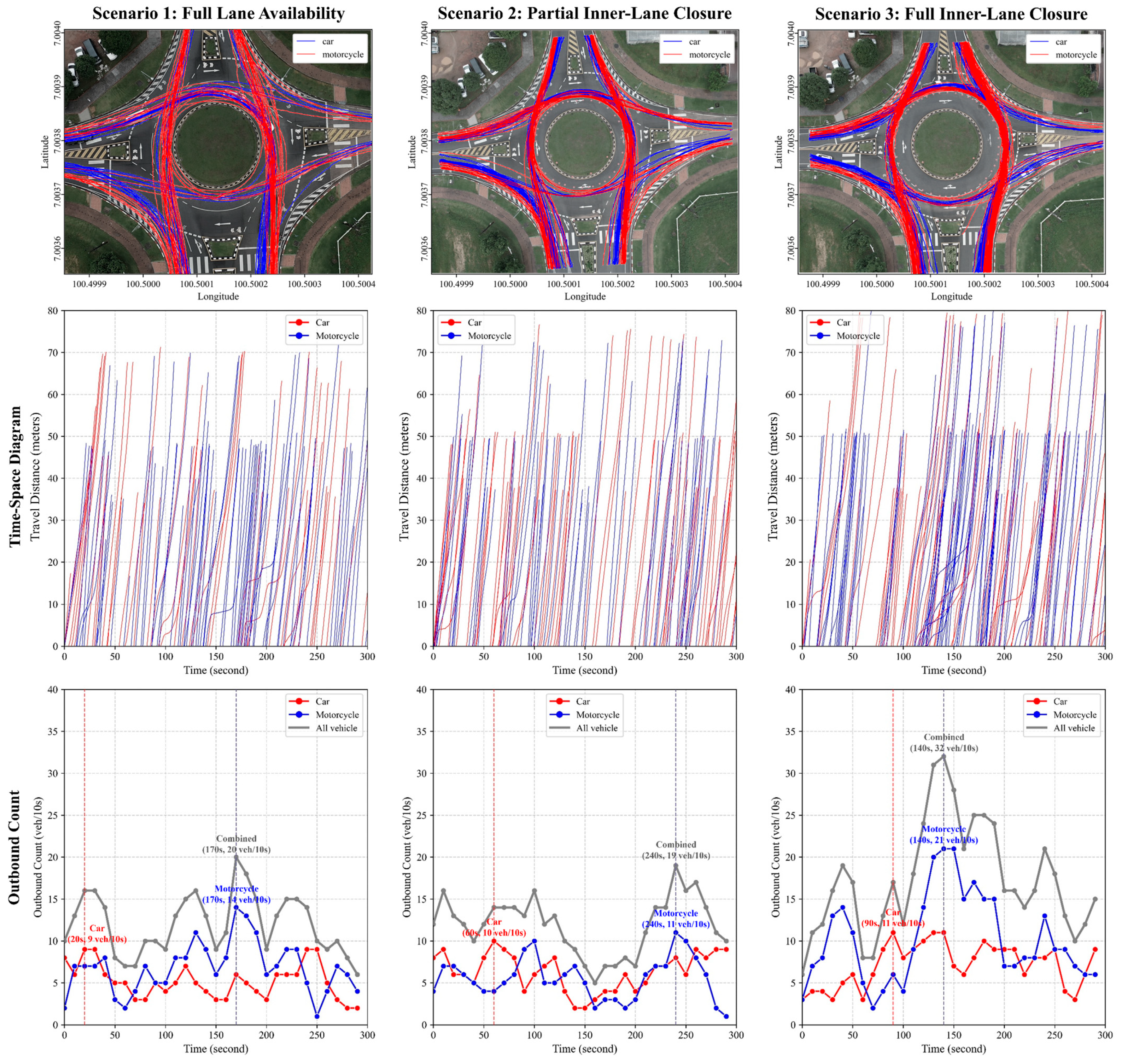
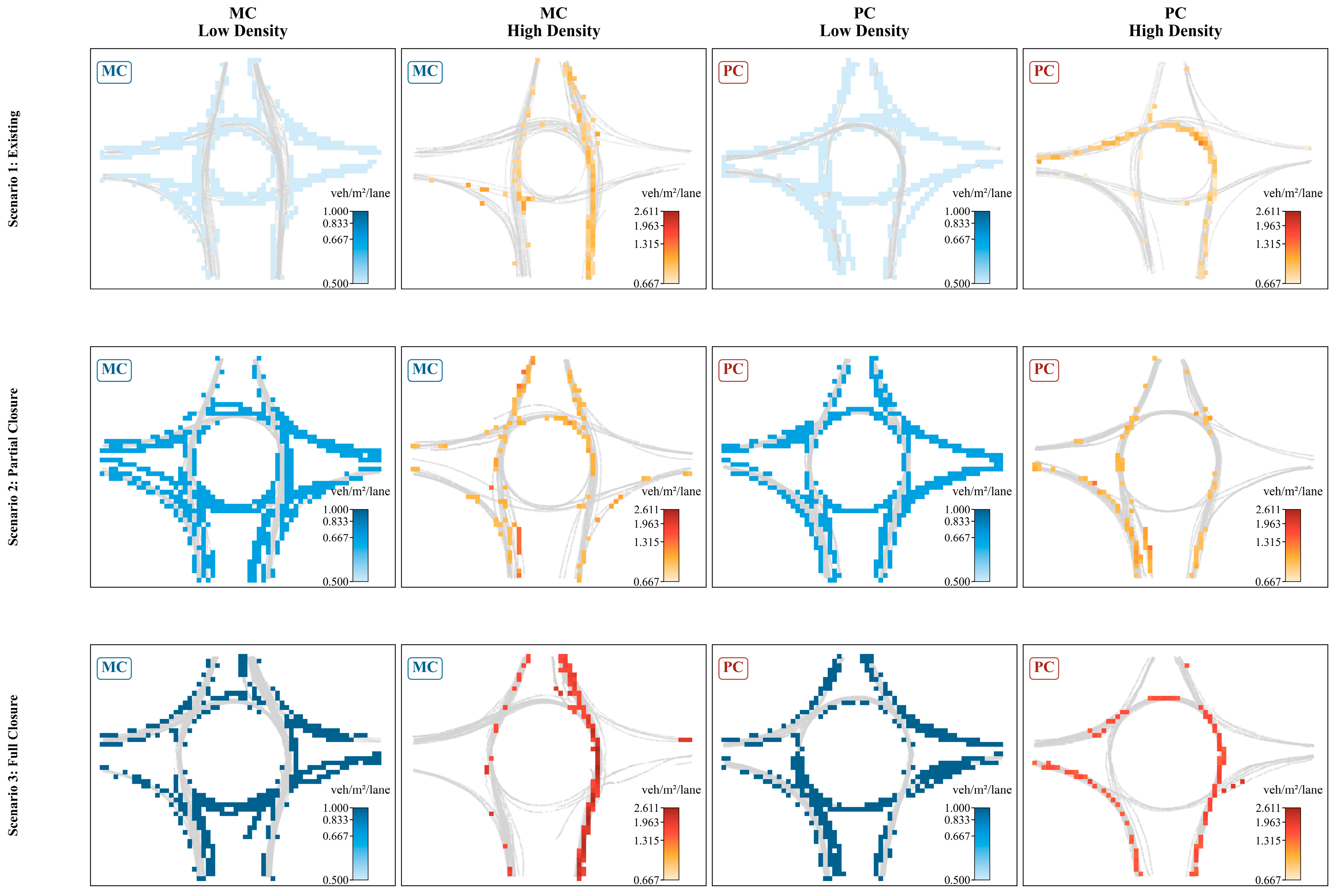
To evaluate the operational impacts of different circulating-lane closure strategies, this section analyzes traffic behavior using MFDs derived from high-resolution vehicle trajectory data. Three progressively restrictive configurations are considered: full lane availability, partial inner-lane closure, and full inner-lane closure. Each scenario is assessed using spatial trajectories, time–space diagrams, 10 s vehicle-count profiles, and density maps (Figure 9), providing insight into how lane geometry influences vehicle behavior, congestion formation, and overall system performance.
The spatial trajectory plots in Row 1 of Figure 9 illustrate the paths of passenger cars and motorcycles under the three scenarios. Each subfigure overlays georeferenced trajectories on the roundabout layout, with color coding by vehicle type to enable comparison of modal movement patterns. These visualizations highlight how the circulating-lane configuration influences approach alignment, circulation behavior, and lane-use efficiency within the roundabout. In Scenario 1 (full lane availability), trajectories show predominantly straight approaches with minimal entry deflection. Motorcycles frequently traverse the circulatory area along near-straight paths, cutting across lanes rather than following a continuous circular path. This behavior reflects typical motorcycle-dominated traffic, where riders prioritize shortest paths and lateral filtering over strict lane adherence. As a result, the outer circulating lane is underutilized, while most vehicles concentrate near the inner edge, indicating inefficient lane use and reduced lateral separation. Nevertheless, overall flow remains stable and continuous, with limited merging turbulence.
In Scenario 2 (partial inner-lane closure), trajectories become more deflected at all entries due to the reduced merging space. The inner lane remains underutilized, while left-turning vehicles shift toward the outer lane. These conditions generate localized conflicts and short queues near merge zones, resulting in reduced speed uniformity and intermittent flow disruptions. Motorcyclists are notably influenced, often accepting smaller gaps and performing more assertive maneuvers to maintain progression through the constrained geometry.
In Scenario 3 (full inner-lane closure), all traffic is confined to a single circulating lane, resulting in highly organized and consistent trajectories. Entry paths exhibit uniform deflection, and circulation follows a smooth outer arc with clearly defined left-turning paths. This configuration enhances path regularity and reduces erratic cross-cutting, indicating enhanced operational stability and spatial discipline, compared with the previous scenarios.
The time–space diagrams in Row 2 of Figure 9 illustrate vehicle progression through the study roundabout by plotting travel distance against time. Each trajectory appears as a sloped line, with steeper slopes indicating higher speeds and horizontal segments representing delays or queueing. These plots reveal how traffic behavior evolves under different lane configurations and how lane availability governs flow stability, queuing, and traffic efficiency. Vehicle movement parameters were computed using Equations (1) and (2), from which cumulative Vehicle-Meters-Traveled (VMT) and Vehicle-Seconds-Traveled (VST) were derived at 1 s intervals for each vehicle. These measures were used to generate the flow–density–speed relationships shown in Figure 10, while the corresponding speed profiles are discussed later in this section. Together, these macroscopic metrics provide a consistent basis for evaluating system-level mobility performance.
In Scenario 1, the trajectories are uniformly steep and evenly spaced, indicating stable, uncongested flow and effective utilization of both circulating lanes. Over the 300 s observation period, cumulative travel distance totals approximately 333,425 m for cars and 423,147 m for motorcycles, reflecting smooth circulation and minimal delay, consistent with free-flow conditions. It should be noted that the 300 s dataset represents a sampled segment from the full observation records, selected to illustrate typical traffic patterns and trends observed across all experimental scenarios.
In Scenario 2, the reduction in inner-lane capacity introduces merging conflicts and disrupts flow continuity. Vehicles encounter tighter gaps, intermittent queuing, and speed fluctuations. Total travel distances increase sharply to approximately 940,220 m for cars (+182%) and 1,014,882 m for motorcycles (+140%) compared to Scenario 1. This escalation indicates longer in-system travel times and reduced throughput efficiency, as vehicles circulate longer before exiting the roundabout.
In Scenario 3, full lane closure intensifies these effects, with frequent horizontal segments and flattened slopes indicating stop-and-go conditions. Cumulative travel distances further increase to 1,000,368 m for cars (+200%) and 1,413,761 m for motorcycles (+234%), signifying a substantial decline in operational performance. These findings confirm that circulating lane restrictions significantly increase travel distance and duration, thereby amplifying congestion and reducing effective capacity.
The 10 s vehicle-count profiles in Row 3 of Figure 9 illustrate short-term variations in the number of unique vehicles observed within the circulating section. Each subfigure presents separate curves for cars, motorcycles, and the combined stream, enabling comparison of temporal clustering and flow stability across scenarios. These values represent vehicle presence within each 10 s interval rather than physical exit discharge. Therefore, they should not be interpreted as direct outflow rates. Where veh/s equivalents are shown, they are provided only as arithmetic equivalents of the 10 s bin counts to aid interpretation, not as measured discharge rates. Under congested conditions, vehicles remain longer within the observation area, increasing the 10 s counts without a proportional increase in actual discharge. Direct exit-line discharge remained below 0.4–0.5 veh/s, consistent with realistic headways of approximately 2–3 s.
In Scenario 1, the 10 s vehicle-count profile remains consistently high and stable over the observation period. With both circulating lanes fully operational, vehicles discharge continuously with minimal interference. The combined flow peaks at t = 170 s, reaching 20 veh/10 s interval (≈2.0 veh/s), the highest among all scenarios. Motorcycles reach 14 veh/10 s interval (≈1.4 veh/s) at the same time, while cars reach 9 veh/10 s interval (≈0.9 veh/s) at t = 20 s. These smooth and symmetrical flow patterns indicate balanced lane utilization, stable throughput, and low turbulence, reflecting efficient, uncongested operation. Although the values expressed per 10 s interval may appear high, they reflect trajectory density rather than actual discharge, with exit-line flows remaining within realistic bounds.
In Scenario 2, the reduced inner-lane capacity decreases overall discharge and introduces flow instability. The combined flow peaks later, at t = 240 s, reaching 19 veh/10 s interval (≈1.9 veh/s). Motorcycles and cars peak at t = 240 s (11 veh/10 s interval, ≈1.1 veh/s) and at t = 60 s (10 veh/10 s interval, ≈1.0 veh/s), respectively. The flatter and delayed flow curves reflect increased merging friction, intermittent queue release, and uneven discharge patterns. Motorcycles initially sustain slightly higher discharge rates by filtering through narrow gaps; however, this advantage diminishes as congestion intensifies near the merge point. The observed oscillations indicate increasing flow instability and reduce effective capacity relative to Scenario 1. Again, the plotted magnitudes reflect temporal clustering rather than physical exit flow, consistent with established operational headways.
In Scenario 3, all vehicles are confined to a single circulating lane, resulting in the most volatile discharge pattern. The combined flow peaks at t = 140 s, reaching 32 veh/10 s interval (≈3.2 veh/s)—the largest instantaneous discharge but also the least stable. Motorcycles peak at 21 veh/10 s interval (≈2.1 veh/s) at t = 140 s, while cars peak at 11 veh/10 s interval (≈1.1 veh/s) at t = 90 s. These short-lived peaks correspond to platoon releases following temporary blockages, whereas subsequent troughs indicate rapid reformation of the queue within a single lane. Confinement to a single lane compresses trajectories in space and time, amplifying fluctuations in bin-based counts without increasing actual discharge capacity. When measured at the exit, the true outflow remains below 0.4–0.5 veh/s.
Figure 10 presents the MFDs derived from the flow–density (q–k), speed–flow (s–q), and speed–density (s–k) relationships for the three scenarios. The MFDs were constructed from the usable UAV-extracted vehicle trajectories for each scenario, aggregated into 60 s intervals to capture short-term traffic-state variability. To capture short-term variability, the data were disaggregated into 60 s intervals following the cell-transmission framework. Each trajectory was assigned to a transmission cell based on its physical length (Lcell = 10–20 m) and the number of active lanes. Scenario 1 represents full circulatory lane availability (two lanes), Scenario 2 corresponds to partial inner-lane closure (1.5 lanes), and Scenario 3 represents full inner-lane closure (one lane). The analysis follows the macroscopic relationships defined in Equations (8)–(10), with vehicle movement characterized by cumulative VMT and VST defined in Equations (1) and (2). These measures ensure consistency between the CTM framework and the observed trajectory data and serve as the basis for the MFDs, which illustrate the progressive decline in flow efficiency and stability as lane availability decreases.
The flow–density relationships provide the primary basis for MFD interpretation, showing satisfactory goodness-of-fit across all scenarios (R2 = 0.799, 0.852, and 0.810 for Scenarios 1–3, respectively). These fitted relationships complement mean-based comparisons and strengthen the statistical basis for interpreting aggregate traffic-state responses to lane-closure conditions.
Under full-lane operation (Scenario 1), the roundabout demonstrates the highest operational stability and balanced performance. The density-flow relationship follows the classical Greenshields form with a strong fit (R2 = 0.799), yielding a maximum flow of approximately 0.239 veh/s per lane at a critical density of about 0.087 veh/m/lane. This point represents the optimal balance between vehicle spacing and discharge rate. Below this threshold, interactions among entry, circulating, and exiting flows remain smooth, supporting stable throughput and minimal congestion.
Under partial inner-lane closure (Scenario 2), the system becomes more sensitive to congestion despite a higher fitted maximum flow of approximately 0.369 veh/s per lane at a critical density of about 0.143 veh/m/lane (R2 = 0.852). This apparent increase in peak flow does not indicate improved operational efficiency; rather, it reflects a compressed operating regime in which higher flow rates are achieved briefly before instability emerges. The rightward shift in the curve indicates delayed flow stabilization and earlier queue formation due to increased merging friction within the circulatory area. Although motorcycles maintain some advantage through gap filtering, their movement is frequently disrupted by merging conflicts. Consequently, observed flow exhibits oscillations and localized bottlenecks, indicating reduced robustness and a transition from stable discharge to intermittent stop-and-go conditions.
Under a full inner-lane closure (Scenario 3), vehicle concentration rises sharply, leading to the most unstable operating regime. The fitted curve (R2 = 0.810) reaches a maximum flow of approximately 0.340 veh/s per lane at a critical density of approximately 0.124 veh/m/lane, beyond which flow declines rapidly. This post-peak behavior reflects classic congestion dynamics, including queue formation, stop-and-go propagation, and discharge breakdown within the single circulating lane. Intensified interactions between entering and circulating vehicles further amplify flow volatility and recovery instability.
The flow-speed relationships reinforce these findings. In Scenario 1 (R2 = 0.010), speeds remain relatively stable across a wide range of flows, reflecting efficient dual-lane performance and steady acceleration, particularly at exits. Scenario 2 (R2 = 0.016) shows a stronger nonlinear trend, with speeds declining more rapidly as flow approaches capacity due to merging constraints and increased vehicle heterogeneity. Scenario 3 (R2 = 0.010) exhibits the greatest dispersion and irregular speed reductions, consistent with highly congested, stop-and-go conditions. Although the R2 values are relatively low across all scenarios, the fitted curves are intended primarily to illustrate general behavioral trends rather than to serve as predictive models. Future research with larger datasets or more extended observation periods could improve model fit and yield more reliable functional relationships suitable for practical applications.
The density-speed relationships further confirm progressive performance degradation. In Scenario 1 (R2 = 0.082), speeds decrease gradually with density, indicating stable flow conditions. Scenario 2 (R2 = 0.186) shows an increased slope and greater variability, reflecting constrained maneuverability and early congestion onset. Scenario 3 (R2 = 0.144) exhibits a weaker but noticeable negative trend, indicating widespread instability across density levels.
Overall, the MFD analysis demonstrates a clear decline in throughput stability, resilience, and flow uniformity as lane availability decreases. Full-lane operation provides the most stable and efficient performance, whereas single-lane circulation induces pronounced congestion, unstable discharge, and reduced operational efficiency.
To complement the MFD analysis, Figure 11 presents a matrix of grid-based density maps comparing low- and high-density spatial distributions of motorcycles (MC) and passenger cars (PC) under the three lane-closure scenarios. Density levels were classified using percentile-based thresholds: cells below the 15th percentile represent low-density (dispersed) areas, and cells above the 85th percentile represent high-density (concentrated) areas. This classification was used to examine differences in spatial dispersion, lane-use concentration, and platoon formation between MC and PC under lane-reduction conditions.
The results show that vehicle concentration increased progressively as lane availability decreased. Maximum localized density increased from approximately 1.25 vehicle observations/m2/lane in Scenario 1 to 1.33 in Scenario 2 and 2.61 in Scenario 3, indicating stronger spatial accumulation under restricted conditions. However, these high-density areas remained concentrated near critical circulating and merging zones rather than being uniformly distributed across the entire roundabout.
When separated by vehicle type, both MC and PC showed increasing density under lane restriction, but their spatial patterns differed substantially. For MC, mean density increased from 0.578 vehicle observations/m2/lane in Scenario 1 to 0.726 and 1.243 in Scenarios 2 and 3, respectively, while maximum density increased from 1.000 to 1.333 and 2.611 vehicle observations/m2/lane. For PC, mean density increased from 0.554 to 0.718 and 1.149 vehicle observations/m2/lane, while maximum density increased from 1.250 to 1.333 and 2.000 vehicle observations/m2/lane across the three scenarios. These results indicate that both vehicle types experienced greater spatial concentration in the lane restriction, with the highest densities observed under a full inner-lane closure.
The low-density panels show that MC movements remained more spatially dispersed than PC movements, particularly in Scenarios 1 and 2. This pattern reflects the greater lateral flexibility of motorcycles, which can use small gaps and adjacent spaces within the traffic stream. In contrast, PC movements were more constrained by the available lane geometry and concentrated along dominant circulating paths, resulting in narrower, more continuous travel bands.
The high-density panels further show that vehicle concentration intensified under lane restriction. In Scenario 3, motorcycles formed localized clusters in constrained areas, but their density patterns still extended into adjacent spaces, indicating residual lateral flexibility. In contrast, PC density formed a compact and continuous band along the remaining circulating lane, suggesting stronger lane-following behavior and a clearer platoon-like structure.
Overall, Figure 11 demonstrates that motorcycles and passenger cars responded differently to lane-reduction scenarios. Motorcycles exhibited greater spatial dispersion and more gradual density variation because of their smaller size and maneuverability, whereas passenger cars became increasingly concentrated within constrained lane space. These vehicle-type-specific density patterns help explain the time–space behavior and flow fluctuations shown in Figure 9 and support the need to analyze MC and PC separately in motorcycle-dominated mixed traffic environments.

4.2. Results of CTM Analysis

The CTM was applied to examine traffic propagation under three lane-availability scenarios. As shown in Figure 7, the roundabout was discretized into entry (Cells 1–4), exit (Cells 5–8), and circulating zones (Cells 9–12), enabling detailed analysis of vehicle accumulation, queue formation, and congestion propagation. Results from Table 7 and Table 8 reveal consistent and generalized patterns of congestion redistribution in roundabouts under reduced capacity.
Table 7 summarizes the spatial distributions of vehicle proportions, total travel time, and total travel distance over a 300 s observation period. These indicators reveal a clear redistribution of traffic as lane capacity decreases, with congestion shifting upstream and concentrating near the circulatory entry. Total time represents cumulative vehicle presence, while total distance corresponds to aggregated VMT derived from UAV trajectories.
In the entry zone (Cells 1–4), traffic performance declines progressively as lane capacity decreases. Vehicle shares decline in upstream cells (Cell 1: from 9.89% to 8.45%; Cell 2: from 5.62% to 5.10–5.81%), indicating growing entry delays and upstream queue spillback. In contrast, Cell 3 increases from 6.97% to 9.68%, suggesting redistribution of inflow toward alternative circulating gaps under constrained conditions. Cell 4 remains low, declining from 2.70% to 1.76%, indicating limited residual capacity once queues develop. These results reflect uneven demand distribution and localized queuing caused by restricted entry gaps, a common effect under reduced circulating capacity.
In the exit zone (Cells 5–8), discharge efficiency declines while congestion propagates from upstream. Vehicle shares decrease moderately across most cells, while total travel distance increases significantly. For example, Cell 6 increases from 554 m to 850 m, and Cell 7 from 631 m to 1255 m, indicating repeated deceleration-acceleration cycles prior to exit. These results suggest that downstream performance is strongly influenced by upstream circulating congestion.
In the circulatory zone (Cells 9–12), vehicle accumulation becomes increasingly concentrated near the entry. Cell 9 increases in vehicle share (from 11.91% to 12.85%) and exhibits substantial increases in both total time (≈155 s to ≈200 s) and total distance (≈910 m to ≈1152 m), confirming its role as the primary congestion node. In contrast, Cells 10–12 show declining proportions, indicating vehicles spend more time queuing near the entry rather than circulating smoothly. These findings demonstrate a transition of the circulatory roadway from a flow corridor to a temporary storage region under constrained conditions.
Overall, Table 7 reveals a clear upstream shift in congestion, with the circulatory zone acting as an intermediate buffer between entry queuing and exit discharge constraints. This pattern is broadly applicable to roundabouts operating under reduced capacity.
Table 8 further quantifies traffic performance using average speed, flow, and density across the entry, circulatory, and exit zones. A consistent trend is observed: as lane capacity decreases, flow declines across all zones, while average speed and density exhibit spatially heterogeneous responses. These variations reflect localized interactions among geometric constraints, merging conflicts, and queue spillback, rather than contradictory system behavior.
Importantly, speed changes are not always indicative of improved conditions. Localized speed increases may occur due to temporary acceleration after congestion or reduced local demand, while overall flow remains unstable. These spatial patterns are consistent with Figure 12, Figure 13 and Figure 14, which show that low-speed areas expand and high-density regions become increasingly concentrated under restricted-lane conditions.
In the entry zone (Cells 1–4), the impact of lane reduction is most pronounced. Flow decreases sharply (Cell 1: from 0.44 to 0.16 veh/s, −64%; Cell 2: from 0.25 to 0.11 veh/s), while speed reductions are relatively modest (from 17.50 to 16.10 km/h). In Cell 3, speed initially increases (up to 18.30 km/h) before dropping to 9.69 km/h as congestion forms, while both flow (from 0.31 to 0.18 veh/s) and density (from 0.056 to 0.036 veh/m/lane) decrease. These findings indicate a supply-constrained bottleneck in which restricted inflow, rather than vehicle accumulation, limits performance. This behavior aligns with Figure 12, Figure 13 and Figure 14, which show that congestion first emerges and intensifies near entry points.
In the circulatory zone (Cells 9–12), flow instability becomes more evident. Flow drops significantly (Cell 9: from 0.53 to 0.24 veh/s) even when speeds remain relatively stable (~21 km/h), showing that continuous movement does not guarantee efficient throughput. In more constrained cells (11–12), both speed (from 23.80 to 19.50 km/h; from 12.40 to 7.89 km/h) and density increase (e.g., Cell 11: from 0.016 to 0.035 veh/m/lane), indicating localized congestion and flow breakdown. These results correspond to Figure 11, Figure 12, Figure 13 and Figure 14, in which high-density contours become concentrated within the circulating ring, confirming its transition from a flow corridor to a congested storage region.
In the exit zone (Cells 5–8), speeds remain relatively stable (16–19 km/h), but flow decreases substantially (e.g., Cell 5: −58%; Cell 6: −63%), and density declines by 30–50%. These results indicate that fewer vehicles are discharged due to upstream constraints. Figure 12, Figure 13 and Figure 14 support this finding, showing that congestion propagates downstream from the circulatory lane, limiting discharge efficiency and preventing full recovery at exits.
Across scenarios, particularly in Scenario 2, average speed varies across zones. Some cells show slight speed increases alongside reduced flow and density (e.g., Cell 6), reflecting lower demand or smoother short-term movement. In contrast, other cells (e.g., Cells 2–3) exhibit simultaneous decreases in speed, flow, and density due to unstable merging and intermittent queuing. These differences highlight that traffic performance is shaped not only by capacity reduction but also by localized interactions and adaptive lane-use behavior.
Overall, Table 8 and Figure 12, Figure 13 and Figure 14 demonstrate a consistent spatial progression of traffic degradation under reduced capacity. Entry zones experience early flow reduction due to merging bottlenecks, circulatory zones exhibit increasing flow instability and density concentration, and exit zones show delayed and constrained discharge. This pattern indicates that reduced circulating capacity disrupts overall flow equilibrium and significantly lowers system throughput, even when localized speed patterns appear stable or temporarily improved.

4.3. Results of Traffic Conflict Analysis

Traffic conflict analysis was conducted to assess the safety implications of the circulating-lane closure scenarios. Figure 15 shows the pairwise comparison of TTC values across scenarios for each conflict severity level, providing an overall view of risk distribution.
Consistent with Section 3.5, TTC values are classified into four risk levels: extreme (TTC < 1.5 s), high (1.5 ≤ TTC < 2.5 s), moderate (2.5 ≤ TTC < 4.0 s), and low (TTC ≥ 4.0 s). The distribution of these risk levels across scenarios is summarized in Table 9.
As shown in Figure 15, TTC values at the low severity level are relatively high and increase across scenarios, from approximately 5.2 s in Scenario 1 to 6.7 s in Scenario 3. These differences are statistically significant (p < 0.05 and p < 0.001), indicating that lane closure increases spacing and enhances safety under low-conflict conditions.
At the moderate and high severity levels, TTC decreases to approximately 3.6–3.9 s and 2.0–2.5 s, respectively, with no significant differences across scenarios (p > 0.05), suggesting limited sensitivity to lane configuration under constrained interactions.
At the extreme severity level, TTC drops below 1.5 s, indicating critical conditions. Although statistically significant differences are observed (e.g., p < 0.01), TTC remains low across all scenarios, implying that lane closure influences interaction dynamics but does not eliminate high-risk conflicts.
Overall, the pairwise TTC analysis indicates that inner-lane closure alters the distribution of temporal conflict risk rather than eliminating conflicts. The results should be interpreted in conjunction with the conflict frequencies presented in Table 9, as higher TTC values indicate lower temporal urgency, while overall safety outcomes also depend on the frequency of interactions in each scenario. This distributional analysis provides additional statistical evidence beyond mean-based comparisons and strengthens the interpretation of TTC variability under different lane-closure conditions.
Detailed TTC–approach speed relationships are shown in Figure 16, Figure 17 and Figure 18. In each figure, panel (a) illustrates the spatial distribution of interactions, while panel (b) shows the relationship between TTC and approach speed. Interactions are categorized by type (rear-end, lane-change, and crossing) and vehicle pair (MC–MC, MC–PC, and PC–PC).
Considering the TTC–approach speed relationships in Scenario 1 (Figure 16), conflicts are widely distributed near entry points and within the circulatory roadway, particularly at merging zones, reflecting active weaving and lateral maneuvering under full lane availability. The TTC–speed distribution exhibits substantial dispersion, including interactions at relatively high approach speeds with short TTC values, indicative of high-energy near-miss conditions. Motorcycle-related interactions dominate these areas, consistent with flexible path selection, gap acceptance, and lateral filtering behavior.
As summarized in Table 9, Scenario 1 generated 383 interactions, with extreme TTC conflicts comprising the majority (67.63%), indicating a high prevalence of temporally critical events under the baseline two-lane condition. MC–PC were most frequent (46.47%), followed by MC–MC (36.81%) and PC–PC (16.71%). Rear-end conflicts dominated (70.23%), highlighting the prevalence of longitudinal interaction dynamics. These results indicate that full lane availability supports flexible movement patterns but also allows short-path riding, lateral filtering, and unstable car–motorcycle interactions within the circulatory roadway.
Under Scenario 2 (Figure 17), conflicts become more spatially concentrated near the treated arc and merge areas, reflecting constrained movements and localized merging pressure due to reduced lane availability. The TTC–speed distribution becomes narrower than in Scenario 1, indicating fewer high-speed interactions, but short-TTC conflicts remain prevalent. Motorcycle-related interactions continue to dominate, although they occur within a more constrained spatial envelope.
As shown in Table 9, Scenario 2 produced 435 interactions, slightly exceeding Scenario 1. The proportion of extreme TTC conflicts remained high (67.36%), suggesting that partial inner-lane closure did not substantially reduce temporally critical interactions. MC–PC interactions were most frequent (48.05%), followed by MC–MC (34.02%) and PC–PC (17.93%). Rear-end conflicts accounted for approximately 69.89%, highlighting the dominance of longitudinal interaction dynamics. These results indicate that partial closure concentrated vehicle movements near merge areas while maintaining conditions that allow unstable lateral interactions between motorcycles and passenger cars.
In Scenario 3 (Figure 18), conflicts are highly concentrated along the outer circulating lane and at entry merge points. Removing the inner circulating lane reduces spatial dispersion and constrains vehicle trajectories to a single dominant path. The TTC–speed distribution shifts toward lower operating speeds, indicating reduced exposure to high-speed conflict conditions. However, short-TTC interactions remain frequent due to increased vehicle compression, leading to close following and platoon-like dynamics.
As shown in Table 9, Scenario 3 produced the highest number of interactions (865), accompanied by a substantial shift in severity composition. The proportion of extreme TTC conflicts decreased to 28.55%, while low-risk interactions increased to 39.54%. MC–MC interactions were dominant (48.79%), followed by MC–PC (44.16%), with PC–PC interactions accounting for 7.05%. Rear-end conflicts accounted for approximately 84.74%, highlighting the predominance of longitudinal following dynamics under single-lane conditions. These results suggest that full inner-lane closure reduced the dominance of the most temporally critical interactions but increased low-speed close-following interactions as vehicles were compressed into a single circulating path.
Overall, Table 9 reveals a transformation in conflict mechanisms rather than complete risk elimination. Full lane availability is associated with dispersed, high-severity interactions, whereas partial closure concentrates conflicts without substantially reducing extreme TTC proportions. Full closure increases interaction frequency but shifts the severity distribution toward lower-risk, longitudinal following dynamics.
Integrating TTC, approach speed, vehicle-pair type, and conflict angle indicates that lane closures redistribute interaction risk rather than uniformly reduce it. MC–PC interactions dominate under existing and partial conditions, while MC–MC interactions prevail under full closure. Rear-end conflicts remain predominant across all scenarios, consistent with mixed-traffic environments characterized by close following and filtering rather than crossing conflicts.
The joint use of TTC and approach speed enables concurrent assessment of collision imminence and potential impact severity. However, TTC should be interpreted as a surrogate safety indicator rather than a direct measure of crash occurrence.
Finally, the long-term safety implications remain uncertain. Behavioral adaptation may improve compliance and stability, but could also lead to more aggressive driving. Longitudinal studies are therefore required to evaluate the persistence and evolution of safety effects under lane-closure strategies.

5. Conclusions and Recommendations

5.1. Conclusions

This study evaluated the operational and safety impacts of lane-reduction strategies within the unique sociotechnical environment of a motorcycle-dominated roundabout. By integrating UAV-derived trajectories with Macroscopic Fundamental Diagrams (MFD), Cell Transmission Models (CTM), and Time-To-Collision (TTC) analyses, the results reveal a systemic trade-off between capacity and safety that challenges conventional engineering priorities and underscores the need for a more sustainable, context-sensitive approach to traffic management in motorcycle-dominated urban environments.
The physical restriction of the inner circulating lane acted as a catalyst for behavioral change. Under baseline conditions, motorcyclists frequently engaged in informal behaviors (such as weaving, filtering, and maintaining short headways) that improved individual mobility but compromised collective safety. Partial closure concentrated movements into a single lane, increasing density and generating localized bottlenecks. Full closure, however, limited lateral filtering and encouraged more stable following patterns and improved lane discipline within the observed short-term period. By reducing opportunities for high-risk maneuvers, the interventions shifted interactions from dispersed, high-energy conflicts to more stable, lower-intensity following behaviors, demonstrating how geometric constraints can support safer and more orderly mobility in mixed traffic. These findings are consistent with the design principle in NCHRP Report 672 [1], which highlighted that multilane roundabouts increase lane-selection complexity for two-wheel users. Although primarily developed for cyclists, this principle is applicable to motorcycle-dominated environments, where similar sensitivities to lane positioning and interaction complexity exist. The results suggest that simplifying the effective circulating space can reduce erratic lateral movements and improve behavioral stability in mixed-traffic roundabouts.
Safety outcomes improved substantially under full closure despite reduced operational efficiency. High-severity lane-change conflicts were substantially reduced, while rear-end interactions shifted toward lower-speed, close-following conditions. Although total conflicts increased due to higher density, their severity decreased, indicating a shift from high-energy interactions to more stable, lower-intensity following behavior. These findings suggest that sustainability in motorcycle-dominated traffic should be understood not only in terms of movement efficiency but also in terms of safety, behavioral stability, and the protection of vulnerable road users.
Overall, the findings suggest that inner-lane closure can reduce high-severity interactions and improve path discipline, but at the cost of reduced throughput and greater flow instability under higher demand. In motorcycle-dominated traffic conditions, a single circulating lane may serve as a safety-oriented operational strategy, especially when supported by appropriate geometric design and traffic control measures. This research reinforces the need to move beyond “one-size-fits-all” design standards. Instead, it advocates for culturally responsive infrastructure that accounts for motorcycle-specific social behaviors (such as filtering and gap-seeking) to create safer, more equitable urban mobility frameworks. It also provides a practical analytical framework for supporting sustainable transportation policy and adaptive traffic management in developing urban contexts.

5.2. Practical Implications

The selection of lane-closure strategies should be guided by the trade-off between traffic demand, safety objectives, and traffic composition, particularly motorcycle share. Under low to moderate traffic demand, full-lane operation preserves capacity and maneuverability but increases exposure to high-speed, short-TTC interactions. In off-peak conditions, reduced interaction density may enable higher speeds and shorter path selection, particularly for motorcyclists. In such cases, a temporary inner-lane closure can serve as a speed management intervention by increasing path deflection and limiting lateral filtering behavior.
Partial inner-lane closure provides an intermediate option, reducing lateral maneuvering while retaining some operational flexibility. Under high-risk conditions—such as high motorcycle proportions, frequent conflicts, or constrained geometry—full closure may be justified as a safety-oriented strategy, subject to capacity considerations.
Importantly, lane-reduction measures can be implemented using existing geometry, enabling adaptive and time-dependent traffic management. Restricting the inner lane during low-demand periods may enhance safety, while reopening it under higher demand can restore capacity. Accordingly, lane reduction should be considered an adaptive operational strategy rather than a static design solution.
Beyond strategy selection, the findings provide several implications for improving roundabout performance in mixed-traffic environments:
  • Safety-oriented monitoring: Incorporating surrogate safety indicators, such as TTC and approach speed, into routine monitoring can support early identification of risk-prone conditions and proactive intervention.
  • Geometry-based risk mitigation: Geometric and operational treatments that improve path guidance, increase vehicle deflection, and limit excessive lateral maneuvering space may help improve lane discipline and reduce unstable interactions. However, any site-specific treatment should be selected based on field-measured geometry, applicable design standards, observed traffic composition, and additional safety evaluation before implementation.
  • Context-sensitive lane design: Effective circulating width strongly influences motorcycle maneuvering, lateral filtering, and close-following behavior. Rather than prescribing a fixed lane width, lane widths should be determined based on site-specific geometry, traffic composition, and the desired balance between safety and capacity.
  • Supportive traffic control measures: Clear advance-warning signs, taper markings, and directional guidance are essential during lane restrictions to prevent abrupt maneuvers and reduce rear-end interactions.
  • Adaptive lane management: Emerging technologies, including UAV-based monitoring, roadside sensing, and connected systems, can enable responsive lane-use management based on real-time traffic and safety conditions. Such approaches may support dynamic lane operation, in which the inner circulating lane is temporarily restricted during lower-demand or higher-risk periods and reopened when additional capacity is required.
Overall, these findings suggest that lane-reduction strategies should be considered as context-sensitive operational tools rather than universal design prescriptions. When supported by continuous monitoring, appropriate geometric assessment, and responsive traffic management, such strategies can help improve safety and operational resilience in motorcycle-dominated urban roundabouts.

5.3. Limitations and Future Scope

Although this study provides valuable insights, several limitations should be acknowledged. First, the analysis is based on a single roundabout, which limits generalizability across diverse geometric and operational contexts. Nevertheless, the selected site represents a common multilane configuration in motorcycle-dominated roundabouts. The findings should therefore be interpreted as transferable insights for comparable contexts rather than universally applicable conclusions.
Second, the UAV observations capture short-term responses to temporary lane-reduction interventions and may reflect behavioral adaptation to visible traffic control devices such as traffic cones and warning signs. Therefore, the findings do not represent long-term equilibrium behavior.
Third, the MFD and CTM analyses were not externally calibrated and are intended for explanatory rather than predictive purposes. In addition, TTC-based indicators are subject to trajectory-processing uncertainty and represent surrogate measures of conflict risk rather than actual crash occurrence.
Future research should extend the analysis to multiple sites with varying geometric, operational, and traffic conditions to improve generalizability. Long-term before-and-after studies are also needed to examine whether the observed behavioral changes, such as reduced filtering, increased path stability, and lower-speed following, persist or evolve.
Further work should incorporate independent model calibration and validation to enhance predictive capability. Integrating trajectory-based analysis with emerging sensing technologies, such as connected-vehicle data and roadside monitoring systems, also offers strong potential for real-time safety assessment and adaptive traffic management.

Author Contributions

Conceptualization, C.Y., P.L. and P.S.; methodology, C.Y., P.L. and P.S.; validation, C.Y., P.L., P.S. and S.J.; formal analysis, C.Y., P.L. and P.S.; investigation, C.Y., P.L., P.S. and S.J.; resources, P.L.; data curation, C.Y., P.L. and P.S.; writing—original draft preparation, C.Y. and P.S.; writing—review and editing, C.Y., P.L. and S.J.; visualization, C.Y. and P.S.; supervision, P.L. and S.J. All authors have read and agreed to the published version of the manuscript.

Funding

This research was funded by the Asian Transportation Research Society (project ID 02/2024) and the Graduate School, Prince of Songkla University (grant number TR-2568/182).

Institutional Review Board Statement

Not applicable.

Informed Consent Statement

Not applicable.

Data Availability Statement

The data presented in this study are available on request from the corresponding author due to privacy and ethical considerations.

Acknowledgments

The authors thank Roboflow for providing a platform that supported image annotation, dataset preprocessing, augmentation, and export for the development of a YOLOv8-based vehicle detection model. The image dataset used in this study was prepared by the authors from UAV video footage collected at the study site, and no external or third-party datasets were used. The authors also acknowledge the support of the staff and relevant units of Prince of Songkla University during field data collection and the implementation of temporary lane-closure scenarios. The authors gratefully acknowledge the Asian Transportation Research Society (ATRANS) for research support and constructive comments during the development of this study. During the preparation of this study, the following tools were used: Python 3.10, Ultralytics YOLOv8 (v8.0.196), the Roboflow platform (accessed during 2023–2024), RStudio (2023.06.0), and QGIS (v3.34.3-Prizren). These tools were used for data preparation, image annotation, dataset preprocessing and augmentation, video processing, vehicle detection, trajectory extraction, spatial data management, statistical analysis, and visualization. The authors reviewed and edited all outputs generated through these tools and took full responsibility for the content of this publication.

Conflicts of Interest

The authors declare no conflicts of interest. The funders had no role in this study’s design, data collection, analysis, interpretation, manuscript writing, or decision to publish the results.

Abbreviations

The following abbreviations are used in this manuscript:
AIArtificial Intelligence
CTMCell Transmission Model
DRACDeceleration Rate to Avoid a Crash
FHWAFederal Highway Administration
MCMotorcycle
MFDMacroscopic Fundamental Diagram
MLMachine Learning
PCPassenger Car
PETPost-Encroachment Time
SSAMSurrogate Safety Assessment Model
TTCTime-To-Collision
UAVUnmanned Aerial Vehicle
VHTVehicle Hours of Travel
VKTVehicle Kilometers Traveled
VMTVehicle Meters Traveled
VSTVehicle Seconds Traveled
YOLOYou Only Look Once

References

  1. Transportation Research Board (TRB). NCHRP Report 672: Roundabouts: An Informational Guide, 2nd ed.; The National Academies Press: Washington, DC, USA, 2010. [Google Scholar] [CrossRef]
  2. Federal Highway Administration (FHWA). Roundabouts: An Informational Guide. Manual 2000. Available online: https://www.fhwa.dot.gov/publications/research/safety/00067/00067.pdf (accessed on 15 November 2024). (In English)
  3. Saini, H.K.; Chouhan, S.S.; Kathuria, A. Exclusive motorcycle lanes: A systematic review. IATSS Res. 2022, 46, 411–426. [Google Scholar] [CrossRef]
  4. Trinh, L.T.; Sano, K.; Hatoyama, K.; De Silva, C.K. Analysis of motorcycle microscopic characteristics at roundabouts under mixed traffic condition: A case study of Vietnam. J. Traffic Transp. Eng. 2021, 8, 605–619. [Google Scholar] [CrossRef]
  5. Šarić, A.; Lovrić, I. Multi-lane Roundabout Capacity Evaluation. Front. Built Environ. 2017, 3, 42. (In English) [Google Scholar] [CrossRef]
  6. Yaibok, C.; Suwanno, P.; Luathep, P.; Jaensirisak, S.; Fukuda, A. Investigating Geometric Design Characteristics and Crash Rates of Roundabouts in Thailand. In Proceedings of the 18th East Asia-Pacific Conference on Structural Engineering and Construction; Springer Nature: Singapore, 2025; Volume 3, pp. 123–134. [Google Scholar]
  7. Ahmed, A.; Rizvi, S.A.; Ahmad, F. Modelling Merging Behaviour of Drivers in Heterogeneous Traffic at Roundabouts. Eur. Transp./Trasp. Eur. 2024, 6. [Google Scholar] [CrossRef]
  8. Hasanvand, M.; Nasiri, A.S.; Rahmani, O.; Shaaban, K.; Samadi, H. A Conflict-Based Safety Diagnosis of SCI Roundabouts Using a Surrogate Safety Measure Model. Sustainability 2023, 15, 13166. [Google Scholar] [CrossRef]
  9. Trentin, V.; Artuñedo, A.; Godoy, J.; Villagra, J. Interaction-Aware Intention Estimation at Roundabouts. IEEE Access 2021, 9, 123088–123102. [Google Scholar] [CrossRef]
  10. Arun, A.; Haque, M.M.; Bhaskar, A.; Washington, S.; Sayed, T. A systematic mapping review of surrogate safety assessment using traffic conflict techniques. Accid. Anal. Prev. 2021, 153, 106016. [Google Scholar] [CrossRef]
  11. Arakawa, S.; Tsumita, N.; Suwanno, P.; Yaibok, C.; Luathep, P.; Fukuda, A. Consideration of Safety Measures in a Roundabout with Mixed High Motorcycle Traffic–A Case Study of the Roundabout at Prince of Songkhla University. In Proceedings of the Eastern Asia Society for Transportation Studies, Surakarta, Indonesia, 1–4 September 2025; Volume 15. [Google Scholar]
  12. Wichitphongsa, W.; Kronprasert, N.; Zaw, M.S.; Pisetsit, P.; Satiennam, T. Modeling Riding and Stopping Behaviors at Motorcycle Box Intersections: A Case Study in Chiang Mai City, Thailand. Infrastructures 2025, 10, 97. [Google Scholar] [CrossRef]
  13. Scholl, L.; Elagaty, M.; Ledezma-Navarro, B.; Zamora, E.; Miranda-Moreno, L. A Surrogate Video-Based Safety Methodology for Diagnosis and Evaluation of Low-Cost Pedestrian-Safety Countermeasures: The Case of Cochabamba, Bolivia. Sustainability 2019, 11, 4737. [Google Scholar] [CrossRef]
  14. Shawky, M.; Alsobky, A.; Al Sobky, A.; Hassan, A. Traffic safety assessment for roundabout intersections using drone photography and conflict technique. Ain Shams Eng. J. 2023, 14, 102115. [Google Scholar] [CrossRef]
  15. Pu, L.; Joshi, R. Surrogate Safety Assessment Model (SSAM): Software User Manual; FHWA-HRT-08-050; Federal Highway Administration: Washington, DC, USA; Office of Safety Research and Development Turner-Fairbank Highway Research Center: McLean, VA, USA, 2008. Available online: https://www.fhwa.dot.gov/publications/research/safety/08050/08050.pdf (accessed on 20 July 2025).
  16. Gettman, D.; Pu, L.; Sayed, T.; Shelby, S. Surrogate Safety Assessment Model and Validation: Final Report; FHWA-HRT-08-051; Federal Highway Administration: Washington, DC, USA; Office of Safety Research and Development Turner-Fairbank Highway Research Center: McLean, VA, USA, 2008. Available online: https://www.fhwa.dot.gov/publications/research/safety/08051/08051.pdf (accessed on 25 July 2024).
  17. Gettman, D.; Shelby, S. Surrogate Safety Assessment Model (SSAM), TechBrief; FHWA-HRT-08-049; Federal Highway Administration: Washington, DC, USA; Office of Safety Research and Development Turner-Fairbank Highway Research Center: McLean, VA, USA, 2008. Available online: https://www.fhwa.dot.gov/publications/research/safety/08049/ (accessed on 20 November 2024).
  18. Gerlough, D.L.; Huber, M.J. Traffic Flow Theory—A Monograph. In Transportation Research Board Special Report; Transportation Research Board: Washington, DC, USA, 1975. [Google Scholar]
  19. Yang, Q.I.; Koutsopoulos, H.N. A Microscopic Traffic Simulator for evaluation of dynamic traffic management systems. Transp. Res. Part C Emerg. Technol. 1996, 4, 113–129. [Google Scholar] [CrossRef]
  20. Daganzo, C.F. Urban gridlock: Macroscopic modeling and mitigation approaches. Transp. Res. Part B Methodol. 2007, 41, 49–62. [Google Scholar] [CrossRef]
  21. Geroliminis, N.; Daganzo, C.F. Existence of urban-scale macroscopic fundamental diagrams: Some experimental findings. Transp. Res. Part B Methodol. 2008, 42, 759–770. [Google Scholar] [CrossRef]
  22. Noothep, J.; Luathep, P.; Jaensirisak, S.; Kronprasert, N. Safety effectiveness of inclusive motorcycle lane: A case study in Hat Yai City, Thailand. Transp. Res. Interdiscip. Perspect. 2025, 33, 101608. [Google Scholar] [CrossRef]
  23. Kanistras, K.; Martins, G.; Rutherford, M.J.; Valavanis, K.P. A survey of unmanned aerial vehicles (UAVs) for traffic monitoring. In Proceedings of the 2013 International Conference on Unmanned Aircraft Systems (ICUAS), Atlanta, GA, USA, 28–31 May 2013; pp. 221–234. [Google Scholar] [CrossRef]
  24. Zhang, Y.; Sun, P.; Jiang, Y.; Yu, D.; Weng, F.; Yuan, Z.; Luo, P.; Liu, W.; Wang, X. ByteTrack: Multi-Object Tracking by Associating Every Detection Box; Computer Vision—ECCV 2022; Springer Nature: Cham, Switzerland, 2022; pp. 1–21. [Google Scholar]
  25. Espadaler-Clapés, J.; Fonod, R.; Barmpounakis, E.; Geroliminis, N. An accurate safety and congestion monitoring framework with a swarm of drones. Transp. Res. Interdiscip. Perspect. 2025, 32, 101490. [Google Scholar] [CrossRef]
  26. Kutsch, A.; Margreiter, M.; Bogenberger, K. TUMDOT–MUC: Data Collection and Processing of Multimodal Trajectories Collected by Aerial Drones. Data Sci. Transp. 2024, 6, 15. [Google Scholar] [CrossRef]
  27. Redmon, J.; Divvala, S.; Girshick, R.; Farhadi, A. You Only Look Once: Unified, Real-Time Object Detection. In Proceedings of the 2016 IEEE Conference on Computer Vision and Pattern Recognition (CVPR), Las Vegas, NV, USA, 27–30 June 2016; pp. 779–788. [Google Scholar] [CrossRef]
  28. Kronprasert, N.; Sutheerakul, C.; Satiennam, T.; Luathep, P. Intersection Safety Assessment Using Video-Based Traffic Conflict Analysis: The Case Study of Thailand. Sustainability 2021, 13, 12722. [Google Scholar] [CrossRef]
  29. Luo, Q.; Lu, X.; Zang, Z.; Gong, H.; Guo, X.; Chen, X. A Real-Time Early Warning Framework for Multi-Dimensional Driving Risk of Heavy-Duty Trucks Using Trajectory Data. Systems 2026, 14, 204. [Google Scholar] [CrossRef]
  30. Maji, A.; Ghosh, I. A systematic review on roundabout safety incorporating the safety assessment methodologies, data collection techniques, and driver behavior. Saf. Sci. 2025, 181, 106661. [Google Scholar] [CrossRef]
  31. De Brabander, B.; Nuyts, E.; Vereeck, L. Road safety effects of roundabouts in Flanders. J. Saf. Res. 2005, 36, 289–296. [Google Scholar] [CrossRef] [PubMed]
  32. Wang, J.; Cicchino, J.B. Safety effects of roundabout conversions in Carmel, Indiana, the Roundabout City. J. Saf. Res. 2022, 82, 159–165. [Google Scholar] [CrossRef] [PubMed]
  33. Hu, W.; Cicchino, J.B. Long-term crash trends at single-and double-lane roundabouts in Washington State. J. Saf. Res. 2019, 70, 207–212. [Google Scholar] [CrossRef]
  34. Singleton, P.A.; Poudel, N. Bicycling comfort at roundabouts: Effects of design and situational factors. Transp. Res. Part F Traffic Psychol. Behav. 2023, 94, 227–242. [Google Scholar] [CrossRef]
  35. Meuleners, L.; Fraser, M.; Roberts, P. Improving cycling safety through infrastructure design: A bicycle simulator study. Transp. Res. Interdiscip. Perspect. 2023, 18, 100768. [Google Scholar] [CrossRef]
  36. Savolainen, P.T.; Gates, T.J.; Gupta, N.; Imosemi, S.; Mohammadpour, M.; Dasgar, Y.; Gupta, G. Improving Safety for People Walking and Biking at Roundabouts. Research Paper 2025. Available online: https://rosap.ntl.bts.gov/view/dot/85626 (accessed on 10 October 2025). (In English)
  37. Daniels, S.; Brijs, T.; Nuyts, E.; Wets, G. Extended prediction models for crashes at roundabouts. Saf. Sci. 2011, 49, 198–207. [Google Scholar] [CrossRef]
  38. Maji, A.; Ghosh, I. A copula-based multivariate extreme value framework for roundabout safety evaluation under mixed traffic. Accid. Anal. Prev. 2025, 221, 108219. [Google Scholar] [CrossRef]
  39. Tantarattanaphong, J.S.K. Application of Machine Learning to Study the Behavior of Roundabout Users. In Proceedings of the 30th National Convention on Civil Engineering, Prachuap Khiri Khan, Thailand, 28–30 May 2025; Volume 30. Available online: https://conference.thaince.org/index.php/ncce30/article/view/3670 (accessed on 5 November 2025).
  40. Xia, Y.; Qin, Y.; Li, X.; Xie, J. Risk Identification and Conflict Prediction from Videos Based on TTC-ML of a Multi-Lane Weaving Area. Sustainability 2022, 14, 4620. [Google Scholar] [CrossRef]
  41. Tang, S.; Lu, Y.; Liao, Y.; Cheng, K.; Zou, Y. A New Surrogate Safety Measure Considering Temporal–Spatial Proximity and Severity of Potential Collisions. Appl. Sci. 2024, 14, 2711. [Google Scholar] [CrossRef]
  42. Hoogendoorn, S.P.; Daamen, W.; Knoop, V.L.; Steenbakkers, J.; Sarvi, M. Macroscopic Fundamental Diagram for pedestrian networks: Theory and applications. Transp. Res. Part C Emerg. Technol. 2018, 94, 172–184. [Google Scholar] [CrossRef]
  43. Alonso, B.; Pòrtilla, Á.I.; Musolino, G.; Rindone, C.; Vitetta, A. Network Fundamental Diagram (NFD) and traffic signal control: First empirical evidences from the city of Santander. Transp. Res. Procedia 2017, 27, 27–34. [Google Scholar] [CrossRef]
  44. Lin, X.; Chaojian, T.; Xiaohui, L. Short term road network Macroscopic Fundamental Diagram parameters and traffic state prediction based on LSTM. Arch. Transp. 2024, 71, 107–126. [Google Scholar] [CrossRef]
  45. Guerrieri, M. Total capacity and LOS estimation of innovative and conventional roundabouts through macroscopic fundamental diagrams. Transp. Res. Interdiscip. Perspect. 2024, 27, 101232. [Google Scholar] [CrossRef]
  46. Brilon, W.; Wu, N.; Schmitz, J. Fundamental diagram for an intersection: Application for a roundabout. Transp. Res. Rec. 2023, 2677, 359–372. [Google Scholar] [CrossRef]
  47. Alsalhi, R.; Dixit, V.V.; Gayah, V.V. On the existence of network Macroscopic Safety Diagrams: Theory, simulation and empirical evidence. PLoS ONE 2018, 13, e0200541. [Google Scholar] [CrossRef] [PubMed]
  48. Daganzo, C.F. The cell transmission model: A dynamic representation of highway traffic consistent with the hydrodynamic theory. Transp. Res. Part B Methodol. 1994, 28, 269–287. [Google Scholar] [CrossRef]
  49. Adacher, L.; Tiriolo, M. A macroscopic model with the advantages of microscopic model: A review of Cell Transmission Model’s extensions for urban traffic networks. Simul. Model. Pract. Theory 2018, 86, 102–119. [Google Scholar] [CrossRef]
  50. Al Hasanat, H.A.; Juhasz, J. The influence of circulating and entering flows on critical gaps value in roundabouts. Int. J. Traffic Transp. Eng. 2022, 12, 322–339. [Google Scholar] [CrossRef]
  51. Zacharia, A.B.; Madhavan, H.; Anjaneyulu, M.V.L.R. Geometric factors influencing entry capacity of roundabouts under heterogeneous traffic conditions. Arch. Transp. 2019, 49, 87–101. [Google Scholar] [CrossRef]
  52. Janstrup, K.H.; Kostic, B.; Møller, M.; Rodrigues, F.; Borysov, S.; Pereira, F.C. Predicting injury-severity for cyclist crashes using natural language processing and neural network modelling. Saf. Sci. 2023, 164, 106153. [Google Scholar] [CrossRef]
  53. Khan, T.; Pathivada, B.K.; Banerjee, A.; Haleem, K. Development of roundabout crash-specific safety performance functions in Kentucky using different techniques. J. Saf. Res. 2025, 93, 282–291. [Google Scholar] [CrossRef] [PubMed]
  54. Eva, P.; Andrea, K. Case Study: Capacity Characteristics Comparison of Single-lane Roundabout and Turbo-roundabouts. Procedia Eng. 2017, 192, 701–706. [Google Scholar] [CrossRef]
  55. Karbasi, A.; Mehrbani, B.; Saffarzadeh, M. Impact of connected and automated vehicles on the capacity of single lane road based on macroscopic fundamental diagram. In Proceedings of the 2nd Conference on Environment, Civil, Architecture and Urban Development, Padua, Italy, 17 September 2020. [Google Scholar]
  56. Kubíková, S.S.; Kalašová, A.; Čulík, K.; Palúch, J. Comparison of Traffic Flow Characteristics of Signal Controlled Intersection and Turbo Roundabout. Arch. Automot. Eng.—Arch. Motoryz. 2020, 88, 19–36. [Google Scholar] [CrossRef]
  57. Ultralytics. Explore Ultralytics YOLOv8. Available online: https://docs.ultralytics.com/models/yolov8/ (accessed on 5 July 2024).
  58. Roboflow. Roboflow: Computer Vision Platform. Available online: https://roboflow.com/ (accessed on 10 November 2024).
  59. Shorten, C.; Khoshgoftaar, T.M. A survey on Image Data Augmentation for Deep Learning. J. Big Data 2019, 6, 60. [Google Scholar] [CrossRef]
  60. Bisong, E. Google Colaboratory. In Building Machine Learning and Deep Learning Models on Google Cloud Platform: A Comprehensive Guide for Beginners; Apress: Berkeley, CA, USA, 2019; pp. 59–64. [Google Scholar]
  61. Sukhdeve, D.S.R.; Sukhdeve, S.S. Google Colaboratory. In Google Cloud Platform for Data Science: A Crash Course on Big Data, Machine Learning, and Data Analytics Services; Apress: Berkeley, CA, USA, 2023; pp. 11–34. [Google Scholar]
  62. Greenshields, B.D.; Bibbins, J.R.; Channing, W.; Miller, H.H. A study of traffic capacity. In Highway Research Board Proceedings; National Research Council: Washington, DC, USA, 1935; Volume 14, pp. 448–477. [Google Scholar]
  63. Souleyrette, R.; Hochstein, J. Development of a Conflict Analysis Methodology Using SSAM. In “InTrans Project 10-376,” Institute for Transportation (InTrans), 2012. Available online: https://www.intrans.iastate.edu/ (accessed on 15 November 2024).
  64. Jurewicz, C.; Sobhani, A.; Woolley, J.; Dutschke, J.; Corben, B. Exploration of Vehicle Impact Speed—Injury Severity Relationships for Application in Safer Road Design. Transp. Res. Procedia 2016, 14, 4247–4256. [Google Scholar] [CrossRef]
  65. Hydén, C. The Development of a Method for Traffic Safety Evaluation: The Swedish Traffic Conflicts Technique; Bulletin Lund Institute of Technology, Department: Lund, Sweden, 1987; Available online: https://www.ictct.net/wp-content/uploads/SMoS_Library/LIB_Hyden_1987.pdf (accessed on 25 July 2024).
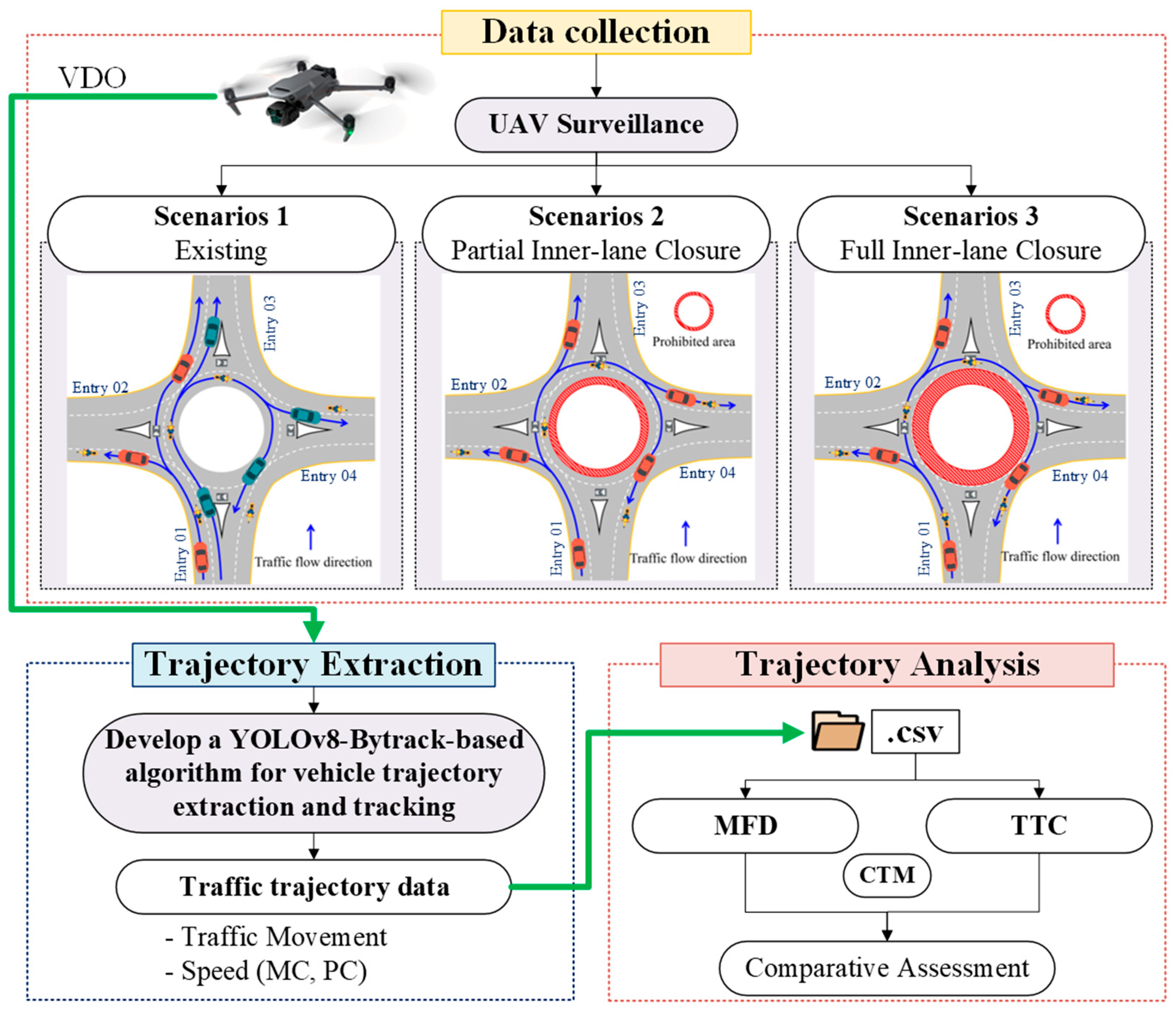
Figure 1. Study workflow and experimental scenarios.
Sustainability 18 04995 g001
Figure 2. Plan view and cross-sectional profiles of the study site by approach direction: (a) plan view, (b) northbound, (c) eastbound, (d) southbound, and (e) westbound.
Sustainability 18 04995 g002
Figure 3. Experimental lane-closure scenarios: (a) Scenario 1: full lane availability, (b) Scenario 2: partial inner-lane closure, and (c) Scenario 3: full inner-lane closure.
Sustainability 18 04995 g003
Figure 4. Workflow for vehicle trajectory identification.
Sustainability 18 04995 g004
Figure 5. Training and validation results obtained using the YOLOv8 model trained from the Roboflow prepared dataset [58].
Sustainability 18 04995 g005
Figure 6. UAV-based vehicle detection and tracking at the study roundabout: (a) raw UAV frame and (b) detection and tracking overlay.
Sustainability 18 04995 g006
Figure 7. Transmission Cell Configuration for the study roundabout.
Sustainability 18 04995 g007
Figure 8. Schematic illustration of relative vehicle positions, velocity vectors, and conflict-angle classification framework. Source: Prepared by the authors based on methodologies described in SSAM [15], FHWA [17], and Souleyrette and Hochstein [63].
Sustainability 18 04995 g008
Figure 9. Effects of lane closures on vehicle trajectories and flow characteristics.
Sustainability 18 04995 g009
Figure 10. Macroscopic fundamental diagrams under the three scenarios. The red curves represent fitted trend lines used to illustrate the relationships among flow, density, and speed.
Sustainability 18 04995 g010
Figure 11. Matrix of grid-based density maps comparing low- and high-density spatial distributions of motorcycles (MC) and passenger cars (PC) under the three lane-closure scenarios.
Sustainability 18 04995 g011
Figure 12. Speed map and time-speed contour (Scenario 1).
Sustainability 18 04995 g012
Figure 13. Speed map and time-speed contour (Scenario 2).
Sustainability 18 04995 g013
Figure 14. Speed map and time-speed contour (Scenario 3).
Sustainability 18 04995 g014
Figure 15. Distribution of TTC values across scenarios and severity levels.
Sustainability 18 04995 g015
Figure 16. TTC-based conflict distribution and spatial pattern (Scenario 1).
Sustainability 18 04995 g016
Figure 17. TTC-based conflict distribution and spatial pattern (Scenario 2).
Sustainability 18 04995 g017
Figure 18. TTC-based conflict distribution and spatial pattern (Scenario 3).
Sustainability 18 04995 g018
Table 1. Empirical and modeling studies on roundabout performance, safety, and lane configuration.
ThemeKey FindingImpact of Lane ReductionDesign ResponseReferences
1. Roundabout safety and vulnerable road users
1.1 Roundabout safety and surrogate safety indicatorsTTC, PET, DRAC, and Δv are widely used to identify rear-end, weaving, lane-change, and crossing conflicts at roundabouts, particularly near entries, circulating sections, and exits.Lane reduction may shift conflicts toward entry and merging areas, where vehicle interactions become more concentrated.Apply site-specific conflict thresholds and conflict heatmaps, and implement proactive safety monitoring to guide lane-marking and speed-control measures.[13,14,15,16,17,30]
1.2 Vulnerable road users at roundaboutsRoundabouts reduce severe crashes, but multilane layouts can increase risk for vulnerable users. Recent studies show that cyclists’ and pedestrians’ safety and comfort depend strongly on lane configuration, crossing design, and operating speed.Lane reduction may improve speed control and simplify interactions, but its safety effect depends on whether the remaining layout supports vulnerable and mixed-traffic users.Use user-sensitive geometric treatments, clear crossing layouts, speed management, and context-specific design.[1,2,31,32,33,34,35,36]
2. Motorcycle behavior in mixed-traffic interactions and Roundabouts
2.1 Motorcycle microscopic behavior at roundaboutsMotorcycles show shorter headways, flexible paths, lateral filtering, and greater movement variability than passenger cars. Evidence from Vietnam shows smaller gap acceptance and more variable turning and speed behavior at roundabouts.Reduced circulating width may suppress weaving and filtering but can increase close-following and rear-end exposure under high demand.Apply behavior-sensitive lane management and geometric control that account for motorcycle filtering, short headways, and flexible trajectories.[4,38]
2.2 Motorcycle behavior in Southeast Asian mixed traffic environmentsStudies from Thailand and Southeast Asia show that motorcycle movement is shaped by filtering, stopping behavior, departure headways, and safety-critical interactions in dense mixed traffic.Lane reduction may reduce unstable overtaking opportunities but can increase merging pressure and platooning when demand is high.Combine lane management, channelization, and behavior-sensitive monitoring to reduce unstable motorcycle maneuvers while maintaining acceptable flow.[11,12,39]
3. Traffic trajectory and emerging safety analytics
3.1 UAV and AI-based trajectory extractionUAV and AI-based tracking methods, such as YOLO and ByteTrack, enable high-resolution trajectory extraction in dense, heterogeneous traffic.Lane reduction effects can be evaluated through trajectory-level changes in path choice, conflict clustering, and vehicle interactions.Use UAV/AI trajectory monitoring for before–and–after evaluation of geometric and operational interventions.[13,14,22,23,24,25,26,27]
3.2 Video-based conflict analysis and multidimensional risk analyticsVideo-based and trajectory-derived methods support conflict detection, surrogate-safety estimation, and multidimensional risk analysis. Thai mixed-traffic studies confirm their applicability in real-world heterogeneous traffic.Lane reduction can be assessed through changes in conflict density, speed-related severity, and spatial risk patterns. Use video and UAV-based conflict analysis, risk heatmaps, and multidimensional trajectory indicators for proactive safety assessment.[28,29,40,41]
4. Macroscopic and mesoscopic operational analysis
4.1 MFD-based operational analysisMFD represents system-level relationships among flow, density, and speed, supporting evaluation of capacity, critical density, and congestion onset.Lane reductions may lower effective capacity, advance the onset of congestion, and amplify instability during mixed-traffic interactions.Use MFD to interpret capacity–safety trade-offs and identify operating conditions under restricted-lane scenarios.[20,21,42,43,44,45,46,47]
4.2 CTM and congestion propagationCTM captures queue propagation, discharge behavior, and spillback across entries, circulating segments, and exits.Lane reductions may increase queue spillback, bottlenecks, and discharge inefficiency, especially under constrained merging conditions.Combine CTM with behavior-sensitive interpretation to evaluate congestion propagation and operational instability.[48,49]
5. Effects of geometric design and lane management on traffic operations and safety
Geometric design and traffic conflict mechanismsEntry width, circulating width, lane configuration, entry–exit arrangement, and roundabout size influence vehicle paths, speed control, merging behavior, and crash risk. In motorcycle-rich settings, mismatches between design guidance and actual lane configuration may increase lane-use ambiguity and filtering.Lane reduction may reduce weaving and lateral conflicts but can increase merging pressure and queue volatility if demand exceeds capacity.Use context-sensitive lane guidance, clear markings, channelization, and speed management; evaluate lane reductions as behavior-shaping interventions rather than a universal prescription.[2,6,22,37,50,51,52,53,54,55,56]
Table 2. Summary of UAV data collection and scenario conditions.
ScenarioLane ConfigurationEffective Circulating Width (m)UAV Time PeriodVideo Duration
(min)
Traffic Condition
1Full lane availability824 July 2024, 09:00–10:0040Dry daylight
2Partial inner-lane closure624 July 2024, 11:00–12:0040Dry daylight
3Full inner-lane closure424 July 2024, 13:00–14:0040Dry daylight
Note: For each scenario, the first 5 min after scenario setup were treated as an acclimatization period and excluded from the main analysis. The central 30 min of stable UAV footage were used for trajectory extraction and scenario comparison.
Table 3. Summary of observed vehicle composition across scenarios.
ScenarioObservation Interval
(min)
MC
(Vehicles)
PC
(Vehicles)
Total
(Vehicles)
MC Share
(%)
PC Share
(%)
MC/PC Ratio
130 20315635956.5043.501.30
23016619135746.5053.500.87
33030421451858.7041.301.42
Table 4. Roboflow dataset split used for YOLOv8 model development.
Dataset SubsetNumber of ImagesPercentage
Training set231687%
Validation set2228%
Test set1094%
Total2647100%
Table 5. Key parameters for YOLOv8 model training.
ParameterValue
Detection frameworkUltralytics YOLOv8
Base modelyolov8m.pt
Training environmentGoogle Colab
Dataset sourceRoboflow export in YOLOv8 format
Image size800 × 800 pixels
Batch size8
Epochs100
Patience15
Initial learning rate0.001
Classesmotorcycle and car (including van and pickup)
Table 6. Dataset of a tracked vehicle at a specific frame.
FieldDescriptionUnitNotes
IDPersistent track identifier for a vehicleintegerUnique per trajectory across frames
Seq IDInternal sequence counterintegerOptional; monotonically increasing per track
TypeClass labelcategoricalCar, motorcycle
SpeedInstantaneous speedkm/hDerived from tracker
XPlanar x-coordinate (local frame)meterRoundabout-fixed Cartesian frame
YPlanar y-coordinate (local frame)meterRoundabout-fixed Cartesian frame
LatitudeGeographic latitude (WGS84)degreesOptional when X and Y are present
LongitudeGeographic longitude (WGS84)degreesOptional when X and Y are present
ZoneInCurrent zone label on entrycategoricalEntry, circulating, and exit ID
ZoneOutCurrent zone label on exitcategoricalEntry, circulating, and exit ID
AngleHeading angledegrees0° aligned with +X; counter-clockwise positive
TimestampObservation timesecondsUnix time (e.g., 00:00:00)
Frame IDVideo frame indexintegerZero- or one-based, consistent within the dataset
Table 7. Summary of vehicle, time, and distance parameters from CTM Analysis.
ZoneCellVehicle (Veh) [%]Total Time (s) [%]Total Distance (m) [%]
Scenario 1Scenario 2Scenario 3Scenario 1Scenario 2Scenario 3Scenario 1Scenario 2Scenario 3
Entry144 [9.89]53 [12.30]48 [8.45]134188 [40.30]179 [33.58]653830 [27.11]799 [22.36]
225 [5.62]22 [5.10]33 [5.81]164122 [−25.61]191 [16.46]481413 [−14.14]561 [16.63]
331 [6.97]29 [6.73]55 [9.68]11178 [−29.37]218 [96.40]380398 [4.74]586 [54.21]
412 [2.70]9 [2.09]10 [1.76]3333 [1.83]38 [15.55]196202 [3.06]212 [8.16]
Exit540 [8.99]40 [9.28]50 [8.80]6990 [30.81]93 [35.76]336425 [26.49]427 [27.08]
658 [13.03]59 [13.69]64 [11.27]125139 [11.20]229 [83.20]554619 [11.73]850 [53.43]
756 [12.58]48 [11.14]84 [14.79]149122 [−18.12]303 [103.36]631568 [−9.98]1255 [98.89]
861 [13.71]49 [11.37]83 [14.61]10094 [−6.01]170 [70.34]468498 [6.41]818 [74.79]
Circulatory953 [11.91]44 [10.21]73 [12.85]155116 [−25.16]197 [27.10]910701 [−22.97]1152 [26.59]
1025 [5.62]29 [6.73]24 [4.23]100103 [3.41]84 [−16.06]516552 [6.98]429 [−16.86]
1127 [6.07]36 [8.35]34 [5.99]5184 [64.01]74 [44.75]341486 [42.52]402 [17.89]
1213 [2.92]13 [3.02]10 [1.76]5665 [15.81]87 [54.35]194278 [43.30]190 [−2.06]
Sum445 [100]431 [100]568 [100]
Note: [%] indicates percentage change compared to Scenario 1.
Table 8. Summary of speed, flow, and density parameters from CTM Analysis.
ZoneCellAverage Speed (km/h) [%]Flow (Veh/s) [%]Density (Veh/m/Lane) [%]
Scenario 1Scenario 2Scenario 3Scenario 1Scenario 2Scenario 3Scenario 1Scenario 2Scenario 3
Entry117.5015.90 [−9.14]16.10 [−8.00]0.440.53 [20.45]0.16 [−63.64]0.0450.063 [40.00]0.020 [−55.56]
210.6012.20 [15.09]10.60 [0.00]0.250.22 [−12.00]0.11 [−56.00]0.0550.041 [−25.45]0.021 [−61.82]
312.3018.30 [48.78]9.69 [−21.22]0.310.29 [−6.45]0.18 [−40.97]0.0560.039 [−30.36]0.036 [−35.71]
421.5021.80 [1.40]20.10 [−6.51]0.120.09 [−25.00]0.03 [−72.25]0.0080.008 [0.00]0.003 [−62.50]
Exit517.6017.0 [−3.41]16.50 [−6.25]0.400.40 [0.00]0.17 [−58.25]0.0410.053 [29.27]0.018 [−56.10]
616.0016.10 [0.63]13.40 [−16.25]0.580.59 [1.72]0.21 [−63.28]0.1250.139 [11.20]0.076 [−39.20]
715.2016.80 [10.53]14.90 [−1.97]0.560.48 [−14.29]0.28 [−50.00]0.0750.061 [−18.67]0.051 [−32.00]
816.9019.10 [13.02]17.40 [2.96]0.610.49 [−19.67]0.28 [−54.59]0.0290.028 [−3.45]0.017 [−41.38]
Circulatory921.1021.80 [3.32]21.10 [0.00]0.530.44 [−16.98]0.24 [−54.15]0.0490.048 [−2.04]0.041 [−16.33]
1018.7019.20 [2.67]18.50 [−1.07]0.250.29 [16.00]0.08 [−68.00]0.0310.043 [38.71]0.017 [−45.16]
1123.8020.80 [−12.61]19.50 [−18.07]0.270.36 [33.33]0.11 [−58.15]0.0160.035 [118.75]0.016 [0.00]
1212.4015.40 [24.19]7.89 [−36.37]0.130.13 [0.00]0.03 [−74.38]0.0180.027 [50.00]0.018 [0.00]
Note: [%] indicates percentage change compared to Scenario 1.
Table 9. Comparison of TTC-based traffic interaction distributions across three lane-closure scenarios.
Type **Scenario 1: Existing (383)Scenario 2: Partial Closure (435)Scenario 3: Full Closure (865)
Severity *Severity *Severity *
ExtremeHighModerateLowExtremeHighModerateLowExtremeHighModerateLow
MC–MC
Crossing------------
Lane change16 (4.18%)10 (2.61%)-6 (1.57%)25 (5.75%)12 (2.76%)-8 (1.84%)-4 (0.46%)4 (0.46%)38 (4.39%)
Rear end93 (24.28%)11 (2.87%)-5 (1.31%)86 (19.77%)12 (2.76%)2 (0.46%)3 (0.69%)142 (16.42%)107 (12.37%)17 (1.97%)110 (12.72%)
Sum109 (28.46%)21 (5.48%)-11 (2.87%)111 (25.52%)24 (5.52%)2 (0.46%)11 (2.53%)142 (16.42%)111 (12.83%)21 (2.43%)148 (17.11%)
MC–PC
Crossing-----2 (0.46%)-----4 (0.46%)
Lane change31 (8.09%)18 (4.70%)5 (1.31%)9 (2.35%)22 (5.06%)22 (5.06%)-13 (2.99%)1 (0.12%)10 (1.16%)4 (0.46%)54 (6.24%)
Rear end84 (21.93%)23 (6.01%)3 (0.78%)5 (1.31%)117 (26.90%)23 (5.29%)1 (0.23%)9 (2.07%)91 (10.52%)99 (11.45%)18 (2.08%)101 (11.68%)
Sum115 (30.03%)41 (10.70%)8 (2.09%)14 (3.66%)139 (31.95%)47 (10.80%)1 (0.23%)22 (5.06%)92 (10.64%)109 (12.60%)22 (2.54%)159 (18.38%)
PC–PC
Crossing-1 (0.26%)-2 (0.52%)--------
Lane change1 (0.26%)8 (2.09%)-7 (1.83%)10 (2.30%)12 (2.76%)2 (0.46%)3 (0.69%)-1 (0.12%)-12 (1.39%)
Rear end34 (8.88%)4 (1.04%)2 (0.52%)5 (1.31%)33 (7.59%)13 (2.99%)2 (0.46%)3 (0.69%)13 (1.50%)12 (1.39%)-23 (2.66%)
Sum35 (9.14%)13 (3.39%)2 (0.52%)14 (3.66%)43 (9.89%)25 (5.75%)4 (0.92%)6 (1.38%)13 (1.50%)13 (1.50%)-35 (4.05%)
Total259 (67.63%)75 (19.58%)10 (2.61%)39 (10.18%)293 (67.36%)96 (22.07%)7 (1.61%)39 (8.96%)247 (28.55%)233 (26.94%)43 (4.97%)342 (39.54%)
Note: * Extreme (TTC < 1.5 s), High (1.5 ≤ TTC < 2.5 s), and Moderate (2.5 ≤ TTC < 4.0 s) represent increasing levels of safety concern, whereas Low (TTC ≥ 4.0 s) represents low-risk or green-zone interactions retained for comparative analysis [8]. ** Crossing (conflict angle > 85°), Lane change (30–85°), and Rear end (Conflict angle < 30°) [63].
Disclaimer/Publisher’s Note: The statements, opinions and data contained in all publications are solely those of the individual author(s) and contributor(s) and not of MDPI and/or the editor(s). MDPI and/or the editor(s) disclaim responsibility for any injury to people or property resulting from any ideas, methods, instructions or products referred to in the content.