


Why Chinese Consumers Buy Pre-Loved Luxury Fashion: The Mediating Role of Channel Engagement





Abstract
1. Introduction
2. Literature Review and Hypotheses Development
2.1. Conceptualising Pre-Loved Luxury Fashion
2.2. Perceived Value in Pre-Loved Luxury Fashion
2.3. Motivational Antecedents
2.3.1. Economic Motivation
2.3.2. Functional Motivation
2.3.3. Individual Motivation
2.3.4. Social Motivation
2.4. Channel Engagement as a Mediator
2.5. Research Questions and Contributions
3. Methodology
3.1. Research Design
3.2. Quantitative Study
3.2.1. Sample and Procedure
3.2.2. Measures and Constructs
3.2.3. Data Analysis
3.3. Qualitative Study
3.3.1. Interview Sample
3.3.2. Coding and Analysis
- Deductive coding based on the conceptual model (economic, functional, individual, and social motivations; perceived value; channel engagement).
- Inductive coding to capture emergent themes such as “trust in daigou,” “face-saving concerns,” and “nostalgic value of vintage brands.”
4. Findings
4.1. Quantitative Results
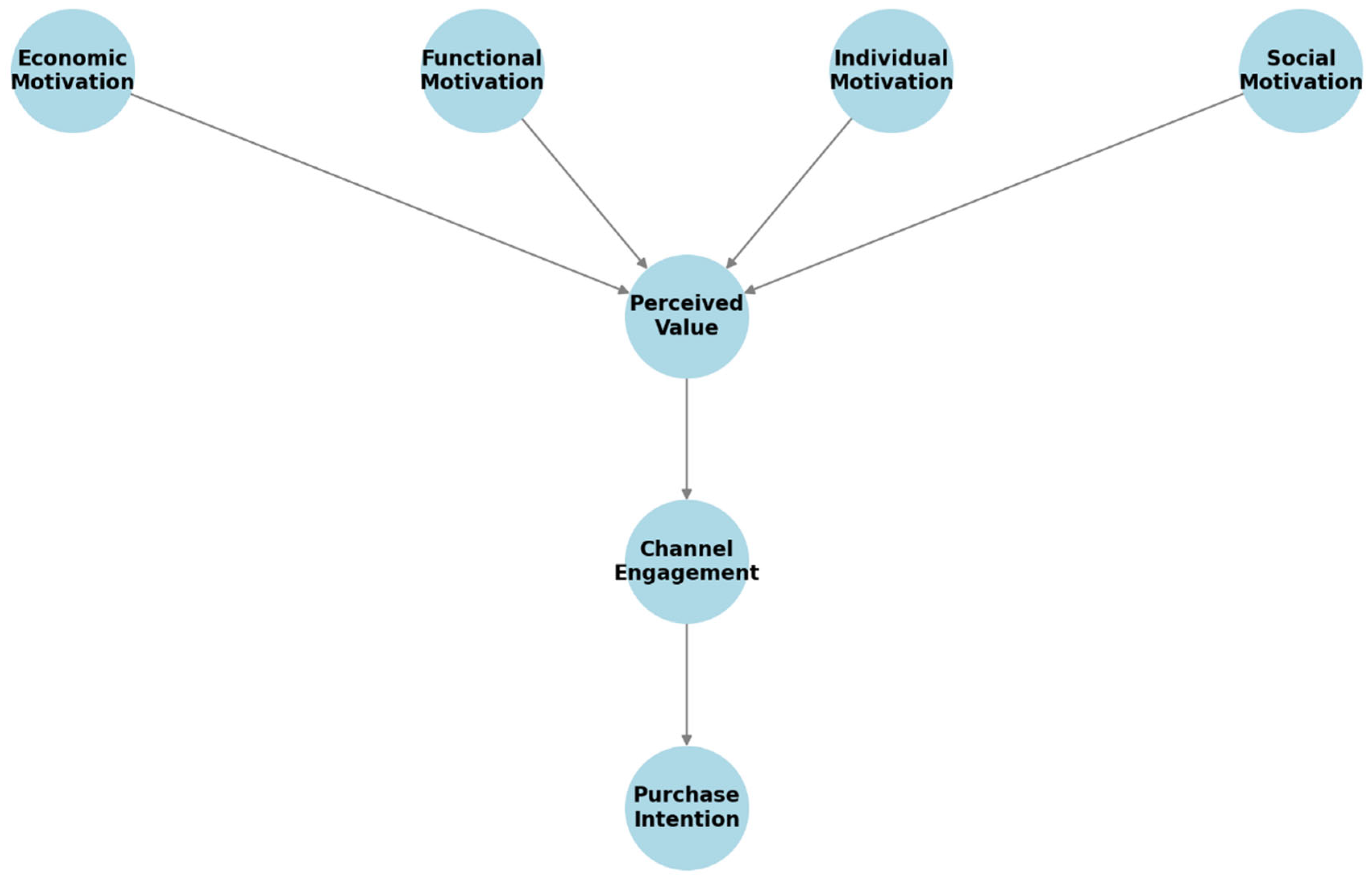
4.1.1. H1–H4: Motivational Antecedents of Perceived Value
- H1 (Economic Motivation→Perceived Value): The path coefficient was β = 0.26 (p < 0.001), indicating that price sensitivity, resale potential, and value-for-money perceptions significantly enhanced perceived value. This aligns with prior studies suggesting that pre-loved luxury consumption is partially driven by financially rational decision-making.
- H2 (Functional Motivation→Perceived Value): Functional motivation had the strongest effect (β = 0.35, p < 0.001), underscoring the importance of quality, authenticity, and durability. Consumers placed a premium value on well-preserved items from reputable brands, mirroring previous findings by Turunen et al. (2019) [3].
- H3 (Individual Motivation→Perceived Value): Individualistic motives such as aesthetic appreciation, nostalgia, and personal enjoyment significantly predicted perceived value (β = 0.21, p = 0.004). This suggests that hedonic and emotional attachments to rare or vintage fashion pieces are central to the formation of value.
- H4 (Social Motivation→Perceived Value): The social dimension (e.g., sustainability signalling and social approval) was also positively linked (β = 0.19, p = 0.011), though the effect size was comparatively smaller. This result highlights the increasing, albeit moderate, social legitimacy of second-hand luxury in Chinese culture.
4.1.2. H5–H6: Mediation Through Channel Engagement
- H5 (Perceived Value→Channel Engagement): A strong positive effect was found (β = 0.44, p < 0.001), suggesting that consumers who recognised value in pre-loved items were more inclined to interact with relevant purchase channels, including both online platforms and physical consignment stores.
- H6 (Channel Engagement→Purchase Intention): Engagement significantly predicted purchase intention (β = 0.47, p < 0.001), supporting the assertion that involvement with the shopping environment—through browsing, interacting, or following sellers—increases the likelihood of eventual purchase.
4.2. Structural Model Summary
4.3. Qualitative Themes
4.3.1. Theme 1: Trust Barriers in Online Channels (Supports H5)
“I love the idea of buying rare bags online, but unless I get a certificate or real-time authentication, I worry it’s fake.”(Female, 27, Shanghai)
“I bought from a Douyin live stream after seeing others buy and reading their reviews, considering the shop’s opening duration, considering if the store owner gathered the money and ran away or something like that, and after-sales satisfaction”.(Female, 33, Hefei)
4.3.2. Theme 2: Tactile Advantage in Offline Experiences (Supports H6)
“Trying on the clothes and seeing the texture helps me decide. It feels like shopping for new luxury, but with better prices”.(Male, 31, Guangzhou)
“The shop salesperson is a young man, probably around your age. We call him ‘Big Brother’. I feel he’s very professional. He has various appraisal tools and demonstrated how he appraises items in front of me. For example, he explained the craftsmanship and showed me the lettering on the back of a Ferragamo buckle, explaining how the font is printed. He taught me how to distinguish authentic items from counterfeits. He also wears a long, microscope-like device over his eyes, and his phone has a magnification function similar to that of a tablet. He can use it to show you the craftsmanship details on the back of an item. He can show you clearly whether a part is connected properly or how it has been handcrafted”.(Male, 29, Xi’an)
5. Discussion
5.1. Theoretical Contributions
5.2. Managerial Implications
5.3. Limitations and Future Research
6. Conclusions
Author Contributions
Funding
Institutional Review Board Statement
Informed Consent Statement
Data Availability Statement
Conflicts of Interest
Appendix A. Final Interview Question List
- One-to-one interview, 30–40 min maximum. Since the participants are Chinese, there will be two language versions of the interview question list: English and Chinese (with experts reviewing the Chinese version).
- Ask participants’ demographic characteristics before starting questions: Gender, Age, Occupation, Educational attainment, Current residence, and Personal monthly income.
- Have you purchased PRE-LOVED luxury fashion goods?
- Why do you purchase pre-loved luxury fashion goods?
- Have you ever thought about sustainability? Why?
- Is it important for you to purchase pre-loved luxury fashion goods?
- Which channel do you purchase pre-loved luxury fashion goods? Why you choose this channel?
- Will you do post-purchase after engagement with channels? Why?
- Have you purchased PRE-LOVED luxury fashion goods?
- 2.
- If no, do you intend to purchase PRE-LOVED luxury fashion goods in the future?
- Why are you intending to purchase PRE-LOVED luxury fashion goods in the future? (e.g., Economic Motivations, Functional Motivations, Individual Motivations, Social Motivations)
- Do you have awareness of PRE-LOVED luxury fashion goods?
- Why you have an interest in purchasing PRE-LOVED luxury fashion goods?
- Which channel do you purchase pre-loved luxury fashion goods? Online/offline? Why?
- Will you do post-purchase after engagement with channels? Why?
- Why are you not intending to purchase PRE-LOVED luxury fashion goods in the future? What are the main reasons? Are there specific concerns or preferences that influence this decision?
- Do you have awareness of PRE-LOVED luxury fashion goods?
- Why do you haven’t an interest in purchasing PRE-LOVED luxury fashion goods?
References
- Barroso, F.C.M.B. Which Are the Drivers of Renting, Buying, and Selling Second-Hand Luxury Fashion Products in the Context of the COVID-19 Pandemic? Master’s Thesis, Universidade do Porto, Porto, Portugal, 2021. [Google Scholar]
- Guiot, D.; Roux, D. A second-hand shoppers’ motivation scale: Antecedents, consequences, and implications for retailers. J. Retail. 2010, 86, 355–371. [Google Scholar] [CrossRef] [Scilit]
- Turunen, L.L.M.; Pöyry, E. Shopping with the resale value in mind: A study on second-hand luxury consumers. Int. J. Consum. Stud. 2019, 43, 549–556. [Google Scholar] [CrossRef] [Scilit]
- Vigneron, F.; Johnson, L.W. Measuring perceptions of brand luxury. In Advances in Luxury Brand Management; Springer: Berlin/Heidelberg, Germany, 2017; pp. 199–234. [Google Scholar]
- Wiedmann, K.P.; Hennigs, N.; Siebels, A. Value-based segmentation of luxury consumption behavior. Psychol. Mark. 2009, 26, 625–651. [Google Scholar] [CrossRef] [Scilit]
- Beck, N.; Rygl, D. Categorization of multiple channel retailing in Multi-, Cross-, and Omni-Channel Retailing for retailers and retailing. J. Retail. Consum. Serv. 2015, 27, 170–178. [Google Scholar] [CrossRef] [Scilit]
- Chatterjee, P.; Kumar, A. Consumer willingness to pay across retail channels. J. Retail. Consum. Serv. 2017, 34, 264–270. [Google Scholar] [CrossRef] [Scilit]
- Ortega, D.L.; Wang, H.H.; Wu, L.; Hong, S.J. Retail channel and consumer demand for food quality in China. China Econ. Rev. 2015, 36, 359–366. [Google Scholar] [CrossRef] [Scilit]
- Wang, B.; Li, X.; Stanton, B.; Fang, X. The influence of social stigma and discriminatory experience on psychological distress and quality of life among rural-to-urban migrants in China. Soc. Sci. Med. 2010, 71, 84–92. [Google Scholar] [CrossRef] [Scilit]
- Wang, D.; Jia, Y.; Gao, W.; Chen, S.; Li, M.; Hu, Y.; Luo, F.; Chen, X.; Xu, H. Relationships between stigma; social support, and distress in caregivers of Chinese children with imperforate anus: A multicenter cross-sectional study. J. Pediatr. Nurs. 2019, 49, e15–e20. [Google Scholar] [CrossRef] [Scilit]
- Si, R. China Livestreaming E-Commerce Industry Insights; Springer: Berlin/Heidelberg, Germany, 2021. [Google Scholar]
- Turunen, L.L.M.; Leipämaa-Leskinen, H. Pre-loved luxury: Identifying the meanings of second-hand luxury possessions. J. Prod. Brand Manag. 2015, 24, 57–65. [Google Scholar] [CrossRef] [Scilit]
- Kong, H.M.; Ko, E. Why do consumers choose sustainable fashion? A cross-cultural study of South Korean, Chinese, and Japanese consumers. J. Glob. Fash. Mark. 2017, 8, 220–234. [Google Scholar] [CrossRef] [Scilit]
- Lin, S.-Y.; Su, A.C.-W. Bridging Fashion and Sustainability: Exploring the Cultural Impact of Vintage Clothing in Taiwan. Fash. Theory 2025, 1–19. [Google Scholar] [CrossRef] [Scilit]
- Janigo, K.A.; Wu, J.; DeLong, M. Redesigning fashion: An analysis and categorization of women’s clothing upcycling behavior. Fash. Pract. 2017, 9, 254–279. [Google Scholar] [CrossRef] [Scilit]
- Moon, K.K.-L.; Lai, C.S.-Y.; Lam, E.Y.-N.; Chang, J.M. Popularization of sustainable fashion: Barriers and solutions. J. Text. Inst. 2015, 106, 939–952. [Google Scholar] [CrossRef] [Scilit]
- Peirson-Smith, A.; Craik, J. Transforming sustainable fashion in a decolonial context: The case of redress in Hong Kong. Fash. Theory 2020, 24, 921–946. [Google Scholar] [CrossRef] [Scilit]
- Park, J.; Ahn, S.; Lee, S. Pre-owned, still precious: How emotional attachment shapes pre-owned luxury consumption. J. Retail. Consum. Serv. 2025, 87, 104420. [Google Scholar] [CrossRef] [Scilit]
- Amatulli, C.; Pino, G.; De Angelis, M.; Cascio, R. Understanding purchase determinants of luxury vintage products. Psychol. Mark. 2018, 35, 616–624. [Google Scholar] [CrossRef] [Scilit]
- Belk, R.W. Collecting in a Consumer Society; Routledge: Abingdon, UK, 2013. [Google Scholar]
- Price, L.L.; Arnould, E.J.; Curasi, C.F. Older consumers’ disposition of special possessions. J. Consum. Res. 2000, 27, 179–201. [Google Scholar] [CrossRef] [Scilit]
- Yeap, J.A.; Ooi, S.K.; Yapp, E.H.; Ramesh, N. Preloved is reloved: Investigating predispositions of second-hand clothing purchase on C2C platforms. Serv. Ind. J. 2024, 44, 993–1017. [Google Scholar] [CrossRef] [Scilit]
- Zeithaml, V.A. Consumer perceptions of price, quality, and value: A means-end model and synthesis of evidence. J. Mark. 1988, 52, 2–22. [Google Scholar] [CrossRef] [Scilit]
- Jiang, Y.; Miao, M.; Jalees, T.; Zaman, S.I. Analysis of the moral mechanism to purchase counterfeit luxury goods: Evidence from China. Asia Pac. J. Mark. Logist. 2019, 31, 647–669. [Google Scholar] [CrossRef] [Scilit]
- Bu, L.; Durand-Servoingt, B.; Kim, A.; Yamakawa, N. Chinese Luxury Consumers: More Global, More Demanding, Still Spending; McKinsey & Company: New York, NY, USA, 2017. [Google Scholar]
- Silva, S.C.; Duarte, P.; Sandes, F.S.; Almeida, C.A. The hunt for treasures, bargains and individuality in pre-loved luxury. Int. J. Retail. Distrib. Manag. 2022, 50, 1321–1336. [Google Scholar] [CrossRef] [Scilit]
- Liu, H.; Bai, H. Embracing Sustainability and Circularity in Luxury: The Rise of the Pre-Loved Market in China. In Proceedings of the 56th Academy of Marketing Conference 2024, Cardiff, UK, 1–4 July 2024. [Google Scholar]
- Aycock, M.; Cho, E.; Kim, K. “I like to buy pre-owned luxury fashion products”: Understanding online second-hand luxury fashion shopping motivations and perceived value of young adult consumers. J. Glob. Fash. Mark. 2023, 14, 327–349. [Google Scholar] [CrossRef] [Scilit]
- Sun, Y.; Wang, R.; Cao, D.; Lee, R. Who are social media influencers for luxury fashion consumption of the Chinese Gen Z? Categorisation and empirical examination. J. Fash. Mark. Manag. Int. J. 2022, 26, 603–621. [Google Scholar] [CrossRef] [Scilit]
- Hollebeek, L.D.; Glynn, M.S.; Brodie, R.J. Consumer brand engagement in social media: Conceptualization, scale development and validation. J. Interact. Mark. 2014, 28, 149–165. [Google Scholar] [CrossRef] [Scilit]
- Li, L.; Xu, J.; Kumar, U. Consumers purchase intention in consumer-to-consumer online transaction: The case of Daigou. Transnatl. Corp. Rev. 2023, 15, 15–31. [Google Scholar] [CrossRef] [Scilit]
- Turunen, L.L.M.; Cervellon, M.-C.; Carey, L.D. Selling second-hand luxury: Empowerment and enactment of social roles. J. Bus. Res. 2020, 116, 474–481. [Google Scholar] [CrossRef] [Scilit]
- Peña-García, N.; Gil-Saura, I.; Rodríguez-Orejuela, A.; Siqueira-Junior, J.R. Purchase intention and purchase behavior online: A cross-cultural approach. Heliyon 2020, 6, e04284. [Google Scholar] [CrossRef] [Scilit] [PubMed]
- Shek, D.T.; Yu, L. Confirmatory factor analysis using AMOS: A demonstration. Int. J. Disabil. Hum. Dev. 2014, 13, 191–204. [Google Scholar] [CrossRef] [Scilit]
- Thakkar, J.J. Applications of structural equation modelling with AMOS 21, IBM SPSS. In Structural Equation Modelling: Application for Research and Practice (with AMOS and R); Springer: Berlin/Heidelberg, Germany, 2020; pp. 35–89. [Google Scholar]
- Liu, H. Investigating Pre-Loved Luxury Fashion Consumption: Evidence from the Chinese Consumers. Ph.D. Thesis, Liverpool John Moores University, Liverpool, UK, 2025. [Google Scholar]
- Guo, J.; Qi, Y.; Luo, J.; Du, G.; Sun, J.; Wei, X.; Soothar, M.K. Carbon Emission Status and Regional Differences of China: High-Resolution Estimation of Spatially Explicit Carbon Emissions at the Prefecture Level. Land 2025, 14, 291. [Google Scholar] [CrossRef] [Scilit]
- Global Times. China’s Rising per Capita Disposable Income Has Global Implications. 2025. Available online: https://www.globaltimes.cn/page/202503/1329335.shtml (accessed on 2 March 2025).
- Wang, J.; Hu, H. A Review and Empirical Analysis of the Influencing Factors of Urban per Capita Disposable Income in China under the New Eraz. World Econ. Res. 2025, 14, 587–596. [Google Scholar] [CrossRef]
- Phan, T.D.; Smart, J.C.; Stewart-Koster, B.; Sahin, O.; Hadwen, W.L.; Dinh, L.T.; Tahmasbian, I.; Capon, S.J. Applications of Bayesian networks as decision support tools for water resource management under climate change and socio-economic stressors: A critical appraisal. Water 2019, 11, 2642. [Google Scholar] [CrossRef] [Scilit]
- Boardman, R.; Zhou, Y.; Guo, Y. Chinese consumer attitudes towards second-hand luxury fashion and how social media eWoM affects decision-making. In Sustainable Luxury: An International Perspective; Springer: Berlin/Heidelberg, Germany, 2022; pp. 241–269. [Google Scholar]
- Dubois, D.; Jung, S.; Ordabayeva, N. The psychology of luxury consumption. Curr. Opin. Psychol. 2021, 39, 82–87. [Google Scholar]
- Faschan, M.; Chailan, C.; Huaman-Ramirez, R. Emerging adults’ luxury fashion brand value perceptions: A cross-cultural comparison between Germany and China. J. Glob. Fash. Mark. 2020, 11, 207–231. [Google Scholar] [CrossRef] [Scilit]
- Bai, H.; McColl, J.; Moore, C. Motives behind retailers’ post-entry expansion-Evidence from the Chinese luxury fashion market. J. Retail. Consum. Serv. 2020, 59, 102400. [Google Scholar] [CrossRef] [Scilit]
- Bian, Q.; Forsythe, S. Purchase intention for luxury brands: A cross cultural comparison. J. Bus. Res. 2012, 65, 1443–1451. [Google Scholar] [CrossRef] [Scilit]
- Hair, J.F.; Babin, B.J.; Anderson, R.E.; Black, W.C. Multivariate Data Analysis, 8th ed.; Pearson Prentice: London, UK, 2019. [Google Scholar]
- Braun, V.; Clarke, V. Using thematic analysis in psychology. Qual. Res. Psychol. 2006, 3, 77–101. [Google Scholar] [CrossRef] [Scilit]
- Gewers, F.L.; Ferreira, G.R.; Arruda, H.F.D.; Silva, F.N.; Comin, C.H.; Amancio, D.R.; Costa, L.D.F. Principal component analysis: A natural approach to data exploration. ACM Comput. Surv. 2021, 54, 1–34. [Google Scholar] [CrossRef] [Scilit]
- Nunnally, J.C. Psychometric theory—25 years ago and now. Educ. Res. 1975, 4, 7–21. [Google Scholar]
- Morgan, G.A.; Barrett, K.C.; Leech, N.L.; Gloeckner, G.W. IBM SPSS for Intermediate Statistics: Use and Interpretation; Routledge: Abingdon, UK, 2014. [Google Scholar]
- Rahimnia, F.; Hassanzadeh, J.F. The impact of website content dimension and e-trust on e-marketing effectiveness: The case of Iranian commercial saffron corporations. Inf. Manag. 2013, 50, 240–247. [Google Scholar] [CrossRef] [Scilit]
- Churchill, G.A., Jr. A paradigm for developing better measures of marketing constructs. J. Mark. Res. 1979, 16, 64–73. [Google Scholar] [CrossRef] [Scilit]
- Patton, M.Q. Qualitative Research & Evaluation Methods: Integrating Theory and Practice; Sage: Thousand Oaks, CA, USA, 2014. [Google Scholar]
- Hennink, M.M.; Kaiser, B.N.; Marconi, V.C. Code saturation versus meaning saturation: How many interviews are enough? Qual. Health Res. 2017, 27, 591–608. [Google Scholar] [CrossRef] [Scilit] [PubMed]
- Maxwell, J.A. Qualitative Research Design: An Interactive Approach; Sage: Thousand Oaks, CA, USA, 2013. [Google Scholar]

| Construct | Description | Source |
|---|---|---|
| Economic motivation | Consumers’ pursuit of cost savings, value for money, and potential resale returns. Pre-loved luxury fashion enables access to aspirational brands at reduced prices, preserving social status while enhancing affordability. | Turunen et al. [32] |
| Functional motivation | Tangible product attributes, including quality, condition, and durability. | Turunen and Leipämaa-Leskinen [12] |
| Individual motivation | Individual motivation encompasses personal gratification, aesthetic appreciation, and the pleasure of acquiring unique items. Consumers often seek rare or discontinued items to express their identity or as a form of self-reward. | Silva et al. [26] |
| Social motivation | The desire for social approval, status signalling, or alignment with peer groups. In pre-loved luxury fashion, this involves displaying status through ownership of luxury brands and signalling ethical values through support for circular fashion | Aycock et al. [28] |
| Perceived value | Perceived value represents a consumer’s overall evaluation of a product, balancing perceived benefits against the sacrifices required to acquire it. | Zeithaml [23] |
| Channel engagement | Channel engagement refers to the consumer’s psychological investment and behavioural participation in a retail environment. In the context of pre-loved luxury fashion, engagement extends beyond transactions to include exploration, authentication verification, and platform loyalty. | Hollebeek et al. [30] |
| Purchase intention | Purchase intention is identified as one of the purchase behaviour studies. It is used to examine the implementation of a new distribution channel, encouraging decision makers to consider whether the idea can be further developed and to determine which consumer segments and geographic markets to target through the channel. | Peña-García et al. [33] |
| Profile of the Participants | Totals | Profile of the Participants | Totals | ||
|---|---|---|---|---|---|
| Gender | n = 438 | % | City currently lives | n = 438 | % |
| Male | 169 | 38.6 | Tier 1 | 67 | 15.3 |
| Female | 256 | 58.4 | New Tier 1 | 170 | 38.8 |
| Other | 13 | 3.0 | Tier 2 | 68 | 15.5 |
| Age | n = 438 | % | Tier 3 | 57 | 13.0 |
| 18–25 | 107 | 24.4 | Tier 4 and below | 76 | 17.4 |
| 26–35 | 128 | 29.2 | Income | n = 438 | % |
| ≥36 | 203 | 46.3 | No income | 55 | 12.6 |
| Occupation | n = 438 | % | ¥1–3999 (≈$0.14–$552) | 80 | 18.3 |
| Student | 114 | 26.0 | ¥4000–5999 (≈$552–827) | 79 | 18.0 |
| Employment | 296 | 67.6 | ¥6000–7999 (≈$827–1103) | 92 | 21.0 |
| Other | 28 | 6.4 | ¥8000–9999 (≈$1103–1379) | 56 | 12.8 |
| Education | n = 438 | % | ¥10,000–19,999 (≈$1379–2758) | 48 | 11.0 |
| Degrees include/under tertiary or no degree | 54 | 12.3 | ¥20,000 or more (≈$2758 or more) | 28 | 6.4 |
| Undergraduate (BSc) | 263 | 60.0 | |||
| Postgraduate (MSc) and above | 121 | 27.6 | |||
| Construct | Scale | Label | References |
|---|---|---|---|
| Economic Motivations | I don’t want to pay more for a product just because it’s new. | EM1 | Adapted from Guiot and Roux [2] |
| By buying pre-loved luxury fashion goods, I feel I’m paying a fair price. | EM2 | ||
| I enjoy buying pre-loved luxury fashion goods because when I resell it, there is still a good market for some of the more valuable brands of pre-loved luxury fashion goods. | EM3 | Adapted from Boardman et al. [41] and Turunen and Pöyry [3] | |
| I buy pre-loved luxury fashion goods because there is an investment opportunity for some rarer items or limited editions are even greater than the first released in the secondary market. | EM4 | ||
| I have explicit intent to sell the product at a later point of time. | EM5 | ||
| Functional Motivations | A luxury product cannot be sold in supermarkets. | FM1 | Adapted from Wiedmann et al. [5] |
| Authentic luxury products cannot be mass-produced. | FM2 | ||
| Few people own an authentic luxury product. | FM3 | ||
| People who buy luxury products try to differentiate themselves from the others. | FM4 | ||
| I hope to come across items that nobody else has. | FM5 | Adapted from Guiot and Roux [2] | |
| I hope to come across original items that are not found in mainstream stores. | FM6 | ||
| I’m inclined to evaluate the substantive attributes and performance of a luxury brand myself rather than listen to others’ opinions. | FM7 | Adapted from Wiedmann et al. [5] | |
| The luxury brand preferred by many people but that does not meet my quality standards will never enter into my purchase consideration. | FM8 | ||
| I buy a luxury brand for satisfying my personal needs without any attempt to make an impression on other people. | FM9 | ||
| Individual Motivations | Luxury fashion goods make life more beautiful. | IM1 | Adapted from Dubois et al. [42] and Faschan et al. [43] |
| Luxury fashion goods bring excitement. | IM2 | ||
| One buys luxury fashion goods primarily for one’s pleasure. | IM3 | ||
| I feel happy when I have luxury fashion goods. | IM4 | ||
| I like wandering around pre-loved outlets because I always hope I’ll come across a real find. | IM5 | Adapted from Guiot and Roux [2] | |
| I go to certain pre-loved outlets to rummage around and try to find something. | IM6 | ||
| I’m often on the lookout for a find when I go to certain pre-loved outlets. | IM7 | ||
| In certain pre-loved outlets, I feel rather like a treasure hunter. | IM8 | ||
| I am attracted more to old things than new ones. | IM9 | Adapted from Guiot and Roux [2] | |
| Above all, I buy luxury fashion goods pre-loved, because they are old and have a history. | IM10 | ||
| I like buying pre-loved luxury fashion goods because they evoke the past. | IM11 | ||
| I like buying pre-loved luxury fashion goods because I find them authentic. | IM12 | ||
| I like to buy pre-loved luxury fashion goods because I am a collector. | IM13 | Adapted from Turunen and Leipämaa-Leskinen [12] | |
| I am interested in specific types of pre-loved luxury fashion goods. | IM14 | ||
| Collecting pre-loved luxury fashion goods can bring me joy and satisfaction. | IM15 | ||
| In relation to collectable items, I feel strong emotional connections. | IM16 | ||
| Social Motivations | Even though they are pre-loved, luxury items and brands are an indicator of my wealth. | SM1 | Adapted from Boardman et al. [41], Vigneron and Johnson [4] and Wiedmann et al. [5] |
| Luxury brands can represent my social status. | SM2 | ||
| I enjoy buying pre-loved luxury fashion goods because I don’t like objects being thrown away that can still be of use. | SM3 | Adapted from Boardman et al. [41] and Guiot and Roux [2] | |
| By buying pre-loved luxury fashion goods, I feel I’m helping to fight against waste. | SM4 | ||
| Buying pre-loved luxury fashion goods are more environmentally friendly. | SM5 | ||
| Perceived Value | Considering the risks I take in buying luxury fashion products, shopping at pre-loved luxury fashion retailers has value. | PV1 | Adapted from Aycock et al. [28] |
| Considering the money, I pay for buying luxury fashion products, shopping at pre-loved luxury fashion retailers is a good deal. | PV2 | ||
| Considering all the monetary and non-monetary costs I incur in buying luxury fashion products, shopping at pre-loved luxury fashion retailers is of good value. | PV3 | ||
| Engagement with Channels | I enjoy buying pre-loved luxury fashion goods at brick-and-mortar (in store). | EWC1 | Adapted from Aycock et al. [28], Bai et al. [44], and Wang et al. [10] |
| I enjoy buying pre-loved luxury fashion goods at official online pre-loved luxury consignment stores (e.g., International—https://www.therealreal.com, https://www.vestiairecollective.com, https://www.fashionphile.com, https://www.luxurygaragesale.com, etc; China—Fei Yu, Zhi Er, Hong Bu Lin, Pang Hu, Si Ku, etc.). | EWC2 | ||
| I enjoy buying pre-loved luxury fashion goods at online e-commerce platforms (e.g., Alibaba’s Taobao and Tmall, JD.com, Pinduoduo, etc.) | EWC3 | ||
| I enjoy buying pre-loved luxury fashion goods at online social networking sites (e.g., WeChat, Little Red Book, Douyin, etc.). | EWC4 | ||
| I enjoy buying pre-loved luxury fashion goods online after I watch an online live stream (e.g., Taobao Live, Douyin Live, Little Red Book Live, WeChat Live, etc.). | EWC5 | ||
| I enjoy buying pre-loved luxury fashion goods at multiple channels (including any channels online and offline channels). | EWC6 | ||
| Purchase Intention | I intend to buy pre-loved luxury fashion products in the near future. | PI | Adapted from Bian and Forsythe [45] and Faschan et al. [43] |
| Gender | Age | Current City | Personal Monthly Income | Purchase Experience | Intention in Future | |
|---|---|---|---|---|---|---|
| P1 | Female | 18–25 | New Tier 1 | No income | No | Yes |
| P2 | Female | 18–25 | New Tier 1 | No income | No | Yes |
| P3 | Female | 26–35 | Tier 1 | ¥10,000–19,999 | Yes | |
| P4 | Female | 26–35 | New Tier 1 | No income | No | No |
| P5 | Female | ≥36 | New Tier 1 | ¥10,000–19,999 | No | No |
| P6 | Female | 26–35 | Tier 1 | No income | No | Yes |
| P7 | Female | 26–35 | New Tier 1 | ¥8000–9999 | No | No |
| P8 | Male | 26–35 | New Tier 1 | ¥6000–7999 | Yes | |
| P9 | Male | 26–35 | New Tier 1 | ¥10,000–19,999 | No | No |
| P10 | Male | 26–35 | New Tier 1 | No income | Yes | |
| P11 | Male | 18–25 | New Tier 1 | No income | No | Yes |
| P12 | Female | 26–35 | New Tier 1 | ¥8000–9999 | Yes | |
| P13 | Male | 26–35 | Tier 2 | ¥8000–9999 | No | Yes |
| P14 | Female | 18–25 | Tier 1 | No income | No | Yes |
| P15 | Female | 18–25 | Tier 2 | No income | Yes | |
| P16 | Female | 18–25 | Tier 4 and below | No income | No | Yes |
| P17 | Female | 18–25 | Tier 2 | ¥1–3999 | Yes | |
| P18 | Female | 18–25 | Tier 2 | No income | No | Yes |
| P19 | Female | 18–25 | Tier 1 | ¥1–3999 | No | No |
| P20 | Male | ≥36 | Tier 3 | ¥20,000 or more | No | Yes |
| P21 | Male | ≥36 | New Tier 1 | ¥20,000 or more | No | Yes |
Disclaimer/Publisher’s Note: The statements, opinions and data contained in all publications are solely those of the individual author(s) and contributor(s) and not of MDPI and/or the editor(s). MDPI and/or the editor(s) disclaim responsibility for any injury to people or property resulting from any ideas, methods, instructions or products referred to in the content. |
© 2025 by the authors. Licensee MDPI, Basel, Switzerland. This article is an open access article distributed under the terms and conditions of the Creative Commons Attribution (CC BY) license.
Share and Cite
Liu, H.; Kostopoulos, I.; Poo, M.C.-P.; Lau, Y.-y. Why Chinese Consumers Buy Pre-Loved Luxury Fashion: The Mediating Role of Channel Engagement. Sustainability 2026, 18, 26. https://doi.org/10.3390/su18010026
Liu H, Kostopoulos I, Poo MC-P, Lau Y-y. Why Chinese Consumers Buy Pre-Loved Luxury Fashion: The Mediating Role of Channel Engagement. Sustainability. 2026; 18(1):26. https://doi.org/10.3390/su18010026
Chicago/Turabian StyleLiu, Hui, Ioannis Kostopoulos, Mark Ching-Pong Poo, and Yui-yip Lau. 2026. "Why Chinese Consumers Buy Pre-Loved Luxury Fashion: The Mediating Role of Channel Engagement" Sustainability 18, no. 1: 26. https://doi.org/10.3390/su18010026
APA StyleLiu, H., Kostopoulos, I., Poo, M. C.-P., & Lau, Y.-y. (2026). Why Chinese Consumers Buy Pre-Loved Luxury Fashion: The Mediating Role of Channel Engagement. Sustainability, 18(1), 26. https://doi.org/10.3390/su18010026

