1. Introduction
The global agricultural system faces a critical dilemma: how to feed a projected 10 billion people by 2050 while also overcoming severe pressures from climate change, water scarcity, and ecological degradation [
1]. Given this pressing challenge, a consensus has emerged in the international agricultural community on the need to transition from the unsustainable, extensive model of agricultural production to more efficient and sustainable pathways. In this context, the concept of agricultural “sustainable intensification” has emerged, with its core principle being to achieve the dual objectives of increasing yield per unit area and reducing the environmental footprint through technological innovation. As a key technological pathway to achieve this goal, Precision Agriculture Technologies (PATs) are regarded as the core driving force of the Agriculture 4.0 revolution, leading a profound transformation in global agricultural production methods [
2].
The precision agriculture technology system integrates multiple modern information technologies, including the Global Navigation Satellite System (GNSS), Geographic Information Systems (GIS), Remote Sensing (RS), Variable Rate Technology (VRT), and the Internet of Things sensor networks [
3]. These technologies work synergistically to enable fine-grained management of the field environment, crop growth status, and resource inputs, thus facilitating scientific decision-making for “on-demand supply” based on spatiotemporal variability within fields. From a theoretical perspective, this precise management approach represents a fundamental shift in the agricultural production paradigm. Its advantages are primarily manifested in two dimensions: economic and environmental [
4].
In terms of economic returns, PATs employ techniques like precision fertilization and smart irrigation to significantly reduce inputs such as seeds, fertilizers, water, and fuel. These efficiencies directly lower agricultural production costs. Simultaneously, by optimizing the crop growth environment, they can improve resource use efficiency, stabilize or even increase crop yields, ultimately enhancing the overall profitability of farms [
5]. In the dimension of environmental benefits, reducing excessive agricultural inputs directly mitigates non-point source pollution, for instance, by lowering the risk of water eutrophication. Additionally, it helps reduce greenhouse gas emissions (notably nitrous oxide), protect farmland biodiversity, and improve soil health. These combined effects facilitate an eco-friendly transition in agricultural production [
6].
However, after nearly three decades of practical exploration and numerous empirical studies, academic assessments of the actual application effects of PATs show significant divergence. Evidence from supporters indicates that PATs can indeed generate substantial benefits under specific conditions. For instance, a study in the US Corn Belt showed that farms using variable rate fertilization technology achieved an average return on investment exceeding 30% [
7]. However, skeptics and the cautiously optimistic point out that PATs require high initial investments along with ongoing software and service fees. They argue this creates an insurmountable economic barrier for small and medium-sized farms, which form the backbone of global agriculture [
8]. More worryingly, PATs carry the risk of a “rebound effect.” The production costs saved through efficiency gains may incentivize farmers to cultivate more marginal land or increase cropping intensity. This expansion could, at a systemic level, offset or even reverse the local environmental benefits. This phenomenon is known in economics as the “Jevons Paradox” [
9].
Further analysis suggests that the high inconsistency in existing research findings likely stems from differences in research contexts. The effectiveness of PATs implementation is significantly influenced by a range of factors. These factors include the specific type of technology adopted, farm operation scale, the crop production system (such as the distinction between staple and cash crops), and the regional development level. The implementation effectiveness of PATs depends on several key variables: the specific technology type, farm operation scale, the crop production system, and the regional development level [
10].
To address these gaps and move the debate forward, this study aims to make two primary contributions to the existing literature. Firstly, previous reviews in this field have primarily been narrative, compiling mixed evidence without providing a quantitative synthesis. In contrast, this study conducts the first comprehensive, quantitative meta-analysis that simultaneously assesses both the economic and environmental outcomes of PATs on a global scale. This integrated approach allows for a direct comparison of the technology’s dual promises. More importantly, this analysis moves beyond merely estimating an average effect. It is specifically designed to systematically investigate the contextual factors—such as technology type, farm scale, and regional setting—that explain the stark heterogeneity in reported results. Consequently, it shifts the central question from “Do PATs work?” to the more nuanced and policy-relevant inquiry of “Under what conditions do PATs work, and for whom?”
This study consciously focuses on the economic and environmental impacts of PATs. Although social sustainability—encompassing effects on labor, rural communities, and equity—is a crucial pillar of agricultural transformation, it falls beyond the primary scope of this analysis. This delineation is driven by methodological pragmatism. Specifically, the economic and environmental outcomes of PATs are predominantly measured and reported through standardized, quantitative metrics—such as yield, input use, and emission levels—which are essential for a rigorous meta-analytic synthesis. In contrast, the evidence base for social impacts remains fragmented, context-specific, and often qualitative, making it less amenable to the comparative quantitative synthesis that is the core objective of this study. By clarifying this scope, we aim to provide a precise and consolidated evidence base on the techno-economic and biophysical performance of PATs, where the literature is mature enough for systematic review.
Based on the aforementioned research gaps and intended contributions, this study employs a meta-analysis to address three key questions. Firstly, to systematically evaluate the average impact of PAT adoption on key economic and environmental indicators globally. Secondly, to investigate the moderating effects of factors like technology characteristics and farm structure to explain heterogeneity. Finally, to propose differentiated recommendations for farmers, R&D institutions, and policymakers.
The remainder of this article is structured as follows.
Section 2, the Literature Review and Theoretical Framework, outlines the precision agriculture technology system and critically synthesizes prior empirical findings to establish the rationale for the meta-analysis.
Section 3 details the Data and Methodology, including the literature search strategy, inclusion criteria, data extraction process, and the statistical models for synthesis and moderator analysis.
Section 4 presents the Results of the meta-analysis, covering the average effect sizes alongside the findings from heterogeneity and moderator analyses.
Section 5 presents the Discussion, which interprets the results within the context of existing theory, examines policy implications, acknowledges the study’s limitations, summarizes the core findings, and suggests directions for future research.
2. Literature Review and Theoretical Framework
The precision agriculture technology system, as a core technological cluster driving the transformation from traditional to modern agriculture, involves a complex interplay of technological, economic, social, and environmental factors in realizing its comprehensive benefits. To comprehensively grasp the research progress and development trends in this field, this section adopts a systematic literature analysis method. It conducts an in-depth review from three key dimensions: the constituent elements of the technological system, empirical research on economic benefits, and methods for assessing environmental benefits. Based on existing research findings, it constructs the theoretical analytical framework for this study, laying a theoretical foundation for subsequent empirical analysis.
2.1. Overview of the Precision Agriculture Technology System
PATs are essentially an integrated technological system combining modern information technology and intelligent equipment, rather than a single technological breakthrough. This system achieves precise management of the entire agricultural production process through a closed-loop operational mechanism of “perception-decision-execution.” From a systems theory perspective, this technological system can be divided into three interconnected and functionally complementary hierarchical layers:
The Data Acquisition Layer serves as the foundational support of the technological system, with spatial information technology and intelligent sensing technology as its dual cores. The framework integrates several core technologies. These include the Global Navigation Satellite System (GNSS) for centimeter-level positioning, UAV multispectral remote sensing for large-scale crop monitoring, and proximal sensor networks for collecting field micro-environment data like soil moisture and foliar nutrient status. Additionally, it utilizes distributed data acquisition networks composed of IoT-based field monitoring nodes. These technologies collectively form a real-time perception system for spatiotemporal variation information in fields, constituting the data cornerstone for precision management [
11].
The Decision Analysis Layer is the central nervous system of the technological system. It relies on the spatial analysis of Geographic Information Systems (GIS), the computing power of cloud platforms, and the intelligent decision-making of AI algorithms. With these capabilities, it performs deep integration and intelligent analysis of multi-source heterogeneous data. The specific implementation involves several key steps. First, agronomic knowledge and data models are integrated through a Decision Support System (DSS). Then, yield map analysis tools identify spatial variability in field productivity, and machine learning algorithms build variable rate prescription models. Ultimately, these steps yield spatially differentiated management plans that provide a scientific basis for agricultural decisions. This layer not only focuses on “how to farm” but also answers “why farm this way,” representing the core link where PATs transform data into value [
12].
The Precision Execution Layer constitutes the final implementation stage of the technological system. It comprises intelligent equipment such as auto-guidance systems, variable rate fertilizer applicators, variable rate seeders, precision sprayers, and smart irrigation equipment. These implements receive and execute prescription map instructions, achieving the on-demand allocation of agricultural resources and differentiated operations, thereby forming a closed-loop feedback mechanism of “perception-decision-execution.” With advancements in mechatronics and robotics, execution equipment is evolving towards higher levels of automation, intelligence, and collaboration, further enhancing operational accuracy and system response speed [
13].
The organic synergy of this multi-layered technological system forms the technical foundation for PATs to enhance agricultural resource allocation efficiency and achieve sustainable development. Furthermore, this systemic structure provides an analytical framework for studying its comprehensive benefits. It is important to note that the technologies at each layer do not develop in isolation but show a trend of deep integration and co-evolution. For example, agricultural robots that integrate sensing and execution functions, along with distributed decision-making architectures that combine edge and cloud computing, are emerging. These innovations are continuously expanding the technological boundaries and application scenarios of precision agriculture.
2.2. Context of Empirical Research on Economic Benefits
Research on the economic benefits of PATs has continuously deepened alongside technological development, showing a clear trajectory from theoretical deduction to empirical testing. Early studies were primarily based on model simulations and case study analyses, with highly variable conclusions reflecting the uncertainties of the nascent technology phase and the specificity of application contexts.
As technological maturity improved and the scope of application expanded, empirical studies based on larger samples gradually increased. According to USDA Economic Research Service reports, corn and soybean farms in North America have significantly benefited from adopting Variable Rate Technology (VRT) and auto-guidance systems. These PATs enabled substantial production cost savings and net profit growth through precise input application and improved operational efficiency, with the efficiency gains from guidance technology being particularly notable. Research by European scholars confirms this trend but specifically points out that in regions with complex topography and fragmented fields, the economies of scale from PATs are significantly constrained [
14]. This suggests a need to pay attention to the boundaries of technological applicability and context compatibility. Furthermore, economic returns differ for various technology combinations, with integrated systems typically generating higher marginal benefits than single technologies.
In the Chinese context, related research shows a unique developmental trajectory. Early studies mostly focused on highly scaled state farm systems and collective farms. For instance, an empirical study in the Heilongjiang state farm area demonstrated the benefits of GPS guidance technology [
15]. Their research showed that by optimizing implement paths, this technology effectively reduced machinery operation overlap and miss rates, achieving fuel and labor cost savings of 5–10%. However, for the vast number of small-scale farmers with fragmented land holdings, existing empirical studies are not only limited in number but also mostly fail to conclude significant economic benefits [
16]. This contrast highlights the crucial role of operational scale in realizing PATs benefits and also reveals the socio-economic barriers faced during technology promotion.
It is noteworthy that the agricultural machinery service market has been developing alongside improvements in digital infrastructure. This progress is enabling service-based precision agriculture models to overcome scale limitations, offering smallholders new possibilities to share in technological dividends. For example, new business formats like cloud platform-based precision fertilization services and UAV plant protection services significantly lower the technical barrier for smallholders, pointing towards valuable directions for future research. Future studies need to further focus on the fixed and variable cost structures of technology adoption, learning curve effects, and the impact mechanisms of servitization models on economic benefits [
17].
However, a critical examination of the spectrum of empirical evidence reveals a fundamental tension: a significant contextual disjunction exists between the universal promise of the technology itself and the realization of its economic benefits. This disjunction first manifests as a striking “scale paradox”: why do the cost savings and revenue growth repeatedly verified in large-scale North American farms often fail to manifest in the smallholder economies of Asia and elsewhere? While the existing literature documents this phenomenon, it predominantly attributes it to the vague notion of “scale differences.” It fails to dissect the specific structural constraints—such as land fragmentation, labor opportunity costs, or capital access thresholds—that may constitute the actual “scale threshold.” Secondly, the “pathway debate” regarding technology adoption—whether integrated systems or single technologies are superior—remains unresolved due to methodological divergences. Evaluations targeting large farms often focus on complex systems, whereas studies in small-scale contexts tend to concentrate on single technologies. This selective bias in assessment subjects hinders cross-context, cross-technology-tier benefit comparisons due to a lack of common benchmarks. Finally, the narrative surrounding the “servitization model,” seen as a potential breakthrough, currently relies more on business cases and theoretical deduction than on rigorously tested, replicable economic evidence. This leaves the field in a bind: embracing the technology’s promised universal benefits ignores smallholder realities, yet overemphasizing those realities may cause us to overlook transformative innovations.
It is precisely this fragmented and contextualized nature of the evidence that constitutes the core rationale for employing meta-analysis for systematic integration and discrimination at this juncture. Traditional narrative reviews are ill-equipped to address the issues outlined above; they can only list contradictions without quantifying their boundaries or testing their moderating factors. In contrast, a meta-analysis that is designed to test for heterogeneity can reframe the “scale paradox” as a question addressable through meta-regression and the “pathway debate” as a comparative issue suitable for subgroup analysis. This approach moves beyond individual cases to provide a probabilistic answer grounded in the entire evidence base. It specifically addresses several core questions: Under what conditions, for which actors, and through which technological pathways can economic benefits be realized? Currently, the number of independent studies accumulated in this field makes such a comprehensive analysis feasible, yet cognitive understanding remains bottlenecked by dispersion and contradiction. Therefore, the meta-analysis proposed in this study is necessary not merely to “summarize” the known but, more importantly, to discriminate the unknown. It represents an active, method-driven critical examination aimed at uncovering the more general patterns and conditional boundaries hidden behind the numerous and often contradictory localized findings.
2.3. Context of Empirical Research on Environmental Benefits
Compared to economic benefits, assessing the environmental benefits of PATs faces more complex methodological challenges, but the body of evidence is continually improving. International research demonstrates that Variable Rate Technology (VRT) works by precisely matching crop nitrogen demand with the soil’s supply capacity. This approach optimizes the spatiotemporal distribution of nitrogen fertilizer and improves its partial factor productivity. Consequently, it effectively reduces nitrogen leaching losses and nitrous oxide emission intensity [
18]. In plant protection, precision pesticide application technology identifies the spatial heterogeneity of pests and diseases. This enables a shift from blanket spraying to localized control, substantially reducing pesticide use per unit area [
19]. Such reduction is significant for protecting farmland biodiversity and mitigating residue risks in agricultural products.
Beyond nutrient management and plant protection, PATs also demonstrate significant environmental value in water resource management. Precision irrigation systems, based on soil moisture monitoring, provide irrigation on demand according to crop needs and soil conditions. This approach not only improves water use efficiency but also helps alleviate ecological issues such as groundwater over-extraction. Furthermore, reducing unnecessary machinery operations indirectly reduces carbon emissions from the agricultural sector by lowering fossil fuel consumption, reflecting the potential contribution of PATs to climate change mitigation [
20].
Domestic research on environmental benefits is still dominated by model simulations and technical potential assessments. For example, scenario analysis models have indicated that promoting VRT in the wheat-maize system of the North China Plain could theoretically reduce nitrogen fertilizer use by 10–15%, thereby significantly reducing non-point source pollution load. However, empirical research based on long-term fixed-position observations and large-sample field monitoring remains relatively scarce. This imbalance in research methods somewhat constrains the accurate assessment of the actual environmental benefits of PATs and affects the scientific justification of related policies [
21].
It is particularly important to note that the realization of environmental benefits is often influenced by multiple factors such as the degree of technology adoption, farmer management skills, and ecosystem complexity, showing significant context dependency. For instance, environmental benefits of PATs are more pronounced in areas with high soil variability, whereas in farms with a good management foundation, the marginal environmental improvement space might be relatively limited. This necessitates fully considering these moderating factors in the evaluation framework, avoiding simplistic value judgments, and strengthening research on quantification methods and monetary assessment of environmental benefits.
2.4. Theoretical Framework Construction: A Multi-Dimensional Interactive Influence Model
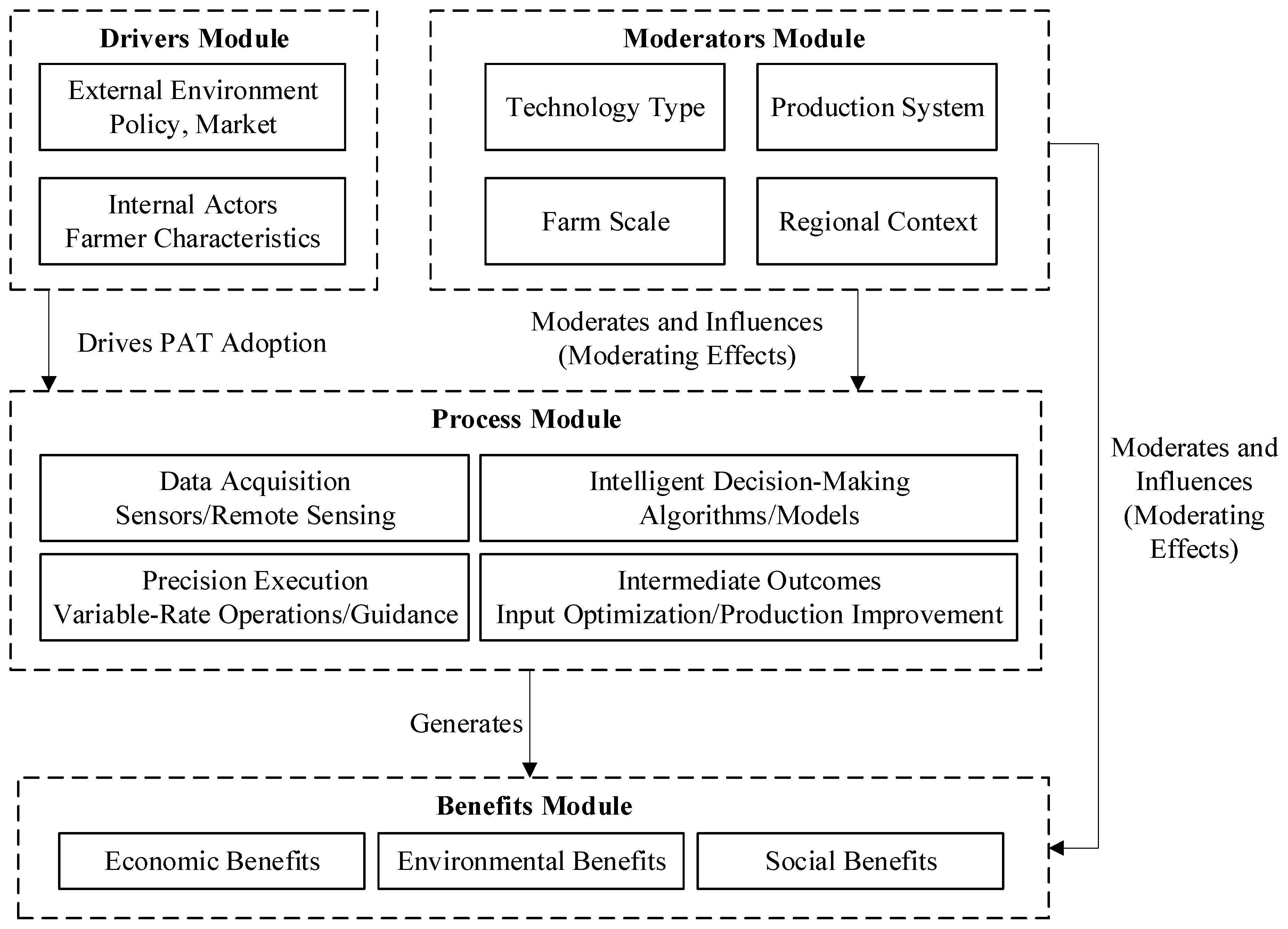
This study aims to systematically analyze the complex pathway from PATs adoption to benefit realization. To this end, the study integrates the Diffusion of Innovations theory with agricultural production economics theory to construct a comprehensive “Drivers-Processes-Moderators-Benefits” (DPMB) analytical framework (
Figure 1). This framework is designed to elucidate the causal pathways and interactive mechanisms among key elements, with its core components outlined as follows:
Firstly, the Drivers Module: This module encompasses the initial motivations that prompt farmers to decide whether to adopt PATs, including external environmental drivers and internal agent drivers. External drivers include policy support, market pressures, technology accessibility, and social network influences. Internal drivers include farmer characteristics, resource endowment, and cognitive factors. They are the starting point of the entire technology application process [
22].
Secondly, the Processes Module: This module depicts the core stages of technology application, constituting a continuum from “perception” to “action”. This process begins by acquiring field data through sensing and remote sensing. It then proceeds to intelligent decision-making, where management prescriptions are generated via data analysis and model computation. Finally, it acts upon the production process through precision execution using intelligent equipment. This direct application leads to intermediate outcomes, such as optimized input use and improved crop growth conditions. Furthermore, this module emphasizes how these outcomes are shaped by technology use intensity and use efficiency [
23].
Thirdly, the Moderators Module: This framework emphasizes that the transformation from “processes” to “benefits” is not linear but is significantly moderated by multiple contextual factors. These moderating variables include: (1) the attributes of the technology itself (e.g., compatibility, complexity); (2) farm operational characteristics (e.g., scale, degree of land fragmentation); (3) type of production system (e.g., field crops, facility agriculture); (4) regional development context (e.g., infrastructure, institutional environment). They act like “filters,” collectively modifying and determining the extent and manifestation of the final benefits of the technology [
24].
Fourthly, the Benefits Module: This module is the final output of technology application, used to evaluate the comprehensive value brought by PATs. It measures outcomes across three key dimensions: economic benefits, environmental benefits, and social benefits. Together, these dimensions constitute a comprehensive evaluation of the technology’s application outcomes [
25].
The innovative value of this framework lies in three key contributions. First, it incorporates the quality dimension of technology adoption—including use intensity and efficiency—thereby breaking through the limitations of the traditional dichotomous approach. Second, it clearly distinguishes the direct pathway of technology effects from contextual moderating effects, which aids in more accurately assessing the net technology effect. Finally, it constructs a multi-dimensional benefit evaluation system that overcomes the limitations of single-benefit assessments. This theoretical framework not only provides an analytical tool for this study but also offers an expandable conceptual model for subsequent related research.
3. Research Methods
3.1. Literature Search Strategy
To ensure the comprehensiveness and systematicity of the literature search, this study developed a rigorous search protocol and employed a multi-database search strategy. Searches were executed in three major internationally authoritative databases: the Web of Science Core Collection (including the SCI-E, SSCI, and A&HCI sub-databases), Scopus, and AGRICOLA. The search timeframe covered all literature published from the inception of each database up to 10 October 2025.
The search strategy utilized a combination of subject headings and keywords to construct a complex Boolean logic search string. The core structure of the English search string was built around four key conceptual blocks, combined using the “AND” operator: Precision Agriculture Technologies: “precision agriculture” OR “precision farm” OR “variable rate technolog” OR “VRT” OR “GPS guidance” OR “auto-steer” OR “drones” OR “UAV” AND “agriculture”; Economic Metrics: “profit” OR “return on investment” OR “ROI” OR “net return” OR “cost” OR “yield”; Environmental Metrics: “environment” OR “nitrogen use efficiency” OR “NUE” OR “pesticide” OR “herbicide” OR “greenhouse gas” OR “GHG” OR “water use efficiency”; Spatial Context: “farm” OR “field” OR “plot”.
To mitigate potential language bias in international databases, this study conducted supplementary searches. These were carried out in two authoritative domestic academic platforms: China National Knowledge Infrastructure (CNKI) and Wanfang Data Knowledge Service Platform. Corresponding Chinese keyword combinations were employed, including core terms such as “precision agriculture”, “variable rate fertilization”, “auto-guidance”, “economic benefits”, and “environmental benefits”, along with their relevant variants, to ensure comprehensive coverage of high-quality domestic research. The selection of these keywords thoroughly considered various dimensions of the research theme, thereby guaranteeing the breadth and representativeness of the search results. All retrieved literature records were imported into EndNote X9 reference management software for systematic organization. Through a combination of the software’s deduplication function and manual verification, the purity of the literature sample and its geographical representativeness were ensured [
26].
3.2. Inclusion and Exclusion Criteria
During the literature screening process, we strictly adhered to the internationally recognized PICOS (Population, Intervention, Comparison, Outcomes, Study Design) framework to establish a systematic and comprehensive screening criteria system [
27].
Population: The study population was restricted to commercially operated crop farms or rigorously controlled field trials. This selection criterion ensures the practical applicability and relevance of the research findings.
Intervention: The interventions encompassed the full spectrum of precision agriculture technology applications, specifically including major types such as Variable Rate Technology (VRT), auto-guidance systems, and precision irrigation technologies.
Comparison: We explicitly required that studies must use farms or plots employing conventional uniform management practices as controls. This provides a scientifically reliable baseline for the accurate subsequent calculation of effect sizes.
Outcomes: Studies were required to fully report data for at least one economic benefit indicator and one environmental benefit indicator. This included key statistical parameters such as means, standard deviations (or standard errors), and sample sizes. For studies that did not directly report standard deviations, we established a flexible alternative approach, accepting other statistical values (such as F-values, t-values,
p-values) from which effect sizes could be calculated through statistical conversion [
28].
Study Design: The included study types were limited to empirical research that had undergone rigorous peer review, specifically including designs with sound experimental structures such as randomized block experiments, paired-field designs, and survey studies.
Exclusion criteria included: review articles, purely theoretical modeling studies, studies lacking a control group, studies with incomplete data or where original data were inaccessible, and studies not published in English or Chinese. These criteria were implemented to ensure the scientific rigor and data accessibility of the included studies [
29].
3.3. Data Extraction and Coding
To ensure the professionalism and reliability of the data extraction process, we established a standardized data extraction procedure. A detailed data extraction form template was first designed, covering key information across various dimensions of the studies. The data extraction was performed independently by two trained researchers using a dual-independent extraction model. Any discrepancies encountered during the extraction process were resolved through discussion or by consulting a third senior researcher, ensuring data accuracy and consistency through this multiple verification mechanism [
30].
The extracted information primarily included the following dimensions:
Basic Study Characteristics: Included fundamental information such as the first author’s name, publication year, country or region where the study was conducted, and study duration.
Sample Characteristics: Included detailed sample size data for both the treatment and control groups.
Technology Characteristics: This dimension documented the specific types of PATs studied. Each technology was coded using a unified system into categories such as VRT fertilization, auto-guidance, and smart irrigation.
Farm and System Characteristics: Included average farm size (in hectares) and primary crop type (coded into a unified classification system such as cereals, cash crops, vegetables) [
31].
Regarding the extraction of outcome data, we focused on core statistics for each outcome indicator, including key parameters such as means and standard deviations (or standard errors). Specifically, we extracted quantitative metrics for economic outcomes (e.g., yield, input use efficiency, profitability) and environmental outcomes (e.g., nutrient loss, greenhouse gas emissions). Indicators pertaining to the social dimension of sustainability, such as labor impacts and community dynamics, were not systematically extracted in this study. This is because they are typically reported with high heterogeneity, making them less amenable to the standardized quantitative synthesis that is the primary objective of our meta-analysis. This focused approach ensures the comparability and validity of the effect sizes synthesized across studies. For the handling of moderating variables, we coded the study countries as “developed” or “developing” based on the World Bank classification standards. Simultaneously, farm size was scientifically categorized into “large-scale” (>100 hectares) and “small-scale” (≤100 hectares) based on the median of the study samples. This classification facilitates cross-country comparison and alignment with numerous global studies. However, it inevitably simplifies the diverse, contextually defined national interpretations of “small-scale” farming. For instance, in China, the official standards for a “family farm” are significantly lower (e.g., ≥6.67 hectares for field crops), highlighting that our “small-scale” category encompasses a wide spectrum of operational sizes [
32].
3.4. Effect Size Calculation and Transformation
To synthesize results across studies that reported outcomes in different metrics, all statistical findings were converted into a comparable effect size metric for meta-analysis. For continuous outcomes (e.g., yield, input use efficiency), we primarily used the standardized mean difference (SMD), commonly known as Cohen’s d, or the mean difference (MD) when studies reported outcomes in identical physical units.
When studies did not report means and standard deviations directly, we applied standardized procedures to convert other reported statistics. For t-values, F-values, or p-values, we used established formulas to convert them to SMDs or MDs, ensuring correct effect direction and sample size were accounted for. For results from regression models, we extracted the treatment coefficient and its standard error, which directly provide the mean difference and its variance. When means and SDs were unavailable but 95% confidence intervals were reported, we back-calculated the standard error.
We implemented several measures to control error and variance. For studies missing variance measures, a conservative imputation approach was employed following Cochrane Handbook guidelines, such as using pooled standard deviations from comparable studies or contacting authors. All SMDs were adjusted for small-sample bias using Hedge’s g correction. The variance for each effect size was calculated with a consistent, type-appropriate formula to ensure correct weighting in the meta-analysis model. Finally, a sensitivity analysis was conducted by comparing results with and without studies requiring such conversions, confirming the robustness of the main findings.
All conversion formulas and decision rules were pre-specified in our analysis protocol to avoid ad-hoc decisions.
3.5. Quality Assessment and Publication Bias
To systematically evaluate the methodological quality of the included studies, we employed a modified Newcastle-Ottawa Scale (NOS) for the rigorous assessment of observational studies. This scale evaluates studies based on three key dimensions: the appropriateness of subject selection, the assurance of comparability between groups, and the rigor of outcome assessment, with a total possible score of 9 points. We established a threshold of ≥7 points to designate high-quality studies, a stringent criterion ensuring the methodological robustness and reliability of the included research.
Regarding potential publication bias, we utilized Egger’s linear regression test for rigorous statistical examination. When significant publication bias was detected, we conducted an in-depth sensitivity analysis using the trim-and-fill method. This approach effectively evaluates the extent to which publication bias might influence the overall effect size, thereby ensuring the stability and reliability of the study’s conclusions [
33].
3.6. Statistical Analysis
All statistical analyses were conducted within the R statistical environment (version 4.2.0), utilizing the specialized metafor package for meta-analytic computations. This choice ensures the reproducibility of the analytical process and the verifiability of the results.
Regarding the calculation of effect sizes, for continuous outcome variables, we selected Hedges’ g as the standardized mean difference effect size metric. Hedges’ g is a bias-corrected version of Cohen’s d for small sample sizes. The value of Hedges’ g, along with its 95% confidence interval, was used to precisely measure the effect size. A result of g > 0 indicates that the performance of the precision agriculture technology group was superior to the traditional management control group [
34].
In terms of model selection strategy, based on the anticipation of substantial heterogeneity among the included studies, all analyses employed a random-effects model. The advantage of this model is its ability to account for both within-study and between-study sources of variation, providing a more realistic reflection of the complexity inherent in the research landscape compared to a fixed-effects model. Heterogeneity was assessed using the Q-statistic to test the significance of heterogeneity and the I2 statistic to quantify its magnitude, with I2 > 50% set as our criterion indicating high heterogeneity.
When high heterogeneity was detected, we further employed subgroup analysis based on a mixed-effects model and meta-regression to thoroughly explore its sources. Subgroup analysis was applied to important categorical moderating variables, while meta-regression was used for continuous moderating variables. This approach helps to uncover key factors influencing the benefits of precision agriculture technologies and their potential underlying mechanisms. All statistical tests employed a strict two-tailed test, with the significance level uniformly set at α = 0.05, ensuring the rigor of statistical inferences [
35].
4. Results Analysis
4.1. Literature Screening Process and Characteristics of Included Studies
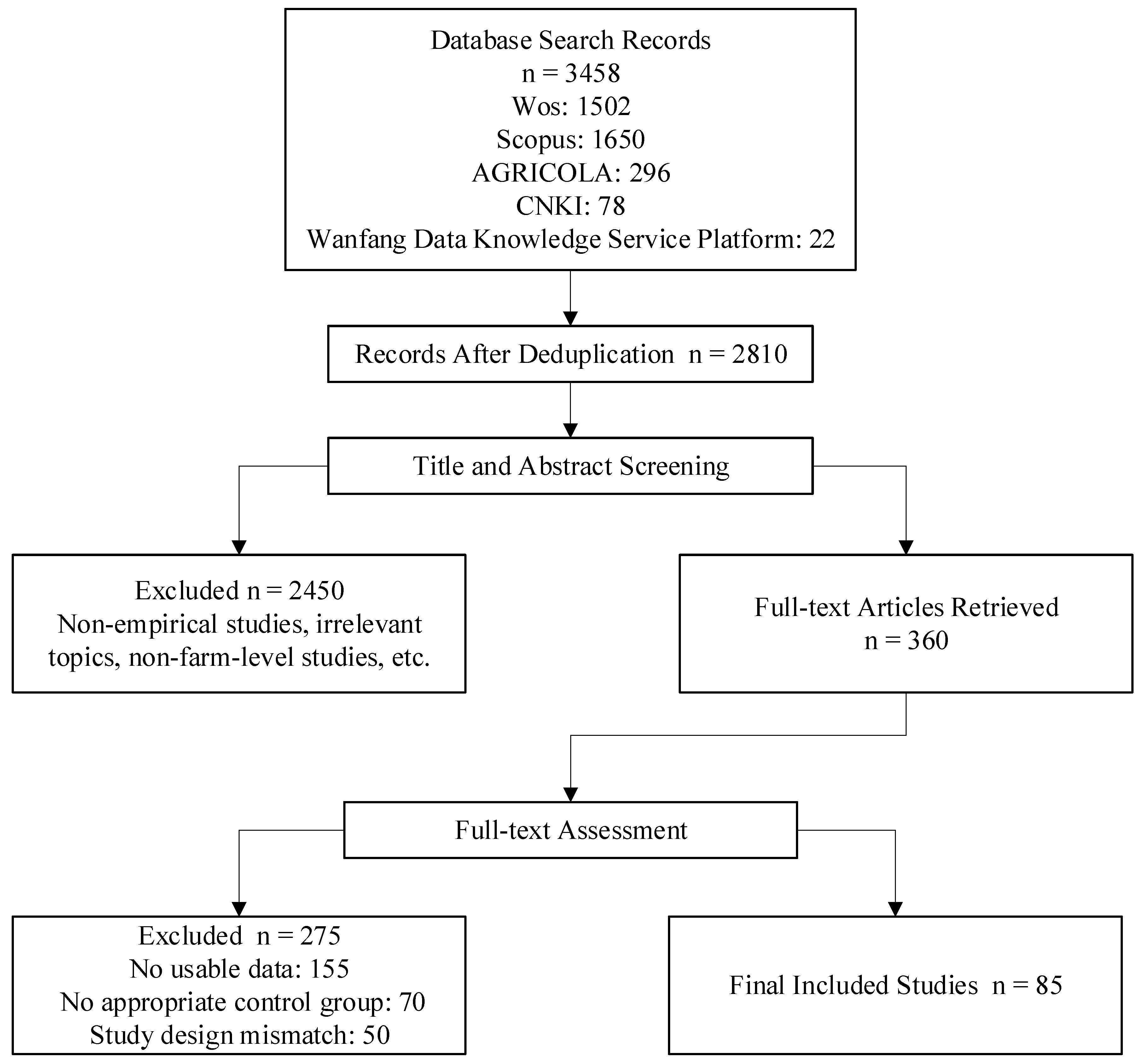
Through systematic retrieval and rigorous screening, this study ultimately constructed an analytical sample comprising 85 high-quality studies. The PRISMA flow diagram (
Figure 2) details the entire literature selection process. Our initial search identified 3548 records, which were reduced to 2810 unique studies after deduplication. Screening of titles and abstracts led to the exclusion of 2450 studies that did not meet the inclusion criteria. Subsequently, we assessed the full texts of the remaining 360 articles and excluded 275 more due to incomplete data, lack of a control group, or incompatible study design. Ultimately, 85 studies were identified for inclusion in this meta-analysis.
As shown in
Table 1, the included studies span from 1998 to 2025, clearly reflecting the developmental trajectory of precision agriculture technologies from early exploration to mature application. Geographically, studies from North America predominated (52%), followed by Europe (28%), Asia (12%), Oceania (5%), and South America (3%). It is particularly noteworthy that China, as a major agricultural country, contributed half of the Asian studies (6%), demonstrating its active engagement in precision agriculture research. Regarding the distribution of technology types, research on Variable Rate Technology (VRT) for fertilization was most concentrated (35%), which is closely related to the high proportion of fertilizer costs in total agricultural production expenses. This was followed by auto-guidance systems (30%), which are relatively mature and easier to promote. Research on precision spraying technologies (15%) and integrated systems (12%) was less common, with other technology types accounting for 8%. The average quality score of all included studies was 7.4 (standard deviation = 1.2), with 72 studies (84.7%) scoring 7 or higher, indicating a high overall methodological quality and providing a reliable data foundation for subsequent analysis [
36].
Table 2 reports the results of the overall benefit effects analysis for precision agriculture technologies. Regarding economic benefits, the pooled analysis for return on investment (including 58 independent studies) revealed an average effect size of Hedges’ g = 0.65 (95% CI: 0.52, 0.78). This moderate-to-large effect size corresponds to an approximate 22.3% increase in ROI, and the statistical test result was significant (z = 9.87,
p < 0.001). The analysis for net profit (including 63 studies) showed an average effect size of Hedges’ g = 0.54 (95% CI: 0.41, 0.67), corresponding to an approximate 18.5% increase in net profit, which was also statistically significant (z = 8.21,
p < 0.001).
In terms of environmental benefits, the analysis results also demonstrated significant positive effects. The analysis for Nitrogen Use Efficiency (including 47 studies) showed an average effect size of Hedges’ g = 0.43 (95% CI: 0.31, 0.55), corresponding to an approximate 15.1% improvement in NUE (z = 6.94, p < 0.001). This improvement primarily stems from the precise regulation of nitrogen fertilizer application by Variable Rate Technology, achieving a better match between crop demand and fertilizer supply. Regarding pesticide use (including 39 studies), the effect size was Hedges’ g = −0.38 (95% CI: −0.50, −0.26), indicating an average reduction in pesticide application amount of 12.8% (z = −6.12, p < 0.001). This is mainly attributed to the localized and precise control of pest and disease outbreaks enabled by precision spraying technology. For greenhouse gas emissions (including 28 studies), the effect size was Hedges’ g = −0.29 (95% CI: −0.43, −0.15), corresponding to an approximate 9.4% reduction in emissions (z = −4.05, p < 0.001). This benefit primarily derives from the reduction in nitrous oxide emissions due to decreased nitrogen fertilizer use and lower fuel consumption resulting from improved operational efficiency.
4.2. Heterogeneity Test and Publication Bias
As shown in
Table 3, the I
2 statistics for all primary analyses exceeded 75% (ROI: I
2 = 82.1%; Profit: I
2 = 79.5%; NUE: I
2 = 76.8%), indicating high heterogeneity among the studies. The Q-test results were all statistically significant (
p < 0.001), further confirming the presence of heterogeneity. This high level of heterogeneity does not reflect methodological flaws but rather authentically represents the complexity of the mechanisms through which precision agriculture technologies realize benefits. From a methodological standpoint, this supports the necessity of conducting moderator analysis.
Publication bias was assessed using Egger’s test. A significant result was found for the ROI analysis (t = 2.45, p = 0.017), suggesting the potential for slight publication bias, meaning studies with positive results might be more likely to be published. Considering that the small-study effect could influence the overall conclusions, we applied the trim-and-fill method for adjustment. The results showed that the adjusted pooled effect size, although slightly reduced (Hedges’ g = 0.61, 95% CI: 0.48, 0.74), remained statistically significant. This indicates that the study conclusions are reasonably robust and unlikely to be entirely driven by publication bias. No significant publication bias was detected in the analyses of the other outcome indicators.
4.3. Moderator Analysis
To further investigate the sources of heterogeneity, this study conducted systematic subgroup analyses and meta-regression analyses.
Table 4 presents the results of the subgroup analysis using Return on Investment as the outcome indicator, clearly revealing the moderating effects of different factors on technology benefits.
From the perspective of technology type, significant differences in economic benefits were observed among different technologies (p < 0.001). Variable Rate Technology (VRT) demonstrated the most substantial economic benefit (Hedges’ g = 0.78). This strong performance is closely linked to its direct optimization of fertilizer, which is the largest cost input in agricultural production. By precisely matching crop nutrient demand with soil supply, VRT achieves the dual objectives of cost reduction and efficiency improvement. Auto-guidance technology followed (Hedges’ g = 0.61), primarily realizing economic benefits through improved operational efficiency, reduced overlap and missed areas, and lowered labor intensity, with its advantages being particularly evident in large-scale farms. Although precision spraying technology also showed a positive effect, the effect size was relatively smaller (Hedges’ g = 0.35). This might be related to its higher technical complexity and demand for monitoring accuracy, while also reflecting the impact of the randomness and suddenness of pest and disease outbreaks on the technology’s effectiveness.
Farm scale exhibited a strong moderating effect (p < 0.001). The effect size for large-scale farms (>100 hectares) (Hedges’ g = 0.82) was significantly higher than that for small-scale farms (≤100 hectares) (Hedges’ g = 0.31). This finding provides strong evidence for the existence of economies of scale in the application of precision agriculture technologies, indicating that technologies with high fixed costs can better realize their economic benefits in large-scale operations. It also highlights the adoption barriers faced by small-scale farms.
Regional context also showed a significant moderating effect (p = 0.005). The effect size for studies conducted in developed countries (Hedges’ g = 0.72) was noticeably higher than that for developing countries (Hedges’ g = 0.39). This result likely reflects the important roles played by factors such as infrastructure, technical support, and human capital in the realization of technological benefits. Better digital infrastructure, more comprehensive technical service systems, and a higher quality agricultural workforce in developed regions provide favorable conditions for precision agriculture technologies to deliver effectiveness.
Significant differences were also observed among different cropping systems (p = 0.032). The effect size in grain production systems (Hedges’ g = 0.70) was higher than that in cash crop systems (Hedges’ g = 0.48). This might be related to the standardization level and management characteristics of different cropping systems. The standardized planting models and large-scale operation characteristics of grain production systems are more conducive to the promotion, application, and benefit realization of precision agriculture technologies.
Further meta-regression analysis, using farm size as a continuous independent variable, showed that farm size had a significant positive influence on the ROI effect size (β = 0.004, p < 0.01). Specifically, for every 100-hectare increase in farm size, the Hedges’ g effect size increased by an average of 0.4. This finding provides more precise quantitative evidence for the moderating role of farm size and offers important references for formulating promotion strategies for precision agriculture technologies.
4.4. Sensitivity Analysis
To verify the robustness of the research findings, we conducted systematic sensitivity analyses [
37]. Firstlly, the “leave-one-out” method was employed, recalculating the pooled effect size after excluding each study one at a time. The results showed that the point estimates and confidence intervals for all primary outcomes did not change directionally. This indicates that the main conclusions are robust, as they are not unduly influenced by any single study and demonstrate good stability.
Secondly, we compared the differences between the results from the random-effects model and the fixed-effect model. Under the random-effects model, the pooled effect size for ROI was 0.65 (95% CI: 0.52, 0.78), while under the fixed-effect model it was 0.59 (95% CI: 0.50, 0.68). Although there were differences in the effect size estimates, the statistical significance and direction of the conclusions remained consistent under both models, further supporting the reliability of the study’s findings.
Furthermore, a stratified analysis was further conducted based on study quality scores. The pooled effect size for high-quality studies (score ≥ 7) was Hedges’ g = 0.68, while that for low-quality studies (score < 7) was g = 0.61. Despite this numerical difference, both effect sizes were statistically significant and demonstrated entirely consistent direction. This result rules out a substantial influence of study quality on the overall conclusions.
Finally, we examined the impact of different study designs on the results, finding similar trends across randomized block experiments, paired-field designs, and large-sample surveys. Although there were reasonable differences in the magnitude of effect sizes, all supported the positive benefits of precision agriculture technologies. These multi-faceted sensitivity analyses enhance the credibility of the research conclusions from a methodological standpoint and lay a solid data foundation for subsequent discussion and policy recommendations.
5. Discussion
5.1. Summary of Main Findings
This meta-analysis integrates empirical evidence from across the globe, providing the most systematic and quantitative answer to date to the long-standing debate surrounding the economic and environmental benefits of Precision Agriculture. The core conclusion is clear: at the global average level, adopting PATs can bring significant positive economic returns to farm operators while simultaneously generating positive environmental externalities. This finding strongly affirms the overall value of PATs as a key pathway for agricultural modernization.
However, the more critical insight lies in the vast and systematic heterogeneity concealed behind this global average. Our analysis conclusively confirms that PATs are by no means a universal “panacea”. Their successful application and ultimate benefits are strongly dependent on the specific implementation context, jointly constituted by the technology itself, farm characteristics, regional agro-ecosystems, and socio-economic backgrounds. Overlooking this heterogeneity is a primary reason why many past discussions have fallen into a simplistic binary opposition of “effective” versus “ineffective” [
38].
5.2. Dialogue with Existing Research and Theory
The results of this study resonate profoundly with the classic Diffusion of Innovations theory [
39]. This theory posits that the adoption and ultimate effect of an innovation fundamentally depend on its perceived relative advantage, compatibility, complexity, trialability, and observability. Our analysis clearly reveals that farm scale is a key factor causing heterogeneity in PATs benefits, perfectly corroborating this theoretical framework. Specifically, large-scale farms benefit more significantly from PATs. This advantage is primarily due to their stronger capital capacity, greater risk tolerance, and better access to expertise. These factors allow complex PATs to seamlessly integrate through high “compatibility” with their existing refined management systems. Simultaneously, economies of scale greatly amplify their “relative advantage” in saving inputs, optimizing management, and enhancing output [
40]. Conversely, for small-scale farms, high initial investment, steep learning curves, and low compatibility with existing production modes collectively constitute major adoption barriers, severely diluting their potential benefits. This mechanism also provides a powerful theoretical explanation for understanding why the promotion of PATs in China, dominated by smallholder economies, often falls into the dilemma of being “widely praised but seldom adopted” [
41]. It is important to note that our meta-analytic category of “small-scale” (≤100 ha) is a broad, comparative construct. When applied to the Chinese context, the official threshold for a “scale operation” in crop farming can be as low as 6.67 hectares. This stark contrast with the global classification used in our analysis underscores that the identified economic and technical barriers are faced by an even more diverse and predominantly smaller group of farmers than the global median suggests. This definitional contrast further amplifies the scale compatibility challenge in such contexts.
Furthermore, different precision agriculture technologies, due to their distinct mechanisms of action, exhibit significantly differentiated benefit pathways. Variable Rate Technology (VRT) operates by precisely regulating fertilizer, which is a core agricultural input. This approach directly achieves the dual goals of increasing yield and reducing cost, while also effectively lowering the risk of non-point source pollution. Consequently, its benefit mechanism is considered the most direct and significant [
42]. Auto-guidance technology primarily saves inputs like fuel, labor, and seeds by enhancing operational accuracy. It also indirectly promotes yield increases by reducing operational overlap and misses, thereby improving cultivation quality. Consequently, its core benefit is more focused on “cost reduction and efficiency improvement.” The benefits of precision spraying technology, however, are highly dependent on the spatial heterogeneity of pest and disease occurrence. Its advantages are not obvious in uniformly affected fields; its environmental and economic value of precise targeted spraying is maximized only when distinct “disease spots” or “insect nests” appear [
43].
The systematic gap in PATs benefits between developed and developing countries extends beyond technology and farm-level factors. This disparity stems not only from differences in average farm size but also, more profoundly, from a chasm in the maturity of their overall agricultural ecosystems. Developed countries possess well-established agricultural technology extension systems, reliable data service markets, mature machinery cooperation networks, and sound property rights and data regulations. These elements collectively form the “soft infrastructure” that enables PATs to achieve their maximum potential. This ecosystem effectively lowers adoption barriers, ensures the value conversion of data flows, and provides a stable return on investment expectation [
44]. The absence of this support system is precisely the systemic shortcoming and core challenge faced by many developing countries in promoting precision agriculture [
45].
However, a balanced assessment of PATs must also acknowledge their potential limitations and drawbacks. Firstly, the high initial investment and ongoing maintenance costs pose a significant adoption barrier, particularly for resource-constrained smallholders, risking the exacerbation of the “digital divide” and inequity within agriculture [
46]. Secondly, technological complexity introduces new skill requirements and dependencies. Farmers may transition from independent decision-makers to operators within a technological system. This shift increases their reliance on external service providers and complex data platforms, raising concerns about data sovereignty, deskilling, and the restructuring of power along the agricultural supply chain. Thirdly, PATs rely on high-quality data inputs, but uneven data access and inherent algorithmic biases could lead to suboptimal or even biased management recommendations. Finally, adopting a broader systemic perspective reveals a potential risk known as the “Jevons Paradox.” Here, the very cost savings achieved through on-farm efficiency gains might incentivize farmers to expand their operations or cultivate marginal lands. At a system level, such behavioral responses could offset or even reverse the local environmental benefits initially gained [
47]. These limitations do not negate the value of PATs but underscore that their successful implementation is deeply embedded within supporting economic incentives, skill development, digital infrastructure, and inclusive governance systems.
The regional and systemic heterogeneities identified above are fundamentally anchored in deeper, structural conditions: natural endowments, national policy frameworks, and digital technology ecosystems. Firstly, natural endowments—such as topography, soil variability, and climate-water conditions—define the physical canvas and inherent difficulty for PATs to create value. Technologies demonstrate clear benefits in flat, contiguous landscapes but face a “natural discount” in fragmented or mountainous terrains. Secondly, national policy frameworks—including subsidy orientations, data property rights legislation, and technology extension systems—profoundly shape adoption incentives through signaling and resource allocation. A policy that integrates PATs into the core of green subsidies differs radically from one that treats it as a mere market choice. Thirdly, the digital technology ecosystem—encompassing broadband coverage, maturity of agricultural data platforms, and depth of private-sector engagement—constitutes the translation layer that turns a technology from “available” to “usable”. It determines whether data can flow, algorithms can iterate, and services can be delivered. Thus, the benefit gap between developed and developing regions is not merely a difference in average farm size but a systemic lag in the maturity of these three foundational structures. Effective technology promotion strategies must therefore begin with a diagnostic of these underlying conditions.
Moving beyond the independent effects of individual factors, a more comprehensive understanding of PATs’ impact requires consideration of their potential synergistic interactions. The benefits and adoption of these technologies are shaped by the complex interplay of technology type, farm scale, and regional context, not by any single factor in isolation. This interplay means that, for instance, integrated systems may yield disproportionately higher returns on large-scale farms. These operations possess the management capacity and capital necessary to leverage technological synergies, whereas smallholders might only adopt singular, low-complexity components. Furthermore, the regional development context—encompassing digital infrastructure, service markets, and policies—can act as a critical enabling (or constraining) layer that determines whether a specific technology-scale combination can succeed. While our meta-analysis identifies these as core moderating variables, quantitatively disentangling their higher-order interactions remains a challenge, primarily due to a scarcity of primary studies designed to test such multifactorial hypotheses. Future research employing factorial experimental designs, case-study comparisons, or structural equation modelling on rich survey data is needed to map these interactive networks. Unravelling these synergies is crucial for developing context-specific technology packages and predictive models that accurately reflect the complexities of real-world agricultural systems.
5.3. Policy Implications
Our findings reveal systematic heterogeneity in the impacts of precision agriculture. Based on this, we argue that its promotion would benefit from moving beyond a “one-size-fits-all” policy approach toward more targeted and stratified strategies to match the actual needs of different developmental contexts [
48].
Translating the above insights into actionable policy requires moving from recognizing heterogeneity to engaging in cost-effective and adaptive structural diagnosis. The design of any differentiated strategy should be informed by a clear assessment of the local natural endowments, the existing national policy framework, and the maturity of the digital technology ecosystem.
Policy interventions must be evaluated not only for their potential impact, but also for their implementation cost and adaptability to local institutional capacities. This is particularly important in regions dominated by small-scale agriculture, where resources and administrative capabilities are often constrained. These three pillars, combined with a cost-adaptability lens, determine the true “implementability” and likely return on investment for any PATs intervention.
For developed countries, the policy orientation could shift from subsidizing single technologies or hardware toward fostering a sustainable and innovation-friendly digital ecosystem. This entails continued support for R&D of next-generation PATs aimed at high-value and complex production environments [
49]. In parallel, it requires the formulation of forward-looking regulations and standards—particularly concerning data interoperability, privacy, ownership, and benefit-sharing. Such a regulatory foundation is crucial to break down “data silos,” facilitate secure data flow, and build the trust necessary for data-driven decision-making [
50].
For developing countries like China, where small-scale farming predominates and implementation capacity is a key constraint, policies must be explicitly designed for phased adaptation and cost-effectiveness. For large-scale farms and new agricultural business entities: Support should evolve from generic hardware subsidies to performance-linked incentives. Mechanisms such as green credit discounts, or post-adoption subsidies contingent on verified outcomes, can enhance the cost-effectiveness of public expenditure and steer technology toward the most productive applications [
51].
For the vast number of smallholders: The policy focus must shift from promoting expensive products to cultivating accessible solutions and robust service markets. This involves a dual strategy. The first is supporting the development and certification of low-cost, simplified, and context-appropriate technology modules (e.g., smartphone-controlled variable-rate devices). The second is strategically fostering localized “Technology-as-a-Service” (TaaS) models. Practical instruments like providing “service vouchers” to smallholders or facilitating group purchasing of services can significantly lower the upfront cost and trial risk. The government’s primary role here is to set service standards, regulate contracts, and ensure quality, rather than operating services directly [
52].
Strategic investment in “soft” infrastructure must also prioritize cost-effectiveness and scalability. This includes three key measures. Firstly, prioritize digital infrastructure rollout in core production zones and along high-value chains. This can be co-located with existing facilities, such as rural e-commerce hubs, to share costs. Secondly, catalyze local data analytics capabilities through cost-efficient means. Examples include sponsoring “digital agronomist” training programs or public competitions for data-driven solutions [
53]. Thirdly, integrate PATs literacy and operational skills into existing agricultural extension systems and new vocational farmer training curricula. This should utilize modular and vernacular online content for wide, low-cost reach [
54].
Ultimately, building open, collaborative innovation platforms is key to continuously reducing adaptation costs. Encouraging the formation of public-private-producer innovation consortia can directly connect localized needs with R&D through mechanisms like innovation challenges or match-funded development contracts. This approach harnesses local knowledge to co-develop tailored solutions. It thereby avoids the high costs and frequent failures associated with importing non-adapted technologies. Ultimately, this ensures a deeper and more sustainable integration of innovation with local needs [
55].
5.4. Research Limitations and Future Directions
Admittedly, as a comprehensive meta-analysis, this study, while providing global evidence, also has inherent limitations, and these very limitations clearly chart the course for future research.
Firstly, the empirical foundation underlying our conclusions relies heavily on short-term (1–3 growing seasons) observational data, which limits our ability to capture the long-term cumulative effects of PATs. Short-term studies likely suffer from a systematic underestimation of key long-term benefits. For instance, advantages such as the gradual improvement of soil organic matter and microbial communities through variable rate fertilization—along with the resulting gains in long-term productivity and climate resilience—are often not fully captured.
Secondly, the primary literature generally lacks detailed reporting on contextual variables. This limitation prevented us from conducting in-depth quantitative analysis of key socio-economic and behavioral factors, such as farmers’ education levels, risk preferences, and social network capital. This somewhat limits the explanatory power regarding the deep-seated motivations behind the heterogeneity in technology adoption.
Thirdly, our search strategy relied primarily on major English academic databases, which helped ensure research quality. However, this approach may have unintentionally excluded relevant findings from local language journals and grey literature, potentially introducing publication bias.
Fourthly, constrained by the reporting depth and design of primary studies, our analysis primarily examined the independent effects of core moderating variables. We were unable to conduct an in-depth quantitative exploration of the potential complex interactions among these factors, such as the synergy between technology type, farm scale, and regional context.
Fifthly, the use of a uniform, hectare-based threshold to categorize farm scale (e.g., ≤100 hectares as “small-scale”), while necessary for global synthesis, may not align with nationally or sectorally specific definitions. For instance, China’s official standards for a “family farm” in crop production are significantly lower (e.g., ≥6.67 hectares). This definitional divergence means our “small-scale” category encompasses a wide spectrum of operational realities. Consequently, it may mask important contextual heterogeneity when interpreting findings for specific countries or agricultural systems.
Based on the above five limitations, future research should focus on five frontier directions. Firstly, there is an urgent need for more long-term positioning experiments and tracking studies on PATs. Such research would systematically evaluate their comprehensive cost-benefit, environmental footprint, and social benefits over the full technology lifecycle, thereby providing a solid basis for sustainable policies. Secondly, the research paradigm must deepen its exploration at the micro-level of behavioral agents. This can be achieved by actively introducing theories and methods from behavioral economics and sociology. The goal is to thoroughly analyze the decision-making mechanisms and psychological motivations that influence smallholders throughout the entire process—from technology adoption and continued use to the final realization of benefits. Thirdly, the entire field should actively embrace cutting-edge technological waves, proactively exploring the use of disruptive technologies such as the Agricultural Internet of Things, big data analytics, and Artificial Intelligence. The aim is to develop more intelligent, adaptive, and predictive new-generation precision decision models. This will fundamentally advance precision agriculture, shifting it from the current “sense-and-respond” mode toward a more proactive “predict-and-optimize” paradigm. Fourthly, to bridge the significant evidence gap identified in this study, future work must develop and apply interdisciplinary methodologies suited to capturing social impacts. This calls for employing mixed-methods approaches, such as embedded qualitative case studies, longitudinal household surveys, and participatory assessments. These methods are essential to systematically evaluate how PATs transform labor relations, skill demands, and social equity across diverse agri-food systems.
Fifthly, to overcome the inherent constraints of short-term empirical data and to capture the lagged, cumulative effects of PATs—particularly on slow-responding variables like soil health—future studies should integrate scenario simulation methods. Building upon the foundational effect sizes derived from meta-analyses like this one, researchers can employ system dynamics modeling, agent-based modeling, or integrated assessment models. These models can incorporate key biophysical processes, adoption diffusion curves, and socio-economic feedback loops to project long-term outcomes under different technology adoption scenarios and policy interventions. This model-data integration approach can provide invaluable foresight into the sustainability trajectories of agricultural systems. It helps assess the long-term cost-effectiveness and resilience benefits of PATs—benefits that are often invisible in short-term trials.