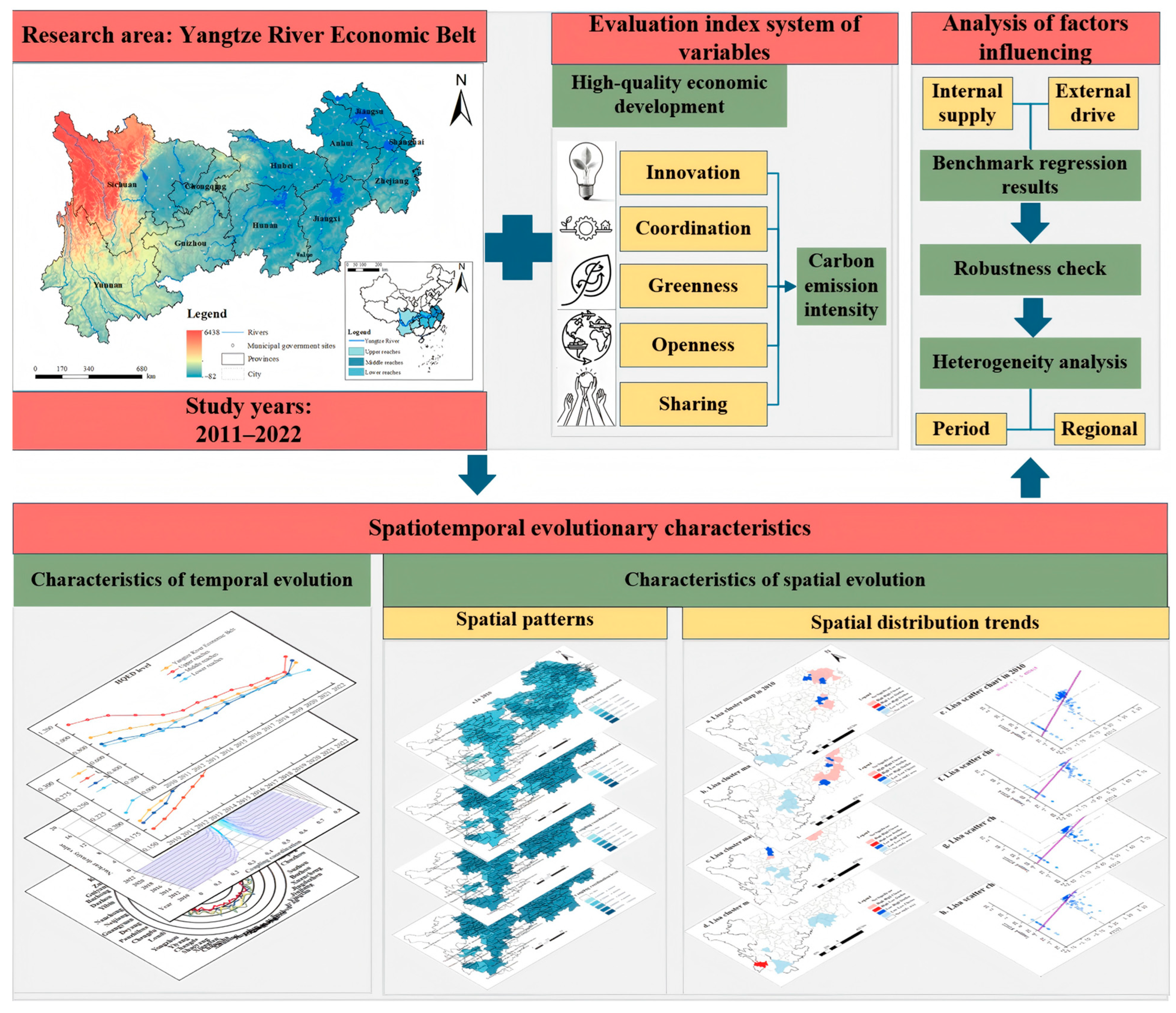

Heterogeneity Analysis of Factors Influencing Carbon Emissions in the Yangtze River Basin: The Impact of National High-Quality Economic Development


Abstract
1. Introduction
2. Literature Review
3. Materials and Methods
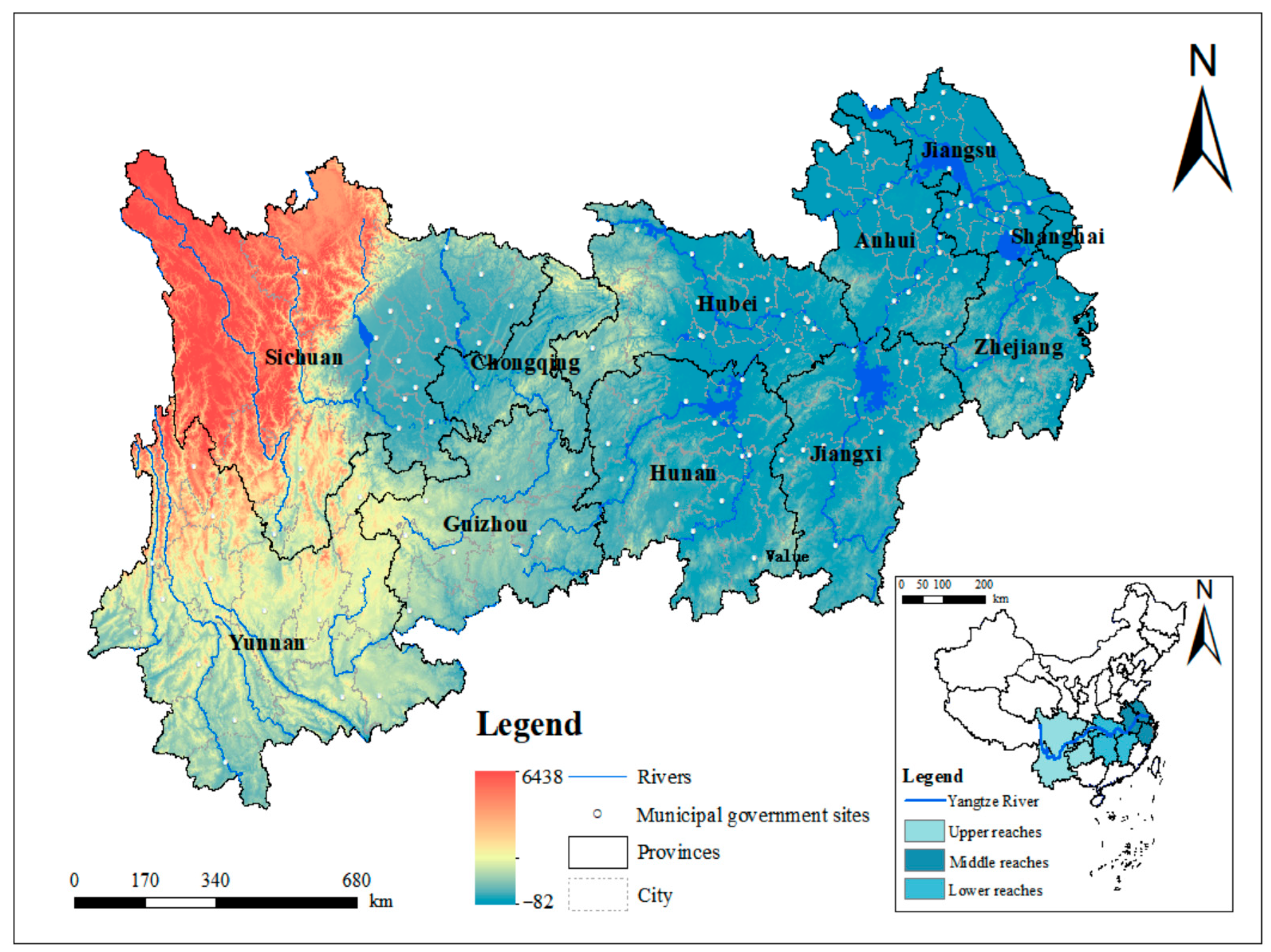
3.1. Study Area
3.2. Data Sources and Processing
3.2.1. CEI Variables
3.2.2. HQED Variables
3.2.3. Influencing Factors
3.3. Research Methods
3.3.1. The Entropy-Weight TOPSIS Model
3.3.2. The Coupling Coordination Degree (CCD) Model
- Forced Coordination: 0 ≤ CCD ≤ 0.2
- Low Coordination: 0.2 < CCD ≤ 0.4
- Moderate Coordination: 0.4 < CCD ≤ 0.6
- High Coordination: 0.6 < CCD ≤ 0.8
- Extreme Coordination: 0.8 < CCD ≤ 1.0
3.3.3. Spatial Autocorrelation
4. Results
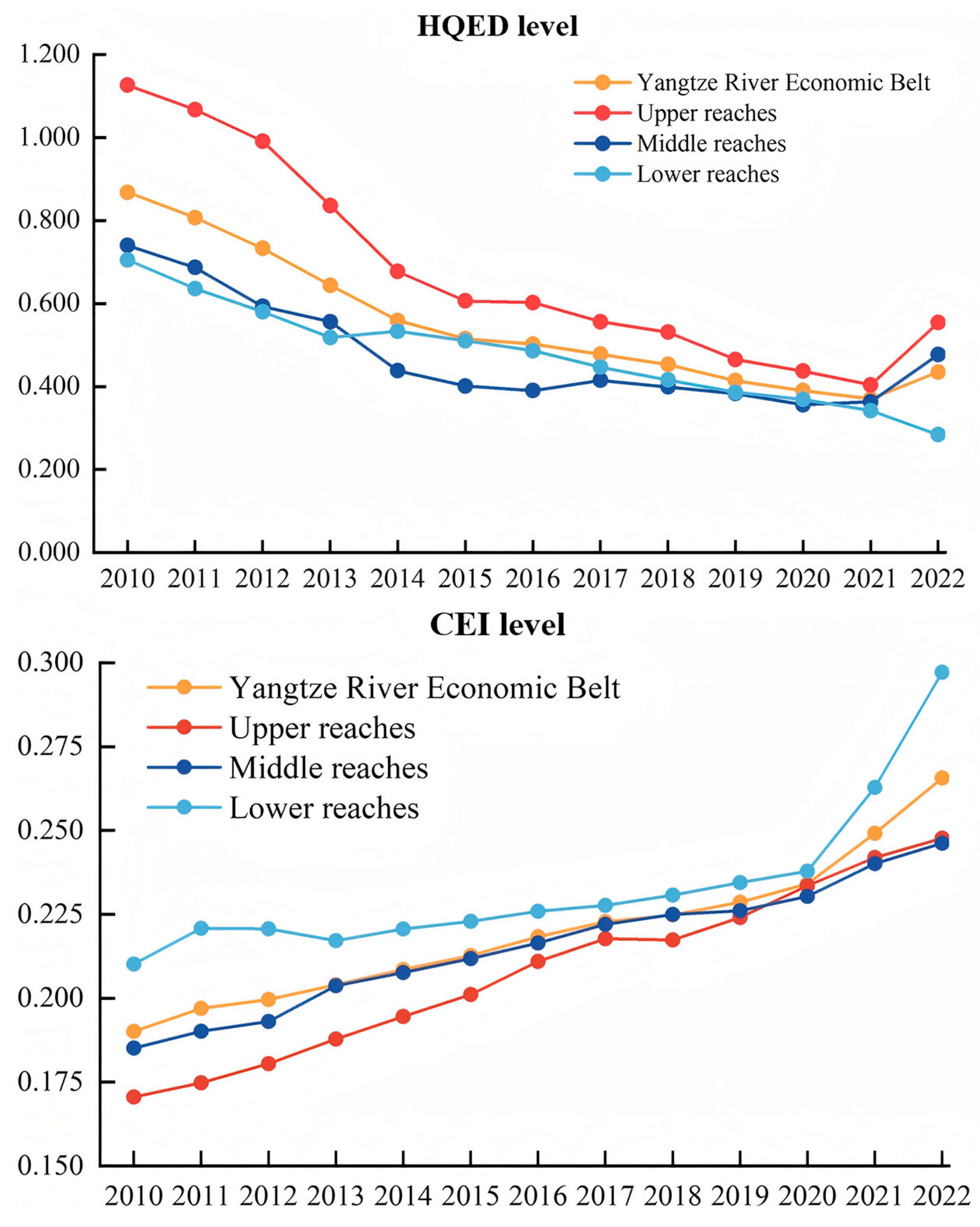
4.1. Temporal Evolution Characteristics of the Targeted Variables
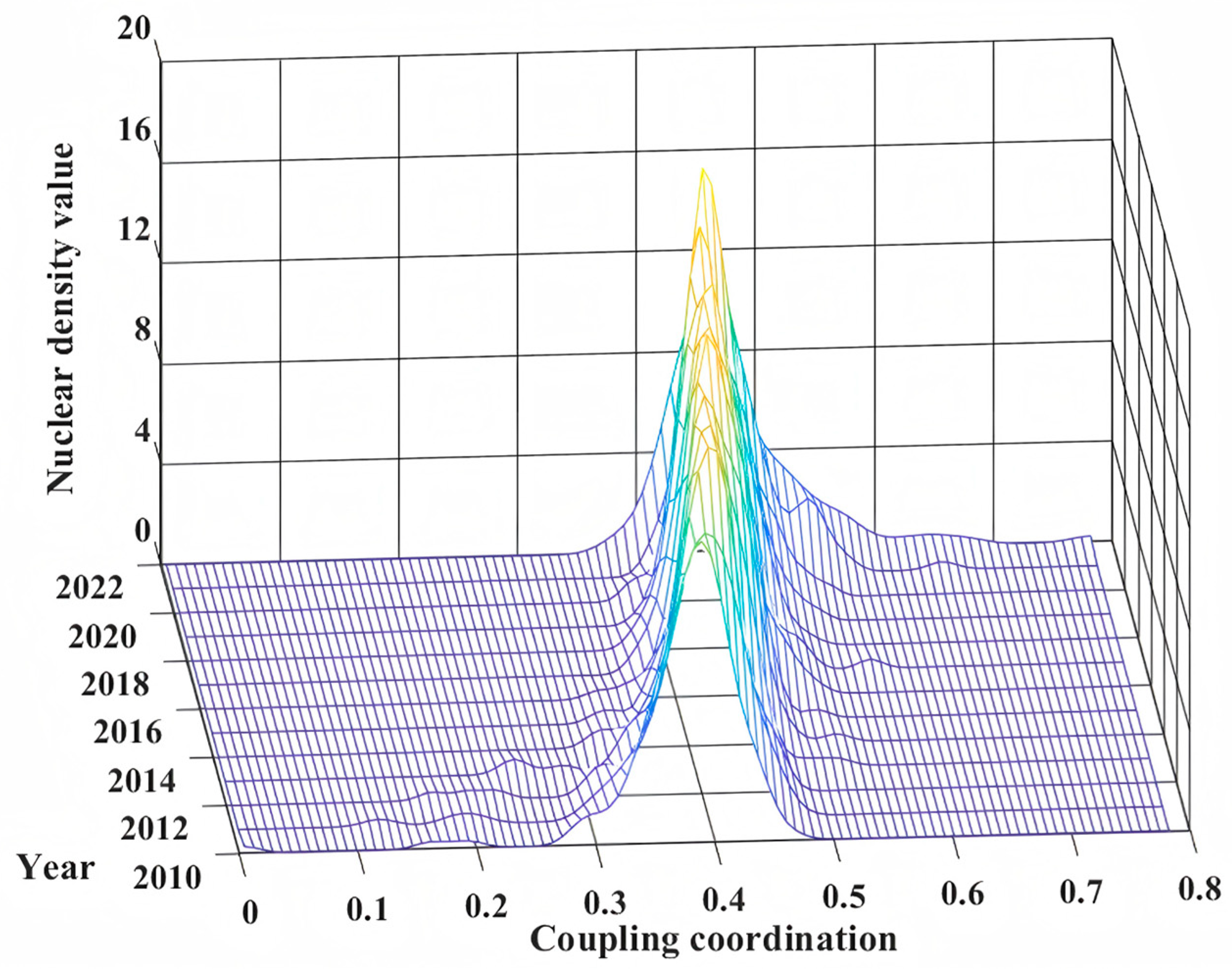
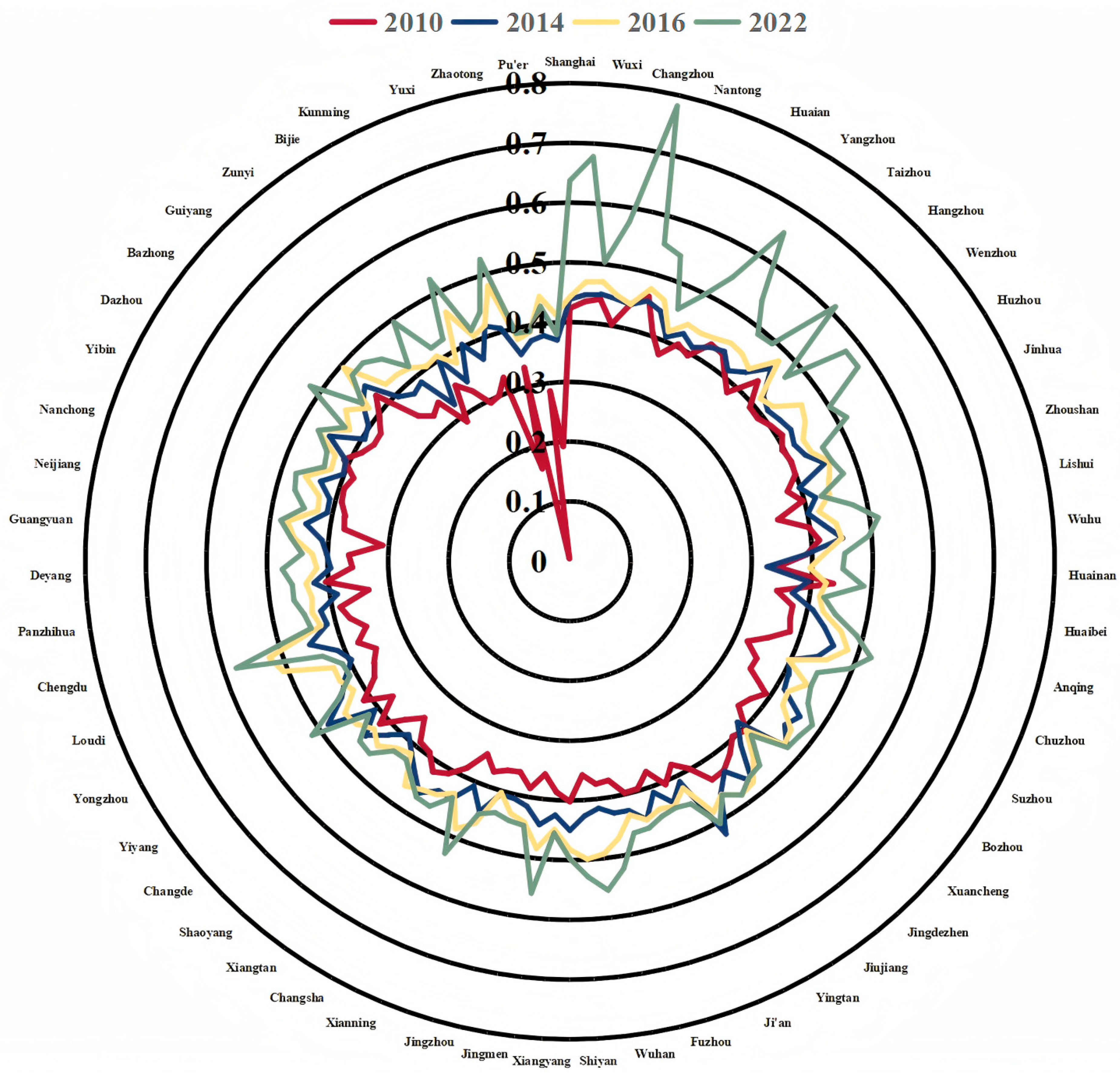
4.2. Characterization of the Temporal Evolution of CCD
4.3. Analysis of the Spatial Correlation of CCD in the YREB
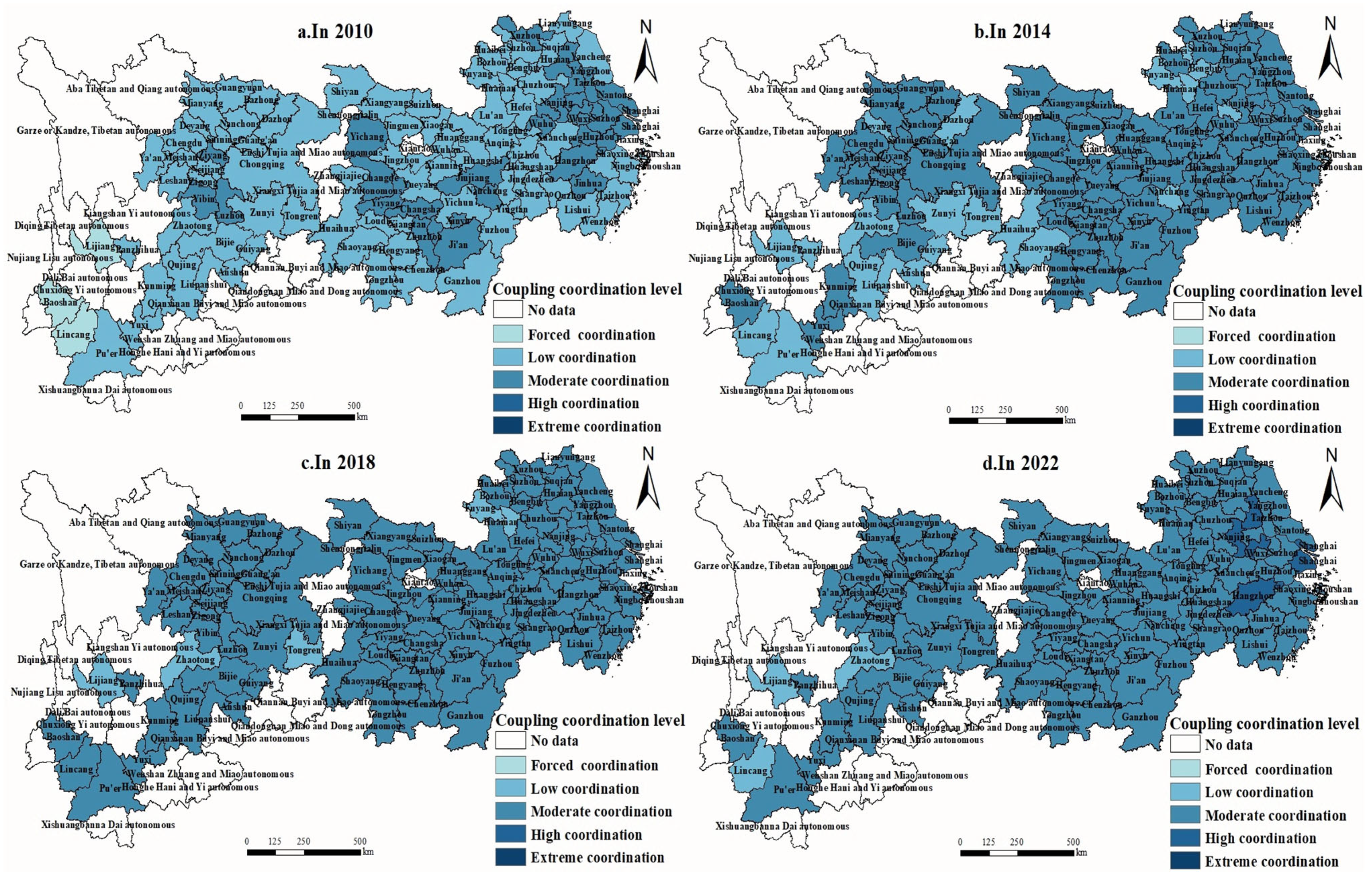
4.3.1. Characterization of the Spatial Evolution Patterns
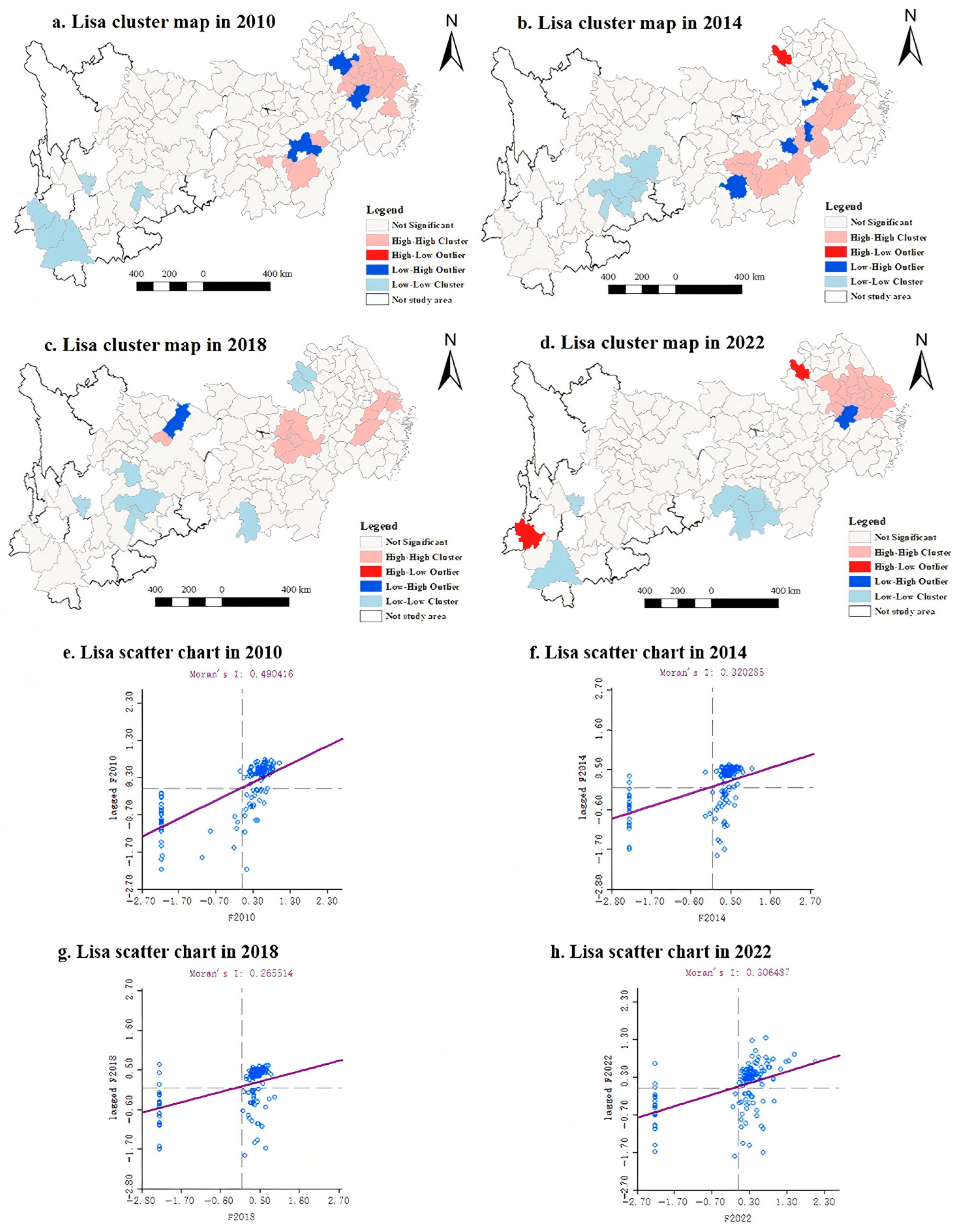
4.3.2. Characterization of the Spatial Distribution Trends of CCD
5. Empirical Validated Results
5.1. Results of the Benchmark Regression
5.2. Results of the Robustness Test
5.3. Heterogeneity Analysis
5.3.1. The Period Heterogeneity Characterization
5.3.2. The Regional Heterogeneity Characteristics
6. Discussion
7. Conclusions and Recommendations
Author Contributions
Funding
Institutional Review Board Statement
Informed Consent Statement
Data Availability Statement
Acknowledgments
Conflicts of Interest
Abbreviations
| YREB | Yangtze river economic belt |
| EKC | Environmental Kuznets Curve |
| CCD | Coupling coordination degree |
| LMDI | Logarithmic Mean Divisia Index |
| STIRPAT | Stochastic Impacts by Regression on Population, Affluence, and Technology |
| CEI | Carbon emission intensity |
| HQED | High-quality economic development |
| RGDP | Economic development level |
| HM | Human capital |
| IS | Industrial structure |
| TEC | Technology |
| GI | Green innovation |
| GOV | Government support |
| UR | Urbanization |
| OPEN | Opening up |
References
- Mora, C.; Spirandelli, D.; Franklin, E.C.; Lynham, J.; Kantar, M.B.; Miles, W.; Smith, C.Z.; Freel, K.; Moy, J.; Louis, L.V. Broad threat to humanity from cumulative climate hazards intensified by greenhouse gas emissions. Nat. Clim. Change 2018, 8, 1062–1071. [Google Scholar] [CrossRef]
- Yun, G. China’s response to climate change issues after Paris Climate Change Conference. Adv. Clim. Change Res. 2016, 7, 235–240. [Google Scholar]
- Pucha, W.; Jing, W. Impact of environmental investment and resource endowment on regional energy efficiency: Evidence from the Yangtze River Economic Belt, China. Environ. Sci. Pollut. Res. Int. 2021, 29, 5445–5453. [Google Scholar]
- Liang, Y.; Renyue, L.; Xia, W.; Weijun, H.; Yang, K.; Stephen, R.T.; Mulugeta, D.D. Decoupling of economic growth and resources-environmental pressure in the Yangtze River Economic Belt, China. Ecol. Indic. 2023, 153, 110399. [Google Scholar] [CrossRef]
- Tian, Y.; Sun, C. Comprehensive carrying capacity, economic growth and the sustainable development of urban areas: A case study of the Yangtze River Economic Belt. J. Clean. Prod. 2018, 195, 486–496. [Google Scholar] [CrossRef]
- Chen, W.; Lan, M.-H.; Sun, W.; Liu, W.; Liu, C.-G. Integrated high-quality development of the Yangtze River Delta: Connotation, current situation and countermeasures. J. Nat. Resour. 2022, 37, 1403–1412. [Google Scholar] [CrossRef]
- Liu, Z. Implementing the national strategy of higher-quality integrated development of the Yangtze River Delta. In Integration Development in the China Yangtze River Delta; Routledge: London, UK, 2023; pp. 1–17. [Google Scholar]
- Zhang, Z.; Fu, S.; Li, J.; Qiu, Y.; Shi, Z.; Sun, Y. Spatiotemporal Analysis and Prediction of Carbon Emissions from Energy Consumption in China through Nighttime Light Remote Sensing. Remote Sens. 2023, 16, 23. [Google Scholar] [CrossRef]
- Cheng, Y.; Tang, Y.; Zhou, B.; Feng, H. Spatiotemporal analysis of national carbon emission and regional carbon simulation in China. Environ. Sci. Pollut. Res. Int. 2024, 31, 10702–10716. [Google Scholar] [CrossRef]
- Liu, K.; Ren, G.; Dong, S.; Xue, Y. The synergy between pollution reduction and carbon reduction in Chinese cities and its influencing factors. Sustain. Cities Soc. 2024, 106, 105348. [Google Scholar] [CrossRef]
- Sun, Z.-Y.; Deng, M.-X.; Li, D.; Sun, Y. Characteristics and driving factors of carbon emissions in China. J. Environ. Plan. Manag. 2024, 67, 967–992. [Google Scholar] [CrossRef]
- Meng, C.; Du, X.; Zhu, M.; Ren, Y.; Fang, K. The static and dynamic carbon emission efficiency of transport industry in China. Energy 2023, 274, 127297. [Google Scholar] [CrossRef]
- Ding, H.; Liu, C. Carbon emission efficiency of China’s logistics industry: Measurement, evolution mechanism, and promotion countermeasures. Energy Econ. 2024, 129, 107221. [Google Scholar] [CrossRef]
- Liu, C.; Hu, S.; Wu, S.; Song, J.; Li, H. County-level land use carbon emissions in China: Spatiotemporal patterns and impact factors. Sustain. Cities Soc. 2024, 105, 105304. [Google Scholar] [CrossRef]
- Du, Y.; Liu, H.; Huang, H.; Zhang, J.; Wang, Y. Research on provincial implied carbon emissions in China under the shared responsibility driven by new quality productivity: A new approach. Sustain. Futures 2024, 8, 100303. [Google Scholar] [CrossRef]
- Zhao, X.; Ma, X.; Chen, B.; Shang, Y.; Song, M. Challenges toward carbon neutrality in China: Strategies and countermeasures. Resour. Conserv. Recycl. 2022, 176, 105959. [Google Scholar] [CrossRef]
- Xu, Y.; Liu, Y.; Chen, R.; Meng, Y.; Li, K.; Fu, C. Study on the spatiotemporal evolution characteristics and driving mechanism of China’s carbon emissions. Humanit. Soc. Sci. Commun. 2023, 10, 786. [Google Scholar] [CrossRef]
- Sun, M.; Liang, B.; Meng, X.; Zhang, Y.; Wang, Z.; Wang, J. Study on the evolution of spatial and temporal patterns of carbon emissions and influencing factors in China. Land 2024, 13, 828. [Google Scholar] [CrossRef]
- Wang, W.; Hu, Y.; Lu, Y. Driving forces of China’s provincial bilateral carbon emissions and the redefinition of corresponding responsibilities. Sci. Total Environ. 2023, 857, 159404. [Google Scholar] [CrossRef]
- Huang, Y.; Yu, Q.; Wang, R. Driving factors and decoupling effect of carbon footprint pressure in China: Based on net primary production. Technol. Forecast. Soc. Change 2021, 167, 120722. [Google Scholar] [CrossRef]
- Liu, Z.; Wang, F.; Tang, Z.; Tang, J. Predictions and driving factors of production-based CO2 emissions in Beijing, China. Sustain. Cities Soc. 2020, 53, 101909. [Google Scholar] [CrossRef]
- Xu, B.; Xu, R. Assessing the carbon intensity of the heavy industry in China: Using a nonparametric econometric model. Environ. Impact Assess. Rev. 2023, 98, 106925. [Google Scholar] [CrossRef]
- Xian, Y.; Wang, K.; Shi, X.; Zhang, C.; Wei, Y.-M.; Huang, Z. Carbon emissions intensity reduction target for China’s power industry: An efficiency and productivity perspective. J. Clean. Prod. 2018, 197, 1022–1034. [Google Scholar] [CrossRef]
- Pang, J.; Li, H.; Lu, C.; Lu, C.; Chen, X. Regional differences and dynamic evolution of carbon emission intensity of agriculture production in China. Int. J. Environ. Res. Public Health 2020, 17, 7541. [Google Scholar] [CrossRef] [PubMed]
- Sun, J.; Li, W.; Zhu, K.; Zhang, M.; Yu, H.; Wang, X.; Liu, G. Research on Industrial CO2 Emission Intensity and Its Driving Mechanism Under China’s Dual Carbon Target. Sustainability 2024, 16, 10785. [Google Scholar] [CrossRef]
- Peng, Z.; Li, M. Carbon Emissions Intensity of the Transportation Sector in China: Spatiotemporal Differentiation, Trends Forecasting and Convergence Characteristics. Sustainability 2025, 17, 815. [Google Scholar] [CrossRef]
- Xia, W.; Ma, Y.; Gao, Y.; Huo, Y.; Su, X. Spatial-temporal pattern and spatial convergence of carbon emission intensity of rural energy consumption in China. Environ. Sci. Pollut. Res. 2024, 31, 7751–7774. [Google Scholar] [CrossRef]
- Liu, J.; Li, S.; Ji, Q. Regional differences and driving factors analysis of carbon emission intensity from transport sector in China. Energy 2021, 224, 120178. [Google Scholar] [CrossRef]
- Dong, F.; Yu, B.; Hadachin, T.; Dai, Y.; Wang, Y.; Zhang, S.; Long, R. Drivers of carbon emission intensity change in China. Resour. Conserv. Recycl. 2018, 129, 187–201. [Google Scholar] [CrossRef]
- Vukić, L. Tracking Carbon Intensity of Global Container Fleet: Carbon Emissions Index (CEI). Trans. Marit. Sci. 2024, 13, 1–14. [Google Scholar] [CrossRef]
- Bai, Z.; Zhang, N.; Winiwarter, W.; Luo, J.; Chang, J.; Smith, P.; Ledgard, S.; Wu, Y.; Hong, C.; Conchedda, G. Decline in carbon emission intensity of global agriculture has stagnated recently. Proc. Natl. Acad. Sci. USA 2024, 121, e2317725121. [Google Scholar] [CrossRef]
- Liu, X.-J.; Jin, X.-B.; Luo, X.-L.; Zhou, Y.-K. Multi-scale variations and impact factors of carbon emission intensity in China. Sci. Total Environ. 2023, 857, 159403. [Google Scholar] [CrossRef] [PubMed]
- Geng, W.; Liu, X.; Liao, X. Mechanism analysis of the influence of intelligent manufacturing on carbon emission intensity: Evidence from cross country and industry. Environ. Dev. Sustain. 2024, 26, 15777–15801. [Google Scholar] [CrossRef]
- Chang, H.; Ding, Q.; Zhao, W.; Hou, N.; Liu, W. The digital economy, industrial structure upgrading, and carbon emission intensity—Empirical evidence from China’s provinces. Energy Strategy Rev. 2023, 50, 101218. [Google Scholar] [CrossRef]
- Xu, Q.; Li, J.; Lin, Z.; Wu, S.; Yang, Y.; Lu, Z.; Xu, Y.; Zha, L. Impact of Economic Agglomeration on Carbon Emission Intensity and Its Spatial Spillover Effect: A Case Study of Guangdong Province, China. Land 2025, 14, 197. [Google Scholar] [CrossRef]
- Xu, J.; Guan, Y.; Oldfield, J.; Guan, D.; Shan, Y. China carbon emission accounts 2020–2021. Appl. Energy 2024, 360, 122837. [Google Scholar] [CrossRef]
- Petrov, S. Application of the IPCC Methodology to Assess the Spatial Distribution of CO2 Emissions in Russian Ferrous Metallurgy. Stud. Russ. Econ. Dev. 2024, 35, 54–59. [Google Scholar] [CrossRef]
- Liu, Q.; Song, J.; Dai, T.; Shi, A.; Xu, J.; Wang, E. Spatiotemporal dynamic evolution of carbon emission intensity and the effectiveness of carbon emission reduction at county level based on nighttime light data. J. Clean. Prod. 2022, 362, 132301. [Google Scholar] [CrossRef]
- González, P.F.; Presno, M.J.; Landajo, M. Tracking the change in Spanish greenhouse gas emissions through an LMDI decomposition model: A global and sectoral approach. J. Environ. Sci. 2024, 139, 114–122. [Google Scholar] [CrossRef]
- Jia, L.; Wang, M.; Yang, S.; Zhang, F.; Wang, Y.; Li, P.; Ma, W.; Sui, S.; Liu, T.; Wang, M. Analysis of agricultural carbon emissions and carbon sinks in the yellow river basin based on LMDI and tapio decoupling models. Sustainability 2024, 16, 468. [Google Scholar] [CrossRef]
- Wei, M.; Cai, Z.; Song, Y.; Xu, J.; Lu, M. Spatiotemporal evolutionary characteristics and driving forces of carbon emissions in three Chinese urban agglomerations. Sustain. Cities Soc. 2024, 104, 105320. [Google Scholar] [CrossRef]
- Li, S.; Yao, L.; Zhang, Y.; Zhao, Y.; Sun, L. China’s provincial carbon emission driving factors analysis and scenario forecasting. Environ. Sustain. Indic. 2024, 22, 100390. [Google Scholar] [CrossRef]
- Han, Y.; Yang, Q.; Tian, P. The fundamentals of boosting high-quality development by megaprojects: A systematic literature review. Proj. Leadersh. Soc. 2024, 5, 100140. [Google Scholar] [CrossRef]
- Lin, B. China’s high-quality economic growth in the process of carbon neutrality. China Financ. Econ. Rev. 2022, 11, 3–22. [Google Scholar] [CrossRef]
- Guo, X.; Deng, M.; Wang, X.; Yang, X. Population agglomeration in Chinese cities: Is it benefit or damage for the quality of economic development? Environ. Sci. Pollut. Res. 2024, 31, 10106–10118. [Google Scholar] [CrossRef]
- Liu, Y.; Yang, M.; Cui, J. Urbanization, economic agglomeration and economic growth. Heliyon 2024, 10, e23772. [Google Scholar] [CrossRef]
- Olaoye, O. Environmental quality, energy consumption and economic growth: Evidence from selected African countries. Green Low-Carbon Econ. 2024, 2, 28–36. [Google Scholar] [CrossRef]
- Zhang, M.; Qi, S. The spatiotemporal evolution and driving factors of high-quality development in the Yellow River Basin during the period of 2010–2022. Sustainability 2023, 15, 13512. [Google Scholar] [CrossRef]
- Zhang, F.; Tan, H.; Zhao, P.; Gao, L.; Ma, D.; Xiao, Y. What was the spatiotemporal evolution characteristics of high-quality development in China? A case study of the Yangtze River economic belt based on the ICGOS-SBM model. Ecol. Indic. 2022, 145, 109593. [Google Scholar] [CrossRef]
- Chang’e, K.; Wenyi, L.; Xiaosi, H. Spatial-temporal evolution and driving factors of coupling coordination between carbon emission intensity and high-quality economic development in urban agglomerations in the middle reaches of the Yangtze River. Econ. Geogr. 2022, 42, 30–40. [Google Scholar]
- Nasir, M.; Rehman, F.U. Environmental Kuznets curve for carbon emissions in Pakistan: An empirical investigation. Energy Policy 2011, 39, 1857–1864. [Google Scholar] [CrossRef]
- Lau, L.; Choong, C.; Eng, Y. Investigation of the environmental Kuznets curve for carbon emissions in Malaysia: Do foreign direct investment and trade matter? Energy Policy 2014, 68, 490–497. [Google Scholar] [CrossRef]
- Alshehry, A.; Belloumi, M. Study of the environmental Kuznets curve for transport carbon dioxide emissions in Saudi Arabia. Renew. Sustain. Energy Rev. 2017, 75, 1339–1347. [Google Scholar] [CrossRef]
- Moomaw, W.; Unruh, G. Are environmental Kuznets curves misleading us? The case of CO2 emissions. Environ. Dev. Econ. 1997, 2, 451–463. [Google Scholar] [CrossRef]
- Dong, K.; Wang, B.; Zhao, J.; Taghizadeh-Hesary, F. Mitigating carbon emissions by accelerating green growth in China. Econ. Anal. Policy 2022, 75, 226–243. [Google Scholar] [CrossRef]
- Sun, G.; Liu, Y.; Li, B.; Guo, L. Road to sustainable development of China: The pursuit of coordinated development between carbon emissions and the green economy. J. Clean. Prod. 2024, 434, 139833. [Google Scholar] [CrossRef]
- Xiao, Y.; Huang, H.; Qian, X.-M.; Chen, L. Can carbon emission trading pilot facilitate green development performance? Evidence from a quasi-natural experiment in China. J. Clean. Prod. 2023, 400, 136755. [Google Scholar] [CrossRef]
- Wang, J.; Tian, J.; Kang, Y.; Guo, K. Can green finance development abate carbon emissions: Evidence from China. Int. Rev. Econ. Financ. 2023, 88, 73–91. [Google Scholar] [CrossRef]
- Dong, Q.; Zhong, K.; Liao, Y.; Xiong, R.; Wang, F.; Pang, M. Coupling coordination degree of environment, energy, and economic growth in resource-based provinces of China. Resour. Policy 2023, 81, 103308. [Google Scholar] [CrossRef]
- Liu, C.; Sun, W.; Li, P.; Zhang, L.; Li, M. Differential characteristics of carbon emission efficiency and coordinated emission reduction pathways under different stages of economic development: Evidence from the Yangtze River Delta, China. J. Environ. Manag. 2023, 330, 117018. [Google Scholar] [CrossRef]
- Jiang, J.; Zhu, S.; Wang, W.; Li, Y.; Li, N. Coupling coordination between new urbanisation and carbon emissions in China. Sci. Total Environ. 2022, 850, 158076. [Google Scholar] [CrossRef]
- Xu, Y.; Liu, Z.; Walker, T.R.; Adams, M.; Dong, H. Spatiotemporal patterns and spillover effects of synergy on carbon dioxide emission and pollution reductions in the Yangtze River Delta region in China. Sustain. Cities Soc. 2024, 107, 105419. [Google Scholar] [CrossRef]
- Liu, Z.; Xia, Z.; Zhang, X.; Chen, W. Spatiotemporal Evolution of the Coupled and Coordinated Development Between Digital Economy and Carbon Emission Governance Capability: Evidence from 30 Provinces of China. Appl. Ecol. Environ. Res. 2025, 23, 1377–1400. [Google Scholar] [CrossRef]
- Zhang, B.; Yin, J.; Jiang, H.; Qiu, Y. Spatial–temporal pattern evolution and influencing factors of coupled coordination between carbon emission and economic development along the Pearl River Basin in China. Environ. Sci. Pollut. Res. 2023, 30, 6875–6890. [Google Scholar] [CrossRef] [PubMed]
- Wu, H.; Yang, Y.; Li, W. Dynamic spatiotemporal evolution and spatial effect of carbon emissions in urban agglomerations based on nighttime light data. Sustain. Cities Soc. 2024, 113, 105712. [Google Scholar] [CrossRef]
- Chen, X.; Di, Q.; Liang, C. The mechanism and path of pollution reduction and carbon reduction affecting high quality economic development-taking the Yangtze River Delta urban agglomeration as an example. Appl. Energy 2024, 376, 124340. [Google Scholar] [CrossRef]
- Li, Q.; Yang, Z.; Tian, Z.; Yin, Q. Multidimensional measurement of the High-Quality development of city Clusters: Dynamic Evolution, regional differences and trend forecasting--based on the basic connotation of Chinese-style modernization. Ecol. Indic. 2024, 161, 111989. [Google Scholar] [CrossRef]
- Wang, X.; Lu, Y.; Chen, C.; Yi, X.; Cui, H. Total-factor energy efficiency of ten major global energy-consuming countries. J. Environ. Sci. 2024, 137, 41–52. [Google Scholar] [CrossRef]
- Lee, C.-C.; Zhao, Y.-N. Heterogeneity analysis of factors influencing CO2 emissions: The role of human capital, urbanization, and FDI. Renew. Sustain. Energy Rev. 2023, 185, 113644. [Google Scholar] [CrossRef]
- Tang, D.; Li, J.; Zhao, Z.; Boamah, V.; Lansana, D.D. The influence of industrial structure transformation on urban resilience based on 110 prefecture-level cities in the Yangtze River. Sustain. Cities Soc. 2023, 96, 104621. [Google Scholar] [CrossRef]
- Liu, K.; Xue, Y.; Chen, Z.; Miao, Y. The spatiotemporal evolution and influencing factors of urban green innovation in China. Sci. Total Environ. 2023, 857, 159426. [Google Scholar] [CrossRef]
- Lin, B.; Zhang, A. Impact of government subsidies on total factor productivity of energy storage enterprises under dual-carbon targets. Energy Policy 2024, 187, 114046. [Google Scholar] [CrossRef]
- Guo, X.; Fang, C. How does urbanization affect energy carbon emissions under the background of carbon neutrality? J. Environ. Manag. 2023, 327, 116878. [Google Scholar]
- Ma, X.; Weng, S.; Zhao, J.; Liu, H.; Huang, H. Investigating spatiotemporal characteristics and influencing factors for green energy consumption in China. Geosci. Front. 2024, 15, 101672. [Google Scholar] [CrossRef]
- Wang, C.; Liu, P.; Ibrahim, H.; Yuan, R. The temporal and spatial evolution of green finance and carbon emissions in the Pearl River Delta region: An analysis of impact pathways. J. Clean. Prod. 2024, 446, 141428. [Google Scholar] [CrossRef]
- Shen, Z.; Min, H.; Wang, L.; Zhang, Y. Evaluation of Carbon Neutrality Capacity of Regional Construction Industry Based on the Entropy Weight TOPSIS Model. Buildings 2024, 14, 2363. [Google Scholar] [CrossRef]
- Liang, H.; Chen, S.; Yan, Y.; Li, S.; Qin, M. Chengdu carbon emission analysis and emission reduction countermeasure research in the context of the Double Carbon. Highlights Sci. Eng. Technol. 2025, 125, 434–444. [Google Scholar] [CrossRef]
- Zhang, J.; Shan, Y.; Jiang, S.; Xin, B.; Miao, Y.; Zhang, Y. Study on the coordinated development degree of new quality productivity and manufacturing carbon emission efficiency in provincial regions of China. Environ. Dev. Sustain. 2024, 1–35. [Google Scholar] [CrossRef]
- Deng, Q.; Li, C. Spatiotemporal characteristics and influencing factors of coupling coordination degreee between ecological environment and green finance in Yangtze River Economic Belt. Resour. Environ. Yangtze Basin 2025, 34, 28–41. [Google Scholar]
- Jin, Y.; Zhang, K.; Li, D.; Wang, S.; Liu, W. Analysis of the spatial–temporal evolution and driving factors of carbon emission efficiency in the Yangtze River economic Belt. Ecol. Indic. 2024, 165, 112092. [Google Scholar] [CrossRef]
- Cheng, M.; Wang, J.; Yang, S.; Li, Q. The driving effect of technological innovation on green development: From the perspective of efficiency. Energy Policy 2024, 188, 114089. [Google Scholar] [CrossRef]
- Lin, B.; Huang, C. Promoting variable renewable energy integration: The moderating effect of digitalization. Appl. Energy 2023, 337, 120891. [Google Scholar] [CrossRef]
- Chen, Z.; Li, H.; Wang, T.; Wu, J. How digital transformation affects bank risk: Evidence from listed Chinese banks. Financ. Res. Lett. 2023, 58, 104319. [Google Scholar] [CrossRef]
- He, C.; Geng, X.; Tan, C.; Guo, R. Fintech and corporate debt default risk: Influencing mechanisms and heterogeneity. J. Bus. Res. 2023, 164, 113923. [Google Scholar] [CrossRef]
- Wei, H. Regional Development: From Gradient Advance to Coordinated Development. In The Chinese Approach: How China Has Transformed Its Economy and System? Springer: Berlin/Heidelberg, Germany, 2021; pp. 91–118. [Google Scholar]
- Zhang, Z.; Sharifi, A. Analysis of decoupling between CO2 emissions and economic growth in China’s provincial capital cities: A Tapio model approach. Urban Clim. 2024, 55, 101885. [Google Scholar] [CrossRef]
- Yang, X.; Ran, G. Factors influencing the coupled and coordinated development of cities in the Yangtze River Economic Belt: A focus on carbon reduction, pollution control, greening, and growth. J. Environ. Manag. 2024, 370, 122499. [Google Scholar] [CrossRef]
- Wan, J.; Wang, Z.; Ma, C.; Su, Y.; Zhou, T.; Wang, T.; Zhao, Y.; Sun, H.; Li, Z.; Wang, Y. Spatial-temporal differentiation pattern and influencing factors of high-quality development in counties: A case of Sichuan, China. Ecol. Indic. 2023, 148, 110132. [Google Scholar] [CrossRef]
- Lee, C.-C.; Yan, J.; Li, T. Ecological resilience of city clusters in the middle reaches of Yangtze river. J. Clean. Prod. 2024, 443, 141082. [Google Scholar] [CrossRef]



| Primary Indicators | Secondary Indicators | Description | Unit | Effect | Weight |
|---|---|---|---|---|---|
| Innovation | Education level expenditure | Education expenditure to the general expenditure of government finance | % | + | 0.062 |
| Science and technology expenditure intensity | Science and technology spending to total government expenditure | % | + | 0.010 | |
| Human capital stock | Number of students enrolled in standard higher education institutions | persons/104 people | + | 0.018 | |
| Coordination | Urban–rural income disparity | Urban to rural per capita disposable income | % | − | 0.035 |
| Urban–rural consumption disparity | Urban to rural per capita consumption spending | % | − | 0.026 | |
| Consumption rate | Total retail sales of consumer goods to GDP | % | + | 0.033 | |
| Industrial structure upgrading | Value-added of the tertiary sector of GDP | % | + | 0.026 | |
| Employee structure | Share of the tertiary sector in the total workforce | % | + | 0.056 | |
| Greenness | Atmospheric pollution intensity | SO2 emissions from industry per unit of GDP | tons/104 yuan | − | 0.003 |
| Wastewater discharge intensity | Unit GDP industrial wastewater discharge | tons/104 yuan | − | 0.013 | |
| Built-up green coverage rate | Green coverage in built-up areas | % | + | 0.020 | |
| Waste treatment capacity | Domestic waste disposal rate | % | + | 0.005 | |
| Sewage treatment capacity | Centralized sewage treatment rate | % | + | 0.019 | |
| Openness | Foreign capital dependence | FDI is actually utilized in GDP | % | + | 0.284 |
| Trade openness | Total trade in goods of GDP | % | + | 0.031 | |
| Sharing | Road area per capita | Total road area per capita | m2 | + | 0.120 |
| Green Park area | Green Park area per capita | m2 | + | 0.059 | |
| Public cultural infrastructure | Public library collections per 104 people | item/104 people | + | 0.030 | |
| Medical resource sharing | Health facilities per 104 residents | units/104 people | + | 0.151 |
| Influence Level | Definition | Symbol | Variable Connotation | VIF Value |
|---|---|---|---|---|
| Internal supply | Economic development level | RGDP | Real GDP per capita | 4.629 |
| Human capital | HM | General higher education students to the total population | 1.720 | |
| Industrial structure | IS | Industrial structure advanced index | 1.702 | |
| Technology | TEC | Technology innovation and application | 1.657 | |
| External drivers | Green innovation | GI | Green patent grant/invention patent | 1.092 |
| Government support | GOV | Government accounts generally pay out/gross regional product | 2.030 | |
| Urbanization | UR | Urban population/total population | 6.031 | |
| Opening up | OPEN | The actual amount of foreign capital utilized | 2.233 |
| Years | K = 3 | K = 4 | K = 5 | ||||||
|---|---|---|---|---|---|---|---|---|---|
| Moran’s I | Z-Statistic | p-Value | Moran’s I | Z-Statistic | p-Value | Moran’s I | Z-Statistic | p-Value | |
| 2010 | 0.495 | 4.852 | 0.000 | 0.490 | 4.841 | 0.000 | 0.485 | 4.721 | 0.000 |
| 2011 | 0.409 | 6.112 | 0.000 | 0.404 | 6.086 | 0.000 | 0.401 | 5.942 | 0.000 |
| 2012 | 0.398 | 5.976 | 0.000 | 0.396 | 5.934 | 0.000 | 0.389 | 5.877 | 0.000 |
| 2013 | 0.355 | 5.254 | 0.000 | 0.351 | 5.199 | 0.000 | 0.344 | 5.137 | 0.000 |
| 2014 | 0.324 | 3.301 | 0.000 | 0.320 | 3.225 | 0.001 | 0.312 | 3.148 | 0.003 |
| 2015 | 0.164 | 2.425 | 0.010 | 0.157 | 2.351 | 0.019 | 0.149 | 2.276 | 0.020 |
| 2016 | 0.114 | 1.729 | 0.059 | 0.108 | 1.657 | 0.097 | 0.100 | 1.584 | 0.092 |
| 2017 | 0.144 | 2.167 | 0.033 | 0.138 | 2.098 | 0.036 | 0.130 | 2.028 | 0.043 |
| 2018 | 0.267 | 3.502 | 0.000 | 0.266 | 3.439 | 0.001 | 0.259 | 3.375 | 0.011 |
| 2019 | 0.247 | 3.568 | 0.000 | 0.240 | 3.511 | 0.000 | 0.233 | 3.453 | 0.000 |
| 2020 | 0.219 | 3.182 | 0.000 | 0.212 | 3.123 | 0.002 | 0.205 | 3.063 | 0.012 |
| 2021 | 0.208 | 3.061 | 0.000 | 0.201 | 3.005 | 0.003 | 0.194 | 2.948 | 0.012 |
| 2022 | 0.314 | 5.098 | 0.000 | 0.307 | 5.045 | 0.000 | 0.300 | 4.990 | 0.000 |
| Explanatory Variable | Model I | Model II | Model III | Model IV | Model V | Model VI | Model VII |
|---|---|---|---|---|---|---|---|
| RGDP | 0.024 *** | 0.025 *** | 0.024 *** | 0.024 *** | 0.018 *** | 0.027 *** | 0.023 *** |
| (0.005) | (0.005) | (0.005) | (0.004) | (0.005) | (0.006) | (0.009) | |
| HM | 0.035 *** | 0.037 *** | 0.036 *** | 0.035 *** | 0.039 *** | 0.122 * | 0.371 * |
| (0.009) | (0.009) | (0.009) | (0.008) | (0.010) | (0.156) | (0.303) | |
| IS | −0.006 *** | −0.006 *** | −0.006 *** | −0.006 *** | −0.010 *** | −0.014 ** | −0.014 ** |
| (0.002) | (0.002) | (0.002) | (0.002) | (0.002) | (0.007) | (0.007) | |
| GI | 0.009 *** | 0.003 ** | 0.007 *** | 0.009 *** | 0.011 *** | 0.000 ** | 0.000 ** |
| (0.001) | (0.002) | (0.002) | (0.001) | (0.002) | (0.000) | (0.000) | |
| GOV | −0.007 *** | −0.006 *** | −0.006 *** | −0.007 *** | −0.005 ** | −0.009 * | −0.049 * |
| (0.002) | (0.002) | (0.002) | (0.002) | (0.002) | (0.014) | (0.029) | |
| UR | 0.012 *** | 0.012 *** | 0.011 *** | 0.012 *** | 0.012 *** | 0.088 *** | −0.024 |
| (0.003) | (0.003) | (0.003) | (0.003) | (0.003) | (0.020) | (0.037) | |
| OPEN | −0.011 *** | −0.010 *** | −0.010 *** | −0.011 *** | −0.010 *** | −0.003 *** | −0.005 *** |
| (0.002) | (0.002) | (0.002) | (0.002) | (0.002) | (0.001) | (0.002) | |
| TEC | −0.016 *** | ||||||
| (0.004) | |||||||
| _cons | 0.430 *** | 0.430 *** | 0.430 *** | 0.273 *** | 0.436 *** | — | — |
| (0.001) | (0.001) | (0.001) | (0.026) | (0.001) | |||
| Urban and time fixed effects | YES | YES | YES | YES | YES | YES | YES |
| N | 1430 | 1430 | 1404 | 1430 | 1320 | 1430 | 1430 |
| adj.R2 | 0.715 | 0.720 | 0.709 | — | 0.699 | — | — |
| Explanatory Variable | Different Periods | Different Regions | |||
|---|---|---|---|---|---|
| Model VIII | Model IX | Model X | Model XI | Model XII | |
| RGDP | 0.021 *** | 0.016 ** | 0.019 * | 0.012 | 0.014 ** |
| (0.007) | (0.008) | (0.011) | (0.008) | (0.007) | |
| HM | 0.029 | 0.028 * | 0.059 *** | 0.015 | 0.006 |
| (0.025) | (0.015) | (0.017) | (0.011) | (0.017) | |
| IS | −0.030 *** | −0.007 *** | −0.011 ** | 0.001 | −0.010 *** |
| (0.008) | (0.002) | (0.005) | (0.002) | (0.004) | |
| GI | −0.010 | 0.016 *** | −0.000 | 0.006 ** | 0.010 *** |
| (0.006) | (0.001) | (0.005) | (0.003) | (0.001) | |
| GOV | 0.000 | 0.008 ** | −0.010 *** | −0.008 | 0.010 ** |
| (0.003) | (0.004) | (0.003) | (0.005) | (0.004) | |
| UR | 0.008 | 0.016 *** | 0.012 ** | 0.023 *** | 0.007 |
| (0.006) | (0.005) | (0.005) | (0.006) | (0.005) | |
| OPEN | −0.001 | −0.000 | −0.011 *** | −0.040 *** | 0.012 *** |
| (0.004) | (0.002) | (0.003) | (0.005) | (0.004) | |
| _cons | 0.400 *** | 0.442 *** | 0.451 *** | 0.447 *** | 0.421 *** |
| (0.006) | (0.004) | (0.010) | (0.003) | (0.010) | |
| Urban and time fixed effects | YES | YES | YES | YES | YES |
| N | 660 | 770 | 429 | 468 | 533 |
| adj.R2 | 0.785 | 0.714 | 0.736 | 0.754 | 0.757 |
Disclaimer/Publisher’s Note: The statements, opinions and data contained in all publications are solely those of the individual author(s) and contributor(s) and not of MDPI and/or the editor(s). MDPI and/or the editor(s) disclaim responsibility for any injury to people or property resulting from any ideas, methods, instructions or products referred to in the content. |
© 2025 by the authors. Licensee MDPI, Basel, Switzerland. This article is an open access article distributed under the terms and conditions of the Creative Commons Attribution (CC BY) license (https://creativecommons.org/licenses/by/4.0/).
Share and Cite
Zhang, K.; Li, D.; Li, W.; Zhang, Y.; Liu, W. Heterogeneity Analysis of Factors Influencing Carbon Emissions in the Yangtze River Basin: The Impact of National High-Quality Economic Development. Sustainability 2025, 17, 10992. https://doi.org/10.3390/su172410992
Zhang K, Li D, Li W, Zhang Y, Liu W. Heterogeneity Analysis of Factors Influencing Carbon Emissions in the Yangtze River Basin: The Impact of National High-Quality Economic Development. Sustainability. 2025; 17(24):10992. https://doi.org/10.3390/su172410992
Chicago/Turabian StyleZhang, Kerong, Dongyang Li, Wentao Li, Ying Zhang, and Wuyi Liu. 2025. "Heterogeneity Analysis of Factors Influencing Carbon Emissions in the Yangtze River Basin: The Impact of National High-Quality Economic Development" Sustainability 17, no. 24: 10992. https://doi.org/10.3390/su172410992
APA StyleZhang, K., Li, D., Li, W., Zhang, Y., & Liu, W. (2025). Heterogeneity Analysis of Factors Influencing Carbon Emissions in the Yangtze River Basin: The Impact of National High-Quality Economic Development. Sustainability, 17(24), 10992. https://doi.org/10.3390/su172410992