
Article

Driving Sustainable Entrepreneurship Through AI and Knowledge Management: Evidence from SMEs in Emerging Economies

by
Qasem Mohammed Alshammakhi
1 and
Riyaz Abdullah Sheikh
2,*
1
Department of Management and Marketing, College of Business, Jazan University, Jazan 45142, Saudi Arabia
2
Department of Management Information Systems, College of Business, Jazan University, Jazan 45142, Saudi Arabia
*
Author to whom correspondence should be addressed.
Sustainability 2025, 17(24), 10928; https://doi.org/10.3390/su172410928 (registering DOI)
Submission received: 29 October 2025 / Revised: 26 November 2025 / Accepted: 2 December 2025 / Published: 6 December 2025
(This article belongs to the Special Issue AI-Driven Entrepreneurship and Sustainable Business Innovation)

Abstract

This study investigates how artificial intelligence (AI) capabilities shape sustainable entrepreneurship (SE) among small and medium-sized enterprises (SMEs) in emerging economies. Focusing on knowledge management (KM) as a mediator, entrepreneurial orientation (EO) as a moderator, and government policy support (GPS) as an enabler, the research draws upon the Knowledge-Based View, Dynamic Capabilities Theory, and Institutional Theory. Using data from Saudi Arabian SMEs operating within the Vision 2030 agenda, the structural model demonstrates that AI primarily influences sustainability when firms possess robust KM systems capable of translating digital insights into actionable practices. Both EO and GPS strengthen the conversion of knowledge into sustainable outcomes, where EO fosters innovation and proactivity, and GPS provides essential resources and legitimacy. Nevertheless, excessive reliance on policy incentives may divert firms toward compliance rather than substantive transformation. Conceptually, this paper situates KM at the core of sustainability transformation, with policy support shaping the institutional context. The findings offer actionable guidance for SME managers and policymakers seeking to advance the United Nations Sustainable Development Goals (SDGs) through strategic engagement with AI and KM.

1. Introduction

Organizations face the dual imperative of achieving economic growth while fulfilling environmental and social responsibilities. Small and medium-sized enterprises (SMEs) are pivotal contributors to economic development, yet they often encounter significant challenges in implementing sustainability initiatives at scale. The 2030 Sustainable Development Agenda underscores the urgency of integrating the United Nations Sustainable Development Goals (SDGs) within national and organizational strategies. In Saudi Arabia, Vision 2030 has placed renewed emphasis on digital innovation, economic diversification, and sustainability, particularly among SMEs [1,2]. Vision 2030 is Saudi Arabia’s comprehensive national development strategy, launched in 2016 by the Saudi government to address post-oil economic sustainability [3]. The initiative establishes an integrated framework encompassing three pillars: (1) a thriving economy that diversifies revenue sources away from petroleum dependence through innovation-driven sectors; (2) an empowered society with enhanced quality of life for citizens and workers; and (3) environmental stewardship and resource conservation. Within Vision 2030, SMEs are strategically positioned as engines of job creation and GDP growth, particularly in the manufacturing, services, and technology sectors. To facilitate SME participation, the Saudi government provides institutional support mechanisms including regulatory frameworks that encourage digital adoption, financial incentives for technology investment, capacity-building programs in AI and data analytics, and sustainability certification schemes aligned with international standards. For SMEs seeking a competitive advantage, Vision 2030 creates both a policy imperative and a practical framework for integrating artificial intelligence and knowledge management systems into core business operations—the focus of this research. Despite these policy priorities, SMEs continue to experience tensions in balancing growth and sustainability, prompting questions regarding both their capabilities and the types of support required [4,5,6].
Adopting AI [7] presents opportunities for improving eco-efficiency and innovation, but also entails risks, such as rebound effects, algorithmic bias, and elevated energy consumption [8]. The effective use of AI for sustainability, therefore, depends on the presence of strong knowledge management (KM) systems capable of converting technological insights into actionable strategies [9,10,11]. This aligns with the Knowledge-Based View (KBV), which foregrounds information as a strategic resource, and the Dynamic Capabilities Theory (DCT), which highlights the capacity for resource reconfiguration in dynamic environments [12,13]. While these frameworks illuminate internal organizational processes, external forces—particularly entrepreneurial orientation (EO) and government policy support (GPS)—also shape the pursuit of sustainable business models [14,15]. EO encompasses innovativeness, proactiveness, and a willingness to experiment, while GPS introduces an institutional dimension through motivational, planning, and regulatory mechanisms [16,17,18].
Despite growing interest, few studies systematically examine how AI, KM, EO, and GPS interact to drive sustainable entrepreneurship. Addressing this gap, the present research proposes and empirically tests an integrated model in which KM mediates the relationship between AI capabilities and SE, with EO and GPS moderating key pathways. By extending KBV and DCT to include institutional considerations, the study demonstrates how digital and organizational resources can be mobilized to advance sustainability under supportive environmental conditions. Drawing on data from Saudi SMEs, this work (1) clarifies that AI advances sustainability primarily through KM; (2) specifies dual roles for EO and underscores the institutional importance of GPS; and (3) delivers practical insights for advancing Vision 2030 and the SDGs.

2. Literature Review

2.1. AI Capabilities

Artificial intelligence (AI) increasingly underpins strategic decision-making in SMEs by automating data analysis, forecasting market trends, and optimizing operations [19,20,21]. Recent research demonstrates that AI can enhance organizational flexibility, responsiveness, and risk management [20,22,23]. However, these benefits are often contingent on the firm’s capacity to interpret and integrate AI-derived insights within core business processes [24]. While AI adoption can drive eco-efficiency and innovation, adverse outcomes such as algorithmic bias, increased energy consumption, and rebound effects must also be considered [25]. Therefore, effective AI utilization requires robust knowledge management systems to translate technological capabilities into sustainable entrepreneurial outcomes.

2.2. Knowledge Management

Knowledge management (KM) is essential for transforming data-driven insights into actionable strategies within SMEs [12,26]. Effective KM systems facilitate the acquisition, codification, sharing, and application of both internal and external knowledge, thereby enabling firms to harness AI for sustainable innovation [27,28]. Empirical evidence indicates that integrating KM with digital capabilities generates continuous improvements in sustainability practices and competitive advantages [29]. Without robust KM processes, however, the benefits of AI technologies and sustainability initiatives are unlikely to be fully realized [19,30,31].

2.3. Sustainable Entrepreneurship

Sustainable entrepreneurship integrates economic performance with environmental and social impact, aligning business objectives with the Sustainable Development Goals (SDGs) and the triple bottom line (TBL) framework [32,33]. SMEs pursuing sustainable entrepreneurship aim to generate value across profit, planet, and people dimensions, but often face tensions and trade-offs when addressing diverse stakeholder goals [34,35,36]. Empirical evidence suggests that while integrating sustainability promotes long-term competitiveness, firms may prioritize economic returns over social or environmental benefits, especially under resource constraints or policy pressures [37,38,39]. Overcoming these challenges requires not only digital transformation and knowledge management but also organizational cultures attuned to innovation and ethical practice.

2.4. Entrepreneurial Orientation

Entrepreneurial orientation (EO) reflects a firm’s propensity for innovativeness, proactiveness, and risk-taking, shaping its strategic responses to environmental challenges [40,41]. Evidence indicates that EO promotes opportunity recognition, experimentation, and resilience, thereby enhancing both competitive performance and the implementation of sustainability initiatives [42,43]. However, EO’s effectiveness depends on its integration with organizational knowledge systems and contextual factors such as policy support [44]. Within this study, EO is posited to play a dual role—serving as both an antecedent of knowledge management and as a moderator amplifying the relationship between KM and sustainable entrepreneurship.

2.5. Government Policy Support

Government policy support (GPS) plays a pivotal role in enabling or constraining sustainable entrepreneurship among SMEs, functioning through regulatory mandates, normative pressures, and cognitive framing, as articulated in Institutional Theory [45]. Effective policies provide strategic incentives, regulatory clarity, and legitimacy, reducing uncertainty and encouraging investment in sustainability-oriented innovation [46,47]. Empirical research demonstrates that well-designed policy support stimulates resource mobilization and organizational commitment to sustainable practices [27]. However, excessive dependence on government incentives may foster a compliance mentality or subsidy dependence, potentially undermining long-term transformation [48]. This study conceptualizes GPS as both a direct institutional enabler of sustainable entrepreneurship and a moderator amplifying the effectiveness of internal capabilities.

2.6. Model Constructs, Theoretical Underpinnings, and Research Hypotheses

The conceptual model integrates Dynamic Capabilities Theory, the Knowledge-Based View, and Institutional Theory to explain how AI capabilities, knowledge management, entrepreneurial orientation, and government policy support interact to drive sustainable entrepreneurship in SMEs [12,45,49]. Table 1 summarizes the constructs, their theoretical grounding, key academic debates, and the associated research hypotheses. Figure 1 visualizes this framework, positioning Knowledge Management as the central mediating construct through which AI translates to sustainable entrepreneurship, with Entrepreneurial Orientation and Government Policy Support as moderators (shown as dashed lines).

3. Formulation of Hypotheses

To support the proposed model, hypotheses were developed, starting with the relationship between artificial intelligence abilities and knowledge management. AI helps companies collect, analyze, and interpret large volumes of data. The value of AI for sustainability is only realized when these insights are used effectively in practice. The KBV defines knowledge as the most vital strategic resource for a firm. The DCT explains how AI increases sensing, seizing, and reconfiguring. However, AI must be supported by intentional KM to yield results. Past studies support that AI helps firms acquire, share, and implement knowledge [19,50].
H1. 
AI Capabilities have a positive effect on Knowledge Management.
Extending the discussion to sustainability, the next section takes into consideration the direct effect of artificial intelligence and integrity on sustainable businesses. In addition to the knowledge processes, AI promotes the idea of sustainability directly through increases in efficiency, prediction, and eco-innovation [51,52,53]. In addition, AI can ensure the most efficient use of resources and generate new business sustainability opportunities, particularly in SMEs [54,55].
H2. 
AI Capabilities positively affect Sustainable Entrepreneurship.
Our aim reveals the way in which knowledge management processes are intertwined with the orientation of both enterprises and their entrepreneurial approach. KM processes assist businesses in codifying, sharing, and systematically using sustainability-related knowledge. In turn, this enhances EO, which encourages active discovery, innovation, and risk-taking at a calculated cost [56,57]. SMEs that have a good KM system will be more inclined to pursue entrepreneurial opportunities associated with sustainability [58].
H3. 
Knowledge Management positively influences Entrepreneurial Orientation.
However, knowledge management is crucial to sustainable entrepreneurship, as discussed below. The evidence that KM is a direct way of enhancing SE is increasing. It assists in transforming knowledge into eco-innovations, a circular economy approach, and engagement with stakeholders [59,60]. KM is an engine that transforms AI-driven insights into economic, environmental, and social outcomes.
H4. 
There is a positive impact of Knowledge Management on Sustainable Entrepreneurship.
The connection between knowledge management and sustainable entrepreneurship is also slightly complicated by the moderating influence of entrepreneurial orientation. Even though KM can offer knowledge, the entrepreneurial spirit of the firm will be critical in converting this into SE. EO enhances the presence of a connection between KM and SE due to the encouragement of experimentation, rapid commercialization, and market pioneering [61,62]. Firms that have low EO are unable to embrace sustainability knowledge to its full potential.
H5. 
There is a positive mediating effect of Knowledge Management on Sustainable Entrepreneurship via EO.
Also, the moderating variable of the supporting government policy is evaluated. Government policies provide institutional backing to entrepreneurial initiatives. These include subsidies, carbon reporting, and national sustainability programs. Support of a policy mitigates risks and costs, which makes KM more efficient in generating sustainability outcomes [63,64]. Examples include Vision 2030 policies, which increase the advantages of knowledge-based sustainability in Saudi Arabia.
H6. 
Government Policy Support positively mediates the knowledge management–sustainable entrepreneurship relationship.
The other dimension is the mediating factor of knowledge management, especially between AI and sustainable entrepreneurship. AI may boost sustainability results through direct means, but the best value occurs in cases where knowledge processes exploit its insights. KBV considers knowledge to be the primary intermediary of technology benefits [65,66]. KM, therefore, offers a robust channel: it facilitates a relationship between AI capabilities and SE.
H7. 
Knowledge Management is a mediating variable between AI Capabilities and Sustainable Entrepreneurship.
GPS exerts influence not only as a contextual moderator but also as a direct catalyst for sustainable entrepreneurship in SMEs. Institutional Theory states that the regulative mechanisms, incentives, and legitimacy provided by government bodies can drive sustainability independently of firms’ internal capabilities [45,46]. Recent research in emerging economies demonstrates that strong policy support can lower barriers, promote resource mobilization, and accelerate the uptake of sustainable practices, even among firms at nascent stages of digital or knowledge development [27,48]. The present study therefore proposes that government policy support has a direct, positive impact on sustainable entrepreneurship, beyond its moderating effects on internal capabilities.
H8. 
Government policy support directly enhances sustainable entrepreneurship in SMEs.

4. Research Methodology

4.1. Research Design and Approach

This cross-sectional quantitative study validates the interconnections between AI, KM, EO, and GPS and their contributions to sustainable entrepreneurship. In the cross-sectional design, several constructs can be tested within a single framework. This provides a diagnosis of SME practices. The complex relationships were analyzed with the help of Partial Least Squares Structural Equation Modeling (PLS-SEM). PLS-SEM is used to explain and predict variations, rather than model fit. It applies to emerging areas such as digital technologies in the transformation of sustainability. SEM using covariance requires big samples and normal data; PLS-SEM can be applied to small samples and complicated models. It is suitable for applied research and predictive research, which is the case in sustainability research [67].

4.2. Research Context

The study targets small and medium-sized businesses in Saudi Arabia. The economic transformation of Vision 2030, focusing on digitalization, innovativeness, and sustainability, plays a significant role in the economic transformation of SMEs. Nonetheless, the resources of SMEs are minimal in terms of money, human resources, and technology. This is why they struggle to achieve sustainability and digital innovation. Another issue troubling these companies is the need to minimize their environmental effects and to increase their social contribution while remaining competitive. This twin-pronged aspect renders SMEs an excellent solution to investigate the potential of AI, organizational learning, and policy support in developing sustainable entrepreneurship.

4.3. Sampling and Data Collection

The study targeted small and medium-sized enterprises (SMEs) in Saudi Arabia, following the national definition of firms with between 11 and 500 employees as per the Ministry of Commerce. A stratified random sampling method was utilized to ensure adequate representation from the manufacturing, services, and trade sectors, which are the dominant SME classifications in the country.
The initial sampling frame was developed in partnership with industry associations and business registries, resulting in a list of 1200 eligible firms. Invitation emails outlining the study’s purpose were sent to organizational leaders including CEOs, operational managers, sustainability officers, and IT managers. The survey was conducted electronically from March to August 2024, allowing for flexibility in response and maximizing accessibility.
A total of 523 valid survey responses were received, yielding a response rate of 43.6%. Following data cleaning procedures involving checks for completeness, consistency, and outlier analysis, the final analytic sample comprised 500 SMEs. Respondent demographics were diverse, with firms ranging in age from 1 to 36 years (average 8.3, SD = 6.2), with a median size of 94 employees (range: 11–498). Sector representation included manufacturing (38%), services (42%), and trade (20%), while regional distribution covered Riyadh (40%), Jeddah (30%), Dammam (20%), and other urban centers (10%).
Survey participants held key decision-making roles—35% served as CEO or founder, 30% as operations managers, 20% as sustainability officers, and 15% as IT managers. The majority (85%) possessed at least a bachelor’s degree. Notably, 72% of firms reported some level of AI adoption, and 68% had a formal sustainability program in place.
The sampling protocol, stratification approach, and procedural details were designed to enhance the generalizability and credibility of study findings, while also ensuring coverage of digitally active and sustainability-engaged organizations most relevant to the research objectives.

4.4. Measurement of Constructs

The survey used in the study is based on tried and tested questions from past research, updated to match the situation of small businesses focusing on sustainability in Saudi Arabia. All questions asked people to rate their agreement on a five-point scale from 1 (strongly disagree) to 5 (strongly agree).
The measurement scales used in the study were well established and were the same that had been used in previous studies, ensuring their reliability and fit with the context. AI capabilities were measured using items that reflected decision support, recognition of opportunity, minimization of resources, operational efficiency, and integration in sustainability strategies. KM talks about five dimensions, and these dimensions include acquisition, sharing, storing, application, and creating knowledge pertaining to sustainability. The EO addressed the level of innovativeness, proactiveness, and risk taking and GPS addressed aspects such as regulatory encouragement, policy incentives, country programs, and institutional support. Lastly, SE was evaluated based on triple bottom line measures: economic, environmental, and social performance. A pilot study was conducted on a sample of SME managers to make sure that the questionnaire was clear and relevant, and some slight modifications were made to correct it. The questionnaire is provided in detail in Annexure I.

4.5. Data Analysis Procedure

Data analysis was performed using SmartPLS 4. To verify that the measurement model was reliable and valid, we initially used tests such as Cronbach’s alpha, AVE, HTMT, and VIF to determine that the items used were consistent and different. Then, we evaluated the structural model, estimating the path relationships and their significance using bootstrapping, and looked at R2, f2, and Q2 values in order to evaluate their explanatory power and predictive relevance. We then mediated, moderated, and considered whether knowledge management mediated or moderated relationships between AI and sustainability outcomes, and whether entrepreneurial orientation and government policy reinforced these associations. Other indices, like SRMR and NFI, were also used to confirm model fit. Lastly, sophisticated methods were used: IPMA to reveal the most problematic and underperforming aspects of sustainable entrepreneurship, and PLS-POS to reveal the hidden subgroups of the SME sample to learn more about them.

4.6. Ethical Considerations

Strict ethical standards were upheld in this research. Respondents were allowed to join and participate voluntarily, without revealing the academic purpose of the study. Participation was informed, and anonymity was guaranteed to ensure the confidentiality of the organizational information. There was no collection of any personally identifiable data. Institutional guidelines were adhered to by obtaining ethical approval at the College of Business at Jazan University.

4.7. Methodological Rigor

Potential common method bias was addressed through (a) the use of Harman’s single-factor test, which revealed that no single factor explained more than 31% of the variance, and (b) temporal separation within the survey design, where independent and dependent variables were measured in separate sections. Reverse-coded items and assurances of anonymity further minimized bias. Non-response bias was assessed by comparing early and late respondents in key variables, finding no significant differences.
Given the cross-sectional survey design, causal inferences are limited. This study addresses potential endogeneity and reverse causality, particularly in the KM–SE relationship, by grounding hypotheses in established theory (Dynamic Capabilities Theory, Knowledge-Based View, Institutional Theory) and using statistical controls such as mean-centering for moderation effects and robust variance inflation factor (VIF) diagnostics (all VIF < 5). Nonetheless, the potential for omitted variable bias and simultaneity remains; this is acknowledged as a limitation, and longitudinal follow-up is recommended.

4.8. Reporting Standards

This study adheres to the leading standards for academic transparency and reporting. Full details on model specification, estimation procedures, indicator loadings, and validity statistics are provided in Appendix A and the Supplementary Materials.

5. Data Analysis and Interpretation

5.1. Assessment of Model

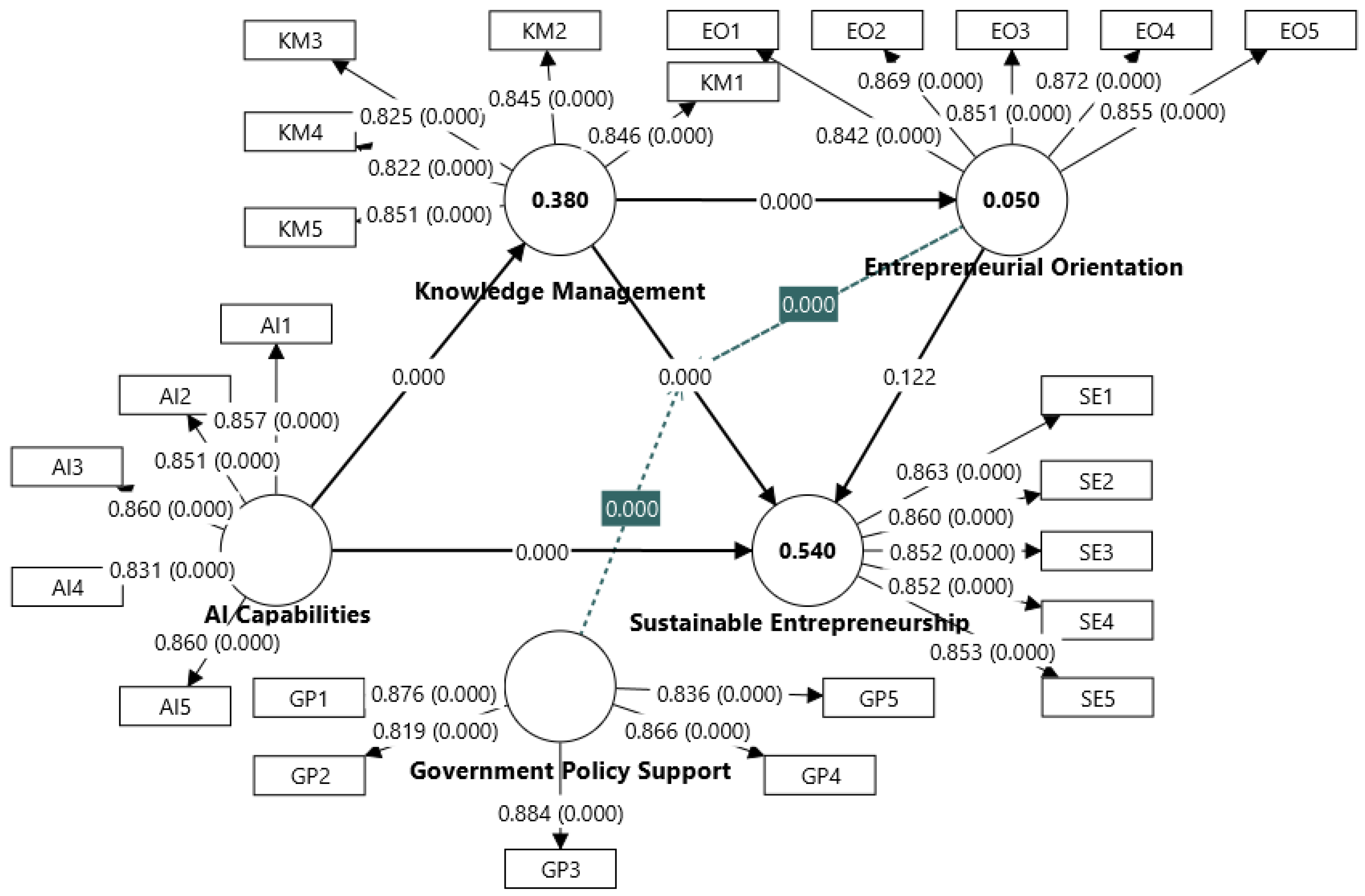
Figure 2 displays the complete PLS-SEM model, along with both measurement and structural components. The left side shows how each construct is operationalized through indicators; the right side illustrates the pathways between constructs with standardized coefficients and t-statistics. Solid lines represent direct effects and mediation relationships, while dashed lines show the moderating influences of EO and GPS on the KM → SE link. AI Capabilities and Knowledge Management emerge as the primary drivers of sustainable entrepreneurship, with KM serving as the transformation mechanism converting digital insights into practice. The moderating pathways reveal that entrepreneurial orientation and government policy support amplify knowledge management’s effectiveness in generating sustainability outcomes.

5.1.1. Measurement Model Assessment

The first step in PLS-SEM analysis involves evaluating the reliability and validity of the measurement model to ensure that constructs are appropriately operationalized through their respective items. This assessment confirms that each measured indicator accurately captures its intended construct before proceeding to structural model testing. Table 2 presents the key reliability and validity statistics for all six constructs, including Cronbach’s alpha, composite reliability, average variance extracted (AVE), and heterotrait–monotrait (HTMT) ratios for discriminant validity assessment.
The measurement model results decisively validate the reliability and validity of each construct. All Cronbach’s alpha coefficients exceeded 0.89 and composite reliability values exceeded 0.92, substantially exceeding the 0.70 threshold, indicating strong internal consistency across all constructs. Average variance extracted (AVE) ranged from 0.70 to 0.73, all exceeding the 0.50 threshold for convergent validity, confirming that measurement items adequately represent their constructs. Discriminant validity was confirmed through Fornell–Larcker criterion (square root of AVE exceeds inter-construct correlations) and HTMT ratios (all < 0.85, well below the 0.85 conservative threshold). These results provide strong confidence in measurement model quality and allow for the study to proceed to structural model testing. Notably, interaction terms (EO × KM and GPS × KM) showed acceptable correlations with no multicollinearity concerns, supporting their use as moderators in subsequent analysis.

5.1.2. Overall Model Fit and Explanatory Power

After confirming measurement model adequacy, a comprehensive assessment of overall model fit and predictive power is conducted. This evaluation examines whether the proposed structural model appropriately represents the data and whether the model explains meaningful variance in endogenous constructs. Table 3 presents multiple fit indices, power analysis results, multicollinearity diagnostics, and predictive relevance (Q2) values across all constructs.
The model demonstrates strong fit and adequate explanatory power. Standardized root mean square residual (SRMR = 0.050) and normed fit index (NFI = 0.943) both indicate good overall model fit, with values well within acceptable thresholds. Post hoc power analysis confirms that the study design can detect even small effect sizes (α = 5%, 80% power = 0.084 minimum effect size), ensuring robust hypothesis testing. Variance inflation factors across all indicators and interaction terms remain below 5.0, confirming the absence of multicollinearity problems. Most importantly, the model explains 54% of the variance in Sustainable Entrepreneurship (R2 = 0.54), a substantial effect size indicating that the proposed relationships meaningfully predict sustainability outcomes. Knowledge Management shows 38% explained variance, while Entrepreneurial Orientation shows 5% variance, suggesting that EO is influenced by external factors beyond KM alone. Predictive relevance (Q2 = 0.368 for SE; 0.378 for KM) demonstrates strong out-of-sample predictive power, confirming the model’s generalizability beyond the current sample. These comprehensive fit indices collectively support the structural model as an appropriate representation of the dynamics between AI, knowledge management, and sustainable entrepreneurship.

5.1.3. Hypothesis Testing and Path Relationships

With measurement model validity and overall model fit confirmed, the hypothesized path relationships are now examined. Table 4 presents the standardized path coefficients (β), t-statistics, p-values, effect sizes (f2), and hypothesis decisions for all eight hypotheses. Significance is assessed using bootstrapping with 5000 resamples to ensure robust statistical inference. Effect sizes are interpreted as small (f2 = 0.02), medium (f2 = 0.15), or large (f2 = 0.35), following Cohen’s guidelines for PLS-SEM.

5.1.4. Summary of Hypothesis Testing Results

Hypotheses testing revealed strong support for seven of the eight proposed relationships, with notable variations in effect magnitudes that illuminate the relative importance of different pathways to sustainable entrepreneurship. H1 demonstrated the strongest relationship: AI Capabilities → Knowledge Management (β = 0.617, t = 28.424, p < 0.001, f2 = 0.614, large effect). This result confirms that AI is a primary driver of knowledge management capability, with firms leveraging AI technologies to sense, acquire, and systematize knowledge about sustainability opportunities. H2 (AI → SE direct effect) was supported (β = 0.327, p < 0.001, medium effect), indicating that AI also has direct positive effects on sustainable outcomes through efficiency improvements and innovation. However, the medium effect size relative to H1 suggests that AI’s sustainability impact is substantially mediated through knowledge management systems rather than being a purely technological effect. H3 (KM → EO, β = 0.223, p < 0.001, small–medium effect) and H4 (KM → SE, β = 0.399, p < 0.001, medium–large effect) both supported the central role of knowledge management. Notably, KM’s direct effect on sustainable entrepreneurship (H4) is substantially stronger than its effect on entrepreneurial orientation (H3), confirming that KM serves as the primary transformation mechanism converting technological and organizational inputs into sustainability outcomes. These findings are also in line with those of the Journal of Cleaner Production, which indicates that green KM facilitates eco-innovation and competitive advantages [68]. The moderating effects proved significant: H5 (EO × KM → SE, β = 0.208, p < 0.001, small–medium effect) and H6 (GPS × KM → SE, β = 0.160, p < 0.001, small–medium effect) confirm that both entrepreneurial orientation and government policy support amplify KM’s effectiveness. The larger moderation coefficient for EO versus GPS suggests that firm-level organizational culture may be slightly more influential than external policy in determining whether knowledge management translates to sustainability outcomes. Notably, H7 (EO → SE direct effect) was NOT supported (β = 0.039, t = 1.548, p = 0.122, negligible effect). This non-significant direct effect indicates that entrepreneurial orientation does not automatically guarantee sustainable outcomes; rather, EO requires integration with robust knowledge management systems to translate entrepreneurial energy into substantive sustainability practices. This finding protects against greenwashing by high-EO firms that pursue aggressive strategies without a knowledge-based assessment of true sustainability impacts. H8 (GPS → SE direct effect) was strongly supported (β = 0.285, p < 0.001, medium–large effect), confirming that government policy support provides both direct institutional catalysts for sustainability adoption and moderating effects that amplify internal capabilities. In combination, these results demonstrate that sustainable entrepreneurship emerges from the integrated effect of technological capacity (AI), organizational knowledge systems (KM), internal organizational culture (EO), and institutional support (GPS), with KM serving as the critical transformation hub.
IPMA was used in the study to show the factors that have the greatest impact on sustainable entrepreneurship. It demonstrates the importance of each of them in relation to their current performance. IPMA assists in determining the constructs (AI, KM, EO, or GPS) that are most important to the sustainability results and the strengths and weaknesses of the company. This allows managers and researchers to determine which enhancement to focus on, depending on the extent to which it will assist the environment. According to the results in Table 5 of IPMA ranking, the most significant elements of sustainable entrepreneurship are the AI Capabilities and KM. In the AI, AI3 (to use AI to make sure resources are used efficiently and cause less harm to the environment; MV = 0.141) and AI1 (to use AI to assist in making decisions related to sustainability projects; MV = 0.139) make the biggest contribution. This implies that companies can enhance sustainability through the incorporation of AI to enhance environmental efficiency and decision-making. AI5 (MV = 0.138) stresses that the usage of AI in long-term sustainability plans is important, while its contribution to short-term operational activities is still less significant. It is implied that it is strategic rather than operational uses of AI that are the drivers of sustainability. Knowledge management comes up as one of the key enablers. KM5 (process of continuous creation and updating of knowledge to enhance sustainability; MV = 0.102) emphasizes the fact that sustained learning is a more important determinant of sustainability performance as compared to the storage of knowledge in place. The role of KM1 and KM4 is also important, which means that the process of learning and implementing sustainability is critical to change resources into entrepreneurial behavior. This highlights the central role of KM: it directs AI knowledge into real, sustainable operations, serving as a driver of organizational change. The implication is that organizations should maintain proactive KM processes to increase sustainability. There is no significant value addition (MVs 0.008–0.010) of EO items. This implies that EO can reinforce the effect of KM by innovating and taking responsibility, but this is not the sole way of promoting sustainability. Items under GPS are moderate in importance (MVs 0.004–0.007): they are not as effective as AI and KM, yet institutional frameworks (e.g., regulations and national programs) provide a facilitating environment for sustainable practices. The implication is that although government support does not automatically assure a sustainable outcome, there are policy implications and institutional credibility that can orient films towards sustainable entrepreneurship, particularly when policies are consistent with long-term national goals.

5.2. Mechanism and Analytical Rigor

This study advances analytical rigor by clarifying the organizational pathways through which AI capabilities drive sustainable entrepreneurship. Specifically, the results show that artificial intelligence enhances knowledge management by enabling efficient data interpretation, proactive information sharing, and knowledge codification. In turn, robust knowledge management systems facilitate the translation of digital insights into sustainable practices and innovative business models. The effect is further shaped by entrepreneurial orientation and government policy support, which strengthen the link between knowledge management and entrepreneurial outcomes, respectively.

6. Discussion

To illustrate practical significance, case studies from Saudi Arabia’s digital transformation initiatives, including the Knowledge-based Advanced Manufacturing Innovation Network (KAMIN), demonstrate improved operational efficiency [69]. The KAMIN program trained 800 participants from 120 SMEs and manufactured 1400 prototypes, showcasing how structured knowledge transfer enhances productivity. Quantitative research on 605 Saudi service sector organizations confirms that knowledge management processes significantly improve operational performance [70]. Conversely, firms reliant solely on policy incentives without internal capability development primarily achieved compliance, not transformation. These cases highlight that successful transitions require both robust internal systems and external support, affirming the quantitative results.
The study results allow us to empirically justify the idea that AI skills and knowledge management can be used to create sustainable entrepreneurship, characterized by the effects of entrepreneurial orientation and government policy advocacy. The variance that is explained by the fact that the SE model is high (54) [71,72,73]. This framework covers institutional and organizational aspects that will help SMEs to be sustainable within emerging economies, herein the Saudi Arabia Vision 2030 setting. The research adds to the existing body of literature by illuminating the correlation between AI capabilities, KM, EO, and GPS in developing SE in SMEs. According to the DCT, KBV, and Institutional Theory, digital technologies can only help to achieve sustainability when there are good internal knowledge practices and positive institutional conditions. The implication is that AI is a facilitator, KM is the process of turning knowledge into action, and EO and GPS play an important role in the environment as far as effective sustainability results are concerned. For details, refer to Table A1 and Table A2.

6.1. AI Is an Enabling Force, Rather than a Panacea to Sustainability

The idea is that AI serves as an enabler, rather than the only driver of sustainability. Although AI helps in predictive analytics, resource optimization, and eco-efficiency, when used with KM processes to codify and act upon digital insights, a major impact is generated. This reinforces the significance of the integration of AI with KM to achieve significant organizational change, which is in line with recent findings that show AI has been utilized to improve decision-making processes and not to automate sustainability, which aligns with previous research [74,75]. In practice, it is advisable to pay attention to the integration of AI into KM practices that aim to achieve the greatest level of sustainability.
This literature is based on the previous literature, which centers on the benefits of digitalization in terms of efficiency [74,76]. Without a well-established KM, SMEs adopting AI can become the victims of pilot project traps: digital tools create insights that do not become sustainable practice. Such research demonstrates the highest level of influence of AI in the case of integration with organizational knowledge practices, which contribute to sustainability in general.

6.2. The Conversion Engine Is Knowledge Management

The second implication is that KM is the core of the organization in terms of its transforming digital insights and entrepreneurial intent into quantifiable sustainability results, which supports the results of previous studies [12]. The Knowledge-Based View suggests that knowledge is the most strategic asset of the firm. These results, similarly to those obtained by other literature sources, support the idea that successful green KM, i.e., the acquisition, sharing, and utilization of knowledge, is the key to eco-innovation, embracing a circular economy, and gaining a competitive advantage, as mentioned in previous studies [77]. This implies that organizations should work on systematized KM to transform digital opportunities into sustainability initiatives [78].
Significantly, this study has shown that KM is the best predictor of SE, which proves the necessity of systematic knowledge practices in sustainability transitions, as argued in a previous study [79], in addition to entrepreneurial motivation or technology acceptance. This supports the fact that the ability to absorb and integrate green knowledge is the determinant of environmental competitiveness [80]. Practically, SMEs investing in strong KM systems are in a better position to integrate the insights derived from AI into practical interventions, which include eco-design, efficient production, and inclusive models, which also strengthens the results of previous studies [81]. Moreover, the creation of powerful KM systems is key to the viable sustainability benefits, aligning with previous research [31].
This contribution reinforces the opinion that KM [82] is to be regarded more as a strategic means of maintaining performance, as opposed to playing a supporting role. KM is the connection between digital transformation and sustainability outcomes, and this is why some SMEs successfully implement sustainability and others only achieve surface-level implementation. The implication is that strategic KM fills the gap in the meaningful integration of sustainability.

6.3. EO and GPS: Situational Boundary Conditions

The third implication is that context is important. EO and GPS affect the way knowledge is converted to the sustainability outcomes, but differently. EO reinforces the interaction between KM and SE, which proves the idea that proactive, innovative, and risk-taking firms are more prone to take on sustainability knowledge, which aligns with the previous study [83]. However, EO cannot ensure sustainability, and one should not rely on entrepreneurial spirit only, which argues against previous studies [84]. This implies that although EO may facilitate action, it needs to be complemented by strong KM and policy frameworks to prevent superficial or insincere implementation.
Another key policy that is instrumental in determining the outcomes of sustainability is the GPS, which offers external legitimacy and minimizes uncertainty, supporting previous studies [85]. Although policy incentives have the potential to scale eco-innovation, where the goals of SMEs are aligned with national goals, excessive use of government incentives may result in compliance-based sustainability practices as opposed to transformative practices. Hence, policy support must be employed to strengthen, and not to replace, internal organizational initiatives towards sustainable entrepreneurship. These findings form part of the overall discourse on contextual conditions, in the sense that they show that EO provides the internal mindset and GPS provides the external scaffolding; they are both required to ensure that KM will translate into real sustainability outcomes.
The findings underscore that AI and knowledge management are most effective when supported by entrepreneurial leadership and favorable policy environments. SME managers should focus on building organizational processes that encourage experimentation, cross-functional learning, and the systematic integration of digital insights into sustainability strategies. Policymakers can maximize impact by pairing incentives with capability-building programs, ensuring support extends beyond compliance to genuine transformation. These actionable insights inform both managerial practice and policy design for sustainable digital transformation, as shown in Table 6.
These findings show the theoretical contributions of and practical implications for SMEs, policy implications, compatibility with the SDGs, relevance to society, limitations, and future research opportunities. This overall summary describes how research can contribute to the current theories and provides useful advice to managers and policymakers. It also explains the relationship with international sustainability objectives, including the SDGs and Vision. These findings are visible to the academics and practitioners according to the table that contains them.
While these findings are situated within the ambitious policy context of Saudi Vision 2030, the pathways identified here may have broader relevance for emerging economies pursuing sustainable entrepreneurship via digital transformation. Nevertheless, outcomes should be interpreted considering contextual differences such as regulatory environments and levels of digital readiness. The country’s state-driven model with substantial policy scaffolding may not mirror environments with less government intervention or fewer resources. Adaptation and context-specific analysis are therefore recommended before broadly applying these findings.
Comparative analysis across emerging or developed economies would be valuable for testing the robustness of these mechanisms under diverse institutional settings. Particularly, exploring countries with varying levels of digital readiness, policy support, and market maturity could illuminate the conditions under which these pathways to sustainable entrepreneurship are most effective, and highlight whether policy-driven models offer unique advantages or constraints.
Ultimately, recommendations for practice and policy must be applied with careful regard for local circumstances. Strategies that succeed in the Saudi context, characterized by strong government support and ambitious economic reforms, may require adjustment in other environments. Researchers and practitioners should continually assess how institutional, cultural, and economic conditions shape the effectiveness of digital and sustainability interventions.

7. Conclusions

This study was conducted in the context of Saudi Arabia’s Vision 2030—a far-reaching national initiative to foster economic diversification, promote digital transformation, and advance sustainability goals. The policy environment is distinguished by active government involvement, large-scale incentives, and a strong push toward institutional modernization, making it an ideal setting for examining how digital capabilities interact with entrepreneurial practices and policy support in SMEs.
This research advances theory in three ways. First, it extends the Knowledge-Based View by demonstrating that AI capabilities drive sustainability primarily through knowledge management mechanisms rather than through technological efficiency alone. Second, it integrates Dynamic Capabilities Theory with Institutional Theory, showing that both internal capabilities (sensing through AI, transforming through KM) and external institutional support (GPS) shape sustainability outcomes. Third, the non-significant direct effect of EO provides important boundary conditions, suggesting that entrepreneurial orientation operates through knowledge-mediated pathways rather than directly influencing sustainability.
For SME managers, the findings suggest prioritizing KM infrastructure alongside AI adoption, cultivating entrepreneurial culture to amplify knowledge effectiveness, and measuring authentic sustainability outcomes. For policymakers, the results indicate that technology subsidies without KM capacity-building yield limited transformation; effective policies should integrate training, knowledge infrastructure, and incentive structures rewarding genuine sustainability rather than adoption metrics. For Vision 2030 implementation, the study validates current programs combining technology and knowledge development (e.g., KAMIN) while cautioning against approaches emphasizing entrepreneurial spirit without corresponding knowledge systems.

7.1. Limitations and Directions for Future Research

Several limitations warrant acknowledgment. The cross-sectional design precludes causal inference; longitudinal research is needed to establish temporal precedence. Self-reported data may introduce common method bias, although statistical tests (Harman’s single-factor) suggest acceptable levels. The Saudi Arabian context, while relevant for Vision 2030 research, may limit generalizability to other emerging economies or developed markets. Finally, the quantitative approach, while enabling hypothesis testing, cannot capture the nuanced implementation processes that qualitative methods might reveal.
Future research should address these limitations through (1) longitudinal panel studies tracking AI-KM-SE relationships over time to establish causality; (2) multi-country comparisons across GCC and other emerging economies to test generalizability; (3) sector-specific analyses examining whether manufacturing, services, and trade SMEs exhibit different pathway strengths; (4) qualitative case studies providing rich implementation narratives; (5) examination of negative outcomes (greenwashing, compliance-driven adoption) in firms lacking KM foundations; and (6) investigation of additional moderators, including firm size, industry turbulence, and digital maturity levels.

7.2. Final Remark

This study does not contradict the United Nations Sustainable Development Goals because it explains how SMEs can use AI and knowledge management to create economic, environmental, and social value. The lessons provide practical advice to policymakers, practitioners, and businessmen to support resilient, inclusive, and responsible business models, thus improving the welfare of society as a whole and sustainable development.

Supplementary Materials

The following supporting information can be downloaded at: https://www.mdpi.com/article/10.3390/su172410928/s1, S1 Measurement Model; Measurement Model Path Coefficient. S2 Structural Model, Structural Model Path Coefficient. Reference [86] are citied in the Supplementary Materials.

Author Contributions

Conceptualization, Q.M.A. and R.A.S.; methodology, Q.M.A.; software, Q.M.A.; validation, Q.M.A. and R.A.S.; formal analysis, Q.M.A.; investigation, Q.M.A.; resources, Q.M.A.; data curation, Q.M.A.; writing—original draft, Q.M.A.; writing—review and editing, R.A.S.; visualization, Q.M.A.; supervision, R.A.S.; project administration, R.A.S. All authors have read and agreed to the published version of the manuscript.

Funding

This research received no external funding.

Institutional Review Board Statement

The study was conducted in accordance with the Declaration of Helsinki, and approved by the Ethics Committee of College of Business, Jazan University (JU-REC-2025-1458 dated 4 March 2025).

Informed Consent Statement

Informed consent was obtained from all subjects involved in the study.

Data Availability Statement

Data can be obtained upon reasonable request to the authors.

Conflicts of Interest

The authors declare no conflicts of interest.

Abbreviation

AbbreviationFull FormContext/Usage in Study
AIArtificial IntelligenceRepresents digital tools and capabilities that support sustainability decision-making and innovation.
KMKnowledge ManagementOrganizational processes for acquiring, sharing, storing, and applying sustainability-related knowledge.
SESustainable EntrepreneurshipTriple bottom line–oriented entrepreneurship integrating economic, environmental, and social value.
EOEntrepreneurial OrientationOrganizational strategic posture characterized by innovativeness, proactiveness, and calculated risk-taking.
GPSGovernment Policy SupportInstitutional enablers such as regulations, incentives, and programs influencing SME sustainability performance.
SMESmall and Medium-Sized EnterprisesThe primary context of the study, aligned with Vision 2030 and SDG progress.
SDGsSustainable Development GoalsUnited Nations’ global agenda guiding sustainability integration in business.
DCTDynamic Capabilities TheoryTheoretical foundation explaining how firms adapt and reconfigure resources in changing environments.
KBVKnowledge-Based ViewTheoretical lens emphasizing knowledge as the core strategic resource enabling sustainability outcomes.
TBLTriple Bottom LineSustainability measurement framework covering economic, environmental, and social performance.
PLS-SEMPartial Least Squares Structural Equation ModelingAnalytical technique used to test the structural model and hypotheses.
IPMAImportance–Performance Map AnalysisAdvanced PLS method used to assess priority areas for managerial action.
PLS-POSPrediction-Oriented SegmentationMethod used to identify unobserved heterogeneity within SME groups.
AVEAverage Variance ExtractedMeasure of convergent validity in construct reliability assessment.
VIFVariance Inflation FactorMulticollinearity diagnostic for structural relationships.
R2Coefficient of DeterminationIndicates explanatory power of the model for endogenous constructs.
Q2Predictive Relevance StatisticAssesses predictive accuracy of constructs in PLS-SEM.
SRMRStandardized Root Mean Square ResidualModel fit indicator assessing overall goodness of fit.
NFINormed Fit IndexIndicator of comparative model fit quality.
DCTDynamic Capabilities TheoryExplain how firms sense, seize, and reconfigure resources with AI.
RBVResource-Based ViewMentioned as a contrasting theory that lacks dynamism in sustainability transitions.

Appendix A

Table A1. Total Effect.
ConstructsOriginal Sample (O) Sample Mean (M) Standard Deviation (STDEV) T Statistics (|O/STDEV|) p Values
AI Capabilities → Entrepreneurial Orientation 0.138 0.139 0.022 6.352 0.000
AI Capabilities → Knowledge Management 0.617 0.617 0.022 28.424 0.000
AI Capabilities → Sustainable Entrepreneurship 0.578 0.578 0.022 26.391 0.000
Entrepreneurial Orientation → Sustainable Entrepreneurship 0.039 0.040 0.025 1.548 0.122
Entrepreneurial Orientation x Knowledge Management → Sustainable Entrepreneurship 0.208 0.208 0.022 9.259 0.000
Government Policy Support → Sustainable Entrepreneurship −0.025 −0.023 0.024 1.082 0.279
Government Policy Support x Knowledge Management → Sustainable Entrepreneurship 0.160 0.160 0.021 7.555 0.000
Knowledge Management → Entrepreneurial Orientation 0.223 0.225 0.032 6.947 0.000
Knowledge Management → Sustainable Entrepreneurship 0.408 0.409 0.030 13.541 0.000
Table A2. Specific Indirect Effect.
Constructs Original Sample (O)Sample Mean (M)Standard Deviation (STDEV)T Statistics (|O/STDEV|)p Values
AI Capabilities → Knowledge Management → Sustainable Entrepreneurship 0.2460.2470.02012.1960.000
Knowledge Management → Entrepreneurial Orientation → Sustainable Entrepreneurship 0.0090.0090.0061.5000.134
AI Capabilities → Knowledge Management → Entrepreneurial Orientation → Sustainable Entrepreneurship 0.0050.0050.0041.4900.136
AI Capabilities → Knowledge Management → Entrepreneurial Orientation 0.1380.1390.0226.3520.000

References

  1. Kraus, S.; Kanbach, D.K.; Krysta, P.M.; Steinhoff, M.M.; Tomini, N. Facebook and the creation of the metaverse: Radical business model innovation or incremental transformation? Int. J. Entrep. Behav. Res. 2022, 28, 52–77. [Google Scholar] [CrossRef]
  2. Lozano, R. Proposing a definition and a framework of organisational sustainability: A review of efforts and a survey of approaches to change. Sustainability 2018, 10, 1157. [Google Scholar] [CrossRef]
  3. 2030 Saudi Vision. Vison 2030 Kingdom of Saudi Arabia. 2016. Available online: https://www.vision2030.gov.sa/en (accessed on 28 January 2025).
  4. Annesi, N.; Battaglia, M.; Ceglia, I.; Mercuri, F. Navigating paradoxes: Building a sustainable strategy for an integrated ESG corporate governance. Manag. Decis. 2024, 63, 531–559. [Google Scholar] [CrossRef]
  5. Clements, P. Improving learning and accountability in foreign aid. World Dev. 2020, 125, 104670. [Google Scholar] [CrossRef]
  6. Khan, F.U.; Zhang, J.; Saeed, I.; Ullah, S. Do institutional contingencies matter for green investment?—An institution based view of Chinese listed companies. Heliyon 2024, 10, e23456. [Google Scholar] [CrossRef]
  7. Sheikh, R.A.; Abdalkrim, G.M.; Shehawy, Y.M. Assessing the impact of business simulation as a teaching method for developing 21st century future skills. J. Int. Educ. Bus. 2023, 16, 351–370. [Google Scholar] [CrossRef]
  8. Vu, T.T.-T.; Demena, B.A. How does technology adoption affect energy intensity? Evidence from a meta-analysis. Appl. Energy 2025, 398, 126439. [Google Scholar] [CrossRef]
  9. Nakash, M.; Bolisani, E. The transformative impact of AI on knowledge management processes. Bus. Process Manag. J. 2025, 31, 124–147. [Google Scholar] [CrossRef]
  10. Mujalli, A.; Wani, M.J.G.; Almgrashi, A.; Khormi, T.; Qahtani, M. Investigating the factors affecting the adoption of cloud accounting in Saudi Arabia’s small and medium-sized enterprises (SMEs). J. Open Innov. Technol. Mark. Complex. 2024, 10, 100314. [Google Scholar] [CrossRef]
  11. Sheikh, R.A.; Ahmed, I.; Faqihi, A.Y.A.; Shehawy, Y.M. Global Perspectives on Navigating Industry 5.0 Knowledge: Achieving Resilience, Sustainability, and Human-Centric Innovation in Manufacturing. J. Knowl. Econ. 2024, 16, 15997–16032. [Google Scholar] [CrossRef]
  12. Grant, R.M. Toward a knowledge-based theory of the firm. Strateg. Manag. J. 1996, 17, 109–122. [Google Scholar] [CrossRef]
  13. Teece, D.J. Business models and dynamic capabilities. Long Range Plan. 2018, 51, 40–49. [Google Scholar] [CrossRef]
  14. Kusa, R.; Suder, M.; Duda, J.; Czakon, W.; Juárez-Varón, D. Does knowledge management mediate the relationship between entrepreneurial orientation and firm performance? J. Knowl. Manag. 2023, 28, 33–61. [Google Scholar] [CrossRef]
  15. Wani, M.J.G.; Loganathan, N.; Alamir, I.A.; Mujalli, A.; Almgrashi, A. Examining the emissions-growth nexus: Carbon impact, economic expansion, FDI, globalization, and trade in leading economies. J. Appl. Econ. 2025, 28, 2554712. [Google Scholar] [CrossRef]
  16. Dou, J.; Dou, J.; Qin, M.; Su, C.-W. Towards Sustainable Development: Assessing the Significance of World Uncertainty in Green Technology Innovation. Sustainability 2025, 17, 1314. [Google Scholar] [CrossRef]
  17. Jamil, K.; Zhang, W.; Anwar, A.; Mustafa, S. Driving SME Sustainability via the Influence of Green Capital, HRM, and Leadership. Sustainability 2025, 17, 6076. [Google Scholar] [CrossRef]
  18. Khan, S.M.; Suhluli, S. Generative AI and Cognitive Challenges in Research: Balancing Cognitive Load, Fatigue, and Human Resilience. Technologies 2025, 13, 486. [Google Scholar] [CrossRef]
  19. Wamba, S.F.; Gunasekaran, A.; Akter, S.; Ren, S.J.F.; Dubey, R.; Childe, S.J. Big data analytics and firm performance: Effects of dynamic capabilities. J. Bus. Res. 2017, 70, 356–365. [Google Scholar] [CrossRef]
  20. Kraus, S.; Palmer, C.; Kailer, N.; Kallinger, F.L.; Spitzer, J. Digital transformation: An overview of the current state of the art of research. Sage Open 2022, 12, 1–14. [Google Scholar] [CrossRef]
  21. Masmali, F.H.; Khan, S.M.; Hakim, T. IoT-Enabled Digital Nudge Architecture for Sustainable Energy Behavior: An SEM-PLS Approach. Technologies 2025, 13, 504. [Google Scholar] [CrossRef]
  22. Khalufi, N.A.M.; Sheikh, R.A.; Khan, S.M.F.A.; Onn, C.W. Evaluating the Impact of Sustainability Practices on Customer Relationship Quality: An SEM-PLS Approach to Align with SDG. Sustainability 2025, 17, 798. [Google Scholar] [CrossRef]
  23. Shehawy, Y.M.; Khan, S.M.F.A. Consumer readiness for green consumption: The role of green awareness as a moderator of the relationship between green attitudes and purchase intentions. J. Retail. Consum. Serv. 2024, 78, 103739. [Google Scholar] [CrossRef]
  24. Bresciani, S.; Ferraris, A.; Rovelli, P.; Bertoldi, B. Digital transformation as a springboard for product innovation: The interplay between knowledge management and open innovation. J. Bus. Res. 2021, 123, 264–275. [Google Scholar]
  25. Borner, C.J.; Arndt, H.W. The double-edged sword of digitalization: Challenges and opportunities of artificial intelligence in sustainability. Technol. Forecast. Soc. Change 2022, 178, 121599. [Google Scholar]
  26. Crossan, M.M. Review of The Knowledge-Creating Company: How Japanese Companies Create the Dynamics of Innovation, by I. Nonaka & H. Takeuchi. J. Int. Bus. Stud. 1996, 27, 196–201. Available online: http://www.jstor.org/stable/155381 (accessed on 24 November 2025).
  27. Centobelli, P.; Cerchione, R.; Esposito, E. Environmental sustainability in the service industry of transportation and logistics service providers: Systematic literature review and research directions. Transp. Res. D Transp. Environ. 2018, 53, 454–470. [Google Scholar] [CrossRef]
  28. Sahoo, S.; Kumar, A.; Upadhyay, A. How do green knowledge management and green technology innovation impact corporate environmental performance? Understanding the role of green knowledge acquisition. Bus. Strategy Environ. 2022, 32, 551–569. [Google Scholar] [CrossRef]
  29. Alegre, J.; Chiva, R. Linking entrepreneurial orientation and firm performance: The role of organizational learning capability and innovation. J. Small Bus. Manag. 2013, 51, 491–507. [Google Scholar] [CrossRef]
  30. Maroufkhani, P.; Wagner, R.; Ismail, W.K.W.; Baroto, M.B.; Nourani, M. Big data analytics and firm performance: A systematic review. Information 2019, 10, 226. [Google Scholar] [CrossRef]
  31. Sjödin, D.; Parida, V.; Palmié, M.; Wincent, J. How AI capabilities enable business model innovation: Scaling AI through co-evolutionary processes and feedback loops. J. Bus. Res. 2021, 134, 574–587. [Google Scholar] [CrossRef]
  32. Shepherd, D.A.; Patzelt, H. The new field of sustainable entrepreneurship: Studying entrepreneurial action linking ‘what is to be sustained’ with ‘what is to be developed. Entrep. Theory Pract. 2011, 35, 137–163. [Google Scholar] [CrossRef]
  33. Cohen, B.; Winn, M.I. Market imperfections, opportunity and sustainable entrepreneurship. J. Bus. Ventur. 2007, 22, 29–49. [Google Scholar] [CrossRef]
  34. Dentchev, N.A. and others. Integrating sustainable development in business: An analysis of 100 sustainability reports. Bus. Strategy Environ. 2015, 24, 593–614. [Google Scholar]
  35. Sloan, P. Redefining stakeholder engagement: From control to collaboration. J. Bus. Ethics 2009, 90, 539–551. [Google Scholar]
  36. Herzallah, F.; Mohammad, B.A.; Alhayek, M.; Khan, S.M.F.A. Mitigating uncertainty in travel agency selection in Jordan: A signaling theory approach. Int. J. Inf. Manag. Data Insights 2025, 5, 100362. [Google Scholar] [CrossRef]
  37. Giudice, M.D.; Scuotto, V.; Garcia-Perez, A.; Petruzzelli, A.M. A brief review of the literature on knowledge management and sustainability. J. Knowl. Manag. 2016, 20, 1029–1047. [Google Scholar]
  38. de Sousa Jabbour, A.B.L.; Luiz, J.V.R.; Luiz, O.R.; Jabbour, C.J.C.; Ndubisi, N.O.; de Oliveira, J.H.C.; Junior, F.H. Circular economy business models and operations management. J. Clean. Prod. 2019, 235, 1525–1539. [Google Scholar] [CrossRef]
  39. Wani, M.J.G.; Alamir, I.A.; Ghazwani, M.; Ahmed, I.; Alkaraan, F.; Khan, M.A. Asymmetric Effect of Green Energy and Economic Growth on the Environmental Deterioration and the Environmental Kuznets Curve Validation in MENA Countries. Int. J. Financ. Econ. 2024, 30, 3553–3568. [Google Scholar] [CrossRef]
  40. Miller, D. The correlates of entrepreneurship in three types of firms. Manag. Sci. 1983, 29, 770–791. [Google Scholar] [CrossRef]
  41. Lumpkin, G.T.; Dess, G.G. Clarifying the entrepreneurial orientation construct and linking it to performance. Acad. Manag. Rev. 1996, 21, 135–172. [Google Scholar] [CrossRef]
  42. Shamsudeen, K.; Liman, B.M.; Haruna, M.J. An empirical investigation on the relationship between entrepreneurial orientation, entrepreneurial education and entrepreneurial intention in Nigeria: A study of some selected students of higher learning. Saudi J. Bus. Manag. Stud. 2017, 2, 125–130. [Google Scholar]
  43. Covin, J.G.; Rigtering, J.P.C.; Hughes, M.; Kraus, S.; Cheng, C.F.; Bouncken, R.B. Individual and team entrepreneurial orientation: Scale development and configurations for success. J. Bus. Res. 2020, 112, 1–12. [Google Scholar] [CrossRef]
  44. Kusa, R.; Duda, J.; Suder, M. Entrepreneurial orientation and knowledge management in SMEs: The role of institutional context. J. Bus. Res. 2023, 160, 113808. [Google Scholar]
  45. Scott, W.R. Institutions and Organizations: Ideas, Interests, and Identities, 4th ed.; Sage Publications: Thousand Oaks, CA, USA, 2014. [Google Scholar]
  46. Busch, T.; Hoffmann, V.H. How hot is your bottom line? Linking carbon performance and financial performance. Bus. Soc. 2011, 50, 233–265. [Google Scholar] [CrossRef]
  47. North, D.C. Institutions, Institutional Change and Economic Performance; Cambridge University Press: Cambridge, UK, 1990. [Google Scholar]
  48. DiMaggio, P.J.; Powell, W.W. The iron cage revisited: Institutional isomorphism and collective rationality in organizational fields. Am. Sociol. Rev. 1983, 48, 147–160. [Google Scholar] [CrossRef]
  49. Teece, D.J. Explicating dynamic capabilities: The nature and microfoundations of (sustainable) enterprise performance. Strateg. Manag. J. 2007, 28, 1319–1350. [Google Scholar] [CrossRef]
  50. Chen, Y.; Yu, Z. Corrigendum to ‘Digitalization, trust, and sustainability transitions: Insights from two blockchain-based green experiments in China’s electricity sector’ [Environmental Innovation and Societal Transitions, 50 (2024), 100801]. Environ. Innov. Soc. Transit. 2024, 50, 100804. [Google Scholar] [CrossRef]
  51. Al Halbusi, H.; Al-Sulaiti, K.I.; Alalwan, A.A.; Al-Busaidi, A.S. AI capability and green innovation impact on sustainable performance: Moderating role of big data and knowledge management. Technol. Forecast. Soc. Change 2025, 210, 123897. [Google Scholar] [CrossRef]
  52. Song, Z.; Deng, Y. The impact of artificial intelligence on green economy efficiency under integrated governance. Sci. Rep. 2025, 15, 25919. [Google Scholar] [CrossRef]
  53. Sheikh, R.A.; Lanjewar, U.A. Decision Support System for Cotton Bales Blending Using Genetic Algorithm. Int. J. Comput. Appl. 2010, 8, 28–34. [Google Scholar] [CrossRef]
  54. Fossen, F.M.; Sorgner, A. New digital technologies and heterogeneous wage and employment dynamics in the United States: Evidence from individual-level data. Technol. Forecast. Soc. Change 2022, 175, 121381. [Google Scholar] [CrossRef]
  55. Wani, M.J.G.; Loganathan, N.; Mujalli, A. The impact of sustainable development goals (SDGs) on tourism growth. Empirical evidence from G-7 countries. Cogent Soc. Sci. 2024, 10, 2397535. [Google Scholar] [CrossRef]
  56. Cepeda-Carrion, G.; Cegarra-Navarro, J.G.; Cillo, V. Tips to use partial least squares structural equation modelling (PLS-SEM) in knowledge management. J. Knowl. Manag. 2019, 23, 67–89. [Google Scholar] [CrossRef]
  57. Ha, S.T.; Lo, M.C.; Suaidi, M.K.; Mohamad, A.A.; Razak, Z.B. Knowledge Management Process, Entrepreneurial Orientation, and Performance in SMEs: Evidence from an Emerging Economy. Sustainability 2021, 13. [Google Scholar] [CrossRef]
  58. Durst, S.; Edvardsson, I.R.; Foli, S. Knowledge management in SMEs: A follow-up literature review. J. Knowl. Manag. 2023, 27, 25–58. [Google Scholar] [CrossRef]
  59. Sadiq, M.; Thi, T.D.P.; Nguyen, C.M.; Do, H.-D. Sustainable entrepreneurship and knowledge management: Role of green information technology in building sustainable entrepreneurial ecosystems. J. Innov. Knowl. 2025, 10, 100689. [Google Scholar] [CrossRef]
  60. Sandu, G.; Varganova, O.; Samii, B. Managing physical assets: A systematic review and a sustainable perspective. Int. J. Prod. Res. 2022, 61, 6652–6674. [Google Scholar] [CrossRef]
  61. Borodako, K.; Berbeka, J.; Rudnicki, M.; Łapczyński, M. The impact of innovation orientation and knowledge management on business services performance moderated by technological readiness. Eur. J. Innov. Manag. 2023, 26, 674–695. [Google Scholar] [CrossRef]
  62. Qasim, D.; Shuhaiber, A.; Rawshdeh, Z. The impact of entrepreneurial orientation on innovation performance: The role of knowledge sharing as a mediating factor. J. Innov. Entrep. 2025, 14, 83. [Google Scholar] [CrossRef]
  63. Abu-Taweel, G.M.; Al-Fifi, Z.; Abada, E.; Khemira, H.; Almalki, G.; Modafer, Y.; Khedher, K.M.; Yaseen, Z.M. Parrotfish: An overview of ecology, nutrition, and reproduction behaviour. J. King Saud Univ.-Sci. 2023, 35, 102778. [Google Scholar] [CrossRef]
  64. Sarkis, J.; Zhu, Q.; Lai, K.H. An organizational theoretic review of green supply chain management literature. Int. J. Prod. Econ. 2011, 130, 1–15. [Google Scholar] [CrossRef]
  65. Leoni, L.; Ardolino, M.; El Baz, J.; Gueli, G.; Bacchetti, A. The mediating role of knowledge management processes in the effective use of artificial intelligence in manufacturing firms. Int. J. Oper. Prod. Manag. 2022, 42, 411–437. [Google Scholar] [CrossRef]
  66. Sobaih, A.E.E.; Gharbi, H.; Abdallah, M.A.B.; Hassan, O.H.M. Unveiling the role of knowledge management effectiveness in university’s performance through administrative departments’ innovation. J. Open Innov. Technol. Mark. Complex. 2025, 11, 100473. [Google Scholar] [CrossRef]
  67. Hair, J.; Alamer, A. Partial Least Squares Structural Equation Modeling (PLS-SEM) in second language and education research: Guidelines using an applied example. Res. Methods Appl. Linguist. 2022, 1, 100027. [Google Scholar] [CrossRef]
  68. de Guimarães, J.C.F.; Severo, E.A.; de Vasconcelos, C.R.M. The influence of entrepreneurial, market, knowledge management orientations on cleaner production and the sustainable competitive advantage. J. Clean. Prod. 2018, 174, 1653–1663. [Google Scholar] [CrossRef]
  69. World Economic Forum. Modernizing Small & Medium-Sized Enterprises in Saudi Arabia. 2023. Available online: https://www3.weforum.org/docs/WEF_Modernizing_Small_Medium_Sized_Enterprises_in_Saudi_Arabia_2023.pdf (accessed on 26 November 2025).
  70. Alharbi, G.L.; Aloud, M.E. The effects of knowledge management processes on service sector performance: Evidence from Saudi Arabia. Humanit. Soc. Sci. Commun. 2024, 11, 378. [Google Scholar] [CrossRef]
  71. Hair, J.F.; Sarstedt, M.; Ringle, C.M. Rethinking some of the rethinking of partial least squares. Eur. J. Mark. 2019, 53, 566–584. [Google Scholar] [CrossRef]
  72. Hair, J.; Hult, G.T.M.; Ringle, C.; Sarstedt, M. A Primer on Partial Least Squares Structural Equation Modeling (PLS-SEM); Springer Nature: Dordrecht, The Netherlands, 2021. [Google Scholar] [CrossRef]
  73. Khan, S.M.; Shehawy, Y.M. Perceived AI Consumer-Driven Decision Integrity: Assessing Mediating Effect of Cognitive Load and Response Bias. Technologies 2025, 13, 374. [Google Scholar] [CrossRef]
  74. Jiang, L.; Li, B.; Zhang, M. The impact of digital transformation on the efficiency of corporate resource allocation: Internal mechanisms and external environment. Technol. Forecast. Soc. Change 2025, 215, 124107. [Google Scholar] [CrossRef]
  75. Shehawy, Y.M.; Khan, S.M.F.A.; Khalufi, N.A.M.; Abdullah, R.S. Customer adoption of robot: Synergizing customer acceptance of robot-assisted retail technologies. J. Retail. Consum. Serv. 2025, 82, 104062. [Google Scholar] [CrossRef]
  76. Islam, Q.; Khan, S.M.A. Assessing Consumer Behavior in Sustainable Product Markets: A Structural Equation Modeling Approach with Partial Least Squares Analysis. Sustainability 2024, 16, 3400. [Google Scholar] [CrossRef]
  77. Broccardo, L.; Truant, E.; Dana, L.-P. The interlink between digitalization, sustainability, and performance: An Italian context. J. Bus. Res. 2023, 158, 113621. [Google Scholar] [CrossRef]
  78. Spender, J.C. Making knowledge the basis of a dynamic theory of the firm. Strateg. Manag. J. 1996, 17, 45–62. [Google Scholar] [CrossRef]
  79. Ren, S.; Du, M.; Bu, W.; Lin, T. Assessing the impact of economic growth target constraints on environmental pollution: Does environmental decentralization matter? J. Environ. Manag. 2023, 336, 117618. [Google Scholar] [CrossRef] [PubMed]
  80. Wilson, R.; Joiner, K.; Abbasi, A. Improving students’ performance with time management skills. J. Univ. Teach. Learn. Pract. 2021, 18. [Google Scholar] [CrossRef]
  81. El-Kassar, A.N.; Singh, S.K. Green innovation and organizational performance: The influence of big data and the moderating role of management commitment and HR practices. Technol. Forecast. Soc. Change 2019, 144, 483–498. [Google Scholar] [CrossRef]
  82. Behravesh, S.-A.; Darnall, N.; Bretschneider, S. A framework for understanding sustainable public purchasing. J. Clean. Prod. 2022, 376, 134122. [Google Scholar] [CrossRef]
  83. Leavy, B. Marco Iansiti and Karim Lakhani: Strategies for the new breed of ‘AI first’ organizations. Strategy Leadersh. 2020, 48, 11–18. [Google Scholar] [CrossRef]
  84. Gao, Y.; Liu, H. Artificial intelligence-enabled personalization in interactive marketing: A customer journey perspective. J. Res. Interact. Mark. 2023, 17, 663–680. [Google Scholar] [CrossRef]
  85. Augustin-Behravesh, S.-A.; Darnall, N.; No, W.; Bretschneider, S. How stakeholder influence shapes public sector environmental policy choices. J. Clean. Prod. 2025, 523, 146312. [Google Scholar] [CrossRef]
  86. Ringle, C.M.; Wende, S.; Becker, J.-M. SmartPLS 4; SmartPLS: Bönningstedt, Germany, 2024; Available online: https://www.smartpls.com (accessed on 25 January 2025).
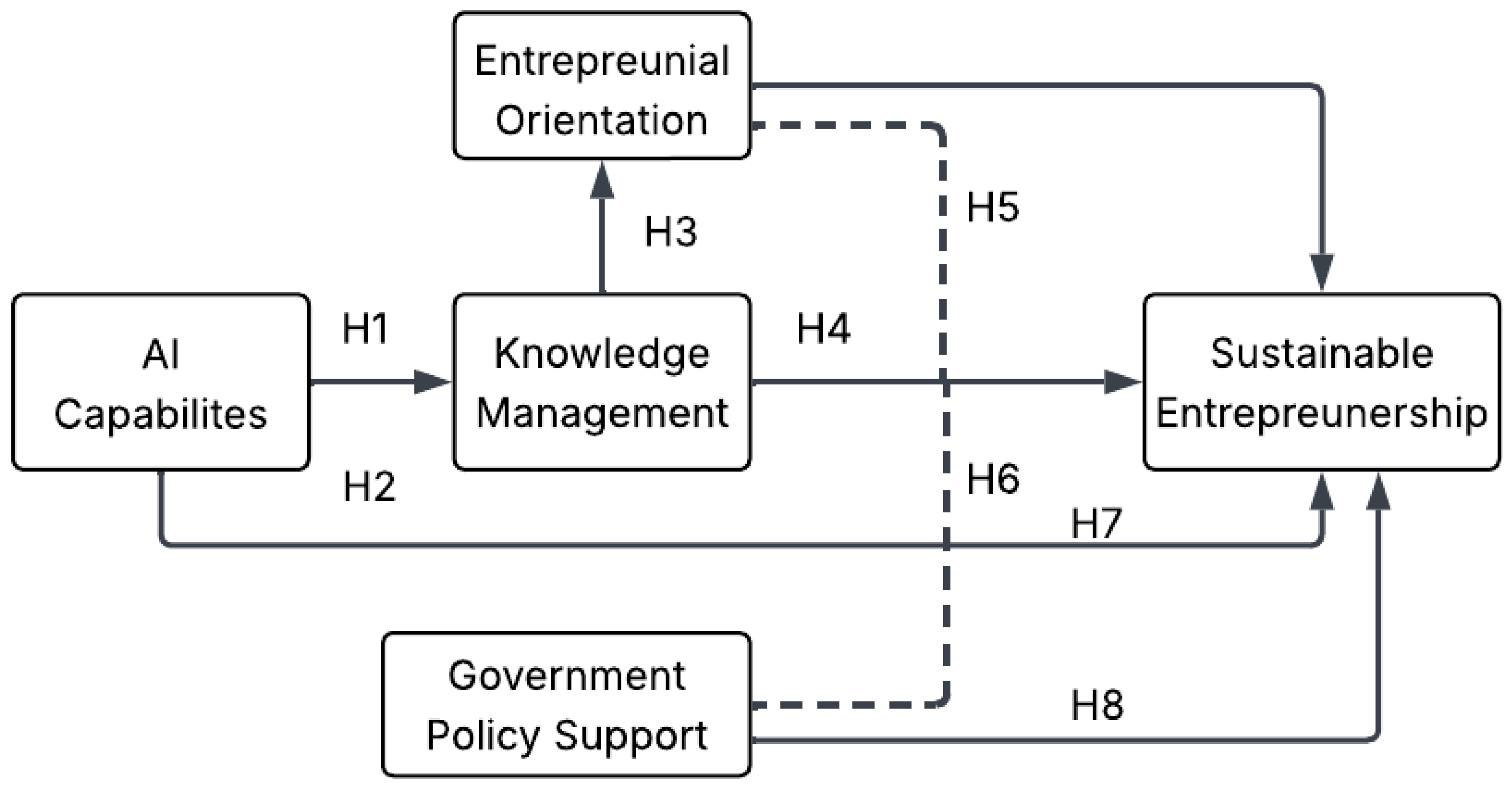
Figure 1. Conceptual model integrating Dynamic Capabilities Theory, Knowledge-Based View, and Institutional Theory. (Dashed lines represent moderating influences of Entrepreneurial Orientation and Government Policy Support.).
Sustainability 17 10928 g001
Figure 2. Standardized path coefficients and significance levels from PLS-SEM structural model analysis.
Sustainability 17 10928 g002
Table 1. Summary of constructs, theoretical origins, critical debates, the literature gaps, and their link to the research hypotheses.
ConstructTheoretical BaseMajor Debate/ContradictionGaps in the LiteratureLink to Hypotheses
AIDCT, KBVEfficiency paradox, energy cost, rebound/justice riskPathways from AI to SE still poorly understoodH1, H2, H7
KMKBVOrg. culture and absorptive capacity, underutilizationGreen KM in emerging marketsH3, H4, H5, H6
EODCT, KBVInnovation or risk spiraling?Moderating effect on KM → SEH5
GPSInstitutional TheoryCompliance vs. transformation, subsidy dependencyBoundary/spillover effectsH6, H8
SEAllTBL trade-off, authenticityMeasurement, contextual driversH4–H8
Table 2. Convergent and discriminant validity.
ConstructsCronbach’s αrho_AComposite Reliability (ρc)AVEAIEOGPSKMSEEO × KMGPS × KM
AI Capabilities (AI)0.9050.9070.9300.7260.3480.2670.6840.6590.0880.020
Entrepreneurial Orientation (EO)0.9100.9140.9330.7360.3480.0470.2450.2550.0080.034
Government Policy Support (GPS)0.9100.9350.9320.7340.2670.0470.1410.1290.0290.062
Knowledge Management (KM)0.8940.8950.9220.7020.6840.2450.1410.6920.0600.042
Sustainable Entrepreneurship (SE)0.9090.9090.9320.7330.6590.2550.1290.6920.2820.210
EO × KM0.0880.0080.0290.0600.2820.081
GPS × KM0.0200.0340.0620.0420.2100.081
Table 3. Comprehensive model assessment results.
CategoryIndicatorValue(s)Interpretation
Post hoc Power AnalysisRequired Effect Size (α = 1%, 80% Power)0.107Minimum detectable effect; indicates sufficient sensitivity for small effects
Required Effect Size (α = 5%, 80% Power)0.084Demonstrates strong statistical power under standard significance level
Required Effect Size (α = 1%, 90% Power)0.121Indicates ability to detect medium effects with high confidence
Required Effect Size (α = 5%, 90% Power)0.098Confirms robust statistical adequacy for hypothesis testing
Model Fit IndicesSRMRSaturated = 0.033; Estimated = 0.050Values < 0.08 demonstrate good model fit
d_ULS0.356 (Sat.); 0.824 (Est.)Lower values indicate better approximation of empirical data
d_G0.158 (Sat.); 0.165 (Est.)Acceptable consistency between empirical and model-implied matrices
Chi-square820.692 (Sat.); 844.915 (Est.)Indicates acceptable model–data discrepancy
NFI0.944 (Sat.); 0.943 (Est.)Values > 0.90 indicate strong model fit
Explained Variance (R2)Entrepreneurial Orientation0.050 (Adj. 0.049)Weak explanatory power—suggests influence from additional external factors
Knowledge Management0.380 (Adj. 0.380)Moderate explanatory power—indicates meaningful variance explained
Sustainable Entrepreneurship0.540 (Adj. 0.536)Substantial explanatory power—confirms strong predictive relevance
Multicollinearity (VIF)AI Indicators2.228–2.484All < 5, indicating no multicollinearity concerns
EO Indicators2.352–2.661Acceptable range, supporting construct independence
GP Indicators2.340–2.768Below threshold; confirms model stability
KM Indicators2.049–2.323Reflects acceptable variance inflation
SE Indicators2.385–2.559Within recommended limits
Interaction TermsEO × KM = 1.000; GPS × KM = 1.000Perfect centering eliminates collinearity risk
Predictive Relevance (Q2 predict)Entrepreneurial OrientationQ2 = 0.067; RMSE = 0.968; MAE = 0.807Indicates weak predictive accuracy, suggesting exploratory nature
Knowledge ManagementQ2 = 0.378; RMSE = 0.790; MAE = 0.636Demonstrates strong predictive relevance
Sustainable EntrepreneurshipQ2 = 0.368; RMSE = 0.797; MAE = 0.649Indicates strong predictive relevance for sustainability outcomes
Table 4. Hypothesis testing.
HypothesisPath RelationshipOriginal Sample (O)Sample Mean (M)Standard Deviation (STDEV)t-Statisticsp-ValueEffect Size (f2)Decision
H1AI Capabilities → Knowledge Management0.6170.6170.02228.4240.0000.614 (Large)Supported
H2AI Capabilities → Sustainable Entrepreneurship0.3270.3260.03010.7270.0000.129 (Medium)Supported
H3Knowledge Management → Entrepreneurial Orientation0.2230.2250.0326.9470.0000.053 (Small–Medium)Supported
H4Knowledge Management → Sustainable Entrepreneurship0.3990.4000.03013.4850.0000.214 (Medium–Large)Supported
H5 (Moderation)Entrepreneurial Orientation × Knowledge Management → Sustainable Entrepreneurship0.2080.2080.0229.2590.0000.092 (Small–Medium)Supported
H6 (Moderation)Government Policy Support × Knowledge Management → Sustainable Entrepreneurship0.1600.1600.0217.5550.0000.056 (Small–Medium)Supported
H7Entrepreneurial Orientation → Sustainable Entrepreneurship0.0390.0400.0251.5480.1220.003 (Negligible)Not Supported
H8Government Policy Support → Sustainable Entrepreneurship0.2850.2820.02710.5560.0000.210 (Medium–Large)Supported
Table 5. Importance Performance Map Analysis (IPMA).
ConstructItem CodeQuestionnaire StatementImportance (IPMA)Performance (Revised)
AI Capabilities (AI)AI1AI supports decision-making in sustainability projects.0.13968
AI2AI identifies new sustainability opportunities.0.13570
AI3AI optimizes resource use and environmental impact.0.14165
AI4AI improves operational sustainability efficiency.0.12567
AI5AI is integrated into long-term sustainability strategies.0.13866
Entrepreneurial Orientation (EO)EO1We seek innovative sustainability solutions.0.00860
EO2We exploit sustainability-driven opportunities.0.00962
EO3We take calculated risks in sustainability ventures.0.00959
EO4We lead in sustainability-oriented offerings.0.01061
EO5Sustainability innovation is part of our strategy.0.01063
Government Policy Support (GP)GP1Regulations encourage sustainability entrepreneurship.0.00757
GP2Policy incentives support our initiatives.0.00455
GP3National programs (Vision 2030, SDGs) influence practices.0.00758
GP4Policies make sustainability implementation easier.0.00656
GP5We receive adequate institutional support.0.00554
Knowledge Management (KM)KM1We acquire sustainability-related knowledge.0.10164
KM2Knowledge sharing supports sustainability.0.09563
KM3We maintain sustainability knowledge repositories.0.09261
KM4Knowledge application informs sustainability decisions.0.09865
KM5We update our sustainability knowledge continuously.0.10266
Table 6. Summary of key contributions, findings, and future research.
Key ContributionSummary of Findings/NoveltyDirections for Future Research
Integration of Digital, Organizational, and Institutional FactorsDemonstrates that AI capabilities, when combined with knowledge management (KM), entrepreneurial orientation (EO), and government policy support (GPS), most effectively advance sustainable entrepreneurship (SE) in emerging market SMEs.Explore multi-level or cross-sector models in other emerging economies; test for differences in combinations of internal/external drivers.
Mediation Role of Knowledge ManagementEstablishes KM as a critical mediator that converts digital (AI) potential into actionable sustainability practices.Conduct qualitative studies on KM processes and barriers in SMEs; investigate specific KM practices most linked to sustainability.
Moderating Impact of EO and GPSReveals that both EO and GPS magnify the KM → SE link, highlighting cultural and institutional contexts as amplifiers.Longitudinal studies on how EO and GPS evolve; examine EO/GPS in various institutional settings or policy regimes.
Direct Effect of Government Policy Support (H8)Confirms that government policy directly fosters SE, not merely as a moderator, validating the Institutional Theory’s claims in emerging contexts.Assess long-term effects of policy dependency; compare effectiveness of different policy instruments or approaches.
Qualitative Managerial InsightsShows from open-text responses that genuine SE outcomes require both internal champions and enabling environments—policy alone can foster compliance without transformation.Case studies to understand “what works” on the ground; behavioral research on attitudes toward compliance versus innovation.
Saudi Context and Vision 2030 BlueprintOffers empirical evidence for Vision 2030’s effectiveness in catalyzing SME sustainable transformation, with lessons for similar emerging markets.Comparative policy analyses; adapt the model for various national development agendas and stages of digital maturity.
Disclaimer/Publisher’s Note: The statements, opinions and data contained in all publications are solely those of the individual author(s) and contributor(s) and not of MDPI and/or the editor(s). MDPI and/or the editor(s) disclaim responsibility for any injury to people or property resulting from any ideas, methods, instructions or products referred to in the content.