Modeling Health-Supportive Urban Environments: The Role of Mixed Land Use, Socioeconomic Factors, and Walkability in U.S. ZIP Codes


Abstract
1. Introduction
- ▪
- Hybrid 1 includes walkability variables.
- ▪
- Hybrid 2 adds water-area measures.
- ▪
- Hybrid 3 incorporates carbon-emission variables and excludes ZIP codes with water area.
- ▪
- Hybrid 4 uses only socioeconomic and land-use indicators.
- ▪
- The All-ZIP Codes model applies to a unified structure for all 28,758 ZIP codes.
2. Literature Review
Research Gaps Identified in the Literature
- 1.
- Lack of ZIP-code–level, national models integrating walkability, health services, and environmental measures.
- Most studies focus on cities, counties, or neighborhoods, but large-scale, data-driven analyses at fine geographic resolution remain limited.
- 2.
- Limited empirical research linking mixed-use development to health outcomes via composite indices.
- Existing studies often analyze walkability, land-use mix, or emissions independently rather than through holistic integrated metrics.
- 3.
- Insufficient differentiation between metropolitan, micropolitan, and rural areas.
- Research tends to focus on large cities, overlooking the geographic heterogeneity and non-metropolitan dynamics.
- 4.
- Absence of model-based typologies linking urban form, socioeconomic structure, and environmental sustainability.
- Clustering methods are underused in studies of health-supportive environments.
- 5.
- No study uses multiple statistical formulations (Hybrid Models 1–4) to test variable stability under different modeling constraints.
- Most studies rely on a single regression structure, limiting robustness.
- 6.
- Limited use of machine learning methods for structured urban datasets.
- Machine learning is commonly applied to image-based data, but rarely to large-scale ZIP-code demographic datasets.
3. Data and Methods
3.1. Primary Research Hypothesis (H1)
3.2. Supporting Hypotheses
3.3. Data Sources
3.4. Methodology
- Urban form indicators:
- –
- Walk Score, representing the walkability index based on distance to nearby amenities
- –
- Mix Factor, capturing the balance of population, jobs, and employment diversity
- –
- Population density, representing residents per square mile
- –
- Number of businesses, measuring overall economic activity
- Facility availability variables:
- –
- Education facilities
- –
- Health facilities
- –
- Accommodation and food services
- –
- Arts, entertainment, and recreation facilities
- Socioeconomic and demographic variables:
- –
- Income per household
- –
- % occupied housing units
- –
- Median age
- –
- Diversity of race, measuring the probability that two randomly selected residents have different races
- –
- Population aged 75 years and over
- Environmental variables: Total carbon emissions (tCO2e/yr) for each ZIP code
3.4.1. Construction of Health and Fitness Index (HFI):
- = normalized value
- = raw variable value
- , = min and max of the variable
- (1)
- Walkability (Walkscore_Norm)
- = network distance to the nearest amenity in category (e.g., grocery, school, park, restaurant)
- = category weight
- = distance-decay function awarding maximum points for distances ≤ 0.4 km and zero points for distances ≥ 1.6 km
- (2)
- Healthcare Accessibility (Health_Norm)
- = number of licensed healthcare facilities in ZIP code i
- = land area of the ZIP code
- (3)
- Environmental Sustainability (Carbon_Norm)
- : normalized walkability score
- : normalized density of health facilities
- : normalized total carbon emissions (inverted to reflect positive contribution to fitness).
3.4.2. Predictive Modeling
- ✓
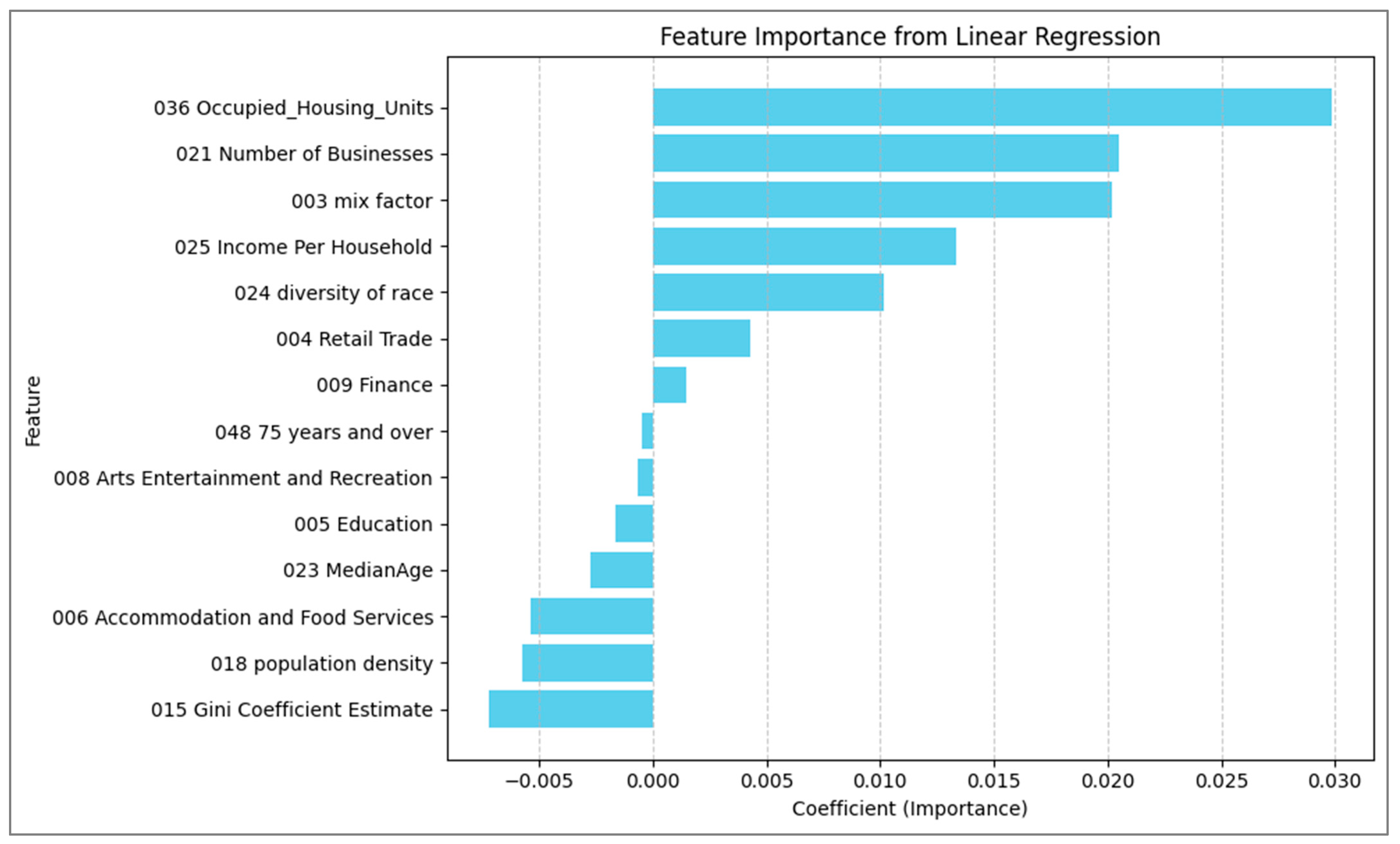
- Multiple Linear Regression: A baseline model was estimated as:
- : Health and Fitness Index for ZIP code i
- : predictor j (urban form, socioeconomic, environmental variables)
- : regression coefficients
- : error term
- ✓
- Model fit was assessed via RMSE and MAE:
- ✓
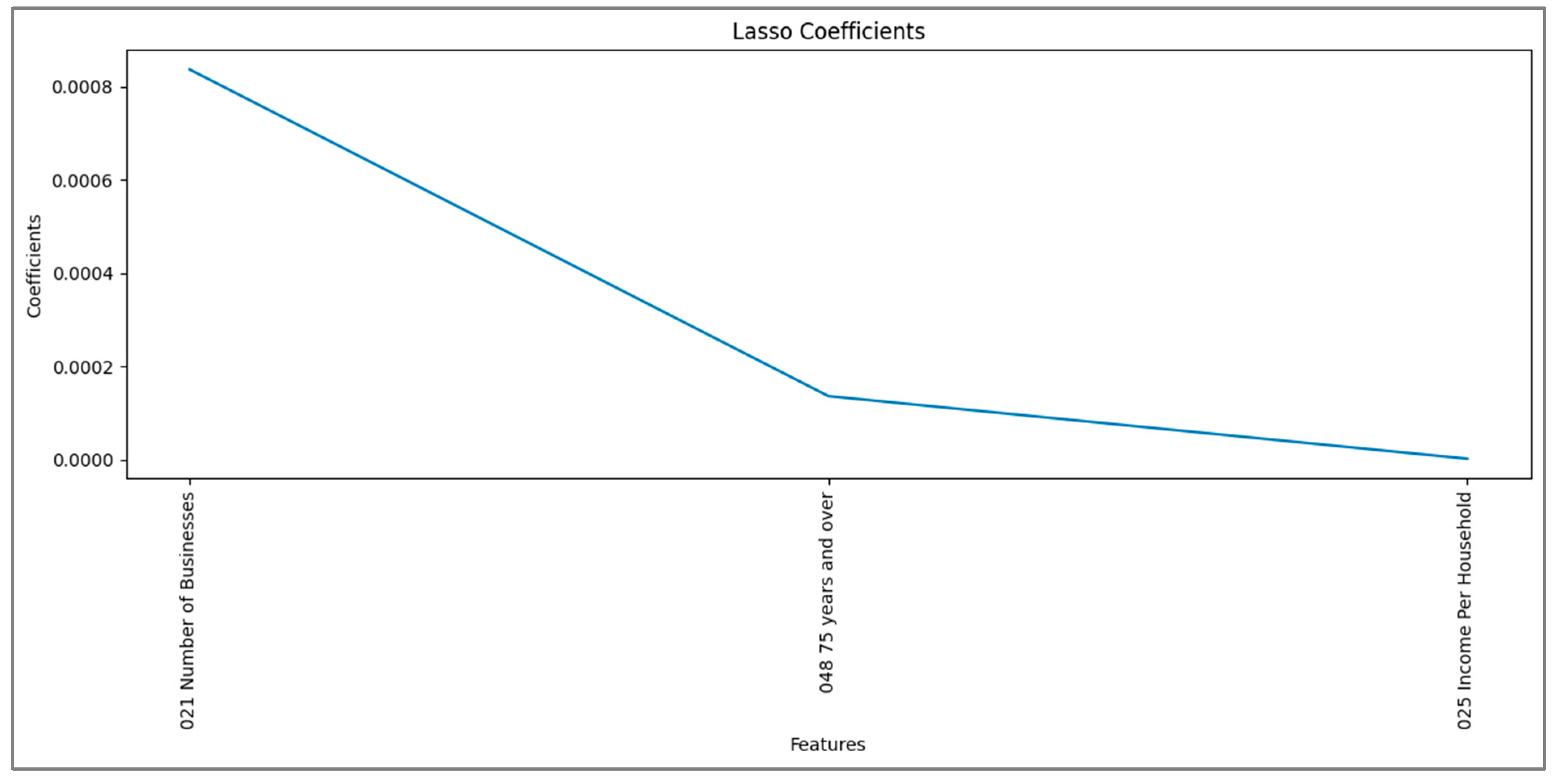
- Lasso Regression: To handle multicollinearity and perform feature selection, Lasso regression was employed:
- ✓
- Decision Tree Model: A Decision Tree Regressor was implemented to capture nonlinear interactions.
- ➢
- Splits were chosen to minimize the Mean Squared Error (MSE) at each node:
- ➢
- Feature importance was computed as:
- : set of nodes where feature was used
- : reduction in MSE due to the split at node
- ✓
- K-Nearest Neighbor (KNN) Classifier: The K-Nearest Neighbor classifier was employed to categorize ZIP codes into high-, medium-, and low-HFI groups and to identify the variables that most strongly differentiate these categories.
- KNN Algorithm: KNN classifies an observation by examining the k closest ZIP codes in feature space and assigning the majority class:
- validate whether ZIP codes naturally cluster into distinct health/fitness profiles, and
- Compare classification performance to regression-based predictor rankings.
3.4.3. Train–Validation–Test Split
4. Data Analysis and Correlations
5. Regression Modeling Results
- Training set: 16% of all observations
- Validation set: 4% of all observations
- Test set: 80% of all observations
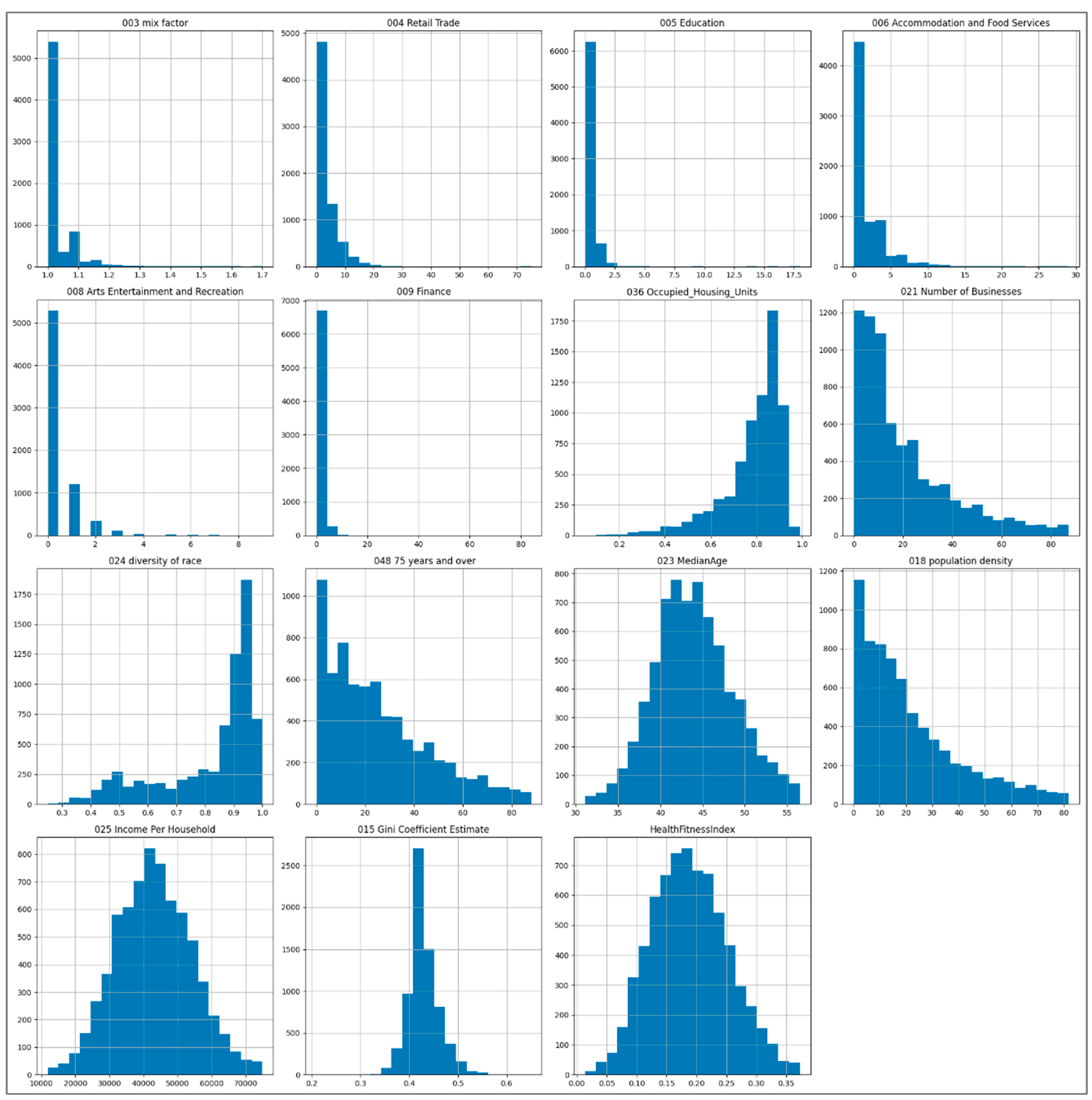
- Land use and services: Mix Factor, Retail Trade, Education Facilities, Accommodation and Food Services, Arts/Entertainment/Recreation, Finance/Professional Services
- Housing and demographics: Occupied Housing Units, Number of Businesses, Diversity of Race, Population Aged 75+, Median Age, Population Density
- Socioeconomic indicators: Income per Household, Gini Coefficient Estimate
- (1)
- Multiple Linear Regression
- RMSE: 0.0405
- MAE: 0.0317
- R2: 0.60
- (2)
- LASSO Regression
- RMSE: 0.0431
- MAE: 0.0342
- R2: 0.57
- Mean cross-validated R2: 0.53
- (3)
- Decision Tree Regression
- RMSE: 0.0528
- MAE: 0.0447
- R2: 0.42
- Cross-validated R2: 0.39
- (4)
- K-Nearest Neighbor (KNN) Classifier
- Overall classification accuracy: 74%
- Macro-averaged precision: 0.71
- Macro-averaged recall: 0.70
- Macro-averaged F1-score: 0.69
6. Discussion
7. Conclusions
Author Contributions
Funding
Institutional Review Board Statement
Informed Consent Statement
Data Availability Statement
Conflicts of Interest
Abbreviations
| VMT | Vehicle Miles Traveled |
| HFI | Health and Fitness Index |
| Lasso | Least Absolute Shrinkage and Selection Operator |
References
- Geyer, H.S. The theory and praxis of mixed-use development—An integrative literature review. Cities 2024, 147, 104774. [Google Scholar] [CrossRef]
- Ryckewaert, M.; Zaman, J.; De Boeck, S. Variable Arrangements Between Residential and Productive Activities: Conceiving Mixed-Use for Urban Development in Brussels. Urban. Plan. 2021, 6, 334–349. [Google Scholar] [CrossRef]
- Jinollo, G.T.; Habtemariam, L.W.; Belete, D.A. The impacts of mixed land use planning on spatial development. Discov. Cities 2025, 2, 8. [Google Scholar] [CrossRef]
- Kausar, A.; Zubair, S.; Sohail, H.; Anwar, M.M.; Aziz, A.; Vambol, S.; Vambol, V.; Khan, N.A.; Poteriaiko, S.; Tyshchenko, V.; et al. Evaluating the challenges and impacts of mixed-use neighborhoods on urban planning: An empirical study of a megacity, Karachi, Pakistan. Discov. Sustain. 2024, 5, 24. [Google Scholar] [CrossRef]
- Zagow, M.; Elbany, M.; Darwish, A.M. Identifying urban, transportation, and socioeconomic characteristics across US zip codes affecting CO2 emissions: A decision tree analysis. Energy Built Environ. 2024, 6, 484–494. [Google Scholar] [CrossRef]
- Martino, N.; Girling, C.; Lu, Y. Urban form and livability: Socioeconomic and built environment indicators. Build. Cities 2021, 2, 220–243. [Google Scholar] [CrossRef]
- Hamidi, N. How Walkable Mixed-Use Urbanism Affects Environmental, Social, and Economic Sustainability. Int. J. Sustain. Appl. Sci. Eng. 2025, 2, 25–38. [Google Scholar]
- Zahrah, W.; Ginting, N.; Aulia, D.N.; Marisa, A. Quality of life for livable mixed use living. IOP Conf. Ser. Earth Environ. Sci. 2021, 780, 012043. [Google Scholar] [CrossRef]
- Darwish, A.M.; Zagow, M.; Elkafoury, A. Impact of land use, travel behavior, and socio-economic characteristics on carbon emissions in cool-climate cities, USA. Environ. Sci. Pollut. Res. 2023, 30, 91108–91124. [Google Scholar] [CrossRef]
- Hendrigan, C.; Newman, P. Dense, mixed-use, walkable urban precinct to support sustainable transport or vice versa? A model for consideration from Perth, Western Australia. Int. J. Sustain. Transp. 2017, 11, 11–19. [Google Scholar] [CrossRef]
- Shulman, L. Walk and Thrive? The Importance of Low-Income Household Access to Mixed-Use Neighborhoods in the Metro Vancouver Region. Ph.D. Thesis, University of British Columbia, Vancouver, BC, Canada, 2021. [Google Scholar] [CrossRef]
- Elkafoury, A.; Zagow, M.; Saeed, K.; Darwish, A.M. Model Willingness to Use Public Transport in the USA Based on Socio-Economic and Demographic Characteristics. Civil. Eng. Archit. 2023, 11, 1487–1497. [Google Scholar] [CrossRef]
- Shokry, S.; Alrashidi, A.; El-Bany, M.E.-S.; Darwish, A.M. Impact of road geometry on school-area traffic congestion using regression and machine learning analysis: Lessons from six Saudi cities. Transp. Res. Interdiscip. Perspect. 2025, 34, 101686. [Google Scholar] [CrossRef]
- Temeljotov Salaj, A.; Lindkvist, C.M. Urban facility management. Facilities 2021, 39, 525–537. [Google Scholar] [CrossRef]
- Mbiankeu Nguea, S. Uncovering the linkage between sustainable development goals for access to electricity and access to safely managed drinking water and sanitation services. Soc. Sci. Med. 2024, 345, 116687. [Google Scholar] [CrossRef]
- McShane, I.; Coffey, B. Rethinking community hubs: Community facilities as critical infrastructure. Curr. Opin. Environ. Sustain. 2022, 54, 101149. [Google Scholar] [CrossRef]
- Mahtta, R.; Fragkias, M.; Güneralp, B.; Mahendra, A.; Reba, M.; Wentz, E.A.; Seto, K.C. Urban land expansion: The role of population and economic growth for 300+ cities. Npj Urban. Sustain. 2022, 2, 5. [Google Scholar] [CrossRef]
- Abdi, M.H.; Lamíquiz-Daudén, P.J. Transit-oriented development in developing countries: A qualitative meta-synthesis of its policy, planning and implementation challenges. Int. J. Sustain. Transp. 2022, 16, 195–221. [Google Scholar] [CrossRef]
- Sallis, J.F.; Saelens, B.E.; Frank, L.D.; Conway, T.L.; Slymen, D.J.; Cain, K.L.; Chapman, J.E.; Kerr, J. Neighborhood built environment and income: Examining multiple health outcomes. Soc. Sci. Med. 2009, 68, 1285–1293. [Google Scholar] [CrossRef]
- Ye, Y.; Richards, D.; Lu, Y.; Song, X.; Zhuang, Y.; Zeng, W.; Zhong, T. Measuring daily accessed street greenery: A human-scale approach for informing better urban planning practices. Landsc. Urban. Plan. 2019, 191, 103434. [Google Scholar] [CrossRef]
- Althoff, T.; Ivanovic, B.; Hicks, J.L.; Delp, S.L.; King, A.C.; Leskovec, J. Countrywide natural experiment reveals impact of built environment on physical activity. arXiv 2024, arXiv:2406.04557. [Google Scholar] [CrossRef]
- Zhu, J.; Kodali, H.; Wyka, K.E.; Huang, T.T.-K. Perceived neighborhood environment walkability and health-related quality of life among predominantly Black and Latino adults in New York City. BMC Public Health 2023, 23, 127. [Google Scholar] [CrossRef]
- Shi, Y.; Zheng, B.; Wang, Z.; Zheng, J. Mixed Land Use and Its Relationship with CO2 Emissions: A Comparative Analysis Based on Several Typical Development Zones in Shanghai. Land 2023, 12, 1675. [Google Scholar] [CrossRef]
- Zhang, M.; Zhao, P. The impact of land-use mix on residents’ travel energy consumption: New evidence from Beijing. Transp. Res. D Transp. Environ. 2017, 57, 224–236. [Google Scholar] [CrossRef]
- Li, Q.; Chen, X.; Jiao, S.; Song, W.; Zong, W.; Niu, Y. Can Mixed Land Use Reduce CO2 Emissions? A Case Study of 268 Chinese Cities. Sustainability 2022, 14, 15117. [Google Scholar] [CrossRef]
- Adkins, A.; Makarewicz, C.; Scanze, M.; Ingram, M.; Luhr, G. Contextualizing Walkability: Do Relationships Between Built Environments and Walking Vary by Socioeconomic Context? J. Am. Plan. Assoc. 2017, 83, 296–314. [Google Scholar] [CrossRef]
- Avila-Palencia, I.; Sánchez, B.N.; Rodríguez, D.A.; Perez-Ferrer, C.; Miranda, J.J.; Gouveia, N.; Bilal, U.; Useche, A.F.; Wilches-Mogollon, M.A.; Moore, K.; et al. Health and Environmental Co-Benefits of City Urban Form in Latin America: An Ecological Study. Sustainability 2022, 14, 14715. [Google Scholar] [CrossRef]
- WHO European. European Ministerial Conference on Counteracting Obesity—Diet and Physical Activity for Health. In European Charter on Counteracting Obesity; World Health Organization: Geneva, Switzerland, 2006; Volume 2011, p. 57. [Google Scholar]
- Saelens, B.E.; Sallis, J.F.; Frank, L.D. Environmental correlates of walking and cycling: Findings from the transportation, urban design, and planning literatures. Ann. Behav. Med. 2003, 25, 80–91. [Google Scholar] [CrossRef] [PubMed]
- Ewing, R.; Meakins, G.; Hamidi, S.; Nelson, A.C. Relationship between urban sprawl and physical activity, obesity, and morbidity—Update and refinement. Health Place 2014, 26, 118–126. [Google Scholar] [CrossRef] [PubMed]
- Otsuka, N.; Welsch, J.; Lättman, K.; Prichard, E.; van der Vlugt, A.-L.; De Vos, J. Walking in urban neighbourhoods—Insights from a mixed methods approach and citizen science in walkability research. Transp. Res. Interdiscip. Perspect. 2025, 33, 101588. [Google Scholar] [CrossRef]
- Bibri, S.E.; Krogstie, J.; Kärrholm, M. Compact city planning and development: Emerging practices and strategies for achieving the goals of sustainability. Dev. Built Environ. 2020, 4, 100021. [Google Scholar] [CrossRef]
- Eckersten, S.; Balfors, B. Bridging gaps between land use and transport planning to facilitate the transition toward sustainable development. Int. J. Sustain. Transp. 2025, 19, 517–531. [Google Scholar] [CrossRef]
- Cacciatore, S.; Mao, S.; Nuñez, M.V.; Massaro, C.; Spadafora, L.; Bernardi, M.; Perone, F.; Sabouret, P.; Biondi-Zoccai, G.; Banach, M.; et al. Urban health inequities and healthy longevity: Traditional and emerging risk factors across the cities and policy implications. Aging Clin. Exp. Res. 2025, 37, 143. [Google Scholar] [CrossRef]
- Dau, L.; Barros, P.; Cilliers, E.J.; Hemsley, B.; Martin, M.; Lakhanpaul, M.; Smith, M. Urban density and child health and wellbeing: A scoping review of the literature. Health Place 2025, 91, 103393. [Google Scholar] [CrossRef]
- Bin Tan, S.; Dickens, B.L.; Sevtsuk, A.; Zheng, S.; Zeng, K.; Lee, Y.S.; Yap, F.; Chan, S.-Y.; Chan, J.K.Y.; Tan, K.H.; et al. Exploring how socioeconomic status affects neighbourhood environments’ effects on obesity risks: A longitudinal study in Singapore. Landsc. Urban. Plan. 2022, 226, 104450. [Google Scholar] [CrossRef]
- Lee, J.; Choi, K.; Leem, Y. Bicycle-based transit-oriented development as an alternative to overcome the criticisms of the conventional transit-oriented development. Int. J. Sustain. Transp. 2016, 10, 975–984. [Google Scholar] [CrossRef]
- Tcymbal, A.; Demetriou, Y.; Kelso, A.; Wolbring, L.; Wunsch, K.; Wäsche, H.; Woll, A.; Reimers, A.K. Effects of the built environment on physical activity: A systematic review of longitudinal studies taking sex/gender into account. Environ. Health Prev. Med. 2020, 25, 75. [Google Scholar] [CrossRef]
- Liu, J.; Zhou, J.; Xiao, L. Built environment correlates of walking for transportation: Differences between commuting and non-commuting trips. J. Transp. Land Use 2021, 14, 1129–1148. [Google Scholar] [CrossRef]
- Boakye-Dankwa, E.; Barnett, A.; Pachana, N.A.; Turrell, G.; Cerin, E. Associations between latent classes of perceived neighborhood destination accessibility and walking behaviors in older adults of a low-density and a high-density city. J. Aging Phys. Act. 2019, 27, 553–564. [Google Scholar] [CrossRef] [PubMed]
- Yin, C.; Cao, J.; Sun, B.; Liu, J. Exploring built environment correlates of walking for different purposes: Evidence for substitution. J. Transp. Geogr. 2023, 106, 103505. [Google Scholar] [CrossRef]
- Saelens, B.E.; Handy, S.L. Built Environment Correlates of Walking: A Review. Med. Sci. Sports Exerc. 2008, 40, S550. [Google Scholar] [CrossRef]
- Kuzmyak, R.; Baber, C.; Savory, D. Use of a walk opportunities index to quantify local accessibility. Transp. Res. 2006, 1977, 145–153. [Google Scholar] [CrossRef]
- Boarnet, M.G.; Greenwald, M.; McMillan, T. Walking, Urban Design, and Health: Toward a Cost-Benefit Analysis Framework. J. Plan. Educ. Res. 2008, 27, 341–358. [Google Scholar] [CrossRef]
- Ewing, R.; Cervero, R. Travel and the Built Environment: A Meta-Analysis. J. Am. Plan. Assoc. 2010, 76, 265–294. [Google Scholar] [CrossRef]
- Sung, H.; Lee, S. Residential built environment and walking activity: Empirical evidence of Jane Jacobs’ urban vitality. Transp. Res. 2015, 41, 318–329. [Google Scholar] [CrossRef]
- Kramer, M.G. Our Built and Natural Environments; EPA: Washington, DC, USA, 2013. [Google Scholar]
- Jerrett, M.; Almanza, E.; Davies, M.; Wolch, J.; Dunton, G.; Spruitj-Metz, D.; Pentz, M.A. Smart Growth Community Design and Physical Activity in Children. Am. J. Prev. Med. 2013, 45, 386–392. [Google Scholar] [CrossRef]
- Dunton, G.F.; Intille, S.S.; Wolchc, J.; Pentz, M.A. Investigating the impact of a smart growth community on the contexts of children’s physical activity using Ecological Momentary Assessment. Health Place 2012, 18, 76–84. [Google Scholar] [CrossRef]
- Salon, D.; Boarnet, M.G.; Handy, S.; Spears, S.; Tal, G. How do local actions affect VMT? A critical review of the empirical evidence. Transp. Res. Part D 2012, 17, 495–508. [Google Scholar] [CrossRef]
- Brownstone, D.; Golob, T. The Impact of Residential Density on Vehicle Usage and Energy Consumption. J. Urban Econ. 2009, 65, 91–98. [Google Scholar] [CrossRef]
- Fang, H.A. A discrete–continuous model of households’ vehicle choice and usage, with an application to the effects of residential density. Transp. Res. Part. B Methodol. 2008, 42, 736–758. [Google Scholar] [CrossRef]
- Frank, L.D.; Greenwald, M.J.; Kavage, S.; Devlin, A. An Assessment of Urban form and Pedestrian and Transit Improvements as an Integrated Ghg Reduction Strategy; The State of Washington, Department of Transportation: Seattle, WA, USA, 2011. [Google Scholar]
- Stein, D.F. Entertaining Entertainment Districts. Urban. Land 2007, 66, 106–109. [Google Scholar]
- Elkafoury, A.; Elboshy, B.; Darwish, A.M. Development of response surface method prediction model for traffic-related roadside noise levels based on traffic characteristics. Environ. Sci. Pollut. Res. 2023, 30, 94229–94241. [Google Scholar] [CrossRef]
- Berg Mårtensson, H.; Höjer, M.; Åkerman, J. Low emission scenarios with shared and electric cars: Analyzing life cycle emissions, biofuel use, battery utilization, and fleet development. Int. J. Sustain. Transp. 2024, 18, 115–133. [Google Scholar] [CrossRef]
- Darwish, A.M.; Almansour, M.; Salah, A.; Zagow, M.; Saeed, K.; Elkafoury, A. Sensitivity evaluation of machine learning-based calibrated transportation mode choice models: A case study of Alexandria City, Egypt. Transp. Res. Interdiscip. Perspect. 2024, 24, 101052. [Google Scholar] [CrossRef]
- Alsobky, A.; Darwish, A.M. A realistic framework for volume-delay function determination. Ain Shams Eng. J. 2023, 14, 102279. [Google Scholar] [CrossRef]
- Acosta-González, N.; Cahueñas, S.; Pérez, C. Risk factors for fatal road traffic accidents in Ecuador. Transp. Res. Interdiscip. Perspect. 2025, 32, 101515. [Google Scholar] [CrossRef]
- Hermawan, I.; Mulya Firdausy, C.; Rizqy Rambe, K.; Zuhdi, F.; Erwidodo; Nugraheni, R.D.; Malisan, J.; Isnasari, Y.; Marpaung, E.; Asshagab, S.M. Road traffic facilities, traffic accidents, and poverty: Lesson learned from Indonesia. Transp. Res. Interdiscip. Perspect. 2024, 28, 101273. [Google Scholar] [CrossRef]
- Patil, G.R.; Sharma, G. Overweight/obesity relationship with travel patterns, socioeconomic characteristics, and built environment. J. Transp. Health 2021, 22, 101240. [Google Scholar] [CrossRef]
- Saeidizand, P.; Boussauw, K. Patterns of car dependency of metropolitan areas worldwide: Learning from the outliers. Int. J. Sustain. Transp. 2024, 18, 221–235. [Google Scholar] [CrossRef]
- US-Census. 2025. Available online: https://data.census.gov/table (accessed on 10 May 2025).



| Model | All Zip Codes | Metropolis Hybrid 1 | Metropolis Hybrid 2 | Metropolis Hybrid 3 | Metropolis Hybrid 4 |
|---|---|---|---|---|---|
| Zip codes | 28758 | 15828 | 15828 | 14063 | 9563 |
| Model formulation: | Metropolis Hybrid 1 is a statistical model developed to examine how urban facility types, demographic characteristics, and elements of the urban fabric influence the dependent variable within U.S. metropolitan ZIP codes. This model specifically includes Walk Score, allowing the analysis to capture the effect of pedestrian accessibility and walkability on the outcome. | Metropolis Hybrid 2 is constructed using the same metropolitan ZIP-code sample as Hybrid 1, but includes Water Area as a predictor variable. This modification allows the model to capture the influence of proximity to water bodies—a key geographical and urban-development factor in many U.S. metropolitan regions. | Metropolis Hybrid 3 refines the dataset by excluding ZIP codes that contain water areas and by excluding Walk Score, while including total carbon emissions (tCO2e/yr). This model is designed to specifically examine urban ZIP codes where water is not a confounding factor, allowing the analysis to focus on environmental performance and built-environment structure. | Metropolis Hybrid 4 is the most selective model, using a reduced dataset focused solely on metropolitan ZIP codes that contain complete socioeconomic, demographic, and built-form data without missing entries. It excludes Walk Score, Water Area, and Carbon Emissions, allowing the model to focus strictly on structural and socioeconomic predictors. | |
| Purpose of the model | This formulation isolates the effect of walkability while holding other structural and socioeconomic variables constant. It tests whether pedestrian-friendly environments significantly affect the dependent variable in metropolitan areas. | This model tests whether ZIP codes that include or border water areas exhibit different behavioral patterns in the dependent variable. Water proximity often affects land values, land-use diversity, housing patterns, and environmental amenities. Hybrid 2 quantifies that relationship. | By removing ZIP codes with water area and walkability scores, this formulation isolates the relationship between carbon emissions, built form, and socioeconomic characteristics. It helps determine whether low-emission ZIP codes exhibit distinct structural or demographic profiles independent of geographical water features. | Hybrid 4 aims to produce a pure metropolitan structural–socioeconomic model, free from external environmental or geographical modifiers. It provides a baseline urban-form model for metropolitan ZIP codes, enabling direct comparison with earlier models to understand how excluding environmental and walkability variables changes the explanatory power (Adjusted R2 = 0.842). |
| Variables | Definition | Data Source |
|---|---|---|
| Health and Fitness Index | Index integrates three key components: normalized walkability scores, the availability of health facilities, and normalized total carbon emissions. | |
| Number of businesses | Total number of businesses in each zip code | US-Census |
| 75 years and over | Population of people 75 years and over in each zip code | US-Census |
| Walkscore | Walk Score is a standardized walkability index that measures how accessible essential daily services are by foot. The score is generated through an algorithm that calculates proximity to multiple categories of amenities (including grocery stores, schools, restaurants, parks, and retail) using a distance-decay function that awards maximum points for amenities within 400 m and zero points beyond 1.6 km. The algorithm also incorporates the diversity of accessible amenities and the pedestrian-friendliness of the street network, including intersection density, block length, and population density. The final score is normalized on a 0–100 scale, where higher scores indicate more walkable environments. | (https://www.walkscore.com/professional/research.php) (accessed on 29 October 2025). |
| Health facilities | Number of health facilities in each zip code | US-Census |
| Total (tCO2e/yr) | Carbon emission in each zip code | US-Census |
| Population density | Number of people per square mile in each zip code | US-Census |
| Median age | Median age in each zip code | US-Census |
| Diversity of race | Represent a probability that if two people are selected at random, they will have the same race | |
| % Occupied housing units | Percentage of occupied housing units to total housing units in each zip code | US-Census |
| Income per household | Income per household in each zip code | US-Census |
| Education | Number of education facilities in each zip code | US-Census |
| Accommodation and food services | Number of accommodations and food services in each zip code | US-Census |
| Arts, entertainment, and recreation | Number of arts, entertainment, and recreation facilities in each zip code | US-Census |
| Mix Factor | Index of proportion of jobs to population and diversity of employment types | US-Census |
| Dependent Variable | All zip codes | Metropolis Hybrid 1 | Metropolis Hybrid 2 | Metropolis Hybrid 3 | Metropolis Hybrid 4 |
|---|---|---|---|---|---|
| Regression Statistics | |||||
| (Constant) | 0.0 | 0.0 | 0.0 | −100.85 | −107.424 |
| Type of facilities | |||||
| Education | 7.45 | 7.76 | 7.49 | 7.336 | 7.157 |
| Accommodation and food services | 4.45 | 4.68 | 4.76 | 4.752 | 4.907 |
| Health | 2.07 | 2.16 | 2.11 | 2.087 | 2.168 |
| Arts, entertainment, and recreation | 3.46 | 3.34 | 3.19 | 3.196 | 3.006 |
| Social and Economic | |||||
| Population density | −0.003 | −0.004 | |||
| Total housing units | 0.01 | 0.01 | 0.01 | 0.006 | 0.005 |
| % Occupied housing units | 55.833 | 62.917 | |||
| Median age | −0.58 | −0.60 | −0.44 | 0.675 | 1.231 |
| Diversity of race | −33.27 | −50.63 | −51.09 | −67.675 | −87.406 |
| Income per household | 0.001 | 0.001 | |||
| Health | |||||
| 75 years and over | −0.05 | −0.06 | −0.05 | −0.060 | −0.054 |
| Total (tCO2e/yr) | 0.98 | 1.19 | 0.10 | ||
| Urban Fabric | |||||
| Mix factor | 0.26 | 0.24 | 0.23 | 0.218 | 0.168 |
| Street factor | −0.22 | −0.18 | −0.07 | 0.150 | 0.148 |
| Mixed land use | 34.77 | 45.15 | 46.64 | 45.445 | 53.813 |
| Water Area | −0.05 | −0.09 | |||
| Walk score | 0.19 | 0.07 | |||
| Adjusted R Square | 0.92 | 0.92 | 0.93 | 0.871 | 0.842 |
| Observations | 28,758 | 15,828 | 15,828 | 14,063 | 9563 |
Disclaimer/Publisher’s Note: The statements, opinions and data contained in all publications are solely those of the individual author(s) and contributor(s) and not of MDPI and/or the editor(s). MDPI and/or the editor(s) disclaim responsibility for any injury to people or property resulting from any ideas, methods, instructions or products referred to in the content. |
© 2025 by the authors. Licensee MDPI, Basel, Switzerland. This article is an open access article distributed under the terms and conditions of the Creative Commons Attribution (CC BY) license (https://creativecommons.org/licenses/by/4.0/).
Share and Cite
Zagow, M.; Darwish, A.M.; Shokry, S. Modeling Health-Supportive Urban Environments: The Role of Mixed Land Use, Socioeconomic Factors, and Walkability in U.S. ZIP Codes. Sustainability 2025, 17, 10873. https://doi.org/10.3390/su172310873
Zagow M, Darwish AM, Shokry S. Modeling Health-Supportive Urban Environments: The Role of Mixed Land Use, Socioeconomic Factors, and Walkability in U.S. ZIP Codes. Sustainability. 2025; 17(23):10873. https://doi.org/10.3390/su172310873
Chicago/Turabian StyleZagow, Maged, Ahmed Mahmoud Darwish, and Sherif Shokry. 2025. "Modeling Health-Supportive Urban Environments: The Role of Mixed Land Use, Socioeconomic Factors, and Walkability in U.S. ZIP Codes" Sustainability 17, no. 23: 10873. https://doi.org/10.3390/su172310873
APA StyleZagow, M., Darwish, A. M., & Shokry, S. (2025). Modeling Health-Supportive Urban Environments: The Role of Mixed Land Use, Socioeconomic Factors, and Walkability in U.S. ZIP Codes. Sustainability, 17(23), 10873. https://doi.org/10.3390/su172310873