
Article

How Household Characteristics Drive Divergent Livelihood Resilience: A Case from the Lancang River Source Area of Sanjiangyuan National Park


1
School of Geographical Science, Qinghai Normal University, Xining 810008, China
2
Qinghai Province Key Laboratory of Physical Geography and Environmental Process, College of Geo-Graphical Science, Qinghai Normal University, Xining 810008, China
3
School of Politics and Public Administration, Qinghai Minzu University, Xining 810007, China
4
Key Laboratory of Ecological Safety and Sustainable Development in Arid Lands, Northwest Institute of Eco-Environment and Resources, Chinese Academy of Sciences, Lanzhou 730000, China
5
School of Finance and Economics, Qinghai University, Xining 810016, China
6
Qinghai Institute of Public Administration, Xining 810001, China
*
Author to whom correspondence should be addressed.
Sustainability 2025, 17(23), 10755; https://doi.org/10.3390/su172310755
Submission received: 14 October 2025 / Revised: 17 November 2025 / Accepted: 25 November 2025 / Published: 1 December 2025
(This article belongs to the Special Issue Climate Adaptation, Sustainability, Ethics, and Well-Being)

Abstract

Enhancing herders’ livelihoods is essential in balancing human–land interactions and promoting inclusive, sustainable development within protected area management. Using a household survey (N = 3539; March–June 2025) and a mixed-methods quantitative approach (weighted TOPSIS, obstacle degree, Spatial Durbin Model, and hierarchical regression), we assessed household livelihood resilience in the Lancang River source area of Sanjiangyuan National Park. Key findings included the following. Overall livelihood resilience was moderate, with a mean score of 0.411. This was characterized by a marked weakness in learning capacity (0.358) and relative strength in self-organization (0.431). Major barriers to resilience included cooperative participation (obstacle degree: 8.14%), education levels (7.58%), skills training (7.18%), household savings (6.40%), and information acquisition abilities (5.97%). The spatial analysis revealed a core-periphery pattern of resilience, evidenced by significant negative spatial autocorrelation (W×HLR coefficient = −0.787, p = 0.001), suggesting competitive interactions among villages. Within this pattern, cooperative participation induced significant positive spatial spillovers (W×X8 coefficient = 0.147, p < 0.001), while benefits derived from information acquisition abilities remained localized (Direct Effect = 0.061, p < 0.001). The pathways to resilience were associated with household heterogeneity. Associations between key factors and resilience varied across demographic groups, with women and youth benefiting more from skills training and education. Livelihood strategies were linked to information utilization, with cordyceps-dependent households exhibiting greater sensitivity to information acquisition abilities (interaction coefficient = 0.009, p = 0.009). The institutional environment shaped organizational benefits; the positive association with cooperative participation diminished in the core protected zone (interaction coefficient = −0.011, p = 0.036). These findings highlight household heterogeneity as a key factor influencing diverse resilience pathways. They also emphasize the need for targeted, spatially specific, and group-oriented governance strategies.

1. Introduction

Livelihood systems in pastoral regions worldwide are experiencing unprecedented changes due to the combined impacts of climate change and stringent conservation policies [1,2]. Establishing protected areas, such as national parks, is a central strategy in mitigating environmental threats. The pioneering Sanjiangyuan National Park (SNP), located on the Qinghai–Tibet Plateau in China, exemplifies this approach. This initiative aims to balance ecological conservation with local socioeconomic development. Relevant conservation policies—such as grazing restrictions [3], functional zoning (core and general zones) [4], and the “one household, one position” ecological guardian system [5]—are essential for sustainable development but simultaneously limit traditional pastoral livelihoods [6]. Consequently, local herders have rapidly shifted their livelihoods, moving from a reliance on animal husbandry to an increasing dependence on cash incomes derived from the harvesting of Cordyceps sinensis and government ecological compensation [7,8]. Although these shifts may boost short-term revenues, they reduce the long-term development potential [9], thereby worsening the persistent conflict between conservation and development. In this context, strengthening livelihood resilience—defined as a household’s capacity to absorb shocks, adapt to change, and transform amid adversity [10,11]—is crucial to promote inclusive and sustainable development in protected area management.
The concept of livelihood resilience has evolved from focusing on static asset ownership to including dynamic capabilities within socio-ecological systems [12,13]. Pioneering frameworks, especially the work of Speranza et al. [11], have been instrumental in conceptualizing resilience through three core dimensions: buffering capacity, learning capacity, and self-organizing capacity. This multidimensional framework is widely used to assess household coping mechanisms in respond to disturbances across diverse agricultural and pastoral contexts [14,15,16]. Nevertheless, the conceptualization and measurement of resilience in socioeconomic research vary considerably [17]. Existing studies frequently regard households as homogeneous units [18,19], neglecting the significant mediating roles of internal factors, including gender, age, and livelihood strategies. This oversight is problematic, as existing evidence shows that these characteristics actively moderate the impacts of external interventions and capital endowments on livelihood outcomes by systematically filtering and reshaping their effects [20]. Studies conducted in Nigeria and Bhutan show that gender roles and zoning policies result in markedly different risk management and diversification strategies [21,22]. Research on the Andean region highlights age’s influence on the adoption of new technologies and application of traditional knowledge [23]. Ignoring this heterogeneity results in uniform policies that do not adequately support vulnerable groups and may exacerbate existing inequalities [24,25]. Clear distinction between livelihood resilience and vulnerability is essential. Resilience refers to the capacity to anticipate, withstand, and recover from shocks; vulnerability denotes susceptibility to harm and exposure to stresses. In the Sanjiangyuan region, many pastoralist households possess limited assets and a low adaptive capacity [26,27]. Uniform policy implementation may conceal the differential impacts of household capabilities on resilience transformation outcomes [28]. Although existing studies document macro-level livelihood transformation patterns in the area [7,29], few have examined how household characteristics moderate the transformation of capital into resilience using spatial microdata across villages.
This study aims to enhance the understanding of intermediary mechanisms by focusing on the Lancang River Source Area (hereinafter referred to as the Park) within SNP and pursuing three specific objectives: (1) to assess the overall level and spatial distribution of herders’ livelihood resilience; (2) to identify key factors limiting resilience improvement; and (3) to examine how household characteristics—such as gender, age, livelihood type, and functional zoning—moderate the pathways shaping livelihood resilience. This study contributes to the existing literature in three significant ways. Theoretically, it advances the livelihood resilience framework by explicitly conceptualizing and modeling household heterogeneity as a core moderating mechanism. Methodologically, it develops and demonstrates an integrated approach combining weighted TOPSIS, the spatial Durbin model, and hierarchical regression. Empirically, it provides novel insights from a large-scale household survey in SNP (n = 3539), offering an evidence base for precision governance in protected areas.

2. Materials and Methods

Building on the livelihood resilience framework developed by Speranza et al. [11], we conceptualize pastoral households’ livelihood resilience as the combined outcome of their capacities to buffer disturbances, learn and adapt, and self-organize. This framework effectively captures three essential elements underpinning households’ capacities to cope with change: static endowments (buffer capacity), dynamic learning processes (capacity for learning), and collective action mechanisms (self-organization) [30]. The framework assumes that households develop these capacities by transforming their capital assets [31,32], including natural, human, financial, social, and physical capital. However, a critical limitation arises when applying the asset-based framework in heterogeneous pastoral environments: it assumes that capital is converted directly into resilience outcomes through relatively uniform pathways. Recent studies challenge this assumption, emphasizing that such transformation is neither automatic nor uniform but is constrained by internal household factors and external environmental conditions [18,19]. According to Baird [12], livelihood diversification pathways and the resultant resilience are strongly influenced by social networks and household characteristics, which govern access to opportunities and resources. This suggests that household characteristics, as key moderating variables, significantly influence both the strength and direction of the relationship between capital endowments and resilience capacities.
Building on above, we propose an extended theoretical framework (Figure 1) that explicitly incorporates household characteristics as moderating variables. This framework indicates that external policies and climate change influence the capital foundations of households, while household characteristics systematically moderate this influence. Consequently, this results in distinct pathways by which capital is converted into livelihood capacity among households with varying characteristics, ultimately leading to disparities in resilience. Demographic characteristics influence risk perception, intrahousehold resource allocation, and adaptation to new strategies [21,33]. Livelihood strategies exhibit a path dependency, shaping households’ skill sets, risk exposure levels, and acceptance of various interventions [34,35]. The institutional environment shapes constraints and opportunities—such as grazing restrictions and ecotourism potential—and consequently reshapes the utility of capital assets [4,28]. Therefore, this framework is based on the core hypothesis that the effects of key capital endowments on livelihood resilience vary and are significantly moderated by household characteristics. By testing this hypothesis, this study transcends static, capital-focused theories and proposes a dynamic, synergistic perspective on resilience. This study aims to demonstrate how micro-level heterogeneity fundamentally shapes pathways to resilience, thereby bridging the critical gap between macro-level resilience theories and the complex realities of household decision-making within social–ecological systems.

2.1. Study Area and Livelihoods of Herders

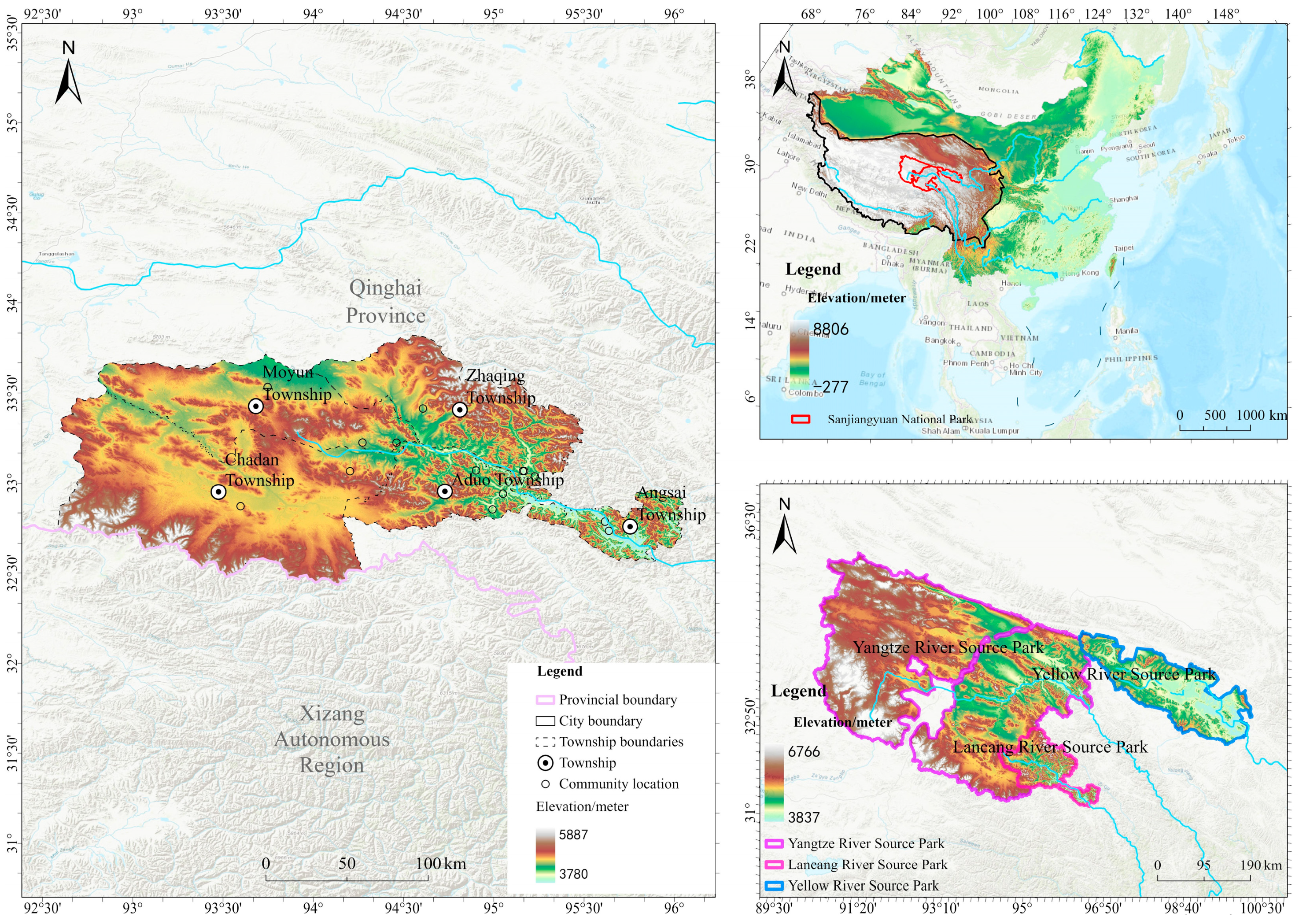
The Park covers 12,100 km2, with an average elevation of over 4000 m (Figure 2). It includes five townships and nineteen villages, collectively housing approximately 33,000 residents. The Park’s ecosystem exhibits high vulnerability [36]. Climate change exacerbates this vulnerability by impacting vegetation dynamics, glaciers, permafrost, and extreme weather events [37]. Vulnerability in this coupled social-ecological system manifests as a reinforcing cycle of ecological degradation and community poverty, creating a vulnerability trap. Meanwhile, pastoral livelihoods are shifting from traditional animal husbandry toward integrated models of ecological conservation and green development. Although this shift increases community incomes, it also introduces new ecological pressures and social stratification [38]. Furthermore, the Tibetan belief in the animacy of all beings fosters a profound reverence of nature. Integrating cultural innovation with ecological conservation creates new opportunities for cultural heritage preservation and environmental protection. Consequently, this region forms a coupled system characterized by intertwined natural disturbances, institutional transformations, and cultural adaptations. These aspects position the Park as a natural platform for an analysis of the resilience of coupled ecology–livelihood–culture systems.
The Park is divided into two zones: a core protection zone and a general control zone. The core protection zone enforces strict limitations on resource use. Conversely, the general control zone allows traditional pastoral activities and moderate natural resource development, aiming to balance ecological conservation and livelihood development. Under the new protected area policy framework, the traditional production methods of pastoral households, which are heavily dependent on natural resources, are restricted. Overall, the primary livelihood sources for pastoral households include animal husbandry, Cordyceps sinensis harvesting, and ecological compensation payments. The Park contains greater Cordyceps sinensis and pasture resources than the Yellow and Yangtze River Source Areas. Pastoral livelihoods rely heavily on seasonal rotational grazing and Cordyceps sinensis harvesting, leading to significant income fluctuations and increased vulnerability. Due to varying perspectives across existing research, the classification criteria for livelihood strategies differ; they are commonly based on livelihood methods and income sources [39,40,41]. Considering that pastoral households in the Park mainly depend on animal husbandry, Cordyceps sinensis harvesting, and policy subsidies, this study classifies them into four categories: livestock-dependent households, cordyceps-dependent households, subsidy-dependent households, and diversified income households. Additionally, some households rely on a single livelihood source besides policy subsidies. Their classification is based on the relative proportions of these two income types.

2.2. Data Source

Data for this study were collected through a questionnaire survey conducted at the Lancang River Source area from March to June 2025. The survey comprised three phases: a preliminary survey (March 2025), a formal survey (April to May 2025), and a supplementary survey (June 2025). The sampling frame for this study comprised the official roster of ecological conservation officers provided by township governments, ensuring that the sample was fully drawn from the target population. Building on this foundation, we implemented a probability sampling method. Among the 19 administrative villages across five townships within the Park, at least 50 households were randomly selected from the roster as survey participants. This randomization process effectively reduced the selection bias that may arise from convenience sampling. The survey employed a hybrid approach that combined face-to-face interviews with online questionnaires to address the complex geographical environment. Although this study did not perform a comprehensive census of the entire population, the sample size was substantial and encompassed all 19 administrative villages (Table 1). A total of 3731 pastoral households participated in the survey. Given the minimal number of missing values in the dataset, this study utilized listwise deletion prior to data analysis to maintain consistency. After questionnaire collection, data entry, verification, and confirmation, 3539 valid questionnaires were obtained, yielding a validity rate of 94.85%. Additionally, to ensure data authenticity, we provided standardized and neutral training for translators, emphasized research independence and the absence of vested interests in responses during interviews, and utilized softened phrasing for sensitive questions in the design of the questionnaire.
The questionnaire comprised 59 questions, employing scales, categorization, and fill-in-the-blank formats to systematically cover four core sections. The first section addressed household demographics to gather essential background information about the respondents and their families, which provided foundational variables for analysis. The second section evaluated household resilience by assessing herders’ abilities to absorb external shocks using existing assets, such as material resources, diversified income streams, and social support networks. The third section assessed the household learning capacity, exploring how households acquired information and skills, enhanced their awareness, and ultimately converted this knowledge into adaptive behavioral adjustments. The fourth section evaluated the household self-organizing capacity, emphasizing the extent to which households managed resources and addressed shared challenges in their communities through participation in organizations, collective action, and influencing rule making. The data were imported into IBM SPSS Statistics (version 23.0) for reliability and validity assessments. Data analysis showed a Cronbach’s α coefficient of 0.668, whereas the reliability coefficients for each dimension exceeded 0.7. This indicated that the scale showed good internal consistency and reliability across all dimensions. Nevertheless, the overall reliability coefficient was slightly below 0.7, a threshold typically considered acceptable in exploratory social surveys [42]. The KMO value was 0.762, indicating sampling adequacy. Furthermore, Bartlett’s test of sphericity yielded a value of 11,385.025 with a significance level of 0.000, confirming the validity of the measurement indicators. The results from SPSS (version 23.0) confirmed the questionnaire data’s significance, ensuring the reliability and accuracy of subsequent analyses.

2.3. Research Methods

This study developed a comprehensive evaluation index system for household livelihood resilience, emphasizing three dimensions: buffer capacity, capacity for learning, and self-organization. Initially, the raw data were normalized using the range normalization method. Composite weights for each indicator were calculated using the entropy method and factor analysis. The composite weighted TOPSIS model was applied to calculate the household livelihood resilience index. Furthermore, K-means clustering was used to identify the spatial distribution of livelihood resilience levels among households. The obstacle degree model was used to determine the five most significant influencing factors. Additionally, the spatial Durbin model was adopted to examine the spatial spillover effects of these key factors. Finally, a hierarchical regression model was used to assess the moderating effects of household characteristics on pathways leading to household livelihood resilience formation.

2.3.1. Indicator System

This study adopts the livelihood resilience measurement framework proposed by Speranza et al. [11]. This framework’s core strengths include its systematic approach, multidimensional analysis, and support for policy formulation and practical implementation [30]. Three core dimensions are identified: buffer capacity, capacity for learning, and self-organization. The framework retains essential resource indicators, including natural capital, physical capital, and human capital [43]. Furthermore, it enhances the assessment of dynamic adaptation processes through indicators such as skills training and non-pastoral employment opportunities [44,45]. This approach aligns closely with the essential needs for livelihood transformation in pastoral areas under ecological constraints. To ensure relevance to national park management, this study incorporates unique indicators, including awareness of policies and grassland dependency [30,46], to quantitatively integrate ecological conservation with livelihood development. It also integrates cultural capital and traditional knowledge into the evaluation system [47,48], addressing the systematic neglect of local knowledge in the SES framework. Moreover, the indicator design considers the specific characteristics of highland pastoral areas. While retaining core production indicators such as pasture quality and livestock quantities, the framework introduces social network indicators, including weak ties connectivity and participation in collective actions [49,50]. This approach addresses the traditional framework’s excessive reliance on individual capital. The livelihood resilience measurement framework developed in this study comprises 30 indicators. Based on the presented theoretical analysis, indicators are classified into relevant dimensions, with the specific definitions detailed in Table 2.
(1)
Data standardization
Variations in the nature, magnitude, and scale of the initial data indicators can influence the evaluation results. Consequently, normalizing the raw data prior to data analysis is crucial [51].
X i j = x i j m i n x i j / m a x x i j m i n x i j
X i j = m a x x i j x i j / m a x x i j m i n x i j
Equation (1) describes the normalization procedure for positive indicators, whereas Equation (2) applies to negative indicators. In these equations, Xij denotes the normalized value and xij the original value.
(2)
Determination of Indicator Weights
Initially, factor analysis was employed to extract independent common factors and calculate their weights based on variance contribution rates. This process reveals the intrinsic structural relationships and potential dimensions among indicators, thereby effectively addressing the issue of multicollinearity [52]. Subsequently, the entropy method was employed to compute information entropy weights based on the dispersion of the indicator data. This method objectively reflects the differences in information content among the indicators associated with the factors [53]. The combined weighting method addresses the distortion of weights resulting from the entropy method’s neglect of indicator correlations and mitigates the indirectness and subjectivity inherent in the original weight allocation component of the factor analysis method. Furthermore, optimizing the weight hierarchy through a balance of subjective and objective evaluations significantly enhances the scientific rigor, robustness, and interpretability of the weighting system. It is crucial to note that factor analysis is mainly used in this study due to the two objective metrics that it provides—variance explained and factor loadings—for the calculation of scientific weights, rather than to test the theoretical structure of the scale or perform dimensionality reduction.
W i = W 1 i W 2 i 1 / 2 / i = 1 n W 1 i W 2 i 1 / 2
Here, W1i and W2i denote the weights derived from the entropy and factor analysis methods, respectively, whereas Wi represents the combined weight calculated through the Lagrange multiplier method.
(3)
Comprehensive Evaluation Using the TOPSIS Model
The Technique for Order Preference by Similarity to Ideal Solution (TOPSIS) model is a multi-attribute decision-making approach. The fundamental function of TOPSIS is to rank evaluation objects according to their performance across multiple attributes by measuring their distances from the ideal best and worst solutions [54]. This approach identifies the optimal solution. In this study, combined weights serve as input for the subsequent TOPSIS analysis, in which we calculate the relative proximity of each herding household to the ideal solution. Employing combined weights effectively mitigates the arbitrariness inherent in the traditional model’s averaging assumption. This approach facilitates a more accurate assessment of the livelihood resilience levels of herding households.
First, we construct the normalized raw matrix X and combine it with the weight matrix to create the weighted comprehensive evaluation matrix Z This matrix reflects the varying contributions of different dimensions to resilience.
X = x i j m n ,   Z = W i × X i j
Next, we identify the positive ideal solution Z+ (optimal value) and the negative ideal solution Z (worst value) for each indicator to serve as evaluation benchmarks.
Z + = m a x Z i j i = 1 , 2 , 3 , , m , Z + = m a x Z i j i = 1 , 2 , 3 , , m
Then, we calculate the Euclidean distance between each household and both the positive ideal solution and the negative ideal solution. These distances represent the gaps from the optimal level Dj+ and the worst level Dj, respectively.
D j + = i = 1 m Z i + Z i j 2 , D j = i = 1 m Z i Z i j 2
Finally, we compute the relative proximity Tj of each household to the negative ideal solution to derive the livelihood resilience index.
T j = D j / D j + D j +
This index ranges from 0 to 1, with higher values indicating greater livelihood resilience for each household.

2.3.2. Analysis of Influencing Factors

The obstacle degree model is utilized to further identify the key factors influencing the livelihood resilience of herders in national parks [43]. Factor contribution and indicator deviation are integrated to construct the obstacle degree diagnostic model. The equation is presented below:
O j = W i × A i j / j = 1 n W i × A i j × 100 %
Here, Wi denotes the degree of influence of a single factor on the overall indicator, reflecting its weight regarding the overall objective. Aij indicates the indicator deviation, reflecting the disparity between individual indicators and the comprehensive level. Oj signifies the factor obstacle degree, indicating the influence of individual indicators on the livelihood resilience of herders.
Furthermore, to investigate the spatial effects of factors influencing the livelihood resilience of herder households, the geographic detector model was initially employed to identify the spatial heterogeneity of these factors. However, the results were not statistically significant, indicating weak spatial heterogeneity. Therefore, the Spatial Durbin Model (SDM) is utilized to assess the spatial spillover mechanisms of factors influencing the livelihood resilience of herder households [55]. The equation is presented below:
Y = ρ W Y + X β + W X θ + ε
Here, Y represents the livelihood resilience vector for the 19 villages, X includes the five key factors identified using the obstacle degree model, and W is the binary spatial weight matrix constructed based on the geographical adjacency of these villages. The parameter ρ characterizes the spatial dependence of the dependent variable, β indicates the direct effects of local influencing factors, and θ captures the spatial spillover effects of factors from neighboring villages, thereby quantifying the resilience synergy mechanism across village boundaries.

2.3.3. Moderation Effect Measure

Beyond the abovementioned factors, family characteristics—including age, gender, spatial zoning, and income type—significantly influence the structure and dynamics of livelihood resilience through their impacts on resource acquisition, capacity building, and social participation. Consequently, this study utilizes a hierarchical regression model to examine how the sample’s characteristics moderate the pathways of livelihood resilience formation [56]. A continuous moderating variable serves as an illustrative example to develop a generalizable model.
Y = β 0 + β X X + β M M + β X M X × M + ε
In this context, X′ and M′ represent the centered independent variable and the moderating variable, respectively, while βXM indicates the strength of the moderating effect. Initially, we established a baseline model that encompassed only the main effects of key influencing factors. Subsequently, we enhanced the baseline model by sequentially adding moderator variables and interaction terms between the independent and moderator variables, resulting in a comprehensive model that incorporated moderation effects. To mitigate multicollinearity and improve the interpretation of interaction coefficients, continuous independent variables were mean-centered by subtracting the sample mean before their inclusion in the model. Categorical moderator variables were dummy-coded, with females, individuals aged 18–35, the control zone, and livestock-dependent households as reference groups. In the hierarchical regression analysis, we compare the changes in the explanatory power of the models before and after including interaction terms and assess the significance of βXM through t-tests, thereby revealing heterogeneous pathways of resilience formation within the context of social demographics and spatial differentiation. Given the typically low power in detecting moderation effects, we adopt a 90% confidence interval as the criterion to assess the significance of interaction terms in our analysis. This approach is consistent with methodological recommendations aimed at balancing the risks of type I and type II errors [57]. When a model includes a significant interaction term, interpreting main effects in isolation can be limiting and even misleading. Therefore, this study focuses on analyzing and interpreting interaction effects to directly highlight the moderating role of family characteristics.

2.3.4. Robustness Testing Strategy

To verify the reliability of the livelihood resilience index developed in this study, a robustness test was performed. Specifically, the TOPSIS livelihood resilience index was recalculated using three distinct weighting schemes: (1) entropy-based weighting, with objective weights derived exclusively from the entropy method; (2) factor analysis weighting, with weights derived exclusively from the variance contribution rates obtained through factor analysis; (3) equal weighting, with equal weights assigned to all 30 indicators. Consistency among the resilience index results calculated using these weighting schemes was compared.
To address the limited village-level sample size (N = 19) and validate the robustness of the spatial spillover effects, we conducted a series of tests. First, we replaced the spatial weight matrix. Besides the baseline adjacency matrix, we constructed a K-nearest neighbor matrix (K = 4) to evaluate the sensitivity to various spatial relationship definitions. Second, we applied bootstrap inference. Employing a non-parametric bootstrap method with 5000 resamples, we calculated robust standard errors and confidence intervals for key parameter estimates of the spatial Durbin model (SDM), with an emphasis on spatial effects. Finally, we conducted model specification tests. Through the likelihood ratio test (LR test), we confirmed the superiority of the spatial Durbin model (SDM) over the spatial error model (SEM) and the spatial lag model (SLM).

3. Results

3.1. Livelihood Resilience Assessment Results

3.1.1. Composition of Household Resilience

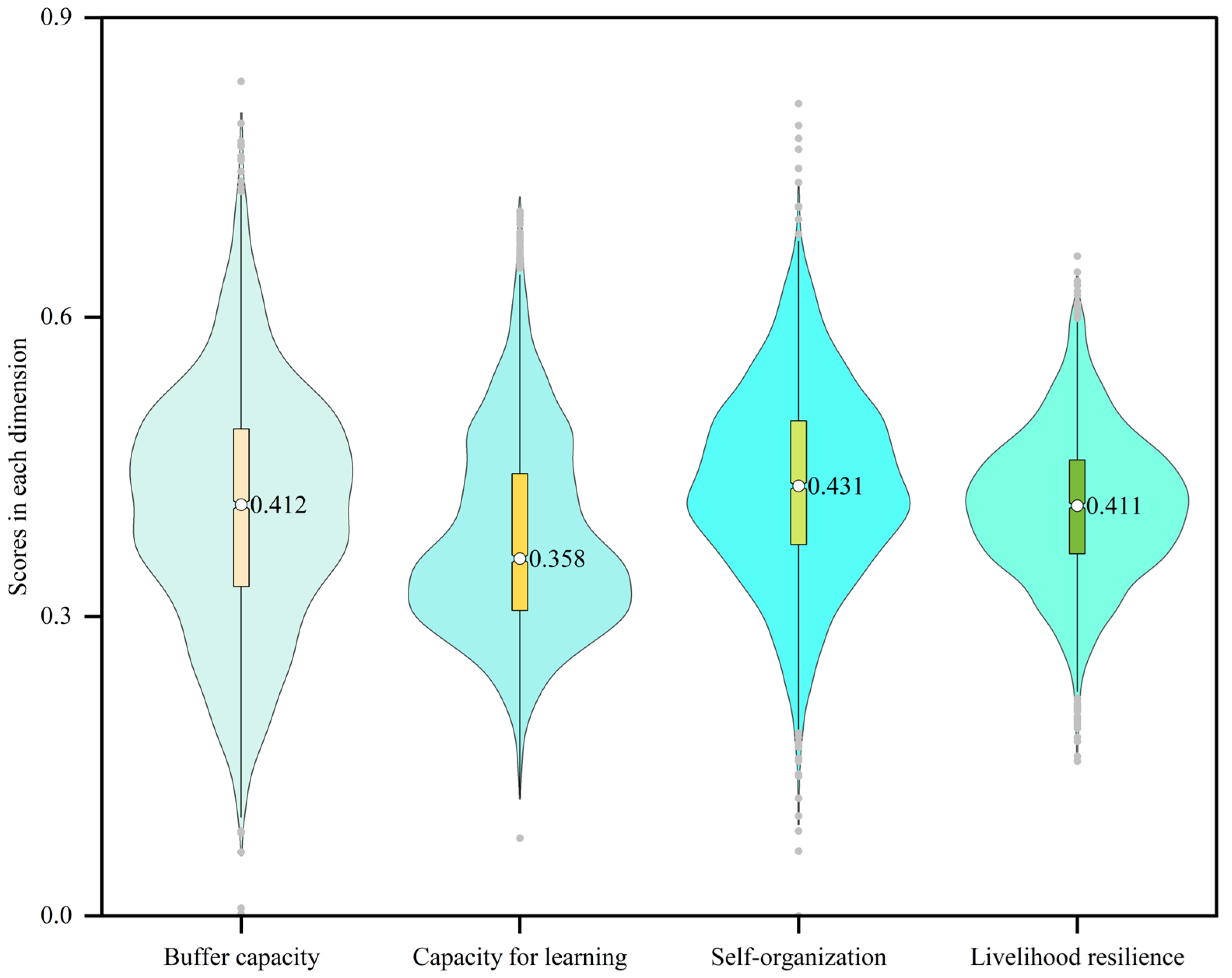
The livelihood resilience index, buffering capacity index, learning capacity index, and self-organizing capacity index were calculated individually using the previously introduced combined weighting–TOPSIS model. Furthermore, the resilience indices derived from various weighting schemes—including the entropy, factor analysis, equal weighting, and combined weighting methods—exhibited strong positive correlations. Specifically, the Pearson correlation coefficients for all pairs of schemes indicated strong positive correlations, with a minimum value of 0.887 and most exceeding 0.95, all significant at p < 0.001. This suggests that the livelihood resilience levels measured in this study were insensitive to the weighting assignment method, resulting in robust outcomes. Subsequently, violin plots for each dimension of livelihood resilience were generated using the Origin (2021) software (Figure 3). The numbers displayed within the plots represent the average scores for each dimension. The gray dots extending both upward and downward represent individual outlier households. The wider sections of each violin shape illustrate the concentration of individual scores within the given range.
The mean buffering capacity score is 0.412 (±0.118 SD), slightly above the median. However, the box plot height and the violin plot widths reveal substantial individual variation and a large number of intermediate values. The mean capacity for learning score is 0.358 (±0.096 SD), the lowest among all categories. Its distribution is relatively narrow, indicating that most herders exhibit low, closely clustered learning capacities. The mean self-organization score is 0.431 (±0.096 SD), the highest among the categories, with a wider distribution. The higher box plot position suggests that herders generally possess strong self-organization capabilities. The mean livelihood resilience score is 0.411 (±0.072 SD), comparable to that for the buffer capacity and the overall mean. The distribution is relatively uniform, indicating that herders’ livelihood resilience is somewhat above average with some individual variation. Overall, herders exhibit the weakest learning capacities, reflecting deficiencies in knowledge acquisition, skills training, information absorption, and adaptive learning. This deficiency may limit their long-term adaptability and transformative capacity. Self-organization is the strongest dimension and shows considerable variation, suggesting that social capital, mutual aid groups, and grassroots organizations function effectively overall. Some herders perform exceptionally well, providing an advantage that can enhance other capabilities. Buffer capacity and livelihood resilience are moderate but vary noticeably among individuals. Some herders have strong risk diversification strategies, while others remain vulnerable, highlighting the need for targeted interventions.

3.1.2. Village Clusters and Spatial Patterns

This study uses the village as the smallest geographical unit. We calculated the arithmetic mean of the TOPSIS scores for all herding households in each village to derive the village-level livelihood resilience. This aggregation method is widely utilized in community-level research because it allows an assessment of the overall average performance of villages [58]. Building on this foundation, we applied the K-means clustering method to categorize the 19 villages into distinct types. We compared various cluster numbers (K = 2, 3, 4) and identified K = 3 as the optimal solution, yielding an average silhouette coefficient of 0.733. This value significantly exceeded those at K = 2 (0.630) and K = 4 (0.655), indicating strong discrimination and internal consistency in the clustering results. The final cluster centers clearly delineated three village types, as measured by the TOPSIS relative proximity (range: 0–1). Type 1 includes high-resilience villages (livelihood resilience = 0.446, buffering capacity = 0.487, learning capacity = 0.401, self-organizing capacity = 0.425), demonstrating balanced and high performance across all three dimensions. Type 2 includes moderate-resilience villages (livelihood resilience = 0.421, buffering capacity = 0.429, learning capacity = 0.366, self-organizing capacity = 0.445), characterized by a particularly strong self-organizing capacity. Type 3 includes low-resilience villages (livelihood resilience = 0.403, buffering capacity = 0.395, learning capacity = 0.416, self-organizing capacity = 0.371), exhibiting relatively weaker buffering and self-organizing capacities. This outcome reveals a complete gradient pattern, providing a foundation for subsequent spatial analysis.
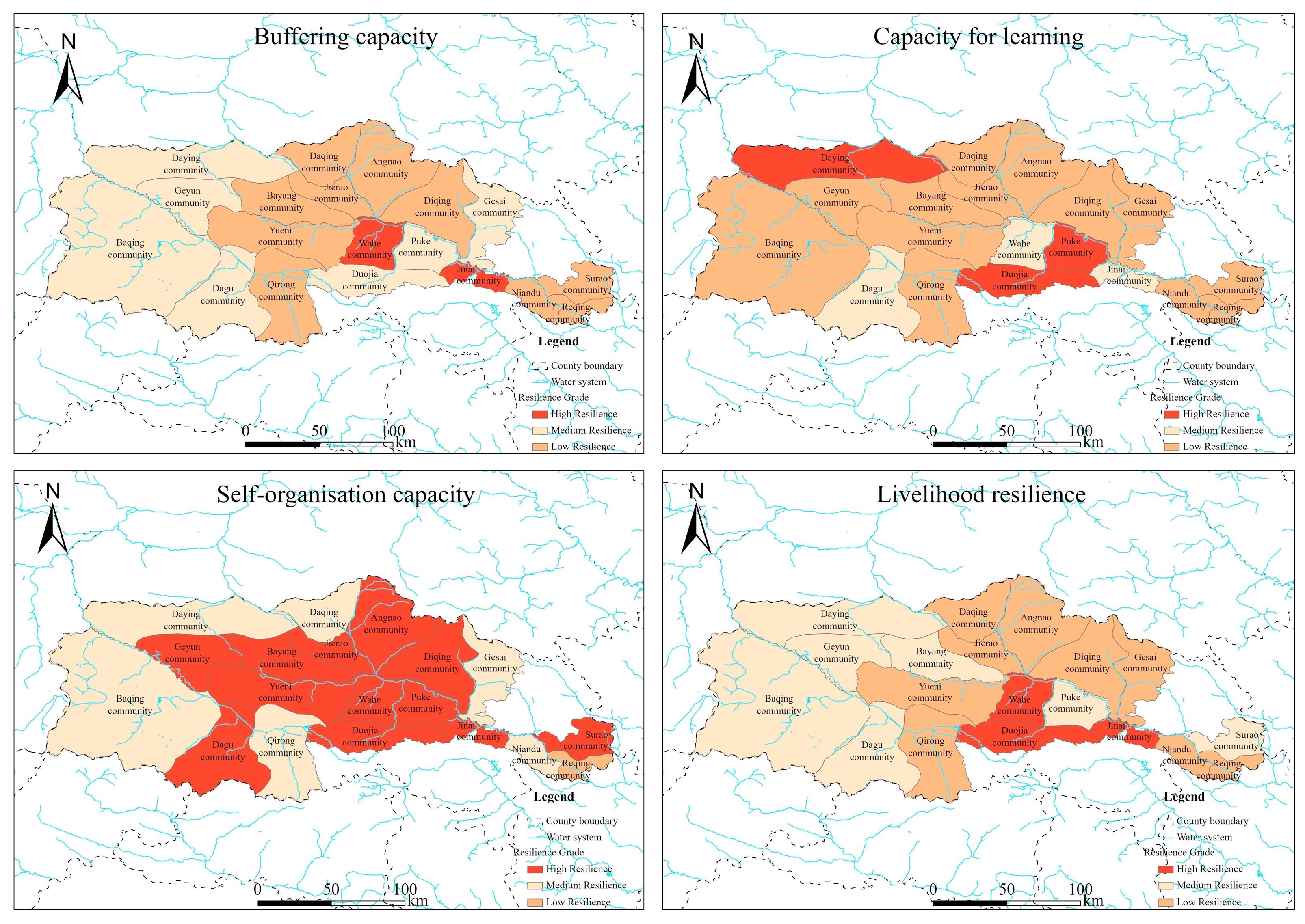
Figure 4 illustrates the spatial distribution of livelihood resilience across different dimensions among the 19 villages. Considering the buffer capacity, high-resilience villages are mainly concentrated in the central to southeastern regions. Moderate resilience exhibits a band-like distribution extending toward the central and western regions, while low resilience is seen mainly along the western edge and in some eastern villages. In terms of the capacity for learning, high-resilience villages are scattered throughout the Park, primarily in the eastern and northwestern areas. Moderate resilience is concentrated in the central and southeastern areas, whereas low resilience is more prevalent, especially in the southwestern and central zones. Villages with high self-organization resilience have the widest distribution, covering most central and western areas. Low-resilience villages are fewer in number and are mainly located at the northwestern edge and in some eastern areas. Concerning livelihood resilience, high-resilience villages are concentrated in the central and eastern regions, while moderate and low scores dominate the western and central areas. Among the four dimensions, high resilience in self-organization shows the widest coverage, indicating that internal governance and mutual aid mechanisms at the village level are generally robust. In contrast, significant regional disparities exist in the capacity for learning and livelihood resilience, highlighting an imbalance among villages; buffer capacity shows a pattern in which it is strong in the center and weak at the edges. The Park’s overall structure reflects a core–periphery model, where central and some eastern villages perform well across multiple dimensions, forming a relatively stable high-resilience zone. Conversely, villages at the western and northwestern edges show a weaker buffer capacity, capacity for learning, and livelihood resilience but maintain relatively strong self-organization. This suggests that traditional social capital remains a key resource for risk management in peripheral areas.

3.2. Results of Influencing Factor Evaluation

3.2.1. Identification of Influencing Factors

To identify key factors influencing livelihood resilience across diverse family characteristics, obstacle index scores were calculated using Formula (8). The five most significant factors limiting livelihood resilience were then selected for detailed analysis. The findings indicate household savings (X6), cooperative participation (X8), skills training (X12), education levels (X13), and information acquisition abilities (X14) as critical factors limiting improvements in herders’ livelihood resilience.
A detailed analysis of Table 3 reveals that the operational mechanisms of the five major obstacles exhibit a clear pattern of overall stability with localized variations. First, these factors consistently rank among the top five across all eleven subgroups, with their order (X8 > X13 > X12 > X6 > X14) remaining stable in most instances, confirming their status as common bottlenecks. However, intergroup differences in obstacle severity provide critical insights for targeted interventions. Pastoralists in core protected areas encounter significant challenges in cooperative participation, highlighting unique difficulties in building social capital under stringent ecological constraints. The relatively weak barriers to educational attainment among youth suggest positive trends in intergenerational human capital enhancement. Conversely, the comparatively high barriers faced by women in terms of education and information acquisition highlight structural disadvantages in human capital investment for this group. Therefore, while identifying common constraints, this study also reveals the unique barriers encountered by different groups through detailed intergroup comparisons. This provides strong empirical evidence for a transition from universal policies to differentiated governance strategies.

3.2.2. Results of Spatial Effect Analysis

In this study, we incorporate all five key influencing factors identified using the spatial degree of moderation (SDM) model, along with their spatial lag terms, into a spatial Durbin model. This modeling choice is based on theoretical and practical considerations. The SDM does not specify which variables exhibit spatial spillovers; therefore, including all core variables as spatial lags provides a strong foundation for the capture of potential spatial dependencies [59]. Importantly, these factors have the potential to create cross-regional impacts. For example, cooperative participation can affect surrounding areas through intervillage demonstration effects and knowledge diffusion. Furthermore, the benefits of information acquisition abilities may decrease with geographical distance, while human capital factors may generate spillovers through labor mobility. Consequently, incorporating spatial lags for all variables allows us to establish a comprehensive framework to empirically test the existence of these factors and their effects on the livelihood resilience of neighboring households.
This study analyzes the spatial patterns across the entirety of the Park by including all villages as research subjects, resulting in a fixed sample size of 19. Although this sample size limits the statistical power, it ensures research boundary integrity and provides direct reference value for park management. We performed a likelihood ratio test (LR test) to determine the appropriate model specification. The results yielded LR test statistics of 13.591 and 13.363, with corresponding p-values of 0.018 and 0.038. At the 5% significance level, we reject the null hypothesis that the spatial Durbin model (SDM) can be simplified to either the spatial lag model (SLM) or the spatial error model (SEM). Thus, it is confirmed that the SDM is the superior model specification for this study. Furthermore, the Breusch–Pagan (BP) test (p = 0.353) and Jarque–Bera (JB) test (p = 0.340) indicate no heteroscedasticity and confirm that the residuals were normally distributed. The model estimation results (Table 4) clearly reveal the spatial effect patterns of various factors.
The model’s adjusted R2 is 0.843, demonstrating the strong combined explanatory power of the variables. A key finding is that the spatial lag term of livelihood resilience (W×LR) is significantly negative at the 1% level, suggesting competitive spatial interactions among villages with a core–periphery pattern. Conversely, the spatial lag of W×X8 is significantly positive at the 1% level, indicating a synergistic spatial pattern. To evaluate the robustness of the core findings, alternative spatial weight matrices were employed in a sensitivity analysis. We constructed a K-nearest neighbor weight matrix (K = 4) to replace the binary adjacency matrix and re-estimated the spatial Durbin model (SDM). The results showed that, under the K-nearest neighbor weight matrix, W×X8 remained significantly positive at the 1% significance level (regression coefficient = 0.266, p < 0.001). The sign and significance of both its direct and indirect effects remained stable. Simultaneously, W×HLR remained consistently and significantly negative (regression coefficient = −0.907, p = 0.007). These results strongly indicate that the two core spatial patterns identified in this study—cooperative synergies and regional competitive patterns—are robust.
Table 5 presents the direct, indirect, and total effects along with their 95% confidence intervals, calculated using 5000 bootstrap samples. Effects with confidence intervals excluding zero are statistically significant at p < 0.05 and are highlighted in bold. This method is more suitable for our small sample size (N = 19) than asymptotic theoretical approaches, thereby enhancing the robustness. The results indicate that cooperative participation (X8) serves as the primary driver of livelihood resilience. Its direct effect (0.069, p < 0.01), indirect effect (0.061, p < 0.01), and total effect (0.130, p < 0.01) are all significantly positive. This indicates that cooperative participation not only significantly enhances household livelihood resilience within the village but also generates strong positive spatial spillover effects through knowledge diffusion and joint marketing, benefiting surrounding villages. Cooperative development represents a win–win public policy that strengthens overall regional resilience. Information acquisition abilities (X14) primarily produce local benefits. Its direct effect is significantly positive (0.040, p < 0.01), whereas the indirect effect is not significant (p > 0.05). This implies that the benefits of information acquisition abilities are largely confined to the village, failing to produce significant cross-village spillovers. This may be attributed to the private and competitive nature of information use, suggesting the presence of a digital divide. The remaining variables—household savings, education level, and skills training—show no statistically significant effects (p > 0.05), indicating weak spatial transmission mechanisms at the village level.

3.3. Results of the Moderation Effect Assessment

A hierarchical regression analysis was conducted to assess the moderating effects of gender, age, geographic region, and livelihood type on the development of livelihood resilience. Model comparisons revealed that including moderator variables and interaction terms significantly improved the model’s explanatory power, indicating that the moderation effects are statistically significant. Table 6 presents detailed results, including the regression coefficients, standard errors, exact p-values, 95% confidence intervals, and overall model fit statistics. These results facilitate the direct interpretation of the moderation patterns. The results show that all specified moderating variables have significant interaction effects. This indicates that the influence of individual factors on livelihood resilience pathways is substantially affected by household heterogeneity.
Women gain significantly greater marginal benefits from training than men, underscoring the gender disparities in training outcomes. A similar trend is observed at higher education levels, reflecting women’s unique potential and structural advantages in non-agricultural employment and human capital transformation. The positive effects of skills training are mainly concentrated among youth (aged 18–35), whereas its impact on the middle-aged group (aged 35–60) declines significantly with age. However, primary education exhibits a strong and lasting protective effect on the livelihood resilience of middle-aged and elderly individuals, particularly those over 60, highlighting the long-term benefits of early educational investment. Regarding livelihood types, the moderating effects confirm that interventions must be tailored to specific livelihood strategies. Skills training positively affects policy households that are dependent on transfer payments and serves as an effective approach to achieving sustainable livelihoods. For cordyceps-dependent households, information acquisition is a critical resilience source in coping with market fluctuations; enhancing this capacity positively affects their resilience.
The moderating effects of functional zoning reveal the unique challenges faced by residents in core protected areas. In these areas, even moderate household savings (CNY 50,000 to 100,000) contribute significantly less to livelihood resilience compared to the control group. Similarly, cooperative participation, generally considered to enhance resilience, exhibits suboptimal effects in core areas. This suggests that, under strict ecological constraints, traditional capital accumulation and organizational pathways cannot be effectively translated into livelihood resilience, highlighting the urgent need to explore alternative green development solutions. To further validate the institutional environment’s moderating role, we performed regression analyses grouped by functional zone. The results indicate that cooperative participation generally has a positive effect on livelihood resilience; however, the effect size varies significantly across functional zones. In the general zone, characterized by relatively relaxed ecological regulations, the positive effect of cooperative participation was the strongest (B = 0.080, p < 0.01). Conversely, in the core zone, subject to stringent ecological controls, the effect remained significantly positive but notably weaker (B = 0.072, p < 0.01), indicating an approximately 10% reduction in effect size. This finding suggests that stringent ecological conservation policies partially suppress but do not eliminate the role of cooperatives in enhancing livelihood resilience. It highlights the critical filtering role of institutional environments in shaping local development pathways.

4. Discussion

This study deepens our understanding of livelihood resilience by identifying family heterogeneity as a vital moderating factor. The findings consistently show that resilience formation does not follow a simple linear trajectory based solely on capital endowment. Rather, resilience arises synergistically from internal family characteristics, external policy environments, and strategic livelihood decisions. The following sections synthesize these findings using a micro–meso–macro analytical framework and situate them within a broader theoretical and comparative context.

4.1. Gender and Life Cycle Shape Intervention Response Pathways

Our findings challenge the widespread assumption in livelihood resilience research that households are homogeneous units. This study shows that the household demographic composition—particularly the gender and age distribution—fundamentally determines the return on human capital investment. This provides a crucial-microfoundation for an understanding of the varied impacts of development interventions within protected areas. Contrary to the common perception of nomadic women as marginalized, female-headed households in this study realized significantly greater resilience gains from skills training and higher education. This finding challenges the single-household model prevalent in economics and development studies, which often masks gender disparities in resource allocation and investment returns [60]. This study both aligns with and extends intra-household allocation theory. It reveals that entrenched patriarchal investment strategies prioritize males due to perceived higher market returns, resulting in the structural undervaluation of women’s potential within resource-constrained traditional systems [61]. Consequently, women often diversify through informal income streams, enabling higher marginal returns from skills training, which supports industrial diversification beyond traditional pastoralism [21]. This finding suggests that empowering women addresses equity concerns and serves as an effective strategy to improve household resilience [31]. It facilitates sustainable livelihood transitions despite the constraints imposed by national parks.
Age significantly influences outcomes, highlighting the necessity of adopting a life-cycle perspective in resilience theory and application. Skills training has a pronounced positive effect on young herders (aged 18–35), consistent with innovation adoption theory, which emphasizes younger cohorts’ greater physical mobility, openness to innovation, and longer investment return periods [35,62]. Conversely, basic formal education provides lasting protective benefits for middle-aged and older herders, revealing a less explored dimension of human capital. This finding supports the experience compensation effect [63], showing that foundational literacy and numeracy enable older individuals to effectively utilize tacit knowledge gained from pastoral management and traditional risk-coping strategies [64]. These results allow us to refine the concept of capital in nomadic contexts by distinguishing adaptive capital (transitional skill training) from foundational capital (stability-focused education). Treating households as homogeneous units obscures these critical dynamics. Therefore, we propose a dual theoretical and practical shift by implementing life-cycle–focused interventions that recognize heterogeneity in capital returns across gender and age groups. In governing SNP, this necessitates a move beyond uniform training models. Precision governance requires the stratified management of pastoralist groups and customized human capital investments that consider the distinct capacities and roles of women, youth, and elders in achieving conservation and development goals.

4.2. Policy Environment and Livelihood Choices Collaboratively Construct Resilience

Beyond household characteristics, our analysis reveals that livelihood resilience emerges from the dynamic interaction between macro-level institutional environments and micro-level livelihood strategies. This finding addresses a common oversight in socio-ecological studies, which often treat policies and livelihood types as independent variables, neglecting their synergistic role as regulatory filters that convert capital into resilience [65]. First, ecological functional zoning serves as a robust institutional filter, redefining rules governing the conversion of capital into resilience [66]. The significant weakening of savings and cooperative participation effects in core protected areas reveals how stringent conservation mandates suppress traditional resilience pathways dependent on resource expansion or intensive development. This observation extends institutional economics to protected area management, demonstrating that policies are not mere external contexts but active forces that recalibrate the utility of household assets [22]. Meanwhile, the ordinary control zone, functioning as an ecological–economic buffer, provides additional opportunities through skills training, effectively activating human capital to support green development goals [67]. Thus, functional zoning fundamentally reshapes the effectiveness of household resource endowments through two institutional mechanisms: suppression and activation. This nuanced perspective challenges the conventional view that policies uniformly impose constraints or empower households.
Second, a household’s primary livelihood strategy functions as an internal strategic filter, reflecting its asset accumulation, risk profile, and cognitive patterns. Cordyceps-dependent households show heightened sensitivity to information acquisition, aligning with the theory of livelihood diversification in volatile environments. Timely market intelligence serves as a critical intangible asset, enabling households to navigate price fluctuations and seize fleeting opportunities [34]. Conversely, for subsidy-dependent households prioritizing stability, skills training provides a key pathway by which to reduce welfare dependencies and develop alternative capabilities. This finding supports prior research in other conservation contexts [25], highlighting the importance of building adaptive capacity among vulnerable groups. This strategic alignment shows that intervention effectiveness is not inherent but is contingent upon alignment with household livelihood logic [68]. Our findings emphasize that livelihood strategies act as dynamic regulators rather than static outcomes, determining the efficacy of external interventions and thereby refining the sustainable livelihoods framework. Consequently, one-size-fits-all approaches are theoretically flawed and practically ineffective. For the effective governance of SNP, interventions must achieve dual alignment: compatibility with the zoned management system and relevance to household livelihood strategies. This study offers a robust theoretical and empirical foundation for transitioning from standardized support toward a differentiated, collaborative governance model that aligns institutional design with household strategies.

4.3. Spatial Patterns of Resilience as Influenced by Household Heterogeneity

Our spatial analysis reveals that the geographic distribution of livelihood resilience is non-random and exhibits a clear core–periphery pattern. This study redefines livelihood resilience as an emergent property resulting from the heterogeneous spatial aggregation of households. This perspective bridges the gap between micro-level household decisions and macro-level regional geography, extending beyond explanations based solely on physical infrastructure or resource endowments. The significant negative spatial autocorrelation of resilience (W × HLR = −0.787, p = 0.001) indicates a competitive dynamic, in which highly resilient villages frequently border low-resilience ones. This pattern empirically supports the application of core–periphery models from regional development theory to protected area contexts [69], suggesting processes of resource concentration and polarization. However, these underlying mechanisms originate from micro-level stratification. Villages with superior infrastructure and information acquisition abilities tend to attract and retain households possessing higher human capital and greater potential for diversified development [70]. In contrast, remote peripheral villages frequently comprise households dependent on traditional nomadic practices, typically exhibiting lower educational attainment and marked population aging [71]. Thus, spatial disparities at the macro level fundamentally reflect the geographic manifestation of micro-level household stratification and inequality.
The distinct spatial effects of key influencing factors further elucidate the underlying mechanisms driving this pattern. The significant positive spatial spillover effect of cooperative participation (W × X8 = 0.147, p < 0.001) underscores its function as a regional institution, extending the benefits beyond village boundaries. This effect operates through social networks linking actively participating households, facilitating the flow of knowledge, resources, and market access across communities [72,73]. Conversely, benefits from information acquisition abilities (X14) remain highly localized, yielding no significant indirect effects. This finding empirically supports spatial spillover theory by revealing distinct spatial transmission patterns across different capital types. Relational and collaborative social capital within cooperatives naturally diffuses through social networks [74]. However, information capital often evokes privacy and competitive concerns during use, which hinder automatic diffusion and may exacerbate spatial digital divides [75]. This study empirically demonstrates that achieving cross-boundary benefits critically depends on the intrinsic properties of capital and on households’ existing social and human capital. These factors determine households’ capacities to absorb and share capital, thus enriching the theory of spatial spillover effects.
Resilient spatial patterns both influence and are influenced by household dynamics. The effective governance of vast protected areas such as SNP requires policies promoting regional coordination and mitigating spatial inequality across geographical boundaries. These policies should specifically target key household groups and capital types that facilitate positive spatial mobility. Our study rejects geography-based interventions and advocates for spatially informed, household-oriented strategies. For example, fostering inter-village cooperative alliances can institutionalize and enhance the positive spillover effects of social capital. Addressing the localized benefits of information resources requires targeted infrastructure investment and digital literacy training tailored to the capacities of marginalized households. Ultimately, understanding and addressing the microfoundations of household heterogeneity is essential in reshaping macro-level resilience patterns in protected landscapes.

4.4. Robustness Assessment and Future Research Directions

This study was conducted under a rigorous ethical framework, which is essential for research integrity and validity. Prior to data collection, informed consent was obtained from all participants. Anonymity and confidentiality were ensured to guarantee authentic responses. To mitigate potential biases, local translators underwent standardized training to maintain neutrality and accurately convey the questions. This training ensured that data collection respected local norms and time constraints.
Robustness assessments confirmed the high reliability of our core finding regarding cooperative participation. The positive direct and spatial spillover effects remained statistically significant and consistent across alternative spatial weight matrices and non-parametric bootstrap methods. This solidifies cooperative participation’s role as a key mechanism for regional resilience. Conversely, the non-significant spatial effects of household savings, education, and skills training at the village level highlight their scale-dependent nature. This suggests that their influence is confined to the household level. The findings obtained from the moderation analysis, some of which were based on 90% confidence intervals to balance statistical power in this exploratory study, should be considered preliminary and require validation with larger samples.
Building on these insights, future research should adopt several key approaches to enhance causal inference and mechanistic understanding. The first is collecting panel data to monitor livelihood resilience dynamics over time; the second is developing multilevel models to disentangle effects at the household and village levels; the third is identifying suitable instrumental variables to address endogeneity, including those associated with cooperative participation. Additionally, visualization tools, such as marginal effect plots, can be employed to illustrate the nuanced conditional effects of the key interactions identified in this study, thereby enhancing the current findings.

5. Conclusions

This study elucidates the mechanisms underlying differentiated livelihood resilience among herders in SNP by explicitly modeling household heterogeneity as a moderating variable. Our findings indicate that overall herder resilience is moderate, yet it is characterized by significant structural imbalances and a distinct core–periphery spatial pattern. Importantly, the household gender, age, livelihood strategy, and institutional environment significantly moderate the effects of key factors. These factors include training and cooperative participation. Consequently, we recommend that future park management focus on (1) activating positive spatial linkages by institutionally amplifying cross-community spillovers from cooperatives; (2) targeting heterogeneous groups by prioritizing support for those with higher returns on human capital investments; and (3) promoting institutional synergy by developing green livelihoods that are compatible with strict conservation goals. These directional insights, derived from correlational evidence, warrant further refinement through pilot projects and longitudinal studies.
These findings collectively provide three major contributions. Theoretically, this study advances livelihood resilience research by shifting from a static, capital-centric paradigm to a dynamic, synergistic framework. By empirically validating household heterogeneity as a central moderating mechanism—as demonstrated by the greater marginal benefits of skills training for women and youth and reduced cooperative efficacy in the core zone—we challenge the homogeneity assumption and reveal differentiated pathways through which assets enhance resilience. Methodologically, we have developed and validated a comprehensive analytical framework integrating weighted TOPSIS, the spatial Durbin model, and hierarchical regression. This integrated approach offers a replicable tool to simultaneously quantify resilience levels, spatial spillover effects, and micro-level moderating mechanisms. It provides a holistic understanding beyond conventional analyses. Empirically, we offer robust, evidence-based guidance for precision governance in protected areas. We identify the spatial spillover value of key levers, such as cooperatives, and empirically demonstrate that intervention effectiveness depends on the household context. This finding directly supports a strategic shift from standardized interventions toward targeted policies tailored according to spatial and group dimensions.

Author Contributions

Methodology, J.C. and H.M.; software, B.X. and G.D.; validation, Z.S. and T.P.; formal analysis, J.C.; data curation, B.X.; writing—original draft preparation, J.C. and Z.S.; writing—review and editing, J.C. and B.X.; visualization, G.D. and T.P.; supervision, H.M.; funding acquisition, H.M. All authors have read and agreed to the published version of the manuscript.

Funding

This study was funded by Major Projects of Philosophy and Social Science Planning in Qinghai Province (24ZT001), the Western Project of the National Social Science Foundation of China (21XGL013), and Youth Project of Philosophy and Social Science Planning in Qinghai Province (24QN084).

Institutional Review Board Statement

The ethical review of this study was waived by the School of Geographical Sciences at Qinghai Normal University, which also issued the formal exemption letter.

Informed Consent Statement

Informed consent was obtained from all subjects involved in the study.

Data Availability Statement

The data that support the findings of this study are available on request from the corresponding author.

Acknowledgments

We sincerely thank Suonan Duojia, Zhaqing Township, for his valuable assistance during the questionnaire survey.

Conflicts of Interest

The authors declare no conflicts of interest.

References

  1. Piemontese, L.; Terzi, S.; Di Baldassarre, G.; Menestrey Schwieger, D.A.; Castelli, G.; Bresci, E. Over-Reliance on Water Infrastructure Can Hinder Climate Resilience in Pastoral Drylands. Nat. Clim. Change 2024, 14, 267–274. [Google Scholar] [CrossRef]
  2. Tugjamba, N.; Walkerden, G.; Miller, F. Adapting Nomadic Pastoralism to Climate Change. Clim. Change 2023, 176, 28. [Google Scholar] [CrossRef]
  3. Chai, G.; Guo, J.; Lei, Y.; Su, Y. Ecological Sustainability: A “Natural-Social-Digital” Analysis Framework for China’s National Park Policy. J. Environ. Manag. 2025, 391, 126400. [Google Scholar] [CrossRef] [PubMed]
  4. Peng, W.; Kong, D.; Wu, C.; Moller, A.P.; Longcore, T. Predicted Effects of Chinese National Park Policy on Wildlife Habitat Provisioning: Experience from a Plateau Wetland Ecosystem. Ecol. Indic. 2020, 115, 106346. [Google Scholar] [CrossRef]
  5. Risvoll, C.; Hovelsrud, G.K.; Riseth, J.A. Falling between the Cracks of the Governing Systems: Risk and Uncertainty in Pastoralism in Northern Norway. Weather Clim. Soc. 2022, 14, 191–204. [Google Scholar] [CrossRef]
  6. Su, X.; Shen, Y.; Dong, S.; Liu, Y.; Cheng, H.; Wan, L.; Liu, G. Feedback and Trigger of Household Decision-Making to Ecological Protection Policies in Sanjiangyuan National Park. Front. Plant Sci. 2022, 12, 827618. [Google Scholar] [CrossRef]
  7. Hou, L.; Xia, F.; Chen, Q.; Huang, J.; He, Y.; Rose, N.; Rozelle, S. Grassland ecological compensation policy in China improves grassland quality and increases herders’ income. Nat. Commun. 2021, 12, 4683. [Google Scholar] [CrossRef]
  8. Yang, M.; Dong, S.; Dong, Q.; Xu, Y.; Zhi, Y.; Liu, W.; Zhao, X. Trade-offs in ecological, productivity and livelihood dimensions inform sustainable grassland management: Case study from the Qinghai-Tibetan Plateau. Agric. Ecosyst. Environ. 2021, 313, 107377. [Google Scholar] [CrossRef]
  9. Li, T.; Singh, R.K.; Pandey, R.; Liu, H.; Cui, L.; Xu, Z.; Xia, A.; Wang, F.; Tang, L.; Wu, W.; et al. Enhancing sustainable livelihoods in the Three Rivers Headwater Region: A geospatial and obstacles context. Ecol. Indic. 2023, 156, 111134. [Google Scholar] [CrossRef]
  10. Fan, Y.; Shi, X.; Li, X.; Feng, X. Livelihood resilience of vulnerable groups in the face of climate change: A systematic review and meta-Analysis. Environ. Dev. 2022, 44, 100777. [Google Scholar] [CrossRef]
  11. Speranza, C.I.; Wiesmann, U.; Rist, S. An indicator framework for assessing livelihood resilience in the context of social–ecological dynamics. Glob. Environ. Change 2014, 28, 109–119. [Google Scholar] [CrossRef]
  12. Baird, T.D. Pastoralist Livelihood Diversification and Social Network Transition: A Conceptual Framework. Pastor.-Res. Policy Pract. 2024, 14, 12892. [Google Scholar] [CrossRef]
  13. Quinlan, A.E.; Berbes-Blazquez, M.; Haider, L.J.; Peterson, G.D. Measuring and assessing resilience: Broadening understanding through multiple disciplinary perspectives. J. Appl. Ecol. 2016, 53, 677–687. [Google Scholar] [CrossRef]
  14. Liu, W.; Li, J.; Ren, L.; Xu, J.; Li, C.; Li, S. Exploring Livelihood Resilience and Its Impact on Livelihood Strategy in Rural China. Soc. Indic. Res. 2020, 150, 977–998. [Google Scholar] [CrossRef]
  15. Aschinger, R.; Boillat, S.; Speranza, C.I. Smallholder livelihood resilience to climate variability in South-Eastern Kenya, 2012–2015. Front. Sustain. Food Syst. 2023, 7, 1070083. [Google Scholar] [CrossRef]
  16. Yang, D.; Yang, X.; Sun, W. How do ecological vulnerability and disaster shocks affect livelihood resilience building of farmers and herdsmen: An empirical study based on CNMASS data. Front. Environ. Sci. 2022, 10, 998527. [Google Scholar] [CrossRef]
  17. Ansah, I.G.K.; Gardebroek, C.; Ihle, R. Resilience and household food security: A review of concepts, methodological approaches and empirical evidence. Food Secur. 2019, 11, 1187–1203. [Google Scholar] [CrossRef]
  18. Moser, S.; Meerow, S.; Arnott, J.; Jack-Scott, E. The turbulent world of resilience: Interpretations and themes for transdisciplinary dialogue. Clim. Change 2019, 153, 21–40. [Google Scholar] [CrossRef]
  19. Quandt, A.; Paderes, P. Livelihood resilience and global environmental change: Toward integration of objective and subjective approaches of analysis. Geogr. Rev. 2023, 113, 536–553. [Google Scholar] [CrossRef]
  20. Ouyang, J.; Zhang, P.; Yu, H.; Zhang, N.; Liu, Y. Analysis on Coupling Coordination Degree Between Livelihood Strategy for Peasant Households and Land Use Behavior in Ecological Conservation Areas—A Case Study of the Chang-Zhu-Tan Ecological Greenheart Area. Sustainability 2025, 17, 3996. [Google Scholar] [CrossRef]
  21. Guodaar, L.; Kabila, A.; Afriyie, K.; Segbefia, A.Y.; Addai, G. Farmers’ Perceptions of Severe Climate Risks and Adaptation Interventions in Indigenous Communities in Northern Ghana. Int. J. Disaster Risk Reduct. 2023, 95, 103891. [Google Scholar] [CrossRef]
  22. Gurung, D.B.; Scholz, R.W. Community-Based Ecotourism in Bhutan: Expert Evaluation of Stakeholder-Based Scenarios. Int. J. Sustain. Dev. World Ecol. 2008, 15, 397–411. [Google Scholar] [CrossRef]
  23. Yager, K.; Valdivia, C.; Slayback, D.; Jimenez, E.; Meneses, R.I.; Palabral, A.; Bracho, M.; Romero, D.; Hubbard, A.; Pacheco, P.; et al. Socio-Ecological Dimensions of Andean Pastoral Landscape Change: Bridging Traditional Ecological Knowledge and Satellite Image Analysis in Sajama National Park, Bolivia. Reg. Environ. Change 2019, 19, 1353–1369. [Google Scholar] [CrossRef]
  24. McGreavy, B. Resilience as Discourse. Environ. Commun. 2016, 10, 104–121. [Google Scholar] [CrossRef]
  25. Wang, H.; Wu, W.; Xiong, L.; Wang, F. Is There an Environment and Economy Tradeoff for the National Key Ecological Function Area Policy in China? Environ. Impact Assess. Rev. 2024, 104, 107347. [Google Scholar] [CrossRef]
  26. Yu, Y.; Yan, J.; Akin, S.-M.; Liu, H.; Martens, P. Livestock Diversification Works as a Helpful Livelihood Strategy for Herders on the Tibetan Plateau: Implications for Climate Change Adaptation. Sustain. Futures 2025, 10, 101116. [Google Scholar] [CrossRef]
  27. Zhao, Y.; Chen, D.; Fan, J. Sustainable Development Problems and Countermeasures: A Case Study of the Qinghai-Tibet Plateau. Geogr. Sustain. 2020, 1, 275–283. [Google Scholar] [CrossRef]
  28. Ma, T.; Swallow, B.; Zhong, L.; Xu, K.; Sang, W.; Jia, L. Local Perspectives on Social-Ecological Transformation: China’s Sanjiangyuan National Park. Environ. Dev. Sustain. 2022, 26, 1809–1829. [Google Scholar] [CrossRef]
  29. Wang, X.; Zhang, X. Study on the Coordinated Development of Economy, Tourism, and Eco-Environment in Sanjiangyuan. Math. Probl. Eng. 2022, 2022, 9463166. [Google Scholar] [CrossRef]
  30. Tohidimoghadam, A.; PourSaeed, A.; Bijani, M.; Samani, R.E. Towards farmers’ livelihood resilience to climate change in Iran: A systematic Review. Environ. Sustain. Indic. 2023, 19, 100266. [Google Scholar] [CrossRef]
  31. Cavatassi, R.; Phillips, L.M.; Maggio, G.; Anteneh, Z.; Mabiso, A. Enhancing households’ livelihoods in agrifood systems: The role of women’s Empowerment. Glob. Food Secur. 2025, 45, 100856. [Google Scholar] [CrossRef]
  32. Shah, K.U.; Dulal, H.B.; Johnson, C.; Baptiste, A. Understanding livelihood vulnerability to climate change: Applying the livelihood vulnerability index in Trinidad and Tobago. Geoforum 2013, 47, 125–137. [Google Scholar] [CrossRef]
  33. Ghazali, S.; Zibaei, M.; Keshavarz, M. The Effectiveness of Livelihood Management Strategies in Mitigating Drought Impacts and Improving Livability of Pastoralist Households. Int. J. Disaster Risk Reduct. 2022, 77, 103063. [Google Scholar] [CrossRef]
  34. Liu, Y.; Zhou, J.; Cheng, H.; Li, Y.; Shen, Y.; Wan, L.; Yang, S.; Liu, G.; Su, X. The Role of Livelihood Assets in Livelihood Strategy Choice from the Perspective of Macrofungal Conservation in Nature Reserves on the Qinghai-Tibetan Plateau. Glob. Ecol. Conserv. 2023, 44, e02478. [Google Scholar] [CrossRef]
  35. Wang, M.; Li, M.; Jin, B.; Yao, L.; Ji, H. Does Livelihood Capital Influence the Livelihood Strategy of Herdsmen? Evidence from Western China. Land 2021, 10, 763. [Google Scholar] [CrossRef]
  36. Zhao, Z.; Li, T.; Zhang, Y.; Lü, D.; Wang, C.; Lü, Y.; Wu, X. Spatiotemporal Patterns and Driving Factors of Ecological Vulnerability on the Qinghai-Tibet Plateau Based on the Google Earth Engine. Remote Sens. 2022, 14, 5279. [Google Scholar] [CrossRef]
  37. Zhong, L.; Ma, Y.; Xue, Y.; Piao, S. Climate Change Trends and Impacts on Vegetation Greening Over the Tibetan Plateau. J. Geophys. Res. -Atmos. 2019, 124, 7540–7552. [Google Scholar] [CrossRef]
  38. Jiang, Y.; Shi, B.; Su, G.; Lu, Y.; Li, Q.; Meng, J.; Ding, Y.; Song, S.; Dai, L. Spatiotemporal analysis of ecological vulnerability in the Tibet Autonomous Region based on a pressure-state-response-management framework. Ecol. Indic. 2021, 130, 108054. [Google Scholar] [CrossRef]
  39. Wang, X.; Lin, D.; Hao, H. The dominant livelihood types of farm households and their determinants in Key Ecological Function Areas. J. Resour. Ecol. 2022, 14, 114–123. [Google Scholar] [CrossRef]
  40. Nielsen, O.J.; Rayamajhi, S.; Uberhuaga, P.; Meilby, H.; Smith-Hall, C. Quantifying rural livelihood strategies in developing countries using an activity choice Approach. Agric. Econ. 2013, 44, 57–71. [Google Scholar] [CrossRef]
  41. Chen, C.; Gan, C. The nexus between livelihood goals and livelihood strategy selection: Evidence from rural China. Appl. Econ. 2023, 56, 5012–5034. [Google Scholar] [CrossRef]
  42. Nguyen-Phuoc, D.Q.; Nguyen, N.A.N.; Tran, P.T.K.; Pham, H.-G.; Oviedo-Trespalacios, O. The influence of environmental concerns and psychosocial factors on electric motorbike switching intention in the global south. J. Transp. Geogr. 2023, 113, 103705. [Google Scholar] [CrossRef]
  43. Wang, P.; Wang, J.; Zhu, C.; Li, Y.; Sun, W.; Li, J. Factors Influencing Livelihood Resilience of Households Resettled from Coal Mining Areas and Their Measurement—A Case Study of Huaibei City. Land 2024, 13, 13. [Google Scholar] [CrossRef]
  44. Sun, Q.; Bai, Y.; Fu, C.; Xu, X.; Sun, M.; Cheng, B.; Zhang, L. Heterogeneous Effects of Skill Training on Rural Livelihoods around Four Biosphere Reserves in China. Int. J. Environ. Res. Public Health 2022, 19, 11524. [Google Scholar] [CrossRef]
  45. Bonye, S.Z.; Aasoglenang, T.A.; Yiridomoh, G.Y. Urbanization, agricultural land use change and livelihood adaptation strategies in peri-urban Wa, Ghana. SN Soc. Sci. 2020, 1, 9. [Google Scholar] [CrossRef]
  46. Kimengsi, J.N.; Pretzsch, J.; Kechia, M.A.; Ongolo, S. Measuring Livelihood Diversification and Forest Conservation Choices: Insights from Rural Cameroon. Forests 2019, 10, 81. [Google Scholar] [CrossRef]
  47. Caviedes, J.; Ibarra, J.T.; Calvet-Mir, L.; Alvarez-Fernandez, S.; Junqueira, A.B. Indigenous and local knowledge on Social-ecological changes is positively associated with livelihood resilience in a Globally Important Agricultural Heritage System. Agric. Syst. 2024, 216, 103885. [Google Scholar] [CrossRef]
  48. Chao, O.; Li, X.; Reyes-Garcia, V. Exploring the dynamic functions of pastoral traditional Knowledge. Ambio 2025, 54, 932–946. [Google Scholar] [CrossRef]
  49. Abunyewah, M.; Erdiaw-Kwasie, M.O.; Okyere, S.A.; Thayaparan, G.; Byrne, M.; Lassa, J.; Zander, K.K.; Fatemi, M.N.; Maund, K. Influence of personal and collective social capital on flood preparedness and community resilience: Evidence from Old Fadama, Ghana. Int. J. Disaster Risk Reduct. 2023, 94, 103790. [Google Scholar] [CrossRef]
  50. He, X.; Wu, Y.; Wei, J. The Status of Collective Action among Rural Households in Underdeveloped Regions of China and Its Livelihood Effects under the Background of Rural Revitalization—Evidence from a Field Survey in Shanxi Province. Sustainability 2024, 16, 6575. [Google Scholar] [CrossRef]
  51. He, Y. Measurement of livelihood resilience and its influencing factors for farmers in poverty alleviation areas: A case study of Yunnan Province, China. Appl. Econ. 2025, 1–19. [Google Scholar] [CrossRef]
  52. Aroca-Jimenez, E.; Bodoque, J.M.; Garcia, J.A. An Integrated Multidimensional Resilience Index for urban areas prone to flash floods: Development and Validation. Sci. Total Environ. 2023, 894, 164935. [Google Scholar] [CrossRef]
  53. Yi, P.; Wang, S.; Li, W.; Dong, Q. Urban resilience assessment based on “window” data: The case of three major urban agglomerations in China. Int. J. Disaster Risk Reduct. 2023, 85, 103528. [Google Scholar] [CrossRef]
  54. Li, T.; Cai, S.; Singh, R.K.; Cui, L.; Fava, F.; Tang, L.; Xu, Z.; Li, C.; Cui, X.; Du, J. Livelihood resilience in pastoral communities: Methodological and field insights from Qinghai-Tibetan Plateau. Sci. Total Environ. 2022, 838, 155960. [Google Scholar] [CrossRef] [PubMed]
  55. Du, L.; Tian, M.; Cheng, J.; Chen, W.; Zhao, Z. Environmental regulation and green energy efficiency: An analysis of spatial Durbin model from 30 provinces in China. Environ. Sci. Pollut. Res. 2022, 29, 67046–67062. [Google Scholar] [CrossRef] [PubMed]
  56. Tian, B.; Stoffelen, A.; Vanclay, F. Understanding resilience in ethnic tourism communities: The experiences of Miao villages in Hunan Province, China. J. Sustain. Tour. 2023, 32, 1433–1452. [Google Scholar] [CrossRef]
  57. Sharma, P.K.; Yadav, M. Confidence Interval: Advantages, Disadvantages and the Dilemma of Interpretation. Rev. Recent Clin. Trials 2024, 19, 76–80. [Google Scholar] [CrossRef]
  58. Zhai, L.; Lee, J.E. Exploring and Enhancing Community Disaster Resilience: Perspectives from Different Types of Communities. Water 2024, 16, 881. [Google Scholar] [CrossRef]
  59. Yao, L.; Qian, W.; Jiang, H. Spatial-temporal distribution and multiple driving mechanisms of energy-related CH4 emissions in China. Environ. Impact Assess. Rev. 2024, 106, 107463. [Google Scholar] [CrossRef]
  60. Guiso, L.; Zaccaria, L. From patriarchy to partnership: Gender equality and household finance. J. Financ. Econ. 2023, 147, 573–595. [Google Scholar] [CrossRef]
  61. Schnettler, S. Parental Investment, Status, and Child Gender: Some Evidence for the Trivers–Willard Hypothesis from a Survey Experiment. Kölner Z. Soziologie Sozialpsychologie 2024, 76, 467–489. [Google Scholar] [CrossRef]
  62. Nigussie, L.; Minh, T.T.; Senaratna Sellamuttu, S. Youth Inclusion in Value Chain Development: A Case of the Aquaculture in Nigeria. Cabi Agric. Biosci. 2024, 5, 44. [Google Scholar] [CrossRef]
  63. Carr, A.; Balasubramanian, K.; Atieno, R.; Onyango, J. Lifelong learning to empowerment: Beyond formal Education. Distance Educ. 2018, 39, 69–86. [Google Scholar] [CrossRef]
  64. Moritz, M.; Giblin, J.; Ciccone, M.; Davis, A.; Fuhrman, J.; Kimiaie, M.; Madzsar, S.; Olson, K.; Senn, M. Social Risk-Management Strategies in Pastoral Systems: A Qualitative Comparative Analysis. Cross-Cult. Res. 2011, 45, 286–317. [Google Scholar] [CrossRef]
  65. Wu, X.; Nie, X.; Chen, Z.; Wang, H.; Kang, Q.; Lei, W. How to improve the adaptive capacity of coastal zone farm households?—Explanation based on complementary and alternative relationships of livelihood capital in a sustainable livelihood framework. Ocean Coast. Manag. 2023, 245, 106853. [Google Scholar] [CrossRef]
  66. Wang, B.; He, S.; Min, Q.; Yang, X. Conflict or Coexistence? Synergies between Nature Conservation and Traditional Tea Industry Development in Wuyishan National Park, China. Front. Sustain. Food Syst. 2023, 6, 991847. [Google Scholar] [CrossRef]
  67. Zhang, X.; Zhang, Y.; Yang, Y.; Wang, W.; Zeng, X. From Land Conservation to Famers’ Income Growth: How Advanced Livelihoods Moderate the Income-Increasing Effect of Land Resources in an Ecological Function Area. Land 2025, 14, 1337. [Google Scholar] [CrossRef]
  68. López-i-Gelats, F.; Contreras Paco, J.L.; Huilcas Huayra, R.; Siguas Robles, O.D.; Quispe Peña, E.C.; Bartolomé Filella, J. Adaptation Strategies of Andean Pastoralist Households to Both Climate and Non-Climate Changes. Hum. Ecol. 2015, 43, 267–282. [Google Scholar] [CrossRef]
  69. Kapruwan, R.; Saksham, A.K.; Bhadoriya, V.S.; Kumar, C.; Goyal, Y.; Pandey, R. Household livelihood resilience of pastoralists and smallholders to climate change in Western Himalaya, India. Heliyon 2024, 10, 24133. [Google Scholar] [CrossRef]
  70. Li, Y.; Song, C.; Huang, H. Rural Resilience in China and Key Restriction Factor Detection. Sustainability 2021, 13, 1080. [Google Scholar] [CrossRef]
  71. Banica, A.; Pascariu, G.C.; Kourtit, K.; Nijkamp, P. Unveiling Core-periphery disparities through multidimensional spatial resilience Maps. Ann. Reg. Sci. 2024, 73, 1–29. [Google Scholar] [CrossRef]
  72. Huang, H.; Yuan, C.; Liao, T. The Spatial Spillover Effects of Fiscal Expenditures and Household Characteristics on Household Consumption Spending: Evidence from Taiwan. Economies 2022, 10, 227. [Google Scholar] [CrossRef]
  73. Jia, S.; Xu, X. Community-level Social Capital and Agricultural Cooperatives: Evidence from Hebei, China. Agribusiness 2021, 37, 804–817. [Google Scholar] [CrossRef]
  74. Stoop, E.; Brandsen, T.; Helderman, J.-K. The impact of the cooperative structure on organizational social capital. Soc. Enterp. J. 2021, 17, 548–565. [Google Scholar] [CrossRef]
  75. Meng, X.; Wang, X.; Nisar, U.; Sun, S.; Ding, X. Mechanisms and Heterogeneity in the Construction of Network Infrastructure to Help Rural Households Bridge the “Digital Divide”. Sci. Rep. 2023, 13, 19283. [Google Scholar] [CrossRef]
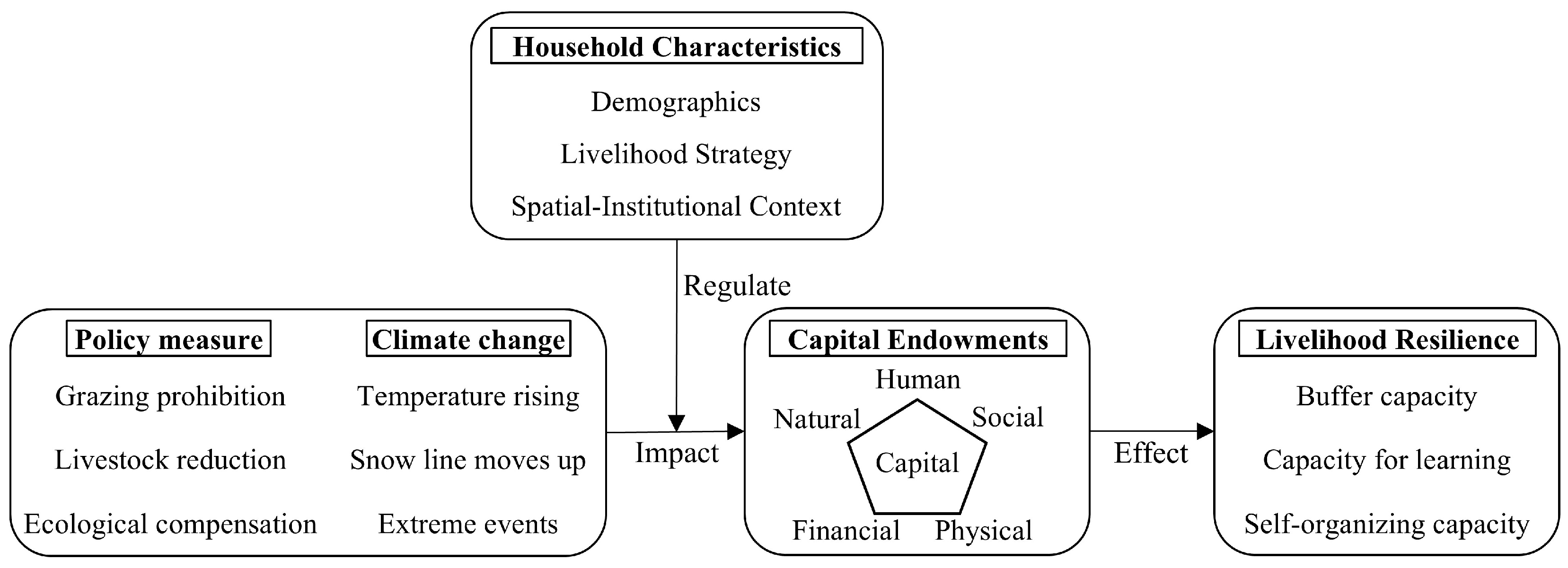
Figure 1. Framework for analysis of livelihood resilience, incorporating household characteristics.
Sustainability 17 10755 g001
Figure 2. Geographic Location of the Research area.
Sustainability 17 10755 g002
Figure 3. The multi-dimensional characteristics of livelihood resilience in herder household (household-level TOPSIS scores; N = 3539 households).
Sustainability 17 10755 g003
Figure 4. The spatial distribution of the livelihood resilience of herder households (village mean TOPSIS score; N = 19 villages).
Sustainability 17 10755 g004
Table 1. Survey Sample Area Distribution.
TownshipVillageValid Samples (Households)Total (Households)
ZhaqingDiqing301925
Angnao194
Daqing193
Gesai237
MoyunBayang85640
Daying297
Geyun145
Jierao113
ChadanBaqing137556
Dagu95
Qirong157
Yueni167
AngsaiNiandu318762
Reqing257
Surao187
AduoJinai75656
Puke192
Wahe247
Duojia142
Table 2. Indicator System for Evaluating the Livelihood Resilience of Herders.
Dimension LayerIndicator LayerIndicator Definition and AssignmentWeight
Buffer capacityHealth status (X1)Subjective perception of the overall health status of family members. Unhealthy = 1, Not very healthy = 2, Average = 3, Fairly healthy = 4, Very healthy = 50.021
Pasture area (X2)Family-owned pasture area. None = 1, 1–500 mu = 2, 500–1000 mu = 3, Over 1000 mu = 40.030
Pasture quality (X3)The condition of family pastures. Very poor = 1, Poor = 2, Average = 3, Fair = 4, Very good = 50.020
Livestock quantity (X4)The number of cattle and sheep raised. None = 1, 1–50 heads = 2, 50–100 heads = 3, over 100 heads = 40.037
Per capita income (X5)Total household income/Total household population (yuan)0.019
Household savings (X6)The savings held by households. None = 1, 10,000–30,000 yuan = 2, 30,000–50,000 yuan = 3, 50,000–100,000 yuan = 4, Over 100,000 yuan = 50.046
Network of relatives and friends (X7)The likelihood of receiving help from relatives and friends when facing difficulties. Very difficult = 1, Somewhat difficult = 2, Average = 3, Somewhat easy = 4, Very easy = 50.020
Cooperative participation (X8)Whether to join the livestock cooperative.
Yes = 1, No = 0
0.062
Housing capital (X9)Whether owns property in the city.
Yes = 1, No = 0
0.048
Motor vehicle (X10)Whether the household owns a motor vehicle.
Yes = 1, No = 0
0.04
Capacity for
learning
Awareness of policies (X11)Understand the status of ecological conservation policies. Completely unfamiliar = 1, Somewhat familiar = 2, Fairly familiar = 3, Quite familiar = 4, Very familiar = 50.021
Skills training (X12)Whether participated in skills training.
Participated = 1, Did not participate = 0
0.062
Respondent’s education level (X13)Below primary school = 1, primary school = 2,
junior high school = 3, high school and vocational
school = 4, college and above = 5
0.056
Information retrieval capability (X14)Number of information access channels (units)0.046
Local resource utilization (X15)Household Farming and Gathering Income/Total Household Income (%)0.016
Communicating with others (X16)Frequency of interaction with other herding families. Never = 1, Occasionally = 2, Frequently = 30.023
Non-pastoral employment (X17)Subjective perception of non-agricultural employment opportunities. No chance = 1, Very little = 2, Moderate = 3, Some = 4, Very good = 50.029
New skills and techniques (X18)Willingness to learn new skills and techniques. Very unwilling = 1, Unwilling = 2, Neutral = 3, Willing = 4, Very willing = 50.014
Educational support (X19)Parents’ willingness to support their children’s education Do not support = 1, Somewhat support = 2, Strongly support = 30.014
Proportion of family education expenditure (X20)Household Education Expenditures/Total Household Expenditures (%)0.040
Self-organizationClimate change awareness (X21)Understanding of climate change. Unfamiliar = 1, Somewhat familiar = 2, Fairly familiar = 3, Quite familiar = 4, Very familiar = 50.030
Application of new technologies (X22)Frequency of application of emerging technologies. Never = 1, Occasionally = 2, Frequently = 30.047
Livestock self-sufficiency (X23)Self-sufficiency in livestock production. External purchases = 1, Purchases plus self-sufficiency = 2, Self-sufficient = 30.036
Grassland dependency (X24)Highly dependent = 1, Moderately dependent = 2, Neutral = 3, Moderately independent = 4, Completely independent = 50.044
Participation in collective actions (X25)Frequency of participation in community meetings. No participation = 1, Occasional participation = 2, Frequent participation = 30.031
Community rules (X26)Compliance with community rules. Non-compliance = 1, Partial compliance = 2, Full compliance = 30.016
Cultural heritage (X27)Participation in traditional cultural activities. Don’t participate = 1 Occasionally participate = 2 Frequently participate = 30.038
Livelihood diversity index (X28)Number of livelihood types (species)0.025
Organizational involvement (X29)Whether any family members hold positions in the community. Yes = 1, No = 00.043
Weak ties connectivity (X30)Should one trust families with no blood ties.
Distrust = 1, Partial trust = 2, Full trust = 3
0.026
Table 3. Analysis Results of Livelihood Resilience Obstacle Factors Based on Family Characteristics.
Grouping VariableGrouping CategoriesX8 (%)X13 (%)X12 (%)X6 (%)X14 (%)
whole sample-8.147.587.186.405.97
GenderMale8.177.767.216.456.13
Female8.046.987.186.225.74
Age18–358.245.996.776.516.21
35–608.118.647.376.625.97
Over 608.197.997.746.315.94
Functional partitionCore zone8.527.676.736.325.79
General zone7.957.757.416.446.11
Livelihood typeCordyceps-dependent8.267.437.216.225.76
Livestock-dependent7.857.667.346.356.08
Diversified income8.157.787.276.596.13
Subsidy-dependent8.047.716.746.355.78
Table 4. Spatial Dube Model (SDM) Analysis Results.
VariablesCoefStd. Errz-Valuep-Value95%CI
X60.0160.0121.2960.195−0.008~0.039
X80.0850.0117.4920.000 **0.063~0.108
X12−0.0200.017−1.1310.258−0.053~0.014
X130.0060.0080.8070.420−0.009~0.022
X140.0360.0066.1020.000 **0.024~0.048
W × X60.0260.0330.7920.428−0.039~0.091
W × X80.1470.0344.3280.000 **0.080~0.214
W × X12−0.0290.057−0.5070.612−0.141~0.083
W × X130.0140.0180.7940.427−0.021~0.048
W × X140.0100.0210.4830.629−0.031~0.051
W × HLR−0.7870.242−3.2450.001 **−1.262~−0.312
Constant0.5390.0876.1760.000 **0.368~0.710
Sample size19
R20.939
Adjust R20.843
F-valueF(6,12) = 9.569, p = 0.003
** denotes significance at the 1% level.
Table 5. Bootsatrap-Based Spatial Effect Analysis.
VariablesEffectEffect ValueStd. Errz-Valuep-Value95%CI
X6ADI0.0130.0130.9570.339−0.013~0.039
AII0.0110.0250.4340.664−0.038~0.059
ATI0.0230.0231.0180.309−0.022~0.068
X8ADI0.0690.0144.9880.0000.042~0.096
AII0.0610.0222.7980.0050.018~0.103
ATI0.1300.0206.6240.0000.092~0.169
X12ADI−0.0170.024−0.6860.493−0.065~0.031
AII−0.0100.048−0.2150.830−0.105~0.084
ATI−0.0270.036−0.7570.449−0.097~0.043
X13ADI0.0050.0080.5840.559−0.011~0.020
AII0.0070.0120.5460.585−0.018~0.031
ATI0.0110.0130.8940.371−0.014~0.036
X14ADI0.0400.0084.8750.0000.024~0.056
AII−0.0140.015−0.9160.360−0.043~0.016
ATI0.0260.0122.1340.0330.002~0.050
Table 6. Moderation Effects Table for Stratified Regression.
VariableCoefficient BStd. Errp-ValueΔR2ΔF95%CI
Male × Participate in skills training−0.013 **0.0050.0110.0016.462 **−0.023~−0.003
Male × college degree or above−0.027 ***0.0080.0010.0024.193 ***−0.043~−0.012
Aged 35–60 × Participate in skills training−0.007 *0.0040.0880.0011.517 *−0.016~0.001
Aged 35–60 × primary school0.013 ***0.0050.0090.0021.821 **0.004~0.048
Aged over 60 × primary school0.026 **0.0110.0190.003~0.023
Core area × Savings of 5–10 million yuan−0.019 *0.0120.0950.0011.167 *−0.042~0.003
Core area × Join in cooperatives−0.011 **0.0050.0360.0014.387 **−0.022~−0.001
Subsidy-dependent × Participate in skills training0.017 *0.0090.0610.0012.741 **−0.001~0.034
Cordyceps-dependent × Information acquisition ability0.009 ***0.0030.0090.0025.104 ***0.002~0.015
* denotes significance at the 10% level, ** denotes significance at the 5% level, *** denotes significance at the 1% level.
Disclaimer/Publisher’s Note: The statements, opinions and data contained in all publications are solely those of the individual author(s) and contributor(s) and not of MDPI and/or the editor(s). MDPI and/or the editor(s) disclaim responsibility for any injury to people or property resulting from any ideas, methods, instructions or products referred to in the content.