
Civil Societies and Disaster Risk Reduction in China: Policy and Literature Analysis



Abstract
1. Rationale
1.1. Concept and Definition of Civil Society Organizations in China
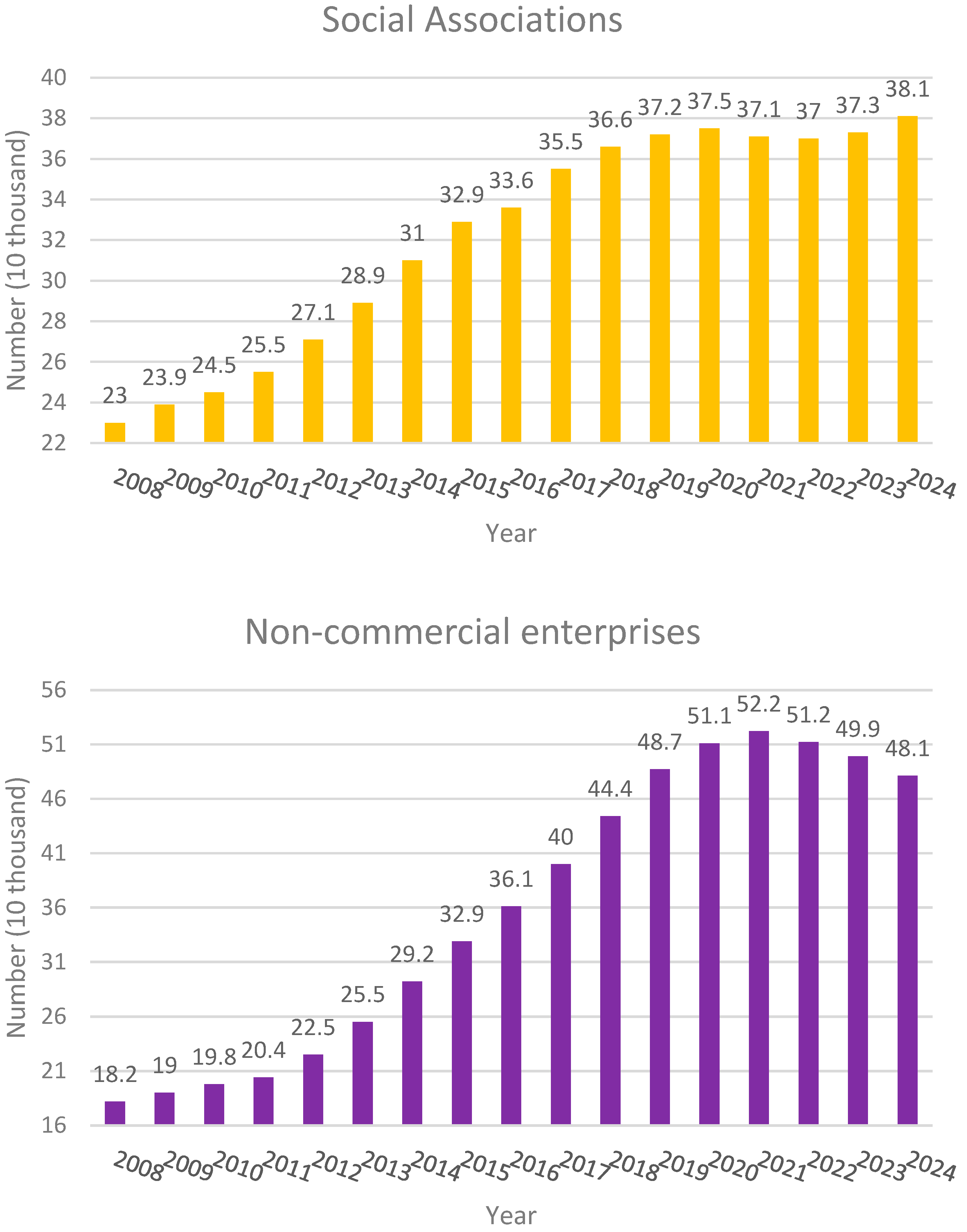
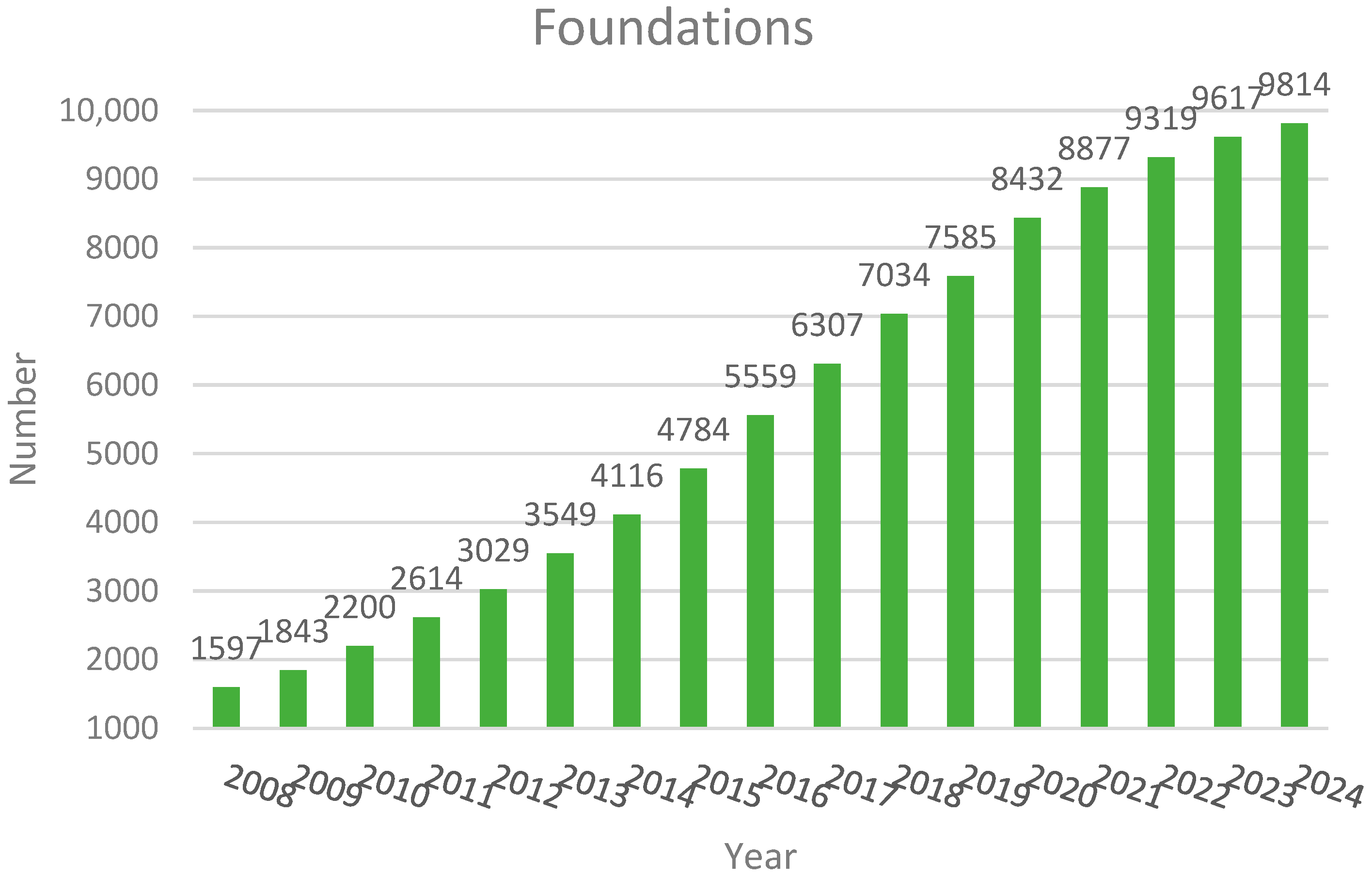
1.2. The Blossom Period in China: Starting in 2008
1.3. The Research Objectives
2. Data and Methods
2.1. Review of Policies and Strategies
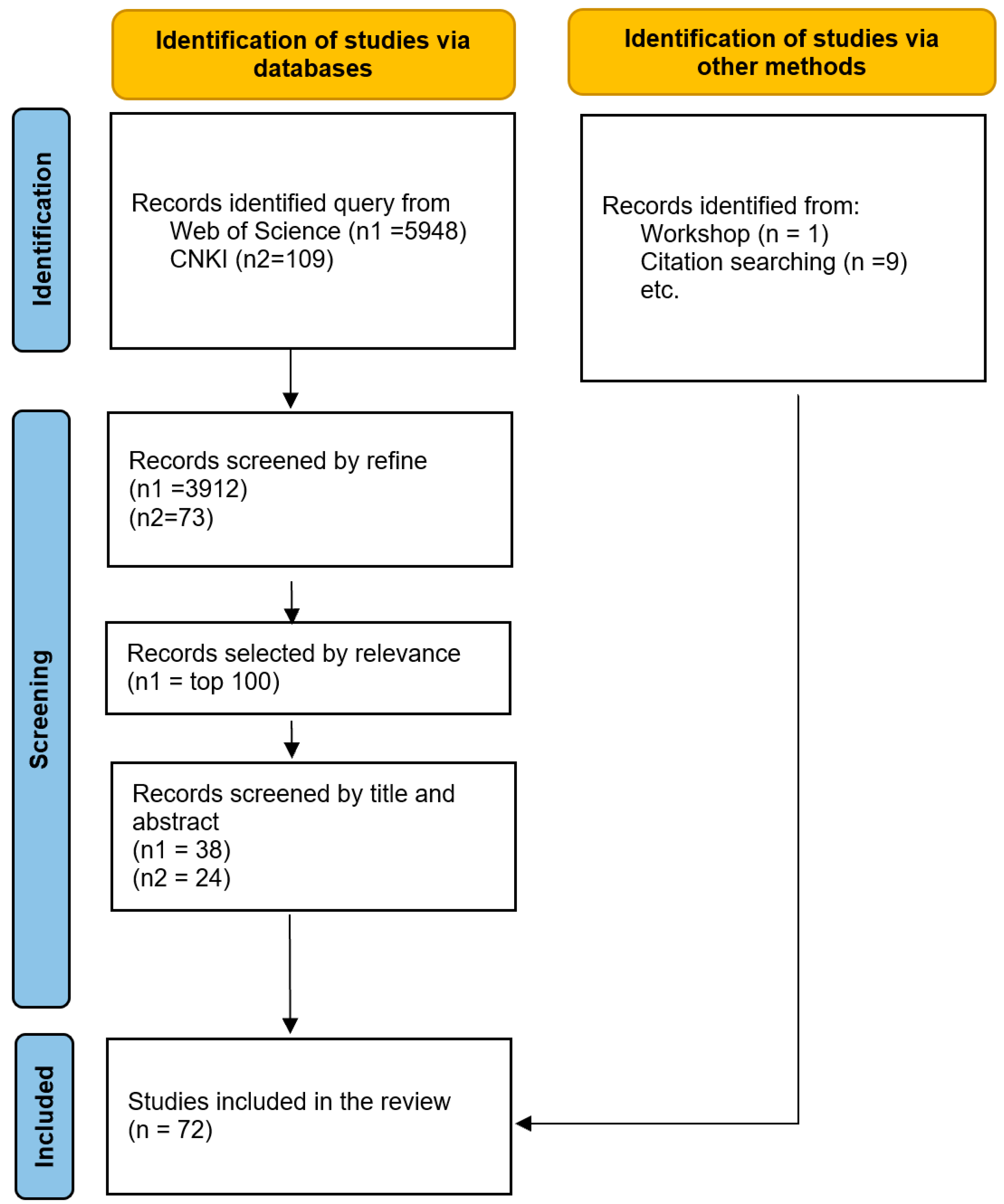
2.2. Review of Academic Literature
3. The Policy Support and Development of DRR CSOs
3.1. The International Frameworks Shaping the Development of DRR CSOs
3.2. The National Policy Development in China
3.2.1. The Related Paragraphs in the National Policies
3.2.2. The Development of Roles and Policy Guidance for CSOs Implicated in the National Policies
3.3. Comparison of International and National Policy Development
4. The DRR Working Areas and the Development of Chinese CSOs
4.1. Working Domains
4.1.1. Focusing on Response and Recovery of Natural Hazard Events

| Glossary of Hazards | Hazard Perils with Cases |
|---|---|
| Geophysical | Earthquake [11,12,13,14,15,16,17,18,19,20] |
| Hydrological |
|
| Meteorological | Typhoon [27,28] |
| Climatological | Drought [29] |
| Biological | COVID-19 pandemic [30,31,32] |
| Environmental | Waste [33] |
| Chemical | Chemical accidents [34] |
| Technical | Flood-related Natech [35] |
| Phase of Disaster Management and DRR | Cases |
|---|---|
| Prevention | [36] |
| Emergency Response (Rescue and relief) | [11,15,20,22,24,26,27,28,34,37,38,39] |
| Reconstruction and Recovery | [16,18,40,41,42,43,44,45,46] |
| Risk Governance and Capacity Building | [4,19,21,23,30,47,48,49,50,51,52,53,54] |
4.1.2. Coherence of DRR, CCA, and SDGs
4.2. Engaging in International Activities and Events
4.3. Embracing Technologies and Innovations
5. Discussion and Recommendations
5.1. The Challenge of Development
5.1.1. CSOs’ Participation in Diverse Aspects of DRR Efforts
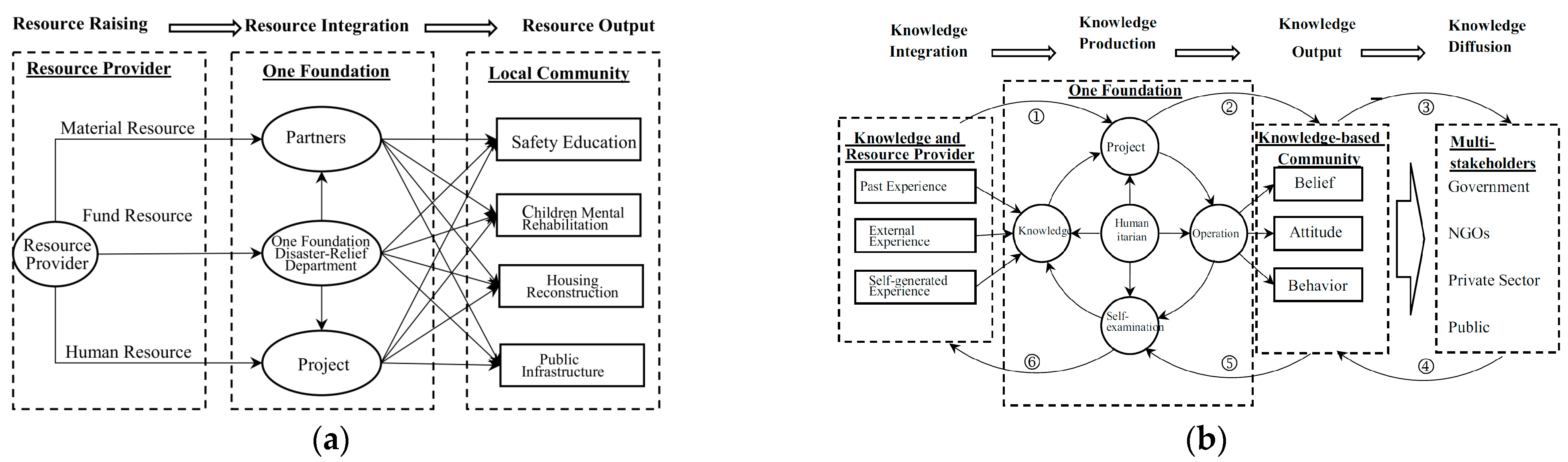
5.1.2. Government–CSO Collaboration and CSO-CSO Collaboration
5.2. The Recommendations in DRR Education for Chinese CSOs
6. Conclusions
Author Contributions
Funding
Institutional Review Board Statement
Informed Consent Statement
Data Availability Statement
Conflicts of Interest
Appendix A
- The query for WoS was:
- The records of WoS were initially refined based on:
- The query for CNKI was:
- Topic: 社会组织 (social organizations) OR 社会力量 (social forces)
- AND Topic: Disaster
- AND Topic: China
- AND after May 2008
References
- IFRC. A Practical Guide to Advocacy for Disaster Risk Reduction; International Federation of Red Cross and Red Crescent Societies: Paris, France, 2009. [Google Scholar]
- Shaw, R.; Izumi, T. Civil society and disaster risk reduction: An Asian overview. In Civil Society Organization and Disaster Risk Reduction: The Asian Dilemma; Springer: Tokyo, Japan, 2014; pp. 1–13. [Google Scholar]
- Kang, Y. The development of grassroots Chinese NGOs following the Wenchuan earthquake of 2008: Three case studies, four Modi Vivendi. Volunt. Int. J. Volunt. Nonprofit Organ. 2017, 28, 1648–1672. [Google Scholar] [CrossRef] [Scilit]
- Sim, T.; Dominelli, L.; Lau, J. A Pathway to Initiate Bottom-Up Community-Based Disaster Risk Reduction Within a Top-Down System: The Case of China; WIT Press: Southampton, UK, 2017. [Google Scholar]
- Lassa, J.A. Roles of Non-Government Organizations in Disaster Risk Reduction; Oxford University Press: Oxford, UK, 2018. [Google Scholar] [CrossRef] [Scilit]
- Zhu, J.; Lai, W. “Incomplete Collaboration”:The Strategy for Chinese NGO Alliance:Case Study of NGOs’ Joint Action during the Wenchuan Earthguake Relief. Chin. J. Sociol. 2014, 34, 187–209. [Google Scholar] [CrossRef]
- Zhao, X.J.; Wang, H.; Morikawa, S.; Wang, S.Y.; Tang, J.C.; Sugiyama, S.; Sriwarnasinghe, S.M. Mapping non-profits participation in disaster mitigation: A data-driven study of functional diversity, spatial patterns and driving factors of China’s emergency management nonprofit organizations. Int. J. Disaster Risk Reduct. 2025, 118, 105252. [Google Scholar] [CrossRef] [Scilit]
- Cai, X. Crisis mobilization and public participation in disaster relief in ancient China. China J. Disaster Reduct. 2024, 8, 62–64. Available online: https://kns.cnki.net/kcms2/article/abstract?v=LYi8dJWcB0VJDruWAtqVG2KJAMKssiXs3eSd0W6mRhjCaG010BZPnmb1nUmUtaTg0mQBNFBG9eW23_pVavsXHoMXM4OkgpZTrVjNKYkVOVl4S-Nc-DpJfXcpGFDlFEdiluD3r_5u3yU7-JCWfTVdTTOde1I1Fl0tILe6RakqpNxVL8_HCSWHNQ==&uniplatform=NZKPT&language=CHS (accessed on 24 November 2025).
- IRDR. Peril Classification and Hazard Glossary (IRDR DATA Publication No. 1); Integrated Research on Disaster Risk: Beijing, China, 2014. [Google Scholar]
- ISC; UNDRR. Hazard Information Profiles: Supplement to UNDRR-ISC Hazard Definition & Classification Review: Technical Report; International Science Council: Paris, Franec; UNDRR: Geneva, Switzerland, 2021. [Google Scholar]
- Chen, Y.X.; Zhang, J.; Tadikamalla, P.R.; Zhou, L. The Mechanism of Social Organization Participation in Natural Hazards Emergency Relief: A Case Study Based on the Social Network Analysis. Int. J. Environ. Res. Public Health 2019, 16, 4110. [Google Scholar] [CrossRef] [Scilit] [PubMed]
- Liu, M.; Chen, G. The Folk United Operational Mechanism for Disaster Rescue in Southwest China—By the Case Study of Yiliang”9.7” Earthquake. In Proceedings of the 2013 International Conference on Applied Social Science Research (Icassr-2013), Shanghai, China, 20–21 June 2013; Volume 38, pp. 178–182. [Google Scholar]
- Nan, Y.; Zhang, L.; Du, X. Lessons Learned from the Emergency Response to Ms 7.0 Jiuzhaigou Earthquake. China Emerg. Rescue 2020, 6, 62–66. [Google Scholar] [CrossRef]
- Li, X. “Great Battle” Style Natural Catastrophe Response: Observation and Reflection on Response from Lushan Earthguake to Jishishan Earthquake. China Emerg. Rescue 2024, 4, 10–17+24. [Google Scholar] [CrossRef]
- Wang, W.; Chen, H.; Xu, A.; Qu, M. Analysis of the disaster characteristics and emergency response of the Jiuzhaigou earthquake. Nat. Hazards Earth Syst. Sci. 2018, 18, 1771–1783. [Google Scholar] [CrossRef] [Scilit]
- Lu, Y.; Li, R. Rebuilding resilient homeland: An NGO-led post-Lushan earthquake experimental reconstruction program. Nat. Hazards 2020, 104, 853–882. [Google Scholar] [CrossRef] [Scilit]
- Zhang, Q.; Zhang, H. The Chinese path of social organizations participating in international humanitarian aid: Lessons from the response to the Nepal earthquake. Disaster Reduct. China 2018, 30–31. [Google Scholar]
- Zhang, L. Analysis of social organizations’ participation in Nepal earthquake relief. Disaster Reduct. China 2015, 11, 28–31. [Google Scholar]
- Wang, C.-Y.; Guo, J.; Kuo, M.-F. The building of social resilience in Sichuan after the Wenchuan earthquake: A perspective of the socio-government interactions. Saf. Sci. 2020, 126, 104662. [Google Scholar] [CrossRef] [Scilit]
- You, C.; Chen, X.; Yao, L. How China responded to the May 2008 earthquake during the emergency and rescue period. J. Public Health Policy 2009, 30, 379–394. [Google Scholar] [CrossRef] [Scilit]
- Chen, Z.X.; Zhang, L.; Wang, N.N.; Wang, Q.S.; Cao, Y.; Chen, H.X. Optimizing flood disaster management: Unraveling the role of social organizations in China’s GBA through social network analysis. Front. Energy Res. 2024, 12, 11. [Google Scholar] [CrossRef] [Scilit]
- Lyu, S.; Gao, G.C.; Lee, C.H.; Sun, L.S.; Xu, N.; Qian, C. Collective Rescue: Why the Government Can Collaborate with the Public during Extreme Precipitation. Water 2023, 15, 2848. [Google Scholar] [CrossRef] [Scilit]
- Guo, J.; Bian, Y.; Li, M.; Du, J. Assessing resilience through social networks: A case study of flood disaster management in China. Int. J. Disaster Risk Reduct. 2024, 108, 104583. [Google Scholar] [CrossRef] [Scilit]
- Lu, Y.; Wang, Y.; Zhang, L. System dynamic modeling of the NGO post-disaster relief contribution in the 2021 Henan flood in China. Int. J. Disaster Risk Reduct. 2023, 89, 103626. [Google Scholar] [CrossRef] [Scilit]
- Lu, Y.; Zhang, Z.; Gan, Y. Joint disaster relief: The Chinese civilian rescue teams’ response to the 2021 Henan flood. Nat. Hazards 2024, 120, 1755–1783. [Google Scholar] [CrossRef] [Scilit]
- Cai, J.M.; Sun, F.; Hu, S.Y.; Li, H.B.; Xing, H.G. Research on cross-organizational emergency collaboration networks based on functional modules: An example of landslide disaster incident in Shuicheng, Guizhou, China. Int. J. Disaster Risk Reduct. 2023, 97, 19. [Google Scholar] [CrossRef] [Scilit]
- Peng, L.; Wu, F. Building up alliances and breaking down the state monopoly: The rise of non-governmental disaster relief in China. China Q. 2018, 234, 463–485. [Google Scholar] [CrossRef] [Scilit]
- Wang, X. Collaborating in a centralized governance mechanism: Structure and fragmentation of large-scale response coordination during the 2018 Typhoon Mangkhut in Shenzhen. Int. J. Emerg. Serv. 2023, 12, 213–230. [Google Scholar] [CrossRef] [Scilit]
- Liu, Z. Social organizations actively participate in drought relief in Southwest China. China Soc. Organ. 2010, 35–37. [Google Scholar] [CrossRef]
- Tian, Y. Building an urban community anti-epidemic system from the perspective of governance. Soc. Sci. J. 2020, 1, 19–27. [Google Scholar]
- Li, Q.; Yang, X. On Chinese Red Cross in Disaster Relief Socialization--Take the COVlD-19 disaster in 2019 as an example. Soc. Welf. 2020, 5, 49–55. [Google Scholar]
- Yang, B.; Xiao, L.; Chen, K. The ladder of collaboration: Research on joint actions of social organizations against the COVID-19 epidemic. China Nonprofit Rev. 2021, 12, 233–256. [Google Scholar] [CrossRef] [Scilit]
- Arantes, V.; Zou, C.; Che, Y. Coping with waste: A government-NGO collaborative governance approach in Shanghai. J. Environ. Manag. 2020, 259, 8. [Google Scholar] [CrossRef] [Scilit]
- Du, L.; Feng, Y.B.; Tang, L.Y.; Lu, W.; Kang, W. Time dynamics of emergency response network for hazardous chemical accidents: A case study in China. J. Clean Prod. 2020, 248, 12. [Google Scholar] [CrossRef] [Scilit]
- Liu, T.; Zhang, H.; Li, X.; Li, H. Effects of organization factors on flood-related Natechs in urban areas of China. Nat. Hazards 2017, 88, 355–365. [Google Scholar] [CrossRef] [Scilit]
- Wu, G.; Gao, M. Role of the NGOs in the National Significant Seismic Monitoring andProtection Regions. Earthq. Res. China 2014, 30, 317–323. [Google Scholar]
- Peng, L. Crisis crowdsourcing and China’s civic participation in disaster response: Evidence from earthquake relief. China Inf. 2017, 31, 327–348. [Google Scholar] [CrossRef] [Scilit]
- Du, X. The Research on the Construction of Emergency Rescue Force in the New Era. J. China Emerg. Manag. Sci. 2022, 10, 74–82. [Google Scholar]
- Dong, T.; Zhang, M. Study on the Interactive Pattern between Chinese Government and Non-profitable Organization in Relief of Disaster. Seek. Truth 2017, 44, 67–75. [Google Scholar]
- Tsai, S.L.; Ochiai, C.; Tseng, M.H.; Deng, C.Z. A framework for NGO-led post-disaster reconstruction programs in the indigenous community: A case study of the 2009 Typhoon Morakot in Taiwan. Int. J. Disaster Risk Reduct. 2022, 73, 102879. [Google Scholar] [CrossRef] [Scilit]
- Lu, Q.; Zhong, D.; Zhang, Q. The evolving pattern of NGOs’ participating in post-disaster community reconstruction in China: Cases study on the 2008 Wenchuan earthquake and the 2013 Lushan earthquake. Nat. Hazards 2020, 104, 167–184. [Google Scholar] [CrossRef] [Scilit]
- Wang, G.; Fang, Y.; Zhang, Q. China Model and lmplications of 4.20 Lushan Earthquake’s Post Disaster Recovery and Reconstruction. Urban Plan. Forum 2022, 315–320. [Google Scholar] [CrossRef]
- Liu, Z. The Ya’an practice of coordinating social forces in disaster relief and reconstruction. Manag. Technol. SME 2016, 3, 131–132. Available online: https://kns.cnki.net/kcms2/article/abstract?v=vSXt4VHTcs6LG_lwTjcIt5KrZlNWQ0BCo9nHNONFzOrYUG8kaheoMgKBby520obRN93Vd5r7khA3xpq0hGK64JJuOYGT15mmBF_fXkXg8u1LzAT939WhUN_D7ITmXbwl1BlHTEiBrwDYUzJYRKxAei6_q3e2r2eYSiIJVENSFvpcEECF1w9SAliTi4V9BcWbNL9WUf3qmrg=&uniplatform=NZKPT&language=CHS (accessed on 24 November 2025).
- Meng, T. Dilemmas and institutional reconstruction of NGO participation in disaster relief—A case study of the Wenchuan earthquake. J. Southwest Minzu Univ. (Humanit. Soc. Sci. Ed.) 2014, 35, 87–91. [Google Scholar]
- Tang, G. Research on transformation from “paired assistance” to “collaborative networks” in post-disaster recovery of 2008 Wenchuan Earthquake, China. Nat. Hazards 2020, 104 (Suppl. S1), 31–53. [Google Scholar] [CrossRef] [Scilit]
- Gao, M.; Yuan, W.L. E-NGO’s Participation in Post-disaster Environmental Reconstruction: A case study of Wenchuan Earthquake. In Proceedings of the Iscram China 2010: Fourth International Conference on Information Systems for Crisis Response and Management, Harbin, China, 10–12 September 2010; pp. 61–66. [Google Scholar]
- Jing, F.; Xu, J. Social Mobilization Mechanism of Marine Disasters Response in Modern China. J. Inst. Disaster Prev. 2015, 17, 82–89. [Google Scholar]
- Li, Y.; Ruan, H. The practical process and operational logic of collaborative governance in natural disasters—A case study of Ya’an, Sichuan. J. Southwest Minzu Univ. (Humanit. Soc. Sci. Ed.) 2018, 39, 193–198. [Google Scholar]
- Luo, S.; Wu, M. “Concerted Action of the Three Social Sectors” + Disaster Prevention, Reduction, and Relief: A New Way to Comprehensively Reduce Disaster in the New Era-Investigation and Analysis Based on Anhui Province. J. Jianghan Univ. (Soc. Sci. Ed.) 2019, 36, 44–55+127. [Google Scholar] [CrossRef]
- Sun, M. Social organizations participating in community disaster reduction—Experience sharing from the Digital Campus Special Fund of China Next Generation Education Foundation. Disaster Reduct. China 2013, 23, 24–25. [Google Scholar]
- Yu, L. Strengthening disaster risk management: The Asia Foundation in China. City Disaster Reduct. 2014, 1, 47. [Google Scholar]
- Lu, Y.; Wei, L.; Cao, B.; Li, J. Participatory child-centered disaster risk reduction education: An innovative Chinese NGO program. Disaster Prev. Manag. Int. J. 2021, 30, 293–307. [Google Scholar] [CrossRef] [Scilit]
- Han, X. Disaster Culture and Emergency Governance of the Community. J. China Emerg. Manag. Sci. 2021, 4, 20–26. [Google Scholar]
- Wu, J.; Chang, I.S.; Yilihamu, Q.; Zhou, Y. Study on the practice of public participation in environmental impact assessment by environmental non-governmental organizations in China. Renew. Sust. Energ. Rev. 2017, 74, 186–200. [Google Scholar] [CrossRef] [Scilit]
- Zhai, T.T. An empirical study of marine environmental civil public-interest litigation in China: Based on 216 cases from 2015 through 2022. Ocean Coast Manag. 2024, 253, 107164. [Google Scholar] [CrossRef] [Scilit]
- Zhu, D.M. The Role of Multiple Social Body in the Environmental Governance: The Case of Jiaxing Model. Ekoloji 2018, 27, 319–328. [Google Scholar]
- Yang, Z.J.; Liu, W.H.; Sun, J.; Zhang, Y.L. Corporate Environmental Responsibility and Environmental Non-Governmental Organizations in China. Sustainability 2017, 9, 1756. [Google Scholar] [CrossRef] [Scilit]
- Wang, R.Y.; Peng, Y.; Liu, Y. Explaining the sustained public participation of ENGOs in China’s water governance: A case study of the ‘civilian river chiefs’ under the theoretical framework of ‘double embeddedness’. Int. J. Water Resour. Dev. 2022, 38, 680–698. [Google Scholar] [CrossRef] [Scilit]
- Du, X.Y.; Ullah, S. Environmental governance-public supervision and participation nexus under state supervision system and carbon neutrality targets in China. Environ. Sci. Pollut. Res. 2024, 31, 14208–14217. [Google Scholar] [CrossRef] [Scilit]
- Bernauer, T.; Gampfer, R.; Meng, T.G.; Su, Y.S. Could more civil society involvement increase public support for climate policy-making? Evidence from a survey experiment in China. Glob. Environ. Change-Hum. Policy Dimens. 2016, 40, 1–12. [Google Scholar] [CrossRef] [Scilit]
- Lin, P. China’s evolving humanitarian diplomacy: Evidence from China’s disaster-related aid to Nepal. Asian J. Comp. Politics 2021, 6, 221–237. [Google Scholar] [CrossRef] [Scilit]
- Li, X.; Han, X. On the Natural Disaster Risk And Management Involving Chinese Citizen in the Contribution of “One Belt One Road”-Taking the China-Pakistan Economic Corridor as an Example. J. Gansu Open Univ. 2019, 29, 31–35. [Google Scholar]
- Zhang, Q. Innovative models of China’s social forces participating in international humanitarian assistance under the South-South cooperation framework: A case study of the China-ASEAN friendly city emergency management “hand-in-hand” activities in Cambodia and Laos. Disaster Reduct. China 2024, 26–28. [Google Scholar] [CrossRef]
- Xu, S. An Update on Involvement of Chinese CSOs in International Humanitarian Response. In Proceedings of the Coordination in Humanitarian Contexts for Chinese NGOs Working Internationally, Amity Foundation, ICVA. Online, 11 May 2022. [Google Scholar]
- Xu, J.; Zhang, H.J. Activating beyond Informing: Action-Oriented Utilization of WeChat by Chinese Environmental NGOs. Int. J. Environ. Res. Public Health 2022, 19, 3776. [Google Scholar] [CrossRef] [Scilit]
- Chang, L.-C.; Liao, Y.; Tang, H.; Huang, S.; Liu, Y.; Zhu, S. An ecosystem-oriented business model to promote well-being via digital technology: A multi-case narrative inquiry in China. Asia Pac. Bus. Rev. 2024, 1–21. [Google Scholar] [CrossRef] [Scilit]
- Seddiky, M.A.; Giggins, H.; Gajendran, T. International principles of disaster risk reduction informing NGOs strategies for community based DRR mainstreaming: The Bangladesh context. Int. J. Disaster Risk Reduct. 2020, 48, 101580. [Google Scholar] [CrossRef] [Scilit]
- Izumi, T.; Shaw, R. Chapter 3 role of NGOs in community-based disaster risk reduction. In Community-Based Disaster Risk Reduction; Emerald Group Publishing Limited: Bingley, UK, 2012; pp. 35–54. [Google Scholar]
- Namoe, E.; Nyamache, T.; Gervasio, M.; Otieno, E. Impact of Community-Based Early Warning Systems as an Approach for Developing Resilience by Non-Governmental Organizations in Turkana County, Kenya. Int. J. Innov. Res. Adv. Stud. (IJIR) 2022, 9, 1–5. [Google Scholar]
- Chan, E.Y.Y.; Li, W. Role of Government and NGOs. In Orthopedics in Disasters: Orthopedic Injuries in Natural Disasters and Mass Casualty Events; Springer: Berlin/Heidelberg, Germany, 2016; pp. 47–59. [Google Scholar]
- Troy, D.A.; Carson, A.; Vanderbeek, J.; Hutton, A. Enhancing community-based disaster preparedness with information technology. Disasters 2008, 32, 149–165. [Google Scholar] [CrossRef] [Scilit]
- Kusumasari, B. Network organisation in supporting post-disaster management in Indonesia. Int. J. Emerg. Serv. 2012, 1, 71–85. [Google Scholar] [CrossRef] [Scilit]
- Schneider, S. The Locals will Know”: The Role of Local Actors and Local Knowledge in Trigger Development for Anticipatory Action. 2024. Available online: https://www.researchgate.net/profile/Soeren-Schneider-2/publication/389105236_The_Locals_will_Know_The_Role_of_Local_Actors_and_Local_Knowledge_in_Trigger_Development_for_Anticipatory_Action/links/67b58049461fb56424dfb269/The-Locals-will-Know-The-Role-of-Local-Actors-and-Local-Knowledge-in-Trigger-Development-for-Anticipatory-Action.pdf (accessed on 22 March 2025).
- Li, X.; Dong, Q. Chinese NGOs are “Going Out”: History, Scale, Characteristics, Outcomes, and Barriers. Nonprofit Policy Forum 2018, 9, 20170038. [Google Scholar] [CrossRef] [Scilit]
- Kang, Z.G. The Dilemma of Chinese NGOs in Emergency Management and Possible Solutions. In Proceedings of the 2009 International Conference on Public Administration (5th), Chengdu, China, 23–25 October 2009; pp. 392–396. Available online: https://www.webofscience.com/wos/woscc/full-record/WOS:000273673900056 (accessed on 24 November 2025).
- Qin, P.; Meng, T.; Dai, X.; Dong, Z.G. The Dilemma and Solution of China’s NGOs Participation in Disaster Relief—An Example from Wenchuan Earthquake. Res. J. Chem. Environ. 2012, 16, 132–138. [Google Scholar]
- Huang, F.K.; Zhu, X.N. Analysis on Predicaments and Solutions of China’s NGOs in Disastrous Crisis Management. In Proceedings of the 2009 International Conference on Public Administration (5th), Chengdu, China, 23–25 October 2009; pp. 407–412. [Google Scholar]
- Meng, L.; Cheng, W.; Deng, Y.; Dai, Z. Research on the collaborative relationship of task-driven urban earthquake emergency organizations. Int. J. Disaster Risk Reduct. 2024, 113, 104887. [Google Scholar] [CrossRef] [Scilit]
- Sun, F.; Li, H.; Cai, J.; Hu, S.; Xing, H. Examining organizational collaboration and resource flows of disaster response system based on a time-dynamic perspective. Int. J. Disaster Risk Reduct. 2024, 108, 104565. [Google Scholar] [CrossRef] [Scilit]
- Sun, F.; Zhou, J.; Hu, S.; Zhang, R.; Xing, H. Dynamically examining emergency response network resilience: A case study of a typical earthquake in China. Saf. Sci. 2025, 184, 106766. [Google Scholar] [CrossRef] [Scilit]
- Zhang, Y. Research on the Joint Operation Model of Social Emergency Response Forces in Disaster Governance: Re-exploration of the Leadership-Oriented Organizational Form Network. China Emerg. Manag. Sci. 2024, 8, 41–52. [Google Scholar]
- Ye, S.; Zhu, J. Hierarchical Network Governance: A Type of Alliance Mechanism foiSocial Organizations. Chin. J. Sociol. 2024, 44, 1–29. [Google Scholar] [CrossRef]
- Lu, Y.; Zhan, C.; Li, R.; Su, M. An NGO disaster relief network for small and medium-scale natural hazards in China. Nat. Hazards 2021, 106, 2689–2709. [Google Scholar] [CrossRef] [Scilit]
- Gao, H.X.; Chen, J.C.; Wang, H.R. The Construction of Positive Interaction between Government and NGOs in Post-Lushan Earthquake Reconstructionac. In Proceedings of the 2013 China International Conference on Insurance and Risk Management, Kunming, China, 17–20 June 2013; pp. 142–150. [Google Scholar]
- Xu, J.; Xu, D.; Lu, Y.; Wang, Q. A bridged government–NGOs relationship in post-earthquake reconstruction: The Ya’an service center in Lushan earthquake. Nat. Hazards 2018, 90, 537–562. [Google Scholar] [CrossRef] [Scilit]
- Lu, W.; Wang, Y. Response to Social Organization Trust Crisis and Brand Reconstructionfrom the Perspective of Social Governance: Based onthe Theory of Disaster Causes. Soc. Work Manag. 2018, 18, 45–54. [Google Scholar]




| UN Agenda for DRR | National Strategies | Government Documents |
|---|---|---|
| Yokohama Strategy and Plan of Action for a Safer World (1994) | Disaster Reduction Plan of the People’s Republic of China (1998–2010). | Guiding Opinions of the Ministry of Civil Affairs on Supporting and Guiding Social Forces to Participate in Disaster Relief Work (2015) |
| Hyogo Framework for Action 2005–2014 | National 11th Five-Year Plan for Comprehensive Disaster Prevention and Mitigation (2006–2010) | Opinions of the Central Committee of the Communist Party of China and the State Council on Promoting the Reform of the System and Mechanism for Disaster Prevention, Mitigation and Relief (2016) |
| Sendai Framework for Disaster Risk Reduction 2015–2030 | National Comprehensive Disaster Prevention and Mitigation Planning (2011–2015). | Opinions on Further Promoting the Healthy Development of Social Emergency Response Forces (2022) |
| National Comprehensive Disaster Prevention and Mitigation Plan (2016–2020). | ||
| The 14th Five-Year Plan for Comprehensive Disaster Risk Reduction (2021–2025) |
| Questions | Content |
|---|---|
| What are the working domains of Chinese DRR CSOs? |
|
| What are the challenges of the development of Chinese DRR CSOs? |
|
| International Consensus | Role of CSOs | Support/Guidance | Integration into Governance |
|---|---|---|---|
| Yokohama Strategy and Plan of Action for a Safer World (1994) | Identified as a consultative body, focused on community participation and knowledge sharing. | Offer limited guidance, relying on governments to involve civil society. | Approached civil society as an auxiliary to state-driven processes. |
| Hyogo Framework for Action 2005–2014 | Formalized the partnership role, emphasizing active implementation and advocacy. | Urge governments to empower civil society through capacity building, resource allocation, and training. | Recognized civil society as co-implementers alongside governments. |
| Sendai Framework for Disaster Risk Reduction 2015–2030 | Elevated to a strategic role, with responsibilities in policy-making, monitoring, and advocacy. | Institutionalize support mechanisms, including financial aid, technical assistance, and systemic integration of civil society into governance structures. | Positioned civil society as a core participant in global disaster governance. |
| Dimension | International Frameworks | China’s National Plans | Key Observations |
|---|---|---|---|
| Policy Orientation | Gradual shift from disaster response (Yokohama, 1994) to proactive risk governance and resilience-building (Sendai, 2015). | Transition from regulatory control (1998–2010) to active state–society partnership in DRR (2021–2025). | Both systems evolved toward comprehensive risk management; China mirrors global trends, but within a government-led structure |
| Role of CSOs | Yokohama: consultative role; Hyogo: implementing partner; Sendai: strategic stakeholder with policy and advocacy responsibilities. | 1998–2010: restricted participation in relief; 2011–2015: volunteerization and capacity building; 2016–2025: institutionalized as “social forces” in emergency response and recovery. | China’s policies increasingly acknowledge CSOs but still emphasize coordination under government leadership. |
| Support and Capacity-Building Mechanisms | Progressive inclusion of financial, technical, and educational support for CSOs (Hyogo and Sendai). | Introduction of government procurement of social services (2016–2020) and professional training of social emergency forces (2021–2025). | China’s mechanisms echo Sendai priorities but remain state-managed rather than independent. |
| Integration into Governance | Encourages multi-stakeholder, decentralized governance; promotes autonomy and accountability of CSOs. | Integrates CSOs into hierarchical DRR governance through Five-Year Plans, ministerial guidelines, and emergency management platforms. | Integration achieved, but autonomy limited—participation primarily consultative and operational. |
| Governance Philosophy | “All-of-society” and participatory approach to resilience. | “Led by government, participated by society” principle in all DRR plans. | Shared goal of inclusiveness, but China emphasizes top-down coordination. |
| When | Where | Hazard/Context | Who | What |
|---|---|---|---|---|
| 2016 | Yunnan border with Myanmar | Conflict migrants | Blue Sky Rescue (BSR) (Dehong) | Shelter, Camp Coordination, and Camp Management (CCCM) |
| Ecuador | Earthquake | Amity F., China Foundation for Rural Development (CFPA), Pearl R., Ramunion R. | Emergency management (EM), assessment, and shelter | |
| Italy | Earthquake | Ramunion R. | Search and rescue (SAR) | |
| Haiti | Hurricane | Pearl R. | EM | |
| 2017 | Ethiopia | Drought | Amity F. | Water, Sanitation, and Hygiene (WASH) |
| Sri Lanka | Flood | Amity F., BB. BSR, China Merchant F. | EM, WASH, and early recovery | |
| Iran | Earthquake | Union ad hoc (BJR, Shenzhen R.) | Assessment | |
| 2018 | Laos | Flood | At least 9 rescue teams | Evacuation, EM, and aid distribution |
| Philippines | Typhoon | Amity F. | Food, WASH | |
| Uganda | Refugee | CFPA | Livelihood, Education | |
| Indonesia | Earthquake | BSR, Peaceland F., Shenzhen R. | WASH, and EM | |
| 2019 | Mozambique, Zimbabwe | Hurricane | Ramunion R., Peaceland F., BJR | EM, WASH |
| Iran | Flood | Peaceland F. | WASH | |
| Sri Lanka | Explosion | Peaceland F. | Health | |
| Kenya, Cameroon, South Sudan | Refugee | Amity F. | Food, CCCM, and WASH | |
| 2020 | Cambodia | COVID-19 | BSR | Disinfection, capacity building |
| Ethiopia, Kenya | COVID-19 | Amity F. | Food, WASH | |
| 2021 | Afghanistan | Food insecurity | Peaceland F. | Food |
| Ethiopia, Kenya | COVID-19 | Amity F. | Food | |
| 2022 | Nepal | Flood | CFPA | Food, CCCM |
| Priority Actions | What CSOs Can Do |
|---|---|
| Priority 1. Understanding disaster risk |
|
| Priority 2. Strengthening disaster risk governance |
|
| Priority 3. Investing in DRR for resilience |
|
| Priority 4. Enhancing disaster preparedness for effective response and to “Build Back Better” in recovery, rehabilitation, and reconstruction |
|
Disclaimer/Publisher’s Note: The statements, opinions and data contained in all publications are solely those of the individual author(s) and contributor(s) and not of MDPI and/or the editor(s). MDPI and/or the editor(s) disclaim responsibility for any injury to people or property resulting from any ideas, methods, instructions or products referred to in the content. |
© 2025 by the authors. Licensee MDPI, Basel, Switzerland. This article is an open access article distributed under the terms and conditions of the Creative Commons Attribution (CC BY) license (https://creativecommons.org/licenses/by/4.0/).
Share and Cite
Lian, F.; Shaw, R. Civil Societies and Disaster Risk Reduction in China: Policy and Literature Analysis. Sustainability 2025, 17, 10644. https://doi.org/10.3390/su172310644
Lian F, Shaw R. Civil Societies and Disaster Risk Reduction in China: Policy and Literature Analysis. Sustainability. 2025; 17(23):10644. https://doi.org/10.3390/su172310644
Chicago/Turabian StyleLian, Fang, and Rajib Shaw. 2025. "Civil Societies and Disaster Risk Reduction in China: Policy and Literature Analysis" Sustainability 17, no. 23: 10644. https://doi.org/10.3390/su172310644
APA StyleLian, F., & Shaw, R. (2025). Civil Societies and Disaster Risk Reduction in China: Policy and Literature Analysis. Sustainability, 17(23), 10644. https://doi.org/10.3390/su172310644