


Abstract
The novelty lies in combining chemical and ecotoxicological approaches to evaluate the safety of ashes from different fuels. Its practical relevance is in demonstrating that only mixed firewood ash shows sufficiently low toxicity for safe use in home gardens, offering guidance for sustainable household ash management. The use of ash in agriculture as a fertilizer has become a topic which is gaining growing attention because of its high nutrient content and its capacity to enhance soil structure. Ash from the combustion of wood, coal or plant biomass, although at first glance it seems to be a useless residue, contains a large amount of components essential for the healthy development of plants. These include potassium, phosphorus, magnesium, calcium and many microelements that can significantly affect the yield and condition of crops. For this reason, it was deemed necessary to investigate the toxicity of ashes produced during the burning of solid materials. The study material consisted of samples collected under controlled conditions resulting from the burning of the following materials: lumps of hard coal larger than 60 mm, hard coal graded between 25 and 80 mm, fine hard coal ranging from 8 to 25 mm, wood pellets, and a mixture of firewood types. A leaching procedure was then carried out to obtain eluates from the individual ash types. The analyses made it possible to determine and evaluate the extent to which polycyclic aromatic hydrocarbons (PAHs) leach from ashes originating from different fuels. Furthermore, the effect of fuel type on the transfer of these substances into the water environment was established. Carcinogenic equivalents of ash solutions, as well as the acute ecotoxicity of the eluates, were also assessed using Microtox® biotests with luminescent bacteria Aliivibrio fischeri. Based on the results, it was shown that the eluate derived from the combustion of mixed firewood exhibited the lowest toxicity, both with respect to PAH-related indicators and Microtox® outcomes. In our view, only this type of ash can be regarded as suitable for agricultural application in home gardens.
1. Introduction
According to estimates by the World Health Organization (WHO), around three billion people across the globe use coal, wood, and other solid fuels for residential combustion [1,2,3]. The burning of solid fuels in domestic combustion installations generates a variety of waste. Among common household residues, bottom ash is frequently generated as a by-product of fuel combustion in boilers and fireplaces [4]. In low-power boilers, the most frequently used fuel is hard coal, eco-pea coal or coke [5], while fireplaces are most often fired with wood or wood briquettes [6]. Large-scale combustion of solid fuels generates approximately one billion tons of ash annually worldwide [7]. However, in Poland it exceeds the level of 2.5 tons per year [8].
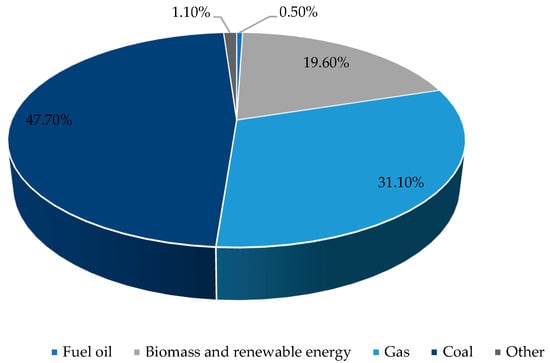
Waste from burning solid fuels from home furnaces currently has no specific classification. However, the main products are ash remaining in ash pans and soot in chimneys. This combustion waste poses a technical problem for municipal waste sorting installations. Furnace waste also does not meet the requirements for inert waste. The situation has made thorough analysis necessary and determining the possibility of using ashes from home furnaces has become a very important issue. It should be noted that the problem of managing ashes from domestic furnaces with a predominant share of hard coal ashes does not occur in other European countries. This results from the distinct pattern of energy consumption in Polish households compared with other European Union countries. The coal-oriented profile of domestic energy use leads to Poland accounting for more than 80% of the coal burned in households across Europe. In Poland, coal constitutes 47.7% of individual heating (Figure 1). Therefore, no European country is experiencing the problem, on such a large scale as in Poland, of managing ashes resulting from coal combustion in home central heating or hot water installations [8].
Figure 1.
Individual district heating—energy sources in Poland in 2020 [9].
Household residues from wood and coal combustion are most commonly disposed of together with municipal waste. In practice, we have also observed that domestic ash is sometimes mixed with soil in home gardens used for cultivating vegetables and herbs. In Poland this is a regular practice. For this purpose, it is necessary to determine which solid fuel ashes would be suitable for this purpose in terms of toxic impact.
Polycyclic aromatic hydrocarbons (PAHs) are acknowledged as long-lasting environmental contaminants characterized by widespread distribution in aquatic ecosystems [10]. Recent comprehensive assessments document their occurrence in freshwater systems from multiple anthropogenic and natural sources, with particular concern for ecotoxicological impacts on aquatic organisms [10]. Major health hazards include carcinogenic and mutagenic effects, with pathways of exposure via breathing, swallowing, and skin absorption [11]. A significant emerging concern involves PAH derivatives, including nitrated, oxygenated, and alkylated PAHs, which have been detected in diverse environmental matrices and in some cases exhibit higher toxicities than their parent compounds [12].
The valorization of combustion residues as agricultural amendments aligns with current EU circular economy policy objectives [13]. However, standardized safety protocols for ash reuse remain underdeveloped [13]. Effective remediation strategies, including bioremediation approaches utilizing biochar and microbial consortia, show promising potential for reducing PAH contamination [14,15]. This integrated approach to ash management—combining toxicological assessment with remediation strategies—is essential for safe agricultural reuse of combustion residues.
The issue of environmental contamination by polycyclic aromatic hydrocarbons (PAHs) originating from the combustion of solid organic fuels is the subject of intensive scientific research. Numerous studies document significant differences in PAH levels depending on the type of burned material, combustion technology, and type of resulting residues. Research conducted in northern Vietnam by Nguyen and co-workers [16] revealed significant differences in PAH concentrations in residues from municipal and industrial waste incinerators. Average concentrations of total PAHs were 9.55 × 10³ ng/Nm3 in PM10 dust, 215 × 103 ng/g in fly ash, and 2.38 ng/g in bottom ash. The researchers observed that PAHs with low molecular weight (containing 2–3 rings) prevailed in the majority of samples, and industrial installations were characterized by higher PAH concentrations than municipal ones [16]. Meanwhile, Zhao and co-workers [17] analyzed PAH levels in various types of ash from hospital waste incinerators in China. Average levels of ∑PAHs in waste ash varied significantly from 4.16 mg kg−1 to 198.92 mg kg−1. Levels of carcinogenic PAHs varied from 0.74 to 96.77 mg kg−1, exceeding limits established by several countries. Furthermore, Ren and co-workers [18] investigated the impact of biomass burning on PAH concentrations in PM2.5 in China. Daily concentrations of ∑13PAHs during the heating period were more than twice as high compared to the pre-heating period. Average concentration of ∑8oxygenated PAHs reached 351 ng m−3, with a significant increase in concentrations observed during the heating season. Conversely, Lim et al. [19] carried out year-long monitoring in three residential regions of Sweden, revealing distinct seasonal fluctuations in PAH concentrations during the colder months, primarily attributed to intensified domestic heating. Their model indicated that local wood combustion accounted for 98% of benzo[a]pyrene emissions in the Stockholm area, while local traffic contributed only 2%. Nonetheless, non-local sources were predominant in the urban background, representing 60% of the total.
The objective of this study was to assess the toxicity of ash produced from the combustion of various types of solid fuels, with particular focus on the release of polycyclic aromatic hydrocarbons (PAHs) and their ecotoxicological effects. By combining chemical analyses with standardized biotests, we sought to identify which types of ashes may be considered safe for potential agricultural use, and to provide scientific evidence to support sustainable household ash management.
Accordingly, research was undertaken to evaluate the toxicity of ashes derived resulting from the burning of selected, prevalent solid fuels. Ash was obtained from the combustion of the following fuels under controlled conditions: large-sized hard coal pieces over 60 mm, medium (25–80 mm) and fine (8–25 mm) hard coal fractions, wood pellets, and split firewood. Then, a 24 h elution process was carried out, obtaining eluents from various ashes. The findings of the study allowed for a comprehensive identification and assessment of the leaching potential of polycyclic aromatic hydrocarbons (PAHs) from ash generated by the combustion of various solid fuels. Furthermore, the analyses provided insight into how fuel type affects the mobility of PAHs in aquatic systems, emphasizing the importance of fuel composition in determining the environmental behavior of these compounds. In addition, the carcinogenic potential of the ash extracts was quantified through the calculation of carcinogenic equivalents, while the acute ecotoxicity of the eluates was assessed using standardized biotests. For this purpose, the Microtox® system, employing luminescent bacteria Aliivibrio fischeri, was applied as a sensitive bioindicator of toxic effects. Together, these approaches allowed for a comprehensive characterization of both the chemical and ecotoxicological properties of ash eluates obtained from solid fuel combustion.
2. Materials and Methods
The procedure applied for the collection and preparation of ash samples in this study was adopted directly from the methodological framework previously elaborated and validated by the Szatyłowicz research group [20,21,22]. This protocol, recognized for its robustness and reproducibility, has been consistently employed in earlier investigations addressing the environmental implications of solid fuel combustion. Its reapplication in the present work ensured strict methodological standardization, thereby allowing reliable cross-comparison of newly obtained data with results reported in prior studies. By adhering to this established procedure, the present research minimizes experimental variability, enhances the credibility of toxicological assessments, and aligns with the broader scientific practice of employing validated methodologies in environmental and ecotoxicological studies.
2.1. Preparation of Ash and Eluent Samples
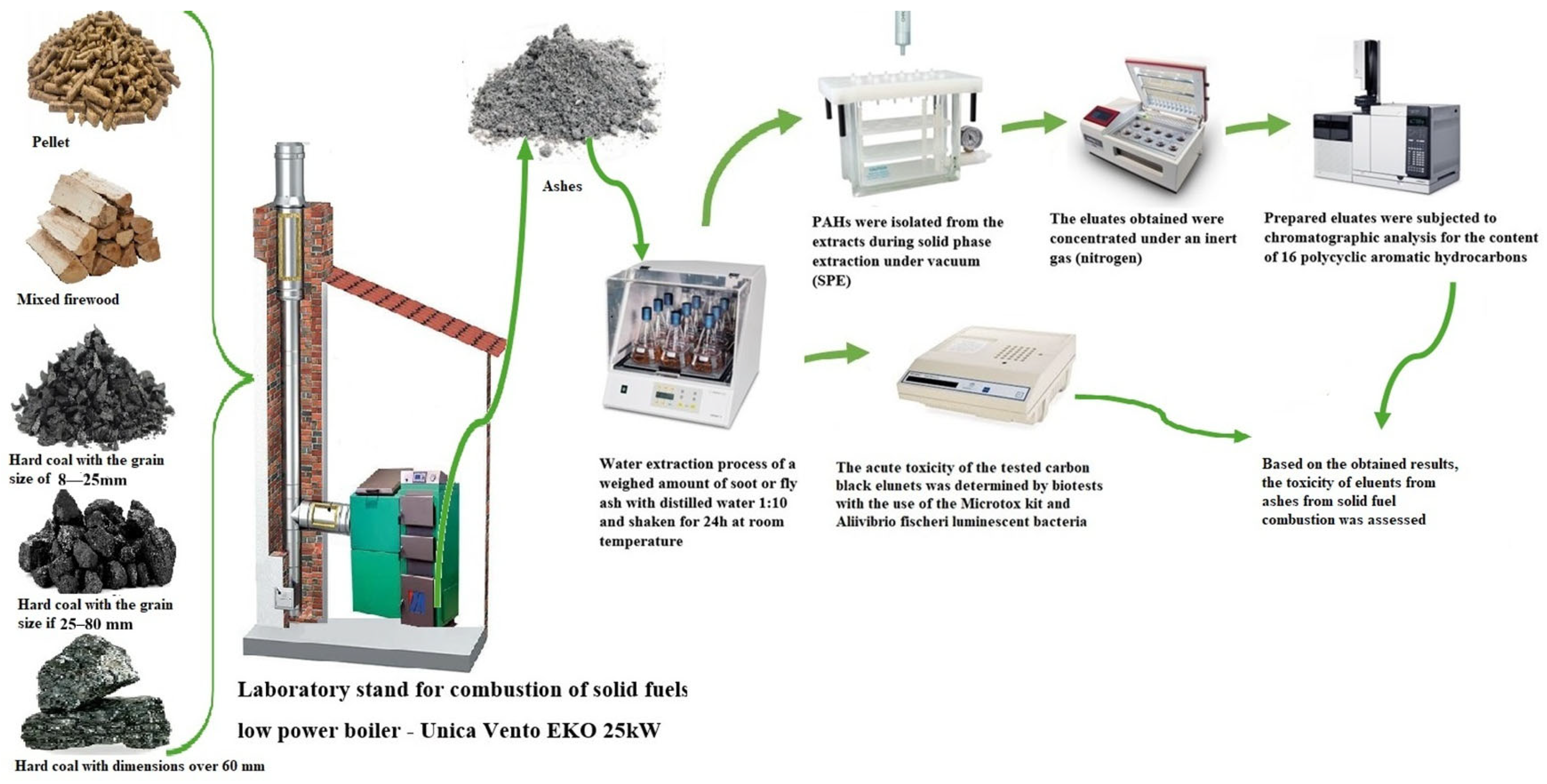
The collection of ash obtained from the burning of solid fuels was conducted under strictly controlled laboratory parameters designed to guarantee the accuracy and consistency of the results. The experimental setup involved the combustion of several representative fuel types: hard coal pieces larger than 60 mm, coal fractions of 25–80 mm and 8–25 mm, 6 mm diameter pellets, and a mixture of firewood types. All combustion trials were performed at a dedicated laboratory station [10], which comprised a Moderator Unica Vento Eko 25 kW boiler (Moderator Sp. z o.o., Hajnówka, Poland) fitted with an automatic fuel feeder and equipped with both manual and retort grates, allowing the simulation of various combustion modes typically found in household heating systems. To provide statistically reliable results and to account for combustion variability, three independent combustion cycles were conducted for each of the five selected solid fuels. Ash residues were systematically collected from the boiler furnace on a daily basis during each experimental series [20,21]. This approach allowed not only for the acquisition of sufficient quantities of representative ash samples but also for the assessment of potential variability between successive combustion processes, ensuring that the samples accurately reflected the properties of ash generated under typical operational conditions. Figure 2 shows a simplified diagram of the experiment.
During each combustion cycle, 15 kg of the tested fuel was combusted under stable operating conditions to maintain the comparability of the results. The exhaust gas temperature and the outlet feed water temperature were kept at approximately 70–80 °C, with the return water temperature not dropping below 50 °C. Once combustion was finished for each fuel type, the soot collected from the three replicates was merged, thoroughly mixed, and subsequently processed through aqueous extraction. For this purpose, a weighed portion of soot was combined with distilled water at a 1:10 (w/v) proportion, followed by shaking for 24 h at room temperature. After aqueous extraction, the solution was filtered through a 0.45 µm PTFE membrane filter to remove solid particles that could hinder sorption on the SPE column. Polycyclic aromatic hydrocarbons (PAHs) were extracted from the resulting solutions using solid-phase extraction (SPE) under vacuum conditions. Chromabond SPE columns Macherey-Nagel (Düren, Germany) (5 mL, 500 mg) packed with octadecyl C18 sorbent were employed. Prior to sample application, the columns were prepared for use by sequential rinsing twice with 3 cm3 with methanol, followed by two rinses using 3 cm3 of a water–methanol mixture (9:1, v/v). Subsequently, 3 cm3 of the prepared sample was loaded onto the column without vacuum assistance, maintaining a flow rate of 5 cm3/min. Afterward, vacuum was applied to pass the remainder of the sample through the sorbent. Next, the columns were cleaned using 3 cm3 of a methanol–water solution (1:1, v/v) and subsequently subjected to vacuum drying for 20 min. In the final step, PAHs were extracted with 5 cm3 of dichloromethane, and the eluates were concentrated under a nitrogen atmosphere to a final volume of 500 µL [22]. To verify the effectiveness of the applied extraction method, a PAH recovery experiment was conducted, the procedure and obtained recovery values for LMW, MMW, and HMW compounds being described in detail in the Supplementary Materials.
2.2. Chromatographic Analysis
The prepared eluates were subsequently analyzed chromatographically to determine the concentration of 16 priority polycyclic aromatic hydrocarbons (PAHs), namely: acenaphthylene, acenaphthalene, anthracene, benzo(a)anthracene, benzo(b)fluoranthene, benzo(k)fluoranthene, benzo(g,h,i)perylene, benzo(a)pyrene, chrysene, dibenzo(a,h)anthracene, fluoranthene, fluorene, indeno(1,2,3-c,d)pyrene, naphthalene, phenanthrene, and pyrene. These compounds were selected in accordance with commonly accepted environmental monitoring standards, as they represent the group of PAHs most relevant to both toxicological risk assessment and regulatory frameworks.
Quantitative determination of the target PAHs was carried out using gas chromatography coupled with mass spectrometry (GC–MS). The analytical system consisted of an Agilent Triple Quadrupole GC/MS 7000C, fitted with a split/splitless injector and an HP-5MS capillary column (30 m × 0.25 mm inner diameter, 0.25 µm film thickness). The chromatographic conditions applied ensured adequate separation and detection sensitivity for all analytes of interest. Specific operational parameters of the instrument, encompassing the temperature schedule, carrier gas velocity, and ionization conditions, are summarized in Table 1 [12].
Table 1.
Operating conditions of the apparatus during the analysis of PAHs in eluents [21,22].
The detailed temperature program applied during the chromatographic analysis, including the successive heating stages and their respective durations, is summarized in Table 2. This program was optimized to achieve effective separation of the target PAHs, ensuring adequate resolution and reproducibility of the analytical results.
Table 2.
Temperature program during the analysis of PAHs in eluents [21,22].
Figure 2.
Scheme of the entire experiment with analytical methodology.
No internal standard was introduced during the extraction process. Instead, the quality and reliability of the analytical procedure were verified by performing the complete method simultaneously with the use of the certified reference material EDF-5183 Clean Soil (Cerilliant Analytical Reference Standards). This control step allowed the continuous monitoring of method performance and ensured that potential matrix effects were properly accounted for. Quantitative analysis of PAHs was conducted using an external calibration approach, relying on calibration curves established individually for each compound. Calibration solutions were prepared from a standard mixture of 16 priority PAHs (catalog no. Z-014G, AccuStandard) available commercially [22]. The application of this calibration strategy not only enabled precise determination of the target analytes but also provided consistency with established reference data, thereby enhancing the reliability and reproducibility of the obtained results.
2.3. Toxicological Assessment Using Indicators
To provide a comprehensive evaluation of the toxicological relevance of polycyclic aromatic hydrocarbons (PAHs) detected in the eluates, several well-established indicators were applied. These indices make it possible to quantify not only the general toxicity of PAH mixtures but also their mutagenic and carcinogenic potential. The use of multiple metrics allows for a multidimensional characterization of health risks, taking into account both the cumulative effects of the entire PAH group and the relative contribution of specific high-risk compounds. The formulas used for calculating these indicators, along with their interpretation, are presented in Table 3 [23,24,25].
Table 3.
Toxicological indicators applied for the assessment of PAHs in ash eluates [23,24,25].
2.4. Microtox Biotest Methodology
The acute ecotoxicity of extracts derived from the burning of the examined fuel samples was evaluated using standardized bioluminescence inhibition assays performed with a Microtox® Model 500 luminometer manufactured by Strategic Diagnostics Inc. (Newark, DE, USA). This bioassay is widely recognized as a sensitive and rapid method for assessing the ecotoxicity of aqueous samples, relying on the metabolic activity of the marine bacterium Aliivibrio fischeri. These microorganisms naturally emit light as a result of enzymatic reactions associated with their respiratory processes. When exposed to toxic compounds present in environmental samples, the intensity of their luminescence decreases in proportion to the degree of cellular disruption. Thus, the reduction in light output provides a quantitative measure of acute ecotoxicity, with higher inhibition values reflecting increased concentrations of harmful substances [26].
The analytical system employed consisted of the Microtox® Model 500 analyzer integrated with a personal computer and the dedicated Microtox Omni 4.1 software, enabling automated data collection, statistical analysis, and result interpretation. To ensure consistency and reliability, all reagents recommended by the manufacturer (Modern Water) were used. These included the bacterial regeneration medium (Reconstitution Solution), solution for osmotic balance adjustment and dilution water, for both solid and liquid phases. The biological test organism was freeze-dried A. fischeri (formerly Vibrio fischeri, NRRL B-11177), supplied in lyophilized form. According to the manufacturer’s specifications, the bacteria can be stored for up to one year at −20 °C without loss of viability. Prior to use, the bacteria were rehydrated with deionized water and suspended in a 2% NaCl solution, which provides the optimal osmotic environment for maintaining luminescence. Under these conditions, the microorganisms exhibit stable light emission for approximately 1–1.5 h, providing a sufficient time window to conduct the toxicity measurements.
During the test procedure, bacterial suspensions were exposed to defined volumes of the extracts obtained from the combustion of each fuel type. The response was monitored as a reduction in bioluminescence after specific incubation periods, following the manufacturer’s standard operating procedure as specified in the SDI guidelines. The degree of luminescence inhibition was expressed as a percentage relative to control samples, thus allowing direct comparison between the different eluates. The resulting data were processed using Microtox Omni 4.1 software, which applies built-in statistical algorithms to ensure accurate evaluation of the dose–response relationships. This methodological approach, combining a well-established bioindicator with a standardized analytical platform, enabled a robust and reproducible assessment of the acute ecotoxicity of eluates derived resulting from the burning of selected solid fuels.
For each tested sample, the Microtox® system generated a detailed analytical report that included the following parameters: the EC50 value (expressed as the percentage decrease in Aliivibrio fischeri luminescence), 95% confidence intervals and the corresponding confidence level, regression formula and correlation factor, and the coefficient of determination (R2). The EC50 values, determined after both 5 and 15 min of exposure, were subsequently converted into toxicity units (TU) in order to standardize the results and facilitate comparative analysis of sample toxicity. The conversion was performed according to the following formula:
where
TUa—units of acute ecological toxicity.
EC50—median effective concentration.
To classify the toxicity of eluates obtained from combustion residues, two complementary evaluation systems were applied. The first, developed by Persoone [27], is widely used in ecotoxicological studies and provides a fine-grained division of toxicity levels, particularly in the range of low acute ecotoxicity. The second system, proposed by Sawicki et al. [28], introduces a simplified classification scheme, often applied in environmental monitoring in Poland, with emphasis on distinguishing between low-toxic, toxic, and highly toxic samples. The use of both scales allowed for a more comprehensive assessment of the acute ecotoxicity of the tested eluates, facilitating both international comparability and regional applicability.
To classify the acute ecotoxicity of the tested eluates, two systems were applied. Table 4 presents the classification according to Persoone [27], while Table 5 shows the system proposed by Sawicki et al. [28].
Table 4.
Classification of acute ecotoxicity of samples according to Persoone [27].
Table 5.
Classification of acute ecotoxicity of samples according to Sawicki et al. [28].
2.5. Determination of Elemental Composition by Atomic Absorption Spectrometry (AAS)
The quantitative determination of calcium (Ca), potassium (K), magnesium (Mg), lead (Pb), and cadmium (Cd) in ash samples was performed using a Thermo Fisher Scientific iCE 3500 Atomic Absorption Spectrometer (Waltham, MA, USA). The analyses were carried out in accordance with standard AAS protocols recommended for environmental and agricultural materials.
Prior to measurement, the ash samples were subjected to acid digestion to ensure complete mineralization. Approximately 0.5 g of homogenized dried ash was placed in Teflon vessels and digested in a mixture of concentrated HNO3 (65%) and HCl (37%) in a 3:1 v/v ratio using a controlled heating system at 180 °C for 2 h. After cooling, the digests were filtered through 0.45 µm membranes and diluted to 50 mL with ultrapure deionized water (resistivity > 18 MΩ·cm).
The AAS determinations were performed in flame atomization mode (air–acetylene mixture, burner head = 50 mm) with hollow cathode lamps specific to each element. The analytical wavelengths and instrumental parameters were as follows:
3. Results
Table 6 summarizes the concentrations of 16 polycyclic aromatic hydrocarbons (PAHs) determined in water extracts of ashes generated from the combustion of selected solid fuels. For clarity of interpretation, the compounds were grouped into three categories: ΣLMW (low molecular weight PAHs), comprising hydrocarbons with two to four aromatic rings (naphthalene, acenaphthene, acenaphthylene, fluorene, phenanthrene, and anthracene); ΣHMW (high molecular weight PAHs), which include compounds with five or six aromatic rings (fluoranthene, pyrene, benzo(a)anthracene, chrysene, benzo(b)fluoranthene, benzo(k)fluoranthene, benzo(a)pyrene, indeno(1,2,3-c,d)pyrene, dibenzo(a,h)anthracene, and benzo(g,h,i)perylene); and ΣPAHs, representing the total content of all 16 hydrocarbons analyzed.
Table 6.
Operating parameters of Thermo Fisher iCE 3500 Atomic Absorption Spectrometer for determination of Ca, K, Mg, Pb, and Cd in ash samples.
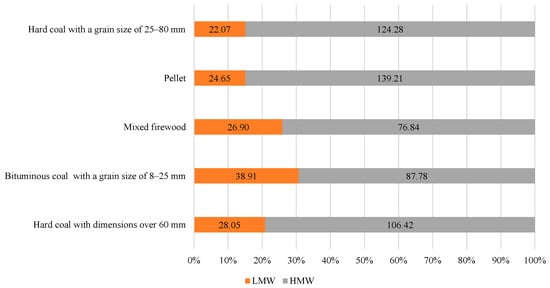
The obtained results (Table 7) demonstrate that the lowest overall content of ΣPAHs was recorded in the water eluate from ash originating from mixed firewood combustion (111.53 ng/g dry mass), while the highest concentration was found in ash from pellet combustion (168.77 ng/g dry mass) (Figure 3). The distribution of PAH groups is also relevant: low molecular weight PAHs (ΣLMW) are generally more water soluble and mobile in the environment, whereas high molecular weight PAHs (ΣHMW) tend to be more hydrophobic, persistent, and are associated with stronger toxic, mutagenic, and carcinogenic effects. This differentiation underlines the importance of both the total PAH content and the structural composition of individual fractions when assessing the environmental risk posed by ash eluates.
Table 7.
Concentrations of PAHs and toxicological indicators in water extracts of ashes from the combustion of different solid fuels (ng/g d.m.).
Figure 3.
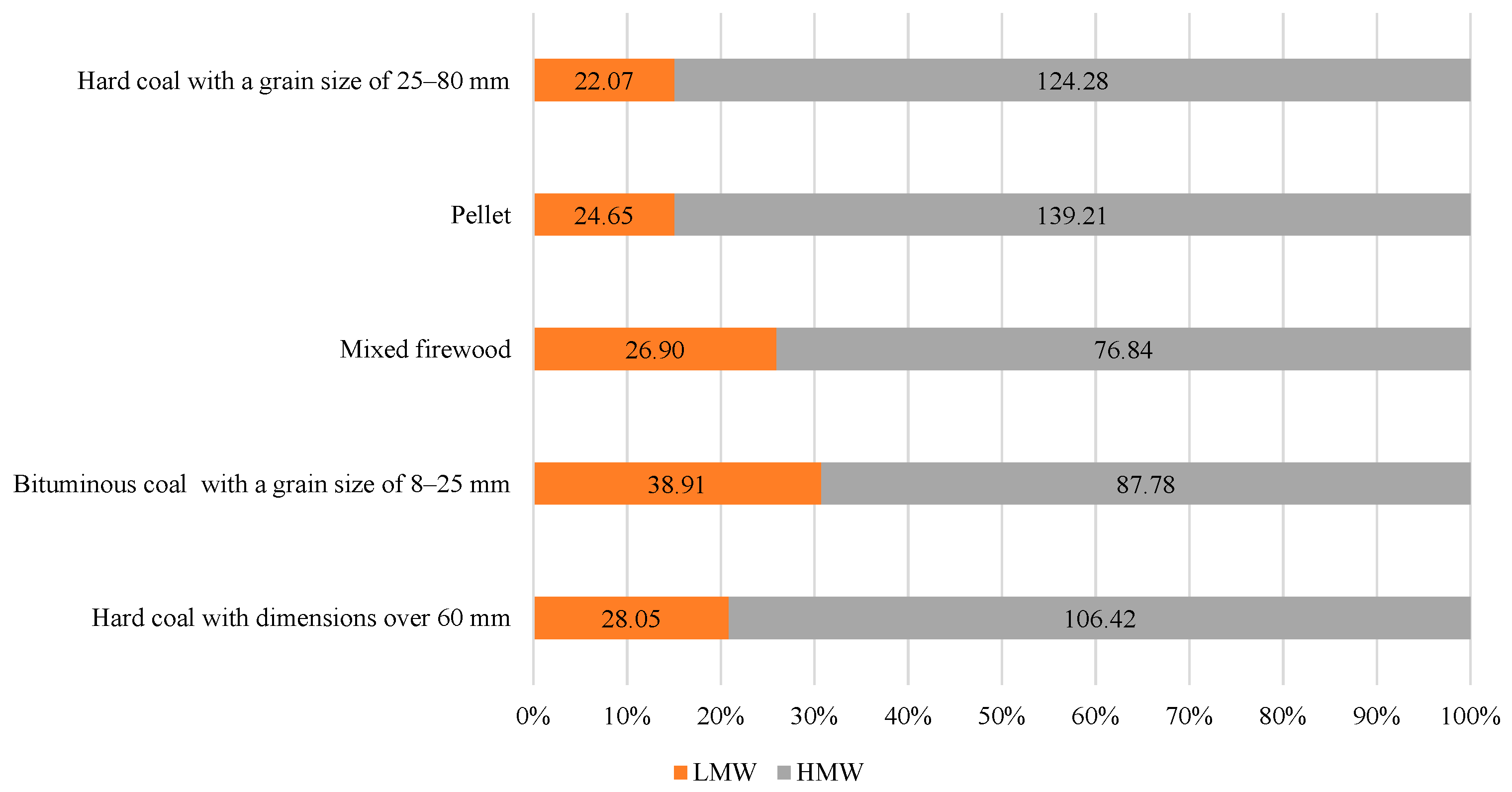
Distribution of low- and high-molecular-weight PAHs emitted from combustion of different solid fuels.
As illustrated in Figure 3, the lowest concentration of ΣLMW compounds in water extracts from fly ash (22.07 ng/g d.m.) was observed for hard coal with a particle size range of 25–80 mm, whereas the highest ΣLMW value (38.91 ng/g d.m.) was determined for ash originating from the burning of hard coal in the 8–25 mm fraction. In contrast, the highest ΣHMW content in eluates was associated with pellet combustion (139.1 ng/g d.m.), while the lowest concentration of this fraction was obtained for mixed firewood combustion (76.84 ng/g d.m.). These results demonstrate that the type and granulation of the fuel strongly influence the mobility and solubility of PAHs, with finer coal fractions and biomass pellets favoring the release of heavier PAH structures into the aqueous phase. Among individual compounds, dibenzo[a,h]anthracene (D(ah)A) was consistently found to dominate in the water extracts, both in terms of frequency of occurrence and concentration. The maximum level of this compound was measured in extracts obtained from the burning of hard coal in the 25–80 mm size fraction (65.36 ng/g d.m.). Conversely, the lowest concentrations were observed for naphthalene and acenaphthylene, which were either absent or present in trace amounts, confirming their lower persistence in aqueous eluates compared to high molecular weight congeners. In terms of toxicological indicators, the highest toxicity equivalent (TEQ) values were calculated for eluates from pellet combustion (393.32 ng/g d.m.) and hard coal in the 25–80 mm fraction (346.63 ng/g d.m.), whereas the lowest TEQ was associated with mixed firewood (117.84 ng/g d.m.). Similarly, mutagenicity equivalents (MEQ) reached their maximum in pellet combustion extracts (33.21 ng/g d.m.) and their minimum in firewood combustion extracts (16.87 ng/g d.m.). The carcinogenicity equivalent (TCDD-TEQ), calculated according to the applied formula [3], followed the same trend, further supporting the conclusion that ash derived from biomass pellets and hard coal of larger fractions poses a considerably greater ecotoxicological risk compared to ash from mixed firewood. The obtained calculation results are presented in Table 1. TCDD-TEQ calculations were also performed for the tested water extracts from ashes. The greatest TCDD-TEQ value was determined for the water extract of ash produced from the combustion of hard coal with a granulation of 25–80 mm and pellets with a granulation of 6 mm. It was 0.29 ng/g d.m. and 0.25 ng/g d.m., respectively. The lowest TEQ coefficient in water extracts from ashes was obtained in the ash extract obtained from the burning of mixed firewood (0.12 ng/g d.m.).However, in the group of fly ash extracts, the highest ΣPAHcarc/ΣPAH ratio was calculated for samples from the combustion of mm pellets (739.32 ng/g d.m.), and the lowest value was recorded for samples derived from the combustion of hard coal in the 8–25 mm fraction (498.78 ng/g d.m.).
Table 8 reports the results of acute biotoxicity assays of ash samples performed with the Microtox® kit using the luminescent marine bacterium Aliivibrio fischeri. In this method, inhibition of bacterial light emission following exposure to the sample is quantified and expressed as EC50, which serves as the primary endpoint for acute ecotoxicity evaluation. The Microtox® assay is widely applied in ecotoxicology, and its EC50 values have been shown to correlate with conventional acute ecotoxicity parameters for vertebrate species. Although tests with Daphnia magna are among the most commonly used reference bioassays, the literature indicates that A. fischeri-based biotests provide comparable and reliable outcomes for aqueous samples, offering a sensitive and rapid screening tool for assessing acute toxic effects [29,30,31,32,33].
Table 8.
Acute ecotoxicity of extracts obtained from the combustion of tested fuels.
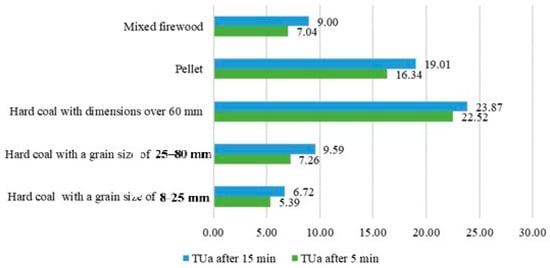
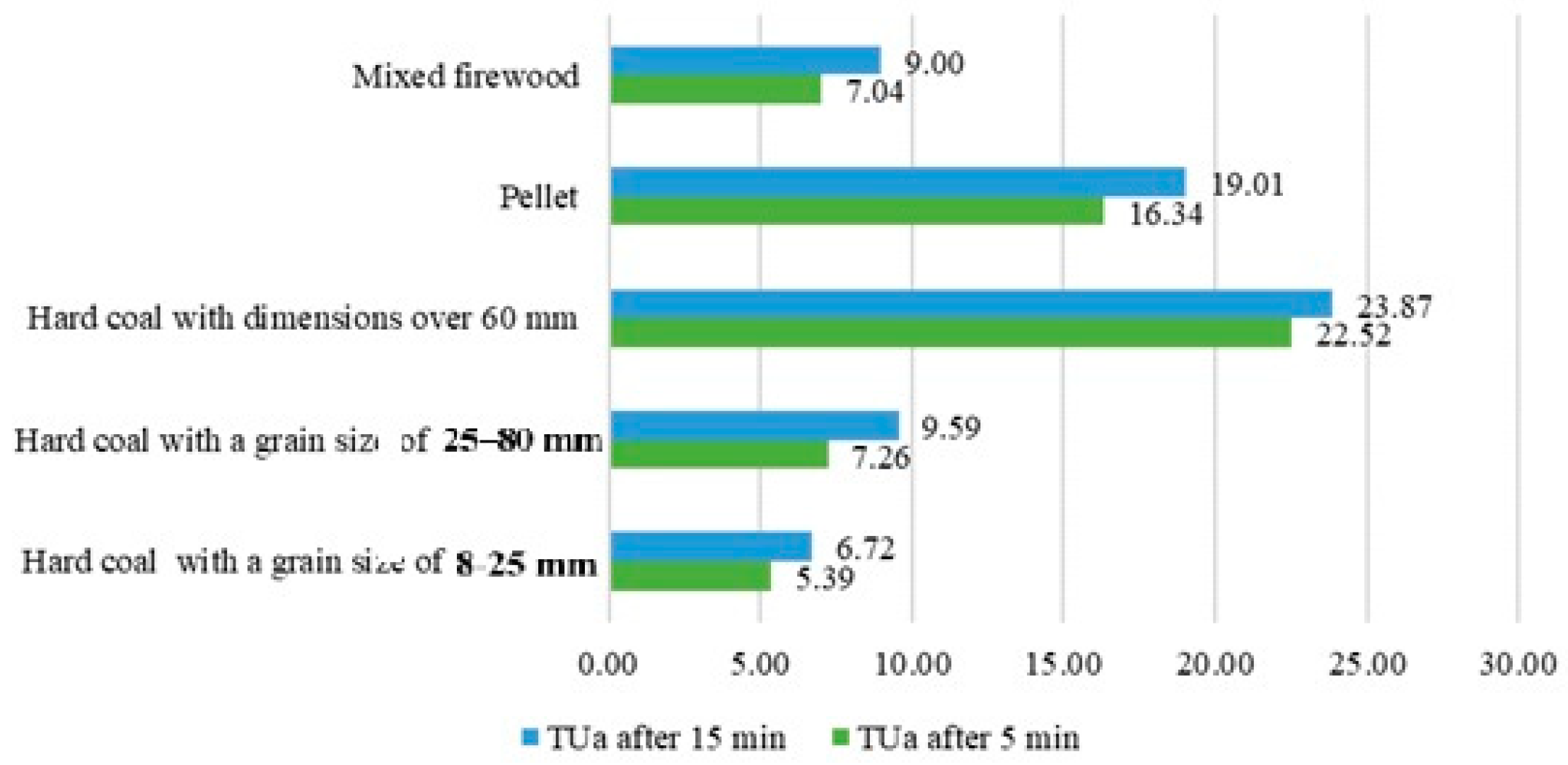
The biotoxicity tests were evaluated in two time intervals, reflecting acute ecptoxicity (TUa) of the eluates following 5 and 15 min of exposure. The analysis of the results (Table 4) showed that the substances released from the ash samples exhibited a noticeable toxic effect on the test organisms at both exposure durations. The highest TUa values (Figure 4) were recorded for hard coal with particle sizes greater than 60 mm, reaching 22.52 after 5 min and 23.87 after 15 min, indicating pronounced toxicity. In contrast, the lowest toxicity was associated with hard coal of 25–80 mm granulation, for which TUa values were 5.39 and 6.75 after 5 and 15 min, respectively. The obtained results were then categorized based on the toxicity classification systems proposed by Persoone [27] and Sawicki et al. [18]. Ash eluates derived from hard coal (>60 mm) and pellets showed the highest toxicity, corresponding to class 3 (high acute ecotoxicity) in the Persoone classification and class 2 (significant toxic effect—low-toxic sample) in the Sawicki classification, consistently for both exposure times. In the case of the remaining fuels, eluates were placed into class 2 (significant toxicity) according to Persoone [27] and class 1 (no significant toxic effect) according to Sawicki et al. [28], regardless of whether the evaluation was made after 5 or 15 min of exposure. These findings confirm that although all tested ashes released compounds exerting acute toxic effects on Aliivibrio fischeri, the intensity of toxicity varied considerably with fuel type and particle size. Specifically, larger coal fractions (>60 mm) and pellet combustion produced eluates with the strongest ecotoxicological impact, whereas eluates from mixed firewood and smaller coal granulations were characterized by a substantially lower degree of toxicity.
Figure 4.
Acute ecotoxicity (TUa) values measured after 5 and 15 min of exposure to water extracts of ash obtained from the burning of various solid fuels. Higher TUa values indicate greater inhibitory effects on the luminescence of Aliivibrio fischeri.
The results obtained during the experiments confirm the toxic impact of compounds contained in the extract of ashes from the tested fuels. The degree of toxicity varies depending on the type of burned fuel. The obtained results are consistent with the re-search conducted by Szatyłowicz and Hawrylik [11], which demonstrated the toxicity of water extracts of soot derived from the combustion of the same fuels analyzed in this study, showing that hard coal with particle sizes exceeding 60 mm exhibited the highest toxicity. The bioindication method using Aliivibrio fischeri bacteria, widely used by many researchers [34,35,36,37] therefore confirms the toxicity of PAHs present in soot and ash originating from the combustion of various fuels to living organisms present in the environment, taking into account the synergistic effect of other component substances.
To comprehensively assess the chemical safety and agricultural applicability of the studied ashes, additional elemental analyses were carried out (Table 9). These determinations were performed to evaluate the concentration of both essential macronutrients and trace elements that influence soil enrichment, plant growth, and environmental safety. The analysis specifically focused on calcium (Ca), potassium (K), and magnesium (Mg)—key nutrients improving soil quality and pH buffering capacity—as well as on potentially toxic elements such as lead (Pb) and cadmium (Cd), which are critical for assessing environmental compliance and fertilizer safety. The measurements were conducted using Atomic Absorption Spectrometry (AAS) on residues of the previously analyzed ash samples. The obtained data complement the polycyclic aromatic hydrocarbons (PAHs) analysis by providing a broader chemical characterization of the ashes. This combined dataset allows for a more complete evaluation of the ashes’ suitability for possible agricultural reuse, balancing their nutrient potential with the need for environmental protection.
Table 9.
Elemental composition of ash samples from the combustion of different solid fuels (Ca, K, Mg in %, Pb and Cd in mg/kg d.m.).
The results presented in Table 7 indicate substantial variability in the mineral composition of ashes derived resulting from the burning of various solid fuels, which reflects the characteristics of the raw materials as well as the combustion conditions. Ashes originating from biomass fuels (pellet and mixed firewood) are characterized by the highest contents of macronutrients (Ca, K, Mg). In particular, the ash produced from pellet combustion exhibits very high calcium (8.64%) and potassium (2.45%) levels, confirming its potential as a liming and soil-replenishing agent. Mixed firewood ash also contains significant quantities of these nutrients (Ca = 0.184%, K = 0.00021%, Mg = 0.0019%), though notably lower than pellet ash, probably due to differences in fuel composition and combustion uniformity.
In contrast, coal-derived ashes show a markedly lower content of major nutrients, especially for coarser fractions. The ashes from fine coal (8–25 mm) display moderate concentrations of Ca (3.40%), K (1.08%) and Mg (1.40%), whereas the largest-grain coal (>60 mm) shows slightly higher calcium but still significantly lower nutrient levels compared to biomass ashes. The ash from medium-sized coal (25–80 mm) contains trace levels of macronutrients, with Ca < 0.003%, confirming its low agronomic value.
Regarding toxic metals (Pb and Cd), their concentrations are generally low across all samples, remaining within the ranges typically reported for combustion residues. The highest levels were recorded for pellet ash (Pb = 97 mg/kg, Cd = 42.5 mg/kg), which may be linked to particulate contamination from feedstock origin or production additives. Coal ashes contained moderate Pb levels (16–35 mg/kg) and very low Cd (≤ 1.9 mg/kg), while biomass ash from firewood presented negligible amounts (Pb = 1.84 mg/kg, Cd = 0.019 mg/kg). Overall, the results reveal a clear distinction between biomass- and coal-based ashes: the former are nutrient-rich and environmentally favorable for potential agricultural reuse (subject to metal content control), while the latter demonstrate higher inertness and lower nutrient value but relatively stable elemental profiles. This distinction highlights the greater ecological and agronomic applicability of ashes derived from renewable biomass sources.
The data presented above reveal substantial differences in PAH concentrations and ecotoxicological responses across ash types. To interpret these findings within broader environmental and regulatory contexts, the following discussion examines the mechanistic basis for observed variations, compares results with established environmental standards, and considers implications for agricultural application. These comprehensive analytical results—spanning PAH concentrations, ecotoxicological bioassays, and elemental composition—provide the foundation for interpreting the environmental suitability of combustion ashes for potential agricultural reuse, as discussed in the following section.
4. Discussion
The results presented above demonstrate substantial differences in PAH concentrations and ecotoxicological responses across ash types derived from various solid fuels. To interpret these findings within broader environmental and regulatory contexts, the following discussion examines the mechanistic basis for observed variations, compares results with established environmental standards, and considers implications for agricultural application and waste management policy.
4.1. Comparative Analysis and Environmental Context
The combined interpretation of PAH concentrations and Microtox® EC50 results provides deeper insight into the environmental implications of ash leaching [38]. Comparison with the environmental quality standards defined in the EU Water Framework Directive (2000/60/EC) and the Environmental Quality Standards Directive (2008/105/EC) revealed that certain high-molecular-weight PAHs—particularly benzo(a)pyrene, benzo(b)fluoranthene, and indeno(1,2,3-cd)pyrene—exceeded the permissible ranges for surface waters (0.01–0.1 µg L−1) [39]. Such exceedances clearly demonstrate that uncontrolled release of ash eluates into natural systems could cause significant ecological stress, particularly for aquatic organisms sensitive to hydrophobic organic contaminants [38,40].
Furthermore, the ecotoxicological context provided by the Microtox® assay supports these findings. The reduced luminescence of Aliivibrio fischeri in contact with the eluates indicates the presence of bioavailable toxic compounds capable of disturbing cellular metabolism, even at low concentrations [38]. The combination of chemical and biological indicators allowed for a multidimensional assessment of ash safety, not limited to pollutant quantification but expanded to include measurable biological responses [40].
Integrating these results with EU regulatory benchmarks increases the environmental relevance of the study. It underlines the need to control ash management practices and explore treatment or stabilization strategies prior to potential agricultural use [39,40]. This approach aligns with the goals of sustainable waste utilization and environmental protection, ensuring that secondary products of combustion are evaluated not only for nutrient recovery but also for ecotoxicological safety [41].
Recent advances in agricultural residue processing, including granulation and controlled pyrolysis technologies, offer promising pathways for converting low-value biomass into value-added products while simultaneously reducing environmental burdens from waste combustion. Such approaches complement the present study’s findings by suggesting that pre-treatment of feedstock materials—rather than post-treatment of ashes—could optimize both energy efficiency and environmental safety in household heating systems [41].
The lower toxicity observed for the mixed firewood ash can be explained by several complementary mechanisms related to the combustion process and the physico-chemical properties of the resulting material. First, mixed firewood typically combusts at higher and more stable temperatures compared to coal or biomass pellets, which promotes more complete oxidation of organic precursors and enhances the thermal degradation of PAHs [41]. Elevated combustion temperatures accelerate PAH decomposition kinetics through oxidation and pyrolysis reactions, limiting the persistence of high-molecular-weight, carcinogenic congeners in the resulting residues [38]. Studies have demonstrated that incomplete combustion of PAHs is strongly influenced by temperature and oxygen availability in the combustion zone, with PAH emissions decreasing significantly above 500 °C [38].
Secondly, the mineral composition of wood ash plays an important role in buffering system pH and immobilizing hazardous compounds. The high content of alkaline components such as calcium, potassium, and magnesium contributes to the formation of basic oxides and carbonates, which can neutralize acidic species and catalytically transform some residual organics into less harmful products [41]. This mineral buffering also reduces the solubility of certain PAHs and metals in aqueous eluates, thereby lowering the measured biological toxicity [38,40].
Research on alkali-activated ash systems demonstrates that alkaline activation can stabilize and bind contaminants through geopolymerization reactions, effectively immobilizing potentially toxic substances [40]. Furthermore, differences in combustion efficiency and feedstock heterogeneity may influence the volatile organic emissions and ash composition. In the case of mixed firewood, the variable density and moisture content of different wood species may favor more gradual burning, which results in extended exposure of organic intermediates to high-temperature oxidation zones [41]. This process enhances PAH mineralization within the combustion chamber, leaving an ash fraction that is both chemically simpler and less bioavailable to aquatic organisms [38]. Taken together, these factors suggest that the relatively low toxicity of mixed firewood ash stems from a combination of thermal degradation of PAHs, alkaline mineral buffering, and limited leaching of residual organics, which collectively diminish the ecotoxicological impact observed in the Microtox® assays [38,40,41].
4.2. National Context—Barriers and Limitations in Poland
In Poland, despite regulatory recognition of ash potential (Regulation of the Ministry of Infrastructure, Dz.U. 2021 nr 1475), practical barriers limit agricultural applications. These include
- the lack of standardized ash quality criteria and testing protocols;
- insufficient public awareness regarding safe ash management;
- variability in residential fuel quality due to unstandardized coal and biomass sourcing.
Technical challenges include inconsistent combustion conditions in household furnaces and insufficient monitoring infrastructure. Addressing these barriers through national standardization initiatives and awareness campaigns would align Polish practices with EU circular economy objectives.
4.3. Study Limitations and Future Research Directions
While this study provides valuable insights into the toxicological suitability of ashes from various solid fuels for agricultural applications, several analytical and methodological limitations should be acknowledged to enhance scientific transparency and guide future research.
First, the PAH analysis focused on the 16 priority compounds classified by the US EPA. Although these compounds represent the most environmentally significant congeners, numerous other PAH species and derivatives (e.g., alkylated PAHs, nitro-PAHs, and oxy-PAHs) were not included in the analytical spectrum. Expanding the target analyte list in future work would provide a more comprehensive assessment of the organic contaminant profile in ash eluates and better reflect the full environmental burden.
Second, potential matrix effects in the GC-MS analysis may have influenced the accuracy and precision of PAH quantification. Complex environmental matrices, such as ash extracts, can suppress or enhance analyte responses during chromatographic separation and detection. Although calibration curves demonstrated acceptable linearity (R2 ≥ 0.998), the absence of matrix-matched calibration standards or comprehensive internal standard correction for every target compound represents a potential source of variability. Studies have shown that matrix effects in PAH analysis can range from 30% to over 90% depending on the sample composition. Future investigations should incorporate deuterated internal standards for all priority PAHs and employ matrix-matched calibration to minimize these biases.
Third, the use of a single ecotoxicity bioassay (Microtox® with Aliivibrio fischeri) provides a limited perspective on ash toxicity. While bacterial luminescence inhibition is a well-established and rapid screening method, it does not capture the full spectrum of ecological risks. Future studies should integrate multi-trophic bioassays, including plant germination tests, algal growth inhibition assays, and chronic toxicity tests with invertebrates and fish, to obtain a more holistic ecotoxicological profile.
Finally, the laboratory combustion conditions, although standardized, do not fully replicate the variability of real-world household heating systems. The influence of fuel moisture, combustion temperature fluctuations, and airflow dynamics on ash composition and contaminant leaching behavior warrants further field-based validation with ashes collected directly from residential furnaces.
Addressing these limitations will strengthen future research efforts and contribute to more robust guidelines for the safe reuse of combustion ashes in agriculture.
5. Conclusions
Based on the experimental research carried out, the following conclusions were formulated:
- Samples of water extracts from ashes were characterized by much lower concentrations of total PAHs than extracts from soot (the extract from the combustion of 6 mm pellets showed the highest concentration (168.77 ng/g d.m.), whereas the lowest concentration was recorded for the extract obtained from burning mixed firewood (111.53 ng/g d.m.).
- Analysis of the low-molecular-weight (LMW) fraction indicated that water extracts from ashes produced by the combustion of 6 mm pellets showed the smallest share of this group in the total PAH concentration. This finding suggests a reduced presence of more biodegradable PAHs, which typically belong to the low molecular weight fraction.
- Based on the calculated toxicological indicators (TEQ = CEQ, MEQ, TCDD-TEQ), the eluate from pellet ashes exhibited the highest toxicity and carcinogenic potential. In contrast, the eluates derived from the combustion of mixed firewood exerted the least adverse impact on living organisms and the environment, indicating a more favorable ecotoxicological profile.
- The greatest ΣPAHcarc/ΣPAH proportion was found in the water extracts of ash originating from pellet combustion, demonstrating that, among all tested fuels, pellets released the greatest proportion of compounds classified as carcinogenic PAHs into the aqueous phase.
- The compounds present in the extracts from all tested ashes exhibited acute ecotoxicity, as confirmed by biotests with Aliivibrio fischeri. The intensity of toxic effects was dependent on the type of fuel combusted, with the strongest responses recorded for eluates from hard coal with particle sizes exceeding 60 mm.
- The elemental composition analysis revealed clear differences between biomass and coal-derived ashes. Biomass ashes, particularly those from pellet combustion, showed significantly higher levels of essential nutrients (Ca, K, Mg), indicating their potential use as soil amendments. Coal ashes, in contrast, contained lower nutrient levels and limited fertilizing value but maintained low concentrations of toxic metals (Pb, Cd), confirming their chemical stability and low environmental risk.
Due to the above conclusions resulting from the research and tests, it was found that only ashes from wood biomass, in this case mixed firewood, are suitable for agricultural use in home gardens. Only water eluents from ash from the combustion of this fuel were characterized by the lowest toxicity, taking into account indicators based on the PAH content and biotests. Moreover, it should be remembered that a large variability of properties and composition is observed in ashes, resulting from the differentiation and quality of the fuel, which also causes a variable amount of impurities in this material. Standards for ashes and their uses define the physical, chemical and mineralogical properties that fly ashes must meet in order to be used as secondary raw materials. Therefore, in order to obtain the required ash parameters, it is important to properly compose the mixture for the boiler (not only from the point of view of energy production efficiency).
Our findings show that among the tested fuels, only mixed firewood ash exhibited sufficiently low PAH content and acute ecotoxicity to be considered potentially suitable for small-scale agricultural use under controlled conditions. This highlights its potential for sustainable household ash management, while stressing the need for careful monitoring and further research on long-term environmental impacts.
However, even for mixed firewood ash, careful quality control and monitoring of ash composition is recommended, as variability in fuel quality and combustion conditions can significantly influence the release of toxic compounds. Long-term soil–plant bioavailability and phytotoxicity testing are essential prior to definitive recommendations for agricultural use [42].
From a practical perspective, the results of this study indicate that only ashes from mixed firewood combustion can be considered for limited agricultural applications, such as use in home gardens. However, even in this case, careful monitoring of ash composition is recommended, as variability in fuel quality and combustion conditions can significantly influence the release of toxic compounds. The findings highlight the need to establish regulatory guidelines for the safe use and disposal of household ashes in Poland and other regions with a high reliance on solid fuels.
Future studies should concentrate on long-term field investigations evaluating the buildup of PAHs and other contaminants (such as heavy metals) in soils and crops exposed to ashes. Moreover, studies on the effectiveness of mitigation strategies such as composting, co-application with organic amendments, and phytoremediation should be pursued to further reduce toxicological risks. Comparative analyses across different geographic regions and combustion technologies would also provide valuable insights into the broader applicability of the conclusions drawn in this study.
However, the findings of this laboratory-based assessment require validation through long-term field experiments addressing PAH soil–plant bioavailability, phytotoxicity, and ecosystem-level impacts before definitive recommendations for large-scale agricultural application can be established [42].
Supplementary Materials
The following supporting information can be downloaded at: https://www.mdpi.com/article/10.3390/su17219777/s1. Methodology for Assessing Recovery of PAHs by Water Extraction.
Author Contributions
Conceptualization, E.S. and E.H.; methodology, E.S.; software, E.H.; validation, E.S.; formal analysis, E.H.; investigation, E.S.; resources, E.H.; data curation, E.H.; writing—original draft preparation, E.S.; writing—review and editing, E.H.; visualization, E.S.; supervision, E.S.; project administration, E.S.; funding acquisition, E.S. All authors have read and agreed to the published version of the manuscript.
Funding
This research was funded by the Polish Ministry of Higher Education and Science grant number WZ/WB-IIŚ/6/2025 and grant number WZ/WB-IIŚ/5/2025.
Institutional Review Board Statement
Not applicable.
Informed Consent Statement
Not applicable.
Data Availability Statement
The original contributions presented in this study are included in the article. Further inquiries can be directed to the corresponding author.
Conflicts of Interest
The authors declare no conflicts of interest.
References
- Chafe, Z.; Brauer, M.; H’eroux, M.E.; Klimont, Z.; Lanki, T.; Salonen, R.O.; Smith, K.R. Residential Heating with Wood and Coal: Health Impacts and Policy Options in Europe and North America. 2015. Available online: https://www.ccacoalition.org/sites/default/files/resources/2015_residential-heating-wood-coal-health-impacts-policy_WHO.pdf (accessed on 26 April 2024).
- Perera, F. Pollution from Fossil-Fuel Combustion is the Leading Environmental Threat to Global Pediatric Health and Equity: Solutions Exist. Int. J. Environ. Res. Public Health 2018, 15, 16. [Google Scholar] [CrossRef] [Scilit]
- Pędziwiatr, A.; Potysz, A.; Uzarowicz, Ł. Combustion wastes from thermal power stations and household stoves: A comparison of properties, mineralogical and chemical composition, and element mobilization by water and fertilizers. Waste Manag. 2021, 131, 136–146. [Google Scholar] [CrossRef] [Scilit]
- Munawer, M. Human health and environmental impacts of coal combustion and post-combustion wastes. J. Sustain. Min. 2018, 17, 87e96. [Google Scholar] [CrossRef] [Scilit]
- Smołka-Danielowska, D.; Jabłońska, M. Chemical and mineral composition of ashes from wood biomass combustion in domestic wood-fired furnaces. Int. J. Environ. Sci. Technol. 2022, 19, 5359–5372. [Google Scholar] [CrossRef] [Scilit]
- Horák, J.; Kuboňová, L.; Bajer, S.; Dej, M.; Hopan, F.; Krpec, K.; Ochodek, T. Composition of ashes from the combustion of solid fuels and municipal waste in households. J. Environ. Manag. 2019, 248, 109269. [Google Scholar] [CrossRef] [Scilit] [PubMed]
- Mtisi, M.; Gwenzi, W. Evaluation of the phytotoxicity of coal ash on lettuce (Lactuca sativa L.) germination, growth and metal uptake. Ecotoxicol. Environ. Saf. 2019, 170, 750–762. [Google Scholar] [CrossRef] [Scilit]
- Wasielewski, R.; Radko, T. The problem of household furnace waste management. Ecol. Eng. 2018, 19, 36–44. [Google Scholar] [CrossRef] [Scilit]
- Dębkowska, K.; Juszczak, A.; Maj, M.; Szymańska, A. Energy Foresight in Poland. Polish Economic Institute: Warsaw, Poland, 2021. Available online: www.pie.net.pl (accessed on 1 May 2024).
- Berríos-Rolón, P.J.; Cotto, M.C.; Márquez, F. Polycyclic Aromatic Hydrocarbons (PAHs) in Freshwater Systems: A Comprehensive Review of Sources, Distribution, and Ecotoxicological Impacts. Toxics 2025, 13, 321. [Google Scholar] [CrossRef] [Scilit]
- Sousa, G.; Viegas, S.; Twarużek, M.; Kosicki, R.; Viegas, C. Exposure to Polycyclic Aromatic Hydrocarbons (PAHs) during Firefighting Activities: A Review. Int. J. Environ. Res. Public Health 2022, 19, 12677. [Google Scholar] [CrossRef] [Scilit]
- Cao, W.; Yuan, J.; Geng, S.; Zou, J.; Dou, J.; Fan, F. Oxygenated and Nitrated Polycyclic Aromatic Hydrocarbons: Sources, Quantification, Incidence, Toxicity, and Fate in Soil—A Review Study. Processes 2023, 11, 52. [Google Scholar] [CrossRef] [Scilit]
- Blasenbauer, D.; Huber, F.; Lederer, J.; Quina, M.J.; Blanc-Biscarat, D.; Bogush, A.; Evarts, J.; Geysen, D.; Huber, T.; Hyks, J.; et al. Legal Situation and Current Practice of Waste Incineration Bottom Ash Utilisation in Europe. Waste Mang. 2020, 102, 868–883. [Google Scholar] [CrossRef] [Scilit]
- Geng, S.; Mao, S.; Xu, G.; Ding, A.; Chen, F.; Dou, J.; Fan, F. Performance Evaluation of Modified Biochar as a Microorganism-Immobilizing Carrier for Phenanthrene Remediation. Processes 2024, 12, 2939. [Google Scholar] [CrossRef] [Scilit]
- Beljin, J.; Đukanović, N.; Anojčić, J.; Simetić, T.; Apostolović, T.; Mutić, S.; Maletić, S. Biochar in the Remediation of Organic Pollutants in Water. Nanomaterials 2024, 15, 26. [Google Scholar] [CrossRef] [Scilit]
- Nguyen, H.T.; Pham, V.Q.; Nguyen, T.P.M.; Nguyen, T.T.T.; Tu, B.M.; Le, P.T. Emission and distribution profiles of polycyclic aromatic hydrocarbons in solid residues of municipal and industrial waste incinerators, Northern Vietnam. Environ. Sci. Pollut. Res. 2023, 30, 38255–38268. [Google Scholar] [CrossRef] [Scilit] [PubMed]
- Zhao, L.; Zhang, F.-S.; Hao, Z.; Wang, H. Levels of polycyclic aromatic hydrocarbons in different types of hospital waste incinerator ashes. Sci. Total Environ. 2008, 397, 24–30. [Google Scholar] [CrossRef] [Scilit] [PubMed]
- Ren, J.; Zhang, L.; Li, X.; Wang, Y.; Wang, H.; Xie, M.; Chen, J.; Zhang, Y. Characterization of polycyclic aromatic hydrocarbons in soil in a coal mining area, East China: Spatial distribution, sources, and carcinogenic risk assessment. Front. Earth Sci. 2022, 10, 1035792. [Google Scholar] [CrossRef] [Scilit]
- Lim, H.; Silvergren, S.; Spinicci, S.; Mashayekhy Rad, F.; Nilsson, U.; Westerholm, R.; Johansson, C. Contribution of Wood Burning to Exposures of PAHs and Oxy-PAHs in Eastern Sweden. Atmos. Chem. Phys. 2022, 22, 11359–11379. [Google Scholar] [CrossRef] [Scilit]
- Szatyłowicz, E.; Walendziuk, W. Analysis of Polycyclic Aromatic Hydrocarbon Content in Ash from Solid Fuel Combustion in Low-Power Boilers. Energies 2021, 14, 6801. [Google Scholar] [CrossRef] [Scilit]
- Szatyłowicz, E.; Hawrylik, E. Assessment of Migration of PAHs Contained in Soot of Solid Fuel Combustion into the Aquatic Environment. Water 2022, 14, 3079. [Google Scholar] [CrossRef] [Scilit]
- Szatyłowicz, E.; Skoczko, I. Evaluation of the PAH Content in Soot from Solid Fuels Combustion in Low Power Boilers. Energies 2019, 12, 4254. [Google Scholar] [CrossRef] [Scilit]
- Nisbet, I.C.T.; LaGoy, P.K. Toxic equivalency factors (TEFs) for polycyclic aromatic hydrocarbons (PAHs). Regul. Toxicol. Pharm. 1992, 16, 290–300. [Google Scholar] [CrossRef] [Scilit]
- Rogula-Kozłowska, W.; Kozielska, B.; Klejnowski, K. Concentration, origin and health hazard from fine particle-bound PAH at three characteristic sites in Southern Poland. Bull. Environ. Contam. Tox. 2013, 91, 349–355. [Google Scholar] [CrossRef] [Scilit]
- Willett, K.L.; Gardinali, P.R.; Sericano, J.L.; Wade, T.L.; Safe, S.H. Characterization of the H4IIE rat hepatoma cell bioassay for evaluation of environmental samples containing polynuclear aromatic hydrocarbons (PAHs). Arch. Environ. Cont. Tox. 1997, 32, 442–448. [Google Scholar] [CrossRef] [Scilit] [PubMed]
- Widder, E. Bioluminescence in the Ocean: Origins of Biological, Chemical, and Ecological Diversity. Science 2010, 328, 704–708. [Google Scholar] [CrossRef] [Scilit]
- Mantis, I.; Voutsa, D.; Samara, C. Assessment of the environmental hazard from municipal and industrial wastewater treatment sludge by employing chemical and biological methods. Ecotoxicol. Environ. Saf. 2005, 62, 397–407. [Google Scholar] [CrossRef] [Scilit]
- Sawicki, J.; Nałęcz-Jawecki, G.; Mankiewicz-Boczek, J.; Izydorczyk, K.; Sumorok, B.; Drobniewska, A.; Kaza, M. Comprehensive Ecotoxicological Analysis of Surface Waters; MNiI project no. 2 P05F 056 28; Department of Environmental Biology, Medical University of Warsaw: Warsaw, Poland, 2007. (In Polish) [Google Scholar]
- Park, K.; Hee, S.Q. Effect of dust on the viability of Vibrio fischeri in the Microtox test. Ecotoxicol. Environ. Saf. 2001, 50, 189–195. [Google Scholar] [CrossRef] [Scilit] [PubMed]
- Hsieh, C.Y.; Tsai, M.H.; Ryan, D.K.; Pancorbo, O.C. Toxicity of the 13 priority pollutant metals to Vibrio fisheri in the Microtox® chronic toxicity test. Sci. Total Environ. 2004, 320, 37–50. [Google Scholar] [CrossRef] [Scilit]
- Baran, A.; Tarnawski, M. Phytotoxkit/Phytotestkit and Microtox® as tools for toxicity assessment of sediments. Ecotoxicol. Environ. Saf. 2013, 98, 19–27. [Google Scholar] [CrossRef] [Scilit]
- Czech, B.; Jośko, I.; Oleszczuk, P. Ecotoxicological evaluation of selected pharmaceuticals to Vibrio fischeri and Daphnia magna before and after photooxidation process. Ecotoxicol. Environ. Saf. 2014, 104, 247–253. [Google Scholar] [CrossRef] [Scilit] [PubMed]
- Ajuzieogu, C.A.; Odokuma, L.O. Comparison of the sensitivity of Crassostrea gigas and Vibrio fischeri (Microtox) for toxicity assessment of produced water. J. Adv. Biol. Biotechnol. 2018, 17, 1–10. [Google Scholar] [CrossRef] [Scilit]
- Zadorozhnaya, O.; Kirsanov, D.; Buzhinsky, I.; Tsarev, F.; Abramova, N.; Bratov, A.; Legin, A. Water pollution monitoring by an artificial sensory system performing in terms of Vibrio fischeri bacteria. Sens. Actuators B Chem. 2015, 207, 1069–1075. [Google Scholar] [CrossRef] [Scilit]
- Mansour, S.A.; Abdel-Hamid, A.A.; Ibrahim, A.; Mahmoud, N.H.; Moselhy, W.A. Toxicity of some pesticides, heavy metals and their mixtures to Vibrio fischeri bacteria and Daphnia magna: Comparative study. J. Biol. Life Sci. 2015, 6, 221–240. [Google Scholar] [CrossRef] [Scilit]
- Mariani, L.; Grenni, P.; Barra Caracciolo, A.; Donati, E.; Rauseo, J.; Rolando, L.; Patrolecco, L. Toxic response of the bacterium Vibrio fischeri to sodium lauryl ether sulphate residues in excavated soils. Ecotoxicology 2020, 29, 815–824. [Google Scholar] [CrossRef] [Scilit]
- Ramteke, P.W.; Sagar, A.; Singh, M.P. Assessment of wastewater toxicity by Vibrio fischeri bioassay. Int. J. Ecol. Environ. Sci. 2019, 45, 15–17. [Google Scholar]
- Chen, Y.; Fan, Y.J.; Huang, Y.; Liao, X.L.; Xu, W.F.; Zhang, T. A Comprehensive Review of Toxicity of Coal Fly Ash and Its Leachate in the Ecosystem. Ecotoxicol. Environ. Saf. 2024, 269, 115905. [Google Scholar] [CrossRef] [Scilit] [PubMed]
- SCHEER (Scientific Committee on Health, Environmental and Emerging Risks). Environmental Risk Limits for Polycyclic Aromatic Hydrocarbons (PAHs): For Direct Aquatic, Benthic and Terrestrial Toxicity. European Commission—Health and Food Safety: Brussels, Belgium, 2023; Available online: https://health.ec.europa.eu/system/files/2023-03/scheer_o_061.pdf (accessed on 25 October 2025).
- Simon, F.-G.; Scholz, P. Assessment of the Long-Term Leaching Behavior of Incineration Bottom Ash: A Study of Two Waste Incinerators in Germany. Appl. Sci. 2023, 13, 13228. [Google Scholar] [CrossRef] [Scilit]
- Cwalina, P.; Krasowska, M.; Smolewska, M.E.; Koziak, K. Effect of Composting Ashes from Biomass Combustion on Polycyclic Aromatic Hydrocarbon Content. Energies 2024, 17, 840. [Google Scholar] [CrossRef] [Scilit]
- Zhylina, M.; Shishkin, A.; Miroshnichenko, D.; Sterna, V.; Ozolins, J.; Ansone-Bertina, L.; Klavins, M.; Goel, G.; Goel, S. Granulation and pyrolysis of agricultural residues for an enhanced circular economy. Results Eng. 2025, 26, 104919. [Google Scholar] [CrossRef] [Scilit]

Disclaimer/Publisher’s Note: The statements, opinions and data contained in all publications are solely those of the individual author(s) and contributor(s) and not of MDPI and/or the editor(s). MDPI and/or the editor(s) disclaim responsibility for any injury to people or property resulting from any ideas, methods, instructions or products referred to in the content. |
© 2025 by the authors. Licensee MDPI, Basel, Switzerland. This article is an open access article distributed under the terms and conditions of the Creative Commons Attribution (CC BY) license (https://creativecommons.org/licenses/by/4.0/).