Article

Exploring Impact and Driving Forces of Land Use Transformation on Ecological Environment in Urban Agglomeration from the Perspective of Production-Living-Ecological Spatial Synergy

1
College of Geography and Environment, Shandong Normal University, Jinan 250014, China
2
Shandong Provincial Territorial Spatial Ecological Restoration Center, Jinan 250014, China
3
Zaozhuang Municipal Bureau of Natural Resources and Planning, Zaozhuang 277800, China
*
Authors to whom correspondence should be addressed.
Sustainability 2025, 17(18), 8235; https://doi.org/10.3390/su17188235
Submission received: 15 July 2025 / Revised: 7 September 2025 / Accepted: 11 September 2025 / Published: 12 September 2025

Abstract

Accurate analysis of land use transformation (LUT) and its ecological and environmental effects, along with investigations into how ecological and environmental quality responds to both natural and human factors, is crucial for protecting regional ecosystems. This research concentrated on the Yangtze River Delta Urban Agglomeration (YRDUA), analyzing land use change patterns and their effects on ecological environment quality (EEQ) from the perspectives of production, living, and ecological spaces. Partial least squares structural equation modeling (PLS-SEM) was utilized to assess the immediate and mediated effects of environmental and socio-economic drivers. Additionally, this study examined how urban agglomeration integration affects LUT and EEQ. The findings suggest that: (1) Throughout 2000–2020, production land decreased, and living land expanded markedly, while ecological land remained largely stable. (2) Between 2000 and 2020, the overall environmental quality in the YRDUA declined, showing significant temporal and spatial disparities among regions. (3) Converting urban or rural residential land to agricultural land promotes ecological improvement, whereas the opposite conversion tends to result in environmental degradation. (4) Topography, climate, and greening directly improve environmental quality, whereas LUT, economic development and integration exert adverse impacts. Topography indirectly influences the ecological environment through its effects on climate, economy, regional integration, and LUT, whereas climate and the economy exert indirect effects via LUT, greening and integration. This research serves as a scientific foundation for ecological environment protection, sustainable growth and regional land space planning in urban agglomerations.

1. Introduction

LUT represents a critical factor influencing regional ecological environmental dynamics [1,2]. Rapid industrialization and urbanization have promoted rapid socio-economic development, but they have also prompted substantial transformations in land utilization patterns and spatial configurations [3,4]. In addition, the transformation of land use functions may positively or negatively influence the regional ecological environment and cumulatively affect the global EEQ [5,6]. Accordingly, the investigation of ecological and environmental consequences arising from LUT provides valuable insights into the assessment and projection of regional ecological conditions and their temporal dynamics [7,8].
LUT denotes the dynamic transformation of land use patterns—both explicit and implicit—over time, driven by socioeconomic changes and innovations and corresponding to the transition in a region’s stage of socioeconomic development [9,10]. Economic development, transformation, and innovation often arise from the implementation of new policies and development strategies, which directly influence regional economic activities and are spatially manifested as adjustments within land system configurations. The continuous evolution of land structures strengthens their functional roles, enabling land systems to progress from initial formation to stable operation, thereby supporting the realization of regional socioeconomic development goals [11]. Land utilization restructuring denotes the process through which a significant shift emerges in a specific region’s land utilization pattern in alignment with a particular phase of economic and social advancement [12]. One of its key manifestations is the continuous restructuring of territorial assets across production-living-ecological spaces [13,14]. Essentially, environmental degradation driven by LUT is the consequence of a misalignment in the distribution and layout of land allocated to productive, living, and ecological functions [15]. Therefore, combining the evolving changes in production, living, and ecological areas with transformations in land use has become a crucial approach to evaluating the environmental effects of regional land transformation, allowing for a comprehensive understanding of its influence on environmental quality [16,17,18]. At present, there are many studies on production-living-ecological space, focusing on basic concepts [19,20], classification schemes [21], type identification [21,22,23], coordination analysis [24,25,26], and spatiotemporal evolution [27,28]. Previous studies have demonstrated that changes in land utilization patterns exert a considerable influence on EEQ [29,30], and the driving mechanism of promoting changes in environmental consequences driven by LUT has been a major focus of academic attention [3,31,32].
In recent years, research methodologies for ecological environment quality have exhibited a trend toward diversification. Remote sensing monitoring methods continue to occupy a central position, with related studies extensively employing composite indicators such as the Normalized Difference Vegetation Index (NDVI), Enhanced Vegetation Index (EVI), and Remote Sensing Ecological Index (RSEI) to reflect ecological environment quality levels [33,34,35]. Meanwhile, comprehensive quantitative measurement methods such as the Ecosystem Services Value (ESV) model and the Ecological Quality Index (EQI) have also been widely applied in regional ecological impact assessments and policy evaluations [36,37]. At present, research areas are mostly concentrated in districts and counties [38], economically developed areas and ecologically fragile areas [39]. In recent years, the rapidly developing urban clusters in central China have gradually emerged as a new research focus, particularly in studies examining the interplay between urbanization, LUT, and ecological environments [40,41,42].
Multiple factors contribute to variations in ecological and environmental quality. Numerous researchers have conducted systematic studies and assessments of the driving factors using statistical methods such as correlation analysis [43], cluster analysis [44], multiple linear regression [45], and principal component analysis [46]. Nevertheless, these approaches primarily concentrate on the relationships between single factors and outcome variables, lacking a systematic discussion of the causal relationships between various influencing factors and their transmission paths [47,48]. Structural equation modeling is a statistical approach that utilizes the covariance structure among variables to explore causal relationships between them. This method can examine several factors at once and clearly uncover the cause-and-effect linkage linking latent indicators and measured indicators [49]. Structural equation modeling models are primarily classified into covariance-based structural equation models (CB-SEM) and PLS-SEM. In contrast to CB-SEM, PLS-SEM is capable of addressing both reflective and composite models. Meanwhile, it imposes relatively lenient conditions regarding the number of observations and data characteristics and does not depend on the assumption of data being normally distributed [50]. PLS-SEM can assess the immediate impact of various factors on observed variables and uncover the processes through which several factors exert an indirect impact on observed variables via intermediary pathways [51].
As a significant nexus of the Belt and Road Initiative and the Yangtze River Economic Belt, the YRDUA ranks as one of China’s foremost centers of economic growth [52,53]. Yet, with the swift advancement of industrialization and urban sprawl, the YRDUA has experienced persistent growth in urban land extent and the density of its development. Such intensified land resource utilization has substantially amplified the ecological vulnerabilities confronting emerging urban environments [54]. This has resulted in issues such as the encroachment on green ecological land and inefficient land utilization during LUT, ultimately giving rise to multiple ecological and environmental challenges [55,56]. As the most integrated urban agglomeration in China [57,58], the YRDUA has rarely been studied in depth from both qualitative and quantitative perspectives to explore the mechanisms through which its integration process influences ecological and environmental quality. Therefore, this study considers urban agglomeration integration as a driving factor for identifying EEQ, providing new insights into the spatial variation features and causal mechanisms affecting EEQ within urban agglomerations.
The primary aims of this research are to (1) explore the temporal and spatial dynamics of land utilization transformation through the lens of production–living–ecological spaces; (2) identify the spatiotemporal characteristics of EEQ changes in the study area, as well as the beneficial and adverse impacts that LUT imposes upon EEQ; and (3) reveal the spatiotemporal influencing factors of environmental elements and anthropogenic actions impacting EEQ and offer guidance for future ecological management and sustainable advancement of urban clusters.

2. Materials and Methods

2.1. Research Region

The YRDUA (28°01′ N~34°28′ N, 115°46′ E~123°25′ E) is situated along the central and lower sections of the Yangtze River. It borders the Yellow Sea and the East China Sea and ranks among the three principal urban agglomerations in China. It comprises 26 prefecture-level cities, covering a total area of approximately 211,577 km2 (Figure 1). This area experiences a subtropical monsoon climate characterized by clear seasonal variations. The mean yearly temperature varies between 18 and 23 °C, while the yearly rainfall ranges from 1000 to 2000 mm. Topographically, the area exhibits a progressive reduction in elevation moving southwest to northeast. The area of arable land, forest land, and construction land is 98,000 km2, 57,000 km2 and 29,000 km2, respectively. The natural vegetation mainly comprises evergreen and deciduous broadleaf forests, underscoring the region’s significance as a key ecological function zone at the national level. The research region is home to an estimated permanent population of approximately 170 million, with an urbanization level reaching 75.01%. In terms of economic output, the region’s Gross Domestic Product (GDP) reaches approximately 20.5 trillion yuan, with the tertiary sector contributing about 8.9 trillion yuan.

2.2. Methodology

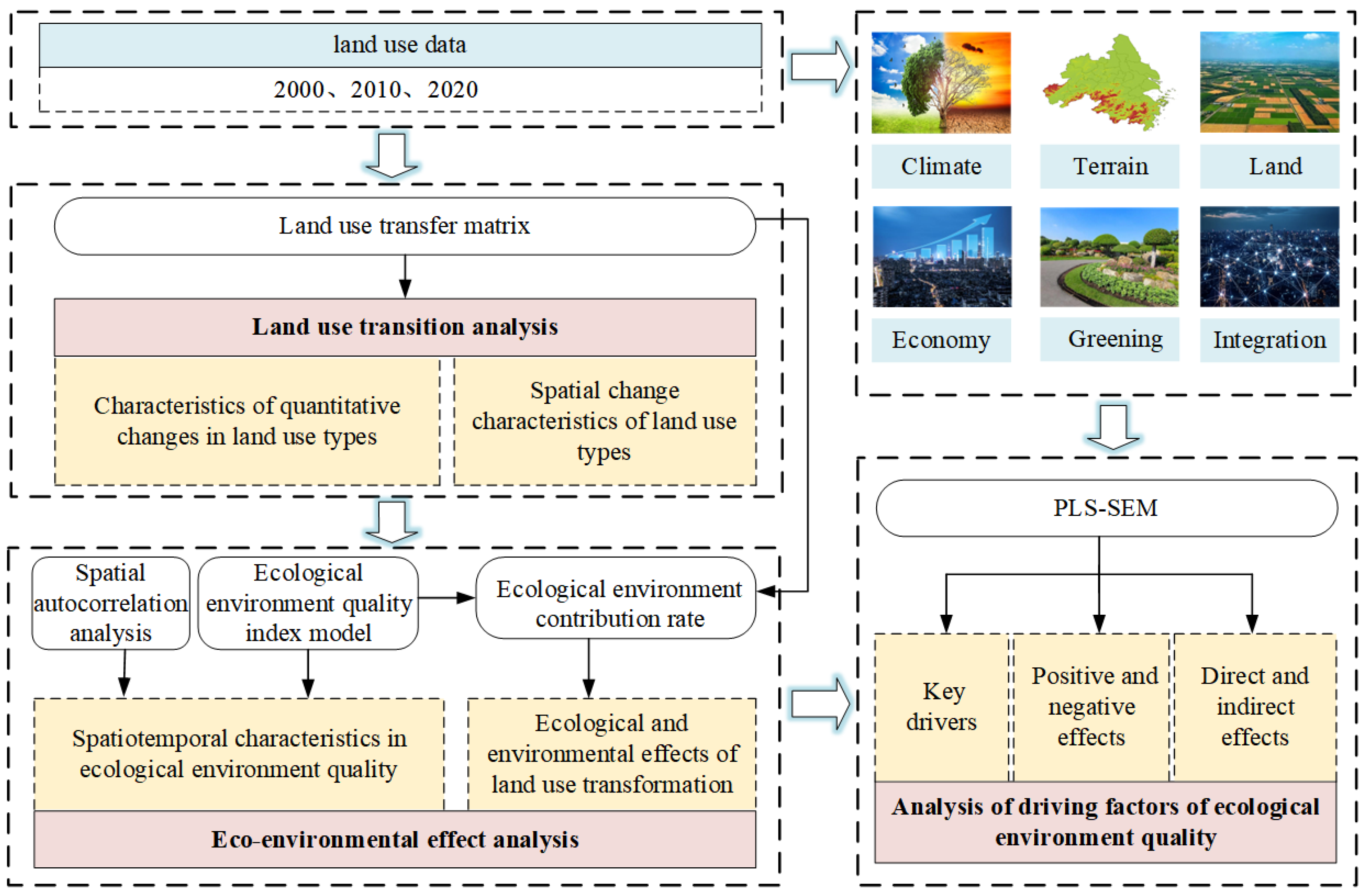
The overall structure of this study comprises the following steps (Figure 2): (1) examining the spatial and temporal patterns of land use transition in the YRDUA from 2000 to 2020 using three periods of land use data, focusing on quantitative and structural changes; (2) measuring the spatial and temporal evolution characteristics of EEQ in the YRDUA using the ecological environment quality index; (3) analyzing ecological environment response to land use transition through the ecological environment contribution; and (4) exploring the determinants and Influence mechanisms on ecological and environmental conditions analyzed via PLS-SEM and making recommendations.

2.2.1. Changes in Land Utilization

The land use transition matrix is a technique based on systems analysis that is used to quantitatively characterize changes in the state of a system [59]. This matrix serves to represent the transitions among different land cover categories within a defined region during a specific timeframe, revealing the progression trends of land use makeup and utilization. The matrix expression is as follows:
L i j = L 11 L 1 n L n 1 L n n
where L is the land area (unit: km2), n is the quantity of land use categories, and i and j are the land use classes at the commencement and termination of this study, respectively.

2.2.2. Ecological Quality Status

The ecological environment quality index quantifies and assesses the overall ecological environment status of a region by combining the EEQ of different land use types within the region and their area proportions, thereby describing the overall level of ecological quality [60]. The formula is as follows:
E V t = i = 1 n C i × L U k i / T A
where E V t represents the ecological environment quality index for the t th period, C i represents the ecological environment quality index for the i th land use type, n represents the total number of land use types, L U k i represents the area of land use type i in the t th period, and T A represents the total area.
To quantitatively assess the ecological environment quality index, this research allocates ecological quality weights to different land use categories according to pertinent prior studies [7].

2.2.3. Spatial Autocorrelation Analysis

Global Moran’s I and Local Moran’s I are employed to assess the spatial correlation of EEQ [61,62]. Global Moran’s I primarily measures the overall correlation between attribute values of adjacent spatial units, with values ranging from [−1, 1]. A positive Moran’s I value indicates a positive correlation between spatial units, while a negative value indicates a negative correlation. Values closer to 1 or −1 indicate a stronger positive or negative spatial correlation, respectively [63]. The mathematical expression of Global Moran’s I is given as follows:
G l o b a l   M o r a n s   I = n i = 1 n j = 1 n W i j ( x i x ¯ ) ( x j x ¯ ) ( i = 1 n j = 1 n W i j ) i = 1 n ( x i x ¯ ) 2
Local Moran’s I (LISA) was employed to perform local spatial autocorrelation analysis, thereby revealing the spatial aggregation patterns of EEQ within the research region and delineating its localized geographic distribution patterns. The mathematical expression of Local Moran’s I is given as follows:
L o c a l   M o r a n s   I = n ( x i x ¯ ) j = 1 n W i j ( x j x ¯ ) i = 1 n ( x i x ¯ ) 2

2.2.4. Ecological Contribution Rate

This indicator is employed to assess how alterations in distinct categories of land cover affect the ecological and environmental conditions of a given region. It serves as a key metric indicating the extent of eco-environmental impact arising from the mutual transformation of different land use categories. This metric is derived from the changes in the eco-environmental quality index corresponding to different land use categories and reveals how much conversions among distinct land use classifications contribute to EEQ [64]. The formula can be expressed as:
L E I = L E t + 1 L E t L A / T A
where L E I is the ecological contribution rate; L E t + 1 and L E t are the ecological quality values of a specific land use category at the start and end points of the transformation, respectively; L A is the area of a certain land use type change; and T A refers to the overall area.

2.2.5. Identification of Driving Factors

Selection of Impact Factors
Taking into account a comprehensive evaluation of the characteristics of the research area and the availability of relevant datasets, and drawing on the findings of existing research [65,66,67,68,69,70], this study selects topography, economic development, climate, greening, regional integration and land use transformation status as the primary factors influencing ecological and environmental quality (Table 1). Additionally, the greening factors here refer to urban greening, with the selected indicators being the number of parks and green coverage area.
We use the gravity model to identify the economic high-quality development correlations among cities within the Yangtze River Delta city cluster, as shown in Equation (4) [70]:
R i j = K i j M i M j D i j 2
where R i j is the gravitational force between the two cities. M i and M j are the economic size of the two cities, respectively, which refers to the GDP here. D i j 2 is the distance between the two cities. K i j is a constant and can take the value of 1 [71].
Partial Least Squares-Structural Equation Modeling
The formula can be expressed as:
x = Λ x ξ + δ
y = Λ y η + ε
where x refers to the vector of externally observed variables, y represents the vector of internally observed variables, Λ x is the factor loadings matrix from ξ to x, Λ y is the factor loadings matrix from η to y, and δ and ε are the measurement error vectors. The relationship between the two latent variables can be expressed by the following regression equation:
η = B η + Γ ξ + ζ
where η denotes the vector of latent endogenous variables, ξ represents the vector of latent exogenous variables, B is the regression path coefficient of the effect between different η , Γ is the regression path coefficient of the effect, and ζ refers to the measurement error of the model.

2.3. Sources and Handling of Data

2.3.1. Land Use Type Data

The datasets on land use from the years 2000, 2010, and 2020 utilized in this research were obtained from the Resource and Environment Science and Data Center of the Chinese Academy of Sciences. The dataset is organized into 6 major classes and 25 sub-classes, with a spatial resolution of 30 m. As a multifunctional spatial carrier, land simultaneously fulfills production, living, and ecological roles, collectively supporting various human activities related to surface utilization and development. Building on previous research [7,72], this study identified and categorized the dominant land use functions (Table 2).

2.3.2. Other Data

The data encompass multiple dimensions throughout this research, including natural geography, climatic conditions, and socio-economic factors, aiming to comprehensively capture the key drivers influencing EEQ in the study area. Natural geographic indicators—namely elevation and slope—were obtained from the China Geographic Spatial Data Cloud Platform. These variables serve to depict the essential topographic features of the research region. Socio-economic indicators, including per capita GDP, urbanization rate, tertiary industry share, and regional GDP, were collected at the prefecture-level city scale from the National Bureau of Statistics. These indicators function to assess the area’s economic development and level of urbanization, with regional GDP also serving as a proxy for inter-city connectivity, thereby reflecting the degree of regional integration. Climate-related indicators consist of annual average precipitation and relative humidity, sourced from the WorldClim Global Climate Database. These variables primarily reflect the region’s moisture and humidity conditions, distinguishing them from temperature-based energy indicators and emphasizing their relevance to ecosystem water availability. For urban greening, the number of parks and green space coverage were chosen to represent the progress of environmental infrastructure and the spatial distribution of green assets within the metropolitan cluster (Table 3).

3. Results

3.1. Analysis of Land Use Change

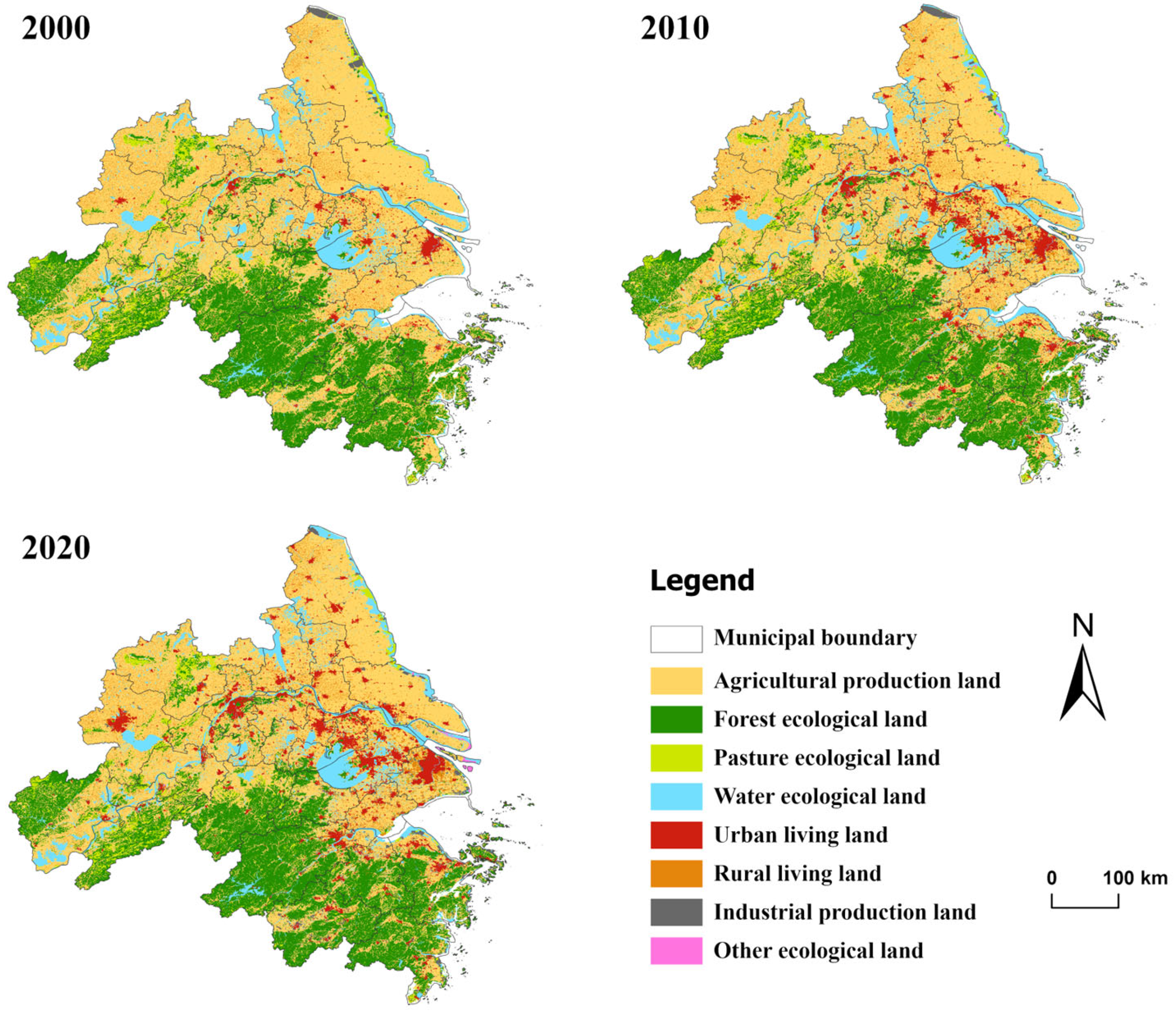
Using the classification framework of production-living-ecological land categories, we examine the spatial and temporal evolution of these functional spaces within the YRDUA. During the period 2000–2020, the area of production land steadily declined by 10,223.47 km2, with its share of the total area decreasing from 53.14% in 2000 to 49.35% in 2010 and further to 48.08% in 2020. In contrast, residential land experienced a significant increase of 10,571.85 km2, with its proportion rising from 7.08% in 2000 to 12.04% in 2020. Throughout the research timeframe, ecological land stayed relatively consistent, with only slight overall variation (Figure 3).
Looking at the spatial distribution of sub-category land cover types, APL and FEL have the broadest coverage, followed by WEL. APL is primarily located in the northern region of the YRDUA, especially in the southern Jiangsu, northern Zhejiang and southern Anhui regions, where crops such as rice, wheat and oilseed rape are more commonly grown. In the mountainous and hilly areas of the YRDUA, FEL predominates, supported by favorable topographic and climatic conditions that have contributed to the formation of rich forest resources. WEL is predominantly distributed across rivers, lakes, and reservoirs, with major water bodies such as the Yangtze River, Taihu Lake, and Hangzhou Bay, together with coastal tidal flats, harbors, and waterways, constituting the core components of the region’s water resources system.
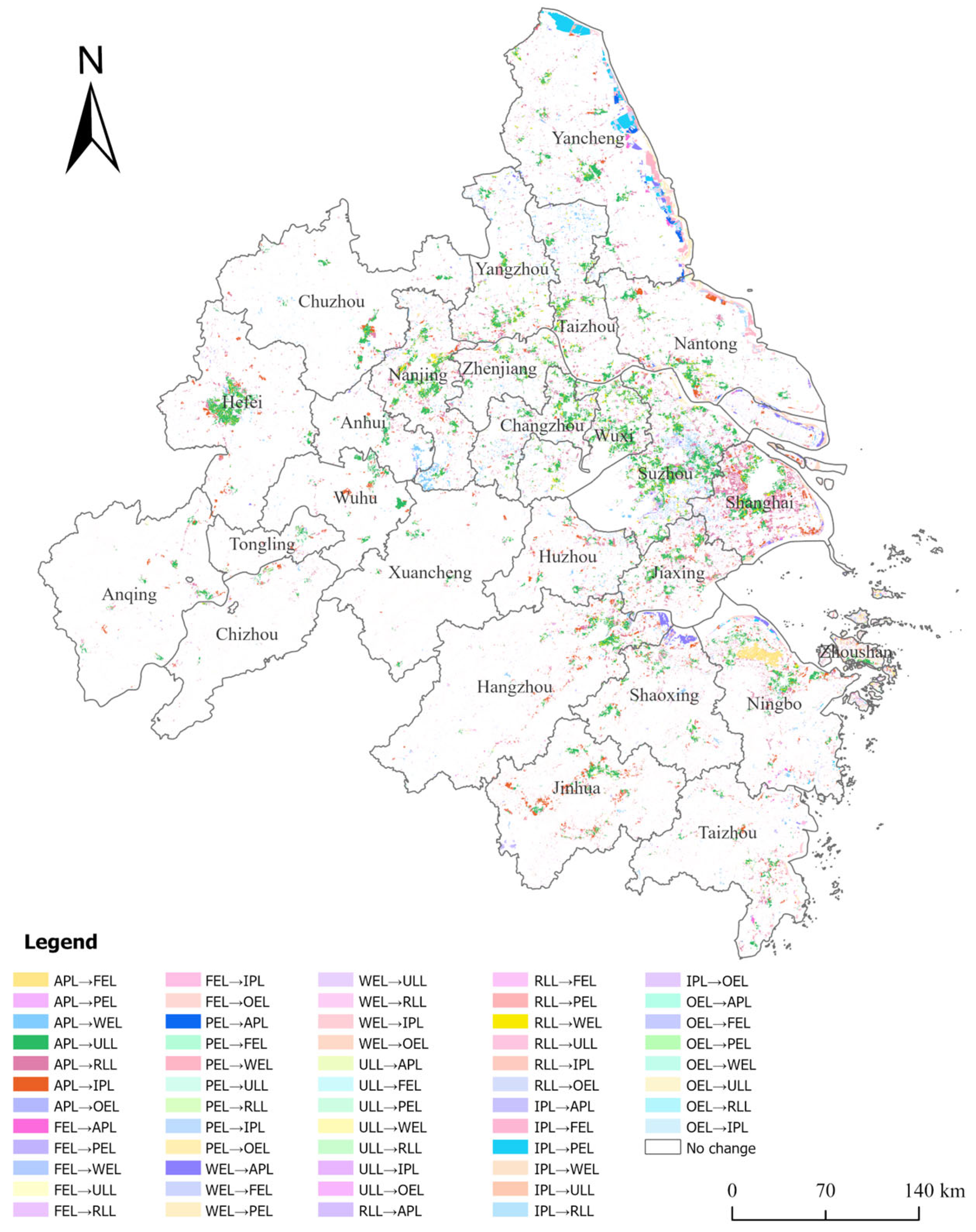
The transformation of land use in the YRDUA shows pronounced spatial differentiation (Figure 4). Living spaces have expanded rapidly, with vast areas of APL, FEL, and WEL being converted into construction land. This process is highly concentrated in core urban areas such as Shanghai, Suzhou, Wuxi, Nanjing, and Hefei, reflecting the strong demand for land use resulting from population concentration and industrial clustering. The transformation of ecological space exhibits a distinct duality: On the one hand, along coastal and riverine industrial belts and at the peripheries of major cities, ecological spaces face sustained pressure from IPL and ULL, thereby enduring significant ecological stress. On the other hand, in the hilly and mountainous regions of western Zhejiang and southern Anhui, there is a positive trend whereby APL and RLL are being converted into FEL, underscoring the effectiveness of measures including the conversion of farmland to forest and ecosystem rehabilitation. Within production spaces, the conversion relationships between different land types are complex. IPL in coastal and riverine areas is primarily converted into IPL and ecological land, whereas APL is more frequently converted into ULL and IPL, accelerating its loss in counties surrounding metropolitan areas. The conversion of APL into FEL is mainly concentrated in Ningbo.
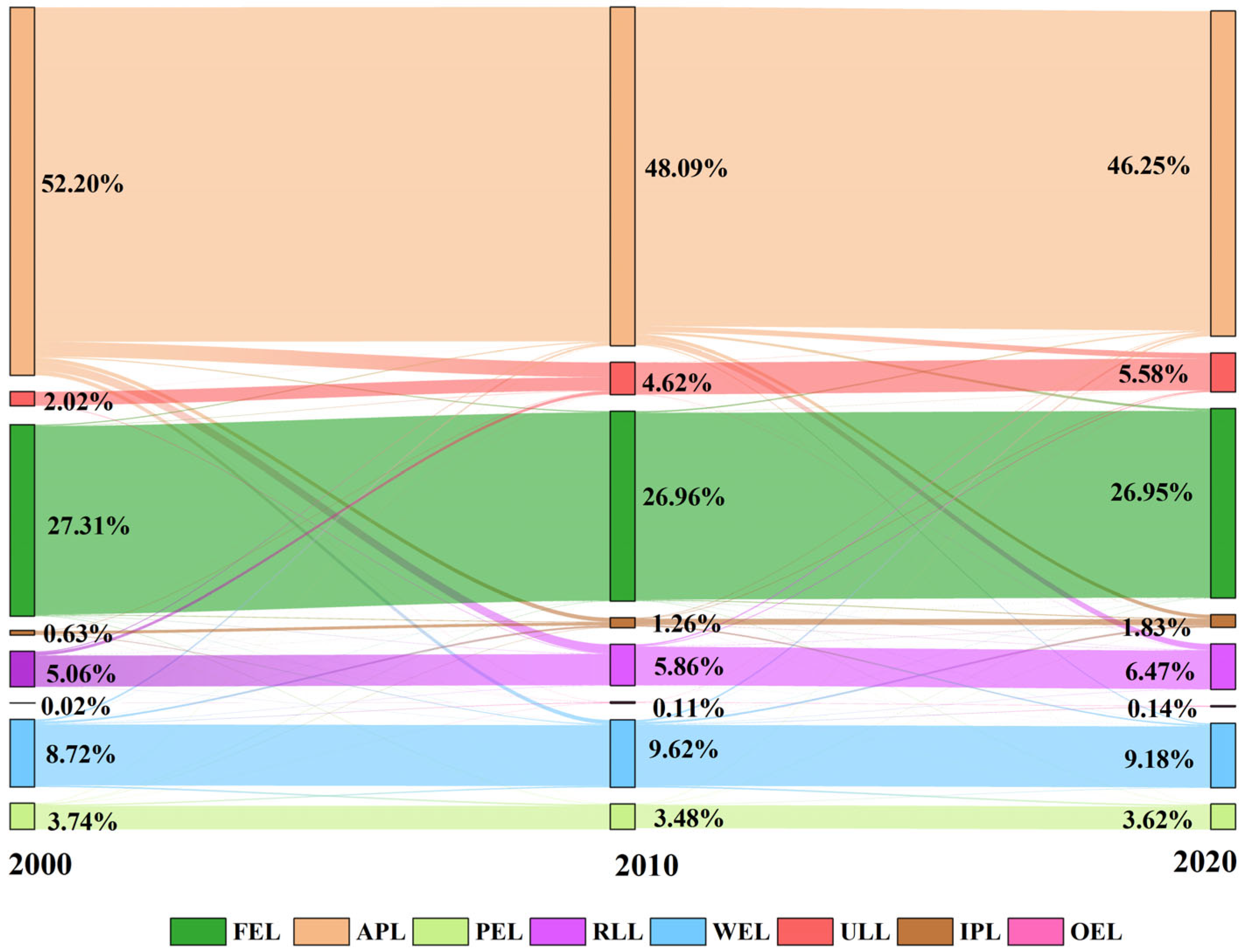
Between 2000 and 2020, the areas of different land cover types in the YRDUA exhibited significant dynamic changes (Table 4). The research findings indicate that the areas of APL and FEL show a consistent year-on-year decline, with APL exhibiting a more pronounced decrease. In contrast, the areas of ULL, RLL, IPL, and OEL exhibit a continuous annual increase, with ULL experiencing the most significant expansion. The PEL area follows a “U-shaped” trajectory—initially decreasing before rebounding—although the overall trend remains downward. Conversely, the area of WEL initially expanded before subsequently contracting, with an overall upward trend. The conversion among land cover categories within the YRDUA during the period 2000 to 2020 (Figure 5). The results of this study show that between 2000 and 2010, there was a significant reduction in APL, primarily being converted into ULL, RLL, IPL, and WEL. FEL and PEL experienced slight decreases and remained relatively stable overall. In contrast, OEL showed modest increases, mainly due to conversions from APL and PEL. These changes reflect the acceleration of urbanization and the large-scale migration of rural populations into urban areas, which have heightened the demand for ULL and IPL. Concurrently, government initiatives promoting rural land transfer and intensive land management have encouraged agricultural modernization, further facilitating the transformation of farmland into non-agricultural purposes. Additionally, some forest areas were converted into OEL, highlighting the ongoing tension and trade-offs between economic development and ecological conservation. From 2010 to 2020, APL continued to shrink, with most conversions occurring toward ULL, RLL, and IPL. WEL also declined, mainly being converted into APL, PEL, and IPL. This shift indicates that the ongoing population concentration and accelerated economic growth have further escalated the need for building space, leading to the extensive transformation of farmland into non-agricultural uses. The expansion of RLL also reflects broader urbanization dynamics. As the rural revitalization strategy was implemented, improvements in rural infrastructure and living conditions spurred increased rural land use. The decline in WEL is primarily attributed to the encroachment of agriculture and industrial expansion, which has negatively impacted aquatic ecosystems and exacerbated ecological degradation. Therefore, as economic growth advances, striking a harmony between land utilization and environmental conservation has become an increasingly pressing and vital issue.

3.2. Eco-Environmental Effects

3.2.1. Spatiotemporal Variation in EEQ

In this research, a 3 km × 3 km square was used for isometric sampling to generate nearly 25,200 sample areas. The EEQ of the YRDUA was categorized into five grades, namely, low-quality zone (0–0.21), lower-quality zone (0.21–0.38), medium-quality zone (0.38–0.55), higher-quality zone (0.55–0.72) and high-quality zone (0.72–0.89).
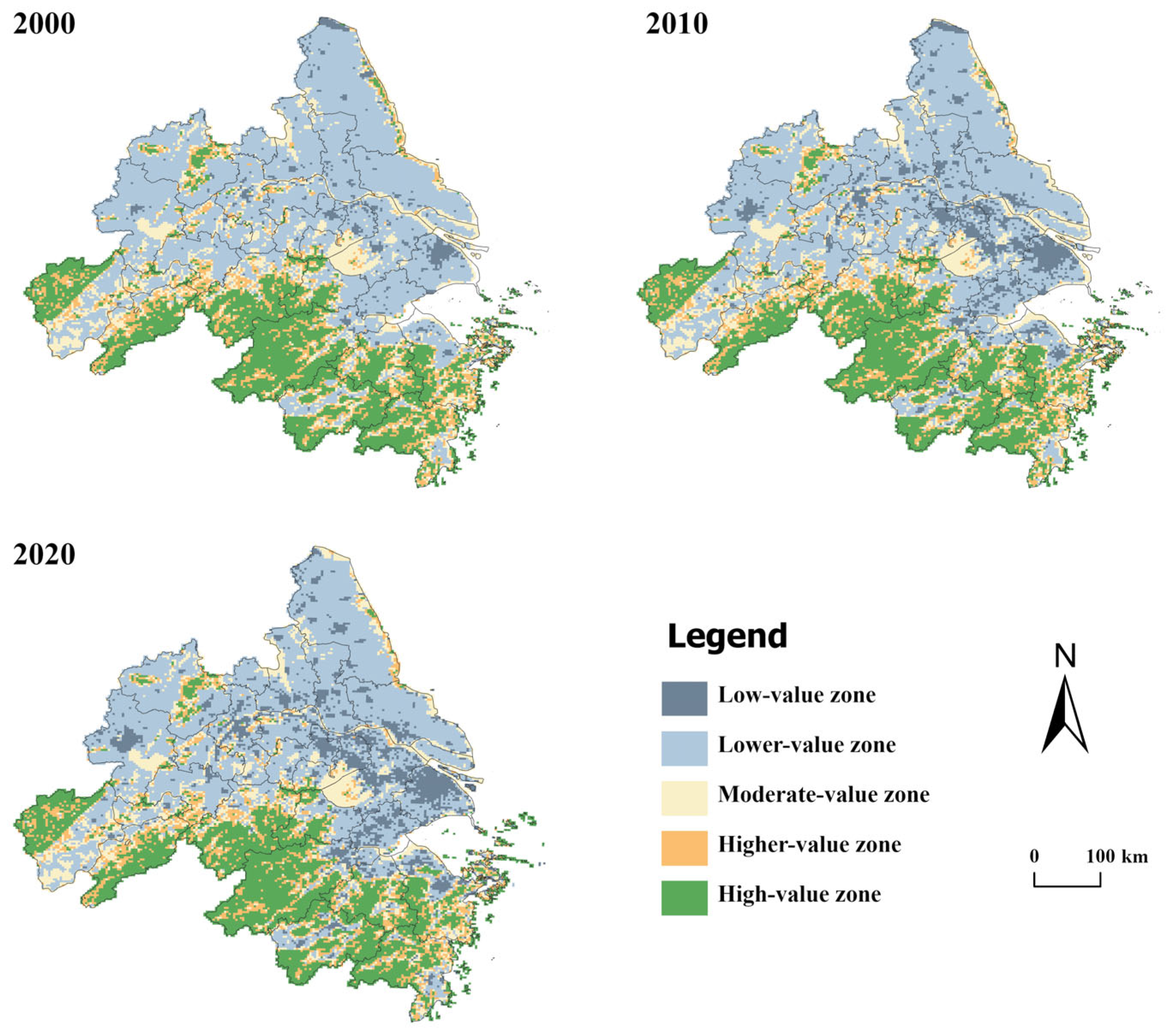
From 2000 to 2020, the EEQ of the YRDUA exhibited an overall declining trend (Table 5). The area classified as low-quality ecological environment increased significantly, rising from 6264 km2 in 2000 to 23,382 km2 in 2020. In contrast, the area classified as moderately low-quality steadily decreased from 102,960 km2 to 90,522 km2 over the same period. The extent of regions with moderate ecological quality demonstrated a pattern of first rising and then gradually declining, resulting in a relatively small net decrease—from 33,588 km2 in 2000 to 32,706 km2 in 2020. The sizes of the high- and higher-ecological-quality zones exhibited a declining-then-rising trend: they declined initially and then rebounded, though their 2020 values remained slightly below those of 2000.
There is obvious spatial variability in the ecological quality of the YRDUA (Figure 6). The EEQ across the YRDUA exhibits a geographical distribution marked by superior conditions in the southern zones and comparatively poorer quality in the middle and northern parts. High-quality and higher-quality zones are predominantly concentrated in the southern part of the YRDUA, including cities such as Chongqing, Xuancheng, Hangzhou, Jinhua, Shaoxing, Taizhou, and Ningbo. Moderate-quality zones are mainly located in the water bodies across the region. Low-quality zones are the most extensive, predominantly located in the central and northern regions, accompanied by a progressive decline in spatial extent over time. However, areas designated as having the poorest condition are predominantly distributed across the middle part of the region and have experienced continuous expansion over the years. From a spatial perspective, the extent and distribution of moderate, higher, and high zones have remained relatively stable over the years. In contrast, many moderately low-quality zones have been converted into low-quality zones. Changes in land utilization, especially the shift in farmland toward industrial and urban functions in central zones, have undermined ecosystem stability and contributed to the decline in EEQ. Although the ecological quality in high-quality and higher-quality zones has remained largely stable, the continued shrinkage of moderately low-quality zones and the expansion of low-quality zones, especially in central regions, reflect increasing environmental pressures. These changes indicate that excessive land expansion and accelerated industrial and urban growth have resulted in the deterioration of natural habitats, unsustainable resource utilization, and increasing ecological contamination. In particular, the expansion of industrial production and urban development has increased impervious surfaces, reduced vegetation cover, and weakened ecosystem service functions.

3.2.2. Spatial Autocorrelation of EEQ

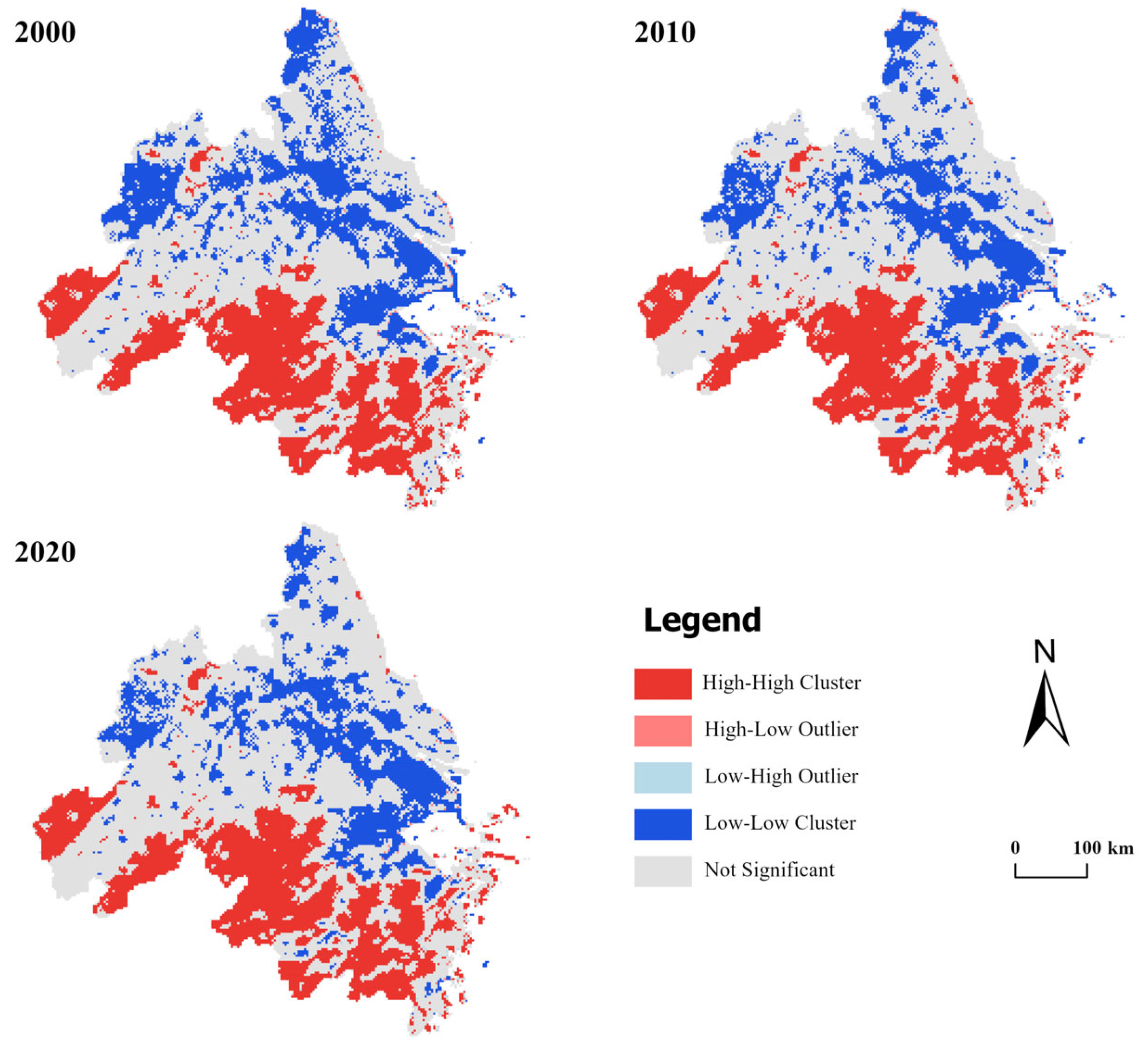
To examine whether the EEQ distribution in the study area exhibits spatial clustering, Moran’s I was employed for analysis. The Global Moran’s I indices for EEQ in 2000, 2010, and 2020 were 0.846, 0.848, and 0.853, respectively, each of which was statistically significant at the 1% level. The findings suggest that, over the entire study duration, the EEQ of the YRDUA demonstrated a strong spatial positive correlation and varying degrees of clustering effects.
To thoroughly depict EEQ’s spatial patterns across the study region and further apply local spatial autocorrelation analysis to examine spatial dependencies among geographic units, this study constructed a LISA cluster map using Moran’s scatter plot (Figure 7). The analysis indicates that the spatial pattern of EEQ in the YRDUA is primarily characterized by two typical clustering types: high-high clusters and low-low clusters. Specifically, Xuancheng, Hangzhou, Chizhou, Taizhou, and their surrounding areas form a high-high cluster, where both internal and adjacent regions exhibit high EEQ levels, collectively serving as an important ecological barrier in the YRDUA. This pattern is closely associated with the region’s favorable natural endowments and relatively low pollution intensity, thereby reflecting a pronounced positive clustering effect. In contrast, Shanghai, Jiaxing, Suzhou, Wuxi, Taizhou, Nanjing, Hefei, and their surrounding areas predominantly form a low-low cluster. These regions are subject to substantial accumulation of agricultural nonpoint source pollution and intensified urban expansion pressures, resulting from the combined effects of long-term intensive agricultural practices and rapid urbanization. Consequently, their overall EEQ levels remain low, exhibiting distinct negative spatial clustering characteristics.

3.2.3. Ecological Contribution Rate of Production-Living-Ecological Space Transformation

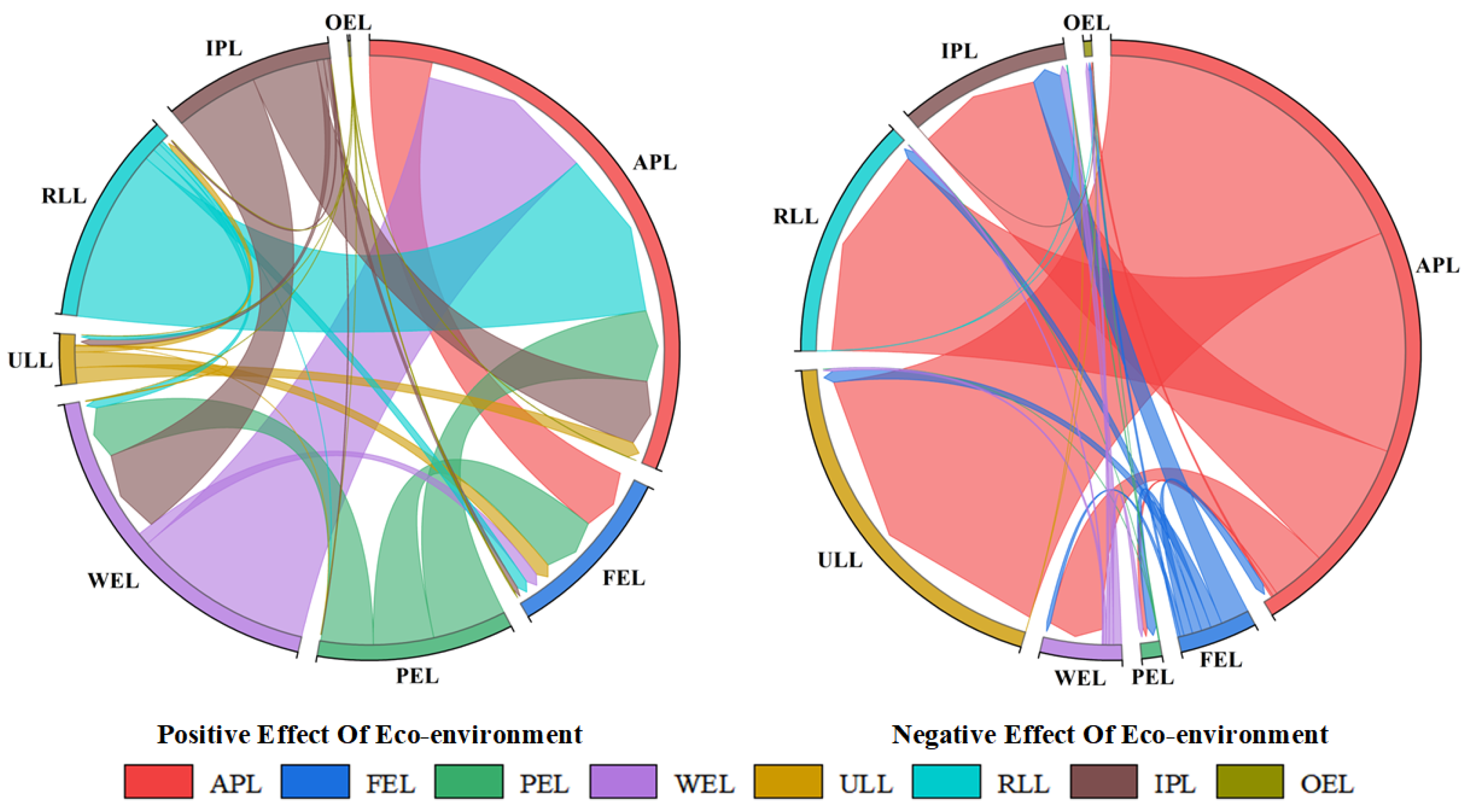
The contribution rate of LUT to the ecological environment quality index is calculated according to Equation (3) (Figure 8). From 2000 to 2020, conversions into APL occurred from WEL, RLL, PEL, and ULL, while WEL was primarily derived from IPL and PEL conversions. Among various land use transitions, the conversion of APL, PEL, WEL, and RLL into FEL represents the most significant contributor to ecological environmental improvement. Among all land use conversions that contribute to ecological improvement, the transitions between these key land use types constitute the majority, with a combined contribution rate reaching 95.33%. Meanwhile, transitions such as WEL to APL, RLL to APL, and IPL to WEL have a combined share of 52.62% in advancing ecological conditions. Within the YRDUA, the main types of land use conversions driving ecological deterioration consist of APL being converted into ULL, RLL, IPL, and WEL. Additionally, FEL has been transformed into IPL, ULL, PEL, RLL, and APL. The total ecological contribution rate of these land use conversions amounts to 96.02%. Simultaneously, the combined contribution rate of ecological and environmental deterioration resulting from the transformation of APL into ULL, RLL, and IPL comprised 81.47% of the overall contribution rate. Overall, the enhancement in the ecological environment has been outweighed by its decline, leading to a general pattern of degradation in the regional ecological conditions.

3.3. Analysis of Factors Affecting EEQ

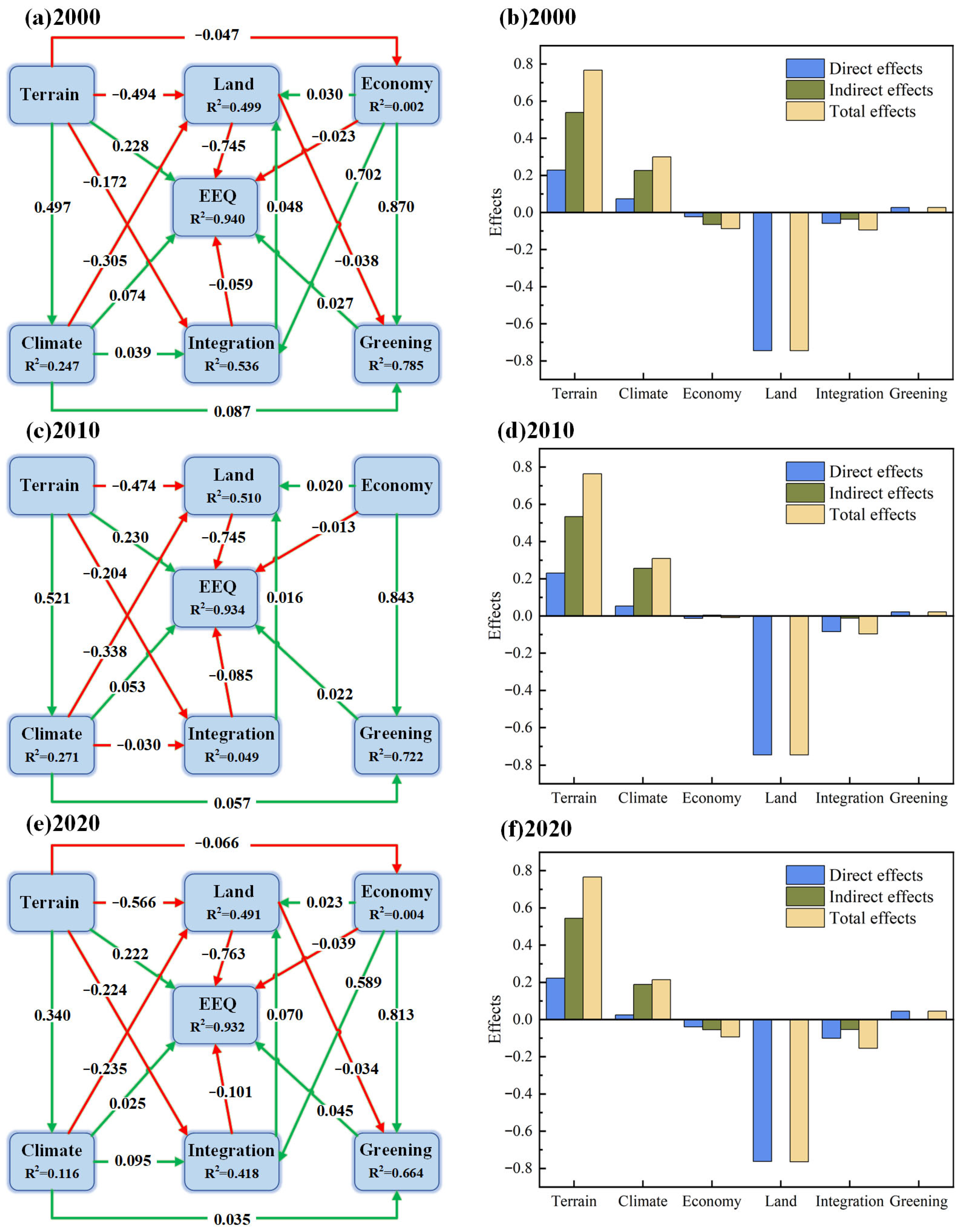
Utilizing PLS-SEM analysis, this research investigated the immediate, mediated, and overall impacts of various determinants on ecological and environmental quality in the YRDUA from 2000 to 2020 (Figure 9). The model explained 94.0%, 93.4%, and 93.2% of the variance in ecological and environmental quality for the years 2000, 2010, and 2020, respectively, indicating strong explanatory power. The findings suggest that throughout the study period, economic development, LUT, and regional integration all exerted direct negative impacts on EEQ. The path coefficients for economic development were −0.023, −0.013, and −0.039 in 2000, 2010, and 2020, respectively. The path coefficient for LUT was −0.745 in both 2000 and 2010, increasing to −0.763 in 2020. The path coefficients for regional integration were −0.059, −0.085, and −0.101 in 2000, 2010, and 2020, respectively. Terrain, climate, and urban greening all exerted direct positive effects on EEQ. The path coefficient for terrain was 0.228 in 2000, 0.230 in 2010, and 0.222 in 2020; for climate, it was 0.074 in 2000, 0.053 in 2010, and 0.025 in 2020; and for urban greening, it was 0.027 in 2000, 0.022 in 2010, and increased to 0.045 in 2020.
Beyond the six pathways directly impacting ecological and environmental quality, topography, climate, economic development, LUT, regional integration, and urban greening also exert indirect effects through their influence on other driving factors. Specifically, topography indirectly enhances EEQ by amplifying the positive effects of climate while mitigating the negative impacts of regional integration, LUT, and economic development. Climate indirectly promotes EEQ improvement by amplifying the positive effects of urban greening and mitigating the adverse impacts of LUT. Economic development indirectly contributes to ecological and environmental degradation by intensifying the negative effects of LUT and regional integration, while simultaneously indirectly improving EEQ by enhancing the positive effects of urban greening. LUT indirectly lowers EEQ by weakening the positive effects of urban greening. Regional integration exacerbates ecological and environmental deterioration by intensifying the negative effects of LUT. In contrast, urban greening only exerts a direct effect on EEQ, without demonstrating significant indirect effects. Notably, the indirect effect of climate on integration varies across years. In 2000 and 2020, climate amplifies the negative effects of integration, while in 2010, it helps to mitigate them. These findings underscore the complex and evolving interactions between natural and socio-economic systems in shaping ecological and environmental outcomes.
Overall, the combined effects of terrain, climate, and urban greening consistently exert a positive influence on EEQ, while the aggregate impacts of economic development, LUT, and regional integration remain consistently negative. Topography maintains the strongest positive influence across all periods, whereas LUT demonstrates the most pronounced negative effect. These two factors also constitute the most influential determinants of overall impact. Climate ranks next in importance, though its overall positive effect on ecological environment quality weakened in 2020 compared to 2000 and 2010. By contrast, the overall impacts of regional integration, economic development, and urban greening remain relatively limited. The findings indicate that natural factors—particularly terrain and climate—play a dominant and stable role in shaping EEQ, whereas ecological pressures arising from LUT and regional integration show a gradually intensifying trend.
The results of the Variance Inflation Factor (VIF) test indicate that the VIF values for all variables in 2000 and 2020 range between 1 and 3, while those in 2010 range between 1 and 5, suggesting that multicollinearity is not a concern (Table A1). All path coefficients in the structural model are statistically significant, confirming the model’s path validity (Table A2). The PLS-SEM also demonstrates good reliability and validity. Specifically, all factor loadings exceed 0.6, the average variance extracted (AVE) values are above 0.45, and the composite reliability (CR) values are greater than 0.6 (Table A3). These findings suggest that the dataset employed in this research satisfies the statistical criteria, and the developed model is both dependable and stable.

4. Discussion

4.1. The Impact of LUT on the Ecological Environment

The overall EEQ of the YRDUA has exhibited a declining trend. This deterioration is primarily attributed to the dominance of an extensive economic development model and the inadequate protection of land ecosystems, which collectively have fueled the swift proliferation of low-ecological-quality land categories and diminished the ecosystem’s regulatory ability [73,74]. Meanwhile, the spatial pattern of land use in the region has undergone significant transformations, marked by a continuous decline in APL and the accelerated growth of ULL and IPL. This transition has not only reshaped the spatial configuration of land resources but also fundamentally altered the ecological foundation of regional environmental processes. LUT have long been acknowledged as a key driver for shifts in ecological and environmental conditions [75,76,77,78]. The shift in land resource allocation toward urban construction and industrial development has intensified landscape fragmentation and imposed significant pressures on ecological functions [79,80]. Similarly located near coastal areas, the Pearl River Delta urban agglomeration differs from the YRDUA in that its production space shows a slight expansion trend, while the Yangtze River Delta’s production space exhibits a declining trend. The ecological space of both urban agglomerations is primarily distributed in mountainous and hilly regions. Living space has expanded extensively and regionally within the urban agglomerations, concentrated mainly in rapidly urbanizing areas. From 2000 to 2020, the expansion of ULL in the YRDUA shifted from an extensive to an intensive pattern, while the Pearl River Delta maintained an intensive expansion model for its ULL [81]. Firstly, the ecological imbalance resulting from LUT has become increasingly evident. The reduction in natural areas, including green vegetation and aquatic systems, both weakens ecosystem functionality and alters the microclimatic conditions within urban environments [82,83,84,85]. Urban encroachment onto green land has undermined the environment’s ability to filter the atmosphere and moderate climate, thereby worsening regional air contamination and amplifying the urban heat island effect [86]. In particular, the fragmentation of ecological land weakens spatial connectivity, disrupts structural stability and functional continuity, and ultimately accelerates the deterioration of ecological environmental quality [85]. Secondly, APL, which constitutes the largest share of land use in the YRDUA, is increasingly threatened by ecological service loss as rapid economic development and urbanization drive its conversion into residential and industrial land [83]. This transformation heightens ecological and environmental pressures, potentially triggering land degradation, water pollution, and urban heat island effects, ultimately disrupting regional ecological balance. The growth of urban space has diminished the spatial connectivity between current ecological zones and farmland regions [80]. The blurring of functional boundaries among production, residential, and ecological spaces further compromises ecosystem connectivity and resilience. Built-up area expansion leads to higher population density and heightened use of natural resources [87,88]. Moreover, land resource misallocation poses significant ecological risks and environmental pressures, exacerbating human-land conflicts and contributing to urban sprawl in the region [89]. Overall, the coordinated development of production-living-ecological areas is crucial for mitigating land utilization conflicts and attaining harmonious regional development [75]. However, optimizing land resource allocation while reconciling ecological protection with economic development remains a key challenge for the YRDUA.

4.2. Multi-Factor Driving Mechanism: An Empirical Analysis Based on Structural Equation Modeling

The evolution of ecological and environmental quality is shaped by the interplay of multiple factors. Each variable not only exerts a direct influence on ecological quality but may also indirectly affect it through interactions with other variables, thereby profoundly impacting the overall functioning and transformation of ecosystems [76]. In the YRDUA, topographical factors serve as a fundamental determinant, shaping regional climate and hydrological conditions. Moreover, by influencing transportation accessibility and development suitability, terrain indirectly governs land use types and intensities, thus playing a long-term, positive role in ecological and environmental quality [90]. LUT has exerted significant direct negative impacts on ecological and environmental quality, aligning with the conclusions of previous studies. The rapid expansion of construction land often encroaches upon farmland and green spaces, thereby disrupting ecosystem structures and directly undermining environmental quality. Simultaneously, LUT alters the spatial pattern of urban green spaces and ecological connectivity, thereby diminishing the positive contribution of vegetation cover to the ecological environment and hindering the full realization of greening’s role in enhancing environmental quality [91,92,93]. Therefore, LUT not only directly undermines ecological and environmental quality but also exacerbates negative impacts by curtailing the beneficial effects of urban greening. Climate change, widely recognized as a key driver of ecological variability, affects vegetation growth and water resource availability [94]. Research has demonstrated that variations in precipitation and relative humidity significantly impact ecological quality [82,95]. Meanwhile, both climate change and anthropogenic activities have severely threatened aquatic ecosystems, resulting in declining water quality, habitat degradation, and overexploitation of resources, which collectively contribute to ecological deterioration [96,97]. In highly urbanized areas such as Shanghai, Nanjing, and Hangzhou, the swift growth of developed land has encroached upon natural habitats. Simultaneously, reduced humidity has diminished the performance of ecosystem services, intensifying the urban heat island effect and exacerbating environmental degradation [98]. As regional coordination and urbanization accelerate, urban agglomerations have become key platforms for regional integration [99]. While integration enhances regional economic resilience and the capacity to withstand external shocks [100,101], a significant negative spatial autocorrelation has been identified between the degree of integration and ecological quality [102], which aligns with the results of this research. Urban greening plays a dual role. On the one hand, it directly improves ecological quality by enhancing vegetation cover, reducing surface temperatures, and improving air quality [94,103]. On the other hand, our findings suggest an indirect negative effect via regional integration, as greening may promote urban expansion and increase impervious surfaces, thereby degrading ecological functions [104]. Structural equation modeling reveals that this dual effect varies over time, likely due to the compression of ecological space and functional decline of green areas amid accelerated urbanization. Research indicates that urban infrastructure should incorporate green infrastructure strategies to reduce reliance on, and mitigate risks associated with, traditional built infrastructure, thereby enhancing EEQ [105]. Furthermore, economic development and population growth drive construction land expansion, replacing farmland and natural habitats and leading to extensive land use changes that negatively affect ecosystem integrity [92,106]. Rising urban consumption of water supplies has also exacerbated problems related to shortage and contamination [107], undermining ecosystem regulatory capacities and contributing to regional ecological degradation. Ultimately, the effectiveness of urban greening policies is highly context-dependent, shaped not only by the quantity and quality of greening itself but also by the urbanization stage and the broader socio-environmental framework within which it operates. Within the Pearl River Delta urban agglomeration, the primary drivers of productive space evolution are changes in arable land area and per capita GDP growth; residential space evolution is mainly influenced by the scale of rural residential land and terrain undulation; ecological space evolution is similarly dominated by changes in arable land area [81]. This characteristic is somewhat similar to that of the YRDUA. However, significant differences exist in ecological governance strategies: the YRDUA requires strengthening integrated management of cross-regional water resources, water environment, and water ecology, while optimizing the design and implementation of ecological compensation mechanisms. Conversely, the Pearl River Delta urban agglomeration should prioritize establishing collaborative sharing mechanisms for cross-regional monitoring standards—including atmospheric environment—and deepening co-governance and shared practices in ecological and environmental domains [108]. Overall, human activities, natural conditions, and especially shifts in land use types collectively drive the evolution of urban agglomerations’ production-living-ecological spaces. Changes in this spatial pattern reflect the interactions and dynamic coupling effects among human society, the natural environment, and policy systems [81].

4.3. Policy Recommendations

First, the ecological functions of the YRDUA are primarily sustained by forests, water bodies, and farmland. Thus, it is essential to prioritize the effective management of these ecosystems to enhance their natural resilience and service functions, thereby improving overall environmental quality. Moving forward, the region should adopt scientifically informed urban and land use planning strategies, establish clear urban growth boundaries, strictly regulate development intensity, and curb unregulated spread of urbanized areas. Concurrently, farmland replacement should be carefully managed, with basic farmland strictly protected. Over-conversion of farmland to non-agricultural uses must be curtailed, and an intensive land use management system should be promoted to revitalize existing urban land and reduce adverse effects on habitat conditions. Second, the ecological function of land should be central to regional planning, with functional zoning and hierarchical control mechanisms implemented across production, living, and ecological spaces. During urban expansion, ecological red lines and land conversion approval systems should be rigorously enforced. For large ecological land parcels, appropriate protection grades and buffer zones must be delineated to safeguard landscape integrity and reduce fragmentation. Ecological areas adjacent to urban construction zones also warrant targeted protection. In coastal urban agglomerations, where spatial conflicts are more pronounced and ecological resilience is weaker [86], stronger mechanisms for ecological space protection and coordination are urgently needed. At the same time, core urban areas such as Shanghai, Suzhou, Wuxi, Nanjing, and Hefei should prioritize urban stock renewal and ecological restoration while strictly restricting further spatial expansion. Coastal and riverside industrial belts need to enhance ecological access management and shoreline control in order to mitigate potential environmental risks. In addition, ecologically sensitive areas in Zhejiang and Anhui should strengthen ecological compensation mechanisms and actively promote the development of the ecological economy. Moreover, modern urban development must balance innovation-driven growth with green, low-carbon transformation. Efforts should be directed toward advancing green technologies and developing eco-industrial parks to harmonize economic growth with environmental sustainability. Core cities should strengthen their leadership and spillover roles, fostering ecological collaboration and improving the alignment of urban renewal with green transition goals. For surrounding agricultural and ecologically significant areas, farmland protection and ecological compensation mechanisms should be reinforced to prevent the externalization of ecological pressures and improve the agglomeration’s ecological resilience through optimized resource allocation and spatial planning [109]. Finally, in response to the spatially heterogeneous decline in ecological quality, policies should be adapted to local conditions. Differentiated master plans for land use should be formulated to guide high-quality urbanization and resource efficiency. Environmental protection measures, including ecological compensation programs and regulatory areas, are vital for habitat recovery and long-term ecological sustainability.

4.4. Limitations and Prospective Directions

This study investigated the temporal and spatial evolution of land utilization alterations along with their ecological and environmental impacts in the YRDUA from 2000 to 2020, investigated the main determinants behind variations in EEQ, and offered valuable guidance for regional land use planning and management. However, the indicator weights of the ecological quality index are based on expert experience scores, which is subjective to a certain extent. Moreover, it does not fully capture the spatial heterogeneity of EEQ, indicating that the same land use type may exhibit significant variations across different regions. Future research could develop more precise EEQ quantification models by integrating the functional characteristics of land use types with environmental context differences at finer spatial unit scales. This study primarily assessed the ecological and environmental contribution rate of land use area transformation from a regional-scale perspective but did not fully explore the potential impacts of evolving land use spatial patterns. Furthermore, it did not systematically characterize the spatial heterogeneity of land use transformation’s contribution to EEQ at finer spatial scales, such as individual grid cells, administrative districts, or watersheds. Future research could incorporate spatial autocorrelation analysis, landscape pattern indices, and spatial econometric models to more comprehensively quantify the mechanisms through which changes in land use spatial structure affect EEQ. To explore the driving mechanisms influencing the ecological environment, PLS-SEM was employed. This method allows for the analysis of systems involving numerous variables and complex interrelationships, offering a novel perspective on how the ecological environment responds to various influencing factors. Although PLS-SEM shows its effectiveness, the introduction of influencing factors is still limited, for example, introducing more efficient data helps enhance the precision of its response to driving factors, such as water resource status, land use stealth patterns and policies, with a view to providing a more comprehensive and objective evaluation of regional EEQ. At the same time, integrating additional models and approaches will aid in investigating the nonlinear linkage between spatial land transformation and EEQ, as well as their reciprocal interactions, in a more comprehensive manner. Moreover, this research primarily utilizes remote sensing datasets and statistical yearbook information, where data precision and currency might constrain the dependability of the findings. Subsequent investigations could integrate on-site surveys and higher-resolution spatial data in order to enhance the credibility as well as the applicability of the findings.

5. Conclusions

Using the YRDUA as a case, this research investigates the spatial and temporal evolution of production-living-ecological land functions and their influence on ecological quality outcomes. The findings reveal that land use conversions aimed at restoring agricultural functions generally contribute to enhancements in ecological quality, whereas the urbanization of agricultural land continues to be the main cause behind ecological deterioration. In terms of driving mechanisms, topography, climate, and urban greening exert direct positive effects on EEQ, while LUT, economic development and regional integration impose direct negative impacts. Furthermore, terrain and climate primarily enhance ecological environment quality indirectly by amplifying positive effects and mitigating negative ones. Economic development and regional integration promote LUT while intensifying ecological degradation, although economic growth may also exert a compensatory effect through urban greening. Meanwhile, urban greening contributes to ecological environment quality mainly through direct effects, with its indirect impacts remaining insignificant. Notably, the influence of climate on regional integration has fluctuated between positive and negative effects over different years, highlighting the intricate interaction of environmental and socio-economic systems during the development of urban clusters. The research outcomes can supply scientific data and theoretical support for the informed development of the YRDUA, which is of practical significance in promoting the coordinated development of the regional economic, social and ecological environments as well as the effective allocation of ecological resources.

Author Contributions

Conceptualization, L.R. and B.Z.; methodology, X.W.; software, W.J.; validation, X.Z.; formal analysis, L.R.; data curation, M.R.; writing—original draft preparation, L.R.; writing—review and editing, B.Z.; project administration, B.Z.; funding acquisition, B.Z., M.R. and L.Y. All authors have read and agreed to the published version of the manuscript.

Funding

This research was funded by the Shandong Province Graduate Teaching Reform Project (SDYJSJGC2024068); Shandong Province Undergraduate Teaching Reform Project (Z20220004); Jinan City-School Integration Project (JNSX2023036); National Natural Science Foundation of China (42201308); National Natural Science Foundation of China (42401220); and Taishan Scholar Foundation of Shandong Province (tsqnz20231207 to L.Y.).

Institutional Review Board Statement

Not applicable.

Informed Consent Statement

Not applicable.

Data Availability Statement

The original contributions presented in this study are included in the article Further inquiries can be directed to the corresponding author.

Conflicts of Interest

The authors declare no conflicts of interest.

Appendix A

Table A1. PLS-SEM Variance Inflation Factor (VIF) for each metric.
VIF200020102020
Elevation2.1272.1312.128
Slope2.1272.1312.128
GDP per capita2.0233.8712.190
Urbanization rate2.3684.3782.697
The proportion of tertiary industry1.6771.7731.809
Relative humidity1.9351.5051.759
Average annual precipitation1.9351.5051.759
Number of parks1.1961.2502.808
Green coverage area1.1961.2502.808
Strength of inter-city linkages1.0001.0001.000
Proportion of agricultural production land1.0221.0001.006
Land development intensity1.0221.0001.006
Table A2. PLS-SEM path validity.
YearPath Path Coefficientp-Value
2000Terrain→EEQ0.228***
→Climate0.497***
→Economy−0.047***
→Integration−0.172***
→Land−0.049***
Climate→EEQ0.074***
→Greening0.087***
→Integration0.039***
→Land−0.305***
Economy→EEQ−0.023***
→Greening0.870***
→Integration0.702***
→Land0.030***
Greening→EEQ0.027***
Integration→EEQ−0.059***
→Land0.048***
Land→EEQ−0.745***
→Greening−0.038***
2010Terrain→EEQ0.230***
→Climate0.521***
→Integration−0.204***
→Land−0.474***
Climate→EEQ0.053***
→Greening0.057***
→Integration−0.030***
→Land−0.338***
Economy→EEQ−0.013***
→Greening0.843***
→Land0.020***
Greening→EEQ0.022***
Integration→EEQ−0.085***
→Land0.016**
Land→EEQ−0.745***
2020Terrain→EEQ0.222***
→Climate0.340***
→Economy−0.066***
→Integration−0.224***
→Land−0.566***
Climate→EEQ0.025***
→Greening0.035***
→Integration0.095***
→Land−0.235***
Economy→EEQ−0.039***
→Greening0.813***
→Integration0.589***
→Land0.023***
Greening→EEQ0.045***
Integration→EEQ−0.101***
→Land0.070***
Land→EEQ−0.763***
→Greening−0.034***
Note: **, *** represent 0.01 < p < 0.05 and p < 0.01, respectively.
Table A3. Reliability and validity assessment of PLS-SEM.
Year200020102020
ConstructLoadingAVECRLoadingAVECRLoadingAVECR
Terrain 0.8640.927 0.8640.927 0.8640.927
Elevation0.926 0.926 0.926
Slope0.932 0.933 0.933
Economy 0.7460.898 0.8040.925 0.7660.908
GDP per capita0.870 0.904 0.877
Urbanization rate0.894 0.930 0.905
The proportion of tertiary industry0.825 0.853 0.843
Climate 0.8450.916 0.7750.872 0.8260.904
Relative humidity0.896 0.803 0.881
Average annual precipitation0.942 0.951 0.935
Greening 0.6880.812 0.7190.836 0.9010.948
Number of parks0.927 0.899 0.957
Green coverage area0.718 0.793 0.942
Integration // // //
Strength of inter-city linkages1.000 1.000 1.000
Land 0.5670.717 0.5050.666 0.4630.631
Proportion of agricultural production land0.875 0.803 0.745
Land development intensity0.607 0.604 0.609

References

  1. Long, H. Land use policy in China: Introduction. Land Use Policy 2014, 40, 1–5. [Google Scholar] [CrossRef]
  2. Yang, Y. Evolution of habitat quality and association with land-use changes in mountainous areas: A case study of the Taihang Mountains in Hebei Province, China. Ecol. Indic. 2021, 129, 107967. [Google Scholar] [CrossRef]
  3. Long, H.; Liu, Y.; Hou, X.; Li, T.; Li, Y. Effects of land use transitions due to rapid urbanization on ecosystem services: Implications for urban planning in the new developing area of China. Habitat Int. 2014, 44, 536–544. [Google Scholar] [CrossRef]
  4. Hualou, L.; Yi, Q.; Shuangshuang, T.; Yurui, L.; Dazhuan, G.; Yingnan, Z.; Li, M.; Wenjie, W.; Jing, W. Land use transitions under urbanization and their environmental effects in the farming areas of China: Research progress and prospect. Adv. Earth Sci. 2018, 33, 455. [Google Scholar]
  5. Grainger, A. National land use morphology: Patterns and possibilities. Geography 1995, 80, 235–246. [Google Scholar] [CrossRef]
  6. Zhai, Y.; Zhang, F.; Ma, L. Changes of production-living-ecology land transformation and eco-environmental effects in Xinjiang in last 40 years. Chin. J. Soil Sci. 2022, 53, 514–523. [Google Scholar]
  7. Yang, Q.; Duan, X.; Wang, L.; Jin, Z. Land use transformation based on ecological-production-living spaces and associated eco-environment effects: A case study in the Yangtze River Delta. Sci. Geogr. Sin. 2018, 38, 97–106. [Google Scholar]
  8. Lambin, E.F.; Meyfroidt, P. Land use transitions: Socio-ecological feedback versus socio-economic change. Land Use Policy 2010, 27, 108–118. [Google Scholar] [CrossRef]
  9. Long, H.; Ma, L.; Zhou, G. Land use transition research in China: Progress, challenges and prospect. Acta Geogr. Sin. 2025, 80, 1993–2015. [Google Scholar]
  10. Long, H.; Chen, K. Urban-rural integrated development and land use transitions: A perspective of land system science. Acta Geogr. Sin. 2021, 76, 295–309. [Google Scholar]
  11. Long, H. Explanation of Land Use Transitions. China Land Sci. 2022, 36, 1–7. [Google Scholar]
  12. Long, H. Land use transition and rural transformation development. Prog. Geogr. 2012, 31, 131–138. [Google Scholar]
  13. Jilai, L.; Yansui, L.; Yurui, L. Classification evaluation and spatial-temporal analysis of “production-living-ecological” spaces in China. Acta Geogr. Sin. 2017, 72, 1290–1304. [Google Scholar]
  14. Jin, G.; Guo, B.; Cheng, J.; Deng, X.; Wu, F. Layout optimization and support system of territorial space: An analysis framework based on resource efficiency. Acta Geogr. Sin. 2022, 77, 534–546. [Google Scholar]
  15. Gou, M.-M.; Liu, C.-F.; Li, L.; Xiao, W.-F.; Wang, N.; Hu, J.-W. Ecosystem service value effects of the Three Gorges Reservoir Area land use transformation under the perspective of “production-living-ecological” space. Ying Yong Sheng Tai Xue Bao J. Appl. Ecol. 2021, 32, 3933–3941. [Google Scholar]
  16. Tian, C.; Cheng, L.; Shao, Y. Efficiency Characteristics and Evolution Patterns of Urban Carbon Metabolism of Production-Living-Ecological Space in Beijing-Tianjin-Hebei Region. Environ. Sci. 2024, 45, 1254–1264. [Google Scholar]
  17. Dong, Z.; Wan, Q.; Wang, Z.; Ren, P. Analysis and simulation prediction of the evolutionary characteristics of the living-production-ecological spatial conflicts in the agriculture-pastoral ecotone in western Sichuan: Taking four counties in Aba Prefecture as examples. Acta Ecol. Sin. 2023, 43, 6243–6256. [Google Scholar]
  18. Wang, P.; Pu, X.; Yang, P.; Luo, C. Identification and Spatial-Temporal Evolution Analysis of “Production-Living-Ecological” Space in Karst Area—A Case Study of Huaxi District, Guiyang City. J. Northwest For. Univ. 2023, 38, 263–274. [Google Scholar]
  19. Fang, C.; Jia, K.; Li, G.; Wang, Y. Theoretical analysis of the index system and calculation model of carrying capacity of land ecological-production-living spaces from county scale. Acta Ecol. Sin. 2017, 37, 5198–5209. [Google Scholar]
  20. Deng, W.; Zhang, J.; Shi, Z.; Wan, J.; Meng, B. Interpretation of mountain territory space and its optimized conceptual model and theoretical framework. Mt. Res. 2017, 35, 121–128. [Google Scholar]
  21. Hongqi, Z.; Erqi, X.; Huiyi, Z. Ecological-living-productive land classification system in China. J. Resour. Ecol. 2017, 8, 121–128. [Google Scholar] [CrossRef]
  22. Duan, Y.; Wang, H.; Huang, A.; Xu, Y.; Lu, L.; Ji, Z. Identification and spatial-temporal evolution of rural “production-living-ecological” space from the perspective of villagers’ behavior—A case study of Ertai Town, Zhangjiakou City. Land Use Policy 2021, 106, 105457. [Google Scholar] [CrossRef]
  23. Tao, Y.; Wang, Q. Quantitative recognition and characteristic analysis of production-living-ecological space evolution for five resource-based cities: Zululand, Xuzhou, Lota, Surf Coast and Ruhr. Remote Sens. 2021, 13, 1563. [Google Scholar] [CrossRef]
  24. Zong, S.; Hu, Y.; Zhang, Y.; Wang, W. Identification of land use conflicts in China’s coastal zones: From the perspective of ecological security. Ocean Coast. Manag. 2021, 213, 105841. [Google Scholar] [CrossRef]
  25. Yang, Y.; Bao, W.; Liu, Y. Coupling coordination analysis of rural production-living-ecological space in the Beijing-Tianjin-Hebei region. Ecol. Indic. 2020, 117, 106512. [Google Scholar] [CrossRef]
  26. Zhou, D.; Xu, J.; Lin, Z. Conflict or coordination? Assessing land use multi-functionalization using production-living-ecology analysis. Sci. Total Environ. 2017, 577, 136–147. [Google Scholar] [CrossRef] [PubMed]
  27. Wu, J.; Zhang, D.; Wang, H.; Li, X. What is the future for production-living-ecological spaces in the Greater Bay Area? A multi-scenario perspective based on DEE. Ecol. Indic. 2021, 131, 108171. [Google Scholar] [CrossRef]
  28. Xie, X.; Li, X.; Fan, H.; He, W. Spatial analysis of production-living-ecological functions and zoning method under symbiosis theory of Henan, China. Environ. Sci. Pollut. Res. 2021, 28, 69093–69110. [Google Scholar] [CrossRef]
  29. Asabere, S.B.; Acheampong, R.A.; Ashiagbor, G.; Beckers, S.C.; Keck, M.; Erasmi, S.; Schanze, J.; Sauer, D. Urbanization, land use transformation and spatio-environmental impacts: Analyses of trends and implications in major metropolitan regions of Ghana. Land Use Policy 2020, 96, 104707. [Google Scholar] [CrossRef]
  30. Chen, W.; Chi, G.; Li, J. The spatial association of ecosystem services with land use and land cover change at the county level in China, 1995–2015. Sci. Total Environ. 2019, 669, 459–470. [Google Scholar] [CrossRef]
  31. Liu, Y.; Long, H.; Li, T.; Tu, S. Land use transitions and their effects on water environment in Huang-Huai-Hai Plain, China. Land Use Policy 2015, 47, 293–301. [Google Scholar] [CrossRef]
  32. Yang, F.; Yang, X.; Wang, Z.; Sun, Y.; Zhang, Y.; Xing, H.; Wang, Q. Spatiotemporal evolution of production–living–ecological land and its eco-environmental response in China’s coastal zone. Remote Sens. 2023, 15, 3039. [Google Scholar] [CrossRef]
  33. Xu, H. A remote sensing index for assessment of regional ecological changes. China Environ. Sci. 2013, 33, 889–897. [Google Scholar]
  34. Pettorelli, N.; Vik, J.O.; Mysterud, A.; Gaillard, J.-M.; Tucker, C.J.; Stenseth, N.C. Using the satellite-derived NDVI to assess ecological responses to environmental change. Trends Ecol. Evol. 2005, 20, 503–510. [Google Scholar] [CrossRef]
  35. Li, Y.; Wang, S. Exploration of eco-environment and urbanization changes based on multi-source remote sensing data—A case study of Yangtze River Delta urban agglomeration. Sustainability 2024, 16, 5903. [Google Scholar] [CrossRef]
  36. Niu, X.; Wang, B.; Liu, S.; Liu, C.; Wei, W.; Kauppi, P.E. Economical assessment of forest ecosystem services in China: Characteristics and implications. Ecol. Complex. 2012, 11, 1–11. [Google Scholar] [CrossRef]
  37. Messer, L.C.; Jagai, J.S.; Rappazzo, K.M.; Lobdell, D.T. Construction of an environmental quality index for public health research. Environ. Health 2014, 13, 39. [Google Scholar] [CrossRef]
  38. Song, X.; Wu, Z. Modelling and mapping trends in grain production growth in China. Outlook Agric. 2013, 42, 255–263. [Google Scholar] [CrossRef]
  39. Fang, Z.; Ding, T.; Chen, J.; Xue, S.; Zhou, Q.; Wang, Y.; Wang, Y.; Huang, Z.; Yang, S. Impacts of land use/land cover changes on ecosystem services in ecologically fragile regions. Sci. Total Environ. 2022, 831, 154967. [Google Scholar] [CrossRef]
  40. Hu, P.; Li, F.; Sun, X.; Liu, Y.; Chen, X.; Hu, D. Assessment of land-use/cover changes and its ecological effect in rapidly urbanized areas—Taking Pearl River Delta urban agglomeration as a case. Sustainability 2021, 13, 5075. [Google Scholar] [CrossRef]
  41. Zhang, L.; Fang, C.; Zhao, R.; Zhu, C.; Guan, J. Spatial–temporal evolution and driving force analysis of eco-quality in urban agglomerations in China. Sci. Total Environ. 2023, 866, 161465. [Google Scholar] [CrossRef] [PubMed]
  42. Wang, W.; Yang, J.; Yang, G.; Wu, C.; Yu, J. How do ecosystem service functions affect ecological health? Evidence from the Yangtze River Economic Belt in China. Environ. Sci. Process. Impacts 2024, 26, 2215–2226. [Google Scholar] [CrossRef] [PubMed]
  43. Han, J.; Wang, J.; Zhao, Y.; Wang, Q.; Zhang, B.; Li, H.; Zhai, J. Spatio-temporal variation of potential evapotranspiration and climatic drivers in the Jing-Jin-Ji region, North China. Agric. For. Meteorol. 2018, 256, 75–83. [Google Scholar] [CrossRef]
  44. Sun, X.; Shao, H.; Xiang, X.; Yuan, L.; Zhou, Y.; Xian, W. A coupling method for eco-geological environmental safety assessment in mining areas using PCA and catastrophe theory. Nat. Resour. Res. 2020, 29, 4133–4148. [Google Scholar] [CrossRef]
  45. Zhao, L.; Dai, A.; Dong, B. Changes in global vegetation activity and its driving factors during 1982–2013. Agric. For. Meteorol. 2018, 249, 198–209. [Google Scholar] [CrossRef]
  46. Zheng, Y.; Han, J.; Huang, Y.; Fassnacht, S.R.; Xie, S.; Lv, E.; Chen, M. Vegetation response to climate conditions based on NDVI simulations using stepwise cluster analysis for the Three-River Headwaters region of China. Ecol. Indic. 2018, 92, 18–29. [Google Scholar] [CrossRef]
  47. Huang, S.; Xiao, L.; Zhang, Y.; Wang, L.; Tang, L. Interactive effects of natural and anthropogenic factors on heterogenetic accumulations of heavy metals in surface soils through geodetector analysis. Sci. Total Environ. 2021, 789, 147937. [Google Scholar] [CrossRef]
  48. Long, X.; Lin, H.; An, X.; Chen, S.; Qi, S.; Zhang, M. Evaluation and analysis of ecosystem service value based on land use/cover change in Dongting Lake wetland. Ecol. Indic. 2022, 136, 108619. [Google Scholar] [CrossRef]
  49. Cortizas, A.M.; Horák-Terra, I.; Pérez-Rodríguez, M.; Bindler, R.; Cooke, C.A.; Kylander, M. Structural equation modeling of long-term controls on mercury and bromine accumulation in Pinheiro mire (Minas Gerais, Brazil). Sci. Total Environ. 2021, 757, 143940. [Google Scholar] [CrossRef]
  50. Dash, G.; Paul, J. CB-SEM vs PLS-SEM methods for research in social sciences and technology forecasting. Technol. Forecast. Soc. Change 2021, 173, 121092. [Google Scholar] [CrossRef]
  51. Xie, M.; Chen, J.; Zhang, Q.; Li, H.; Fu, M.; Breuste, J. Dominant landscape indicators and their dominant areas influencing urban thermal environment based on structural equation model. Ecol. Indic. 2020, 111, 105992. [Google Scholar] [CrossRef]
  52. Tao, J.; Wang, Y.; Zameer, H. Can urban spatial structure adjustment mitigate air pollution effect of economic agglomeration? New evidence from the Yangtze River Delta region, China. Environ. Sci. Pollut. Res. 2023, 30, 57302–57315. [Google Scholar] [CrossRef] [PubMed]
  53. Yang, Y.-n.; Li, J.; Wang, L.; Wang, Z.-h.; Yao, C.-x.; Wang, Y. Impact of urbanization on supply and demand of typical ecosystem services in Yangtze River Delta. J. Nat. Resour. 2022, 37, 1555–1571. [Google Scholar] [CrossRef]
  54. Wang, X.; Che, L.; Zhou, L.; Xu, J. Spatio-temporal dynamic simulation of land use and ecological risk in the Yangtze River Delta Urban Agglomeration, China. Chin. Geogr. Sci. 2021, 31, 829–847. [Google Scholar] [CrossRef]
  55. Chen, D.; Lu, X.; Liu, X.; Wang, X. Measurement of the eco-environmental effects of urban sprawl: Theoretical mechanism and spatiotemporal differentiation. Ecol. Indic. 2019, 105, 6–15. [Google Scholar] [CrossRef]
  56. Han, L.; Zhang, X.; Zhou, W.; Shen, M.; Huang, Y.; Li, W.; Qian, Y. Transformation of China’s urbanization and eco-environment dynamics: An insight with location-based population-weighted indicators. Environ. Sci. Pollut. Res. 2021, 28, 16558–16567. [Google Scholar] [CrossRef]
  57. Hu, H.; Lv, T.; Zhang, X.; Xie, H.; Fu, S.; Geng, C.; Li, Z. Spatiotemporal heterogeneity and decoupling decomposition of industrial carbon emissions in the Yangtze River Delta urban agglomeration of China. Environ. Sci. Pollut. Res. 2023, 30, 50412–50430. [Google Scholar] [CrossRef]
  58. Chang, Q.; Sha, Y.; Chen, Y. The coupling coordination and influencing factors of urbanization and ecological resilience in the Yangtze River Delta urban agglomeration, China. Land 2024, 13, 111. [Google Scholar] [CrossRef]
  59. Zhu, H.; Li, X. Discussion on the index method of regional land use change. ACTA Geogr. Sin. Chin. Ed. 2003, 58, 643–650. [Google Scholar]
  60. Huang, X.; Cheng, W.-S.; Li, X.-D.; Yang, C.-Y.; Huang, Q.-Q. Recognition on the changes and driving factors of eco-environmental effect of land use transformation in arid inland river basin. Res. Soil Water Conserv. 2023, 30, 324–332. [Google Scholar]
  61. Liu, Z.; Zhang, W.; Lu, H.; Ji, J.; Yang, Z.; Chen, C. Exploring evolution characteristics of eco-environment quality in the Yangtze River Basin based on remote sensing ecological index. Heliyon 2023, 9, e23243. [Google Scholar] [CrossRef] [PubMed]
  62. Shaker, R.R.; Aversa, J.; Papp, V.; Serre, B.M.; Mackay, B.R. Showcasing relationships between neighborhood design and wellbeing Toronto indicators. Sustainability 2020, 12, 997. [Google Scholar] [CrossRef]
  63. Zhao, Y.; Qu, Z.; Zhang, Y.; Ao, Y.; Han, L.; Kang, S.; Sun, Y. Effects of human activity intensity on habitat quality based on nighttime light remote sensing: A case study of Northern Shaanxi, China. Sci. Total Environ. 2022, 851, 158037. [Google Scholar] [CrossRef] [PubMed]
  64. Dong, D.; Luo, Y.; Gu, K. Spatio-temporal Differentiation and Driving Forces of Eco-Environmental Effects of Land Use Transformation in Yangtze River Delta Economic Zone: A Perspective of “Production-Living-Ecological” Spaces. Resour. Environ. Yangtze Basin 2023, 32, 1664–1676. [Google Scholar]
  65. Gan, X.; Du, X.; Duan, C.; Peng, L. Evaluation of ecological environment quality and analysis of influencing factors in Wuhan City based on RSEI. Sustainability 2024, 16, 5809. [Google Scholar] [CrossRef]
  66. Yang, H.; Yu, J.; Xu, W.; Wu, Y.; Lei, X.; Ye, J.; Geng, J.; Ding, Z. Long-time series ecological environment quality monitoring and cause analysis in the Dianchi Lake Basin, China. Ecol. Indic. 2023, 148, 110084. [Google Scholar] [CrossRef]
  67. Zhu, H.; Ou, X.; Li, Z.; Liu, L.; Tang, L. Multidimensional Analysis of Urban Spatial Interaction in the Yangtze River Delta. Geogr. Geo-Inf. Sci. 2022, 38, 50–57. [Google Scholar]
  68. Huang, J.; Xue, D.; Dong, C.; Wang, C.; Zhang, C.; Ma, B.; Song, Y. Eco-environmental effects and spatial differentiation mechanism of land use transition in agricultural areas of arid oasis: A perspective based on the dominant function of production-living-ecological spaces. Prog. Geogr. 2022, 41, 2044–2060. [Google Scholar] [CrossRef]
  69. Li, C.; Xiang, W. Spatial connection intensity of central cities in Guanzhong Plain City Group. Arid Land Geogr. 2020, 43, 1593–1602. [Google Scholar]
  70. Zhai, M.; Lu, Y.; Wei, L. Evolution of Spatial Association Network of Cities in Yangtze River Delta and Its Influencing Factors--Based on Modified Gravity Model. Resour. Environ. Yangtze Basin 2025, 34, 1426–1440. [Google Scholar]
  71. Tang, F.; Gu, J.; Lv, X.; Zhou, S. Study on regional integration process of Changsha-Zhuzhou-Xiangtan urban agglomeration under the perspective of new regionalism. Hum. Geogr. 2018, 33, 95–101. [Google Scholar] [CrossRef]
  72. Cao, Y.; Zhang, M.; Zhang, Z.; Liu, L.; Gao, Y.; Zhang, X.; Chen, H.; Kang, Z.; Liu, X.; Zhang, Y. The impact of land-use change on the ecological environment quality from the perspective of production-living-ecological space: A case study of the northern slope of Tianshan Mountains. Ecol. Inform. 2024, 83, 102795. [Google Scholar] [CrossRef]
  73. Yu, Z.; Chen, L.; Li, L.; Zhang, T.; Yuan, L.; Liu, R.; Wang, Z.; Zang, J.; Shi, S. Spatiotemporal characterization of the urban expansion patterns in the Yangtze River Delta region. Remote Sens. 2021, 13, 4484. [Google Scholar] [CrossRef]
  74. Zhang, S.; Liu, S.; Zhong, Q.; Zhu, K.; Fu, H. Assessing Eco-Environmental Effects and Its Impacts Mechanisms in the Mountainous City: Insights from Ecological-Production-Living Spaces Using Machine Learning Models in Chongqing. Land 2024, 13, 1196. [Google Scholar] [CrossRef]
  75. Li, K.; Zhang, B.; Xiao, W.; Lu, Y. Land use transformation based on production-living-ecological space and associated eco-environment effects: A case study in the Yangtze River Delta Urban Agglomeration. Land 2022, 11, 1076. [Google Scholar] [CrossRef]
  76. Liang, L.; Song, Y.; Shao, Z.; Zheng, C.; Liu, X.; Li, Y. Exploring the causal relationships and pathways between ecological environmental quality and influencing Factors: A comprehensive analysis. Ecol. Indic. 2024, 165, 112192. [Google Scholar] [CrossRef]
  77. Jahanishakib, F.; Salmanmahiny, A.; Mirkarimi, S.H.; Poodat, F. Hydrological connectivity assessment of landscape ecological network to mitigate development impacts. J. Environ. Manag. 2021, 296, 113169. [Google Scholar] [CrossRef]
  78. Kang, J.; Dong, W.; Liu, T.; Fang, L. Exploring ecosystem sensitivity patterns in China: A quantitative analysis using the Importance-Vulnerability-Sensitivity framework and neighborhood effects method. Ecol. Indic. 2024, 167, 112623. [Google Scholar] [CrossRef]
  79. Xiong, Y.; Liu, M.; Wen, L.; Zhang, A. Does urbanization inevitably exacerbate cropland pressure? The multiscale evidence from China. J. Clean. Prod. 2025, 504, 145413. [Google Scholar] [CrossRef]
  80. Zhai, D.; Zhang, X.; Zhuo, J.; Mao, Y. Driving the Evolution of Land Use Patterns: The Impact of Urban Agglomeration Construction Land in the Yangtze River Delta, China. Land 2024, 13, 1514. [Google Scholar] [CrossRef]
  81. Deng, Y.; Yang, R. Influence mechanism of production-living-ecological space changes in the urbanization process of Guangdong Province, China. Land 2021, 10, 1357. [Google Scholar] [CrossRef]
  82. Das, M.; Das, A.; Pereira, P. Impact of urbanization induced land use and land cover change on ecological space quality-mapping and assessment in Delhi (India). Urban Clim. 2024, 53, 101818. [Google Scholar] [CrossRef]
  83. Yang, H.; Wang, Y.; Tu, P.; Zhong, Y.; Huang, C.; Pan, X.; Xu, K.; Hong, S. Evaluating the effects of future urban expansion on ecosystem services in the Yangtze River Delta urban agglomeration under the shared socioeconomic pathways. Ecol. Indic. 2024, 160, 111831. [Google Scholar] [CrossRef]
  84. Li, R.; Xu, Q.; Yu, J.; Chen, L.; Peng, Y. Multiscale assessment of the spatiotemporal coupling relationship between urbanization and ecosystem service value along an urban–rural gradient: A case study of the Yangtze River Delta urban agglomeration, China. Ecol. Indic. 2024, 160, 111864. [Google Scholar] [CrossRef]
  85. Pu, J.; Shen, A.; Liu, C.; Wen, B. Impacts of ecological land fragmentation on habitat quality in the Taihu Lake basin in Jiangsu Province, China. Ecol. Indic. 2024, 158, 111611. [Google Scholar] [CrossRef]
  86. Fan, Y.; Wei, G. Assessment of ecological resilience and its response mechanism to land spatial structure conflicts in China’s Southeast Coastal Areas. Ecol. Indic. 2025, 170, 112980. [Google Scholar] [CrossRef]
  87. Li, J.; Nie, W.; Zhang, M.; Wang, L.; Dong, H.; Xu, B. Assessment and optimization of urban ecological network resilience based on disturbance scenario simulations: A case study of Nanjing city. J. Clean. Prod. 2024, 438, 140812. [Google Scholar] [CrossRef]
  88. Zhang, M.; Chen, E.; Zhang, C.; Liu, C.; Li, J. Multi-scenario simulation of land use change and ecosystem service value based on the markov–FLUS model in Ezhou city, China. Sustainability 2024, 16, 6237. [Google Scholar] [CrossRef]
  89. Lv, T.; Hu, H.; Han, H.; Zhang, X.; Fan, H.; Yan, K. Towards sustainability: The spatiotemporal patterns and influence mechanism of urban sprawl intensity in the Yangtze River Delta urban agglomeration. Habitat Int. 2024, 148, 103089. [Google Scholar] [CrossRef]
  90. Schirpke, U.; Tasser, E.; Borsky, S.; Braun, M.; Eitzinger, J.; Gaube, V.; Getzner, M.; Glatzel, S.; Gschwantner, T.; Kirchner, M. Past and future impacts of land-use changes on ecosystem services in Austria. J. Environ. Manag. 2023, 345, 118728. [Google Scholar] [CrossRef]
  91. Jia, J.; Jiang, E.; Tian, S.; Qu, B.; Li, J.; Hao, L.; Liu, C.; Jing, Y. Land-Use Transformation and Its Eco-Environmental Effects of Production–Living–Ecological Space Based on the County Level in the Yellow River Basin. Land 2025, 14, 427. [Google Scholar] [CrossRef]
  92. Song, X.; Chen, F.; Sun, Y.; Ma, J.; Yang, Y.; Shi, G. Effects of land utilization transformation on ecosystem services in urban agglomeration on the northern slope of the Tianshan Mountains, China. Ecol. Indic. 2024, 162, 112046. [Google Scholar] [CrossRef]
  93. Zhao, Q.; Wen, Z.; Chen, S.; Ding, S.; Zhang, M. Quantifying land use/land cover and landscape pattern changes and impacts on ecosystem services. Int. J. Environ. Res. Public Health 2020, 17, 126. [Google Scholar] [CrossRef]
  94. Zhang, H.; Zhou, Q.; Yang, J.; Xiang, H. Change and driving factors of eco-environmental quality in Beijing green belts: From the perspective of Nature-based Solutions. Ecol. Indic. 2024, 166, 112581. [Google Scholar] [CrossRef]
  95. Aruhan; Liu, D. Study on the influencing factors of the evolution of space pattern based on principal component analysis in Duolun County. Sci. Rep. 2024, 14, 20567. [Google Scholar] [CrossRef] [PubMed]
  96. Pan, Y.; Teng, T.; Wang, S.; Wang, T. Impact and mechanism of urbanization on urban green development in the Yangtze River Economic Belt. Ecol. Indic. 2024, 158, 111612. [Google Scholar] [CrossRef]
  97. Wang, R.; Liu, L.; Tao, Z.; Wan, B.; Wang, Y.; Tang, X.; Li, Y.; Li, X. Effect of urbanization and urban forests on water quality improvement in the Yangtze River Delta: A case study in Hangzhou, China. J. Environ. Manag. 2024, 351, 119980. [Google Scholar] [CrossRef]
  98. Liu, Q.; Qiao, J.; Li, M.; Dun, Y.; Zhu, X.; Ji, X. Spatiotemporal evolution of ecological environmental quality and its dynamic relationships with landscape pattern in the Zhengzhou Metropolitan Area: A perspective based on nonlinear effects and spatiotemporal heterogeneity. J. Clean. Prod. 2024, 480, 144102. [Google Scholar] [CrossRef]
  99. Ma, S.; Li, L.; Zuo, J.; Gao, F.; Ma, X.; Shen, X.; Zheng, Y. Regional integration policies and urban green innovation: Fresh evidence from urban agglomeration expansion. J. Environ. Manag. 2024, 354, 120485. [Google Scholar] [CrossRef]
  100. Feng, Y.; Lee, C.-C.; Peng, D. Does regional integration improve economic resilience? Evidence from urban agglomerations in China. Sustain. Cities Soc. 2023, 88, 104273. [Google Scholar] [CrossRef]
  101. Yang, X.; Li, H.; Zhang, J.; Niu, S.; Miao, M. Urban economic resilience within the Yangtze River Delta urban agglomeration: Exploring spatially correlated network and spatial heterogeneity. Sustain. Cities Soc. 2024, 103, 105270. [Google Scholar] [CrossRef]
  102. Wu, H.; Jiang, Z.; Zhu, L.; Lin, A.; Zhou, H.; Cen, L. Analyzing multiscale associations and couplings between integrated development and eco-environmental systems: A case study of the central plains urban agglomeration, China. Appl. Geogr. 2024, 171, 103387. [Google Scholar] [CrossRef]
  103. Liu, C.; Li, Y.; He, D.; Deng, B.; Zhang, E.; Wei, S.; Duan, X. Dynamic monitoring of eco-environmental quality in the Greater Mekong Subregion: Evolutionary characteristics and country differences. Environ. Impact Assess. Rev. 2025, 110, 107700. [Google Scholar] [CrossRef]
  104. Hu, H.; Yan, K.; Shi, Y.; Lv, T.; Zhang, X.; Wang, X. Decrypting resilience: The spatiotemporal evolution and driving factors of ecological resilience in the Yangtze River Delta Urban Agglomeration. Environ. Impact Assess. Rev. 2024, 106, 107540. [Google Scholar] [CrossRef]
  105. Shaker, R.R.; Rybarczyk, G.; Brown, C.; Papp, V.; Alkins, S. (Re) emphasizing urban infrastructure resilience via scoping review and content analysis. Urban Sci. 2019, 3, 44. [Google Scholar] [CrossRef]
  106. Lei, X.; Liu, H.; Li, S.; Luo, Q.; Cheng, S.; Hu, G.; Wang, X.; Bai, W. Coupling coordination analysis of urbanization and ecological environment in Chengdu-Chongqing urban agglomeration. Ecol. Indic. 2024, 161, 111969. [Google Scholar] [CrossRef]
  107. Zheng, L.; Wu, J.; Chen, Q.; Wang, J.; Chen, W.; Pan, S. Identifying the Interactive Coercive Relationships Between Urbanization and Eco-Environmental Quality in the Yangtze and Yellow River Basins, China. Remote Sens. 2024, 16, 4353. [Google Scholar] [CrossRef]
  108. Tang, L.; Lan, T.; Xing, X.; Xie, T.; Li, W.; Fang, C.; Cao, Y.; Xu, Y.; Chen, D.; Wang, L.; et al. Past achievements and future strategies of eco-environmental construction in mega urban agglomerations in eastern China. Bull. Chin. Acad. Sci. 2023, 38, 394–406. [Google Scholar] [CrossRef]
  109. Wang, H.; Ge, Q. Ecological resilience of three major urban agglomerations in China from the “environment–society” coupling perspective. Ecol. Indic. 2024, 169, 112944. [Google Scholar] [CrossRef]
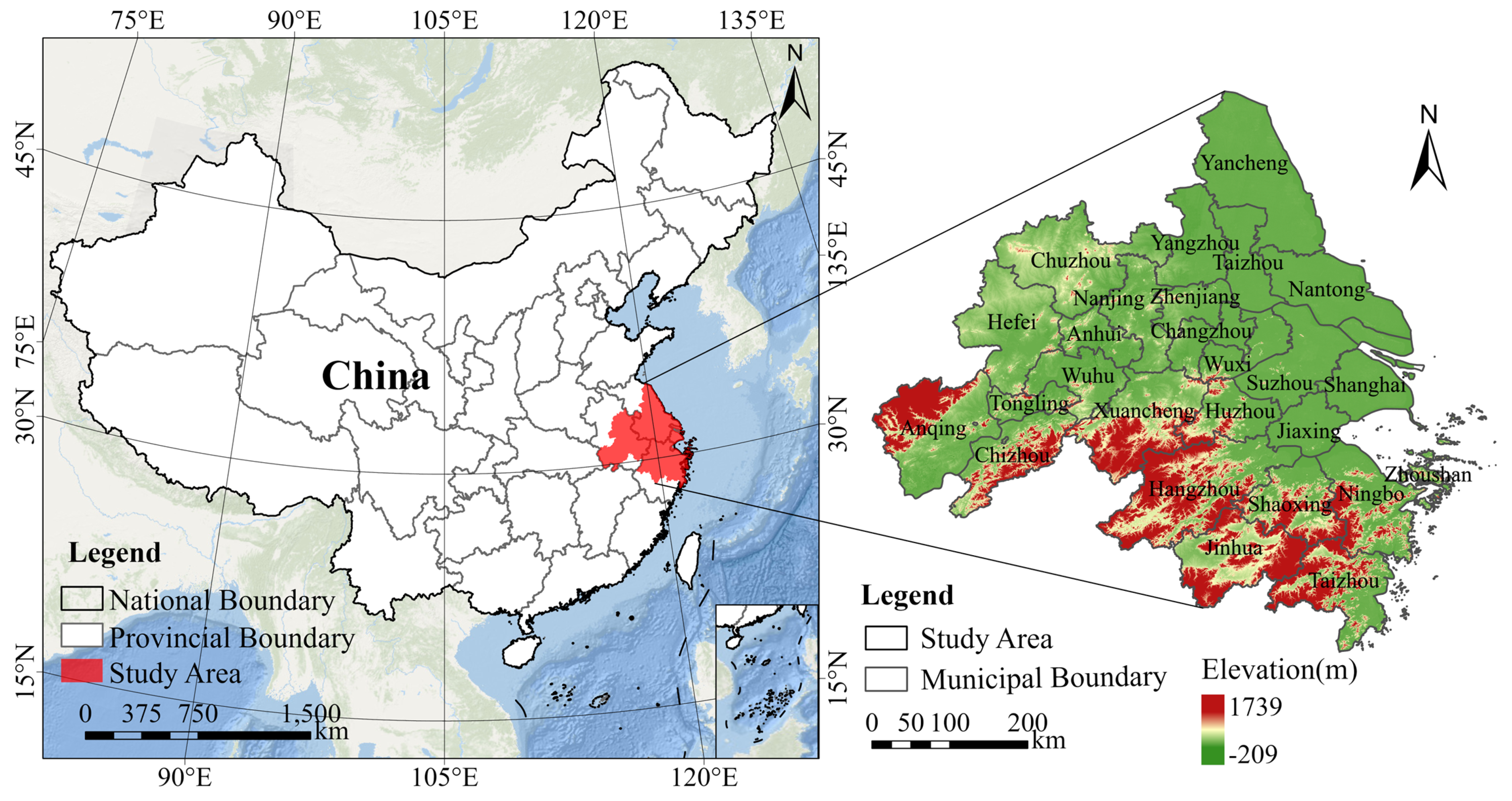
Figure 1. The geographic position of the YRDUA.
Sustainability 17 08235 g001
Figure 2. The study framework.
Sustainability 17 08235 g002
Figure 3. Land use pattern in the YRDUA from 2000 to 2020.
Sustainability 17 08235 g003
Figure 4. Spatiotemporal evolution and transformation of land use in the YRDUA from 2000 to 2020.
Sustainability 17 08235 g004
Figure 5. Sankey diagram of land use type conversion.
Sustainability 17 08235 g005
Figure 6. Spatial pattern of EEQ in the YRDUA.
Sustainability 17 08235 g006
Figure 7. LISA clustering map of EEQ in the YRDUA.
Sustainability 17 08235 g007
Figure 8. The ecological contribution rate of LUT in the YRDUA from 2000 to 2020.
Sustainability 17 08235 g008
Figure 9. PLS-SEM result diagram.
Sustainability 17 08235 g009
Table 1. Selection of impact factors.
Latent VariableManifest Variable
TerrainElevation
Slope
EconomyGDP per capita
Urbanization rate
The proportion of tertiary industry
ClimateAverage annual precipitation
Relative humidity
GreeningNumber of parks
Green coverage area
IntegrationStrength of inter-city linkages
LandProportion of agricultural production land
Land development intensity
Table 2. Production-living-ecological space dominant land use function classification system.
Production-Living-Ecological Space Land Use ClassificationSecondary Land Use Date Type
First ClassificationSecondary Land Classification
Production landAgricultural production land (APL)Paddy field, dry land
Industrial production land (IPL)Industrial, mining and transportation construction land
Living landUrban living land (ULL)Urban land
Rural living land (RLL)Rural residential area
Ecological landForest ecological land (FEL)Sparse woodland, shrubbery, woodland, other woodland
Pasture ecological land (PEL)Low coverage grassland, medium coverage grassland, high coverage grassland
Water ecological land (WEL)Rivers, lakes, reservoirs, ponds, permanent glaciers, snow, beaches
Other ecological land (OEL)Marshland, bare rocky gravel land, Gobi, sandy land, beach land, saline-alkali land, bare land, alpine desert
Table 3. Data source.
DateResolutionUnitYearSources
Elevation30 mm2000, 2010, 2020Geospatial Data Cloud
Slope30 m%2000, 2010, 2020Geospatial Data Cloud
GDP per capitaCity scaleyuan2000, 2010, 2020National Bureau of Statistics
Urbanization rateCity scale%2000, 2010, 2020National Bureau of Statistics
The proportion of tertiary industryCity scale%2000, 2010, 2020National Bureau of Statistics
Relative humidity1000 m%2000, 2010, 2020WorldClim Global Climate Database
Average annual precipitation1000 mmm2000, 2010, 2020WorldClim Global Climate Database
Number of parksCity scalecount2000, 2010, 2020National Bureau of Statistics
Green coverage areaCity scaleha2000, 2010, 2020National Bureau of Statistics
GDPCity scale108 yuan2000, 2010, 2020National Bureau of Statistics
Table 4. Area of various land use types in the YRDUA from 2000 to 2020.
Land Use Type2000 (km2)2010 (km2)2020 (km2)
APL111,084.25101,744.8997,849.10
FEL57,779.7257,040.4957,010.93
PEL7911.257353.287651.91
WEL18,449.2020,363.4419,417.10
ULL4272.909771.1711,796.33
RLL10,703.1912,399.6013,687.94
IPL1341.262675.743874.94
OEL35.12228.28288.65
Total211,576.89211,576.89211,576.89
Table 5. Ecological environment quality grading standards and area proportion.
TypesInterval200020102020
Grid (Number)Area
(km2)
Grid (Number)Area
(km2)
Grid (Number)Area
(km2)
Low-value zone0–0.216966264194317,487259823,382
Lower-value zone0.21–0.3811,440102,96010,43393,89710,05890,522
Moderate-value zone0.38–0.55373233,588381834,362363432,706
Higher-value zone0.55–0.72276124,849266223,958268624,174
High-value zone0.72–0.89611955,071599253,928600054,000
Disclaimer/Publisher’s Note: The statements, opinions and data contained in all publications are solely those of the individual author(s) and contributor(s) and not of MDPI and/or the editor(s). MDPI and/or the editor(s) disclaim responsibility for any injury to people or property resulting from any ideas, methods, instructions or products referred to in the content.