


Abstract
With the rising urgency of global environmental challenges, understanding the mechanisms behind green consumption has become increasingly vital. This study investigates how green product information disclosure influences consumers’ green consumption intention, focusing on new energy vehicle (NEV) consumers in China. Grounded in the Theory of Planned Behavior (TPB), the study introduces environmental concern as a mediator and brand reputation as a moderator to enhance the explanatory power of the model. A total of 527 valid questionnaires were collected on-site from NEV exhibitions in Beijing. Structural equation modeling and PROCESS macro analysis were employed to test the research hypotheses. The results indicate that environmental information disclosure significantly promotes green consumption intention, both directly and indirectly, through the mediating effects of green consumption attitude, subjective norms, and environmental concern. However, the direct effect of information communication channels was not statistically significant. Moreover, brand reputation positively moderates the relationship between environmental information disclosure and green consumption intention. These findings provide new theoretical insights by extending TPB with contextual and psychological variables and offer practical implications for NEV manufacturers and marketers. Specifically, companies are encouraged to prioritize transparent and credible environmental information disclosure, strengthen brand reputation, and consider consumers’ attitudes and social norms when designing green marketing strategies.
1. Introduction
In the context of accelerating climate change and the global push for sustainable development, green consumption has become a vital pathway toward building low-carbon societies. From a broader perspective, Hua et al. [1] reviews the literature related to the transition from fuel vehicles to electric vehicles and identifies research priorities for electric vehicles as a key component of carbon reduction strategies. Welfare analyses of government subsidies for new energy vehicles (NEVs) in China by Yang et al. [2] demonstrate that targeted incentives can effectively promote environmentally friendly transportation, with welfare implications that support policy justification. Similarly, Koengkan et al. [3] confirm that fiscal and financial incentives in Latin America contribute to reductions in CO2 emissions, reinforcing the environmental benefits of renewable energy incentives.
From an academic standpoint, research on green consumption behavior has accumulated a solid theoretical foundation. Among these, the Theory of Planned Behavior (TPB) has emerged as a dominant framework due to its explanatory power and adaptability across behavioral domains [4]. By incorporating attitude, subjective norms, and perceived behavioral control, TPB offers a structured lens to analyze individual behavioral intentions. In the NEV context, numerous studies have applied the TPB model to examine psychological determinants of adoption, including environmental concern, social influence, and control perceptions [5,6]. Although there have been studies showing that firms’ information transparency in terms of products, prices, inventories, and processes have a positive impact on consumer trust and purchase intentions [7], the relevant studies have mainly focused on attitudinal-level analyses and lacked systematic explorations under the framework of behavioral theories. However, the study emphasizes environmental information disclosure from the perspective of China’s environmental governance, emphasizing its promotion of public trust and policy implementation, but did not link it to consumer behavioral intentions, nor did it integrate the analysis with information communication channels [8]. It can be understood that existing studies have not yet explored in depth the comprehensive influence mechanism of environmental information disclosure and information communication channels on consumers’ green behavioral intentions from an integrated perspective.
However, the existing literature has largely remained at the surface level, exploring how information transparency affects trust or general attitudes. It has not yet systematically incorporated Environmental Information Disclosure (EID) and Information Communication Channels (ICC) into an extended TPB framework, nor has it empirically examined their combined influence on green consumption intentions. Moreover, the empirical base is still dominated by studies from developed economies, whereas China—home to the world’s largest NEV market—offers a unique policy-driven, culturally distinct, and platform-dependent consumer landscape, making it a highly relevant context for investigation.
In response to these research gaps, this study builds an extended TPB model that integrates external information factors, specifically EID and ICC, to examine their roles in shaping Chinese consumers’ green consumption intentions toward NEVs. Based on a structural equation modeling (SEM) analysis of large-scale survey data, the study aims to contribute to the literature in three aspects: (1) Theoretically, by broadening the scope of TPB to include external variables, it enhances the model’s explanatory power in green consumption research. (2) Empirically, by identifying the mediating and moderating roles of information disclosure and communication mechanisms, it provides evidence for the psychological mechanisms underlying NEV adoption. (3) Practically, by offering policy implications for optimizing environmental communication strategies to promote low-carbon transportation in emerging markets.
Based on an extended Theory of Planned Behavior (TPB) framework, this study investigates how environmental information disclosure and information communication channels affect consumers’ green consumption intentions, incorporating brand reputation as a moderating factor. Specifically, the research constructs a theoretical model integrating cognitive, normative, and affective pathways, and empirically tests its validity using survey data from new energy vehicle (NEV) consumers in China. The remainder of this paper is structured as follows: Section 2 reviews relevant literature and develops the research hypotheses; Section 3 outlines the research methodology, including data collection and model construction; Section 4 presents the empirical results; Section 5 discusses the findings in light of theoretical and practical implications; and Section 6 concludes with key insights, limitations, and directions for future research.
2. Literature Review and Research Hypothesis
2.1. Green Product Information Disclosure and Green Consumption Intention
Green products, also known as environmentally friendly products, refers to goods made from non-toxic, natural, and recyclable materials with ecological packaging, and designed to minimize environmental pollution during use [9]. According to the Theory of Planned Behavior (TPB), green consumption intention serves as a key prerequisite for consumers’ actual green purchasing behavior. However, the formation of green consumption intention is a complex psychological and cognitive process influenced by multiple factors.
At present, scholars both in China and abroad have primarily explored the formation mechanism of green consumption intention from the following three perspectives:
- (1)
- Environmental Perspective: Some consumers choose green products out of a motivation to protect the environment and preserve ecological systems. This group typically possesses a high level of environmental awareness and pays special attention to whether products exhibit green attributes during the decision-making process [10]. These green attributes can be presented directly through eco-labels or reflected in sustainability-related information regarding the product’s production and use.
- (2)
- Economic Perspective: When consumers have a comprehensive understanding of the long-term benefits of green products—such as cost savings and improved energy efficiency—they are generally more inclined to purchase them [11]. However, Wang et al. [12] pointed out that most consumers are unable to accurately assess the lifecycle costs and benefits of green products. Instead, they tend to focus on immediate prices and returns, favoring short-term economic gains over environmental performance. Some studies suggest that this cognitive bias stems from information asymmetry between enterprises and consumers [13], which can be effectively mitigated through systematic and transparent environmental information disclosure [14].
- (3)
- Social Perspective: Certain consumers may develop a willingness to purchase green products due to motivations related to building a green image or enhancing social status [15]. Although the link between social motives and environmental information disclosure is less direct compared to the previous two perspectives, it is still possible to infer a positive influence of green information disclosure on consumption intention through mechanisms such as social reputation.
Current research has preliminarily confirmed a positive correlation between certain types of environmental information and consumers’ green consumption intention. For example, Wang et al. [16] found that increased exposure to energy-saving information significantly impacts the sales of energy-efficient household appliances across various market contexts. Similarly, Chi’s study [17] demonstrated that eco-labels, as a form of environmental information, can effectively stimulate consumers’ intention to engage in green consumption. These findings suggest that both energy-saving information and eco-labels—though different in form—serve as effective carriers of environmental messages capable of enhancing green consumption intention.
Moreover, environmental information is not limited to labeling. It also includes sustainability-related disclosures throughout the product’s production, supply chain, and full life cycle. Such information can assist consumers in better integrating their existing environmental knowledge and attitudes, while strengthening their perception of green brands. This, in turn, reduces concerns about “greenwashing” [18]. In this sense, the provision of environmental information has become a key factor in guiding consumers toward green decision-making and in enhancing brand trust.
However, for a long time, corporate green communication has focused more on the content of the information rather than on the role of the communication channel itself. Some studies have shown that the effectiveness of marketing channels significantly influences consumers’ understanding and acceptance of green concepts [19]. If the channels lack authority or credibility, consumers may develop biased perceptions of the green information, which can erode brand trust and ultimately hinder the formation of green consumption intention.
Hypothesis (H1a).
Environmental information disclosure positively influences consumers’ green consumption intention.
Hypothesis (H1b).
Communication channels positively influence consumers’ green consumption intention.
2.2. Mediating Effects
2.2.1. The Mediating Role of Green Consumption Attitude
According to the Theory of Planned Behavior (TPB), behavioral attitude refers to an individual’s overall evaluation—positive or negative—of performing a particular behavior [4]. When applied to the context of green product consumption, green consumption attitude can be understood as the degree of consumers’ preference or inclination toward engaging in green purchasing behaviors [20]. Existing research has largely focused on the relationship between green consumption attitude and behavioral intention or actual behavior. Some studies have confirmed that green consumption attitude significantly influences green purchase intention or behavior [20], while others have investigated the discrepancy between attitude and behavior, exploring the phenomenon of “attitude-behavior inconsistency” [21]. However, compared with such studies, there remains limited research on the interaction mechanisms between green consumption attitude and other influencing factors.
In terms of environmental information disclosure, Nittala [21] pointed out that consumers with higher levels of green knowledge tend to have greater expectations of green products, yet they also exhibit stronger skepticism. As a result, they require more detailed and transparent environmental information to enhance their trust in a company’s green claims. Accurate information disclosure can correct previously held negative perceptions of green products, thereby increasing consumer favorability and purchase preference. Similarly, the research of Robinson et al. [22] found that for consumers with relatively limited green knowledge, providing information on the potential value and long-term environmental benefits of green products can gradually reshape their attitude toward such products. Therefore, regardless of the consumer’s existing level of green knowledge, systematic environmental information disclosure helps eliminate inherent biases and fosters a more positive green consumption attitude.
In addition, Zepeda et al. [23] emphasized that consumers with strong environmental awareness tend to actively seek out information and, in doing so, continuously build their own green cognitive structures and value systems. This process of cognitive construction heavily depends on the effectiveness of communication channels [13]. Hence, when companies transmit green information through efficient and trustworthy channels, it becomes more likely to trigger consumers’ willingness to receive such information, thereby strengthening their green consumption attitude.
On the other hand, as previously mentioned, green consumption attitude encompasses consumers’ emotional and evaluative responses—both positive and negative—toward green products. It reflects their psychological judgments and emotional reactions in the context of green consumption behavior [24]. As one of the core variables in TPB, attitude is a key predictor of behavioral intention, and the two are generally positively correlated [25]. In other words, the more positive a consumer’s attitude toward green products, the stronger their intention to engage in green purchasing behavior.
Hypothesis (H2a).
Green consumption attitude mediates the relationship between environmental information disclosure and green consumption intention.
Hypothesis (H2b).
Green consumption attitude mediates the relationship between communication channels and green consumption intention.
2.2.2. The Mediating Role of Subjective Norms
According to the Theory of Planned Behavior (TPB), subjective norms are another key determinant of behavioral intention, reflecting the perceived social pressure or expectations from others that an individual experiences during the decision-making process [26]. Numerous studies have explored the influence of subjective norms on behavioral intention. For example, Teng et al. [27], in an empirical study combining altruism with TPB to predict consumers’ intention to choose green hotels, found that subjective norms have a significant positive effect on green consumption intention. This indicates that when consumers perceive recognition and support for green products from people around them, they are more likely to develop a favorable intention to engage in green consumption.
In terms of the conceptual scope of subjective norms, “others” often include reference groups that consumers identify with during the consumption process. According to Xie Fang et al. [28] reference groups not only serve as important sources of consumer information but also influence individuals’ purchasing judgments through the dissemination of attitudinal messages. When these groups express approval of green products after receiving environmental information, a broader green consumption atmosphere can be created through social transmission. Therefore, if corporate environmental information disclosure is perceived as credible and gains widespread consumer trust, reference groups may amplify green discourse, thereby strengthening individuals’ perceived subjective norms.
In the context of digital social environments, the formation of subjective norms also tends to become more networked and context-dependent. Yang Qiang et al. [29] pointed out that interpersonal relationships on social networks often rely heavily on the exchange of value-oriented information. Boyd & Ellison [30] further emphasized that subjective norms on social media are essentially maintained through meaningful information interactions between users. Thus, when environmental information about green products is widely disseminated and accepted on social platforms, consumers are more likely to align themselves with community norms and develop green consumption intention.
Furthermore, Zhang et al. [31] in a study on the influence of smog pollution on residents’ green consumption behavior, found that government-led green publicity campaigns and effective green marketing strategies by businesses enhance consumers’ awareness of green issues. This, in turn, generates a certain level of social pressure, encouraging consumers to pay greater attention to green products. These findings suggest that forming a positive social consensus on green consumption can reinforce subjective norms and promote green behavioral decisions among consumers.
In summary, environmental information disclosure and communication channels not only function as external stimuli influencing consumer cognition but also indirectly shape green consumption intention by enhancing individuals’ perceived social support and normative pressure from relevant groups [4,25,32].
Hypothesis (H3a).
Subjective norms mediate the relationship between environmental information disclosure and green consumption intention.
Hypothesis (H3b).
Subjective norms mediate the relationship between communication channels and green consumption intention.
2.2.3. The Mediating Role of Environmental Concern
According to the Theory of Planned Behavior (TPB), individuals’ behavioral intentions are primarily shaped by three rational components: attitude toward the behavior, subjective norms, and perceived behavioral control [4]. However, existing studies have pointed out that TPB alone is insufficient to fully explain the role of non-rational factors—such as moral values, environmental awareness, and emotional tendencies—in green consumer behavior [33]. To enhance the explanatory power of the model, scholars have attempted to integrate TPB with other theoretical frameworks, such as Social Cognitive Theory [25], as well as by incorporating environmental variables [34].
Social Cognitive Theory emphasizes that individuals’ sustainable behavior is shaped by their evaluation of past experiences and their understanding of the current context [35,36]. However, because contextual variables typically involve a complex interplay of internal and external influences, it is often difficult for researchers to clearly identify the internal logical relationships among them, thereby complicating empirical testing and research design [25]. In light of this, the current study introduces “environmental concern” as an affective dimension variable into the TPB framework to broaden its theoretical scope.
Environmental concern refers to an individual’s sensitivity and sense of responsibility toward environmental issues, reflected across multiple dimensions, including values, attitudes, emotions, cognition, knowledge, and behaviors [32]. Research has shown that an increased level of environmental concern is often accompanied by stronger green values and greater knowledge, which, in turn, lead consumers to form more positive perceptions and attitudes toward green products. Consumers with heightened environmental concern are more inclined to prioritize sustainability in their purchasing decisions, even when it entails paying a premium price. Moreover, Zhang et al. [31] found that individuals with higher education levels and greater green knowledge typically exhibit stronger intentions to purchase environmentally friendly products.
From the perspective of environmental information disclosure, Han et al. [37] found that green marketing efforts should focus on clearly highlighting the environmental attributes of products in order to increase consumer concern about environmental issues, thereby laying the psychological foundation for forming green consumption intention. Similarly, Jin Xiaotong et al. [15] argued that the environmental information disclosed by products has a mutually reinforcing relationship with consumers’ green cognition. These findings suggest that the more accurate and transparent the environmental information provided by companies, the better consumers will understand the green attributes of the product, which in turn enhances their level of environmental concern.
From the perspective of communication channels, the environmental practices adopted during the production and manufacturing stages of green products—as well as their functional value in addressing ecological challenges—must be effectively communicated through appropriate marketing channels [15]. The perceptual stimuli generated by marketing activities continuously reinforce consumers’ environmental responsibility and value orientation [38]. Hong et al. [39] emphasized that under conditions of information asymmetry, consumers tend to rely on trusted communication channels to obtain green product information. Only information transmitted through high-credibility channels is likely to shape consumers’ green attitudes and shift their environmental values. Consistent with the definition of environmental concern, consumers’ environmental attitudes, value orientations, and sense of responsibility are all key manifestations of their environmental concern.
Based on the above analysis, this study argues that both content-level environmental information disclosure and channel-level effective communication can enhance consumers’ environmental concern by stimulating their awareness of environmental values, thereby increasing their green consumption intention.
Hypothesis (H4a).
Environmental concern mediates the relationship between environmental information disclosure and green consumption intention.
Hypothesis (H4b).
Environmental concern mediates the relationship between communication channels and green consumption intention.
2.3. The Moderating Role of Brand Reputation
Brand reputation is commonly defined as consumers’ subjective perception of a brand’s overall image, encompassing their comprehensive evaluation of product quality, service performance, and corporate social responsibility [40]. A strong brand reputation enhances consumer trust and willingness to accept the values the brand represents [41], and serves as an intangible asset that can drive behavioral outcomes [42]. Conversely, poor brand reputation often leads to skepticism regarding reliability and environmental commitment.
Environmental information disclosure—i.e., the communication of sustainability-related product attributes during production, distribution, and other life-cycle stages—has been shown to significantly enhance trust and green purchase intentions, particularly when origin-related environmental information is provided [43]. Empirical research in green marketing suggests that when consumers perceive a brand as reputable, they are more likely to accept its environmental claims as credible, thereby strengthening their green purchase intentions [44]. Additionally, research shows that high green trust significantly enhances the perceived usefulness of sustainability information, which in turn increases green purchasing behavior [45]. In contrast, consumer skepticism toward brand credibility can undermine the influence of such disclosures, limiting their effectiveness [46].
Previous research has also shown that strong brand reputation can indirectly influence green purchasing behavior by enhancing consumer trust [32]. This trust mechanism applies not only to the content of the information but also to the credibility of the communication channel. The higher the brand reputation, the more willing consumers are to accept and believe information transmitted through its channels, thus increasing their recognition of and receptiveness to environmental information. In contrast, when brand reputation is low, consumers may question or even reject the content disseminated, thereby suppressing the formation of green consumption intention. Green brand image positively influences brand equity, mediated by green satisfaction, green trust, and perceived value [47]. Therefore, investing resources to enhance these green characteristics helps improve brand equity. Nguyen et al. [48] found that brand reputation can enhance the role of communication channels in increasing consumers’ green awareness and attitudes. High brand reputation means that consumers already have a strong foundation of trust in the brand, making the environmental information conveyed through marketing channels more easily accepted and converted into green consumption intentions. Additionally, Jain et al. [49] emphasized that the synergy between brand reputation and communication channels significantly affects consumers’ perceived quality of environmental information, thereby increasing their purchase intentions. The effectiveness of communication channels depends on brand reputation. Consumers are more inclined to trust environmental information when they perceive the sustainability communication channel to be reliable and consistent with the brand’s known values and actions. This trust is not solely dependent on the type of organization conveying the message—be it a business, government, or NGO—but is significantly influenced by the perceived credibility and alignment of the communication with the brand’s established reputation. In their study, Bakalarska and Dahl [50] found that brand reputation acts as a “trust amplifier,” moderating the relationship between communication channels and green consumption intention. Their empirical evidence supports the view that the reliability of communication channels and their consistency with brand reputation play a crucial role in promoting consumer trust in environmental information. Conversely, when brand reputation is low, consumers tend to be skeptical of information from these channels, hindering the formation of green consumption intentions.
In summary, brand reputation functions as a “trust amplifier” in the process of environmental information disclosure and dissemination, enhancing the effectiveness of green communication and the conversion of intention into behavior. Based on this, the following moderating hypotheses are proposed:
Hypothesis (H5a).
Brand reputation positively moderates the relationship between environmental information disclosure and green consumption intention.
Hypothesis (H5b).
Brand reputation positively moderates the relationship between communication channels and green consumption intention.
Perceived Behavioral Control (PBC) refers to an individual’s subjective evaluation of whether they possess the ability and resources—such as time, knowledge, money, and opportunity—to perform a specific behavior [4]. This sense of control reflects the perceived feasibility of taking action and serves as a key component of the Theory of Planned Behavior (TPB). Within this framework, PBC not only directly predicts behavioral intention but also enhances the likelihood of intention being translated into actual behavior, particularly when individuals feel capable of overcoming potential barriers [34]. In essence, the stronger one’s belief in their own efficacy, the more likely intentions will materialize into concrete actions.
In the context of green consumption, a high level of PBC indicates that consumers believe they can engage in sustainable behaviors—such as locating green products, affording eco-friendly alternatives, and accessing relevant information with ease. This perceived “doability” is especially critical for green decision-making, where action often depends not only on attitude but also on structural and contextual feasibility.
Existing studies suggest that even if consumers receive environmental information or are persuaded through communication channels, low levels of PBC may still hinder the transformation of green intention into actual purchase behavior [51]. For instance, some consumers might support green values in principle, yet perceive green products as too expensive, difficult to find, or unavailable in their local markets—manifesting a “know-but-can’t-do” response. Conversely, consumers with higher PBC are not only more likely to trust environmental information but also to translate that information into green behaviors, as their sense of ability reinforces intention-action alignment. Recent empirical research also confirms that PBC significantly influences green consumption: for example, studies among Indonesian households show that PBC is the strongest predictor of zero-waste behavior (β = 0.367, p ≤ 0.001), even more than environmental knowledge or subjective norms [52]. Another study of university students found that attitudes, subjective norms, and PBC all positively impact green purchase intentions, with PBC having the greatest effect [53].
Moreover, PBC can act as a filter for external messages: under similar environmental disclosures, consumers with higher perceived control interpret and act on the information more effectively, whereas those with lower PBC may remain unmotivated or unable to act on intentions. As such, PBC may moderate the influence of both environmental information disclosure and communication channels on green consumption intention.
Based on this reasoning, the following moderating hypotheses are proposed:
Hypothesis (H6a).
Perceived behavioral control positively moderates the relationship between environmental information disclosure and green consumption intention.
Hypothesis (H6b).
Perceived behavioral control positively moderates the relationship between communication channels and green consumption intention.
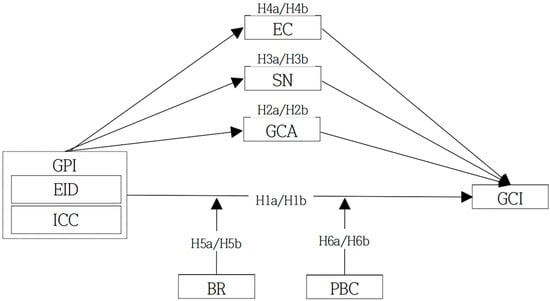
In summary, the research model of this paper is shown in Figure 1.
Figure 1.
Research model.
3. Research Object and Data Collection
This study follows internationally recognized carbon accounting standards, including ISO 14064-1:2018 [54] and the Greenhouse Gas Protocol (WRI/WBCSD, 2004/2015) [55], to ensure the reliability and comparability of environmental information disclosure indicators.
The study selects new energy vehicles (NEVs), a type of green product, as the focus for research on green information disclosure. The primary reasons for this choice are as follows: the premium issue of most green products on the market is currently quite severe, particularly among everyday green consumer goods. This leads to a relatively low level of green product consumption domestically, largely concentrated among high-income individuals, resulting in a small target sample group that is not convenient for conducting research. Compared to traditional fuel-powered vehicles, the overall market share of NEVs remains relatively low. However, since automobiles are a product of rigid demand, the consumer base for NEVs is broader and thus more representative than that for general green consumer goods. Additionally, the study targets consumers who have had driving experience with NEVs. This is because the research involves specific details about NEVs, and respondents without systematic perception of these vehicles might provide random answers, leading to distortions in the research results.
This research collects data via a questionnaire survey. The primary locations for distributing the questionnaire were new energy vehicle exhibitions in Beijing. The survey utilized an on-site approach, distributing, completing, collecting, and providing immediate feedback on the spot. During this phase, 863 questionnaires were distributed, and after excluding responses that were sequentially answered, incomplete, or from individuals without NEV driving experience, 527 valid questionnaires were obtained.
In the process of data collection, measures were taken to ensure the reliability and ethical standards of the survey. The content of the research was thoroughly explained at the beginning of the questionnaire. A total of 863 questionnaires were distributed, of which 527 were valid, resulting in an effective recovery rate of 61%. As shown in Table 1, Regarding the demographics of the respondents, 55.20% were male, and 44.80% were female. In terms of age, students who plan to purchase cars after entering the workforce were also included in the survey, given that their understanding of NEVs is influenced by the media and their families. To ensure comprehensiveness, younger individuals aged 20 years and below were included, comprising 25% of the sample. Respondents aged 21 to 30 years made up 29.00%, those aged 31 to 40 years accounted for 32.40%, those aged 41 to 50 years constituted 10.10%, and those aged 51 years and above represented 3.40%.
Table 1.
Distribution Description of Sample Characteristics.
The educational level of the respondents was mainly undergraduate, making up 41.20% of the sample. Respondents with middle school education or below and those with high school education each accounted for 25.40% and 5.70%, respectively. Meanwhile, 18.60% held a master’s degree, and 9.10% held a doctoral degree.
Regarding monthly income, 41.00% earned less than 6000 RMB, 19.00% earned between 6000 and 10,000 RMB, 18.40% earned between 10,000 and 14,000 RMB, 9.50% earned between 14,000 and 18,000 RMB, 7.00% earned between 18,000 and 22,000 RMB, 2.70% earned between 22,000 and 26,000 RMB, 1.70% earned between 26,000 and 30,000 RMB, and 0.80% earned more than 30,000 RMB.
The questionnaire design for this study consists of two parts: the first part focuses on the basic demographic information of the respondents, and the second part measures the key constructs of the study. The questionnaire items are provided in Appendix A. Existing research has identified that factors such as an individual’s gender, age, education level, and monthly income all influence their willingness to engage in green consumption. The survey on the influence mechanism of green product information disclosure on green consumption intentions used question items derived from established scales, with appropriate adjustments made to align with the specific research focus of this study without altering the original meaning. The measurement of variables adopted the Likert 5-point scale, where 1 represents “strongly disagree” and 5 represents “strongly agree.”
The green information disclosure variables centered on two aspects: environmental information disclosure indicators and information communication channel indicators. The study utilized seven items from the research conducted by Shao et al. [18] and another seven from the research by Cerri et al. [56]. In this study, green consumption intentions were measured using six items developed by Paul based on the Theory of Planned Behavior (TPB) [32]. In addition, the measurement of perceived behavioral control referenced the seven items proposed by Ajzen [4]. These measurement tools have been validated in several studies to effectively capture consumers’ behavioral intentions and perceived control in green consumption decisions. The measurement of brand reputation, on the other hand, utilized five items from the study by Agmeka [32]. This study explored the impact of discount framing on brand reputation and brand image, providing a reliable measurement basis for this study. Written informed consent was not obtained as the study involved anonymous survey responses and did not collect any personally identifiable information. Participation was voluntary, and submission of the survey was considered implied consent.
4. Data Analysis and Results
4.1. Control of Common Method Bias
To address the issue of common method bias, this study adopted both procedural and statistical control methods. For procedural control, an anonymous questionnaire was used to minimize the respondents’ defensive psychology when filling out the survey, thereby ensuring high-quality responses. For statistical control, Harman’s single-factor test was conducted on all the measurement items. The results indicated that the first factor did not explain the majority of the variance. Therefore, it can be concluded that common method bias did not have a significant impact on this study.
4.2. Reliability and Validity Test
This study used SPSS 29.0 (IBM Corp., Armonk, NY, USA) and AMOS 29.0 (IBM Corp., Armonk, NY, USA) to test the reliability and validity of the scales. During the testing process, Cronbach’s α coefficient was employed to evaluate the reliability of the scales. When the coefficient is greater than 0.7, it indicates a high level of internal consistency among the data. As shown in Table 2, the Cronbach’s α coefficients for environmental information disclosure and information communication channels were 0.892 and 0.890, respectively. The Cronbach’s α coefficients for green consumption attitude, subjective norms, and environmental concern were 0.781, 0.831, and 0.892, respectively. The Cronbach’s α coefficient for perceived behavioral control was 0.974, brand reputation was 0.967, and green consumption intention was 0.867. Since all variables, except for green consumption attitude, had Cronbach’s α coefficients greater than 0.8, and green consumption attitude had a coefficient of 0.781, which is above the acceptable threshold of 0.7, it can be concluded that the scales used in this study have good reliability.
Table 2.
Reliability Analysis of Scales.
It is important to emphasize that each dimension in this study uses an existing, well-established scale, with only appropriate adjustments made based on the specific research subjects. Therefore, content validity can be largely ensured. Furthermore, the composite reliability (CR) coefficients of all variables are greater than 0.8, and the average variance extracted (AVE) values are all greater than 0.6, indicating that the scales for each dimension in this study have good convergent validity.
It is also evident that the square roots of the AVE values for variables such as environmental information disclosure and information communication channels are greater than the correlation coefficients of their respective rows and columns with other latent variables. This indicates good discriminant validity among the various dimensions. As shown in Table 2, all constructs demonstrated good reliability and convergent validity, with Cronbach’s α and CR values exceeding the recommended 0.70 threshold and AVE values above 0.50.
To further assess indicator reliability, we report the outer loading values for all observed items. As shown in Table 3, all item loadings exceeded the recommended threshold of 0.70, indicating that each indicator contributes significantly to its respective construct. This provides strong evidence of indicator reliability, supplementing the internal consistency and convergent validity already supported by high Cronbach’s α, Composite Reliability (CR), and Average Variance Extracted (AVE) values.
Table 3.
Outer Loading.
To further assess discriminant validity, both the Fornell–Larcker criterion and the Heterotrait–Monotrait (HTMT) ratio were employed. As shown in Table 4, the square root of the AVE for each construct exceeds its correlations with other constructs, indicating acceptable discriminant validity according to the Fornell–Larcker criterion. Additionally, Table 5 presents the HTMT values between all construct pairs, all of which fall below the conservative threshold of 0.85. This further supports the presence of adequate discriminant validity. Together, these results confirm that each latent construct is empirically distinct from the others, fulfilling the established criteria for discriminant validity.
Table 4.
Fornell–Larcker Criterion for Discriminant Validity.
Table 5.
HTMT Results for Discriminant Validity Testing.
4.3. Model Matching Degree Test
AMOS 29.0 was used to test the model’s fit. Based on the model fit results presented in Table 6, it can be seen that the CMIN/DF (Chi-square divided by degrees of freedom) is 1.307, which falls within the acceptable range of 1 to 3. The RMSEA (Root Mean Square Error of Approximation) is 0.038, which is within the excellent range of <0.05. Additionally, the indices IFI (Incremental Fit Index), TLI (Tucker–Lewis Index), and CFI (Comparative Fit Index) all achieved excellent levels above 0.9. Therefore, the comprehensive analysis results indicate that the CFA (Confirmatory Factor Analysis) model has good fit.
Table 6.
Model Fit Evaluation.
4.4. Main Effect Test
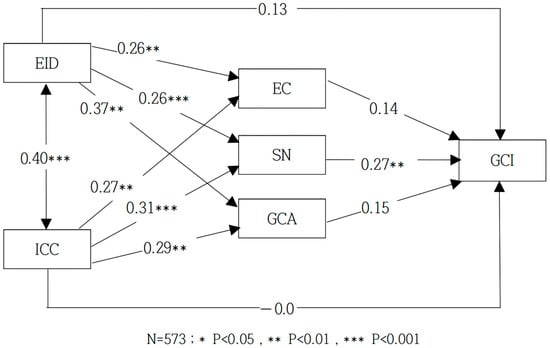
This study used AMOS 29.0 to test the research hypotheses related to environmental information disclosure, information communication channels, green consumption attitude, subjective norms, environmental concern, perceived behavioral control, and green consumption intention for new energy vehicles. The test results can be found in Figure 2.
Figure 2.
Path verification of the model.
The direct effect of environmental information disclosure on green consumption intention was found to be significant (β = 0.13, p < 0.001), thus supporting Hypothesis 1a. However, the direct effect of information communication channels on green consumption intention was not significant (β = 0.652, p > 0.05), indicating that Hypothesis 1b is not supported. According to existing literature, some experts and scholars have also concluded that information communication channels do not have a significant impact on green consumption intention. For instance, in Chi’s study on the influence of eco-labels, eco-brands, and social media on green consumption intention, it was found that social media did not directly influence consumer intention, which was attributed to the lack of credibility of eco-brands, leading to a loss of trust in social media. In light of this, the present study suggests that when a company’s eco-brand reputation fails to convince consumers, the green information communicated through information channels will not effectively influence consumers’ green consumption intentions.
Furthermore, since the information communication channel does not have a direct effect on green consumption intention, subsequent tests on mediation and moderation effects related to it lose their theoretical significance.
4.5. Intermediate Effect Test
For testing the three mediating variables, this study used the PROCESS Macro v4.2 (Andrew F. Hayes, The Ohio State University, Columbus, OH, USA) macro and the Bootstrap confidence interval method, setting Bootstrap sampling to 5000 iterations. The test evaluated whether the absolute ratio of the point estimate to the SE value (Z value) was greater than 1.96 and whether the Bias-corrected and Percentile confidence intervals at a 95% confidence level (Confidence Interval, CI) included zero, to determine the existence of mediation effects.
As shown in Table 7, the Z value of the direct effect is 3.201 > 1.96, with a Bias-corrected 95% CI range of [0.0531, 0.2220] that does not include zero, and a Percentile 95% CI range of [0.0531, 0.2220] that also does not include zero. These data indicate that the direct effect of environmental information disclosure on green consumption intention exists, making further mediation effect testing feasible.
Table 7.
Direct, Indirect, and Total Effects.
According to the table, the influence of environmental information disclosure on green consumption intention is achieved through three paths: “Environmental Information Disclosure—Green Attitude—Green Consumption Intention,” “Environmental Information Disclosure—Subjective Norms—Green Consumption Intention,” and “Environmental Information Disclosure—Environmental Concern—Green Consumption Intention.” The Z values for these three paths are 2.5997, 4.8420, and 2.8874, respectively (all greater than 1.96). Meanwhile, the Bias-corrected 95% CI ranges for these three mediating paths are [0.0096, 0.0874], [0.0337, 0.1019], and [0.0098, 0.0732], all of which do not include zero. Similarly, the Percentile 95% CI ranges are [0.0096, 0.0874], [0.0337, 0.1019], and [0.0098, 0.0732], none of which include zero. These data indicate that all three variables have a significant mediating effect.
Additionally, the ratio of the estimated values of indirect effects to the total effect are 31%, 43%, and 26%, respectively, indicating that subjective norms have the strongest mediating effect, followed by green attitude and then environmental concern. In conclusion, green attitude, subjective norms, and environmental concern all play mediating roles between environmental information disclosure and green consumption intention, supporting Hypotheses 2a, 3a, and 4a.
From the main effect analysis above, it can be concluded that the direct effect of information communication channels on green consumption intention is not significant. Thus, it is inferred that the corresponding mediating effects do not exist, and Hypotheses 2b, 3b, and 4b are not supported.
4.6. Adjustment Effect Test
For the moderation effect test, this study used the SPSS PROCESS macro to conduct regression analysis. To avoid potential multicollinearity issues, the independent variable and the moderator variable were first mean centered before calculating the interaction term. According to Table 6, after mean-centering, the maximum VIF (Variance Inflation Factor) values for each regression model did not exceed 2, indicating that there were no multicollinearity issues.
In this study, green consumption intention was used as the outcome variable, with control variables such as gender and age being introduced sequentially, followed by the independent variable of environmental information disclosure and the moderator variable of brand reputation, and finally, the interaction term of mean-centered environmental information disclosure and brand reputation. The results, as shown in Table 6, indicate that the interaction term between environmental information disclosure and brand reputation has a significant positive effect on green consumption intention (β = 0.1209, p < 0.01), suggesting that brand reputation positively moderates the relationship between environmental information disclosure and green consumption intention. Therefore, Hypothesis 5a is supported.
Based on the previous analysis, since the direct effect of information communication channels on green consumption intention is not significant, it is inferred that the moderation effect also does not exist. Thus, Hypothesis 5b is not supported.
5. Discussion
5.1. Theoretical Implications
This study advances the understanding of green consumption behavior by examining how environmental information disclosure (EID) and information communication channels (ICC) influence Chinese consumers’ green consumption intention in the context of new energy vehicles (NEVs). It offers empirical support for extending the Theory of Planned Behavior (TPB) through the integration of external informational and brand-related constructs. Several key findings deserve further theoretical interpretation.
First, the results confirm that EID exerts a significant positive effect on green consumption intention, both directly and indirectly via mediators such as environmental concern, green consumption attitude, and subjective norms. This finding reinforces prior research suggesting that transparent environmental messaging builds consumer trust and promotes pro-environmental behavior [16,17]. Unlike earlier studies focusing on simple cues such as eco-labels, this study highlights the role of more comprehensive sustainability disclosures—covering carbon emissions, recyclability, and supply chain transparency—in strengthening consumers’ environmental values and reducing skepticism toward NEV products.
Second, the mediating role of environmental concern proves particularly salient. It suggests that activating a sense of ecological responsibility is critical in translating environmental disclosures into behavioral intentions. While TPB has long acknowledged the importance of cognitive and affective mechanisms, this study identifies environmental concern as a central cognitive-affective link bridging external messages and internal motivation [32]. This insight is valuable for policymakers and educators aiming to cultivate environmental literacy and deepen public engagement.
Third, the study empirically validates the moderating role of brand reputation. Consumers assess sustainability claims not only on informational content but also through the perceived credibility of the brand. This finding supports existing literature on brand trust and reputation [32], indicating that brands with strong environmental reputations are more likely to convert green messaging into behavioral outcomes. Such brands benefit from elevated consumer trust, which amplifies the persuasiveness of their environmental claims.
Fourth, contrary to certain assumptions in the literature, the direct effect of ICC on green consumption intention was not statistically significant. This suggests that increasing the number or diversity of communication channels alone (e.g., digital ads or media campaigns) is insufficient to drive behavioral change. Instead, the effectiveness of communication may depend on other factors—such as message quality, interactivity, or alignment with brand values [38,39]. These results call for a reconsideration of one-way communication approaches, especially in contexts where consumer trust is fragile.
Collectively, these findings contribute to the refinement of TPB by integrating external messaging and brand credibility as key mechanisms shaping green behavioral intentions.
5.2. Managerial Implications
The findings also offer several actionable insights for companies and marketers, particularly those operating in the NEV sector.
First, firms should view environmental disclosure not merely as a compliance tool, but as a strategic component of consumer engagement. Disclosures must be specific, verifiable, and emotionally compelling to resonate with consumers and build trust.
Second, efforts to cultivate a strong brand reputation should be prioritized. A credible brand enhances the perceived reliability of environmental messaging and increases consumers’ willingness to act on such information. Companies with positive environmental reputations enjoy a competitive advantage in converting sustainability disclosures into purchase intentions.
Third, the role of communication channels must be approached strategically. Rather than investing solely in expanding outreach platforms, firms should emphasize the interactive quality and authenticity of messages. Communication must align with the brand’s identity and address consumers’ psychological needs for control, trust, and transparency.
Lastly, managers should recognize that consumer intention is co-shaped by internal attitudes and external signals. Therefore, green marketing strategies must holistically integrate behavioral drivers such as environmental concern, perceived behavioral control, and brand credibility to enhance their overall effectiveness.
6. Conclusions
Based on an extended Theory of Planned Behavior (TPB) framework and empirical data collected from NEV consumers, this study systematically investigates both the direct and indirect mechanisms through which environmental information disclosure and information communication channels influence green consumption intention, while also examining the moderating role of brand reputation and the mediating effects of psychological factors.
The study makes several theoretical contributions. First, it extends the TPB framework by integrating environmental information disclosure and communication channels as key external variables, thereby addressing the growing need to contextualize pro-environmental behavior within modern information environments. By empirically validating the significant predictive role of environmental information disclosure, the study enriches the understanding of how informational interventions translate into sustainable consumer behavior.
Second, by identifying green consumption attitude, subjective norms, and environmental concern as mediating variables, this study sheds light on the cognitive and emotional processes that bridge the gap between external stimuli and behavioral intention. The strong mediating effect of environmental concern, in particular, reveals the importance of affective and ethical dimensions in shaping green purchasing behavior—thus enhancing the explanatory power of the original TPB framework.
Third, the study introduces brand reputation as a moderating factor that influences how environmental information is received and acted upon. This addition not only expands TPB’s boundary conditions but also underscores the crucial role of corporate credibility in sustainability communication. It responds to a key research gap in green marketing by linking brand trustworthiness with the efficacy of sustainability messaging.
Lastly, although information communication channels do not exert a significant direct effect on green consumption intention, the findings reveal that channel effectiveness is conditional upon baseline consumer trust. This result contributes to the refinement of green communication theory, suggesting that “how” messages are delivered is less important than “who” delivers them and “how credible” they are perceived to be.
Overall, the study develops a more holistic and socially embedded framework for understanding green consumer behavior by combining psychological constructs, corporate attributes, and communication strategies. It responds to calls for more integrated models that reflect the complex interplay between individual agency and institutional messaging in the sustainability transition.
7. Limitations and Future Directions
This study advances the understanding of green consumption behavior by integrating environmental information disclosure into an extended TPB framework. Nonetheless, several limitations should be acknowledged, and they point to fruitful directions for future research.
The current analysis concentrates on the influence of information content and communication channels. Although the role of disclosure content is well established, the non-significant influence of communication channels indicates that more nuanced dimensions of message delivery remain to be explored. Future research could enrich this perspective by examining emotional framing, motivational language, or interactive mechanisms such as consumer feedback and user engagement.
Another limitation lies in the cross-sectional design, which restricts the ability to capture changes in green consumption intention over time. As consumer attitudes may evolve through ongoing exposure to information, shifting social norms, or changes in personal circumstances, future research could employ longitudinal approaches or time-lagged structural models to examine the dynamics of green intention formation.
Additionally, the model does not include psychological traits or value-based variables beyond traditional TPB constructs. Incorporating dimensions such as environmental moral self-identity, value congruence, or the salience of green identity may improve explanatory power and help identify why some consumers respond to environmental messages more readily than others.
This study is also limited by its empirical focus on new energy vehicles, which represent high-involvement, durable green products. To test the broader applicability of the model, future studies could extend the analysis to other product categories, including fast-moving consumer goods or green services, and apply it to different communication environments such as social media, e-commerce interfaces, or in-store contexts.
Finally, the data were collected from a specific geographic region—Beijing—and within the context of NEV exhibitions. This may limit the generalizability of findings to other regions or consumer segments. Broader sampling across multiple locations and the inclusion of online respondents could help address potential sample biases and improve the robustness of future research outcomes.
Author Contributions
Conceptualization, J.Z.; Methodology, J.Z.; Validation, J.Z. and Z.J.; Formal analysis, J.Z.; Investigation, J.Z. and Z.J.; Data curation, Z.J.; Writing—original draft, J.Z.; Writing—review & editing, J.Z., Z.J. and Z.L.; Supervision, Z.L. All authors have read and agreed to the published version of the manuscript.
Funding
This research received no external funding.
Institutional Review Board Statement
Ethical review and approval were waived for this study based on both institutional and national-level guidelines. According to Republic of Korea. Bioethics and Safety Act, Act No. 16225. Ministry of Health and Welfare: Seoul, Republic of Korea, 2021, research involving anonymous and voluntary online questionnaires, with no collection of personally identifiable information and no foreseeable physical, psychological, or social risk, is exempt from ethical review. This study was conducted under the ethical oversight of Kyonggi University, in full compliance with its institutional research ethics policy and the principles of the Declaration of Helsinki. Additionally, as the participants were located in China, we also refer to the Ministry of Education of the People’s Republic of China. Ethical Review Measures for Higher Education Institutions. Beijing, China, 2023, which specify that non-invasive, anonymous, and low-risk social surveys that do not involve the collection of personal data are also exempt from IRB review. Together, these regulations provide sufficient justification for the ethical review waiver in both the researcher’s host country and the participants’ country of residence.
Informed Consent Statement
Informed consent was obtained from all participants prior to their inclusion in the study. Participation was fully anonymous and voluntary. Respondents were informed of the study’s purpose, the voluntary nature of participation, and their right to withdraw at any time without consequence.
Data Availability Statement
Data are contained within the article.
Conflicts of Interest
The authors declare no conflict of interest.
Appendix A
Questionnaire Introduction To better understand how green information disclosure influences consumers’ green consumption intentions through environmental concern, subjective norms, and brand perception, we are conducting a questionnaire-based study grounded in the Theory of Planned Behavior (TPB). This research focuses on the interrelations among the following constructs: Green Information Disclosure, Environmental Concern, Subjective Norms, Brand Reputation, and Green Consumption Intention, aiming to uncover how informational and social cognitive factors jointly shape consumers’ sustainable choices regarding new energy vehicles (NEVs).
This study strictly adheres to the ethical standards set out in the Declaration of Helsinki. All data will be collected anonymously and used exclusively for academic research and statistical analysis. No personal identifiable information will be collected. There are no right or wrong answers, and all responses will remain confidential and be reported only in aggregate form.
We sincerely invite you to participate in this survey. Your truthful responses will greatly contribute to our understanding of how green information disclosure affects NEV-related green consumption behavior, and will provide both theoretical insights and practical guidance for policy and business strategies promoting sustainable development. Thank you very much for your time and support.
1 What is your gender?
○ Male ○ Female
2 What is your age?
○ ≤20 ○ 21–30 ○ 31–40 ○ 41–50 ○ ≥51
3 What is your marital status?
○ Single ○ Married ○ Divorced
4 What is your highest level of education?
○ Middle school or below ○ High school ○ Bachelor’s degree
○ Master’s degree ○ Doctoral degree
5 What is your monthly income level?
○ ≤6000 RMB ○ 6001–10,000 RMB ○ 10,001–14,000 RMB
○ 14,001–18,000 RMB ○ 18,001–22,000 RMB ○ 22,001–26,000 RMB
○ 26,001–30,000 RMB ○ ≥30,001 RMB
| 6 | I will consider buying a new energy vehicle next time I purchase a car. |
| 7 | I expect to drive a new energy vehicle in the near future. |
| 8 | If prices are similar, I would prefer to purchase a new energy vehicle over a conventional one. |
| 9 | I intend to use a new energy vehicle soon. |
| 10 | I look forward to owning a new energy vehicle in the near future. |
| 11 | I plan to drive a new energy vehicle in the near future. |
| 12 | Considering comfort and driving range, NEVs have better overall performance. |
| 13 | Compared with conventional fuel vehicles, NEVs are safer. |
| 14 | Compared with traditional vehicles, NEVs are more fashionable. |
| 15 | I am willing to pay a premium for a NEV that meets my environmental expectations. |
| 16 | I care about detailed environmental impact information of NEVs. |
| 17 | After understanding the environmental impact details of NEVs, I would be willing to pay more for one that meets my expectations. |
| 18 | I value detailed social impact information about NEVs. |
| 19 | After understanding the social impact details of NEVs, I would be willing to pay a premium for one that meets my expectations. |
| 20 | The NEVs described above provide detailed environmental and social impact information. |
| 21 | After receiving both types of information, I would be willing to pay a premium for a NEV that meets my expectations. |
| 22 | Most people important to me think I should buy green products. |
| 23 | Most people important to me expect me to buy green products. |
| 24 | People whose opinions I value would prefer me to buy green products. |
| 25 | My friends’ positive evaluations influence my green product purchases. |
| 26 | I care deeply about the environment. |
| 27 | I am willing to reduce consumption to protect the environment. |
| 28 | Major political changes are needed to protect the natural environment. |
| 29 | Major social changes are needed to protect the natural environment. |
| 30 | The enforcement of anti-pollution laws should be strengthened. |
| 31 | Broadcast advertisements are effective in increasing public awareness of sustainability. |
| 32 | Television advertisements are effective in increasing public awareness of sustainability. |
| 33 | Newspaper advertisements are effective in increasing public awareness of sustainability. |
| 34 | Magazine advertisements are effective in increasing public awareness of sustainability. |
| 35 | Eco-consumerism campaigns are effective in increasing public awareness of sustainability. |
| 36 | Member-based magazine newsletters are effective in increasing public awareness of sustainability. |
| 37 | Online communications (e.g., email, blogs) are effective in increasing public awareness of sustainability. |
| 38 | I believe I have the ability to purchase green products. |
| 39 | If it were entirely up to me, I would purchase green products. |
| 40 | I think I will be able to buy green products in the future. |
| 41 | I have the resources, time, and willingness to purchase green products. |
| 42 | Green products are generally available in stores where I usually shop. |
| 43 | I often have opportunities to purchase green products. |
| 44 | I feel that purchasing green products is not entirely within my control. |
| 45 | New energy vehicle companies are trustworthy. |
| 46 | New energy vehicle companies have a good reputation. |
| 47 | New energy vehicle companies make honest claims. |
| 48 | New energy vehicle companies are reliable. |
| 49 | I have a clear understanding of what new energy vehicle companies are like. |
References
- Hua, X.; Xu, M.; Zhang, Y.; Li, J. How can new energy vehicles become qualified relays from the perspective of carbon neutralization? Literature review and research prospect based on the CiteSpace knowledge map. Environ. Sci. Pollut. Res. 2022, 29, 55473–55491. [Google Scholar] [CrossRef] [Scilit] [PubMed]
- Yang, Z.; Tang, M. Welfare Analysis of Government Subsidy Programs for Fuel-Efficient Vehicles and New Energy Vehicles in China. Env. Resour. Econ. 2019, 74, 911–937. [Google Scholar] [CrossRef] [Scilit]
- Koengkan, M.; Fuinhas, J.A.; Marques, A.C. Chapter Five–The effect of fiscal and financial incentive policies for renewable energy on CO2 emissions: The case for the Latin American region. Ext. Energy-Growth Nexus Theory Empir. Appl. 2019, 141–172. [Google Scholar] [CrossRef] [Scilit]
- Ajzen, I. The theory of planned behavior. Organ. Behav. Hum. Decis. Process. 1991, 50, 179–211. [Google Scholar] [CrossRef] [Scilit]
- Rezvani, Z.; Jansson, J.; Bodin, J. Advances in consumer electric vehicle adoption research: A review and research agenda. Transp. Res. Part. D Transp. Environ. 2015, 34, 122–136. [Google Scholar] [CrossRef] [Scilit]
- Barbarossa, C.; De Pelsmacker, P.; Moons, I. Personal values, green self-identity and electric car adoption. Ecol. Econ. 2017, 140, 190–200. [Google Scholar] [CrossRef] [Scilit]
- Weller, A. Transparency: Motivations and challenges. In Explainable AI: Interpreting 2019, Explaining and Visualizing Deep Learning; Springer International Publishing: Cham, Switzerland, 2019; pp. 23–40. [Google Scholar]
- Wang, A.L. Explaining Environmental Information Disclosure in China. Ecol. Law. Q. 2018, 44, 865–923. [Google Scholar]
- Gong, J.; Sun, J. Empirical analysis on influencing effects of green information in green purchasing behavior—Based on the survey data from 538 families in Wuhan, Jinan and Chengdu. J. Huazhong Agric. Univ. (Soc. Sci. Ed.) 2012, 4, 11–16. [Google Scholar]
- Lin, Y.C.; Chang, C.C.A. Double standard: The role of environmental consciousness in green product usage. J. Mark. 2012, 76, 125–134. [Google Scholar] [CrossRef] [Scilit]
- Papista, E.; Krystallis, A. Investigating the types of value and cost of green brands: Proposition of a conceptual framework. J. Bus. Ethics 2013, 115, 75–92. [Google Scholar] [CrossRef] [Scilit]
- Wang, B.; Deng, N.; Liu, X.; Sun, Q.; Wang, Z. Effect of energy efficiency labels on household appliance choice in China: Sustainable consumption or irrational intertemporal choice? Resour. Conserv. Recycl. 2021, 169, 105458. [Google Scholar] [CrossRef] [Scilit]
- Sanstad, A.H.; Howarth, R.B. ‘Normal’ markets, market imperfections and energy efficiency. Energy Policy 1994, 22, 811–818. [Google Scholar] [CrossRef] [Scilit]
- Young, W.; Hwang, K.; McDonald, S.; Oates, C.J. Sustainable consumption: Green consumer behaviour when purchasing products. Sustain. Dev. 2010, 18, 20–31. [Google Scholar] [CrossRef] [Scilit]
- Jin, X.T.; Zhao, T.Y.; Li, Y. How does marketing information affect purchase intention of pro-environmental products—Based on the moderating effect of social presence. Manag. Rev. 2017, 29, 166–174. [Google Scholar]
- Wang, Z.H.; Lu, B.; Wang, B. The impact of energy-saving information exposure on green consumption behavior—An empirical study of large-scale text data from e-commerce data platforms. Chin. J. Manag. Sci. 2022, 30, 241–251. [Google Scholar]
- Chint, K. Understanding the effects of eco-label, eco-brand, and social media on green consumption intention in ecotourism destinations. J. Clean. Prod. 2021, 321, 128995. [Google Scholar]
- Shao, J.; Li, W.; Aneye, C.; Fang, W. Facilitating mechanism of green products purchasing with a premium price—Moderating by sustainability-related information. Corp. Soc. Responsib. Environ. Manag. 2021, 29, 686–700. [Google Scholar] [CrossRef] [Scilit]
- Risitano, M.; Romano, R.; La Ragione, G.; Quintano, M. Analysing the impact of green consumption values on brand responses and behavioural intention. Bus. Ethics Environ. Responsib. 2023, 32, 1096–1112. [Google Scholar] [CrossRef] [Scilit]
- Zhang, W.; Wang, X.; He, D.X. Research on the mechanism of how positive e-commerce network word-of-mouth influences consumers’ green consumption intention. Manag. Rev. 2023, 35, 193–204. [Google Scholar]
- Nittala, R. Green consumer behavior of the educated segment in India. J. Int. Consum. Mark. 2014, 26, 138–152. [Google Scholar] [CrossRef] [Scilit]
- Robinson, R.; Smith, C. Psychosocial and demographic variables associated with consumer intention to purchase sustainably produced foods as defined by the Midwest food alliance. J. Nutr. Educ. Behav. 2002, 34, 316–325. [Google Scholar] [CrossRef] [Scilit]
- Zepeda, L.; Deal, D. Organic and local food consumer behaviour: Alphabet theory. Int. J. Consum. Stud. 2009, 33, 697–705. [Google Scholar] [CrossRef] [Scilit]
- Kotchen, M.J.; Reiling, S.D. Environmental attitudes, motivations, and contingent valuation of nonuse values: A case study involving endangered species. Ecol. Econ. 2000, 32, 93–107. [Google Scholar] [CrossRef] [Scilit]
- Chen, M.F.; Tung, P.J. Developing an extended Theory of Planned Behavior model to predict consumers’ intention to visit green hotels. Int. J. Hosp. Manag. 2014, 36, 221–230. [Google Scholar] [CrossRef] [Scilit]
- Lin, B.Q.; Shi, L. Identify and bridge the intention–behavior gap in new energy vehicles consumption: Based on a new measurement method. Sustain. Prod. Consum. 2022, 31, 432–447. [Google Scholar] [CrossRef] [Scilit]
- Teng, Y.M.; Wu, K.S.; Liu, H.H. Integrating altruism and the theory of planned behavior to predict patronage intention of a green hotel. J. Hosp. Tour. Res. 2015, 39, 299–315. [Google Scholar] [CrossRef] [Scilit]
- Xie, F.; Sheng, G.H.; Gong, S.Y. Study on the influence of reference groups on green consumption behavior of Chinese residents under the background of civil environmental co-governance. China Popul. Resour. Environ. 2019, 29, 66–75. [Google Scholar]
- Yang, Q.; Jiang, Y.S.; Zhou, X.; Zhu, J. How long will product information persist in social media moments—The impact of identity and economic incentives on users’ willingness and duration of sharing. Nankai Bus. Rev. 2021, 24, 16–29. [Google Scholar]
- Boyd, D.M.; Ellison, N.B. Social network sites: Definition, history, and scholarship. J. Comput.-Mediat. Commun. 2008, 13, 210–230. [Google Scholar] [CrossRef] [Scilit]
- Zhang, M.; Guo, S.; Bai, C.; Wang, W. Study on the impact of haze pollution on residents’ green consumption behavior: The case of Shandong Province. J. Clean. Prod. 2019, 219, 11–19. [Google Scholar] [CrossRef] [Scilit]
- Lin, S.-T.; Niu, H.-J. Green consumption: Environmental knowledge, environmental consciousness, social norms, and purchasing behavior. Bus. Strategy Environ. 2018, 27, 1679–1688. [Google Scholar] [CrossRef] [Scilit]
- Qi, H.; Yu, H.; Xiang, W.; Sun, Y.; Xu, C. Discussion of current theories and future research on attitude–behavior gap in green consumption. Adv. Psychol. Sci. 2019, 27, 1307–1319. [Google Scholar] [CrossRef] [Scilit]
- Paul, J.; Modi, A.G.; Patel, J.D. Predicting green product consumption using theory of planned behavior and reasoned action. J. Retail. Consum. Serv. 2016, 29, 123–134. [Google Scholar] [CrossRef] [Scilit]
- Bandura, A. Social Foundations of Thought and Action: A social Cognitive Theory. Prentice-Hall. 1986. Available online: https://archive.org/details/socialfoundation0000band (accessed on 1 September 2025).
- Klöckner, C.A. A comprehensive model of the psychology of environmental behaviour—A meta-analysis. Glob. Environ. Change 2013, 23, 1028–1038. [Google Scholar] [CrossRef] [Scilit]
- Han, H.; Hsu, L.T.J.; Sheu, C. Application of the Theory of Planned Behavior to green hotel choice: Testing the effect of environmental friendly activities. Tour. Manag. 2010, 31, 325–334. [Google Scholar] [CrossRef] [Scilit]
- Terlau, W.; Hirsch, D. Sustainable consumption and the attitude–behaviour–gap phenomenon—Causes and measurements towards a sustainable development. Int. J. Food Syst. Dyn. 2015, 6, 159–174. [Google Scholar] [CrossRef] [Scilit]
- Hong, Y.; Hu, J.; Chen, M.; Tang, S. Motives and antecedents affecting green purchase intention: Implications for green economic recovery. Econ. Anal. Policy 2023, 77, 523–538. [Google Scholar] [CrossRef] [Scilit]
- Agmeka, F.; Wathoni, R.N.; Santoso, A.S. The influence of discount framing towards brand reputation and brand image on purchase intention and actual behaviour in e-commerce. Procedia Comput. Sci. 2019, 161, 851–858. [Google Scholar] [CrossRef] [Scilit]
- Wang, S. The role of CSR perceptions in shaping purchase intention: Mediating effects of brand equity, credibility, and reputation. Sustainability 2021, 13, 11975. [Google Scholar] [CrossRef] [Scilit]
- Wang, M.Y. The effect of emotion, expectation, and privacy on purchase behavior: Trust mediates the relationship between corporate reputation and purchase intention. Int. J. Environ. Res. Public Health 2019, 16, 3861. [Google Scholar] [CrossRef] [Scilit]
- Xiang, P. Is it both sufficient and necessary to disclose environmental information regarding the origin on consumer purchases? Sustainability 2024, 16, 5017. [Google Scholar] [CrossRef] [Scilit]
- Dinh, C.T.; Uehara, T.; Tsuge, T. Green attributes in young consumers’ purchase intentions: A cross-country, cross-product comparative study using a discrete choice experiment. Sustainability 2021, 13, 9825. [Google Scholar] [CrossRef] [Scilit]
- Wu, M.; Long, R. How do perceptions of information usefulness and green trust influence eco-friendly purchase intentions: Evidence from social media marketing. Front. Psychol. 2024, 15, 1429454. [Google Scholar] [CrossRef] [Scilit]
- Zhang, Y.; Zhang, Q.; Li, X. Addressing consumer skepticism: Effects of post-purchase green attribute disclosure on consumer attitude change. Humanit. Soc. Sci. Commun. 2025, 12, 1167. [Google Scholar] [CrossRef] [Scilit]
- Vilaningrum Wadyatenti, M.A.; Pranatasari, F.D. Analysis of Green Brand Image on Green Brand Equity With Green Trust, Green Satisfaction, And Green Perceived Value As Mediation. Dinasti Int. J. Econ. Financ. Account. 2025, 5, 6149–6157. [Google Scholar] [CrossRef] [Scilit]
- Nguyen, T.T.H.; Yang, Z.; Nguyen, N.; Johnson, L.W.; Cao, T.K. Greenwash and Green Purchase Intention: The Mediating Role of Green Skepticism. Sustainability 2019, 11, 2653. [Google Scholar] [CrossRef] [Scilit]
- Jain, V.K.; Gupta, A.; Verma, H. Millennials green consumption behavior its linkage to firms’ marketing competitiveness: Findings from select study in Uttarakhand. J. Asia-Pac. Bus. 2020, 21, 63–84. [Google Scholar] [CrossRef] [Scilit]
- Dahl, F.; Bakalarska, A. The Complexity of Consumer Trust in Sustainability Communication. Master’s Thesis, Lund University, Lund, Sweden, 2018. [Google Scholar]
- Vermeir, I.; Verbeke, W. Sustainable food consumption: Exploring the consumer “Attitude–Behavioural Intention” gap. J. Agric. Environ. Ethics 2006, 19, 169–194. [Google Scholar] [CrossRef] [Scilit]
- Amir, F.; Miru, A.S.; Sabara, E. Urban household behavior in Indonesia: Drivers of zero waste participation. arXiv 2025, arXiv:2505.17864. [Google Scholar] [CrossRef] [Scilit]
- Shang, W. Understanding the influences on green purchase intention with moderation by sustainability awareness. Sustainability 2024, 16, 4688. [Google Scholar] [CrossRef] [Scilit]
- ISO 14064-1:2018; Greenhouse Gases—Part 1: Specification with Guidance at the Organization Level for Quantification and Reporting of Greenhouse Gas Emissions and Removals. International Organization for Standardization: Geneva, Switzerland, 2018.
- WRI/WBCSD; Greenhouse Gas Protocol: Corporate Accounting and Reporting Standard (Revised Edition). World Resources Institute and World Business Council for Sustainable Development: Washington, DC, USA, 2004.
- Cerri, J.; Testa, F.; Rizzi, F. The more I care, the less I will listen to you: How information, environmental concern and ethical production influence consumers’ attitudes and the purchasing of sustainable products. J. Clean. Prod. 2018, 175, 343–353. [Google Scholar] [CrossRef] [Scilit]

Disclaimer/Publisher’s Note: The statements, opinions and data contained in all publications are solely those of the individual author(s) and contributor(s) and not of MDPI and/or the editor(s). MDPI and/or the editor(s) disclaim responsibility for any injury to people or property resulting from any ideas, methods, instructions or products referred to in the content. |
© 2025 by the authors. Licensee MDPI, Basel, Switzerland. This article is an open access article distributed under the terms and conditions of the Creative Commons Attribution (CC BY) license (https://creativecommons.org/licenses/by/4.0/).