Abstract
For sustainable building design, performance-based optimization incorporating parametric modelling and evolutionary optimization can allow architects to leverage building massing design to improve energy performance. However, two key challenges make such applications of performance-based optimization difficult in practice. First, due to the parametric modelling approaches, the topological variability in the building massing variants is often very limited. This, in turn, limits the scope for the optimization process to discover high-performing solutions. Second, for architects, the process of creating parametric models capable of generating the necessary topological variability is complex and time-consuming, thereby significantly disrupting the design processes. To address these two challenges, this paper presents a parametric massing algorithm based on the subtractive form generation principle. The algorithm can generate diverse building massings with significant topological variability by removing different parts from a predefined volume. Additionally, the algorithm can be applied to different building massing design scenarios without additional parametric modelling being required. Hence, using the algorithm can help architects achieve an explorative performance-based optimization for building massing design while streamlining the overall design process. Two case studies of daylighting performance optimizations are presented, which demonstrate that the algorithm can enhance the exploration of the potential in building massing design for energy performance improvements.
1. Introduction
Recent decades have witnessed rapid urbanization in China, which has fed the demand for more energy-efficient buildings moving towards a more sustainable future. While engineering methods, such as system control, renewable energy generation, and high-performance materials, have been widely applied in the building sector, the contribution made by architectural design remains limited. This issue has raised widespread concerns in architecture and increased the awareness of embracing performance-based design or performative design in architectural design [1,2]. In performance-based design for energy sustainability, building massing design can play a role in energy performance improvement [3,4,5]. A good building massing design can make the building adapt to the surrounding urban environment and take advantage of climate resources, such as sun, light, and wind. As a result, the building can benefit from passive energy savings by leveraging daylighting, passive heating or cooling, and natural ventilation.
In sustainable architectural design, there are certain widespread building massing design strategies for passive energy saving, such as atriums, courtyards, and stilts. With these strategies, it is possible to achieve a moderate improvement in passive energy saving by following certain rules-of-thumb or guidelines [6]. However, the full exploitation of applying these strategies for progressive energy saving is not trivial. Because of the uncertainty resulting from the interaction between the climate conditions and the specific surrounding urban environment, the application of these strategies in building massing design for each project must be site-specific [7]. In this regard, a systematic exploration of a broad range of building massing design alternatives can help to identify the appropriate application of these strategies for the project.
In the past, building massing design exploration has mostly been partial and limited as manually generating many different configurations and combinations of these strategies is tiring and time-consuming. Recent progress in parametric modelling and evolutionary optimization is considered a possible solution to these challenges. This allows architects to undertake automated performance-based optimization as a means of building massing design exploration. Parametric modelling allows for a design space (solution search space) to be defined, encompassing a large number of design variants for evolutionary optimization to explore. Evolutionary optimization evolves the population of building massing design and aims to identify the computed optimal solution with the desired energy performance [8,9,10].
In the last decade, a growing body of research literature has developed around efforts to apply performance-based optimization to maximize the potential of building massing design in passive energy savings [11,12]. Despite many successful applications in the literature, applying performance-based optimization for building massing design exploration is still challenging. While certain barriers have been identified by other researchers, such as the lack of easy-to-use optimization tools and the problematic integration of optimization with architectural design [13,14,15], another critical barrier is the lack of topological variability among the variants offered by these techniques in the design space.
The lack of topological variability means that the building massing design variants generated by the parametric model show little or no topological differentiation to the change of parameters. Thus, despite a large number of design variants, the design space may actually only cover a small subset of all possible design alternatives, which excludes many other competitive alternatives from being explored by the optimization process. In order to overcome the lack of topological variability in the design space, this research proposes a parametric algorithm to generate building massing designs based on a subtractive form generation principle. The process starts with a solid building block defining the basic volume of the building massing. By removing different parts from the building block, the generated building massings show significant topological variability, which can imply different configurations and combinations of various passive energy-saving strategies in the building massing design.
To place the research in context, we first discuss the progress that has been made in parametric modelling for building massing design before going on to describe the details of the proposed algorithm. We then present two case studies with associated results. We conclude the paper by discussing the relative effectiveness of this algorithm and some limitations.
Parametric Modelling for Building Massing Design
Parametric models describe design by explicit rules and parameters [16]. Often, the rules encoded are rigorous but inflexible. This often results in the design space defining a family of design variants that are all very similar with limited topological variability [10,17,18,19]. The lack of topological variability is often overlooked as architects may use parametric models to describe a specific design strategy for each optimization. Hence, the fact that the design space only includes similar design variants is seen as acceptable, since they are all derived from the same strategy. A case in point is that for building massing design optimizations aimed at daylighting or passive solar energy, many researchers or architects create parametric models to describe building blocks with central internal courtyards [20,21]. With such models, the shape of the courtyard can typically be changed by formal transformation operations, such as rotation, twisting, and slanting [22,23]. The result of the optimization may show remarkable improvements by identifying the fittest shape of the courtyards. However, such optimization nonetheless leaves many other competitive solutions unexplored, for example, the one characterized by features, such as stilts and solar envelopes.
In order to overcome the lack of topological variability, other researchers have proposed sophisticated parametric modelling approaches to offering discrete formal variability of the generated building massing. One commonly used approach is to include several massing algorithms, respectively describing different building massing forms in one parametric model, and select one of these algorithms to create the building massing each time [6,24,25]. This approach is often used in design problems at the urban scale, and the desired urban form diversity can be simply achieved by varying permutations and combinations of different forms over multiple buildings. Nault et al. [6] and Xiaodong et al. [25] used this approach to create neighborhood-scale and urban block design based on a set of basic building forms for energy-daylighting optimization and outdoor thermal comfort optimization. Another approach is to create building massings composed of various small mass units. By arranging and rearranging these mass units, the algorithm can generate different spatial configurations [26,27,28,29]. This approach is also widely used in conjunction with thermal-zone layout optimization to achieve better energy efficiency [30,31]. Buildings generated by this approach typically have a cellular-look massing. However, due to the parametric approach, the arbitrary arrangement of the mass units often results in many chaotic design variants [28].
Applying the two approaches mentioned above is technically demanding and consumes a great amount of time and effort. The former requires laborious developments of different massing algorithms [19], while the latter requires complex constraint handling to ensure the designs generated are meaningful [28,29,31].
Regardless of the difficulty in developing massing algorithms capable of offering desired topological variability, another drawback shared by common performance-based optimization exercises is that a large amount of parametric modelling is required for different projects. Hence, although there are approaches to generating building designs with high topological variability, architects may still struggle with such a complex parametric modelling task, which further results in significant interruptions to the design process. This issue has been drawing concern recently [6,19,22,32]. The reusability of the parametric model, therefore, becomes a critical issue for minimizing the interruption to the design process [6,33]. Ideally, it should be possible to reuse parametric models in different design contexts [9,34]. However, this merit is often overshadowed as highly customized parametric models are often built on architects’ preferences and biases. The designs generated by such customized parametric models are often too specific or unique to be reused in other design contexts.
In contrast, this research explores the idea that it may be possible to reuse a parametric model for different design contexts if generic design (building massing) strategies can be represented by the parametric model [35]. Recently, a few studies have attempted to develop design support systems, including predefined generic building forms, to reduce the effort and time invested in parametric modelling, thereby allowing architects to carry out streamlined performance-based optimization processes without the interruption of parametric modelling [6,25]. However, as pointed out in these studies, offering sufficient topological variability in the design generated, again, presents a significant challenge for developers.
In contrast to the existing approaches, the proposal of using the subtractive form generation principle in parametric building massing algorithms may have some advantages in overcoming the challenges related to the lack of topological variability and low reusability:
- First, the subtractive form generation principle is one of the most generic and widely applied massing strategies in architecture. This strategy can fit many different common types of building designs [4]. Using this principle ensures that, with simple constraints, most of the building massings generated have acceptable and reasonable architectural features. In addition, by removing different parts from a predefined building volume, the subtracted building massing can show great topological variability. These two advantages can efficiently overcome the weaknesses identified above.
- Second, many passive energy-saving strategies for building massing design, such as courtyards, stilts, and solar envelopes, can be schematically described as removing (subtracting) parts from a building block [3,35], which complies with the subtractive form generation principle. Thus, with different parts removed, the subtracted building massing can be recognized as different combinations and arrangements of these passive energy-saving strategies imposed in the building massing design.
- Third, the subtractive form generation approach allows for easy customization of the types of building design features that are generated. Architects can tune the types of features by adjusting various global parameters associated with the subtractors. For example, such parameters may include the size, position, and number of subtracting parts.
2. Methods
2.1. Overview of Proposed Algorithm
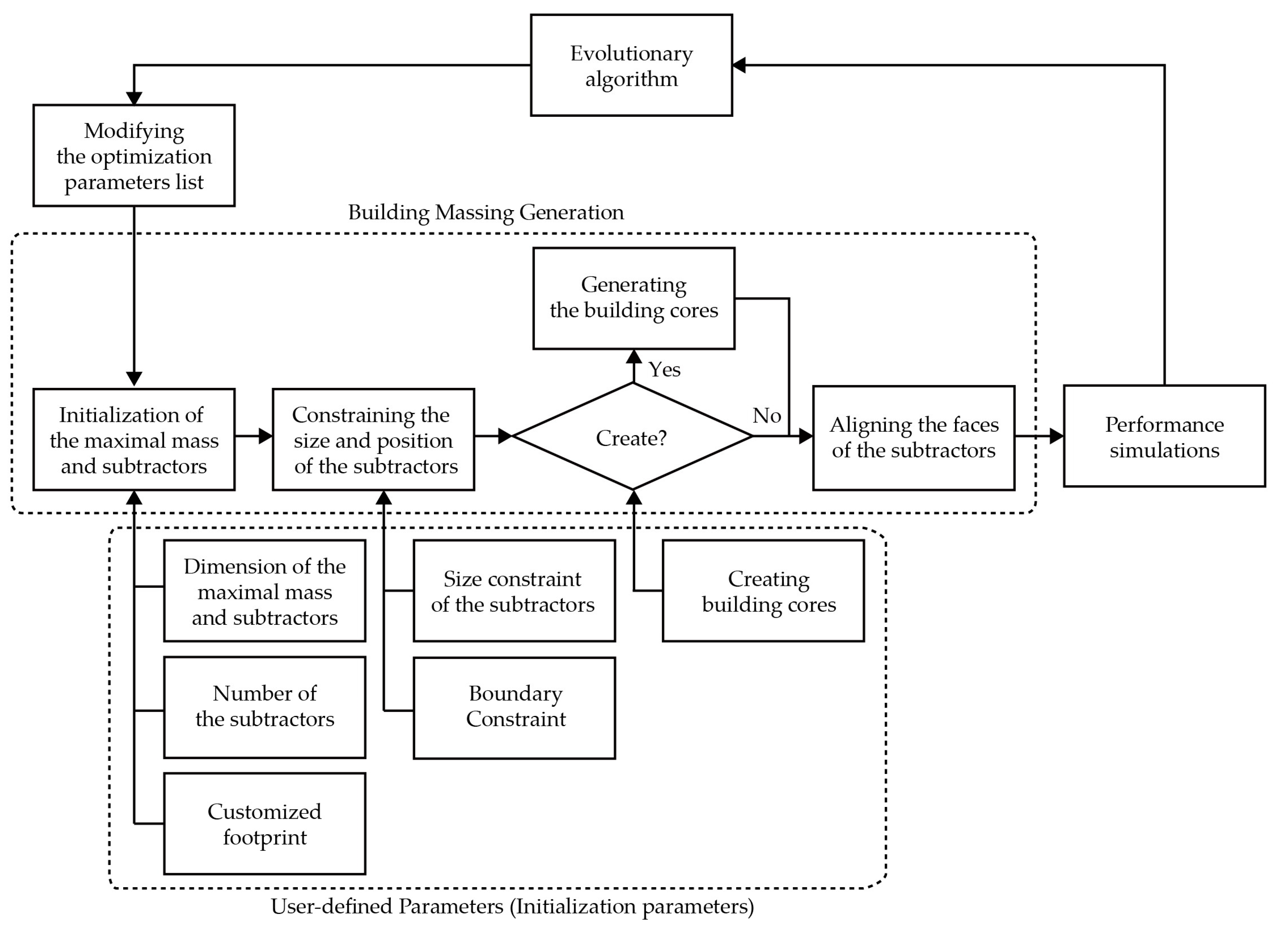
The proposed algorithm generates building massings according to a subtractive form generation principle. The algorithm starts with a maximal building volume and then creates building massing design variants by subtracting parts of this volume. By varying the number of parts to be removed as well as their positions and dimensions, alternative massings with significant topological variability can be generated. The core of the algorithm is to define the part to be removed, which is referred to as the “subtractor” in this paper. The definition and formation of the subtractor consist of three basic steps: (1) Initialization of a maximal volume and the subtractors, (2) constraining the position and size of the subtractors, and (3) aligning the subtractors. In addition, there is one optional step to generate building cores.
In order to be able to provide control over the features of the building massing after subtraction, several initialization parameters are provided. These parameters are assigned before the optimization process starts and remains fixed throughout the process. Other parameters, referred to as the optimization parameters, are changeable and modified by the evolutionary algorithm during the optimization processes. The initialization parameters include: (1) the dimension of the maximal volume, (2) the number of subtractors, (3) the size constraint of the subtractor, and (4) the boundary constraint regulating the relationship between subtractors and the maximal volume. The optimization parameters define the dimension and spatial position of each subtractor. Moreover, two optional initialization parameters are: (1) Specifying the footprint of the maximal volume, and (2) turning on or off the generation of building cores.
Once the initialization parameters have been assigned, the algorithm can generate building massing variants by varying the optimization parameters list, and these variants can then be sent to various energy simulation tools for performance evaluation. An evolutionary algorithm can be used to evolve building massing designs by iteratively changing optimization parameters and receiving corresponding performance feedback from simulations. The overall building massing creation and iterative evolutionary processes are illustrated in Figure 1.
Figure 1.
Schematic diagram of the building massing creation and evolutionary optimization process.
2.2. Generative Steps
The generative process consists of three main generative steps related to the subtractors: Initialization, constraints, and alignment. Finally, a fourth step can also optionally be added, to insert building cores.
2.2.1. Subtractor Initialization
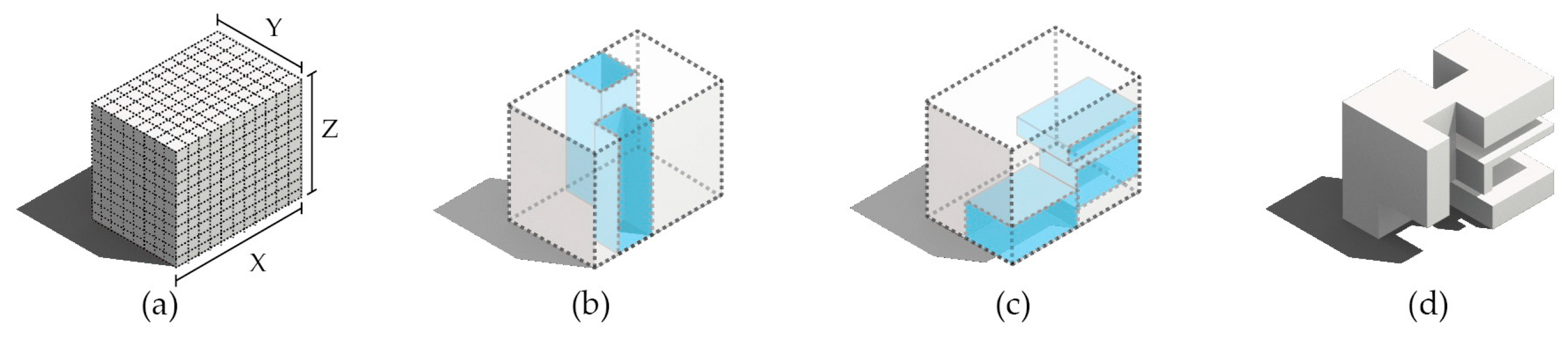
The first step is to initialize the maximal volume and the subtractors. The shape of the maximal volume is a rectangular block by default, and its dimension is defined by the number of column gridpoints in the x- and y-directions and the number of floors in the z-direction, which are assigned by architects in the initialization parameters (Figure 2a). Changing the dimensions allows different types of buildings to be generated, e.g., high-rise or low-rise buildings. For each building massing design variant, two types of subtractors—vertical subtractors and horizontal subtractors—are created based on values in the optimization parameters lists. Vertical subtractors have an aims to create features related to design strategies, such as atriums and courtyards (Figure 2b). In contrast, horizontal subtractors aim to create features, such as stepped (cascade) roofs, empty floors, and stilts, in the building massing (Figure 2c). Using these two types of subtractors, the building massing is generated by removing the parts occupied by these subtractors from the maximal volume (Figure 2d).
Figure 2.
The creation of the building massing by two types of subtractors: (a) generating maximal volume, (b) vertical subtractors, (c) horizontal subtractors, and (d) assembling of vertical and horizontal subtractors.
The number of subtractors, defined by architects, is an important factor affecting the topological variability of the generated building massings. Figure 3 shows the generated building massings with different numbers of subtractors. It can be noticed that when the number of subtractors increases, subtractors become merged and turn the negative volume subtracted from the building mass into a complex topological configuration. By changing the number of subtractors, architects can control the overall topological variability and configurational complexity of the generated building massings.
Figure 3.
Generated building massings based on different numbers of subtractors: V indicates vertical subtractors, H indicates horizontal subtractors.
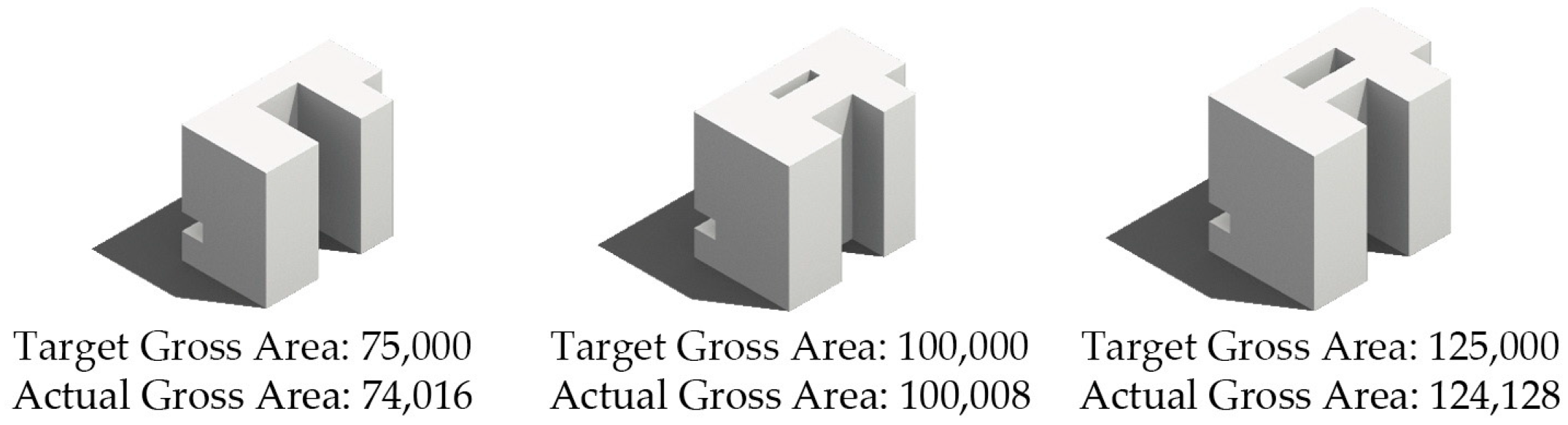
As the accumulated negative volume subtracted by all subtractors is dynamically changed by varying the optimization parameters, the gross area of the subtracted building massing varies accordingly. The gross area is a critical functional requirement in architectural design. Therefore, although a building massing may have excellent energy performance, it is of little relevance if its gross area is too low or too high. The algorithm, therefore, adjusts the maximal volume to create a building massing close to a target gross area by iteratively increasing or decreasing the number of column grid spans and floors. With the maximal volume adjusted, the appearance of subtractors also varies as some subtractors may be deactivated due to the size constraint, which is described in Section 2.2.2 (Figure 4). The adjustment of building massing is executed during the building massing creation process and is independent of the evolutionary optimization process. At the same time, in order to give some additional control, architects are able to freeze certain dimensions (x, y, or z).
Figure 4.
Generated building massings with different target gross areas.
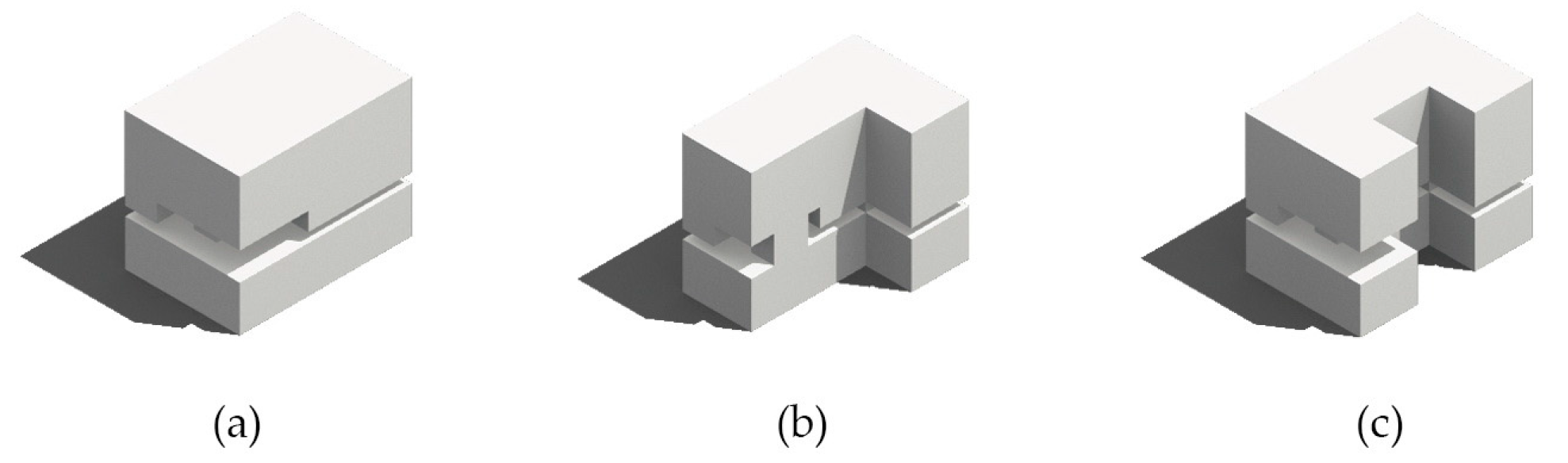
The maximal volume that is a rectangular block may not fit into irregular building plots or satisfy architectural intentions. Therefore, the algorithm provides an initialization parameter to specify the footprint of the maximal volume, which is achieved by removing a fixed part from the building massing. As shown in Figure 5, this operation can create maximal volumes with an L-shaped or U-shaped footprint.
Figure 5.
Generated building massings with different footprints: (a) rectangular footprint, (b) L-shaped footprint, and (c) U-shaped footprint.
2.2.2. Subtractor Constraints
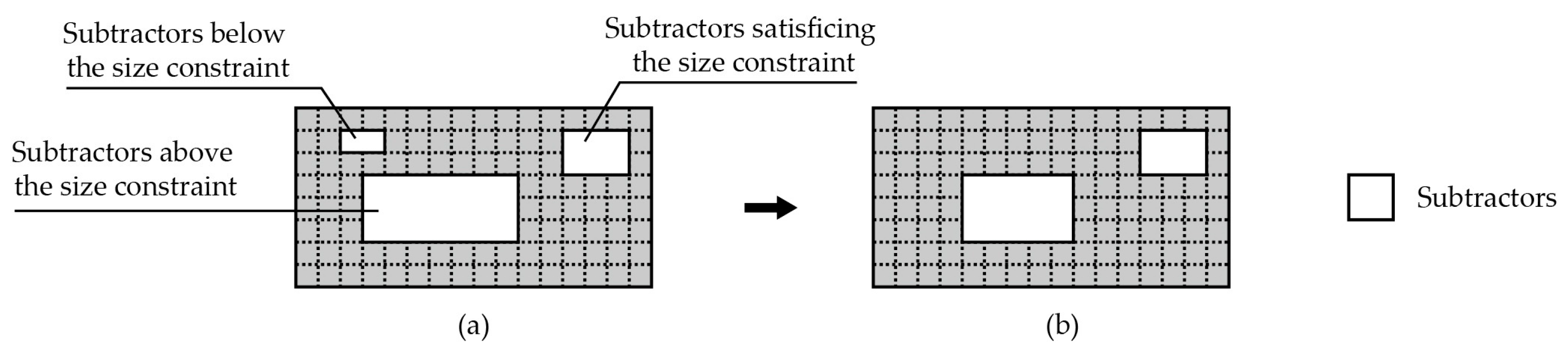
The second step is to constrain the size and position of subtractors according to the values in the optimization parameters list. In order to prevent over-large or over-small voids from appearing in the building massing, the horizontal dimension of subtractors is restricted by the size constraint, by which architects specify the upper and lower size limit of subtractors in the unit of column-grid span numbers. When the size of a subtractor does not satisfy the size constraints, a number of operations are used to automatically modify the subtractors. When the size is above the upper limit, the dimension of the subtractor is decreased to the upper limit. When the size is below the lower limit, the subtractor is deactivated, and the corresponding part is not subtracted from the building massing (Figure 6). Note that the size constraint does not guarantee that all subtracting parts appearing in the building mass are satisfactory. When two or more subtractors are merged, it can turn into a large void in the maximal volume that could exceed the upper boundary.
Figure 6.
The size constraint in the horizontal direction: assuming the size constraint is 2 to 5, (a) before size being constrained, and (b) after size being constrained.
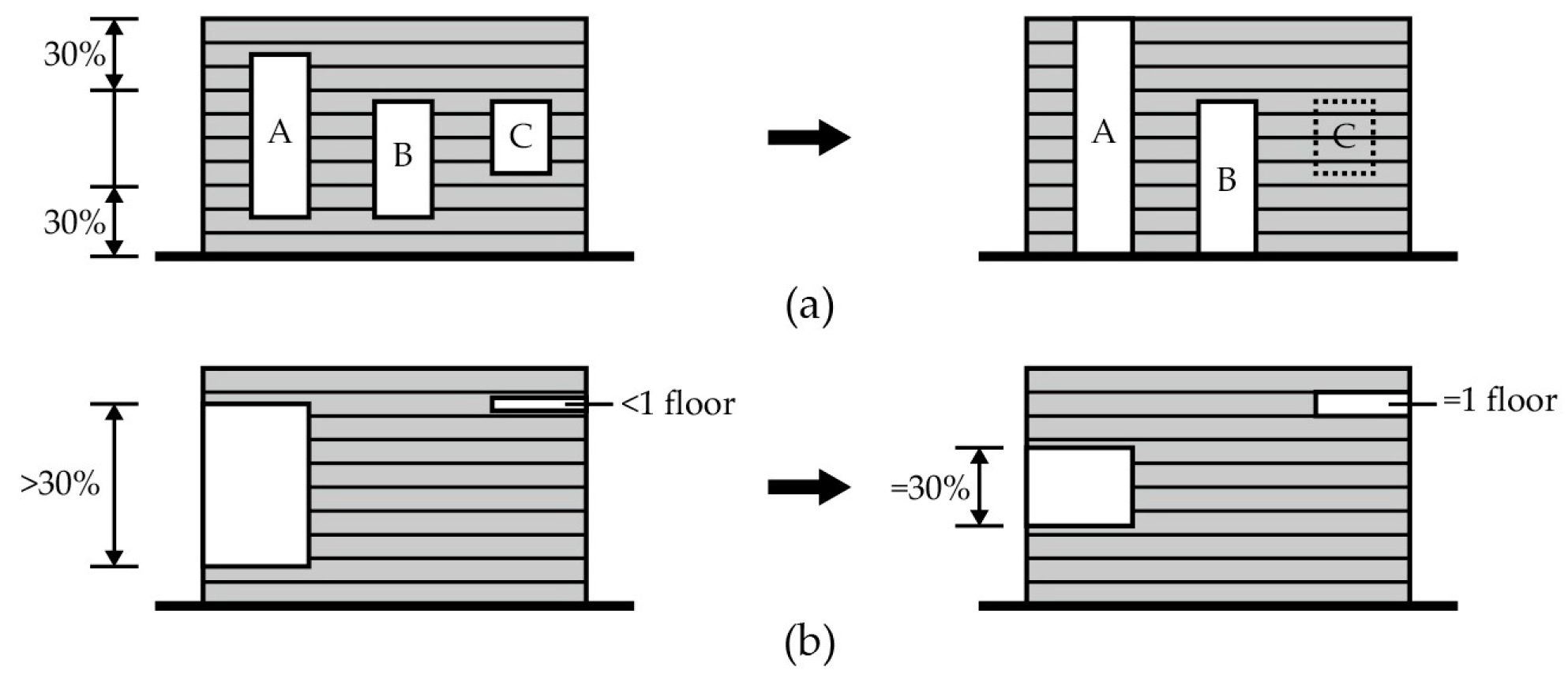
Other than the user-defined size constraint in the horizontal direction, another constraint, which is hard-coded in the algorithm, restricts the size of subtractors in the vertical direction. In order to differentiate vertical and horizontal subtractors, two different constraints are subject to the two types of subtractors. For the vertical subtractors, the top and bottom faces are automatically aligned to the maximal volume if the displacement between the face and the maximal volume is less than 30% of the total height of the building (Figure 7a). At the same time, for each vertical subtractor, at least one face has to satisfy this constraint, or else the subtractor is deactivated. For horizontal subtractors, the vertical size of every subtractor has to be less than 30% of the total height of the building but should also not be smaller than one floor. For any horizontal subtractors violating this condition, the algorithm automatically changes the size to make it satisfactory (Figure 7b).
Figure 7.
The size constraint in the vertical direction.
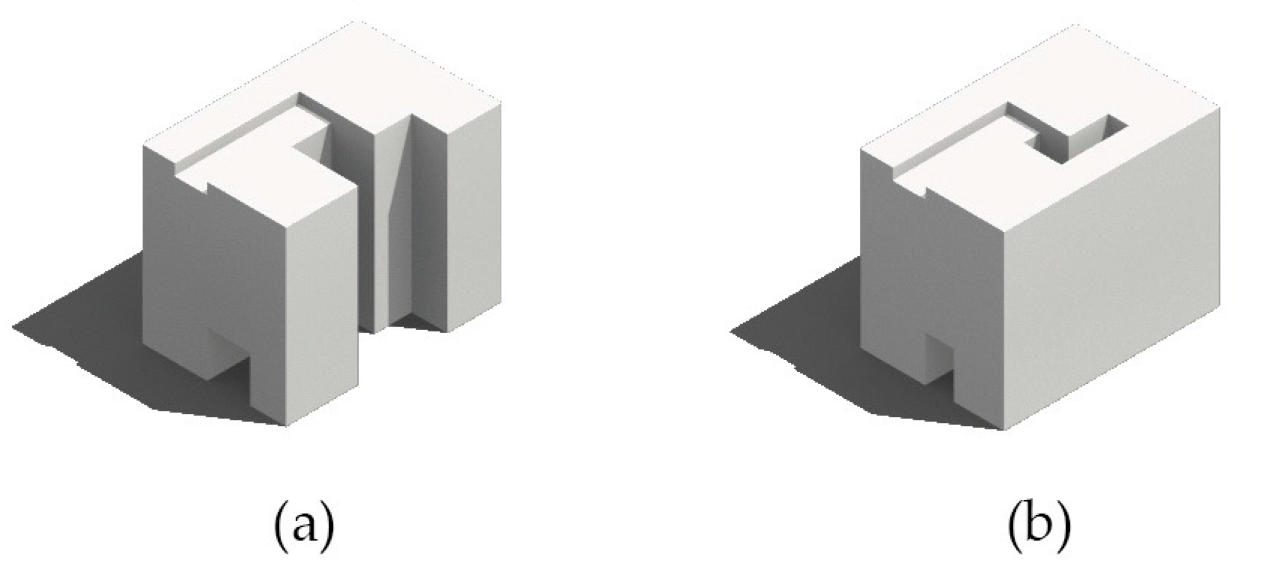
Apart from the size constraint, users also define the boundary constraint, which determines whether vertical subtractors can break through the outer face of the maximal volume in the horizontal direction. When the constraint is deactivated, any face of a vertical subtractor close to the face of the maximal volume is aligned to one of the faces of the maximal volume so that it creates a vertically open void running through the maximal volume (Figure 8a). In contrast, the boundary remains intact when the boundary constraint is activated, and any vertical subtractor close to the face of the maximal volume is moved away from the face of the maximal volume (Figure 8b).
Figure 8.
Generated building massings with or without the boundary constraint activated: (a) the boundary constraint disabled, (b) the boundary constraint enabled.
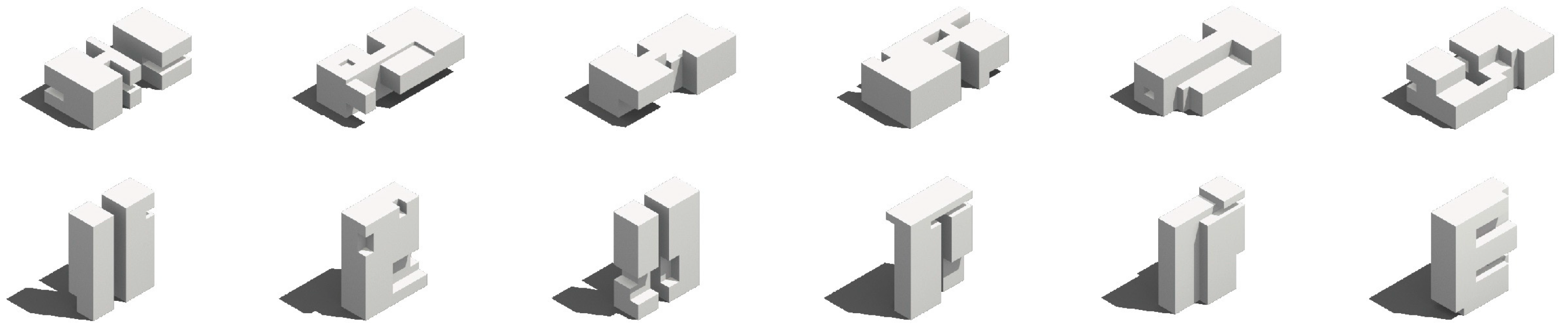
Deactivating the boundary constraint permits radical changes in the building massing. Figure 9 presents generated building massings with the boundary constraint deactivated. As it can be seen, massing design variants consisting of two or more completely separate buildings can emerge. These types of massing design variants allow the optimization process to explore beyond solutions characterized by one building massing. Such an expansion to the solution space may benefit the building energy performance, for example, by allowing for inter-block shading among buildings [3].
Figure 9.
Examples of massing designs generated with the boundary constraint deactivated.
2.2.3. Subtractor Alignment
Alignment is an important approach by which architects regulate the massing elements to maintain geometric order [35]. However, arbitrary placements of subtractors can result in poor alignment. For example, two subtractors may be positioned close together, creating a space between the two subtractors that may be too narrow to be of any use. Thus, in the horizontal direction, the parallel faces from different subtractors are aligned to be co-planar when the distance between the two faces is less than a half span of one column grid (Figure 10a). Similarly, the faces of two partly overlapping subtractors are also aligned in the same way to avoid small jagged faces in the void merged by two or more subtractors (Figure 10b). Lastly, when a subtractor has a face close to the maximal volume’s boundary, the face is aligned to the boundary (Figure 10c). Note that the last alignment operation only applies to vertical subtractors if the boundary constraint is deactivated.
Figure 10.
The procedures of alignment: (a) aligning two separated subtractors, (b) aligning two partly overlapping subtractors, and (c) aligning a subtractor to the maximal volume.
In architectural design, apart from the alignment among massing elements, the placement of the face of massing elements (walls or facades) typically also aligns with grid lines defined by the modulus related to the column grid. Hence, the faces of all subtractors are aligned to its nearest n/4 (n could be 0) position in between two adjacent columns (Figure 11). With the constraints and operations mentioned above, many commonly unwanted features that may appear in the building massing when using parametric approaches are excluded.
Figure 11.
Alignment operation of the face of subtractors to the axes: assuming the size constraint is 2 to 5, (a) before being aligned to axes, and (b) after being aligned to axes.
Despite the fact that the number of subtractors is predefined as an initialization parameter, the various operations applied during the building massing generation process can cause the actual appearance of the number of parts being subtracted from the building massing to vary significantly. As a result, building massing with different topological complexity can be generated, from the one without any part removed to that with the largest number of parts permitted removed. As such, the generated building massings may present various combinations and arrangements of different passive design strategies, such as several smaller courtyards or one large courtyard (Figure 12).
Figure 12.
Examples of massing designs generated with the same number of subtractors.
2.2.4. Building Cores
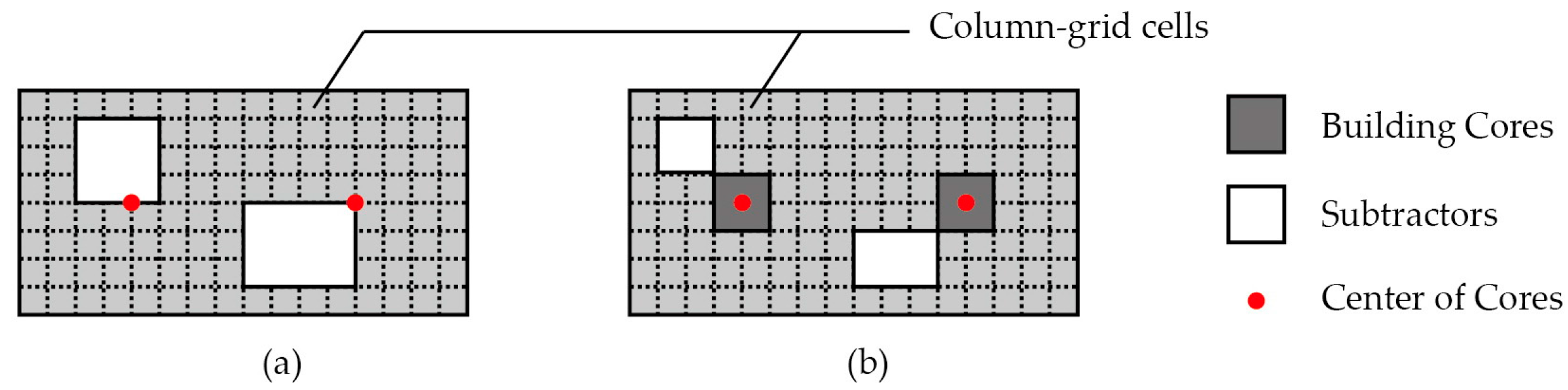
As widely applied to modern building design, building cores can serve as circulation, evacuation, and structural supports. In this consideration, the algorithm provides an optional operation to create building cores. The principle for creating these cores is based on the footprint of the building massing and complies with the firefighting evacuation regulation in China. In China, the door-to-door distance from a room to its closest evacuation stair and the distance of any point in the room to its closest exit door to corridors should be no more than 22 m. Since the proposed algorithm does not subdivide the floor plan into rooms, the calculation of the number and position of the building cores is simplified to fulfill a requirement that every face of the maximal volume’s footprint to its closest cores is no more than 35 m. When the position of the cores is determined, the column grid cell containing or close to (equal or less than half of the column-grid span) the center point of any core is turned into the building core. After the building cores have been generated, all subtractors are also required to align with these cores (Figure 13).
Figure 13.
Generated building massings with or without building cores: (a) building core generation disabled, (b) building core generation enabled.
2.3. Implementation
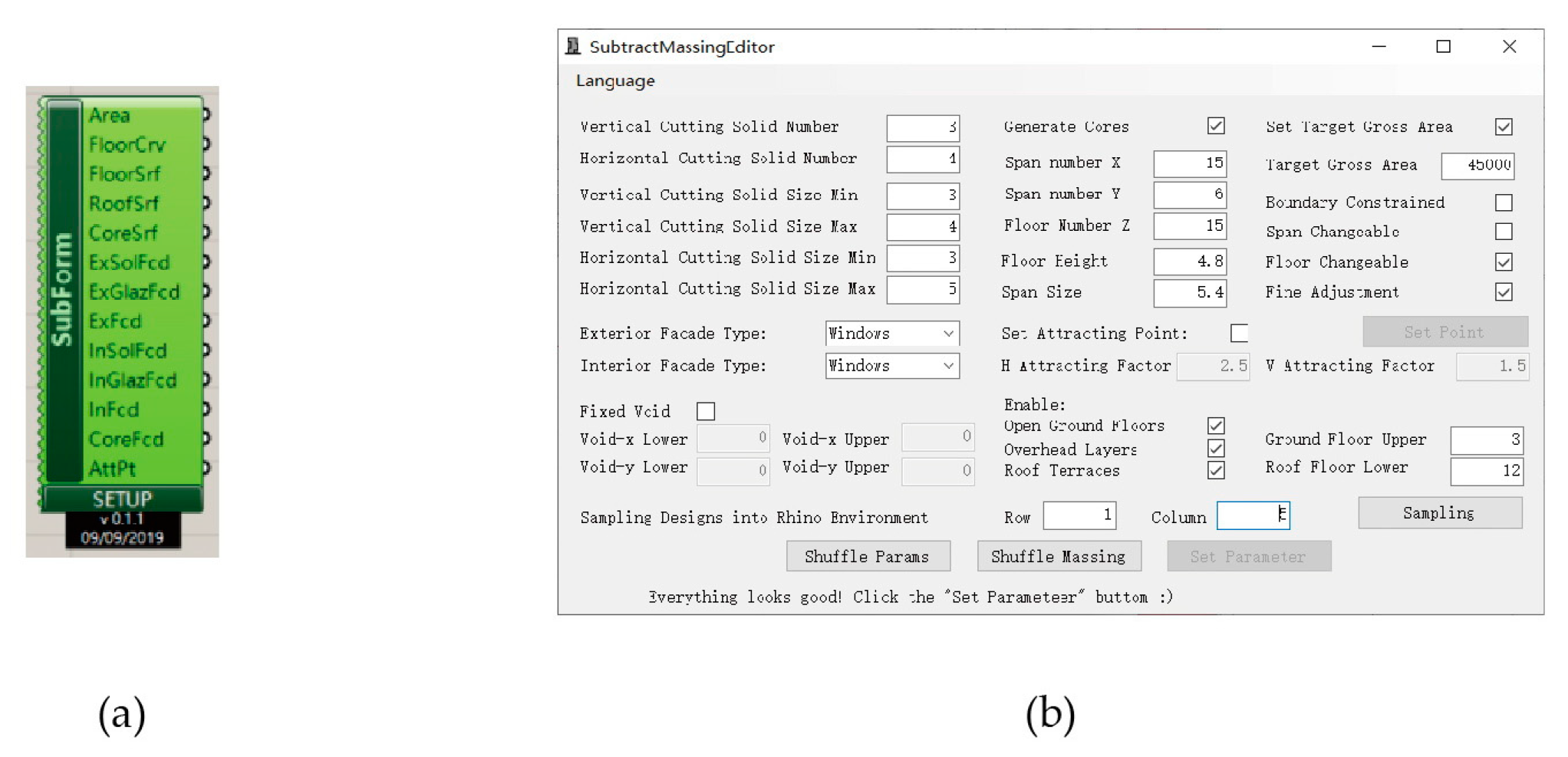
In order to facilitate the ease of use, the algorithm was implemented as a plug-in component (Figure 14a) in Rhino-Grasshopper, which is one of the most popular 3D and parametric modelling tools in architecture [36]. A user interface (Figure 14b) was also integrated into the component for architects to specify the initialization parameters and other attributes related to the building massing design, such as floor height, span size (width), and facade types. As to the facade type, only curtain walls and strip windows are provided in the current implementation, which could be further expanded in the future. With the component and the user interface, architects can interact with the building massing creation process and observe the change in the renewed building massing instantly in the Rhino-Grasshopper environment. The timely visual feedback of the generated building massings allows architects to undertake parameter tuning to exclude unwanted or unsuitable features in the building massing and ensure that these features do not appear in evolutionary optimization.
Figure 14.
(a) Component implemented in Rhino-Grasshopper, (b) the user interface.
The implementation in the Rhino-Grasshopper environment takes advantage of the Visual Programming Language, where no coding is required. It allows architects, even computational design novices, to use the algorithm and establish a performance-based optimization system for building massing design in a plug-and-play fashion. The implementation of the proposed algorithm is part of an integrated evolutionary design toolkit, which also embeds a diversity-driven evolutionary algorithm [37]. As such, a performance-based optimization system can be established simply by connecting the component of this building massing algorithm and the evolutionary algorithm with various building performance simulation tools, such as DIVA, Ladybug, Honeybee, Archsim, etc. [38].
2.4. Case Studies
2.4.1. Design Setting
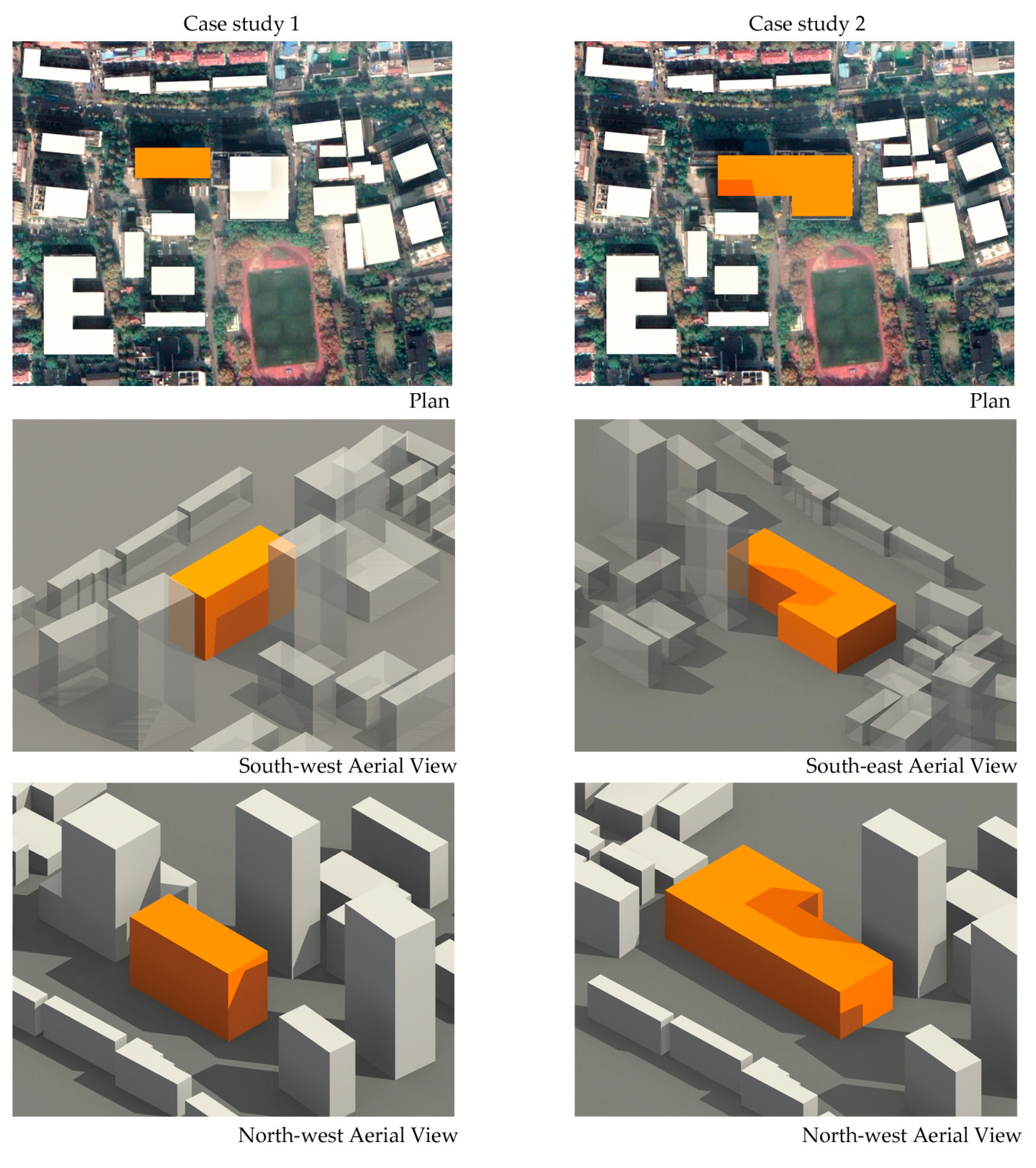
To demonstrate the efficacy of the proposed algorithm, two case-study performance-based optimization processes for building massing design were carried out. The two case studies respectively describe a high-rise slab-type building design and a middle-rise deep plan building design (Figure 15). The difference between these two building design objects is to clarify the capability of the proposed algorithm to handle different settings of building massing design. For both case studies, the energy performance objective was to maximize daylighting for passive energy savings.
Figure 15.
Plan and aerial view of the building plot: the orange block indicates the building being designed.
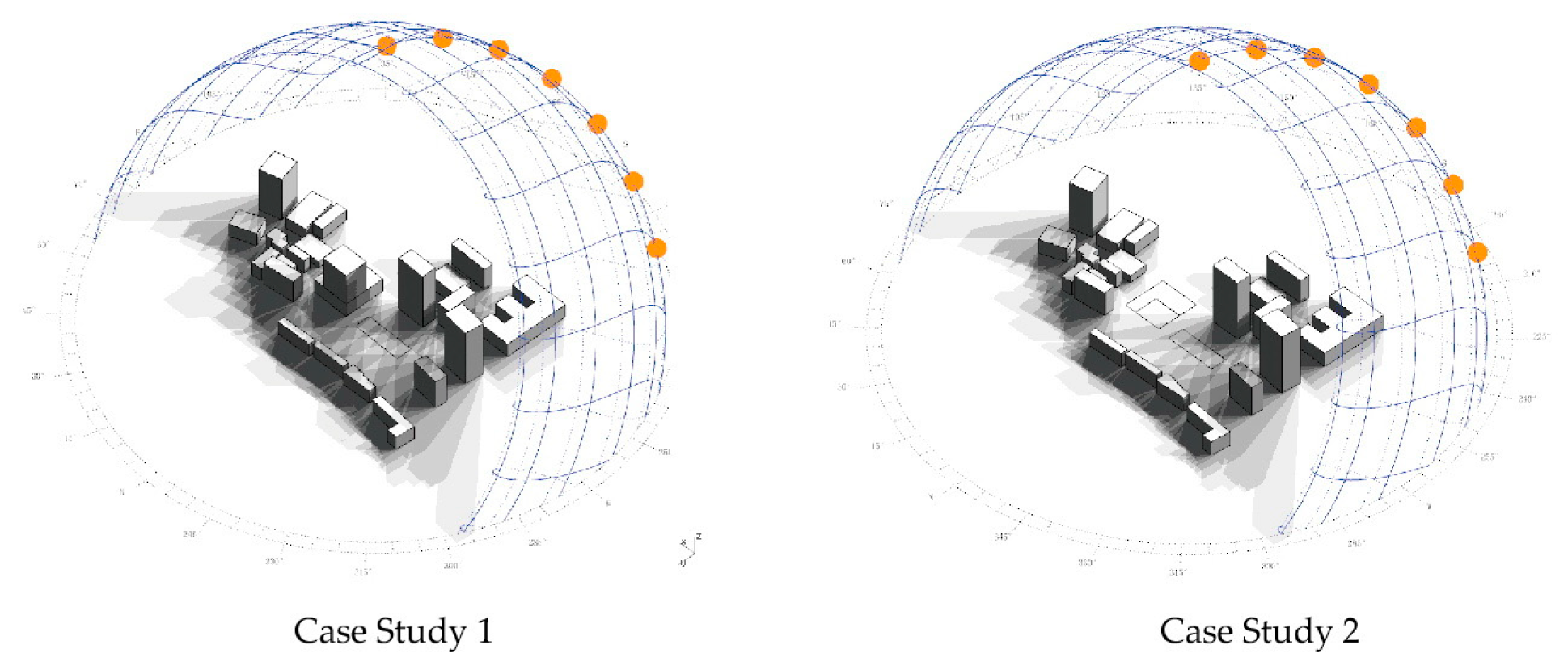
The building plot for the two case studies is located at the campus of Nanjing University in Nanjing City, Jiangsu Province, China. Several high- and middle-rise buildings surround the building plot and cast shadows on the plot (Figure 16), thereby presenting a significant challenge in achieving desired daylighting. Without the assistance of performance-based optimization, architects may conceive high-performing solutions by manual trial and error. However, this is not only time-consuming and laborious, but the solution is likely to be prejudiced due to architects’ cognitive biases.
Figure 16.
Sun path of the building plot (winter solstice).
For the optimization objective, the fitness evaluation considers both the energy reduction resulting from daylighting and the gross area of the building massing. For the energy reduction from daylighting, annual lighting energy (LE) consumption is taken as the performance indicator, and the general objective of the evolutionary optimization is to minimize this value. At the same time, the gross area of the building massing considers a penalty function in the fitness calculation. While the proposed algorithm can automatically adjust the dimension and floor number of the building massing to make the gross area close to the required target value, there could be an unacceptable gross area difference if the original difference is too large. Hence, the difference is considered a penalty function to punish unsatisfactory design variants. In this regard, the value of lighting energy increases proportionally with the increase in the difference between the actual gross area and the required gross area. Therefore, even with low lighting energy, the building massing still receives an unfavorable fitness value when the gap between its gross area and the target value is too large. The fitness function can be described below:
where LE indicates the lighting energy consumption, and Aactual and ATarget indicate the actual gross area of the building massing and the required target gross area.
The annual lighting energy consumption is calculated by a Radiance-based simulation tool, called DIVA [39], in Rhino-Grasshopper. In order to ensure each simulation can be finished in a reasonable timeframe, the lowest simulation quality is adopted, which means that the Radiance engine calculates a lower number of bounces of rays for the simulation. Using a higher quality makes the simulation too time-consuming, since there might be thousands of simulations involved in one evolutionary optimization process. Moreover, although the lowest quality degrades the accuracy of the simulation, the bias to the overall optimization result is not significant. This is because the fitness ranking among high-performing and low-performing design variants calculated by the lowest simulation quality corresponds to that calculated by the higher quality according to our observation. With the lowest simulation quality applied, each simulation lasts from 1 to 2 min (HP Z440 Workstation with a Xeon 4-core CPU). The typical time for one evolutionary optimization process reaching the required number of design generations and performance evaluations (4980, to be exact, in the case study) is around 4 to 5 days. While the time consumed by the optimization process cannot satisfy the time constraint set by practice, this can be addressed with an increase in computational power and incorporating other approaches, such as parallel computing and cloud computing.
With regard to the optimization algorithm, the case study uses a newly developed hybrid evolutionary algorithm designed to support explorative design optimization, called SSIEA (steady-state island evolutionary algorithm) [37]. This algorithm can yield several high-performing solutions, while the solutions also have enhanced design differentiations. The algorithm integrates an island-model approach and a steady-state replacement strategy into a standard evolutionary algorithm to increase diversity in the design population and improve the search efficiency. The island model allows the algorithm to launch multiple parallel search processes to evolve several “niching” subpopulations. For each subpopulation, it is guided to focus on a different region in the design solution space. The separation and multitude of subpopulations counteract the exploitative natural inherited in the standard evolutionary algorithm and prevents the optimization from producing a family of very similar design solutions due to the genotypic similarity. At the same, the steady-state replacement strategy speeds up the optimization process by increasing the evolutionary pressure on each subpopulation. We examined the algorithm in a previous study [37], which indicates that this algorithm can significantly outperform the standard genetic algorithm. Incorporating this algorithm with the proposed building massing generation algorithm can retrieve several high-performing solutions from the optimization process. Furthermore, these solutions have significant topological differentiation due to the genotypic diversity in the individuals from different subpopulations. The diversity in the result enhances the feedback from optimization, which helps architects discover underlying compromises and trade-offs characterizing the design problem.
For the setting of SSIEA, six subpopulations (islands) are set for the optimization process in order to achieve a relatively high diversity in the optimization result. Each subpopulation has 50 individuals as the initial size, and, thereby, the overall initial population size is 300. In each iteration, 10 individuals are randomly selected from each subpopulation, and six higher-ranking individuals are selected as parents by tournament selection to reproduce an equal number of offspring individuals by crossover and mutations. With all offspring individuals evaluated by simulations, the 10 originally selected individuals compete against the offspring individuals, and inferior ones are then replaced by higher-ranking offspring individuals. Lastly, 130 iterations are set as the termination criteria, so that there are 4980 design generations and evaluations in each optimization process as a result, which ensures that the design can be sufficiently evolved.
2.4.2. Initialization Parameters
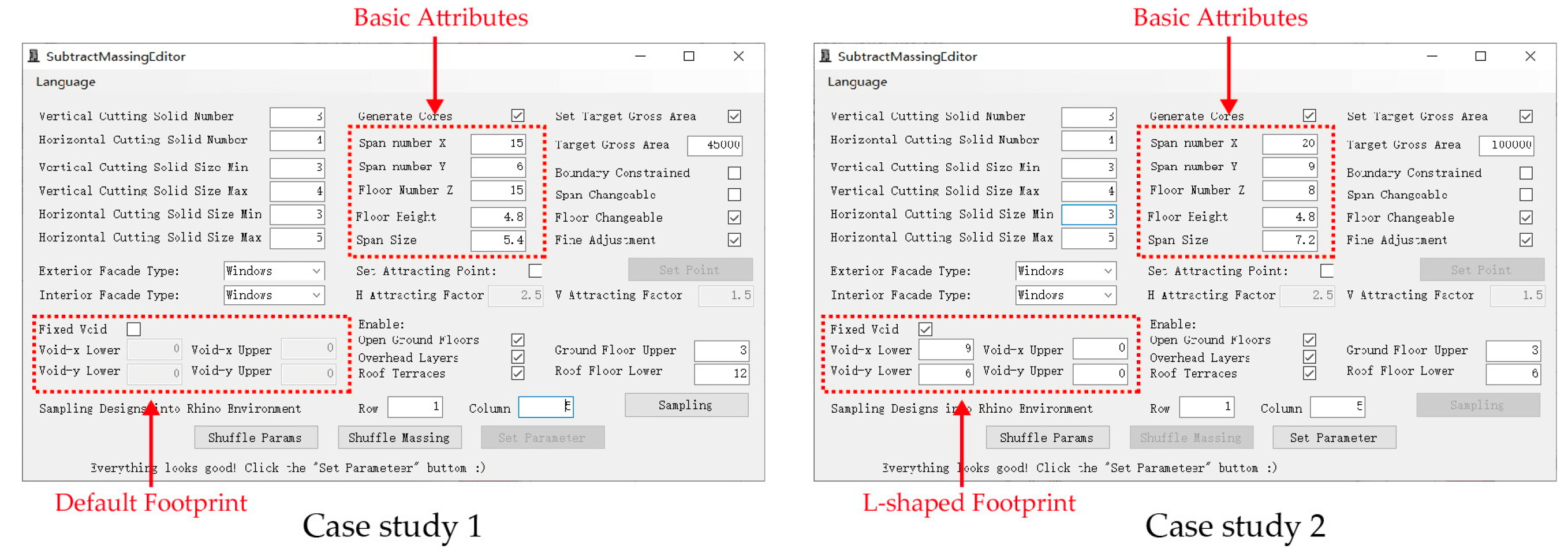
With the proposed algorithm, the first step is to specify the initialization parameters. In order to widen the scope of exploration, the boundary constraint is deactivated to achieve a relatively radical change in the generated building massings. Then, we specify the parameters related to the attribute of two building massing designs, including total floor numbers, numbers of column grids in the x- and y- directions, floor heights, and column-grid span sizes. For the second case study, the building plot shown in Figure 15 is not suitable for a rectangular footprint, and, therefore, an L-shaped footprint is set for the maximal volume and divides the building massing into a west wing and a south wing. This part of the setting will be presented at the end of this section together with other initialization parameters in the user interface.
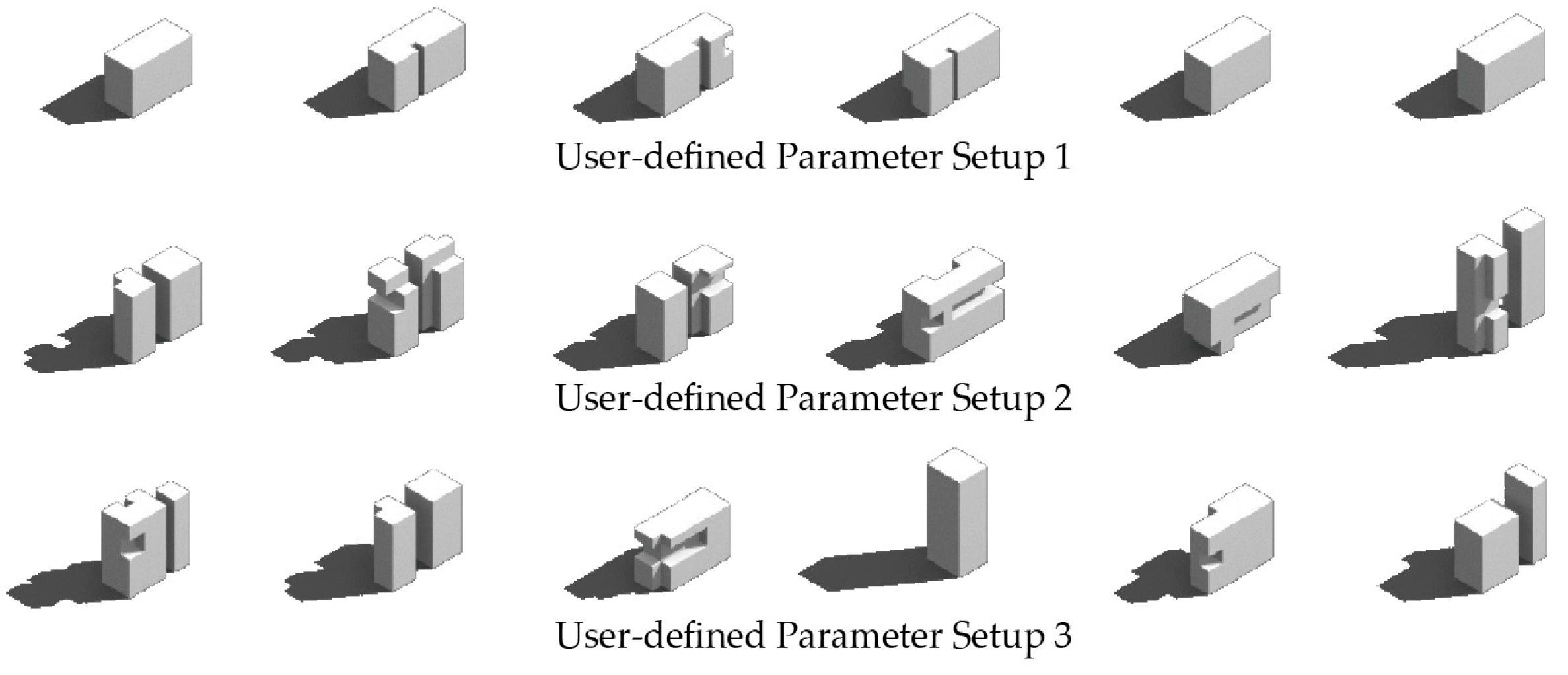
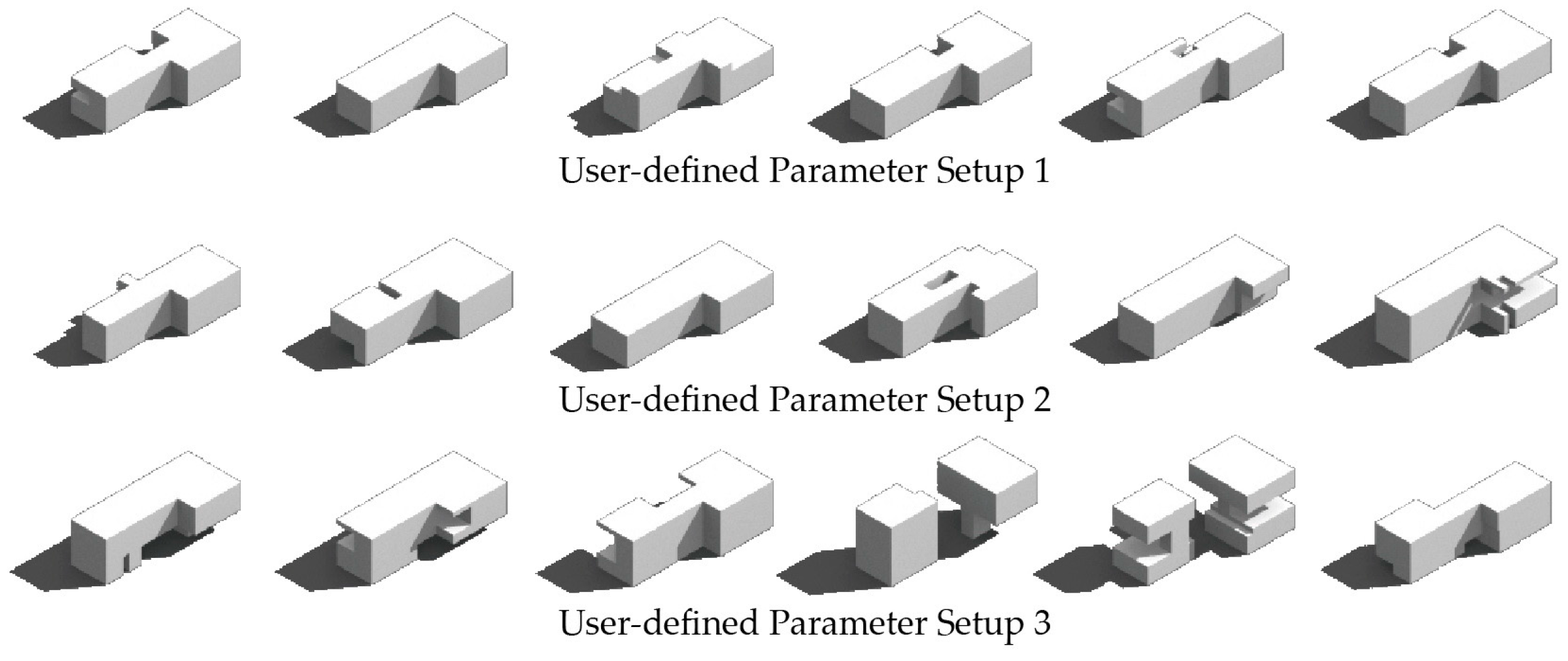
Apart from the parameters mentioned specifying the attributes of the building massing design, we also compare three initialization parameter setups varying the size constraints and the number of subtractors (Table 1). For the first case study, Figure 17 illustrates the generated building massings for the three initialization modeling parameter setups. From the first row in Figure 17, it can be seen that if the number of subtractors and the size constraint are set too small, the building massings will not embody significant topological variability. This is despite the fact that the boundary constraint is deactivated, which will improve topological variability. For the other two setups, the features appearing in the generated building massings are mostly similar as shown in the second and third rows in Figure 17. Considering that a larger number of subtractors applied to the third setup expands the search space and increases the search difficulty for evolutionary optimization, the second initialization parameter setup is selected for the subsequent execution of the optimization process.
Table 1.
Initialization parameters.
Figure 17.
Random sampling generated building massings by the initialization parameter.
For the second case study, Figure 18 shows the generated building massings, also based on the three initialization parameter setups. In this case, the second setup in Table 1 is selected as it results in reasonable topological variability. In contrast, the generated building massings by the first setup (the first line in Figure 18) are relatively similar. For those generated by the third setup (in the third line in Figure 18), the possibility of creating two separate building massing entities may be not suitable for the functional requirement in this case due to the lack of accessibility and connectivity.
Figure 18.
Random sampling generated building massings by the initialization parameter.
The process of setting up the optimization algorithm is straightforward for the user and does not require any parametric modelling to be performed. Instead, the user only needs to fill in certain initialization parameter settings in a graphical user interface (GUI). Based on the above parameter setup, the user interface for the two case studies is filled out as below (Figure 19). The difference in the settings on the user interface between the two case studies is highlighted. The basic attributes specify the parameters related to floor numbers, span numbers, etc. For the second case study, a fixed cut volume in the building massing is set to create the L-shaped footprint.
Figure 19.
The setting on the user interface.
3. Results
3.1. Case Study 1
The first case study describes a slab-type high-rise office building with a target gross area of 45,000 m2. We take the building massing shown in Figure 15 without any part removed as the benchmark. The gross area of the benchmark building massing is 43,740 m2. The LE of the benchmark building massing is 813,811 kWh, and the fitness after being penalized by the gross area difference is 836,597.
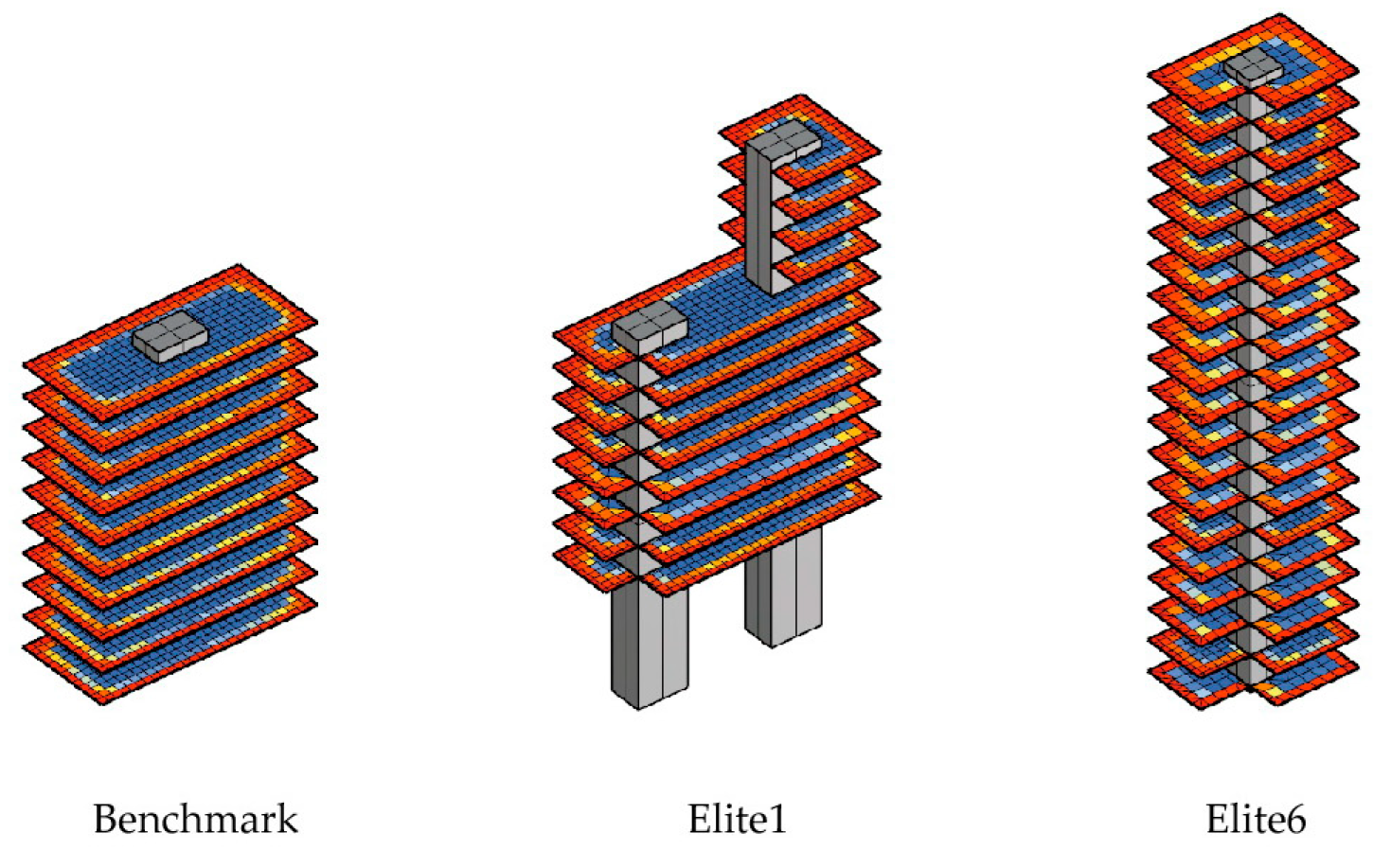
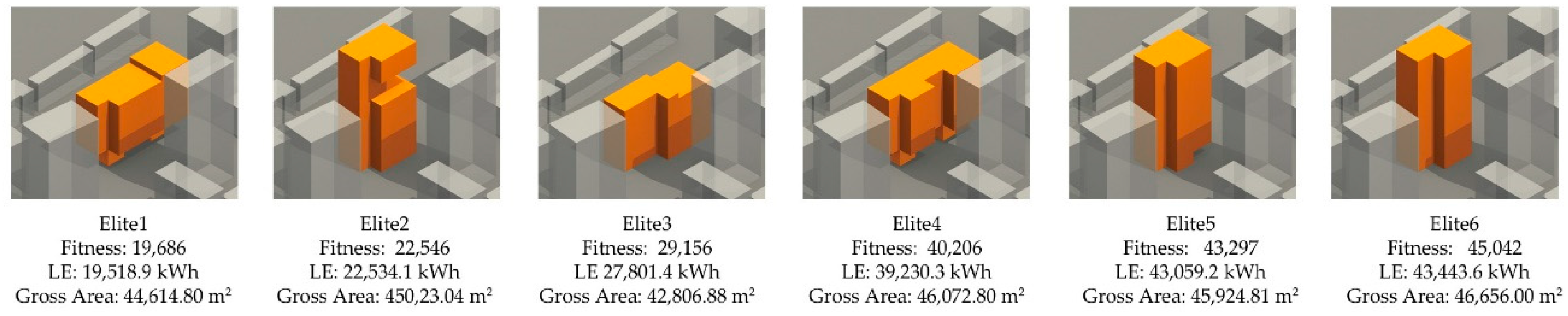
Figure 20 shows the elite individual in each subpopulation found by the optimization process. In this case study, the surrounding buildings prevent a large amount of daylight from reaching the building massing (Figure 16) and cast shadows on the facade of the building, which can undermine the daylighting quality on the floor with windows frequently shaded by the shadow. In order to improve daylighting, three dominant features can be found among elite individuals. First, stilts appear in the building massing of Elite1, Elite4, and Elite5, which raise the overall building mass. Raising the building mass reduces the space close to the ground, which naturally has worse daylighting quality due to heavy daylight obstructions by the surrounding buildings.
Figure 20.
Elite individuals of natural daylighting (south-west aerial view).
Second, cases, such as Elite2, Elite5, and Elite6, appear as a tower-type building massing. The reason for this is that tower-type building massing increases the indoor floor area at a higher altitude where there are fewer daylight obstructions due to surrounding buildings. Figure 21 illustrates the natural lit space in a cross-sectional direction. Note that the natural-lit space (warmer red-colored areas) increases as the floor level is raised. The first and second features suggest that the overall performance of daylighting can be improved by manipulating the building massing in the vertical direction—either reducing the proportion of lower floor levels as in Elite1 or increasing the proportion of higher floor levels as in Elite6. In contrast, the third feature manipulates the building massing in the horizontal direction. All elite individuals tend to have a stepped footprint, which can enlarge the spacing with the south high-rise building as well as increase the facade area exposed to daylight [40].
Figure 21.
Daylight autonomy analysis by floors.
The effect of the optimization on daylighting is significant. The elites achieve an average 96% improvement compared with the benchmark building massing. It means that, for this case study, the performance of daylighting is sensitive to the change in the building massing. This finding also suggests that while there is great potential in building massing design to achieve better daylighting, inappropriate building massing design can also lead to much intensive lighting energy consumption. Lastly, the elites with a tower-like massing may be inappropriate when a rigorous urban planning code regulates the height of the building. However, this helps to enhance the tendency of raising the building massing for better daylighting for this case study.
3.2. Case Study 2
The second case study describes a middle-rise deep-plan building for multi-purpose use with a target gross area of 100,000 m2. Similar to the first case study, the building massing without any part removed is taken as the benchmark, as shown in Figure 15. The gross area of the benchmark building massing is 102,332 m2. The LE of the benchmark building massing is 1.9334 × 10⁶ kWh, and the fitness after being penalized by the gross area factor is 1.9785 × 10⁶. Compared with the first case study, the change in the building plot allows the south wing of the building to be exposed to direct sunlight without obstructions by other buildings (Figure 16). Thus, the building massing should react differently compared with the first case study.
Figure 22 shows the elite individual in each subpopulation. As the deep-plan building is unfavorable to daylighting, a common approach reflected in the elite building massing to overcome this drawback is to reduce the depth of the floor plan by inserting subtractors. This approach can result in two dominant features found among these elite building massings. First, light wells appear in Elite1 and Elite5, which allow daylight to reach the inner part of the building. Second, there is a setback in the south wing of the building massing (the blue-colored volume shown in Figure 23), which allows the floor plan to become thinner and escape from the shadow cast by the south-west high-rise building. Apart from these two features, horizontal carve-outs appearing in the south wing of Elite1 and stepped roofs in Elite6 also help to reduce the depth of the floor plan and increases the facade area exposed to daylight. Similar to the first case study, stilts also appear in Elite1 and Elite4 due to the same reason explained in the first case study.
Figure 22.
Elite individuals of daylighting (south-east aerial view).
Figure 23.
Set-back in the south wing of the building massing (south-east aerial view).
In summary, the elite building massing achieves an average 95.6% improvement in the overall performance compared with the benchmark building massing. Concerning the features, thin plans stand out in this case study as deep-plan buildings are naturally inferior in daylighting performance. In contrast, courtyards, as a commonly adopted strategy for daylighting, do not appear in this case study, which is mostly because a courtyard often occupies a large amount of building floor area, and its contribution is not sufficiently significant to offset its disadvantage of a loss of floor area. Last, but not least, Elite1 shows a mixture of different passive energy-saving strategies, including self-shading, stilts, and light wells. It suggests that synergizing these strategies allows for significant progressive improvement. Such mixtures of strategies are challenging to conceive by human architects and unlikely to be found when the optimization is confined to building massing with limited topological variability.
4. Discussion
The two case studies allowed the efficacy of the proposed algorithm to be investigated under different design settings, in terms of surrounding buildings and building design objects. Strengthened by the explorative character of the proposed evolutionary algorithm, the optimization process successfully explored and evaluated different building massing variants and identified multiple high-performing solutions for each design scenario. Due to the extensive topological variability, the building massings retrieved from the optimization present significant design differentiation. The difference among these elite variants helps to reveal performance trade-offs and compromises. At the same time, without the need to perform any actual parametric modelling, the process of carrying out performance-based optimization is streamlined. Architects only need to specify the initialization parameters to restrict the overall geometric feature in the generated building massings. In this regard, the parametric model based on the algorithm can be viewed as a “meta-model” of the subtractive form generation principle, from which various task-specific versioning models for different projects can be readily derived.
While the proposed algorithm addresses the two challenges identified in the first section, there are three key issues and limitations to be highlighted. First, the generated building massings are all created from orthogonal geometries. In this regard, the optimization-based exploration with the proposed algorithm can be seen as an initial exploration of diverse building massings but without in-depth exploitation of the accurate solution under each specific building massing configuration. In other words, the result of the optimization can be further improved if higher geometric freedom is provided by incorporating transformation approaches, such as twist, rotation, and slant [22,23,41]. Incorporating these in the algorithm requires additional variables to define transformation operations. Since the algorithm already has a relatively large number of optimization parameters, adding extra parameters may be ineffective since the increase in the size of the design solution space often impedes the discovery of high-performing solutions [28]. Instead, it is more advisable to separate the optimization process into two stages. In the first stage, the coarse building massing can be explored while, in the second stage, a small number of massings reflecting the specific architectural implications can be selected, and transformation operations can then be applied to evolve more in-depth solutions.
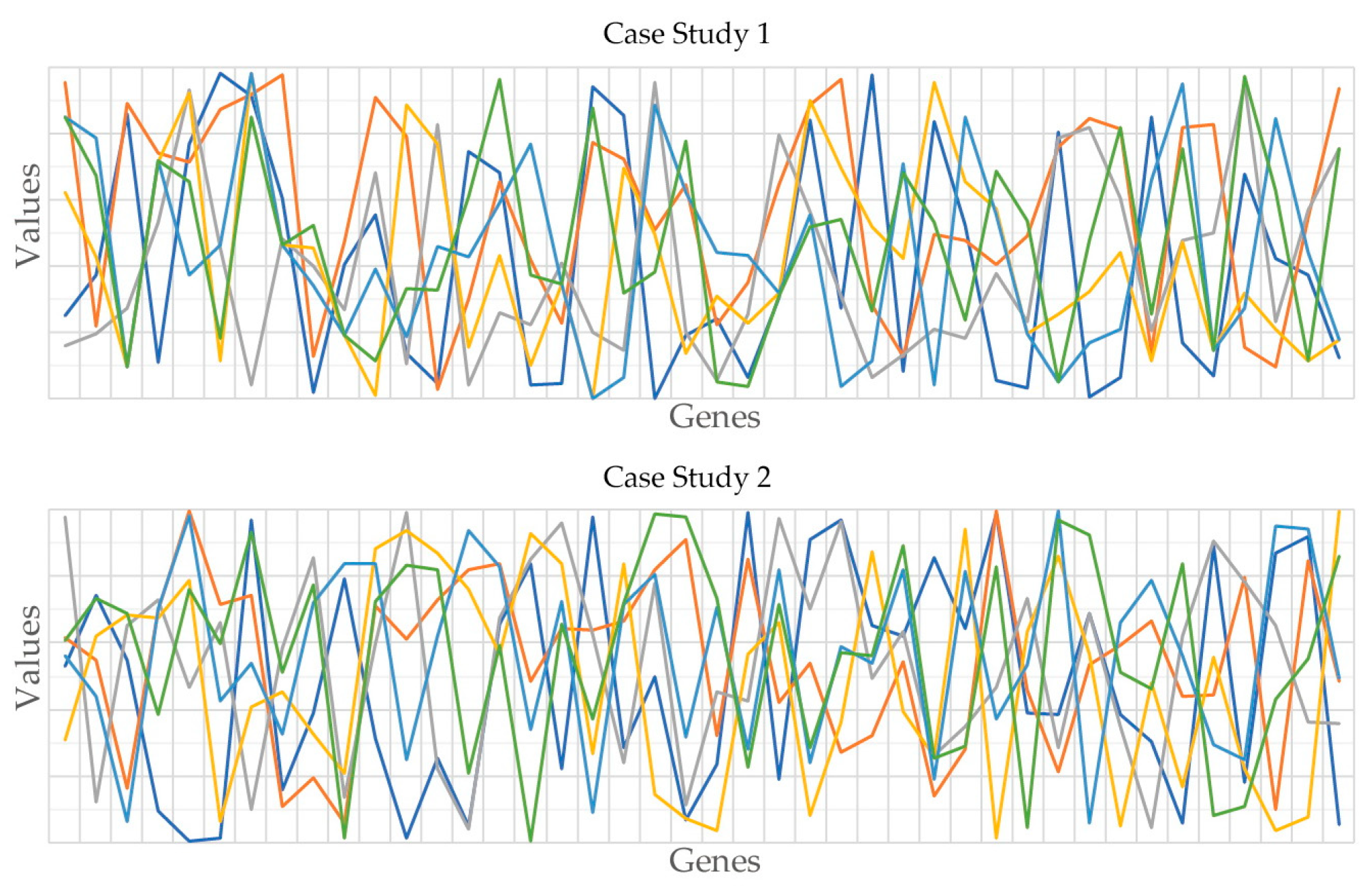
Second, in the context of evolutionary optimization, the arbitrary placement of subtractors creates a many-to-one relationship between the optimization parameters lists and the corresponding output. This relationship defines the genotype–phenotype mapping. For example, although two design variants (phenotypes) have similar topological configurations, the two variants could be generated from two entirely different optimization parameter lists (genotypes). This is because the two different parameter lists contain the segment (chromosomes) at different positions with similar or identical values, and this segment results in a subtractor in similar spatial positions and with similar dimensions. Figure 24 shows the parallel coordinate visualizing the parameter lists of the elite design variants. Compared with the similarity among the formal representations (phenotypic representation), as shown in Figure 20 and Figure 22, the parameter lists (genotypic representation) do not show equivalent similarity. This many-to-one mapping could be problematic for evolutionary optimization as it may result in early entrapment into a local optimum [28]. However, in this research, the many-to-one mapping may help to clarify dominant features when these features repeatedly appear in many subpopulations.
Figure 24.
Parallel coordinate visualizing the parameters of elite design variants.
Third, instead of considering one objective as in the case studies, architects can alternatively use multi-objective approaches, such as Pareto optimization, to include multiple objectives. Using multi-objective optimization can show trade-offs and compromises among conflicting objectives. While using multi-objective optimization has become popular in the literature, it should be noted that it may result in a reduction in the search efficiency of the evolutionary optimization process [42]. In addition, the result of multi-objective optimization blends features related to conflicting objectives, which could make it difficult to identify the dominant feature related to each objective as clearly as shown in the case studies of this research.
Last, apart from the issues and limitations mentioned above, there are two other directions related to the algorithm itself that can be considered in future research. First, when considering the energy consumption of air conditioning, the partition on the floor plan of rooms is critical to producing accurate simulation results. While there is a technique to conduct simple thermal zoning by a straight-skeleton subdivision [43], grammar approaches [44] allow for a more realistic approximation of the subdivision of rooms. These techniques can be integrated into the algorithm. Second, increasing the degree of customization can allow the algorithm to satisfy more specific design settings. For example:
- More complex shapes for the maximal volume beyond box-like masses to make possible combinations, such as towers and podiums and non-orthogonal geometries.
- Provide more practical user-defined constraints to regulate the overall building massing, such as maximum height, width, and length of the building massing.
- Provide additional placement strategies of building cores, such as placing the cores at corners rather than in the center of the building.
5. Conclusions
The focus of this research was to develop a reusable algorithm that generates building massing with extensive topological variability to help architects conduct explorative and non-disruptive performance-based optimization. The underlying intention of the research was to use optimization as a means of exploiting the potential in building massing design for passive energy savings at the outset of design processes. This process can narrow down the scope of consideration for architects, thereby facilitating knowledge extraction for performance-aware design processes. At the same time, what is indispensable is that such optimization-based exploration should be well integrated into the architectural design process.
For the algorithm focusing on design exploration rather than providing direct solutions, we acknowledge that the building massing found by the case-study optimization may not satisfy all aspects of architectural design [16,45]. Instead, in the data-poor situation of conceptual design stages, the solution retrieved from the optimization plays a role as the “medium of reflection” in design processes and allows architects to draw inspiration from its result [13]. In this regard, the use of the subtractive form generation principle has the advantage that the architectural implication revealed by the optimization result is intuitive and cognizable, which facilitates architects’ gaining insight from the optimization results.
Driven by the optimization process, subtractors are manipulated only to remove volume from the building massing that contributes to the most dominant and profitable effect on the improvement in the building energy performance. It is evident that compared with the random sampling alternatives in Figure 17 and Figure 18, irrelevant and unnecessary voids appearing in those sampling alternatives were mostly discarded and excluded across the optimization process. With minimal redundant information, architects’ focus can remain on the dominant building massing characters and the associative architectural implications related to building energy performance. In contrast, ambiguity and distractions may happen if the geometry of the building massing is too complex. Desired architectural implications could be misled by other less relevant issues.
In order to maximize the utility of performance-based optimization to assist architects in achieving compelling energy sustainability, the proposed algorithm provides an unconventional approach to using such optimization in conceptual design processes. Without parametric modelling, using the algorithm encourages architects to leverage optimization processes to explore unknown solutions and collect feedback related to various building energy performance factors at the outset of the design process. In contrast, conventional performance-based optimization is only carried out after the stage of design ideation and concept development. However, when the design concept is already predetermined in building massing design, the room for performance improvements is limited. More importantly, for those concepts developed in the data-poor situations of early design stages, these concepts could be problematic and may result in flaws, which “can rarely be compensated at later design stages and incurs a great redesign expense” [46]. In contrast, the proposed algorithm allows for early interventions of performance-based optimization before and during concept development stages. Such interventions increase architects’ awareness of building energy performance, thereby reducing the possibility of a poor decision being made during the building massing design stages. The increased awareness also allows architects to extrapolate the trajectory beyond the possibilities explored by the optimization process, thereby driving the design towards a desired environmental-friendly solution.
Author Contributions
Conceptualization, L.W., P.J. and K.W.C.; methodology, L.W.; software, L.W.; resources, G.J.; writing—original draft preparation, L.W.; writing—review and editing, K.W.C., P.J. and Z.T.; supervision, G.J.; funding acquisition, Z.T. and G.J.
Funding
The work described in this study was sponsored by the projects of the National Natural Science Foundation of China (NSFC#51578277) and (NSFC#51378248).
Acknowledgments
The authors would like to thank anonymous reviewers, editors, Zhonggao Chen, and Hyoung-June Park for their detailed and valued comments and suggestions. A warm acknowledgment is given to Derek Pung Shuai Shi for his kind help to this research.
Conflicts of Interest
The authors declare no conflict of interest.
References
- Shi, X. Performance-Based and Performance-Driven Architectural Design and Optimization. Front. Archit. Civ. Eng. China 2010, 4, 512–518. [Google Scholar] [CrossRef]
- Kolarevic, B.B.; Malkawi, A. Performative Architecture: Beyond Instrumentality; Spon Press: New York, NY, USA, 2005. [Google Scholar]
- DeKay, M.; Brown, G.Z. Sun, Wind, and Light: Architectural Design Strategies, 2nd ed.; John Wiley & Sons: Hoboken, NJ, USA, 2014. [Google Scholar]
- Simitch, A.; Warke, V. The Language of Architecture: 26 Principles Every Architect Should Know; Rockport Pub: Beverly, MA, USA, 2014. [Google Scholar]
- McMullan, R. Environmental Science in Building, 4th ed.; Palgrave Macmillan Education: London, UK, 1998. [Google Scholar]
- Nault, E.; Waibel, C.; Carmeliet, J.; Andersen, M. Development and Test Application of the UrbanSOLve Decision-Support Prototype for Early-Stage Neighborhood Design. Build. Environ. 2018, 137, 58–72. [Google Scholar] [CrossRef]
- Yi, Y.K.; Malkawi, A.M. Site-Specific Optimal Energy Form Generation Based on Hierarchical Geometry Relation. Autom. Constr. 2012, 26, 77–91. [Google Scholar] [CrossRef]
- Turrin, M.; Von Buelow, P.; Stouffs, R. Design Explorations of Performance Driven Geometry in Architectural Design Using Parametric Modeling and Genetic Algorithms. Adv. Eng. Inform. 2011, 25, 656–675. [Google Scholar] [CrossRef]
- Woodbury, R.F.; Burrow, A.L. Whither Design Space? AIE EDAM Artif. Intell. Eng. Des. Anal. Manuf. 2006, 20, 63–82. [Google Scholar] [CrossRef]
- Dino, I.G. Creative Design Exploration by Parametric Generative Systems in Architecture. Metu J. Fac. Arch. 2012, 29, 207–224. [Google Scholar] [CrossRef]
- Touloupaki, E.; Theodosiou, T. Performance Simulation Integrated in Parametric 3D Modeling as a Method for Early Stage Design Optimization—A Review. Energies 2017, 10, 637. [Google Scholar] [CrossRef]
- Shi, X.; Tian, Z.; Chen, W.; Si, B.; Jin, X. A Review on Building Energy Efficient Design Optimization from the Perspective of Architects. Renew. Sustain. Energy Rev. 2016, 65, 872–884. [Google Scholar] [CrossRef]
- Wortmann, T. Efficient, Visual, and Interactive Architectural Design Optimization with Model-Based Methods. PhD Thesis, Singagore University of Technology and Design, Singapore, 2018. [Google Scholar] [CrossRef]
- Janssen, P. Dexen: A Scalable and Extensible Platform for Experimenting with Population-Based Design Exploration Algorithms. AI EDAM 2015, 29, 443–455. [Google Scholar] [CrossRef]
- Kyropoulou, M.; Ferrer, P.; Subramaniam, S. Optimization of Intensive Daylight Simulations: A Cloud-Based Methodology Using HPC (High Performance Computing). In Proceedings of the PLEA 2018 HONG KONG Smart and Healthy within the 2-Degree Limit, Hong Kong, China, 10–12 December 2018; pp. 150–155. [Google Scholar]
- Wortmann, T.; Nannicini, G. Introduction to Architectural Design Optimization. In City Networks: Collaboration and Planning for Health and Sustainability; Karakitsiou, A., Migdalas, A., Rassia, S.T., Pardalos, P.M., Eds.; Springer International Publishing: Cham, Switzerland, 2017; pp. 259–278. [Google Scholar] [CrossRef]
- Burry, M.; Murray, Z. Architectural Design Based on Parametric Variation and Associative Geometry. In Proceedings of the 15th eCAADe Conference Proceedings, Vienna, Austria, 17–20 September 1997; ISBN 0-9523687-3-0. [Google Scholar]
- Oxman, R. Thinking Difference: Theories and Models of Parametric Design Thinking. Des. Stud. 2017, 52, 4–39. [Google Scholar] [CrossRef]
- Harding, J.E.; Shepherd, P. Meta-Parametric Design. Des. Stud. 2017, 52, 73–95. [Google Scholar] [CrossRef]
- Caldas, L.; Santos, L. Generation of Energy-Efficient Patio Houses With GENE_ARCH. eCAADe 30 2012, 1, 459–470. [Google Scholar]
- Chen, K.W.; Janssen, P.; Schlueter, A. Multi-Objective Optimization of Building Form, Envelope and Cooling System for Improved Building Energy Performance. Autom. Constr. 2018, 94, 449–457. [Google Scholar] [CrossRef]
- Chen, K.W.; Choo, T.S.; Norford, L. Enabling Algorithm-Assisted Architectural Design Exploration for Computational Design Novices. Comput. Des. Appl. 2019, 16, 269–288. [Google Scholar] [CrossRef]
- Wang, L.; Janssen, P.; Ji, G. Progressive Modelling for Parametric Design Optimization: An Example of How Parametric Design Optimization Can Support Reflection. In Proceedings of the 24th CAADRIA Conference, Wellington, New Zealand, 15–18 April 2019; pp. 383–392. [Google Scholar]
- Chen, K.W. Architectural Design Exploration of Low-Exergy (LowEx) Buildings in the Tropics. Ph.D. Thesis, ETH Zurich, Switzerland, 2015. [Google Scholar]
- Xu, X.; Yin, C.; Wang, W.; Xu, N.; Hong, T.; Li, Q. Revealing Urban Morphology and Outdoor Comfort through Genetic Algorithm-Driven Urban Block Design in Dry and Hot Regions of China. Sustainability 2019, 11, 3683. [Google Scholar] [CrossRef]
- Si, F.; Wang, T. Building Massing Optimization in Early de Sign Stage. In Proceedings of the 20th International Conference of the Association for Computer-Aided Architectural Design Research in Asia, Daegu, Korea, 20–22 May 2015; pp. 583–592. [Google Scholar]
- Janssen, P. A Generative Evolutionary Design Method. Digit. Creat. 2006, 17, 49–63. [Google Scholar] [CrossRef]
- Wang, L.; Janssen, P.; Ji, G. Utility of Evolutionary Design in Architectural Form Finding: An Investigation into Constraint Handling Strategies. In International Conference on-Design Computing and Cognition; Springer International Publishing: Cham, Switzerland, 2019; pp. 177–194. [Google Scholar] [CrossRef]
- Stouffs, R.; Janssen, P.; Roudavski, S. An Evolutionary Design Process: Adaptive-Iterative Explorations in Computational Embryogenesis Vignesh. In Proceedings of the 18th International Conference on Computer-Aided Architectural Design Research in Asia (CAADRIA 2013), Singapore, 15–18 May 2013; pp. 137–146. [Google Scholar]
- Yi, H. User-Driven Automation for Optimal Thermal-Zone Layout during Space Programming Phases. Arch. Sci. Rev. 2016, 59, 279–306. [Google Scholar] [CrossRef]
- Yi, H.; Yi, Y.K. Performance Based Architectural Design Optimization: Automated 3D Space Layout Using Simulated Annealing. In Proceedings of the 2014 ASHRAE/IBPSA-USA Building Simulation Conference, Atlanta, GA, USA, 10–12 September 2014; pp. 292–299. [Google Scholar]
- Cichocka, J.; Browne, W.N.; Ramirez, E.R. Optimization in the Architectural Practice An International Survey. In Proceedings of the 22nd CAADRIA Conference, Suzhou, China, 5–8 April 2017; pp. 387–397. [Google Scholar]
- Janssen, P. A Design Method and Computational Architecture for Generating and Evolving Building Designs. PhD Thesis, The Hong Kong Polytechnic University, Hong Kong, China, 2005. [Google Scholar]
- Woodbury, R. Elements of Parametric Design; Routledge: Abingdon, UK, 2010. [Google Scholar]
- Akin, O.; Moustapha, H. Strategic Use of Representation in Architectural Massing. Des. Stud. 2004, 25, 31–50. [Google Scholar] [CrossRef]
- Wortmann, T. Architectural Design Optimization-Results from a User Survey. In Proceedings of the Architecture Across Boundaries 2019, Suzhou, China, 19–21 June 2019; CKnE Social Sciences: Dubai, UAE. [Google Scholar] [CrossRef]
- Wang, L.; Janssen, P.; Ji, G. Diversity and Efficiency: A Hybrid Evolutionary Algorithm Combining the Island Model with a Steady-State Replacement Strategy. In Proceedings of the 24th CAADRIA Conference, Wellington, New Zealand, 15–18 April 2019; pp. 593–602. [Google Scholar]
- Sun, Y.; Turrin, M.; Sariyildiz, S.; Ren, S.; Yang, D. Multi-Disciplinary and Multi-Objective Optimization Problem Re-Formulation in Computational Design Exploration: A Case of Conceptual Sports Building Design. Autom. Constr. 2018, 92, 242–269. [Google Scholar] [CrossRef]
- Jakubiec, J.A.; Reinhart, C.F. DIVA 2.0: Integrating Daylight and Thermal Simulations Using Rhinoceros 3D, Daysim and EnergyPlus. Proc. Build. Simul. 2011, 20, 2202–2209. [Google Scholar]
- Raji, B.; Tenpierik, M.J.; van den Dobbelsteen, A. Early-Stage Design Considerations for the Energy-Efficiency of High-Rise Office Buildings. Sustainability 2017, 9, 623. [Google Scholar] [CrossRef]
- Yi, Y.K.; Malkawi, A.M. Optimizing Building Form for Energy Performance Based on Hierarchical Geometry Relation. Autom. Constr. 2009, 18, 825–833. [Google Scholar] [CrossRef]
- Cao, K.; Huang, B.; Wang, S.; Lin, H. Sustainable Land Use Optimization Using Boundary-Based Fast Genetic Algorithm. Comput. Environ. Urban Syst. 2012, 36, 257–269. [Google Scholar] [CrossRef]
- Dogan, T.; Reinhart, C.; Michalatos, P. Autozoner: An Algorithm for Automatic Thermal Zoning of Buildings with Unknown Interior Space Definitions. J. Build. Perform. Simul. 2016, 9, 176–189. [Google Scholar] [CrossRef]
- Wang, X.Y.; Yang, Y.; Zhang, K. Customization and Generation of Floor Plans Based on Graph Transformations. Autom. Constr. 2018, 94, 405–416. [Google Scholar] [CrossRef]
- Bradner, E.; Iorio, F.; Davis, M. Parameters Tell the Design Story: Ideation and Abstraction in Design Optimization. Simul. Ser. 2014, 46, 172–197. [Google Scholar]
- Okudan, G.E.; Tauhid, S. Concept Selection Methods—A Literature Review from 1980 to 2008. Int. J. Des. Eng. 2008, 1, 243. [Google Scholar] [CrossRef]
© 2019 by the authors. Licensee MDPI, Basel, Switzerland. This article is an open access article distributed under the terms and conditions of the Creative Commons Attribution (CC BY) license (http://creativecommons.org/licenses/by/4.0/).