


Abstract
Background: Oral mucositis is a major toxicity of hematopoietic stem-cell transplantation (HSCT). In preclinical models, glucagon-like peptide-1 (GLP-1) signaling promotes intestinal epithelial repair after chemotherapy-induced injury, but its relationship to oral mucositis after transplantation is undefined. We hypothesized that semaglutide would be associated with a lower risk of stomatitis and oral mucositis, without increased xerostomia, and with fewer systemic complications. Methods: Using the TriNetX COVID-19 Research Network (88 healthcare organizations; query executed 13 August 2026), adults aged 18–90 with stem-cell transplant status (ICD-10-CM Z94.84) were classified as semaglutide-exposed or unexposed. The index date was the first date on which all cohort-defining criteria were met; because Z94.84 is a status code, the index date does not correspond to the date of transplantation. Long-term outcomes were assessed from day 30 after the index date until the end of available records; oral mucositis was assessed as a 3-month outcome (days 1–90 after the index date) in a separate propensity-matched analysis that additionally balanced underlying hematologic diagnoses. The primary endpoint was stomatitis and related lesions (K12); oral mucositis (K12.3, a subcategory of K12) was the key secondary endpoint. Dry mouth, taste/smell disturbances, candidal stomatitis, food and fluid intake codes, systemic inflammation, influenza/pneumonia, graft-versus-host disease, and mortality were exploratory endpoints. One-to-one propensity-score matching was used to balance age, sex, race/ethnicity, type 2 diabetes, external causes of morbidity, body-mass index, and Eastern Cooperative Oncology Group (ECOG) performance status. Results: During long-term follow-up (1355 matched pairs), stomatitis occurred in 4.0% versus 10.6% (risk ratio [RR] 0.378, 95% CI 0.262–0.545; hazard ratio [HR] 0.476, 95% CI 0.323–0.700; p < 0.001). At 3 months (1152 matched pairs), oral mucositis occurred in 2.7% versus 9.6% (RR 0.280, 95% CI 0.178–0.442; risk difference −6.9 percentage points; p < 0.001; the proportional-hazards assumption was not met, so the hazard ratio is reported only as an average effect). Dry mouth and taste/smell disturbances did not differ. In exploratory analyses, exposed patients had lower observed risks of sepsis-spectrum inflammation (6.2% versus 13.1%), influenza/pneumonia (11.6% versus 23.8%), and death (6.7% versus 25.0%), although follow-up was considerably shorter in the exposed cohort. Conclusions: Among patients with a documented history of HSCT, semaglutide exposure was inversely associated with ICD-coded stomatitis and oral mucositis, without a detectable increase in coded xerostomia, and with lower observed risks of infectious outcomes and death. Because the timing of exposure relative to transplantation could not be determined and residual confounding is likely, these findings are hypothesis-generating, require prospective confirmation, and do not establish a preventive indication.
1. Introduction
Oral mucositis (OM) remains one of the most frequent and debilitating toxicities of hematopoietic stem-cell transplantation (HSCT) [1,2,3]. OM occurs in the majority of patients receiving higher dose conditioning, and post-transplant cyclophosphamide contributes to severe pain, impaired oral intake, secondary infections, prolonged hospitalization, and increased treatment-related mortality [4,5,6]. Despite advances in supportive care, effective pharmacologic strategies that meaningfully reduce the incidence or severity of OM in the transplant setting remain limited [7,8,9,10,11,12]. Glucagon-like peptide-1 receptor agonists (GLP-1 RAs), including semaglutide, are widely used for type 2 diabetes and obesity. Kissow et al., in their preclinical studies, have demonstrated that GLP-1 signaling promotes intestinal epithelial repair and attenuates chemotherapy-induced mucosal injury [13]. Higher endogenous GLP-1 levels at the time of HSCT have also been associated with reduced systemic inflammation and lower risk of acute graft-versus-host disease. These observations raise the possibility that exogenous GLP-1 RA exposure could exert protective effects on both gastrointestinal and oral mucosa [14]. At the same time, emerging reports of xerostomia and other oral adverse effects with semaglutide introduce a competing concern that the drug might worsen oral mucosal integrity or secondary complications [15,16]. Real-world evidence examining the relationship between semaglutide exposure and oral mucositis or related outcomes specifically in HSCT recipients is lacking. Using a large federated electronic health record network, we therefore evaluated whether semaglutide exposure is associated with altered risks of oral mucositis, xerostomia, systemic infections, and mortality among patients with a history of hematopoietic stem-cell transplantation. We hypothesized that semaglutide exposure would be associated with a lower incidence of oral mucositis and related stomatitis, as well as reduced rates of systemic infectious complications and all-cause mortality, among propensity-matched HSCT recipients. The primary aim was to compare the risk of ICD-coded stomatitis and related lesions (K12), with coded oral mucositis (K12.3) as the key secondary oral outcome, between semaglutide-exposed and non-exposed HSCT patients after propensity-score matching. Exploratory aims were to evaluate associations with dry mouth, smell and taste disturbances, candidal stomatitis, food and fluid intake or weight-loss codes, systemic inflammation including sepsis, influenza and pneumonia, graft-versus-host disease, and all-cause mortality. Thus, several critical questions require answers:
- After propensity-score matching for key demographic and clinical covariates, is semaglutide exposure associated with a lower risk of stomatitis and related lesions and of oral mucositis among patients with a history of hematopoietic stem-cell transplantation?
- Does semaglutide exposure increase the risk of xerostomia or smell and taste disturbances in this population?
- Is semaglutide exposure associated with reduced rates of systemic inflammation, including sepsis, influenza, and pneumonia, and all-cause mortality after HSCT?
- Are the observed associations consistent across unmatched and propensity-matched analyses, supporting the robustness of any inverse association?
2. Methods
We conducted a retrospective cohort study using the TriNetX global federated health research network [17]. The analysis was performed on the [Deprecated 11-20-2024] COVID-19 Research Network, which comprised 88 healthcare organizations contributing de-identified electronic health record data. The query was executed on 13 August 2026. Because only de-identified, aggregate data were accessed, the study did not constitute human-subjects research; the Western Institutional Review Board has granted TriNetX a waiver of informed consent for research using these data.
Two cohorts of adult patients aged 18 to 90 years with a documented diagnosis of stem-cell transplant status (ICD-10-CM Z94.84) were defined. Cohort 1 included patients who also had a record of semaglutide exposure (RxNorm 1991302), while Cohort 2 comprised patients with the same transplant status code but without any record of semaglutide. Cohort 1 comprised 1356 patients who met the cohort definition, and Cohort 2 comprised 49,965 patients. Of these, 1355 and 49,818 patients, respectively, entered the comparative analysis and were available for propensity-score matching; 1 and 147 patients were not carried forward by the platform, none of them because of the TriNetX 20-year index-event look-back rule (0 patients excluded in each cohort) (Supplementary Table S2). The index date was defined as the first date on which a patient met all cohort-defining criteria. For Cohort 2, this was the first recorded Z94.84 code; for Cohort 1, it was the later of the first Z94.84 code and the first semaglutide record. Because Z94.84 is a status code recorded at encounters after transplantation, rather than a procedure code, neither the index date nor the start of follow-up corresponds to the date of transplantation or conditioning, and the sequence and interval between semaglutide initiation and transplantation could not be determined. Exposed patients may therefore enter follow-up at a later point in their post-transplant course than comparators. Accordingly, this study examines coded outcomes among patients with a documented history of HSCT, rather than conditioning-related mucositis in the peri-transplant period. For all outcomes except the time-restricted oral mucositis analysis, the observation window began 30 days after the index date and continued until the end of available records (long-term follow-up); the 30-day lag was applied to reduce capture of diagnoses recorded at or around the index encounter. Oral mucositis (K12.3) was evaluated as a 3-month outcome in a separate TriNetX analysis that used the same cohort definitions and index events, with an observation window from day 1 through day 90 after the index date; all other outcomes were evaluated over long-term follow-up. The 3-month analysis was not registered in a protocol and is therefore reported as a time-restricted analysis rather than a prespecified test. In TriNetX time-to-event analyses, patients are censored at their last recorded encounter in the network or at the end of the observation window.
The primary outcome was stomatitis and related lesions (ICD-10-CM K12). Oral mucositis (ulcerative) (K12.3), a subcategory nested within K12, was the key secondary oral outcome and was assessed at 3 months; because every K12.3 code is also a K12 code, the two analyses share cases and are interpreted together rather than as independent confirmations. Exploratory outcomes were dry mouth (xerostomia), smell and taste disturbances, candidal stomatitis, symptoms and signs concerning food and fluid intake (including abnormal weight loss), systemic inflammation including sepsis, influenza and pneumonia, graft-versus-host disease, and all-cause mortality. Complete code definitions for all outcomes are provided in Supplementary Table S1. All outcomes were identified from ICD-10-CM diagnosis codes, which reflect documented diagnostic encounters rather than standardized, prospectively graded clinical examinations (e.g., World Health Organization [WHO] or Common Terminology Criteria for Adverse Events [CTCAE] scales). Risk and survival analyses excluded patients who already carried the relevant outcome code before the start of the observation window, except for the Kaplan–Meier analysis of food and fluid intake codes and the instance counts for dry mouth and graft-versus-host disease, for which such patients were retained (Supplementary Table S1). Because these exclusions were applied after matching and differed between cohorts, outcome-specific analytic denominators are reported in Supplementary Table S2.
To reduce confounding, 1:1 propensity-score matching was performed using nearest-neighbor methods without replacement. Propensity scores were estimated by logistic regression within TriNetX, and patients were matched by greedy nearest-neighbor matching with a caliper of 0.1 pooled standard deviations of the propensity score. Matching covariates, ascertained from records before the index date, were age at index, sex, race, ethnicity, type 2 diabetes mellitus (E11), and external causes of morbidity (V00–Y99), body-mass index (BMI; LOINC 39156-5, continuous value and categories), and ECOG performance status (LOINC 89247-1) (marked with an asterisk in Table 1). Three social-determinant variables (likelihood of access to transportation, estimated household income, and likelihood of health insurance) were also specified but had no recorded values in either cohort and therefore did not contribute to the model. In the long-term analysis, underlying hematologic diagnoses were described but not used as matching covariates, and transplant type (autologous versus allogeneic), conditioning regimen and intensity, disease status at transplantation, time since transplantation, and supportive-care measures are not available as structured, transplant-linked variables in the network. Consistent with TriNetX conventions, categorical covariates indicate the presence of a code; absence of a code was treated as absence of the condition, and no imputation was performed for missing values (including BMI). After matching, each cohort contained 1355 patients. For the 3-month oral mucositis analysis, propensity-score matching was repeated with the same covariates plus 13 underlying hematologic diagnosis codes (C90.0, C90.00, C90.01, C91, C92, C83, C85, D60–D64, D61, D64, D65–D69, and D70–D77); 1162 exposed and 42,330 non-exposed patients entered this analysis, yielding 1152 matched pairs (Supplementary Tables S2 and S7). Covariate balance was assessed with standardized mean differences (SMD), with SMD < 0.10 considered adequate; all demographic and diagnosis covariates and the BMI categories met this threshold, whereas continuous BMI (SMD 0.218) and the mean ECOG score (SMD 0.782; ECOG recorded for fewer than 1% of patients) remained imbalanced (Table 1). Baseline characteristics were summarized with means and standard deviations or medians and interquartile ranges for continuous variables and with frequencies and percentages for categorical variables. For each outcome, we calculated absolute risk, risk difference with 95% confidence interval, RR, odds ratio, Kaplan–Meier estimates of freedom from the outcome, log-rank tests, and HR with 95% confidence intervals derived from Cox proportional-hazards models. The proportional-hazards assumption was assessed with the proportionality test provided by TriNetX; where it was violated, the risk difference and risk ratio over the fixed window were treated as the principal estimates and the hazard ratio as an average, non-constant effect. Death was not modeled as a competing event for nonfatal outcomes, because competing-risk regression was not available within the TriNetX analytics platform; Kaplan–Meier estimates therefore treat death as censoring [18]. Matched cohorts were analyzed as independent samples. The primary endpoint was tested at a two-sided significance level of 0.05; all other outcomes were considered secondary or exploratory, and, as a sensitivity criterion for multiplicity across the ten outcomes analyzed (Table 2), a Bonferroni-corrected threshold of p < 0.005 (0.05/10) was also applied. All analyses were performed within the TriNetX analytics platform. Baseline characteristics for all matching covariates, unmatched outcome analyses, complete Kaplan–Meier and proportionality statistics, and counts of outcome instances are provided in Supplementary Tables S3–S7.
Table 1.
Baseline characteristics before and after 1:1 propensity-score matching.
Table 2.
Risk of oral and systemic outcomes after 1:1 propensity-score matching between semaglutide-exposed and non-exposed patients with stem-cell transplant status a,b.
3. Results
Both cohorts were defined by stem-cell transplant status (ICD-10-CM Z94.84). In the unmatched network, the semaglutide-exposed HSCT cohort (n = 1355) and the non-exposed HSCT cohort (n = 49,818) differed in underlying hematologic diagnoses. Multiple myeloma (C90.0) was common in both groups but slightly less frequent among semaglutide-exposed patients (342 [24%] versus 14,855 [30%]) (Table 1). Myeloma not in remission (C90.00) showed a similar pattern (300 [21%] versus 14,299 [29%]), whereas myeloma in remission (C90.01) showed a comparable pattern (124 [9%] versus 3812 [8%]) (Table 1). Myeloid leukemia (C92) was recorded in 126 (9%) versus 6308 (13%) patients, lymphoid leukemia (C91) in 47 (3%) versus 2805 (6%), non-follicular lymphoma (C83) in 72 (5%) versus 3590 (7%), and other or unspecified non-Hodgkin lymphoma (C85) in 51 (4%) versus 3628 (7%) (Table 1).
Exposed patients were older (mean age 58.4 versus 54.8 years; standardized mean difference [Std Diff] 0.248), more often female (54.2% versus 42.6%; Std Diff 0.233), more frequently Black or African American (18.4% versus 12.0%; Std Diff 0.179), and had a markedly higher prevalence of type 2 diabetes mellitus (32.6% versus 7.7%; Std Diff 0.654) and higher body-mass index (35.0 versus 28.3 kg/m2; Std Diff 0.906) (Table 1).
External causes of morbidity (V00–Y99) were less common in the semaglutide group (3.5% versus 5.9%; Std Diff 0.113) (Table 1). After 1:1 propensity-score matching (n = 1355 per arm), these differences were largely eliminated. Age, sex, race, ethnicity, type 2 diabetes (32.6% versus 31.2%; Std Diff 0.030), and external causes of morbidity all had Std Diff values below 0.1. Although BMI was included in the propensity model, it was only partly balanced: BMI categories had Std Diff values below 0.1, but continuous BMI remained imbalanced (35.0 versus 33.4 kg/m2; Std Diff 0.218), and a BMI value was available for only 692 (51.1%) and 684 (50.5%) matched patients, respectively (Table 1). ECOG performance status, also included in the model, was recorded for fewer than 1% of patients (12 versus 10), and the mean score remained imbalanced (0.8 versus 0.3; Std Diff 0.782). This residual imbalance is not trivial, given the relationship between adiposity, semaglutide prescription, and clinical outcomes. Underlying hematologic diagnoses were not included in matching for the long-term analysis, and their post-matching distributions were not generated for that analysis. In the separately matched 3-month oral mucositis cohort (1152 pairs), in which these diagnoses were included in the model, all hematologic diagnoses, demographic variables, type 2 diabetes, and external causes of morbidity had Std Diff values below 0.1, whereas continuous BMI (Std Diff 0.118) and the mean ECOG score (Std Diff 0.199) remained slightly imbalanced (Supplementary Table S7).
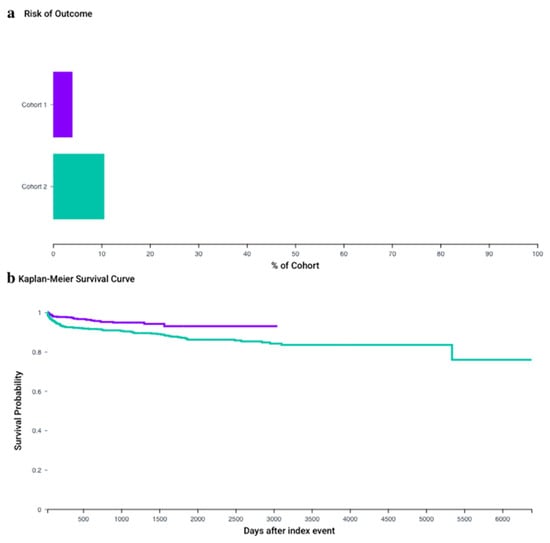
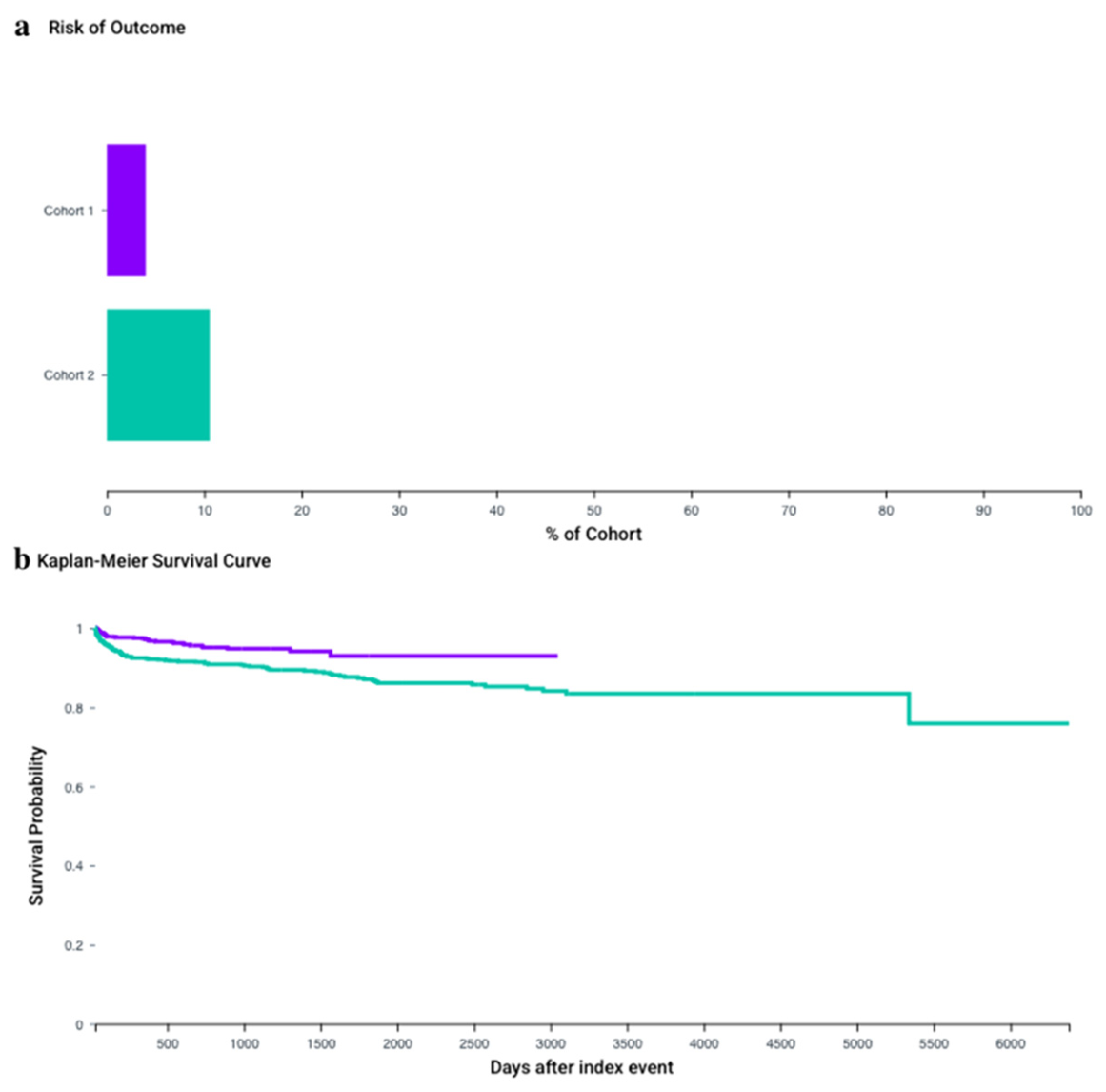
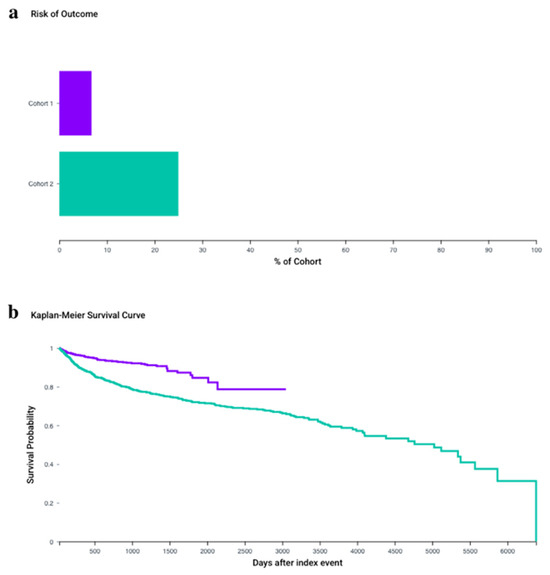
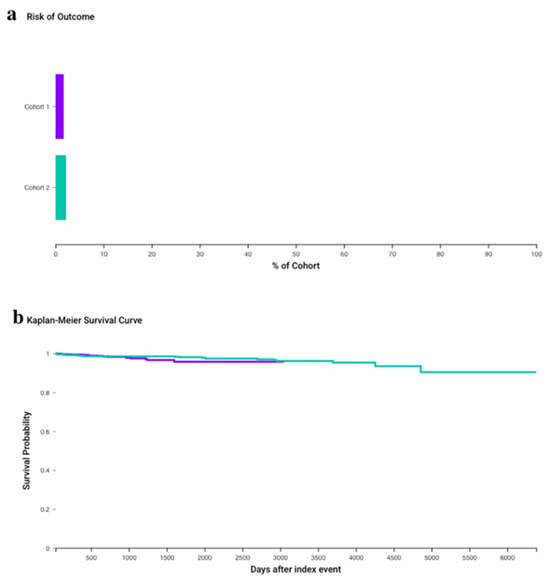
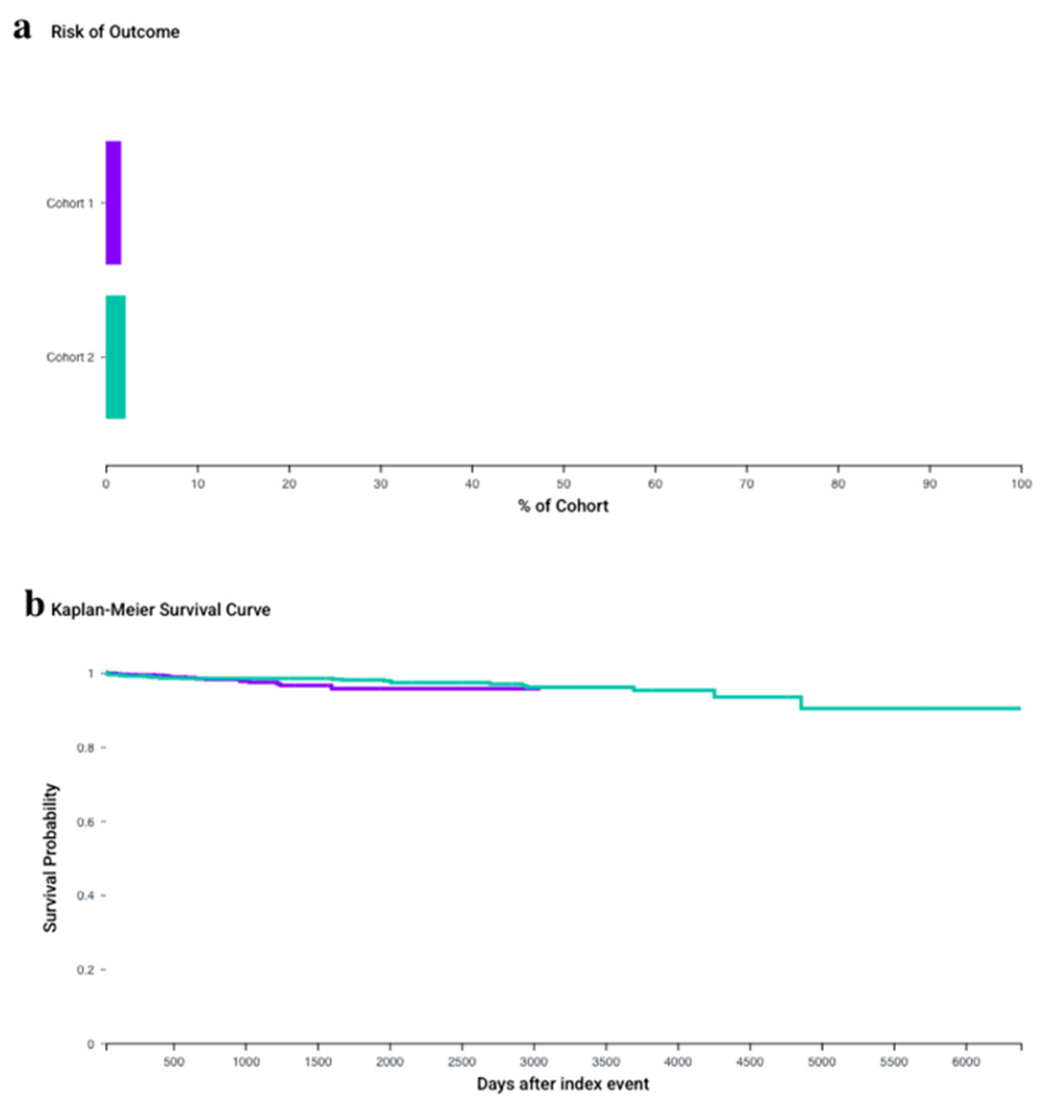
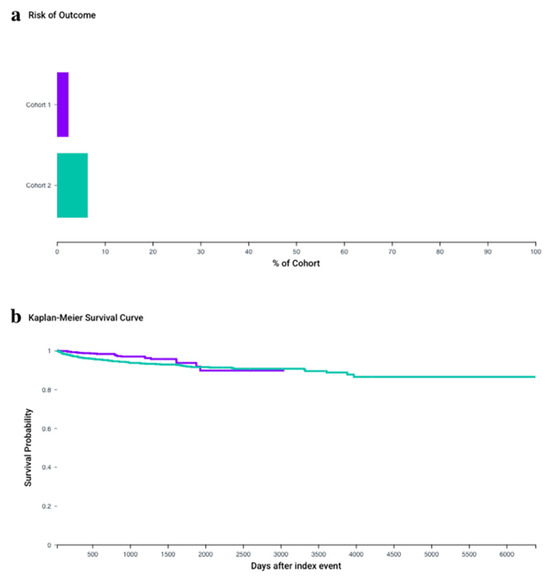
In the matched analysis using the long-term follow-up window beginning 30 days after the index event, stomatitis and related lesions (K12) occurred in 37 of 926 semaglutide-exposed patients (4.0%) compared with 99 of 936 non-exposed patients (10.6%) (Figure 1a). This corresponded to a risk difference of −6.6 percentage points (95% CI −8.9 to −4.2; p < 0.001), a RR of 0.378 (95% CI 0.262–0.545), and an OR of 0.352 (95% CI 0.238–0.519) (Figure 1a, Table 2). Event-free survival was 92.96% versus 75.86% (log-rank p < 0.001), with a HR of 0.476 (95% CI 0.323–0.700) (Figure 1b, Table 3).
Figure 1.
Risk and event-free survival for stomatitis and related lesions (K12) after propensity-score matching. (a) Risk of stomatitis and related lesions in semaglutide-exposed (Cohort 1, purple) and non-exposed (Cohort 2, teal) patients, shown as percentage of cohort. (b) Kaplan–Meier Survival Curve showing event-free survival for stomatitis and related lesions in semaglutide-exposed (purple) and non-exposed (teal) patients by days after the index event.
Table 3.
Kaplan–Meier event-free survival estimates and Cox proportional-hazards ratios for oral and systemic outcomes after propensity-score matching a–e.
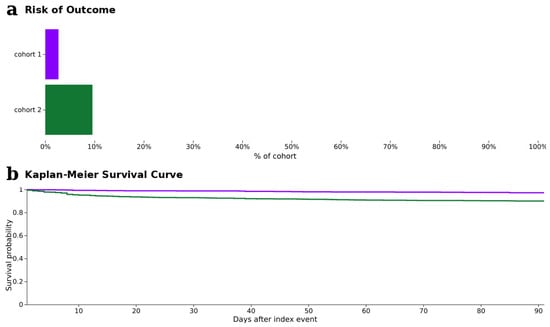
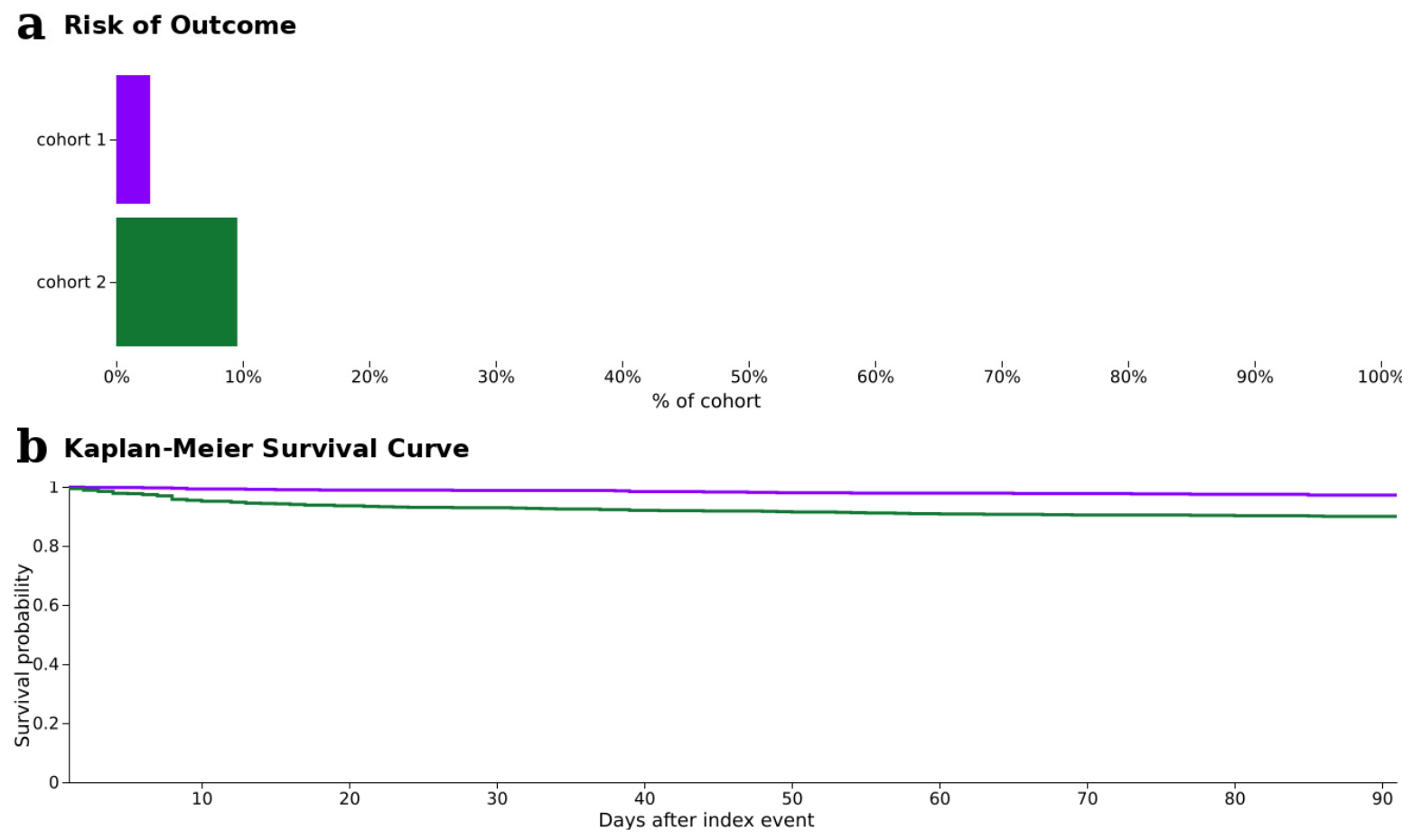
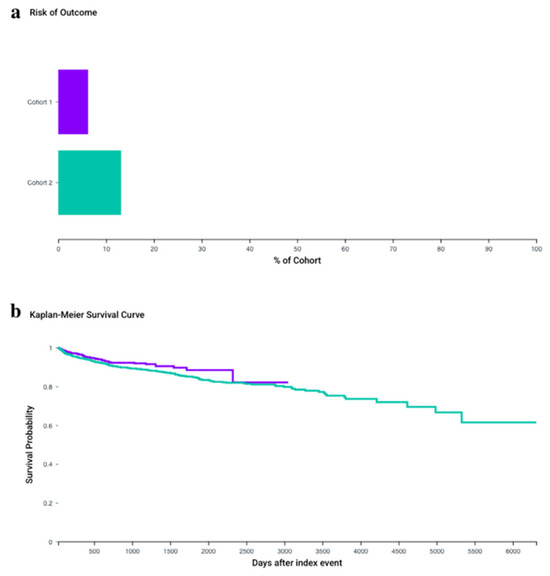
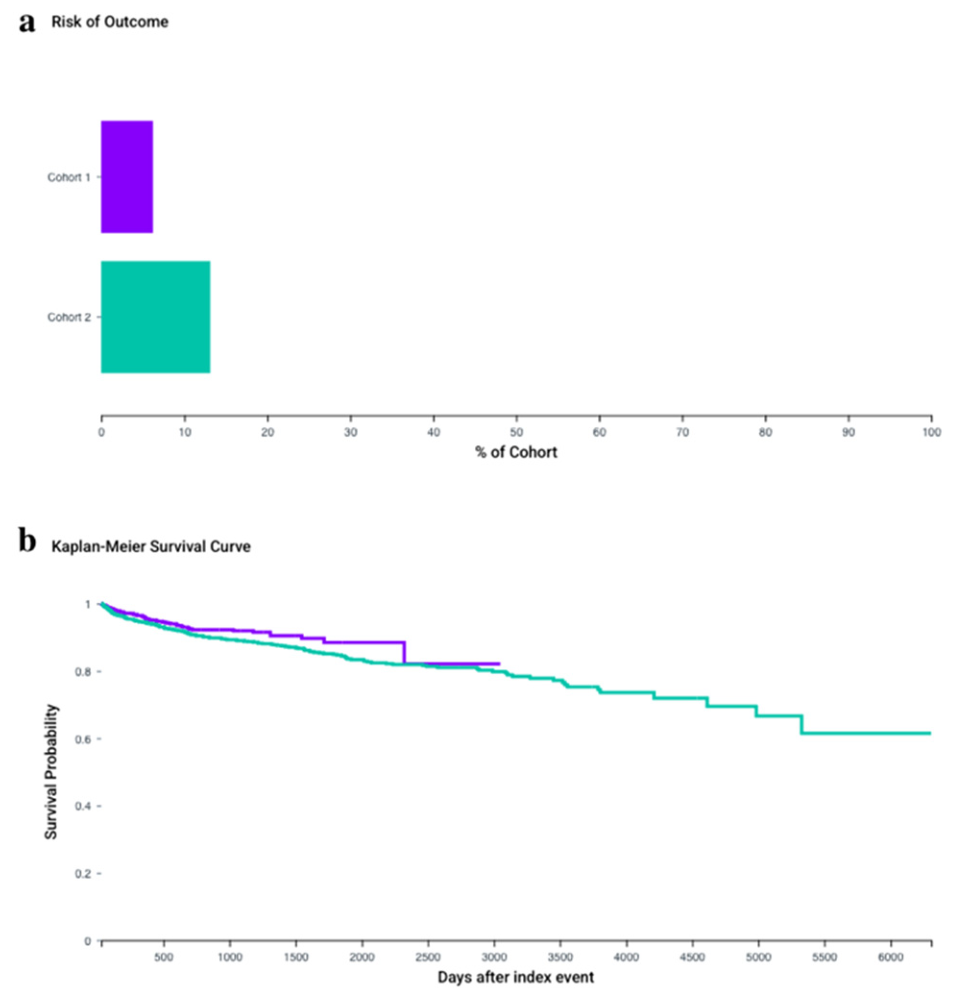
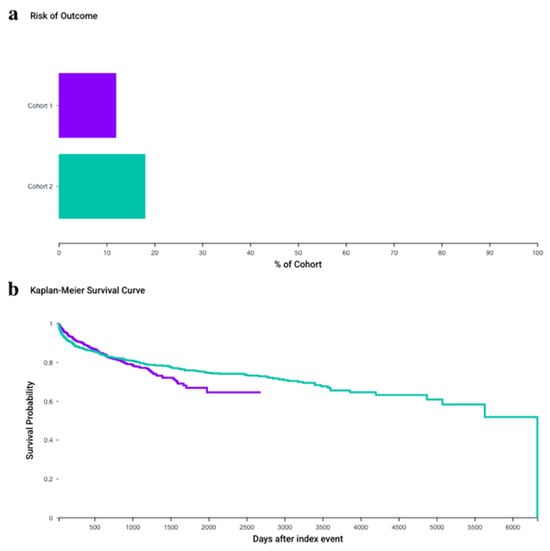
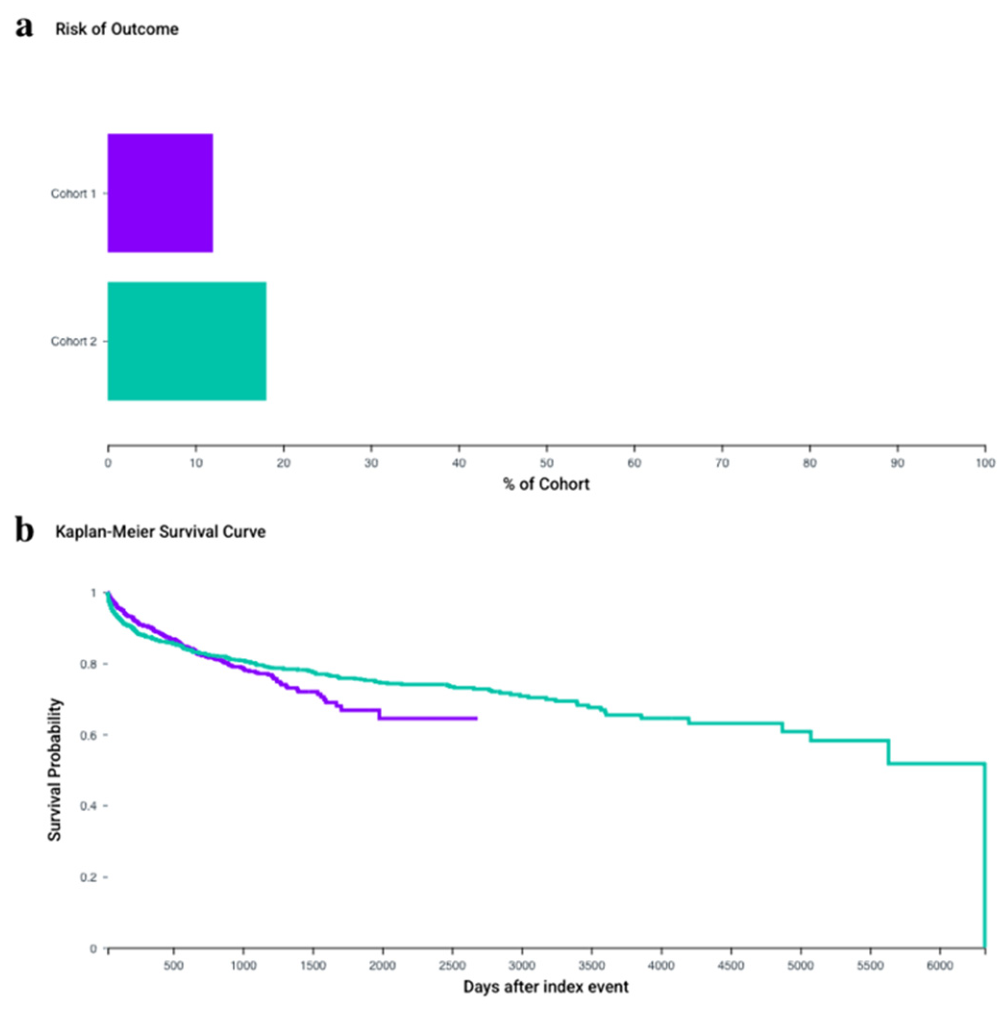
In the 3-month analysis (1152 matched pairs; days 1–90 after the index date), oral mucositis was coded less frequently among semaglutide-exposed patients. Oral mucositis occurred in 22 of 820 semaglutide-exposed patients (2.7%) compared with 92 of 961 non-exposed patients (9.6%) (Figure 2a). The absolute risk difference was −6.9 percentage points (95% CI −9.1 to −4.7; z = −5.921; p < 0.001), the RR was 0.280 (95% CI 0.178–0.442), and the OR was 0.260 (95% CI 0.162–0.419) (Figure 2a, Table 2). Event-free survival at 90 days was 97.18% in the semaglutide cohort and 89.98% in the comparison cohort (log-rank χ2 = 36.094; df = 1; p < 0.001) (Figure 2b, Table 3). The corresponding HR was 0.266 (95% CI 0.167–0.423); however, the proportional-hazards assumption was violated for this model (p = 0.017), so the HR represents an average, non-constant effect over the window, and the absolute risk difference and RR are considered the principal estimates (Figure 2b, Table 3). Because K12.3 is nested within K12, this analysis is not independent of the stomatitis analysis. Among patients who experienced the outcome, the mean number of mucositis instances did not differ (1.59 ± 1.26 versus 1.69 ± 1.50; t = −0.271; p = 0.787). Of the 1152 matched patients in each cohort, 332 semaglutide-exposed and 191 non-exposed patients were excluded from the 3-month analysis because the outcome was already recorded before the start of the time window (Supplementary Table S2). For reference, oral mucositis over long-term follow-up in the main matched cohort is reported in Supplementary Tables S4 and S5.
Figure 2.
Risk and event-free survival for oral mucositis (K12.3) at 3 months (days 1–90 after the index date) after propensity-score matching (1152 pairs). (a) Risk of oral mucositis in semaglutide-exposed (Cohort 1, purple) and non-exposed (Cohort 2, green) patients, shown as percentage of cohort. (b) Kaplan–Meier Survival Curve showing event-free survival for oral mucositis in semaglutide-exposed (purple) and non-exposed (green) patients by days after the index event.
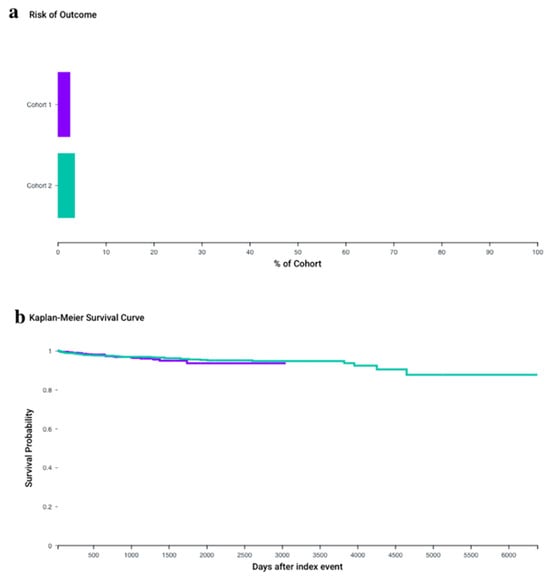
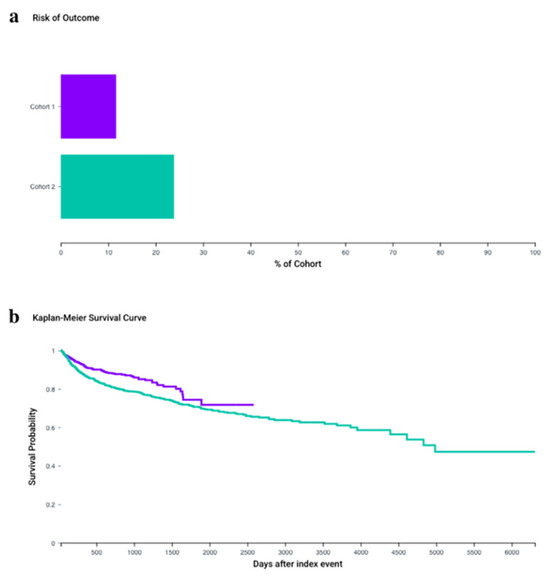
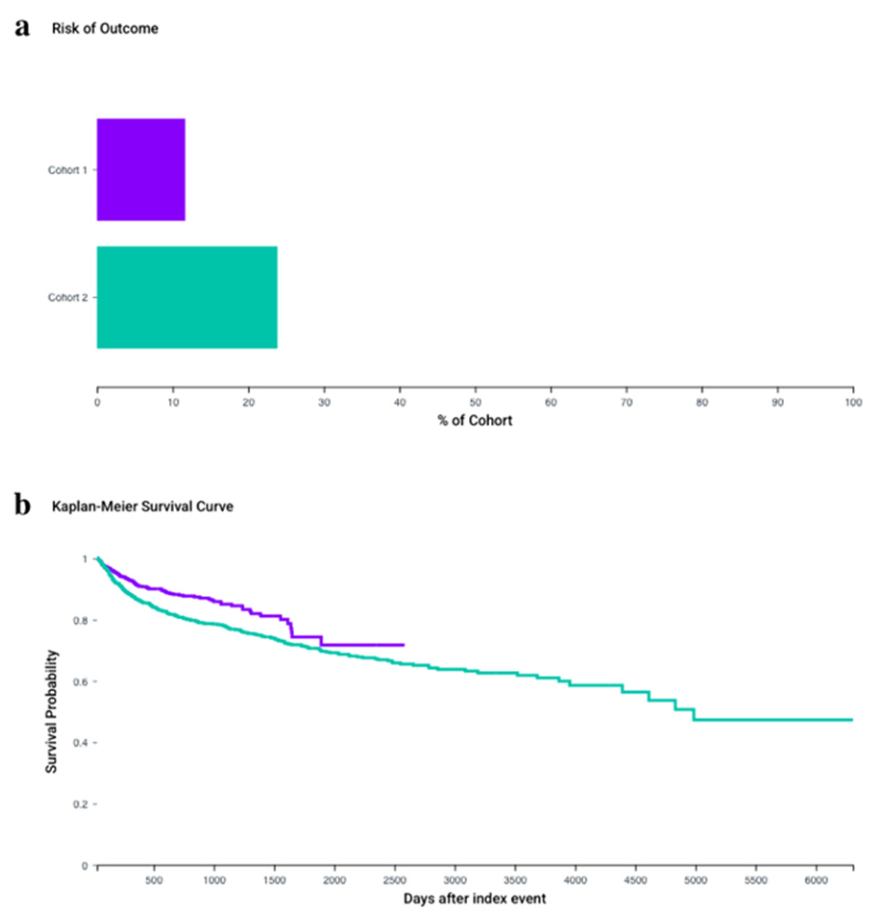
All-cause mortality was lower among semaglutide-exposed patients (86 of 1276 [6.7%] versus 326 of 1306 [25.0%]; RR 0.270, 95% CI 0.216–0.338; p < 0.001) (Figure 3a, Table 2). The HR for death was 0.396 (95% CI 0.310–0.506; log-rank p < 0.001) (Figure 3b, Table 3). Follow-up differed markedly between cohorts: the longest follow-up in the semaglutide cohort was approximately 3000 days, consistent with the approval of semaglutide in late 2017, whereas comparator follow-up extended to approximately 6400 days (Figure 3b). Kaplan–Meier estimates beyond the exposed cohort’s maximum follow-up, including the terminal comparator estimate of 0%, are based on very few patients at risk and are not interpretable as long-term overall survival. Dry mouth (2.6% versus 3.5%; p = 0.164) and smell and taste disturbances (1.7% versus 2.2%; p = 0.377) did not differ significantly (Figure 4 and Figure 5, Table 2 and Table 3). Systemic inflammation, including sepsis (6.2% versus 13.1%; RR 0.475; p < 0.001) and influenza and pneumonia (11.6% versus 23.8%; RR 0.488; p < 0.001), was lower with semaglutide exposure, with higher event-free survival (Figure 6 and Figure 7, Table 2 and Table 3); for systemic inflammation, the log-rank p value (0.043) did not meet the Bonferroni-corrected threshold.
Figure 3.
Risk and survival outcomes for all-cause mortality after propensity-score matching. (a) Risk of death in semaglutide-exposed (Cohort 1, purple) and non-exposed (Cohort 2, teal) patients, shown as percentage of cohort. (b) Kaplan–Meier Survival Curve showing overall survival in semaglutide-exposed (purple) and non-exposed (teal) patients by days after the index event. Follow-up in the semaglutide cohort ended at approximately 3000 days; the terminal portion of the comparator curve reflects very few patients at risk and should not be interpreted as long-term survival.
Figure 4.
Risk and event-free survival for dry mouth after propensity-score matching. (a) Risk of dry mouth in semaglutide-exposed (Cohort 1, purple) and non-exposed (Cohort 2, teal) patients, shown as percentage of cohort. (b) Kaplan–Meier Survival Curve showing event-free survival for dry mouth in semaglutide-exposed (purple) and non-exposed (teal) patients by days after the index event.
Figure 5.
Risk and event-free survival for smell and taste disturbances after propensity-score matching. (a) Risk of smell and taste disturbances in semaglutide-exposed (Cohort 1, purple) and non-exposed (Cohort 2, teal) patients, shown as percentage of cohort. (b) Kaplan–Meier Survival Curve showing event-free survival for smell and taste disturbances in semaglutide-exposed (purple) and non-exposed (teal) patients by days after the index event.
Figure 6.
Risk and event-free survival for systemic inflammation including sepsis (R65) after propensity-score matching. (a) Risk of systemic inflammation including sepsis in semaglutide-exposed (Cohort 1, purple) and non-exposed (Cohort 2, teal) patients, shown as percentage of cohort. (b) Kaplan–Meier Survival Curve showing event-free survival for systemic inflammation including sepsis in semaglutide-exposed (purple) and non-exposed (teal) patients by days after the index event.
Figure 7.
Risk and event-free survival for influenza and pneumonia after propensity-score matching. (a) Risk of influenza and pneumonia in semaglutide-exposed (Cohort 1, purple) and non-exposed (Cohort 2, teal) patients, shown as percentage of cohort. (b) Kaplan–Meier curves showing event-free survival for influenza and pneumonia in semaglutide-exposed (purple) and non-exposed (teal) patients by days after the index event.
Codes for symptoms and signs concerning food and fluid intake, including abnormal weight loss, were recorded in 102 of 851 (12.0%) semaglutide-exposed versus 200 of 1106 (18.1%) non-exposed patients (RR 0.663, 95% CI 0.531–0.827; p < 0.001) (Figure 8, Table 2). In the corresponding Kaplan–Meier analysis, which retained patients with a code before the window, event-free survival did not differ (HR 1.085, 95% CI 0.903–1.303; log-rank p = 0.385), and the proportional-hazards assumption was violated (p < 0.001) (Figure 8b, Table 3). Candidal stomatitis was coded less frequently in the semaglutide cohort (29 of 1209 [2.4%] versus 82 of 1280 [6.4%]; RR 0.374, 95% CI 0.247–0.568; p < 0.001) (Figure 9a, Table 2); the HR was 0.539 (95% CI 0.349–0.834; log-rank p = 0.005), but the proportional-hazards assumption was violated (p < 0.001), and the Kaplan–Meier curves largely overlapped over extended follow-up (Figure 9b, Table 3). Graft-versus-host disease codes (D89.810–D89.813), analyzed as an additional exploratory outcome, were recorded in 40 of 1085 (3.7%) exposed versus 151 of 1216 (12.4%) non-exposed patients (RR 0.297, 95% CI 0.212–0.417; HR 0.327, 95% CI 0.230–0.464; proportionality p = 0.591) (Table 2 and Table 3). Because graft-versus-host disease occurs only after allogeneic transplantation, this difference may partly reflect a lower proportion of allogeneic recipients in the exposed cohort, which could not be assessed. Applying the Bonferroni-corrected threshold (p < 0.005), the risk-based comparisons for stomatitis, oral mucositis, systemic inflammation, influenza and pneumonia, food and fluid intake codes, candidal stomatitis, graft-versus-host disease, and all-cause mortality remained statistically significant, whereas dry mouth and smell and taste disturbances did not differ. All outcomes other than the primary endpoint should nonetheless be regarded as exploratory.
Figure 8.
Risk and event-free survival for fluid intake and weight loss after propensity-score matching. (a) Risk of fluid intake and weight-loss codes in semaglutide-exposed (Cohort 1, purple) and non-exposed (Cohort 2, teal) patients, shown as percentage of cohort. (b) Kaplan–Meier Survival Curve showing event-free survival for fluid intake and weight loss in semaglutide-exposed (purple) and non-exposed (teal) patients by days after the index event.
Figure 9.
Risk and event-free survival for candidal stomatitis after propensity-score matching. (a) Risk of candidal stomatitis in semaglutide-exposed (Cohort 1, purple) and non-exposed (Cohort 2, teal) patients, shown as percentage of cohort. (b) Kaplan–Meier curves showing event-free survival for candidal stomatitis in semaglutide-exposed (purple) and non-exposed (teal) patients by days after the index event.
In summary, after matching on demographic and clinical covariates, semaglutide exposure was associated with a lower observed risk of coded stomatitis and, at 3 months of coded oral mucositis (2.7% versus 9.6%; RR 0.280) (Figure 1 and Figure 2, Table 2 and Table 3). In exploratory analyses, lower observed risks were also seen for systemic inflammation, influenza and pneumonia, and mortality, with no significant difference in coded xerostomia or dysgeusia (Table 2 and Table 3).
4. Discussion
In this propensity-matched, real-world analysis of adults with stem-cell transplant status, we aimed to test whether semaglutide exposure is associated with a lower incidence of oral mucositis, related stomatitis, and other oral complications, and with concurrent reductions in systemic infectious complications and mortality. The findings are consistent with our hypothesis but, given the observational design, do not establish causality. After matching, coded stomatitis and oral mucositis were substantially less frequent among semaglutide-exposed patients, event-free survival was higher, and coded oral mucositis at 3 months showed the same direction of association; because K12.3 is nested within K12, these are related rather than independent findings. Dry mouth and smell or taste disturbances were not increased. In exploratory analyses, lower observed risks were also seen for systemic inflammation (including sepsis, influenza, and pneumonia), fluid intake and weight loss codes, and all-cause mortality. These associations persisted after balancing age, sex, race, ethnicity, type 2 diabetes, external causes of morbidity, BMI, and ECOG performance status (the last recorded for fewer than 1% of patients), but transplant-specific factors could not be balanced.
The first aim concerned oral mucosal injury. In the matched analysis, stomatitis and related lesions (K12) were less frequent among semaglutide-exposed patients (Figure 1, Table 2). Assessing oral mucositis (K12.3) at 3 months, a horizon more aligned with the expected tempo of conditioning-related mucositis, yielded a substantially lower observed risk (2.7% versus 9.6%; RR 0.280; HR 0.266; 3-month event-free survival 97.18% versus 89.98%) (Figure 2, Table 2 and Table 3). This association was observed in a cohort that was additionally matched on underlying hematologic diagnoses, which reduces, but does not eliminate, confounding by disease type. Because K12.3 is a subcategory of K12, the stomatitis and mucositis analyses share cases and should not be regarded as independent confirmations; their concordance indicates internal consistency of coding rather than replication. The 3-month analysis is clinically important because most transplant-related oral mucositis clusters in the first weeks after conditioning [10,19,20,21]; however, because the index date in this study is not anchored to conditioning, the 3-month window cannot be assumed to coincide with the period of conditioning-related mucosal injury. Because K12.3 is coded specifically for ulcerative mucositis, cases captured by the broader K12 construct but not by K12.3 more likely reflect non-ulcerative or chronic stomatitis rather than conditioning-related mucosal injury.
Oral mucositis must also be interpreted within the broader spectrum of oral mucosal pathology after transplantation. In HSCT recipients, oral ulceration and stomatitis may result from conditioning-related mucosal toxicity but also from infection, such as herpes simplex virus reactivation, oropharyngeal candidiasis, or reactive infectious mucocutaneous eruptions such as Mycoplasma pneumoniae-induced rash and mucositis, in which oral involvement is dominant and which is frequently misdiagnosed as drug-induced Stevens–Johnson syndrome or erythema multiforme [22], from oral chronic graft-versus-host disease, from drug-induced lesions (e.g., associated with methotrexate, mTOR inhibitors, or targeted agents), and from secondary mucosal manifestations of systemic disease [23]. Administrative codes do not reliably discriminate between these etiologies: a K12 or K12.3 code may be recorded for a viral or fungal ulcer, and codes recorded late in follow-up are more likely to reflect such causes than toxic mucositis. Differences between cohorts in antiviral or antifungal prophylaxis, immunosuppression, or chronic graft-versus-host disease, none of which were captured here, could therefore contribute to the observed associations. The separate coding of candidal stomatitis (Figure 9) provides partial, but not complete, discrimination of infectious lesions.
These oral findings may be biologically plausible. In murine 5-fluorouracil mucositis, exogenous GLP-1 preserved mucosal mass and villus height and reduced histologic severity to a degree comparable to GLP-2, whereas GLP-1 receptor blockade delayed recovery [13]. Endogenous GLP-1 and GLP-2 rose sharply after intestinal injury, supporting a physiologic repair axis rather than a purely pharmacologic curiosity [13]. In adults undergoing autologous transplantation, fasting GLP-1 increased after high-dose chemotherapy and tracked with systemic inflammation [14]. In pediatric allogeneic transplantation, higher day-0 GLP-1 levels were associated with faster citrulline recovery and lower C-reactive protein levels [24]. Proposed mechanisms include enhanced epithelial proliferation, reduced apoptosis, tighter junction integrity, attenuated cytokine signaling, and synergy with co-secreted GLP-2 [14,24]. Direct evidence that these pathways operate in oral, as opposed to intestinal, epithelium remains limited, and that gap should temper causal inference [14,24]. Nonetheless, the concordance between preclinical mucosal protection, human transplant biomarker studies, and the present coded-outcome associations is hypothesis-generating but does not establish a mechanism in oral mucosa.
The second aim asked whether semaglutide would increase xerostomia or dysgeusia, a competing concern given pharmacovigilance signals and case series of hyposalivation. After matching, dry mouth (2.6% versus 3.5%) and smell or taste disturbances (1.7% versus 2.2%) did not differ significantly, and event-free survival for dry mouth was similar (Figure 4, Table 2 and Table 3). This does not refute a salivary effect of GLP-1 receptor agonists in other populations; it indicates that, among propensity-matched HSCT recipients and using ICD-coded outcomes, any xerostomia signal was small relative to the lower observed risk of coded mucositis. Under-ascertainment of dry mouth in electronic records is likely, so the absence of a coded increase should not be read as proof of salivary safety. It does, however, argue against the interpretation that reduced mucositis codes are simply the inverse of increased oral dryness coding.
The third aim addressed systemic complications. In exploratory analyses, lower observed risks of systemic inflammation, including sepsis (RR 0.475), influenza and pneumonia (RR 0.488), nutritional or fluid-related codes (RR 0.663, although the corresponding time-to-event analysis showed no difference), and all-cause mortality (RR 0.270) are directionally consistent with a model in which mucosal barrier injury contributes to translocation, cytokine amplification, infection, and treatment-related death; however, these were exploratory endpoints, and the same pattern would be expected from healthy-user bias or residual confounding (Figure 3, Figure 6, Figure 7 and Figure 8, Table 2) [25,26,27,28,29,30]. The mortality contrast was particularly large (6.7% versus 25.0%; HR 0.396) (Figure 3b, Table 3). That magnitude is implausibly large for a single supportive medication and most likely reflects, at least in part, residual confounding and differential follow-up. Electronic “deceased” flags and ill-defined mortality codes over very long windows can inflate apparent survival differences, especially if follow-up intensity, competing risks, or loss to the network differ by exposure. Residual confounding by healthier metabolic phenotype, better outpatient engagement, or unmeasured fitness for GLP-1 therapy could also bias mortality downward. Unmeasured factors, including performance status (e.g., Eastern Cooperative Oncology Group or Karnofsky score), disease remission status, comorbidity burden such as the HCT-specific comorbidity index, transplant type, and outpatient engagement, may all differ between patients who are prescribed and continue semaglutide and those who are not [31]. In addition, maximum follow-up was approximately 3000 days in the exposed cohort versus approximately 6400 days in the comparator cohort, and the exposed cohort was necessarily drawn from a more recent calendar period, during which transplant outcomes have improved. Accordingly, the mortality association should not be interpreted as a treatment effect.
The fourth aim concerned robustness across unmatched and matched analyses. Inverse associations for mucositis, stomatitis, infections, and mortality were evident before matching (Supplementary Table S4), when diabetes and body mass index were markedly imbalanced [32], and they persisted after those covariates were aligned (Table 1). Persistence after matching suggests that the oral association is not explained solely by the metabolic profile that typically prompts semaglutide prescription. Residual imbalance in continuous body mass index (standardized difference of 0.218) and incomplete capture of socioeconomic and performance-status variables remain relevant (Table 1) [28,31,33]. Body mass index categories, however, were well balanced after matching (Table 1); nevertheless, although BMI was included in the propensity model, continuous BMI remained imbalanced and was missing for approximately half of patients, and ECOG performance status was recorded for fewer than 1%, so residual confounding by adiposity and functional status cannot be excluded.
Several limitations follow from the design. First, exposure was defined as any recorded semaglutide use plus transplant-status coding, rather than verified peri-conditioning administration, dose, duration, or adherence. Patients may have received semaglutide months or years away from the mucositis-risk window. Because Z94.84 is a status code, the date of transplantation, and therefore the sequence and interval between semaglutide initiation, conditioning, and outcome assessment, could not be determined; the index date of exposed patients may fall later in the post-transplant course than that of comparators, so the cohorts may represent different periods of clinical risk, and immortal-time bias cannot be excluded [34]. A sensitivity analysis restricted to patients with active semaglutide prescriptions within a defined peri-transplant window (e.g., 30–60 days before to 90 days after transplantation) could not be performed with the transplant-status definition used here; future studies should anchor follow-up to the transplant procedure date and record the date, dose, and duration of GLP-1 RA therapy relative to conditioning. Second, all outcomes were identified from ICD-10-CM codes, which reflect diagnostic and billing events rather than prospective, standardized oral examinations; they were not graded by WHO or CTCAE instruments, and severity, duration, opioid use, and feeding-tube dependence could not be assessed [35,36,37,38,39]. Administrative coding of oral mucositis is vulnerable to under-reporting, non-systematic documentation, and billing-related variation, and its sensitivity and specificity against clinician-graded mucositis have not been established in this setting; sensitivity is likely to be low, and specificity for conditioning-related mucositis is uncertain because K12 and K12.3 may also be assigned for infectious, graft-versus-host disease-related, or drug-induced lesions. Our findings therefore describe ICD-coded diagnostic events, not confirmed reductions in clinically graded mucositis incidence or severity. Third, patients with pre-window outcome codes were excluded from risk analyses, which improves incidence estimation but can select a lower-risk residual cohort and does not fully solve left-censoring; moreover, these exclusions were applied after matching and differed between cohorts (Supplementary Table S2), and covariate balance within the outcome-specific analytic subsets was not re-assessed. Fourth, the three-month mucositis Cox model showed evidence of non-proportional hazards, so that HR should be treated as an average effect rather than a constant relative hazard; time-varying Cox models and restricted mean survival time were not available within the platform, and the 3-month risk difference and risk ratio are therefore presented as the principal estimates. Fifth, the network was a deprecated COVID-era research set; coding intensity and follow-up may differ from contemporary oncology-specific networks. Sixth, healthy-user, confounding-by-indication, and immortal-time biases cannot be excluded. Important transplant-related confounders were not available or not included in matching: underlying hematologic diagnosis (which differed before matching and was included in matching only for the 3-month oral mucositis analysis), autologous versus allogeneic transplantation, conditioning regimen and intensity (including total-body irradiation and high-dose melphalan), post-transplant cyclophosphamide and other graft-versus-host disease prophylaxis, disease status at transplantation, time since transplantation, subsequent antineoplastic therapy, mucositis-directed preventive measures, calendar period, and performance status (which was included in matching but recorded for fewer than 1% of patients). A sensitivity analysis restricted to patients with comparable metabolic indications (e.g., comparators treated with other glucose-lowering or anti-obesity agents) was not performed. Because these variables are strongly related to mucositis risk and survival and may differ by metabolic profile, the magnitude of the observed associations, particularly for mortality, may be substantially overestimated. Seventh, multiple endpoints were examined; although most risk-based comparisons remained significant after Bonferroni correction, all secondary findings should be viewed as exploratory. Eighth, event-free survival estimates at the extreme tail of a multi-year window, particularly the near-zero survival probability for death in the comparator arm, are sensitive to censoring assumptions and should not be over-interpreted as long-term overall survival. Median follow-up and numbers at risk by cohort were not available in the exported output, and analyses with standardized follow-up windows (e.g., 90 days, 180 days, and 1 year) were not performed for all outcomes; differential follow-up, loss to the network, and informative censoring could therefore bias time-to-event estimates. Ninth, death was not treated as a competing event for nonfatal outcomes, which may distort cumulative-incidence estimates, particularly in the comparator cohort, which had higher mortality [18]. Tenth, matched pairs were analyzed as independent samples, so confidence intervals do not account for the matched design, and covariate balance was summarized with standardized mean differences in Table 1 rather than a graphical balance (Love) plot. Finally, the Kaplan–Meier figures were exported directly from the TriNetX platform and do not display numbers at risk.
These limitations substantially constrain interpretation and define what the study cannot claim: it cannot establish the temporal relationship between exposure and outcome, cannot establish that initiating semaglutide during conditioning prevents clinically graded mucositis, cannot quantify the number-needed-to-treat under protocolized dosing, and cannot substitute for a randomized trial.
Any future role for GLP-1 receptor agonists must be considered alongside established, context-dependent strategies for oral mucositis mitigation. The MASCC/ISOO clinical practice guidelines recommend, for HSCT recipients, intraoral photobiomodulation for prevention in patients receiving high-dose chemotherapy with or without total-body irradiation, oral cryotherapy for patients receiving high-dose melphalan, and palifermin (keratinocyte growth factor-1) for autologous HSCT with high-dose chemotherapy and total-body irradiation, together with multi-agent basic oral care protocols and patient-controlled morphine analgesia for mucositis pain [7,12,35,36]. Recent reviews of preventive modalities likewise highlight photobiomodulation, cryotherapy, benzydamine, topical morphine, and glutamine, while noting heterogeneous evidence across treatment settings [40]. Each of these interventions targets a specific phase of mucositis pathobiology or a specific conditioning context, and none is effective across all transplant platforms. A GLP-1 receptor agonist would therefore most plausibly be evaluated as an adjunct to, rather than a replacement for, guideline-based care, ideally in trials stratified by conditioning regimen and with photobiomodulation and cryotherapy recorded as co-interventions. Because guideline-based preventive measures were not captured in the present dataset, differences in their use between cohorts could also have influenced the observed associations.
The findings are adjacent to the PROTECT trial (NCT06449625), a randomized, placebo-controlled phase 2 study of weekly semaglutide to reduce the severity of gastrointestinal mucositis after autologous transplantation for lymphoma [41,42]. PROTECT uses clinician-graded gastrointestinal mucositis as its primary endpoint and C-reactive protein and quality of life as secondary endpoints. The present analysis complements that program by examining oral rather than intestinal coding, a mixed autologous and allogeneic real-world population, and a broader set of infectious and mortality outcomes. If PROTECT confirms a gastrointestinal benefit, the current oral and systemic signals would support extending prospective assessment to standardized oral examinations, salivary flow, and infection endpoints. If PROTECT is neutral, residual confounding in observational data would become the more likely explanation of our associations.
Clinically, these data do not justify off-label initiation of semaglutide solely to prevent mucositis. They do support two narrower conclusions. Patients who already require a GLP-1 receptor agonist for diabetes or obesity and who proceed to transplantation do not, in this matched sample, show excess coded xerostomia or oral mucositis; if anything, mucosal and infectious codes are lower (Figure 1, Figure 2, Figure 6 and Figure 7). Second, oral medicine and transplant teams should treat GLP-1 exposure as a covariate to capture in mucositis registries [31,33,35], because it may modify risk sufficiently to confound supportive-care trials if ignored.
Future work should specify the timing of exposure relative to conditioning, ideally through a target-trial emulation anchored to the transplant procedure date [34], distinguish autologous from allogeneic platforms, match or stratify on hematologic diagnosis and conditioning intensity, and pair coded outcomes with graded oral assessments, citrulline or other barrier biomarkers, salivary flow, and adjudication of infection and death. Mechanistic studies of GLP-1 receptor expression and signaling in human oral epithelium would close an important translational gap. Until such data exist, the present study should be read as hypothesis-generating real-world evidence that, among patients with a documented history of stem-cell transplantation, semaglutide exposure is inversely associated with coded stomatitis and oral mucositis, without a detectable increase in coded dry mouth, and with lower observed risks of selected systemic complications.
Supplementary Materials
The following supporting information can be downloaded at: https://www.mdpi.com/article/10.3390/clinpract16110202/s1, Table S1: Cohort, exposure and outcome definitions ((A): cohorts and index events; (B): outcome codes and analysis settings); Table S2: Cohort flow (A) and outcome-specific analytic denominators and exclusions (B); Table S3: Baseline characteristics before and after propensity score matching, including all matching covariates; Table S4: Risk of outcomes in the unmatched and propensity-matched cohorts (long-term follow-up); Table S5: Kaplan–Meier time-to-event analysis and proportional-hazards testing (long-term follow-up); Table S6: Number of outcome instances among patients with each outcome (long-term follow-up); Table S7: Three-month oral mucositis analysis: baseline characteristics before and after matching, including hematologic diagnoses (A), and outcome results (B).
Author Contributions
Conceptualization, P.S.S.; methodology, P.S.S.; data curation, Z.A., K.K., J.E., K.M., P.M., A.P., N.B., R.P. and P.S.S.; writing—original draft preparation, Z.A., K.K., J.E., K.M., P.M., A.P., N.B., R.P. and P.S.S.; writing—review and editing, Z.A., K.K., J.E., K.M., P.M., A.P., N.B., R.P. and P.S.S.; funding acquisition, P.S.S. All authors have read and agreed to the published version of the manuscript.
Funding
This research received no external funding.
Institutional Review Board Statement
Ethical review and approval were not required for this study because the data analyzed in this study constitute a secondary examination of pre-existing information, do not involve intervention or interaction with human subjects, and have been de-identified in accordance with the de-identification requirements outlined in Section 164.514(a) of the HIPAA Privacy Rule; a qualified expert, as defined in Section 164.514(b)(1) of the HIPAA Privacy Rule, has formally attested to the data de-identification process, and this expert assessment was updated in December 2020; and TriNetX, LLC adheres to the Health Insurance Portability and Accountability Act (HIPAA).
Informed Consent Statement
Patient consent was not required because the study was a retrospective secondary analysis of pre-existing, de-identified data. The authors had no intervention or interaction with patients and no access to identifiable information, and the data are de-identified in accordance with Section 164.514(a) of the HIPAA Privacy Rule, as attested by a qualified expert under Section 164.514(b)(1).
Data Availability Statement
Restrictions apply to the availability of these data. Data were obtained from TriNetX, LLC and are available from the authors with the permission of TriNetX, LLC.
Conflicts of Interest
The authors declare no conflicts of interest.
References
- Sonis, S.T.; Oster, G.; Fuchs, H.; Bellm, L.; Bradford, W.Z.; Edelsberg, J.; Hayden, V.; Eilers, J.; Epstein, J.B.; LeVeque, F.G.; et al. Oral mucositis and the clinical and economic outcomes of hematopoietic stem-cell transplantation. J. Clin. Oncol. 2001, 19, 2201–2205. [Google Scholar] [CrossRef] [Scilit] [PubMed]
- Gyurkocza, B.; Sandmaier, B.M. Conditioning regimens for hematopoietic cell transplantation: One size does not fit all. Blood 2014, 124, 344–353. [Google Scholar] [CrossRef] [Scilit] [PubMed] [PubMed Central]
- Ali, M.; Kerio, A.A.; Khattak, T.A.; Hussain, M.; Khan, M.A.; Abbas, Y. Oral Mucositis in Patients Undergoing Hematopoietic Stem Cell Transplantation. J. Coll. Physicians Surg. Pak. 2023, 33, 804–808. [Google Scholar] [CrossRef] [Scilit] [PubMed]
- Stewart, S.; Robertson, C.; Pan, J.; Kennedy, S.; Haahr, L.; Manoukian, S.; Mason, H.; Kavanagh, K.; Graves, N.; Dancer, S.J.; et al. Impact of healthcare-associated infection on length of stay. J. Hosp. Infect. 2021, 114, 23–31. [Google Scholar] [CrossRef] [Scilit] [PubMed]
- Jeon, C.Y.; Neidell, M.; Jia, H.; Sinisi, M.; Larson, E. On the role of length of stay in healthcare-associated bloodstream infection. Infect. Control Hosp. Epidemiol. 2012, 33, 1213–1218. [Google Scholar] [CrossRef] [Scilit] [PubMed] [PubMed Central]
- Mikulska, M.; Gualandi, F.; Anserini, P. Early and late complications of hematopoietic stem cell transplantation. Handb. Clin. Neurol. 2024, 202, 135–151. [Google Scholar] [CrossRef] [Scilit] [PubMed]
- Riley, P.; Glenny, A.M.; Worthington, H.V.; Littlewood, A.; Fernandez Mauleffinch, L.M.; Clarkson, J.E.; McCabe, M.G. Interventions for preventing oral mucositis in patients with cancer receiving treatment: Cytokines and growth factors. Cochrane Database Syst. Rev. 2017, 11, CD011990. [Google Scholar] [CrossRef] [Scilit] [PubMed] [PubMed Central]
- Blakaj, A.; Bonomi, M.; Gamez, M.E.; Blakaj, D.M. Oral mucositis in head and neck cancer: Evidence-based management and review of clinical trial data. Oral Oncol. 2019, 95, 29–34. [Google Scholar] [CrossRef] [Scilit] [PubMed]
- Franco, P.; Martini, S.; Di Muzio, J.; Cavallin, C.; Arcadipane, F.; Rampino, M.; Ostellino, O.; Pecorari, G.; Garzino Demo, P.; Fasolis, M.; et al. Prospective assessment of oral mucositis and its impact on quality of life and patient-reported outcomes during radiotherapy for head and neck cancer. Med. Oncol. 2017, 34, 81. [Google Scholar] [CrossRef] [Scilit] [PubMed]
- Chaudhry, H.M.; Bruce, A.J.; Wolf, R.C.; Litzow, M.R.; Hogan, W.J.; Patnaik, M.S.; Kremers, W.K.; Phillips, G.L.; Hashmi, S.K. The Incidence and Severity of Oral Mucositis among Allogeneic Hematopoietic Stem Cell Transplantation Patients: A Systematic Review. Biol. Blood Marrow Transpl. 2016, 22, 605–616. [Google Scholar] [CrossRef] [Scilit] [PubMed]
- Murphy, B.A. Clinical and economic consequences of mucositis induced by chemotherapy and/or radiation therapy. J. Support Oncol. 2007, 5, 13–21. [Google Scholar] [PubMed]
- Nguyen, D.T.; Shayani, S.; Palmer, J.; Dagis, A.; Forman, S.J.; Epstein, J.; Spielberger, R. Palifermin for prevention of oral mucositis in allogeneic hematopoietic stem cell transplantation: A single-institution retrospective evaluation. Support. Care Cancer 2015, 23, 3141–3147. [Google Scholar] [CrossRef] [Scilit] [PubMed]
- Kissow, H.; Hartmann, B.; Holst, J.J.; Poulsen, S.S. Glucagon-like peptide-1 as a treatment for chemotherapy-induced mucositis. Gut 2013, 62, 1724–1733. [Google Scholar] [CrossRef] [Scilit] [PubMed]
- Ebbesen, M.S.; Kissow, H.; Hartmann, B.; Grell, K.; Gørløv, J.S.; Kielsen, K.; Holst, J.J.; Müller, K. Glucagon-Like Peptide-1 Is a Marker of Systemic Inflammation in Patients Treated with High-Dose Chemotherapy and Autologous Stem Cell Transplantation. Biol. Blood Marrow Transplant. 2019, 25, 1085–1091. [Google Scholar] [CrossRef] [Scilit] [PubMed]
- Barać, M.; Roganović, J. GLP-1 Receptor Signaling and Oral Dysfunction: A Narrative Review on the Mechanistic Basis of Semaglutide-Related Oral Adverse Effects. Biology 2025, 14, 1650. [Google Scholar] [CrossRef] [Scilit] [PubMed] [PubMed Central]
- Bijoch, J. Oral Health Implications of GLP-1 Receptor Agonists and Other Incretin-Based Therapies. J. Clin. Med. 2026, 15, 5358. [Google Scholar] [CrossRef] [Scilit] [PubMed] [PubMed Central]
- Palchuk, M.B.; London, J.W.; Perez-Rey, D.; Drebert, Z.J.; Winer-Jones, J.P.; Thompson, C.N.; Esposito, J.; Claerhout, B. A global federated real-world data and analytics platform for research. JAMIA Open 2023, 6, ooad035. [Google Scholar] [CrossRef] [Scilit] [PubMed]
- Austin, P.C.; Lee, D.S.; Fine, J.P. Introduction to the analysis of survival data in the presence of competing risks. Circulation 2016, 133, 601–609. [Google Scholar] [CrossRef] [Scilit] [PubMed]
- Shouval, R.; Kouniavski, E.; Fein, J.; Danylesko, I.; Shem-Tov, N.; Geva, M.; Yerushalmi, R.; Shimoni, A.; Nagler, A. Risk factors and implications of oral mucositis in recipients of allogeneic hematopoietic stem cell transplantation. Eur. J. Haematol. 2019, 103, 402–409. [Google Scholar] [CrossRef] [Scilit] [PubMed]
- Nakagaki, M.; Kennedy, G.A.; Gavin, N.C.; Clavarino, A.; Whitfield, K. The incidence of severe oral mucositis in patients undergoing different conditioning regimens in haematopoietic stem cell transplantation. Support. Care Cancer 2022, 30, 9141–9149. [Google Scholar] [CrossRef] [Scilit] [PubMed] [PubMed Central]
- Vera-Llonch, M.; Oster, G.; Ford, C.M.; Lu, J.; Sonis, S. Oral mucositis and outcomes of allogeneic hematopoietic stem-cell transplantation in patients with hematologic malignancies. Support. Care Cancer 2007, 15, 491–496. [Google Scholar] [CrossRef] [Scilit] [PubMed]
- D’Agostino, S.; Granberg, V.; Valentini, G.; Corsalini, M.; Limongelli, L. Mucositis associated with Mycoplasma pneumoniae: Systematic review and case series. Children 2026, 13, 638. [Google Scholar] [CrossRef] [Scilit] [PubMed]
- Elad, S.; Yarom, N.; Zadik, Y.; Kuten-Shorrer, M.; Sonis, S.T. The broadening scope of oral mucositis and oral ulcerative mucosal toxicities of anticancer therapies. CA Cancer J. Clin. 2022, 72, 57–77, Erratum in CA Cancer J. Clin. 2022, 72, 595. https://doi.org/10.3322/caac.21755. [Google Scholar] [CrossRef] [Scilit] [PubMed]
- Ebbesen, M.; Kissow, H.; Hartmann, B.; Kielsen, K.; Sørensen, K.; Stinson, S.E.; Frithioff-Bøjsøe, C.; Esmann Fonvig, C.; Holm, J.C.; Hansen, T.; et al. Glucagon-Like Peptide-1 Is Associated with Systemic Inflammation in Pediatric Patients Treated with Hematopoietic Stem Cell Transplantation. Front. Immunol. 2021, 12, 793588. [Google Scholar] [CrossRef] [Scilit] [PubMed] [PubMed Central]
- Blijlevens, N.M.; Donnelly, J.P.; De Pauw, B.E. Mucosal barrier injury: Biology, pathology, clinical counterparts and consequences of intensive treatment for haematological malignancy: An overview. Bone Marrow Transplant. 2000, 25, 1269–1278. [Google Scholar] [CrossRef] [Scilit] [PubMed] [PubMed Central]
- van der Velden, W.J.; Herbers, A.H.; Netea, M.G.; Blijlevens, N.M. Mucosal barrier injury, fever and infection in neutropenic patients with cancer: Introducing the paradigm febrile mucositis. Br. J. Haematol. 2014, 167, 441–452. [Google Scholar] [CrossRef] [Scilit] [PubMed]
- Eichhorn, S.; Rudin, L.; Ramasamy, C.; Varsani, R.; Padhi, P.; Nassour, N.; Meleveedu, K.; Epstein, J.B.; Semegran, B.; Pili, R.; et al. Elevated Likelihood of Infectious Complications Related to Oral Mucositis After Hematopoietic Stem Cell Transplantation: A Systematic Review and Meta-Analysis of Outcomes and Risk Factors. Cancers 2025, 17, 2657. [Google Scholar] [CrossRef] [Scilit] [PubMed] [PubMed Central]
- Dandoy, C.E.; Kim, S.; Chen, M.; Ahn, K.W.; Ardura, M.I.; Brown, V.; Chhabra, S.; Diaz, M.A.; Dvorak, C.; Farhadfar, N.; et al. Incidence, Risk Factors, and Outcomes of Patients Who Develop Mucosal Barrier Injury-Laboratory Confirmed Bloodstream Infections in the First 100 Days After Allogeneic Hematopoietic Stem Cell Transplant. JAMA Netw. Open 2020, 3, e1918668. [Google Scholar] [CrossRef] [Scilit] [PubMed] [PubMed Central]
- See, I.; Iwamoto, M.; Allen-Bridson, K.; Horan, T.; Magill, S.S.; Thompson, N.D. Mucosal barrier injury laboratory-confirmed bloodstream infection: Results from a field test of a new National Healthcare Safety Network definition. Infect. Control Hosp. Epidemiol. 2013, 34, 769–776. [Google Scholar] [CrossRef] [Scilit] [PubMed]
- Kumar, G.; Ahmad, S.; Taneja, A.; Patel, J.; Guddati, A.K.; Nanchal, R. Milwaukee Initiative in Critical Care Outcomes Research Group of Investigators. Severe sepsis in hematopoietic stem cell transplant recipients. Crit. Care Med. 2015, 43, 411–421. [Google Scholar] [CrossRef] [Scilit] [PubMed]
- Sorror, M.L.; Storb, R.F.; Sandmaier, B.M.; Maziarz, R.T.; Pulsipher, M.A.; Maris, M.B.; Bhatia, S.; Ostronoff, F.; Deeg, H.J.; Syrjala, K.L.; et al. Comorbidity-age index: A clinical measure of biologic age before allogeneic hematopoietic cell transplantation. J. Clin. Oncol. 2014, 32, 3249–3256. [Google Scholar] [CrossRef] [Scilit] [PubMed] [PubMed Central]
- Majhail, N.S.; Challa, T.R.; Mulrooney, D.A.; Baker, K.S.; Burns, L.J. Hypertension and diabetes mellitus in adult and pediatric survivors of allogeneic hematopoietic cell transplantation. Biol. Blood Marrow Transplant. 2009, 15, 1100–1107. [Google Scholar] [CrossRef] [Scilit] [PubMed]
- Mielcarek, M.; Gooley, T.; Martin, P.J.; Chauncey, T.R.; Young, B.A.; Storb, R.; Torok-Storb, B. Effects of race on survival after stem cell transplantation. Biol. Blood Marrow Transplant. 2005, 11, 231–239. [Google Scholar] [CrossRef] [Scilit] [PubMed]
- Hernán, M.A.; Sauer, B.C.; Hernández-Díaz, S.; Platt, R.; Shrier, I. Specifying a target trial prevents immortal time bias and other self-inflicted injuries in observational analyses. J. Clin. Epidemiol. 2016, 79, 70–75. [Google Scholar] [CrossRef] [Scilit] [PubMed]
- Elad, S.; Cheng, K.K.F.; Lalla, R.V.; Yarom, N.; Hong, C.; Logan, R.M.; Bowen, J.; Gibson, R.; Saunders, D.P.; Zadik, Y.; et al. MASCC/ISOO clinical practice guidelines for the management of mucositis secondary to cancer therapy. Cancer 2020, 126, 4423–4431, Erratum in Cancer 2021, 127, 3700. https://doi.org/10.1002/cncr.33549. [Google Scholar] [CrossRef] [Scilit] [PubMed] [PubMed Central]
- Hong, C.H.L.; Gueiros, L.A.; Fulton, J.S.; Cheng, K.K.F.; Kandwal, A.; Galiti, D.; Fall-Dickson, J.M.; Johansen, J.; Ameringer, S.; Kataoka, T.; et al. Systematic review of basic oral care for the management of oral mucositis in cancer patients and clinical practice guidelines. Support. Care Cancer 2019, 27, 3949–3967. [Google Scholar] [CrossRef] [Scilit] [PubMed]
- McGuire, D.B.; Fulton, J.S.; Park, J.; Brown, C.G.; Correa, M.E.; Eilers, J.; Elad, S.; Gibson, F.; Oberle-Edwards, L.K.; Bowen, J.; et al. Systematic review of basic oral care for the management of oral mucositis in cancer patients. Support Care Cancer 2013, 21, 3165–3177. [Google Scholar] [CrossRef] [Scilit] [PubMed]
- Mohan, M.P.; Pili, R.; Epstein, J.B.; Rudin, L.; Eichhorn, S.; Satheeshkumar, P.S. Cancer treatment-induced ulcerative mucositis serves as a significant predictor of burden of illness including dysphagia, and associated disparities among hospitalized cancer patients. Support. Care Cancer 2024, 33, 22. [Google Scholar] [CrossRef] [Scilit] [PubMed]
- Cheng, K.K.; Leung, S.F.; Liang, R.H.; Tai, J.W.; Yeung, R.M.; Thompson, D.R. Severe oral mucositis associated with cancer therapy: Impact on oral functional status and quality of life. Support. Care Cancer 2010, 18, 1477–1485. [Google Scholar] [CrossRef] [Scilit] [PubMed]
- Poposki, B.; Ivanovski, K.; Pejčić, A.; Kokolanski, V.; Stanković, I. Up-to-date modalities in the prevention of oral mucositis: A literature review. AFMN Biomed. 2025, 42, 13–26. [Google Scholar] [CrossRef] [Scilit]
- Semaglutide in Auto-HSCT (PROTECT). Available online: https://clinicaltrials.gov/study/NCT06449625 (accessed on 24 September 2026).
- Knop, F.K.; Kissow, H.; Sørum, M.E.; Gang, A.O.; Tholstrup, D.M.; Gudbrandsdottir, S.; Kornblit, B.; Müller, K. Semaglutide treatment for PRevention of Toxicity in high-dosE Chemotherapy with autologous haematopoietic stem-cell Transplantation (PROTECT): Study protocol for a randomised, double-blind, placebo-controlled, investigator-initiated study. BMJ Open 2024, 14, e089862. [Google Scholar] [CrossRef] [Scilit] [PubMed]

Disclaimer/Publisher’s Note: The statements, opinions and data contained in all publications are solely those of the individual author(s) and contributor(s) and not of MDPI and/or the editor(s). MDPI and/or the editor(s) disclaim responsibility for any injury to people or property resulting from any ideas, methods, instructions or products referred to in the content. |
© 2026 by the authors. Licensee MDPI, Basel, Switzerland. This article is an open access article distributed under the terms and conditions of the Creative Commons Attribution (CC BY) license.