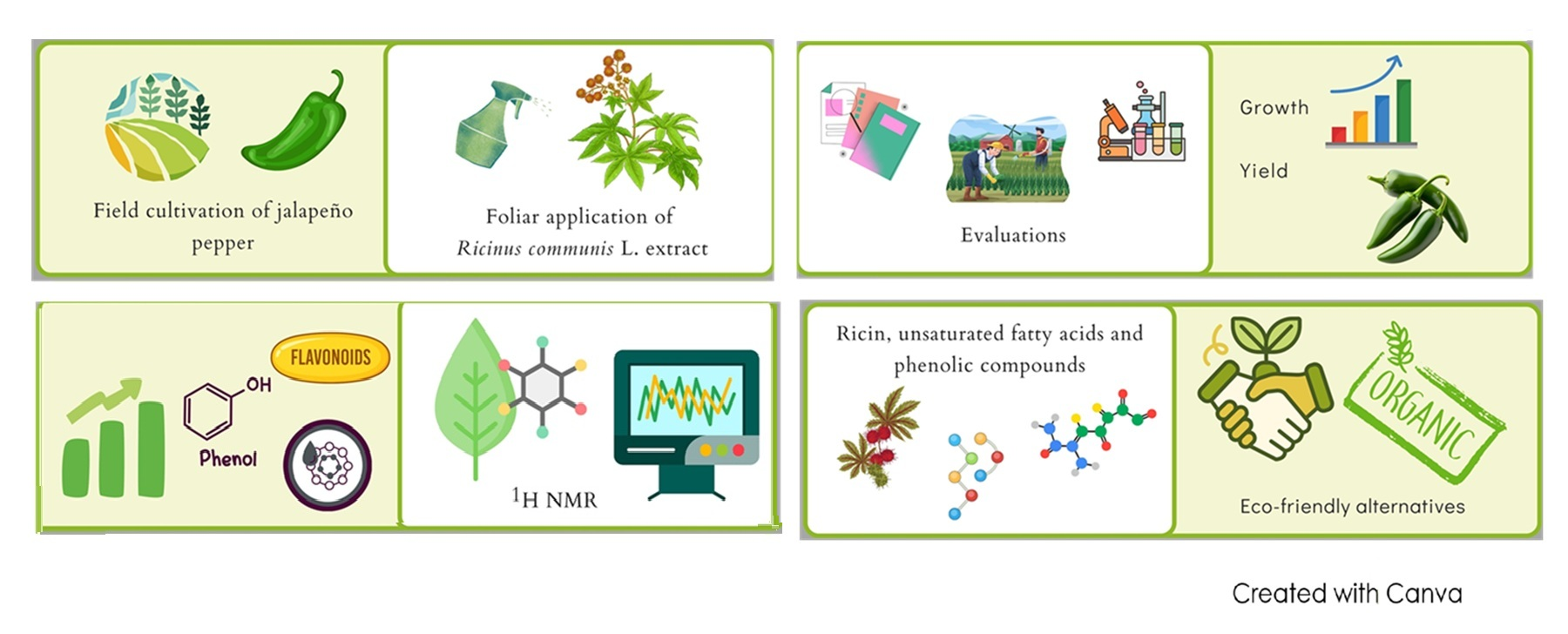


Foliar Application of a Methanolic Extract of Ricinus communis L. Modulates Growth, Yield, Photosynthetic Pigments, and Antioxidant Capacity of Jalapeño Pepper (Capsicum annuum L.) Under Open Field Conditions
 ,
,
Abstract
1. Introduction
2. Materials and Methods
2.1. Study Area and Crop Establishment
2.2. Preparation of Ricinus Communis Leaf Extract
2.3. Biostimulant Application
2.4. Agronomic Variables
2.5. Leaf Sampling
2.6. Measurements of Photosynthetic Pigments
2.7. Extraction of Bioactive Compounds
2.8. Determination of Total Phenols
2.9. Determination of Total Flavonoids
2.10. Determination of Total Antioxidant Capacity by Inhibition of the ABTS Radical
2.11. Determination of Total Antioxidant Capacity by Inhibition of the DPPH Radical
2.12. Preliminary Structural Analysis of Metabolites
2.13. Statistical Analysis
3. Results
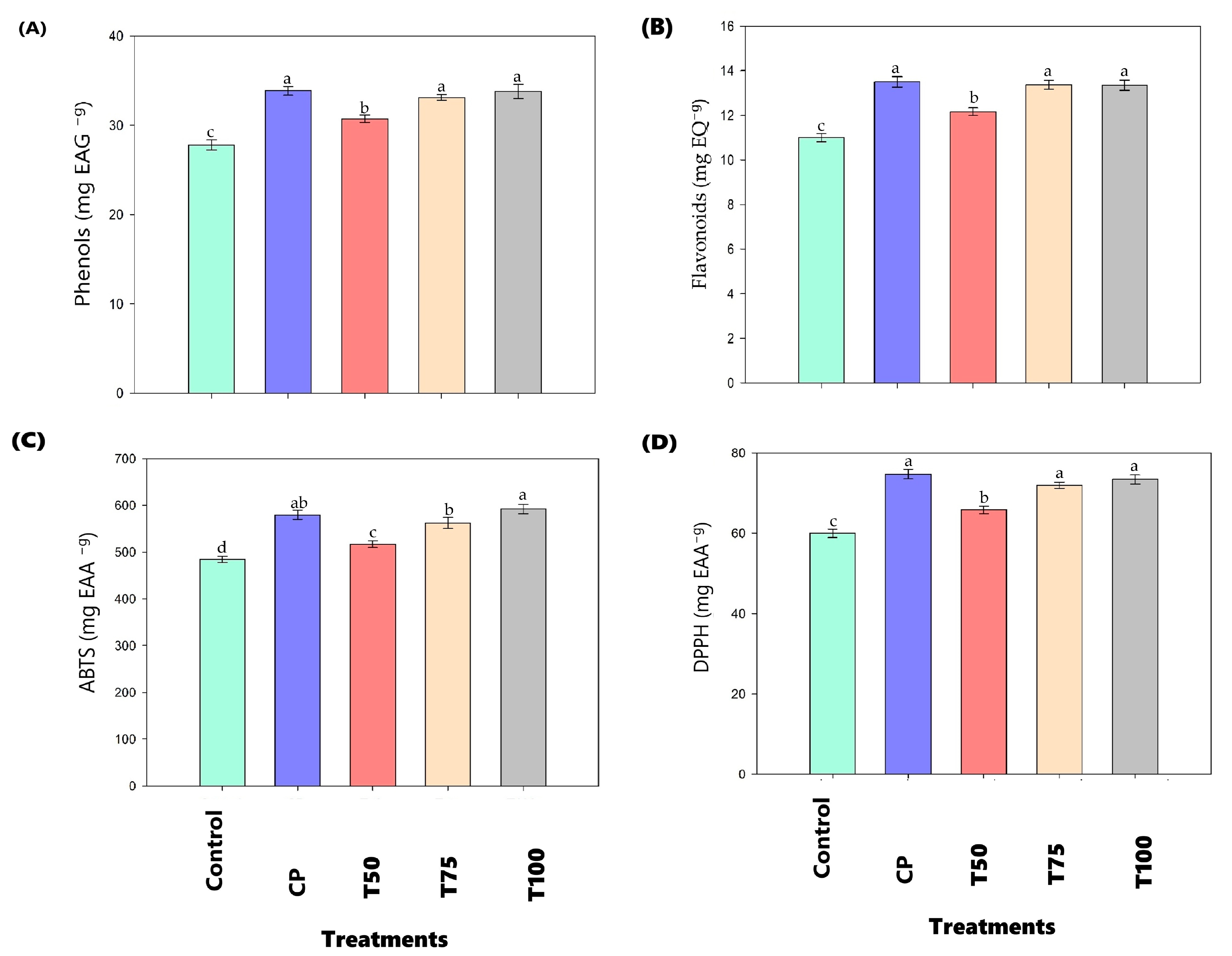
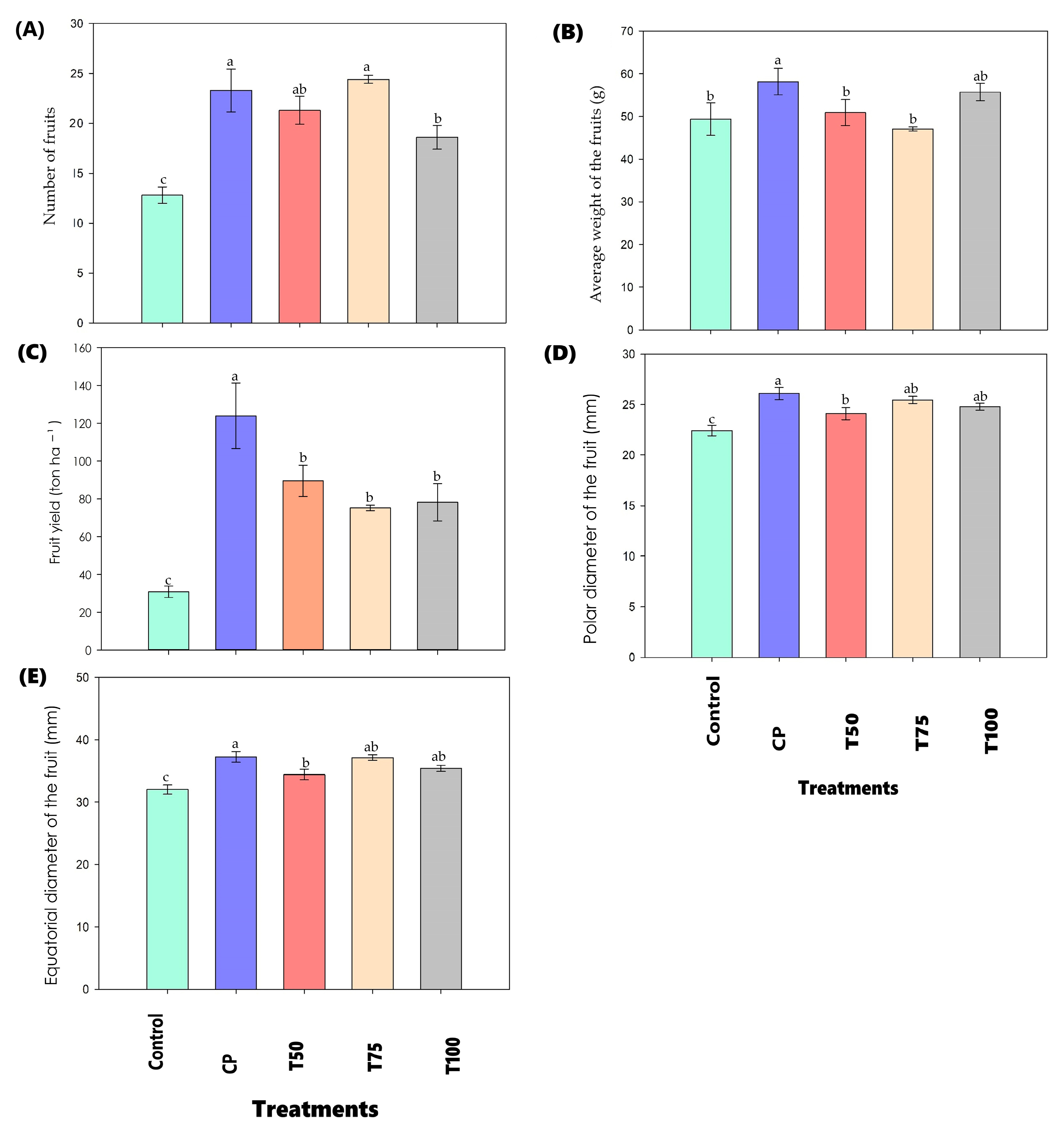
3.1. Agronomic and Biochemical Variables
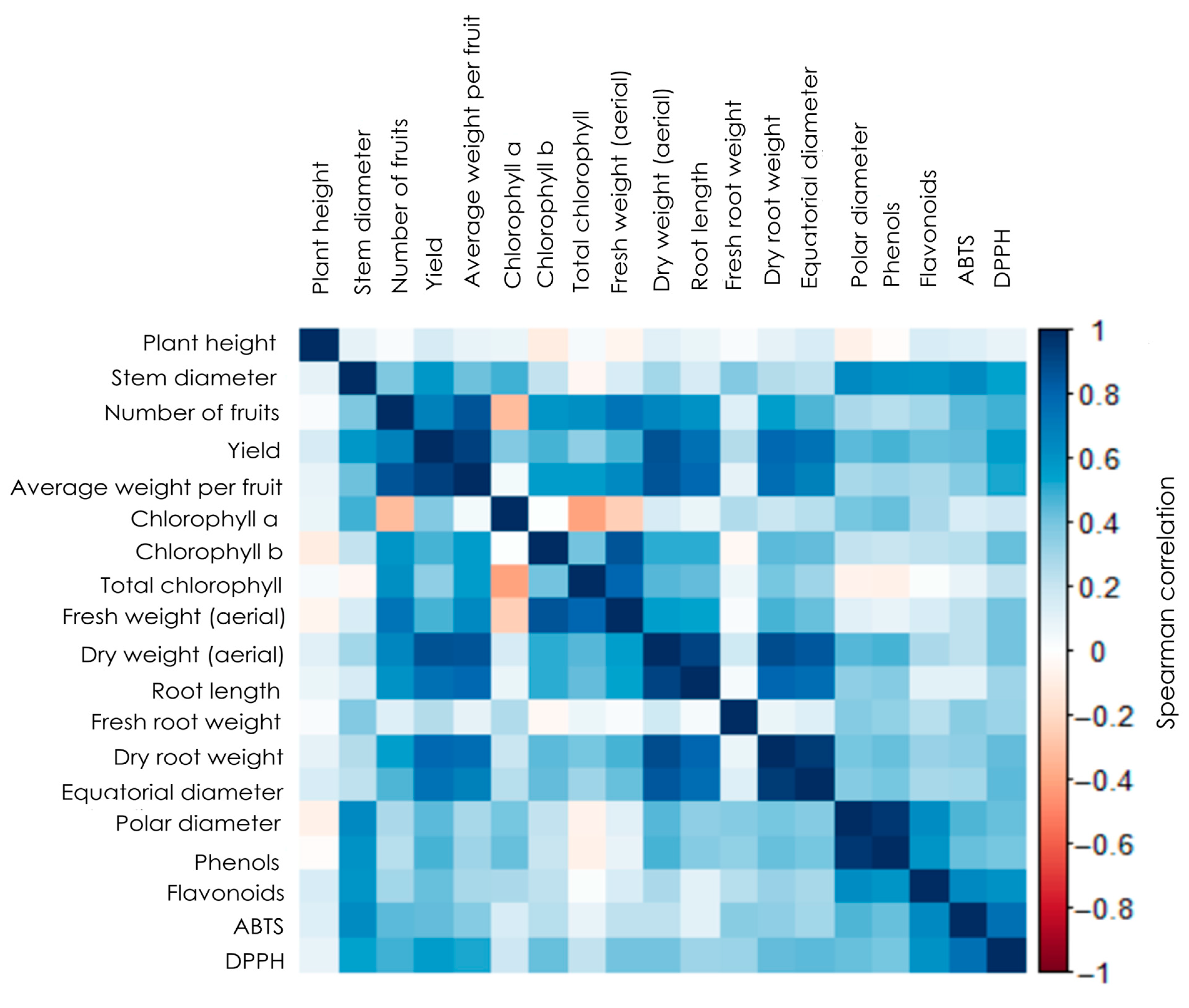
3.2. Correlations Between Agronomic Variables, Bioactive Compounds, and Antioxidant Activity
3.3. Preliminary Structural Analysis of Metabolites
4. Discussion
5. Conclusions
Supplementary Materials
Author Contributions
Funding
Data Availability Statement
Acknowledgments
Conflicts of Interest
References
- Sánchez-Toledano, B.I.; Camarena-Gómez, D.M.J.; López-Santiago, M.A.; Cuevas-Reyes, V. Consumer preferences of jalapeño pepper in the Mexican market. Horticulturae 2023, 9, 684. [Google Scholar] [CrossRef]
- FAOSTAT. Statistical Data on Crops, Tomatoes, World. FAO Statistics Division. 2025. Available online: http://www.fao.org/faostat/en/#data/QCL (accessed on 20 December 2025).
- Terán-Samaniego, K.; Robles-Parra, J.M.; Vargas-Arispuro, I.; Martínez-Téllez, M.Á.; Garza-Lagler, M.C.; Félix-Gurrlola, D.; Espinoza-López, P.C. Agroecology and sustainable agriculture: Conceptual challenges and opportunities—A systematic literature review. Sustainability 2025, 17, 1805. [Google Scholar] [CrossRef]
- Di Sario, L.; Boeri, P.; Matus, J.T.; Pizzio, G.A. Plant biostimulants to enhance abiotic stress resilience in crops. Int. J. Mol. Sci. 2025, 26, 1129. [Google Scholar] [CrossRef] [PubMed]
- Dasgan, H.Y.; Aksu, K.S.; Zikaria, K.; Gruda, N.S. Biostimulants enhance the nutritional quality of soilless greenhouse tomatoes. Plants 2024, 13, 2587. [Google Scholar] [CrossRef]
- Arinaitwe, U.; Yabwalo, D.N.; Hangamaisho, A. Unlocking the potential of biostimulants: A review of classification, mode of action, formulations, efficacy, mechanisms, and recommendations for sustainable intensification. Int. J. Plant Biol. 2025, 16, 122. [Google Scholar] [CrossRef]
- Lopes, A.M.; Ribeiro, L.K.; Cogo, M.R.D.M.; Frescura, L.M.; da Rosa, M.B.; Schulz, A.; Zabot, G.L. Ricinus communis L. leaf extracts as a sustainable alternative for weed management. Sustainability 2025, 17, 6942. [Google Scholar] [CrossRef]
- Pačuta, V.; Rašovský, M.; Briediková, N.; Lenická, D.; Ducsay, L.; Zapletalová, A. Plant biostimulants as an effective tool for increasing physiological activity and productivity of different sugar beet varieties. Agronomy 2023, 14, 62. [Google Scholar] [CrossRef]
- Tamariz, M.N.B.; Calzada, R.T.; Cohen, I.S.; Hernández, A.F.; Valle, M.A.V.; Sandoval, A.P. Castor seed yield at suboptimal soil moisture: Is it high enough? Int. J. Agric. Nat. Resour. 2019, 46, 253–265. [Google Scholar] [CrossRef]
- Barba-Ostria, C.; Carrera-Pacheco, S.E.; Gonzalez-Pastor, R.; Heredia-Moya, J.; Mayorga-Ramos, A.; Rodríguez-Pólit, C.; Guamán, L.P. Evaluation of biological activity of natural compounds: Current trends and methods. Molecules 2022, 27, 4490. [Google Scholar] [CrossRef]
- Majkowska-Gadomska, J.; Dobrowolski, A.; Jadwisieńczak, K.K.; Kaliniewicz, Z.; Francke, A. Effect of biostimulants on the growth, yield and nutritional value of Capsicum annuum grown in an unheated plastic tunnel. Sci. Rep. 2021, 11, 22335. [Google Scholar] [CrossRef]
- Mezeyová, I.; Kollárová, I.; Golian, M.; Árvay, J.; Mezey, J.; Šlosár, M.; Horečná, T. The effect of humic-based biostimulants on the yield and quality parameters of chili peppers. Horticulturae 2024, 10, 998. [Google Scholar] [CrossRef]
- Golian, M.; Mezeyová, I.; Andrejiová, A.; Hegedűsová, A.; Adamec, S.; Štefániková, J.; Árvay, J. Effects of selected biostimulants on qualitative and quantitative parameters of nine cultivars of the genus Capsicum spp. Open Agric. 2024, 9, 20220266. [Google Scholar] [CrossRef]
- INEGI. Anuario Estadístico y Geográfico del Estado de Hidalgo, México; Instituto Nacional de Estadística y Geografía: Aguascalientes City, Mexico, 2017. [Google Scholar]
- Rojas, S.; Castillejos-Cruz, C.; Solano, E. Florística y relaciones fitogeográficas del matorral xerófilo en el Valle de Tecozautla, Hidalgo, México. Bot. Sci. 2013, 91, 273–294. [Google Scholar] [CrossRef]
- Flores-Velazquez, J.; Ojeda-Bustamante, W.; Lopez-Cruz, I.; Rojano, A.; Salazar, I. Requerimientos de riego para tomate de invernadero. Terra Latinoam. 2007, 25, 127–134. [Google Scholar]
- CONAGUA. Comisión Nacional del Agua, México, 2025. Available online: https://smn.conagua.gob.mx/es/pronostico-del-tiempo-por-municipios (accessed on 18 April 2025).
- Ochoa-Chaparro, E.H.; Ramírez-Estrada, C.A.; Anchondo-Páez, J.C.; Sánchez, E.; Pérez-Álvarez, S.; Castruita-Esparza, L.U.; Franco-Lagos, C.L. Nanopriming with zinc–molybdenum in jalapeño pepper on imbibition, germination, and early growth. Agronomy 2024, 14, 1609. [Google Scholar] [CrossRef]
- Sánchez, E.; Rivero, R.M.; Ruiz, J.M.; Romero, L. Changes in biomass, enzymatic activity and protein concentration in roots and leaves of green bean plants (Phaseolus vulgaris L. cv. Strike) under high NH4NO3 application rates. Sci. Hortic. 2004, 99, 237–248. [Google Scholar] [CrossRef]
- Sasidharan, S.; Chen, Y.; Saravanan, D.; Sundram, K.M.; Latha, L.Y. Extraction, isolation and characterization of bioactive compounds from plants’ extracts. Afr. J. Tradit. Complement. Altern. Med. 2011, 8, 1–10. [Google Scholar] [CrossRef]
- Saddiqe, Z.; Nazir, A.; Sabir, M. Allelopathic effect of Ricinus communis L. extracts on germination and seedling growth of Zea mays L. J. Nat. Appl. Sci. Pak. 2020, 2, 232–243. [Google Scholar]
- Parreno, J.; Cempron, B.; Bucog, N.; Pepito, M.; Zamora, C. Allelopathic potential of castor plant (Ricinus communis L.) aqueous extracts on germination on selected crop species. Int. Res. J. Sci. Technol. 2020, 1, 120–125. [Google Scholar] [CrossRef]
- López-Serrano, L.; Scalschi, L.; Simeón, R.; San Bautista, A.; González-Hernández, A.I. Harnessing the power of biostimulants: A comprehensive review of their role in enhancing agricultural productivity and sustainability. Appl. Sci. 2026, 16, 1924. [Google Scholar] [CrossRef]
- Basílio, S.; Furtado Junior, M.R.; de Alvarenga, C.B.; Vitória, E.L.D.; Vargas, B.C.; Privitera, S.; Manetto, G. Effect of adjuvants on physical–chemical properties, droplet size, and drift reduction potential. Agriculture 2024, 14, 2271. [Google Scholar] [CrossRef]
- Zhao, P.; Zheng, L.; Li, Y.; Wang, C.; Cao, L.; Cao, C.; Huang, Q. Tank-mix adjuvants regulate the deposition, absorption, and permeation behavior of pesticide solutions on rice plant. Agriculture 2022, 12, 1119. [Google Scholar] [CrossRef]
- Song, Y.; Huang, Q.; Huang, G.; Liu, M.; Cao, L.; Li, F.; Cao, C. The effects of adjuvants on the wetting and deposition of insecticide solutions on hydrophobic wheat leaves. Agronomy 2022, 12, 2148. [Google Scholar] [CrossRef]
- Hay, R.K.M.; Porter, J.R. The Physiology of Crop Yield, 2nd ed.; Blackwell Publishing: Hoboken, NJ, USA, 2006; Volume 100, pp. 889–891. [Google Scholar]
- González-Lemus, U.; Tapia-Zayago, F.A.; Pérez-Ríos, S.R.; Zaldívar-Ortega, A.K.; Rueda-Puente, E.O.; Hernández-Pérez, A.; Hernández-Soto, I. Lentil biorooting agents: An ecological alternative to improve the growth and development of Italian zucchini. Horticulturae 2025, 11, 332. [Google Scholar] [CrossRef]
- Sánchez-Granados, N.T.; Pérez-Ríos, S.R.; González-García, Y.; Fernández-Luqueño, F.; Aquino-Torres, E.; Saucedo-García, M.; Hernández-Soto, I. Impacts of foliar application of Se and TiO2 nanoparticles on growth and flowering in Lilium Sunny Oriental. Int. J. Plant Biol. 2025, 16, 103. [Google Scholar] [CrossRef]
- Tapia-Zayago, F.A.; Cenobio-Galindo, M.F.; Ocampo-López, J.; Aquino-Torres, E.; Velázquez-Jiménez, R.; Soto, I.H. Aprovechamiento agroecológico de residuos vegetales: Bioestimulación en tomate de cáscara. Boletín Cienc. Agropecu. ICAP 2025, 12, 9–15. [Google Scholar] [CrossRef]
- Hernández-Soto, I.; González-García, Y.; Juárez-Maldonado, A.; Hernández-Fuentes, A.D. Impact of Argemone mexicana L. on tomato plants infected with Phytophthora infestans. PeerJ 2024, 12, e16666. [Google Scholar] [CrossRef]
- Nagata, M.; Yamashita, I. Simple method for simultaneous determination of chlorophyll and carotenoids in tomato fruit. Nippon. Shokuhin Kogyo Gakkaishi 1992, 39, 925–928. [Google Scholar] [CrossRef]
- Vargas-Ortiz, M.; Servent, A.; Rodríguez-Jimenes, G.; Pallet, D.; Salgado-Cervantes, M.E. Effect of thermal stage in processing avocado by flash vacuum expansion: Antioxidant capacity and quality. J. Food Process. Preserv. 2017, 41, e13118. [Google Scholar] [CrossRef]
- Cenobio-Galindo, A.D.J.; Ocampo-López, J.; Reyes-Munguía, A.; Carrillo-Inungaray, M.L.; Cawood, M.; Medina-Pérez, G.; Campos-Montiel, R.G. Influence of bioactive compounds incorporated in a nanoemulsion as coating on avocado during postharvest storage. Antioxidants 2019, 8, 500. [Google Scholar] [CrossRef]
- Villa-Rodríguez, J.A.; Molina-Corral, F.J.; Ayala-Zavala, J.F.; Olivas, G.I.; González-Aguilar, G.A. Effect of maturity stage on fatty acids and antioxidant activity of Hass avocado. Food Res. Int. 2011, 44, 1231–1237. [Google Scholar] [CrossRef]
- Hernández-Pérez, A.; Hernández-Fuentes, A.D.; Jiménez, R.V. Estudio fitoquímico del extracto de acetato de etilo de Haplopappus venetus. Boletín Cienc. Agropecu. ICAP 2025, 11, 13–17. [Google Scholar] [CrossRef]
- Shafi, M.E.; Alsabi, H.A.; Almasoudi, S.H.; Mufti, F.A.; Alowaidi, S.A.; Alaswad, A.A. Catalytic conversion of Jatropha curcas oil to biodiesel. Inorganics 2024, 12, 109. [Google Scholar] [CrossRef]
- Carvalho, F.; Lahlou, R.A.; Silva, L.R. Exploring bioactive compounds from fruit and vegetable by-products with potential for food and nutraceutical applications. Foods 2025, 14, 3884. [Google Scholar] [CrossRef] [PubMed]
- Zhang, L.; He, L.L.; Fu, Q.T.; Xu, Z.F. Selection of reliable reference genes for Jatropha curcas using RT-qPCR. Int. J. Mol. Sci. 2013, 14, 24338–24354. [Google Scholar] [CrossRef] [PubMed]
- Wu, Q.; Zheng, D.; Lian, N.; Zhu, X.; Wu, J. Hormonal regulation and stimulation response of Jatropha curcas L. homolog overexpression. Int. J. Mol. Sci. 2023, 24, 13183. [Google Scholar] [CrossRef]
- Yakhin, O.I.; Lubyanov, A.A.; Yakhin, I.A.; Brown, P.H. Biostimulants in plant science: A global perspective. Front. Plant Sci. 2017, 7, 2049. [Google Scholar] [CrossRef]
- Abdel Latef, A.A.H.; Hameed, M.; Khan, Z.; Khan, S.; Imran, A.; Fatima, N. Foliar stimulants: A sustainable strategy for enhancing plant resilience to abiotic and biotic stresses. Physiol. Plant. 2026, 178, e70741. [Google Scholar] [CrossRef] [PubMed]
- Jiang, H.; Fang, L.; Li, J.; Zhai, X.; Tan, J.; Yang, L.; Luan, T. Photosystem-driven resilience of green microalga Tetraselmis chuii toward acute nonylphenol stress. Environ. Sci. Technol. 2026, 60. [Google Scholar] [CrossRef]
- Sales, C.R.; Molero, G.; Evans, J.R.; Taylor, S.H.; Joynson, R.; Furbank, R.T.; Carmo-Silva, E. Phenotypic variation in photosynthetic traits in wheat grown under field versus glasshouse conditions. J. Exp. Bot. 2022, 73, 3221–3237. [Google Scholar] [CrossRef]
- Ali, S.; Akhtar, M.S.; Siraj, M.; Zaman, W. Molecular communication of microbial plant biostimulants in the rhizosphere under abiotic stress. Int. J. Mol. Sci. 2024, 25, 12424. [Google Scholar] [CrossRef]
- Mthiyane, P.; Aycan, M.; Mitsui, T. Integrating biofertilizers with organic fertilizers enhances photosynthetic efficiency in rice. Sustainability 2024, 16, 9297. [Google Scholar] [CrossRef]
- Ullah, H.; Dacrema, M.; Buccato, D.G.; Fayed, M.A.; De Lellis, L.F.; Morone, M.V.; Morone, C.; Daglia, M. Plant extracts for metabolic syndrome: Efficacy, safety, and advances. Nutrients 2025, 17, 877. [Google Scholar] [CrossRef]
- Guo, X.; An, X.; Wang, D. Effects of stoichiometric ratio fertilization on photosynthesis and fruit quality of blueberry. BMC Plant Biol. 2025, 25, 334. [Google Scholar] [CrossRef]
- Márquez-Mendoza, J.G.; García-Sánchez, R.; Hernández-Piñón, E.; López-Medina, J. La biofertilización aumenta el tamaño de fruto y calidad del chile jalapeño. Trop. Subtrop. Agroecosyst. 2025, 28, 35–44. [Google Scholar] [CrossRef]
- Adame-García, J.; Martínez-González, A.; Ramírez-Luna, M. Efecto de bioestimulantes microbianos en plántulas y frutos de chile jalapeño (Capsicum anuum L.) producidos en macrotúnel.: Bioestimulantes en chile jalapeño. Rev. Bio Cienc. 2024, 11, 1–18. [Google Scholar] [CrossRef]
- Veeramani, P.; Subrahmaniyan, K.; Harisudan, C.; Vijayan, R.; Saravanan, P.A.; Velmurugan, M.; Ravichandran, V. Exploring the medicinal potential of castor. Ann. Phytomed. 2024, 13, 199–205. [Google Scholar] [CrossRef]
- Ramothloa, T.P.; Mkolo, N.M.; Motshudi, M.C.; Mphephu, M.M.; Makhafola, M.A.; Naidoo, C.M. Phytochemical composition and multifunctional applications of Ricinus communis. Molecules 2025, 30, 3214. [Google Scholar] [CrossRef]
- Nour, I.H.; Alhadead, K.; Ellmouni, F.Y.; Badr, R.; Saad, T.I.; El-Banhawy, A.; Abdel Rahman, S.M. Morphological, anatomical and chemical characterization of Ricinus communis. Agronomy 2023, 13, 985. [Google Scholar] [CrossRef]
- Yeboah, A.; Ying, S.; Lu, J.; Xie, Y.; Amoanimaa-Dede, H.; Boateng, K.G.A.; Yin, X. Castor oil: Chemical composition and physicochemical properties. Food Sci. Technol. 2020, 41, 399–413. [Google Scholar] [CrossRef]
- Abomughaid, M.M.; Teibo, J.O.; Akinfe, O.A.; Adewolu, A.M.; Teibo, T.K.A.; Afifi, M.; Batiha, G.E.S. A phytochemical and pharmacological review of Ricinus communis. Discov. Appl. Sci. 2024, 6, 315. [Google Scholar] [CrossRef]
- Rodríguez-Cervantes, M.; Zavala-Gómez, C.E.; Hernández-Caracheo, K.; Campos-Guillén, J.; Rodríguez-de León, E.; Amaro-Reyes, A.; Ramos-López, M.A. Activity of Ricinus communis extracts against Spodoptera frugiperda. Appl. Sci. 2024, 14, 3128. [Google Scholar] [CrossRef]
- Sotelo-Leyva, C.; Salinas-Sánchez, D.O.; Peña-Chora, G.; Trejo-Loyo, A.G.; González-Cortázar, M.; Zamilpa, A. Insecticidal compounds in Ricinus communis to control Melanaphis sacchari. Fla. Entomol. 2020, 103, 91–95. [Google Scholar] [CrossRef]
- Mamy, A.; Fabrice, R.D.J.E.; Ruphin, F.P.; Baholy, R.R. Phytochemical study and structural determination of isolated product of Ricinus communis. Br. Int. Exact Sci. J. 2025, 7, 182–197. [Google Scholar] [CrossRef]
- Anifowose, S.O.; Salih, A.M.; Oladejo, M.K.; Rady, A.; Al Mosallam, M.S.; Aljohi, H.A.; Al-Dahmash, B.A. Bioactivity-guided fractionation and mechanistic insights into Aristolochia ringens root extract-induced apoptosis. Pharmaceuticals 2025, 18, 1250. [Google Scholar] [CrossRef]
- Han, M.; Kasim, S.; Yang, Z.; Deng, X.; Saidi, N.; Uddin, M.; Shuib, E. Plant extracts as biostimulant agents: A promising strategy for managing environmental stress in sustainable agriculture. Phyton 2024, 93, 2149–2166. [Google Scholar] [CrossRef]
- Espinosa-Antón, A.A.; Hernández-Herrera, R.M.; Pizano-Andrade, J.C.; Salcedo-Perez, E. Botanical extracts with biostimulant potential for agriculture in Mexico: A review. Biotecnia 2025, 27, e2633. [Google Scholar] [CrossRef]
- Godlewska, K.; Ronga, D.; Michalak, I. Plant extracts—Importance in sustainable agriculture. Ital. J. Agron. 2021, 16, 1851. [Google Scholar] [CrossRef]





| δ (ppm)/Range | Multiplicity | Proton Type/Chemical Environment | Tentative Assignment | Metabolite Class | Fraction(s) Where Observed |
|---|---|---|---|---|---|
| 0.7–1.0 | m | Terminal –CH3 of long aliphatic chains | Terminal methyl groups of fatty acids | Fatty acids (saturated/unsaturated) | F2, F6–10, F11–14 |
| 1.0–1.5 | m | –(CH2)n– of aliphatic chains | Acyl chain methylenes | Fatty acids, terpenoids | F2, F3–5, F6–10, F11–14 |
| 1.8–2.3 | m | CH2 adjacent to unsaturation (–CH2–CH=CH–) | Allylic methylenes | Unsaturated fatty acids | F2, F11–14 |
| 2.5–3.0 | m | CH2 adjacent to electronegative groups (–CH2–O–/–CH2–N–) | Functionalized side chains | Modified fatty acids/phenolics | F2, F3–5, F6–10 |
| 3.0–3.5 | m | Oxygenated CH and CH2 (–CHOH–, –CH2–O–) | Sugar and polyol protons | Sugars/carbohydrates | MeOH fraction |
| 3.5–4.1 | s, m | –OCH3 (methoxyl groups), oxygenated CH | Methoxyl groups of aromatic compounds | Methoxylated phenolics/flavonoids | F3–5, F6–10, F15–17, F18–22 |
| 3.55 | s | –OCH3 | Methoxyl group on pyridinic ring | Ricinine | Crystals (acetone) |
| 3.99 | s | –OCH3 | Segundo grupo metoxilo | Ricinine | Crystals (acetone) |
| 4.0–5.5 | m | Anomeric and vinylic protons (sugars/double bonds) | Anomeric sugar protons and olefinic H | Sugars, unsaturated fatty acids | F2, F3–5, F6–10, MeOH |
| 5.0–5.5 | m | –CH=CH– | Olefinic protons | Unsaturated fatty acids, terpenoids | F2, F3–5, F6–10, F11–14 |
| 6.0–7.0 | m | Substituted aromatic protons | Aromatic nuclei of phenolics and flavonoids | Phenolic compounds | F3–5, F6–10, F11–14, F15–17, F18–22 |
| 6.06 | d (J ~7–10 Hz) | Vinylic/aromatic proton in conjugated system | Heteroaromatic proton of ricinine | Ricinine | Crystals (acetone) |
| 7.0–8.0 | m | Aromatic protons (benzenoid and heteroaromatic rings) | Phenolics, flavonoids, aromatic alkaloids | Phenolics, flavonoids, ricinine | F3–5, F6–10, F11–14, F15–17, F18–22 |
| 7.51 | d (J ~7–10 Hz) | Aromatic proton in pyridinic ring | Aromatic proton of ricinine | Ricine | Crystals (acetone) |
| 8.0–8.5 | m | Aromatic protons | Highly conjugated phenolics/heteroaromatics | Phenolics, alkaloids | F15–17, F18–22, MeOH |
Disclaimer/Publisher’s Note: The statements, opinions and data contained in all publications are solely those of the individual author(s) and contributor(s) and not of MDPI and/or the editor(s). MDPI and/or the editor(s) disclaim responsibility for any injury to people or property resulting from any ideas, methods, instructions or products referred to in the content. |
© 2026 by the authors. Licensee MDPI, Basel, Switzerland. This article is an open access article distributed under the terms and conditions of the Creative Commons Attribution (CC BY) license.
Share and Cite
Reyes-Santamaria, M.I.; Chávez-Trejo, D.; Hernández-Pérez, A.; Velázquez-Jiménez, R.; Aquino-Torres, E.; Khan, A.; Cenobio-Galindo, A.d.J.; Vicente-Flores, M.; Hernández-Soto, I. Foliar Application of a Methanolic Extract of Ricinus communis L. Modulates Growth, Yield, Photosynthetic Pigments, and Antioxidant Capacity of Jalapeño Pepper (Capsicum annuum L.) Under Open Field Conditions. Int. J. Plant Biol. 2026, 17, 37. https://doi.org/10.3390/ijpb17050037
Reyes-Santamaria MI, Chávez-Trejo D, Hernández-Pérez A, Velázquez-Jiménez R, Aquino-Torres E, Khan A, Cenobio-Galindo AdJ, Vicente-Flores M, Hernández-Soto I. Foliar Application of a Methanolic Extract of Ricinus communis L. Modulates Growth, Yield, Photosynthetic Pigments, and Antioxidant Capacity of Jalapeño Pepper (Capsicum annuum L.) Under Open Field Conditions. International Journal of Plant Biology. 2026; 17(5):37. https://doi.org/10.3390/ijpb17050037
Chicago/Turabian StyleReyes-Santamaria, Ma Isabel, David Chávez-Trejo, Aracely Hernández-Pérez, René Velázquez-Jiménez, Eliazar Aquino-Torres, Amanulla Khan, Antonio de Jesus Cenobio-Galindo, Macario Vicente-Flores, and Iridiam Hernández-Soto. 2026. "Foliar Application of a Methanolic Extract of Ricinus communis L. Modulates Growth, Yield, Photosynthetic Pigments, and Antioxidant Capacity of Jalapeño Pepper (Capsicum annuum L.) Under Open Field Conditions" International Journal of Plant Biology 17, no. 5: 37. https://doi.org/10.3390/ijpb17050037
APA StyleReyes-Santamaria, M. I., Chávez-Trejo, D., Hernández-Pérez, A., Velázquez-Jiménez, R., Aquino-Torres, E., Khan, A., Cenobio-Galindo, A. d. J., Vicente-Flores, M., & Hernández-Soto, I. (2026). Foliar Application of a Methanolic Extract of Ricinus communis L. Modulates Growth, Yield, Photosynthetic Pigments, and Antioxidant Capacity of Jalapeño Pepper (Capsicum annuum L.) Under Open Field Conditions. International Journal of Plant Biology, 17(5), 37. https://doi.org/10.3390/ijpb17050037