Article

Diversity of Coffea canephora Genotypes from the Robusta and Conilon Botanical Groups at the Seedling Stage


by
Pablo Santana Vial
,
Niquisse José Alberto
,
Emanoel Chequetto
,
Wellington Castrillon Grélla
,
Laís da Silva Magevski
,
Militino Paiva Carrafa
,
Edilson Romais Schmildt
,
Deurimar Herênio Gonçalves Júnior
* and
Fábio Luiz Partelli
*
Graduate Program in Tropical Agriculture, Federal University of Espírito Santo, São Mateus 29932-540, ES, Brazil
*
Authors to whom correspondence should be addressed.
Int. J. Plant Biol. 2026, 17(4), 34; https://doi.org/10.3390/ijpb17040034
Submission received: 26 February 2026 / Revised: 9 April 2026 / Accepted: 15 April 2026 / Published: 21 April 2026
(This article belongs to the Section Plant Reproduction)

Abstract

This study evaluated the morphological development of 23 Coffea canephora clones in Espírito Santo to identify materials with superior vigor and quality for commercial and breeding purposes. Seedlings from cuttings were arranged in a completely randomized design with ten replicates and assessed at the commercial dispatch stage. Shoot and root growth, biomass, leaf area (LA), Dickson Quality Index (DQI), structural ratios (shoot/root ratio, SRR; height/diameter ratio, HDR), and anatomical traits were measured. Data were analyzed using analysis of variance with Scott–Knott clustering, Pearson correlation, and Principal Component Analysis (PCA). Significant variability was observed among clones. Clones 88, VR3, 8, and LB33 showed the highest stem diameter (SD), total dry mass (TDM), LA, and DQI, with balanced shoot and root development. Leaf area correlated strongly with SD, number of leaves (NL), biomass, and DQI, confirming its role as a seedling quality indicator. PCA identified two groups: a high-performance group with greater vigor and biomass, and a lower-performance group including clones 7, MR04, and VR4. The convergence of methods confirms the robustness of the results. Overall, clones 88, VR3, 8, and LB33 demonstrate superior agronomic potential at the seedling stage, offering promising options for nurseries, growers, and clonal selection programs.

1. Introduction

Coffee cultivation holds substantial economic and social relevance in Brazil, consolidating the country as the world’s largest coffee producer, with output exceeding 56 million processed bags [1]. In this context, Coffea canephora Pierre ex Froehner has assumed a strategic role, particularly in tropical regions such as the state of Espírito Santo, the leading national producer, where a large proportion of Conilon coffee production is concentrated, underscoring its importance for the sustainability of the production chain [2,3].
From a biological standpoint, C. canephora exhibits an allogamous reproductive system due to gametophytic self-incompatibility, which promotes high genetic variability among individuals [4,5]. Although these characteristics limit seed-based propagation with maintenance of desirable traits, it favors the exploitation of genetic variability in breeding programs. In this regard, vegetative propagation by cuttings has been widely adopted, enabling the fixation of superior genotypes and the establishment of more homogeneous plantations with enhanced productivity, uniformity, and adaptation to diverse edaphoclimatic conditions [6].
The high genetic diversity of C. canephora, including the botanical varieties Conilon and Robusta, results in broad variation in morphological, physiological, and agronomic attributes, such as vegetative growth, resource-use efficiency, stress tolerance, and yield potential [7,8]. This variability constitutes the foundation for the selection of superior clones and is essential for the advancement of genetic improvement and the adaptation of the crop to diverse environmental conditions.
In this context, the seedling production stage represents a critical phase for plantation establishment, as seedling quality directly influences early performance, survival, and yield potential under field conditions. The evaluation of morphophysiological attributes, such as stem diameter, leaf number, leaf area, biomass accumulation, and root system development, enables the inference of vegetative vigor and establishment capacity [9,10]. Among these indicators, the Dickson Quality Index (DQI) stands out for integrating multiple growth traits and is widely employed as a robust parameter for assessing seedling quality [11].
The Dickson Quality Index and associated morphological indicators have been validated as predictors of post-transplant performance across a range of woody and semi-perennial species. In Eucalyptus seedlings, stem diameter and shoot-to-root ratio were among the strongest discriminators of field survival and early growth [12]. Studies with native tree species have similarly demonstrated that DQI integrates biomass allocation patterns in ways that simple height or diameter measurements fail to capture individually [13]. In fruit crops, leaf area has emerged as a particularly informative non-destructive proxy for overall seedling vigor, given its direct relationship with photosynthetic capacity and carbon assimilation [14]. Taken together, these findings support the use of an integrated, multivariate approach to seedling characterization, the framework adopted in the present study for Coffea canephora.
Beyond morphological attributes, early seedling performance is closely associated with the physiological and nutritional efficiency of genotypes, reflected in their capacity for nutrient uptake, allocation, and utilization, as well as biomass production and leaf area expansion. Studies have demonstrated that genetic variability in C. canephora significantly influences nutritional efficiency and plant growth patterns, highlighting the existence of genotypes with superior resource acquisition and use efficiency [10]. Thus, the integration of vegetative growth and physiological efficiency is a key determinant of seedling vigor and quality.
Additionally, the application of multivariate statistical approaches, such as correlation analysis and Principal Component Analysis (PCA), has proven effective in identifying physiological patterns and discriminating superior genotypes, enabling a comprehensive understanding of the interrelationships among structural traits, biomass accumulation, and plant quality [8,10]. These tools allow for more precise selection of promising materials by simultaneously considering multiple agronomic attributes of interest.
Given the increasing adoption of C. canephora clones and the demand for more productive materials adapted to the edaphoclimatic conditions of Espírito Santo, a thorough characterization of early seedling development is essential, encompassing morphoanatomical attributes, physiological traits, and integrated quality indicators. Accordingly, the present study aimed to evaluate the performance of 23 C. canephora genotypes based on growth variables, biomass production, structural relationships, and seedling quality, with the objective of identifying superior clones for commercial use and breeding programs.

2. Materials and Methods

2.1. Experimental Area

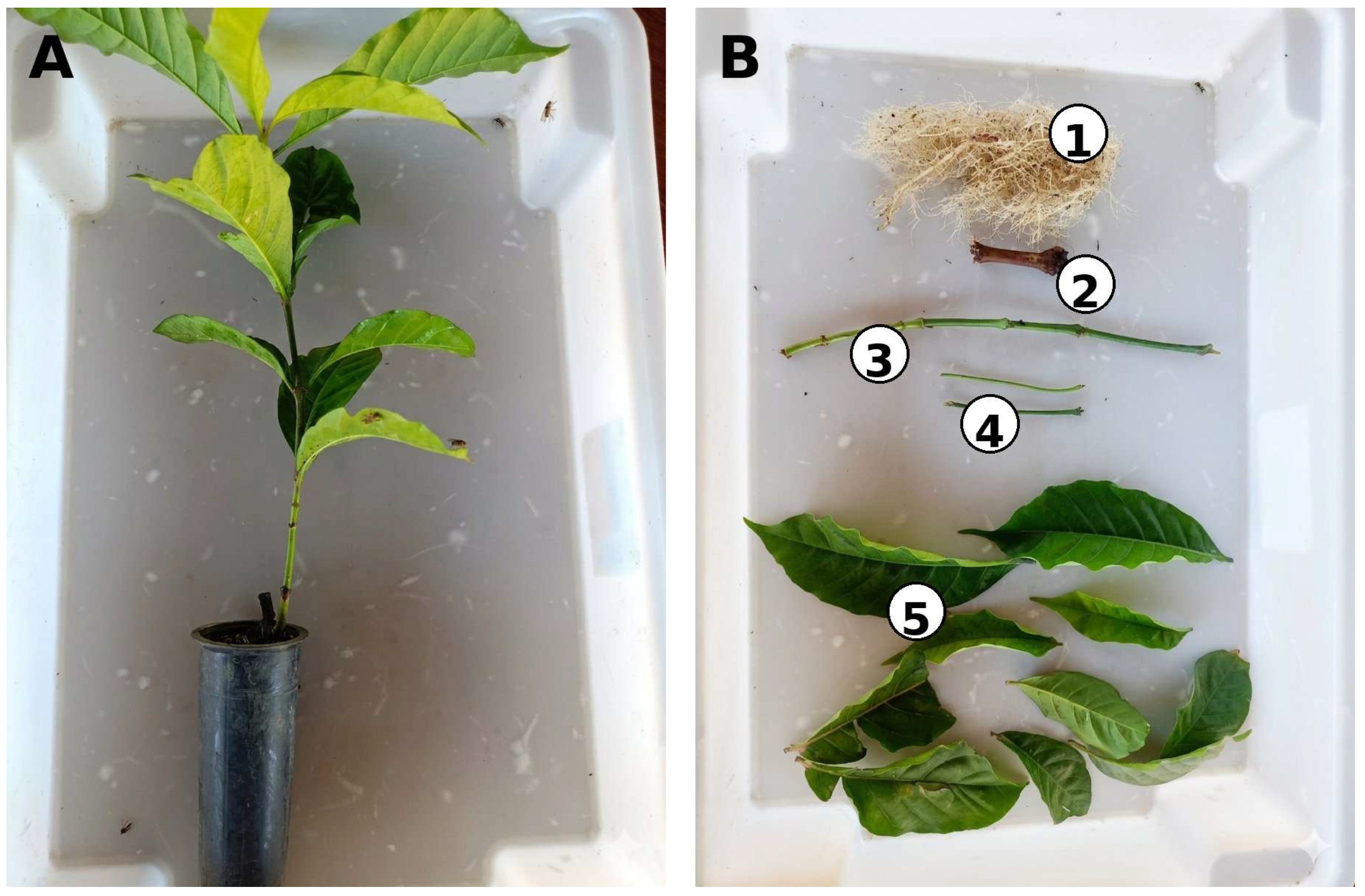
The experiment was conducted at Demuner Viveiro (Estr. São Dalmácio; 19.712168° S, 40.703197° W), located in the municipality of São Roque do Canaã, state of Espírito Santo, Brazil, at an altitude of 108 m and with a mean annual temperature of 24 °C [15]. C. canephora (Robusta coffee) seedlings were evaluated from 23 genotypes selected based on recommendations from local nurseries and growers, representing the most demanded genotypes in the region. The seedlings were dispatched at the stage recommended by specific technical guidelines (Figure 1).

2.2. Plant Material

The plant material used in the experiment consisted of 23 Coffea canephora clones, identified as: VR3, 88, LB33, 25, 8, 41, RMD, G8, G40, MR04, G20, 102, R22, LB80, 3, 65, VR4, RG2, R110, AS2, 7, 6, and LB15_10. These clones were selected based on recommendations from nursery operators and regional growers’ demand. Seedlings were collected at the dispatch stage and propagated by cuttings, as illustrated in Figure 1A,B. These clones represent materials from both botanical varieties of Coffea canephora, Conilon and Robusta, as well as genotypes of hybrid origin resulting from natural cross-pollination between these groups, which is expected given the strictly allogamous reproductive system of the species, imposed by gametophytic self-incompatibility [4,5]. No controlled crosses were performed in the production of the evaluated material.

2.3. Experimental Design

A completely randomized design was adopted, with ten replications arranged in rows. Each genotype constituted a treatment, and each experimental unit consisted of one seedling. Seedlings were propagated by cuttings and produced in black polyethylene tubes (290 mL) with drainage holes at the bottom. The substrate consisted of coconut fiber-based growing medium.

2.4. Evaluation of Morphoanatomical Attributes and Dickson Quality Index

Morphoanatomical attributes of C. canephora seedlings were evaluated at 210 days after planting the cuttings (DAPC), when seedlings exhibited four to five pairs of leaves. Measurements were performed at the Centro Universitário Norte do Espírito Santo (CEUNES–UFES), located in the municipality of São Mateus, ES. Shoot and root growth and development, dry matter production, and the Dickson Quality Index (DQI) were assessed.
For shoot and root growth and development, the following variables were measured: number of roots (NR), cutting length (CL), number of orthotropic shoots (NOS), number of plagiotropic shoots (NPS), number of leaves (NL), and leaf area (LA). Leaf area was determined using a graduated ruler based on the formula:
L A = 0.2027 × C N C 2.1336
where CNC corresponds to the length of the central leaf vein [9,16].
Cutting length and orthotropic shoot length were measured with a graduated ruler, whereas the diameter of the orthotropic shoot was measured at the second internode using a digital caliper (MTX Tool, model 150 mm, Moscow, Russia). Dry matter production was determined by separating plant organs (leaves, stem, and roots), which were dried at 60 °C in a forced-air circulation oven (Sheldon Manufacturing Inc., model SHEL LAB SMO14-2, Cornelius, OR, USA) for five days and subsequently weighed on a precision balance (BEL Engineering, model M214AIH, Monza, Italy). Total dry matter (TDM) was obtained by summing the dry masses of leaves (LDM), plagiotropic shoots (PSD), orthotropic shoots (OSD), roots (RDM), cuttings (CDM), and shoot dry matter (SDM).
The Dickson Quality Index (DQI) was calculated using the formula:
D Q I = T D M S H S D + S D M R D M
where CL and CD correspond, respectively, to cutting length and cutting diameter [9,11]. Additionally, the shoot-to-root ratio (SRR) and the height-to-diameter ratio (HDR) of the seedlings were determined.

2.5. Statistical Analysis

The collected data were subjected to analysis of variance (ANOVA), followed by the Scott–Knott test at the 5% significance level for mean comparison. To investigate multivariate patterns among variables, Principal Component Analysis (PCA) was performed. In addition, Pearson’s correlation analysis was conducted among the evaluated attributes. All statistical analyses were carried out using the R software [17], version 4.5.2, through the RStudio interface (RStudio 2026.01.1+403 “Apple Blossom”; Posit, PBC, Boston, MA, USA). Prior to ANOVA, normality of residuals and homogeneity of variances were verified using the Shapiro–Wilk and Bartlett tests, respectively, at 5% significance. In cases of moderate deviation from these assumptions, the robustness of the F-test was supported by the balanced structure of the completely randomized design, with 207 residual degrees of freedom, which confers stability to the ANOVA results under such conditions [18]. Pearson correlation coefficients reported in this study reflect phenotypic associations among seedling traits across clones, consistent with the nursery-stage selection objectives of the study.

3. Results

3.1. Trait Variation Among Clones

The results obtained from the statistical analysis using the Scott–Knott test revealed significant differences among the studied clones for the vegetative growth and development variables: stem diameter (SD), number of plagiotropic shoots (NPS), number of orthotropic shoots (NOS), total number of roots (NR), number of leaves (NL), and plant height (PH) (Table 1).
For SD, the superior group comprised clones 88, RMD, 8, VR3, LB15_10, G40, 25, R110, R22, 3, and 65, with values ranging from 4.942 to 5.705 mm. The inferior group included clones G20, 6, VR4, AS2, 102, LB80, 41, RG2, MR04, and 7, with values between 3.796 and 4.629 mm.
For NPS, the superior group consisted of clones 8, 25, 65, G8, 3, LB15_10, LB33, R110, RMD, AS2, and VR3, with values ranging from 1.600 to 2.889 plagiotropic shoots. The inferior group included clones 88, LB80, G40, G20, VR4, RG2, MR04, 102, 6, R22, 41, and 7, with values between 0.300 and 1.400. This variable is essential for assessing the capacity to form productive branches.
For NOS, the superior group was composed of clones G8, R22, G20, 102, RMD, AS2, LB80, and 41, with values ranging from 1.2 to 1.5. The inferior group included clones 25, 3, 88, 6, 7, 8, 65, LB15_10, LB33, R110, VR3, G40, VR4, RG2, and MR04, with values between 1.0 and 1.1. Despite the limited variation observed, NOS reflects the structural capacity of the plant for support and development.
For NR, the superior group consisted exclusively of clone G40, with 11.6 roots. The secondary group included R110, R22, LB33, 8, VR3, 102, 65, 41, G8, VR4, and 6, with values ranging from 6.7 to 9.1. The tertiary group comprised clones LB15_10, LB80, G20, 88, MR04, 25, RMD, and 7, with values between 4.9 and 6.3. Finally, the quaternary group included RG2, AS2, and 3, with values ranging from 3.1 to 4.6. This variable indicates root system development, which is essential for nutrient uptake.
For NL, the superior group comprised clones G8, RMD, 25, and 65, with values between 14.2 and 15.6 leaves. The secondary group included clones 8, 3, AS2, LB33, and VR3, with values ranging from 11.6 to 12.89. The tertiary group consisted of clones 41, 88, LB80, R22, R110, G40, and G20, with values between 9.9 and 11.1. The quaternary group included clones LB15_10, 102, RG2, 7, MR04, 6, and VR4, with values ranging from 7.2 to 9.0. This attribute reflects vegetative vigor.
For PH, the superior group was formed by clones 25, VR3, 65, and RMD, with values ranging from 26.800 to 28.160 cm. The secondary group included clones LB33, 88, 41, G8, 8, and LB15_10, with values between 21.850 and 23.680 cm. The tertiary group comprised clones 3, 102, G40, AS2, R22, LB80, R110, and RG2, with values ranging from 16.830 to 19.780 cm. The quaternary group consisted of clones 6 and G20, with values between 15.490 and 16.050 cm. The lowest group included clones VR4, MR04, and 7, with values between 11.420 and 13.650 cm. Plant height is an important variable for assessing vegetative growth and yield potential.
The mean values of morphoanatomical attributes and dry matter production for the 23 evaluated Coffea canephora clones are presented in Table 2. For root dry matter (RDM), clones VR3, 88, and LB33 exhibited the highest values, ranging from 0.813 to 0.907 g, and were therefore classified in the superior group. These clones demonstrated strong root development, which may be associated with greater water and nutrient uptake capacity. In contrast, clones VR4, RG2, and 6 presented the lowest means, ranging from 0.478 to 0.490 g, suggesting lower root growth efficiency, which may compromise shoot development.
Regarding cutting dry matter (CDM), clone VR3 showed the highest mean (1.873 g), followed by LB15_10 (1.578 g) and 88 (1.457 g), forming the superior group. These clones exhibited strong initial development, which may be critical for seedling adaptation to different environmental conditions. Conversely, clones 6, 7, and VR4 showed the lowest means, ranging from 0.612 to 0.616 g, indicating reduced rooting efficiency and early growth.
For plagiotropic shoot dry matter (PSD), clones LB33, 8, and 65 stood out, with means between 0.225 and 0.276 g, indicating robust development of lateral plant structures. In contrast, clones R110, RMD, and G40 showed the lowest means, ranging from 0.004 to 0.096 g, which may suggest preferential allocation of resources to root growth at the expense of lateral shoots.
In terms of orthotropic shoot dry matter (OSD), clones VR3, 88, and RMD presented the highest means, ranging from 1.037 to 1.145 g. These clones exhibited vigorous vertical shoot growth, which is important for plant structure. Conversely, clones VR4, RG2, 6, MR04, and 7 displayed the lowest values, ranging from 0.236 to 0.397 g, indicating reduced shoot development, potentially affecting plant structure and productivity.
For leaf dry matter (LDM), clone 88 showed the highest mean (3.650 g), followed by clones 8, VR3, RMD, LB33, G8, and 65, with means ranging from 2.668 to 3.196 g. These clones demonstrated strong leaf production, which may indicate higher photosynthetic capacity. In contrast, clones VR4, RG2, and MR04 exhibited the lowest means, between 1.155 and 1.412 g, reflecting more limited leaf growth.
Regarding shoot dry matter (SDM), clones 88, 8, VR3, RMD, and LB33 exhibited the highest values, ranging from 4.053 to 4.889 g. These clones showed substantially aboveground biomass production, distinguishing them as the most productive. In contrast, clones VR4, RG2, MR04, 6, and 7 were grouped in the lowest category, with values between 1.395 and 1.833 g, suggesting more restricted shoot growth.
For total dry matter (TDM), representing the sum of root, cutting, shoot, and leaf dry matter, clones 88, VR3, 8, LB33, and RMD stood out, with means ranging from 4.721 to 5.777 g, indicating a balanced allocation between root and shoot development, which is advantageous for plant adaptation and productivity. Conversely, clones VR4, RG2, MR04, 6, and 7 showed the lowest means, ranging from 1.771 to 2.553 g, indicating lower overall plant performance.
All evaluated attributes showed significant differences among clones, reflecting the existing genetic variability.
The morphoanatomical traits and dry matter-related attributes of the evaluated Coffea canephora clones are presented in Table 3. For the shoot-to-root ratio (SRR), clones 65, RMD, 8, LB15_10, 3, VR4, G8, 88, and R22 were classified in the superior group, with means ranging from 5.580 to 8.035, indicating a balanced biomass distribution between shoot and root systems. This balance suggests coordinated development of both plant compartments, which is advantageous for adaptation and growth. In contrast, clones AS2, R110, LB80, LB33, G40, 25, VR3, G20, 6, 102, 41, 7, RG2, and MR04 exhibited lower means, ranging from 2.920 to 5.335, suggesting less proportional allocation between roots and shoots.
For the height-to-diameter ratio (HDR), clones 65, 41, 25, VR3, and RMD stood out, with mean values between 4.830 and 5.551, indicating a favorable relationship between plant height and stem diameter, which may reflect greater structural robustness. Clones LB33, 102, 8, G8, AS2, LB80, RG2, LB15_10, 88, and 3 presented intermediate values, with means ranging from 4.028 to 4.464. The inferior group included clones R22, G40, 6, R110, G20, MR04, VR4, and 7, with values between 3.034 and 3.737, suggesting comparatively less vigorous development in terms of height and diameter balance.
Regarding the Dickson Quality Index (DQI), clones 88, VR3, LB33, and 8 exhibited the highest values, ranging from 0.490 to 0.602, indicating superior overall seedling quality, with well-balanced root and shoot development. Clones 25, RMD, G8, G20, G40, R22, and MR04 were classified in the intermediate group, with values between 0.358 and 0.412. Conversely, clones 3, LB80, R110, VR4, 102, 65, 41, AS2, RG2, 7, LB15_10, and 6 were allocated to the inferior group, with values ranging from 0.242 to 0.342, suggesting less balanced growth between below- and aboveground components.
For cutting length (CL), clones RMD, 65, VR3, 102, G40, 8, 88, and LB15_10 stood out, with means ranging from 8.100 to 8.600 cm, indicating strong initial growth potential and establishment capacity. In contrast, clones LB33, VR4, G20, R110, 3, LB80, MR04, 7, G8, 25, R22, 41, RG2, AS2, and 6 exhibited lower means, ranging from 6.250 to 7.670 cm, reflecting comparatively reduced initial cutting development.
Finally, for leaf area (LA), clones RMD, 88, 8, and VR3 showed the highest means, ranging from 546.150 to 610.170 cm2, indicating substantial leaf expansion and potentially greater photosynthetic capacity. The intermediate group comprised clones G8, 65, LB33, 25, and 3, with values between 423.460 and 495.550 cm2, suggesting satisfactory, though comparatively lower, leaf development. The lower groups included clones AS2, 41, G40, LB80, R22, and G20, with values between 345.650 and 385.830 cm2, while clones 102, R110, RG2, LB15_10, MR04, VR4, 6, and 7 exhibited the lowest means, ranging from 203.340 to 288.550 cm2, indicating more restricted leaf development.

3.2. Correlation Structure Among Traits

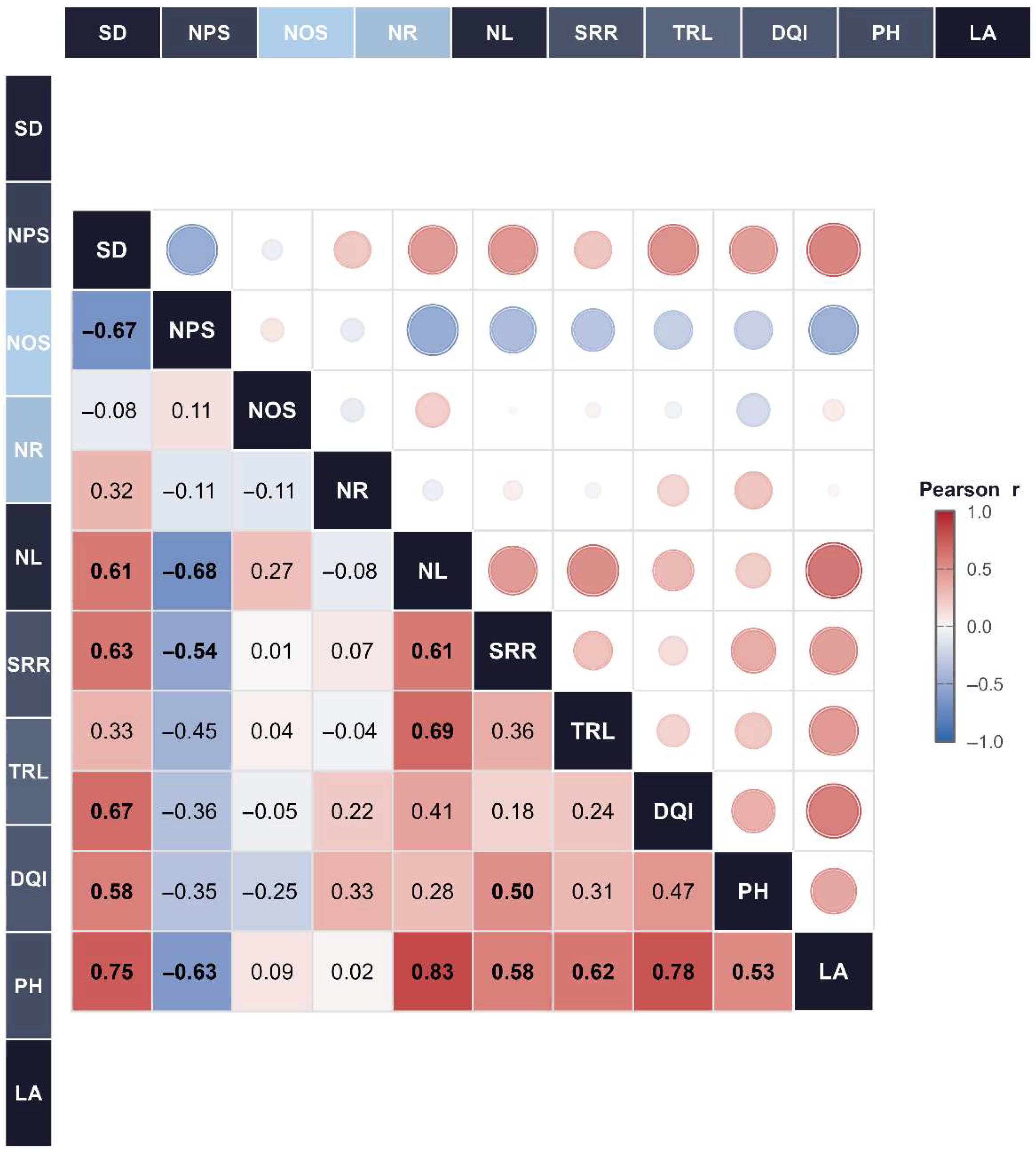
The graph presented in Figure 2 shows a correlation matrix between morphological and physiological variables related to the development of coffee clones, using the Pearson correlation coefficient. Blue tones indicate positive correlations, whereas red tones represent negative correlations, and the numerical values express the strength and direction of these relationships.
Stem diameter (SD) showed a positive correlation with leaf area (LA, r = 0.75), Dickson Quality Index (DQI, r = 0.67), and shoot/root ratio (SRR, r = 0.63), indicating that plants with greater stem diameter tend to exhibit larger leaf area, higher physiological quality, and a more efficient root system. In contrast, SD showed a negative correlation with the number of plagiotropic shoots (NPS, r = −0.67), suggesting that plants with larger stem diameter have fewer plagiotropic shoots.
The number of plagiotropic shoots (NPS) showed a significant negative correlation with SD (r = −0.67), LA (r = −0.63), and number of leaves (NL, r = −0.68), indicating that an increase in the number of plagiotropic shoots is associated with plants with reduced leaf development and smaller stem diameter. The number of orthotropic shoots (NOS) did not show a significant correlation with the other variables.
The number of roots (NR), in turn, exhibited a positive correlation with NL (r = 0.61) and LA (r = 0.83), suggesting that a more developed root system promotes greater leaf biomass accumulation and, consequently, larger leaf area.
For NL, positive correlations were observed with SRR (r = 0.69), LA (r = 0.83), and SD (r = 0.61), indicating that plants with a higher number of leaves tend to show better root system development and greater stem diameter, reinforcing the interdependence between vegetative growth and plant vigor. Conversely, NL showed a negative correlation with NPS (r = −0.68), reinforcing that excessive development of plagiotropic shoots may result in reduced leaf biomass accumulation.
The shoot/root ratio (SRR) was positively correlated with NL (r = 0.69), DQI (r = 0.52), and LA (r = 0.62), reinforcing that root system development is directly associated with vegetative growth and overall plant quality. Total root length (TRL) showed a negative correlation with NPS (r = −0.45), indicating that plants with a greater number of plagiotropic shoots exhibit reduced root development, which may negatively affect nutrient uptake.
The Dickson Quality Index (DQI), considered a robust indicator of plant vigor, showed positive correlations with SD (r = 0.67), SRR (r = 0.52), LA (r = 0.78), and NL (r = 0.41). These correlations confirm that plants with superior physiological quality present larger leaf area, improved root development, and greater stem diameter. Plant height (PH) showed a moderate positive correlation with LA (r = 0.53) and DQI (r = 0.47), suggesting that taller plants tend to have greater leaf area and a higher quality index.
Finally, leaf area (LA) stood out as a highly relevant variable, showing significant positive correlations with SD (r = 0.75), NR (r = 0.83), NL (r = 0.83), DQI (r = 0.78), and SRR (r = 0.62), highlighting its direct relationship with vegetative vigor and plant quality. In contrast, LA showed a negative correlation with NPS (r = −0.63), indicating that greater leaf area is associated with plants with fewer plagiotropic shoots.
In summary, the correlation analysis revealed that variables such as SD, NL, LA, and DQI are strong indicators of plant vigor and quality, showing positive interrelationships with root development and vegetative structure. Conversely, traits such as NPS were negatively correlated with key attributes, suggesting that an excessive number of plagiotropic shoots may compromise balanced growth and the future productivity of the evaluated clones. These results are essential to support the selection of superior genetic materials in coffee breeding programs, prioritizing traits associated with vigorous and productive plant growth.

3.3. Multivariate Grouping and Selection of Superior Clones

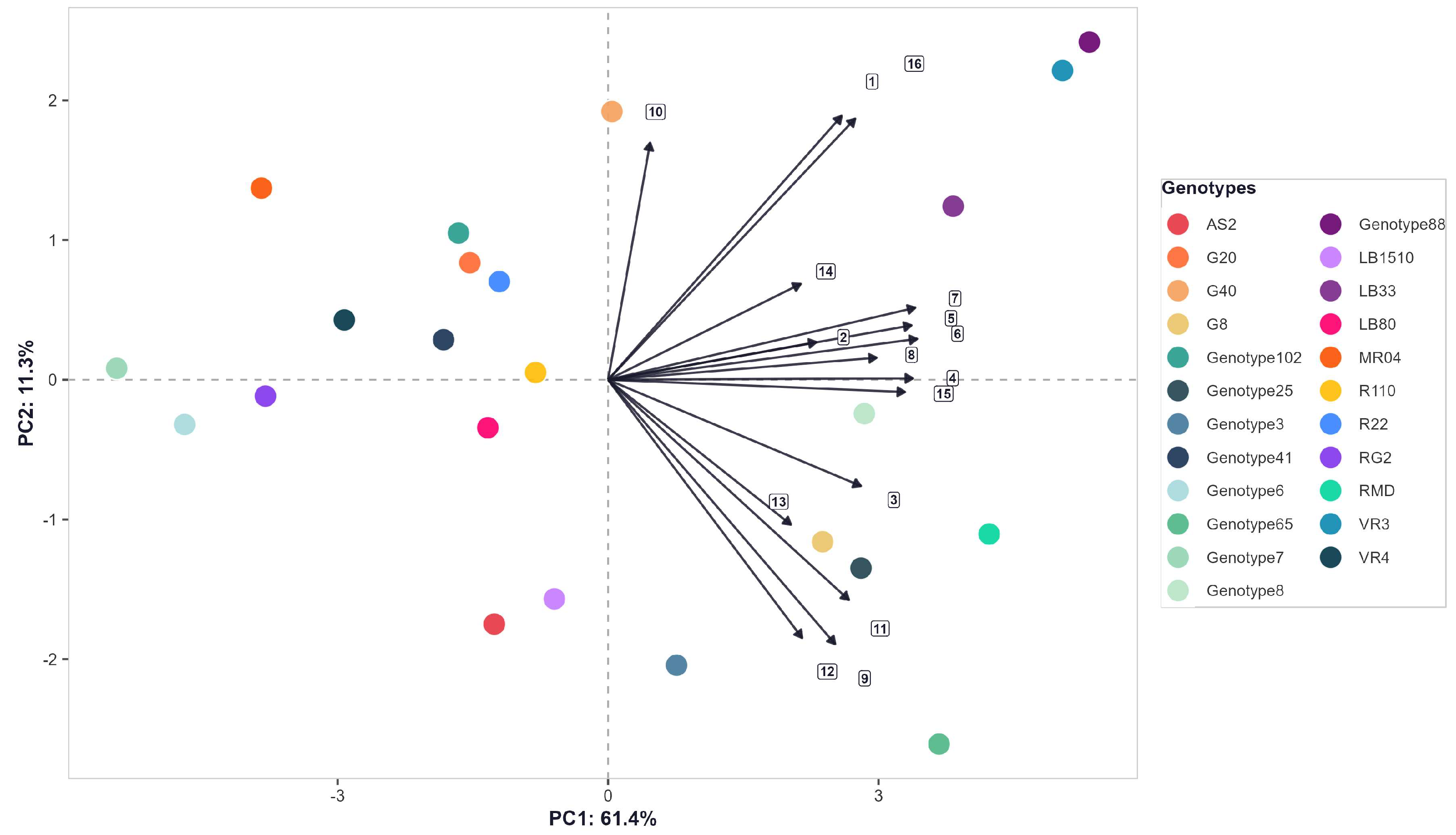
Figure 3 presents the PCA results obtained from the evaluated parameters, showing the dispersion pattern of the analyzed clones. In this dataset, the first principal component (PCA1) explains 61.4% of the total variation, while the second principal component (PCA2) explains 11.3%. Together, PCA1 and PCA2 account for 72.7% of the total data variability, indicating that the PCA adequately represents the relationships among the evaluated variables.
As shown in Figure 3, two groups were formed based on the dispersion of clones. The first group, located on the right side of the plot, includes clones VR3, 88, LB33, RMD, 08, G8, 25, 03, LB1510, and AS2. The second group, located on the left side, comprises clones 07, 06, RG2, MR04, VR4, 41, 102, G20, R22, LB80, R110, and G40. These clones exhibited similar behavior according to the performed analyses.
The PCA loading plot (Figure 3) shows the contribution of all morphological parameters evaluated in the experiment. The parameters are positioned on the same side of the graph, indicating strong positive correlations among them, with no negative associations observed. The Cos2 (squared cosine) color gradient and the length of the vectors indicate the strength of each parameter within the analysis. Variables such as root dry mass (RDM), Dickson Quality Index (DQI), total dry mass (TDM), stem diameter (SD), leaf dry mass (LDM), and shoot dry mass (SDM), among others, were among the most influential contributors to the PCA, demonstrating a significant impact on data variation.
The group located on the right side of the plot showed a stronger association with these influential parameters, whereas the group on the left side exhibited comparatively lower influence. However, since all variables were positively correlated in the analysis, both groups displayed the same general response pattern, differing primarily in magnitude rather than direction.
The Scott–Knott clustering analysis corroborates the PCA results. For stem diameter (SD), clone 88, positioned on the right side of the PCA (Figure 3), presented the highest mean among all evaluated clones, whereas clone 07, located in the left-side group, showed the lowest mean. For DQI, as previously highlighted, clones 88, VR3, LB33, and 08, also positioned in the right-side cluster, stood out with superior performance. Regarding total dry mass (TDM), the most prominent clones were 88, VR3, 08, LB33, and RMD.
All three variables mentioned (SD, DQI, and TDM) exhibited strong influence in the PCA, as indicated by their high Cos2 values in Figure 3, linking the results of the mean clustering test with the grouping pattern observed in the multivariate analysis. Based on these findings, it is possible to identify outstanding clones, particularly clone 88, which consistently demonstrated superior performance across the evaluated parameters.

4. Discussion

The morphological evaluation of the 23 clones of Coffea canephora revealed marked differences in vegetative growth, biomass production, and structural balance of the seedlings, reflecting the strong genetic variability present in the studied material. Overall, the results presented in Table 1, Table 2 and Table 3, as well as the correlation and PCA analyses, demonstrate that certain clones exhibit superior performance and greater agronomic potential, whereas others show more restricted development, forming groups with lower aptitude.
Stem diameter (SD) emerged as a key variable in differentiating the clones, being consistently higher in genotypes 88, RMD, VR3, 8, LB33, LB15_10, and 25, which composed the group with greater vegetative vigor. This parameter is widely recognized as a predictor of vigor and future productivity, as it is directly associated with water and photoassimilate transport efficiency and plant structural robustness, as previously reported in coffee studies [10,19]. Thus, the observed values reinforce the superiority of these clones during early development.
The number of plagiotropic shoots (NPS) also contributed to differentiation among materials, with higher values observed in clones 8, 25, 65, G8, 3, LB15_10, and LB33. Considering that plagiotropic shoots constitute the productive framework of coffee plants, a greater number indicates higher potential for reproductive structure formation. However, a negative correlation was observed between NPS and traits such as SD, NL, and leaf area (LA), suggesting that excessive development of plagiotropic shoots may intensify competition for physiological resources, thereby affecting leaf biomass accumulation, as demonstrated in the correlation matrix (Figure 2).
Regarding the root system, clone G40 exhibited the highest number of roots (NR), whereas clones 7, RG2, and AS2 showed inferior development. However, biomass analysis revealed that the highest root dry mass (RDM) values were observed in clones 88, VR3, and LB33, indicating greater efficiency in belowground biomass accumulation, a desirable characteristic, as it enhances water and nutrient uptake and confers greater resilience under adverse edaphoclimatic conditions.
Aboveground biomass followed similar patterns: clones 88, VR3, 8, LB33, and RMD presented the highest shoot dry mass (SDM) and total dry mass (TDM), reflecting structurally more developed plants and greater efficiency in converting energy into vegetative tissues. The strong positive correlations among LA, NL, SD, and DQI reinforce that vegetative vigor results from an integrated set of physiological attributes, including greater photosynthetic area and improved balance between shoot and root growth.
The Dickson Quality Index (DQI), one of the most robust indicators for qualitative seedling assessment, highlighted the superiority of clones 88, VR3, LB33, and 8, all positioned within the quadrant of greatest influence in the PCA (Figure 3). These clones exhibited the best balance among biomass accumulation, robustness, and vegetative architecture, directly corresponding to the standard of high-quality seedlings [11].
The shoot/root ratio (SRR) also contributed to material differentiation. The highest values were observed in clones 65, RMD, 8, and LB15_10, suggesting greater allocation to the shoot portion. Although elevated values may indicate enhanced leaf expansion and photosynthetic potential, excessively high ratios can reflect reduced proportional root development. In the present study, however, these clones also exhibited satisfactory RDM and DQI values, indicating that root development was not compromised.
The correlation analysis presented in Figure 2 revealed coherent physiological patterns, with LA emerging as a central variable in seedling performance, exhibiting significant associations with SD (r = 0.75), NR (r = 0.83), NL (r = 0.83), and DQI (r = 0.78). These results confirm that leaf area is a strong indicator of quality and vigor, as it integrates photosynthetic capacity with vegetative architecture.
The results of the present study point to leaf area (LA) and stem diameter (SD) as the most practical candidates for early screening of seedling quality in C. canephora clonal programs. Both variables are non-destructive, measurable with basic equipment (graduated ruler and digital caliper, respectively), and showed the strongest associations with the composite quality indicator DQI (r = 0.78 and r = 0.67, respectively) as well as with total dry mass in the PCA (Figure 3). Leaf area, in particular, integrates photosynthetic surface, carbon assimilation capacity, and vegetative architecture into a single measurement, which explains its high correlations with NL (r = 0.83), NR (r = 0.83), and SD (r = 0.75), a convergence that makes it a reliable proxy for overall plant vigor without requiring destructive sampling. Stem diameter adds structural information about vascular capacity and mechanical robustness, traits directly linked to water and photoassimilate transport efficiency [10,19]. The combination of LA and SD at the nursery stage could thus allow growers and breeders to pre-select superior clones before field establishment, reducing evaluation time and cost while maintaining predictive accuracy. Future studies should validate this screening protocol under contrasting edaphoclimatic conditions to assess its generalizability across C. canephora production environments in Espírito Santo.
The PCA (Figure 3) clearly demonstrated the formation of two distinct clusters. Clones 88, VR3, LB33, RMD, 8, G8, and 25 were concentrated in the higher-performance group, directly associated with the most influential variables: SD, DQI, TDM, leaf dry mass (LDM), and root dry mass (RDM). This clustering pattern reflects a consistent and homogeneous physiological superiority. The second group, comprising clones 7, MR04, VR4, 6, RG2, and G20, showed lower performance, corroborating the reduced mean values observed in the tables.
Thus, the convergence of Scott–Knott clustering, correlation analysis, and PCA reinforces the reliability of the results and demonstrates that the superiority of clones 88, VR3, 8, and LB33 is not isolated but rather the outcome of an integrated set of morphophysiological attributes consistently expressed across different analytical approaches. These materials exhibit greater vigor, improved biomass accumulation efficiency, enhanced structural robustness, and superior quality index, qualifying them as promising candidates for commercial use and breeding programs. Conversely, lower-performing clones, such as 7, MR04, and VR4, demonstrated important limitations in vegetative development, reduced vigor indices, and lower biomass accumulation, characteristics suggesting reduced agronomic suitability at the seedling stage.
It is important to acknowledge that the present study is limited to the seedling stage, and the morphophysiological superiority observed in clones 88, VR3, 8, and LB33 does not automatically translate into superior yield or fruit quality at maturity. In C. canephora, the relationship between early vegetative performance and adult productive potential is modulated by genotype × environment interactions, management practices, and physiological traits expressed only after canopy closure and reproductive onset [20]. Additionally, seedling performance under controlled nursery conditions (standardized substrate, irrigation, and temperature) may not fully reflect clone behavior under the variable edaphoclimatic conditions of field cultivation. The sample size of 23 clones, while representative of the most commercially demanded materials in Espírito Santo, does not capture the full breadth of C. canephora genetic diversity available in regional germplasm banks. Disease resistance and environmental adaptability, which are critical criteria in variety approval processes, were also not assessed in the present study and should be addressed in future field-based evaluations [3]. Similarly, leaf metabolite diversity and genomic characterization represent complementary dimensions that could substantially deepen the understanding of clone differentiation observed here; recent SNP-based analyses of C. canephora materials from the same region have confirmed the genetic distinctiveness of several commercial clones evaluated in the present study [21]. Future studies integrating seedling-stage morphophysiological data with multi-harvest yield assessments, cup quality evaluations, and genomic approaches would substantially strengthen the practical recommendations derived from nursery-stage clone selection.
The convergence of Scott–Knott clustering, Pearson correlation, and PCA across all evaluated attributes leaves little ambiguity regarding the identity of the superior materials. Clones 88, VR3, 8, and LB33 consistently occupied the high-performance stratum in every analytical dimension assessed, biomass accumulation, structural robustness, leaf area, and integrated quality index, a pattern that is unlikely to result from chance, given the breadth of variables and the independence of the analytical methods. For nurseries and breeding programs operating under the edaphoclimatic conditions of Espírito Santo, these four clones represent the most technically supported options for seedling production and clonal selection at the current stage of knowledge.

5. Conclusions

The morphoanatomical evaluation of the 23 clones of Coffea canephora revealed broad variability among the materials, reflecting the genetically heterogeneous nature of the species and enabling the identification of genotypes with superior performance at the seedling stage.
Clones 88, VR3, 8, and LB33 exhibited the best overall performance, characterized by greater stem diameter (SD), higher biomass accumulation, larger leaf area (LA), higher Dickson Quality Index (DQI) values, and balanced development between shoot and root systems.
In contrast, clones such as 7, MR04, and VR4 showed inferior performance across multiple variables, presenting lower vigor, reduced biomass accumulation, and lower qualitative indices, which limit their agronomic potential during early seedling establishment.
Overall, the results demonstrate that the combined use of morphophysiological and multivariate analyses is an effective tool for selecting superior materials, allowing reliable discrimination of the most promising genotypes. Thus, this study provides relevant scientific support for nurseries, growers, and breeding programs, contributing to the selection of more adapted and vigorous clones capable of sustaining high productive performance under the edaphoclimatic conditions of Espírito Santo.

Author Contributions

Conceptualization, P.S.V., N.J.A. and F.L.P.; methodology, P.S.V., E.C., W.C.G., L.d.S.M. and M.P.C.; software, D.H.G.J., F.L.P. and E.R.S.; validation, D.H.G.J. and F.L.P.; formal analysis, P.S.V., E.C., W.C.G., L.d.S.M., M.P.C., N.J.A., D.H.G.J. and E.R.S.; investigation, P.S.V., E.C., W.C.G., L.d.S.M., M.P.C. and N.J.A.; resources, F.L.P.; data curation, D.H.G.J. and F.L.P.; writing—original draft preparation, P.S.V., E.C., W.C.G., L.d.S.M., M.P.C. and N.J.A.; writing—review and editing, D.H.G.J. and F.L.P.; visualization, D.H.G.J., F.L.P. and E.R.S.; supervision, D.H.G.J. and F.L.P.; project administration, E.R.S.; funding acquisition, E.R.S. All authors have read and agreed to the published version of the manuscript.

Funding

This research was funded by the Espírito Santo Research and Innovation Foundation (FAPES), grant numbers 2022-M465D, 2022-WTZQP, and 2024-9H43M, and by the Brazilian National Council for Scientific and Technological Development (CNPq), grant number 309535/2021-2.

Data Availability Statement

The original contributions presented in this study are included in the article. Further inquiries can be directed to the corresponding authors.

Acknowledgments

The authors thank Viveiro DeMuner for its support and collaboration in the development of this study. The authors also acknowledge the Universidade Federal do Espírito Santo (UFES) for providing the infrastructure and institutional support necessary for conducting the research.

Conflicts of Interest

The authors declare no conflicts of interest.

Abbreviations

The following abbreviations are used in this manuscript:
ANOVAAnalysis of Variance
C. canephoraCoffea canephora
CDCutting Diameter
CDMCutting Dry Mass
CEUNES–UFESCentro Universitário Norte do Espírito Santo–Universidade Federal do Espírito Santo
CLCutting Length
CNCLength of the central leaf vein
CONABCompanhia Nacional de Abastecimento
CRDCompletely Randomized Design
DAPCDays After Planting the Cuttings
DQIDickson Quality Index
HDRHeight-to-Diameter Ratio
LALeaf Area
LDMLeaf Dry Mass
NLNumber of Leaves
NOSNumber of Orthotropic Shoots
NPSNumber of Plagiotropic Shoots
NRNumber of Roots
OSDOrthotropic Shoot Dry Mass
PCAPrincipal Component Analysis
PCA1First Principal Component
PCA2Second Principal Component
PHPlant Height
PSDPlagiotropic Shoot Dry Mass
RDMRoot Dry Mass
SDStem Diameter
SDMShoot Dry Mass
SRRShoot-to-Root Ratio
TDMTotal Dry Mass
TRLTotal Root Length
Cos2Squared Cosine

References

  1. IBGE—Instituto Brasileiro de Geografia e Estatística. Produção Agropecuária: Café. Available online: https://www.ibge.gov.br/explica/producao-agropecuaria/cafe/br (accessed on 10 December 2025).
  2. CONAB—Companhia Nacional de Abastecimento. Acompanhamento da Safra Brasileira de Café; CONAB: Brasília, Brazil, 2024. [Google Scholar]
  3. Ferrão, R.G.; Fonseca, A.F.A.; Ferrão, M.A.G.; De Muner, L.H. (Eds.) Conilon Coffee, 3rd ed.; Updated and Expanded; Incaper: Vitória, Brazil, 2019; 973p. [Google Scholar]
  4. Conagin, C.H.T.M.; Mendes, A.J.T. Pesquisas citológicas e genéticas em três espécies de Coffea: Auto-incompatibilidade em Coffea canephora Pierre ex Froehner. Bragantia 1961, 20, 788–804. [Google Scholar] [CrossRef]
  5. Nowak, M.D.; Davis, A.P.; Anthony, F.; Yoder, A.D. Expression and trans-specific polymorphism of self-incompatibility RNases in Coffea (Rubiaceae). PLoS ONE 2011, 6, e21019. [Google Scholar] [CrossRef] [PubMed]
  6. Bragança, S.M.; Carvalho, C.H.S.; Fonseca, A.F.A.; Ferrão, R.G. Clonal varieties of Conilon coffee for the Espírito Santo State, Brazil. Pesqui. Agropecu. Bras. 2001, 36, 765–770. [Google Scholar] [CrossRef]
  7. Partelli, F.L.; Espindula, M.C. (Eds.) Café Conilon: Conhecimento para Superar Desafios; CAUFES: Alegre, Brazil, 2019; 178p. [Google Scholar]
  8. Fernandes, S.H.F.; Bezerra, C.S.; Ramos, S.L.F.; Lopes, R.; Espíndula, M.C.; Ramos, T.S.; Matiello, R.R.; Marques, M.J.; Meneses, C.H.S.G.; Lopes, M.T.G. Genetic diversity and structure in Coffea canephora genotypes from the Amazon region. Horticulturae 2026, 12, 250. [Google Scholar] [CrossRef]
  9. Vitória, E.L.; Nardotto Júnior, A.O.; Ribeiro, L.F.O.; Dubberstein, D.; Partelli, F.L. Leaf area estimation in Coffea canephora genotypes by neural networks and multiple regression. Rev. Bras. Eng. Agríc. Ambient. 2024, 28, e279246. [Google Scholar] [CrossRef]
  10. Silva, C.A.; Dalazen, J.R.; Rodrigues, W.P.; Rocha, R.B.; Partelli, F.L. Nutritional efficiency of Coffea canephora: The role of genetic variability and nutrient accumulation. Plants 2025, 14, 1509. [Google Scholar] [CrossRef] [PubMed]
  11. Dickson, R.E.; Leaf, A.L.; Hosner, J.F. Quality appraisal of white spruce and white pine seedling stock in nurseries. For. Chron. 1960, 36, 10–13. [Google Scholar] [CrossRef]
  12. Grossnickle, S.C. Why seedlings survive: Influence of plant attributes. New For. 2012, 43, 711–738. [Google Scholar] [CrossRef]
  13. Fonseca, É.P.; Valéri, S.V.; Miglioranza, É.; Fonseca, N.A.N.; Couto, L. Padrão de qualidade de mudas de Trema micrantha (L.) Blume, produzidas sob diferentes períodos de sombreamento. Rev. Árvore 2002, 26, 515–523. [Google Scholar] [CrossRef]
  14. Taiz, L.; Zeiger, E.; Møller, I.M.; Murphy, A. Plant Physiology and Development, 6th ed.; Sinauer Associates: Sunderland, MA, USA, 2015. [Google Scholar]
  15. PROATER—Programa de Assistência Técnica e Extensão Rural. Plano 2020–2024; Incaper: Vitória, Brazil, 2020. Available online: https://incaper.es.gov.br (accessed on 10 December 2025).
  16. Partelli, F.L.; Vieira, H.D.; Detmann, E.; Campostrini, E. Estimativa da área foliar do cafeeiro conilon a partir do comprimento da folha. Rev. Ceres 2006, 53, 204–210. [Google Scholar]
  17. R Core Team. R: A Language and Environment for Statistical Computing, version 4.5.2; R Foundation for Statistical Computing: Vienna, Austria, 2025. Available online: https://www.r-project.org/ (accessed on 20 February 2026).
  18. Ferreira, D.F. Sisvar: A computer statistical analysis system. Ciênc. Agrotec. 2011, 35, 1039–1042. [Google Scholar] [CrossRef]
  19. Dhaliwal, T. Correlations between yield and morphological characters in Puerto Rican and Columnaris varieties of Coffea arabica L. J. Agric. Univ. Puerto Rico 1968, 52, 29–37. [Google Scholar]
  20. DaMatta, F.M.; Ronchi, C.P.; Maestri, M.; Barros, R.S. Ecophysiology of coffee growth and production. Braz. J. Plant Physiol. 2007, 19, 485–510. [Google Scholar] [CrossRef]
  21. Oliveira, R.G.; Almeida, F.A.N.; Zaidan, I.R.; Senra, J.F.B.; Silva, M.A.; Ferreira, A.; Ferreira, M.F.S. Genomic discrimination of the botanical groups Conilon and Robusta of Coffea canephora. Sci. Rep. 2026, 16, 5584. [Google Scholar] [CrossRef] [PubMed]
Figure 1. (A) Seedling at the dispatch stage (210 days after planting; 4–5 leaf pairs). (B) Seedling organs after separation for destructive analysis: (1) roots; (2) cutting; (3) orthotropic branch; (4) plagiotropic branch; (5) leaves.
Ijpb 17 00034 g001
Figure 2. Pearson correlation matrix among [agronomic/morphological] traits evaluated in 23 clones of Coffea canephora (Conilon, Robusta and hybrid genotypes). The upper triangle displays circles scaled proportionally to the absolute value of the correlation coefficient (r), and the lower triangle shows the corresponding r values (bold when |r| ≥ 0.50). Color gradient ranges from blue (negative correlations) to red (positive correlations). SD = stem diameter; NPS = number of plagiotropic shoots; NOS = number of orthotropic shoots; NR = number of roots; NL = number of leaves; SRR = shoot/root ratio; TRL = total root length; DQI = Dickson Quality Index; PH = plant height; LA = leaf area.
Ijpb 17 00034 g002
Figure 3. Ordination generated from Principal Component Analysis (PCA) for the 23 clones of Coffea canephora (Conilon, Robusta and hybrid genotypes) used in this experiment. Vectors represent the contribution of each morphological and anatomical parameter to the principal components: (1) RDM = root dry mass; (2) SDM = shoot dry mass; (3) PSD = plagiotropic shoot dry mass; (4) OSD = orthotropic shoot dry mass; (5) LDM = leaf dry mass; (6) CDM = cutting dry mass; (7) TDM = total dry mass; (8) SD = stem diameter; (9) NPS = number of plagiotropic shoots; (10) NOS = number of orthotropic shoots; (11) NL = number of leaves; (12) SRR = shoot-to-root ratio; (13) HDR = height-to-diameter ratio; (14) CL = cutting length; (15) LA = leaf area; (16) DQI = Dickson Quality Index.
Ijpb 17 00034 g003
Table 1. Means of stem diameter (SD, mm), number of plagiotropic shoots (NPS), number of orthotropic shoots (NOS), number of roots (NR), number of leaves (NL), and plant height (PH, cm).
ClonesSDNPSNOSNRNLPH
34.943 a2.300 a1.1 b3.1 d12.5 b19.780 c
64.509 b0.500 b1.1 b6.7 b7.6 d16.050 d
73.796 b0.300 b1.1 b4.9 c7.9 d11.420 e
85.511 a2.889 a1.0 b7.89 b12.89 b22.056 b
255.255 a2.800 a1.1 b5.1 c15.2 a28.160 a
414.185 b0.400 b1.2 a7.1 b11.1 c22.570 b
654.942 a2.800 a1.0 b7.3 b14.2 a27.260 a
885.705 a1.400 b1.1 b5.8 c10.9 c23.040 b
1024.365 b0.600 b1.3 a7.6 b8.5 d19.410 c
AS24.456 b1.800 a1.2 a3.9 d11.9 b19.030 c
G204.629 b0.800 b1.3 a5.8 c9.9 c15.490 d
G405.368 a1.100 b1.0 b11.6 a10.1 c19.140 c
G85.282 a2.400 a1.5 a7.0 b15.6 a22.490 b
LB15_105.397 a2.200 a1.0 b6.3 c9.0 d21.850 b
LB335.358 a2.100 a1.0 b8.3 b11.7 b23.680 b
LB804.350 b1.200 b1.2 a6.0 c10.5 c17.900 c
MR044.040 b0.700 b1.0 b5.7 c7.9 d13.200 e
R1105.066 a1.900 a1.0 b9.1 b10.4 c17.780 c
R224.947 a0.400 b1.4 a8.3 b10.5 c18.420 c
RG24.106 b0.700 b1.0 b4.6 d8.3 d16.830 c
RMD5.619 a1.800 a1.2 a5.0 c15.4 a26.800 a
VR35.467 a1.600 a1.0 b7.7 b11.6 b28.140 a
VR44.500 b0.800 b1.0 b6.9 b7.2 d13.650 e
CV (%)13.1575.6327.7631.5830.2914.77
CV: coefficient of variation. Means followed by the same letter within a column do not differ significantly according to the Scott–Knott clustering test (5%).
Table 2. Root dry matter (RDM, g), cutting dry matter (CDM, g), plagiotropic shoot dry matter (PSD, g), orthotropic shoot dry matter (OSD, g), leaf dry matter (LDM, g), shoot dry matter (SDM, g), and total dry matter (TDM, g).
ClonesRDMCDMPSDOSDLDMSDMTDM
30.490 c1.431 a0.152 b0.595 c2.193 c2.941 c3.429 c
60.362 c0.616 c0.013 c0.385 d1.192 d1.593 d1.955 d
70.374 c0.612 c0.007 c0.236 d1.155 d1.396 d1.771 d
80.686 b1.310 b0.259 a0.947 b3.196 b4.403 a5.087 a
250.716 b1.078 c0.174 b0.974 b2.246 c3.394 b4.109 b
410.632 c0.657 c0.004 c0.572 c1.783 c2.360 c2.992 c
650.487 c1.411 a0.225 a0.883 b2.668 b3.774 b4.263 b
880.887 a1.457 a0.144 b1.098 a3.650 a4.889 a5.777 a
1020.540 c1.125 b0.038 c0.569 c1.744 c2.350 c2.893 c
AS20.476 c0.966 c0.064 c0.563 c1.848 c2.476 c2.951 c
G200.569 c1.041 c0.047 c0.485 c1.860 c2.390 c2.961 c
G400.574 c1.202 b0.069 c0.584 c2.031 c2.684 c3.258 c
G80.597 c0.805 c0.160 b0.794 b2.775 b3.527 b4.123 b
LB15_100.358 c1.578 a0.117 b0.671 c1.691 c2.195 c2.553 d
LB330.813 a1.198 b0.276 a0.833 b2.945 b4.053 a4.863 a
LB800.507 c1.057 c0.068 c0.516 c1.903 c2.486 c2.992 c
MR040.572 c0.947 c0.034 c0.311 d1.273 d1.618 d2.190 d
R1100.477 c1.272 b0.096 c0.557 c1.825 c2.479 c2.958 c
R220.514 c0.776 c0.026 c0.588 c2.158 c2.771 c3.286 c
RG20.478 c0.857 c0.034 c0.387 d1.335 d1.753 d2.233 d
RMD0.599 c1.200 b0.088 c1.073 a2.959 b4.120 a4.721 a
VR30.907 a1.873 a0.134 b1.145 a3.023 b4.298 a5.208 a
VR40.480 c1.176 b0.026 c0.397 d1.412 d1.833 d2.313 d
CV (%)34.2639.9393.5928.9428.6929.5428.7
CV: coefficient of variation. Means followed by the same letter within a column do not differ significantly according to the Scott–Knott clustering test (5%).
Table 3. Shoot-to-root ratio (SRR), height-to-diameter ratio (HDR), Dickson Quality Index (DQI), cutting length (CL, cm), and leaf area (LA, cm2).
ClonesSRRHDRDQICLLA
36.116 a4.028 b0.342 c7.330 b423.460 b
64.499 b3.593 c0.242 c6.250 b225.050 d
73.741 b3.034 c0.263 c7.170 b203.340 d
86.580 a4.342 b0.490 a8.166 a561.477 a
254.921 b5.487 a0.412 b7.140 b462.640 b
414.240 b5.495 a0.315 c6.900 b375.730 c
658.035 a5.551 a0.320 c8.570 a479.540 b
885.602 a4.051 b0.602 a8.150 a573.410 a
1024.445 b4.459 b0.328 c8.370 a288.550 d
AS25.335 b4.301 b0.310 c6.600 b385.830 c
G204.627 b3.420 c0.401 b7.410 b345.650 c
G404.956 b3.594 c0.395 b8.200 a368.380 c
G85.892 a4.342 b0.402 b7.150 b495.550 b
LB15_106.177 a4.112 b0.251 c8.100 a258.550 d
LB335.103 b4.464 b0.518 a7.670 b475.440 b
LB805.119 b4.154 b0.337 c7.300 b357.770 c
MR042.920 b3.289 c0.358 b7.300 b255.300 d
R1105.253 b3.523 c0.337 c7.380 b287.470 d
R225.580 a3.737 c0.362 b7.000 b347.610 c
RG23.710 b4.130 b0.290 c6.830 b264.530 d
RMD7.077 a4.830 a0.404 b8.600 a610.170 a
VR34.882 b5.157 a0.519 a8.550 a546.150 a
VR45.949 a3.041 c0.333 c7.470 b252.110 d
CV (%)35.7816.8332.5512.4429.76
CV: coefficient of variation. Means followed by the same letter within a column do not differ significantly according to the Scott–Knott clustering test (5%).
Disclaimer/Publisher’s Note: The statements, opinions and data contained in all publications are solely those of the individual author(s) and contributor(s) and not of MDPI and/or the editor(s). MDPI and/or the editor(s) disclaim responsibility for any injury to people or property resulting from any ideas, methods, instructions or products referred to in the content.