
Enterococcus durans Secretome Modulates Interleukins Gene Expressions in Intestinal Epithelial Cells Challenged by Staphylococcus aureus Secretome: In Vitro Study on the HT-29 Cell Line


 ,
,  , , ,
, , ,  ,
,  and
and
Abstract
1. Introduction
2. Materials and Methods
2.1. Bacterial Isolation and Identification
2.2. Bacterial Cell-Free Supernatant Preparation
2.3. Cell Cultures
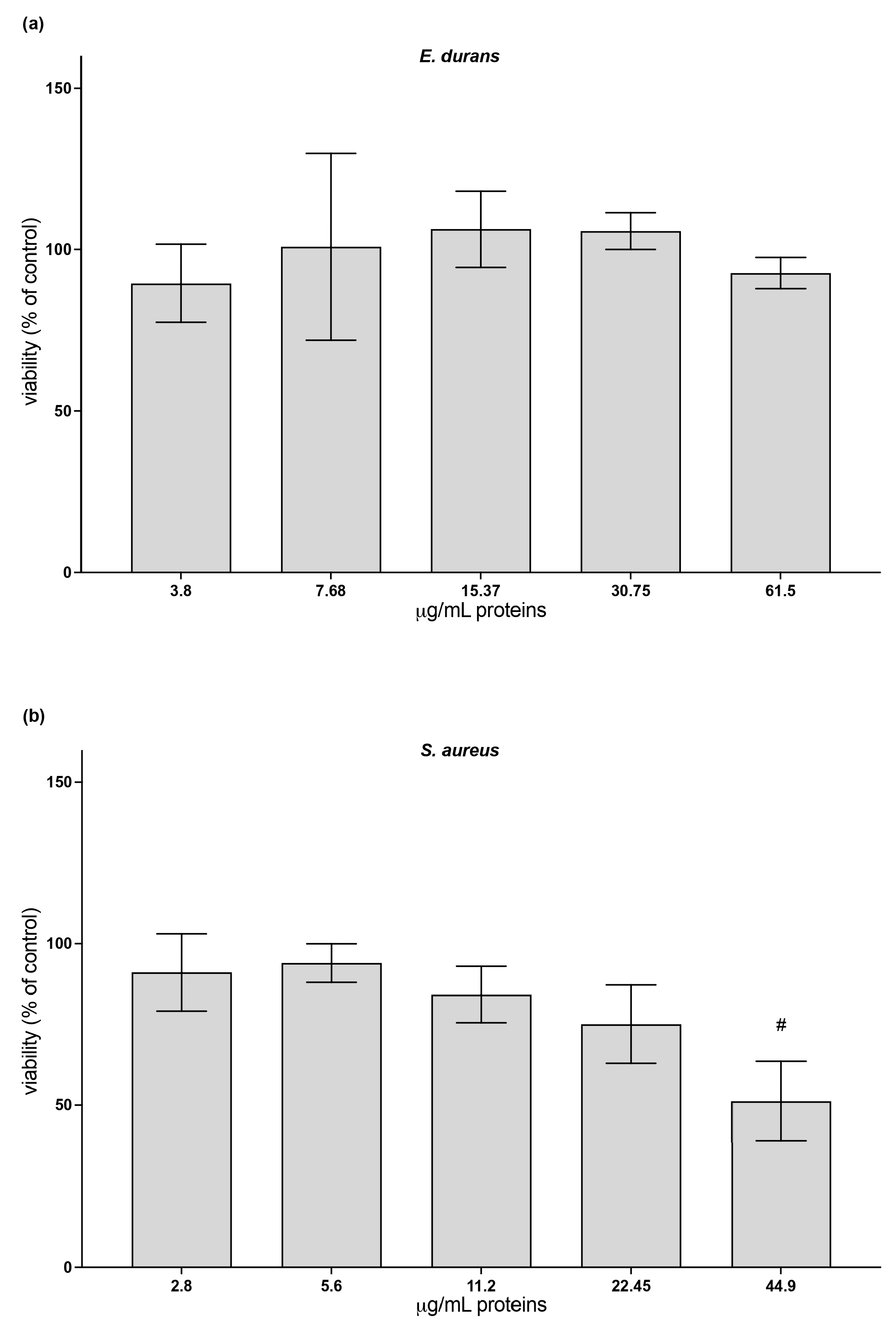
2.4. Determination of Enterococcus durans and Staphylococcus aureus CFSs Cytotoxicity in HT-29 Cells
2.5. HT-29 Cells Treatments
- (a)
- Incubation of HT-29 cells (2 h) with culture medium only (Control);
- (b)
- Incubation of HT-29 cells (2 h) with culture medium plus Ed-CFS (61.5 μg/mL protein);
- (c)
- Incubation of HT-29 cells (2 h) with culture medium plus Sa-CFS (22.45 μg/mL protein);
- (d)
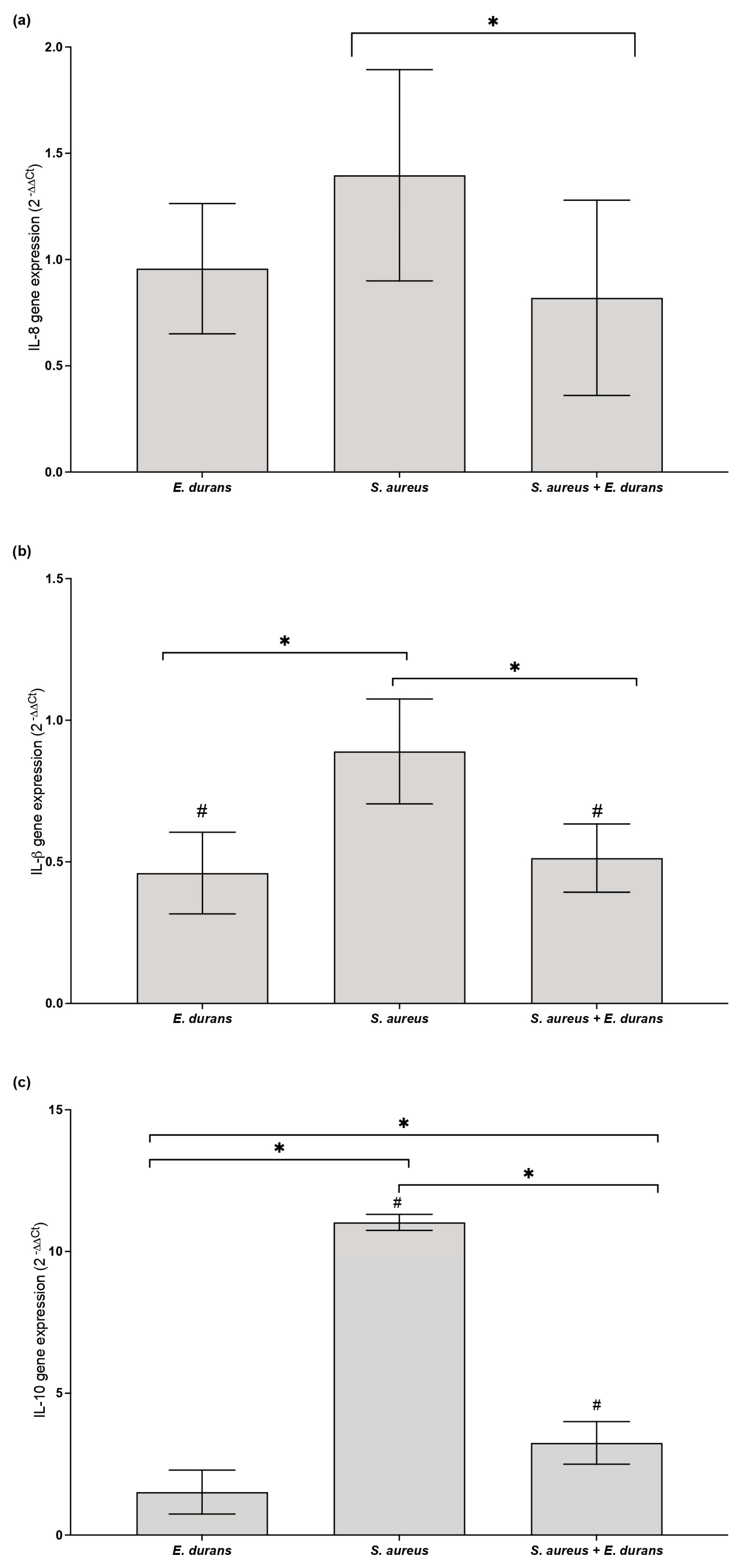
- Incubation of HT-29 cells (2 h) with culture medium plus Sa-CFS (22.45 μg/mL protein) followed by the addition of Ed-CFS (61.5 μg/mL protein), further 2 h of incubation.
2.6. Interleukin-8, -10, and -1β Gene Expression
2.7. Statistical Analysis
3. Results
3.1. Cytotoxicity of Enterococcus durans and Staphylococcus aureus in HT-29 Cells
3.2. Effect of Enterococcus durans and Staphylococcus aureus CFS on HT-29 Interleukin-8, -10, and -1β Gene Expression
4. Discussion
Author Contributions
Funding
Institutional Review Board Statement
Informed Consent Statement
Data Availability Statement
Conflicts of Interest
Abbreviations
| CFS | cell-free supernatant |
| Ed | Enterococcus durans |
| GAPDH | glyceraldehyde-3-phosphate dehydrogenase |
| IL | interleukin |
| LAB | lactic acid bacteria |
| MTT | 3-(4,5-dimethylthiazol-2-thiazolyl)-2.5-diphenyl-2H-tetrazolium bromide |
| PCR | polymerase chain reaction |
| Sa | Staphylococcus aureus |
References
- Veldhoen, M.; Brucklacher-Waldert, V. Dietary influences on intestinal immunity. Nat. Rev. Immunol. 2012, 12, 696–708. [Google Scholar] [CrossRef]
- Lowy, F.D. Staphylococcus aureus Infections. N. Engl. J. Med. 1998, 339, 520–532. [Google Scholar] [CrossRef]
- Ghssein, G.; Ezzeddine, Z. The key element role of metallophores in the pathogenicity and virulence of Staphylococcus aureus: A review. Biology 2022, 11, 1525. [Google Scholar] [CrossRef]
- Cenci-Goga, B.T.; Karama, M.; Rossitto, P.V.; Morgante, R.A.; Cullor, J.S. Enterotoxin production by Staphylococcus aureus isolated from mastitic cows. J. Food Prot. 2003, 66, 1693–1696. [Google Scholar] [CrossRef] [PubMed]
- Grispoldi, L.; Karama, M.; El-Ashram, S.; Saraiva, C.; García-Díez, J.; Chalias, A.; Cenci-Goga, B. Evolution and antimicrobial resistance of enterococci isolated from Pecorino and goat cheese manufactured on-farm in an area facing constraints as per EU Regulation 1305/2013 in Umbria, Italy. Ital. J. Food Saf. 2022, 11, 10070. [Google Scholar] [CrossRef] [PubMed]
- Dinges, M.M.; Orwin, P.M.; Schlievert, P.M. Exotoxins of Staphylococcus aureus. Clin. Microbiol. Rev. 2000, 13, 16–34. [Google Scholar] [CrossRef]
- Harrison, L.M.; Morris, J.A.; Bishop, L.A.; Lauder, R.M.; Taylor, C.A.M.; Telford, D.R. Detection of specific antibodies in cord blood, infant and maternal saliva and breast milk to staphylococcal toxins implicated in sudden infant death syndrome (SIDS). FEMS Immunol. Med. Microbiol. 2004, 42, 94–104. [Google Scholar] [CrossRef] [PubMed]
- di Vito, R.; di Mezza, A.; Conte, C.; Traina, G. The crosstalk between intestinal epithelial cells and mast cells is modulated by the probiotic supplementation in co-culture models. Int. J. Mol. Sci. 2023, 24, 4157. [Google Scholar] [CrossRef]
- Zhou, X.; Wu, Y.; Zhu, Z.; Lu, C.; Zhang, C.; Zeng, L.; Xie, F.; Zhang, L.; Zhou, F. Mucosal immune response in biology, disease prevention and treatment. Signal Transduct. Target. Ther. 2025, 10, 7. [Google Scholar] [CrossRef] [PubMed]
- Edwards, L.A.; O’Neill, C.; Furman, M.A.; Hicks, S.; Torrente, F.; Pérez-Machado, M.; Wellington, E.M.; Phillips, A.D.; Murch, S.H. Enterotoxin-producing staphylococci cause intestinal inflammation by a combination of direct epithelial cytopathy and superantigen-mediated T-cell activation. Inflamm. Bowel Dis. 2012, 18, 624–640. [Google Scholar] [CrossRef]
- Wang, J.; Qi, L.; Wu, Z.; Mei, L.; Wang, H. Different effects of lipoteichoic acid from Clostridium butyricum and Staphylococcus aureus on inflammatory responses of HT-29 cells. Int. J. Biol. Macromol. 2016, 87, 481–487. [Google Scholar] [CrossRef]
- Hattar, K.; Grandel, U.; Moeller, A.; Fink, L.; Iglhaut, J.; Hartung, T.; Morath, S.; Seeger, W.; Grimminger, F.; Sibelius, U. Lipoteichoic acid (LTA) from Staphylococcus aureus stimulates human neutrophil cytokine release by a CD14-dependent, Toll-like-receptor-independent mechanism: Autocrine role of tumor necrosis factor-α in mediating LTA-induced interleukin-8 generation. Crit. Care Med. 2006, 34, 835. [Google Scholar] [CrossRef] [PubMed]
- Hersh, D.; Weiss, J.; Zychlinsky, A. How bacteria initiate inflammation: Aspects of the emerging story. Curr. Opin. Microbiol. 1998, 1, 43–48. [Google Scholar] [CrossRef]
- Jung, H.C.; Eckmann, L.; Yang, S.K.; Panja, A.; Fierer, J.; Morzycka-Wroblewska, E.; Kagnoff, M.F. A distinct array of proinflammatory cytokines is expressed in human colon epithelial cells in response to bacterial invasion. J. Clin. Investig. 1995, 95, 55–65. [Google Scholar] [CrossRef]
- Kaminsky, L.W.; Al-Sadi, R.; Ma, T.Y. IL-1β and the Intestinal Epithelial Tight Junction Barrier. Front. Immunol. 2021, 12, 767456. [Google Scholar] [CrossRef]
- di Vito, R.; Conte, C.; Traina, G. A Multi-Strain Probiotic Formulation Improves Intestinal Barrier Function by the Modulation of Tight and Adherent Junction Proteins. Cells 2022, 11, 2617. [Google Scholar] [CrossRef]
- Pires, S.; Parker, D. IL-1β activation in response to Staphylococcus aureus lung infection requires inflammasome-dependent and independent mechanisms. Eur. J. Immunol. 2018, 48, 1707–1716. [Google Scholar] [CrossRef]
- Volk, C.F.; Burgdorf, S.; Edwardson, G.; Nizet, V.; Sakoulas, G.; Rose, W.E. Interleukin (IL)-1β and IL-10 host responses in patients with Staphylococcus aureus bacteremia determined by antimicrobial therapy. Clin. Infect. Dis. 2020, 70, 2634–2640. [Google Scholar] [CrossRef] [PubMed]
- Gutierrez Jauregui, R.; Fleige, H.; Bubke, A.; Rohde, M.; Weiss, S.; Förster, R. IL-1β promotes Staphylococcus aureus biofilms on implants in vivo. Front. Immunol. 2019, 10, 1082. [Google Scholar] [CrossRef]
- Kanangat, S.; Bronze, M.S.; Meduri, G.U.; Postlethwaite, A.; Stentz, F.; Tolley, E.; Schaberg, D. Enhanced extracellular growth of Staphylococcus aureus in the presence of selected linear peptide fragments of human interleukin (IL)-1β and IL-1 receptor antagonist. J. Infect. Dis. 2001, 183, 65–69. [Google Scholar] [CrossRef] [PubMed]
- Li, Z.; Peres, A.G.; Damian, A.C.; Madrenas, J. Immunomodulation and Disease Tolerance to Staphylococcus aureus. Pathogens 2015, 4, 793–815. [Google Scholar] [CrossRef]
- Ohkusa, T.; Yoshida, T.; Sato, N.; Watanabe, S.; Tajiri, H.; Okayasu, I. Commensal bacteria can enter colonic epithelial cells and induce proinflammatory cytokine secretion: A possible pathogenic mechanism of ulcerative colitis. J. Med. Microbiol. 2009, 58, 535–545. [Google Scholar] [CrossRef]
- Sellon, R.K.; Tonkonogy, S.; Schultz, M.; Dieleman, L.A.; Grenther, W.; Balish, E.; Rennick, D.M.; Sartor, R.B. Resident Enteric Bacteria Are Necessary for Development of Spontaneous Colitis and Immune System Activation in Interleukin-10-Deficient Mice. Infect. Immun. 1998, 66, 5224–5231. [Google Scholar] [CrossRef]
- Krawczyk, B.; Wityk, P.; Gałęcka, M.; Michalik, M. The Many Faces of Enterococcus spp.—Commensal, Probiotic and Opportunistic Pathogen. Microorganisms 2021, 9, 1900. [Google Scholar] [CrossRef] [PubMed]
- Buňková, L.; Buňka, F.; Dráb, V.; Kráčmar, S.; Kubáň, V. Effects of NaCl, lactose and availability of oxygen on tyramine production by the Enterococcus durans CCDM 53. Eur. Food Res. Technol. 2012, 234, 973–979. [Google Scholar] [CrossRef]
- Hanchi, H.; Mottawea, W.; Sebei, K.; Hammami, R. The Genus Enterococcus: Between Probiotic Potential and Safety Concerns—An Update. Front. Microbiol. 2018, 9, 1791. [Google Scholar] [CrossRef]
- Nami, Y.; Vaseghi Bakhshayesh, R.; Mohammadzadeh Jalaly, H.; Lotfi, H.; Eslami, S.; Hejazi, M.A. Probiotic Properties of Enterococcus Isolated From Artisanal Dairy Products. Front. Microbiol. 2019, 10, 300. [Google Scholar] [CrossRef] [PubMed]
- Taras, D.; Vahjen, W.; Macha, M.; Simon, O. Performance, diarrhea incidence, and occurrence of Escherichia coli virulence genes during long-term administration of a probiotic Enterococcus faecium strain to sows and piglets. J. Anim. Sci. 2006, 84, 608–617. [Google Scholar] [CrossRef] [PubMed]
- Żółkiewicz, J.; Marzec, A.; Ruszczyński, M.; Feleszko, W. Postbiotics—A Step Beyond Pre- and Probiotics. Nutrients 2020, 12, 2189. [Google Scholar] [CrossRef]
- Moradi, M.; Tajik, H.; Mardani, K.; Ezati, P. Efficacy of lyophilized cell-free supernatant of Lactobacillus salivarius (Ls-BU2) on Escherichia coli and shelf life of ground beef. Vet. Res. Forum 2019, 10, 193–198. [Google Scholar] [CrossRef]
- Wegh, C.A.M.; Geerlings, S.Y.; Knol, J.; Roeselers, G.; Belzer, C. Postbiotics and their potential applications in early life nutrition and beyond. Int. J. Mol. Sci. 2019, 20, 4673. [Google Scholar] [CrossRef]
- Fong, F.L.Y.; Kirjavainen, P.V.; El-Nezami, H. Immunomodulation of Lactobacillus rhamnosus GG (LGG)-derived soluble factors on antigen-presenting cells of healthy blood donors. Sci. Rep. 2016, 6, 22845. [Google Scholar] [CrossRef]
- Mariano, V.; McCrindle, C.M.; Cenci-Goga, B.; Picard, J.A. Case-control study to determine whether river water can spread tetracycline resistance to unexposed impala (Aepyceros melampus) in Kruger National Park (South Africa). Appl. Environ. Microbiol. 2009, 75, 113–118. [Google Scholar] [CrossRef]
- Salminen, S.; Collado, M.C.; Endo, A.; Hill, C.; Lebeer, S.; Quigley, E.M.M.; Sanders, M.E.; Shamir, R.; Swann, J.R.; Szajewska, H.; et al. The International Scientific Association of Probiotics and Prebiotics (ISAPP) consensus statement on the definition and scope of postbiotics. Nat. Rev. Gastroenterol. Hepatol. 2021, 18, 649–667. [Google Scholar] [CrossRef] [PubMed]
- Liang, B.; Xing, D. The Current and Future Perspectives of Postbiotics. Probiotics Antimicrob. Proteins 2023, 15, 1626–1643. [Google Scholar] [CrossRef]
- Das, D.J.; Shankar, A.; Johnson, J.B.; Thomas, S. Critical insights into antibiotic resistance transferability in probiotic Lactobacillus. Nutrition 2020, 69, 110567. [Google Scholar] [CrossRef] [PubMed]
- Daneshmandi, L.; Shah, S.; Jafari, T.; Bhattacharjee, M.; Momah, D.; Saveh-Shemshaki, N.; Lo, K.W.H.; Laurencin, C.T. Emergence of the Stem Cell Secretome in Regenerative Engineering. Trends Biotechnol. 2020, 38, 1373–1384. [Google Scholar] [CrossRef]
- Zubair, M.; Khan, F.A.; Menghwar, H.; Faisal, M.; Ashraf, M.; Rasheed, M.A.; Marawan, M.A.; Dawood, A.; Chen, Y.; Chen, H.; et al. Progresses on bacterial secretomes enlighten research on Mycoplasma secretome. Microb. Pathog. 2020, 144, 104160. [Google Scholar] [CrossRef] [PubMed]
- Tsolis, K.C.; Hamed, M.B.; Simoens, K.; Koepff, J.; Busche, T.; Rückert, C.; Oldiges, M.; Kalinowski, J.; Anné, J.; Kormanec, J.; et al. Secretome Dynamics in a Gram-Positive Bacterial Model. Mol. Cell. Proteom. 2019, 18, 423–436. [Google Scholar] [CrossRef]
- Abdelhamid, A.G.; Esaam, A.; Hazaa, M.M. Cell free preparations of probiotics exerted antibacterial and antibiofilm activities against multidrug resistant Escherichia coli. Saudi Pharm. J. 2018, 26, 603–607. [Google Scholar] [CrossRef]
- Ebrahimi, M.; Sadeghi, A.; Rahimi, D.; Purabdolah, H.; Shahryari, S. Postbiotic and Anti-aflatoxigenic Capabilities of Lactobacillus kunkeei as the Potential Probiotic LAB Isolated from the Natural Honey. Probiotics Antimicrob. Proteins 2021, 13, 343–355. [Google Scholar] [CrossRef]
- Johnson, C.N.; Kogut, M.H.; Genovese, K.; He, H.; Kazemi, S.; Arsenault, R.J. Administration of a Postbiotic Causes Immunomodulatory Responses in Broiler Gut and Reduces Disease Pathogenesis Following Challenge. Microorganisms 2019, 7, 268. [Google Scholar] [CrossRef]
- Vitiello, M.; D’Isanto, M.; Galdiero, M.; Raieta, K.; Tortora, A.; Rotondo, P.; Peluso, L.; Galdiero, M. Interleukin-8 production by THP-1 cells stimulated by Salmonella enterica serovar Typhimurium porins is mediated by AP-1, NF-κB and MAPK pathways. Cytokine 2004, 27, 15–24. [Google Scholar] [CrossRef]
- Leroy, F.; Charmpi, C.; Vuyst, L.D. Meat fermentation at a crossroads: Where the age-old interplay of human, animal, and microbial diversity and contemporary markets meet. FEMS Microbiol. Rev. 2023, 47, fuad016. [Google Scholar] [CrossRef]
- Popović, N.; Djokić, J.; Brdarić, E.; Dinić, M.; Terzić-Vidojević, A.; Golić, N.; Veljović, K. The Influence of Heat-Killed Enterococcus faecium BGPAS1-3 on the Tight Junction Protein Expression and Immune Function in Differentiated Caco-2 Cells Infected With Listeria monocytogenes ATCC 19111. Front. Microbiol. 2019, 10, 412. [Google Scholar] [CrossRef]
- Choi, H.J.; Shin, M.S.; Lee, S.M.; Lee, W.K. Immunomodulatory properties of Enterococcus faecium JWS 833 isolated from duck intestinal tract and suppression of Listeria monocytogenes infection. Microbiol. Immunol. 2012, 56, 613–620. [Google Scholar] [CrossRef] [PubMed]
- Molina, M.A.; Díaz, A.M.; Hesse, C.; Ginter, W.; Gentilini, M.V.; Nuñez, G.G.; Canellada, A.M.; Sparwasser, T.; Berod, L.; Castro, M.S.; et al. Immunostimulatory Effects Triggered by Enterococcus faecalis CECT7121 Probiotic Strain Involve Activation of Dendritic Cells and Interferon-Gamma Production. PLoS ONE 2015, 10, e0127262. [Google Scholar] [CrossRef] [PubMed]
- Pradhan, D.; Avadhani, R.; Mallappa, R.H.; Soumya, K.; Gupta, S. Comparative Evaluation of Anti-Inflammatory Effects of Postbiotic and Probiotic Lactobacilli in HT-29 Cells and Colitis Mouse Model. Food Biotechnol. 2025, 39, 414–435. [Google Scholar] [CrossRef]
- Ohtsuki, Y.; Nakamura, E.; Asakami, M.; Morikawa, R.; Tokumura, A. Inhibitory Effects of Lysophospholipids on Survival and Interleukin-8 Secretion of HT-29, a Human Colon Cancer-Derived Epithelial Cell. Biol. Pharm. Bull. 2025, 48, 119–125. [Google Scholar] [CrossRef]
- Majdoddin, M.A.; Safari, F. Investigating the Impact of the Secretome From hAMSCs on HT-29 Colon Cancer Cells via TNF-α/TGF-β/c-MYC Signaling Pathways Using a Three-Dimensional Cell Culture Model. Immun. Inflamm. Dis. 2025, 13, e70283. [Google Scholar] [CrossRef]
- Raz, I.; Gollop, N.; Polak-Charcon, S.; Schwartz, B. Isolation and characterisation of new putative probiotic bacteria from human colonic flora. Br. J. Nutr. 2007, 97, 725–734. [Google Scholar] [CrossRef]
- Avram-Hananel, L.; Stock, J.; Parlesak, A.; Bode, C.; Schwartz, B. Enterococcus durans strain M4–5 isolated from human colonic flora attenuates intestinal inflammation. Dis. Colon Rectum 2010, 53, 1676. [Google Scholar] [CrossRef]
- Daig, R.; Rogler, G.; Aschenbrenner, E.; Vogl, D.; Falk, W.; Gross, V.; Schölmerich, J.; Andus, T. Human intestinal epithelial cells secrete interleukin-1 receptor antagonist and interleukin-8 but not interleukin-1 or interleukin-6. Gut 2000, 46, 350–358. [Google Scholar] [CrossRef]
- Ichikawa, Y.; Takahashi, H.; Chinen, Y.; Arita, A.; Sekido, Y.; Hata, T.; Ogino, T.; Miyoshi, N.; Uemura, M.; Yamamoto, H.; et al. Low G9a expression is a tumor progression factor of colorectal cancer via IL-8 promotion. Carcinogenesis 2022, 43, 797–807. [Google Scholar] [CrossRef] [PubMed]
- Ma, D.; Forsythe, P.; Bienenstock, J. Live Lactobacillus rhamnosus Is Essential for the Inhibitory Effect on Tumor Necrosis Factor Alpha-Induced Interleukin-8 Expression. Infect. Immun. 2011, 79, 2961. [Google Scholar] [CrossRef]
- McCracken, V.J.; Chun, T.; Baldeón, M.E.; Ahrné, S.; Molin, G.; Mackie, R.I.; Gaskins, H.R. TNF-α sensitizes HT-29 colonic epithelial cells to intestinal Lactobacilli. Exp. Biol. Med. 2002, 227, 665–670. [Google Scholar] [CrossRef]
- Jeffrey, M.P.; Strap, J.L.; Jones Taggart, H.; Green-Johnson, J.M. Suppression of Intestinal Epithelial Cell Chemokine Production by Lactobacillus rhamnosus R0011 and Lactobacillus helveticus R0389 Is Mediated by Secreted Bioactive Molecules. Front. Immunol. 2018, 9, 2639. [Google Scholar] [CrossRef] [PubMed]
- Zecconi, A.; Scali, F. Staphylococcus aureus virulence factors in evasion from innate immune defenses in human and animal diseases. Immunol. Lett. 2013, 150, 12–22. [Google Scholar] [CrossRef]
- Teymournejad, O.; Montgomery, C.P. Evasion of Immunological Memory by S. aureus Infection: Implications for Vaccine Design. Front. Immunol. 2021, 12, 633672. [Google Scholar] [CrossRef]
- Hajam, I.A.; Liu, G.Y. Linking, S. aureus Immune Evasion Mechanisms to Staphylococcal Vaccine Failures. Antibiotics 2024, 13, 410. [Google Scholar] [CrossRef] [PubMed]
- Bear, A.; Locke, T.; Rowland-Jones, S.; Pecetta, S.; Bagnoli, F.; Darton, T.C. The immune evasion roles of Staphylococcus aureus protein A and impact on vaccine development. Front. Cell. Infect. Microbiol. 2023, 13, 1242702. [Google Scholar] [CrossRef]
- Heim, C.E.; Vidlak, D.; Scherr, T.D.; Kozel, J.A.; Holzapfel, M.; Muirhead, D.E.; Kielian, T. Myeloid-derived suppressor cells contribute to Staphylococcus aureus orthopedic biofilm infection. J. Immunol. 2014, 192, 3778–3792. [Google Scholar] [CrossRef]
- Leech, J.M.; Lacey, K.A.; Mulcahy, M.E.; Medina, E.; McLoughlin, R.M. IL-10 Plays Opposing Roles during Staphylococcus aureus Systemic and Localized Infections. J. Immunol. 2017, 198, 2352–2365. [Google Scholar] [CrossRef] [PubMed]
- Prince, A. Staphylococcus aureus metabolites promote IL-10. Nat. Microbiol. 2020, 5, 1183–1184. [Google Scholar] [CrossRef] [PubMed]
- Govari, M.; Pexara, A. Occurrence of Staphylococcus aureus TSST-1 in Foods: A Review. Toxins 2025, 17, 606. [Google Scholar] [CrossRef] [PubMed]
- Neish, A.S.; Gewirtz, A.T.; Zeng, H.; Young, A.N.; Hobert, M.E.; Karmali, V.; Rao, A.S.; Madara, J.L. Prokaryotic Regulation of Epithelial Responses by Inhibition of IκB-α Ubiquitination. Science 2000, 289, 1560–1563. [Google Scholar] [CrossRef]



| Gene | Primer | Sequence (5′ → 3′) |
|---|---|---|
| IL-8 | forward | GACATACTCCAAACCTTTCCA |
| reverse | AACTTCTCCACAACCCTCT | |
| IL-10 | forward | GCTTCTGGTGAAGGAGGATC |
| reverse | TCTTGGTTCTCAGCTTGGGG | |
| IL-1β | forward | GGACCTGGACCTCTGCCCTCTGG |
| reverse | GCCTGCCTGAAGCCCTTGCTGTAG | |
| GAPDH | forward | TGGTATCGTGGAAGGACTCATGAC |
| reverse | ATGCCAGTGAGCTTCCCGTTCAGC |
Disclaimer/Publisher’s Note: The statements, opinions and data contained in all publications are solely those of the individual author(s) and contributor(s) and not of MDPI and/or the editor(s). MDPI and/or the editor(s) disclaim responsibility for any injury to people or property resulting from any ideas, methods, instructions or products referred to in the content. |
© 2026 by the authors. Licensee MDPI, Basel, Switzerland. This article is an open access article distributed under the terms and conditions of the Creative Commons Attribution (CC BY) license.
Share and Cite
Costanzi, E.; Traina, G.; Misuraca, M.; Msakni, D.; Sgaravizzi, G.; Karama, M.; Al-Olayan, E.; El-Ashram, S.; Martinez-Barbitta, M.; Zerani, M.; et al. Enterococcus durans Secretome Modulates Interleukins Gene Expressions in Intestinal Epithelial Cells Challenged by Staphylococcus aureus Secretome: In Vitro Study on the HT-29 Cell Line. Microbiol. Res. 2026, 17, 89. https://doi.org/10.3390/microbiolres17050089
Costanzi E, Traina G, Misuraca M, Msakni D, Sgaravizzi G, Karama M, Al-Olayan E, El-Ashram S, Martinez-Barbitta M, Zerani M, et al. Enterococcus durans Secretome Modulates Interleukins Gene Expressions in Intestinal Epithelial Cells Challenged by Staphylococcus aureus Secretome: In Vitro Study on the HT-29 Cell Line. Microbiology Research. 2026; 17(5):89. https://doi.org/10.3390/microbiolres17050089
Chicago/Turabian StyleCostanzi, Egidia, Giovanna Traina, Marco Misuraca, Donia Msakni, Giada Sgaravizzi, Musafiri Karama, Ebtesam Al-Olayan, Saeed El-Ashram, Marcelo Martinez-Barbitta, Massimo Zerani, and et al. 2026. "Enterococcus durans Secretome Modulates Interleukins Gene Expressions in Intestinal Epithelial Cells Challenged by Staphylococcus aureus Secretome: In Vitro Study on the HT-29 Cell Line" Microbiology Research 17, no. 5: 89. https://doi.org/10.3390/microbiolres17050089
APA StyleCostanzi, E., Traina, G., Misuraca, M., Msakni, D., Sgaravizzi, G., Karama, M., Al-Olayan, E., El-Ashram, S., Martinez-Barbitta, M., Zerani, M., & Cenci-Goga, B. T. (2026). Enterococcus durans Secretome Modulates Interleukins Gene Expressions in Intestinal Epithelial Cells Challenged by Staphylococcus aureus Secretome: In Vitro Study on the HT-29 Cell Line. Microbiology Research, 17(5), 89. https://doi.org/10.3390/microbiolres17050089