1. Introduction
Since its pandemic emergence in 1968, influenza A(H3N2) has remained one of the most persistent and rapidly evolving respiratory pathogens in humans, driving annual seasonal epidemics and disproportionately affecting older adults and individuals with comorbidities. Compared with A(H1N1)pdm09 and influenza B viruses, H3N2 typically evolves more rapidly at both the genetic and antigenic levels, increasing the likelihood of mismatch between vaccine components and circulating viruses and contributing to seasons with substantial healthcare burden [
1].
This continual turnover is underpinned by selective pressure on the viral surface glycoproteins hemagglutinin (HA) and neuraminidase (NA), which must jointly preserve efficient entry and release while evading population immunity [
1]. Most neutralizing antibodies target epitopes on the HA head near the receptor-binding site (RBS), a region that accumulates substitutions and glycosylation changes that reduce recognition while maintaining receptor engagement. Accordingly, antigenic drift is often realized through a constrained set of recurrent solutions, including remodeling of surface loops, shifts in charge, and gains or losses of N-linked glycosylation. Historical examples include clade-defining HA mutations such as F159Y and K160T, with the latter enabling addition of a glycan that contributed to antigenically distinct clades and reduced vaccine performance in the mid-2010s [
1]. Contemporary H3N2 viruses also pose practical surveillance challenges, as changes in receptor usage and glycosylation can affect virus propagation and the readout of classical antigenic assays [
2].
Vaccine strain selection is further complicated by the propagation of candidate vaccine viruses, particularly in egg-based manufacturing, where adaptive substitutions can be selected near the HA RBS and can alter antigenicity relative to the intended target virus [
3]. In addition, antigenic change is not restricted to HA: NA-specific antibodies can contribute to protection, and NA evolution, including glycosylation changes near functional sites, can modulate immune recognition and complement HA-mediated drift [
4]. At the same time, H3N2 fitness depends on coordinated, genome-wide compatibility; for example, HA changes that affect receptor avidity may require compensatory NA changes, and internal-gene substitutions can help maintain replication competence under immune pressure [
5].
During the 2025/26 season, the rapid global rise of influenza A(H3N2) subclade K (J.2.4.1) provided a timely example of these dynamics. Characterization studies reported reduced haemagglutination inhibition (HI) reactivity of many subclade K isolates relative to contemporary vaccine reference viruses, consistent with antigenic displacement in standard assays [
6,
7,
8]. Despite these laboratory drift signals, interim vaccine-effectiveness estimates from England, Canada, and Beijing suggested that protection against medically attended influenza remained measurable during early subclade K predominance [
7,
9,
10]. At the strain-selection level, World Health Organization (WHO) vaccine composition recommendations for the 2025 southern hemisphere and 2025/26 northern hemisphere seasons, together with complementary summaries from the Centers for Disease Control and Prevention (CDC), the Food and Drug Administration (FDA), the European Medicines Agency (EMA), and the European Centre for Disease Prevention and Control (ECDC), synthesized multi-country genetic and antigenic evidence and provided additional context for interpreting assay findings and uncertainties [
11,
12,
13,
14,
15,
16].
Recent global influenza surveillance outputs have further informed the most recent WHO recommendations for the composition of influenza vaccines for the 2026/27 Northern Hemisphere season, as stated in the WHO Weekly Epidemiological Record (WER) [
17]. These recommendations were derived from the integrated analysis conducted within the Global Influenza Surveillance and Response System (GISRS), incorporating virological, antigenic, and epidemiological evidence from multiple regions, including data reported through FluNet, national influenza centers, and sequence repositories such as Global Initiative on Sharing All Influenza Data (GISAID). A central element of the WHO consultation was the continued expansion and global predominance of A(H3N2) viruses within the 2a.3a.1 genetic group, and in particular subclade J.2.4.1 (subclade K), according to the nomenclature system proposed by Neher et al. [
18], which exhibited widespread circulation across both hemispheres during the 2025/26 season. Antigenic characterization data summarized in the WER report indicated measurable reductions in haemagglutination inhibition reactivity of J.2.4.1 viruses relative to the previously recommended vaccine reference strain, consistent with antigenic drift at key HA epitopes. Importantly, these findings were interpreted in conjunction with genetic data and early epidemiological indicators, highlighting the multifactorial nature of vaccine strain selection. The WHO recommendation process emphasized that vaccine composition decisions cannot rely solely on antigenic distance estimates from ferret antisera, but require an integrated assessment of HA and NA evolution, global transmission dynamics, and interim vaccine effectiveness (VE) data. In this context, the rapid international spread and antigenic displacement of subclade K provided convergent evidence supporting its relevance in shaping the 2026/27 vaccine update. This further underscores the importance of real-time genomic surveillance and coordinated global data sharing for anticipating antigenic evolution in rapidly drifting influenza A(H3N2) viruses.
Interpretation of these interim VE estimates requires consideration of study context, population factors, and temporal dynamics. VE commonly differs by endpoint (medically attended outpatient illness versus hospitalization), age and prior exposure history, vaccine platform and product mix, and the timing of evaluation within the season (including potential within-season waning). Recent test-negative studies conducted during early subclade K predominance reported moderate VE in outpatient settings, including an adjusted VE of 41.3% (95% CI: 29.2–51.3) in Beijing (September–December 2025) [
10] and interim VE estimates of approximately 40% against medically attended illness due to predominant A(H3N2) viruses (including subclade K) in Canada (January 2026) [
9]. Moreover, serologic reductions measured with ferret antisera in HI assays do not necessarily translate linearly to population-level VE, which reflects immune mechanisms beyond HI-measured antibodies, including NA-directed responses and non-neutralizing antibody effector functions [
1].
This work investigates the emergence and expansion of subclade K using paired HA and NA phylogenetic analyses and a synthesis of publicly available epidemiological and surveillance evidence.
Section 2 outlines the study design, data sources, and analytical approach.
Section 3 presents the main results, describing the genetic features of subclade K, the integration of publicly available HA and NA genome sequences within a phylogenetic reconstruction framework to define the evolutionary relationships of subclade K viruses available antigenic evidence, and analysis of World Health Organization (WHO) FluNet time-series data to evaluate global circulation trends. Finally,
Section 4 provides a comprehensive discussion of the implications for genomic surveillance and vaccine strain selection, delineates the principal limitations and remaining knowledge gaps, and defines priorities for the continued monitoring of H3N2 evolutionary trajectories.
2. Materials and Methods
This study combined genomic characterization of influenza A(H3N2) viruses with a synthesis of public surveillance evidence to describe the emergence and early spread of the A(H3N2) subclade K lineage and to contextualize its antigenic and epidemiological relevance. The primary objectives were: (i) to reconstruct the evolutionary history, temporal dynamics, and global genetic structure of subclade K through phylogenetic analyses of hemagglutinin (HA) and neuraminidase (NA) sequences; and (ii) to summarize contemporaneous surveillance and vaccine-effectiveness evidence from the 2025/26 season.
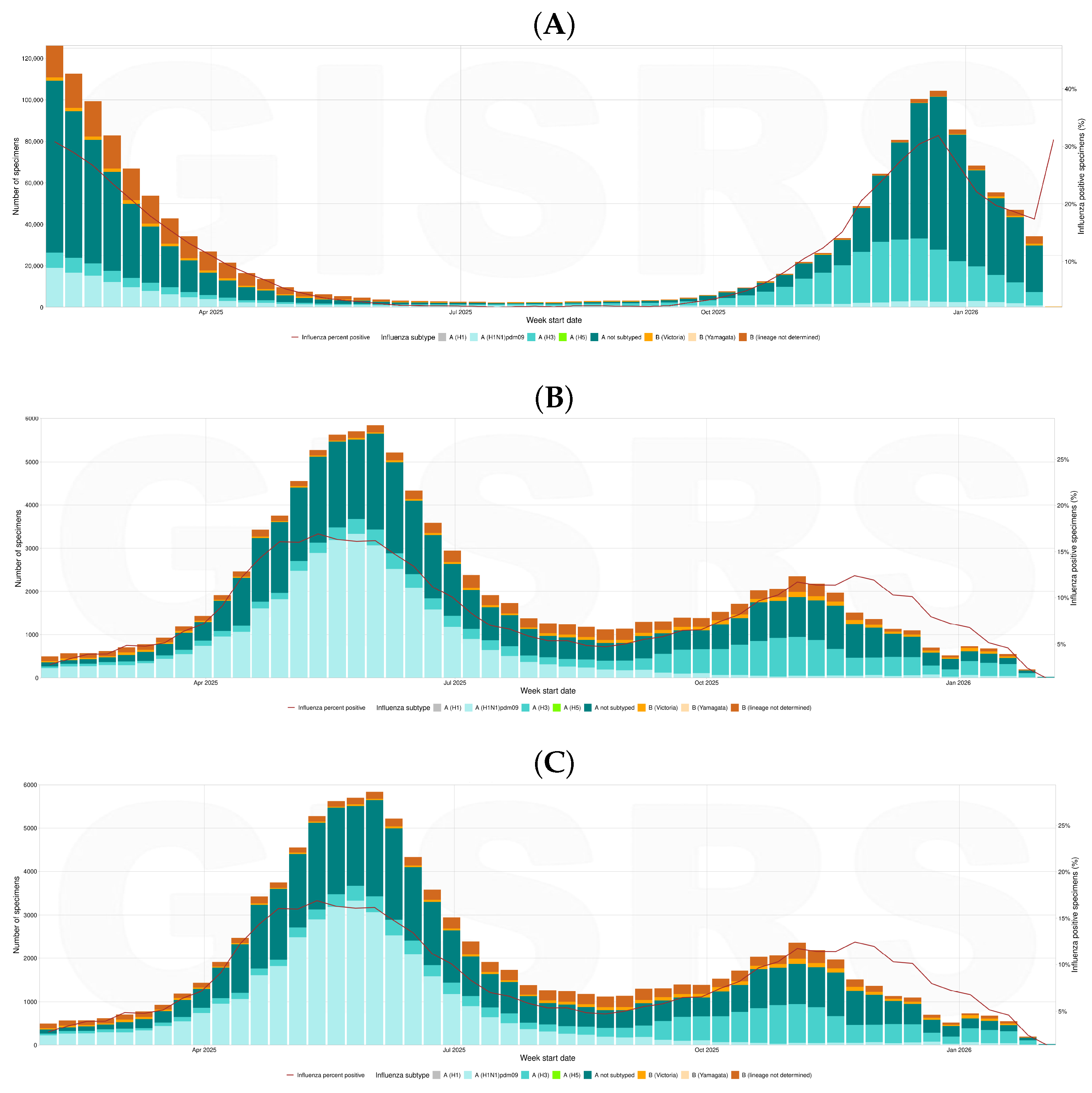
From an epidemiological perspective, data were obtained from the WHO FluNet platform (
https://www.who.int/tools/flunet, accessed on 10 February 2026). The dataset consisted of aggregated time series describing global influenza activity and subtype circulation across countries. FluNet integrates heterogeneous surveillance inputs from multiple reporting systems, including sentinel, non-sentinel, and undefined streams. Sentinel surveillance refers to systematic sampling from predefined outpatient networks using standardized case definitions (e.g., influenza-like illness (ILI) or acute respiratory infection (ARI)), enabling consistent temporal comparisons over time. Non-sentinel surveillance generally reflects testing performed outside sentinel networks, including hospital-based testing, outbreak investigations, and routine diagnostic testing, and may be influenced by variations in healthcare-seeking behavior and testing intensity. Undefined (or unknown) streams include reports for which the surveillance source is not specified or cannot be clearly assigned to either sentinel or non-sentinel categories. FluNet data were analyzed as reported, without normalization for population size, testing volume, or surveillance coverage. Accordingly, the resulting time series should be interpreted as indicators of surveillance activity and temporal dynamics rather than direct estimates of incidence or disease burden. Geographic stratification followed the predefined regional categories available within the FluNet interface. Because data are aggregated at the national level, countries spanning multiple climatic or epidemiological zones are assigned to a single category, which may introduce ecological bias and limit the interpretation of regional comparisons. Influenza A detections reported without subtype specification were retained as a separate category to avoid introducing assumptions in subtype assignment. These records may reflect incomplete laboratory characterization or differences in reporting practices across surveillance systems.
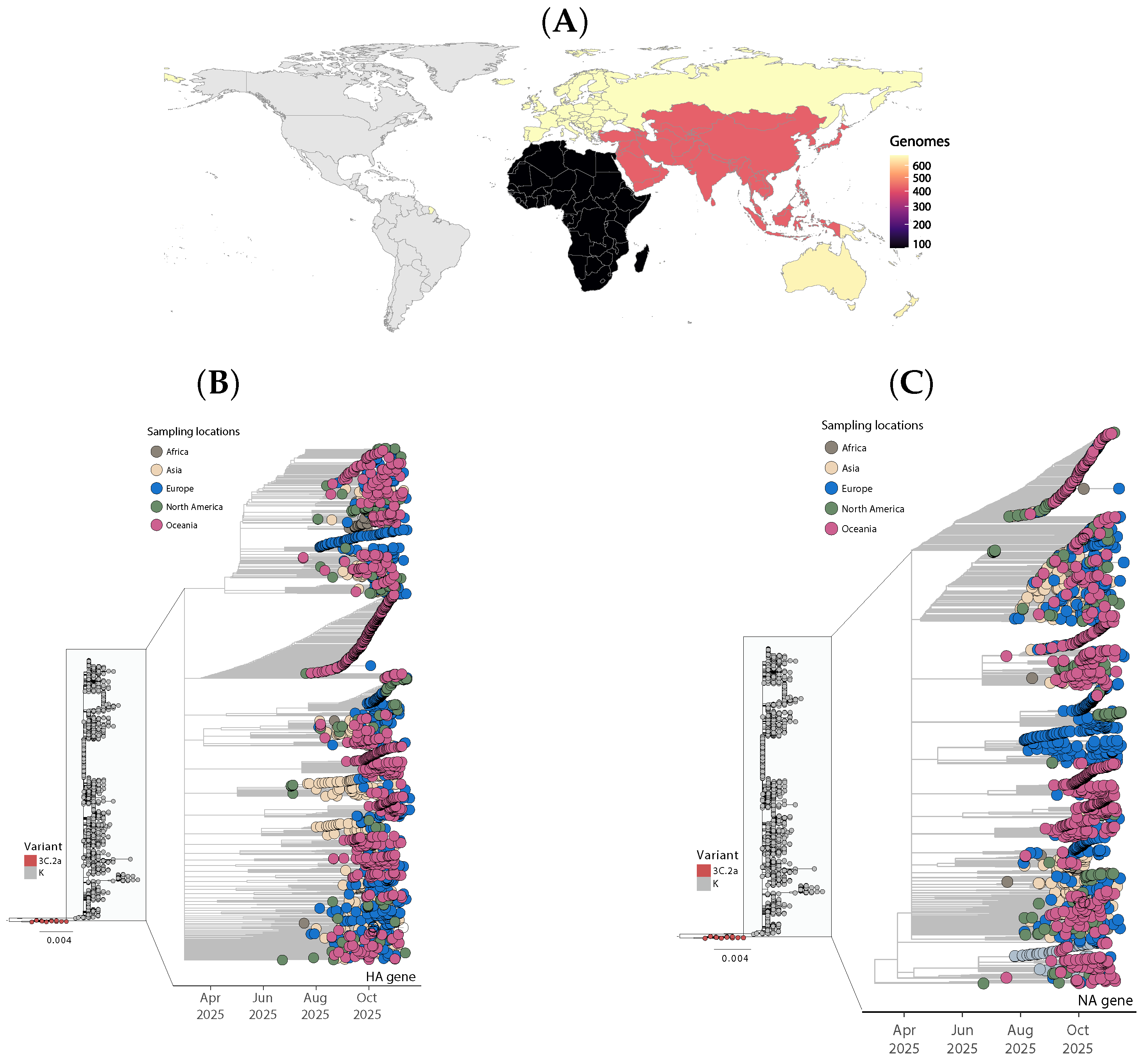
From a phylogenetic perspective, analyses were performed using publicly available, de-identified sequence data and associated metadata, without access to individual-level human participant information, and therefore did not require additional ethical approval. Available H3N2 sequences were downloaded from GISAID by gene segment (HA and NA), applying filters for sequence completeness, quality, and availability of sampling metadata. To minimize geographic sampling bias, sequences were selected to ensure representative coverage across different regions. In total, 2040 sequences per gene were included in the analyses, together with 30 ancestral H3N2 3C.3a reference sequences used to provide phylogenetic context. Sequence alignments for the two surface antigen segments (HA and NA) were generated using ViralMSA with minimap2 [
19,
20]. Alignments were manually inspected and curated in AliView to remove potential biological inconsistencies and alignment artifacts, including frameshifts and terminal gaps [
21]. Maximum-likelihood (ML) phylogenetic inference for each alignment was performed using IQ-TREE2 [
22], employing the general time-reversible model of nucleotide substitution with a proportion of invariable sites (+I), as selected by ModelFinder. Time-scaled phylogenies were subsequently reconstructed using TreeTime only for sequences belonging to the K clade in each gene segment [
23].
4. Discussion
The genomic, antigenic, and epidemiological evidence presented in this study supports the interpretation that influenza A(H3N2) subclade K (J.2.4.1) represents a recently diversified lineage, characterized by coordinated evolution of the HA and NA surface glycoproteins and rapid international spread during the 2025/26 season. Our temporal phylogenetic analyses demonstrated concordant clustering of K-associated viruses in both gene segments, ruling out transient stochastic expansion and instead indicating sustained evolutionary success within the current H3N2 genetic background. The observed constellation of substitutions in HA at antigenically relevant sites fits within the established paradigm of progressive antigenic drift of H3N2, in which relatively limited sets of amino acid substitutions can significantly reduce antibody recognition while preserving receptor binding and viral fitness [
30]. It is important to note that, although reduced reactivity in hemagglutination inhibition assays compared to vaccine reference antisera has been reported in several contexts, contemporary estimates of VE have remained moderate, highlighting the complex and often nonlinear relationship between antigenic distance measured in ferret serology and protection at the population level.
Considering this evolutionary and antigenic context, the constellation of substitutions observed in J.2.4.1 appears plausibly functional, suggesting advantages in terms of antigenic adaptation, receptor binding, and compatibility with NA activity and internal gene composition. In particular, this series of substitutions could (i) modify key antigenic surfaces on HA, (ii) preserve or modulate receptor interaction, and (iii) remain compatible with NA activity and internal gene constellations that support replication. It is important to note that rapid expansion of the subclade does not necessarily imply increased virulence; more likely, it reflects an increased ability to infect individuals with partial immunity or to trigger early transmission during the season.
The observed predominance of J.2.4.1 in the United Kingdom and the United States during the first half of the season aligns with the hypothesis of a transmission advantage that is detectable at the population level. Nevertheless, estimates of relative growth are sensitive to surveillance intensity, representativeness of sequenced specimens, and delays in reporting. Continued analyses using phylodynamic approaches with explicit sampling models, combined with antigenic cartography where available, will be helpful to quantify the magnitude of any intrinsic advantage and to separate biological effects from surveillance artifacts.
Our results are consistent with the broader narrative of ongoing antigenic drift in H3N2, in which relatively small sets of HA changes can meaningfully erode recognition by antibodies induced by prior infection or vaccination. This has practical implications for vaccine strain selection, particularly when candidate vaccine viruses are propagated in eggs, where additional adaptive substitutions may be selected and further distort antigenic match. This remains especially relevant for H3N2, as egg-adaptive changes near the receptor-binding site have been associated with reduced VE in some seasons. In this context, several studies have reported improved antigenic fidelity and, in some cases, higher effectiveness for cell-based or recombinant vaccines compared to egg-based formulations, including high-dose and adjuvanted vaccines, highlighting the impact of production platform on vaccine performance.
The emergence of J.2.4.1 further highlights that HA-only assessments may be insufficient to fully anticipate vaccine performance. NA antigenic drift and the breadth of NA-directed immunity can influence protection, particularly against severe disease, yet NA remains less standardized in vaccine composition and evaluation. Integrating NA sequence surveillance, neuraminidase inhibition data, and paired HA/NA evolutionary analyses should therefore be prioritized to better understand how combined antigenic trajectories shape population immunity and vaccine outcomes.
The evolutionary success of H3N2 lineages is often underpinned by coordinated changes across segments. Alterations in HA that affect receptor avidity can require compensatory changes in NA to maintain an optimal balance between attachment and release. Our paired analyses of HA and NA support the view that J.2.4.1 should be interpreted as a genome-wide phenotype rather than as an HA-only event. This has operational implications: tracking subclades using both HA and NA lineages, and evaluating reassortment signals when they occur, can improve the resolution of surveillance and the interpretation of antigenic data.
From a public health perspective, the rapid rise of J.2.4.1 reinforces the need for timely sharing of sequences and antigenic characterization data, particularly early in the season when vaccine strain decisions are being informed. In addition to routine genetic classification, near-real-time monitoring of substitutions at known antigenic sites, glycosylation motifs, and receptor-binding associated residues can provide early warning signals of potential antigenic change. Where feasible, coupling genomic surveillance with standardized antigenic assays and epidemiological indicators (e.g., age distribution, severity proxies, and vaccine breakthrough analyses) will help interpret whether emerging lineages are primarily immune-escape variants, transmission-enhanced variants, or both.
Given the global connectivity of influenza transmission, regional differences in timing and dominance should not be viewed in isolation. The apparent early signals in parts of the southern hemisphere, followed by widespread detections in the northern hemisphere, emphasize the importance of integrating datasets across regions. Investments in sequencing capacity, harmonized analytic pipelines, and rapid dissemination of interpretive reports will be crucial to reduce lag between viral evolution and public health action.
4.1. Limitations
This study has several limitations. First, the FluNet data used for epidemiological trend analysis are not standardized for population size, testing volume, or surveillance intensity. Substantial heterogeneity exists across countries in diagnostic capacity, healthcare access, and reporting completeness. Consequently, aggregated counts may be disproportionately influenced by nations with higher testing volumes and more comprehensive surveillance systems, potentially biasing the observed temporal and geographic patterns. Furthermore, the use of predefined FluNet geographic categories—based on operational reporting groupings rather than strict climatological definitions—may introduce classification ambiguity. This is particularly relevant for large countries spanning multiple climatic zones, where national-level aggregation may obscure important subnational variation in transmission dynamics. Additionally, a proportion of influenza A detections are reported without subtype designation; these may not be randomly distributed across time or geography, reflecting differences in laboratory capacity or testing priorities, which may affect the accuracy of subtype-specific trend interpretation. Second, the representativeness of publicly available sequences from GISAID may vary substantially by country, time period, and sampling frame, potentially biasing estimates of lineage frequency and geographic spread. Third, antigenic characterization data are not uniformly available across regions and may be influenced by assay choice, virus isolation history, and laboratory-specific protocols. Fourth, phylogenetic inference is sensitive to sequence quality, alignment choices, and model assumptions; although our analyses employed standard, reproducible approaches, alternative models might yield modestly different estimates of timing and branching patterns. Finally, we did not directly estimate VE or clinical severity associated with subclade K (J.2.4.1); therefore, our conclusions focus on evolutionary dynamics and antigenic signals rather than on clinical impact.
4.2. Conclusions
In summary, our molecular characterization of influenza A(H3N2) subclade K (J.2.4.1) indicates that its rapid rise during the 2025/26 season is consistent with successful dissemination accompanied by antigenic drift relative to contemporary vaccine reference strains. From an epidemiological perspective, this rapid predominance is compatible with a modest but meaningful transmission advantage, potentially driven by improved fitness under existing population immunity, enhanced seeding during early-season travel, or favorable antigenic positioning relative to prior vaccine strains. However, increased prevalence does not necessarily imply increased virulence, as current public health reports primarily highlight expanded detection and early-season activity rather than a clear signal of increased clinical severity. These observations underscore the persistent challenges posed by H3N2 for vaccine strain selection and highlight the value of integrating HA/NA genomic surveillance with antigenic and epidemiological data streams. Continued monitoring of J.2.4.1 and its descendants will be essential to determine whether its predominance persists, whether further antigenic drift accumulates, and how these changes should inform next-season vaccine composition and preparedness planning. From a public health perspective, these findings reinforce the need for sustained and globally representative genomic surveillance with timely sequence sharing and adequate geographic coverage to support early detection of emerging variants and improve pandemic preparedness.




 ,
,