
An Anti-Misalignment Method for Inductive Power Transmission System Based on Working Mode Switching


Abstract
1. Introduction
2. Circuit Analysis
2.1. Working Mode I
2.2. Working Mode II
3. Analysis of Anti-Misalignment Characteristics
4. Theoretical Verification
4.1. Parameter Design
4.2. Control System Design
- (1)
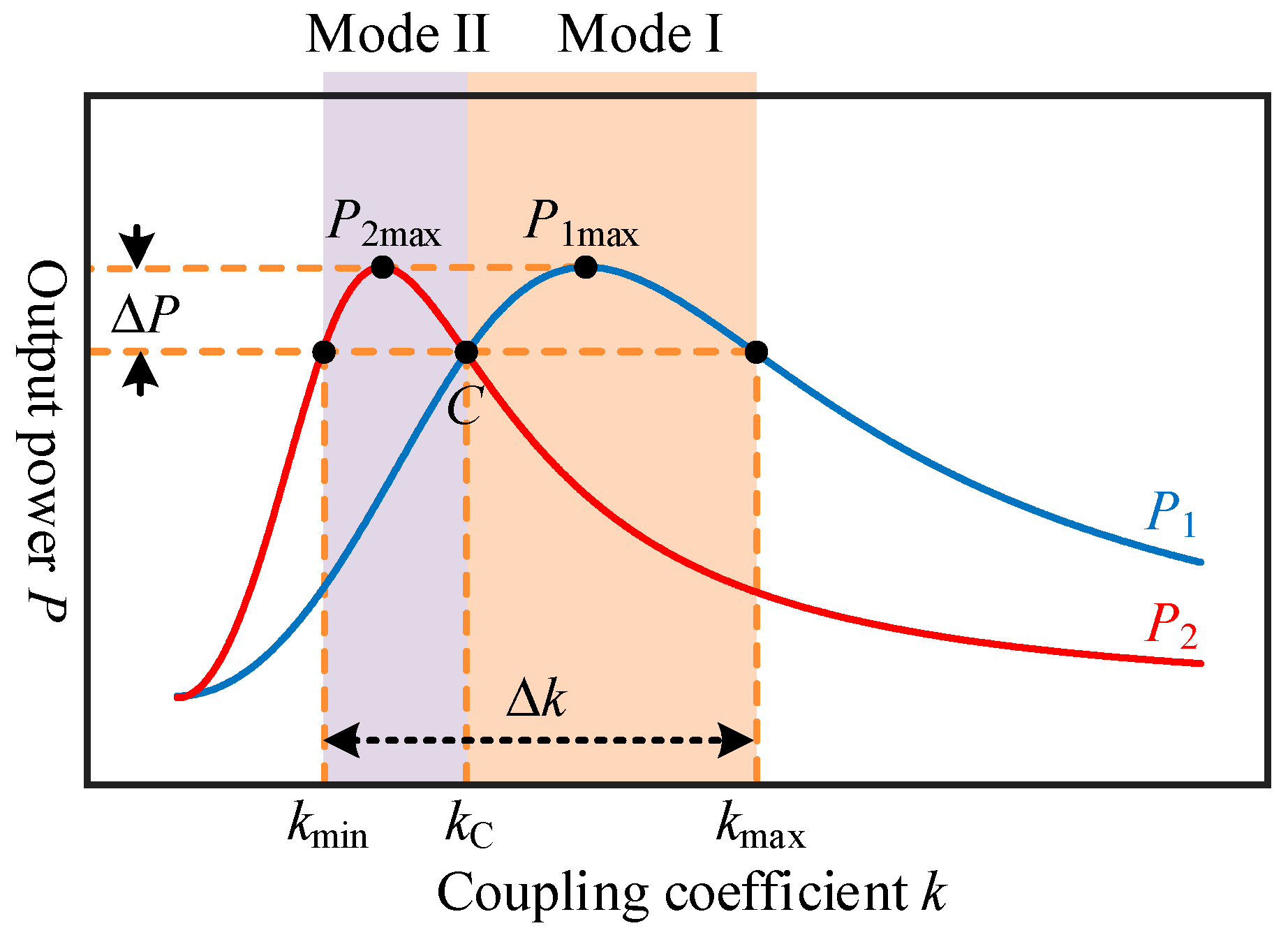
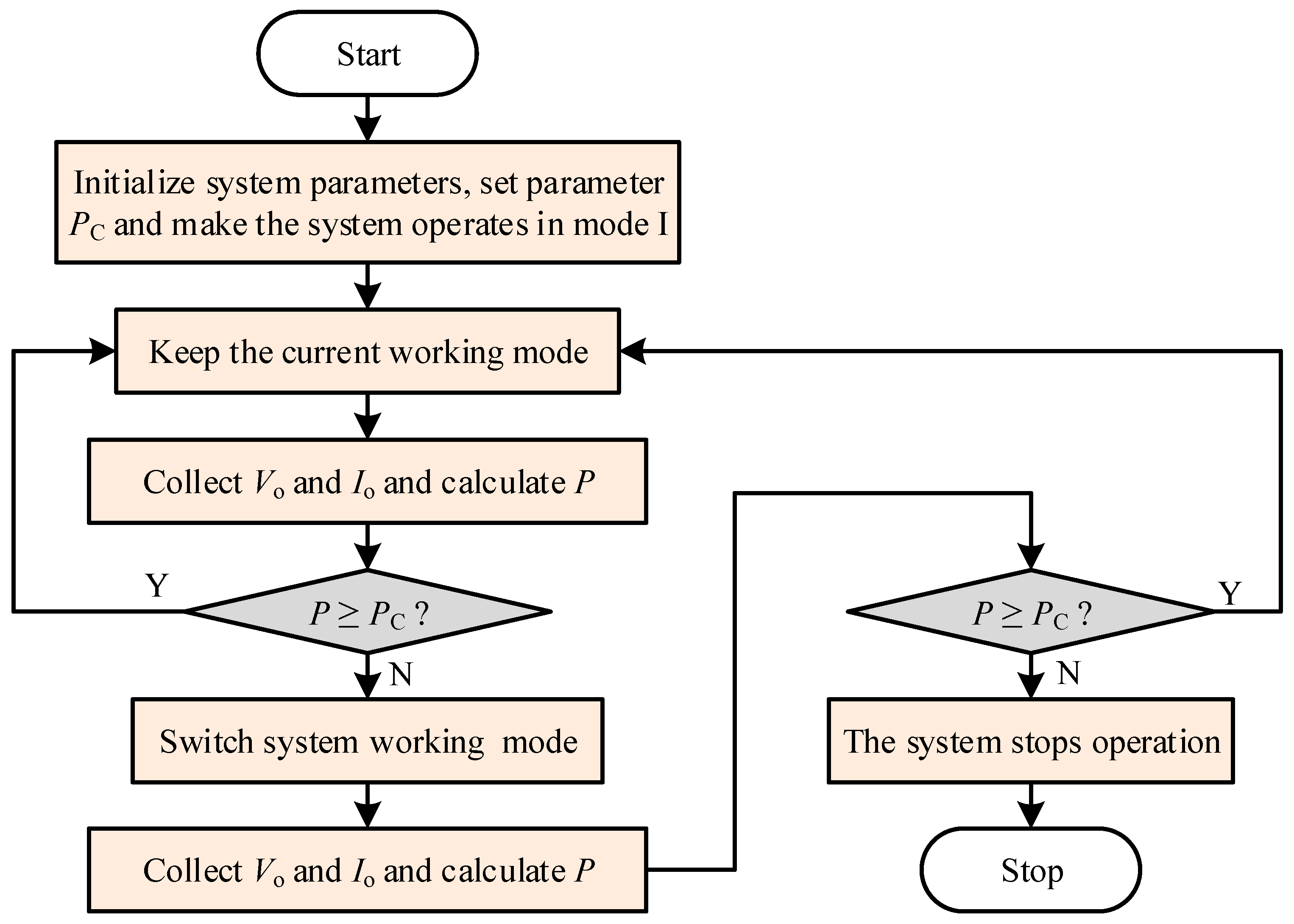
- When P is greater than or equal to PC, the system continues to operate in its current mode.
- (2)
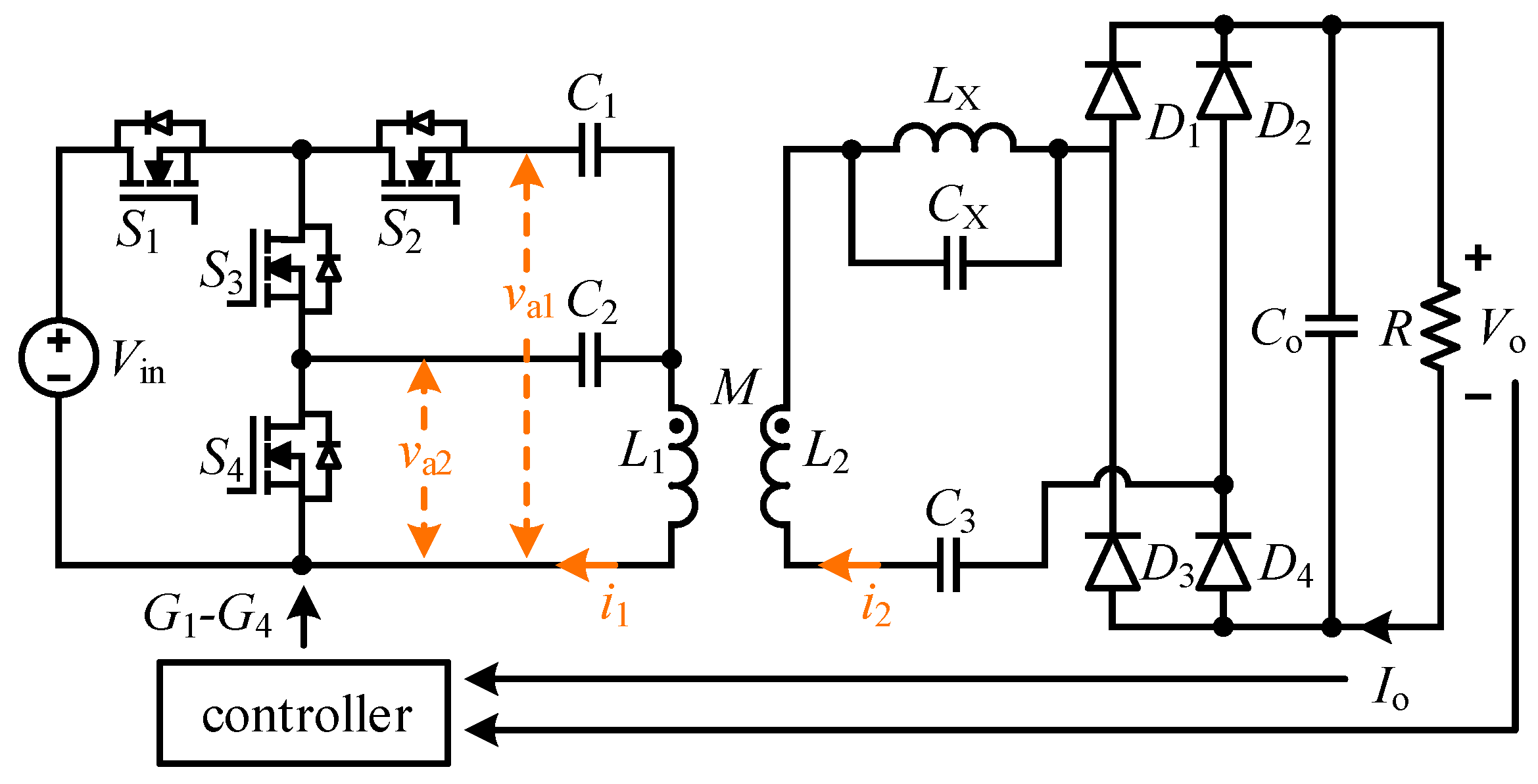
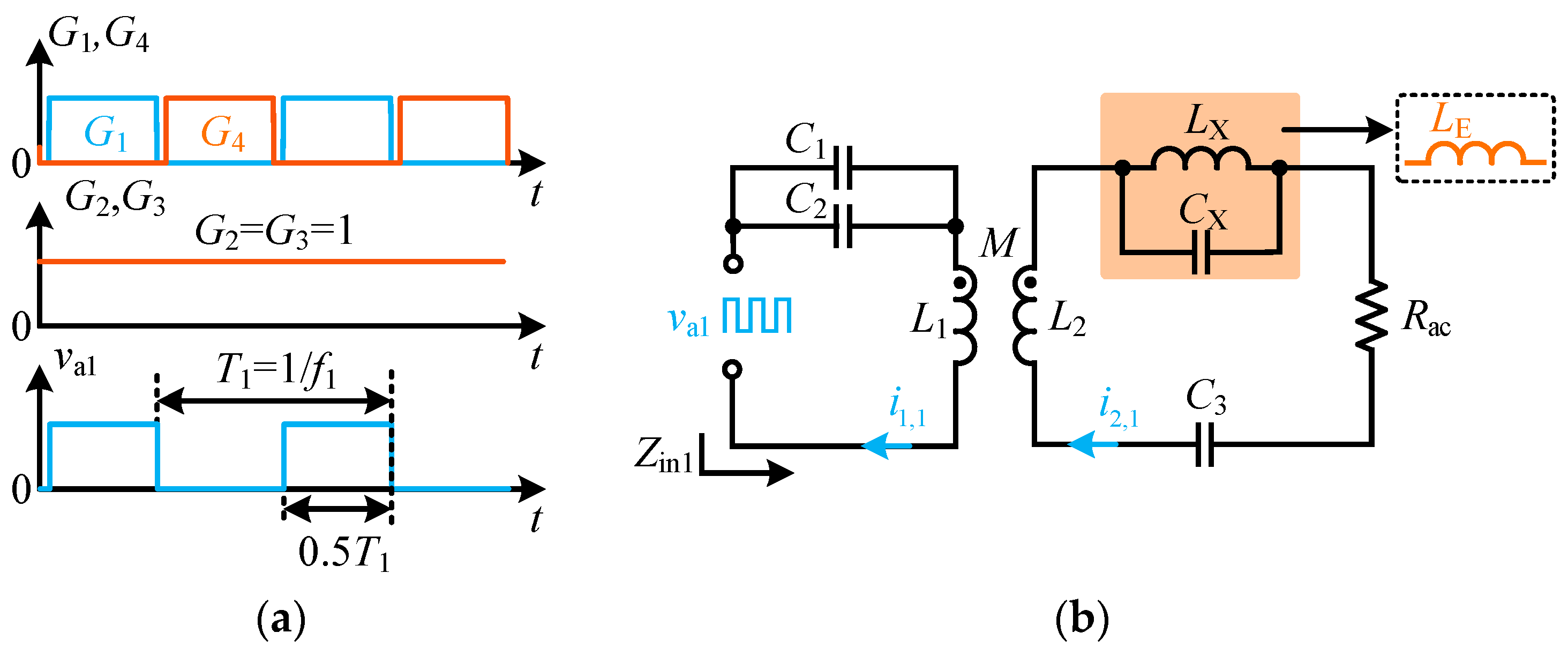
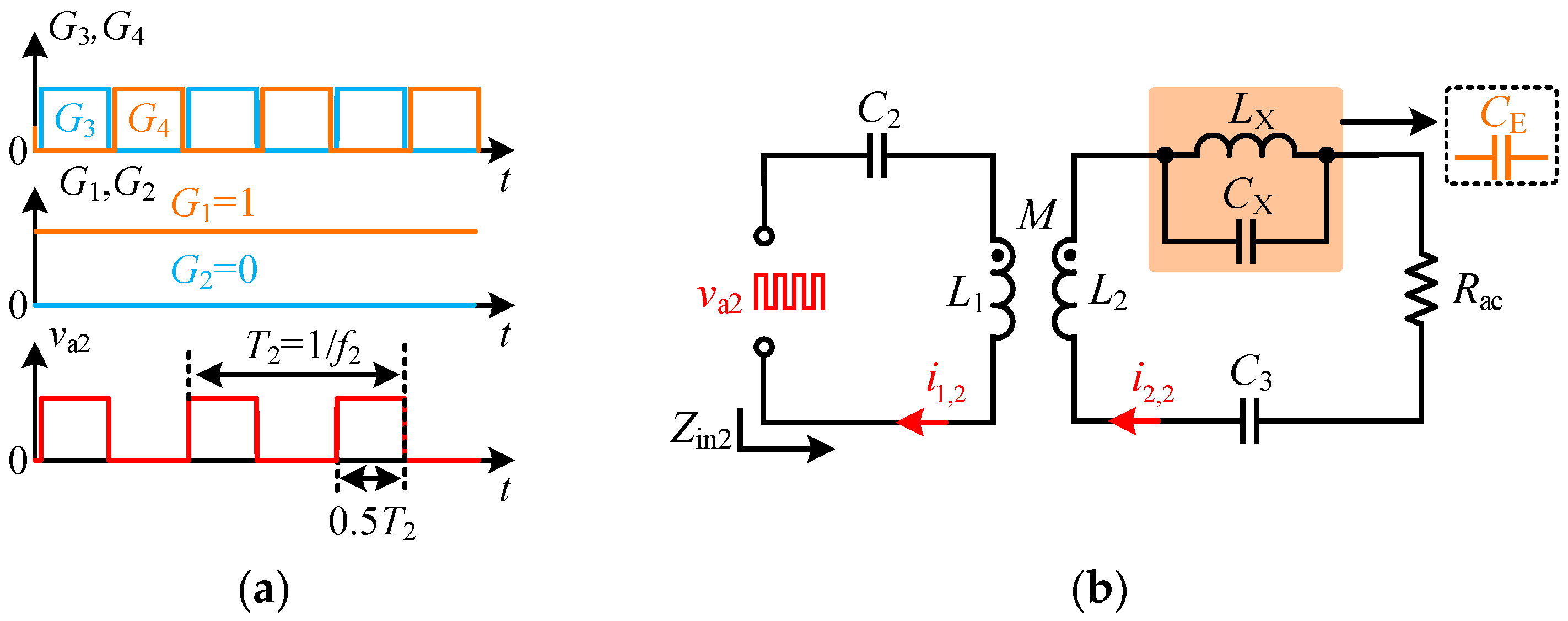
- When P is less than PC, the working mode of the system must first be determined. If the system is operating in working mode I, it should be switched to working mode II, i.e., the driver signal of the inverter as shown in Figure 2. Conversely, if the system is operating in working mode II, it should be switched to working mode I, i.e., the driver signal of the inverter as shown in Figure 2.
- (3)
- Upon completion of the system’s mode switching, the output voltage and current are measured to calculate the output power P. If P exceeds the PC, the current operating mode is retained; otherwise, the system stops operation.
4.3. Simulation Verification
4.4. Experimental Verification
4.5. Discussion
5. Conclusions
- (1)
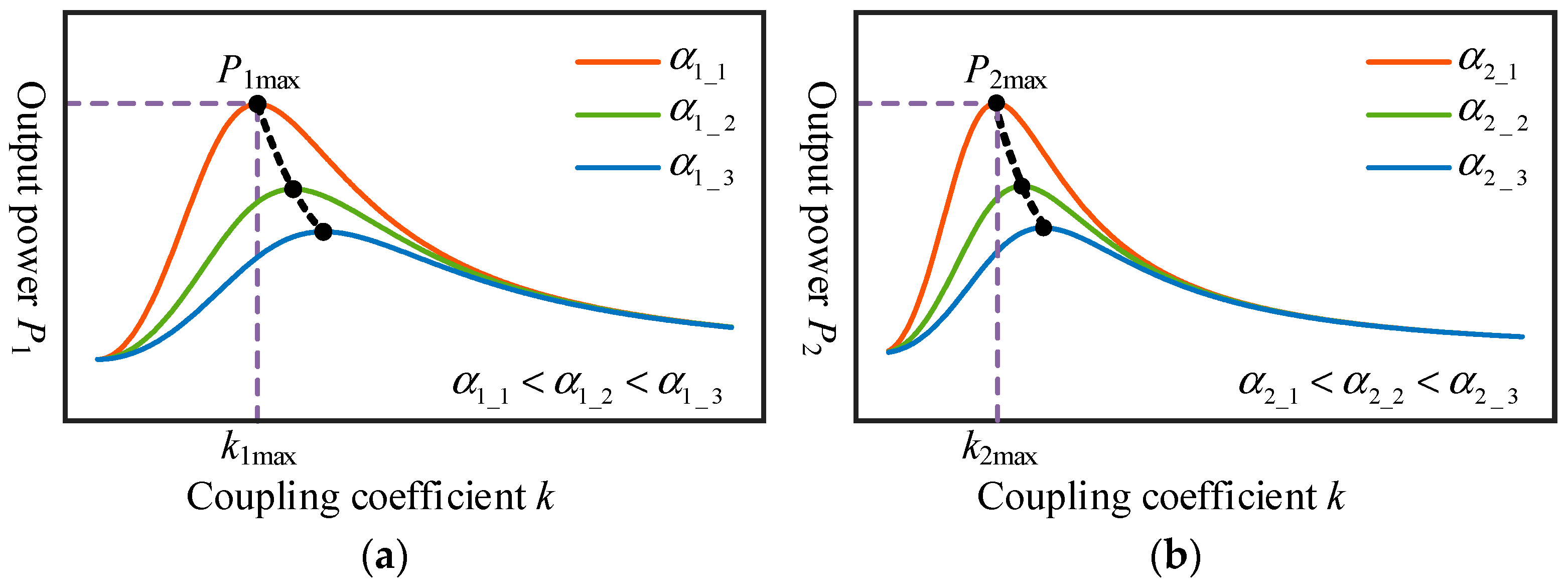
- The output characteristics and anti-misalignment characteristics of the IPT system operating inductance detuning and secondary-side resonance were analyzed. At the same time, parameter selection processes were given based on theoretical analysis.
- (2)
- According to the variations in output power, the controller adjusts the switching frequency and conduction mode of the inverter to modify the system output curve. This approach not only reduces the impact of coil misalignment on output power but also simplifies system control.
- (3)
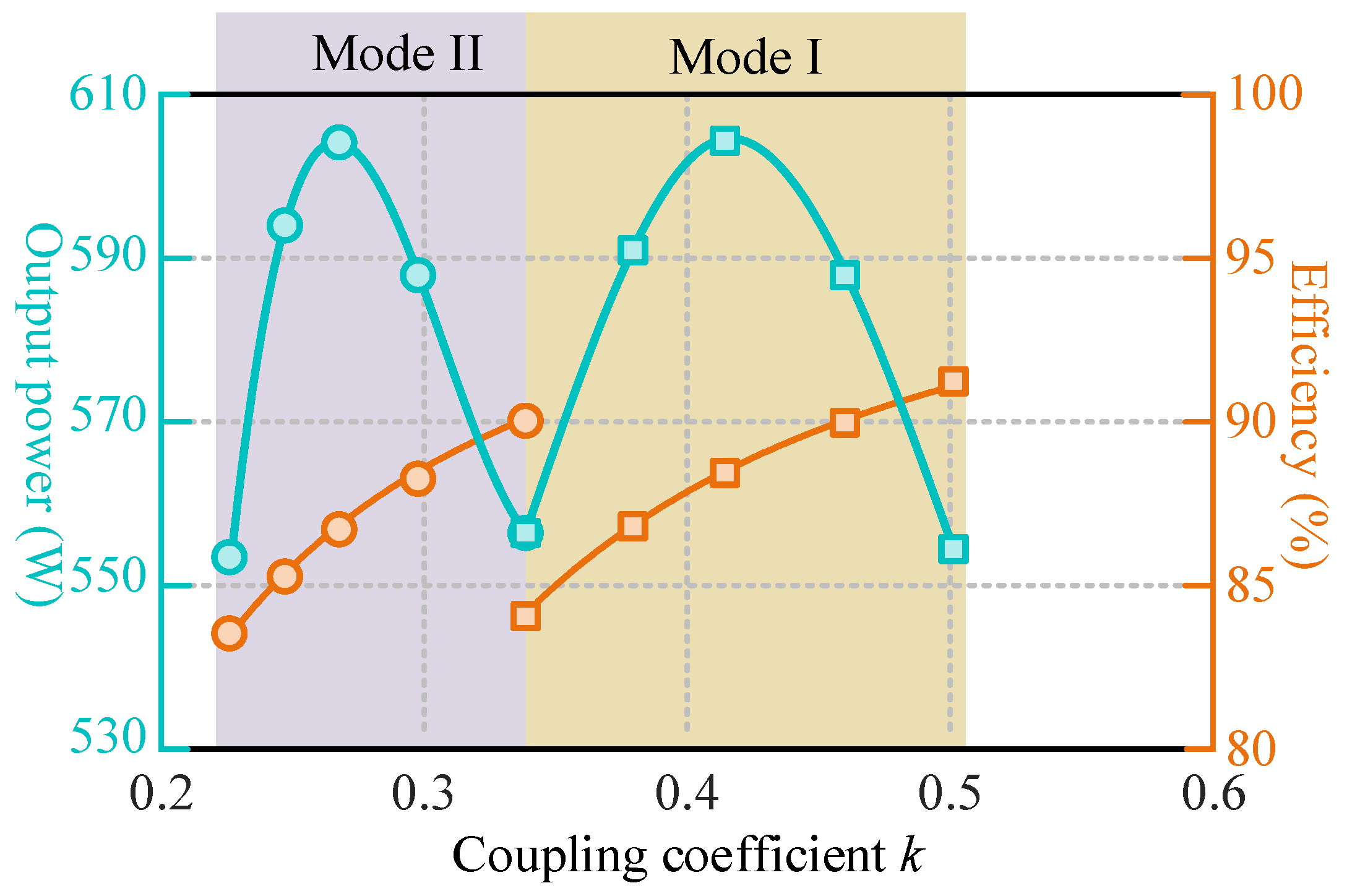
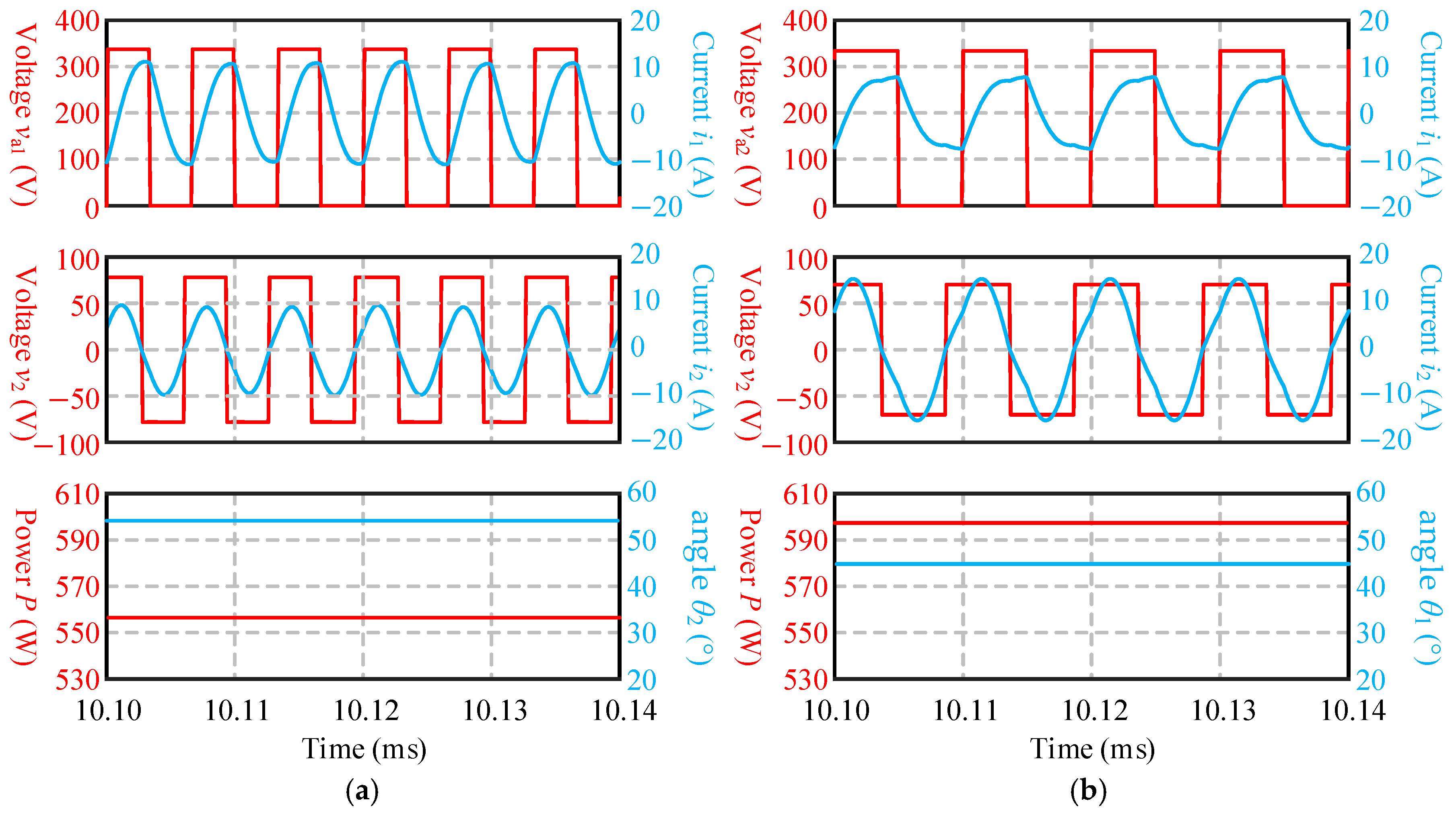
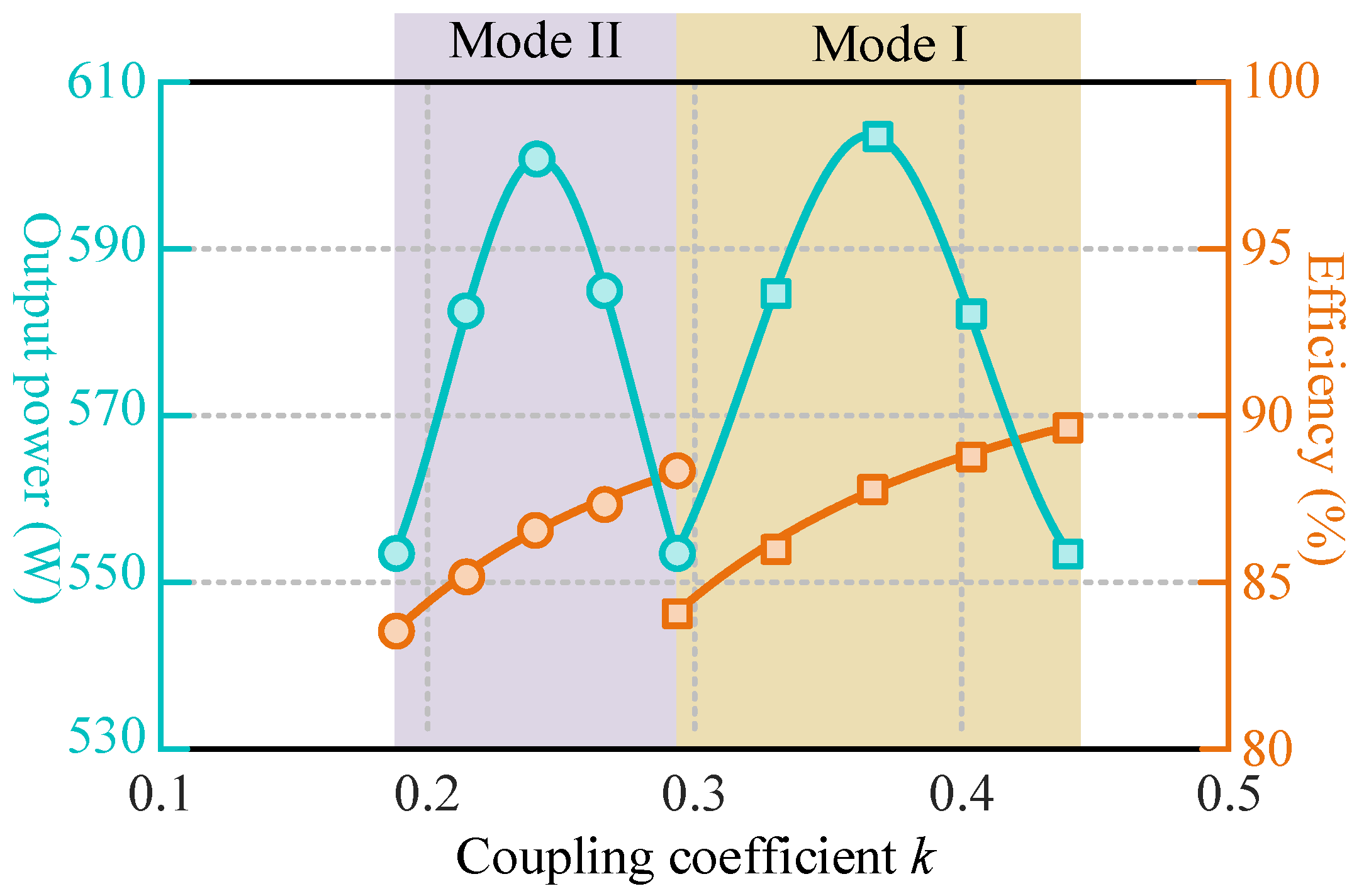
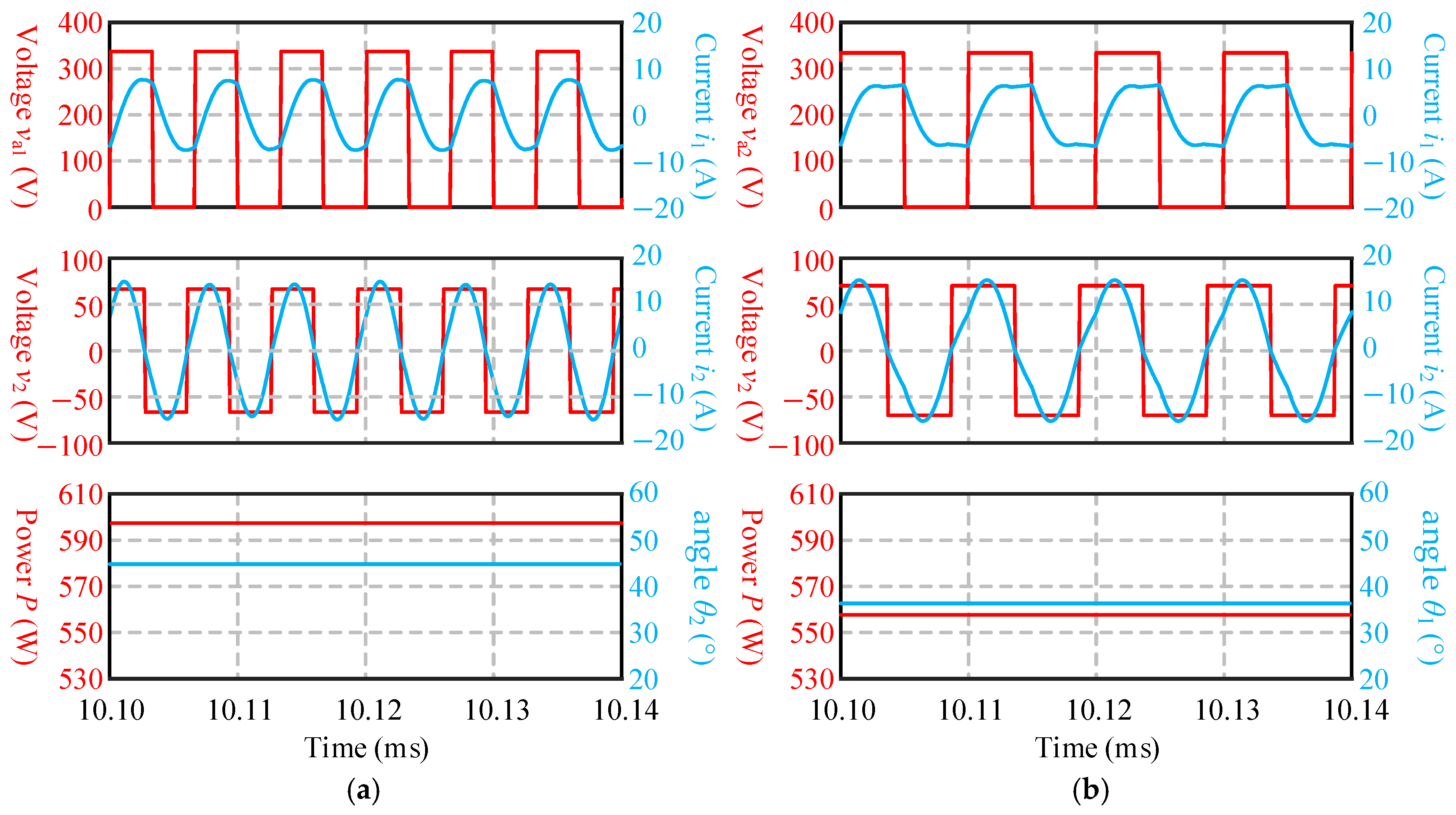
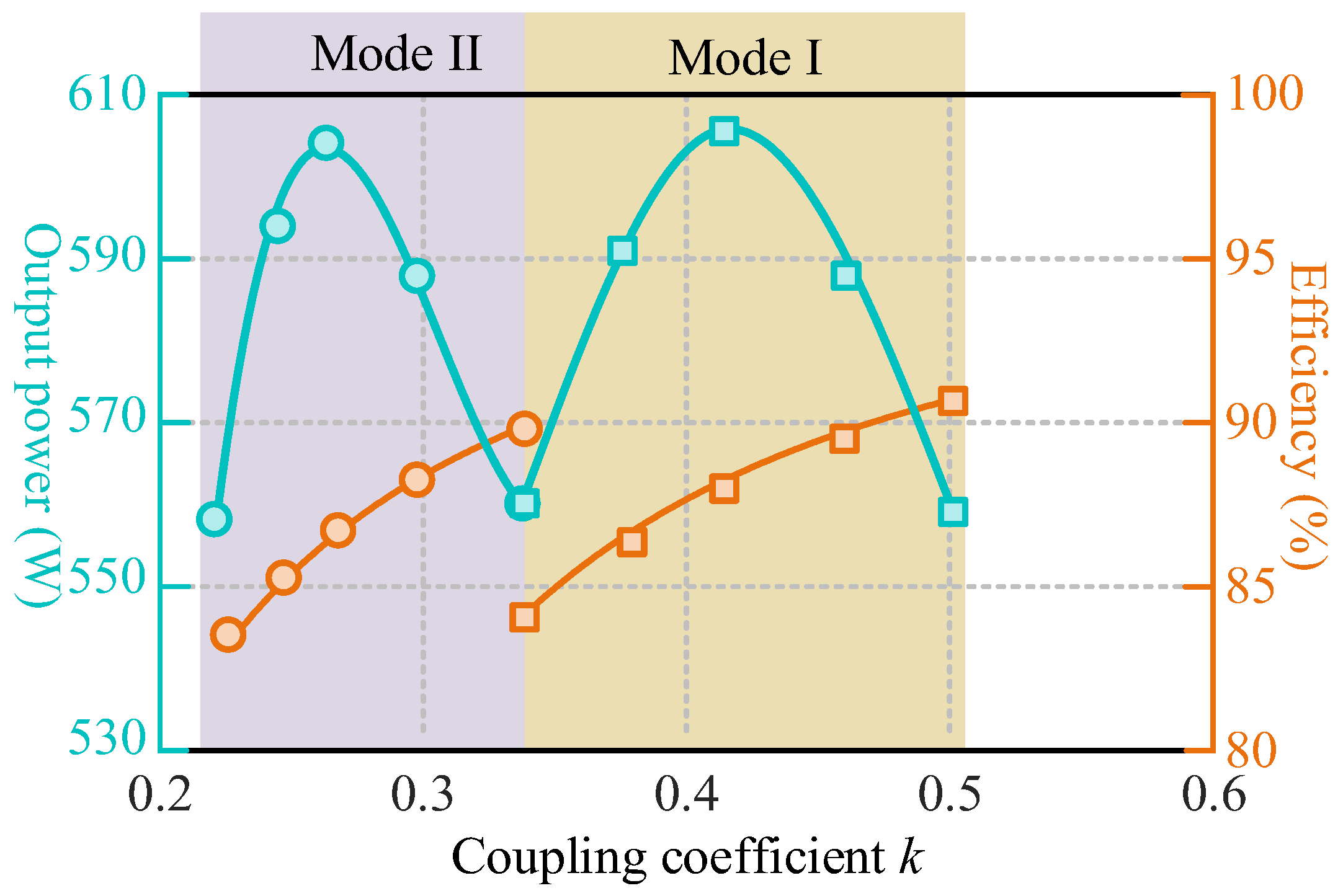
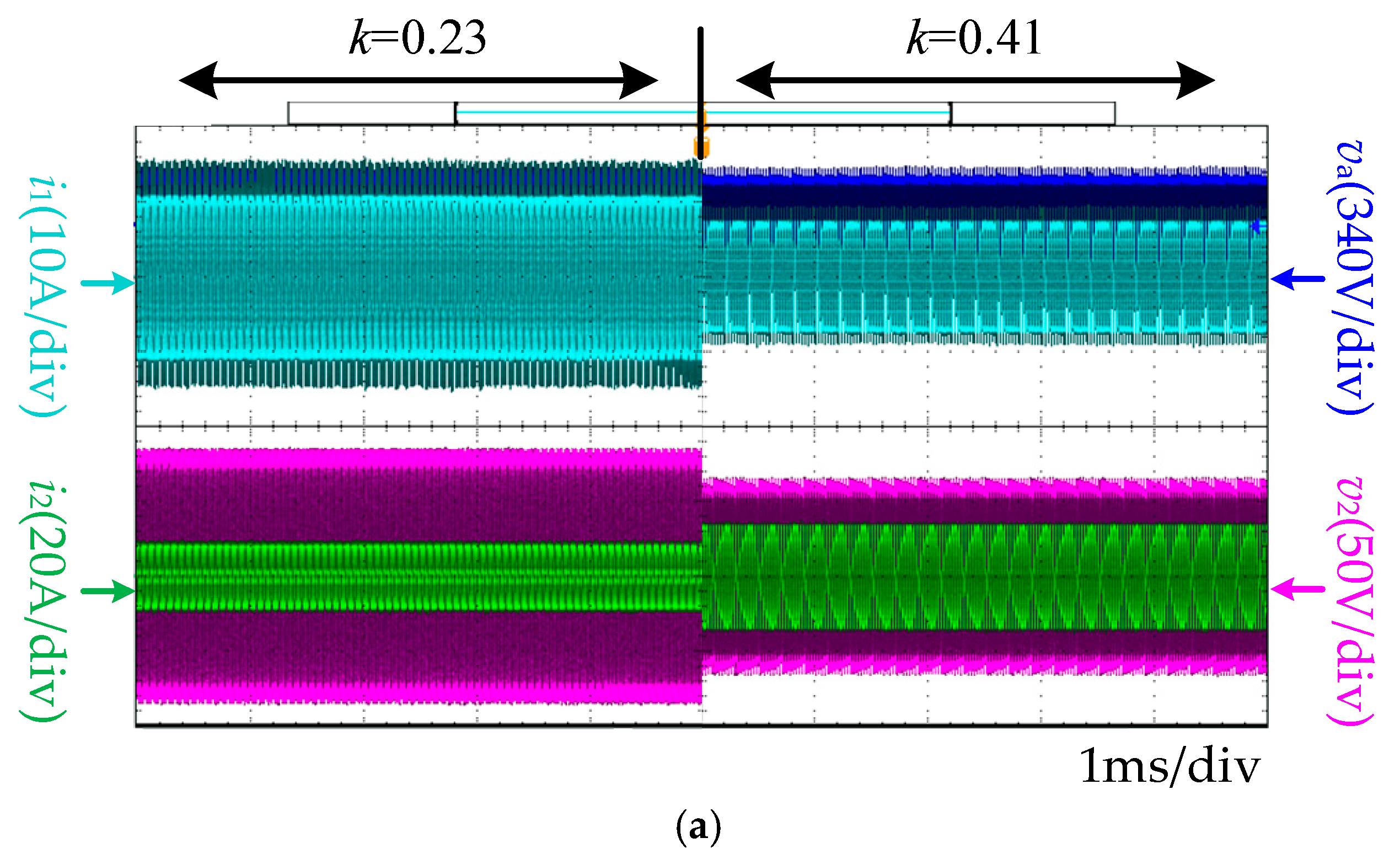
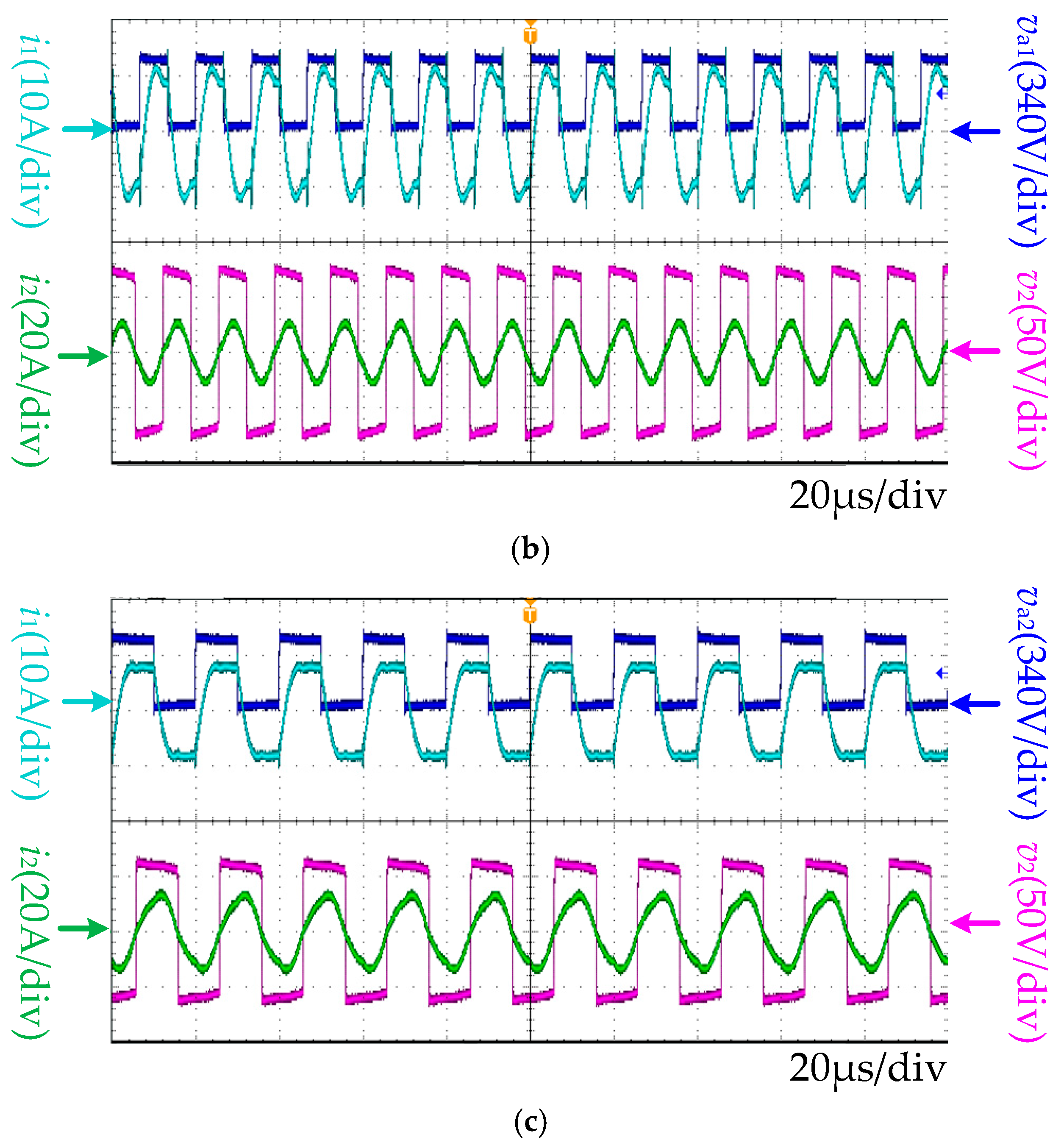
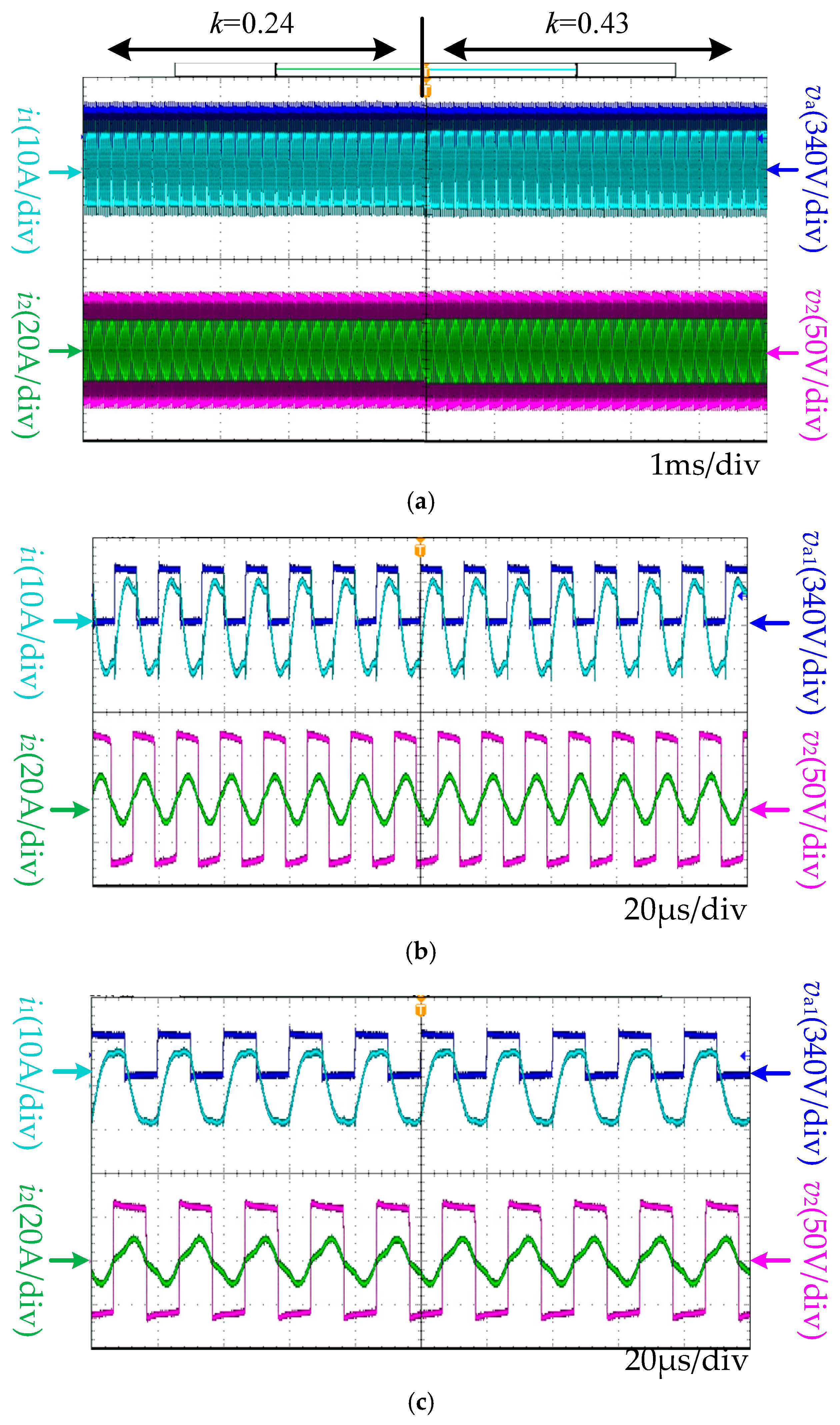
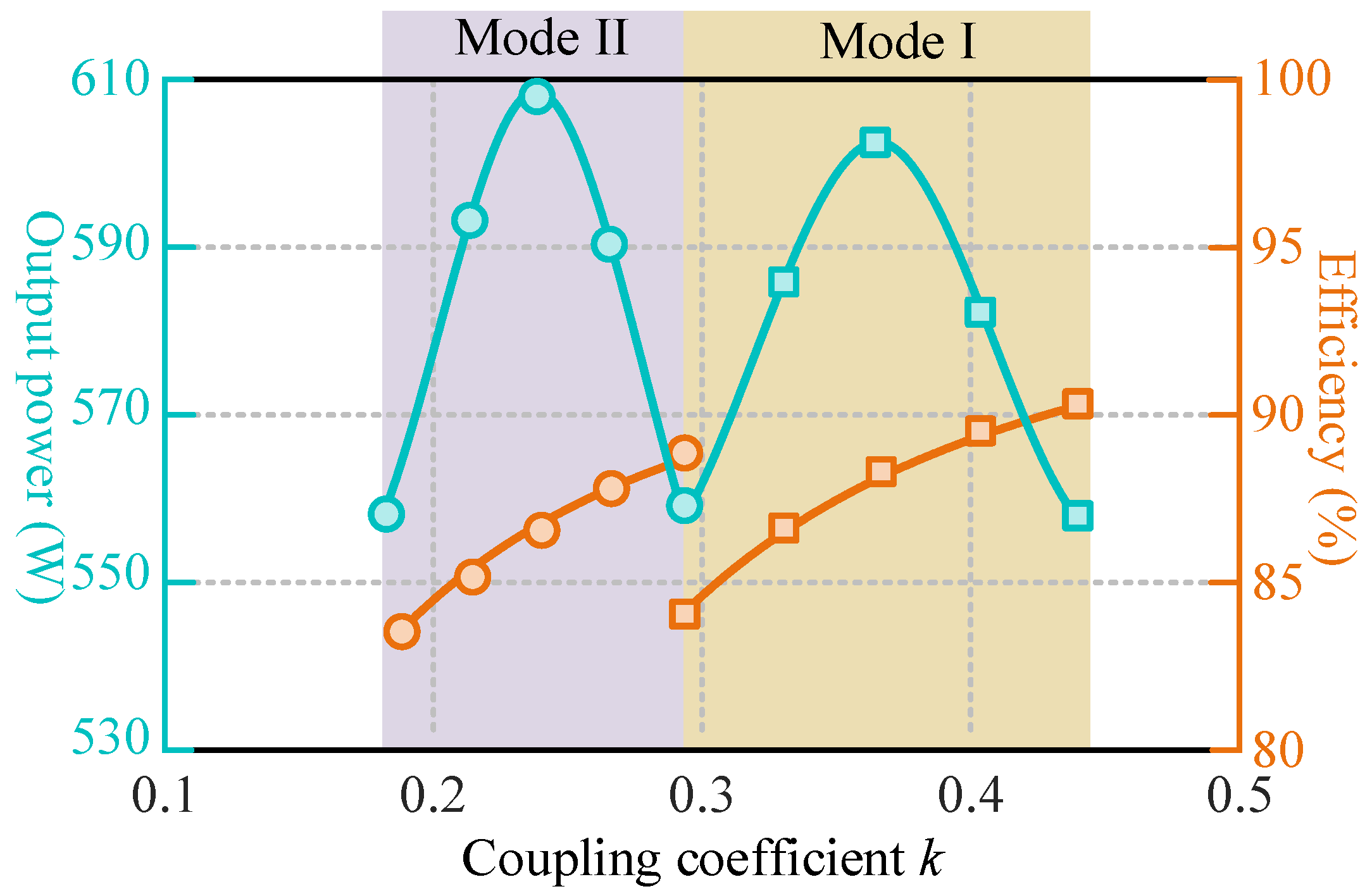
- A simulation platform and an experimental prototype with an output power of 600 W were constructed. The simulation and experimental results indicate that as the coupling coefficient increases from 0.23 to 0.5, the system’s output power reaches 600 W, with an output power fluctuation of 4.4%. The theoretical analysis has been validated through these simulations and experiments.
Author Contributions
Funding
Data Availability Statement
Conflicts of Interest
References
- Grazian, F.; Soeiro, T.B.; Bauer, P. Voltage/Current Doubler Converter for Electric Vehicle Wireless Charging Employing Bipolar Pads. IEEE J. Emerg. Sel. Top. Power Electron. 2023, 11, 4549–4562. [Google Scholar] [CrossRef]
- Bouanou, T.; El Fadil, H.; Lassioui, A.; Bentalhik, I.; Koundi, M.; El Jeilani, S. Design Methodology and Circuit Analysis of Wireless Power Transfer Systems Applied to Electric Vehicles Wireless Chargers. World Electr. Veh. J. 2023, 14, 117. [Google Scholar] [CrossRef]
- Han, J.; Hu, J.; Yang, Y.; Wang, Z.; Wang, S.X.; He, J. A Nonintrusive Power Supply Design for Self-Powered Sensor Networks in the Smart Grid by Scavenging Energy from AC Power Line. IEEE Trans. Ind. Electron. 2015, 62, 4398–4407. [Google Scholar] [CrossRef]
- Hamed, A.; Lassioui, A.; El Fadil, H.; Abbade, H.; El Jeilani, S.; El Ancary, M.; Chiheb, M.; El Idrissi, Z. Modelling, Analysis, and Nonlinear Control of a Dynamic Wireless Power Transfer Charger for Electrical Vehicle. World Electr. Veh. J. 2025, 16, 512. [Google Scholar] [CrossRef]
- Detka, K.; Górecki, K. Wireless Power Transfer-A Review. Energies 2022, 15, 7236. [Google Scholar] [CrossRef]
- Yang, C.; Zhang, L.; Huang, W.; Yang, Y.; Guo, K. Research and Design of a Single-Switch Wireless Power Transfer System with Misalignment-Tolerant Characteristics. World Electr. Veh. J. 2026, 17, 1. [Google Scholar] [CrossRef]
- Yu, Q.; Xiong, W.; Yan, Z.; Mai, R.; He, Z.; Shao, Y. Efficiency Improvement and Ripple Suppression Method Based on Partial Power Processing for Wireless Power Transfer System. IEEE Trans. Power Electron. 2023, 38, 13181–13193. [Google Scholar] [CrossRef]
- Fu, M.; Ma, C.; Zhu, X. A Cascaded Boost-Buck Converter for High-Efficiency Wireless Power Transfer Systems. IEEE Trans. Ind. Electron. 2014, 10, 1972–1980. [Google Scholar] [CrossRef]
- Zhu, G.; Dong, J.; Shi, W.; Soeiro, T.B.; Xu, J.; Bauer, P. A Mode-Switching-Based Phase Shift Control for Optimized Efficiency and Wide ZVS Operations in Wireless Power Transfer Systems. IEEE Trans. Power Electron. 2023, 38, 5561–5575. [Google Scholar] [CrossRef]
- Zhou, J.; Guidi, G.; Chen, S.; Tang, Y.; Suul, J.A. Conditional Pulse Density Modulation for Inductive Power Transfer Systems. IEEE Trans. Power Electron. 2024, 39, 88–93. [Google Scholar] [CrossRef]
- Fan, M.; Shi, L.; Yin, Z.; Jiang, L.; Zhang, F. Improved Pulse Density Modulation for Semi-bridgeless Active Rectifier in Inductive Power Transfer System. IEEE Trans. Power Electron. 2019, 34, 5893–5902. [Google Scholar] [CrossRef]
- Tao, C.; Wang, L.; Zhang, Y.; Li, S.; Da, C. Research on Three-Phase Hybrid Compensation WPT System with High Misalignment Tolerance and Its ZVS Control Strategy. IEEE Trans. Power Electron. 2023, 38, 14847–14860. [Google Scholar] [CrossRef]
- Wang, Q.; Che, W.; Mongiardo, M.; Monti, G. Wireless Power Transfer System with High Misalignment Tolerance for Bio-Medical Implants. IEEE Trans. Circuits Syst. II 2020, 67, 3023–3027. [Google Scholar] [CrossRef]
- Chen, Y.; Mai, R.; Zhang, Y.; Li, M.; He, Z. Improving Misalignment Tolerance for IPT System Using a Third Coil. IEEE Trans. Power Electron. 2019, 34, 3009–3013. [Google Scholar] [CrossRef]
- Budhia, M.; Boys, J.T.; Covic, G.A.; Huang, C.-Y. Development of a Single-Sided Flux Magnetic Coupler for Electric Vehicle IPT Charging Systems. IEEE Trans. Ind. Electron. 2013, 60, 318–328. [Google Scholar] [CrossRef]
- Zaheer, A.; Covic, G.A.; Kacprzak, D. A Bipolar Pad in a 10-kHz 300-W Distributed IPT System for AGV Applications. IEEE Trans. Ind. Electron. 2014, 61, 3288–3301. [Google Scholar] [CrossRef]
- Ke, G.; Chen, Q.; Xu, L.; Ren, X.; Zhang, Z. Analysis and Optimization of a Double-Sided S-LCC Hybrid Converter for High Misalignment Tolerance. IEEE Trans. Ind. Electron. 2021, 68, 4870–4881. [Google Scholar] [CrossRef]
- Li, Z.; Zhang, Y.; Yu, S.S.; Zhang, G. A Hybrid Wireless Power Transfer System with High Misalignment Tolerance Using Diagonal Crossed Solenoid Magnetic Coupler. Chin. J. Electr. Eng. 2025, 11, 138–150. [Google Scholar] [CrossRef]
- Qu, X.; Yao, Y.; Wang, D.; Wong, S.-C.; Tse, C.K. A Family of Hybrid IPT Topologies with Near Load-Independent Output and High Tolerance to Pad Misalignment. IEEE Trans. Power Electron. 2020, 35, 6867–6877. [Google Scholar] [CrossRef]
- Wang, D.; Qu, X.; Yao, Y.; Yang, P. Hybrid Inductive-Power-Transfer Battery Chargers for Electric Vehicle Onboard Charging with Configurable Charging Profile. IEEE Trans. Intell. Transp. Syst. 2021, 22, 592–599. [Google Scholar] [CrossRef]
- Yang, B.; Chen, Y.; Ruan, W.; Liu, H.; Ren, Y.; Mai, R. Current Stress Optimization for Double-Sided CLLLC Topology-Based IPT System with Constant Output Current Tolerating Pad Misalignments. IEEE Trans. Ind. Appl. 2022, 58, 1032–1043. [Google Scholar] [CrossRef]
- Feng, H.; Cai, T.; Duan, S.; Zhang, X.; Hu, H.; Niu, J. A Dual-Side-Detuned Series–Series Compensated Resonant Converter for Wide Charging Region in a Wireless Power Transfer System. IEEE Trans. Ind. Electron. 2018, 65, 2177–2188. [Google Scholar] [CrossRef]
- Yao, Y.; Ibrahim, A.U.; Zhong, W. A Three-Resonator Wireless Power Transfer System with Constant-Output Feature Within a Misalignment Range. IEEE Trans. Power Electron. 2022, 37, 15753–15763. [Google Scholar] [CrossRef]
- Zhao, P.; Liang, J.; Wang, H.; Fu, M. Detuned LCC/S-S Compensation for Stable-Output Inductive Power Transfer System Under UltraWide Coupling Variation. IEEE Trans. Power Electron. 2023, 38, 12342–12347. [Google Scholar] [CrossRef]
- Chen, Y.; He, S.; Yang, B.; Chen, S.; He, Z.; Mai, R. Reconfigurable Rectifier-Based Detuned Series-Series Compensated IPT System for Anti-Misalignment and Efficiency Improvement. IEEE Trans. Power Electron. 2023, 38, 2720–2729. [Google Scholar] [CrossRef]
- Xiong, W.; Tan, J.; Liu, Z.; Zhu, Q.; Sun, Y.; Su, M. A Repeater-Based Dynamic Wireless Power Transfer System with Controllable Detuning Rate for a Constant Output Profile. IEEE Trans. Power Electron. 2025, 40, 10176–10188. [Google Scholar] [CrossRef]
- Xiong, W.; Yu, Q.; Liu, Z.; Zhu, Q.; Su, M.; Zhao, L. A Dual-Frequency-Detuning Method for Improving the Coupling Tolerance of Wireless Power Transfer. IEEE Trans. Power Electron. 2023, 38, 6923–6928. [Google Scholar] [CrossRef]
- Liu, Y.; Xiong, M.; Zhang, Q.; Yang, F.; Lan, Y.; Jiang, J.; Song, K. Reconfigurable Wireless Power Transfer System with High Misalignment Tolerance Using Coaxial Antipodal Dual DD Coils for AUV Charging Applications. Energies 2025, 18, 4148. [Google Scholar] [CrossRef]
- Li, T.; Wang, Y.; Lang, Z.; Qi, C.; Jin, X.; Chen, X. Analysis and Design of Rotary Wireless Power Transfer System with Dual-Coupled XLC/S Compensation Topology. IEEE Trans. Ind. Appl. 2023, 59, 2639–2649. [Google Scholar] [CrossRef]
- Xia, Z.; Dai, X.; Li, Y.; Wang, L.; Chen, F.; Ma, J. A Data-Driven Control Method for Nonlinear Characteristics of Variable Frequency Regulation for Wide-Distance-Range Adaptive WPT System. IEEE Trans. Power Electron. 2025, 40, 10221–10241. [Google Scholar] [CrossRef]
- Zhou, L.; Preindl, M. Variable Switching Frequency Techniques for Power Converters: Review and Future Trends. IEEE Trans. Power Electron. 2023, 38, 15603–15619. [Google Scholar] [CrossRef]
- Ramakrishnan, V.; Savio, A.D.; Shorfuzzaman, M.; Mohammed Abdelfattah, W. An Enhanced Vehicle-to-Vehicle Wireless Power Transfer System for Electric Vehicle Applications Using a Reconfigurable Coil Approach. IEEE Access 2025, 13, 9931–9941. [Google Scholar] [CrossRef]
- Meira Gomes, Z.; Prado, E.; Le Gall, Y.; Damm, G.; Ripoll, C.; Pinheiro, J.R. Design, Model, and Control of a Dynamic Wireless Power Transfer System for a 30-kW Electric Vehicle Charger Application. IEEE J. Emerg. Sel. Top. Ind. Electron. 2025, 13, 3882–3894. [Google Scholar] [CrossRef]
- Zhang, X.; Xue, R.; Wang, F.; Xu, F.; Chen, T.; Chen, Z. Capacitor Tuning of LCC-LCC Compensated IPT System with Constant-Power Output and Large Misalignments Tolerance for Electric Vehicles. IEEE Trans. Power Electron. 2023, 38, 11928–11939. [Google Scholar] [CrossRef]






| Parameter | Value | Parameter | Value |
|---|---|---|---|
| L1 | 47.2 μH | R1 | 422 mΩ |
| L2 | 49.7 μH | R2 | 437 mΩ |
| LX | 4.9 μH | RLX | 34 mΩ |
| C1 | 100.7 nF | C2 | 40.7 nF |
| C3 | 41.9 nF | CX | 275.9 nF |
| Proposed In | Ref. [22] | Ref. [23] | Ref. [24] | Ref. [25] | This Work |
|---|---|---|---|---|---|
| Number of coils | 2 | 3 | 2 | 2 | 2 |
| Number of inductors | 0 | 0 | 1 | 0 | 1 |
| Number of capacitors | 2 | 3 | 4 | 2 | 4 |
| Operating frequency | 200 kHz | − | 400 kHz | 250 kHz | 100 or 150 kHz |
| Coupling variation | 0.08–0.24 | 0.09–0.14 | 0.07–0.4 | 0.1–0.4 | 0.23–0.50 |
| Output power | 70 W | 3.3 kW | 163 W | 400 W | 600 W |
| Power fluctuation | 12% | 4.9% | 11.2% | 9.7% | 4.5% |
| Efficiency | 77.5–91.4% | 90.1–94.4% | 80.5–93.5% | 87.5–95.6% | 83.7–91.7% |
| Complexity control | Simple | Simple | Difficult | Medium | Medium |
Disclaimer/Publisher’s Note: The statements, opinions and data contained in all publications are solely those of the individual author(s) and contributor(s) and not of MDPI and/or the editor(s). MDPI and/or the editor(s) disclaim responsibility for any injury to people or property resulting from any ideas, methods, instructions or products referred to in the content. |
© 2026 by the authors. Published by MDPI on behalf of the World Electric Vehicle Association. Licensee MDPI, Basel, Switzerland. This article is an open access article distributed under the terms and conditions of the Creative Commons Attribution (CC BY) license.
Share and Cite
Zhou, Y.; Li, Y.; Ouyang, J. An Anti-Misalignment Method for Inductive Power Transmission System Based on Working Mode Switching. World Electr. Veh. J. 2026, 17, 203. https://doi.org/10.3390/wevj17040203
Zhou Y, Li Y, Ouyang J. An Anti-Misalignment Method for Inductive Power Transmission System Based on Working Mode Switching. World Electric Vehicle Journal. 2026; 17(4):203. https://doi.org/10.3390/wevj17040203
Chicago/Turabian StyleZhou, You, Yifei Li, and Jianquan Ouyang. 2026. "An Anti-Misalignment Method for Inductive Power Transmission System Based on Working Mode Switching" World Electric Vehicle Journal 17, no. 4: 203. https://doi.org/10.3390/wevj17040203
APA StyleZhou, Y., Li, Y., & Ouyang, J. (2026). An Anti-Misalignment Method for Inductive Power Transmission System Based on Working Mode Switching. World Electric Vehicle Journal, 17(4), 203. https://doi.org/10.3390/wevj17040203