1. Introduction
The metaverse has become increasingly important in recent years and is now an integral part of many areas of life, both private and professional. It is often described as a further development of the internet and offers a wide range of possible uses [
1]. This digital world is not only a platform for entertainment and social interaction but also provides space for professional, leisure, and economic activities, as well as social engagement [
2].
Central components of this world are avatars, which serve as digital representations of users and can take various forms [
3]. Through the integration of artificial intelligence, these are developing into adaptive, interactive assistants that can respond to users’ needs in real time. In this paper, the term “avatar” is used throughout to refer to artificial intelligence (AI)-powered, embodied digital assistants. Although such systems are also referred to as AI agents or embodied agents in the technical literature, the term “avatar” is used here to emphasize the system’s visual and interactive representation within a mixed-reality environment.
Advancing digitalization poses new challenges for cities and municipalities, particularly for designing citizen-oriented, efficient, and sustainable administrative services. In addition, citizens expect digital offerings to be intuitive, accessible, and trustworthy, in addition to being functionally useful [
4]. In light of this, innovative technologies are becoming increasingly important. These enable the use of digital assistance systems in the form of avatars. The use of AI-supported mixed reality (MR) avatars offers significant potential to make administrative processes more user-oriented and to reduce barriers to citizen contact, without replacing human administrators. Such systems could complement traditional service and information points, such as those found in the entrance area of a town hall. However, this concept is only relevant if citizens accept it. Although the theoretical potential is diverse, little research has examined whether citizens actually accept these systems. The findings of this work should help to realize the potential of this technology and advance the development of future assistance systems in the public sector.
1.1. Background
The term metaverse is composed of two components: meta, a Greek prefix meaning “after” or “beyond,” and the suffix verse, a short form of universe [
5,
6]. It can therefore also be understood as a post-reality universe that merges physical reality with the virtual world, offering numerous opportunities for interaction and innovation [
5,
7].
The metaverse is based on a wide range of technologies. In addition to blockchain, gaming technology, artificial intelligence, network technology, and the Internet of Things, it also relies on immersive systems that play a central role in the user experience [
6,
8,
9]. The term “extended reality” (XR) encompasses immersive technologies such as virtual reality (VR), augmented reality (AR), and mixed reality (MR) [
5,
10]. They serve as a bridge between the physical and digital worlds, making it possible to “enter” the digital space [
6,
9].
The metaverse is a boundless, persistent online 3D environment in which users appear as avatars, interact with others and digital objects, and can actively shape virtual worlds [
11,
12]. It enables a wide range of leisure, social, and professional activities, covering almost all areas of life [
2,
9].
Despite technical advances, the metaverse is still in an early stage of development, and there is no uniform scientific definition. However, various descriptions emphasize core features such as “persistence,” “decentralization,” “metaphysical universe,” and “immersive, hyperspatial–temporal virtual space” [
6,
11,
12].
It is described as a networked system of virtual worlds that extends physical reality and in which users interact through avatars. It offers an immersive environment that encourages users to actively participate in shaping it [
12]. In this sense, the metaverse is considered the “next step of the internet” or “interface of the future,” in which users are surrounded by a persistent virtual plane or can immerse themselves in it [
9,
12].
Avatars are now integral to a wide range of digital contexts. Over the years, they have evolved from simple game characters to complex, interactive representations of users. Users can assume different roles in the metaverse through avatars. They can move around the virtual world through their avatars and interact with other users. Avatars enable virtual meetings, collaboration in digital work environments, and participation in games and events in the metaverse. This allows users to interact with the digital world and other users in real time through their avatars, as they would in the real world [
13]. Avatars are therefore often considered a link between the physical and digital worlds [
3]. The appearance of avatars often varies. They can appear as two-dimensional figures, three-dimensional models, or even animated characters. Their designs range from simple, straightforward forms to detailed, realistic images [
3]. In addition to purely visual representations of users in the metaverse, avatars also serve other functions.
In combination with AI, avatars represent a further development of classic chatbots, which have been widely used in the digital space for several years. They typically appear as simple text-based windows on websites and provide predefined answers to frequently asked questions [
14]. By integrating artificial intelligence into chatbots, they can develop into dynamic, context-sensitive conversation partners [
15,
16]. AI chatbots, also called AI agents [
17], recognize systematic patterns and generate appropriate responses based on them. As a result, interactions with the bot appear much more human [
15,
16,
17]. Unlike a classic chatbot, an AI agent can act independently and make autonomous decisions [
18]. To make the interaction even more human and natural, AI agents are increasingly being embodied [
19]. When combined with AI, avatars can adapt to their environment independently, which means that control is no longer exclusively in the hands of the user. For example, they can recognize speech, facial expressions, and gestures, enabling them to respond independently to users and provide information [
19]. The integration of AI into virtual avatars offers great potential in many areas. They can also make a significant contribution in the public sector, allowing citizens to interact with the administration in innovative ways. Virtual avatars could be used in various areas of the public sector to provide citizens with direct assistance with a range of issues. This modern technology could be used in town halls, among other settings, to address citizens’ concerns directly and provide prompt assistance with any questions they may have. The use of virtual reality and mixed reality is a promising approach to modernizing citizen services in town halls.
Town halls are often overloaded and completely exhausted in terms of capacity [
20]. This is becoming more of a problem in larger cities in particular, as citizens often have to queue up for minor issues. The information service in town halls relies on personal interaction, which can lead to long waiting times and inefficient request processing. In addition, language barriers often cause problems for many citizens [
20]. AI-supported avatars, accessible to citizens via VR glasses, could mitigate this and enable faster, smoother communication. In theory, the use of virtual avatars in city halls has mostly advantages. However, this paper examines in detail how this works in practice and whether citizens will accept it.
1.2. Related Work
To address this question in a well-founded manner, various scientific articles in Web of Science, EBSCO, and Google Scholar were examined in May 2025. The search term, “User acceptance of mixed reality avatars in the public sector,” yielded no results in either EBSCO or Web of Science, neither in German nor in English. In Google Scholar, the search “User acceptance” “mixed reality” “Avatars” “Public sectors” yielded three hits. Upon closer inspection, however, it became apparent that none of the hits actually contained all of the sought content. None of the three papers made any reference to the public sector. The research question was therefore broken down into key terms, and synonyms for each term were identified. Despite this comprehensive research, neither EBSCO nor Web of Science yielded any hits that combined all of the terms mentioned. This means that there is currently no systematic study in the scientific literature on the combination of user acceptance, AI-supported avatars, mixed reality technology, and the public sector, such as a city hall. This, therefore, represents a gap in research.
Nevertheless, modified searches identified individual studies that are thematically similar. The following search: “user acceptance” “avatar” “public sectors” “metaverse” yielded three results in Google Scholar. These included a study examining the acceptance of a mobile XR application for promoting sustainable behavior in a Greek community [
21]. Although this study uses XR instead of MR and does not focus on AI-supported avatars, it nevertheless provides valuable insights into user acceptance of immersive technology in public spaces. The results demonstrate that perceived usefulness and user-friendliness, in particular, have a significant influence on attitudes toward use and intention to use. Although the technical implementation and thematic focus differ in this study, the results can nevertheless be transferred to user acceptance in public spaces. These provide a theoretical basis for the present study and underscore its relevance and novelty. Mertes et al. provide an interesting practical reference to this in a case study. This examines the potential of immersive digital solutions, including digital spaces, for optimizing interaction between citizens and city administrations [
22]. Above all, user-friendliness, information accessibility, and interactivity emerged as decisive factors in the acceptance of such technologies. Although this study does not focus on MR avatars, the finding that digital representations in public spaces must be designed to be familiar and appealing to be accepted by citizens can be applied to the design of an MR avatar for a city hall. Since research on the public sector did not yield any further relevant results, studies not specifically addressing this context were also taken into account in the subsequent analysis. One such study by Schmidt et al. analyzes the effects of personalized AI-controlled avatars on user interaction in virtual environments [
23]. It was shown that acceptance and trust depend significantly on the avatar’s design and its perceived proximity to the user. The study’s results provide concrete insights for designing mixed-reality assistance systems that promote acceptance. However, Song & Shin prove that the design should not be too hyperrealistic [
24]. They explain that hyperrealistic avatars elicit unease, which undermines trust in the system and the intention to use it. This should be avoided, as trust plays a crucial role in avatar interactions. Their appearance should be designed to inspire trust in users rather than deter them. The use of stylized, less realistic forms and visual references to familiar symbols can contribute to this. This effect, also known as the uncanny valley, therefore plays an important role in avatar design [
24]. Another study shows that a differentiated, realistic representation of avatars is significant [
25]. In the medical field in particular, users feel better understood when they can recognize themselves in the avatars. A possible explanation for the sometimes contradictory findings is provided by the study of Gasch et al., which shows that the effect of avatars depends significantly on the current context of use [
26]. In serious, more professional contexts, realistic or user-like avatars are preferred, whereas in more casual, leisure-related contexts, unrealistic, abstract avatars are predominantly used. This finding is also reinforced by the study “Avatar creation in the metaverse: A focus on event expectations” by Barta et al. [
27]. When designing their own avatars, users also adapt them to the situation, for example, making them more formal for conferences and more expressive for leisure events [
27]. These studies suggest that avatars for use in city hall should be designed to be more serious and neutral.
However, how avatars are perceived is significantly influenced by the user’s gender [
28]. Male users were more likely than female users to rate avatars as creepy and less realistic. Lim et al. also emphasize that female participants rate the agents more positively than male participants, regardless of the avatar’s gender [
29]. This finding suggests that acceptance does not depend solely on the appearance or gender of the avatar but also on demographic factors and social influences such as social norms. John et al. (2014, 2019) show, in the context of public administration, that descriptive social norms—i.e., information about what the majority of citizens do—are an effective lever for influencing citizen behavior [
30,
31]. In addition, findings by Al-Adwan also show that willingness to use avatars is promoted by social influences [
32].
These findings indicate that the acceptance of avatars in municipal institutions such as town halls is influenced not only by individual demographic characteristics but also to a considerable extent by social normative expectations regarding what others consider to be appropriate use of technology. This finding should be taken into account when designing avatars and interpreting the resulting outcomes.
In summary, many important aspects of avatar acceptance in the metaverse have already been highlighted in the scientific literature. Nevertheless, systematic literature review has shown that the combination of mixed reality, AI-supported avatars, and user acceptance in the context of city halls or public administration remains insufficiently researched.
This paper applies established technology acceptance models to better understand user acceptance of AI avatars in the context of citizen services. Furthermore, it exposes experiment participants to visually different avatars to investigate the influence of avatar appearance on user acceptance. Thus, the article draws on the existing body of knowledge and extends it to more nuanced aspects of user acceptance.
1.3. Research Questions
This paper aims to determine the extent to which an AI-supported MR avatar can efficiently and user-friendly assist citizens at the city hall with their everyday concerns. In particular, it examines how this technological approach is perceived with respect to willingness to use, acceptance, and trust.
This article also aims to contribute to the collection of empirical data and provide insights into the practicability that can further promote the use of MR avatars in the public sector. It aims to discuss the potential future role of virtual avatars. The study examines whether citizens accept an MR avatar and the role its appearance plays in this acceptance.
Based on these objectives, the following central research question arises:
RQ1: Do citizens want to use a mixed reality avatar as a digital assistant in the city hall, and would they accept it?
To enable a more differentiated consideration of the main question, the following sub-question is asked:
RQ2: How does the appearance of mixed reality avatars influence user acceptance and citizen trust?
2. Materials and Methods
To answer the research question “Do citizens want to use a mixed reality avatar as a digital assistant in city hall, and would they accept it?” and the associated sub-question, an experimental, quantitative research approach with supplementary qualitative elements was chosen [
33]. The aim was to investigate the influence of an AI avatar’s visual appearance on user acceptance in a municipal environment.
The experimental part was conducted in as neutral an environment as possible. The study examined how citizens evaluate and accept an AI avatar as a virtual assistant in the city hall. Against this background, a deliberate variation in the avatar’s appearance was introduced. The participants were divided into two groups to test both variations equally.
The primary data collection was conducted using a final questionnaire, with the theoretical models Technology Acceptance Model 2 (TAM2) and the Standardized User Experience Percentile Rank Questionnaire (SUPR-Q) as the methodological basis.
The TAM2 model was chosen to examine user acceptance of the application. The model was developed by Venkatesh and Davis (2000) [
34] and extends the original TAM model by Davis (1989) [
35]. While the TAM model primarily examines perceived usefulness and perceived ease of use, TAM2 expands these factors to include social and cognitive-instrumental process variables, resulting in eight factors: perceived usefulness (PU), perceived ease of use (PEOU), social norm (SN), image (IMG), task relevance, quality of output, comprehensibility, and usage intentions [
36].
The SUPR-Q model, developed by Sauro [
37], comprises four dimensions of user experience: ease of use, trust, appearance, and loyalty. Since, each dimension should contain at least two elements, this model results in a total of eight questions. This model was chosen to measure users’ trust in the technology in particular.
The methodological implementation aimed to yield valid and comprehensible insights into how citizens respond to the use of AI avatars in municipal citizen services. Particular reference was made to acceptance, trust, and visual design. The experiment was designed to capture interaction with an MR avatar in a nearly realistic application scenario.
Proper planning and preparation were of great importance, and particular attention was paid to creating an authentic usage situation that the test subjects could easily relate to. Several town halls and citizen service offices in Germany were therefore contacted to identify the most common citizen concerns: Identification documents (e.g., applying for an identity card or passport), registration matters (e.g., registering, deregistering, or changing your place of residence and registration certificates), applying for a certificate of good conduct, residence matters and driver’s license matters.
The experiment’s scenarios were developed based on this information. It is important to note that the test subjects were only asked to solve informational issues; in the experiment, the avatar could only provide information but could not collect data or make appointments. Therefore, three scenarios were developed, all based on the municipalities’ responses but deliberately more complex. The increased complexity stemmed from the need for participants to interact with the avatar, and issues could not be resolved by simply asking a single question. Consequently, three issues were created:
You are going on vacation to Italy tomorrow. Today, you noticed that your ID card expired two months ago. How do you proceed so that you can still travel?
You are moving to Neckarsulm in a week. Think about what steps are necessary and what will happen to your old apartment.
You are traveling to Italy by car, but you have lost your driver’s license. What can you do to still be allowed to drive?
After defining the application context, the relevant information was gathered, and a data sheet was created for the avatar. This information was used to populate the avatar with the relevant content. To ensure compliance with data protection regulations, a privacy policy was created that comprised all relevant information on data collection, storage, and evaluation. In addition, a questionnaire was created to collect the relevant data. Furthermore, the technical setup was prepared by the technology partners Bechtle AG, 74172 Neckarsulm, Germany, and Magnetic Media Network S.p.A. (MMN), 20122 Milano, Italy.
2.1. Avatar Appearance
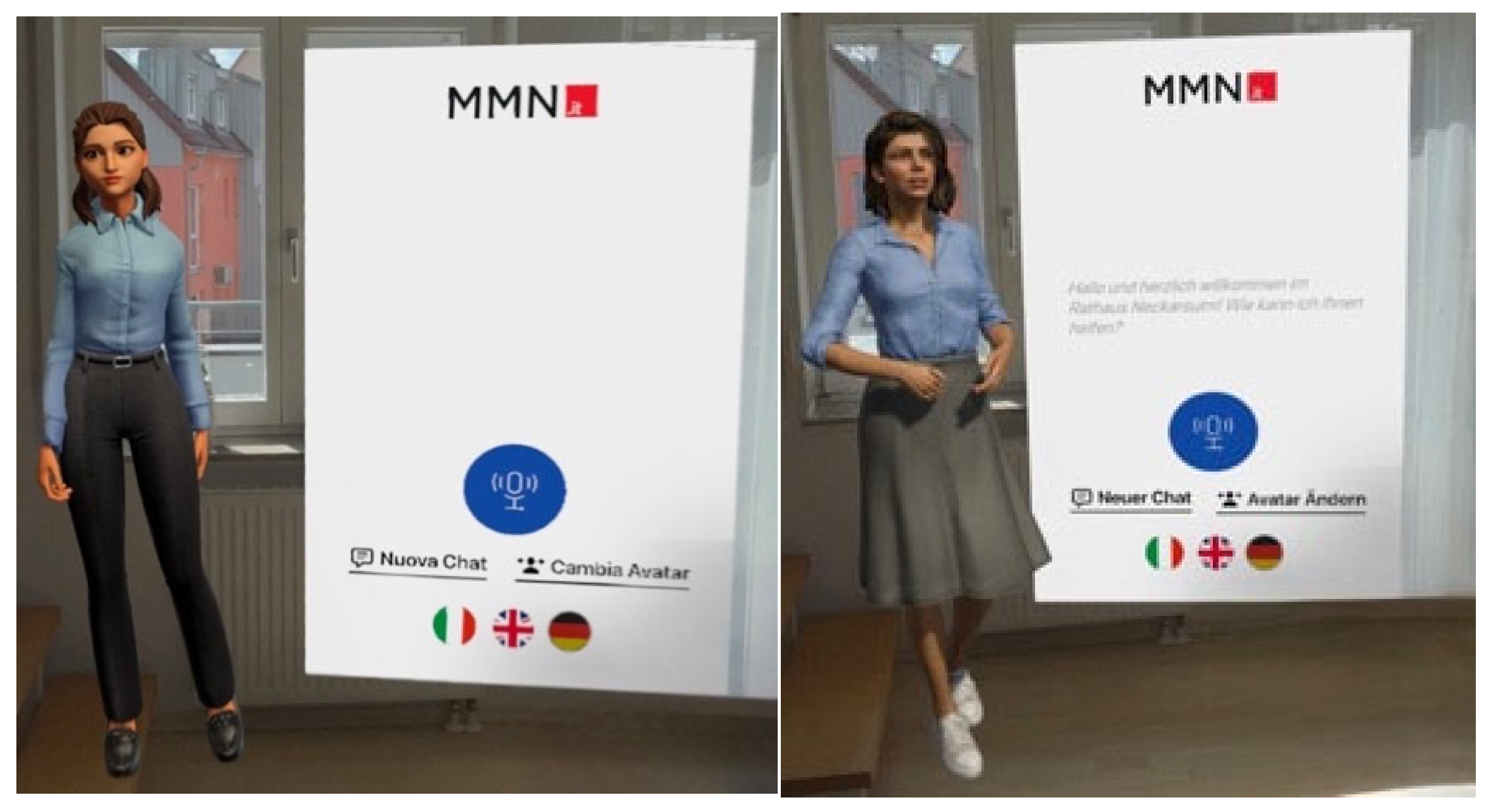
To investigate the role of the AI avatar’s external appearance in user acceptance, two avatar types were tested in the experiment. They differ significantly in their degree of realism and thus provide a valid contrast.
Figure 1 depicts both avatar variants.
The realistic avatar was designed to give test subjects the feeling of communicating with a real person through its natural appearance, including human movements. The comic-like avatar, on the other hand, was deliberately designed with less detail to create a contrast to the perceived humanity. These differences were intended to reveal the extent to which varying degrees of realism influence user acceptance. The focus was primarily on the contrast between comic and realistic, rather than on the role of gender. It was important to create two avatars of the same gender, and, since, according to Lim et al. [
29], the avatar’s gender has no significant influence on acceptance, a female avatar was randomly selected.
The technical structure of the avatar application was based on clearly separated units for input, processing, and output. The architecture enabled rapid adaptation to new use cases, for example, by exchanging the knowledge base or adapting the target language. The solution combined speech recognition, large-language-model-based response generation, and text-to-speech to enable fast, fluid dialogues. In addition, a text display next to the avatar, displaying the conversation transcript, ensured a barrier-free user experience. When the app was launched, a welcome message was automatically displayed and played back in the selected language. The language could be switched flexibly between German, English, and Italian by clicking on the respective flags. In addition, it was possible to reset ongoing dialogues using the “New Chat” function.
This provided two functional avatar variants that differed only in appearance and could therefore be used specifically for the planned investigation of user acceptance. The following section describes the experimental procedure in detail.
2.2. Experimental Procedure
The recruitment of test subjects was deliberately open and without restrictions, so that anyone aged 18 or over could take part in the experiment. The aim was to obtain a mixed, representative sample spanning different age groups and diverse areas of interest, as is also the case in the real-life context of a citizens’ office.
A flyer containing all relevant information about the experiment was created for recruitment purposes. This was shared on several social networks. In addition, multiple copies of the flyer were printed and distributed in the cities of Heilbronn and Neckarsulm, at both town halls and in supermarkets. A total of 54 people participated in the experiment.
The experiment took place from 15 July to 19 July 2025. Beginning on 15 July, it was conducted at Neckarsulm, Germany. On the following days (16–19 July 2025), it was conducted at Sindelfingen, Germany. Care was taken to choose a neutral room at both locations to minimize distractions. Thus, both locations contributed to testing user acceptance in contexts that were as realistic as possible.
The participants in the experiment were randomly assigned to two groups, without their knowledge, to test both avatar variants. Each second person received the other avatar to achieve an equal number of test subjects per avatar. The test subjects were not informed in advance about the two avatar variants.
After a personal welcome, the participants received a brief introduction to the experiment, including a presentation of the three scenarios to be worked on. They were informed in advance about data protection and the types of data collected, as participants’ interactions with the avatar were recorded. The recordings were used, in particular, to document the processing time of the scenarios and to capture spontaneous verbal feedback from the participants. Participation was only possible after consenting to this privacy policy. This was followed by an explanation of how to use the Apple Vision VR headset and how to interact correctly with the avatar. After starting the audio recording, the application was opened via the VR glasses, and guest mode was activated to scan the eyes and measure the hands, as the eyes and hands control the glasses. The glasses were then handed over to the test subject. A short introductory video from Apple then appeared, which plays by default when guest mode starts. This was followed by measuring the hands and scanning the eyes. Once the process was complete, the avatar appeared directly in front of the test subject, allowing interaction to begin. Because this is MR technology, the avatar appears in the same room, so the spatial environment does not change.
The test subjects immersed themselves in the mixed-reality environment using the VR headset and interacted with one of the two avatars. The prepared scenarios, based on realistic citizen concerns, were printed and placed in the room so that participants could read them independently at any time through the VR glasses. During the interaction, notes were made on the test subject’s behavior, and their comments were recorded.
After the interaction, the participants were asked to complete a questionnaire that included questions about themselves and, above all, about user acceptance and trust in the avatar. The test subjects decided for themselves whether to complete it digitally or on paper. After each test run, the VR glasses were cleaned and disinfected.
While participation in the overall experiment, including briefing and completing the questionnaires, took between 20 and 70 min (average: 35 min), the actual interaction with the avatars to master the experiment scenarios lasted on average 526 s (max: 1407 s, min: 115 s).
2.3. Questionnaire Design
The questionnaire was based on two established models: Technology Acceptance Model 2 (TAM2) and SUPR-Q (Standardized User Experience Percentile Rank Questionnaire).
The questionnaire was divided into the following four parts: 1. General questions (sociodemographic information), 2. Questions on user acceptance (TAM2), 3. Questions on trust (SUPR-Q), 4. Open-ended questions.
The first part included sociodemographic information, such as age, gender, educational background, prior technical experience, and prior experience with virtual reality. This information was used to identify potential patterns or differences in the evaluation of avatars across user groups.
Parts two and three comprised the main sections of the questionnaire, containing items from the TAM2 and SUPR-Q models. A 5-point Likert scale was used for these questions, offering a choice between “strongly disagree” and “strongly agree.” For the evaluation, the lowest level, “strongly disagree,” was assigned a value of 1, and the highest level, “strongly agree,” a value of 5. The only question that used an 11-point Likert scale was about recommending the avatar. This scale ranged from a value of 0 (“extremely unlikely”) to a value of 10 (“extremely likely”). This question is part of the SUPR-Q model, which specifies an 11-point scale [
37].
The questions from the main section of the questionnaire for the two models were integrated and tailored to the application context of an AI avatar in municipal citizen services. The final questions covered central constructs of the two methods. This yields 17 questions for TAM2 and 8 for SUPR-Q. To avoid duplication of content, three questions were used across both models (questions 15 and 16—user-friendliness and question 21—loyalty) and then assigned separately to both models. This resulted in a total of 22 questions in the main section of the questionnaire.
The final section of the questionnaire consisted of open-ended questions that were not based on the two models but were nevertheless relevant to answering the research questions. For example, questions were asked about the general acceptance of AI avatars in the local town hall, as well as praise, criticism, or suggestions for improvement.
The collected data were first transferred to Excel, checked for completeness, and then imported into IBM SPSS Statistics (Version 31.0.0) software for further analysis.
3. Results
Before analyzing user acceptance and trust, an overview of the sample composition and the key initial variables is presented. This enables classification of participants by age, gender, educational level, basic technical understanding, and knowledge of AI and VR.
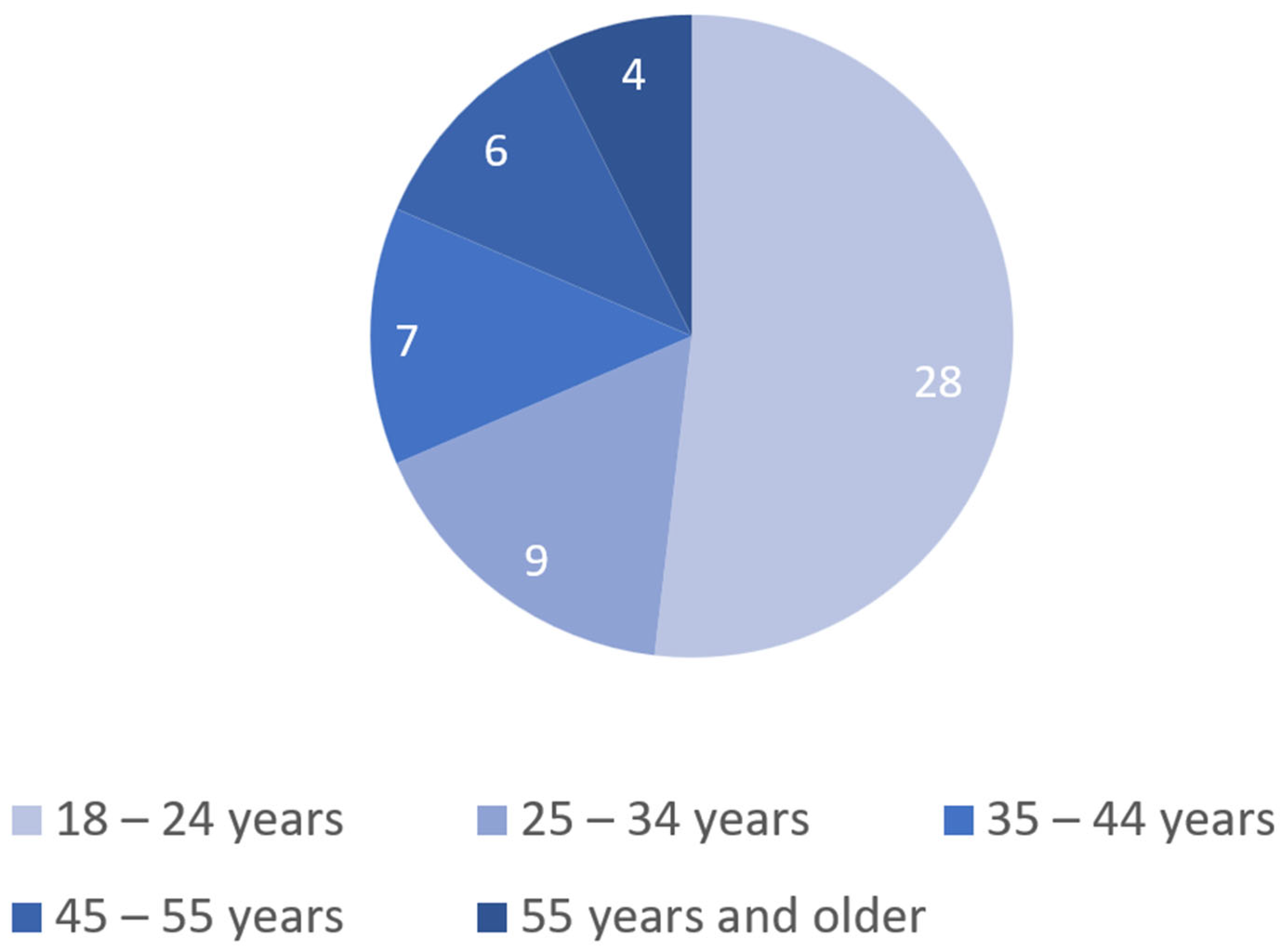
The participants’ age range was 18 to 72 years.
Figure 2 presents details of the age distribution. It shows that the sample consisted predominantly of younger participants, with more than 65% under the age of 35. Of the total 54 participants, 37.0% (n = 20) identified as male and 63.0% (n = 34) as female. The sample was clearly female-dominated.
Table 1 presents further demographic data for the sample, specifically the level of education, previous VR use, and self-assessments of technical understanding, VR/MR knowledge, as well as AI experience.
Overall, the sample showed a broad age distribution, a predominance of women, and a predominantly high level of education. The majority rated their basic technical understanding as high, while their understanding of VR and MR, and their practical application, was rather low. In contrast, just under half had “a lot” or “a great deal” of experience in dealing with artificial intelligence. Thus, there was greater variance in age and AI experience, whereas educational level and VR/MR knowledge were comparatively homogeneous.
Randomization checks were used to verify that the two groups (comic-style avatar vs. realistic avatar) were comparable with respect to sociodemographic characteristics, basic technical knowledge, and prior experience with AI and VR. Using t-tests for independent samples, Chi2 tests, and Mann–Whitney U tests, the results show that the two experimental groups do not differ significantly in any of the characteristics examined, providing a solid basis for subsequent comparisons of experimental operations.
To assess internal consistency, Cronbach’s alpha was calculated for scales with three or more items, and the Spearman–Brown coefficient was calculated for scales with fewer than three items. Values below 0.50 are considered unacceptable, values between 0.50 and 0.70 are considered poor, values between 0.70 and 0.80 are considered acceptable, values between 0.80 and 0.90 are considered good, and values above 0.90 are considered excellent [
32]. The scales from TAM2 and SUPR-Q were examined for the calculation.
The scales of the TAM2 model exhibited predominantly good (≥0.80) and partly acceptable (0.70–0.79) reliability. The scales of utility, image, task relevance, intention to use, user-friendliness, and trust show good to very good reliability. In contrast, the scales of social norm, output quality, comprehensibility, appearance, and loyalty were rated as acceptable. Thus, the scales used are reliable overall.
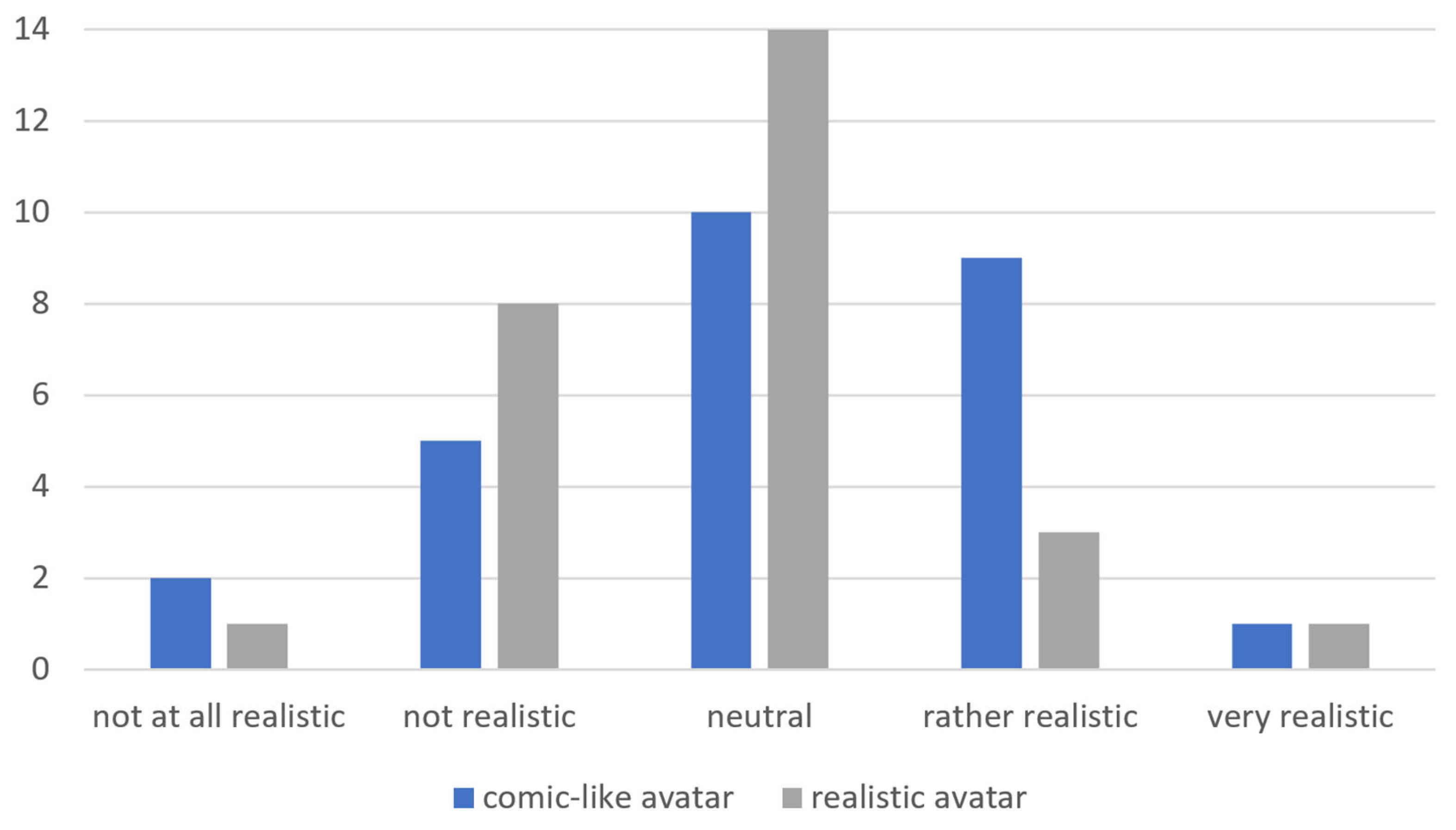
A manipulation check was performed to verify the intended manipulation of the avatar’s degree of realism. To this end, responses to the questionnaire item on the perceived realism of the avatar were compared statistically between the two groups. The Mann–Whitney U test revealed no significant difference in perceived realism between the comic-like (mean rank = 30.04) and realistic avatars (mean rank = 24.96), U = 269.00, z = −1.258,
p = 0.208, r = 0.17. The intended manipulation of the degree of realism could therefore not be confirmed.
Figure 3 shows the distribution of realism ratings for each avatar variant.
To address the research questions, statistical tests were conducted to examine differences between the two experimental groups (comic-style vs. realistic avatars) and overall acceptance regardless of avatar type. For metric variables,
t-tests for independent samples were performed (two-tailed, α = 0.05) [
38]. In the event of a violation of the test requirements, the Mann–Whitney U test was used [
39,
40]. Binary variables were tested using the Chi2 independence test [
41], and effect sizes were reported as Cohen’s d with 95% confidence intervals [
42].
RQ1: Do citizens want to use a mixed reality avatar as a digital assistant in the city hall, and would they accept it?
At the outset, the main research question was considered. To determine basic user acceptance and willingness to use, a one-sample
t-test was performed against the scale midpoint (for intention to use: scale 1–5, test against 3; for recommendation: scale 0–10, test against 5) [
38]. The explicit acceptance question was tested with a binomial test against an expected value of 50% [
41]. The open-ended reasons given for this question were categorized thematically and evaluated separately in the additional analyses.
The Technology Acceptance Model 2 was also used to measure general acceptance. The questions addressed several dimensions that collectively assess user acceptance [
34,
36]. The scale values for all dimensions were calculated and evaluated descriptively to obtain a comprehensive picture of user acceptance, independent of avatar type. In the original studies, TAM2 was tested using structural equation modeling [
34]. However, because this method requires substantially larger samples, a simplified approach has been applied in this study. Scale means were calculated and tested for their significance in predicting usage intention using regression analyses.
Initially, a one-sample
t-test was performed. The intention to use (M = 4.24, SD = 0.67, n = 54) was significantly higher than the scale midpoint 3, t (53) = 13.59,
p < 0.001. The 95% confidence interval of the difference was between 1.06 and 1.42. Cohen’s d effect size was 1.85, indicating a very strong effect [
42]. The recommendation rate was also significantly above the scale mean of 5, with M = 8.00 and SD = 1.789 (t (53) = 12.38,
p < 0.001). The 95% confidence interval for the difference ranges from 2.52 to 3.49. Cohen’s d of 1.68 also showed a very strong effect [
42]. Of the 54 participants in total, 52 (96%) accepted the avatar, whereas 2 (4%) did not accept it. The binomial test showed that this proportion of approval was significantly greater than the random level of 50% (
p < 0.001).
The Technology Acceptance Model 2 was used to supplement these results. This model confirms the results. The descriptive results showed high mean values in almost all dimensions, with the highest scores for image (M = 4.51, SD = 0.62) and perceived usefulness (PU) (M = 4.39, SD = 0.67). The overall intention to use (BI) was M = 4.42 (SD = 0.67).
A multiple linear regression was calculated to examine the influence of individual constructs on the intention to use (TAM_BI). The model shows a significant proportion (53%) of the variance in intention to use (R2 = 0.535, adjusted R2 = 0.464), F (7.46) = 7.561, p < 0.001. Thus, the included predictors contributed significantly to the prediction of intention to use, particularly social norm (β = 0.423, p = 0.001) and result demonstrability (β = 0.371, p = 0.009). The remaining constructs (Perceived Usefulness, Perceived Ease of Use, image, task relevance, and output quality) did not show any significant influence (all p > 0.05).
The descriptive analysis by gender showed that male and female respondents reported similar values in almost all dimensions. In perceived usefulness and user-friendliness, slightly higher values were observed among women. In comparison, the values among men were slightly higher in the dimensions of social norm and intention to use. The acceptance question was answered affirmatively by all male participants (M = 1.00), while there were isolated rejections among women (M = 1.06).
Furthermore, the open responses to the acceptance question were considered. Of the 52 confirmations, 33 provided a reason. Frequently cited advantages included speed, efficiency, and user-friendliness (“faster exchange of information,” “questions can be clarified quickly and without an appointment”). However, some also indicated only conditional acceptance (“only for standard questions” or “additionally a real person”). Two participants stated that they did not accept the avatar. The need for human interaction justified this rejection: “I prefer to talk to a human being,” and “Real human interaction is necessary for specific questions and possibly also in case of ambiguities.”
RQ2: How does the appearance of mixed reality avatars influence user acceptance and citizen trust in the city hall?
To address the research question, the SUPR-Q model was first applied, followed by consideration of the results for user acceptance and trust across the two avatar variants. The Technology Acceptance Model 2 was employed to assess user acceptance. First, the TAM2 dimensions (PU, PEOU, SN, IMG, task Relevance, Output Quality, Result Demonstrability) were evaluated for both avatar variants. Independent-samples
t-tests were used to assess differences in mean values. If the normal distribution was violated, the Mann–Whitney U test was used as an alternative [
39]. The focus was on intention to use, recommendation, and the central TAM2 dimensions. The recommendation scale was originally an 11-point Likert scale but was transformed into a 5-point Likert scale for comparability.
In addition, multiple regression analyses [
43] were performed separately for both avatar groups to identify differences in intention to use. The TAM2 dimensions were incorporated into the model as determinants, whereas intention to use was treated as the dependent variable. This made it possible to identify possible differences in the significance of individual influencing factors. To assess whether the appearance of the avatar influenced citizens’ trust, a
t-test for independent samples was conducted. In the absence of normal distribution, the Mann–Whitney U test was used as an alternative [
39]. In addition, the Standardized User Experience Questionnaire (SUPR-Q) was used in this study to provide a holistic assessment of user experience and trust. The model comprises several dimensions that together provide a differentiated view of the general user experience [
37]. The mean values were calculated separately for each avatar variant to identify potential differences in perception between the two appearances.
The descriptive evaluations and tests for normal distribution showed that all TAM dimensions, except for the social norm, were not normally distributed (p < 0.05), so the Mann–Whitney U test was predominantly used. Only a t-test was performed for the social norm. None of the mean comparisons revealed significant differences between the two avatar variants. Multiple regression analyses were conducted to assess potential differences in the factors influencing the intention to use. As no influence of avatar appearance on any dimension could be found, mediation effects are unlikely.
For the comic-style avatar, a model with an R2 of 0.659 and a corrected R2 of 0.534, F (7.19) = 5.249, and p = 0.002 was obtained. Significant predictors here were social norm (ß = 0.421, t = 2.525, p = 0.021) and comprehensibility (ß = 0.439, t = 2.607, p = 0.017). The remaining dimensions, perceived usefulness, perceived ease of use, image, job relevance, and output quality, did not reach significance (all p > 0.05).
For the realistic avatar, the model yielded R2 = 0.585 and a corrected R2 of 0.432, F (7.19) = 3.824, p = 0.009. In this model, only the social norm proved to be significant for the intention to use (ß = 0.513, t = 2.799, p = 0.011), while all other dimensions proved to be insignificant (all p > 0.05). To investigate the influence of the avatar’s appearance on user trust, descriptive statistics were first examined. The comic-style avatar had a mean of M = 4.44 (SD = 0.54), whereas the realistic avatar had a mean of M = 4.28 (SD = 0.59). The tests for normal distribution showed significant deviations from normal distribution for both groups (cartoon-like: D (27) = 0.291, p < 0.001; realistic: W (27) = 0.801, p < 0.001), (D = Kolmogorov–Smirnov, W = Shapiro–Wilk). Therefore, a Mann–Whitney U test was performed. This revealed no significant difference between the two avatars (U = 316.0, Z = −0.91, p = 0.363). The mean ranks were 29.30 for the comic-like version and 25.70 for the realistic version.
The SUPR-Q results showed consistently high mean values. The highest value was for trust (M = 4.36, SD = 0.57). This was followed by loyalty (M = 4.23, SD = 0.59) and appearance (M = 4.20, SD = 0.71). The lowest mean value was for user-friendliness with M = 4.16 (SD = 0.89). Despite this, all values were above the scale mean of 3. Since the test for normal distribution showed significant deviations, a Mann–Whitney U test was performed. This showed no significant differences between the comic-like and realistic avatars across the four dimensions of the SUPR-Q (all p > 0.05). Additional analyses of user acceptance and trust also confirm this result.
The answers to the open question “What did you particularly like about the interaction?” were evaluated separately for the two avatar variants and clustered into five categories. 1: Quality of content of the responses, 2: Speed and efficiency, 3: Human interaction and friendliness, 4: Appearance, and 5: User-friendliness. For both avatar types, responses were particularly frequent in the first two categories. Respondents emphasized above all the clear and precise responses. The similarity to human interaction was also mentioned in both versions, with statements such as “like a real conversation.” There were differences in terms of appearance. The comic-style avatar was praised for its modern, business-like appearance, but its body language was criticized (“The body language seemed uncertain,” “too much wiggling”). The realistic avatar, on the other hand, received no positive comments on its appearance and was criticized (“The avatar’s appearance bothered me,” “Suggestion for improvement: more appealing appearance”). In the case of the comic-style avatar, the gestures and body language in particular were criticized as unnatural and “video game-like.” There were also frequent comments such as “long thinking” and, in some cases, an “arrogant” effect. The realistic avatar was criticized for its appearance (especially the hairstyle and mouth animation) and its lack of humanity (“seems monotonous,” “lacks humanity”). There were frequent requests for more natural movements, a more appealing design, and more humanity.
4. Discussion
Overall, the results indicate a high level of acceptance and intention to use the AI avatar. A total of 96% of participants say they would accept the avatar in their local town hall. Both the intention to use and the recommendation rate are well above the scale average. In particular, the aspects of speed, efficiency, and the ability to resolve simple issues without much effort ensure a high level of satisfaction among participants. At the same time, it is clear that acceptance applies primarily to standard issues and as a supplement to human contact. For more complex or specific issues, there is still a desire for personal advice from human employees.
The results of the TAM2 model indicate that social norms, and, in particular, comprehensibility, significantly influence the intention to use. In contrast, and contrary to the findings of al-Adwan and Katika, classic dimensions such as perceived usefulness and user-friendliness do not play a significant role in this study [
21,
32]. One possible explanation lies in the still-limited everyday experience with MR avatars.
The control variable analysis also supports this interpretation. Of the 54 participants, just under a third do not know whatsoever how to use MR or VR, and only around 15% have good to very good knowledge.
Participants with greater AI experience show greater acceptance and a more positive image of the avatar. In addition, younger participants show greater intention to use it, whereas older participants respond more cautiously. These results confirm the findings of Bailey et al., who found that demographic factors such as age and experience play a central role in acceptance [
28]. These findings underscore that a lack of experience can relativize the influence of classic dimensions such as user-friendliness. In contrast, social influences and transparency already play a central role in acceptance.
The results thus confirm that the use of AI avatars in municipal environments is generally viewed positively, particularly when it is low-threshold, comprehensible, and socially embedded.
In terms of appearance, there is no significant difference in user acceptance and trust between the comic-like and realistic avatars. The measured values of all relevant TAM2 and SUPR-Q dimensions, as well as the direct question about acceptance, do not differ statistically significantly between the two avatar types. Responses regarding the recommendation of the avatar were also comparable. In terms of user trust, the mean value for the comic-like avatar is slightly higher than that of the realistic avatar. Still, the Mann–Whitney U test shows no statistically significant difference. Both variants are therefore perceived as comparably trustworthy.
The results contradict previous assumptions, for example, those of Mertes et al., according to which appearance is said to have a major influence on acceptance [
22]. The uncanny valley effect is also relevant in this context. Song and Shin demonstrate that hyperrealistic avatars can elicit a sense of eeriness and, consequently, rejection [
24]. This effect is not detectable in the present study. The present results also contradict prior assumptions that visual design significantly influences trust. Schmidt et al. point out that proximity and design are decisive factors in building trust in avatars [
23]. The discussion about the uncanny valley effect, according to which hyperrealistic avatars can cause discomfort, is also not confirmed in this study. One possible explanation for the results is that although the two variants are deliberately designed to be distinguishable, both are perceived as acceptable representations without tending toward “too realistic” or “too artificial.” The qualitative evaluation supports this interpretation. The participants do not perceive either of the two avatars as particularly realistic. The comic-like avatar is even rated as more realistic than the actually realistic avatar. This rating suggests that the originally intended degree of realism is only achieved to a limited extent (e.g., in the gestures). In terms of appearance, the realistic avatar was frequently criticized, particularly regarding the hairstyle.
Since the expected manipulation of realism is not always clearly perceived in the study, this may explain the lack of significant differences. For future studies, it is therefore advisable to adopt a more clearly differentiated design and validation of the appearances.
These results suggest that the external appearance of a mixed reality avatar significantly influences neither user acceptance nor citizen trust. Both variants exhibit a high and comparable level of trust overall. Instead, functional aspects such as traceability, social norms, and reliability appear to play a greater role. According to the results, resources should be invested less in enhancing reality and more in improving functional quality and providing clear user guidance.
The present results can be classified within the existing state of research, with both confirmations and deviations being observed. The findings of Al-Adwan and Katika et al. suggest that classic dimensions such as perceived usefulness and user-friendliness play a central role in user acceptance [
21,
32]. However, the results of this study indicate that, in a municipal context, social and functional factors, such as social norms and the comprehensibility of the technology, are more decisive. At the same time, one finding is consistent with Al-Adwan’s study, which also shows that social influences promote willingness to use the technology [
32].
Othman et al. emphasize in their study that avatars are not considered a complete replacement for human interaction [
44]. The results of this study reinforce this finding. The test subjects confirm that acceptance applies primarily to standard issues and as a supplement to human contact. However, for more complex issues, the desire for personal consultation with human employees remains strong.
The results also contradict previous assumptions regarding appearance. Although Mertes et al. and Schmidt et al. emphasize that visual design significantly influences acceptance and trust, no correlation is demonstrated in this study [
22,
23]. The uncanny valley effect described by Song and Shin is also irrelevant in this context [
24], as are increased privacy concerns towards more realistic or even hyperrealistic avatars, which were found by Gasch et al. [
26]. Appearances as applied in this study play no role in perceived acceptance and trust.
Overall, in the municipal context, it is not the external appearance but rather the functional and social dimensions that are significant determinants of acceptance and trust. In addition, this study reinforces the statement by Bechtle & Weinberger that the metaverse has the potential to make municipal processes more accessible [
45].
This study thus makes a significant contribution to closing the research gap, as neither the combination of mixed reality, AI-supported avatars, and user acceptance in the municipal environment nor the application of SUPR-Q in this context has been investigated to date.
These findings have concrete implications for practice. For municipalities, the use of MR avatars in administrative tasks is generally well received, provided that human employees remain available for more complex matters. To increase perceived benefits, MR avatars should not only provide information but also support simple administrative tasks, such as scheduling appointments or data entry.
In design, functional quality, transparency, and user-friendliness are more important than realism. Simple interaction concepts and short response times increase user satisfaction. Due to complex calibration, long setup times, and limited usability for eyeglass wearers, the Apple Vision Pro proved only partially suitable for use in the citizens’ office; therefore, alternative MR hardware should be considered.
Acceptance is also significantly influenced by social integration. Positive communication, recommendations from trusted individuals, and targeted support services promote usage, especially among older and less tech-savvy user groups. In addition, multilingualism can enhance accessibility.
The introduction of MR avatars should be understood as an iterative process with continuous user feedback. In addition, operational aspects such as hygiene, technical support, theft protection, and IT security must be considered at an early stage.
Overall, MR avatars have great potential to increase the efficiency and accessibility of municipal services but require user-centered, secure, and adaptable implementation.
Despite the meaningful results, the present study has limitations that must be considered when interpreting and generalizing the findings. With 54 participants, the sample is relatively small and predominantly comprises younger and tech-savvy individuals. This may limit the generalizability of the results to the overall population, particularly for older and less tech-savvy user groups, which might be specifically important in aging societies. In addition, the experiment was conducted under controlled conditions. The participants volunteered to take part in the experiment and were aware of the controlled and experimental conditions. In real-life situations, which may be characterized by a high need for advice or emotional stress, for example, different levels of acceptance and trust may result. This might also be due to different types of tasks that an avatar might support, which might range from providing routine information to more severe tasks, e.g., related to tax or legal issues. The paper at hand aims to assess user acceptance across two avatar appearances. However, the intended variation in realism is not clearly perceived by participants, as confirmed by the manipulation check. This limits the significance of the influence of appearance, as the variants examined were too similar to achieve the planned effect. User acceptance and trust are primarily measured using questionnaire data and subjective assessments, supplemented by qualitative observations. Objective usage data over longer periods is not available. As a result, long-term acceptance remains unexplored.
These limitations restrict the transferability of the results and highlight the need for further research. Future research should involve larger and more homogeneous samples, preferably in field tests rather than lab experiments, and should apply AI avatars in various settings, e.g., at an information desk, for standardized or more complex tasks. These experimental settings could enable a better understanding of the appropriate use cases for AI avatars in citizen services and users’ willingness to use such systems. Despite this, the work demonstrates the potential of MR avatars to enhance the efficiency and modernization of public services. However, it is not the external appearance that is crucial for success, but rather the technology’s functional and transparent design. The study thus helps close the research gap and offers valuable insights for science and practice.