In Silico Predictions Driving the Development of 3D-Printed Drug Delivery Systems


Abstract
1. Introduction
2. Materials and Methods
2.1. 3D-DDS Data Mining and Collection
2.2. Predictability in Two Stages of 3DP-DDS
2.2.1. Stage 1. Printability
2.2.2. Stage 2. Dissolution Profile
2.3. API and Excipient Systems Preparation
2.3.1. Preparation of the Chemical Structures of API and Excipients
2.3.2. Structure Preparation
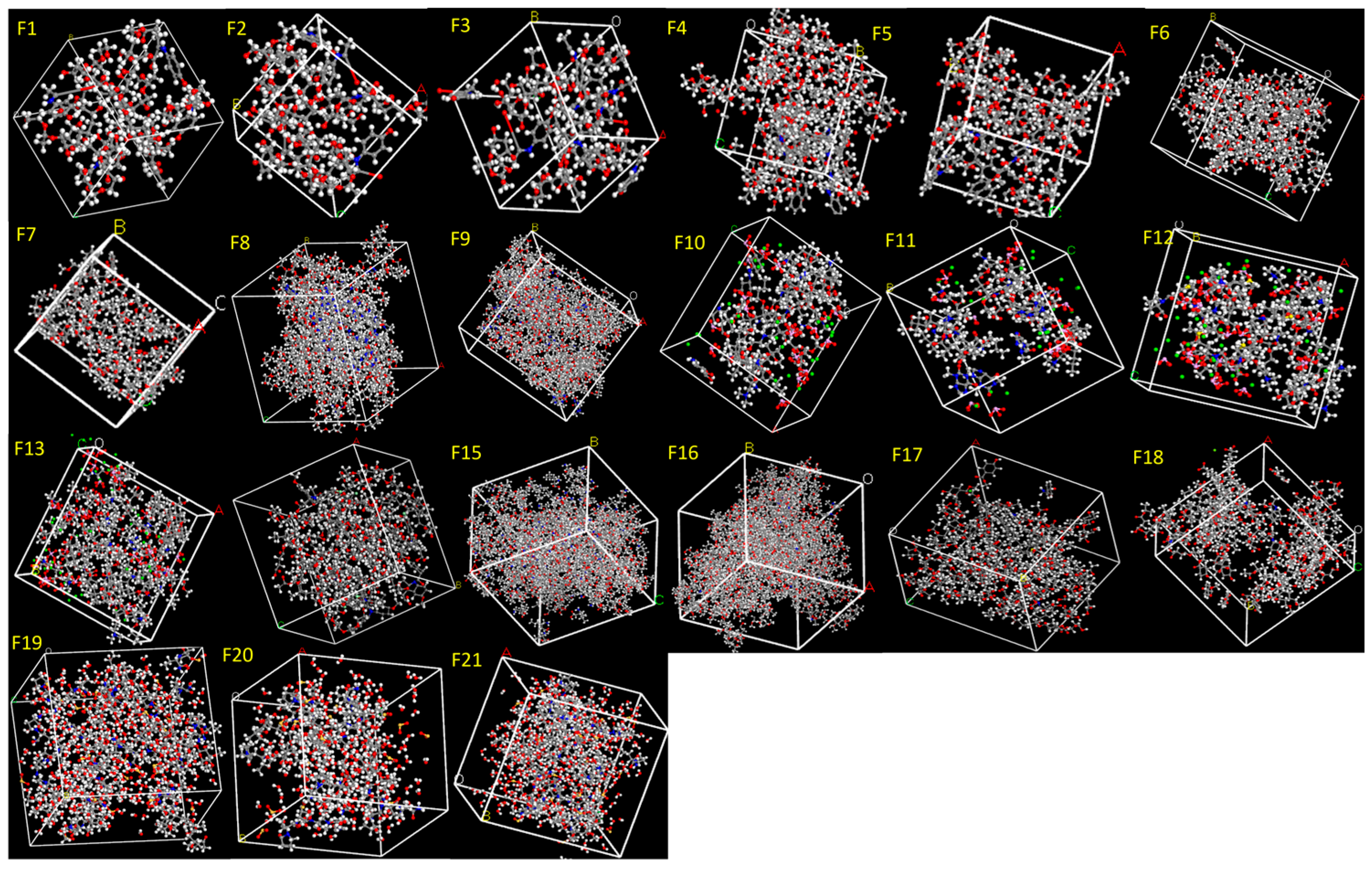
2.3.3. Excipient and API System Construction Using Amorphous Cell Module
2.4. Printability Prediction
Miscibility Parameters for Predicting Printability
2.5. Dissolution Prediction
Cohesive Energy Density for Predicting Dissolution Behavior
3. Results and Discussion
3.1. Printability Prediction
3.2. Dissolution Behavior Prediction
3.2.1. Dissolution Prediction: General Trends Across Polymers
3.2.2. Polymer Grade-Dependent Trends in Dissolution Prediction
3.2.3. Polymer Concentration-Dependent Trends in Dissolution Prediction
4. Conclusions
Author Contributions
Funding
Institutional Review Board Statement
Informed Consent Statement
Data Availability Statement
Acknowledgments
Conflicts of Interest
References
- Kyser, A.J.; Fotouh, B.; Mahmoud, M.Y.; Frieboes, H.B. Rising Role of 3D-Printing in Delivery of Therapeutics for Infectious Disease. J. Control. Release 2024, 366, 349–365. [Google Scholar] [CrossRef]
- Wang, N.; Shi, H.; Yang, S. 3D Printed Oral Solid Dosage Form: Modified Release and Improved Solubility. J. Control. Release 2022, 351, 407–431. [Google Scholar] [CrossRef]
- Seoane-Viaño, I.; Trenfield, S.J.; Basit, A.W.; Goyanes, A. Translating 3D Printed Pharmaceuticals: From Hype to Real-World Clinical Applications. Adv. Drug Deliv. Rev. 2021, 174, 553–575. [Google Scholar] [CrossRef]
- Cailleaux, S.; Sanchez-Ballester, N.M.; Gueche, Y.A.; Bataille, B.; Soulairol, I. Fused Deposition Modeling (FDM), the New Asset for the Production of Tailored Medicines. J. Control. Release 2021, 330, 821–841. [Google Scholar] [CrossRef] [PubMed]
- Curti, C.; Kirby, D.J.; Russell, C.A. Current Formulation Approaches in Design and Development of Solid Oral Dosage Forms Through Three-Dimensional Printing. Prog. Addit. Manuf. 2020, 5, 111–123. [Google Scholar] [CrossRef]
- Wang, J.; Zhang, Y.; Aghda, N.H.; Pillai, A.R.; Thakkar, R.; Nokhodchi, A.; Maniruzzaman, M. Emerging 3D Printing Technologies for Drug Delivery Devices: Current Status and Future Perspective. Adv. Drug Deliv. Rev. 2021, 174, 294–316. [Google Scholar] [CrossRef]
- Pandey, M.; Choudhury, H.; Fern, J.L.C.; Kee, A.T.K.; Kou, J.; Jing, J.L.J.; Her, H.C.; Yong, H.S.; Ming, H.C.; Bhattamisra, S.K.; et al. 3D Printing for Oral Drug Delivery: A New Tool to Customize Drug Delivery. Drug Deliv. Transl. Res. 2020, 10, 986–1001. [Google Scholar] [CrossRef]
- Shahbazi, M.; Jäger, H.; Feiler, A.; Wu, Y.; Mukherjee, S. Current Status in the Utilization of Biobased Polymers for 3D Printing Process: A Systematic Review of the Materials, Processes, and Challenges. ACS Appl. Bio Mater. 2021, 4, 325–369. [Google Scholar] [CrossRef] [PubMed]
- Konta, A.A.; García-Piña, M.; Serrano, D.R.; Briscoe, B.J.; Arias, Á. Personalised 3D Printed Medicines: Which Techniques and Polymers Are More Successful? Bioengineering 2017, 4, 79. [Google Scholar] [CrossRef]
- Pereira, G.G.; Figueiredo, S.; Fernandes, A.I.; Pinto, J.F. Polymer Selection for Hot-Melt Extrusion Coupled to Fused Deposition Modelling in Pharmaceutics. Pharmaceutics 2020, 12, 795. [Google Scholar] [CrossRef]
- Kalepu, S.; Nekkanti, V. Application of Film-Casting Technique to Investigate Drug–Polymer Miscibility and Identification of Physical Stability for Amorphous Solid Dispersion Formulation. J. Pharm. Sci. 2015, 104, 3579–3584. [Google Scholar]
- Roche, A.; Daly, R.; Cryan, S.-A.; O’Dwyer, J. Fused Deposition Modelling 3D printing and solubility enhancement of poorly water-soluble drugs: A literature-based review. Eur. J. Pharm. Sci. 2024, 194, 106692. [Google Scholar]
- Peng, H.; Han, B.; Tong, T.; Jin, X.; Peng, Y.; Guo, M.; Li, B.; Ding, J.; Kong, Q.; Wang, Q. 3D printing processes in precise drug delivery for personalized medicine. Biofabrication 2024, 16, 032001. [Google Scholar] [CrossRef]
- Zhang, J.; Xu, P.; Vo, A.Q.; Bandari, S.; Yang, F.; Durig, T.; Repka, M.A. Development and evaluation of pharmaceutical 3D printability for hot-melt extruded cellulose-based filaments. J. Drug Deliv. Sci. Technol. 2019, 52, 292–302. [Google Scholar] [CrossRef]
- Muehlenfeld, C.; Duffy, P.; Yang, F.; Zermeño Pérez, D.; El-Saleh, F.; Durig, T. Excipients in Pharmaceutical Additive Manufacturing: A Comprehensive Exploration of Polymeric Material Selection for Enhanced 3D Printing. Pharmaceutics 2024, 16, 317. [Google Scholar] [CrossRef]
- Patel, G.; Minko, T. Miscibility, phase behavior, and mechanical properties of copovidone/HPMC ASLF and copovidone/Eudragit EPO polymer blends for hot-melt extrusion and 3D printing applications. Int. J. Pharm. 2025, 670, 125124. [Google Scholar] [CrossRef]
- Barrulas, R.V.; Corvo, M.C. Rheology in product development: An insight into 3D printing of hydrogels and aerogels. Gels 2023, 9, 986. [Google Scholar] [CrossRef] [PubMed]
- Zhao, J.; Yang, D.; Li, X.; Luo, J.; Bai, X.; Hao, M.; Cui, J.; Yuan, H.; Wang, H.; Shao, G. Shear thinning molecular dynamics simulation of binder solution for 3D printing alumina. Ceram. Int. 2022, 48, 27302–27311. [Google Scholar] [CrossRef]
- Elbadawi, M.; Gustaffson, T.; Gaisford, S.; Basit, A.W. 3D printing tablets: Predicting printability and drug dissolution from rheological data. Int. J. Pharm. 2020, 590, 119868. [Google Scholar] [CrossRef]
- Ong, J.J.; Castro, B.M.; Gaisford, S.; Cabalar, P.; Basit, A.W.; Pérez, G.; Goyanes, A. Accelerating 3D printing of pharmaceutical products using machine learning. Int. J. Pharm. X 2022, 4, 100120. [Google Scholar] [CrossRef]
- Abdalla, Y.; Elbadawi, M.; Ji, M.; Alkahtani, M.; Awad, A.; Orlu, M.; Gaisford, S.; Basit, A.W. Machine learning using multi-modal data predicts the production of selective laser sintered 3D printed drug products. Int. J. Pharm. 2023, 633, 122628. [Google Scholar] [CrossRef]
- Elbadawi, M.; Castro, B.M.; Gavins, F.K.; Mustafa, S.; De Bank, P.; Tse, Y.M. M3DISEEN: A Novel Machine Learning Approach for Predicting the 3D Printability of Medicines. Int. J. Pharm. 2020, 590, 119837. [Google Scholar] [CrossRef]
- Castro, B.M.; Elbadawi, M.; Ong, J.J.; Pollard, T.; Song, Z.; Gaisford, S.; Pérez, G.; Basit, A.W.; Cabalar, P.; Goyanes, A. Machine learning predicts 3D printing performance of over 900 drug delivery systems. J. Control Release 2021, 337, 530–545. [Google Scholar] [CrossRef]
- Lee, S.; Son, M.; Lee, J.; Byun, I.; Kim, J.W.; Kim, J.; Seonwoo, H. Computational fluid dynamics analysis and empirical evaluation of carboxymethylcellulose/alginate 3D bioprinting inks for screw-based microextrusion. Polymers 2024, 16, 1137. [Google Scholar] [CrossRef]
- Yan, Q.; Shen, S.; Wang, Y.; Weng, J.; Wan, A.; Yang, G.; Feng, L. The finite element analysis research on microneedle design strategy and transdermal drug delivery system. Pharmaceutics 2022, 14, 1625. [Google Scholar] [CrossRef]
- Cerda, J.R.; Arifi, T.; Ayyoubi, S.; Knief, P.; Ballesteros, M.P.; Keeble, W.; Barbu, E.; Healy, A.M.; Lalatsa, A.; Serrano, D.R. Personalised 3D printed medicines: Optimising material properties for successful passive diffusion loading of filaments for fused deposition modelling of solid dosage forms. Pharmaceutics 2020, 12, 345. [Google Scholar] [CrossRef]
- Wojeicchowski, J.P.; Ferreira, A.M.; Okura, T.; Pinheiro Rolemberg, M.; Mafra, M.R.; Coutinho, J.A. Using COSMO-RS to predict Hansen solubility parameters. Ind. Eng. Chem. Res. 2022, 61, 15631–15638. [Google Scholar] [CrossRef]
- Sacan, A.; Ekins, S.; Kortagere, S. Applications and Limitations of in Silico Models in Drug Discovery. Bioinform. Drug Discov. 2012, 910, 87–124. [Google Scholar]
- Tsakiridou, G.; Reppas, C.; Kuentz, M.; Adjé, F.; Zema, L.; Goyanes, A. A Novel Rheological Method to Assess Drug-Polymer Interactions Regarding Miscibility and Crystallization of Drug in Amorphous Solid Dispersions for Oral Drug Delivery. Pharmaceutics 2019, 11, 625. [Google Scholar] [CrossRef] [PubMed]
- Louwerse, M.J.; Maldonado, A.; Rousseau, S.; Moreau-Masselon, C.; Roux, B.; Rothenberg, G. Revisiting Hansen solubility parameters by including thermodynamics. ChemPhysChem 2017, 18, 2999–3006. [Google Scholar] [CrossRef] [PubMed]
- Hansen, C.M. Polymer additives and solubility parameters. Prog. Org. Coat. 2004, 51, 109–112. [Google Scholar] [CrossRef]
- Kang, M.; Smith, P.E. Kirkwood–Buff theory of four and higher component mixtures. J. Chem. Phys. 2008, 128, 244511. [Google Scholar] [CrossRef]
- Abbott, S. Kirkwood-Buff and the χ Parameter. Practical Solubility Science. Available online: https://www.stevenabbott.co.uk/practical-solubility/kbchi.php (accessed on 15 August 2025).
- Dindigala, A.K.; Anitha, P.; Makineni, A.; Viswanath, V. A review on amorphous solid dispersions for improving physical stability and dissolution: Role of polymers. GSC Adv. Res. Rev. 2024, 20, 0231. [Google Scholar]
- Barata, T.S.; Zhang, C.; Dalby, P.A.; Brocchini, S.; Zloh, M. Identification of Protein–Excipient Interaction Hotspots Using Computational Approaches. Int. J. Mol. Sci. 2016, 17, 853. [Google Scholar] [CrossRef]
- Mehta, C.H.; Narayan, R.; Nayak, U.Y. Computational Modeling for Formulation Design. Drug Discov. Today 2019, 24, 781–788. [Google Scholar] [CrossRef]
- Persson, L.C.; Porter, C.J.; Charman, W.N.; Bergström, C.A. Computational Prediction of Drug Solubility in Lipid-Based Formulation Excipients. Pharm. Res. 2013, 30, 3225–3237. [Google Scholar] [CrossRef]
- Becelaere, J.; Frateur, O.; Schoolaert, E.; Vanhoorne, V.; D’hooge, D.R.; Vervaet, C.; Hoogenboom, R.; De Clerck, K. Solvent Electrospinning Amorphous Solid Dispersions with High Itraconazole, Celecoxib, Mebendazole and Fenofibrate Drug Loading and Release Potential. J. Control. Release 2023, 362, 268–277. [Google Scholar] [CrossRef] [PubMed]
- Ruiz-Cantu, L.; Trindade, G.F.; Taresco, V.; Zhou, Z.; He, Y.; Burroughs, L.; Clark, E.A.; Rose, F.R.; Tuck, C.; Hague, R.; et al. Bespoke 3D-Printed Polydrug Implants Created via Microstructural Control of Oligomers. ACS Appl. Mater. Interfaces 2021, 13, 38969–38978. [Google Scholar] [CrossRef] [PubMed]
- Gryczke, A. Solubility Parameters for Prediction of Drug/Polymer Miscibility in Hot-Melt Extruded Formulations. In Hot-Melt Extrusion: Pharmaceutical Applications; Douroumis, D., Ed.; John Wiley & Sons, Ltd.: Chichester, UK, 2012; pp. 71–92. [Google Scholar]
- Walden, D.M.; Bundey, Y.; Jagarapu, A.; Antontsev, V.; Chakravarty, K.; Varshney, J. Molecular Simulation and Statistical Learning Methods Toward Predicting Drug–Polymer Amorphous Solid Dispersion Miscibility, Stability, and Formulation Design. Molecules 2021, 26, 182. [Google Scholar] [CrossRef]
- Li, C.; Strachan, A. Cohesive Energy Density and Solubility Parameter Evolution During the Curing of Thermoset. Polymer 2018, 135, 162–170. [Google Scholar] [CrossRef]
- Cuomo, F.; de Nigris, A.; Zeppa, L.; Mastropasqua, R.; Lopez, F.; Ambrosone, L. Complex Viscosity and Cohesive Energy Density of Mixtures of Sodium Hyaluronate and Hypromellose for Medical Devices. J. Mol. Liq. 2024, 407, 125138. [Google Scholar] [CrossRef]
- Patel, N.G.; Serajuddin, A.T. Development of FDM 3D-Printed Tablets with Rapid Drug Release, High Drug-Polymer Miscibility and Reduced Printing Temperature by Applying the Acid-Base Supersolubilization (ABS) Principle. Int. J. Pharm. 2021, 600, 120524. [Google Scholar] [CrossRef]
- Patel, N.G.; Serajuddin, A.T. Improving Drug Release Rate, Drug–Polymer Miscibility, Printability and Processability of FDM 3D-Printed Tablets by Weak Acid–Base Interaction. Int. J. Pharm. 2023, 632, 122542. [Google Scholar] [CrossRef]
- Korte, C.; Quodbach, J. Formulation Development and Process Analysis of Drug-Loaded Filaments Manufactured via Hot-Melt Extrusion for 3D-Printing of Medicines. Pharm. Dev. Technol. 2018, 23, 1117–1127. [Google Scholar] [CrossRef] [PubMed]
- Xu, P.; Li, J.; Meda, A.; Osei-Yeboah, F.; Peterson, M.L.; Repka, M.; Zhan, X. Development of a Quantitative Method to Evaluate the Printability of Filaments for Fused Deposition Modeling 3D Printing. Int. J. Pharm. 2020, 588, 119760. [Google Scholar] [CrossRef]
- Fanous, M.; Gold, S.; Hirsch, S.; Ogorka, J.; Imanidis, G. Development of Immediate Release (IR) 3D-Printed Oral Dosage Forms with Focus on Industrial Relevance. Eur. J. Pharm. Sci. 2020, 155, 105558. [Google Scholar] [CrossRef]
- Zhang, J.; Feng, X.; Patil, H.; Tiwari, R.V.; Repka, M.A. Coupling 3D Printing with Hot-Melt Extrusion to Produce Controlled-Release Tablets. Int. J. Pharm. 2017, 519, 186–197. [Google Scholar] [CrossRef] [PubMed]
- Prasad, E.; Islam, M.T.; Goodwin, D.J.; Megarry, A.J.; Halbert, G.W.; Florence, A.J.; Robertson, J. Development of a Hot-Melt Extrusion (HME) Process to Produce Drug Loaded Affinisol™ 15LV Filaments for Fused Filament Fabrication (FFF) 3D Printing. Addit. Manuf. 2019, 29, 100776. [Google Scholar] [CrossRef]
- Fina, F.; Goyanes, A.; Gaisford, S.; Basit, A.W. Selective Laser Sintering (SLS) 3D Printing of Medicines. Int. J. Pharm. 2017, 529, 285–293. [Google Scholar] [CrossRef]
- Tagami, T.; Ando, M.; Nagata, N.; Goto, E.; Yoshimura, N.; Takeuchi, T.; Noda, T.; Ozeki, T. Fabrication of Naftopidil-Loaded Tablets Using a Semisolid Extrusion-Type 3D Printer and the Characteristics of the Printed Hydrogel and Resulting Tablets. J. Pharm. Sci. 2019, 108, 907–913. [Google Scholar] [CrossRef]
- Alhijjaj, M.; Nasereddin, J.; Belton, P.; Qi, S. Impact of Processing Parameters on the Quality of Pharmaceutical Solid Dosage Forms Produced by Fused Deposition Modeling (FDM). Pharmaceutics 2019, 11, 633. [Google Scholar] [CrossRef]
- Fuenmayor, E.; Forde, M.; Healy, A.V.; Devine, D.M.; Lyons, J.G.; McConville, C.; Major, I. Material Considerations for Fused-Filament Fabrication of Solid Dosage Forms. Pharmaceutics 2018, 10, 44. [Google Scholar] [CrossRef]
- Sadia, M.; Sośnicka, A.; Arafat, B.; Isreb, A.; Ahmed, W.; Kelarakis, A.; Alhnan, M.A. Adaptation of Pharmaceutical Excipients to FDM 3D Printing for the Fabrication of Patient-Tailored Immediate Release Tablets. Int. J. Pharm. 2016, 513, 659–668. [Google Scholar] [CrossRef]
- Scoutaris, N.; Ross, S.A.; Douroumis, D. 3D Printed “Starmix” Drug Loaded Dosage Forms for Paediatric Applications. Pharm. Res. 2018, 35, 34. [Google Scholar] [CrossRef] [PubMed]
- Lamichhane, S.; Park, J.B.; Sohn, D.H.; Lee, S.; Moon, H.; Baek, J.-S.; Min, J.; Kim, M.S.; Park, J.-S. Customized Novel Design of 3D Printed Pregabalin Tablets for Intra-Gastric Floating and Controlled Release Using Fused Deposition Modeling. Pharmaceutics 2019, 11, 564. [Google Scholar] [CrossRef] [PubMed]
- Infanger, S.; Haemmerli, A.; Iliev, S.; Baier, A.; Stoyanov, E.; Quodbach, J. Powder Bed 3D-Printing of Highly Loaded Drug Delivery Devices with Hydroxypropyl Cellulose as Solid Binder. Int. J. Pharm. 2019, 555, 198–206. [Google Scholar] [CrossRef]
- El Aita, I.; Breitkreutz, J.; Quodbach, J. Investigation of Semi-Solid Formulations for 3D Printing of Drugs After Prolonged Storage to Mimic Real-Life Applications. Eur. J. Pharm. Sci. 2020, 146, 105266. [Google Scholar] [CrossRef]
- ChemSpider. Available online: https://www.chemspider.com/StructureSearch (accessed on 21 July 2025).
- Jha, P.K.; Larson, R.G. Assessing the Efficiency of Polymeric Excipients by Atomistic Molecular Dynamics Simulations. Mol. Pharm. 2014, 11, 1676–1686. [Google Scholar] [CrossRef]
- Chami Khazraji, A.; Robert, S. Interaction Effects Between Cellulose and Water in Nanocrystalline and Amorphous Regions: A Novel Approach Using Molecular Modeling. J. Nanomater. 2013, 2013, 409676. [Google Scholar] [CrossRef]
- Macháčková, M.; Tokarský, J.; Čapková, P. A Simple Molecular Modeling Method for the Characterization of Polymeric Drug Carriers. Eur. J. Pharm. Sci. 2013, 48, 316–322. [Google Scholar] [CrossRef] [PubMed]
- Yang, D.; Liu, C.; Quan, P.; Fang, L.A. Systematic Approach to Determination of Permeation Enhancer Action Efficacy and Sites: Molecular Mechanism Investigated by Quantitative Structure–Activity Relationship. J. Control. Release 2020, 322, 1–12. [Google Scholar] [CrossRef]
- Quan, P.; Wan, X.; Tian, Q.; Liu, C.; Fang, L. Dicarboxylic Acid as a Linker to Improve the Content of Amorphous Drug in Drug-in-Polymer Film: Effects of Molecular Mobility, Electrical Conductivity and Intermolecular Interactions. J. Control. Release 2020, 317, 142–153. [Google Scholar] [CrossRef]
- Gupta, K.M.; Chin, X.; Kanaujia, P. Molecular Interactions Between APIs and Enteric Polymeric Excipients in Solid Dispersion: Insights from Molecular Simulations and Experiments. Pharmaceutics 2023, 15, 1164. [Google Scholar] [CrossRef]
- Maus, M.; Wagner, K.G.; Kornherr, A.; Zifferer, G. Molecular Dynamics Simulations for Drug Dosage Form Development: Thermal and Solubility Characteristics for Hot-Melt Extrusion. Mol. Simul. 2008, 34, 1197–1207. [Google Scholar] [CrossRef]
- Kalra, V.; Silakari, O.; Tiwary, A.K. Veracity of in Silico Approach for Designing Rivastigmine-Polymer Nanocomplexes for Intranasal Delivery: Prediction and in Vitro Validation. J. Pharm. Innov. 2024, 19, 82. [Google Scholar] [CrossRef]
- Kreft, K.; Lavrič, Z.; Gradišar Centa, U.; Mihelčič, M.; Slemenik Perše, L.; Dreu, R. Correlating mechanical and rheological filament properties to processability and quality of 3D printed tablets using multiple linear regression. Int. J. Pharm. 2024, 651, 123719. [Google Scholar] [CrossRef]
- Azad, M.A.; Olawuni, D.; Kimbell, G.; Badruddoza, A.Z.; Hossain, M.S.; Sultana, T. Polymers for extrusion-based 3D printing of pharmaceuticals: A holistic material–process perspective. Pharmaceutics 2020, 12, 124. [Google Scholar] [CrossRef] [PubMed]
- Milliken, R.L.; Quinten, T.; Andersen, S.K.; Lamprou, D.A. Application of 3D printing in early phase development of pharmaceutical solid dosage forms. Int. J. Pharm. 2024, 653, 123902. [Google Scholar] [CrossRef] [PubMed]
- Yasin, H.K.; Al-Tabakha, M.M.; Chan, S.Y. Advancing Personalized Medicine Through FDM 3D Printing: Ketoprofen Tablets with Customizable Drug Release Profiles and In Silico Simulation. Pharmaceutics 2025, 17, 1495. [Google Scholar] [CrossRef]
- Buj-Corral, I.; Bagheri, A.; Domínguez-Fernández, A.; Casado-López, R. Influence of Infill and Nozzle Diameter on Porosity of FDM-Printed Parts with Rectilinear Grid Pattern. Procedia Manuf. 2019, 41, 288–295. [Google Scholar] [CrossRef]
- Jamróz, W.; Szafraniec, J.; Kurek, M.; Jachowicz, R. 3D printing in pharmaceutical and medical applications—Recent achievements and challenges. Pharm. Res. 2018, 35, 176. [Google Scholar] [CrossRef]
- Mayo, S.L.; Olafson, B.D.; Goddard, W.A. DREIDING: A generic force field for molecular simulations. J. Phys. Chem. 1990, 94, 8897–8909. [Google Scholar] [CrossRef]
- Mobley, D.L.; Liu, S.; Lim, N.M.; Wyczalkowski, M.A.; Guthrie, D.B. Escaping atom types in force fields using direct chemical perception. J. Chem. Theory Comput. 2018, 14, 6054–6062. [Google Scholar] [CrossRef]
- Edueng, K.; Kabedev, A.; Ekdahl, A.; Mahlin, D.; Baumann, J.; Mudie, D.; Bergström, C.A. Pharmaceutical Profiling and Molecular Dynamics Simulations Reveal Crystallization Effects in Amorphous Formulations. Int. J. Pharm. 2022, 613, 121360. [Google Scholar] [CrossRef]
- Walden, D.M.; Kulkarni, A.; Kelly, J.G.; Varshney, J.; Chakravarty, K.; Jagarapu, A.; Bundey, Y.; Antontsev, V. Molecular Simulation and Statistical Learning Methods Applied to Pharmaceutical Systems. Pharmaceutics 2021, 13, 30. [Google Scholar]
- Choudhury, D.; Murty, U.S.; Banerjee, S. Selection of Appropriate Dapsone and Poly (1-Vinylpyrrolidone-co-Vinyl Acetate) Ratios for the Preparation of Amorphous Solid Dispersions. Heliyon 2023, 9, e14252. [Google Scholar] [CrossRef] [PubMed]
- Aguilar-de-Leyva, Á.; Casas, M.; Ferrero, C.; Linares, V.; Caraballo, I. 3D Printing Direct Powder Extrusion in the Production of Drug Delivery Systems: State of the Art and Future Perspectives. Pharmaceutics 2024, 16, 437. [Google Scholar] [CrossRef]
- Silva, I.A.; Lima, A.L.; Gratieri, T.; Gelfuso, G.M.; Sa-Barreto, L.L.; Cunha-Filho, M. Compatibility and Stability Studies Involving Polymers Used in Fused Deposition Modeling 3D Printing of Medicines. J. Pharm. Anal. 2022, 12, 424–435. [Google Scholar] [CrossRef] [PubMed]
- Marsac, P.J.; Shamblin, S.L.; Taylor, L.S. Theoretical and Practical Approaches for Prediction of Drug–Polymer Miscibility and Solubility. Pharm. Res. 2006, 23, 2417–2426. [Google Scholar] [CrossRef]
- Fanous, M.; Bitar, M.; Gold, S.; Sobczuk, A.; Hirsch, S.; Ogorka, J.; Imanidis, G. Development of Immediate Release 3D-Printed Dosage Forms for a Poorly Water-Soluble Drug by Fused Deposition Modeling: Study of Morphology, Solid State and Dissolution. Int. J. Pharm. 2021, 599, 120417. [Google Scholar] [CrossRef]
- Ayyoubi, S.; Cerda, J.R.; Fernandez-Garcia, R.; Knief, P.; Lalatsa, A.; Healy, A.M.; Serrano, D.R. 3D Printed Spherical Mini-Tablets: Geometry Versus Composition Effects in Controlling Dissolution from Personalised Solid Dosage Forms. Int. J. Pharm. 2021, 597, 120336. [Google Scholar] [CrossRef]
- Surini, S.; Bimawanti, Y.; Kurniawan, A. The Application of Polymers in Fabricating 3D Printing Tablets by Fused Deposition Modeling (FDM) and the Impact on Drug Release Profile. Pharm. Sci. 2022, 29, 156–164. [Google Scholar] [CrossRef]
- Venkatesh, D.N.; Meyyanathan, S.N.; Kovacevic, A.; Zielińska, A.; Fonseca, J.; Eder, P.; Dobrowolska, A.; Souto, E.B. Effect of Hydrophilic Polymers on the Release Rate and Pharmacokinetics of Acyclovir Tablets Obtained by Wet Granulation: In Vitro and In Vivo Assays. Molecules 2022, 27, 6490. [Google Scholar] [CrossRef]
- Mathiyalagan, R.; Westerlund, M.; Mahran, A.; Altunay, R.; Suuronen, J.; Palo, M.; Nyman, J.O.; Immonen, E.; Rosenholm, J.M.; Monaco, E.; et al. 3D Printing of Tailored Veterinary Dual-Release Tablets: A Semi-Solid Extrusion Approach for Metoclopramide. RSC Pharm. 2025, 2, 413–426. [Google Scholar] [CrossRef]
- Venâncio, N.; Pereira, G.G.; Pinto, J.F.; Fernandes, A.I. Influence of the Infill Geometry of 3D-Printed Tablets on Drug Dissolution. Med. Sci. Forum 2021, 5, 15. [Google Scholar]
- Serajuddin, A. Challenges, Current Status and Emerging Strategies in the Development of Rapidly Dissolving FDM 3D-Printed Tablets: An Overview and Commentary. ADMET DMPK 2023, 11, 33–55. [Google Scholar] [CrossRef]
- Chi, Z.; Azhar, I.; Khan, H.; Yang, L.; Feng, Y. Automatic Dissolution Testing with High-Temporal Resolution Based on Sequential Flow Gating Interface Capillary Electrophoresis. Sci. Rep. 2019, 9, 17093. [Google Scholar]
- Cui, M.; Li, D.; Liu, T.; Wu, B.; Qian, Y.; Hu, F.; Wang, Z.; Huang, Y.; Wu, Y.; Li, H.; et al. Opportunities and challenges of three-dimensional printing technology for pharmaceutical formulation development. Acta Pharm. Sin. B 2021, 11, 2313–2331. [Google Scholar] [CrossRef] [PubMed]
- Djuris, J.; Cvijic, S.; Djekic, L. Model-informed drug development: In silico assessment of drug bioperformance following oral and percutaneous administration. Pharmaceutics 2024, 17, 177. [Google Scholar] [CrossRef]
- de Castro, M.; Cordeiro, A.S.; Li, M.; Lübbert, C.; McColl, C.; Khurana, J.; Evans, M.; Schlindwein, W.S. Advancing Amorphous Solid Dispersions Through Empirical and Hybrid Modeling of Drug–Polymer Solubility and Miscibility: A Case Study Using Ibuprofen. Int. J. Pharm. 2025, 10, 100373. [Google Scholar] [CrossRef]
- Trenfield, S.J.; Xu, X.; Goyanes, A.; Rowland, M.; Wilsdon, D.; Gaisford, S.; Basit, A.W. Releasing Fast and Slow: Non-Destructive Prediction of Density and Drug Release from SLS 3D Printed Tablets Using NIR Spectroscopy. Int. J. Pharm. 2023, 5, 100148. [Google Scholar] [CrossRef]
- Huang, L.; Zhang, X.; Huang, Q.; Zhu, M.; Yang, T.; Zhang, J. Three-Dimensional Printing of Personalized Carbamazepine Tablets Using Hydrophilic Polymers: An Investigation of Correlation Between Dissolution Kinetics and Printing Parameters. Polymers 2025, 17, 2126. [Google Scholar] [CrossRef] [PubMed]
- Butreddy, A.; Sarabu, S.; Almutairi, M.; Ajjarapu, S.; Kolimi, P.; Bandari, S.; Repka, M.A. Hot-Melt Extruded Hydroxypropyl Methylcellulose Acetate Succinate Based Amorphous Solid Dispersions: Impact of Polymeric Combinations on Supersaturation Kinetics and Dissolution Performance. Int. J. Pharm. 2022, 615, 121471. [Google Scholar] [CrossRef] [PubMed]
- Sarabu, S.; Kallakunta, V.R.; Bandari, S.; Batra, A.; Bi, V.; Durig, T.; Zhang, F.; Repka, M.A. Hypromellose Acetate Succinate Based Amorphous Solid Dispersions via Hot Melt Extrusion: Effect of Drug Physicochemical Properties. Carbohydr. Polym. 2020, 233, 115828. [Google Scholar] [CrossRef] [PubMed]
- Shah, D.D.; Taylor, L.S. Chemistry and Ionization of HPMCAS Influences the Dissolution and Solution-Mediated Crystallization of Posaconazole Amorphous Solid Dispersions. J. Pharm. Sci. 2025, 114, 223–233. [Google Scholar] [CrossRef]
- Tian, Y.; Qian, K.; Jacobs, E.; Amstad, E.; Jones, D.S.; Stella, L.; Andrews, G.P. The investigation of Flory–Huggins interaction parameters for amorphous solid dispersion across the entire temperature and composition range. Pharmaceutics 2019, 11, 420. [Google Scholar] [CrossRef]
- Van Leuken, S.H.M.; van Benthem, R.A.T.M.; Tuinier, R.; Vis, M. Predicting Multi-Component Phase Equilibria of Polymers using Approximations to Flory–Huggins Theory. Macromol. Theory Simul. 2023, 32, 2300001. [Google Scholar] [CrossRef]





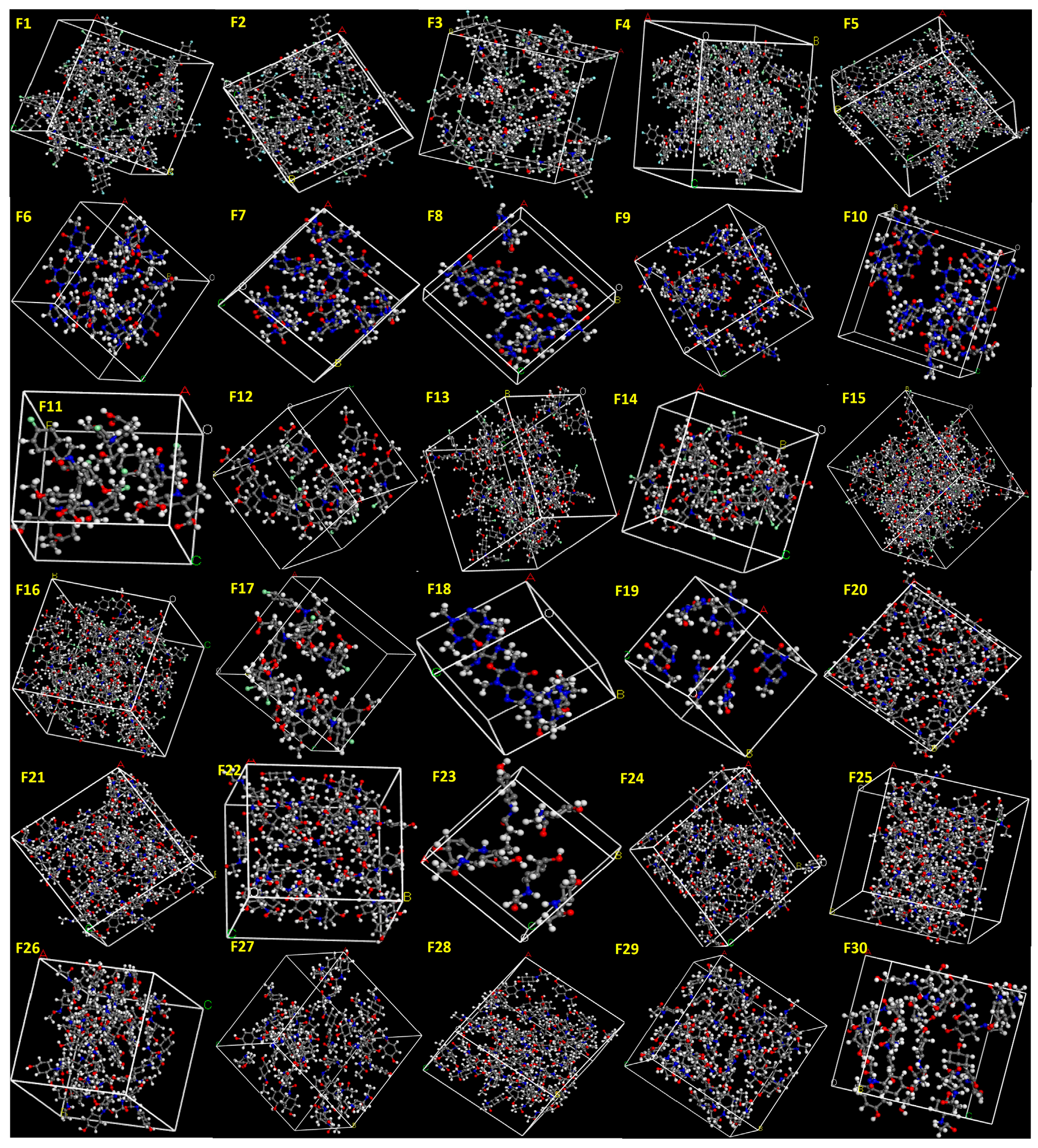
| Formulation Code | API System (D) | Excipient System (E) | Temp (°C) | Amorphous Cell Lengths (a (Å), b (Å), c (Å) |
|---|---|---|---|---|
| F1 | Haloperidol (15%) | Kollidon® VA 64 (BASF SE, Ludwigshafen, Germany) (74.5%) + glutaric acid (10.5%) | 115 | D-29.2 × 29.2 × 29.2 E-50.4 × 50.4 × 50.4 |
| F2 | Haloperidol (15%) | Kollidon® VA 64 (85%) | 150 | D-29.2 × 29.2 × 29.2 E-52.0 × 52.0 × 52.0 |
| F3 | Haloperidol (15%) | Kollidon® VA 64 and Affinisol™ 15Cp (The Dow Chemical Company, Midland, MI, USA) (4:6) (74.5%) + glutaric acid (10.5%) | 115 | D-28.2 × 28.2 × 28.2 E-50.0 × 50.0 × 50.0 |
| F4 | Haloperidol (30%) | Kollidon® VA 64 (79.6%) + malic acid (5.4%) | 120 | D-33.5 × 33.5 × 33.5 E-59.4 × 59.4 × 59.4 |
| F5 | Haloperidol (40%) | Kollidon® VA 64 (31.5%) + malic acid (28.5%) | 120 | D-35.5 × 35.5 × 35.5 E-34.3 × 34.3 × 34.3 |
| F6 | Theophylline (30%) | Eudragit RLPO (Evonik Industries AG, Darmstadt, Germany) (62.6%) + stearic acid (7%) | 180 | D-20.0 × 20.0 × 20.0 E-27.0 × 27.0 × 27.0 |
| F7 | Theophylline (30%) | Eudragit RLPO (70%) | 175 | D-19.6 × 19.6 × 19.6 E-25.8 × 25.8 × 25.8 |
| F8 | Theophylline (9.45%) | HPC MF (84.69%) + PEG300 (5.48%) | 145 | D-17.6 × 17.6 × 17.6 E-37.7 × 37.7 × 37.7 |
| F9 | Theophylline (30%) | Eudragit RLPO (59.6%) + PEG4000 (10%) | 145 | D-23.2 × 23.2 × 23.2 E-29.8 × 29.8 × 29.8 |
| F10 | Theophylline (30%) | Eudragit RLPO (66.1%) + Stearic acid (3.5%) | 170 | D-20.0 × 20.0 × 20.0 E-26.1 × 26.1 × 26.1 |
| F11 | Indomethacin (30%) | HPMC-AS HG (65%) + HPC LF (5%) | 160 | D-18.1 × 18.1 × 18.1 E-28.8 × 28.8 × 28.8 |
| F12 | Indomethacin (30%) | PVA (70%) | 160 | D-20.7 × 20.7 × 20.7 E-27.5 × 27.5 × 27.5 |
| F13 | Indomethacin (30%) | HPMC K15M (70%) | 180 | D-32.9 × 32.9 × 32.9 E-43.7 × 43.7 × 43.7 |
| F14 | Indomethacin (30%) | HPMC K15M (60%) + Stearic acid (10%) | 180 | D-18.1 × 18.1 × 18.1 E-35.4 × 35.4 × 35.4 |
| F15 | Indomethacin (30%) | HPMCAS-HG (60%) + PEG 4000 (10%) | 160 | D-35.1 × 35.1 × 35.1 E-46.3 × 46.3 × 46.3 |
| F16 | Indomethacin (30%) | HPMCAS-HG (70%) | 160 | D-35.2 × 35.2 × 35.2 E-49.5 × 49.5 × 49.5 |
| F17 | Indomethacin (30%) | HPMCAS-HG (65%) + HPC-LF (5%) | 160 | D-10.2 × 10.2 × 10.2 E-30.3 × 30.3 × 30.3 |
| F18 | Caffeine (10.03%) | HPC-SSL (37.34%) + PEG4000 (15.24%) + Dicalcium phosphate (37.34%) | 120–145 | D-13.9 × 13.9 × 13.9 E-26.1 × 26.1 × 26.1 |
| F19 | Caffeine (10.03%) | HPC-SSL (89.97%) | 120–145 | D:14.8 × 14.8 × 14.8 E-22.6 × 22.6 × 22.6 |
| F20 | Acetaminophen (30%) | HPMC E5 (45.5%) + Soluplus (15%) | 180 | E-50.2 × 50.2 × 50.2 D-32.4 × 32.4 × 32.4 |
| F21 | Acetaminophen (30%) | HPMC E5 (45.5%) + HPC LF (15%) | 180 | D:13.6 × 13.6 × 13.6 E-33.4 × 33.4 × 33.4 |
| F22 | Acetaminophen (30%) | HPMC E5 (35%) + Eudragit L100 (35%) | 180 | D-26.2 × 26.2 × 26.2 E-38.6 × 38.6 × 38.6 |
| F23 | Acetaminophen (30%) | HPMC E5 (35%) + HPC LF (35%) | 180 | D-38.8 × 38.8 × 38.8 E-41.1 × 41.1 × 41.1 |
| F24 | Acetaminophen (30%) | HPC LF (35%) + Ethyl cellulose (35%) | 160 | D-29.6 × 29.6 × 29.6 E-38.7 × 38.7 × 38.7 |
| F25 | Acetaminophen (30%) | Ethyl cellulose (35%) + Soluplus (35%) | 160 | E-49.9 × 49.9 × 49.9 D-30.5 × 30.5 × 30.5 |
| F26 | Paracetamol (25%) | Affinisol™ (The Dow Chemical Company, Midland, MI, USA) 15LV (75%) | 130 | D-28.3 × 28.3 × 28.3 E-38.2 × 38.2 × 38.2 |
| F27 | Paracetamol (30%) | Affinisol™ 15LV (70%) | 130 | D-26.2 × 26.2 × 26.2 E-34.7 × 34.7 × 34.7 |
| F28 | Paracetamol (35%) | Affinisol™ 15LV (65%) | 110 | D-31.1 × 31.3 × 31.1 E-38.2 × 38.2 × 38.2 |
| F29 | Paracetamol (40%) | Affinisol™ 15LV (60%) | 110 | D-26.4 × 26.4 × 26.4 E-30.3 × 30.3 × 30.3 |
| F30 | Paracetamol (5%) | Affinisol™ 15LV (95%) | 180 | D-19.6 × 19.6 × 19.6 E-55.1 × 55.1 × 55.1 |
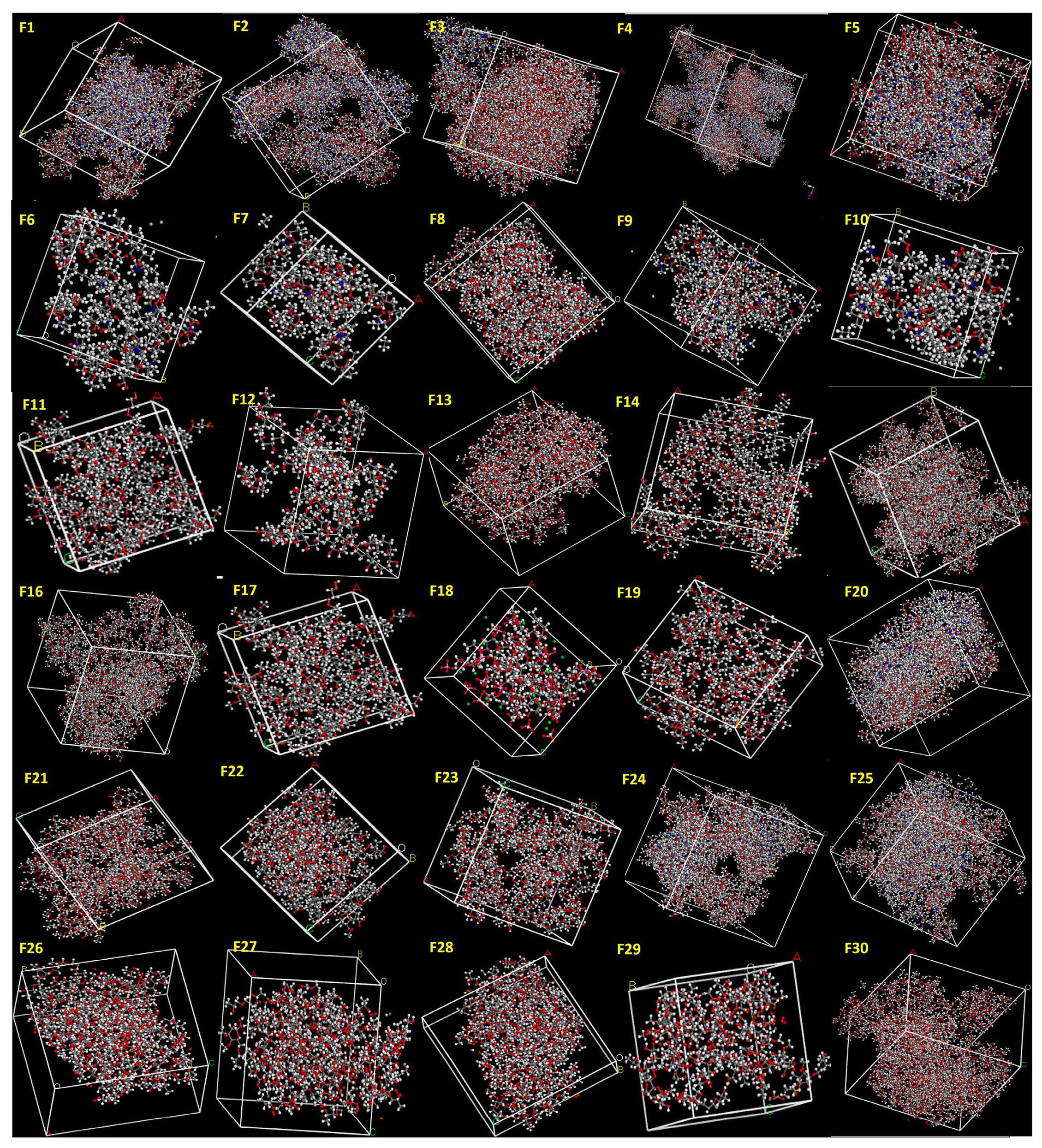
| Formulation Code | Polymer Matrix | Formulation Composition | Amorphous Cell Lengths (a (Å), b (Å), c (Å)) | Temp (°C) |
|---|---|---|---|---|
| F1 | Kollicoat IR | Paracetamol (PCM) (5%) + Kollicoat IR (BASF SE, Ludwigshafen, Germany) (92%) | 17.2 × 17.2 × 17.2 | 110 |
| F2 | PCM (10%) + Kollicoat IR (77%) | 17.2 × 17.2 × 17.2 | 110 | |
| F3 | PCM (15%) + Kollicoat IR (62%) | 17.2 × 17.2 × 17.2 | 110 | |
| F4 | HPMC K4M | Naftopidil (20%) + HPMC (30%) + Mannitol (45%) + PEG4000 (10%) | 18.7 × 18.7 × 18.7 | 90 |
| F5 | Naftopidil (20%) + HPMC (50%) + Mannitol (15%) + PEG4000 (10%) | 20.0 × 20.0 × 20.0 | 90 | |
| F6 | Polycaprolactone (PCL) | Acetylsalicylic acid (10%) + PCL (90%) | 29.3 × 29.3 × 29.3 | 100 |
| F7 | Acetylsalicylic acid (15%) + PCL (85%) | 27.0 × 27.0 × 27.0 | 100 | |
| F8 | Kollidon® VA 64 | Caffeine (5%) + Kollidon® VA 64 (40%) + PCL (45%) + PEO (25%) | 48.1 × 48.1 × 48.1 | 140 |
| F9 | Caffeine (5%) + Kollidon® VA 64 (30%) + PCL (55%) + PEO (10%) | 44.0 × 44.0 × 44.0 | 140 | |
| F10 | Eudragit EPO | 5-aminosalicylic acid (12.5%) + Eudragit EPO (Evonik Industries AG, Darmstadt, Germany) (46.75%) + Triethyl citrate (3.25%) + Tricalcium phosphate (37.5%) | 27.5 × 27.5 × 27.5 | 90–100 |
| F11 | Theophylline (12.5%) + Eudragit EPO (46.75%) + Triethyl citrate (3.25%) + Tricalcium phosphate (37.5%) | 26.3 × 26.3 × 26.3 | 90–100 | |
| F12 | Captopril (12.5%) + Eudragit EPO (46.75%) + Triethyl citrate (3.25%) + Tricalcium phosphate (37.5%) | 29.1 × 29.1 × 29.1 | 90–100 | |
| F13 | Prednisolone (12.5%) + Eudragit EPO (46.75%) + Triethyl citrate (3.25%) + Tricalcium phosphate (37.5%) | 34.6 × 34.6 × 34.6 | 90–100 | |
| F14 | HPMCAS-HG | Indomethacin (20%) + HPMCAS-HG (60%) + PEG6000 (20%) | 30.8 × 30.8 × 30.8 | 140 |
| F15 | Pregabalin (50%) + HPMCAS-HG (40%) + PEG 400 (10%) | 34.9 × 34.9 × 34.9 | 140 | |
| Polymer Grades | ||||
| F16 | HPMCAS-HG | PCM (5%) + HPMCAS-HG (95%) + Methyl paraben (15%) + Magnesium stearate (5%) | 50.4 × 50.4 × 50.4 | - |
| F17 | HPMCAS-MG | PCM (5%) + HPMCAS-MG (95%) + Methyl paraben (15%) + Magnesium stearate (5%)-MG | 33.9 × 33.9 × 33.9 | - |
| F18 | HPMCAS-LG | PCM (5%) + HPMCAS-LG (95%) + Methyl paraben (15%) + Magnesium stearate (5%) | 38.4 × 38.4 × 38.4 | - |
| Polymer ratio | ||||
| F19 | HPMC (5%) | Levetiracetam (23.4%) + Kollidon SR (25.9%) + SiO2 (10%) + HPMC (Metolose 90SH; Shin-Etsu Chemical Co., Ltd., Tokyo, Japan) (5%) + Water (35.7%) | 35.4 × 35.4 × 35.4 | - |
| F20 | HPMC (10%) | Levetiracetam (23.4%) + Kollidon SR (20.9%) + SiO2 (10%) + HPMC (Metolose 90SH) (10%) + Water (35.7%) | 30.6 × 30.6 × 30.6 | - |
| F21 | HPMC (15%) | Levetiracetam (23.4%) + Kollidon SR (15.9%) + SiO2 (10%) + HPMC (Metolose 90SH) (15%) + Water (35.7%) | 35.5 × 35.5 × 35.5 | - |
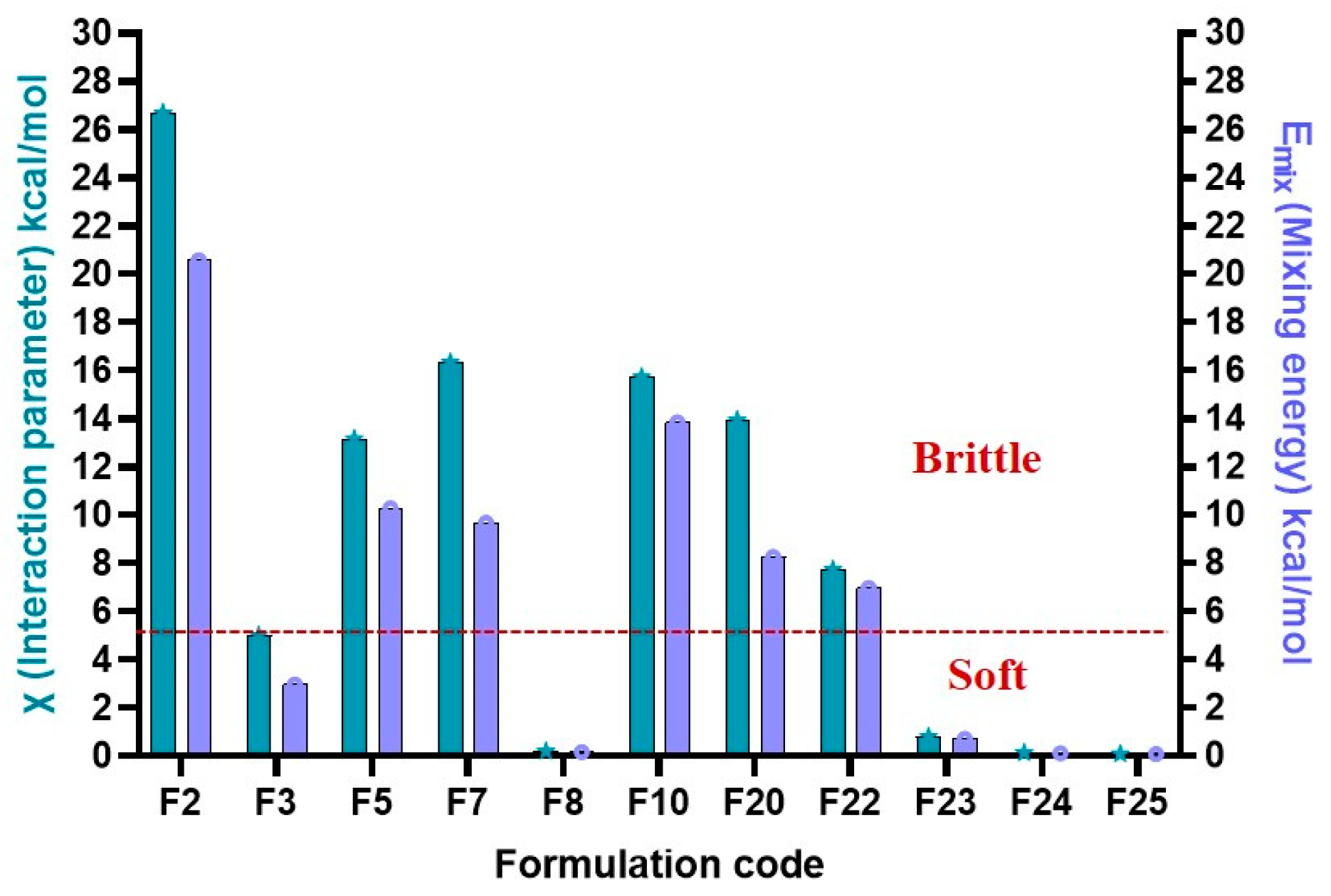
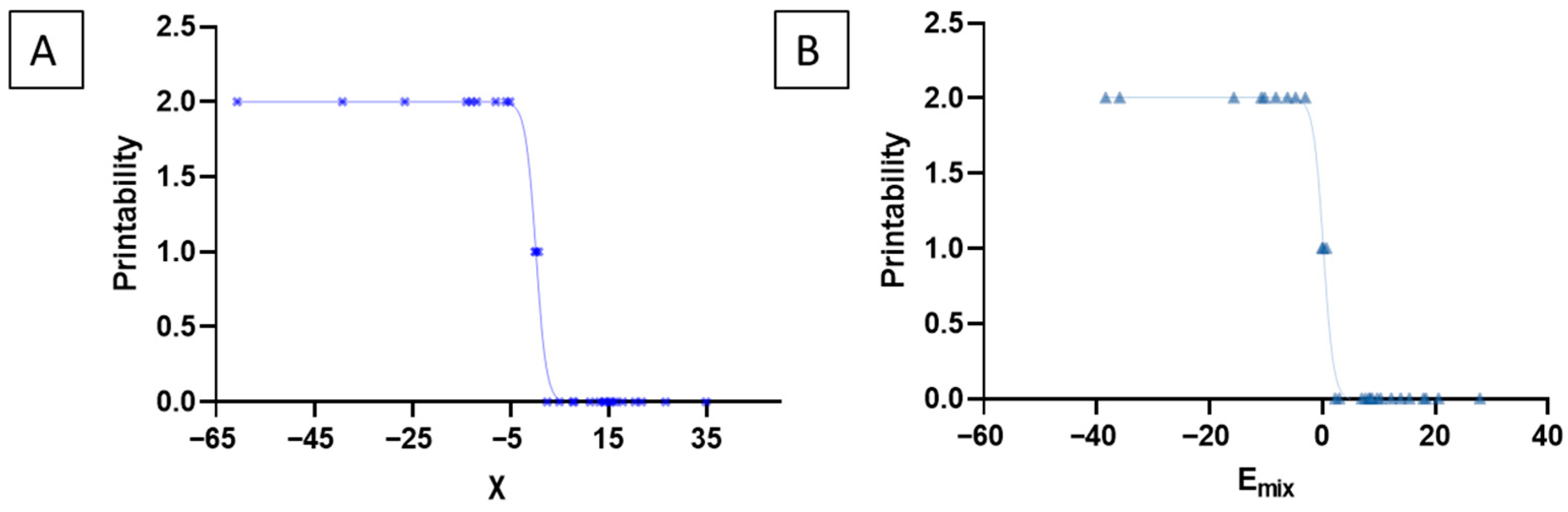
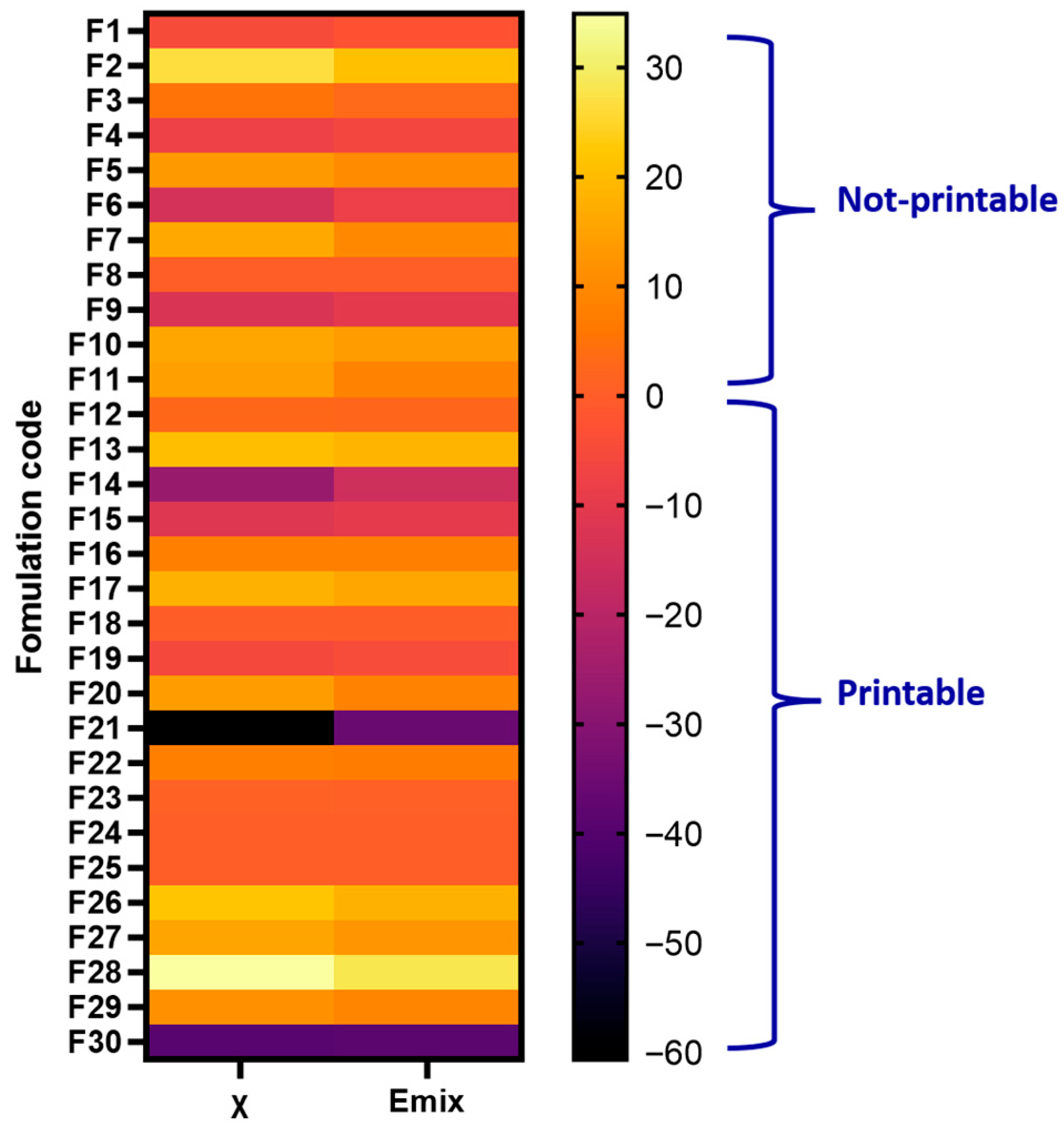
| Formulation Code | In Silico Miscibility | Experimental Reported Printability | ||
|---|---|---|---|---|
| χ | Emix | Miscibility | ||
| F1 | −5.11 | −3.03 | Miscible | Yes |
| F2 | 26.67 | 20.57 | Immiscible | No |
| F3 | 5.00 | 2.96 | Immiscible | No |
| F4 | −7.95 | −6.21 | Miscible | Yes |
| F5 | 13.16 | 10.28 | Immiscible | No |
| F6 | −13.94 | −8.25 | Miscible | Yes |
| F7 | 16.34 | 9.68 | Immiscible | No |
| F8 | 0.20 | 0.16 | Immiscible | No |
| F9 | −12.99 | −10.79 | Miscible | Yes |
| F10 | 15.72 | 13.84 | Miscible | No |
| F11 | 14.34 | 8.49 | Immiscible | No |
| F12 | 2.50 | 2.26 | Immiscible | No |
| F13 | 20.41 | 18.38 | Immiscible | No |
| F14 | −26.48 | −15.68 | Miscible | Yes |
| F15 | −11.90 | −10.25 | Miscible | Yes |
| F16 | 8.02 | 7.62 | Immiscible | No |
| F17 | 17.89 | 15.40 | Immiscible | No |
| F18 | −0.02 | −0.01 | Immiscible | No |
| F19 | −5.85 | −4.75 | Miscible | Yes |
| F20 | 13.95 | 8.26 | Immiscible | No |
| F21 | −60.70 | −35.94 | Miscible | Yes |
| F22 | 7.74 | 6.97 | Immiscible | No |
| F23 | 0.79 | 0.71 | Not miscible | No |
| F24 | 0.12 | 0.11 | Not miscible | No |
| F25 | 0.08 | 0.07 | Not miscible | No |
| F26 | 21.79 | 17.89 | Not miscible | No |
| F27 | 15.25 | 12.22 | Not miscible | No |
| F28 | 34.86 | 27.93 | Not miscible | No |
| F29 | 11.27 | 8.80 | Not miscible | No |
| F30 | −39.22 | −38.43 | Miscible | yes |
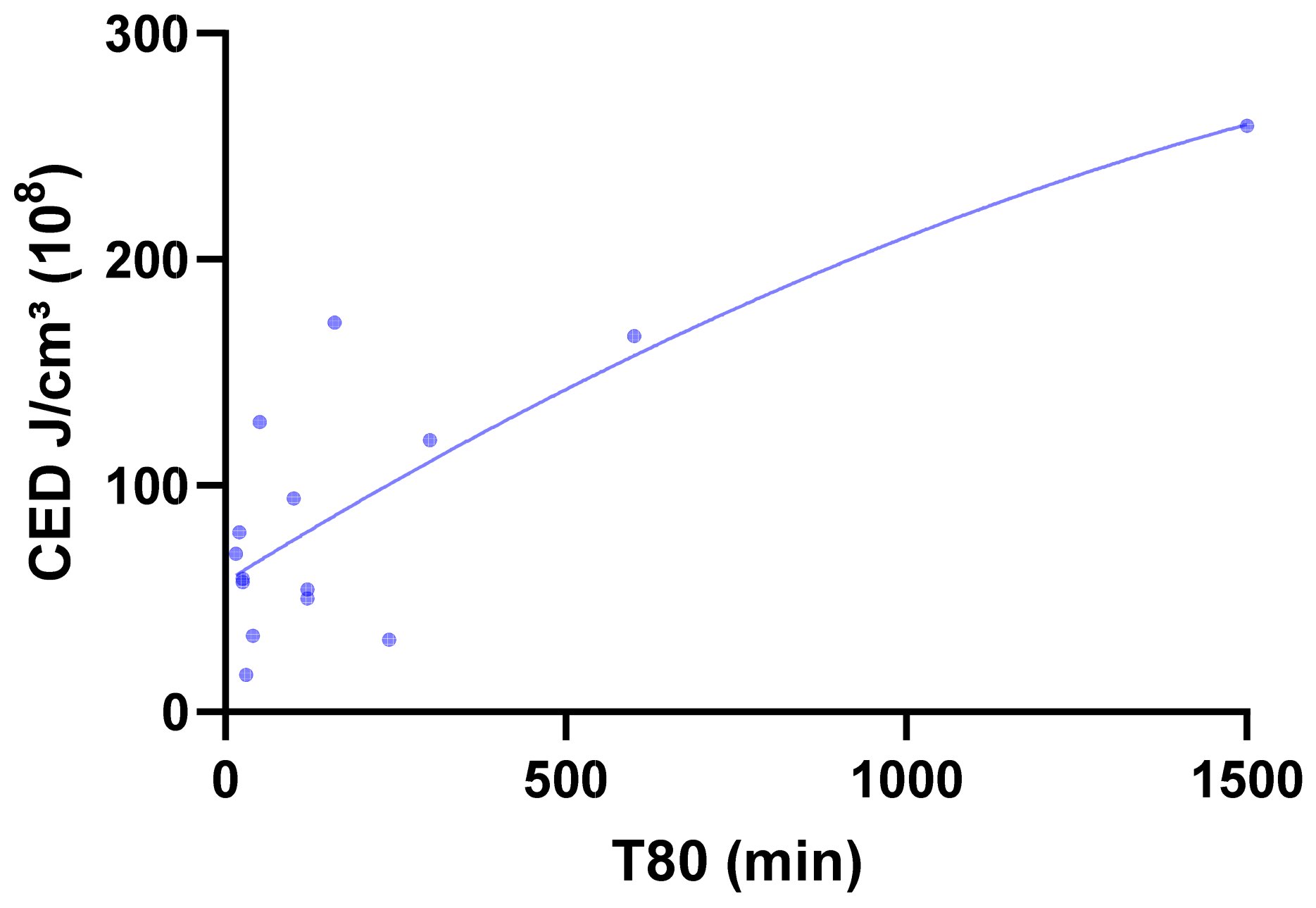
| Formulation Code | Formulation Composition | T80 (Min) | CED J/cm3 (108) |
|---|---|---|---|
| Dissolution prediction: general trends across polymers | |||
| F1 | Kollicoat IR (92%) | 30 | 16.3 |
| F2 | Kollicoat IR (77%) | 120 | 54 |
| F3 | Kollicoat IR (62%) | 300 | 120 |
| F4 | HPMC (30%) | 40 | 33.6 |
| F5 | HPMC (50%) | 120 | 50 |
| F6 | PCL (90%) | 100 | 94.4 |
| F7 | PCL (85%) | 160 | 172 |
| F8 | Kollidon® VA 64 (40%) +PCL (45%) | 600 | 166 |
| F9 | Kollidon® VA 64 (30%) +PCL (55%) | 1500 | 259 |
| F10 | 5-ASA + EPO (46.75%) | 15 | 69.9 |
| F11 | Theophylline (12.5%) + Eudragit EPO (46.75%) | 20 | 79.4 |
| F12 | Captopril (12.5%) + Eudragit EPO (46.75%) | 25 | 58.8 |
| F13 | Prednisolone (12.5%) + Eudragit EPO (46.75%) | 25 | 57.4 |
| F14 | HPMCAS-HG (60%) | 50 | 128 |
| F15 | HPMCAS-HG (40%) | 240 | 31.8 |
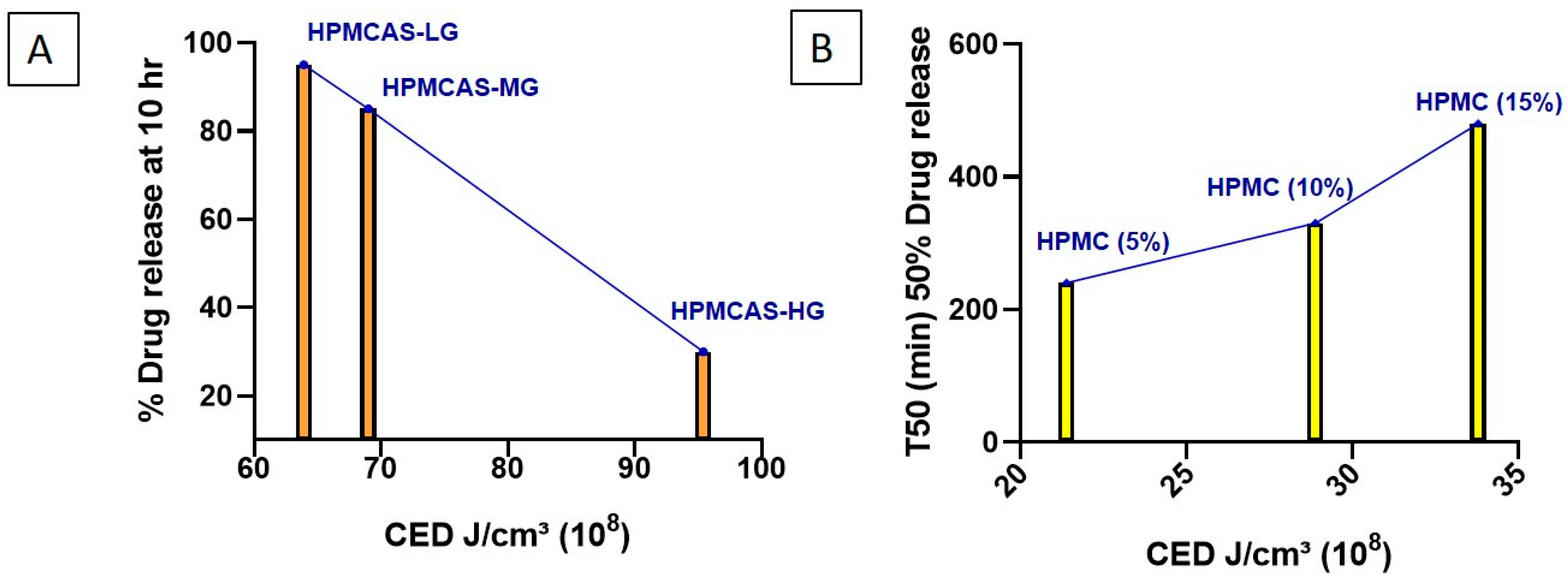
| Formulation Code | Formulation Composition | % release at 10 h | CED J/cm3 (108) |
| Polymer grade-dependent trends in dissolution prediction | |||
| F16 | HPMCAS-LG (95%) | 95 | 63.9 |
| F17 | HPMCAS-MG (95%) | 85 | 69 |
| F18 | HPMCAS-HG (95%) | 30 | 95.4 |
| Formulation Code | Formulation Composition | T50 (min) | CED J/cm3 (108) |
| Polymer concentration-dependent trends in dissolution prediction | |||
| F19 | HPMC (5%) | 240 | 21.4 |
| F20 | HPMC (10%) | 330 | 28.9 |
| F21 | HPMC (15%) | 480 | 33.8 |
Disclaimer/Publisher’s Note: The statements, opinions and data contained in all publications are solely those of the individual author(s) and contributor(s) and not of MDPI and/or the editor(s). MDPI and/or the editor(s) disclaim responsibility for any injury to people or property resulting from any ideas, methods, instructions or products referred to in the content. |
© 2025 by the authors. Licensee MDPI, Basel, Switzerland. This article is an open access article distributed under the terms and conditions of the Creative Commons Attribution (CC BY) license.
Share and Cite
Todke, P.; Lazauskas, R.; Bernatoniene, J. In Silico Predictions Driving the Development of 3D-Printed Drug Delivery Systems. Pharmaceutics 2026, 18, 32. https://doi.org/10.3390/pharmaceutics18010032
Todke P, Lazauskas R, Bernatoniene J. In Silico Predictions Driving the Development of 3D-Printed Drug Delivery Systems. Pharmaceutics. 2026; 18(1):32. https://doi.org/10.3390/pharmaceutics18010032
Chicago/Turabian StyleTodke, Pooja, Robertas Lazauskas, and Jurga Bernatoniene. 2026. "In Silico Predictions Driving the Development of 3D-Printed Drug Delivery Systems" Pharmaceutics 18, no. 1: 32. https://doi.org/10.3390/pharmaceutics18010032
APA StyleTodke, P., Lazauskas, R., & Bernatoniene, J. (2026). In Silico Predictions Driving the Development of 3D-Printed Drug Delivery Systems. Pharmaceutics, 18(1), 32. https://doi.org/10.3390/pharmaceutics18010032