
Gut Microbiota and Probiotics in Influenza: A Narrative Review of Mechanisms and Emerging Evidence
 , , , ,
Abstract
1. Introduction
2. Literature Selection Approach
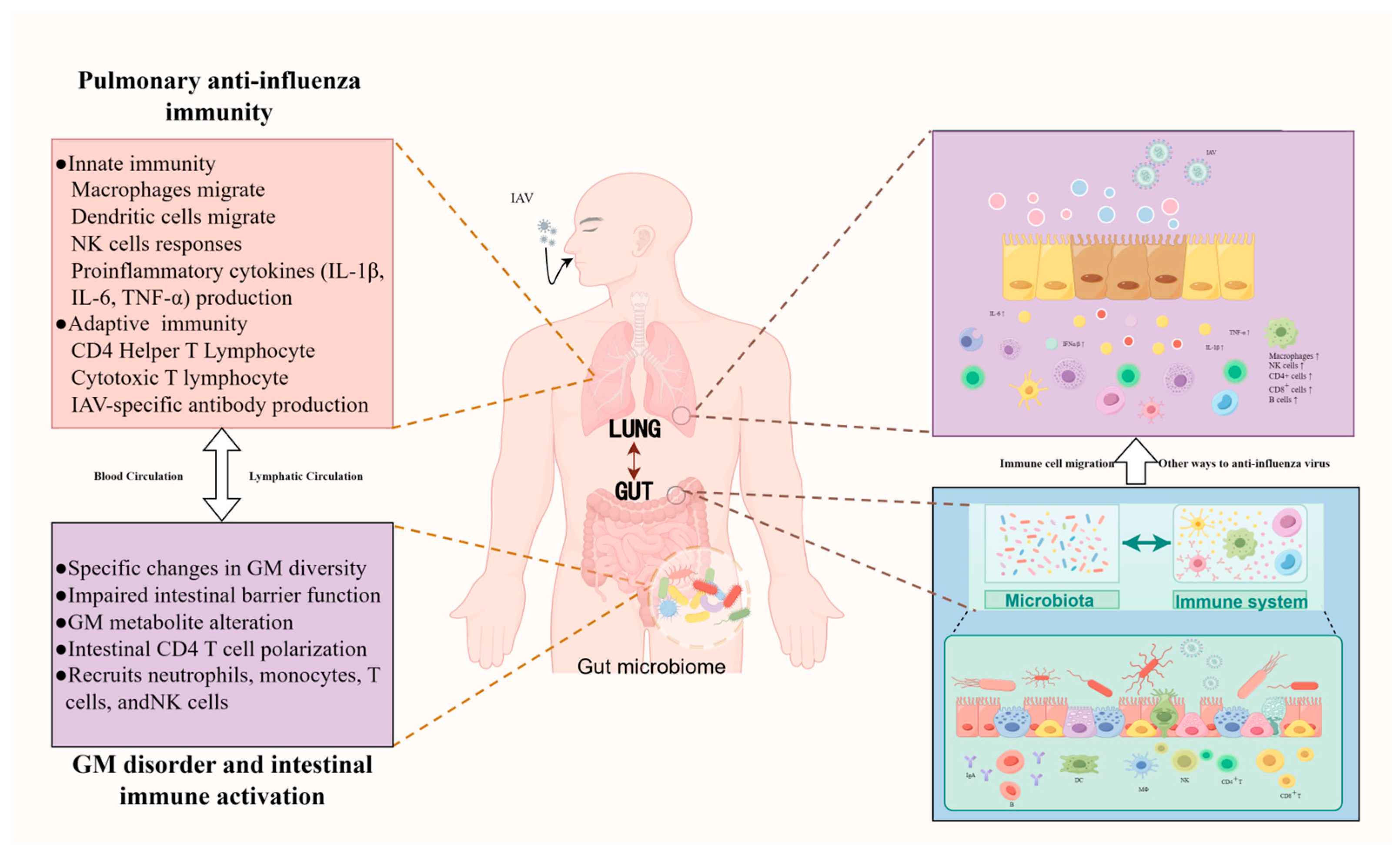
3. Bidirectional Regulation and Immune Modulation of Gut Microbiota in Influenza Virus Infection
4. Probiotic Interventions Against Influenza Infection: Evidence and Potential
5. Probiotics and Mucosal Immunity in Influenza: Mechanistic Insights
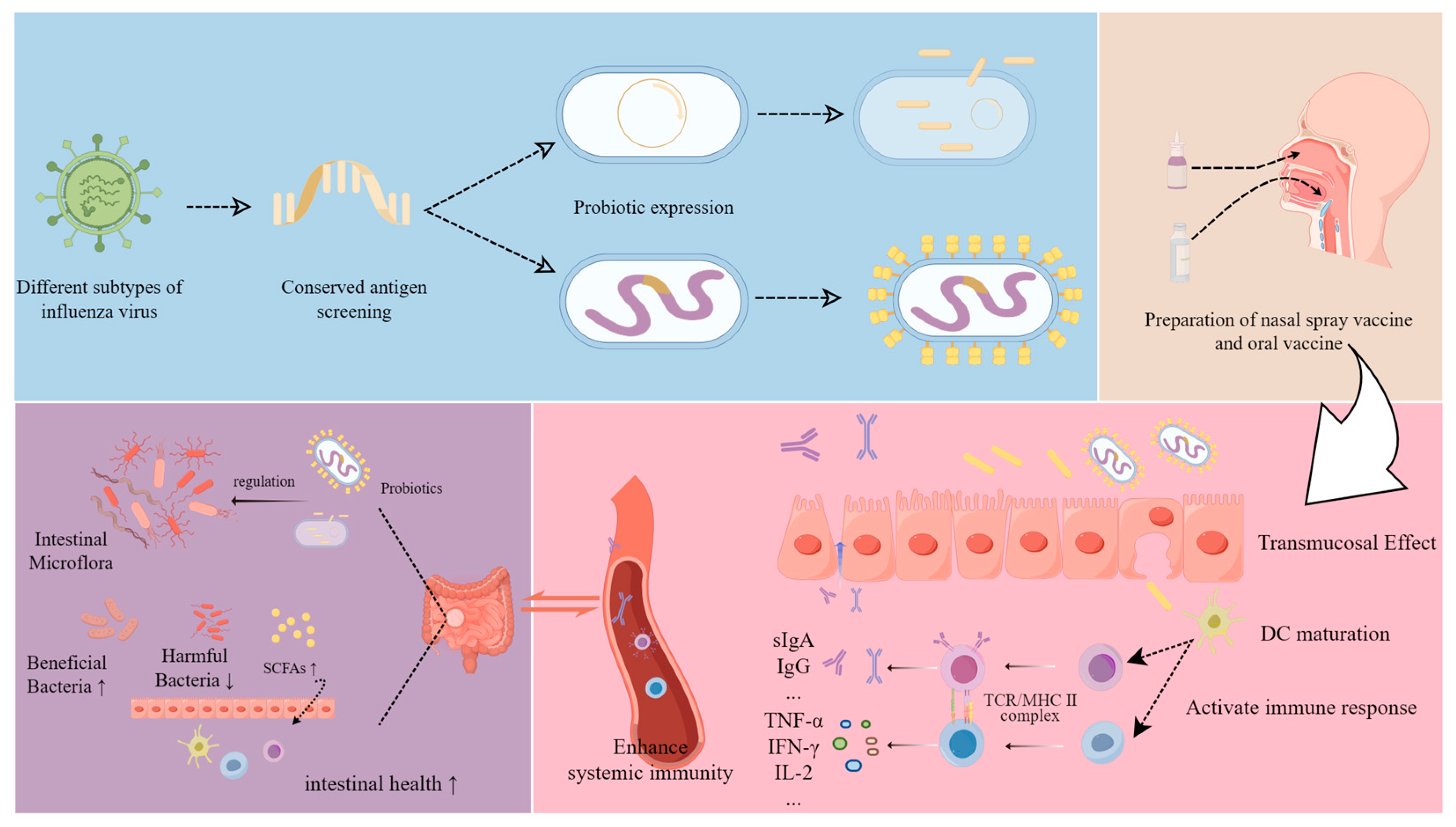
6. Probiotic Vector-Based Vaccines for Influenza: Current Evidence and Translational Limitations
7. Discussion and Future Directions
8. Conclusions
Author Contributions
Funding
Institutional Review Board Statement
Informed Consent Statement
Data Availability Statement
Acknowledgments
Conflicts of Interest
Abbreviations
| GALT | Gut-associated lymphoid tissue |
| SCFAs | Short-chain fatty acids |
| IAV | Influenza A virus |
| EcN | Escherichia coli Nissle 1917 |
| FMT | Fecal microbiota transplantation |
| LPS | Lipopolysaccharide |
References
- Fazal, A.; Harker, E.J.; Neelam, V.; Olson, S.M.; Rolfes, M.A.; Reinhart, K.; Kniss, K.; Frutos, A.; Leonard, J.; Reed, C.; et al. Pediatric Influenza-Associated Encephalopathy and Acute Necrotizing Encephalopathy—United States, 2024–2025 Influenza Season. MMWR Morb. Mortal. Wkly. Rep. 2025, 74, 556–564. [Google Scholar] [CrossRef]
- Russ, S.; Nogareda, F.; Regan, A.K.; Benedetti, E.; Pasinovich, M.; Voto, C.; Chilver, M.; Stocks, N.; Sullivan, S.G.; Cheng, A.C.; et al. Interim Effectiveness Estimates of 2025 Southern Hemisphere Influenza Vaccines in Preventing Influenza-Associated Outpatient and Hospitalized Illness—Eight Southern Hemisphere Countries, March–September 2025. MMWR Morb. Mortal. Wkly. Rep. 2025, 74, 570–578. [Google Scholar] [CrossRef]
- Marsland, B.J.; Gollwitzer, E.S. Host–Microorganism Interactions in Lung Diseases. Nat. Rev. Immunol. 2014, 14, 827–835. [Google Scholar] [CrossRef]
- Marsland, B.J.; Trompette, A.; Gollwitzer, E.S. The Gut–Lung Axis in Respiratory Disease. Ann. Am. Thorac. Soc. 2015, 12, S150–S156. [Google Scholar] [CrossRef]
- Bemark, M.; Pitcher, M.J.; Dionisi, C.; Spencer, J. Gut-Associated Lymphoid Tissue: A Microbiota-Driven Hub of B Cell Immunity. Trends Immunol. 2024, 45, 211–223. [Google Scholar] [CrossRef]
- Gioula, G.; Exindari, M. The Airway Microbiome as a Modulator of Influenza Virus Infection: Mechanistic Insights and Translational Perspectives-Review. Pathogens 2026, 15, 63. [Google Scholar] [CrossRef]
- Nowosad, C.R.; Mesin, L.; Castro, T.B.R.; Wichmann, C.; Donaldson, G.P.; Araki, T.; Schiepers, A.; Lockhart, A.A.K.; Bilate, A.M.; Mucida, D.; et al. Tunable Dynamics of B Cell Selection in Gut Germinal Centres. Nature 2020, 588, 321–326. [Google Scholar] [CrossRef] [PubMed]
- Qin, J.; Li, R.; Raes, J.; Arumugam, M.; Burgdorf, K.S.; Manichanh, C.; Nielsen, T.; Pons, N.; Levenez, F.; Yamada, T.; et al. A Human Gut Microbial Gene Catalogue Established by Metagenomic Sequencing. Nature 2010, 464, 59–65. [Google Scholar] [CrossRef] [PubMed]
- The Human Microbiome Project Consortium. Structure, Function and Diversity of the Healthy Human Microbiome. Nature 2012, 486, 207–214. [Google Scholar] [CrossRef] [PubMed]
- Durack, J.; Lynch, S.V. The Gut Microbiome: Relationships with Disease and Opportunities for Therapy. J. Exp. Med. 2019, 216, 20–40. [Google Scholar] [CrossRef]
- Blander, J.M.; Longman, R.S.; Iliev, I.D.; Sonnenberg, G.F.; Artis, D. Regulation of Inflammation by Microbiota Interactions with the Host. Nat. Immunol. 2017, 18, 851–860. [Google Scholar] [CrossRef]
- Erttmann, S.F.; Swacha, P.; Aung, K.M.; Brindefalk, B.; Jiang, H.; Härtlova, A.; Uhlin, B.E.; Wai, S.N.; Gekara, N.O. The Gut Microbiota Prime Systemic Antiviral Immunity via the cGAS-STING-IFN-I Axis. Immunity 2022, 55, 847–861.e10. [Google Scholar] [CrossRef]
- Wu, D.; Wang, T.; Wu, H.; Dong, Y.; Huang, Z.; Zhang, J.; Zhang, W. Trends and hotspots in global influenza and intestinal flora research based on bibliometrics. Front. Microbiol. 2025, 16, 1630924. [Google Scholar] [CrossRef]
- Woodall, C.A.; McGeoch, L.J.; Hay, A.D.; Hammond, A. Respiratory Tract Infections and Gut Microbiome Modifications: A Systematic Review. PLoS ONE 2022, 17, e0262057. [Google Scholar] [CrossRef]
- Velikova, T.; Ali, H.; Batselova, H.; Chervenkov, L.; Miteva, D.; Peruhova, M.; Gulinac, M.; Tomov, L.; Mitova-Mineva, Y.; Velev, V. Interplay between viral infections and gut microbiota dysbiosis: Mechanisms and therapeutic potential. World J. Gastroenterol. 2026, 32, 112437. [Google Scholar] [CrossRef]
- Steed, A.L.; Christophi, G.P.; Kaiko, G.E.; Sun, L.; Goodwin, V.M.; Jain, U.; Esaulova, E.; Artyomov, M.N.; Morales, D.J.; Holtzman, M.J.; et al. The Microbial Metabolite Desaminotyrosine Protects from Influenza Through Type I Interferon. Science 2017, 357, 498–502. [Google Scholar] [CrossRef] [PubMed]
- Thaiss, C.A.; Zmora, N.; Levy, M.; Elinav, E. The Microbiome and Innate Immunity. Nature 2016, 535, 65–74. [Google Scholar] [CrossRef] [PubMed]
- Ngo, V.L.; Lieber, C.M.; Kang, H.; Sakamoto, K.; Kuczma, M.; Plemper, R.K.; Gewirtz, A.T. Intestinal Microbiota Programming of Alveolar Macrophages Influences Severity of Respiratory Viral Infection. Cell Host Microbe 2024, 32, 335–348.e8. [Google Scholar] [CrossRef]
- Wypych, T.P.; Wickramasinghe, L.C.; Marsland, B.J. The Influence of the Microbiome on Respiratory Health. Nat. Immunol. 2019, 20, 1279–1290. [Google Scholar] [CrossRef] [PubMed]
- Ma, L.; Ji, L.; Wang, T.; Zhai, Z.; Su, P.; Zhang, Y.; Wang, Y.; Zhao, W.; Wu, Z.; Yu, H.; et al. Research Progress on the Mechanism of Traditional Chinese Medicine Regulating Intestinal Microbiota to Combat Influenza a Virus Infection. Virol. J. 2023, 20, 260. [Google Scholar] [CrossRef]
- Kim, S.; Lee, S.; Kim, T.-Y.; Lee, S.-H.; Seo, S.-U.; Kweon, M.-N. Newly Isolated Lactobacillus paracasei Strain Modulates Lung Immunity and Improves the Capacity to Cope with Influenza Virus Infection. Microbiome 2023, 11, 260. [Google Scholar] [CrossRef]
- Huang, L.; Tang, W.; He, L.; Li, M.; Lin, X.; Hu, A.; Huang, X.; Wu, Z.; Wu, Z.; Chen, S.; et al. Engineered Probiotic Escherichia coli Elicits Immediate and Long-Term Protection against Influenza A Virus in Mice. Nat. Commun. 2024, 15, 6802. [Google Scholar] [CrossRef]
- Zou, X.; Cao, H.; Hong, L.; Suo, L.; Wang, C.; Chang, K.; Ni, Y.; Liu, B.; Cao, B. Enrichment of Streptococcus oralis in Respiratory Microbiome Enhance Innate Immunity and Protects Against Influenza Infection. Signal Transduct. Target. Ther. 2025, 10, 272. [Google Scholar] [CrossRef] [PubMed]
- Decker, V.; Qureshi, K.; Roberts, L.; Powell, N.; Marchesi, J.R.; Mullish, B.H.; Alexander, J.L. The Emerging Role of the Gut Microbiota in Vaccination Responses. Gut Microbes 2025, 17, 2549585. [Google Scholar] [CrossRef]
- Mezhenskaya, D.; Isakova-Sivak, I.; Gupalova, T.; Bormotova, E.; Kuleshevich, E.; Kramskaya, T.; Leontieva, G.; Rudenko, L.; Suvorov, A. A Live Probiotic Vaccine Prototype Based on Conserved Influenza a Virus Antigens Protect Mice Against Lethal Influenza Virus Infection. Biomedicines 2021, 9, 1515. [Google Scholar] [CrossRef]
- Minodier, L.; Charrel, R.N.; Ceccaldi, P.-E.; van der Werf, S.; Blanchon, T.; Hanslik, T.; Falchi, A. Prevalence of Gastrointestinal Symptoms in Patients with Influenza, Clinical Significance, and Pathophysiology of Human Influenza Viruses in Faecal Samples: What Do We Know? Virol. J. 2015, 12, 215. [Google Scholar] [CrossRef] [PubMed]
- Asseri, A.A.; Shati, A.A.; Al-Qahtani, S.M.; Alzaydani, I.A.; Al-Jarie, A.A.; Alaliani, M.J.; Ali, A.S. Distinctive Clinical and Laboratory Features of COVID-19 and H1N1 Influenza Infections among Hospitalized Pediatric Patients. World J. Pediatr. 2021, 17, 272–279. [Google Scholar] [CrossRef]
- Wang, J.; Li, F.; Wei, H.; Lian, Z.-X.; Sun, R.; Tian, Z. Respiratory Influenza Virus Infection Induces Intestinal Immune Injury via Microbiota-Mediated Th17 Cell–Dependent Inflammation. J. Exp. Med. 2014, 211, 2397–2410. [Google Scholar] [CrossRef]
- Yue, K.; Lu, S.; Yang, T.; Mi, J.; He, S.; Ma, H.; He, Y.; Yang, Z.; Huang, Y.; Song, L.; et al. Lactiplantibacillus plantarum GUANKE Alleviates Intestinal Barrier Damage Caused by Influenza Infection in Mice. Probiotics Antimicrob. Proteins 2025, 18, 2122–2136. [Google Scholar] [CrossRef]
- El-Khoury, G.; Hajjar, C.; Geitani, R.; Sarkis, D.K.; Butel, M.-J.; Barbut, F.; Abifadel, M.; Kapel, N. Gut microbiota and viral respiratory infections: Microbial alterations, immune modulation, and impact on disease severity: A narrative review. Front. Microbiol. 2025, 16, 1605143. [Google Scholar] [CrossRef] [PubMed]
- Deriu, E.; Boxx, G.M.; He, X.; Pan, C.; Benavidez, S.D.; Cen, L.; Rozengurt, N.; Shi, W.; Cheng, G. Influenza Virus Affects Intestinal Microbiota and Secondary Salmonella Infection in the Gut through Type I Interferons. PLoS Pathog. 2016, 12, e1005572. [Google Scholar] [CrossRef]
- Yildiz, S.; Mazel-Sanchez, B.; Kandasamy, M.; Manicassamy, B.; Schmolke, M. Influenza A Virus Infection Impacts Systemic Microbiota Dynamics and Causes Quantitative Enteric Dysbiosis. Microbiome 2018, 6, 9. [Google Scholar] [CrossRef]
- Sencio, V.; Barthelemy, A.; Tavares, L.P.; Machado, M.G.; Soulard, D.; Cuinat, C.; Queiroz-Junior, C.M.; Noordine, M.-L.; Salomé-Desnoulez, S.; Deryuter, L.; et al. Gut Dysbiosis during Influenza Contributes to Pulmonary Pneumococcal Superinfection through Altered Short-Chain Fatty Acid Production. Cell Rep. 2020, 30, 2934–2947.e6. [Google Scholar] [CrossRef]
- Gu, S.; Chen, Y.; Wu, Z.; Chen, Y.; Gao, H.; Lv, L.; Guo, F.; Zhang, X.; Luo, R.; Huang, C.; et al. Alterations of the Gut Microbiota in Patients with Coronavirus Disease 2019 or H1N1 Influenza. Clin. Infect. Dis. 2020, 71, 2669–2678. [Google Scholar] [CrossRef]
- Ichinohe, T.; Pang, I.K.; Kumamoto, Y.; Peaper, D.R.; Ho, J.H.; Murray, T.S.; Iwasaki, A. Microbiota Regulates Immune Defense against Respiratory Tract Influenza A Virus Infection. Proc. Natl. Acad. Sci. USA 2011, 108, 5354–5359. [Google Scholar] [CrossRef] [PubMed]
- Kullberg, R.F.J.; van Linge, C.C.A.; Haak, B.W.; Paul, P.S.; Butler, J.M.; Wolff, N.; van Engelen, T.S.R.; Sikkens, J.J.; Bomers, M.K.; Lefèvre, A.; et al. Effect of the Gut Microbiota-Derived Tryptophan Metabolite Indole-3-Acetic Acid in Pneumonia. Nat. Commun. 2025, 16, 8565. [Google Scholar] [CrossRef] [PubMed]
- Hornung, F.; SureshKumar, H.K.; Klement, L.; Reisser, Y.; Wernike, C.; Nischang, V.; Jordan, P.M.; Werz, O.; Hoffmann, C.; Löffler, B.; et al. High-Fat Diet Impairs Microbial Metabolite Production and Aggravates Influenza A Infection. Cell Commun. Signal. 2025, 23, 359. [Google Scholar] [CrossRef]
- Cho, S.J.; Hong, K.S.; Schenck, E.; Lee, S.; Harris, R.; Yang, J.; Choi, A.M.K.; Stout-Delgado, H. Decreased IDO1-Dependent Tryptophan Metabolism in Aged Lung During Influenza. Eur. Respir. J. 2021, 57, 2000443. [Google Scholar] [CrossRef]
- Jia, H.; He, X.; Jiang, T.; Kong, F. Roles of Bile Acid-Activated Receptors in Monocytes-Macrophages and Dendritic Cells. Cells 2025, 14, 920. [Google Scholar] [CrossRef] [PubMed]
- Hagan, T.; Cortese, M.; Rouphael, N.; Boudreau, C.; Linde, C.; Maddur, M.S.; Das, J.; Wang, H.; Guthmiller, J.; Zheng, N.-Y.; et al. Antibiotics-Driven Gut Microbiome Perturbation Alters Immunity to Vaccines in Humans. Cell 2019, 178, 1313–1328.e13. [Google Scholar] [CrossRef]
- Zhu, J.; Huang, Z.; Lin, Y.; Zhu, J.; Min, R.; Wan, Z.; Chen, Y.; Zhu, J.; Xing, L.; Li, S.; et al. The Potential Immunological Mechanisms of Gut Microbiota Dysbiosis Caused by Antibiotics Exacerbate the Lethality of Influenza Viruses. Gut Microbes 2026, 18, 2609451. [Google Scholar] [CrossRef]
- Zhang, Y.; Wan, Y.; Xin, X.; Qiao, Y.; Qiao, W.; Ping, J.; Su, J. Signals from intestinal microbiota mediate the crosstalk between the lung-gut axis in an influenza infection mouse model. Front. Immunol. 2024, 15, 1435180. [Google Scholar] [CrossRef]
- Ngo, V.L.; Lieber, C.M.; Abo, H.; Kuczma, M.; Zou, J.; Plemper, R.K.; Gewirtz, A.T. Segmented Filamentous Bacteria Reprogramming of Alveolar Macrophages Limits Postinfluenza Bacterial Pneumonia. Sci. Immunol. 2026, 11, eadt8858. [Google Scholar] [CrossRef]
- Niu, J.; Cui, M.; Yang, X.; Li, J.; Yao, Y.; Guo, Q.; Lu, A.; Qi, X.; Zhou, D.; Zhang, C.; et al. Microbiota-Derived Acetate Enhances Host Antiviral Response via NLRP3. Nat. Commun. 2023, 14, 642. [Google Scholar] [CrossRef]
- Arpaia, N.; Campbell, C.; Fan, X.; Dikiy, S.; van der Veeken, J.; deRoos, P.; Liu, H.; Cross, J.R.; Pfeffer, K.; Coffer, P.J.; et al. Metabolites Produced by Commensal Bacteria Promote Peripheral Regulatory T-Cell Generation. Nature 2013, 504, 451–455. [Google Scholar] [CrossRef]
- Furusawa, Y.; Obata, Y.; Fukuda, S.; Endo, T.A.; Nakato, G.; Takahashi, D.; Nakanishi, Y.; Uetake, C.; Kato, K.; Kato, T.; et al. Commensal Microbe-Derived Butyrate Induces the Differentiation of Colonic Regulatory T Cells. Nature 2013, 504, 446–450. [Google Scholar] [CrossRef]
- Qu, S.; Gao, Y.; Ma, J.; Yan, Q. Microbiota-Derived Short-Chain Fatty Acids Functions in the Biology of B Lymphocytes: From Differentiation to Antibody Formation. Biomed. Pharmacother. 2023, 168, 115773. [Google Scholar] [CrossRef] [PubMed]
- Suez, J.; Zmora, N.; Segal, E.; Elinav, E. The Pros, Cons, and Many Unknowns of Probiotics. Nat. Med. 2019, 25, 716–729. [Google Scholar] [CrossRef]
- O’Toole, P.W.; Marchesi, J.R.; Hill, C. Next-Generation Probiotics: The Spectrum from Probiotics to Live Biotherapeutics. Nat. Microbiol. 2017, 2, 17057. [Google Scholar] [CrossRef]
- Javanshir, N.; Ebrahimi, V.; Mazhary, Z.; Jahromi, B.S.; Zuo, T.; Fard, N.A. The Antiviral Effects and Underlying Mechanisms of Probiotics on Viral Infections. Microb. Pathog. 2025, 200, 107377. [Google Scholar] [CrossRef]
- Coleman, J.L.; Hatch-McChesney, A.; Small, S.D.; Allen, J.T.; Sullo, E.; Agans, R.T.; Fagnant, H.S.; Bukhari, A.S.; Karl, J.P. Orally Ingested Probiotics, Prebiotics, and Synbiotics as Countermeasures for Respiratory Tract Infections in Nonelderly Adults: A Systematic Review and Meta-Analysis. Adv. Nutr. 2022, 13, 2277–2295. [Google Scholar] [CrossRef] [PubMed]
- Chu, X.-J.; Song, D.-D.; Zhou, M.-H.; Chen, X.-Z.; Chu, N.; Li, M.; Li, B.-Z.; Liu, S.-H.; Hou, S.; Wu, J.-B.; et al. Perturbations in gut and respiratory microbiota in COVID-19 and influenza patients: A systematic review and meta-analysis. Front. Med. 2024, 11, 1301312. [Google Scholar] [CrossRef] [PubMed]
- Zhu, Z.; Zhu, X.; Chu, Y.; Zhang, B.; Chen, Y. Comparative Effectiveness of Oral Nutritional Supplements in Preventing Respiratory Tract Infections among Adults: A Systematic Review and Network Meta-Analysis. EClinicalMedicine 2025, 88, 103479. [Google Scholar] [CrossRef]
- Yasui, H.; Kiyoshima, J.; Hori, T.; Shida, K. Protection against influenza virus infection of mice fed Bifidobacterium breve YIT4064. Clin. Diagn. Lab. Immunol. 1999, 6, 186–192. [Google Scholar] [CrossRef] [PubMed]
- Sanders, M.E.; Hill, C. The Microbiome: An Actor or Stage for the Beneficial Action of Probiotics, Prebiotics, Synbiotics, and Postbiotics? Cell Host Microbe 2025, 33, 777–789. [Google Scholar] [CrossRef]
- Mazziotta, C.; Tognon, M.; Martini, F.; Torreggiani, E.; Rotondo, J.C. Probiotics Mechanism of Action on Immune Cells and Beneficial Effects on Human Health. Cells 2023, 12, 184. [Google Scholar] [CrossRef]
- Nakayama, Y.; Moriya, T.; Sakai, F.; Ikeda, N.; Shiozaki, T.; Hosoya, T.; Nakagawa, H.; Miyazaki, T. Oral Administration of Lactobacillus gasseri SBT2055 Is Effective for Preventing Influenza in Mice. Sci. Rep. 2014, 4, 4638. [Google Scholar] [CrossRef]
- Yang, Y.; Ren, Z.; Xu, J. Synergistic Effects of Lactiplantibacillus plantarum GUANKE and Tryptophan on Alleviating Lung Injury through the AHR/STAT3/IL-10 Pathway in Influenza Infection Mice. J. Nutr. Biochem. 2026, 148, 110165. [Google Scholar] [CrossRef]
- Lu, W.; Fang, Z.; Liu, X.; Li, L.; Zhang, P.; Zhao, J.; Zhang, H.; Chen, W. The Potential Role of Probiotics in Protection Against Influenza a Virus Infection in Mice. Foods 2021, 10, 902. [Google Scholar] [CrossRef]
- Wahab, S.; Almaghaslah, D.; Mahmood, S.E.; Ahmad, M.F.; Alsayegh, A.A.; Abu Haddash, Y.M.; Rahman, M.A.; Ahamd, I.; Ahmad, W.; Khalid, M.; et al. Pharmacological Efficacy of Probiotics in Respiratory Viral Infections: A Comprehensive Review. J. Pers. Med. 2022, 12, 1292. [Google Scholar] [CrossRef]
- Chen, Q.; Lin, Y.; Wang, K.; Li, J.; Li, P.; Song, H. Lactobacillus Murinus Reduces Susceptibility to Secondary MRSA Infection in IAV-Infected Mice Through Promoting a T Cell-Independent IgA Response. Microorganisms 2025, 13, 1709. [Google Scholar] [CrossRef]
- Ruane, D.; Chorny, A.; Lee, H.; Faith, J.; Pandey, G.; Shan, M.; Simchoni, N.; Rahman, A.; Garg, A.; Weinstein, E.G.; et al. Microbiota Regulate the Ability of Lung Dendritic Cells to Induce IgA Class-Switch Recombination and Generate Protective Gastrointestinal Immune Responses. J. Exp. Med. 2016, 213, 53–73. [Google Scholar] [CrossRef]
- Tezuka, H.; Ohteki, T. Regulation of IgA Production by Intestinal Dendritic Cells and Related Cells. Front. Immunol. 2019, 10, 1891. [Google Scholar] [CrossRef]
- Maeda, N.; Nakamura, R.; Hirose, Y.; Murosaki, S.; Yamamoto, Y.; Kase, T.; Yoshikai, Y. Oral Administration of Heat-Killed Lactobacillus plantarum L-137 Enhances Protection against Influenza Virus Infection by Stimulation of Type I Interferon Production in Mice. Int. Immunopharmacol. 2009, 9, 1122–1125. [Google Scholar] [CrossRef]
- Kobayashi, N.; Saito, T.; Uematsu, T.; Kishi, K.; Toba, M.; Kohda, N.; Suzuki, T. Oral Administration of Heat-Killed Lactobacillus pentosus Strain B240 Augments Protection against Influenza Virus Infection in Mice. Int. Immunopharmacol. 2011, 11, 199–203. [Google Scholar] [CrossRef]
- Xing, J.-H.; Shi, C.-W.; Sun, M.-J.; Gu, W.; Zhang, R.-R.; Chen, H.-L.; Li, Y.; Wang, D.; Li, J.; Niu, T.-M.; et al. Lactiplantibacillus plantarum 0111 Protects Against Influenza Virus by Modulating Intestinal Microbial-Mediated Immune Responses. Front. Microbiol. 2022, 13, 820484. [Google Scholar] [CrossRef]
- Wang, Y.; Moon, A.; Huang, J.; Sun, Y.; Qiu, H.-J. Antiviral Effects and Underlying Mechanisms of Probiotics as Promising Antivirals. Front. Cell. Infect. Microbiol. 2022, 12, 928050. [Google Scholar] [CrossRef]
- Mahooti, M.; Abdolalipour, E.; Salehzadeh, A.; Mohebbi, S.R.; Gorji, A.; Ghaemi, A. Immunomodulatory and Prophylactic Effects of Bifidobacterium bifidum Probiotic Strain on Influenza Infection in Mice. World J. Microbiol. Biotechnol. 2019, 35, 91. [Google Scholar] [CrossRef]
- Chen, M.-F.; Weng, K.-F.; Huang, S.-Y.; Liu, Y.-C.; Tseng, S.-N.; Ojcius, D.M.; Shih, S.-R. Pretreatment with a Heat-Killed Probiotic Modulates Monocyte Chemoattractant Protein-1 and Reduces the Pathogenicity of Influenza and Enterovirus 71 Infections. Mucosal Immunol. 2017, 10, 215–227. [Google Scholar] [CrossRef]
- Aziz, N.; Bonavida, B. Activation of Natural Killer Cells by Probiotics. Forum Immunopathol. Dis. Ther. 2016, 7, 41–55. [Google Scholar] [CrossRef]
- Takeda, S.; Takeshita, M.; Kikuchi, Y.; Dashnyam, B.; Kawahara, S.; Yoshida, H.; Watanabe, W.; Muguruma, M.; Kurokawa, M. Efficacy of Oral Administration of Heat-Killed Probiotics from Mongolian Dairy Products against Influenza Infection in Mice: Alleviation of Influenza Infection by Its Immunomodulatory Activity through Intestinal Immunity. Int. Immunopharmacol. 2011, 11, 1976–1983. [Google Scholar] [CrossRef]
- Lebeer, S.; Vanderleyden, J.; De Keersmaecker, S.C.J. Host Interactions of Probiotic Bacterial Surface Molecules: Comparison with Commensals and Pathogens. Nat. Rev. Microbiol. 2010, 8, 171–184. [Google Scholar] [CrossRef] [PubMed]
- Han, M.; Lu, Q.; Wang, D.; Zhou, K.; Jia, C.; Teng, L.; Hamuti, A.; Peng, X.; Hu, Y.; Li, W.; et al. Oral Co-Administration of Lactiplantibacillus plantarum 16 and Lacticaseibacillus rhamnosus P118 Improves Host Defense against Infuenza A Virus Infection. J. Virol. 2024, 98, e00950-24. [Google Scholar] [CrossRef] [PubMed]
- Park, S.; Kim, J.I.; Bae, J.-Y.; Yoo, K.; Kim, H.; Kim, I.-H.; Park, M.-S.; Lee, I. Effects of Heat-Killed Lactobacillus plantarum against Influenza Viruses in Mice. J. Microbiol. 2018, 56, 145–149. [Google Scholar] [CrossRef]
- Kechaou, N.; Chain, F.; Gratadoux, J.-J.; Blugeon, S.; Bertho, N.; Chevalier, C.; Le Goffic, R.; Courau, S.; Molimard, P.; Chatel, J.M.; et al. Identification of One Novel Candidate Probiotic Lactobacillus plantarum Strain Active against Influenza Virus Infection in Mice by a Large-Scale Screening. Appl. Environ. Microbiol. 2013, 79, 1491–1499. [Google Scholar] [CrossRef]
- Zelaya, H.; Tsukida, K.; Chiba, E.; Marranzino, G.; Alvarez, S.; Kitazawa, H.; Agüero, G.; Villena, J. Immunobiotic Lactobacilli Reduce Viral-Associated Pulmonary Damage through the Modulation of Inflammation–Coagulation Interactions. Int. Immunopharmacol. 2014, 19, 161–173. [Google Scholar] [CrossRef]
- Bae, J.-Y.; Kim, J.I.; Park, S.; Yoo, K.; Kim, I.-H.; Joo, W.; Ryu, B.H.; Park, M.S.; Lee, I.; Park, M.-S. Effects of Lactobacillus plantarum and Leuconostoc mesenteroides Probiotics on Human Seasonal and Avian Influenza Viruses. J. Microbiol. Biotechnol. 2018, 28, 893–901. [Google Scholar] [CrossRef]
- Wang, H.; Zhao, Y.; Pei, Z.; Zhao, J.; Zhang, P.; Zhang, X.; Zhang, Z.; Lu, W. Effect of Mixed Probiotics on Alleviating H1N1 Influenza Infection and Regulating Gut Microbiota. Foods 2024, 13, 3079. [Google Scholar] [CrossRef] [PubMed]
- Takahashi, E.; Sawabuchi, T.; Kimoto, T.; Sakai, S.; Kido, H. Lactobacillus delbrueckii ssp. Bulgaricus OLL1073R-1 Feeding Enhances Humoral Immune Responses, Which Are Suppressed by the Antiviral Neuraminidase Inhibitor Oseltamivir in Influenza A Virus–Infected Mice. J. Dairy Sci. 2019, 102, 9559–9569. [Google Scholar] [CrossRef]
- Nagai, T.; Makino, S.; Ikegami, S.; Itoh, H.; Yamada, H. Effects of Oral Administration of Yogurt Fermented with Lactobacillus delbrueckii ssp. Bulgaricus OLL1073R-1 and Its Exopolysaccharides against Influenza Virus Infection in Mice. Int. Immunopharmacol. 2011, 11, 2246–2250. [Google Scholar] [CrossRef] [PubMed]
- Harata, G.; He, F.; Hiruta, N.; Kawase, M.; Kubota, A.; Hiramatsu, M.; Yausi, H. Intranasal Administration of Lactobacillus rhamnosus GG Protects Mice from H1N1 Influenza Virus Infection by Regulating Respiratory Immune Responses. Lett. Appl. Microbiol. 2010, 50, 597–602. [Google Scholar] [CrossRef]
- Miettinen, M.; Pietilä, T.E.; Kekkonen, R.A.; Kankainen, M.; Latvala, S.; Pirhonen, J.; Österlund, P.; Korpela, R.; Julkunen, I. Nonpathogenic Lactobacillus rhamnosus Activates the Inflammasome and Antiviral Responses in Human Macrophages. Gut Microbes 2012, 3, 510–522. [Google Scholar] [CrossRef]
- Valentin, C.; Brito Rodrigues, P.; Verce, M.; Delbauve, S.; La Palombara, L.; Demaret, F.; Allard, J.; Salmon, I.; Cani, P.D.; Köhler, A.; et al. Maternal Probiotic Exposure Enhances CD8 T Cell Protective Neonatal Immunity and Modulates Offspring Metabolome to Control Influenza Virus Infection. Gut Microbes 2025, 17, 2442526. [Google Scholar] [CrossRef]
- Rodrigues, P.B.; Valentin, C.; Woenande, E.; Delbauve, S.; Vermijlen, D.; Köhler, A.; Flamand, V.; Everard, A. Bioactive Metabolites in Neonates of Mothers Supplemented with Bifidobacterium animalis Are Linked to Microbiota-Related Compounds in Milk and Maternal Plasma in Mice. J. Nutr. Biochem. 2026, 153, 110301. [Google Scholar] [CrossRef]
- Kikuchi, Y.; Kunitoh-Asari, A.; Hayakawa, K.; Imai, S.; Kasuya, K.; Abe, K.; Adachi, Y.; Fukudome, S.; Takahashi, Y.; Hachimura, S. Oral Administration of Lactobacillus plantarum Strain AYA Enhances IgA Secretion and Provides Survival Protection against Influenza Virus Infection in Mice. PLoS ONE 2014, 9, e86416. [Google Scholar] [CrossRef]
- Mi, J.; Yue, K.; Zhang, X.; Yang, Y.; Lu, S.; He, Y.; Yang, Z.; He, S.; Huang, Y.; Song, L.; et al. Complementary Protective Effects of Lactiplantibacillus plantarum GUANKE and Picolinic Acid Against Influenza A Virus Infection in Mice. Probiotics Antimicrob. Proteins 2026. Online ahead of print. [Google Scholar] [CrossRef]
- Lu, S.; Yue, K.; He, S.; Mi, J.; Yang, T.; Yang, Y.; Ma, H.; Ren, Z.; Ren, L.; Xu, J. Lactiplantibacillus plantarum GUANKE Ameliorates Influenza a Virus-Induced Inflammation and Lung Barrier Dysfunction Through Enhancing Mitophagy and Improving Oxidative Phosphorylation. Cell. Mol. Life Sci. 2026, 83, 107. [Google Scholar] [CrossRef]
- Waki, N.; Yajima, N.; Suganuma, H.; Buddle, B.M.; Luo, D.; Heiser, A.; Zheng, T. Oral Administration of Lactobacillus brevis KB290 to Mice Alleviates Clinical Symptoms Following Influenza Virus Infection. Lett. Appl. Microbiol. 2014, 58, 87–93. [Google Scholar] [CrossRef] [PubMed]
- Belkacem, N.; Serafini, N.; Wheeler, R.; Derrien, M.; Boucinha, L.; Couesnon, A.; Cerf-Bensussan, N.; Boneca, I.G.; Santo, J.P.D.; Taha, M.-K.; et al. Lactobacillus paracasei Feeding Improves Immune Control of Influenza Infection in Mice. PLoS ONE 2017, 12, e0184976. [Google Scholar] [CrossRef]
- Arai, S.; Iwabuchi, N.; Takahashi, S.; Xiao, J.; Abe, F.; Hachimura, S. Orally Administered Heat-Killed Lactobacillus paracasei MCC1849 Enhances Antigen-Specific IgA Secretion and Induces Follicular Helper T Cells in Mice. PLoS ONE 2018, 13, e0199018. [Google Scholar] [CrossRef] [PubMed]
- Jung, Y.-J.; Lee, Y.-T.; Ngo, V.L.; Cho, Y.-H.; Ko, E.-J.; Hong, S.-M.; Kim, K.-H.; Jang, J.-H.; Oh, J.-S.; Park, M.-K.; et al. Heat-Killed Lactobacillus casei Confers Broad Protection against Influenza A Virus Primary Infection and Develops Heterosubtypic Immunity against Future Secondary Infection. Sci. Rep. 2017, 7, 17360. [Google Scholar] [CrossRef] [PubMed]
- Tochilina, A.G.; Belova, I.V.; Ilyicheva, T.N.; Marchenko, V.Y.; Zhirnov, V.A.; Molodtsova, S.B.; Ikonnikov, A.V.; Muhkina, I.V.; Blagonravova, A.S.; Soloveva, I.V. Genome Features of Probiotic Bifidobacteria Determining Their Strain-Specific Properties. Sovrem. Tehnol. Med. 2022, 14, 36. [Google Scholar] [CrossRef]
- Kiso, M.; Takano, R.; Sakabe, S.; Katsura, H.; Shinya, K.; Uraki, R.; Watanabe, S.; Saito, H.; Toba, M.; Kohda, N.; et al. Protective Efficacy of Orally Administered, Heat-Killed Lactobacillus pentosus b240 against Influenza A Virus. Sci. Rep. 2013, 3, 1563. [Google Scholar] [CrossRef]
- Wang, Q.; Fang, Z.; Xiao, Y.; Wang, H.; Zhang, P.; Lu, W.; Zhang, H.; Zhou, X. Lactiplantibacillus pentoses CCFM1227 Produces Desaminotyrosine to Protect against Infuenza Virus H1N1 Infection through the Type I Interferon in Mice. Nutrients 2023, 15, 3659. [Google Scholar] [CrossRef]
- Zhou, H.; Huang, W.; Li, J.; Chen, P.; Shen, L.; Huang, W.; Mai, K.; Zou, H.; Shi, X.; Weng, Y.; et al. Oral Probiotic Extracellular Vesicle Therapy Mitigates Influenza A Virus Infection via Blunting IL-17 Signaling. Bioact. Mater. 2025, 45, 401–416. [Google Scholar] [CrossRef]
- He, S.; Song, L.; Xiao, Y.; Huang, Y.; Ren, Z. Genomic, Probiotic, and Functional Properties of Bacteroides Dorei RX2020 Isolated from Gut Microbiota. Nutrients 2025, 17, 1066. [Google Scholar] [CrossRef]
- Choi, D.; Jang, S.J.; Choi, S.; Park, S.; Kim, W.-K.; Lee, G.; Lee, C.; Ko, G. Oral Administration of Limosilactobacillus reuteri KBL346 Ameliorates Influenza Virus A/PR8 Infection in Mouse. Probiotics Antimicrob. Proteins 2024, 17, 3546–3558. [Google Scholar] [CrossRef]
- Winther, K.; Kristensen, C.; Henriksen, B.L.; Hansen, L.H.B.; Ryt-Hansen, P.; Vestergaard, G.; Skovgaard, K.; Sandvang, D.; Boll, E.J.; Williams, A.R.; et al. Bacillus subtilis-597 Induces Changes in Lung Pathology and Inflammation during Influenza A Virus Infection in Pigs. Vet. Microbiol. 2024, 291, 110032. [Google Scholar] [CrossRef]
- Chollet, L.; Heumel, S.; Deruyter, L.; Bouilloux, F.; Delval, L.; Robert, V.; Gevaert, M.-H.; Pichavant, M.; Sencio, V.; Robil, C.; et al. Faecalibacterium duncaniae as a Novel next Generation Probiotic against Influenza. Front. Immunol. 2024, 15, 1347676. [Google Scholar] [CrossRef] [PubMed]
- Goto, H.; Sagitani, A.; Ashida, N.; Kato, S.; Hirota, T.; Shinoda, T.; Yamamoto, N. Anti-Influenza Virus Effects of Both Live and Non-Live Lactobacillus acidophilus L-92 Accompanied by the Activation of Innate Immunity. Br. J. Nutr. 2013, 110, 1810–1818. [Google Scholar] [CrossRef]
- Kawase, M.; He, F.; Kubota, A.; Harata, G.; Hiramatsu, M. Oral Administration of Lactobacilli from Human Intestinal Tract Protects Mice against Influenza Virus Infection. Lett. Appl. Microbiol. 2010, 51, 6–10. [Google Scholar] [CrossRef]
- Kawase, M.; He, F.; Kubota, A.; Yoda, K.; Miyazawa, K.; Hiramatsu, M. Heat-Killed Lactobacillus gasseri TMC0356 Protects Mice against Influenza Virus Infection by Stimulating Gut and Respiratory Immune Responses. FEMS Immunol. Med. Microbiol. 2012, 64, 280–288. [Google Scholar] [CrossRef]
- Youn, H.-N.; Lee, D.-H.; Lee, Y.-N.; Park, J.-K.; Yuk, S.-S.; Yang, S.-Y.; Lee, H.-J.; Woo, S.-H.; Kim, H.-M.; Lee, J.-B.; et al. Intranasal Administration of Live Lactobacillus Species Facilitates Protection against Influenza Virus Infection in Mice. Antivir. Res. 2012, 93, 138–143. [Google Scholar] [CrossRef] [PubMed]
- Low, Z.X.; Woo, O.; Kanauchi, O.; Hassandarvish, P.; Tiong, V.; AbuBakar, S. Stimulation of Peripheral Blood Mononuclear Cells with Lactococcus lactis Strain Plasma Elicits Antiviral Effects Against H1N1 and SARS-CoV-2. Int. J. Mol. Sci. 2025, 26, 11573. [Google Scholar] [CrossRef]
- Ye, Z.; Zhang, Y. Glutathione-ROS pathway activation by probiotic B240 augments macrophage response to influenza. Front. Cell. Infect. Microbiol. 2025, 15, 1697559. [Google Scholar] [CrossRef]
- Xing, J.; Niu, T.; Yu, T.; Zou, B.; Fan, S.; Wang, C.; Shi, C.; Zhang, D.; Wang, N.; Jiang, Y.; et al. Gut Microbiota-Derived Isovaleric Acid Ameliorates Influenza Virus Infection via Gut-Lung Axis. npj Biofilms Microbiomes 2025, 11, 116. [Google Scholar] [CrossRef] [PubMed]
- Belkacem, N.; Bourdet-Sicard, R.; Taha, M.-K. Lactobacillus paracasei Feeding Improves the Control of Secondary Experimental Meningococcal Infection in Flu-Infected Mice. BMC Infect. Dis. 2018, 18, 167. [Google Scholar] [CrossRef] [PubMed]
- Ryan, F.J.; Clarke, M.; Lynn, M.A.; Benson, S.C.; McAlister, S.; Giles, L.C.; Choo, J.M.; Rossouw, C.; Ng, Y.Y.; Semchenko, E.A.; et al. Bifidobacteria Support Optimal Infant Vaccine Responses. Nature 2025, 641, 456–464. [Google Scholar] [CrossRef]
- Przemska-Kosicka, A.; Childs, C.E.; Enani, S.; Maidens, C.; Dong, H.; Dayel, I.B.; Tuohy, K.; Todd, S.; Gosney, M.A.; Yaqoob, P. Effect of a Synbiotic on the Response to Seasonal Influenza Vaccination Is Strongly Influenced by Degree of Immunosenescence. Immun. Ageing 2016, 13, 6. [Google Scholar] [CrossRef]
- Davidson, L.E.; Fiorino, A.-M.; Snydman, D.R.; Hibberd, P.L. Lactobacillus GG as an Immune Adjuvant for Live-Attenuated Influenza Vaccine in Healthy Adults: A Randomized Double-Blind Placebo-Controlled Trial. Eur. J. Clin. Nutr. 2011, 65, 501–507. [Google Scholar] [CrossRef]
- Rizzardini, G.; Eskesen, D.; Calder, P.C.; Capetti, A.; Jespersen, L.; Clerici, M. Evaluation of the Immune Benefits of Two Probiotic Strains Bifidobacterium animalis ssp. lactis, BB-12® and Lactobacillus paracasei ssp. paracasei, L. Casei 431® in an Influenza Vaccination Model: A Randomised, Double-Blind, Placebo-Controlled Study. Br. J. Nutr. 2012, 107, 876–884. [Google Scholar] [CrossRef]
- Olivares, M.; Díaz-Ropero, M.P.; Sierra, S.; Lara-Villoslada, F.; Fonollá, J.; Navas, M.; Rodríguez, J.M.; Xaus, J. Oral Intake of Lactobacillus fermentum CECT5716 Enhances the Effects of Influenza Vaccination. Nutrition 2007, 23, 254–260. [Google Scholar] [CrossRef]
- Leyer, G.J.; Li, S.; Mubasher, M.E.; Reifer, C.; Ouwehand, A.C. Probiotic Effects on Cold and Influenza-Like Symptom Incidence and Duration in Children. Pediatrics 2009, 124, e172–e179. [Google Scholar] [CrossRef]
- Baron, M. A Patented Strain of Bacillus coagulans Increased Immune Response to Viral Challenge. Postgrad. Med. 2009, 121, 114–118. [Google Scholar] [CrossRef]
- Akatsu, H.; Iwabuchi, N.; Xiao, J.; Matsuyama, Z.; Kurihara, R.; Okuda, K.; Yamamoto, T.; Maruyama, M. Clinical Effects of Probiotic Bifidobacterium longum BB536 on Immune Function and Intestinal Microbiota in Elderly Patients Receiving Enteral Tube Feeding. J. Parenter. Enter. Nutr. 2013, 37, 631–640. [Google Scholar] [CrossRef]
- Fonollá, J.; Gracián, C.; Maldonado-Lobón, J.A.; Romero, C.; Bédmar, A.; Carrillo, J.C.; Martín-Castro, C.; Cabrera, A.L.; García-Curiel, J.M.; Rodríguez, C.; et al. Effects of Lactobacillus coryniformis K8 CECT5711 on the Immune Response to Influenza Vaccination and the Assessment of Common Respiratory Symptoms in Elderly Subjects: A Randomized Controlled Trial. Eur. J. Nutr. 2019, 58, 83–90. [Google Scholar] [CrossRef]
- Aida, M.; Togawa, N.; Mizuyama, K.; Aoki, Y.; Suehiro, S.; Sakamoto, A.; Uchida, N.; Yamada, R. Heyndrickxia coagulans strain SANK70258 suppresses symptoms of upper respiratory tract infection via immune modulation: A randomized, double-blind, placebo-controlled, parallel-group, comparative study. Front. Immunol. 2024, 15, 1389920. [Google Scholar] [CrossRef]
- Özçam, M.; Lynch, S.V. The Gut–Airway Microbiome Axis in Health and Respiratory Diseases. Nat. Rev. Microbiol. 2024, 22, 492–506. [Google Scholar] [CrossRef]
- Cai, Y.; Liu, J.; Zhang, M.; Qin, N.; Liao, M.; Gao, F.; Zhao, Z.; Sha, O. Trends and Hotspots in Research of Virus and Gastrointestinal Mucosal Immunity: A Bibliometric Analysis of Four Decades. Virol. J. 2025, 22, 302. [Google Scholar] [CrossRef]
- Moriyama, M.; Rodrigues, G.; Wang, J.; Jayewickreme, R.; Hudak, A.; Dong, H.; Homer, R.J.; Ma, S.; Iwasaki, A. Intranasal Hemagglutinin Protein Boosters Induce Protective Mucosal Immunity against Influenza A Viruses in Mice. Proc. Natl. Acad. Sci. USA 2025, 122, e2422171122. [Google Scholar] [CrossRef]
- Kamble, N.S.; Thomas, S.; Madaan, T.; Ehsani, N.; Sange, S.; Tucker, K.; Muhumure, A.; Kunkler, S.; Kotagiri, N. Engineered Bacteria as an Orally Administered Anti-Viral Treatment and Immunization System. Gut Microbes 2025, 17, 2500056. [Google Scholar] [CrossRef] [PubMed]
- Maidana, S.D.; Aybar, J.N.A.; Albarracin, L.; Imamura, Y.; Arellano-Arriagada, L.; Namai, F.; Suda, Y.; Nishiyama, K.; Villena, J.; Kitazawa, H. Modulation of the Gut-Lung Axis by Water Kefir and Kefiran and Their Impact on Toll-like Receptor 3-Mediated Respiratory Immunity. Biomolecules 2024, 14, 1457. [Google Scholar] [CrossRef]
- Cohen, R.H.; Colgan, S.P.; Cartwright, I.M. Pleiotropic Mucosal Innate Immune Memory in the Gastrointestinal Tract. Int. J. Mol. Sci. 2025, 26, 10093. [Google Scholar] [CrossRef]
- Zeng, Z.; Wang, Y.; Fang, D.; Guo, W. Commentary: Immunomodulatory role of gut microbial metabolites: Mechanistic insights and therapeutic frontiers. Front. Microbiol. 2026, 17, 1750075. [Google Scholar] [CrossRef]
- Cheng, S.-C.; Quintin, J.; Cramer, R.A.; Shepardson, K.M.; Saeed, S.; Kumar, V.; Giamarellos-Bourboulis, E.J.; Martens, J.H.A.; Rao, N.A.; Aghajanirefah, A.; et al. mTOR- and HIF-1α-Mediated Aerobic Glycolysis as Metabolic Basis for Trained Immunity. Science 2014, 345, 1250684. [Google Scholar] [CrossRef]
- Aldayel, T.S.; Abdelrazek, H.M.A.; El-Fahla, N.A.; Tawfik, N.M.; Eltamany, D.A.; Zeidan, D.W.; Abbas, S. Maternal Bacillus Probiotic Regulates Offspring Growth and Immunity via Spleen IGF-1/mTOR and FOXO1/IL-10 Pathways. Sci. Rep. 2026, 16, 8500. [Google Scholar] [CrossRef]
- Cortes-Perez, N.G.; de LeBlanc, A.d.M.; Gomez-Gutierrez, J.G.; LeBlanc, J.G.; Bermúdez-Humarán, L.G. Probiotics and Trained Immunity. Biomolecules 2021, 11, 1402. [Google Scholar] [CrossRef]
- Jeyanathan, M.; Vaseghi-Shanjani, M.; Afkhami, S.; Grondin, J.A.; Kang, A.; D’Agostino, M.R.; Yao, Y.; Jain, S.; Zganiacz, A.; Kroezen, Z.; et al. Parenteral BCG Vaccine Induces Lung-Resident Memory Macrophages and Trained Immunity via the Gut-Lung Axis. Nat. Immunol. 2022, 23, 1687–1702. [Google Scholar] [CrossRef]
- Duan, H.; Wang, L.; Huangfu, M.; Li, H. The Impact of Microbiota-Derived Short-Chain Fatty Acids on Macrophage Activities in Disease: Mechanisms and Therapeutic Potentials. Biomed. Pharmacother. 2023, 165, 115276. [Google Scholar] [CrossRef]
- Kotlyarov, S. Role of Short-Chain Fatty Acids Produced by Gut Microbiota in Innate Lung Immunity and Pathogenesis of the Heterogeneous Course of Chronic Obstructive Pulmonary Disease. Int. J. Mol. Sci. 2022, 23, 4768. [Google Scholar] [CrossRef] [PubMed]
- Wang, W.; Dernst, A.; Martin, B.; Lorenzi, L.; Cadefau-Fabregat, M.; Phulphagar, K.; Wagener, A.; Budden, C.; Stair, N.; Wagner, T.; et al. Butyrate and Propionate Are Microbial Danger Signals That Activate the NLRP3 Inflammasome in Human Macrophages upon TLR Stimulation. Cell Rep. 2024, 43, 114736. [Google Scholar] [CrossRef] [PubMed]
- Winkle, J.A.V.; Peterson, S.T.; Kennedy, E.A.; Wheadon, M.J.; Ingle, H.; Desai, C.; Rodgers, R.; Constant, D.A.; Wright, A.P.; Li, L.; et al. Homeostatic Interferon-Lambda Response to Bacterial Microbiota Stimulates Preemptive Antiviral Defense within Discrete Pockets of Intestinal Epithelium. eLife 2022, 11, e74072. [Google Scholar] [CrossRef] [PubMed]
- Niu, L.; Li, H.; Guo, J.; Jia, Z.; Chang, Q.; Liu, N.; Zhang, S.; Ge, J. Gut Commensal Lactobacillus Strain Induces a Balanced Trained Immunity Phenotype to Enhance Vaccine Efficacy through JAK-STAT-SOCS Pathway. Probiotics Antimicrob. Proteins 2025, 18, 4315–4338. [Google Scholar] [CrossRef]
- Matsuda, K.; Migueles, S.A.; Huang, J.; Bolkhovitinov, L.; Stuccio, S.; Griesman, T.; Pullano, A.A.; Kang, B.H.; Ishida, E.; Zimmerman, M.; et al. A Replication-Competent Adenovirus-Vectored Influenza Vaccine Induces Durable Systemic and Mucosal Immunity. J. Clin. Investig. 2021, 131, e140794. [Google Scholar] [CrossRef] [PubMed]
- Mettelman, R.C.; Allen, E.K.; Thomas, P.G. Mucosal Immune Responses to Infection and Vaccination in the Respiratory Tract. Immunity 2022, 55, 749–780. [Google Scholar] [CrossRef]
- Kastenschmidt, J.M.; Sureshchandra, S.; Jain, A.; Hernandez-Davies, J.E.; de Assis, R.; Wagoner, Z.W.; Sorn, A.M.; Mitul, M.T.; Benchorin, A.I.; Levendosky, E.; et al. Influenza Vaccine Format Mediates Distinct Cellular and Antibody Responses in Human Immune Organoids. Immunity 2023, 56, 1910–1926.e7. [Google Scholar] [CrossRef] [PubMed]
- Cowling, B.J.; Okoli, G.N. Influenza Vaccine Effectiveness and Progress Towards a Universal Influenza Vaccine. Drugs 2024, 84, 1013–1023. [Google Scholar] [CrossRef]
- Xiong, F.; Zhang, C.; Shang, B.; Zheng, M.; Wang, Q.; Ding, Y.; Luo, J.; Li, X. An mRNA-Based Broad-Spectrum Vaccine Candidate Confers Cross-Protection against Heterosubtypic Influenza A Viruses. Emerg. Microbes Infect. 2023, 12, 2256422. [Google Scholar] [CrossRef]
- Moin, S.M.; Boyington, J.C.; Boyoglu-Barnum, S.; Gillespie, R.A.; Cerutti, G.; Cheung, C.S.-F.; Cagigi, A.; Gallagher, J.R.; Brand, J.; Prabhakaran, M.; et al. Co-Immunization with Hemagglutinin Stem Immunogens Elicits Cross-Group Neutralizing Antibodies and Broad Protection against Influenza A Viruses. Immunity 2022, 55, 2405–2418.e7. [Google Scholar] [CrossRef]
- Bliss, C.M.; Nachbagauer, R.; Mariottini, C.; Cuevas, F.; Feser, J.; Naficy, A.; Bernstein, D.I.; Guptill, J.; Walter, E.B.; Berlanda-Scorza, F.; et al. A Chimeric Haemagglutinin-Based Universal Influenza Virus Vaccine Boosts Human Cellular Immune Responses Directed towards the Conserved Haemagglutinin Stalk Domain and the Viral Nucleoprotein. eBioMedicine 2024, 104, 105153. [Google Scholar] [CrossRef]
- Sun, J.-M.; Zhang, W.-Q.; Li, Y.-J.; Guo, T.-K.; Zhang, R.-R.; Yang, Y.-L.; Zhao, Y.; Yu, L.-J.; Shi, C.-W.; Yang, G.-L.; et al. Recombinant Probiotic Escherichia coli Delivers the Polymeric Protein of Swine Influenza Virus for Protection. Vet. Microbiol. 2025, 302, 110401. [Google Scholar] [CrossRef]
- Wang, D.; Yu, L.; Lu, Q.; Han, M.; Wang, B.; Peng, X.; Yue, M.; Li, Y. Oral Pretreatment with Escherichia coli Nissle 1917 Enhances the Host’s Defense Against Influenza A Virus Infection. mLife 2025, 4, 666–682. [Google Scholar] [CrossRef]
- Bo, F.; Yang, W.-T.; Shonyela, S.M.; Jin, Y.-B.; Huang, K.-Y.; Shao, L.-N.; Wang, C.; Zhou, Y.; Li, Q.-Y.; Jiang, Y.-L.; et al. Immune Responses of Mice Inoculated with Recombinant Lactobacillus plantarum NC8 Expressing the Fusion Gene HA2 and 3M2e of the Influenza Virus and Protection against Different Subtypes of Influenza Virus. Virus Res. 2019, 263, 64–72. [Google Scholar] [CrossRef] [PubMed]
- Lei, H.; Xu, Y.; Chen, J.; Wei, X.; Lam, D.M.-K. Immunoprotection against Influenza H5N1 Virus by Oral Administration of Enteric-Coated Recombinant Lactococcus lactis Mini-Capsules. Virology 2010, 407, 319–324. [Google Scholar] [CrossRef]
- Sandionigi, A.; Giani, A.D.; Tursi, F.; Michelotti, A.; Cestone, E.; Giardina, S.; Zampolli, J.; Gennaro, P.D. Effectiveness of Multistrain Probiotic Formulation on Common Infectious Disease Symptoms and Gut Microbiota Modulation in Flu-Vaccinated Healthy Elderly Subjects. BioMed Res. Int. 2022, 2022, 3860896. [Google Scholar] [CrossRef] [PubMed]
- Starosila, D.; Rybalko, S.; Varbanetz, L.; Ivanskaya, N.; Sorokulova, I. Anti-Influenza Activity of a Bacillus subtilis Probiotic Strain. Antimicrob. Agents Chemother. 2017, 61, e00539-17. [Google Scholar] [CrossRef]
- Zhao, Y.; Dong, B.R.; Hao, Q. Probiotics for Preventing Acute Upper Respiratory Tract Infections. Cochrane Database Syst. Rev. 2022, 2022, CD006895. [Google Scholar] [CrossRef]
- Kazemifard, N.; Dehkohneh, A.; Baradaran Ghavami, S. Probiotics and probiotic-based vaccines: A novel approach for improving vaccine efficacy. Front. Med. 2022, 9, 940454. [Google Scholar] [CrossRef]
- Tang, A.S.P.; Quek, J.; Sulaimi, F.; Sim, B.; Kai, T.O.S.; Soon, E.Y.; Goh, C.N.; Hsu, J.L.J.; Lee, C.K.L.; Chong, S.K.S.; et al. Probiotics for Irritable Bowel Syndrome: An Updated Systematic Review and Meta-Analysis with Trial Sequential Analysis. J. Gastroenterol. Hepatol. 2026, 41, 1131–1146. [Google Scholar] [CrossRef]
- Wu, H.; Liu, Z.; Li, Y. Intestinal microbiota and respiratory system diseases: Relationships with three common respiratory virus infections. Microb. Pathog. 2025, 203, 107500. [Google Scholar] [CrossRef] [PubMed]
- Liu, T.; Li, S.; Wang, X.; Liu, M.; Wang, Y.; Ying, J.; Zhang, S.; Lin, Y.; Wang, N.; Bai, Y.; et al. Deciphering the Therapeutic Effects of Xiyanping Injection: Insights into Pulmonary and Gut Microbiome Modulation, SerpinB2/PAI-2 Targeting, and Alleviation of Influenza a Virus-Induced Lung Injury. Virol. J. 2025, 22, 19. [Google Scholar] [CrossRef]
- Sedaghat, A.; Torshizi, M.A.K. Immune Responses, Intestinal Microbiota, Performance and Blood Characteristics of Japanese Quail Fed on Diets Containing Camphor. Animal 2017, 11, 2139–2146. [Google Scholar] [CrossRef]
- Cao, J.; Zhang, Y.; Jiang, Y.; Li, G.; Zhang, G.; Ling, J. Trametes robiniophila Murr. Extract Alleviates Influenza-Induced Lung Injury by Regulating Gut Microbiota and Metabolites. J. Pharm. Biomed. Anal. 2025, 257, 116700. [Google Scholar] [CrossRef]
- Liu, L.; Gao, T.; Liu, J.; Zhao, J.; Zhou, Y.; Chen, Y.; Pan, W.; Deng, X.; Yang, Z.; Liang, X. Erucic Acid Attenuates Post-Influenza Secondary Staphylococcus aureus Infection by Modulating VCAM-1 and CEACAM-1 Expression and Gut Dysbiosis. Int. Immunopharmacol. 2026, 172, 116191. [Google Scholar] [CrossRef]
- Zhao, R. The association between early-life respiratory infections and childhood asthma: A meta-analytic perspective. Front. Med. 2026, 13, 1751843. [Google Scholar] [CrossRef]
- Malik, Y.S.; Pathania, A.; De, U.K.; M, M.; Panwar, H.; Kaur, J.; Mishra, A.; Kumar, N.; Ghosh, S.; Sarkar, V.K. Exploring the Therapeutic Landscape of Probiotics in Enteric and Respiratory Viral Infections. Probiotics Antimicrob. Proteins 2025, 17, 2856–2877. [Google Scholar] [CrossRef]
- Gioula, G.; Exindari, M. The Gut Microbiome and Vaccination: A Comprehensive Review of Current Evidence and Future Perspectives. Vaccines 2025, 13, 1116. [Google Scholar] [CrossRef]
- Xue, L.; Wang, C.; Liu, C. Immunomodulatory effects of gut microbiota on vaccine efficacy against respiratory pathogens. Front. Immunol. 2025, 16, 1618921. [Google Scholar] [CrossRef]
- Xie, Y.; Zhang, A.; Wang, Y.; Wang, R. Community-Acquired Pneumonia in Patients with Diabetes: Narrative Review. JMIR Diabetes 2026, 11, e82215. [Google Scholar] [CrossRef]



| Strain | Model | Measured Outcomes | Key Findings | Ref. |
|---|---|---|---|---|
| Escherichia coli Nissle 1917 1 | Mouse | Innate immunity markers | Activation of innate respiratory tract immunity | [22] |
| Lactiplantibacillus plantarum 16/Lacticaseibacillus rhamnosus P118 1 | Mouse | Viral load | Reduces viral load in the respiratory tract | [73] |
| Lactobacillus plantarum 1 | Mouse | Viral replication | Inhibited viral replication in the lungs | [74] |
| Lactobacillus plantarum CNRZ1997 1 | Mouse | Viral replication | Inhibition of viral proliferation in the lungs | [75] |
| Lactobacillus rhamnosus CRL1505 1 | Mouse | Cytokines; coagulation markers | Modulated inflammatory and coagulation-related pathways | [76] |
| Leuconostoc mesenteroides (DRC1506 and 218) 2 | Mouse | Survival | Improved survival after infection | [77] |
| Lactobacillus plantarum (330, CK10, and 920) 1 | Mouse | Observational/clinical | Reduced the onset and duration of fever, runny nose, and cough | [78] |
| Lacticaseibacillus rhamnosus CCFM1279/Limosilactobacillus reuteri CCFM1145/Lacticaseibacillus casei CCFM1127 1 | Mouse | Viral replication | Inhibits viral replication and mitigates influenza-induced lung inflammation | [79] |
| Lactobacillus delbrueckii ssp. bulgaricus OLL1073R-1 1 | Mouse | IgA levels; cytokines | Increases IgA production and modulates cytokine responses | [80] |
| Lactobacillus rhamnosus GG 1 | Mouse | Cellular immune response | Enhance the respiratory cell-mediated immune response | [81,82,83] |
| Lactobacillus rhamnosus LC705 1 | Cell | Inflammatory cytokines | Activated macrophage innate immune response | [82] |
| Bifidobacterium animalis subsp. lactis 1 | Mouse | CD8+ T cell response; mucosal immunity | Increased the CD8+ T cell-mediated antiviral and systemic/mucosal immune responses | [84] |
| Lactobacillus plantarum AYA 1 | Mouse | IgA levels | Increased mucosal IgA production | [85] |
| Lactiplantibacillus plantarum GUANKE 1 | Mouse | Cytokines | Reduced pro-inflammatory cytokines levels | [86,87] |
| Lactobacillus brevis KB290 1 | Mouse | IFN-α; IgA | Increased IFN-α production and influenza-specific IgA | [88] |
| Lactobacillus paracasei CNCM I-1518 1 | Mouse | Lung immunity | Modulates pulmonary immune responses | [89] |
| Lactobacillus paracasei MCC1849 1 | Mouse | IgA; Tfh cells | Increased antigen-specific IgA and follicular helper T cells | [90] |
| Lactobacillus casei DK128 1 | Mouse | Immune activation | Activation innate immunity and adaptive Immunity responses | [91] |
| Bifidobacterium bifidum 379, 1, and 791 1 | Cell | Antiviral activity | Pronounced antiviral activity | [92] |
| Lactobacillus pentosus strain b240 1 | Mouse | Pulmonary IgA | Increased pulmonary IgA secretion | [93] |
| Lactiplantibacillus pentoses CCFM1227 1 | Mouse | Viral load; lung pathology | Reduced viral replication and lung immunopathology | [94] |
| Lactobacillus reuteri EHA2 1 | Mouse | SCFAs; IL-17 | Increased SCFAs and reduced IL-17-mediated inflammation | [95] |
| Bacteroides dorei RX2020 2 | Mouse | IFN-β | Increased dendritic cell IFN-β production | [96] |
| Limosilactobacillus reuteri KBL346 1 | Mouse | Viral load; cytokines | Reduces pulmonary viral load and inflammatory cytokine | [97] |
| Bacillus subtilis-597 1 | Swine | Lung pathology | Reduced severity of lung lesions | [98] |
| Faecalibacterium duncaniae (A2-165 and I-4574) 2 | Mouse | Viral load; inflammation | Reduces lung viral load and inflammation | [99] |
| Lactobacillus acidophilus L-92 1 | Mouse | Neutrophils; NK activity | Reduces neutrophils and boosts NK activity | [100] |
| Lactobacillus gasseri TMC0356 1 | Mouse | Viral load; immune response | Reduces viral load and enhance mucosal immune | [101,102] |
| Lactobacillus spp. 1 | Mouse | IL-12, IgA, TNF-α, IL-6 | Increased IL-12 and IgA; decreased proinflammatory cytokines | [103] |
| Lactococcus lactis subsp. lactis JCM5805 1 | Cell | Cytokines | Upregulation IFN-α and interferon-stimulated genes | [104] |
| Lactobacillus pentosus b240 1 | Mouse | Interferon-stimulated genes | Regulated pulmonary antiviral genes expression | [105] |
| Prevotella copri 2 | Mouse | Survival | Improved survival and clinical outcomes | [106] |
| Lactobacillus paracasei CNCM I-1518 1 | Mouse | Secondary infection | Modulates pulmonary immunity, decreasing lung inflammatory cell accumulation, and accelerating viral clearance | [107] |
| Strain | Population | Measured Outcomes | Key Findings | Ref. |
|---|---|---|---|---|
| Bifidobacteria | Human(vaccine) | Vaccine-specific antibody titers | Mitigated the detrimental effects of early-life antibiotics on vaccine immunogenicity | [108] |
| Bifidobacterium longum bv. infantis CCUG 52,486 | Human(vaccine) | Vaccine-specific antibody titers | Increased vaccine-specific antibody responses | [109] |
| Lactobacillus rhamnosus GG | Human(vaccine) | rates of seroconversion after administration of LAIV | Improved influenza vaccine immunogenicity | [110] |
| Bifidobacterium animalis subsp. lactis | Human(vaccine) | IgG; IgA | Increased systemic/mucosal immune responses | [111] |
| Lactobacillus paracasei ssp. paracasei | Human(vaccine) | IgG; IgA | Increased systemic/mucosal immune responses | [111] |
| Lactobacillus fermentum CECT5716 | Human(vaccine) | Th1 response; neutralizing antibodies | Increased Th1 response and virus-neutralizing antibodies | [112] |
| Lactobacillus acidophilus NCFM/Bifidobacterium animalis subsplactis Bi-07 | Human(RTIs) | Observational/clinical | Reduces the incidence and duration of fever, cough, and runny nose. | [113] |
| Bacillus coagulans GBI-30, 6086 | Human(clinical) | T cell response | Enhanced T cell-mediated immune response | [114] |
| Bifidobacterium longum BB536 | Human(vaccine) | Serum IgA | Increased serum IgA levels | [115] |
| Lactobacillus coryniformis K8 CECT5711 | Human(vaccine) | Vaccine response; RTI symptoms | Improved vaccine immunogenicity and reduced RTI symptoms | [116] |
| Lactic acid bacterium SANK70258 | Human(Observational/clinical) | NK cell activity; sIgA | Increased NK cell activity and mucosal IgA levels | [117] |
Disclaimer/Publisher’s Note: The statements, opinions and data contained in all publications are solely those of the individual author(s) and contributor(s) and not of MDPI and/or the editor(s). MDPI and/or the editor(s) disclaim responsibility for any injury to people or property resulting from any ideas, methods, instructions or products referred to in the content. |
© 2026 by the authors. Licensee MDPI, Basel, Switzerland. This article is an open access article distributed under the terms and conditions of the Creative Commons Attribution (CC BY) license.
Share and Cite
Guan, F.; Zhang, J.; Tian, Y.; Fu, B.; Liu, J.; Song, Y.; Yan, A.; Zhang, B.; Chen, L.; Zhang, M.; et al. Gut Microbiota and Probiotics in Influenza: A Narrative Review of Mechanisms and Emerging Evidence. Viruses 2026, 18, 553. https://doi.org/10.3390/v18050553
Guan F, Zhang J, Tian Y, Fu B, Liu J, Song Y, Yan A, Zhang B, Chen L, Zhang M, et al. Gut Microbiota and Probiotics in Influenza: A Narrative Review of Mechanisms and Emerging Evidence. Viruses. 2026; 18(5):553. https://doi.org/10.3390/v18050553
Chicago/Turabian StyleGuan, Feihu, Jie Zhang, Ye Tian, Bofan Fu, Ji Liu, Yafen Song, Aoyang Yan, Bing Zhang, Ling Chen, Min Zhang, and et al. 2026. "Gut Microbiota and Probiotics in Influenza: A Narrative Review of Mechanisms and Emerging Evidence" Viruses 18, no. 5: 553. https://doi.org/10.3390/v18050553
APA StyleGuan, F., Zhang, J., Tian, Y., Fu, B., Liu, J., Song, Y., Yan, A., Zhang, B., Chen, L., Zhang, M., Du, P., Wang, L., Yang, X., Guo, S., Yang, C., Zhang, H., & Zhang, Q. (2026). Gut Microbiota and Probiotics in Influenza: A Narrative Review of Mechanisms and Emerging Evidence. Viruses, 18(5), 553. https://doi.org/10.3390/v18050553