Review

Tree Detection Using Terrestrial Laser Scanning Point Clouds: A Systematic Literature Review

1
Department of Forest Resource Planning and Informatics, Faculty of Forestry, Technical University in Zvolen, T. G. Masaryka 24, 960 01 Zvolen, Slovakia
2
Department of Mathematical Methods and Operations Research, Faculty of Management Science and Informatics, University of Žilina, Univerzitná 8215/1, 010 26 Žilina, Slovakia
*
Author to whom correspondence should be addressed.
Forests 2026, 17(5), 548; https://doi.org/10.3390/f17050548
Submission received: 13 March 2026 / Revised: 20 April 2026 / Accepted: 25 April 2026 / Published: 30 April 2026
(This article belongs to the Section Forest Inventory, Modeling and Remote Sensing)

Abstract

Tree detection is a core task in forest inventory and mapping, yet reliable stem identification remains difficult in dense and structurally complex forests. This study systematically reviews the literature on terrestrial laser scanning (TLS)-based tree detection to summarize methodological development, identify persistent challenges, and highlight research gaps. Records were retrieved from Scopus and Web of Science (WoS). Following PRISMA 2020, 39 articles were included and analyzed using Bibliometrix v 5.2.1 package in R Studio 2026.01.1 and qualitative content coding. The reviewed studies were published between 2011 and 2025 in 20 peer-reviewed journals and involved 169 authors from 73 institutions across 24 countries. The literature was organized into three developmental phases: foundational development (2011–2015), rapid growth (2016–2020), and refinement and integration (2021–2025). Across these phases, methods evolved from geometric fitting and clustering to voxel-based and increasingly integrated workflows. Reported performance varied markedly with scan configuration, forest structure, and algorithm design, ranging from very low detection rates to near-complete detection under favorable conditions. Overall, TLS shows strong potential for forest inventory; however, dense stands, multilayered forests, and regeneration-rich environments remain major challenges.

1. Introduction

Research on terrestrial laser scanning (TLS) for stem detection and individual-tree segmentation has become an important area of inquiry because TLS can provide detailed three-dimensional (3D) forest structural data with high spatial resolution and accuracy [1,2]. Since the late 1990s, TLS technology has advanced rapidly and has been increasingly adopted for forestry applications during the 2000s. This development enabled detailed 3D characterization of forest structure, including diameter at breast height (DBH), tree height, and stem volume [3,4,5]. The practical value of TLS lies in its capacity to support sustainable forest management, biomass estimation, and ecological monitoring through non-destructive, efficient, and increasingly automated data acquisition [6,7]. For example, TLS-based approaches have reported detection rates above 90% under some forest conditions, with DBH estimation errors often below 2 cm, demonstrating their potential for operational forest inventories [8,9].
The terms tree detection and stem detection are closely related, but they are not interchangeable. In many TLS workflows, the object detected directly is the stem, typically through geometric analysis of vertical structures or cross-sections near breast height. By contrast, detection of an individual tree as a complete 3D object generally requires an additional segmentation step that assigns points from the stem, crown, and other tree components to the same tree. In this review, tree detection is used as a broad umbrella term, whereas stem detection refers more specifically to direct identification of the woody stem in TLS point clouds. Because many of the reviewed methods detect stems rather than complete 3D tree objects, the term stem detection is used when greater methodological precision is required.
Despite these advances, important challenges remain. Accurate stem detection and reliable extraction of tree parameters are still difficult in structurally complex forests characterized by dense canopies, understory vegetation, and irregular stem morphology [10,11,12]. Existing methods are often limited by occlusion, sensitivity to parameter settings, and reduced robustness in natural forests compared with plantation settings [13,14,15]. In addition, there is no clear consensus on the most effective algorithms for stem detection and DBH estimation. Current approaches range from geometric fitting methods, such as circle, cylinder, and ellipse fitting, to machine learning and graph-based clustering. Each approach offers a different balance among accuracy, computational efficiency, and generalizability [5,16,17,18,19]. These limitations can reduce the accuracy of forest resource assessment and hinder broader application of TLS across diverse forest types [1,8].
Conceptually, many TLS-based workflows begin with point-cloud preprocessing and ground–vegetation separation, followed by stem detection as the primary operational step [20,21,22]. In some studies, stem-level detections are used directly for tree mapping and DBH estimation. In others, they serve as seed features or structural constraints for subsequent individual-tree segmentation. Accurate separation of stem points from foliage and understory vegetation is therefore fundamental, and commonly relies on geometric descriptors, clustering, and spatial continuity [13,14]. Stem-parameter extraction then typically relies on fitting geometric primitives to cross-sectional point-cloud slices to estimate DBH and stem form [23,24,25,26]. Because these steps are closely connected, errors in stem identification, validation, or segmentation propagate directly into parameter estimates and affect the reliability of forest inventory outputs [18,27].
Light Detection and Ranging (LiDAR) technologies comprise a range of systems and acquisition platforms. Each modality offers distinct capabilities for forest monitoring and remote sensing, and differs in spatial coverage, point density, and acquisition geometry [28]. Among these modalities, TLS uses static ground-based sensors mounted on tripods to capture highly detailed 3D point clouds over localized areas [2]. Other LiDAR modalities support mobile, airborne, or operator-based acquisition over a range of spatial extents, but they generally differ from TLS in point densities, geometric precision, and occlusion patterns [29,30,31,32]. TLS, however, provides dense, high-accuracy point clouds with consistent acquisition geometry, enabling reliable detection and analysis of tree stems and forest structures [33]. Focusing on TLS improves methodological comparability and builds on the relative maturity of the existing literature, thereby supporting analytical consistency, reproducibility, and a more robust synthesis of evidence. Accordingly, this review focuses on TLS-based methods for detecting standing trees, with particular attention to studies in which stems are the primary detected objects and to studies that extend stem detection into individual-tree segmentation.
Despite the growing body of research on TLS-based tree and stem detection, the field still lacks a focused systematic synthesis of methods, performance patterns, and recurring limitations. Existing reviews in forestry and LiDAR remote sensing have generally addressed broader topics, such as forest structure, biomass estimation, dendrometric-parameter retrieval, or LiDAR applications in general, rather than providing a dedicated assessment of tree detection from TLS point clouds [5,28,34,35,36,37,38,39]. Consequently, methodological developments remain dispersed across individual studies, and reported performance is difficult to interpret because outcomes vary with scan design, forest structure, and evaluation criteria. This review addresses that gap by systematically synthesizing the literature on TLS-based tree detection, with emphasis on methodological evolution, reported performance, and the main factors that constrain robustness and operational applicability.
Given the fragmented nature of the literature, a systematic review is needed to synthesize published evidence using transparent and reproducible methods [40,41,42,43,44,45,46]. In this study, bibliometric analysis and qualitative synthesis are combined to characterize publication trends, examine methodological development, and critically assess current capabilities and limitations in TLS-based tree detection.
Based on a comprehensive survey of studies indexed in the Scopus and Web of Science (WoS) databases [47], this review provides a structured synthesis of TLS-based tree detection methods, a phase-based interpretation of methodological development, and a critical discussion of persistent limitations related to scan design, forest complexity, and heterogeneity in evaluation approaches. The review follows the PRISMA 2020 guidelines [42] and uses the Bibliometrix v 5.2.1 package in R 2026.01.1 for bibliometric analysis [45]. Accordingly, this review addresses four questions: (1) How have TLS-based tree-detection methods developed over time? (2) Which methodological families are most used in the literature? (3) How does reported performance vary with scan configuration and forest conditions? (4) What limitations and research gaps continue to constrain operational application? By organizing the literature around detection algorithms, stem extraction methods, and performance assessment, this review clarifies current capabilities, identifies recurring constraints, and highlights priorities for future research. Taken together, the findings provide a clearer foundation for methodological comparison and support the development of more standardized and operationally robust TLS workflows for forest resource assessment.

2. Materials and Methods

Relevant literature was systematically retrieved from the Scopus and WoS databases. These sources were selected because they provide curated coverage of peer-reviewed journal literature, standardized exportable metadata, and direct compatibility with the Bibliometrix workflow used in this study. Other databases, such as Google Scholar and IEEE Xplore, were not used as primary search sources; consequently, some technically oriented literature, particularly conference proceedings and recently indexed records, may not have been included. No records were identified from registers because these sources were deemed irrelevant to the scope of the study; accordingly, they were removed from the PRISMA diagram to improve clarity and consistency.
Records were retrieved from Scopus on 7 January 2026 and from WoS on 13 January 2026 using predefined search queries. The search was designed to capture the most current and comprehensive set of publications available at the time of data collection. The search strategy applied in both databases was as follows: TITLE-ABS-KEY ((“detection”) AND (“forest*” OR “tree*” OR “timber” OR “stem*” OR “trunk*”) AND (“point cloud*” OR “3D” OR “three dimensional”) AND (“terrestrial laser scan*” OR “terrestrial lidar” OR “tls”)).
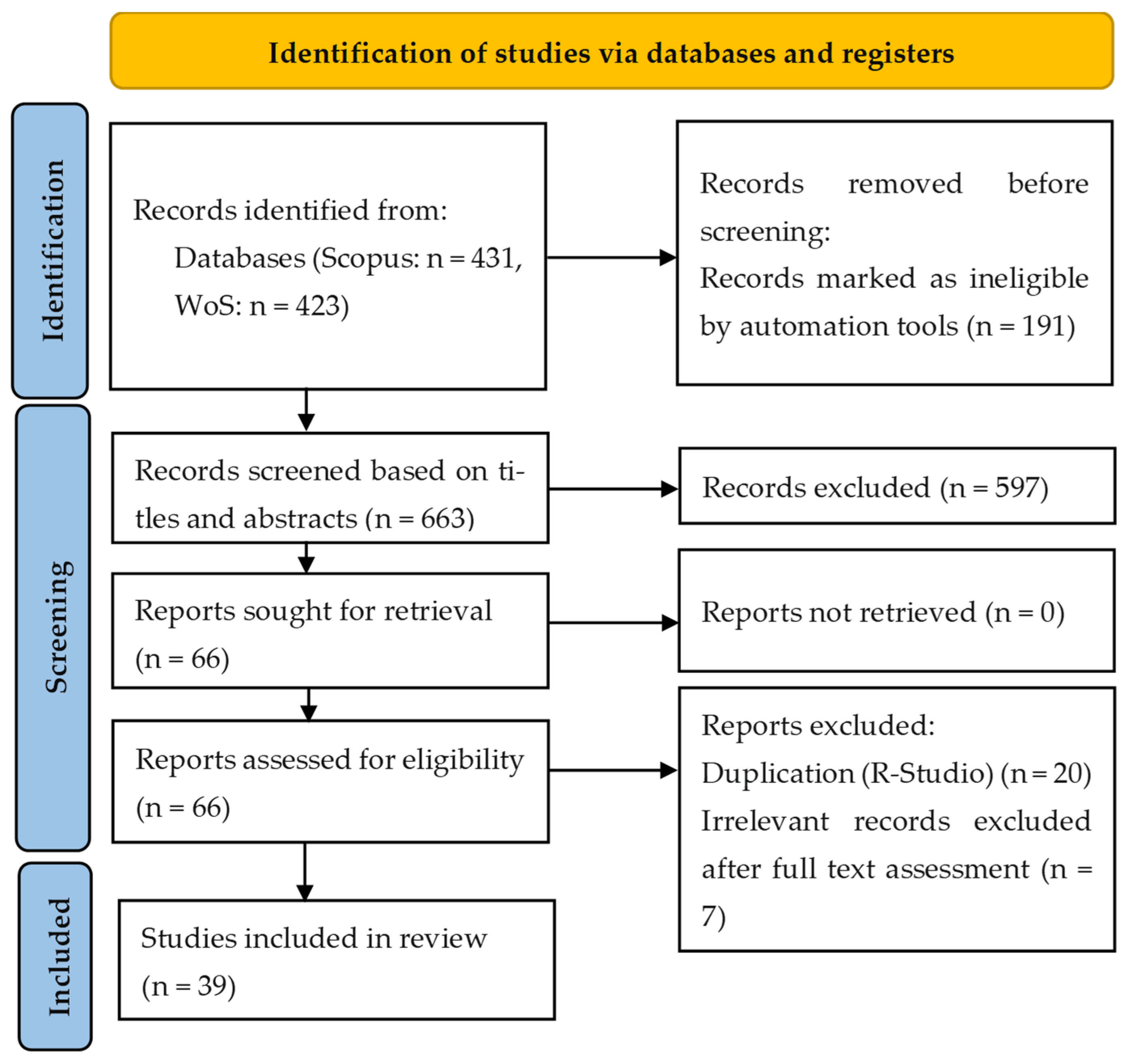
The systematic review workflow was designed and reported in accordance with PRISMA 2020 guidelines [42], as summarized in Figure 1. The study selection process, eligibility criteria (Table 1), data-extraction framework, and reporting structure were defined in advance.
The database search identified 431 records in Scopus and 423 records in WoS, yielding 854 records before screening. The databases returned records published between 2004 and 2026; however, the review was intended to capture all available literature relevant to the topic that was available at the time of the search.
In the first screening stage, records were limited to peer-reviewed journal articles published in English. After applying these criteria, 191 records were automatically excluded, leaving 303 records from Scopus and 360 records from WoS, for a total of 663 records for further screening.
A second screening stage was then conducted using article titles and abstracts to assess the relevance of each record to the scope of the review. Records that did not directly address tree detection using TLS were excluded. The detailed study-selection criteria are presented in Table 1. Studies using static TLS either alone or in combination with other laser scanning modalities were included when TLS-based detection results were reported independently. Studies based exclusively on non-TLS modalities or focused exclusively on non-stem targets were excluded. For multi-objective records, only studies that presented quantitative results for stem detection using TLS were included.
This screening process identified 25 records from Scopus and 41 records from WoS as potentially eligible, yielding 66 records before de-duplication. Scopus records were exported in BibTeX format, whereas WoS records were exported in plain-text format. The two datasets were merged, and duplicate records were removed using the Bibliometrix v 5.2.1 package in the R Studio 2026.01.1 environment. Duplicate records (n = 20) were identified and removed after merging the Scopus and WoS datasets and prior to full-text screening; subsequently, seven records were excluded following full-text assessment.
The deduplicated records were then assessed against the predefined study-selection criteria. In total, 39 studies met the inclusion criteria and were retained for analysis. Figure 1 summarizes record identification, duplicate removal, screening, and study inclusion. The search was limited to Scopus and WoS; registers and other online sources were not used.
After record identification, duplicate removal, title and abstract screening, and full-text eligibility assessment, the included studies were analyzed using two complementary approaches. Bibliometric analysis was first conducted in Biblioshiny using the merged Scopus and Web of Science (WoS) dataset to identify dominant research themes, characterize the conceptual structure of the field, and generate descriptive tables and figures summarizing publication trends and source distribution. Qualitative content analysis was then used to extract and compare methodological characteristics, reported outcomes, and accuracy assessment approaches across the included studies. A predefined data-extraction framework was applied consistently to ensure transparency and reproducibility. Risk of bias was also assessed qualitatively for each included study on the basis of data representativeness, ground-truth quality, and validation procedures.
A predefined framework was developed to guide data extraction and qualitative synthesis. The framework systematically captured key methodological, technical, and contextual variables from each selected study, including acquisition modality, geographic region, forest environment, processing environment, detection approach, validation design, performance metrics, and reported outcomes. Each variable was explicitly defined to ensure consistency and reproducibility. This structured approach facilitated the qualitative analysis across studies and supported a transparent and systematic synthesis of literature. The complete coding framework is presented in Table 2.
The risk of bias in the included studies was assessed based on three criteria: data representativeness, validation independence, and algorithmic transparency. These criteria were chosen for their impact on the reliability and generalizability of tree detection methods. Each study was categorized as having low, moderate, or high risk of bias as shown in Table 3. Data representativeness was evaluated based on how well the datasets represented real-world forest conditions. Validation independence assessed whether unbiased reference data or robust validation procedures were used. Algorithmic transparency was evaluated based on the clarity and completeness of methodological descriptions.

3. Results

This section summarizes findings from the included studies. We combined bibliometric analysis with structured qualitative coding to characterize publication trends and synthesize methodological approaches. This review summarizes the current state of the field and consolidates the main reported outcomes. Descriptive bibliometric results and qualitative content analysis are presented using a consistent framework across the included studies. Table 4 summarizes the main characteristics of the dataset.
The section also highlights current research trends and key technical aspects of TLS-based tree detection, including algorithmic approaches, sensor characteristics, and reported accuracy. Across the literature, studies emphasize methodological innovation, advances in sensing systems, and efforts to improve performance under challenging forest conditions. Together, these results synthesize evidence on detection accuracy, processing workflows, sensor specifications, robustness to stand complexity and occlusion, and computational efficiency. This synthesis provides an integrated view of current capabilities and remaining limitations in TLS-based tree detection for forestry applications.

3.1. Bibliometric Analysis

Bibliometric analysis was used to characterize publication trends, sources, keywords and collaboration patterns within the reviewed corpus. These outputs support a quantitative characterization of publication activity and related research trends within the reviewed corpus.
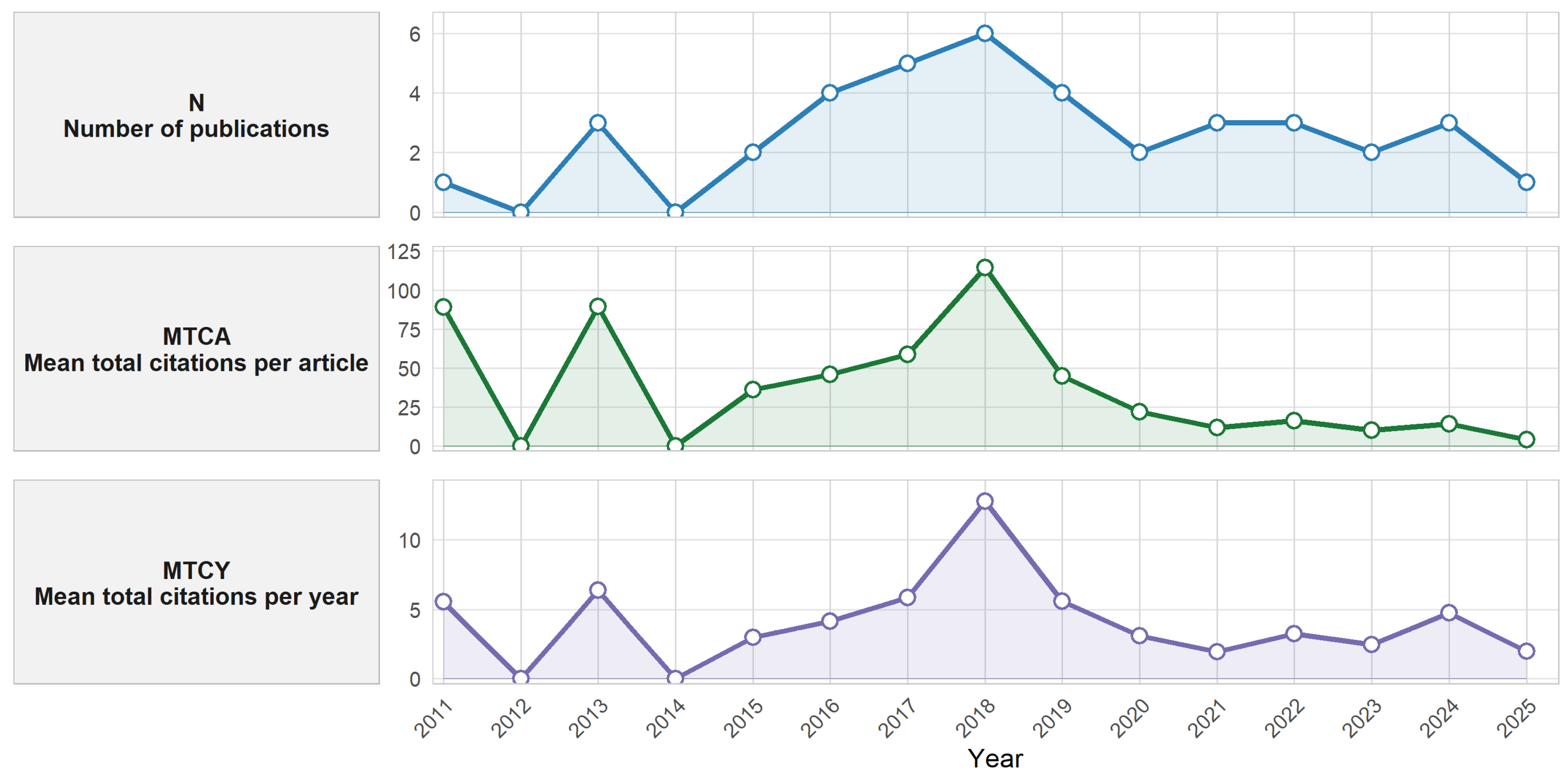
Figure 2 presents the annual scientific production of the included studies. Here, mean total citations per article (MTCA) refers to the average number of citations received per article published in a given year, whereas mean total citations per year (MTCY) represent the average annual citation rate per article (i.e., citations normalized by the number of years since publication). The highest publication output occurred in 2018, with six articles. This year also showed the highest MTCA (114.5) and the highest MTCY (12.72). By contrast, 2011 and 2025 each included one article. The 2011 paper nevertheless had a high citation impact (MTCA = 89), ranking among the highest across the time series.

3.1.1. Journal Source Analysis

Table 5 summarizes the journals represented in the included corpus and reports their bibliographic characteristics. The included articles were published across 20 peer-reviewed journals, reflecting broad dissemination of TLS-based tree detection research. Remote Sensing contributed the largest number of publications (NP = 12), followed by Forests (NP = 7). Publication counts were otherwise distributed across multiple outlets: four journals published two articles each, whereas the remaining journals were represented by a single article.
Citation impact varies markedly across sources. Remote Sensing accumulated the highest total citations (TC = 610), followed by the ISPRS Journal of Photogrammetry and Remote Sensing (TC = 475). In contrast, Machine Graphics and Vision showed the lowest citation count (TC = 2). The earliest included study was published in Photogrammetric Engineering and Remote Sensing in 2011. By comparison, Remote Sensing began publishing within this topic in 2015.

3.1.2. Affiliations, Countries, and Keywords Analysis

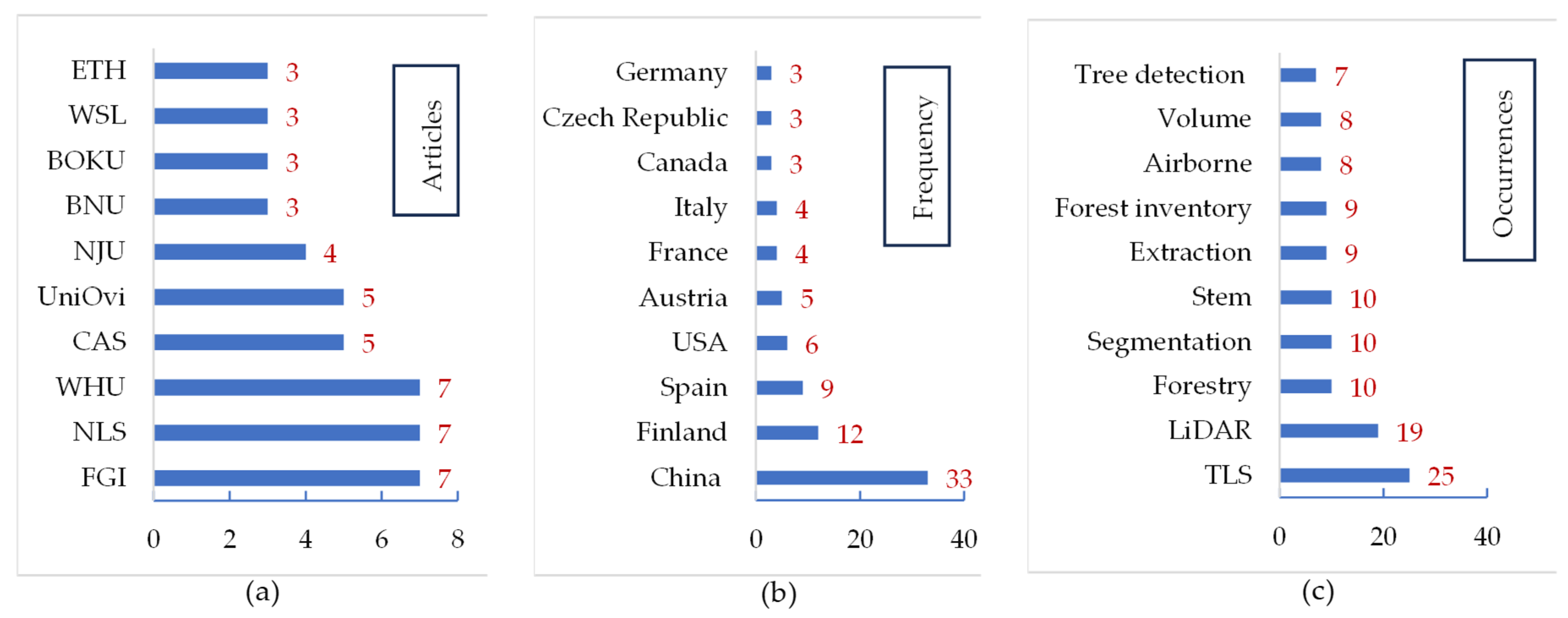
In total, 73 institutions contributed to the TLS-based tree-detection literature included in this review. The Finnish Geospatial Research Institute, the National Land Survey of Finland, and Wuhan University were the most prolific affiliations, each contributing seven publications (Figure 3a).
Across the corpus, authors were affiliated with institutions in 24 countries. Under full counting of author affiliations by country, China had the highest publication count, followed by Finland, Spain, the United States, and Austria (Figure 3b). Citation impact also differed among countries. China, Finland, and Spain accumulated the highest total citations, exceeding those of the remaining countries in this dataset.
Term-frequency analysis provides additional insight into dominant research themes. The most frequent keywords include TLS, LiDAR, forestry, segmentation, stem, extraction, forest inventory, and tree detection (Figure 3c). Together, these terms reflect the methodological emphasis on point-cloud processing and stem-level detection for forest inventory applications.
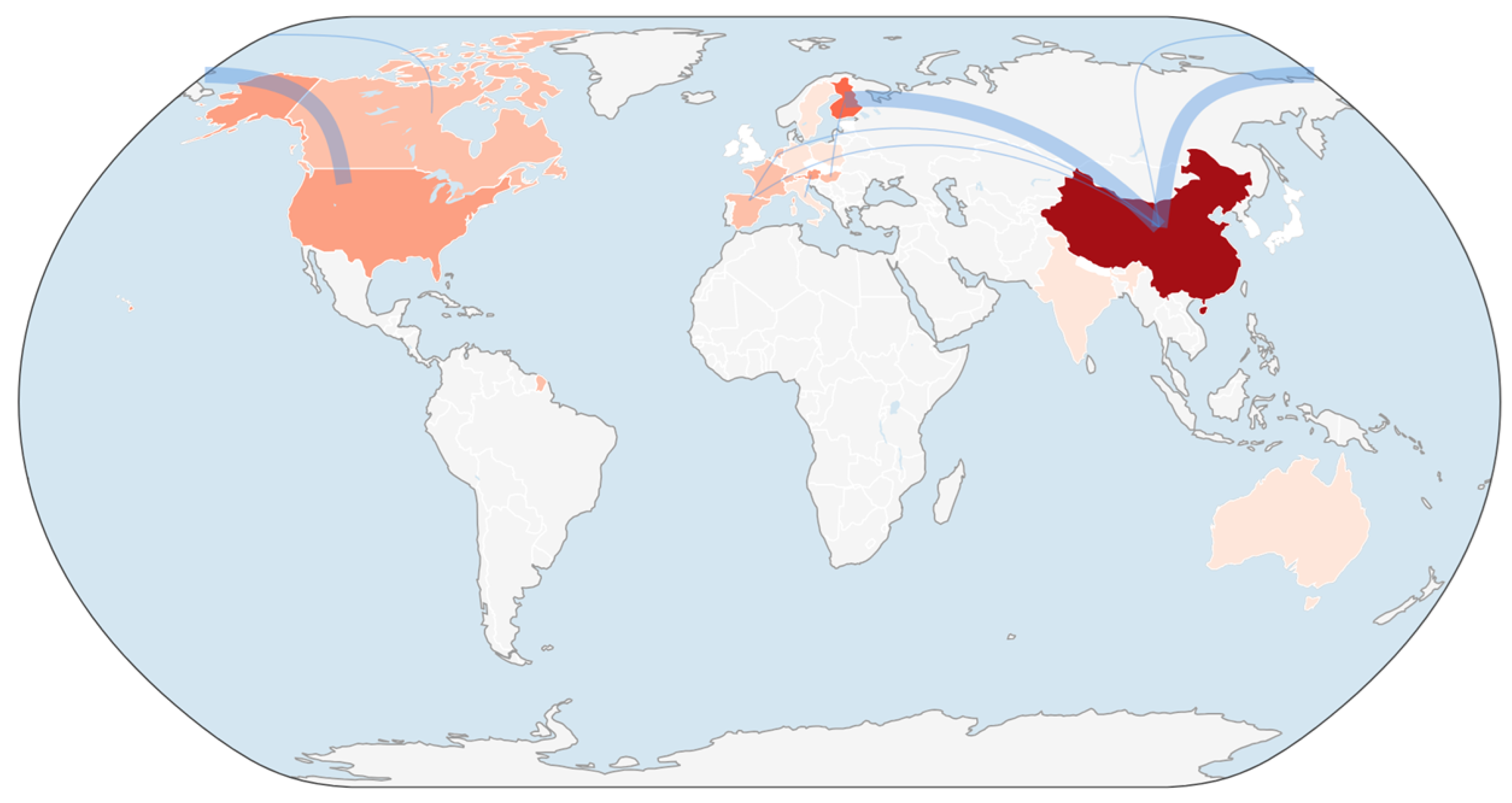
International collaboration patterns in TLS-based tree detection research were examined using Biblioshiny and are shown in Figure 4. These collaboration measures follow a full-counting approach in the software; therefore, authors with dual or multiple affiliations in different countries may be associated with more than one nation. The map indicates that China, several European countries, Canada, and the United States are the main contributors in this corpus. The strongest collaboration links occur between China and Finland and between China and the United States. Additional, weaker links connect China with other European countries and Canada. Collaboration among European countries is also well represented.
Australia and India contribute to the literature, but they show fewer international co-authorship links in this dataset. Several regions, including parts of Africa, the Middle East, and South America, are underrepresented in both publications and collaborations.

3.2. Qualitative Synthesis of Included Studies

Qualitative content analysis was performed on the 39 included articles. Each study was reviewed in detail, and data were extracted using a predefined coding framework to support consistent synthesis. We first recorded general bibliographic information, including study ID, authors, publication year, journal, and total citations (TC). These fields were extracted from Biblioshiny outputs and then cross-checked against the original articles to confirm accuracy.
Methodological and contextual attributes were then coded. These included the data acquisition modality (static TLS alone or TLS combined with other sources), the study region, and forest environment (FENV). We also recorded the primary detection target (e.g., stem detection or individual-tree segmentation), together with the main detection approach and any supporting algorithms. Extracted outcomes included tree counts, tree locations, and stem diameter measurements (e.g., DBH), when reported. For evaluation, we documented the performance metrics used in each study (e.g., precision, recall, F1-score, and RMSE), the reported accuracy values, and the validation design (e.g., site-level testing and reference data).
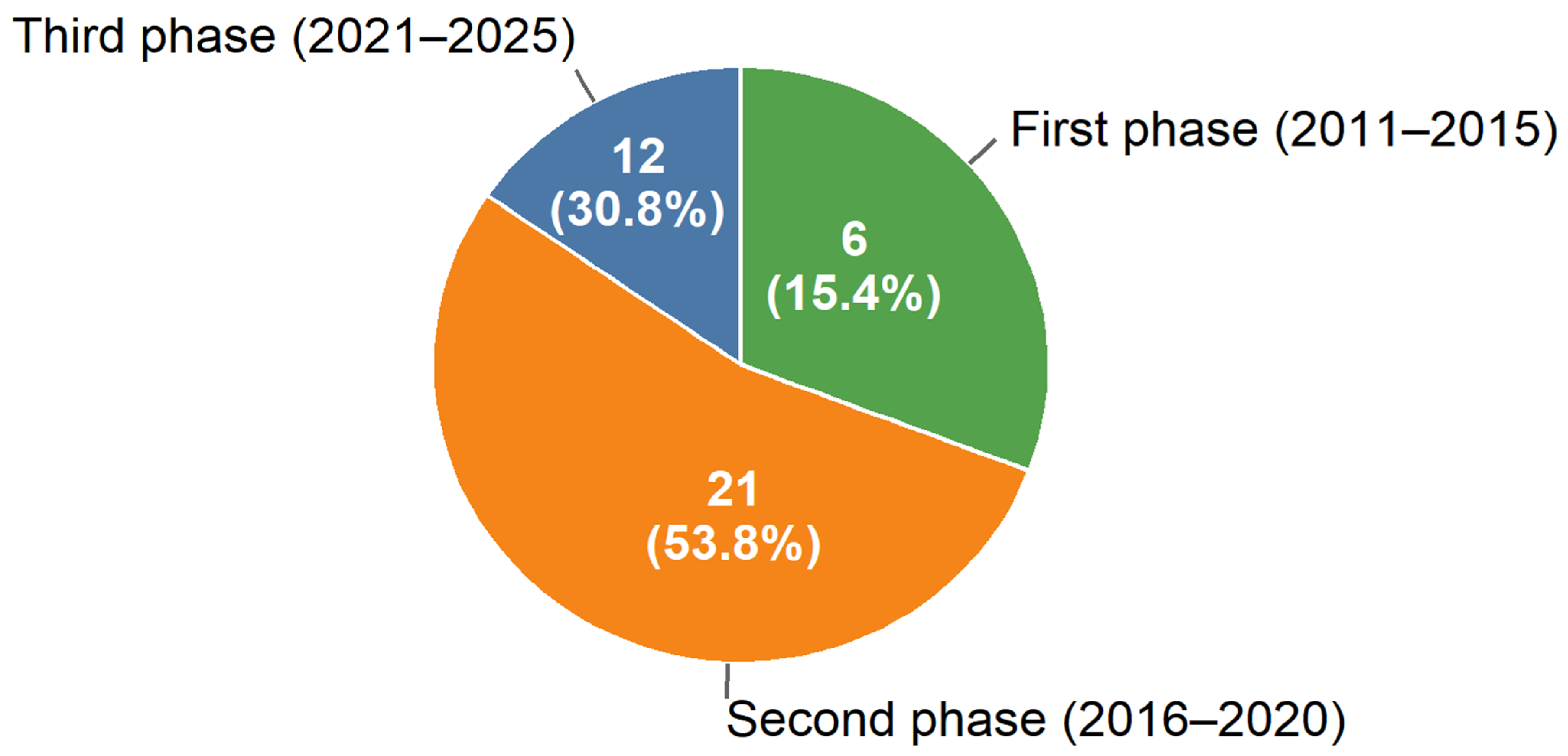
For synthesis, the included studies were organized into three phases that reflect both publication period and methodological maturation: a Foundational phase (2011–2015) characterized by early stem-detection workflows, a Rapid growth phase (2016–2020) marked by expanding algorithmic diversity and broader evaluation, and a Refinement and integration phase (2021–2025) emphasizing improved robustness and integrated processing pipelines. Figure 5 shows the number and proportion of included articles in each phase.
The reviewed literature demonstrates the broad use of TLS for acquiring high-density 3D point clouds in forest environments and for detecting stems and related structural components. Across studies, researchers applied a range of approaches, including geometric and segmentation-based methods, algorithmic refinements for stem detection, and workflows that support estimation of tree attributes such as DBH and height. Organizing the evidence into three phases highlights how methodological emphasis and evaluation practices have evolved over time.

3.2.1. Foundational Phase (2011–2015)

The Foundational phase comprises early studies that were largely conducted in relatively simple, low-complexity forest plots (Table 6). Because stem detection, and in some study’s subsequent individual-tree segmentation, is a prerequisite for most TLS-based forest analyses, research in this period focused on developing and testing workflows for detecting stems, localizing standing trees, and, in some cases, segmenting individual trees. In many cases, stem detection was the primary objective, or it served as a necessary step within broader pipelines for DBH and tree-height estimation, as well as for stem classification, extraction, and subsequent individual-tree segmentation.
For example, the earliest included study [48] proposed an automated TLS-based approach for estimating forest structural parameters in a simple plot in China. The workflow included scan alignment, ground–vegetation separation, and stem detection followed by DBH and height estimation. Stem detection relied on a horizontal slice at approximately 1.3 m above ground, rasterization, and circle fitting using a Hough-transform-based procedure. The authors reported complete detection of 26 trees and estimation precision of 0.76 m for height and 3.4 cm for DBH. These results demonstrate the potential of TLS for automated forest inventory under favorable stand conditions, while also highlighting that additional factors must be addressed to maintain performance in structurally complex forests.
Study [49] introduced the multi-single-scan (MSS) approach for automated stem mapping from TLS data. The method processes each scan independently to extract stem locations and attributes, then aligns stems across scans by matching stem positions to those detected in a central reference scan. Stem positions and tree attributes are subsequently fused at both the feature and decision levels. This design improves detection relative to single-scan approaches without requiring artificial targets or point-level registration, which can reduce field effort and simplify acquisition. At the plot level, the reported stem detection accuracy ranged from 92% to 100%. Reported DBH estimation error (RMSE) ranged from 0.90 to 1.90 cm, and height RMSE ranged from 2.04 to 6.53 m. The authors noted that the approach can be sensitive to understory trees and dense regeneration, which may increase false detections. These limitations may also complicate implementation in large-area plot mapping where stand structure varies substantially.
One investigation [50] examined how scan configuration and circle-fitting algorithms influence stem detection and the extraction of diameter and volume from TLS data at two sites in Germany. Merged multi-scan point clouds improved stem diameter and volume estimates relative to single scans by reducing RMSE and variability. For unobstructed stems, detection rates were 94% and 96% across the two sites, but occlusion reduced detection to 85% and 84%, respectively. Stem diameter was derived from horizontal slices and circle fitting using three algorithms (Lemen, Pratt, and Taubin), with the Lemen method generally providing the best performance under the tested conditions. The authors also reported a systematic bias in reference DBH due to a time lag between field measurements and TLS acquisition. They further noted sensitivity to shadowing effects and increased field time required for multi-scan data collection.
A separate contribution [51] introduced an automated procedure for detecting juvenile trees (approximately 3–6 m in height) from TLS data collected in three plots in Hungary. Detection rates ranged from 79% to 90% across plots. The approach is well suited to plot-level mapping, but its scalability to larger areas may be constrained by acquisition and processing costs. Reliable performance also depends on sufficiently high point density.
Additionally, one study [52] proposed a method for stem detection in dense bamboo forests using single-scan TLS data. The workflow combines a two-scale classification strategy with clustering and a direction-growing algorithm to mitigate shadowing and to separate adjacent stems. The authors reported an overall accuracy of 88%, suggesting that the approach can be effective under dense-canopy conditions. Errors were mainly associated with cluster merging when neighboring stems were very close or in contact, which can create false connections. Performance may also degrade under severe shadowing, dense foliage, or when upper-stem segments with small diameters are mistakenly detected as separate stems.
Another contribution [53] presented a simpler clustering-based approach for stem detection and dimension estimation using TLS data from three forest sites in Estonia. The method performed well in pine stands, where 95% of stems were detected, but it was less effective in birch and dense spruce stands. These limitations were attributed primarily to undergrowth and low branches, which increase occlusion and complicate stem delineation.
Together, these early studies established baseline algorithmic strategies for stem detection in TLS point clouds and highlighted key failure modes related to occlusion, dense understory, and tightly spaced stems. Their findings provide a foundation for subsequent methodological refinements.

3.2.2. Rapid Growth Phase (2016–2020)

The second phase shows a marked increase in research activity, with broader geographic coverage, more diverse test sites, and rapid methodological development in TLS-based tree detection. This period produced the largest number of included articles (Figure 5; Table 7) and expanded the range of algorithms designed to improve detection robustness and tree-attribute accuracy. It also includes an international TLS benchmarking effort that brought together multiple research groups and enabled cross-site comparison of methods [1].
One representative contribution [22] evaluated an automated workflow for stem detection and stem-profile estimation using TLS data from a natural forest plot in Sweden. The approach used geometric descriptors derived from surface flatness and curvature to identify stem candidates efficiently. A voxel-based representation was applied to estimate flatness over local surface patches, following the concept proposed in [54], and stem elements were subsequently modeled using cylinder fitting. The method reported stem detection performance above 0.9 and approximately 1 cm RMSE for stem diameter estimation, suggesting potential applicability in operational settings.
Another study [55] assessed how point-cloud down-sampling influences stem detection and diameter estimation using TLS data from two plots in Finland. The authors compared uniform sampling with leveled histogram sampling, both intended to reduce point density while preserving key geometric characteristics, as described in [56]. Detection performance remained largely stable under sampling, but the full-resolution point clouds were recommended for more precise single-tree attribute estimation. The leveled histogram approach generally provided better DBH estimates. Reported detection accuracy was 91.3%, with DBH RMSE ranging from 6.1–16.1 mm for uniform sampling and 7.0–11.7 mm for histogram-based sampling.
Table 7. Extracted qualitative information for studies published in 2016–2020.
ID and YearTCSensorFENVRegion Detection
Outcome
Test Sites
[22] 201653Leica ScanStation C10Natural and mixedSwedenStem detectionOne plot
[55] 201636Leica HDS6100Managed (plantation)FinlandStem detection2 S. plots
[57] 201623Leica HDS6100Managed FinlandStem positionsOne plot
[58] 201671Leica HDS6100Natural (boreal coniferous forest)FinlandStem detection5 S. plots
[59] 201758FARO Focus X330Mixed complexityAustriaStem detectionOne stand
(4.08 ha)
[60] 201760FARO Focus X330Managed treesFinlandStem detection10 S. plots
[11] 201761FARO Focus S120NaturalSwitzerlandStem detection9 S. plots
[61] 201791Leica ScanStation 2UrbanChinaStem detection2 Sites
[62] 201723Leica ScanStation P20 Mixed (natural and urban)France and USAStem detection3 Sites
[63] 2018117FARO FocusNaturalSpainStem detection3 S. plots
[1] 2018357Leica HDS6100Mixed complexityFinlandStem detection24 S. plots
[8] 201814RIEGL VZ-1000Natural (deciduous)IndiaStem detection5 S. plots
[64] 2018146FARO FocusNatural and urbanSpainStem detection2 Sites
[12] 201824FARO Focus S120Natural and mixed complexitySwitzerlandStem detection9 S. plots
[65] 201829RIEGL VZ-400NaturalChinaStem detection2 S. plots
[13] 201990Leica HDS1600Natural (Evo) and mixed standsFinlandStem detection7 S. plots
[66] 201912SICK LMS-511PlantationChinaStem detection4 S. plots
[67] 201911FARO Focus S120NaturalSwitzerlandStem detection14 S. plots
[68] 201966FARO Focus X330NaturalAustriaStem detection23 S. plots
[69] 202013SICK LMS-151Natural (mangrove)F.S. MicronesiaStem and roots3 S. plots
[23] 202031FARO Focus X 130Mixed (natural and plantation)China & FinlandStem detection 3 S. plots
ID = article identifier; TC = total citations; FENV = forest environment.
A further contribution [57] presented an automated method for extracting stem locations, diameters, and heights from TLS data across five plots in Finland. Stem locations were identified using a 3D directional mask followed by region growing. The authors emphasized operational feasibility and observed that multi-scan acquisition improved detection and tree-parameter estimation relative to single-scan data. In their experiments, 76% of stems were detected. The pipeline relied on fitting cylindrical segments rather than reconstructing complete stems, which may partly explain why its parameter estimates were less accurate than those reported in other studies.
Moreover, ref. [58] proposed a hierarchical minimum-cut method for automated individual-tree mapping from TLS point clouds. The workflow first detected stems using horizontal slicing and cylinder fitting and then applied a graph-based strategy to segment individual tree crowns. Using five plots from the TLS International Benchmarking Project in Finland, the method achieved a recall of 90.42% for extracting individual trees in boreal coniferous forests. Performance decreased when stems deviated from an ideal pole-like shape or were strongly occluded.
In another study, ref. [59] applied a two-stage density-based clustering approach to detect trees in a 4.08 ha forest stand in Austria, which contained 1789 trees with DBH ≥ 10 cm. In the first stage, each point-cloud tile was stratified into vertical layers based on normalized height (z), and cluster centroids were identified within each layer. In the second stage, these centroids were projected onto the horizontal plane (discarding z), and additional clustering was performed using the resulting x–y coordinates. The authors argued that the first-stage clustering captures not only stem centers, but also local density maxima associated with thick branches and understory vegetation. The method achieved an overall detection accuracy of 91.6% when validated against field measurements, with omission and commission errors of 5.7% and 2.7%, respectively. A practical limitation is that stems must be sufficiently visible from the scanner, which may reduce robustness in dense stands.
Paper [60] presented an automated plot-level stem-mapping workflow that matches multiple scans without artificial targets. The authors compared single-scan, multi-scan, and multi-single-scan (MSS) acquisition across 10 plots in Finland. The MSS approach improved completeness but produced slightly lower correctness than multi-scan matching. Overall, matching multiple scans increased both completeness and correctness by improving point-cloud coverage. Mean completeness and correctness across the 10 plots were 0.700 and 0.942 for single-scan, 0.808 and 0.909 for MSS, and 0.731 and 0.972 for matched multi-scan data, respectively. For individual plots, correctness increased by up to 10.3% relative to single-scan and 17.7% relative to MSS. The authors emphasized that natural occlusions strongly limit stem visibility, particularly in single-scan configurations. They also noted that automatic registration remains challenging in forest environments because scans often have insufficient overlap and stems exhibit similar geometric structure.
In contrast, ref. [11] proposed a stem-detection method designed for complex forest environments with dense understory, using TLS data from nine plots in Switzerland. The workflow converts the point cloud into a 3D voxel grid and applies morphological operations. Stem segments are identified using shape- and neighborhood-based criteria and then merged to reconstruct individual stems. The method achieved detection rates of 97% for mature trees and more than 84% for regeneration, providing reliable estimates of stem locations and counts. Detection was more difficult in the lower vegetation layers, where stem geometry is often weakly expressed and ground-layer vegetation (e.g., grasses and shrubs) can dominate the signal.
A hierarchical framework for individual-tree segmentation was introduced in [61] using both TLS and MLS data from two sites in China. The approach applied a normalized-cut formulation with a modified node-similarity measure to better separate neighboring trees, including cases with overlapping canopies. Stem candidates were identified from local maxima within octree nodes. Reported performance was high for both modalities (TLS: 92.4% completeness and 95.4% correctness; MLS: 94.0% completeness and 93.7% correctness), with F-scores of 0.94 for both leaf-off and leaf-on datasets. The authors noted reduced suitability for forests with highly complex vertical structure, where separating intertwined crowns and multiple strata remains challenging.
Another study [62] presented an automated workflow for detecting trees and estimating DBH, height, and volume using TLS and MLS data from three sites (two in France and one in the United States). Ground points were identified from the vertical distribution of points within a gridded digital elevation model (DEM). The remaining points were then clustered and classified within “super-clusters” using voxel-based segmentation. The authors reported an overall segmentation and classification accuracy of 84%, with average parameter estimation errors ranging from 1.6% to 9%. Performance was sensitive to occlusion, and limited visibility of the upper stem reduced the reliability of estimates derived from higher stem sections.
In addition, ref. [63] presented an automated workflow for detecting trees, estimating their positions, and deriving DBH and height across three forest sites in Spain. The method relies on stem isolation and vertical continuity. It first height-normalizes the point cloud, then delineates individual stems. DBH is estimated iteratively from points near breast height, and tree height is computed after denoising and clustering points assigned to each tree. The authors reported 100% completeness and detection of 99% of trees within a plot. Reported RMSE values ranged from 0.8 to 1.3 cm for DBH and from 0.3 to 0.7 m for height.
A major contribution during this period was the international benchmarking study [1], which evaluated TLS-based forest inventory methods using 24 sample plots in Finland. The results confirmed that TLS can support accurate forest mapping, but performance depends strongly on stand structure and acquisition strategy. In particular, completeness and correctness differed substantially between single-scan and multi-scan configurations and varied across stand-density classes (easy, medium, and difficult). Multi-scan acquisition generally improved detection, but dense stands and tree-height estimation remained challenging. The authors also emphasized that many algorithms are sensitive to incomplete stem representation and noise, which propagate into detection and parameter errors.
In addition, ref. [8] developed an automated single-scan TLS method for stem detection and DBH estimation in central Indian forests using Random Sample Consensus (RANSAC). Reported detection accuracy decreased with distance from the scanner (85% at 15 m and 70% at 20 m), while DBH estimation achieved R2 = 0.97 and RMSE = 3.5 cm. These results suggest that single-scan TLS can support plot-level inventory, although occlusion and range effects constrain completeness.
In another comparison, ref. [64] evaluated tree detection and parameter estimation using static TLS and wearable laser scanning in two contrasting environments in Spain: a mountainous natural forest and an urban garden. The workflow clustered points by individual tree, isolated stems, and applied iterative circle fitting to estimate DBH and tree height, following the approach described in [70]. Detection performance and DBH precision were reported to be comparable for the two devices. However, TLS underestimated tree height above a threshold defined by the authors, indicating sensitivity to canopy visibility and acquisition geometry.
A method for 3D segmentation of individual trees in dense forests was presented in [12] using TLS data from nine square plots in Switzerland. The workflow combines morphological stem detection with spectral clustering guided by stem priors and a Markov random field formulation [71]. The authors reported detection rates of 97.40% for mature trees and 84.62% for regeneration, along with good accuracy in delineating 3D tree extent. They also noted that broader testing is needed to assess scalability to larger areas and to better characterize performance for understory trees.
A point-based approach for automated stem detection was proposed in [65] using TLS data from two forest plots in China. To account for variation in point density, the method employed an adaptive search radius. Stem classification was performed using a support vector machine optimized with cuckoo search, and stems were modeled with cylindrical primitives. The reported detection rate was 76.1%. Performance was lower within 40 m than that reported for the methods in [58,72], and the authors attributed most errors to occlusion and interference from nearby objects. They also noted that hard partitioning decisions may become unstable in large, structurally complex plots.
A simple segment-based approach for detecting standing stems from plot-level TLS data was introduced in [13] and evaluated across seven sites in Finland. The method used curvature-derived features and connected-component segmentation to extract stem segments efficiently. Completeness decreased systematically with increasing stand complexity, whereas correctness remained high but did not reach 100%. Reported performance was comparable to state-of-the-art methods (>95%), and the authors emphasized applicability across a range of forest conditions and stem forms.
Another study [66] presented the BEE scanner, an automated low-cost TLS developed for forest inventory applications. The system estimates structural parameters such as DBH and tree height and is intended to support practical field deployment, although performance can degrade in dense stands or on uneven terrain. Stem detection and DBH estimation were based on a horizontal slice at 1.3 m combined with Pratt circle fitting. Tree height was estimated by modeling the local ground plane using RANSAC and then identifying the highest point within each tree cluster using a k-nearest-neighbors (kNN)-based clustering procedure. The study reported a stem detection rate of 92.75%, with RMSE values of 1.27 cm for DBH and 0.24 m for height. The authors noted limitations under leaf-on conditions in dense forests and recommended the system primarily for small sample plots. Incomplete sampling of the upper canopy also led to height underestimation.
A TLS-based framework for detecting forest regeneration was introduced in [67] and evaluated across 14 plots at two sites in Switzerland, with a focus on small understory trees. The method combined 3D mathematical morphology with machine learning to extract stems, estimate DBH, and segment individual trees. Reported accuracy for quantifying established and unestablished regeneration was 8.08% and 2.23%, with mean absolute errors of 1.11 and 0.27 classes, respectively. The authors noted that the approach was tested over relatively small areas and that dense clusters of small trees could not be reliably separated into individual objects because of occlusion.
Study [68] examined how TLS scanner placement and plot size influence tree detection and diameter estimation in forest inventory. The analysis used 23 subplots in Austria. The authors developed a multistage density-based clustering workflow for automatic tree mapping and DBH measurement. A newly proposed clustering step reduced false detections by approximately 64%. Performance depended strongly on acquisition geometry. Smaller plot radii and favorable scanner configurations improved both detection and diameter accuracy. Reported detection rates ranged from 68.3% in 20 m radius plots to 92% in 10 m radius plots. The authors also noted that a broadly accepted standard workflow for automated tree detection and stem diameter estimation remains lacking.
In [69], a low-cost TLS system was assessed for mapping stems and roots in complex mangrove forests in the Federated States of Micronesia. The method integrated 3D classification and reconstruction to support automated measurement as an alternative to conventional field surveys. Stem classification accuracy and precision were 82% and 77%, respectively, while root detection accuracy and precision were 76% and 68%. Occlusion and close stem–root spacing reduced consistency, and low point density contributed to DBH overestimation.
An improved 3D stem-mapping algorithm and an ellipse-based DBH estimation method were presented in [23] using TLS data from three plots in China and additional plots from the international TLS benchmarking project in Finland. The proposed workflow increased stem extraction integrity by 36% and improved DBH estimation by accounting for stem growth direction and applying robust least-squares ellipse fitting. Reported DBH performance was strong (RMSE = 1.14 cm; mean relative accuracy = 95.2%), exceeding the accuracy of the comparison methods in that study. The authors noted, however, that the full pipeline required multiple software packages, which increased complexity and processing time. They also highlighted a persistent limitation of many stem-extraction methods: incomplete reconstruction near the upper stem, which reduces overall stem integrity.

3.2.3. Refinement and Integration Phase (2021–2025)

The 2021–2025 period is characterized by refinement of established workflows and the emergence of more integrated pipelines aimed at improving detection robustness and the accuracy of derived tree parameters. Studies during this phase employed a broad range of software platforms and algorithmic strategies. Some approaches were implemented as standalone methods, whereas others were embedded within end-to-end processing frameworks (Figure 5; Table 8). A broader review of standalone software tools and software libraries for processing ground-based point clouds in forest applications, including their capabilities and intended use, is provided by [73].
For example, ref. [21] proposed a voxel-based workflow for automated stem detection and parameter extraction (position, DBH, stem curve, and height) using TLS data from 24 sample plots in Finland. Stem detection combined voxelization with filtering based on stem-point density. Stem diameters and heights were derived using individual taper models and crown segmentation in voxel space. The method showed stable performance for stem detection and stem-curve estimation across diverse stand conditions. Mean stem-detection completeness across all stands was 50.9% for single scans and 68.5% for multiple scans.
Another investigation [74] assessed TLS for estimating forest inventory parameters, including DBH and tree height, across 24 plots in Malaysia. The authors compared manual workflow implemented in RiSCAN PRO with an automated approach based on point-cloud segmentation. Average detection rates were similar for the two approaches (89% for manual and 90% for automated). However, the manual workflow was time-consuming and operator dependent. The automated workflow was less reliable under strong occlusion and in stands with high branching complexity.
In contrast, ref. [75] proposed a five-step TLS-based workflow to quantify and classify timber assortments using five square plots in a mixed Mediterranean forest in Italy. The method achieved high accuracy in timber–leaf discrimination, and detection performance was 84.4% when considering trees taller than 0.30 m. The authors highlighted potential applications for timber valorization and forest carbon assessment. Stem reconstruction was most hindered by stem defects, insufficient point coverage, and stem form. Occlusion was a key challenge for understory detection, and the approach appeared more sensitive to commission errors than omission errors.
Another study [76] applied density-based spatial clustering of applications with noise (DBSCAN) for stem detection and extraction using TLS data from two plots in China. The workflow first used principal component analysis (PCA) to derive eigenvalues and eigenvectors from local neighborhoods. It then extracted candidate stem points in two stages—coarse and refined—using 3D geometric features together with the z-component of the normal vector. The method yielded R2 values of 0.990 and 0.982 for the two plots, indicating strong agreement with the reference measurements reported in that study.
A bottom-up approach for individual-tree segmentation from TLS point clouds based on DBSCAN was proposed in [14]. The authors also tested an enhanced DBSCAN variant that uses a distance-distribution matrix to improve parameter selection and segmentation robustness. The method was evaluated on TLS datasets from two sites, one in Germany and one in China. Stem detection was further refined using Hough-based circle fitting to correct and validate stem candidates. The approach automatically selected several key processing parameters and was reported to improve overall segmentation, stem detection, and detection of small trees beneath taller canopies relative to traditional DBSCAN-based methods. Reported precision, recall, and F1-score were 95.38%, 90.84%, and 0.93, respectively. A remaining limitation is that the neighborhood radius and the minimum number of points still required manual specification, which constrains full automation. Performance also decreased in complex conditions, particularly for multi-stem trees and stands with dense understory.
By comparison, ref. [77] presented ForestTaxator, a software tool for stem-based tree detection and approximating cross-sectional area from 3D point clouds. The workflow uses genetic algorithms and includes an ellipse-based model. The authors reported high accuracy and short computation times using data from the RemBioFor project in Poland. However, the method can produce large errors when stems have irregular cross-sectional shapes. Limited information on tree height in the scan data can also reduce reliability.
A separate contribution [16] proposed a feature-based stem detection approach that emphasizes stem-level descriptors. The method derives voxel-based features and applies a stem-oriented feature-selection strategy to improve accuracy while limiting feature redundancy. The evaluation used three plots in China and six plots from the international TLS benchmarking project in Finland. Reported improvements were modest for stem detection (+1.2%) and larger for stem extraction (+9.5%). The authors noted sensitivity to voxel size, as overly coarse or overly fine voxels can suppress feature expression and degrade detection.
A method combining a circular Hough transform with denoising and robust least-squares circle fitting to estimate stem positions and radii from TLS data in Poland was introduced in [78]. The authors reported 94.8% stem delineation accuracy, with low RMSE for position (1.64 cm) and radius (1.15 cm). Further development is needed to support standard inventory outputs such as DBH, and to evaluate performance across a wider range of stand structures and acquisition conditions.
A recent contribution to TLS-based forest inventory was presented in [79], which introduced the 3DFin software and its associated algorithms for detecting stems and locating trees in ground-based point clouds. The tool is available as standalone software and as plugins for platforms such as CloudCompare and QGIS. It was evaluated across multiple forest conditions and was reported to achieve near-complete tree mapping, along with accurate DBH estimation (RMSE < 2 cm; bias < 1 cm). As described by the authors, these results suggest that the software can support operational workflows for plot-based inventory.
Another study [80] proposed an improved individual-tree detection and segmentation framework based on seed points derived from TLS and MLS point clouds from two sites: a natural forest in Germany and planted trees in China. The workflow first detects stems using DBSCAN and filters clusters using a predefined threshold. It then applies a kNN step to reclassify non-core points excluded during thresholding and uses RANSAC-based cylinder fitting to refine stem detection. Stem centroids are subsequently used as seed points for individual-tree segmentation. The authors reported that the proposed framework achieved overall recall of 95.2%, precision of 97.4%, and F-score of 0.96. Remaining challenges include reliable treetop identification in dense stands and consistent segmentation of small trees beneath the canopy.
TLS and conventional manual methods (CMM) were compared in [81] for assessing complex forest structure across two plots in Germany. Tree identification and DBH/height estimation were derived from TLS point clouds using OPTICS and DBSCAN. The authors concluded that TLS could characterize these stands, but it tended to underestimate tree height and standing volume relative to CMM. Commission errors accounted for 9.6% of TLS-identified trees, while omission errors were 6.5% relative to trees recorded by CMM. The study also noted that areas with very low point density may increase the likelihood of omissions. To improve accuracy and efficiency, the authors suggested incorporating personal laser scanning and additional 3D point-cloud metrics.
Random Sample Consensus Cylinder Fitting (RANSAC-CyF), an enhanced stem-detection algorithm optimized for cylindrical stem geometry, was introduced in [15]. The method was evaluated on three planted forest plots in China and was reported to outperform least-squares circle fitting (LSCF) and RANSAC-based circle fitting (RANSAC-CF) in accuracy, robustness, and adaptability, including for tilted stems. The authors reported that 2–8 clusters were sufficient to achieve 100% detection in their plots, compared with 26 and 40 clusters required by the comparison approaches. Detection performance may decline for heavily branched or twisted stems, which deviate from an ideal cylindrical form.

3.3. Risk of Bias Assessment

Risk of bias in the included studies was assessed systematically using predefined criteria. Accordingly, each study was evaluated qualitatively and categorized as having a low, moderate, or high risk of bias. The assessment was based on three criteria: data representativeness, validation independence, and algorithmic transparency. Data representativeness was evaluated according to the extent to which the datasets reflected real-world forest conditions, including variation in forest types, stand structures, and environmental settings. Validation independence referred to the use of unbiased and independent reference data or robust validation procedures, such as cross-validation or separate training and testing datasets. Algorithmic transparency was assessed based on the clarity and completeness of methodological descriptions, including the reporting of algorithmic details, parameter settings, and workflow reproducibility. The results of this assessment are presented in Table 9.
Table 9 also provides a structured synthesis of key methodological attributes across all included studies. Specifically, it summarizes the software and computational tools used, the detection methods and algorithms implemented, the performance metrics applied, and the validation approaches adopted. This structured presentation supports a more systematic understanding of the analytical frameworks and evaluation practices reported in the reviewed literature.

3.4. Cross Studies Comparison

Based on Table 6, Table 7, Table 8 and Table 9, the reviewed studies can be grouped into three main methodological families: geometric/model-based approaches, clustering and segmentation methods, and machine learning or hybrid approaches, with a smaller number of studies adopting mixed strategies, as shown in Table 10. Geometric methods, such as circle fitting, cylinder fitting, and Hough-transform techniques, demonstrate high accuracy in plantation environments with regular stem geometry, but they are sensitive to occlusion in complex forest structures. Clustering-based methods, including DBSCAN, region growing, and voxel-based segmentation, are the most widely used approaches and provide greater flexibility across varying forest conditions, although their performance depends strongly on parameter selection and point-cloud quality. Machine-learning and hybrid approaches show improved robustness in heterogeneous and occluded environments by capturing more complex spatial patterns, although they often require greater computational resources.
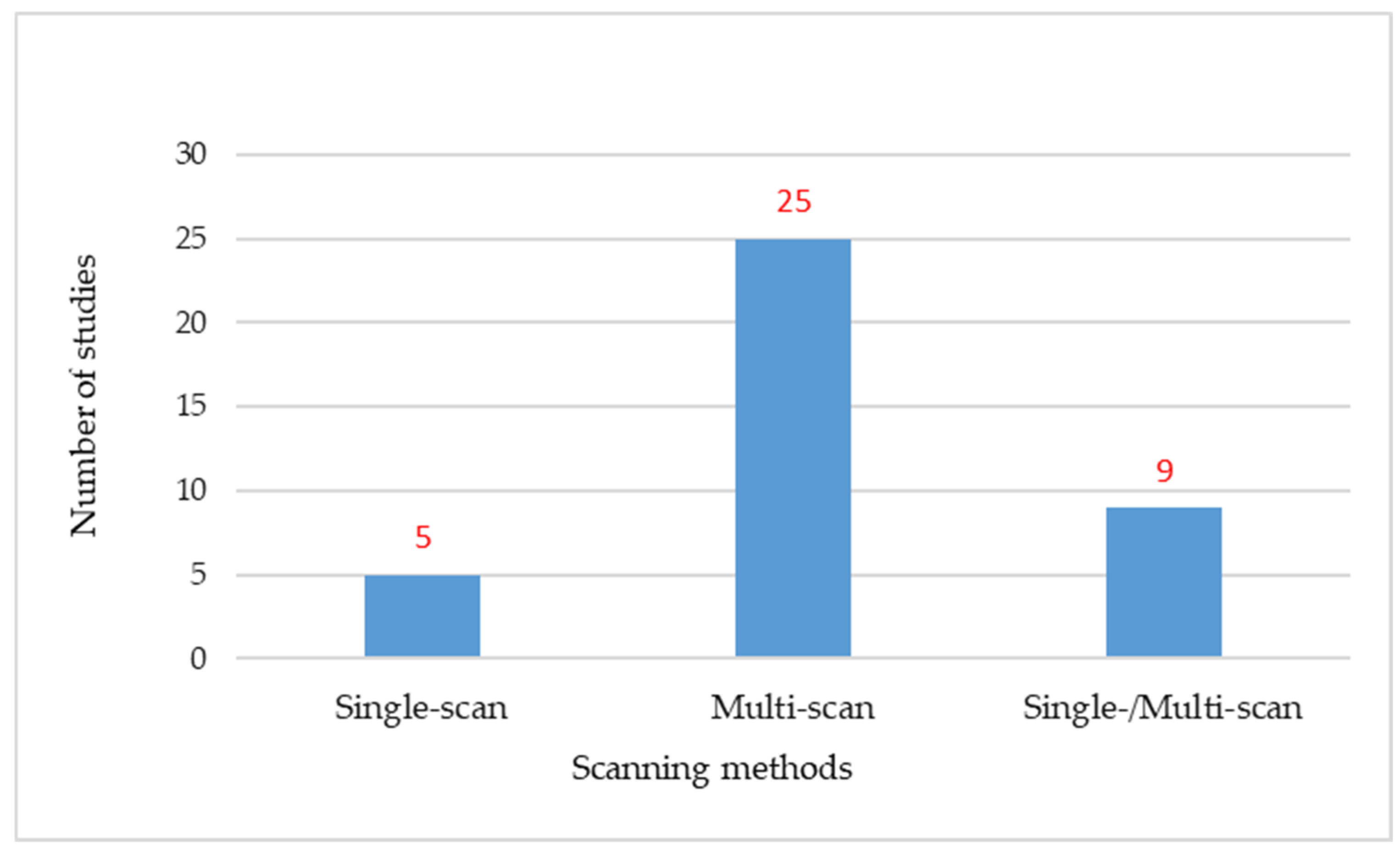
Across the reviewed studies, multi-scan TLS emerges as the dominant acquisition strategy, particularly in structurally complex forest environments as shown in Figure 6. For example, both [1] and [2] relied on multiple scan positions to ensure sufficient point density and reduce occlusion effects. Multi-scan configurations allow for improved representation of tree stems and understory elements by capturing complete viewpoints, which is especially critical in dense or heterogeneous stands. However, this approach comes with increased field and processing effort due to the need for scan registration and alignment.
In contrast, single-scan approaches are typically favored for efficiency but suffer from occlusion, reduced completeness, and lower detection accuracy, particularly in dense forests [3,4]. Studies that combine or compare both configurations [5,6] often highlight a trade-off between efficiency (single-scan) and accuracy/completeness (multi-scan), with the reported detection accuracy range between 80% to 97 for the multi-scan and 60% to 85 for the single-scan approach. Overall, the literature suggests that scan configuration is a key factor influencing detection performance, with multi-scan approaches generally providing more reliable results in complex forest conditions.

4. Discussion

4.1. Thematic Synthesis and Critical Analysis

Existing review literature has generally addressed broader LiDAR-related themes, including biomass estimation, dendrometric parameter retrieval, timber assortments, and forestry applications more broadly, rather than focusing specifically on TLS-based tree and stem detection. As a result, knowledge in this area has remained fragmented. The present review addresses that gap by providing a focused synthesis of TLS-based detection workflows, their methodological development, reported performance, and persistent limitations.
The reviewed literature shows that TLS-based detection workflows have evolved from relatively simple stem-identification procedures into increasingly integrated pipelines that, in some cases, extend to full individual-tree segmentation. This evolution is reflected not only in a broader algorithmic repertoire, but also in the expansion of studies across more diverse forest structures and acquisition settings. Across the reviewed studies, four broad methodological families can be identified: geometric fitting methods, clustering-based approaches, voxel- and morphology-based workflows, and integrated or hybrid pipelines that combine multiple processing stages [1,15,16,57]. Their collective development demonstrates clear methodological progress, yet also shows that detection performance remains fundamentally conditioned by scan design, stand complexity, and the way performance is evaluated [15,52,58,62,69,74].
The field is most clearly structured around three themes: acquisition strategy, detection and segmentation methodology, and performance assessment. Together, they show that progress in TLS-based tree detection has depended as much on improved workflow design as on individual algorithmic advances. Geometric modeling, particularly circle- and cylinder-based fitting, remains central to stem identification, but its effectiveness is increasingly mediated by preprocessing quality, noise filtering, and the treatment of occlusion [50,53]. In parallel, the literature has shifted from isolated proof-of-concept methods toward semi-automated and automated pipelines that aim to extract not only tree presence, but also inventory-relevant variables such as DBH and height [58,74,75]. This shift represents an important transition toward greater algorithmic robustness and wider adoption, reflected in the emergence of influential studies and the increased publication activity observed during this period [1].
Methodological diversity, however, has not translated into uniform robustness. Reported performance is often high under favorable conditions, especially in mature stands with relatively clear stem visibility, but it declines consistently in dense forests, regeneration layers, and multilayered canopies [11,15]. This pattern suggests that performance differences cannot be attributed to algorithm choice alone. Rather, they emerge from the interaction between method, scan geometry, occlusion regime, and forest structure, further complicated by inconsistent metric definitions and matching rules across studies. Multi-scan acquisition generally improves completeness by reducing occlusion, although at the cost of greater field effort and increased registration complexity [1,8]. At the same time, the growing use of adaptive filtering, point thinning, and automated parameter selection indicates that computational efficiency has become a central concern alongside detection accuracy [1,22].
Taken together, the literature suggests that TLS-based tree detection is approaching operational maturity, but not yet under all forest conditions. The strongest evidence supports its use in relatively accessible stands with adequate visibility and carefully designed acquisition protocols. In contrast, dense, regeneration-rich, and structurally heterogeneous forests continue to expose the limits of current methods. The central challenge is therefore no longer simply improving detection in ideal conditions, but developing workflows that remain reliable, transferable, and computationally feasible across the full range of forest environments encountered in practice.

4.2. Research Implications

The findings of this review have implications for both methodological development and operational forest inventory. Most importantly, they show that TLS-based detection workflows, whether focused on stem detection or individual-tree segmentation, should not be interpreted as a purely algorithmic problem. Detection performance emerges from the interaction among acquisition design, forest structure, and processing assumptions. As a result, methodological advances cannot be evaluated independently of scan geometry, occlusion conditions, and stand complexity. From an applied perspective, the evidence confirms that TLS can support accurate and non-destructive estimation of key tree attributes, particularly when acquisition protocols and processing workflows are matched to site conditions. Future progress is therefore likely to depend less on isolated improvements in individual algorithms and more on the integration of robust acquisition strategies, transparent evaluation practices, and scalable processing frameworks.
The reviewed literature also refines the conceptual basis for using TLS to characterize three-dimensional forest structure. In particular, it shows that reliable stem detection and parameter estimation depend on coupling geometric modeling with effective preprocessing and segmentation. Advances such as RANSAC-based cylinder fitting, voxel-based segmentation, and hybrid workflows demonstrate that TLS can partially overcome occlusion and improve robustness in structurally complex stands [1,15,16]. At the same time, these developments make clear that measurement accuracy is shaped jointly by acquisition design and algorithm choice, rather than by either factor alone.
A further implication concerns the geometric assumptions embedded in many workflows. Several studies move beyond the simplifying assumption of perfectly circular stems by introducing ellipse-based, cylinder-based, or otherwise more flexible geometric models [12,23,66,81]. This shift represents a substantive methodological advance rather than a minor refinement. In natural forests, stems commonly deviate from ideal circular geometry because of eccentric growth, leaning form, buttressing, branching irregularities, and partial occlusion. Under such conditions, circle fitting can introduce systematic error into stem diameter estimates and can propagate that error into downstream estimates of stem form, volume, and aboveground biomass. Similarly, the contrast between single-scan and multi-scan acquisition strategies reinforces a broader methodological principle: multi-perspective sampling improves stem visibility and measurement reliability, even though it also increases field effort and processing complexity [1,49,78].
The literature further suggests that TLS-based tree detection is becoming increasingly aligned with broader trends in remote sensing toward automated, adaptive, and data-driven workflows. The growing use of machine learning, graph-based segmentation, and integrated processing pipelines reflects an effort to make methods more transferable across heterogeneous forest conditions [12,14,57]. Within the reviewed corpus, however, machine learning was represented mainly by traditional approaches, such as support vector machines and feature-based classifiers, often combined with geometric rules or graph-based segmentation rather than end-to-end learning. By contrast, deep-learning methods, including CNN- and PointNet-type architectures that are becoming increasingly important in point-cloud processing, were largely absent from the included studies [82,83]. This suggests that TLS-based tree and stem detection in forestry is still transitioning from rule-based and hybrid workflows toward more fully learned representations. At the same time, the reviewed literature shows that stand complexity, scanner placement, and local environmental conditions continue to exert strong control over detection outcomes. This has an important implication for future research and practice: robust TLS-based forest modeling will require methods that explicitly account for structural and ecological variability rather than treating it as residual noise [68].
Taken together, these findings indicate that TLS has strong potential to support operational forestry, tree inventories, and ecological monitoring through automated estimation of variables such as DBH, tree height, and stem volume [8,58,62,73]. However, the path toward broader deployment lies not only in higher detection accuracy, but in the development of workflows that are standardized, interpretable, and operationally efficient. In this sense, the main research implication is clear: the future of TLS-based tree detection depends on integrating methodological rigor with practical field applicability.

4.3. Limitations, Research Gaps, and Future Directions

Despite clear methodological progress, the reviewed literature reveals several persistent limitations that continue to constrain the broader operational use of TLS-based tree detection. The most consistent challenges are not isolated technical problems, but interacting sources of uncertainty linked to occlusion, dense understory, complex vertical structure, variable point density, and inconsistent evaluation design. These factors affect detection completeness, parameter accuracy, and the comparability of reported results. They also expose a central weakness in the current evidence base: many methods perform well under favorable conditions [48], but their robustness under structurally complex and operationally realistic forest conditions remains insufficiently demonstrated.
Occlusion remains the dominant limitation across the literature. Dense foliage, overlapping crowns, and understory vegetation reduce stem visibility and weaken point-cloud representation, particularly in single-scan configurations [11,13,52]. The consequences are systematic rather than incidental. Small trees, regeneration layers, and lower stem sections are often under-detected or incompletely reconstructed, which can bias inventory outputs and underrepresent ecologically important vegetation strata [12]. Multi-scan acquisition improves completeness by increasing stem visibility from multiple viewpoints, but this benefit comes with greater data volume, more demanding registration, and higher processing complexity [1,49,68]. Future work should therefore move beyond simply comparing single- and multi-scan performance and focus instead on acquisition strategies and compensation methods that explicitly address occlusion as a structural property of forest environments.
A second limitation concerns transferability across forest conditions. Uneven terrain, irregular stand structure, and dense vegetation introduce additional noise and reduce measurement precision, making performance highly sensitive to local context [66]. This sensitivity is reinforced by the continued dependence of many workflows on parameter tuning, assumptions about point-cloud quality, and simplified stem geometry [14,15,65]. In particular, circular or cylindrical models remain convenient, but they are not always adequate for irregular stems, leaning trees, or species with complex morphology. The literature therefore points to a need for more flexible representations of stem form, including ellipse-based fitting, deformable geometric models, and data-driven approaches capable of accommodating structural variability rather than treating it as noise [49]. More broadly, future research should prioritize controlled cross-site evaluations that test method stability across contrasting terrain, stand types, and levels of structural complexity.
Computational efficiency remains another major barrier to operational deployment. High-density TLS point clouds are information-rich, but they are also computationally expensive to process, particularly when multiple scans or larger forest areas are involved. Common strategies such as thinning, voxelization, and aggressive filtering reduce processing time, but they can also remove structurally important information and degrade detection performance [1,21,22]. This creates a persistent trade-off between computational feasibility and structural fidelity. The field therefore needs more efficient data-reduction, adaptive filtering, and noise-removal strategies that preserve stem-relevant information while lowering memory and runtime demands. Without such advances, the scalability of TLS-based tree detection will remain limited.
The literature is also constrained by uneven evidence and limited standardization. Many studies are based on small experimental plots, specific forest types, or plantation settings, which restricts generalization to natural, mixed-species, and structurally heterogeneous forests [8]. At the same time, methodological diversity has been accompanied by substantial heterogeneity in evaluation metrics, matching rules, preprocessing choices, and validation procedures. This heterogeneity weakens cross-study comparability and slows the transition from experimental workflows to operational use. Progress in the field will therefore depend not only on better algorithms, but also on stronger benchmarking infrastructure. Open benchmark datasets, standardized evaluation metrics, and more transparent reporting of acquisition settings, preprocessing steps, parameter values, and validation procedures would substantially improve comparability, reproducibility, and practical uptake.
Finally, this review has its own source limitations. Although Scopus and WoS provide broad coverage of peer-reviewed literature, the exclusion of other databases, such as Google Scholar and IEEE Xplore, may have limited retrieval of some technically oriented publications, particularly conference papers and recently indexed records. This should be considered when interpreting the breadth of the synthesized evidence. The geographic pattern should be interpreted with caution, as it may partly reflect database coverage, language restrictions, and differences in research capacity and access to TLS instrumentation.
Taken together, these limitations define a clear agenda for future research. The field does not simply require higher detection accuracy under ideal conditions; it requires methods that generalize across forest types, remain robust under occlusion and structural complexity, operate efficiently at scale, and can be evaluated within a shared and transparent benchmarking framework. In that sense, the next stage of development in TLS-based tree detection is likely to depend as much on standardization, transferability, and reproducibility as on algorithmic innovation itself.

5. Conclusions

This study provides a critical review of current research on TLS-based tree detection, with particular emphasis on stem detection and individual-tree segmentation. Relevant studies were identified through the Scopus and WoS databases. A systematic review workflow was applied, including literature search, screening, merging of records, duplicate removal, and qualitative content analysis. In accordance with PRISMA 2020 guidelines, 39 articles were included in the final synthesis and evaluated using both descriptive and qualitative approaches.
The reviewed literature shows clear progress in the use of TLS for detecting standing trees in forestry, particularly through advances in stem detection and, in some studies, individual-tree segmentation. The review highlights significant methodological advancements and emerging trends in TLS-based forest inventory and structural analysis. The findings indicate that geometric and model-based approaches remain effective in simple and homogeneous forest stands, while advanced techniques demonstrate increasing potential for addressing complex and heterogeneous forest environments. Overall, these studies demonstrate that TLS can provide detailed and accurate measurements of key tree attributes, including stem position, diameter at breast height (DBH), height, stem form, and volume. Reported detection performance is often high under favorable conditions, particularly in mature and open stands, and multi-scan designs generally improve completeness relative to single-scan acquisition. Methodological advances, including RANSAC-based cylinder fitting, density-based clustering, adaptive parameter selection, machine learning, and hybrid geometric fitting, have improved detection robustness and stem measurement accuracy.
At the same time, the literature consistently identifies several limitations. Occlusion, shadowing, and variation in point-cloud density remain major sources of error, especially in dense, multilayered, or regeneration-rich stands. Detection and parameter estimation are also influenced by stand complexity, species composition, terrain heterogeneity, and scan configuration. These factors reduce comparability across studies and indicate that methods often require site-specific adaptation. Although voxel-based filtering, noise-reduction strategies, and increasingly automated pipelines have improved processing efficiency and practical usability, computational demands and parameter sensitivity remain important challenges.
Taken together, the reviewed evidence indicates that TLS is a valuable tool for precise and non-destructive forest inventory and management. Broader operational adoption, however, will require more robust algorithms, better generalization across forest conditions, and greater standardization of acquisition and evaluation protocols. Future research should therefore focus on improving algorithm transferability, reducing computational cost, strengthening benchmarking, and integrating TLS with other LiDAR and sensing technologies to address persistent limitations in complex forest environments.
This review also has limitations. It was restricted to two major bibliographic databases and may therefore have missed relevant studies indexed elsewhere. Although the search strategy incorporated key concepts related to tree detection, its focus on the term ‘detection’ may have excluded studies using alternative terminology, representing a potential omission bias inherent to keyword-based systematic reviews. In addition, only English language journal articles were considered, which may have excluded relevant research published in other languages or formats. Future reviews should broaden source coverage, strengthen the search strategy, and expand the inclusion criteria to provide a more comprehensive synthesis of the field. Continued advances in TLS acquisition, algorithm development, and multimodal integration are likely to further improve forest monitoring, ecological analysis, and sustainable forest management.

Supplementary Materials

The following supporting information can be downloaded at: https://www.mdpi.com/article/10.3390/f17050548/s1, File S1: BiblioshinyReport-2026-02-23; File S2: merged_data, R-Packege.

Author Contributions

Conceptualization, M.K.A.A.; methodology, M.K.A.A., M.K. and P.M.; investigation, M.K.A.A. and M.K.; writing—original draft preparation, M.K.A.A.; writing—review & editing, M.K.A.A., M.K., P.M., R.K. and Š.S.; visualization, M.K.A.A. and Š.S.; funding acquisition, M.K. All authors have read and agreed to the published version of the manuscript.

Funding

This work was supported by the project Comprehensive Research of Mitigation and Adaptation Measures to Reduce the Negative Impacts of Climate Change on Forest Ecosystems in Slovakia (FORRES), ITMS 313011T678, under the Operational Programme Integrated Infrastructure (OPII), funded by the European Regional Development Fund (ERDF), and by the NextGenerationEU instrument through the Recovery and Resilience Plan for Slovakia (Project No. 09I03-03-V02-00034).

Data Availability Statement

The original contributions presented in this study are included in the article/Supplementary Material. Further inquiries can be directed to the corresponding author.

Conflicts of Interest

The authors declare no conflicts of interest.

Abbreviations

The following abbreviations are used in this manuscript:
ALSAirborne Laser Scanning
CMMConventional Manual Methods
DBHDiameter at Breast Height
DBSCANDensity-Based Spatial Clustering of Applications with Noise
DEMDigital Elevation Model
FENVForest Environment
kNNK-Nearest Neighbors
LiDARLight Detection and Ranging
LSCFLeast-Squares Circle Fitting
MLSMobile Laser Scanning
MSSMulti-Single-Scan
MTCAMean Total Citations per Article
MTCYMean Total Citations per Year
OPTICSOrdering Points to Identify the Clustering Structure
PCAPrincipal Component Analysis
PLSPersonal Laser Scanning
PRISMAPreferred Reporting Items for Systematic Reviews and Meta-Analyses
RANSACRandom Sample Consensus
RANSAC-CFRandom Sample Consensus Circle Fitting
RANSAC-CyFRandom Sample Consensus Cylinder Fitting
RMSERoot Mean Square Error
TLSTerrestrial Laser Scanning
ULSUnmanned Laser Scanning
WoSWeb of Science

References

  1. Liang, X.; Hyyppä, J.; Kaartinen, H.; Lehtomäki, M.; Pyörälä, J.; Yu, X.; Pfeifer, N.; Brolly, G.; Pirotti, P.; Hackenberg, J.; et al. International Benchmarking of Terrestrial Laser Scanning Approaches for Forest Inventories. ISPRS J. Photogramm. Remote Sens. 2018, 144, 137–179. [Google Scholar] [CrossRef]
  2. Disney, M.; Burt, A.; Calders, K.; Schaaf, C.; Stovall, A. Innovations in Ground and Airborne Technologies as Reference and for Training and Validation: Terrestrial Laser Scanning (TLS). Surv. Geophys. 2019, 40, 937–958. [Google Scholar] [CrossRef]
  3. Henning, J.G.; Radtke, P.J. Detailed Stem Measurements of Standing Trees from Ground-Based Scanning Lidar. For. Sci. 2006, 52, 67–80. [Google Scholar] [CrossRef]
  4. Maas, H.-G.; Bienert, A.; Scheller, S.; Keane, E. Automatic Forest Inventory Parameter Determination from Terrestrial Laser Scanner Data. Int. J. Remote Sens. 2008, 29, 1579–1593. [Google Scholar] [CrossRef]
  5. Koreň, M.; Scheer, Ľ.; Sedmák, R.; Fabrika, M. Evaluation of Tree Stump Measurement Methods for Estimating Diameter at Breast Height and Tree Height. Int. J. Appl. Earth Obs. Geoinf. 2024, 129, 103828. [Google Scholar] [CrossRef]
  6. Li, Z.; Qiao, Q.; Han, Z.; Liu, X.; Wang, Y.; Tang, H.; Deng, L. Terrestrial Laser Scanning in Forestry: Accuracy and Efficiency in Measuring Individual Tree Parameters. PLoS ONE 2025, 20, e0331126. [Google Scholar] [CrossRef] [PubMed]
  7. Srinivasan, S.; Popescu, S.; Eriksson, M.; Sheridan, R.; Ku, N.-W. Terrestrial Laser Scanning as an Effective Tool to Retrieve Tree Level Height, Crown Width, and Stem Diameter. Remote Sens. 2015, 7, 1877–1896. [Google Scholar] [CrossRef]
  8. Reddy, R.S.; Jha, C.S.; Rajan, K.S. Automatic Tree Identification and Diameter Estimation Using Single Scan Terrestrial Laser Scanner Data in Central Indian Forests. J. Indian Soc. Remote Sens. 2018, 46, 937–943. [Google Scholar] [CrossRef]
  9. Bauwens, S.; Bartholomeus, H.; Calders, K.; Lejeune, P. Forest Inventory with Terrestrial LiDAR: A Comparison of Static and Hand-Held Mobile Laser Scanning. Forests 2016, 7, 127. [Google Scholar] [CrossRef]
  10. Liu, X.; Chen, M.; Tan, C.; Zhang, X.; Yang, W. Automatic Stem Mapping Using Single-Scan Terrestrial Laser Scanning Data and Mean Shift Clustering. IOP Conf. Ser. Earth Environ. Sci. 2021, 865, 012015. [Google Scholar] [CrossRef]
  11. Heinzel, J.; Huber, M. Detecting Tree Stems from Volumetric TLS Data in Forest Environments with Rich Understory. Remote Sens. 2016, 9, 9. [Google Scholar] [CrossRef]
  12. Heinzel, J.; Huber, M.O. Constrained Spectral Clustering of Individual Trees in Dense Forest Using Terrestrial Laser Scanning Data. Remote Sens. 2018, 10, 1056. [Google Scholar] [CrossRef]
  13. Zhang, W.; Wan, P.; Wang, T.; Cai, S.; Chen, Y.; Jin, X.; Yan, G. A Novel Approach for the Detection of Standing Tree Stems from Plot-Level Terrestrial Laser Scanning Data. Remote Sens. 2019, 11, 211. [Google Scholar] [CrossRef]
  14. Fu, H.; Li, H.; Dong, Y.; Xu, F.; Chen, F. Segmenting Individual Tree from TLS Point Clouds Using Improved DBSCAN. Forests 2022, 13, 566. [Google Scholar] [CrossRef]
  15. Ma, S.; Chen, Y.; Li, Z.; Chen, J.; Zhong, X. Improved Cylinder-Based Tree Trunk Detection in LiDAR Point Clouds for Forestry Applications. Sensors 2025, 25, 714. [Google Scholar] [CrossRef] [PubMed]
  16. Chen, M.; Liu, X.; Pan, J.; Mu, F.; Zhao, L. Stem Detection from Terrestrial Laser Scanning Data with Features Selected via Stem-Based Evaluation. Forests 2023, 14, 2035. [Google Scholar] [CrossRef]
  17. Ravaglia, J.; Fournier, R.A.; Bac, A.; Véga, C.; Côté, J.-F.; Piboule, A.; Rémillard, U. Comparison of Three Algorithms to Estimate Tree Stem Diameter from Terrestrial Laser Scanner Data. Forests 2019, 10, 599. [Google Scholar] [CrossRef]
  18. Panagiotidis, D.; Abdollahnejad, A.; Slávik, M. Assessment of Stem Volume on Plots Using Terrestrial Laser Scanner: A Precision Forestry Application. Sensors 2021, 21, 301. [Google Scholar] [CrossRef]
  19. Koreň, M.; Mokroš, M.; Bucha, T. Accuracy of Tree Diameter Estimation from Terrestrial Laser Scanning by Circle-Fitting Methods. Int. J. Appl. Earth Obs. Geoinf. 2017, 63, 122–128. [Google Scholar] [CrossRef]
  20. Xu, X.; Iuricich, F.; Calders, K.; Armston, J.; De Floriani, L. Topology-Based Individual Tree Segmentation for Automated Processing of Terrestrial Laser Scanning Point Clouds. Int. J. Appl. Earth Obs. Geoinf. 2023, 116, 103145. [Google Scholar] [CrossRef]
  21. Brolly, G.; Király, G.; Lehtomäki, M.; Liang, X. Voxel-Based Automatic Tree Detection and Parameter Retrieval from Terrestrial Laser Scans for Plot-Wise Forest Inventory. Remote Sens. 2021, 13, 542. [Google Scholar] [CrossRef]
  22. Olofsson, K.; Holmgren, J. Single Tree Stem Profile Detection Using Terrestrial Laser Scanner Data, Flatness Saliency Features and Curvature Properties. Forests 2016, 7, 207. [Google Scholar] [CrossRef]
  23. Ye, W.; Qian, C.; Tang, J.; Liu, H.; Fan, X.; Liang, X.; Zhang, H. Improved 3D Stem Mapping Method and Elliptic Hypothesis-Based DBH Estimation from Terrestrial Laser Scanning Data. Remote Sens. 2020, 12, 352. [Google Scholar] [CrossRef]
  24. Pitkänen, T.P.; Raumonen, P.; Kangas, A. Measuring Stem Diameters with TLS in Boreal Forests by Complementary Fitting Procedure. ISPRS J. Photogramm. Remote Sens. 2019, 147, 294–306. [Google Scholar] [CrossRef]
  25. You, L.; Wei, J.; Liang, X.; Lou, M.; Pang, Y.; Song, X. Comparison of Numerical Calculation Methods for Stem Diameter Retrieval Using Terrestrial Laser Data. Remote Sens. 2021, 13, 1780. [Google Scholar] [CrossRef]
  26. Koreň, M.; Hunčaga, M.; Chudá, J.; Mokroš, M.; Surový, P. The Influence of Cross-Section Thickness on Diameter at Breast Height Estimation from Point Cloud. IJGI 2020, 9, 495. [Google Scholar] [CrossRef]
  27. Hackenberg, J.; Morhart, C.; Sheppard, J.P.; Spiecker, H.; Disney, M. Highly Accurate Tree Models Derived from Terrestrial Laser Scan Data: A Method Description. Forests 2014, 5, 1069–1105. [Google Scholar] [CrossRef]
  28. Beland, M.; Parker, G.; Sparrow, B.; Harding, D.; Chasmer, L.; Phinn, S.; Antonarakis, A.; Strahler, A. On Promoting the Use of Lidar Systems in Forest Ecosystem Research. For. Ecol. Manag. 2019, 450, 117484. [Google Scholar] [CrossRef]
  29. Wang, Y.; Chen, Q.; Zhu, Q.; Liu, L.; Li, C.; Zheng, D. A Survey of Mobile Laser Scanning Applications and Key Techniques over Urban Areas. Remote Sens. 2019, 11, 1540. [Google Scholar] [CrossRef]
  30. Chen, S.; Liu, H.; Feng, Z.; Shen, C.; Chen, P. Applicability of Personal Laser Scanning in Forestry Inventory. PLoS ONE 2019, 14, e0211392. [Google Scholar] [CrossRef]
  31. Okyay, U.; Telling, J.; Glennie, C.L.; Dietrich, W.E. Airborne Lidar Change Detection: An Overview of Earth Sciences Applications. Earth-Sci. Rev. 2019, 198, 102929. [Google Scholar] [CrossRef]
  32. Zhang, Z.; Zhu, L. A Review on Unmanned Aerial Vehicle Remote Sensing: Platforms, Sensors, Data Processing Methods, and Applications. Drones 2023, 7, 398. [Google Scholar] [CrossRef]
  33. Wilkes, P.; Lau, A.; Disney, M.; Calders, K.; Burt, A.; Gonzalez de Tanago, J.; Bartholomeus, H.; Brede, B.; Herold, M. Data Acquisition Considerations for Terrestrial Laser Scanning of Forest Plots. Remote Sens. Environ. 2017, 196, 140–153. [Google Scholar] [CrossRef]
  34. Silva, B.R.F.D.; Ucella-Filho, J.G.M.; Bispo, P.D.C.; Elera-Gonzales, D.G.; Silva, E.A.; Ferreira, R.L.C. Using Drones for Dendrometric Estimations in Forests: A Bibliometric Analysis. Forests 2024, 15, 1993. [Google Scholar] [CrossRef]
  35. Hartley, R.J.L.; Jayathunga, S.; Morgenroth, J.; Pearse, G.D. Tree Branch Characterisation from Point Clouds: A Comprehensive Review. Curr. For. Rep. 2024, 10, 360–385. [Google Scholar] [CrossRef]
  36. Alvites, C.; Marchetti, M.; Lasserre, B.; Santopuoli, G. LiDAR as a Tool for Assessing Timber Assortments: A Systematic Literature Review. Remote Sens. 2022, 14, 4466. [Google Scholar] [CrossRef]
  37. Xu, D.; Wang, H.; Xu, W.; Luan, Z.; Xu, X. LiDAR Applications to Estimate Forest Biomass at Individual Tree Scale: Opportunities, Challenges and Future Perspectives. Forests 2021, 12, 550. [Google Scholar] [CrossRef]
  38. Rodrigues, W.G.; Vieira, G.S.; Cabacinha, C.D.; Bulcão-Neto, R.F.; Soares, F. Applications of Artificial Intelligence and LiDAR in Forest Inventories: A Systematic Literature Review. Comput. Electr. Eng. 2024, 120, 109793. [Google Scholar] [CrossRef]
  39. Dassot, M.; Constant, T.; Fournier, M. The Use of Terrestrial LiDAR Technology in Forest Science: Application Fields, Benefits and Challenges. Ann. For. Sci. 2011, 68, 959–974. [Google Scholar] [CrossRef]
  40. Green, B.N.; Johnson, C.D.; Adams, A. Writing Narrative Literature Reviews for Peer-Reviewed Journals: Secrets of the Trade. J. Chiropr. Med. 2006, 5, 101–117. [Google Scholar] [CrossRef]
  41. Palmatier, R.W.; Houston, M.B.; Hulland, J. Review Articles: Purpose, Process, and Structure. J. Acad. Mark. Sci. 2018, 46, 1–5. [Google Scholar] [CrossRef]
  42. Page, M.J.; Moher, D.; Bossuyt, P.M.; Boutron, I.; Hoffmann, T.C.; Mulrow, C.D.; Shamseer, L.; Tetzlaff, J.M.; Akl, E.A.; Brennan, S.E.; et al. PRISMA 2020 Explanation and Elaboration: Updated Guidance and Exemplars for Reporting Systematic Reviews. BMJ 2021, 372, n160. [Google Scholar] [CrossRef]
  43. Nicholson Thomas, I.; Roche, P.; Grêt-Regamey, A. Harnessing Artificial Intelligence for Efficient Systematic Reviews: A Case Study in Ecosystem Condition Indicators. Ecol. Inform. 2024, 83, 102819. [Google Scholar] [CrossRef]
  44. Bustos Navarrete, C.; Morales Malverde, M.G.; Salcedo Lagos, P.; Díaz Mujica, A. Buhos: A Web-Based Systematic Literature Review Management Software. SoftwareX 2018, 7, 360–372. [Google Scholar] [CrossRef]
  45. Aria, M.; Cuccurullo, C. Bibliometrix: An R-Tool for Comprehensive Science Mapping Analysis. J. Informetr. 2017, 11, 959–975. [Google Scholar] [CrossRef]
  46. Valadez-de La Paz, N.P.; Vazquez-Lopez, J.A.; Hernandez-Lopez, A.; Aviles-Viñas, J.F.; Navarro-Gonzalez, J.L.; Reyes-Acosta, A.V.; Lopez-Juarez, I. Automation Applied to the Collection and Generation of Scientific Literature. Publications 2025, 13, 11. [Google Scholar] [CrossRef]
  47. Zhu, J.; Liu, W. A Tale of Two Databases: The Use of Web of Science and Scopus in Academic Papers. Scientometrics 2020, 123, 321–335. [Google Scholar] [CrossRef]
  48. Huang, H.; Li, Z.; Gong, P.; Cheng, X.; Clinton, N.; Cao, C.; Ni, W.; Wang, L. Automated Methods for Measuring DBH and Tree Heights with a Commercial Scanning Lidar. Photogramm. Eng. Remote Sens. 2011, 77, 219–227. [Google Scholar] [CrossRef]
  49. Liang, X.; Hyyppä, J. Automatic Stem Mapping by Merging Several Terrestrial Laser Scans at the Feature and Decision Levels. Sensors 2013, 13, 1614–1634. [Google Scholar] [CrossRef]
  50. Pueschel, P.; Newnham, G.; Rock, G.; Udelhoven, T.; Werner, W.; Hill, J. The Influence of Scan Mode and Circle Fitting on Tree Stem Detection, Stem Diameter and Volume Extraction from Terrestrial Laser Scans. ISPRS J. Photogramm. Remote Sens. 2013, 77, 44–56. [Google Scholar] [CrossRef]
  51. Brolly, G.; Király, G.; Czimber, K. Mapping Forest Regeneration from Terrestrial Laser Scans. Acta Silv. Lignaria Hung. 2013, 9, 135–146. [Google Scholar] [CrossRef]
  52. Xia, S.; Wang, C.; Pan, F.; Xi, X.; Zeng, H.; Liu, H. Detecting Stems in Dense and Homogeneous Forest Using Single-Scan TLS. Forests 2015, 6, 3923–3945. [Google Scholar] [CrossRef]
  53. Kuusk, A.; Lang, M.; Märdla, S.; Písek, J. Tree Stems from Terrestrial Laser Scanner Measurements. For. Stud. 2015, 63, 44–55. [Google Scholar] [CrossRef]
  54. Raumonen, P.; Kaasalainen, M.; Åkerblom, M.; Kaasalainen, S.; Kaartinen, H.; Vastaranta, M.; Holopainen, M.; Disney, M.; Lewis, P. Fast Automatic Precision Tree Models from Terrestrial Laser Scanner Data. Remote Sens. 2013, 5, 491–520. [Google Scholar] [CrossRef]
  55. Kankare, V.; Puttonen, E.; Holopainen, M.; Hyyppä, J. The Effect of TLS Point Cloud Sampling on Tree Detection and Diameter Measurement Accuracy. Remote Sens. Lett. 2016, 7, 495–502. [Google Scholar] [CrossRef]
  56. Puttonen, E.; Lehtomäki, M.; Kaartinen, H.; Zhu, L.; Kukko, A.; Jaakkola, A. Improved Sampling for Terrestrial and Mobile Laser Scanner Point Cloud Data. Remote Sens. 2013, 5, 1754–1773. [Google Scholar] [CrossRef]
  57. Xi, Z.; Hopkinson, C.; Chasmer, L. Automating Plot-Level Stem Analysis from Terrestrial Laser Scanning. Forests 2016, 7, 252. [Google Scholar] [CrossRef]
  58. Yang, B.; Dai, W.; Dong, Z.; Liu, Y. Automatic Forest Mapping at Individual Tree Levels from Terrestrial Laser Scanning Point Clouds with a Hierarchical Minimum Cut Method. Remote Sens. 2016, 8, 372. [Google Scholar] [CrossRef]
  59. Ritter, T.; Schwarz, M.; Tockner, A.; Leisch, F.; Nothdurft, A. Automatic Mapping of Forest Stands Based on Three-Dimensional Point Clouds Derived from Terrestrial Laser-Scanning. Forests 2017, 8, 265. [Google Scholar] [CrossRef]
  60. Liu, J.; Liang, X.; Hyyppä, J.; Yu, X.; Lehtomäki, M.; Pyörälä, J.; Zhu, L.; Wang, Y.; Chen, R. Automated Matching of Multiple Terrestrial Laser Scans for Stem Mapping without the Use of Artificial References. Int. J. Appl. Earth Obs. Geoinf. 2017, 56, 13–23. [Google Scholar] [CrossRef]
  61. Zhong, L.; Cheng, L.; Xu, H.; Wu, Y.; Chen, Y.; Li, M. Segmentation of Individual Trees from TLS and MLS Data. IEEE J. Sel. Top. Appl. Earth Obs. Remote Sens. 2017, 10, 774–787. [Google Scholar] [CrossRef]
  62. Aijazi, A.; Checchin, P.; Malaterre, L.; Trassoudaine, L. Automatic Detection and Parameter Estimation of Trees for Forest Inventory Applications Using 3D Terrestrial LiDAR. Remote Sens. 2017, 9, 946. [Google Scholar] [CrossRef]
  63. Cabo, C.; Ordóñez, C.; López-Sánchez, C.A.; Armesto, J. Automatic Dendrometry: Tree Detection, Tree Height and Diameter Estimation Using Terrestrial Laser Scanning. Int. J. Appl. Earth Obs. Geoinf. 2018, 69, 164–174. [Google Scholar] [CrossRef]
  64. Cabo, C.; Del Pozo, S.; Rodríguez-Gonzálvez, P.; Ordoñez, C.; González-Aguilera, D. Comparing Terrestrial Laser Scanning (TLS) and Wearable Laser Scanning (WLS) for Individual Tree Modeling at Plot Level. Remote Sens. 2018, 10, 540. [Google Scholar] [CrossRef]
  65. Chen, M.; Wan, Y.; Wang, M.; Xu, J. Automatic Stem Detection in Terrestrial Laser Scanning Data with Distance-Adaptive Search Radius. IEEE Trans. Geosci. Remote Sens. 2018, 56, 2968–2979. [Google Scholar] [CrossRef]
  66. Wang, P.; Li, R.; Bu, G.; Zhao, R. Automated Low-Cost Terrestrial Laser Scanner for Measuring Diameters at Breast Height and Heights of Plantation Trees. PLoS ONE 2019, 14, e0209888. [Google Scholar] [CrossRef]
  67. Heinzel, J.; Ginzler, C. A Single-Tree Processing Framework Using Terrestrial Laser Scanning Data for Detecting Forest Regeneration. Remote Sens. 2018, 11, 60. [Google Scholar] [CrossRef]
  68. Gollob, C.; Ritter, T.; Wassermann, C.; Nothdurft, A. Influence of Scanner Position and Plot Size on the Accuracy of Tree Detection and Diameter Estimation Using Terrestrial Laser Scanning on Forest Inventory Plots. Remote Sens. 2019, 11, 1602. [Google Scholar] [CrossRef]
  69. Rouzbeh Kargar, A.; MacKenzie, R.A.; Apwong, M.; Hughes, E.; van Aardt, J. Stem and Root Assessment in Mangrove Forests Using a Low-Cost, Rapid-Scan Terrestrial Laser Scanner. Wetl. Ecol. Manag. 2020, 28, 883–900. [Google Scholar] [CrossRef]
  70. Liang, X.; Kankare, V.; Hyyppä, J.; Wang, Y.; Kukko, A.; Haggrén, H.; Yu, X.; Kaartinen, H.; Jaakkola, A.; Guan, F.; et al. Terrestrial Laser Scanning in Forest Inventories. ISPRS J. Photogramm. Remote Sens. 2016, 115, 63–77. [Google Scholar] [CrossRef]
  71. Komodakis, N.; Tziritas, G. Approximate Labeling via Graph Cuts Based on Linear Programming. IEEE Trans. Pattern Anal. Mach. Intell. 2007, 29, 1436–1453. [Google Scholar] [CrossRef]
  72. Olofsson, K.; Holmgren, J.; Olsson, H. Tree Stem and Height Measurements Using Terrestrial Laser Scanning and the RANSAC Algorithm. Remote Sens. 2014, 6, 4323–4344. [Google Scholar] [CrossRef]
  73. Murtiyoso, A.; Cabo, C.; Singh, A.; Obaya, D.P.; Cherlet, W.; Stoddart, J.; Fol, C.R.; Beloiu Schwenke, M.; Rehush, N.; Stereńczak, K.; et al. A Review of Software Solutions to Process Ground-Based Point Clouds in Forest Applications. Curr. For. Rep. 2024, 10, 401–419. [Google Scholar] [CrossRef]
  74. Kalwar, O.P.P.; Hussin, Y.A.; Weir, M.J.C.; de Bie, C.A.J.M.; Karna, Y. Deriving Forest Plot Inventory Parameters Using Terrestrial Laser Scanning in the Tropical Rainforest of Malaysia. Int. J. Remote Sens. 2021, 42, 884–901. [Google Scholar] [CrossRef]
  75. Alvites, C.; Santopuoli, G.; Hollaus, M.; Pfeifer, N.; Maesano, M.; Moresi, F.V.; Marchetti, M.; Lasserre, B. Terrestrial Laser Scanning for Quantifying Timber Assortments from Standing Trees in a Mixed and Multi-Layered Mediterranean Forest. Remote Sens. 2021, 13, 4265. [Google Scholar] [CrossRef]
  76. Zhang, J.; Wang, J.; Dong, P.; Ma, W.; Liu, Y.; Liu, Q.; Zhang, Z. Tree Stem Extraction from TLS Point-Cloud Data of Natural Forests Based on Geometric Features and DBSCAN. Geocarto Int. 2022, 37, 10392–10406. [Google Scholar] [CrossRef]
  77. Małaszek, M.; Zembrzuski, A.; Gajowniczek, K. Foresttaxator: A Tool for Detection and Approximation of Cross-Sectional Area of Trees in a Cloud Of 3d Points. Mach. Graph. Vis. 2022, 31, 19–48. [Google Scholar] [CrossRef]
  78. Michałowska, M.; Rapiński, J.; Janicka, J. Tree Position Estimation from TLS Data Using Hough Transform and Robust Least-Squares Circle Fitting. Remote Sens. Appl. Soc. Environ. 2023, 29, 100863. [Google Scholar] [CrossRef]
  79. Laino, D.; Cabo, C.; Prendes, C.; Janvier, R.; Ordoñez, C.; Nikonovas, T.; Doerr, S.; Santín, C. 3DFin: A Software for Automated 3D Forest Inventories from Terrestrial Point Clouds. Forestry 2024, 97, 479–496. [Google Scholar] [CrossRef]
  80. Chen, Q.; Luo, H.; Cheng, Y.; Xie, M.; Nan, D. An Individual Tree Detection and Segmentation Method from TLS and MLS Point Clouds Based on Improved Seed Points. Forests 2024, 15, 1083. [Google Scholar] [CrossRef]
  81. Wardius, Y.; Hein, S. Terrestrial Laser Scanning vs. Manual Methods for Assessing Complex Forest Stand Structure: A Comparative Analysis on Plenter Forests. Eur. J. For. Res. 2024, 143, 635–649. [Google Scholar] [CrossRef]
  82. Betsas, T.; Georgopoulos, A.; Doulamis, A.; Grussenmeyer, P. Deep Learning on 3D Semantic Segmentation: A Detailed Review. Remote Sens. 2025, 17, 298. [Google Scholar] [CrossRef]
  83. Kulicki, M.; Cabo, C.; Trzcinski, T.; Bédkowski, J.; Stereńczak, K. Artificial Intelligence and Terrestrial Point Clouds for Forest Monitoring. Curr. For. Rep. 2025, 11, 5. [Google Scholar] [CrossRef]
Figure 1. Study selection workflow, adapted from the PRISMA 2020 [42].
Forests 17 00548 g001
Figure 2. Annual scientific production and citation count.
Forests 17 00548 g002
Figure 3. Descriptive bibliometric analysis of the included corpus: (a) top 10 affiliations by number of publications, (b) countries by frequency of author affiliations, and (c) most frequent terms. Abbreviations: FGI = Finnish Geospatial Research Institute; NLS = National Land Survey of Finland; WHU = Wuhan University; CAS = Chinese Academy of Sciences; UniOvi = University of Oviedo; NJU = Nanjing University; BNU = Beijing Normal University; BOKU = University of Natural Resources and Life Sciences, Vienna; WSL = Swiss Federal Institute for Forest, Snow and Landscape Research; ETH = Swiss Federal Institute of Technology.
Forests 17 00548 g003
Figure 4. Global map of international collaboration based on country co-authorship in the included corpus. Color intensity indicates publication output, with darker red representing higher output and lighter shades representing lower output; countries without publications are shown in white. Cyan lines represent co-authorship links, with thicker and darker lines indicating stronger collaboration. Generated in Biblioshiny.
Forests 17 00548 g004
Figure 5. Number and proportion of included articles across the three phases.
Forests 17 00548 g005
Figure 6. Categorization of the included studies by scanning method.
Forests 17 00548 g006
Table 1. Inclusion and exclusion criteria used for study selection.
CriteriaInclusionExclusion
Report typePeer-reviewed journal articlesConference papers, reviews, book chapters,
theses, reports, editorials, and other non-journal publications
Language EnglishLanguages other than English
Topical
scope
Studies focused on tree detection in point cloudsStudies not focused on tree detection (e.g., visualization only, classification without detection, or unrelated point-cloud applications)
Target
object
Detection of standing treesDetection of fallen or felled trees, deadwood, tree crowns only, canopy elements only, or upper-tree components without stem detection
Sensor
modality
Static TLS used alone or in combination with other laser scanning modalitiesStudies based exclusively on non-TLS modalities (e.g., ALS, MLS, PLS, or ULS without static TLS), or on close-range photogrammetry only
Methodological
contribution
Studies presenting, applying, or evaluating
a detection method, algorithm, or processing workflow
Studies without a defined detection method
or algorithm
Reported
outcomes
Studies reporting quantitative detection results (e.g., tree counts, tree positions, detection accuracy, or derived tree metrics)Studies without quantitative results relevant to tree detection performance
Table 2. Predefined framework for qualitative analysis.
CategoryVariableDefinition
Bibliographic informationID, year, journal, and citationStudy identifier and bibliographic details
Acquisition modality and sensorsLiDAR/Sensor typeScanner type and instrument model
Geographic regionStudy locationCountry or the region where the study was conducted
Forest environmentStand typeForest structure, composition, and terrain characteristics
Detection approachAlgorithms usedMethods used for stem detection or individual-tree segmentation
Processing environmentSoftware used in the studiesEnvironment for TLS data processing and analysis
Performance metricsEvaluation indicatorsPrecision, recall, F1-score, completeness, correctness, commission and omission, detection rate, and RMSE
ResultsDetection performanceReported outcomes of detection methods
Validation designReference dataGround truth and evaluation procedures
LimitationsReported constraintsStudy-specific challenges and uncertainties
Table 3. Criteria used to assess study-level risk of bias.
CriteriaDescriptionLRBMRBHRB
Data representativenessData reflects real forest conditions and diversityDiverse, real-world datasets representing various forest types and structuresLimited or moderately representative datasets.Poorly described datasets
Validation independenceIndependent reference dataIndependent validation datasets, cross-site validation, and robust techniques.Partial separation of datasets or limited validation methodsLacks a clear validation procedure
Algorithmic transparencyClarity and reproducibility of the methodsComprehensive methodological details and parameter settings.Describes the methodology but lacks full implementation details.Insufficient methodological information
LRB: low risk of bias, MRB: moderate risk of bias, HRB: high risk of bias.
Table 4. Summary characteristics of the included-study dataset (generated in Biblioshiny).
CharacteristicValue
Timespan (publication years)2011–2025
Sources (journals)20
Documents (articles)39
Document average age (years)7.41
Average citations per doc50.41
Keywords Plus150
Author’s keywords122
Authors169
Co-authors per document5.28
International co-authorships (%)30.77
Table 5. Journals represented in the included corpus and their bibliographic characteristics.
Sourceh-IndexTCNPPYStart
Remote Sensing11610122015
Forests725672015
European Journal of Forest Research22822014
International Journal of Applied Earth Observation and Geoinformation217722017
ISPRS Journal of Photogrammetry and Remote Sensing247522013
Sensors213722013
Acta Silvatica Et Lignaria Hungarica11712013
Forestry11812024
Forestry Studies1712015
Geocarto International11112022
IEEE Journal of Selected Topics in Applied Earth Observations and Remote Sensing19112017
IEEE Transactions on Geoscience and Remote Sensing12912018
International Journal of Remote Sensing1612021
Journal of the Indian Society of Remote Sensing11412018
Machine Graphics and Vision1212022
Photogrammetric Engineering and Remote Sensing18912011
PLOS One11212019
Remote Sensing Applications-Society and Environment11312023
Remote Sensing Letters13612016
Wetlands Ecology and Management11312020
TC = total citations; NP = number of publications; PYStart = first publication year in the included corpus.
Table 6. Extracted qualitative information for studies published in 2011–2015.
ID and YearTCSensorFENVRegionDetection
Outcome
Test Sites
[48] 201189RIEGL LMS-Z360iNatural open standsChinaStem positionsOne plot
[49] 2013133Leica HDS6100NaturalFinlandStem detection5 S. plots
[50] 2013118FARO Photon 120Managed and mixedGermanyStem detection2 S. plots
[51] 201317RIEGL LMS-Z 420iNaturalHungaryRegeneration3 S. plots
[52] 201565Leica ScanStation C10Homogenous (plantation)ChinaStem detection2 S. plots
[53] 20157Leica ScanStation C10Natural and mixedEstoniaStem detection3 sites
ID = article identifier; TC = total citations; FENV = forest environment.
Table 8. Extracted qualitative information for studies published in 2021–2025.
ID and YearTCSensorFENVRegionDetection
Outcome
Test Sites
[21] 202119Leica HDS6100NaturalFinlandStem detection24 S. plots
[74] 20216RIEGL VZ-400UrbanMalaysiaStem detection24 S. plots
[75] 202110Leica ScanStation P40Natural and mixed complexityItalyStem positions5 S. plots
[76] 202211Leica ScanStation P40NaturalChinaStem detection2 S. plots
[14] 202238RIEGL VZ-400 and FARO Focus150Natural and plantationGermany & ChinaStem detection6 S. plots
[77] 20220FARO FocusSingle-tree datasetPolandStem detectionRemBioFor
project
[16] 20237RIEGL VZ-400NaturalChinaStem detection9 S. plots
[78] 202313Leica ScanStation C10Open/Sparse treesPolandStem detectionOne plot
[79] 202418RIEGL VZ-400Natural and Mixed complexityAustriaStem positionsMulti-source data
[80] 202412RIEGL VZ-400Natural & plantationGermany & ChinaStem detection2 sites
[81] 202413Leica BLK 360 and Leica RTC 360Natural and mixed complexityGermanyStem detection2 S. plots
[15] 20254STONEX X150 plusPlantationChinaStem detection3 S. plots
ID = article identifier; TC = total citations; FENV = forest environment.
Table 9. Summary of study methods, software, metrics, validation, and risk of bias.
IDSoftwareDetection MethodMetrics UsedValidationRisk of Bias
[48]RiSCAN PRO software3D voxel histogram-based approach and circle fitting combined with Hough transformDetection rateField data measurementsHigh
[49]Leica HDS6100Spatial properties and eigenvalue analysis, fitting 3D cylindersDetection rateField data measurementsModerate
[50]FARO Scene and Custom-developed algorithmsRange images of single scans, multiple slices extracted from different heightsDetection rateField data measurementsModerate
[51]Custom implementation (piLine Ltd.)Automatic procedure and reconstruction of stems by the aggregation of stem fragmentsDetection rateField data measurementsHigh
[52]Leica Cyclone SCANTwo-scale classification, clustering approach, and a direction-growing algorithmDetection rateField data measurementsModerate
[53]Leica Cyclone, Custom programA special 3D clustering, fitting a circle to detect characteristic circular patterns corresponding to tree stemsDetection rateField data measurementsLow
[22]Custom-developed algorithmsFlatness saliency features and cylinder fittingDetection rate,
Omission/Commission errors
Field data measurementsLow
[55]TerraScanUniform sampling and levelled histogram samplingDetection rateField data measurementsHigh
[57]Algorithms were developed in MATLAB3-D directional mask and region growing algorithmDetection rateField data measurementsLow
[58]Custom-developed algorithmsSlicing and cylinder fittingRecallField data measurementsModerate
[59]FARO SCENE, LAStools, and R packageA two-stage density-based clustering approachOmission/Commission error, and Detection rateField data measurementsLow
[60]FARO SCENE, and Custom algorithmStem curve reconstruction and Cylinder fittingCompleteness and CorrectnessBenchmarking project (field data)Moderate
[11]FARO SCENE and Custom-developed algorithms3D voxel grid transformation and morphological operations, shape and neighborhood criteriaDetection rateField data measurementsModerate
[61]LAStools and Custom-developed algorithmsTop-down hierarchical segmentation framework, local maxima in octree nodesRecall, Precision, and F-scoreField data measurementsModerate
[62]Custom-developed implementationSuper-voxel-based segmentationDetection rateField data measurementsModerate
[63]Custom-developed algorithmsIsolation and vertical continuity of the stemsCompleteness and CorrectnessField data measurementsLow
[1]TerraScan (and multiple software and tools)Voxel-based, slice-based, and clustering approachesDetection rate,
Completeness and Correctness
Field data measurements and with other methodsLow
[8]MATLAB, Python and R programming languageSingle scan TLS dataDetection rateField data measurementsModerate
[64]FARO SCENE and Custom algorithmsClustering and iterative circle fittingRMSEValidation with the used methodsModerate
[12]FARO SCENE software and Python and C/C++ programming languageMorphological stem detection, spectral clustering with stem priors, and a Markov random field frameworkDetection rateField data measurements and with other methodsLow
[65]Custom algorithmsA point-based method, Cuckoo Search (CS)-based Support Vector Machine (SVM)Detection rateField data measurementsModerate
[13]CloudCompareSimple segment-based method and curvature-based methodCompleteness and CorrectnessInternational TLS benchmarking project (field data)Low
[66]Designated with the scannerSingle slice method, and Pratt circle fitting methodDetection rateField data measurementsModerate
[67]FARO SCENE and Developed Algorithms.3D mathematical morphology, Hough transformation and machine learningMean Absolute ErrorField data measurementsModerate
[68]FARO SCENE 6.2 program, LAStools software package, and R statistical softwareA multistage density-based clustering approachDetection rateField data measurementsLow
[69]CloudCompare3D classifierStem Precision and AccuracyField data measurement and with other methodsModerate
[23]FARO SCENE, Point Cloud Library, CloudCompare, and Developed AlgorithmsImproved RANSAC cylinder fittingDetection rateValidation with the used methodsLow
[21]Custom Custom-developed algorithms, C/C++Voxel-based, and stem point density filteringCompleteness and CorrectnessTLS benchmarking projectLow
[74]RiSCAN PRO softwareManually and automatically with a tree segmentation approachDetection rateField data measurementsLow
[75]Leica Cyclone 360 3DR V.1.7.1000, OPALS v 2.4.0., CloudCompare software, R softwareRaster-based approachDetection rateField data measurementsModerate
[76]MATLAB R2019bPrincipal component analysis and DBSCAN algorithmR2 correlation analysisField data measurementsModerate
[14]Custom-developed algorithmsDBSCAN, improved DBSCAN, and Hough circle fittingRecall, Precision, and F1-scoreField data measurements and with other methodsLow
[77]ForestTaxator software written in C# and runs on the NET Core platform, and CloudCompareGenetic algorithms and ellipse-based modellingSensitivity and Specificity measuresField data measurementsModerate
[16]MATLAB R2018bImproved voxel-based features and a stem-based feature selection methodDetection rateInternational TLS benchmarking project and with other methodLow
[78]Custom-developed software in the C# languageCircular Hough transform, denoising, and robust least-square circle fittingDetection accuracyField data measurementsModerate
[79]3DFin (Stand alone and plugin)Horizontal stripe, and DBSCANCompleteness and CorrectnessPublicly available datasets and with other methodsLow
[80]CloudCompareSeed points, DBSCAN, K-nearest neighbor (KNN) algorithm, RANSAC cylinder fittingRecall, Precision, and F-scoreValidation with the used methods Low
[81]Leica Cyclone, and KNN from R-packageOPTICS and DBSCAN algorithmsOmission and CommissionValidation with the used methodsModerate
[15]StoNexSiScanRandom Sample Consensus cylinder FittingDetection rateField data measurementsModerate
Table 10. Categorization of included studies by methodological family.
Method FamilyNumber of StudiesApproachesStrengthLimitationCommonly Used Forest Structure
Geometric model-based14Circle fitting, cylinder fitting, Hough-transform, RANSACHigh accuracy, efficient, and interpretableSensitive to occlusion and requires clear stem geometryNatural, plantation/open stands
Clustering algorithms17DBSCAN, region growing, voxel-based, super-voxel segmentationFlexible, adaptable to structure variabilityParameter sensitivity and noise dependentNatural, mixed, moderately complex forest
Machine learning5SVM, Spectral clustering, Markov random field, ML-enhanced morphologyRobust in complex environmentsRequire training data, and computationally intensiveNatural and heterogenous forests
Mixed/multi-approaches3Combined voxel, clustering, and geometric approachesBalanced performanceIncreased complexityNatural, mixed conditions
Disclaimer/Publisher’s Note: The statements, opinions and data contained in all publications are solely those of the individual author(s) and contributor(s) and not of MDPI and/or the editor(s). MDPI and/or the editor(s) disclaim responsibility for any injury to people or property resulting from any ideas, methods, instructions or products referred to in the content.