Article

Watershed-Based Assessment and Spatial Heterogeneity Analysis of Ecosystem Service Value in the Beihai Forest Ecosystem, Tengchong

1
National Plateau Wetlands Research Center, Southwest Forestry University, Kunming 650233, China
2
Yunnan Key Laboratory of Plateau Wetland Conservation, Restoration and Ecological Services, Kunming 650233, China
3
College of Economics and Management, Southwest Forestry University, Kunming 650224, China
4
College of Ecology, Environment and Wetland, Southwest Forestry University, Kunming 650233, China
5
College of Forestry, Southwest Forestry University, Kunming 650224, China
6
Beihai Wetland Provincial Nature Reserve Management Office, Tengchong 679100, China
7
Yunnan Institute of Forest Inventory and Planning, Kunming 650051, China
*
Authors to whom correspondence should be addressed.
Forests 2026, 17(5), 519; https://doi.org/10.3390/f17050519
Submission received: 22 March 2026 / Revised: 13 April 2026 / Accepted: 20 April 2026 / Published: 23 April 2026
(This article belongs to the Section Forest Ecology and Management)

Abstract

The administrative boundaries of ecosystems do not necessarily align with natural watershed boundaries, which is a significant reason for the current inefficiency and pronounced conflicts in ecological governance. Using the watershed as the fundamental unit, this study assessed the forest ecosystem services (FES) of the Beihai Wetland watershed in Tengchong (As of 2025). Forest vegetation was classified to the formation level, and the functional value method was employed. The results showed the following order of service values: regulating services > provisioning services > supporting services > cultural services. Biodiversity was identified as the most valuable ecosystem function. The study further revealed that factors such as stand type, stand age, and altitude influence the total FES value within the watershed. Analysis of FES per unit stand (1 ha) indicated that Lithocarpus variolosus Franch. Chun (natural forest) exhibited the highest value. Through in-depth analysis of linear correlations and spatial associations of FES per unit stand, a synergy-trade-off visualization was constructed. This revealed that natural forests in the upper watershed may exert systemic effects on nutrient cycling in the lower watershed. The results obtained at the formation level provide support for the development of watershed-based forest tending plans. Moreover, studying FES using the watershed as a unit represents a practical exploration of the “life community of mountains, rivers, forests, farmlands, lakes, grasslands, and deserts” and offers a potential reference for maintaining the ecological security and supporting the ecological protection and restoration of the Beihai watershed.

1. Introduction

To conduct an ecosystem service value (ESV) assessment, the first step is to define the research unit. The administrative boundaries of ecosystems often do not align with the boundaries of natural watersheds, which is a key factor contributing to the inefficiency of current ecological governance [1]. Taking the “watershed” as the unit for ESV research enables a systematic study of ecosystem services that transcends spatial scales and administrative boundaries. Watershed ecology serves as the disciplinary foundation for watershed ecosystem research, providing theoretical support for watershed-based ESV studies [2]. In the Oxford English Dictionary, “watershed” is composed of “water” and “shed,” referring to “a line separating the flow of different rivers”; topographically, it denotes “a high-lying area dividing two valleys or lowlands, a divide” [3]. In the Cambridge Dictionary, it is defined as “a turning point, dividing line, or watershed marking a significant change” [4]. A watershed is a catchment or drainage area delineated by a water divide; it constitutes a fundamental unit of natural ecosystems, characterized by a distinct ecological, economic, and geographical configuration, functioning as a relatively enclosed system with clear boundaries [5]. A watershed represents a complex assemblage of different ecosystems, as well as an integrated natural–economic–social–cultural system [6]. Systematic governance at the watershed level can significantly reduce the loss of ecosystem service functions within the watershed [1], making it an ideal unit for ESV research [7].
Ecosystem services (ES) directly or indirectly enhance human well-being and serve as fundamental components of socio-economic value [8], representing a focal area of research in ecological economics [9,10]. Recognized for their potential to address sustainability challenges, they have emerged as a critical scientific concept [11]. In 1935, Tansley [12] conducted preliminary qualitative research on ecosystems, establishing an initial theoretical framework that sparked academic interest in the field of ecosystem studies. However, public perception and understanding of the benefits provided by ecosystems vary considerably, and the general population remains limited in their knowledge of specific ecosystem services, often overlooking those public, non-excludable services characterized by positive externalities [13]. In contrast, the value of intact, functionally diverse ecosystem services is often greater than the value derived from extraction or direct market transactions [14]. Therefore, employing the Gross National Product (GNP) economic concept to reflect ESV [15,16], and using units of familiar and valued service instruments (i.e., currency) as equivalents to estimate the economic value of service functions, represents an effective approach [17,18]. In 1997, Daily [19] systematically conducted a classification study of ecosystem service functions, covering ecosystems such as marine, freshwater, forest, and grassland. In the same year, Costanza, in Nature, explicitly unified ecological services and ecological products as ecosystem service functions, conducting a quantitative assessment of the global biosphere’s ecosystem services using 17 evaluation indicators, with a total estimated value of 16 × 1012 dollars. Their research methodology had a significant impact within the academic community.
A significant challenge in conducting ESV research lies in the selection of assessment methods, necessitating an interdisciplinary approach to evaluate multiple correlated factors [20]. A scientific assessment method can more accurately reflect ESV; before a globally recognized valuation method is established, employing a “substitute method” can largely capture the benefits that people derive from ecosystems [21]. Currently, the functional value method and the equivalent factor method are the two approaches commonly used by scholars. In 2001, Xie et al. [22], drawing on the experience of international scholars, developed the equivalent factor method. This method, primarily based on expert knowledge and synthesized from multiple sources, standardizes the calculation process, making the assessment relatively straightforward. It has been applied to evaluate grassland ecosystem service values, though it may require sensitivity analysis. In 1999, Ouyang et al. [23] were the first in China to report the functional value method, which has since been widely adopted by numerous researchers. Both methods inherit the classification system from the Millennium Ecosystem Assessment (MA) [24]. The functional value method quantitatively assesses the physical quantity of ecosystem services, closely linking them to actual ecosystem conditions and functional capacities. By integrating socioeconomic data with the physical quantity of ecosystem services, this method calculates the total value with high accuracy. The functional value method is widely applied in China and holds authoritative status, as evidenced by its inclusion in government documents such as the Specification for Accounting of Gross Ecosystem Product (Trial) [25] and the GB/T 38582-2020 [26] issued by the National Forestry and Grassland Administration.
FES are a critical component of the biosphere and play an irreplaceable role in climate regulation and biodiversity conservation, providing sustainable livelihood sources for the development of human society [27]. At present, research findings have been steadily accumulating in areas such as single forest ecosystem types [28], forest vegetation types [29], and analyses of specific ecosystem service functions [30]. Research themes related to forest ecosystems continue to deepen [31], encompassing the response mechanisms of ecosystem service functions to environmental changes [32], the effects of plant diversity on ecosystem service functions [33], the trade-offs driving stand attributes [34], and the spatiotemporal evolution patterns of service functions [35]. However, regional assessments of ecosystems still rely heavily on species-based indicators or simple land cover proxies [36], which provide limited information about the ecosystems themselves. There is a need for in-depth analysis of the trade-offs and synergies among ecosystem services [37,38], and to explore the spatial correlations among the most critical ecosystem service providers, which calls for innovative approaches to the definition of research units.
Currently, few studies have focused on ES and spatial heterogeneity in plateau wetland watersheds, using the watershed as the fundamental unit and precisely classifying forests on the water-collecting mountain surfaces at the formation/association level [39]. This study adopts the watershed as the unit to overcome the limitations inherent in traditional patch-scale and administrative region-scale research. Furthermore, it refines the research units from vegetation type groups and vegetation types (or subtypes) down to the formation level. In-depth analyses are conducted on influencing factors such as functional categories, stand characteristics, forest age, and altitude. Grounded in practical needs, the protected area management bureau urgently requires relevant research data to inform potential reference strategies for forest ecological restoration and conservation efforts (The watershed is largely situated within the Tengchong Beihai Wetland Provincial Nature Reserve.). Therefore, investigating the FES of the Tengchong Beihai Wetland watershed holds significant scientific importance, practical value, and serves as a representative case study.

2. Materials and Methods

2.1. Study Area

2.1.1. Watershed Location

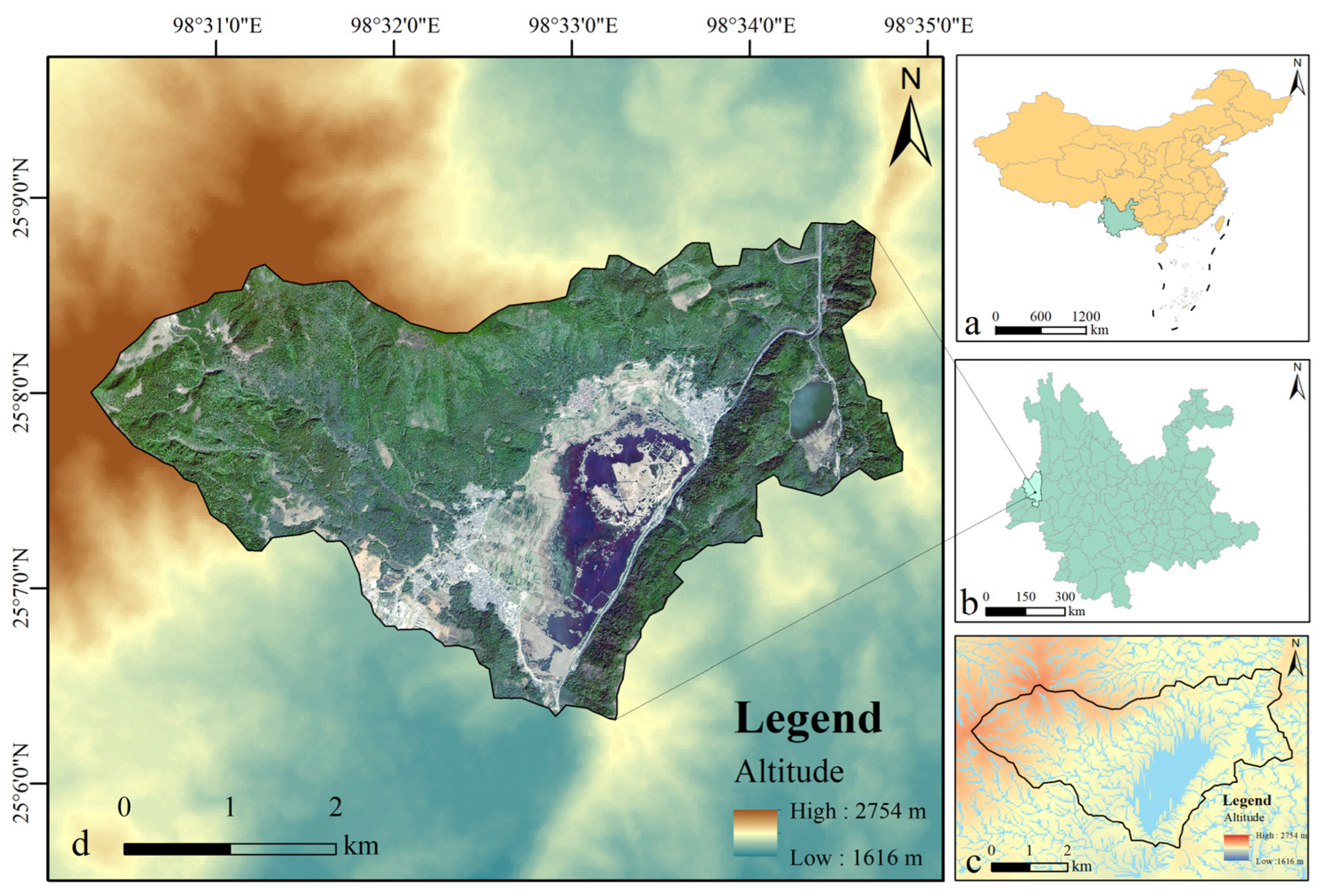
The Beihai Wetland watershed is situated in Tengchong City, Yunnan Province, China, with geographical coordinates ranging from 98°30′17″ to 98°34′51″ E and 25°6′20″ to 25°8′54″ N. It covers an area of 1964.54 ha, with elevations ranging from 1731 to 2754 m, resulting in a vertical drop of 1023 m, as shown in Figure 1.
Located within the optimal climatic zone at 25° N latitude, the area experiences a subtropical monsoon climate, characterized by substantial vertical climatic variation and diverse climate types [40]. The watershed primarily consists of the “Beihai” and “Qinghai Lake” volcanic barrier lake wetland ecosystems [41] and the surrounding mountain forest ecosystems (in part) that contribute to the catchment. Furthermore, the Beihai Wetland serves as the headwater of the Daying River and represents the sole plateau lake wetland within China belonging to the Irrawaddy River basin. This wetland is a permanently inundated marsh, featuring a “floating mat” of vegetation up to 2 m thick—a rare marsh meadow landscape in China [42]. Moreover, within the biodiverse province of Yunnan, the Beihai Wetland in Tengchong constitutes the world’s largest natural habitat for the wild Brasenia schreberi J. F. Gmel. [43]. It also supports nationally protected wild plant species, including Trapa incisa Siebold & Zucc. and Ottelia acuminata (Gagnep.) Dandy, as well as nationally protected first-class wild animal species such as Aquila chrysaetos Linnaeus, Ciconia nigra Linnaeus, and Syrmaticus humiae S. h. burmanicus. The forest ecosystems within this watershed provide critical habitat for numerous wild fauna and flora species. They serve as both a source of water and nutrients for the wetland and a potential carrier of pollutants, thereby playing a crucial role in biodiversity conservation, watershed ecological security, and ecological restoration across the entire watershed.

2.1.2. Forest Ecosystem

The forest area within the Beihai wetland watershed is 1477.37 ha. The dominant tree species were determined using the “important value” index, a widely accepted method for community studies in international research, with Taiwania cryptomerioides Hayata, Alnus nepalensis D. Don, Pinus armandi Franch., Pinus yunnanensis Franch., Lithocarpus variolosus Franch. Chun as the primary species. The vegetation structure in the study area is predominantly pure coniferous or pure broad-leaved forest, with only a minimal proportion of mixed coniferous-broad-leaved forest. In 1998, China implemented the Natural Forest Protection Project, and in response, the local area adopted the “Grain for Green” policy. The current forest vegetation is mainly composed of planted forests, with the representative formation being Taiwania flousiana forest. A remnant patch of natural forest—Lithocarpus variolosus—is preserved only on the mountaintop area of the eastern slope of Beihai. The Beihai watershed is adjacent to the Gaoligong Mountain National Nature Reserve, situated in a globally significant biodiversity hotspot [44]. Moreover, under the management of the nature reserve, the ecosystem has been effectively conserved and restored, resulting in enhanced biodiversity [45], as well as increased forest biomass accumulation, thereby providing favorable conditions for improving FES.

2.2. Research Methodology

2.2.1. Experimental Pretreatment

Digital Elevation Model (DEM) data for Tengchong City were obtained from the Geospatial Data Cloud platform (https://www.gscloud.cn (accessed on 8 April 2025)). Using ArcGIS 10.8, the watershed boundary of the Beihai Wetland was delineated, and a spatial map of the ecosystem service values of the forest ecosystem within this watershed was subsequently generated. Field survey data were incorporated to validate the delineation results, and the final vector boundary map of the watershed was determined, as illustrated in Figure 1.
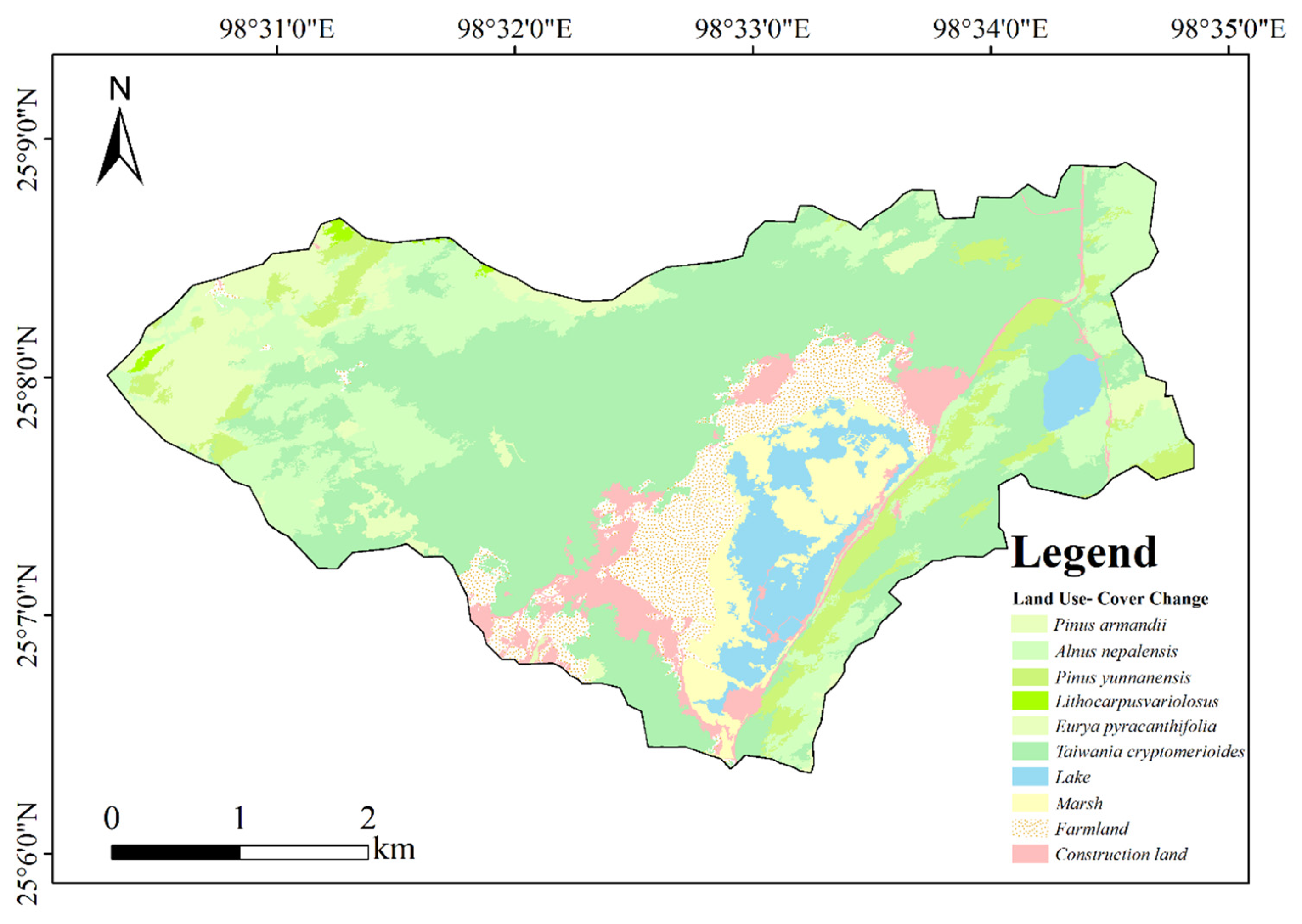
Forest vegetation in the study area was interpreted at the formation level using eCognition Developer 10.4. The overall accuracy of the confusion matrix (Confusion Matrix—Samples) was 0.9249, with a Kappa coefficient of 0.9116, as shown in Figure 2.

2.2.2. Field Sampling

The selection of sampling sites was guided primarily by the Plant Science Data Specification (2022 Edition) [46], the GB/T 35377-2017 [47], and the GB/T 33027-2016 [48]. Since October 2024, based on the pattern of altitudinal gradients, typical forest plots with suitable slopes and minimal human disturbance were selected to establish 20 tree quadrats (dimensions: 20 m × 20 m). Plant specimens were collected, and measurements were taken for tree height, diameter at breast height, and crown width for trees; for shrubs, height, basal diameter, and crown width were recorded; for herbaceous plants, parameters such as abundance and coverage were quantified.
For plant specimen identification, authoritative references such as Flora of China and Flora of Yunnan were consulted to verify the family, genus, and species of each plant, providing foundational data for biodiversity analysis and biomass estimation. Within each plot, three sampling points were randomly selected to collect soil samples at depths of 0–20 cm, 20–40 cm, and 40–60 cm. The samples were immediately placed into self-sealing bags, with each bag containing 1 kg of soil, resulting in a total of 180 soil samples and 180 soil core samples. All collected samples were documented and transported to the laboratory for storage and subsequent analysis. Monitoring data were obtained in coordination with agencies including the Tengchong Municipal Bureau of Natural Resources, the Forestry and Grassland Administration, the Meteorological Bureau, and the Beihai Wetland Provincial Nature Reserve Administration. The baseline data were derived from the Beihai Wetland Monitoring Station, fully integrated with field survey data from the Beihai Wetland watershed.

2.2.3. Construction of the Accounting System

Accounting system. This study presents the first systematic valuation of the FES in the Tengchong Beihai Wetland watershed, addressing a significant research gap in this field. By integrating field surveys, remote sensing data, and literature reviews, the functional value method was employed for accounting, covering the period from 2024 to the present. The accounting encompasses four major categories—provisioning services, regulating services, supporting services, and cultural services—along with their 24 specific service functions.
Accounting procedures. Drawing on the GB/T 43648-2024, data on tree biomass and volume were calculated. Following the GB/T 38582-2020, the functional value method was adopted. Using a comprehensive indicator system for forest ecosystem service functions, the Distributed Computation Model (DCM) was applied to calculate the material quantity per unit stand across different community types. Subsequently, the value quantity was derived by integrating socio-economic data, as presented in Table 1.

2.2.4. Statistical Analysis

The biomass conversion factor model is a regression model established through statistical analysis. It utilizes tree measurement factors, such as diameter at breast height and tree height, as explanatory variables to predict the biomass conversion factor as the response variable.
Measured   forest   stand   biomass = 1 S i = 1 n W i
In the equation, S denotes the sample plot area (ha), n represents the number of trees within the plot, and W i refers to the biomass (dry weight, t/tree) of the i-th tree, which is calculated using either allometric equations or the direct harvesting method.
Assess   the   biomass   of   the   forest   stand = j = 1 m W j × A j
In the equation, m denotes the number of assessment units (specifically, subcompartments of different tree species). W j refers to the estimated biomass (t/ha−1) of the j-th unit; A j represents the area (ha) of the j-th unit.
The forest ecosystem service correction coefficient is defined as the ratio of factors (e.g., biomass) in the target stand to be assessed to those in a measured stand within the same assessment unit (Source: GB/T 38582-2020).
FES-CC = B e B o = B E F × V B o
In the equation, FES-CC denotes the forest ecosystem service correction coefficient. B e represents the biomass of the assessed forest stand (unit: kg). B o denotes the measured biomass of the forest stand (unit: kg). BEF is the biomass expansion factor (converting volume to biomass). And V signifies the volume of the assessed forest stand (unit: m3).
MA = a0 D a1 H a2
The binary above-ground tree biomass model (GB/T 43648-2024). MA represents the estimated above-ground biomass (unit: kg). D denotes the tree diameter at breast height (unit: centimeter, cm). H indicates the tree height (unit: meter, m). The coefficients a0, a1, and a2 are fitted model parameters.
MB = b0 D b1 H b2
The binary below-ground tree biomass model. MB estimated belowground biomass (kg). D, tree diameter at breast height (cm). H, tree height (m). The coefficients b0, b1, and b2 are model parameters.
BCF = c0 D c1 H c2
The binary biomass conversion factor model. BCF represents biomass conversion factor (g/cm3). D represents tree diameter at breast height (cm), and H denotes tree height (m). The coefficients c0, c1, and c2 are fitted model parameters.
V = d0 D d1 H d2
The binary standing tree volume model. V represents the standing tree volume (unit: m3), D is the tree diameter at breast height (unit: cm), and H denotes the tree height (unit: m). The coefficients d0, d1, and d2 are model parameters.
Formulas and parameter configuration for physical and value quantities accounting. Parameter Descriptions: A stand area (unit: ha). Ba denotes the measured net productivity of the stand, expressed as t/ha−1. F is the correction coefficient for F-ESV.
Unutrient = A × BYears × F (Nnutrition × C1 + Pnutrition × C1 + Knutrition × C3)
Value of forest nutrient retention. Unutrient stand assessment of annual nutrient retention value (unit: CNY). It’s based on the measured nutrient contents within trees—specifically, nitrogen (N, %), phosphorus (P, %), and potassium (K, %)—alongside reference market prices for corresponding fertilizers. Diammonium phosphate price (C1, unit: CNY/t−1) and potassium chloride price (C3, unit: CNY/t−1) are used as the economic proxies for phosphorus and potassium, respectively.
USoil stabilization = A × (X2X1) × F × Csoil
Value of soil stabilization. USoil stabilization expressed in CNY, represents the annual soil fixation value of the forest stand. The soil erosion modulus for non-forest land, denoted as X2, is measured in t/ha−1. In contrast, X1 refers to the measured soil erosion modulus for the forested stand, with the same unit (t/ha−1). Csoil, in CNY/m3, indicates the cost required for excavating and transporting a unit volume of earthwork. Finally, ρ stands for soil bulk density, with a unit of g/cm3.
Fertilizer retention value (value of reduced losses of nitrogen, phosphorus, potassium, and organic matter)
U Fertilizer = A × ( X 2 X 1 ) × F × ( N × C 1 R 1 + P × C 1 R 2 + K × C 2 R 3 + M × C 3 )
Value of fertilizer retention. UFertilizer represents the annual fertilizer retention value of the forest stand, with units of CNY. X2 denotes the soil erosion modulus of bare land (t/ha−1), while X1 is the measured soil erosion modulus of the forested stand (t/ha−1). Key soil nutrient contents within the measured stand are expressed as percentages: N for nitrogen, P for phosphorus, K for potassium, and M for organic matter. For economic valuation, C1 is the market price of diammonium phosphate fertilizer (CNY/t−1), with R1 and R2 representing its nitrogen and phosphorus content (%), respectively. C2 is the market price of potassium chloride fertilizer (CNY/t−1), and R3 indicates its potassium content (%). Finally, C3 denotes the reference price of organic matter (CNY/t−1).
URegulation = 10 A × (PWaterEC) × F × CReservoir
Value of water regulation. URegulation denotes the annual water regulation value of the forest stand, in CNY. PWater refers to the measured precipitation outside the forest, in mm/a−1. E represents the measured evapotranspiration of the forest stand, in mm/a−1. C signifies the measured surface rapid runoff of the forest stand, in mm/a−1. CReservoir is the market transaction price of water resources, in CNY/m3.
UPurification = 10 A × (PWaterEC) × F × KWater
Value of water purification. UPurification is defined as the monetary value of water purification by forest stands, while KWater denotes the associated purification cost, both expressed in units of CNY.
GCarbon = GVegetation + GSoil
UCarbon = (1.63 RCarbon × BYears + SSoil) × A × F × CCarbon
Value of carbon sequestration. UCarbon represents the annual carbon sequestration value of a forest stand, with units of CNY. GVegetation denotes the annual carbon sequestration amount of the stand vegetation, in t/a−1. GSoil indicates the corresponding annual carbon sequestration amount of the stand soil, also in t/a−1. RCarbon is the carbon fraction in carbon dioxide, which is 27.27%. BYears stands for the measured net primary productivity of the forest stand, in t/ha−1. SSoil refers to the measured soil carbon sequestration per unit area of the stand, in t/ha−1. CCarbon is the price of sequestered carbon, with units of CNY/t−1.
UOxygen = 1.19 A × BYears × F × COxygen
Value of oxygen release. UOxygen denotes the assessed annual monetary value of oxygen released by the forest stand (unit: CNY). COxygen represents the unit price of oxygen (unit: CNY/t−1).
Atmospheric environment purification value
UNegative ion = 5.256 × 10¹⁵ × A × H × F × KNegative ion × (QNegative ion − 600)/L
Value of negative oxygen ion. UNegative ion: Annual monetary value of negative air ions provided by the forest stand (CNY). H: Measured height of the forest stand (m). KNegative ion: Unit production cost of negative air ions (CNY/ion−1). QNegative ion: Measured concentration of negative air ions in the stand (ions cm3). L: Lifetime of negative air ions (min).
Value of gaseous pollutant absorption
USO2 = QSO2 × A × F/1000 × KSO2
Value of sulfur dioxide (SO2) absorption. USO2 represents the annual value of sulfur dioxide (SO2) absorption by the forest stand, expressed in CNY. QSO2 denotes the measured annual SO2 absorption per unit area of the forest stand, with units of kg·ha−1. KSO2 refers to the unit cost of SO2 treatment, expressed in CNY/kg−1.
UFluoride = QFluoride × A × F/1000 × KFluoride
Value of fluoride absorption. UFluoride represents the estimated annual value of fluoride absorption by the forest stand, expressed in CNY. QFluoride denotes the measured annual fluoride absorption per unit area of the stand, with units of kg/ha−1. KFluoride signifies the unit cost for fluoride remediation, given in CNY/kg−1.
UNOx = QNOx × A × F/1000 × KNOx
Value of nitrogen oxides (NOx) absorption. UNOx represents the annual value of nitrogen oxide absorption by the forest stand, expressed in CNY. QNOx denotes the measured amount of nitrogen oxide absorbed per unit area of the forest stand, with units of kg/ha−1. KNOx is the treatment cost of nitrogen oxides, in CNY/kg−1.
UStagnant dust = (GTSPGPM10 − GPM2.5) × KTSP + UPM10 + UPM2.5
UStagnant dust = (QTSP × A × F/1000 − GPM10 − GPM2.5) × KTSP + UPM10 + UPM2.5
Value of Total Suspended Particulates (TSP) retention. UStagnant dust represents the potential dust retention value (unit: CNY). GTSP, GPM10, and GPM2.5 denote the potential retention capacities of TSP, PM10, and PM2.5, with units of t/a−1, kg/a−1, and kg/a−1, respectively. QTSP refers to the actual retained amount of TSP (unit: kg/ha−1). KTSP is the dust removal cost per unit mass (unit: CNY/kg−1). UPM10 and UPM2.5 indicate the monetary value of the potential retention of PM10 and PM2.5, respectively (unit: CNY).
UPM10 = 10 × QPM10 × A × n × F × LAI × CPM10
Value of PM10 retention. UPM10 (unit: CNY/kg/a−1) is the estimated annual PM10 retention potential value of a forest stand. QPM10 (unit: g/m2) is the measured PM10 retention per unit stand area. n represents the annual number of wash-off events. LAI stands for the leaf area index. CPM10 (unit: CNY/kg−1) is the unit cost for PM10 removal.
UPM2.5 = 10 × QPM2.5 × A × n × F × LAI × CPM2.5
Value of PM2.5 retention. UPM2.5 represents the annual potential PM2.5 retention value of a forest stand, with units of CNY/kg−1. QPM2.5 denotes the measured PM2.5 retention amount per unit area of a forest stand, in units of g/m2. CPM2.5 refers to the PM2.5 cleaning cost, expressed in CNY/kg−1.
Ufarmland protection = Ka × Va × ma × Afarmland
Value of forest protection, specifically, farmland protection. Ufarmland protection estimates the value of the stand’s cropland protection function, with units: CNY. Ka represents the protective area, specifically that 1 hectare of shelterbelt can protect 19 hectares of cropland on average. Va denotes the price of crops or forage grass, with units: CNY/kg−1. ma is the average yield increase of crops or forage grass, with units: kg/ha−1. Afarmland is the area of the farmland shelterbelt, with units: ha.
U Wood products = i n ( A i × S i × U i ) ( i = 1 , 2 , , n )
Value of wood products. UWood products represents the annual value of wood products from the forest in the study area, with units of CNY. A i denotes the area of the i-th wood product type, in hectares. S i is the stock volume per unit area for the i-th wood product type, expressed as m3/ha−1. U i refers to the market price of the i-th wood product type, with units of CNY/m−3.
Shannon-Wiener Index: H’ = i = 1 S ( P i I n   P i )
Value of biodiversity. S represents the number of species recorded in each sample plot. P i denotes the relative abundance of the i-th species.
U bio. = ( 1 + m = 1 x E m × 0.1 + n = 1 y B n × 0.1 + r = 1 z O r × 0.1 ) × S bio. × A
Ubio. represents the annual species resource conservation value of a forest stand, with units of CNY. E m denotes the rarity and endangerment index for species m within the stand. B n signifies the endemic species index for species n within the stand. O r indicates the ancient tree annual ring index for species r within the stand. The variable x counts the number of rare and endangered species, y counts the number of endemic species, and r counts the number of ancient tree species. Sbio. is the species resource conservation value per unit area, with units of CNY/ha−1. A stands for the area of the forest stand, in hectares.
Ur = 0.8Uk
Value of cultural services, specifically, forest therapy. Ur represents the annual forest recreation and wellness value within the watershed, measured in CNY. Uk denotes the value of the forestry tourism and leisure industry along with the forest rehabilitation and wellness industry within an administrative region. This includes tourism revenue and the value directly contributed to other interconnected industries, with its unit also being CNY. k stands for the number of administrative regions. The coefficient 0.8 reflects that the volume of tourists received by forest parks and the tourism output value they generate account for approximately 80% of the total scale of forest tourism nationwide.

2.2.5. Pearson Correlation Coefficient

r = i = 1 n ( X i X ¯ ) ( Y i Y ¯ ) i = 1 n ( X i X ¯ ) 2 i = 1 n ( Y i Y ¯ ) 2
Let “n” denote the number of paired observations for the two variables. Here, Xi and Yi represent the “i”-th observations of variables X and Y, respectively, while X ¯ = 1 n i = 1 n X i and Y ¯ = 1 n i = 1 n Y i denote their respective arithmetic means.
t = r · n 2 1 r 2
In testing the significance of the Pearson correlation coefficient via the t-test, the calculated t-statistic obeys a t-distribution whose degrees of freedom are df = n − 2. The associated p-value is thereby derived by consulting a t-distribution table.

2.2.6. Mantel Test

r Mantel = i = 1 n j = i + 1 n ( X i j X ) ( Y i j Y ) ( i = 1 n j = i + 1 n ( X i j X ¯ 2 ) ( i = 1 n j = i + 1 n ( Y i j Y ¯ ) 2 )
Mantel’s r Xij denotes the distance element in the i-th row and j-th column of matrix X (where ij; only the upper or lower triangular part is considered to avoid duplication). Yij is the distance element at the corresponding position in matrix Y. X ¯ = 2 n ( n 1 ) i = 1 n j = i + 1 n   X i j represents the mean of all off-diagonal elements in matrix X, and Y ¯ represents the mean of all off-diagonal elements in matrix Y.
Mantel’s p. a. Randomly permute the rows and columns of one matrix while preserving its symmetry, then calculate the correlation coefficient r M a n t e l * for the permuted configuration. b. Repeat this permutation procedure K times to obtain K values of r M a n t e l * . c. The Mantel’s p-value is calculated as the proportion of permutations, out of the total K, for which r M a n t e l * r M a n t e l .

3. Results

3.1. Law of Total Value

3.1.1. Spatial Distribution of Total FES

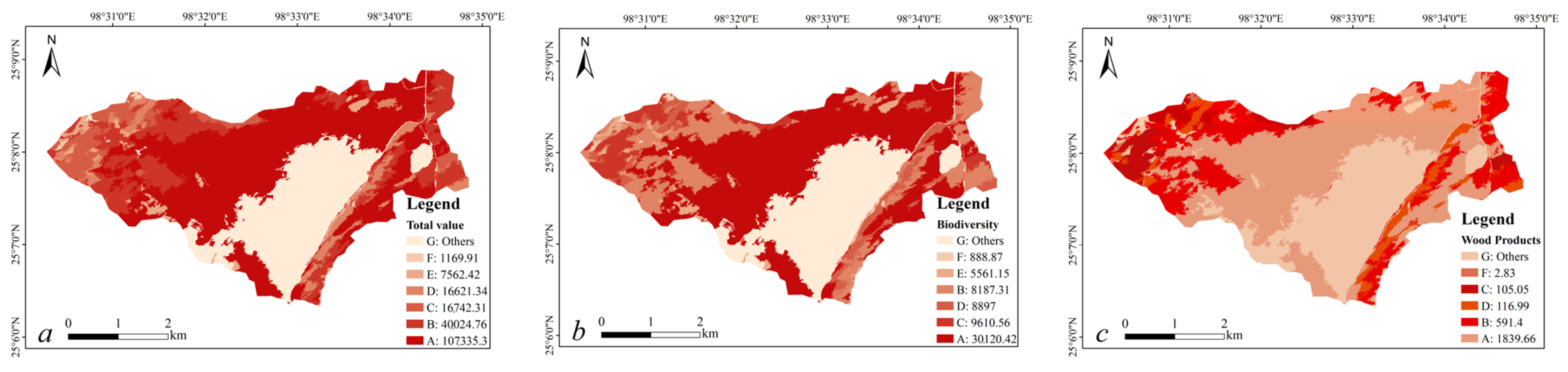
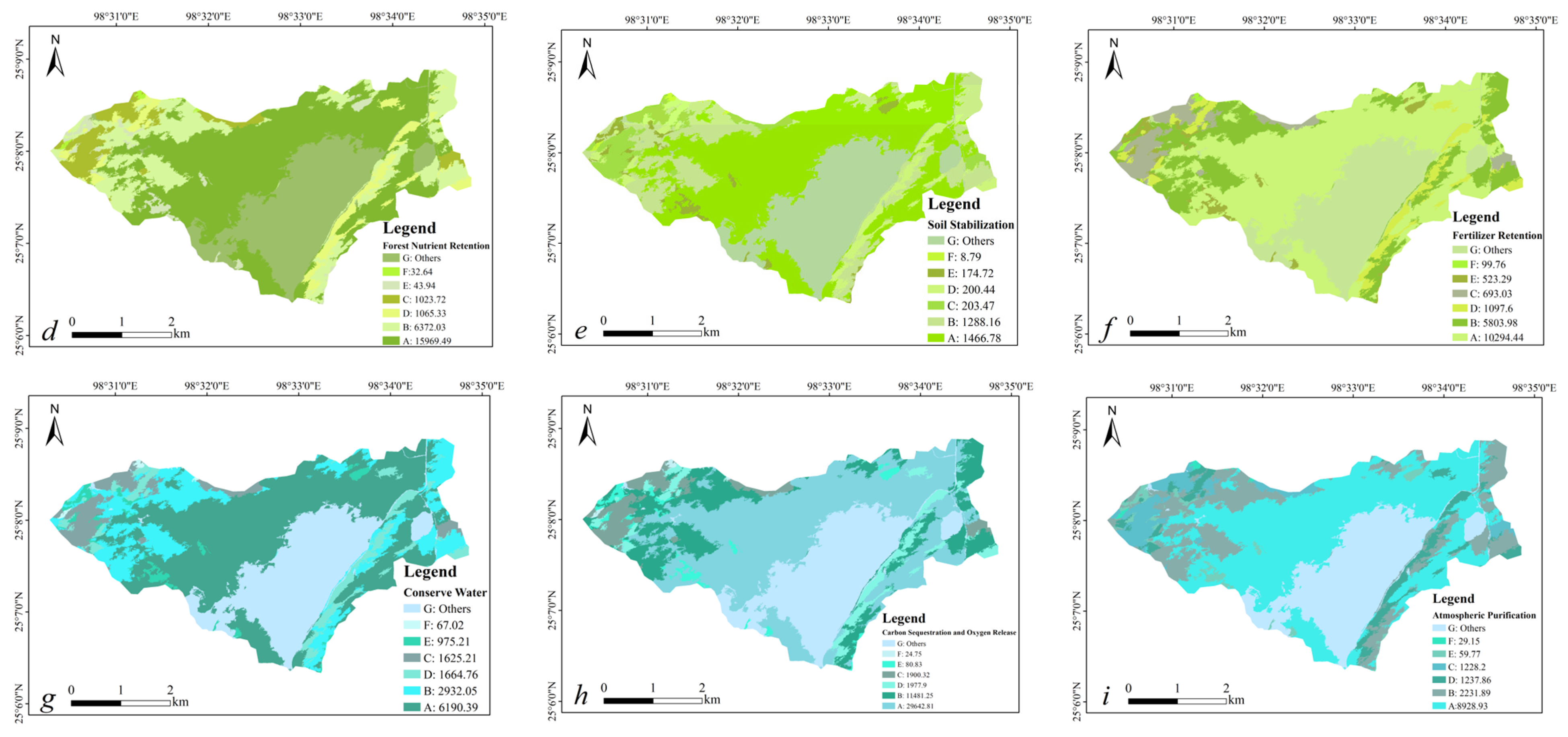
The forest vegetation in the Beihai wetland watershed was interpreted at the formation level. The unit stand value of different formations was calculated stepwise using the functional value method and the DCM model. After refining the accounting of service functions into 24 specific indicators, the results were visualized in Figure 3 (some indicators were combined; for example, “carbon sequestration” and “oxygen release” are presented together as “carbon sequestration and oxygen release” in the figure).
Following the systematic quantification of FES in the Beihai wetland watershed, the value corresponding to each stand type was visualized using ArcGIS 10.8, providing a more intuitive representation of the total value of each stand type within its respective functional category. To improve the visualization of FES in the watershed, four land use types—built-up land, cropland, marsh, and lake—were grouped as “other”, as shown in Figure 3. The results indicate that in 2024, the total FES value of the Beihai wetland watershed was 1.90 billion CNY. Among these, the formation with the highest value was Form. Taiwania cryptomerioides (1.07 billion CNY), and the service function with the highest value was Biodiversity (633 million CNY).
The findings reveal that the forests in this watershed hold significant ecological and economic value. Therefore, it is necessary to analyze the patterns and influencing factors of the total FES value across different formations.

3.1.2. Patterns of Total FES Value Across Different Formations

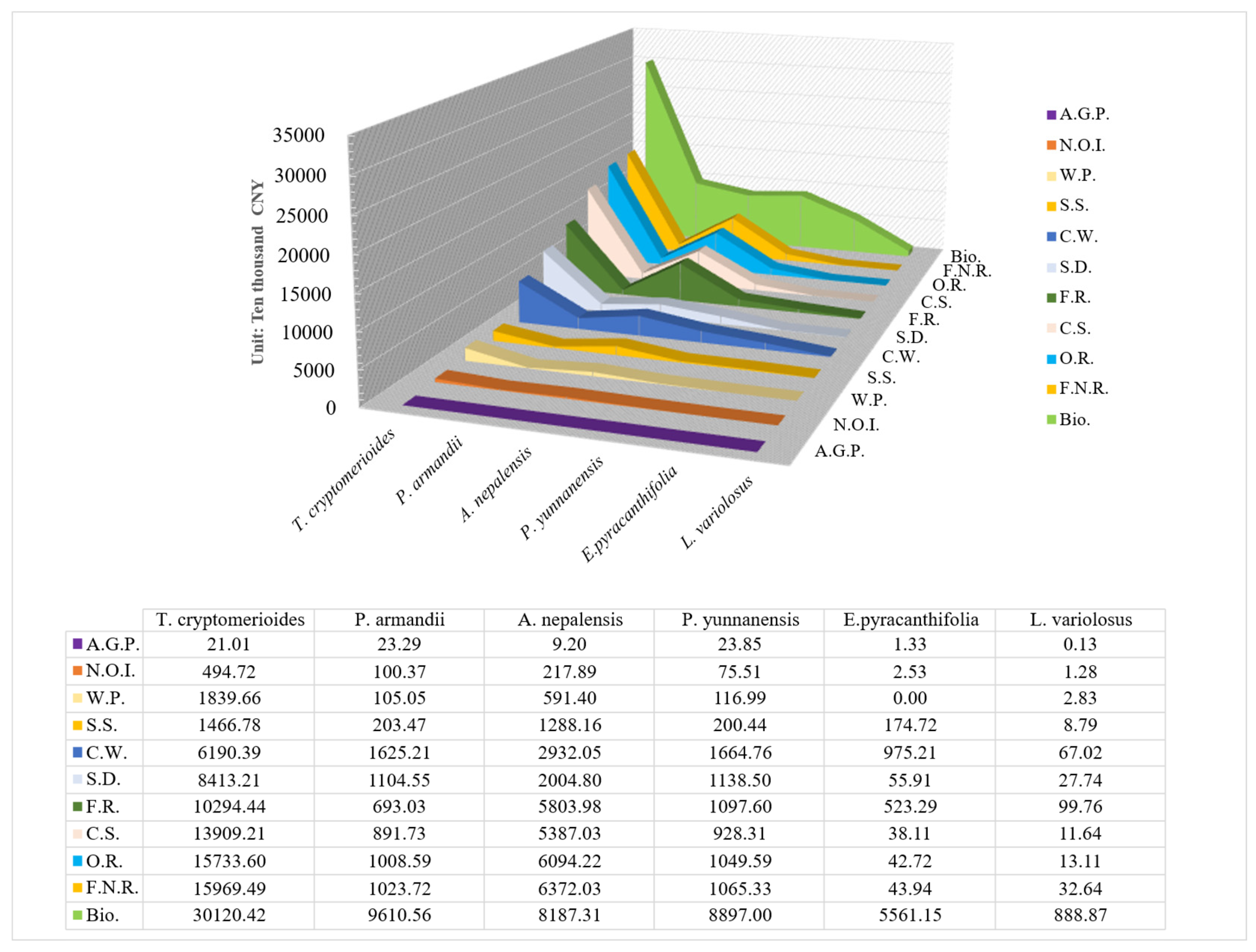
The results indicate that the values corresponding to different service functions exhibit considerable disparities. Certain service functions (1, 3, 7, 8) show notably high peaks, primarily attributed to the contributions of Form. Taiwania cryptomerioides and Form. Alnus nepalensis. The total FES value is predominantly concentrated in Biodiversity and Forest Nutrient Retention. The service function values are primarily distributed within the low-to-medium range, reflecting a general pattern observed across most formation types.
The study reveals that the total value of FES across different formation types in the Beihai wetland watershed exhibits significant variation. Form. Taiwania cryptomerioides ranks the highest in value across multiple service functions and represents the formation type with the greatest total value. Additionally, substantial disparities are observed among various service functions, with Biodiversity playing a dominant role, as shown in Figure 4. Therefore, it is necessary to analyze the factors influencing the total FES value.

3.1.3. Factors Influencing Total FES

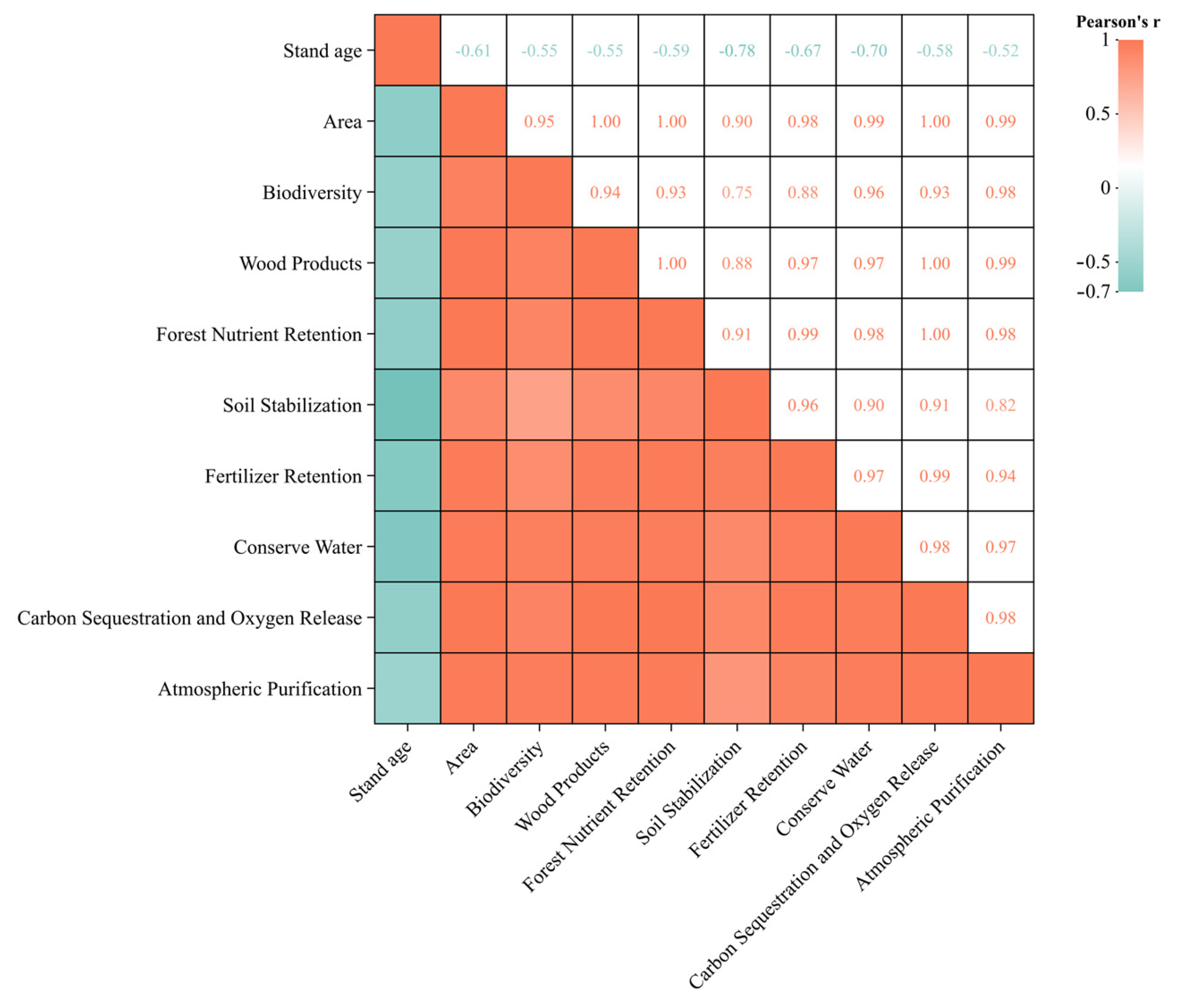
To validate the influencing factors of the total FES value, a Pearson correlation coefficient heatmap of forest ecosystem and service functions is presented. The results indicate a strong positive correlation of forest area, with the “r” between Area and service functions being closer to “1”, suggesting that a larger forest area is generally associated with a higher FES value. The circles corresponding to most ecological service functions are predominantly dark red, indicating the existence of strong positive synergistic relationships among these service functions.
The study found that within the Beihai Wetland watershed, there are significant correlations among forest ecosystem service functions, with forest area serving as the primary factor driving the total FES value within the watershed, as shown in Figure 5. Therefore, it is necessary to conduct a systematic investigation of the patterns and influencing factors of FES at the stand level across different flora, using the individual forest stand as the fundamental unit.

3.2. Patterns of FES at the Individual Forest Stand Level

3.2.1. Patterns of FES at the Individual Forest Stand Level Across Different Flora

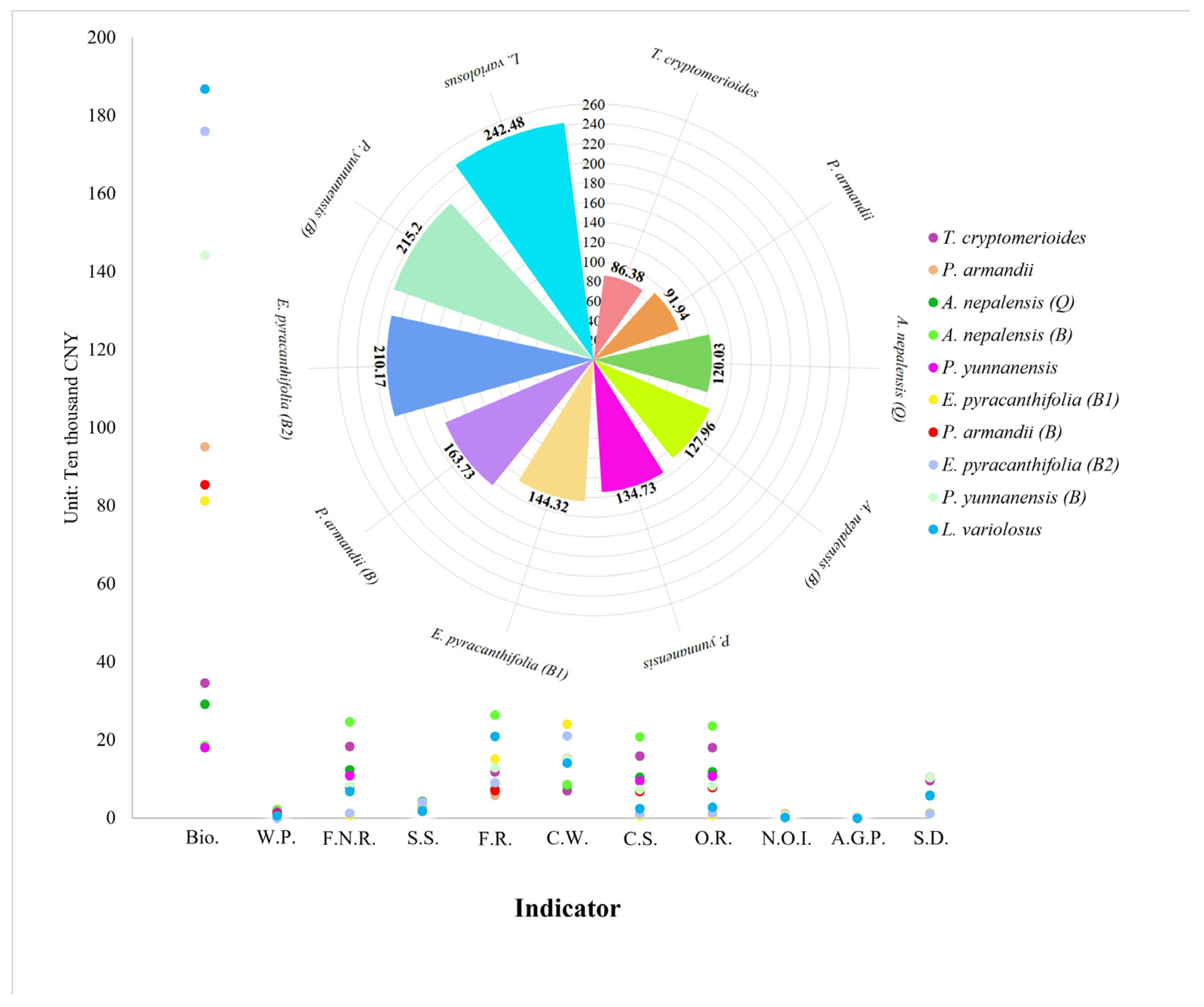
Rose Diagram Element Description. Radial scale: Represents FES (range 0–260, unit: “ten thousand CNY”). “Petals” and formations: Each color of the “petals” corresponds to a distinct sample plot (consistent with the scatter plot). The length and area of the petals directly visualize the FES per unit stand (1 ha) based on the ten sample plots.
The results indicate that the total value of FES across six formations in the Beihai wetland watershed, quantified on a per-unit-area basis, amounts to 9.50 million CNY.
Form. Lithocarpus variolosus, Form. Pinus yunnanensis (B), and Form. Eurya pyracanthifolia (B2) exhibited the highest values among all formations, which were significantly greater than those of the other formations. The formation with sky-blue petals (Form. Lithocarpus variolosus) had the highest value, reaching 2.42 million CNY·ha−1. Additionally, a certain correlation was observed between service functions and formations, with marked variations in the values of different service functions. The biodiversity value showed a notably high peak, primarily because biodiversity served as the main driving factor in the total value, whereas most other service functions had relatively lower values, as shown in Figure 6.
The study found that natural forests (Form. Lithocarpus variolosus, Form. Pinus yunnanensis (B), and Form. Eurya pyracanthifolia (B2)) in the upper watershed had significantly richer and more distinct service function values per unit forest stand compared to planted forests (the other seven plots). Furthermore, the value of biodiversity played a dominant role in the total value per unit forest stand, with significant differences in biodiversity values among different formations.
In summary, biodiversity plays a fundamental role in the overall value of the forest ecosystem in the Beihai watershed. Meanwhile, natural forests in the upper watershed contribute substantially to the maintenance of biodiversity, thereby exerting a systematic effect on enhancing the value of the forest ecosystem in the downstream areas. Consequently, further in-depth research and analysis on the service functions of FES and related indicators are warranted.

3.2.2. Correlation Analysis of FES Indicator Categories

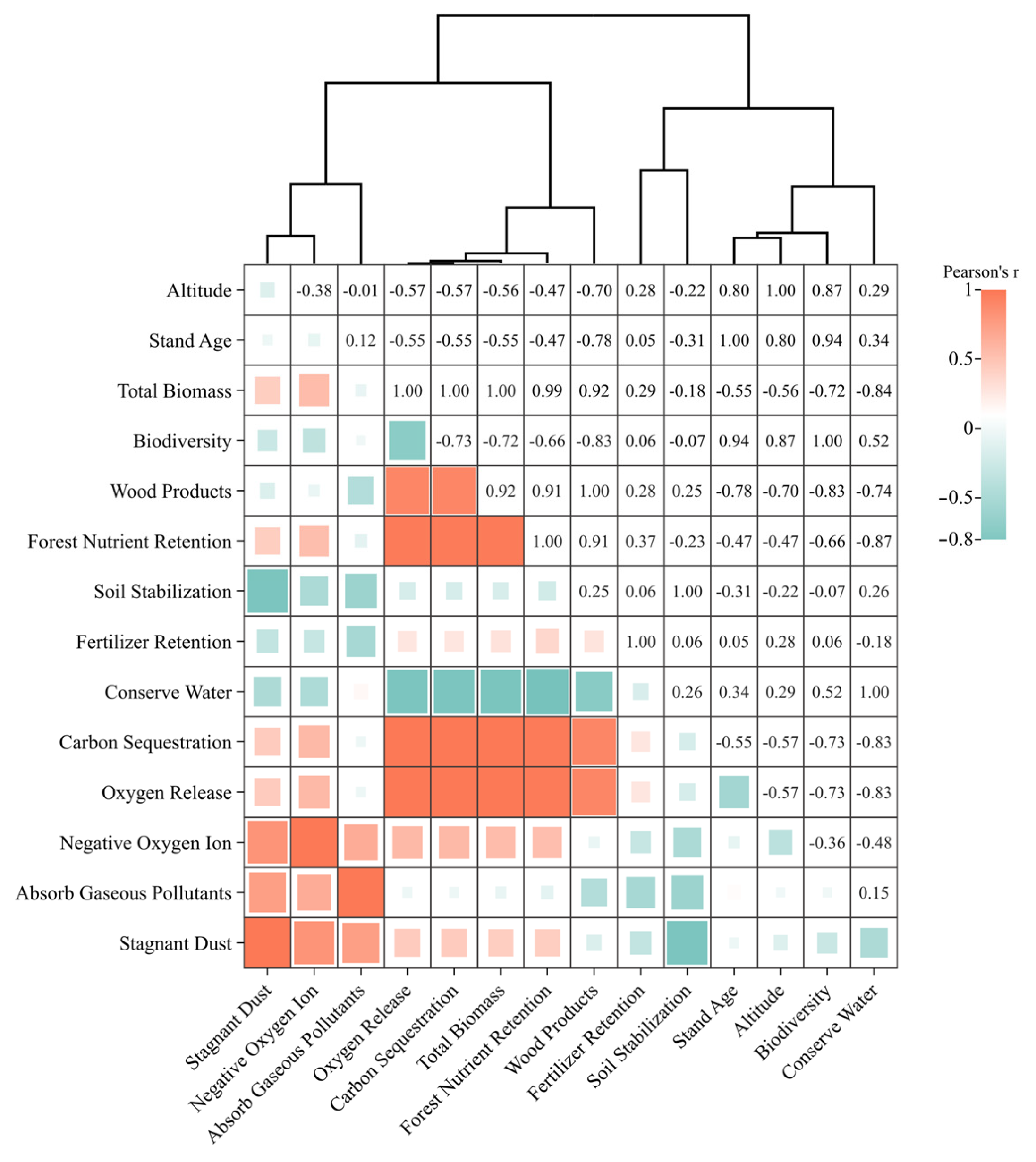
The results indicate that certain associations exist between environmental factors and ecosystem services. Stand age shows a negative correlation with most ecosystem services (e.g., r = −0.55 with total biomass, r = −0.73 with oxygen release), suggesting that an increase in stand age may reduce the value of certain ecosystem services. Altitude exhibits weak correlations with most services (with “r” values mostly ranging from −0.38 to 0.29), indicating a relatively limited direct influence on ecosystem services in Figure 7.
Trade-offs and synergies among ecosystem services. For example, the correlation coefficients (r) for services such as Total Biomass, Wood Products, and Forest Nutrient Retention approach “1”, indicating a high degree of synergy in the values of these services. Conversely, the correlation coefficients between certain service pairs, such as Soil Stabilization and Stagnant Dust, as well as Stand Age and Wood Products, approach −0.87, suggesting a trade-off relationship characterized by a “reciprocal” dynamic. Additionally, functional groups exhibit patterns of “synergy-trade-off”. Within the environmental purification group, Negative Oxygen Ion, Absorb Gaseous Pollutants, and Stagnant Dust are positively correlated, representing synergistic functions. However, the strong trade-off between Soil Stabilization and Stagnant Dust alternatively indicates that increased soil stabilization in forest ecosystems corresponds to reduced airborne dust. Within the nutrient cycling group, Forest Nutrient Retention is positively correlated with Wood Products but negatively correlated with Conserve Water, reflecting a trade-off between production functions and water conservation. This suggests that timber forests (e.g., Form. Taiwania cryptomerioides) in this watershed absorb substantial amounts of water, thereby significantly diminishing their water conservation value. Within the sustainable development group, Biodiversity exhibits significant synergy with Conserve Water, Altitude, and Stand Age. Moreover, clustering reveals certain patterns among service functions. The top dendrogram categorizes service functions into multiple groups. One cluster is centered around services such as Total Biomass and Wood Products (exhibiting strong positive associations). Another cluster comprises services such as Stand Age and Wood Products (mostly negatively correlated), highlighting the distinct grouping characteristics inherent in the correlational structure among different service functions.
The study reveals that environmental factors and FES in the Beihai watershed exhibit a network relationship characterized by synergies and trade-offs. A significant correlation is observed between stand age and biodiversity, with biodiversity playing a dominant role in shaping FES. Additionally, the correlation between elevation and stand age is also substantial; stand age is generally higher in the upstream areas of the watershed, reflecting, to some extent, a lower level of anthropogenic socioeconomic disturbance in these upstream forest ecosystems, which are therefore relatively well-preserved. In contrast, forest ecosystems in the downstream areas of the watershed are more evidently influenced by human socioeconomic activities. The findings indicate that forest ecosystems within the watershed possess self-regulatory capacity, with different formations mutually influencing and constraining one another through the exchange, transfer, and cycling of materials, energy, and information. This dynamic manifests as a gradual process of change across formations and elevations. This implies that managers need to pay greater attention to the synergy-trade-off relationships within the watershed and implement effective management measures for the mature timber forests in this region.

3.2.3. Provider of Sustainable Ecosystem Services

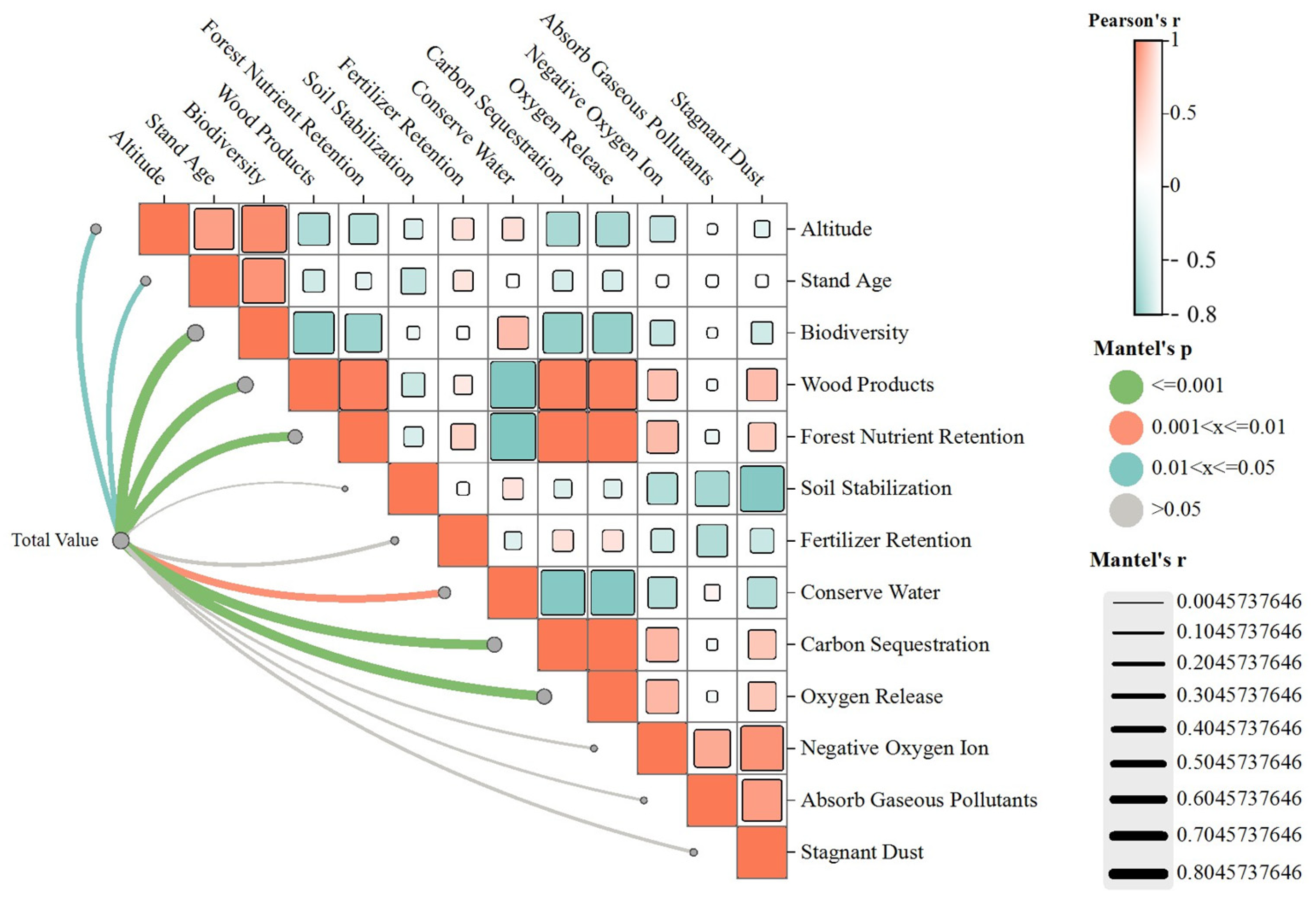
Mantel’s p represents the significance of spatial associations between the total value per unit forest stand and various functions, with colors indicating significance levels: green, orange, cyan, and gray. Mantel’s r reflects the strength of spatial associations between the total value per unit forest stand and various functions, with thicker lines (indicating larger “r” values) denoting stronger associations, as shown in Figure 8.
The results indicate that for Mantel’s p, a green color denotes extremely significant spatial association (p ≤ 0.001), as observed between total value and biodiversity, forest products, nutrient retention, carbon sequestration, and oxygen release. Orange indicates significant association (0.001 < p ≤ 0.01), as seen between total value and water conservation. Cyan denotes moderately significant association (0.01 < p ≤ 0.05), as observed between total value and elevation, as well as stand age. Gray indicates non-significant association (p > 0.05), as observed between total value and soil retention, as well as nutrient conservation. Mantel’s r reveals that total value exhibits the thickest connecting lines with biodiversity and forest products, indicating the strongest spatial association strengths. Conversely, total value shows the thinnest connecting lines with soil retention and nutrient conservation, indicating the weakest spatial association strengths.
The study finds that the total value per unit forest stand exhibits both “linear relationships” and “spatial association characteristics” with various service functions. These insights may provide possible references for “optimization strategies aimed at enhancing the forest ecosystem service functions within the watershed.” By analyzing the inherent relationships among FES, priority should be given to strengthening the categories of services that support sustainable ecosystem functioning, while also considering the spatial configuration of production, carbon–oxygen cycling, and other service functions within the watershed. Such targeted formulation of forest ecosystem management strategies within the watershed can comprehensively enhance the marginal benefits of the total value of FES, thereby promoting the integrated benefits of the forest ecosystem in the Beihai Wetland watershed toward Pareto optimality.

4. Discussion

4.1. Conducting Research at the Watershed Scale

The watershed represents one of the most optimal spatial scales for ecosystem service research, balancing theoretical depth with practical applicability [53]. Conducting ecosystem service research at the watershed scale constitutes a research paradigm that leverages the natural geographic integrity, ecological process connectivity, and human activity interdependency inherent to watersheds, thereby enhancing the scientific rigor, systemic coherence, and practical relevance of such research [54,55].
With water as its central link, the watershed integrates the upper, middle, and lower reaches into a universally interconnected composite ecosystem. Changes in terrestrial carbon or nutrient dynamics arise not only from ecosystem metabolism and atmospheric exchange but also from lateral transport via hydrological processes, which redistribute carbon and nutrients to downstream areas [56,57,58]. As a natural geographic unit defined by the hydrological cycle, the watershed encompasses diverse ecosystem types—such as mountains, waters, forests, farmlands, lakes, grasslands, and sandlands—forming a continuous ecosystem service value chain characterized by “upstream provision, midstream regulation, and downstream utilization”. The core advantage of the watershed unit lies in its ability to integrate the continuity of natural ecological processes, the spatial coupling of ecosystem service supply and demand, and the systemic nature of human activities, thereby overcoming the spatial limitations inherent in traditional patch-based or administrative boundary approaches. Advancing ecosystem service research at the watershed scale facilitates the close integration of systemic mechanisms, spatial patterns, driving factors, and management strategies, rendering the research more practically applicable.
It should be clarified that the proposed “upstream–midstream–downstream” value chain framework is not independent of the intrinsic characteristics of forest ecosystem services; rather, it serves as a synthesis of the spatial distribution patterns of these services. The spatial differentiation of different ecosystem service functions is a key factor shaping the spatial pattern of ecosystem service values in the Beihai watershed. Therefore, this framework represents an integration and interpretation of functional characteristics, rather than a detachment from them. Future studies could further explore the sensitivity and applicability of different service function types to the upstream–midstream–downstream spatial delineation within a watershed.

4.2. Exploring Pathways to Enhance FES in the Watershed

The findings reveal that although the Beihai Wetland watershed is predominantly covered by timber-oriented forests, its FES are reflected not only in timber production but also, to a greater extent, in Carbon Sequestration and Oxygen Release (451 million CNY), Fertilizer Retention (185 million CNY), and Atmospheric Purification (130 million CNY). Moreover, Biodiversity contributes the highest value (633 million CNY). Biodiversity is regarded as a potential driver of ecosystem services [59], while service functions such as biomass production and nutrient cycling exhibit strong responses to changes in biodiversity [60,61]. It is necessary to thoroughly investigate the processes and driving mechanisms underlying ecosystem changes, with particular attention to the loss of functional diversity and complementarity. Concurrently, anthropogenic disturbances to the watershed ecosystem should be mitigated, and the scientific basis for human interventions strengthened.
Realizing the comprehensive benefits of ecosystem service functions requires a greater number of species [62]. The complexity and stability of forest community structure serve as the core carriers for the formation of ecological service functions [63]. FES also exhibit significant variation depending on natural factors such as stand type, stand age, and altitude [64]. By strategically optimizing the vegetation composition and spatial configuration within the Beihai Wetland watershed, it is possible to establish a multi-functional mixed forest system, optimize vertical and horizontal stand structures, and promote forest succession towards mature stages. A balance should be struck between “more individuals [65] and more species [66]”. The watershed requires not only a certain area of timber forest but also sustained efforts to strengthen the protection of natural forests, alongside careful consideration of superior new tree species [67] and planting altitudes. It is essential to maximize the stabilization of vegetation biomass accumulation and the soil carbon pool, thereby reinforcing the long-term, steady supply of services such as carbon storage and water conservation [68].
Furthermore, field investigations indicate that areas within this watershed with intact forest community structures not only harbor high biodiversity but also demonstrate effective resistance against the invasive species Ageratina adenophora (Spreng.) R. M. King & H. Rob. Exploring an ecological management zoning approach that integrates Land Equivalent Ratio (LER) with Ecosystem Service Value (ESV) represents an ideal strategy [69].

4.3. Promoting the Value Realization of FES at the Watershed Scale

Promoting the value realization of FES using the “watershed” as a fundamental unit represents a pathway to overcoming administrative fragmentation and enhancing the effectiveness of ecological governance. By treating the Beihai Wetland watershed as an integrated ecological-economic-social-cultural system, the core rationale lies in adhering to the linkage mechanism of “hydrology driving ecological functions, functions underpinning service provision, and markets and policies enabling monetization (money)”. This approach aims to construct a dynamic research methodology and practical framework that spans from foundational accounting to diversified realization.
First, establishing a refined accounting system for ecological products at the watershed scale serves as the foundational basis for measurement. Accounting must distinguish between “tangible products” and “intangible services”, integrating multidimensional data such as remote sensing, ecological models, and field monitoring [70] to enable spatial explicit and dynamic assessments, thereby providing fundamental data for market transactions and ecological compensation [71]. Second, designing a differentiated market transformation mechanism based on product attributes represents the core component [72]. For tangible products with clear ownership, such as timber and medicinal herbs, market value should be enhanced through certification, brand development, and supply chain upgrading. For intangible regulating services, such as carbon sequestration and air purification, the key lies in constructing “quasi-markets” through institutional innovation, leveraging diverse pathways to unlock the multifaceted service functions of forest ecosystems within the watershed and increase product value addition [73], thereby enabling local communities to benefit from forest ecological products and forming a virtuous cycle of “conservation—value enhancement—benefit sharing”. Finally, establishing a multi-stakeholder collaborative governance and policy support system is crucial for implementation. This requires developing a collaborative governance model led by the government, with active participation from enterprises, communities, and research institutions.

5. Conclusions

According to publicly available data from the Tengchong City People’s Government, in 2024, the general public budget revenue of Beihai Town was 9.85 million CNY, with total fiscal revenue reaching 15.65 million CNY. The balances of financial institution deposits and loans stood at 481 million CNY and 202 million CNY, respectively. In the same year, the total value of FES in the Beihai Wetland watershed was 1.90 billion CNY. Therefore, it is necessary to effectively maintain the forest ecosystem in the Tengchong Beihai watershed and promote the sustainable use of natural resources.
First, land use types within the Beihai watershed should be rationally planned to ensure the efficient utilization of land resources [74], stabilize land productivity, and mitigate the risk of land degradation. Second, water-saving practices and non-point source pollution control projects in water-collecting areas and catchments should be implemented to maintain an adequate and high-quality water supply across the upper, middle, and lower reaches of the Beihai Wetland watershed. Third, a new round of forest tending projects should be carried out to preserve the naturalness of the watershed’s forest ecosystem, conserve its biodiversity, and continuously enhance the diversification of ecosystem service functions within the watershed [75]. Fourth, the intensity of development must not exceed the ecological carrying capacity of the Beihai watershed, so as to promote the sustainable utilization of natural resources and foster the coordinated development of watershed ecological construction and the sustainable livelihoods of local households. Finally, cultural services, with an annual value of 4.80 million CNY, represent a crucial category of ecosystem services in the Beihai Wetland watershed. Watershed management should prioritize these services by continuously improving the forest landscape design and community development of the Beihai Wetland watershed, and exploring pathways to realize value through ecotourism and forest-based health and wellness initiatives.
The research paradigm that presents the valuation of forest ecosystem services at the “formation” level helps to reveal the contribution of vegetation heterogeneity. However, this approach relies on detailed vegetation classification data and cannot fully eliminate the influence of spatial autocorrelation. Future studies should further integrate higher-resolution remote sensing data with grid-based analyses to verify the robustness of the findings. In addition, greater attention should be paid to the scale effects across different levels of watersheds, the equity of value transfer, and the collaborative monitoring of long-term ecological, economic, social, and cultural impacts, so as to continuously refine this research paradigm.

Author Contributions

C.H. and H.G. impart academic ideas, strategic planning projects, and provide research funds and humanistic care. L.Z. provided guidance on the conceptualization and research paradigm of the manuscript. R.D., W.Z. and H.J. conducted field research, collected samples and gathered data. R.D. and S.L. conduct plant specimen identification. R.D. and H.J. design and conduct experiments. R.D. analyzing the data and wrote the paper, and with the joint efforts of all the authors, the article was constantly revised and improved. All authors have read and agreed to the published version of the manuscript.

Funding

This research was funded by National Natural Science Foundation of China, grant number 72163030; Yunnan Key Laboratory of Plateau Wetland Conservation, Restoration and Ecological Services, grant number 202105AG070002; Humanities and Social Science Fund of Southwest Forestry University, grant number WKXS2413.

Data Availability Statement

Digital Elevation Model (DEM) data for Tengchong City were obtained from the Geospatial Data Cloud platform (https://www.gscloud.cn (accessed on 8 April 2025)). The socioeconomic data are presented in Table A1.

Acknowledgments

First of all, we would like to express our gratitude to the anonymous reviewers and academic editors for their valuable suggestions. Secondly, we would like to express our gratitude to the leaders and relevant staff of the Beihai Wetland Provincial Nature Reserve Administration Bureau and the relevant government units of Tengchong City for their support. We are grateful to the villagers of Shuanghai Village, Beihai Township and the ecological forest rangers for their care about our daily life and services during our fieldwork. Next, we would like to express our gratitude to the teachers who coordinated the work and the students who provided technical assistance during the experiment. Finally, we would like to express our special gratitude to the two corresponding authors for their strategic planning and humanistic care in academic creation, which have made the path of scientific research even more full of the power to forge ahead.

Conflicts of Interest

The authors declare no conflicts of interest.

Appendix A

Table A1. Socioeconomic Data.
Indicator NameUnitData Source
Soil Erosion Modulus of Forested Landton/ha−1/a−1China Biodiversity: A Country Study
Soil Erosion Modulus of Non-Forested Landton/ha−1/a−1
Excavation and Transportation Costs Per Unit Area of EarthworkCNY/m3According to the “Water Conservancy Engineering Budget Norms (Volume 1)” published by the Yellow River Conservancy Press in 2002, the labor cost for excavating Class I and II soil, when converted to 2024, is 73.08 CNY/cubic meter.
Net Productivity of Standston/m3GB/T 43648-2024.
Wood PriceCNY/m3http://m.chinatimber.org (accessed on 19 March 2026)
Ammonium Dihydrogen Phosphate Nitrogen Content%Fertilizer product specification in China
Ammonium Dihydrogen Phosphate Phosphorus Content%
Potassium Chloride Potassium Content%
Ammonium Dihydrogen Phosphate Fertilizer PriceCNY/ton According to the average price of ammonium dihydrogen phosphate and potassium chloride fertilizer on China fertilizer network (http://www.fert.cn (accessed on 19 March 2026)) in spring 2025; Organic matter according to the average price of China agricultural supplies network (www.ampcn.com (accessed on 19 March 2026)) in spring 2025.
Potassium Chloride Fertilizer Price
Organic Matter Price
Water Purification CostCNY/m3The National Development and Reform Commission Price [2015] No. 119
SO2 Treatment CostCNY/tonAccording to the pollution fee standards from the National Development and Reform Commission and four other ministries adjusted to the present price using a discount rate.
Fluoride Treatment Cost
Nitrogen Oxide Treatment Cost
Dust accumulation cleaning cost
PM10 cleaning cost
PM2.5 cleaning cost
Soil carbon sequestration capacityton/ha−1/a−1Field collection and experimental testing
Carbon sequestration priceCNY/tonIn 2025, the carbon tax in Sweden will be 1450 Swedish kronor per ton. The exchange rate of the Swedish kronor to the CNY is 1:0.75, which is equivalent to 1087.5 CNY CNY/ton.
Oxygen priceMedical oxygen prices in Yunnan Province, China in 2024.
Negative Ion Production CostCNY/1018 unitsAccording to the applicable range of the KLD-2000 ion generator, which is 30 square meters (with a room height of 3 m), a power of 6 watts, a negative ion concentration of 105 ions per cubic meter, a service life of 10 years, and a price of 65 CNY each, the negative ion lifespan is 10 min. By the end of the 14th Five-Year Plan, the electricity rate is 0.65 CNY per kWh. The cost of generating negative ions is calculated to be 9.46 CNY per 1018 ions, and the discounted price is 10.97 CNY per 1018 ions.
Crop pricesCNY/tonNotice of the National Development and Reform Commission and Other Departments on Announcing the Minimum Purchase Price of Rice in 2024
Value of Biodiversity ConservationCNY/ha−1/a−1"Specifications for assessment of forest ecosystem services" (GB/T 38582-2020)

References

  1. Yong, G.; Joseph, S.; Bruce, M. Rescue China’s highland lakes and their ecosystem services. Nature 2022, 609, 32. [Google Scholar] [CrossRef]
  2. Cai, Q.H.; Chen, Y.Y.; King, L. Why Watershed Ecology?—A New Approach for Research and Protection of Aquatic Ecosystems. In Proceedings of the Flood Risks and Land Use Conflicts in the Yangtze Catchment, China and at the Rhine River, Germany—Strategies for a Sustainable Flood Management, Wallenberg, Germany, 31 August–2 September 2000. [Google Scholar]
  3. Oxford English Dictionary; Oxford University Press: Oxford, UK, 1997.
  4. Cambridge Advanced Learner’s Dictionary; Cambridge University Press & Assessment: Cambridge, UK, 2021.
  5. Cheng, G.D.; Li, X. Integrated research methods in watershed science. Sci. China Earth Sci. 2015, 58, 1159–1168. [Google Scholar] [CrossRef]
  6. Zheng, J.K. Watershed System Management; China Forestry Press: Beijing, China, 2023. [Google Scholar]
  7. Zhao, B. Watersheds are the best natural partition units for ecological studies. Sci. Technol. Rev. 2014, 32, 12. [Google Scholar]
  8. Costanza, R.; d’Arge, R.; de Groot, R.; Farber, S.; Grasso, M.; Hannon, B.; Limburg, K.; Naeem, S.; O’Neill, R.V.; Paruelo, J.; et al. The value of the world’s ecosystem services and natural capital. Nature 1997, 387, 253–260. [Google Scholar] [CrossRef]
  9. Costanza, R.; de Groot, R.; Braat, L.; Kubiszewski, I.; Fioramonti, L.; Sutton, P.; Farber, S.; Grasso, M. Twenty years of ecosystem services: How far have we come and how far do we still need to go? Ecosyst. Serv. 2017, 28, 1–16. [Google Scholar] [CrossRef]
  10. Drews, S. Towards systems-oriented behavioral ecological economics. Ecol. Econ. 2025, 227, 108402. [Google Scholar] [CrossRef]
  11. Bai, Y.; Wong, C.P.; Jiang, B.; Hughes, A.; Wang, M.; Wang, Q. Developing China’s Ecological Redline Policy using ecosystem services assessments for land use planning. Nat. Commun. 2018, 9, 3034. [Google Scholar] [CrossRef]
  12. Tansley, A.G. The Use and Abuse of Vegetational Concepts and Terms. Ecology 1935, 16, 284–307. [Google Scholar] [CrossRef]
  13. Guo, H.J.; Shi, B.Z. Research on the ecological compensation mechanism of nature reserves. Inq. Into Econ. Issues 2013, 8, 135–142. [Google Scholar]
  14. Keith, D.A.; Ferrer-Paris, J.R.; Nicholson, E.; Bishop, M.; Polidoro, B.A.; Ramirez-Llodra, E.; Tozer, M.G.; Nel, J.L.; Mac Nally, R.; Gregr, E.J.; et al. A function-based typology for Earth’s ecosystems. Nature 2022, 610, 513–518. [Google Scholar] [CrossRef]
  15. McCauley, D. Selling out on nature. Nature 2006, 443, 27–28. [Google Scholar] [CrossRef]
  16. Lovrić, M.; Torralba, M.; Orsi, F.; Pettenella, D.; Mann, C.; Geneletti, D.; Plieninger, T.; Primmer, E.; Hernandez-Morcillo, M.; Thorsen, B.J.; et al. Mind the income gap: Income from wood production exceed income from providing diverse ecosystem services from Europe’s forests. Ecosyst. Serv. 2025, 71, 101689. [Google Scholar] [CrossRef]
  17. Costanza, R. Ecosystem services: Multiple classification systems are needed. Biol. Conserv. 2008, 141, 350–352. [Google Scholar] [CrossRef]
  18. Hua, C.L.; Yang, D.; Zhao, Y.F.; Wen, Q.Z.; Tao, J.; Song, J.X.; Deng, X.Q.; Bi, Y.L. Assessment of forest ecosystem services value of the national and provincical nature reserves in Yunnan Province. Plant Divers. Res. 2013, 35, 656–664. [Google Scholar]
  19. Daily, G.C. Natures Services: Societal Dependence on Natural Ecosystems; Island Press: Washington, DC, USA, 1997. [Google Scholar]
  20. De Groot, R.S.; Alkemade, R.; Braat, L.; Hein, L.; Willemen, L. Challenges in integrating the concept of ecosystem services and values in landscape planning, management and decision-making. Ecol. Complex. 2010, 7, 260–272. [Google Scholar] [CrossRef]
  21. Elisabeth, C.B.; Erik, G.B. Ecosystem services from urban forests: The case of Oslomarka, Norway. Ecosyst. Serv. 2021, 51, 101358. [Google Scholar] [CrossRef]
  22. Xie, G.D.; Zhang, Y.L.; Lu, C.X.; Zheng, D.; Cheng, S.K. Study on valuation of rangeland ecosystem services of China. J. Nat. Res. 2001, 16, 47–53. [Google Scholar]
  23. Ouyang, Z.Y.; Wang, X.K.; Miao, H. A primary study on Chinese terrestrial ecosystem services and their ecological-economic values. Acta Ecol. Sin. 1999, 19, 607–613. [Google Scholar]
  24. Millenium Ecosystem Assessment. Ecosystems and Human Well-Being: Biodiversity Synthesis; World Resources Institute: Washington, DC, USA, 2005. [Google Scholar]
  25. NDRC Infrastructure Document No. 481 [2022]; Specification for Accounting of Gross Ecosystem Product (Trial); National Development and Reform Commission, National Bureau of Statistics: Beijing City, China, 2022.
  26. GB/T 38582-2020; Specifications for Assessment of Forest Ecosystem Services. State Administration for Market Regulation and Standardization Administration: Beijing City, China, 2020.
  27. Holl, K.D.; Brancalion, P.H.S. Tree planting is not a simple solution. Science 2020, 368, 580–581. [Google Scholar] [CrossRef]
  28. Estoque, R.C.; Ooba, M.; Avitabile, V.; Hijioka, Y.; DasGupta, R.; Togawa, T.; Murayama, Y. The future of Southeast Asia’s forests. Nat. Commun. 2019, 10, 1829. [Google Scholar] [CrossRef]
  29. Ma, S.; Qiao, Y.P.; Wang, L.J.; Zhang, J.C. Terrain gradient variations in ecosystem services of different vegetation types in mountainous regions: Vegetation resource conservation and sustainable development. For. Ecol. Manag. 2021, 482, 118856. [Google Scholar] [CrossRef]
  30. Vanneste, T.; Depauw, L.; De Lombaerde, E.; Meeussen, C.; Govaert, S.; De Pauw, K.; Sanczuk, P.; Bollmann, K.; Brunet, J.; Calders, K.; et al. Trade-offs in biodiversity and ecosystem services between edges and interiors in European forests. Nat. Ecol. Evol. 2024, 8, 880–887. [Google Scholar] [CrossRef] [PubMed]
  31. Maes, J.; Bruzón, A.G.; Barredo, J.I.; Vallecillo, S.; Vogt, P.; Rivero, I.M.; Santos-Martín, F. Accounting for forest condition in Europe based on an international statistical standard. Nat. Commun. 2023, 14, 3723. [Google Scholar] [CrossRef]
  32. Migliavacca, M.; Musavi, T.; Mahecha, M.D.; Nelson, J.A.; Knauer, J.; Baldocchi, D.D.; Perez-Priego, O.; Christiansen, R.; Peters, J.; Anderson, K.; et al. The three major axes of terrestrial ecosystem function. Nature 2021, 598, 468–472. [Google Scholar] [CrossRef]
  33. Isbell, F.; Calcagno, V.; Hector, A.; Connolly, J.; Harpole, W.S.; Reich, P.B.; Scherer-Lorenzen, M.; Schmid, B.; Tilman, D.; van Ruijven, J.; et al. High plant diversity is needed to maintain ecosystem services. Nature 2011, 477, 199–202. [Google Scholar] [CrossRef]
  34. Felipe-Lucia, M.R.; Soliveres, S.; Penone, C.; Manning, P.; van der Plas, F.; Boch, S.; Prati, D.; Ammer, C.; Schall, P.; Gossner, M.M.; et al. Multiple forest attributes underpin the supply of multiple ecosystem services. Nat. Commun. 2018, 9, 4839. [Google Scholar] [CrossRef]
  35. Telila, Z.; Amare, A.; Tolera, T. Evaluating forest cover change and its impact on ecosystem services in Gargeda state forest western Ethiopia. Sci. Rep. 2025, 15, 34795. [Google Scholar] [CrossRef]
  36. Díaz, S.; Settele, J.; Brondízio, E.S.; Ngo, H.T.; Guèze, M.; Agard, J.; Arneth, A.; Balvanera, P.; Brauman, K.A.; Butchart, S.H.M.; et al. Summary for Policymakers of the Global Assessment Report on Biodiversity and Ecosystem Services of the Intergovernmental Science-Policy Platform on Biodiversity and Ecosystem Services; Intergovernmental Panel on Biodiversity and Ecosystem Services: Bonn, Germany, 2019. [Google Scholar]
  37. Dai, E.F.; Wang, X.L.; Zhu, J.J.; Tian, Q. Quantifying Co-Benefits and Trade-Offs between Forest Ecosystem Services in the Gan River Basin of South China. Sustainability 2022, 14, 8271. [Google Scholar] [CrossRef]
  38. Xi, Y.; Peng, S.; Liu, G.; Ciais, P.; Prigent, C.; Li, X.Y.; Tang, X.T. Trade-off between tree planting and wetland conservation in China. Nat. Commun. 2022, 13, 1967. [Google Scholar] [CrossRef] [PubMed]
  39. Nolander, C.; Lundmark, R. A Review of Forest Ecosystem Services and Their Spatial Value Characteristics. Forests 2024, 15, 919. [Google Scholar] [CrossRef]
  40. Cui, K.; Wang, Y.B.; Liu, X.Q.; Shen, J.; Wang, Y. Holocene variation in the Indian Summer Monsoon modulated by the tropical Indian Ocean Sea-surface temperature mode. Catena 2022, 215, 106302. [Google Scholar] [CrossRef]
  41. Gao, L.; Xiao, X.Y.; Li, Y.L.; Jiang, Q.F.; Long, H. Chronological constraints on the late Quaternary Beihai wetland deposits in southwestern China and its depositional history linked to hydroclimate change. Palaeogeogr. Palaeoclimatol. Palaeoecol. 2022, 599, 111047. [Google Scholar] [CrossRef]
  42. Du, Q.; Liu, H.Z.; Liu, Y.; Xu, L.J.; Sun, J.H. Water and carbon dioxide fluxes over a “floating blanket” wetland in southwest of China with eddy covariance method. Agric. For. Meteorol. 2021, 311, 108689. [Google Scholar] [CrossRef]
  43. Wang, T.F.; Yang, H.M.; Chen, H.Y.; Zhang, W.; Liu, Z.Y.; Li, Q.F.; Sun, M. Growth of Brasenia schreberi requries good water quality and appropriate sediment nitrogen content. Front. Plant Sci. 2025, 16, 1535395. [Google Scholar] [CrossRef]
  44. Myers, N.; Mittermeier, R.A.; Mittermeier, C.G.; da Fonseca, F.A.B.; Kent, J. Biodiversity hotspots for conservation priorities. Nature 2000, 403, 853–858. [Google Scholar] [CrossRef]
  45. Yu, H.; Xu, L.; Li, S.; Li, Y.; Li, J. Do Protected Areas Exacerbate Rural Shrinkage? Research on China’s Gaoligong Mountain Region from an Institutional-Space Perspective. Forests 2022, 13, 1567. [Google Scholar] [CrossRef]
  46. Song, C.Y.; Li, M. Plant Science Data Specification; Higher Education Press: Beijing, China, 2022. [Google Scholar]
  47. GB/T 35377-2017; Indicators System for Long-Term Observation of Forest Ecosystem. General Administration of Quality Supervision, Inspection and Quarantine of the People’s Republic of China, and Standardization Administration of China: Beijing City, China, 2020.
  48. GB/T 33027-2016; Methodology for Field Long-Term Observation of Forest Ecosystem. General Administration of Quality Supervision, Inspection and Quarantine of the People’s Republic of China, and Standardization Administration of China: Beijing City, China, 2016.
  49. Lin, J.C.; Chiou, C.R.; Chan, W.H.; Wu, M.S. Valuation of Forest Ecosystem Services in Taiwan. Forests 2021, 12, 1694. [Google Scholar] [CrossRef]
  50. Kitaibekova, S.; Toktassynov, Z.; Sarsekova, D.; Mohammadi, L.S.; Zhilkibayeva, E. Assessment of Forest Ecosystem Services in Burabay National Park, Kazakhstan: A Case Study. Sustainability 2023, 15, 4123. [Google Scholar] [CrossRef]
  51. Velasco-Muñoz, J.F.; Aznar-Sánchez, J.A.; Schoenemann, M.; Felices, B.L. An Analysis of the Worldwide Research on the Socio-Cultural Valuation of Forest Ecosystem Services. Sustainability 2022, 14, 2089. [Google Scholar] [CrossRef]
  52. Korneeva, E.A. Monetary Valuation of Ecosystem Services Provided by Protective Forest Plantations in the Agroforestry System in the South of the Volga Upland. Forests 2023, 14, 1955. [Google Scholar] [CrossRef]
  53. Battin, T.J.; Lauerwald, R.; Bernhardt, E.S.; Bertuzzo, E.; Gener, L.G.; Hall, R.O.; Hotchkiss, E.R.; Maavara, T.; Pavelsky, T.M.; Ran, L.; et al. River ecosystem metabolism and carbon biogeochemistry in a changing world. Nature 2023, 613, 449–459. [Google Scholar] [CrossRef] [PubMed]
  54. Margules, C.; Pressey, R. Systematic conservation planning. Nature 2000, 405, 243–253. [Google Scholar] [CrossRef]
  55. Du, R.J.; Hua, C.L.; Zhao, Y.; Jiang, H.W.; Li, S.Z.; Guo, H.J. Advances in Watershed-based Ecosystem Service Valuation of Plateau Wetlands. J. West For. Sci. 2025, 54, 131–140. [Google Scholar]
  56. Kindler, R.; Siemens, J.; Kaiser, K.; Moors, E.J. Dissolved carbon leaching from soil is a crucial component of the net ecosystem carbon balance. Glob. Change Biol. 2011, 17, 1167–1185. [Google Scholar] [CrossRef]
  57. Dean, J.F.; Coxon, G.; Zheng, Y.; Bishop, J.; Garnett, M.H.; Bastviken, D.; Galy, V.; Spencer, R.G.M.; Tank, S.E.; Tipper, E.T.; et al. Old carbon routed from land to the atmosphere by global river systems. Nature 2025, 642, 105–111. [Google Scholar] [CrossRef]
  58. Mwanake, R.M.; Gettel, G.M.; Wangari, E.G.; Butterbach-Bahl, K.; Kiese, R. The role of agricultural fertilization intensity on fluvial GHG fluxes from tropical and temperate catchments. J. Environ. Manag. 2025, 395, 127782. [Google Scholar] [CrossRef]
  59. Mace, G.M.; Norris, K.; Fitter, A.H. Biodiversity and ecosystem services: A multilayered relationship. Trends Ecol. Evol. 2012, 27, 19–26. [Google Scholar] [CrossRef]
  60. Tilman, D.; Downing, J.A. Biodiversity and stability in grasslands. Nature 1994, 367, 363–365. [Google Scholar] [CrossRef]
  61. Naeem, S.; Thompson, L.J.; Lawler, S.P.; Lawton, J.H.; Woodfin, R.M. Declining biodiversity can alter the performance of ecosystems. Nature 1994, 368, 734–737. [Google Scholar] [CrossRef]
  62. Keith, D.A.; Rodr´ıguez, J.P.; Brooks, T.M.; Burgman, M.A.; Barrow, E.G.; Bland, L.; Comer, P.J.; Franklin, J.; Link, J.; McCarthy, M.A.; et al. The IUCN Red List of ecosystems: Motivations, challenges, and applications. Conserv. Lett. 2015, 8, 214–226. [Google Scholar] [CrossRef]
  63. Maestre, F.T.; Quero, J.; Gotelli, N.J.; Escudero, A.; Ochoa, V.; Delgado-Baquerizo, M.; García-Gómez, M.; Bowker, M.A.; Soliveres, S.; Escolar, C.; et al. Plant species richness and ecosystem multifunctionality in global drylands. Science 2012, 335, 214–218. [Google Scholar] [CrossRef]
  64. Gamfeldt, L.; Snäll, T.; Bagchi, R.; Jonsson, M.; Gustafsson, L.; Kjellander, P.; Ruiz-Jaen, M.C.; Fröberg, M.; Stendahl, J.; Philipson, C.D.; et al. Higher levels of multiple ecosystem services are found in forests with more tree species. Nat. Commun. 2013, 4, 1340. [Google Scholar] [CrossRef] [PubMed]
  65. Gaston, K.J. Global patterns in biodiversity. Nature 2000, 405, 220. [Google Scholar] [CrossRef]
  66. Madrigal-González, J.; Calatayud, J.; Ballesteros-Cánovas, J.A.; Escudero, A.E.; Cayuela, L.; Rueda, M.; Ruiz-Benito, P.; Herrero, A.; Aponte, C.; Sagardia, R.; et al. Climate reverses directionality in the richness–abundance relationship across the World’s main forest biomes. Nat. Commun. 2020, 11, 5635. [Google Scholar] [CrossRef]
  67. Jing, Y.L.; Bian, L.M.; Zhang, X.F.; Zhao, B.W.; Zheng, R.H.; Su, S.D.; Ye, D.Q.; Zheng, X.Y.; El-Kassaby, Y.A.; Shi, J.S. Genetic diversity and structure of the 4th cycle breeding population of Chinese fir (Cunninghamia lanceolata (lamb.) hook). Front. Plant Sci. 2023, 14, 1106615. [Google Scholar] [CrossRef]
  68. Bonan, G.B. Forests and climate change: Forcings, feedbacks, and the climate benefits of forests. Science 2008, 320, 1444–1449. [Google Scholar] [CrossRef]
  69. Wang, S.Q.; Chen, Y.Y.; Jin, H.Y.; Li, Y.G. Ecological management zoning based on the causation between ecological risk and ecosystem services in the Gaoligong Mountain. Ecol. Indic. 2024, 167, 112673. [Google Scholar] [CrossRef]
  70. Lars, H.; Kenneth, J.; Carl, O.; Edens, B.; Schenau, S.; Castillo, G.; Soulard, F.; Brown, C.; Driver, A.; Bordt, M.; et al. Progress in natural capital accounting for ecosystems. Science 2020, 367, 514–515. [Google Scholar] [CrossRef] [PubMed]
  71. Wang, S.X.; Liu, C.; Lu, X.H.; Hong, X.; Yang, S.Y. How does ecological compensation change in Hubei Province based on a multi-scenario simulation of ecosystem services value? Humanit. Soc. Sci. Commun. 2025, 12, 1021. [Google Scholar] [CrossRef]
  72. Zhang, B.T.; Feng, Q.; Lu, Z.X.; Li, Z.X.; Zhang, B.J.; Cheng, W.J. Ecosystem service value and ecological compensation in Qilian Mountain National Park: Implications for ecological conservation strategies. Ecol. Indic. 2024, 167, 112661. [Google Scholar] [CrossRef]
  73. Jacob, A.; Wilson, S.; Lewis, S. Forests are more than sticks of carbon. Nature 2014, 507, 306. [Google Scholar] [CrossRef] [PubMed]
  74. Karadeniz, E.; Sekeroglu, A.; Kaya, A.Y.; Zhang, M.M.; Adiguzel, F. A spatial planning approach for the sustainability of provisioning ecosystem services with economic value: The case of Türkiye. J. Environ. Manag. 2026, 399, 128652. [Google Scholar] [CrossRef] [PubMed]
  75. Paluš, H.; Krahulcová, M.; Parobek, J. Assessment of Forest Certification as a Tool to Support Forest Ecosystem Services. Forests 2021, 12, 300. [Google Scholar] [CrossRef]
Figure 1. DEM-derived spatial distribution of the Beihai wetland watershed, Yunnan Province. Caption of the overview figure. (a), Administrative divisions of China; (b), Geographical location of the Tengchong Beihai Wetland watershed within Tengchong City, Yunnan Province; (c), Digital elevation model (DEM) and watershed boundary extraction of the Tengchong Beihai Wetland; (d), Remote sensing image of the Tengchong Beihai Wetland watershed (resolution: 2 m).
Forests 17 00519 g001
Figure 2. Land use and land cover map of the Beihai wetland watershed, Tengchong City, Yunnan Province. Legend description. The land use and land cover in the Beihai watershed primarily consist of the following: Form. Taiwania cryptomerioides, Form. Alnus nepalensis, Form. Pinus armandii, Form. Pinus yunnanensis, Form. Eurya pyracanthifolia (Eurya pyracanthifolia P. S. Hsu), Form. Lithocarpus variolosus, Lake, Marsh, Farmland, Construction land, comprising a total of 10 types.
Forests 17 00519 g002
Figure 3. Distribution of total FES value. Figure Legend. This figure presents a visualization of the total value of FES for six formations within the Beihai Wetland watershed, categorized into eight functional types across four service categories. In the figure, A–F represent the following six formations: Form. Taiwania cryptomerioides, Form. Alnus nepalensis, Form. Pinus armandii, Form. Pinus yunnanensis, Form. Eurya pyracanthifolia, Form. Lithocarpus variolosus, “G” denotes land use types, including Lake, Marsh, Farmland, Construction land. Additionally, (ai) illustrate the distribution of values associated with various service functions for each formation. Specifically, (a) presents the total value of each formation within the Beihai Wetland watershed; (b) represents Biodiversity under the provisioning service category; (c) represents Wood Products under the provisioning service category; (d) represents Forest Nutrient Retention under the supporting service category; (e) represents Soil Stabilization under the supporting service category; (f) represents Fertilizer Retention under the supporting service category; (g) represents Conserve Water under the regulating service category; (h) represents Carbon Sequestration and Oxygen Release under the regulating service category; and (i) represents Atmospheric Purification under the regulating service category. Unit: 10,000 CNY.
Forests 17 00519 g003aForests 17 00519 g003b
Figure 4. Total FES value and its distribution pattern across different formation types. Explanation of Scatter Plot Elements. Indicators: A.G.P., N.O.I., W.P., S.S., C.W., S.D., F.R., C.S., O.R., F.N.R. and Bio. represent Absorb Gaseous Pollutants, Negative Oxygen Ion, Wood Products, Soil Stabilization, Conserve Water, Stagnant Dust, Fertilizer Retention, Carbon Sequestration, Oxygen Release, Forest Nutrient Retention and Biodiversity, comprising a total of 11 indicators. The six different formation types, including T. cryptomerioides, are: Form. Taiwania cryptomerioides, Form. Pinus armandii, Form. Alnus nepalensis, Form. Pinus yunnanensis, Form. Eurya pyracanthifolia, and Form. Lithocarpus variolosus. “Values” represent the ecological service value, expressed in ten thousand CNY.
Forests 17 00519 g004
Figure 5. Heatmap of the total FES value. Explanation of Elements in the Correlation Coefficient Clustering Heatmap. Rows/Columns: Cover forest fundamental characteristics (Area) and various ecological service functions. Color Explanation: Darker red indicates a stronger positive correlation (r approaching 1), while light blue-green represents a weaker correlation (r as low as −0.78). The size of the numerical value indicates the strength of the significance.
Forests 17 00519 g005
Figure 6. FES per unit stand across different formations. Scatter Plot Element Description. Horizontal axis (Indicator): Bio., W.P., F.N.R., S.S., F.R., C.W., C.S., O.R., N.O.I., A.G.P., S.D., representing Biodiversity, Wood Products, Forest Nutrient Retention, Soil Stabilization, Fertilizer Retention, Conserve Water, Carbon Sequestration, Oxygen Release, Negative Oxygen Ion, Absorb Gaseous Pollutants, and Stagnant Dust, respectively (total of 11 indicators). Vertical axis: Represents the FES per unit stand, with the unit expressed as “10 thousand CNY”. Color coding rule: Different colors correspond to different forest plots. The ten forest plots, including T. cryptomerioides, are as follows: Form. Taiwania cryptomerioides, Form. Pinus armandii, Form. Alnus nepalensis (Q), Form. Alnus nepalensis (B), Form. Pinus yunnanensis, Form. Eurya pyracanthifolia (B1), Form. Pinus armandii (B), Form. Eurya pyracanthifolia (B2), Form. Pinus yunnanensis (B), Form. Lithocarpus variolosus.
Forests 17 00519 g006
Figure 7. Correlation heatmap of FES indicator categories. Cluster Heatmap Legend. This panel presents a cluster heatmap of Pearson correlation coefficients between forest environmental factors (altitude, stand age). Rows and columns represent environmental factors and ecosystem service functions. The color scale ranges from red (r = 1, indicating a strong positive correlation) to dark green (r = −0.87, indicating a strong negative correlation). Numerical values within each cell denote the corresponding correlation coefficient, providing a direct representation of the strength of association.
Forests 17 00519 g007
Figure 8. Interactive Mantel test correlation heatmap. Legend for the Interactive Mantel Test Correlation Heatmap. The color gradient in the legend for the Pearson correlation coefficient (linear association) ranges from red (r = 1, strong positive correlation) to dark green (r = −0.87, strong negative correlation), reflecting the strength of linear relationships between the total value per unit forest stand and individual indicators.
Forests 17 00519 g008
Table 1. Calculation Methods for Indicators of material mass and value Quantity.
Function CategoryIndicator CategoryPhysical Quantity Accounting MethodValue Quantity Accounting Method [49,50,51,52]
Soil ConservationSoil RetentionRevised Universal Soil Loss Equation (RUSLE)Shadow Project Method
Fertility Preservation: Reduction of N, P, K and Organic Carbon LossesRevised Fertility Preservation EquationMarket Value Method
Forest Nutrient RetentionNitrogen RetentionRevised Nitrogen Retention EquationReplacement Cost Method
Phosphorus RetentionRevised Phosphorus Retention Equation
Potassium RetentionRevised Potassium Retention Equation
Water ConservationWater Quantity RegulationWater Storage ModelShadow Project Method
Water Quality PurificationWater Supply MethodSubstitution Cost Method
Carbon Sequestration and Oxygen ReleaseVegetation & Soil Carbon SequestrationCarbon Sequestration Mechanism ModelCarbon Tax Method
Oxygen ReleaseOxygen Release Mechanism ModelMarket Value Method
Atmospheric PurificationNegative Ion ProvisionNegative Ion Mechanism ModelSubstitution Cost Method
Absorbing Sulfur Dioxide, Fluoride, Nitrogen OxidesPollutant Purification ModelReplacement Cost Method
Retaining TSP, PM10, PM2.5
BiodiversitySpecies Resource ConservationStatistical SurveyConservation Value Method
Forest Product SupplyWood ProductsMarket Value Method
Forest TherapyForest TherapyTravel Cost Method
Disclaimer/Publisher’s Note: The statements, opinions and data contained in all publications are solely those of the individual author(s) and contributor(s) and not of MDPI and/or the editor(s). MDPI and/or the editor(s) disclaim responsibility for any injury to people or property resulting from any ideas, methods, instructions or products referred to in the content.