1. Introduction
Surface quality of machined wood-based panels is a critical parameter affecting the aesthetic appearance, coating performance, and functional integrity of furniture components. Edge milling represents a particularly critical operation as it exposes the internal structure of the material and increases susceptibility to defects such as tearing-out, fiber pull-out, and edge chipping. These defects directly influence subsequent processes, including finishing, sealing, and lamination, as well as the service life of the final product.
For decades, scientific research has focused on the utilization of alternative lignocellulosic raw materials in the production of wood-based panels. In recent years, this topic has gained increasing attention from the industrial sector, driven by the need to reduce pressure on forest resources and to enhance material circularity in the furniture industry and joinery manufacturing [
1]. It is estimated that the cost of agricultural biomass could be several times lower than that of wood chips, suggesting that replacing conventional wood-based raw materials with alternative lignocellulosic resources could lead to significant cost reductions [
2]. These materials include agricultural residues (e.g., rapeseed and rice straw), fast-growing species, and post-production wood residues, which can be successfully incorporated into particleboard structures [
3]. Despite this, their industrial implementation remains limited. One of the fundamental constraints, beyond technological considerations, is the limited and regionally variable availability of such raw materials. In parts of Central Europe, the supply of alternative lignocellulosic biomass is currently insufficient to fully replace softwood resources in large-scale industrial particleboard production. In addition to availability, adhesive systems also represent a key challenge. However, numerous studies have demonstrated that particleboards based on some alternative lignocellulosic raw materials can be successfully manufactured using conventional amino resins, although the bonding quality depends on the type of material [
4]. At the same time, these systems are increasingly being questioned due to formaldehyde emissions and environmental concerns, leading to the development of alternative, formaldehyde-free adhesive systems [
5]. Even when these limitations related to raw material availability and adhesive systems are addressed, a critical gap remains in the understanding of the machinability of such materials. This lack of knowledge is particularly important from an industrial perspective, as machinability directly determines the feasibility of processing these boards under production conditions, influencing tool wear, process stability, and final product quality [
6]. Consequently, machinability data are essential for manufacturers, as they affect not only the processing performance, but also the optimization of board structure, including the design of raw material mixtures and the selection of appropriate particle size fractions for panel manufacturing.
Although surface quality in the machining of wood-based panels has been widely studied, the mechanisms governing surface formation during CNC edge milling remain insufficiently understood, particularly for materials with recycled content. Previous research consistently shows that surface quality is sensitive to cutting conditions, especially feed per tooth, and that MDF generally produces smoother surfaces than particleboard due to its more homogeneous structure [
7,
8,
9]. Increasing feed per tooth leads to higher surface roughness and more pronounced edge damage, primarily due to increased uncut chip thickness and less stable material removal processes.
Feed per tooth (f
z) is a governing parameter, as it directly controls chip thickness and surface formation mechanisms. Higher values of fz result in thicker chips, more pronounced tool marks, and increased fiber disruption, leading to higher surface roughness [
10]. However, its effect is not always statistically significant and depends on the parameter range and material characteristics [
11,
12]. Milling strategy further modifies the chip formation conditions, with climb milling often associated with improved surface quality, although this effect is strongly material-dependent [
13].
Material structure plays a decisive role in surface formation. Homogeneous materials such as MDF exhibit stable chip formation and predictable surface quality, whereas heterogeneous materials, including particleboard and panels with recycled content, show greater variability due to density gradients, particle geometry, and the presence of contaminants. Recycled content further reduces internal cohesion and increases structural variability, leading to higher susceptibility to defects such as fiber pull-out and edge chipping [
14,
15].
Surface quality can be interpreted as a direct consequence of chip formation processes governed by material structure and cutting conditions. Increasing the chip thickness leads to more intensive deformation and fracture, resulting in deeper tool marks and higher roughness [
16,
17]. Unlike metals, wood removal involves fracture mechanisms in addition to shear deformation, with chip formation governed by crack initiation and propagation [
18,
19]. Stable chip formation produces smooth surfaces, whereas unstable, fracture-dominated processes lead to fiber tearing, pull-out, and increased roughness [
20,
21].
Despite these findings, significant gaps remain. Most studies focus on flat-surface machining, while CNC edge milling, where the internal structure is directly exposed, has received limited attention. Moreover, studies on panels with recycled content are scarce and often report inconsistent results due to variability in material composition and structure. As a result, interaction between material structure, chip formation, and surface quality in edge milling remains insufficiently understood.
The present study aims to investigate surface quality in CNC edge milling of particleboards manufactured from alternative lignocellulosic materials with different structural characteristics. The focus is on the effect of feed per tooth and milling strategy, as well as on the influence of material structure on surface formation. Particular attention is given to the role of material heterogeneity and its interaction with chip formation processes during machining. By combining quantitative surface evaluation with statistical analysis and mechanistic interpretation, the study seeks to contribute to a better understanding of factors governing machinability under CNC edge milling conditions. Emphasis is placed on the relevance of these findings for industrial processing and application in furniture and joinery manufacturing.
2. Materials and Methods
2.1. Materials
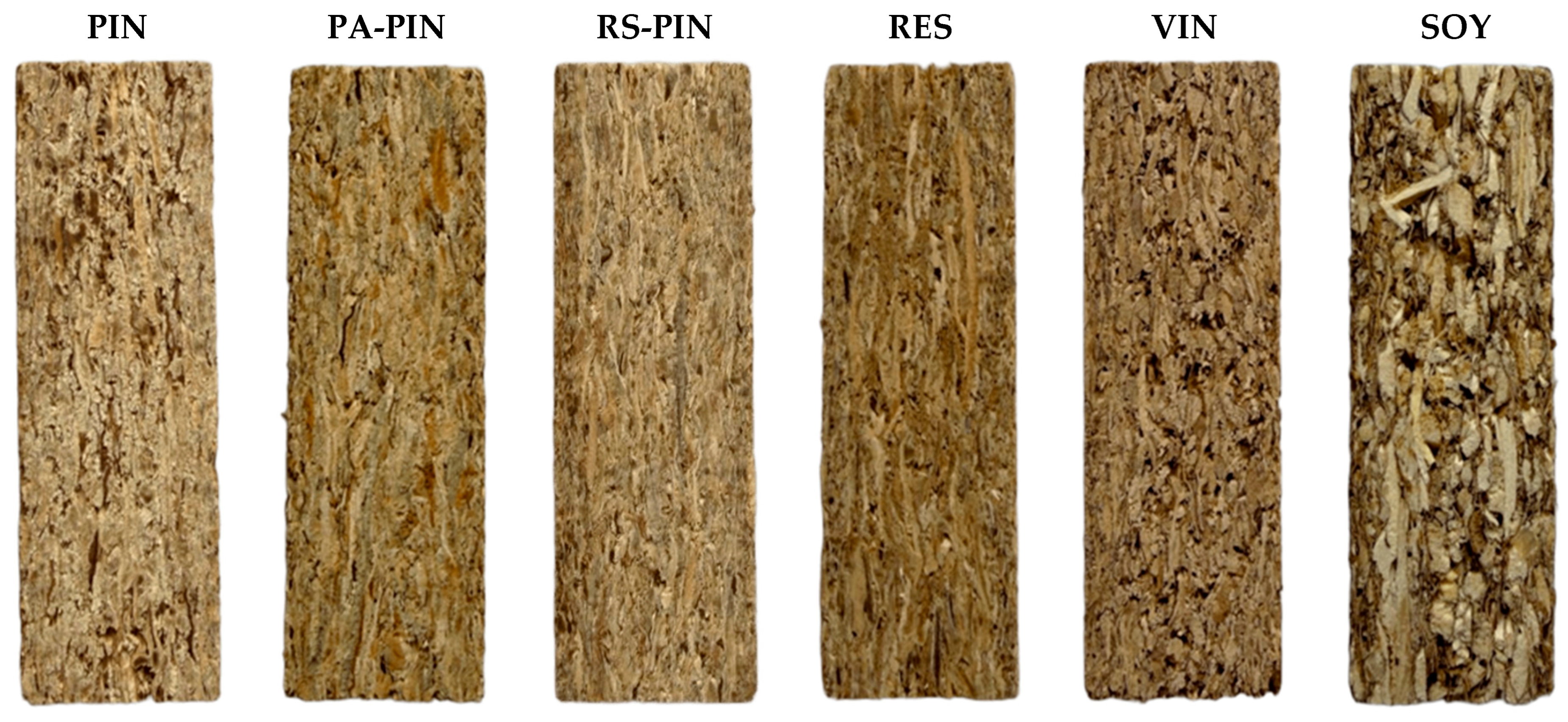
The experimental investigation was carried out on six variants of three-layer particleboards differing in raw material composition. The boards were manufactured using both conventional wood particles and alternative lignocellulosic resources derived from agricultural biomass, post-production residues, and fast-growing tree species (
Figure 1). The aim was to compare the machining behavior of conventional particleboard with boards containing alternative biomass components.
All panels were produced with a nominal thickness of 16 mm and a nominal density of approximately 670 kg·m
−3. The panel dimensions were 700 mm × 500 mm. A melamine–urea–formaldehyde (MUF) resin was used as a binder, with a melamine content of 4% (Swiss Krono, Żary, Poland). According to previous material characterization, the manufactured boards met the minimum requirements of EN 312:2010 [
22] for P2 particleboards intended for interior applications under dry conditions. Measurements of the density of the particleboard were also carried out in accordance with the EN 323:1993 standard [
23].
Six board variants were investigated:
PIN—particleboard manufactured from pine particles (Pinus sylvestris L.), used as the reference material.
PA-PIN—particleboard produced from a mixture of paulownia (Paulownia spp.) particles and pine particles in a 50:50 ratio.
RS-PIN—particleboard manufactured from a mixture of rapeseed (Brassica napus L.) stems and pine particles in a 50:50 ratio.
RES—particleboard manufactured from post-production residues originating from machining of plywood, particleboard, HDF, and glued hardwood components.
VIN—particleboard produced from grapevine (Vitis vinifera L.) pruning residues.
SOY—particleboard manufactured from soybean (Glycine max L.) stems, representing post-harvest agricultural residues.
These materials represent different categories of lignocellulosic biomass, including conventional wood resources, agricultural residues, industrial by-products, and biomass derived from fast-growing tree species. This selection enabled the evaluation of the machinability of particleboards produced from alternative raw materials.
Prior to machining, the panels were conditioned under conditions corresponding to a relative humidity of 65% and a temperature of 20 °C to ensure stable moisture content. The basic physical characteristics of the boards are summarized in
Table 1.
2.2. CNC Machining Setup
Machining experiments were performed on a five-axis CNC machining center Morbidelli m100 (SCM Group, Rimini, Italy). Test specimens were rigidly fixed on the machine table to ensure stable cutting conditions and minimize vibration.
Straight milling passes were performed along the board edge to simulate industrial machining conditions typical for furniture component processing. The tool path and machining parameters were kept constant for all experiments except for the selected experimental variables.
2.3. Cutting Tool and Cutting Conditions
Edge milling was performed using a solid milling cutter with a diameter of 16 mm equipped with a single replaceable cutting insert (one cutting edge). The cutting tool is shown in
Figure 2. To eliminate the influence of tool wear, a new cutting insert was used for each experimental series.
All experiments were carried out at a constant spindle speed of: n = 18,000 min−1. The main variable cutting parameter was feed per tooth (fz), applied at three levels:
Additionally, two milling strategies were tested:
climb milling;
conventional milling.
The milling cutter passed through the full thickness of the panel (16 mm), corresponding to an axial depth of cut a
p = 16 mm. The radial depth of cut was kept constant at a
e = 2 mm. The axial and radial depths of cut were kept constant throughout the experiments to isolate the influence of feed per tooth and milling strategy (
Table 2).
2.4. Surface Quality Evaluation
2.4.1. Measurement System
Surface quality was evaluated using a non-contact 3D optical profilometer (VR-6000 series, Keyence, Osaka, Japan). The system enables high-resolution optical scanning and three-dimensional reconstruction of the measured surface without physical contact with the specimen. Before each measurement session, the instrument was calibrated according to the manufacturer’s recommended procedure. The measurement setup and sample positioning are presented in
Figure 3.
2.4.2. Measurement Strategy
Surface evaluation was performed on the milled edge of the specimens. To ensure consistent measurements and eliminate transient effects associated with tool engagement and tool exit, which are characterized by unstable cutting conditions and non-representative surface formation, the measurement region was defined according to the following protocol:
the initial (entry) and final (exit) sections of the milled edge, each with a length of 75 mm, were excluded from evaluation,
the measurement area was defined in the central part of the milled edge,
three regions of interest (ROI) were selected within this central region,
each ROI had dimensions of 20 mm (length) × 12 mm (height),
the ROIs were spaced at 30 mm from each other,
all ROIs were oriented along the feed direction,
the same measurement protocol was applied to all specimens.
For each specimen, three independent measurement areas (ROI 1–ROI 3) were evaluated along the machined edge (
Figure 4). The initial (entry) and final (exit) sections of the tool path (75 mm each) were excluded from evaluation. Surface measurements were performed in the central part of the edge using three regions of interest (ROI 1–ROI 3), each with dimensions of 20 × 12 mm and spaced 30 mm apart, aligned with the feed direction. The same profile spacing and ROI dimensions were maintained for all samples.
2.4.3. Multiline Profile Extraction and Filtering
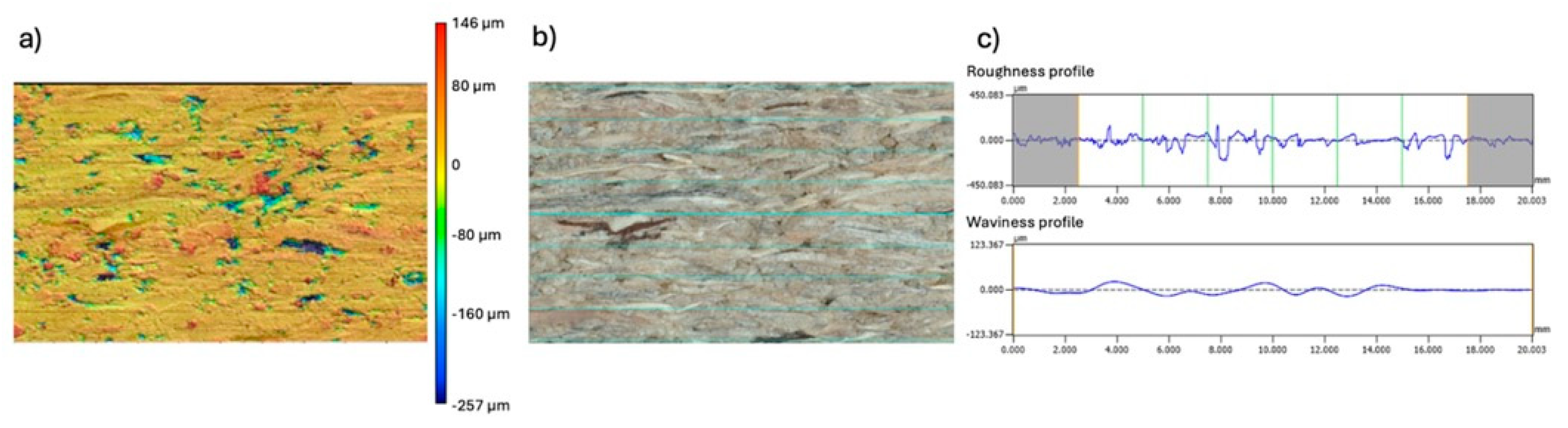
Within each region of interest (ROI), multiple parallel profiles were extracted using the multiline measurement function of the profilometer. The profiles were oriented along the feed direction.
For each measurement area, one central profile was defined, and four additional parallel profiles were extracted on each side of the central line, resulting in a total of nine evaluated profiles per ROI (
Figure 5b). Surface profiles were filtered using a Gaussian filter with a cut-off wavelength of λ
c = 2.5 mm to separate roughness and waviness components. The evaluation length of 20 mm ensured a sufficient number of sampling lengths for reliable parameter estimation. Prior to filtering, form removal (levelling) was applied to eliminate the global tilt of the measured surface. The complete process of surface topography analysis, from 3D mapping to profile separation, is shown in
Figure 5.
2.4.4. Evaluated Surface Parameters
Surface quality was evaluated at two scales of surface irregularities.
Roughness parameters
Waviness parameters
While roughness parameters describe the fine-scale surface texture, waviness parameters reflect larger-scale irregularities associated with process stability and structural homogeneity of the material.
2.5. Statistical Analysis
The measured data were statistically evaluated using Microsoft Excel (Microsoft Corp., Redmond, WA, USA). For each machining condition (material × feed per tooth × milling strategy), mean values and standard deviations were calculated.
The statistical analysis included:
one-way ANOVA to evaluate the influence of feed per tooth on surface quality parameters;
two-way ANOVA to evaluate the effect of material type and milling strategy, including their interaction.
When statistically significant differences were detected, post hoc comparisons were performed using the Scheffé test. A significance level of α = 0.05 was adopted for all statistical analyses.
In addition, surface heterogeneity was evaluated using the coefficient of variation of roughness (CVRa), calculated as the ratio of the standard deviation to the mean roughness value (CVRa = SD/Ra) for each machining condition.
3. Results
3.1. Effect of Feed per Tooth on Surface Roughness
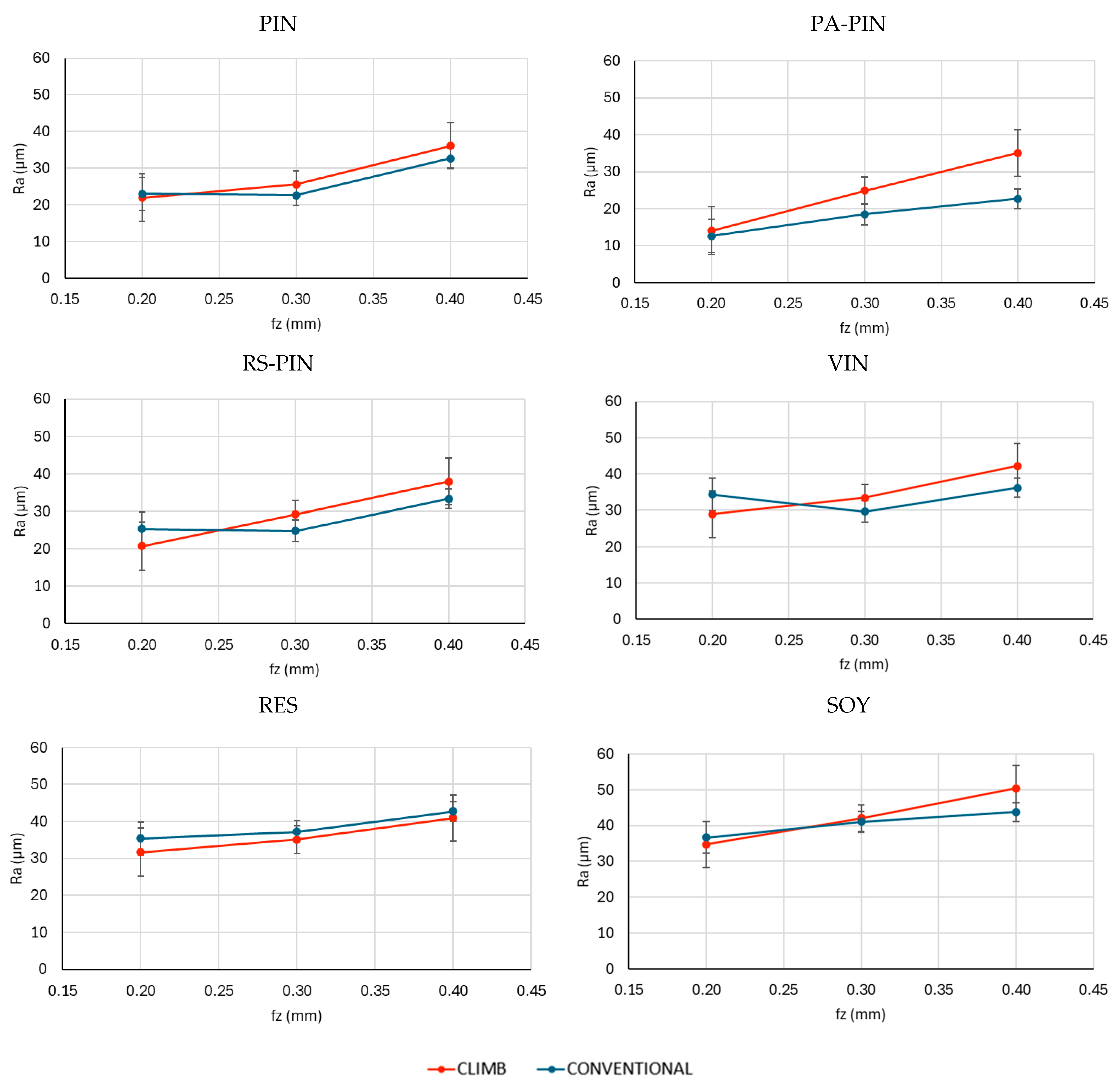
The effect of feed per tooth on surface roughness was evaluated for all tested materials and both milling strategies. As shown in
Figure 6, the roughness parameter R
a generally increased with increasing feed per tooth. The lowest R
a values were observed at a feed per tooth of 0.2 mm, while the highest values occurred at the feed per tooth of 0.4 mm for all investigated materials. Increasing feed per tooth from 0.2 mm to 0.4 mm increased the surface roughness by approximately 30%–70%, depending on the material and milling strategy, confirming the strong influence of feed on surface formation.
Although an increasing trend was observed for both milling strategies, the magnitude of the roughness increase differed among individual materials. In most cases, climb milling resulted in slightly higher Ra values compared with conventional milling, particularly at higher feed levels. However, the overall shape of the roughness–feed relationship remained similar for both strategies.
The largest increase in roughness with increasing feed was observed for materials PA-PIN and SOY, whereas the change was less pronounced for RES and PIN. Despite these differences, all materials exhibited a comparable general trend of increasing surface roughness with increasing feed per tooth.
One-way ANOVA confirmed a statistically significant effect of feed per tooth on surface roughness for both milling strategies (
Table 3). The effect was statistically significant for climb milling (
p < 0.001), while for conventional milling, the effect was weaker but still statistically significant (
p = 0.033).
Post hoc comparisons using the Scheffé test indicated that for climb milling, the most pronounced differences occurred between a feed per tooth of 0.3 and 0.4 mm as well as between 0.2 and 0.4 mm. For conventional milling, a significant difference was observed only between the lowest and highest feed levels (0.2 and 0.4 mm).
3.2. Effect of Feed per Tooth on Surface Waviness
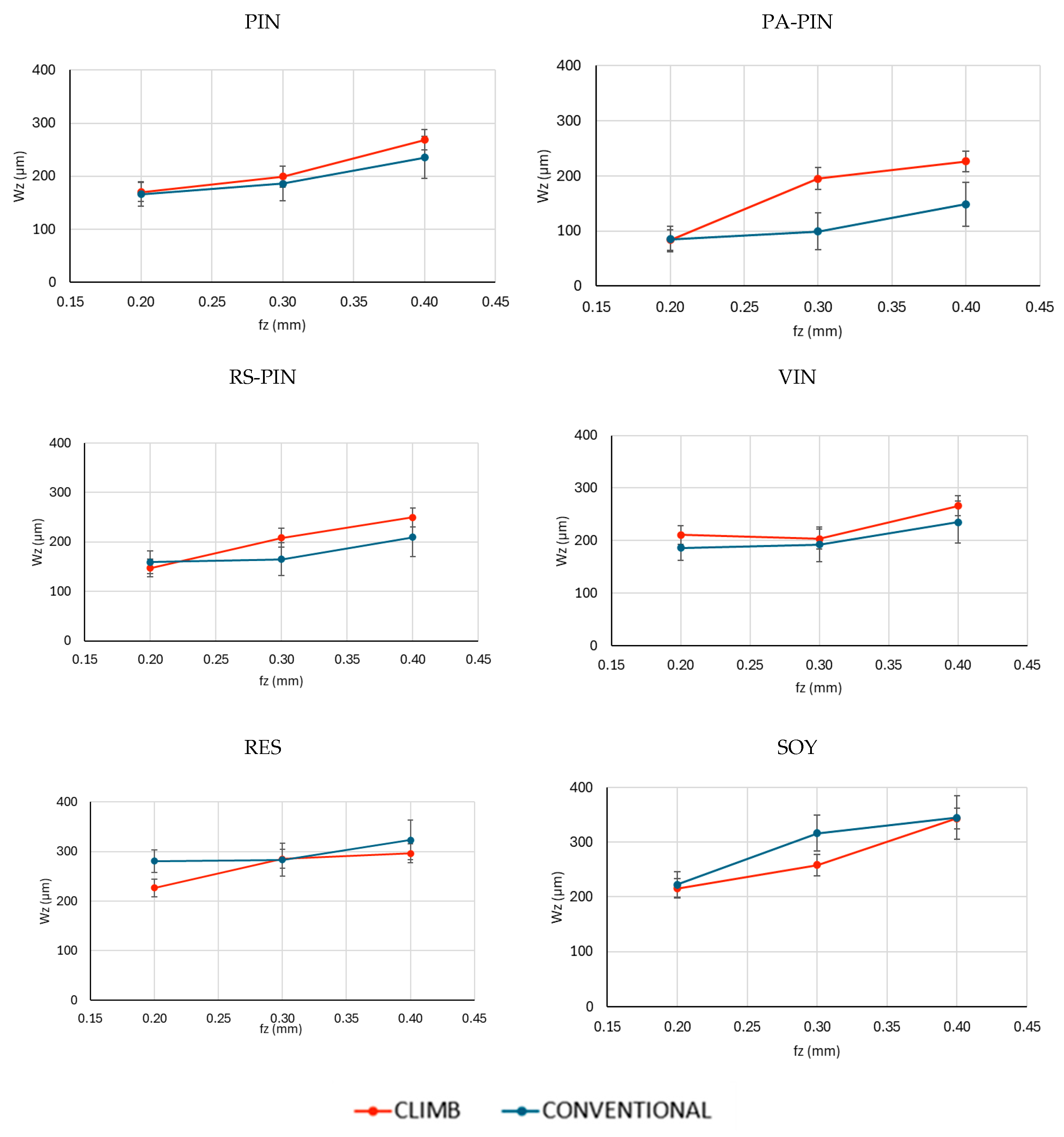
The influence of feed per tooth on surface waviness was evaluated using the W
z parameter for all tested materials and both milling strategies (
Figure 7). In general, W
z tended to increase with increasing feed per tooth, although the trend was less consistent than in the case of surface roughness R
a. The increase in feed per tooth from 0.2 mm to 0.4 mm led to an increase in waviness values of approximately 25%–60% for most materials, although the magnitude of this effect varied depending on the material structure and milling strategy.
A pronounced increase in waviness with increasing feed was observed for several materials, particularly PIN, PA-PIN, RS-PIN, and SOY. For these materials, the highest Wz values were generally recorded at the feed per tooth of 0.4 mm. In contrast, the response of the RES material to increasing feed was less pronounced. Differences between milling strategies were material dependent. In several cases, climb milling produced higher Wz values than conventional milling, particularly at higher feed levels.
One-way ANOVA confirmed a statistically significant effect of feed per tooth on surface waviness for climb milling (
p < 0.001), whereas for conventional milling, the effect was not statistically significant (
p = 0.065) (
Table 4).
Post hoc comparisons using the Scheffé test indicated significant differences between all feed levels for climb milling.
To facilitate a comparison of surface quality among the investigated materials, the average values of the evaluated surface parameters for both milling strategies are summarized in
Table 5.
3.3. Influence of Material Type and Milling Strategy
As shown in
Table 5, noticeable differences in surface roughness could be observed among the investigated materials. These differences were statistically evaluated using two-way analysis of variance (
Table 6). The results showed that the type of material had a statistically significant effect on surface roughness (
p < 0.001).
Noticeable differences in surface quality were observed among the investigated materials. The lowest roughness values were obtained for PA-PIN, while the highest values were observed for the SOY and RES materials, indicating a strong influence of material structure on the resulting surface quality.
In contrast, the milling strategy itself did not have a statistically significant influence on Ra (p = 0.367). Similarly, the interaction between material type and milling strategy was not statistically significant (p = 0.895).
These results suggest that under the tested conditions, surface roughness is more strongly influenced by material structure rather than by the choice of milling strategy.
The absence of a statistically significant effect of feed per tooth on Wz in conventional milling may be related to the nature of the waviness parameter, which reflects larger-scale surface irregularities influenced by material structure.
3.4. Surface Heterogeneity of Machined Edges
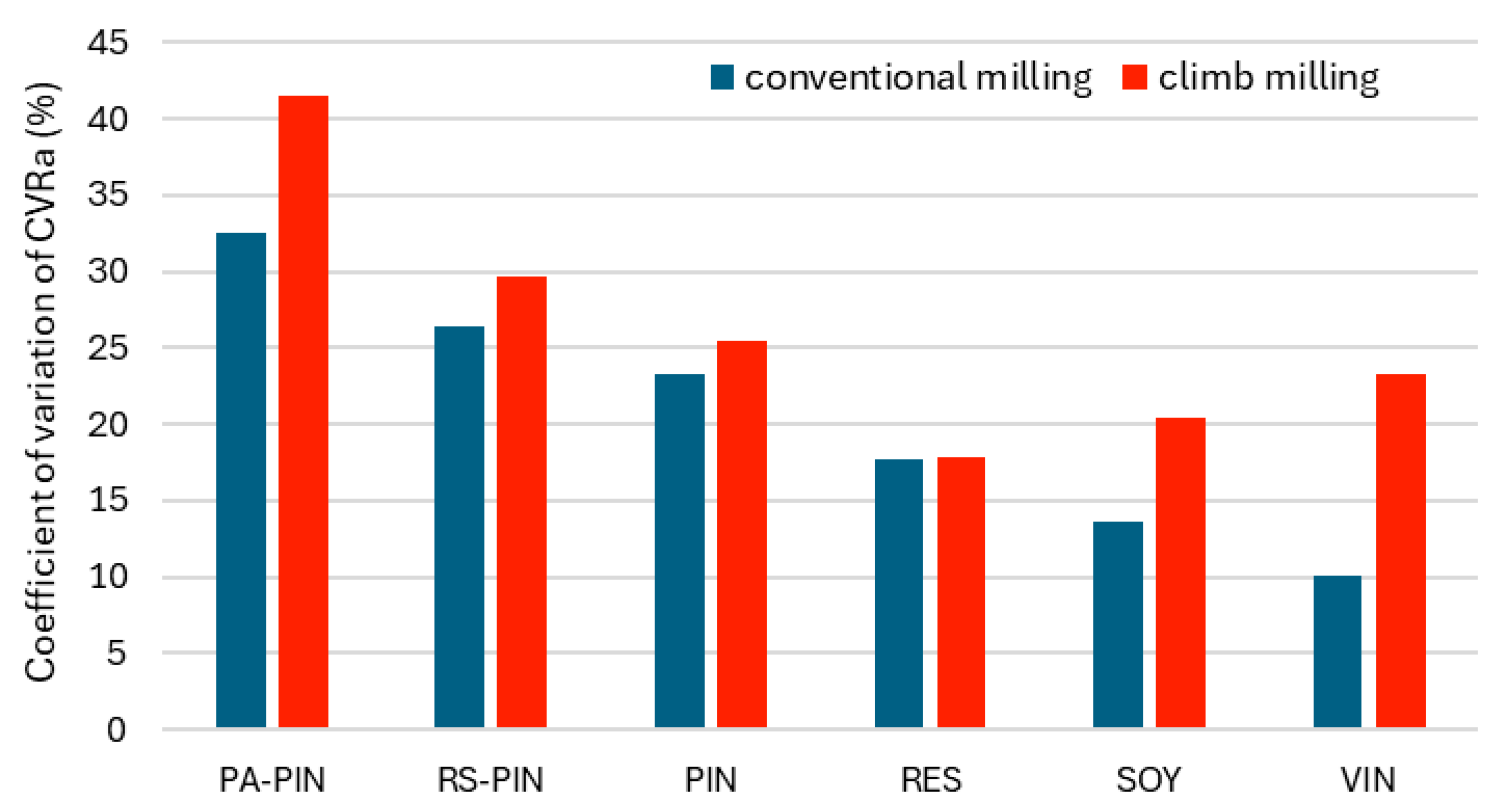
Surface heterogeneity of the machined edges was evaluated using the coefficient of variation of surface roughness (CVR
a). The obtained values varied considerably among the tested materials (
Figure 8). CVR
a values were evaluated descriptively, as they represent a derived variability indicator used for subsequent correlation analysis.
The highest surface heterogeneity was observed for the PA-PIN material, followed by RS-PIN and PIN. In contrast, the lowest CVRa values were recorded for VIN and SOY, indicating a more uniform surface formation during the milling process.
Although slightly higher CVRa values were observed for climb milling, these differences were not statistically significant and should therefore be interpreted with caution. The observed variation is likely related to inherent variability in the material rather than a systematic effect of the milling strategy. However, the overall ranking of materials remained similar for both milling strategies. The variability of the machined surface is largely determined by material structure rather than by the milling strategy.
3.5. Roughness Sensitivity to Feed
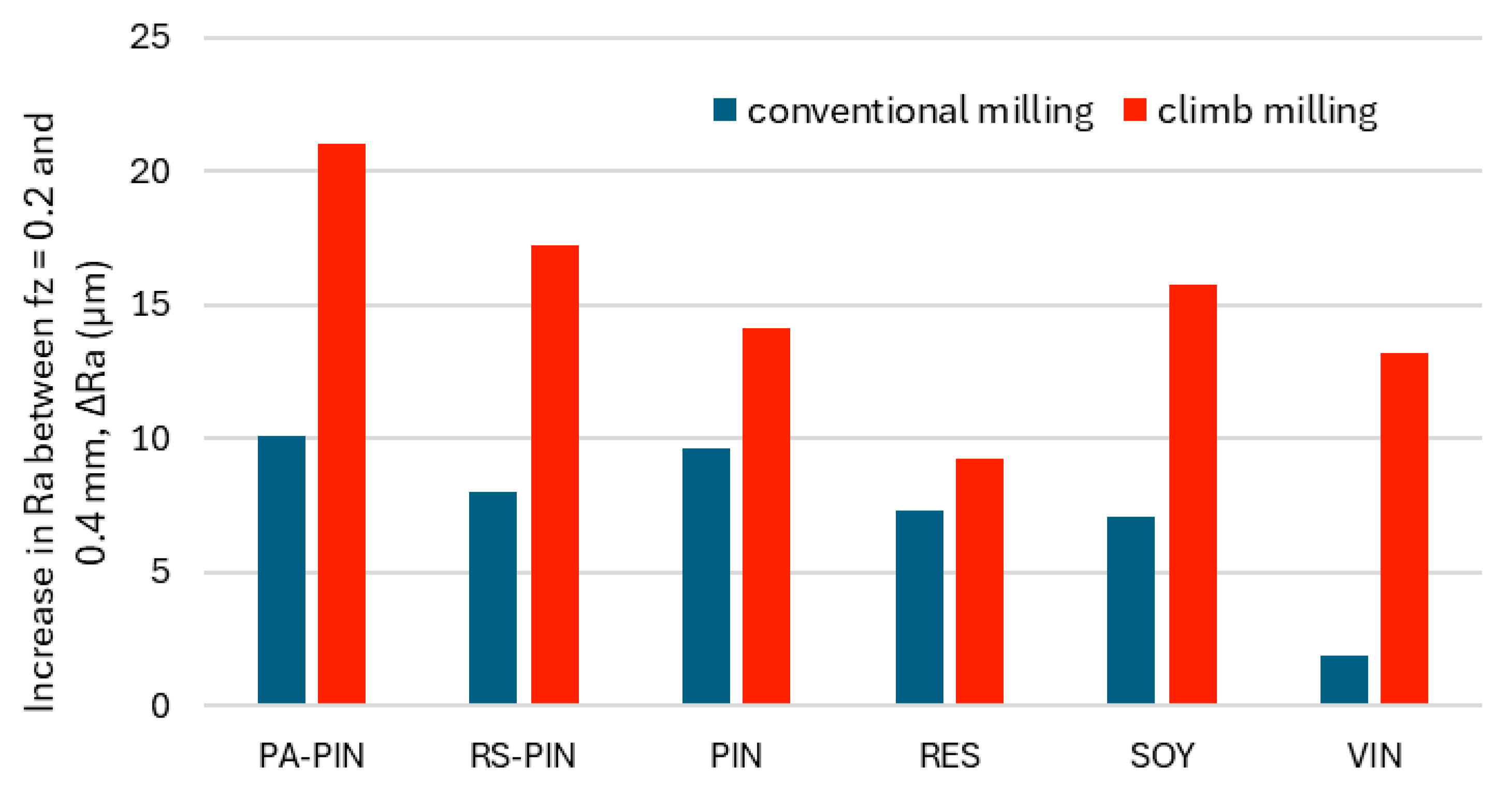
To quantify the sensitivity of surface roughness to changes in feed per tooth, the parameter ΔR
a was calculated as the difference between R
a values obtained at feeds of 0.4 mm and 0.2 mm (
Figure 9). For materials with the highest feed sensitivity, particularly PA-PIN and RS-PIN, the increase in R
a between feeds of 0.2 mm and 0.4 mm exceeded 60%, whereas the RES material showed an increase of less than 25%, indicating a considerably more stable surface formation during machining.
Considerable differences in ΔRa were observed among the tested materials. The highest roughness sensitivity to feed was found for PA-PIN and RS-PIN, particularly under climb milling. In contrast, the RES material exhibited the lowest ΔRa values, indicating a relatively weak response of surface roughness to increasing feed. For most materials, ΔRa values were higher for climb milling than for conventional milling, suggesting a tendency toward a stronger dependence of surface roughness on feed under this machining strategy, although this effect was not statistically significant.
These results indicate that the response of surface roughness to increasing feed varies significantly among materials, reflecting differences in their structural characteristics.
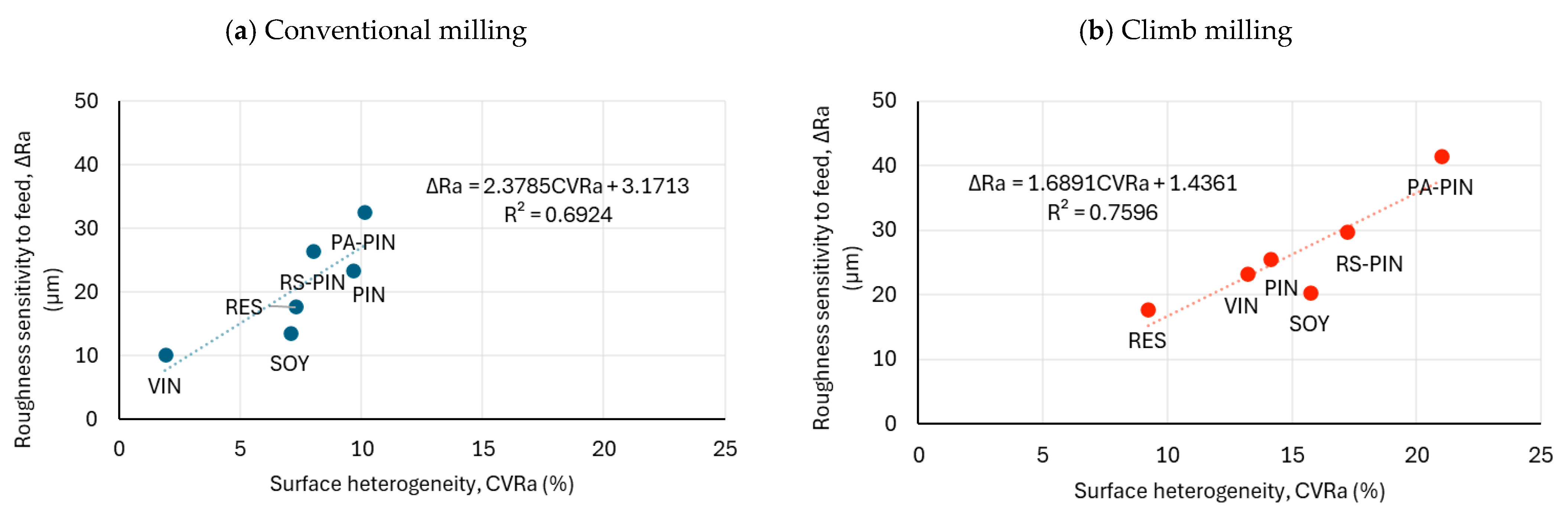
3.6. Relationship Between Surface Heterogeneity and Roughness Sensitivity
The relationship between surface heterogeneity and the sensitivity of surface roughness to feed was analyzed by comparing the coefficient of variation of roughness (CVR
a) with the roughness increase parameter ΔR
a (
Figure 10).
Linear regression analysis revealed a statistically significant positive relationship between surface heterogeneity (CVRa) and roughness sensitivity to feed (ΔRa) for both milling strategies. The relationship was stronger for climb milling (R2 = 0.76, p = 0.017) than for conventional milling (R2 = 0.69, p = 0.040). Materials with higher surface heterogeneity exhibited a greater increase in surface roughness with increasing feed per tooth. This trend was particularly evident for PA-PIN and RS-PIN, which showed the highest CVRa values and the largest increases in roughness.
4. Discussion
The results of the present study show that surface quality after CNC edge milling of wood-based panels is influenced by both machining parameters and material characteristics, particularly feed per tooth and material structure. This finding aligns with previous studies demonstrating that surface roughness in wood machining is governed by the combined effects of cutting parameters, tool characteristics, and material properties [
24,
25,
26].
4.1. Influence of Feed per Tooth on Surface Quality
The increase in surface roughness with increasing feed per tooth observed in this study is consistent with findings reported in numerous studies on milling wood-based materials. Feed rate is widely considered one of the most influential parameters affecting surface roughness during the CNC machining of MDF and particleboard [
7,
27,
28,
29].
From a process mechanics perspective, increasing feed per tooth leads to greater uncut chip thickness and higher cutting loads acting on the material. This results in more pronounced deformation and fracture processes in the cutting zone and consequently higher surface roughness values, as also observed in previous studies [
27,
30,
31].
Higher feed rates additionally reduce the number of cutting engagements per unit length, which leads to larger scallops left by the cutting edge and increases the probability of fiber tearing or particle breakout [
7,
28]. Mechanistically, chip formation in wood is governed not only by shearing but also by fracture processes, including crack initiation and propagation [
18,
19]. As chip thickness increases, the cutting process becomes less stable and shifts toward fracture-dominated material removal. This results in fiber pull-out, tearing, and increased surface roughness, as also reported in previous studies [
10,
20]. In addition, higher feed per tooth produces deeper tool marks and more intensive material separation, further contributing to increased surface roughness [
16,
17].
The weaker and less consistent response of Wz compared with Ra suggests that waviness is influenced not only by cutting kinematics but also by larger-scale structural features of the material, such as the typical density profile of particleboards, characterized by denser surface layers and a less dense core. The weaker response of waviness may also be influenced by the selected cut-off wavelength, which determines the separation between roughness and waviness and may include structural features of the material within the waviness profile.
It should be noted that amplitude parameters such as Ra and Rz capture not only surface irregularities generated by the cutting process but also the structural features of particleboards, particularly pores and inter-particle voids. As a result, the evaluated roughness values represent a combined effect of machining conditions and material structure, which may partially mask subtle differences related to machining parameters, such as milling strategy.
In addition, the selected cutting conditions, including the high cutting speed and the use of a single-edge tool, promote relatively stable cutting conditions, which can reduce differences between climb and conventional milling. Furthermore, the fracture-dominated behavior of particleboard materials limits the influence of cutting direction, as material removal is governed more by internal structural failure than by chip formation kinematics. Finally, the relatively small range of feed per tooth and the resulting low chip thickness may further reduce the sensitivity of the process to changes in cutting direction.
4.2. Influence of Material Structure on Surface Roughness
The statistical analysis showed that material type had a significant influence on surface roughness, while the milling strategy did not significantly affect the Ra parameter, suggesting that material structure plays a dominant role under the tested conditions.
Wood-based panels are heterogeneous composites consisting of particles or fibers bonded by adhesive systems, which lead to local variations in chip formation behavior during machining. These differences can also be related to the microstructural characteristics of lignocellulosic materials, such as porosity and cell wall organization, which influence fracture behavior during machining. Consequently, surface roughness depends strongly on internal structure, including particle size distribution, density profile, and bonding quality [
26,
32].
Previous studies have demonstrated that fiber-based panels such as MDF generally produce smoother surfaces due to their relatively homogeneous structure, whereas particle-based materials tend to exhibit higher surface roughness due to coarse particles and density gradients [
25,
31,
33].
Similar differences among wood-based panels were also reported in [
34], who demonstrated systematic differences in surface roughness among various wood-based panels used in furniture manufacturing.
At the process level, the interaction between the cutting edge and heterogeneous structures leads to irregular fracture processes such as particle pull-out, fiber tearing, and fragmentation, which increase surface roughness and variability [
35,
36]. This behavior is closely related to unstable chip formation, where discontinuous or fragmented chips are produced [
18,
21].
The incorporation of recycled material further enhances this effect by introducing degraded particles, contaminants, and weaker inter-particle bonding, which facilitate particle detachment during machining. This has been linked to reduced internal bond strength and material cohesion in recycled panels [
13,
14].
The differences observed among the investigated boards can be explained by their specific structural characteristics, particularly the typical density profile of particleboards, characterized by denser surface layers and a less dense core. During edge milling, these differences influence chip formation processes, where denser regions tend to produce more compact surfaces with fewer depressions, while less dense regions are more prone to particle pull-out and the formation of deeper surface irregularities. The RES boards exhibited a relatively stable machining response, which may be attributed to the presence of previously densified and bonded wood structures. In contrast, boards containing agricultural biomass showed less stable behavior.
The SOY boards exhibited relatively high roughness but low surface heterogeneity, suggesting a uniform but rough surface morphology. In contrast, PA-PIN boards exhibited high surface heterogeneity (CVRa) and strong sensitivity to feed, likely due to the combination of low-density paulownia and denser pine particles. A similar effect was observed in RS-PIN boards, where porous rapeseed structures contributed to irregular fracture processes and increased the sensitivity to machining conditions.
From a material perspective, the observed differences can also be interpreted in relation to the structural and compositional characteristics of lignocellulosic constituents. The fracture behavior of such materials is governed by their heterogeneous microstructure, including particle bonding, porosity, and cell wall organization, which influence crack initiation and propagation during machining [
18,
19,
26].
Materials containing agricultural residues typically exhibit higher porosity and lower structural integrity compared to conventional wood particles, which promotes particle pull-out and irregular fracture. In contrast, more compact wood-based particles tend to form more stable chips and smoother surfaces. Therefore, the variability in surface formation can be linked not only to macroscopic density differences but also to microstructural features influencing fracture behavior during machining.
4.3. Surface Heterogeneity and Sensitivity to Machining Parameters
Linear regression analysis revealed a statistically significant positive relationship between surface heterogeneity (CVRa) and roughness sensitivity to feed (ΔRa) for both milling strategies, with a stronger dependence observed for climb milling (R2 = 0.76, p = 0.017) compared with conventional milling (R2 = 0.69, p = 0.040). The positive slope of the regression models indicates that materials with higher surface heterogeneity (CVRa) tend to show a greater increase in roughness with increasing feed per tooth.
From a mechanistic perspective, this behavior can be explained by the instability of chip formation in heterogeneous materials. Local variations in density, particle geometry and bonding quality lead to fluctuating cutting conditions and irregular crack propagation. As feed per tooth increases, the uncut chip thickness becomes larger, and the cutting process shifts toward a more fracture-dominated regime. In such conditions, structurally weak zones are more prone to particle pull-out, fiber tearing, and local material failure, which results in a disproportionate increase in surface roughness.
The stronger relationship observed for climb milling suggests that this machining strategy amplifies the influence of material structure on surface formation. This may be related to the cutting kinematics, where the chip thickness decreases along the cutting-edge engagement, leading to a more pronounced interaction between the tool and the local structural heterogeneities of the material.
Although the number of tested materials was limited, the observed relationships indicate that surface heterogeneity is not only a descriptor of surface variability but also a useful predictor of the sensitivity of surface quality to machining parameters. This finding highlights the importance of considering surface variability, in addition to average roughness values, when evaluating the machinability of heterogeneous wood-based materials such as lignocellulosic composite panels.
5. Conclusions
This study investigated the influence of feed per tooth and material structure on surface quality during CNC edge milling of particleboards manufactured from alternative lignocellulosic materials. The main findings can be summarized as follows:
Feed per tooth was identified as a significant factor influencing surface roughness. Increasing feed per tooth led to a consistent increase in roughness for all investigated materials, confirming its dominant role in surface formation under CNC edge milling conditions.
The type of raw material used for particleboard production had a statistically significant effect on surface roughness, whereas milling strategy did not significantly influence the Ra parameter. Considerable differences in surface heterogeneity were observed among the tested particleboards, indicating that material structure plays a key role in determining surface quality.
A statistically significant positive relationship was found between surface heterogeneity (CVRa) and roughness sensitivity to feed (ΔRa), indicating that materials with higher surface heterogeneity (CVRa) are more sensitive to changes in feed per tooth. Materials such as PA-PIN and RS-PIN exhibited the highest sensitivity and variability, whereas RES boards showed a more stable machining response.
Overall, the results demonstrate that surface quality in CNC edge milling is not governed solely by machining parameters but is strongly controlled by material structure, particularly its structural variability. This behavior is associated with fracture-dominated material removal, where local structural features influence chip formation stability and surface generation. These findings highlight the importance of accounting for material heterogeneity when optimizing machining conditions for particleboards manufactured from alternative lignocellulosic resources.
The presented results form part of a broader research framework focused on the machinability of sustainable wood-based materials, including ongoing investigations of cutting forces, dust emission, and detailed material characterization.