Article

Morphophysiological Responses of Rhizophora mangle L. Seedlings Exposed to a Glyphosate-Based Herbicide Formulation Under Controlled Experimental Conditions

by
Arlis A. Navarrete Memije
1,
Carlos A. Chan-Keb
2,*,
Roman A. Pérez-Balan
2,
Hugo López Rosas
3 and
Claudia M. Agraz-Hernández
4,*
1
Multidisciplinary Master’s Program, Coastal-Marine Zone Management, Universidad Autónoma de Campeche, Campeche 24030, Mexico
2
Faculty of Chemical-Biological Sciences, Universidad Autónoma de Campeche, Campeche 24030, Mexico
3
El Colegio de Veracruz, Academia de Desarrollo Regional Sustentable, Carrillo Puerto 26, Zona Centro, Xalapa 91000, Mexico
4
Institute of Ecology, Fisheries and Oceanography of the Gulf of Mexico (EPOMEX), Universidad Autónoma de Campeche, Campeche 24030, Mexico
*
Authors to whom correspondence should be addressed.
Forests 2026, 17(4), 509; https://doi.org/10.3390/f17040509
Submission received: 25 March 2026 / Revised: 13 April 2026 / Accepted: 17 April 2026 / Published: 20 April 2026

Abstract

Mangroves rank among the most productive ecosystems on Earth, yet they are increasingly threatened by climate change and the expansion of agricultural land use. Among agricultural pollutants reaching coastal environments, glyphosate-based herbicide formulations (GBHFs) are of particular concern owing to their widespread application and environmental persistence. This study evaluated the phytotoxic effects of a GBHF (commercial product Velfosato, 48% active ingredient) on Rhizophora mangle L. seedlings under controlled experimental conditions simulating the intertidal regime of the collection site. Propagules were collected from the Los Petenes Biosphere Reserve (Campeche, Mexico), established in experimental tanks containing mangrove soil, and grown until uniform seedling development was achieved. Once seedlings reached uniform development, they were exposed to nominal concentrations of 0.003, 0.03, 0.3, 3.0, and 10 mg L−1 of the formulation dissolved in interstitial water. The experiment followed a completely randomized design (three replicate tanks per treatment plus a triplicate control; n = 1170 seedlings total). All inferential tests used the tank as the experimental unit (n = 3 per treatment). Total chlorophyll concentration was significantly lower in treated seedlings than in the control across all tested concentrations (ANOVA F5,12 = 4.55, p = 0.015). Height growth rates were significantly reduced at concentrations ≥ 3 mg L−1 (F5,12 = 6.84, p = 0.003). Lenticel number increased significantly at the two highest concentrations (F5,24 = 3.63, p = 0.014). Mangrove soil exhibited significant increases in pH and decreases in redox potential across the concentration gradient (p < 0.001 and p = 0.001, respectively). These findings indicate that sublethal exposure to a GBHF is associated with alterations in key ecophysiological processes and soil physicochemical conditions in R. mangle seedlings under controlled conditions, highlighting the sensitivity of early developmental stages to GBHF exposure.

1. Introduction

Over the past decades, global agriculture has continuously expanded cultivated land and increased its reliance on agrochemical inputs [1]. This trend is closely linked to the intensive application of herbicides as a primary strategy for controlling weeds [2,3]. Among these compounds, glyphosate has become one of the most widely applied herbicides worldwide due to its broad-spectrum effectiveness, widespread commercial availability, relatively low cost, and high agronomic performance [4]. Glyphosate acts by inhibiting the enzyme 5-enolpyruvylshikimate-3-phosphate synthase (EPSPS), blocking the shikimate pathway and thereby preventing the synthesis of phenylalanine, tyrosine, and tryptophan—aromatic amino acids essential for protein production in plants [5,6]. Because this metabolic pathway also exists in non-target organisms, glyphosate can affect species beyond intended targets [7].
Global glyphosate use has increased by more than 1500% since 1996, driven largely by the rapid expansion of genetically modified glyphosate-tolerant crops [8]. A growing body of evidence indicates that glyphosate residues in soil can disrupt microbial communities, decrease nutrient availability, and alter biogeochemical processes, indirectly affecting the performance of non-target plant species [9,10].
In Mexico, glyphosate is commonly applied at doses between 1.5 and 4.3 kg ha−1, with the Yucatán Peninsula being one of the regions where its use is most intensive [11]. In this area, herbicide applications occur up to three times per agricultural cycle at mean rates of 2.36 L ha−1 [8]. The state of Campeche—where the present study was conducted—is characterized by intensive mechanized agriculture with recurrent herbicide applications, contributing to documented contamination of soil and both surface and groundwater [11]. During the rainy season, runoff originating from inland agricultural areas can transport dissolved agrochemical residues toward coastal zones, increasing the likelihood of exposure in adjacent ecosystems. Mangrove forests located along these coastal interfaces are particularly vulnerable, as they receive freshwater inputs from agricultural catchments that facilitate the transport of dissolved contaminants. Documented cases of glyphosate residues in terrestrial agricultural soils and in surface and groundwater systems within agricultural localities of the Yucatán Peninsula [12] underscore the spatial proximity between intensive agriculture and vulnerable coastal ecosystems.
Glyphosate-based formulations can reach adjacent ecosystems through surface runoff, leaching, and atmospheric drift [13,14,15]. In coastal environments, additional exposure pathways include groundwater discharge and tidal redistribution within estuarine systems [16]. Due to their intertidal position and hydrological connectivity, mangroves function as effective receptors of land-derived contaminants, making them especially susceptible to agricultural pollution [9,10,17].
Mangroves sustain key ecosystem services, including coastal protection, carbon sequestration, water filtration, and provision of habitat for commercially important species, all of which directly benefit human communities [18,19]. Previous studies have documented the uptake and accumulation of herbicides in mangrove tissues, including Avicennia marina (Forssk.) Vierh exposed to diuron, ametryn, and atrazine, and Rhizophora mangle L. exposed to 2,4-D, reporting reduced chlorophyll content, lower biomass, and mortality [18,19]. However, only two experimental studies have specifically addressed glyphosate effects on mangroves: one found that high concentrations (5 and 50 mg L−1) were associated with leaf vigor loss, reduced stem length, and decreased root biomass in Laguncularia racemosa (L.) C.F. Gaertn seedlings [20]; the second reported that repeated glyphosate application to R. mangle seedlings (25, 50, and 100 mg L−1) reduced height and diameter growth and decreased leaf production [21]. Importantly, these studies used concentrations substantially higher than those reported for environmental waters in agricultural regions, where glyphosate is typically detected at μg L−1 levels rather than mg L−1 concentrations [12].
Despite the growing body of evidence on glyphosate toxicity in aquatic and terrestrial plants, two critical gaps remain inadequately addressed in literature. First, the sublethal effects of environmentally realistic, low-dose GBHF exposure (i.e., at μg L−1 to low mg L−1 concentrations) on mangrove morphophysiology have not been systematically evaluated; prior experimental studies employed concentrations substantially higher than those reported in field measurements. Second, the potential interactions between GBHF exposure and soil physicochemical conditions (particularly pH and redox dynamics that govern nutrient availability and microbial activity in intertidal soils) have not been examined concurrently with plant physiological responses in mangrove systems. Addressing these two gaps is essential to understanding whether low-level contamination from agricultural runoff poses measurable risks to mangrove seedling establishment and soil functioning.
Rhizophora mangle was selected for this study because it is the dominant mangrove species at the collection site (Los Petenes Biosphere Reserve), ecologically representative of neotropical mangrove ecosystems, and occupies a key position at the interface between freshwater inputs and tidal exchange.
This study addressed three core scientific questions: (1) Does exposure to a GBHF at environmentally relevant and higher concentrations produce a dose-dependent reduction in growth rate and chlorophyll production in R. mangle seedlings (dose–response relationship)? (2) Is there a concentration threshold below which no measurable physiological effect is detectable under the tested conditions (physiological threshold)? (3) Are changes in plant physiological variables associated with concurrent alterations in soil physicochemical properties, and do soil responses co-vary with seedling stress indicators across the same concentration gradient (soil–plant interaction)? The findings provide quantitative evidence relevant to understanding the potential risks of GBHF to mangrove ecosystems.

2. Materials and Methods

2.1. Study Site and Collection Area

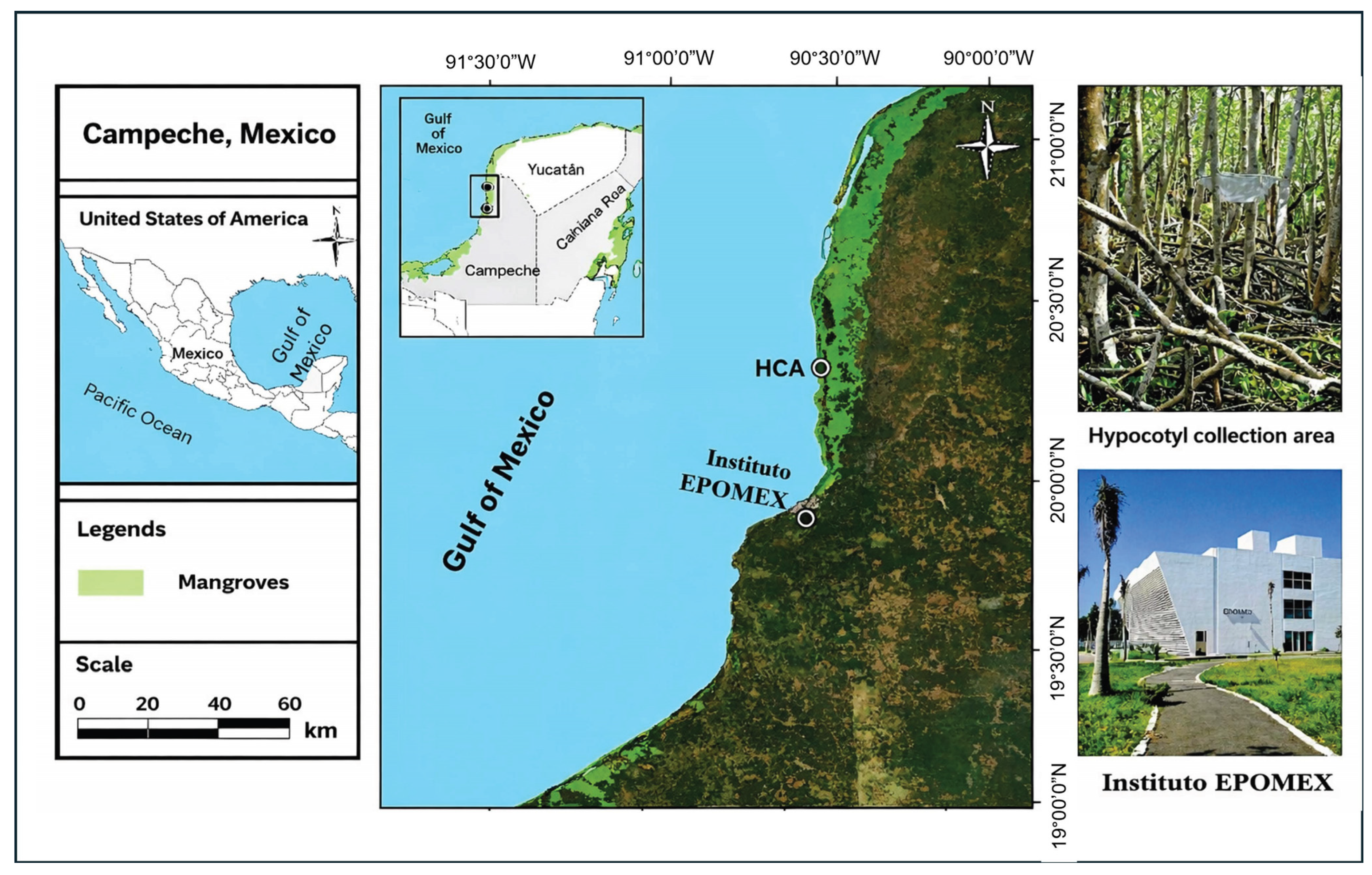
Mangrove soil and propagules were collected from a monospecific Rhizophora mangle forest within the Los Petenes Biosphere Reserve (LPBR; 20°51′30″ N, 90°20′00″ W; Figure 1), located on the northwestern coast of Campeche, Mexico. The site was selected due to its limited direct anthropogenic disturbance within the protected area boundaries [18]. The LPBR encompasses extensive mangrove formations that fringe karstic springs (Petenes) and are subject to semidiurnal microtidal regimes. These coastal mangroves receive freshwater inputs from inland karstic discharge zones, particularly during the rainy season, creating hydrological connectivity between adjacent agricultural catchments and the coastal fringe. The regional climate is warm sub-humid (Aw), with a mean annual temperature of ~26 °C and annual precipitation of ~1100 mm. Soils at the collection site are organic-rich histosols developed over calcareous substrate, with naturally alkaline pH influenced by the karstic geology. Although the LPBR itself is a protected area, its surrounding watersheds include agricultural zones where herbicide use (including glyphosate) has been documented [8,11]. The experimental nursery was located at the EPOMEX Institute, Universidad Autónoma de Campeche (Figure 1).

2.2. Soil and Propagule Collection and Transport

Mangrove soil was collected from the surface down to 40 cm depth. Soil was extracted from multiple points within the collection area and pooled to obtain a composite sample representative of site conditions. In the same area, 1500 R. mangle propagules (hypocotyls) were manually gathered from multiple trees, using gentle detachment by touch as the maturity indicator [22] (SEMARNAT/SGPA/UGA/DIRA/203/2017, File 04DF2-01382/161). Propagules were visually screened for uniformity in length (≈20–25 cm) and diameter; those showing physical damage, herbivory, or marked size deviations were excluded. Although individual fresh weight and initial length were not recorded prior to planting (a limitation acknowledged in the interpretation of growth and biomass outcomes), the selection criteria ensured comparable developmental stages, and acclimation-phase monitoring confirmed the absence of biologically meaningful differences among experimental units prior to exposure (see Section 3.1). From the total collected material, 1170 propagules meeting the selection criteria were established (65 per tank).

2.3. Experimental Design and Phases

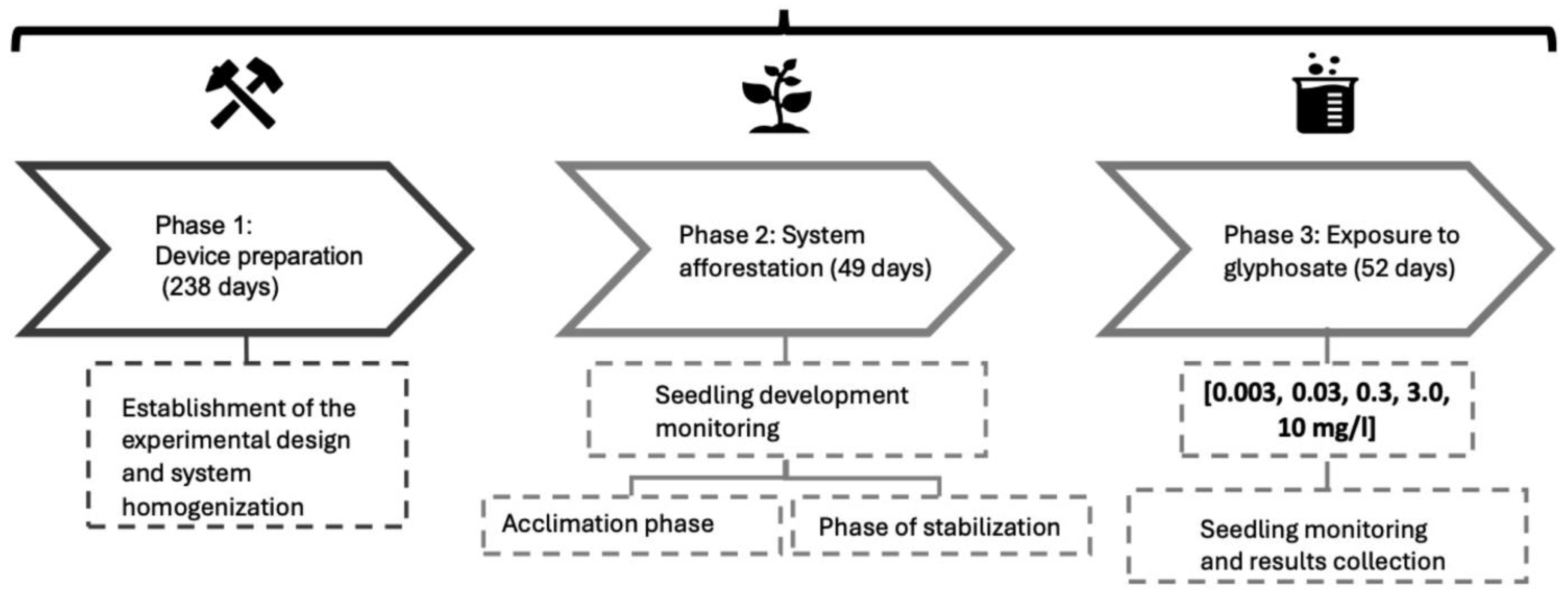
The experiment comprised three sequential phases (Figure 2) conducted inside an experimental nursery (51.7 m2, 2 m height). A total of 24 Rotoplas® tanks (450 L each, low-density linear polyethylene; Grupo Rotoplas S.A.B. de C.V., Mexico City, Mexico) were used: 18 as experimental units and six as storage tanks for mangrove water adjusted to 20 ± 2 PSU. Each tank was considered an independent experimental unit throughout the study.
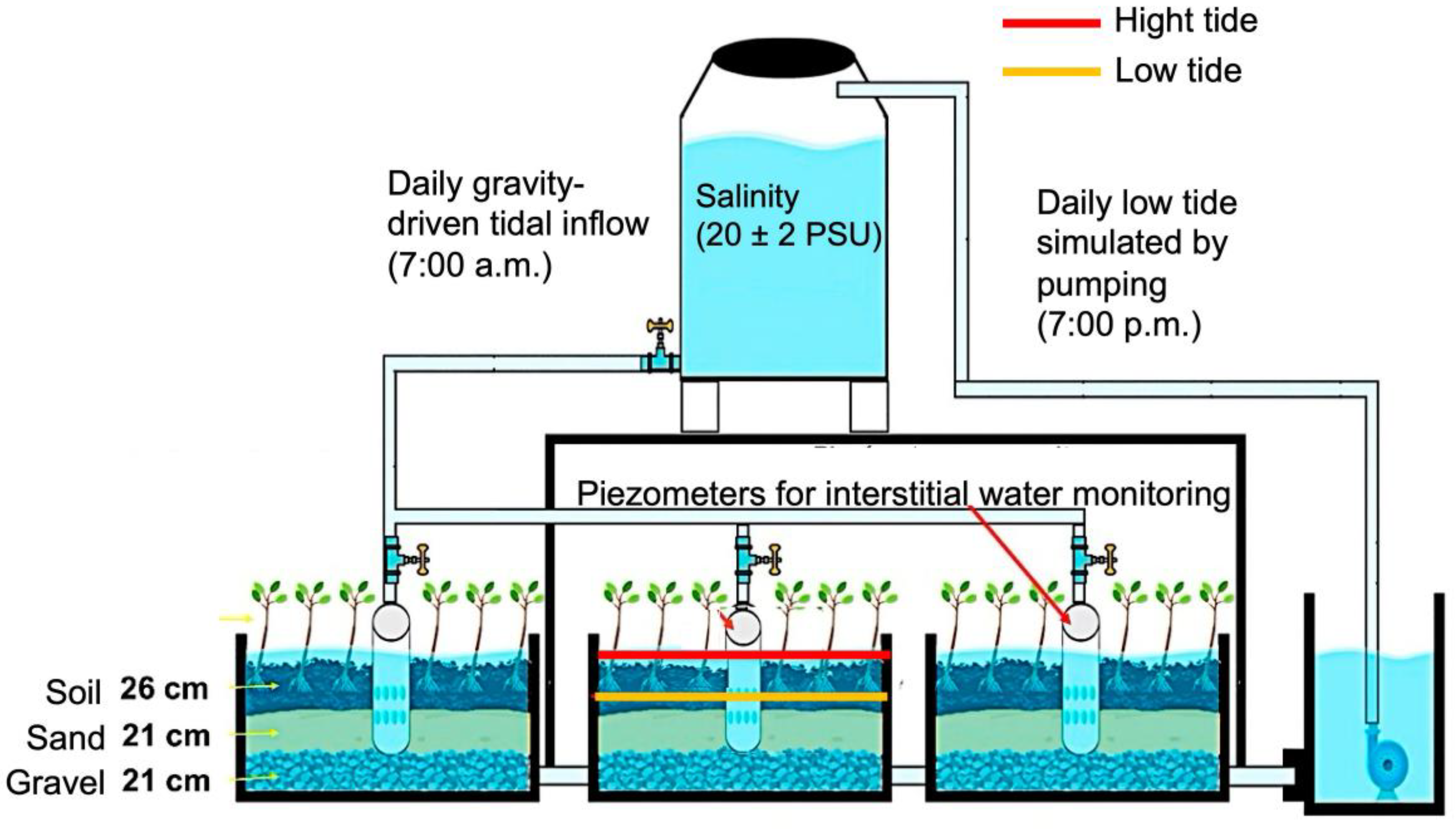
Each tank was equipped with an independent hydraulic system reproducing the local tidal regime, with high tide simulated by gravity flow (7:00 a.m.) and low tide by pumping (7:00 p.m.), producing a flooding cycle of ~12 h with water depth reaching ~5 cm above the soil surface at high tide (Figure 3). After 12 h, water was drained below the soil surface, thereby completing the tidal cycle and simulating natural intertidal fluctuations. This tidal simulation operated as a closed recirculating system within each tank, ensuring that the total water volume—and therefore the nominal herbicide concentration—remained constant throughout the exposure period. No external water exchange occurred between tanks, preventing cross-contamination or dilution among treatments. A shade mesh (30% light attenuation) maintained a mean temperature at 26.4 ± 0.4 °C and light intensity at 7172.5 ± 30.3 lux.
Phase 1 (238 days): Device preparation and system homogenization. Biological filters were built in each tank, arranged from bottom to top as gravel (21 cm), sand-and-gravel (21 cm), and mangrove soil (26 cm). Site leveling, flooding frequency, water salinity (20 ± 2 PSU), and redox potential (−195.9 ± 84 mV) were calibrated to reproduce the physicochemical conditions of the source forest [18]. Interstitial-water and soil parameters were monitored until uniform conditions were achieved.
Phase 2 (49 days): Acclimation and establishment. In each tank, 65 propagules were planted 8 cm apart at approximately 3 cm depth. After the first leaf pair emerged, monitoring of total chlorophyll (μmol m−2), Fv/Fm, and height growth rate was initiated and continued until homogeneous conditions were verified across all tanks. Statistical analyses confirmed no biologically meaningful differences among tanks for any biological variable (total chlorophyll: F = 0.22, p = 1.000; Fv/Fm: H = 4.33, p = 0.999; height growth rate: F = 0.43, p = 0.975; all p >> 0.05), zero mortality, and uniform seedling development prior to GBHF exposure (see Section 3.1).
Phase 3 (52 days): Exposure to a GBHF. The commercial formulation Velfosato (48% active ingredient, 480 g isopropylamine salt L−1 at 20 °C) was used. The 18 experimental tanks were randomly assigned to six treatment groups (three tanks per group) using a completely randomized design: five nominal GBHF concentrations (0.003, 0.03, 0.3, 3.0, and 10 mg L−1) and one control (without herbicide). Treatment concentrations were established using the standard dilution equation (C1V1 = C2V2) adjusted to the tank volume (450 L). The lowest concentrations (0.003–0.3 mg L−1) were selected to represent environmentally reported levels documented in water bodies adjacent to agricultural areas in the Yucatán Peninsula [12], while the higher concentrations (3.0 and 10 mg L−1) were based on values reported for Laguncularia racemosa experiments [20], scaled downward to explore sublethal thresholds.
The commercial formulation used contains adjuvants (surfactants and other inert ingredients) in addition to the active ingredient. No adjuvant-only control was included; therefore, the observed responses reflect the combined effect of the active ingredient and co-formulants. The relative contribution of individual co-formulants cannot be experimentally separated within this design, which is acknowledged as a limitation of the study (see Section 4.7).

Herbicide Preparation and Addition

The commercial formulation Velfosato (48% active ingredient, 480 g isopropylamine salt L−1 at 20 °C) was stored in its original sealed container at room temperature (20–25 °C), protected from direct light and heat sources, following manufacturer specifications, until use. No separate stock solution or mother liquor was prepared. Treatment concentrations were established by pipetting calculated volumes of the commercial formulation directly into each tank at the water intake point at the beginning of the first high-tide cycle of Phase 3 to ensure uniform distribution within the recirculating water volume. Required volumes per tank were calculated using the standard dilution equation (C1V1 = C2V2), where C1 = 480,000 mg L−1 (the concentration of the active ingredient in the commercial formulation expressed in mg L−1), V2 = 450 L (nominal water volume per tank), and C2 = the target nominal concentration. The resulting addition volumes were: 0.003 mg L−1 → 2.8 μL; 0.03 mg L−1 → 28.1 μL; 0.3 mg L−1 → 281.3 μL; 3.0 mg L−1 → 2.8 mL; 10 mg L−1 → 9.4 mL per tank. Pipetting of volumes < 100 μL was performed using a calibrated micropipette (10–100 μL range). No additional herbicide was added during the 52-day exposure period, consistent with the closed-loop recirculating design.

2.4. Monitoring of Physicochemical and Biological Variables

Physicochemistry of interstitial water and mangrove soil. Parameters (pH, salinity, redox potential, temperature) were measured weekly during low tide using a calibrated HACH Sension+ MM150 multiparameter instrument (Hach Company, Loveland, CO, USA) and an ATAGO refractometer (0–100 PSU) manufactured by ATAGO Co., Ltd., Tokyo, Japan. Measurements were conducted consistently throughout the experimental phases to ensure comparability among tanks.
Height growth rate. Growth monitoring began once the first leaf level appeared during Phase 2. Twelve seedlings per tank were randomly selected and tagged; measurements were taken weekly using a vernier caliper (0–150 mm, Truper (Mexico City, Mexico)). Growth rate per tank was estimated by linear regression of cumulative height on time (slope = cm d−1), following [23].
Chlorophyll fluorescence (Fv/Fm). Seedling stress was evaluated using maximum chlorophyll fluorescence, measured with an OS30p+ fluorometer (Opti-Sciences (Hudson, NH, USA)). Measurements began during Phase 2 and continued throughout Phase 3. The instrument provides direct Fv/Fm readings within a detection interval of 0.1–1.5 s. Values below 0.75 are commonly interpreted as indicative of photosystem II impairment [24].
Total chlorophyll concentration. Total chlorophyll concentration was monitored during Phase 2 and Phase 3 using an MC-100 m (±1% linearity, ±1% repeatability). Results were expressed as μmol chlorophyll m−2 using the two-wavelength transmission relationship at 653 nm and 931 nm.
Biomass and lenticel count. During Phase 3, three seedlings per tank were randomly selected and harvested every two weeks (days 14, 28, and 42 of the exposure period). Random selection was performed independently at each harvest date using a positional grid system: each tank floor was mapped onto a numbered grid of 65 positions corresponding to initial planting positions. At each harvest date, three positions were selected using a random number table, and the seedlings occupying those positions were harvested. Any position corresponding to a seedling harvested at a prior date was excluded from the sampling pool. Selection was performed independently at each date, without replacement across the experiment, ensuring that the same individual was never sampled twice and that spatial clustering of harvested plants did not occur within tanks. Harvested seedlings were rinsed to remove sediment, lenticels were counted on stems and hypocotyls, and plant components (root, stem, hypocotyl) were separated, dried at 60 °C until constant weight [25], and weighed (ABC plus-300 digital scale).

2.5. Statistical Analyses

The tank was treated as the independent experimental unit in all inferential statistical analyses (n = 3 tanks per treatment; 6 treatment groups, including control). For variables measured on multiple seedlings or over multiple timepoints within each tank, values were averaged at the tank level prior to analysis, thereby avoiding pseudoreplication. For height growth rate, total chlorophyll concentration, and Fv/Fm—measured weekly throughout Phase 3—values were averaged across all weekly measurements within the tank before analysis. This yields n = 3 tank means per treatment, dfbetween = 5, and dfwithin = 12 for one-way ANOVA, or df = 5 for Kruskal–Wallis. For biomass and lenticel counts—collected via destructive sampling at three harvest dates—the dataset provides individual tank-harvest records per treatment (n = 5 per treatment as structured in the raw data), yielding dfbetween = 5 and dfwithin = 24 for one-way ANOVA.
To confirm the uniformity of experimental conditions prior to herbicide addition (Phase 2), one-way ANOVA or Kruskal–Wallis tests were applied as appropriate. For Phase 3, one-way ANOVA was used to compare height growth rate, total chlorophyll concentration, biomass components, and lenticel number among treatments. For Fv/Fm, the Kruskal–Wallis test was applied due to non-compliance with parametric assumptions.
Post hoc Fisher LSD tests were conducted only when the overall ANOVA was statistically significant (α = 0.05). Normality and homogeneity of variance were assessed using the Shapiro–Wilk test [26]; when assumptions were not met, Box–Cox transformation [27] or Kruskal–Wallis tests were applied as appropriate. All analyses were performed using Minitab 19. Figures were generated using SigmaPlot 11.0.

3. Results

3.1. Physicochemical Parameters Before and After Exposure

During Phase 2, biological variables showed no biologically meaningful differences among the future treatment groups: total chlorophyll F = 0.22, p = 1.000; Fv/Fm H = 4.33, p = 0.999; height growth rate F = 0.43, p = 0.975 (all p >> 0.05; Table 1). These results confirm the functional equivalence of experimental units at the onset of Phase 3 and represent the primary evidence of pre-treatment comparability.
When physicochemical parameters were evaluated at the tank level (n = 3 per future treatment group), several IW and soil variables showed statistically detectable differences during Phase 2 (Table 1). However, the magnitudes of these differences were biologically trivial: temperature varied by less than 0.4 °C across all 18 tanks, salinity by less than 0.5 PSU, redox potential by less than 10 mV, and pH by less than 0.1 units. These minor gradients are consistent with spatial variation inherent to any greenhouse setup and do not compromise the pre-treatment equivalence of experimental units. Because treatments were randomly assigned across tanks, any such gradients are balanced by randomization and cannot systematically bias treatment comparisons.
During Phase 3, interstitial-water pH (H(5) = 9.27, p = 0.099) and redox potential (F5,12 = 2.97, p = 0.057) showed no statistically significant differences among treatments (p > 0.05; Table 1). Temperature (H(5) = 13.88, p = 0.016) and salinity (F5,12 = 9.92, p < 0.001) showed statistically detectable but biologically trivial differences (temperature range: 0.46 °C; salinity range: 0.33 PSU), consistent with the minor greenhouse gradients observed in Phase 2. In contrast, mangrove soil exhibited significant increases in pH and decreases in redox potential across the concentration gradient (p < 0.001 and p = 0.001, respectively; Table 1). Soil pH ranged from 7.75 ± 0.01 (control) to 8.01 ± 0.04 (10 mg L−1); post hoc comparisons (Fisher LSD) revealed that all treatments differed significantly from the control, while 10 mg L−1 also differed from intermediate concentrations. Soil redox potential decreased from 77.3 ± 3.2 mV (control) to 43.8 ± 4.6 mV (10 mg L−1); all treatments differed significantly from the control, and 10 mg L−1 also differed from 0.003 and 0.03 mg L−1. Soil temperature remained consistent (24.6 ± 0.4 °C; H(5) = 10.45, p = 0.063).

3.2. Morphophysiological Responses to a Glyphosate-Based Herbicide Formulation

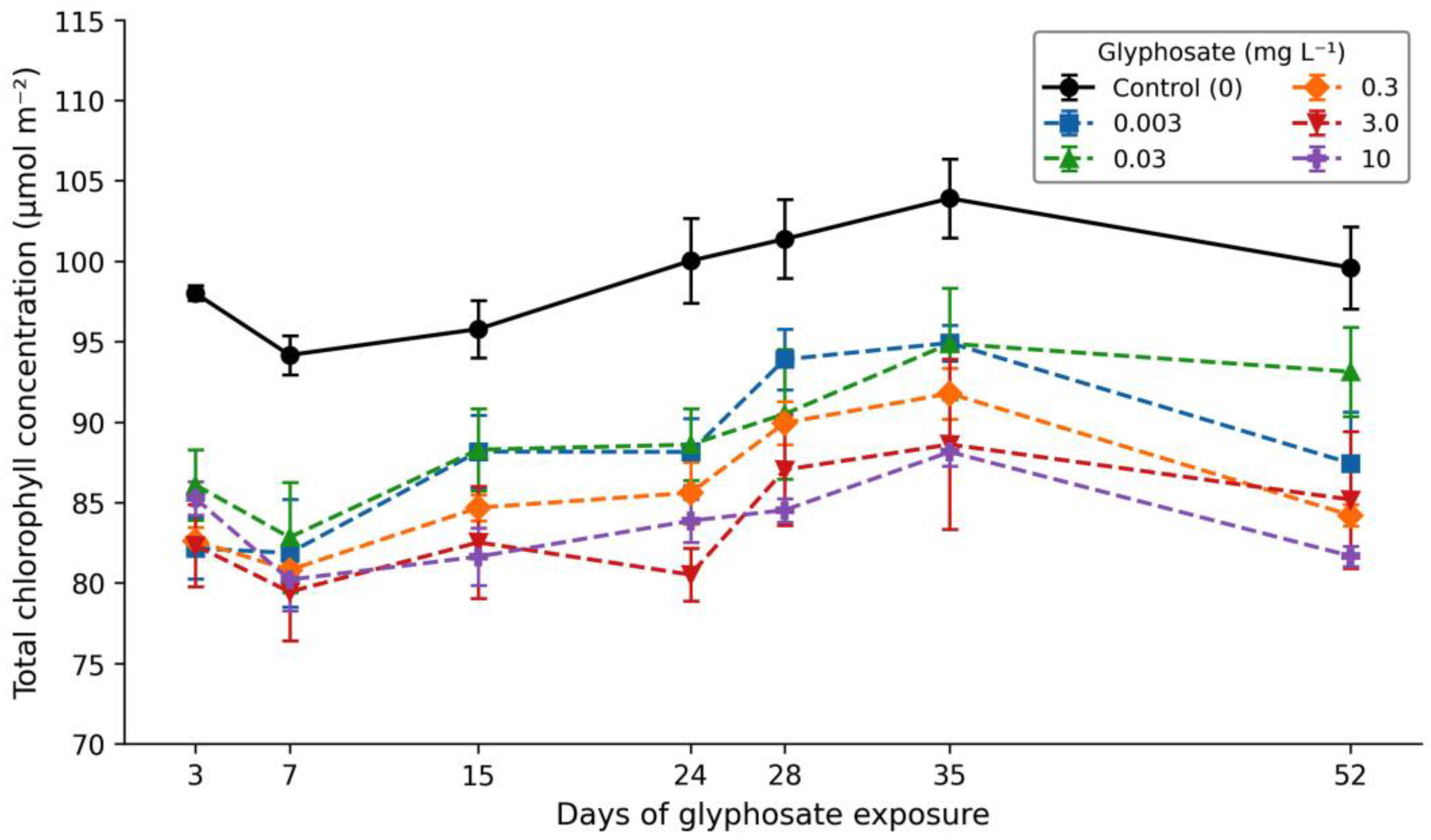
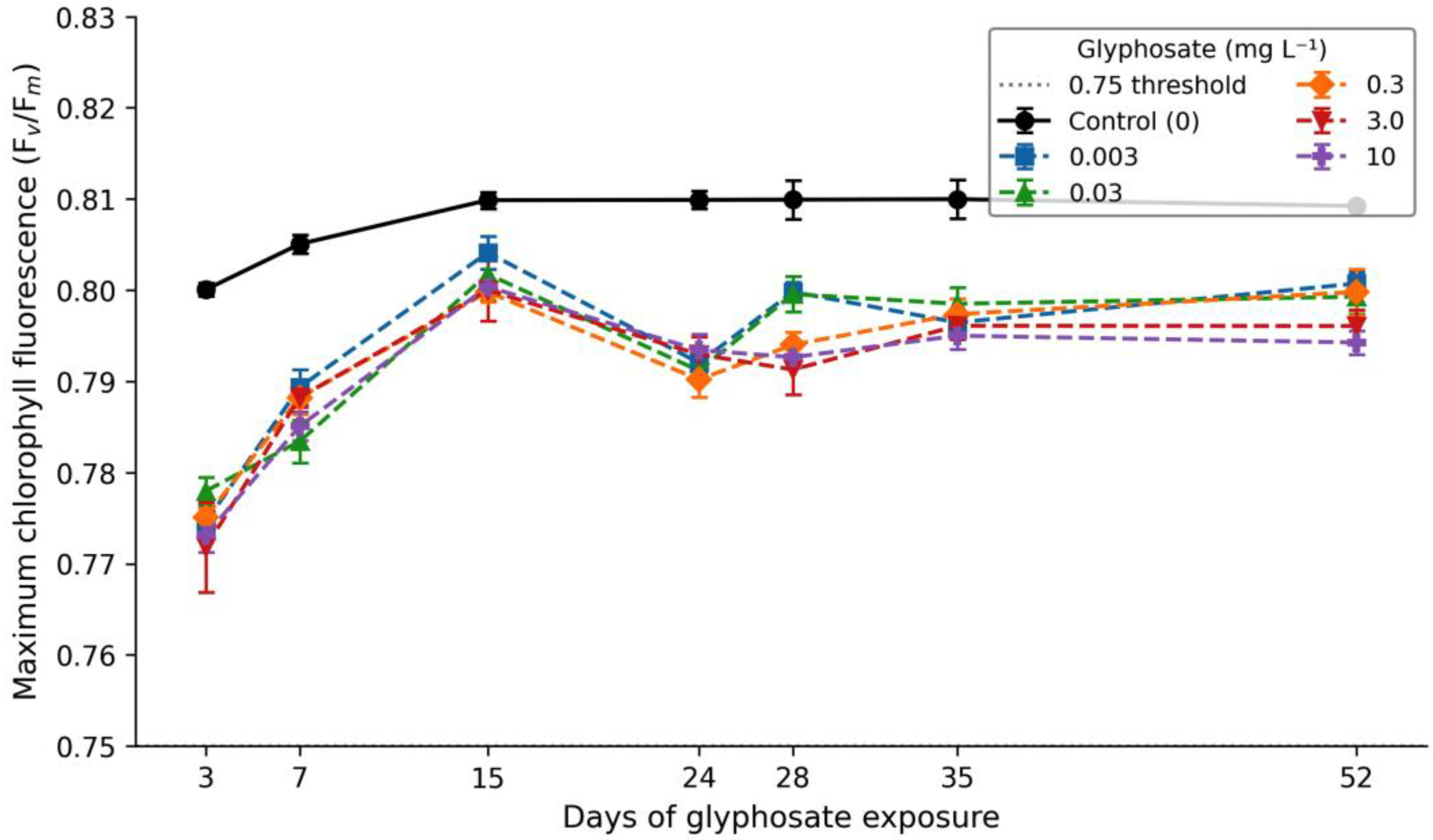
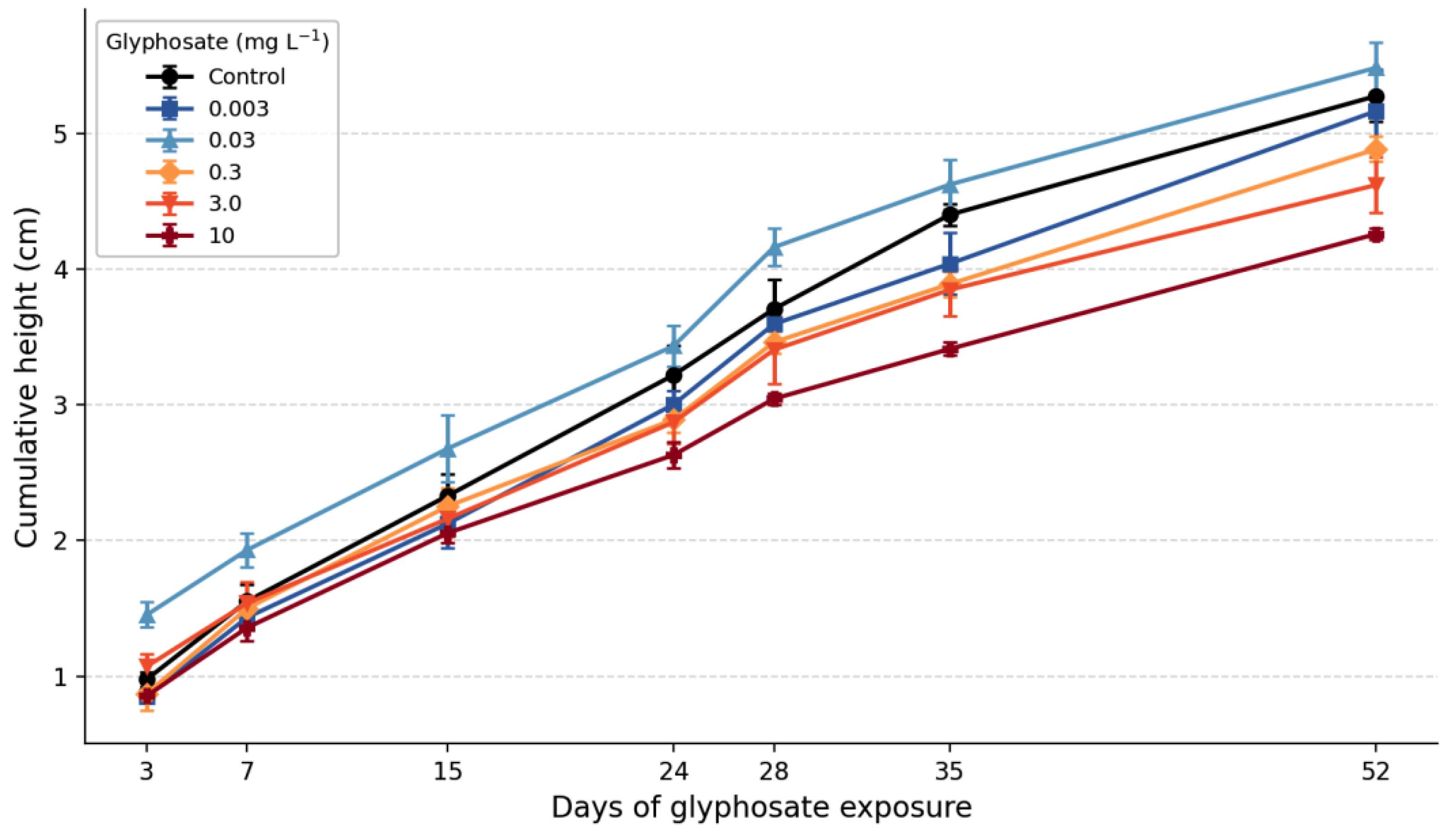
The morphophysiological responses of R. mangle seedlings to formulation exposure are summarized in Table 2, with total chlorophyll concentration, Fv/Fm, and cumulative height shown in Figure 4, Figure 5 and Figure 6, respectively.
Exposure produced a consistent reduction in total chlorophyll concentration across all tested concentrations (0.003 to 10 mg L−1). This separation between treated tanks and the control was detectable from the earliest measurement occasion (day 3) and persisted throughout the 52-day exposure period without evidence of recovery (Figure 4). Phase-averaged mean chlorophyll values in treated tanks ranged from 84.8 ± 0.9 to 87.9 ± 2.3 μmol m−2, all significantly lower than in the control (98.2 ± 1.9 μmol m−2; ANOVA F5,12 = 4.55, p = 0.015). Post hoc comparisons confirmed that all treatment concentrations differed significantly from the control, while no significant separation was detected among treatment concentrations. This pattern is consistent with a threshold-type response: a concentration-independent reduction in chlorophyll content apparent at even the lowest tested dose (0.003 mg L−1), rather than a clear monotonic gradient across the concentration range.
Maximum chlorophyll fluorescence (Fv/Fm) showed a consistent gap below the control across all treatments throughout Phase 3, most pronounced at day 3 and narrowing progressively through day 15, after which values stabilized (Figure 5). Mean Fv/Fm values across the exposure period ranged from 0.772 ± 0.005 (3.0 mg L−1, day 3) to 0.810 ± 0.001 (control, day 15). No significant differences among treatments were detected across the exposure period (Kruskal–Wallis H(5) = 10.08, p = 0.073). All Fv/Fm values remained above the 0.75 threshold throughout (Figure 5), indicating sublethal stress rather than acute photosystem II impairment.
Total biomass ranged from 101.1 ± 1.7 g (10 mg L−1) to 104.3 ± 2.1 g (control), with no significant differences detected for total, root, or stem biomass (ANOVA p > 0.05; Table 2). Lenticel number increased significantly (F5,24 = 3.63, p = 0.014), from 158.4 ± 16.2 (control) to 275.6 ± 38.9 at 3.0 mg L−1. Post hoc comparisons indicated that only the 3.0 mg L−1 treatment differed significantly from the control (p = 0.002) and from the three lowest concentrations; 10 mg L−1 also differed from the control (p = 0.011) but did not reach significance against all intermediate concentrations (p = 0.042–0.085).
Height growth rates were significantly reduced at the two highest concentrations (F5,12 = 6.84, p = 0.003): 0.0742 ± 0.003 cm d−1 at 3.0 mg L−1 and 0.0691 ± 0.000 cm d−1 at 10 mg L−1, compared with 0.0898 ± 0.002 cm d−1 in the control. Post hoc comparisons indicated no significant differences among control, 0.003, and 0.03 mg L−1; 0.3 mg L−1 showed a borderline non-significant trend (p = 0.081). Divergence between the two highest concentrations and the control became apparent from approximately day 24 and widened progressively through day 52 (Figure 6), a temporal pattern distinct from the immediate-onset chlorophyll reduction observed across all concentrations from day 3 onward.

4. Discussion

4.1. Experimental Control

The experimental system was designed to reproduce the intertidal regime at an appropriate scale, ensuring that observed outcomes could be attributed to formulation exposure rather than confounding environmental variation [20,28]. Inundation levels, interstitial-water salinity, ambient temperature, and light intensity were held constant, and the biological variables confirmed equivalence across all experimental units prior to Phase 3. This level of control is essential because minor variations in salinity, temperature, light, or flooding regime can alter mangrove seedling physiology and biochemistry [29,30].
As discussed in Section 3.1, using tank-level means to test pre-treatment equivalence revealed statistically detectable but biologically trivial differences in several physicochemical parameters during Phase 2 (e.g., temperature range < 0.4 °C, salinity range < 0.5 PSU). These differences are consistent with minor spatial gradients inherent to greenhouse settings and are effectively controlled by the randomized treatment assignment. The biological variables (which represent direct evidence of seedling physiological status) showed no meaningful differences among tanks before exposure, confirming the validity of the experimental units.

4.2. Physicochemical Parameters

During Phase 3, interstitial-water physicochemical parameters were not significantly affected by formulation treatments: pH (p = 0.099) and redox potential (p = 0.057) did not differ significantly, and the minor temperature and salinity differences (<0.5 units) were biologically trivial. In contrast, mangrove soil exhibited significant increases in pH and decreases in redox potential (p ≤ 0.001). The naturally alkaline character of the soil reflects the karstic geology of the collection site, where calcium carbonate inputs release OH ions. The additional pH increase observed in treated soils may be linked to glyphosate degradation processes that can release CO2, nitrogen fractions, and phosphate groups under alkaline conditions [15,31].
The decline in redox potential with increasing formulation concentration suggests an indirect influence on soil conditions. Redox potential in mangrove soils is driven by hydrological processes, oxygen demand, and the amount and quality of organic-matter inputs [32]. In this experiment, all tanks received identical hydrological regimes, so the observed redox differences are most consistently associated with formulation-mediated changes in soil biogeochemistry. Higher pH combined with lower redox conditions may promote precipitation of insoluble Fe, Mn, Cu, and Zn compounds, potentially reducing micronutrient availability [33], and may suppress microbial activity [34] with downstream effects on organic-matter quality and forest productivity [35]. Future studies should incorporate organic-matter additions to better approximate field conditions.

4.3. Total Chlorophyll Production

GBHF-treated seedlings exhibited significantly lower total chlorophyll concentration than control seedlings across all tested concentrations. Post hoc comparisons revealed that all formulation treatments differed significantly from the control, while separation among treatment concentrations was limited (ANOVA p = 0.015). This pattern is consistent with a threshold-type response: a concentration-independent reduction in chlorophyll content apparent at even the lowest tested dose (0.003 mg L−1), rather than a clear monotonic gradient across the concentration range.
The chlorophyll reduction documented across all tested concentrations likely reflects multiple converging mechanisms beyond direct EPSPS inhibition. Disruption of the shikimic pathway reduces the availability of phenylalanine and tryptophan, which are precursors to secondary metabolites involved in chloroplast membrane stabilization and photoprotection, including tocopherols and certain phenylpropanoids [36,37]. Independently, glyphosate has been shown to impair nitrogen metabolism by interfering with glutamine synthetase activity, reducing ammonium assimilation efficiency and thereby constraining the nitrogen supply available for chlorophyll synthesis and chloroplast protein turnover [38]. In parallel, the concurrent increase in soil pH and decline in redox potential observed in treated tanks may have limited the availability of Fe2+ and Mn2+—essential cofactors in chlorophyll biosynthesis and in the oxygen-evolving complex of photosystem II—by promoting their precipitation as insoluble hydroxides under alkaline, reducing conditions [33,34]. These pathways—direct EPSPS-mediated amino acid limitation, nitrogen metabolism impairment, and soil-mediated micronutrient restriction—are not mutually exclusive and may act synergistically to depress chlorophyll production. Tissue elemental analysis and enzyme activity assays are required to partition their relative contributions.
Direct comparison with prior GBHF studies on mangroves is constrained by the wide variation in experimental concentrations, species, and exposure conditions. The two existing controlled studies used concentrations substantially higher than those tested here: Veloso Castro et al. [20] reported leaf vigor loss, reduced stem length, and decreased root biomass in Laguncularia racemosa at 5 and 50 mg L−1, while López-Chávez et al. [21] documented reduced height, diameter growth, and leaf production in R. mangle at 25, 50, and 100 mg L−1. The present study detected significant chlorophyll reduction at concentrations as low as 0.003 mg L−1 (three orders of magnitude below the lowest effective concentration reported for L. racemosa), suggesting that early-stage R. mangle seedlings may exhibit marked sensitivity to GBHF at ecologically plausible exposure levels. Comparable sensitivity has been documented for other herbicide classes in mangroves: diuron produced significant Fv/Fm reductions in Avicennia marina at concentrations in the μg L−1 range [13], and 2,4-D induced chlorophyll and growth reductions in R. mangle at mg L−1 concentrations [18,39]. The present results extend the evidence of mangrove herbicide sensitivity to the EPSPS-inhibition pathway, indicating that the ecologically relevant concentration range for GBHF effects may be substantially lower than previously recognized.

4.4. Maximum Chlorophyll Fluorescence (Fv/Fm)

Fv/Fm is widely used as an early indicator of photosystem II disruption [24]. In this study, values did not fall below the 0.75 stress threshold (mean ≈ 0.79), consistent with the fact that glyphosate inhibits the shikimate pathway rather than directly blocking photosystem II electron transport. This contrasts with PSII-inhibiting herbicides (diuron, ametryn, atrazine), which produce severe Fv/Fm declines in mangrove species [40]. Although a slight reduction relative to control values (0.805 → ~0.789) was observed across the concentration gradient, differences among treatments were not statistically significant (p = 0.073). These findings suggest that early physiological stress from GBHF exposure may be detectable through fluorescence measurements, even when overt photoinhibition thresholds are not crossed.

4.5. Biomass Production and Lenticel Number

The absence of statistically significant biomass differences may be explained by three factors. First, the concentrations used were lower than those producing measurable biomass reductions in prior mangrove studies (e.g., ≥50 mg L−1 for L. racemosa [20]). Second, root uptake of glyphosate typically shows reduced phytotoxicity compared to foliar absorption, because soil cations can form glyphosate–cation complexes that reduce bioavailability [41,42]; when transported through xylem, glyphosate activity declines relative to phloem-mediated translocation [43]. Third, the significant increase in lenticel production may represent a compensatory tolerance mechanism: lenticels facilitate gas exchange and cellular respiration under flooding stress [39], and their hypertrophy and overproduction could partially offset physiological impairment. The disconnect between reduced height growth and unchanged biomass is consistent with the fact that height growth depends on cell division and elongation at apical meristems—processes directly affected by EPSPS inhibition and amino acid deprivation [38]—whereas total biomass integrates cumulative contributions from all plant tissues, including the large hypocotyl reserve, which likely continued contributing stored resources over the 52-day period. This buffering is particularly plausible in viviparous mangrove species.

4.6. Growth Effects

Seedlings exposed to the GBHF at ≥3.0 mg L−1 exhibited significant reductions in height growth rate. This response is consistent with metabolic limitation associated with EPSPS inhibition, which blocks aromatic amino acid biosynthesis and reduces downstream protein synthesis, constraining cell division and elongation in active meristems [38]. This pattern aligns with previous reports of growth reduction in L. racemosa seedlings exposed to glyphosate [20] and in R. mangle and R. stylosa exposed to 2,4-D [18,44]. While 2,4-D disrupts auxin-mediated growth regulation, glyphosate restricts growth through amino acid deprivation and reduced protein synthesis [38,45]. The shared outcome of reduced elongation likely reflects a general physiological constraint imposed by metabolic disruption, despite distinct primary modes of action.

4.7. Integrated Soil–Plant Linkages and Limitations

The concurrent increase in soil pH and decrease in redox potential, alongside the decline in seedling chlorophyll and growth rate, suggest a potential chain of effects mediated by micronutrient restriction. While the present experimental design does not allow formal causal testing of this pathway—tissue micronutrient concentrations, microbial activity, and time-resolved exposure concentrations were not measured—the co-occurrence of soil and plant responses across the same concentration gradient is consistent with the hypothesis that the formulation may exacerbate seedling stress both directly and indirectly through altered soil conditions.
Four principal limitations bound the inferential scope of this study and must be explicitly recognized. (i) Absence of analytically verified exposure concentrations: glyphosate and its primary metabolite AMPA were not quantified in interstitial water or soil at any point during Phase 3. In closed soil–water systems, glyphosate undergoes sorption to mineral and organic soil particles, formation of metal–glyphosate complexes, and microbial degradation [15,41,42], processes that can reduce bioavailable concentrations substantially below nominal values over time. All concentrations reported throughout this study are nominal rather than measured; actual bioavailable fractions at any given timepoint are unknown. This limitation precludes mechanistically interpretable dose–response modeling, prevents the derivation of effect concentrations (EC50, NOEC, LOEC) in terms of measured exposure, and limits the comparability of these results with studies reporting analytically confirmed concentrations. (ii) Absence of adjuvant-only and technical-grade glyphosate controls: Velfosato contains surfactants and other co-formulants in addition to the active ingredient. All observed responses represent the integrated phytotoxic effect of the complete commercial formulation; the relative contributions of the active ingredient and co-formulants cannot be experimentally separated within this design. Evidence that surfactants in glyphosate-based formulations can independently disrupt membrane integrity and contribute to phytotoxicity [46] means that the causal role of glyphosate per se cannot be isolated. (iii) Single-species design: only R. mangle was examined. Mangrove communities include species differing substantially in salt-tolerance mechanisms, root architecture, and metabolic regulation (e.g., Avicennia germinans, Laguncularia racemosa), which are expected to exhibit different GBHF sensitivity profiles. No generalization of the present findings to community-level responses is supported. (iv) Short exposure duration and absence of recovery monitoring: the 52-day exposure captures early seedling responses and provides no information on chronic toxicity accumulation, tolerance acclimation, or post-exposure recovery. Whether the observed physiological changes are reversible upon removal of herbicide pressure cannot be assessed from the present data.
The ecological context of natural mangrove forests introduces complexity—organic-matter inputs, tidal flushing, resident microbial communities, and litter decomposition dynamics—that is absent from the closed experimental system used here. These factors influence herbicide sorption, degradation, and bioavailability in ways that cannot be replicated in tank conditions. Direct extrapolation of the present findings to natural forest productivity, regeneration capacity, or ecosystem functioning is not warranted without field-based validation under natural hydrological and biogeochemical conditions. The findings underscore the importance of careful management of herbicide applications in agricultural areas adjacent to mangrove ecosystems and motivate the validation studies specified below.

5. Conclusions

This study addressed three scientific questions concerning the responses of Rhizophora mangle seedlings to GBHF exposure under controlled conditions. Regarding the dose–response relationship (Q1): total chlorophyll concentration showed a threshold-type response (uniform reduction relative to control across all concentrations tested, with no significant monotonic gradient among treatment groups), while height growth rate showed a significant, concentration-dependent reduction at ≥3.0 mg L−1. Regarding the physiological threshold (Q2): no no-effect concentration could be identified for total chlorophyll within the tested range, as significant reductions were present even at the lowest tested concentration (0.003 mg L−1); for height growth rate, concentrations below 3.0 mg L−1 produced no statistically significant effect, though the absence of analytically confirmed exposure concentrations precludes a formal threshold determination. Regarding soil–plant interaction (Q3): soil pH and redox potential co-varied with plant physiological responses across the same concentration gradient in a pattern consistent with the hypothesis that formulation-mediated soil alterations may exacerbate seedling stress through micronutrient restriction; formal causal testing of this pathway was not possible within the present design.
All inferential analyses used the tank as the experimental unit (n = 3 per treatment; dfbetween = 5, dfwithin = 12 for weekly-averaged biological variables; dfbetween = 5, dfwithin = 24 for destructively sampled variables). Exposure to the GBHF was associated with: significant reductions in total chlorophyll concentration across all tested concentrations (F5,12 = 4.55, p = 0.015); no statistically significant effect on Fv/Fm (H(5) = 10.08, p = 0.073) or total biomass (p > 0.05); a significant reduction in height growth rate at ≥3.0 mg L−1 (F5,12 = 6.84, p = 0.003); a significant increase in lenticel number at the two highest concentrations (F5,24 = 3.63, p = 0.014); and significant soil alkalinization and redox decline across all treated tanks (p ≤ 0.001).
Although the experiment was conducted under controlled conditions using nominal exposure concentrations, these findings provide evidence that early-stage R. mangle seedlings exhibit measurable ecophysiological responses to GBHF at concentrations spanning the environmentally relevant range. The physiological alterations documented here are restricted to the controlled experimental context; their implications for seedling performance in natural field conditions require further investigation before broader conclusions can be drawn.
Future studies should address the four principal limitations of the present work: (1) analytical quantification of glyphosate and AMPA at multiple exposure timepoints to replace nominal with measured concentrations and enable dose–response modeling; (2) inclusion of adjuvant-only and technical-grade glyphosate treatments to isolate the contribution of the active ingredient from co-formulant toxicity; (3) multi-species experimental designs incorporating at minimum Avicennia germinans and Laguncularia racemosa to characterize interspecific sensitivity variation within the same system; and (4) extended exposure periods (>90 days) with a post-exposure recovery phase, combined with field-based validation in natural mangrove forests adjacent to agricultural runoff zones.

Author Contributions

Conceptualization: A.A.N.M., C.A.C.-K. and C.M.A.-H.; Methodology: A.A.N.M., C.A.C.-K. and C.M.A.-H.; Formal Analysis: A.A.N.M. and R.A.P.-B.; Investigation: A.A.N.M.; Resources: C.M.A.-H.; Data Curation: A.A.N.M.; Writing—Original Draft: A.A.N.M.; Writing—Review and Editing: A.A.N.M., C.A.C.-K., R.A.P.-B., H.L.R. and C.M.A.-H.; Visualization: A.A.N.M.; Supervision: C.A.C.-K. and C.M.A.-H.; Project Administration: C.M.A.-H.; Funding Acquisition: C.M.A.-H. All authors have read and agreed to the published version of the manuscript.

Funding

This research was funded by the Secretaría de Ciencias, Humanidades, Tecnología e Innovación (SECIHTI), Mexico, through a graduate scholarship awarded to A.A. Navarrete-Memije (Student ID: 1242385). The funders had no role in study design, data collection and analysis, decision to publish, or preparation of the manuscript.

Data Availability Statement

The raw datasets supporting the results of this study, including individual measurements for all morphophysiological variables (height growth, biomass, chlorophyll concentration, Fv/Fm values, lenticel counts), physicochemical parameters (pH, salinity, redox potential, temperature), and statistical analysis outputs, are openly available in Mendeley Data at https://data.mendeley.com/datasets/sfnc79gpj3/1 (accessed on 10 April 2026).

Acknowledgments

This research is part of AANM’s master’s thesis, conducted at the Universidad Autónoma de Campeche (UACAM, Mexico), thanks to the financial support of scholarships granted by the Secretaría de Ciencias, Humanidades, Tecnología e Innovación (SECIHTI) (Number Assigned to the Student: 1242385). We would like to thank Jordán Reyes and Adriana Gregorio for their valuable assistance during fieldwork and laboratory analysis.

Conflicts of Interest

The authors declared that this work was conducted in the absence of any commercial or financial relationships that could be construed as a potential conflict of interest.

References

  1. FAO. La Agricultura Mundial en la Perspectiva del Año 2050. Available online: https://www.fao.org/fileadmin/templates/wsfs/docs/Issues_papers/Issues_papers_SP/La_agricultura_mundial.pdf (accessed on 12 January 2026).
  2. Godfray, H.C.J.; Beddington, J.R.; Crute, I.R.; Haddad, L.; Lawrence, D.; Muir, J.F.; Pretty, J.; Robinson, S.; Thomas, S.M.; Toulmin, C. Food security: The challenge of feeding 9 billion people. Science 2010, 327, 812–818. [Google Scholar] [CrossRef]
  3. Rosegrant, M.W.; Koo, J.; Cenacchi, N.; Ringler, C.; Robertson, R.; Fisher, M.; Cox, M.; Garrett, K.; Perez, N.D.; Sabbagh, P. Food Security in a World of Natural Resource Scarcity: The Role of Agricultural Technologies, 1st ed.; International Food Policy Research Institute: Washington, DC, USA, 2014; pp. 1–154. [Google Scholar]
  4. Duke, S.O.; Powles, S.B. Glyphosate: A once-in-a-century herbicide. Pest Manag. Sci. 2008, 64, 319–325. [Google Scholar] [CrossRef]
  5. Romano, R.M.; Romano, M.A.; de Oliveira, C.A. Glifosato como disruptor químico endócrino. Ambiência 2009, 5, 359–372. [Google Scholar]
  6. Herrmann, K.M.; Weaver, L.M. The shikimate pathway. Annu. Rev. Plant Biol. 1999, 50, 473–503. [Google Scholar] [CrossRef] [PubMed]
  7. Martinez, D.A.; Loening, U.E.; Graham, M.C. Impacts of glyphosate-based herbicides on disease resistance and health of crops: A review. Environ. Sci. Eur. 2018, 30, 2. [Google Scholar] [CrossRef] [PubMed]
  8. Arellano-Aguilar, O.; Rendón von Osten, J. La Huella de los Plaguicidas en México; Greenpeace: Ciudad de México, México, 2016; p. 39. [Google Scholar]
  9. Zobiole, L.H.S.; de Oliveira, R.S.; Kremer, R.J.; Constantin, J.; Bonato, C.M.; Muniz, A.S. Water use efficiency and photosynthesis of glyphosate-resistant soybean as affected by glyphosate. Pestic. Biochem. Physiol. 2010, 97, 182–193. [Google Scholar] [CrossRef]
  10. Wildi, M.; Jandres Vásquez, M.; Santamaría, N.; Padilla Moreno, A.; Recinos Paredes, G.V.; Villanueva Ramírez, G.; López, D. Riesgos Ambientales y Sanitarios de los Plaguicidas y Fertilizantes Utilizados en El Salvador: Estudio de Caso de la Industria Azucarera en la Subcuenca Brazo del Río Paz; Asociación Unidad Ecológica Salvadoreña (UNES): San Salvador, El Salvador, 2021; p. 221. [Google Scholar]
  11. Instituto Nacional de Ecología y Cambio Climático (INECC); Martínez Arroyo, A.; Gavilán García, A.; Mendoza Cantú, A. Diagnóstico Sobre la Contaminación por Plaguicidas en Agua Superficial, Agua Subterránea y Suelo; INECC: Mexico City, Mexico, 2019; p. 37. [Google Scholar]
  12. Rendón-von Osten, J.; Dzul-Caamal, R. Glyphosate Residues in Groundwater, Drinking Water and Urine of Subsistence Farmers from Intensive Agriculture Localities: A Survey in Hopelchén, Campeche, Mexico. Int. J. Environ. Res. Public Health 2017, 14, 595. [Google Scholar] [CrossRef]
  13. Bell, A.M.; Duke, N.C. Effects of Photosystem II inhibiting herbicides on mangroves—Preliminary toxicology trials. Mar. Pollut. Bull. 2005, 51, 297–307. [Google Scholar] [CrossRef]
  14. Maggi, F.; La Cecilia, D.; Tang, F.H.M.; McBratney, A. The global environmental hazard of glyphosate use. Sci. Total Environ. 2020, 717, 137167. [Google Scholar] [CrossRef]
  15. Borggaard, O.K.; Gimsing, A.L. Fate of glyphosate in soil and the possibility of leaching to ground and surface waters: A review. Pest Manag. Sci. 2008, 64, 441–456. [Google Scholar] [CrossRef]
  16. Duaví, W.C.; Gama, A.F.; Damasceno, É.P.; Moreira, L.B.; Da Silva, V.P.A.; Nascimento, R.F.; Cavalcante, R.M. Are pesticides only a problem from rural areas? The case of a highly urbanised tropical mangrove (Fortaleza, CE, Brazil). Int. J. Environ. Anal. Chem. 2021, 103, 5868–5886. [Google Scholar] [CrossRef]
  17. Montero, V.; Muñoz, O.; Cuasquer, J. Los impactos ecológicos productivos por actividades agrícolas en el humedal Abras de Mantequilla, Ecuador. Investig. Tecnol. Innovación 2022, 14, 16–28. [Google Scholar] [CrossRef]
  18. Chan-Keb, C.A.; Agraz-Hernández, C.M.; Muñiz-Salazar, R.; Posada-Vanegas, G.; Osti-Sáenz, J.; Reyes-Castellano, J.E.; Conde-Medina, K.P.; Vega-Serratos, B.E. Ecophysiological Response of Rhizophora mangle to the Variation in Hydrochemistry during Five Years along the Coast of Campeche, México. Diversity 2018, 10, 9. [Google Scholar] [CrossRef]
  19. Shete, A.; Gunale, V.R.; Pandit, G.G. Organochlorine pesticides in Avicennia marina from the Mumbai mangroves, India. Chemosphere 2009, 76, 1483–1485. [Google Scholar] [CrossRef] [PubMed]
  20. Castro, A.J.V.; Correa, J.N.; Santos, R.L. Efeitos do herbicida Roundup® em Laguncularia racemosa (L.) C. F. Gaertn (Combretaceae). Braz. J. Dev. 2021, 7, 94644–94660. [Google Scholar] [CrossRef]
  21. López-Chávez, M.Y.; Infante-Mata, D.; Álvarez-Legorreta, T.; Dunn, M.F.; Castro-Chan, R.A.; Guillén-Navarro, K. Continuous glyphosate applications affect plant development of mangrove species from coastal wetlands: Rhizophora mangle and Pachira aquatica. Aquat. Bot. 2023, 187, 103658. [Google Scholar] [CrossRef]
  22. Tovilla, C.; Orihuela, D.E. Supervivencia de Rhizophora mangle L. en el manglar de Barra de Tecoanapa, Guerrero, México. Madera Bosques 2002, 8, 89–102. [Google Scholar] [CrossRef]
  23. Duke, N.C.; Bell, A.M.; Pederson, D.K.; Roelfsema, C.M.; Bengtson Nash, S. Herbicides implicated as the cause of severe mangrove dieback in the Mackay region, NE Australia: Consequences for marine plant habitats of the GBR World Heritage Area. Mar. Pollut. Bull. 2005, 51, 308–324. [Google Scholar] [CrossRef]
  24. Maxwell, K.; Johnson, G.N. Chlorophyll fluorescence—A practical guide. J. Exp. Bot. 2000, 51, 659–668. [Google Scholar] [CrossRef]
  25. Agraz-Hernández, C.M.; García-Zaragoza, C.; Iriarte-Vivar, S.; Flores-Verdugo, F.J.; Moreno-Casasola, P. Forest structure, productivity and species phenology of mangroves in the La Mancha lagoon in the Atlantic coast of Mexico. Wetlands Ecol. Manag. 2011, 19, 273–293. [Google Scholar] [CrossRef]
  26. Shapiro, S.S.; Wilk, M.B. An Analysis of Variance Test for Normality (Complete Samples). Biometrika 1965, 52, 591–611. [Google Scholar] [CrossRef]
  27. Zar, J.H. Biostatistical Analysis, 5th ed.; Pearson Prentice Hall: Upper Saddle River, NJ, USA, 2010. [Google Scholar]
  28. Rabaza, J.A.S. Modulación del Crecimiento Inicial y la Fisiología de Rhizophora mangle L. Mediante Cambios en el Hidroperiodo. Master’s Thesis, Centro de Investigación Científica de Yucatán, A.C., Mérida, México, 2019. Available online: https://cicy.repositorioinstitucional.mx/jspui/bitstream/1003/1574/1/PCB_M_Tesis_2019_Julio_Salas_Rabaza.pdf (accessed on 12 January 2026).
  29. Saenger, P. Physico-chemical Factors and Mangrove Performance. In Mangrove Ecology, Silviculture and Conservation, 1st ed.; Springer Science + Business Media: Dordrecht, The Netherlands, 2002; pp. 101–137. [Google Scholar] [CrossRef]
  30. Kozlowski, T.T. Responses of woody plants to flooding and salinity. Tree Physiol. 1997, 17, 490. [Google Scholar] [CrossRef]
  31. Alcântara, E.N.; Nóbrega, J.C.A.; Ferreira, M.M. Métodos de controle de plantas invasoras na cultura do cafeeiro (Coffea arabica L.) e componentes da acidez do solo. Rev. Bras. Ciênc. Solo 2007, 31, 1525–1533. [Google Scholar] [CrossRef]
  32. Culic, P. The effects of 2,4-D on the growth of Rhizophora stylosa Griff. seedlings. In Physiology and Management of Mangroves, Tasks for Vegetation Science; Teas, H.J., Ed.; Springer: Dordrecht, The Netherlands, 1984; Available online: https://link.springer.com/chapter/10.1007/978-94-009-6572-0_8 (accessed on 12 January 2026).
  33. Marschner, H. Mineral Nutrition of Higher Plants, 3rd ed.; Academic Press: London, UK, 2012. [Google Scholar]
  34. Imfeld, G.; Vuilleumier, S. Measuring the effects of pesticides on bacterial communities in soil: A critical review. Eur. J. Soil Biol. 2012, 49, 22–30. [Google Scholar] [CrossRef]
  35. Alongi, D.M. Macro-and micronutrient cycling and crucial linkages to geochemical processes in mangrove ecosystems. J. Mar. Sci. Eng. 2021, 9, 456. [Google Scholar] [CrossRef]
  36. Steinrücken, H.C.; Amrhein, N. The herbicide glyphosate is a potent inhibitor of 5-enolpyruvylshikimic acid-3-phosphate synthase. Biochem. Biophys. Res. Commun. 1980, 94, 1207–1212. [Google Scholar] [CrossRef]
  37. Calderón, M.; Quintana, M.; Pineiro, A.; Hermosín, M.; Cornejo, J. Estudio preliminar sobre el comportamiento del herbicida glifosato en dos suelos de Extremadura. In Estudios de la Zona No Saturada del Suelo; Samper Calvete, F.J., Paz González, A., Eds.; Universidade da Coruña: La Coruña, Spain, 2005; Volume VII, pp. 367–372. [Google Scholar]
  38. Geiger, D.R.; Fuchs, M.A. Inhibitors of Aromatic Amino Acid Biosynthesis (Glyphosate). In Herbicide Classes in Development; Böger, P., Wakabayashi, K., Hirai, K., Eds.; Springer: Berlin/Heidelberg, Germany, 2002. [Google Scholar] [CrossRef]
  39. Chan-Keb, C.A.; Agraz-Hernández, C.M.; Pérez-Balan, R.A.; Gutiérrez-Alcántara, E.J.; Muñiz-Salazar, R.; Reyes-Castellano, J.E.; Osti-Sáenz, J. Phytotoxicity in Seedlings of Rhizophora mangle (L.) Exposed to 2,4-Dichlorophenoxyacetic Acid under Experimental Conditions. J. Mar. Sci. Eng. 2021, 9, 1417. [Google Scholar] [CrossRef]
  40. Ashton, F.M.; Crafts, A.S. Mode of Action of Herbicides, 1st ed.; Wiley-Interscience: New York, NY, USA, 1981. [Google Scholar]
  41. Nilsson, G. Interaction between glyphosate and metals essential for plant growth. In The Herbicide Glyphosate; Grossbard, E., Atkinson, D., Eds.; Butterworths: London, UK, 1985; pp. 35–47. [Google Scholar]
  42. Hall, G.; Hart, C.; Jones, C. Plants as sources of cations antagonistic to glyphosate activity. Pest Manag. Sci. 2000, 56, 351–358. [Google Scholar] [CrossRef]
  43. Alister, C.; Kogan, M.; Pino, I. Differential phytotoxicity of glyphosate in maize seedlings following applications to roots or shoots. Weed Res. 2005, 45, 27–32. [Google Scholar] [CrossRef]
  44. Cruz Borruel, M.; Hernández Fundora, Y.; Rivas Figueredo, E. Mecanismo de resistencia de las plantas. Temas Cienc. Tecnol. 2006, 29, 45–54. [Google Scholar]
  45. Armas, E.D.; Monteiro, R.T.R.; Amâncio, A.V.; Correa, R.M.L.; Guercio, M.A. Uso de agrotóxicos em cana-de-açúcar na bacia do Rio Corumbataí e o risco de poluição hídrica. Quím. Nova 2005, 28, 975–982. [Google Scholar] [CrossRef]
  46. Mesnage, R.; Benbrook, C.; Antoniou, M.N. Insight into the confusion over surfactant co-formulants in glyphosate-based herbicides. Food Chem. Toxicol. 2019, 128, 137–145. [Google Scholar] [CrossRef] [PubMed]
Figure 1. Geographic location of the Rhizophora mangle propagule collection area in the Los Petenes Biosphere Reserve (LPBR), Campeche, Mexico, and the location of the experimental site (EPOMEX Institute).
Forests 17 00509 g001
Figure 2. Timeline of the experimental phases.
Forests 17 00509 g002
Figure 3. Overall scheme of the experimental system used to simulate intertidal conditions for mangrove seedlings under controlled conditions.
Forests 17 00509 g003
Figure 4. Total chlorophyll concentration (μmol m−2) in Rhizophora mangle seedlings across GBHF concentration treatments over the 52-day exposure period (Phase 3). Data points show mean ± SE of n = 3 tank means per treatment. Measurements were taken at days 3, 7, 15, 24, 28, 35, and 52 of exposure. All treatment concentrations remained significantly lower than the control throughout the exposure period (overall ANOVA: F5,12 = 4.55, p = 0.015; Fisher LSD post hoc comparisons reported in Table 2).
Forests 17 00509 g004
Figure 5. Maximum chlorophyll fluorescence (Fv/Fm) in Rhizophora mangle seedlings across GBHF concentration treatments over the 52-day exposure period (Phase 3). Data points show mean ± SE of n = 3 tank means per treatment. Measurements were taken at days 3, 7, 15, 24, 28, 35, and 52 of exposure. The dashed horizontal line indicates the 0.75 threshold commonly used to identify photosystem II impairment [24]. No significant differences among treatments were detected across the exposure period (Kruskal–Wallis H(5) = 10.08, p = 0.073).
Forests 17 00509 g005
Figure 6. Cumulative height (cm) of Rhizophora mangle seedlings across GBHF concentration treatments over the 52-day exposure period (Phase 3). Data points show mean ± SE per treatment (n = 3 tanks per treatment). Error bars represent ±1 SE. Measurements were taken at days 3, 7, 15, 24, 28, 35, and 52 of exposure. Significant divergence between the two highest concentrations (3.0 and 10 mg L−1) and the control (0 mg L−1) was detected from approximately day 24 onward (overall ANOVA: F5,12 = 6.84, p = 0.003; Fisher LSD post hoc comparisons are reported in Table 2).
Forests 17 00509 g006
Table 1. Physicochemical parameters of interstitial water (IW) and mangrove soil during Phase 2 (pre-exposure) and Phase 3 (GBHF exposure) in Rhizophora mangle experimental tanks. Values are mean ± SE. n = 3 tanks per treatment. K–W = Kruskal–Wallis. IW = interstitial water. Statistically significant but biologically trivial (range < 0.5 PSU or <0.5 °C). Different lowercase letters within a row indicate statistically significant pairwise differences among treatments (Fisher LSD post hoc test, α = 0.05); variables without letters did not yield a statistically significant test.
Phase/CompartmentParameterConcentration (mg L−1)Statisticp
Control—00.0030.030.3310
Phase 2—IW Temp (°C)26.3 ± 0.3 a26.4 ± 0.3 a26.5 ± 0.3 a26.6 ± 0.2 a26.5 ± 0.2 a26.4 ± 0.2 aH(5) = 14.950.011
Salinity (PSU)21.8 ± 0.1 a21.4 ± 0.0 a21.8 ± 0.1 a21.9 ± 0.0 a21.7 ± 0.1 a21.9 ± 0.0 aF5,12 = 22.73<0.001
Redox (mV)107.0 ± 1.6 a111.3 ± 0.3 a110.9 ± 1.8 a110.4 ± 0.6 a116.1 ± 1.4 a109.0 ± 0.6 aH(5) = 11.290.046
pH7.95 ± 0.01 a7.88 ± 0.01 a7.93 ± 0.02 a7.86 ± 0.02 a7.89 ± 0.02 a7.96 ± 0.04 aH(5) = 11.780.038
Phase 2—SoilTemp (°C)27.4 ± 0.1 a27.5 ± 0.0 a27.4 ± 0.1 a27.7 ± 0.1 a27.7 ± 0.0 a27.4 ± 0.0 aH(5) = 13.500.019
Redox (mV)64.5 ± 2.159.7 ± 1.458.3 ± 1.859.2 ± 1.661.8 ± 1.662.1 ± 2.7F5,12 = 1.450.278
pH7.73 ± 0.01 a7.76 ± 0.02 a7.79 ± 0.00 a7.68 ± 0.02 a7.68 ± 0.01 a7.76 ± 0.02 aH(5) = 13.890.016
Phase 3—IWTemp (°C)23.3 ± 0.0 a23.6 ± 0.1 a23.8 ± 0.0 a23.8 ± 0.1 a23.7 ± 0.0 a23.5 ± 0.0 aH(5) = 13.880.016
Salinity (PSU)21.3 ± 0.0 a21.3 ± 0.0 a21.2 ± 0.0 a21.5 ± 0.0 a21.3 ± 0.0 a21.5 ± 0.0 aF5,12 = 9.92<0.001
Redox (mV)112.9 ± 0.9109.9 ± 0.5109.7 ± 0.5109.3 ± 0.6108.3 ± 2.0108.0 ± 0.5F5,12 = 2.970.057
pH7.94 ± 0.047.88 ± 0.017.91 ± 0.017.94 ± 0.017.89 ± 0.017.91 ± 0.03H(5) = 9.270.099
Phase 3—SoilTemp (°C)24.4 ± 0.124.6 ± 0.024.6 ± 0.024.6 ± 0.024.6 ± 0.024.6 ± 0.0H(5) = 10.450.063
pH7.75 ± 0.01 c7.88 ± 0.03 b7.91 ± 0.00 b7.89 ± 0.01 b7.89 ± 0.01 b8.01 ± 0.04 aF5,12 = 15.70<0.001
Redox (mV)77.3 ± 3.2 a55.7 ± 0.8 b55.7 ± 3.9 b52.7 ± 2.8 b57.7 ± 5.7 b43.8 ± 4.6 cF5,12 = 8.370.001
Table 2. Morphophysiological responses of Rhizophora mangle seedlings to GBHF exposure during Phase 3. Values are mean ± SE. For Fv/Fm, total chlorophyll, and growth rate: n = 3 tank means per treatment; dfbetween = 5, dfwithin = 12. For biomass and lenticels: n = 5 tank-harvest records per treatment; dfbetween = 5, dfwithin = 24. Different lowercase letters within a row indicate statistically significant pairwise differences among treatments (Fisher LSD post hoc test, α = 0.05); rows without letters did not yield a statistically significant overall test. Temporal trajectories of total chlorophyll and Fv/Fm across the 52-day exposure period are shown in Figure 4 and Figure 5, respectively.
VariableConcentration (mg L−1)Statisticp
Control—00.0030.030.33.010
Fv/Fm0.805 ± 0.0010.790 ± 0.0010.790 ± 0.0010.788 ± 0.0010.788 ± 0.0010.788 ± 0.000H(5) = 10.080.073
Total Chl (µmol m−2)98.2 ± 1.9 a87.9 ± 2.3 b89.1 ± 3.3 b86.1 ± 0.8 b84.8 ± 3.5 b84.8 ± 0.9 bF5,12 = 4.550.015
Growth rate (cm d−1)0.0898 ± 0.002 a0.0888 ± 0.006 a0.0851 ± 0.002 a0.0813 ± 0.002 ab0.0742 ± 0.003 bc0.0691 ± 0.000 cF5,12 = 6.840.003
Total biomass (g)104.3 ± 2.1103.4 ± 1.8103.2 ± 2.6103.2 ± 2.0101.8 ± 2.1101.1 ± 1.7F5,24 = 0.320.897
Root biomass (g)77.5 ± 1.877.1 ± 1.976.6 ± 2.775.7 ± 2.175.3 ± 2.174.2 ± 1.7F5,24 = 0.360.874
Stem biomass (g)27.5 ± 0.627.2 ± 0.627.0 ± 0.626.6 ± 0.526.5 ± 0.225.9 ± 0.4F5,24 = 1.370.272
Lenticel number158.4 ± 16.2 b184.8 ± 11.6 b190.8 ± 12.3 b178.8 ± 29.9 b275.6 ± 38.9 a252.4 ± 24.1 abF5,24 = 3.630.014
Disclaimer/Publisher’s Note: The statements, opinions and data contained in all publications are solely those of the individual author(s) and contributor(s) and not of MDPI and/or the editor(s). MDPI and/or the editor(s) disclaim responsibility for any injury to people or property resulting from any ideas, methods, instructions or products referred to in the content.