Systematic Review

Vegetation Carbon Stock Estimation Using Remote Sensing: A Bibliometric and Critical Review

by
Xiaoxiao Min
1,2,
Mohd Johari Mohd Yusof
1,*,
Luxin Fan
3,* and
Sreetheran Maruthaveeran
1
1
Faculty of Design and Architecture, Universiti Putra Malaysia, Serdang 43400, Malaysia
2
College of Horticulture, Xinyang Agriculture and Forestry University, Xinyang 464000, China
3
Faculty of Engineering, Universiti Putra Malaysia, Serdang 43400, Malaysia
*
Authors to whom correspondence should be addressed.
Forests 2026, 17(4), 503; https://doi.org/10.3390/f17040503
Submission received: 18 March 2026 / Revised: 11 April 2026 / Accepted: 16 April 2026 / Published: 18 April 2026
(This article belongs to the Section Forest Inventory, Modeling and Remote Sensing)

Abstract

Vegetation carbon stock is a key component of the terrestrial carbon cycle and supports climate-change mitigation and carbon-neutrality strategies. While field inventories provide accurate references, they are constrained by cost and limited scalability, motivating the rapid adoption of remote sensing for large-scale spatial estimation and mapping. However, the literature lacks a consolidated bibliometric and critical synthesis focused on above-ground vegetation carbon stock estimation. Therefore, this review aims to provide a quantitative overview of publication trends, synthesise methodological developments, and identify key research gaps in remote-sensing-based above-ground vegetation carbon stock estimation. A total of 1825 Web of Science records (2015–2024) were retrieved, of which 763 were included for bibliometric mapping using VOSviewer version 1.6.20 and CiteSpace version 6.3.R2, complemented by a critical review of 32 high-quality studies. Results indicate a shift from passive optical and single-index approaches toward active sensing and multi-sensor, multi-platform integration, alongside broad uptake of machine learning and an emerging dominance of deep learning for nonlinear modelling and feature learning. Research attention is expanding beyond forests to non-forest ecosystems, yet challenges persist in spatial resolution, validation data availability, and cross-biome generalizability. This review summarizes methodological trajectories and identifies priorities for robust, transferable above-ground carbon estimation.

1. Introduction

The climate crisis is intensifying, with anthropogenic greenhouse-gas emissions raising global mean surface temperature by ~1.1 °C above pre-industrial levels; in 2024, the global surface temperature reached 17.16 °C, and atmospheric CO2 rose from ~280 to ~420 ppm [1,2,3]. Forest ecosystems play a central role in the terrestrial carbon cycle through carbon sequestration, storage, and climate regulation, yet land-use change, deforestation, degradation, and fossil-fuel combustion continue to undermine carbon sinks and increase atmospheric CO2 [4,5]. In response, the Paris Agreement and related national net-zero pledges emphasize mitigation pathways that require robust measurement–reporting–verification (MRV) frameworks to track emissions and removals with spatial and temporal fidelity [6]. Within MRV, accurate estimation of vegetation carbon stock (VCS) is pivotal for forest carbon accounting, sustainable forest management, and policy instruments such as Reducing Emissions from Deforestation and Forest Degradation (REDD+) and nature-based solutions [7]. This review focuses on above-ground vegetation carbon stock (AGC), which is often reported directly as carbon stock or derived from above-ground biomass (AGB). Soil organic carbon and other below-ground pools are not considered because they are governed by distinct processes and measurement frameworks and are commonly assessed using different observation and modelling approaches than above-ground carbon. Accordingly, studies targeting below-ground biomass, soil carbon, or ecosystem total carbon were excluded unless explicitly required for context.
Conventional forest resource inventories estimate above-ground vegetation carbon stock (AGC) from plot-based measurements of tree attributes (e.g., diameter at breast height, height, crown dimensions), typically via allometric equations [8,9]. Although field plots provide authoritative references, they are labor-intensive and costly, and they scale poorly for repeated monitoring across large and heterogeneous landscapes. Remote sensing complements field data by enabling repeatable, non-destructive observations across satellites, aircraft, uncrewed aerial vehicles (UAVs), and ground platforms, using optical, light detection and ranging (LiDAR), and synthetic aperture radar (SAR) sensors [10,11,12,13]. By linking canopy spectral and structural information (e.g., vegetation indices, Solar-Induced Fluorescence, canopy height, texture/coherence metrics) to AGC-relevant predictors, remote sensing supports large-scale estimation and mapping required for operational MRV and forest carbon accounting.
Building on the scalability advantages outlined above, remote sensing-based above-ground carbon estimation has advanced rapidly since 2015, shifting from single-index optical approaches toward multi-sensor, multi-platform, and multi-scale integration (e.g., Sentinel-1/2, Landsat-8/9, Global Ecosystem Dynamics Investigation (GEDI), ICESat-2) for operational carbon accounting and MRV support [14,15]. Along the sensor–data axis, workflows increasingly combine passive optical time series with active LiDAR and C/L-band SAR across UAV, airborne laser scanning (ALS), and satellite platforms, using scale-bridging designs to upscale plot references to wall-to-wall products [16,17,18]. Along the feature axis, predictor sets have expanded beyond single vegetation indices to include multi-scale texture, LiDAR waveform and canopy-height distributions, polarimetric/interferometric coherence, and fused spectral–structural stacks (including SIF) that can mitigate optical saturation in high-biomass forests [19,20,21]. Along the modeling axis, approaches have progressed from empirical regressions to machine learning and deep learning, with growing attention to physically informed hybrids, spatially blocked validation, domain adaptation, and explicit uncertainty quantification to improve generalization [22,23,24,25,26,27,28,29,30]. Along the application axis, research has expanded from forests to non-forest woody and managed systems (e.g., wetlands, croplands/managed vegetation, and urban green spaces) and from pixel-level mapping to parcel-, regional-, and national-scale inventories designed to support MRV implementation [31,32,33,34,35]. Collectively, these advances are accelerating the transition from case studies to operational systems for biome-wide above-ground carbon mapping.
Based on review articles retrieved from the Web of Science (WoS) covering 2015–2024, the literature has increasingly synthesized remote-sensing approaches for vegetation carbon-stock estimation, from policy-oriented monitoring frameworks (e.g., REDD+) to sensor-fusion strategies and ecosystem-specific applications [36,37]. Subsequent reviews highlighted the growing role of spaceborne observations and LiDAR–SAR synergy for biomass/carbon estimation and scale-bridging [38,39], while product-focused syntheses revealed substantial inconsistencies among regional and global gridded biomass datasets and emphasized that uncertainty remains incompletely characterized [40]. Context-specific reviews further expanded to trees outside forests and blue-carbon systems, underscoring heterogeneity, proxy dependence, and the need for stronger field validation [41,42,43], and recent studies increasingly examined machine-learning-enabled estimation in agroforestry and natural forests [44,45]. Despite these contributions, existing reviews remain fragmented by sensor, ecosystem, or product theme, and they seldom provide a reproducible, quantitative knowledge map of the field or a harmonized appraisal of uncertainty and validation across contexts—limitations that constrain evidence-based method selection and the development of MRV-ready, operational above-ground carbon estimation workflows.
Accordingly, this review aims to provide a quantitative overview of the knowledge structure and publication trends in remote-sensing-based above-ground vegetation carbon stock research from 2015 to 2024, to critically assess methodological developments in data sources, predictor design, modelling approaches, validation practices, and uncertainty treatment, and to highlight the principal research gaps and priorities for improving the reliability and generalizability of carbon estimation.

2. Research Methodology

2.1. Scientometric Workflow for Bibliometric Mapping

This study adopts an integrated framework that combines bibliometric analysis with a structured critical appraisal, focusing on remote-sensing approaches for estimating vegetation carbon stocks. The overall workflow is summarized in Figure 1.
As illustrated in Figure 1, the review comprises three stages. Stage 1 involves literature identification and selection, including identification, screening, eligibility, and inclusion [46]. Stage 2 applies bibliometric mapping to characterize major research domains, influential sources, collaboration networks, and thematic keyword structures. Stage 3 conducts a structured critical appraisal of the selected studies, focusing on research objectives, data sources, sensor configurations (optical, SAR, LiDAR, passive microwave, and multi-sensor fusion), modeling strategies, validation design, and uncertainty reporting. Finally, the review synthesizes methodological progress and highlights emerging trends in sensor fusion as well as scale-bridging and upscaling strategies.
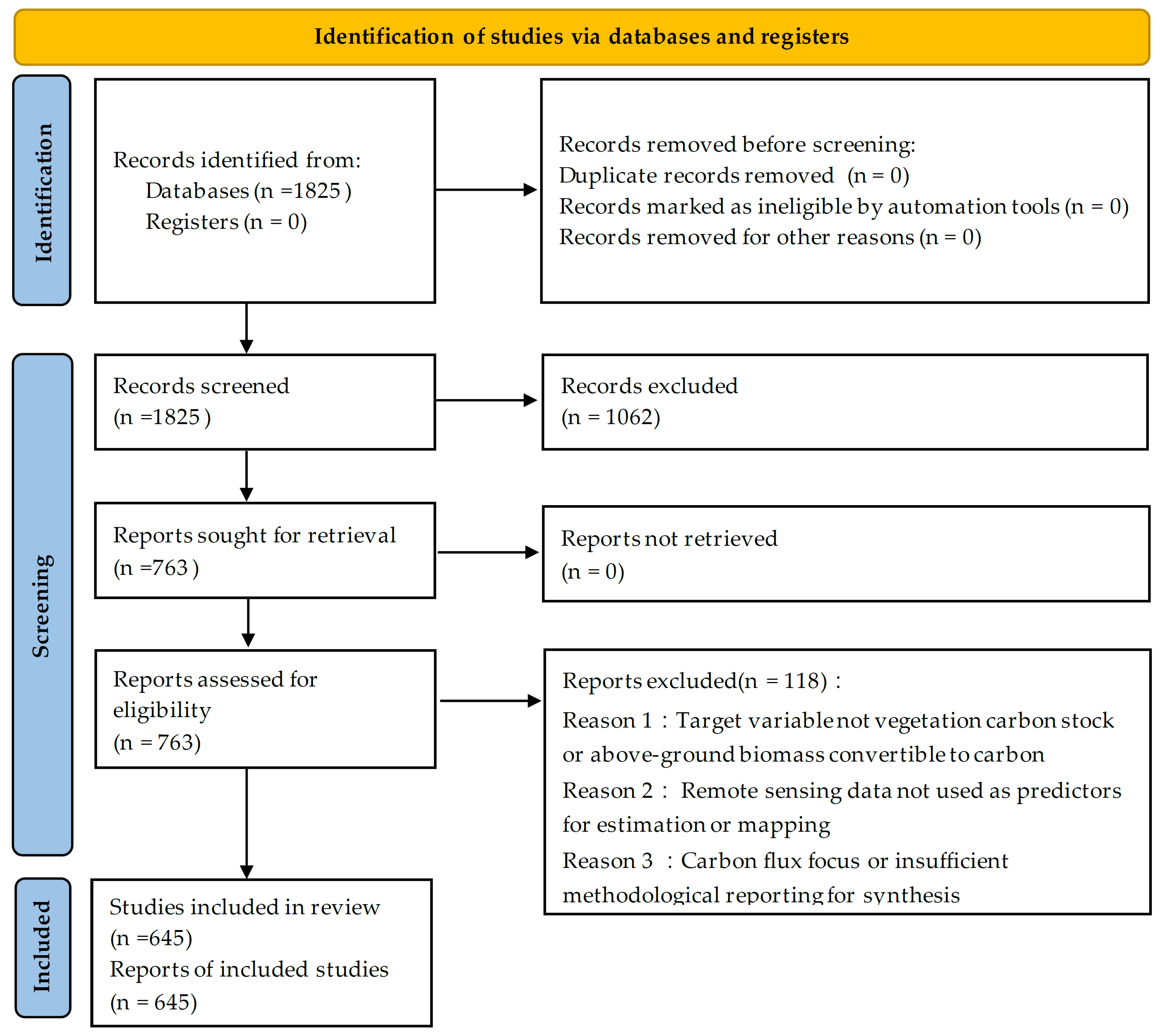
This review was conducted and reported with reference to the Preferred Reporting Items for Systematic Reviews and Meta-Analyses (PRISMA) 2020 guidelines, where applicable, to improve transparency in the literature identification, screening, eligibility assessment, and inclusion process. The literature identification and selection process is presented in Figure 2 as a PRISMA 2020 flow diagram, supporting transparent reporting of study screening and inclusion. Because this study combines bibliometric analysis, science mapping, and structured critical appraisal rather than being a conventional intervention-based systematic review, no formal review protocol was registered.
The four phases of this workflow are described step by step in the following text and are also summarised in Figure 2.
Phase 1: Search strategy and dataset definition. In November 2024, exploratory searches were conducted in Scopus, Web of Science, and ScienceDirect using the terms “carbon storage”, “carbon stock”, “carbon sequestration”, and “remote sensing”. Based on retrieval yield and topical relevance, the combination “carbon stock” AND “remote sensing” was identified as the most suitable final search expression because it provided the broadest and most relevant coverage of studies on remote-sensing-based vegetation carbon estimation. Web of Science was then selected for formal retrieval because of its strong coverage and consistent bibliographic metadata. The formal search was conducted in the Web of Science Core Collection using the Topic field with the search string Topic Search (TS) = (“carbon stock” AND “remote sensing”). The search was limited to publications from 2015 to 2024 and to document type “Article”; review articles were excluded from the formal analytical dataset because the main objective of this study was to assess original empirical research, whereas review papers were used only to inform the broader contextual framing of the Introduction. This phase yielded 1825 records. Citation data used for bibliometric analysis (e.g., total citations, average annual citations, and H-index) were recorded from the Web of Science Core Collection on 1 November 2024.
Phase 2: Title and abstract screening. After export from Web of Science, the retrieved records were manually screened by a single reviewer using predefined inclusion and exclusion criteria, without the use of automation tools. Titles and abstracts of the 1825 records were screened to retain studies that directly addressed vegetation carbon stock estimation across forests, urban green spaces, wetlands, and cropland or managed systems, including maize, rubber plantations, bamboo, aquatic vegetation, and mangroves. Records outside the vegetation carbon scope were excluded, including marine biotic carbon, system-level terrestrial carbon, soil carbon, and unrelated topics. A total of 1062 records were excluded, leaving 763 for further assessment.
Phase 3: Full-text assessment. Full texts of the remaining 763 articles were assessed to confirm their methodological relevance to remote sensing-based vegetation carbon stock estimation. Studies were excluded when (1) the target variable was not vegetation carbon stock or above-ground biomass convertible to carbon, (2) remote sensing data were not used as predictors for estimation or mapping, (3) the study focused on carbon fluxes without reporting carbon stock estimates, or (4) the reporting was insufficient to support methodological synthesis and appraisal, including the absence of a clearly described estimation workflow and minimal information on reference data and evaluation. This step removed 118 records and retained 645 articles for bibliometric analysis.
Phase 4: The 645 articles retained from the screening process were grouped according to analytical purpose and underwent a multi-stage scientometric analysis. First, all 645 eligible articles were used for general bibliometric evaluation to profile overall publication trends, influential journals, key authors, contributing countries, and thematic keyword structures. The bibliographic records were processed and visualised using VOSviewer version 1.6.20 and CiteSpace version 6.3.R2. This stage also helped identify major methodological directions and emerging themes within the field. The results highlighted a prominent and growing emphasis on machine learning applications. Guided by this finding, the methods and conclusions of the 645 articles were further examined manually by a single reviewer, yielding a focused subset of 184 publications explicitly related to machine learning, including deep learning. These 184 articles were then subjected to more advanced scientometric analyses, including co-citation analysis, co-authorship analysis, and annual trend evaluation, to examine their intellectual foundations and collaboration patterns. Finally, a structured prioritisation protocol was applied to identify 32 core articles for in-depth qualitative review and structured critical appraisal, as described in Section 2.2.

2.2. Core Literature Selection and Prioritisation Criteria

Following the scientometric mapping, a focused corpus was required for full-text critical analysis because conducting an exhaustive appraisal of all candidate studies would be impractical and could introduce subjectivity if studies were selected ad hoc. A transparent and reproducible prioritisation protocol was therefore implemented to identify a manageable core set for in-depth qualitative appraisal, consistent with the transparency principles of PRISMA 2020 [47].
Candidate studies were ranked using a composite impact score that integrates two complementary dimensions with equal weights. First, venue standing was operationalised using Journal Citation Reports (JCR) journal quartiles as a standardised proxy for outlet selectivity and editorial filtering (Q1 = 4, Q2 = 3, Q3 = 2, Q4 = 1; unrated = 0) [48]. Second, article-level uptake was quantified using a time-normalised citation indicator, namely average annual citations. To mitigate age-related citation bias, studies were scored by citation quartiles within the candidate pool (top 25% = 4; 25%–50% = 3; 50%–75% = 2; bottom 25% = 1) [49]. The composite impact score was calculated as the equally weighted mean of the journal score and the citation score.
Based on the composite ranking, a core set of studies was retained for subsequent full-text critical analysis. This procedure was designed not to establish an absolute measure of study quality, but to provide a transparent and replicable basis for prioritising high-visibility and field-influential publications for detailed appraisal. The resulting core literature set was then examined through the structured critical analysis reported in Section 3.3.

3. Results

3.1. Bibliometric Mapping

This study uses scientometric methods to map the knowledge structure and research evolution of remote-sensing-based vegetation carbon stock estimation from 2015 to 2024. It examines publication and citation trends, author and institutional productivity, collaboration networks, and keyword co-occurrence patterns. VOSviewer version 1.6.20 software [50] and CiteSpace version 6.3.R2 software [51] are used to visualise co-citation relationships, co-authorship networks, and thematic clusters. Together, these analyses outline the field’s intellectual base, identify dominant topics, and trace emerging directions, providing context for the subsequent profiling of leading contributors and themes.

3.1.1. Annual Analysis of the Publications

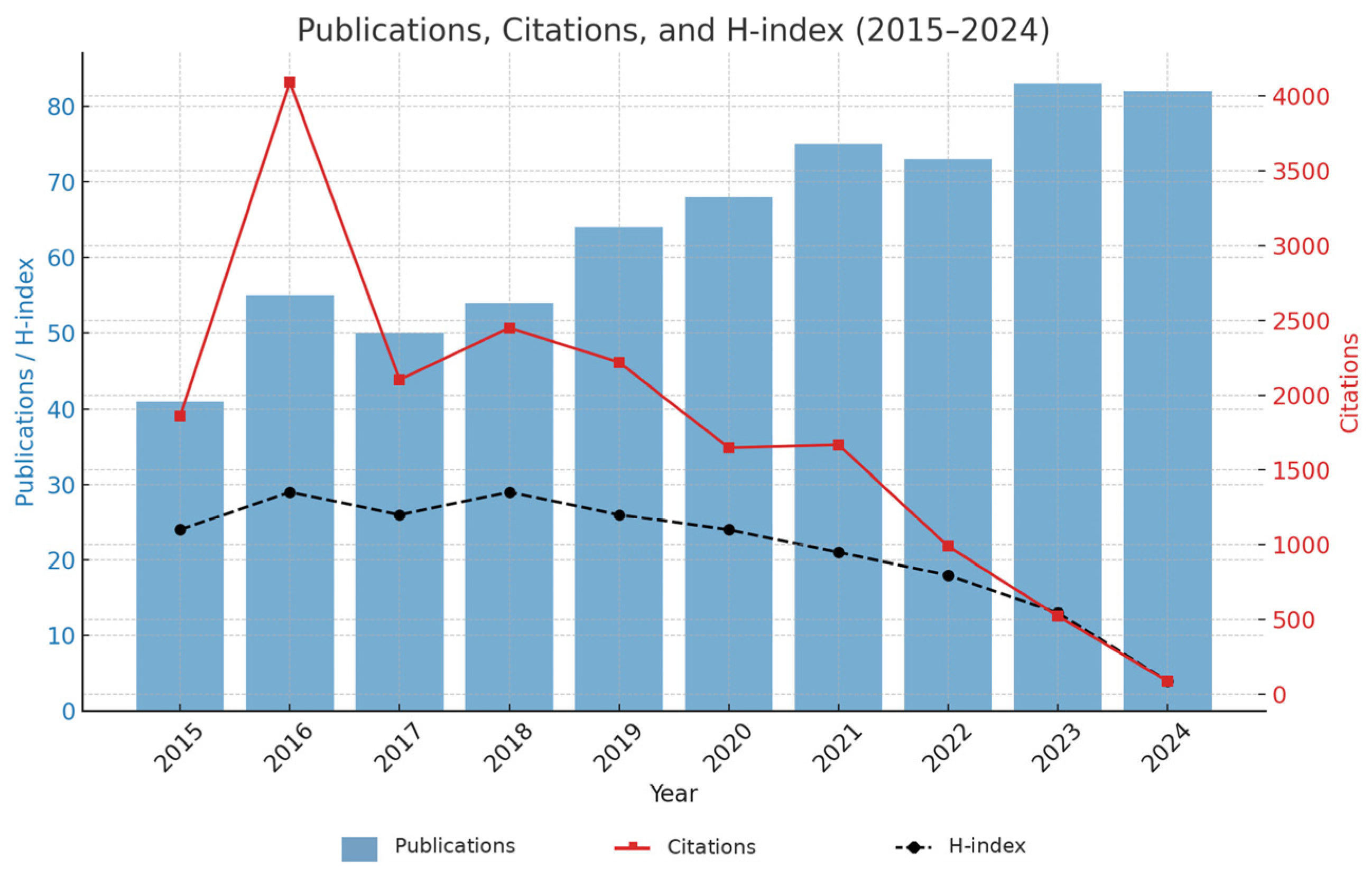
The final dataset comprises 645 publications from 2015 to 2024 (Figure 3). Annual output increased overall, remaining relatively stable during 2015–2019 and rising steadily after 2020, with the highest publication levels observed in 2023–2024. This pattern reflects growing research activity in remote-sensing-based vegetation carbon stock estimation over the past decade.
Annual citations exhibit a clear time-lag effect (Figure 3). Citations are concentrated in earlier years, whereas lower counts in 2021–2024 largely reflect the shorter citation window for recent publications rather than reduced scholarly relevance. Consistently, the yearly H-index peaks in the mid-period (e.g., 2016 and 2018) and declines toward 2024, while the dataset-level cumulative H-index is 29, indicating that at least 29 papers have each received 29 or more citations.

3.1.2. The Most Cited Publications

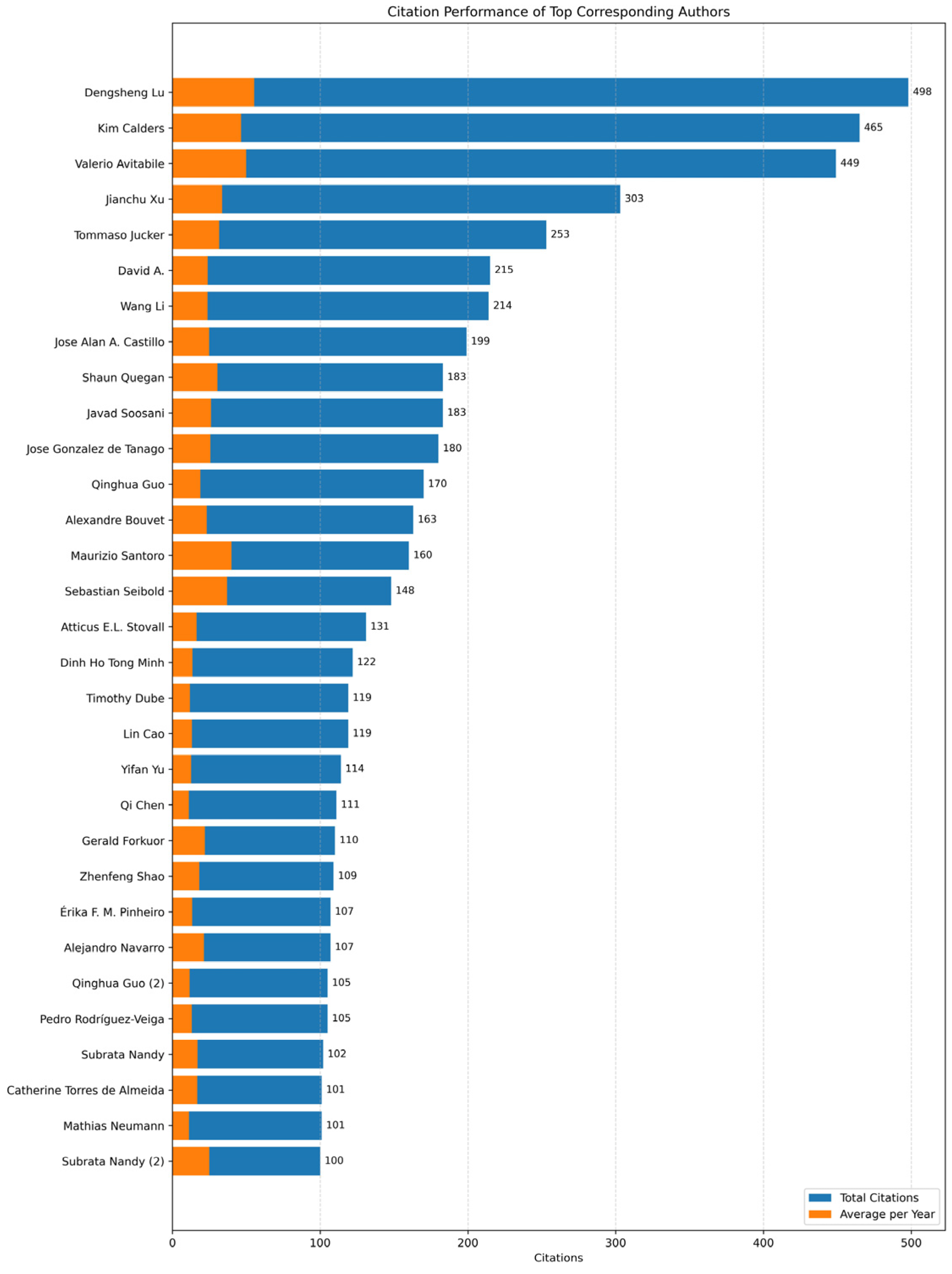
To identify the most influential contributions within the 645-paper dataset, a threshold of at least 100 citations was applied, yielding 32 highly cited papers. Collectively, these papers received 5646 citations, representing approximately one-third of all citations in the dataset and indicating that scholarly influence is concentrated in a relatively small core literature. Figure 4 compares total citations with average annual citations, allowing cumulative impact to be interpreted alongside time-normalised citation momentum. However, because raw citation counts are affected by publication age, this ≥100-citation subset should not be interpreted as fully representing the current technological frontier. In rapidly evolving areas, recent studies may be methodologically influential but have had insufficient time to accumulate high total citation counts. To reduce this time-lag bias and strengthen the forward-looking dimension of the review, three highly influential recent papers from 2022–2024, identified as top 1% papers within their respective publication years, were additionally considered in the synthesis [52,53,54]. These recent studies represent emerging frontier directions in deep-learning-based forest analysis, LiDAR point-cloud regression for above-ground forest biomass estimation, nation-wide tree-level carbon stock mapping, and uncertainty-aware assessment of large-scale biomass products [52,53,54]. Notably, many of the most cited papers focus on above-ground biomass (AGB) estimation, which is widely used as a practical proxy for vegetation carbon stock through standard biomass-to-carbon conversion factors (often around 50% of AGB) [55]. Taken together, the historically most cited papers and the recent frontier exemplars indicate that the field is evolving from conventional biomass mapping toward more structurally informed, learning-based, and uncertainty-aware estimation frameworks.

3.1.3. The Most Productive Countries

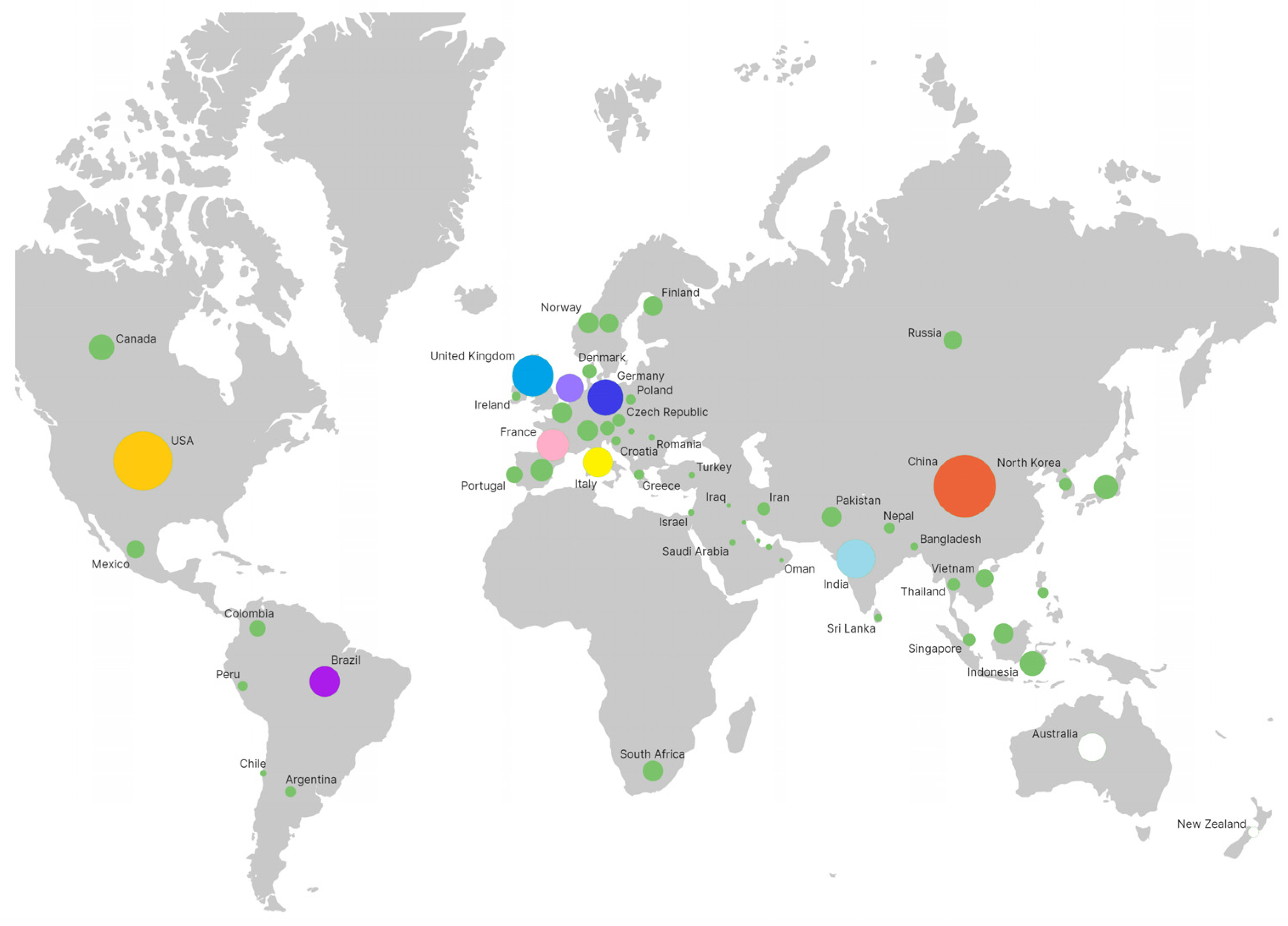
Figure 5 illustrates the geographical distribution of the 645 publications, showing contributions from 57 countries. Overall, research output is concentrated in Asia and Europe, with smaller contributions from the Americas, Oceania, and Africa, indicating an uneven global distribution of remote-sensing-based vegetation carbon stock research.
Following the geographical distribution analysis, Table 1 summarizes the productivity of the top 10 countries, ranked by their total number of publications. The table includes metrics such as total publications (TP), total citations (TC), average citations (AC), the number of papers with high citation counts, and the H-index. The data in Table 1 indicates that China is the leading country in publication volume, with 191 papers and 5068 citations. The United States is second with 172 publications, but leads in several citation-based metrics: it has the highest total citations (7541), the highest H-index (46), and the most papers (16) with 100 or more citations. The United Kingdom ranks third with 85 publications and 5305 citations, followed by India with 75 publications and 2064 citations.
Further examination of the table shows variations in citation numbers relative to publication volume. For example, France (51 publications) has more total citations (3427) than Germany (64 publications, 2440 citations). Similarly, Italy (44 publications) has more citations (3293) than Brazil (47 publications, 2011 citations). Among countries with the same number of publications, such as the Netherlands and Australia (both 39), the Netherlands recorded a higher number of total citations (3585 vs. 2988).

3.1.4. Keyword Co-Occurrence Analysis

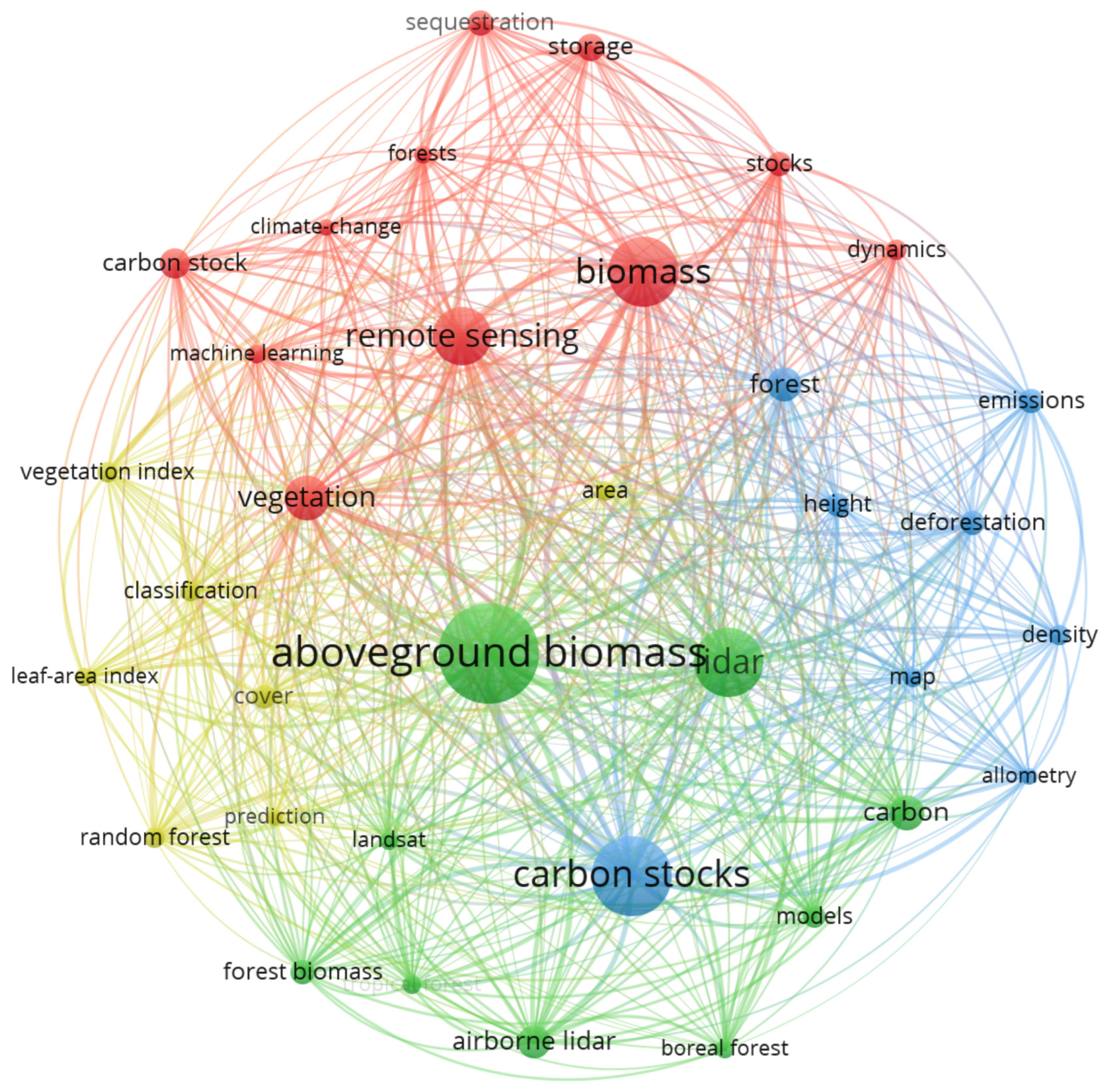
A keyword co-occurrence analysis was conducted to identify major research themes and emerging hotspots in remote-sensing-based vegetation carbon stock estimation. A total of 2818 keywords were extracted from the dataset, and a minimum occurrence threshold of 35 was applied, resulting in 35 high-frequency keywords for network analysis. Figure 6 presents the keyword co-occurrence network, while the cluster structure is summarised in Table 2.
In Figure 6, node size reflects keyword frequency, and link thickness indicates the strength of co-occurrence relationships. The most frequent keyword is “aboveground biomass” (213 occurrences), followed by “carbon stocks” (170), “biomass” (148), and “remote sensing” (124). The prominence of aboveground biomass suggests its widespread use as an operational proxy for vegetation carbon stock in the literature. Several closely related terms also appear separately in the original records, including “lidar” and “airborne lidar”, as well as “carbon stock” and “carbon stocks,” indicating partial variation in keyword usage across studies.
The keyword “aboveground biomass” shows particularly strong links with “carbon stocks,” “biomass,” and “lidar,” underscoring the central role of LiDAR-based remote sensing in biomass and carbon-stock estimation. In addition, “machine learning” appears within the core network structure, suggesting its growing integration into vegetation carbon stock research as a widely adopted analytical approach.
The keyword network was grouped into four clusters, as shown in Figure 6 and summarised in Table 2. The red cluster represents the conceptual and methodological core of the field, linking terms such as biomass, carbon stock, remote sensing, and machine learning. The presence of machine learning in this cluster suggests its growing integration into mainstream vegetation carbon estimation research. The green cluster is more object- and sensor-oriented, centred on aboveground biomass, forest biomass, and key observation technologies such as lidar, airborne lidar, and Landsat. The blue cluster highlights ecological drivers and measurement-related terms, including deforestation, emissions, allometry, height, and density. The yellow cluster captures analytical workflows, combining modelling terms such as random forest, classification, and prediction with variables such as leaf-area index and vegetation index. Together, these clusters reflect the field’s major dimensions, spanning core concepts, observation technologies, ecological processes, and modelling pipelines.
The top 10 keywords are summarised in Table 3. Among them, “carbon stocks,” “aboveground biomass,” and “biomass” have the highest numbers of links, confirming their central position in the research network. Although “carbon stock” and “carbon stocks” appear separately in the original records, their combined presence further highlights the dominance of carbon-related themes in the field. By contrast, terms such as “lidar” show comparatively high total link strength, indicating a particularly strong association with the field’s core research topics.

3.2. Science Mapping of the Machine-Learning-Related Subset

Initial bibliometric results from the full dataset of 645 papers indicated a strong association between vegetation carbon stock estimation, remote sensing, and machine learning. To further characterise this emerging methodological direction, the abstracts and conclusions of all 645 papers were screened, yielding a subset of 184 publications explicitly related to machine learning, including deep learning. This subset was then subjected to additional science-mapping analysis to examine its intellectual structure and collaboration patterns.

3.2.1. Source Co-Citation Network

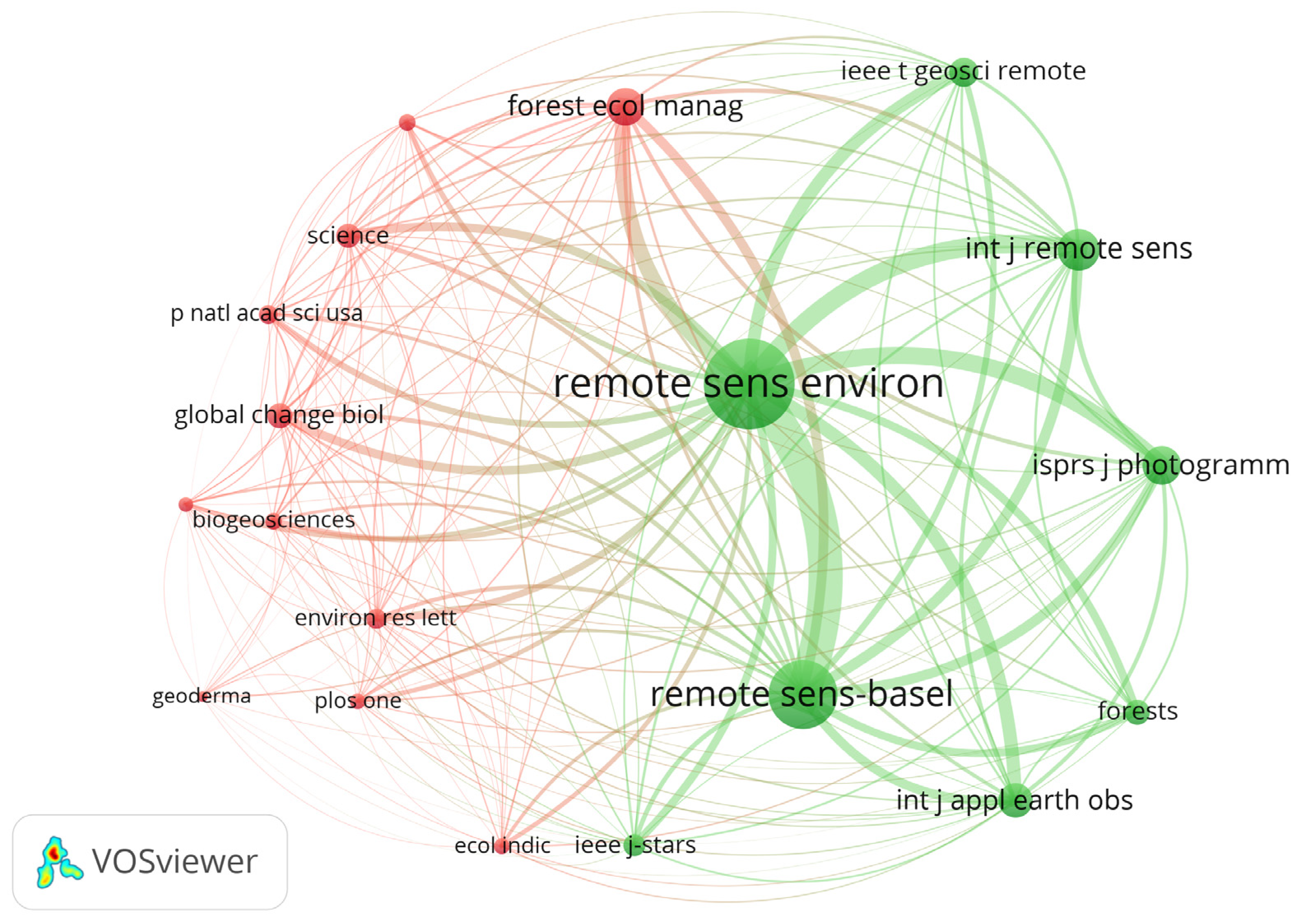
A source co-citation analysis was conducted on the 184 machine-learning-related papers to identify the journal-level intellectual structure of this research subset. Using a minimum threshold of 100 citations, 19 cited sources were retained for network construction. The resulting network is shown in Figure 7, while the detailed co-citation indices are provided in the Supplementary Materials.
The source co-citation network reveals a clear interdisciplinary structure. One cluster is centred on core remote-sensing journals, such as Remote Sensing of Environment, Remote Sensing, and ISPRS Journal of Photogrammetry and Remote Sensing, while the other is anchored in ecology and environmental science journals, including Forest Ecology and Management and Global Change Biology. The strong connections between these clusters indicate that machine-learning-based vegetation carbon stock research is shaped jointly by advances in remote-sensing methodology and ecological applications.
The green cluster is dominated by core remote-sensing journals, led by Remote Sensing of Environment, Remote Sensing, International Journal of Remote Sensing, and ISPRS Journal of Photogrammetry and Remote Sensing. The red cluster is more closely associated with ecology and environmental science, with Forest Ecology and Management, Global Change Biology, and Science as prominent nodes. Together, these clusters illustrate the journal distribution underlying the interdisciplinary structure of the machine-learning-related literature.

3.2.2. Country Collaboration Network

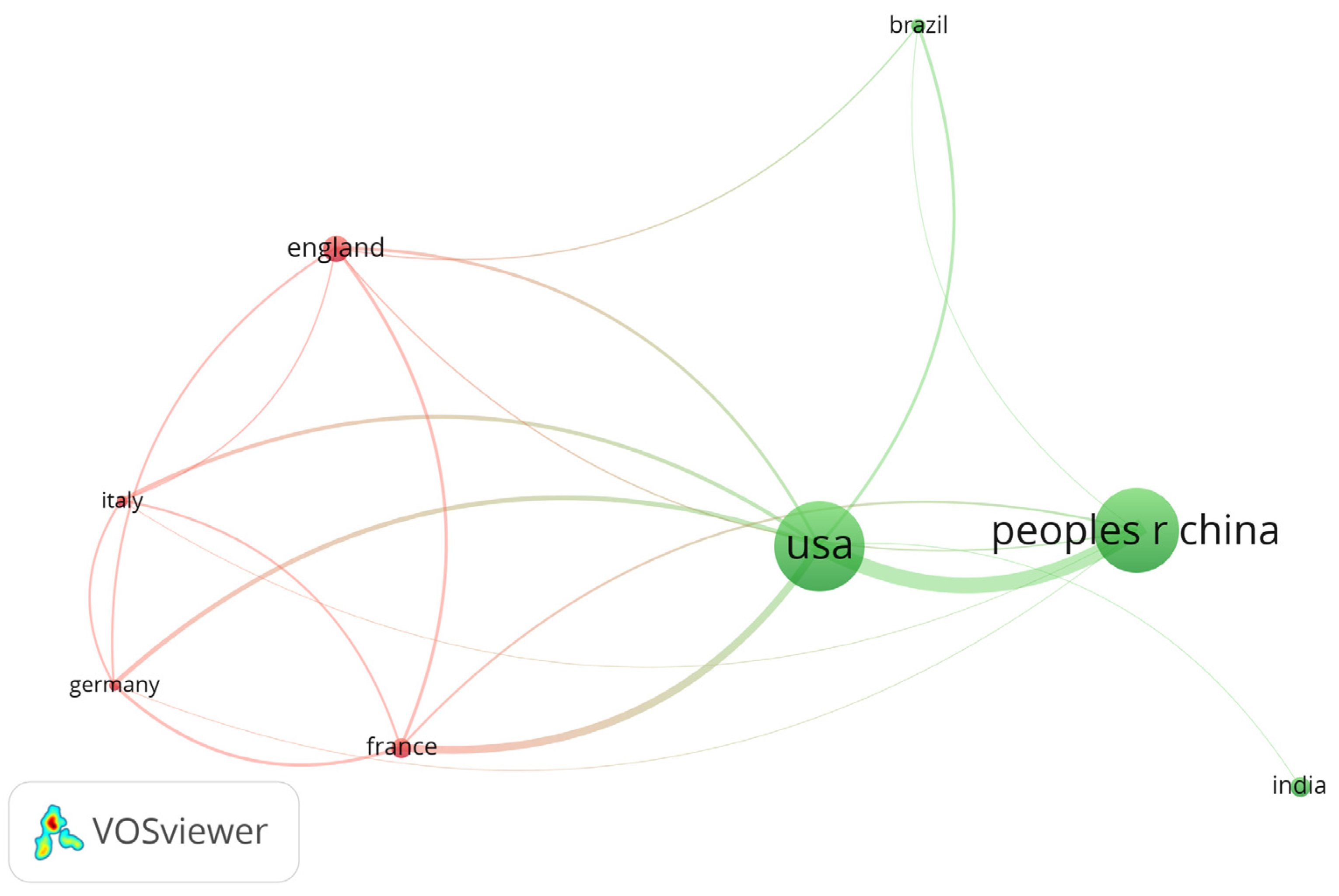
A co-authorship analysis was conducted at the country level to examine patterns of international collaboration within the 184 machine-learning-related papers. Using a threshold of at least 10 documents per country, 8 countries were retained for network construction. The resulting collaboration network is shown in Figure 8, while the detailed co-authorship indices are provided in the Supplementary Materials.
Figure 8 shows the country-level co-authorship network of the 184 machine-learning-related papers, which is organised into two main clusters. One cluster is centred on the United States, which occupies the strongest bridging position and maintains close collaboration links with China, Brazil, and India. The other cluster is formed by several European countries, including France, England, Germany, and Italy, and is characterised by relatively dense intra-regional collaboration. Overall, the network suggests that international collaboration in this subset is concentrated among a small number of major contributors, with the United States acting as the principal connector across clusters.

3.2.3. Timeline View Analysis

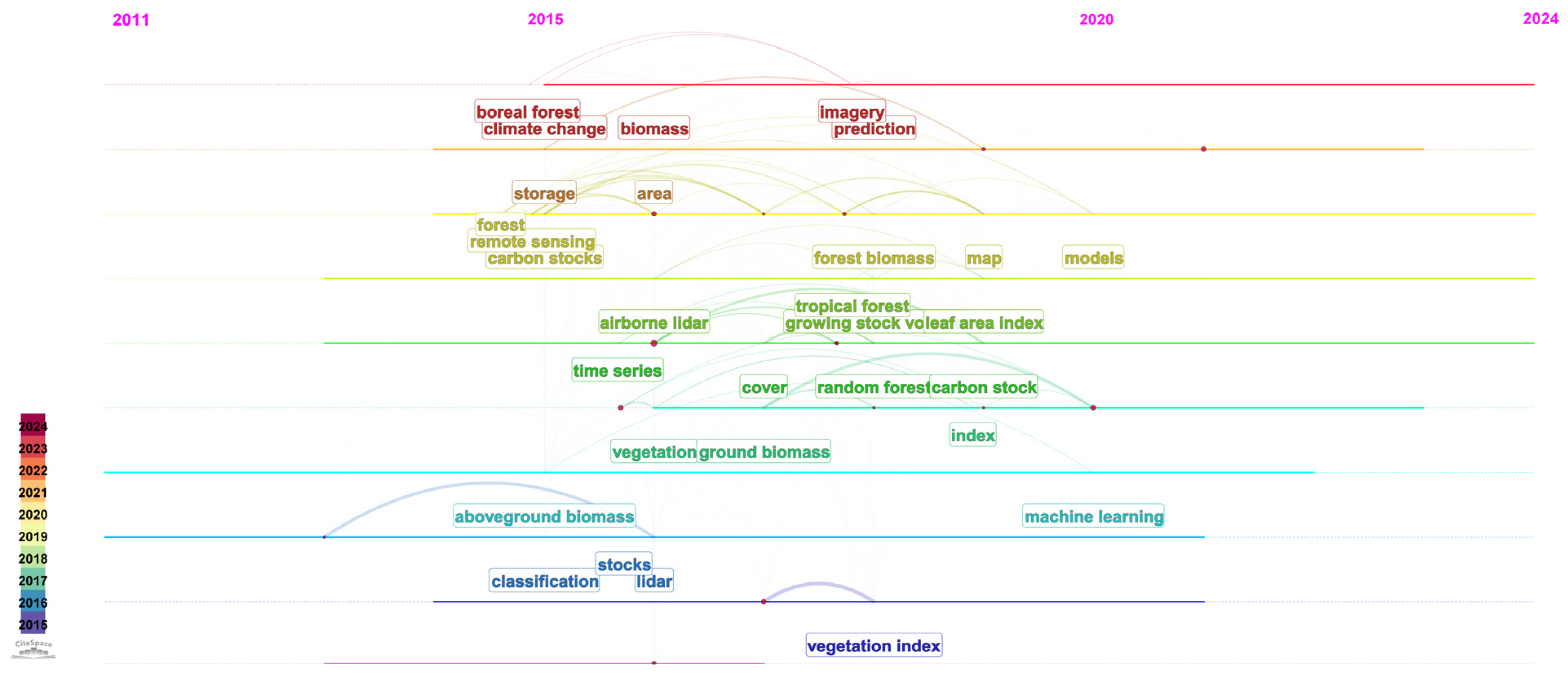
To illustrate the temporal evolution of major research topics, a keyword timeline view was generated for the period 2015–2024 (Figure 9 and Table 4). Overall, the timeline indicates a gradual progression from foundational concepts to more specialised applications and, more recently, to data-driven analytical approaches. The early stage (2015–2018) was dominated by foundational terms such as “remote sensing,” “carbon stocks,” “lidar,” and “classification,” reflecting the establishment of the field’s core concepts and technical basis. During the middle stage (2018–2021), the focus shifted toward more specific applications and modelling strategies, with keywords such as “aboveground biomass,” “forest biomass,” “models,” and “random forest” becoming more prominent. In the most recent stage (2021–2024), “machine learning” emerged more clearly, indicating a methodological shift toward more advanced data-driven approaches and marking a major frontier in current vegetation carbon stock research.

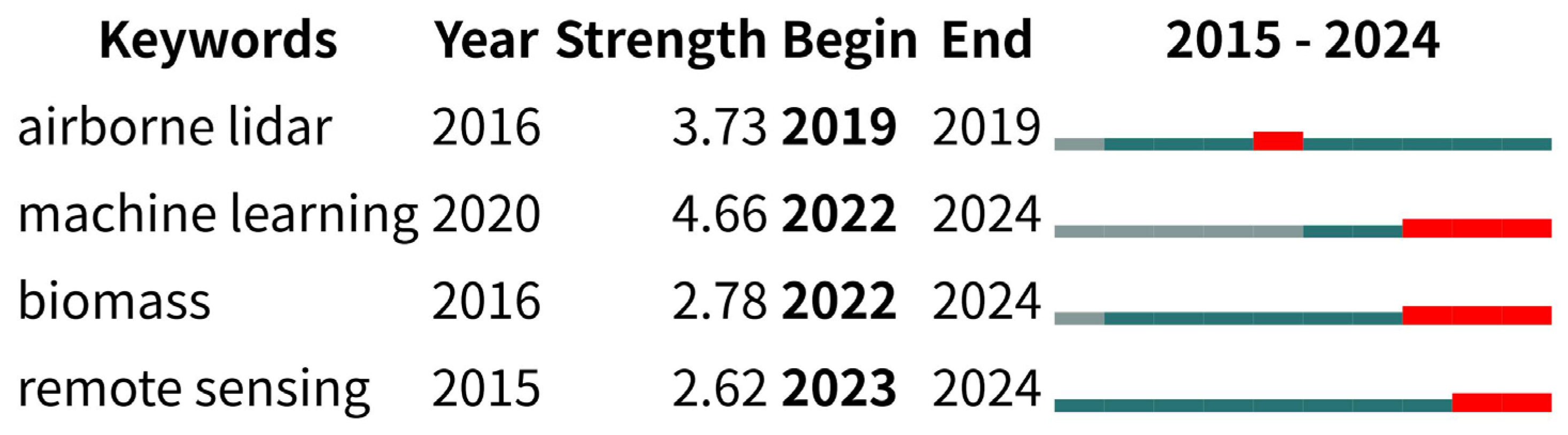
3.2.4. Keyword Burst Analysis

To further identify keywords that experienced a rapid increase in attention during specific periods, a keyword burst analysis was conducted using CiteSpace version 6.3.R2 (Figure 10). The results revealed four keywords with the strongest citation bursts during 2015–2024, namely “airborne lidar”, “machine learning”, “biomass”, and “remote sensing”. Among them, “airborne lidar” showed an earlier burst in 2019, indicating that LiDAR-based approaches attracted marked attention during the transitional stage from conventional remote sensing analysis to more structurally explicit biomass estimation. In contrast, “machine learning” exhibited the highest burst strength (4.66) and remained active from 2022 to 2024, highlighting the rapid rise of advanced data-driven methods in recent vegetation carbon stock research. The concurrent bursts of “biomass” (2022–2024) and “remote sensing” (2023–2024) further suggest that recent studies have increasingly integrated methodological innovation with biomass-oriented remote sensing applications. Overall, the burst analysis complements the timeline view by showing that, while the field evolved progressively from foundational remote sensing concepts toward more specialised estimation topics, the most pronounced recent surge has centred on machine-learning-driven biomass estimation.

3.3. Critical Analysis

Based on the prioritisation protocol described in Section 2.2, a core set of studies was identified for in-depth critical analysis. Rather than reviewing all candidate publications in equal detail, this section focuses on the selected core literature to examine the field’s methodological strengths, recurring limitations, and emerging directions more systematically. The analysis is organised around several key dimensions, including target variables, data sources, sensor configurations, modelling strategies, validation design, and uncertainty reporting. Through this focused appraisal, the section moves beyond descriptive scientometric patterns to provide a critical assessment of how machine-learning-based remote-sensing approaches have been applied to vegetation carbon stock estimation.
The selected analytical corpus is summarised in Table 5, which presents the publications retained through the structured prioritisation procedure. All 184 machine-learning-related publications were first evaluated using a composite impact score based on journal standing and time-normalised article impact, and a threshold of 4.0 was then applied to retain 32 publications for detailed appraisal. For transparency and reproducibility, the complete list of selected studies and their corresponding scores is provided in the Supplementary Materials. To support the critical analysis presented below, the full study-by-study appraisal matrix for the selected publications is provided in Supplementary Table S1, covering study context, data sources, modelling approaches, validation strategies, and reported performance. To provide a concise overview of the selected core literature, the top 10 studies are presented in Table 6.
The subsequent evaluation of the 32 selected studies was guided by eight analytical questions:
Q1 What were the study’s ecosystem, carbon pool, and scale?
Q2 What sensors and platforms were utilized?
Q3 What dataset is being used, and what is the spatial resolution of the data?
Q4 What predictor variables (features) were derived from the sensor data?
Q5 What was the methodology for ground truth data?
Q6 What machine learning algorithms were used for carbon stock modeling?
Q7 What validation strategy was employed?
Q8 What performance metrics were reported?
To ensure a rigorous and transparent synthesis, the critical analysis is organised into four successive components. Section 3.3.1 examines application and research objects, focusing on ecosystem type, carbon pool, and study scale. Section 3.3.2 addresses data foundations, including sensor configurations, predictor construction, and reference-data sources. Section 3.3.3 evaluates modelling and validation, covering algorithm choice, validation design, and reported performance. Finally, Section 3.3.4 synthesises the cross-cutting methodological gaps that emerge across these dimensions. In this structure, Section 3.3.1 mainly addresses Q1, Section 3.3.2 addresses Q2–Q5, Section 3.3.3 addresses Q6–Q8, and Section 3.3.4 synthesises the cross-cutting gaps emerging across these questions. This structure enables the review to move from ecological and observational context to modelling practice and, ultimately, to the persistent constraints affecting transferability, interpretability, and operational deployment.

3.3.1. Application and Research Objects

Across the selected studies, machine-learning-based vegetation carbon stock estimation is dominated by forest and woody-vegetation above-ground biomass (AGB) applications, with forest ecosystems accounting for the largest share of the reviewed literature [53,54,56,58,59,60,64,65,66,67,68,69,71,72,73,75,77,78,79,82,83,84]. In most cases, the primary target variable is above-ground biomass, which is subsequently treated as a practical proxy for vegetation carbon stock through biomass-to-carbon conversion assumptions. Other ecosystems, including mangroves, tidal marshes, grasslands, urban forests, and savanna-like woody vegetation, are represented but remain comparatively limited [57,61,62,63,70,74,76,80,81,85]. This distribution suggests that methodological development has been shaped to a considerable extent by the stronger structural signals, greater data availability, and relatively mature allometric reference systems typically associated with forest environments [53,56,60,64,66,69].
In terms of spatial scope, most studies were conducted at the regional scale [56,58,59,61,62,63,64,65,68,69,70,71,72,73,74,75,76,77,78,79,80,83,85], whereas national- and global-scale applications were less common [53,54,57,60,66,81,84]. Large-area studies typically relied more heavily on precompiled products, multi-source integration, or simplified reference assumptions, reflecting the greater difficulty of scaling models across heterogeneous biomes and management regimes [54,60,66,78,81,84]. Overall, the reviewed literature indicates that ecosystem type and study scale are not neutral design choices, but key factors influencing predictor construction, modelling strategy, validation design, and the interpretability of reported performance [53,54,57,60,67,78,84].

3.3.2. Data and Foundations

The data foundations of the reviewed studies are characterised by a strong reliance on multi-source remote sensing. Across the selected studies, a clear methodological pattern is the widespread reliance on combinations of optical imagery, SAR, LiDAR, topographic variables, and climatic covariates [53,54,56,57,58,59,60,63,65,66,67,68,69,70,71,73,74,75,76,77,78,81,82,83,84,85]. Among these, Sentinel-2 and Landsat were the most frequently used optical sources, reflecting both their accessibility and their utility for deriving spectral bands, vegetation indices, and texture-related predictors [56,57,58,62,64,67,68,69,70,71,72,75,77,79,80,83]. However, optical data alone remain vulnerable to saturation in dense canopies and may lose sensitivity under structurally complex forest conditions [56,58,60,69,70].
To compensate for the limitations of optical data, many studies incorporated active sensors that are more sensitive to canopy structure. In particular, SAR data, especially Sentinel-1, the Advanced Land Observing Satellite/Phased Array type L-band Synthetic Aperture Radar (ALOS/PALSAR), and Phased Array type L-band Synthetic Aperture Radar-2 (PALSAR-2), were widely used to improve sensitivity to canopy structure and biomass gradients [56,58,59,63,68,70,71,77,78,80,81,82,83,84,85]. SAR-based variables were particularly valuable where optical signals were constrained by canopy closure, forest density, or atmospheric effects [56,58,59,68,71,77,83,85]. At the same time, LiDAR emerged as the most structurally informative data source, including airborne LiDAR, UAV-LiDAR, ICESat/GLAS, ICESat-2, and LiDAR-derived canopy height products [53,60,63,65,69,70,74,75,81,82,84]. Studies supported by LiDAR generally benefited from more direct representations of canopy height and structural heterogeneity, which are difficult to recover reliably from optical data alone [53,60,65,69,70,74,75,82].
Beyond the choice of sensors, the reviewed studies also show substantial variation in how raw observations were transformed into model predictors. Predictor construction was highly diverse, but most workflows relied on combinations of spectral bands, vegetation indices, textural measures, SAR backscatter or polarimetric variables, LiDAR-derived height metrics, and terrain factors [56,57,58,59,61,62,63,64,65,68,69,70,71,72,73,74,75,76,77,78,79,80,81,82,83,85]. Common optical predictors included visible–near-infrared and shortwave infrared bands and indices such as the Normalized Difference Vegetation Index (NDVI), Enhanced Vegetation Index (EVI), Soil-Adjusted Vegetation Index (SAVI), Modified Soil-Adjusted Vegetation Index (MSAVI), Atmospherically Resistant Vegetation Index (ARVI), Optimized Soil-Adjusted Vegetation Index (OSAVI), and Wide Dynamic Range Vegetation Index (WDRVI) [57,61,69,71,76,79,80]. In SAR-based or SAR-supported studies, predictor sets often included vertical transmit and vertical receive/vertical transmit and horizontal receive (VV/VH) backscatter, polarization combinations, coherence, entropy, anisotropy, and texture features, reflecting the importance of structural sensitivity in biomass estimation [56,58,59,68,71,77,78,82,83,85]. Where LiDAR was available, studies typically derived canopy height, canopy cover, height percentiles, shape metrics, and intensity-based statistics, many of which were among the strongest predictors in structurally complex vegetation [53,63,65,69,70,74,75,81,82].
A further layer of the data foundation concerns the construction of reference data, which remains a major source of methodological uncertainty. In most reviewed studies, ground truth was not a direct carbon measurement but an indirect reference estimate, usually derived from allometric equations, and often supplemented by destructive sampling, volume-based estimation, biomass expansion factors, or forest inventory data [53,57,60,61,62,63,64,65,66,68,69,70,71,72,73,74,75,76,77,78,79,80,81,82,83,84,85]. While such approaches are operationally necessary, they introduce an additional layer of uncertainty, since the credibility of the target variable depends on plot design, species representativeness, wood-density assumptions, and the transferability of the allometric models used [53,56,60,64,66,69,70]. This means that model performance is shaped not only by sensor quality and algorithm choice, but also by the reliability of the underlying reference-data framework.
Taken together, these patterns indicate a broader transition from single-sensor dependence toward data synergy, but also reveal several unresolved challenges in data integration. The reviewed literature points to increasing use of optical, SAR, LiDAR, and ancillary environmental variables in combination to improve robustness across biomass ranges and ecological settings [58,60,63,69,70,75,77,81,84]. At the same time, this transition introduces persistent methodological challenges, including scale mismatch, temporal inconsistency, high-dimensional predictor redundancy, and reduced interpretability, especially when point-cloud, pixel-based, and gridded datasets are combined within the same modelling workflow [53,60,67,75,78,81,84].

3.3.3. Modelling and Validation

The modelling dimension of the reviewed studies is characterised by both methodological diversification and the continued dominance of a small number of robust baseline algorithms. Across the selected literature, Random Forest (RF) was the most frequently adopted model, appearing across a wide range of ecosystems, spatial scales, and sensor combinations [54,57,64,66,67,68,70,71,72,73,77,78,81,82,83,84]. Its prominence reflects several practical advantages, including tolerance to heterogeneous predictors, stable performance under mixed data types, and ease of implementation [54,57,64,66,67,68,70,71,72,73,77,78,81,82,83,84] in workflows combining spectral, textural, structural, topographic, and climatic variables. In many studies, RF functioned as the default or benchmark model against which more complex algorithms were compared [64,66,68,70,71,72,73,77,78,81,82,83,84]. This pattern suggests that RF remains the most reliable baseline in studies with heterogeneous predictors, moderate sample sizes, and operationally constrained workflows.
Beyond RF, the literature shows a broad but highly context-dependent use of alternative machine-learning algorithms. Conventional models such as Support Vector Regression/Support Vector Machine (SVR/SVM), Cubist, k-Nearest Neighbors (k-NN), Artificial Neural Network (ANN), Extreme Gradient Boosting (XGBoost), and Categorical Boosting (CatBoost) were applied in response to specific data structures, ecosystem conditions, or modelling objectives [56,59,61,62,63,74,76,78,80]. For example, SVR/SVM were often used where nonlinear relationships and limited sample sizes were central concerns [56,61], while Cubist and boosting-based models such as XGBoost and CatBoost appeared in studies emphasising nonlinear regression and interaction effects among predictors [60,62,63,74,84]. However, the reviewed evidence does not support a single universally best conventional model. Instead, model performance was strongly conditioned by ecosystem type, predictor design, reference-data quality, and the validation strategy adopted [56,60,62,63,74,76,78,84]. Accordingly, method selection should be understood as a context-dependent design choice rather than a search for a universally superior algorithm.
A further methodological shift is the increasing use of deep-learning architectures, particularly in studies supported by high-dimensional fused inputs or structural data. The reviewed studies include Convolutional Neural Networks (CNNs), sparse 3D CNNs, stacked sparse autoencoders, deep neural networks, and multilayer perceptrons [53,58,69,75,79,85]. These models were generally introduced to enhance representation learning and reduce dependence on manually engineered features, especially where LiDAR point clouds, dense multi-sensor fusion, or highly nonlinear feature spaces formed the basis of estimation [53,58,69,75,79]. In such settings, deep learning often defined the performance frontier, particularly where structural information was rich and computational resources were available [53,69,75]. At the same time, the apparent advantages of deep learning were not always separable from the effects of improved data quality, larger feature sets, or more favourable validation conditions, suggesting that higher reported accuracy should not automatically be attributed to model architecture alone [53,58,69,75,79,85]. This indicates that deep learning is best viewed as a high-potential method family whose benefits are most likely to emerge under structurally rich, data-intensive, and computationally supported conditions, rather than as a universally superior solution.
Validation design represents one of the most important but most uneven methodological dimensions in the reviewed studies. Many studies relied on random hold-out validation, while others adopted k-fold cross-validation, leave-one-out cross-validation (LOOCV), Monte Carlo simulation, spatially blocked hold-out designs, or leave-one-domain-out (LODO) validation [53,54,58,60,63,64,65,66,67,69,70,71,72,73,74,75,76,77,80,81,82,83,84,85]. A closer inspection of the 32 core studies shows that only two studies (6.25%) explicitly used strongly transferability-oriented designs, namely spatially blocked hold-out and LODO validation [53,67], while three additional studies (9.38%) adopted stratified validation designs [70,75,78]. By contrast, most studies relied on conventional hold-out or non-spatial resampling strategies. These differences are not trivial because reported model performance is not directly comparable when validation protocols differ in how they handle spatial dependence, ecological heterogeneity, and domain shift. In particular, random hold-out designs may overestimate model performance when training and test samples are spatially or environmentally similar, whereas spatially blocked or domain-aware validation provides a more demanding and more realistic assessment of transferability [53,67,78,84]. The reviewed literature, therefore, suggests that explicit testing of spatial generalisability remains limited relative to the field’s growing emphasis on large-area and transferable carbon mapping [53,67,70,75,78].
Reported performance metrics were also highly variable, which further complicates cross-study comparison. Most studies reported R2 and RMSE, but many also used MAE, NRMSE, relative RMSE (i.e., RMSE expressed relative to the mean or reference value), Bias, or adjusted R2 (i.e., the coefficient of determination adjusted for the number of predictors), and some mixed percentage-based and unit-based expressions within the same evaluation framework [53,54,57,60,63,65,66,69,70,71,72,73,74,75,76,77,81,82,83,84,85]. As a result, apparently strong performance in one study is not always directly comparable to results reported elsewhere. High accuracy does not necessarily imply high generalisability, especially when model evaluation is based on locally calibrated reference data, limited spatial extents, or validation schemes that do not explicitly test out-of-domain robustness [53,54,78,84].
Taken together, the reviewed literature suggests that modelling success in vegetation carbon stock estimation depends less on identifying a universally superior algorithm than on aligning model complexity with data structure, reference-data quality, and evaluation design. Simpler ensemble models such as RF continue to provide strong and reliable baselines, especially under heterogeneous predictors and limited sample sizes, whereas deep-learning models may offer advantages when supported by richer structural data and more rigorous implementation conditions. At the same time, the credibility of reported performance increasingly depends on the quality of validation design and the transparency of performance reporting, rather than on headline accuracy values alone. From a comparative perspective, the most credible methodological pathway is not defined by algorithmic novelty alone, but by the joint quality of predictors, reference data, validation design, and interpretability [53,54,55,56,57,58,59,60,61,62,63,64,65,66,67,68,69,70,71,72,73,74,75,76,77,78,79,80,81,82,83,84,85].

3.3.4. Cross-Cutting Methodological Gaps

Across the reviewed literature, several methodological gaps recur across ecosystems, scales, and modelling frameworks, indicating that current progress remains uneven despite clear advances in data integration and algorithmic design. The first and most persistent gap concerns ecosystem imbalance. Most machine-learning-based studies remain concentrated on forests and woody vegetation, while non-forest systems such as mangroves, tidal marshes, grasslands, and urban green spaces are still comparatively underrepresented [57,61,62,63,70,74,76,80,81,85]. This imbalance limits the ecological breadth of current evidence and constrains the development of methods that are transferable across contrasting vegetation types and carbon pools.
A second gap lies in the uncertainty of reference-data foundations. In most studies, the target variable was not a direct carbon measurement but an estimate derived from allometric equations, destructive sampling, biomass expansion factors, or inventory-based conversions [53,57,60,61,62,63,64,65,66,68,69,70,71,72,73,74,75,76,77,78,79,80,81,82,83,84,85]. While operationally necessary, these indirect reference systems remain uneven in quality and are often insufficiently interrogated as sources of modelling uncertainty. Consequently, some reported performance gains may partly reflect calibration to locally adapted reference frameworks rather than genuine improvements in model generalisability [53,56,60,64,66,69,70]. This issue becomes especially important when models are transferred across sites, species assemblages, or biome boundaries.
A third gap concerns the tension between data richness and interpretability. The increasing use of multi-source fusion and high-dimensional predictor spaces has clearly improved the ability of models to capture biomass-related variability [58,60,63,69,70,75,77,81,84]. However, these gains are often accompanied by unresolved problems of scale mismatch, temporal inconsistency, predictor redundancy, and limited ecological interpretability [53,60,67,75,78,81,84]. In many studies, the modelling workflow becomes more accurate but less transparent, making it difficult to determine whether good performance reflects robust ecological relationships or dependence on complex, locally optimised feature spaces.
A fourth gap is the lack of consistency in validation practice and performance reporting. Although the reviewed studies used a wide variety of approaches—including hold-out testing, k-fold cross-validation, LOOCV, Monte Carlo simulation, spatial blocking, and leave-one-domain-out designs [53,54,58,60,63,64,65,66,67,69,70,71,72,73,74,75,76,77,80,81,82,83,84,85]—these protocols are not equivalent in their ability to assess generalisability. Random hold-out splits remain common, yet they may overestimate performance when spatial autocorrelation or ecological similarity makes test samples too similar to training data [53,67,78,84]. At the same time, reported metrics vary substantially across studies, with different combinations of R2, RMSE, MAE, NRMSE, Bias, and relative RMSE, making direct comparison difficult and sometimes misleading [53,54,57,60,63,65,66,69,70,71,72,73,74,75,76,77,81,82,83,84,85]. The very limited adoption of explicitly spatially structured validation indicates that robust assessment of transferability is still not standard practice in this field [53,67,70,75,78].
Finally, cross-domain transferability remains one of the least resolved challenges in the field. Many studies demonstrate strong within-region or within-ecosystem performance, but far fewer provide convincing evidence that models can be transferred across biomes, management regimes, or heterogeneous landscapes without major loss of reliability [54,67,78,84]. This suggests that the field has made substantial progress in predictive modelling under local or regional conditions, but is still far from achieving a universally robust framework for large-scale, operational vegetation carbon stock estimation.
Taken together, these recurring gaps show that current methodological progress remains constrained by limited ecosystem coverage, uncertain reference-data foundations, inconsistent validation practice, and unresolved challenges in interpretability and transferability. At the same time, several practical lessons can be drawn from the reviewed studies [53,54,55,56,57,58,59,60,61,62,63,64,65,66,67,68,69,70,71,72,73,74,75,76,77,78,79,80,81,82,83,84,85]. First, model choice should be aligned with predictor structure, sample support, and ecological context, rather than framed as a search for a universally superior algorithm. Second, multi-source fusion is most useful when it is used to address specific information gaps, particularly where optical signals saturate, and structural information from SAR or LiDAR can improve sensitivity to biomass variation. Third, reference-data quality should be treated as a central component of model credibility, not merely as a background input for training and evaluation. Fourth, when the objective is transferable mapping, spatially structured or domain-aware validation provides a more credible basis for assessing generalisability than conventional random splitting alone [53,67,70,75,78]. Finally, performance and uncertainty should be reported in a more transparent and comparable way to support meaningful cross-study interpretation. Overall, future progress is likely to depend less on increasing model complexity in isolation than on improving validation credibility, interpretability, and operational robustness [53,54,55,56,57,58,59,60,61,62,63,64,65,66,67,68,69,70,71,72,73,74,75,76,77,78,79,80,81,82,83,84,85].

4. Synthesis and Discussion

4.1. Key Findings

The key findings of this review are synthesised around three interconnected dimensions: application and research objects, data foundations, and modelling and methodology. Drawing on the bibliometric mapping, science mapping, and structured critical analysis presented in Section 3, this Section does not repeat the detailed evidence, but instead distils the most important patterns and discusses their implications for remote sensing-based vegetation carbon stock estimation.

4.1.1. Knowledge Evolution and Thematic Shift

A first major finding is that remote sensing-based vegetation carbon stock estimation has evolved from a relatively fragmented research area into a rapidly expanding and increasingly method-driven field. Bibliometric evidence indicates a clear post-2020 acceleration in publication output, together with the consolidation of core publication venues and research hubs. This pattern is consistent with the broader transition identified in recent syntheses, where VCS/AGB mapping is moving from feasibility demonstrations toward application-driven research that increasingly supports carbon accounting, ecological monitoring, and operational MRV requirements [86,87,88].
Thematic evolution further suggests that machine learning is no longer a peripheral analytical tool, but has become embedded in the field’s core methodological structure. Keyword co-occurrence and timeline patterns indicate a progression from foundational remote sensing and biomass mapping themes toward a more explicit emphasis on learning-based estimation frameworks. In this sense, the field has entered a stage in which methodological innovation is increasingly shaped not only by data availability but also by the need to improve predictive flexibility, model scalability, and ecological applicability across increasingly diverse landscapes.
At the same time, the knowledge structure of the field remains relatively concentrated. A limited number of journals, countries, and highly cited studies continue to exert disproportionate influence on research direction and visibility. This concentration does not necessarily weaken the field, but it does suggest that current development is still being shaped by a relatively small set of dominant methodological traditions and publication platforms. As a result, emerging topics such as uncertainty-aware mapping, domain transfer, and non-forest carbon estimation may still receive uneven attention despite their growing importance.
An additional limitation should also be noted in relation to the focused critical appraisal. The prioritisation of core studies using journal quartiles and citation metrics improved transparency and feasibility when narrowing a large candidate pool, but it may also favour older or more visible publications and may therefore underrepresent more recent studies with strong methodological contributions but lower citation accumulation. These indicators were used as pragmatic proxies for influence and visibility rather than as direct measures of methodological rigour. No separate formal methodological quality-scoring framework was applied. Instead, the selected studies were subsequently examined through structured critical appraisal of data sources, predictor design, reference data, modelling approaches, validation strategies, and reported performance. This consideration should be kept in mind when interpreting the composition of the core study set.

4.1.2. Data Foundations and Sensor Synergy

A second major finding concerns the increasing importance of data foundations and sensor synergy in shaping model performance. Across the reviewed studies, vegetation carbon stock estimation is no longer dominated by single-sensor workflows. Instead, combinations of optical, SAR, LiDAR, and ancillary environmental variables have become a common strategy for improving sensitivity across biomass ranges and ecological settings [58,60,63,69,70,75,77,81,84]. Optical imagery remains foundational because of its accessibility, continuity, and spectral richness, yet its well-known limitations under dense or structurally complex canopies have driven the wider integration of SAR and LiDAR.
Consistent with many recent syntheses, multi-sensor fusion is increasingly treated as a pragmatic default for operational mapping [8,89,90]. Integrating active sensors such as SAR and LiDAR with optical imagery is widely used to reduce saturation effects, improve sensitivity to structural variation, and enhance robustness across forest types and disturbance regimes. However, this review adds an important practical nuance to that consensus: while fusion often improves predictive stability, it also introduces non-trivial methodological challenges, including scale alignment between point clouds and pixels, temporal harmonisation in time-series designs, and reduced interpretability of highly integrated predictor spaces. These issues are often under-discussed in performance-focused studies, yet they directly affect transferability, comparability, and eventual deployment.
The critical synthesis also shows that the quality of data foundations depends not only on sensor combinations, but on how those observations are transformed into predictors and linked to reference data. High-dimensional predictor construction has become increasingly common, especially in fusion-based studies, but the ecological meaning and stability of selected variables are not always clearly justified. More importantly, the reference side of the data chain remains a fundamental source of uncertainty. Most studies still rely on indirect reference estimates derived from allometric equations, destructive sampling, inventory conversions, or biomass expansion procedures. Consequently, improvements in model performance cannot be interpreted as purely algorithmic gains; they are also conditioned by the quality, consistency, and transferability of the underlying reference-data framework.

4.1.3. Modelling, Validation, and Methodological Constraints

A third major finding is that current progress in vegetation carbon stock estimation is increasingly shaped by the interaction between model choice, validation design, and reference-data credibility, rather than by algorithm selection alone. Random Forest remains a widely used and reliable baseline, owing to its robustness to heterogeneous predictors and its stable performance under limited or mixed-type training data [54,57,64,66,67,68,71,72,73,91]. This explains why it continues to dominate the reviewed literature even as the modelling landscape becomes more diverse. At the same time, deep learning represents the methodological frontier. Where structural observations such as LiDAR point clouds and high-dimensional fused inputs are available, representation learning can reduce reliance on handcrafted variables and, in many settings, produce the strongest predictive performance [53,58,69,75,79,92].
However, the reviewed evidence does not support the existence of a universally superior modelling framework. Model performance remains strongly context-dependent, reflecting the combined influence of ecosystem type, spatial scale, predictor construction, reference-data quality, and evaluation design. Moving from high-performing prototypes to scalable operational mapping, therefore, requires more than algorithmic sophistication. It also requires explicit attention to computational burden, training and inference efficiency, model transparency, and deployability under real-world data constraints [93].
One area where the present synthesis adds particular emphasis is validation design as a determinant of credibility. Some earlier reviews discuss validation primarily in terms of train–test splits and accuracy metrics, whereas the reviewed evidence here indicates that validation protocol choice can fundamentally alter the meaning of reported performance [86]. Random splits may inflate accuracy when spatial autocorrelation or ecological similarity makes training and test samples overly alike [94]. By contrast, spatially blocked and domain-aware validation, including leave-one-region-out or leave-one-domain-out schemes, provides a more realistic test of transferability under spatial non-stationarity and cross-biome domain shifts [86,95]. This shift toward generalisation-aware evaluation is becoming more visible in recent studies, but it remains far from standard practice.
Finally, the modelling literature remains constrained by several persistent methodological imbalances. The application landscape is still ecosystem-skewed: forests dominate VCS/AGB estimation because they combine high carbon relevance, stronger structural signal, and relatively mature plot and allometric reference systems [93,96]. By contrast, non-forest systems such as wetlands, mangroves, grasslands, croplands, and urban green spaces remain less represented, despite increasing policy relevance and growing technical feasibility. This imbalance is not merely descriptive; it directly affects the generalisability of current modelling frameworks and contributes to the continuing scale–accuracy trade-off in large-area mapping. Taken together, the evidence suggests that the field is transitioning toward sensor synergy, learning-based modelling, and more generalisation-aware evaluation, yet remains constrained by ecosystem imbalance, reference-data uncertainty, cross-biome transfer limitations, and non-standardised validation and uncertainty protocols.

4.2. Implications for Forestry Practice and Policy

The findings of this review have practical relevance for forestry practice and policy. In particular, remote sensing-based vegetation carbon stock estimation can support forest inventory by improving spatial coverage and update frequency, while providing spatially explicit information for carbon monitoring and forest management. The increasing use of optical, SAR, and LiDAR data, often in combination with machine learning, further strengthens this potential.
At the same time, practical application still depends on reliable reference data, robust validation, and model transferability. Remote sensing should therefore be regarded as a complement to field-based inventory and management, rather than a replacement. These considerations are also important for MRV, regional carbon accounting, and forest-related decision-making.

5. Conclusions

This review examines the evolution of vegetation carbon stock estimation studies based on remote sensing from 2015 to 2024 by combining bibliometric analysis, scientific network analysis, and structured critical evaluation. Overall, the results indicate that the field has developed rapidly, with growth in both the number of published papers and methodological complexity. Recent studies no longer rely primarily on traditional spectral analysis but increasingly adopt machine learning and multi-source data fusion in response to the demand for spatially explicit carbon distribution maps in different application contexts.
A clear finding of this review is that machine learning has evolved from a supplementary analytical tool into one of the central themes in the field. The role of sensor integration has also become increasingly prominent. In most studies, optical data still provide the basic information framework, but Synthetic Aperture Radar (SAR) and LiDAR are now frequently incorporated to capture canopy structure more effectively and to mitigate saturation issues, particularly in areas with dense vegetation or complex canopy structures. The review also suggests that progress in this field cannot be attributed solely to the algorithms themselves. Model performance is shaped by the design of predictor variables, the quality and representativeness of reference data, the rigor of validation, and the ecological conditions under which the model is applied. In this context, Random Forest remains the most consistent benchmark across studies, while deep learning shows the greatest potential in settings where structural information and richer fused inputs are available.
Despite these advances, the field has not yet reached full maturity. Most of the existing evidence remains focused on forest ecosystems, while research on non-forest vegetation types is still relatively limited. Reference data also continue to rely heavily on indirect estimates derived from resource inventories or allometric relationships; however, the uncertainty introduced at this stage is often not adequately addressed during model development and interpretation. Validation practices represent another long-standing weakness. Accuracy reported across different studies is often difficult to compare directly, and strong performance within a single study area does not necessarily imply broader generalizability. These issues suggest that future research should place equal emphasis on ecological coverage, the reliability of reference data, and robust evaluation design, rather than focusing only on predictive accuracy.
This review is also subject to several limitations. Like other bibliometric studies, it is constrained by database coverage, search design, and citation lag, particularly for recent years. Furthermore, because studies differ in terms of reference data, allometric assumptions, spatial support, and validation protocols, caution is needed when directly comparing model performance across studies. Despite these limitations, the overall trends identified in this review remain clear. Future advances in vegetation carbon stock estimation are unlikely to come mainly from isolated improvements in model fit, but rather from the development of methods that are transferable across ecosystems, offer interpretable relationships between predictors and response variables, communicate uncertainty more clearly, and are credible in practical applications.

Supplementary Materials

The following supporting information can be downloaded at: https://www.mdpi.com/article/10.3390/f17040503/s1, PRISMA 2020 Checklist; Table S1: The Critical Appraisal Matrix of 32 Key Studies on Remote Sensing-Based Vegetation Carbon Stock and Aboveground Biomass Mapping is available to download at https://doi.org/10.57967/hf/8098 accessed on 21 March 2025.

Author Contributions

Conceptualization, X.M., M.J.M.Y., L.F. and S.M.; methodology, X.M. and L.F.; software, L.F.; validation, X.M., M.J.M.Y. and S.M.; formal analysis, X.M. and M.J.M.Y.; investigation, X.M. and L.F.; resources, X.M.; data curation, L.F. and X.M.; writing—original draft preparation, X.M.; writing—review and editing, M.J.M.Y.; visualization, X.M.; supervision, M.J.M.Y., L.F. and S.M.; project administration, M.J.M.Y.; funding acquisition, X.M. All authors have read and agreed to the published version of the manuscript.

Funding

This research received no external funding.

Data Availability Statement

Data is contained within the article.

Acknowledgments

The work described in this paper was undertaken at the Faculty of Design and Architecture, Universiti Putra Malaysia, Serdang 43400, Malaysia, when X.M. was at Universiti Putra Malaysia.

Conflicts of Interest

The authors declare no conflicts of interest.

Abbreviations

The following abbreviations are used in this manuscript:
ACAverage Citations
AGBAboveground Biomass
AGCAboveground Carbon
ALSAirborne Laser Scanning
ANNArtificial Neural Network
ARVIAtmospherically Resistant Vegetation Index
CatBoostCategorical Boosting
CNNConvolutional Neural Network
CVCross-Validation
DEMDigital Elevation Model
EVIEnhanced Vegetation Index
GEDIGlobal Ecosystem Dynamics Investigation
GLASGeoscience Laser Altimeter System
ICESatIce, Cloud, and Land Elevation Satellite
K-fold CVK-Fold Cross-Validation
k-NNk-Nearest Neighbours
LiDARLight Detection and Ranging
LODOLeave-One-Domain-Out
LOOCVLeave-One-Out Cross-Validation
MAEMean Absolute Error
MODISModerate Resolution Imaging Spectroradiometer
MRVMeasurement, Reporting and Verification
MSAVIModified Soil-Adjusted Vegetation Index
NDVINormalized Difference Vegetation Index
NRMSENormalized Root Mean Square Error
OSAVIOptimized Soil-Adjusted Vegetation Index
PCAPrincipal Component Analysis
PRISMAPreferred Reporting Items for Systematic Reviews and Meta-Analyses
R2Coefficient of Determination
RFRandom Forest
RMSERoot Mean Square Error
SARSynthetic Aperture Radar
SAVISoil-Adjusted Vegetation Index
SIFSolar-Induced Fluorescence
SVRSupport Vector Regression
SVMSupport Vector Machine
TCTotal Citations
TPTotal Publications
UAVUncrewed Aerial Vehicle
VCSVegetation Carbon Stock
WDRVIWide Dynamic Range Vegetation Index
XGBoostExtreme Gradient Boosting

References

  1. IPCC. Climate Change 2021: Summary for All; IPCC: Geneva, Switzerland, 2022. [Google Scholar]
  2. Shanmugam, G. Fossil Fuels, Climate Change, and the Vital Role of CO2 Plays in Thriving People and Plants on Planet Earth. Bull. Miner. Res. Explor. 2023, 175, 167–175. [Google Scholar]
  3. Wei, J.; Jiang, T.; Ménager, P.; Kim, D.-G.; Dong, W. COP29: Progresses and Challenges to Global Efforts on the Climate Crisis. Innovation 2025, 6, 100748. [Google Scholar] [CrossRef] [PubMed]
  4. Baumann, M.; Gasparri, I.; Piquer-Rodríguez, M.; Gavier Pizarro, G.; Griffiths, P.; Hostert, P.; Kuemmerle, T. Carbon Emissions from Agricultural Expansion and Intensification in the Chaco. Glob. Change Biol. 2017, 23, 1902–1916. [Google Scholar] [CrossRef] [PubMed]
  5. Li, J.; Guo, X.; Chuai, X.; Xie, F.; Yang, F.; Gao, R.; Ji, X. Reexamine China’s Terrestrial Ecosystem Carbon Balance under Land Use-Type and Climate Change. Land Use Policy 2021, 102, 105275. [Google Scholar] [CrossRef]
  6. Meinshausen, M.; Lewis, J.; McGlade, C.; Gütschow, J.; Nicholls, Z.; Burdon, R.; Cozzi, L.; Hackmann, B. Realization of Paris Agreement Pledges May Limit Warming Just below 2 °C. Nature 2022, 604, 304–309. [Google Scholar] [CrossRef]
  7. Keith, H.; Vardon, M.; Obst, C.; Young, V.; Houghton, R.A.; Mackey, B. Evaluating Nature-Based Solutions for Climate Mitigation and Conservation Requires Comprehensive Carbon Accounting. Sci. Total Environ. 2021, 769, 144341. [Google Scholar] [CrossRef]
  8. Xu, W.; Cheng, Y.; Luo, M.; Mai, X.; Wang, W.; Zhang, W.; Wang, Y. Progress and Limitations in Forest Carbon Stock Estimation Using Remote Sensing Technologies: A Comprehensive Review. Forests 2025, 16, 449. [Google Scholar] [CrossRef]
  9. Chen, Z.; Lin, Z.; Shi, T.; Deng, D.; Chen, Y.; Pan, X.; Chen, X.; Wu, T.; Lei, J.; Li, Y. Advancing Forest Inventory in Tropical Rainforests: A Multi-Source LiDAR Approach for Accurate 3D Tree Modeling and Volume Estimation. Remote Sens. 2025, 17, 3030. [Google Scholar] [CrossRef]
  10. Abdulraheem, M.I.; Zhang, W.; Li, S.; Moshayedi, A.J.; Farooque, A.A.; Hu, J. Advancement of Remote Sensing for Soil Measurements and Applications: A Comprehensive Review. Sustainability 2023, 15, 15444. [Google Scholar] [CrossRef]
  11. Zeng, Y.; Hao, D.; Huete, A.; Dechant, B.; Berry, J.; Chen, J.M.; Joiner, J.; Frankenberg, C.; Bond-Lamberty, B.; Ryu, Y. Optical Vegetation Indices for Monitoring Terrestrial Ecosystems Globally. Nat. Rev. Earth Environ. 2022, 3, 477–493. [Google Scholar] [CrossRef]
  12. Zhou, H.; Zhang, J.; Ge, L.; Yu, X.; Wang, Y.; Zhang, C. Research on Volume Prediction of Single Tree Canopy Based on Three-Dimensional (3D) LiDAR and Clustering Segmentation. Int. J. Remote Sens. 2021, 42, 738–755. [Google Scholar] [CrossRef]
  13. Meng, L.; Yan, C.; Lv, S.; Sun, H.; Xue, S.; Li, Q.; Zhou, L.; Edwing, D.; Edwing, K.; Geng, X.; et al. Synthetic Aperture Radar for Geosciences. Rev. Geophys. 2024, 62, e2023RG000821. [Google Scholar] [CrossRef]
  14. Pötzschner, F.; Baumann, M.; Gasparri, N.I.; Conti, G.; Loto, D.; Piquer-Rodríguez, M.; Kuemmerle, T. Ecoregion-Wide, Multi-Sensor Biomass Mapping Highlights a Major Underestimation of Dry Forests Carbon Stocks. Remote Sens. Environ. 2022, 269, 112849. [Google Scholar] [CrossRef]
  15. Singh, R.K.; Biradar, C.M.; Behera, M.D.; Prakash, A.J.; Das, P.; Mohanta, M.R.; Krishna, G.; Dogra, A.; Dhyani, S.K.; Rizvi, J. Optimising Carbon Fixation through Agroforestry: Estimation of Aboveground Biomass Using Multi-Sensor Data Synergy and Machine Learning. Ecol. Inform. 2024, 79, 102408. [Google Scholar] [CrossRef]
  16. Illarionova, S.; Tregubova, P.; Shukhratov, I.; Shadrin, D.; Efimov, A.; Burnaev, E. Advancing Forest Carbon Stocks’ Mapping Using a Hierarchical Approach with Machine Learning and Satellite Imagery. Sci. Rep. 2024, 14, 21032. [Google Scholar] [CrossRef]
  17. Fernandes, M.R.; Aguiar, F.C.; Martins, M.J.; Rico, N.; Ferreira, M.T.; Correia, A.C. Carbon Stock Estimations in a Mediterranean Riparian Forest: A Case Study Combining Field Data and UAV Imagery. Forests 2020, 11, 376. [Google Scholar] [CrossRef]
  18. Navarrete-Poyatos, M.A.; Navarro-Cerrillo, R.M.; Lara-Gómez, M.A.; Duque-Lazo, J.; Varo, M.d.l.A.; Palacios Rodriguez, G. Assessment of the Carbon Stock in Pine Plantations in Southern Spain through ALS Data and K-Nearest Neighbor Algorithm Based Models. Geosciences 2019, 9, 442. [Google Scholar] [CrossRef]
  19. Radočaj, D.; Gašparović, M.; Jurišić, M. Open Remote Sensing Data in Digital Soil Organic Carbon Mapping: A Review. Agriculture 2024, 14, 1005. [Google Scholar] [CrossRef]
  20. Bocoli, F.A.; Ribeiro, D.; Mancini, M.; de Sousa, L.A.; Barbosa, S.M.; Serafim, M.E.; Silva, B.M.; Avanzi, J.C.; Guilherme, L.R.G.; Curi, N. Can Environmental Variables, High Sampling Density and Machine Learning Deliver Detailed Maps of Soil Organic Carbon and Carbon Stock in Tropical Regions? Catena 2025, 249, 108718. [Google Scholar] [CrossRef]
  21. Khan, K.; Khan, S.N.; Ali, A.; Khokhar, M.F.; Khan, J.A. Estimating Aboveground Biomass and Carbon Sequestration in Afforestation Areas Using Optical/SAR Data Fusion and Machine Learning. Remote Sens. 2025, 17, 934. [Google Scholar] [CrossRef]
  22. Qi, Y.; Yin, R.; Wang, C.; Sun, K.; Xie, P.; Song, J.; Hou, Q.; Yu, Z.; Huang, Q.; Wu, H.; et al. Flexible and Biocompatible Polyvinyl Alcohol/Nitrogen-Doped Porous Carbon Film with Weakly Negative Permittivity in Radio Frequency for Wearable Devices. Adv. Compos. Hybrid Mater. 2025, 8, 18. [Google Scholar] [CrossRef]
  23. Algarra, M.; Soto, J.; Pino-González, M.S.; Gonzalez-Munoz, E.; Dučić, T. Multifunctionalized Carbon Dots as an Active Nanocarrier for Drug Delivery to the Glioblastoma Cell Line. ACS Omega 2024, 9, 13818–13830. [Google Scholar] [CrossRef] [PubMed]
  24. Jia, S.; Tan, Z.; Li, C. Carbon Prices Forecasting Based on Sliding Time Window and Improved Support Vector Regression. Computing 2025, 107, 53. [Google Scholar] [CrossRef]
  25. Tang, J.; Li, J. Carbon Risk and Return Prediction: Evidence from the Multi-CNN Method. Front. Environ. Sci. 2022, 10, 1035809. [Google Scholar] [CrossRef]
  26. McKnight, S.; Tunukovic, V.; Pierce, S.G.; Mohseni, E.; Pyle, R.; MacLeod, C.N.; O’Hare, T. Advancing Carbon Fiber Composite Inspection: Deep Learning-Enabled Defect Localization and Sizing via 3-D U-Net Segmentation of Ultrasonic Data. IEEE Trans. Ultrason. Ferroelectr. Freq. Control 2024, 71, 1106–1119. [Google Scholar] [CrossRef]
  27. Wang, J.; Zhen, Z.; Zhao, Y.; Ma, Y.; Zhao, Y. 3D-CNN with Multi-Scale Fusion for Tree Crown Segmentation and Species Classification. Remote Sens. 2024, 16, 4544. [Google Scholar] [CrossRef]
  28. Han, Z.; Cui, B.; Xu, L.; Wang, J.; Guo, Z. Coupling LSTM and CNN Neural Networks for Accurate Carbon Emission Prediction in 30 Chinese Provinces. Sustainability 2023, 15, 13934. [Google Scholar] [CrossRef]
  29. Wang, Y.; Khodadadzadeh, M.; Zurita-Milla, R. Spatial+: A New Cross-Validation Method to Evaluate Geospatial Machine Learning Models. Int. J. Appl. Earth Obs. Geoinf. 2023, 121, 103364. [Google Scholar] [CrossRef]
  30. Mahjour, S.K.; Saleh, A.; Mahjour, S.S. Dimension-Adaptive Machine Learning for Efficient Uncertainty Quantification in Geological Carbon Storage Models. Processes 2025, 13, 1834. [Google Scholar] [CrossRef]
  31. Mitsch, W.J.; Mander, Ü. Wetlands and Carbon Revisited. Ecol. Eng. 2018, 114, 1–6. [Google Scholar] [CrossRef]
  32. Lin, T.; Wu, D.; Yang, M.; Ma, P.; Liu, Y.; Liu, F.; Gan, Z. Evolution and Simulation of Terrestrial Ecosystem Carbon Storage and Sustainability Assessment in Karst Areas: A Case Study of Guizhou Province. Int. J. Environ. Res. Public Health 2022, 19, 16219. [Google Scholar] [CrossRef] [PubMed]
  33. Li, N.; Deng, L.; Yan, G.; Cao, M.; Cui, Y. Estimation for Refined Carbon Storage of Urban Green Space and Minimum Spatial Mapping Scale in a Plain City of China. Remote Sens. 2024, 16, 217. [Google Scholar] [CrossRef]
  34. Robinson, D.T.; Zhang, J.; MacDonald, D.; Samson, C. Estimating Settlement Carbon Stock and Density Using an Inventory Approach and Quantifying Their Variation by Land Use and Parcel Size. Urban For. Urban Green. 2023, 82, 127878. [Google Scholar] [CrossRef]
  35. Chan, S.; Ellinger, P.; Widerberg, O. Exploring National and Regional Orchestration of Non-State Action for a <1.5 °C World. Int. Environ. Agreem. 2018, 18, 135–152. [Google Scholar] [CrossRef]
  36. Patenaude, G.; Milne, R.; Dawson, T.P. Synthesis of Remote Sensing Approaches for Forest Carbon Estimation: Reporting to the Kyoto Protocol. Environ. Sci. Policy 2005, 8, 161–178. [Google Scholar] [CrossRef]
  37. De Sy, V.; Herold, M.; Achard, F.; Asner, G.P.; Held, A.; Kellndorfer, J.; Verbesselt, J. Synergies of Multiple Remote Sensing Data Sources for REDD+ Monitoring. Curr. Opin. Environ. Sustain. 2012, 4, 696–706. [Google Scholar] [CrossRef]
  38. Kaasalainen, S.; Holopainen, M.; Karjalainen, M.; Vastaranta, M.; Kankare, V.; Karila, K.; Osmanoglu, B. Combining Lidar and Synthetic Aperture Radar Data to Estimate Forest Biomass: Status and Prospects. Forests 2015, 6, 252–270. [Google Scholar] [CrossRef]
  39. Schimel, D.; Pavlick, R.; Fisher, J.B.; Asner, G.P.; Saatchi, S.; Townsend, P.; Miller, C.; Frankenberg, C.; Hibbard, K.; Cox, P. Observing Terrestrial Ecosystems and the Carbon Cycle from Space. Glob. Change Biol. 2015, 21, 1762–1776. [Google Scholar] [CrossRef]
  40. Zhang, Y.; Liang, S.; Yang, L. A Review of Regional and Global Gridded Forest Biomass Datasets. Remote Sens. 2019, 11, 2744. [Google Scholar] [CrossRef]
  41. Schnell, S.; Kleinn, C.; Stahl, G. Monitoring Trees Outside Forests: A Review. Environ. Monit. Assess. 2015, 187, 600. [Google Scholar] [CrossRef]
  42. Simpson, J.; Bruce, E.; Davies, K.P.; Barber, P. A Blueprint for the Estimation of Seagrass Carbon Stock Using Remote Sensing-Enabled Proxies. Remote Sens. 2022, 14, 3572. [Google Scholar] [CrossRef]
  43. Tien, D.P.; Yokoya, N.; Dieu, T.B.; Yoshino, K.; Friess, D.A. Remote Sensing Approaches for Monitoring Mangrove Species, Structure, and Biomass: Opportunities and Challenges. Remote Sens. 2019, 11, 230. [Google Scholar] [CrossRef]
  44. Thapa, B.; Lovell, S.; Wilson, J. Remote Sensing and Machine Learning Applications for Aboveground Biomass Estimation in Agroforestry Systems: A Review. Agrofor. Syst. 2023, 97, 1097–1111. [Google Scholar] [CrossRef]
  45. Matiza, C.; Mutanga, O.; Peerbhay, K.; Odindi, J.; Lottering, R. A Systematic Review of Remote Sensing and Machine Learning Approaches for Accurate Carbon Storage Estimation in Natural Forests. South. For.-A J. For. Sci. 2023, 85, 123–141. [Google Scholar] [CrossRef]
  46. Page, M.J.; McKenzie, J.E.; Bossuyt, P.M.; Boutron, I.; Hoffmann, T.C.; Mulrow, C.D.; Shamseer, L.; Tetzlaff, J.M.; Akl, E.A.; Brennan, S.E.; et al. The PRISMA 2020 Statement: An Updated Guideline for Reporting Systematic Reviews. PLoS Med. 2021, 18, e1003583. [Google Scholar] [CrossRef]
  47. Haddaway, N.R.; Page, M.J.; Pritchard, C.C.; McGuinness, L.A. PRISMA2020: An R Package and Shiny App for Producing PRISMA 2020-compliant Flow Diagrams, with Interactivity for Optimised Digital Transparency and Open Synthesis. Campbell Syst. Rev. 2022, 18, e1230. [Google Scholar] [CrossRef]
  48. Donthu, N.; Kumar, S.; Mukherjee, D.; Pandey, N.; Lim, W.M. How to Conduct a Bibliometric Analysis: An Overview and Guidelines. J. Bus. Res. 2021, 133, 285–296. [Google Scholar] [CrossRef]
  49. Waltman, L. A Review of the Literature on Citation Impact Indicators. J. Informetr. 2016, 10, 365–391. [Google Scholar] [CrossRef]
  50. Van Eck, N.; Waltman, L. Software Survey: VOSviewer, a Computer Program for Bibliometric Mapping. Scientometrics 2010, 84, 523–538. [Google Scholar] [CrossRef]
  51. Chen, C. CiteSpace II: Detecting and Visualizing Emerging Trends and Transient Patterns in Scientific Literature. J. Am. Soc. Inf. Sci. 2006, 57, 359–377. [Google Scholar] [CrossRef]
  52. Mugabowindekwe, M.; Brandt, M.; Chave, J.; Reiner, F.; Skole, D.L.L.; Kariryaa, A.; Igel, C.; Hiernaux, P.; Ciais, P.; Mertz, O.; et al. Nation-Wide Mapping of Tree-Level Aboveground Carbon Stocks in Rwanda. Nat. Clim. Change 2023, 13, 91–97. [Google Scholar] [CrossRef] [PubMed]
  53. Oehmcke, S.; Li, L.; Trepekli, K.; Revenga, J.C.; Nord-Larsen, T.; Gieseke, F.; Igel, C. Deep Point Cloud Regression for Above-Ground Forest Biomass Estimation from Airborne LiDAR. Remote Sens. Environ. 2024, 302, 113968. [Google Scholar] [CrossRef]
  54. Araza, A.; de Bruin, S.; Herold, M.; Quegan, S.; Labriere, N.; Rodriguez-Veiga, P.; Avitabile, V.; Santoro, M.; Mitchard, E.T.A.; Ryan, C.M.; et al. A Comprehensive Framework for Assessing the Accuracy and Uncertainty of Global Above-Ground Biomass Maps. Remote Sens. Environ. 2022, 272, 112917. [Google Scholar] [CrossRef]
  55. Eggleston, H.S.; Buendia, L.; Miwa, K.; Ngara, T.; Tanabe, K. 2006 IPCC Guidelines for National Greenhouse Gas Inventories, Volume 4: Agriculture, Forestry and Other Land Use; Institute for Global Environmental Strategies (IGES): Hayama, Japan, 2006. [Google Scholar]
  56. Vafaei, S.; Soosani, J.; Adeli, K.; Fadaei, H.; Naghavi, H.; Pham, T.D.; Tien Bui, D. Improving Accuracy Estimation of Forest Aboveground Biomass Based on Incorporation of ALOS-2 PALSAR-2 and Sentinel-2A Imagery and Machine Learning: A Case Study of the Hyrcanian Forest Area (Iran). Remote Sens. 2018, 10, 172. [Google Scholar] [CrossRef]
  57. Byrd, K.B.; Ballanti, L.; Thomas, N.; Nguyen, D.; Holmquist, J.R.; Simard, M.; Windham-Myers, L. A Remote Sensing-Based Model of Tidal Marsh Aboveground Carbon Stocks for the Conterminous United States. ISPRS J. Photogramm. Remote Sens. 2018, 139, 255–271. [Google Scholar] [CrossRef]
  58. Zhang, F.; Tian, X.; Zhang, H.; Jiang, M. Estimation of Aboveground Carbon Density of Forests Using Deep Learning and Multisource Remote Sensing. Remote Sens. 2022, 14, 3022. [Google Scholar] [CrossRef]
  59. Van Pham, T.; Do, T.A.T.; Tran, H.D.; Do, A.N.T. Assessing the Impact of Ecological Security and Forest Fire Susceptibility on Carbon Stocks in Bo Trach District, Quang Binh Province, Vietnam. Ecol. Inform. 2023, 74, 101962. [Google Scholar] [CrossRef]
  60. Zhang, R.; Zhou, X.; Ouyang, Z.; Avitabile, V.; Qi, J.; Chen, J.; Giannico, V. Estimating Aboveground Biomass in Subtropical Forests of China by Integrating Multisource Remote Sensing and Ground Data. Remote Sens. Environ. 2019, 232, 111341. [Google Scholar] [CrossRef]
  61. Anand, A.; Pandey, P.C.; Petropoulos, G.P.; Pavlides, A.; Srivastava, P.K.; Sharma, J.K.; Malhi, R.K.M. Use of Hyperion for Mangrove Forest Carbon Stock Assessment in Bhitarkanika Forest Reserve: A Contribution Towards Blue Carbon Initiative. Remote Sens. 2020, 12, 597. [Google Scholar] [CrossRef]
  62. Li, H.; Zhang, G.; Zhong, Q.; Xing, L.; Du, H. Prediction of Urban Forest Aboveground Carbon Using Machine Learning Based on Landsat 8 and Sentinel-2: A Case Study of Shanghai, China. Remote Sens. 2023, 15, 284. [Google Scholar] [CrossRef]
  63. Tian, Y.; Huang, H.; Zhou, G.; Zhang, Q.; Tao, J.; Zhang, Y.; Lin, J. Aboveground Mangrove Biomass Estimation in Beibu Gulf Using Machine Learning and UAV Remote Sensing. Sci. Total Environ. 2021, 781, 146816. [Google Scholar] [CrossRef]
  64. Singh, C.; Karan, S.K.; Sardar, P.; Samadder, S.R. Remote Sensing-Based Biomass Estimation of Dry Deciduous Tropical Forest Using Machine Learning and Ensemble Analysis. J. Environ. Manag. 2022, 308, 114639. [Google Scholar] [CrossRef] [PubMed]
  65. de Almeida, C.T.; Galvao, L.S.; Ometto, J.P.H.B.; Jacon, A.D.; de Souza Pereira, F.R.; Sato, L.Y.; Lopes, A.P.; de Alencastro Graça, P.M.L.; de Jesus Silva, C.V.; Ferreira-Ferreira, J. Combining LiDAR and Hyperspectral Data for Aboveground Biomass Modeling in the Brazilian Amazon Using Different Regression Algorithms. Remote Sens. Environ. 2019, 232, 111323. [Google Scholar] [CrossRef]
  66. Fararoda, R.; Reddy, R.S.; Rajashekar, G.; Chand, T.R.K.; Jha, C.S.; Dadhwal, V.K. Improving Forest above Ground Biomass Estimates over Indian Forests Using Multi Source Data Sets with Machine Learning Algorithm. Ecol. Inform. 2021, 65, 101392. [Google Scholar] [CrossRef]
  67. Arevalo, P.; Baccini, A.; Woodcock, C.E.; Olofsson, P.; Walker, W.S. Continuous Mapping of Aboveground Biomass Using Landsat Time Series. Remote Sens. Environ. 2023, 288, 113483. [Google Scholar] [CrossRef]
  68. Liu, Y.; Gong, W.; Xing, Y.; Hu, X.; Gong, J. Estimation of the Forest Stand Mean Height and Aboveground Biomass in Northeast China Using SAR Sentinel-1B, Multispectral Sentinel-2A, and DEM Imagery. ISPRS J. Photogramm. Remote Sens. 2019, 151, 277–289. [Google Scholar] [CrossRef]
  69. Zhang, L.; Shao, Z.; Liu, J.; Cheng, Q. Deep Learning Based Retrieval of Forest Aboveground Biomass from Combined LiDAR and Landsat 8 Data. Remote Sens. 2019, 11, 1459. [Google Scholar] [CrossRef]
  70. Bispo, P.d.C.; Rodriguez-Veiga, P.; Zimbres, B.; de Miranda, S.C.; Giusti Cezare, C.H.; Fleming, S.; Baldacchino, F.; Louis, V.; Rains, D.; Garcia, M.; et al. Woody Aboveground Biomass Mapping of the Brazilian Savanna with a Multi-Sensor and Machine Learning Approach. Remote Sens. 2020, 12, 2685. [Google Scholar] [CrossRef]
  71. Forkuor, G.; Zoungrana, J.-B.B.; Dimobe, K.; Ouattara, B.; Vadrevu, K.P.; Tondoh, J.E. Above-Ground Biomass Mapping in West African Dryland Forest Using Sentinel-1 and 2 Datasets-A Case Study. Remote Sens. Environ. 2020, 236, 111496. [Google Scholar] [CrossRef]
  72. Dang, A.T.N.; Nandy, S.; Srinet, R.; Luong, N.V.; Ghosh, S.; Kumar, A.S. Forest Aboveground Biomass Estimation Using Machine Learning Regression Algorithm in Yok Don National Park, Vietnam. Ecol. Inform. 2019, 50, 24–32. [Google Scholar] [CrossRef]
  73. Silveira, E.M.O.; Silva, S.H.G.; Acerbi-Junior, F.W.; Carvalho, M.C.; Carvalho, L.M.T.; Scolforo, J.R.S.; Wulder, M.A. Object-Based Random Forest Modelling of Aboveground Forest Biomass Outperforms a Pixel-Based Approach in a Heterogeneous and Mountain Tropical Environment. Int. J. Appl. Earth Obs. Geoinf. 2019, 78, 175–188. [Google Scholar] [CrossRef]
  74. Tian, Y.; Zhang, Q.; Huang, H.; Huang, Y.; Tao, J.; Zhou, G.; Zhang, Y.; Yang, Y.; Lin, J. Aboveground Biomass of Typical Invasive Mangroves and Its Distribution Patterns Using UAV-LiDAR Data in a Subtropical Estuary: Maoling River Estuary, Guangxi, China. Ecol. Indic. 2022, 136, 108694. [Google Scholar] [CrossRef]
  75. Shao, Z.; Zhang, L.; Wang, L. Stacked Sparse Autoencoder Modeling Using the Synergy of Airborne LiDAR and Satellite Optical and SAR Data to Map Forest Above-Ground Biomass. IEEE J. Sel. Top. Appl. Earth Obs. Remote Sens. 2017, 10, 5569–5582. [Google Scholar] [CrossRef]
  76. Zeng, N.; Ren, X.; He, H.; Zhang, L.; Li, P.; Niu, Z. Estimating the Grassland Aboveground Biomass in the Three-River Headwater Region of China Using Machine Learning and Bayesian Model Averaging. Environ. Res. Lett. 2021, 16, 114020. [Google Scholar] [CrossRef]
  77. Chen, L.; Wang, Y.; Ren, C.; Zhang, B.; Wang, Z. Optimal Combination of Predictors and Algorithms for Forest Above-Ground Biomass Mapping from Sentinel and SRTM Data. Remote Sens. 2019, 11, 414. [Google Scholar] [CrossRef]
  78. Rodriguez-Veiga, P.; Quegan, S.; Carreiras, J.; Persson, H.J.; Fransson, J.E.S.; Hoscilo, A.; Ziolkowski, D.; Sterenczak, K.; Lohberger, S.; Staengel, M.; et al. Forest Biomass Retrieval Approaches from Earth Observation in Different Biomes. Int. J. Appl. Earth Obs. Geoinf. 2019, 77, 53–68. [Google Scholar] [CrossRef]
  79. Narine, L.L.; Popescu, S.C.; Malambo, L. Synergy of ICESat-2 and Landsat for Mapping Forest Aboveground Biomass with Deep Learning. Remote Sens. 2019, 11, 1503. [Google Scholar] [CrossRef]
  80. Do, A.N.T.; Tran, H.D.; Ashley, M.; Nguyen, A.T. Monitoring Landscape Fragmentation and Aboveground Biomass Estimation in Can Gio Mangrove Biosphere Reserve over the Past 20 Years. Ecol. Inform. 2022, 70, 101743. [Google Scholar] [CrossRef]
  81. Liao, Z.; Van Dijk, A.I.J.M.; He, B.; Larraondo, P.R.; Scarth, P.F. Woody Vegetation Cover, Height and Biomass at 25-m Resolution across Australia Derived from Multiple Site, Airborne and Satellite Observations. Int. J. Appl. Earth Obs. Geoinf. 2020, 93, 102209. [Google Scholar] [CrossRef]
  82. Nandy, S.; Srinet, R.; Padalia, H. Mapping Forest Height and Aboveground Biomass by Integrating ICESat-2, Sentinel-1 and Sentinel-2 Data Using Random Forest Algorithm in Northwest Himalayan Foothills of India. Geophys. Res. Lett. 2021, 48, e2021GL093799. [Google Scholar] [CrossRef]
  83. David, R.M.; Rosser, N.J.; Donoghue, D.N.M. Improving above Ground Biomass Estimates of Southern Africa Dryland Forests by Combining Sentinel-1 SAR and Sentinel-2 Multispectral Imagery. Remote Sens. Environ. 2022, 282, 113232. [Google Scholar] [CrossRef]
  84. Zhang, Y.; Ma, J.; Liang, S.; Li, X.; Li, M. An Evaluation of Eight Machine Learning Regression Algorithms for Forest Aboveground Biomass Estimation from Multiple Satellite Data Products. Remote Sens. 2020, 12, 4015. [Google Scholar] [CrossRef]
  85. Pham, T.D.; Yoshino, K.; Bui, D.T. Biomass Estimation of Sonneratia Caseolaris (l.) Engler at a Coastal Area of Hai Phong City (Vietnam) Using ALOS-2 PALSAR Imagery and GIS-Based Multi-Layer Perceptron Neural Networks. GISci. Remote Sens. 2017, 54, 329–353. [Google Scholar] [CrossRef]
  86. Remote Sensing in Forestry: Current Challenges, Considerations and Directions|Forestry: An International Journal of Forest Research|Oxford Academic. Available online: https://academic.oup.com/forestry/article/97/1/11/7159227?login=false (accessed on 14 January 2026).
  87. Liang, X.; Yu, S.; Meng, B.; Wang, X.; Yang, C.; Shi, C.; Ding, J. Multi-Source Remote Sensing and GIS for Forest Carbon Monitoring Toward Carbon Neutrality. Forests 2025, 16, 971. [Google Scholar] [CrossRef]
  88. Mitchell, A.L.; Rosenqvist, A.; Mora, B. Current Remote Sensing Approaches to Monitoring Forest Degradation in Support of Countries Measurement, Reporting and Verification (MRV) Systems for REDD. Carbon Balance Manag. 2017, 12, 9. [Google Scholar] [CrossRef]
  89. Li, Y.; Xiao, X. Deep Learning-Based Fusion of Optical, Radar, and LiDAR Data for Advancing Land Monitoring. Sensors 2025, 25, 4991. [Google Scholar] [CrossRef]
  90. Ullah, S.; Nazeer, M.; Wong, M.S.; Amin, G. Remote Sensing for Aboveground Biomass Monitoring in Terrestrial Ecosystems: A Systematic Review. Remote Sens. Appl. Soc. Environ. 2025, 39, 101635. [Google Scholar] [CrossRef]
  91. Tian, L.; Wu, X.; Tao, Y.; Li, M.; Qian, C.; Liao, L.; Fu, W. Review of Remote Sensing-Based Methods for Forest Aboveground Biomass Estimation: Progress, Challenges, and Prospects. Forests 2023, 14, 1086. [Google Scholar] [CrossRef]
  92. Yun, T.; Li, J.; Ma, L.; Zhou, J.; Wang, R.; Eichhorn, M.P.; Zhang, H. Status, Advancements and Prospects of Deep Learning Methods Applied in Forest Studies. Int. J. Appl. Earth Obs. Geoinf. 2024, 131, 103938. [Google Scholar] [CrossRef]
  93. Gizachew, B. Artificial Intelligence and Machine Learning in Remote Sensing for Tropical Forest Monitoring: Applications, Challenges, and Emerging Solutions. Remote Sensing 2026, 18, 1193. [Google Scholar] [CrossRef]
  94. Ploton, P.; Mortier, F.; Réjou-Méchain, M.; Barbier, N.; Picard, N.; Rossi, V.; Dormann, C.; Cornu, G.; Viennois, G.; Bayol, N.; et al. Spatial Validation Reveals Poor Predictive Performance of Large-Scale Ecological Mapping Models. Nat. Commun. 2020, 11, 4540. [Google Scholar] [CrossRef]
  95. Duncanson, L.; Armston, J.; Disney, M.; Avitabile, V.; Barbier, N.; Calders, K.; Carter, S.; Chave, J.; Herold, M.; Crowther, T.W.; et al. The Importance of Consistent Global Forest Aboveground Biomass Product Validation. Surv. Geophys. 2019, 40, 979–999. [Google Scholar] [CrossRef]
  96. Ma, T.; Zhang, C.; Ji, L.; Zuo, Z.; Beckline, M.; Hu, Y.; Li, X.; Xiao, X. Development of Forest Aboveground Biomass Estimation, Its Problems and Future Solutions: A Review. Ecol. Indic. 2024, 159, 111653. [Google Scholar] [CrossRef]
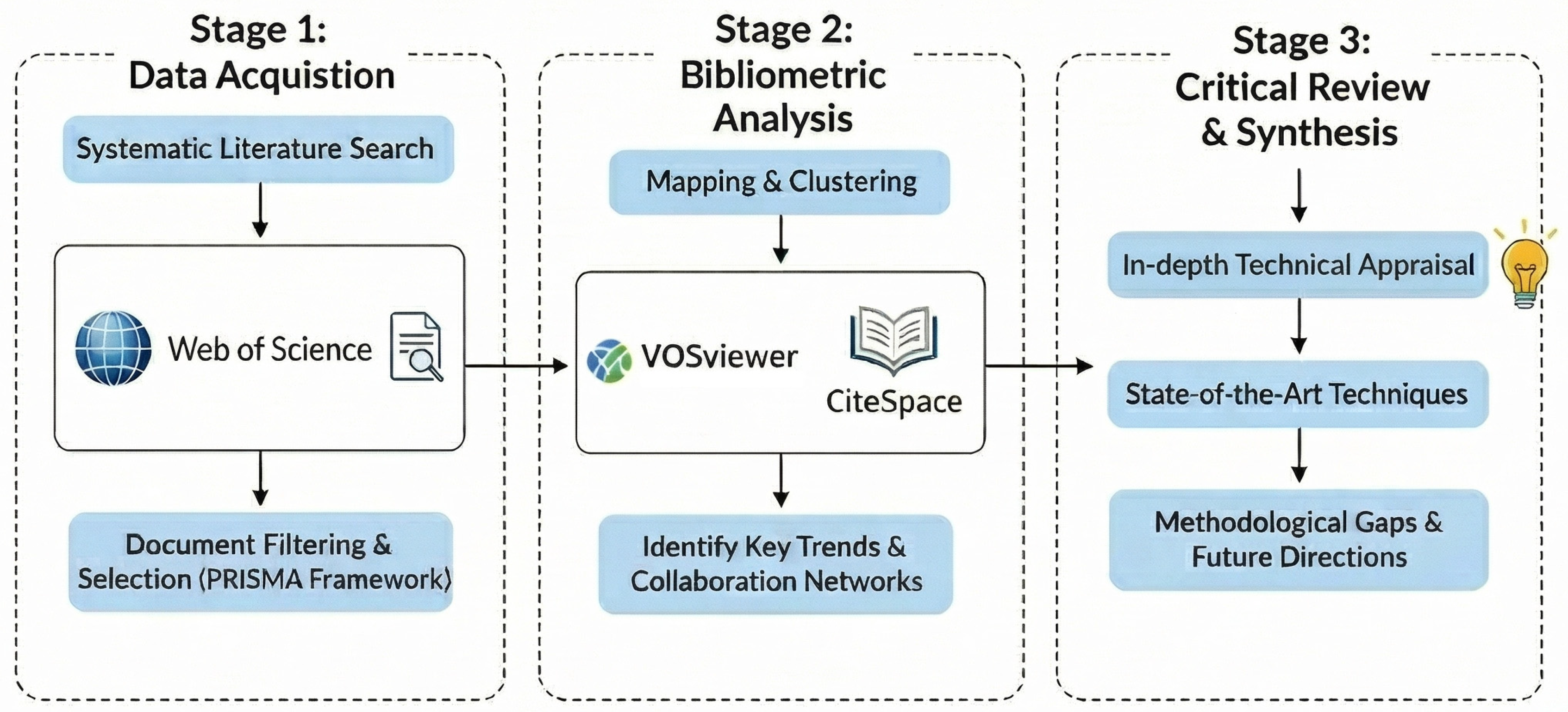
Figure 1. Overview of research methodology.
Forests 17 00503 g001
Figure 2. PRISMA 2020 flow diagram of the literature selection process.
Forests 17 00503 g002
Figure 3. Summary of annual characteristics of the papers.
Forests 17 00503 g003
Figure 4. Summary of the most frequently referenced academic papers.
Forests 17 00503 g004
Figure 5. Geographical distribution of the publications.
Forests 17 00503 g005
Figure 6. Network visualization of co-occurrences of the keywords.
Forests 17 00503 g006
Figure 7. Network visualization of the co-citation analysis of the sources.
Forests 17 00503 g007
Figure 8. Network visualization of co-authorship of the countries.
Forests 17 00503 g008
Figure 9. The timeline view of the keywords.
Forests 17 00503 g009
Figure 10. Top Keywords with the Strongest Citation Bursts in Vegetation Carbon Stock Estimation Research (2015–2024). Red bars indicate the burst period, while grey and green bars indicate the non-burst years within the study period.
Forests 17 00503 g010
Table 1. Summary of the most productive countries.
CountryTPTCAC≥100≥50≥30≥10H-Index
China1915068955.269244710435
USA17275411238.9716417313346
United Kingdom855305808.741426417035
India752064383.61511244226
Germany642440460.02617264829
France513427569.51920284628
Brazil472011306.5858142621
Italy443293477.681117233225
TP (total publications), TC (total citations), AC (average citations); ≥100, ≥50, ≥30, and ≥10 indicate the numbers of publications with citation counts of 100 or more, 50 or more, 30 or more, and 10 or more, respectively.
Table 2. Summary of clusters obtained from keyword analysis.
Cluster ColorObserved KeywordsNo. of Keywords
Redbiomass, carbon stock, climate-change, dynamics, forests, machine learning, remote sensing, sequestration, stocks, storage, vegetation11
Greenaboveground biomass, airborne lidar, boreal forest, carbon, forest biomass, Landsat, lidar, models, tropical forest9
Blueallometry, carbon stocks, deforestation, density, emissions, forest, height, map8
Yellowarea, classification, cover, leaf-area index,
prediction, random forest, vegetation index
7
Table 3. Summary of the top 10 keywords.
KeywordOccurrencesLinksTotal Link Strength
aboveground biomass21334700
carbon stocks17035587
biomass14834476
lidar14632509
remote sensing12433458
vegetation9623316
carbon7623258
forest7233256
airborne lidar7032230
carbon stock6530189
Table 4. Keywords of vegetation carbon stock estimation publications during three stages (2015–2024).
Time PeriodKeywords
(2015–2018)classification, lidar, remote sensing, carbon stocks, forest,
storage, biomass, climate change, boreal forest
(2018–2021)aboveground biomass, airborne lidar, time series, forest biomass,
models, random forest, cover, tropical forest, imagery, prediction, map
(2021–2024)machine learning, index, vegetation biomass, vegetation index
Table 5. Structured impact scoring table for the selected publications.
Ref.Publication YearPublication SourceTotal
Citations
Average CitationsCitation ScoreJCR QuartileJournal ScoreComposite Score
[56]2018Remote Sensing18326.144Q144
[57]2018SPRS Journal of Photogrammetry and Remote Sensing8512.144Q144
[58]2022Remote Sensing258.334Q144
[59]2023Ecological Informatics189.004Q144
[60]2019Remote Sensing of Environment569.334Q144
[61]2020Remote Sensing377.404Q144
[62]2023Remote Sensing168.004Q144
[63]2021Science of the Total Environment8020.004Q144
[64]2022Journal of Environmental Management299.674Q144
[54]2022Remote Sensing of Environment5819.334Q144
[65]2019Remote Sensing of Environment10116.834Q144
[63]2024Remote Sensing of Environment1010.004Q144
[66]2021Ecological Informatics4010.004Q144
[67]2023Remote Sensing of Environment2010.004Q144
[68]2019ISPRS Journal of Photogrammetry and Remote Sensing9916.504Q144
[69]2019Remote Sensing10918.174Q144
[70]2020Remote Sensing357.004Q144
[71]2020Remote Sensing of Environment11022.004Q144
[72]2019Ecological Informatics10217.004Q144
[73]2019International Journal of Applied Earth Observation and Geoinformation7813.004Q144
[74]2022Ecological Indicators3411.334Q144
[75]2017IEEE Journal of Selected Topics in Applied Earth Observations and Remote Sensing8710.884Q144
[76]2021Environmental Research Letters307.504Q144
[77]2019Remote Sensing7312.174Q144
[78]2019International Journal of Applied Earth Observation and Geoinformation7212.004Q144
[79]2019Remote Sensing7111.834Q144
[80]2022Ecological Informatics3511.674Q144
[81]2020International Journal of Applied Earth Observation and Geoinformation357.004Q144
[82]2021Geophysical Research Letters10025.004Q144
[83]2022Remote Sensing of Environment5016.674Q144
[84]2020Remote Sensing7715.404Q144
[85]2017GIScience & Remote Sensing627.754Q144
Table 6. Condensed comparison of key VCS/AGB mapping studies.
Ref.EcosystemCarbon PoolScaleSensor/Data TypeGround TruthAlgorithmValidationKey Performance
[53]ForestAGBRegionalSentinel-2 + ALOS-2 PALSAR-2Volume tables + species-specific wood densitySVRHold-outR2 = 0.73; RMSE = 38.68 Mg ha−1
[54]Tidal marsh vegetationAGCNationalLandsat + Sentinel-1 + NAIPDestructive sampling + allometryRFCross-validationR2 = 0.58; NRMSE = 10.3%
[55]ForestAGCRegionalSentinel-2 + Sentinel-1 + ALOS-2 PALSAR-2Allometric equationsCNNRandom splitR2 = 0.7465; RMSE = 22.67
[56]Tropical forestAGCRegionalSentinel-1Allometric equationsPCA-ANNHold-outR2 = 0.7465; RMSE = 6.29 t ha−1
[57]Subtropical forestAGBNationalMODIS + ICESat/GLAS + DEM + climateDestructive sampling + allometry + volume-based estimationCubistCross-validationR2 = 0.65; RMSE = 54 Mg ha−1
[58]Mangrove forestAGCRegionalEO-1 HyperionAllometric equationsSVMHold-outR2 = 0.84–0.87
[59]Urban forestAGCRegionalLandsat 8 + Sentinel-2Allometric equationsCatBoostHold-outR2 = 0.70; RMSE = 5.76 Mg ha−1
[60]Mangrove forestAGBRegionalUAV LiDAR + RGBAllometric equationsXGBoostHold-outR2 = 0.8319; RMSE = 22.76 Mg ha−1
[61]Dry deciduous tropical forestAGBRegionalSentinel-2Destructive sampling + allometric modelsRFk-fold cross-validationAdjusted R2 = 0.91; RMSE = 23.72 Mg ha−1
[62]Global terrestrial vegetationAGBGlobalCompiled AGB maps + ancillary layersNFI- and research-network-based compiled referenceRFHold-outR2 = 0.24–0.36
Disclaimer/Publisher’s Note: The statements, opinions and data contained in all publications are solely those of the individual author(s) and contributor(s) and not of MDPI and/or the editor(s). MDPI and/or the editor(s) disclaim responsibility for any injury to people or property resulting from any ideas, methods, instructions or products referred to in the content.