Ecological Security Pattern Construction in the Yellow River Water Replenishment Area of Gannan, China
Abstract
1. Introduction
2. Study Area and Methods
2.1. Overview of the Study Area
2.2. Data Sources and Preprocessing
- (1)
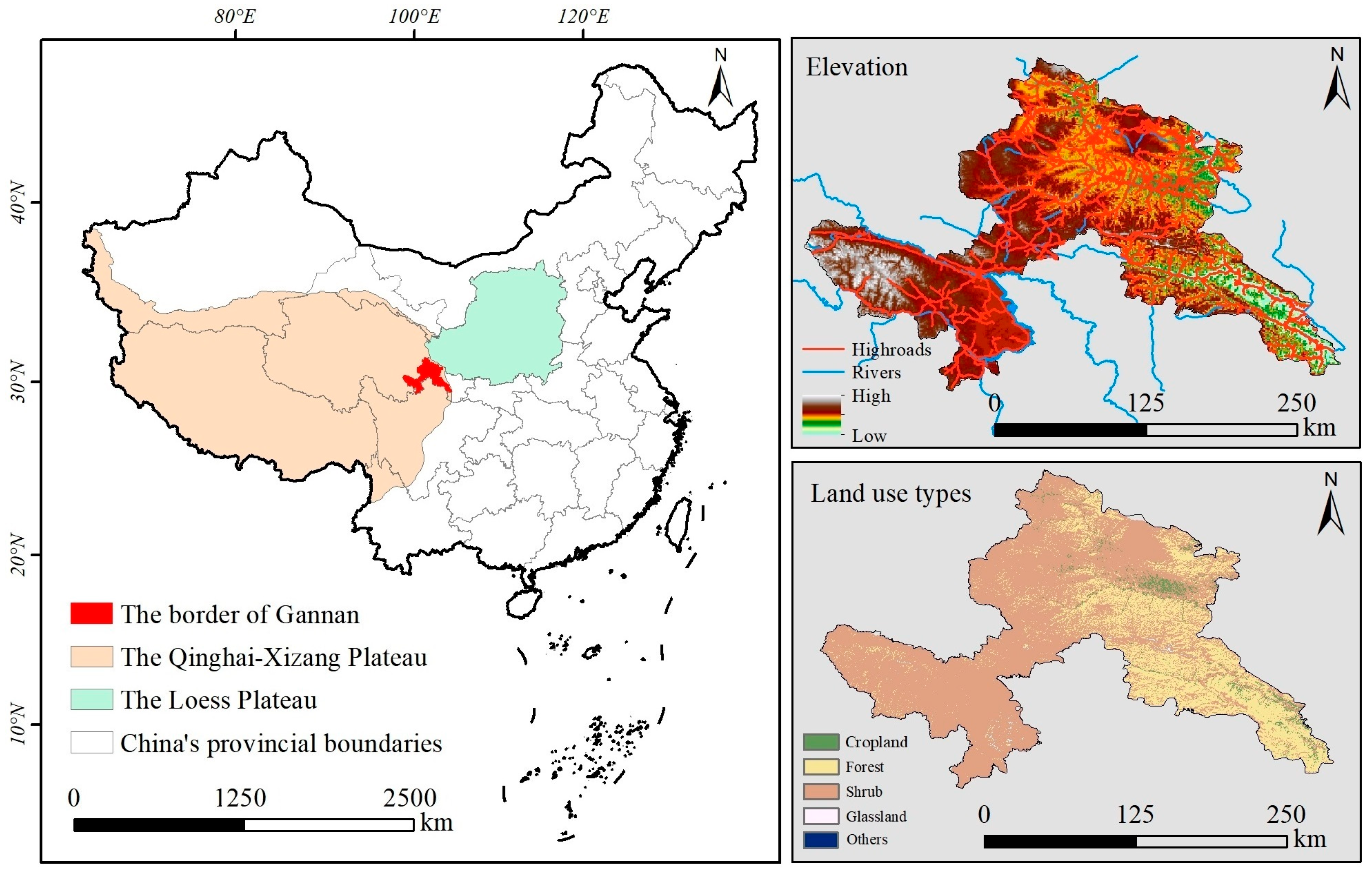
- Land use data for Gannan Prefecture in 2023 were obtained from the annual China Land Cover Dataset (CLCD; http://doi.org/10.5281/zenodo.4417809) produced by Huang Ting’s team at Wuhan University, with a spatial resolution of 30 m. Administrative boundary data were collected from the 1:1,000,000 National Fundamental Geographic Information Database. Using ArcGIS 10.8, land use was reclassified into five landscape types: cropland, forest, shrub, grassland, and others.
- (2)
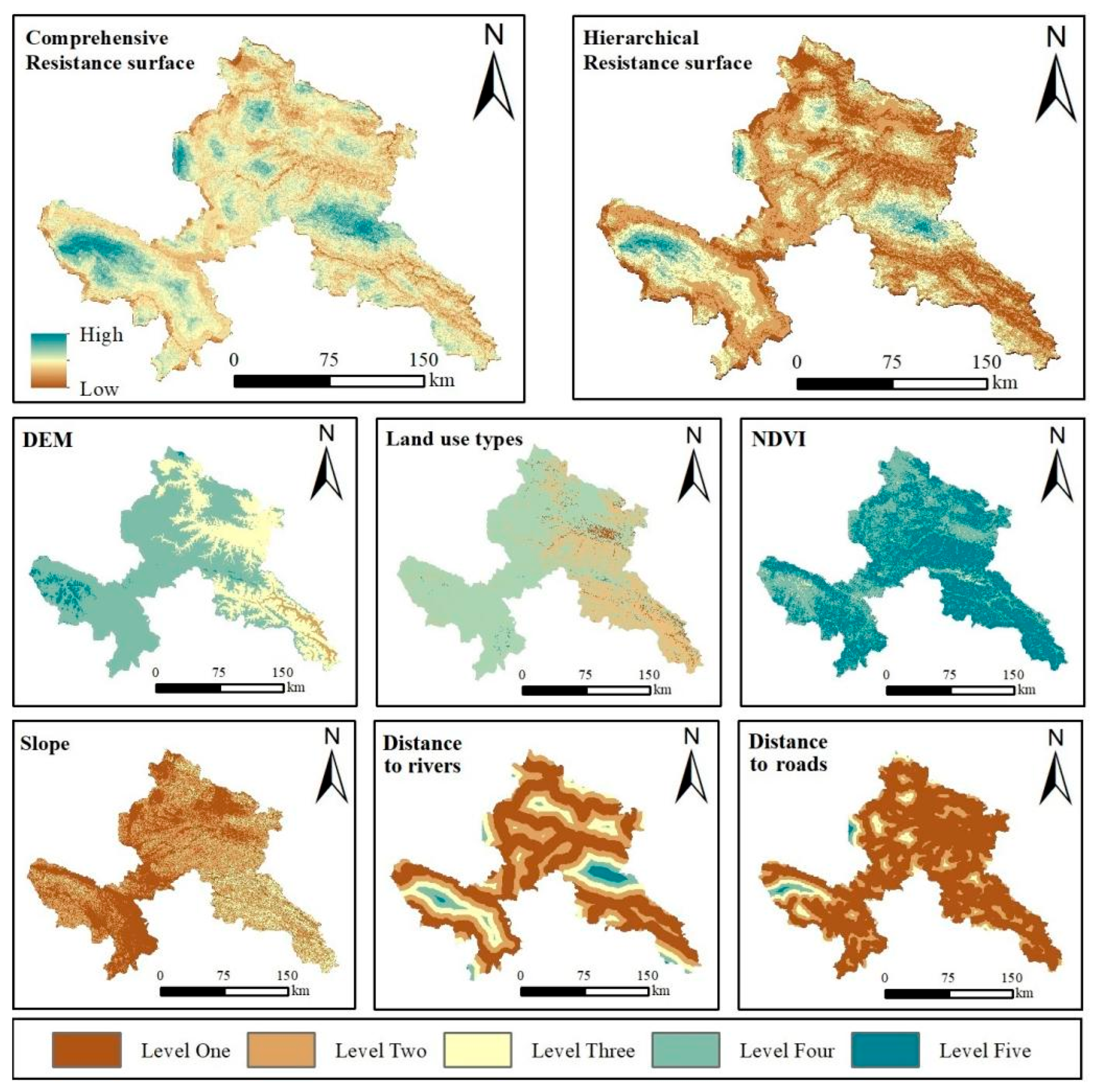
- Boundaries of Gannan Prefecture and its towns, as well as road and water system distributions, were obtained from BIGEMAP GIS Office (http://www.bigemap.com/) with a spatial resolution of 30 m. Road data include main roads, highways, and railways.
- (3)
- Remote sensing images and digital elevation data were obtained from the Geospatial Data Cloud (http://www.gscloud.cn/search), accessed on 15 July 2025, at a spatial resolution of 30 m. Slope was derived using the slope analysis tool in ArcGIS. Vegetation quality was represented by the Normalized Difference Vegetation Index (NDVI).
- (4)
- Forest cover and plant functional type data were obtained from the 1 km annual forest cover and plant functional type dataset for China from 1981 to 2023 (https://doi.org/10.5194/essd-18-1103-2026).
2.3. Research Methodology
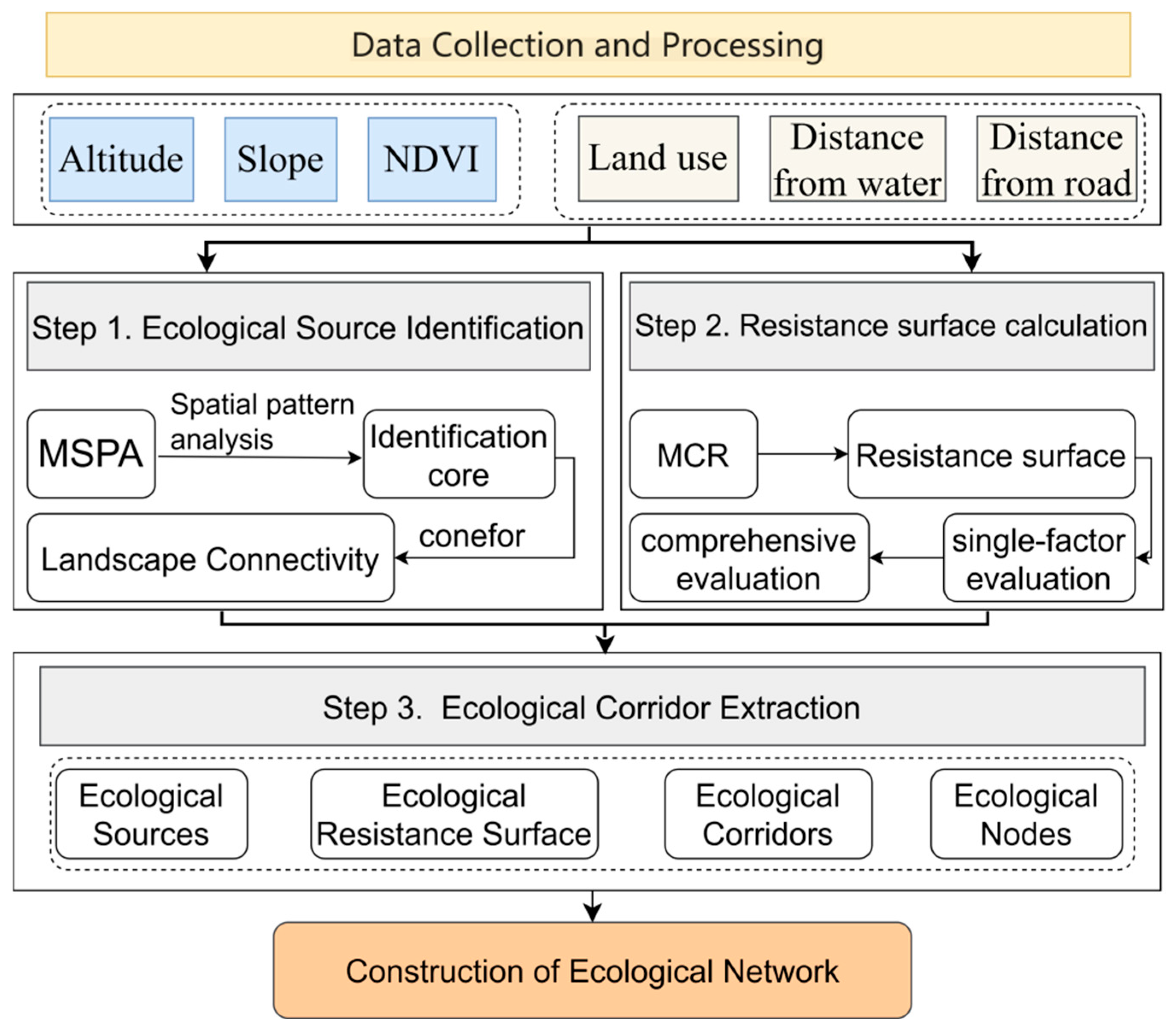
2.3.1. Identification of Ecological Sources Based on MSPA and Conefor
2.3.2. Comprehensive Ecological Resistance Evaluation System and Spatial Principal Component Analysis
2.3.3. Minimum Cumulative Resistance (MCR) Model
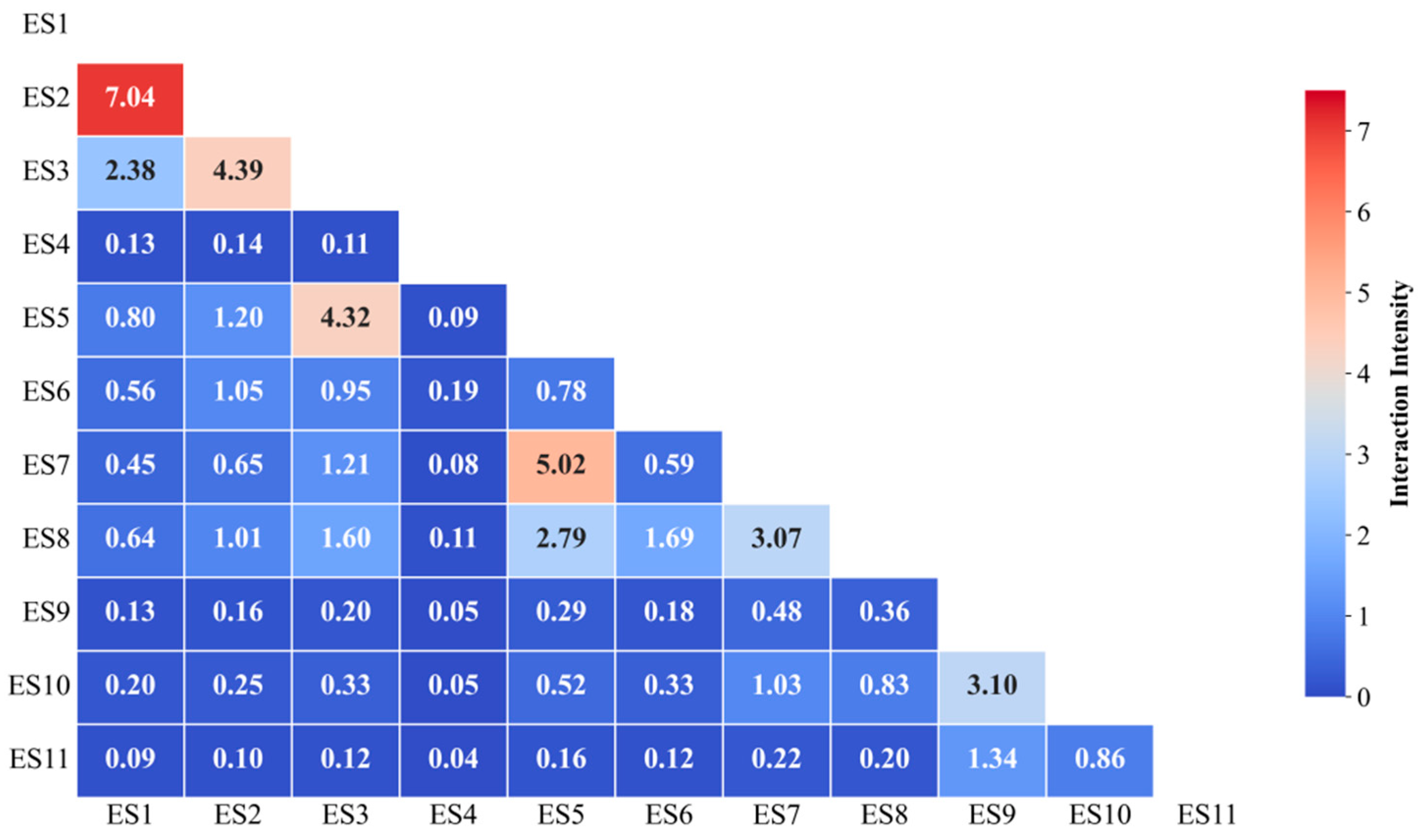
2.3.4. Gravity Model
2.3.5. Ecological Node Classification
3. Results
3.1. Identification of Ecological Sources
3.2. Construction of the Comprehensive Ecological Resistance Surface
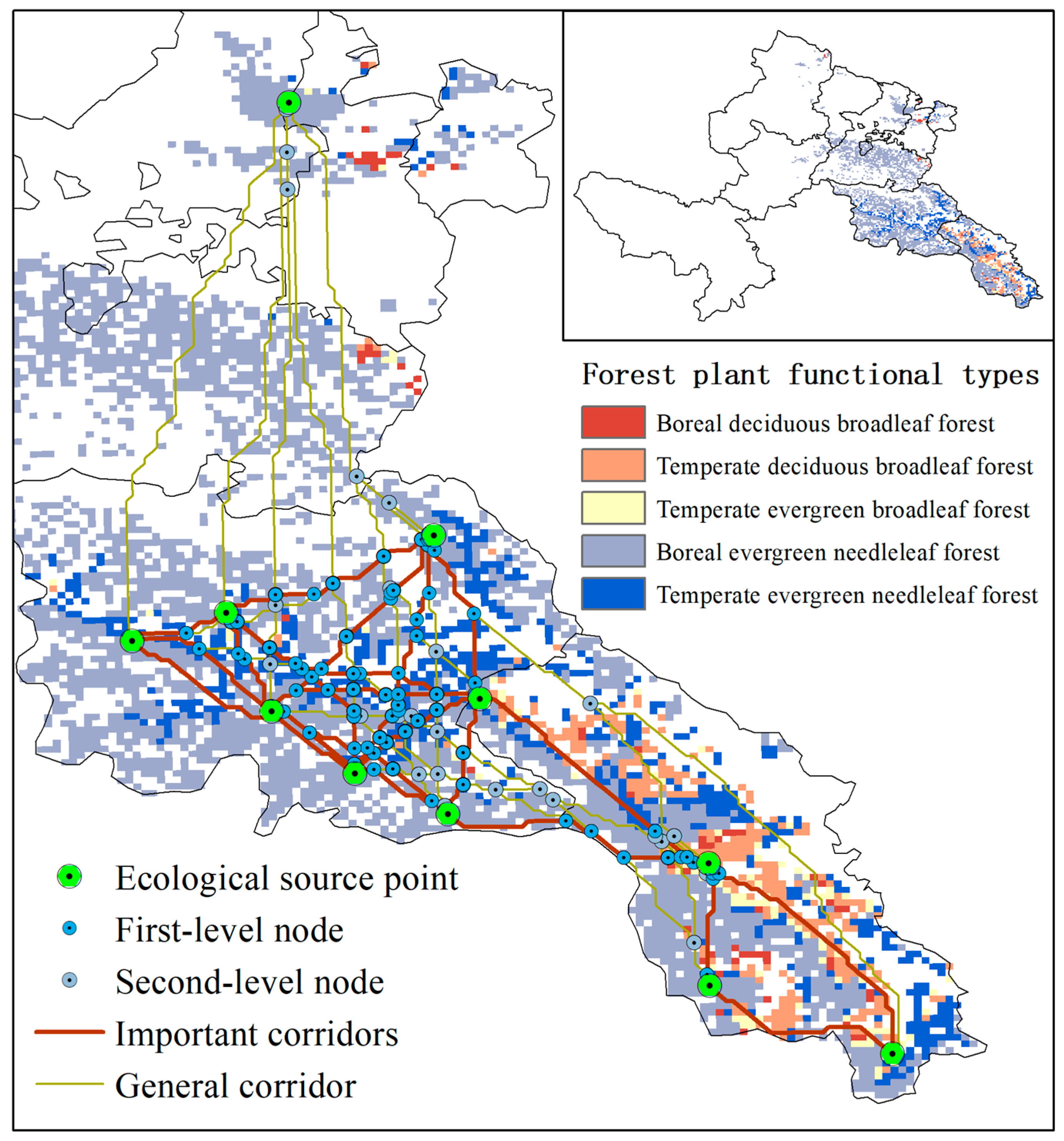
3.3. Extraction of Ecological Corridors
3.4. Identification of Ecological Nodes
4. Discussion
4.1. Spatial Pattern Optimization and Management Suggestions
4.2. Promoting Multi-Scale Ecological Network Construction
4.3. Coupling Between Ecological Security Pattern and Forest Functional Type Heterogeneity
4.4. Prospects and Limitations
5. Conclusions
Author Contributions
Funding
Data Availability Statement
Acknowledgments
Conflicts of Interest
References
- Wang, Y.; Li, X.; Zhang, F.; Wang, W. Effects of rapid urbanization on ecological functional vulnerability of the land system in Wuhan, China: A flow and stock perspective. J. Clean. Prod. 2020, 248, 119284. [Google Scholar] [CrossRef]
- Chen, X.; Yang, Z.; Wang, T.; Han, F. Landscape ecological risk and ecological security pattern construction in world natural heritage sites: A case study of Bayinbuluke, Xinjiang, China. ISPRS Int. J. Geo-Inf. 2022, 11, 328. [Google Scholar] [CrossRef]
- Yang, L.; Chen, W.; Pan, S.; Li, J. Spatial relationship between land urbanization and ecosystem health in the Yangtze River Basin, China. Environ. Monit. Assess. 2023, 195, 957. [Google Scholar] [CrossRef]
- Modica, G.; Salvatore, P.; Laudari, L. Implementation of multispecies ecological networks at the regional scale: Analysis and multi-temporal assessment. J. Environ. Manag. 2021, 289, 112494. [Google Scholar] [CrossRef]
- Dadashpoor, H.; Azizi, P.; Moghadasi, M. Land use change, urbanization, and change in landscape pattern in a metropolitan area. Sci. Total Environ. 2019, 655, 707–719. [Google Scholar] [CrossRef]
- Rondinini, C.; Pressey, R.L. Special section: Systematic conservation planning in the European landscape. Conserv. Biol. 2007, 21, 1404–1405. [Google Scholar] [CrossRef] [PubMed]
- Ma, L.; Bo, J.; Li, X.; Fang, F. Identifying key landscape pattern indices influencing the ecological security of inland river basin: The middle and lower reaches of Shule River Basin as an example. Sci. Total Environ. 2019, 674, 424–438. [Google Scholar] [CrossRef] [PubMed]
- Wood, S.L.R.; Jones, S.K.; Johnson, J.A.; Brauman, K.A. Distilling the role of ecosystem services in the Sustainable Development Goals. Ecosyst. Serv. 2018, 29, 70–82. [Google Scholar] [CrossRef]
- Zhang, D.H.; Ren, H.H.; Sun, P.J.; Li, X.Y. Construction of multi-level ecological security network in fragmented nature landscape using the three-dimensional framework of ecological adaptability. Ecol. Indic. 2023, 157, 111229. [Google Scholar] [CrossRef]
- Qian, M.Y.; Huang, Y.T.; Cao, Y.R.; Wu, J.J. Ecological network construction and optimization in Guangzhou from the perspective of biodiversity conservation. J. Environ. Manag. 2023, 336, 117692. [Google Scholar] [CrossRef]
- Li, Y.Y.; Zhang, Y.Z.; Jiang, Z.Y.; Guo, C.X. Integrating morphological spatial pattern analysis and the minimal cumulative resistance model to optimize urban ecological networks: A case study in Shenzhen City, China. Ecol. Process. 2021, 10, 63. [Google Scholar] [CrossRef]
- Huang, K.X.; Peng, L.; Wang, X.H.; Deng, W. Integrating circuit theory and landscape pattern index to identify and optimize ecological networks: A case study of the Sichuan Basin, China. Environ. Sci. Pollut. Res. Int. 2022, 29, 66874–66887. [Google Scholar] [CrossRef]
- Kong, F.H.; Yin, H.W.; Nakagoshi, N.; Zong, Y.G. Urban green space network development for biodiversity conservation: Identification based on graph theory and gravity modeling. Landsc. Urban Plan. 2010, 95, 16–27. [Google Scholar] [CrossRef]
- Wang, H.; Tang, L.; Qiu, Q.; Chen, H. Assessing the impacts of urban expansion on habitat quality by combining the concepts of land use, landscape, and habitat in two urban agglomerations in China. Sustainability 2020, 12, 4346. [Google Scholar] [CrossRef]
- Yu, K.J. Landscape ecological security patterns in biodiversity conservation. Acta Ecol. Sin. 1999, 19, 8–15. [Google Scholar] [CrossRef]
- Guan, W.B.; Xie, C.H.; Ma, K.M.; Liu, Y.H. A vital method for constructing regional ecological security pattern: Landscape ecological restoration and rehabilitation. Acta Ecol. Sin. 2003, 23, 64–73. [Google Scholar]
- Meng, J.J.; Wang, Y.; Wang, X.D.; Li, Z.G. Construction of landscape ecological security pattern in Guiyang based on MCR model. Resour. Environ. Yangtze Basin 2016, 25, 1052–1061. [Google Scholar] [CrossRef]
- Chen, W.H.; Liu, H.M.; Wang, J.L. Construction and optimization of regional ecological security patterns based on MSPA-MCR-GA model: A case study of Dongting Lake basin in China. Ecol. Indic. 2024, 165, 112169. [Google Scholar] [CrossRef]
- Li, H.H.; Ma, T.H.; Wang, K.; Li, Y.F. Construction of ecological security pattern in Northern Peixian based on MCR and SPCA. J. Ecol. Rural Environ. 2020, 36, 1036–1045. [Google Scholar] [CrossRef]
- Wu, W.; Liu, Z.Z.; Shen, L.B. Habitat network optimization from across-regional perspective: A case study of the little egret in the Su-Xi-Chang area. Acta Ecol. Sin. 2020, 40, 2953–2963. [Google Scholar] [CrossRef]
- Li, X.; Zheng, Y.; Chen, A.N.; Hou, Q.H. Identification of ecological restoration priority areas based on ecological security patterns and risk assessment: A case study of Shenmu City. Acta Ecol. Sin. 2024, 44, 8784–8797. [Google Scholar] [CrossRef]
- Fan, C.M.; Wang, Z.T.; Tang, N.; Yang, S. Construction of ecological network in downtown of Guiyang city based on morphological spatial pattern and spatially principal component analysis. Acta Ecol. Sin. 2022, 42, 6620–6632. [Google Scholar] [CrossRef]
- Jing, Y.; Sun, X.; Liu, J.; Zhang, L. Construction of ecological corridors in Etuoke Banner, Inner Mongolia based on MCR model. Bull. Soil Water Conserv. 2021, 41, 170–177. [Google Scholar] [CrossRef]
- Guan, J.; Hu, J.; Li, B. How to restore ecological impacts from wind energy? An assessment of Zhongying Wind Farm through MSPA-MCR model and circuit theory. Ecol. Indic. 2024, 163, 112149. [Google Scholar] [CrossRef]
- Saura, S.; Torne, J. Conefor Sensinode 2.2: A software package for quantifying the importance of habitat patches for landscape connectivity. Environ. Model. Softw. 2009, 24, 135–139. [Google Scholar] [CrossRef]
- Urban, D.; Keitt, T. Landscape connectivity: A graph-theoretic perspective. Ecology 2001, 82, 1205–1218. [Google Scholar] [CrossRef]
- Horne, J.S.; Garton, E.O.; Krone, S.M.; Lewis, J.S. Analyzing animal movements using Brownian bridges. Ecology 2007, 88, 2354–2363. [Google Scholar] [CrossRef] [PubMed]
- Chen, X.P.; Chen, W.B. Construction and evaluation of ecological network in Poyang Lake Eco-economic Zone, China. Chin. J. Appl. Ecol. 2016, 27, 1611–1618. [Google Scholar] [CrossRef]
- Liu, M.X.; Zhang, Y.Y.; Li, Q.D.; Wang, J. Species abundance distribution characteristics of alpine meadow plant community in Gannan. China Environ. Sci. 2021, 41, 1405–1414. [Google Scholar] [CrossRef]
- Liu, Z.C.; Cao, W.X.; Wang, Z.W.; Wang, S.L.; Wang, J.J.; Chen, X.D. Spatiotemporal variation of water conservation function and its driving factors in Gannan Prefecture of Gansu Province during 2005–2020. Bull. Soil Water Conserv. 2024, 44, 231–240. [Google Scholar]
- Zhao, X.Y. The impact of human factors on the environment in Gannan pasturing area. Acta Geogr. Sin. 2010, 65, 1411–1420. [Google Scholar]
- Dai, L.; Liu, Y.; Luo, X. Integrating the MCR and DOI models to construct an ecological security network for the urban agglomeration around Poyang Lake, China. Sci. Total Environ. 2021, 754, 141868. [Google Scholar] [CrossRef]
- Luo, J.L.; Zhu, L.; Fu, H.; Wang, Q. Construction of wetland ecological network based on MSPA-Conefor-MCR: A case study of Haikou City. Ecol. Indic. 2024, 166, 112329. [Google Scholar] [CrossRef]
- Liu, Z.G.; Qiu, F.Y. Distribution of Main Vegetation Types in the Gongga Mountain Region. Acta Phytotaxon. Sin. 1986, 10, 26–34. [Google Scholar]
- Ma, Y.; He, H.M.; Zhao, H.F. Spatiotemporal change of soil erosion in Gannan Tibetan Autonomous Prefecture based on GIS and RUSLE. Res. Soil Water Conserv. 2023, 30, 37–46. [Google Scholar] [CrossRef]
- Zhang, X.B.; Liu, Y.N.; Yin, J.F.; Chen, L. Multi-scenario simulation of land use change and its impact on ecosystem services in the northeastern edge of the Qinghai-Xizang Plateau, China. J. Arid Land 2025, 17, 145–166. [Google Scholar] [CrossRef]
- Vogt, P.; Riitters, K.; Rambaud, P.; Estreguil, C. GuidosToolbox Workbench: Spatial analysis of raster maps for ecological applications. Ecography 2022, 2022, e05864. [Google Scholar] [CrossRef]
- Du, X.Y.; Lyu, F.N.; Wang, C.Y.; Zhang, L. Construction of ecological network based on MSPA-Conefor-MCR at the county scale: A case study in Yanqing District, Beijing, China. Chin. J. Appl. Ecol. 2023, 34, 1073–1082. [Google Scholar] [CrossRef]
- Nie, W.B.; Shi, Y.; Siaw, M.J.; Yang, Y. Constructing and optimizing ecological network at county and town scale: The case of Anji County, China. Ecol. Indic. 2021, 132, 108294. [Google Scholar] [CrossRef]
- Sun, B.D.; Cheng, D.X.; Chen, Z.H.; Wang, L. Enhancing construction of ecological security pattern through a wetland waterbird protection approach: A case study of Yellow River Basin in Shandong Province, China. Chin. J. Appl. Ecol. 2025, 36, 1837–1848. [Google Scholar] [CrossRef]
- Ma, J.; Yu, Q.; Wang, H.; Zhang, F. Construction and optimization of wetland landscape ecological network in Dongying City, China. Land 2022, 11, 1226. [Google Scholar] [CrossRef]
- Knaapen, J.P.; Scheffer, M.; Harms, B. Estimating habitat isolation in landscape planning. Landsc. Urban Plan. 1992, 23, 1–16. [Google Scholar] [CrossRef]
- Kline, J.D.; Moses, A.; Alig, R.J. Integrating urbanization into landscape-level ecological assessments. Ecosystems 2001, 4, 3–18. [Google Scholar] [CrossRef]
- Xu, D.; Wang, F.; Fu, M. Research progress and prospects for constructing ecological security pattern based on ecological network. Ecol. Indic. 2024, 168, 112800. [Google Scholar] [CrossRef]
- Jin, X.; Wei, L.; Wang, Y.; Lu, Y. Construction of ecological security pattern based on the importance of ecosystem service functions and ecological sensitivity assessment: A case study in Fengxian County of Jiangsu Province, China. Environ. Dev. Sustain. 2021, 23, 563–590. [Google Scholar] [CrossRef]
- Zhu, J.; Su, J.; Yin, H.; Liu, L. Construction of Xuzhou ecological network based on comprehensive identification of ecological sources and multi-scale nesting. J. Nat. Resour. 2020, 35, 1986–2001. [Google Scholar] [CrossRef]
- An, Y.; Liu, S.; Sun, Y.; Shi, F. Construction and optimization of an ecological network based on morphological spatial pattern analysis and circuit theory. Landsc. Ecol. 2021, 36, 2059–2076. [Google Scholar] [CrossRef]
- Saura, S.; Pascual-Hortal, I. A new habitat availability index to integrate connectivity in landscape conservation planning: Comparison with existing indices and application to a case study. Landsc. Urban Plan. 2007, 83, 91–103. [Google Scholar] [CrossRef]
- Zhang, J.; Zhu, H.; Zhang, P.; Song, Y.; Zhang, Y.; Li, Y.; Rong, T.; Liu, Z.; Yang, D.; Lou, Y. Construction of GI Network Based on MSPA and PLUS Model in the Main Urban Area of Zhengzhou: A Case Study. Front. Environ. Sci. 2022, 10, 878656. [Google Scholar] [CrossRef]
- Sun, Z.; Jia, Y.; Zhou, D.; Huang, X.; Jiang, J.; Zhu, X.; Zhang, J. Constructing an ecological security pattern by integrating ecosystem service values and ecological sensitivity: A case study of the Hexi Region, China. Environ. Sustain. Indic. 2026, 29, 101070. [Google Scholar] [CrossRef]
- Chen, W.; Zhao, J.; Chen, G.; Lin, Y.; Yang, H.; Chen, Q. Ecological Network Optimization and Security Pattern Development for Kunming’s Main Urban Area Using the MSPA-MCR Model. Sustainability 2025, 17, 3623. [Google Scholar] [CrossRef]
- Pan, Y.; Gong, J.; Yang, J.; Yang, T.; Wang, Y. Construction of ecological security patterns based on ecological importance and MSPA core area connectivity: A case study of the Guijiang river Basin. China Land Sci. 2022, 36, 86–95. [Google Scholar] [CrossRef]
- Li, Y.; Liu, W.; Feng, Q.; Zhu, M.; Yang, L.; Zhang, J.; Yin, X. The role of land use change in affecting ecosystem services and the ecological security pattern of the Hexi Regions, Northwest China. Sci. Total Environ. 2023, 855, 158940. [Google Scholar] [CrossRef]
- Xu, Z.; Dong, B.; Wang, C.; Gao, X.; Xu, H.; Wei, Z.; Lu, Z.; Liu, X. Construction of international important wetland White-headed crane ecological corridor in Chongming Dongtan, China. Ecol. Indic. 2023, 149, 110156. [Google Scholar] [CrossRef]
- Peng, J.; Pan, Y.; Liu, Y.; Zhao, H.; Wang, Y. Linking ecological degradation risk to identify ecological security patterns in a rapidly urbanizing landscape. Habitat Int. 2018, 71, 110–124. [Google Scholar] [CrossRef]
- Fu, Y.; Shi, X.; He, J.; Yuan, Y.; Qu, L. Identification and optimization strategy of county ecological security pattern: A case study in the Loess Plateau, China. Ecol. Indic. 2020, 112, 106030. [Google Scholar] [CrossRef]
- Von Thaden, J.; Badillo-Montaño, R.; Lira-Noriega, A.; García-Ramírez, A.; Benítez, G.; Equihua, M.; Looker, N.; Pérez-Maqueo, O. Contributions of green spaces and isolated trees to landscape connectivity in an urban landscape. Urban For. Urban Green. 2021, 64, 127277. [Google Scholar] [CrossRef]
- Zhang, B.; Cao, J.; Chen, D.; Li, X.; Liu, Y.; Wang, J.; Liu, T. Construction of watershed ecological security patterns with integrated spatial variability: A case study of the Yellow River Basin, China. Ecol. Indic. 2024, 159, 111663. [Google Scholar] [CrossRef]
- Xiang, H.; Zhang, J.; Mao, D.; Wang, M.; Yu, F.; Wang, Z.; Li, H. Optimizing Ecological Security Patterns Considering Zonal Vegetation Distribution for Regional Sustainability. Ecol. Eng. 2023, 194, 107055. [Google Scholar] [CrossRef]
- Hou, W.; Neubert, M.; Walz, U. A Simplified Econet Model for Mapping and Evaluating Structural Connectivity with Particular Attention of Ecotones, Small Habitats, and Barriers. Landsc. Urban Plan. 2017, 160, 28–37. [Google Scholar] [CrossRef]
- Huang, K.; Peng, L.; Wang, X.; Chen, T. Integrating Landscape Connectivity and Natural-Anthropogenic Interaction to Understand Karst Vegetation Restoration: A Case Study of Guizhou Province, China. Front. Ecol. Evol. 2022, 10, 844437. [Google Scholar] [CrossRef]
- Peringer, A.; Frank, V.; Snell, R.S. Climate Change Simulations in Alpine Summer Pastures Suggest a Disruption of Current Vegetation Zonation. Glob. Ecol. Conserv. 2022, 37, e02140. [Google Scholar] [CrossRef]
- Wang, Y.; Sun, J.; He, W.; Ye, C.; Liu, B.; Chen, Y.; Zeng, T.; Ma, S.; Gan, X.; Miao, C.; et al. Migration of Vegetation Boundary Between Alpine Steppe and Meadow on a Century-Scale Across the Tibetan Plateau. Ecol. Indic. 2022, 136, 108599. [Google Scholar] [CrossRef]
- Li, Z.; You, H.M.; Wang, Z. Multi-scale effects of urban landscape pattern on green space plant diversity in Xuzhou City. Chin. J. Appl. Ecol. 2018, 29, 1813–1821. [Google Scholar] [CrossRef]




| Type | Resistance Factor | Resistance Assignment | ||||
|---|---|---|---|---|---|---|
| 1 | 2 | 3 | 4 | 5 | ||
| Ecological Property | Altitude (m) | 0–1067 | 1067–2135 | 2135–3203 | 3203–4271 | 4271–5339 |
| Slope (°) | 0–17 | 17–35 | 35–53 | 53–71 | 71–89 | |
| NDVI | 0.6–1 | 0.2–0.6 | −0.2–0.2 | −0.6–0.2 | −0.6–1 | |
| Human interference | Land use | Forest | Shrub | Grassland | Cropland | Others |
| Distance from water (m) | 0–6289 | 6289–12,579 | 12,579–18,869 | 18,869–25,159 | 25,159–31,449 | |
| Distance from road (m) | 10,691–19,472 | 6644–10,690 | 3743–6643 | 1605–3742 | 0–1604 | |
| Landscape Type | Foreground (Forest) | Foreground (Water) | ||||
|---|---|---|---|---|---|---|
| Area (km2) | Proportion of Forest (%) | Proportion of the Study Area (%) | Area (km2) | Proportion of Water (%) | Proportion of the Study Area (%) | |
| Core | 4237.81 | 49.31 | 11.58 | 20.90 | 22.70 | 0.06 |
| Islet | 341.07 | 3.97 | 0.93 | 19.96 | 21.68 | 0.05 |
| Loop | 214.43 | 2.50 | 0.59 | 0.28 | 0.30 | 0.00 |
| Bridge | 1545.69 | 17.99 | 4.22 | 13.21 | 14.35 | 0.04 |
| Perforation | 310.86 | 3.62 | 0.85 | 2.29 | 2.49 | 0.01 |
| Edge | 640.17 | 7.45 | 1.75 | 8.28 | 8.99 | 0.02 |
| Branch | 516.25 | 6.01 | 1.41 | 9.35 | 10.16 | 0.03 |
| Ecological Source | Area (km2) | Importance Index | Relative Importance Index | |
|---|---|---|---|---|
| Integral Index of Connectivity | Probability of Connectivity | |||
| 1 | 689.35 | 75.39 | 78.37 | 76.88 |
| 2 | 244.37 | 10.22 | 8.84 | 9.53 |
| 3 | 183.63 | 18.88 | 21.87 | 20.38 |
| 4 | 142.82 | 5.97 | 5.17 | 5.57 |
| 5 | 118.41 | 11.90 | 19.31 | 15.60 |
| 6 | 116.64 | 2.33 | 2.36 | 2.35 |
| 7 | 114.79 | 1.42 | 1.23 | 1.33 |
| 8 | 109.39 | 1.29 | 1.12 | 1.21 |
| 9 | 85.80 | 0.80 | 0.69 | 0.74 |
| 10 | 79.58 | 0.68 | 0.59 | 0.64 |
| 11 | 68.27 | 1.36 | 1.53 | 1.45 |
| Resistance Factor | Principal Component(PC) | ||||||
|---|---|---|---|---|---|---|---|
| PC1 | PC2 | PC3 | PC4 | PC5 | PC6 | Weight | |
| DEM | 0.546 | 0.221 | −0.241 | −0.154 | 0.005 | 0.756 | 0.163 |
| LULC | 0.452 | −0.409 | 0.206 | 0.117 | 0.747 | −0.122 | 0.173 |
| NDVI | −0.435 | 0.299 | −0.599 | −0.021 | 0.601 | 0.028 | 0.168 |
| Slope | −0.290 | 0.444 | 0.734 | −0.133 | 0.284 | 0.285 | 0.173 |
| Distance from water system | 0.264 | 0.528 | 0.009 | 0.786 | −0.026 | −0.182 | 0.154 |
| Distance from road | 0.392 | 0.468 | −0.030 | −0.572 | 0.027 | −0.547 | 0.169 |
| Principal component eigenvalue | 2.046 | 1.489 | 0.826 | 0.692 | 0.504 | 0.443 | / |
| Cumulative contribution rate (%) | 34.1 | 58.1 | 72.7 | 84.2 | 92.6 | 100.0 | / |
Disclaimer/Publisher’s Note: The statements, opinions and data contained in all publications are solely those of the individual author(s) and contributor(s) and not of MDPI and/or the editor(s). MDPI and/or the editor(s) disclaim responsibility for any injury to people or property resulting from any ideas, methods, instructions or products referred to in the content. |
© 2026 by the authors. Licensee MDPI, Basel, Switzerland. This article is an open access article distributed under the terms and conditions of the Creative Commons Attribution (CC BY) license.
Share and Cite
Gao, W.; Wang, S.; Wu, S.; Yuan, S.; Zhang, Y.; He, L.; Han, T. Ecological Security Pattern Construction in the Yellow River Water Replenishment Area of Gannan, China. Forests 2026, 17, 495. https://doi.org/10.3390/f17040495
Gao W, Wang S, Wu S, Yuan S, Zhang Y, He L, Han T. Ecological Security Pattern Construction in the Yellow River Water Replenishment Area of Gannan, China. Forests. 2026; 17(4):495. https://doi.org/10.3390/f17040495
Chicago/Turabian StyleGao, Wenqi, Shengting Wang, Shouxia Wu, Shangke Yuan, Yujia Zhang, Leping He, and Tuo Han. 2026. "Ecological Security Pattern Construction in the Yellow River Water Replenishment Area of Gannan, China" Forests 17, no. 4: 495. https://doi.org/10.3390/f17040495
APA StyleGao, W., Wang, S., Wu, S., Yuan, S., Zhang, Y., He, L., & Han, T. (2026). Ecological Security Pattern Construction in the Yellow River Water Replenishment Area of Gannan, China. Forests, 17(4), 495. https://doi.org/10.3390/f17040495