Article

Analysis of Allometric Relations of Picea schrenkiana in Different Development Stages in the Western Tianshan Mountains of China


1
College of Biological Science and Technology, Yili Normal University, Yili 839300, China
2
Institute of Resources and Ecology, Yili Normal University, Yili 839300, China
3
Key Laboratory of Vegetation Ecology, Ministry of Education, Northeast Normal University, Changchun 130024, China
*
Author to whom correspondence should be addressed.
Forests 2026, 17(4), 487; https://doi.org/10.3390/f17040487
Submission received: 11 March 2026 / Revised: 10 April 2026 / Accepted: 11 April 2026 / Published: 15 April 2026
(This article belongs to the Section Forest Ecology and Management)

Abstract

During the growth process of a tree population, the characteristics of biomass allocation vary with individual size or development stages, which typically reflect the life-history strategies of plant populations. However, differences in allometric strategies across different development stages and the underlying factors influencing these differences have not yet been fully studied. This study investigated the differences in the allometric relations among tree height (H), diameter at breast height (DBH), and crown width (CW) of Picea schrenkiana growing in the western Tianshan Mountains of China, across different development stages and slope aspects. The results revealed that allometric relations exist among H, DBH, and CW of P. schrenkiana at all development stages. The differences in allometric relations among different development stages were significant. Moreover, the allometric patterns varied with development stages, with seedlings prioritizing DBH growth and saplings prioritizing CW growth. The allometric relations of P. schrenkiana at different development stages did not change significantly with different slope aspects. In summary, P. schrenkiana adopts an allometric strategy at all development stages, with significant differences in the allometric relations at each stage, and these differences remain unchanged across different slope aspects. Our findings can provide crucial theoretical support for the management and ecological conservation of this tree species.

1. Introduction

When plants encounter environmental changes, they often prioritize biomass allocation to certain organs and regulate resource acquisition ability in order to adapt to such changes. Varying biomass allocation ratios lead to an allometric pattern among different organs of the tree habit [1,2,3]. Therefore, the allometric pattern in trees reflects the balance between plant morphology and function [4,5].
For trees, the intrinsic relationships and trade-off patterns among H, DBH, and CW are fundamental to understanding growth strategies, biomass allocation, and forest community structure [6,7]. The WBE model, based on metabolic scaling theory, proposes a macro-theoretical hypothesis that biological traits scale according to the 1/4 power law [8]. However, numerous empirical studies have demonstrated that the tree height–DBH and crown width–DBH relationships commonly deviate from this “universal constant” across different functional types and habitats, exhibiting significant species specificity and plasticity. This reflects the responses of trees to environmental conditions through evolution and adaptation [9,10].
In the study of factors influencing allometric relations, research has evolved from focusing on individual species to a deeper analysis of the regulatory roles played by biotic and abiotic factors. Studies indicate that stand density and competition are key biotic factors influencing the tree height–DBH relationship [11]. In high-density stands, trees tend to grow taller and thinner to compete for light, resulting in greater heights for trees of the same DBH [12]. For example, studies by Pretzsch et al. [13,14] have shown that the crown morphology and spatial occupancy strategies of trees in mixed stands differ significantly from those in monocultures, directly affecting their allometric relations [15]. Site conditions are equally critical [16], as variations along gradients of temperature, aridity, and competition lead to predictable changes in the allometric relations of tree aboveground parts [17]. The crown width–DBH relationship is also sensitive to competition, but a lack of dynamic monitoring data limits a deeper understanding of its growth strategies [18].
However, existing research has predominantly focused on certain developmental stages of fast-growing or long-lived tree species. Since trees encounter varying limiting factors at different growth and development stages, their allometric relations are not fixed [19]. Picea schrenkiana is the most important component of the forest community in the western Tianshan Mountains of China, playing a vital role in the formation and maintenance of the forest ecosystem. Unlike herbaceous plants with their short growth cycles and pronounced biomass changes, the prolonged growth period of P. schrenkiana may obscure certain ecological processes. Hence, it is necessary to account for variations across different development stages when investigating the allometric relations of P. schrenkiana, in order to reveal the life-history strategies of its populations throughout ontogeny and to provide a theoretical foundation for the artificial restoration of P. schrenkiana forests. Therefore, this study selects a typical 6-hectare P. schrenkiana forest plot within the West Tianshan National Nature Reserve for investigation, proposing and examining the following hypotheses:
  • Allometric relations exist among CW, DBH, and H of P. schrenkiana across different development stages, and the allometric relations vary significantly among the different stages.
  • Populations at the same development stages exhibit different allometric relations on different slope aspects, resulting in distinct allometric patterns of P. schrenkiana populations across varying slope aspects.

2. Materials and Methods

2.1. Study Area

The West Tianshan National Nature Reserve is located in the east of Gongliu County, Ili Kazakh Autonomous Prefecture, Xinjiang Uygur Autonomous Region, at the northern foot of the Nalati Mountain and Ishgrik Mountain (82°51′~83°06′ east longitude and 43°03′~43°15′ north latitude). The reserve is 28 km long from north to south and 14 km wide from east to west, with a total area of 31,217 ha. The annual precipitation in the study area is 800–1000 mm, reaching the subtropical precipitation level, and it is the highest precipitation area in Xinjiang. It belongs to the continental monsoon climate, with an annual average temperature of 2.7 °C, with the lowest temperature reaching −10.6 °C in January and the highest temperature reaching 11 °C in July.
The investigation site for this study is located in the permanent fixed sample plot built by the National Positioning Observation and Research Station of Forest Ecosystem in West Tianshan Mountain, Xinjiang. The sample plot consists of a well-growing pure forest of P. schrenkiana, with tree ages covering all development stages of the P. schrenkiana population. The soil in the forest is mountainous, eluviated taupe forest soil with a deep and moist soil layer, and the environmental conditions are optimum for the growth of P. schrenkiana [20]. The representative plant species in the forest are Dryopteris filix-mas, Impatiens aquatilis, Aegopodium alpestre, Urtica cannabina, Hypericum monogynum, Prunella vulgaris, Rumex nepalensis, Plantago depressa, and Stellaria soongorica.

2.2. Experimental Design

In June and July of 2022, a sample plot of size 200 m × 300 m was selected in a typical forest area. The plot was divided into 20 m × 20 m grids, and a compass was used to obtain the geographical slope direction of each grid section. Taking the true north direction as 0°, the slope direction was divided into shady slopes (0°~45°, 315°~360°), semi-shady slopes (45°~90°, 270°~315°), and semi-sunny slopes. The survey shows that the survey plot is located in a semi-sunny slope and a semi-shaded slope. An overview of the sample site environment is shown in Table 1. A seedling (S) was defined as an independent tree separated above the ground, unrelated to each other, and less than 50 cm in height. A tree more than 50 cm and less than 2 m in height was defined as a treelet (T). An adult (A) was defined as a tree more than 3 m in height [21]. The numbers of all A, T, and S were assessed in the quadrant. The H, DBH, and CW of P. schrenkiana were measured as follows:
DBH: For A and T, we first measured the circumference at 1.3 m and 0.5 m above the ground using a steel tape measure. Then, the measured circumference was converted into the diameter of the trunk. For S, the basal diameter was measured at 1 mm above the ground using a vernier caliper, Unit: meters (m) [22].
H: It was measured using a laser rangefinder (Deli DL331050L Deli, Ningbo, China) and a steel tape measure, Unit: meters (m).
CW: We first measured the average canopy width in the east–west and south–north directions. Then, we used the following formula to calculate CW:
C W = C W E W + C W S N 2
where CW is the crown width, and C W E W   a n d   C W S N are the crown widths of spruce in the east–west and south–north directions, respectively.

2.3. Data Analysis

The H, CW, and DBH of each P. schrenkiana were converted into their logarithmic values (log10) for conformity to normal distribution and subsequent analysis. The Y = axb function can be linearly converted into lgy = lga + blgx, where X and Y represent two functional parameters, a is the intercept of allometric relations, and b is the slope, that is, the allometric index: when b = 1, it indicates an isometric relationship between the two variables; when b > 1, it signifies that Y increases at a greater rate than X; and when b < 1, it signifies that Y increases at a lesser rate than X [23,24]. We used the standardized major axis regression (SMA) method for data analysis [25]. The comparisons between slope and intercept were calculated via the Smatr package in statistical software R [26]. We used one-way analysis of variance to assess the comparisons among average values of H, CW, and DBH between different slope directions, and the analyses were done using SPSS 26. The significance of the slope and intercept of an SMA equation was determined as described previously [21]. Significant differences in the slope of SMA with allometric of a functional trait in different slope directions indicate different growth trajectories of the functional trait in different slope directions, and that the allometric relations are affected by the slope environment. If there is no significant difference between the slopes, then significant differences in the intercepts are analyzed. Significant differences between the intercepts indicate that the tree size affects the allometric relations of the functional trait in different slope directions.

3. Results

3.1. Overview of Sample Site Environment

In this experiment, we surveyed a total of 1059 adult trees, 116 treelets, and 2000 seedlings of P. schrenkiana. Within the sample plots, the density of mature Schrenk’s spruce was 176.5 trees per hectare, the basal area at breast height was 62.82 m2 ha−1, and the canopy closure was 62.82%.

3.2. Allometric Relations in Different Development Stages

The study found that there were significant allometric relations among the functional characters of P. schrenkiana in the western Tianshan Mountains of China (all p < 0.05) (Figure 1). The SMA slopes for DBH-H, CW-H, and CW-DBH were 1.094 (95% CI = 1.074, 1.113 and p = 0.000; (Table 2)), 0.896 (95% CI = 0.881, 0.911, p = 0.000; (Table 2)), and 0.819 (95% CI = 0.797, 0.835, p = 0.000; (Table 2)), respectively. The SMA slope of DBH-H was significantly greater than 1 (PS < 0.05), while those for CW-H and CW-DBH were significantly less than 1 (both PS < 0.05), indicating allometric among DBH, CW, and H of P. schrenkiana.

3.3. Allometric Relations of P. schrenkiana at Different Development Stages and Slope Directions

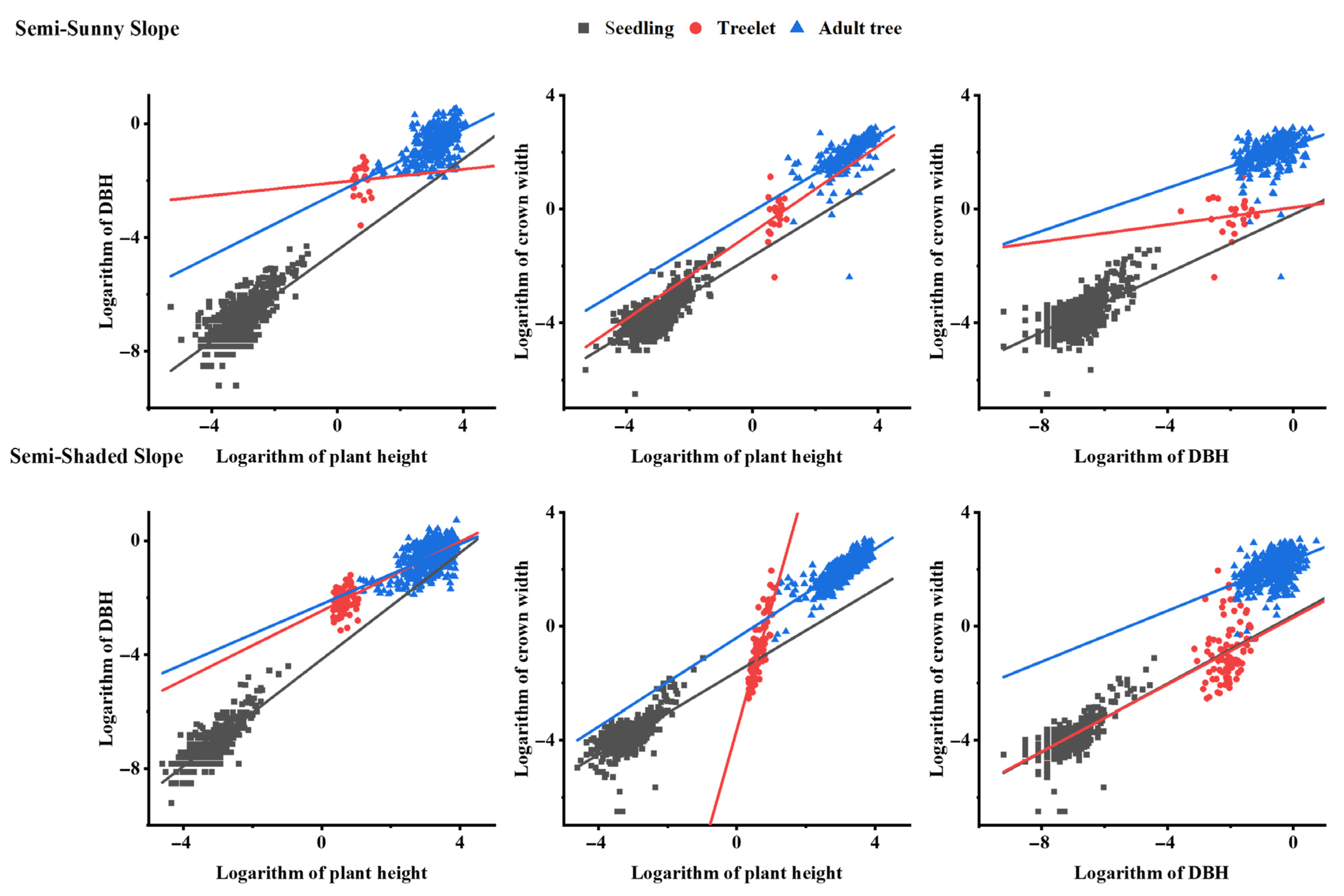
There was a significant positive correlation between DBH-H, CW-H, and CW-DBH at different development stages on different slopes (p < 0.05). The allometric relations of Picea schrenkiana at different development stages and slope aspects are shown in Figure 2. The growth pattern of DBH-H was not obvious in different slope directions, but it was significant at different development stages. The slope of the regression equation was the highest at the T stage, with slopes of 2.007 and 2.594 in the semi-shady and semi-sunny slopes, respectively. The slope was the lowest at the A stage, with slopes of 0.875 and 0.878 on the semi-shady and semi-sunny slopes, respectively. The change law of CW-H and CW-DBH was the same as that of DBH-H. In different development stages, treelets are the highest and adult trees are the lowest, and there is no significant difference among different slope directions (Table 3).

4. Discussion

4.1. Changes in the DBH-H Relationship at Different Development Stages

Among the growth characteristics, DBH is a response variable to H and CA. It is a relatively stable trait and is often used as a proxy for tree age. H is the most susceptible trait to environmental influence, especially in a forest under optimum light conditions. Light affects the growth of H and DBH of a tree. Previous studies reported a stable correlation between diameter at DBH and H under identical environmental conditions [27,28]. However, the present study found that the relationship of DBH-H varied at different development stages and slope directions, indicating that the relationship of DBH-H was not only impacted by environmental conditions. We found that the influence of development stages could not be ignored during allometric analysis.
In the S stage, P. schrenkiana is small and has certain shade tolerance, relatively less limited by light. Our previous research showed that the number of P. schrenkiana S on fallen trees is affected by the moisture content of fallen trees. The lower the H of an S, the greater the impact of the moisture content. P. schrenkiana is a typical shallow-rooted tree. During forest regeneration, the S stage is the most sensitive and fragile stage, easily impacted by external mechanical pressure. Furthermore, the trees at this stage constantly optimize their internal resource allocation [29]. Therefore, at this developmental stage, trees tend to prioritize DBH to adapt to changes in their early-growth habitat. Next, we found that the T stage was characterized by lateral growth, thickening of the trunk on the stem, and enlargement of the crown on the canopy. However, the trees exhibited very slow H growth at this stage. With increasing tree growth at this stage, the demand for photosynthesis increases and light eventually becomes the main limiting factor for the tree growth. Therefore, P. schrenkiana, in the T stage, tends to allocate more biomass to CW to synthesize high levels of photosynthetic products to maintain its own growth under the forest. However, because the light intensity in the environment remains at the light compensation point of photosynthesis, the growth and development of T are hindered, making them grow older but not up, resulting in “aging treelets” [30,31]. The H of a T will grow again only when the tree finds a gap and obtains enough light. After this, it will grow to the top layer, known as the growth release. The current study revealed a significant difference in the DBH-H of T and A. It might also explain why the DBH growth rate of T was much higher than the H growth rate.
When the trees reach the mature stage, their DBH growth rate decreases. Hence, at this stage, the trees focus on H growth, which is closely related to light conditions. In tropical trees, this phenomenon can be explained by crown shyness. At this stage, the tree focuses on CW growth to obtain more light radiation. However, P. schrenkiana does not follow this growth pattern. On the one hand, it exhibits a low stand density, and on the other hand, its crown is tower-shaped, and its CW decreases with increasing H. In this manner, this species is different from the broad-leaved trees. Therefore, the change in the H of P. schrenkiana might not be impacted by photoinhibition. Notably, H growth might be accompanied by the generation of new leaves on the side branches and the elongation of other side branches. New leaves are usually produced during the growth of annual branches [32,33], and the generation of new leaves is most active in the uppermost part of the conifer crown [34]. These findings indicated that the H growth of trees might be related to the production of new leaves. More importantly, because evergreen leaves have a long life, these trees must constantly renew their leaves to survive even under constrained conditions. According to the leaf turnover priority hypothesis [35], trees grow tall for leaf renewal to maintain productivity, so the stem diameter at the crown increases at this time while the DBH growth rate is low. The decreasing slope of DBH-H for big trees, showing an allometric rate with a slope significantly less than 1, might be attributed to this hypothesis. Corroborating our results, another study showed that the H and DBH growth of spruce trees reach their maximum at the age of 40 years, that is, at the T stage, followed by a rapid decrease in DBH growth rate [36].

4.2. Changes in the CW Growth at Different Stages

The growth of CW is closely related to the DBH and H. These parameters are commonly used for the study of aboveground forest productivity to construct a regression model of the crown biomass [37]. Previous studies have shown that at the T stage, the H growth rate is higher than the DBH and CW growth rates [38]. Therefore, the slopes for CW-DBH or CW-H will be higher at the S or T stage. However, different trees live in different environments, which affects the allometric relations between their CW, DBH, and H.
Different tree organs serve distinct functions, and their developmental status can reflect the tree’s ability to acquire various resources. Trees adjust resource allocation among organs according to environmental constraints [37]. According to the optimal allocation theory [39], trees tend to prioritize the development of organs that can acquire the most limited resources, thereby optimizing their adaptation strategy to the external environment. For example, to adapt to low-light environments, understory plants prioritize leaf development and expand canopy area to compensate for insufficient light. This is accompanied by relatively faster leaf growth and a more efficient resource allocation pattern in understory plants [40,41,42,43]. Research on the shrub layer in Tiantong Forest, Zhejiang Province, shows that compared to canopy trees, understory shrubs significantly increase leaf area and expand crown width to capture more light for growth [40]. Another study on the ramet population of Fargesia pauciflorus under subalpine coniferous forests also found that as canopy density increases, leaf development shows an enhanced trend [31]. The current study showed that the DBH-CW of S and T exhibited allometric relations. However, the allometric slope of T was significantly greater than 1, indicating that the T diameter had higher support efficiency for the crown and tended to favor CW growth. Our findings were in agreement with the results of the previous studies [41,43,44]. Furthermore, the CW-DBH slope of S was significantly less than 1 and the smallest among the slopes for all three stages, indicating that the DBH of S was the largest among all tree stages for the same CW. This finding suggested that the supporting efficiency of the stems of S was the lowest and that the trees preferred DBH growth at the S stage (Table 3). In this stage, spruce is small and has a certain shade tolerance, which is relatively less limited by light.
The relationship between CW and DBH in the A stage can be explained by the pipeline model. The growth of the crown is restricted by the diameter because there are enough vascular bundles to transport water and nutrients to support the crown growth. So, the larger the crown, the larger the diameter of the tree. According to the pipeline model theory, in order to meet the water demand of trees, the cross-sectional area of the xylem is directly proportional to the assimilation area they support [45]. Due to the limited metabolism, the photosynthetic products produced per unit of CW determine the optimal tree size for normal survival [46]. Hence, CW and DBH must exhibit the same growth relationship at all development stages, as was observed in the present study (Table 3).

4.3. Analysis of Allometric Relations in Different Slope Aspects

As for different slope directions, the DBH-H relationship of P. schrenkiana has changed (Figure 2), and the semi-shady slope is relatively larger, which might be attributed to the weaker light intensity on the semi-shady slope. The trees face more intense competition for sunlight and other resources, forcing them to allocate more photosynthetic products into H growth, as evident by the increasing SMA slope of CW-H of A in the present study (Table 3). Therefore, to maintain sufficient transpirational pull, trees must prioritize crown expansion, leading to a higher growth rate in height than in diameter. The standardized major axis regression slope shows a gradually increasing trend (Table 3).
Our results revealed no significant difference in the allometric index of CW-DBH between the semi-shaded slopes and semi-sunny slopes (Figure 2). Furthermore, the allometric relations in the same growth stage were not significant between different slope directions, indicating the same allometric law in different slope directions. We observed that because the semi-shady and semi-sunny slopes are in the transition area between the shady and sunny slopes, and the community has a complex composition, P. schrenkiana adopted the same growth strategy to adapt to the change in habitat. This finding was consistent with the results of previous studies on the allometric relations of Platycladus orientalis with different slope directions in the north of Lanzhou [28,47].
However, the change from the semi-shady to the semi-sunny slope led to decreased stand and canopy densities of the P. schrenkiana forest. Notably, the light intensity and temperature of the semi-sunny slope are higher than those of the semi-shady slope. At the S stage, the canopy density decreases, and the gap increases from the semi-shady to the semi-sunny slope. So, P. schrenkiana S under the forest can get more light resources, with a lower CW growth rate but stronger transpiration. Moreover, we observed that P. schrenkiana on semi-sunny slopes showed enhanced diameter development during the S and T stages, which improved its water absorption capacity to meet water consumption demands. Hence, the S on the semi-sunny slope exhibited a lower SMA slope of CW-DBH than those on the semi-sunny slope (Table 3). However, when the trees receive more light in the T stage, the stems of trees with suppressed growth are released, and resource allocation is skewed towards H increases. This was evident by the decreased SMA slopes of CW-DBH and CW-H of a T on the semi-sunny slopes compared to those on the semi-shaded slopes.

5. Conclusions

P. schrenkiana adopts distinct allometric strategies at different developmental stages. During the seedling stage, it prioritizes diameter at DBH growth to enhance mechanical support and establishment ability. In the treelet stage, as light becomes the primary limiting factor, the focus of allometric shifts to crown expansion to synthesize more photosynthetic products. At the adult trees stage, the growth emphasis transitions to height increment, which is more closely associated with leaf renewal and the need to maintain productivity rather than mere competition for light. Within the same growth stage, the allometric relations of P. schrenkiana show no significant variation across different slope aspects. This indicates that, while slope aspect influences stand characteristics such as density and canopy closure, the allometric patterns of P. schrenkiana populations at the individual level remain consistent and are not fundamentally altered by differences in slope aspect. This study reveals that the allometric relations of P. schrenkiana are a key life-history strategy for coping with limited understory light conditions and for progressing from establishment to canopy dominance. The findings not only deepen the understanding of the ecological adaptability of P. schrenkiana populations but also provide important theoretical references for the silvicultural management and artificial restoration of its forests.

Author Contributions

D.H. provided research ideas; D.H. and J.H. conceived and designed the experiments; J.H., Y.Z., Z.X. and R.S. participated in fieldwork and collected the data; J.H. and Y.Z. conducted data analysis; J.H. wrote the manuscript; D.H. and Y.Y. revised the manuscript. All authors have read and agreed to the published version of the manuscript.

Funding

This research was funded by the Special Project of Applied Technology Research and Innovation Drive in the Yili Kazakh Autonomous (YYD2023A13) and Key Research Project of Yili Normal University (2023YSZD008).

Data Availability Statement

The data are contained within the article.

Conflicts of Interest

The authors declare no conflicts of interest.

References

  1. Bonser, S.; Aarssen, L.W. Interpreting reproductive allometry: Individual strategies of allocation explain size-dependent reproduction in plant populations. Perspect. Plant Ecol. Evol. Syst. 2009, 11, 31–40. [Google Scholar] [CrossRef]
  2. Mooney, K.A.; Halitschke, R.; Kessler, A.; Agrawal, A.A. Evolutionary trade-offs in plants mediate the strength of trophic cascades. Science 2010, 5973, 1642–1644. [Google Scholar] [CrossRef]
  3. Fan, G.H.; Cui, Z.; Zhang, J.W.; Haung, Y.X. Effects of population density on the biomass allocation and allometric of Chenopodium acuminatum. Acta Ecol. Sin. 2017, 37, 5080–5090. [Google Scholar]
  4. Hallé, F.; Oldeman, R.A.A.; Tomlinson, P.B. Tropical trees and forests. In An Architectural Analysis; Springer: Berlin/Heidelberg, Germany, 1978. [Google Scholar]
  5. Daniel, B.; Yves, C. Plant Architecture: A Dynamic, Multilevel and Comprehensive Approach to Plant Form, Structure and Ontogeny. Ann. Bot. 2007, 99, 375–407. [Google Scholar] [CrossRef] [PubMed]
  6. Midgley, J.J. Is bigger better in plants? The hydraulic costs of increasing size in trees—ScienceDirect. Trends Ecol. Evol. 2003, 18, 5–6. [Google Scholar] [CrossRef]
  7. Leland, S.J.; Donald, B.L. Influence of Photosynthetic Crown Structure on Potential Productivity of Vegetation, Based Primarily on Mathematical Models. Ecology 1965, 46, 319–326. [Google Scholar] [CrossRef]
  8. West, G.B.; Brown, J.H.; Enquist, B.J. A general model for the structure and allometry of plant vascular systems. Nature 1999, 400, 664–667. [Google Scholar] [CrossRef]
  9. Niklas, K.J. Size-dependent allometry of tree height, diameter and trunk-taper. Ann. Bot. 1995, 75, 217–227. [Google Scholar] [CrossRef]
  10. Li, L.P.; Anwar, M.; Wang, X.P. Study on Relationship between Height and DBH of Mountain Coniferous Forests in Xinjiang. Arid Zone Res. 2011, 28, 47–53. [Google Scholar] [CrossRef]
  11. Ducey, M.J.; Knapp, R.A. A stand density index for complex mixed species forests in the northeastern United States. For. Ecol. Manag. 2010, 260, 1613–1622. [Google Scholar] [CrossRef]
  12. Wu, Y.; Chen, B.Y.; Xu, G.B.; Chen, L.Z.M.; He, G.X.; Liu, B.; Yue, F.H.; Liang, W.B.; Zhang, X. The relationship between the allometric growth and spatial competition pattern of large-diameter Chinese fir. Hunan For. Sci. Technol. 2025, 52, 42–48. [Google Scholar]
  13. Pretzsch, H. Canopy space filling and tree crown morphology in mixed-species stands compared with monocultures. For. Ecol. Manag. 2014, 327, 251–264. [Google Scholar] [CrossRef]
  14. Duan, J.; Ma, L.Y.; Jia, L.M.; Xu, C.Y.; Jia, Z.K.; Che, W.R. The density effect of Platycladus orientalis plantation in Beijing area. Acta Ecol. Sin. 2010, 30, 3206–3214. [Google Scholar]
  15. Yao, W.; Krzic, M.; Coops, N.C. Modelling tree height–diameter relationships in multi-species and multi-layered forests: A comparison of mixed-effects and quantile regression approaches. For. Ecol. Manag. 2018, 409, 683–692. [Google Scholar]
  16. Vanclay, J.K. Tree diameter, height and stocking in evenaged forests. Ann. For. Sci. 2009, 66, 702. [Google Scholar] [CrossRef]
  17. Lines, E.R.; Zavala, M.A.; Purves, D.W.; Coomes, D.A. Predictable changes in aboveground allometry of trees along gradients of temperature, aridity and competition. Glob. Ecol. Biogeogr. 2012, 21, 1017–1028. [Google Scholar] [CrossRef]
  18. Hulshof, C.M.; Swenson, N.G.; Weiser, M.D. Tree crown allometry: A review. J. Ecol. 2015, 103, 651–662. [Google Scholar]
  19. Wang, Y.; Cai, N.H.; Chen, L.; Tang, J.; Xu, Y.; Chen, S. Relationships Between Biomass Allocation Pattern and Plant Size of Pinus yunnanensis Seedling. For. Resour. Manag. 2022, 6, 101–108. [Google Scholar] [CrossRef]
  20. He, J.K.; Xu, Z.W.; Shi, R.K.; Han, D.Y. Quantitative Characteristics and Influencing Factors of Regeneration Seedlings of Different Decay Grades of Pinus schrenkiana Western Tianshan Mountains. Bull. Bot. Res. 2024, 44, 279–288. [Google Scholar]
  21. Wang, T.; Liang, Y.; Ren, H.; Yu, D.; Ni, J.; Ma, K. Age structure of Picea schrenkiana forest along an altitudinal gradient in the central Tianshan Mountains, northwestern China. For. Ecol. Manag. 2004, 196, 267–274. [Google Scholar] [CrossRef]
  22. Liu, H.Q.; Jia, Y.Y.; Xie, X.R.; Yang, F.; Zhang, W.; Yang, Y. Cespitose Population Structure and Dynamics of Rare Fraxinus sogdiana in the Yili River Valley, China. Forests 2025, 16, 567. [Google Scholar] [CrossRef]
  23. Hajek, P.; Seidel, D.; Leuschner, C. Mechanical abrasion, and not competition for light, is the dominant canopy interaction in a temperate mixed forest. For. Ecol. Manag. 2015, 348, 108–116. [Google Scholar] [CrossRef]
  24. Shi, Y.C.; Zhao, C.Z.; Song, Q.H.; Du, J.; Chen, L.; Wang, J. Slope-related variations in twig and leaf traits of Robinia pseudoacacia in the northern mountains of Lanzhou. Chin. J. Plant Ecol. 2015, 39, 362–370. [Google Scholar]
  25. Warton, D.I.; Wright, I.J.; Falster, D.S.; Westoby, M. Bivariate line-fitting methods for allometry. Biol. Rev. 2006, 81, 259–291. [Google Scholar] [CrossRef]
  26. Warton, D.I.; Duursma, R.A.; Falster, D.S.; Taskinen, S. SMATR 3—An R package for estimation and inference about allometric lines. Methods Ecol. Evol. 2012, 3, 257–259. [Google Scholar] [CrossRef]
  27. Li, Z.C.; Lin, X.Y.; Dong, L.B. Interaction Effects of Stand Density and Site Conditions on the Height–Diameter Model of Larix olgensis Plantations. For. Res. 2026, 39, 43–53. [Google Scholar]
  28. Duan, G.S.; Gao, Z.G.; Wang, Q.Y.; Fu, L. Comparison of different height–diameter modelling techniques for prediction of site productivity in natural uneven-aged pure stands. Forests 2018, 9, 63. [Google Scholar] [CrossRef]
  29. Xie, R.; Li, J.Q.; Zhao, X.; Li, N. Effect of different canopy conditions on biomass allocation and clonal morphology of Fargesia denudata in a subalpine coniferous forest in southwestern China. Chin. J. Plant Ecol. 2010, 34, 753–760. [Google Scholar]
  30. Canham, C. Suppression and Release during Canopy Recruitment in Acer saccharum. Bull. Torrey Bot. Club 1985, 112, 134–145. [Google Scholar] [CrossRef]
  31. Becker, P.; Wong, M. Seed Dispersal, Seed Predation, and Juvenile Mortality of Aglaia sp. (Meliaceae) in Lowland Dipterocarp Rainforest. Biotropica 1985, 17, 230–237. [Google Scholar] [CrossRef]
  32. Brian, J.F. Physiology of Woody Plants. Bot. J. Linn. Soc. 2007, 153, 243. [Google Scholar] [CrossRef]
  33. Beck, C.B. An Introduction to Plant Structure and Development: Index; Cambridge University Press: Cambridge, UK, 2010. [Google Scholar]
  34. Kurachi, N. Distribution of leaf- and branch-biomass density within a crown of Japanese larch and its relationship to primary production: Analysis by sainome-cutting. Crown Canopy Struct. Relat. Product. 1986, 308–322. [Google Scholar]
  35. Sumida, A.; Miyaura, T.; Torii, H. Relationships of tree height and diameter at breast height revisited: Analyses of stem growth using 20-year data of an even-aged Chamaecyparis obtusa stand. Tree Physiol. 2013, 33, 106–118. [Google Scholar] [CrossRef] [PubMed]
  36. Blanchard, E.; Birnbaum, P.; Ibanez, T.; Boutreux, T.; Antin, C.; Ploton, P.; Vincent, G.; Pouteau, R.; Vandrot, H.; Hequet, V.; et al. Contrasted allometries between stem diameter, crown area, and tree height in five tropical biogeographic areas. Trees 2016, 30, 1953–1968. [Google Scholar] [CrossRef]
  37. Li, Z.Y.; Luo, Q.H.; Xu, Z.L. Effects of stand density on the biomass allocation and tree height-diameter allometric of Picea schrenkiana forest on the northern slope of the western Tianshan Mountains. Arid Zone Res. 2021, 38, 545–552. [Google Scholar]
  38. Wang, Y.J.; Li, F.Q.; Liu, Y.B. Study on Growth Pattern and Ornamental of Young Forest of Sorbus aucuparia. For. Sci. Technol. 2021, 46, 7–9. [Google Scholar]
  39. Weiner, J. Allocation, plasticity and allometry in plants. Perspect. Plant Ecol. Evol. Syst. 2004, 6, 207–215. [Google Scholar] [CrossRef]
  40. Lin, K.M.; Hong, W.; Yu, X.T.; Haung, B.L. The dynamic characteristics and forecasting models of biomass of undergrowth plant in Chinese fir plantation. Sci. Silvae Sin. 2001, 37, 99–105. [Google Scholar]
  41. Yuan, H.J.; Xing, W.L.; Xu, H.D.; Wang, Y.D.; Cheng, X.R.; Zhang, C.X. Variation in Growth and Biomass of Quercus acutissima Provenances. For. Res. 2020, 33, 97–105. [Google Scholar]
  42. Zuo, C.; Wang, M.T.; Wang, L.X.; Tao, Y. Trade-offs in Modular Biomass Allocation of Crotalaria spectabilis in Different Habitats. Acta Agrestia Sin. 2020, 28, 454–460. [Google Scholar]
  43. Zhang, Y.Y.; Meng, H.H.; Zhou, X.B.; Yin, B.F.; Zhou, D.Q.; Tao, Y. Biomass allocation patterns of an ephemeral species (Erodium oxyrhinchum) in different habitats and germination types in the Gurbantunggut Desert, China. Arid Zone Res. 2022, 39, 541–550. [Google Scholar]
  44. Xia, C.C.; Yang, T.H.; Cao, J.; Zhao, Q.; Lin, B.; Da, J. Biomass allocation and simulation of tree species in the shrub layer in Tiantong, Zhejiang Province. J. Anhui Agric. Univ. 2014, 41, 945–949. [Google Scholar]
  45. Shinozaki, K.; Yoda, K.; Hozumi, K.; Kira, T. A quantitative analysis of plant form—The pipe model theory. Jpn. J. Ecol. 1964, 14, 133–139. [Google Scholar]
  46. Olson, M.E.; Aguirre-Hernández, R.; Rosell, J.A. Universal foliage-stem scaling across environments and species in dicot trees: Plasticity, biomechanics and Corner’s Rules. Ecol. Lett. 2009, 12, 210–219. [Google Scholar] [CrossRef]
  47. Shi, Y.C.; Zhao, C.Z.; Song, Q.H.; Du, J.; Wang, J. Allometric relations between height and crown width or diameter of Platycladus orientalis on different slope aspects of Lanzhou northern mountains. Chin. J. Ecol. 2015, 34, 1879–1885. [Google Scholar]
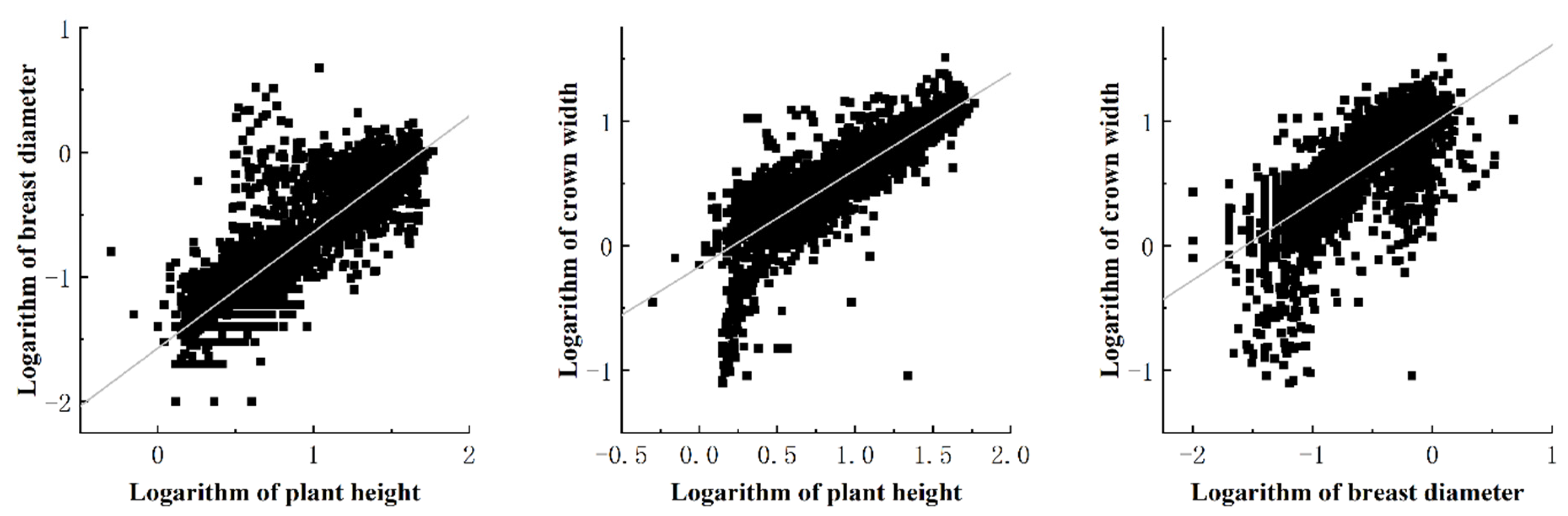
Figure 1. Allometric relations of Picea schrenkiana in western Tianshan Mountains. Note: The lines in the figure represent fitted curves.
Forests 17 00487 g001
Figure 2. Allometric relations of Picea schrenkiana at different development stages and slope aspects. Note: The lines in the figure represent fitted curves.
Forests 17 00487 g002
Table 1. Overview of sample site environment.
Slope OrientationSeedling CountTreelet CountAdult Trees CountStand Density (n/ha)Canopy Density (%)Basal Area at Breast Height (m2/ha)
Semi-Shaded Slope66693717188.6889.9169.07
Semi-Sunny Slope133423342155.4579.0152.02
Total 20001161059176.5085.9162.82
Table 2. Standardized major axis regression of allometric relations of Picea schrenkiana.
AllometricIntercept (95% CI)Slope (95% CI)R2pPS
DBH-H−1.708−1.727−1.6901.0941.0741.1130.7250.0000.000
CW-H−0.269−0.283−0.2540.8960.8810.9110.7540.0000.000
CW-DBH1.1311.1071.14108190.7970.8350.5890.0000.000
Note: p refers to the degree of fit of the equation. Ps represents the difference between the standardized major axis regression slope and 1 (Ps, Table 2): when the difference is not significant (Ps > 0.05), it is isokinetic growth; and when the difference is significant (Ps < 0.05), the growth is allometric.
Table 3. Standardized major axis regression of allometric relations of regeneration seedlings of Picea schrenkiana in different slope directions.
AllometricAgeSlope
Aspect
Intercept (95% CI)Slope (95% CI)R2pPSPH
DBH-HSSH−1.801−1.830−1.7731.1641.0941.2380.5330.0000.0000.771
SU−1.771−1.819−1.7231.1941.1521.2370.4920.0000.000
TSH−4.417−5.575−3.2593.2112.0694.9810.1960.0000.0000.592
SU−3.439−3.729−3.152.1651.7752.640.1720.0060.000
ASH−1.399−1.475−1.3240.8750.8210.9330.7300.0000.0000.953
SU−1.438−1.567−1.3090.8920.8030.9910.1400.0000.000
CW-HSSH−0.297−0.323−0.2711.0190.9811.0580.4350.000>0.050.053
SU−0.248−0.283−0.2120.9320.8810.9870.6070.0000.000
TSU−3.243−4.632−1.8533.9452.5616.0740.3710.0000.0000.826
SH−4.166−4.552−3.7795.1684.6135.7890.7010.0000.000
ASH−0.298−0.344−0.2520.8750.8410.9100.6480.0000.0000.483
SU−0.364−0.446−0.2820.9170.8590.9790.6660.0000.000
CW-DBHSSH1.2401.2041.2750.8750.8410.9060.4090.0000.0000.272
SU1.1711.1131.2300.7810.7500.8160.4630.0000.000
TSH2.1841.0253.3431.2290.7941.9010.1500.5770.0000.502
SU4.0453.0155.0762.3881.9542.9180.0610.0000.000
ASH1.1021.0761.1271.0000.9281.0660.6800.000>0.050.919
SU1.1151.0721.1581.0280.9231.1460.8400.000>0.05
Note: PH represents the difference in the standardized major axis regression slope between different slope orientations: when PH < 0.05, it indicates a significant difference in the standardized major axis regression slope between different slope orientations; and when PH > 0.05, it indicates that there is no significant difference.
Disclaimer/Publisher’s Note: The statements, opinions and data contained in all publications are solely those of the individual author(s) and contributor(s) and not of MDPI and/or the editor(s). MDPI and/or the editor(s) disclaim responsibility for any injury to people or property resulting from any ideas, methods, instructions or products referred to in the content.