Article

Plant Roots Exert Stronger Co-Structuring Effects than Soils on the Litter Microbial Community Following the Succession of Fagus lucida Forests

1
College of Biology and Environmental Sciences, Jishou University, Jishou 416000, China
2
Key Laboratory for Ecotourism of Hunan Province, School of Tourism and Urban-Rural Planning, Jishou University, Jishou 416000, China
3
Institute of Applied Ecology, School of Food Science, Nanjing Xiaozhuang University, Nanjing 211171, China
4
Administration Bureau of Badagongshan National Nature Reserve, Sangzhi 427100, China
*
Author to whom correspondence should be addressed.
Forests 2026, 17(4), 476; https://doi.org/10.3390/f17040476
Submission received: 16 March 2026 / Revised: 9 April 2026 / Accepted: 10 April 2026 / Published: 13 April 2026

Abstract

Clarifying the responses of microbial communities in distinct microhabitats like roots, the soil, and litter layers to secondary succession is critical for predicting the effects of global climate change on ecosystem functions. We investigated the microbial activities, compositions, and networks in these microhabitats of Fagus lucida forests ranging from 40 to 200 years. The results showed that soil physicochemical properties decreased with forest succession, except for NH4+-N and available phosphorus, which decreased at the early stage. All vector angles of extracellular enzyme stoichiometry that were greater than 45° indicated that phosphorus was the key limiting element for microorganisms. The microbial community shifted from r- to K-strategists with forest succession, displaying the replacement of most bacterial phyla by Proteobacteria and Acidobacteriota, and an increase in the Acidobacteriota: Proteobacteria ratio, especially in the soil and litter layers. Soil properties, particularly NH4+-N and pH, significantly affected the bacterial diversity and structure. Moreover, the bacterial network complexity increased with succession, particularly in the litter layer, and the topological properties of bacterial networks showed a stronger influence on microbial activities compared with those of fungal networks. The richness of keystone taxa in the litter layer was higher than in the soil layer and roots. However, the fungal community dominated by symbiotrophs showed lower sensitivity to soil nutrient changes and greater resilience to forest succession, displaying stable diversity and decreased network complexity, particularly in the roots. Ectomycorrhizal fungi (e.g., Russula) dominated the fungal guilds, and their abundance increased with forest succession, accompanied by a decrease in pathogenic fungi. Plant roots with significantly higher phosphatase activities played a stronger role than soils in structuring the litter microbial community, as reflected by similar carbon- and nitrogen-acquiring enzyme activities, microbial compositions, a greater share of taxa, and closer community distance. Our results revealed the increasingly important role of plant roots with forest succession in structuring the microbial community and nutrient cycling in the soil and litter layers.

1. Introduction

Forests are the mainstay of terrestrial ecosystems, and their succession process not only shapes the structure and functions of aboveground vegetation but also profoundly changes the physical, chemical, and biological properties of the belowground world [1,2]. Forest succession as an ecological process usually lasts for decades to centuries, during which soil microorganisms form a closely coupled system with plants and soil through nutrient cycling [3,4]. The development of root systems will enhance rhizosphere secretions, which promote soil nutrient activation and release, thus enhancing the conversion efficiency of litter available nitrogen (N) and phosphorus (P) [5,6]. Moreover, as the forest develops, the quantification of leaf litter and the contents of total N and total P increase, especially in the middle succession stage [7]. On the other hand, the absorption of soil nutrients by plants will also increase with forest development and notably change the nutrient distribution patterns. High absorption causes the notoriously low levels of soil nutrients in subtropical/tropical forest ecosystems and leads to the recycling of most nutrients directly from decomposing litter by mycorrhizae [8]. These changes in soil nutrient dynamics are the dominant factor determining the variation in the forest soil microbial community [9].
The soil microbial community is determined by the dominant vegetation and differs significantly along different forest succession stages [10,11]. However, the aboveground and belowground biodiversity patterns are often not correlated [12]. This may be due to the high heterogeneity in the belowground world. In particular, microhabitats, such as the roots, the soil, and litter layers, provide distinctly different ecological niches for microorganisms. The soil fungal community has the closest relations with the plant community, whereas the bacterial community shows the strongest relations with soil properties [13,14]. Bacterial and fungal communities in the rhizosphere contain a greater share of symbiotic microorganisms and r-strategists than those in the bulk soils [15,16,17]. Microbial communities in the litter layer are also quite distinct from those in the soil layer [18,19]. The fungal community composition, including mycorrhizal (like ectomycorrhizal, ECM) fungi, in the litter layer can form associations with the roots of nearby tree species [20,21]. Moreover, phyllosphere microorganisms inhabiting live leaves before abscission also comprise a significant share of the community in decomposing litter [22,23]. As a pioneer microbial group, these endophytes preferentially colonize litter and function in decomposing organic components [24,25]. However, whether the microbial community composition inhabiting these distinct microhabitats (the roots, soil, and litter layers) responds differently to forest succession is not well understood, especially the dynamics of litter-dwelling (or detritusphere) microorganisms, which play a crucial role in recycling litter nutrients.
Different microbial groups are highly interconnected and form networks via predation, competition, and commensalism, with greater topological properties (e.g., the number of nodes and edges and average degree) of the microbial co-occurrence networks indicating more complex networks [26,27]. With forest development, the complexity and modularity of microbial networks increase, and the late successional stage favors the maintenance of higher microbial network complexity [2,4,28]. However, the rhizosphere and bulk soils display different microbial network complexity and keystone species [28]. Investigating the microbial community assembly process, which consists of deterministic and stochastic processes, could help predict the structure and networking of microbial communities [29,30]. Deterministic processes emphasize the role of environmental filtering and biological interactions, while stochastic processes encompass the probabilistic dispersal and ecological drift, which result in unpredictable and divergent community outcomes [31]. The soil microbial community assembly process varied among different forest ages, with the community composition governed by deterministic processes in the early stages, and by stochastic processes in the later stages [32]. As the litter layer had microbial communities distinct from those in the roots and soil layer, the assembly process and networks of litter microbial communities may display different patterns during forest succession, which remain unexplored.
The influence of forest succession on soil properties and microbial community will inevitably impact microbial activity. Extracellular enzymes derived from plant roots and microorganisms are secreted to degrade complex organic compounds and obtain nutrients, such as N and P [33,34]. The dynamic changes in extracellular enzyme activity (EEA) indicate the relative allocation of carbon (C), N, and P resources by the microbial community for obtaining nutrients, while the EEA stoichiometric ratio (EES) can reveal the nutrient limitations in microbial growth and metabolic processes [35,36]. With forest succession, microbial P limitation is reported to decrease while N limitation increases [37]. The limitation of different nutrients during the succession process will reshape the microbial community at different forest succession stages. Investigation into the nutrient limitation patterns in roots, the soil, and litter layers would help reveal the microbial community dynamics during forest succession.
Most studies focus on heterospecific forests; the dynamics of the microbial community during the succession (or development) of conspecific forests need further investigation [7,37,38]. Fagus lucida Rehder & E. H, a large deciduous tree species belonging to the Fagaceae family, is an endemic species and often forms a dominant community in China [39]. In particular, F. lucida can form a climax community as a conspecific forest in Badagongshan Nature Reserve [40,41]. We investigated the microbial community in the roots, soil, and litter layers of F. lucida forests ranging from 40 to 200 years, aiming to clarify the response pattern of microbial communities in these distinct microhabitats to the secondary succession of F. lucida forests. The dynamics of soil physicochemical properties, EEAs, and EESs were analyzed to evaluate the underlying mechanisms. We expected that (1) nutrient limitation for microorganisms would differ among microhabitats. Specifically, the microbial community in roots would be limited by N and P; in the litter layer, it would be limited by C, as labile C exuded by roots can exert priming effects on litter decomposition, while in the soil layer, it would be limited by both. Litter is reported to decompose faster in its native plant community than in a heterogeneous plant community, known as the home-field advantage [42,43]. The affinity between microbial decomposers and litter is widely considered to be the intrinsic cause of the home-field advantage effect [44,45]. With forest succession, the F. lucida would exert a stronger home-field advantage on litter decomposition and enhance this affinity through its roots. Thus, (2) the composition of the microbial community in the litter layer would become closer to that in the roots along the chronosequence, due to the specialization of litter decomposer communities in adapting to the F. lucida forests. (3) The complexity of microbial community co-occurrence networks in these microhabitats would increase along the chronosequence, and in the litter layer, would be greater, as the litter microbial community was influenced by both the roots and soil.

2. Materials and Methods

2.1. Description of the Study Area

The study sites are located in the Badagongshan National Nature Reserve (109°41′45″–110°09′50″ E, 29°39′18″–29°49′48″ N) in Sangzhi County, Hunan Province [46]. The regions enjoy abundant sunlight and heat, plentiful rainfall, a long frost-free period, short severe cold periods, and distinct seasons. The average annual temperature is 11.5 °C, with an average temperature of 0.1 °C in January and 22.8 °C in July. The annual precipitation is 2105.4 mm. The average frost-free period is 190 days, with an annual accumulated temperature of 3621.6 °C. The forest coverage reaches 94.1%, and the average annual relative humidity of the forests is 90%. The soil pH value (0–10 cm) is 4.79, with 43.99% soil water content, 4.92 mg kg−1 NH4+-N, and 13.24 mg kg−1 available phosphorus (AP).

2.2. Sampling of Roots, the Soil, and the Litter Layer

Three succession stages of F. lucida forests in the Badagongshan National Nature Reserve were selected: the 40-year young-age, 60-year middle-age, and 200-year climax forests (Figure S1). The young forest (T40) is located in Tianping Mountain (110°07′61″ E, 29°77′53″ N) with an elevation of 1336.45 m, with associated vegetation including Cyclobalanopsis multinervis, Castanea mollissima, Daphniphyllum macropodum, Symplocos sinensis, Hedera nepalensis, Spiraea japonica, and Ophiopogon japonicus, and a vegetation coverage of about 0.6–0.7. The middle-aged forest (T60) is located in Tianping Mountain (110°07′66″ E, 29°77′52″ N) with an elevation of 1316.77 m, with associated vegetation including Cyclobalanopsis multinervis, Aesculus chinensis, Carpinus turczaninowii, Davidia involucrata, Nandina domestica, Buxus sinica, and Selaginella tamariscina, and a vegetation coverage of about 0.6–0.7. The 200-year climax forest (D200) is located in Doupeng Mountain (109°74′56″ E, 29°68′75″ N) with an elevation of 1800.33 m, with associated vegetation including Cyclobalanopsis multinervis, Sorbus hupeana, Rhododendron simsii, Dryopteris crassirhizoma, Viburnum alnifolium, and Fargesia denudata, and a vegetation coverage of about 0.7–0.8.
In order to compare the microbial community characteristics in different microhabitats (roots, soil, and litter layers), five 1 × 1 m subplots (five replicates) were randomly established in each 10 × 10 m plot of the three F. lucida forests during the litter-falling period (Figure S1). In each subplot, the fermentation litter layer (partially decomposed litter) was collected using a five-point sampling method, homogenized by cutting the litter into 0.25-cm2 pieces, and composited into one sample. Simultaneously, spatially independent mineral soil samples from the upper 5 cm were collected (soil cores of 45-mm diameter) at the litter patches, sieved through a 2 mm mesh (soil layer), and the cores were pooled to form a single composite sample. Along with the soil sampling, fine roots were collected, and the rhizosphere soil was cleared off with a sterilized brush in the laboratory. The samples were kept in a sterile self-sealing bag and divided into two portions: one portion was stored at 4 °C for the determination of EEAs and soil physicochemical properties, and the other portion was stored at −80 °C for high-throughput sequencing of the microbial community.

2.3. Determination of Soil Physicochemical Properties and EEAs

Soil water content (Swc) was determined using the oven-drying method. Soil pH was measured using a pHS-25 pH meter (INASE Scientific Instrument Co., Ltd., Shanghai, China) (with a soil-to-water ratio of 1:2.5). Soil organic matter (SOM) was determined by the potassium dichromate oxidation method [47]. Soil NH4+-N was measured by the indophenol blue colorimetric method [20]. Soil AP extracted with 0.5 mol L−1 NaHCO3 (pH 8.5) was determined by the Olsen method [48]. Soil alkali-hydrolyzable N (AHN) was measured according to Roberts et al. [49]. Microbial respiration rate was estimated by determining the released CO2 that was trapped in 0.5 M NaOH and was expressed as mmol CO2 g−1 soil day−1 [24].
EEAs involved in C acquisition (cellulase or carboxymethyl cellulase (Cx), and β-1,4-glucosidase (BG)), N acquisition (chitinase or β-N-acetylglucosaminidase (NAG), urease (URE), leucine aminopeptidase (LAP) and nitrate reductase (NR)), and P acquisition (acid phosphatase (ACP) and alkaline phosphatase (ALP)) were determined spectrophotometrically (see Table S1 for the detailed assay procedure). The enzymatic activity assay was finished within one week after sampling.

2.4. Microbial Community Analysis

Total DNA from the roots, soil, and litter layers was extracted using the Power Soil DNA Isolation Kit (MoBio Laboratories, Carlsbad, CA, USA). Bacterial 16S rDNA V4-V5 regions were amplified using primers 515F (5′-GTGCCAGCMGCCGCGGTAA-3′) and 907R (5′-CCGTCAA TTCMTTTRAGT TT-3′) [50], while the ITS4 region of fungi was amplified using primers fITS7F (5′-GTGARTCATCGA RTCTTTG-3′) and ITS4 (5′-TCCTCCGCTTATTGATATGC-3′) [51]. The PCR reaction conditions were as follows: an initial denaturation at 94 °C for 1 min, followed by 12 cycles of denaturation at 95 °C for 20 s, annealing at 65 °C for 45 s, and extension at 72 °C for 45 s, with a final extension at 72 °C for 5 min, and then held at 4 °C. After purification, quantification, and normalization, the PCR products were used to construct libraries with the NEBNext Ultra II DNA Library Prep Kit for Illumina (NEB#E7645L) from NEW ENGLAND BioLabs (Ipswich, MA, USA). Raw sequence data were deposited in the Sequence Read Archive (SRA) database of the National Center for Biotechnology Information (NCBI) (Accession Number: PRJNA1398509). Qualified libraries were sequenced on the Illumina NovaSeq 6000 (Illumina, San Diego, CA, USA) platform using the PE250 sequencing method. Passed sequences were dereplicated and subjected to the DADA2 algorithm (QIIME 2) to identify indel mutations and substitutions [52]. The trimming and filtering were performed on paired reads with a maximum of two expected errors per read (maxEE  =  2). After merging paired reads and chimera filtering, the phylogenetic affiliation of each amplicon sequence variant (ASV) was taxonomically annotated against the Silva 128 and Unite 6.0 databases using a confidence threshold of 80% [53].

2.5. Statistics Analysis

The EES ratios of C:N (EC:N), C:P (EC:P), and N:P (EN:P) were calculated using the following formulae:
E C : N = L n ( B G ) L n ( N A G + L A P )
E C : P = L n ( B G ) L n ( A C P )
E N : P = L n ( N A G + L A P ) L n ( A C P )
The vector analysis of EES was used to quantify the relative limitation of C, N, and P to microorganisms:
Vector Length = [ L n B G : L n N A G + L A P ] 2 + [ L n B G : L n A C P ] 2
Vector Angle = D e g r e e s A T A N 2 ( L n ( B G ) : L n ( A C P ) ) , ( L n ( B G ) : L n ( N A G + L A P ) )
where ATAN2 represents the arctangent of the point (Ln BG/Ln ACP, Ln BG/Ln (NAG + LAP)) relative to the origin point. The vector length indicates the relative extent of microbial C limitation, with longer vectors representing greater C limitation. The vector angle indicates the relative extent of microbial N or P limitation, with angles less than 45° indicating relative N limitation and angles greater than 45° indicating greater P limitation. The greater the deviation from 45°, the stronger the N or P limitation [54,55].
Based on null-model theory using the β-nearest taxon index (βNTI) and Bray–Curtis-based Raup–Crick index (RCbray) parameters, the assembly processes of the microbial community were evaluated using the “NST” and “iCAMP” packages in R [56]. The values of |βNTI| > 2 were interpreted as deterministic processes that govern community assembly; therein, βNTI > 2 or <−2 indicated that heterogeneous or homogenous selection was significantly dominant. In turn, |βNTI| < 2 and |RCbray| > 0.95 indicated that community assembly was driven by homogenizing dispersal (RCbray < −0.95) or dispersal limitation (RCbray > 0.95). When |βNTI| < 2 with |RCbray| < 0.95, community assembly was dominated by ecological drift [24,56]. Co-occurrence networks of microbial communities were constructed based on Pearson correlation (ρ > 0.3, p < 0.05). Spearman correlation analysis was performed in the “Hmisc” package, and ASVs with a relative abundance greater than 0.1% and detected in more than 30% of the samples were retained [57]. The co-occurrence networks were constructed using the “igraph” and “WGCNA” packages and visualized in Gephi 0.10.1. The “zipR” package was used to calculate the Zi-Pi values. Based on the values of within-module connectivity (Zi) and among-module connectivity (Pi), nodes in the network were classified into peripheral nodes (Zi < 2.5; Pi < 0.62), connectors (Zi < 2.5, Pi > 0.62), module hubs (Zi > 2.5; Pi < 0.62), and network hubs (Zi > 2.5; Pi > 0.62) [26,58]. Network hubs, module hubs, and connectors were identified as keystone species.
Two-way ANOVA and Duncan’s test were performed to compare the effects of forest age and microhabitat on EEAs. The alpha diversity of microbial communities was calculated using the “picante” package, and differences in diversity were compared using Tukey’s method. The “vegan” package was used to calculate beta diversity based on the Bray–Curtis distance, and differences in microbial communities were tested using permutational multivariate analysis of variance (PERMANOVA, with 999 permutations). The “tidyverse” and “ggvenn” packages were used to visualize the ASV Venn diagram. The fungal ecological functions were predicted using the FUNGuild databases [59]. Simple linear regressions of the abundance of ectomycorrhizal fungi against phosphatase activities and the vector angle of extracellular enzyme stoichiometry were analyzed. Principal component analysis (PCA), Mantel tests, and a heatmap based on Spearman correlation were conducted to reveal the relationships among keystone species, dominant groups, soil physicochemical properties, and EEAs. All analyses were conducted in R software 4.5.1.

3. Results

3.1. The Soil Physicochemical Properties and EEAs During F. lucida Forest Succession

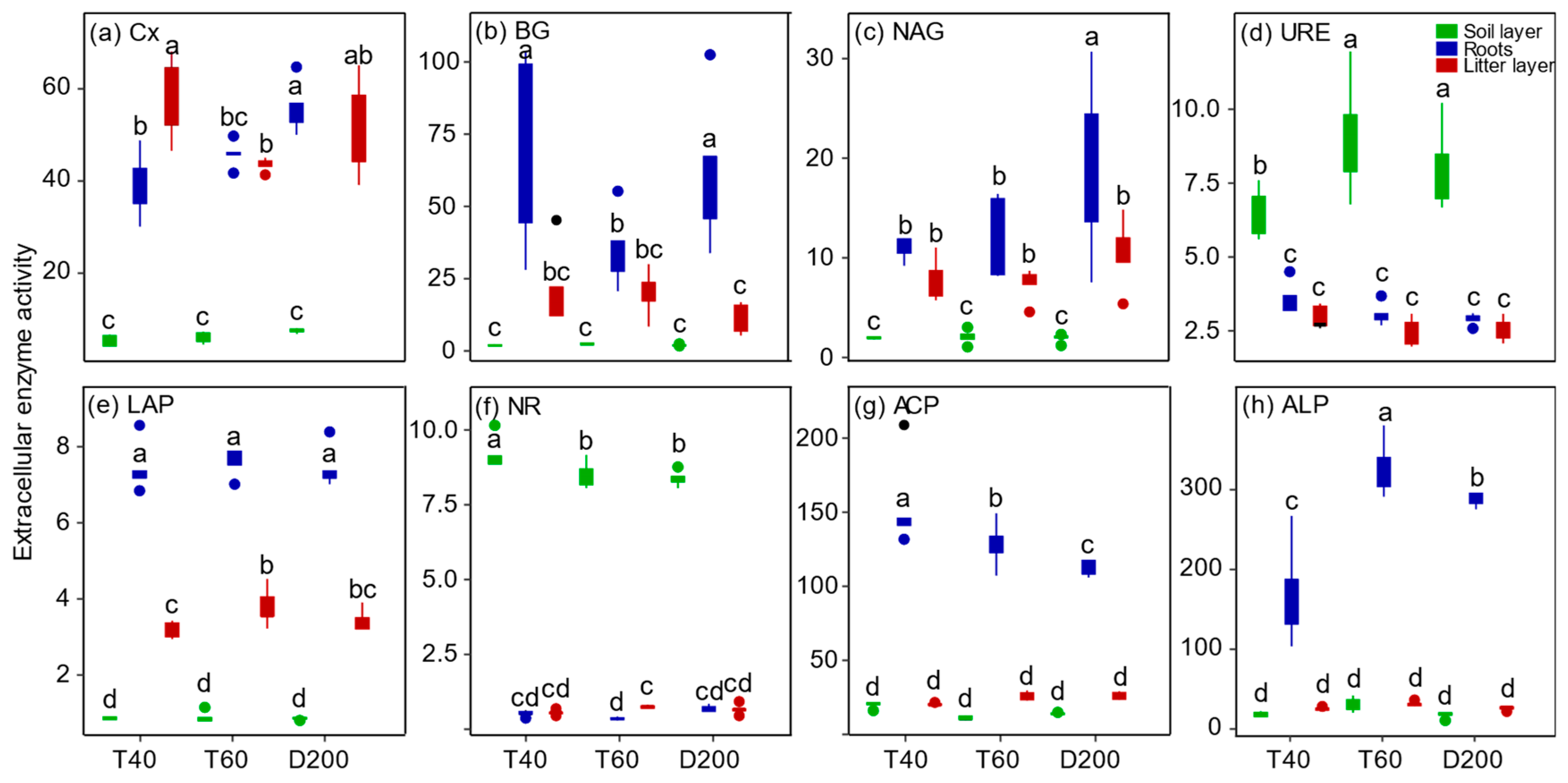
Along the chronosequence of F. lucida forests, soil pH, microbial respiration rate, and AHN and SOM contents decreased significantly, while NH4+-N and AP decreased from T40 to T60 forests and then remained stable afterward (p < 0.05, Table S2). Full factorial ANOVA showed that forest age significantly influenced the activities of Cx, NAG, ALP, and ACP, while habitat significantly affected EEAs, and their interactions significantly affected the activities of Cx, URE, NR, ACP, and ALP (p < 0.05, Table 1). With forest succession, Cx activity increased significantly in the roots and decreased in the litter layer, while BG activity showed a decreasing trend, and NAG and LAP activities increased significantly (p < 0.05, Figure 1). URE and NR activities showed divergent patterns: URE activity increased in the soil layer and decreased in the roots and litter layer, while NR activity decreased in the soil layer and increased in the roots and litter layer. ACP activity decreased while ALP activity increased significantly in the roots. Regardless of forest age, the litter layer and roots had similar C and N-acquiring enzyme activities, with higher Cx, BG, LAP, and NAG activities and lower NR and URE activities than in the soil layer, while roots had significantly higher phosphatase (ACP and ALP) activities than the soil and litter layers (p < 0.05, Figure 1 and Figure S2).
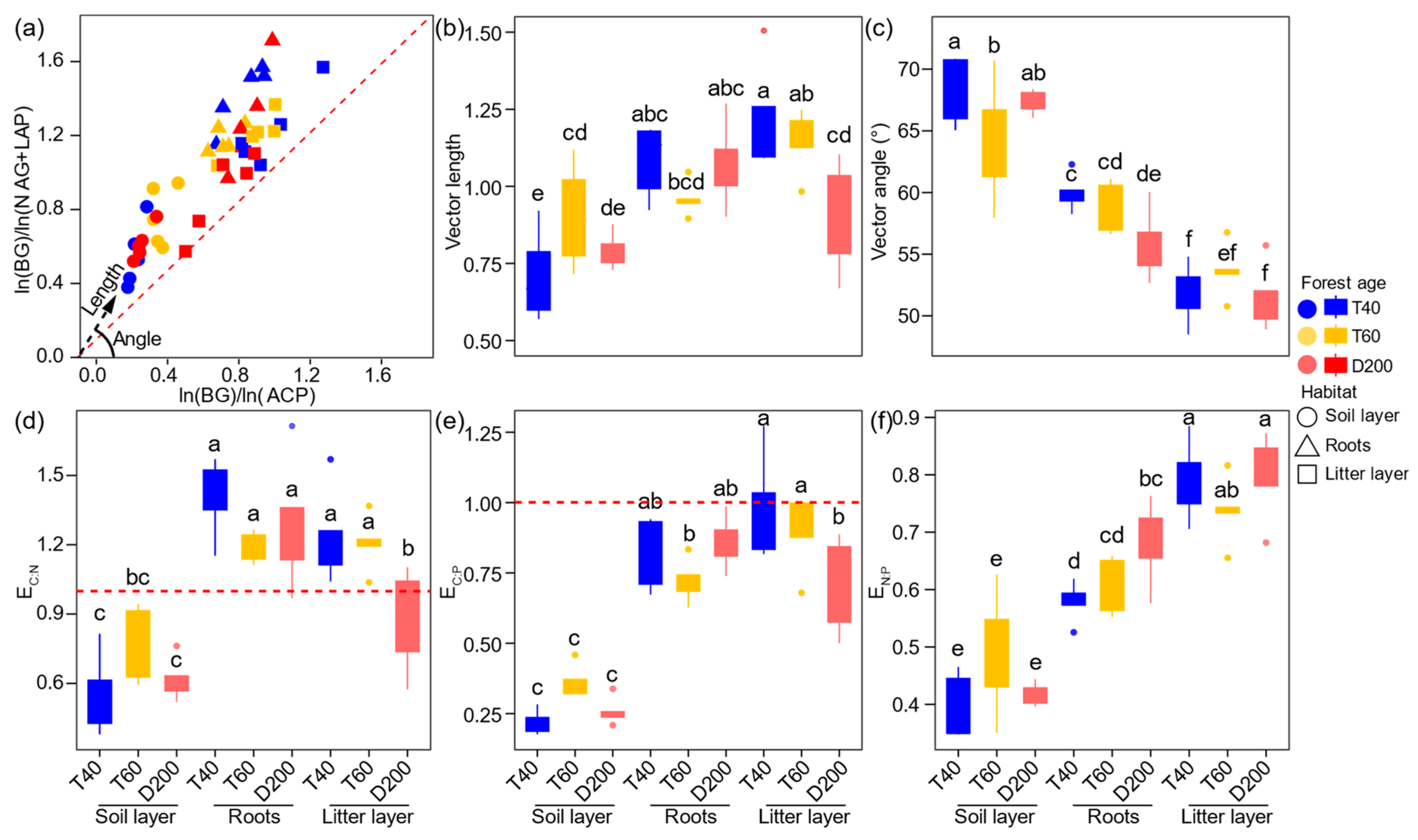
Habitat and its interaction with forest age significantly affected the EES (p < 0.01, Table 1). With increasing forest age, the vector length increased in the soil layer and roots, while decreasing in the litter layer, suggesting increased C limitation in the soil layer and roots and decreased C limitation in the litter layer (Figure 2). The roots and litter layer displayed microbial C limitation relative to N. All vector angles were greater than 45° and decreased with increasing forest age, indicating that the microorganisms were highly limited by P, and this microbial P limitation declined with forest succession. The soil layer had the greatest vector angle and the lowest EC:N, EC:P, and EN:P, indicating the strongest microbial P limitation as well as N limitation, followed by the roots, and the litter layer had the lowest microbial P limitation.

3.2. Diversity and Assembly Processes of Microbial Communities During F. lucida Forest Succession

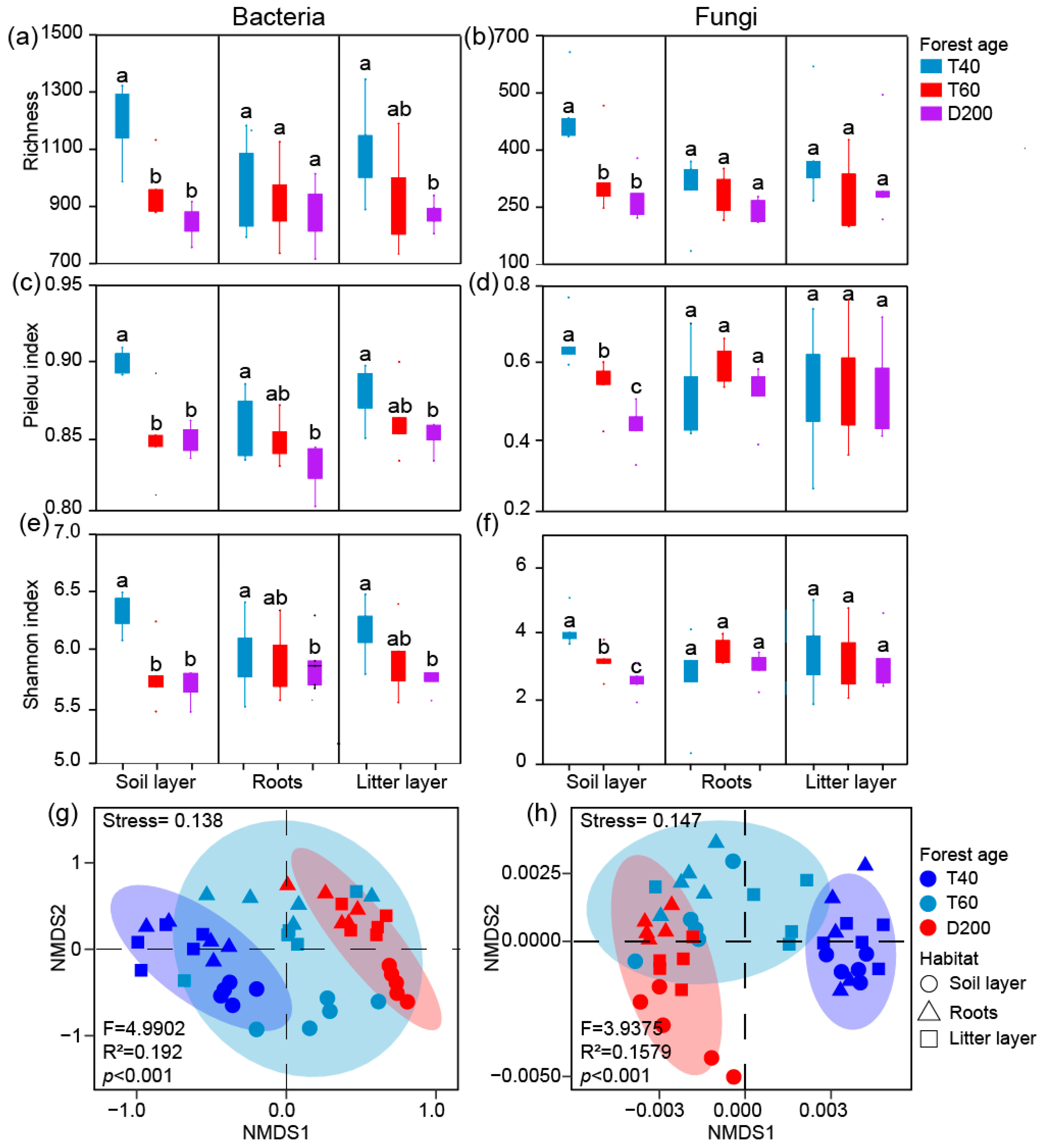
With forest development, the alpha bacterial diversity decreased significantly except for root richness (p < 0.05, Figure 3). Fungal diversity in the soil layer decreased significantly, while it remained relatively stable in the roots and litter layer (p < 0.05). Based on Bray–Curtis distances, the differences in the structure of bacterial (R = 0.192, p < 0.01) and fungal communities (R = 0.1579, p < 0.01) among different forest ages and microhabitats were significant (Figure 3g,h). Within the same forest age, the distance between bacterial communities in the litter layer and roots was smaller than that between the soil layer and the litter layer or roots (Figure 3g). However, the distance between fungal communities was smaller between the litter and soil layers in T40, between the soil layer and roots in T60, and between the litter layer and roots in D200 than in the other comparisons (Figure 3h). Within the same habitat, the distances of bacterial communities in the soil and litter layers between T40 and T60 were the largest and the smallest between T60 and D200. The distances of the root bacterial community between T40 and D200 were the largest and the smallest between T60 and D200 (Figure 3g). The distances of fungal communities between T40 and D200 were the largest and the smallest between T60 and D200 in the three microhabitats (Figure 3h).
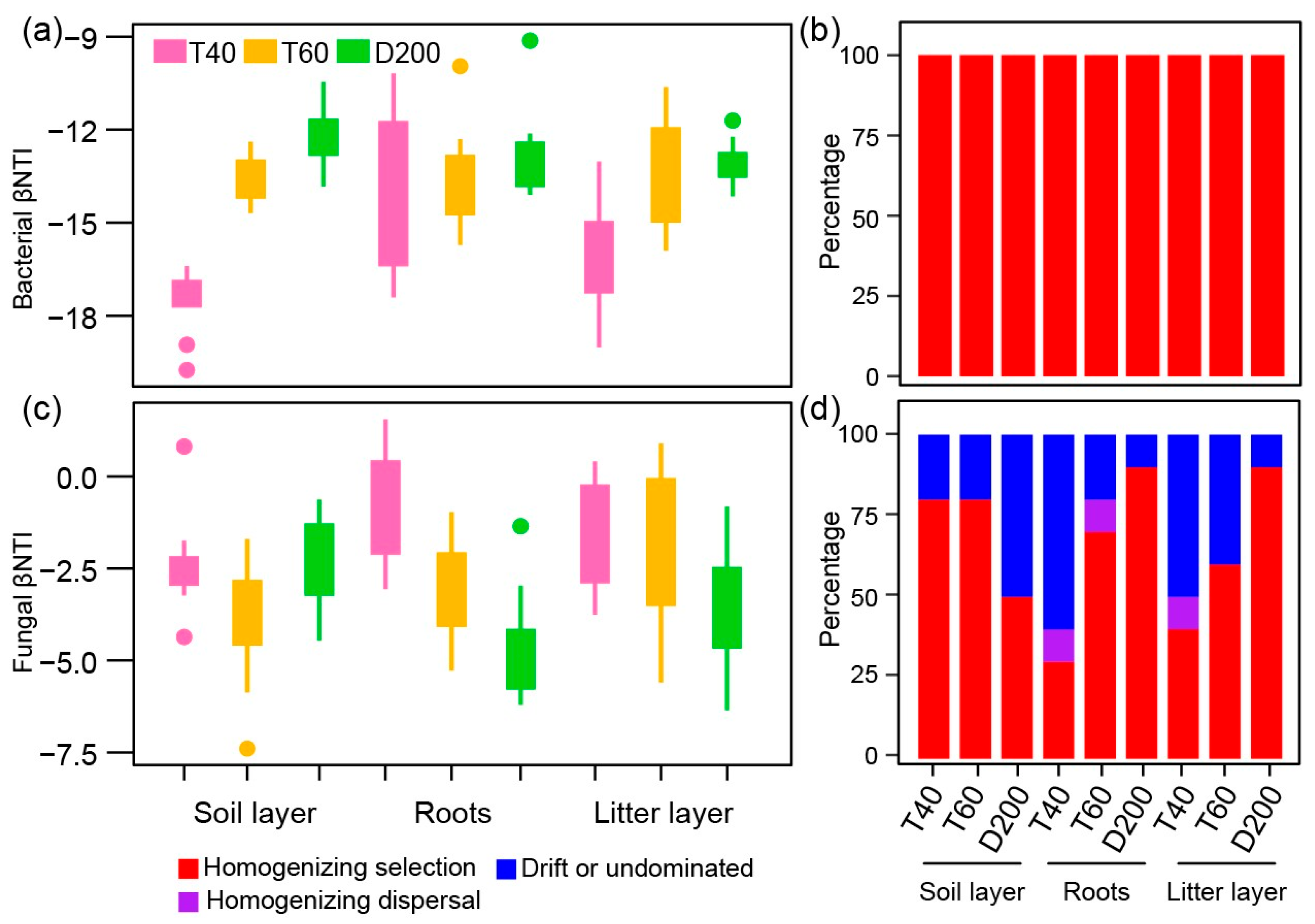
Based on the null model, the absolute βNTI values of the bacterial community were greater than 2, suggesting that bacterial community assembly was driven by deterministic processes (homogeneous selection, Figure 4). However, the assembly of the fungal community was driven by both stochastic and predominantly deterministic processes. The proportions of drift or undominated processes increased in the soil layer while decreasing in the roots and litter layer with increasing forest age. Homogenizing dispersal appeared in the roots and litter layer of T40 and in the T60 litter layer.

3.3. Microbial Community Structure Across Different F. lucida Forest Ages

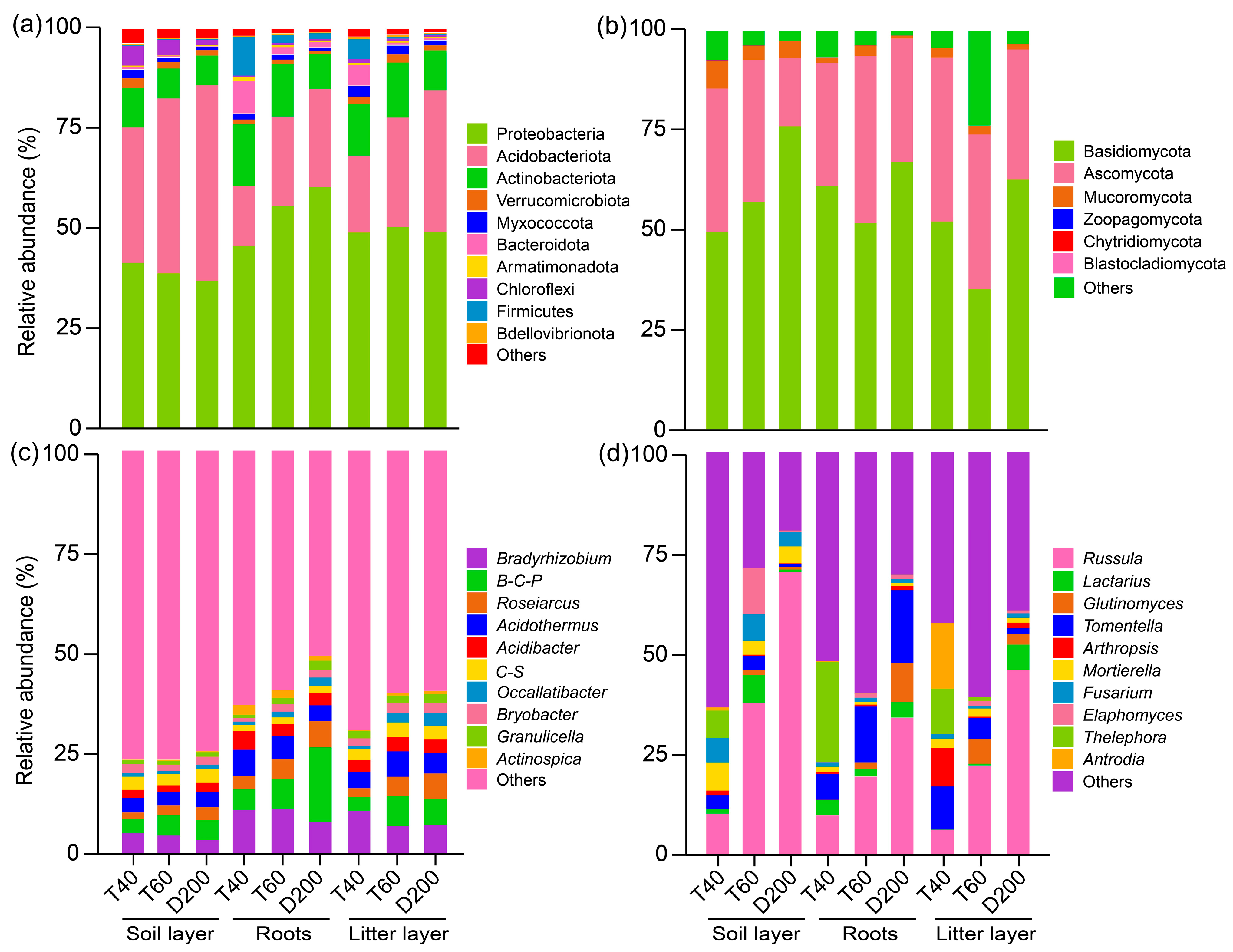
In the F. lucida forests, the dominant bacterial phyla were Proteobacteria (47.16%), Acidobacteriota (30.07%), Actinobacteriota (10.79%), Verrucomicrobiota (1.57%), Myxococcota (1.52%), Bacteroidota (2.20%), Armatimonadota (0.43%), Chloroflexi (1.55%), and Firmicutes (2.49%) (Figure 5a). With increasing forest age, the abundance of Proteobacteria decreased in the soil layer, while it increased significantly in the roots (p < 0.05, Figure S3a). Except for Acidobacteriota, the abundance of most other dominant phyla decreased (Figure S3). The ratio of Acidobacteriota: Proteobacteria, which has been suggested as a proxy for K-strategists [60], increased with increasing forest age, especially in the soil and litter layers (p < 0.05, S3q). The soil layer (1.129) had the highest Acidobacteriota: Proteobacteria ratio, followed by the litter layer (0.559) and roots (0.381). The dominant fungal phyla were Basidiomycota (57.60%), Ascomycota (33.92%), Mucoromycota (2.73%), and unclassified taxa (5.67%) (Figure 5b). With forest development, Basidiomycota increased significantly, and Mucoromycota decreased significantly in the soil layer (p < 0.05); most other dominant fungal phyla showed no obvious changes (p > 0.05, Figure S4).
At the genus level, Bradyrhizobium, Burkholderia-Caballeronia-Paraburkholderia, Roseiarcus, Acidothermus, Acidibacter, Candidatus-Solibacter, Occallatibacter, Bryobacter, Granulicella, and Actinospica were the dominant bacterial genera, and Russula, Lactarius, Glutinomyces, Tomentella, Arthropsis, Mortierella, Fusarium, Elaphomyces, Thelephora, and Antrodia were the dominant fungal genera (Figure 5c,d). With increasing forest age, the abundance of Bradyrhizobium, Acidibacter, Mortierella, and Thelephora decreased while Roseiarcus, Bryobacter, Candidatus-Solibacter, and Russula increased significantly (p < 0.05, Figure S4). This indicated that microorganisms were replaced by Roseiarcus, Bryobacter, and Russula, as well as Candidatus-Solibacter, with forest succession. Moreover, most of the dominant bacteria and fungi at both the phylum and genus levels in the litter layer showed abundance patterns similar to those in the roots.
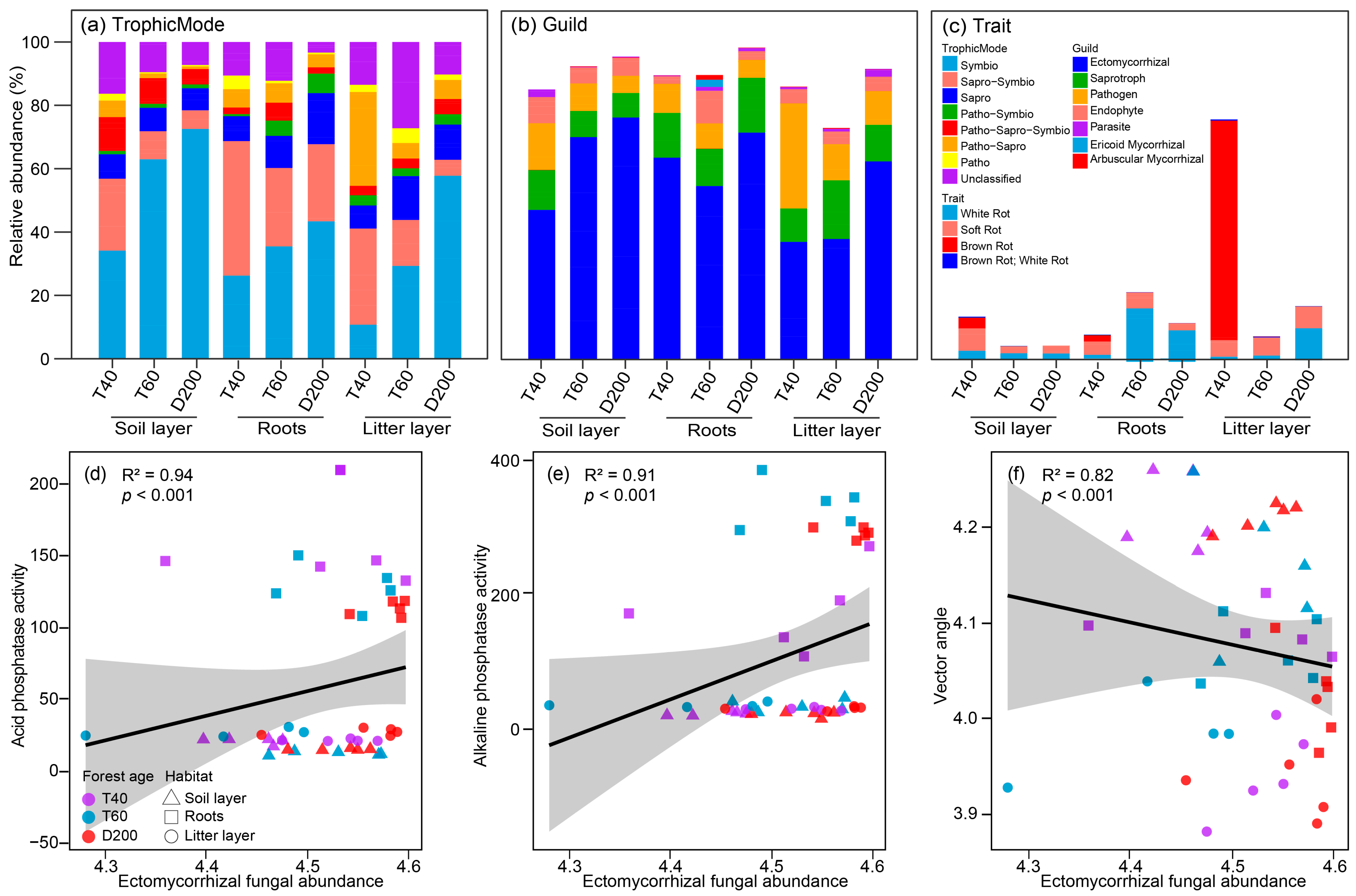
Based on FUNGuild analysis, the symbiotroph trophic mode predominated, followed by symbiotroph-saprotroph and saprotroph (Figure 6a). The decrease in the abundance of symbiotroph–saprotroph, and the increase in symbiotroph and saprotroph abundance with increasing forest age implied the functional divergence of the fungi with forest succession (Table S3). Fungi that have both symbiotic and saprophytic abilities became differentiated into more specialized functions with forest development. Among the symbiotrophs, ECM fungi dominated the fungal guilds and their abundance increased with forest age, followed by saprotrophs and pathogens (Figure 6b). Specifically, the abundance of pathogens decreased with increasing forest age. The identified fungal traits showed that the relative abundance of rots decreased in the soil layer, while it increased in the roots and litter layer, especially for the white rot fungi (Figure 6c). Linear regressions showed that the abundance of ECM fungi was positively correlated with phosphatase activities and negatively correlated with the vector angle of EES (p < 0.001, Figure 6d–f).

3.4. The Ubiquitous and Shared Microbial Taxa in Roots, the Soil Layer, and the Litter Layer of F. lucida Forests

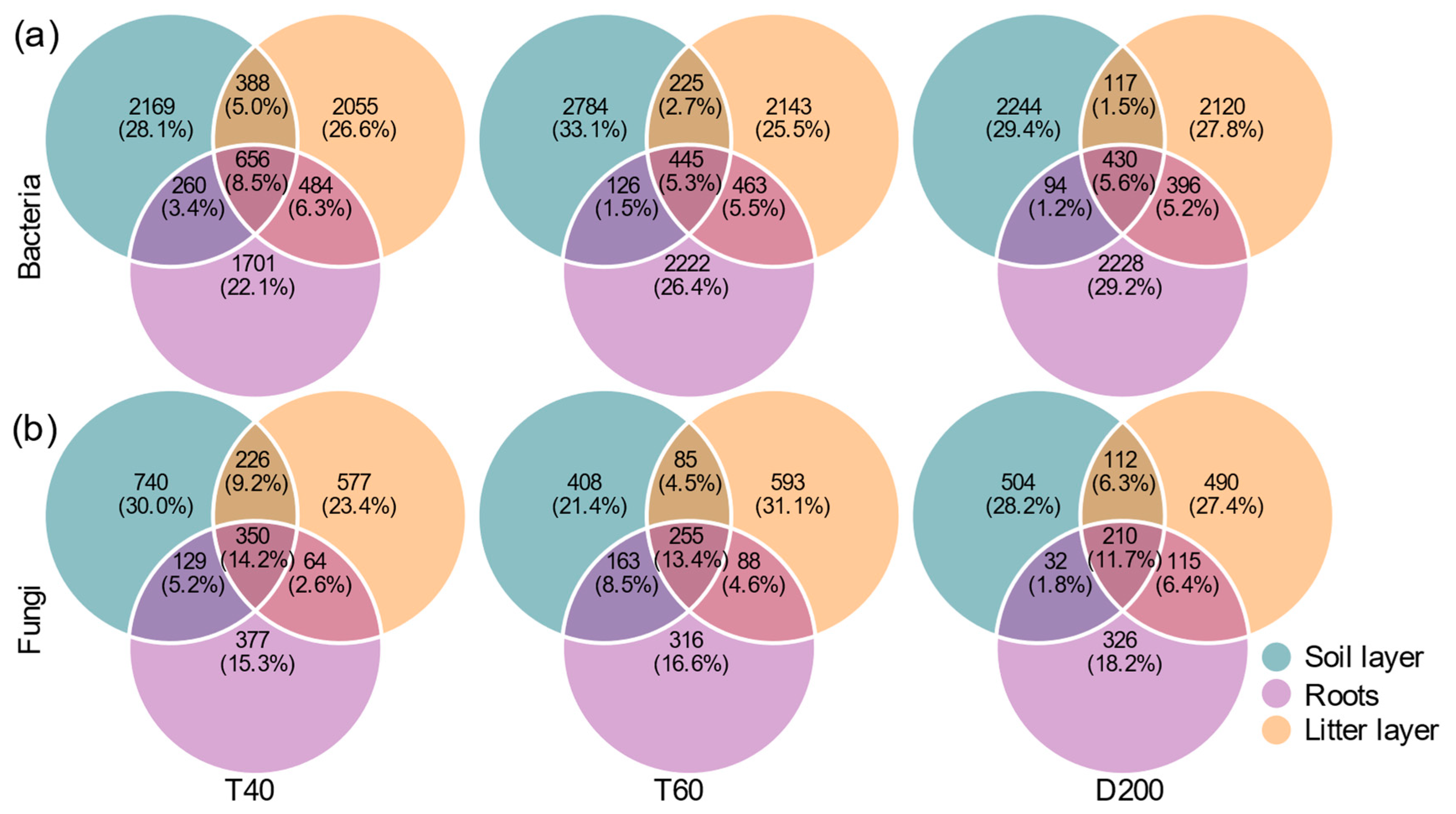
Through Venn diagram analysis, a total of 324 bacterial and 26 fungal shared ASVs were identified in the F. lucida forests (Table S4). Burkholderia-Caballeronia-Paraburkholderia (25 ASVs), Acidothermus (20 ASVs), Roseiarcus (16 ASVs), Candidatus Solibacter (15 ASVs), Bradyrhizobium (13 ASVs), Bryobacter (11 ASVs), Acidibacter (10 ASVs), Candidatus Koribacter (6 ASVs), Occallatibacter (6 ASVs), Conexibacter (5 ASVs), Granulicella (5 ASVs), and Mycobacterium (5 ASVs) were the dominant bacterial genera, while Russula (6 ASVs), Trichoderma (3 ASVs), and Fusarium (2 ASVs) were the dominant fungal genera. These genera were widely distributed in the roots, soil, and litter layers across the three F. lucida forest ages.
With increasing forest age, the proportion of shared ASVs among different microhabitats decreased from 8.5% to 5.6% for bacteria and from 14.2% to 11.7% for fungi (Figure 7). The shared bacterial ASVs of the litter layer with the soil layer decreased from 13.5% to 7.1%, and were lower than those with the roots (from 14.8% to 10.8%). The shared fungal ASVs of the litter layer with the soil layer decreased from 23.4% to 17.9%, while those with the roots increased from 16.8% to 18.1%. Although the shared fungal ASVs of the litter layer with the soil layer were notably higher than those with roots in the T40 forest (23.4% vs. 16.8%), this phenomenon disappeared in the T60 and D200 forests. Moreover, the proportion of shared fungal taxa among different microhabitats was markedly higher than that of bacteria. In different microhabitats, the proportion of shared ASVs across the three forest ages was similar, with 4.4%, 5.2%, and 4.8% in the soil layer, roots, and litter layer for bacteria, and 3.6%, 6.3%, and 4.7% for fungi, respectively (Figure S5). These proportions were much lower than those among different microhabitats within the same forest age, especially for the fungal community.

3.5. Microbial Co-Occurrence Network and Potential Keystone Microbial Taxa in F. lucida Forests

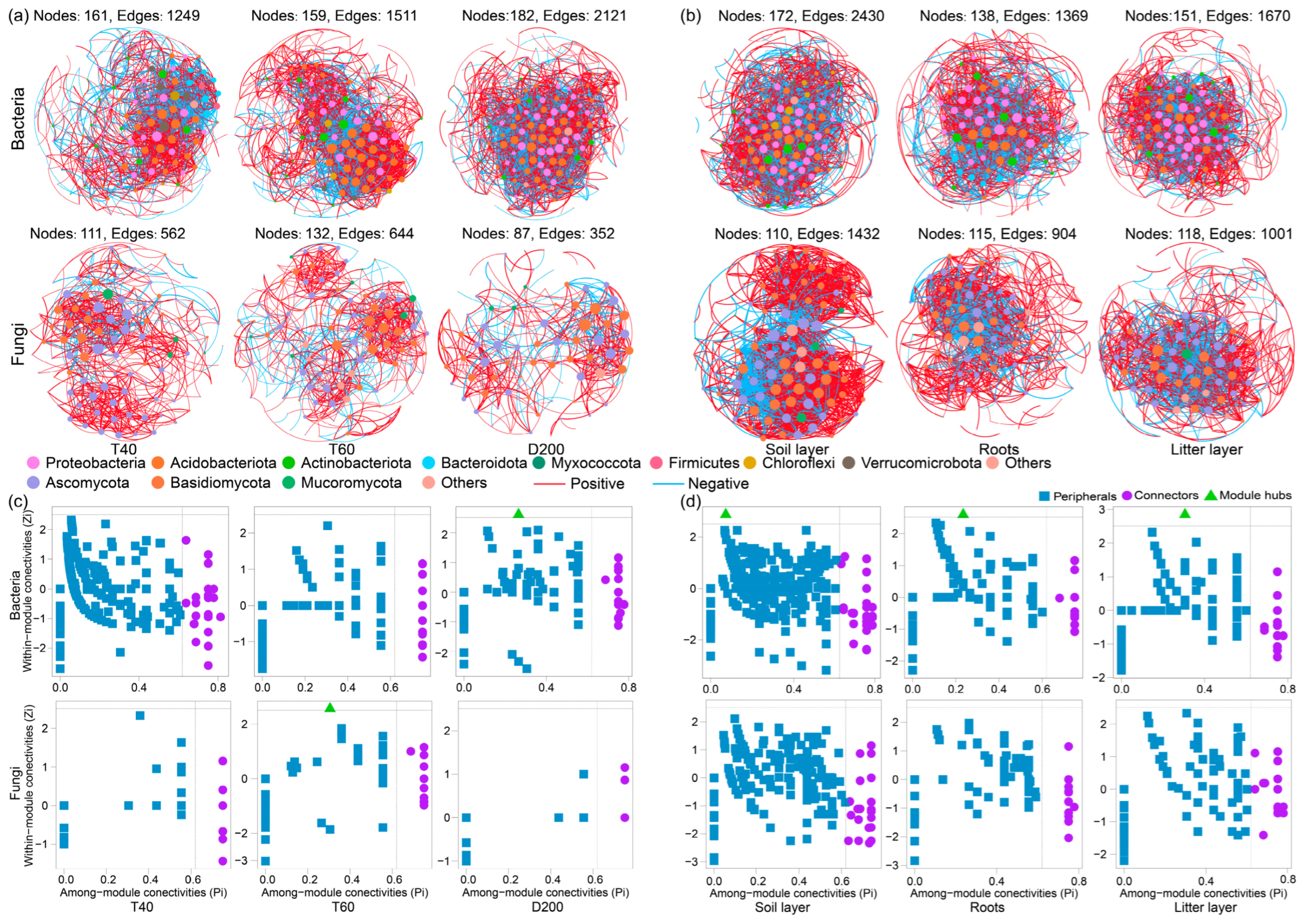
In the F. lucida forests, positive correlations dominated the linkages of bacterial and fungal networks (Figure S6 and Table S5). With forest development, the number of edges and nodes, average degree, and density for both bacterial and fungal networks in the roots decreased, indicating a decrease in network complexity. However, the complexity of microbial networks in the litter layer increased with increasing forest age. In order to reveal the species coexistence across the forest ages and microhabitats, samples were combined to construct the networks [28]. With forest development, the complexity of bacterial networks increased (Figure 8a and Table S5). This might be due to the increase in the bacterial network complexity in the litter layer. However, the complexity of fungal networks decreased, especially in the roots, despite the complexity in the litter layer increasing with forest development. On the whole, the soil layer had the highest microbial network complexity, followed by the litter layer and the roots (Figure 8b and Table S5). Keystone nodes were identified by analyzing the topological roles that each node played in the network. In total, 561 bacterial and 252 fungal connectors were identified in the F. lucida forests (Table S6). The majority of the bacterial keystone taxa came from Acidobacteriota, Proteobacteria, and Actinobacteriota, whereas the fungal keystone taxa were mainly represented by Ascomycota, Basidiomycota, and Mucoromycota (Table S7). With increasing forest age, the richness of bacterial keystone taxa increased slightly in the soil layer, while decreasing in the roots, and remained relatively stable in the litter layer. However, the richness of fungal keystone taxa decreased dramatically in the soil layer, while remaining stable in the roots and increasing in the litter layer.
Samples were combined to further compare the richness of keystone taxa across forest ages and microhabitats. In total, 602 bacterial and 240 fungal connectors, and 6 bacterial and 1 fungal module hubs were identified (Table S6). The richness of keystone taxa decreased with increasing forest age (Figure 8c and Table S7). In the T40 forest, 111 bacterial and 41 fungal connectors were identified. In the T60 forest, 83 bacterial and 47 fungal connectors, and 1 fungal module hub (Russula cyanoxantha) were identified. However, only 70 bacterial and 20 fungal connectors, and 1 bacterial module hub (Acidobacteriota) were identified in the D200 forest. In comparison among the microhabitats, the richness of keystone taxa in the litter layer was markedly higher than that in the soil layer and roots (Figure 8d and Table S7). In the soil layer, 104 bacterial and 38 fungal connectors, and 2 bacterial module hubs (Proteobacteria) were identified. In the roots, 100 bacterial and 32 fungal connectors, and 1 bacterial module hub (Lachnospiraceae) were identified. In contrast, 133 bacterial and 62 fungal connectors, and 1 bacterial module hub (Acidobacteriota) were identified in the litter layer.

3.6. Correlations Among Properties of Soil and Microbial Community

Enzyme activities involved in C-acquiring (especially, Cx activity) in the soil layer and roots were negatively while those in the litter layer were positively correlated with soil properties (p < 0.05, Figure S7). N-acquiring-related EEAs (URE in the soil layer, and LAP and NR in the litter layer) were negatively correlated with NH4+-N (p < 0.05). The correlation between P-acquiring EEAs and soil properties changed from positive in the soil layer to negative in the litter layer, with roots serving as the transitional microhabitat, with ACP and ALP activities showing opposite correlations with soil properties (p < 0.05). Soil EC:P was negatively correlated with NH4+-N, while the vector length, EC:N, and EC:P in the litter layer were positively correlated with microbial respiration (p < 0.05).
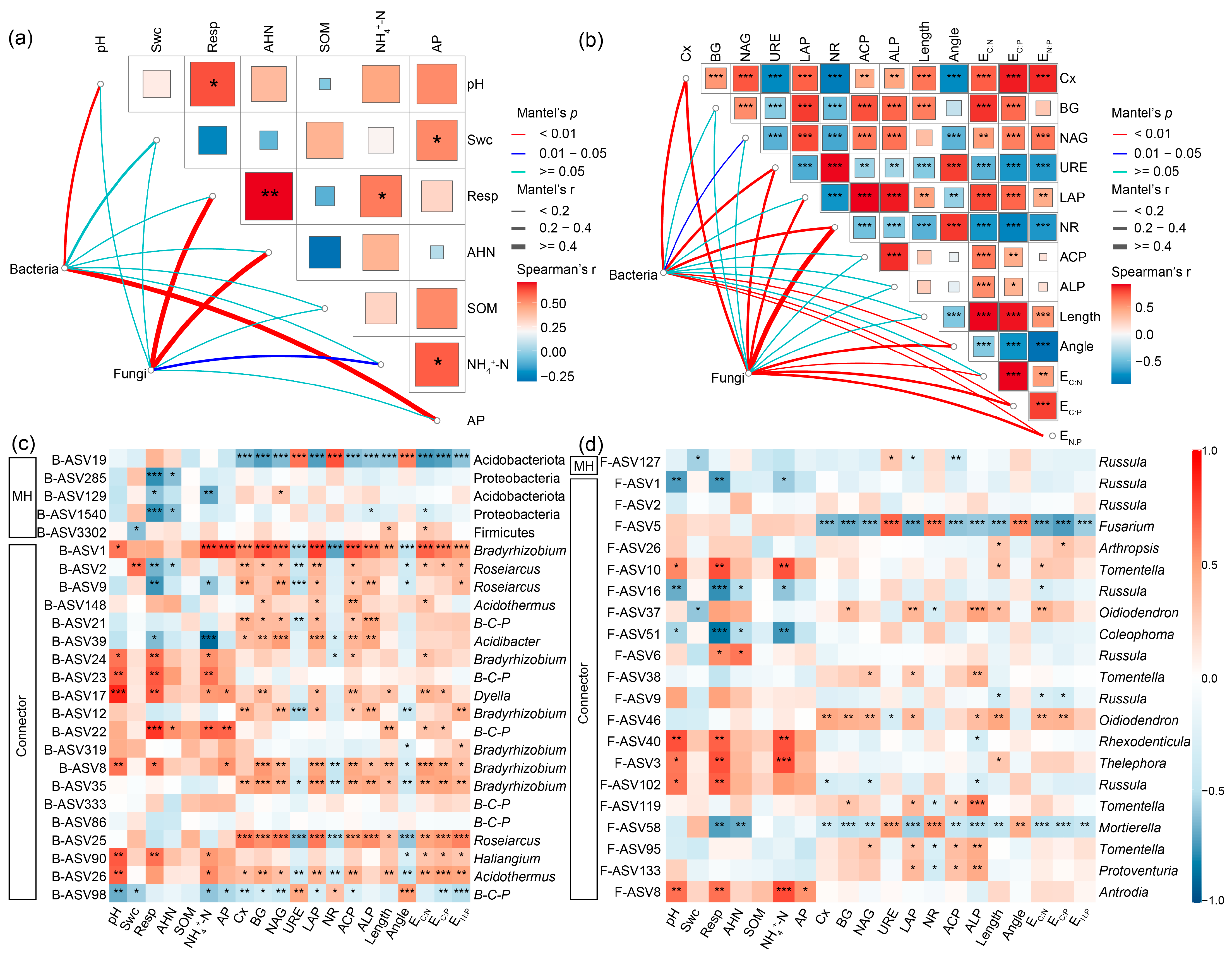
Mantel test analysis showed that the bacterial composition was significantly correlated with soil pH, AP, the Cx, NAG, URE, and NR activities, as well as vector angle, EC:P, and EN:P, while the fungal composition was significantly correlated with microbial respiration, AHN, SOM, and NH4+-N, the Cx, URE, LAP, and NR activities, as well as EES, expect for vector length (p < 0.05, Figure 9). The microbial diversity indices were positively correlated with soil properties (in particular, soil pH, microbial respiration, and NH4+-N), soil NR and ACP activities, and root ACP activity, while they were negatively correlated with soil Cx and URE activities and litter ACP activity (p < 0.05, Figure S8). Microbial activity showed a stronger relationship with the topological properties of bacterial networks than with those of fungal networks (Figure S8d). In bacterial networks, the node number was negatively correlated with ACP activity, and the edge number was negatively correlated with Cx activity, vector length, and EC:P (p < 0.05). The average degree and network density were negatively correlated with EC:P, and the average path length was positively correlated with vector length and EC:P (p < 0.05). In fungal networks, the modularity showed a negative correlation with EEAs and EESs, in particular with NAG activity (p < 0.05).
Among the keystone microbial taxa, the module hubs showed negative correlations, while most of the top 20 connectors showed positive correlations with the properties of soil and enzyme activities (Figure 9). However, B-ASV98 from Burkholderia-Caballeronia-Paraburkholderia, F-ASV2 from Fusarium, and F-ASV58 from Mortierella showed negative correlations with soil properties and enzyme activities. Moreover, URE and NR activities and vector angle were negatively correlated with most of the keystone bacterial taxa. In different microhabitats, the correlation patterns were different (Figure S8). Overall, EEAs and EESs in the soil and litter layers showed a weaker influence by the keystone taxa compared to those in the roots. In the litter layer, keystone bacterial taxa played a more important role than fungal taxa in microbial activity. Compared with other EEAs, Cx, NR, and ACP activities in the soil layer, Cx, URE, ACP, and ALP activities in the roots, and litter ACP activity showed stronger correlations with the keystone taxa.
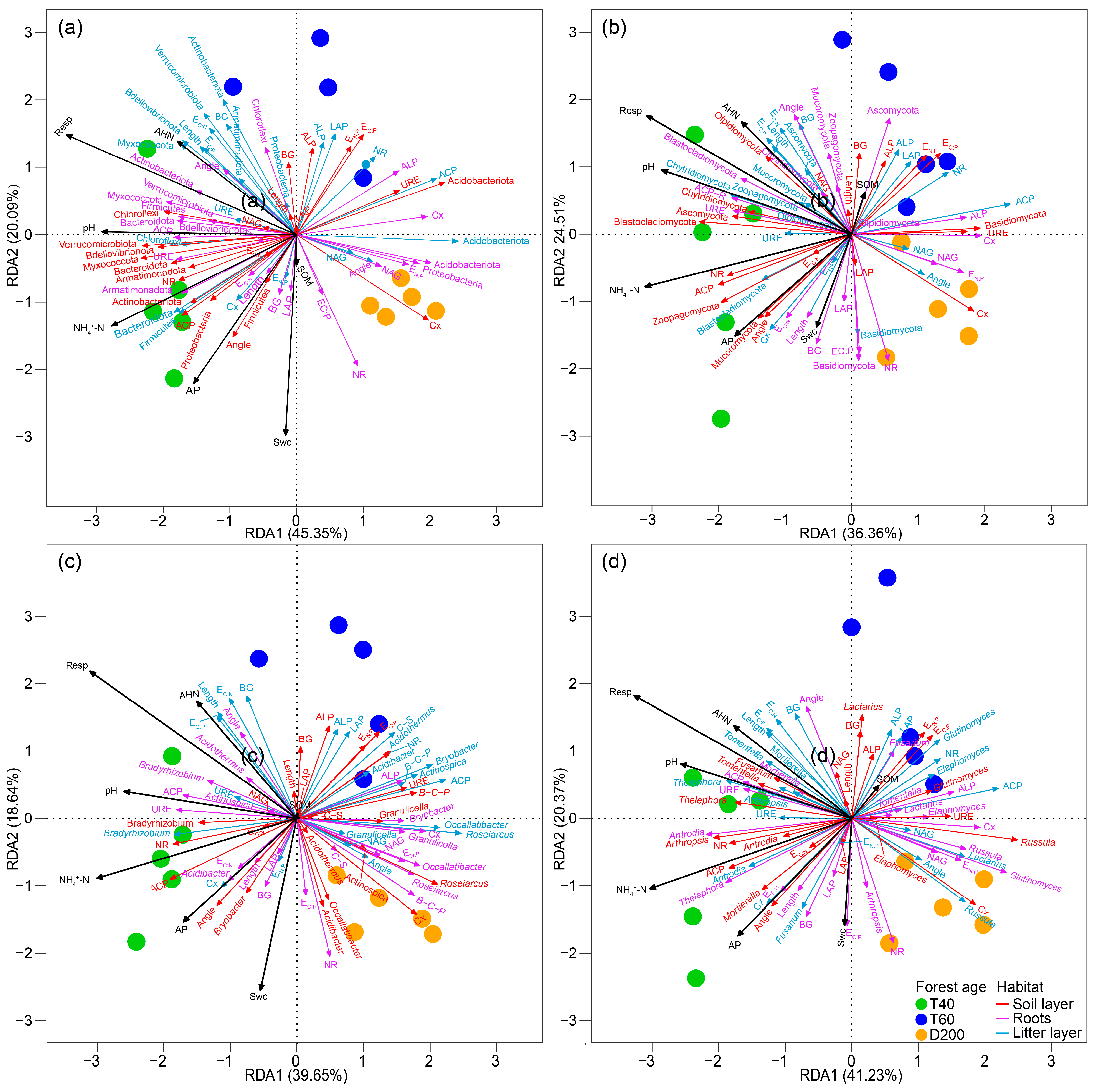
RDA results showed that the dominant bacterial phyla were positively correlated with AHN, pH, and NH4+-N, except for Acidobacteriota and root Proteobacteria, which showed negative correlations (Figure 10 and Figure S9). Chytridiomycota, Ascomycota in the soil and litter layers, Mucoromycota and Zoopagomycota in the litter layer and roots, and Blastocladiomycota in roots and the soil layer, showed positive correlations with soil pH, AHN, and microbial respiration, while Basidiomycota showed negative correlations with them. AP showed a positive correlation with Firmicutes and Mucoromycota in the soil layer. At the genus level, the abundance of Bradyrhizobium (especially with pH), Mortierella, Thelephora, Antrodia (especially with NH4+-N), Tomentella, and Arthropsis in the soil and litter layers was positively correlated with soil pH, respiration rate, AHN, and NH4+-N, while Burkholderia-Caballeronia-Paraburkholderia, Roseiarcus, Candidatus-Solibacter, Occallatibacter, Granulicella, Russula, Glutinomyces, and Elaphomyces showed negative correlations. The correlations between Proteobacteria, Acidothermus, Acidibacter, Lactarius, Fusarium, and soil physicochemical properties depended on the microhabitats. The Cx, URE, NR, and ACP activities in the soil layer, Cx and ACP activities in roots, and ACP activity in the litter layer were more strongly influenced by the dominant microbial community than other EEAs (Figure S9).

4. Discussion

4.1. Dynamics of Soil Physicochemical Properties and EEAs in F. lucida Forests

Changes in environmental conditions caused by forest succession alter belowground community succession processes, directly affecting soil nutrient transformation processes and soil physicochemical properties [61]. Consistent with previous reports, soil pH in our study decreased with forest succession [28,62]. The accumulation of tannins and resins during litter decomposition forms acidic solutions during forest succession, which can lower the soil pH value [63]. However, the contents of soil nutrients could increase [28,62], decrease [64], or increase initially and remain stable afterward with forest succession [7]. The impact of forest succession on soil physicochemical properties is a multi-factor, coupled, and regionally significant process. In our study, AHN and SOM contents decreased significantly with the succession of F. lucida forests, while NH4+-N and AP contents only decreased at the early succession stage. AHN and AP contents have shown a downward trend with increasing forest age [65]. TP and TN also decrease with the secondary forest successional process [37]. The F. lucida forests are dominated by ECM fungi, which play a crucial role in tree nutrient acquisition under nutrient-limited conditions [66]. ECM fungi can not only absorb nutrients from the soil, but also can directly mobilize nutrients from organic matter as decomposers [67]. The competition of ECM fungi with saprotrophic fungi could suppress litter decomposition and subsequently litter nutrient release into the soil, known as the Gadgil effect [68]. Soil nutrient availability can be enhanced by thinning through increasing saprotrophic fungi and reducing ECM fungi [69]. Thus, in F. lucida forests, the decreased soil nutrient contents might be due to the direct absorption of nutrients from decomposing litter and slowed nutrient release by ECM fungi, which intensified the competition for nutrients between microorganisms and plants.
Nevertheless, the changes in soil properties significantly influenced the microbial activities. Most of the EEAs involved in N- and P-acquisition showed significant correlations with soil properties. EEAs are vital for the breakdown of plant litter, converting complex organic materials into simpler forms and facilitating nutrient cycling for plant uptake [45]. With the succession of F. lucida forests, Cx activity in the roots increased significantly and was negatively correlated with soil properties, suggesting that the decline in soil nutrients had stimulated the microbial decomposers to invest more C in decomposing litter for nutrients. Moreover, the NAG and LAP activities also increased with forest succession. NAG is capable of breaking down the cell walls of insects and fungi, and LAP can cleave N-terminal residues from proteins and peptides, both converting complex N into available N [70,71]. The increased utilization of microbial-derived N with forest succession might be due to the decrease in soil N contents (AHN and NH4+-N). In particular, NH4+-N has been reported to play an end-product regulation function [20]. Low NH4+-N contents might have stimulated the N-acquiring-related EEAs, as they were negatively correlated. These results indicated a shift in metabolic activity or that the competition for nutrients among soil microorganisms intensified with F. lucida forest succession [20]. Moreover, the litter layer and roots had relatively higher Cx, BG, LAP, and NAG activities and lower NR and URE activities than the soil layer. This indicated that microbial decomposers in the roots and litter layer invested more energy and C than those in the soil layer to release nutrients from decomposing litter. EES results showed that the roots and litter layer displayed microbial C limitation relative to N, and especially, the microorganisms in the roots, soil, and litter layers were highly limited by P, which was not totally consistent with our first hypothesis. However, BG, NAG (or NAG + LAP), and AP are not the only terminal enzymes involved in the release of C, N, and P from complex substrates, respectively. For example, NAG and LAP can also act as terminal C-acquiring enzymes, as chitin and proteins contain both C and N. Thus, the reliability of the enzymatic stoichiometry approach remains unconfirmed. The phosphatase activity in the roots was significantly higher than that in the soil and litter layers. In F. lucida forests, symbiotrophs, especially ECM, predominated as the trophic mode. ECM fungi and their associated bacteria can mobilize available P from organic P by releasing phosphatase [72,73,74]. Positive correlations between ECM fungi and phosphatase activities suggested that the high abundance of ECM fungi in F. lucida forests can significantly increase phosphatase activity, which helps the plants directly mine nutrients from decomposing litter. The increase in the abundance of ECM fungi alleviated the microbial P limitation, which weakened gradually with the succession of F. lucida forests.

4.2. Dynamics of Microbial Diversity and Composition in F. lucida Forests

With forest succession, changes in aboveground plant biomass and diversity significantly affect the diversity and structure of microbial communities [75,76]. Various dynamics of bacterial and fungal diversity are documented following forest succession, depending on forest type [7,77,78]. In our study, bacterial diversity decreased significantly, except for richness in the roots with forest succession. Fungal diversity in the soil layer decreased significantly, while it remained stable in the roots and litter layer. Environmental and soil properties, such as soil organic matter, nutrients, and especially soil pH, are the main factors governing the bacterial and fungal richness/diversity [79]. The decrease in bacterial diversity in F. lucida forests might be due to the decrease in soil nutrient availability, in particular pH and NH4+-N, as they were significantly and positively correlated. Soil pH could affect bacterial diversity by directly influencing the physiological stress, as most bacteria exhibit optimal growth at a neutral pH value, and by indirectly affecting the nutrient availability via nutrient solubility and enzyme activity. Nutrient availability could directly affect the growth and niche partitioning of the bacterial community. Moreover, the bacterial community assembly was driven by deterministic processes, which also proved that soil properties were the main factors influencing bacterial diversity [80]. However, compared with the bacterial community, fungal diversity showed greater resilience to the changes in soil properties during forest succession. Firstly, stochastic (drift or undominated) processes played an important role in the assembly of the fungal community, besides the deterministic processes. A significantly higher proportion of shared fungal taxa among the microhabitats than among bacteria verified their stronger migration ability. In addition, fungal communities have high nutrient competitiveness and lower nutrient requirements than bacterial communities [81]. In the F. lucida forests, ECM fungi, as the dominant fungi, can obtain C from plants and directly mine nutrients from decomposing litter [66]. ECM fungi are reported to be the least influenced by environmental factors, like soil properties, microclimate, and plant composition [82]. These features bestowed the fungal community with lower sensitivity to soil nutrient changes following forest succession.
In the F. lucida forests, Proteobacteria (including Bradyrhizobium, Burkholderia-Caballeronia-Paraburkholderia, Roseiarcus, and Acidibacter), Acidobacteriota (including Candidatus-Solibacter, Occallatibacter, Bryobacter, and Granulicella), and Actinobacteriota (including Acidothermus and Actinospica) were the predominant bacterial phyla. Proteobacteria belong to the copiotrophic r-strategists and are closely related to the decomposition of labile C [60]. Acidobacteriota, formerly known as Acidobacteria [83], and Actinobacteria are oligotrophic K-strategists, which generally utilize recalcitrant C [77]. With forest succession, the abundance of Proteobacteria increased in roots, and the abundance of Acidobacteriota increased significantly in the three microhabitats, while most other bacterial phyla decreased. This indicated that the dominant bacterial phyla were replaced by Proteobacteria and Acidobacteriota with forest succession. Acidobacteriota have acidophilic solid characteristics, and soil pH is the best predictor of changes in their abundance [84,85]. The increase in the abundance of Acidobacteriota might be due to the decrease in the soil pH value. In addition, the ratio of Acidobacteriota:Proteobacteria increased with increasing forest age, especially in the soil and litter layers, and was the highest in the soil layer. This suggested that the microbial community in the F. lucida forest shifted from r- to K-strategists with forest succession, especially in the soil and litter layers. The ratio decreases under increased labile C availability [60]. Thus, the decreased pH and accumulation of recalcitrant C (humus) in the soil layer favored Acidobacteriota outcompeting other bacterial phyla, while the abundant labile C in root exudates favored Proteobacteria, maintaining the low Acidobacteriota:Proteobacteria ratio. Our results were consistent with previous research that the rhizosphere supports greater numbers of r-strategists than the soil layer [19,86]. In particular, the T60 and D200 forests had no significant difference in the ratio in the soil layer, suggesting that the soil layer had accumulated enough recalcitrant C and had finished the shift in the T60 forest (Figure S3). On the contrary, the ratio in the litter layer increased significantly with increasing forest age, suggesting that recalcitrant C content in the litter layer increased along the chronosequence or the litter decomposability was becoming low, as shown by the increase in the abundance of rots (white-rot fungi).
The predominant fungal phyla were Basidiomycota, Ascomycota, and Mucoromycota. The abundance of Basidiomycota increased significantly while Mucoromycota decreased significantly in the soil layer with forest succession. Basidiomycota and Ascomycota contain many ECM (including Russula, Lactarius, and Thelephora) and saprophytic fungi (Glutinomyces and Tomentella), which are essential for litter decomposition and nutrient cycling [19]. The phylum Mucoromycota (including Mortierella) harbors a variety of arbuscule-forming (or arbuscular mycorrhizal, AM) fungi, including the subphylum Glomeromycotina [87], and Densosporales or Endogonomycete fine root endophytes [88]. These AM-dominated forests display an inorganic nutrient economy because of rapid mineralization of nutrients, whereas ECM-dominated forests have an organic nutrient economy due to enhanced root/rhizosphere coupling and slow N and P nutrient cycling [89,90]. The replacement of Mucoromycota by Basidiomycota indicated that the predominant role of the organic nutrient economy was enhanced with succession. In the organic nutrient economy framework, nutrients were directly recycled from decomposing litter, which resulted in a decrease in soil nutrient availability in F. lucida forests [69,91]. Interestingly, pathogen abundance decreased significantly with succession. ECM fungi can reduce pathogen abundance by decreasing soil nutrient availability through the Gadgil effect and providing a physical barrier, and form positive plant-soil feedback (PSF), which further decreases pathogen abundance in ECM forests [67,92,93].
Nevertheless, consistent with our second hypothesis, the dominant bacterial and fungal phyla in the litter layer showed similar dynamic patterns to those in the roots along the chronosequence of F. lucida forests, suggesting that plant roots played an important role in structuring the litter microbial community, which was supported by their similar C- and N-acquiring EEAs [19]. This was likely due to the strong ability of plant roots to regulate microbial P limitation [73]. NMDS results also showed that the distance of bacterial communities between the litter layer and roots was closer than that between the soil layer and the litter layer or roots. Moreover, the shared bacterial ASVs of the litter layer with the soil layer were lower than those with the roots. Despite the shared fungal ASVs between litter and soil layers being notably higher than those between the litter layer and roots in the T40 forest, the shared fungal ASVs between the litter and soil layers decreased, while those with the roots increased with succession. These results suggested that the bacterial community in the litter layer mainly comes from the roots, while the litter fungal community at the early development stage mainly comes from the soil layer and was increasingly influenced by the roots with forest succession [19]. The distance of the fungal community in the litter layer was closer to the soil layer in the T40 forest, and with the roots in the D200 forest, further suggesting this increasing influence of roots on the litter microbial community. These results also suggested that the affinity between the root and litter microbial community was enhanced with forest succession, which underlays the home-field advantage on litter decomposition.

4.3. Dynamics of Microbial Co-Occurrence Networks and Keystone Microbial Taxa in F. lucida Forests

In the F. lucida forests, positive links dominated the connections in both bacterial and fungal networks. Positive association indicates potential cooperations among taxa, including niche overlap and/or beneficial interactions, which can be driven by species interactions and environmental filtering [94,95]. In the F. lucida forests, symbiotrophs were the predominant trophic mode. These symbiotrophic members share similar nutrient niches, obtaining labile C from host plants and nutrients directly from decomposing litter, and thus usually form positive correlations. The proportions of shared taxa among different forest ages were much lower than those among different microhabitats, especially for the fungal community, suggesting that environmental filtering was the main driver of assembling microbial communities and shaping their interactions.
Consistent with previous research that succession increases the network complexity of soil microbial communities in forests [4,28], the complexity of bacterial networks in the F. lucida forests increased with succession, especially in the litter layer. The increase in the Acidobacteriota:Proteobacteria ratio in the litter layer with forest succession indicated that the litter was becoming less readily decomposed by microbes. Thus, more complex microbial decomposer networks were needed to decompose the accumulated recalcitrant C. Except for positive links and average path length, most bacterial topological properties showed negative correlations with microbial activities involved in decomposing labile C (e.g., Cx activity). This might be because the bacterial community shifted from r- to K-strategists and invested more energy and C to decompose recalcitrant C, or improved the decomposition efficiency by improving microbial cooperations [4]. Inconsistent with our third hypothesis, microbial network complexity in the soil layer was the highest. This verified that the soil layer had accumulated much recalcitrant C, which was consistent with the higher soil Acidobacteriota:Proteobacteria ratio. Higher nutrient heterogeneity in the soil layer also supports greater microbial network complexity and functional diversity [96,97]. The microbial activity showed a stronger influence of the topological properties of bacterial networks compared with fungal networks, indicating that the bacterial community might play a more important role in nutrient cycling. However, the complexity of fungal networks decreased with forest succession, especially in the roots, despite the fact that the fungal network complexity increased in the litter layer. The succession of other fungi, such as pathogenic fungi, by ECM fungi might lead to simpler fungal networks, as these ECM fungi had higher efficiency in nutrient acquisition than other fungi [66]. These results also suggested that plant roots played the main role in structuring the fungal networks.
The keystone species, which are highly connected within microbial networks, play critical roles for ecosystem functions (e.g., litter decomposition and nutrient cycling) by allowing the exchange of energy and matter within networks [57]. Consistent with previous research that the number of keystone species decreases with stand age [28], we also found that the richness of keystone taxa decreased with the succession of F. lucida forests. The keystone bacterial taxa mainly came from Acidobacteriota, Proteobacteria, and Actinobacteriota, and the keystone fungal taxa were mainly from Ascomycota, Basidiomycota, and Mucoromycota, which were the predominant phyla in F. lucida forests. Most of the keystone species showed a positive correlation. Particularly, EEAs and EESs in the soil and litter layers showed a weaker influence by the keystone taxa compared with roots, suggesting the important role of roots in regulating microbial activity. Because of the interactions between vegetation and soil properties, the richness of keystone microbial taxa changed with forest age and differed in the roots, soil, and litter layers, which was consistent with previous reports [28]. On the whole, the richness of keystone taxa in the litter layer was markedly higher than in the soil layer and roots. Litter habitats as detritusphere hotspots had higher microbial activity for complex biochemical cycling than the roots and lower spatial nutrient heterogeneity than the soil layer [98,99]. Among these keystone species, the fungal module hub Russula cyanoxantha, as an ECM fungus, is one of the most frequent taxa in deciduous forests [82,100]. The bacterial module hubs Acidobacteriota and Proteobacteria were closely related to the decomposition of recalcitrant and labile C, respectively [60,77]. Moreover, the bacterial module hub Lachnospiraceae has strong hydrolysis activities [101,102].

5. Conclusions

With the succession of F. lucida forests, plant roots played an increasingly important role in structuring the microbial community in the soil and litter layers due to their greater ability to alleviate microbial P limitation through their associated symbiotrophs. These symbiotic fungi, especially the ECM fungi, played a predominant role in shaping soil physicochemical properties, which significantly affected the diversity, structure, assembly processes, and functions of the bacterial community, causing the shift of the microbial community from r- to K-strategists. Stronger migration ability, high nutrient competitiveness, and low nutrient requirements conferred on the fungal community lower sensitivity to soil nutrient changes and greater resilience or higher network stability to forest succession. These ECM fungi might enhance the affinity between the root and litter microbial communities and mediate the home-field advantage on litter decomposition. As plant roots play a crucial role in the belowground microbial community, further research is needed on plant diversity, including tree and understory vegetation, root traits, as well as functional diversity, as these factors are helpful in elucidating the mechanisms shaping microbial community structure and function. Moreover, changes in the belowground microbial community and networks with forest succession should cause changes in ecological processes and functions, such as nutrient cycling and C sequestration, which also require further research in F. lucida forests.

Supplementary Materials

The following supporting information can be downloaded at https://www.mdpi.com/article/10.3390/f17040476/s1, Figure S1: The F. lucida forests of 40-year ((a), T40), 60-year ((b), T60), 200-year ((c), D200) stands in Badagongshan Nature Reserve and the microhabitats (d–f) of the microbial community; Figure S2: The extracellular enzyme activities among different ages of F. lucida forests (a) and from different microhabitats (b); Figure S3: The relative abundance of the dominant bacterial (a–j) and fungal (k–p) phyla; Figure S4: The relative abundance of the dominant bacterial (a–j) and fungal (k–t) genera; Figure S5: The shared ASVs of microbial community among different forest ages in the F. lucida forests across different microhabitats; Figure S6: The co-occurrence networks of microbial community in different microhabitats of the F. lucida forest across different ages; Figure S7: The correlations of microbial and soil physicochemical properties; Figure S8: Correlation of keystone microbial taxa in F. lucida forests with extracellular enzyme activities and soil physicochemical properties in different microhabitats; Figure S9: Correlations of dominant phylum- (a) and genus- (b) level microbial taxa with extracellular enzyme activities and soil physicochemical properties in different microhabitats in F. lucida forests; Table S1: Assay procedures of the extracellular enzymatic activities; Table S2: Soil nutrient contents in F. lucida forests across different ages; Table S3: The relative abundance of fungal functional groups based on guild analysis in the F. lucida forests across different ages; Table S4: The shared microbial taxa in the soil layer, roots, and litter layer of the F. lucida forests based on Venn diagram analysis; Table S5: The topological properties of microbial co-occurrence network of the F. lucida forests across different ages; Table S6: The keystone microbial taxa in the soil layer, roots, and litter layer of the F. lucida forests; Table S7: The richness of keystone microbial taxa (number of ASV) in the F. lucida forests. References [103,104,105,106,107,108,109] are cited in the Supplementary Materials.

Author Contributions

Conceptualization, X.L. and X.K.; methodology, X.H.; software, Y.L. and Z.H.; validation, H.L. and J.X.; formal analysis, X.L. and X.K.; investigation, S.S.; resources, J.X.; data curation, X.L. and Z.H.; writing—original draft preparation, X.L. and X.K.; writing—review and editing, X.H., X.K., H.L. and S.S.; visualization, X.L.; supervision, X.K.; project administration, X.K.; funding acquisition, X.K. All authors have read and agreed to the published version of the manuscript.

Funding

This research was funded by the Natural Science Foundation of Hunan Province (2025JJ50112 and 2025JJ60205), the National Natural Science Foundation of China (32160356, 32060332, and 31670624), the Scientific Research Projects of Hunan Provincial Education Department (24B0500), and the Open Fund Project of Hunan Key Laboratory of Ecotourism (STLY2501).

Data Availability Statement

The original contributions presented in the study are included in the article/Supplementary Materials; further inquiries can be directed to the corresponding author.

Acknowledgments

We appreciate the valuable comments and suggestions from the anonymous reviewers; this feedback has greatly improved the quality of our paper.

Conflicts of Interest

The authors declare no conflicts of interest.

Abbreviations

The following abbreviations are used in this manuscript:
ACPAcid phosphatase
AHNAlkali-hydrolyzable N
ALPAlkaline phosphatase
AMArbuscular mycorrhizal
APAvailable phosphorus
ASVsAmplicon sequence variants
BGβ-1,4-glucosidase
CxCellulase or carboxymethyl cellulase
ECMEctomycorrhizal
EEAExtracellular enzyme activity
EESExtracellular enzyme stoichiometry
LAPLeucine aminopeptidase
NAGChitinase or β-N-acetylglucosaminidase
NMDSNon-metric multidimensional scaling
NRNitrate reductase
SOMSoil organic matter
SwcSoil water content
TNTotal nitrogen
TPTotal phosphorus
UREUrease

References

  1. Zhang, B.; Jackson, T.D.; Coomes, D.A.; Burslem, D.F.R.P.; Nilus, R.; Bittencourt, P.R.L.; Bartholomew, D.C.; Rowland, L.; Fischer, F.J.; Jucker, T. Soils and topography drive large and predictable shifts in canopy dynamics across tropical forest landscapes. New Phytol. 2025, 247, 1666–1679. [Google Scholar] [CrossRef] [PubMed]
  2. Sun, D.; Huang, Y.; Wang, Z.; Tang, X.; Ye, W.; Cao, H.; Shen, H. Soil microbial community structure, function and network along a mangrove forest restoration chronosequence. Sci. Total Environ. 2024, 913, 169704. [Google Scholar] [CrossRef] [PubMed]
  3. Brancalion, P.H.S.; Hua, F.; Joyce, F.H.; Antonelli, A.; Holl, K.D. Moving biodiversity from an afterthought to a key outcome of forest restoration. Nat. Rev. Biodivers. 2025, 1, 248–261. [Google Scholar] [CrossRef]
  4. Wang, M.; Shao, Y.; Zhang, W.; Yu, B.; Shen, Z.; Fan, Z.; Zu, W.; Dai, G.; Fu, S. Secondary succession increases diversity and network complexity of soil microbial communities in subtropical and temperate forests. CATENA 2025, 249, 108662. [Google Scholar] [CrossRef]
  5. Philippot, L.; Raaijmakers, J.M.; Lemanceau, P.; van der Putten, W.H. Going back to the roots: The microbial ecology of the rhizosphere. Nat. Rev. Microbiol. 2013, 11, 789–799. [Google Scholar] [CrossRef]
  6. Tian, K.; Kong, X.; Yuan, L.; Lin, H.; He, Z.; Yao, B.; Ji, Y.; Yang, J.; Sun, S.; Tian, X. Priming effect of litter mineralization: The role of root exudate depends on its interactions with litter quality and soil condition. Plant Soil 2019, 440, 457–471. [Google Scholar] [CrossRef]
  7. Liu, Y.; Zhu, G.; Hai, X.; Li, J.; Shangguan, Z.; Peng, C.; Deng, L. Long-term forest succession improves plant diversity and soil quality but not significantly increase soil microbial diversity: Evidence from the Loess Plateau. Ecol. Eng. 2020, 142, 105631. [Google Scholar] [CrossRef]
  8. Bunn, R.A.; Simpson, D.T.; Bullington, L.S.; Lekberg, Y.; Janos, D.P. Revisiting the ‘direct mineral cycling’ hypothesis: Arbuscular mycorrhizal fungi colonize leaf litter, but why? ISME J. 2019, 13, 1891–1898. [Google Scholar] [CrossRef]
  9. Fierer, N.; Bradford, M.A.; Jackson, R.B. Toward and ecological classification of soil bacteria. Ecology 2007, 88, 1354–1364. [Google Scholar] [CrossRef]
  10. Fu, Q.; Gu, J.; Li, Y.; Qian, X.; Sun, W.; Wang, X.; Gao, H.; Zhen, L.; Lei, Y. Analyses of microbial biomass and community diversity in kiwifruit orchard soils of different planting ages. Acta Ecol. Sin. 2015, 35, 22–28. [Google Scholar] [CrossRef]
  11. Cao, Y.; Fu, S.; Zou, X.; Cao, H.; Shao, Y.; Zhou, L. Soil microbial community composition under Eucalyptus plantations of different age in subtropical China. Eur. J. Soil Biol. 2010, 46, 128–135. [Google Scholar] [CrossRef]
  12. Cameron, E.K.; Martins, I.S.; Lavelle, P.; Mathieu, J.; Tedersoo, L.; Bahram, M.; Gottschall, F.; Guerra, C.A.; Hines, J.; Patoine, G.; et al. Global mismatches in aboveground and belowground biodiversity. Conserv. Biol. 2019, 33, 1187–1192. [Google Scholar] [CrossRef] [PubMed]
  13. Rożek, K.; Chmolowska, D.; Odriozola, I.; Větrovský, T.; Rola, K.; Kohout, P.; Baldrian, P.; Zubek, S. Soil fungal and bacterial community structure in monocultures of fourteen tree species of the temperate zone. For. Ecol. Manag. 2023, 530, 120751. [Google Scholar] [CrossRef]
  14. Zhong, Z.; Zhang, X.; Wang, X.; Fu, S.; Wu, S.; Lu, X.; Ren, C.; Han, X.; Yang, G. Soil bacteria and fungi respond differently to plant diversity and plant family composition during the secondary succession of abandoned farmland on the Loess Plateau, China. Plant Soil 2020, 448, 183–200. [Google Scholar] [CrossRef]
  15. Corneo, P.E.; Pellegrini, A.; Cappellin, L.; Gessler, C.; Pertot, I. Weeds influence soil bacterial and fungal communities. Plant Soil 2013, 373, 107–123. [Google Scholar] [CrossRef]
  16. Koide, R.T.; Xu, B.; Sharda, J. Contrasting below-ground views of an ectomycorrhizal fungal community. New Phytol. 2005, 166, 251–262. [Google Scholar] [CrossRef]
  17. Xu, Y.; Li, J.; Qiao, C.; Yang, J.; Li, J.; Zheng, X.; Wang, C.; Cao, P.; Li, Y.; Chen, Q. Rhizosphere bacterial community is mainly determined by soil environmental factors, but the active bacterial diversity is mainly shaped by plant selection. BMC Microbiol. 2024, 24, 450. [Google Scholar] [CrossRef]
  18. Lindahl, B.D.; Ihrmark, K.; Boberg, J.; Trumbore, S.E.; Högberg, P.; Stenlid, J.; Finlay, R.D. Spatial separation of litter decomposition and mycorrhizal nitrogen uptake in a boreal forest. New Phytol. 2007, 173, 611–620. [Google Scholar] [CrossRef]
  19. Urbanová, M.; Šnajdr, J.; Baldrian, P. Composition of fungal and bacterial communities in forest litter and soil is largely determined by dominant trees. Soil Biol. Biochem. 2015, 84, 53–64. [Google Scholar] [CrossRef]
  20. Gao, Y.; Long, X.; Liao, Y.; Lin, Y.; He, Z.; Kong, Q.; Kong, X.; He, X. Influence of arbuscular mycorrhizal fungi on nitrogen dynamics during Cinnamomum camphora litter decomposition. Microorganisms 2025, 13, 151. [Google Scholar] [CrossRef]
  21. Vivanco, L.; Rascovan, N.; Austin, A.T. Plant, fungal, bacterial, and nitrogen interactions in the litter layer of a native Patagonian forest. PeerJ 2018, 6, e4754. [Google Scholar] [CrossRef]
  22. Voříšková, J.; Baldrian, P. Fungal community on decomposing leaf litter undergoes rapid successional changes. ISME J. 2013, 7, 477–486. [Google Scholar] [CrossRef]
  23. Chen, J.; Bai, E.; Liang, Y.; Liu, Z.; Ji, Y.; Sun, T.; Guo, Z.; Huo, Y.; Liu, S.; Berg, B. The origin and succession of the microbial community in decomposing litter. ISME Commun. 2025, 5, ycaf155. [Google Scholar] [CrossRef] [PubMed]
  24. Yang, D.; He, Z.; Lin, Y.; He, X.; Kong, X. Priority colonization of endophytic fungal strains drives litter decomposition and saprotroph assembly via functional trait selection in Karst oak forests. Microorganisms 2025, 13, 1066. [Google Scholar] [CrossRef] [PubMed]
  25. Xiao, J.; He, Z.; He, X.; Lin, Y.; Kong, X. Tracing microbial community across endophyte-to-saprotroph continuum of Cinnamomum camphora (L.) Presl leaves considering priority effect of endophyte on litter decomposition. Front. Microbiol. 2025, 15, 1518569. [Google Scholar] [CrossRef] [PubMed]
  26. Zhang, C.; Lei, S.; Wu, H.; Liao, L.; Wang, X.; Zhang, L.; Liu, G.; Wang, G.; Fang, L.; Song, Z. Simplified microbial network reduced microbial structure stability and soil functionality in alpine grassland along a natural aridity gradient. Soil Biol. Biochem. 2024, 191, 109366. [Google Scholar] [CrossRef]
  27. Oña, L.; Shreekar, S.K.; Kost, C. Disentangling microbial interaction networks. Trends Microbiol. 2025, 33, 619–634. [Google Scholar] [CrossRef]
  28. Wang, Y.; Dong, L.; Zhang, M.; Cui, Y.; Bai, X.; Song, B.; Zhang, J.; Yu, X. Dynamic microbial community composition, co-occurrence pattern and assembly in rhizosphere and bulk soils along a coniferous plantation chronosequence. CATENA 2023, 223, 106914. [Google Scholar] [CrossRef]
  29. Kuzyakov, Y.; Ling, N.; Pietramellara, G.; Nannipieri, P. Some new grand questions in soil biology and biochemistry. Soil Biol. Biochem. 2026, 212, 109996. [Google Scholar] [CrossRef]
  30. Nemergut Diana, R.; Schmidt Steven, K.; Fukami, T.; O’Neill Sean, P.; Bilinski Teresa, M.; Stanish Lee, F.; Knelman Joseph, E.; Darcy John, L.; Lynch Ryan, C.; Wickey, P.; et al. Patterns and processes of microbial community assembly. Microbiol. Mol. Biol. Rev. 2013, 77, 342–356. [Google Scholar] [CrossRef]
  31. Zhou, J.; Ning, D. Stochastic community assembly: Does it matter in microbial ecology? Microbiol. Mol. Biol. Rev. 2017, 81, 10-1128. [Google Scholar] [CrossRef] [PubMed]
  32. Liu, L.; Zhu, K.; Krause, S.M.B.; Li, S.; Wang, X.; Zhang, Z.; Shen, M.; Yang, Q.; Lian, J.; Wang, X.; et al. Changes in assembly processes of soil microbial communities during secondary succession in two subtropical forests. Soil Biol. Biochem. 2021, 154, 108144. [Google Scholar] [CrossRef]
  33. Cui, Y.; Moorhead, D.L.; Guo, X.; Peng, S.; Wang, Y.; Zhang, X.; Fang, L. Stoichiometric models of microbial metabolic limitation in soil systems. Glob. Ecol. Biogeogr. 2021, 30, 2297–2311. [Google Scholar] [CrossRef]
  34. Zhou, L.; Liu, S.; Shen, H.; Zhao, M.; Xu, L.; Xing, A.; Fang, J. Soil extracellular enzyme activity and stoichiometry in China’s forests. Fungal Ecol. 2020, 34, 1461–1471. [Google Scholar] [CrossRef]
  35. Cui, Y.; Bing, H.; Moorhead, D.L.; Delgado-Baquerizo, M.; Ye, L.; Yu, J.; Zhang, S.; Wang, X.; Peng, S.; Guo, X.; et al. Ecoenzymatic stoichiometry reveals widespread soil phosphorus limitation to microbial metabolism across Chinese forests. Commun. Earth Environ. 2022, 3, 184. [Google Scholar] [CrossRef]
  36. Kong, X.; Jia, Y.; Song, F.; Tian, K.; Lin, H.; Bei, Z.; Jia, X.; Yao, B.; Guo, P.; Tian, X. Insight into litter decomposition driven by nutrient demands of symbiosis system through the hypha bridge of arbuscular mycorrhizal fungi. Environ. Sci. Pollut. Res. 2018, 25, 5369–5378. [Google Scholar] [CrossRef]
  37. Liu, G.; Wang, H.; Yan, G.; Wang, M.; Jiang, S.; Wang, X.; Xue, J.; Xu, M.; Xing, Y.; Wang, Q. Soil enzyme activities and microbial nutrient limitation during the secondary succession of boreal forests. CATENA 2023, 230, 107268. [Google Scholar] [CrossRef]
  38. Huo, X.; Ren, C.; Wang, D.; Wu, R.; Wang, Y.; Li, Z.; Huang, D.; Qi, H. Microbial community assembly and its influencing factors of secondary forests in Qinling Mountains. Soil Biol. Biochem. 2023, 184, 109075. [Google Scholar] [CrossRef]
  39. Hukusima, T.; Matsui, T.; Nishio, T.; Pignatti, S.; Yang, L.; Lu, S.-Y.; Kim, M.-H.; Yoshikawa, M.; Honma, H.; Wang, Y. (Eds.) Phytosociology of the Beech (Fagus) Forests in East Asia. In Phytosociology of the Beech (Fagus) Forests in East Asia; Springer: Berlin/Heidelberg, Germany, 2013; pp. 1–8. [Google Scholar] [CrossRef]
  40. Guo, Y.; Lu, J.; Franklin, S.B.; Wang, Q.; Xu, Y.; Zhang, K.; Bao, D.; Qiao, X.; Huang, H.; Lu, Z.; et al. Spatial distribution of tree species in a species-rich subtropical mountain forest in central China. Can. J. For. Res. 2013, 43, 826–835. [Google Scholar] [CrossRef]
  41. Zhi-Jun, L.U.; Da-Chuan, B.A.O.; Yi-Li, G.U.O.; Jun-Meng, L.U.; Qing-Gang, W.; Dong, H.E.; Kui-Han, Z.; Yao-Zhan, X.U.; Hai-Bo, L.I.U.; Hong-Jie, M.; et al. Community composition and structure of Badagongshan (BDGS) forest dynamic plot in a mid-subtropical mountain evergreen and deciduous broad-leaved mixed forest, central China. Plant Sci. J. 2013, 31, 336–344. [Google Scholar] [CrossRef]
  42. Ayres, E.; Steltzer, H.; Simmons, B.L.; Simpson, R.T.; Steinweg, J.M.; Wallenstein, M.D.; Mellor, N.; Parton, W.J.; Moore, J.C.; Wall, D.H. Home-field advantage accelerates leaf litter decomposition in forests. Soil Biol. Biochem. 2009, 41, 606–610. [Google Scholar] [CrossRef]
  43. Tian, K.; Kong, X.; Gao, J.; Jia, Y.; Lin, H.; He, Z.; Ji, Y.; Bei, Z.; Tian, X. Local root status: A neglected bio-factor that regulates the home-field advantage of leaf litter decomposition. Plant Soil 2018, 431, 175–189. [Google Scholar] [CrossRef]
  44. Austin, A.T.; Vivanco, L.; González-Arzac, A.; Pérez, L.I. There’s no place like home? An exploration of the mechanisms behind plant litter–decomposer affinity in terrestrial ecosystems. New Phytol. 2015, 204, 307–314. [Google Scholar] [CrossRef] [PubMed]
  45. Lin, H.; Kong, Q.; Xu, X.; He, X.; Lin, Y.; He, Z.; Gao, Y.; Kong, X. Higher soil mesofauna abundance and microbial activities drive litter decomposition in subtropical forests. Diversity 2024, 16, 700. [Google Scholar] [CrossRef]
  46. Qiao, X.; Li, Q.; Jiang, Q.; Lu, J.; Franklin, S.; Tang, Z.; Wang, Q.; Zhang, J.; Lu, Z.; Bao, D.; et al. Beta diversity determinants in Badagongshan, a subtropical forest in central China. Sci. Rep. 2015, 5, 17043. [Google Scholar] [CrossRef]
  47. Wu, C.; Kong, X.; He, X.; Lin, Y.; He, Z.; Gao, Y.; Kong, Q. Effects of arbuscular mycorrhizal fungi on microbial activity and nutrient release are sensitive to acid deposition during litter decomposition in a subtropical Cinnamomum camphora forest. iForest—Biogeosc. For. 2023, 16, 314–324. [Google Scholar] [CrossRef]
  48. Olsen, S.R. Estimation of Available Phosphorus in Soils by Extraction with Sodium Bicarbonate; US Department of Agriculture: Washington, DC, USA, 1954.
  49. Roberts, T.L.; Ross, W.J.; Norman, R.J.; Slaton, N.A.; Wilson, C.E., Jr. Predicting Nitrogen Fertilizer Needs for Rice in Arkansas Using Alkaline Hydrolyzable-Nitrogen. Soil Sci. Soc. Am. J. 2011, 75, 1161–1171. [Google Scholar] [CrossRef]
  50. Luan, L.; Jiang, Y.; Cheng, M.; Dini-Andreote, F.; Sui, Y.; Xu, Q.; Geisen, S.; Sun, B. Organism body size structures the soil microbial and nematode community assembly at a continental and global scale. Nat. Commun. 2020, 11, 6406. [Google Scholar] [CrossRef]
  51. Shinohara, N.; Woo, C.; Yamamoto, N.; Hashimoto, K.; Yoshida-Ohuchi, H.; Kawakami, Y. Comparison of DNA sequencing and morphological identification techniques to characterize environmental fungal communities. Sci. Rep. 2021, 11, 2633. [Google Scholar] [CrossRef]
  52. Edgar, R.C. Search and clustering orders of magnitude faster than BLAST. Bioinformatics 2010, 26, 2460–2461. [Google Scholar] [CrossRef]
  53. Kim, M.; Chun, J. Chapter 4—16S rRNA gene-based identification of bacteria and archaea using the EzTaxon Server. In Methods in Microbiology; Goodfellow, M., Sutcliffe, I., Chun, J., Eds.; Academic Press: San Diego, CA, USA, 2014; pp. 61–74. [Google Scholar] [CrossRef]
  54. Abay, P.; Gong, L.; Luo, Y.; Zhu, H.; Ding, Z. Soil extracellular enzyme stoichiometry reveals the nutrient limitations in soil microbial metabolism under different carbon input manipulations. Sci. Total Environ. 2024, 913, 169793. [Google Scholar] [CrossRef] [PubMed]
  55. Cui, Y.; Zhang, Y.; Duan, C.; Wang, X.; Zhang, X.; Ju, W.; Chen, H.; Yue, S.; Wang, Y.; Li, S.; et al. Ecoenzymatic stoichiometry reveals microbial phosphorus limitation decreases the nitrogen cycling potential of soils in semi-arid agricultural ecosystems. Soil Tillage Res. 2020, 197, 104463. [Google Scholar] [CrossRef]
  56. Stegen, J.C.; Lin, X.; Fredrickson, J.K.; Chen, X.; Kennedy, D.W.; Murray, C.J.; Rockhold, M.L.; Konopka, A. Quantifying community assembly processes and identifying features that impose them. ISME J. 2013, 7, 2069–2079. [Google Scholar] [CrossRef] [PubMed]
  57. Shi, Y.; Delgado-Baquerizo, M.; Li, Y.; Yang, Y.; Zhu, Y.-G.; Peñuelas, J.; Chu, H. Abundance of kinless hubs within soil microbial networks are associated with high functional potential in agricultural ecosystems. Environ. Int. 2020, 142, 105869. [Google Scholar] [CrossRef]
  58. Poudel, R.; Jumpponen, A.; Schlatter, D.C.; Paulitz, T.C.; Gardener, B.B.M.; Kinkel, L.L.; Garrett, K.A. Microbiome Networks: A Systems Framework for Identifying Candidate Microbial Assemblages for Disease Management. Phytopathology 2016, 106, 1083–1096. [Google Scholar] [CrossRef]
  59. Nguyen, N.H.; Song, Z.; Bates, S.T.; Branco, S.; Tedersoo, L.; Menke, J.; Schilling, J.S.; Kennedy, P.G. FUNGuild: An open annotation tool for parsing fungal community datasets by ecological guild. Fungal Ecol. 2016, 20, 241–248. [Google Scholar] [CrossRef]
  60. Sun, Y.; Wang, C.; Yang, J.; Liao, J.; Chen, H.Y.H.; Ruan, H. Elevated CO2 shifts soil microbial communities from K- to r-strategists. Glob. Ecol. Biogeogr. 2021, 30, 961–972. [Google Scholar] [CrossRef]
  61. Ouyang, X.J.; Zhou, G.Y.; Wei, S.G.; Huang, Z.L.; Li, J.; Zhang, D.Q. Soil organic carbon and nitrogen mineralization along a forest successional gradient in Southern China. Ying Yong Sheng Tai Xue Bao 2007, 18, 1688–1694. [Google Scholar]
  62. Li, S.; Huang, X.; Shen, J.; Xu, F.; Su, J. Effects of plant diversity and soil properties on soil fungal community structure with secondary succession in the Pinus yunnanensis forest. Geoderma 2020, 379, 114646. [Google Scholar] [CrossRef]
  63. Wei-tong, S.; Shao-hui, F.A.N.; Cheng-dong, Y. Variation of Soil Properties of Chinese Fir plantation. For. Res. 2003, 16, 377–385. [Google Scholar]
  64. Bi, B.; Wang, Y.; Wang, K.; Zhang, H.; Fei, H.; Pan, R.; Han, F. Changes in microbial metabolic C- and N- limitations in the rhizosphere and bulk soils along afforestation chronosequence in desertified ecosystems. J. Environ. Manag. 2022, 303, 114215. [Google Scholar] [CrossRef] [PubMed]
  65. Ke-Ke, Z.; De-Ming, J.; Hai-Bin, Y.U.; Quan-Lai, Z.; Yun, W. Impacts of mycorrhizal fungi inoculum on growth characteristics of four kinds of afforestation seedlings in Horqin sandy land, China. Chin. J. Ecol. 2017, 36, 1791. [Google Scholar]
  66. Pena, R.; Tibbett, M. Mycorrhizal symbiosis and the nitrogen nutrition of forest trees. Appl. Microbiol. Biotechnol. 2024, 108, 461. [Google Scholar] [CrossRef] [PubMed]
  67. Luo, Y.-H.; Ma, L.-L.; Cadotte, M.W.; Seibold, S.; Zou, J.-Y.; Burgess, K.S.; Tan, S.-L.; Ye, L.-J.; Zheng, W.; Chen, Z.-F.; et al. Testing the ectomycorrhizal-dominance hypothesis for ecosystem multifunctionality in a subtropical mountain forest. New Phytol. 2024, 243, 2401–2415. [Google Scholar] [CrossRef] [PubMed]
  68. Fernandez, C.W.; Kennedy, P.G. Revisiting the ‘Gadgil effect’: Do interguild fungal interactions control carbon cycling in forest soils? New Phytol. 2016, 209, 1382–1394. [Google Scholar] [CrossRef]
  69. Zhou, Z.; Wang, C.; Ren, C.; Sun, Z. Effects of thinning on soil saprotrophic and ectomycorrhizal fungi in a Korean larch plantation. For. Ecol. Manag. 2020, 461, 117920. [Google Scholar] [CrossRef]
  70. Gomaa, E.Z. Microbial chitinases: Properties, enhancement and potential applications. Protoplasma 2021, 258, 695–710. [Google Scholar] [CrossRef]
  71. Matsui, M.; Fowler, J.H.; Walling, L.L. Leucine aminopeptidases: Diversity in structure and function. Biol. Chem. 2006, 387, 1535–1544. [Google Scholar] [CrossRef]
  72. Wang, L.; Song, S.; Li, H.; Liu, Y.; Xu, L.; Li, H.; You, C.; Liu, S.; Xu, H.; Tan, B.; et al. Soil phosphorus dynamics and its correlation with ectomycorrhizal fungi following forest conversion in subtropical conifer (Picea asperata) forests. Eur. J. Soil Biol. 2025, 124, 103712. [Google Scholar] [CrossRef]
  73. Plassard, C.; Dell, B. Phosphorus nutrition of mycorrhizal trees. Tree Physiol. 2010, 30, 1129–1139. [Google Scholar] [CrossRef]
  74. Yuan, J.; Yan, R.; Zhang, X.; Su, K.; Liu, H.; Wei, X.; Wang, R.; Huang, L.; Tang, N.; Wan, S.; et al. Soil organic phosphorus is mainly hydrolyzed via phosphatases from ectomycorrhiza-associated bacteria rather than ectomycorrhizal fungi. Plant Soil 2024, 504, 659–678. [Google Scholar] [CrossRef]
  75. Chen, C.; Chen, H.Y.H.; Chen, X.; Huang, Z. Meta-analysis shows positive effects of plant diversity on microbial biomass and respiration. Nat. Commun. 2019, 10, 1332. [Google Scholar] [CrossRef] [PubMed]
  76. Zhou, Z.; Wang, C.; Jiang, L.; Luo, Y. Trends in soil microbial communities during secondary succession. Soil Biol. Biochem. 2017, 115, 92–99. [Google Scholar] [CrossRef]
  77. Zhu, K.; Wang, Q.; Zhang, Y.; Zarif, N.; Ma, S.; Xu, L. Variation in Soil Bacterial and Fungal Community Composition at Different Successional Stages of a Broad-Leaved Korean Pine Forest in the Lesser Hinggan Mountains. Forests 2022, 13, 625. [Google Scholar] [CrossRef]
  78. Liu, G.-y.; Chen, L.-l.; Shi, X.-r.; Yuan, Z.-y.; Yuan, L.Y.; Lock, T.R.; Kallenbach, R.L. Changes in rhizosphere bacterial and fungal community composition with vegetation restoration in planted forests. Land Degrad Dev. 2019, 30, 1147–1157. [Google Scholar] [CrossRef]
  79. Siles, J.A.; Margesin, R. Abundance and diversity of bacterial, archaeal, and fungal communities along an altitudinal fradient in alpine forest soils: What are the driving factors? Microb. Ecol. 2016, 72, 207–220. [Google Scholar] [CrossRef]
  80. Ni, Y.; Yang, T.; Ma, Y.; Zhang, K.; Soltis, P.S.; Soltis, D.E.; Gilbert, J.A.; Zhao, Y.; Fu, C.; Chu, H. Soil pH determines bacterial distribution and assembly processes in natural mountain forests of eastern China. Glob. Ecol. Biogeogr. 2021, 30, 2164–2177. [Google Scholar] [CrossRef]
  81. Van Der Heijden, M.G.A.; Bardgett, R.D.; Van Straalen, N.M. The unseen majority: Soil microbes as drivers of plant diversity and productivity in terrestrial ecosystems. Ecol. Lett. 2008, 11, 296–310. [Google Scholar] [CrossRef]
  82. Kutszegi, G.; Siller, I.; Dima, B.; Takács, K.; Merényi, Z.; Varga, T.; Turcsányi, G.; Bidló, A.; Ódor, P. Drivers of macrofungal species composition in temperate forests, West Hungary: Functional groups compared. Fungal Ecol. 2015, 17, 69–83. [Google Scholar] [CrossRef]
  83. Huber, K.J.; Pester, M.; Eichorst, S.A.; Navarrete, A.A.; Foesel, B.U. Editorial: Acidobacteria—Towards Unraveling the Secrets of a Widespread, Though Enigmatic, Phylum. Front. Microbiol. 2022, 13, 960602. [Google Scholar] [CrossRef]
  84. Jones, R.T.; Robeson, M.S.; Lauber, C.L.; Hamady, M.; Knight, R.; Fierer, N. A comprehensive survey of soil acidobacterial diversity using pyrosequencing and clone library analyses. ISME J 2009, 3, 442–453. [Google Scholar] [CrossRef]
  85. Kielak, A.M.; Barreto, C.C.; Kowalchuk, G.A.; van Veen, J.A.; Kuramae, E.E. The Ecology of Acidobacteria: Moving beyond Genes and Genomes. Front. Microbiol. 2016, 7, 744. [Google Scholar] [CrossRef]
  86. Buée, M.; De Boer, W.; Martin, F.; van Overbeek, L.; Jurkevitch, E. The rhizosphere zoo: An overview of plant-associated communities of microorganisms, including phages, bacteria, archaea, and fungi, and of some of their structuring factors. Plant Soil 2009, 321, 189–212. [Google Scholar] [CrossRef]
  87. Spatafora, J.W.; Chang, Y.; Benny, G.L.; Lazarus, K.; Smith, M.E.; Berbee, M.L.; Bonito, G.; Corradi, N.; Grigoriev, I.; Gryganskyi, A.; et al. A phylum-level phylogenetic classification of zygomycete fungi based on genome-scale data. Mycologia 2016, 108, 1028–1046. [Google Scholar] [CrossRef] [PubMed]
  88. Lutz, S.; Mikryukov, V.; Labouyrie, M.; Bahram, M.; Jones, A.; Panagos, P.; Delgado-Baquerizo, M.; Maestre, F.T.; Orgiazzi, A.; Tedersoo, L.; et al. Global richness of arbuscular mycorrhizal fungi. Fungal Ecol. 2025, 74, 101407. [Google Scholar] [CrossRef]
  89. Phillips, R.P.; Brzostek, E.; Midgley, M.G. The mycorrhizal-associated nutrient economy: A new framework for predicting carbon–nutrient couplings in temperate forests. New Phytol. 2013, 199, 41–51. [Google Scholar] [CrossRef]
  90. Lin, G.; McCormack, M.L.; Ma, C.; Guo, D. Similar below-ground carbon cycling dynamics but contrasting modes of nitrogen cycling between arbuscular mycorrhizal and ectomycorrhizal forests. New Phytol. 2017, 213, 1440–1451. [Google Scholar] [CrossRef]
  91. Sawada, K.; Tatsumi, C.; Lyu, H.; Inagaki, Y.; Mori, K.; Kunito, T.; Sugihara, S.; Toyota, K.; Murase, J.; Tanikawa, T.; et al. Microbial mechanisms underlying the reduction of soil mineral nitrogen availability by ectomycorrhizal tree introduction in cedar plantations. Plant Soil 2025, 519, 1433–1446. [Google Scholar] [CrossRef]
  92. Pan, Y.; Wang, Y.; He, X.; Zhang, S.; Song, X.; Zhang, N. Plant–soil feedback is dependent on tree mycorrhizal types and tree species richness in a subtropical forest. Geoderma 2024, 442, 116780. [Google Scholar] [CrossRef]
  93. Eagar, A.C.; Abu, P.H.; Brown, M.A.; Moledor, S.M.; Smemo, K.A.; Phillips, R.P.; Case, A.L.; Blackwood, C.B. Setting the stage for plant–soil feedback: Mycorrhizal influences over conspecific recruitment, plant and fungal communities, and coevolution. J. Ecol. 2025, 113, 1327–1344. [Google Scholar] [CrossRef]
  94. Freilich, M.A.; Wieters, E.; Broitman, B.R.; Marquet, P.A.; Navarrete, S.A. Species co-occurrence networks: Can they reveal trophic and non-trophic interactions in ecological communities? Ecology 2018, 99, 690–699. [Google Scholar] [CrossRef] [PubMed]
  95. Qiao, Y.; Wang, T.; Huang, Q.; Guo, H.; Zhang, H.; Xu, Q.; Shen, Q.; Ling, N. Core species impact plant health by enhancing soil microbial cooperation and network complexity during community coalescence. Soil Biol. Biochem. 2024, 188, 109231. [Google Scholar] [CrossRef]
  96. Zheng, L.-L.; Song, M.-H.; Wu, C.-P.; Meng, J.; Guo, Y.; Zu, J.-X.; Yu, F.-H. Soil nutrient heterogeneity affects community stability through changing asynchrony in an alpine meadow on the Qinghai-Tibetan Plateau. Glob. Ecol. Conserv. 2024, 53, e03045. [Google Scholar] [CrossRef]
  97. Sveen, T.R.; Viketoft, M.; Bengtsson, J.; Strengbom, J.; Lejoly, J.; Buegger, F.; Pritsch, K.; Fritscher, J.; Hildebrand, F.; Osburn, E.; et al. Functional diversity of soil microbial communities increases with ecosystem development. Nat. Commun. 2025, 16, 10408. [Google Scholar] [CrossRef]
  98. Cao, T.; Fang, Y.; Chen, Y.; Kong, X.; Yang, J.; Alharbi, H.; Kuzyakov, Y.; Tian, X. Synergy of saprotrophs with mycorrhiza for litter decomposition and hotspot formation depends on nutrient availability in the rhizosphere. Geoderma 2022, 410, 115662. [Google Scholar] [CrossRef]
  99. Wan, B.; Kuzyakov, Y.; Chen, X.; Hu, F.; Whalen, J.K.; Liu, M. Rhizosphere—Detritusphere interactions stabilize soil carbon depending on plant litter traits. Soil Biol. Biochem. 2025, 209, 109875. [Google Scholar] [CrossRef]
  100. Zsigmond, A.R.; Kántor, I.; May, Z.; Urák, I.; Héberger, K. Elemental composition of Russula cyanoxantha along an urbanization gradient in Cluj-Napoca (Romania). Chemosphere 2020, 238, 124566. [Google Scholar] [CrossRef]
  101. Teng, Y.; Yang, X.; Li, G.; Zhu, Y.; Zhang, Z. Habitats show more impacts than host species in shaping gut microbiota of sympatric rodent species in a fragmented forest. Front. Microbiol. 2022, 13, 811990. [Google Scholar] [CrossRef]
  102. Stackebrandt, E. The Family Lachnospiraceae. In The Prokaryotes: Firmicutes and Tenericutes; Rosenberg, E., DeLong, E.F., Lory, S., Stackebrandt, E., Thompson, F., Eds.; Springer: Berlin/Heidelberg, Germany, 2014; pp. 197–201. [Google Scholar] [CrossRef]
  103. Ghose, T.K. Measurement of cellulase activities. Pure Appl. Chem. 1987, 59, 257–268. [Google Scholar] [CrossRef]
  104. Vepsalainen, M.; Kukkonen, S.; Vestberg, M.; Sirvio, H.; Niemi, R.M. Application of soil enzyme activity test kit in a field experiment. Soil. Biol. Biochem. 2001, 33, 1665–1672. [Google Scholar] [CrossRef]
  105. Urbanová, M.; Šnajdr, J.; Brabcová, V.; Merhautová, V.; Dobiášová, P.; Cajthaml, T.; Vaněk, D.; Frouz, J.; Šantrůčková, H.; Baldrian, P. Litter decomposition along a primary post-mining chronosequence. Biol. Fertil. Soils 2014, 50, 827–837. [Google Scholar] [CrossRef]
  106. Nannipieri, P.; Ceccanti, B.; Cervelli, S.; Matarese, E. Extraction of phosphatase, urease, proteases, organic carbon, and nitrogen from soil. Soil Sci. Soc. Am. J. 1980, 44, 1011–1016. [Google Scholar] [CrossRef]
  107. Zhang, S.; Cai, X.; Luo, X.; Wang, S.; Guo, A.; Hou, J.; Wu, R. Molecular cloning and characterization of leucine aminopeptidase gene from Taenia pisiformis. Exp. Parasitol. 2018, 186, 1–9. [Google Scholar] [CrossRef]
  108. Daniel, R.M.; Curran, M.P. A method for the determination of nitrate reductase. J. Biochem. Bioph. Meth 1981, 4, 131–132. [Google Scholar] [CrossRef]
  109. Kandeler, E.; Tscherko, D.; Spiegel, H. Long-term monitoring of microbial biomass, N mineralisation and enzyme activities of a Chernozem under different tillage management. Biol. Fertil. Soils 1999, 28, 343–351. [Google Scholar] [CrossRef]
Figure 1. The extracellular enzyme activities in different microhabitats across different ages of the F. lucida forests. Different lowercase letters indicate significant differences at the p < 0.05 level. Cx, carboxymethyl cellulase; BG, β-1,4-glucosidase; NAG, β-N-acetylglucosaminidase; URE, urease; LAP, leucine aminopeptidase; NR, nitrate reductase; ACP, acid phosphatase; ALP, alkaline phosphatase.
Forests 17 00476 g001
Figure 2. Vector (ac) and stoichiometric (df) characteristics of extracellular enzymes of the roots, soil, and litter layers across different forest ages. Different lowercase letters indicate significant differences at the p < 0.05 level. BG, β-1,4-glucosidase; NAG, β-N-acetylglucosaminidase; LAP, leucine aminopeptidase; ACP, acid phosphatase. Dashed line indicates 1 of the ratio.
Forests 17 00476 g002
Figure 3. The diversity (af) and Bray–Curtis distance (g,h) of microbial communities in F. lucida forests across different ages. Different lowercase letters indicate significant differences at the p < 0.05 level.
Forests 17 00476 g003
Figure 4. The ecological assembly processes of bacterial (a,b) and fungal (c,d) communities of F. lucida forest across different ages.
Forests 17 00476 g004
Figure 5. Microbial compositions of the F. lucida forests across different ages. The communities of bacteria (a) and fungi (b) at the phylum level, and (c) (bacteria) and (d) (fungi) at the genus level. B-C-P: Burkholderia-Caballeronia-Paraburkholderia; C-S: Candidatus-Solibacter.
Forests 17 00476 g005
Figure 6. The fungal functional groups (ac) and the correlations of ectomycorrhizal fungi with phosphatase activities (d,e) and the vector angle (f). The data on ectomycorrhizal fungal abundance and vector angle were logarithmically transformed. Symbio, symbiotroph; Sapro, saprotroph; Patho, pathotroph. The solid lines in d-f are regression lines, and the shaded areas represent 95% confidence intervals.
Forests 17 00476 g006
Figure 7. The shared bacterial (a) and fungal (b) taxa among different microhabitats in the F. lucida forests across different ages.
Forests 17 00476 g007
Figure 8. The co-occurrence networks (a,b) of microbial community and keystone taxa (c,d) in the F. lucida forests.
Forests 17 00476 g008
Figure 9. Correlations of the taxonomic compositions ((a,b), Mantel test) and dominant keystone microbial taxa (c,d) with the properties of soil and extracellular enzyme activities in F. lucida forests. Edge color in Mantel test analysis denotes statistical significance based on 9999 permutations. The phyla or genera to which the keystone taxa belong are listed on the left of (c,d). Swc, Swc, soil water content; Resp, microbial respiration rate; AHN, alkali-hydrolyzable nitrogen; SOM, soil organic matter; AP, available phosphorus; Cx, carboxymethyl cellulase; BG, β-1,4-glucosidase; NAG, β-N-acetylglucosaminidase; URE, urease; LAP, leucine aminopeptidase; NR, nitrate reductase; ACP, acid phosphatase; ALP, alkaline phosphatase. B and F indicate bacteria and fungi, respectively; B-C-P, Burkholderia-Caballeronia-Paraburkholderia. *, **, and *** indicate differences at the 0.05, 0.01, and 0.001 levels, respectively.
Forests 17 00476 g009
Figure 10. Redundancy analysis (RDA) ordination diagram showing the relationships among microbial activity, soil physicochemical properties and the dominant bacterial (a,c) and fungal (b,d) species at phylum (a,b) and genus (c,d) levels, respectively, in F. lucida forests. Cx, carboxymethyl cellulase; BG, β-1,4-glucosidase; NAG, β-N-acetylglucosaminidase; URE, urease; LAP, leucine aminopeptidase; NR, nitrate reductase; ACP, acid phosphatase; ALP, alkaline phos-phatase. Res, microbial respiration; B-C-P, Burkholderia-Caballeronia-Paraburkholderia; C-S, Candidatus-Solibacter.
Forests 17 00476 g010
Table 1. Full factorial ANOVA analysis of the effects of forest age and habitat (roots, soil, and litter layers) on the activities and stoichiometry of extracellular enzymes. The F statistic (F) and statistical significance (p) are given for the main effects. Degrees of freedom are 2; values highlighted in bold indicate significant effects. Cx, carboxymethyl cellulase; BG, β-1,4-glucosidase; NAG, β-N-acetylglucosaminidase; URE, urease; LAP, leucine aminopeptidase; NR, nitrate reductase; ACP, acid phosphatase; ALP, alkaline phosphatase.
Source of VarianceForest AgeHabitatForest Age × Habitat
FpFpFp
Cx5.1360.011292.020<0.0017.570<0.001
BG2.2570.11943.810<0.0012.5520.056
NAG3.8390.03138.096<0.0011.5590.206
URE1.3160.281148.605<0.0015.4150.002
NR2.7440.0784687.419<0.0016.476<0.001
LAP1.8180.1771191.411<0.0010.8180.522
ACP5.7600.007457.537<0.0016.0160.001
ALP22.871<0.001484.246<0.00117.458<0.001
Vector length1.6680.20319.378<0.0014.3740.006
Vector angle1.1500.328106.334<0.0012.7810.041
EC:N2.6940.08153.384<0.0013.6180.014
EC:P1.5150.233115.433<0.0014.9380.003
EN:P1.1520.328104.833<0.0012.8300.039
Disclaimer/Publisher’s Note: The statements, opinions and data contained in all publications are solely those of the individual author(s) and contributor(s) and not of MDPI and/or the editor(s). MDPI and/or the editor(s) disclaim responsibility for any injury to people or property resulting from any ideas, methods, instructions or products referred to in the content.