1. Introduction
As global climate change and ecological degradation become increasingly severe, ecological environmental protection and sustainable development have emerged as shared concerns of all humankind. The environmental quality of cities, as the areas with the highest concentration of human activities, resource consumption, and environmental pollution, directly affects the health and well-being of hundreds of millions of residents as well as the long-term resilience of economic and social development. In recent years, China has experienced the largest and fastest urbanization process in world history. While achieving remarkable economic accomplishments, this process has also generated substantial environmental pressures. According to the China Ecological Environment Status Bulletin 2022 released by the Ministry of Ecology and Environment, although overall environmental quality in China has continued to improve, ozone pollution has become increasingly prominent in some regions, concentrations of fine particulate matter (PM2.5) still need to be further reduced, and the critical turning point from quantitative improvement to qualitative transformation in ecological environmental quality has yet to be reached. Urban areas face challenges such as air pollution, high carbon emissions, and insufficient ecological space, which have become key bottlenecks constraining high-quality development and the construction of a “Beautiful China”. Therefore, exploring effective pathways for urban environmental governance and jointly advancing “pollution reduction, carbon mitigation, greening expansion, and economic growth” are not only essential for enhancing urban livability and competitiveness, but also an intrinsic requirement for China’s green transformation and sustainable development. The effective implementation of such governance pathways relies on the dual support of technological innovation and structural optimization. Green innovation, as the core technological underpinning, can address technological bottlenecks in pollution control and carbon reduction at the source, thereby promoting the green transformation of production modes. Industrial upgrading, as a key structural support, can optimize the economic development structure and reduce environmental burdens by phasing out highly polluting and energy-intensive industries while fostering green and low-carbon industries. These two forces complement and reinforce each other, serving as core levers for continuously improving urban environmental quality and achieving synergistic gains in pollution reduction and carbon mitigation. They also serve as critical links for reconciling ecological protection with economic development and resolving the tension between environmental constraints and economic growth.
In response to this pressing challenge, China has elevated the construction of an ecological civilization to a strategic priority in national development. The report of the 19th National Congress of the Communist Party of China explicitly proposed “adhering to harmonious coexistence between humanity and nature” as a fundamental principle and incorporated the concept that “lucid waters and lush mountains are invaluable assets” into the Party Constitution. Subsequently, the 14th Five-Year Plan for National Economic and Social Development and the Outline of Long-Range Objectives Through 2035 further emphasized the promotion of green development and the advancement of harmonious coexistence between humanity and nature. In particular, the announcement of the “dual carbon” goals in 2020 marked China’s commitment to treating the synergistic enhancement of pollution reduction and carbon mitigation as the overarching lever for comprehensive green transformation of economic and social development. Guided by this series of top-level institutional designs, governments at all levels in China have actively explored and innovated various environmental governance instruments and practical approaches. These practices aim to directly improve environmental quality and fundamentally resolve the conflict between environmental protection and development by incentivizing technological innovation and guiding industrial structural transformation.
Nevertheless, which policy interventions can effectively enhance urban ecological environments? What are the underlying economic and technological driving mechanisms that rely on green innovation and industrial upgrading? Do these mechanisms exhibit synergistic transmission effects? These questions have become focal issues of concern for both academia and policymakers. One strand of the literature has begun to examine the environmental impacts of urban policies centered on ecological construction and green infrastructure. From the perspective of ecosystem services, Nowak et al. (2014) demonstrated the fundamental role of urban forests and green spaces in air purification and carbon sequestration [
1]. Subsequent studies by Zhao D et al. (2023) and Wang et al. (2023) further indicate that urban greening and the expansion of ecological spaces not only help reduce concentrations of traditional pollutants but can also curb carbon emission intensity to a certain extent [
2,
3]. At the level of policy evaluation, some studies have adopted quasi-natural experimental approaches to assess the environmental performance effects of city-level green development policies (Li et al., 2022; Yang et al., 2021) [
4,
5]. Another strand of research focuses on emission outcomes, systematically analyzing the determinants and evolution of urban pollutant and carbon emissions. Grossman and Krueger (1995) and Cole et al. (1997) were among the earliest to discuss the relationship between economic growth and pollution emissions from the perspective of the environmental Kuznets curve [
6,
7]. With the rising prominence of climate change issues, research has gradually expanded to the dimension of carbon emissions. Dietz and Rosa (1997) and York et al. (2003), based on the STIRPAT framework, revealed the systematic effects of population size, economic development, and technological progress on carbon emissions [
8,
9]. At the urban level, Dhakal (2009) pointed out that differences in urban development patterns and spatial structures are important reasons for the divergence in emission levels across cities [
10]. Wang et al. (2024) found that the construction of national key ecological function zones can significantly enhance county-level economic resilience in China, exerting transmission effects through economic agglomeration, optimized factor allocation, and green industrial transformation [
11]. Furthermore, some studies have begun to examine pollution emissions and carbon emissions simultaneously, arguing that while the two share certain commonalities at the levels of energy structure and production modes, differences remain in governance logic and policy instruments (Aghion et al., 2016) [
12]. Horbach et al. (2012) further empirically demonstrated that green innovation can significantly reduce firms’ pollutant and carbon emission intensities by optimizing production processes and improving energy efficiency, with more pronounced effects at the urban level [
13]. In terms of industrial upgrading, Zhang et al. (2023) found that the advancement and rationalization of industrial structure can effectively improve urban air quality and restrain carbon emissions by reducing the share of highly polluting industries and enhancing resource allocation efficiency [
14]. In the research fields of environmental economics and urban governance, the aforementioned empirical studies are underpinned by several classical theoretical frameworks. The STIRPAT model proposed by Dietz and Rosa (1997) incorporates population size, affluence, and technological level into a systematic analysis of environmental impacts [
8]. Furthermore, the Porter Hypothesis, introduced by Porter and van der Linde (1995), constitutes a foundational theoretical pillar for understanding the relationship between environmental policies and green innovation [
15]. This hypothesis provides a key theoretical explanation for this paper’s analysis of how the establishment of National Forest Cities can enhance environmental performance by stimulating green innovation. While existing research provides a solid theoretical foundation and methodological reference for this study, several areas warrant further exploration. Regarding the research subject, the existing literature predominantly focuses on the environmental effects of single policy instruments or specific ecological projects. There remains a lack of sufficient causal evidence concerning how comprehensive, institutionalized ecological policies—exemplified by the National Forest City program—systematically influence urban environmental quality. In terms of the analytical framework, although current studies have separately validated the environmental effects of green innovation and industrial structure, few have integrated these two factors into a unified framework to investigate their synergistic transmission mechanisms under the same policy intervention.
Based on this, this study takes the establishment of National Forest Cities as a quasi-natural experiment to systematically evaluate its ecological and environmental effects at the urban level. Compared with the existing literature, the innovations of this study are primarily reflected in the following three aspects: The first is the innovation in research perspective. Pollution reduction and carbon mitigation are integrated into a unified analytical framework, focusing on the synergistic governance effects of comprehensive environmental policies, rather than the end-of-pipe treatment of individual pollutants. This perspective not only responds to China’s strategic demand for systemic and coordinated environmental governance under the “dual carbon” goals but also expands the boundaries of traditional ecological policy evaluation research. The second, the deepening of the identification strategy. A staggered difference-in-differences (DID) method is employed to identify the causal effects of the National Forest City policy. Compared with previous studies that mostly used static comparisons or correlation analyses, this approach allows for a cleaner isolation of the policy’s net effect. Furthermore, the examining of two pathways—green technology innovation and industrial structure upgrading—reveals the underlying transmission mechanisms through which the policy exerts its influence. The third aspect is the targeted nature and practical value of policy implications. The findings of this paper offer specific value for policymakers and urban planners as follows: They confirm that forest city policies can achieve synergistic pollution and carbon reduction through ecological expansion and development constraints, suggesting that policy design should transcend single indicators like greening and instead construct a multi-objective system to unlock synergistic potential. The mechanism analysis reveals that green innovation and industrial upgrading are key transmission pathways, providing planners with clear policy levers: while precisely allocating resources to green R&D, it is also necessary to leverage ecological advantages to guide the agglomeration of low-carbon industries. In summary, this paper provides a policymaking reference and risk mitigation strategies for cities to advance the coordinated goals of “reducing pollution, lowering carbon emissions, expanding green spaces, and fostering economic growth”.
2. Theoretical Analysis and Research Hypotheses
2.1. Institutional Background
The National Forest City (NFC) initiative is a systematic and emblematic ecological construction program launched by China in the context of rapid urbanization to address challenges such as insufficient urban ecological space and environmental pollution. Its core objectives are to promote the development of urban forest ecosystems, enhance urban ecological carrying capacity, improve the living environment, and explore a pathway through which ecological construction can foster sustainable urban development. The initiative can be broadly divided into three stages.
- (1)
Pilot Exploration Stage (2004–2012): This stage was primarily characterized by encouragement and guidance. The evaluation criteria were relatively principle-oriented, aiming to establish a group of exemplary cities that improved urban ecology through large-scale afforestation, such as Guiyang and Shenyang, which were among the first cities to receive official designation. These cities played an important demonstrative and leading role.
- (2)
Standardized Development and Expansion Stage (2013–2016): Following the elevation of ecological civilization construction to a national strategic priority after the 18th National Congress of the Communist Party of China, the construction of National Forest Cities entered a new phase of rapid expansion and institutionalization. The competent authorities began to systematically revise and refine the evaluation system and management procedures, promoting the transition of the initiative from pilot programs to broader implementation. An increasing number of cities were incorporated into the program, and the focus of construction extended from mere greening expansion to quality enhancement, emphasizing the integrated development of urban–rural forest networks.
- (3)
Deepening and Integration Stage (2017–present): Driven by national strategies such as the concept that “lucid waters and lush mountains are invaluable assets” and the “dual carbon” goals, the National Forest City policy has entered a stage of comprehensive deepening and integration. This stage is marked by the release of more scientific, quantitative, and operational Evaluation Indicators for National Forest Cities, which set refined requirements for forest coverage rate, per capita park green space, connectivity of ecological networks, proportion of native tree species, ecological service functions, and public satisfaction. The evaluation procedures have become increasingly stringent and standardized. Meanwhile, the connotation of National Forest City construction has been further expanded, placing greater emphasis on synergistic integration with biodiversity conservation, carbon neutrality goals, sponge city development, and the creation of high-quality living environments, thereby becoming an important lever for promoting green and high-quality urban development.
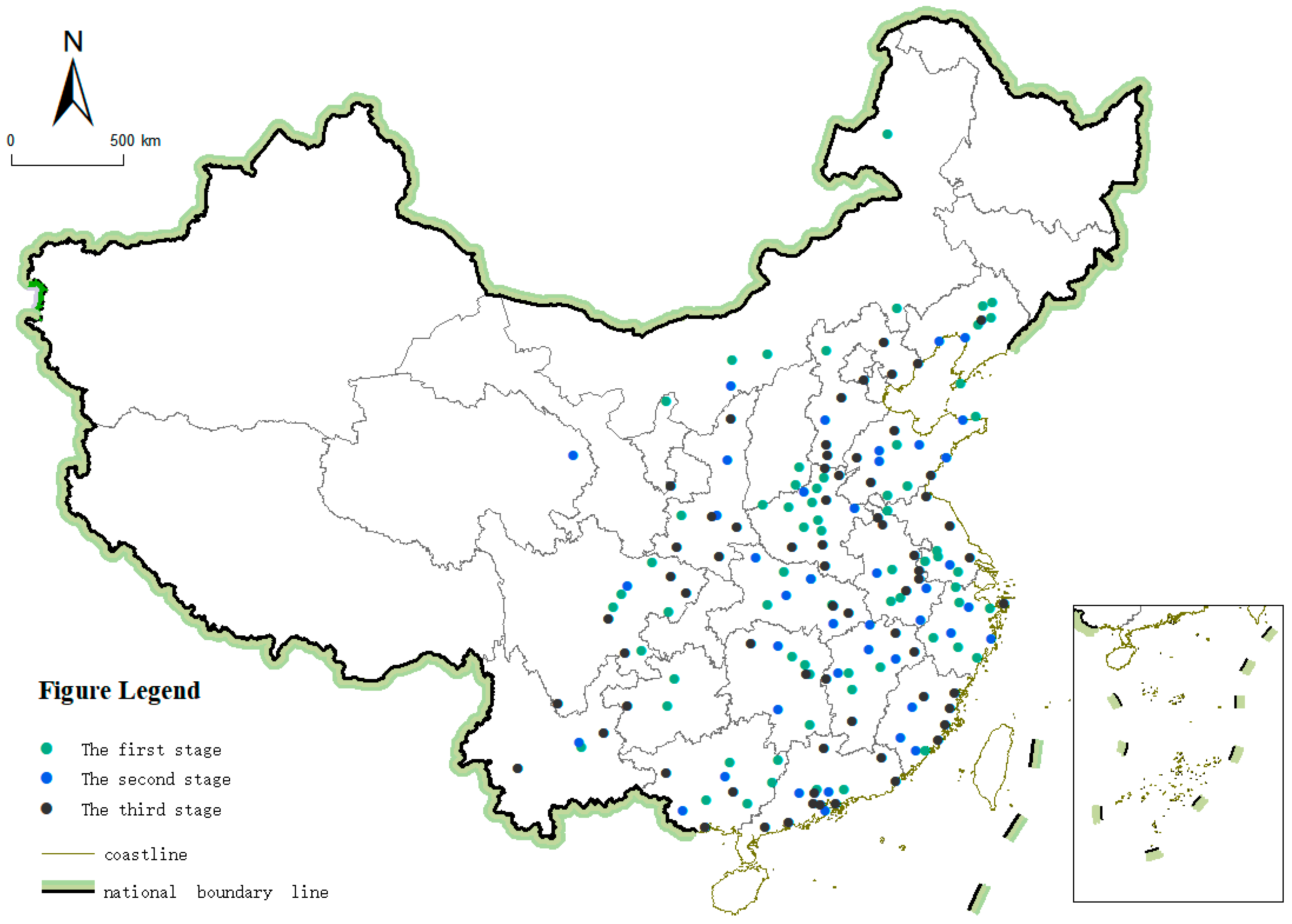
From a spatial distribution perspective, National Forest Cities exhibit a pronounced pattern of being more numerous in the east and south and fewer in the west and north, a characteristic highly consistent with the “Hu Line” (Hei he–Teng chong Line): they are densely distributed in the eastern coastal areas, the Yangtze River Basin, and the Pearl River Delta region, while being relatively sparse in the northwestern and southwestern regions. This spatial pattern provides a foundation for this paper to identify policy effects and conduct regional heterogeneity analysis.
Figure 1 illustrates the spatial distribution of National Forest Cities and their batch characteristics.
From the perspective of research design, the National Forest City policy is characterized by a gradual, batch-by-batch implementation process, and the conferral of the title constitutes an exogenous incentive for local governments. This feature renders the policy a suitable setting for a “quasi-natural experiment”. As a comprehensive intervention integrating spatial planning, fiscal investment, and ecological governance, it not only represents a concrete practice of implementing the concept of a life community of mountains, rivers, forests, farmlands, lakes, grasslands, and deserts, as well as the “dual carbon” goals, but also provides a unique research window for empirically examining how ecological construction policies influence urban pollution reduction and carbon mitigation through multiple pathways. Nevertheless, policy implementation may deviate from theoretical expectations. First, under constraints of land resource scarcity, the reallocation of land factors to meet greening targets may crowd out space for industrial development, thereby inhibiting green technological innovation and industrial upgrading [
16,
17]. Second, large-scale construction and maintenance of green spaces may themselves generate new environmental burdens, such as increased water resource consumption and risks of non-point source pollution [
18]. Finally, under limited fiscal budgets, excessive allocation of resources toward greening projects may crowd out other environmental governance investments with greater emission reduction effectiveness [
19]. Consequently, the net environmental effect of the policy is theoretically uncertain. Such theoretical divergence has begun to manifest in real-world cases. For instance, the right panel of
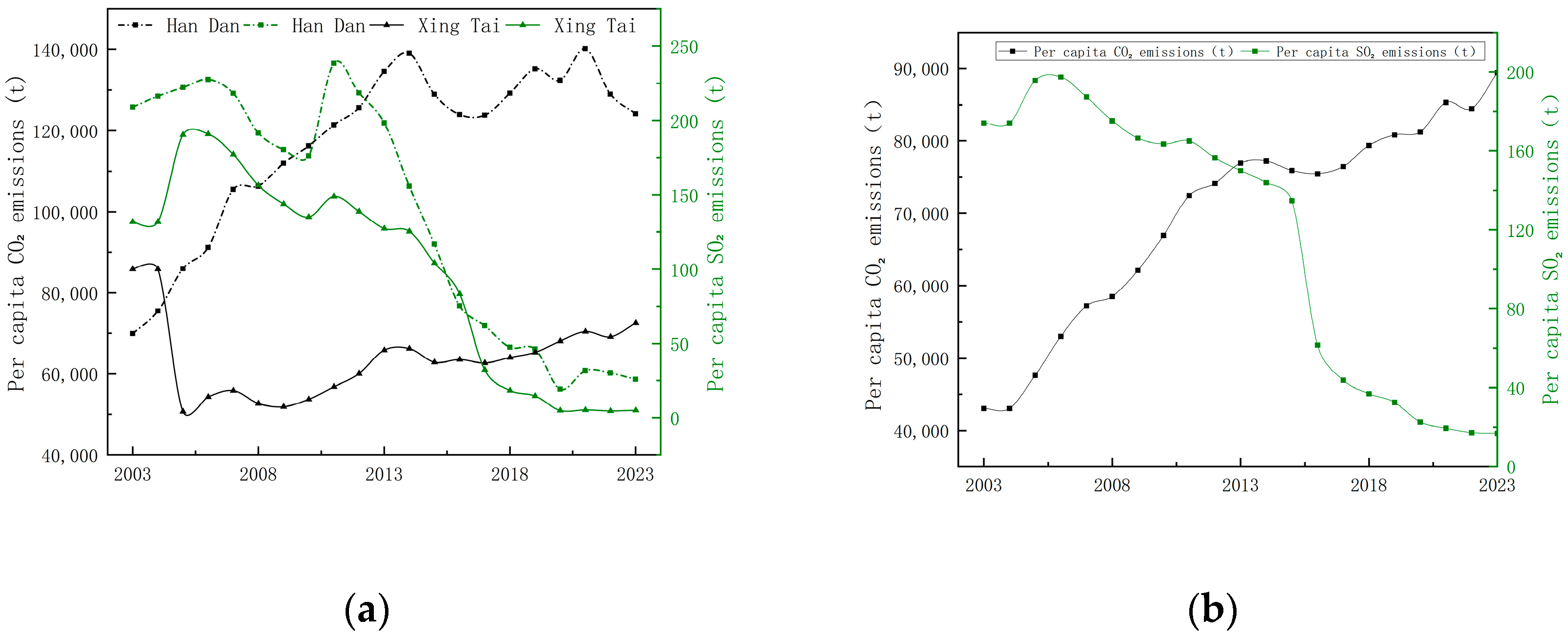
Figure 2 presents the overall carbon emissions and pollution levels in China, while the left panel focuses on Xingtai and Handan, two cities located in southern Hebei Province with similar resource endowments. Both cities were concurrently designated as National Forest Cities in 2022; however, their environmental performance following policy implementation exhibits significant divergence. Relying on the construction of forest cities, Xingtai has explored an ecological industry pathway by deeply integrating mountain greening with the understory economy. While increasing its green coverage rate, it has successfully achieved a synchronous and significant reduction in both pollution emission intensity and carbon emission intensity. In contrast, Handan, as a traditional steel city, has invested substantial resources in promoting territorial greening. However, constrained by its heavy industrial structure, the effect of carbon emission reduction has significantly lagged behind the reduction in pollutants. Consequently, despite an increase in green coverage, Handan has failed to effectively control its carbon emissions. This significant heterogeneity effect indicates that the environmental outcomes of forest city construction are highly dependent on local governments’ implementation models and industrial transformation pathways. While National Forest City construction promotes ecological improvement, it may also introduce a risk of “crowding-out imbalance” among different governance objectives. This refers to a scenario where an excessive focus on greening investments crowds out resources for industrial transformation, or where ecological restoration advances while green technological innovation lags, making it difficult to simultaneously achieve the goals of pollution reduction and carbon mitigation. Based on the above analysis, it is necessary to systematically evaluate the ecological and environmental effects of the National Forest City creation policy from the perspective of synergistic pollution and carbon reduction. This evaluation aims to reveal the critical conditions for achieving such synergy and the risk factors leading to crowding-out imbalances, thereby providing reliable empirical evidence and policy insights for improving urban ecological governance policies.
2.2. Research Hypotheses
The construction of National Forest Cities constitutes an institutionalized and sustained urban ecological governance policy implemented in China within the framework of ecological civilization construction. Its core lies in systematically embedding ecological constraints into the urban development process through institutional arrangements. Given that both air pollutant emissions and carbon emissions exhibit significant negative externalities, cities often fail to fully internalize the environmental and climate costs associated with emissions in their production and spatial expansion decisions, resulting in persistently excessive levels of pollutant and greenhouse gas emissions [
20,
21]. Under such circumstances, reliance on market mechanisms alone is insufficient to achieve effective governance, and government intervention through policy instruments becomes a necessary means to improve urban ecological environments. As an ecological governance policy that combines both incentive and constraint attributes, the National Forest City initiative can influence urban pollution and carbon emissions through two interrelated channels: enhancement of ecosystem functions and constraints on development pathways. On the one hand, by mandating the expansion of forest and green space areas, the policy directly strengthens the carrying capacity of urban ecosystems, whereby vegetation passively reduces net emission intensity per unit of economic activity through adsorption and carbon sink effects [
22]. On the other hand, the stringent spatial controls, land-use constraints, and environmental access standards embedded in the policy raise compliance costs and development thresholds for high-emission industries from the factor supply side, while simultaneously attracting the agglomeration of green factors by improving ecological livability, thereby guiding urban industrial structures toward low-carbon transformation at the source [
23]. Therefore, compared with single pollution control policies that primarily rely on end-of-pipe treatment, the National Forest City initiative places greater emphasis on improving urban ecosystem structures and constraining urban development pathways, simultaneously acting on pollution and carbon emissions at both the source and process levels. In theory, this provides an institutional foundation for promoting urban environmental improvement. Accordingly, this paper proposes the following hypothesis:
H1. The construction of National Forest Cities can significantly improve urban ecological environments.
Beyond its direct ecological effects, the construction of National Forest Cities may also indirectly improve urban ecological environments by influencing urban green innovation behavior. As a comprehensive ecological governance policy, the National Forest City initiative is typically accompanied by clearer environmental target constraints and higher standards for ecological construction, which objectively intensify the institutional constraints faced by pollution emissions and resource consumption. In this context, cities and firms that continue to rely on traditional production modes characterized by high emissions and high energy consumption will find it increasingly difficult to meet policy requirements, with both their development space and compliance costs facing substantial constraints. This logic aligns closely with the core proposition of the Porter Hypothesis, which argues that well-designed environmental regulations can stimulate innovation offsets, thereby reducing pollution emissions while enhancing firm competitiveness. In the specific context of the National Forest City program, the translation of regulatory pressure into innovation incentives operates through the following institutional channels: first, hard targets embedded in the evaluation system—such as green coverage ratios and ecological space controls—are directly translated into performance evaluation pressure for local officials, thereby driving the allocation of fiscal resources toward green technology development. Second, stricter environmental access standards raise compliance costs for high-emission enterprises, while the brand premium and green reputation effects associated with the “National Forest City” designation create anticipated returns for firms engaging in green technology innovation through differentiated market competitiveness. To adapt to stricter ecological constraints, local governments and enterprises often need to reduce emission intensity and resource consumption through technological improvements. On the one hand, the National Forest City initiative continuously signals a green development orientation, guiding fiscal funds, public resources, and policy support toward energy conservation, emission reduction, and cleaner production. On the other hand, higher environmental standards and heightened social attention strengthen firms’ incentives to engage in the research, development, and application of environmentally friendly technologies. In this process, urban-level green innovation activities are stimulated, and the application scope of green technologies in production processes, energy utilization, and management models continues to expand. Consequently, the construction of National Forest Cities not only improves environmental quality through direct ecological expansion effects, but may also leverage stronger regulatory pressure and policy expectations to induce market entities to increase green R&D investment, patent applications, and technological adoption, thereby promoting a fundamental green transformation of urban production modes and achieving indirect improvements in environmental quality. Based on this reasoning, this paper proposes the following hypothesis:
H2. The construction of National Forest Cities can improve urban ecological environments by enhancing the level of urban green innovation.
The environmental improvement effects of National Forest City construction may also be realized through its role in driving the evolution of urban industrial structures toward greener and more advanced forms. According to theories of environmental regulation and endogenous growth, stringent and well-designed environmental policies can alter cities’ factor endowments and comparative advantages, thereby triggering systemic optimization of industrial structures. Such optimization does not merely entail a simple increase in the share of the tertiary sector; rather, its deeper implication lies in the strategic reallocation of economic resources from traditional industrial sectors with high marginal environmental costs toward modern service and knowledge-intensive sectors with lower marginal environmental costs. Specifically, the strengthened ecological constraints and enhanced green reputation associated with National Forest City construction reshape urban economic geography from both the supply and demand sides. On the supply side, higher environmental standards raise the relative prices of factors such as land and energy for pollution-intensive industries, forcing such industries to undertake green technological upgrading or face contraction. On the demand side, superior ecological environments become a distinctive locational advantage for attracting high human capital, high-technology enterprises, and green investment, thereby providing fertile ground for the development of clean industries such as research and development, professional services, and digital information. This process drives a shift in cities’ leading industries from scale expansion reliant on physical capital and energy consumption toward quality enhancement driven by human capital and technological innovation. Accordingly, the upgrading of industrial structure essentially represents a structural transformation of urban economic growth drivers from resource- and environment-intensive modes to knowledge- and green-intensive modes. This transformation not only directly reduces emission intensity per unit of economic output but also provides sustained endogenous momentum for urban environmental improvement by building new comparative advantages based on green factors. Based on this reasoning, this paper proposes the following hypothesis:
H3. The construction of National Forest Cities can improve urban ecological environments by optimizing the level of urban industrial structure upgrading.
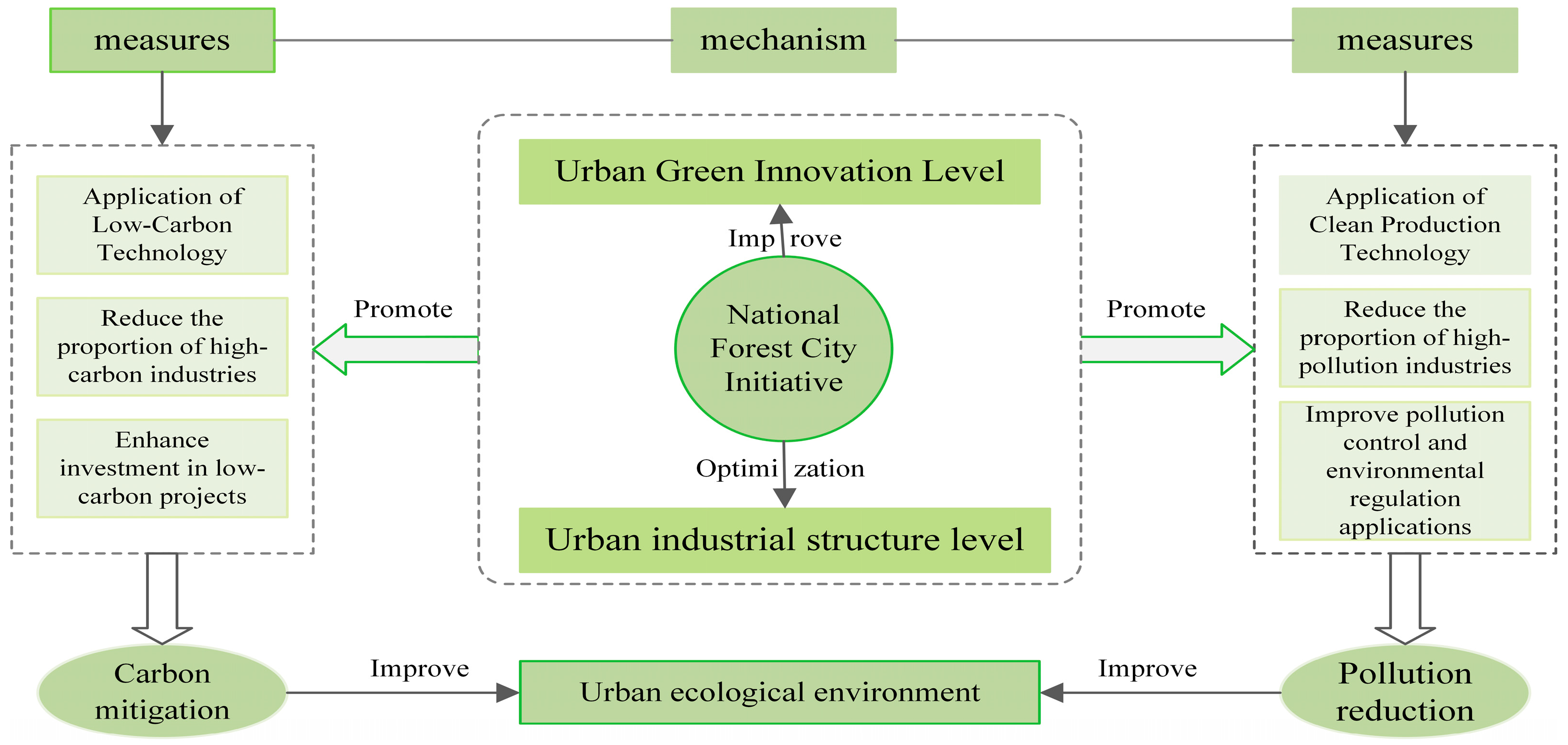
In summary,
Figure 3 illustrates the mechanism framework of this study.
3. Materials and Methods
3.1. Data Sources
- (1)
National Forest City Data
To examine the impact of National Forest City construction on urban ecological environments, this study collects panel data for 271 Chinese cities over the period 2003–2023. This study period was selected because 2004 marks the official launch year of the National Forest City policy, and 2023 serves as the cutoff year for this study based on data availability. This research window fully covers the policy implementation period and encompasses the critical phase of China’s environmental governance transition from pollution control to the synergistic reduction of pollution and carbon emissions, laying the foundation for evaluating the policy effects. Accordingly, this study compiles and matches the list of National Forest Cities based on policy documents issued by the National Forestry and Grassland Administration, including the Guiding Opinions on Promoting the Construction of Forest Cities, the National Forest City Evaluation Indicators (Trial), and the National Forest City Development Plan. Due to missing key economic, social, or environmental variable data for some cities during the study period, this study ultimately includes 265 city samples in the empirical analysis, among which 174 National Forest Cities are selected as the treatment group sample.
- (2)
Ecological Environment Data
The ecological environment indicators in this study primarily focus on per capita carbon dioxide emissions and per capita sulfur dioxide emissions. Data on urban sulfur dioxide emissions are obtained from the China City Statistical Yearbook; City-level CO2 emission data are derived from gridded emission data provided by the EDGAR database. Spatial aggregation was completed using ArcGIS (v10.8) software, following these steps: first, the EDGAR raster data and the administrative boundary vector data of Chinese prefecture-level cities were loaded, and their coordinate systems were unified; second, after extracting the CO2 raster data for China and removing outliers, the raster data were aggregated based on city administrative boundaries, calculating the total CO2 emissions for each city.
- (3)
Socioeconomic Development Data.
Socioeconomic development data are mainly drawn from the National Bureau of Statistics of China, the China City Statistical Yearbook, the China National Intellectual Property Administration, and the Statistical Report on National Economic and Social Development. These data include indicators of urban economic development level, industrial development level, degree of openness, population density, education expenditure level, human capital level, mobile phone penetration rate, industrial structure level, and urban green technological innovation level. Missing values are supplemented using city-level statistical yearbooks.
3.2. Variable Selection
- (1)
Explained Variables: Urban Ecological Environment Level
The urban ecological environment level is measured from the dual dimensions of pollution reduction and carbon mitigation [
24,
25]. As shown in
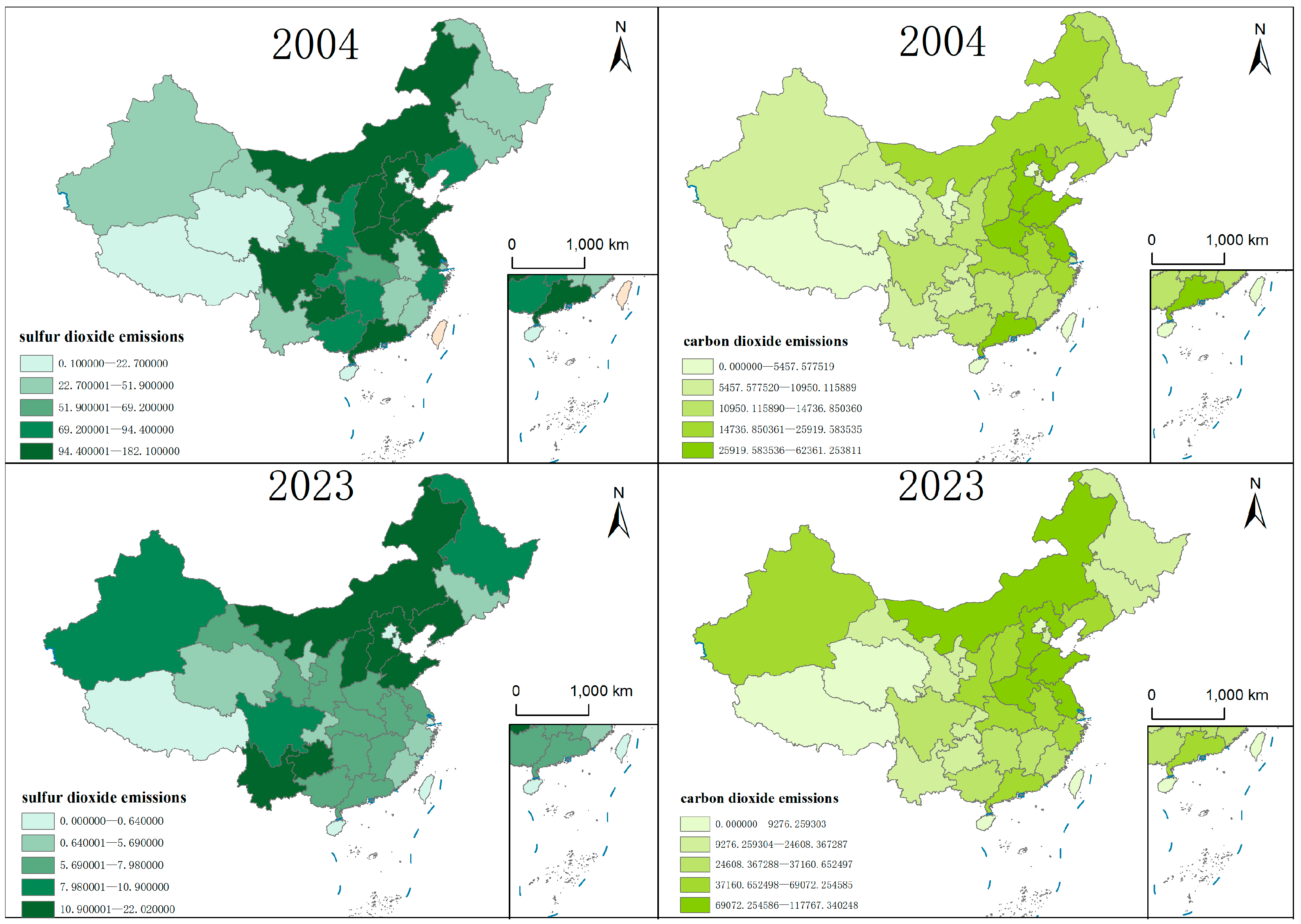
Figure 4 (Tibet is excluded from this publication due to data incompleteness), China’s total provincial CO
2 emissions exhibited an overall upward trend during the period 2004–2023, with more pronounced growth in northern regions and eastern coastal areas. In contrast, total SO
2 emissions showed an overall declining trend, and regions with historically high emissions experienced significant pollution reduction effects. This macro-level pattern provides an important background for evaluating the ecological impacts of the National Forest City initiative. To more accurately capture improvements in ecological environmental quality, this study employs per capita carbon dioxide emissions and per capita sulfur dioxide emissions as indicators to measure urban “carbon mitigation” and “pollution reduction”, respectively. Additionally, the logarithm of per capita sulfur dioxide emissions was taken. This is because, compared with per capita carbon dioxide, the numerical distribution of per capita SO
2 emissions is relatively concentrated with smaller fluctuations. Applying a logarithmic transformation can effectively eliminate heteroskedasticity, leading to more robust regression results. Moreover, the emission reduction effect is more appropriately reflected by a “relative decline” when using this form.
- (2)
Core Explanatory Variable
The core explanatory variable in this study is the National Forest City construction policy [
26]. This study employs the logarithm of the number of green utility model patents granted in cities as a measure of green innovation level, for two primary reasons. First, by focusing on granted patents rather than patent applications, this approach excludes patent applications that fail to pass technical examination and lack genuine technological value, effectively avoiding estimation bias caused by inflated patent application numbers and accurately reflecting the true outcomes of urban green innovation. Second, selecting utility model patents as the specific metric places greater emphasis on the practical application and transformation of technology, which aligns closely with the core logic of this study: the implementation and application of utility model patents can directly promote industrial green transformation and reduce pollutant emissions.
- (3)
Mechanism Variables
Green Innovation Level:
This variable is used to measure a city’s capacity and output level in green technology research, development, and innovation. This study employs the logarithm of the number of granted green utility model patents as the indicator of green innovation level, for the following two reasons. First, by focusing on granted patents rather than patent applications, we exclude applications that fail to pass technical examination and lack genuine technical value, effectively avoiding estimation bias caused by artificially inflated patent application counts and accurately capturing the substantive achievements of urban green innovation. Second, selecting utility model patents as the specific metric places greater emphasis on the practical application and commercialization of technologies, which aligns closely with the core logic of this study: the implementation of utility model patents can directly drive industrial green transformation and reduce pollutant emissions [
26]. Larger values indicate more active green innovation activities and stronger green technology supply capacity.
Industrial Structure Level: This variable reflects changes in the proportion of low-emission industries within a city’s industrial structure. Drawing on previous studies [
27], this paper measures the level of industrial structure upgrading using the spatial vector angle method. In constructing this index, GDP is treated as a spatial vector
, and the shares of value added by the primary, secondary, and tertiary industries in GDP are regarded as the components of this vector, such that
. The angle between
and a set of vectors representing the ordered progression of industrial structure from lower to higher levels—namely,
—is then calculated. The specific calculation method is shown in Equation (1):
where
. The calculation formula for the industrial structure upgrading index
is shown in Equation (2).
A larger value of indicates a higher level of industrial structure upgrading.
- (4)
Control Variables
In addition to ecological policies, urban ecological environments are influenced by various other factors. Drawing on the existing literature [
28,
29,
30,
31], this study includes the following variables as controls: economic development level (GDP), urbanization rate, industrial development level (industry), population density (density), education expenditure level (education), human capital level (capital), mobile phone penetration rate (mobile), and degree of openness (openness). The definitions of the main variables and their descriptive statistics are presented in
Table 1 below.
3.3. Model Specification
- (1)
Baseline Model
To identify the causal effect of National Forest City construction on urban ecological environmental improvement, this study employs a multi-period difference-in-differences (DID) model for empirical analysis. The specific model setting is shown in Equation (3).
where
denotes cities and
denotes years. The explained variable
represents urban ecological environmental conditions, which are measured by per capita sulfur dioxide (
) emissions and per capita carbon dioxide (
) emissions to capture the two dimensions of urban environmental improvement, “pollution reduction” and “carbon mitigation”, respectively. The core explanatory variable
is a dummy variable for the National Forest City policy, which takes the value of 1 if city
has been officially awarded the title of National Forest City in year
or thereafter, and 0 otherwise.
denotes a vector of control variables used to account for socioeconomic factors that may affect urban ecological environmental quality.
and
represent city fixed effects and year fixed effects, respectively, controlling for time-invariant city-specific characteristics and common macro-level time shocks.
is the random error term.
- (2)
Parallel Trend Test
To verify the key identification assumption of the DID model—that the treatment group and the control group follow parallel trends prior to policy implementation—this study adopts an event study approach to conduct the parallel trend test [
32]. Specifically, the time window before and after policy implementation is divided into multiple relative periods, and corresponding dummy variables are introduced to capture the dynamic effects at different stages surrounding policy implementation. The model setting is shown in Equation (4).
This study estimates effects for five periods prior to policy implementation and six periods after implementation, with the period immediately preceding policy implementation omitted as the baseline. If the coefficients for the pre-policy periods are statistically insignificant and exhibit no systematic trend differences, the parallel trend assumption can be considered satisfied. The dynamic changes in the post-policy coefficients further help to characterize the persistence and evolution of the effects of National Forest City construction on urban ecological environments.
- (3)
Mediation Effect Model
To identify the mechanisms through which National Forest City construction affects urban ecological environments, this study employs the classical two-step mediation effect testing framework [
33]. Specifically, the analysis first examines the impact of the policy on the mediator variables; it then tests whether the direct effect of the policy on ecological environmental outcomes weakens after controlling for the mediator variables, thereby assessing the existence and strength of the mediation channels. Accordingly, the model setting is shown in Equation (5).
where
denotes the mediator variables, namely urban green innovation level and urban industrial structure level.
is the dummy variable for National Forest City construction,
is the vector of control variables, and
and
represent city and year fixed effects, respectively. If
is significantly positive, it indicates that National Forest City construction can influence the level of urban ecological environment through the corresponding mediation variables.
- (4)
Research Methodology
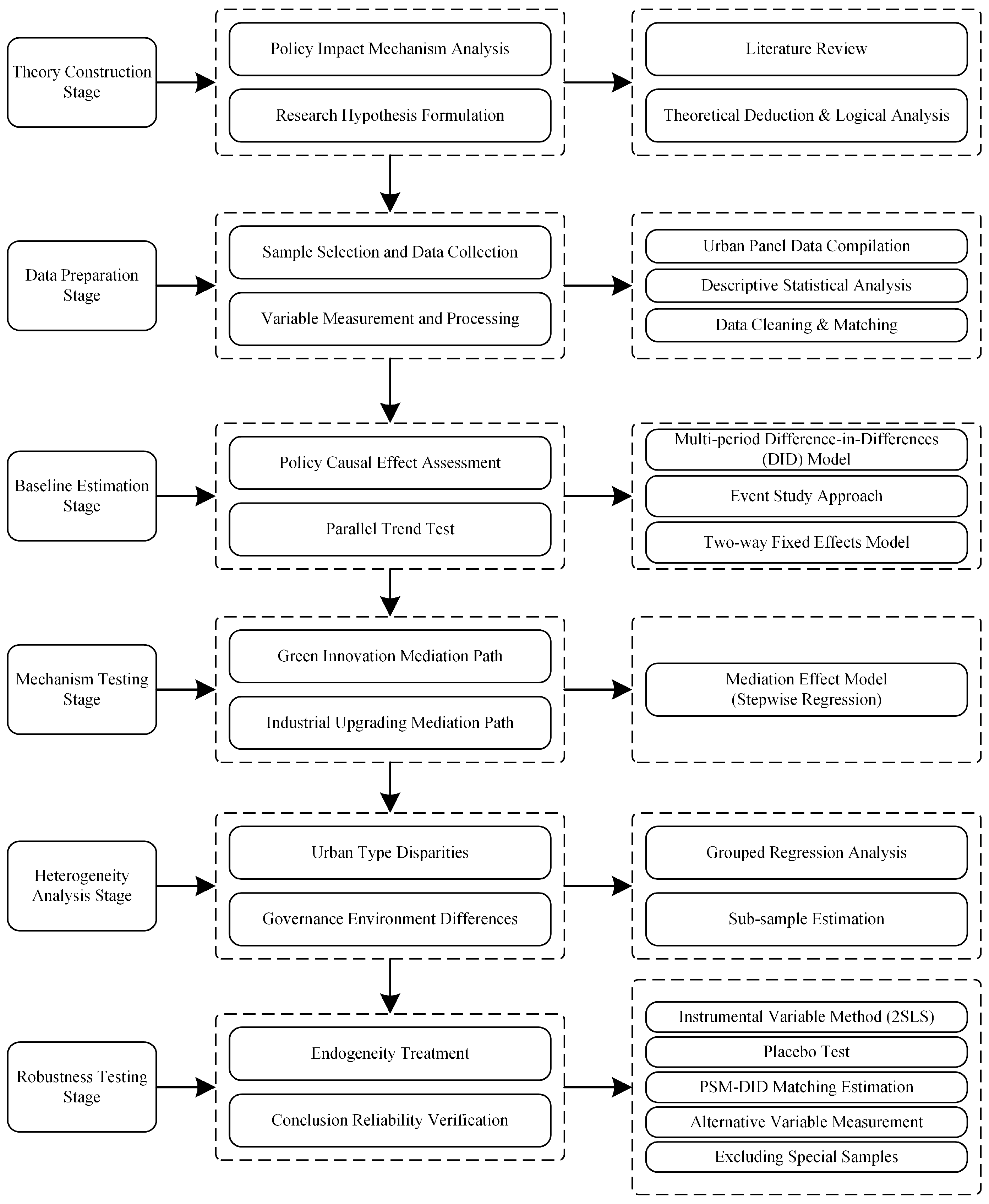
Figure 5 illustrates the complete research process of this study, from theoretical construction to robustness testing, outlining the core research content and the econometric methods employed at each stage. The staggered difference-in-differences (DID) model serves as the core identification strategy, covering the entire process from baseline estimation to mechanism testing. The instrumental variable (IV) approach and placebo tests jointly ensure the reliability of causal identification. Heterogeneity analysis is conducted from multiple dimensions, including urban resource endowments, administrative hierarchies, and city sizes.
4. Results
4.1. Baseline Regression
Table 2 reports the baseline regression results of the impact of National Forest City construction on urban ecological environmental improvement. The explained variables are per capita carbon dioxide emissions and per capita sulfur dioxide emissions, which are used to measure city-level “carbon mitigation” and “pollution reduction” effects, respectively. The regression results show that, regardless of whether city and year fixed effects are included and whether a set of control variables are added, the estimated coefficient of the National Forest City dummy variable is significantly negative for both environmental indicators. This indicates that the establishment of National Forest Cities has played a positive role in controlling both traditional pollutant emissions and carbon emissions. In terms of the results, the magnitude of reduction differs considerably between the two, which may primarily stem from the differing measurement methods used in this study for per capita carbon dioxide and per capita sulfur dioxide. Furthermore, carbon dioxide mainly originates from industrial combustion, and the National Forest City policy contributes to its reduction primarily through passive absorption, functioning as “auxiliary emission reduction”. Moreover, CO
2 emission reduction relies more heavily on industrial governance itself, resulting in a relatively moderate decline, which aligns with the policy’s scope of action. In contrast, sulfur dioxide has a broader range of sources, including industry, transportation, and residential activities. The National Forest City policy contributes to SO
2 reduction through both active constraints and indirect guidance: while increased forest vegetation coverage directly absorbs CO
2, the green development orientation driven by the policy indirectly promotes transformations in urban energy structures and residents’ lifestyles. This dual mechanism of “direct + indirect” effects results in a relatively greater reduction in urban SO
2 compared to CO
2. Given the differing mechanisms, the disparity in reduction magnitudes is reasonable. In summary, Hypothesis H1 of this study is validated.
4.2. Robustness Checks
To ensure the reliability of the baseline regression results, this study conducts a series of robustness checks from multiple perspectives.
- (1)
Parallel Trend Test
To verify the core identification assumption of the difference-in-differences (DID) model—namely, that there are no significant trend differences between the treatment group and the control group prior to policy implementation—this study applies an event study approach to test the parallel trend assumption. Specifically, the policy effect of National Forest City construction is decomposed into dynamic effects within an event-time window, and the coefficients for several periods prior to policy implementation are estimated.
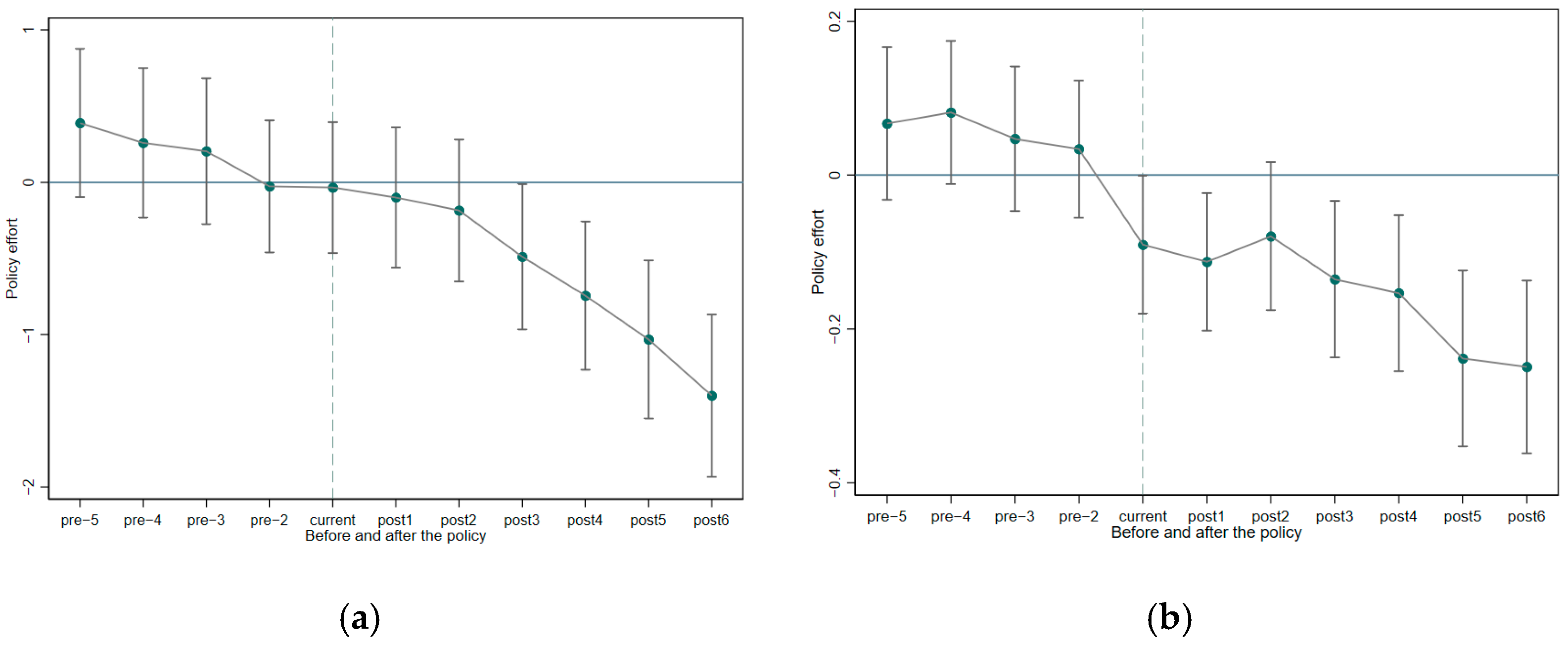
The results of the parallel trend test are presented in
Figure 6. The horizontal axis represents years before and after policy implementation, while the vertical axis depicts the estimated policy effect coefficients. The results indicate that, across multiple periods prior to policy implementation, the estimated coefficients are statistically insignificant and close to zero, suggesting that there are no significant pre-policy trend differences between the treatment and control groups. Hence, the parallel trend assumption is satisfied. Following policy implementation, the coefficients become significantly negative and gradually increase in magnitude over time, indicating that National Forest City construction exerts sustained and cumulative improvement effects in reducing per capita sulfur dioxide emissions and per capita carbon dioxide emissions. Furthermore, this study conducted a joint significance test on the estimated coefficients for the period from the 5th year to the 1st year prior to policy implementation. The test results, with per capita sulfur dioxide as the dependent variable, show F (5, 284) = 0.80,
p = 0.522, indicating failure to reject the null hypothesis at the 10% significance level. The test results with per capita carbon dioxide as the dependent variable show F (4, 5234) = 1.31,
p = 0.263, also failing to reject the null hypothesis. Taken together, these findings confirm that the identification conditions of the DID model are met, and the estimated policy effects can be interpreted as the causal impact of National Forest City construction on urban ecological environmental improvement.
- (2)
Placebo Test
To further verify the causal interpretability of the baseline results, this study conducts a placebo test to rule out the influence of other potential confounding factors [
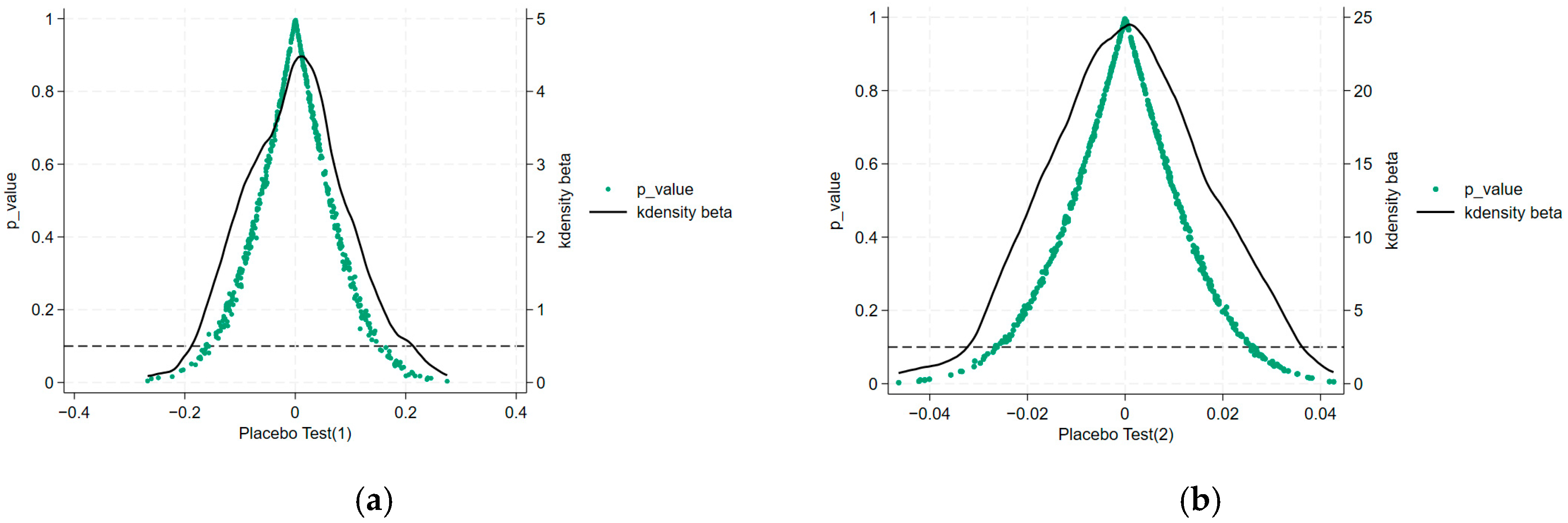
34]. Specifically, the treatment group is randomly assigned, and the coefficients of the pseudo policy shocks are repeatedly estimated through 500 random resampling. As shown in
Figure 7, the estimated coefficients of the randomly assigned policy variable are mostly concentrated around zero and fail to pass conventional significance tests. This result indicates that, in the absence of a genuine policy intervention, the model does not generate significant spurious effects, thereby reinforcing the robustness and causal interpretability of the baseline regression results.
In summary, the placebo test provides additional support that the estimated effects of National Forest City construction on urban ecological environmental improvement are not driven by random chance or other time-varying factors, thus enhancing the credibility of the policy effect estimates.
- (3)
PSM–DID
To mitigate the potential impact of sample selection bias on the estimation results, this study further employs the propensity score matching–difference-in-differences (PSM–DID) approach as a robustness check [
35]. First, the probability of treatment (i.e., the propensity score) is estimated based on control variables such as cities’ economic development level and population density. Nearest-neighbor matching (1:1) is then applied to construct a matched sample, ensuring that the treatment group and the control group exhibit comparable covariate distributions prior to policy implementation. Subsequently, the DID model is re-estimated using the matched sample to identify the net effect of National Forest City construction.
The balance diagnostics indicate that, after matching, the standardized differences of the main covariates between the treatment and control groups decline substantially and mean balance is significantly improved, suggesting that the matching procedure effectively reduces systematic differences. The PSM–DID estimation results are reported in
Table 3. In the matched sample, the coefficients of National Forest City construction on per capita sulfur dioxide emissions and per capita carbon dioxide emissions remain significantly negative, with directions and significance levels consistent with those of the baseline regression. These findings indicate that the baseline conclusions do not hinge on sample selection or covariate imbalance, thereby further strengthening the robustness and causal interpretability of the estimated effects of National Forest City construction on urban ecological environmental improvement.
- (4)
Instrumental Variable Approach
To further alleviate potential endogeneity concerns, this study adopts an instrumental variable (IV) approach and selects average urban elevation as an instrument for National Forest City construction [
32]. In terms of relevance, average elevation reflects a city’s natural geographic conditions and ecological endowment. Generally, cities with higher average elevation tend to possess comparative advantages in forest resource endowments, ecosystem integrity, and ecological conservation value, making them more likely to be recognized in the National Forest City evaluation process. Thus, the relevance condition of the instrumental variable is satisfied. Regarding exogeneity, average elevation is primarily determined by natural geographic conditions and exhibits strong time invariance. After controlling for city fixed effects, year fixed effects, and a set of city-specific characteristics, average elevation is unlikely to directly affect urban pollutant emissions or carbon emissions through channels other than National Forest City construction. Hence, it can be considered to satisfy the exclusion restriction. As shown in
Table 4, the first-stage regression results indicate that average urban elevation significantly affects the likelihood of National Forest City designation. Moreover, the first-stage F-statistic is 43.55, well above the critical value, indicating the absence of a weak instrument problem. This confirms that the relevance condition for the instrumental variable is satisfied. The second-stage regression results show that the coefficient for the impact of National Forest City establishment on urban “pollution and carbon reduction” is significantly negative, indicating that after accounting for endogeneity concerns, the construction of National Forest Cities still significantly suppresses per capita carbon dioxide and per capita sulfur dioxide emissions. The effect remains significant, further validating the causal effect of the National Forest City policy and confirming the relevance of the instrument. In the second-stage regression, the effect of National Forest City construction on urban “pollution reduction and carbon mitigation” remains significant, further validating the causal impact of the policy.
- (5)
Testing for Heterogeneous Treatment Effects
Recent theoretical econometric literature suggests that the classical two-way fixed effects difference-in-differences model may suffer from estimation bias when treatment effects are time-varying (Goodman-Bacon, 2021) [
36]. After conducting the robustness tests described above, and considering the heterogeneous implementation timing of the National Forest City pilot program, this study further employs Bacon decomposition to break down the TWFE-DID estimator into weighted averages of its components. The results are presented in
Table 5, showing that the weight of comparisons between earlier-treated groups and later-treated groups is approximately 15.1%, indicating that heterogeneous treatment effects account for a substantial proportion of the weight. Nevertheless, the coefficient remains significantly negative even in the presence of potential bias from treatment timing heterogeneity, further demonstrating the robustness of the main conclusions of this study.
To ensure the robustness and validity of the research conclusions, this study further conducts tests using a robust estimator that addresses heterogeneous treatment effects. Borusyak et al. (2024) propose an imputation-based counterfactual estimator to correct the estimation bias in TWFE models [
37]. By estimating cohort fixed effects, time fixed effects, and treatment–control group fixed effects, a more accurate estimator can be obtained. The results, presented in
Table 6, show that after excluding heterogeneous treatment effects using the imputation method, the estimated impact remains significantly negative, further demonstrating the robustness and reliability of the baseline regression conclusions.
- (6)
Additional Robustness Checks
In addition to the robustness checks discussed above, this study further examines the baseline results by replacing the explained variables and excluding special samples.
Replacing the explained variables: This study replaces the original indicators of per capita carbon dioxide emissions and per capita sulfur dioxide emissions with carbon emission intensity and pollution emission intensity, respectively. The regression results, reported in
Table 7, show that the positive effect of National Forest City construction on urban ecological environmental improvement remains statistically significant. This indicates that the conclusions do not depend on a specific choice of environmental indicators and are therefore robust.
Excluding special samples: Given that municipalities directly under the central government enjoy institutional advantages in terms of administrative rank, fiscal resources, and access to policy support, their ecological governance capacity and environmental improvement performance may be systematically stronger, potentially affecting the marginal policy effects of National Forest City construction. To avoid interference from such samples, this study re-estimates the regressions after excluding these municipalities. As shown in
Table 5, the direction and significance level of the core explanatory variable remain largely unchanged, providing further support for the robustness of the baseline regression results.
5. Mechanism Testing and Heterogeneity Analysis
5.1. Mechanism Testing
The baseline regression results indicate that National Forest City construction significantly promotes urban ecological environmental improvement, achieving coordinated control of both traditional pollutant and carbon emissions. However, identifying the policy effect alone is insufficient to fully understand the incentive mechanisms of the National Forest City policy. Based on the theoretical analysis presented earlier, this study further examines two mediating channels—urban green innovation level and industrial structure level—by constructing mediation effect models to systematically test the internal transmission mechanisms through which National Forest City construction affects urban ecological environment improvement.
- (1)
Mediation Effect of Urban Green Innovation Level
The mediation regression results in
Table 8 show that National Forest City construction significantly enhances the level of urban green innovation. Specifically, in the regression where urban green innovation level serves as the dependent variable, the estimated coefficient for National Forest City establishment is positive and statistically significant at conventional levels, suggesting that this policy has effectively promoted green technology innovation activities at the urban level. Furthermore, after incorporating the mediating variable into the model, the coefficient for green innovation is significantly negative, while the coefficient for the core explanatory variable also remains significantly negative. This finding suggests that during the implementation of National Forest City construction, the continuous reinforcement of ecological priority and green development orientations has heightened the emphasis placed by local governments and enterprises on green technology research and development. Green technological achievements, through their application in cleaner production, end-of-pipe treatment, and energy efficiency improvement, have directly contributed to the reduction of pollutant and carbon emissions, thereby improving the urban environment. These results provide empirical evidence supporting the pathway through which National Forest Cities enhance the urban ecological environment via the “green innovation pathway”, thus validating Hypothesis H2 of this study.
- (2)
Mediation Effect of Industrial Structure Level
Mediating effect of industrial structure level: Further mediation regression results, as shown in
Table 6,
Table 7 and
Table 8, reveal that the estimated coefficient of National Forest City establishment on urban industrial structure level is significantly positive. After simultaneously incorporating the mediating variable and the dependent variable into the model, both coefficients are significantly negative. This finding indicates that while emphasizing ecological space protection and environmental carrying capacity constraints, the establishment of National Forest Cities has exerted a structural influence on the direction of urban industrial development. With the elevation of ecological construction standards and the strengthening of environmental access constraints, the expansion space for highly polluting and energy-intensive industries has been somewhat limited. Meanwhile, improvements in ecological environment quality and urban livability have enhanced the attractiveness of cities to modern service industries and other low-emission sectors, promoting the evolution of industrial structure towards low-carbon and high-end orientations. This structural optimization has reduced the pollution and carbon emission intensity per unit of output, thereby creating a more favorable economic structure foundation for urban “pollution and carbon reduction”.
5.2. Heterogeneity Test
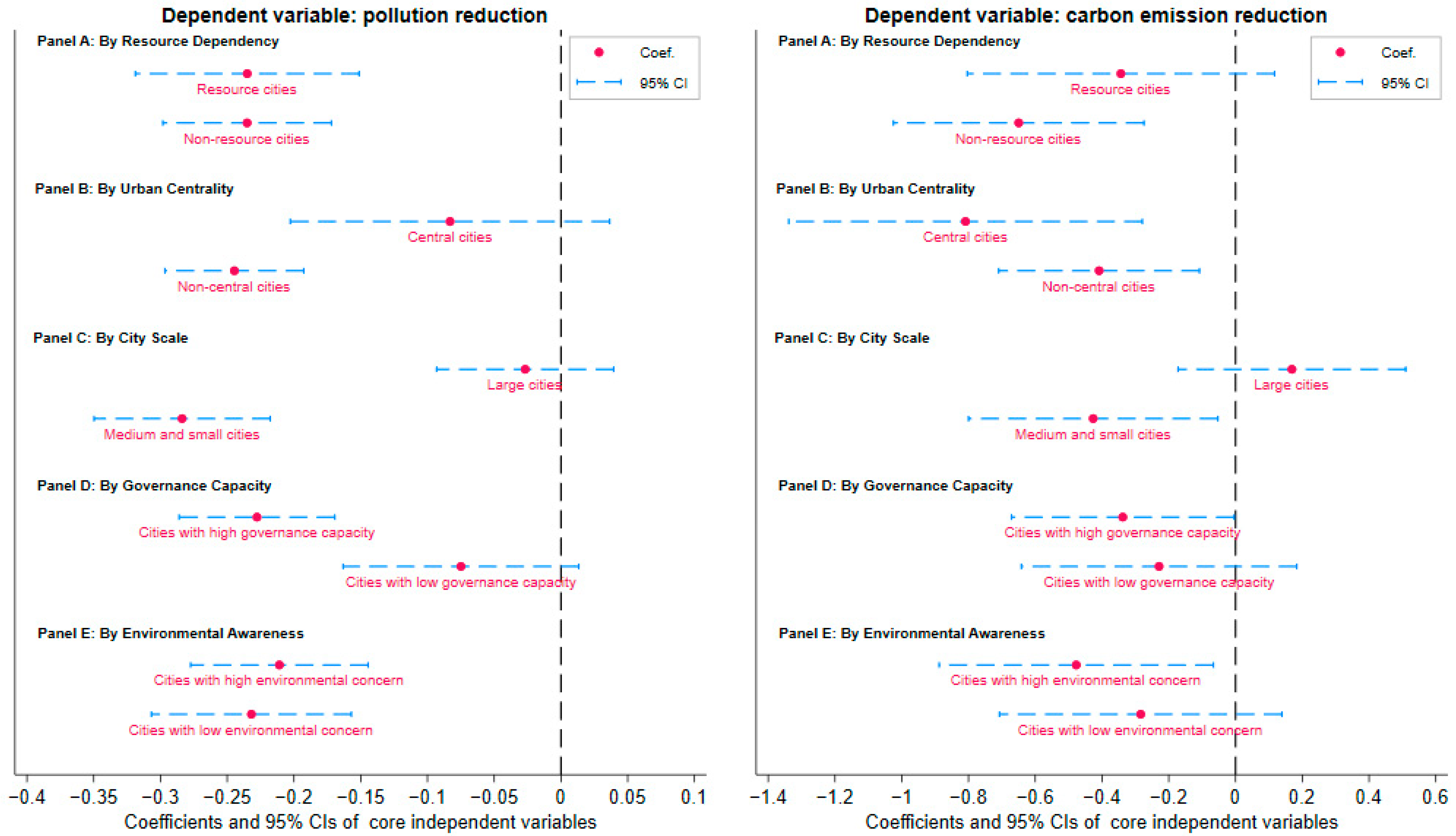
Considering significant differences across cities in terms of resource endowments, development stages, and governance conditions, the effects of National Forest City construction on urban carbon and pollutant emissions may exhibit notable heterogeneity. Therefore, this study conducts subgroup analyses along multiple dimensions—including resource dependence, city functional positioning, city size, governance capacity, and social attention—to more comprehensively examine the differentiated features of the policy’s environmental effects. The analysis results are shown in
Figure 8:
- (1)
Heterogeneity by Resource Dependence
Resource-based and non-resource-based cities differ significantly in industrial structure and pollution emission characteristics. Resource-based cities rely heavily on resource extraction and primary processing industries, facing greater path dependence in pollution reduction and low-carbon transition, whereas non-resource-based cities have more flexibility and stronger potential for industrial adjustment.
Table 9 shows that National Forest City construction significantly promotes “pollution reduction and carbon mitigation” in non-resource-based cities, whereas its effect on carbon reduction in resource-based cities is not significant. This indicates that non-resource-based cities have greater ease in achieving coordinated emission reductions through industrial adjustment and environmental governance.
- (2)
Heterogeneity by City Centrality
Central and non-central cities differ in terms of economic agglomeration, policy resource allocation, and functional positioning. Central cities typically perform more complex economic and social functions, with environmental outcomes influenced by multiple policy and structural factors.
Table 9 shows that National Forest City construction has significant effects on both carbon and pollutant reductions in non-central cities, but the effect on pollution reduction in central cities is not significant. This may be due to already stronger environmental governance and lower baseline pollution in central cities, limiting the marginal reduction potential.
- (3)
Heterogeneity by City Size
City size affects population density, industrial structure, and environmental carrying capacity, thereby influencing the implementation effects of the National Forest City policy. Columns (1)–(4) of
Table 10 show that the policy’s effects on pollution and carbon reduction in large cities are not significant. In contrast, in medium and small cities, the policy significantly reduces per capita sulfur dioxide and carbon dioxide emissions, suggesting that these cities have greater flexibility in expanding ecological space and adjusting industrial structures, making policy implementation more effective in achieving tangible environmental improvements.
- (4)
Heterogeneity by Governance Capacity
Urban governance capacity is an important institutional foundation affecting the effectiveness of environmental policies. Cities with stronger governance generally have more complete institutional systems, higher policy execution efficiency, and stronger environmental monitoring capabilities, facilitating the realization of ecological policy effects. Grouped regression results in Columns (5)–(8) of
Table 10 indicate that in cities with higher governance capacity, National Forest City construction significantly reduces carbon and pollutant emissions. Conversely, in cities with weaker governance, the policy’s effect on emissions is not significant. This suggests that the environmental impact of the National Forest City policy largely depends on local governance support, and policy goals can only be effectively realized in cities with strong implementation and coordination capacity.
- (5)
Heterogeneity by Social Attention
Social attention reflects public awareness of ecological issues and the intensity of policy oversight. Higher social attention can strengthen government incentives for environmental governance and enhance policy transparency and enforceability.
Table 11 shows that in cities with high social attention, National Forest City construction significantly suppresses both pollutant and carbon emissions, whereas in cities with low social attention, significant effects are observed only for pollutant emissions. This indicates that public participation and social supervision play an important role in promoting the achievement of long-term environmental objectives.
6. Discussion
This study takes the establishment of National Forest Cities as a quasi-natural experiment to investigate the intrinsic mechanisms through which comprehensive ecological policies influence the urban ecological environment via the dual mediating pathways of green innovation and industrial upgrading. The findings indicate that this policy effectively reduces pollutant and carbon emissions by stimulating green technology innovation vitality and promoting industrial structure optimization, thereby achieving synergistic improvement in the urban ecological environment. This conclusion validates the effectiveness of nature-based solutions in China’s urban governance and provides new empirical evidence for understanding the indirect transmission mechanisms of environmental regulations. Furthermore, the policy effects exhibit multidimensional heterogeneity. From the perspective of cities’ inherent attributes, the policy effects are more pronounced in non-resource-based cities, non-central cities, and small-to-medium-sized cities, while remaining insignificant in resource-dependent cities, large cities, and central cities. From the perspective of environmental governance, cities with stronger local government governance capacity and higher levels of social environmental awareness demonstrate better policy implementation outcomes. This finding suggests that the effectiveness of ecological policies depends not only on urban development stages and resource endowments but also on the supporting capacity of institutional environments and social foundations.
Compared with existing research, the findings of this study engage in multiple academic dialogues. First, unlike literature focusing on the end-of-pipe treatment effects of command-and-control policies (Jaffe & Palmer, 1997), this study reveals the indirect governance pathways of National Forest City creation [
38], echoing research by Langinier et al. (2025) on environmental regulations incentivizing green transformation [
39]. Second, while urban forest research has predominantly focused on direct assessments of ecosystem service functions (Nowak et al., 2014) [
1], this study confirms, through causal identification, its transmission mechanisms of green innovation and industrial upgrading, providing empirical support for Diep et al.’s (2025) argument that NbS requires strengthened systemic governance embedding [
40]. These dialogues indicate that, building upon traditional environmental regulation theory, this study effectively connects with cutting-edge international topics such as NbS governance and cross-sectoral synergy. Further analysis reveals that the carbon reduction effect of National Forest City creation is significantly stronger than its effect on conventional pollutant reduction. This disparity stems from the inherent attributes of the policy: the direct carbon sequestration function of forest vegetation and the structural energy-saving effects brought by spatial optimization contribute rapidly and persistently to carbon reduction. In contrast, the reduction of conventional pollutants relies more heavily on end-of-pipe treatment and the application of clean production technologies, involving longer transmission chains that are susceptible to moderation by factors such as local industrial foundations and technological absorption capacity, thus resulting in relatively lagging effects.
Based on these findings, this study provides the following foundational directions for subsequent research: first, further investigation into the differential mechanisms through which various pollutants (e.g., PM2.5, ozone) and carbon emissions interact, revealing sources of intrinsic heterogeneity in policy effects; second, incorporating spatial econometric methods to examine the regional spillover effects of forest city policies and their transmission pathways in synergistic governance; third, conducting in-depth analysis of the dynamic evolution patterns of policy effects, identifying their short-term responses and long-term cumulative effects; fourth, exploring the interactive effects between policies and institutional factors such as local governance capacity and public participation, providing more refined theoretical support for optimizing policy design.
7. Conclusions
Based on panel data of Chinese cities and employing a multi-period difference-in-differences (DID) model, this study systematically examines the effects of National Forest City construction on urban ecological environment quality and its underlying mechanisms. The findings reveal that National Forest City construction effectively promotes pollutant and carbon emission reductions, thereby improving urban environmental quality. These conclusions remain robust across a series of sensitivity tests. Mechanism analysis indicates that the policy primarily operates through two channels: green innovation incentives and industrial structure optimization. On the one hand, the policy significantly enhances urban green innovation, promoting clean production and low-carbon technology application, which reduces pollutant and carbon emission intensity per unit of economic activity. On the other hand, the policy facilitates an increase in the share of tertiary industries and optimizes urban economic structure, thereby reducing the environmental pressure of overall economic activity. Heterogeneity analysis further shows that the policy has stronger environmental improvement effects in non-resource-based cities, non-central cities, and small- to medium-sized cities; it is also more effective in cities with stronger local governance capacity and higher public environmental awareness.
The scientific contributions of this study are mainly reflected in the following aspects: First, unlike existing studies that mostly focus on the end-of-pipe treatment effects of command-and-control or market-based incentive environmental instruments, this study integrates “pollution reduction” and “carbon mitigation” into a unified analytical framework, revealing the effectiveness of National Forest City creation as a nature-based solution (NbS) in China’s urban governance, providing new empirical evidence for understanding the synergistic governance effects of comprehensive ecological policies. Furthermore, by incorporating green innovation and industrial upgrading as mediating pathways, this study deepens the theoretical understanding of the indirect transmission mechanisms of environmental regulations. Based on a systematic analysis of heterogeneity in urban resource endowments, administrative hierarchies, and city sizes, this study provides an empirical basis for understanding the conditional dependence of ecological policy effects, enriching the literature on environmental policy evaluation in the Chinese context.
It should be noted that the applicability of this study’s findings has certain limitations. First, this study focuses on two core dimensions—pollutant emissions and carbon emissions—without comprehensively covering the long-term impacts of ecological functions such as ecological restoration and biodiversity conservation. Therefore, the findings are mainly applicable to evaluating the “pollution and carbon reduction” performance of forest city construction, rather than its complete ecosystem service value. Second, the heterogeneity analysis shows that policy effects are relatively limited in resource-based cities, central cities, large cities, cities with weaker governance capacity, and cities with low social attention. This means that the conclusions of this study have stronger reference significance for small and medium-sized cities in the accelerated industrialization phase with greater industrial structure flexibility, as well as for cities with high government attention and strong governance capacity. For megacities that have completed industrial transformation, their environmental governance needs to be supplemented with other types of policy instruments. Finally, due to data availability constraints, this study does not conduct an in-depth analysis of the dynamic changes in green innovation and industrial upgrading effects or the spatial spillover effects between regions. Future research could combine spatial econometric methods to further examine the transmission mechanisms of National Forest City policies in regional synergistic governance, providing more targeted references for promoting integrated regional ecological and environmental governance.
Although this study systematically evaluates the effects of National Forest City creation on the urban environment from multiple dimensions through the dual mediating pathways of green innovation and industrial upgrading, and although it employs various methods to verify the robustness of the results, some limitations remain. First, it is limited by data availability. This study only measures urban environmental improvement from the two dimensions of pollutant emissions and carbon emissions, without comprehensively covering ecological functions such as ecological restoration and biodiversity conservation or their long-term impacts, nor does it deeply analyze the dynamic changes in the dual mediating effects of green innovation and industrial upgrading over the long term. Second, this study does not deeply explore the ecological spatial spillover effects between different regions. Future research could combine spatial econometric methods to examine the synergistic effects of National Forest City creation at the regional level, while further investigating the transmission roles of green innovation and industrial upgrading in the spatial spillover process, providing more targeted references for regionally coordinated promotion of ecological environment governance and green transformation.
Based on the above findings, and considering the common challenges of global urban sustainable development and policy practices, this study proposes the following policy implications with international reference value:
First, strengthen the systemic and synergistic orientation of policy design by integrating National Forest City creation into the overall framework of urban climate and environmental governance. Specifically, it is recommended to add a “synergistic pollution and carbon reduction performance” module to the forest city evaluation indicator system, incorporating per capita pollutant reduction, the rate of carbon emission intensity decline per unit of GDP, and the increase in carbon sinks in built-up areas into the core assessment dimensions, thus transcending the traditional single green coverage rate assessment. It is recommended to go beyond single greening indicators in the evaluation system by systematically incorporating multi-dimensional environmental performance goals such as pollution reduction, carbon sink enhancement, and ecological resilience. At the same time, promote the establishment of joint meeting systems among forestry, ecological environment, natural resources, and housing and urban–rural development departments to coordinate forest city construction with carbon neutrality pathways, air quality improvement, and biodiversity conservation goals in territorial spatial planning, forming a synergistic mechanism of “joint planning, collaborative project implementation, and shared data”. Promote the alignment of forest city construction with global sustainable agendas such as urban carbon neutrality pathways, air quality management, and biodiversity conservation. This approach not only helps enhance the local implementation effectiveness of policies but also provides institutional references for other developing countries exploring comprehensive ecological policies. Additionally, drawing on the European Union’s nature-based solution assessment framework, establish an ecological benefit accounting system for forest cities, providing quantitative foundations for dynamic policy optimization.
Second, implement differentiated and adaptive implementation strategies to enhance the precision and effectiveness of policies in different types of cities. Design categorized construction models based on urban resource endowments, development stages, and functional positioning. For large cities, shift towards improving existing quality and regional radiation; for resource-based cities, provide supporting industrial transformation and exit compensation. For cities with weaker governance capacity, simultaneously empower institutions and strengthen digital supervision. For cities with low social attention, establish ecological account disclosure and public incentive mechanisms. At the same time, introduce dynamic assessment mechanisms to regularly optimize support policies based on urban development stages, ensuring precise resource allocation. This framework can provide operable categorized pathways for ecological governance in regions with uneven development endowments. For industrial-based and resource-dependent cities, promote the deep integration of forest city construction with industrial green transformation; for large and central cities, place greater emphasis on improving ecological spatial quality and network connectivity, leveraging their driving role in regional green radiation. Furthermore, drawing on international experience, establish dynamic assessment and learning mechanisms to support experience sharing and capacity building among cities.
Third, highlight the core role of innovation-driven and structural transformation in establishing long-term mechanisms for promoting urban green development. Policy design should shift from emphasizing construction to emphasizing operation and transformation. At the innovation incentive level, it is recommended to establish special urban green innovation funds, linking fiscal subsidies and tax preferences to enterprises’ actual performance in green patent output and clean production technology application. Simultaneously, promote green procurement systems, prioritizing the procurement of low-carbon products and services from enterprises in forest city areas, creating stable market demand for green technologies. At the industrial transformation level, link forest city construction with national strategies such as comprehensive pilot programs for service sector opening-up and digital economy innovation development zones, actively leveraging ecological livability advantages to attract the agglomeration of knowledge-intensive industries such as R&D design, financial services, and low-carbon technology, promoting the evolution of urban economic structures towards low environmental impact. Additionally, drawing on the experience of Singapore’s “Garden City” initiative, regularly publish urban ecological accounts, incorporate green asset values into local government performance assessment systems, and institutionally ensure sustained investment in ecological governance.