Article

Influence of a White Oak Species Gradient on Genetic Structure and Diversity of Quercus glabrescens (Fagaceae) in Mexico

by
Katia Sánchez-Ortiz
1,
Susana Valencia-A
2 and
Efraín Tovar-Sánchez
3,*
1
Oxford Martin School, University of Oxford, 34 Broad Street, Oxford OXI 3BD, UK
2
Herbario de la Facultad de Ciencias, Departamento de Biología Comparada, Universidad Nacional Autónoma de México, Circuito Exterior s/n, Ciudad Universitaria, Coyoacán, Mexico City 04510, Mexico
3
Centro de Investigation en Biodiversidad y Conservación, Universidad Autónoma del Estado de Morelos, Av. Universidad 1001, Col. Chamilpa, Cuernavaca 62209, Mexico
*
Author to whom correspondence should be addressed.
Forests 2026, 17(4), 408; https://doi.org/10.3390/f17040408
Submission received: 3 March 2026 / Revised: 21 March 2026 / Accepted: 23 March 2026 / Published: 25 March 2026

Abstract

Quercus glabrescens Benth. (white oak) is a widespread temperate forest species endemic to Mexico, known to form hybrids with related species in regions of sympatry. Q. glabrescens presents weak reproductive barriers with other white oak species; hence, in this study, we tested whether increasing the richness of sympatric white oak species contributes to greater genetic diversity in Q. glabrescens. In total, eight microsatellite primers (eight nSSRs and four cpSSRs) were analyzed in five Q. glabrescens populations: one allopatric (without the presence of other white oak) and four sympatric populations, across which the number of white oak species occurring in sympatry with Q. glabrescens ranged from one to four (Q. obtusata, Q. rugosa, Q. laeta, and Q. potosina). In total, 100 individuals were analyzed. In general, sympatric populations had the highest levels of genetic diversity (Gd), Shannon diversity index (H), and expected heterozygosity (He) compared with the allopatric population of Q. glabrescens, regardless of microsatellite origin. Furthermore, estimates of genetic differentiation (FST and RST) were consistently higher for cpSSRs than for nSSRs. Genetic diversity in Q. glabrescens (H, cpSSRs; He and F nSSRs) increased significantly with the number of white oak species occurring in sympatry. Our results support the hypothesis that as the number of white oak species growing in sympatry with Q. glabrescens increases, its genetic diversity also increases, possibly due to introgressive hybridization. This pattern provides a robust framework for predicting how associated oak species may influence the genetic diversity of Q. glabrescens, which permits the assignment of a new conservation status based on species richness growing in sympatry.

1. Introduction

The analysis of genetic structure is a key factor in understanding population dynamics and species evolutionary history; therefore, this information supports the development of conservation strategies to maintain genetic diversity, a fundamental component of biodiversity [1]. Genetic diversity provides the raw material for evolution by natural selection [2], and it is well known that the levels of genetic variation have an influence on species fitness [3,4].
Hybridization is a widespread natural process in plants [5]; it generates new genetic combinations by introducing semicompatible genes into another genotype. This process significantly influences population genetic structure by increasing genetic variation through gene flow between species [5,6,7].
Particularly, oaks (Quercus) constitute one of the most diverse plant lineages in temperate forest ecosystems [8]. The genus is known for exhibiting incipient reproductive barriers between species, which lead to a high frequency of introgressive hybridization [7,9]. The genus Quercus is also considered a paradigm of hybridization and has been proposed as a model for a species concept more closely tied to ecological parameters than to reproductive isolation [9], owing to the frequent occurrence of intermediate forms between species in nature. This has caused taxonomic problems in defining species based solely on morphological characters [10]; therefore, the taxonomic status of some species in the genus has been questioned [11].
In general, the hybridization phenomenon in oaks occurs only between species belonging to the same section [Lobatae (red oaks), Protobalanus (intermediate oaks), or Quercus (white oaks)]. Quercus is the section in which hybridization and introgression have been detected more frequently [9,10].
Oaks constitute one of the most diverse tree lineages in temperate ecosystems, with more than 531 species occurring globally [8]. Mexico is considered the main center of diversification in the genus Quercus, with 161 species, of which 109 are endemic [12]. In particular, the Transmexican Volcanic Belt (TVB) has been recognized as a center of origin for new plant species through introgressive hybridization [13,14]. Despite this, many species of Mexican oaks are endangered, mainly due to forest fires and tree felling for agricultural use [15].
Quercus glabrescens Benth. (white oak) is an endemic species well represented in Mexican temperate forests (particularly at the TVB and the North Oaxaca Sierra), distributed across a wide altitudinal range [16]. As a result, Q. glabrescens is distributed across various forest types and occurs in sympatry with several white oak species, including Q. obtusata, Q. rugosa, Q. laeta, and Q. potosina [17]. An overlap of the flowering period of Q. glabrescens with other white oak species has been detected at sympatric sites, which could facilitate interspecific hybridization. Q. glabrescens presents remarkable differences in foliar morphology at allopatric sites [16]; however, at sites where it is found in sympatry with other species of white oaks, intermediate individuals with an atypical foliar morphology have been detected, which suggests that hybridization could explain the observed variation. For example, hybridization between Q. glabrescens and Q. rugosa at the TVB has been identified using chemical and genetic markers [17] and foliar morphological characters [18]. Also, hybridization between Q. glabrescens × Q. obtusata and Q. glabrescens × Q. rugosa × Q. obtusata has been documented with chemical and genetic markers [17].
Although hybridization and introgression are well documented in Quercus [7], there is limited understanding of how variation in sympatric species richness influences genetic diversity and population structure in Q. glabrescens. In particular, the extent to which increasing numbers of co-occurring white oak species promote interspecific gene flow and introgressive hybridization, and how these processes shape contemporary genetic patterns, remains poorly resolved. We hypothesize that in regions where Q. glabrescens occurs in sympatry with more white oak species, the frequency of introgressive hybridization increases, leading to higher genetic diversity and altered population genetic structure.
The objectives of this study were: (1) to characterize the genetic structure of Q. glabrescens populations using nuclear (nSSRs, biparental inheritance) and chloroplast microsatellites (cpSSRs, uniparental inheritance), and (2) to evaluate whether an increasing gradient of associated oak species contributes to greater genetic diversity in Q. glabrescens.

2. Materials and Methods

2.1. Study Species

Adult individuals of Quercus glabrescens (section Quercus) typically reach heights of 6–20 m and exhibit trunk diameters between 30 and 60 cm. These trees have shiny, dark green leaves above and pale green ones beneath. Q. glabrescens can be recognized for being glabrous and for presenting 3–5 rounded lobes above the middle. The flowering season is from February to June, and the fruiting season is in October. Q. glabrescens is an endemic species of Mexico, and it is distributed across cloud forests and mixed Pinus–Quercus and Quercus–Abies forest ecosystems, between 2500 and 3450 m a.s.l. [16,19,20]. Due to this altitude range, Q. glabrescens has established itself in sympatry with various white oak species, including Q. laeta, Q. obtusata, Q. rugosa, Q. gregii, Q. frutex, and Q. candicans. Quercus glabrescens is distributed mainly across the TVB [17]. TVB is a volcanic mountain system that spans central Mexico east–west, where individuals with atypical leaf morphology occur. One allopatric zone and four sympatric zones were chosen at the TVB, where a white oak species gradient associated with Q. glabrescens has been observed (Table 1).

2.2. Study Sites

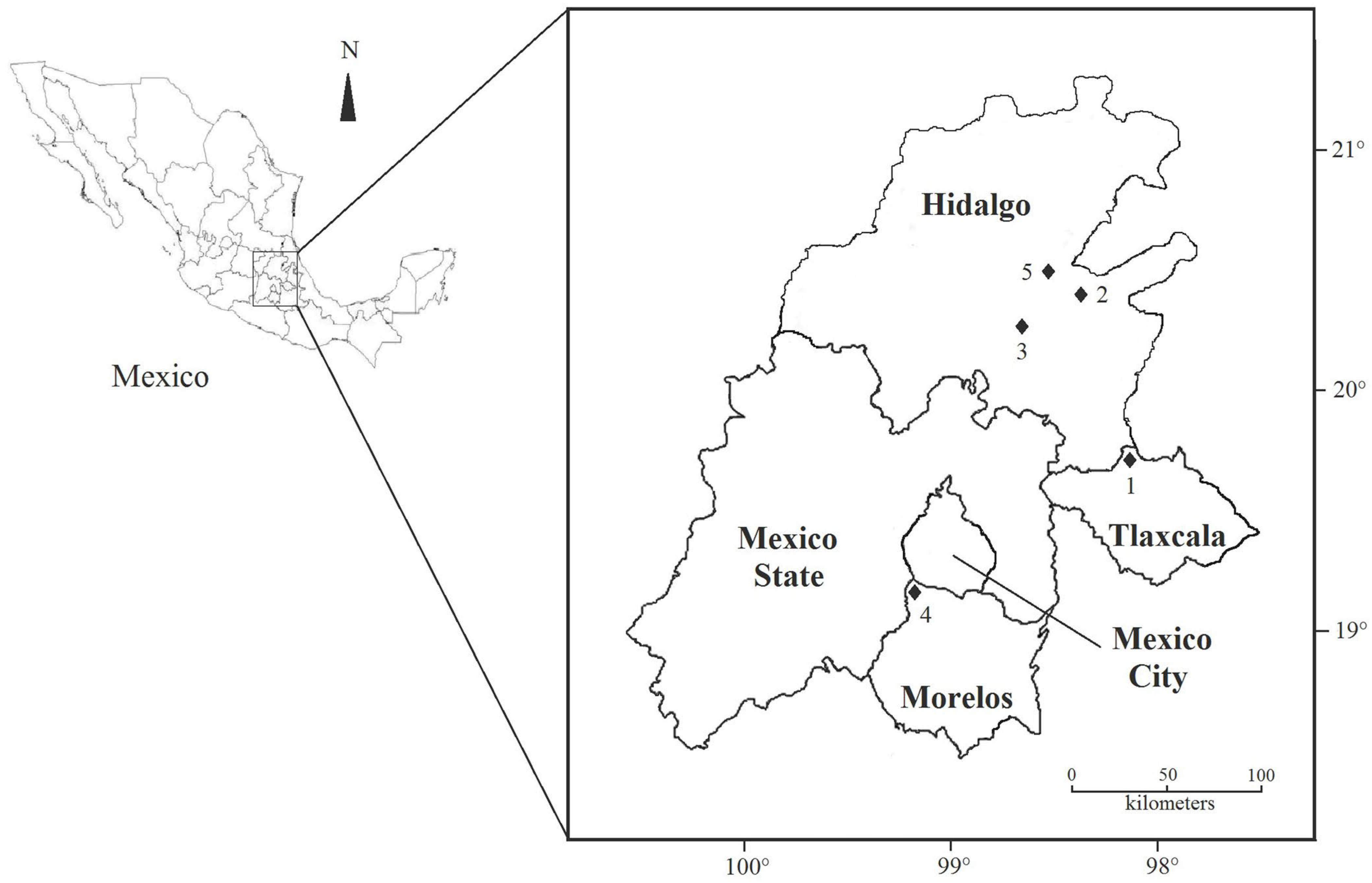
To minimize environmental site effects, we selected five localities in central Mexico within the Trans-Mexican Volcanic Belt (TVB; Figure 1) that share key characteristics. All sites share a similar geological history, as they are part of the TVB, which originated during the Quaternary-Pliocene period [21], the same climate (temperate subhumid), the same altitude (between 2318 and 2898 m), and the same vegetation developmental stage (mature oak). Also, all localities were situated in habitats associated with slopes and deep soil, as well as with highways and human settlements. One allopatric population of Q. glabrescens was chosen where this species was dominant, and no individuals of other white oak species were observed. Also, four stands where Q. glabrescens co-occurs with other white oak species were selected. Associated species to Q. glabrescens in each locality are shown in Table 1. In each locality, transects of approximately 1000 m were made. Sampling was conducted every 50 m by selecting the individual nearest to Q. glabrescens.

2.3. Molecular Data

Young leaves without visible damage were collected from 100 plants, distributed in one allopatric stand (n = 20) and four sympatric stands (20 in each stand). Leaf samples were preserved in liquid nitrogen and subsequently transported to the laboratory for DNA extraction. Genomic DNA was obtained following the protocol of the DNAeasy Plant Mini Kit (Qiagen, Valencia, CA, USA). DNA concentrations were quantified for each sample by fluorometric analysis (Eppendorf Biophotometer, Hamburg, Germany), and DNA quality was verified by electrophoresis on a 0.8% agarose gel and comparison of band intensities with lambda DNA. Finally, DNA samples were diluted to obtain a final concentration of 10 ng/µL.
A total of eighteen microsatellite loci were tested. Genetic analyses were performed using twelve highly polymorphic microsatellite loci for Q. glabrescens. We selected eight nuclear loci: ssrQpZAG110, ssrQpZAG11, ssrQrZag46, Quru-GA-0E09, Quru-GA-1F07, Quru-GA-0C11, Quru-GA-1C08, Quru-GA-0A01, and four chloroplast loci: Ccmp3, Mdt1, Mdt3, and Mdt4. Characteristics of nuclear and chloroplast microsatellite loci used in this study are described in the Supplementary Material (Table S1, [22,23,24,25,26]). The amplification mixture for each sample contained 20 mM Tris-HCl (pH 8.4), 50 mM KCl, 2 mM MgCl2, 0.13 mM of each dNTP, primer 25 μM, 15 ng of genomic DNA, and 0.8 units of Taq polymerase, in a final volume of 15 μL. The polymerase chain reaction (PCR) was conducted in a Mastercycler gradient Eppendorf AG, Hamburg, as follows: 5 min at 95 °C, followed by 30 cycles of: 1 min at 94 °C, 1 min at 50 °C, 30 s at 72 °C, and a final extension of 8 min at 72 °C. The annealing temperature was changed for different microsatellite primers: 58 °C for Quru-GA-1F07, 53 °C for ssrQpZAG110, ssrQpZAG11, and Quru-GA-0C11, 50 °C for Quru-GA-0A01, Quru-GA-0E09, and Ccmp3, 48 °C for Quru-GA-1C08 and Mdt1, 46 °C for ssrQrZag46 and Mdt3, and 44 °C for Mdt4. All primers used were 5’ labeled with fluorescein. PCR products were resolved on a 4% agarose gel at 60 W for 1.5 h. Samples were diluted with deionized water (1:10–1:90) according to the intensity of the bands observed on the agarose gel. To obtain the exact size of the microsatellite (base pairs), polymorphic fragments were analyzed by sequencing with an ABI PRISM 3100 automated sequencer (Applied Biosystems, CA, USA) using 9.5 mL of formamide (Applied Biosystems, CA, USA), 0.5 mL of GeneScan ROX 500 (Applied Bisystems, CA, USA) was used as a size standard and 1 mL of each PCR product. Allele sizes were determined using GeneMapper software version 3.7 (Applied Biosystems, Foster City, CA, USA).

2.4. Genetic Analysis

We assessed genetic variation in Q. glabrescens by analyzing allele frequencies at 12 loci (eight cpSSRs and four nSSRs) within each population. We also recorded haplotypic variation in each population, comprising combinations of four polymorphic cpSSRs. Haplotypic variation was estimated using Nei’s unbiased genetic diversity index [27], as well as the genetic diversity (Gd), mean number of alleles (A), and Shannon diversity index (H) for cpSSRs. Shannon diversity index (−Σ pi ln (pi)) [28] and gene diversity (1 − Σ pi2) [27] (where pi is the frequency of allele i, and ∑ pi2 is the sum of the squared allele frequencies). For nSSRs, we pooled all loci to obtain the mean number of alleles (A) and average expected heterozygosity (He). The analysis was performed using ARLEQUIN version 3.5 [28], POPGENE v. 3.31 [29], and TFPGA v. 2.0 [30]. Differences in genetic diversity indices (He, H, and Gd) among Q. glabrescens populations were tested using the Kruskal–Wallis analysis of variance [31].
Analysis of molecular variance (AMOVA; [28]) was employed to assess the population structure of Q. glabrescens by quantifying the partitioning of sequence variation within and among populations across all sites.
The relationships among populations were reconstructed using the UPGMA clustering method based on Nei’s [27] unbiased genetic distance in POPGENE [32,33]. The inferred tree was visualized using TREEVIEW v. 1.52 [34]. Correlation significance was assessed using bootstrapping across loci, with a 95% nominal confidence interval [28]. In addition to the hierarchical analyses, a NeighborNet network was created using Nei’s genetic distances in SplitsTree v.4 to explore possible non-hierarchical relationships among populations. This approach does not require strictly branching relationships and helps visualize conflicting phylogenetic signals in the data. It provides a useful way to detect patterns indicative of genetic connectivity or reticulation in microsatellite datasets [35].
Inbreeding coefficients (F) were estimated for Q. glabrescens using eight nuclear microsatellite loci (nSSRs) with the software INEST v.2.3 [36], which provides unbiased estimates by simultaneously accounting for the presence of null alleles and genotyping errors. Analyses were performed under the nfb model to jointly estimate inbreeding, null allele frequency, and genotyping error. The inbreeding coefficient (F) ranges from −1 to 1, where values close to zero indicate random mating, positive values indicate inbreeding (excess of homozygotes), and negative values indicate an excess of heterozygotes.
Shannon diversity (H) and genetic diversity (Gd) estimated from chloroplast markers were correlated with each other. Regression analyses were therefore performed using the H variable to evaluate the relationship between genetic diversity and the gradient of oak species occurring in association with Q. glabrescens [31]. Mean number of alleles (A) and average expected heterozygosity (He) estimated from nuclear markers were correlated with each other. Consequently, regression analyses using the He and F variables were conducted to test the relationship between genetic diversity and the oak species gradient associated with Q. glabrescens [31]. Statistical analyses were carried out using STATISTICA software ver. 8.0 [37].

3. Results

3.1. Levels of Genetic Diversity over All Populations Analyzed

The 12 SSR loci (eight cpSSRs and four nSSRs) were polymorphic in 100 individuals of Q. glabrescens. A total of 14 cpSSR alleles (five or six per locus) were identified. On the other hand, for nSSRs loci, a total of 28 alleles were found (having either eight or eleven alleles per locus). Tests of allele distribution homogeneity revealed highly significant results (p < 0.001) for all eight loci. In general, analyses based on cpSSR and nSSR markers showed that sympatric populations with a higher number of white oak species associated with Q. glabrescens had the highest values of Gd, H, and He compared with the allopatric zone (Table 2). Results of the Kruskal–Wallis analysis of variance showed significant differences in the genetic diversity index (Gd: H = 12.35, p < 0.003; H: H = 9.61, p < 0.009, and He: H = 9.39, p < 0.007) among populations of Q. glabrescens.
Estimates of genetic differentiation (FST and RST) were higher for chloroplast microsatellites (cpSSRs) than for nuclear microsatellites (nSSRs) (Table 2).

3.2. Genetic Differentiation Among Populations

The AMOVA performed under the infinite allele model (IAM) with cpSSRs revealed a statistically significant fixation index for Q. glabrescens (0.53). The majority of genetic variation was partitioned within populations (64.6%), whereas 35.4% was distributed among populations. AMOVA performed under the stepwise mutation model (SMM) revealed a statistically significant fixation index for Q. glabrescens (0.47). In contrast, the SMM showed the highest variation among Q. glabrescens populations (59.7%) (Table 2).
AMOVA conducted under the infinite allele model (IAM) using nuclear microsatellites (nSSRs) revealed a significant fixation index for Q. glabrescens (0.58). Variation was predominantly distributed within populations (90.3%), with the remaining 9.7% occurring among populations. AMOVA performed under the stepwise mutation model (SMM) revealed a statistically significant fixation index for Q. glabrescens (0.56). Results based on the SMM showed that the highest variation occurred in Q. glabrescens (78.7%). Nm estimates were about half for cpSSRs (1.4) compared with nSSRs (2.6) (Table 2).

3.3. Relationship Between Genetic Diversity in Q. glabrescens and the Gradient of Co-Occurring Oak Species

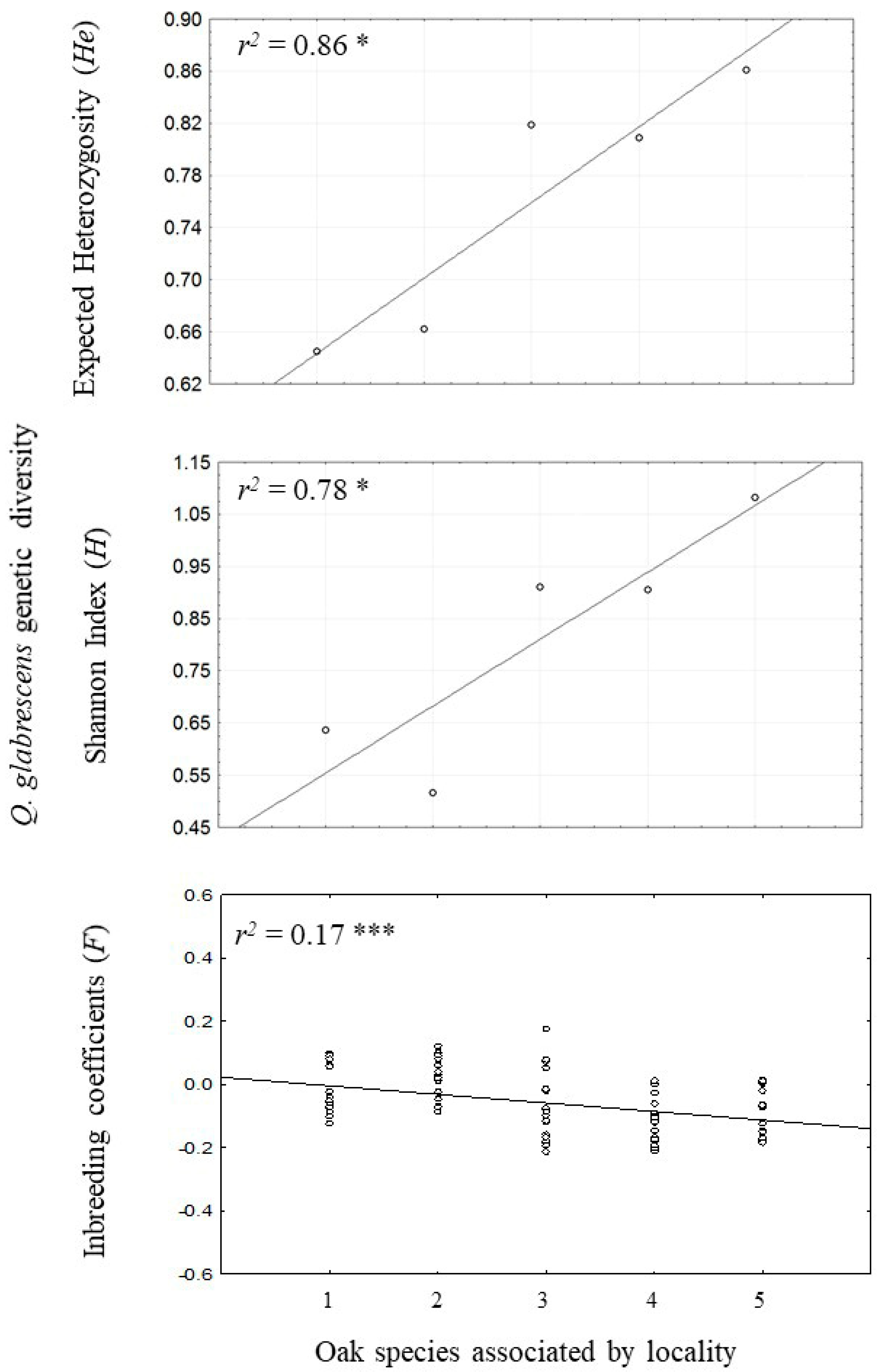
Inbreeding coefficients (F), used as a measure of individual genetic diversity, indicated that Q. glabrescens exhibits significantly higher genetic diversity in sympatric sites with greater richness of white oak species (r = −0.41, p < 0.001, r2 = 0.17). Our findings also demonstrated a significant positive relationship between genetic diversity in Q. glabrescens (H: r = 0.88, p < 0.05, r2 = 0.78; He: r = 0.93, p < 0.05, r2 = 0.86) and the richness of sympatric white oak species (Figure 2).

3.4. Population Relationships

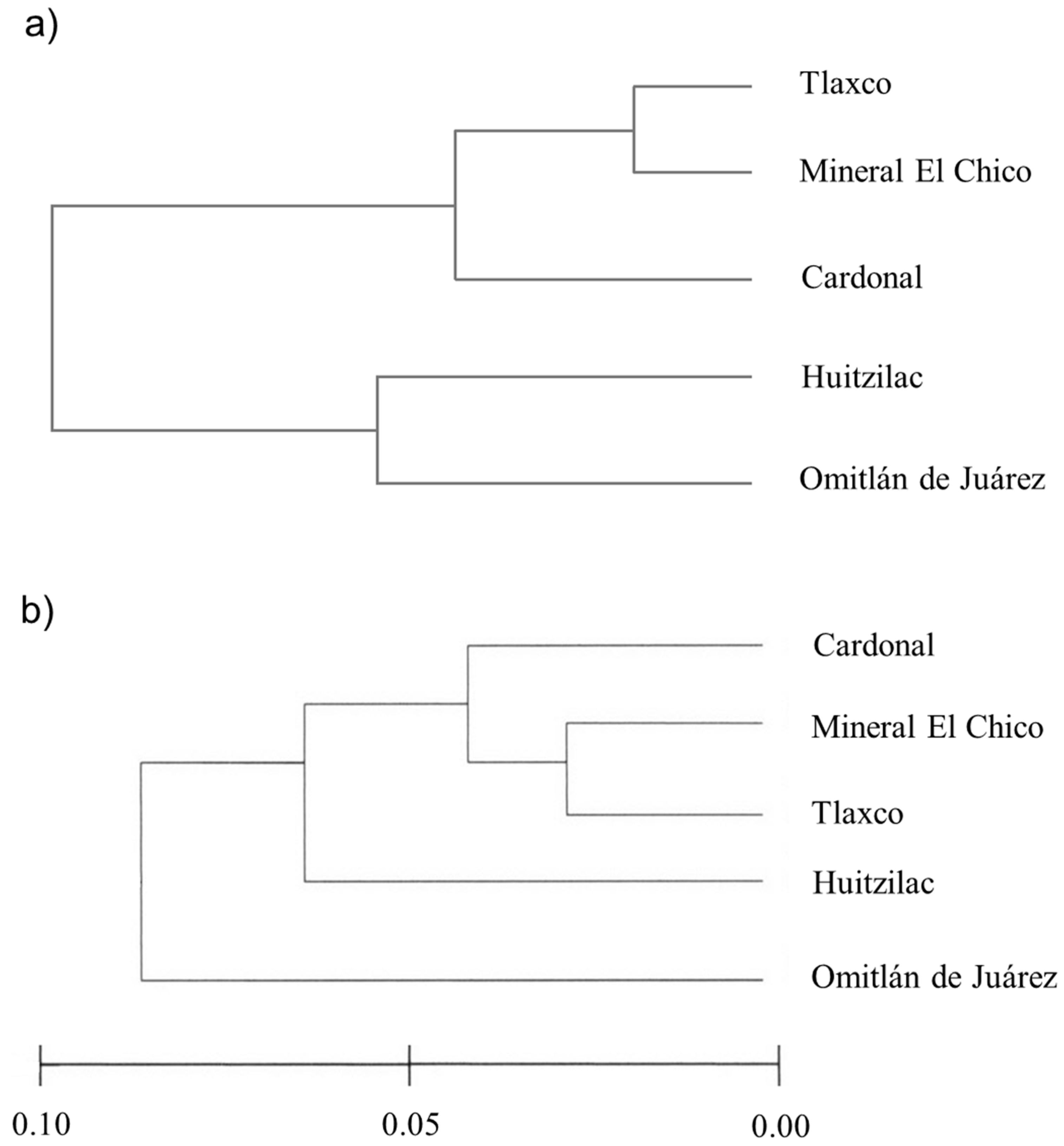
The UPGMA clustering method revealed two dendrograms (based on cpSSRs and nSSRs) which followed a very similar pattern: Two main groups can be distinguished; first, one constituted by Tlaxco (allopatric population), Mineral del Chico (a population with one associated species), and Cardonal (a population with two associated species) which are the populations with the lowest genetic diversity; and a second group, constituted by Huitzilac and Omitlán de Juárez, the populations with the highest number of associated species and therefore with the highest genetic diversity (Figure 3).
The NeighborNet analysis using Nei’s genetic distances showed a pattern similar to the UPGMA dendrograms. Two main groups were identified. The first group included Tlaxco (allopatric population), Mineral del Chico (one associated species), and Cardonal (two associated species), all of which had lower genetic diversity. The second group consisted of Huitzilac and Omitlán de Juárez, which have the most oak species associated with them and the highest genetic diversity.
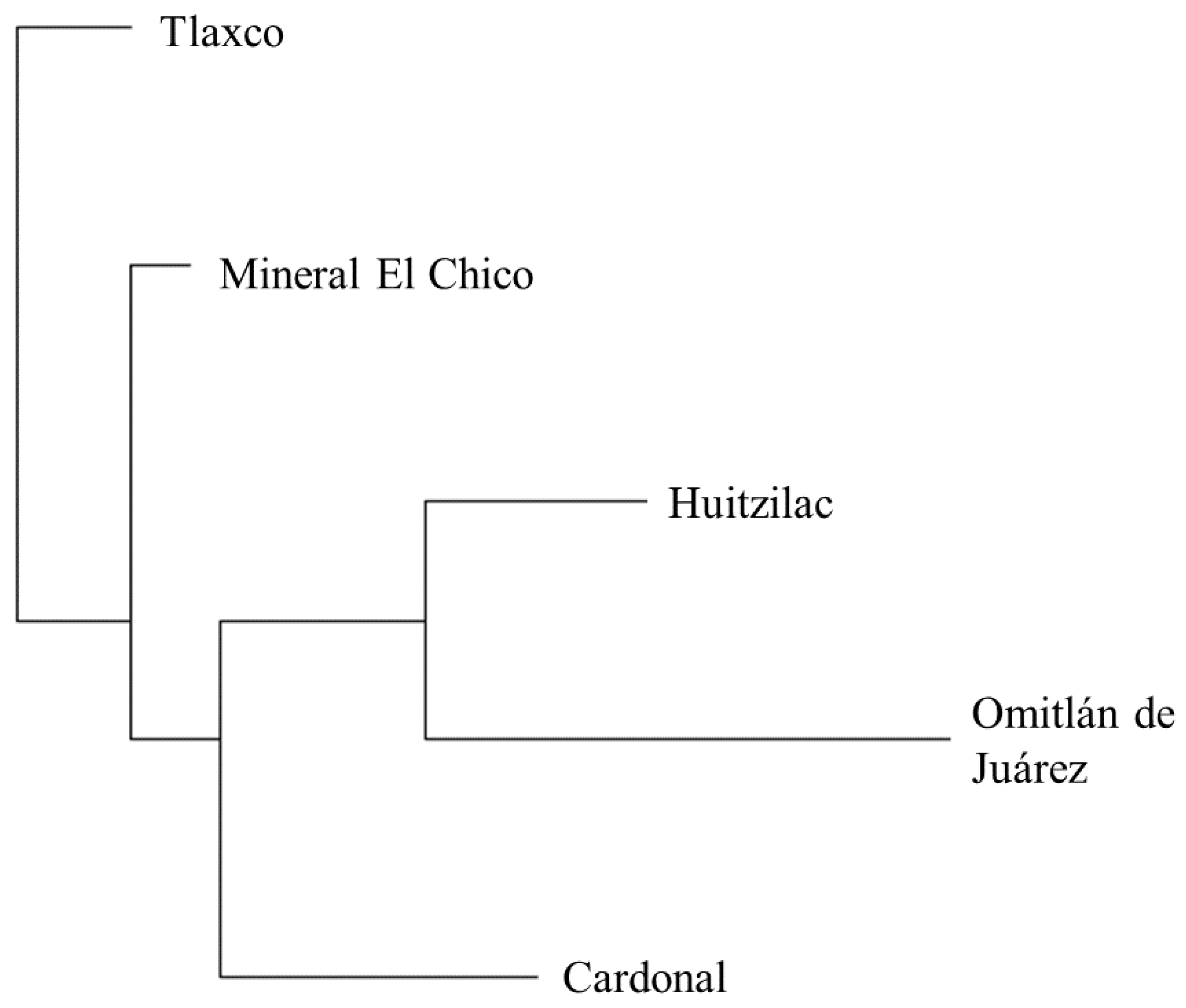
The overall topology was mostly tree-like. Sympatric populations had closer genetic relationships and were more closely connected in the network. In contrast, the allopatric population was more on the edge (Figure 4). This pattern further supports a gradient of increasing genetic connectivity associated with higher sympatric species richness.

4. Discussion

Our results support the hypothesis that increasing richness of sympatric white oak species is associated with higher genetic diversity in Q. glabrescens. This pattern was independent of both the genetic diversity parameters estimated (Gd, H, He, F) and the marker type employed (cpSSRs or nSSRs). The difference in the genetic diversity levels of the five populations analyzed was also evident with the dendrograms showing the genetic distance between populations, where populations form groups depending on the number of their associated species, in a way that Omitlán de Juárez and Huitzilac (populations with the highest genetic diversity) are mainly separated from Tlaxco and Mineral del Chico (populations with the lowest genetic diversity). Our results are consistent with the study by Valencia-Cuevas et al. [38], which documented a positive and significant relationship between the genetic diversity of Q. castanea and the number of co-occurring red oak species.
Analysis of individual genetic diversity (F) revealed considerable genotypic variation, with a statistically significant increase in heterozygous genotypes along the gradient (χ2 = 21.3, d.f. = 5, p < 0.05). The prevalence of negative F values in sites with greater species richness may be associated with a tendency toward heterozygote excess, potentially reflecting increased opportunities for interspecific gene flow and introgressive hybridization. Similar patterns have been reported in oak species complexes, where hybridization and gene flow among sympatric species contribute to genetic admixture and elevated heterozygosity [39,40]. At the population level, He, H, and Gd exhibited an increase corresponding to the number of oak-associated species. Valencia-Cuevas et al. [38] found similar results in a range of red oak species linked to Q. castanea in Mexico. Our results from this experimental design suggest that the increase in genetic diversity in sympatric populations with the highest number of associated species could be attributed to interspecific hybridization. These results are supported by hybridization studies, particularly in oaks, where it has been demonstrated that hybridization can increase the genetic diversity of hybrid populations. For example, hybridization events between Q. glabrescens × Q. rugosa, Q. glabrescens × Q. obtusata, and Q. glabrescens × Q. rugosa × Q. obtusata have been confirmed using chemical and genetic markers [17]. In our study, Q. rugosa was found in 75% of the sympatric populations analyzed (n = 3). Q. rugosa is considered the species that hybridizes with the highest number of white oaks in Mexico [17]. For example, studies have documented its hybridization with Q. laeta, Q. obtusata [41], and Q. glabrescens [17,18]. Hence, we suggest that in sympatric populations, Q. glabrescens may engage in genetic exchange, either directly or indirectly, with the four white oak species.
The study by Castillo-Mendoza et al. [17] suggests that Q. glabrescens is involved in hybridization events with Q. rugosa and Q. obtusata, two common white oak species that occur in sympatry with Q. glabrescens in TVB. Our findings align with those of Tovar-Sánchez et al. [6], Valencia-Cuevas et al. [38], and McVay et al. [14], who found that the highest genetic variation among oak species in Mexico occurs at the TVB. Interspecific hybridization, a process common among oak species in this region, may account for the origin and persistence of these levels of genetic diversity. The TVB is widely recognized as a center of oak species diversity [8]. This phenomenon is likely attributable to the region’s function as a natural bridge connecting distinct biogeographic provinces. This connectivity has enabled interactions among previously isolated species and contributed to their diversification [6,14,42,43].
On the other hand, Tovar-Sánchez et al. [6] employed cpSSR and found that hybrid populations composed of Q. crassifolia and Q. crassipes presented the highest levels of genetic diversity (Gd, 0.508–0.644; H, 0.770–1.097) compared to the allopatric populations of the parental species. Genetic diversity estimates for sympatric populations of Q. glabrescens, inferred from cpSSRs (Gd = 0.404–0.636; H = 0.517–1.083), are comparable to those reported for hybrid populations of the Q. crassifolia × Q. crassipes complex. This similarity supports the hypothesis that hybridization among oak species co-occurring with Q. glabrescens enhances chloroplast genetic diversity in sympatric populations.
The genetic structure of Q. glabrescens populations showed that the greatest variation was within populations rather than among them. This pattern is consistent regardless of the fixation index analyzed with nSSRs (FST = 0.097, RST = 0.213); however, with cpSSRs, it can be observed only with the IAM fixation index (FST = 0.354, RST = 0.597). In general, studies have shown that differentiation levels tend to be higher with the RST estimate (e.g., [6,44].
Our results for genetic differentiation using cpSSRs are similar to those reported for Mexican populations of Q. crassifolia (FST = 0.353, RST = 0.501) [6] and Q. castanea (FST = 0.663, RST = 0.735) [38]. The estimate of differentiation FST (cpSSRs) was relatively low compared to North American populations of Q. rubra (0.465) [45] and to European populations of Q. frainetto (0.457) [46]. On the other hand, the values obtained in this study were lower than those reported for European populations of Q. petraea (0.835), Q. pubescens (0.854), and Q. faginea (0.843) [46].
The elevated levels of genetic differentiation detected among European species likely reflect the extensive geographic scope of the sampling design, which encompassed 37 countries and 2623 populations. Such broad spatial coverage increases the probability of capturing historical phylogeographic structure and regional demographic discontinuities. Consistent with theoretical expectations and empirical evidence, genetic differentiation tends to increase with geographic distance, reflecting the effects of isolation-by-distance and spatially restricted gene flow [44,47]. Hence, detecting high values of the differentiation estimates makes sense through extensive analysis of species.
In general, cpSSRs showed higher levels of genetic differentiation among Q. glabrescens populations (FST = 0.354, RST = 0.597) than nSSRs (FST = 0.097, RST = 0.213). This pattern is consistent with previous studies across diverse plant taxa. For example, Petit et al. [44] analyzed 103 genera across 52 families and reported mean GST values of 0.163 for nuclear markers and 0.655 for chloroplast markers. When angiosperms were analyzed separately, a similar trend was observed (nGST = 0.184; cpGST = 0.637). Comparable results have also been reported in Quercus: Dodd et al. [48] found FST values of 0.94 for cpSSRs and 0.23 for nSSRs in Q. agrifolia, while Grivet et al. [49] reported GST values of 0.805 for cpSSRs and 0.052 for nSSRs in Q. lobata.
This pattern has traditionally been attributed to contrasting dispersal mechanisms, whereby biparentally inherited nuclear markers reflect both pollen- and seed-mediated gene flow, while maternally inherited chloroplast markers primarily track seed dispersal, which is typically more limited. However, beyond differences in dispersal, it is important to consider that cpSSRs are haploid and therefore have a reduced effective population size (Ne) relative to diploid nuclear markers. From a theoretical perspective, this results in inherently higher fixation indices under comparable migration rates (FST ≈ 1/(1 + 4Nem) for diploid markers vs. FST ≈ 1/(1 + 2Nem) for haploid markers [50]. Consequently, the higher levels of genetic differentiation observed for cpSSRs are not solely due to restricted seed dispersal but also reflect the stronger influence of genetic drift associated with their smaller effective population size [44,51]. This combined effect highlights the need for caution when directly comparing differentiation estimates derived from organellar and nuclear markers.
This hypothesis can be further explored by estimating the mean number of migrants per generation (Nm), which was higher for nSSRs (2.6) than for cpSSRs (1.4). Although Nm is an indirect parameter derived from genetic differentiation and assumes equilibrium between drift and migration, it can still provide a useful approximation of historical connectivity among populations. In this context, the Nm values obtained for Q. glabrescens based on nDNA are broadly consistent with previous studies reporting relatively high levels of gene flow in oaks, largely mediated by wind-dispersed pollen [49,52,53]. For instance, Ducousso et al. [52] compared multiple oak species and found that Nm values based on nuclear markers ranged from 1 to 27 among populations within species, with values around 2.5 among species, which is comparable to the estimate obtained in this study (Nm = 2.6).
Nevertheless, these estimates should be interpreted with caution, as Nm reflects long-term historical gene flow rather than contemporary dispersal, and relies on simplifying assumptions that may not hold in natural populations. While relatively high Nm values are generally consistent with the potential for substantial pollen-mediated connectivity in Quercus, they do not necessarily imply ongoing gene flow at similar rates. Moreover, theoretical thresholds such as Nm > 1, often cited as sufficient to counteract genetic drift, are based on idealized models and should not be applied uncritically to natural populations [54]. Therefore, the observed patterns of genetic differentiation likely reflect a combination of historical gene flow, life-history traits, and demographic processes, rather than direct estimates of current migration rates.
The results from both UPGMA dendrograms (cpSSRs and nSSRs) and NeighborNet analysis show a consistent genetic structure in Q. glabrescens populations across different levels of sympatric species richness. In both methods, populations with fewer associated white oak species (Tlaxco, Mineral del Chico, and Cardonal) were clearly separated from those with more sympatric species (Huitzilac and Omitlán de Juárez), which also had higher genetic diversity. This suggests that having more species living together is linked to greater genetic connectivity among populations.
The mostly tree-like structure of the NeighborNet indicates few conflicting signals, suggesting the population relationships are mainly hierarchical. The closer grouping of sympatric populations aligns with expectations for greater gene flow, which is common in Quercus because weak reproductive barriers and widespread pollen dispersal encourage genetic exchange between species [55,56]. On the other hand, the allopatric population is more isolated, reflecting lower connectivity and lower genetic diversity.
In summary, these results support the idea that living alongside multiple oak species may help gene flow and shape genetic diversity in Q. glabrescens. However, because only a small number of microsatellite loci were studied, these findings should be interpreted as evidence of increased genetic connectivity rather than direct proof of introgressive hybridization [57,58].
Our findings corroborate the notion that oaks’ life-history characteristics promote extensive gene flow, thereby contributing to comparatively low levels of population differentiation and elevated genetic diversity within populations [7].
It is important to emphasize that assessing the genetic structure and diversity of Q. glabrescens along a gradient of co-occurring oak species may provide critical insights for the development of effective genetic resource conservation strategies. Genetic diversity constitutes the fundamental level of biodiversity [1] and represents the primary substrate upon which natural selection operates, thereby sustaining evolutionary potential [2].
In particular, the analysis of the genetic structure of foundation species, such as oaks (characterized by abundance, distribution across different environments, and associations with fauna and flora), provides important information about an ecosystem [59]. The aforementioned can be explained by the fact that genetic expression that causes interactions with other species extends beyond populations, producing phenotypes of communities or ecosystems [59].
Plant hybrid zones have been shown to be centers of biodiversity where evolutionary and ecological processes occur [60,61], thus their conservation is indispensable. Being the genus Quercus, recognized for frequent hybridization, it represents a system capable of generating information on its implications for species evolution, community structure, and conservation strategies, among others. Due to its association with multiple species, Q. glabrescens represents a unique model for deeper analysis of the effects of hybridization on the diversity and genetic structure of its populations. The number of studies on plant hybridization has recently increased; however, there remains a lack of studies evaluating multispecies hybridization phenomena (syngameon). Therefore, it is necessary to conduct more detailed studies to demonstrate more accurately the levels of hybridization between Q. glabrescens and other white oak-associated species.
Finally, it is necessary to consider that generating information on hybridization processes is essential to achieving recognition of these phenomena as natural components of ecosystems. This study demonstrates that sympatric sites of white oak species promote increased genetic diversity. Hence, if conservation studies seek to protect biodiversity, it is essential to include these kinds of environments in conservation programs.

5. Conclusions

The results indicate that sympatric populations of Quercus glabrescens exhibit significantly higher levels of genetic diversity (Gd, H, and He) than the allopatric population analyzed. This pattern was observed across both nuclear and chloroplast microsatellite markers, suggesting that species coexistence is a key factor influencing the genetic structure of this oak species.
Chloroplast microsatellites showed greater genetic differentiation than nuclear microsatellites, underscoring the distinct inheritance patterns and dispersal mechanisms of cytoplasmic and biparentally inherited markers. These findings indicate that seed-mediated gene flow is likely more spatially limited than pollen-mediated gene flow in Q. glabrescens, resulting in stronger population structure at the chloroplast genome level.
A positive and significant relationship was observed between the genetic diversity of Q. glabrescens and the number of white oak species occurring in sympatry. This finding supports the hypothesis that greater species richness within white oak assemblages enhances the genetic diversity of Q. glabrescens, likely through introgressive hybridization and interspecific gene flow.
The results suggest that the diversity of co-occurring white oak species is a significant ecological and evolutionary driver of genetic diversity in Q. glabrescens. Therefore, species richness within sympatric oak communities can serve as an indicator of genetic variability and guide conservation strategies. Conservation assessments of Q. glabrescens should include the diversity of associated oak species as a critical factor when evaluating its genetic conservation status and establishing management priorities.

Supplementary Materials

The following supporting information can be downloaded at: https://www.mdpi.com/article/10.3390/f17040408/s1, Table S1: Characteristics of nuclear and chloroplast microsatellite loci used in this study.

Author Contributions

Conceptualization, E.T.-S.; Data curation, K.S.-O. and S.V.-A.; Formal analysis, E.T.-S.; Investigation, K.S.-O.; Methodology, K.S.-O. and E.T.-S.; Supervision, E.T.-S.; Validation, K.S.-O., S.V.-A. and E.T.-S.; Writing—original draft, K.S.-O. and E.T.-S.; Writing—review and editing, K.S.-O., S.V.-A. and E.T.-S. All authors have read and agreed to the published version of the manuscript.

Funding

This research received no external funding.

Data Availability Statement

Data is contained within the article.

Acknowledgments

The authors thank Mauricio Mora-Jarvio and Guillermo Sánchez for their help with field collections and Laura Marquez for technical assistance.

Conflicts of Interest

The authors declare no conflicts of interest.

References

  1. Hoban, S.; Bruford, M.; D’Urban Jackson, J.; Lopes-Fernandes, M.; Heuertz, M.; Hohenlohe, P.A.; Paz-Vinas, I.; Sjögren-Gulve, P.; Segelbacher, G.; Vernesi, C. Genetic diversity targets and indicators in the CBD post-2020 global biodiversity framework must be improved. Biol. Conserv. 2020, 248, 108654. [Google Scholar] [CrossRef]
  2. Teixeira, J.C.; Huber, C.D. The inflated significance of neutral genetic diversity in conservation genetics. Trends Ecol. Evol. 2021, 36, 704–712. [Google Scholar] [CrossRef]
  3. Reed, D.H.; Frankham, R. Correlation between fitness and genetic diversity. Conserv. Biol. 2003, 17, 230–237. [Google Scholar] [CrossRef]
  4. Kardos, M.; Armstrong, E.E.; Fitzpatrick, S.W.; Hauser, S.; Hedrick, P.W.; Miller, J.M.; Tallmon, D.A.; Funk, W.C. The crucial role of genome-wide genetic variation in conservation. Proc. Natl. Acad. Sci. USA 2021, 118, e2104642118. [Google Scholar] [CrossRef]
  5. Taylor, S.A.; Larson, E.L. Insights from genomes into the evolutionary importance and prevalence of hybridization in nature. Nat. Ecol. Evol. 2019, 3, 170–177. [Google Scholar] [CrossRef]
  6. Tovar-Sánchez, E.; Mussali-Galante, P.; Esteban-Jiménez, R.; Piñero, D.; Arias, D.M.; Dorado, O.; Oyama, K. Chloroplast DNA polymorphism reveals geographic structure and introgression in the Quercus crassifolia × Quercus crassipes hybrid complex in Mexico. Botany 2008, 86, 228–239. [Google Scholar] [CrossRef]
  7. Leroy, T.; Louvet, J.M.; Lalanne, C.; Le Provost, G.; Labadie, K.; Aury, J.M.; Delzon, S.; Plomion, C.; Kremer, A. Adaptive introgression as a driver of local adaptation to climate in European white oaks. New Phytol. 2020, 226, 1171–1182. [Google Scholar] [CrossRef]
  8. Nixon, K.C. The genus Quercus in Mexico. In Biological Diversity of Mexico: Origins and Distribution; Nixon, K.C., Ed.; Oxford University Press: New York, NY, USA, 1993; pp. 447–458. [Google Scholar]
  9. Kremer, A.; Hipp, A.L. Oaks: An evolutionary success story. New Phytol. 2020, 226, 987–1011. [Google Scholar] [CrossRef]
  10. Hipp, A.L.; Manos, P.S.; González-Rodríguez, A.; Hahn, M.; Kaproth, M.; McVay, J.D.; Cavender-Bares, J. Genomic landscape of the global oak phylogeny. New Phytol. 2020, 226, 1198–1212. [Google Scholar] [CrossRef]
  11. Muir, G.; Fleming, C.C.; Schlötterer, C. Species status of hybridizing oaks. Nature 2000, 405, 1016. [Google Scholar] [CrossRef]
  12. Valencia, S. Diversidad del género Quercus (Fagaceae) en México. Bol. Soc. Bot. Mex. 2004, 75, 33–53. [Google Scholar] [CrossRef]
  13. González-Rodríguez, A.; Arias, D.M.; Oyama, K.; Stone, G.N. Range expansion and lineage diversification of Mexican white oaks: A phylogeographic perspective. Mol. Ecol. 2013, 22, 4339–4356. [Google Scholar] [CrossRef]
  14. McVay, J.D.; Hipp, A.L.; Manos, P.S.; González-Rodríguez, A. A genetic legacy of introgression confounds phylogeny and biogeography in oaks. Proc. R. Soc. B 2017, 284, 20170300. [Google Scholar] [CrossRef]
  15. CONABIO. Capital Natural de México, Vol. II: Estado de Conservación y Tendencias de Cambio; Comisión Nacional para el Conocimiento y Uso de la Biodiversidad: Mexico City, Mexico, 2009. [Google Scholar]
  16. Zavala-Chávez, F. Identificación de Encinos de México, 2nd ed.; Universidad Autónoma de Chapingo: Texcoco, México, 2003. [Google Scholar]
  17. Castillo-Mendoza, E.; Salinas-Sánchez, D.; Valencia-Cuevas, L.; Zamilpa, A.; Tovar-Sánchez, E. Natural hybridisation among Quercus glabrescens, Q. rugosa and Q. obtusata (Fagaceae): Microsatellites and secondary metabolites markers. Plant Biol. 2019, 21, 110–121. [Google Scholar] [CrossRef]
  18. Núñez-Castillo, S.M.; Álvarez-Moctezuma, J.G.; Zavala-Chávez, F.; Espinoza-Robles, P. Morfología y comportamiento meiótico en el híbrido natural Quercus glabrescens × Quercus rugosa (Fagaceae). Rev. Chapingo Ser. Cienc. For. Amb. 2010, 16, 171–177. [Google Scholar] [CrossRef]
  19. Mejía, D.N.; Meave, A.; Ruíz-Jiménez, C. Análisis estructural de un bosque mesófilo de montaña en el extremo oriental de la Sierra Madre del Sur (Oaxaca), México. Bol. Soc. Bot. Mex. 2004, 74, 13–29. [Google Scholar]
  20. Martínez, G.; Cruz, M.D.R.; Castrejón, R.S.; Valencia, A.J.; Jiménez, R.; Ruíz-Jiménez, C. Flora vascular de la porción guerrerense de la Sierra de Taxco, Guerrero, México. An. Inst. Biol. UNAM Ser. Bot. 2004, 75, 105–189. [Google Scholar]
  21. Ferrusquía-Villafranca, I. Geología de México: Una sinopsis. In Diversidad Biológica de México: Orígenes y Distribución; Ramamoorthy, T.P., Bye, R., Lot, A., Fa, J., Eds.; Instituto de Biología, UNAM: Ciudad de México, México, 1998; pp. 3–108. [Google Scholar]
  22. Steinkellner, H.; Fluch, S.; Turetschek, E.; Lexer, C.; Streiff, R.; Kremer, A.; Burg, K.; Glössl, J. Identification and characterization of (GA/CT)n-microsatellite loci from Quercus petraea. Plant Mol. Biol. 1997, 33, 1093–1096. [Google Scholar] [CrossRef] [PubMed]
  23. Kampfer, S.; Lexer, C.; Glössl, J.; Steinkellner, H. Characterization of (GA)n microsatellite loci from Quercus robur. Mol. Ecol. 1998, 7, 357. [Google Scholar] [CrossRef]
  24. Aldrich, P.R.; Michler, C.H.; Sun, W.; Romero-Severson, J. Microsatellite markers for northern red oak (Quercus rubra). Mol. Ecol. Notes 2002, 2, 472–474. [Google Scholar] [CrossRef]
  25. Weising, K.; Gardner, R.C. A set of conserved PCR primers for the analysis of simple sequence repeat polymorphisms in chloroplast genomes of dicotyledonous angiosperms. Genome 1999, 42, 9–19. [Google Scholar] [CrossRef] [PubMed]
  26. Deguilloux, M.F.; Pemonge, M.H.; Petit, R.J. Novel perspectives in wood certification and forensics: Dry wood as a source of DNA. Proc. R. Soc. B 2003, 270, 1039–1046. [Google Scholar] [CrossRef]
  27. Nei, M. Molecular Evolutionary Genetics; Columbia University Press: New York, NY, USA, 1989. [Google Scholar]
  28. Excoffier, L.; Lischer, H.E.L. Arlequin suite ver 3.5: A new series of programs to perform population genetics analyses under Linux and Windows. Mol. Ecol. Resour. 2010, 10, 564–567. [Google Scholar] [CrossRef]
  29. Yeh, F.C.; Yang, R.C.; Boyle, T. POPGENE Version 1.32: Microsoft Windows-Based Freeware for Population Genetic Analysis; University of Alberta: Edmonton, AB, Canada, 1999. [Google Scholar]
  30. Miller, M.P. Tools for Population Genetic Analyses (TFPGA), Version 1.3; Department of Biological Sciences, Northern Arizona University: Flagstaff, AZ, USA, 2002. [Google Scholar]
  31. Zar, J.H. Biostatistical Analysis, 5th ed.; Prentice Hall: Upper Saddle River, NJ, USA, 2010. [Google Scholar]
  32. Sneath, P.H.A.; Sokal, R.R. Numerical Taxonomy: The Principles and Practice of Numerical Classification; W.H. Freeman: San Francisco, CA, USA, 1973. [Google Scholar]
  33. Swofford, D.L.; Olsen, G.J. Phylogeny reconstruction. In Molecular Systematics; Hillis, D.M., Moritz, C., Eds.; Sinauer Associates: Sunderland, MA, USA, 1990; pp. 411–501. [Google Scholar]
  34. Page, R.D.M. TreeView: An application to display phylogenetic trees on personal computers. Comput. Appl. Biosci. 1996, 12, 357–358. [Google Scholar]
  35. Huson, D.H.; Bryant, D. Application of phylogenetic networks in evolutionary studies. Mol. Biol. Evol. 2006, 23, 254–267. [Google Scholar] [CrossRef]
  36. Chybicki, I.J.; Burczyk, J. Simultaneous estimation of null alleles and inbreeding coefficients. J. Hered. 2009, 100, 106–113. [Google Scholar] [CrossRef]
  37. StatSoft, Inc. STATISTICA (Data Analysis Software System), Version 8.0; StatSoft, Inc.: Tulsa, OK, USA, 1998. [Google Scholar]
  38. Valencia-Cuevas, L.; Piñero, D.; Mussali-Galante, P.; Valencia-Ávalos, S.; Tovar-Sánchez, E. Effect of a red oak species gradient on genetic structure and diversity of Quercus castanea (Fagaceae) in Mexico. Tree Genet. Genomes 2014, 10, 641–652. [Google Scholar] [CrossRef]
  39. Valbuena-Carabaña, M.; González-Martínez, S.C.; Sork, V.L.; Collada, C.; Soto, Á.; Goicoechea, P.G.; Gil, L. Gene flow and hybridization in a mixed oak forest (Quercus pyrenaica and Quercus petraea). Heredity 2005, 95, 457–465. [Google Scholar] [CrossRef] [PubMed]
  40. Curtu, A.L.; Gailing, O.; Finkeldey, R. Evidence for hybridization and introgression within a species-rich oak (Quercus spp.) community. BMC Evol. Biol. 2007, 7, 218. [Google Scholar] [CrossRef] [PubMed]
  41. Trehane, P. Quercus: The Genus Quercus; Royal Botanic Gardens, Kew: Richmond, UK, 2011. [Google Scholar]
  42. González-Rodríguez, A.; Arias, D.M.; Valencia, S.; Oyama, K. Morphological and RAPD analysis of hybridization between Quercus laurina and Quercus affinis (Fagaceae), two Mexican red oaks. Am. J. Bot. 2004, 91, 401–409. [Google Scholar] [PubMed]
  43. Peñaloza-Ramírez, J.M.; González-Rodríguez, A.; Mendoza-Cuenca, L.; Caron, H.; Kremer, A.; Oyama, K. Interspecific gene flow in a multispecies oak hybrid zone in the Sierra Tarahumara of Mexico. Ann. Bot. 2010, 105, 389–399. [Google Scholar] [CrossRef]
  44. Petit, R.J.; Fineschi, S.; Hampe, A.; Salvini, D.; Vendramin, G.G. Comparative organization of chloroplast, mitochondrial and nuclear diversity in plant populations. Mol. Ecol. 2005, 14, 689–701. [Google Scholar] [CrossRef]
  45. Magni, C.R.; Ducousso, A.; Caron, H.; Petit, R.J.; Kremer, A. Chloroplast DNA variation of Quercus rubra L. in North America and comparison with other Fagaceae. Mol. Ecol. 2005, 14, 513–524. [Google Scholar] [CrossRef]
  46. Petit, R.J.; Csaikl, U.; Bordács, S.; Burg, K.; Coart, E.; Cottrell, J.; Van Dam, B.; Deans, J.; Dumolin-Lapègue, S.; Fineschi, S.; et al. Chloroplast DNA variation in European white oaks: Phylogeography and patterns of diversity based on data from over 2600 populations. For. Ecol. Manag. 2002, 156, 5–26. [Google Scholar] [CrossRef]
  47. Dumolin-Lapègue, S.; Demesure, B.; Fineschi, S.; Le Corre, V.; Petit, R.J. Phylogeographic structure of white oaks throughout the European continent. Genetics 1997, 146, 1475–1487. [Google Scholar] [CrossRef]
  48. Dodd, R.S.; Afzal-Rafii, Z.; Mayer, W. Molecular markers show how pollen and seed dispersal affect population genetic structure in Coast Live Oak (Quercus agrifolia Née). In Proceedings of the Sixth Symposium on Oak Woodlands: Today’s Challenges, Tomorrow’s Opportunities; Standiford, R.B., Ed.; Pacific Southwest Research Station, Forest Service, U.S. Department of Agriculture: Albany, CA, USA, 2008; pp. 485–495. [Google Scholar]
  49. Grivet, D.; Sork, V.L.; Westfall, R.D.; Davis, F.W. Conserving the evolutionary potential of California valley oak (Quercus lobata Née): A multivariate approach to conservation planning. Mol. Ecol. 2008, 17, 139–156. [Google Scholar] [CrossRef] [PubMed]
  50. Birky, C.W.; Maruyama, T.; Fuerst, P. An approach to population and evolutionary genetic theory for genes in mitochondria and chloroplasts. Genetics 1983, 103, 513–527. [Google Scholar] [CrossRef] [PubMed]
  51. Ennos, R.A. Estimating the relative rates of pollen and seed migration among plant populations. Heredity 1994, 72, 250–259. [Google Scholar] [CrossRef]
  52. Ducousso, A.; Michaud, H.; Lumaret, R. Reproduction and gene flow in the genus Quercus L. Ann. Sci. For. 1993, 50, 91–106. [Google Scholar] [CrossRef]
  53. Sork, V.L.; Smouse, P.E.; Grivet, D. Gene flow in forest trees: Implications for conservation and management. Ann. Bot. 2002, 90, 193–206. [Google Scholar]
  54. Lowe, A.J.; Allendorf, F.W. What can genetics tell us about population connectivity? Mol. Ecol. 2010, 19, 3038–3051. [Google Scholar] [CrossRef] [PubMed]
  55. Petit, R.J.; Bodenes, C.; Ducousso, A.; Roussel, G.; Kremer, A. Hybridization as a mechanism of invasion in oaks. New Phytol. 2003, 161, 151–164. [Google Scholar] [CrossRef]
  56. Kremer, A.; Dupouey, J.L.; Deans, J.D.; Cottrell, J.; Csaikl, U.M.; Finkeldey, R.; Espinel, S.; Jensen, J.; Kleinschmit, J.; Van Dam, B.; et al. Leaf morphological differentiation between Quercus robur and Q. petraea is stable across western European mixed oak stands. Ann. For. Sci. 2002, 59, 777–787. [Google Scholar] [CrossRef]
  57. Lexer, C.; Fay, M.F.; Joseph, J.A.; Nica, M.S.; Heinze, B. Barrier to gene flow between two ecologically divergent Populus species, P. alba and P. tremula. Mol. Ecol. 2005, 14, 1045–1057. [Google Scholar]
  58. Abbott, R.; Albach, D.; Ansell, S.; Arntzen, J.W.; Baird, S.J.E.; Bierne, N.; Boughman, J.; Brelsford, A.; Buerkle, C.A.; Buggs, R.; et al. Hybridization and speciation. J. Evol. Biol. 2013, 26, 229–246. [Google Scholar] [CrossRef]
  59. Whitham, T.G.; Bailey, J.K.; Schweitzer, J.A.; Shuster, S.M.; Bangert, R.K.; LeRoy, C.J.; Lonsdorf, E.V.; Allan, G.J.; DiFazio, S.P.; Potts, B.M.; et al. A framework for community and ecosystem genetics: From genes to ecosystems. Nat. Rev. Genet. 2006, 7, 510–523. [Google Scholar] [CrossRef]
  60. Whitham, T.G.; Martinsen, G.D.; Floate, K.D.; Dungey, H.S.; Potts, B.M.; Keim, P. Plant hybrid zones affect biodiversity: Tools for a genetic-based understanding of community structure. Ecology 1999, 80, 416–428. [Google Scholar] [CrossRef]
  61. Tovar-Sánchez, E.; Oyama, K. Community structure of canopy arthropods associated to Quercus crassifolia × Quercus crassipes complex. Oikos 2006, 112, 70–381. [Google Scholar] [CrossRef]
Figure 1. Sampled populations of Quercus glabrecens. Populations are represented by numbers: 1 = Tlaxco, Tlaxcala (allopatric); 2 = Mineral del Chico, Hidalgo (sympatric); 3 = Cardonal, Hidalgo (sympatric); 4 = Huitzilac, Morelos (sympatric); 5 = Omitlán de Juárez, Hidalgo (sympatric).
Forests 17 00408 g001
Figure 2. Relationship between genetic diversity of Quercus glabrescens (He, H, and F) and a gradient of associated oak species. Populations are represented by numbers depending on the number of white oak species in sympatry: 1 = Q. glabrescens; 2 = Q. glabrescens and Q. obtusata; 3 = Q. glabrescens, Q. obtusata, and Q. rugosa; 4 = Q. glabrescens, Q. obtusata, Q. rugosa, and Q. laeta; 5 = Q. glabrescens, Q. obtusata, Q. rugosa, Q. laeta, and Q. potosina. * = p < 0.05, *** = p < 0.001.
Forests 17 00408 g002
Figure 3. Dendrogram of similarity based on SSR data in five populations of Quercus glabrescens in Mexico. (a) based on chloroplast microsatellites, (b) based on nuclear microsatellites.
Forests 17 00408 g003
Figure 4. UPGMA dendrogram based on Nei’s unbiased genetic distance showing the genetic relationships among five populations of Quercus glabrescens in Mexico inferred from nuclear microsatellites.
Forests 17 00408 g004
Table 1. Sampling locality, state, geographic coordinates, elevation, distribution pattern, and richness of white oak species associated with Quercus glabrescens in Mexico.
LocalityStateLatitude—LongitudeAltitude (m)Distribucion PatternOak Species
TlaxcoTlaxcala19°41′46′′–98°04′54′′2588AllopatricQ. glabrescens
Mineral El ChicoHidalgo20°12′52′′–98°43′14′′2580SympatricQ. glabrescens, Q. obtusata
CardonalHidalgo20°11′40′′–98°44′32′′2898SympatricQ. glabrescens, Q. obtusata, Q. rugosa
HuitzilacMorelos19°00′39′′–99°15′14′′2318SympatricQ. glabrescens, Q. obtusata, Q. rugosa, Q. laeta
Omitlán de JuárezHidalgo20°09′44′′–98°39′15′′2522SympatricQ. glabrescens, Q. obtusata, Q. rugosa, Q. laeta. Q. potosina
Table 2. Population genetic diversity and structure inferred from cpDNA and nDNA markers in five Mexican populations of Quercus glabrescens.
IAMSMM
PopulationNNo. loci HeNmFSTRST
nSSR
Tlaxco208 0.6452.61
Mineral del Chico208 0.6621.69
Cardonal208 0.8193.27
Huitzilac208 0.8092.36
Omitlán de Juárez208 0.8612.89
Mean 2.5640.097 *0.213 *
cpSSR
IAMSMM
PopulationNNo. loci HGdNmFSTRST
Tlaxco204 0.6360.4231.19
Mineral del Chico204 0.5170.4041.09
Cardonal204 0.9110.5311.15
Huitzilac204 0.9050.6322.03
Omitlán de Juárez204 1.0830.6361.37
Mean 1.3660.354 *0.597 *
Note: N, number of individuals; He, expected heterozygosity; Nm, migrant estimate; H, Shannon index; Gd, genetic diversity; RST and FST, genetic differentiation; IAM, Infinite Allele Model; SMM, Stepwise Mutation Model. * = p < 0.05.
Disclaimer/Publisher’s Note: The statements, opinions and data contained in all publications are solely those of the individual author(s) and contributor(s) and not of MDPI and/or the editor(s). MDPI and/or the editor(s) disclaim responsibility for any injury to people or property resulting from any ideas, methods, instructions or products referred to in the content.