Identification of Cypress Bark Beetle-Infested Cypress Based on LiDAR and RGB Imagery

 ,
,
Abstract
1. Introduction
2. Study Area and Data
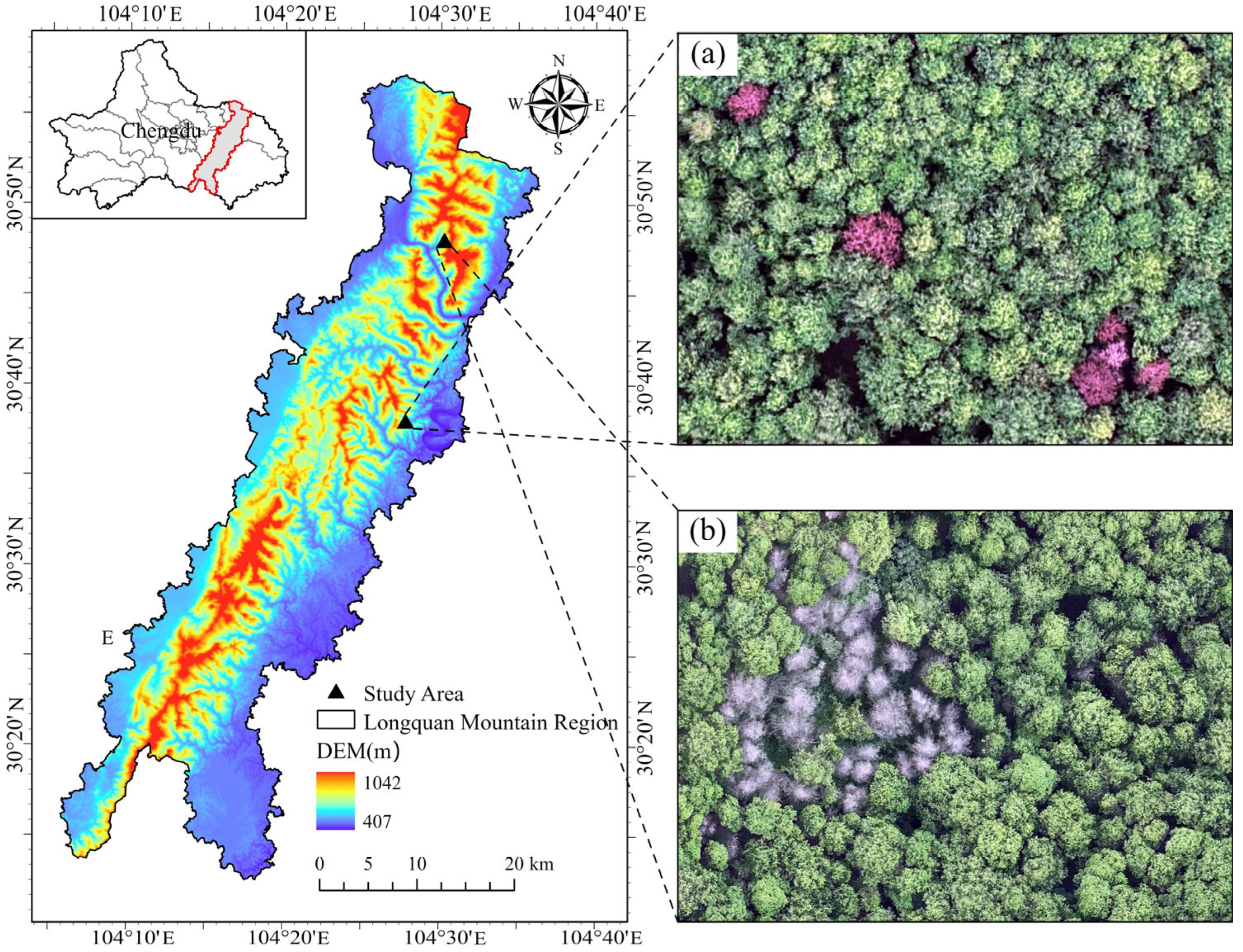
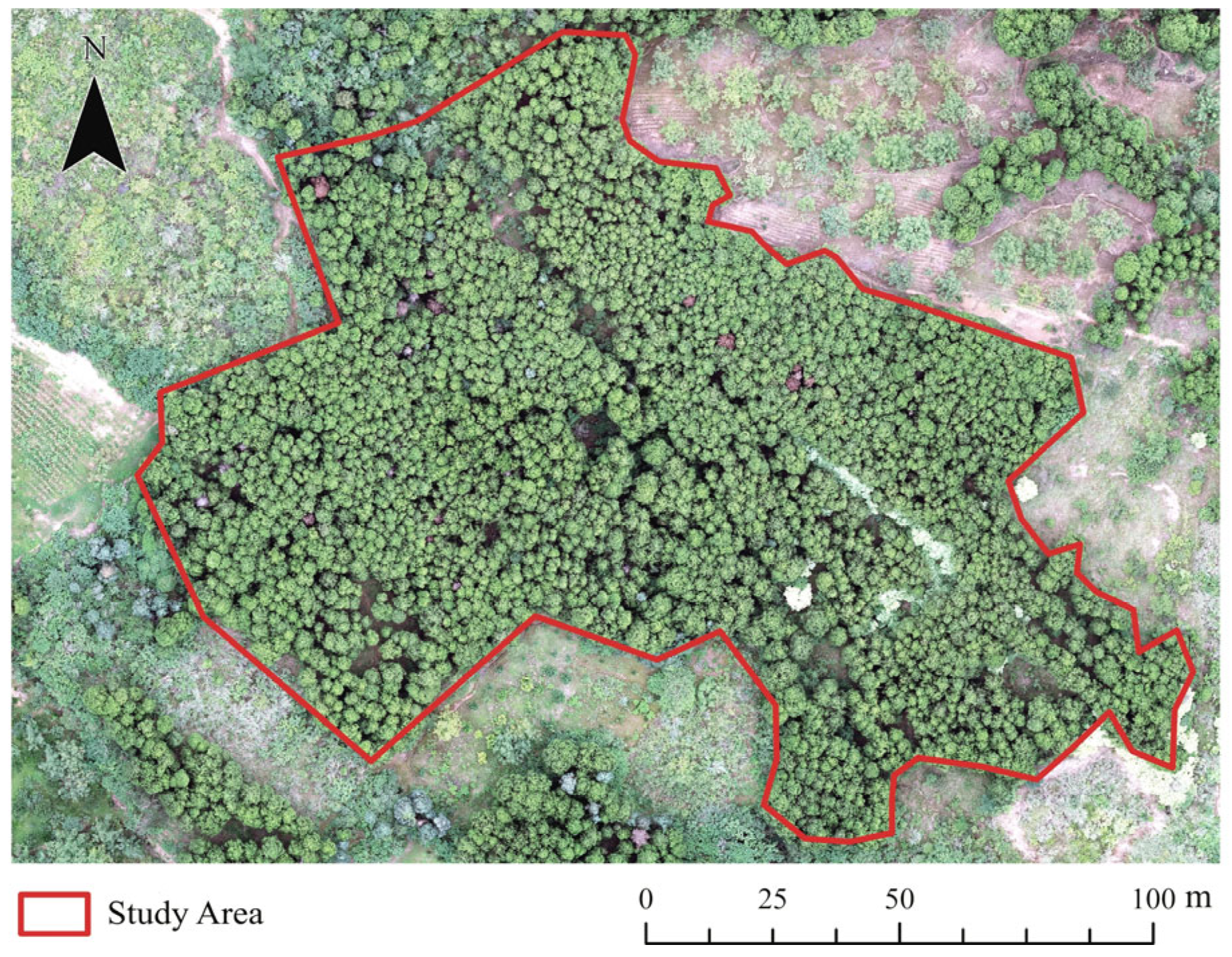
2.1. Study Area
2.2. Data Acquisition
2.2.1. Aircraft LiDAR Data
2.2.2. UAV RGB Imagery
3. Methods
3.1. Individual Tree Segmentation Algorithm
3.2. Evaluation Indices for Individual Tree Segmentation
3.3. Identification of the Infested Tree
3.4. Estimation of the Infestation Rate on Stand Level
4. Results
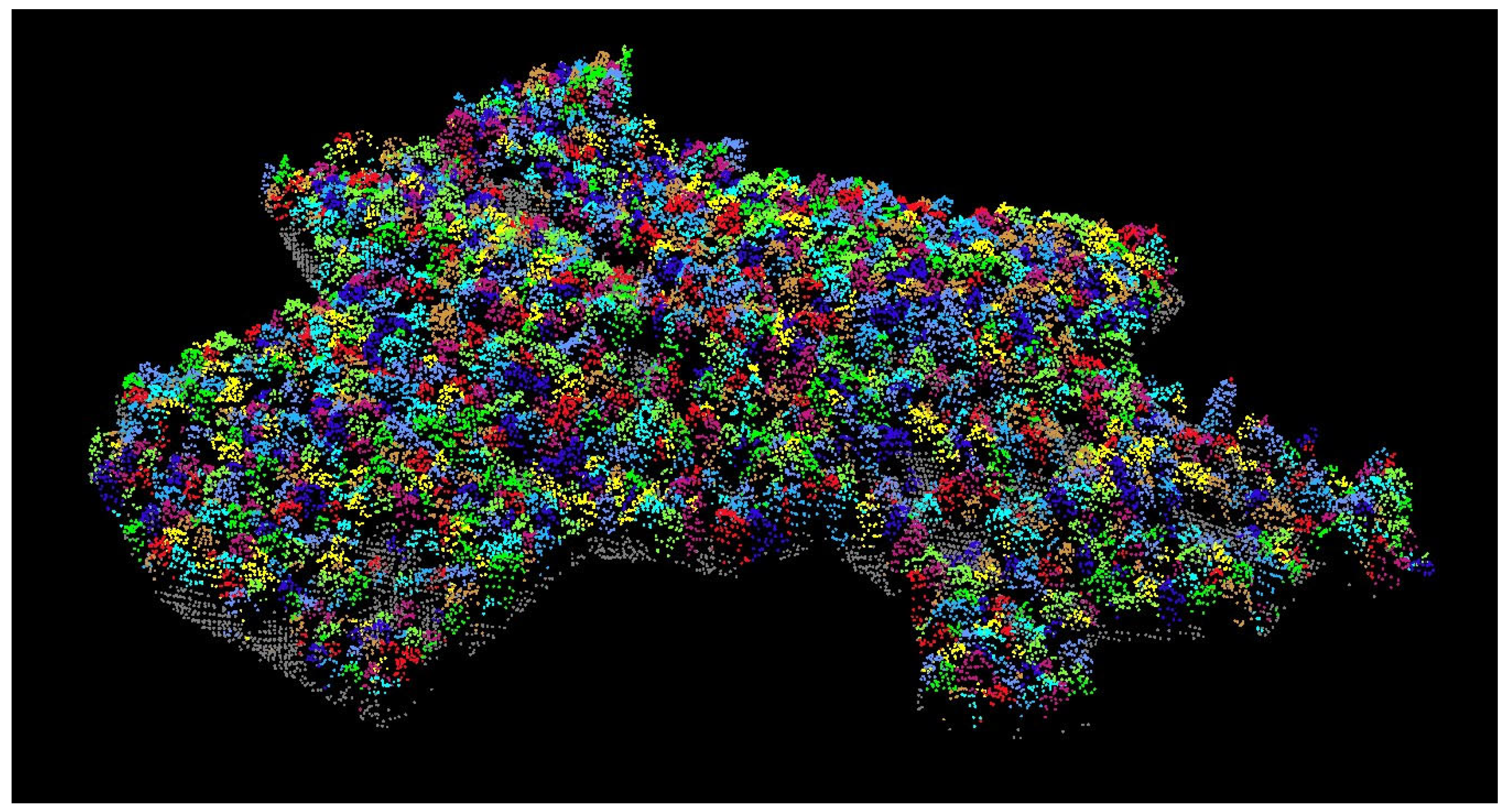
4.1. Results and Accuracy Assessment of Individual Tree Segmentation
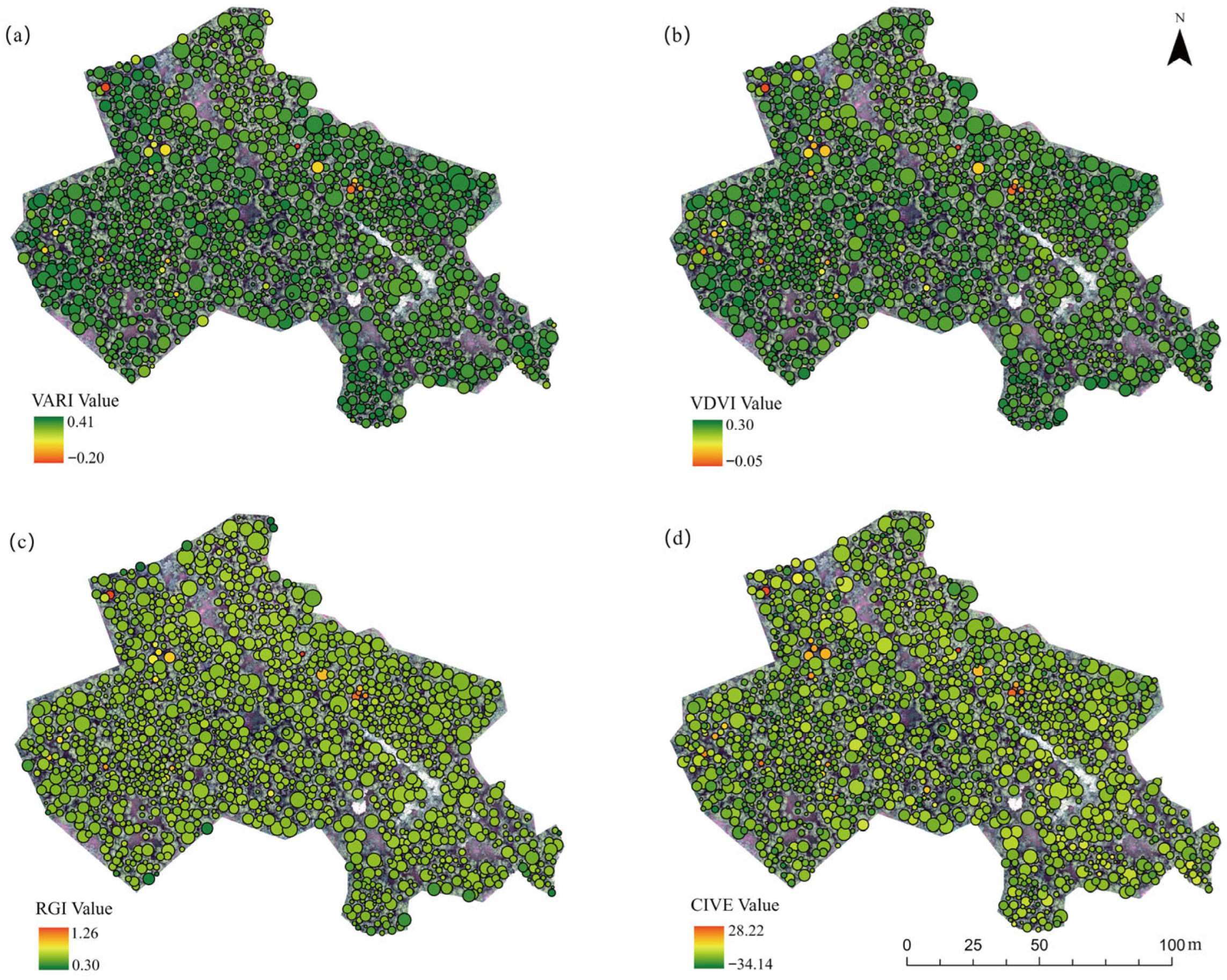
4.2. Extraction of Infested Trees from Different VIs
4.3. Threshold Segmentation for Infested Trees
4.4. Estimation of Infestation Rate
5. Discussion
5.1. The Reliability of the RGI Index
5.2. The Reliability of the Thresholding
5.3. Uncertainties and Prospects
6. Conclusions
- (1)
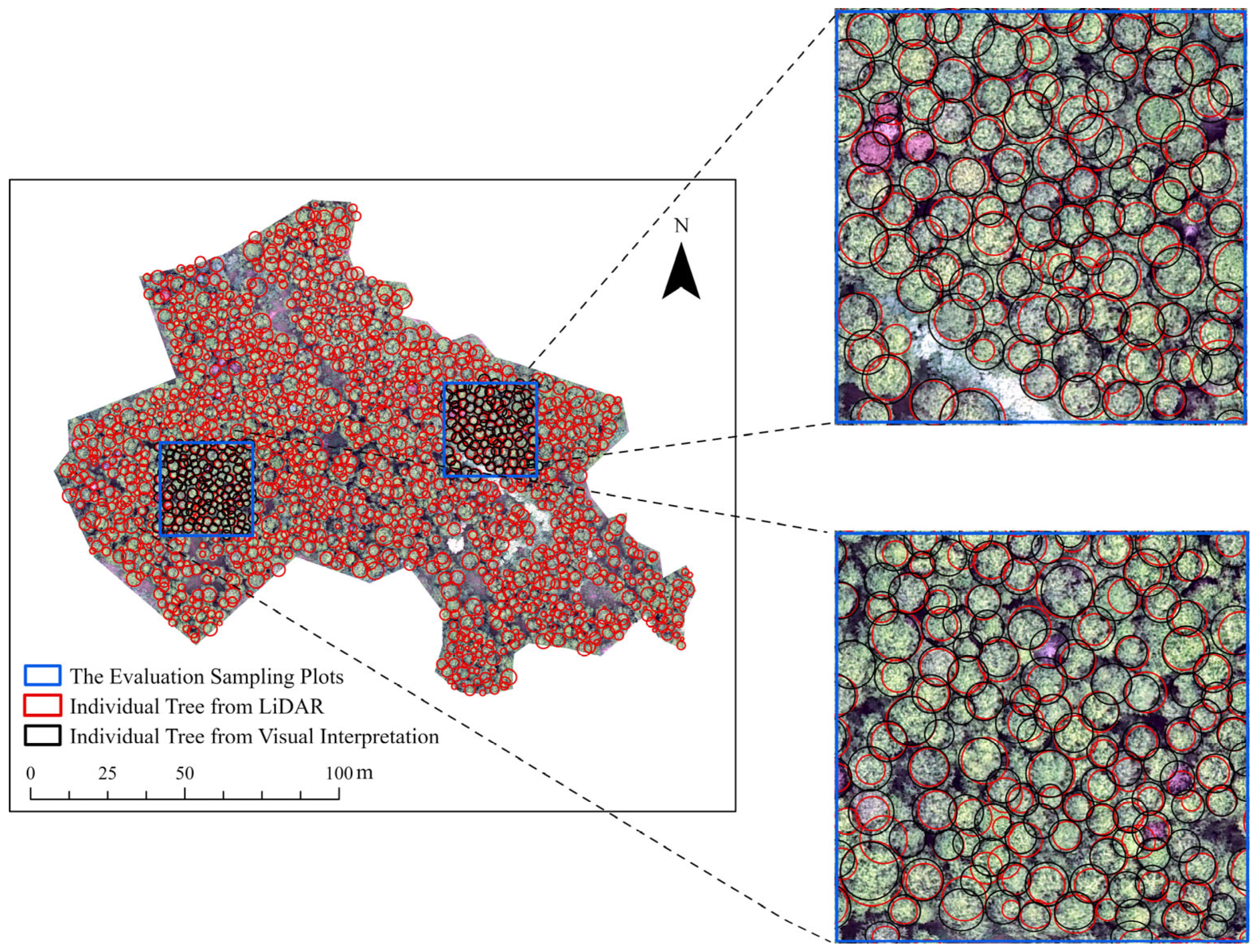
- A total of 1368 individual trees were identified using the LiDAR point cloud data and LSS method. Visual interpretation based on RGB imagery verified that the individual tree segmentation achieved a Precision of 82.51%, a Recall of 80.00%, and an F1-score of 81.24%, demonstrating that this method enables reliable automatic identification at the single-tree scale.
- (2)
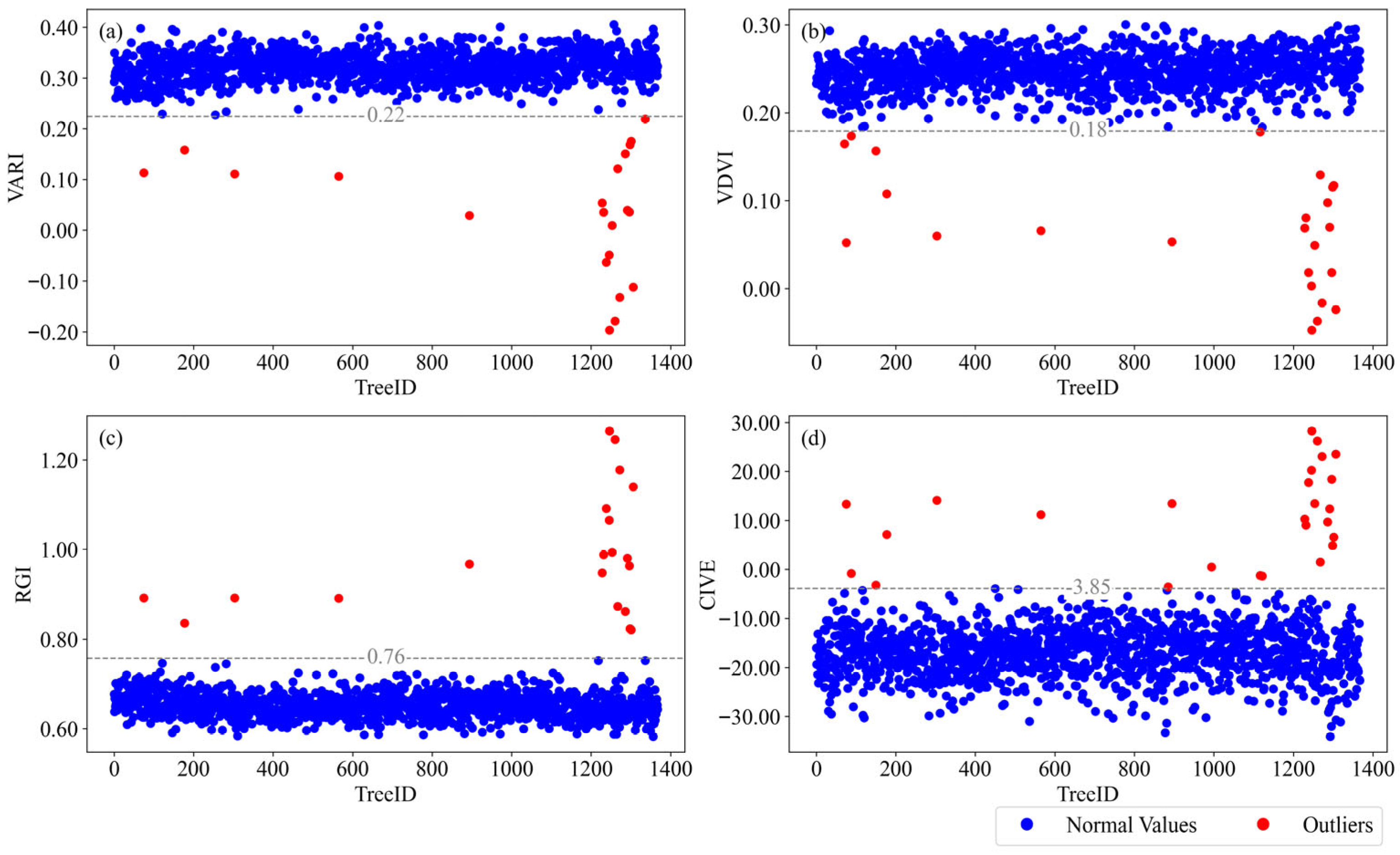
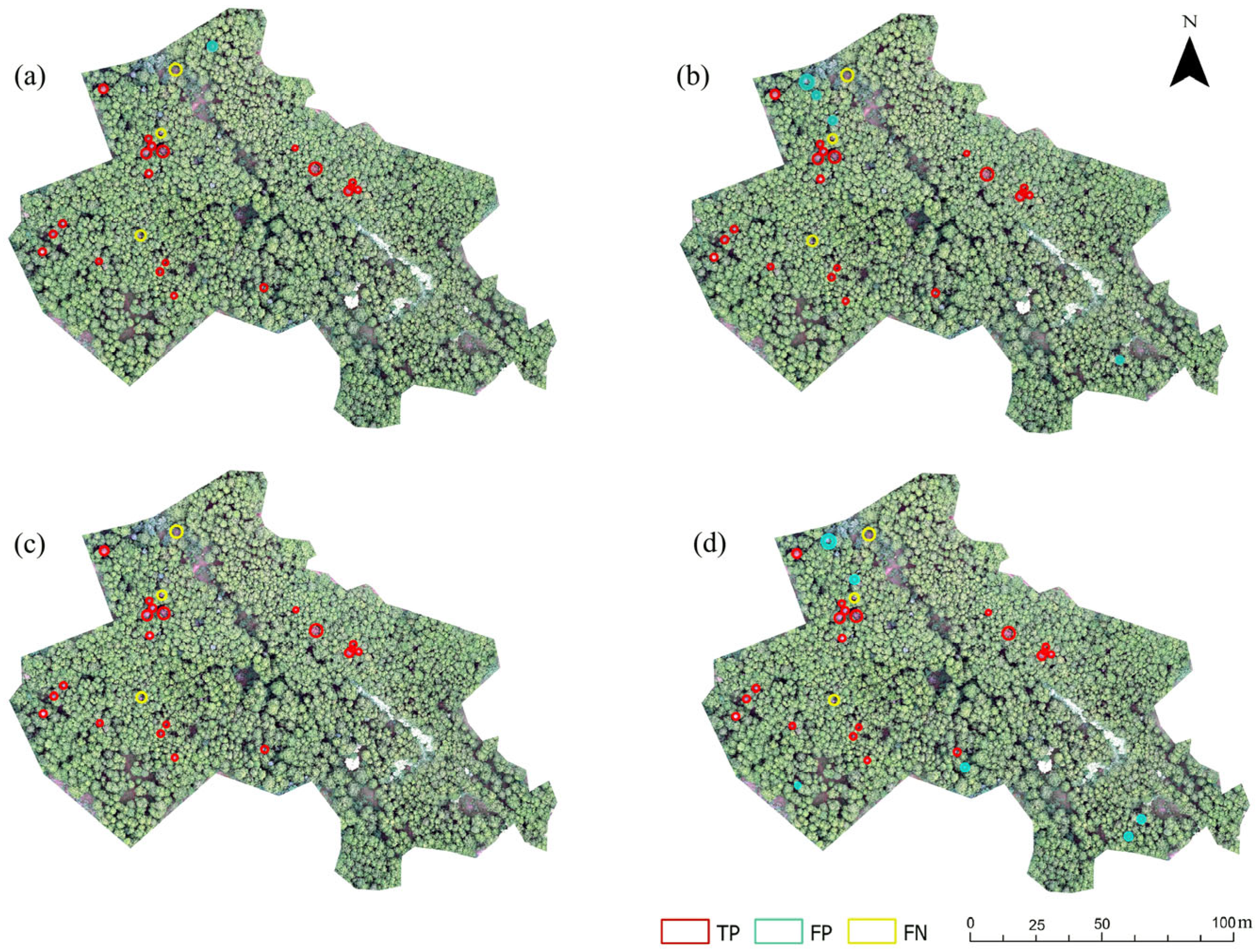
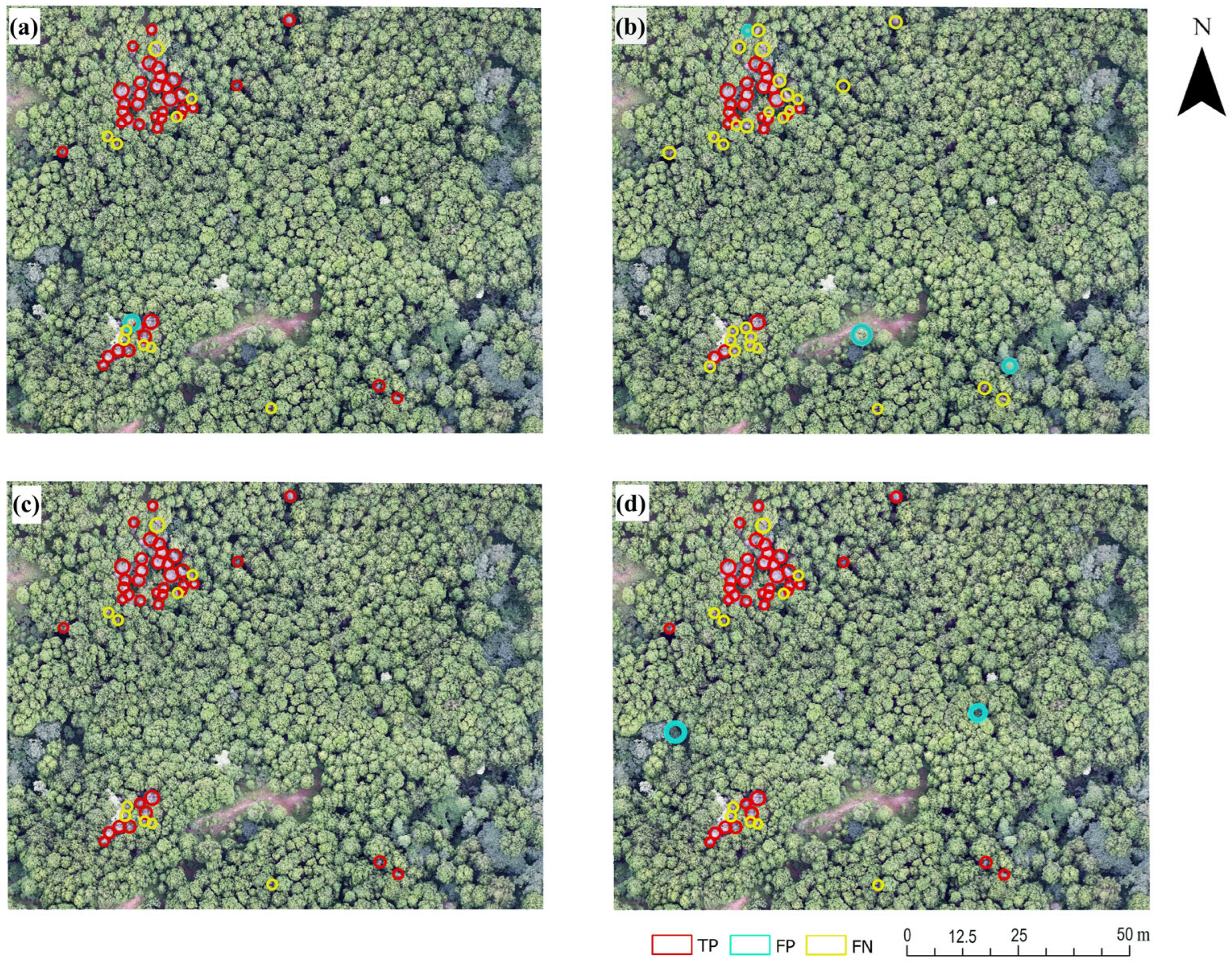
- Four VIs (VARI, VDVI, RGI, and CIVE) were used to identify infested trees at the red attack phase using a μ ± 2σ threshold. Among them, RGI showed the best performance, achieving 100% Precision, 86.96% Recall, and an F1-score of 93.02%.
- (3)
- Based on the RGI index, a total of 20 insect-infested trees were identified, accounting for 1.46% of the cypress stand. The proposed method enables rapid and reliable monitoring of insect-infested trees, offering a critical tool for safeguarding forest health and advancing sustainable forest management.
- (4)
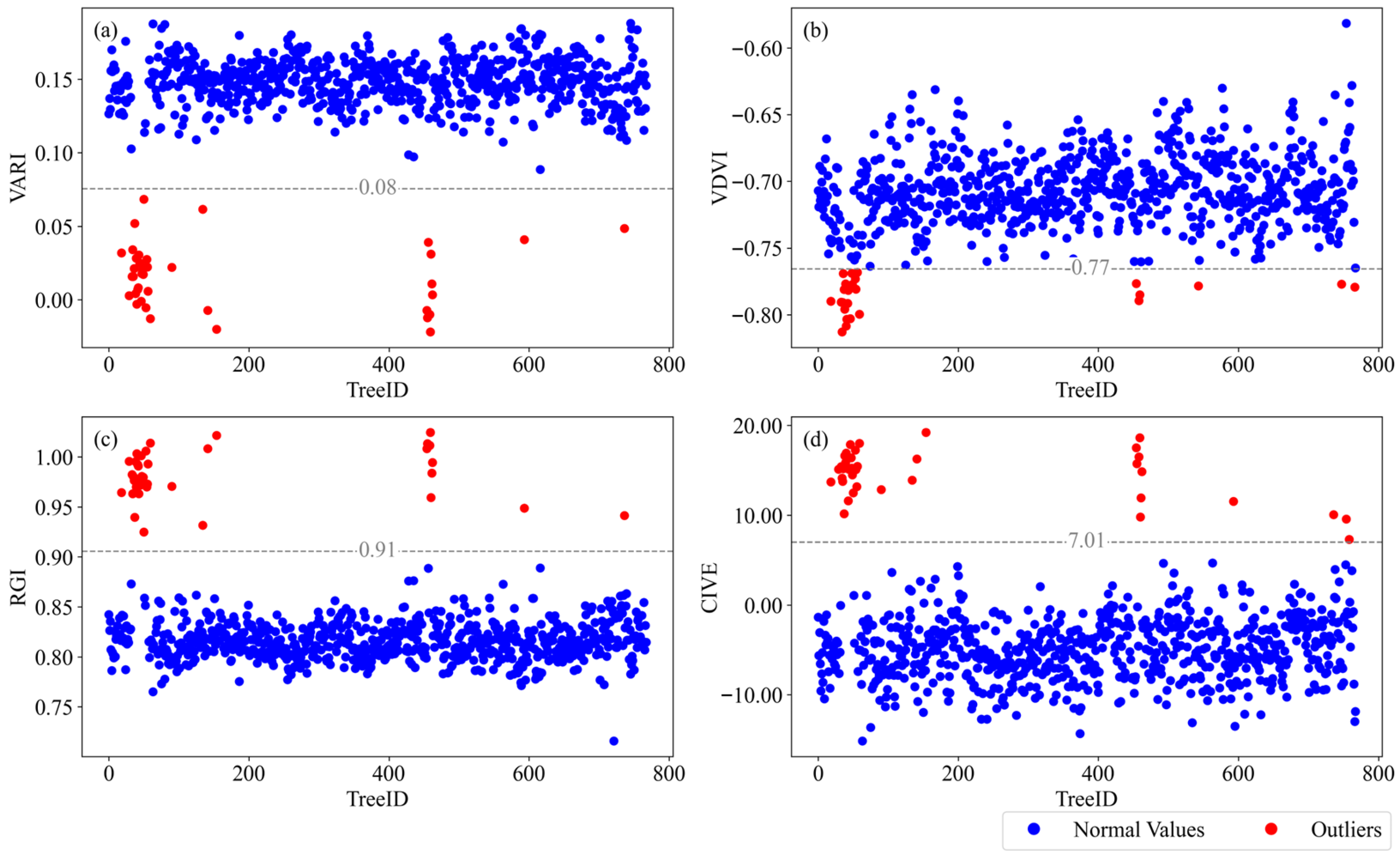
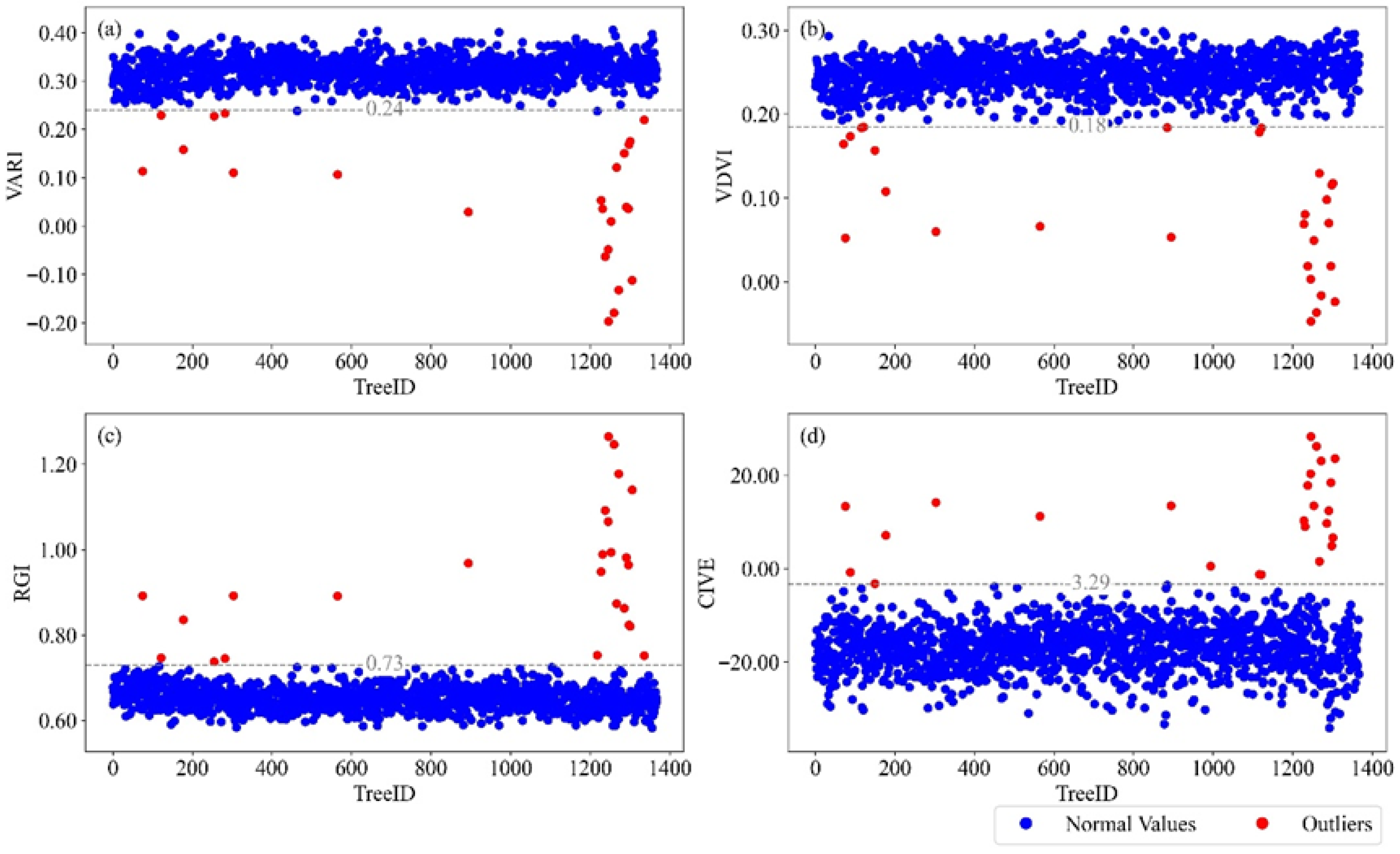
- In the supplementary experiment focusing on the gray attack stage, RGI again demonstrated superior performance compared with the other indices, confirming its robustness across two infestation phases. In addition, the μ ± 2σ thresholding approach showed better performance than the IQR-based method, indicating its methodological advantage within the proposed framework.
Author Contributions
Funding
Data Availability Statement
Acknowledgments
Conflicts of Interest
References
- Ratnadass, A.; Fernandes, P.; Avelino, J.; Habib, R. Plant species diversity for sustainable management of crop pests and diseases in agroecosystems: A review. Agron. Sustain. Dev. 2012, 32, 273–303. [Google Scholar] [CrossRef]
- Law, B.E.; Moomaw, W.R.; Hudiburg, T.W.; Schlesinger, W.H.; Sterman, J.D.; Woodwell, G.M. Creating strategic reserves to protect forest carbon and reduce biodiversity losses in the United States. Land 2022, 11, 721. [Google Scholar] [CrossRef]
- Rahaman, Z.A.; Kafy, A.-A.; Saha, M.; Rahim, A.A.; Almulhim, A.I.; Rahaman, S.N.; Fattah, M.A.; Rahman, M.T.; Kalaivani, S.; Abdullah-Al-Faisal, A.; et al. Assessing the impacts of vegetation cover loss on surface temperature, urban heat island and carbon emission in Penang city, Malaysia. Build. Environ. 2022, 222, 109335. [Google Scholar] [CrossRef]
- Houghton, R. Aboveground forest biomass and the global carbon balance. Glob. Change Biol. 2005, 11, 945–958. [Google Scholar] [CrossRef]
- Aydin, M.B.S.; Çukur, D. Maintaining the carbon–oxygen balance in residential areas: A method proposal for land use planning. Urban For. Urban Green. 2012, 11, 87–94. [Google Scholar] [CrossRef]
- Edburg, S.L.; Hicke, J.A.; Brooks, P.D.; Pendall, E.G.; Ewers, B.E.; Norton, U.; Gochis, D.; Gutmann, E.D.; Meddens, A.J. Cascading impacts of bark beetle-caused tree mortality on coupled biogeophysical and biogeochemical processes. Front. Ecol. Environ. 2012, 10, 416–424. [Google Scholar] [CrossRef]
- Hlásny, T.; König, L.; Krokene, P.; Lindner, M.; Montagné-Huck, C.; Müller, J.; Qin, H.; Raffa, K.F.; Schelhaas, M.-J.; Svoboda, M. Bark beetle outbreaks in Europe: State of knowledge and ways forward for management. Curr. For. Rep. 2021, 7, 138–165. [Google Scholar] [CrossRef]
- Oberle, B.; Ogle, K.; Zanne, A.E.; Woodall, C.W. When a tree falls: Controls on wood decay predict standing dead tree fall and new risks in changing forests. PLoS ONE 2018, 13, e0196712. [Google Scholar] [CrossRef]
- Huang, W.J.; Zhang, J.C.; Huang, L.S.; Dong, Y.Y.; Zhao, J.L.; Yuan, L.; Liu, L.Y.; Ma, H.Q.; Ruan, C. Progress of vegetation pest and disease monitoring and forecasting. Natl. Remote Sens. Bull. 2025, 29, 2065–2082. (In Chinese) [Google Scholar] [CrossRef]
- Russell, M.B.; Fraver, S.; Aakala, T.; Gove, J.H.; Woodall, C.W.; D’Amato, A.W.; Ducey, M.J. Quantifying carbon stores and decomposition in dead wood: A review. For. Ecol. Manag. 2015, 350, 107–128. [Google Scholar] [CrossRef]
- Larson, A.J.; Lutz, J.A.; Donato, D.C.; Freund, J.A.; Swanson, M.E.; HilleRisLambers, J.; Sprugel, D.G.; Franklin, J.F. Spatial aspects of tree mortality strongly differ between young and old-growth forests. Ecology 2015, 96, 2855–2861. [Google Scholar] [CrossRef] [PubMed]
- Ren, S.Q.; He, K.M.; Girshick, R.; Sun, J. Faster R-CNN: Towards real-time object detection with region proposal networks. IEEE Trans. Pattern Anal. Mach. Intell. 2015, 39, 1137–1149. [Google Scholar] [CrossRef] [PubMed]
- Goldbergs, G.; Upenieks, E.M. Hierarchical integration of UAS and Sentinel-2 imagery for spruce bark beetle grey-attack detection by vegetation index thresholding approach. Forests 2024, 15, 644. [Google Scholar] [CrossRef]
- Coops, N.C.; Johnson, M.; Wulder, M.A.; White, J.C. Assessment of QuickBird high spatial resolution imagery to detect red attack damage due to mountain pine beetle infestation. Remote Sens. Environ. 2006, 103, 67–80. [Google Scholar] [CrossRef]
- Spruce, J.P.; Hicke, J.A.; Hargrove, W.W.; Grulke, N.E.; Meddens, A.J. Use of MODIS NDVI products to map tree mortality levels in forests affected by mountain pine beetle outbreaks. Forests 2019, 10, 811. [Google Scholar] [CrossRef]
- Campos-Vargas, C.; Sanchez-Azofeifa, A.; Laakso, K.; Marzahn, P. Unmanned aerial system and machine learning techniques help to detect dead woody components in a tropical dry forest. Forests 2020, 11, 827. [Google Scholar] [CrossRef]
- Safonova, A.; Hamad, Y.; Alekhina, A.; Kaplun, D. Detection of Norway spruce trees (Picea abies) infested by bark beetle in UAV images using YOLOs architectures. IEEE Access 2022, 10, 10384–10392. [Google Scholar] [CrossRef]
- Xie, W.; Wang, H.; Liu, W.; Zang, H. Early-stage pine wilt disease detection via multi-feature fusion in UAV imagery. Forests 2024, 15, 171. [Google Scholar] [CrossRef]
- Song, Y.N.; Liu, W.P.; Luo, Y.Q.; Zong, S.X. Monitoring of dead trees in forest images based on linear spectral clustering. Sci. Silvae Sin. 2019, 55, 187–195. (In Chinese) [Google Scholar] [CrossRef]
- Einzmann, K.; Atzberger, C.; Pinnel, N.; Glas, C.; Böck, S.; Seitz, R.; Immitzer, M. Early detection of spruce vitality loss with hyperspectral data: Results of an experimental study in Bavaria, Germany. Remote Sens. Environ. 2021, 266, 112676. [Google Scholar] [CrossRef]
- Wu, B.Z.; Liang, A.J.; Zhang, H.F.; Zhu, T.F.; Zou, Z.Y.; Yang, D.M.; Tang, W.Y.; Li, J.; Su, J. Application of conventional UAV-based high-throughput object detection to the early diagnosis of pine wilt disease by deep learning. For. Ecol. Manag. 2021, 486, 118986. [Google Scholar] [CrossRef]
- Jiang, X.; Wu, Z.; Han, S.; Yan, H.; Zhou, B.; Li, J. A multi-scale approach to detecting standing dead trees in UAV RGB images based on improved Faster R-CNN. PLoS ONE 2023, 18, e0281084. [Google Scholar] [CrossRef] [PubMed]
- Li, H.; Fang, W.Q.; Li, L.L.; Chen, X.Y. Recognition of pine wood infected with pine nematode disease based on deep learning. J. For. Eng. 2021, 6, 142–147. (In Chinese) [Google Scholar] [CrossRef]
- Marvasti-Zadeh, S.M.; Goodsman, D.; Ray, N.; Erbilgin, N. Early detection of bark beetle attack using remote sensing and machine learning: A review. ACM Comput. Surv. 2023, 56, 97. [Google Scholar] [CrossRef]
- Röder, M.; Latifi, H.; Hill, S.; Wild, J.; Svoboda, M.; Brůna, J.; Macek, M.; Nováková, M.H.; Gülch, E.; Heurich, M. Application of optical unmanned aerial vehicle-based imagery for the inventory of natural regeneration and standing deadwood in post-disturbed spruce forests. Int. J. Remote Sens. 2018, 39, 5288–5309. [Google Scholar] [CrossRef]
- Zhong, H.; Zhang, Z.Y.; Liu, H.R.; Wu, J.Z.; Lin, W.S. Individual tree species identification for complex coniferous and broad-leaved mixed forests based on deep learning combined with UAV LiDAR data and RGB images. Forests 2024, 15, 293. [Google Scholar] [CrossRef]
- Wang, L. A multi-scale approach for delineating individual tree crowns with very high resolution imagery. Photogramm. Eng. Remote Sens. 2010, 76, 371–378. [Google Scholar] [CrossRef]
- Cheng, G.; Han, J. A survey on object detection in optical remote sensing images. ISPRS J. Photogramm. Remote Sens. 2016, 117, 11–28. [Google Scholar] [CrossRef]
- Jaakkola, A.; Hyyppä, J.; Kukko, A.; Yu, X.; Kaartinen, H.; Lehtomäki, M.; Lin, Y. A low-cost multi-sensoral mobile mapping system and its feasibility for tree measurements. ISPRS J. Photogramm. Remote Sens. 2010, 65, 514–522. [Google Scholar] [CrossRef]
- Chen, Q.; Baldocchi, D.; Gong, P.; Kelly, M. Isolating individual trees in a savanna woodland using small footprint LiDAR data. Photogramm. Eng. Remote Sens. 2006, 72, 923–932. [Google Scholar] [CrossRef]
- Li, W.K.; Guo, Q.H.; Jakubowski, M.K.; Kelly, M. A new method for segmenting individual trees from the LiDAR point cloud. Photogramm. Eng. Remote Sens. 2012, 78, 75–84. [Google Scholar] [CrossRef]
- Ayrey, E.; Fraver, S.; Kershaw, J.A., Jr.; Kenefic, L.S.; Hayes, D.; Weiskittel, A.R.; Roth, B.E. Layer stacking: A novel algorithm for individual forest tree segmentation from LiDAR point clouds. Can. J. Remote Sens. 2017, 43, 16–27. [Google Scholar] [CrossRef]
- Liu, Y.; You, H.; Tang, X.; You, Q.; Huang, Y.; Chen, J. Study on individual tree segmentation of different tree species using different segmentation algorithms based on 3D UAV data. Forests 2023, 14, 1327. [Google Scholar] [CrossRef]
- Yang, Q.L. Comparison of Airborne LiDAR Individual Tree Segmentation Methods and Analysis of Influencing Factors. Master’s Thesis, Xinjiang University, Urumqi, China, 2018. (In Chinese) [Google Scholar]
- Brovkina, O.; Cienciala, E.; Surový, P.; Janata, P. Unmanned aerial vehicles (UAV) for assessment of qualitative classification of Norway spruce in temperate forest stands. Geo-Spat. Inf. Sci. 2018, 21, 12–20. [Google Scholar] [CrossRef]
- Dash, J.P.; Watt, M.S.; Pearse, G.D.; Heaphy, M.; Dungey, H.S. Assessing very high resolution UAV imagery for monitoring forest health during a simulated disease outbreak. ISPRS J. Photogramm. Remote Sens. 2017, 131, 1–14. [Google Scholar] [CrossRef]
- Kulesza, K.; Hawryło, P.; Socha, J.; Hościło, A. How reliable are the spectral vegetation indices for the assessment of tree condition and mortality in european temporal forests? Remote Sens. 2025, 17, 2549. [Google Scholar] [CrossRef]
- Hall, R.; Castilla, G.; White, J.; Cooke, B.; Skakun, R. Remote sensing of forest pest damage: A review and lessons learned from a Canadian perspective. Can. Entomol. 2016, 148, S296–S356. [Google Scholar] [CrossRef]
- Yu, T.Y.; Ni, W.J.; Liu, J.L.; Zhang, Z.Y. Detection of scattered dead standing trees based on UAV visible images acquired in the Daxinganling Forest. Natl. Remote Sens. Bull. 2021, 25, 12. (In Chinese) [Google Scholar]
- Sancho-Adamson, M.; Trillas, M.I.; Bort, J.; Fernandez-Gallego, J.A.; Romanyà, J. Use of RGB vegetation indexes in assessing early effects of Verticillium wilt of olive in asymptomatic plants in high and low fertility scenarios. Remote Sens. 2019, 11, 607. [Google Scholar] [CrossRef]
- Li, H.; Xu, H.H.; Zheng, H.Y.; Chen, X.Y. Research on pine wood nematode surveillance technology based on unmanned aerial vehicle remote sensing image. J. Chin. Agric. Mech. 2020, 41, 170. (In Chinese) [Google Scholar] [CrossRef]
- Zhao, H.S.; Xie, T.Z.; Xie, C.; Chen, J.H.; Lin, J.; Gong, G.T.; Luo, Z.S.; Mu, C.L. Study on species selection in vegetation restoration of the Longquan Mountain Urban Forest Park in Chengdu. J. Sichuan For. Sci. Technol. 2021, 41, 41–47. (In Chinese) [Google Scholar] [CrossRef]
- Goutte, C.; Gaussier, E. A probabilistic interpretation of precision, recall and F-score, with implication for evaluation. In Proceedings of the European Conference on Information Retrieval, Santiago de Compostela, Spain, 21–23 March 2005; Springer: Berlin/Heidelberg, Germany, 2005; pp. 345–359. [Google Scholar]
- Sokolova, M.; Japkowicz, N.; Szpakowicz, S. Beyond accuracy, F-score and ROC: A family of discriminant measures for performance evaluation. In Proceedings of the Australasian Joint Conference on Artificial Intelligence, Hobart, Australia, 4–8 December 2006; Springer: Berlin/Heidelberg, Germany, 2006; pp. 1015–1021. [Google Scholar]
- Hui, Z.Y.; Cheng, P.; Yang, B.S.; Zhou, G.Q. Multi-level self-adaptive individual tree detection for coniferous forest using airborne LiDAR. Int. J. Appl. Earth Obs. Geoinf. 2022, 114, 103028. [Google Scholar] [CrossRef]






| TP | FP | FN | Precision | Recall | F1-Score | |
|---|---|---|---|---|---|---|
| Sample plot 1 | 85 | 21 | 15 | 80.19% | 85.00% | 82.52% |
| Sample plot 2 | 99 | 18 | 31 | 84.62% | 76.15% | 80.16% |
| Total | 184 | 39 | 46 | 82.51% | 80.00% | 81.24% |
| VIs | TP | FP | FN | Precision | Recall | F1-Score |
|---|---|---|---|---|---|---|
| VARI | 20 | 1 | 3 | 95.24% | 86.96% | 90.91% |
| VDVI | 20 | 4 | 3 | 83.33% | 86.96% | 85.11% |
| RGI | 20 | 0 | 3 | 100.00% | 86.96% | 93.02% |
| CIVE | 20 | 6 | 3 | 76.92% | 86.96% | 81.63% |
| VIs | TP | FP | FN | Precision | Recall | F1-Score |
|---|---|---|---|---|---|---|
| VARI | 38 | 1 | 10 | 97.44% | 79.17% | 87.36% |
| VDVI | 22 | 3 | 27 | 88.00% | 44.90% | 59.46% |
| RGI | 38 | 0 | 10 | 100.00% | 79.17% | 88.37% |
| CIVE | 38 | 2 | 10 | 95.00% | 79.17% | 86.36% |
| VIs | TP | FP | FN | Precision | Recall | F1-Score |
|---|---|---|---|---|---|---|
| VARI | 20 | 4 | 3 | 83.33% | 86.96% | 85.11% |
| VDVI | 20 | 8 | 3 | 71.43% | 86.96% | 78.43% |
| RGI | 20 | 5 | 3 | 80.00% | 86.96% | 83.33% |
| CIVE | 20 | 5 | 3 | 80.00% | 86.96% | 83.33% |
Disclaimer/Publisher’s Note: The statements, opinions and data contained in all publications are solely those of the individual author(s) and contributor(s) and not of MDPI and/or the editor(s). MDPI and/or the editor(s) disclaim responsibility for any injury to people or property resulting from any ideas, methods, instructions or products referred to in the content. |
© 2026 by the authors. Licensee MDPI, Basel, Switzerland. This article is an open access article distributed under the terms and conditions of the Creative Commons Attribution (CC BY) license.
Share and Cite
Wu, K.; Li, Z.; Feng, L.; Shi, S.; Zhang, L.; Zhou, S.; Zhai, S.; Xiao, L. Identification of Cypress Bark Beetle-Infested Cypress Based on LiDAR and RGB Imagery. Forests 2026, 17, 328. https://doi.org/10.3390/f17030328
Wu K, Li Z, Feng L, Shi S, Zhang L, Zhou S, Zhai S, Xiao L. Identification of Cypress Bark Beetle-Infested Cypress Based on LiDAR and RGB Imagery. Forests. 2026; 17(3):328. https://doi.org/10.3390/f17030328
Chicago/Turabian StyleWu, Ke, Zhiqiang Li, Linpan Feng, Shali Shi, Liangying Zhang, Shixing Zhou, Sen Zhai, and Lin Xiao. 2026. "Identification of Cypress Bark Beetle-Infested Cypress Based on LiDAR and RGB Imagery" Forests 17, no. 3: 328. https://doi.org/10.3390/f17030328
APA StyleWu, K., Li, Z., Feng, L., Shi, S., Zhang, L., Zhou, S., Zhai, S., & Xiao, L. (2026). Identification of Cypress Bark Beetle-Infested Cypress Based on LiDAR and RGB Imagery. Forests, 17(3), 328. https://doi.org/10.3390/f17030328