1. Introduction
High-order numerical methods have become increasingly important as modern computational fluid dynamics (CFD) continues to push toward more accurate and efficient simulations of complex physical systems. With growing computational power and the demand for predictive fidelity in engineering and scientific applications, a wide range of advanced discretization techniques has emerged, each offering distinct advantages in accuracy, robustness, and/or geometric flexibility [
1,
2,
3,
4].
Among finite-element-based approaches, discontinuous Galerkin (DG) methods have evolved into a versatile high-order framework capable of representing sharp gradients and discontinuities through element-wise polynomial approximations and carefully designed numerical fluxes. Their ability to combine high-order accuracy with local conservation has made DG methods effective in challenging applications such as compressible flows, turbulence modeling, and multiphase dynamics [
5]. Spectral element (SE) methods form another major class of high-order techniques, leveraging high-degree polynomial bases to achieve spectral-like accuracy while retaining the geometric adaptability of element-based discretization [
3]. Closely related spectral volume (SV) and spectral difference (SD) methods extend this philosophy by integrating spectral reconstruction with control-volume or finite-difference formulations, enabling efficient high-order solutions on both structured and unstructured meshes [
4].
Other developments have focused on improving wave propagation characteristics. Group-velocity-control (GVC) schemes, for example, modify numerical dispersion and dissipation properties to enhance the fidelity of long-distance wave transport, making them suitable for acoustics, electromagnetics, and solid mechanics [
1,
6]. Meanwhile, essentially non-oscillatory (ENO) [
7] and weighted ENO (WENO) [
8] schemes remain widely used for high-speed compressible flows due to their robustness in the presence of strong shocks. By adaptively selecting or weighting stencils based on local smoothness, ENO/WENO methods effectively suppress spurious oscillations while maintaining high-order accuracy in smooth regions [
7]. Numerous refinements, such as WENO-Z, WENO-AO, and other variants, have further improved accuracy near critical points and reduced numerical dissipation [
9].
Hybrid approaches have also been proposed to address limitations of classical WENO schemes. For instance, boundary-variation-diminishing (BVD) strategies and scale-invariant formulations have been introduced to enhance shock resolution and maintain accuracy across a wide range of flow regimes [
1,
2]. Weighted compact schemes (WCS) and their modified variants combine compact finite-difference formulations with WENO-like nonlinear weighting to achieve high resolution while controlling oscillations, though challenges remain regarding stability and computational cost [
10].
Despite the diversity of high-order methods, many of them face trade-offs between accuracy, robustness, and computational efficiency, particularly in the presence of strong discontinuities. This motivates continued development of improved shock-capturing schemes. In this context, MUSCL (Monotonic Upstream-Centered Scheme for Conservation Laws)-type methods, though traditionally considered lower-order, remain highly attractive due to their simplicity, robustness, and compatibility with modern limiter and reconstruction strategies. Enhancing MUSCL schemes to achieve higher accuracy while retaining their well-known stability properties represents a promising direction for advancing practical CFD solvers [
5].
The MUSCL framework originated from van Leer’s effort [
11] to construct high-resolution conservative schemes that overcome the excessive numerical diffusion of first-order Godunov methods. Van Leer introduced MUSCL as part of a systematic program toward “ultimate” difference schemes, establishing piecewise-linear reconstruction and slope limiting as the foundation for second-order monotone finite-volume methods. Over the following decades, MUSCL became the foundation for a wide class of high-resolution finite difference and finite volume methods. Subsequent work extended the scheme to curvilinear and unstructured grids, enabling its application to increasingly complex geometries. A major theoretical milestone was achieved by van Leer and Nishikawa [
12], who clarified the long-standing question of when MUSCL can achieve third-order accuracy, demonstrating that a unique reconstruction parameter, κ = 1/3, yields third-order accuracy in smooth regions. This result was later generalized to unstructured meshes through the U-MUSCL analysis of Padway and Nishikawa [
13], providing a unified understanding of MUSCL-type schemes across grid topologies. More recent developments have focused on improving robustness and geometric fidelity, such as the freestream-preserving MUSCL formulations for perturbed curvilinear grids proposed by Guan et al. [
14]. Hybrid approaches, including MUSCL–THINC blending strategies, have also emerged to enhance shock resolution while maintaining stability in mixed smooth–discontinuous flows [
15]. Together, these advances illustrate how MUSCL has evolved from a second-order extension of Godunov’s method into a broad, theoretically unified family of high-resolution schemes central to modern computational fluid dynamics.
In our previous study [
16], we proposed the compact-corrected WENO schemes, which are designed to enhance the accuracy of classical fifth-order WENO schemes by incorporating information from high-order compact finite-difference formulas while avoiding the instability and high computational cost traditionally associated with compact schemes. This correction can be applied locally- only in regions where higher accuracy is needed, making it highly flexible and computationally efficient. In this paper, we investigate the application of this localized enhancement to MUSCL, which makes the new MUSCL scheme, compact-corrected MUSCL (CCMUSCL), achieve more accuracy comparable to or exceeding that of traditional WENO schemes, without the associated overhead.
The structure of this paper is as follows:
Section 2 introduces the numerical schemes and methods utilized in the study, including the flux-based differentiation, MUSCL schemes, compact correction method, etc. In
Section 3, we present the numerical simulation results for some classical 1D and 2D benchmark cases.
Section 4 offers a discussion of the numerical results obtained using CCMUSCL. Finally,
Section 5 summarizes the findings and provides concluding remarks.
2. Numerical Formula
This section outlines the numerical formulations of flux-based differentiation, the MUSCL scheme, and CCMUSCL, a new approach to enhance accuracy by correcting the MUSCL flux using a high-order compact scheme.
2.1. Flux-Based Differentiation
In computational fluid dynamics, many governing equations arise from fundamental conservation principles, meaning that the evolution of physical quantities is governed by the balance of fluxes entering and leaving a control region. For a conserved variable
, the governing equation can be written in conservation form as
where
represents the physical flux associated with the transport of mass, momentum, or energy. Designing numerical schemes directly around fluxes ensures that the discrete method mirrors this physical structure. When the equation is integrated over a control volume
, the integral form becomes
where
denotes the cell-averaged solution or the variable value at the grid point x
j. This expression shows that the change in the conserved quantity depends solely on the net flux across the cell boundaries, making flux-based discretization a natural and physically consistent choice. Because the flux leaving one cell enters the next, such schemes automatically satisfy global conservation, a property essential for long-time stability and correct shock propagation.
Flux-based formulations also play a central role in capturing weak solutions of hyperbolic conservation laws. Discontinuities such as shock waves satisfy the Rankine–Hugoniot jump condition, which emerges directly from the integral conservation form. Numerical methods that compute interface fluxes, especially those using Riemann solvers or approximate flux functions, preserve this condition at a discrete level, ensuring that shock speeds and discontinuity structures are physically accurate. This is one reason finite volume and flux difference schemes remain dominant in compressible flow simulations, as emphasized in modern CFD literature [
17,
18].
In practice, flux-based numerical schemes compute interface fluxes using reconstructed left and right states. A typical update is
where
is a numerical flux approximating the physical flux. These numerical fluxes may be obtained from exact or approximate Riemann solvers [
19,
20], central-upwind fluxes [
21], or flux-splitting approaches. The key idea is that the numerical flux encapsulates the local wave propagation physics, allowing the scheme to remain stable and accurate even in the presence of strong nonlinearities.
Another advantage of flux-based construction is its geometric flexibility. Because fluxes are evaluated on control-volume faces, the method extends naturally to unstructured meshes, curvilinear coordinates, and moving grids. This makes flux-based schemes suitable for complex geometries encountered in aerospace, environmental, and biomedical applications. Furthermore, flux-based formulations integrate seamlessly with modern high-resolution reconstruction techniques, such as MUSCL, WENO, and discontinuous Galerkin methods, allowing them to achieve high-order accuracy while maintaining strict conservation.
The numerical flux
is associated with the original function
through an implicit definition represented by the following integral,
Now define
as the primitive function of
and its function value at the cell interfaces can be calculated by
2.2. MUSCL Schemes
The MUSCL (Monotonic Upstream-Centered Scheme for Conservation Laws) extends the first-order Godunov method by replacing piecewise-constant cell averages with piecewise-linear reconstructions, enabling higher-order spatial accuracy while maintaining monotonicity. For a one-dimensional conservation law (Equation (1)), the semi-discrete finite-volume update for cell
or the finite difference grid point
is
where the numerical fluxes are evaluated using reconstructed left and right interface states. In the classical MUSCL approach, these states are obtained through slope-limited linear extrapolation,
with the ratio
used to detect local smoothness. The limiter function
ensures total variation diminishing (TVD) behavior, preventing the creation of new extrema while preserving accuracy in smooth regions. This formulation provides a robust and flexible foundation for high-resolution finite-volume or finite difference schemes and serves as the basis for numerous modern extensions.
A unified understanding of MUSCL schemes is achieved through the κ-form reconstruction, which expresses the interface states as weighted combinations of forward and backward differences. In this formulation, the reconstructed left and right states at the interface
are given by
where
and
. A Taylor-series expansion of these expressions shows that the truncation error depends explicitly on the parameter
. Matching the exact third-order expansion of the solution at the interface requires eliminating the second-order error term, which occurs only when
.
This result, rigorously established by van Leer and Nishikawa [
12], resolves long-standing ambiguity regarding the achievable order of accuracy in MUSCL schemes and demonstrates that third-order accuracy is not inherent to MUSCL but instead depends on this specific reconstruction parameter. Subsequent analysis has confirmed that the same condition applies to unstructured-grid extensions such as U-MUSCL, provided that the gradient reconstruction is sufficiently accurate [
13]. In practice, the choice
yields a low-dissipation, high-resolution reconstruction in smooth regions while remaining compatible with nonlinear limiters, making it the preferred configuration in many modern high-order finite-volume solvers.
The van Albada limiter is a widely used nonlinear slope limiter designed to enhance the accuracy and stability of high-resolution schemes. Introduced as part of efforts to avoid the excessive numerical dissipation associated with more restrictive limiters like minmod, the van Albada limiter provides a smooth, differentiable transition between limited and unlimited slopes, making it particularly effective in regions where the solution contains smooth extrema. Its functional form,
ensures that the limiter approaches unity in smooth regions (preserving high-order accuracy) while naturally damping oscillations near discontinuities. This balance between non-oscillatory behavior and minimal dissipation has made the van Albada limiter a preferred choice in modern MUSCL implementations, especially when combined with the κ-form reconstruction that achieves third-order accuracy in smooth flows. Its smoothness also facilitates convergence in implicit solvers and enhances robustness on both structured and unstructured grids, contributing to its widespread adoption in contemporary CFD practice.
2.3. Compact Correction Method
Compact schemes provide spectral-like resolution and high accuracy, but their classical formulations require solving global linear systems, which leads to instability near discontinuities and rapid propagation of boundary errors. In our previous study [
16], the compact scheme-based flux correction method was implemented to correct the flux from the WENO scheme, it shows the numerical results obtained through this compact-corrected WENO (CCWENO) retain the high-order accuracy of compact schemes while preserving the robustness and locality of WENO.
This compact-correction method begins with the standard fifth-order WENO flux
, computed from three second-order substencils [
8]. To introduce compact accuracy, the scheme constructs compact relations for the primitive function
, where
.
Equation (13) gives the compact scheme using the same points in the 2nd WENO substencil. The compact schemes on the three WENO substencils correspond to third- and fourth-order approximations.
To avoid solving a global system, the compact relations are rearranged to solve only for the flux at a single point, moving all other terms to the right-hand side. For example, the correction for the first substencil (
) is written as:
with analogous formulas for the other substencils [
16].
These corrected fluxes
are then blended with the original WENO fluxes using a smoothness-based indicator:
Here,
denotes the smoothness indicator chosen as the non-linear weight of the central sub-stencil, while
is in
, represents a user-defined threshold (empirically set to 0.1 in this study). This threshold can be dynamically tuned to satisfy varying continuity and complexity constraints across different flow regimes. Operating within a normalized range, α effectively dictates the minimum threshold or percentage of local flow smoothness required to trigger the compact-based correction.
2.4. Compact-Corrected MUSCL (CCMUSCL)
Our previous numerical investigations have demonstrated that the compact-corrected WENO scheme, when formulated using original primitive variables, can outperform standard WENO schemes utilizing characteristic variables. This is a remarkable result, especially considering that characteristic decompositions incur substantially higher computational overhead.
However, because CCWENO is fundamentally built upon the standard WENO framework, it inherits its architectural complexities. Specifically, it still requires computing fluxes across three distinct sub-stencils, calculating smoothness indicators for each, and performing non-linear weight reconstructions. For many large-scale engineering simulations, the extreme computational cost required to achieve ultra-high fidelity remains prohibitive. Practical engineering applications inherently demand a pragmatic balance between numerical accuracy and computational efficiency.
This trade-off motivates the core idea of the present study. Following the same rationale as the original compact framework, the compact correction scheme introduced in Eq. 14 can be extended to lower-order methods, such as the MUSCL, as follows:
Unlike WENO reconstructions that rely on a wider global stencil, the standard MUSCL flux at the cell interface requires only a three-point local stencil. Intriguingly, this exactly aligns with the central sub-stencil embedded within the WENO architecture. This structural synergy allows us to apply the compact correction formulation directly to the MUSCL flux. Compared to the corrected flux formula used on the central sub-stencil of CCWENO, the fluxes at points and are simply replaced with their respective MUSCL counterparts. By completely bypassing the need to calculate candidate fluxes on the remaining two sub-stencils, the entire non-linear reconstruction procedure, including the evaluation of smoothness indicators and non-linear weights, is eliminated. This drastically reduces the floating-point operations per time step.
A key component of the CCWENO framework is its correction indicator, which originally relied on the non-linear weight of the central sub-stencil. To preserve the computational economy of the proposed MUSCL-based approach, it is critical to implement an alternative indicator that yields robust flow physics detection without adding significant CPU time. In traditional MUSCL schemes, slope limiters are employed to dynamically adjust the reconstruction to different flow regimes (such as maintaining TVD properties near discontinuities). Among various options, the van Albada limiter naturally acts as an effective sensor for the local smoothness of the flow distribution within the sub-stencil. Consequently, we can formulate the correction indicator for the CCMUSCL scheme using a function of the limiter, such as:
where
represents the van Albada limiter function, effectively scaling the compact correction based on local gradient changes (the range of
is between 0 and 1, the function becomes smooth when
).
3. Numerical Results
To evaluate the performance of CCMUSCL, this study employs three classical one-dimensional benchmark problems derived from the Euler equations. These tests are widely used to assess a numerical method’s ability to resolve discontinuities, capture fine-scale flow structures, and maintain stability in the presence of strong nonlinear interactions. The governing equations for all cases are the 1D Euler system in conservative form:
where
,
, and
represent density, velocity, and total energy, respectively.
represents pressure and is calculated by
.
These tests aim to assess the performance of numerical schemes in resolving fine-scale structures and accurately capturing significant discontinuities.
3.1. Numerical Results for 1D Benchmark Cases
The presented CCMUSCL is applied to solve the one-dimensional Euler equations for three benchmark tests—the Sod shock tube problem, Shu-Osher problem and the two interacting blast waves problem. The results are presented with a comparison against the WENO ones with conservative or characteristic variables. Note that the exact solutions for the subsequent problems were obtained using WENO with fine grids, specifically with a grid number of , and other results are simulated with coarse grids with . In addition, to exclude the influence of the different indicators used in the schemes, we used the CCWENO indicator (Equation (15)) in all the following cases in this subsection.
3.1.1. Sod Shock Tube Problem
The Sod problem provides a clean test of shock-capturing capability. It consists of a Riemann problem with a single shock, contact discontinuity, and a rarefaction wave. The initial states are:
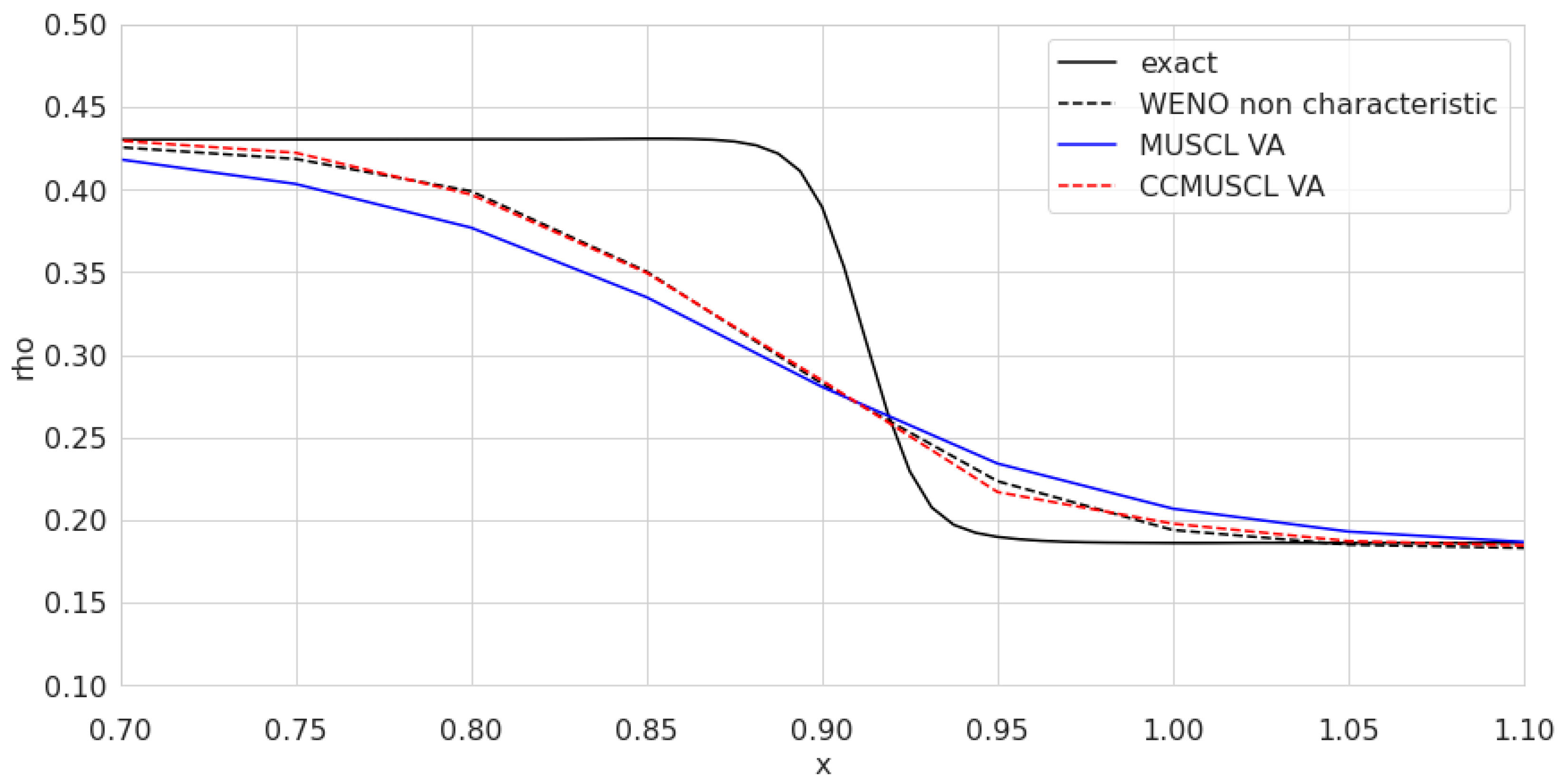
Figure 1 illustrates the density profile in the Sod shock tube problem. Comparing CCMUSCL to the original MUSCL and WENO schemes, the CCMUSCL exhibits the same pronounced capability for capturing the shock with heightened precision as WENO. This augmentation enables the scheme to depict the shock phenomenon with sharper delineation and increased fidelity compared to its original version.
3.1.2. Shu-Osher Problem
This problem examines how well a numerical scheme resolves small-scale oscillatory structures behind a shock. The initial condition consists of a strong shock interacting with a sinusoidal density field:
The document emphasizes that this test is highly sensitive, as numerical dissipation can significantly dampen entropy waves.
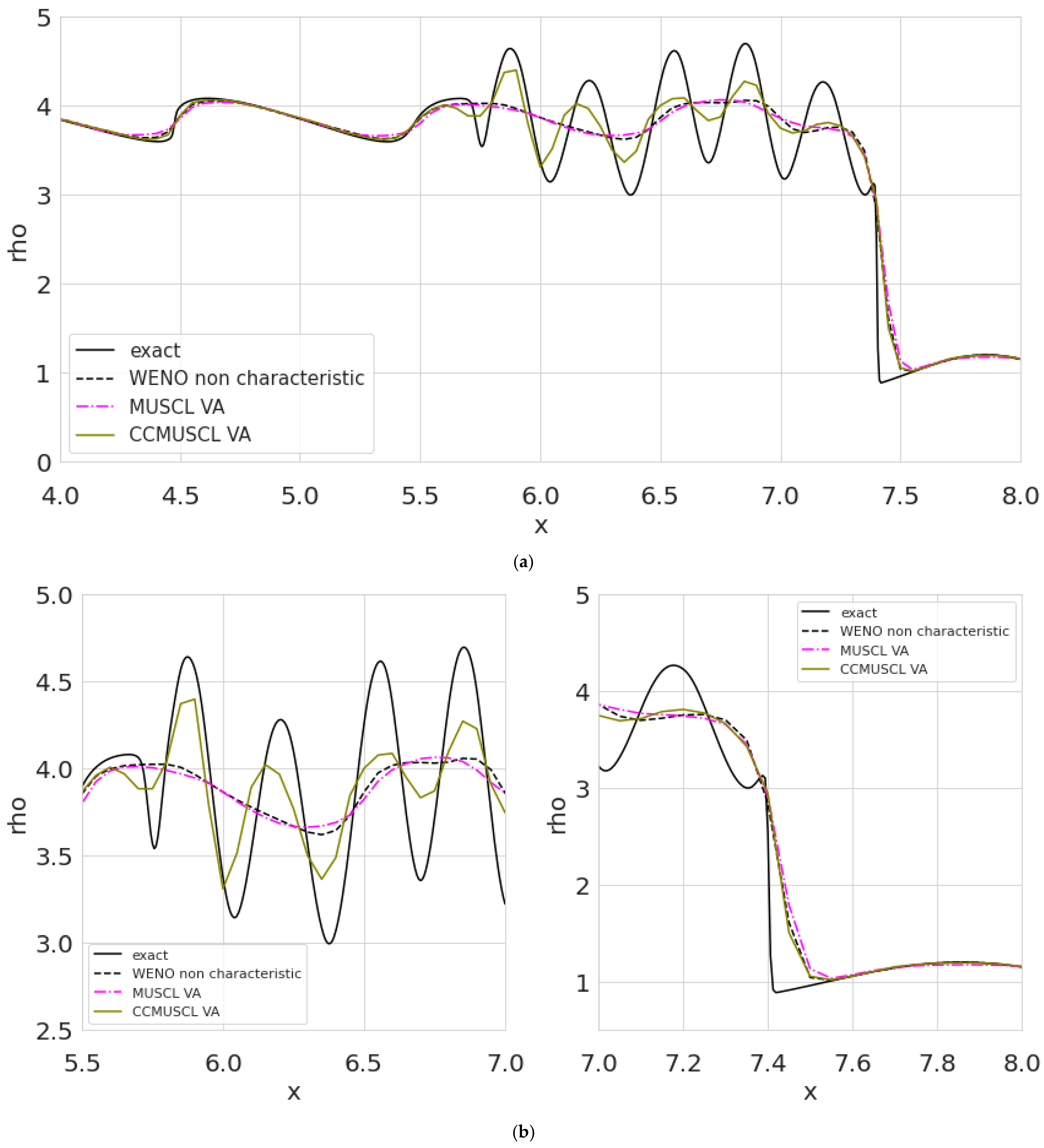
Figure 2 illustrates the numerical results of density profiles in the Shu-Osher problem from different schemes. The CCMUSCL excels the other schemes in capturing the waves accurately. In contrast, the other schemes tend to blur the small-scale waves; even the WENO scheme with characteristic variables shows more dissipation, so that it was unable to adequately capture fluctuations along with the discontinuities. This comparison underscores the superiority of CCMUSCL in representing intricate flow dynamics, particularly at smaller scales.
3.1.3. Two Interacting Blast Waves Problem
This is the most challenging benchmark, involving multiple strong shocks and complex wave interactions. The initial conditions consist of three regions:
where the indices
,
, and
denote conditions in the left (
), middle (
), and right (
) regions, respectively.
This test evaluates the scheme’s ability to handle strong shock waves and their multiple interactions. The good numerical schemes should be able to produce sharper shock fronts and more accurate resolution of the intricate wave structures generated by the blast interactions.
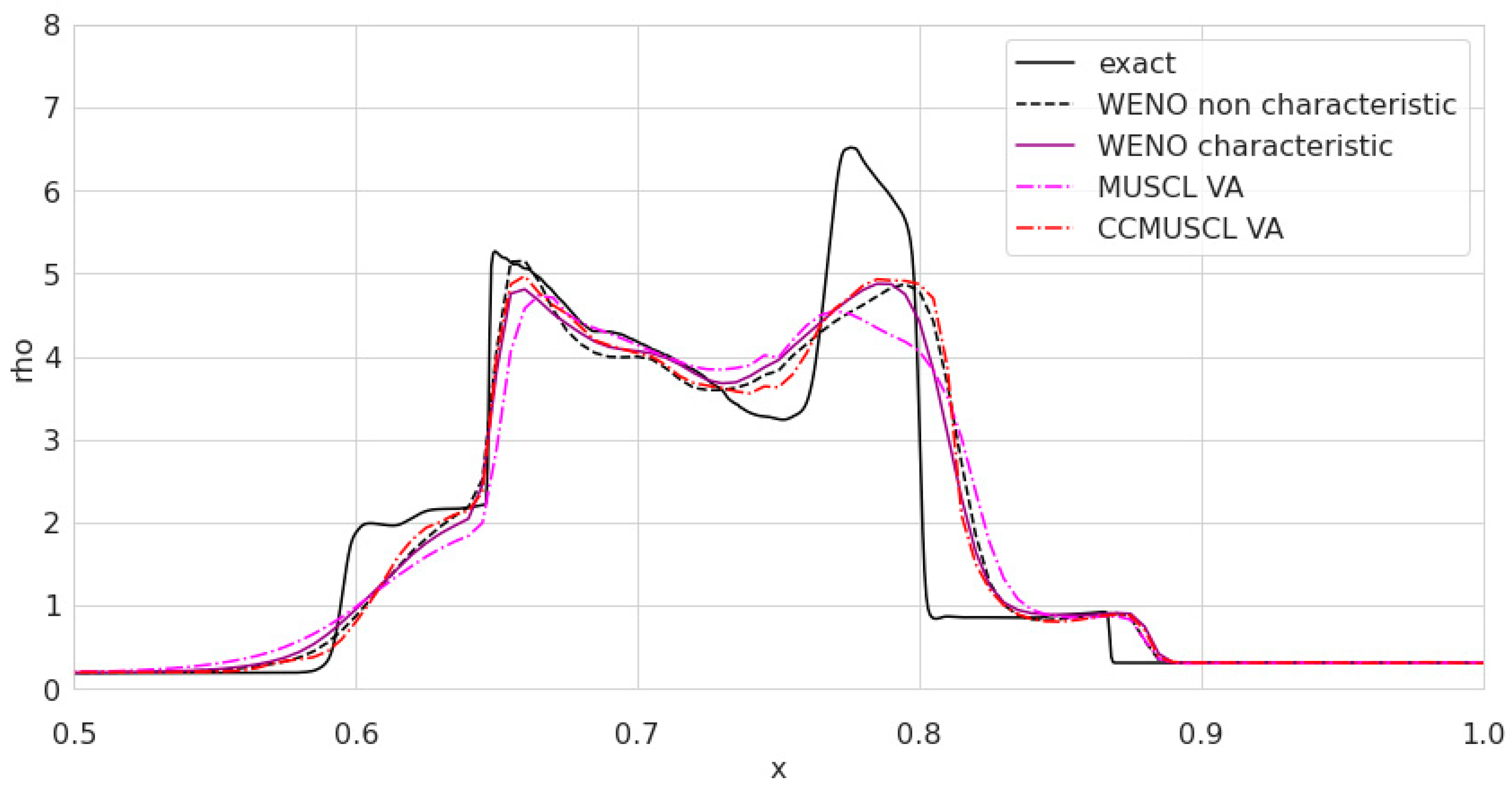
Figure 3 presents the density distribution for the two interacting blast waves problem. The CCMUSCL scheme delivers consistently strong performance in resolving the complex interactions between the two blast-generated shock fronts, outperforming both the original MUSCL and the WENO formulations. In particular, it exhibits enhanced shock-capturing sharpness compared with the baseline MUSCL scheme, while simultaneously maintaining high fidelity in regions involving multiple rarefaction waves and contact discontinuities. These results underscore the effectiveness of CCMUSCL in accurately representing intricate flow structures, especially in scenarios dominated by repeated shock interactions.
3.1.4. Grid Convergence Tests for WENO Scheme
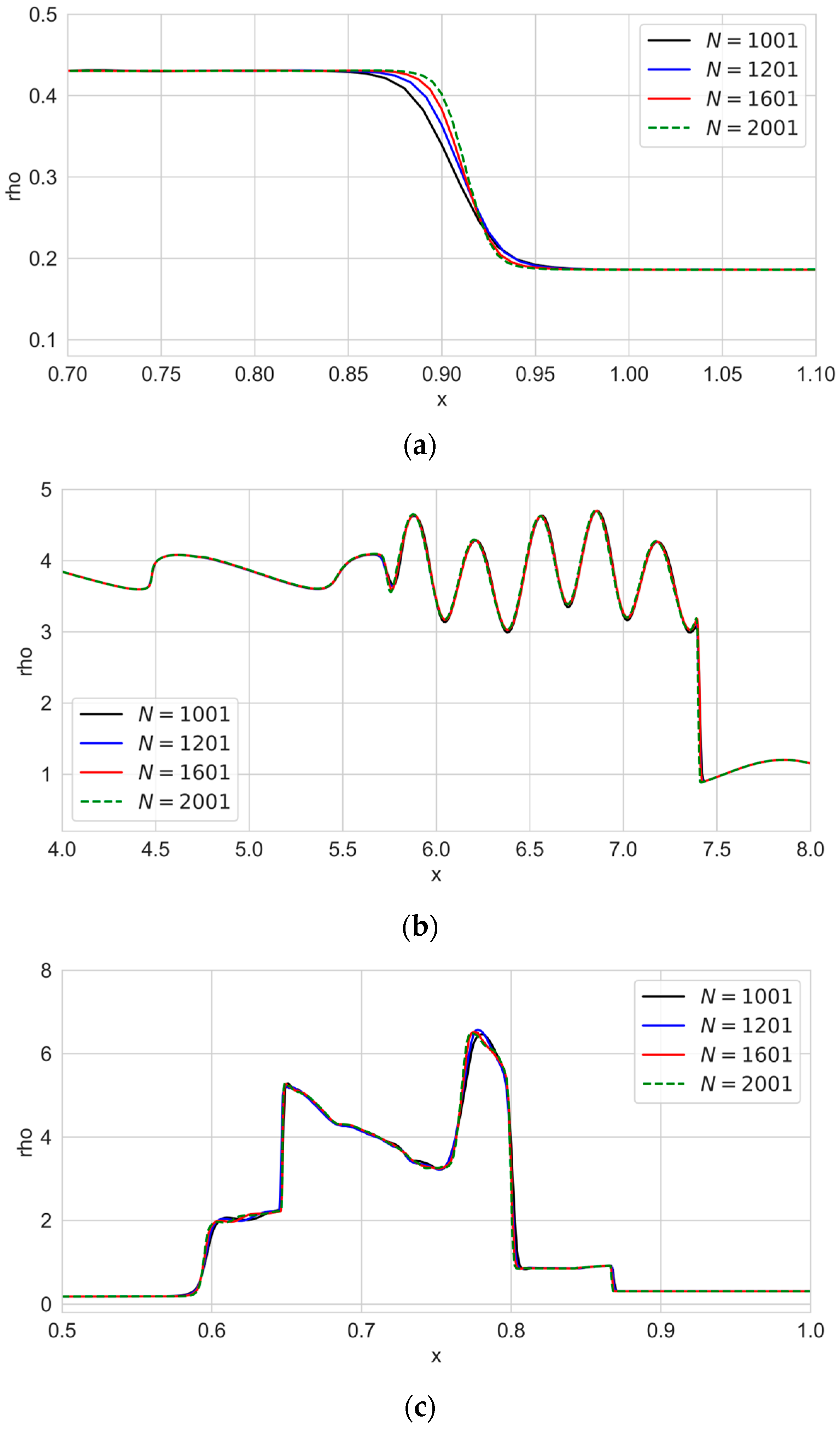
To justify that the WENO solution on the fine grid can be treated as a reliable reference solution for each benchmark problem, grid convergence tests were conducted using four different grid resolutions: , , , and .
As shown in
Figure 4, the numerical solutions exhibit clear convergence behavior, with successive results becoming increasingly consistent as the grid is refined. This confirms adequate grid convergence for the chosen resolutions. Consequently, the WENO solution computed on the grid with
is adopted as the reference solution for all benchmark problems in this study.
3.2. Van Albada Limiter Used as the Correction Indicator
As mentioned in
Section 2.4, the van Albada limiter can also work as an indicator, and
.
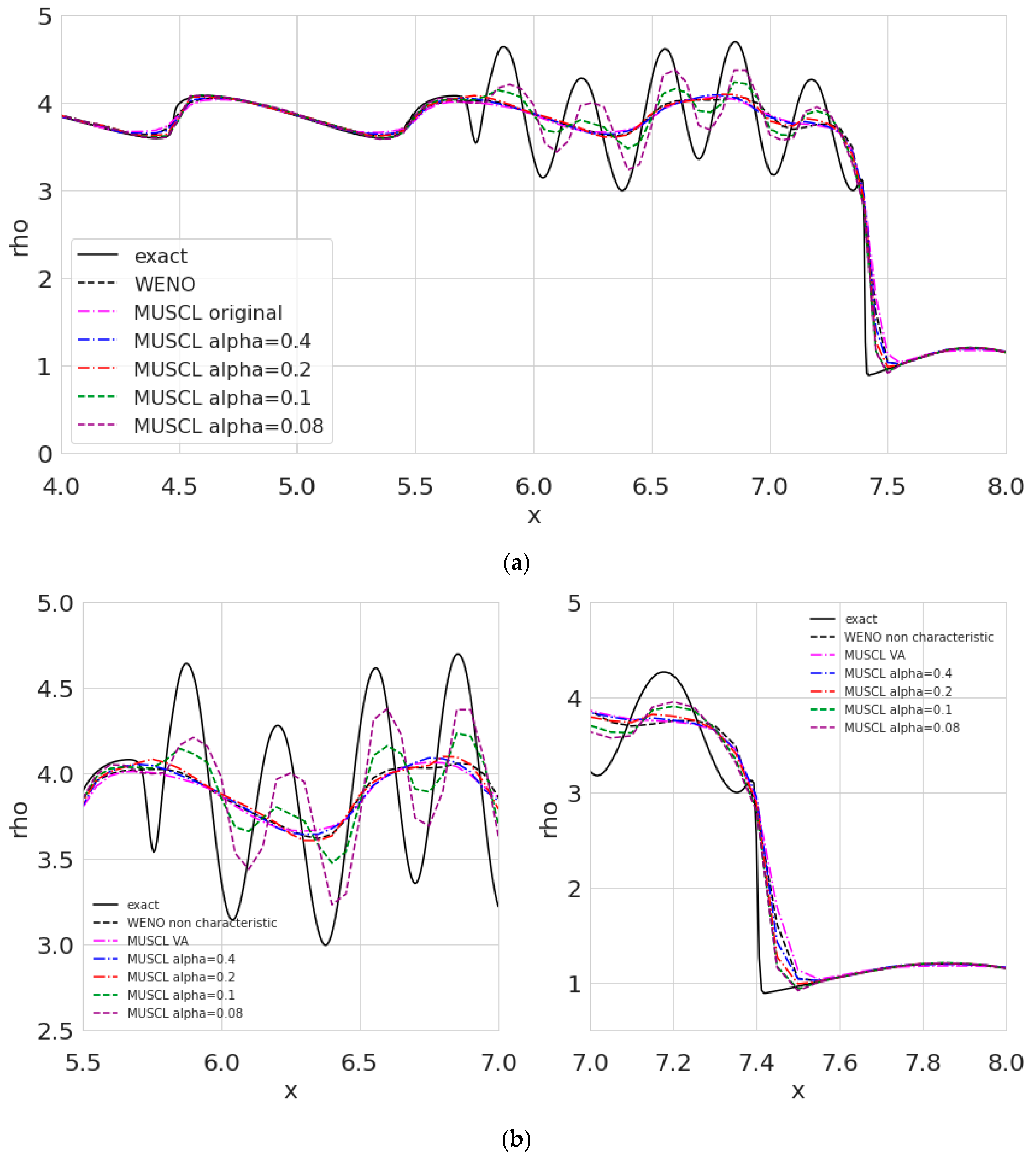
Figure 5 illustrates the density distributions in the Shu-Osher problem, with different
values used (see Equation (15)). Notably, the figure highlights the improved accuracy exhibited by the CCMUSCL using the van Albada limiter as the smoothness indicator with smaller
values. The original indicator we used in CCWENO scheme must be calculated using WENO’s nonlinear weights on all three substencils, while the indicator for CCMUSCL only needs the central substencil (three points) and thus less calculation is needed.
Smaller values of
α cause the indicator to activate at more grid points, leading to more frequent flux corrections and consequently higher overall accuracy.
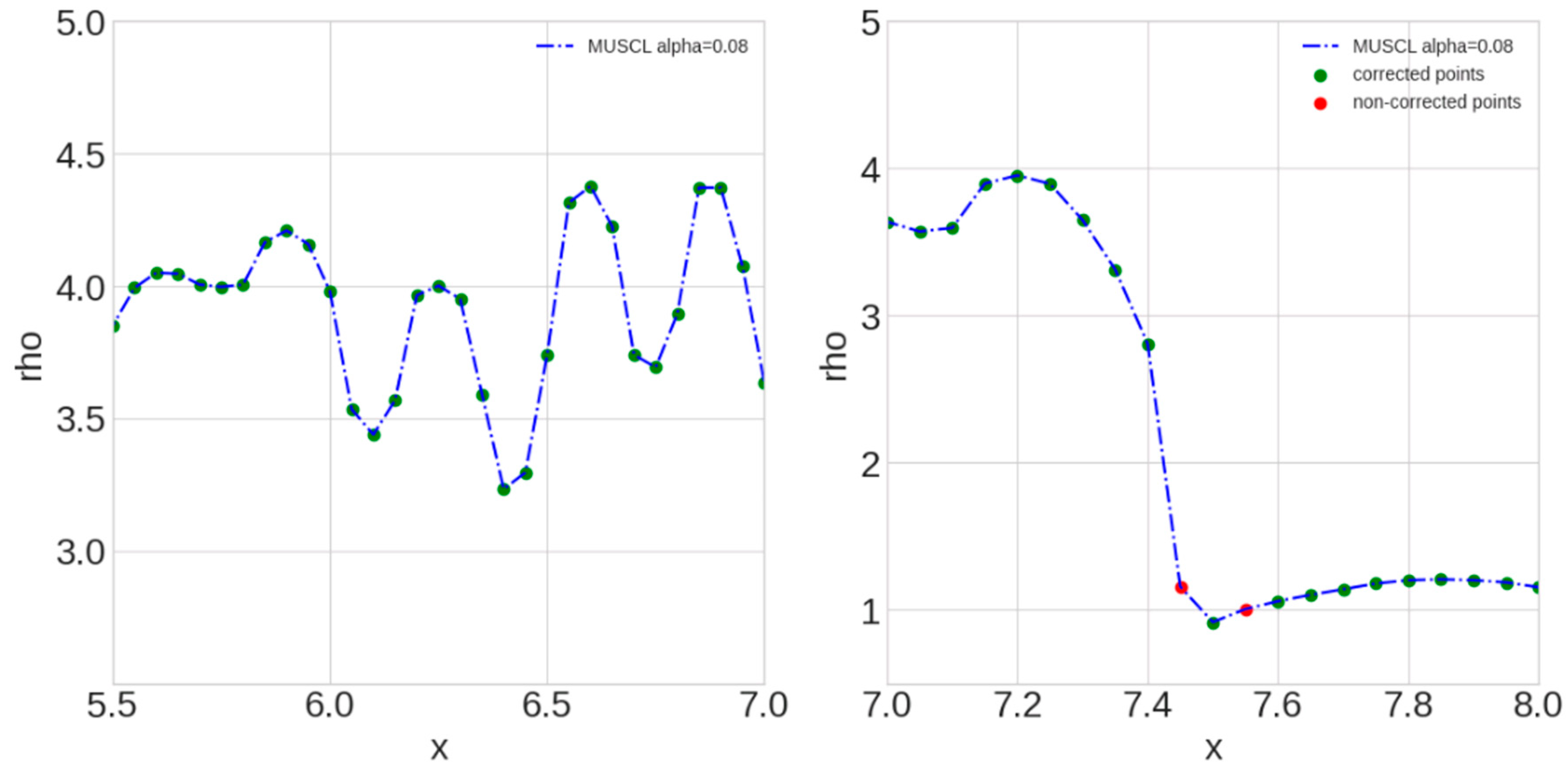
Figure 6 highlights the grid locations where fluxes are corrected when
. Nearly all points undergo correction, except for two points immediately upstream of the shock. However, choosing an excessively small
α may introduce stability issues, as an increasing number of fluxes are forced toward the compact-scheme limit. Another observation, consistent with the results in
Figure 5, is that reducing
α also tends to increase numerical dispersion in the solution. In general, the optimal choice of
is heavily dependent on the local features of the flow field. For flows characterized by lower-intensity discontinuities and minimal numerical oscillations, a larger value of
can be safely selected. This permits a broader application of the high-order compact corrections, thereby maximizing spatial accuracy. Conversely, in flow regimes featuring extremely strong shock waves, steep gradients, or high-intensity turbulence, a relatively smaller
must be employed. A smaller threshold restricts the compact correction in highly irregular regions, allowing the base scheme’s inherent dissipative properties to successfully stabilize the solution and suppress non-physical oscillations. Consequently, systematically optimizing
to dynamically match diverse flow conditions and complex aerodynamic regimes remains an important avenue for future research.
3.3. Numerical Results for 2D Benchmark Cases
3.3.1. Shock–Vortex Interaction Problem
A widely used two-dimensional benchmark for evaluating high-resolution numerical schemes is the shock–vortex interaction, which examines how a stationary shock wave responds to the passage of a convecting vortex. In this configuration, a Mach 1.1 normal shock is positioned at
, perpendicular to the
-axis, dividing the domain into pre-shock and post-shock regions. The flow is governed by the two-dimensional Euler equations,
where
,
, and
represent density, velocity, and total energy, respectively.
represents pressure and is calculated by
.
The stationary shock satisfies the Rankine-Hugoniot jump conditions across the plane
. A vortex of prescribed strength is superimposed on the upstream flow and convects toward the shock. A common vortex specification uses perturbations of the form
where
,
controls vortex strength, and
determines its compactness. The total primitive variables are obtained by adding these perturbations to the uniform pre-shock state. As the vortex impinges on the stationary shock, it generates a rich set of multidimensional flow features—shock deformation, vorticity amplification, acoustic radiation, and downstream entropy waves. Because these structures are highly sensitive to numerical dissipation and dispersion, the shock–vortex interaction serves as a stringent test of a scheme’s ability to preserve fine-scale vortical structures while accurately capturing shock dynamics.
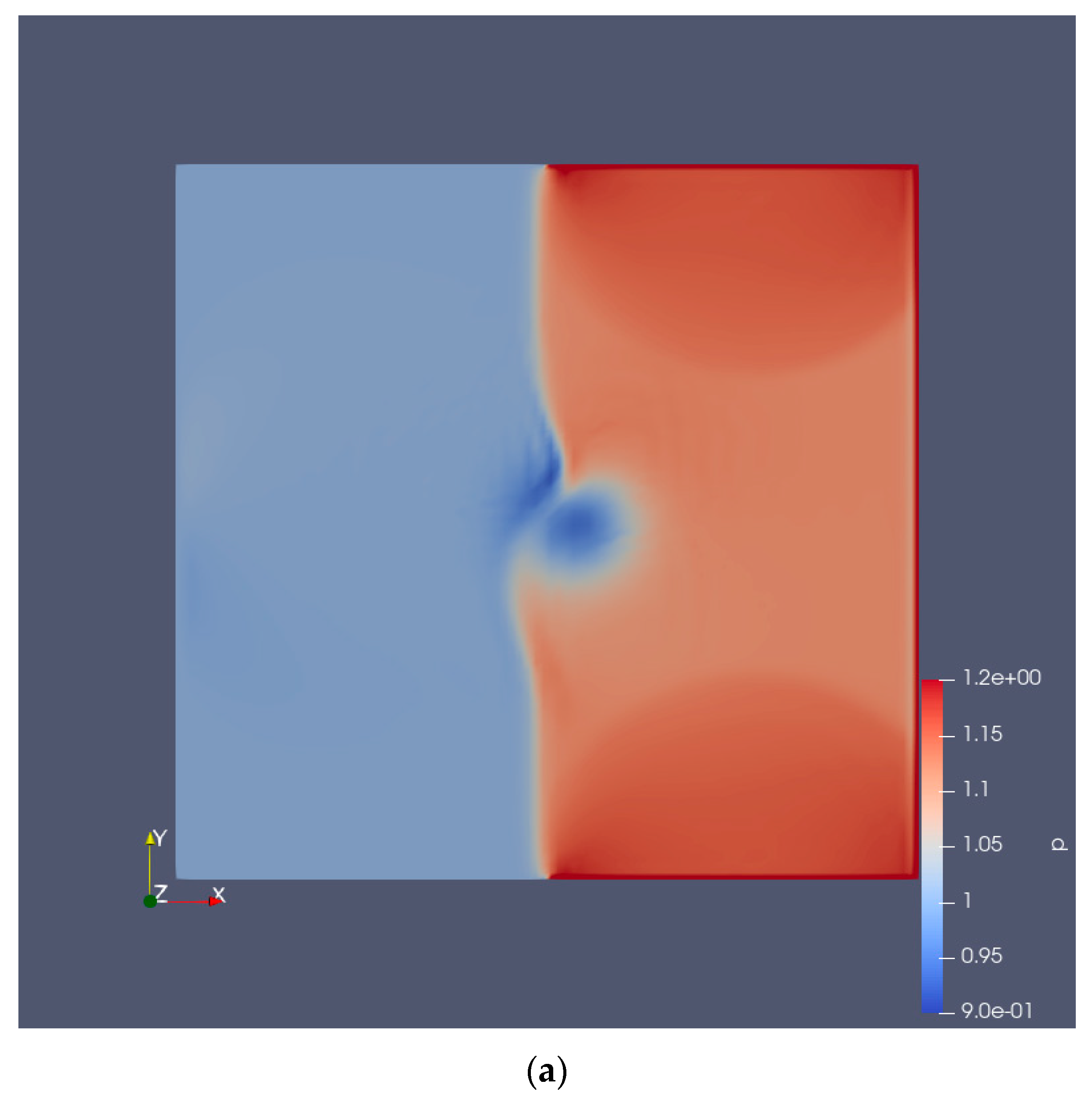
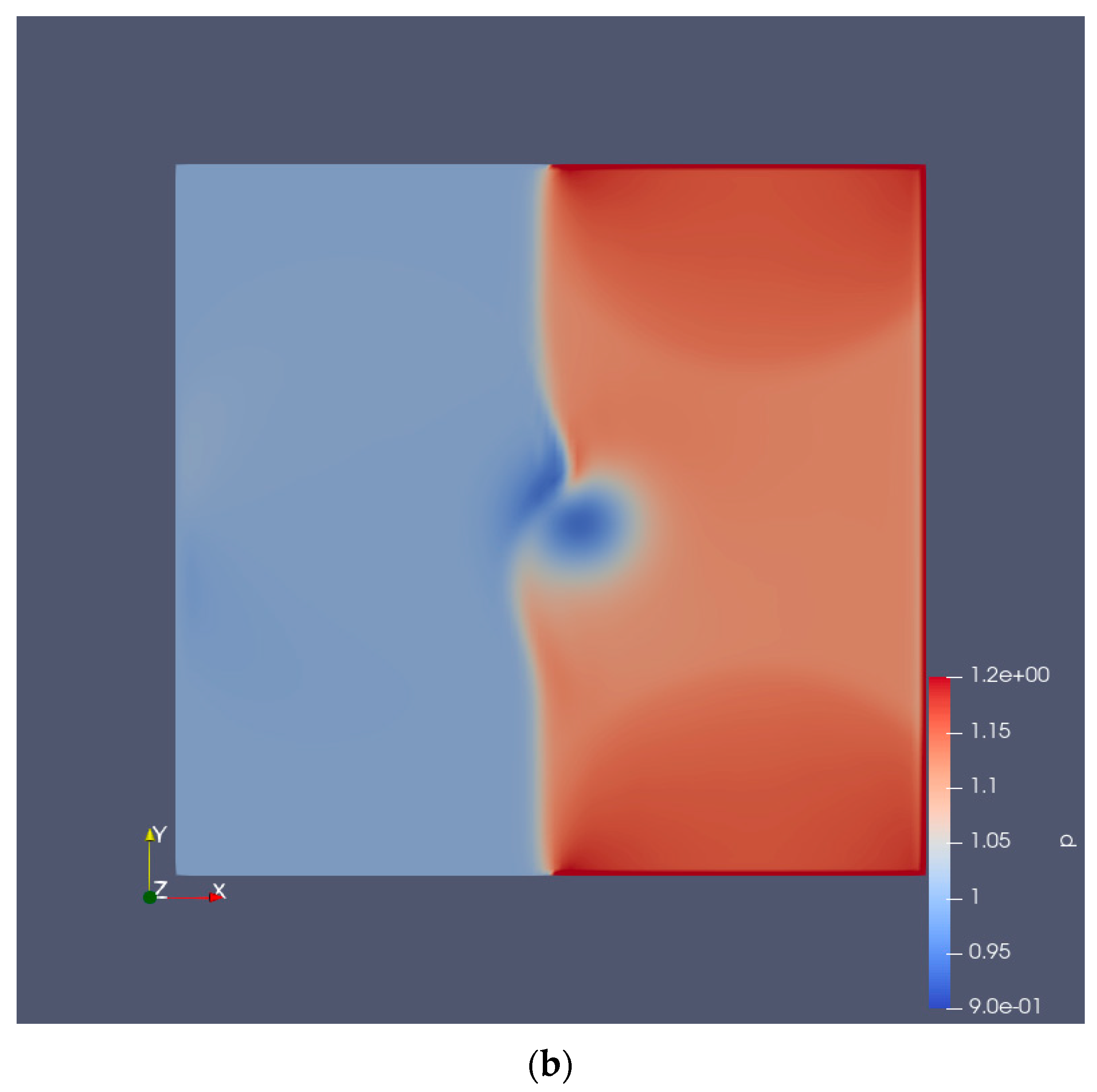
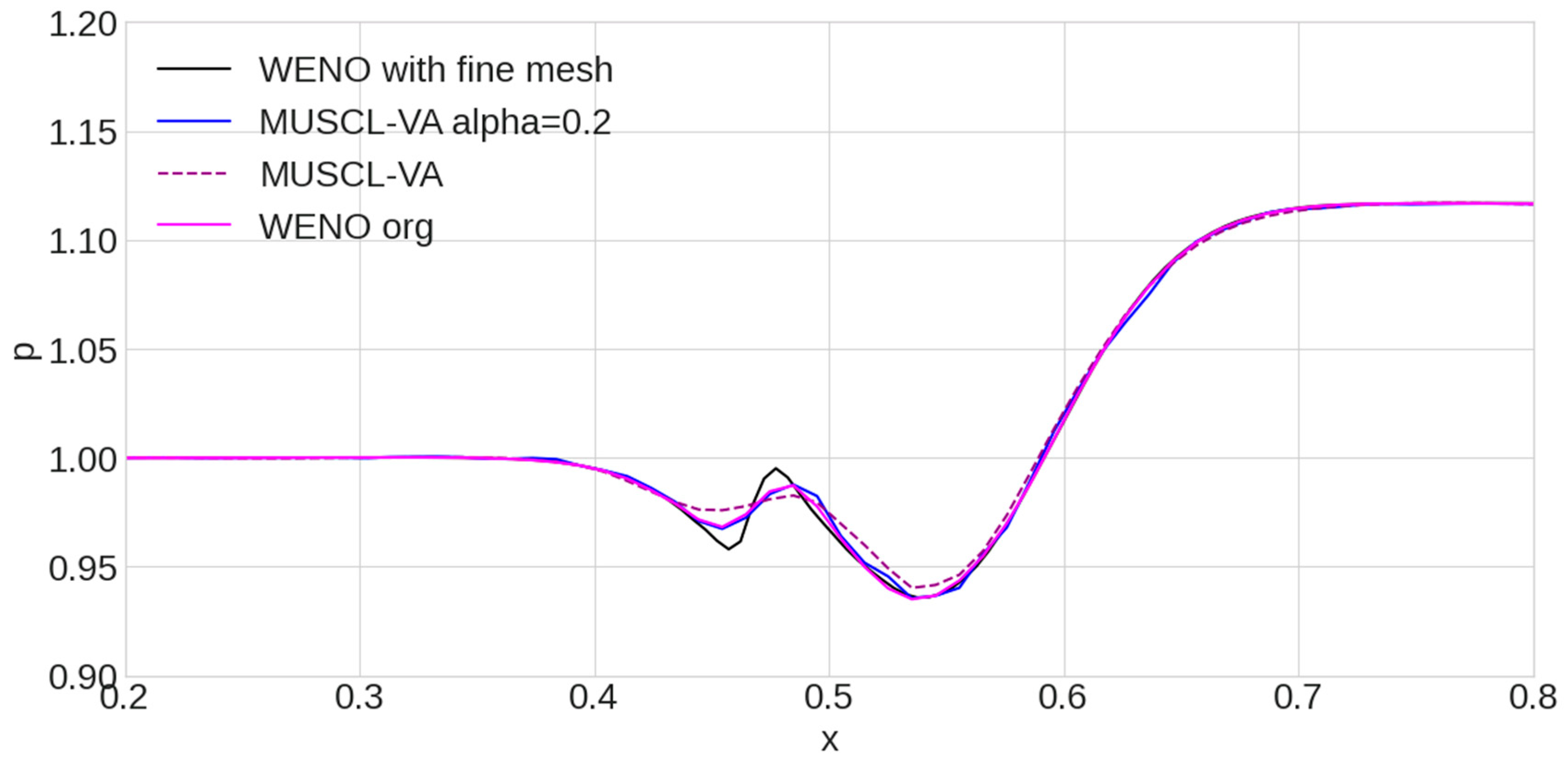
Figure 7 shows the pressure distributions for the shock–vortex interaction problem at the moment when the vortex has just penetrated the shock wave near the center of the domain. Results from both the CCMUSCL and WENO schemes are presented using a
grid. The two distributions exhibit broadly similar large-scale features; however, the CCMUSCL solution reveals additional subtle small-scale structures, indicating its enhanced ability to resolve fine flow details.
Figure 8 presents the pressure profile along the horizontal centerline of the domain. The results clearly show that both the CCMUSCL and WENO schemes capture the disturbed pressure variations far more accurately than the original MUSCL formulation. Moreover, the profiles produced by CCMUSCL and WENO are nearly indistinguishable, indicating that their performance for this benchmark is effectively equivalent.
3.3.2. 2D Incident Shock Interaction (Mach 2 Oblique Shock Reflection)
To further assess the robustness of the proposed numerical scheme in multidimensional settings, we consider another classical 2D incident shock interaction, also known as the Mach 2 oblique shock reflection problem. This benchmark examines the interaction between an incoming planar shock and a solid wall, producing a reflected shock and a complex pattern of compression waves, slip lines, and expansion fans.
While using the same two-dimensional Euler equation (Equation (21)), a Mach 2 shock is introduced at an oblique angle
relative to the horizontal axis. The computational domain is initialized with a uniform pre-shock state
. The post-shock state
is obtained from the Rankine–Hugoniot jump conditions applied in the shock-normal direction:
where
is the shock-normal Mach number,
and
denote the normal and tangential velocity components. As the incident shock strikes the lower wall, the boundary condition enforces
, generating a reflected shock whose angle and strength depend on the incident Mach number and geometry. This configuration produces a rich set of multidimensional flow features—triple-point structures, slip lines, and shock-induced vortical layers—making it an ideal test for evaluating the scheme’s ability to resolve discontinuities and maintain stability in complex 2D shock interactions.
The non-reflecting upper boundary conditions and the slip-wall conditions at the lower boundary are imposed, the inflow conditions are specified to the freestream, and the outflow conditions are calculated by extrapolation. A grid is used in the simulation.
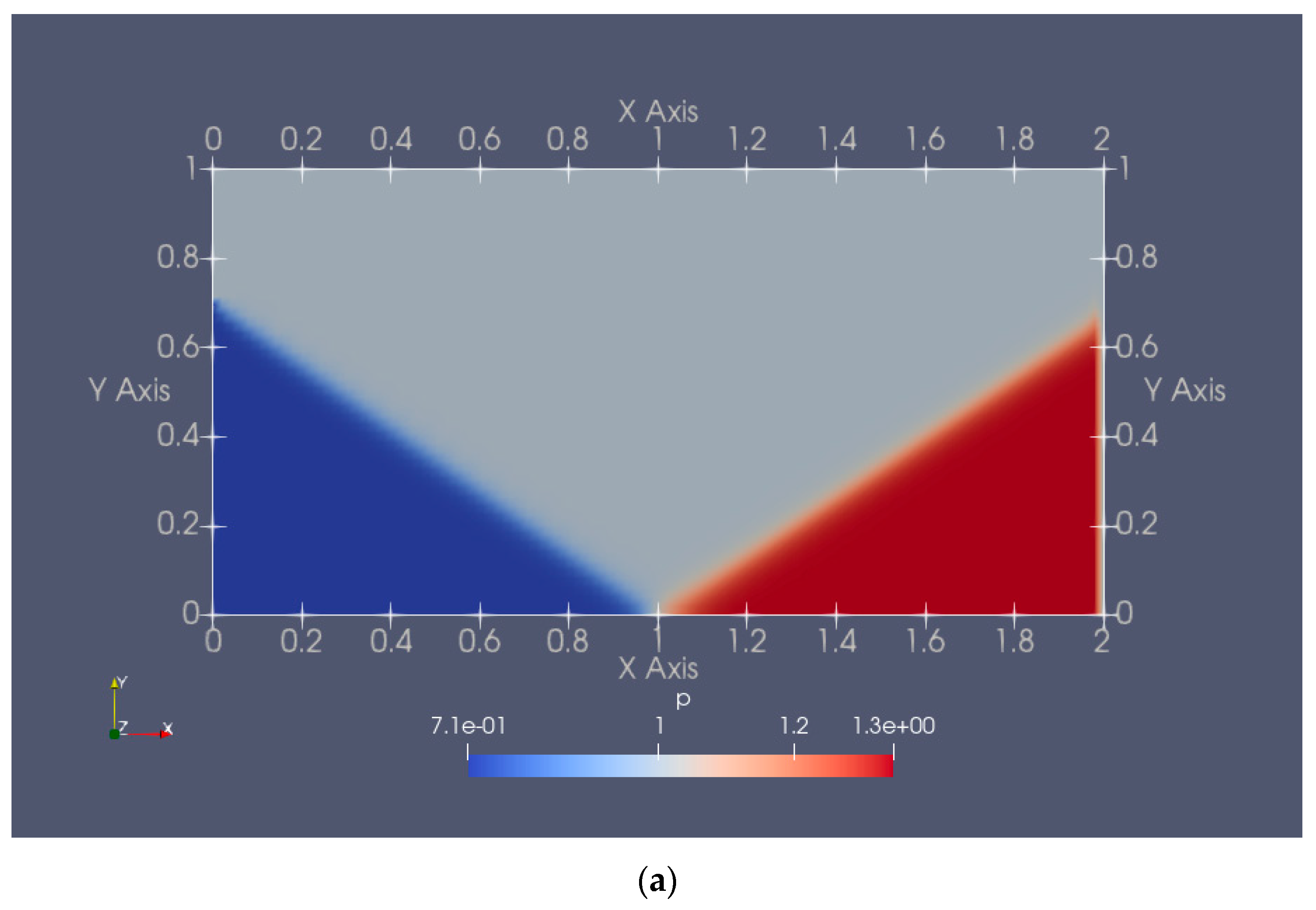
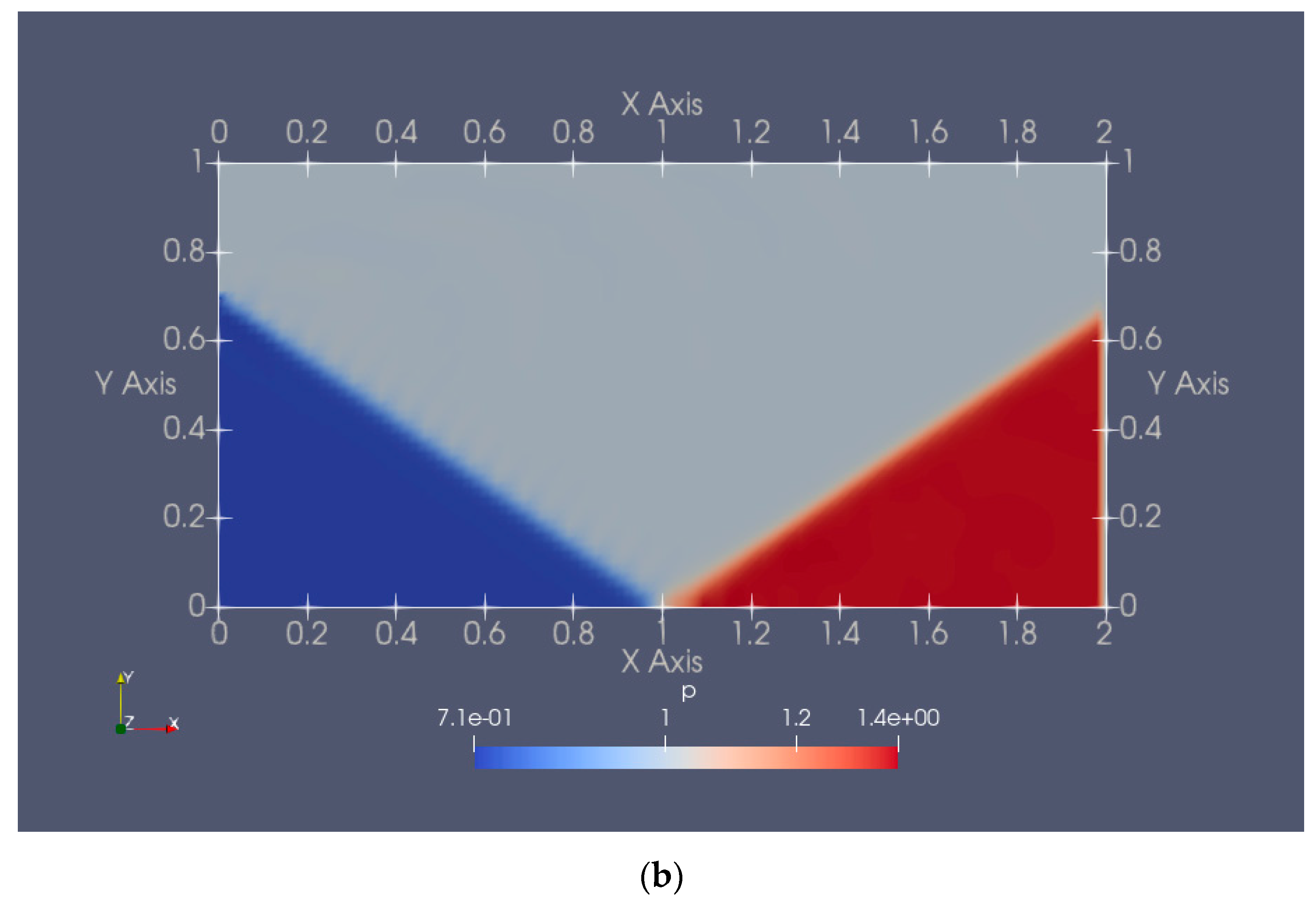
Figure 9 presents the numerical results for the 2D incident shock interaction problem obtained using both the CCMUSCL and WENO schemes. Both methods successfully capture the reflected shock structure. However, the shock edges in the CCMUSCL solution appear noticeably sharper and more distinct, indicating that CCMUSCL introduces less numerical dissipation and therefore resolves the discontinuity more effectively.
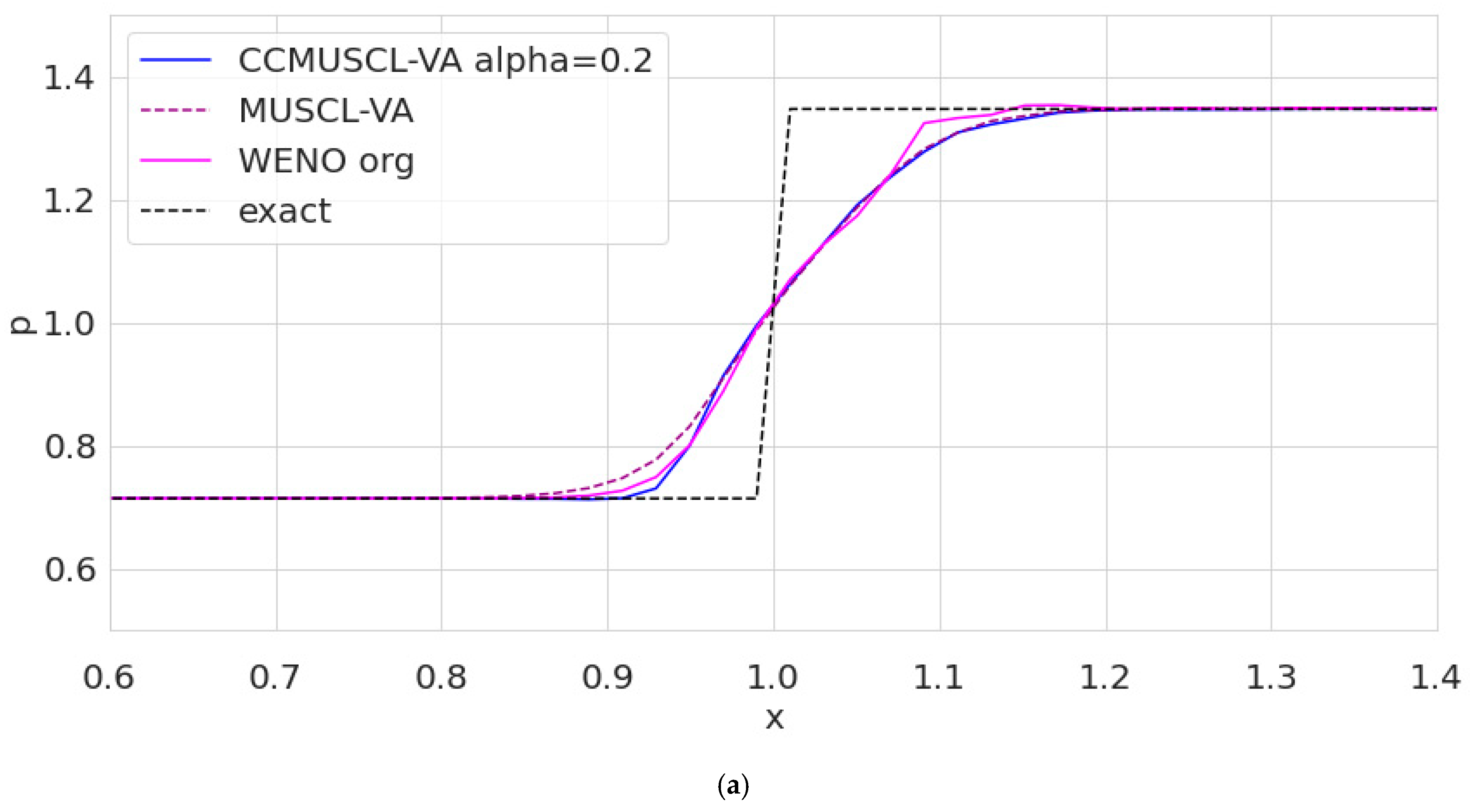
Figure 10a presents the pressure profiles from both schemes along the wall boundary. The CCMUSCL solution exhibits a noticeably steeper gradient immediately upstream of the shock, whereas the WENO scheme produces a steeper profile downstream of the shock. Overall, the CCMUSCL curve is smoother and shows reduced oscillatory behavior. It is worth noting that the pressure distribution near the wall is also influenced by the specific boundary treatment employed.
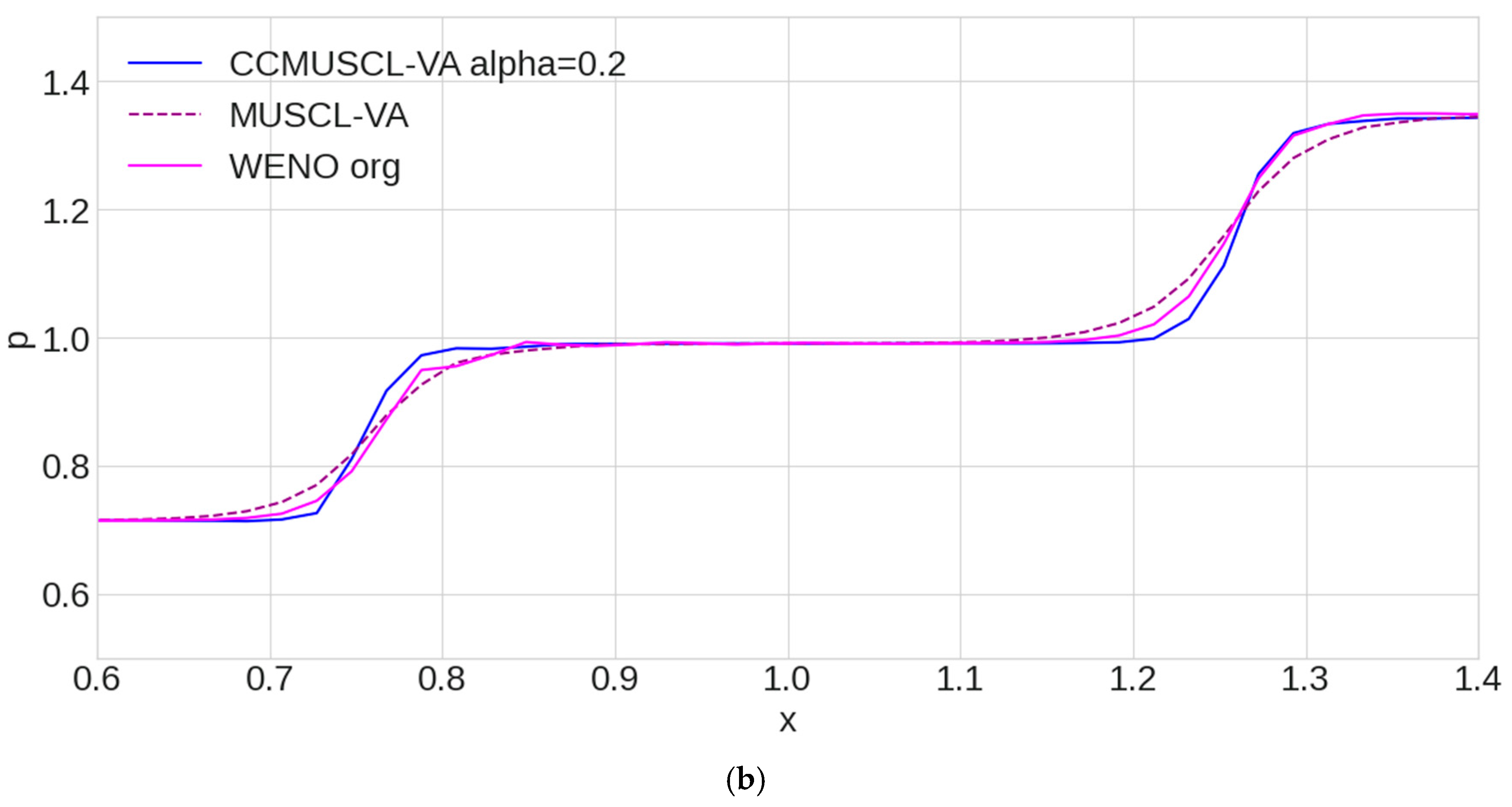
Figure 10b displays pressure profiles along the horizontal line
. Along this line, the CCMUSCL scheme clearly outperforms both the original MUSCL and WENO methods in capturing the shock with superior sharpness.
3.4. Efficiency Comparison
To compare the computational complexity of CCMUSCL with that of the original WENO scheme (using conservative variables), we evaluate the arithmetic operations required to compute a single flux on a 1D grid with grid points. The WENO scheme requires approximately 67N arithmetic operations in the flux formula, the smoothness indicators and the nonlinear weights on the three substencils along with the nonlinear construction, whereas the MUSCL scheme requires only 19N, and the compact correction introduces an additional 7N. Even when the MUSCL and compact-correction costs are combined, CCMUSCL remains significantly more efficient, with WENO requiring roughly 2.6 times more operations. For practical 3D simulations, where five flux functions must be evaluated, the computational gap becomes even more pronounced: WENO may require up to 85.5 times the operations of CCMUSCL. This substantial difference highlights the clear advantage of adopting CCMUSCL as a more efficient alternative to WENO in large-scale 3D computations.
5. Conclusions
This study successfully developed and validated the CCMUSCL scheme as a robust and high-accuracy tool for high-speed flow simulations. By integrating a compact-scheme-based flux correction into the flexible MUSCL framework, the new method overcomes the traditional accuracy limitations of lower-order reconstructions while avoiding the high computational overhead and instability typically associated with global compact schemes.
Numerical simulations of 1D and 2D Euler equations demonstrate that the CCMUSCL scheme is highly effective at capturing sharp shock fronts and resolving fine-scale oscillatory structures. The results indicate that CCMUSCL performs at a level effectively equivalent to or better than WENO schemes across various benchmark tests, such as the Mach 2 oblique shock reflection and the shock–vortex interaction. A critical advantage of the proposed scheme is its computational efficiency; it requires substantially fewer arithmetic operations than WENO, making it particularly well-suited for large-scale 3D computations where flux evaluation costs are a primary bottleneck.
Furthermore, the implementation of the van Albada limiter as a smoothness indicator allows for a localized, adaptive application of accuracy enhancements, giving users the flexibility to balance numerical dissipation and stability. In summary, CCMUSCL offers a low-cost, high-resolution alternative to more complex high-order methods, providing a promising path forward for efficient and adaptive high-fidelity flow simulations in complex engineering and scientific applications.