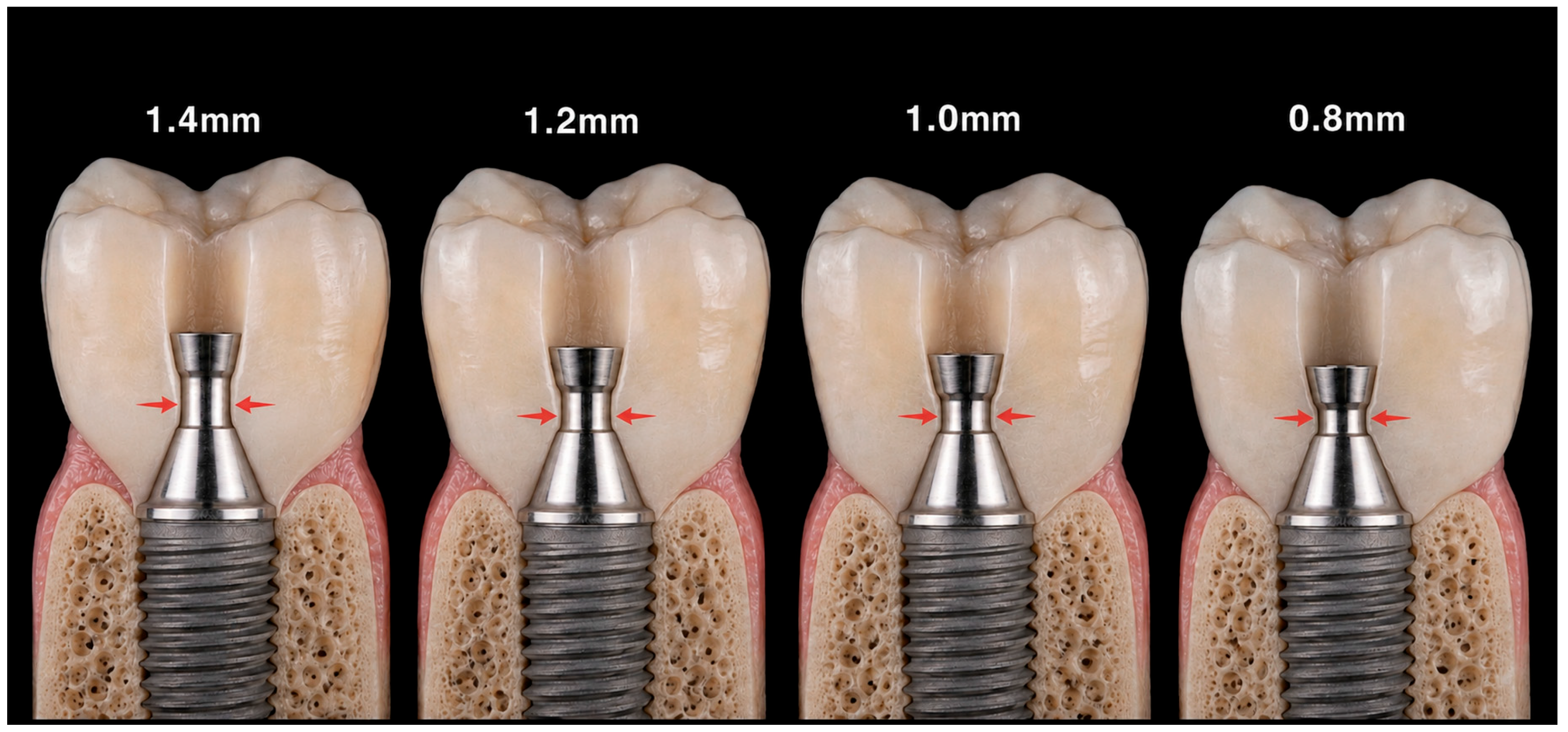
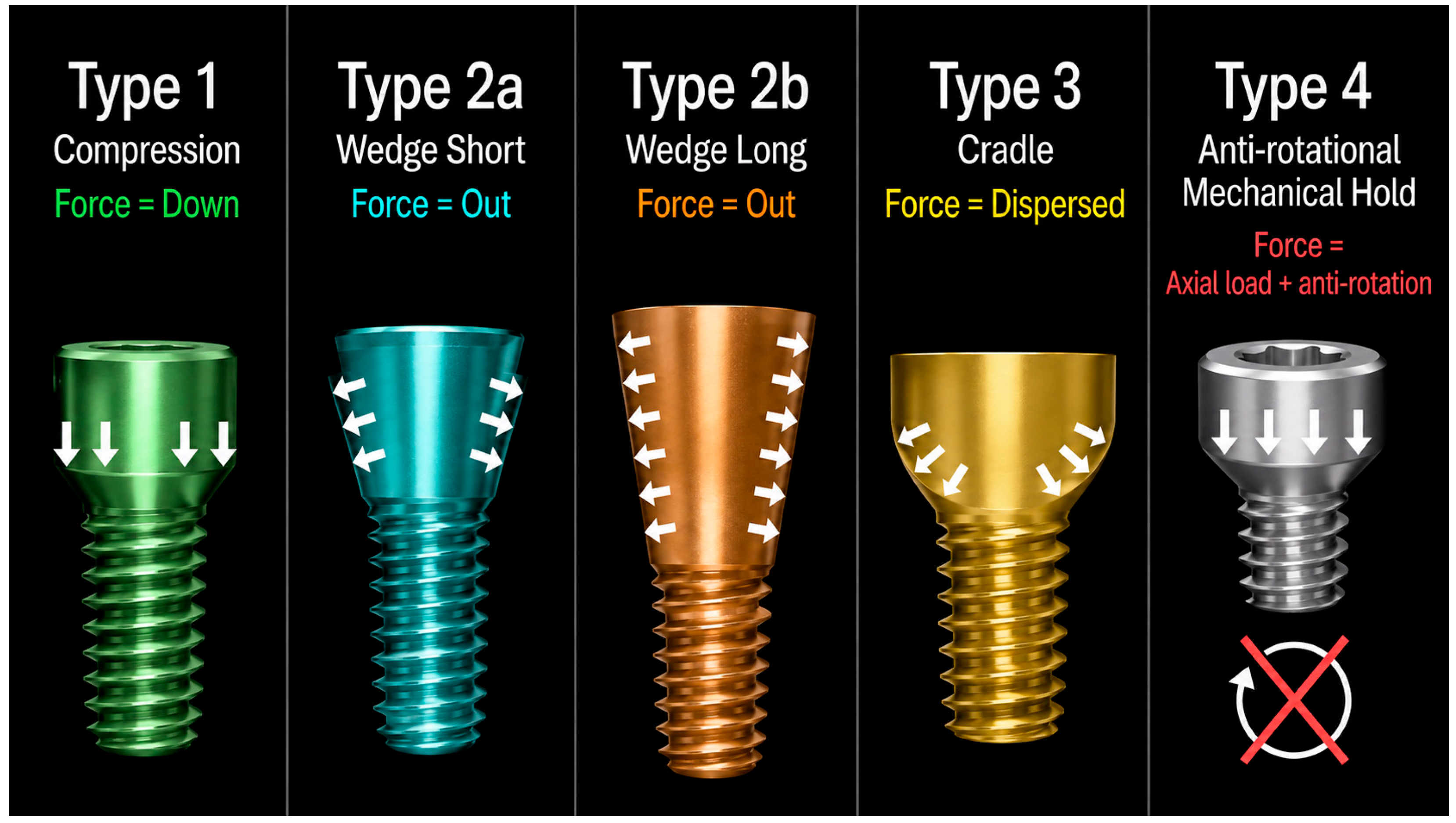
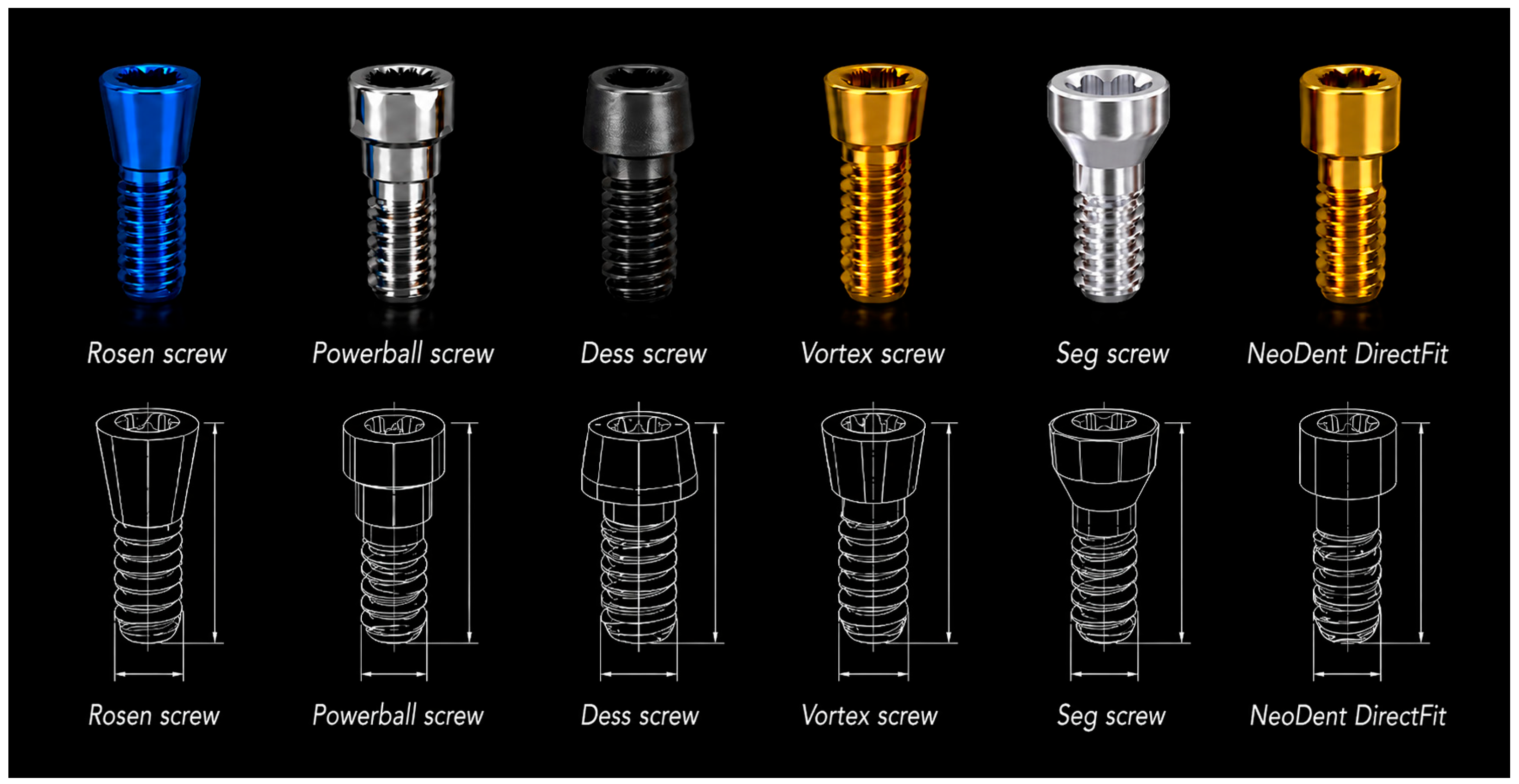
1. Introduction
Implant-supported complete-arch prostheses have become a well-established treatment option for the rehabilitation of edentulous patients, with multi-unit abutment (MUA) systems playing a central role in contemporary prosthodontics. MUAs facilitate the correction of implant angulation, improve prosthetic alignment, and support screw-retained restorations with favorable retrievability and maintenance [
1]. In parallel, digital workflows have expanded the prosthetic possibilities for complete-arch implant rehabilitation, including the fabrication of monolithic zirconia fixed dental prostheses through computer-aided design and computer-aided manufacturing (CAD/CAM)-based protocols [
2,
3,
4].
In conventional CAD/CAM workflows, these restorations frequently incorporate titanium bases as intermediary components between the prosthetic structure and the abutment. Titanium-base abutments have shown favorable short-term clinical performance, particularly in single-unit restorations, and were introduced to combine the mechanical advantages of titanium with the restorative flexibility of ceramic suprastructures [
5,
6]. However, the use of an intermediate titanium base also adds an additional restorative interface, commonly involving adhesive cementation, which may become a site of debonding or other technical complications. In addition, cemented implant restorations have long been considered susceptible to complications related to residual cement, although recent meta-analytic evidence suggests that cement- and screw-retained prostheses may show comparable peri-implant disease risk under controlled clinical conditions [
7].
To reduce component interfaces and simplify restorative workflows, titanium base-free prosthetic concepts have emerged as an alternative approach in which the definitive restoration is directly connected to the MUA or implant platform, without an intermediary base. The structural differences among titanium base-free, bar-supported, and titanium base-supported configurations, particularly in terms of component interfaces and load-transfer pathways, are illustrated in
Figure 1. This concept has been enabled by advances in digital workflows, manufacturing precision, and the availability of high-strength restorative materials, particularly zirconia [
2,
3,
8]. Zirconia has become increasingly relevant in implant prosthodontics because of its favorable flexural strength, fracture resistance, and suitability for CAD/CAM fabrication, including complete-arch frameworks and monolithic reconstructions [
8,
9]. More recently, abutment-free or direct screw-retained prosthetic concepts have been investigated as a means of avoiding cementation-related complications and enabling a more individualized emergence profile, although they may also increase sensitivity to prosthetic fit and torque-related mechanical behavior [
10].
In this context, prosthetic screws are critical not only for retention but also for maintaining joint stability through preload generation and preservation. Screw material, surface characteristics, geometry, and head design can directly influence preload, frictional behavior, load transfer, and resistance to loosening or fracture [
11,
12,
13,
14]. Experimental and numerical studies have shown that screw-head geometry affects loosening torque, preload maintenance, and stress distribution, with conical or tapered-head designs generally demonstrating improved resistance to preload loss compared with conventional flat-head screws [
11,
12,
13,
14]. Such designs are of particular interest in titanium-base-free restorations, where greater mechanical demand is transferred directly to the prosthetic screw and the prosthesis–abutment interface.
Despite the growing use of titanium base-free MUA restorations and the increasing availability of dedicated screw systems, the evidence remains limited and fragmented. Much of the current literature consists of laboratory investigations, technical descriptions, and clinical reports, whereas the biomechanical consequences of eliminating the titanium base, particularly with respect to preload maintenance, load distribution, restorative design, and long-term mechanical behavior, have not been comprehensively synthesized [
2,
10,
14]. In addition, the specific role of prosthetic screw design in compensating for the absence of a titanium base remains insufficiently clarified.
Therefore, the purpose of this critical review is to evaluate titanium base-free multi-unit abutment connections, with particular emphasis on the influence of prosthetic screw design on biomechanical behavior, preload maintenance, restorative design considerations, and clinical performance. This review was conducted because titanium base-free MUA restorations represent an emerging prosthetic concept for which the available evidence remains limited, heterogeneous, and fragmented, despite increasing clinical and commercial interest. The specific contribution of this review is to synthesize the current biomechanical rationale for eliminating titanium bases, clarify how this design change may affect prosthetic screw behavior and load transfer, and provide a structured framework for understanding the indications, limitations, and mechanical risks of these systems. By integrating current evidence on connection mechanics, material behavior, and emerging screw concepts, this review aims to guide clinicians in the cautious application of titanium base-free MUA restorations and to encourage future standardized research on their mechanical and clinical performance.
2. Materials and Methods
A structured literature search was conducted to identify publications relevant to titanium base-free prosthetic concepts and prosthetic screw design in MUA connections. Electronic databases including PubMed/MEDLINE, Scopus, Web of Science, and Google Scholar were searched up to 22 March 2026.
The search strategy combined keywords and Boolean operators related to the topic, including “multi-unit abutment”, “titanium base”, “Ti-base”, “titanium base-free”, “prosthetic screw”, “abutment screw”, “preload”, “screw loosening”, “implant-supported prosthesis”, and “complete-arch restoration”. Reference lists of selected articles were also screened manually to identify additional relevant publications.
Because of the emerging nature of this topic, all study types were considered, including in vitro studies, clinical studies, case reports, technical reports, and review articles, provided they contributed relevant information on prosthetic screw behavior, connection mechanics, restorative design, or titanium base-free configurations involving MUAs. Publications focused exclusively on implant-level connections without MUA involvement or without relevance to screw mechanics were excluded.
Given the limited number of directly relevant comparative studies and the predominance of technical descriptions and early clinical reports, a narrative critical review approach was adopted rather than a formal systematic review methodology. Accordingly, studies were selected on the basis of conceptual relevance to biomechanical principles, preload behavior, restorative design considerations, and clinical performance. The objective of this review was therefore not to quantitatively synthesize outcomes, but to critically appraise the available evidence, identify recurring biomechanical relationships, and provide an integrative overview of prosthetic screw behavior in titanium base-free MUA restorations.
3. Concept and Classification of Titanium Base-Free MUA Connections
Titanium base-free prosthetic configurations are restorative approaches in which the definitive prosthesis is directly connected to the MUA without an intermediate titanium base. In conventional digital workflows, titanium bases are commonly used to provide a prefabricated connection geometry and to facilitate extraoral bonding between the restorative material and the abutment interface. This hybrid concept has been widely adopted because it combines the precision of a manufacturer-machined connection with the flexibility of CAD/CAM restorative design. However, in titanium base-free systems, this intermediary component is eliminated, resulting in a simplified restorative assembly in which connection stability depends primarily on prosthesis fit and the mechanical integrity of the prosthetic screw joint [
15,
16].
The absence of a titanium base alters the biomechanical behavior of the implant-supported reconstruction. In titanium-base-supported designs, functional loads are transferred through multiple interfaces, including the restorative material, the cement layer, the titanium base, the prosthetic screw, and the abutment [
17]. By contrast, titanium base-free configurations reduce the number of interfaces and direct occlusal forces more immediately toward the MUA–screw complex. Although this simplification may reduce bonding-related complications and eliminate cementation procedures, it also increases the dependence of the system on fit accuracy, restorative material behavior, and screw design [
10,
15]. Abutment-free or direct screw-retained concepts have therefore been proposed to simplify the restorative complex while avoiding complications associated with cemented interfaces, although their mechanical behavior remains sensitive to torque maintenance and load transfer [
10]. Titanium base-free MUA restorations can therefore be classified according to prosthetic design, prosthetic material, and fabrication technique (
Table 1).
From a prosthetic design standpoint, titanium base-free MUA restorations may be broadly categorized as monolithic or framework-based. In monolithic designs, the prosthesis is fabricated as a single continuous structure, typically from a high-strength material, and connected directly to the MUAs without an intermediate base. This configuration minimizes internal material interfaces and may reduce the risk of chipping associated with veneered restorations. However, because the restoration behaves as a rigid unit, stress transmission to the prosthetic screw and abutment interface may be more pronounced, particularly when stiff materials such as zirconia are used [
8,
18]. Framework-based designs, by contrast, incorporate a supporting substructure directly connected to the MUAs and may be fully, partially, or veneered, depending on the restorative concept. Compared with monolithic restorations, these configurations may offer greater flexibility in esthetic layering and stress modulation, although they reintroduce additional internal interfaces within the prosthesis [
8].
A second classification may be made according to prosthetic material. Titanium base-free MUA restorations have been described using materials with markedly different mechanical behaviors. Zirconia is the most widely discussed material because of its high flexural strength, fracture resistance, wear resistance, and suitability for monolithic CAD/CAM complete-arch prostheses [
8]. However, its high elastic modulus may increase stress concentration at the screw joint and implant–abutment interface, particularly under nonaxial loading [
8,
19]. Metal-based frameworks, particularly cobalt–chromium or titanium, provide high rigidity and structural reliability, although they often require veneering and involve more complex laboratory procedures [
19]. Polyetheretherketone (PEEK) and related high-performance polymers, as well as modern polymer-based and resin-composite materials, have mechanical properties that differ substantially from zirconia and metal-based frameworks. PEEK and related polymers have lower elastic moduli, which may reduce peak stress transfer to the screw–abutment interface and provide a more stress-dampening biomechanical response [
18,
20]. However, their lower stiffness and hardness may also increase susceptibility to deformation, wear, veneering instability, and long-term durability concerns [
18,
20]. Resin-based materials, including CAD/CAM resin composites, polymethyl methacrylate (PMMA), and composite-based structures, may offer advantages such as easier repairability, lower cost, shock absorption, and suitability for provisional or transitional restorations; in selected situations, they may also be used in definitive hybrid prosthetic concepts [
20]. Nevertheless, their mechanical performance depends on filler content, polymerization quality, prosthetic thickness, aging conditions, and expected functional loading [
20]. Because each material presents a different balance of rigidity, resilience, and fracture behavior, material selection has a direct influence on prosthetic biomechanics and the functional demands placed on the prosthetic screw [
8,
18,
19,
20]. Representative quantitative ranges for elastic modulus, hardness, strength, and fracture-related properties of these materials are provided in
Supplementary Table S1.
Titanium base-free restorations may also be classified according to fabrication technique. In an all-digital workflow, impression making, prosthetic design, occlusal development, and manufacturing are performed digitally, typically through intraoral scanning, CAD design, and CAM milling or printing. This approach may improve efficiency, reduce analog steps, and facilitate direct fabrication of prostheses designed to engage the MUA without intermediary components. However, its success depends heavily on the trueness of complete-arch scanning, the accuracy of the digital library, and manufacturing precision [
3,
21]. In a hybrid workflow, digital and conventional laboratory procedures are combined. For example, digital planning and framework design may be followed by analog verification, conventional veneering, or laboratory finishing procedures. Although hybrid workflows may offer greater flexibility in complex complete-arch cases, they may also introduce additional sources of error through interactions between digital and analog steps [
3,
22].
This classification highlights that titanium base-free MUA connections do not constitute a single restorative concept but rather a group of prosthetic approaches that differ substantially in structural design, material behavior, and fabrication pathways. These differences are clinically relevant because they influence load transfer, fit accuracy, prosthetic complications, and the mechanical demands imposed on the prosthetic screw. A clear understanding of these categories is therefore essential before evaluating the specific role of screw design in the performance of titanium base-free MUA restorations [
10,
19].
5. Biomechanical Considerations in Titanium Base-Free MUA Connections
The biomechanical behavior of titanium base-free MUA restorations is determined by the interaction among prosthetic design, restorative material, abutment geometry, and prosthetic screw characteristics. Elimination of the titanium base reduces the number of restorative interfaces but simultaneously alters the pathway through which functional forces are transferred across the prosthesis–abutment–implant complex. As a result, the system becomes more directly dependent on the integrity of the screw joint and the precision of the prosthesis–MUA interface. This shift is biomechanically relevant because even minor discrepancies in fit, preload loss, or stress concentration may have amplified consequences in rigid, directly connected restorations [
10,
14,
27,
31].
In conventional titanium base-supported restorations, the intermediate titanium base may contribute to stress modulation by acting as a metallic transition zone between the restorative material and the abutment. Although this additional interface may introduce technical complications, such as debonding or cement-related problems, it may also partially modify force transmission by interposing a ductile component between the prosthesis and the supporting connection. In titanium base-free systems, this transition zone is absent. Occlusal loads are therefore transferred more directly from the restorative material to the MUA and prosthetic screw, which may increase tensile, compressive, and shear stresses at the screw–abutment interface. Consequently, biomechanical tolerance depends more heavily on prosthetic passivity, material stiffness, screw preload, and connection geometry [
14,
27,
50].
A central concept in these restorations is the relationship between joint stability and external loading. The prosthetic screw generates a clamping force through preload, and as long as functional loads remain below this clamping force, the joint behaves as a stable unified structure. However, when cyclic occlusal loads approach or exceed this threshold, microseparation may occur at the interface, initiating micromovement and progressive preload loss. In titanium base-free restorations, this process may be more critical because the direct connection provides less opportunity for interface accommodation. Once clamping integrity is compromised, the screw is exposed to greater bending and shear stresses, which may accelerate loosening or fatigue failure [
11,
12,
13,
23].
Prosthetic fit is another decisive biomechanical variable. Passive fit has long been regarded as essential in implant prosthodontics because implants lack the periodontal ligament and therefore exhibit minimal physiologic mobility. Any framework misfit may introduce static strain even before functional loading begins. In titanium base-free restorations, where the prosthesis engages the MUA directly, a lack of passivity may generate internal stresses that are transferred immediately to the screw joint and abutment interface. This is especially relevant in complete-arch restorations, where small inaccuracies may accumulate across multiple implants and create distortive forces during screw tightening. Under these conditions, the screw may function not only as a retaining element but also as a compensatory mechanism attempting to draw a misfitting prosthesis into place, thereby reducing effective preload and increasing the risk of mechanical complications [
50,
51].
The elastic modulus of the restorative material also exerts a major influence on stress distribution. Materials with a high modulus of elasticity, such as zirconia and cobalt–chromium, resist deformation under load and therefore transmit a larger proportion of occlusal forces directly to the supporting interfaces. Although this may be advantageous in terms of structural rigidity and resistance to bulk deformation, it also increases stress concentration at the screw joint and implant–abutment connection. By contrast, materials with a lower elastic modulus, such as high-performance polymers or resin-based structures, may absorb part of the functional load through elastic deformation, thereby reducing peak stress transmission to supporting components. This potential biomechanical advantage, however, may be offset by reduced long-term dimensional stability, greater wear, or increased susceptibility to veneering failure. Thus, material selection is not merely a matter of strength; it determines whether the prosthesis behaves predominantly as a rigid stress-transmitting unit or as a more resilient stress-dampening assembly [
14,
52,
53,
54].
Among the available materials, monolithic zirconia deserves particular attention because it is frequently proposed for direct-to-MUA complete-arch prostheses. Its favorable flexural strength, fracture toughness, wear resistance, and suitability for digital manufacturing make it attractive for titanium base-free applications. Nevertheless, its high stiffness limits its ability to dissipate functional loads, especially under off-axis or cantilevered loading. In a titanium base-free configuration, this may intensify stress at the screw head, threads, and abutment interface, particularly if the prosthesis is not fully passive or if occlusal contacts are not carefully controlled. For this reason, the biomechanical performance of zirconia-based titanium base-free restorations is closely linked to accurate digital workflows, careful occlusal design, and optimized screw geometry [
8,
14,
52,
55].
The prosthetic design itself also influences biomechanical behavior. Monolithic restorations behave as continuous structures and eliminate internal prosthetic interfaces, thereby reducing the risk of chipping or delamination. However, their rigidity may cause the prosthesis to distribute forces broadly across the arch while simultaneously concentrating stress at the most constrained interfaces, particularly the screw–abutment junction. Framework-based designs may behave differently depending on whether they are fully anatomical, cutback, or blended configurations. A rigid metallic framework may distribute forces efficiently across multiple implants, whereas frameworks combined with veneering composites or lower-modulus overlay materials may display a more complex combination of rigidity and resilience. In blended or partially anatomical designs, different regions of the prosthesis may respond differently to functional loading, thereby altering both bulk stress distribution and the type of force transmitted to the screw joint [
52,
53,
54].
A related consideration is the presence or absence of cantilevers. Cantilever extensions increase bending moments and amplify nonaxial loading, thereby increasing tensile and shear stresses on distal implants, abutments, and screws. In titanium base-free systems, this effect may be particularly unfavorable because the direct restorative connection reduces the number of stress-interrupting interfaces. As a result, cantilevers may magnify the biomechanical disadvantages of high-stiffness materials and increase the likelihood of screw loosening, fracture, or ceramic complications. Conversely, minimizing or eliminating cantilevers generally improves the mechanical prognosis of the prosthetic complex [
1,
53,
54,
56,
57,
58].
The direction and magnitude of occlusal forces are equally important. Implant-supported prostheses are biomechanically most favorable when forces are directed axially, because axial loading tends to be distributed more uniformly along the implant body and supporting bone. Lateral and oblique forces generate bending moments and asymmetric stress distribution, particularly at the crestal bone and connection level. In titanium base-free restorations, where direct load transfer predominates, nonaxial forces may more readily destabilize the screw joint and increase micromovement at the interface. This is particularly relevant in complete-arch prostheses, where parafunctional activity, uneven occlusal contacts, or poorly controlled excursions may generate repeated eccentric loading. Accordingly, occlusal design is not merely a finishing step but a major determinant of connection stability [
50,
52,
53,
54,
58].
Patient-related clinical conditions may further modify the biomechanical risk profile of titanium base-free MUA restorations. Bruxism and other parafunctional habits can generate repeated high-magnitude and nonaxial forces, increasing the risk of preload loss, micromovement, screw loosening, prosthetic fracture, and fatigue-related complications [
50,
52,
53,
54,
58]. These effects may be particularly relevant in titanium base-free configurations because occlusal forces are transferred more directly to the prosthetic screw–abutment interface, especially when high-stiffness materials such as zirconia are used [
10,
14,
52,
55]. Bone quality may also influence mechanical stability, as compromised implant support can increase micromovement and alter load distribution, thereby increasing stress at the prosthetic connection and surrounding peri-implant bone [
50,
51]. Therefore, patients with bruxism, compromised bone quality, unfavorable implant distribution, or high occlusal loading should be considered higher-risk candidates for titanium base-free MUA restorations.
The role of angulated MUAs must also be considered. Multi-unit abutments are frequently used to compensate for implant angulation and facilitate screw-retained prosthetic access, particularly in complete-arch rehabilitations [
59]. Although MUAs improve restorative alignment, the use of angulated abutments may alter force direction and increase bending moments under function, depending on the degree of angulation and prosthetic design. In titanium base-free systems, these effects may be more pronounced because the prosthesis is connected directly to the abutment without an intermediary titanium base that might otherwise influence contact geometry and force transmission [
59]. When angulated MUAs are combined with rigid restorative materials and long-span prostheses, the importance of precise fit and stable screw preload becomes even greater. At the same time, angulated abutments may also enable more favorable implant distribution and wider support zones, which can reduce cantilever effects in complete-arch designs [
1,
37,
54].
Another crucial issue is fatigue behavior under cyclic loading. Implant-supported restorations are subjected to repeated functional loads over prolonged periods, and most mechanical complications arise not from single overload events but from the cumulative effect of cyclic stress. Even when the applied load is below the ultimate strength of the screw or restorative material, repeated cycles may cause progressive damage through fatigue mechanisms. In titanium base-free restorations, fatigue risk may increase if preload decreases over time, because reduced clamping force permits micromovement and increases local stress concentration within the screw. Likewise, rigid materials that transmit load more directly may subject the screw to repeated high-magnitude stress cycles, particularly during eccentric function. Therefore, long-term biomechanical success depends not only on initial fit and torque, but also on the ability of the screw–abutment interface to maintain stability under repeated loading [
11,
12,
13,
23].
The screw head–abutment interface has emerged as an especially important biomechanical zone in this context. Conventional screw designs rely mainly on the threads to maintain clamping and resist functional loads. By contrast, modified screw geometries with conical or interface-engaging heads may introduce additional frictional contact and a broader load-bearing area at the head–abutment interface. This concept is particularly relevant in titanium base-free restorations because it may partially compensate for the absence of an intermediate metallic base by improving force distribution across the connection. Although direct comparative evidence remains limited, the biomechanical rationale for such designs is strong, particularly in rigid zirconia restorations where thread overloading and micromovement are major concerns [
11,
12,
13,
35].
From a broader perspective, the biomechanical performance of titanium base-free MUA restorations should be understood as the result of component interaction rather than isolated behavior. A favorable screw design cannot fully compensate for severe framework misfit, excessive cantilever length, inappropriate occlusal scheme, or unsuitable restorative material. Similarly, an accurately fitting prosthesis may still be vulnerable if preload is inadequate or if the screw geometry is poorly suited to the loading conditions. This interdependence is particularly important when interpreting the literature, because studies often vary simultaneously in prosthetic material, design, tightening protocol, implant distribution, abutment angulation, and method of fit verification. For this reason, biomechanical analysis of titanium base-free systems must remain integrative rather than reductionist [
14,
23,
52,
54].
Overall, titanium base-free MUA restorations offer theoretical advantages in terms of fewer interfaces, simplified workflows, and elimination of titanium base–related complications. However, these benefits are achieved at the cost of greater mechanical dependence on the direct prosthesis–abutment connection. As a result, the system becomes more sensitive to preload loss, fit inaccuracies, material stiffness, and unfavorable occlusal loading. Successful application of titanium base-free concepts therefore requires meticulous control of prosthetic passivity, restorative design, material selection, occlusal scheme, and screw characteristics. These biomechanical principles provide the basis for understanding both the potential benefits and the limitations of this restorative approach and are essential when interpreting its mechanical and clinical performance (
Table 5) [
14,
23,
31,
52,
58].
9. Future Perspectives
Titanium base-free MUA restorations represent an evolving concept in implant prosthodontics, and several areas require further investigation to clarify their long-term mechanical and clinical predictability [
10,
14].
One of the most important priorities is the optimization of prosthetic screw design specifically for titanium base-free applications. Many currently available screw systems have been adapted from conventional implant or titanium base-supported workflows, and their performance in direct-to-MUA prosthetic assemblies remains insufficiently characterized. Future developments may focus on screw geometries that improve load distribution, such as refined conical interfaces, multi-contact head designs, and hybrid frictional-mechanical locking concepts. Advances in surface engineering, including low-friction coatings and wear-resistant treatments, may also enhance preload generation and long-term stability under cyclic loading [
10,
14].
Another key area is the interaction between restorative material behavior and connection mechanics. The relationship between high-stiffness materials, such as zirconia, and the screw–abutment interface warrants further investigation, particularly under nonaxial and fatigue loading conditions. Development of functionally graded materials or hybrid prosthetic designs that combine rigidity in load-bearing regions with resilience in less critical areas may help achieve a more favorable biomechanical response and reduce stress concentration at vulnerable interfaces [
10,
14].
Further progress is also expected from digital workflows and manufacturing accuracy. Improvements in intraoral scanning, photogrammetry, and data-processing algorithms may enhance complete-arch accuracy and facilitate more predictable passive fit in titanium base-free restorations [
3,
71]. In addition, artificial intelligence–assisted design and occlusal optimization may allow more individualized adjustment of prosthetic contours and contact patterns based on patient-specific functional data [
77].
From a clinical research perspective, there is a clear need for well-designed comparative studies evaluating titanium base-free and titanium base-supported systems under standardized conditions. Long-term clinical trials assessing screw stability, complication rates, prosthesis survival, and maintenance requirements are particularly needed. Comparative studies of different prosthetic screw designs, including conventional and modified geometries, will also be essential for validating their proposed biomechanical advantages in titanium base-free restorations [
10,
14].
Finally, broader clinical adoption will depend on the development of standardized protocols for screw selection, torque application, prosthetic verification, occlusal design, and maintenance. As material science, digital dentistry, and connection design continue to evolve, titanium base-free systems may become a more predictable treatment option, provided that their biomechanical limitations are more clearly understood and appropriately managed.
10. Conclusions
Titanium base-free MUA restorations represent an emerging prosthetic concept that simplifies implant-supported restorative workflows by eliminating intermediate titanium bases and bonding interfaces. However, this simplification increases the biomechanical dependence of the restoration on the direct prosthesis–abutment interface and prosthetic screw joint. The available evidence indicates that preload maintenance, screw loosening, micromovement, and fatigue behavior are the main mechanical factors influencing the performance of these systems. Screw design, surface characteristics, prosthetic fit, restorative material stiffness, and occlusal loading all contribute to load transfer and joint stability.
Modified screw designs may improve force distribution and resistance to loosening, but current evidence is insufficient to identify one design as clinically superior. Therefore, titanium base-free MUA restorations should be considered technique-sensitive and should be used with careful control of screw selection, torque application, passive fit, restorative thickness, cantilever extension, and occlusion. Although short-term clinical feasibility has been reported, long-term comparative data remain limited. Future standardized laboratory, finite element, fatigue, and clinical studies are needed to quantify mechanical performance and establish predictable indications for these restorations.



 ,
,