Process Strategies Enabling Selective Polymer Valorization from Textile Fiber Blends

 ,
,  , ,
, ,  and
and 
Highlights
- Selective chemical recycling of mixed textile waste via polymer-specific routes.
- Recovery of acrylic, nylon, polyester and cotton fibers through tailored processes.
- Incorporation of recycled products into new polymer matrices.
- Demonstration of the feasibility of closed-loop textile-to-polymer valorization strategies.
Abstract
1. Introduction
2. Materials and Methods
2.1. Materials
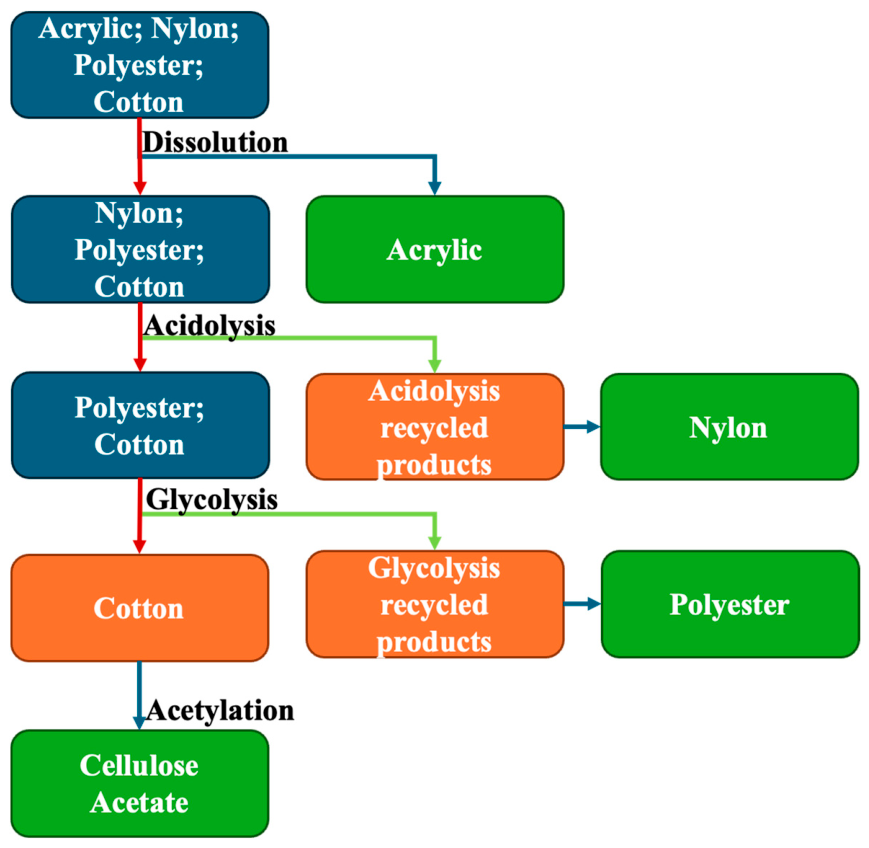
2.2. Valorization of Fibers Mixture
2.3. Preparation of New Materials
2.4. Characterization
3. Preliminary Valorization Essays
4. Valorization of a Mixture of Fibers
4.1. Dissolution–Precipitation of Acrylic Fibers
4.2. Acidolysis of Nylon Fibers
4.3. Glycolysis of Polyester Fibers
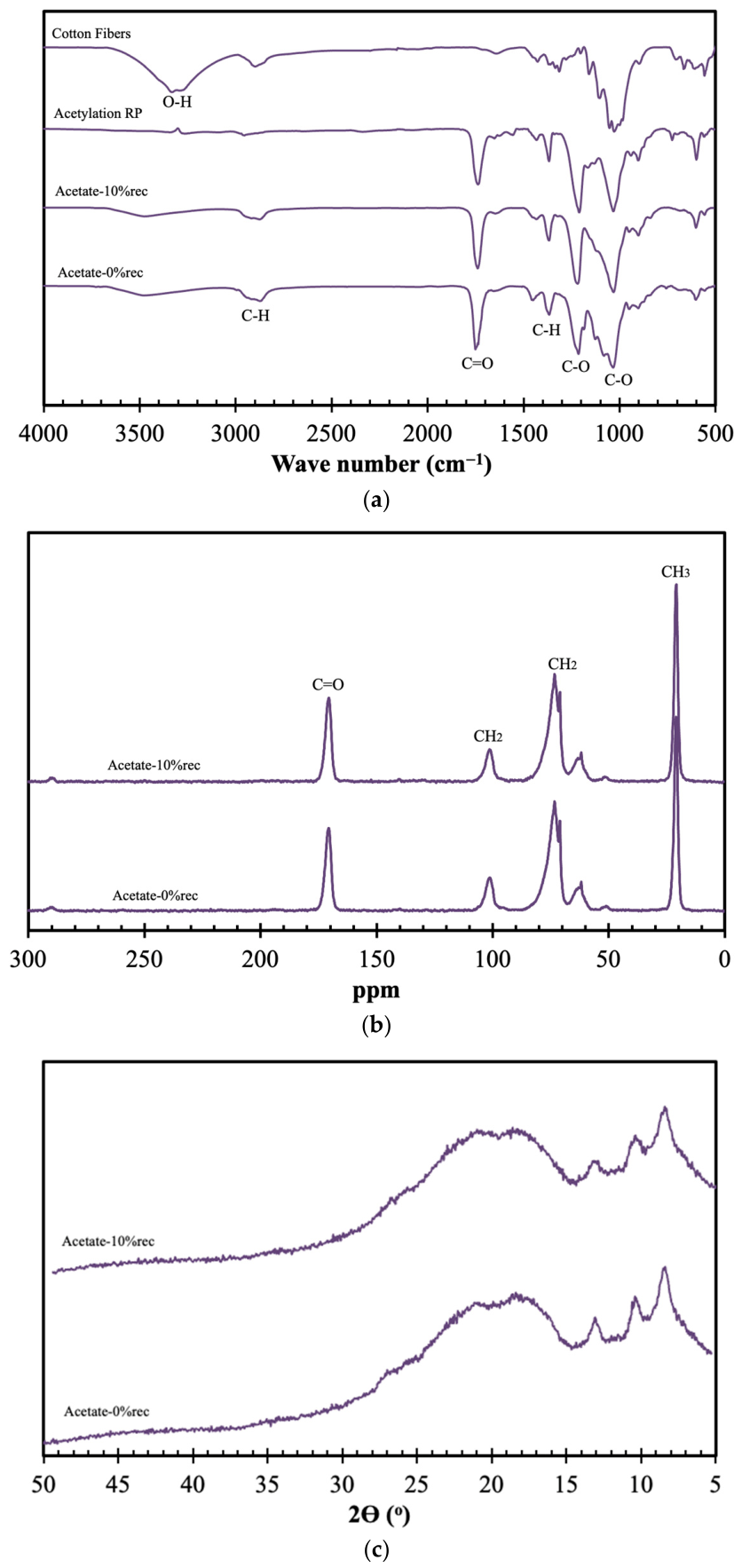
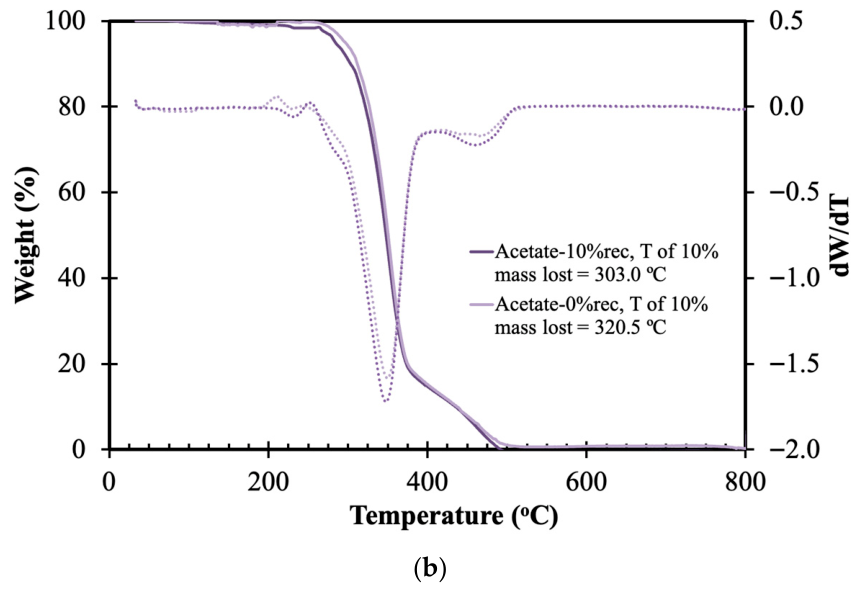
4.4. Acetylation of Cellulose Fibers
5. Conclusions
Author Contributions
Funding
Data Availability Statement
Conflicts of Interest
References
- Niinimäki, K.; Peters, G.; Dahlbo, H.; Perry, P.; Rissanen, T.; Gwilt, A. The Environmental Price of Fast Fashion. Nat. Rev. Earth Environ. 2020, 1, 189–200. [Google Scholar] [CrossRef]
- Boondaeng, A.; Keabpimai, J.; Srichola, P.; Vaithanomsat, P.; Trakunjae, C.; Niyomvong, N. Optimization of Textile Waste Blends of Cotton and PET by Enzymatic Hydrolysis with Reusable Chemical Pretreatment. Polymers 2023, 15, 1964. [Google Scholar] [CrossRef]
- Gritsch, S.M.; Mihalyi, S.; Bartl, A.; Ipsmiller, W.; Jenull-Halver, U.; Putz, R.F.; Quartinello, F.; Guebitz, G.M. Closing the Cycle: Enzymatic Recovery of High Purity Glucose and Polyester from Textile Blends. Resour. Conserv. Recycl. 2023, 188, 106701. [Google Scholar] [CrossRef]
- Egan, J.; Wang, S.; Shen, J.; Baars, O.; Moxley, G.; Salmon, S. Enzymatic Textile Fiber Separation for Sustainable Waste Processing. Resour. Environ. Sustain. 2023, 13, 100118. [Google Scholar] [CrossRef]
- Enking, J.; Becker, A.; Schu, G.; Gausmann, M.; Cucurachi, S.; Tukker, A.; Gries, T. Recycling Processes of Polyester-Containing Textile Waste–A Review. Resour. Conserv. Recycl. 2025, 219, 108256. [Google Scholar] [CrossRef]
- Ndagano, U.N.; Cahill, L.; Smullen, C.; Gaughran, J.; Kelleher, S.M.; Ndagano, U.N.; Cahill, L.; Smullen, C.; Gaughran, J.; Kelleher, S.M. The Current State-of-the-Art of the Processes Involved in the Chemical Recycling of Textile Waste. Molecules 2025, 30, 299. [Google Scholar] [CrossRef] [PubMed]
- Pappa, G.; Boukouvalas, C.; Giannaris, C.; Ntaras, N.; Zografos, V.; Magoulas, K.; Lygeros, A.; Tassios, D. The Selective Dissolution/Precipitation Technique for Polymer Recycling: A Pilot Unit Application. Resour. Conserv. Recycl. 2001, 34, 33–44. [Google Scholar] [CrossRef]
- Gama, N.; Silva, G.; Godinho, B.; Ferreira, A.; Rodrigues, M.; Coutinho, J.A.P. Recycling of a Polymer Mixture Through Dissolution–Precipitation and Development of Machine Learning Models to Assess Polymer/Solvent Suitability. J. Polym. Sci. 2025, 63, 1983–1993. [Google Scholar] [CrossRef]
- Gama, N.; Penzo, D.; Godinho, B.; Rossignolo, G.; Quinteiro, P.; Dias, A.C.; Modesti, M.; Ferreira, A.; Lorenzetti, A.; Barros-Timmons, A. Rethinking Nylon Recycling: A Novel Chemical Approach for Sustainable Polyamide Valorization. J. Environ. Chem. Eng. 2026, 14, 120988. [Google Scholar] [CrossRef]
- Bharadwaj, C.; Purbey, R.; Bora, D.; Chetia, P.; Maheswari R, U.; Duarah, R.; Dutta, K.; Sadiku, E.R.; Varaprasad, K.; Jayaramudu, J. A Review on Sustainable PET Recycling: Strategies and Trends. Mater. Today Sustain. 2024, 27, 100936. [Google Scholar] [CrossRef]
- Vilela, C.; Sousa, A.F.; Freire, C.S.R.; Silvestre, A.J.D.; Neto, C.P. Novel Sustainable Composites Prepared from Cork Residues and Biopolymers. Biomass Bioenergy 2013, 55, 148–155. [Google Scholar] [CrossRef]
- DIN EN ISO 527; Plastics—Determination of Tensile Properties—Part 1: General Principles. Deutsches Institut für Normung (DIN): Berlin, Germany, 2019.
- Mu, B.; Yu, X.; Shao, Y.; Yang, Y. High-Quality Acrylic Fibers from Waste Textiles. Sci. Total Environ. 2024, 931, 172752. [Google Scholar] [CrossRef] [PubMed]
- Matayeva, A.; dos Passos, J.S.; Straka, P.; Skibsted, S.K.G.; Biller, P. Chemical Recycling of Post-Consumer Textile Waste via Continuous Hydrothermal Liquefaction and Hydrotreatment for Simultaneous Monomer and Hydrocarbons Production. Chem. Eng. J. 2025, 508, 161108. [Google Scholar] [CrossRef]
- Callister, W.D., Jr. Fundamentals of Materials Science and Engineering, 5th ed.; John Wiley & Sons, Inc.: New York, NY, USA, 2001. [Google Scholar]
- Zheng, L.; Wang, M.; Li, Y.; Xiong, Y.; Wu, C. Recycling and Degradation of Polyamides. Molecules 2024, 29, 1742. [Google Scholar] [CrossRef]
- Babaei, M.; Jalilian, M.; Shahbaz, K. Chemical Recycling of Polyethylene Terephthalate: A Mini-Review. J. Environ. Chem. Eng. 2024, 12, 112507. [Google Scholar] [CrossRef]
- Abtew, M.A.; Atalie, D.; Dejene, B.K. Recycling of Cotton Textile Waste: Technological Process, Applications and Sustainability within a Circular Economy. J. Ind. Text. 2025, 55, 85. [Google Scholar] [CrossRef]
- Grover, T.; Wang, L.; Nayak, R.; Padhye, R.; Khandual, A. Sustainable Strategies for the Valorization of Cotton and Cotton Blended Waste: Pathways to Circular Economy. Cellulose 2025, 32, 4077–4100. [Google Scholar] [CrossRef]
- Homem, N.C.; Amorim, M.T.P. Synthesis of Cellulose Acetate Using as Raw Material Textile Wastes. Mater. Today Proc. 2020, 31, S315–S317. [Google Scholar] [CrossRef]
- Chennam, P.K.; Kachlík, M.; Říhová, M.; Čičmancová, V.; Maca, K.; Macak, J.M. Synthesis of Centrifugally Spun Polyacrylonitrile-Carbon Fibers. J. Mater. Res. Technol. 2024, 28, 2199–2205. [Google Scholar] [CrossRef]
- Jin, S.Y.; Kim, M.H.; Jeong, Y.G.; Yoon, Y.I.; Park, W.H. Effect of Alkaline Hydrolysis on Cyclization Reaction of PAN Nanofibers. Mater. Des. 2017, 124, 69–77. [Google Scholar] [CrossRef]
- Feng, H.; Ye, C.; Feng, Z. The Miscibility of Homopolymer/Random Copolymer Blends IV. Poly(Vinylidene Chloride-Co-Acrylonitrile)/Poly(Methyl Methacrylate) Blends. Polym. J. 1996, 28, 678–681. [Google Scholar] [CrossRef][Green Version]
- Hu, X.; Tang, X.; Han, N.; Xu, J. Microstructure Evolution of Dry-Jet Wet-Spinning Polyacrylonitrile Fibers during Oxidative Stabilization. IOP Conf. Ser. Mater. Sci. Eng. 2019, 563, 022037. [Google Scholar] [CrossRef]
- Shin, H.K.; Park, M.; Kim, H.-Y.; Park, S.-J. Influence of Oxidative Atmosphere of the Electron Beam Irradiation on Cyclization of PAN-Based Fibers. Carbon Lett. 2015, 16, 219–221. [Google Scholar] [CrossRef]
- Shekar, B.C.; Sathish, S.; Sengoden, R. Spin Coated Nano Scale PMMA Films for Organic Thin Film Transistors. Phys. Procedia 2013, 49, 145–157. [Google Scholar] [CrossRef][Green Version]
- Haider, M.K.; Ullah, A.; Sarwar, M.N.; Yamaguchi, T.; Wang, Q.; Ullah, S.; Park, S.; Kim, I.S. Fabricating Antibacterial and Antioxidant Electrospun Hydrophilic Polyacrylonitrile Nanofibers Loaded with Agnps by Lignin-Induced in-Situ Method. Polymers 2021, 13, 748. [Google Scholar] [CrossRef] [PubMed]
- Goodman, I.; Maitland, D.J.; Kehayoglou, A.H. 13C NMR Spectra of Nylon 6/12 Copolymers and Related Model Compounds. Eur. Polym. J. 2000, 36, 1301–1311. [Google Scholar] [CrossRef]
- Cabello-Alvarado, C.; Andrade-Guel, M.; Ávila-Orta, C.A.; Gamero-Melo, P.; Reyes-Rodríguez, P.Y.; Quiñones-Jurado, Z.V.; Cadenas-Pliego, G.; Bartolo-Pérez, P.; Soriano-Corral, F.; Covarrubias-Gordillo, C. Composites Based on Nylon 6/Clinoptilolite by Ultrasound-Assisted Extrusion for Enhanced Flame Retardant and Mechanical Properties. Polym. Bull. 2022, 79, 1803–1819. [Google Scholar] [CrossRef]
- Pashaei, S.; Siddaramaiah, S.; Avval, M.; Syed, A. Thermal Degradation Kinetics of Nylon6/GF/Crysnano Nanoclay Nanocomposites by TGA. Chem. Ind. Chem. Eng. Q. 2011, 17, 141–151. [Google Scholar] [CrossRef]
- Senra, E.M.; Guimarães, A.C.D.S.; Almeida, R.H.G.D.; Silva, A.L.N.D.; Pinto, J.C.C.D.S.; Nascimento, C.R.; Pacheco, E.B.A.V. A Technical Feasibility Assessment of Chemically Recycling PET Fibers Through Glycolysis to Produce Functional Oligoesters. Recycling 2026, 11, 36. [Google Scholar] [CrossRef]
- Godinho, B.; Nogueira, R.; Gama, N.; Ferreira, A. Synthesis and Characterization of Poly(Glycerol Sebacate), Poly(Glycerol Succinate) and Poly(Glycerol Sebacate-Co-Succinate). J. Polym. Environ. 2024, 32, 4330–4347. [Google Scholar] [CrossRef]
- Silva, C.V.G.; da Silva Filho, E.A.; Uliana, F.; de Jesus, L.F.R.; de Melo, C.V.P.; Barthus, R.C.; Rodrigues, J.G.A.; Vanini, G. PET Glycolysis Optimization Using Ionic Liquid [Bmin]ZnCl3 as Catalyst and Kinetic Evaluation. Polímeros 2018, 28, 450–459. [Google Scholar] [CrossRef]
- Lima, G.R.; Monteiro, W.F.; Ligabue, R.; Santana, R.M.C. Titanate Nanotubes as New Nanostrutured Catalyst for Depolymerization of PET by Glycolysis Reaction. Mater. Res. 2017, 20, 588–595. [Google Scholar] [CrossRef]
- Wang, D.; Luo, F.; Shen, Z.; Wu, X.; Qi, Y. A Study on the Crystallization Behavior and Mechanical Properties of Poly(Ethylene Terephthalate) Induced by Chemical Degradation Nucleation. RSC Adv. 2017, 7, 37139–37147. [Google Scholar] [CrossRef]
- Roungpaisan, N.; Srisawat, N.; Rungruangkitkrai, N.; Chartvivatpornchai, N.; Boonyarit, J.; Kittikorn, T.; Chollakup, R. Melt Spinning Process Optimization of Polyethylene Terephthalate Fiber Structure and Properties from Tetron Cotton Knitted Fabric. Polymers 2023, 15, 4364. [Google Scholar] [CrossRef]
- Liu, H.; Zhang, Y.; Xie, X.; Zhang, X. Continuous Glycolysis of Waste PET via Reactive Extrusion and Copolymerization with PTMG for Enhanced Toughness. Polym. Degrad. Stab. 2026, 246, 111916. [Google Scholar] [CrossRef]
- Rubeš, D.; Vinklárek, J.; Podzimek, Š.; Honzíček, J. Bio-Based Unsaturated Polyester Resin from Post-Consumer PET. RSC Adv. 2024, 14, 8536–8547. [Google Scholar] [CrossRef]
- Celik, Y.; Shamsuyeva, M.; Endres, H.J. Thermal and Mechanical Properties of the Recycled and Virgin PET—Part I. Polymers 2022, 14, 1326. [Google Scholar] [CrossRef]
- Alhulaybi, Z.; Dubdub, I. Comprehensive Kinetic Study of PET Pyrolysis Using TGA. Polymers 2023, 15, 3010. [Google Scholar] [CrossRef]
- Adebajo, M.O.; Frost, R.L. Acetylation of Raw Cotton for Oil Spill Cleanup Application: An FTIR and 13C MAS NMR Spectroscopic Investigation. Spectrochim. Acta A Mol. Biomol. Spectrosc. 2004, 60, 2315–2321. [Google Scholar] [CrossRef] [PubMed]
- Zannagui, C.; Amhamdi, H.; El Barkany, S.; Jilal, I.; Sundman, O.; Salhi, A.; Abou-Salama, M.; El Idrissi, A.; Zaghrioui, M. Adsorption and Regenerability of Pb(II), Cu(II), Cd(II) and Zn(II) from Aqueous Metal Solutions by Cellulose Chemically Modified with Ethylenediamine and Diethylenetriamine. In Proceedings of the Journée Nationale sur la Chimie, Tangier, Morocco, 10 February 2018. [Google Scholar]
- John, A.; Chen, Y.; Kim, J. Synthesis and Characterization of Cellulose Acetate–Calcium Carbonate Hybrid Nanocomposite. Compos. B Eng. 2012, 43, 522–525. [Google Scholar] [CrossRef]
- Rbih, S.; Neggaoui, H.; Laallam, L.; Jouaiti, A. Study on the Ternary Phase Diagram of Synthesized Cellulose/Mixed Solvents/Water System: Influence of Crystallinity on Dissolution. Polym. Bull. 2023, 80, 917–928. [Google Scholar] [CrossRef]
- De Fenzo, A.; Giordano, M.; Sansone, L. A Clean Process for Obtaining High-Quality Cellulose Acetate from Cigarette Butts. Materials 2020, 13, 4710. [Google Scholar] [CrossRef] [PubMed]
- Stark, N.M.; Matuana, L.M. Surface Chemistry Changes of Weathered HDPE/Wood-Flour Composites Studied by XPS and FTIR Spectroscopy. Polym. Degrad. Stab. 2004, 86, 1–9. [Google Scholar] [CrossRef]







| Dissolution–Precipitation | Acidolysis | Glycolysis | Acetylation | |
|---|---|---|---|---|
| Acrylic | Yes | No | No | No |
| Nylon | No | Yes | Yes | No |
| Polyester | No | No | Yes | No |
| Cotton | No | No | No | Yes |
| Sample | Tensile Strength (kPa) | Young Modulus (MPa) | Elongation at Break (%) | ||||||
|---|---|---|---|---|---|---|---|---|---|
| Acrylic | 6328.9 | ± | 225.4 | 532.1 | ± | 20.7 | 50.6 | ± | 4.0 |
| Acrilic rec | 3756.8 | ± | 351.1 | 473.7 | ± | 23.1 | 37.8 | ± | 1.6 |
| Nylon | 1081.7 | ± | 180.0 | 40.2 | ± | 4.3 | 3.5 | ± | 0.7 |
| Nylon rec | 1791.1 | ± | 476.1 | 56.5 | ± | 2.3 | 2.9 | ± | 0.8 |
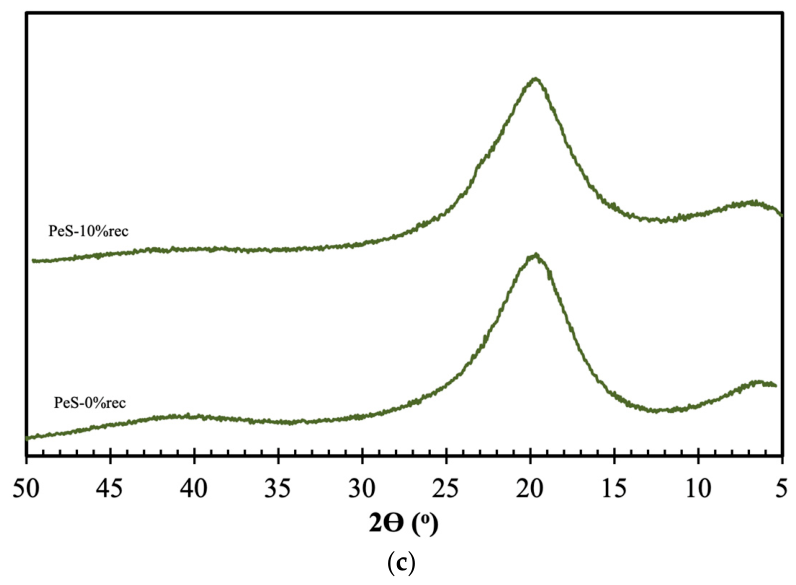
| PeS | 2.8 * | ± | 0.1 * | 324.0 | ± | 35.1 | 60.5 | ± | 6.0 |
| PeS rec | 3.7 * | ± | 0.7 * | 344.0 | ± | 45.1 | 103.2 | ± | 11.2 |
| Acetate | 5662.2 | ± | 1092.2 | 179.2 | ± | 7.6 | 7.9 | ± | 1.1 |
| Acetate rec | 3016.0 | ± | 650.4 | 169.2 | ± | 11.3 | 5.3 | ± | 0.8 |
Disclaimer/Publisher’s Note: The statements, opinions and data contained in all publications are solely those of the individual author(s) and contributor(s) and not of MDPI and/or the editor(s). MDPI and/or the editor(s) disclaim responsibility for any injury to people or property resulting from any ideas, methods, instructions or products referred to in the content. |
© 2026 by the authors. Licensee MDPI, Basel, Switzerland. This article is an open access article distributed under the terms and conditions of the Creative Commons Attribution (CC BY) license.
Share and Cite
Smarandache, D.; Godinho, B.; Matos, M.; Pinto, S.C.; Ionescu, C.; Cioateră, N.; Ferreira, A.; Gama, N. Process Strategies Enabling Selective Polymer Valorization from Textile Fiber Blends. Materials 2026, 19, 2100. https://doi.org/10.3390/ma19102100
Smarandache D, Godinho B, Matos M, Pinto SC, Ionescu C, Cioateră N, Ferreira A, Gama N. Process Strategies Enabling Selective Polymer Valorization from Textile Fiber Blends. Materials. 2026; 19(10):2100. https://doi.org/10.3390/ma19102100
Chicago/Turabian StyleSmarandache, Diana, Bruno Godinho, Marina Matos, Susana C. Pinto, Cătălina Ionescu, Nicoleta Cioateră, Artur Ferreira, and Nuno Gama. 2026. "Process Strategies Enabling Selective Polymer Valorization from Textile Fiber Blends" Materials 19, no. 10: 2100. https://doi.org/10.3390/ma19102100
APA StyleSmarandache, D., Godinho, B., Matos, M., Pinto, S. C., Ionescu, C., Cioateră, N., Ferreira, A., & Gama, N. (2026). Process Strategies Enabling Selective Polymer Valorization from Textile Fiber Blends. Materials, 19(10), 2100. https://doi.org/10.3390/ma19102100