Flexural Behavior of Reinforced Concrete Two-Way Slabs Strengthened with Basalt Fiber-Reinforced Polymer Grid and Engineered Cementitious Composite


Highlights
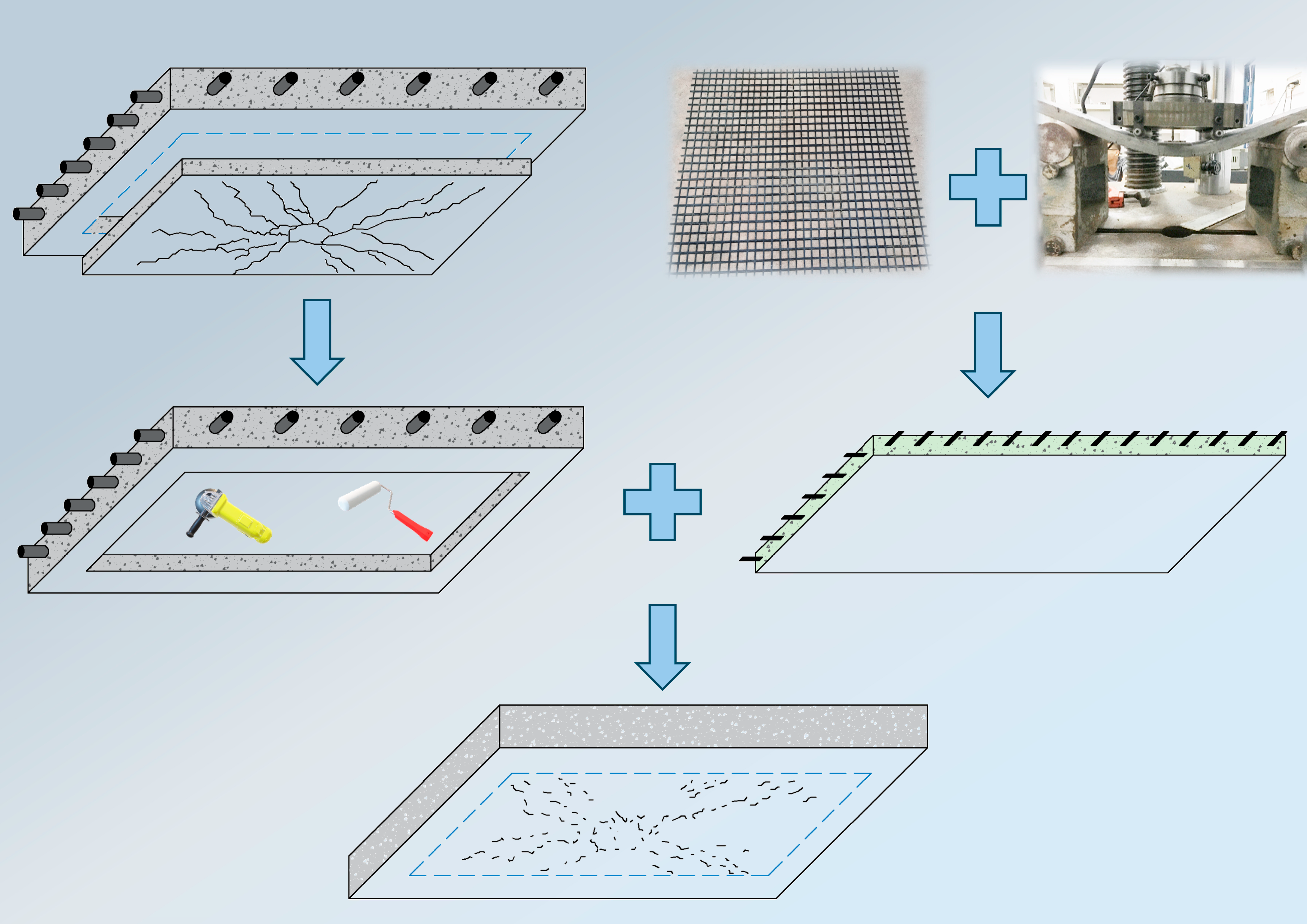
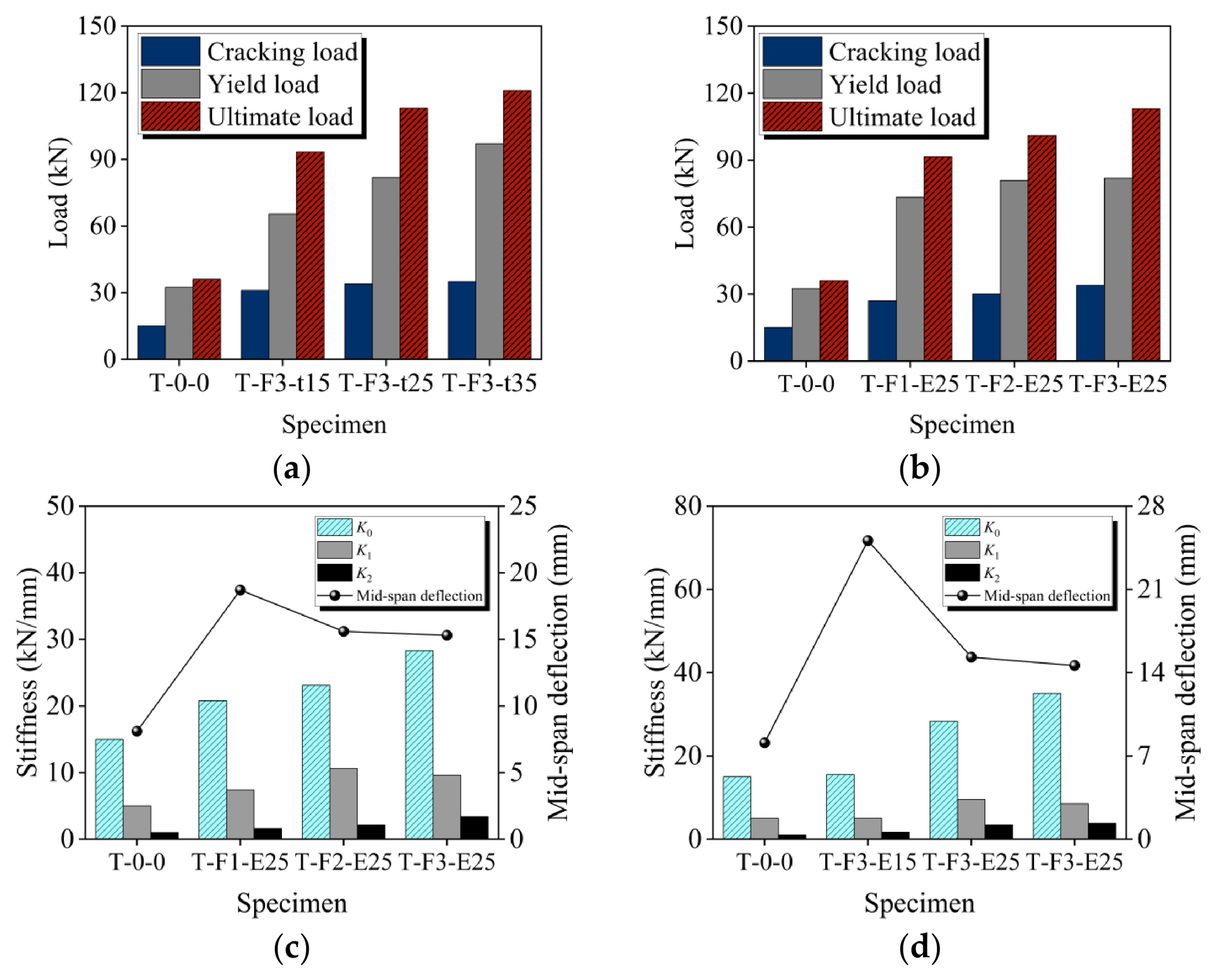
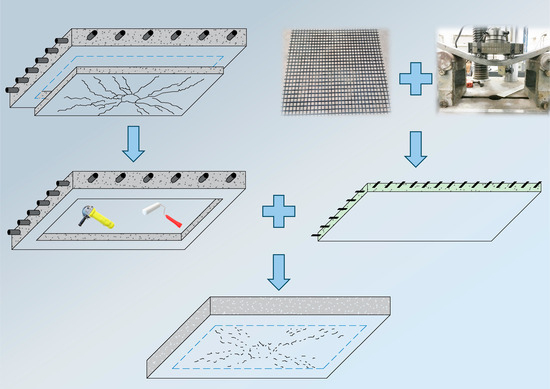
- The BFRP grid–ECC composite increased the ultimate slab capacity by 154.1–236.1%, demonstrating an effective epoxy-free CRM retrofitting solution for slabs.
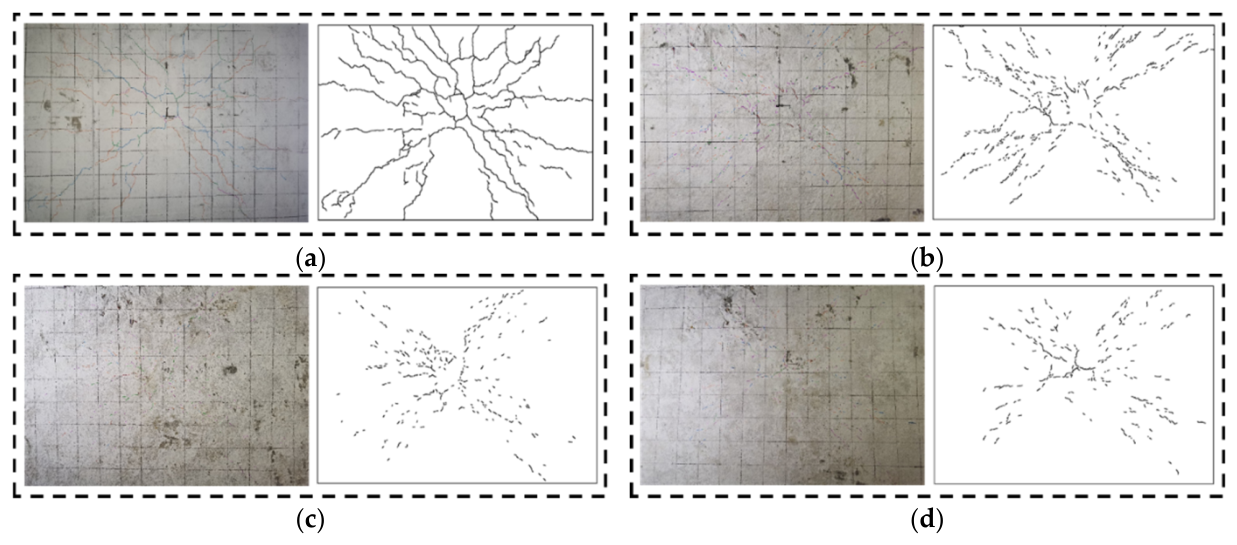
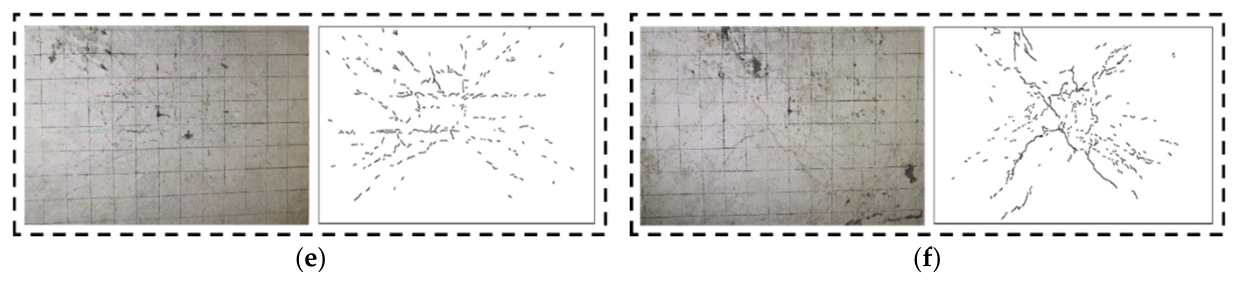
- Failure shifted from continuous diagonal cracks to fine, discontinuous short cracks, indicating that the composite layer effectively suppresses crack propagation and enhances ductility.
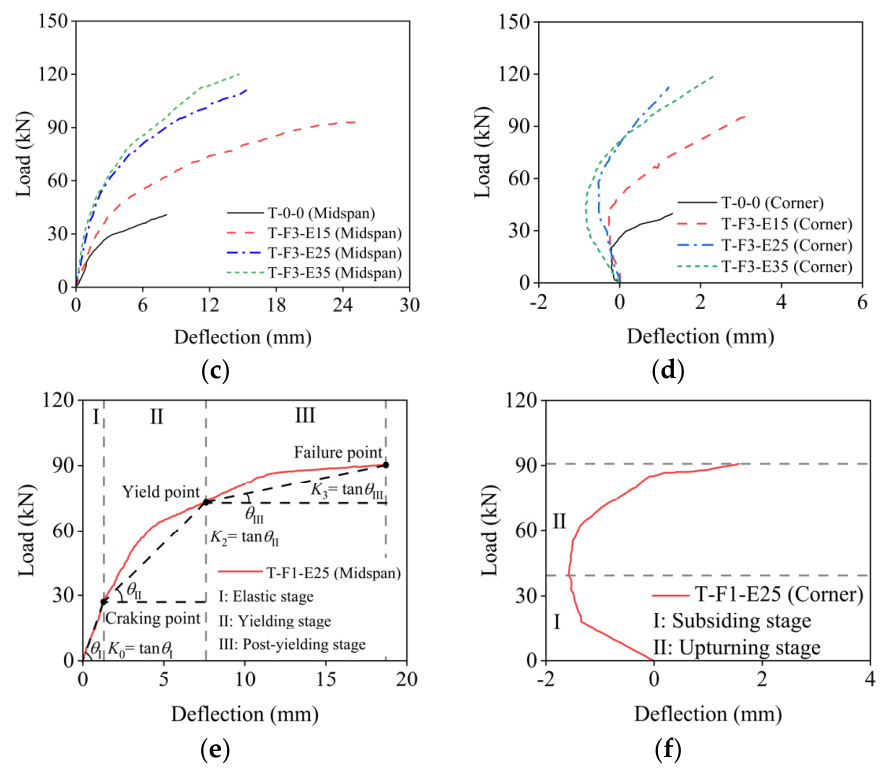
- Thicker BFRP grids and ECC layers consistently improved flexural load and stiffness, suggesting that appropriately increasing CRM thickness is conducive to reinforcement.
- Y-shaped and triangular yield line models accurately predicted the ultimate capacity, providing a reliable design basis for field applications.
Abstract
1. Introduction
2. Experimental Program
2.1. Specimen Details
2.2. Materials
2.3. Preparation of Strengthened Specimens
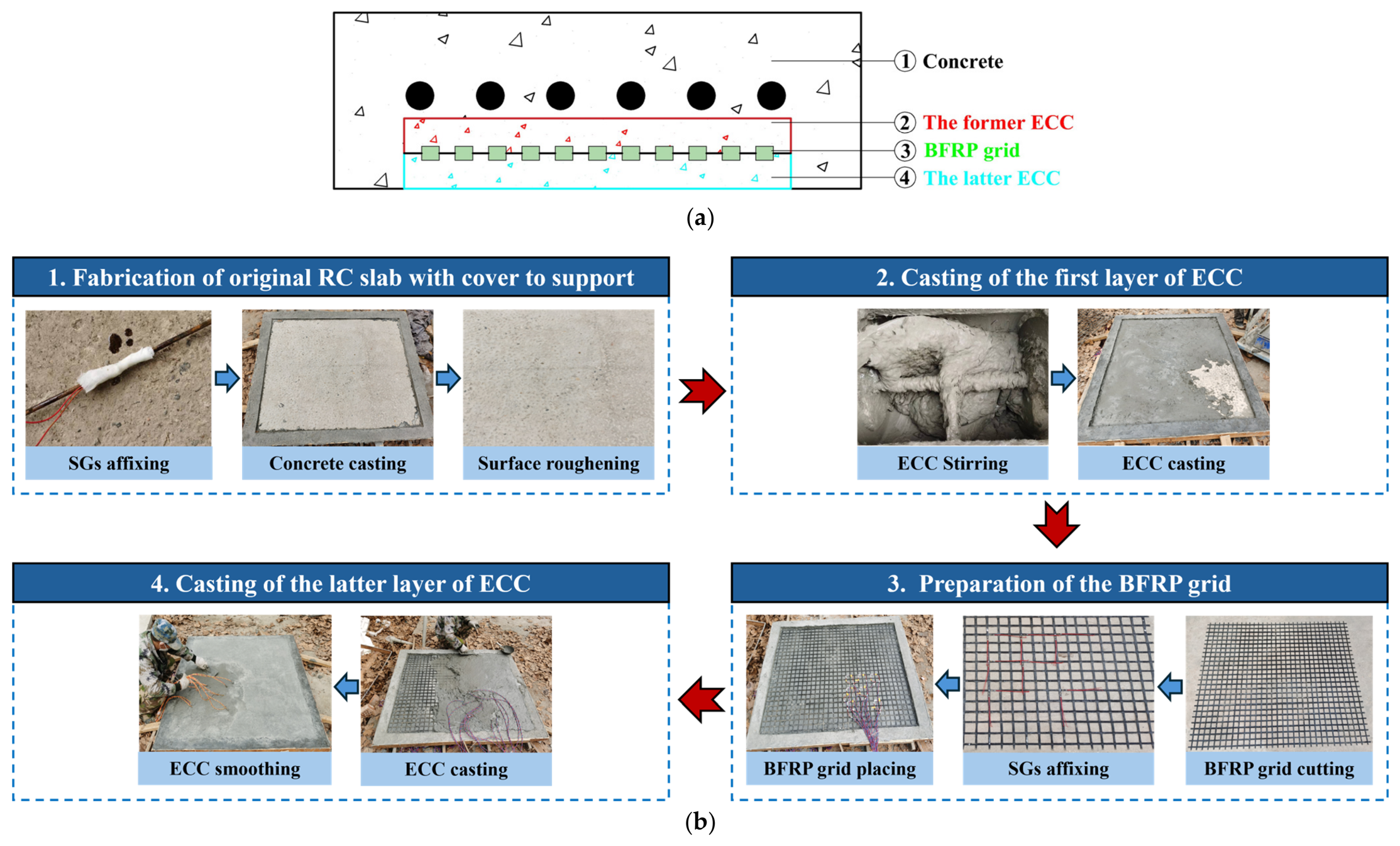
- Fabrication of original RC slab with cover to support. First, construct and fix wooden formworks of size 1800 mm × 1500 mm × 80 mm and 1600 mm × 1300 mm × 15 mm. Affix strain gauges to the pre-fabricated rebars with adhesives, protecting them with silicone and epoxy resin-soaked gauze. Rebars are tied into a mesh using binding wire, and place it on the 1600 mm × 1300 mm × 15 mm wooden formwork. Next, pour concrete, compact it with a vibrator, level the surface, and cure it under an impermeable membrane for 28 days. Then, the bottom surface of the reinforced area was roughened for effective bonding.
- Casting of the former layer of ECC. The prepared ECC is poured in the reinforced area, and the thickness is half of the composite layer.
- Preparation of the BFRP grid. Cut to size, and paste strain gauges. Then, the BFRP grid is pressed gently into the fresh initial ECC, which is located in the middle of the composite layer in the thickness direction.
- Casting of the latter layer of ECC. Pour the remaining ECC, remove the formwork 2 days later, and continue curing until 28 days.

2.4. Test Setup
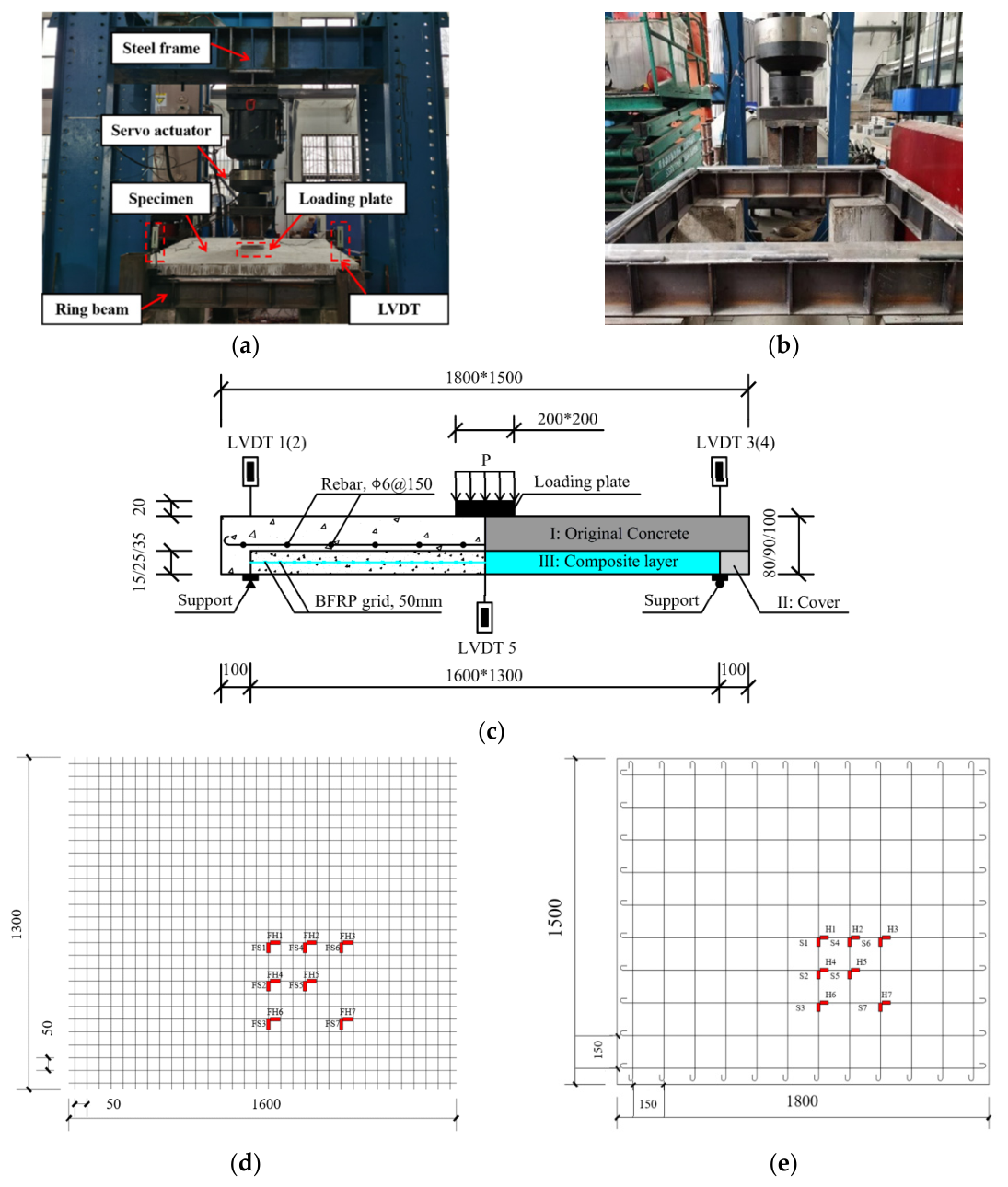
- Failure due to the main steel reinforcement snapping in tension or exceeding a strain of 0.01.
- Concrete crushing on the compressive surface of the slab.
- Mid-span deflection surpassing 1/50 of the span (28 mm in this study).
- Maximum crack width exceeding 1.5 mm.
- Sudden failure of the BFRP grid.
- Debonding failure of the composite reinforcement layer.

3. Experimental Results and Analysis
3.1. Failure Mode and Cracking Pattern
3.2. Cracking, Yield, and Ultimate Load
3.3. Load-Deflection Response
3.4. Load–Strain Response of Steel Reinforcement
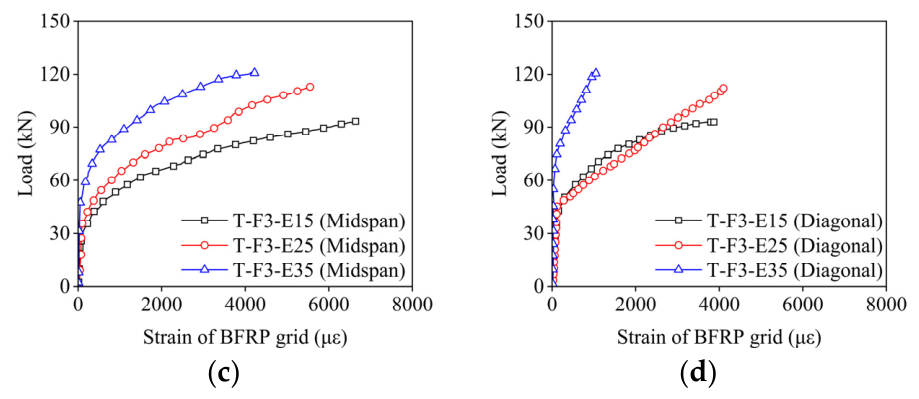
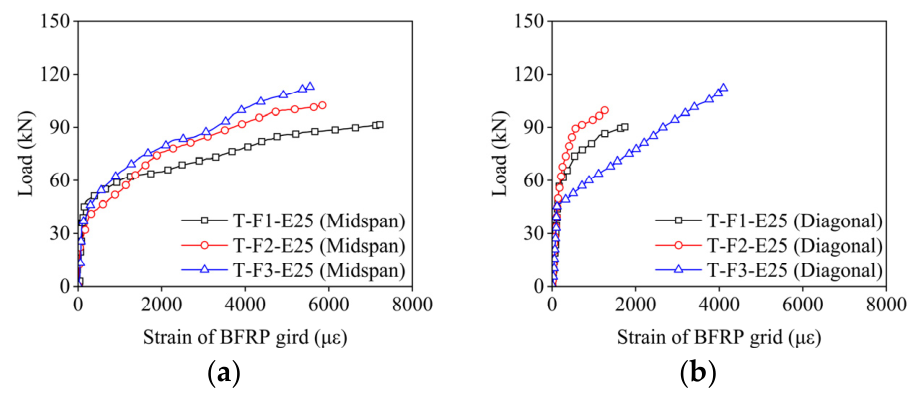
3.5. Load–Strain Response of BFRP Grid
4. Prediction Model for Flexural Capacity of Strengthened Slabs
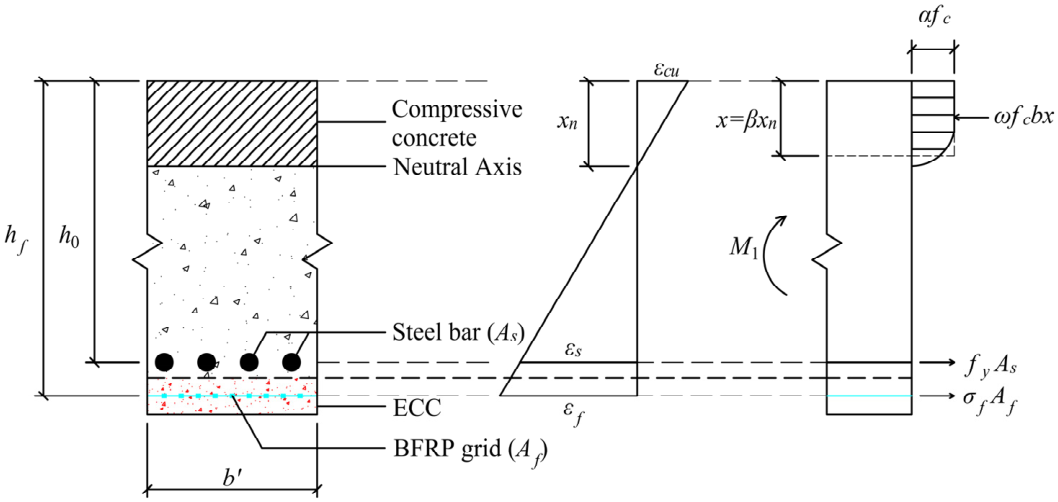
4.1. Basic Assumptions
- At all loading stages, the section of the slab satisfies the plane section assumption.
- After cracking, the tensile capacity of the concrete and ECC is neglected. Due to the inherent variability of cracking of cementitious materials, it is considered unsafe to rely on the tensile strength of the matrix in the limit state.
- A linear elastic model is used for the stress–strain response of the BFRP grid.
- When the slab forms a failure mechanism, it is divided into several rigid segments by multiple yield lines, with shear and torsional deformations neglected.
- The rectangular slab is simplified to a square slab, and it is assumed that the reinforcement provided by the steel reinforcement and BFRP grid is the same in both directions.
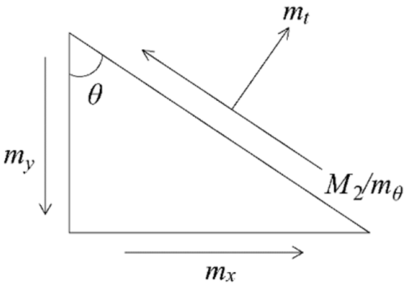
4.2. Bending Moment on the Yield Line
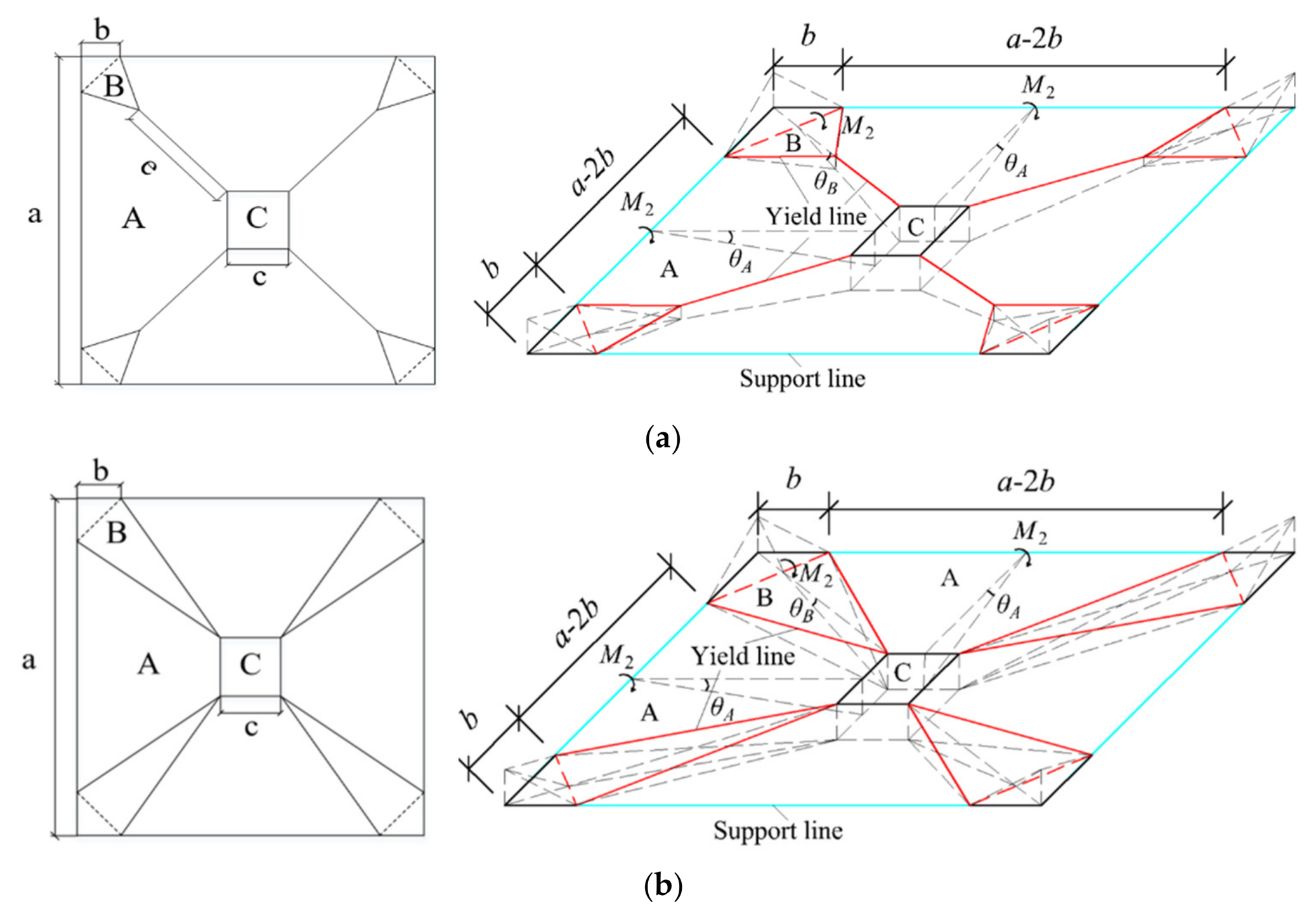
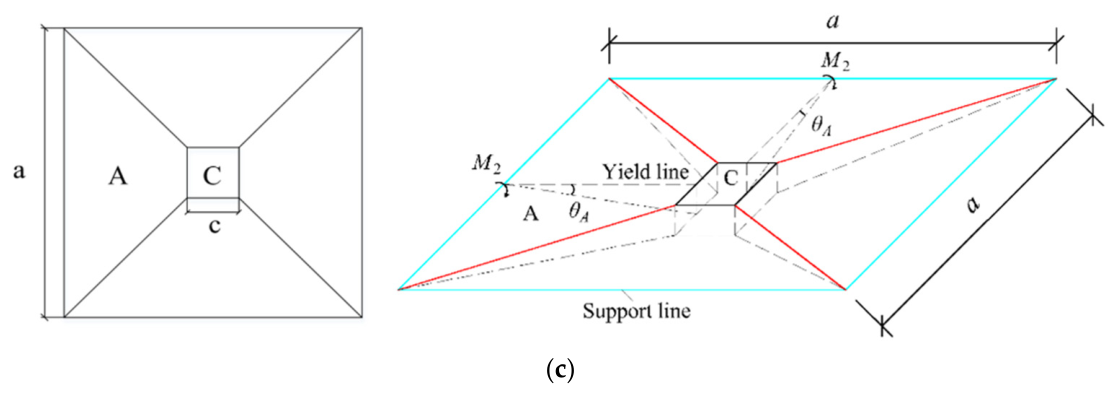
4.3. Yield Line Theory
4.3.1. Y-Shaped Pattern
4.3.2. Triangular Pattern
4.3.3. Linear Pattern
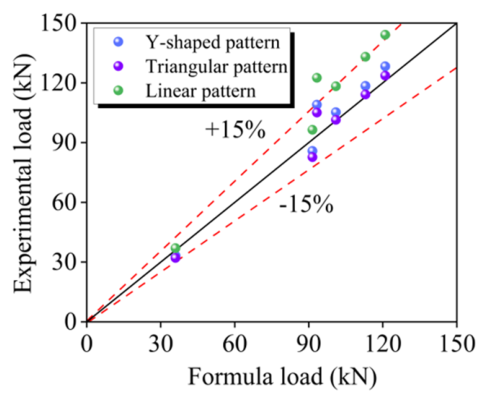
4.4. Validation of Formula
5. Conclusions
- The flexural performance of the strengthened slabs saw significant enhancement. Cracking load, yielding load, and ultimate loads increased by 80–133.3%, 126.5–199.7%, and 154.1–236.1%, respectively. The cracking pattern shifted from diagonally concentrated through-length cracks to discontinuous short cracks. Moreover, the absence of debonding between ECC and the original concrete confirms the method’s feasibility.
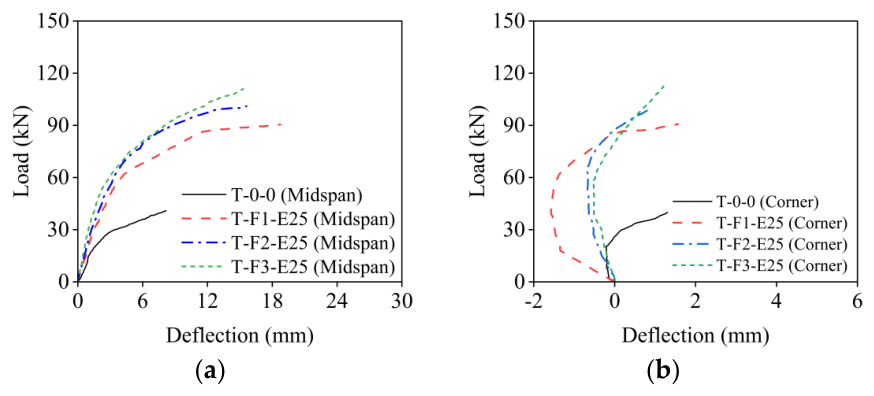
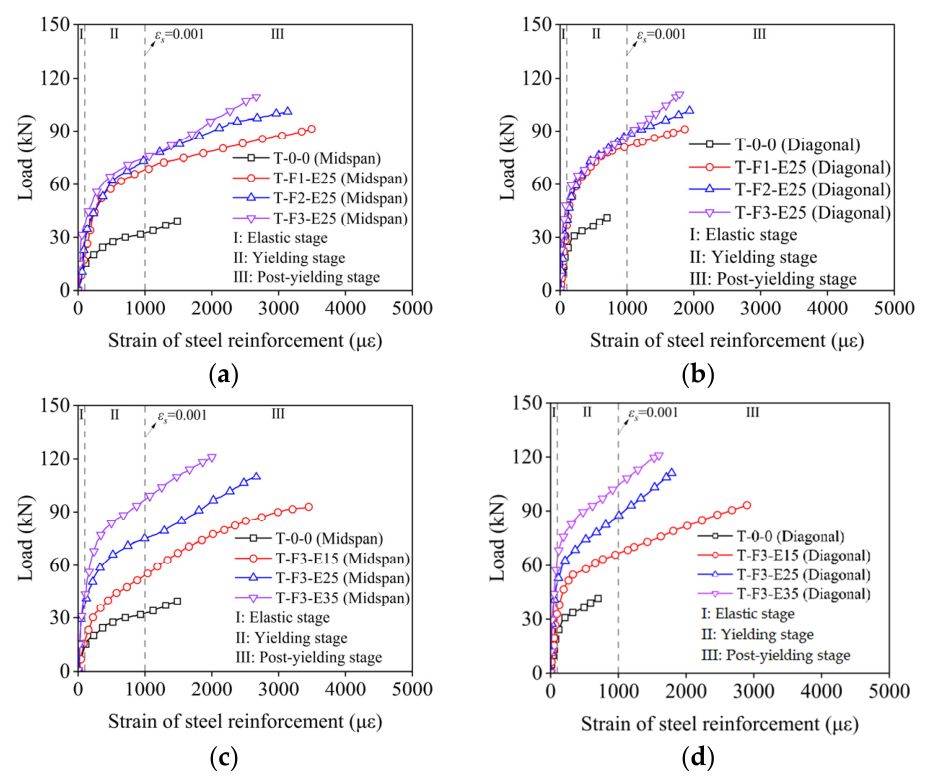
- The impacts of two variables on characteristic load, stiffness, and strain response were meticulously examined. Experimental results revealed that characteristic load and representative stiffness increased with BFRP grid and ECC thicknesses, albeit with some loss in ductility. Initially, a higher utilization rate of steel bars was achieved with the composite layer. However, as BFRP grid and ECC thicknesses increased, utilization rates for both steel bars and BFRP grid gradually declined.
- Three yield line patterns were introduced to predict the flexural capacity of the strengthened slab. The Y-shaped and triangular models, considering the corner lever effect, yielded results more consistent with experimental data, serving as valuable references for practical engineering applications. Further experimental tests are necessary to validate these proposed models.
- The demonstrated improvements in ductility and the shift toward fine, discontinuous cracking patterns offer a reliable technical basis for reinforcing aging infrastructure, particularly where clearance constraints and fire safety (due to the inorganic matrix) are critical.
- This study primarily focused on the static flexural response under specific span-to-loading area ratios. Future research should evaluate the long-term durability of the interfacial bond under environmental stressors (e.g., freeze–thaw cycles or chloride attack) and investigate the structural reliability under fatigue or dynamic loading to facilitate broader engineering applications.
Author Contributions
Funding
Data Availability Statement
Acknowledgments
Conflicts of Interest
Abbreviations
| RC | Reinforced concrete |
| BFRP | Basalt fiber-reinforced polymer |
| ECC | Engineered cementitious composite |
| EB | Externally bonding |
| NSM | Near-surface-mounted |
| CRM | Composite-reinforced mortar |
| PVA | Polyvinyl alcohol |
| LVDT | Linear variable differential transformer |
| SG | Strain gauge |
References
- Liang, H.; Li, S.; Lu, Y.; Hu, J.; Liu, Z. Electrochemical Performance of Corroded Reinforced Concrete Columns Strengthened with Fiber Reinforced Polymer. Compos. Struct. 2019, 207, 576–588. [Google Scholar] [CrossRef]
- Zhang, D.; Zhao, Y.; Ueda, T.; Li, X.; Xu, Q. CFRP Strengthened RC Beams with Pre-Strengthening Non-Uniform Reinforcement Corrosion Subjected to Post-Strengthening Wetting/Drying Cycles. Eng. Struct. 2016, 127, 331–343. [Google Scholar] [CrossRef]
- Mosallam, A.S.; Mosalam, K.M. Strengthening of Two-Way Concrete Slabs with FRP Composite Laminates. Constr. Build. Mater. 2003, 17, 43–54. [Google Scholar] [CrossRef]
- Dziomdziora, P.; Smarzewski, P. Reinforced Concrete Beams with FRP and Hybrid Steel–FRP Composite Bars: Load–Deflection Response, Failure Mechanisms, and Design Implications. Materials 2025, 18, 4381. [Google Scholar] [CrossRef]
- Ortiz, J.D.; Khedmatgozar Dolati, S.S.; Malla, P.; Nanni, A.; Mehrabi, A. FRP-Reinforced/Strengthened Concrete: State-of-the-Art Review on Durability and Mechanical Effects. Materials 2023, 16, 1990. [Google Scholar] [CrossRef] [PubMed]
- Sabzi, J.; Esfahani, M.R.; Ozbakkaloglu, T.; Ramezani, A. The Effect of Tensile Reinforcement on the Behavior of CFRP Strengthened Reinforced Concrete Beams: An Experimental and Analytical Study. Steel Comps. Struct. 2023, 46, 115–132. [Google Scholar] [CrossRef]
- Shayanfar, J.; Bengar, H.A. A Practical Model for Simulating Nonlinear Behaviour of FRP Strengthened RC Beam-Column Joints. Steel Comps. Struct. 2018, 27, 49–74. [Google Scholar] [CrossRef]
- Zhou, C.Y.; Yu, Y.A.; Zhou, C.F.; He, X.J.; Wang, Y. Experimental Study on RC Beams Externally Bonded by CFRP Sheets with and without End Self-Locking. Steel Comps. Struct. 2023, 48, 599–610. [Google Scholar] [CrossRef]
- El-Sherif, H.; Wakjira, T.G.; Ebead, U. Flexural Strengthening of Reinforced Concrete Beams Using Hybrid Near-Surface Embedded/Externally Bonded Fabric-Reinforced Cementitious Matrix. Constr. Build. Mater. 2020, 238, 117748. [Google Scholar] [CrossRef]
- Yang, Y.; Xian, G.; Li, H.; Sui, L. Thermal Aging of an Anhydride-Cured Epoxy Resin. Polym. Degrad. Stab. 2015, 118, 111–119. [Google Scholar] [CrossRef]
- Smith, S.T.; Hu, S.; Kim, S.J.; Seracino, R. FRP-Strengthened RC Slabs Anchored with FRP Anchors. Eng. Struct. 2011, 33, 1075–1087. [Google Scholar] [CrossRef]
- Yang, Q.; Xian, G.; Karbhari, V.M. Hygrothermal Ageing of an Epoxy Adhesive Used in FRP Strengthening of Concrete. J. Appl. Polym. Sci. 2008, 107, 2607–2617. [Google Scholar] [CrossRef]
- Ke, Y.; Zhang, S.S.; Jedrzejko, M.J.; Lin, G.; Li, W.G.; Nie, X.F. Strength Models of Near-Surface Mounted (NSM) Fibre-Reinforced Polymer (FRP) Shear-Strengthened RC Beams Based on Machine Learning Approaches. Compos. Struct. 2024, 337, 118045. [Google Scholar] [CrossRef]
- Özkiliç, Y.O.; Madenci, E.; Badr, A.; Mansour, W.; Fayed, S. Shear Strengthening of Seawater Sea-Sand Concrete Beams Containing No Shear Reinforcement Using NSM Aluminum Alloy Bars. Steel Comps. Struct. 2024, 51, 153–172. [Google Scholar] [CrossRef]
- Guo, R.; Pan, Y.; Cai, L.; Hino, S. Bonding Behavior of CFRP Grid-Concrete with PCM Shotcrete. Eng. Struct. 2018, 168, 333–345. [Google Scholar] [CrossRef]
- Oddo, M.C.; Minafò, G.; Mendola, L. La Constitutive Models for the Tensile Behaviour of TRM Materials: Literature Review and Experimental Verification. Materials 2021, 14, 700. [Google Scholar] [CrossRef]
- Sui, Z.A.; Dong, K.; Jiang, J.; Yang, S.; Hu, K. Flexural Behavior of Fire-Damaged Prefabricated RC Hollow Slabs Strengthened with CFRP versus TRM. Materials 2020, 13, 2556. [Google Scholar] [CrossRef]
- Illampas, R.; Oliveira, D.V.; Lourenço, P.B. Design of Strain-Hardening Natural TRM Composites: Current Challenges and Future Research Paths. Materials 2023, 16, 4558. [Google Scholar] [CrossRef]
- Taljsten, B.; Blanksvärd, T. Mineral-Based Bonding of Carbon FRP to Strengthen Concrete Structures. J. Compos. Constr. 2007, 11, 120–128. [Google Scholar] [CrossRef]
- He, W.; Wang, X.; Ding, L.; Wu, Z. Efficiency of Different BFRP-Based Strengthening Techniques in Improving Flexural Behavior of RC Slabs. Constr. Build. Mater. 2021, 308, 125002. [Google Scholar] [CrossRef]
- D’Antino, T.; Calabrese, A.S.; Poggi, C.; Colombi, P.; Fava, G.; Bocciarelli, M. Strengthening of Different Types of Slabs with Composite-Reinforced Mortars (CRM). In Buildings for Education: A Multidisciplinary Overview of the Design of School Buildings; Della Torre, S., Bocciarelli, M., Daglio, L., Neri, R., Eds.; Springer International Publishing: Cham, Switzerland, 2020; pp. 293–303. [Google Scholar]
- Zhang, X.; Wang, X.; Zhang, Y.; Chang, X.; Shi, Y.; Li, G.; Wu, Z. Flexural Behavior of Tunnel Lining Segment Strengthened with BFRP Grid-Fiber Reinforced Geopolymer Mortar. Structures 2025, 74, 108490. [Google Scholar] [CrossRef]
- Palanivelu, R.; Panchanatham, B.; Zapris, A.G.; Kytinou, V.K. Non-Conventional and Sustainable Retrofitting of Fire-Exposed Reinforced Concrete Columns Using Basalt Fiber–Engineered Geopolymer Composites. Buildings 2025, 15, 1962. [Google Scholar] [CrossRef]
- Emara, M.; El-Zohairy, A.; Fekry, M.; Husain, M. Effect of Using ECC Layer on the Flexural Performance of RC Beams Previously Strengthened with EB CFRP Laminates. Sustainability 2022, 14, 16990. [Google Scholar] [CrossRef]
- Chen, X.; Li, R.; Xiong, Z.; Liu, Y.; Zhuge, Y. Experimental Study on Axial Behavior of Pre-Damaged Concrete Columns Confined with Carbon Textile-Reinforced ECC. Constr. Build. Mater. 2025, 458, 139582. [Google Scholar] [CrossRef]
- Chen, Y.; Yu, J.; Leung, C.K.Y. Use of High Strength Strain-Hardening Cementitious Composites for Flexural Repair of Concrete Structures with Significant Steel Corrosion. Constr. Build. Mater. 2018, 167, 325–337. [Google Scholar] [CrossRef]
- Basha, S.H.; Lian, X.Q.; Hou, W.; Zheng, P.D.; Guo, Z.X. Behavior of Short Columns Constructed Using Engineered Cementitious Composites under Seismic Loads. Steel Comps. Struct. 2023, 48, 565–582. [Google Scholar] [CrossRef]
- Sheta, A.M.; Ma, X.; Zhuge, Y.; ElGawady, M.A.; Mills, J.E.; Abd-Elaal, E. Shear Behaviour of Thin-Walled Composite Cold-Formed Steel/PE-ECC Beams. Steel Comps. Struct. 2023, 46, 75–92. [Google Scholar] [CrossRef]
- Ren, Y.; Xia, M.; Pan, Y.; Guo, S.; Guo, R. Study on the Uniaxial Tensile Behavior of an FRP Grid-ECC Composite Layer. Case Stud. Constr. Mat. 2024, 20, e02909. [Google Scholar] [CrossRef]
- Yuan, F.; Pan, J.; Leung, C.K.Y. Flexural Behaviors of ECC and Concrete/ECC Composite Beams Reinforced with Basalt Fiber-Reinforced Polymer. J. Compos. Constr. 2013, 17, 591–602. [Google Scholar] [CrossRef]
- Gao, W.-Y.; Hu, K.-X.; Dai, J.-G.; Dong, K.; Yu, K.-Q.; Fang, L.-J. Repair of Fire-Damaged RC Slabs with Basalt Fabric-Reinforced Shotcrete. Constr. Build. Mater. 2018, 185, 79–92. [Google Scholar] [CrossRef]
- Zhou, Y.; Sui, L.; Huang, X.; Guo, M.; Luo, M.; Hu, B.; Chen, C. Enhancing the EB-FRP Strengthening Effectiveness by Incorporating a Cracking-Control Layer of ECC with Different Thicknesses. Constr. Build. Mater. 2021, 286, 122975. [Google Scholar] [CrossRef]
- Wu, C.; Su, Y.; Zhang, P.; Zhu, H.; Gao, D.; Sheikh, S.A. Experimental Study of GFRP Reinforced Concrete Beams with U-Shaped CFRP Grid-Reinforced ECC Stay-in-Place Formwork. Front. Mater. 2022, 9, 872232. [Google Scholar] [CrossRef]
- Yang, X.; Gao, W.-Y.; Dai, J.-G.; Lu, Z.-D.; Yu, K.-Q. Flexural Strengthening of RC Beams with CFRP Grid-Reinforced ECC Matrix. Compos. Struct. 2018, 189, 9–26. [Google Scholar] [CrossRef]
- Wu, C.; Li, V.C. CFRP-ECC Hybrid for Strengthening of the Concrete Structures. Compos. Struct. 2017, 178, 372–382. [Google Scholar] [CrossRef]
- Zhang, Z.; Liu, D.; Abdalla, J.A.; Hawileh, R.A.; Qin, F.; Xu, X. Flexural Behavior of Reinforced Concrete Beams Externally Strengthened with ECC and FRP Grid Reinforcement. Constr. Build. Mater. 2024, 446, 137964. [Google Scholar] [CrossRef]
- Deng, L.; Liu, Y.; Zhou, Z.; Zou, Y.; Shi, W.; Jin, Z.; Zhong, Q. Flexural Performance of BFRP Grid–ECC in Strengthening Damaged RC Beams. Structures 2024, 69, 107420. [Google Scholar] [CrossRef]
- Guo, R.; Ren, Y.; Li, M.; Hu, P.; Du, M.; Zhang, R. Experimental Study on Flexural Shear Strengthening Effect on Low-Strength RC Beams by Using FRP Grid and ECC. Eng. Struct. 2021, 227, 111434. [Google Scholar] [CrossRef]
- Yang, X.; Gao, W.-Y.; Dai, J.-G.; Lu, Z.-D. Shear Strengthening of RC Beams with FRP Grid-Reinforced ECC Matrix. Compos. Struct. 2020, 241, 112120. [Google Scholar] [CrossRef]
- EAD 340392-00-0104; CRM (Composite Reinforced Mortar) Systems for Strengthening Concrete and Masonry Structures. European Organization for Technical Assessment: Brussels, Belgium, 2018.
- ACI 549.4R-20; Guide to Design and Construction of Externally Bonded Fabric-Reinforced Cementitious Matrix (FRCM) and Steel-Reinforced Grout (SRG) Systems for Repair and Strengthening Concrete and Masonry Structures. American Concrete Institute: Farmington Hills, MI, USA, 2020.
- CNR-DT 215/2018; Guide for the Design and Construction of Externally Bonded Fibre Reinforced Cementitious Matrix (FRCM) Systems for Strengthening Existing Structures. National Research Council: Rome, Italy, 2018.
- Zheng, Y.Z.; Wang, W.W.; Brigham, J.C. Flexural Behaviour of Reinforced Concrete Beams Strengthened with a Composite Reinforcement Layer: BFRP Grid and ECC. Constr. Build. Mater. 2016, 115, 424–437. [Google Scholar] [CrossRef]
- GB 50010-2010; Code for Design of Concrete Structures. General Administration of Quality Supervision, Inspection and Quarantine of the People’s Republic of China: Beijing, China, 2010.
- GB/T 3354-2014; Test Method for Tensile Properties of Oriented Fibre-Reinforced Polymer Matrix Composites. General Administration of Quality Supervision, Inspection and Quarantine of the People’s Republic of China: Beijing, China, 2014.
- JC/T 2461-2018; Standard Test Method for the Mechanical Properties of Ductile Fiber Reinforced Cementitious Composites. Ministry of Industry and Information Technology of the People’s Republic of China: Beijing, China, 2018.
- GB 50152-2012; Standard for Test Method of Concrete Structures. General Administration of Quality Supervision, Inspection and Quarantine of the People’s Republic of China: Beijing, China, 2012.
- Ghayeb, H.H.; Atea, R.S.; Al-Kannoon, M.A.-A.; Lee, F.W.; Wong, L.S.; Mo, K.H. Performance of Reinforced Concrete Flat Slab Strengthened with CFRP for Punching Shear. Case Stud. Constr. 2023, 18, e01801. [Google Scholar] [CrossRef]
- Mercimek, Ö.; Ghoroubi, R.; Erbaş, Y.; Anil, Ö. Comparison of Strengthening Methods to Improve Punching Behavior of Two-Way RC Flat Slabs. Structures 2022, 46, 1495–1516. [Google Scholar] [CrossRef]
- Zheng, Y.Z.; Wang, W.W.; Mosalam, K.M.; Fang, Q.; Chen, L.; Zhu, Z.F. Experimental Investigation and Numerical Analysis of RC Beams Shear Strengthened with FRP/ECC Composite Layer. Compos. Struct. 2020, 246, 112436. [Google Scholar] [CrossRef]
- Ebead, U.; Marzouk, H. Fiber-Reinforced Polymer Strengthening of Two-Way Slabs. ACI Struct. J. 2004, 101, 650–659. [Google Scholar] [CrossRef]
- Li, X.J.; Lu, Y.Y.; Li, N. Behavior of Two-Way RC Slabs Combination Strengthened with CFRP Strips and Steel Sheets. Appl. Mech. Mater. 2014, 501–504, 1048–1052. [Google Scholar] [CrossRef]
- AbdelBaset, M.; Makhlouf, M.H.; Bondok, M.H.; Khaleel, G.I. Experimental and Numerical Study for Flexural Behavior of RC Two-Way Slabs with Openings Strengthened by EBR and NSM Techniques. Structures 2025, 73, 108361. [Google Scholar] [CrossRef]
- Teng, J.G.; Smith, S.T.; Yao, J.; Chen, J.F. Intermediate Crack-Induced Debonding in RC Beams and Slabs. Constr. Build. Mater. 2003, 17, 447–462. [Google Scholar] [CrossRef]
- Jnaid, F. Review of Flexural Design Parameters of Concrete Cross-Sections Strengthened with FRP Laminates. Int. J. Eng. Adv. Technol. 2025, 14, 16–22. [Google Scholar] [CrossRef]
- Torabian, A.; Isufi, B.; Mostofinejad, D.; Pinho Ramos, A. Flexural Strengthening of Flat Slabs with FRP Composites Using EBR and EBROG Methods. Eng. Struct. 2020, 211, 110483. [Google Scholar] [CrossRef]
- Moshiri, N.; Martinelli, E.; Breveglieri, M.; Czaderski, C. Experimental Tests and Numerical Simulations on the Mechanical Response of RC Slabs Externally Strengthened by Passive and Prestressed FRP Strips. Eng. Struct. 2023, 292, 116559. [Google Scholar] [CrossRef]
- Codina, A.; Torres, L.; D’Antino, T.; Baena, M.; Barris, C. Flexural Performance of RC Beams Strengthened with HB CFRP Plates: Experimental Study and Theoretical Model Based on the Intermediate Crack Debonding. Constr. Build. Mater. 2025, 458, 139444. [Google Scholar] [CrossRef]
- Mostakhdemin Hosseini, M.R.; Dias, S.J.E.; Barros, J.A.O. Behavior of One-Way RC Slabs Flexurally Strengthened with Prestressed NSM CFRP Laminates—Assessment of Influencing Parameters. Compos. Struct. 2020, 245, 112259. [Google Scholar] [CrossRef]
- Aljidda, O.; El Refai, A.; Alnahhal, W. Experimental and Analytical Investigation on the Use of NSM–BFRP and NSM–GFRP Bars in Strengthening Corrosion–Damaged RC Slabs. Compos. Struct. 2023, 322, 117428. [Google Scholar] [CrossRef]
- Dias, S.J.E.; Barros, J.A.O.; Janwaen, W. Behavior of RC Beams Flexurally Strengthened with NSM CFRP Laminates. Compos. Struct. 2018, 201, 363–376. [Google Scholar] [CrossRef]
- Su, M.; Gong, S.; Liu, Y.; Peng, H. Flexural Behavior of RC Beams Strengthened with Fully or Partially Prestressed Near-Surface Mounted FRP Strips: An Experimental Investigation. Eng. Struct. 2022, 262, 114345. [Google Scholar] [CrossRef]
- Zhang, H.Y.; Liu, H.Y.; Kodur, V.; Li, M.Y.; Zhou, Y. Flexural Behavior of Concrete Slabs Strengthened with Textile Reinforced Geopolymer Mortar. Compos. Struct. 2022, 284, 115220. [Google Scholar] [CrossRef]
- Deng, Z.; Xia, Q.; Gong, M.; Xu, J. Flexural Strengthening of Two-Way RC Slabs with Textile Reinforced Mortar: Experimental Study and Calculation Model. KSCE J. Civ. Eng. 2023, 27, 5268–5280. [Google Scholar] [CrossRef]
- Koutas, L.N.; Papakonstantinou, C.G. Flexural Strengthening of RC Beams with Textile-Reinforced Mortar Composites Focusing on the Influence of the Mortar Type. Eng. Struct. 2021, 246, 113060. [Google Scholar] [CrossRef]
- ACI 440.2 R-17; Guide for the Design and Construction of Externally Bonded FRP Systems for Strengthening Concrete Structures. American Concrete Institute: Farmington Hills, MI, USA, 2017.
- He, W.; Wang, X.; Wu, Z. Flexural Behavior of RC Beams Strengthened with Prestressed and Non-Prestressed BFRP Grids. Compos. Struct. 2020, 246, 112381. [Google Scholar] [CrossRef]
- Kaura, J. Optimisation of Thickness of Fibre Reinforced Polymer Sheets for Strengthening Reinforced Concrete Beams with Flexural Deficiency. Niger. J. Technol. 2016, 36, 45–49. [Google Scholar] [CrossRef]
- GB 50608-2020; Technical Standard for Fiber Reinforced Polymer (FRP) in Construction. General Administration of Quality Supervision, Inspection and Quarantine of the People’s Republic of China: Beijing, China, 2020.
- Park, R.; Gamble, W.L. Reinforced Concrete Slabs; John Wiley & Sons: Hoboken, NJ, USA, 1999. [Google Scholar]









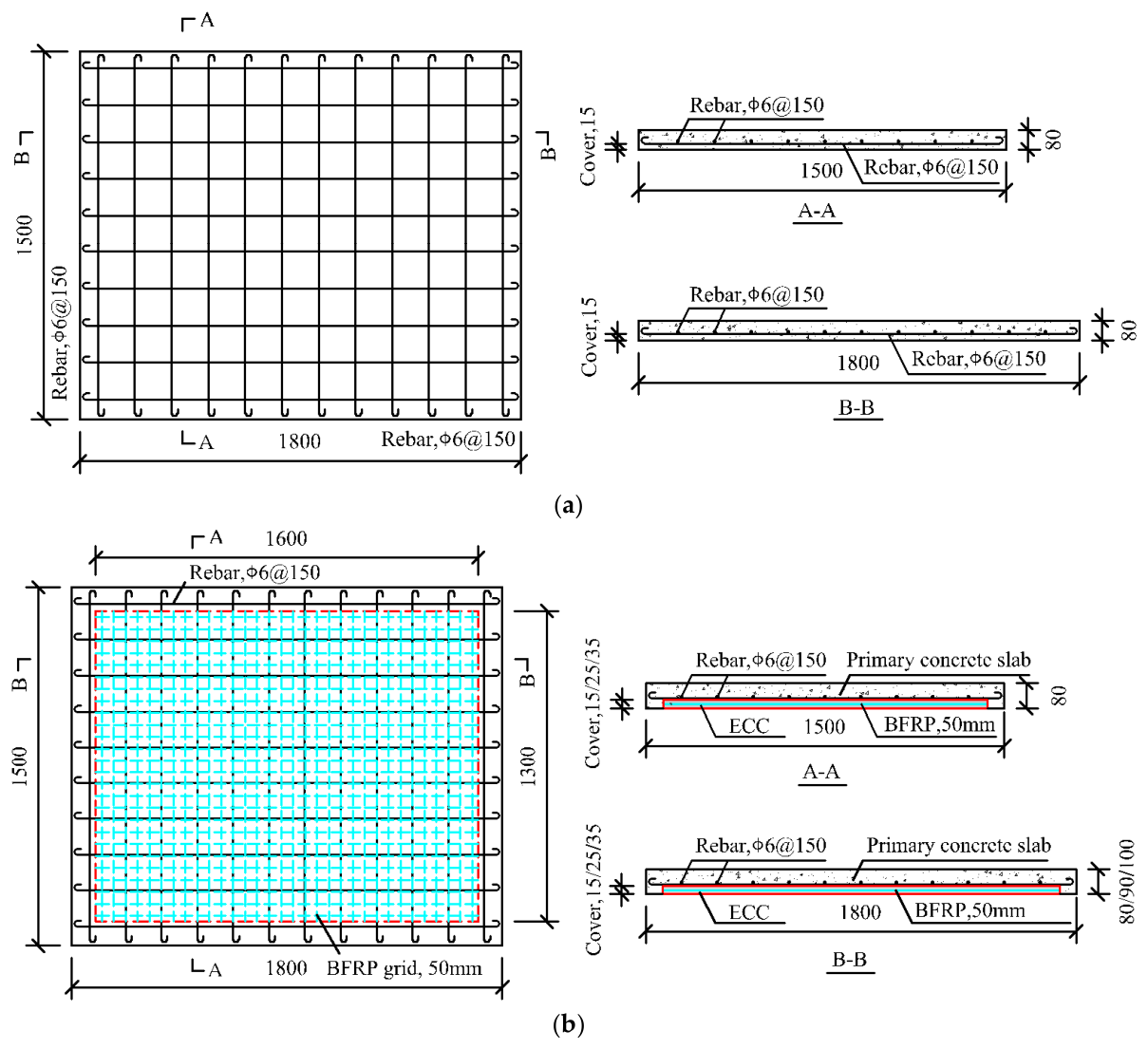
| Specimen | h (mm) | hf (mm) | he (mm) | Ss (mm2) | Sf (mm2) |
|---|---|---|---|---|---|
| T-0-0 | 80 | / | / | 1800 × 1500 | 1600 × 1300 |
| T-F1-E25 | 90 | 1 | 25 | 1800 × 1500 | 1600 × 1300 |
| T-F2-E25 | 90 | 2 | 25 | 1800 × 1500 | 1600 × 1300 |
| T-F3-E25 | 90 | 3 | 25 | 1800 × 1500 | 1600 × 1300 |
| T-F3-E15 | 80 | 3 | 15 | 1800 × 1500 | 1600 × 1300 |
| T-F3-E35 | 100 | 3 | 35 | 1800 × 1500 | 1600 × 1300 |
| Matreial | Index | Sample 1 (Mpa) | Sample 2 (Mpa) | Sample 3 (Mpa) | Mean (Mpa) | SD (Mpa) | COV (%) |
|---|---|---|---|---|---|---|---|
| Concrete | fcu | 28.07 | 25.48 | 25.36 | 26.3 | 1.25 | 4.75 |
| ECC | fe,cu | 37.3 | 38.75 | 35.64 | 37.23 | 1.27 | 3.41 |
| fe,tu | 3.6 | 3.8 | 3.91 | 3.77 | 0.13 | 3.40 | |
| Steel rebar | fy | 352 | 348 | 359 | 353 | 4.55 | 1.29 |
| fu | 509 | 511 | 523 | 514.3 | 6.18 | 1.20 | |
| BFRP grid (1 mm) | ffu | 2415 | 2422 | 2426 | 2421 | 4.55 | 0.19 |
| BFRP grid (2 mm) | 2358 | 2363 | 2365 | 2362 | 2.94 | 0.13 | |
| BFRP grid (3 mm) | 2417 | 2423 | 2426 | 2422 | 3.74 | 0.15 |
| No. | hf (mm) | Af (mm2) | Ef (GPa) | Elongation (%) |
|---|---|---|---|---|
| B1 | 1 | 5 | 86 | 2.4 |
| B2 | 2 | 10 | 87 | 2.3 |
| B3 | 3 | 15 | 85 | 2.3 |
| Specimen | Total Mass (kg) | Concrete (kg) | Steel Rebar (kg) | ECC (kg) | BFRP (kg) |
|---|---|---|---|---|---|
| T-0-0 | 523.95 | 515.96 | 7.99 | / | / |
| T-F1-E25 | 573.15 | 455.96 | 7.99 | 108.33 | 0.87 |
| T-F2-E25 | 573.15 | 455.96 | 7.99 | 107.45 | 1.75 |
| T-F3-E25 | 573.15 | 455.96 | 7.99 | 106.58 | 2.62 |
| T-F3-E15 | 514.59 | 441.08 | 7.99 | 62.9 | 2.62 |
| T-F3-E35 | 631.71 | 470.84 | 7.99 | 150.26 | 2.62 |
| ID | Failure Mode | Pc (kN) | dc (mm) | Py (kN) | dy (mm) | Pu (kN) | du (mm) | K0 (kN/mm) | K1 (kN/mm) | K2 (kN/mm) | μ | En (J) |
|---|---|---|---|---|---|---|---|---|---|---|---|---|
| T-0-0 | CC | 15 | 1 | 32.4 | 4.5 | 36 | 8.1 | 15 | 5 | 1 | 1.8 | 231.28 |
| T-F1-E25 | CE | 27 | 1.3 | 73.4 | 7.6 | 91.5 | 18.7 | 20.8 | 7.4 | 1.6 | 2.46 | 1335.33 |
| T-F2-E25 | CE | 30 | 1.3 | 80.9 | 6.1 | 101 | 15.6 | 23.1 | 10.6 | 2.1 | 2.56 | 1201.96 |
| T-F3-E25 | CE | 34 | 1.2 | 81.9 | 6.2 | 113 | 15.3 | 28.3 | 9.6 | 3.4 | 2.47 | 1236.92 |
| T-F3-E15 | CE | 31 | 2 | 65.4 | 8.9 | 93.3 | 25.1 | 15.5 | 5 | 1.7 | 2.82 | 1726.15 |
| T-F3-E35 | CE | 35 | 1 | 97.1 | 8.3 | 121 | 14.6 | 35 | 8.5 | 3.8 | 1.76 | 1263.48 |
| Researcher | Strengthening Technique | Subject | Dimension (mm) | Anchor/Interface Configuration | Debonding | ∆Pc (%) | ∆Py (%) | ∆Pu (%) | λs (%) | λf (%) |
|---|---|---|---|---|---|---|---|---|---|---|
| Authors’ study | BFRP grid–ECC | Two-way slab | 1800 × 1500 × 80 | Chiseling | No debonding | 80~133.3 | 101.9~199.7 | 154.1~236.1 | 15~35 | 4.5~31.4 |
| Zheng et al. [50] | BFRP grid–ECC | Beam | 1800 × 200 × 300 | Chiseling | Partial debonding after the rupture of BFRP grid | 58.1~96.8 | 14.9~34.7 | 4~32.5 | 50~70 | 27~46 |
| Yang et al. [34] | CFRP grid–ECC | Beam | 2000 × 200 × 150 | U warp anchor/Chiseling/Epoxy resin adhesive | Critical diagonal/Intermediate crack-induced debonding | 87.5–425 | 26.7–102.9 | 35.5–116.8 | 24~73 | 24~96 |
| Wu et al. [33] | CFRP grid–ECC | Beam | 2300 × 250 × 150 | Steel reinforcement wrapped by ECC | No debonding | 20~100 | 5.9~16 | −7~20 | 25~30 | / |
| Zhou et al. [32] | EB CFRP strips | One-way slab | 3200 × 250 × 150 | Hybrid anchor/Polishing | Intermediate crack-induced debonding | 0~14.3 | 13~21.7 | −3.3~10 | / | 42~87 |
| Torabian et al. [56] | EB\EBORG CFRP sheets | Two-way slab | 2200 × 2200 × 150 | Epoxy resin adhesive | Partial debonding | 23.5~35.7 | / | 2~39 | 2.5~30 | 0~50 |
| Moshiri et al. [57] | EB\EBORG CFRP strips | One-way slab | 6000 × 1000 × 220 | End anchor system/Epoxy resin adhesive | Intermediate crack-induced debonding | / | / | 32~35 | / | 45~78 |
| Codina et al. [58] | EB\HB CFRP laminates | Beam | 2400 × 180 × 140 | Epoxy resin adhesive | Intermediate crack-induced debonding | / | / | 8~27 | / | 39~77 |
| Hosseini et al. [59] | NSM CFRP laminates | One-way slab | 2600 × 600 × 120 | Epoxy resin adhesive | No debonding | 0~371.8 | 19.8~119.4 | 58.6~134 | / | 13~96 |
| Aljidda et al. [60] | NSM BFRP/GFRP bars | One-way slab | 3000 × 600 × 150 | Epoxy resin adhesive | No debonding | 12.5~77.8 | 40.4~71.8 | 82.4~101.6 | / | 65~69 |
| Dias et al. [61] | NSM CFRP laminates | Beam | 2400 × 150 × 300 | Epoxy resin adhesive | Intermediate crack-induced debonding | 4.5~19.4 | 10.2~34.3 | 41.9~103.2 | / | 83~100 |
| Su et al. [62] | Prestressed NSM CFRP strips | Beam | 2700 × 150 × 250 | Epoxy resin adhesive | End interfacial debonding + End cover separation | −233.3 | / | −12.3~136.8 | 10–50 | 11–62 |
| Zhang et al. [63] | TRM | One-way slab | 4200 × 600 × 100 | Geopolymer mortar or Polymer modified cement mortar/ grinding and cleaning | No debonding | / | / | 12~92 | 30–98 | 15.9–30.5 |
| Deng et al. [64] | TRM | Two-way slab | 1800 × 1300 × 100 | Epoxy resin adhesive | No debonding | 123.4~191.2 | / | 43.8~54.2 | / | / |
| Koutas and Papakonstantinou [65] | TRM | Beam | 1600 × 120 × 200 | Fiber-reinforced cement-based mortar with synthetic \polymers | Intermediate crack-induced debonding | / | / | 7.4–37.4 | / | / |
| ID | Pu (kN) | Y-Shaped Pattern | Triangular Pattern | Linear Pattern | |||
|---|---|---|---|---|---|---|---|
| Pu1 (kN) | Pu1/Pu | Pu2 (kN) | Pu2/Pu | Pu3 (kN) | Pu3/Pu | ||
| T-0-0 | 36 | 33.29 | 0.832 | 32.08 | 0.891 | 37.04 | 1.028 |
| T-F1-E25 | 91.5 | 85.82 | 0.938 | 82.71 | 0.904 | 96.42 | 1.054 |
| T-F2-E25 | 101 | 105.27 | 1.042 | 101.44 | 1.004 | 118.27 | 1.171 |
| T-F3-E25 | 113 | 118.47 | 1.048 | 114.17 | 1.010 | 133.10 | 1.179 |
| T-F3-E15 | 93.3 | 109.05 | 1.168 | 105.09 | 1.126 | 122.52 | 1.313 |
| T-F3-E35 | 121 | 128.29 | 1.060 | 123.63 | 1.022 | 144.13 | 1.191 |
| Average | / | / | 1.030 | / | 0.993 | / | 1.150 |
| COV | / | / | 0.079 | / | 0.079 | / | 0.081 |
Disclaimer/Publisher’s Note: The statements, opinions and data contained in all publications are solely those of the individual author(s) and contributor(s) and not of MDPI and/or the editor(s). MDPI and/or the editor(s) disclaim responsibility for any injury to people or property resulting from any ideas, methods, instructions or products referred to in the content. |
© 2026 by the authors. Licensee MDPI, Basel, Switzerland. This article is an open access article distributed under the terms and conditions of the Creative Commons Attribution (CC BY) license.
Share and Cite
Xue, J.; Zhu, M.; Liang, H.; Li, H. Flexural Behavior of Reinforced Concrete Two-Way Slabs Strengthened with Basalt Fiber-Reinforced Polymer Grid and Engineered Cementitious Composite. Materials 2026, 19, 2019. https://doi.org/10.3390/ma19102019
Xue J, Zhu M, Liang H, Li H. Flexural Behavior of Reinforced Concrete Two-Way Slabs Strengthened with Basalt Fiber-Reinforced Polymer Grid and Engineered Cementitious Composite. Materials. 2026; 19(10):2019. https://doi.org/10.3390/ma19102019
Chicago/Turabian StyleXue, Jifeng, Mingyu Zhu, Hongjun Liang, and Haoyu Li. 2026. "Flexural Behavior of Reinforced Concrete Two-Way Slabs Strengthened with Basalt Fiber-Reinforced Polymer Grid and Engineered Cementitious Composite" Materials 19, no. 10: 2019. https://doi.org/10.3390/ma19102019
APA StyleXue, J., Zhu, M., Liang, H., & Li, H. (2026). Flexural Behavior of Reinforced Concrete Two-Way Slabs Strengthened with Basalt Fiber-Reinforced Polymer Grid and Engineered Cementitious Composite. Materials, 19(10), 2019. https://doi.org/10.3390/ma19102019