Evaluation of High-Temperature Performance of Hungarian Bituminous Binders Using the BTSV Method


Abstract
1. Introduction
2. Materials and Methods
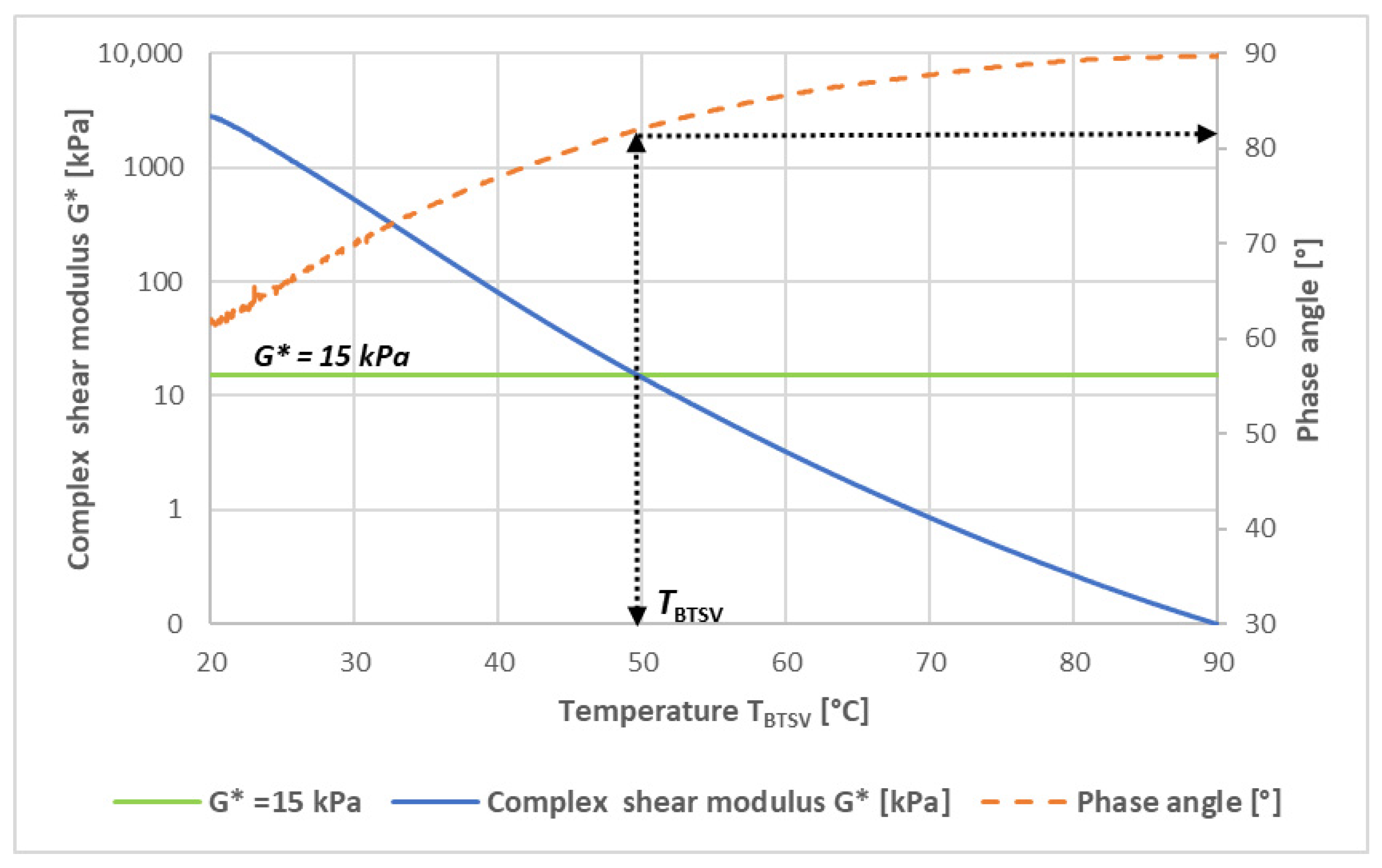
2.1. Background
2.2. Materials
3. Results
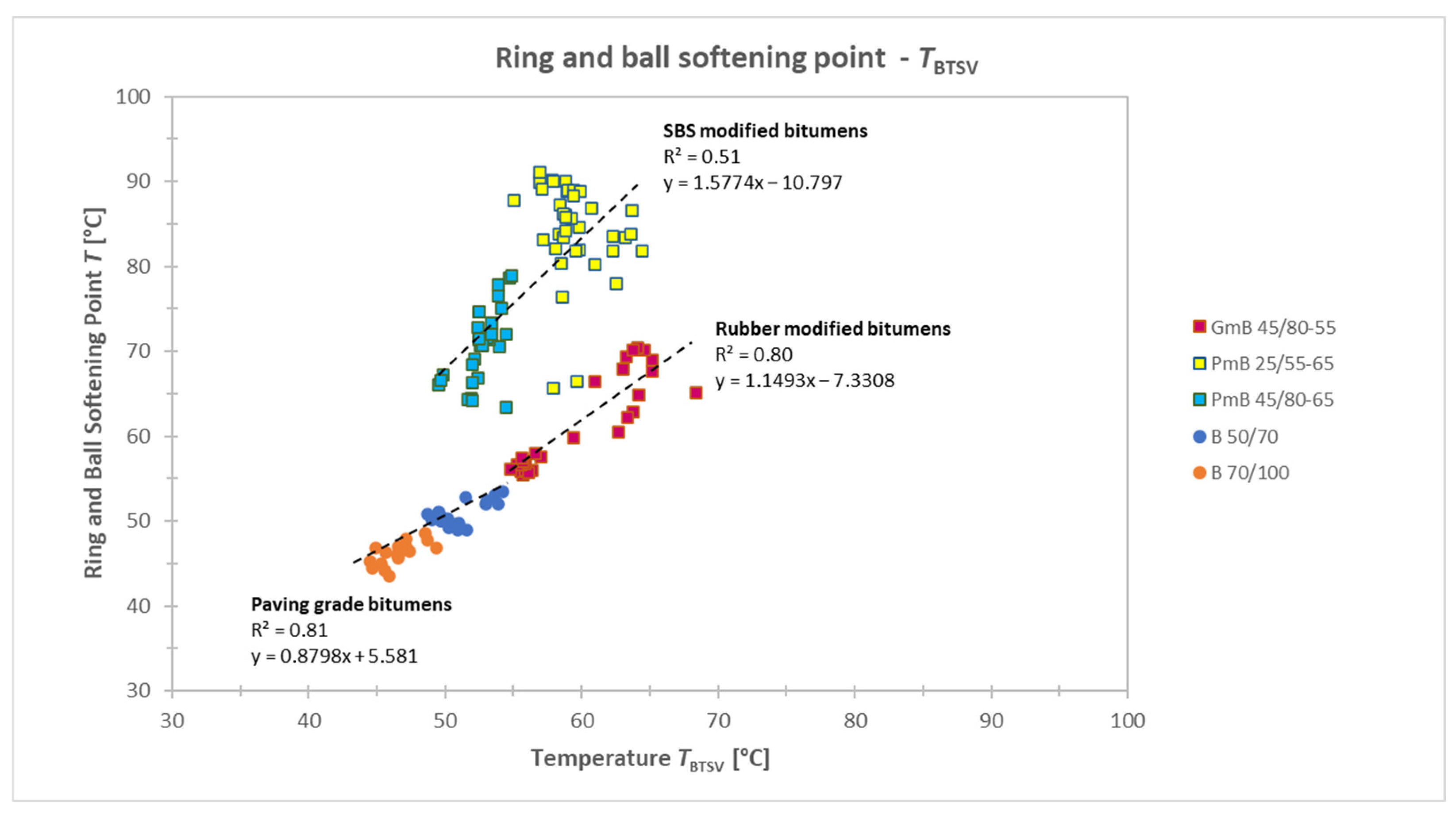
3.1. Relationship Between TBTSV Temperature and Ring and Ball Softening Point
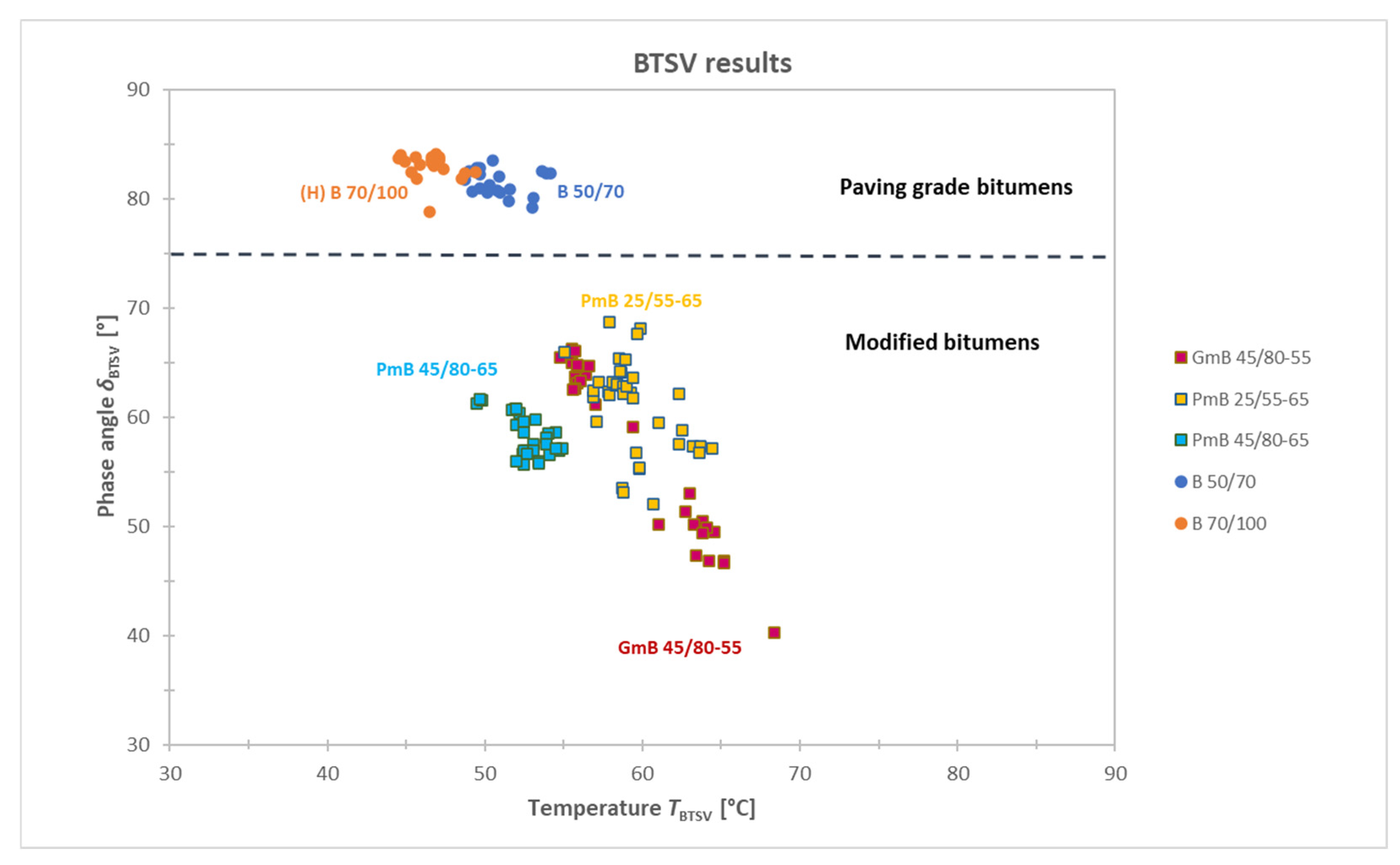
3.2. BTSV Parameters
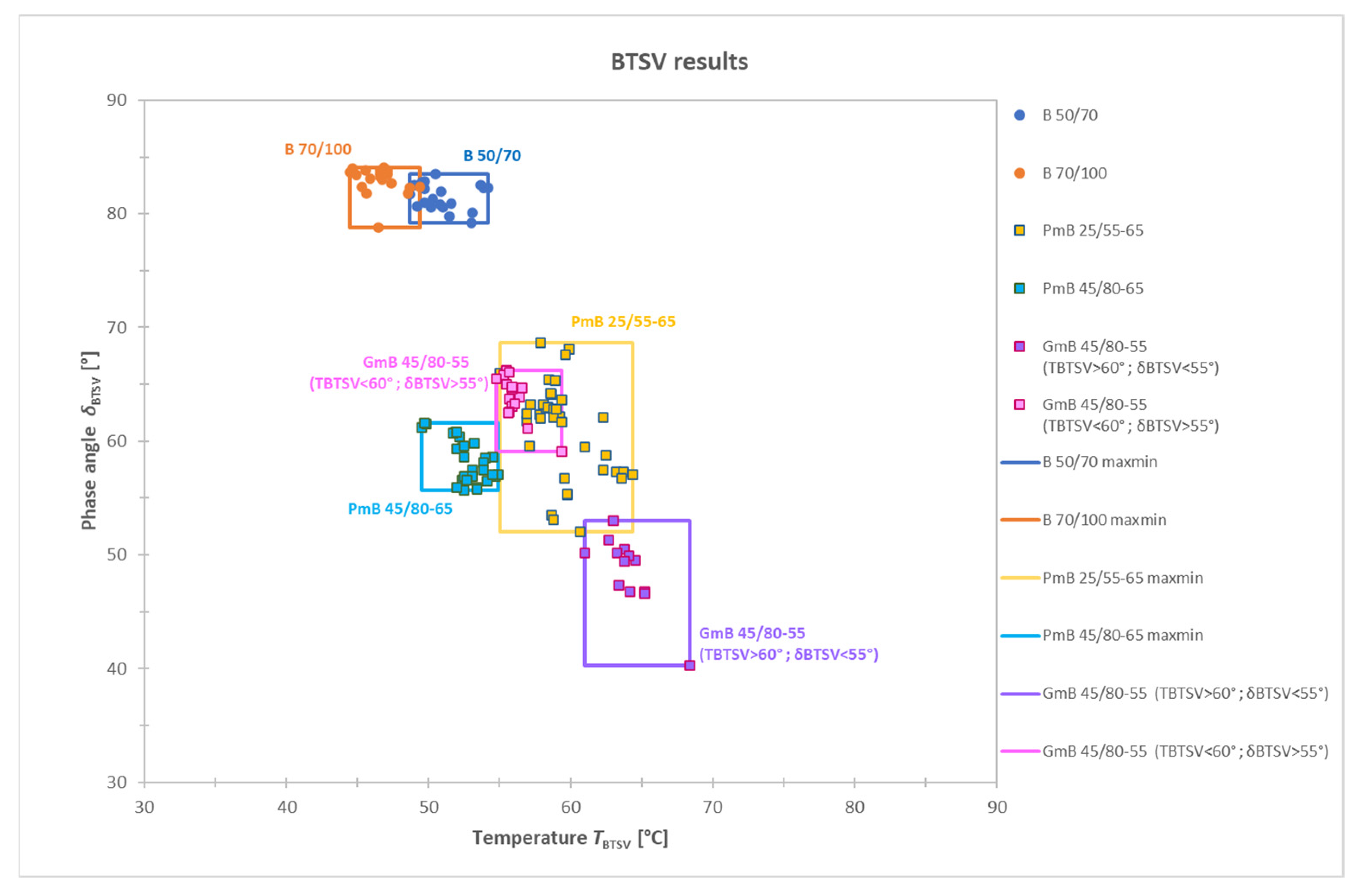
3.3. Categorization of the Tested Bitumens According to BTSV
4. Discussion
5. Conclusions
Author Contributions
Funding
Institutional Review Board Statement
Informed Consent Statement
Data Availability Statement
Conflicts of Interest
Abbreviations
| DSR | Dynamic Shear Rheometer |
| BTSV | Rapid Bitumen Categorization Method |
| RAP | Reclaimed Asphalt Pavements |
| US | United States |
| PG | Superpave Performance Classification |
| SHRP | Strategic Highway Research Program |
| RTFOT | Rolling Thin Film Oven Test |
| MSCR | Multiple Stress Creep and Recovery |
| CSRB | Chemically Stabilized Rubber Bitumen |
| AS | Standards Australia |
| EN | European Norm |
| ASTM | American Society for Testing and Materials |
| SD | Standard Deviation |
| Arithmetic Mean |
References
- EN 1426; Bitumen and Bituminous Binders—Determination of Needle Penetration. European Committee for Standardization: Brussels, Belgium, 2016.
- EN 1427; Bitumen and Bituminous Binders—Determination of the Softening Point—Ring and Ball Method. European Committee for Standardization: Brussels, Belgium, 2016.
- EN 12591; Bitumen and Bituminous Binders—Specifications for Paving Grade Bitumens. European Committee for Standardization: Brussels, Belgium, 2009.
- EN 14023; Bitumen and Bituminous Binders—Specification Framework for Polymer Modified Bitumens. European Committee for Standardization: Brussels, Belgium, 2010.
- e-UT 05.01.26; Bitumen Binders for the Production of Asphalt Mixtures for Road Construction. MAÚT: Budapest, Hungary, 2018. (In Hungarian)
- TL Bitumen-StB 25; Technische Lieferbedingungen für Straßenbaubitumen und Gebrauchsfertige Polymermodifizierte Bitumen. FGSV-Verlag: Cologne, Germany, 2025.
- Guericke, R. 100 years of softening points of the ring and ball—What comes next? Road Motorw. 2010, 61, 481–491. [Google Scholar]
- Mattischek, H.-P.; Sobczak, R.; Bleier, J. The use of a new measuring instrument in bitumen testing—Correlation of zero viscosity with the softening point of the ring and ball. Bitumen 1996, 1, 8–12. [Google Scholar]
- Radenberg, M.; Nytus, N.; Gehrke, M. Chemische und physikalische Eigenschaften der in Deutschland verwendeten Straßenbaubitumen. Straße Autob. 2014, 65, 851–860. [Google Scholar]
- Roberts, F.L.; Kandhal, P.S.; Brown, E.R.; Lee, D.Y.; Kennedy, T.W. Hot Mix Asphalt Materials, Mixture Design, and Construction; National Asphalt Pavement Association Education Foundation: Lanham, MD, USA, 1996. [Google Scholar]
- AASHTO M320-23-UL; Standard Method of Test for Performance Graded Asphalt Binder. American Association of State Highway and Transportation Officials: Washington, DC, USA, 2023.
- AASHTO T 315-12-UL; Standard Method of Test for Determining the Rheological Properties of Asphalt Binder Using a Dynamic Shear Rheometer (DSR). American Association of State Highway and Transportation Officials: Washington, DC, USA, 2024.
- AASHTO T 240-23-UL; Standard Method of Test for Effect of Heat and Air on a Moving Film of Asphalt Binder (Rolling Thin-Film Oven Test). American Association of State Highway and Transportation Officials: Washington, DC, USA, 2023.
- Bahia, H.U.; Hanson, D.I.; Zeng, M.; Zhai, H.; Khatri, M.A.; Anderson, D.A. Characterization of Modified Asphalt Binders in Superpave Mix Design; National Cooperative Highway Research Program (NCHRP) Report 459; Transportation Research Board: Washington, DC, USA, 2001. [Google Scholar]
- Biro, S.; Bartha, L.; Deák, G.; Geiger, A. Chemically Stabilized Asphalt Rubber Compositions and a Mechano-Chemical Method for Preparing the Same. European Patent EP1960472 B1, 15 May 2009. [Google Scholar]
- Shenoy, A. Fatigue testing and evaluation of asphalt binders using the dynamic shear rheometer. J. Test. Eval. 2002, 30, 303–312. [Google Scholar] [CrossRef]
- ASTM D7405-21; Standard Test Method for Multiple Stress Creep and Recovery (MSCR) of Asphalt Binder Using a Dynamic Shear Rheometer. ASTM International: West Conshohocken, PA, USA, 2021.
- Paez-Dueñas, A.; Cabanillas, P.; Carrera, V.; Cerny, R.; De Visscher, J.; Durand, G.; Lancaster, I. European round-robin tests for the multiple-load creep-recovery test and contribution to the development of a European standard test method. In Proceedings of the 6th Eurasphalt & Eurobitume Congress, Prague, Czech Republic, 1–3 June 2016. [Google Scholar]
- Soenen, H.; Blomberg, T.; Pellinen, T.; Laukkanen, O. The multiple stress creep recovery test: Repeatability, reproducibility and relationship with other rheological tests. Road Mater. Pavement Des. 2013, 14, 2–11. [Google Scholar] [CrossRef]
- Geiger, A.; Holló, A.; Thernesz, A.; Durgo, R.; Czibor, S.; Bartha, L.; Gergo, P. Chemically stabilized rubber bitumen. In Proceedings of the 5th Eurasphalt & Eurobitume Congress, Istanbul, Turkey, 13–15 June 2012. [Google Scholar]
- Tóth, C.; Igazvölgyi, Z.; Soós, Z. Laboratory Tests of Asphalt Mixtures with Rubber Bitumen; Budapest University of Technology and Economics: Budapest, Hungary, 2017. (In Hungarian) [Google Scholar]
- Gáspár, L. Complex Performance Evaluation of Road Pavement Layers with Chemically Modified Rubber Bitumen; KTI Institute for Transport Sciences and Budapest University of Technology and Economics: Budapest, Hungary, 2019. (In Hungarian) [Google Scholar]
- Almássy, K.; Geiger, A.; Gergó, P. Using possibilities of rubber bitumen in road building. Pollack Period. 2010, 5, 53–63. [Google Scholar] [CrossRef]
- Almássy, K.; Geiger, A.; Holló, A.; Gáspár, L. Performance of asphalt mixtures with a new type of rubber modified bitumen. Facta Univ. Ser. Archit. Civ. Eng. 2022, 19, 31–54. [Google Scholar] [CrossRef]
- Almássy, K.; Koch, D. Performance of rubber bituminous asphalt mixes at hot and warm production temperatures. Epitoanyag 2023, 75, 88–91. [Google Scholar] [CrossRef]
- Radenberg, M.; Gehrke, M. Assessing bitumen in the whole service-temperature-range with the dynamic shear rheometer. In Proceedings of the Eurasphalt & Eurobitume Congress, Prague, Czech Republic, 1–3 June 2016. [Google Scholar]
- Alisov, A. Typisierung von Bitumen Mittels Instationärer Oszillationsrheometrie; TU Braunschweig (ISBS): Braunschweig, Germany, 2017. [Google Scholar]
- DIN 52050; Bitumen und bitumenhaltige Bindemittel—BTSV-Prüfung. German Standard: Berlin, Germany, 2018.
- prEN 14023; Bitumen and Bituminous Binders—Framework Specification for the Quality of Polymer-Modified Bitumens. CEN: Brussels, Belgium, 2020.
- CEN/TC 336; Bitumens and Bituminous Binders—Complementary Performance-Related Specification Framework. European Committee for Standardization: Brussels, Belgium, 2025.
- EN 12607-1; Bitumens and Bituminous Binders-Determination of the Resistance to Hardening under Influence of Heat and Air-Part 1: RTFOT Method. European Committee for Standardization: Brussels, Belgium, 2024.
- ZTV Asphalt-StB 07/13; Zusätzliche Technische Vertragsbedingungen und Richtlinien für den Bau von Verkehrsflächenbefestigungen aus Asphalt. FGSV-Verlag: Cologne, Germany, 2013.
- EN 58; Bitumen and Bituminous Binders—Sampling Bitubinious Binders. European Committee for Standardization: Brussels, Belgium, 2012.
- Alisov, A.; Riccardi, C.; Schrader, J.; Falchetto, A.C.; Wistuba, M.P. A novel method to characterize asphalt binder at high temperature. Road Mater. Pavement Des. 2018, 21, 143–155. [Google Scholar] [CrossRef]
- AGPT/T142; Rubber Content of Crumb Rubber Modified Bitumen: Soxhlet Method. Austroads: Vienna, Austria, 2020.
- Tarefder, R.A.; Zaman, M.; Najjar, Y. Statistical evaluation of asphalt binder properties. Transp. Res. Rec. 2010, 2179, 53–61. [Google Scholar] [CrossRef]



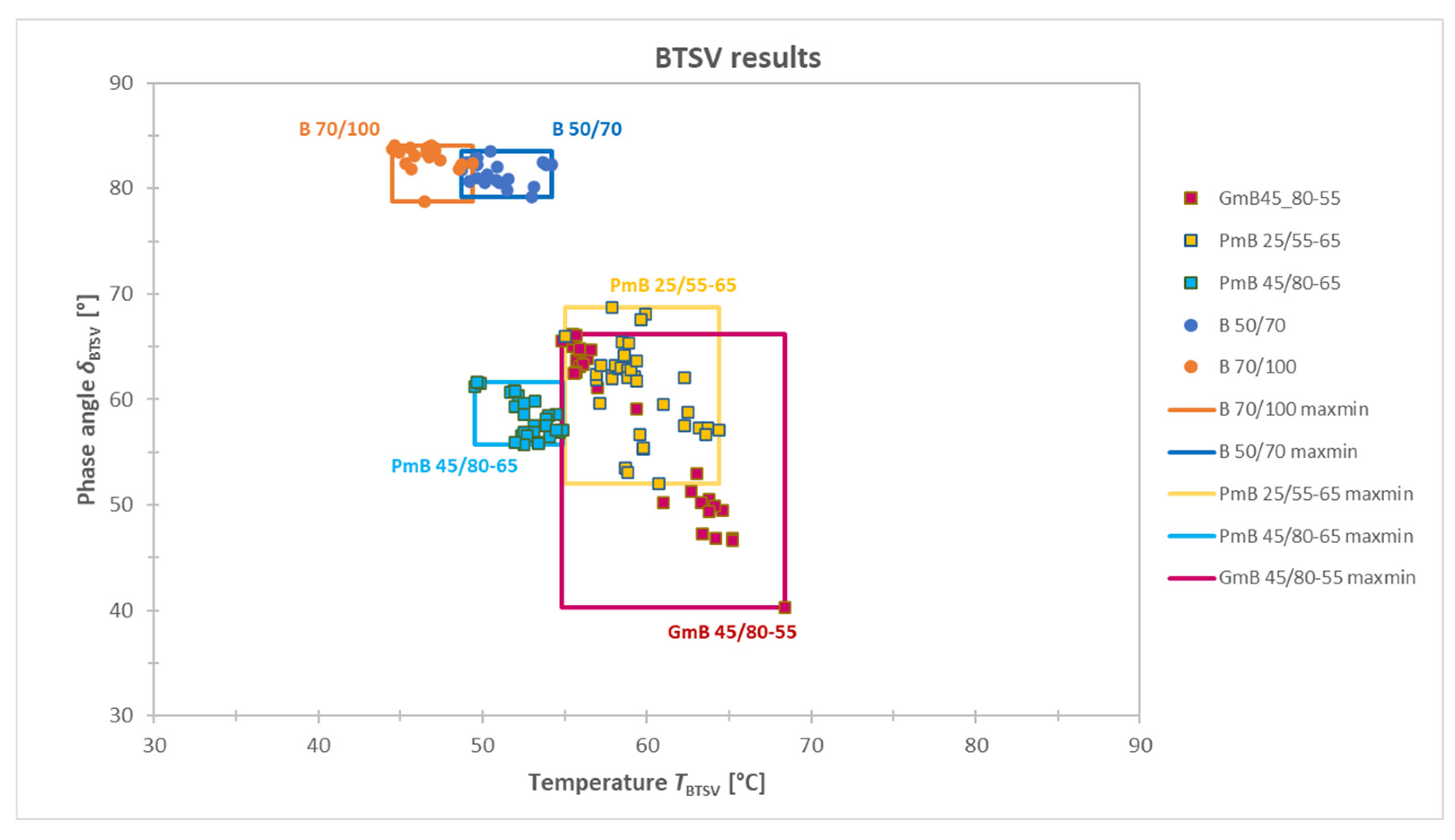



| Sample Type | Sample Size | Parameter | Avg. | St. Dev. | Min. | Max. |
|---|---|---|---|---|---|---|
| B 50/70 | 20 | Softening point [°C] | 50.77 | 1.38 | 49.00 | 53.40 |
| Penetration [0.1 mm] | 58.15 | 5.40 | 52.00 | 69.00 | ||
| TBTSV [°C] | 51.01 | 1.72 | 48.70 | 54.20 | ||
| Phase angle, δ [°] | 81.48 | 1.15 | 79.20 | 83.50 | ||
| B70/100 | 20 | Softening point [°C] | 46.25 | 1.28 | 43.50 | 48.60 |
| Penetration [0.1 mm] | 84.00 | 5.95 | 73.00 | 93.00 | ||
| TBTSV [°C] | 46.57 | 1.31 | 44.50 | 49.40 | ||
| Phase angle, δ [°] | 82.95 | 1.21 | 78.80 | 84.10 | ||
| GmB 45/80-55 | 29 | Softening point [°C] | 61.22 | 5.50 | 55.50 | 70.40 |
| Penetration [0.1 mm] | 45.13 | 3.67 | 39.10 | 49.20 | ||
| TBTSV [°C] | 59.64 | 4.26 | 54.80 | 68.40 | ||
| Phase angle, δ [°] | 57.03 | 8.12 | 40.30 | 66.20 | ||
| PmB 25/55-65 | 38 | Softening point [°C] | 84.28 | 5.65 | 65.60 | 91.05 |
| Penetration [0.1 mm] | 42.21 | 6.22 | 29.50 | 52.00 | ||
| TBTSV [°C] | 56.57 | 4.05 | 51.90 | 64.40 | ||
| Phase angle, δ [°] | 59.46 | 2.10 | 55.05 | 68.80 | ||
| PmB45/80-65 | 30 | Softening point [°C] | 70.75 | 4.36 | 63.35 | 78.90 |
| Penetration [0.1 mm] | 52.24 | 4.98 | 40.85 | 59.00 | ||
| TBTSV [°C] | 52.72 | 1.37 | 49.50 | 54.90 | ||
| Phase angle, δ [°] | 58.29 | 1.89 | 55.70 | 61.60 |
Disclaimer/Publisher’s Note: The statements, opinions and data contained in all publications are solely those of the individual author(s) and contributor(s) and not of MDPI and/or the editor(s). MDPI and/or the editor(s) disclaim responsibility for any injury to people or property resulting from any ideas, methods, instructions or products referred to in the content. |
© 2026 by the authors. Licensee MDPI, Basel, Switzerland. This article is an open access article distributed under the terms and conditions of the Creative Commons Attribution (CC BY) license.
Share and Cite
Rosta, S.; Gáspár, L. Evaluation of High-Temperature Performance of Hungarian Bituminous Binders Using the BTSV Method. Materials 2026, 19, 2012. https://doi.org/10.3390/ma19102012
Rosta S, Gáspár L. Evaluation of High-Temperature Performance of Hungarian Bituminous Binders Using the BTSV Method. Materials. 2026; 19(10):2012. https://doi.org/10.3390/ma19102012
Chicago/Turabian StyleRosta, Szabolcs, and László Gáspár. 2026. "Evaluation of High-Temperature Performance of Hungarian Bituminous Binders Using the BTSV Method" Materials 19, no. 10: 2012. https://doi.org/10.3390/ma19102012
APA StyleRosta, S., & Gáspár, L. (2026). Evaluation of High-Temperature Performance of Hungarian Bituminous Binders Using the BTSV Method. Materials, 19(10), 2012. https://doi.org/10.3390/ma19102012