Impact of Structural Dimensionality on the Optoelectronic Behavior of Lead–Halide Perovskites

Abstract
1. Introduction
2. Materials and Methods
2.1. Synthesis
- 1.
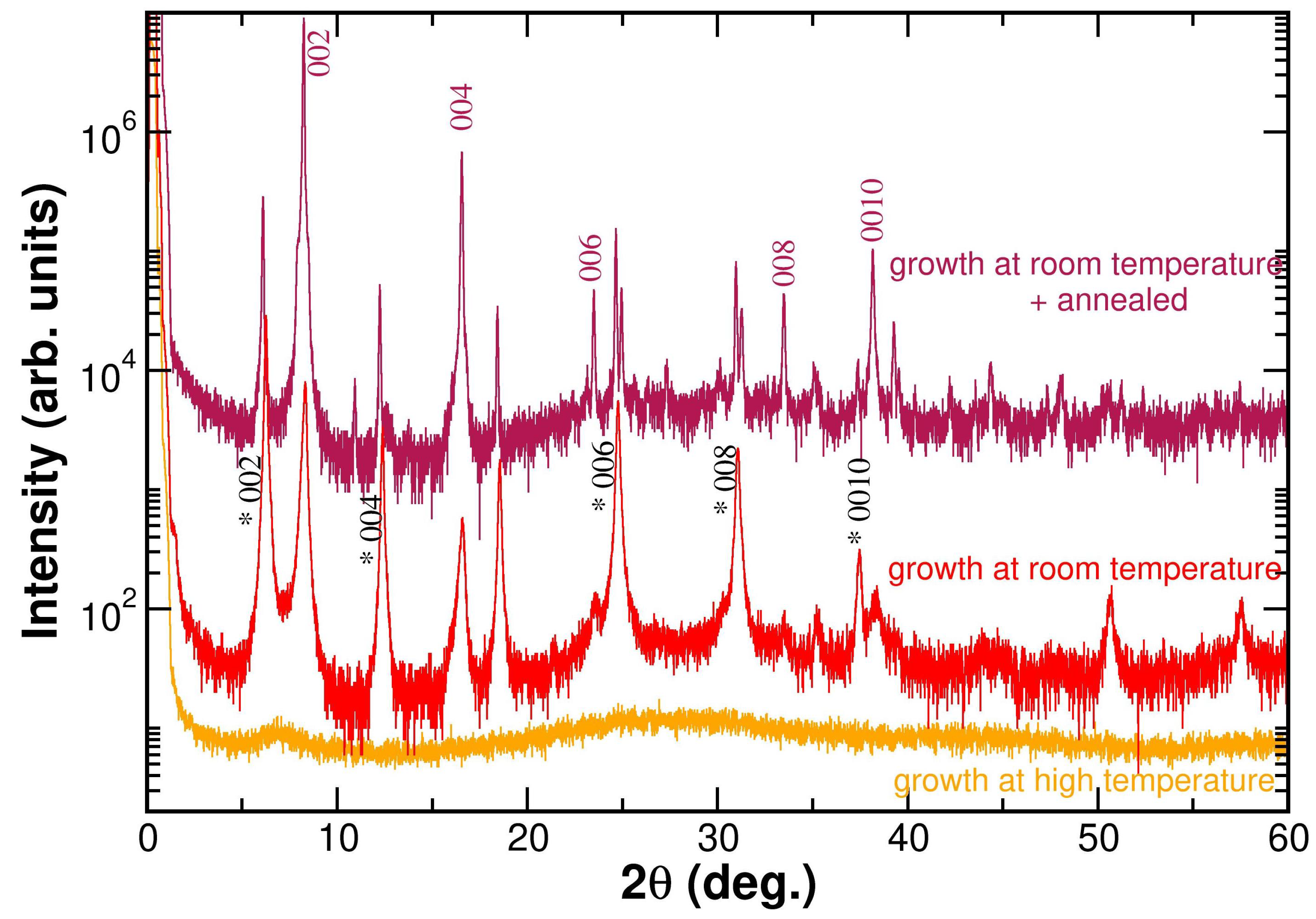
- “Spin coating” technique: this method consisted of dissolving R-1-phenylethylammonium lead–iodide in acetone at room temperature until a saturated solution was obtained. In this way, the solution concentration is given by the Solubility Product Constant of the perovskite, ensuring reproducibility across all experiments. Then, 200 L of the prepared solution were applied dropwise onto a well-cleaned glass substrate coated with indium tin oxide (ITO) and a layer of gold. The substrate, previously cleaned in an ultrasonic bath with acetone/ethanol cycles and dried under gas flow, was placed in the center of the spin coater, which rotated at 400 rpm for 30 s. The resulting thin film was then left to dry at room temperature for 24 h.
- 2.
- Deposit on heated substrate: on the other hand, the solution prepared in the same way was deposited on a glass substrate that was also well cleaned and coated with ITO and a layer of gold, but in this case, the substrate was placed on a heater until a temperature of about C, facilitating the formation of the thin film. Finally, the thin film was also allowed to dry at room temperature.
2.2. Structure and Electronic Characterization
3. Results
3.1. Structural Results
3.1.1. Powder Samples Structure
3.1.2. Thin-Film Samples Structure
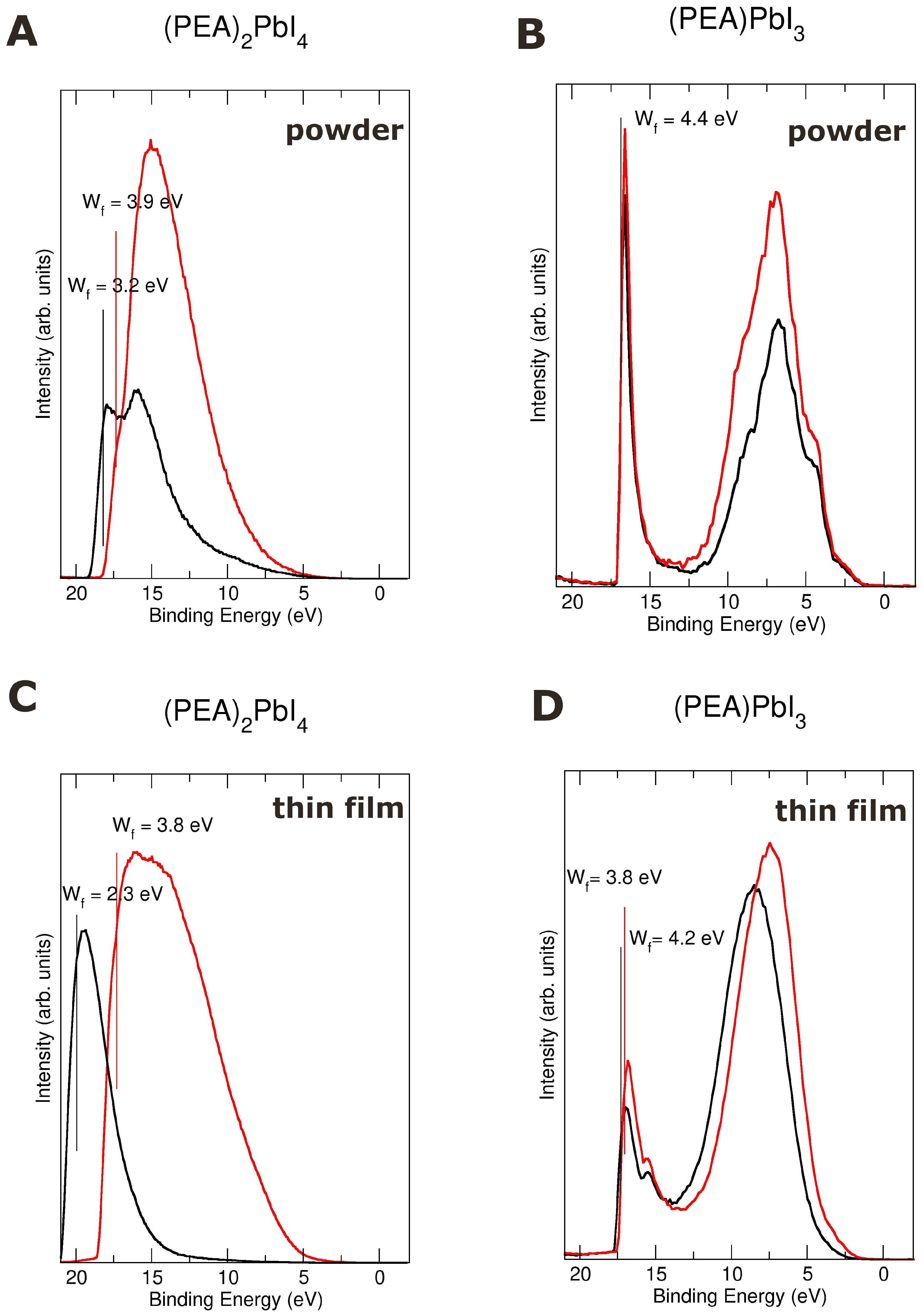
3.2. The HOIP Photoresponse: SPV Effect
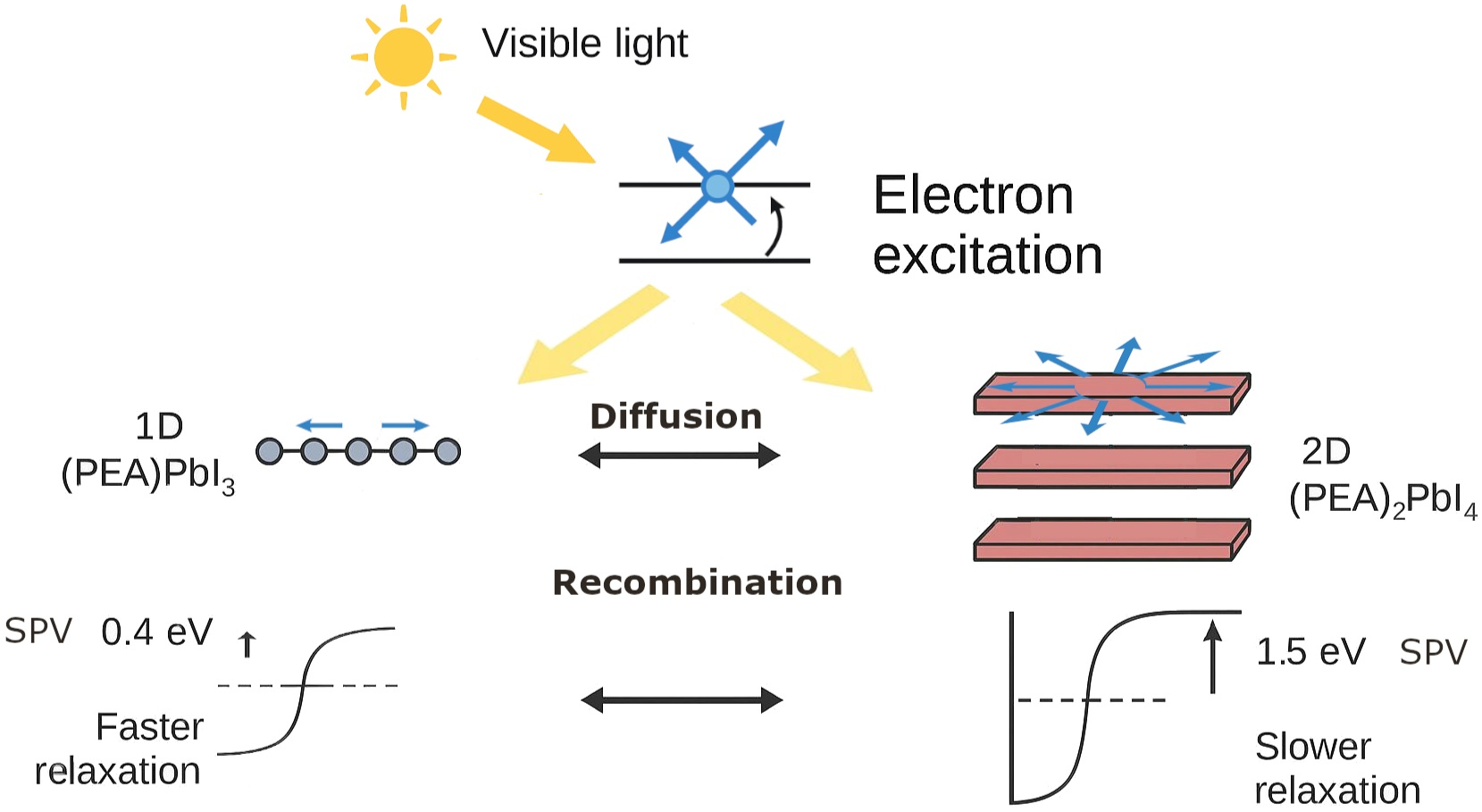
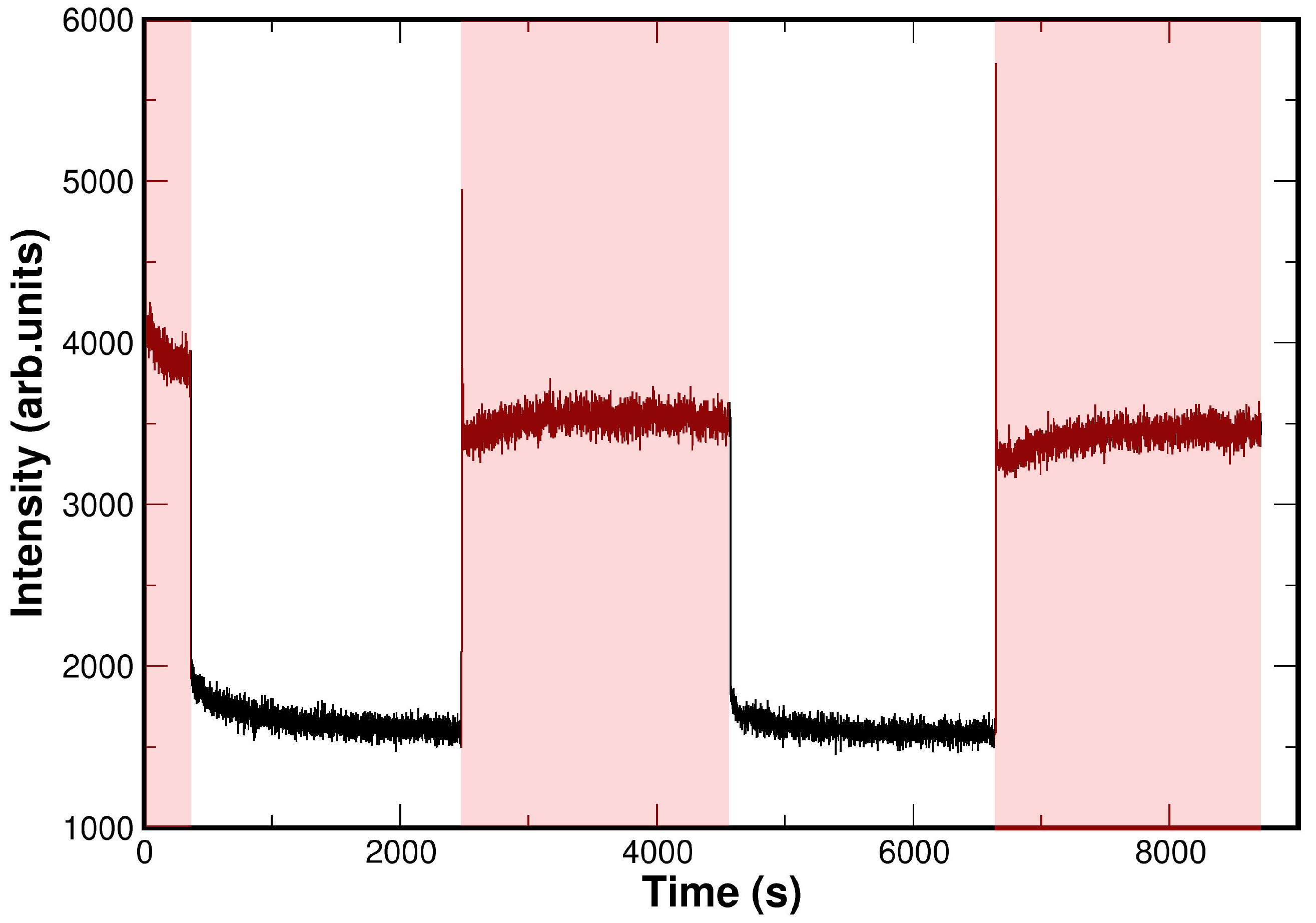
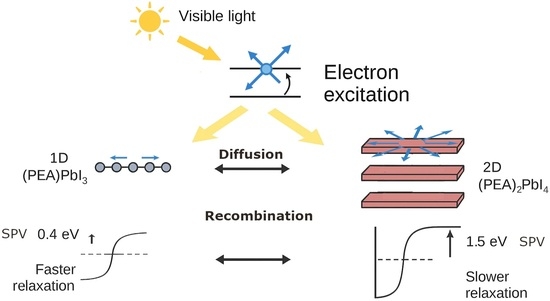
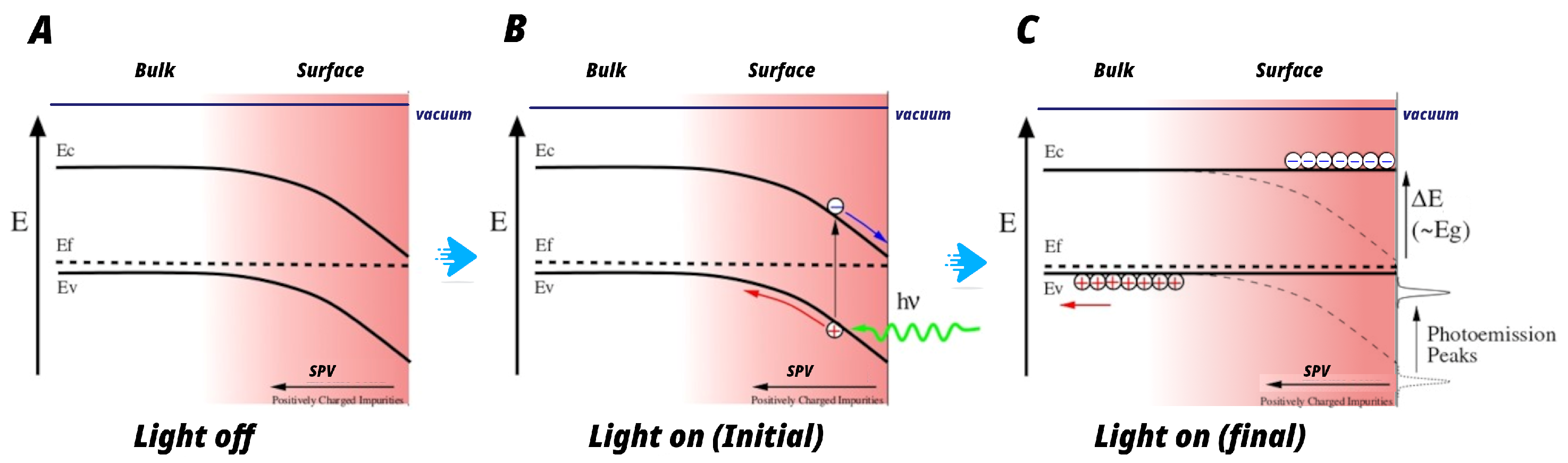
- With light off, positively charged iodide vacancies in the near-surface region generate an electric field that points from the surface to the volume of the material, resulting in the appearance of an electrical potential that causes band bending. These defects favor the location of holes and generate an electron level within the band gap associated with these vacancies. This charge distribution generates a characteristic p-type SPV (see left panel of Figure 8). This depends on the stability of the anion vacancies promoted by the PbI-octahedron sharing present in their respective structures.
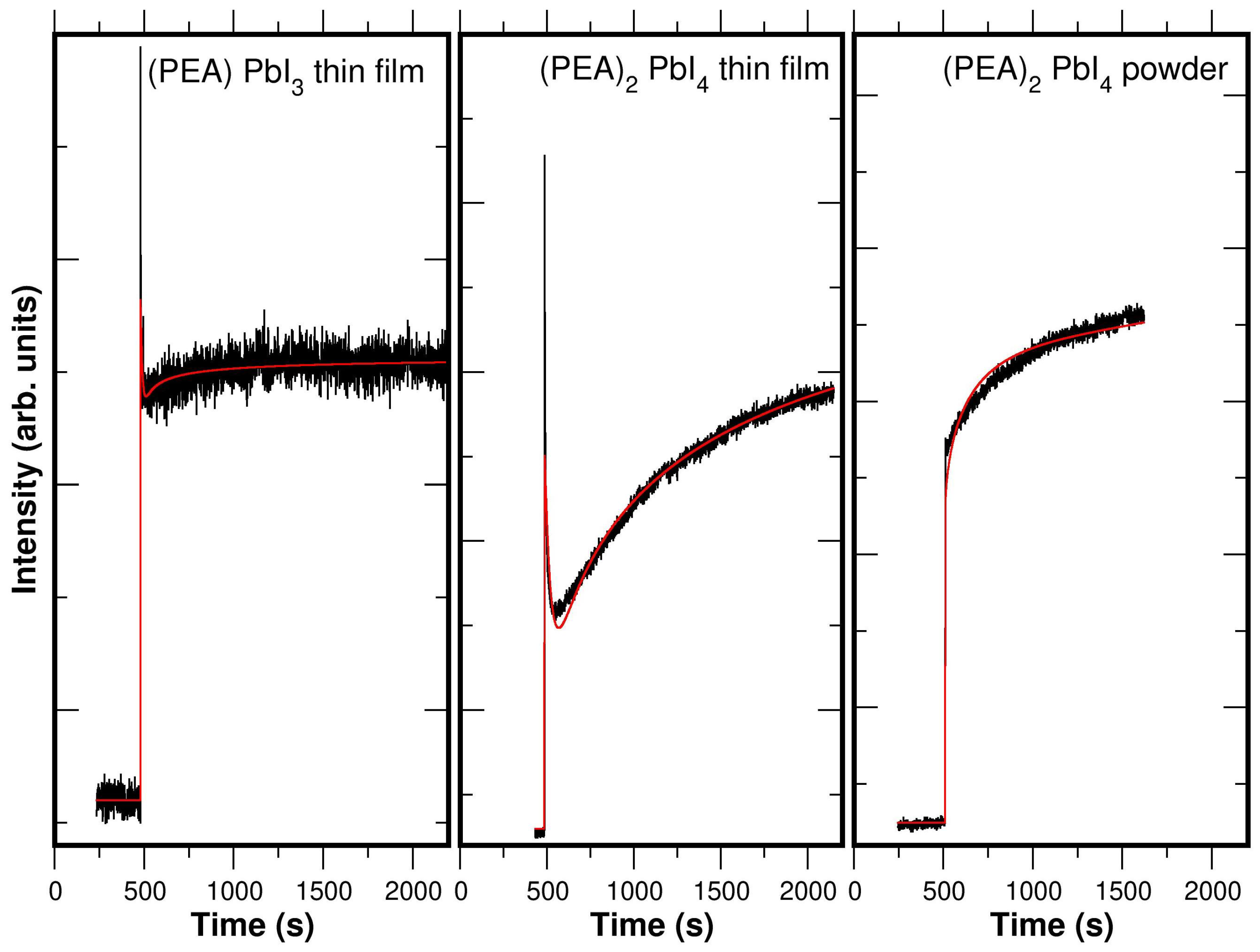
- When the material is illuminated, photons generate electron–hole pairs (excitons). The electric field at the surface separates these charges: electrons migrate to the surface, neutralizing positively charged vacancies, and holes diffuse into the bulk. The accumulation of electrons on the surface reduces band bending, driving the system toward a flat-band condition (see right panel of Figure 8). This manifests as a shift of the electronic levels toward lower binding energies.
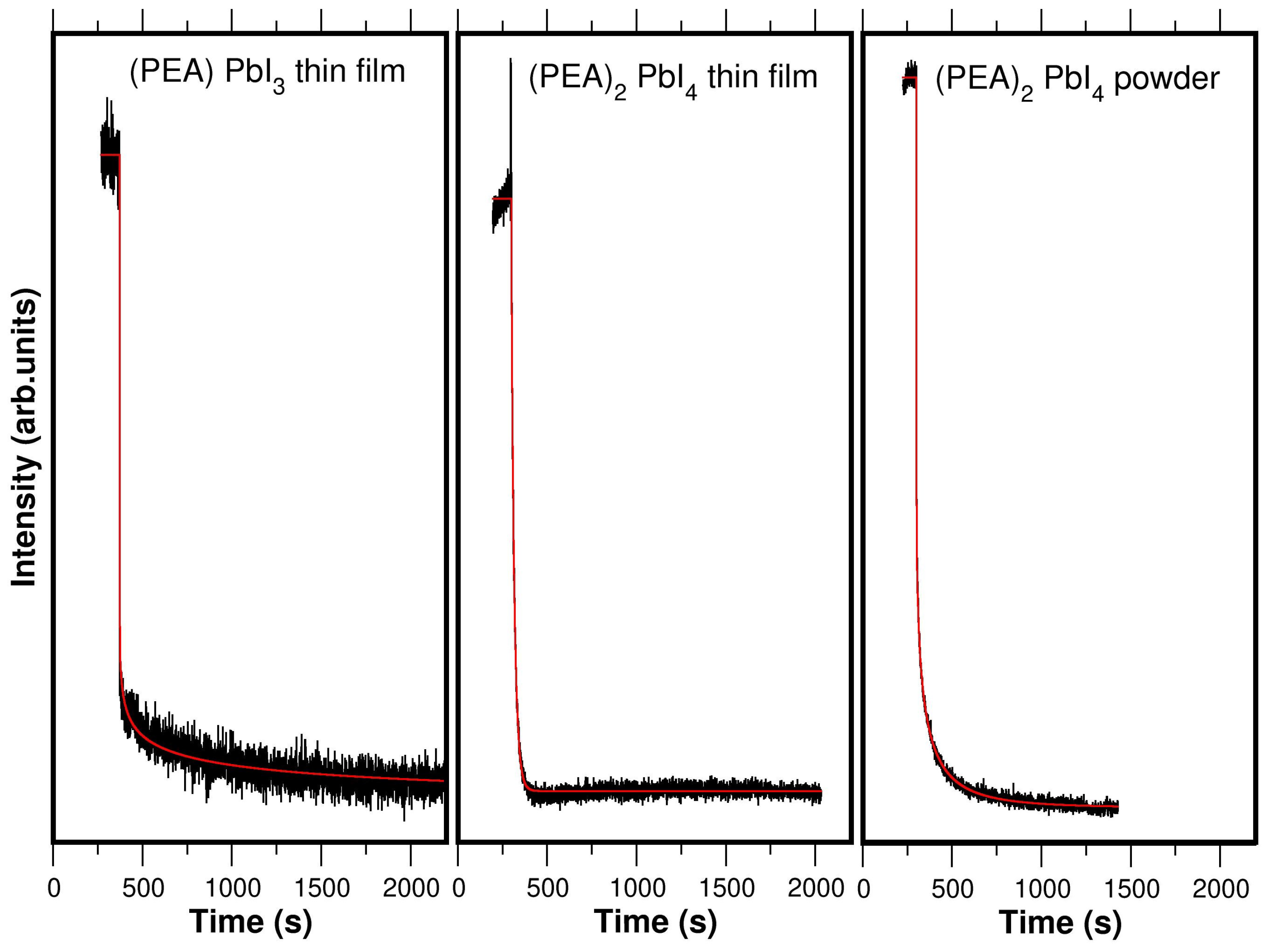
- When the light is turned off, the previously generated electron–hole pairs tend to recombine. This recombination does not occur directly, but through intermediate energy levels located within the gap, which are associated with iodide vacancies .
Photoresponse: Kinetics and Transient Adjustment
4. Conclusions
Author Contributions
Funding
Data Availability Statement
Acknowledgments
Conflicts of Interest
Abbreviations
| UHV | Ultra-High Vacuum |
| XPS | X-ray Photo Spectroscopy |
| UPS | Ultraviolet Photon Spectroscopy |
| SPV | Surface Photo-Voltage |
| HOIP | Hybrid Organic–Inorganic Perovskite |
| PSCs | Perovskite Solar Cells |
| PEA | R-1-PhenylBenzylAmine |
Appendix A. XPS
Appendix B. LD Error Calculation
References
- Lee, M.; Teuscher, J.; Miyasaka, T.; Murakami, T.N.; Snaith, H.J. Efficient Hybrid Solar Cells Based on Meso-Superstructured Organometal Halide Perovskites. Science 2012, 338, 643–647. [Google Scholar] [CrossRef] [PubMed]
- Kim, H.S.; Lee, C.R.; Im, J.H.; Lee, K.B.; Moehl, T.; Marchioro, A.; Moon, S.J.; Humphry-Baker, R.; Yum, J.H.; Moser, J.E.; et al. Lead Iodide Perovskite Sensitized All-Solid-State Submicron Thin Film Mesoscopic Solar Cell with Efficiency Exceeding. Sci. Rep. 2012, 2, 591. [Google Scholar] [CrossRef]
- Best Research-Cell Efficiency Chart. Available online: https://www.nrel.gov/pv/interactive-cell-efficiency.html (accessed on 20 September 2025).
- Ball, J.M.; Lee, M.M.; Hey, A.; Snaith, H.J. Low-Temperature Processed Mesosuperstructured to Thin-Film Perovskite Solar Cells. Energy Environ. Sci. 2013, 6, 1739–1743. [Google Scholar] [CrossRef]
- Carnie, M.J.; Charbonneau, C.; Davies, M.L.; Troughton, J.; Watson, T.M.; Wojciechowski, K.; Snaith, H.; Worsley, D. A One-Step Low Temperature Processing Route for Organolead Halide Perovskite Solar Cells. Chem. Commun. 2013, 49, 7893–7895. [Google Scholar] [CrossRef]
- Manser, J.S.; Christians, J.A.; Kamat, P.V. Intriguing Optoelectronic Properties of Metal Halide Perovskites. Chem. Rev. 2016, 116, 12956–13008. [Google Scholar] [CrossRef] [PubMed]
- Manser, J.S.; Saidaminov, M.I.; Christians, J.A.; Bakr, O.M.; Kamat, P.V. Making and Breaking of Lead Halide Perovskites. Acc. Chem. Res. 2016, 49, 330–338. [Google Scholar] [CrossRef] [PubMed]
- Ohki, Y. News from Japan. IEEE Electr. Insul. Mag. 2024, 40, 40–43. [Google Scholar] [CrossRef]
- Wang, Y.; Han, L. Research activities on perovskite solar cells in China. Sci. China Chem. 2019, 62, 822–828. [Google Scholar] [CrossRef]
- Cui, D.; Wang, Y.; Han, L. China’s progress of perovskite solar cells in 2019. Sci. Bull. 2020, 65, 1306–1315. [Google Scholar] [CrossRef]
- Hartono, N.T.P.; Köbler, H.; Graniero, P.; Khenkin, M.; Schlatmann, R.; Ulbrich, C.; Abate, A. Stability follows efficiency based on the analysis of a large perovskite solar cells ageing dataset. Nat. Commun. 2023, 14, 4869. [Google Scholar] [CrossRef]
- Siegler, T.D.; Dawson, A.; Lobaccaro, P.; Ung, D.; Beck, M.E.; Nilsen, G.; Tinker, L.L. Correction to “The Path to Perovskite Commercialization: A Perspective from the United States Solar Energy Technologies Office”. ACS Energy Lett. 2022, 7, 2113. [Google Scholar] [CrossRef]
- Dipta, S.S.; Uddin, A. Stability Issues of Perovskite Solar Cells: A Critical Review. Energy Technol. 2021, 9, 2100560. [Google Scholar] [CrossRef]
- Sun, Y.; Zhang, J.; Yu, B.; Shi, S.; Yu, H. Regulate defects and energy levels for perovskite solar cells by co-modification strategy. Nano Energy 2024, 121, 109245. [Google Scholar] [CrossRef]
- Liu, J.; Chen, X.; Chen, K.; Tian, W.; Sheng, Y.; She, B.; Jiang, Y.; Zhang, D.; Liu, Y.; Qi, J.; et al. Electron injection and defect passivation for high-efficiency mesoporous perovskite solar cells. Science 2024, 383, 1198–1204. [Google Scholar] [CrossRef]
- Gouadria, H.; Aguilar-Galindo, F.; Spilsbury, M.J.; Álvarez Alonso, J.; de Miguel, J.J.; Fraile, A.; Aleman, J.; Díaz-Tendero, S.; Capitán, M.J. Tailoring the optoelectronic properties of benzylammonium PbI4 hybrid perovskites. Chem. Mater. 2025, 37, 7725–7740. [Google Scholar] [CrossRef]
- Ranjan, R.; Usmani, B.; Pali, S.; Ranjan, S.; Singh, A.; Garg, A.; Gupta, R.K. Role of PC60BM in defect passivation and improving degradation behaviour in planar perovskite solar cells. Sol. Energy Mater. Sol. Cells 2020, 207, 110335. [Google Scholar] [CrossRef]
- Shen, L.; Song, P.; Zheng, L.; Wang, L.; Zhang, X.; Liu, K.; Liang, Y.; Tian, W.; Luo, Y.; Qiu, J.; et al. Ion-Diffusion Management Enables All-Interface Defect Passivation of Perovskite Solar Cells. Adv. Mater. 2023, 35, 2301624. [Google Scholar] [CrossRef]
- Zuo, L.; Li, Z.; Chen, H. Ion Migration and Accumulation in Halide Perovskite Solar Cells. Chin. J. Chem. 2023, 41, 861–876. [Google Scholar] [CrossRef]
- Egger, D.A.; Rappe, A.M.; Kronik, L. Hybrid Organic–Inorganic Perovskites on the Move. Acc. Chem. Res. 2016, 49, 573–581. [Google Scholar] [CrossRef] [PubMed]
- Li, D.; Liao, P.; Shai, X.; Huang, W.; Liu, S.; Li, H.; Shen, Y.; Wang, M. Recent progress on stability issues of organic–inorganic hybrid lead perovskite-based solar cells. RSC Adv. 2016, 6, 89356–89366. [Google Scholar] [CrossRef]
- Zhao, Y.; Zhu, K. Organic–inorganic hybrid lead halide perovskites for optoelectronic and electronic applications. Chem. Soc. Rev. 2016, 45, 655–689. [Google Scholar] [CrossRef] [PubMed]
- Bhandari, K.P.; Ellingson, R.J. 11—An Overview of Hybrid Organic–Inorganic Metal Halide Perovskite Solar Cells. In A Comprehensive Guide to Solar Energy Systems; Letcher, T.M., Fthenakis, V.M., Eds.; Academic Press: Cambridge, MA, USA, 2018; pp. 233–254. [Google Scholar] [CrossRef]
- Wang, H.; Wang, X.; Zhang, H.; Ma, W.; Wang, L.; Zong, X. Organic-inorganic hybrid perovskites: Game-changing candidates for solar fuel production. Nano Energy 2020, 71, 104647. [Google Scholar] [CrossRef]
- Spampinato, C. CsPbI3 Perovskites at the Edge of Commercialization: Persistent Barriers, Multidisciplinary Solutions, and the Emerging Role of AI. J 2026, 9, 12. [Google Scholar] [CrossRef]
- Kim, Y.C.; Jeon, N.J.; Noh, J.H.; Yang, W.S.; Seo, J.; Yun, J.S.; Ho-Baillie, A.; Huang, S.; Green, M.A.; Seidel, J.; et al. Beneficial Effects of PbI2 Incorporated in Organo-Lead Halide Perovskite Solar Cells. Adv. Energy Mater. 2016, 6, 1502104. [Google Scholar] [CrossRef]
- Liu, F.; Dong, Q.; Wong, M.K.; Djurišić, A.B.; Ng, A.; Ren, Z.; Shen, Q.; Surya, C.; Chan, W.K.; Wang, J.; et al. Is Excess PbI2 Beneficial for Perovskite Solar Cell Performance? Adv. Energy Mater. 2016, 6, 1502206. [Google Scholar] [CrossRef]
- Rocks, C.; Svrcek, V.; Maguire, P.; Mariotti, D. Understanding surface chemistry during MAPbI3 spray deposition and its effect on photovoltaic performance. J. Mater. Chem. C 2017, 5, 902–916. [Google Scholar] [CrossRef]
- Kwon, U.; Hasan, M.M.; Yin, W.; Kim, D.; Ha, N.Y.; Lee, S.; Ahn, T.K.; Park, H.J. Investigation into the Advantages of Pure Perovskite Film without PbI2 for High Performance Solar Cell. Sci. Rep. 2016, 6, 35994. [Google Scholar] [CrossRef]
- Cao, D.H.; Stoumpos, C.C.; Malliakas, C.D.; Katz, M.J.; Farha, O.K.; Hupp, J.T.; Kanatzidis, M.G. Remnant PbI2, an unforeseen necessity in high-efficiency hybrid perovskite-based solar cells? APL Mater. 2014, 2, 91101. [Google Scholar] [CrossRef]
- Shin, S.S.; Yeom, E.J.; Yang, W.S.; Hur, S.; Kim, M.G.; Im, J.; Seo, J.; Noh, J.H.; Seok, S.I. Colloidally prepared La-doped BaSnO3 electrodes for efficient, photostable perovskite solar cells. Science 2017, 356, 167. [Google Scholar] [CrossRef]
- Saliba, M.; Matsui, T.; Domanski, K.; Seo, J.Y.; Ummadisingu, A.; Zakeeruddin, S.M.; Correa-Baena, J.P.; Tress, W.R.; Abate, A.; Hagfeldt, A.; et al. Incorporation of rubidium cations into perovskite solar cells improves photovoltaic performance. Science 2016, 354, 206–209. [Google Scholar] [CrossRef]
- Gao, P.; Bin Mohd Yusoff, A.R.; Nazeeruddin, M.K. Dimensionality engineering of hybrid halide perovskite light absorbers. Nat. Commun. 2018, 9, 5028. [Google Scholar] [CrossRef]
- Smith, M.D.; Karunadasa, H.I. White-Light Emission from Layered Halide Perovskites. Acc. Chem. Res. 2018, 51, 619–627. [Google Scholar] [CrossRef]
- Straus, D.B.; Kagan, C.R. Electrons, Excitons, and Phonons in Two-Dimensional Hybrid Perovskites: Connecting Structural, Optical, and Electronic Properties. J. Phys. Chem. Lett. 2018, 9, 1434–1447. [Google Scholar] [CrossRef]
- Billing, D.G.; Lemmerer, A. Synthesis and crystal structures of inorganic–organic hybrids incorporating an aromatic amine with a chiral functional group. CrystEngComm 2006, 8, 686–695. [Google Scholar] [CrossRef]
- Alvarez, J.; Paiser, E.; Capitan, M.J. An automatic attenuator device for X-ray detectors at high counting rate. Rev. Sci. Instrum. 2002, 73, 2788–2790. [Google Scholar] [CrossRef]
- de Rooi, J.J.; van der Pers, N.M.; Hendrikx, R.W.A.; Delhez, R.; Böttger, A.J.; Eilers, P.H.C. Smoothing of X-ray diffraction data and Kα2 elimination using penalized likelihood and the composite link model. J. Appl. Crystallogr. 2014, 47, 852–860. [Google Scholar] [CrossRef]
- Altomare, A.; Campi, G.; Cuocci, C.; Eriksson, L.; Giacovazzo, C.; Moliterni, A.; Rizzi, R.; Werner, P.E. Advances in powder diffraction pattern indexing: N-TREOR09. J. Appl. Crystallogr. 2009, 42, 768–775. [Google Scholar] [CrossRef]
- Altomare, A.; Cuocci, C.; Giacovazzo, C.; Moliterni, A.; Rizzi, R.; Corriero, N.; Falcicchio, A. EXPO2013: A kit of tools for phasing crystal structures from powder data. J. Appl. Crystallogr. 2013, 46, 1231–1235. [Google Scholar] [CrossRef]
- Zukauskas, A.; Vaicekauskas, R.; Tuzikas, A.; Petrulis, A.; Stanikunas, R.; Svegzda, A.; Eidikas, P.; Vitta, P. Firelight LED Source: Toward a Balanced Approach to the Performance of Solid-State Lighting for Outdoor Environments. IEEE Photonics J. 2014, 6, 1–16. [Google Scholar] [CrossRef]
- Knoll, G. Radiation Detection and Measurement, 4th ed.; John Wiley: Hoboken, NJ, USA, 2010. [Google Scholar]
- Momma, K.; Izumi, F. VESTA 3 for three-dimensional visualization of crystal, volumetric and morphology data. J. Appl. Crystallogr. 2011, 44, 1272–1276. [Google Scholar] [CrossRef]
- Patterson, A.L. The Scherrer Formula for X-Ray Particle Size Determination. Phys. Rev. 1939, 56, 978–982. [Google Scholar] [CrossRef]
- Zhao, Y.Q.; Ma, Q.R.; Liu, B.; Yu, Z.L.; Yang, J.; Cai, M.Q. Layer-dependent transport and optoelectronic property in two-dimensional perovskite: (PEA)2PbI4. Nanoscale 2018, 10, 8677–8688. [Google Scholar] [CrossRef]
- Yang, S.; Niu, W.; Wang, A.; Fan, Z.; Chen, B.; Tan, C.; Lu, Q.; Zhang, H. Ultrathin Two-Dimensional Organic–Inorganic Hybrid Perovskite Nanosheets with Bright, Tunable Photoluminescence and High Stability. Angew. Chem. Int. Ed. 2017, 56, 4252–4255. [Google Scholar] [CrossRef]
- Gouadria, H.; Aguilar-Galindo, F.; Álvarez Alonso, J.; de Miguel, J.J.; Díaz-Tendero, S.; Capitán, M.J. Disentangling the Optoelectronic Behavior of Lead Iodide Governed by Two-Dimensional Electron Confinement. ACS Appl. Mater. Interfaces 2024, 16, 57302–57315. [Google Scholar] [CrossRef] [PubMed]
- Zu, F.; Amsalem, P.; Salzmann, I.; Wang, R.; Ralaiarisoa, M.; Kowarik, S.; Duhm, S.; Koch, N. Impact of White Light Illumination on the Electronic and Chemical Structures of Mixed Halide and Single Crystal Perovskites. Adv. Opt. Mater. 2017, 5, 1700139. [Google Scholar] [CrossRef]
- Lukichev, A. Physical meaning of the stretched exponential Kohlrausch function. Phys. Lett. A 2019, 383, 2983–2987. [Google Scholar] [CrossRef]
- Wu, J.; He, M.; Liu, C.; Gao, P. Charge Dynamics and Defect States under “Spot-Light”: Spectroscopic Insights into Halide Perovskite Solar Cells. Adv. Photonics Res. 2024, 6, 2400110. [Google Scholar] [CrossRef]
- Kang, G.; Yoon, J.S.; Kim, G.W.; Choi, K.; Park, T.; Baek, R.H.; Lim, J. Electron trapping and extraction kinetics on carrier diffusion in metal halide perovskite thin films. J. Mater. Chem. A 2019, 7, 25838–25844. [Google Scholar] [CrossRef]
- Taylor, A. Practical Surface Analysis, 2nd edn., vol I, auger and X-ray photoelectron spectroscopy. Edited by D. Briggs & M. P. Seah, John Wiley, New York, 1990, 657 pp., price: £86.50. ISBN 0471 92081 9. J. Chem. Technol. Biotechnol. 1992, 53, 215. [Google Scholar] [CrossRef]
- Moulder, J.F. (Ed.) Handbook of X-Ray Photoelectron Spectroscopy: A Reference Book of Standard Spectra for Identification and Interpretation of XPS Data; Physical Electronics Division, Perkin-Elmer Corporation: Eden Prairie, MN, USA, 1992. [Google Scholar]
- Garcia-de-los Rios, V.M.; Arano-Martínez, J.A.; Trejo-Valdez, M.; Hernández-Pichardo, M.L.; Vidales-Hurtado, M.A.; Torres-Torres, C. Fractional Photoconduction and Nonlinear Optical Behavior in ZnO Micro and Nanostructures. Fractal Fract. 2023, 7, 885. [Google Scholar] [CrossRef]
- Liu, Q.; Ruda, H.E.; Koutzarov, I.P.; Jedral, L.; Chen, G.; Prasad, M. Role of Deep Level Trapping on Surface Photovoltage of semiinsulating GaAs. MRS Proc. 2011, 426, 569. [Google Scholar] [CrossRef]
- Cho, J.; DuBose, J.T.; Kamat, P.V. Charge Carrier Recombination Dynamics of Two-Dimensional Lead Halide Perovskites. J. Phys. Chem. Lett. 2020, 11, 2570–2576. [Google Scholar] [CrossRef]
- Li, F.; Ma, C.; Wang, H.; Hu, W.; Yu, W.; Sheikh, A.D.; Wu, T. Ambipolar solution-processed hybrid perovskite phototransistors. Nat. Commun. 2015, 6, 8238. [Google Scholar] [CrossRef]
- Milot, R.L.; Sutton, R.J.; Eperon, G.E.; Haghighirad, A.A.; Martinez Hardigree, J.; Miranda, L.; Snaith, H.J.; Johnston, M.B.; Herz, L.M. Charge-Carrier Dynamics in 2D Hybrid Metal–Halide Perovskites. Nano Lett. 2016, 16, 7001–7007. [Google Scholar] [CrossRef]
- Mikhnenko, O.V.; Blom, P.W.M.; Nguyen, T.Q. Exciton diffusion in organic semiconductors. Energy Environ. Sci. 2015, 8, 1867–1888. [Google Scholar] [CrossRef]
- Thakur, D.; Chang, S.H. Material properties and optoelectronic applications of lead halide perovskite thin films. Synth. Met. 2024, 301, 117535. [Google Scholar] [CrossRef]





| Transient | Material | ||||
|---|---|---|---|---|---|
| (PEA) | (s) | (s) | |||
| thin film | |||||
| light off () | thin film | ||||
| powder | |||||
| thin film | |||||
| light on () | thin film | ||||
| powder |
| Material (PEA) | LD (mm) | |
|---|---|---|
| thin film | ||
| Transient light off () | thin film | |
| powder | ||
| thin film | ||
| Transient light on () | thin film | |
| powder |
Disclaimer/Publisher’s Note: The statements, opinions and data contained in all publications are solely those of the individual author(s) and contributor(s) and not of MDPI and/or the editor(s). MDPI and/or the editor(s) disclaim responsibility for any injury to people or property resulting from any ideas, methods, instructions or products referred to in the content. |
© 2026 by the authors. Licensee MDPI, Basel, Switzerland. This article is an open access article distributed under the terms and conditions of the Creative Commons Attribution (CC BY) license.
Share and Cite
Gouadria, H.; Álvarez, J.; Capitán, M.J. Impact of Structural Dimensionality on the Optoelectronic Behavior of Lead–Halide Perovskites. Materials 2026, 19, 1990. https://doi.org/10.3390/ma19101990
Gouadria H, Álvarez J, Capitán MJ. Impact of Structural Dimensionality on the Optoelectronic Behavior of Lead–Halide Perovskites. Materials. 2026; 19(10):1990. https://doi.org/10.3390/ma19101990
Chicago/Turabian StyleGouadria, Hamida, Jesús Álvarez, and María José Capitán. 2026. "Impact of Structural Dimensionality on the Optoelectronic Behavior of Lead–Halide Perovskites" Materials 19, no. 10: 1990. https://doi.org/10.3390/ma19101990
APA StyleGouadria, H., Álvarez, J., & Capitán, M. J. (2026). Impact of Structural Dimensionality on the Optoelectronic Behavior of Lead–Halide Perovskites. Materials, 19(10), 1990. https://doi.org/10.3390/ma19101990