Article

Controllable Preparation and Optimisation of Bi4O5Br2 for Photocatalytic Reduction of CO2 to CO

1
College of New Energy, Yulin University, Yulin 719000, China
2
College of Chemistry and Chemical Engineering, Yulin University, Yulin 719000, China
3
School of Material Science and Engineering, Xi’an University of Technology, Xi’an 710048, China
*
Author to whom correspondence should be addressed.
Materials 2025, 18(23), 5442; https://doi.org/10.3390/ma18235442 (registering DOI)
Submission received: 20 September 2025 / Revised: 25 November 2025 / Accepted: 1 December 2025 / Published: 2 December 2025

Abstract

The use of photocatalytic CO2 reduction as a green technology has attracted the attention of scholars. Nevertheless, the lower visible-light utilisation and photocatalytic efficiency of catalysts remain a challenge. In this work, BixOyBrz photocatalysts were synthesised using a hydrothermal method by adjusting the molar ratio of Bi(NO3)3·5H2O and C19H42BrN (Bi:Br ratio) and the pH value of the precursor solution. The obtained samples were characterised, and the CO2 reduction performance was tested. The results showed that the phase composition for most of the samples was Bi4O5Br2, and BiOBr or Bi5O7Br was also confirmed in a small number of samples. Owing to the effects of pH and the Bi:Br ratio on the reaction process, BiOBr→Bi4O5Br2→Bi5O7Br transformation occurred. Acidic conditions are conducive to the formation of BiOBr. In alkaline environments, bismuth-rich Bi4O5Br2 or even Bi5O7Br easily forms. Bi4O5Br2 has self-assembled microsphere and irregular polyhedron morphologies. The polyhedron Bi4O5Br2 results in CO and CH4 yields of 10.34 μmol·g−1·h−1 and 1.86 μmol·g−1·h−1 in CO2 reduction, respectively. Although the microsphere Bi4O5Br2 has a maximum light absorption wavelength of 438 nm, the polyhedron Bi4O5Br2 has the best photocatalytic CO2 reduction performance and CO selectivity. This work describes the controllable preparation of Bi4O5Br2 at various pH values and Bi:Br ratios and the optimisation of its photocatalytic performance.

1. Introduction

The excessive emission of carbon dioxide (CO2) has caused the greenhouse effect, which has led to global climatic warming [1,2,3]. In this case, CO2 reduction is urgent. CO2 reduction into value-added chemicals is considered as one of the most effective pathways for attaining carbon neutrality [2]. Carbon monoxide (CO) is an important raw material in Fischer–Tropsch synthesis [4]. Therefore, reducing CO2 to CO is important for alleviating the greenhouse effect and energy crisis. Because CO2 molecules are extremely stable, their reduction process needs to overcome a large energy barrier [1,5]. Compared with thermocatalysis and electrocatalysis, photocatalysis has the advantages of lower energy consumption and lower cost [6]. Solar-driven photocatalytic CO2 reduction to CO is proposed as a promising, green method [7,8]. However, the lower visible-light utilisation and photocatalytic efficiency of catalysts limit the wider application of this method. Hence, the development of efficient photocatalyst materials remains a challenge for CO2 reduction.
Bismuth oxybromide (BixOyBrz) semiconductor photocatalysts, such as BiOBr, Bi4O5Br2 and Bi5O7Br, have attracted the attention of many researchers due to their excellent photocatalytic performance [5,9,10]. Among them, Bi4O5Br2 has a band gap that is favourable for the formation of photogenic charge carriers [11]. Additionally, Bi4O5Br2, as a bismuth-rich oxybromide, possesses a unique layered crystal structure, where the charge density around the [Bi-O] layer is greater than that around the [Br-Br] layer [9,12]. This difference in the electron density distributions between the [Bi-O] and [Br-Br] layers generates an increase in the internal electric field intensity, which can improve the charge separation efficiency. H. Cai et al. reported that oxygen vacancy-mediated ultrathin Bi4O5Br2 nanosheets promoted the separation and transfer of piezoinduced charges in hydrogen peroxide production [13]. Y. Bai et al. synthesised two-dimensional Bi4O5Br2 nanosheets for the conversion of photocatalytic CO2 into CO, and their CO selectivity was greater than 99.5% [14]. Nevertheless, the utilisation of visible light and charge separation efficiency of Bi4O5Br2 are still lower.
To address the above problems, several modification strategies for catalysts have been proposed. Although many studies have focused on atom doping, heterostructure building, metal–organic frameworks (MOFs) and covalent organic frameworks (COFs) [3,5,8,15,16], the photocatalytic performance can also be optimised by adjusting and controlling the intrinsic structure of catalysts, such as their composition, morphology and size [1,14,17]. Generally, the presence of various morphologies, including one-dimensional nanotubes, two-dimensional nanosheets and three-dimensional self-assembling microspheres, affects the absorption, reflection and refraction of light. D. Mao et al. fabricated ultrathin Bi4O5Br2 nanotubes with abundant oxygen vacancies that extended the photo-response region and increased charge separation [2]. The band structure can be improved by means of regulating the ratio of Bi, O and Br, influencing the optoelectronic efficiency. Compared with BiOBr (2.68 eV), Bi-rich Bi4O5Br2 has a smaller band gap energy (2.25 eV) [9]. Furthermore, high surface-to-volume ratios, such as hollow and porous structures as well as nano size, are beneficial in increasing the number of active sites and also in improving CO2 absorption [18]. One study reported that nanosheets, layered microspheres and hollow spheres of Bi4O5Br2 were synthesised by a microemulsion method, where the concentration of the surfactant influenced the morphology and size of the catalyst [17]. In several studies [11,15,17,19,20], the effect of Bi4O5Br2 morphology on photocatalytic performance during the degradation of pollutants in wastewater has been revealed. Nevertheless, the effects of pH and the Bi:Br ratio of the precursor solution on the phase structure and morphology of BixOyBrz are limited during CO2 reduction to CO in the literature.
The objective of this study was to explore the relationship between the structure and performance of photocatalysts. In this study, Bi4O5Br2 catalysts with various morphologies were prepared using a hydrothermal method by adjusting the pH and Bi:Br ratio of the precursor solution. The phase composition, structure and morphology of the acquired catalysts were characterised. The effects of pH and the Bi:Br ratio on the phase type and morphology of the catalysts were discussed, and the chemical composition and photoelectric, electrochemical and CO2 adsorptive properties of Bi4O5Br2 were evaluated. Furthermore, the yield and selectivity of photocatalysts for CO2 reduction into CO were investigated via gas chromatography.

2. Experimental Procedure

2.1. Synthesis of Bi4O5Br2

Bi4O5Br2 photocatalysts were synthesised using a hydrothermal method. First, Bi(NO3)3·5H2O (0.006, 0.012, 0.015, 0.018, 0.024 and 0.048 mol) was dissolved in 30 mL of glycerinum to obtain A solutions of varying concentrations. Further, C19H42BrN (0.006 mol) was added to the A solutions and stirred magnetically for 30 min until it uniformly mixed to form suspension solution B. To adjust the pH of the reaction mixture, NH3·H2O or hydrochloric acid was added to suspension solution B and subsequently stirred for 2 h to obtain C solution. The pH value of the solution was controlled at 5, 7, 9 and 11 by test paper. Furthermore, the C solution was transferred into a 100 mL reaction vessel, which was heated to 160 °C, maintained for 16 h, and then naturally cooled to room temperature. After the reaction, the precursors were precipitated via a centrifugal treatment. The acquired precursors were washed three times with deionised water or anhydrous ethanol. Finally, the washed precursors were dried at 60 °C for 8 h in a vacuum oven to obtain various samples. The molar ratios of Bi to Br were 1:1, 2:1, 2.55:1, 3:1, 4:1 and 8:1 at different pH values. Considering these reaction conditions, the resulting samples were designated as shown in Table 1.

2.2. Sample Characterisation

The phase composition of the samples was determined via X-ray diffraction (XRD, Bruker, Karlsruhe, Germany) with Cu Kα radiation, a step size of 0.02 and a 2θ of 0–80°. The microstructures and energy spectra of the samples were characterised via field emission scanning electron microscopy (SEM, σ-300, Carl Zeiss AG, Jena, Germany) at voltages of 10 kV and 20 kV. The light absorption performance of the prepared catalysts was determined via UV–visible diffuse reflectance spectroscopy (UV–visDRS) (Shimadzu, UV-2600, Kyoto, Japan). The chemical state of the catalyst surfaces was analysed through X-ray photoelectron spectroscopy (XPS, Nexsa G2, Thermo Fisher Scientific, Madison, WI, USA). Mott–Schottky curves of the synthesised samples were obtained on an electrochemical workstation (Shanghai Chenhua Instrument Co., Ltd., CHI760E, Shanghai, China). Further, the tests were performed with a standard three-electrode system with a working electrode, Ag/AgCl reference electrode and Pt counter electrode. The adsorption properties of the catalysts for N2 and CO2 were measured via a specific surface area analyser (Quantachrome, AutoSorb-IQ, Anton Paar QuantaTec Inc., Boynton Beach, FL, USA).

2.3. Photocatalytic Reactions

The light source was simulated using a xenon lamp with a wattage of 300 W (Beijing Zhongjiao Jinyuan Technology Co., Ltd., CEL-HXF300-T3, Beijing, China) equipped with a continuous reactor (100 mL). Firstly, 10 mg of the prepared catalyst was put into the abovementioned photoreactor. Second, deionised water (1 mL) and moderate CO2 gas were introduced into the photoreactor. Furthermore, the photocatalytic reduction reactions of CO2 were carried out with a simulated sunlight time of 1 h, temperature of 60 °C, pressure of about 0.2 MPa and a non-flowing CO2. Upon completion of the reaction, the gaseous mixture was transferred by argon purge to a gas chromatograph (Fuli Analytical Instruments Co., Ltd., GC9790II, Taizhou, China) for analysis. Separation was performed on an RB-WAX chromatographic column (30 m × 0.32 mm × 0.5 μm) held at 120 °C, with argon as the carrier gas at a flow rate of 1.0 mL/min. The components were detected by a thermal conductivity detector (TCD) and quantified using the external standard method based on peak areas.

3. Results and Discussion

3.1. Influence of pH and the Bi/Br Ratio on the Phase Composition

Figure 1 shows the XRD patterns of all the samples at different pH values and Bi/Br ratios. The characteristic peaks observed in Figure 1a for sample-1 and sample-2 at 2θ values of 10.900°, 25.157°, 32.220°, 46.208° and 57.116° correspond to the (001), (101), (110), (200) and (212) crystal planes, respectively, compared with the standard PDF card (JCPDS 09-0393), which indicates that the phase type of both is BiOBr. The characteristic peaks of sample-3 at 2θ values of 10.948°, 24.946°, 29.548° and 31.671°, corresponding to the (101), (31-1), (11-3) and (402) crystal planes (JCPDS 37-0699), belong to the monoclinic crystal phase of Bi4O5Br2. This result indicates that Bi4O5Br2 crystals are obtained with Bi:Br = 3:1 at a solution pH of 5 and that phase transformation occurs from BiOBr to Bi4O5Br2 with increasing Bi/Br ratio. XRD patterns of the samples prepared under pH = 7 are presented in Figure 1b, where the phase structure of sample-4 is BiOBr, and both sample-5 and sample-6 have a phase composition of Bi4O5Br2. As the Bi/Br ratio increases, the intensity of the diffraction peak of Bi4O5Br2 gradually increases, and the peak shape becomes sharper, but there is no significant shift in the diffraction peak. The results suggest that the Bi4O5Br2 crystal is acquired at pH = 7 when the Bi:Br ratio reaches a value of 2.55:1. As described in Figure 1c, the phase composition of synthesised sample-7 is BiOBr with Bi/Br = 1:1, and those of prepared sample-8 and sample-9 are Bi4O5Br2 at pH = 9 and Bi/Br = 2.55:1 and Bi/Br = 3:1, respectively. This result is similar to that of the samples at pH = 7. The phase transformation of BiOBr to Bi4O5Br2 is also observed. Sample-10 and sample-11 at 2θ values of 28.292°, 31.066°, 46.275° and 53.617°, belonging to the (312), (004), (604) and (316) crystal planes, respectively, were determined to be the Bi4O5Br2 phase, and sample-12 had a phase composition of Bi5O7Br (Figure 1d). These results indicate that the Bi4O5Br2 crystals can be obtained at pH = 11 in solutions with Bi:Br ratios of 2:1 and 4:1. Additionally, as the Bi/Br ratio increases, Bi5O7Br crystals are found when the Bi:Br ratio reaches 8:1, which is accompanied by the phase transformation of B4O5Br2 to Bi5O7Br.
The XRD results of the four groups of samples indicate that the phase composition of most of the samples is Bi4O5Br2, and a small portion of the samples consist of BiOBr or Bi5O7Br. Under the influence of pH and the ratio of Bi/Br, a phase transformation occurs from BiOBr→Bi4O5Br2→Bi5O7Br. When the solution is acidic, the BiOBr phase can be formed easily. When the solution is alkaline, the Bi4O5Br2 or even Bi5O7Br phase is more likely to be generated. This occurrs because the higher the pH value of the solution is, the more Br can be replaced by OH during the reaction, thereby generating bismuth-rich Bi4O5Br2 or even bismuth-rich and bromine-poor Bi5O7Br. When the pH is constant, as the ratio of Bi/Br in the reaction mixture increases, enriched Bi3+ can react with BiOBr to form Bi4O5Br2. Nevertheless, the excess Bi3+ reacts with Bi4O5Br2 to form Bi5O7Br. When the ratio of Bi/Br is constant, an increase in the pH of the solution will cause the phase composition of the samples to change from BiOBr→Bi4O5Br2→Bi5O7Br because more Br can be replaced by OH at higher pH values, resulting in phase transformation.

3.2. Influence of pH and the Bi/Br Ratio on the Morphology

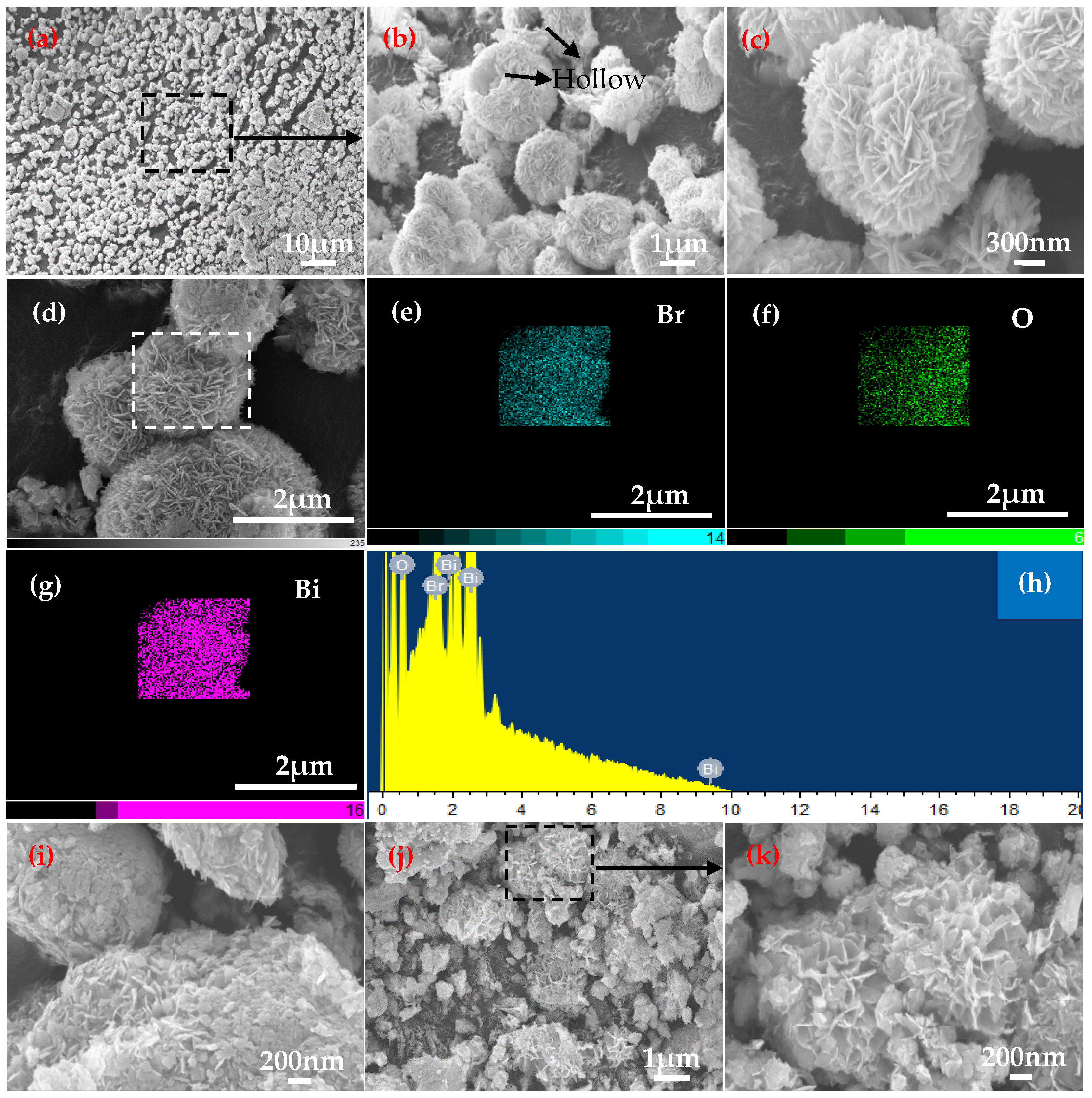
Figure 2 shows the SEM images and chemical compositions of samples prepared at pH = 5 and various Bi/Br ratios in the reaction solution. As shown in Figure 2a,b, the morphology of sample-1 is very regular and spherical, and several spheres present a hollow structure. Moreover, a magnified detail indicates that the regular sphere is formed by the self-assembly of many BiOBr nanosheets (Figure 2c). This hollow microsphere structure is conducive to increasing multiple reflections and scattering of light, thereby enhancing the light absorption capacity [18,21]. Figure 2d–g show the map scanning results for bismuthyl bromide on the sphere surface of sample-1. The distributions of Br, O and Bi are relatively uniform in bismuthyl bromide, where the diffraction peaks of the three elements are presented via EDS (Figure 2h). Table 2 provides the contents of the three elements by EDS point tests. The Bi/Br atomic ratio of 1.3:1 for sample-1 presents a 30% deviation from the experimental value of 1:1 (Table 1). When Bi:Br = 2.55:1, the phase composition of sample-2 remains BiOBr, but the morphology maintains tight and irregular microspheres (Figure 2i). Figure 2j shows SEM image of sample-3 prepared with Bi:Br = 3:1. The phase type changes from BiOBr to Bi4O5Br2, and the morphology presents loose and irregular microspheres (Figure 2k). This morphology increases the pores and specific surface area, allowing more active surfaces and edges of Bi4O5Br2 to be exposed.
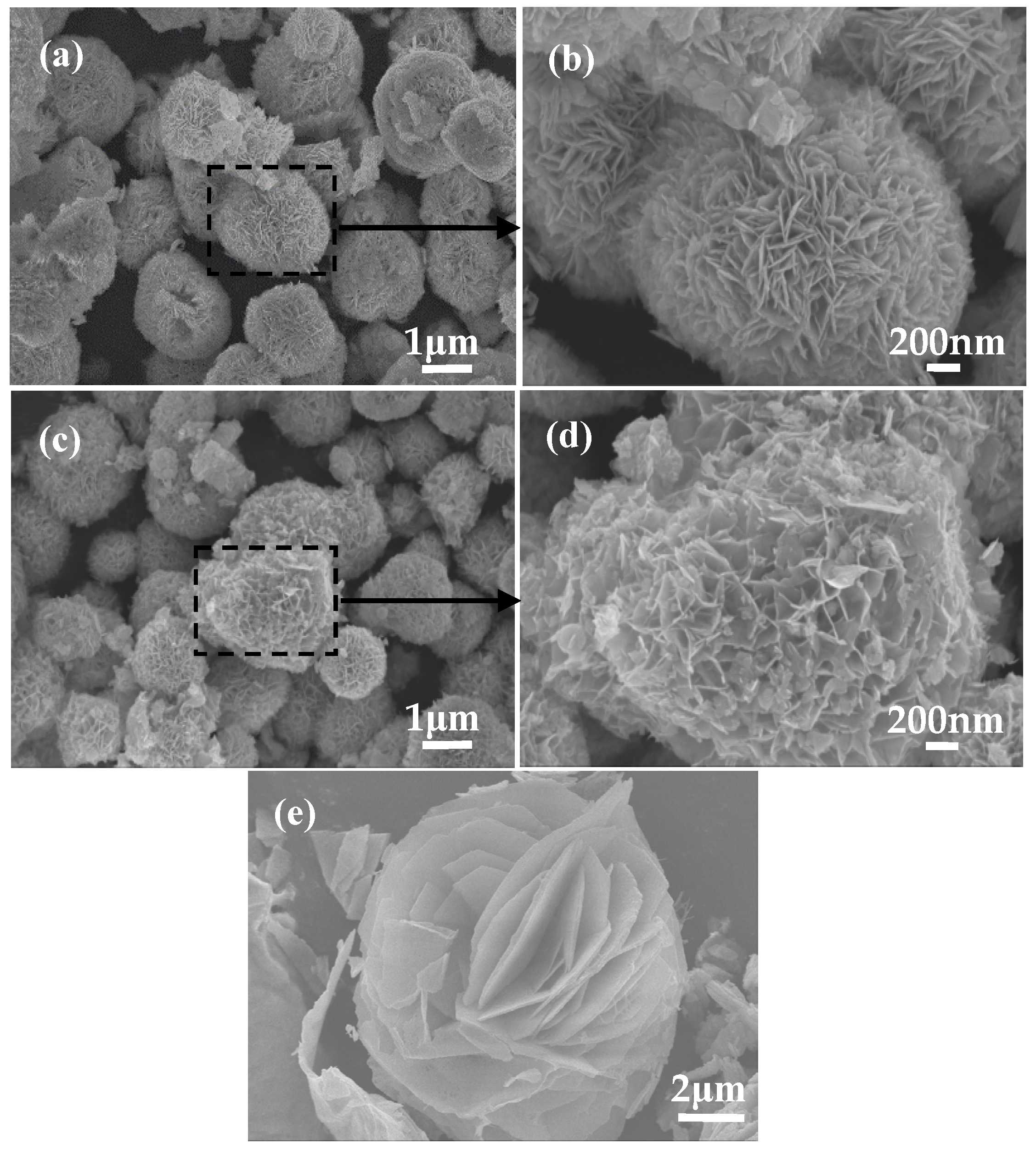
Figure 3 shows SEM images of samples synthesised at pH = 7 with various Bi/Br ratios in the reaction mixture. When the ratio of Bi:Br is 1:1, sample-4 possesses a morphology of self-assembled regular microspheres (Figure 3a), which are composed of many BiOBr nanosheets (Figure 3b). When the ratio of Bi:Br reached a value of 2.55:1, sample-5 presented loose and relatively regular microspheres composed of many thin Bi4O5Br2 nanosheets (Figure 3c). Compared with those in sample-4 and sample-5, the Bi4O5Br2 in sample-6 with microspheres are looser (Figure 3b,d,e). The reason for the formation of the spherical morphology is that the nucleation rate of Bi4O5Br2 can be accelerated with increasing concentration of bismuth nitrate in the solution [22].
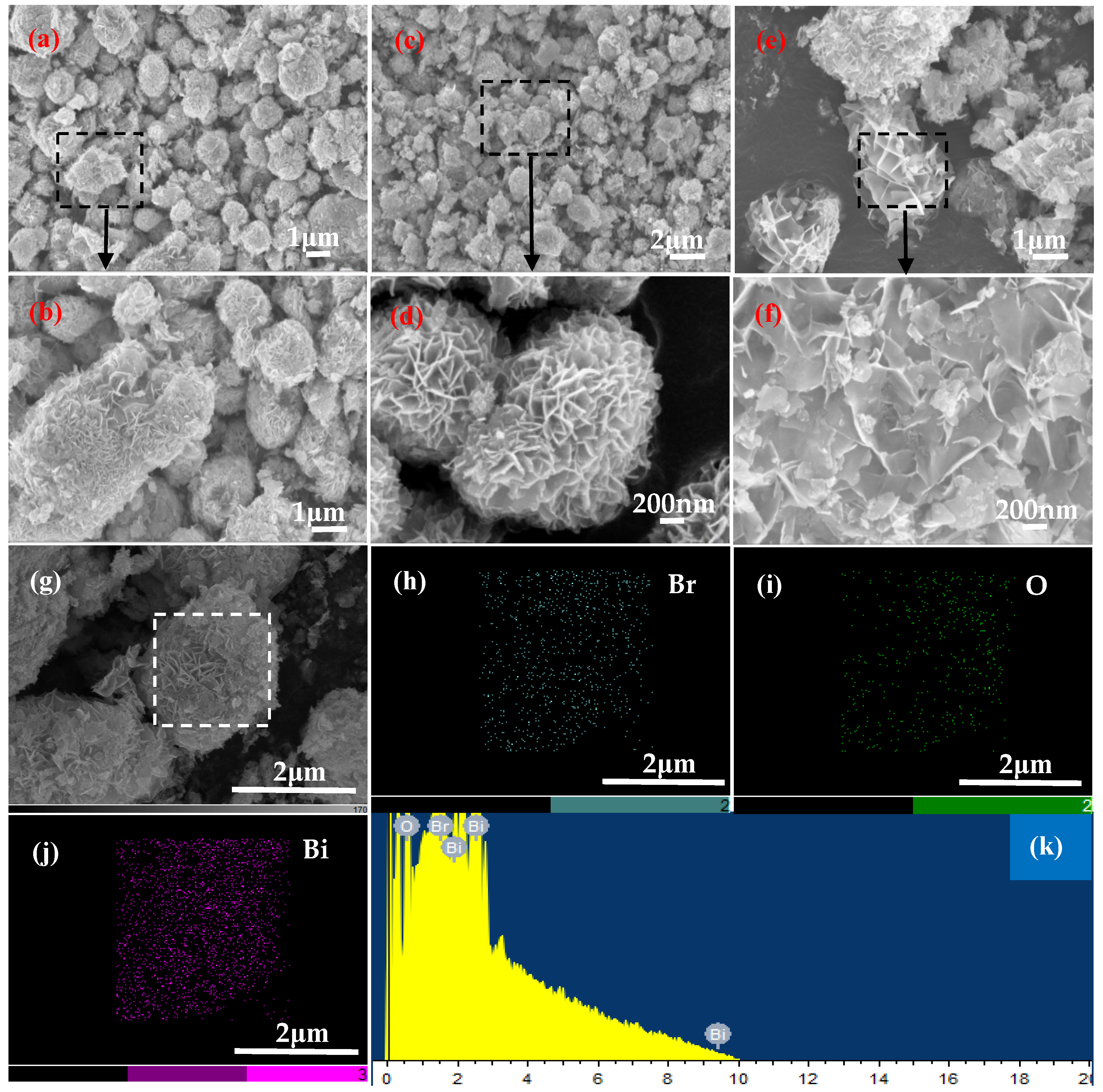
SEM images of samples obtained at pH = 9 and various Bi/Br ratios are shown in Figure 4. Sample-7 presents irregular and loose microspheres and polyhedrons, which are formed by the self-assembly of many thin BiOBr nanosheets (Figure 4a,b). Sample-8 has relatively regular and loose microspheres self-assembled from Bi4O5Br2 nanosheets (Figure 4c,d). As shown in Figure 4e,f, most of the Bi4O5Br2 exhibited a very loose and irregular polyhedral morphology. Compared with the samples obtained at pH = 5 and pH = 7, Bi4O5Br2 is more likely to form loose and irregular polyhedrons in an alkaline environment (pH = 9). The polyhedral morphology of Bi4O5Br2 in sample-9 has larger pores than that of sample-8, leading to an increase in the number of active surfaces. Additionally, the map scanning result of sample-8 reveals that the distributions of Br, O and Bi are uniform in Bi4O5Br2 (Figure 4g–k).
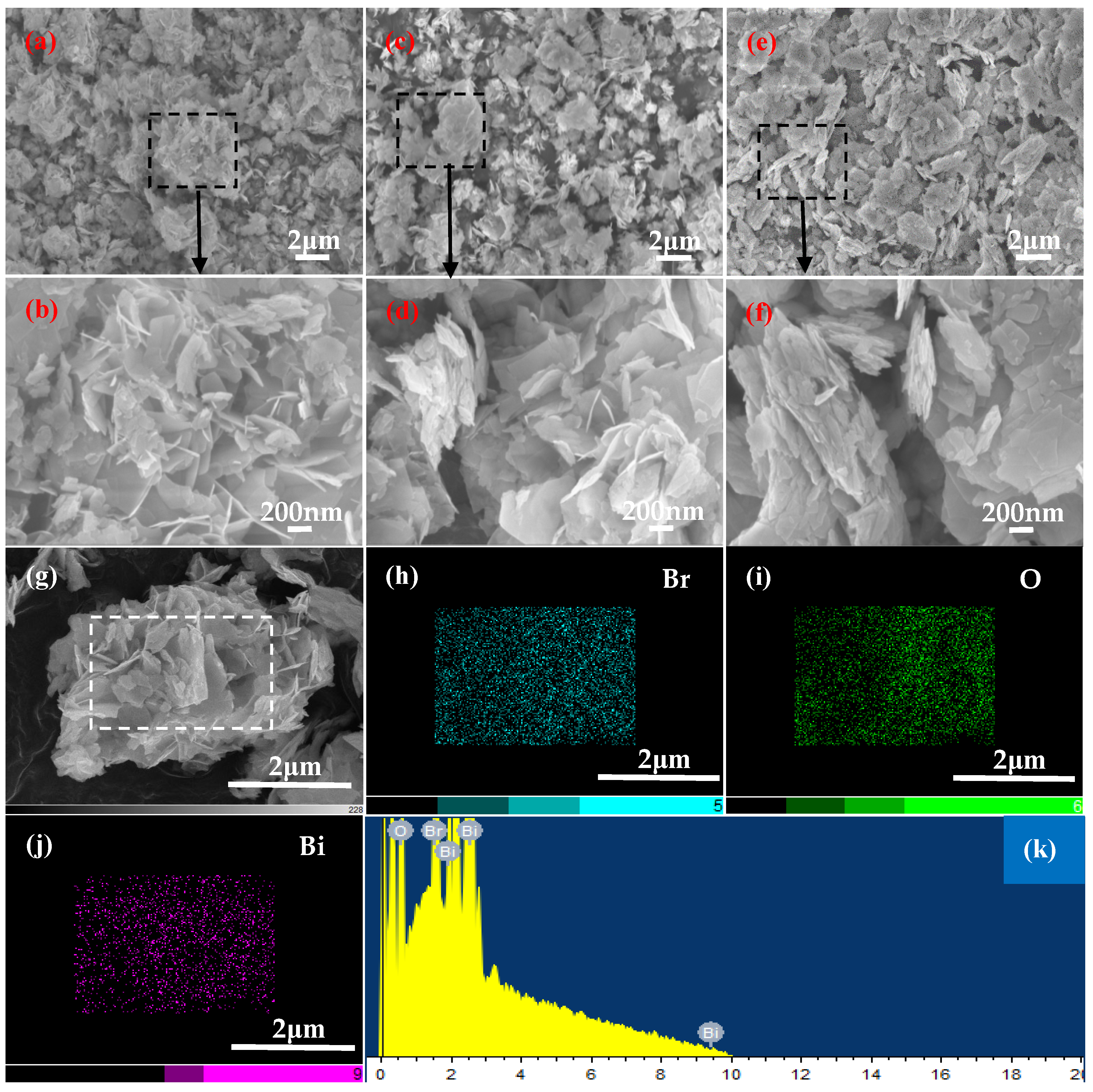
The SEM images of samples obtained at pH = 11 and various Bi/Br ratios are shown in Figure 5, where the phase composition of sample-10 and sample-11 is Bi4O5Br2 (Figure 1d), and the morphology of both reveal loose and irregular polyhedrons composed of numerous Bi4O5Br2 nanosheets (Figure 5a–d). Evidently, the distribution of Bi4O5Br2 nanosheets in sample-11 is looser than that in sample-10. Furthermore, the Bi/Br atomic ratio which is approximately 4.4:1 for sample-11 (Table 2), approaches the experimental value of 4:1 (Table 1). Nevertheless, sample-12, with a phase composition of Bi5O7Br, has a relatively dense lamellar morphology (Figure 5e,f). The map scanning result of sample-11 reveals that the distributions of Br, O and Bi are uniform in Bi4O5Br2 (Figure 5g–k). Furthermore, the contents of Bi, O and Br are 26.27 at.%, 70.35 at.% and 3.38 at.%, respectively. The Bi/Br atomic ratio has a value of approximately 7.8:1 (Table 2), which is lower than the experimental value of 8:1 (Table 1).
The phase composition and structure of the catalysts affect their photocatalytic performance. Therefore, it is necessary to regulate and optimise the phase composition and structure of catalysts. Although the microsphere, nanosheet and nanotube morphologies of BiOBr, Bi4O5Br2 and Bi5O7Br have been synthesised and reported in several studies [5,6,7,8,11,12,13,14,17,21,23], the regulation of phase composition and morphology of these catalysts remains a challenge. This work investigated the controllable preparation of BiOBr, Bi4O5Br2 and Bi5O7Br and the regulation of their morphology. Based on the above results, it can be deduced that the Bi/Br ratio affects the phase composition of the samples, whereas pH affects the morphology of the catalysts. Under acidic conditions, the relatively regular microsphere morphology is dominant (Figure 2). Under alkaline conditions, irregular polyhedron or even nanosheet shapes were obtained (Figure 4 and Figure 5).

3.3. Surface XPS Spectra

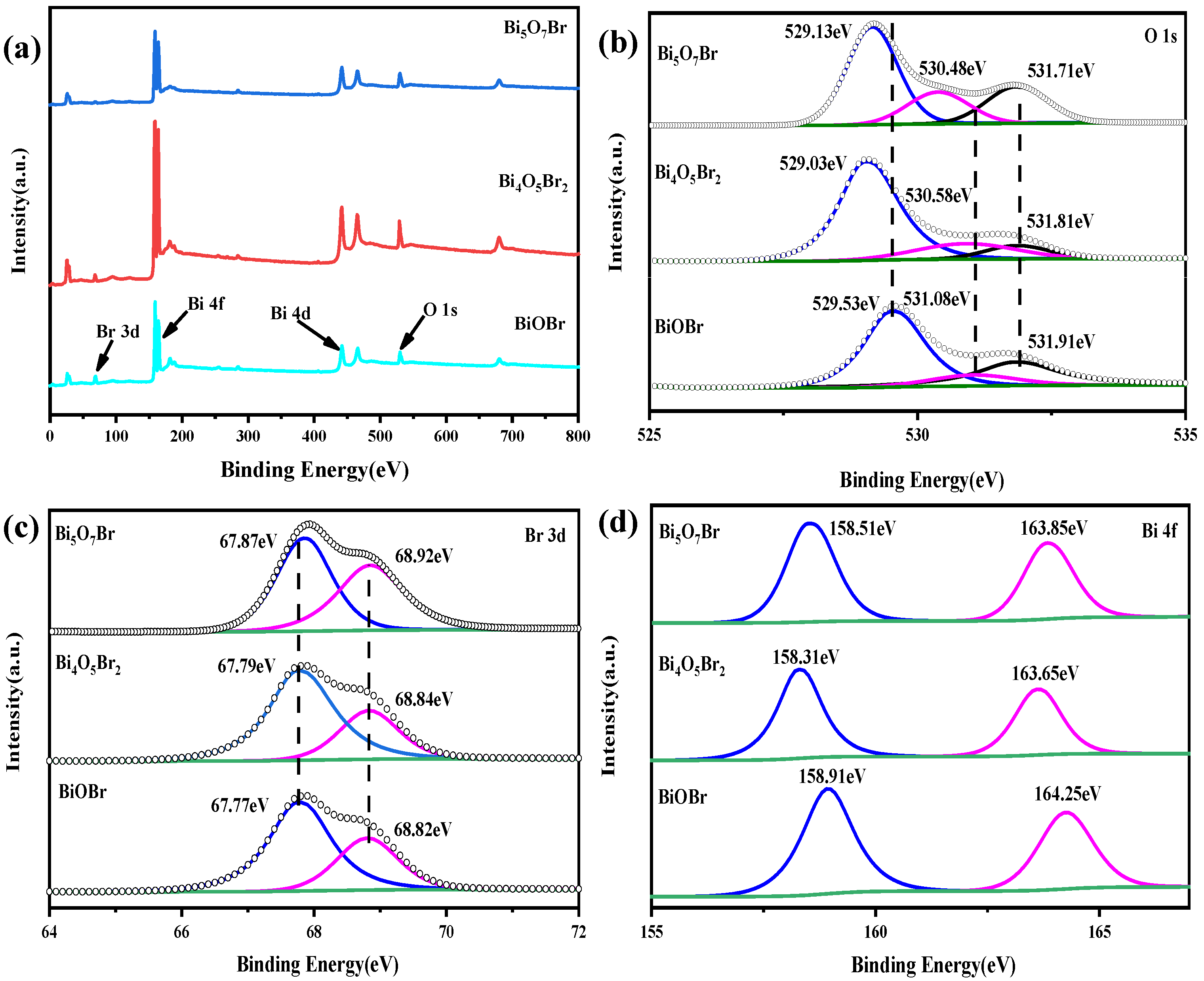
To further evaluate the chemical state, the surface of samples was detected via XPS. The total XPS spectra of sample-2, sample-11 and sample-12 reveal that the prepared BiOBr, Bi4O5Br2 and Bi5O7Br are composed of Br, O and Bi, respectively (Figure 6a). Figure 6b–d show the high-resolution XPS spectra for the BiOBr, Bi4O5Br2 and Bi5O7Br. Furthermore, the O 1 s spectrum (Figure 6b) has three asymmetric peaks with band energies of 529.03 eV, 530.58 eV and 531.81 eV, corresponding to the lattice oxygen, oxygen vacancy and hydroxyl groups in Bi4O5Br2, respectively [2,7]. However, the two main peaks at 529.53 eV and 531.91 eV are obvious in BiOBr, but the oxygen vacancy signal is almost non-existent [5,9]. In Bi5O7Br, the band energies at 529.13 eV, 530.48 eV and 531.71 eV confirmed the presence of lattice oxygen, oxygen vacancy and hydroxyl groups, respectively [10]. Clearly, oxygen vacancies exist in bismuth-rich Bi4O5Br2 and Bi5O7Br, which is consistent with reported results in the literature [13,23]. The band energies of 67.79 eV and 68.84 eV belong to the peaks of Br 3d5/2 and Br 3d3/2, confirming the feature of Br for Bi4O5Br2 (Figure 6c) [24]. In BiOBr and Bi5O7Br, the band energy signals of Br 3d5/2 and Br 3d3/2 have also been confirmed to be 67.77 eV and 68.82 eV as well as 67.87 eV and 68.92 eV [25,26,27], respectively. Figure 6d shows that the Bi 4f spectra with two fitted peaks at band energies of 158.31 eV and 163.65 eV can be attributed to the Bi3+ in Bi4O5Br2 [17]. Nevertheless, the Bi 4f band energy of Bi5O7Br is slightly greater than that of Bi4O5Br2, indicating that the electron density around Bi3+ decreased in Bi5O7Br; this occurred because Bi3+ coordinates with O2− and Br in Bi4O5Br2, and Bi3+ mainly form a coordination bond with O2− in Bi5O7Br as the oxygen content increases, resulting in a stronger bismuth–oxygen bond in Bi5O7Br.

3.4. Electronic Band Structure

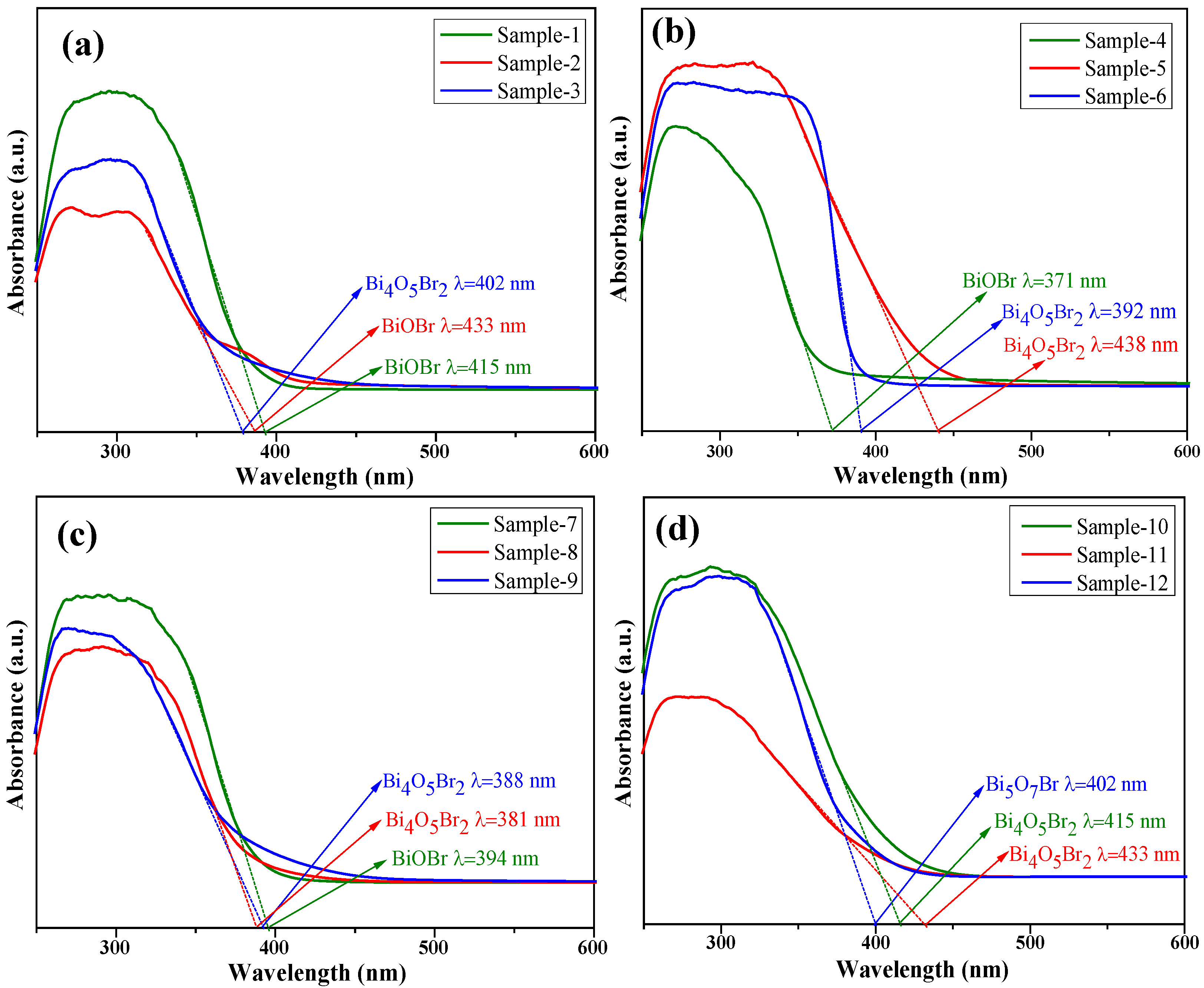
The electronic band structures of the different samples were investigated via UV–Vis DRS. Figure 7 shows the difference in optical absorption performance for the synthesised samples at various pH values and Bi:Br ratios. Notably, the light absorption edges of BiOBr, Bi4O5Br2 and Bi5O7Br are at approximately 433 nm (sample-2), 438 nm (sample-5) and 402 nm (sample-12) (Figure 7a–d), which reach the visible-light range (λ > 400 nm), respectively. However, the optical absorption of these samples occurs predominantly in the UV region, with only a marginal extension into the visible. Compared with BiOBr and Bi5O7Br, Bi4O5Br2 (sample-5) clearly exhibited the best visible-light response. Notably, the light absorption edge for Bi4O5Br2 (sample-11), with a value of 433 nm, is shorter than that of sample-5. This finding can be attributed to the differences in the morphology and size of Bi4O5Br2 caused by variations in the pH value (Figure 2, Figure 3, Figure 4 and Figure 5). The thinner and more loosely arranged the Bi4O5Br2 nanosheet units of the sample are, the stronger is their ability to absorb and reflect light. As shown in Figure 3c,d and Figure 5c,d, the Bi4O5Br2 nanosheets in sample-5 are more dispersed than those in sample-11. Therefore, the utilisation of light for sample-5 has improved.
Additionally, the band gap ( E g ) of BiOBr, Bi4O5Br2 and Bi5O7Br can be calculated via the Kubelka–Munk transformation, according to Equation (1) [5,14]:
α h v = A h v E g n 2
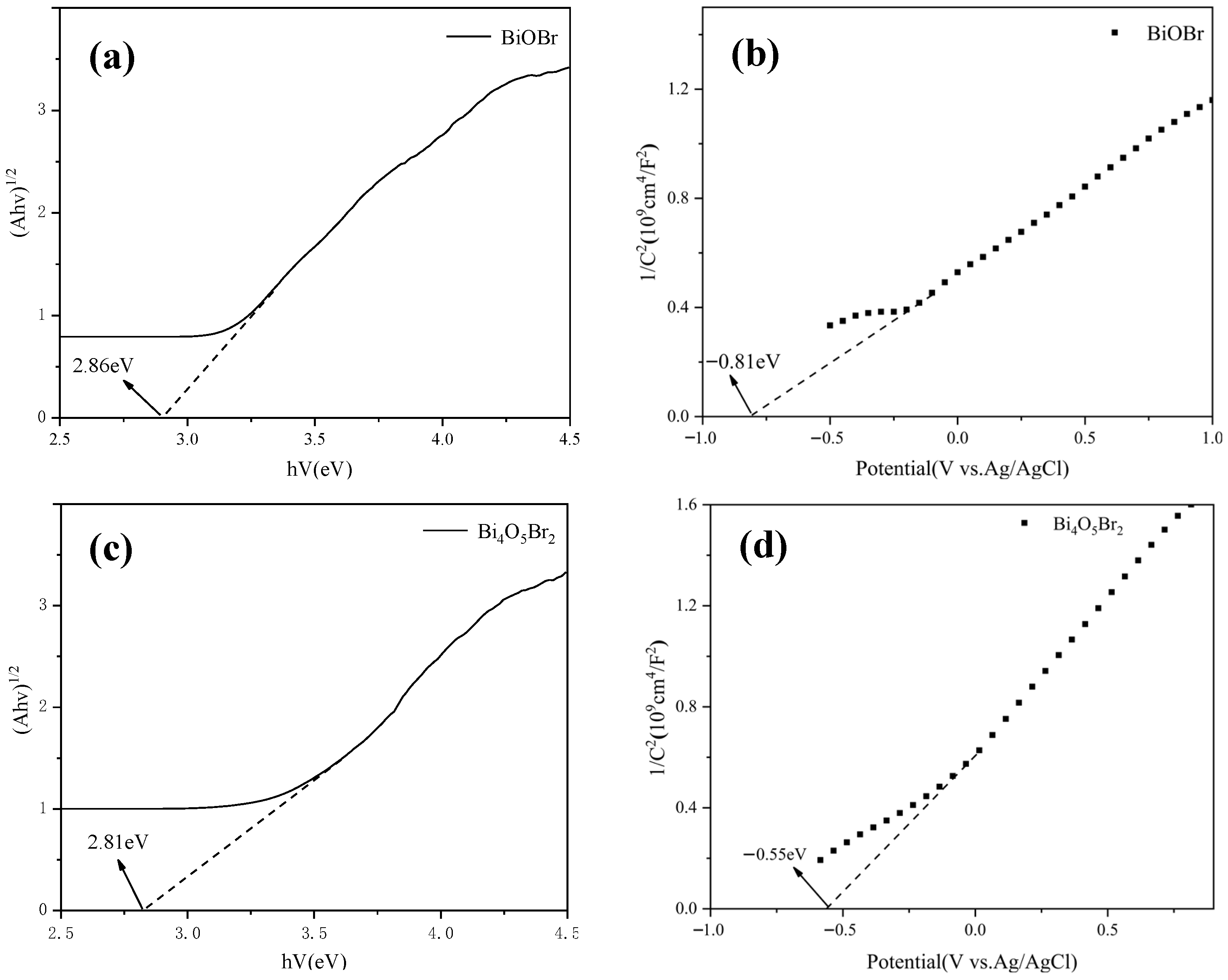
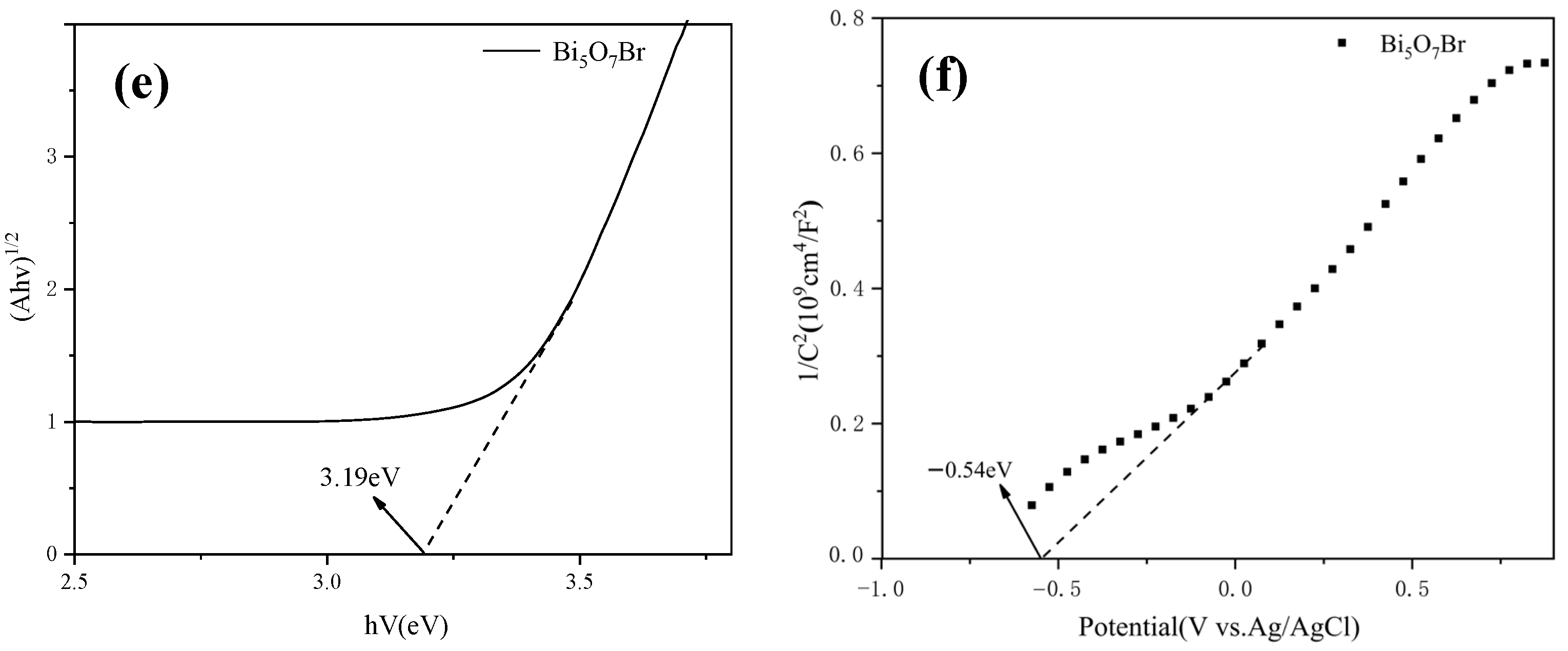
where α , h , v , A , and E g are the absorption coefficient, Planck constant, optical frequency, optical constant and band gap energy, respectively. n is a constant related to the properties of the semiconductor. Since BiOBr, Bi4O5Br2 and Bi5O7Br are indirect bandgap semiconductors [2,9,24], the n value was determined to be 4. Hence, the E g values of BiOBr, Bi4O5Br2 and Bi5O7Br were computed to be 2.86 eV, 2.81 eV and 3.19 eV (Figure 8a,c,e), which are similar to those reported in the literature [24,25,26,27]. Visibly, the E g of Bi4O5Br2 is smaller than that of BiOBr and Bi5O7Br. A narrower band gap benefits the efficient separation of photogenerated carriers. To confirm the energy band level, the Mott–Schottky curves of BiOBr, Bi4O5Br2 and Bi5O7Br are plotted in Figure 8b,d,f, where the values of the calculated flat-band potential ( E f b ) for BiOBr, Bi4O5Br2 and Bi5O7Br are −0.81 eV, −0.55 eV and −0.54 eV with respect to Ag/AgCl, respectively. Because the potential of the conduction band ( E C B ) at the bottom of the n-type semiconductor is close to E f b , E C B can be calculated via Equations (2) and (3) [19,21,28]:
E f b NHE = E f b + 0.197
E C B = E f b N H E   VS .   NHE
where E f b N H E is the potential of the Ag/AgCl electrode relative to the Normal Hydrogen Electrode (NHE). Hence, the E C B values of BiOBr, Bi4O5Br2 and Bi5O7Br are estimated to be −0.61 eV, −0.35 eV and −0.34 eV relative to the NHE, respectively. Additionally, the valence band potential ( E V B ) can also be evaluated via Equation (4) [22,29]:
E g = E V B E C B
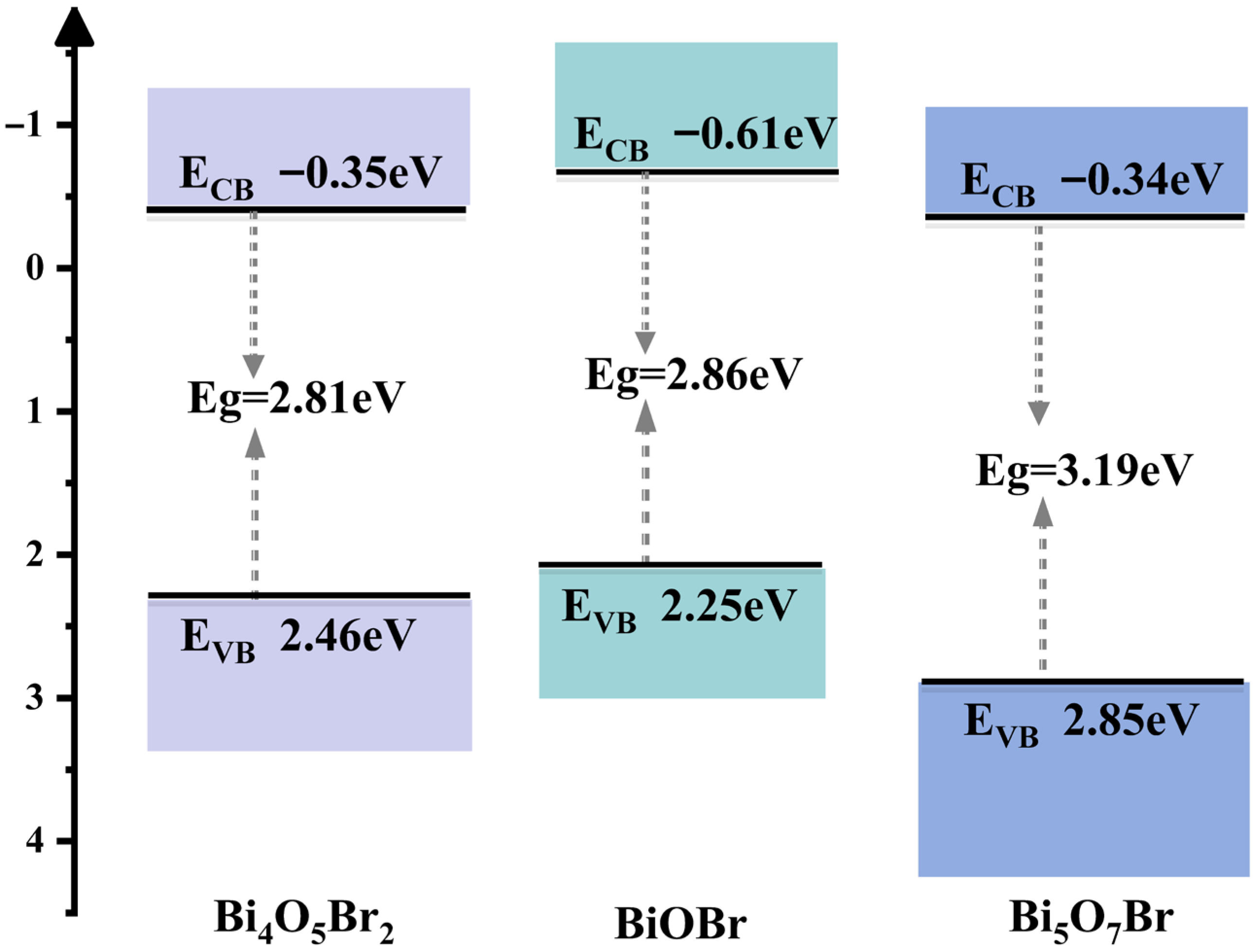
The E V B values of BiOBr, Bi4O5Br2 and Bi5O7Br are 2.25 eV, 2.46 eV and 2.85 eV with respect to the NHE, respectively. Therefore, based on the data acquired from the previous calculations, the energy band structure graphs of BiOBr, Bi4O5Br2 and Bi5O7Br are plotted in Figure 9, where the more negative the E C B level is, the greater the thermodynamic driving force for the CO2 reduction reaction. Here, the E C B of BiOBr is smaller than that of Bi4O5Br2 and Bi5O7Br, but its E g is also greater than that of Bi4O5Br2. Nevertheless, the E C B and E g of Bi5O7Br are the greatest, which may have a negative impact on the photocatalytic activity for CO2 reduction.

3.5. Specific Surface Area and CO2 Adsorption

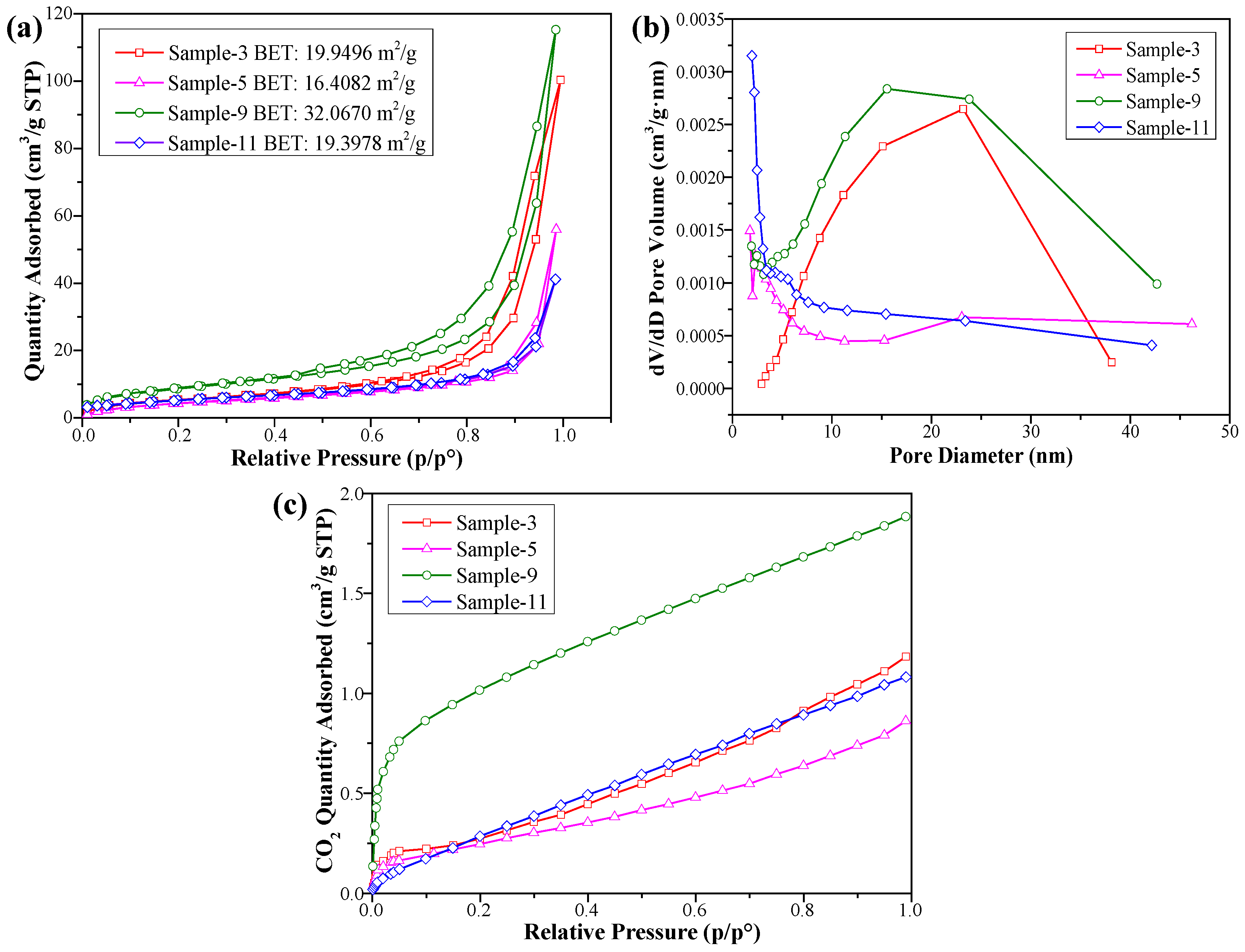
To study the influence of microstructure on the active sites, the N2 adsorption–desorption curves of Bi4O5Br2 samples with various microstructures prepared at different pH values and Bi/Br ratios are shown in Figure 10. The physisorption–desorption isotherms for all the samples have an IV-shaped lag ring (Figure 10a), which reveal that the distribution of pores in Bi4O5Br2 is dominated by micro-mesopores [26,30]. As shown in Figure 10b, micropores dominate sample-5 and sample-11, and mesopores play a major role in sample-3 and sample-9. This structure is conducive to the reflection of light and adsorption of carbon dioxide [31,32]. Table 3 lists the BET surface properties of the different samples. Notably, sample-9 has the largest specific surface area (32.07 ± 0.28 m2·g−1) and largest pore volume (0.18 cm3·g−1) compared with the other samples. Figure 10c shows the CO2 adsorption curves, where the maximum adsorption capacity of CO2 for sample-9 is 1.88 cm3·g−1. For sample-11, the maximum adsorption value of CO2 is 1.08 cm3·g−1. Sample-11 clearly has the average CO2 adsorption capacity among the four samples (Table 3). The CO2 adsorption capacity is dependent on the specific surface area and number of active sites [33,34]. Here, the specific surface area (19.40 ± 0.18 m2·g−1) of sample-11 is smaller than those of samples 9 and 3 (Figure 10a), which suggests that sample-11 has relatively fewer active sites.

3.6. Photocatalytic CO2 Reduction Performance
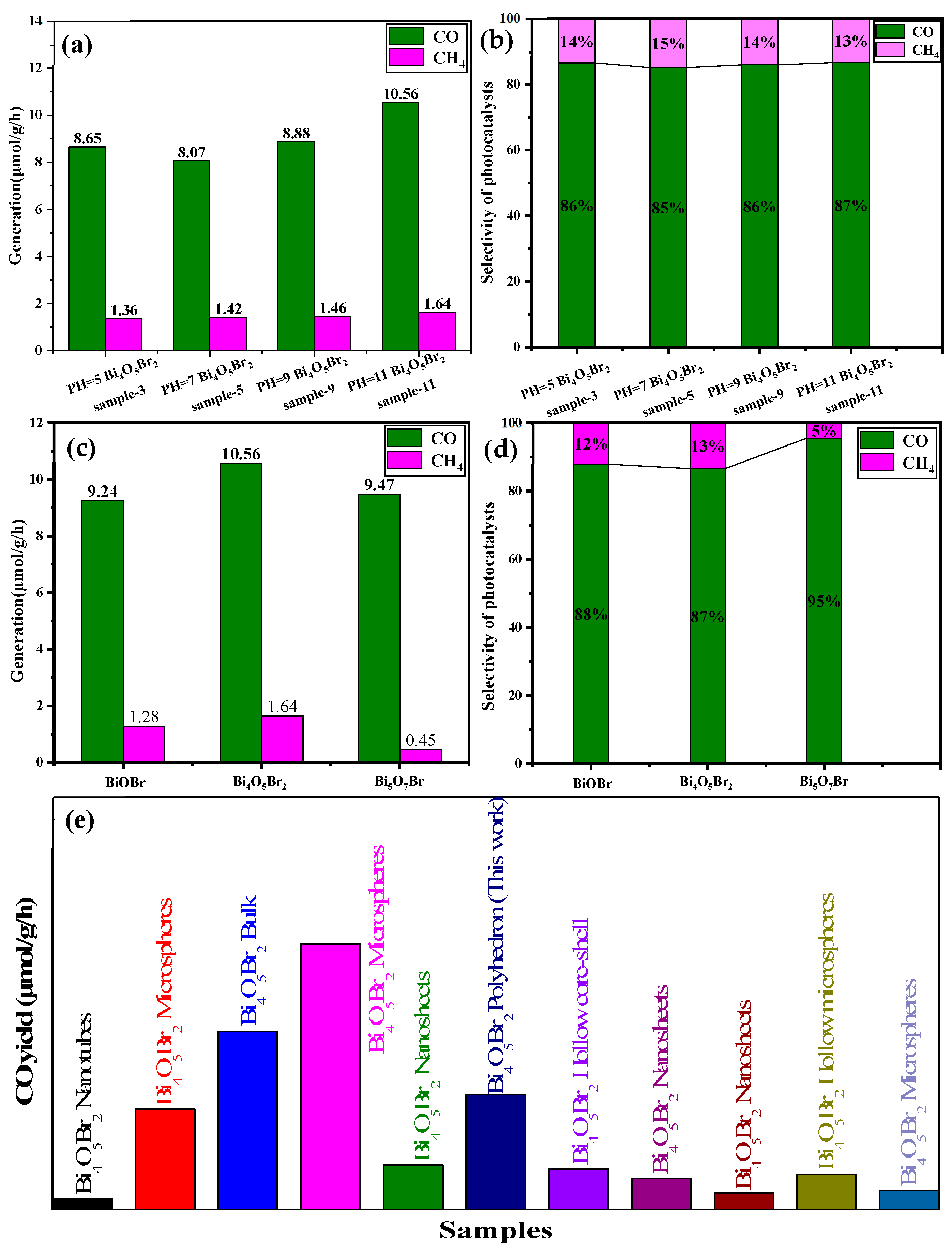
The photoreduction of CO2 by Bi4O5Br2 results in the production of the main product CO and the byproduct CH4 in this study (Figure 11a). The CO production rates of sample-3, sample-5, sample-9 and sample-11 are 8.65, 8.07, 8.88 and 10.56 μmol·g−1·h−1, respectively. The CH4 conversion rates of the corresponding samples were also 1.36, 1.42, 1.46 and 1.64 μmol·g−1·h−1, respectively. The CO productivity of sample-11 clearly has a maximum value of 10.56 μmol·g−1·h−1, and the photocatalytic selectivity of sample-11 for CO products with a value of 87% is greater than that of the other samples (Figure 11b). Based on the above data, sample-11 exhibited the optimal photocatalytic performance and selectivity among the four samples. Although the phase composition of the four samples is Bi4O5Br2 (Figure 1), the differences in photoreduction performance and selectivity of CO2 can be attributed to the various microstructures of the four samples (Figure 2, Figure 3, Figure 4 and Figure 5). Sample-9 presents a loose and irregular polyhedron morphology (Figure 4e,f) and has the largest specific surface area and pore volume (Table 3), which is conducive to CO2 adsorption, but it is not beneficial for multiple light scattering [35,36]. Therefore, sample-9 has the strongest CO2 adsorption capacity (1.88 cm3·g−1) and a relatively weak visible-light absorption edge (388 nm) (Figure 7c). Although sample-11 also has an irregular polyhedron morphology, the specific surface area and pore volume are smaller than those of sample-9, which leads to a lower CO2 adsorption capacity (1.08 cm3·g−1) and a larger visible-light absorption edge (433 nm) (Figure 7d). Consequently, the synergistic effect of the CO2 adsorption capacity and light absorption range results in sample-11 having the best photocatalytic performance.
Figure 11c compares the CO productivity of synthesised BiOBr (sample-2), Bi4O5Br2 (sample-11) and Bi5O7Br (sample-12) for the photoreduction of CO2, where BiOBr and Bi5O7Br have similar CO productivity values of approximately 9.24 μmol·g−1·h−1 and 9.47 μmol·g−1·h−1, respectively. However, the CO yield of both is lower than that of Bi4O5Br2 (10.56 μmol·g−1·h−1). This difference can be attributed not only to the differences in their electronic energy bands (Figure 9) but also to their shapes. The morphology affects the light absorption capacity and the number of active sites for CO2 adsorption [37]. Compared with the particle-like and bulk Bi5O7Br nanosheets [10,27], the Bi5O7Br nanosheets obtained in this study have advantages in terms of photocatalytic performance. Moreover, the energy band structure can affect the number of electronic transitions and the separation efficiency of photogenerated carriers [38]. The E g of Bi4O5Br2 is smaller than those of BiOBr and Bi5O7Br (Figure 9). However, the E C B of Bi4O5Br2 is moderate. Additionally, oxygen vacancies (OVs) can form in bismuth-abundant Bi4O5Br2 or Bi5O7Br (Figure 6b). Several studies have reported that bismuth-rich Bi4O5Br2 and Bi5O7Br are prone to form oxygen vacancies [2,22,27,39], which can further promote the separation of photogenerated carriers and the reduction of CO2 [27,40]. Hence, Bi4O5Br2 exhibited the optimal photocatalytic CO2 reduction performance. With respect to the selectivity of the primary product CO, that of Bi5O7Br, with a value of 95%, is greater than that of BiOBr and Bi4O5Br2 (Figure 11d). Nevertheless, the Bi4O5Br2 with the selectivity of the product CO is the lowest among them. Additionally, Figure 11e shows a comparison of the production rates of the main product CO reported in the literature for Bi4O5Br2. The obtained polyhedron Bi4O5Br2 has a certain advantage in the production rate of CO [2,8,24,41,42,43,44,45]. However, with respect to the production rate of CO, that of Bi4O5Br2 is also lower than those reported in several studies [14,22]. This difference is caused by the morphology and microstructure of the Bi4O5Br2 catalyst.
Figure 11. (a) Generation rates and (b) selectivity of CO and CH4 for Bi4O5Br2 synthesised at different pH values and Bi/Br ratios; (c) generation rates; (d) selectivity of CO and CH4 for BiOBr, Bi4O5Br2 and Bi5O7Br; and (e) comparison of CO production rates for different samples [2,8,14,22,24,41,42,43,44,45].
Materials 18 05442 g011

4. Conclusions

In this study, BiOBr, Bi4O5Br2 and Bi5O7Br photocatalysts were successfully synthesised via a hydrothermal method by adjusting the molar ratio of Bi:Br and the pH of the precursor solution. Owing to the effects of pH and the Bi/Br ratio, a phase transformation occurred from BiOBr→Bi4O5Br2→Bi5O7Br. Under acidic conditions, BiOBr can be formed easily. Under alkaline conditions, bismuth-rich Bi4O5Br2 or even Bi5O7Br was generated.
BiOBr presented a morphology of hollow microspheres, irregular microspheres, irregular and loose microspheres and polyhedrons. The Bi4O5Br2 had relatively regular and loose microspheres, irregular polyhedrons and loose and irregular polyhedrons. The Bi5O7Br exhibited a dense lamella shape. Under acidic conditions, relatively regular microspheres were dominant. Under alkaline conditions, irregular polyhedron or even nanosheet shapes were obtained.
The UV–visDRS results revealed that the light absorption edges of BiOBr, Bi4O5Br2 and Bi5O7Br were at approximately 433 nm, 438 nm and 402 nm, respectively, reaching the visible-light range. The band structure indicated that the E g of Bi4O5Br2 was smaller than those of BiOBr and Bi5O7Br. However, its E C B was moderate. Nevertheless, the E C B and E g of Bi5O7Br were the highest among the three samples.
With respect to Bi4O5Br2, the CO2 photoreduction of samples obtained under different conditions has various yields for the main product, CO, and the by-product, CH4. Among them, the CO productivity of sample-11 has a maximum value of 10.56 μmol·g−1·h−1, and the selectivity for CO reaches 87%. This difference can be attributed to the influence of morphology and microstructure. Additionally, BiOBr and Bi5O7Br have similar CO productivity values of approximately 9.24 μmol·g−1·h−1 and 9.47 μmol·g−1·h−1, respectively, which are lower than that of Bi4O5Br2. Hence, Bi4O5Br2 exhibited the optimal photocatalytic CO2 reduction performance.

Author Contributions

X.C.: Writing—Review and Editing, Draft Investigation, Formal analysis; B.J. and R.L.: Writing—Original, Conceptualization, Data Curation; Y.M.: Validation, Visualisation; B.C.: Resources, Methodology; Y.X.: Supervision, Project administration. All authors have read and agreed to the published version of the manuscript.

Funding

The authors acknowledge the support of the Shaanxi Province Department of Science and Technology (No. 2022QFY06-07, No. 2022GD-TSLD-37, and No. 2020QFY05-04), the Doctoral Research Initiation Fund (No. 20GK02) and the National Natural Science Foundation of China (No. 52261006).

Data Availability Statement

The original contributions presented in this study are included in the article. Further inquiries can be directed to the corresponding author.

Conflicts of Interest

The authors declare no conflicts of interest.

References

  1. Urbanek, K.; Jakimińska, A.; Spilarewicz, K.; Rokicińska, A.; Kuśtrowski, P.; Macyk, W. Cu-Doped CdS-TiO2 Combined with Upconverting Particles for NIR-induced Photocatalytic CO2 Reduction. Acta Mater. 2024, 273, 119980. [Google Scholar] [CrossRef]
  2. Mao, D.; Hu, Y.; Yang, S.; Liang, J.; He, H.; Yang, S.; Xu, Z.; Sun, C.; Zheng, S.; Jiang, Z.; et al. Oxygen-Vacancy-Induced Charge Localization and Atomic Site Activation in Ultrathin Bi4O5Br2 Nanotubes for Boosted CO2 Photoreduction. Chem. Eng. J. 2023, 452, 139304. [Google Scholar] [CrossRef]
  3. Qian, X.; Ma, Y.; Xia, X.; Xia, J.; Ye, J.; He, G.; Chen, H. Recent Progress on Bi4O5Br2-Based Photocatalysts for Environmental Remediation and Energy Conversion. Catal. Sci. Technol. 2024, 14, 1085–1104. [Google Scholar] [CrossRef]
  4. Guo, S.; Ma, Z.; Wang, Q.; Wang, J.; Guo, H.; Chen, C.; Hou, B.; Jia, L.; Li, D. Effect of Different Alkaline Earth Metals on the Adsorption and Catalytic Behavior of Cobalt Fischer-Tropsch Synthesis. Mol. Catal. 2024, 557, 113962. [Google Scholar] [CrossRef]
  5. Shen, M.; Cai, X.; Cao, B.; Cao, J.; Xu, Y. Boron-Doped Ultrathin BiOBr Nanosheet Promotion for Photocatalytic Reduction of CO2 into CO. J. Alloys Compd. 2024, 981, 173727. [Google Scholar] [CrossRef]
  6. Shaikh, J.S.; Rittiruam, M.; Saelee, T.; Márquez, V.; Shaikh, N.S.; Khajondetchairit, P.; Pathan, S.C.; Jiraborvornpongsa, N.; Praserthdam, S.; Praserthdam, P. High Entropy Materials Frontier and Theoretical Insights for Logistics CO2 Reduction and Hydrogenation: Electrocatalysis, Photocatalysis and Thermo-catalysis. J. Alloys Compd. 2023, 969, 172232. [Google Scholar] [CrossRef]
  7. Dong, X.; Xu, L.; Ma, J.; Li, Y.; Yin, Z.; Chen, D.; Wang, Q.; Han, J.; Qiu, J.; Yang, Z.; et al. Enhanced Interfacial Charge Transfer and Photothermal Effect via In-Situ Construction of Atom Co-Sharing Bi Plasmonic/Bi4O5Br2 Nanosheet Heterojunction Towards Improved Full-Spectrum Photocatalysis. Chem. Eng. J. 2023, 459, 141557. [Google Scholar] [CrossRef]
  8. Liu, D.; Hua, J.; Zhang, W.; Wei, K.; Song, S.; Wang, Q.; Song, Z.; Han, H.; Ma, C.; Feng, S. Efficient Photocatalytic CO2 Reduction Achieved by Constructing Bi4O5Br2/Bi-MOF Z-scheme Heterojunction. Colloids Surf. A 2024, 695, 134101. [Google Scholar] [CrossRef]
  9. Zhang, B.; Tan, G.; Xia, A.; Wang, Z.; Wu, X.; Guo, L.; Zeng, C.; Liu, Y.; Liu, T.; Yang, Q.; et al. Dual Strategies for Enhancing Piezoelectric Catalytic Ability of Energy Storage BiOBr@Bi4O5Br2 Heterojunction: Interfacial Electric Field and Intrinsic Polarization Electric Field. Appl. Catal. B 2024, 352, 124021. [Google Scholar] [CrossRef]
  10. Wang, Y.; Wang, K.; Meng, J.; Ban, C.; Duan, Y.; Feng, Y.; Jing, S.; Ma, J.; Yu, D.; Gan, L.; et al. Constructing Atomic Surface Concaves on Bi5O7Br Nanotube for Efficient Photocatalytic CO2 Reduction. Nano Energy 2023, 109, 108305. [Google Scholar] [CrossRef]
  11. Wu, Z.; Shen, J.; Ma, N.; Li, Z.; Wu, M.; Xu, D.; Zhang, S.; Feng, W.; Zhu, Y. Bi4O5Br2 Nanosheets with Vertical Aligned Facets for Efficient Visible-Light-Driven Photodegradation of BPA. Appl. Catal. B 2021, 286, 119937. [Google Scholar] [CrossRef]
  12. Guo, Y.; Shi, W.; Zhu, Y.; Xu, Y.; Cui, F. Enhanced Photoactivity and Oxidizing Ability Simultaneously via Internal Electric Field and Valence Band Position by Crystal Structure of Bismuth Oxyiodide. Appl. Catal. B 2020, 262, 118262. [Google Scholar] [CrossRef]
  13. Cai, H.; Chen, F.; Hu, C.; Ge, W.; Li, T.; Zhang, X.; Huang, H. Oxygen Vacancies Mediated Ultrathin Bi4O5Br2 Nanosheets for Efficient Piezocatalytic Peroxide Hydrogen Generation in Pure Water. Chin. J. Catal. 2024, 57, 123–132. [Google Scholar] [CrossRef]
  14. Bai, Y.; Yang, P.; Wang, L.; Yang, B.; Xie, H.; Zhou, Y.; Ye, L. Ultrathin Bi4O5Br2 Nanosheets for Selective Photocatalytic CO2 Conversion into CO. Chem. Eng. J. 2019, 360, 473–482. [Google Scholar] [CrossRef]
  15. Mi, Y.; Li, H.; Yu, X.; Zhang, Y.; Zeng, S.; Wang, L.; Hou, W. One-Pot Synthesis of Bi2S3/Bi4O5Br2 S-scheme Heterojunction Hierarchical Microbelts with Enhanced Photocatalytic Activity in Contaminant Degradation. Appl. Surf. Sci. 2024, 655, 159573. [Google Scholar] [CrossRef]
  16. Diercks, C.S.; Liu, Y.; Cordova, K.E.; Yaghi, O.M. The Role of Reticular Chemistry in the Design of CO2 Reduction Catalysts. Nat. Mater. 2018, 17, 301–307. [Google Scholar] [CrossRef]
  17. Mao, D.; Ding, S.; Meng, L.; Dai, Y.; Sun, C.; Yang, S.; He, H. One-pot Microemulsion-Mediated Synthesis of Bi-rich Bi4O5Br2 with Controllable Morphologies and Excellent Visible-light Photocatalytic Removal of Pollutants. Appl. Catal. B 2017, 207, 153–165. [Google Scholar] [CrossRef]
  18. Zhang, P.; Lou, X.W. Design of Heterostructured Hollow Photocatalysts for Solar-to-Chemical Energy Conversio. Adv. Mater. 2019, 31, 1900281. [Google Scholar] [CrossRef]
  19. Yang, Y.; Luo, Q.; Li, Y.; Cui, S.; Zhao, C.; Yang, J. Enhanced Photocatalytic Degradation of Oxytetracycline by Z-scheme Heterostructure ZIF-8/Bi4O5Br2. Appl. Catal. A-Gen. 2024, 681, 119786. [Google Scholar] [CrossRef]
  20. Yang, K.; Lv, X.; Meng, J.; Wang, H.; Guo, L.; Li, X.; Su, F.; Lan, Q.; Li, Z.; Wang, W.; et al. Bi4O5Br2 Co-Modified with Oxygen Vacancy and Bi Metal for Efficient Photothermal Conversion of CO2 to C2 Hydrocarbons. Vacuum 2024, 227, 113458. [Google Scholar] [CrossRef]
  21. Liu, Y.; Luo, G.; Liu, Y.; Xu, Z.; Shen, H.; Sheng, Y.; Zhu, Y.; Wu, S.; Liu, L.; Shan, Y. Zinc-Doped C4N3/BiOBr S-scheme Heterostructured Hollow Spheres for Efficient Photocatalytic Degradation of Tetracycline. Phys. Chem. Chem. Phys. 2024, 26, 19658. [Google Scholar] [CrossRef]
  22. Liu, G.; Li, L.; Yang, J.; Dong, J.; Wang, B.; Zhu, W.; Xia, J.; Li, H. Enhanced CO2 Photoreduction Over Bismuth-Rich Bi4O5Br2: Optimized Charge Separation and Intrinsic Barriers. Sep. Purif. Technol. 2024, 349, 127658. [Google Scholar] [CrossRef]
  23. Chen, X.; Qi, M.; Li, Y.; Tang, Z.; Xu, Y. Enhanced Ambient Ammonia Photosynthesis by Mo-Doped Bi5O7Br Nanosheets with Light-Switchable Oxygen Vacancies. Chin. J. Catal. 2021, 42, 2020–2026. [Google Scholar] [CrossRef]
  24. Zha, M.; Ai, L.; Tan, C.; Jia, D.; Guo, N.; Wang, L. 2D/2D Layered Bi12O15Cl6/Bi4O5Br2 Heterostructure Facilitated Photocatalytic CO2 Reduction in Aerobic Environments. Sep. Purif. Technol. 2025, 368, 132995. [Google Scholar] [CrossRef]
  25. Yu, Y.; Zhang, P.; Tuerhong, R.; Chai, K.; Du, X.; Su, X.; Zhao, L.; Han, L. Regulating the Electronic Structure of BiOBr by Cu-Doping to Promote Efficient Photocatalytic Nitrogen Fixation Reaction. Sep. Purif. Technol. 2025, 364, 132501. [Google Scholar] [CrossRef]
  26. Shen, M.; Cai, X.; Cao, B.; Cao, J.; Zhao, P.; Xu, Y. Construction of An S-scheme AgBr/BiOBr Heterojunction by in Situ Hydrolysis for Highly Efficient Photocatalytic Reduction of CO2 into CO. J. Alloys Compd. 2024, 1009, 176905. [Google Scholar] [CrossRef]
  27. Mao, D.; Yang, S.; Hu, Y.; He, H.; Yang, S.; Zheng, S.; Sun, C.; Jiang, Z.; Qu, X.; Wong, P.K. Efficient CO2 Photoreduction Triggered by Oxygen Vacancies in Ultrafine Bi5O7Br Nanowires. Appl. Catal. B 2023, 321, 122031. [Google Scholar] [CrossRef]
  28. Wang, C.; Chen, F.; Chen, E.; Chen, T.; Ma, T.; Huang, H. Unveiling Strong Electric Fields of Ultrafine Hollow Nanotubes Axially Orienting Asymmetric Polar [Bi5O7] Units for Efficient Piezocatalytic Water Splitting. ACS Nano 2025, 19, 22387–22401. [Google Scholar] [CrossRef]
  29. Huang, J.; Shi, W.; Xu, S.; Luo, H.; Zhang, J.; Lu, T.; Zhang, Z. Water-Mediated Selectivity Control of CH3OH Versus CO/CH4 in CO2 Photoreduction on Single-Atom Implanted Nanotube Arrays. Adv. Mater. 2024, 36, 2306906. [Google Scholar] [CrossRef]
  30. Li, W.; Cao, J.; Liang, Y.; Masuda, Y.; Tsuji, T.; Tamura, K.; Ishiwata, T.; Kuramoto, D.; Matsuoka, T. Evaluation of CO2 Storage and Enhanced Gas Recovery Potential in Gas Shale Using Kerogen Nanopore Systems with Mesopores and Micropores. Chem. Eng. J. 2024, 486, 150225. [Google Scholar] [CrossRef]
  31. Kohnke, A.; Wilczewska, P.; Brzeski, J.; Szczodrowski, K.; Ryl, J.; Malankowska, A.; Bielicka-Giełdoń, A.; Siedlecka, E.M. Holes-Mediated Photocatalytic Activation of PDS for Enhanced Ifosfamide Removal with MWCNTs-X/DBOB: Role of Bi4O5Br2 and Bi24O31Br10 Phases. Sep. Purif. Technol. 2025, 375, 133747. [Google Scholar] [CrossRef]
  32. Kajiwara, T.; Ikeda, M.; Kobayashi, K.; Higuchi, M.; Tanaka, K.; Kitagawa, S. Effect of Micropores of A Porous Coordination Polymer on the Product Selectivity in RuII Complex-Catalyzed CO2 Reduction. Chem. Asian J. 2021, 16, 3341–3344. [Google Scholar] [CrossRef]
  33. He, Y.; Yin, L.; Yuan, N.; Zhang, G. Adsorption and Activation, Active Site and Reaction Pathway of Photocatalytic CO2 Reduction: A Review. Chem. Eng. J. 2024, 481, 148754. [Google Scholar] [CrossRef]
  34. Asadollahpour, M.; Ghazi, M.M. Development of A Polyethyleneimine-Functionalized Mixed Ligand ZIF-7-8 for Enhanced CO2 Adsorption Efficiency. J. Solid State Chem. 2025, 350, 125516. [Google Scholar] [CrossRef]
  35. Jovita, S.; Melenia, A.T.; Santoso, E.; Subagyo, R.; Tamim, R.; Asikin-Mijan, N.; Holilah, H.; Bahruji, H.; Nugraha, R.E.; Jalil, A.A.; et al. Mesoporous Aluminosilicate from Nanocellulose Template: Effect of Porosity, Morphology and Catalytic Activity for Biofuel Production. Renew. Energy 2025, 250, 123293. [Google Scholar] [CrossRef]
  36. Bhattacharya, G.; Manna, R.; Sardar, P.; Rahut, S.; Kumar, S.; Samanta, A.N. Excellent Electrochemical Activities of Sn Doped In2S3 with Microflower Morphology for CO2 Reduction to Formic Acid and Methanol. J. Environ. Chem. Eng. 2025, 13, 117451. [Google Scholar] [CrossRef]
  37. Yi, J.; Zhang, G.; Wang, Y.; Qian, W.; Wang, X. Recent Advances in Phase-Engineered Photocatalysts: Classification and Diversified Applications. Materials 2023, 16, 3980. [Google Scholar] [CrossRef]
  38. Ma, Z.; Liu, S.; Zhong, Q.; Zhu, G.; Zhu, J.; Li, D.; Jiang, D. Improving Charge Separation in B-Doped PCN/C-doped PHI via Synergy of Homojunction and Doping Engineering for Enhanced Photocatalytic CO2 Reduction. J. Photochem. Photobiol. A Chem. 2025, 471, 116688. [Google Scholar] [CrossRef]
  39. Hua, J.; Feng, S.; Ma, C.; Huang, H.; Wei, K.; Dai, X.; Wu, K.; Wang, H.; Bian, Z. An Innovative 2D/2D Bi5O7Br/NiFe-LDH Z-scheme Heterojunction for Enhanced Photoreduction CO2 Activity. J. Environ. Chem. Eng. 2023, 11, 111290. [Google Scholar] [CrossRef]
  40. Barrocas, B.T.; Ambrožová, N.; Kočí, K. Photocatalytic Reduction of Carbon Dioxide on TiO2 Heterojunction Photocatalysts—A Review. Materials 2022, 15, 967. [Google Scholar] [CrossRef]
  41. Meng, J.; Jin, X.; Zhao, M.; Chen, Z.; Hao, W. Construction of Core-Shell Bi4O5Br2 Structure for Efficient Photocatalytic CO2 Reduction. Vacuum 2025, 233, 114022. [Google Scholar] [CrossRef]
  42. Wang, X.; Hu, B.; Li, Y.; Yang, Z.; Zhang, G. Dipole Moment Regulation by Ni Doping Ultrathin Bi4O5Br2 for Enhancing Internal Electric Field Toward Efficient Photocatalytic Conversion of CO2 to CO. Chin. J. Catal. 2024, 66, 257–267. [Google Scholar] [CrossRef]
  43. Zeng, J.; Jiang, Z.; Lv, K.; Ahmad, S.A.; Chen, X.; Zhang, W.; Xie, J.; Zhu, T. Experimental and Calculation Investigations of the Photocatalytic Selective and Performance for CO2 Reduction by Cobalt-Doped Bi4O5Br2 Nanosheets. Ceram. Int. 2025, 51, 1801–1812. [Google Scholar] [CrossRef]
  44. Jin, X.; Lv, C.; Zhou, X.; Xie, H.; Sun, S.; Liu, Y.; Meng, Q.; Chen, G. A Bismuth Rich Hollow Bi4O5Br2 Photocatalyst Enables Dramatic CO2 Reduction Activity. Nano Energy 2019, 64, 103955. [Google Scholar] [CrossRef]
  45. Jin, X.; Cao, J.; Wang, H.; Lv, C.; Xie, H.; Su, F.; Li, X.; Sun, R.; Shi, S.; Dang, M.; et al. Realizing Improved CO2 Photoreduction in Z-scheme Bi4O5Br2/AgBr Heterostructure. Appl. Surf. Sci. 2022, 598, 153758. [Google Scholar] [CrossRef]
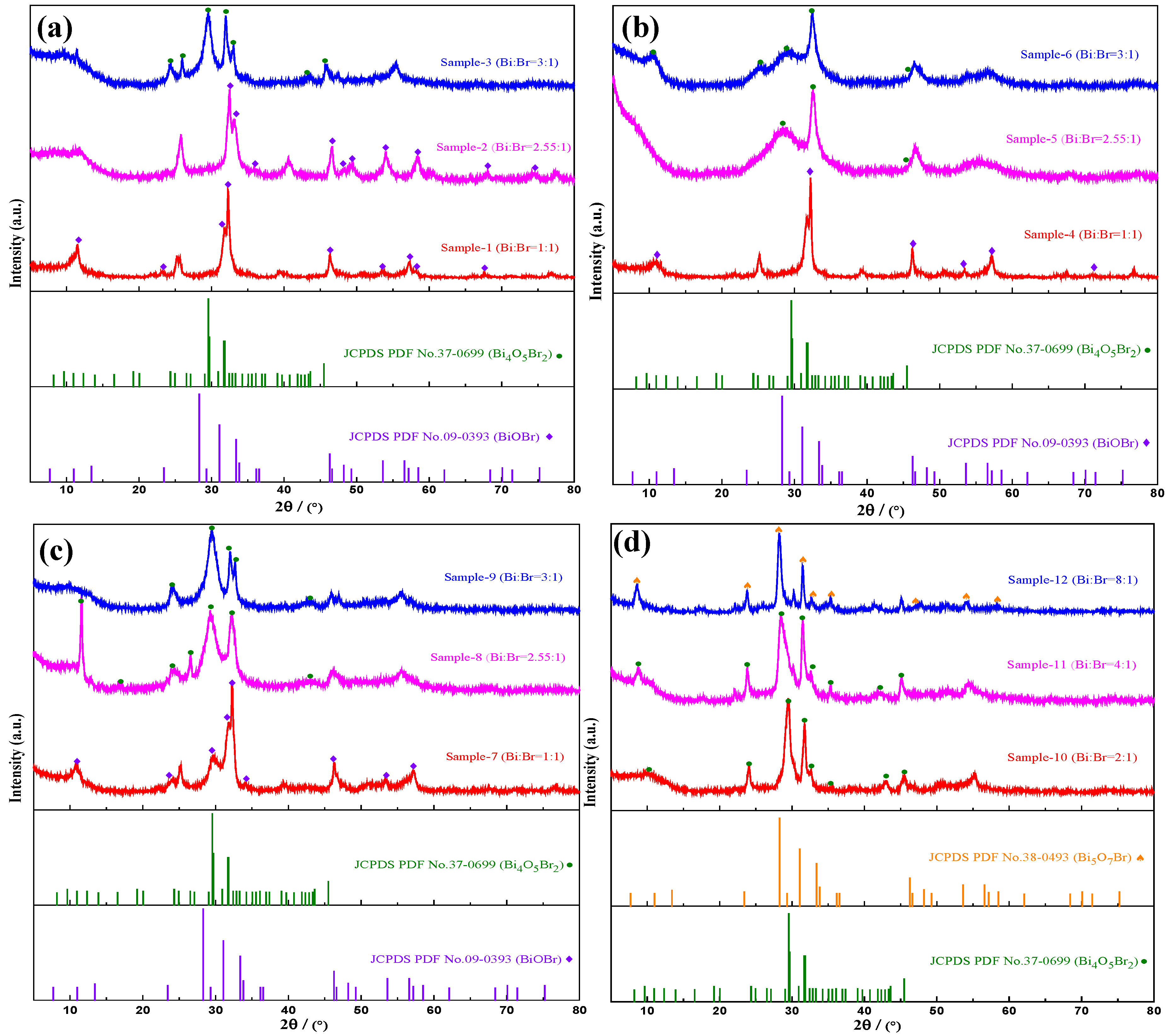
Figure 1. XRD spectra of the samples at different pH values and Bi/Br ratios: (a) pH = 5, (b) pH = 7, (c) pH = 9, (d) pH = 11.
Materials 18 05442 g001
Figure 2. SEM images of the samples at pH = 5 for (a) Bi:Br = 1:1, (b) microstructure marked in (a), (c) enlarged morphology for (b), (d) SEM image, (e) Br, (f) O, (g) Bi, (h) EDS, (i) Bi:Br = 2.55:1, (j) Bi:Br = 3:1 and (k) enlarged detail marked in (j).
Materials 18 05442 g002
Figure 3. SEM images of the pH = 7 samples for (a) Bi:Br = 1:1, (b) magnified detail marked in (a), (c) Bi:Br = 2.55:1, (d) magnified detail marked in (c) and (e) Bi:Br = 3:1.
Materials 18 05442 g003
Figure 4. SEM images of the pH = 9 samples for (a) Bi:Br = 1:1, (b) enlarged detail tagged in (a), (c) Bi:Br = 2.55:1, (d) enlarged detail tagged in (c), (e) Bi:Br = 3:1, (f) magnified detail tagged in (e), (g) SEM image, (h) Br, (i) O, (j) Bi and (k) EDS.
Materials 18 05442 g004
Figure 5. SEM images of the pH = 11 samples for (a) Bi:Br = 2:1, (b) enlarged detail tagged in (a), (c) Bi:Br = 4:1, (d) magnified detail tagged in (c), (e) Bi:Br = 8:1, (f) magnified detail tagged in (e), (g) SEM image, (h) Br, (i) O, (j) Bi and (k) EDS.
Materials 18 05442 g005
Figure 6. (a) XPS survey spectra and high-resolution spectra for (b) O 1s, (c) Br 3d and (d) Bi 4f of BiOBr, Bi4O5Br2 and Bi5O7Br.
Materials 18 05442 g006
Figure 7. UV–Vis DRS of the samples prepared at different pH values: (a) pH = 5, (b) pH = 7, (c) pH = 9 and (d) pH = 11.
Materials 18 05442 g007
Figure 8. Band gap energies for (a) BiOBr, (c) Bi4O5Br2 and (e) Bi5O7Br and Mott–Schottky curves for (b) BiOBr, (d) Bi4O5Br2 and (f) Bi5O7Br.
Materials 18 05442 g008aMaterials 18 05442 g008b
Figure 9. Diagram of the energy band structures of BiOBr, Bi4O5Br2 and Bi5O7Br.
Materials 18 05442 g009
Figure 10. (a) N2 adsorption–desorption isotherms, (b) pore volume distribution curves and (c) CO2 adsorption capacity of Bi4O5Br2 in different samples.
Materials 18 05442 g010
Table 1. The number of obtained samples and the corresponding preparation conditions.
Sample Number123456789101112
Bi/Br ratio1:12.55:13:11:12.55:13:11:12.55:13:12:14:18:1
PH value555777999111111
Table 2. Chemical compositions and atomic ratios of three samples.
Sample NumberElement Type and Atomic Percent
Bi (at.%)O (at.%)Br (at.%)Bi/Br (Ratio)
Sample-114.5574.3011.151.3:1
Sample-1123.9770.575.464.4:1
Sample-1226.2770.353.387.8:1
Table 3. Surface properties of the different samples.
SamplesBET Surface
(m2·g−1)
Pore Volume
(cm3·g−1)
Pore Diameter
(nm)
CO2 Adsorption Capacity (cm3·g−1)
Sample-319.95 ± 0.120.1626.6 ± 5.61.18
Sample-516.41 ± 0.350.0920.9 ± 1.10.86
Sample-932.07 ± 0.280.1820.5 ± 2.71.88
Sample-1119.40 ± 0.180.0613.78 ± 0.891.08
Disclaimer/Publisher’s Note: The statements, opinions and data contained in all publications are solely those of the individual author(s) and contributor(s) and not of MDPI and/or the editor(s). MDPI and/or the editor(s) disclaim responsibility for any injury to people or property resulting from any ideas, methods, instructions or products referred to in the content.