Article

State-Dependent Switching Control with Dwell Time Regulation for Three-Phase VSCs Based on 4D Switching Model †
1
School of Automation and Information Engineering, Xi’an University of Technology, Xi’an 710048, China
2
Shaanxi Key Laboratory of Complex System Control and Intelligent Information Processing, Xi’an University of Technology, Xi’an 710048, China
3
School of Natural and Computing Sciences, King’s College, University of Aberdeen, Aberdeen AB243 UE, UK
*
Author to whom correspondence should be addressed.
This paper is an extended version of our paper published in ACCESS2024—The 19th Annual Conference of China Electrotechnical Society, Xi’an, China, 20–22 September 2024.
Energies 2026, 19(9), 2245; https://doi.org/10.3390/en19092245
Submission received: 19 March 2026 / Revised: 20 April 2026 / Accepted: 30 April 2026 / Published: 6 May 2026

Abstract

This paper proposes a novel modeling and control strategy for three-phase voltage source converters (VSCs) based on a switched system framework. A four-dimensional (4D) switched model and state-dependent switching control strategy with dwell time regulation are proposed. The key contributions of this work are: (1) The proposed switching model accurately represents both the continuous and discrete dynamics of the AC current and DC voltage in three-phase VSCs without relying on linearization or approximation techniques. (2) The proposed method enables the simultaneous control of three-phase AC currents and DC voltage within a single loop under the switching control framework. Complex phase-locked loops (PLLs), pulse width modulation (PWM), and the control parameter tuning process are avoided. (3) The steady-state and transient performance of the system was enhanced through the adaptive adjustment of the dwell time of the switching signal. The simulation and experimental results confirm the effectiveness and advantages of the proposed method.

1. Introduction

Three-phase voltage source converters (VSCs), which serve as crucial components for energy delivery between AC and DC, find extensive applications in various types of power equipment [1,2,3]. Developing precise mathematical models and advanced control methods for three-phase VSCs remains a continuously intriguing topic in both control and electrical engineering [4].
Currently, modeling and control methods for three-phase VSCs generally rely on linearized methods and pulse width modulation (PWM) technologies. On one hand, traditional linearized modeling approaches, such as widely used small-signal modeling methods [5,6], establish the converter’s mathematical model by neglecting the high-frequency state components caused by power device switching. Instead, these methods average the converter’s system states over a control period based on the duty ratio. Therefore, traditional linearized models are unable to accurately represent the dynamics of three-phase VSCs, particularly the discrete switching dynamics of switching devices. On the other hand, conventional control methods based on linearized models, such as voltage-oriented control (VOC) [7] and direct power control (DPC) [8], respectively, require complex double closed-loop controller configurations for DC voltage and AC current [9]. Rotating coordinate transformation is frequently employed in the controller design process. Consequently, a more intricate system control structure featuring multiple control parameters becomes inevitable. The model predictive control (MPC) method [10], including the finite control set MPC (FCS-MPC) method [11] and the continuous control set MPC (CCS-MPC) method [12], has drawn extensive attention in recent years due to its advantages of multi-parameter control within a single control loop and its rapid response characteristic. Nevertheless, MPC faces several inherent challenges, including the difficult selection of appropriate weighting factors for various cost function components, the high computational burden associated with multistep predictions, and the complexity of providing rigorous system stability proofs within the MPC framework [13].
In recent years, the characteristics of continuous and discrete dynamic interactions inherent in power electronic converters have garnered significant attention from scholars, i.e., hybrid system characteristics [14,15]. As a specialized hybrid system model, the switching model has emerged as a robust means of characterizing the operational behavior of converters. By considering the converter with different switching states as separate subsystems, DC-DC converters, such as the Boost, Buck, and Buck–Boost converters, have been studied in recent years because of their potential to be modeled as switched systems [16,17,18,19,20]. However, in contrast to DC-DC converters featuring only one or two switching devices, which implies a relatively simple switching system architecture, the advancements in modeling and control for three-phase converters based on switching system theory are limited. This limitation arises not only from the exponential increase in the number of subsystems caused by complex circuit topologies but also from the inherent challenges of handling time-varying AC states and conducting rigorous system stability analyses.
Initially, the modeling and control methods of three-phase converters based on switched systems were influenced by the well-established linear system theory and periodic switched system theory. In [21,22], a discrete switching linear model was developed for a three-phase active power filter (APF), followed by the design of a quadratic linear optimal controller and an H∞ controller. However, this model is overly complex, and its linearization deviates from the original switching model concept. In [23], a periodic switching model was proposed for three-phase VSCs based on sinusoidal pulse width modulation (SPWM) switching patterns, along with a corresponding switching rule. Yet, the predefined periodic switching in [23] and reliance on existing PWM techniques restrict the flexibility of system analysis and controller design using switching system theory. With the advancements in switching system theory for the modeling and control of converters, the characteristics of the switching affine system of three-phase VSCs have been developed. In [24,25], a current switching affine model was developed for a three- phase APF to depict the current dynamics across subsystems. Subsequently, a stability analysis was conducted, and a switching rule was designed based on a common Lyapunov function (CLF). This model accurately represents the operation of three-phase VSCs, eliminating the need for the complex coordinate transformations and PWM processes typically required in traditional linearized controller designs. Furthermore, a switching affine error model was proposed in [26] for the AC current states of three-phase VSCs under unbalanced grid conditions, along with a control strategy that enables the precise regulation of positive and negative sequence currents. The switching rule was determined to be insensitive to circuit parameter variations, suggesting robust performance. In [27], the stability of three-phase VSCs with PLL constraints was analyzed by means of a unified Lyapunov function, which defined the stability region and guaranteed asymptotic stability under arbitrary switching. In [28], a switching affine model integrating active and reactive power states was introduced for three-phase VSCs, and a fixed frequency switching control method was proposed to regulate power by directly switching between subsystems.
As for research achievements [16,17,18,19,20,21,22,23,24,25,26,27,28], several important benefits of switched model-based control frameworks have been revealed when compared to linearization model-based control frameworks for power converters. On one hand, the switching system framework treats various converter states as separate subsystems, facilitating an exact description of system operation without relying on averaging methods. By directly switching between these subsystems through optimized rules, this control approach alleviates controller complexity and minimizes parameter requirements.
However, to enhance the performance of three-phase VSCs within a switched model-based control framework, two key issues remain to be addressed. First, existing studies [21,22,23,24,25,26,27] typically formulate a three-dimensional (3D) current switching affine model, where the switching controller is applied exclusively to the inner control loop. Therefore, a dual closed-loop control structure is still employed for DC voltage regulation and three-phase AC current regulation. In fact, by leveraging the inherent advantages of switching systems, it is feasible to regulate multiple system states within a single control loop by allowing for direct switching among subsystems. Secondly, in the context of general switching systems, their switching rules can be categorized into two types, state- dependent switching and time-dependent switching, contingent upon whether the switching signal is determined by the system state or dwell time of the subsystem. However, within the existing body of literature [21,22,23,24,25,26,27,28], research has predominantly concentrated on state-dependent switching rules. The dwell time of subsystems has not been sufficiently investigated, which could potentially restrict overall system performance.
To address the limitations of conventional switching control frameworks for three-phase VSCs, this paper proposes a novel state-dependent switching control strategy that incorporates dwell time regulation based on a four-dimensional (4D) switched model. The main contributions of this work are as follows:
(1)
The novel 4D switching model precisely characterizes both the continuous and discrete dynamics of three-phase VSCs within the three-phase abc coordinate frame, without the utilization of any averaging or linearization techniques nor the complex coordinate transformation process.
(2)
A simplified single-loop control architecture devoid of explicit control parameters is proposed to simultaneously regulate three-phase AC current and DC voltage, thereby eliminating the necessity for complex coordinate transformations, PWM, and PLL components. Furthermore, the system ensures robust steady-state and transient performance through the automatic adjustment of the switching signal’s dwell time.
(3)
A more rigorous system stability analysis is achieved under the switched model-based control framework, thereby enhancing the control performance of three-phase VSCs under system delay conditions.

2. The Basic Theory of Switched Model-Based Control Methods for Three-Phase VSCs

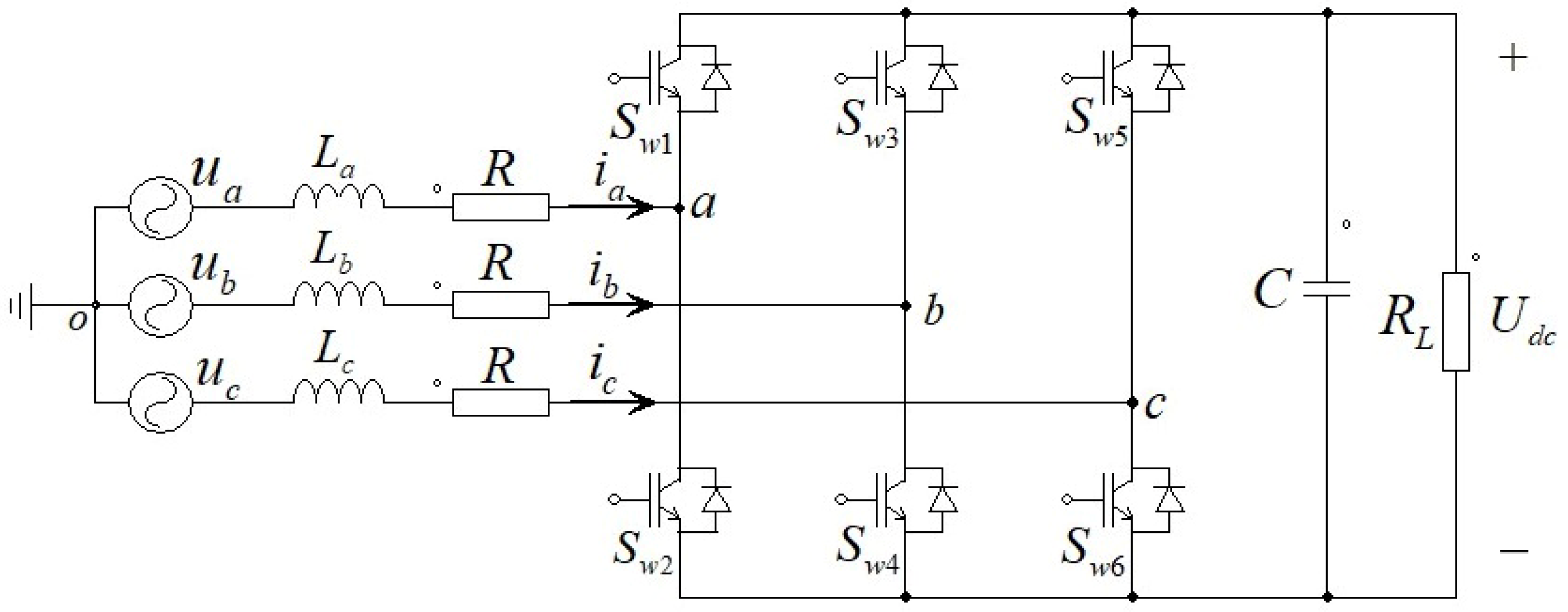
The configuration of the three-phase VSCs is illustrated in Figure 1, where ui and ii (i = a, b, c) represent the three-phase AC voltages and currents, respectively; L a = L b = L c = L denotes the filter inductance on the AC side; R stands for the equivalent resistance of the circuit; S w j ( j = 1 , , 6 ) refer to the power switching devices; C is the DC-side filtering capacitor; RL represents the load resistance; and Udc signifies the DC-link voltage. By defining the current state vector as x ( t ) = [ i a ( t ) , i b ( t ) , i c ( t ) ] , the reference state vector as x r ( t ) = [ i a r ( t ) , i b r ( t ) , i c r ( t ) ] , and the error state vector as x ˜ ( t ) = x ( t ) x r ( t ) = [ i ˜ a ( t ) , i ˜ b ( t ) , i ˜ c ( t ) ] , with individual components expressed as i ˜ a ( t ) = i a ( t ) i a r ( t ) , i ˜ b ( t ) = i b ( t ) i b r ( t ) , and i ˜ c ( t ) = i c ( t ) i c r ( t ) , a 3D switching affine error model in terms of current is commonly formulated for three-phase VSCs, described as follows:
x ˜ ˙ ( t ) = d d t i ˜ a ( t ) i ˜ b ( t ) i ˜ c ( t ) = R L 1 0 0 0 1 0 0 0 1 i ˜ a ( t ) i ˜ b ( t ) i ˜ c ( t ) + 1 L u a ( t ) F a U d c R i a r ( t ) u b ( t ) F b U d c R i b r ( t ) u c ( t ) F c U d c R i c r ( t ) = A x ˜ ( t ) + b σ F j = S j 1 3 j = a , b , c S j , j = a , b , c
where F i ( i = 1 , , 6 ) is the discrete switching function; S i = 1   ( i = a , b , c ) indicates that the upper switch of bridge leg i is turned on and the bottom switch is turned off, while Si = 0 represents the opposite situation; σ: [0, ) → M = {1, ..., m} is the switching signal; A is the state matrix; bσ is the switching affine item. Equation (1) for the switched model consists of two distinct components: the AC current continuous dynamics under different switching states and the discrete dynamics that regulate the switching transitions. Clearly, the model’s Equation (1) is formulated without linearization or averaging, which represents the switching among m = 8 subsystems of three-phase VSCs, denoted as Sup (p = 1, ..., m) based on the switching state vectors [Sa, Sb, Sc], as shown in Table 1.
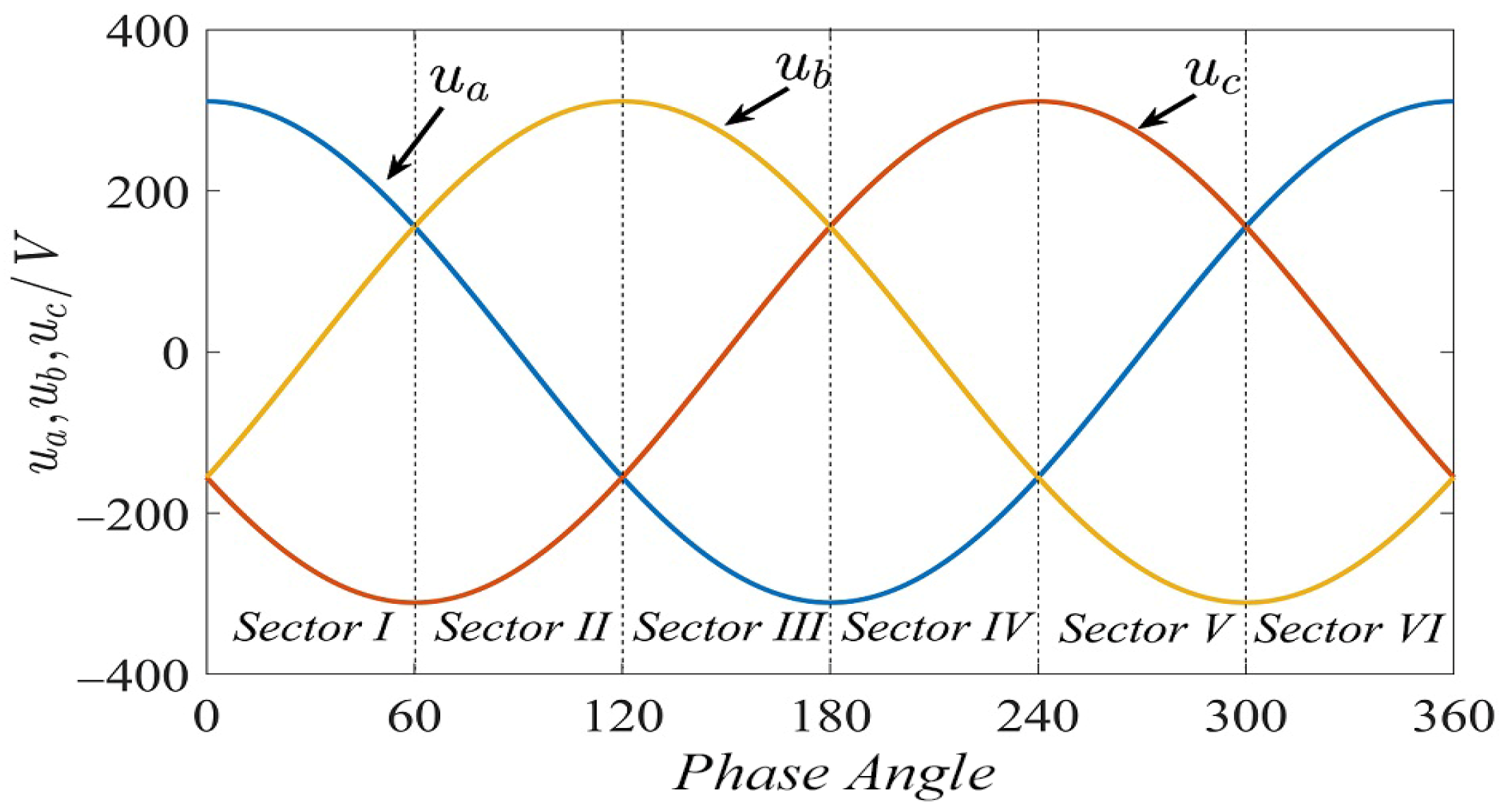
In contrast to traditional modeling and control strategies that depend on duty ratio regulation, switched model-based control frameworks achieve the regulation of the system state through direct switching among different subsystems. However, due to the existence of the switching affine term bσ in Equation (1), different subsystems have distinct equilibrium points. The three-phase VSCs present the characteristics of a complex multi-equilibrium point switching affine system. Simultaneously analyzing the system dynamics and determining the switching signal σ across all m = 8 subsystems detailed in Table 1 constitutes a substantial challenge. To mitigate this complexity and facilitate system analysis, the fundamental AC voltage period of the three-phase VSCs is partitioned into distinct sectors, as illustrated in Figure 2. Building upon the existing switched model-based control framework, convex combination theory is then integrated with common Lyapunov stability principles to enable rigorous stability evaluation and systematic controller design.
As a result, in the existing literature [24,25] and our previous work [26,28], state-dependent switching control strategies have been put forward for regulating the three-phase AC current of three-phase VSCs. Meanwhile, in the context of state-dependent switching rule design, Lemma 1 was employed to analyze the stability of the switched systems in existing works [24,25,26,27,28].
Lemma 1.
For the switching affine system’s Equation (1) of three-phase VSCs, by considering the switching subsystem subset with three subsystems in different sectors as shown in Table 2, suppose there exists a convex combination λ = {λ1,..., λm} ∈ (0, 1) that satisfies the following conditions:
p = 1 m λ p = 1 b λ = p = 1 m λ p b p = 0
Then, under the state-dependent switching rule
σ = arg min σ { 1 , , m } { V ˙ ( x ˜ ) }
x ˜ ( t ) = 0  is an asymptotically stable equilibrium point, where  V ( x ˜ ) = x ˜ T   P x ˜ is a CLF for the switching system, and P is a positive definite symmetric matrix.
Based on Lemma 1, within each control cycle, the subsystem for the subsequent control cycle is directly selected from the offline Table 2 in accordance with the switching rule represented by Equation (3). As a result, the direct switching control of three-phase VSCs is realized within the switching model-based control framework, obviating the necessity for the conventional coordinate transformations, PLLs, and PWM utilized in traditional control approaches. Meanwhile, the switching rule involves no control parameters, indicating a significantly simpler controller configuration compared to the traditional linearization model-based control methods cited in [7,8,9,10,11,12].
Remark 1.
Although the switching control method shares conceptual similarities with FCS-MPC, in that they both directly generate converter switching states per control interval, they differ fundamentally in their underlying control strategies. FCS-MPC determines optimal switching states by predicting future system behavior and minimizing a predefined cost function. In contrast, the switching control approach is strictly rooted in switched system theory. As established in Lemma 1, its core objective is to identify a switching sequence that forces the equilibrium of the “switched average model” to the origin, thereby guaranteeing asymptotic stability under arbitrary subsystem switching. The switching rule selects subsystems via a gradient descent mechanism, intrinsically prioritizing the predefined subsystem subset and rigorous stability constraints. Consequently, despite their apparent operational parallels, the two methodologies diverge significantly in their mathematical modeling, stability analysis paradigms, and state selection criteria. Nevertheless, the above switching control approach presents three primary limitations:
(1) The switching model represented by Equation (1) focuses only on three-phase AC current dynamics, meaning that prior studies [24,25,26,27,28] incorporated just the inner current loop into the switching-based control framework. When regulating DC voltage in three-phase VSCs, as in [24,25,26], the outer voltage loop’s output still requires inverse coordinate transformation to generate the AC current reference, undermining the key advantages of switching control—such as eliminating the need for PLLs and coordinate transformations.
(2) The stability analysis of the 3D current switching model represented by Equation (1), based on Lemma 1, lacks sufficient rigor. Taking sector I in Table 2 as an example, according to Lemma 1, the following conditions should be satisfied when considering m = 3 subsystems, given by
λ 1 + λ 2 + λ 3 = 1   λ 1 ( u a Ri ar ) + λ 2 ( u a 2 U dc 3 Ri ar ) + λ 3 ( u a U dc 3 Ri ar ) = 0   λ 1 ( u b Ri br ) + λ 2 ( u b + U dc 3 Ri br ) + λ 3 ( u b U dc 3 Ri br ) = 0   λ 1 ( u c Ri cr ) + λ 2 ( u c + U dc 3 Ri cr ) + λ 3 ( u c + 2 U dc 3 Ri cr ) = 0  
For (4), there are four equations for determining the three convex combination coefficients. It is evident that Equation (4) does not admit a unique solution. In previous approaches [24,25,26,27], the uc term in Equation (4) is omitted to ensure a unique solution, a practice considered justifiable under balanced grid conditions. However, this approach lacks sufficient theoretical rigor.
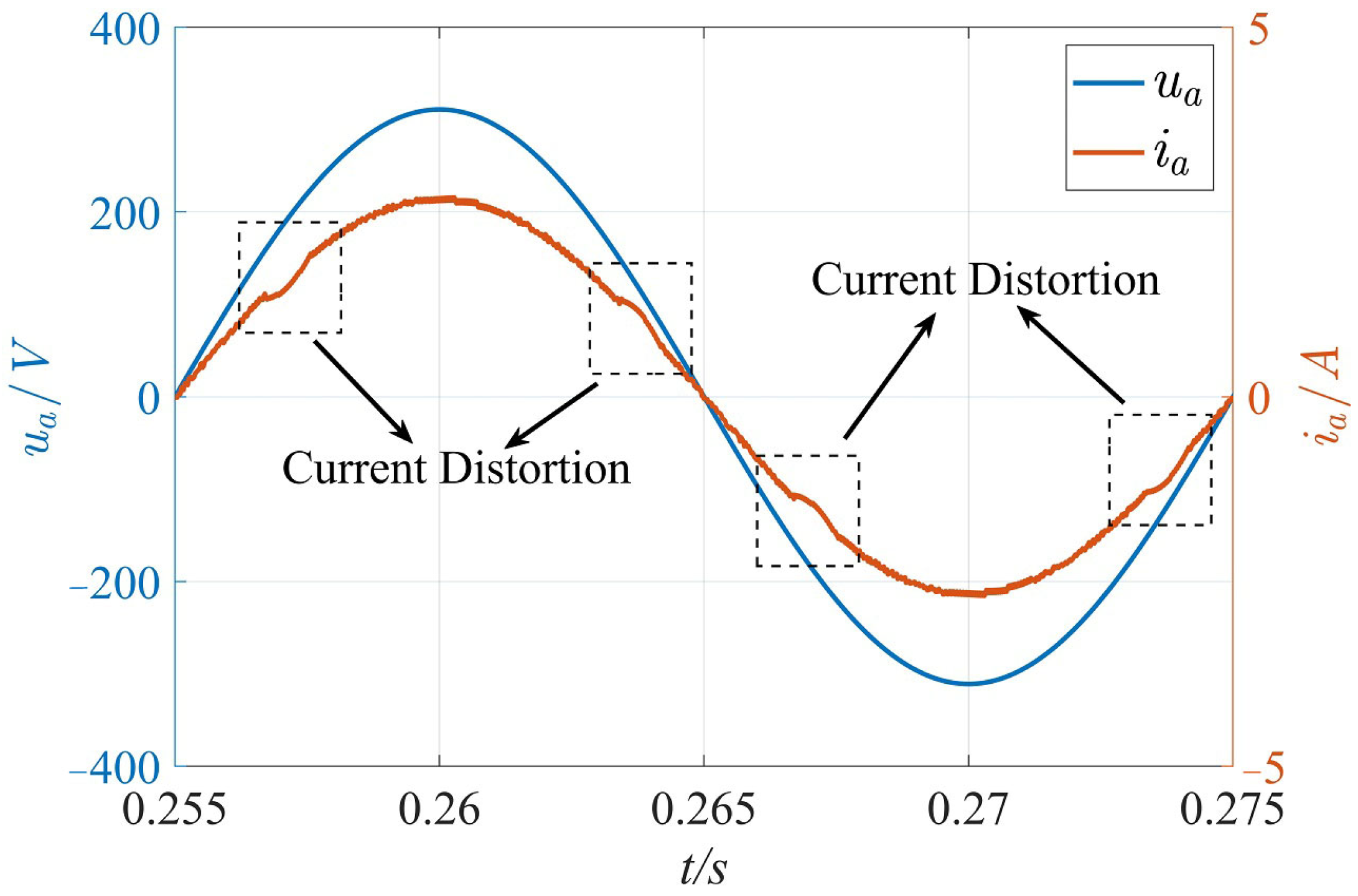
(3) Since the switching signal of three-phase VSCs is determined by Table 2 and the switching rule Equation (3) within the traditional switching control framework, the selected subsystems may be activated with a delay when system delay exists. According to Lemma 1 and Table 2, stability is ensured only when switching occurs within the same sector. Thus, traditional switching methods may cause unstable transitions between subsystems, leading to unexpected current distortion under delay, as shown in Figure 3.

3. The Proposed State-Dependent Switching Control Method with Dwell Time Regulation

To address the aforementioned limitations of traditional switching control methods, a state-dependent switching control strategy incorporating dwell time regulation is proposed. This approach is based on a novel 4D switching model that accounts for both the AC current and DC voltage dynamics of three-phase VSCs.

3.1. 4D Switching Model of Three-Phase VSCS

The 4D switching model of three-phase VSCs, with equilibrium at the origin, is established as Equation (5) [29]. In Equation (5), x ˜ ( t ) = [ i ˜ a ( t ) , i ˜ b ( t ) , i ˜ c ( t ) , U ˜ dc ( t ) ] denotes the system state error vector of three-phase VSCs, U ˜ d c ( t ) = U d c ( t ) U d c r ( t ) and U d c ( t ) is the DC voltage reference of three-phase VSCs.
x ˜ ˙ ( t ) = R L    0     0     F a L 0    R L    0     F b L 0     0     R L     F c L S a C    S b C    S c C    1 R L C i ˜ a ( t ) i ˜ b ( t ) i ˜ c ( t ) U ˜ d c ( t ) = A σ x ˜ ( t ) F i = S i 1 3 i = a , b , c S i , i = a , b , c

3.2. The State-Dependent Switching Controller Design

For the 4D switching model represented by Equation (5), Theorem 1 incorporating a state-dependent switching rule is proposed for three-phase VSCs, with system stability analysis formulated based on Lemmas 2–4 [30,31,32].
Theorem 1.
For the 4D switching model represented by Equation (5), if the subset j ( j = 1 , , 6 ) with four subsystems for each sector in Table 3 has a convex combination  λ = { λ 1 , , λ 4 } ( 0 , 1 )  that satisfies the following conditions
n = 1 4 λ n = 1 A λ j = n Σ j λ n A n   is   Hurwitz   ( j = 1 , , 6 )
then the switching system represented by Equation (5) is quadratically stabilizable to the origin via a state-dependent switching rule
σ = arg min n Σ j ( x ˜ T ( A n T P + P A n ) x ˜ )
where P is a positive definite symmetric matrix for the following LMIs
A λ j T P + PA λ j < P , j = 1 , , 6
Lemma 2
(Theorem 3.1 in [31]). If all subsystems in the switched system x ˙ = A p x    ( p = 1 , , m )  share a radially unbounded common Lyapunov function, then the switched system x ˙ = A p x  is global uniform asymptotical stable (GUAS).
Lemma 3
(Theorem 5.4 in [31]). For the switching linear system  x ˙ = A p x    ( p = 1 , , m ) , suppose there exists a convex combination  λ = { λ 1 , , λ m } ( 0 , 1 )  that satisfies  p = 1 m λ p = 1  and  A λ = p = 1 m λ p A p  is Hurwitz. Then, there is a state-dependent switching rule that makes the switching linear system quadratically stable.
Lemma 4
(Theorem 3.7 in [30]). The switching linear system  x ˙ = A p x    ( p = 1 , , m )  is quadratically stabilizable via a state-dependent switching rule if and only if there is a positive definite matrix P = PT such that the collection
A 1 T P + P A 1 , A 2 T P + P A 2 , , A m T P + P A m
 is strictly complete, i.e.,  x T ( A p T P + P A p ) x < 0 ,  p = { 1 , , m } .
Proof. 
For an entire AC voltage working period of three-phase VSCs, when considering the system dynamics under a series of subsystem combinations, the “average switched model” composed of four subsystems in Table 3 in each sector is defined as follows:
x ˜ ˙ ( t ) = A λ j x ˜ ( t ) ( j = 1 , , 6 )
where A λ j = n Σ j λ n A n , Σ j ( j = 1 , , 6 ) denotes the subset of subsystems in different sectors in Table 3, λ = [ λ 1 , , λ 4 ] ( 0 , 1 ) , n = 1 4 λ n = 1 .
Using sector I, for example, we have
A λ 1 = λ 1 A 3 + λ 2 A 5 + λ 3 A 6 + λ 4 A 7 = R L 0 0 λ 1 2 λ 2 λ 3 λ 4 3 L 0 R L 0 2 λ 1 + λ 2 + 2 λ 3 λ 4 3 L 0 0 R L λ 1 + λ 2 λ 3 + 2 λ 4 3 L λ 2 + λ 3 + λ 4 C λ 1 + λ 4 C λ 3 C 1 CR L
Regarding Equation (11), it is straightforward to identify the convex combination coefficients λ1 = λ2 = λ3 = λ4 = 0.25 that meet the conditions of Equation (6), i.e., Aλ1 is a Hurwitz matrix. For A λ j ( j = 1 , , 6 ) in each sector, the same convex combination coefficients λ1 = λ2 = λ3 = λ4 = 0.25 can be selected to meet the Routh–Hurwitz criterion, i.e., A λ j ( j = 1 , , 6 ) is Hurwitz. We then define a CLF for all the subsystems in different sectors, expressed as follows:
V ( x ˜ ( t ) ) = x ˜ T ( t ) P x ˜ ( t )
where P is a positive definite symmetric matrix. Subsequently, the derivative of Equation (12) is computed as
V ˙ ( x ˜ ( t ) ) = x ˜ T ( t ) ( A λ j T P + P A λ j ) x ˜ ( t ) ( j = 1 , , 6 )
For Equation (13), since A λ j ( j = 1 , , 6 ) is a Hurwitz matrix, a matrix P that satisfies the stability conditions of Theorem 1 can be determined by solving the linear matrix inequalities (LMIs) presented in Equation (8). The results can be calculated by the feasp toolbox of Matlab(2021b), given by
P = 0.1104 0.0416 0.0416 0.0094 0.0416 0.1104 0.0416 0.0094 0.0416 0.0416 0.1104 0.0094 0.0094 0.0094 0.0094 0.0023
Therefore, based on Lemmas 2 and 3, the equilibrium point x ˜ ( t ) = 0 of the “average switching system” x ˜ ˙ ( t ) = A λ j x ˜ ( t ) ( j = 1 , , 6 ) is asymptotically stable within each sector of three-phase VSCs under the arbitrary switching conditions. Specifically, according to Lemma 4, since the condition x ˜ T ( t ) ( A λ j T P + P A λ j ) x ˜ ( t ) < 0 ( j = 1 , , 6 ) is satisfied for all six sectors, stability during the switching between different sectors is also guaranteed.
Furthermore, a state-dependent switching rule can be defined as
σ = arg min j { 1 , , 6 } ( x ˜ T ( A λ j T P + P A λ j ) x ˜ )
Due to the satisfaction of strictly complete conditions in each sector, the satisfaction of (15) indicates that x ˜ T ( t ) ( A n T P + P A n ) x ˜ ( t ) < 0 ( n Σ j ) is satisfied in each sector. In other words, switching rule (15) can be simplified to switching rule (7).
Compared to traditional switching control methods based on the 3D switching model of three-phase VSCs presented in Section 2, the proposed method effectively addresses all three major limitations:
(1)
The proposed 4D switching model enables the simultaneous regulation of AC current and DC voltage within a single control loop under the switching control framework.
(2)
Traditional Table 2 was enhanced to form Table 3, which incorporates a refined subset of four subsystems. The previously inadequate rigor in the stability analysis based on the 3D current switching model represented by Equation (1) in Lemma 1 was addressed and strengthened.
(3)
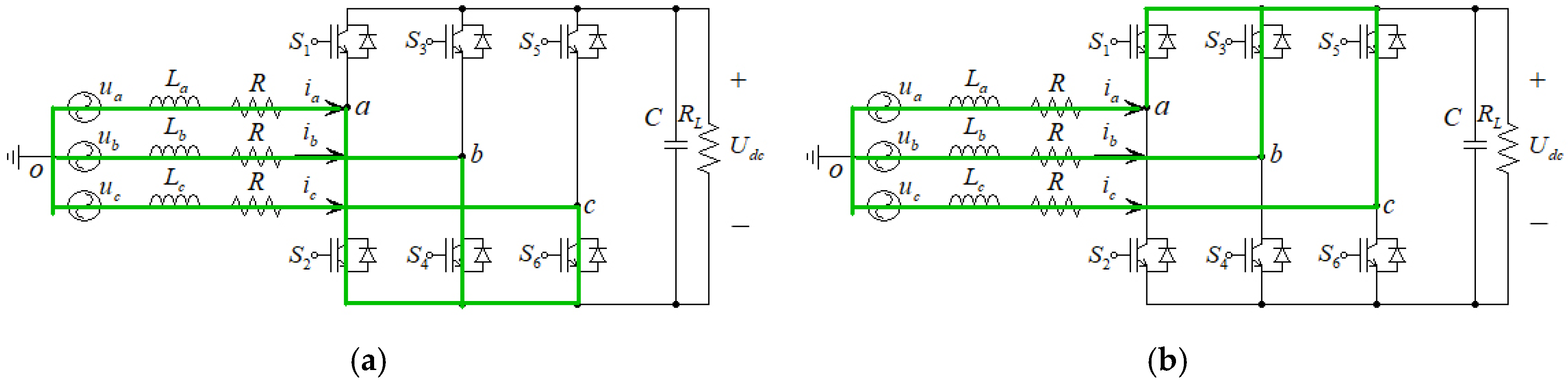
By comparing Table 2 and Table 3, it can be observed that the switching subsets in Table 3 encompass the switching subsets corresponding to both the current and subsequent sectors presented in Table 2. Specially, for subsystems Su1 and Su8, no energy transfer occurs between the AC and DC sides of the three-phase VSCs when these subsystems are active, as illustrated in Figure 4. Therefore, these two subsystems are excluded from the improved Table 3. Consequently, the unstable switching behavior caused by system delays can be effectively alleviated based on the proposed method with the improved Table 3.
Generally, for the proposed switching control method, the subsystem for the subsequent control cycle can be directly selected from the enhanced offline Table 3 in accordance with switching rule (7) at each time interval. Within this framework, the dynamics of both the three-phase AC current and the DC voltage are regulated by adjusting the switching signal σ based on the 4D switching model (5). Only a single matrix P needs to be determined, and this matrix can be efficiently computed using the LMI toolbox in MATLAB, by using the feasp solver employed in this study, for example. However, the proposed state-dependent switching rule (7) solely determines the switching signal σ. For the control problem of three-phase VSCs addressed in this paper, an upper-bounded quadratic error function J can be defined, expressed as
J = 1 T 0 T x ˜ σ ( t ) 2 dt
where x ˜ σ ( t ) denotes the system state error under the switching signal σ { 1 , , n } ; T denotes the dwell time of switching signal σ. It is evident that a further adjustment of the subsystem’s dwell time is necessary to attain the minimum of the control objective specified in (16).

3.3. Dwell Time Regulation

Considering the very fast discrete control requirements of real applications, the following discrete model of three-phase VSCs can be established as Equation (17), i.e., based on Kirchhoff’s voltage and current laws [7,9].
i a ( k + 1 ) = i a ( k ) + u a ( k ) L R L i a ( k ) 2 S a S b S c 3 L U d c ( k ) T i b ( k + 1 ) = i b ( k ) + u b ( k ) L R L i b ( k ) 2 S b S a S c 3 L U d c ( k ) T i c ( k + 1 ) = i c ( k ) + u c ( k ) L R L i c ( k ) 2 S c S a S b 3 L U d c ( k ) T U d c ( k + 1 ) = U d c ( k ) + S a C i a ( k ) + S b C i b ( k ) + S c C i c ( k ) 1 R L C U d c ( k ) T
where i i ( k ) , ( i = a , b , c ) and U d c ( k ) are the AC current and DC voltage sampling values in the k-th control cycle, respectively; i i ( k + 1 ) , ( i = a , b , c ) and U d c ( k + 1 ) are the corresponding states for the (k + 1)-th control cycle under the activation of switching signal σ , respectively.
Based on the discrete-time model in (17), the continuous cost function in Equation (16) can be rewritten in discrete form as
J = ( i a ( k + 1 ) i ar ( k ) ) 2 + ( i b ( k + 1 ) i br ( k ) ) 2 + ( i c ( k + 1 ) i cr ( k ) ) 2 + ( U dc ( k + 1 ) U dcr ( k ) ) 2
To minimize Equation (18), we set J T = 0 and ensure 2 J T 2 > 0 . By solving these equations, we obtain the following results:
T = T 1 T 2
where
T 1 = i = a , b , c i ˜ i ( k ) L ( u i ( k ) Ri i ( k ) F i | σ U dc ( k ) ) + U ˜ d c ( k ) C ( i = a , b , c S i i i ( k ) | σ U dc ( k ) R L ) T 2 = i = a , b , c 1 L 2 ( u i ( k ) Ri i ( k ) F i | σ U dc ( k ) ) 2 + 1 C 2 ( i = a , b , c S i i i ( k ) | σ U dc ( k ) R L ) 2
where i ˜ i ( k ) = i i ( k ) i i r ( k )   ( i = a , b , c ) , and U ˜ d c ( k ) = U d c ( k ) U d c r ( k ) .
According to Equations (19) and (20), the numerator T1 essentially represents the inner product of the system error vector and the state change rate vector driven by the selected subsystem. Driven by the proposed state-dependent switching rule (Theorem 1), the activated subsystem consistently forces the Lyapunov function derivative to be negative. This strict pre-selection mechanism fundamentally guarantees that the convergence condition T1 < 0 is satisfied, ensuring the calculated dwell time T is strictly positive and avoiding singular cases. To better align with the actual physical system and ensure optimal control performance, upper and lower bound constraints are imposed on the dwell time of the subsystems, set as 2 × 10⁻⁵ s to 1 × 10⁻³ s. The implementation of these physical bounds, combined with the proposed theoretical derivation, establishes a highly adaptive and stable dwell time regulation mechanism.
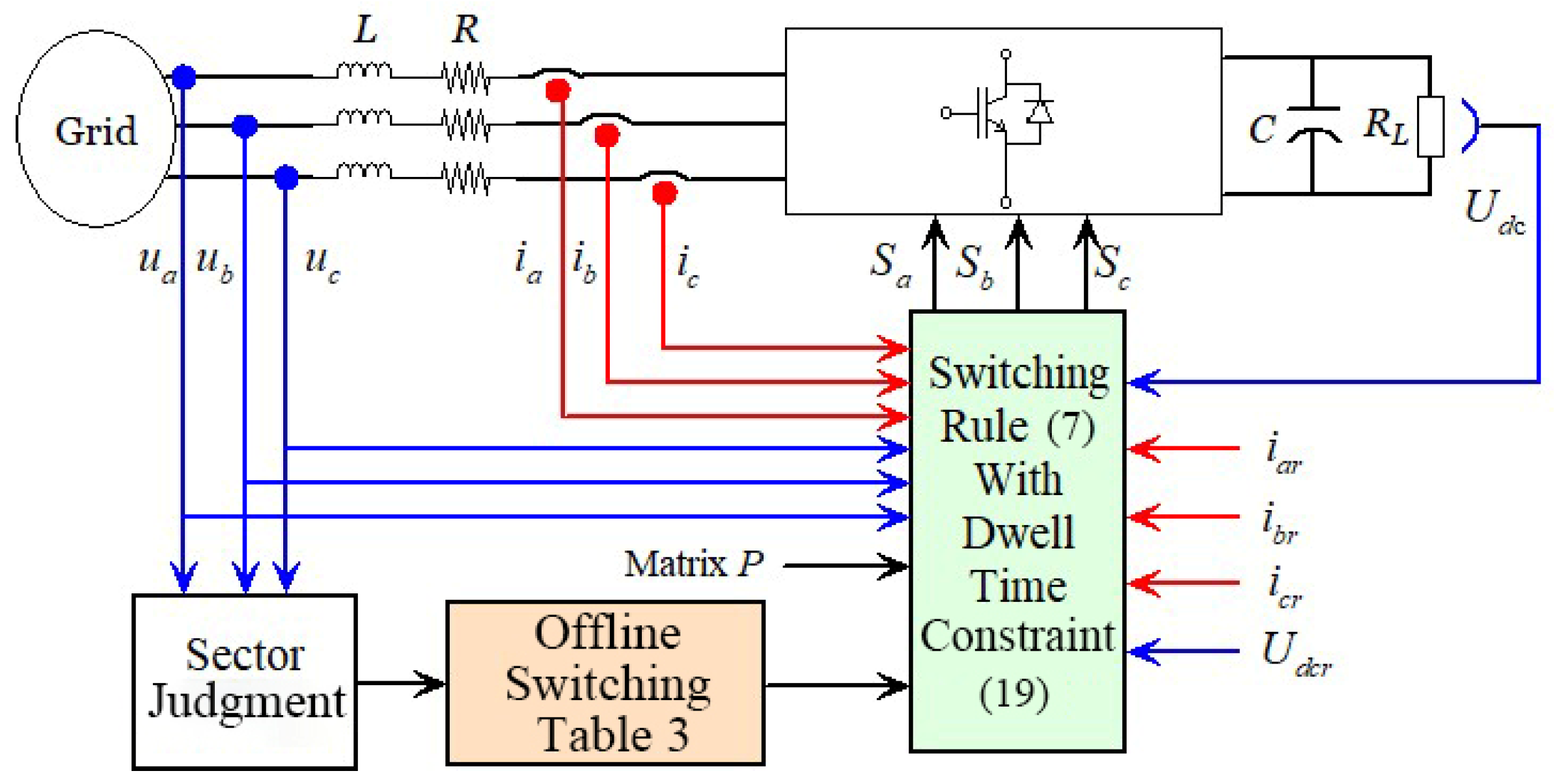
A control block diagram of the proposed method for three-phase VSCs is shown in Figure 5. In each control interval, the three-phase AC voltage, current, and DC voltage are sampled. Based on the offline Table 3 and switching rule (7), the switching states of three-phase VSCs are directly selected, with the dwell time constraint considered. The controller requires no additional parameters or complex processes such as coordinate transformations, PLLs, or PWM.
The system adopts a discretized control cycle with a base sampling interval of 2 × 10⁻⁵ s. Within each control cycle, the complete control process can be rigorously summarized into the following four main steps. First, the system samples the DC voltage, as well as the three-phase AC voltages and currents in real time. The sector where the system is currently located is determined solely based on the relative magnitude relationship of the AC voltages; this process does not require the intervention of a PLL. Second, the controller invokes the pre-established offline switching table. Among the four candidate subsystems corresponding to the current sector, the proposed state-dependent switching rule (Equation (7)) is calculated to directly select the optimal switching state for the next control cycle that drives the system energy to converge toward the reference values. Third, based on the real-time tracking error of the system, the dwell time of this optimal switching state is calculated using the adaptive formula (Equation (19)) and is strictly clamped within the physically allowable upper and lower limits (2 × 10⁻⁵ s to 1 × 10⁻³ s). The controller issues the selected switching state to the converter and strictly maintains the calculated dwell time.

4. Simulation and Experiment Results

4.1. Simulation Results

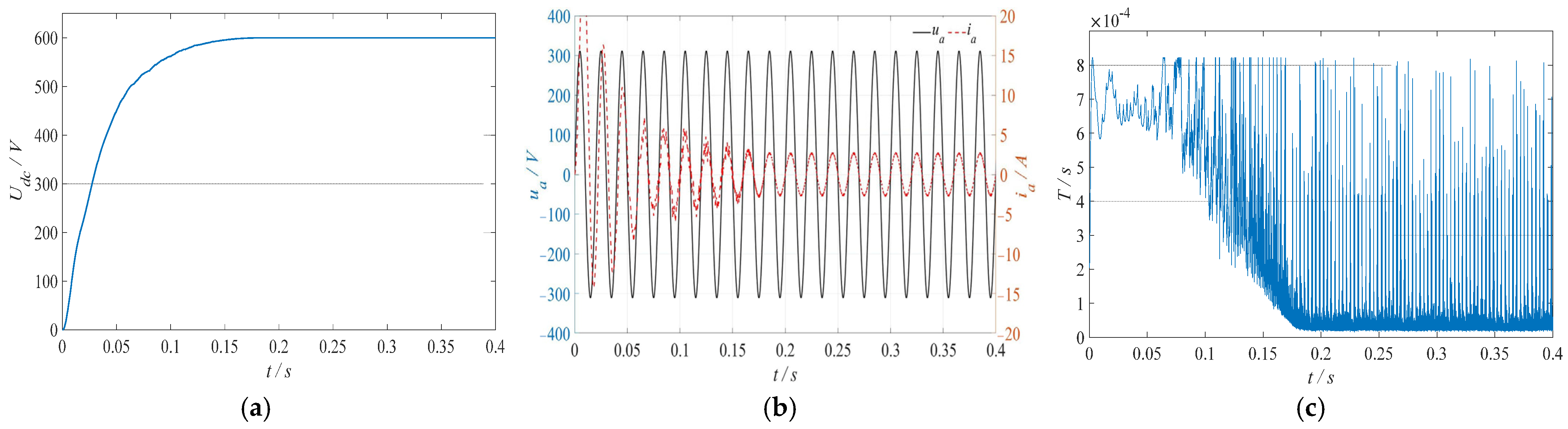
The simulation model is built by Matlab/Simulink(2021b) in this paper, and the circuit parameters of three-phase VSCs are shown in Table 4. The simulation outcomes achieved using the proposed approach are illustrated in Figure 6. More precisely, Figure 6a shows the waveform of the output DC voltage, Figure 6b displays the three-phase AC voltage and associated current waveforms, and Figure 6c presents the variation curves of the subsystems’ dwell time. As observed from Figure 6, the developed switching control strategy enables accurate tracking performance for both the DC voltage and the three-phase AC current. In Figure 6a, the output DC voltage rapidly reaches its reference value of 600 V with no steady-state deviation. Meanwhile, in Figure 6b, the three-phase AC currents exhibit clean sinusoidal shapes and maintain perfect phase alignment with the corresponding voltages.
The power factor (PF) and total harmonic distortion of the current (iTHD) for the three-phase VSCs under the proposed method, as calculated from the results in Figure 6, are measured at 0.9995 and 2.637%, respectively. Furthermore, as indicated in Figure 6c, the dwell time of the subsystem is dynamically regulated to meet varying control goals. When a large discrepancy exists between the actual and desired DC voltage, an extended dwell time is applied to accelerate the voltage rise. In contrast, a reduced dwell time is adopted to suppress current harmonics and enhance waveform quality.
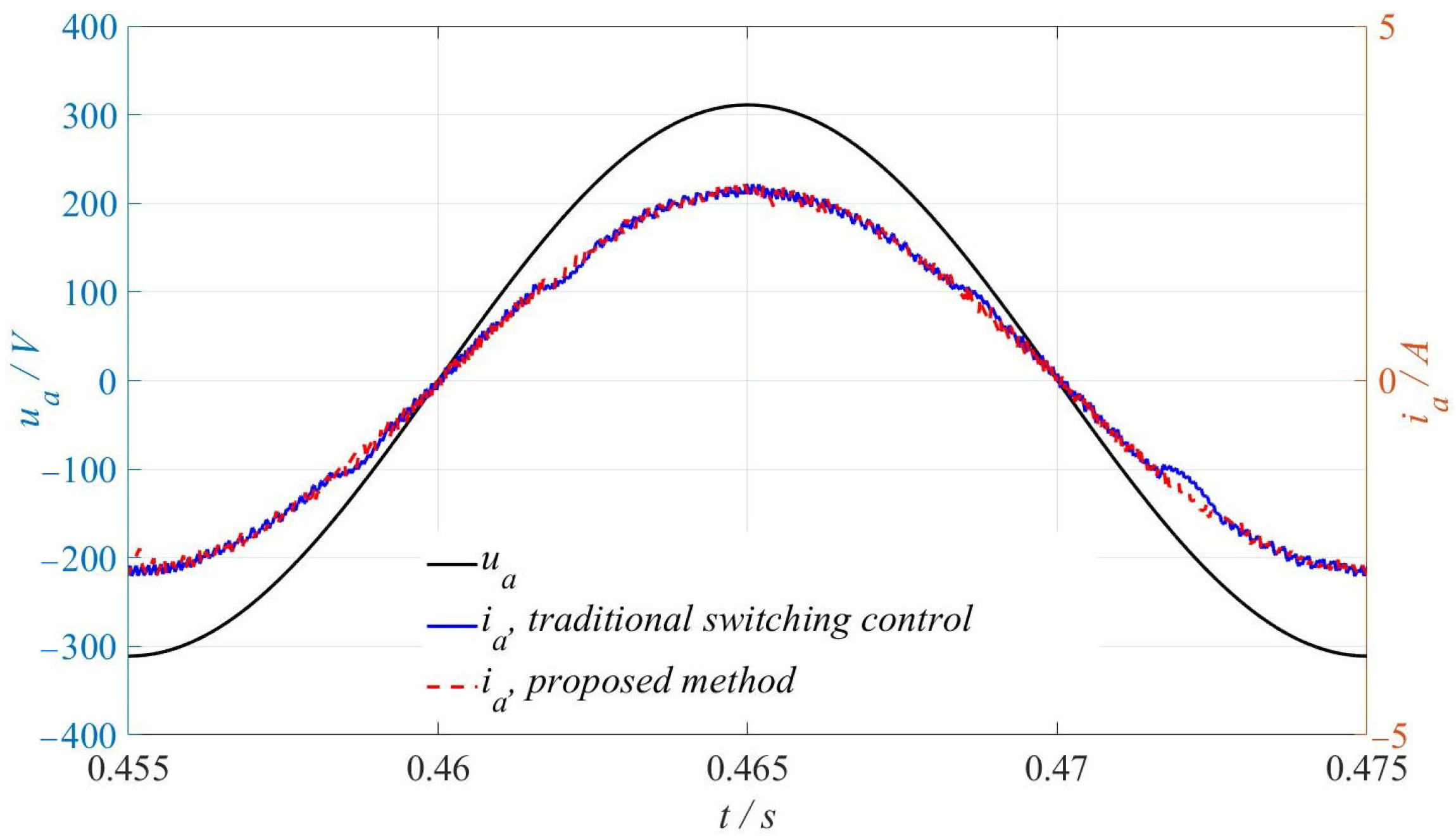
Secondly, the control performance of the proposed method is evaluated and compared with that of the traditional switching control methods cited in reference [26] under system delay. The simulation results, which compare the a-phase AC voltage and current obtained by using the two aforementioned methods with both sampling and control delays set to 4 × 10⁻⁵ s, are presented in Figure 7. As shown, the traditional switching control method, which selects an inappropriate switching subset according to Table 2, may activate an incorrect subsystem under delayed conditions, resulting in undesirable current distortion during sector transitions. In contrast, the proposed method, based on an improved Table 3 derived from a rigorous theoretical analysis, guarantees global system stability and enables smooth current waveforms, as illustrated in Figure 7.
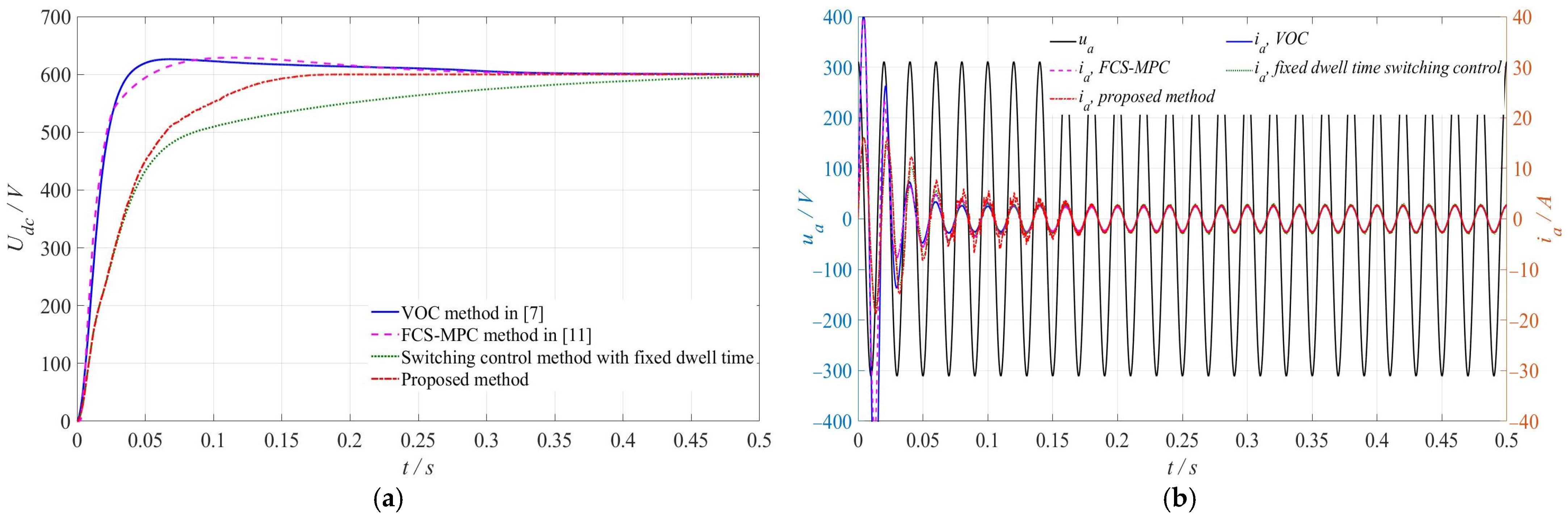
Thirdly, a comparison of the transient and steady-state performance between the proposed method, the traditional VOC method in [7], the FCS-MPC method in [11], and the traditional switching control method with a fixed dwell time of 4 × 10 5 s is presented in Figure 8. For the FCS-MPC method in [11], the cost function is defined as JMPC = [iα(k + 2) − iαref(k)]2 + [iβ(k + 2) − iβref(k)]2 + λ[Udc(k + 2) − Udcref(k)]2, where two-horizon prediction for the AC under the two-phase αβ coordinate frame and the DC voltage is considered.
The DC voltage waveform and the a-phase AC voltage and current waveforms are depicted in Figure 8a and Figure 8b, respectively. As depicted in Figure 8, the traditional VOC method in [7] accomplishes DC voltage and AC current regulation for three-phase VSCs via a double closed-loop control structure. Nevertheless, this method utilizes a comparatively intricate controller configuration with six control parameters, and the system’s response speed is restricted because of the application of conventional PI control technology. Consequently, the traditional VOC method leads to significant DC voltage overshoot and AC current oscillations, as shown in Figure 8. The FCS-MPC method presented in [11] also accomplishes the regulation of DC voltage and AC current for three-phase VSCs, as depicted in Figure 8. Given that this method directly selects switching states by minimizing a cost function that takes into account both DC voltage and three-phase AC current, it exhibits a simpler control structure and a faster dynamic response in comparison to the conventional VOC method. Nevertheless, the performance of the traditional FCS-MPC method in [11] is significantly reliant on the appropriate weighting factors assigned to the DC voltage and AC current terms. As a result, voltage and current fluctuations are detected when the FCS-MPC method from [11] is applied in the system shown in Figure 8. The switching control method, which is also based on the proposed 4D switching model but excludes dwell time regulation, realizes DC voltage and AC current regulation within a single control loop under the switched model-based control framework. The optimal subsystem for the subsequent control cycle is selected according to the switching rule and switching Table 3 at a fixed switching frequency. This method is characterized by a relatively simple control structure, even when compared with the FCS-MPC method cited in [11]. However, as depicted in Figure 8, the DC voltage and AC current demonstrate a relatively slow response when the fixed dwell time switching control method is employed. In comparison with the aforementioned control strategies, the proposed method with dwell time regulation shows the fastest response speed while maintaining identical DC voltage and AC current steady-state waveforms, as shown in Figure 8. Moreover, the proposed method utilizes a highly simplified control structure. Although a more significant current fluctuation is observed in Figure 8 when the DC voltage tracking error is large, which results from the increased dwell time of the subsystem, this fluctuation is considered an acceptable trade-off in view of the overall improvement in system performance.
For the proposed method, control execution primarily involves evaluating the state-dependent switching rule for only four candidate subsystems using the offline table, followed by the adaptive dwell time calculation. This process requires approximately 169 SOP (including basic multiplications, additions, and logical comparisons). For fixed dwell time switching control, the online dwell time calculation is omitted, which slightly reduces the computational burden to 147 SOP, though this minor saving comes at the expense of dynamic control performance. In contrast, the standard FCS-MPC method must iterate through all eight basic voltage vectors of the VSCs, predict the future states, and evaluate the cost function, resulting in a significantly higher computational burden of up to 383 SOP. Furthermore, the traditional VOC method relies heavily on synchronous rotating coordinate transformations, PLLs, double closed-loop PI control, and SVPWM. This not only incurs about 680 basic algebraic operations but also demands the execution of highly computationally intensive nonlinear trigonometric functions. Therefore, by leveraging the offline dimensionality reduction strategy, the proposed method reduces the pure arithmetic computation volume by more than half compared to the standard FCS-MPC and entirely avoids the complex trigonometric operations inherent in the VOC approach, thereby demonstrating exceptional real-time feasibility. A more detailed comparison of the various control methods is presented in Table 5.

4.2. Experiment Results

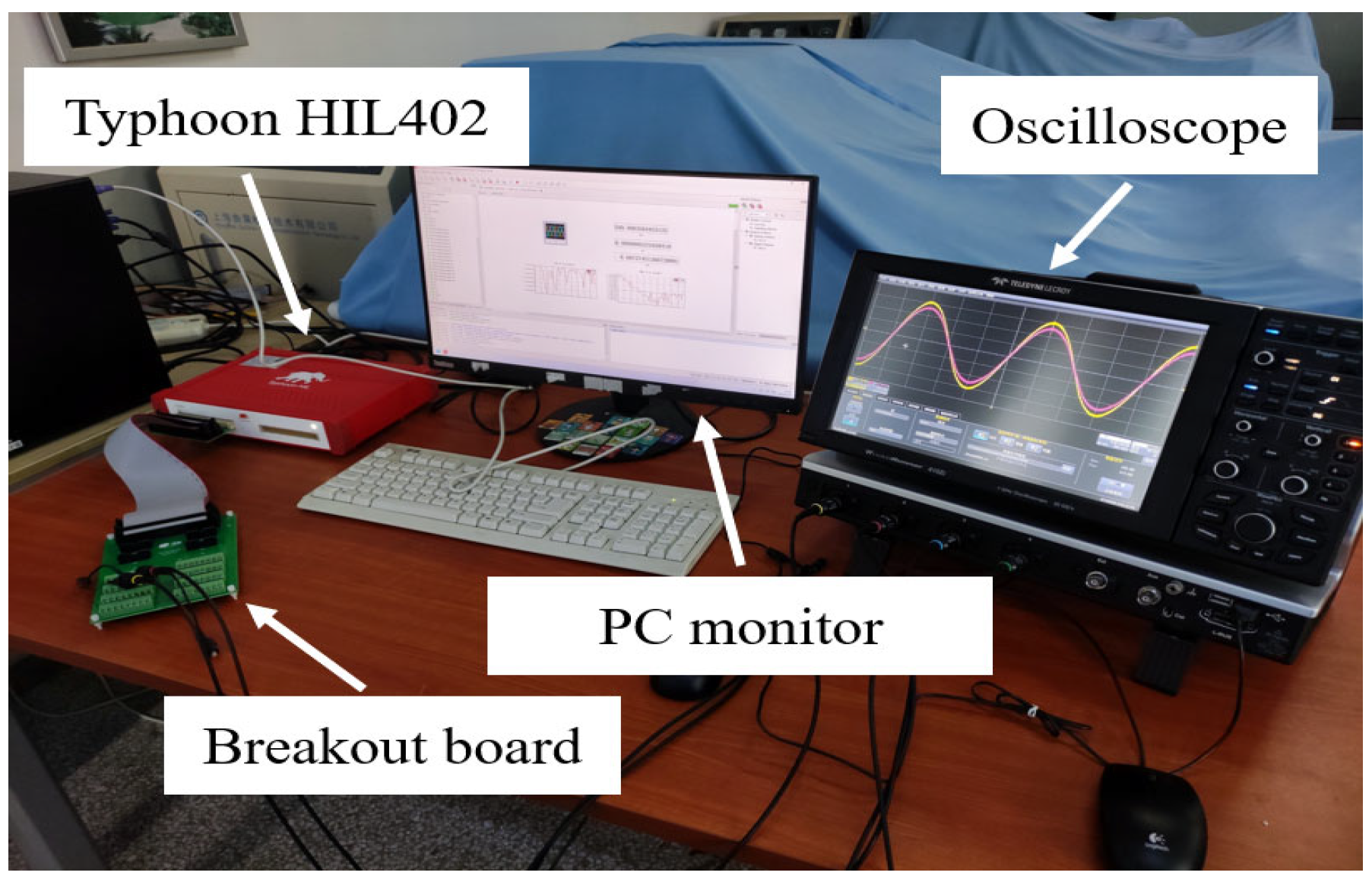
An experimental setup based on a semi-physical hardware-in-the-loop system, Typhoon HIL 402 (manufactured by Shanghai Hanxiang Intelligent Technology Co., Ltd., Shanghai, China), was established, as illustrated in Figure 9. In this experiment, the control strategies were validated under the same conditions as those in the simulation.
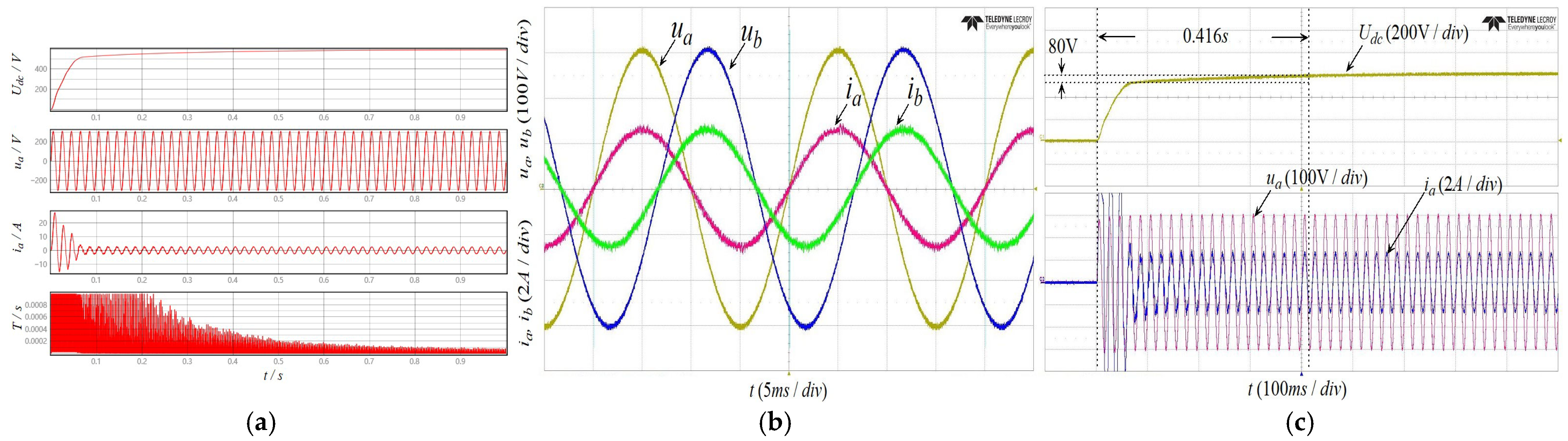
The experimental results of the proposed method for three-phase VSCs, corresponding to the simulation results in Figure 6, are shown in Figure 10. Figure 10a displays the DC voltage, a-phase voltage, a-phase current, and subsystem dwell time waveforms captured via Typhoon HIL’s SCADA tool. The same signals measured from the HIL402 device’s D/A outputs using an oscilloscope are shown in Figure 10b,c. As seen in Figure 10, when the proposed switching control is applied, the DC voltage converges to its reference without overshoot, and the a-phase current synchronizes with the AC voltage waveform. The dwell time is adaptively adjusted based on variations in both DC voltage and AC current: longer durations are used during fast DC transients, while shorter durations handle small AC current fluctuations. These experimental results match the simulations in Figure 6, confirming the method’s effectiveness.
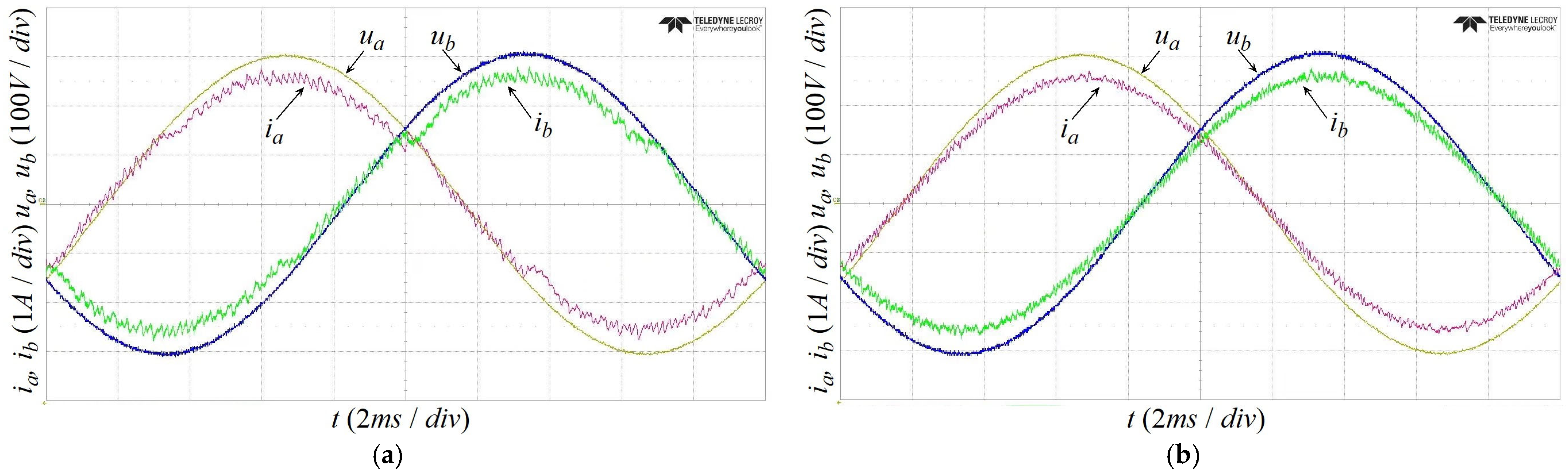
Secondly, Figure 11 presents the experimental results corresponding to the simulation results in Figure 7, evaluating the proposed method under system delay.
The voltage and current waveforms of the a-phase and b-phase using the proposed method with improved Table 3 and the traditional method from [26] with Table 2 are shown in Figure 11a and Figure 11b, respectively. As illustrated, the proposed method effectively reduces current distortions caused by improper subsystem switching under delay, thereby improving system stability.
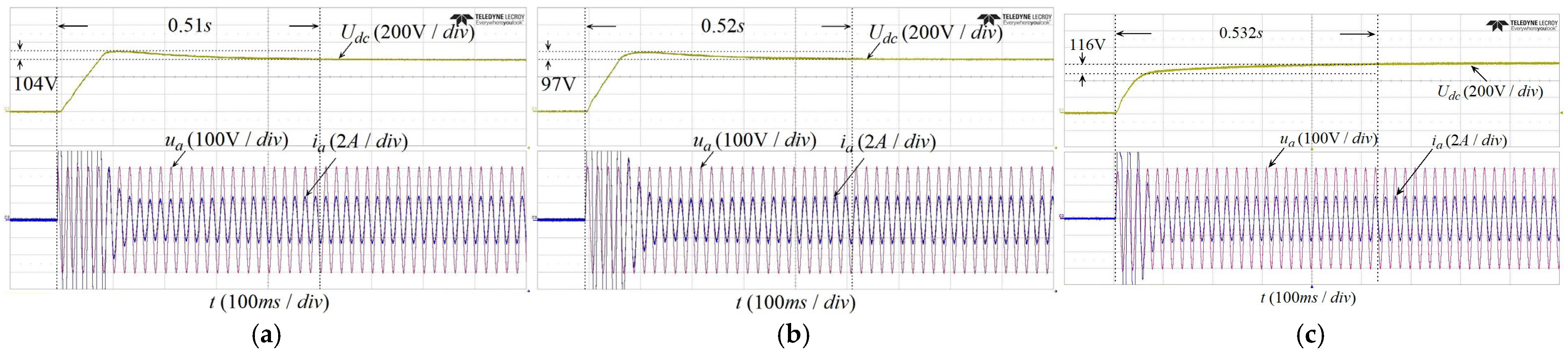
Thirdly, Figure 12 shows the experimental results for the traditional VOC method in [7], the FCS-MPC method in [11], and a fixed dwell time switching control of 4 × 10⁻⁵ s. These correspond to the simulation results in Figure 8 and consider both the transient and steady-state performance of DC voltage and AC current control. As with the analysis of Figure 8 and Table 5, similar comparisons can be made using the proposed method’s results in Figure 10c. Compared to the VOC method (Figure 12a) and FCS MPC (Figure 12b), the proposed method (Figure 10c) achieves faster transient response without overshoot. The a-phase AC current rapidly synchronizes with the AC voltage and reaches steady state. Notably, it delivers superior performance without complex controller design or extensive parameter tuning. In contrast to the fixed dwell time method (Figure 12c), the proposed method enables faster DC voltage dynamics by automatically adjusting the switching dwell time. The experimental results in Figure 10 and Figure 12 align with simulations in Figure 8, confirming that the proposed method outperforms VOC, FCS-MPC, and conventional switching control.

5. Conclusions

This paper proposes a switched model-based control framework for three-phase VSCs, using a novel 4D switching model and state-dependent switching control with dwell time regulation. The approach offers three main advantages: (1) The 4D switching model accurately captures the dynamics of DC voltage and AC current without averaging or approximations, unlike conventional linearization methods. (2) A unified control framework regulates all four system states in a single loop, enabling effective switching between subsystems. (3) An automatic dwell time adjustment method balances DC voltage and AC current control performance, outperforming fixed dwell time approaches. The proposed method can be extended to other three-phase power electronic converters. Although the proposed control strategy’s effectiveness and superiority were thoroughly verified on a HIL platform, HIL simulations cannot fully replicate real converter parasitics, measurement noise, or non-ideal behavior.

Author Contributions

Conceptualization, methodology, writing—original draft preparation, and writing—review and editing, X.G.; software and data curation, H.Q.; validation and visualization, H.C.; investigation and supervision, C.G.; resources, project administration, and funding acquisition, X.G. and S.J. All authors have read and agreed to the published version of the manuscript.

Funding

This research was funded by the National Natural Science Foundation of China (62371388, 61803300), China Postdoctoral Science Foundation (No. 2024MD753985), International Science and Technology Cooperation Promotion Project of Xi’an University of Technology (2024GHCJ029) and Shaanxi Natural Science Basic Research Program (2025JC-YBMS-723).

Data Availability Statement

Data are contained within the article.

Conflicts of Interest

We declare that we have no financial and personal relationships with other people or organizations that could inappropriately influence our work; there is no professional or other personal interest of any nature or kind in any product, service, and/or company that could be construed as influencing the position presented in, or the review of, the manuscript entitled “State-Dependent Switching Control With Dwell Time Regulation for Three-Phase VSCs Based on 4D Switching Model”.

References

  1. Lin, J.; Su, M.; Sun, Y.; Xie, S.; Xiong, W.; Li, X. Unified SISO Loop Gain Modeling, Measurement, and Stability Analysis of Three-Phase Voltage Source Converters. IEEE Trans. Energy Conver. 2022, 37, 1907–1920. [Google Scholar] [CrossRef]
  2. Xue, Y.; Zhang, Z.; Wang, G.; Liu, W.; Xu, Z. Transient stability analysis between SG and grid-forming VSCs with current saturation control considering backward-swing dynamics. CSEE J. Power Energy Syst. 2026, 12, 837–850. [Google Scholar]
  3. Liserre, M.; Beiranvand, H.; Leng, Y.; Zhu, R.; Hoeher, P.A. Overview of Talkative Power Conversion Technologies. IEEE Open J. Power Electron. 2023, 4, 67–80. [Google Scholar] [CrossRef]
  4. Abdel-Aziz, A.; Elgenedy, M.A.; Williams, B.W. Model Predictive Current Control for Low-Cost Shunt Active Power Filter. CSEE J. Power Energy Syst. 2024, 10, 1589–1598. [Google Scholar] [CrossRef]
  5. Liao, Y.; Wang, X. Small-Signal Modeling of AC Power Electronic Systems: Critical Review and Unified Modeling. IEEE Open J. Power Electron. 2021, 2, 424–439. [Google Scholar] [CrossRef]
  6. Ai, Y.; Liu, J.; Chen, S.; Pei, C. A Small-Signal Modeling Method for LLC Resonant Converter Based on Time-Domain Correction. IEEE Trans. Power Electron. 2024, 39, 10792–10806. [Google Scholar] [CrossRef]
  7. Guo, X.; Ren, H.P.; Liu, D. An Optimized PI Controller Design for Three-Phase PFC Converter Based on Multi-Objective Chaotic Particle Swarm Optimization. J. Power Electron. 2016, 16, 610–620. [Google Scholar] [CrossRef]
  8. Yan, S.; Yang, Y.; Hui, S.Y.; Blaabjerg, F. A Review on Direct Power Control of Pulse width Modulation Converters. IEEE Trans. Power Electron. 2021, 36, 11984–12007. [Google Scholar] [CrossRef]
  9. Guo, X.; Ren, H.P.; Li, J. Robust Model Predictive Control for Compound Active Clamp Three Phase Soft Switching PFC Converter Under Unbalanced Grid Condition. IEEE Trans. Ind. Electron. 2018, 65, 2156–2166. [Google Scholar] [CrossRef]
  10. Yan, S.; Chen, J.; Wang, M.; Yang, Y.; Rodriguez, J.M. A Survey on Model Predictive Control of DFIGs in Wind Energy Conversion Systems. CSEE J. Power Energy Syst. 2024, 10, 1085–1104. [Google Scholar] [CrossRef]
  11. Karamanakos, P.; Geyer, T. Guidelines for the Design of Finite Control Set Model Predictive Controllers. IEEE Trans. Power Electron. 2020, 35, 7434–7450. [Google Scholar] [CrossRef]
  12. Wang, F.; Wei, Y.; Young, H.; Ke, D.; Xie, H.; Rodríguez, J. Continuous-Control-Set Model-Free Predictive Fundamental Current Control for PMSM System. IEEE Trans. Power Electron. 2023, 38, 5928–5938. [Google Scholar] [CrossRef]
  13. Zerdali, E.; Rivera, M.; Wheeler, P. A Review on Weighting Factor Design of Finite Control Set Model Predictive Control Strategies for AC Electric Drives. IEEE Trans. Power Electron. 2024, 39, 9967–9981. [Google Scholar] [CrossRef]
  14. Peng, S.; Xie, N.; Wang, C.M. A Self-Adaptive Power Flow Analysis Methodology for AC/DC Hybrid System. IEEE Trans. Power Deliv. 2023, 38, 2261–2273. [Google Scholar] [CrossRef]
  15. Chen, Y.; Zhang, B.; Jiang, Y.; Xie, F.; Qiu, D.; Chen, Y. A General Frequency-Domain Model of Trailing-Edge and Leading-Edge Carrier PWM DC-DC Converter Based on Hybrid Continuous and Discrete-Time Descriptions. IEEE J. Emerg. Sel. Top. Power Electron. 2021, 9, 4175–4187. [Google Scholar] [CrossRef]
  16. Ma, W.J.; Zhang, B. Periodic Time-Triggered Hybrid Control for DC-DC Converter Based on Switched Affine System Model. IEEE Trans. Ind. Electron. 2023, 70, 311–321. [Google Scholar] [CrossRef]
  17. Zhang, L.; Lou, X.; Wang, Z. Output-Based Robust Switching Rule Design for Uncertain Switched Affine Systems: Application to DC-DC Converters. IEEE Trans. Circuits Syst. II-Express Briefs 2022, 69, 4493–4497. [Google Scholar] [CrossRef]
  18. Ma, W.; Zhang, B.; Qiu, D. Robust Single-Loop Control Strategy for Four-Level Flying-Capacitor Converter Based on Switched System Theory. IEEE Trans. Ind. Electron. 2023, 70, 7832–7844. [Google Scholar] [CrossRef]
  19. Ma, W.; Zhang, B.; Qiu, D.; Sun, H. Switching Control Strategy for DC-DC Converters Based on Polynomial Lyapunov Function and Sum-of-Squares Approach. IEEE Trans. Ind. Electron. 2023, 70, 3663–3673. [Google Scholar] [CrossRef]
  20. Xu, X.; Zhu, Y.; Wu, F.; Ahn, C.K. Sampled-Data Control for Buck-Boost Converter Using a Switched Affine Systems Approach. IEEE Trans. Circuits Syst. I Regul. Pap. 2024, 71, 3680–3689. [Google Scholar] [CrossRef]
  21. Li, C.; Tang, H.; Zheng, X. Modeling and Quadratic Optimal Control of Three-Phase APF Based on Switched System. Proc. Chin. Soc. Electr. Eng. 2008, 28, 66–72. [Google Scholar]
  22. Ding, Q.Q.; Tang, H.H.; Rong, Y.J.; Jiao, F. Modeling and H∞ Control of Three-Phase APF Based on Switched System. Trans. China Electrotech. Soc. 2008, 23, 125–131. [Google Scholar]
  23. Han, L.; Xiao, J.; Qiu, C.Y. Modeling and Stability Analysis of Three-Phase SPWM Inverter Based on Switched System Theory. Electr. Mach. Control 2014, 18, 21–27. [Google Scholar]
  24. Tian, C.; Li, K.; Zhang, C.; Zhuang, F.; Ye, B. Control Strategy for Bi-directional AC-DC Converter Based on Switched System Model. Trans. China Electrotech. Soc. 2015, 30, 70–76. [Google Scholar]
  25. Egidio, L.N.; Deaecto, G.S.; Barros, T.A.S. Switched Control of a Three-Phase AC-DC Power Converter. IFAC-PapersOnLine 2020, 53, 6471–6476. [Google Scholar] [CrossRef]
  26. Guo, X.; Ren, H.P. A Switching Control Strategy Based on Switching System Model of Three-Phase VSR Under Unbalanced Grid Conditions. IEEE Trans. Ind. Electron. 2021, 68, 5799–5809. [Google Scholar] [CrossRef]
  27. Tang, Y.Y.; Li, Y.J. Common Lyapunov Function Based Stability Analysis of VSC with Limits of Phase Locked Loop. IEEE Trans. Power Syst. 2023, 38, 1759–1762. [Google Scholar] [CrossRef]
  28. Guo, X.; Pan, Y.; Li, W.P.; Liu, J. A Power Switching Control Strategy of Three-phase VSC Based on Power Switching Model. Proc. Chin. Soc. Electr. Eng. 2024, 44, 4459–4469. [Google Scholar]
  29. Guo, X.; Chong, Y.T.; Yue, P.H. A State-Dependent Switching Control of 4D Switching model for Three-Phase VSC. In Proceedings of the 19th Annual Conference of China Electrotechnical Society (ACCEE 2024), Xi’an, China, 19–21 September 2024; pp. 369–381. [Google Scholar]
  30. Rossa, M.D.; Egidio, L.N.; Jungers, R.M. Stability of Switched Affine Systems: Arbitrary and Dwell-Time Switching. SIAM J. Control Optim. 2023, 61, 2165–2192. [Google Scholar] [CrossRef]
  31. Liberzon, D. Switching in Systems and Control; Birkhäuser: Boston, MA, USA, 2003. [Google Scholar]
  32. Berberich, J.; Köhler, J.; Müller, M.A.; Allgöwer, F. Data-Driven Model Predictive Control With Stability and Robustness Guarantees. IEEE Trans. Autom. Control 2021, 66, 1702–1717. [Google Scholar] [CrossRef]
Figure 1. Three-phase VSC circuit.
Energies 19 02245 g001
Figure 2. Sector division for three-phase VSCs.
Energies 19 02245 g002
Figure 3. a-phase voltage and current waveforms using traditional switching control method based on Table 2 under system delay conditions.
Energies 19 02245 g003
Figure 4. An energy flow diagram of three-phase VSCs under different subsystems: (a) subsystem Su1 and (b) subsystem Su8.
Energies 19 02245 g004
Figure 5. The proposed system block diagram.
Energies 19 02245 g005
Figure 6. Simulation results of three-phase VSCs using proposed switching control method: (a) DC voltage waveform; (b) three-phase AC voltage and current waveforms; (c) dwell time variation waveform.
Energies 19 02245 g006
Figure 7. The simulation comparison results between the proposed method and the traditional switching control method in [26] under system delay conditions.
Energies 19 02245 g007
Figure 8. The simulation comparison results between the different control methods of three-phase VSCs: (a) DC voltage waveforms; (b) a-phase voltage and corresponding current waveforms.
Energies 19 02245 g008
Figure 9. The experiment setup.
Energies 19 02245 g009
Figure 10. Experimental results of three-phase VSCs using proposed method: (a) results displayed by HIL SCADA tool; (b) a-phase and b-phase AC voltage and current waveforms; (c) DC voltage and a-phase AC voltage and current waveforms.
Energies 19 02245 g010
Figure 11. The experiment comparison results between the proposed method and the traditional switching control method in [26] under system delay conditions: (a) using the traditional switching control method in [26]; (b) using the proposed method.
Energies 19 02245 g011
Figure 12. The comprehensive experiment comparison results using different control methods: (a) the VOC method in [7]; (b) the FCS-MPC method in [11]; (c) the switching control method with fixed dwell time.
Energies 19 02245 g012
Table 1. Subsystem division of three-phase VSCs.
Subsystems[Sa Sb Sc]Subsystems[Sa Sb Sc]
Su1[0 0 0]Su5[1 0 0]
Su2[0 0 1]Su6[1 0 1]
Su3[0 1 0]Su7[1 1 0]
Su4[0 1 1]Su8[1 1 1]
Table 2. Traditional switching table of three-phase VSCs.
Sector SubsystemsSectorSubsystems
ISu1, Su5, Su7IVSu1, Su2, Su4
IISu1, Su3, Su7VSu1, Su2, Su6
IIISu1, Su3, Su4VISu1, Su5, Su6
Table 3. Improved switching table of three-phase VSCs.
SectorSubsystemsSectorSubsystems
ISu3, Su5, Su6, Su7IVSu2, Su3, Su4, Su6
IISu3, Su4, Su5, Su7VSu2, Su4, Su5, Su6
IIISu2, Su3, Su4, Su7VISu2, Su5, Su6, Su7
Table 4. Circuit parameters.
ParameterValue
RMS of AC Voltage Uj = 220 V (j = a, b, c)
Filter InductanceL = 20 mH
Circuit Equivalent ResistanceR = 1 Ω
Filter Capacitance C = 1500 μF
LoadRL = 300 Ω
RMS of Current Reference ijr = 1.57 A (j = a, b, c)
DC Voltage ReferenceUdcr = 600 V
Sampling Frequencyfs = 50 KHz
Table 5. Detailed comparison between different control strategies of three-phase VSCs.
VOC in [7]FCS-MPC in [11]Fixed Dwell Time Switching ControlProposed Method
Model State space model under dq coordinate frameState space model under αβ coordinate frame4D switching model under abc coordinate frame4D switching model under abc coordinate frame
ControllerDouble closed-loop PI controllerMinimizing cost functionSwitching ruleSwitching rule
ModulationSVPWM, fixed switching frequencyNone, unfixed switching frequencyNone, unfixed switching frequencyNone, unfixed switching frequency
Computing Burden680 SOP383 SOP147 SOP169 SOP
Control Parameters 6Potential weighting coefficientNoneNone
Responding Speed Very SlowFastSlowFast
PerformancePF = 0.9994
iTHD = 3.19%
PF = 0.9981
iTHD = 5.954%
PF = 0.9984
iTHD = 5.539%
PF = 0.9995
iTHD = 2.637%
Disclaimer/Publisher’s Note: The statements, opinions and data contained in all publications are solely those of the individual author(s) and contributor(s) and not of MDPI and/or the editor(s). MDPI and/or the editor(s) disclaim responsibility for any injury to people or property resulting from any ideas, methods, instructions or products referred to in the content.